EP1548684A2 - Apparat und Methode zum Übermitteln von Informationen von einem mobilen Objekt zu einem Zielort - Google Patents
Apparat und Methode zum Übermitteln von Informationen von einem mobilen Objekt zu einem Zielort Download PDFInfo
- Publication number
- EP1548684A2 EP1548684A2 EP04257933A EP04257933A EP1548684A2 EP 1548684 A2 EP1548684 A2 EP 1548684A2 EP 04257933 A EP04257933 A EP 04257933A EP 04257933 A EP04257933 A EP 04257933A EP 1548684 A2 EP1548684 A2 EP 1548684A2
- Authority
- EP
- European Patent Office
- Prior art keywords
- arrival
- unit
- mobile object
- distance
- registered place
- Prior art date
- Legal status (The legal status is an assumption and is not a legal conclusion. Google has not performed a legal analysis and makes no representation as to the accuracy of the status listed.)
- Withdrawn
Links
Images




Classifications
-
- G—PHYSICS
- G08—SIGNALLING
- G08G—TRAFFIC CONTROL SYSTEMS
- G08G1/00—Traffic control systems for road vehicles
- G08G1/09—Arrangements for giving variable traffic instructions
- G08G1/0962—Arrangements for giving variable traffic instructions having an indicator mounted inside the vehicle, e.g. giving voice messages
- G08G1/0968—Systems involving transmission of navigation instructions to the vehicle
- G08G1/096855—Systems involving transmission of navigation instructions to the vehicle where the output is provided in a suitable form to the driver
- G08G1/096872—Systems involving transmission of navigation instructions to the vehicle where the output is provided in a suitable form to the driver where instructions are given per voice
-
- G—PHYSICS
- G01—MEASURING; TESTING
- G01C—MEASURING DISTANCES, LEVELS OR BEARINGS; SURVEYING; NAVIGATION; GYROSCOPIC INSTRUMENTS; PHOTOGRAMMETRY OR VIDEOGRAMMETRY
- G01C21/00—Navigation; Navigational instruments not provided for in groups G01C1/00 - G01C19/00
- G01C21/20—Instruments for performing navigational calculations
-
- G—PHYSICS
- G01—MEASURING; TESTING
- G01C—MEASURING DISTANCES, LEVELS OR BEARINGS; SURVEYING; NAVIGATION; GYROSCOPIC INSTRUMENTS; PHOTOGRAMMETRY OR VIDEOGRAMMETRY
- G01C21/00—Navigation; Navigational instruments not provided for in groups G01C1/00 - G01C19/00
- G01C21/26—Navigation; Navigational instruments not provided for in groups G01C1/00 - G01C19/00 specially adapted for navigation in a road network
-
- G—PHYSICS
- G08—SIGNALLING
- G08G—TRAFFIC CONTROL SYSTEMS
- G08G1/00—Traffic control systems for road vehicles
- G08G1/09—Arrangements for giving variable traffic instructions
- G08G1/0962—Arrangements for giving variable traffic instructions having an indicator mounted inside the vehicle, e.g. giving voice messages
- G08G1/0968—Systems involving transmission of navigation instructions to the vehicle
- G08G1/096805—Systems involving transmission of navigation instructions to the vehicle where the transmitted instructions are used to compute a route
- G08G1/096827—Systems involving transmission of navigation instructions to the vehicle where the transmitted instructions are used to compute a route where the route is computed onboard
-
- G—PHYSICS
- G08—SIGNALLING
- G08G—TRAFFIC CONTROL SYSTEMS
- G08G1/00—Traffic control systems for road vehicles
- G08G1/09—Arrangements for giving variable traffic instructions
- G08G1/0962—Arrangements for giving variable traffic instructions having an indicator mounted inside the vehicle, e.g. giving voice messages
- G08G1/0968—Systems involving transmission of navigation instructions to the vehicle
- G08G1/096877—Systems involving transmission of navigation instructions to the vehicle where the input to the navigation device is provided by a suitable I/O arrangement
- G08G1/096894—Systems involving transmission of navigation instructions to the vehicle where the input to the navigation device is provided by a suitable I/O arrangement where input is assisted by the navigation device, i.e. the user does not type the complete name of the destination, e.g. using zip codes, telephone numbers, progressively selecting from initial letters
Definitions
- the present invention relates to transmitting information, however, it is not confined to transmitting information.
- a navigation apparatus installed in a mobile object can guide the mobile object to a target place via an appropriate traveling route, and can estimate time of arrival to the target place.
- the estimated time of arrival is updated if the roads are congested.
- the driver or the passenger can know when they are going to reach the target place. If somebody is waiting at the target place, and if the vehicle is going to be late, the driver or the passenger can contact the waiting person and tell him the exact time at which they are going to reach the target place.
- Japanese Unexamined Patent Publication No. H6-104812 discloses a related art. As disclosed therein, when a specific calling operation is performed to a telephone set, even though the power supply of the telephone set is in an off state, a call is automatically made on a predetermined telephone number.
- a waiting person of estimated time of arrival In a navigation apparatus, to notify a waiting person of estimated time of arrival, the waiting person must be notified at an appropriate timing according to the moving state of the mobile object.
- notification of estimated time of arrival cannot be performed at an appropriate timing.
- a call is automatically made when the power supply of the apparatus is turned on. Therefore, a call is automatically made on a predetermined telephone number of a waiting person only at the time at which the mobile object starts to travel.
- the waiting person is notified of an estimated time of arrival that is not very accurate.
- An information transmission apparatus includes a distance calculating unit that calculates a distance to a registered place of a mobile object; a communication interface to which an external communicating unit is connected and that establishes communication with a destination through an external communication network; and an information transmitting unit that transmits information to the destination set in association with the registered place when the distance to the registered place calculated by the distance calculating unit is equal to or less than a predetermined distance.
- An information transmission apparatus includes a distance calculating unit that calculates a distance to a registered place of a mobile object; a communicating unit that establishes communication with a destination through an external communication network; and an information transmitting unit that transmits information to the destination set in association with the registered place when the distance to the registered place calculated by the distance calculating unit is equal to or less than a predetermined distance.
- An information transmission apparatus includes an estimated-time-of-arrival calculating unit that calculates an estimated time of arrival at which a mobile object arrives at a registered place; a communication interface to which an external communicating unit is connected and that establishes communication with a destination through an external communication network; and an information transmitting unit that transmits information to the destination set in association with the registered place when the estimated time of arrival calculated by the estimated-time-of-arrival calculating unit is different from a previously calculated estimated time of arrival by an amount equal to or more than a predetermined time.
- An information transmission apparatus includes an estimated-time-of-arrival calculating unit that calculates an estimated time of arrival at which a mobile object arrives at a registered place; a communicating unit that establishes communication with a destination through an external communication network; and an information transmitting unit that transmits information to the destination set in association with the registered place when the estimated time of arrival calculated by the estimated-time-of-arrival calculating unit is different from a previously calculated estimated time of arrival by an amount equal to or more than a predetermined time.
- An information transmission method includes calculating a distance to a registered place of a mobile object; and transmitting information to a destination set in association with the registered place when the calculated distance to the registered place is equal to or less than a predetermined distance.
- An information transmission method includes calculating an estimated time of arrival at which a mobile object arrives at a registered place; and transmitting information to a destination set in association with the registered place when the calculated estimated time of arrival is different from a previously calculated estimated time of arrival by an amount equal to or more than a predetermined time.
- Computer program according to still other aspects of the present invention cause a computer to execute the above methods according to the present invention.
- Computer-readable recording mediums store therein the above computer program according to the present invention.
- An information transmission apparatus has a configuration in which a wireless communication device is externally connected.
- Fig. 1 is a block diagram of the configuration of the information transmission apparatus according to the first embodiment.
- the information transmission apparatus according to the first embodiment explains a navigation apparatus which guides a traveling route of a vehicle to a registered place.
- a navigation system main unit 1 has a GPS unit 2, which detects a current position of a mobile object, a map recording unit 3 on which map information such as a road map of a road on which the mobile object travels, and an operation input unit 4, which performs various setting such as a target place and is connected to a central processing unit 5, which can be implemented as a CPU or the like.
- the central processing unit 5 has a navigation function that performs arithmetic processing of a traveling route of the mobile object to the target place, estimated time of arrival, and other functions.
- the central processing unit 5 accesses data to be processed in a storage unit 6 to perform the arithmetic processing.
- the storage unit 6 includes a ROM 6a in which a processing program of the central processing unit 5 is stored and a RAM 6b in which data for arithmetic processing is stored.
- a displaying unit 7 displays map information including a current traveling position of the mobile object.
- the displaying unit 7 displays various setting contents obtained by the operation input unit 4, the estimated time of arrival, and other related information.
- a communication interface unit 8 is connected to the central processing unit 5, and can be connected to a communication network through a mobile telephone set 9 serving as an externally connected wireless communication device. Speech communication and data communication can be performed between the mobile telephone set and a mobile telephone terminal, a telephone set, a personal computer (including a PC and a mobile terminal), or other device capable of such communication held by a waiting person who waits for arrival of the mobile object at a target place.
- An audio circuit unit 10 is connected to a microphone 11, which is used to input voice in speech communication, and a loudspeaker 12, which outputs audio assist for a traveling route, an operation, and the like and voice in speech communication.
- Reference numeral 2a denotes an antenna used to receive information from a GPS satellite
- reference numeral 9a denotes an antenna used to be connected to an external communication network in a wireless manner.
- Fig. 2 is a block diagram of the internal function of the central processing unit 5.
- the central processing unit 5 calculates a route between target places set by the operation input unit 4, an estimated time of arrival, and the like.
- map information including a mobile object traveling position is read from the map recording unit 3, and a current position of the mobile object is detected from the GPS unit 2 to calculate the current position of the mobile object.
- Estimated time of arrival is calculated based on the obtained current position of the mobile object, distance information of an estimated traveling route, and other relevant information.
- the estimated time of arrival is newly calculated at a predetermined timing based on dynamically changed information such as a change in traveling speed of the mobile object, a change in congestion state of a road on which the mobile object is planned to travel, or other changes that can affect the arrival time.
- dynamically changed information such as a change in traveling speed of the mobile object, a change in congestion state of a road on which the mobile object is planned to travel, or other changes that can affect the arrival time.
- a distance calculating unit 21 arranged in the central processing unit 5 calculates a traveling distance of the mobile object to the target place based on the distance on the road on the map information.
- An estimated-time-of-arrival calculating unit 22 calculates estimated time of arrival at the target place based on the rest of the traveling distance calculated by the distance calculating unit 21 and the traveling speed of the mobile object. The estimated time of arrival is newly calculated at a predetermined timing depending on the states that dynamically change.
- An electronic mail transmitting unit 24b forms an electronic mail when the rest of the traveling distance calculated by the distance calculating unit 21 is a predetermined distance or less, i.e., when the mobile object comes close to the target place within a predetermined distance, and the electronic mail transmitting unit 24b transmits the electronic mail to a predetermined external communication device through the mobile telephone set 9. At this time, the electronic mail transmitting unit 24b converts, for example, the estimated time of arrival into character data and inserts the character data into the text of the electronic mail.
- the calling unit 24a and the electronic mail transmitting unit 24b have the function of an information transmitting unit 23 that transmits information to a predetermined external communication device each.
- a registering unit 25 is used to cause a vehicle to register a target place (including a stop-off) as a registered location.
- a configuration of the first example is a process that establishes communication when a mobile object comes close to a target place, such as within a predetermined distance.
- Fig. 3 is a flow chart of a communication establishing process according to the first example.
- a predetermined distance D is set through the operation input unit 4 (step S1).
- the distance D is a distance between the target place and the mobile object when the mobile object comes close to the target place after the mobile object starts to travel.
- a telephone number of an automatic destination is set (step S2).
- electronic mail can be used, in which case a mail address of a destination is set.
- the mobile telephone set 9 is connected to the navigation system main unit 1 by a dedicated connection cable (step S3).
- a target place is set when the mobile object starts to travel (step S4).
- the central processing unit 5 retrieves and determines an appropriate route between a current position and the position of the target place (step S5).
- the mobile object starts to travel according to the route (step S6).
- the route after the start of traveling is serially displayed as a guidance.
- the distance calculating unit 21 of the central processing unit 5 calculate a distance X from a current position to the target place after the mobile object starts to travel (step S7).
- the distance calculating unit 21 monitors whether the distance X to the target place is not more than the predetermined distance D (X ⁇ D) (step S8: loop of No).
- step S8: Yes it is displayed on the displaying unit 7 that the mobile object has come close to the target place, and a transmission selection message is displayed, which asks whether transmission to the target place is performed (step S9).
- the display screen displayed on the displaying unit 7 is a screen corresponding to Fig. 4.
- step S10 After the transmission selection message is displayed and when "calling" (including mail transmission) is selected (step S10: Yes), a power supply state is detected of the externally connected mobile telephone set 9 (step S11). If the power supply of the mobile telephone set 9 is an off state (step S11: No), the power supply of the mobile telephone set 9 is turned on (step S12).
- the calling unit 24a automatically transmits the information to the automatic destination set in step S2 (step S13).
- the automatic transmission makes a call with a telephone number.
- the telephone number of the calling destination is a waiting person who waits for the mobile object
- the waiting person is notified of the estimated time of arrival, i.e., the waiting person can be notified that the mobile object will soon arrive at the target place.
- the estimated-time-of-arrival calculating unit 22 displays the estimated time of arrival obtained at this time on the displaying unit 7.
- it is monitored whether the telephone connection is canceled by the end of telephone communication (step S14: loop of No). When the telephone connection is canceled (step S14: Yes), the processes end.
- the automatic transmission process in step S13 is not limited to calling on a telephone number.
- the electronic mail transmitting unit 24b may selectively transmit an electronic mail to the mail address set in step S2.
- characters (text data) identifying the estimated time of arrival are inserted into the text of the set mail address to transmit the electronic mail.
- the process in step S14 may detect the end of transmission of the mail data.
- the process in step S14 can also be designed such that manual inputting of a disconnection command in speech communication is detected.
- Fig. 4 is a diagram of display contents of the displaying unit obtained when the mobile object comes close to the target place in the configuration in the first example.
- An example is shown of a display screen 7a displayed on the displaying unit 7 in the process in step S9 in Fig. 3.
- the display screen 7a of the displaying unit 7 displays information representing that the mobile object has come close to the target place and information of the telephone number of the automatic calling destination set in step S2.
- On the displaying unit 7 is arranged the function of the operation input unit 4, which can input a corresponding item by touching the screen.
- a "telephone" select button 31, a "mail” select button 32, and a "no-transmission” select button 33 can be selected.
- the display screen 7a of the displaying unit 7 displays contents, such as a current place 34, a target place 35, and a menu 36 for switching display screens.
- Fig. 5 is a diagram of display contents of the displaying unit obtained when a telephone call is made in the configuration of the first example.
- An example is shown of a display screen 7b displayed on the displaying unit 7 in the process in step S13 after the "telephone" select button 31 (see Fig. 4) is selected in step S10 in Fig. 3.
- the display screen 7b of the displaying unit 7 shows information representing that a telephone call is made with the telephone number of a set calling destination.
- a "stop" selection button 37 and a "hang-up” selection button 38 can be selected.
- the "stop" selection button 37 makes a call with the set telephone number can be stopped.
- the "hang-up" selection button 38 is selected, the telephone can be hung up after the call is made with the set telephone number.
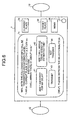
- Fig. 6 is a diagram of display contents of the displaying unit when mail is transmitted in the configuration of the first example.
- An example is shown of a display screen 7c displayed on the displaying unit 7 in the processing in step S13 after the "mail" select button 32 (see Fig. 4) is selected in step S10 in Fig. 3.
- the display screen 7c of the displaying unit 7 displays a current position and information representing that an electronic mail has been transmitted that includes the estimated time of arrival to the target place calculated by the estimated-time-of-arrival calculating unit 22.
- the electronic mail can be transmitted having text representing "behind” or "ahead.”
- the electronic mail transmitting unit 24b sets a destination mail address in a "destination" column, and the electronic mail is transmitted with text data including the estimated time of arrival of the contents inserted into the text of the electronic mail.
- no electronic mail is transmitted.
- a current position and the estimated time of arrival to the target place calculated by the estimated-time-of-arrival calculating unit 22 are displayed on the display screen 7c of the displaying unit 7, and the electronic mail transmitting unit 24b transmits the current position and the estimated time of arrival to the destination.
- the contents of the information transmitted by the electronic mail transmitting unit 24b in addition to map information including a latitude and a longitude and a current position of the mobile object, can be read from the map recording unit 3 and transmitted.
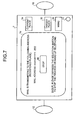
- Fig. 7 is a diagram of the display contents of the displaying unit during the process of mail transmission in the configuration of the first example.
- An example is shown of a display screen 7d displayed on the displaying unit 7 after the "transmission" selection button 43 shown in Fig. 6 is selected.
- the display screen 7d displays a mail address in the process of transmission.
- a "stop" selection button 46 is selected, the transmission can be stopped.
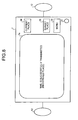
- Fig. 8 is a diagram of the display contents of the displaying unit after the mail is transmitted in the configuration of the first example.
- An example is shown of a display screen 7e displayed on the displaying unit 7 after the mail transmission shown in Fig. 7. As shown in Fig. 7, it is displayed that the transmission of the electronic mail to the set mail address has ended.
- the destination when the mobile object comes close to the target place, communication with the destination can be automatically established at an appropriate timing, and a waiting person who waits at the target place can be notified that the mobile object will soon arrive at the target place.
- the destination can be notified of the estimated time of arrival as accurately as possible.
- communication with the destination can be prevented from being forgotten, and the navigation function can be more effectively used.
- the configuration of the second example is a process that establishes communication when a traveling state of a mobile object changes to change the estimated time of arrival at a target place.
- Fig. 9 is a flow chart of a communication establishing process according to the second example.
- a predetermined time T is set through the operation input unit 4 (step S21).
- the time T is time falling within an allowed range as behind or ahead of time when an actual estimated time of arrival is different from an estimated time of arrival t0 calculated by the estimated-time-of-arrival calculating unit 22 before the start of traveling.
- the traveling state changes, such as due to congestion of a road, a change
- a telephone number of an automatic transmission destination is set (step S22).
- an electronic mail can also be used.
- the mail address of the destination is set.
- the mobile telephone set 9 is connected to the navigation system main unit 1 by a dedicated connection cable (step S23). These operations are performed as a setup before the mobile object starts to travel.
- a target place (step S24) and a stop-off (as needed) (step S25) are set.
- the central processing unit 5 retrieves and determines an appropriate route which connects a current position and the position of the target place (step S26).
- the estimated-time-of-arrival calculating unit 22 calculates the estimated time of arrival t0 to the target place (including a set-off on the way).
- the estimated-time-of-arrival calculating unit 22 stores the calculated estimated time of arrival t0 before the start of traveling in the storage unit 6 (step S27).
- the mobile object starts to travel according to the retrieved route (step S28).
- the displaying unit 7 serially displays a route obtained after the start of traveling as a guide.
- step S29 loop of No.
- step S30 a corresponding transmission selection is displayed on the displaying unit 7 (step S30).
- a transmission selection message representing that there has been a delay is displayed on the displaying unit 7.
- the display screen 7c shown in Fig. 6 can be displayed.
- a text representing that arrival is delayed may be transmitted together with an electronic mail without selecting the "delay" selection button 41.
- the power supply state of the externally connected mobile telephone set 9 is detected (step S32).
- step S32: No the power supply of the mobile telephone set 9 is turned on (step S33).
- the electronic mail transmitting unit 24b automatically transmits an electronic mail to the mail address of the automatic transmission destination set in step S22 (step S34).
- the mail address of the automatic transmission destination is a waiting person who waits at the target place
- the waiting person can be notified of the estimated time of arrival and information representing that arrival will be delayed with an electronic mail.
- the mail address is the mail address of the mobile telephone set 9, and the waiting person can immediately know the arrival of the electronic mail.
- step S35 loop of No.
- step S35: Yes the process is ended.
- the process in step S34 can be achieved not only by transmission of an electronic mail by the electronic mail transmitting unit 24b but also by making a call with the telephone number set by the calling unit 24a in step S22 and speech communication.
- the process in step S27 can be performed not only to a target place but also to a plurality of stop-offs located along the route to the target place. In this case, the process may be performed such that the estimated time of arrival at the target place is replaced with an estimated time of arrival at each of the plurality of stop-offs.
- an automatic calling or transmission of an electronic mail can be performed to a set transmission destination such as a waiting person. The destination can be notified of a more exact estimated time of arrival.
- the configuration of the third embodiment is a process that establishes communication when a mobile object comes close to predetermined user's home or a predetermined registered place even though a target place is not set.
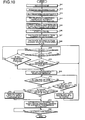
- Fig. 10 is a flow chart of a communication establishment process according to the third example.
- the position of a user's home is registered through the operation input unit 4 (step S41). If a user has a place where she/he frequently visits, that place is registered (step S42). With reference to Fig. 2, not only is the target place set at the start of traveling as described in the first and second examples held in the registering unit 25, but also a plurality of the user's homes or a plurality of registered places can be held.
- a predetermined distance D is set through the operation input unit 4 (step S43). The distance D is a distance between the mobile object and the home or between the mobile object and a registered place when the mobile object comes close to the home or the registered place after the start of traveling of the mobile object.
- a telephone number or a mail address of an automatic transmission destination is set (step S44). For example, a telephone number (or a mail address) of the home registered in step S41 and a telephone number (or a mail address) of the registered place registered in step S42 are set.
- the mobile telephone set 9 is connected to the navigation system main unit 1 by a dedicated connection cable (step S45). These operations are performed as a setup before the mobile object starts to travel.
- the distance calculating unit 21 of the central processing unit 5 calculates a distance X1 between a current place to the home (step S47).
- the distance calculating unit 21 also calculates a distance X2 between the current place and the registered place (step S48).
- the calling unit 24a automatically makes a call. More specifically, it is monitored whether the distance X1 to the home is not more than the predetermined distance D (X1 ⁇ D) (step S49: No), and it is monitored whether the distance X2 to the registered place is not more than the predetermined distance D (X2 ⁇ D) (step S51: loop of No).
- step S50 When the distance X1 to the home is not more than the predetermined distance D (step S49: Yes), "no-transmission" is not selected at first (step S50: No). For this time, the displaying unit 7 displays that the mobile object has come close to the home, and a transmission selection message is displayed that asks whether transmission to the home is performed (step S53). Similarly, when the distance X2 to the registered place is not more than the predetermined distance D (step S51: Yes), "no-transmission” is not selected at first (step S52: No). For this time, the displaying unit 7 displays that the mobile object has come close to the registered place, and a transmission selection message is displayed that asks whether transmission to the registered place is performed (step S53).
- Fig 4 shows an example of a display screen displayed on the displaying unit 7.
- the telephone number of the home is displayed when the mobile object comes close to the home, and the telephone number of the registered place is displayed when the mobile object comes close to the registered place.
- "telephone,” "mail,” and "no-transmission” selection buttons 31, 32, and 33 can be selected.
- step S50: Yes and step S52: Yes the CPU returns to step S49 to continuously calculate the distances.
- step S54 After the transmission selection message is displayed in step S53, "calling" (including mail transmission) is selected (step S54: Yes), and a power supply state is detected of the externally connected mobile telephone set 9 (step S57).
- step S57: No When the power supply of the mobile telephone set 9 is in an off state (step S57: No), the power supply of the mobile telephone set 9 is turned on (step S58), and the CPU shifts to step S59.
- step S54 step S54: No
- step S55: Yes it is stored in the storage unit 6 that "no-transmission” is selected (step S56), and the CPU returns to step S49.
- step S55 when "no-transmission" is not selected (step S55: No), the CPU returns to step S54.
- the contents of the storage unit 6 are referred to each time the mobile object comes close to the home or a registered place.
- the transmission selection message is not displayed on the displaying unit 7. At a result, a cumbersome display can be canceled.
- step S58 When the power supply of the mobile telephone set 9 is turned on in step S58, and when the power supply of the mobile telephone set 9 is set in an on state in step S57 (step S57: Yes), the calling unit 24a automatically makes a call with the telephone number of the automatic transmission destination set in step S44 for any one of the close home and a close registered place (step S59), and speech communication is started with a destination on which the call is made (or transmits a mail). Thereafter, it is monitored whether the telephone connection is canceled upon completion of speech communication (step S60: loop of No). When the telephone connection is canceled (step S60: Yes), the process is ended.
- the explanation is made by exemplifying calling performed by the calling unit 24a.
- a configuration in which formation and transmission of an electronic mail by the electronic mail transmitting unit 24b may also be employed.
- the mobile object when a mobile object comes close to a registered place such as a home or an office, the mobile object can automatically communicate with a destination of the home or the registered place, and a waiting person or the like who waits at home or the registered place can be notified that the mobile object will soon arrive at the corresponding place. in this manner, a waiting person at the home or the registered place where the mobile object frequently goes and returns can be notified of estimated time of arrival as accurately as possible. Furthermore, communication with the waiting person can be prevented from being forgotten, and the navigation function can be used more effectively.
- Fig. 11 is a block diagram of the configuration of an information transmission apparatus according to the second embodiment.
- the second embodiment corresponds to a configuration of an information transmission apparatus in which a wireless communication device is built.
- the same reference numerals as in Fig. 1 denote the same parts in Fig. 11.
- a communication module unit 13 is built in a navigation system main unit 1, and is connected to a communication interface unit 8.
- Reference numeral 13a denotes an antenna used to be connected to an external communication network.
- the communication interface unit 8 is connected to a central processing unit 5, and can be connected to the external communication network through the communication module unit 13 at a predetermined timing.
- the communication module unit 13 can include a communication circuit that can be connected to, e.g., a mobile telephone network serving as a communication network.
- the communication module unit 13 communicates with an external communication device. In this manner, the navigation system main unit 1 can be designed to build the communication module unit 13 in the navigation system main unit 1.
- the automatic transmission processes described in the examples (first, second, and third examples) of the first embodiment can be performed in the same manner.
- a step is performed (for example, step S11 in Fig. 3, step S32 in Fig. 9, and step S57 in Fig. 10) of turning on the power supply of the mobile telephone set 9.
- step S11 in Fig. 3, step S32 in Fig. 9, and step S57 in Fig. 10 of turning on the power supply of the mobile telephone set 9.
- a step of turning on the power supply can be made unnecessary.
- the configuration in which the communication module, which can be connected to an external communication network, is built may not only be a navigation system, but also may be a mobile telephone set having a navigation function.
- a mobile object comes close to a target place as in the first embodiment
- a call can be automatically made to a destination, or an electronic mail can be transmitted.
- a waiting person can be notified that the mobile object will soon arrive at the target place.
- a waiting person at the home or the registered place where the mobile object frequently goes and returns can be notified of the estimated time of arrival as accurately as possible without setting a target place each time the mobile object moves. Furthermore, communication with the waiting person can be prevented from being forgotten, and the navigation function can be more effectively used.
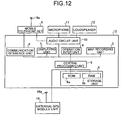
- Fig. 12 is a block diagram of the configuration of an information transmission apparatus according to the third embodiment.
- the third embodiment corresponds to the configuration of a terminal device to which a navigation function can be added.
- the same reference numerals as in Fig. 1 denote the same parts in Fig. 12.
- a terminal device 15 has a configuration to which a navigation function can be added.
- the terminal device 15 can be implemented, for example, as a pocket computer or the like.
- a mobile telephone set 9 is externally connected to the terminal device 15, and an external GPS module unit 16 is externally connected to the terminal device 15.
- Reference numeral 16a denotes an antenna used to receive information from a GPS satellite.
- the terminal device 15 can also be implemented by using a GPS function and a connection function to a mobile telephone network.
- the embodiments described above exemplify speech communication using telephones and transmission of an electronic mail.
- Voice synthesis reading of a voice file registered in advance, or voice recognition can also be used.
- Voice corresponding to a stylized sentence stored in advance is synthesized by an audio circuit unit 10 to communicate to the destination the stylized sentence as a voice.
- an electronic mail may be transmitted to a destination.
- Voice acquired through the microphone 11 is converted into character data (text data) by voice recognition, and the character data is inserted into the text of the electronic mail so that the electronic mail can be transmitted.
- the information transmission apparatus the information transmission method, the program thereof, and the recording medium on which the program is recorded, depending on a traveling state of a mobile object to a place toward which the mobile object moves, a necessary destination can be notified of an estimated time of arrival at an appropriate timing.
- the navigation function can be effectively used, and the destination can be properly notified of an accurate estimated time of arrival.
- the driver since a driver of a mobile object can automatically make a call at an appropriate timing without regard to communication with a destination, the driver can concentrate on driving, which make it possible to improve safe driving.
- the information transmission method described in the embodiment can be realized by executing a prepared program with a computer such as a personal computer or a workstation.
- the program is recorded on a recording medium such as a hard disk, a flexible disk, a CD-ROM, an MO (magneto-optical disc), or a DVD which can be read by a computer.
- the program is executed by being read from the recording medium by the computer.
- the program may be a transmission medium which can be distributed through a network such as the Internet.
Landscapes
- Engineering & Computer Science (AREA)
- Radar, Positioning & Navigation (AREA)
- Remote Sensing (AREA)
- Physics & Mathematics (AREA)
- General Physics & Mathematics (AREA)
- Automation & Control Theory (AREA)
- Navigation (AREA)
- Traffic Control Systems (AREA)
- Mobile Radio Communication Systems (AREA)
- Instructional Devices (AREA)
- Information Transfer Between Computers (AREA)
Applications Claiming Priority (2)
| Application Number | Priority Date | Filing Date | Title |
|---|---|---|---|
| JP2003429238 | 2003-12-25 | ||
| JP2003429238A JP2005189040A (ja) | 2003-12-25 | 2003-12-25 | 情報送信装置、情報送信方法、そのプログラムおよびそのプログラムを記録した記録媒体 |
Publications (2)
| Publication Number | Publication Date |
|---|---|
| EP1548684A2 true EP1548684A2 (de) | 2005-06-29 |
| EP1548684A3 EP1548684A3 (de) | 2007-04-04 |
Family
ID=34545004
Family Applications (1)
| Application Number | Title | Priority Date | Filing Date |
|---|---|---|---|
| EP04257933A Withdrawn EP1548684A3 (de) | 2003-12-25 | 2004-12-17 | Apparat und Methode zum Übermitteln von Informationen von einem mobilen Objekt zu einem Zielort |
Country Status (4)
| Country | Link |
|---|---|
| US (1) | US20060047417A1 (de) |
| EP (1) | EP1548684A3 (de) |
| JP (1) | JP2005189040A (de) |
| KR (1) | KR20050065417A (de) |
Cited By (3)
| Publication number | Priority date | Publication date | Assignee | Title |
|---|---|---|---|---|
| WO2007101720A3 (en) * | 2006-03-08 | 2009-02-12 | Tomtom Int Bv | A navigation device and method for conveying information relationships |
| EP2128567A4 (de) * | 2007-02-28 | 2014-12-10 | Jvc Kenwood Corp | Navigationsvorrichtung |
| CN106165379A (zh) * | 2014-10-07 | 2016-11-23 | 奥迪股份公司 | 用于运行机动车的方法和机动车 |
Families Citing this family (16)
| Publication number | Priority date | Publication date | Assignee | Title |
|---|---|---|---|---|
| JP2007240307A (ja) * | 2006-03-08 | 2007-09-20 | Pioneer Electronic Corp | 端末装置及び情報提供制御方法 |
| JP2007285954A (ja) * | 2006-04-19 | 2007-11-01 | Hcx:Kk | ナビゲーション装置 |
| JP4816494B2 (ja) * | 2007-02-16 | 2011-11-16 | 株式会社ケンウッド | ナビゲーション装置、ナビゲーションシステム、ナビゲーション方法、ならびに、プログラム |
| US20080243386A1 (en) * | 2007-03-27 | 2008-10-02 | Cisco Technology, Inc. | Method and System for Communicating Arrival Notifications |
| US8990003B1 (en) * | 2007-04-04 | 2015-03-24 | Harris Technology, Llc | Global positioning system with internet capability |
| JP5020989B2 (ja) * | 2009-03-23 | 2012-09-05 | 日立オートモティブシステムズ株式会社 | ナビゲーション装置、ナビゲーション方法およびナビゲーションシステム |
| US20120226440A1 (en) * | 2011-03-02 | 2012-09-06 | Navman Wiresless North America LP | Systems and methods for managing mobile assets using estimated time of arrival information |
| US8727056B2 (en) | 2011-04-01 | 2014-05-20 | Navman Wireless North America Ltd. | Systems and methods for generating and using moving violation alerts |
| JP5961969B2 (ja) * | 2011-09-29 | 2016-08-03 | 株式会社ナカヨ | 携帯端末、およびメッセージの送信方法 |
| US9659500B2 (en) | 2011-12-05 | 2017-05-23 | Navman Wireless North America Ltd. | Safety monitoring in systems of mobile assets |
| US8478307B1 (en) | 2012-06-15 | 2013-07-02 | Google Inc. | Communicating based on navigation destination |
| KR101556537B1 (ko) | 2013-05-21 | 2015-10-02 | 팅크웨어(주) | 전자 기기, 서버, 전자 기기의 제어 방법 및 위치 정보 제공 방법 |
| JP2016173651A (ja) * | 2015-03-16 | 2016-09-29 | 株式会社デンソーアイティーラボラトリ | ドライバ状態改善支援装置及びドライバ状態改善支援方法 |
| US9587955B1 (en) * | 2015-10-12 | 2017-03-07 | International Business Machines Corporation | Adaptive audio guidance navigation |
| US20170276504A1 (en) * | 2016-03-22 | 2017-09-28 | Toyota Jidosha Kabushiki Kaisha | Vehicular Traffic Assistance Based on Traffic Management Decisions |
| JP6879967B2 (ja) * | 2018-03-05 | 2021-06-02 | 大陽日酸株式会社 | 運搬システム及び運搬情報提供方法 |
Family Cites Families (3)
| Publication number | Priority date | Publication date | Assignee | Title |
|---|---|---|---|---|
| EP1202234B1 (de) * | 2000-10-24 | 2006-05-03 | At Road, Inc. | Gerichtete und bevorstehende Nachrichtankunftsmeldung für ein drahtlos angeschlossenes Aufenthaltsorstbestimmungsgerät |
| GB2382203A (en) * | 2001-11-20 | 2003-05-21 | Hewlett Packard Co | Alerting users to impending events |
| ATE391982T1 (de) * | 2002-02-14 | 2008-04-15 | Everyday Wireless Inc | Drahtlose mobil-fahrzeug-echtzeit-verfolgungs- und benachrichtigungssysteme und diesbezügliche verfahren |
-
2003
- 2003-12-25 JP JP2003429238A patent/JP2005189040A/ja not_active Abandoned
-
2004
- 2004-12-17 EP EP04257933A patent/EP1548684A3/de not_active Withdrawn
- 2004-12-22 US US11/017,802 patent/US20060047417A1/en not_active Abandoned
- 2004-12-24 KR KR1020040111946A patent/KR20050065417A/ko not_active Withdrawn
Cited By (5)
| Publication number | Priority date | Publication date | Assignee | Title |
|---|---|---|---|---|
| WO2007101720A3 (en) * | 2006-03-08 | 2009-02-12 | Tomtom Int Bv | A navigation device and method for conveying information relationships |
| US8554471B2 (en) | 2006-03-08 | 2013-10-08 | Tomtom International B.V. | Navigation device and method for conveying information relationships |
| EP2128567A4 (de) * | 2007-02-28 | 2014-12-10 | Jvc Kenwood Corp | Navigationsvorrichtung |
| CN106165379A (zh) * | 2014-10-07 | 2016-11-23 | 奥迪股份公司 | 用于运行机动车的方法和机动车 |
| CN106165379B (zh) * | 2014-10-07 | 2018-02-13 | 奥迪股份公司 | 用于运行机动车的方法和机动车 |
Also Published As
| Publication number | Publication date |
|---|---|
| US20060047417A1 (en) | 2006-03-02 |
| JP2005189040A (ja) | 2005-07-14 |
| EP1548684A3 (de) | 2007-04-04 |
| KR20050065417A (ko) | 2005-06-29 |
Similar Documents
| Publication | Publication Date | Title |
|---|---|---|
| EP1548684A2 (de) | Apparat und Methode zum Übermitteln von Informationen von einem mobilen Objekt zu einem Zielort | |
| US12332070B2 (en) | Method and apparatus for setting destination in navigation terminal | |
| JP4859447B2 (ja) | ナビゲーション装置 | |
| JP3198883B2 (ja) | 移動スケジュール処理装置 | |
| US6879909B2 (en) | Map display control apparatus, map information update apparatus, map information update system and control method thereof | |
| JPH11102198A (ja) | メッセージ処理装置、メッセージ処理方法及びメッセージ処理プログラムを記録した媒体 | |
| US6801832B2 (en) | Method for giving navigation information to navigation terminal user | |
| JP4864950B2 (ja) | 車載機器、情報通信システム、車載機器の制御方法およびプログラム | |
| JP2015072523A (ja) | 情報提供システム、情報提供方法、移動情報端末及びコンピュータプログラム | |
| KR20080078300A (ko) | 카네비게이션 시스템 및 그 제어방법 | |
| JP4187419B2 (ja) | 歩行経路案内システム | |
| JP2004159276A (ja) | 通信装置 | |
| JP2005084997A (ja) | 通信システム、通信装置、通信プログラム、及び記録媒体 | |
| JP2005181262A (ja) | 車載機および携帯電話機 | |
| JP6221534B2 (ja) | 情報端末、情報提供システム、目的地設定方法及びコンピュータプログラム | |
| JPH11101652A (ja) | 電子メールデータ受信装置、電子メールホスト装置、これらのためのプログラムを記録した媒体、及び電子メールシステム | |
| JP2008096289A (ja) | 多言語対応ナビゲーション装置 | |
| JP3985668B2 (ja) | ナビゲーション装置 | |
| JP2006105731A (ja) | ナビゲーションシステム、ナビゲーション装置および移動装置 | |
| JP2008101979A (ja) | 情報通信システム | |
| JP2007013931A (ja) | 車載通信装置および車載通信装置用プログラム | |
| JP2006098147A (ja) | ナビゲーション装置、ナビゲーション方法及びナビゲーションプログラム | |
| JP2007121153A (ja) | 携帯端末装置 | |
| JP6858643B2 (ja) | 位置情報共有システム、ナビゲーション装置、携帯通信端末及びプログラム | |
| JP2009239748A (ja) | ハンズフリー通話装置、通話制御方法、通話制御プログラム、および記録媒体 |
Legal Events
| Date | Code | Title | Description |
|---|---|---|---|
| PUAI | Public reference made under article 153(3) epc to a published international application that has entered the european phase |
Free format text: ORIGINAL CODE: 0009012 |
|
| AK | Designated contracting states |
Kind code of ref document: A2 Designated state(s): AT BE BG CH CY CZ DE DK EE ES FI FR GB GR HU IE IS IT LI LT LU MC NL PL PT RO SE SI SK TR |
|
| AX | Request for extension of the european patent |
Extension state: AL BA HR LV MK YU |
|
| PUAL | Search report despatched |
Free format text: ORIGINAL CODE: 0009013 |
|
| AK | Designated contracting states |
Kind code of ref document: A3 Designated state(s): AT BE BG CH CY CZ DE DK EE ES FI FR GB GR HU IE IS IT LI LT LU MC NL PL PT RO SE SI SK TR |
|
| AX | Request for extension of the european patent |
Extension state: AL BA HR LV MK YU |
|
| 17P | Request for examination filed |
Effective date: 20070824 |
|
| 17Q | First examination report despatched |
Effective date: 20070926 |
|
| STAA | Information on the status of an ep patent application or granted ep patent |
Free format text: STATUS: THE APPLICATION HAS BEEN WITHDRAWN |
|
| 18W | Application withdrawn |
Effective date: 20070928 |