EP1548043A1 - Epoxy resin composition for sealing optical semiconductor - Google Patents
Epoxy resin composition for sealing optical semiconductor Download PDFInfo
- Publication number
- EP1548043A1 EP1548043A1 EP03748685A EP03748685A EP1548043A1 EP 1548043 A1 EP1548043 A1 EP 1548043A1 EP 03748685 A EP03748685 A EP 03748685A EP 03748685 A EP03748685 A EP 03748685A EP 1548043 A1 EP1548043 A1 EP 1548043A1
- Authority
- EP
- European Patent Office
- Prior art keywords
- epoxy resin
- photosemiconductor
- resin composition
- epoxy
- component
- Prior art date
- Legal status (The legal status is an assumption and is not a legal conclusion. Google has not performed a legal analysis and makes no representation as to the accuracy of the status listed.)
- Withdrawn
Links
Classifications
-
- C—CHEMISTRY; METALLURGY
- C08—ORGANIC MACROMOLECULAR COMPOUNDS; THEIR PREPARATION OR CHEMICAL WORKING-UP; COMPOSITIONS BASED THEREON
- C08G—MACROMOLECULAR COMPOUNDS OBTAINED OTHERWISE THAN BY REACTIONS ONLY INVOLVING UNSATURATED CARBON-TO-CARBON BONDS
- C08G59/00—Polycondensates containing more than one epoxy group per molecule; Macromolecules obtained by polymerising compounds containing more than one epoxy group per molecule using curing agents or catalysts which react with the epoxy groups
- C08G59/18—Macromolecules obtained by polymerising compounds containing more than one epoxy group per molecule using curing agents or catalysts which react with the epoxy groups ; e.g. general methods of curing
- C08G59/40—Macromolecules obtained by polymerising compounds containing more than one epoxy group per molecule using curing agents or catalysts which react with the epoxy groups ; e.g. general methods of curing characterised by the curing agents used
- C08G59/62—Alcohols or phenols
-
- H—ELECTRICITY
- H10—SEMICONDUCTOR DEVICES; ELECTRIC SOLID-STATE DEVICES NOT OTHERWISE PROVIDED FOR
- H10F—INORGANIC SEMICONDUCTOR DEVICES SENSITIVE TO INFRARED RADIATION, LIGHT, ELECTROMAGNETIC RADIATION OF SHORTER WAVELENGTH OR CORPUSCULAR RADIATION
- H10F77/00—Constructional details of devices covered by this subclass
- H10F77/50—Encapsulations or containers
-
- C—CHEMISTRY; METALLURGY
- C08—ORGANIC MACROMOLECULAR COMPOUNDS; THEIR PREPARATION OR CHEMICAL WORKING-UP; COMPOSITIONS BASED THEREON
- C08G—MACROMOLECULAR COMPOUNDS OBTAINED OTHERWISE THAN BY REACTIONS ONLY INVOLVING UNSATURATED CARBON-TO-CARBON BONDS
- C08G59/00—Polycondensates containing more than one epoxy group per molecule; Macromolecules obtained by polymerising compounds containing more than one epoxy group per molecule using curing agents or catalysts which react with the epoxy groups
- C08G59/18—Macromolecules obtained by polymerising compounds containing more than one epoxy group per molecule using curing agents or catalysts which react with the epoxy groups ; e.g. general methods of curing
- C08G59/40—Macromolecules obtained by polymerising compounds containing more than one epoxy group per molecule using curing agents or catalysts which react with the epoxy groups ; e.g. general methods of curing characterised by the curing agents used
- C08G59/62—Alcohols or phenols
- C08G59/621—Phenols
-
- C—CHEMISTRY; METALLURGY
- C08—ORGANIC MACROMOLECULAR COMPOUNDS; THEIR PREPARATION OR CHEMICAL WORKING-UP; COMPOSITIONS BASED THEREON
- C08L—COMPOSITIONS OF MACROMOLECULAR COMPOUNDS
- C08L61/00—Compositions of condensation polymers of aldehydes or ketones; Compositions of derivatives of such polymers
-
- C—CHEMISTRY; METALLURGY
- C08—ORGANIC MACROMOLECULAR COMPOUNDS; THEIR PREPARATION OR CHEMICAL WORKING-UP; COMPOSITIONS BASED THEREON
- C08L—COMPOSITIONS OF MACROMOLECULAR COMPOUNDS
- C08L63/00—Compositions of epoxy resins; Compositions of derivatives of epoxy resins
-
- H—ELECTRICITY
- H10—SEMICONDUCTOR DEVICES; ELECTRIC SOLID-STATE DEVICES NOT OTHERWISE PROVIDED FOR
- H10F—INORGANIC SEMICONDUCTOR DEVICES SENSITIVE TO INFRARED RADIATION, LIGHT, ELECTROMAGNETIC RADIATION OF SHORTER WAVELENGTH OR CORPUSCULAR RADIATION
- H10F77/00—Constructional details of devices covered by this subclass
- H10F77/30—Coatings
-
- H—ELECTRICITY
- H10—SEMICONDUCTOR DEVICES; ELECTRIC SOLID-STATE DEVICES NOT OTHERWISE PROVIDED FOR
- H10W—GENERIC PACKAGES, INTERCONNECTIONS, CONNECTORS OR OTHER CONSTRUCTIONAL DETAILS OF DEVICES COVERED BY CLASS H10
- H10W74/00—Encapsulations, e.g. protective coatings
- H10W74/40—Encapsulations, e.g. protective coatings characterised by their materials
- H10W74/47—Encapsulations, e.g. protective coatings characterised by their materials comprising organic materials, e.g. plastics or resins
Definitions
- the present invention relates to an epoxy resin composition for sealing a photosemiconductor, the epoxy resin composition having great solder resistance after moisture absorption.
- airtight sealing is used for protecting opto-electronics parts such as photosemiconductor.
- opto-electronics parts When opto-electronics parts are sealed with a sealing agent, it is then required that the resulting sealing membrane has high light transmittance (transparency).
- a process of airtight sealing with glass has been widely adopted.
- an economical resin sealing of general purpose parts has been gradually used for sealing common such parts.
- resin sealing generally, epoxy resin compositions are used. Then, acid anhydrides are used as curing agents.
- Cured materials of the epoxy resin compositions contain ester bonds formed by the reaction of acid anhydrides and epoxy group, so the ester bonds are hydrolyzed when the cured materials (for example, resin membranes for airtight sealing) are stored at high humidity. Therefore, the adhesion and transparency are disadvantageously deteriorated. Because wires in connection to photosemiconductor devices sealed with resins are sometimes cut by the thermal expansion of the sealing resins, an epoxy resin composition with a glass transition temperature (Tg) of 105°C or more, preferably 110°C or more is needed.
- Tg glass transition temperature
- the resulting cured material (resin membrane for airtight sealing) can retain transparency after storage at high humidity. Therefore, the said curing agent is superior to curing agents using acid anhydrides.
- a new problem of the occurrence of peeling in the adhesive face between the sealed resin and the lead frame during solder reflow after moisture absorption has now been drawing attention because of higher solder melting temperatures (solder resistance after moisture absorption).
- solder melting temperatures solder resistance after moisture absorption
- JP-A-2001-2758 proposes an epoxy resin composition using terpene backbone-containing polyvalent phenol as a curing agent.
- the cured material obtained from the epoxy resin composition can overcome some of the disadvantages of the conventional art, however, it is not sufficiently satisfactory. It is an object of the invention to provide an epoxy resin composition for sealing photosemiconductor, which can produce a resin-sealed photosemiconductor with great solder reflow resistance after moisture absorption and has great processability (productivity of sealed photosemiconductor device).
- an epoxy resin composition capable of overcoming the problems described above for photosemiconductor can be obtained by using at least one resin as the component D, which is selected from the group consisting of epoxy resins except for the component (A) and novolak resins as curing agents, in combination with an epoxy resin as the component (A), a terpene backbone-containing polyvalent phenol curing agent as the component (B) and a curing-promoting agent (C).
- the invention relates to those described below.
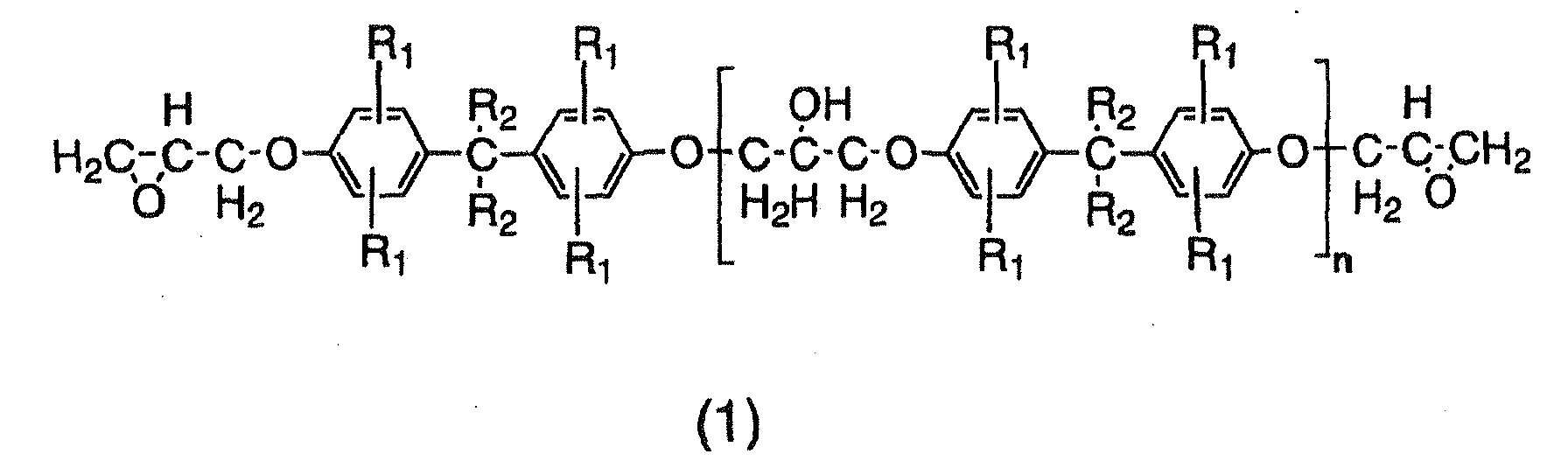
- the epoxy resin as the component (A) for use in the present invention (also referred to as epoxy resin (A) hereinafter) contains the said low molecular epoxy resins where n is 0, 1 or 2 in the formula (1) at 10% by weight or more (the term “%” means “% by weight” hereinbelow unless otherwise stated), preferably 15% or more, more preferably 20% or more of the total weight of the epoxy resin (A). Satisfactorily, the epoxy resin (A) may wholly comprise such low molecular epoxy resins. The content thereof is preferably 80% or less, more preferably 60% or less, still more preferably 50% or less, and most preferably 40% or less.
- the low molecular epoxy resins may comprise any one type of such epoxy resins where n is 0, 1 or 2 or may comprise a mixture of two or more thereof where n is 0, 1 and 2. Generally, the low molecular epoxy resins comprise the three thereof in mixture.
- Epoxy resins containing such low molecular epoxy resins can be commercially available, for example epoxy resins manufactured by Toto Chemical, Co., Ltd. and Mitsui Chemical, Inc.
- GPC gel permeation chromatography
- Optical detector source according to differential refractometry (Shimadzu RID6A)
- the C1 - C8 alkyl group of R 1 includes for example linear or branched alkyl groups having 1 to 8 carbon atoms, such as methyl group, ethyl group, propyl group, butyl group, pentyl group, hexyl group, heptyl group and octyl group.
- the halogen atom includes for example chlorine, bromine and iodine.
- the C1 - C5 alkyl group of R 2 includes for example linear or branched alkyl groups having 1 to 5 carbon atoms, such as methyl group, ethyl group, propyl group, butyl group and pentyl group.
- the halogen-substituted (C1 - C5) alkyl group includes halogen-substituted alkyl groups, where the hydrogen atoms of these alkyl groups are partially or wholly substituted with halogen atoms such as chlorine, bromine and iodine.
- R 1 s existing in a plural number in the formula (1) may be the same or different, but preferably, all the R 1 s are hydrogen atom or methyl group.
- R 2 s existing in a plural number in the formula (1) may be the same or different, but preferably, all the R 2 s are hydrogen atom, methyl group or ethyl group.
- Preferable combinations of R 1 and R 2 are shown below in the table.
- These epoxy resins may be used singly or in mixture thereof at appropriate ratios.
- another epoxy resin as one component (D) except for the component (A) can be used in combination, within a range which does not spoil the effect of the invention. Further, an appropriate combination with the other epoxy resin can be used to thereby achieve the better effect of the invention. In accordance with the invention, thus, the combined use of another epoxy resin as the component (D) is preferable.
- Another epoxy resin includes for example polyfunctional epoxy resins which is glycidyl ether of polyphenol compounds, polyfunctional epoxy resins which is glycidyl ether of various novolak resins, alicyclic epoxy resins, aliphatic epoxy resins, heterocyclic epoxy resins, glycidyl ester-series epoxy resins, glycidylamine-series epoxy resins, and epoxy resins of halogenated phenols after glycidyl modification.
- polyfunctional epoxy resins which is glycidyl ether of polyphenol compounds
- polyfunctional epoxy resins which is glycidyl ether of various novolak resins
- alicyclic epoxy resins aliphatic epoxy resins
- heterocyclic epoxy resins glycidyl ester-series epoxy resins
- glycidylamine-series epoxy resins glycidylamine-series epoxy resins
- epoxy resins of halogenated phenols after glycidyl modification
- Polyfunctional epoxy resins which is glycidyl ethers of polyphenol compounds include polyfunctional epoxy resins obtained by modifying, polyphenol compounds for example bisphenol A, bisphenol F, bisphenol S, 4,4'-biphenylphenol, tetramethylbisphenol A, dimethylbisphenol A, tetramethylbisphenol F, dimethylbisphenol F, tetramethylbisphenol S, dimethylbisphenol S, tetramethyl-4,4'-biphenol, dimethyl-4,4'-biphenylphenol, 1-(4-hydroxyphenyl)-2-[4-(1,1-bis-(4-hydroxyphenyl)ethyl)ph enyl]propane, 2,2'-methylene-bis(4-methyl-6-tertbutylphenol), 4,4'-butylidene-bis(3-methyl-6-tert-butylphenol), trishydroxyphenylmethane, resorcinol, hydroquinone, pyrogallol, phenols
- Polyfunctional epoxy resins which is glycidyl ethers of various novolak resins include glycidyl ethers of various novolak resins, for example novolak resins from various phenols as raw materials, xylylene backbone-containing phenol novolak resins, dicyclopentadiene backbone-containing phenol novolak resins, biphenyl backbone-containing phenol novolak resins, and fluorene backbone-containing phenol novolak resins.
- the various phenols described above include for example phenol, cresols, ethylphenols, butylphenols, octylphenols, bisphenol A, bisphenol F, bisphenol S and naphthols.
- Alicyclic epoxy resins include for example alicyclic epoxy resins with cyclic aliphatic backbones, for example an alicylic epoxy resin with cyclohexane backbone such as 3,4-epoxycyclohexylmethyl 3',4'-cyclohexyl carboxylate.
- Aliphatic epoxy resins include for example glycidyl ethers of polyvalent alcohols. Any polyvalent alcohols may be used as the polyvalent alcohols.
- the polyvalent alcohols include for example glycols with 2 to 6 carbon atoms, poly (C1 - C4) alkylene glycols and C5 - C6 cyclic glycols, such as 1,4-butanediol, 1,6-hexanediol, polyethylene glycol, polypropylene glycol, pentaerythritol, and xylylene glycol derivatives.
- Heterocyclic epoxy resins include heterocyclic epoxy resins with hetero-rings such as isocyanuric ring and hydantoin ring.
- Glycidyl ester-series epoxy resins include for example epoxy resins of carboxylic acids, such as hexahydrophthalic acid diglycidyl ester, and tetrahydrophthalic acid diglycidyl ester.
- Glycidylamine-series epoxy resins include epoxy resins obtained by glycidylation of amines such as aniline, toluidine, p-phenylenediamine, m-phenylenediamine, diaminodiphenylmethane derivatives, and diaminomethylbenzene derivatives.
- Epoxy resins obtained by glycidyl modification of halogenated phenols after include for example bromated bisphenol A, bromated bisphenol F, bromated bisphenol S, bromated phenol novolak, bromated cresol novolak, chlorinated bisphenol S and chlorinated bisphenol A.
- epoxy resins can be used with no specific limitation. From the standpoint of transparency, such epoxy resin with less tinting property is preferable.
- the following epoxy resins are used: polyfunctional epoxy resins which is glycidyl ethers of phenols, glycidyl ethers of various novolak resins, alicyclic epoxy resins with cyclohexane backbone, glycidyl ethers of polyvalent alcohols (for example, 1,6-hexanediol, polyethylene glycol, polypropylene glycol), triglycidyl isocyanurate and hexahydrophthalic acid diglycidyl ester.
- polyfunctional epoxy resins which is glycidyl ethers of phenols, glycidyl ethers of various novolak resins, alicyclic epoxy resins with cyclohexane backbone, glycidyl ethers of polyvalent alcohols (for example, 1,6-hexanediol
- the preferable phenols for the polyfunctional epoxy resins which is glycidyl ethers of phenols as described above include bisphenol A, bisphenol F, bisphenol S, 4,4'-biphenylphenol, tetramethyl-4,4'-biphenol, 1-(4-hydroxyphenyl)-2-[4-(1,1-bis-(4-hydroxyphenyl)ethyl)ph enyl]propane, trishydroxyphenylmethane, resorcinol, 2,6-di tert-butylhydroquinone, phenols with diisopropylidene backbone, and phenols with fluorene backbone, such as 1,1-di-4-hydroxyphenylfluorene.
- preferable novolak resins for the glycidyl ethers of various novolak resins include novolak resins from various phenols as raw materials, for example phenol, cresols, bisphenol A, bisphenol S, and naphthols; dicyclopentadiene backbone-containing phenol novolak resins; biphenyl backbone-containing phenol novolak resins; and fluorene backbone-containing phenol novolak resins.
- Alicyclic epoxy resins with cyclohexane backbone include for example 3,4-epoxycyclohexylmethyl 3', 4'-cyclohexylcarboxylate.
- the glycidyl ethers of phenol novolak resins containing biphenyl backbone are preferable. They include for example NC-3000 (under the trade name; manufactured by Nippon Kayaku Co., LTD.) and NC-3000H (under the trade name; Nippon Kayaku Co., LTD.).
- the glycidyl ethers of phenol novolak resins containing biphenyl backbone are solid at room temperature (for example, 25°C) and have a softening point of preferably 100°C or less, more preferably 75°C or less, and still more preferably 60°C or less.
- epoxy resins may be used in combination with one or two or more thereof, to improve the properties of the resulting cured resin, such as thermal resistance.
- Such another epoxy resin may be mixed with the epoxy resin of the component (A) at an arbitrary ratio to be used.
- a novolak resin curing agent
- content of such another epoxy resin may be added at zero content.
- such another epoxy resin as the component (D) is at 10 to 95% based on the whole epoxy resin (the same as above hereinbelow), preferably 20 to 90%, more preferably 30 to 85%, still more preferably 40 to 85%, while the epoxy resin of the component (A) occupies the remaining part.
- the content of the epoxy resin of the component (A) based on the whole epoxy resin is 5 to 90%, preferably 10 to 80%, more preferably 15 to 70%, still more preferably 15 to 60%.
- the ratio of the total content of the low molecular epoxy resins of the formula (1) (0-, 1-, and 2 nuclei) contained in the whole epoxy resin is 3% or more, preferably 4% or more, more preferably 7% or more. In some case, said ratio may be 10% or more, preferably 15% or more.
- the upper limit is 70% or less, preferably 50% or less, more preferably 30% or less. In the invention, the most preferable upper limit is 20% or less. In some cases, the upper limit is 12% or less. In this case, additionally, the component (A) for use is not specifically limited.
- the curing agent for use in the invention is any compound having cyclic terpene backbone and phenolic hydroxyl group within the molecule, with no specific limitation.
- a cyclic terpene compound is reacted with phenols to add phenols to the cyclic terpene compound at a ratio of about two molecules of the phenols to one molecule of the cyclic terpene compound and to prepare a cyclic terpene backbone-containing polyvalent phenol compound, which can be used.
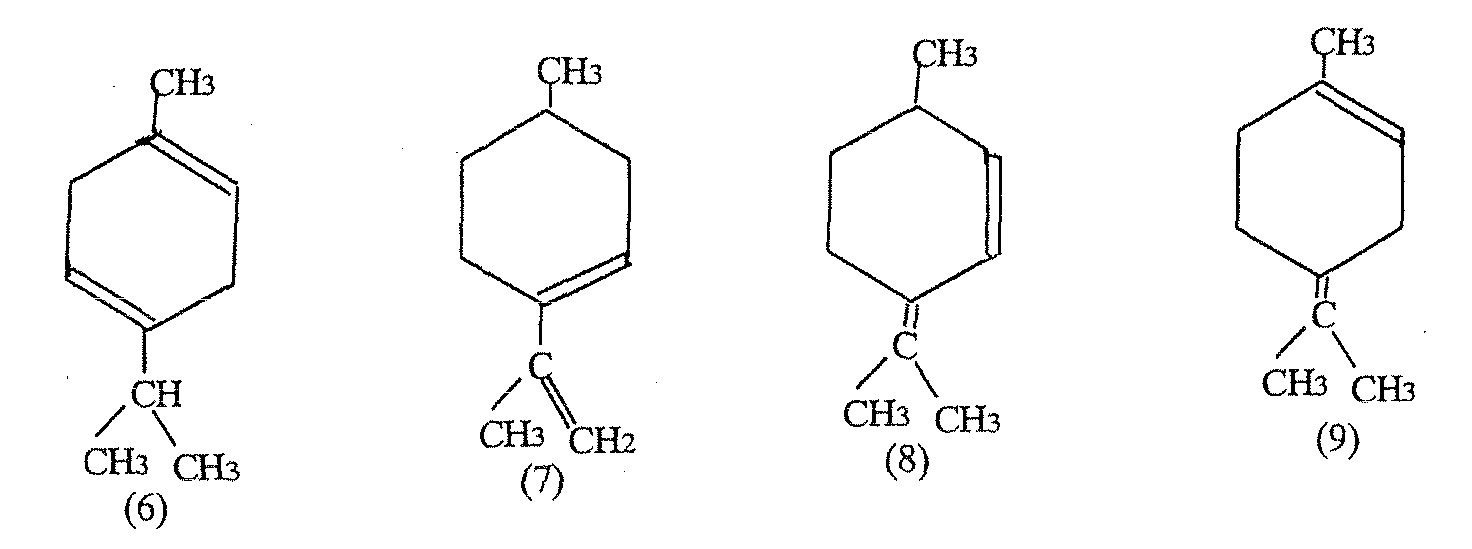
- the cyclic terpene compound includes compounds for example limonene (the following formula (1)), dipentene as an optical isomer of limonene, type ⁇ -pinene (the following formula (2)), type ⁇ -pinene (the following formula (3)), type ⁇ -terpinene (the following formula (4)), type ⁇ -terpinene (the following formula (5)), type ⁇ -terpinene (the following formula (6)), type 3,8-methanediene (the following formula (7)), type 2,4-methanediene (the following formula (8)), and terpinolene (the following formula (9)).
- limonene the following formula (1)
- dipentene as an optical isomer of limonene
- type ⁇ -pinene the following formula (2)
- type ⁇ -pinene the following formula (3)
- type ⁇ -terpinene the following formula (4)
- type ⁇ -terpinene the following formula (5)
- type ⁇ -terpinene the following
- Phenols to be added to the cyclic terpene compound include for example phenol, o-cresol, m-cresol, o-ethylphenol, m-ethylphenol, o-tert-butylphenol, 2,5-xylenol, 2,6-xylenol, 2,5-diethylphenol, 2,6-diethylphenol, 2-methyl-6-tert-butylphenol, pyrocatechol, resorcinol, p-hydroquinone, 2-methylresorcinol, 4-methylresorcinol, 2,5-di-tert-butyl p-hydroquinone, o-allylphenol, 2,6-diallylphenol, 2-allyl-6-methylphenol, 2-allyl-3-methylphenol, o-chlorophenol, m-chlorophenol, o-bromophenol, m-bromophenol, 2-chloro-3-methylphenol, and 2,6-dichloro
- the phenols are more preferably phenol, o-cresol, m-cresol, o-ethylphenol, m-ethylphenol, 2,5-xylenol, 2,6-xylenol, 2-methyl-6-tert-butylphenol, resorcinol, p-hydroquinone, 2-methylresorcinol, 4-methylresorcinol, 2,5-di-tert-butyl p-hydroquinone, o-allylphenol, 2,6-diallylphenol, 2-allyl-6-methylphenol and 2-allyl-3-methylphenol, particularly preferably phenol, o-cresol, m-cresol, o-ethylphenol, m-ethylphenol, 2,5-xylenol, 2,6-xylenol, resorcinol, o-allylphenol, 2,6-diallylphenol, 2-allyl-6-methylphenol and 2-allyl-3-methylphenol.
- the reaction is carried out in the presence of acid catalysts such as hydrochloric acid, sulfuric acid, phosphoric acid, polyphosphoric acid and boron trifluoride.
- acid catalysts such as hydrochloric acid, sulfuric acid, phosphoric acid, polyphosphoric acid and boron trifluoride.
- solvents such as aromatic hydrocarbons, alcohols and ethers are used.
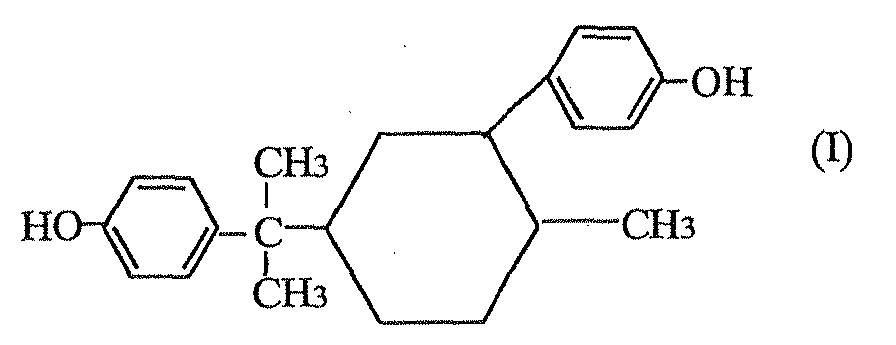
- the cyclic terpene backbone-containing polyvalent phenol compounds thus obtained are possibly a mixture of the compounds of the following formulas (I) and (II), when a compound obtained from the reaction of limonene with phenol is exemplified. It is very difficult to identify the structure.
- a polymerized compound from the condensation reaction of the resulting cyclic terpene backbone-containing polyvalent phenol compound with one or more selected from the group consisting of aldehydes and ketones can also be used as a curing agent.
- aldehydes or ketones herein usable include for example formaldehyde, paraformaldehyde, acetaldehyde, benzaldehyde, hydroxybenzaldehyde, acetone and cyclohexanone.
- the cyclic terpene backbone-containing polyvalent phenol compound is preferably of a bifunctional type in accordance with the invention.
- a novolak resin is preferable.
- the novolak resin can be used as the component (D) together with the curing agent (B).
- the novolak resin is used in combination with the curing agent (B).
- the novolak resin includes for example phenol novolak resins from various phenols as raw materials, xylylene backbone-containing phenol novolak resins, dicyclopentadiene backbone-containing phenol novolak resins, biphenyl backbone-containing phenol novolak resins, and fluorene backbone-containing phenol novolak resins.
- the various phenols for the aforementioned use include for example bisphenol A, bisphenol F, bisphenol S, 4,4'-biphenylphenol, tetramethylbisphenol A, dimethylbisphenol A, tetramethylbisphenol F, dimethylbisphenol F, tetramethylbisphenol S, dimethylbisphenol S, tetramethyl-4,4'-biphenol, dimethyl-4,4'-biphenylphenol, 1-(4-hydroxyphenyl)-2-[4-(1,1-bis-(4-hydroxyphenyl)ethyl)ph enyl]propane,2,2'-methylene-bis(4-methyl-6-tert-butylphenol ), 4,4'-butylidene-bis(3-methyl-6-tert-butylphenol), trishydroxyphenylmethane, resorcinol, hydroquinone, pyrogallol, diisopropylidene, phenols with fluorene backbone such as 1,1
- phenol novolak resins with phenyl-substituted C1 - C3 alkyl groups, which may have substituents C1 - C3 alkyl groups or a hydroxy substitution are preferable from the standpoints of coloration and thermal resistance.
- novolak resins such as paracresol novolak resins, orthocresol novolak resins, and bisphenol A novolak resins are preferable.
- Acid anhydride-series curing agents specifically include aromatic carboxylic anhydrides such as phthalic anhydride, trimellitic anhydride, pyromellitic anhydride, benzophenone tetracarboxylic anhydride, anhydrous ethylene glycol trimellitic anhydride, and biphenyltetracarboxylic anhydride; aliphatic carboxylic anhydrides such as azelaic anhydride, sebacic anhydride, and dodecanedioic anhydride; alicyclic carboxylic anhydrides such as tetrahydrophthalic anhydride, hexahydrophthalic anhydride, nalidic anhydride, Het anhydride, and himic anhydride.
- aromatic carboxylic anhydrides such as phthalic anhydride, trimellitic anhydride, pyromellitic anhydride, benzophenone tetracarboxylic anhydride, anhydrous ethylene glycol trimellitic anhydride,
- These other curing agents can be used at an amount of about 0 to 70%, preferably about 0 to 50%, more preferably 0 to 35%, still more preferably 0 to 25% based on the total amount of all the curing agents, while the remaining part is occupied by the component (B).
- the ratio of the content of the component (B) based on the total amount of all the curing agents is generally 30% or more, preferably 50% or more, particularly preferably 75% or more.
- the ratio of these curing agents to be used to the epoxy resin is within a range of 0.5 to 1.3 equivalents, preferably within a range of 0.8 to 1.2 equivalents, still more preferably within a range of 0.9 to 1.1 equivalents to one epoxy equivalent.
- the curing-promoting agent as the component (C) for use in the invention includes various imidazoles such as 2-methylimidazole, 2-phenylimidazole, 2-undecylimidazole, 2-heptadecylimidazole, 2-phenyl-4-methylimidazole, 1-benzyl-2-phenylimidazole, 1-benzyl-2-methylimidazole, 1-cyanoethyl-2-methylimidazole, 1-cyanoethyl-2-phenylimidazole, 1-cyanoethyl-2-undecylimidazole, 2,4-diamino-6(2'-methylimidazole(1'))ethyl-s-triazine, 2,4-diamino-6(2'-undecylimidazole(1'))ethyl-s-triazine, 2,4-diamino-6(2'-ethyl,4-methylimidazale(
- the kind and amount of such curing-promoting agent is appropriately selected, depending on the characteristic properties required for the transparent resin composition, such as transparency, curing rate and processing conditions.
- the curing-promoting agent is preferably phosphines, particularly preferably triphenylphosphine. These curing-promoting agents are used at about 0.2 to 10%, preferably about 1 to 5% based on the total weight of the epoxy resins.
- To the epoxy resin composition in accordance with the invention may be added appropriately for example a colorant, a coupling agent, a leveling agent and a lubricant, depending on the purpose.
- any colorant may be used with no specific limitation, and includes for example various types of organic dyes, such as phthalocyanine-series, azo-series, disazo-series, quinacridone-series, anthraquinone-series, flavanthrone-series, perinone-series, perylene-series, dioxadium-series, condensed azo-series, and azomethine-series organic dyes; and inorganic pigments such as titanium oxide, lead sulfate, chrome yellow, zinc yellow, chrome vermillion, red oxide, cobalt purple, Miloriblue, ultramarine, carbon black, chrome green, chromium oxide, and cobalt green.
- organic dyes such as phthalocyanine-series, azo-series, disazo-series, quinacridone-series, anthraquinone-series, flavanthrone-series, perinone-series, perylene-series, diox
- the leveling agent includes oligomers having molecular weights of 4,000 to 12,000 of acrylates such as ethyl acrylate, butyl acrylate, and 2-ethylhexyl acrylate, epoxylated soybean fatty acids, epoxylated abiethyl alcohol, hydrogenated castor oil, and titanium-series coupling agents.
- acrylates such as ethyl acrylate, butyl acrylate, and 2-ethylhexyl acrylate, epoxylated soybean fatty acids, epoxylated abiethyl alcohol, hydrogenated castor oil, and titanium-series coupling agents.
- the lubricant includes hydrocarbon-series lubricants such asparaffinwax, microwax, andpolyethylenewax, lubricants based on higher fatty acids such as lauric acid, myristic acid, palmitic acid, stearic acid, arachidi acid, and behenic acid, higher fatty acid amides lubricants-series such as stearyl amide, palmityl amide, oleyl amide, methylenebisstearoamide, and ethylenebisstearoamide, higher fatty acid esters lubricants-series such as hardened castor oil, butyl stearate, ethylene glycol monostearate, and pentaerythritol (mono-, di-, tri- or tetra-)stearate, alcohols lubricants-series such as cetyl alcohol, stearyl alcohol, polyethylene glycol and polyglycerol, metal soaps such as salts of lauric acid, myristic
- the coupling agent includes for example silane-series coupling agents such as 3-glycidoxypropyltrimethoxysilane, 3-glycidoxypropylmethyldimethoxysilane, 3-glycidoxypropylmethyldimethoxysilane, 2-(3,4-epoxycyclohexyl)ethyltrimethoxysilane, N-(2-aminoethyl) 3-aminopropylmethyldimethoxysilane, N-(2-aminoethyl) 3-aminopropylmethyltrimethoxysilane, 3-aminopropyltriethoxysilane, 3-mercaptopropyltrimethoxysilane, vinyltrimethoxysilane, N-(2-(vinylbenzylamino)ethyl) 3-aminopropyltrimethoxysilane hydrochloride salt, 3-methacryloxypropyltrimethoxysilane, 3-chloropropylmethyldime
- the epoxy resin composition of the invention can be prepared by homogenously mixing together the epoxy resin of the formula (1) of the component (A), the curing agent of the component (B) (other curing agents may be used in combination if necessary), the curing-promoting agent of the component (C) and either one or both of another epoxy resin except for the epoxy resin of the component (A) and the novolak resin curing agent as the component (D), and additionally other additives if necessary, for example coupling agents, colorants and leveling agents as components to be blended, and appropriatelymolding the resulting mixture if necessary.
- the said composition is mixed together with blenders such as Henschel mixer and nauta mixer.
- the resulting mixture is kneaded at 80 to 120°C with kneaders, extruders, and heated rolls and is then cooled, which is pulverized into a powder form, to obtain the epoxy resin composition of the invention.
- the blend components are liquid, meanwhile, the said components are homogenously mixed together with a planetary mixer and the like, to prepare the epoxy resin composition of the invention.
- the resin composition has good workability and great productivity of sealed photosemiconductor and the photosemiconductor sealed with the cured material of the composition has great solder reflow resistance.
- solder reflow resistance is now specifically described.
- the solder reflow resistance is generally evaluated on the basis of the ratio of the peeled area of the cured resin from the lead frame on the resin-sealed photosemiconductor device.
- the ratio of the peeled area is 10% or less, preferably 5% or less.
- the ratio of the peeled area when the said device is left to stand under conditions of 30°C ⁇ 70% RH for 48 hours (after moisture absorption) is 60% or less.
- the ratio of the peeled area is the same as described above even under conditions of a soldering bath temperature of 270°C and 30-second immersion, while the ratio of the peeled area after moisture absorption is 60% or less.
- the glass transition point (Tg) (measured with TMA (thermomechanical analyzer) at a condition of temperature-raising rate of 2°C /min)) of the cured material of the said preferable resin composition is 105°C or more, preferably 110°C or more.
- TMA thermomechanical analyzer
- the semiconductor face of a semiconductor device is covered with the said resin composition, which is then cured, to seal the semiconductor face in air tight.
- the epoxy resin composition of the invention is solid, more specifically, the epoxy resin composition of the invention is filled in a molding machine such as low-pressure transfer molding machine to completely cover the semiconductor face of a semiconductor device, and then primarily cured at 100 to 200°C, to prepare a molded article. Drawing out the molded article from the mold of the molding machine and again heating the molded article in an oven and the like at 100 to 200°C for complete curing, the sealed photosemiconductor device of the invention can be obtained.
- the epoxy resin composition is liquid
- the epoxy resin composition of the invention is poured in a mold placing an photosemiconductor device therein, for casting or dispensing so as to completely cover the photosemiconductor face with the composition. Heating then at 100 to 200°C, the epoxy resin composition is cured to prepare the sealed photosemiconductor device of the invention.
- the sealed photosemiconductor device of the invention includes a receiving optics and a light emitting element, which are sealed with the epoxy resin composition of the invention.
- semiconductor parts integrating the device thereon include for example DIP (dual in-line package), QFP (quad flat package), BGA (ball grid array), CSP (chip size package), SOP (small out-line package), TSOP (thin small out-line package), and TQFP (thin quad flat package).
- Epoxy resin 3 (EPOXY 3): NC-3000 (manufactured by Nippon Kayaku Co., Ltd.; biphenyl backbone-containing novolak type epoxy resin)
- Epoxy resin 4 (EPOXY 4): EOCN-104S (manufactured by Nippon Kayaku Co., Ltd.; orthocresol novolak type epoxy resin)
- Curing agent 1 terpene backbone-containing bifunctional phenol curing
- the epoxy resins EPOXY 1, EPOXY 2, EPOXY 3, EPOXY 4
- the curing agents Curing agents 1, 2 and 3
- the curing promoting agent TPP
- Table 1 The epoxy resins (EPOXY 1, EPOXY 2, EPOXY 3, EPOXY 4), the curing agents (Curing agents 1, 2 and 3) and the curing promoting agent (TPP) shown below in Table 1 were placed at blend ratios shown in Table 1 in a blender, for mixing to homogeneity.
- the resulting mixtures were kneaded together under melting at a resin temperature of 60°C to 100°C with a biaxial kneader.
- the resulting kneaded materials were once cooled, pulverized with a pulverizer and tableted with a tableting machine, to prepare the epoxy resin compositions of the invention.
- each of the compositions (numerical figures means "part") in Table 1 shown below was filled in a mold loading a imitation lead frame (8 cm in longitudinal direction, 2 cm in crosswise direction) prepared by plating a 12-PIN SOP copper-made lead frame plated by Ag without gloss, using a low-pressure transfer, for molding at a mold temperature of 150°C and a release time period of 5 minutes.
- the resulting molded articles were post-cured at 150°C for one hour, to completely cure the epoxy resin compositions and to prepare pseudo-devices sealed with the cured materials of the inventive resin compositions.
- the mean ratio of the resin peeled area was calculated as follows.
- the test of the thermal resistance for HC was carried out as follows.
- the epoxy resin compositions of the invention were filled in a mold for sealing photosemiconductor device, for molding at a mold temperature of 150°C and a release time period of 5 minutes , and then post-cured.
- the curing was on completion under a condition of 150°C ⁇ one hour to complete the curing.
- the resulting cured materials were cut into a piece of a size of 10 mm ⁇ 25 mm 2 (the height ⁇ the bottom area).
- Tg was measured under a condition of a temperature raise of 2°C /min, by TMA (thermal mechanical analyzer).
- the composition has great workability and good productivity of sealed photosemiconductor, and the resulting photosemiconductor sealed with the cured material of the composition has great solder reflow resistance after moisture absorption and good thermal resistance for HC.
Landscapes
- Chemical & Material Sciences (AREA)
- Health & Medical Sciences (AREA)
- Chemical Kinetics & Catalysis (AREA)
- Medicinal Chemistry (AREA)
- Polymers & Plastics (AREA)
- Organic Chemistry (AREA)
- Epoxy Resins (AREA)
- Structures Or Materials For Encapsulating Or Coating Semiconductor Devices Or Solid State Devices (AREA)
- Compositions Of Macromolecular Compounds (AREA)
Abstract

Description
| R1 | R2 |
| H | CH3 |
| CH3 | C2H5 |
| CH3 | phenyl |
| H | phenyl |
| H | H |


Epoxy resin 1 (EPOXY 1) 1: YD-012 (manufactured by Toto Chemical, Co., Ltd.; bisphenol type A epoxy resin at the total content of epoxy resins with n = 0, 1 and 2 being 24%: in GPC area%) Epoxy resin 2 (EPOXY 2): YD-904 (manufactured by Toto Chemical, Co., Ltd.; bisphenol type A epoxy resin at the total content of epoxy resins with n = 0, 1 and 2 being 13%: in GPC area%) Epoxy resin 3 (EPOXY 3): NC-3000 (manufactured by Nippon Kayaku Co., Ltd.; biphenyl backbone-containing novolak type epoxy resin)
Epoxy resin 4 (EPOXY 4): EOCN-104S (manufactured by Nippon Kayaku Co., Ltd.; orthocresol novolak type epoxy resin) Curing agent 1: terpene backbone-containing bifunctional phenol curing agent (158 g/eq phenol equivalent) (phenol-added limonene)
Curing agent 2: terpene backbone-containing novolak type polyfunctional phenol curing agent (174 g/eq phenol equivalent) (novolak type polyfunctional phenol-dded to limonene)
Curing agent 3: bisphenol novolak curing agent (118 g/eq phenol equivalent) (bisphenol A novolak resin)
Promoting agent: triphenylphosphine (TPP)
| Examples | Comparative Examples | |||||
| No. | 1 | 2 | 3 | 4 | 1 | 2 |
| EPOXY 1 | 100 | 50 | 50 | |||
| EPOXY 2 | 50 | 100 | 100 | |||
| EPOXY 3 | 50 | |||||
| EPOXY 4 | 100 | |||||
| Curing agent 1 | 14.1 | 12.1 | 10 | 41 | 73 | |
| Curing agent 2 | 5.2 | 4.2 | ||||
| Curing agent 3 | 3.5 | 2.8 | 5 | 12.6 | ||
| TPP | 2 | 2 | 2 | 2 | 2 | 2 |
| Total content of low-molecular materials | 24% | 18.5% | 13% | 12% | 13% | 0% |
| Results of assessment of solder resistance | ||||||
| No moisture absorption | ||||||
| 260°C | ○ | ○ | ○ | ○ | × | ○ |
| 270°C | ○ | ○ | ○ | ○ | × | ○ |
| With moisture absorption (treated at 30°C, 70% for 48 hours) | ||||||
| 260°C | ○ | ○ | Δ | Δ | ×× | ×× |
| 270°C | ○ | ○ | Δ | Δ | ×× | ×× |
| Note) The solder resistance as shown in Table 1 was assessed on the basis of the mean ratio of resin peeled area from lead frame in a sealed photosemiconductor device number (n) = 5. The results were ranked on the following standards. Peeled at 0 to 30%: ○ Peeled at 30 to 60%: Δ Peeled at 60 to 90%: × Peeled at 90% or more: ××. |
| No. | Examples | Comparative Example | ||
| 5 | 6 | 7 | 3 | |
| EPOXY 1 | 70 | 40 | 20 | |
| EPOXY 2 | ||||
| EPOXY 3 | 30 | 60 | 80 | 100 |
| EPOXY 4 | ||||
| Curing agent 1 | 33.7 | 41 | 43 | 43 |
| TPP | 2 | 2 | 2 | 2 |
| Ratio of total content of low molecular materials | 16.8% | 9.6% | 4.8% | 0% |
| Results of assessment of solder resistance (ratio of peeled area) | ||||
| With no moisture absorption | ||||
| 260°C | 3.7% | 4.3% | 2.7% | 0% |
| 270°C | 4.5% | 4.6% | 9.3% | 5.1% |
| With moisture absorption (treated at 30°C x 70% for 48 hours) | ||||
| 260°C | 50.5% | 53.5% | 58.4% | 92.1% |
| Thermal resistance for HC | ||||
| TMA-Tg (°C) | 110 | 120 | 127 | 130 |
Claims (10)
- An epoxy resin for sealing photosemiconductor, comprising(A) a bisphenol-type epoxy resin represented by the following formula (1)(wherein, R1s represent hydrogen atom, a C1 - C8 alkyl group, a halogen atom, which may be the same or different; R2s represent hydrogen atom, a C1 - C5 alkyl group, a halogen-substituted (C1 - C5) alkyl group or phenyl group, which may be the same or different; n represents an integer), where the ratio of the total content of such bisphenol-type lower molecular epoxy resins with n = 0, 1 or 2 is 10% by weight or more based on the whole resin;
 (B) a terpene backbone-containing polyvalent phenol curing agent prepared by adding two molecules of phenols to one molecule of a cyclic terpene compound;(C) a curing-promoting agent;(D) at least one resin selected from the group consisting of epoxy resins except for the component (A) and novolak resins as curing agents.
 - The epoxy resin composition for sealing photosemiconductor according to claim 1 containing epoxy resins except for the component A, where the ratio of the total content of bisphenol-type lower molecular epoxy resins with n = 0, 1 or 2 in the formula (1) is 10% by weight or more based on the whole epoxy resin.
- The epoxy resin composition for sealing photosemiconductor according to claim 1, where the ratio of the total content of the bisphenol-type lower molecular epoxy resins in the epoxy resin of the component (A) is 15 to 50% by weight based on the whole component (A).
- The epoxy resin composition for sealing photosemiconductor according to claim 1 or 3 containing epoxy resins except for the epoxy resin of the component (A) as the component (D) at 20 to 90% by weight and the epoxy resin of the component (A) at 10 to 80%, by weight based on the whole epoxy resin.
- The epoxy resin composition for sealing photosemiconductor according to claim 4, where the epoxy resins except for the component (A) are biphenyl backbone-containing phenol novolak resins.
- The epoxy resin composition for sealing photosemiconductor according to claim 1, where the component (A) is bisphenol type-A and/or bisphenol type-F epoxy resin.
- The epoxy resin composition for sealing photosemiconductor according to claim 1, where the terpene backbone-containing polyvalent phenol curing agent as the component (B) is of a bifunctional type.
- A photosemiconductor device sealed with a cured material of an epoxy resin composition according to any one of claims 1 to 7.
- A method for producing sealed photosemiconductor device characterized by sealing an photosemiconductor device with an epoxy resin composition according to any one of claims 1 to 7.
- The epoxy resin composition according to any one of claims 1 to 7, where the cured product of the resin composition has a glass transition temperature of 105°C or more and the ratio of the peeled area of the cured resin after absorption of moisture in the photosemiconductor device sealed with the said cured product is 60% or less.
Applications Claiming Priority (3)
| Application Number | Priority Date | Filing Date | Title |
|---|---|---|---|
| JP2002290802 | 2002-10-03 | ||
| JP2002290802 | 2002-10-03 | ||
| PCT/JP2003/012677 WO2004031257A1 (en) | 2002-10-03 | 2003-10-02 | Epoxy resin composition for sealing optical semiconductor |
Publications (2)
| Publication Number | Publication Date |
|---|---|
| EP1548043A1 true EP1548043A1 (en) | 2005-06-29 |
| EP1548043A4 EP1548043A4 (en) | 2008-01-23 |
Family
ID=32063823
Family Applications (1)
| Application Number | Title | Priority Date | Filing Date |
|---|---|---|---|
| EP03748685A Withdrawn EP1548043A4 (en) | 2002-10-03 | 2003-10-02 | EPOXY RESIN COMPOSITION FOR OPTICAL SEMICONDUCTOR SEALING |
Country Status (8)
| Country | Link |
|---|---|
| US (1) | US20060058473A1 (en) |
| EP (1) | EP1548043A4 (en) |
| JP (1) | JP5004264B2 (en) |
| KR (1) | KR100967405B1 (en) |
| CN (1) | CN1320019C (en) |
| AU (1) | AU2003268743A1 (en) |
| TW (1) | TW200415197A (en) |
| WO (1) | WO2004031257A1 (en) |
Cited By (3)
| Publication number | Priority date | Publication date | Assignee | Title |
|---|---|---|---|---|
| EP1672026A4 (en) * | 2003-10-09 | 2007-01-17 | Nippon Kayaku Kk | Resin composition for protective film |
| EP2145880A4 (en) * | 2007-05-09 | 2011-02-02 | Adeka Corp | NOVEL EPOXY COMPOUND, RESIN COMPOSITION WHICH CAN BE DEVELOPED BY AN ALKALI COMPOUND, AND PHOTOSENSITIVE RESIN COMPOSITION WHICH CAN BE DEVELOPED BY AN ALKALI COMPOUND |
| US20120172568A1 (en) * | 2010-12-29 | 2012-07-05 | Empire Technology Development Llc | Substances for use as bisphenol a substitutes |
Families Citing this family (17)
| Publication number | Priority date | Publication date | Assignee | Title |
|---|---|---|---|---|
| TW561162B (en) * | 2003-06-11 | 2003-11-11 | Chang Chun Plastics Co Ltd | Epoxy resin composition for encapsulation of optical semiconductor device |
| US20080200636A1 (en) * | 2005-02-25 | 2008-08-21 | Masataka Nakanishi | Epoxy Resin, Hardenable Resin Composition Containing the Same and Use Thereof |
| TWI384006B (en) * | 2005-03-15 | 2013-02-01 | Nippon Kayaku Kk | Epoxy resin, epoxy resin composition, prepreg and laminated plate using same |
| WO2007063894A1 (en) * | 2005-11-30 | 2007-06-07 | Nippon Kayaku Kabushiki Kaisha | Phenolic resin, process for production thereof, epoxy resin, and use thereof |
| WO2007083715A1 (en) * | 2006-01-19 | 2007-07-26 | Nippon Kayaku Kabushiki Kaisha | Liquid epoxy resin, epoxy resin composition, and cured article |
| WO2007135707A1 (en) * | 2006-05-18 | 2007-11-29 | Nichia Corporation | Resin molded body and surface-mounted light emitting device, and manufacturing method thereof |
| JP5024073B2 (en) * | 2007-02-16 | 2012-09-12 | 住友ベークライト株式会社 | Epoxy resin composition for semiconductor encapsulation and semiconductor device |
| FR2917403B1 (en) * | 2007-06-18 | 2009-07-31 | Saint Gobain Technical Fabrics | GLASS YARN STRUCTURE FOR STRENGTHENING AGGLOMERATED ABRASIVE ARTICLES |
| JP5045483B2 (en) * | 2007-09-21 | 2012-10-10 | 住友ベークライト株式会社 | Epoxy resin composition for semiconductor encapsulation and semiconductor device |
| US8969490B2 (en) | 2008-03-25 | 2015-03-03 | Sumitomo Bakelite Company, Ltd. | Epoxy resin composition, resin sheet, prepreg, multilayer printed wiring board and semiconductor device |
| CN102549069B (en) * | 2009-09-30 | 2015-06-10 | 陶氏环球技术有限责任公司 | Epoxy resin compositions |
| JP5272199B2 (en) * | 2010-11-10 | 2013-08-28 | 日立化成株式会社 | Manufacturing method of semiconductor devices |
| TWI491638B (en) * | 2010-11-16 | 2015-07-11 | Ind Tech Res Inst | Thermosetting composition |
| CN102040805A (en) * | 2010-12-23 | 2011-05-04 | 东方电气集团东方汽轮机有限公司 | Epoxy resin system for manufacturing blade mould of wind-driven generator and preparation method thereof |
| CN102061064A (en) * | 2010-12-23 | 2011-05-18 | 东方电气集团东方汽轮机有限公司 | Fast curing epoxy resin system for blades of wind driven generator and preparation method thereof |
| KR101613598B1 (en) * | 2012-03-27 | 2016-04-19 | 디아이씨 가부시끼가이샤 | Epoxy resin, method for producing epoxy resin, epoxy resin composition, cured product thereof, and heat-dissipating resin material |
| KR20150102132A (en) | 2014-02-27 | 2015-09-07 | 삼성디스플레이 주식회사 | Complex substrate for display apparatus, display apparatus having the same and method of manufacturing the same |
Family Cites Families (11)
| Publication number | Priority date | Publication date | Assignee | Title |
|---|---|---|---|---|
| US5416138A (en) * | 1992-09-24 | 1995-05-16 | Sumitomo Bakelite Company Limited | Epoxy resin composition |
| JP3508033B2 (en) * | 1994-11-08 | 2004-03-22 | 旭電化工業株式会社 | Epoxy resin composition |
| JPH08311169A (en) * | 1995-05-18 | 1996-11-26 | Hitachi Chem Co Ltd | Epoxy resin composition for sealing semiconductor and resin-sealed type semiconductor device |
| JP3710220B2 (en) * | 1996-08-07 | 2005-10-26 | 旭電化工業株式会社 | Polyol resin composition |
| JP2001002758A (en) * | 1999-06-17 | 2001-01-09 | Nippon Kayaku Co Ltd | Epoxy resin composition for sealing optical semiconductor |
| JP2001019653A (en) * | 1999-07-05 | 2001-01-23 | Nippon Kayaku Co Ltd | Allylphenol-based compound, curing agent for epoxy resin and hardenable epoxy resin composition |
| JP4423779B2 (en) * | 1999-10-13 | 2010-03-03 | 味の素株式会社 | Epoxy resin composition, adhesive film and prepreg using the composition, multilayer printed wiring board using the same, and method for producing the same |
| JP2002012819A (en) * | 2000-06-28 | 2002-01-15 | Nippon Kayaku Co Ltd | Composition for protective film |
| EP1323761B1 (en) * | 2000-10-05 | 2007-04-25 | Nippon Kayaku Kabushiki Kaisha | Polyphenol resin, process for its production, epoxy resin composition and its use |
| WO2002068495A1 (en) * | 2001-02-23 | 2002-09-06 | Nippon Kayaku Kabushiki Kaisha | Composition for protective film, method of using the same, and use thereof |
| TW200517436A (en) * | 2003-10-09 | 2005-06-01 | Nippon Kayaku Kk | Resin composition for protective film |
-
2003
- 2003-10-01 TW TW092127147A patent/TW200415197A/en unknown
- 2003-10-02 WO PCT/JP2003/012677 patent/WO2004031257A1/en not_active Ceased
- 2003-10-02 CN CNB2003801009179A patent/CN1320019C/en not_active Expired - Fee Related
- 2003-10-02 EP EP03748685A patent/EP1548043A4/en not_active Withdrawn
- 2003-10-02 US US10/530,112 patent/US20060058473A1/en not_active Abandoned
- 2003-10-02 AU AU2003268743A patent/AU2003268743A1/en not_active Abandoned
- 2003-10-02 JP JP2004541280A patent/JP5004264B2/en not_active Expired - Fee Related
- 2003-10-02 KR KR1020057005588A patent/KR100967405B1/en not_active Expired - Fee Related
Cited By (5)
| Publication number | Priority date | Publication date | Assignee | Title |
|---|---|---|---|---|
| EP1672026A4 (en) * | 2003-10-09 | 2007-01-17 | Nippon Kayaku Kk | Resin composition for protective film |
| EP2145880A4 (en) * | 2007-05-09 | 2011-02-02 | Adeka Corp | NOVEL EPOXY COMPOUND, RESIN COMPOSITION WHICH CAN BE DEVELOPED BY AN ALKALI COMPOUND, AND PHOTOSENSITIVE RESIN COMPOSITION WHICH CAN BE DEVELOPED BY AN ALKALI COMPOUND |
| US8252512B2 (en) | 2007-05-09 | 2012-08-28 | Adeka Corporation | Epoxy compound, alkali-developable resin composition, and alkali-developable photosensitive resin composition |
| US20120172568A1 (en) * | 2010-12-29 | 2012-07-05 | Empire Technology Development Llc | Substances for use as bisphenol a substitutes |
| US9018335B2 (en) * | 2010-12-29 | 2015-04-28 | Empire Technology Development Llc | Substances for use as bisphenol a substitutes |
Also Published As
| Publication number | Publication date |
|---|---|
| JPWO2004031257A1 (en) | 2006-02-09 |
| WO2004031257A1 (en) | 2004-04-15 |
| TW200415197A (en) | 2004-08-16 |
| AU2003268743A1 (en) | 2004-04-23 |
| CN1703438A (en) | 2005-11-30 |
| KR100967405B1 (en) | 2010-07-01 |
| CN1320019C (en) | 2007-06-06 |
| KR20050059224A (en) | 2005-06-17 |
| JP5004264B2 (en) | 2012-08-22 |
| US20060058473A1 (en) | 2006-03-16 |
| EP1548043A4 (en) | 2008-01-23 |
Similar Documents
| Publication | Publication Date | Title |
|---|---|---|
| US20060058473A1 (en) | Epoxy resin composition for sealing optical semiconductor | |
| CN102597042A (en) | Curable resin composition for optical semiconductor sealing and cured product thereof | |
| TW201116555A (en) | Polycarboxylic acid composition, process for preparation thereof, and curable resin compositions containing the polycarboxylic acid composition | |
| KR101543821B1 (en) | Epoxy resin composition for optical-semiconductor element encapsulation and optical-semiconductor device using the same | |
| JP2000351831A (en) | Epoxy resin composition for optical semiconductor encapsulation | |
| JP2002012743A (en) | Epoxy resin composition for sealing optical semiconductor, and optical semiconductor device sealed with its cured material | |
| JP5311563B2 (en) | Curable resin composition for optical semiconductor encapsulation, and cured product thereof | |
| JP3820886B2 (en) | Epoxy resin composition for optical semiconductor and optical semiconductor device | |
| JP6953971B2 (en) | Curable resin composition, electronic component device and method for manufacturing electronic component device | |
| JP2001002758A (en) | Epoxy resin composition for sealing optical semiconductor | |
| JP4641869B2 (en) | Epoxy resin liquid composition for optical semiconductors | |
| JP2000351888A (en) | Epoxy resin composition for optical semiconductor encapsulation | |
| JP2007092002A (en) | Epoxy resin composition, hollow package for semiconductor device and semiconductor part device by using the same | |
| JP2004203911A (en) | Encapsulating resin composition and resin-encapsulated semiconductor device | |
| JP4434363B2 (en) | Epoxy resin composition for optical semiconductor encapsulation | |
| JP4530195B2 (en) | Epoxy resin composition for optical semiconductor encapsulation | |
| JP2001019653A (en) | Allylphenol-based compound, curing agent for epoxy resin and hardenable epoxy resin composition | |
| JP2000204139A (en) | Epoxy resin molding material for sealing and electronic device parts | |
| JP2006104416A (en) | Epoxy resin molding material for sealing and electronic part device | |
| JP5410085B2 (en) | Epoxy resin composition for optical semiconductor element sealing and optical semiconductor device using the same | |
| JP6953972B2 (en) | Curable resin composition, electronic component device and method for manufacturing electronic component device | |
| JP6953973B2 (en) | Curable resin composition, electronic component device and method for manufacturing electronic component device | |
| JP3331965B2 (en) | Epoxy resin composition for optical semiconductor and optical semiconductor device | |
| WO2026023033A1 (en) | Curable composition and electronic component device | |
| JP2001031742A (en) | Epoxy resin composition for sealing optical semiconductor |
Legal Events
| Date | Code | Title | Description |
|---|---|---|---|
| PUAI | Public reference made under article 153(3) epc to a published international application that has entered the european phase |
Free format text: ORIGINAL CODE: 0009012 |
|
| 17P | Request for examination filed |
Effective date: 20050322 |
|
| AK | Designated contracting states |
Kind code of ref document: A1 Designated state(s): AT BE BG CH CY CZ DE DK EE ES FI FR GB GR HU IE IT LI LU MC NL PT RO SE SI SK TR |
|
| AX | Request for extension of the european patent |
Extension state: AL LT LV MK |
|
| DAX | Request for extension of the european patent (deleted) | ||
| RBV | Designated contracting states (corrected) |
Designated state(s): CH DE FR GB IT LI |
|
| A4 | Supplementary search report drawn up and despatched |
Effective date: 20080102 |
|
| 17Q | First examination report despatched |
Effective date: 20081014 |
|
| STAA | Information on the status of an ep patent application or granted ep patent |
Free format text: STATUS: THE APPLICATION IS DEEMED TO BE WITHDRAWN |
|
| 18D | Application deemed to be withdrawn |
Effective date: 20090217 |