EP1544741B1 - Circuit tolérant aux défauts avec redondance - Google Patents
Circuit tolérant aux défauts avec redondance Download PDFInfo
- Publication number
- EP1544741B1 EP1544741B1 EP04029907A EP04029907A EP1544741B1 EP 1544741 B1 EP1544741 B1 EP 1544741B1 EP 04029907 A EP04029907 A EP 04029907A EP 04029907 A EP04029907 A EP 04029907A EP 1544741 B1 EP1544741 B1 EP 1544741B1
- Authority
- EP
- European Patent Office
- Prior art keywords
- circuit
- circuit blocks
- blocks
- input signal
- circuit block
- Prior art date
- Legal status (The legal status is an assumption and is not a legal conclusion. Google has not performed a legal analysis and makes no representation as to the accuracy of the status listed.)
- Expired - Lifetime
Links
- 230000007547 defect Effects 0.000 title description 16
- 230000002950 deficient Effects 0.000 claims description 29
- 238000000034 method Methods 0.000 claims description 18
- 230000015654 memory Effects 0.000 claims description 17
- 238000012360 testing method Methods 0.000 claims description 12
- 238000013100 final test Methods 0.000 claims description 5
- 238000010998 test method Methods 0.000 claims description 4
- 230000003247 decreasing effect Effects 0.000 claims description 2
- 238000007664 blowing Methods 0.000 claims 1
- 238000012545 processing Methods 0.000 description 19
- 235000012431 wafers Nutrition 0.000 description 15
- 238000010586 diagram Methods 0.000 description 14
- 230000008901 benefit Effects 0.000 description 6
- 238000004519 manufacturing process Methods 0.000 description 6
- 238000010348 incorporation Methods 0.000 description 4
- 230000000717 retained effect Effects 0.000 description 3
- 238000013461 design Methods 0.000 description 2
- 230000000694 effects Effects 0.000 description 2
- 239000002184 metal Substances 0.000 description 2
- 238000012986 modification Methods 0.000 description 2
- 230000004048 modification Effects 0.000 description 2
- 238000012956 testing procedure Methods 0.000 description 2
- 229930091051 Arenine Natural products 0.000 description 1
- 241001342895 Chorus Species 0.000 description 1
- 238000003491 array Methods 0.000 description 1
- 230000008859 change Effects 0.000 description 1
- 238000004891 communication Methods 0.000 description 1
- 239000013078 crystal Substances 0.000 description 1
- HAORKNGNJCEJBX-UHFFFAOYSA-N cyprodinil Chemical compound N=1C(C)=CC(C2CC2)=NC=1NC1=CC=CC=C1 HAORKNGNJCEJBX-UHFFFAOYSA-N 0.000 description 1
- 230000006870 function Effects 0.000 description 1
- 230000007246 mechanism Effects 0.000 description 1
- 230000005055 memory storage Effects 0.000 description 1
- 230000037361 pathway Effects 0.000 description 1
- 230000002093 peripheral effect Effects 0.000 description 1
- 230000008569 process Effects 0.000 description 1
- 230000009467 reduction Effects 0.000 description 1
- 238000009877 rendering Methods 0.000 description 1
- 229910052710 silicon Inorganic materials 0.000 description 1
- 239000010703 silicon Substances 0.000 description 1
- 239000000758 substrate Substances 0.000 description 1
Images




Classifications
-
- G—PHYSICS
- G11—INFORMATION STORAGE
- G11C—STATIC STORES
- G11C29/00—Checking stores for correct operation ; Subsequent repair; Testing stores during standby or offline operation
- G11C29/70—Masking faults in memories by using spares or by reconfiguring
- G11C29/78—Masking faults in memories by using spares or by reconfiguring using programmable devices
- G11C29/84—Masking faults in memories by using spares or by reconfiguring using programmable devices with improved access time or stability
- G11C29/848—Masking faults in memories by using spares or by reconfiguring using programmable devices with improved access time or stability by adjacent switching
Definitions
- the present invention relates to using redundant circuitry on integrated circuits in order to increase manufacturing yields.
- Integrated circuits are manufactured on wafers, which are typically made of silicon that undergoes several processing steps. Once wafer processing is complete, the integrated circuits on the wafer are tested. This testing procedure is known as wafer sort. After wafer sort, the integrated circuits, the die, are separated from one another, and the good dies, those that pass wafer sort testing, are packaged. The packaged parts are retested in a procedure referred to as final test. The packaged parts that pass final test may then be used or sold.
- U.S. Pat. 5,134,584 discloses a configurable device having a plurality of parallel units composed of cells for storing bits of information. If a non-functional cell is detected with a parallel unit, that parallel unit may be decoupled from a cell interrogator. The remainder of the parallel units are shifted to different interrogators thereby effectively eliminating the use of decoupled parallel unit containing the non-functional cell.
- embodiments of the present invention provide circuits, methods, and apparatus for using redundant circuitry on integrated circuits in order to increase manufacturing yields.
- One exemplary embodiment of the present invention provides a circuit configuration where functional circuit blocks in a group of circuit blocks are selected by multiplexers or other appropriate selection circuitry or apparatus.
- multiplexers at the input and output of the group steer input and output signals to and from functional circuit blocks, avoiding circuit blocks found to be defective or nonfunctional.
- Multiple groups of these circuit blocks may be arranged in series and in parallel. Alternate multiplexer configurations may be used in order to provide a higher level of redundancy.
- inventions use the available functional circuit blocks (or whichever circuit blocks are functional, so long as a certain threshold number are functional) and segregate integrated circuits into bins based on their level of functionality, that is, based on how many circuit blocks are functional.
- Other embodiments of the present invention provide methods of testing integrated circuits having one or more of these circuit configurations.
- Various embodiments of the present invention may incorporate one or more of these and the other configurations and testing procedures described herein.
- Figure 1 is a block diagram of a computing system that benefits by incorporation of embodiments of the present invention
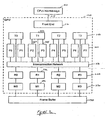
- Figure 2 is a block diagram of a graphics processing unit that benefits by incorporation of embodiments of the present invention
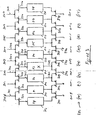
- Figure 3 is a block diagram of an integrated circuit portion including a group of nine parallel circuit blocks that are selected by input and output multiplexers useful in understanding the present invention
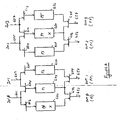
- Figure 4 is a block diagram illustrating a pipelined architecture useful in understanding the present invention
- Figure 5 is a flowchart illustrating a method of testing an integrated circuit consistent with an embodiment of the present invention
- Figure 6 is a block diagram of an integrated circuit portion including two groups of circuit blocks useful in understanding the present invention.
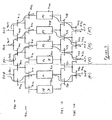
- Figure 7 is a block diagram of an integrated circuit portion that includes two redundant circuit blocks useful in understanding the present invention.
- Figure 8 is a block diagram illustrating an integrated circuit portion that may be sorted into various levels of functionality in a manner consistent with an embodiment of the present invention.
- Figure 9 is a flowchart of a method of sorting devices based on their level of functionality in a manner consistent with an embodiment of the present invention.
- FIG. 1 is a block diagram of a computing system 100 that benefits by incorporation of embodiments of the present invention. Included are a Northbridge 110, graphics processing unit (GPU) 120, Southbridge 130, frame buffer 140, central processing unit (CPU) 150, audio card 160, Ethernet card 162, modem 164, USB card 166, graphics card 168, PCI slots 170, and memories 105.
- This figure as with all the included figures, is shown for illustrative purposes only, and does not limit either the possible embodiments of the present invention or the claims.
- the Northbridge 110 passes information from the CPU 150 to and from the memories 105, graphics processing unit 120, and Southbridge 130.
- Southbridge 130 interfaces to external communication systems through connections such as the universal serial bus (USB) card 166 and Ethernet card 162.
- the graphics processing unit 120 receives graphics information over the accelerated graphics port (AGP) bus 125 through the Northbridge 110 from CPU 150 and directly from memory or frame buffer 140.
- the graphics processing unit 120 interfaces with the frame buffer 140.
- Frame buffer 140 may include a display buffer which stores the pixels to be displayed.
- CPU 150 performs the bulk of the processing tasks required by this computing system.
- the graphics processing unit 120 relies on the CPU 150 to set up calculations arid compute geometry values.
- the audio or sound card 160 relies on the CPU 150 to process audio data, positional computations, and various effects, such as chorus, reverb, obstruction, occlusion, and the like, all simultaneously.
- the CPU 150 remains responsible for other instructions related to applications that may be running, as well as for the control of the various peripheral devices connected to the Southbridge 130.
- FIG. 2 is a block diagram of a graphics processing unit that benefits by incorporation of embodiments of the present invention.
- This graphics processing unit 220 is connected to a CPU/Northbridge 210 and a frame buffer 240.
- the GPU 220 includes a front-end or host 230 and several texture units, each coupled to a pair of geometry/shading processors 260.
- the geometry/shading processors 260 are coupled through an interconnection network 270 to several raster operation (ROP) units which are in turn connected to memory interface circuits 290.
- the memory interface circuits 290 write and read data to and from the frame buffer 240.
- ROIP raster operation
- the GPU 220 receives geometries, commands, and other data from the CPU through the Northbridge 210 over AGP bus 215.
- the front-end or host 230 receives these geometries, commands, and data, and provides them to the texture units 250, geometry/shading processors 260, and ROP units 280.
- the texture units 250 compute filtered values from texture images fetched from the frame buffer 240 or the CPU/Northbridge 210.
- the output of the texture units 250 are received by the geometry/shading processors 260.
- each texture unit 250 is connected to two geometry/shading processors 260, and is also coupled to the frame buffer 240 via an interconnection network 290 and memory interfaces 290.
- the geometry/shading processors 260 request texture computations from the texture units 250, and compute geometry and pixel values.
- the geometry/shading processors are connected through interconnection network 270 to the raster operation units (ROP) 280.
- the raster operation units output pixel values for display on a monitor.
- the raster operation units are coupled to the frame buffer 240 via memory interface units 290.
- the memory interface units communicate with the frame buffer 240, which stores data, textures, pixels, and other data for use by the graphics processor unit 220 and for display on a monitor.
- embodiments of the present invention provide methods, circuits, and apparatus that allow one or more of these circuit blocks to be avoided, while providing a functional device.
- Various embodiments further provide for sorting or separating devices based their level of functionality or performance, which in turn depends on their number of defects. For example, if no circuit is defective on a GPU 220, that device may be separated as a high-functioning or high-performance device, while if one or more circuits are defective, the device may be sorted or separated as a lower-functioning or lower-performance device.
- a circuit block When a circuit block is nonfunctional, either that particular circuit block, or its associated pathway may be avoided. For example, if the raster operations circuit 282 is nonfunctional, that circuit may be avoided, while the other raster operations and memory interface circuits, including memory interface circuit 292, are used. Alternately, the nonfunctional raster operation circuit 282 maybe avoided, while its associated memory interface circuit 292 is also avoided. Similarly, if texture unit 252 is nonfunctional, the geometry/shading processors 260 and 264 may be avoided. Alternately, the geometry/shading processors 262 and 264 may be used.
- the graphics processing unit 120 in Figure 1 and 220 in Figure 2 and other graphics processing units include replicated circuit blocks that function in parallel. This is typically done to increase the performance, throughput, or data handling capability of a circuit.
- the graphics processing unit 220 in Figure 2 is structured as parallel arrays of texture units, geometry/shading processors, raster operations circuits, and memory interface units.
- one or more of these parallel circuit blocks may be nonfunctional.
- defects in one or more of the circuit blocks may be caused by processing errors, such as openings in contacts or vias, metal bridging, or other defects.
- embodiments of the present invention provide a benefit in that the remaining functional circuit blocks may be used, while nonfunctional circuit blocks are avoided. In this way, even though an integrated circuit may have defects which would otherwise render it inoperable, embodiments of the present invention allow the defects to be circumscribed or avoided, thus providing for an operational circuit.
- Figure 3 is a block diagram of an integrated circuit portion including nine parallel circuit blocks that are selected by input and output multiplexers useful in understanding the present invention. Input and output multiplexers are used to select any eight of the nine parallel circuit blocks. Thus, even though one of the nine circuit blocks may have a defect rendering it nonfunctional, in this example P3 308, the remaining eight circuit blocks, P0 302 through P2 306 and P4 310 through P8 318, may be used. The desired functionality, that is eight circuits in parallel, is thus retained.
- the overhead cost associated with this architecture is one redundant circuit block, the several input and output multiplexers, and wires from adjacent blocks. This may be a small price to pay in terms of die area, particularly if the likelihood of a defect occurring somewhere in eight circuit blocks is high. Further, the redundant circuit block is made operational on integrated circuits with no defects, as illustrated in Figure 8 below, thus providing extra performance.
- this integrated circuit portion includes the nine input multiplexers 320, 322, 324, 326, 328, 330, 332, 334, and 336-one multiplexer for each circuit block, nine circuit blocks P0 302, P1 304, P2 306, P3 308, P4 310, P5 312, P6 314, P7 316, and P8 318, and eight output multiplexers 340, 342, 344, 346, 348, 350, 332, and 354-one multiplexer for each output signal.
- This and the other included figures show the inputs and outputs of these multiplexers but omit the select control signals for clarity. This figure, as with the other figures, is included for exemplary purposes only, and does not limit either the possible embodiments of the present invention or the claims.
- This circuitry may be an integrated circuit, or it may be a portion of an integrated circuit.
- a graphics processing unit 120 or 220 typically includes several stages of circuitry in succession or in a pipeline. This architecture is known as a graphics pipeline. Geometry processors, shader processors, texture filters, and raster operations circuits are some of the circuits that are included in a graphics pipeline. The circuitry shown in this and the other figures may be one or more of these or related circuits, for example, it may be a graphics pipeline stage.
- P3 308 has been previously determined by testing to be nonfunctional. Accordingly, the remaining circuit blocks P0 302, P1 304, P2 306, P4 310, P5 312, P6 314, P7 316, and P8 318 are used.
- the input and output multiplexers steer the signals around P3 308 such that is not used. Specifically, input signal IN2 on line 362 is passed through multiplexer 324 to line 325 where it is received by circuit block P2 306. Similarly input signal IN3 on line 364 is routed through multiplexer 328 to line 329 where it is received by circuit block P4 310. In this case, multiplexer 326 is not active, that is, its output is not used.
- the output of P2 306 is routed through mux 344 as output signal OUT2 on line 372.
- the output of P4 310 is routed through mux 346 as output signal OUT3 on line 374.
- Line 381 lists the circuit block proving the output signal for each output line.
- a default circuit such as P8 318, is not used, that is, the leftmost circuit or circuits are used, while the rightmost circuit or circuits are unused.
- Other default circuits may be unused, for example the rightmost circuits may be used, while the leftmost circuit or circuits are unused.
- all circuit blocks are used to deliver additional performance, as shown in Figure 8 below.
- Each of these multiplexers may be a two-input multiplexer with one select control signal. Alternately, these multiplexers may be a specialized multiplexer such as a one hot multiplexer with an individual enable control for each input. The multiplexer control signals are omitted from the drawing for clarity. In other embodiments, each multiplexer may be a three-input or larger multiplexer. Alternatively, the multiplexers such as multiplexers 320-336 may be one combined circuit. There are several alternate multiplexer designs that may be implemented consistent with the present invention. However, it should be noted that these multiplexers typically do not change selection state during device operation. Therefore, the design may account for this. For example, they may be designed as simple switches having comparatively poor dynamic selection performance.
- Input multiplexers 320 and 336 are optional, that is their respective inputs may be hardwired, since if they are nonfunctional, their outputs are ignored by the output multiplexers. However, depending on the exact circuit topology, the inclusion of multiplexers 320 and 336 is typically simple to implement, and may save power by reducing the capacitive load on signals IN0 on line 361 and IN7 on line 367. In the embodiments, such as the embodiment in Figure 8 , multiplexer 336 selects an additional input when no circuit block is defective.
- a circuit such as P3 308
- its clock or clocks may be shut off or disabled as well. This provides a reduction in chip power dissipation and switching noise. Also, bias lines may be disabled. Moreover, since excess power supply current consumption may result from an integrated circuit defect such as a short circuit, the power supplies to nonfunctional circuit blocks may be disconnected. Care should be taken to avoid excessive drops in supply voltage caused by the inclusion of shut off mechanisms.
- each input and output and multiplexer line is shown as a single line for reasons of clarity.
- each of these lines represent multiple wires, for example 100 to 2000 wires may be multiplexed into and out of each block, depending on the exact circuit blocks in question.
- Other embodiments of the present invention may multiplex fewer than 100 wires, while others may multiplex more than 2000 wires.
- there are nine parallel circuit blocks while in other examples there are different numbers of circuit blocks. In other embodiments of the present invention, there may be different numbers of circuit blocks, for example there may be 20, 256, or more circuit blocks.
- circuits in the graphics processing unit 220, or other GPUs, or high performance integrated circuits include circuit blocks that are pipelined, that is, a first circuit performs a first operation on an input and provides a first output to a second circuit which performs a second operation and provides a second output. If an integrated circuit includes such first and second circuits that are made up of more than one parallel circuit block, embodiments of the present invention may be used at each pipelined stage to improve circuit manufacturing yield.
- Figure 4 is a block diagram illustrating a pipelined architecture incorporating an embodiment of the present invention useful in understanding the present invention.
- a first pipelined stage and a second pipelined stage each include input and output multiplexers such that functionality may be retained even though one of the individual circuit blocks in each of the first and the second pipelined stages are nonfunctional.
- the first pipelined stage includes input multiplexers 402, 404, 406, and 408, and output multiplexers 442, 444, and 446.
- the second pipelined stage includes input multiplexers 452, 454, 456, and 458, and output multiplexers 482, 484, and 486.
- circuit blocks P0 422 and T2 476 have previously been determined to be nonfunctional. Accordingly, the input and output multiplexers for these two pipelined stages steer signals around those blocks and utilize the remaining circuit blocks. Specifically, input signal IN0 on line 403 is routed through mux 404 to circuit block P1 424. The input signal IN1 on line 405 is routed through mux 406 to circuit block P2 426, while input signal IN2 on line 407 is routed through mux 408 to circuit block P3 428.
- the output of P 1 424 is routed through multiplexer 442 and multiplexer 452 to circuit block T0 472.
- the output of circuit block P2 426 is routed through multiplexer 444 and multiplexer 454 to circuit block T1 474, while the output of circuit block P3 428 is routed through multiplexer 446 and multiplexer 458 to circuit block T3 478.
- the output of circuit block T0 472 is routed through multiplexer 482 and provided as OUT0 on line 492.
- the output of circuit block T1 474 is routed through multiplexer 484 and provided as OUT1 on line 494, while the output of circuit block T3 478 is routed through multiplexer 486 and provided as OUT2 on line 496.
- Line 498 indicates the paths taken from the inputs to the outputs. Specifically, data IN0 on line 403 is operated on by circuit blocks P 1424 and T0 472 and provided as OUT0 on line 492. Similarly, data IN1 on line 405 is operated on by circuit blocks P2 426 and T1 474 and provided as OUT1 on line 494, while data IN2 on line 407 is operated on by circuit blocks P3 428 and T3 478 and provided as OUT2 on line 496. In this way, the defective circuit blocks P0 422 and T2 476 are effectively excised or circumscribed from the pipelined stages, and the remaining circuit blocks are used. This enhances the yield since these two pipelined stages are fully functional, even though two of their circuit blocks are nonfunctional.
- each pipelined stage there are four circuit blocks in each pipelined stage.
- there may be a different number of circuit blocks in each pipelined stage and each pipelined stage may include a different number of blocks.
- two pipelined stages are shown, though other embodiments may include three or more such pipelined stages.
- some pipelined stages may include a number of parallel circuit blocks, while others stages may not.
- not all stages may need to include embodiments of the present invention, that is, one pipelined stage may include embodiments, while the next does not.
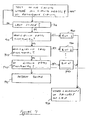
- FIG. 5 is a flowchart illustrating a method of testing an integrated circuit consistent with an embodiment of the present invention.
- M is the number of circuit blocks that are needed for a functional circuit
- N is the number of redundant circuits that are included in the portion of the integrated circuit. It is also the number of circuits that may fail while still providing a fully functional integrated circuit portion.
- it is determined whether there are N, or fewer, failures. If there are more than N failures, the device is rejected in act 530, since there are not enough redundant circuits to compensate for the number of failures. For example, the failed die may be marked with ink or other indicator, such that they may be removed after the die on the wafer are separated.
- failure locations are stored on the integrated circuit (or other storage location that may be accessed by the integrated circuit) in act 550. These failure locations may be stored as blown fuses, bits in memory or registers, or they may be stored in another type of storage. The stored failure locations are then used to select paths through multiplexers or other selection circuitry at the input and output of the appropriate integrated circuit portions.
- M circuit blocks may be tested, and if all M circuit blocks are functional, those circuits may be used, thus saving the time that would be needed to test the other N circuits. If there are failures, circuit blocks may continue to be tested until M good circuit blocks have been found. Also, deductive reasoning or test experience may indicate which integrated circuit portions are likely to yield poorly, and those portions may be tested before others are tested. Also, the locations of the failures (in act 550) may be stored after each integrated circuit portion is tested.
- input and output multiplexers provide paths around one defective circuit block in each integrated circuit portion.
- Embodiments of the present invention can be extended to configurations that allow more than one defective or nonfunctional circuit block in an integrated circuit portion.
- FIG. 6 is a block diagram of an integrated circuit portion including two groups of circuit blocks useful in understanding the present invention.
- Each group of circuit blocks includes three separate circuit blocks, and input and output multiplexers route signals around one defective or nonfunctional circuit block in each group.
- first circuit group made up of circuit blocks P0 622, P1 624, and P2 626, input multiplexers 602, 604, and 606, and output multiplexers 642 and 644, and a second circuit group made up of circuit blocks P3 628, P4 630, and P5 632, input multiplexers 608, 610, and 612, and output multiplexers 646 and 648.
- circuit blocks P0 622 and P4 630 may be nonfunctional, but since the remaining circuit blocks may be used, this integrated circuit portion is functional, and yield is thus improved. If circuit blocks P0 622 and P4 630 are nonfunctional, signals are routed around those circuits, and circuit blocks P1 624, P2 626 are used in the first group, while circuit blocks P3 628 and P5 632 are used in the second.
- input signal IN0 on line 601 is routed through multiplexer 604 to circuit block P1 624, while input signal IN1 on line 603 is routed through multiplexer 606 to circuit block P2 626.
- input signal IN2 on line 605 is routed through multiplexer 608 to circuit blocks P3 628, while input signal IN3 on line 607 is routed through multiplexer 612 to circuit block P5 632.
- the output signals are similarly routed from functional blocks to the output lines, thus avoiding nonfunctional circuit blocks.
- the output of circuit block P1 624 is routed through multiplexer 642 and provided as OUT0 on line 652.
- the output of circuit block P2 626 is routed through multiplexer 644 and provided as OUT1 on line 654.
- the output of circuit block P3 628 is routed through multiplexer 646 and provided as OUT2 on line 656, while the output of circuit block P5 632 is routed through multiplexer 648 and provided as OUT3 on line 658.
- circuit groups of three circuit blocks are shown.
- Figure 7 is a block diagram of an integrated circuit portion that includes two redundant circuit blocks in a group useful in understanding the present invention. One skilled in the art will appreciate that this may be extended to include three or more redundant circuit blocks.
- circuit blocks P0 730, P1 732, P2 734, P3 736, P4 738, and P5 740 are coupled to two tiers or layers of input multiplexers at their input, the first layer 788 including multiplexers 702, 704, 706, 708, and 710, and the second layer 782 including multiplexers 712, 714, 716, 718, 720, and 722, and two layers of output multiplexers, the first layer 784 including multiplexers 750, 752, 754, 756, and 758, and a second layer 786 including multiplexers 760, 762, 764, and 766.
- this circuitry may be implemented using only one tier of multiplexers, for example where each multiplexer is a three input multiplexer.
- each multiplexer is a three input multiplexer.
- consideration of the number of routing wires should be taken into account.
- the specific implementation shown may reduce the number of wires needed in the horizontal direction, if the circuit is layed out in an arrangement with the same orientation as the figure. This in turn may reduce the length of the layout of this circuitry in the vertical direction depending on the number of wires multiplexed and the implementation chosen.
- the input and output multiplexers can steer input and output signals around a total of two nonfunctional circuit blocks, while retaining full functionality for this integrated circuit portion.
- circuit blocks P0 730 and P2 734 have been determined by testing to be nonfunctional. Accordingly, circuit blocks P1 732, P3 736, P4 738, and P5 740 are used. Specifically, input signal IN0 on line 701 is routed through multiplexers 702 and 714 to circuit block P1 732. Similarly, input signal IN1 on line 703 is routed through multiplexers 706 and 718 to circuit block P3 736, input signal IN2 on line 705 is routed through multiplexers 708 and 720 to circuit block P4 738, while input signal IN3 on line 707 is routed through multiplexers 710 and 722 to circuit block P5 740.
- the output of P1 732 is routed through multiplexers 750 and 760 and provided as OUT0 on line 770.
- the output of P3 736 is routed through multiplexers 754 and 762 and provided as OUT1 on line 772
- the output of P4 738 is routed through multiplexers 756 and 764 and provided as OUT2 on line 774
- the output of P5 740 is routed through multiplexers 758 and 766 and provided as OUT3 on line 776.
- all the circuit blocks in an integrated circuit portion may be functional, and no redundant circuits are needed. In that case, it may be desirable to include the functionality or performance of what would otherwise be a redundant, unused circuit. This may be done if integrated circuits having a reduced level of functioning or performance can also be sold or otherwise used. For example, if four parallel circuit blocks are included in an integrated circuit portion and all four circuits are functional, that device may be sold as a premium performance or highly functioning device. If three of the circuit blocks are functioning, the device may be sold as a device having a lower functionality or performance, perhaps at a lower price. Similarly, circuits having two functioning circuit blocks may be sold as even lower-level functioning devices, depending on the circuit in question.
- Figure 8 is a block diagram illustrating an integrated circuit portion that may be sorted into various levels of functionality or performance in a manner consistent with an embodiment of the present invention.
- this architecture there are five input lines, five output lines, and five circuit blocks. If each circuit block is functional, the five inputs and outputs are functional and this integrated circuit portion is at its highest level of functionality or performance. If one circuit block is nonfunctional, four inputs and outputs may be steered towards and from the remaining four functional circuit blocks.
- input signals IN0 on line 801, In1 on line 803, IN2 on line 805, and IN3 on line 807 may be used, while input signal IN4 on line 809 is ignored.
- output signals OUT0 on line 850, OUT1 on line 852, OUT2 on line 854, and OUT3 on line 856 may be used, while input signal OUT4 on line 858 is ignored.
- this integrated circuit portion includes four functional inputs and outputs, and thus is only capable of operating at lower functionality or performance.
- These lower functioning devices may be provided as products, perhaps at lower prices, as mentioned above.
- still lower functionality devices for example where three or two circuit blocks is functional, may be provided as products.
- each wafer yields more usable integrated circuits, effectively increasing manufacturing yield and reducing the average cost per product chip.
- Figure 9 is a flowchart of a method of testing and binning integrated circuits based on their level of functionality or performance in a manner consistent with an embodiment of the present invention.
- This testing may be done at various points in the manufacturing process, for example at wafer sort or final test, where wafer-sort testing is done at the wafer level, and final test is typically done after the wafer has been scribed and packaged, though it may occur after individual devices have been placed on a substrate, for example as part of a hybrid package.
- M plus N circuit blocks are tested in a particular pipelined stage, integrated circuit portion, or in a group of circuit blocks in such a pipelined stage or integrated circuit portion, where M is the number of circuits that are needed for a minimum level of functionality or performance, N is the number of potentially redundant circuits, and M plus N is the number of circuit blocks being tested.
- act 910 it is determined whether the last pipelined stage or integrated circuit portion has been tested. If it hasn't, the next pipelined stage or integrated circuit portion is tested. Alternately, stages may be tested in parallel. For each pipelined stage or integrated circuit portion, there may be a different value for M and N.
- the device may be binned as a highest functioning or performing device, commonly referred to as a Bin 1 device, in act 920. If M plus N less one circuit paths are functional, the device may be binned as a lower grade, or Bin 2 device in act 930. Similarly, as fewer circuit blocks are functional as determined in act 935, the device may be binned as a lower bin device in act 940. If fewer than the minimum number of circuit paths M are functional, the device is rejected in act 945. Without the defect-tolerant circuits described above, only Bin 1 devices, those having zero defects, would be classified as functional. This method enables devices with defects to yield usable-products with reduced functionality or performance.
- the location of any failures are stored on the device, or in a location accessible by the device being tested. Again, these locations may be stored as fuses, in memories, registers, or other memory storage devices. The stored locations are then used to control the selection of the input and output multiplexers or other selection circuitry.
Landscapes
- Semiconductor Integrated Circuits (AREA)
- Design And Manufacture Of Integrated Circuits (AREA)
- Tests Of Electronic Circuits (AREA)
Claims (13)
- Un processeur de graphiques (220) apte à fonctionner à un premier niveau de fonctionnalité et à un second niveau de fonctionnalité, le second niveau représentant un niveau décru de fonctionnalité comparé au premier niveau de fonctionnalité, le processeur de graphiques (220) comprenant :- une pluralité de blocs de circuit, comprenant :o un premier bloc de circuit (822) ;o un deuxième bloc de circuit (824) ;o un troisième bloc de circuit (826) ;- un premier circuit de sélection (804) couplé pour recevoir un premier signal d'entrée (803) et fournir une sortie au premier bloc de circuit (822) ;- un deuxième circuit de sélection (806) couplé pour recevoir le premier signal d'entrée (803) et un deuxième signal d'entrée (803) et fournir une sortie au deuxième bloc de circuit (824) ; et- un troisième circuit de sélection (808) couplé pour recevoir le deuxième signal d'entrée (805) et un troisième signal d'entrée (807) et fournir une sortie au troisième bloc de circuit (826) ;- dans lequel si les premier, deuxième et troisième blocs de circuit (822, 824, 826) ne sont pas défectueux, le processeur de graphiques (220) est configuré pour fonctionner audit premier niveau de fonctionnalité, dans lequel le premier circuit de sélection (804) couple le premier signal d'entrée (803) au premier bloc de circuit (822), le deuxième circuit de sélection (806) couple le deuxième signal d'entrée (805) au deuxième bloc de circuit (824), et le troisième circuit de sélection (808) couple le troisième signal d'entrée (803) au troisième bloc de circuit (826), et- dans lequel si le premier bloc de circuit (822) est défectueux, le processeur de graphiques (220) est configuré pour fonctionner audit second niveau de fonctionnalité, dans lequel le premier circuit de sélection (804) ne couple pas le premier signal d'entrée au premier bloc de circuit (822), le deuxième circuit de sélection (806) couple le premier signal d'entrée (805) au deuxième bloc de circuit (824), le troisième circuit de sélection (808) couple le deuxième signal d'entrée au troisième bloc de circuit (826), et le troisième signal d'entrée (807) est ignoré, et- dans lequel les premier, deuxième et troisième blocs de circuit (822, 824, 826) comprennent des blocs de circuits dupliqués sélectionnés depuis le groupe constitué d'une unité de texture (250), un processeur d'ombrage/ de géométrie (260), une unité de fonctionnement de trame (280), ou une interface mémoire (290).
- Le processeur de graphiques (220) selon la revendication 1, dans lequel le premier circuit de sélection (804) comprend un multiplexeur.
- Le processeur de graphiques (220) selon la revendication 1, dans lequel si le premier bloc de circuit (822) est défectueux, un signal d'horloge pour le premier bloc de circuit (822) est invalidé.
- Le processeur de graphiques (220) selon la revendication 1, comprenant en outre :un élément de stockage configuré pour stocker au moins un bit indiquant si le premier bloc de circuit (822) est défectueux.
- Le processeur de graphiques (220) selon la revendication 4, dans lequel l'élément de stockage comprend un fusible.
- Le processeur de graphiques (220) selon la revendication 4, dans lequel l'élément de stockage comprend une cellule mémoire.
- Un procédé pour tester le processeur de graphiques (220) selon la revendication 1, le procédé comprenant les étapes consistant à :- tester une pluralité de blocs de circuit comprenant lesdits premier, deuxième et troisième blocs de circuit (822, 824, 826) dans une partie du processeur de graphiques (220) ;- déterminer un nombre de blocs de circuit défectueux dans la pluralité de blocs de circuit (822, 824, 826) ;- si le nombre de blocs de circuit défectueux est inférieur ou égal à un nombre de blocs redondants dans la pluralité de blocs de circuit, alors programmer le processeur de graphiques (220) avec un nombre de bits programmables, et ;- si le nombre de blocs de circuit défectueux est zéro, configurer le processeur de graphiques (220) pour fonctionner audit premier niveau de fonctionnalité ;- si le premier bloc de circuit est défectueux, configurer le processeur de graphiques (220) pour fonctionner audit second niveau de fonctionnalité ;- selon lequel les bits programmables déterminent une sélection faite par lesdits premier, deuxième et troisième circuits de sélection (804, 806, 808).
- Le procédé selon la revendication 7, selon lequel les bits programmables sont stockés en faisant sauter un fusible
- Le procédé selon la revendication 7, selon lequel les bits programmables sont stockés dans une mémoire.
- Le procédé selon la revendication 7, selon lequel si le nombre de blocs de circuit défectueux dans la pluralité de blocs de circuit est zéro, l'appareil est classé dans un premier fichier.
- Le procédé selon la revendication 10, selon lequel si le nombre de blocs de circuit défectueux dans la pluralité de blocs de circuit est un, l'appareil est classé dans un second fichier.
- Le procédé selon la revendication 11, selon lequel le classement dans un premier fichier et le classement dans un second fichier est fait lors d'un test de type à plaquette..
- Le procédé selon la revendication 11, selon lequel le classement dans le premier fichier et le classement dans le second fichier est fait lors d'un test final.
Applications Claiming Priority (2)
| Application Number | Priority Date | Filing Date | Title |
|---|---|---|---|
| US10/741,243 US6879207B1 (en) | 2003-12-18 | 2003-12-18 | Defect tolerant redundancy |
| US741243 | 2003-12-18 |
Publications (2)
| Publication Number | Publication Date |
|---|---|
| EP1544741A1 EP1544741A1 (fr) | 2005-06-22 |
| EP1544741B1 true EP1544741B1 (fr) | 2009-09-16 |
Family
ID=34423517
Family Applications (1)
| Application Number | Title | Priority Date | Filing Date |
|---|---|---|---|
| EP04029907A Expired - Lifetime EP1544741B1 (fr) | 2003-12-18 | 2004-12-16 | Circuit tolérant aux défauts avec redondance |
Country Status (6)
| Country | Link |
|---|---|
| US (2) | US6879207B1 (fr) |
| EP (1) | EP1544741B1 (fr) |
| CN (1) | CN100476746C (fr) |
| DE (1) | DE602004023174D1 (fr) |
| SG (1) | SG112988A1 (fr) |
| TW (1) | TWI268596B (fr) |
Families Citing this family (22)
| Publication number | Priority date | Publication date | Assignee | Title |
|---|---|---|---|---|
| US8768642B2 (en) * | 2003-09-15 | 2014-07-01 | Nvidia Corporation | System and method for remotely configuring semiconductor functional circuits |
| US8775997B2 (en) * | 2003-09-15 | 2014-07-08 | Nvidia Corporation | System and method for testing and configuring semiconductor functional circuits |
| US8732644B1 (en) | 2003-09-15 | 2014-05-20 | Nvidia Corporation | Micro electro mechanical switch system and method for testing and configuring semiconductor functional circuits |
| US6880940B1 (en) * | 2003-11-10 | 2005-04-19 | Honda Motor Co., Ltd. | Magnesium mirror base with countermeasures for galvanic corrosion |
| US8711161B1 (en) | 2003-12-18 | 2014-04-29 | Nvidia Corporation | Functional component compensation reconfiguration system and method |
| US8723231B1 (en) | 2004-09-15 | 2014-05-13 | Nvidia Corporation | Semiconductor die micro electro-mechanical switch management system and method |
| US8711156B1 (en) | 2004-09-30 | 2014-04-29 | Nvidia Corporation | Method and system for remapping processing elements in a pipeline of a graphics processing unit |
| US7301242B2 (en) * | 2004-11-04 | 2007-11-27 | Tabula, Inc. | Programmable system in package |
| US8201124B1 (en) | 2005-03-15 | 2012-06-12 | Tabula, Inc. | System in package and method of creating system in package |
| US8021193B1 (en) | 2005-04-25 | 2011-09-20 | Nvidia Corporation | Controlled impedance display adapter |
| US7793029B1 (en) | 2005-05-17 | 2010-09-07 | Nvidia Corporation | Translation device apparatus for configuring printed circuit board connectors |
| US8412872B1 (en) | 2005-12-12 | 2013-04-02 | Nvidia Corporation | Configurable GPU and method for graphics processing using a configurable GPU |
| US8417838B2 (en) | 2005-12-12 | 2013-04-09 | Nvidia Corporation | System and method for configurable digital communication |
| US7839397B2 (en) * | 2007-02-08 | 2010-11-23 | Panasonic Corporation | Display driver and display panel module |
| US8724483B2 (en) | 2007-10-22 | 2014-05-13 | Nvidia Corporation | Loopback configuration for bi-directional interfaces |
| US8687639B2 (en) * | 2009-06-04 | 2014-04-01 | Nvidia Corporation | Method and system for ordering posted packets and non-posted packets transfer |
| US9176909B2 (en) | 2009-12-11 | 2015-11-03 | Nvidia Corporation | Aggregating unoccupied PCI-e links to provide greater bandwidth |
| US9331869B2 (en) | 2010-03-04 | 2016-05-03 | Nvidia Corporation | Input/output request packet handling techniques by a device specific kernel mode driver |
| JP5408362B2 (ja) * | 2010-10-29 | 2014-02-05 | 富士通株式会社 | 半導体回路の切替装置及び切替方法 |
| US9330031B2 (en) | 2011-12-09 | 2016-05-03 | Nvidia Corporation | System and method for calibration of serial links using a serial-to-parallel loopback |
| US9172373B2 (en) * | 2013-09-06 | 2015-10-27 | Globalfoundries U.S. 2 Llc | Verifying partial good voltage island structures |
| US9946658B2 (en) | 2013-11-22 | 2018-04-17 | Nvidia Corporation | Memory interface design having controllable internal and external interfaces for bypassing defective memory |
Citations (1)
| Publication number | Priority date | Publication date | Assignee | Title |
|---|---|---|---|---|
| US5134584A (en) * | 1988-07-22 | 1992-07-28 | Vtc Incorporated | Reconfigurable memory |
Family Cites Families (9)
| Publication number | Priority date | Publication date | Assignee | Title |
|---|---|---|---|---|
| US3897626A (en) * | 1971-06-25 | 1975-08-05 | Ibm | Method of manufacturing a full capacity monolithic memory utilizing defective storage cells |
| JPH0289299A (ja) * | 1988-09-27 | 1990-03-29 | Nec Corp | 半導体記憶装置 |
| JP2689768B2 (ja) * | 1991-07-08 | 1997-12-10 | 日本電気株式会社 | 半導体集積回路装置 |
| US5369314A (en) * | 1994-02-22 | 1994-11-29 | Altera Corporation | Programmable logic device with redundant circuitry |
| US5670895A (en) * | 1995-10-19 | 1997-09-23 | Altera Corporation | Routing connections for programmable logic array integrated circuits |
| WO1998028746A1 (fr) * | 1996-12-23 | 1998-07-02 | Rambus, Inc. | Redondance pour de grandes organisations hierarchiques e/s |
| US6091258A (en) * | 1997-02-05 | 2000-07-18 | Altera Corporation | Redundancy circuitry for logic circuits |
| WO1998053401A1 (fr) * | 1997-05-23 | 1998-11-26 | Altera Corporation | Circuits redondants pour dispositifs a logique programmable a circuits d'entree entrelaces |
| DE19861088A1 (de) * | 1997-12-22 | 2000-02-10 | Pact Inf Tech Gmbh | Verfahren zur Reparatur von integrierten Schaltkreisen |
-
2003
- 2003-12-18 US US10/741,243 patent/US6879207B1/en not_active Expired - Lifetime
-
2004
- 2004-12-14 TW TW093138734A patent/TWI268596B/zh not_active IP Right Cessation
- 2004-12-16 EP EP04029907A patent/EP1544741B1/fr not_active Expired - Lifetime
- 2004-12-16 DE DE602004023174T patent/DE602004023174D1/de not_active Expired - Lifetime
- 2004-12-17 SG SG200407502A patent/SG112988A1/en unknown
- 2004-12-20 CN CNB2004100942610A patent/CN100476746C/zh not_active Expired - Fee Related
-
2005
- 2005-04-12 US US11/105,326 patent/US7477091B2/en not_active Expired - Lifetime
Patent Citations (1)
| Publication number | Priority date | Publication date | Assignee | Title |
|---|---|---|---|---|
| US5134584A (en) * | 1988-07-22 | 1992-07-28 | Vtc Incorporated | Reconfigurable memory |
Also Published As
| Publication number | Publication date |
|---|---|
| DE602004023174D1 (de) | 2009-10-29 |
| CN100476746C (zh) | 2009-04-08 |
| SG112988A1 (en) | 2005-07-28 |
| US20060071701A1 (en) | 2006-04-06 |
| TWI268596B (en) | 2006-12-11 |
| EP1544741A1 (fr) | 2005-06-22 |
| TW200524130A (en) | 2005-07-16 |
| US6879207B1 (en) | 2005-04-12 |
| CN1694252A (zh) | 2005-11-09 |
| US7477091B2 (en) | 2009-01-13 |
| HK1072997A1 (en) | 2005-09-16 |
Similar Documents
| Publication | Publication Date | Title |
|---|---|---|
| EP1544741B1 (fr) | Circuit tolérant aux défauts avec redondance | |
| US6222382B1 (en) | Redundancy circuitry for programmable logic devices with interleaved input circuits | |
| US9804221B2 (en) | Configurable vertical integration | |
| KR100274478B1 (ko) | 병렬 테스트 장치를 갖는 집적 반도체 메모리 및 그 리던던시 방법 | |
| JP2590897B2 (ja) | 半導体メモリ | |
| JP3595495B2 (ja) | 半導体記憶装置 | |
| JP2001006395A (ja) | 半導体メモリ装置及びそのテストモード時の読出方法 | |
| KR101282967B1 (ko) | 리던던시 메모리 블록을 가지는 반도체 메모리 장치 및그의 셀 어레이 구조 | |
| US6646933B1 (en) | Method and apparatus to reduce the amount of redundant memory column and fuses associated with a memory device | |
| US6515920B2 (en) | Semiconductor data storing circuit device, method of checking the device and method of relieving the device from defective cell | |
| US6754865B2 (en) | Integrated circuit | |
| HK1072997B (en) | Defect tolerant circuit with redundancy | |
| JP2009099165A (ja) | 半導体記憶装置 | |
| US7622947B1 (en) | Redundant circuit presents connections on specified I/O ports | |
| US11880607B2 (en) | Memory with fuse pins shared by multiple-type repairs | |
| KR20000057045A (ko) | 반도체 메모리 장치 | |
| JPH06203594A (ja) | 半導体記憶装置 | |
| JPH0785233B2 (ja) | 中間記憶システム | |
| EP2619762B1 (fr) | Lignes de référence à suivi précis remplaçables pour des produits de mémoire | |
| JPS6063651A (ja) | 記憶装置 | |
| JP2004241019A (ja) | 半導体メモリ装置及びそのデータ入出力方法 | |
| JPH05266691A (ja) | 大規模メモリ構成方式 |
Legal Events
| Date | Code | Title | Description |
|---|---|---|---|
| PUAI | Public reference made under article 153(3) epc to a published international application that has entered the european phase |
Free format text: ORIGINAL CODE: 0009012 |
|
| 17P | Request for examination filed |
Effective date: 20041216 |
|
| AK | Designated contracting states |
Kind code of ref document: A1 Designated state(s): AT BE BG CH CY CZ DE DK EE ES FI FR GB GR HU IE IS IT LI LT LU MC NL PL PT RO SE SI SK TR |
|
| AX | Request for extension of the european patent |
Extension state: AL BA HR LV MK YU |
|
| REG | Reference to a national code |
Ref country code: HK Ref legal event code: DE Ref document number: 1072997 Country of ref document: HK |
|
| AKX | Designation fees paid |
Designated state(s): DE GB |
|
| 17Q | First examination report despatched |
Effective date: 20060309 |
|
| GRAP | Despatch of communication of intention to grant a patent |
Free format text: ORIGINAL CODE: EPIDOSNIGR1 |
|
| GRAS | Grant fee paid |
Free format text: ORIGINAL CODE: EPIDOSNIGR3 |
|
| GRAA | (expected) grant |
Free format text: ORIGINAL CODE: 0009210 |
|
| AK | Designated contracting states |
Kind code of ref document: B1 Designated state(s): DE GB |
|
| REG | Reference to a national code |
Ref country code: GB Ref legal event code: FG4D |
|
| REF | Corresponds to: |
Ref document number: 602004023174 Country of ref document: DE Date of ref document: 20091029 Kind code of ref document: P |
|
| REG | Reference to a national code |
Ref country code: HK Ref legal event code: GR Ref document number: 1072997 Country of ref document: HK |
|
| PLBE | No opposition filed within time limit |
Free format text: ORIGINAL CODE: 0009261 |
|
| STAA | Information on the status of an ep patent application or granted ep patent |
Free format text: STATUS: NO OPPOSITION FILED WITHIN TIME LIMIT |
|
| 26N | No opposition filed |
Effective date: 20100617 |
|
| REG | Reference to a national code |
Ref country code: DE Ref legal event code: R082 Ref document number: 602004023174 Country of ref document: DE Representative=s name: KRAUS & WEISERT PATENTANWAELTE PARTGMBB, DE |
|
| PGFP | Annual fee paid to national office [announced via postgrant information from national office to epo] |
Ref country code: GB Payment date: 20231121 Year of fee payment: 20 |
|
| PGFP | Annual fee paid to national office [announced via postgrant information from national office to epo] |
Ref country code: DE Payment date: 20231121 Year of fee payment: 20 |
|
| REG | Reference to a national code |
Ref country code: DE Ref legal event code: R071 Ref document number: 602004023174 Country of ref document: DE |
|
| REG | Reference to a national code |
Ref country code: GB Ref legal event code: PE20 Expiry date: 20241215 |
|
| PG25 | Lapsed in a contracting state [announced via postgrant information from national office to epo] |
Ref country code: GB Free format text: LAPSE BECAUSE OF EXPIRATION OF PROTECTION Effective date: 20241215 |
|
| PG25 | Lapsed in a contracting state [announced via postgrant information from national office to epo] |
Ref country code: GB Free format text: LAPSE BECAUSE OF EXPIRATION OF PROTECTION Effective date: 20241215 |