EP1544724A1 - Neue FIFO Speicherarkitektur und Betriebsverfahren für einen solchen Speicher - Google Patents
Neue FIFO Speicherarkitektur und Betriebsverfahren für einen solchen Speicher Download PDFInfo
- Publication number
- EP1544724A1 EP1544724A1 EP04029809A EP04029809A EP1544724A1 EP 1544724 A1 EP1544724 A1 EP 1544724A1 EP 04029809 A EP04029809 A EP 04029809A EP 04029809 A EP04029809 A EP 04029809A EP 1544724 A1 EP1544724 A1 EP 1544724A1
- Authority
- EP
- European Patent Office
- Prior art keywords
- memory
- fifo
- words
- bits
- word
- Prior art date
- Legal status (The legal status is an assumption and is not a legal conclusion. Google has not performed a legal analysis and makes no representation as to the accuracy of the status listed.)
- Granted
Links
Images

Classifications
-
- G—PHYSICS
- G11—INFORMATION STORAGE
- G11C—STATIC STORES
- G11C11/00—Digital stores characterised by the use of particular electric or magnetic storage elements; Storage elements therefor
- G11C11/21—Digital stores characterised by the use of particular electric or magnetic storage elements; Storage elements therefor using electric elements
- G11C11/34—Digital stores characterised by the use of particular electric or magnetic storage elements; Storage elements therefor using electric elements using semiconductor devices
- G11C11/40—Digital stores characterised by the use of particular electric or magnetic storage elements; Storage elements therefor using electric elements using semiconductor devices using transistors
- G11C11/41—Digital stores characterised by the use of particular electric or magnetic storage elements; Storage elements therefor using electric elements using semiconductor devices using transistors forming static cells with positive feedback, i.e. cells not needing refreshing or charge regeneration, e.g. bistable multivibrator or Schmitt trigger
- G11C11/413—Auxiliary circuits, e.g. for addressing, decoding, driving, writing, sensing, timing or power reduction
- G11C11/417—Auxiliary circuits, e.g. for addressing, decoding, driving, writing, sensing, timing or power reduction for memory cells of the field-effect type
- G11C11/419—Read-write [R-W] circuits
-
- G—PHYSICS
- G06—COMPUTING OR CALCULATING; COUNTING
- G06F—ELECTRIC DIGITAL DATA PROCESSING
- G06F5/00—Methods or arrangements for data conversion without changing the order or content of the data handled
- G06F5/06—Methods or arrangements for data conversion without changing the order or content of the data handled for changing the speed of data flow, i.e. speed regularising or timing, e.g. delay lines, FIFO buffers; over- or underrun control therefor
- G06F5/10—Methods or arrangements for data conversion without changing the order or content of the data handled for changing the speed of data flow, i.e. speed regularising or timing, e.g. delay lines, FIFO buffers; over- or underrun control therefor having a sequence of storage locations each being individually accessible for both enqueue and dequeue operations, e.g. using random access memory
Definitions
- the invention relates to a first-of-a-kind memory, first out ", more commonly called FIFO memory (First In First Out).
- the FIFOs comprise essentially a basic memory (eg RAM type) of the size of the FIFO memory and including its circuits read / write, and logic circuits to handle the content of the FIFO, so that the words are read in the same order that they have been memorized (principle of the FIFO memory).
- the known FIFO memories are in general small (8 to 16 words of 8 bits).
- FIFO memories are currently built on the basis of a double basic memory port, including a read port and a port in writing, at the input and at the output of the FIFO memory.
- a example of such a memory is described in the document US 6,144,608.
- the main disadvantage of these memories is their size. The presence of the two ports is consequence that the silicon surface needed for the making a FIFO is about twice as much important that the silicon surface needed for the realization of a conventional memory of the same capacity (same number of words).
- memory points are in practice bigger and logic circuits, necessary to manage the contents of the FIFO memory and the presence of the two ports of the base memory, are more complex and therefore also bigger than those of a classical memory of the same capacity.
- Another disadvantage of these FIFO memories is their timing frequency (equal to the word flow at the input or output of the FIFO), which is limited in practice by the frequency of dual base port memory timing used to achieve them.
- FIFO memories are made on the basis of a simple port basic memory but used with a frequency twice as much as the frequency of the FIFO memory. The readings in the FIFO are thus performed during the even cycles of a clock signal setting the FIFO, while the writes in the FIFO are performed during the odd cycles of the signal clock.
- the main disadvantage of these FIFOs is that it must use a particularly fast basic memory (important frequency) to obtain a FIFO memory having a reasonable speed, since the frequency of the FIFO is halved compared to the frequency of the basic memory.
- the fast memories are in general expensive, because difficult to achieve, and also big consumers of energy.
- the subject of the invention is a new structure of FIFO memory does not have the disadvantages of FIFOs known.
- the subject of the invention is a FIFO memory of frequency f and size M words of n bits, to memorize successively words of n bits received in series on a input (DIN) and provide in series on an output (QOUT) the said words in the order in which they were stored.
- FIFO memory includes basic memory (110, 220) of frequency f / 2, able to memorize simultaneously two words of n bits successively received on the input (DIN) of the FIFO memory.
- FIFO memory also includes a memory circuit (130) for memorize either a n-bit word received on the input (DIN) the FIFO memory is simultaneously two words of n bits produced by the basic memory (110, 220) and for produce on the output OUT of the FIFO one of the words that said storage circuit (130) stores.
- a memory circuit (130) for memorize either a n-bit word received on the input (DIN) the FIFO memory is simultaneously two words of n bits produced by the basic memory (110, 220) and for produce on the output OUT of the FIFO one of the words that said storage circuit (130) stores.
- a FIFO memory of frequency f uses a basic memory Frequency f / 2, easier to perform and less expensive that a memory of the same size but frequency f.
- the basic memory used is a simple port memory as will be seen better in examples, which further limits its size.
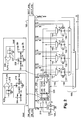
- FIG. memory is of size M * n (M words of n bits) and has a frequency f.
- the memory 100 includes a DIN input of n-bit data and QOUT output of n-bit data.
- the memory also includes two information outputs D_DRDY, Q_SRDY, two D_SRDY command entries, Q_DRDY and a RESET initialization input.
- the signal D_SRDY indicates to the memory that a datum is present at the DIN input to be stored.
- the signal Q_DRDY indicates to the memory that a data must be presented (read) on the Q output.
- the D_DRDY signal indicates that the memory is not full (and therefore a given can be input) and the signal Q_SRDY indicates that the memory is not empty (and therefore a datum can be read on the output Q).
- the RESET signal is used to initialize the memory, that is to say to erase its content, to activate the D_DRDY signal (memory not full) and disable the signal Q_SRDY (empty memory).
- the overall operation of the memory 100 is the next.
- D_SRDY and D_DRDY signals are active (in other words, n-bit data is present on the DIN input and the memory is not full), so the data is stored in the FIFO.
- the signals Q_DRDY and Q_SRDY are active (in other words, a n-bit data is expected on the QOUT output and the memory is not full)
- the data is presented on the Q output.
- the data is read on the QOUT output in the same order they were entered on the DIN input (principle of a FIFO memory.
- the memory 100 includes a RAM 110, a register 120 of n bits, a storage circuit 130 comprising four registers 131, 132, 133, 134 of n bits, a circuit selecting 140 comprising four multiplexers 141, 142, 143 and 144, a multiplexer 150 and a circuit logic 160.
- the memory 100 is clocked by a signal CLK clock of frequency f, which in particular register 120 and the circuit 130.
- the basic memory 110 is a RAM memory, for example of the SRAM type, with a single parallel port of 2 * n bits, comprising a data input and a data output of 2 * n bits.
- the memory 110 receives a signal from validation (CSN), a WEN command signal indicating whether write (WEN active) or read (WEN inactive) should be performed when the CSN signal is active and a ADD signal indicating the address at which two words of data must be written or read as appropriate.
- the memory 110 has a capacity of (M-3) / 2 words of 2 * n bits and has a frequency equal to f / 2, that is, it can memorize or provide a word of 2 * n bits (or two words of n bits in parallel) every two cycles of the CLK signal.
- the register 120 is an n-bit register, comprising a parallel D input of n-bit data connected to the DIN input of FIFO 100 and connected also to the n EH most significant bits of the input of the memory 110, a parallel Q output of n bits connected to the n least significant bits EL of the memory input 110.
- the register 120 receives a signal of RG_D validation and an active edge of the clock signal CLK, it copies on its output Q the data present on D.
- the registers 131, 132, 133, 134 are identical to the register 120.
- register 131 When the register 131, respectively, 132, 133, 134, receives an active edge of clock signal CLK and a validation signal EN0, respectively EN1, EN2, EN3, register 131, respectively 132, 133, 134 copy on its output Q la data present on his entry D.
- Data entry D of register 131, respectively 132, 133, 134, is connected to an output of the multiplexer 140, respectively 141, 142, 143.
- Each multiplexer 140, 141, 142, 143 has three parallel inputs of n bits, connected respectively to the n most significant bits SH of the output of the memory 110, to the low-order bits SL of the output of the memory 110 and the output of n bits 120.
- Each multiplexer provides on its output a data it receives on one or the other of its inputs according to a selection signal SEL_IN0, SEL_IN1, SEL_IN2, SEL_IN3.
- the multiplexer 150 includes meanwhile five parallel inputs of n bits, each connected to the output of a register 120, 131, 132, 133 or 134, and a parallel output of n bits forming the output QOUT of the FIFO memory.
- the multiplexer 150 provides on his output a data he receives on one of his five inputs according to the selection signals R_J and LEVEL_EQUAL_1.
- the logic circuit 160, the memory 110 and the registers 120, 131, 132, 133, 134 are synchronized and clocked by a clock signal CLK (the circuit clock is not shown for the sake of clarity).
- the memory 100 is initialized by a active RESET signal; the memory 100 is empty (memory 110 and registers 120, 131, 132, 133, 134 empty) and the level LEVEL is equal to 0.
- a third word present on the DIN entry is stored in the FIFO on an active edge of CLK; more precisely, the QOUT output of the FIFO memory being not free (the first word has not yet been read) and register 131 being occupied (the second word is always stored in the register 131), the second word is stored in the register 132 via the register 120 and multiplexer 141, and LEVEL level goes to 3.
- a fourth word and a fifth word are similarly stored in registers 133, 134 via the multiplexers 142, 143. The LEVEL level changes to 4 and then to 5.
- a sixth word is placed at the output of the register 120, on the same front clock.
- the signals D_DRDY and D_SRDY are again active and LEVEL is equal to 5, at the active clock edge next, the sixth data word, present at the output of the register 120, and the seventh data word, present on the input of the register 120, are stored simultaneously in the memory 110. LEVEL is incremented to 7.
- the words presented on the DIN entry are then memorized two by two, every two active fronts of the clock signal and the LEVEL level is incremented in result.
- the first word is read on the QOUT output of the FIFO memory and the LEVEL level is decremented by 1.
- the second word stored in the register 131, is positioned on the output QOUT of the FIFO memory.
- the second word is read on the output QOUT of memory, LEVEL is decremented by 1 and the third word, present in register 132, is placed on the QOUT output of the FIFO memory.
- the two registers 131, 132 having become free, a pair of words present in the memory 110 are stored in the registers 131, 132 via the multiplexers 140, 141 (WEN active, RAM memory controlled read).
- the words stored in registers 133, 134 are then positioned successively on the QOUT output at running Q_DRDY read instructions active). As soon as the registers 133, 134 are emptied, two words are read in the memory 110 and stored in the registers 133, 134. Whenever a word is read on the QOUT output of the FIFO memory, LEVEL is decremented accordingly.
- the first word to read is positioned immediately on the QOUT output of the memory.
- the other words to read are positioned successively on the exit QOUT of the memory and come from one or other of the registers 131, 132, 133 or 134.
- two registers registers 131, 132, 133, 134 are free, and if the memory 110 is not empty, so two words of memory 110 are prepositioned in the empty registers 131, 132, 133 or 134, waiting to be positioned on the QOUT output of the FIFO memory.
- LEVEL level is incremented / decremented as and when written / readings in the FIFO.
- the circuit memory 130 includes four registers 131 to 134.
- This solution allows you to immediately read a word in the FIFO as soon as a read signal is received because, for as long as the FIFO memory is not empty, there is always a word be in one of the registers 131 to 134 either in the register 120, so ready to be read.
- a read command of the FIFO in practice of a register 120, 131 to 134 can be executed simultaneously with a FIFO write command (in practice writing in a registers or in the basic memory 110.
- circuit 130 comprising fewer registers, for example only two or three. We will thus obtain a FIFO memory slightly smaller (one or two registers less). However, in certain special circumstances, it is necessary expect a read command in the FIFO can not be executed immediately because the memory circuit 130 is empty while the FIFO she herself is not empty. This may be the case if several successive orders of writings in the basic memory are enabled, preventing the execution a command to read the base memory for to charge the storage circuit 130. (recall that the memory 110 is a single port memory, that is to say that it is not possible to carry out simultaneously write and read memory 110).
- circuit 130 comprising more than four registers. This presents little of interest to the extent that the performance of the FIFO would not be improved, since with four registers, there is already no waiting in reading.
- FIG. 2 A second example of a FIFO memory according to the invention is shown in Figure 2. From a global point of view external, it is identical to that of Figure 1: it has a DIN input and a QOUT data output of n bits, it receives two D_SRDY command signals and Q_DRDY, and its overall operation is the same.
- the memory 200 also has a capacity of M words of n bits and a frequency f.
- the FIFO 200 is distinguished from the memory 100 of the 1 by the fact that the basic memory 110 of type RAM has been replaced by a base memory 210 comprising an input circuit 215, a memory 220 and a output circuit 225.
- the memory 220 is a FIFO memory according to the invention, similar to memory 100 in Figure 1, and having the characteristics: memory 220 deals with words of 2 * n bits and can memorize up to (M-1) / 2 - 1 words of 2 * n bits.
- the memory 220 has a frequency equal to f / 2, where f is the frequency of the memory 200.
- the memory FIFO 220 includes a RAM memory of (M-1) / 4 - 2 words of 4 * n bits and has a frequency equal to f / 4.
- the memory 220 also includes a register 120, a circuit of storing 130 comprising four registers 131, 132, 133, 134 of 2 * n bits, and a selection circuit 140 and a multiplexer 150 of appropriate sizes to handle words of 2 * n bits.
- the input circuit 215 is connected between on the one hand the entry and exit of register 120 and secondly the data input from the memory 220.
- the circuit 215 has for object, when a write WRITE signal in the memory 220 is received, to associate the words of n received bits on the DIN input of the FIFO memory so as to provide words of 2 * n bits on the input of the memory 220.
- the circuit 215 comprises a register 216 of 2 * n bits, a register 217 of 1 bit and a logic gate 218.
- the register 216 includes two parallel inputs of n bits each connected respectively to the DIN input of the 200 and the output Q of the register 120.
- the signal WRITE is applied to an input of validation of the register 216, on a data entry of the register 217 and on an entrance to the door 218.
- the door 218 is of type OR and also includes a second input connected to the output of register 217 and a output on which the control signal is generated DOUT_SRDY applied on the memory 220.
- the output circuit 225 is connected between on the one hand the output of the memory 220 and secondly the inputs of the multiplexers 241, 242, 243, 244.
- the circuit 225 has the following object, when a read READ signal of the memory 220 is received, to dissociate the words of 2 * n bits out of the memory 220 to produce words of n bits.
- the circuit 225 includes a register 226 having an input QIN of 2 * n bits data connected to the Q output of the memory 220 and two parallel QH, QL data outputs n bits each, each connected to an input of inputs of each multiplexer 141, 142, 143, 144.
- the register 226 also includes a validation entry on which the READ signal is applied.
- the door 228 is in the example of type ET, and includes an output on which produces a validation signal Q_DRDY applied to one of the memory validation entries 220.
- Door 228 also includes an entrance on which is applied the READ signal and an input connected to the data output of register 227 which is clocked by the clock signal CLK.
- the AND gate the Q_DRDY signal that is applied to an input of validation of the memory 220.
- gate 228 produces the signal Q_DRDY (delay at activation of the register 227) which activates the output of a datum from the memory 220, the output data being applied to the input of the register 226. As the READ signal is active, this data is presented immediately on the output of register 226.
- RAM which is used to perform FIFO 220 according to the mode of embodiment of FIG. 1 of frequency equal to f / 4, since the words are written / read in the memory 220 two by two, and so in RAM four by four.
- FIFO 220 of Figure 2 can be made according to Figure 1; it can also be performed according to Figure 2, that is to say, itself from a FIFO according to the invention.
Landscapes
- Engineering & Computer Science (AREA)
- Theoretical Computer Science (AREA)
- Physics & Mathematics (AREA)
- General Engineering & Computer Science (AREA)
- General Physics & Mathematics (AREA)
- Microelectronics & Electronic Packaging (AREA)
- Computer Hardware Design (AREA)
- Communication Control (AREA)
Applications Claiming Priority (2)
| Application Number | Priority Date | Filing Date | Title |
|---|---|---|---|
| FR0314960A FR2864320A1 (fr) | 2003-12-19 | 2003-12-19 | Nouvelle architecture de memoire fifo et procede de gestion d'une telle memoire. |
| FR0314960 | 2003-12-19 |
Publications (2)
| Publication Number | Publication Date |
|---|---|
| EP1544724A1 true EP1544724A1 (de) | 2005-06-22 |
| EP1544724B1 EP1544724B1 (de) | 2006-07-05 |
Family
ID=34508707
Family Applications (1)
| Application Number | Title | Priority Date | Filing Date |
|---|---|---|---|
| EP04029809A Expired - Lifetime EP1544724B1 (de) | 2003-12-19 | 2004-12-16 | Neue FIFO Speicherarkitektur und Betriebsverfahren für einen solchen Speicher |
Country Status (4)
| Country | Link |
|---|---|
| US (1) | US7673095B2 (de) |
| EP (1) | EP1544724B1 (de) |
| DE (1) | DE602004001439D1 (de) |
| FR (1) | FR2864320A1 (de) |
Families Citing this family (5)
| Publication number | Priority date | Publication date | Assignee | Title |
|---|---|---|---|---|
| KR100833181B1 (ko) * | 2006-08-16 | 2008-05-28 | 삼성전자주식회사 | 큐잉 설계 방식을 이용한 레이턴시 제어 회로 및 방법 |
| US8631265B2 (en) * | 2010-12-13 | 2014-01-14 | Oracle International Corporation | Synchronization circuit that facilitates multiple parallel reads and writes |
| WO2013014841A1 (ja) * | 2011-07-22 | 2013-01-31 | パナソニック株式会社 | データ処理装置およびデータ処理方法 |
| US9641464B2 (en) * | 2012-04-30 | 2017-05-02 | Nxp Usa, Inc. | FIFO buffer system providing same clock cycle response to pop commands |
| US11451233B2 (en) * | 2020-11-20 | 2022-09-20 | Stmicroelectronics International N.V. | Pulse width modulator with reduced pulse width |
Citations (4)
| Publication number | Priority date | Publication date | Assignee | Title |
|---|---|---|---|---|
| US4779234A (en) * | 1985-05-27 | 1988-10-18 | Matsushita Electric Industrial Co., Ltd. | First-in-first-out memory capable of simultaneous readings and writing operations |
| EP0483441A1 (de) * | 1990-11-02 | 1992-05-06 | STMicroelectronics S.r.l. | Systemverfahren zur Speicherung von Daten auf FIFO-Basis |
| US5371877A (en) * | 1991-12-31 | 1994-12-06 | Apple Computer, Inc. | Apparatus for alternatively accessing single port random access memories to implement dual port first-in first-out memory |
| US6067267A (en) * | 1998-08-12 | 2000-05-23 | Toshiba America Electronic Components, Inc. | Four-way interleaved FIFO architecture with look ahead conditional decoder for PCI applications |
Family Cites Families (8)
| Publication number | Priority date | Publication date | Assignee | Title |
|---|---|---|---|---|
| US4258418A (en) * | 1978-12-28 | 1981-03-24 | International Business Machines Corporation | Variable capacity data buffer system |
| EP0654168B1 (de) * | 1992-08-10 | 2001-10-31 | Monolithic System Technology, Inc. | Fehlertolerantes hierarchisiertes Bussystem |
| FR2707790B1 (fr) | 1993-07-12 | 1995-09-15 | Sgs Thomson Microelectronics | Mémoire à double accès. |
| US6144808A (en) * | 1996-10-01 | 2000-11-07 | Canon Kabushiki Kaisha | Camera having apparatus for enhancing signal-to-noise ratio in reading a film magnetic recording part |
| US6400642B1 (en) * | 2000-03-24 | 2002-06-04 | Cypress Semiconductor Corp. | Memory architecture |
| US6701390B2 (en) * | 2001-06-06 | 2004-03-02 | Koninklijke Philips Electronics N.V. | FIFO buffer that can read and/or write multiple and/or selectable number of data words per bus cycle |
| US6646942B2 (en) * | 2001-10-09 | 2003-11-11 | Micron Technology, Inc. | Method and circuit for adjusting a self-refresh rate to maintain dynamic data at low supply voltages |
| US7571287B2 (en) * | 2003-03-13 | 2009-08-04 | Marvell World Trade Ltd. | Multiport memory architecture, devices and systems including the same, and methods of using the same |
-
2003
- 2003-12-19 FR FR0314960A patent/FR2864320A1/fr active Pending
-
2004
- 2004-12-16 DE DE602004001439T patent/DE602004001439D1/de not_active Expired - Lifetime
- 2004-12-16 EP EP04029809A patent/EP1544724B1/de not_active Expired - Lifetime
- 2004-12-17 US US11/016,325 patent/US7673095B2/en not_active Expired - Fee Related
Patent Citations (4)
| Publication number | Priority date | Publication date | Assignee | Title |
|---|---|---|---|---|
| US4779234A (en) * | 1985-05-27 | 1988-10-18 | Matsushita Electric Industrial Co., Ltd. | First-in-first-out memory capable of simultaneous readings and writing operations |
| EP0483441A1 (de) * | 1990-11-02 | 1992-05-06 | STMicroelectronics S.r.l. | Systemverfahren zur Speicherung von Daten auf FIFO-Basis |
| US5371877A (en) * | 1991-12-31 | 1994-12-06 | Apple Computer, Inc. | Apparatus for alternatively accessing single port random access memories to implement dual port first-in first-out memory |
| US6067267A (en) * | 1998-08-12 | 2000-05-23 | Toshiba America Electronic Components, Inc. | Four-way interleaved FIFO architecture with look ahead conditional decoder for PCI applications |
Also Published As
| Publication number | Publication date |
|---|---|
| FR2864320A1 (fr) | 2005-06-24 |
| EP1544724B1 (de) | 2006-07-05 |
| US7673095B2 (en) | 2010-03-02 |
| DE602004001439D1 (de) | 2006-08-17 |
| US20050160245A1 (en) | 2005-07-21 |
Similar Documents
| Publication | Publication Date | Title |
|---|---|---|
| EP3252774B1 (de) | Adaptierter speicherschaltkreis zur durchführung von rechenoperationen | |
| BE1001068A4 (fr) | Methode d'ouverture rapide de fichiers a disques identifies par la denomination de chemins. | |
| EP0712133A1 (de) | Verfahren zum vorzeitigen Lesen eines seriellen Zugriffspeichers und entsprechender Speicher | |
| EP1510925A2 (de) | Cache-Speicher mit asynchronem Auslesen und Datenspeicherzugriffssteuerungsvorrichtung mit einem solchen Cache-Speicher | |
| FR2803080A1 (fr) | Memoire flash programmable page par page | |
| EP0439855A1 (de) | Mikroregler zur schnellen Ausführung einer grossen Anzahl von Befehlen, die in Folgen von gleichartigen Befehlen zu zerlegen sind | |
| EP0006478B1 (de) | Programmierbarer Steuerschalter für ein Datenverarbeitungssystem | |
| EP1172820A1 (de) | Programmierbarer und elektrisch löschbarer serieller auslesbarer Speicher durch Vorempfang | |
| EP0875830B1 (de) | Prüfbare Schaltung mit geringer Zahl von Anschlüssen | |
| EP0171856B1 (de) | Signalverarbeitungsprozessor und hierarchische Multiverarbeitungstruktur mit mindestens einem solchen Prozessor | |
| EP1544724B1 (de) | Neue FIFO Speicherarkitektur und Betriebsverfahren für einen solchen Speicher | |
| FR2588981A1 (fr) | Processeur de traitement de signal numerique | |
| FR2770660A1 (fr) | Microprocesseur, notamment pour carte a puce | |
| FR2533737A1 (fr) | Reseau de resolution de l'algorithme de l'element le moins recemment utilise | |
| EP0327445A1 (de) | Allgemeiner digitaler Multiplizierer und digitaler Filter mit diesem Multiplizierer | |
| EP1027642B1 (de) | Mikroprozessor mit mitteln für bit-konkatenation | |
| FR2662281A1 (fr) | Processeur comprenant un fichier de registres adressables en plusieurs jeux de registres contenus dans des fenetres. | |
| EP0845787B1 (de) | Vorrichtung zum Schützen eines elektrisch programmierbaren Speichers nach dem seitenweisen Beschreiben | |
| EP0640910B1 (de) | Verfahren zur Steuerung einer FIFO-Schaltung und Einrichtung zu seiner Durchführung | |
| FR2748595A1 (fr) | Memoire a acces parallele | |
| EP1027643B1 (de) | Pipelinemikroprozessor mit verarbeitung von bedingten verzweigungungen in einem einzigen taktzyklus | |
| EP0169089B1 (de) | Elementare Datenverarbeitungsvorrichtung | |
| EP4055485B1 (de) | Verfahren zum ausführen einer transaktion | |
| EP1603049A1 (de) | Schnittstelle von funktionalen Modulen in einem Chipsystem | |
| EP0595707B1 (de) | Lineare Folgesteuerung mit binären Ausgangssignalen |
Legal Events
| Date | Code | Title | Description |
|---|---|---|---|
| PUAI | Public reference made under article 153(3) epc to a published international application that has entered the european phase |
Free format text: ORIGINAL CODE: 0009012 |
|
| AK | Designated contracting states |
Kind code of ref document: A1 Designated state(s): AT BE BG CH CY CZ DE DK EE ES FI FR GB GR HU IE IS IT LI LT LU MC NL PL PT RO SE SI SK TR |
|
| AX | Request for extension of the european patent |
Extension state: AL BA HR LV MK YU |
|
| 17P | Request for examination filed |
Effective date: 20051206 |
|
| GRAP | Despatch of communication of intention to grant a patent |
Free format text: ORIGINAL CODE: EPIDOSNIGR1 |
|
| AKX | Designation fees paid |
Designated state(s): DE FR GB IT |
|
| GRAS | Grant fee paid |
Free format text: ORIGINAL CODE: EPIDOSNIGR3 |
|
| GRAA | (expected) grant |
Free format text: ORIGINAL CODE: 0009210 |
|
| AK | Designated contracting states |
Kind code of ref document: B1 Designated state(s): DE FR GB IT |
|
| PG25 | Lapsed in a contracting state [announced via postgrant information from national office to epo] |
Ref country code: IT Free format text: LAPSE BECAUSE OF FAILURE TO SUBMIT A TRANSLATION OF THE DESCRIPTION OR TO PAY THE FEE WITHIN THE PRESCRIBED TIME-LIMIT;WARNING: LAPSES OF ITALIAN PATENTS WITH EFFECTIVE DATE BEFORE 2007 MAY HAVE OCCURRED AT ANY TIME BEFORE 2007. THE CORRECT EFFECTIVE DATE MAY BE DIFFERENT FROM THE ONE RECORDED. Effective date: 20060705 |
|
| REG | Reference to a national code |
Ref country code: GB Ref legal event code: FG4D Free format text: NOT ENGLISH |
|
| REF | Corresponds to: |
Ref document number: 602004001439 Country of ref document: DE Date of ref document: 20060817 Kind code of ref document: P |
|
| PG25 | Lapsed in a contracting state [announced via postgrant information from national office to epo] |
Ref country code: DE Free format text: LAPSE BECAUSE OF FAILURE TO SUBMIT A TRANSLATION OF THE DESCRIPTION OR TO PAY THE FEE WITHIN THE PRESCRIBED TIME-LIMIT Effective date: 20061006 |
|
| GBT | Gb: translation of ep patent filed (gb section 77(6)(a)/1977) |
Effective date: 20061006 |
|
| PGFP | Annual fee paid to national office [announced via postgrant information from national office to epo] |
Ref country code: DE Payment date: 20061124 Year of fee payment: 3 |
|
| PLBE | No opposition filed within time limit |
Free format text: ORIGINAL CODE: 0009261 |
|
| STAA | Information on the status of an ep patent application or granted ep patent |
Free format text: STATUS: NO OPPOSITION FILED WITHIN TIME LIMIT |
|
| 26N | No opposition filed |
Effective date: 20070410 |
|
| PGFP | Annual fee paid to national office [announced via postgrant information from national office to epo] |
Ref country code: FR Payment date: 20071228 Year of fee payment: 4 |
|
| GBPC | Gb: european patent ceased through non-payment of renewal fee |
Effective date: 20081216 |
|
| REG | Reference to a national code |
Ref country code: FR Ref legal event code: ST Effective date: 20090831 |
|
| PG25 | Lapsed in a contracting state [announced via postgrant information from national office to epo] |
Ref country code: GB Free format text: LAPSE BECAUSE OF NON-PAYMENT OF DUE FEES Effective date: 20081216 |
|
| PG25 | Lapsed in a contracting state [announced via postgrant information from national office to epo] |
Ref country code: FR Free format text: LAPSE BECAUSE OF NON-PAYMENT OF DUE FEES Effective date: 20081231 |