EP1544618B1 - Methode d'analyse d'une proteine - Google Patents
Methode d'analyse d'une proteine Download PDFInfo
- Publication number
- EP1544618B1 EP1544618B1 EP03771282A EP03771282A EP1544618B1 EP 1544618 B1 EP1544618 B1 EP 1544618B1 EP 03771282 A EP03771282 A EP 03771282A EP 03771282 A EP03771282 A EP 03771282A EP 1544618 B1 EP1544618 B1 EP 1544618B1
- Authority
- EP
- European Patent Office
- Prior art keywords
- protein
- membrane
- sample
- solution
- amino acid
- Prior art date
- Legal status (The legal status is an assumption and is not a legal conclusion. Google has not performed a legal analysis and makes no representation as to the accuracy of the status listed.)
- Expired - Lifetime
Links
- 108090000623 proteins and genes Proteins 0.000 title claims abstract description 97
- 102000004169 proteins and genes Human genes 0.000 title claims abstract description 97
- 238000000034 method Methods 0.000 title claims abstract description 59
- 239000007850 fluorescent dye Substances 0.000 claims abstract description 21
- 235000013305 food Nutrition 0.000 claims abstract description 17
- 235000013373 food additive Nutrition 0.000 claims abstract description 17
- 239000002778 food additive Substances 0.000 claims abstract description 17
- 239000003814 drug Substances 0.000 claims abstract description 10
- 238000004445 quantitative analysis Methods 0.000 claims abstract description 4
- 239000012528 membrane Substances 0.000 claims description 79
- 150000001413 amino acids Chemical class 0.000 claims description 43
- 108091003079 Bovine Serum Albumin Proteins 0.000 claims description 33
- 229940098773 bovine serum albumin Drugs 0.000 claims description 33
- 239000003153 chemical reaction reagent Substances 0.000 claims description 20
- 229920002981 polyvinylidene fluoride Polymers 0.000 claims description 16
- 239000002033 PVDF binder Substances 0.000 claims description 14
- 238000010186 staining Methods 0.000 claims description 8
- 239000007787 solid Substances 0.000 claims description 5
- 239000000020 Nitrocellulose Substances 0.000 claims description 4
- 239000002253 acid Substances 0.000 claims description 4
- 229920001220 nitrocellulos Polymers 0.000 claims description 4
- 230000035945 sensitivity Effects 0.000 abstract description 26
- 238000004458 analytical method Methods 0.000 abstract description 16
- 239000013566 allergen Substances 0.000 abstract description 7
- 235000018102 proteins Nutrition 0.000 description 87
- 229940024606 amino acid Drugs 0.000 description 41
- 235000001014 amino acid Nutrition 0.000 description 41
- 239000000523 sample Substances 0.000 description 33
- VEXZGXHMUGYJMC-UHFFFAOYSA-N Hydrochloric acid Chemical compound Cl VEXZGXHMUGYJMC-UHFFFAOYSA-N 0.000 description 29
- 239000000243 solution Substances 0.000 description 20
- 238000001514 detection method Methods 0.000 description 18
- 238000002360 preparation method Methods 0.000 description 14
- XLYOFNOQVPJJNP-UHFFFAOYSA-N water Substances O XLYOFNOQVPJJNP-UHFFFAOYSA-N 0.000 description 13
- 238000005406 washing Methods 0.000 description 12
- 238000002965 ELISA Methods 0.000 description 11
- 238000005259 measurement Methods 0.000 description 11
- 238000011002 quantification Methods 0.000 description 10
- 239000000126 substance Substances 0.000 description 10
- OKKJLVBELUTLKV-UHFFFAOYSA-N Methanol Chemical compound OC OKKJLVBELUTLKV-UHFFFAOYSA-N 0.000 description 9
- 238000007447 staining method Methods 0.000 description 9
- OUYCCCASQSFEME-QMMMGPOBSA-N L-tyrosine Chemical compound OC(=O)[C@@H](N)CC1=CC=C(O)C=C1 OUYCCCASQSFEME-QMMMGPOBSA-N 0.000 description 7
- 230000000172 allergic effect Effects 0.000 description 7
- 208000010668 atopic eczema Diseases 0.000 description 7
- QTBSBXVTEAMEQO-UHFFFAOYSA-N Acetic acid Chemical compound CC(O)=O QTBSBXVTEAMEQO-UHFFFAOYSA-N 0.000 description 6
- 102000004877 Insulin Human genes 0.000 description 6
- 108090001061 Insulin Proteins 0.000 description 6
- DATAGRPVKZEWHA-YFKPBYRVSA-N N(5)-ethyl-L-glutamine Chemical compound CCNC(=O)CC[C@H]([NH3+])C([O-])=O DATAGRPVKZEWHA-YFKPBYRVSA-N 0.000 description 6
- NOESYZHRGYRDHS-UHFFFAOYSA-N insulin Chemical compound N1C(=O)C(NC(=O)C(CCC(N)=O)NC(=O)C(CCC(O)=O)NC(=O)C(C(C)C)NC(=O)C(NC(=O)CN)C(C)CC)CSSCC(C(NC(CO)C(=O)NC(CC(C)C)C(=O)NC(CC=2C=CC(O)=CC=2)C(=O)NC(CCC(N)=O)C(=O)NC(CC(C)C)C(=O)NC(CCC(O)=O)C(=O)NC(CC(N)=O)C(=O)NC(CC=2C=CC(O)=CC=2)C(=O)NC(CSSCC(NC(=O)C(C(C)C)NC(=O)C(CC(C)C)NC(=O)C(CC=2C=CC(O)=CC=2)NC(=O)C(CC(C)C)NC(=O)C(C)NC(=O)C(CCC(O)=O)NC(=O)C(C(C)C)NC(=O)C(CC(C)C)NC(=O)C(CC=2NC=NC=2)NC(=O)C(CO)NC(=O)CNC2=O)C(=O)NCC(=O)NC(CCC(O)=O)C(=O)NC(CCCNC(N)=N)C(=O)NCC(=O)NC(CC=3C=CC=CC=3)C(=O)NC(CC=3C=CC=CC=3)C(=O)NC(CC=3C=CC(O)=CC=3)C(=O)NC(C(C)O)C(=O)N3C(CCC3)C(=O)NC(CCCCN)C(=O)NC(C)C(O)=O)C(=O)NC(CC(N)=O)C(O)=O)=O)NC(=O)C(C(C)CC)NC(=O)C(CO)NC(=O)C(C(C)O)NC(=O)C1CSSCC2NC(=O)C(CC(C)C)NC(=O)C(NC(=O)C(CCC(N)=O)NC(=O)C(CC(N)=O)NC(=O)C(NC(=O)C(N)CC=1C=CC=CC=1)C(C)C)CC1=CN=CN1 NOESYZHRGYRDHS-UHFFFAOYSA-N 0.000 description 6
- 230000007935 neutral effect Effects 0.000 description 6
- 239000000047 product Substances 0.000 description 6
- 238000010790 dilution Methods 0.000 description 5
- 239000012895 dilution Substances 0.000 description 5
- 238000002474 experimental method Methods 0.000 description 5
- 239000002904 solvent Substances 0.000 description 5
- 238000012360 testing method Methods 0.000 description 5
- QNAYBMKLOCPYGJ-UHFFFAOYSA-N D-alpha-Ala Natural products CC([NH3+])C([O-])=O QNAYBMKLOCPYGJ-UHFFFAOYSA-N 0.000 description 4
- ZDXPYRJPNDTMRX-VKHMYHEASA-N L-glutamine Chemical compound OC(=O)[C@@H](N)CCC(N)=O ZDXPYRJPNDTMRX-VKHMYHEASA-N 0.000 description 4
- 239000000427 antigen Substances 0.000 description 4
- 108091007433 antigens Proteins 0.000 description 4
- 102000036639 antigens Human genes 0.000 description 4
- 235000003869 genetically modified organism Nutrition 0.000 description 4
- 238000012546 transfer Methods 0.000 description 4
- XUJNEKJLAYXESH-REOHCLBHSA-N L-Cysteine Chemical compound SC[C@H](N)C(O)=O XUJNEKJLAYXESH-REOHCLBHSA-N 0.000 description 3
- DATAGRPVKZEWHA-UHFFFAOYSA-N L-gamma-glutamyl-n-ethylamine Natural products CCNC(=O)CCC(N)C(O)=O DATAGRPVKZEWHA-UHFFFAOYSA-N 0.000 description 3
- WHUUTDBJXJRKMK-VKHMYHEASA-N L-glutamic acid Chemical compound OC(=O)[C@@H](N)CCC(O)=O WHUUTDBJXJRKMK-VKHMYHEASA-N 0.000 description 3
- AYFVYJQAPQTCCC-GBXIJSLDSA-N L-threonine Chemical compound C[C@@H](O)[C@H](N)C(O)=O AYFVYJQAPQTCCC-GBXIJSLDSA-N 0.000 description 3
- QIVBCDIJIAJPQS-VIFPVBQESA-N L-tryptophane Chemical compound C1=CC=C2C(C[C@H](N)C(O)=O)=CNC2=C1 QIVBCDIJIAJPQS-VIFPVBQESA-N 0.000 description 3
- KZSNJWFQEVHDMF-BYPYZUCNSA-N L-valine Chemical compound CC(C)[C@H](N)C(O)=O KZSNJWFQEVHDMF-BYPYZUCNSA-N 0.000 description 3
- 102000016943 Muramidase Human genes 0.000 description 3
- 108010014251 Muramidase Proteins 0.000 description 3
- 108010062010 N-Acetylmuramoyl-L-alanine Amidase Proteins 0.000 description 3
- 108090000848 Ubiquitin Proteins 0.000 description 3
- 102000044159 Ubiquitin Human genes 0.000 description 3
- 239000002537 cosmetic Substances 0.000 description 3
- 239000011521 glass Substances 0.000 description 3
- 230000036541 health Effects 0.000 description 3
- 229940125396 insulin Drugs 0.000 description 3
- 229960000274 lysozyme Drugs 0.000 description 3
- 239000004325 lysozyme Substances 0.000 description 3
- 235000010335 lysozyme Nutrition 0.000 description 3
- 239000000463 material Substances 0.000 description 3
- 239000011734 sodium Substances 0.000 description 3
- GJBHGUUFMNITCI-QTNFYWBSSA-M sodium;(2s)-2-aminopentanedioate;hydron;hydrate Chemical compound O.[Na+].OC(=O)[C@@H](N)CCC([O-])=O GJBHGUUFMNITCI-QTNFYWBSSA-M 0.000 description 3
- 239000012192 staining solution Substances 0.000 description 3
- 229960004441 tyrosine Drugs 0.000 description 3
- QNAYBMKLOCPYGJ-REOHCLBHSA-N L-alanine Chemical compound C[C@H](N)C(O)=O QNAYBMKLOCPYGJ-REOHCLBHSA-N 0.000 description 2
- ODKSFYDXXFIFQN-BYPYZUCNSA-N L-arginine Chemical compound OC(=O)[C@@H](N)CCCN=C(N)N ODKSFYDXXFIFQN-BYPYZUCNSA-N 0.000 description 2
- CKLJMWTZIZZHCS-REOHCLBHSA-N L-aspartic acid Chemical compound OC(=O)[C@@H](N)CC(O)=O CKLJMWTZIZZHCS-REOHCLBHSA-N 0.000 description 2
- LEVWYRKDKASIDU-IMJSIDKUSA-N L-cystine Chemical compound [O-]C(=O)[C@@H]([NH3+])CSSC[C@H]([NH3+])C([O-])=O LEVWYRKDKASIDU-IMJSIDKUSA-N 0.000 description 2
- AGPKZVBTJJNPAG-WHFBIAKZSA-N L-isoleucine Chemical compound CC[C@H](C)[C@H](N)C(O)=O AGPKZVBTJJNPAG-WHFBIAKZSA-N 0.000 description 2
- ROHFNLRQFUQHCH-YFKPBYRVSA-N L-leucine Chemical compound CC(C)C[C@H](N)C(O)=O ROHFNLRQFUQHCH-YFKPBYRVSA-N 0.000 description 2
- COLNVLDHVKWLRT-QMMMGPOBSA-N L-phenylalanine Chemical compound OC(=O)[C@@H](N)CC1=CC=CC=C1 COLNVLDHVKWLRT-QMMMGPOBSA-N 0.000 description 2
- 108010026552 Proteome Proteins 0.000 description 2
- 108010073771 Soybean Proteins Proteins 0.000 description 2
- 230000004913 activation Effects 0.000 description 2
- 238000011088 calibration curve Methods 0.000 description 2
- 229960003067 cystine Drugs 0.000 description 2
- 238000007598 dipping method Methods 0.000 description 2
- 238000004090 dissolution Methods 0.000 description 2
- 238000001035 drying Methods 0.000 description 2
- 238000001962 electrophoresis Methods 0.000 description 2
- 238000004128 high performance liquid chromatography Methods 0.000 description 2
- 239000013067 intermediate product Substances 0.000 description 2
- 235000013336 milk Nutrition 0.000 description 2
- 239000008267 milk Substances 0.000 description 2
- 210000004080 milk Anatomy 0.000 description 2
- 235000015097 nutrients Nutrition 0.000 description 2
- 210000000056 organ Anatomy 0.000 description 2
- 108090000765 processed proteins & peptides Proteins 0.000 description 2
- 239000002994 raw material Substances 0.000 description 2
- 230000001172 regenerating effect Effects 0.000 description 2
- 230000008929 regeneration Effects 0.000 description 2
- 238000011069 regeneration method Methods 0.000 description 2
- 238000012163 sequencing technique Methods 0.000 description 2
- 235000019710 soybean protein Nutrition 0.000 description 2
- OUYCCCASQSFEME-UHFFFAOYSA-N tyrosine Natural products OC(=O)C(N)CC1=CC=C(O)C=C1 OUYCCCASQSFEME-UHFFFAOYSA-N 0.000 description 2
- 208000019901 Anxiety disease Diseases 0.000 description 1
- 235000017060 Arachis glabrata Nutrition 0.000 description 1
- 244000105624 Arachis hypogaea Species 0.000 description 1
- 235000010777 Arachis hypogaea Nutrition 0.000 description 1
- 235000018262 Arachis monticola Nutrition 0.000 description 1
- 238000008157 ELISA kit Methods 0.000 description 1
- 241000196324 Embryophyta Species 0.000 description 1
- 235000009419 Fagopyrum esculentum Nutrition 0.000 description 1
- 240000008620 Fagopyrum esculentum Species 0.000 description 1
- WHUUTDBJXJRKMK-UHFFFAOYSA-N Glutamic acid Natural products OC(=O)C(N)CCC(O)=O WHUUTDBJXJRKMK-UHFFFAOYSA-N 0.000 description 1
- 244000068988 Glycine max Species 0.000 description 1
- 235000010469 Glycine max Nutrition 0.000 description 1
- 206010020751 Hypersensitivity Diseases 0.000 description 1
- QNAYBMKLOCPYGJ-UWTATZPHSA-N L-Alanine Natural products C[C@@H](N)C(O)=O QNAYBMKLOCPYGJ-UWTATZPHSA-N 0.000 description 1
- 229930064664 L-arginine Natural products 0.000 description 1
- 235000014852 L-arginine Nutrition 0.000 description 1
- 235000019393 L-cystine Nutrition 0.000 description 1
- 239000004158 L-cystine Substances 0.000 description 1
- 229930182816 L-glutamine Natural products 0.000 description 1
- 229930182844 L-isoleucine Natural products 0.000 description 1
- 235000019454 L-leucine Nutrition 0.000 description 1
- 239000004395 L-leucine Substances 0.000 description 1
- 125000000510 L-tryptophano group Chemical group [H]C1=C([H])C([H])=C2N([H])C([H])=C(C([H])([H])[C@@]([H])(C(O[H])=O)N([H])[*])C2=C1[H] 0.000 description 1
- 241000283973 Oryctolagus cuniculus Species 0.000 description 1
- 239000004473 Threonine Substances 0.000 description 1
- 235000021307 Triticum Nutrition 0.000 description 1
- 241000209140 Triticum Species 0.000 description 1
- 208000027418 Wounds and injury Diseases 0.000 description 1
- ZCHPKWUIAASXPV-UHFFFAOYSA-N acetic acid;methanol Chemical compound OC.CC(O)=O ZCHPKWUIAASXPV-UHFFFAOYSA-N 0.000 description 1
- 150000007513 acids Chemical class 0.000 description 1
- NIXOWILDQLNWCW-UHFFFAOYSA-N acrylic acid group Chemical group C(C=C)(=O)O NIXOWILDQLNWCW-UHFFFAOYSA-N 0.000 description 1
- 229960003767 alanine Drugs 0.000 description 1
- 208000026935 allergic disease Diseases 0.000 description 1
- 230000007815 allergy Effects 0.000 description 1
- 230000036506 anxiety Effects 0.000 description 1
- 239000012752 auxiliary agent Substances 0.000 description 1
- 230000008901 benefit Effects 0.000 description 1
- 239000012496 blank sample Substances 0.000 description 1
- 238000004364 calculation method Methods 0.000 description 1
- 230000008859 change Effects 0.000 description 1
- 238000007796 conventional method Methods 0.000 description 1
- NKLPQNGYXWVELD-UHFFFAOYSA-M coomassie brilliant blue Chemical compound [Na+].C1=CC(OCC)=CC=C1NC1=CC=C(C(=C2C=CC(C=C2)=[N+](CC)CC=2C=C(C=CC=2)S([O-])(=O)=O)C=2C=CC(=CC=2)N(CC)CC=2C=C(C=CC=2)S([O-])(=O)=O)C=C1 NKLPQNGYXWVELD-UHFFFAOYSA-M 0.000 description 1
- 230000006378 damage Effects 0.000 description 1
- 238000011033 desalting Methods 0.000 description 1
- 238000011161 development Methods 0.000 description 1
- 230000018109 developmental process Effects 0.000 description 1
- 229950010030 dl-alanine Drugs 0.000 description 1
- 229940079593 drug Drugs 0.000 description 1
- 230000000694 effects Effects 0.000 description 1
- 235000013601 eggs Nutrition 0.000 description 1
- 238000005516 engineering process Methods 0.000 description 1
- 238000011156 evaluation Methods 0.000 description 1
- 238000001914 filtration Methods 0.000 description 1
- 238000012215 gene cloning Methods 0.000 description 1
- PCHJSUWPFVWCPO-UHFFFAOYSA-N gold Chemical compound [Au] PCHJSUWPFVWCPO-UHFFFAOYSA-N 0.000 description 1
- 235000001497 healthy food Nutrition 0.000 description 1
- 230000002209 hydrophobic effect Effects 0.000 description 1
- 238000010191 image analysis Methods 0.000 description 1
- 230000003053 immunization Effects 0.000 description 1
- 239000012535 impurity Substances 0.000 description 1
- 238000000338 in vitro Methods 0.000 description 1
- 208000014674 injury Diseases 0.000 description 1
- 238000011835 investigation Methods 0.000 description 1
- 229960000310 isoleucine Drugs 0.000 description 1
- 229940124280 l-arginine Drugs 0.000 description 1
- 229960003136 leucine Drugs 0.000 description 1
- 239000007788 liquid Substances 0.000 description 1
- 238000000691 measurement method Methods 0.000 description 1
- 238000000329 molecular dynamics simulation Methods 0.000 description 1
- 239000003068 molecular probe Substances 0.000 description 1
- 235000020232 peanut Nutrition 0.000 description 1
- 239000002504 physiological saline solution Substances 0.000 description 1
- 230000008569 process Effects 0.000 description 1
- 102000004196 processed proteins & peptides Human genes 0.000 description 1
- LJPYJRMMPVFEKR-UHFFFAOYSA-N prop-2-ynylurea Chemical compound NC(=O)NCC#C LJPYJRMMPVFEKR-UHFFFAOYSA-N 0.000 description 1
- 238000002331 protein detection Methods 0.000 description 1
- 239000012460 protein solution Substances 0.000 description 1
- 238000000746 purification Methods 0.000 description 1
- 238000011084 recovery Methods 0.000 description 1
- 239000010979 ruby Substances 0.000 description 1
- 229910001750 ruby Inorganic materials 0.000 description 1
- 239000012488 sample solution Substances 0.000 description 1
- 238000007789 sealing Methods 0.000 description 1
- 238000001179 sorption measurement Methods 0.000 description 1
- 241000894007 species Species 0.000 description 1
- 238000000967 suction filtration Methods 0.000 description 1
- 239000013589 supplement Substances 0.000 description 1
- 229960002898 threonine Drugs 0.000 description 1
- 229960004799 tryptophan Drugs 0.000 description 1
- 229960004295 valine Drugs 0.000 description 1
Images

Classifications
-
- G—PHYSICS
- G01—MEASURING; TESTING
- G01N—INVESTIGATING OR ANALYSING MATERIALS BY DETERMINING THEIR CHEMICAL OR PHYSICAL PROPERTIES
- G01N33/00—Investigating or analysing materials by specific methods not covered by groups G01N1/00 - G01N31/00
- G01N33/48—Biological material, e.g. blood, urine; Haemocytometers
- G01N33/50—Chemical analysis of biological material, e.g. blood, urine; Testing involving biospecific ligand binding methods; Immunological testing
- G01N33/68—Chemical analysis of biological material, e.g. blood, urine; Testing involving biospecific ligand binding methods; Immunological testing involving proteins, peptides or amino acids
- G01N33/6803—General methods of protein analysis not limited to specific proteins or families of proteins
- G01N33/6827—Total protein determination, e.g. albumin in urine
Definitions
- the present invention relates to a novel method of analyzing total protein contained in foods, drinks, food additives, medicaments, feeds, etc.
- the Ministry of Labor, Health and Welfare has shown a guideline that foods having a total protein content of at least (not less than) a few ⁇ g/g require expression of allergic substance therein (see "Interim Report of the Allergy Expression Investigation Society of the Food Expression Study Group” by the Planning Section of the Food Insurance Department of the Drug Bureau of the Ministry of Labor, Health and Welfare, dated October 29, 2001).
- ELISA enzyme linked immunosorbent assay
- Nippon Ham Co. sold ELISA kits for the main 5 items.
- Snow Brand Milk Products Co. announced a method of ELISA for soybean protein in the Agricultural Chemistry Society of Japan (Annual Meeting of the Agricultural Chemistry Society of Japan, 2002). The method comprises extracting a protein from a raw material with a physiological saline solution, immunizing rabbits with it, and establishing an ELISA system by the use of IgG roughly purified through a protein A column.
- the sensitivity of the method is on a level of 1 ng/ml for soybean and is high, but since the degree of purification of the material and the antibody is low, the selectivity to soybean protein in the method is low. In addition, there is no information relating to the antigen. In the ELISA method, therefore, the antibody to the allergen (antigen) must be first prepared, and a lot of time is taken for the establishment of the analytical method, and, in addition, there is no guarantee that all allergens could be detected. Further, there is still another problem in that the sensitivity and the specificity fluctuate depending on the properties of the antibody used.
- a method comprising a combination of a dot blot method and a staining method.
- inadotblotting ingeneral, the protein concentrated and held on a membrane is visualized by staining with Coomassie brilliant blue or the like as in Bradford M.M. Analytical Biochemistry 72, 248-254 (1976 ).
- a gold-colloid staining method which, however, has many drawbacks in that the background is high, staining unevenness may occur, and the operation is complicated.
- Alba F.J. et al. Electrophoresis 1998, vol. 19, no. 14, pp. 2407-2411 discloses a slot blot method for the analysis of total protein involving fluorescent staining.
- the problem to be solved by the present invention is to provide an analytical method for proteins such as allergic substances contained in trace amounts in foods, drinks, food additives, medicaments, feeds, etc, which is a simple, and has a high reproducibility and a high sensitivity.
- the present inventors have assiduously studied so as to solve the above-mentioned problem, and, as a result, have found that, when a dot blotting method and a fluorescent staining method heretofore employed in the field of biochemistry are combined, then proteins contained in trace amounts in objects to be examined (samples) can be analyzed in a simplified manner at high sensitivity, and, on the basis of this finding, we have completed the present invention.
- the present invention resides in a method of analyzing total protein in a sample, which comprises subjecting a sample to dot blotting and subsequently to fluorescent staining to stain a protein.
- the method involves Standard addition.
- the analytical method of the present invention enables quantitative analysis and limit analysis (limit test) of the total protein contained in a sample.
- the method may include a step of subjecting the sample in a solution state to the dot blotting to thereby fix the protein on a membrane which is used for protein fixation in the sample, and a step of staining the protein fixed on the membrane by the fluorescent staining.
- sample employable is any of foods, drinks, food additives, medicaments, feeds and their intermediate products.
- One preferred example is an amino acid.
- the method has a sufficient sensitivity for detection of proteins contained in trace amounts in such products.
- At least 0.1 ppm of protein can be analyzed in a preferred case.
- Preferred examples of the membrane for protein fixation are a nitrocellulose membrane and a PVDF (polyvinylidene difluoride) membrane.
- the present invention includes products in which the protein has been analyzed according to the method of the present invention mentioned above, for example, foods, drinks, food additives, medicaments, feeds and their intermediate products, as well as amino acids, etc.
- the present invention encompasses the products thus analyzed in the manner as above, or those using them (products).
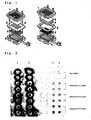
- Fig. 1 is an outline view of the dot blotting apparatus used in Example 1.
- Fig. 2 shows one example of image data of BSA (bovine serum albumin) preparation and amino acid + BSA sample in Example 1.
- BSA bovine serum albumin
- Lanes 1, 2 amino acid + BSA sample; Lanes 3, 4: BSA preparation.
- Fig. 3 shows a calculation method of concentration of a protein in amino acid according to a standard addition method in Example 1.
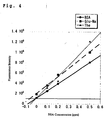
- Fig. 4 shows a measurement result of protein (standard addition method) in "Glu-Na” (sodium L-glutamate monohydrate) and "The” (L-theanine), according to a dot blotting-fluorescent staining method in Example 1.
- Glu-Na sodium L-glutamate monohydrate
- The Li-theanine
- Horizontal axis BSA concentration (ppm); Vertical axis: Fluorescence intensity.
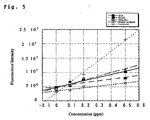
- Fig. 5 shows a measurement result of protein in BSA, lysozyme, ubiquitin, insulin and oxidized insulin B-chain, according to a dot blotting-fluorescent staining in Example 2.
- Horizontal axis Protein concentration (ppm); Vertical axis: Fluorescence intensity.
- the sample to be analyzed is applied onto a membrane for protein fixation to thereby fix the protein in the sample on the membrane, according to a dot blotting method.
- a solution of the sample is subjected to fixation.
- One typical example of the dot blotting method comprises putting, for example, a nitrocellulose membrane, a polyvinylidene difluoride membrane (PVDF membrane) or the like between acrylic plates having a large number of holes formed therein, then injecting a protein solution into a hole on the membrane, and subjecting it to suction filtration by aspirator to thereby fix the protein on the membrane.
- PVDF membrane polyvinylidene difluoride membrane
- the protein fixed on the above membrane is stained according to a fluorescent staining, and subsequently this is determined.
- a fluorescent staining reagent for protein gel separated through SDS electrophoresis.
- the advantage of this reagent is that it enables rapid and simple staining at high sensitivity for accurate quantification as compared with conventional methods, or the like. This may be used, for example, for detection or quantification of protein fixed on a PVDF membrane. In protein quantification at a higher sensitivity, the loss may be greater owing to adsorption to vessels or the like in ordinary operation, and detection may be difficult.
- the combination of dot blotting and fluorescent staining provides a method of analyzing protein contained in trace amounts within a relatively short period of time (approximately 4 or 5 hours from the sample preparation and the image analysis), at high sensitivity for accurate quantification.
- the former may be somewhat inferior to the latter in point of the sensitivity but is superior to the latter in that all the proteins held on the membrane can be detected and determined in the former.
- smaller proteins could be detected so far as they are highly hydrophobic, and when preferred membranes for protein fixation are selected or developed, then they could also be detected.
- their detection sensitivity per weight is higher when their solubility is higher.
- any of acid, neutral or alkaline solvent may be used. Therefore, samples may be dissolved in a solvent having a pH value that is the most suitable for the solubility of the samples, and, as a result, the detection sensitivity can be improved.
- the dot blotting-fluorescent staining method according to the present invention enables detection of all i.e. total proteins, and therefore enables evaluation of the proteins irrespective of the presence or absence of antigenicity in protein. Accordingly, it can be said that the method according to the present invention is a measurement method of higher reliability.
- a solution sample is used directly as it is.
- a solid sample is dissolved in a solution having a high solubility to give a possibly highest concentration thereof.
- Amino acids have a high solubility in acid solutions. Therefore, it is desirable that amino acids are dissolved in aqueous 3.5 % hydrochloric acid solution.
- samples with a standard protein e.g., bovine serum albumin, BSA
- BSA bovine serum albumin
- the protein in the sample is trapped on a nitrocellulose membrane or a PVDF membrane and, at the same time, measurement-disturbing substances are removed from the sample.
- a 96-well dot blotting apparatus can be purchased from a market, and when this is used, multiple samples can be processed at a time.
- the sample After the sample is injected, this is sucked with an aspirator, whereby the protein in the sample is adsorbed by the membrane for protein fixation.
- a PVDF membrane of high absorbability is preferable.
- water is injected a few times into it, and then aspirated, whereby the analysis-disturbing substances remaining on the membrane can be removed.
- amino acid samples amino acids reacting with the staining solution, as well as disturbing low-molecular substances and hydrochloric acid and the like can be removed.
- the washed membrane is taken out of the blotting apparatus (dot blotting apparatus, see Fig. 1 ), and dried enough.
- a fluorescent staining reagent SyproRuby (manufactured by Molecular Dynamics) developed for proteome analysis is a reagent of high sensitivity and good quantification, and this reagent is preferably used.
- the thus-obtained dry membrane is subjected to treatment with acetic acid-methanol solution, whereby the protein is fixed on it, and then the protein is stained with a fluorescent staining reagent. Next, the membrane is washed, and then analyzed preferably by the use of a fluorescent image analyzer.
- the each sample analyzed and the BSA-added sample thereof are observed as spots. It is recommendable to obtain the area intensity of each spot, and subsequently, plot the data on a graph with the amount of the standard protein on the horizontal axis and the fluorescent area intensity on the vertical axis.
- the test sample data are extrapolated to the line horizontally drawn from it and the section thereof indicates the protein concentration in the test sample.
- BSA was used as the standard protein, at least 0.1 ppm of BSA was able to detect:
- the detection sensitivity can directly apply as it is.
- the detection sensitivity to solid samples depends on the solubility of the samples. The sample to be analyzed is dissolved in a solvent in which the solubility of the sample is the highest, so that the highest detection sensitivity to the sample can be obtained.
- acids and alkalis may be removed after proteins have been adsorbed by membranes. Therefore, the method is also excellent in that it does not receive any limitation on the type of solvents.
- tyrosine and cystine and the like that are neutral and have a low solubility can have an increased solubility when they are acidified.
- the present invention is extremely useful, and is much expected.
- the experiment protocol including the analysis protocol and experiment operation is mentioned below.
- Fig. 2 One example of the image obtained according to the dot blotting method is shown in Fig. 2 .
- the spot concentration of the BSA preparation increases with the increase in the amount thereof.
- a spot in added amount 0.1 ⁇ g/ml (0.1 ppm) of BSA is obviously observed. Therefore, this confirms that the present invention enables detection of at least 0.1 ppm protein.
- the same spot concentration change is also observed in the actual amino acid samples, and in addition, doughnut-like fluorescent circles concentric with sample spots are observed. This may be because the amino acid wetted around the wells while removed under reduced pressure would have reacted with the fluorescent reagent. Accordingly, in quantitative analysis, it has been decided that the product (volume) of the fluorescent intensity in the spot part is adopted.
- Protein concentration in the actual samples is calculated according to the following formula, using on the dilution ratio of each amino acid.
- Protein concentration in actual sample ( protein concentration in solution obtained according to standard addition method ) ⁇ ( dilution ratio ) .
- Dilution ratio 14.3 times for Asp, Cys, Glu, Phe, Tyr, Gln, Trp; and 8.3 times for the others than these.
- BSA bovine serum albumin
- Fig. 3 shows a method of calculating the protein concentration in amino acid according to a standard addition method, in which the arrow indicates the protein concentration in an amino acid solution.
- Fig. 4 shows measurement results (standard addition method) of protein in amino acids for food additives, GluNaH 2 O (sodium L-glutamate monohydrate) and The (L-theanine), according to a dot blotting-fluorescent staining method.
- the amino acid concentration is kept constant.
- the detection sensitivity can be further increased.
- Protein having a large molecular weight becomes allergen easily, and such high-molecular-weight protein is readily detected in ELISA.
- protein having a lower molecular weight may be allergen, so that it is desirable that protein having a lower molecular weight and peptide could be detected at high sensitivity.
- proteins having a different molecular weight BSA (66 kDa), lysozyme (14 kDa), ubiquitin (8.6 kDa), insulin (5.7 kDa) and oxidized insulin B chain (3.5 kDa) were tested for the minimum limit of detection and the quantification ability thereof.
- each protein was suitably diluted and its calibration curve was formed according to the dot blotting-fluorescent staining method.
- all proteins had calibration curves of high linearity, and their minimum limit of detection was 0.1 ppm (but the minimum limit of detection of oxidized insulin B chain was only 0.2 ppm). This confirmed a detection of even proteins having a low molecular weight at high-sensitivity.
- the present invention provides a method of analyzing total protein.
- a protein such as allergic substance contained in trace amounts in foods, drinks, food additives, medicaments, cosmetics, feeds, etc. can be analyzed in a simplified manner at high sensitivity.
- the present invention can be carried out widely in various industrial fields especially in those of foods, medicaments, cosmetics, feeds, etc., and its usefulness is obvious.
Landscapes
- Life Sciences & Earth Sciences (AREA)
- Health & Medical Sciences (AREA)
- Molecular Biology (AREA)
- Engineering & Computer Science (AREA)
- Urology & Nephrology (AREA)
- Biomedical Technology (AREA)
- Physics & Mathematics (AREA)
- Chemical & Material Sciences (AREA)
- Immunology (AREA)
- Hematology (AREA)
- Cell Biology (AREA)
- Analytical Chemistry (AREA)
- Proteomics, Peptides & Aminoacids (AREA)
- Biophysics (AREA)
- Bioinformatics & Computational Biology (AREA)
- Microbiology (AREA)
- Bioinformatics & Cheminformatics (AREA)
- Food Science & Technology (AREA)
- Medicinal Chemistry (AREA)
- Biotechnology (AREA)
- Biochemistry (AREA)
- General Health & Medical Sciences (AREA)
- General Physics & Mathematics (AREA)
- Pathology (AREA)
- Investigating Or Analysing Biological Materials (AREA)
- Investigating Or Analysing Materials By The Use Of Chemical Reactions (AREA)
- Investigating, Analyzing Materials By Fluorescence Or Luminescence (AREA)
Claims (7)
- Méthode d'analyse quantitative d'une protéine totale dans une solution selon une méthode d'addition standard dans laquelle une protéine standard est ajoutée à des échantillons de la solution, et les échantillons sont ensuite soumis à une hybridation sur tache sur une membrane et ensuite à une coloration avec un réactif de coloration fluorescent et à la détermination de la coloration.
- Méthode selon la revendication 1, où la protéine standard ajoutée est de l'albumine du sérum bovin.
- Méthode selon la revendication 2, où l'addition de l'albumine du sérum bovin à l'échantillon se situe à un niveau de 0 à 0,5 µg/ml.
- Méthode selon l'une quelconque des revendications précédentes, où la membrane est une membrane de nitrocellulose ou une membrane PVDF.
- Méthode selon l'une quelconque des revendications 1 à 4, où la solution est un aliment, une boisson, un additif d'aliment, médicament ou aliment, ou bien où la solution est produite en dissolvant un échantillon solide d'un aliment, boisson, additif d'aliment, médicament ou aliment pour animaux.
- Méthode selon l'une quelconque des revendications précédentes, où la solution analysée est produite en dissolvant un échantillon d'acides aminés.
- Méthode selon la revendication 6, où l'échantillon d'acides aminés pour l'hybridation sur tache est dissout dans une solution acide.
Applications Claiming Priority (3)
| Application Number | Priority Date | Filing Date | Title |
|---|---|---|---|
| JP2002217099 | 2002-07-25 | ||
| JP2002217099 | 2002-07-25 | ||
| PCT/JP2003/009305 WO2004011948A1 (fr) | 2002-07-25 | 2003-07-23 | Methode d'analyse d'une proteine |
Publications (3)
| Publication Number | Publication Date |
|---|---|
| EP1544618A1 EP1544618A1 (fr) | 2005-06-22 |
| EP1544618A4 EP1544618A4 (fr) | 2006-07-12 |
| EP1544618B1 true EP1544618B1 (fr) | 2009-03-18 |
Family
ID=31184595
Family Applications (1)
| Application Number | Title | Priority Date | Filing Date |
|---|---|---|---|
| EP03771282A Expired - Lifetime EP1544618B1 (fr) | 2002-07-25 | 2003-07-23 | Methode d'analyse d'une proteine |
Country Status (7)
| Country | Link |
|---|---|
| US (1) | US20050147720A1 (fr) |
| EP (1) | EP1544618B1 (fr) |
| JP (1) | JPWO2004011948A1 (fr) |
| AT (1) | ATE426173T1 (fr) |
| AU (1) | AU2003252235A1 (fr) |
| DE (1) | DE60326740D1 (fr) |
| WO (1) | WO2004011948A1 (fr) |
Families Citing this family (5)
| Publication number | Priority date | Publication date | Assignee | Title |
|---|---|---|---|---|
| JP4913391B2 (ja) * | 2004-12-24 | 2012-04-11 | 株式会社生体分子計測研究所 | 抗変性蛋白質抗体精製キット及び蛋白質の検出方法 |
| EP1912065B1 (fr) * | 2005-07-27 | 2015-02-18 | Ajinomoto Co., Inc. | Méthode pour analyser l'albumine dans un prélèvement en solution |
| WO2009048895A2 (fr) * | 2007-10-07 | 2009-04-16 | Jordan Scott | Dispositif portatif de détection d'allergènes alimentaires |
| SG11201908865WA (en) * | 2017-06-29 | 2019-10-30 | Quanticision Diagnostics Inc | Apparatus and method for absolute quantification of biomarkers for solid tumor diagnosis |
| US11781991B2 (en) | 2017-11-10 | 2023-10-10 | Meiji Co., Ltd. | Method for detecting protein |
Family Cites Families (8)
| Publication number | Priority date | Publication date | Assignee | Title |
|---|---|---|---|---|
| US5705649A (en) * | 1992-07-20 | 1998-01-06 | Promega Corporation | Protein staining compositions and methods |
| DE19514089C2 (de) * | 1995-04-13 | 1997-07-10 | Deutsches Krebsforsch | Nachweisverfahren für HIV-TAT |
| US5616502A (en) * | 1995-05-19 | 1997-04-01 | Molecular Probes, Inc. | Non-specific protein staining using merocyanine dyes |
| JPH08338842A (ja) * | 1995-06-12 | 1996-12-24 | Tokuyama Corp | 梅毒抗原の製造方法 |
| WO1998003875A1 (fr) * | 1996-07-24 | 1998-01-29 | Helena Laboratories Corporation | Reactifs et procedes destines a l'analyse par fluorescence de proteines seriques |
| JP3069298B2 (ja) * | 1996-11-07 | 2000-07-24 | 株式会社分子バイオホトニクス研究所 | ポリアミン分析方法 |
| ATE349700T1 (de) * | 1998-10-27 | 2007-01-15 | Molecular Probes Inc | Übergangsmetallkomplex-haltige lumineszente proteinfarben |
| US6329205B1 (en) * | 1999-08-31 | 2001-12-11 | Molecular Probes, Inc. | Detection method using luminescent europium-based protein stains |
-
2003
- 2003-07-23 WO PCT/JP2003/009305 patent/WO2004011948A1/fr not_active Ceased
- 2003-07-23 DE DE60326740T patent/DE60326740D1/de not_active Expired - Fee Related
- 2003-07-23 JP JP2004524123A patent/JPWO2004011948A1/ja active Pending
- 2003-07-23 AT AT03771282T patent/ATE426173T1/de not_active IP Right Cessation
- 2003-07-23 AU AU2003252235A patent/AU2003252235A1/en not_active Abandoned
- 2003-07-23 EP EP03771282A patent/EP1544618B1/fr not_active Expired - Lifetime
-
2005
- 2005-01-24 US US11/039,791 patent/US20050147720A1/en not_active Abandoned
Non-Patent Citations (5)
| Title |
|---|
| ALBA, F.J. ET AL., ELECTROPHORESIS, vol. 19, no. 14, 1998, pages 2407 - 2411 * |
| BIO-RAD: "Quick Start (TM) Bradford Protein Assay", INSTRUCTION MANUAL * |
| BRADFORD, M.M., ANALYTICAL CHEMISTRY, vol. 72, 1976, pages 248 - 254 * |
| DATABASE WIKIPEDIA retrieved from HTTP://EN.WIKIPEDIA.ORG/WIKI Database accession no. http://en.wikipedia.org/wiki/Standard_addition * |
| LEWIS, S. ET AL., ECOTOXICOLOGY, vol. 8, October 1999 (1999-10-01), pages 351 - 368 * |
Also Published As
| Publication number | Publication date |
|---|---|
| US20050147720A1 (en) | 2005-07-07 |
| EP1544618A4 (fr) | 2006-07-12 |
| EP1544618A1 (fr) | 2005-06-22 |
| ATE426173T1 (de) | 2009-04-15 |
| AU2003252235A1 (en) | 2004-02-16 |
| WO2004011948A1 (fr) | 2004-02-05 |
| JPWO2004011948A1 (ja) | 2005-11-24 |
| DE60326740D1 (de) | 2009-04-30 |
Similar Documents
| Publication | Publication Date | Title |
|---|---|---|
| US9625469B2 (en) | Identifying peptides at the single molecule level | |
| US7186799B2 (en) | Peptide and amine examination method using the same | |
| Anna et al. | Methods for 20S immunoproteasome and 20S constitutive proteasome determination based on SPRI biosensors | |
| EP1544618A1 (fr) | Methode d'analyse d'une proteine | |
| EP1767940A1 (fr) | Procédé de détection et/ou d"examen rapide d"antigène par spectrométrie par corrélation de fluorescence | |
| JP6017724B1 (ja) | 十二指腸液試料の膵液由来成分検出用試料としての適性評価方法 | |
| US20240393245A1 (en) | Quantification method of polysorbate in aqueous formulations | |
| US20210317505A1 (en) | Improved detection of anticoagulants in body fluids | |
| CA2513317A1 (fr) | Composition contenant de l'aldolase pour le diagnostic d'une maladie vasculaire au niveau de la retine et methode diagnostique connexe | |
| CN108918891B (zh) | 与人类蛋白nrf1相互作用的结核蛋白及其应用 | |
| US11014088B2 (en) | Sensitive ELISA for disease diagnosis on surface modified poly(methyl methacrylate) (PMMA) microfluidic microplates | |
| Huang | Development and evaluation of an automated dye-binding assay for protein in cerebrospinal fluid. | |
| CN121499823A (zh) | 一种检测寄主昆虫寄生状态的试纸条 | |
| JPWO2011096440A1 (ja) | 天然変性タンパク質に結合する化合物およびそのスクリーニング方法 | |
| JP2007147539A (ja) | 免疫分析法、タンパク質分析装置及び免疫分析用マイクロフローセル | |
| JP2005099001A (ja) | 抗ペプチド抗体測定法とペプチドワクチンのワクチン候補選択方法 | |
| US20070037213A1 (en) | Method of analyzing protein and kit for analyzing protein | |
| Müller | Protein Chips and Biosensors for Biopharmaceutical Process Analytics | |
| RU2169925C1 (ru) | Способ определения активности лейцинаминопептидазы | |
| US20220404350A1 (en) | Method for determination of aggregates | |
| JP3481015B2 (ja) | 免疫比濁測定法 | |
| CA2487483A1 (fr) | Dispositif de presentation de peptides ou de proteines, son procede de preparation et ses utilisations | |
| JP2025075839A (ja) | 膜タンパク質アレイ | |
| US20050272100A1 (en) | Separation and quantification of biotinylated macromolecules | |
| TWI322818B (en) | Peptide and method for dectecing amine using the same |
Legal Events
| Date | Code | Title | Description |
|---|---|---|---|
| PUAI | Public reference made under article 153(3) epc to a published international application that has entered the european phase |
Free format text: ORIGINAL CODE: 0009012 |
|
| 17P | Request for examination filed |
Effective date: 20050214 |
|
| AK | Designated contracting states |
Kind code of ref document: A1 Designated state(s): AT BE BG CH CY CZ DE DK EE ES FI FR GB GR HU IE IT LI LU MC NL PT RO SE SI SK TR |
|
| AX | Request for extension of the european patent |
Extension state: AL LT LV MK |
|
| DAX | Request for extension of the european patent (deleted) | ||
| A4 | Supplementary search report drawn up and despatched |
Effective date: 20060612 |
|
| 17Q | First examination report despatched |
Effective date: 20070423 |
|
| GRAP | Despatch of communication of intention to grant a patent |
Free format text: ORIGINAL CODE: EPIDOSNIGR1 |
|
| GRAS | Grant fee paid |
Free format text: ORIGINAL CODE: EPIDOSNIGR3 |
|
| GRAA | (expected) grant |
Free format text: ORIGINAL CODE: 0009210 |
|
| AK | Designated contracting states |
Kind code of ref document: B1 Designated state(s): AT BE BG CH CY CZ DE DK EE ES FI FR GB GR HU IE IT LI LU MC NL PT RO SE SI SK TR |
|
| REG | Reference to a national code |
Ref country code: GB Ref legal event code: FG4D |
|
| REG | Reference to a national code |
Ref country code: CH Ref legal event code: EP |
|
| REG | Reference to a national code |
Ref country code: IE Ref legal event code: FG4D |
|
| REF | Corresponds to: |
Ref document number: 60326740 Country of ref document: DE Date of ref document: 20090430 Kind code of ref document: P |
|
| PG25 | Lapsed in a contracting state [announced via postgrant information from national office to epo] |
Ref country code: FI Free format text: LAPSE BECAUSE OF FAILURE TO SUBMIT A TRANSLATION OF THE DESCRIPTION OR TO PAY THE FEE WITHIN THE PRESCRIBED TIME-LIMIT Effective date: 20090318 Ref country code: NL Free format text: LAPSE BECAUSE OF FAILURE TO SUBMIT A TRANSLATION OF THE DESCRIPTION OR TO PAY THE FEE WITHIN THE PRESCRIBED TIME-LIMIT Effective date: 20090318 Ref country code: SI Free format text: LAPSE BECAUSE OF FAILURE TO SUBMIT A TRANSLATION OF THE DESCRIPTION OR TO PAY THE FEE WITHIN THE PRESCRIBED TIME-LIMIT Effective date: 20090318 |
|
| PG25 | Lapsed in a contracting state [announced via postgrant information from national office to epo] |
Ref country code: SE Free format text: LAPSE BECAUSE OF FAILURE TO SUBMIT A TRANSLATION OF THE DESCRIPTION OR TO PAY THE FEE WITHIN THE PRESCRIBED TIME-LIMIT Effective date: 20090618 Ref country code: AT Free format text: LAPSE BECAUSE OF FAILURE TO SUBMIT A TRANSLATION OF THE DESCRIPTION OR TO PAY THE FEE WITHIN THE PRESCRIBED TIME-LIMIT Effective date: 20090318 |
|
| NLV1 | Nl: lapsed or annulled due to failure to fulfill the requirements of art. 29p and 29m of the patents act | ||
| PG25 | Lapsed in a contracting state [announced via postgrant information from national office to epo] |
Ref country code: BE Free format text: LAPSE BECAUSE OF FAILURE TO SUBMIT A TRANSLATION OF THE DESCRIPTION OR TO PAY THE FEE WITHIN THE PRESCRIBED TIME-LIMIT Effective date: 20090318 |
|
| PG25 | Lapsed in a contracting state [announced via postgrant information from national office to epo] |
Ref country code: ES Free format text: LAPSE BECAUSE OF FAILURE TO SUBMIT A TRANSLATION OF THE DESCRIPTION OR TO PAY THE FEE WITHIN THE PRESCRIBED TIME-LIMIT Effective date: 20090629 Ref country code: CZ Free format text: LAPSE BECAUSE OF FAILURE TO SUBMIT A TRANSLATION OF THE DESCRIPTION OR TO PAY THE FEE WITHIN THE PRESCRIBED TIME-LIMIT Effective date: 20090318 Ref country code: PT Free format text: LAPSE BECAUSE OF FAILURE TO SUBMIT A TRANSLATION OF THE DESCRIPTION OR TO PAY THE FEE WITHIN THE PRESCRIBED TIME-LIMIT Effective date: 20090826 Ref country code: EE Free format text: LAPSE BECAUSE OF FAILURE TO SUBMIT A TRANSLATION OF THE DESCRIPTION OR TO PAY THE FEE WITHIN THE PRESCRIBED TIME-LIMIT Effective date: 20090318 |
|
| PG25 | Lapsed in a contracting state [announced via postgrant information from national office to epo] |
Ref country code: SK Free format text: LAPSE BECAUSE OF FAILURE TO SUBMIT A TRANSLATION OF THE DESCRIPTION OR TO PAY THE FEE WITHIN THE PRESCRIBED TIME-LIMIT Effective date: 20090318 Ref country code: RO Free format text: LAPSE BECAUSE OF FAILURE TO SUBMIT A TRANSLATION OF THE DESCRIPTION OR TO PAY THE FEE WITHIN THE PRESCRIBED TIME-LIMIT Effective date: 20090318 |
|
| PLBE | No opposition filed within time limit |
Free format text: ORIGINAL CODE: 0009261 |
|
| STAA | Information on the status of an ep patent application or granted ep patent |
Free format text: STATUS: NO OPPOSITION FILED WITHIN TIME LIMIT |
|
| PG25 | Lapsed in a contracting state [announced via postgrant information from national office to epo] |
Ref country code: BG Free format text: LAPSE BECAUSE OF FAILURE TO SUBMIT A TRANSLATION OF THE DESCRIPTION OR TO PAY THE FEE WITHIN THE PRESCRIBED TIME-LIMIT Effective date: 20090618 Ref country code: DK Free format text: LAPSE BECAUSE OF FAILURE TO SUBMIT A TRANSLATION OF THE DESCRIPTION OR TO PAY THE FEE WITHIN THE PRESCRIBED TIME-LIMIT Effective date: 20090318 |
|
| 26N | No opposition filed |
Effective date: 20091221 |
|
| PG25 | Lapsed in a contracting state [announced via postgrant information from national office to epo] |
Ref country code: MC Free format text: LAPSE BECAUSE OF NON-PAYMENT OF DUE FEES Effective date: 20090731 |
|
| REG | Reference to a national code |
Ref country code: CH Ref legal event code: PL |
|
| GBPC | Gb: european patent ceased through non-payment of renewal fee |
Effective date: 20090723 |
|
| PG25 | Lapsed in a contracting state [announced via postgrant information from national office to epo] |
Ref country code: LI Free format text: LAPSE BECAUSE OF NON-PAYMENT OF DUE FEES Effective date: 20090731 Ref country code: CH Free format text: LAPSE BECAUSE OF NON-PAYMENT OF DUE FEES Effective date: 20090731 |
|
| PG25 | Lapsed in a contracting state [announced via postgrant information from national office to epo] |
Ref country code: GB Free format text: LAPSE BECAUSE OF NON-PAYMENT OF DUE FEES Effective date: 20090723 |
|
| PG25 | Lapsed in a contracting state [announced via postgrant information from national office to epo] |
Ref country code: DE Free format text: LAPSE BECAUSE OF NON-PAYMENT OF DUE FEES Effective date: 20100202 |
|
| PG25 | Lapsed in a contracting state [announced via postgrant information from national office to epo] |
Ref country code: IE Free format text: LAPSE BECAUSE OF NON-PAYMENT OF DUE FEES Effective date: 20090723 |
|
| PG25 | Lapsed in a contracting state [announced via postgrant information from national office to epo] |
Ref country code: GR Free format text: LAPSE BECAUSE OF FAILURE TO SUBMIT A TRANSLATION OF THE DESCRIPTION OR TO PAY THE FEE WITHIN THE PRESCRIBED TIME-LIMIT Effective date: 20090619 |
|
| PGFP | Annual fee paid to national office [announced via postgrant information from national office to epo] |
Ref country code: FR Payment date: 20100805 Year of fee payment: 8 |
|
| PG25 | Lapsed in a contracting state [announced via postgrant information from national office to epo] |
Ref country code: IT Free format text: LAPSE BECAUSE OF FAILURE TO SUBMIT A TRANSLATION OF THE DESCRIPTION OR TO PAY THE FEE WITHIN THE PRESCRIBED TIME-LIMIT Effective date: 20090318 |
|
| PG25 | Lapsed in a contracting state [announced via postgrant information from national office to epo] |
Ref country code: LU Free format text: LAPSE BECAUSE OF NON-PAYMENT OF DUE FEES Effective date: 20090723 |
|
| PG25 | Lapsed in a contracting state [announced via postgrant information from national office to epo] |
Ref country code: HU Free format text: LAPSE BECAUSE OF FAILURE TO SUBMIT A TRANSLATION OF THE DESCRIPTION OR TO PAY THE FEE WITHIN THE PRESCRIBED TIME-LIMIT Effective date: 20090919 |
|
| PG25 | Lapsed in a contracting state [announced via postgrant information from national office to epo] |
Ref country code: TR Free format text: LAPSE BECAUSE OF FAILURE TO SUBMIT A TRANSLATION OF THE DESCRIPTION OR TO PAY THE FEE WITHIN THE PRESCRIBED TIME-LIMIT Effective date: 20090318 |
|
| PG25 | Lapsed in a contracting state [announced via postgrant information from national office to epo] |
Ref country code: CY Free format text: LAPSE BECAUSE OF FAILURE TO SUBMIT A TRANSLATION OF THE DESCRIPTION OR TO PAY THE FEE WITHIN THE PRESCRIBED TIME-LIMIT Effective date: 20090318 |
|
| REG | Reference to a national code |
Ref country code: FR Ref legal event code: ST Effective date: 20120330 |
|
| PG25 | Lapsed in a contracting state [announced via postgrant information from national office to epo] |
Ref country code: FR Free format text: LAPSE BECAUSE OF NON-PAYMENT OF DUE FEES Effective date: 20110801 |