EP1544313B1 - Faserverstärkter metallischer Verbundwerkstoff - Google Patents
Faserverstärkter metallischer Verbundwerkstoff Download PDFInfo
- Publication number
- EP1544313B1 EP1544313B1 EP04028396.2A EP04028396A EP1544313B1 EP 1544313 B1 EP1544313 B1 EP 1544313B1 EP 04028396 A EP04028396 A EP 04028396A EP 1544313 B1 EP1544313 B1 EP 1544313B1
- Authority
- EP
- European Patent Office
- Prior art keywords
- composite material
- material according
- weight
- fibres
- oxide
- Prior art date
- Legal status (The legal status is an assumption and is not a legal conclusion. Google has not performed a legal analysis and makes no representation as to the accuracy of the status listed.)
- Expired - Lifetime
Links
- 239000000835 fiber Substances 0.000 title description 28
- 239000011156 metal matrix composite Substances 0.000 title description 2
- 239000002131 composite material Substances 0.000 claims description 36
- 229910052751 metal Inorganic materials 0.000 claims description 19
- 239000002184 metal Substances 0.000 claims description 19
- 239000000463 material Substances 0.000 claims description 18
- UQSXHKLRYXJYBZ-UHFFFAOYSA-N Iron oxide Chemical compound [Fe]=O UQSXHKLRYXJYBZ-UHFFFAOYSA-N 0.000 claims description 12
- 239000011159 matrix material Substances 0.000 claims description 9
- VYPSYNLAJGMNEJ-UHFFFAOYSA-N Silicium dioxide Chemical compound O=[Si]=O VYPSYNLAJGMNEJ-UHFFFAOYSA-N 0.000 claims description 8
- 229910052782 aluminium Inorganic materials 0.000 claims description 7
- XAGFODPZIPBFFR-UHFFFAOYSA-N aluminium Chemical compound [Al] XAGFODPZIPBFFR-UHFFFAOYSA-N 0.000 claims description 7
- 239000000395 magnesium oxide Substances 0.000 claims description 7
- CPLXHLVBOLITMK-UHFFFAOYSA-N magnesium oxide Inorganic materials [Mg]=O CPLXHLVBOLITMK-UHFFFAOYSA-N 0.000 claims description 7
- AXZKOIWUVFPNLO-UHFFFAOYSA-N magnesium;oxygen(2-) Chemical compound [O-2].[Mg+2] AXZKOIWUVFPNLO-UHFFFAOYSA-N 0.000 claims description 7
- 150000002739 metals Chemical class 0.000 claims description 7
- FYYHWMGAXLPEAU-UHFFFAOYSA-N Magnesium Chemical compound [Mg] FYYHWMGAXLPEAU-UHFFFAOYSA-N 0.000 claims description 6
- RTAQQCXQSZGOHL-UHFFFAOYSA-N Titanium Chemical compound [Ti] RTAQQCXQSZGOHL-UHFFFAOYSA-N 0.000 claims description 6
- 229910045601 alloy Inorganic materials 0.000 claims description 6
- 239000000956 alloy Substances 0.000 claims description 6
- 229910052749 magnesium Inorganic materials 0.000 claims description 6
- 239000011777 magnesium Substances 0.000 claims description 6
- 238000000034 method Methods 0.000 claims description 6
- 229910052814 silicon oxide Inorganic materials 0.000 claims description 6
- 239000010936 titanium Substances 0.000 claims description 6
- 229910052719 titanium Inorganic materials 0.000 claims description 6
- GQPLMRYTRLFLPF-UHFFFAOYSA-N Nitrous Oxide Chemical compound [O-][N+]#N GQPLMRYTRLFLPF-UHFFFAOYSA-N 0.000 claims description 5
- ODINCKMPIJJUCX-UHFFFAOYSA-N Calcium oxide Chemical compound [Ca]=O ODINCKMPIJJUCX-UHFFFAOYSA-N 0.000 claims description 4
- 229910052500 inorganic mineral Inorganic materials 0.000 claims description 4
- 239000011707 mineral Substances 0.000 claims description 4
- TWNQGVIAIRXVLR-UHFFFAOYSA-N oxo(oxoalumanyloxy)alumane Chemical compound O=[Al]O[Al]=O TWNQGVIAIRXVLR-UHFFFAOYSA-N 0.000 claims description 4
- 230000002787 reinforcement Effects 0.000 claims description 4
- 239000002245 particle Substances 0.000 claims description 3
- 230000003014 reinforcing effect Effects 0.000 claims description 3
- GWEVSGVZZGPLCZ-UHFFFAOYSA-N Titan oxide Chemical compound O=[Ti]=O GWEVSGVZZGPLCZ-UHFFFAOYSA-N 0.000 claims description 2
- 239000011248 coating agent Substances 0.000 claims description 2
- 238000000576 coating method Methods 0.000 claims description 2
- 239000004411 aluminium Substances 0.000 claims 3
- JEIPFZHSYJVQDO-UHFFFAOYSA-N iron(III) oxide Inorganic materials O=[Fe]O[Fe]=O JEIPFZHSYJVQDO-UHFFFAOYSA-N 0.000 claims 2
- 239000001272 nitrous oxide Substances 0.000 claims 2
- 230000001681 protective effect Effects 0.000 claims 2
- FZFYOUJTOSBFPQ-UHFFFAOYSA-M dipotassium;hydroxide Chemical compound [OH-].[K+].[K+] FZFYOUJTOSBFPQ-UHFFFAOYSA-M 0.000 claims 1
- 239000004744 fabric Substances 0.000 claims 1
- 238000004519 manufacturing process Methods 0.000 description 10
- 229920002748 Basalt fiber Polymers 0.000 description 5
- 229910018072 Al 2 O 3 Inorganic materials 0.000 description 4
- 229910004298 SiO 2 Inorganic materials 0.000 description 4
- XEEYBQQBJWHFJM-UHFFFAOYSA-N iron Substances [Fe] XEEYBQQBJWHFJM-UHFFFAOYSA-N 0.000 description 4
- 239000002648 laminated material Substances 0.000 description 4
- 239000012783 reinforcing fiber Substances 0.000 description 4
- 230000003068 static effect Effects 0.000 description 4
- 229910000881 Cu alloy Inorganic materials 0.000 description 3
- 238000010276 construction Methods 0.000 description 3
- 239000007769 metal material Substances 0.000 description 3
- 239000004033 plastic Substances 0.000 description 3
- 229910000838 Al alloy Inorganic materials 0.000 description 2
- PNEYBMLMFCGWSK-UHFFFAOYSA-N aluminium oxide Inorganic materials [O-2].[O-2].[O-2].[Al+3].[Al+3] PNEYBMLMFCGWSK-UHFFFAOYSA-N 0.000 description 2
- 229910052799 carbon Inorganic materials 0.000 description 2
- 239000000470 constituent Substances 0.000 description 2
- 239000003733 fiber-reinforced composite Substances 0.000 description 2
- 239000000203 mixture Substances 0.000 description 2
- 239000011435 rock Substances 0.000 description 2
- 229910001148 Al-Li alloy Inorganic materials 0.000 description 1
- OKTJSMMVPCPJKN-UHFFFAOYSA-N Carbon Chemical compound [C] OKTJSMMVPCPJKN-UHFFFAOYSA-N 0.000 description 1
- RYGMFSIKBFXOCR-UHFFFAOYSA-N Copper Chemical compound [Cu] RYGMFSIKBFXOCR-UHFFFAOYSA-N 0.000 description 1
- WHXSMMKQMYFTQS-UHFFFAOYSA-N Lithium Chemical compound [Li] WHXSMMKQMYFTQS-UHFFFAOYSA-N 0.000 description 1
- 229910000861 Mg alloy Inorganic materials 0.000 description 1
- 229910001069 Ti alloy Inorganic materials 0.000 description 1
- 229910010413 TiO 2 Inorganic materials 0.000 description 1
- 241000356114 Trachytes Species 0.000 description 1
- 229910001297 Zn alloy Inorganic materials 0.000 description 1
- JFBZPFYRPYOZCQ-UHFFFAOYSA-N [Li].[Al] Chemical compound [Li].[Al] JFBZPFYRPYOZCQ-UHFFFAOYSA-N 0.000 description 1
- 239000000853 adhesive Substances 0.000 description 1
- 230000001070 adhesive effect Effects 0.000 description 1
- 239000002313 adhesive film Substances 0.000 description 1
- WPPDFTBPZNZZRP-UHFFFAOYSA-N aluminum copper Chemical compound [Al].[Cu] WPPDFTBPZNZZRP-UHFFFAOYSA-N 0.000 description 1
- FJMNNXLGOUYVHO-UHFFFAOYSA-N aluminum zinc Chemical compound [Al].[Zn] FJMNNXLGOUYVHO-UHFFFAOYSA-N 0.000 description 1
- 150000001408 amides Chemical class 0.000 description 1
- 229920003235 aromatic polyamide Polymers 0.000 description 1
- 125000003118 aryl group Chemical group 0.000 description 1
- 239000010953 base metal Substances 0.000 description 1
- 239000000292 calcium oxide Substances 0.000 description 1
- BRPQOXSCLDDYGP-UHFFFAOYSA-N calcium oxide Chemical compound [O-2].[Ca+2] BRPQOXSCLDDYGP-UHFFFAOYSA-N 0.000 description 1
- 150000001875 compounds Chemical class 0.000 description 1
- 239000010949 copper Substances 0.000 description 1
- 230000007797 corrosion Effects 0.000 description 1
- 238000005260 corrosion Methods 0.000 description 1
- 238000011161 development Methods 0.000 description 1
- 230000018109 developmental process Effects 0.000 description 1
- 239000011888 foil Substances 0.000 description 1
- 239000011521 glass Substances 0.000 description 1
- 239000003365 glass fiber Substances 0.000 description 1
- 239000010438 granite Substances 0.000 description 1
- 239000011261 inert gas Substances 0.000 description 1
- 239000012774 insulation material Substances 0.000 description 1
- 229910052744 lithium Inorganic materials 0.000 description 1
- 239000001989 lithium alloy Substances 0.000 description 1
- 238000002844 melting Methods 0.000 description 1
- 230000008018 melting Effects 0.000 description 1
- 239000005332 obsidian Substances 0.000 description 1
- 229920000728 polyester Polymers 0.000 description 1
- 229920005594 polymer fiber Polymers 0.000 description 1
- 238000004663 powder metallurgy Methods 0.000 description 1
- 238000002360 preparation method Methods 0.000 description 1
- 239000002994 raw material Substances 0.000 description 1
- 238000005096 rolling process Methods 0.000 description 1
- HBMJWWWQQXIZIP-UHFFFAOYSA-N silicon carbide Chemical compound [Si+]#[C-] HBMJWWWQQXIZIP-UHFFFAOYSA-N 0.000 description 1
- 229910010271 silicon carbide Inorganic materials 0.000 description 1
- 239000000377 silicon dioxide Substances 0.000 description 1
- 235000012239 silicon dioxide Nutrition 0.000 description 1
- 239000003351 stiffener Substances 0.000 description 1
- 239000000126 substance Substances 0.000 description 1
- 239000013585 weight reducing agent Substances 0.000 description 1
Images

Classifications
-
- C—CHEMISTRY; METALLURGY
- C22—METALLURGY; FERROUS OR NON-FERROUS ALLOYS; TREATMENT OF ALLOYS OR NON-FERROUS METALS
- C22C—ALLOYS
- C22C47/00—Making alloys containing metallic or non-metallic fibres or filaments
- C22C47/20—Making alloys containing metallic or non-metallic fibres or filaments by subjecting to pressure and heat an assembly comprising at least one metal layer or sheet and one layer of fibres or filaments
-
- C—CHEMISTRY; METALLURGY
- C22—METALLURGY; FERROUS OR NON-FERROUS ALLOYS; TREATMENT OF ALLOYS OR NON-FERROUS METALS
- C22C—ALLOYS
- C22C47/00—Making alloys containing metallic or non-metallic fibres or filaments
- C22C47/02—Pretreatment of the fibres or filaments
- C22C47/06—Pretreatment of the fibres or filaments by forming the fibres or filaments into a preformed structure, e.g. using a temporary binder to form a mat-like element
- C22C47/062—Pretreatment of the fibres or filaments by forming the fibres or filaments into a preformed structure, e.g. using a temporary binder to form a mat-like element from wires or filaments only
- C22C47/068—Aligning wires
-
- C—CHEMISTRY; METALLURGY
- C22—METALLURGY; FERROUS OR NON-FERROUS ALLOYS; TREATMENT OF ALLOYS OR NON-FERROUS METALS
- C22C—ALLOYS
- C22C49/00—Alloys containing metallic or non-metallic fibres or filaments
- C22C49/14—Alloys containing metallic or non-metallic fibres or filaments characterised by the fibres or filaments
-
- Y—GENERAL TAGGING OF NEW TECHNOLOGICAL DEVELOPMENTS; GENERAL TAGGING OF CROSS-SECTIONAL TECHNOLOGIES SPANNING OVER SEVERAL SECTIONS OF THE IPC; TECHNICAL SUBJECTS COVERED BY FORMER USPC CROSS-REFERENCE ART COLLECTIONS [XRACs] AND DIGESTS
- Y10—TECHNICAL SUBJECTS COVERED BY FORMER USPC
- Y10T—TECHNICAL SUBJECTS COVERED BY FORMER US CLASSIFICATION
- Y10T428/00—Stock material or miscellaneous articles
- Y10T428/12—All metal or with adjacent metals
- Y10T428/12014—All metal or with adjacent metals having metal particles
- Y10T428/12028—Composite; i.e., plural, adjacent, spatially distinct metal components [e.g., layers, etc.]
- Y10T428/12035—Fiber, asbestos, or cellulose in or next to particulate component
-
- Y—GENERAL TAGGING OF NEW TECHNOLOGICAL DEVELOPMENTS; GENERAL TAGGING OF CROSS-SECTIONAL TECHNOLOGIES SPANNING OVER SEVERAL SECTIONS OF THE IPC; TECHNICAL SUBJECTS COVERED BY FORMER USPC CROSS-REFERENCE ART COLLECTIONS [XRACs] AND DIGESTS
- Y10—TECHNICAL SUBJECTS COVERED BY FORMER USPC
- Y10T—TECHNICAL SUBJECTS COVERED BY FORMER US CLASSIFICATION
- Y10T428/00—Stock material or miscellaneous articles
- Y10T428/12—All metal or with adjacent metals
- Y10T428/12014—All metal or with adjacent metals having metal particles
- Y10T428/12028—Composite; i.e., plural, adjacent, spatially distinct metal components [e.g., layers, etc.]
- Y10T428/12063—Nonparticulate metal component
- Y10T428/12069—Plural nonparticulate metal components
- Y10T428/12076—Next to each other
-
- Y—GENERAL TAGGING OF NEW TECHNOLOGICAL DEVELOPMENTS; GENERAL TAGGING OF CROSS-SECTIONAL TECHNOLOGIES SPANNING OVER SEVERAL SECTIONS OF THE IPC; TECHNICAL SUBJECTS COVERED BY FORMER USPC CROSS-REFERENCE ART COLLECTIONS [XRACs] AND DIGESTS
- Y10—TECHNICAL SUBJECTS COVERED BY FORMER USPC
- Y10T—TECHNICAL SUBJECTS COVERED BY FORMER US CLASSIFICATION
- Y10T428/00—Stock material or miscellaneous articles
- Y10T428/12—All metal or with adjacent metals
- Y10T428/12486—Laterally noncoextensive components [e.g., embedded, etc.]
-
- Y—GENERAL TAGGING OF NEW TECHNOLOGICAL DEVELOPMENTS; GENERAL TAGGING OF CROSS-SECTIONAL TECHNOLOGIES SPANNING OVER SEVERAL SECTIONS OF THE IPC; TECHNICAL SUBJECTS COVERED BY FORMER USPC CROSS-REFERENCE ART COLLECTIONS [XRACs] AND DIGESTS
- Y10—TECHNICAL SUBJECTS COVERED BY FORMER USPC
- Y10T—TECHNICAL SUBJECTS COVERED BY FORMER US CLASSIFICATION
- Y10T428/00—Stock material or miscellaneous articles
- Y10T428/12—All metal or with adjacent metals
- Y10T428/12493—Composite; i.e., plural, adjacent, spatially distinct metal components [e.g., layers, joint, etc.]
- Y10T428/12535—Composite; i.e., plural, adjacent, spatially distinct metal components [e.g., layers, joint, etc.] with additional, spatially distinct nonmetal component
-
- Y—GENERAL TAGGING OF NEW TECHNOLOGICAL DEVELOPMENTS; GENERAL TAGGING OF CROSS-SECTIONAL TECHNOLOGIES SPANNING OVER SEVERAL SECTIONS OF THE IPC; TECHNICAL SUBJECTS COVERED BY FORMER USPC CROSS-REFERENCE ART COLLECTIONS [XRACs] AND DIGESTS
- Y10—TECHNICAL SUBJECTS COVERED BY FORMER USPC
- Y10T—TECHNICAL SUBJECTS COVERED BY FORMER US CLASSIFICATION
- Y10T428/00—Stock material or miscellaneous articles
- Y10T428/249921—Web or sheet containing structurally defined element or component
- Y10T428/249924—Noninterengaged fiber-containing paper-free web or sheet which is not of specified porosity
-
- Y—GENERAL TAGGING OF NEW TECHNOLOGICAL DEVELOPMENTS; GENERAL TAGGING OF CROSS-SECTIONAL TECHNOLOGIES SPANNING OVER SEVERAL SECTIONS OF THE IPC; TECHNICAL SUBJECTS COVERED BY FORMER USPC CROSS-REFERENCE ART COLLECTIONS [XRACs] AND DIGESTS
- Y10—TECHNICAL SUBJECTS COVERED BY FORMER USPC
- Y10T—TECHNICAL SUBJECTS COVERED BY FORMER US CLASSIFICATION
- Y10T428/00—Stock material or miscellaneous articles
- Y10T428/29—Coated or structually defined flake, particle, cell, strand, strand portion, rod, filament, macroscopic fiber or mass thereof
- Y10T428/2913—Rod, strand, filament or fiber
- Y10T428/2933—Coated or with bond, impregnation or core
Definitions
- the invention relates to a composite consisting of a metal matrix and embedded therein inorganic reinforcing fibers, wherein the matrix metal is selected from a group consisting of aluminum, magnesium, titanium and alloys containing these metals as main constituents, and wherein the reinforcing fibers of a mineral material with substantial amounts of silicon oxide (SiO 2 ), aluminum oxide (Al 2 O 3 ) and iron oxide (Fe 2 O 3 ) exist. Furthermore, it relates to a method for the production and the use of such a material.
- the lightweight structures should meet different requirements with regard to their static or fatigue strength and their damage tolerance depending on the particular application.
- special attention is paid to the damage tolerant properties of lightweight structures.
- An improvement of these damage tolerant properties can be achieved in a variety of ways, such as by increasing the thickness of the skin, by using additional localized stiffeners, or by locally adapting skin thickness to localized stress requirements.
- Another possibility is to use materials with inherently better damage tolerant properties, such as metallic laminates or fiber reinforced laminates.
- metal-based fiber reinforced composites have gained increasing importance recently because the reinforcement of metallic material with fibers allows to significantly increase the mechanical and damage tolerant properties of metallic materials.
- such an improvement of the material properties is associated with significantly higher costs for such composites, a major reason for this being the higher production costs.
- manufacturing processes that are associated with the melting of the base metal material are very time consuming and costly.
- the bonding of metal sheets with fibers embedded in an adhesive film has proven to be a suitable, relatively inexpensive production method.
- a laminate which consists of at least two metal sheets, between which a plastic layer is arranged, which is glued to the metal sheets, said layer containing glass filaments.
- Such metal laminates are in particular for Lightweight structures are suitable for aircraft applications, since they have advantageous mechanical properties with a low structural weight at the same time.
- a metal laminate has become known in which the use of polymer fibers from the group of aramids, polyaromatic hydrazites and aromatic polyesters is provided in a plastic layer.
- the object of the invention is to provide a material of the type mentioned above with significantly improved static properties. It is another object of the invention to provide a method for producing and the use of such a material.
- the first object is achieved by a composite material according to claim 1, wherein the fibers have a length of at least 10 mm and are arranged aligned in at least one direction parallel to each other.
- the reinforcing fibers consist of a mineral material with a proportion of 35 to 55 wt.% Of silicon dioxide (SiO 2 ), of 10 to 25 wt.% Of aluminum oxide (Al 2 O 3 ), of 7 to 20 wt.% Of iron oxide (Fe 2 O 3 ), from 3 to 10% by weight of magnesium oxide (MgO), from 0 to 5% by weight of titanium oxide (TiO 2 ), from 0 to 5% by weight of nitrogen oxide (N 2 O), from 0 to 10% by weight of kallium oxide (K 2 O) and from 5 to 20% by weight of calcium oxide (CaO).
- the volume fraction of the fibers is between 10 and 70 percent.
- the advantages of the material according to the invention in addition to the significantly improved mechanical and damage tolerant properties in a significant cost reduction over the materials previously used for the same purpose.
- the preparation of the basalt fibers used in the material according to the invention is carried out on the basis of natural rocks, the raw material costs are significantly lower than, for example, those of glass fibers.
- basalt fibers For the production of basalt fibers, a natural rock in the form of basalt, granite, diabase, amphibolite, diorite, trachyte, basalt, porphyry or obsidian can be used.
- the advantages of this Basalt fibers are in their higher modulus of elasticity of 90 to 120 GPa, in the larger temperature working range of -260 to + 650 ° C, in the good properties at changing temperatures, good corrosion properties and in their very good vibration resistance.
- use of such long basalt fibers was known predominantly in the construction industry as a thermal insulation material or for reinforcing concrete products, as well as in the electronics industry for the production of printed circuit boards.
- the composite material shown consists of an upper and lower cover layer 1, 2 of metallic material, in the case of the embodiment described here from an aluminum alloy series 5XXX, here the aluminum alloy AlMg2, which forms the metal matrix.
- the matrix material also metals from the group of aluminum-copper alloys, such as those of the AA2024 type, the aluminum-zinc alloys, such as those of the AA7075 type, aluminum-lithium alloys with a lithium content of 0.5 to 3 percent, titanium alloys , Copper or copper alloys and magnesium alloys are used.
- Fibers 3 made of a basalt material are arranged between these cover layers, these fibers 3 having the chemical composition given in the following table: component % By weight preferred range% by weight SiO 2 35-55 47-50 TiO 2 0-5 1-2 Al 2 O 3 10-25 15-18 Fe 2 O 3 , FeO 7-20 11-14 MgO 3-10 5-7 CaO 5-20 6-12 N 2 O 0-5 2-3 K 2 O 0-10 2-7
- the basalt fibers 3 in the aluminum matrix are parallel to one another in at least one direction. But they can also be connected together in the form of tissues. In both cases, the volume fraction of the fibers 3 on the composite material is in a range between 10 and 70 percent.
- the fibers 3 are provided with a thermally generated coating 4 of particles made of aluminum, magnesium, titanium or alloys containing these metals as main constituents, their breaking elongation being about 2 to 5 percent.
- the fibers coated in this way can be bonded to one another in the form of films 5, the compound of the coated fibers 3 being used to form films 5 at temperatures of more than 200 ° C. and at a pressure of more than 10 MPa.
- foils 5 coated fibers 3 and other additional sheets of aluminum, magnesium, titanium and alloys containing these metals as in Main components are used, and these can be connected in the production either simultaneously or successively with each other, for example by rolling.
- the sheets used in the composite material have a sheet thickness of 0.01 to 3 mm, the sheets 5 of the coated fibers 3 may either be uniformly oriented or have different orientations in successive layers.
- the resulting composite material can be rolled together to form a composite sheet after the connection of the individual layers and then be used in particular in the construction of aircraft fuselages, wherein at least in a part of the trunk, the skin and / or any skin reinforcement consists of such a composite material.
Landscapes
- Chemical & Material Sciences (AREA)
- Engineering & Computer Science (AREA)
- Materials Engineering (AREA)
- Mechanical Engineering (AREA)
- Metallurgy (AREA)
- Organic Chemistry (AREA)
- Crystallography & Structural Chemistry (AREA)
- Laminated Bodies (AREA)
- Manufacture Of Alloys Or Alloy Compounds (AREA)
Description
- Die Erfindung betrifft einen Verbundwerkstoff, bestehend aus einer metallenen Matrix sowie darin eingebetteten anorganischen Verstärkungsfasern, wobei das Matrixmetall aus einer Gruppe stammt, die von Aluminium, Magnesium, Titan und Legierungen, die diese Metalle als Hauptbestandteile enthalten, gebildet wird, und wobei die Verstärkungsfasern aus einem mineralischen Werkstoff mit wesentlichen Anteilen an Siliziumoxid (SiO2), Aluminiumoxid (Al2O3) und Eisenoxid (Fe2O3) bestehen. Ferner betrifft sie ein Verfahren zur Herstellung sowie die Verwendung eines derartigen Werkstoffs.
- Bei der Auslegung von Leichtbaustrukturen wird ein besonderer Wert auf die Gewichtsreduzierung gelegt, zudem sollen die Leichtbaustrukturen in Abhängigkeit von der jeweiligen Anwendung unterschiedliche Anforderungen hinsichtlich ihrer statischen bzw. Ermüdungsfestigkeit sowie ihrer Schadenstoleranz erfüllen. Insbesondere im Flugzeugbau wird ein besonderes Augenmerk auf die schadenstoleranten Eigenschaften von Leichtbaustrukturen gelegt. Eine Verbesserung dieser schadenstoleranten Eigenschaften kann dabei auf unterschiedliche Weise erreicht werden, so zum Beispiel durch eine Erhöhung der Hautdicke, durch die Verwendung von zusätzlichen lokalen Versteifungen oder durch die lokale Anpassung der Hautdicke an die örtlichen Belastungsanforderungen. Eine andere Möglichkeit besteht in der Verwendung von Werkstoffen mit inhärent besseren schadenstoleranten Eigenschaften, wie beispielsweise metallische Schichtwerkstoffe oder faserverstärkte Laminate.
- In letzter Zeit haben insbesondere die faserverstärkten Verbundwerkstoffe auf Metallbasis eine zunehmende Bedeutung gewonnen, da es die Verstärkung von metallischem Material mit Fasern erlaubt, die mechanischen und schadenstoleranten Eigenschaften von metallischen Werkstoffen signifikant zu erhöhen. Allerdings ist eine solche Verbesserung der Werkstoffeigenschaften zugleich mit deutlich höheren Kosten für derartige Verbundwerkstoffe verbunden, wobei ein wesentlicher Grund dafür in den höheren Herstellungskosten liegt. Vor allem Herstellungsverfahren, die mit dem Aufschmelzen des Basismetallwerkstoffes verbunden sind, sind sehr zeit-und kostenaufwendig. Als geeignetes, relativ preiswertes Herstellungsverfahren hat sich demgegenüber das Zusammenkleben von Metallblechen mit in einer Klebefolie eingebundenen Fasern bewährt.
- So ist aus der
EP 0 312 151 ein Laminat bekannt geworden, das aus wenigstens zwei Metallblechen besteht, zwischen denen eine Kunststoffschicht angeordnet ist, die mit den Metallblechen verklebt ist, wobei diese Schicht Glasfilamente enthält. Derartige Metall-Laminate sind insbesondere für Leichtbaustrukturen für Flugzeuganwendungen geeignet, da sie vorteilhafte mechanische Eigenschaften bei einem zugleich niedrigen strukturellen Gewicht aufweisen. Weiterhin ist aus derEP 0 056 288 ein Metall-Laminat bekannt geworden, bei dem die Verwendung von Polymerfasern aus der Gruppe von Aramiden, polyaromatischen Hydraziten und aromatischen Polyestern in einer Kunststoffschicht vorgesehen ist. Schließlich ist aus derEP 0 573 507 ein Laminatmaterial bekannt geworden mit in einer Kunststoffmatrix eingebetteten Verstärkungsfasern, die aus einer Gruppe stammen, die aus Kohlenstoff-, polyaromatischen Amid-, Aluminiumoxid-, Siliziumcarbidfasern oder deren Mischungen besteht. - Die Vorteile dieser bekannten laminierten Werkstoffe liegen im Vergleich zu äquivalenten monolithischen Blechen in den deutlich höheren schadenstoleranten Eigenschaften. So sind die Rißwachstumseigenschaften von langfaserverstärkten Metall-Laminaten um den Faktor 10 bis 20 besser als diejenigen von monolithischen Blechen. Andererseits besitzen diese bekannten laminierten Werkstoffe im Vergleich zu monolithischen Werkstoffen häufig schlechtere statische Eigenschaften. Beispielsweise kann die Elastizitätsgrenze bei einer Zug-, Druck- oder Schubbeanspruchung bei solchen bekannten laminierten Werkstoffen in Abhängigkeit von den verwendeten Klebesystemen und Fasertypen um 5 bis 20% niedriger liegen als bei äquivalenten monolithischen Werkstoffen.
- Eine Verbesserung der statischen Eigenschaften bekannter Verbundwerkstoffe ist mit höheren Kosten verbunden. Die bekannten Herstellungsmethoden, wie Pulvermetallurgie oder Einbettung von Fasern in einem geschmolzenem Matrixmaterial, sind sehr kostenaufwendig und die Größen der damit herstellbaren Erzeugnissen sind sehr begrenzt.
- Aufgabe der Erfindung ist es, einen Werkstoff der eingangs genannten Art mit wesentlich verbesserten statischen Eigenschaften bereitzustellen. Weiterhin ist es Aufgabe der Erfindung, ein Verfahren zur Herstellung sowie die Verwendung eines derartigen Werkstoffs anzugeben.
- Die erste Aufgabe wird erfindungsgemäß durch einen Verbundwerkstoff gemäß Anspruch 1 gelöst, bei dem die Fasern eine Länge von wenigstens 10 mm aufweisen und in wenigstens einer Richtung parallel zueinander ausgerichtet angeordnet sind. Die Verstärkungsfasern bestehen aus einem mineralischen Werkstoff mit einem Anteil von 35 bis 55 Gew.% Siliziumdioxid (SiO2), von 10 bis 25 Gew.% Aluminiumoxid (Al2O3), von 7 bis 20 Gew.% Eisenoxid (Fe2O3), von 3 bis 10 Gew.% Magnesiumoxid (MgO), von 0 bis 5 Gew.% Titanoxid (TiO2), von 0 bis 5 Gew.% Stickstoffoxid (N2O), von 0-10 Gew.% Kalliumoxid (K2O) und von 5 bis 20 Gew.% % Kalziumoxid (CaO). Der Volumenanteil der Fasern liegt zwischen 10 und 70 Prozent. Vorteilhafte Weiterbildungen des Werkstoff nach der Erfindung sowie die Lösung der weiteren Aufgaben sind in den weiteren Ansprüchen angegeben.
- Die Vorteile des Werkstoffs nach der Erfindung liegen neben den wesentlich verbesserten mechanischen und schadenstoleranten Eigenschaften in einer erheblichen Kostenreduzierung gegenüber den bislang für den gleichen Anwendungszweck eingesetzten Werkstoffen. Die Herstellung der in dem erfindungsgemäßen Werkstoff verwendeten Basaltfasern erfolgt dabei auf der Basis von natürlichen Gesteinen, wobei die Rohstoffkosten deutlich niedriger als beispielsweise diejenigen von Glasfasern sind.
- Für die Herstellung von Basaltfasern kann ein natürliche Gestein in Form von Basalt, Granit, Diabas, Amphibolite, Diorit, Trachyt, Basalt, Porphyr oder Obsidian verwendet werden. Die Vorteile dieser Basaltfasern liegen in ihrem höherem Elastizitätsmodul von 90 bis120 GPa, im größeren Temperaturarbeitsbereich vom -260 bis +650°C, in den guten Eigenschaften bei wechselnden Temperaturen, guten Korrosionseigenschaften sowie in ihrer sehr guten Vibrationsbeständigkeit. Bisher war eine Verwendung derartiger langer Basaltfasern überwiegend aus der Bauindustrie als Thermoisolierungs-Werkstoff oder zur Armierung von Betonerzeugnissen sowie in der Elektronikindustrie für die Herstellung von Platinen bekannt. Daneben ist aus der
EP 0 181 996 A2 , derUS 4 615 733 sowie derRU 2 182 605 C1 - Nachfolgend soll die Erfindung anhand eines in der Zeichnung schematisch dargestellten Ausführungsbeispiele näher erläutert werden. Es zeigen:
- Fig. 1
- eine Darstellung einer Faserfolie mit Deckblechen in Verbundwerkstoff
- Fig. 2
- einen ersten Herstellungsschnitt
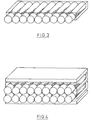
- Fig. 3
- Faseranordnung in einer Folie
- Fig. 4
- eine weitere Ausführungsform mit zwei Faserfolien mit Deckblechen in Verbundwerkstoffen
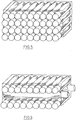
- Fig. 5
- Anordnung von Faserfolien ohne Deckbleche mit mehreren unidirektional eingerichteten Faserfolien in Verbundwerkstoff
- Fig. 6
- Anordnung von Faserfolien ohne Deck- und Zwischenblechen in Verbundwerkstoff
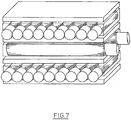
- Fig. 7
- Anordnung von Faserfolien mit Deck- und Zwischenblechen in Verbundwerkstoff.
- Der dargestellte Verbundwerkstoff besteht aus einer oberen und unteren Decklage 1, 2 aus metallenem Werkstoff, im Fall des hier beschriebenen Ausführungsbeispiels aus einer Aluminiumlegierung der Serie 5XXX, hier der Aluminiumlegierung AlMg2, der die metallene Matrix bildet. In gleicher Weise können als Matrixwerkstoff auch Metalle aus der Gruppe der Aluminium-Kupfer-Legierungen, wie solche vom Typ AA2024, der Aluminium-Zink-Legierungen, wie solche vom Typ AA7075, Aluminium-Lithiumlegierungen mit einem Lithiumgehalt von 0.5 bis 3 Prozent, Titanlegierungen, Kupfer bzw. Kupferlegierungen sowie Magnesiumlegierungen verwendet werden.
- Zwischen diesen Decklagen sind Langfasern 3 aus einem Basaltwerkstoff angeordnet, wobei diese Fasern 3 die in der nachfolgenden Tabelle angegebene chemische Zusammensetzung aufweisen:
Komponente Gew. % bevorzugter Bereich Gew. % SiO2 35-55 47-50 TiO2 0-5 1-2 Al2O3 10-25 15-18 Fe2O3, FeO 7-20 11-14 MgO 3-10 5-7 CaO 5-20 6-12 N2O 0-5 2-3 K2O 0-10 2-7 - Bei ihrer Positionierung liegen die Basaltfasern 3 in der Aluminiummatrix wenigstens in einer Richtung parallel zueinander. Sie können aber auch in Form von Geweben miteinander verbunden sein. In beiden Fällen liegt der Volumenanteil der Fasern 3 am Verbundwerkstoff in einem Bereich zwischen 10 und 70 Prozent.
- Die Fasern 3 werden mit einer thermisch erzeugten Beschichtung 4 aus Partikeln, die aus Aluminium, Magnesium, Titan oder Legierungen, die diese Metalle als Hauptbestandteile enthalten, versehen, ihre Bruchdehnung beträgt etwa 2 bis 5 Prozent. Die so beschichteten Fasern können in Form von Folien 5 miteinander verbunden werden, wobei die Verbindung der beschichteten Fasern 3 zur Bildung von Folien 5 bei Temperaturen von über 200°C und bei einem Preßdruck von über 10 MPa erfolgt.
- In dem Verbundwerkstoff können insbesondere auch mehrere Folien 5 mit beschichteten Fasern 3 sowie andere zusätzliche Bleche, die aus Aluminium, Magnesium, Titan und Legierungen, die diese Metalle als Hauptbestandteile enthalten, verwendet werden, wobei diese bei der Herstellung entweder gleichzeitig oder aber sukzessive miteinander verbunden werden können, beispielsweise durch Walzen. Die Verbindung von einzelnen Folien 5 mit beschichteten Fasern 3, sei es mit oder ohne Zwischenlagen aus zusätzlichen Blechen, kann aber auch in einer Vakuumkammer oder in einem Autoklaven unter Schutzgas erfolgen.
- Die in dem Verbundwerkstoff verwendeten Bleche weisen eine Blechdicke von 0.01 bis 3 mm auf, die Folien 5 aus den beschichteten Fasern 3 können entweder einheitlich orientiert sein oder aber in aufeinanderfolgenden Lagen unterschiedliche Orientierungen aufweisen.
- Der so erhaltene Verbundwerkstoff kann nach der erfolgten Verbindung der einzelnen Schichten miteinander zu einem Verbundblech ausgewalzt werden und dann insbesondere beim Bau von Flugzeugrümpfen verwendet werden, wobei zumindest in einem Teil des Rumpfes die Haut und/oder eine etwaige Hautverstärkung aus einem derartigen Verbundwerkstoff besteht.
Claims (18)
- Verbundwerkstoff, bestehend aus einer metallenen Matrix sowie darin eingebetteten anorganischen Verstärkungsfasern, wobei das Matrixmetall aus einer Gruppe stammt, die von Aluminium, Magnesium, Titan und Legierungen, die diese Metalle als Hauptbestandteile enthalten, gebildet wird, und wobei die Verstärkungsfasern aus einem mineralischen Werkstoff mit einem Anteil von 35 bis 55 Gew.% Siliziumoxid (SiO2), von 10 bis 25 Gew. % Aluminiumoxid (Al2O3), von 7 bis 20 Gew.% Eisenoxid (Fe2O3), von 3 bis 10 Gew.% Magnesiumoxid, 0 bis 5 Gew:% Titanoxid (TiO2), 0 bis 5 Gew.% Stickstoffoxid (N2O), 0 bis 10 Gew.% Kalliumoxid (K2O) und von 5 bis 20 Gew.% Kalziumoxid (CaO) bestehen, und der Volumenanteil der Fasern (3) zwischen 10 und 70 Prozent liegt, wobei Fasern (3) eine Länge von wenigstens etwa 10 mm aufweisen, dadurch gekennzeichnet, dass die Fasern (3) in wenigstens einer Richtung parallel zueinander ausgerichtet angeordnet sind.
- Verbundwerkstoff nach Anspruch 1, dadurch gekennzeichnet, dass der Anteil an Siliziumoxid (SiO2) 47 bis 50 Gew.% beträgt.
- Verbundwerkstoff nach Anspruch 1 oder 2, dadurch gekennzeichnet, dass der Anteil an Aluminiumoxid (Al2O3) 15 bis 18 Gew.% beträgt.
- Verbundwerkstoff nach einem der Ansprüche 1 bis 3, dadurch gekennzeichnet, dass der Anteil an Eisenoxid (Fe2O3) 11 bis 14 Gew.% beträgt.
- Verbundwerkstoff nach einem der Ansprüche 1 bis 4, dadurch gekennzeichnet, dass der Anteil an Magnesiumoxid (MgO) 5 bis 7 Gew.% beträgt.
- Verbundwerkstoff nach einem der Ansprüche 1 bis 5, dadurch gekennzeichnet, dass der Anteil an Kalziumoxid (CaO) 6 bis 12 Gew.% beträgt.
- Verbundwerkstoff nach einem der Ansprüche 1 bis 6, dadurch gekennzeichnet, dass die Fasern (3) durch thermisches Beschichten mit Partikeln aus Aluminium, Magnesium, Titan und Legierungen, die diese Metalle als Hauptbestandteile enthalten, miteinander verbunden sind.
- Verbundwerkstoff nach einem der Ansprüche 1 bis 7, dadurch gekennzeichnet, dass die Fasern (3) in Form eines Gewebes miteinander verbunden sind.
- Verbundwerkstoff nach einem der Ansprüche 1 bis 8, dadurch gekennzeichnet, dass die Fasern (3) in Form von Folie (5) durch Partikel miteinander verbunden sind.
- Verbundwerkstoff nach Anspruch 9, dadurch gekennzeichnet, dass mehrere Folien (5) aus beschichteten Fasern (3) zusammen mit Zwischenlagen aus zusätzlichen Blechen aus Aluminium, Magnesium, Titan und Legierungen, die diese Metalle als Hauptbestandteile enthalten, miteinander verbunden sind.
- Verbundwerkstoff nach Anspruch 10, dadurch gekennzeichnet, dass die Bleche (1,2) eine Stärke von 0.01 bis 3 mm aufweisen.
- Verbundwerkstoff nach der einem Ansprüche 9 bis 11, dadurch gekennzeichnet, dass die Folien (5) aus beschichteten Fasern (3) in unterschiedlichen Orientierungen angeordnet sind.
- Verfahren zur Herstellung eines Verbundwerkstoffs nach einem der Ansprüche 9 bis 12, dadurch gekennzeichnet, dass die eingebetteten Fasern (3) bzw. Folien mit eingebetteten Fasern (3) bei Temperaturen oberhalb von 200°C zu Folien (1,2) verbunden werden.
- Verfahren zur Herstellung eines Verbundwerkstoffes nach einem der Ansprüche 9 bis 13, dadurch gekennzeichnet, dass die Verbindung der eingebetteten Fasern (3) zu Folien (1,2) bei einem Pressdruck von wenigstens 10 MPa erfolgt.
- Verfahren zur Herstellung eines Verbundwerkstoffes nach einem der Ansprüche 9 bis 14, dadurch gekennzeichnet, dass die Verbindung in einer Vakuumkammer erfolgt.
- Verfahren zur Herstellung eines Verbundwerkstoffes nach einem der Ansprüche 9 bis 14, dadurch gekennzeichnet, dass die Verbindung unter Schutzgas in einem Autoklaven oder Schutzgasatmosphäre.
- Verfahren zur Herstellung eines Verbundwerkstoffes nach einem der Ansprüche 10 bis 16, dadurch gekennzeichnet, dass der durch Verbindung der einzelnen Schichten hergestellte Verbund zu einem Verbundblech gewalzt wird.
- Verwendung eines Verbundwerkstoffes nach einem der Ansprüche 1 bis 17 zur Herstellung eines Flugzeugrumpfes, dadurch gekennzeichnet, dass in wenigstens einem Teil des Rumpfes die Haut und/oder eine Hautverstärkung aus Verbundwerkstoff besteht.
Applications Claiming Priority (2)
| Application Number | Priority Date | Filing Date | Title |
|---|---|---|---|
| DE2003160808 DE10360808B4 (de) | 2003-12-19 | 2003-12-19 | Faserverstärkter metallischer Verbundwerkstoff |
| DE10360808 | 2003-12-19 |
Publications (2)
| Publication Number | Publication Date |
|---|---|
| EP1544313A1 EP1544313A1 (de) | 2005-06-22 |
| EP1544313B1 true EP1544313B1 (de) | 2018-04-11 |
Family
ID=34485589
Family Applications (1)
| Application Number | Title | Priority Date | Filing Date |
|---|---|---|---|
| EP04028396.2A Expired - Lifetime EP1544313B1 (de) | 2003-12-19 | 2004-12-01 | Faserverstärkter metallischer Verbundwerkstoff |
Country Status (3)
| Country | Link |
|---|---|
| US (1) | US7794851B2 (de) |
| EP (1) | EP1544313B1 (de) |
| DE (1) | DE10360808B4 (de) |
Families Citing this family (13)
| Publication number | Priority date | Publication date | Assignee | Title |
|---|---|---|---|---|
| ATE406998T1 (de) * | 2003-07-08 | 2008-09-15 | Airbus Gmbh | Leichtbaustruktur |
| DE102006023210B4 (de) * | 2006-05-17 | 2012-12-13 | Airbus Operations Gmbh | Verfahren zum Herstellen einer Laminatstruktur, Laminatstruktur und deren Verwendung |
| FR2935990B1 (fr) * | 2008-09-17 | 2011-05-13 | Aircelle Sa | Procede de fabrication d'une piece en materiau composite a matrice metallique |
| CN101417524B (zh) * | 2008-10-17 | 2012-05-30 | 哈尔滨工业大学 | 碳纤维金属复合层合板的制造方法 |
| FR2957280B1 (fr) | 2010-03-12 | 2012-07-13 | Centre Nat Rech Scient | Procede de fabrication d'un complexe metallique |
| JP5947564B2 (ja) * | 2011-09-20 | 2016-07-06 | 国立大学法人信州大学 | 圧縮繊維構造材の製造方法 |
| FR2983772B1 (fr) * | 2011-12-13 | 2014-01-10 | Airbus Operations Sas | Paroi en materiau composite renforcee de maniere a limiter la propagation d'une crique selon une direction |
| DE102012020870B3 (de) * | 2012-10-24 | 2014-02-13 | Audi Ag | Heizvorrichtung für den Fahrzeuginnenraum eines Fahrzeugs |
| RU2653695C2 (ru) * | 2013-01-29 | 2018-05-14 | Акцо Нобель Кемикалз Интернэшнл Б.В. | Способ получения композитного материала, армированного волокнами |
| DE102014203872A1 (de) * | 2014-03-04 | 2015-09-10 | Bayerische Motoren Werke Aktiengesellschaft | Verfahren zur Herstellung eines flächigen Halbzeugs und faserverstärktes Halbzeug |
| JP5959558B2 (ja) * | 2014-03-13 | 2016-08-02 | アイシン高丘株式会社 | 複合構造体及びその製造方法 |
| CN104707888B (zh) * | 2014-12-26 | 2016-09-14 | 中航复合材料有限责任公司 | 一种纤维-金属混杂复合材料零件叠层成型工艺方法 |
| CN112157966A (zh) * | 2020-09-29 | 2021-01-01 | 首钢集团有限公司 | 一种纤维增强的金属材料复合板 |
Family Cites Families (28)
| Publication number | Priority date | Publication date | Assignee | Title |
|---|---|---|---|---|
| NL8100088A (nl) * | 1981-01-09 | 1982-08-02 | Tech Hogeschool Delft Afdeling | Laminaat uit metalen platen en daarmede verbonden draden, alsmede werkwijzen ter vervaardiging daarvan. |
| NL8100087A (nl) | 1981-01-09 | 1982-08-02 | Tech Hogeschool Delft Afdeling | Laminaat uit metalen platen en daarmede verbonden draden. |
| US4411380A (en) | 1981-06-30 | 1983-10-25 | The United States Of America As Represented By The Administrator Of The National Aeronautics And Space Administration | Metal matrix composite structural panel construction |
| JPS6199655A (ja) | 1984-10-18 | 1986-05-17 | Toyota Motor Corp | 鉱物繊維強化金属複合材料 |
| DE3707780A1 (de) * | 1987-03-11 | 1988-09-22 | Schlegel Georg Fa | Schraubklemme fuer elektrische leiter |
| EP0312151B1 (de) * | 1987-10-14 | 1991-03-27 | Akzo N.V. | Schichtstoff aus Metallschichten und aus durchgehendem faserverstärktem synthetischem Material |
| GB2253185A (en) | 1991-03-01 | 1992-09-02 | Secr Defence | Reinforced alloy laminates |
| DE4116639A1 (de) * | 1991-05-22 | 1992-11-26 | Sigri Great Lakes Carbon Gmbh | Verfahren zum beschichten eines faserverstaerkten kunststoffkoerpers |
| US5426000A (en) * | 1992-08-05 | 1995-06-20 | Alliedsignal Inc. | Coated reinforcing fibers, composites and methods |
| DE4313077C2 (de) * | 1993-04-20 | 1996-03-14 | Hermsdorfer Inst Tech Keramik | Verfahren zur Herstellung langfaserverstärkter Metallverbundkörper, Metallverbundkörper und Verwendung desselben |
| DE4324030A1 (de) | 1993-07-17 | 1995-01-19 | Hoechst Ag | Kunststoff-Formmasse zur Herstellung von Formteilen mit Dekoreffekt |
| US5660923A (en) * | 1994-10-31 | 1997-08-26 | Board Of Trustees Operating Michigan State University | Method for the preparation of metal matrix fiber composites |
| US5866272A (en) | 1996-01-11 | 1999-02-02 | The Boeing Company | Titanium-polymer hybrid laminates |
| US6647747B1 (en) | 1997-03-17 | 2003-11-18 | Vladimir B. Brik | Multifunctional apparatus for manufacturing mineral basalt fibers |
| DE10031510A1 (de) | 2000-06-28 | 2002-01-17 | Airbus Gmbh | Strukturbauteil für ein Flugzeug |
| KR20030096221A (ko) * | 2000-09-28 | 2003-12-24 | 쓰리엠 이노베이티브 프로퍼티즈 캄파니 | 금속 기지 복합재 및 그 제조 방법 |
| US6712315B2 (en) | 2000-11-30 | 2004-03-30 | Airbus Deutschland Gmbh | Metal structural component for an aircraft, with resistance to crack propagation |
| DE10108357A1 (de) | 2001-02-21 | 2002-08-29 | Sika Ag, Vorm. Kaspar Winkler & Co | Armierungsstab sowie Verfahren zu dessen Herstellung |
| DE60141774D1 (de) | 2001-04-19 | 2010-05-20 | Groep Masureel Veredeling | Basalthaltiges gewebe |
| RU2182605C1 (ru) * | 2001-10-09 | 2002-05-20 | Прокопенко Дмитрий Николаевич | Композиционный материал |
| US20040185195A1 (en) * | 2002-08-06 | 2004-09-23 | Anderson Christopher C. | Laminated glass and structural glass with integrated lighting, sensors and electronics |
| DE10238460B3 (de) | 2002-08-22 | 2004-03-11 | Airbus Deutschland Gmbh | Leichtbaustruktur aus dünnen Metallblechlagen |
| EP1495858B1 (de) | 2003-07-08 | 2019-08-07 | Airbus Operations GmbH | Leichtbaustruktur aus metallischen schichtwerkstoffen |
| ATE406998T1 (de) | 2003-07-08 | 2008-09-15 | Airbus Gmbh | Leichtbaustruktur |
| KR20060125817A (ko) * | 2003-11-25 | 2006-12-06 | 터치스톤 리서치 래버러토리 리미티드 | 금속 매트릭스 복합물용 필라멘트 권선 |
| US7774912B2 (en) * | 2003-12-01 | 2010-08-17 | Touchstone Research Laboratory, Ltd. | Continuously formed metal matrix composite shapes |
| WO2005053884A1 (en) * | 2003-12-01 | 2005-06-16 | Touchstone Research Laboratory, Ltd. | Metal matrix composite structures |
| US7255916B2 (en) * | 2005-01-04 | 2007-08-14 | Airbus Deutschland Gmbh | Metallic layer material, reinforced with basalt fibers, as well as products made thereof |
-
2003
- 2003-12-19 DE DE2003160808 patent/DE10360808B4/de not_active Expired - Fee Related
-
2004
- 2004-12-01 EP EP04028396.2A patent/EP1544313B1/de not_active Expired - Lifetime
- 2004-12-20 US US11/018,583 patent/US7794851B2/en active Active
Non-Patent Citations (1)
| Title |
|---|
| None * |
Also Published As
| Publication number | Publication date |
|---|---|
| US20050136256A1 (en) | 2005-06-23 |
| DE10360808B4 (de) | 2005-10-27 |
| DE10360808A1 (de) | 2005-07-28 |
| EP1544313A1 (de) | 2005-06-22 |
| US7794851B2 (en) | 2010-09-14 |
Similar Documents
| Publication | Publication Date | Title |
|---|---|---|
| DE69734616T2 (de) | Titan-Polymer hybrid Laminate | |
| EP1495858B1 (de) | Leichtbaustruktur aus metallischen schichtwerkstoffen | |
| DE10360808B4 (de) | Faserverstärkter metallischer Verbundwerkstoff | |
| EP1312467B1 (de) | Metallfaserverstärkter Verbundwerkstoff sowie Verfahren zur Herstellung desselben | |
| DE60222268T2 (de) | Mehrschichtige verbundpanzerung | |
| DE102012110322A1 (de) | Metall-Keramik-Substrat sowie Verfahren zum Herstellen eines Metall-Keramik-Substrates | |
| ES2435823T3 (es) | Hojas compuestas laminadas de aluminio y fibras de vidrio | |
| EP1194285B1 (de) | Faserverbundwerkstoff und verfahren zu seiner herstellung | |
| WO1994010351A1 (en) | Metal matrix composite having enhanced toughness and method of making | |
| DE102010050566A1 (de) | Laufboden für ein gepanzertes Fahrzeug, gepanzertes Fahrzeug mit einem derartigen Laufboden und Verfahren | |
| DE102006051989B4 (de) | Versteifte Beplankung für ein Luft- oder Raumfahrzeug mit einem Laminat-Stringer hoher Steifigkeit | |
| EP1495859B1 (de) | Leichtbaustruktur | |
| US7255916B2 (en) | Metallic layer material, reinforced with basalt fibers, as well as products made thereof | |
| DE8717379U1 (de) | Gleitelement | |
| DE102017128316B4 (de) | Verfahren zur Herstellung eines Metall-Keramik-Substrats und Metall-Keramik-Substrat | |
| EP1989045B1 (de) | Kantenschutzband zum schutz der ränder von mehrfachglasscheiben, insbesondere brandschutzscheiben | |
| WO2007048370A1 (de) | Verbundpanzerplatte | |
| DE102010040731A1 (de) | Batteriegehäuse, Batterie mit Batteriegehäuse und Kraftfahrzeug mit einer entsprechenden Batterie | |
| DE112022005944T5 (de) | Neuartige funktional abgestufte kugelsichere Multiphasen-Hybridpanzerung | |
| DE60224173T2 (de) | Metallverbundwerkstofflaminate und verfahren zur herstellung derselben | |
| DE102007025894B4 (de) | Glaskeramik-Panzermaterial | |
| DE10131887A1 (de) | Trennblech bzw. Verfahren zur Herstellung eines Trennbleches für ein Multilayerpreßpaket | |
| DE10330341B4 (de) | Metallischer Schichtwerkstoff, verstärkt mit langen Basaltfasern sowie dessen Erzeugnisse | |
| EP4463671B1 (de) | Panzerungsplatte, panzerungsplattenverbund und panzerung | |
| DE102010035324A1 (de) | Strukturelement aus einem Hybridlaminat |
Legal Events
| Date | Code | Title | Description |
|---|---|---|---|
| PUAI | Public reference made under article 153(3) epc to a published international application that has entered the european phase |
Free format text: ORIGINAL CODE: 0009012 |
|
| AK | Designated contracting states |
Kind code of ref document: A1 Designated state(s): AT BE BG CH CY CZ DE DK EE ES FI FR GB GR HU IE IS IT LI LT LU MC NL PL PT RO SE SI SK TR |
|
| AX | Request for extension of the european patent |
Extension state: AL BA HR LV MK YU |
|
| 17P | Request for examination filed |
Effective date: 20051222 |
|
| AKX | Designation fees paid |
Designated state(s): AT BE BG CH CY CZ DE DK EE ES FI FR GB GR HU IE IS IT LI LT LU MC NL PL PT RO SE SI SK TR |
|
| 17Q | First examination report despatched |
Effective date: 20140620 |
|
| GRAP | Despatch of communication of intention to grant a patent |
Free format text: ORIGINAL CODE: EPIDOSNIGR1 |
|
| INTG | Intention to grant announced |
Effective date: 20171017 |
|
| GRAS | Grant fee paid |
Free format text: ORIGINAL CODE: EPIDOSNIGR3 |
|
| GRAA | (expected) grant |
Free format text: ORIGINAL CODE: 0009210 |
|
| AK | Designated contracting states |
Kind code of ref document: B1 Designated state(s): AT BE BG CH CY CZ DE DK EE ES FI FR GB GR HU IE IS IT LI LT LU MC NL PL PT RO SE SI SK TR |
|
| RAP1 | Party data changed (applicant data changed or rights of an application transferred) |
Owner name: AIRBUS OPERATIONS GMBH |
|
| REG | Reference to a national code |
Ref country code: GB Ref legal event code: FG4D Free format text: NOT ENGLISH |
|
| REG | Reference to a national code |
Ref country code: CH Ref legal event code: EP |
|
| REG | Reference to a national code |
Ref country code: AT Ref legal event code: REF Ref document number: 988099 Country of ref document: AT Kind code of ref document: T Effective date: 20180415 |
|
| REG | Reference to a national code |
Ref country code: IE Ref legal event code: FG4D Free format text: LANGUAGE OF EP DOCUMENT: GERMAN |
|
| REG | Reference to a national code |
Ref country code: DE Ref legal event code: R096 Ref document number: 502004015662 Country of ref document: DE |
|
| REG | Reference to a national code |
Ref country code: NL Ref legal event code: MP Effective date: 20180411 |
|
| REG | Reference to a national code |
Ref country code: LT Ref legal event code: MG4D |
|
| PG25 | Lapsed in a contracting state [announced via postgrant information from national office to epo] |
Ref country code: NL Free format text: LAPSE BECAUSE OF FAILURE TO SUBMIT A TRANSLATION OF THE DESCRIPTION OR TO PAY THE FEE WITHIN THE PRESCRIBED TIME-LIMIT Effective date: 20180411 |
|
| PG25 | Lapsed in a contracting state [announced via postgrant information from national office to epo] |
Ref country code: ES Free format text: LAPSE BECAUSE OF FAILURE TO SUBMIT A TRANSLATION OF THE DESCRIPTION OR TO PAY THE FEE WITHIN THE PRESCRIBED TIME-LIMIT Effective date: 20180411 Ref country code: LT Free format text: LAPSE BECAUSE OF FAILURE TO SUBMIT A TRANSLATION OF THE DESCRIPTION OR TO PAY THE FEE WITHIN THE PRESCRIBED TIME-LIMIT Effective date: 20180411 Ref country code: PL Free format text: LAPSE BECAUSE OF FAILURE TO SUBMIT A TRANSLATION OF THE DESCRIPTION OR TO PAY THE FEE WITHIN THE PRESCRIBED TIME-LIMIT Effective date: 20180411 Ref country code: SE Free format text: LAPSE BECAUSE OF FAILURE TO SUBMIT A TRANSLATION OF THE DESCRIPTION OR TO PAY THE FEE WITHIN THE PRESCRIBED TIME-LIMIT Effective date: 20180411 Ref country code: BG Free format text: LAPSE BECAUSE OF FAILURE TO SUBMIT A TRANSLATION OF THE DESCRIPTION OR TO PAY THE FEE WITHIN THE PRESCRIBED TIME-LIMIT Effective date: 20180711 Ref country code: FI Free format text: LAPSE BECAUSE OF FAILURE TO SUBMIT A TRANSLATION OF THE DESCRIPTION OR TO PAY THE FEE WITHIN THE PRESCRIBED TIME-LIMIT Effective date: 20180411 |
|
| PG25 | Lapsed in a contracting state [announced via postgrant information from national office to epo] |
Ref country code: GR Free format text: LAPSE BECAUSE OF FAILURE TO SUBMIT A TRANSLATION OF THE DESCRIPTION OR TO PAY THE FEE WITHIN THE PRESCRIBED TIME-LIMIT Effective date: 20180712 |
|
| PG25 | Lapsed in a contracting state [announced via postgrant information from national office to epo] |
Ref country code: PT Free format text: LAPSE BECAUSE OF FAILURE TO SUBMIT A TRANSLATION OF THE DESCRIPTION OR TO PAY THE FEE WITHIN THE PRESCRIBED TIME-LIMIT Effective date: 20180813 |
|
| REG | Reference to a national code |
Ref country code: DE Ref legal event code: R097 Ref document number: 502004015662 Country of ref document: DE |
|
| PG25 | Lapsed in a contracting state [announced via postgrant information from national office to epo] |
Ref country code: SK Free format text: LAPSE BECAUSE OF FAILURE TO SUBMIT A TRANSLATION OF THE DESCRIPTION OR TO PAY THE FEE WITHIN THE PRESCRIBED TIME-LIMIT Effective date: 20180411 Ref country code: RO Free format text: LAPSE BECAUSE OF FAILURE TO SUBMIT A TRANSLATION OF THE DESCRIPTION OR TO PAY THE FEE WITHIN THE PRESCRIBED TIME-LIMIT Effective date: 20180411 Ref country code: CZ Free format text: LAPSE BECAUSE OF FAILURE TO SUBMIT A TRANSLATION OF THE DESCRIPTION OR TO PAY THE FEE WITHIN THE PRESCRIBED TIME-LIMIT Effective date: 20180411 Ref country code: DK Free format text: LAPSE BECAUSE OF FAILURE TO SUBMIT A TRANSLATION OF THE DESCRIPTION OR TO PAY THE FEE WITHIN THE PRESCRIBED TIME-LIMIT Effective date: 20180411 Ref country code: EE Free format text: LAPSE BECAUSE OF FAILURE TO SUBMIT A TRANSLATION OF THE DESCRIPTION OR TO PAY THE FEE WITHIN THE PRESCRIBED TIME-LIMIT Effective date: 20180411 |
|
| REG | Reference to a national code |
Ref country code: CH Ref legal event code: PK Free format text: BERICHTIGUNGEN |
|
| RIC2 | Information provided on ipc code assigned after grant |
Ipc: C22C 49/14 20060101ALI20050331BHEP Ipc: C22C 1/10 20060101AFI20050331BHEP |
|
| PLBE | No opposition filed within time limit |
Free format text: ORIGINAL CODE: 0009261 |
|
| STAA | Information on the status of an ep patent application or granted ep patent |
Free format text: STATUS: NO OPPOSITION FILED WITHIN TIME LIMIT |
|
| PG25 | Lapsed in a contracting state [announced via postgrant information from national office to epo] |
Ref country code: IT Free format text: LAPSE BECAUSE OF FAILURE TO SUBMIT A TRANSLATION OF THE DESCRIPTION OR TO PAY THE FEE WITHIN THE PRESCRIBED TIME-LIMIT Effective date: 20180411 |
|
| 26N | No opposition filed |
Effective date: 20190114 |
|
| PG25 | Lapsed in a contracting state [announced via postgrant information from national office to epo] |
Ref country code: SI Free format text: LAPSE BECAUSE OF FAILURE TO SUBMIT A TRANSLATION OF THE DESCRIPTION OR TO PAY THE FEE WITHIN THE PRESCRIBED TIME-LIMIT Effective date: 20180411 |
|
| REG | Reference to a national code |
Ref country code: CH Ref legal event code: PL |
|
| PG25 | Lapsed in a contracting state [announced via postgrant information from national office to epo] |
Ref country code: LU Free format text: LAPSE BECAUSE OF NON-PAYMENT OF DUE FEES Effective date: 20181201 Ref country code: MC Free format text: LAPSE BECAUSE OF FAILURE TO SUBMIT A TRANSLATION OF THE DESCRIPTION OR TO PAY THE FEE WITHIN THE PRESCRIBED TIME-LIMIT Effective date: 20180411 |
|
| REG | Reference to a national code |
Ref country code: IE Ref legal event code: MM4A |
|
| REG | Reference to a national code |
Ref country code: BE Ref legal event code: MM Effective date: 20181231 |
|
| PG25 | Lapsed in a contracting state [announced via postgrant information from national office to epo] |
Ref country code: IE Free format text: LAPSE BECAUSE OF NON-PAYMENT OF DUE FEES Effective date: 20181201 |
|
| PG25 | Lapsed in a contracting state [announced via postgrant information from national office to epo] |
Ref country code: BE Free format text: LAPSE BECAUSE OF NON-PAYMENT OF DUE FEES Effective date: 20181231 |
|
| PG25 | Lapsed in a contracting state [announced via postgrant information from national office to epo] |
Ref country code: CH Free format text: LAPSE BECAUSE OF NON-PAYMENT OF DUE FEES Effective date: 20181231 Ref country code: LI Free format text: LAPSE BECAUSE OF NON-PAYMENT OF DUE FEES Effective date: 20181231 |
|
| PGFP | Annual fee paid to national office [announced via postgrant information from national office to epo] |
Ref country code: DE Payment date: 20191210 Year of fee payment: 16 |
|
| REG | Reference to a national code |
Ref country code: AT Ref legal event code: MM01 Ref document number: 988099 Country of ref document: AT Kind code of ref document: T Effective date: 20181201 |
|
| PGFP | Annual fee paid to national office [announced via postgrant information from national office to epo] |
Ref country code: FR Payment date: 20191219 Year of fee payment: 16 |
|
| PG25 | Lapsed in a contracting state [announced via postgrant information from national office to epo] |
Ref country code: TR Free format text: LAPSE BECAUSE OF FAILURE TO SUBMIT A TRANSLATION OF THE DESCRIPTION OR TO PAY THE FEE WITHIN THE PRESCRIBED TIME-LIMIT Effective date: 20180411 |
|
| PG25 | Lapsed in a contracting state [announced via postgrant information from national office to epo] |
Ref country code: AT Free format text: LAPSE BECAUSE OF NON-PAYMENT OF DUE FEES Effective date: 20181201 |
|
| PGFP | Annual fee paid to national office [announced via postgrant information from national office to epo] |
Ref country code: GB Payment date: 20191220 Year of fee payment: 16 |
|
| PG25 | Lapsed in a contracting state [announced via postgrant information from national office to epo] |
Ref country code: HU Free format text: LAPSE BECAUSE OF FAILURE TO SUBMIT A TRANSLATION OF THE DESCRIPTION OR TO PAY THE FEE WITHIN THE PRESCRIBED TIME-LIMIT; INVALID AB INITIO Effective date: 20041201 Ref country code: CY Free format text: LAPSE BECAUSE OF FAILURE TO SUBMIT A TRANSLATION OF THE DESCRIPTION OR TO PAY THE FEE WITHIN THE PRESCRIBED TIME-LIMIT Effective date: 20180411 |
|
| PG25 | Lapsed in a contracting state [announced via postgrant information from national office to epo] |
Ref country code: IS Free format text: LAPSE BECAUSE OF FAILURE TO SUBMIT A TRANSLATION OF THE DESCRIPTION OR TO PAY THE FEE WITHIN THE PRESCRIBED TIME-LIMIT Effective date: 20180811 |
|
| REG | Reference to a national code |
Ref country code: DE Ref legal event code: R119 Ref document number: 502004015662 Country of ref document: DE |
|
| GBPC | Gb: european patent ceased through non-payment of renewal fee |
Effective date: 20201201 |
|
| PG25 | Lapsed in a contracting state [announced via postgrant information from national office to epo] |
Ref country code: FR Free format text: LAPSE BECAUSE OF NON-PAYMENT OF DUE FEES Effective date: 20201231 |
|
| PG25 | Lapsed in a contracting state [announced via postgrant information from national office to epo] |
Ref country code: DE Free format text: LAPSE BECAUSE OF NON-PAYMENT OF DUE FEES Effective date: 20210701 Ref country code: GB Free format text: LAPSE BECAUSE OF NON-PAYMENT OF DUE FEES Effective date: 20201201 |