EP1544187A1 - 1,7,8-trifluoronaphthalene-2-naphthol, and method for producing liquid crystal compound using same - Google Patents
1,7,8-trifluoronaphthalene-2-naphthol, and method for producing liquid crystal compound using same Download PDFInfo
- Publication number
- EP1544187A1 EP1544187A1 EP03753954A EP03753954A EP1544187A1 EP 1544187 A1 EP1544187 A1 EP 1544187A1 EP 03753954 A EP03753954 A EP 03753954A EP 03753954 A EP03753954 A EP 03753954A EP 1544187 A1 EP1544187 A1 EP 1544187A1
- Authority
- EP
- European Patent Office
- Prior art keywords
- general formula
- compound represented
- group
- saturated
- carbon number
- Prior art date
- Legal status (The legal status is an assumption and is not a legal conclusion. Google has not performed a legal analysis and makes no representation as to the accuracy of the status listed.)
- Granted
Links
- 0 *c(ccc(c1c2F)ccc2F)c1F Chemical compound *c(ccc(c1c2F)ccc2F)c1F 0.000 description 2
Classifications
-
- C—CHEMISTRY; METALLURGY
- C07—ORGANIC CHEMISTRY
- C07C—ACYCLIC OR CARBOCYCLIC COMPOUNDS
- C07C17/00—Preparation of halogenated hydrocarbons
- C07C17/26—Preparation of halogenated hydrocarbons by reactions involving an increase in the number of carbon atoms in the skeleton
- C07C17/263—Preparation of halogenated hydrocarbons by reactions involving an increase in the number of carbon atoms in the skeleton by condensation reactions
-
- C—CHEMISTRY; METALLURGY
- C07—ORGANIC CHEMISTRY
- C07C—ACYCLIC OR CARBOCYCLIC COMPOUNDS
- C07C39/00—Compounds having at least one hydroxy or O-metal group bound to a carbon atom of a six-membered aromatic ring
- C07C39/24—Halogenated derivatives
- C07C39/38—Halogenated derivatives with at least one hydroxy group on a condensed ring system containing two rings
-
- C—CHEMISTRY; METALLURGY
- C07—ORGANIC CHEMISTRY
- C07C—ACYCLIC OR CARBOCYCLIC COMPOUNDS
- C07C17/00—Preparation of halogenated hydrocarbons
- C07C17/26—Preparation of halogenated hydrocarbons by reactions involving an increase in the number of carbon atoms in the skeleton
- C07C17/263—Preparation of halogenated hydrocarbons by reactions involving an increase in the number of carbon atoms in the skeleton by condensation reactions
- C07C17/269—Preparation of halogenated hydrocarbons by reactions involving an increase in the number of carbon atoms in the skeleton by condensation reactions of only halogenated hydrocarbons
-
- C—CHEMISTRY; METALLURGY
- C07—ORGANIC CHEMISTRY
- C07C—ACYCLIC OR CARBOCYCLIC COMPOUNDS
- C07C25/00—Compounds containing at least one halogen atom bound to a six-membered aromatic ring
- C07C25/18—Polycyclic aromatic halogenated hydrocarbons
- C07C25/22—Polycyclic aromatic halogenated hydrocarbons with condensed rings
-
- C—CHEMISTRY; METALLURGY
- C07—ORGANIC CHEMISTRY
- C07C—ACYCLIC OR CARBOCYCLIC COMPOUNDS
- C07C29/00—Preparation of compounds having hydroxy or O-metal groups bound to a carbon atom not belonging to a six-membered aromatic ring
- C07C29/48—Preparation of compounds having hydroxy or O-metal groups bound to a carbon atom not belonging to a six-membered aromatic ring by oxidation reactions with formation of hydroxy groups
- C07C29/50—Preparation of compounds having hydroxy or O-metal groups bound to a carbon atom not belonging to a six-membered aromatic ring by oxidation reactions with formation of hydroxy groups with molecular oxygen only
- C07C29/54—Preparation of compounds having hydroxy or O-metal groups bound to a carbon atom not belonging to a six-membered aromatic ring by oxidation reactions with formation of hydroxy groups with molecular oxygen only starting from compounds containing carbon-to-metal bonds and followed by conversion of the -O- metal to -OH groups
-
- C—CHEMISTRY; METALLURGY
- C07—ORGANIC CHEMISTRY
- C07C—ACYCLIC OR CARBOCYCLIC COMPOUNDS
- C07C309/00—Sulfonic acids; Halides, esters, or anhydrides thereof
- C07C309/63—Esters of sulfonic acids
- C07C309/64—Esters of sulfonic acids having sulfur atoms of esterified sulfo groups bound to acyclic carbon atoms
- C07C309/65—Esters of sulfonic acids having sulfur atoms of esterified sulfo groups bound to acyclic carbon atoms of a saturated carbon skeleton
-
- C—CHEMISTRY; METALLURGY
- C07—ORGANIC CHEMISTRY
- C07C—ACYCLIC OR CARBOCYCLIC COMPOUNDS
- C07C309/00—Sulfonic acids; Halides, esters, or anhydrides thereof
- C07C309/63—Esters of sulfonic acids
- C07C309/64—Esters of sulfonic acids having sulfur atoms of esterified sulfo groups bound to acyclic carbon atoms
- C07C309/65—Esters of sulfonic acids having sulfur atoms of esterified sulfo groups bound to acyclic carbon atoms of a saturated carbon skeleton
- C07C309/66—Methanesulfonates
-
- C—CHEMISTRY; METALLURGY
- C07—ORGANIC CHEMISTRY
- C07C—ACYCLIC OR CARBOCYCLIC COMPOUNDS
- C07C41/00—Preparation of ethers; Preparation of compounds having groups, groups or groups
- C07C41/01—Preparation of ethers
- C07C41/16—Preparation of ethers by reaction of esters of mineral or organic acids with hydroxy or O-metal groups
-
- C—CHEMISTRY; METALLURGY
- C07—ORGANIC CHEMISTRY
- C07C—ACYCLIC OR CARBOCYCLIC COMPOUNDS
- C07C41/00—Preparation of ethers; Preparation of compounds having groups, groups or groups
- C07C41/01—Preparation of ethers
- C07C41/18—Preparation of ethers by reactions not forming ether-oxygen bonds
-
- C—CHEMISTRY; METALLURGY
- C07—ORGANIC CHEMISTRY
- C07C—ACYCLIC OR CARBOCYCLIC COMPOUNDS
- C07C41/00—Preparation of ethers; Preparation of compounds having groups, groups or groups
- C07C41/01—Preparation of ethers
- C07C41/18—Preparation of ethers by reactions not forming ether-oxygen bonds
- C07C41/20—Preparation of ethers by reactions not forming ether-oxygen bonds by hydrogenation of carbon-to-carbon double or triple bonds
-
- C—CHEMISTRY; METALLURGY
- C07—ORGANIC CHEMISTRY
- C07C—ACYCLIC OR CARBOCYCLIC COMPOUNDS
- C07C41/00—Preparation of ethers; Preparation of compounds having groups, groups or groups
- C07C41/01—Preparation of ethers
- C07C41/18—Preparation of ethers by reactions not forming ether-oxygen bonds
- C07C41/30—Preparation of ethers by reactions not forming ether-oxygen bonds by increasing the number of carbon atoms, e.g. by oligomerisation
-
- C—CHEMISTRY; METALLURGY
- C07—ORGANIC CHEMISTRY
- C07C—ACYCLIC OR CARBOCYCLIC COMPOUNDS
- C07C43/00—Ethers; Compounds having groups, groups or groups
- C07C43/02—Ethers
- C07C43/20—Ethers having an ether-oxygen atom bound to a carbon atom of a six-membered aromatic ring
- C07C43/225—Ethers having an ether-oxygen atom bound to a carbon atom of a six-membered aromatic ring containing halogen
-
- C—CHEMISTRY; METALLURGY
- C09—DYES; PAINTS; POLISHES; NATURAL RESINS; ADHESIVES; COMPOSITIONS NOT OTHERWISE PROVIDED FOR; APPLICATIONS OF MATERIALS NOT OTHERWISE PROVIDED FOR
- C09K—MATERIALS FOR MISCELLANEOUS APPLICATIONS, NOT PROVIDED FOR ELSEWHERE
- C09K19/00—Liquid crystal materials
- C09K19/04—Liquid crystal materials characterised by the chemical structure of the liquid crystal components, e.g. by a specific unit
- C09K19/06—Non-steroidal liquid crystal compounds
- C09K19/32—Non-steroidal liquid crystal compounds containing condensed ring systems, i.e. fused, bridged or spiro ring systems
-
- C—CHEMISTRY; METALLURGY
- C09—DYES; PAINTS; POLISHES; NATURAL RESINS; ADHESIVES; COMPOSITIONS NOT OTHERWISE PROVIDED FOR; APPLICATIONS OF MATERIALS NOT OTHERWISE PROVIDED FOR
- C09K—MATERIALS FOR MISCELLANEOUS APPLICATIONS, NOT PROVIDED FOR ELSEWHERE
- C09K19/00—Liquid crystal materials
- C09K19/04—Liquid crystal materials characterised by the chemical structure of the liquid crystal components, e.g. by a specific unit
- C09K19/06—Non-steroidal liquid crystal compounds
- C09K19/32—Non-steroidal liquid crystal compounds containing condensed ring systems, i.e. fused, bridged or spiro ring systems
- C09K19/322—Compounds containing a naphthalene ring or a completely or partially hydrogenated naphthalene ring
-
- C—CHEMISTRY; METALLURGY
- C07—ORGANIC CHEMISTRY
- C07C—ACYCLIC OR CARBOCYCLIC COMPOUNDS
- C07C2601/00—Systems containing only non-condensed rings
- C07C2601/12—Systems containing only non-condensed rings with a six-membered ring
- C07C2601/14—The ring being saturated
Definitions
- the present invention relates to a method for producing trifluoronaphthalene compounds useful as a liquid crystal display material and an intermediate thereof.
- TN and STN systems having a twisted structure have mainly been used in liquid crystal display elements. Many liquid crystal compounds and compositions with positive dielectric constant anisotropy, which have significant roles in these TN and STN systems, have been developed.
- the display systems such as (1) the system of vertically aligning liquid crystal molecules (VA system; Vertical Alignment system) (for example, there is Japanese Unexamined Patent Application, First Publication No. Hei 2-176625) or (2) the system of rotating liquid crystal molecules in plane horizontal to a substrate by applying voltage (IPS system; In-Plane Switching system) (for example, there is published Japanese translation No.
- VA system Vertical Alignment system
- IPS system In-Plane Switching system
- liquid crystal compounds and compositions with negative dielectric anisotropy have a significant role, instead of the liquid crystal compounds and compositions with positive dielectric constant anisotropy which are referred to as indispensable compounds for the display systems having twisted structure.
- the proposal of the liquid crystal compounds and compositions with negative dielectric constant anisotropy was made in Japanese Unexamined Patent Application, First Publication No. Hei 2-4725.
- liquid crystal compounds having a 1,7,8-trifluoronaphthalene-2,6-diyl group have been performed.
- several compounds are disclosed in Japanese Unexamined Patent Application, First Publication No. 2001-31597 and German Patent Application, Publication No. 19522195.
- a low-volume multiproduct is obligatory since several compounds called homologues, wherein backbones of liquid crystal compounds are the same and side chains are different, are used so as to avoid the deposition of the compounds.
- homologues wherein backbones of liquid crystal compounds are the same and side chains are different, are used so as to avoid the deposition of the compounds.
- the efficiency was deteriorated since the trifluoronaphthalene backbone should be reproduced from the beginning and many intermediates are necessary.
- the production whose yield is relatively low, is performed at the final stage of the production, the loss of the high-cost intermediate is large, thereby deteriorating the efficiency badly.
- Objects of the present invention are to provide 1,7,8-trifluoronaphthalene-2-naphthol and derivatives thereof as intermediates for efficiently producing a trifluoronaphthalene liquid crystal material and to provide a method for efficiently producing trifluoronaphthalene liquid crystal material using the same.
- the present inventors have intensively researched the solution of the above objects. Then, they have developed the method using 1,7,8-trifluoronaphthalene-2-naphthol and derivatives thereof as intermediates, and thus the present invention has been completed.
- the present invention provides a compound represented by general formula (I), wherein X represents a hydrogen atom, CF 3 SO 2 -, or a saturated or unsaturated alkyl group having a carbon number of 1 to 10.
- the present invention provides a method for producing a compound represented by general formula (III) by reacting a compound represented by general formula (Ia) with a compound represented by general formula (II) in the presence of a catalyst, wherein R 1 represents a saturated or unsaturated alkyl group having a carbon number of 1 to 10, and Y represents a single bond, -CH 2 CH 2 -, or -CH 2 O-, and A represents a trans-1,4-cyclohexylene group or a 1,4-phenylene group, and n represents a number of 0 or 1, wherein R 1 , Y, A, and n represent the same as in general formula (II).
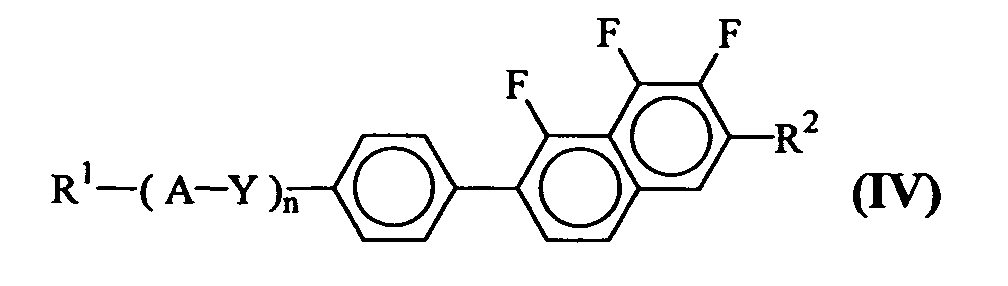
- the present invention provides a method for producing a compound represented by general formula (IV) comprising reacting a compound represented by general formula (Ia) with a compound represented by general formula (II) in the presence of a catalyst to produce a compound represented by general formula (III) and alkylating or alkoxylating the compound represented by general formula (III), wherein R 1 represents a saturated or unsaturated alkyl group having a carbon number of 1 to 10, and Y represents a single bond, -CH 2 CH 2 -, or -CH 2 O-, and A represents a trans-1,4-cyclohexylene group or a 1,4-phenylene group, and n represents a number of 0 or 1, wherein R 1 , Y, A, and n represent the same as in general formula (II), wherein R 1 , Y, A, and n represent the same as in the general formula (II), and R 2 represents a saturated or unsaturated alkyl or alkoxyl group having a carbon number
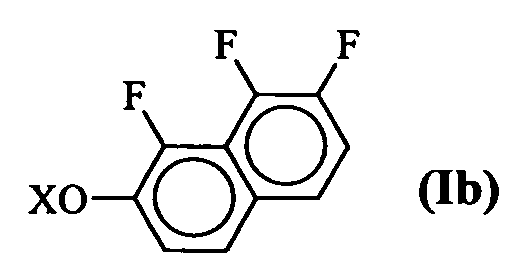
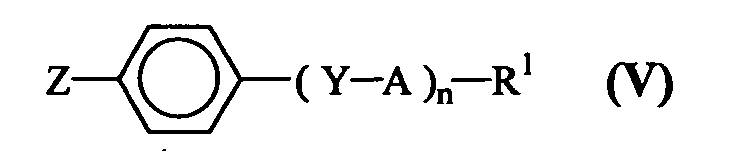
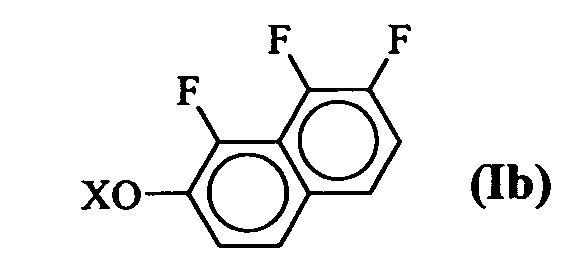
- the present invention provides a method for producing a compound represented by general formula (VI) comprising lithiating the 6-position of a compound represented by general formula (Ib), reacting the compound represented by general formula (Ib) with trimethoxyborane to produce boronic acid, and reacting the boronic acid with a compound represented by general formula (V) in the presence of a catalyst, wherein X represents a saturated or unsaturated alkyl group having a carbon number of 1 to 10, wherein Z represents an iodine atom, a bromine atom, a chlorine atom, or a trifluoromethanesulfonyloxy group, and R 1 represents a saturated or unsaturated alkyl group having a carbon number of 1 to 10, and Y represents a single bond, -CH 2 CH 2 -, or -CH 2 O-, A represents a trans-1,4-cyclohexylene group or a 1,4-phenylene group, and n represents a number of 0 or 1, where
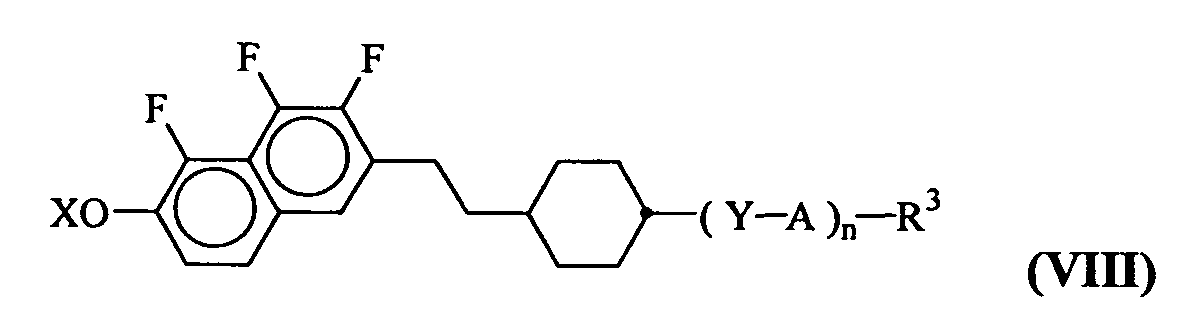
- the present invention provides a method for producing a compound represented by general formula (VIII) comprising lithiating the 6-position of a compound represented by general formula (Ib), reacting the compound represented by general formula (Ib) with a cyclohexylacetoaldehyde derivative represented by general formula (VII), dehydrating a product obtained by the reaction between the compounds represented by general formulae (Ib) and (VII), and hydrogenating a double bond produced by the dehydration, wherein X represents a saturated or unsaturated alkyl group having a carbon number of 1 to 10, wherein R 1 represents a saturated or unsaturated alkyl group having a carbon number of 1 to 10, and Y represents a single bond, -CH 2 CH 2 -, or -CH 2 O-, and A represents a trans-1,4-cyclohexylene group or a 1,4-phenylene group, and n represents a number of 0 or 1, wherein X and R 3 represent saturated alkyl groups having a carbon
- the base such as potassium carbonate, sodium carbonate, or sodium hydride.
- fluoropyridiniums such as N-fluoropyridinium triflate, N-fluoropyridinium tetrafluoroborate, N-fluoro-2,6-dichloropyridinium triflate, N-fluoro-2,6-dichloropyridinium tetrafluoroborate, N-fluro-2,4,6-trimethylpyridinium triflate, N-fluoro-2,4,6-trimetylpyridinium tetrafluoroborate, N,N'-difluoro-2,2'-bipyridinium bis(tetrafluoroborate), or N-fluoro-4,6-dimetylpyridinium-2-sulfonate; fluoroammoniums such as 1-chloromethyl-4-fluoro-1,4-diazoniabicyclo[2.2.2]octanebis(tetrafluoroborate); or electron-withdraw
- 1,1,7,8-tetrafluoro-1,2-dihydronaphthalene-2-one can be produced besides the desired 1,7,8-trifluoro-2-naphthol, it can be easily transformed into 1,7,8-trifluoro-2-naphthol by reducing it with a reducing agent such as a hydrogen.
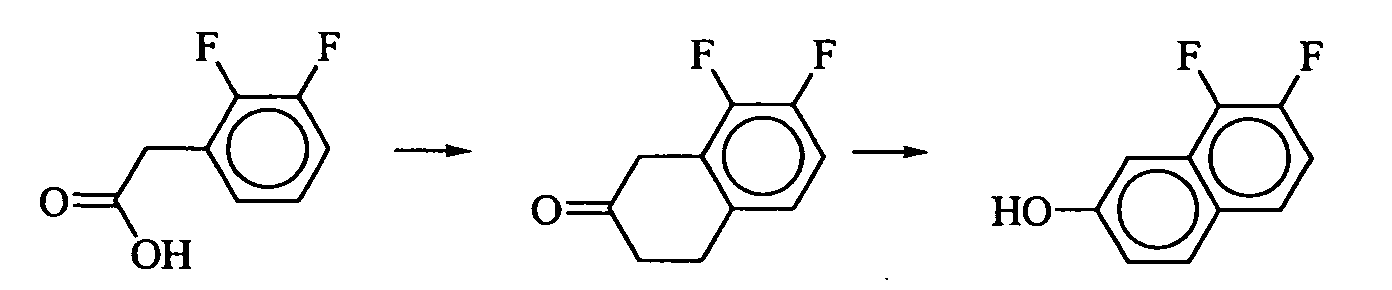
- 7,8-difluoro-2-naphthol which is a starting material in the fluorination
- X represents a saturated or unsaturated alkyl group having a carbon number of 1 to 10
- examples of X include a saturated alkyl group such as a methyl group, an ethyl group, a propyl group, a butyl group, a pentyl group, a hexyl group, a heptyl group, an octyl group, a nonyl group, a decyl group, or a 2-methylbutyl group; and an unsaturated alkyl group such as an aryl group or a crotyl group.
- examples of an alkyl halide used for the synthesis include methyl iodide, ethyl iodide, propyl iodide, butyl iodide, pentyl iodide, hexyl iodide, heptyl iodide, octyl iodide, nonyl iodide, decyl iodide, 2-methylbutyl iodide, methyl bromide, ethyl bromide, propyl bromide, butyl bromide, pentyl bromide, hexyl bromide, heptyl bromide, octyl bromide, nonyl bromide, decyl bromide, 2-methylbutyl bromide, methyl chloride, ethyl chloride, propyl chloride, butyl chloride, pentyl chloride, hexyl chloride
- a mixture system (binary system) of water and an organic solvent can be used as a reaction solvent.
- organic solvent single or mixture of nitrils such as acetonitrile or benzonitrile; halogen type solvents such as dichloromethane, chloroform, carbon tetrachloride, 1,2-dichloroethane, or 1,1,1-trichloroethane; ethers such as diethyl ether, methyl-t-butyl ether, or tetrahydrofuran; esters such as ethyl acetate, methyl acetate, or butyl acetate; saturated hydrocarbons such as pentane, hexane, heptane, or octane; benzenes such as benzene, toluene, xylene, or chlorobenzene; or amides such as N,N-dimethylformaldehyde or N,N-dimethyl
- the reaction can be performed at a temperature which is not less than the boiling point of either an organic solvent or water or the azeotropic point thereof under the normal pressure.
- a temperature which is not less than the boiling point of either an organic solvent or water or the azeotropic point thereof under the normal pressure.
- 80 to 200 °C is preferable, and 90 to 130 °C is particularly preferable.
- inorganic bases such as sodium carbonate, potassium carbonate, sodium hydroxide, potassium hydroxide, sodium hydrogencarbonate, potassium hydrogencarbonate, magnesium carbonate, or calcium carbonate can be used, while sodium carbonate, potassium carbonate, sodium hydroxide, or potassium hydroxide is preferable, and sodium carbonate or potassium carbonate is particularly preferable.
- Examples of the catalyst used in the reaction include a palladium complex such as tetrakis(triphenylphosphine)palladium, dichlorobis(triphenylphosphine)palladium, dichlorobis[(diphenylphosphino)ethane]palladium, dichlorobis[(diphenylphosphino)propane]palladium, dichlorobis[(diphenylphosphino)butane]palladium, or dichlorobis[(diphenylphosphino)ferrocene]palladium; and a nickel complex such as tetrakis(triphenylphosphine)nickel, dichlorobis(triphenylphosphine)nickel, dichlorobis[(diphenylphosphino)ethane]nickel, dichlorobis[(diphenylphosphino)propane]nickel, dichlorobis[(diphenylphosphino)butane
- the method of refluxing with heating using a palladium catalyst and the binary system solvent between water and tetrahydrofuran, benzene, toluene, or xylene in the presence of sodium carbonate or potassium carbonate is particularly preferable in this reaction.
- the alkylation can be performed as follows.
- the 6-position of the naphthalene ring of general formula (III) is selectively lithiated and then reacted with an alkyl iodide or an allyl halide to produce the phenylnaphthalene compound represented by general formula (IV).
- alkyllithium such as butyllithium, s-butyllithium, or t-butyllithium; or lithium amide such as lithium diisopropoxide or lithium hexamethyldisilazide.
- a nonaqueous polar solvent such as tetrahydrofuran, diethyl ether, or dimethoxyethane; or a hydrocarbon type solvent such as benzene, toluene, xylene, hexane, or heptane is preferable.
- alkyl iodide examples include methyl iodide, ethyl iodide, propyl iodide, and butyl iodide.
- allyl iodide examples include allyl chloride, allyl bromide, crotyl chloride, and crotyl bromide.
- the 6-position of the naphthalene ring of general formula (III) is selectively lithiated and then reacted with trimethoxyborane followed by a hydrogen peroxide to produce the naphthol at the 6-position of which a hydroxyl group is introduced. Then, the naphthol is reacted with alkyl halide or allyl halide to produce the phenylnaphthalene compound represented by general formula (IV).
- alkyllithium such as butyllithium, s-butyllithium, or t-butyllithium; or lithium amide such as lithium diisopropoxide or lithium hexamethyldisilazide.
- a nonaqueous polar solvent such as tetrahydrofuran, diethyl ether, or dimethoxyethane; or a hydrocarbon type solvent such as benzene, toluene, xylene, hexane, or heptane is preferable.
- alkyl iodide examples include methyl iodide, ethyl iodide, propyl iodide, and butyl iodide.
- allyl iodide examples include allyl chloride, allyl bromide, crotyl chloride, and crotyl bromide.
- the boronic acid represented by general formula (II) is often used as the intermediate for the production of a liquid crystal.
- the boronic acid can be easily produced by reacting the Grignard reagent, which is produced by reacting the phenyl bromide represented by general formula (Va) with a magnesium, with trimethoxyborane, wherein R 1 , Y, A, and n represent the same as in general formula (II).
- the compound described as general formula (VI) can be produced by the Suzuki coupling which reacts boronic acid, which is easily produced by selectively lithiating and reacting with trimethoxyboran the 6-position of the compound represented by general formula (I) (X represents a saturated or unsaturated alkyl group having a carbon number of 1 to 10), with the compound represented by general formula (V).
- reaction conditions in the above production of the compound represented by general formula (IV) can be directly used in the Suzuki coupling.
- alkyllithium such as butyllithium, s-butyllithium, or t-butyllithium or lithium amide such as lithium diisopropoxide or lithium hexamethyldisilazide.
- lithiation it is preferable for the lithiation to use single or mixture of a nonaqueous polar solvent such as tetrahydrofuran, diethyl ether, or dimethoxyethane or a hydrocarbon type solvent such as benzene, toluene, xylene, hexane, or heptane.
- a nonaqueous polar solvent such as tetrahydrofuran, diethyl ether, or dimethoxyethane
- a hydrocarbon type solvent such as benzene, toluene, xylene, hexane, or heptane.
- the temperature of the lithiation is within a range of 0 °C to the solidifying point, while a range of -20 to -90 °C is preferable, and a range of -40 to -78 °C is particularly preferable.
- the compound represented by general formula (V) is often used as the intermediate for the production of a liquid crystal, and the procurement of this compound is easy.
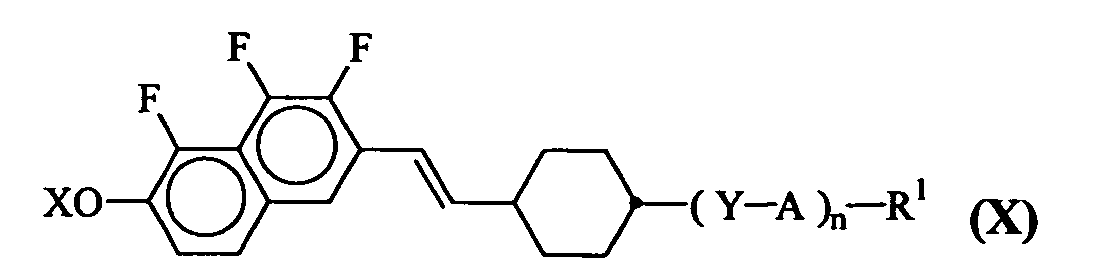
- Examples of the method for producing the compound represented by general formula (VIII) include the method, wherein the 6-position of the compound represented by general formula (I), wherein X represents a saturated or unsaturated alkyl group having a carbon number of 1 to 10, is lithiated selectively and reacted with the cyclohexylacetoaldehyde derivative represented by general formula (VII) to produce the alcohol represented by general formula (IX), and this alcohol is dehydrated to produce the compound represented by general formula (X), and the olefin portion of it is hydrogenated, wherein X and R 1 represent saturated or unsaturated alkyl group having a carbon number of 1 to 10, and Y represents a single bond, -CH 2 CH 2 -, or -CH 2 O-, and A represents trans-1,4-cyclohexylene group or 1,4-phenylene group, and n represents a number of 0 or 1, wherein X, R 1 , Y, A, and n represent the same as in general formula (IX).
- the aldehyde may be dissolved in the same solvent as used for the lithiation and then added in the reaction solution after the lithiation.
- the reaction temperature in the reaction is within a range of room temperature to the solidifying temperature, while a range of 0 to -60 °C is preferable.
- dehydration there is no problem in the generally well-known conditions.
- dehydration include the method of refluxing with heating in toluene in the presence of an acid-catalyst such as sulfuric acid or p-toluenesulfonic acid or the method of reacting with methyl chloride and tosyl chloride in the presence of the base such as pyridine.
- the hydrogenation of an olefin is well-known and easily performed by using the catalyst such as palladium-carbon or Raney nickel in a hydrogen atmosphere or under increased pressure.
- N, N'-difluoro-2,2'-bipiridinium bis(tetrafluoroborate) 53 g was added to an acetonitrile (240 ml) solution of 7,8- difluoro-2- naphthol (26 g), and the reaction solution was refluxed with heating for 3.5 hours.
- the reaction solution was poured into water.
- the organic layer was removed, and the aqueous layer was extracted 3 times with ethyl acetate.
- the organic layers were combined, washed 2 times with a saturated saline solution, and concentrated.
- the crude product of 1,1,7,8-tetrafluoro-1,2-dihydronaphthalen-2-one is obtained as a residue.
- 1,7,8-Trifluoronaphthalene-2-yl trifluoromethanesulfonate (15 g), 4-propylphenylboric acid (11.2 g), potassium carbonate (18.8 g), tetrakis(triphenylphosphine)palladium(0) (1 g), toluene (50 ml), tetrahydrofuran (50 ml), and water (20 ml) were added in an autoclave and stirred for 4 hours at 90 °C under pressurized nitrogen (2 kg/cm 2 ). The reaction solution was poured into water. The organic layer was removed, and the aqueous layer was extracted with toluene.
- N,N-dimethylformamide (30 ml) solution of 6-(4-propylphenyl)-3,4,5-trifluoro-2-naphthol was added dropwise to a N,N-dimethylformamide (5 ml) suspension of sodium hydride (60% oiliness,1.3 g) while cooled with ice.
- a N,N-dimethylformamide (20 ml) solution of ethyl iodide (6.3 g) was added dropwise to the reaction solution for 30 minutes, followed by stirring for another 30 minutes.
- the reaction solution was poured into water, and sodium thiosulfate was added to it. After stirring for a while, the organic layer was removed, and the aqueous layer was extracted with ethyl acetate. The organic layers were combined, washed with brine, and concentrated. The residue was purified by column chromatography (silica gel, toluene), and recrystallized from ethanol (3 times). Then, 3-ethoxy-7-(4-propylphenyl)-1,2,8-trifluoronaphthalene (3.8 g) was obtained.
- reaction solution was extracted with ethyl acetate, washed with brine, and concentrated. The residue was recrystallized from ethyl acetate, and 7-ethoxy-3-[2-[trans-4-(trans-4-butylcyclohexyl)cyclohexyl]-1-hydroxyethyl]-1,2,8-trifluoronaphthalene was obtained.
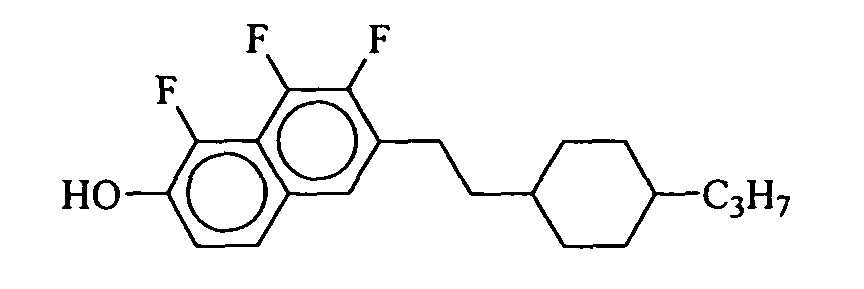
- a 1,7,8- trifluoronaphthalene-2-naphthol derivative and a method for efficiently producing trifluoronaphthalene liquid crystal material using the same provided by the present invention enable to produce a liquid crystal compound having a trifluoronaphthalene backbone which has been difficult to produce in the past.
Landscapes
- Chemical & Material Sciences (AREA)
- Organic Chemistry (AREA)
- Chemical Kinetics & Catalysis (AREA)
- Crystallography & Structural Chemistry (AREA)
- Engineering & Computer Science (AREA)
- Materials Engineering (AREA)
- Organic Low-Molecular-Weight Compounds And Preparation Thereof (AREA)
- Low-Molecular Organic Synthesis Reactions Using Catalysts (AREA)
Abstract
Description









N,N'-difluoro-2,2'-bipyridinium bis(tetrafluoroborate), or
N-fluoro-4,6-dimetylpyridinium-2-sulfonate; fluoroammoniums such as 1-chloromethyl-4-fluoro-1,4-diazoniabicyclo[2.2.2]octanebis(tetrafluoroborate); or electron-withdrawing fluorinating agents such as a fluorine gas, bromine trifluoride, or iodine pentafluoride can be used. While, in the fluorination,
1,1,7,8-tetrafluoro-1,2-dihydronaphthalene-2-one can be produced besides the desired 1,7,8-trifluoro-2-naphthol, it can be easily transformed into 1,7,8-trifluoro-2-naphthol by reducing it with a reducing agent such as a hydrogen.
dichlorobis[(diphenylphosphino)ethane]palladium,
dichlorobis[(diphenylphosphino)propane]palladium,
dichlorobis[(diphenylphosphino)butane]palladium, or dichlorobis[(diphenylphosphino)ferrocene]palladium; and a nickel complex such as
tetrakis(triphenylphosphine)nickel, dichlorobis(triphenylphosphine)nickel,
dichlorobis[(diphenylphosphino)ethane]nickel,
dichlorobis[(diphenylphosphino)propane]nickel,
dichlorobis[(diphenylphosphino)butane]nickel, or
dichlorobis[(diphenylphosphino)ferrocene]nickel, while a palladium complex is preferable.



1H NMR (CDCl3) δ 5.0-6.5 (broad, 1 H), 7.14-7.24 (m, 2 H), 7.45-7.55 (m, 2 H)
MS m/z: 198 (M+, 100)
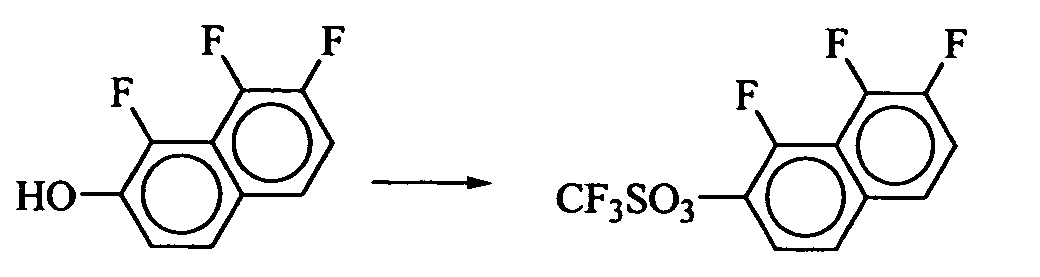
MS m/z: 330 (M+), 169 (100)

Melting point: 96.5 to 98.5 °C
1H NMR (CDCl3) δ 1.48 (t, J = 7.1 Hz, 3 H), 4.27 (q, J = 7.1 Hz, 2H), 7.15-7.35 (m, 2 H), 7.45-7.60 (m, 2 H)
MS m/z: 226 (M+), 198 (100)

MS m/z: 300 (M+), 271 (100)

Melting point: 99 °C
1H NMR (CDCl3) δ 0.99 (t, J = 7.3 Hz, 3 H), 1.70 (sextet, J = 7.3 Hz, 2 H), 2.49 (s, 3 H), 2.66 (t, J = 7.3 Hz, 2 H), 7.2-7.6 (m, 7 H)
MS m/z: 314 (M+), 285 (100)


MS m/z: 316 (M+), 287 (100)
Melting point: 122 °C
1H NMR (CDCl3) δ 0.99 (t, J = 7.3 Hz, 3 H), 1.55 (t, J = 7.1 Hz, 3 H), 1.72 (broad sextet, J = 7.6 Hz, 2 H), 2.65 (t, J = 7.6 Hz, 2 H), 4.23 (q, J = 7.1 Hz, 2 H), 7.0-7.6 (m, 7 H)
MS m/z: 344 (M+), 287 (100)

Phase transition temperatures: Cr 134 N 248 I
1H NMR (CDCl3) δ 0.92 (t, J = 7.1 Hz, 3 H), 1.00-1.15 (m, 2 H), 1.45 (m, 5 H), 1.45-1.60 (m, 5 H), 1.92 (t, J = 16.4 Hz, 4 H), 2.54 (t, J = 12.5 Hz, 1 H), 4.28 (q, J = 6.8 Hz, 2H), 7.20-7.35 (m, 3 H), 7.50-7.60 (m, 4 H)
MS m/z : 426 (M-, 100)

Phase transition temperatures: Cr 94 N 209 I
1H NMR (CDCl3) δ 0.82-0.89 (m, 5 H), 0.94-1.01 (m, 8 H), 1.12-1.27 (m, 8 H), 1.46 (t, J = 7.0 Hz, 3 H), 1.52-1.57 (m, 2 H), 1.67-1.75 (m, 6 H), 1.83-1.85 (m, 2 H), 2.74-2.78 (m, 2 H), 4.24 (q, J = 7.0 Hz, 2 H), 7.20 (dd, J = 9.0 and 6.6 Hz, 1 H), 7.29-7.30 (broad d, J = 8 Hz, 1 H), 7.24-7.44 (broad dt, J = 9.0 and 1.0 Hz, 1 H)
MS m/z: 474 (M+, 100)
Claims (9)
- A compound represented by general formula (I),wherein X represents a hydrogen atom, CF3SO2-, or a saturated or unsaturated alkyl group having a carbon number of 1 to 10.

- A compound according to claim 1, wherein X represents a hydrogen atom.
- A compound according to claim 1, wherein X represents CF3SO2-.
- A compound according to claim 1, wherein X represents a saturated or unsaturated alkyl group having a carbon number of 1 to 10.
- A method for producing a compound represented by general formula (III) by reacting a compound represented by general formula (Ia) with a compound represented by general formula (II) in the presence of a catalyst,
 wherein R1 represents a saturated or unsaturated alkyl group having a carbon number of 1 to 10, and Y represents a single bond, -CH2CH2-, or -CH2O-, and A represents a trans-1,4-cyclohexylene group or a 1,4-phenylene group, and n represents a number of 0 or 1,
 wherein R1, Y, A, and n represent the same as in general formula (II).
- A compound represented by general formula (III),wherein R1 represents a saturated or unsaturated alkyl group having a carbon number of 1 to 10, and Y represents a single bond, -CH2CH2-, or -CH2O-, and A represents a trans-1,4-cyclohexylene group or a 1,4-phenylene group, and n represents a number of 0 or 1.

- A method for producing a compound represented by general formula (IV) comprising:wherein R1 represents a saturated or unsaturated alkyl group having a carbon number of 1 to 10, and Y represents a single bond, -CH2CH2-, or -CH2O-, and A represents a trans-1,4-cyclohexylene group or a 1,4-phenylene group, and n represents a number of 0 or 1,reacting a compound represented by general formula (Ia) with a compound represented by general formula (II) in the presence of a catalyst to produce a compound represented by general formula (III); andalkylating or alkoxylating the compound represented by general formula (III),

 wherein R1, Y, A, and n represent the same as in general formula (II),
 wherein R1, Y, A, and n represent the same as in the general formula (II), and R2 represents a saturated or unsaturated alkyl or alkoxyl group having a carbon number of 1 to 10.
- A method for producing a compound represented by general formula (VI) comprising:wherein X represents a saturated or unsaturated alkyl group having a carbon number of 1 to 10,lithiating 6-position of a compound represented by general formula (Ib);reacting the compound represented by general formula (Ib) with trimethoxyborane to produce boronic acid; andreacting the boronic acid with a compound represented by general formula (V) in the presence of a catalyst,
 wherein Z represents an iodine atom, a bromine atom, a chlorine atom, or a trifluoromethanesulfonyloxy group, and R1 represents a saturated or unsaturated alkyl group having a carbon number of 1 to 10, and Y represents a single bond, -CH2CH2-, or -CH2O-, A represents a trans-1,4-cyclohexylene group or a 1,4-phenylene group, and n represents a number of 0 or 1,
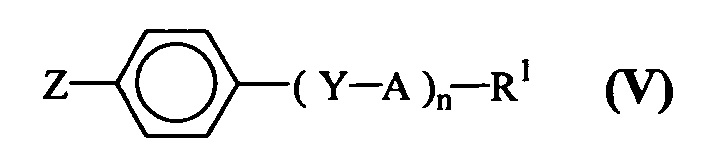 wherein X and R1 represent saturated or unsaturated alkyl groups having a carbon number of 1 to 10, and Y represents a single bond, -CH2CH2-, or -CH2O-, and A represents a trans-1, 4-cyclohexylene group or a 1, 4-phenylene group, and n represents a number of 0 or 1.
- A method for producing a compound represented by general formula (VIII) comprising:wherein X represents a saturated or unsaturated alkyl group having a carbon number of 1 to 10,lithiating 6-position of a compound represented by general formula (Ib);reacting the compound represented by general formula (Ib) with a cyclohexylacetoaldehyde derivative represented by general formula (VII);dehydrating a product obtained by the reaction between the compounds represented by general formulae (Ib) and (VII); andhydrogenating a double bond produced by the dehydration,
 wherein R1 represents a saturated or unsaturated alkyl group having a carbon number of 1 to 10, and Y represents a single bond, -CH2CH2-, or -CH2O-, and A represents a trans-1,4-cyclohexylene group or a 1,4-phenylene group, and n represents a number of 0 or 1,
 wherein X and R3 represent saturated alkyl groups having a carbon number of 1 to 10, and Y represents a single bond, -CH2CH2-, or -CH2O-, and A represents trans-1,4-cyclohexylene group or 1,4-phenylene group, and n represents a number of 0 or 1.
Applications Claiming Priority (3)
| Application Number | Priority Date | Filing Date | Title |
|---|---|---|---|
| JP2002282887 | 2002-09-27 | ||
| JP2002282887 | 2002-09-27 | ||
| PCT/JP2003/012333 WO2004029015A1 (en) | 2002-09-27 | 2003-09-26 | 1,7,8-trifluoronaphthalene-2-naphthol, and method for producing liquid crystal compound using same |
Publications (3)
| Publication Number | Publication Date |
|---|---|
| EP1544187A1 true EP1544187A1 (en) | 2005-06-22 |
| EP1544187A4 EP1544187A4 (en) | 2007-10-24 |
| EP1544187B1 EP1544187B1 (en) | 2011-02-16 |
Family
ID=32040547
Family Applications (1)
| Application Number | Title | Priority Date | Filing Date |
|---|---|---|---|
| EP03753954A Expired - Lifetime EP1544187B1 (en) | 2002-09-27 | 2003-09-26 | 1,7,8-trifluoronaphthalene-2-naphthol, and methods for producing liquid crystal compounds using same |
Country Status (7)
| Country | Link |
|---|---|
| US (1) | US7214835B2 (en) |
| EP (1) | EP1544187B1 (en) |
| KR (1) | KR100644955B1 (en) |
| CN (1) | CN100543004C (en) |
| DE (1) | DE60336066D1 (en) |
| TW (1) | TWI319762B (en) |
| WO (1) | WO2004029015A1 (en) |
Cited By (4)
| Publication number | Priority date | Publication date | Assignee | Title |
|---|---|---|---|---|
| WO2005123749A1 (en) * | 2004-06-19 | 2005-12-29 | F2 Chemicals Limited | Organoboron compound comprising sulphur pentafluoride |
| EP1762605A1 (en) * | 2005-09-08 | 2007-03-14 | Chisso Petrochemial Corporation | Naphthalene compound with terminal hydrogen, liquid crystal composition including the compound, and LCD device including the liquid crystal composition |
| EP1959000A1 (en) | 2007-02-19 | 2008-08-20 | MERCK PATENT GmbH | Liquid crystalline medium |
| WO2012126562A1 (en) * | 2011-03-18 | 2012-09-27 | Merck Patent Gmbh | Liquid crystalline medium |
Families Citing this family (11)
| Publication number | Priority date | Publication date | Assignee | Title |
|---|---|---|---|---|
| JP4872121B2 (en) * | 2005-12-27 | 2012-02-08 | Dic株式会社 | Method for producing difluorobenzene derivative |
| DE102008027972B4 (en) | 2007-07-02 | 2023-06-22 | Merck Patent Gmbh | naphthofuran derivatives |
| DE102008054350A1 (en) | 2007-11-27 | 2009-05-28 | Merck Patent Gmbh | Benzo [f] chromene and pyrano [3,2-f] chromene derivatives |
| CN101550071B (en) * | 2008-04-03 | 2013-08-07 | Dic株式会社 | Manufacturing method of 1,7,8-trifluoro-2-naphthol |
| JP5125707B2 (en) * | 2008-04-10 | 2013-01-23 | Dic株式会社 | Process for producing 1,7,8-trifluoro-2-naphthol |
| CN101633607B (en) * | 2009-08-28 | 2012-09-05 | 浙江博泰化工有限公司 | Synthesis method of fluorine-substituted naphthol |
| CN101693648B (en) * | 2009-10-16 | 2014-03-19 | 南开大学 | Preparation method of 1, 7, 8- trifluoro-2- naphthol and derivative thereof |
| CN103725295B (en) * | 2013-12-24 | 2016-02-03 | 石家庄诚志永华显示材料有限公司 | A kind of liquid-crystal composition |
| CN103804154B (en) * | 2014-03-12 | 2015-07-15 | 石家庄诚志永华显示材料有限公司 | Midbody and method for preparing 1,7,8-trifluoro-2-alkoxynaphthalenel |
| WO2017065078A1 (en) * | 2015-10-16 | 2017-04-20 | Dic株式会社 | Nematic liquid crystal composition and liquid crystal display element using same |
| CN107434973B (en) * | 2016-05-27 | 2023-01-10 | 江苏和成显示科技有限公司 | Liquid crystal compound and composition and application thereof |
Family Cites Families (11)
| Publication number | Priority date | Publication date | Assignee | Title |
|---|---|---|---|---|
| CH678334A5 (en) | 1988-03-10 | 1991-08-30 | Merck Patent Gmbh | |
| JP2548979B2 (en) | 1988-12-28 | 1996-10-30 | 富士通株式会社 | Liquid crystal display |
| DE4042747B4 (en) | 1990-01-09 | 2009-10-08 | Merck Patent Gmbh | Electro-optical liquid crystal switching element |
| DE19522195A1 (en) | 1994-06-20 | 1995-12-21 | Hoechst Ag | Stable 3,4,5-tri:fluoro-naphthalene derivs. useful in liquid crystal mixt. |
| CA2269561C (en) * | 1998-04-22 | 2007-06-05 | Dainippon Ink And Chemicals, Inc. | Naphthalene derivative and liquid crystal composition comprising the same |
| US6913797B1 (en) | 1998-08-24 | 2005-07-05 | Dainippon Ink And Chemicals, Inc. | Decahydronaphthalene derivative |
| JP4573069B2 (en) | 1999-07-14 | 2010-11-04 | Dic株式会社 | Novel liquid crystalline compounds which are n-type naphthalene derivatives and liquid crystal compositions containing the same |
| JP4691746B2 (en) | 1999-07-28 | 2011-06-01 | Dic株式会社 | Nematic liquid crystal composition and liquid crystal display device using the same |
| JP4348600B2 (en) * | 2002-12-26 | 2009-10-21 | Dic株式会社 | Nematic liquid crystal composition and liquid crystal display device using the same |
| JP2004352931A (en) * | 2003-05-30 | 2004-12-16 | Dainippon Ink & Chem Inc | Liquid crystal composition and liquid crystal compound containing difluorotetrahydronaphthalene derivative |
| JP2005048007A (en) * | 2003-07-31 | 2005-02-24 | Dainippon Ink & Chem Inc | Liquid crystal composition, display element and liquid crystalline compound containing trifluoronaphthalene derivative. |
-
2003
- 2003-09-24 TW TW092126282A patent/TWI319762B/en not_active IP Right Cessation
- 2003-09-26 KR KR1020057005106A patent/KR100644955B1/en not_active Expired - Fee Related
- 2003-09-26 WO PCT/JP2003/012333 patent/WO2004029015A1/en not_active Ceased
- 2003-09-26 EP EP03753954A patent/EP1544187B1/en not_active Expired - Lifetime
- 2003-09-26 DE DE60336066T patent/DE60336066D1/en not_active Expired - Lifetime
- 2003-09-26 US US10/527,674 patent/US7214835B2/en not_active Expired - Lifetime
- 2003-09-26 CN CNB038226278A patent/CN100543004C/en not_active Expired - Lifetime
Cited By (6)
| Publication number | Priority date | Publication date | Assignee | Title |
|---|---|---|---|---|
| WO2005123749A1 (en) * | 2004-06-19 | 2005-12-29 | F2 Chemicals Limited | Organoboron compound comprising sulphur pentafluoride |
| EP1762605A1 (en) * | 2005-09-08 | 2007-03-14 | Chisso Petrochemial Corporation | Naphthalene compound with terminal hydrogen, liquid crystal composition including the compound, and LCD device including the liquid crystal composition |
| US7790915B2 (en) | 2005-09-08 | 2010-09-07 | Chisso Petrochemical Corporation | Naphthalene compound with terminal hydrogen, liquid crystal composition including the compound, and LCD device including the liquid crystal composition |
| EP1959000A1 (en) | 2007-02-19 | 2008-08-20 | MERCK PATENT GmbH | Liquid crystalline medium |
| WO2012126562A1 (en) * | 2011-03-18 | 2012-09-27 | Merck Patent Gmbh | Liquid crystalline medium |
| US9347002B2 (en) | 2011-03-18 | 2016-05-24 | Merck Patent Gmbh | Liquid-crystalline medium |
Also Published As
| Publication number | Publication date |
|---|---|
| EP1544187B1 (en) | 2011-02-16 |
| TWI319762B (en) | 2010-01-21 |
| TW200413276A (en) | 2004-08-01 |
| WO2004029015A1 (en) | 2004-04-08 |
| US20060163537A1 (en) | 2006-07-27 |
| EP1544187A4 (en) | 2007-10-24 |
| CN100543004C (en) | 2009-09-23 |
| US7214835B2 (en) | 2007-05-08 |
| KR100644955B1 (en) | 2006-11-10 |
| KR20050057573A (en) | 2005-06-16 |
| DE60336066D1 (en) | 2011-03-31 |
| CN1684933A (en) | 2005-10-19 |
Similar Documents
| Publication | Publication Date | Title |
|---|---|---|
| EP1544187B1 (en) | 1,7,8-trifluoronaphthalene-2-naphthol, and methods for producing liquid crystal compounds using same | |
| FI100529B (en) | Fluorobenzene derivatives and liquid crystalline medium | |
| JP2632401B2 (en) | Substituted phenyl trifluoromethyl ether compounds | |
| Seed et al. | Synthesis, transition temperatures, and optical properties of various 2, 6-disubstituted naphthalenes and related 1-benzothiophenes with butylsulfanyl and cyano or isothiocyanato terminal groups | |
| KR20150108325A (en) | 4,6-difluorodibenzofuran derivatives | |
| CA2088771A1 (en) | Vinyl compounds, and a liquid-crystalline medium | |
| JP3122426B2 (en) | Phenylcyclohexane compound and liquid crystal medium | |
| CA2046590A1 (en) | 1,4-disubstituted 2,6-difluorobenzene compounds, and a liquid crystalline medium | |
| KR100311921B1 (en) | Tolan compound, preparation method thereof, liquid crystal composition containing the compound as an active ingredient, and liquid crystal element using the liquid crystal composition | |
| JP3066069B2 (en) | Benzene derivative and liquid crystal phase | |
| JP3902802B2 (en) | Diene compound and liquid crystal medium | |
| JPH03123736A (en) | Method for cross-coupling by metal palladium catalyst | |
| JPH08507771A (en) | 1,2,2,2-Tetrafluoroethyl ether compound and liquid crystal medium | |
| JP3632702B2 (en) | 1,7,8-trifluoro-2-naphthol and method for producing liquid crystal compound using the same | |
| JP3406346B2 (en) | Benzene derivatives and liquid crystalline media | |
| GB2325930A (en) | Axially-Substituted Cyclohexane Liquid Crystals | |
| JPH02131436A (en) | Preparation of rodlike compound | |
| KR19980081130A (en) | Fluorocyclohexane derivatives and liquid crystal media | |
| JP2927957B2 (en) | Phenylcyclohexanes and liquid crystal media | |
| TW200848413A (en) | Chroman compounds | |
| GB2102000A (en) | 2-(Cyclohexyl)ethyl-cyclo- hexylnitriles and their use in liquid crystal compositions | |
| EP0688752B1 (en) | Trifluoro-2-(trans-4-substituted cyclohexyl) ethylenes and process for their production | |
| US7297378B2 (en) | Fluorinated fused aromatics and their use in liquid-crystal mixtures | |
| EP0426815A1 (en) | Fluorinated biphenyl derivatives. | |
| JPH0977703A (en) | Liquid crystal compound containing halogen atom and alkenyl group and liquid crystal composition |
Legal Events
| Date | Code | Title | Description |
|---|---|---|---|
| PUAI | Public reference made under article 153(3) epc to a published international application that has entered the european phase |
Free format text: ORIGINAL CODE: 0009012 |
|
| 17P | Request for examination filed |
Effective date: 20050321 |
|
| AK | Designated contracting states |
Kind code of ref document: A1 Designated state(s): AT BE BG CH CY CZ DE DK EE ES FI FR GB GR HU IE IT LI LU MC NL PT RO SE SI SK TR |
|
| RBV | Designated contracting states (corrected) |
Designated state(s): DE FR GB |
|
| A4 | Supplementary search report drawn up and despatched |
Effective date: 20070920 |
|
| 17Q | First examination report despatched |
Effective date: 20071123 |
|
| RAP1 | Party data changed (applicant data changed or rights of an application transferred) |
Owner name: DIC CORPORATION |
|
| GRAP | Despatch of communication of intention to grant a patent |
Free format text: ORIGINAL CODE: EPIDOSNIGR1 |
|
| RTI1 | Title (correction) |
Free format text: 1,7,8-TRIFLUORONAPHTHALENE-2-NAPHTHOL, AND METHODS FOR PRODUCING LIQUID CRYSTAL COMPOUNDS USING SAME |
|
| GRAS | Grant fee paid |
Free format text: ORIGINAL CODE: EPIDOSNIGR3 |
|
| GRAA | (expected) grant |
Free format text: ORIGINAL CODE: 0009210 |
|
| AK | Designated contracting states |
Kind code of ref document: B1 Designated state(s): DE FR GB |
|
| REG | Reference to a national code |
Ref country code: GB Ref legal event code: FG4D |
|
| REF | Corresponds to: |
Ref document number: 60336066 Country of ref document: DE Date of ref document: 20110331 Kind code of ref document: P |
|
| REG | Reference to a national code |
Ref country code: DE Ref legal event code: R096 Ref document number: 60336066 Country of ref document: DE Effective date: 20110331 |
|
| PGFP | Annual fee paid to national office [announced via postgrant information from national office to epo] |
Ref country code: GB Payment date: 20110816 Year of fee payment: 9 Ref country code: FR Payment date: 20110907 Year of fee payment: 9 |
|
| PLBE | No opposition filed within time limit |
Free format text: ORIGINAL CODE: 0009261 |
|
| STAA | Information on the status of an ep patent application or granted ep patent |
Free format text: STATUS: NO OPPOSITION FILED WITHIN TIME LIMIT |
|
| 26N | No opposition filed |
Effective date: 20111117 |
|
| REG | Reference to a national code |
Ref country code: DE Ref legal event code: R097 Ref document number: 60336066 Country of ref document: DE Effective date: 20111117 |
|
| GBPC | Gb: european patent ceased through non-payment of renewal fee |
Effective date: 20120926 |
|
| REG | Reference to a national code |
Ref country code: FR Ref legal event code: ST Effective date: 20130531 |
|
| PG25 | Lapsed in a contracting state [announced via postgrant information from national office to epo] |
Ref country code: GB Free format text: LAPSE BECAUSE OF NON-PAYMENT OF DUE FEES Effective date: 20120926 |
|
| PG25 | Lapsed in a contracting state [announced via postgrant information from national office to epo] |
Ref country code: FR Free format text: LAPSE BECAUSE OF NON-PAYMENT OF DUE FEES Effective date: 20121001 |
|
| PGFP | Annual fee paid to national office [announced via postgrant information from national office to epo] |
Ref country code: DE Payment date: 20150922 Year of fee payment: 13 |
|
| REG | Reference to a national code |
Ref country code: DE Ref legal event code: R119 Ref document number: 60336066 Country of ref document: DE |
|
| PG25 | Lapsed in a contracting state [announced via postgrant information from national office to epo] |
Ref country code: DE Free format text: LAPSE BECAUSE OF NON-PAYMENT OF DUE FEES Effective date: 20170401 |