EP1542248A2 - An electrolytic solution for an electrochemical capacitor and an electrochemical capacitor using the same - Google Patents
An electrolytic solution for an electrochemical capacitor and an electrochemical capacitor using the same Download PDFInfo
- Publication number
- EP1542248A2 EP1542248A2 EP04029267A EP04029267A EP1542248A2 EP 1542248 A2 EP1542248 A2 EP 1542248A2 EP 04029267 A EP04029267 A EP 04029267A EP 04029267 A EP04029267 A EP 04029267A EP 1542248 A2 EP1542248 A2 EP 1542248A2
- Authority
- EP
- European Patent Office
- Prior art keywords
- imidazolium
- electrolytic solution
- group
- ethyl
- dimethyl
- Prior art date
- Legal status (The legal status is an assumption and is not a legal conclusion. Google has not performed a legal analysis and makes no representation as to the accuracy of the status listed.)
- Granted
Links
Classifications
-
- H—ELECTRICITY
- H01—ELECTRIC ELEMENTS
- H01G—CAPACITORS; CAPACITORS, RECTIFIERS, DETECTORS, SWITCHING DEVICES, LIGHT-SENSITIVE OR TEMPERATURE-SENSITIVE DEVICES OF THE ELECTROLYTIC TYPE
- H01G9/00—Electrolytic capacitors, rectifiers, detectors, switching devices, light-sensitive or temperature-sensitive devices; Processes of their manufacture
- H01G9/004—Details
- H01G9/02—Diaphragms; Separators
-
- H—ELECTRICITY
- H01—ELECTRIC ELEMENTS
- H01G—CAPACITORS; CAPACITORS, RECTIFIERS, DETECTORS, SWITCHING DEVICES, LIGHT-SENSITIVE OR TEMPERATURE-SENSITIVE DEVICES OF THE ELECTROLYTIC TYPE
- H01G11/00—Hybrid capacitors, i.e. capacitors having different positive and negative electrodes; Electric double-layer [EDL] capacitors; Processes for the manufacture thereof or of parts thereof
- H01G11/54—Electrolytes
- H01G11/58—Liquid electrolytes
- H01G11/62—Liquid electrolytes characterised by the solute, e.g. salts, anions or cations therein
-
- H—ELECTRICITY
- H01—ELECTRIC ELEMENTS
- H01G—CAPACITORS; CAPACITORS, RECTIFIERS, DETECTORS, SWITCHING DEVICES, LIGHT-SENSITIVE OR TEMPERATURE-SENSITIVE DEVICES OF THE ELECTROLYTIC TYPE
- H01G9/00—Electrolytic capacitors, rectifiers, detectors, switching devices, light-sensitive or temperature-sensitive devices; Processes of their manufacture
- H01G9/004—Details
- H01G9/022—Electrolytes; Absorbents
- H01G9/035—Liquid electrolytes, e.g. impregnating materials
-
- Y—GENERAL TAGGING OF NEW TECHNOLOGICAL DEVELOPMENTS; GENERAL TAGGING OF CROSS-SECTIONAL TECHNOLOGIES SPANNING OVER SEVERAL SECTIONS OF THE IPC; TECHNICAL SUBJECTS COVERED BY FORMER USPC CROSS-REFERENCE ART COLLECTIONS [XRACs] AND DIGESTS
- Y02—TECHNOLOGIES OR APPLICATIONS FOR MITIGATION OR ADAPTATION AGAINST CLIMATE CHANGE
- Y02E—REDUCTION OF GREENHOUSE GAS [GHG] EMISSIONS, RELATED TO ENERGY GENERATION, TRANSMISSION OR DISTRIBUTION
- Y02E60/00—Enabling technologies; Technologies with a potential or indirect contribution to GHG emissions mitigation
- Y02E60/13—Energy storage using capacitors
-
- Y—GENERAL TAGGING OF NEW TECHNOLOGICAL DEVELOPMENTS; GENERAL TAGGING OF CROSS-SECTIONAL TECHNOLOGIES SPANNING OVER SEVERAL SECTIONS OF THE IPC; TECHNICAL SUBJECTS COVERED BY FORMER USPC CROSS-REFERENCE ART COLLECTIONS [XRACs] AND DIGESTS
- Y02—TECHNOLOGIES OR APPLICATIONS FOR MITIGATION OR ADAPTATION AGAINST CLIMATE CHANGE
- Y02T—CLIMATE CHANGE MITIGATION TECHNOLOGIES RELATED TO TRANSPORTATION
- Y02T10/00—Road transport of goods or passengers
- Y02T10/60—Other road transportation technologies with climate change mitigation effect
- Y02T10/70—Energy storage systems for electromobility, e.g. batteries
Definitions
- the present invention relates to an electrolytic solution for an electrochemical capacitor and an electrochemical capacitor using the electrolytic solution.
- the present invention relates to an electrochemical capacitor, which is adapted for memory backup in various electronic devices, and which is adapted for electric power in battery cars necessary for a large amount of currents.
- the present invention relates to an electrolytic solution preferable for such electrochemical capacitor.
- a conventional non-aqueous electrolytic solution may be insufficient in voltage proof, so that the electrochemical capacitor using such a conventional non-aqueous electrolytic solution may be involved in a significant performance deterioration with time,
- the purpose of the present invention is to provide an electrolytic solution which may significantly improve an electrochemical capacitor in its performance deterioration with time.
- the electrolytic solution for the electrochemical capacitor of the present invention is featured as including an electrolyte salt (A) shown as the following formula (1).
- A electrolyte salt
- R 1 ,” “R 2 ,” and “R 3” independently represent an alkyl group having a carbon number of 1 to 3
- R 4 and “R 5” independently represent hydrogen atom or an alkyl group having a carbon number of 1 to 3
- X represents a counterpart anion.
- the electrolytic solution for the electrochemical capacitor of the present invention is significantly high in voltage proof, so that it allows to produce an electrochemical capacitor whose performance deterioration is significantly little.
- use of the electrolytic solution of the present invention significantly increases an energy density of the electrochemical capacitor.
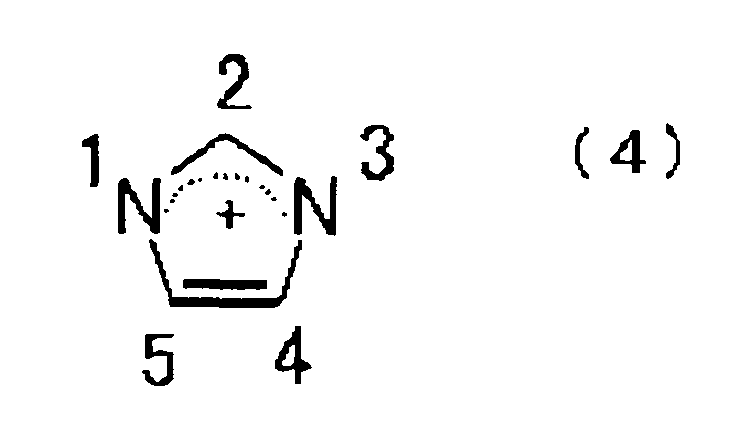
- the imidazolium salt of the present invention is named in accordance with a nomenclature generally used in organic chemistry, and the portions in the imidazolium ring are numbered as shown in the formula (4). Thus, the numbers of R 1 to R 5 do not correspond to the sites of the substituents.
- the electrolyte salt (A) as shown in the formula (1) includes, e.g., the following salt with a cation:
- it would be specifically preferable to use ones having methyl group at the second portion and it would be more preferable to use 1,2,3-trimethyl imidazolium, 1,2,3,4-tetramethyl imidazolium and 1-ethyl-2,3-dimethyl imidazolium.
- anion (X - ) it is preferable to use an anion of PF 6 - , BF4 - , AsF 6 - , SbF 6 - , N(RfSO 3 ) 2 - , C(RfSO 3 ) 3 - , RfSO 3 - (where "Rf” represents a fluoroalkyl group having a carbon number of 1 to 12), F - , ClO 4 - , AlF 4 - , AlCl 4 - , TaF 6 - , NbF 6 - , SiF 6 - , CN' or F(HF) n - , wherein "n” represents a number from 1 to 4.
- Rf in the anions of N(RfSO 3 ) 2 - , C(RfSO 3 ) 3 - , and RfSO 3 - represents a fluoroalkyl group having a carbon number of 1 to 12, which may include, e.g., trifluoro methyl, pentafluoro ethyl, heptafluoro propyl, and nonafluoro buthyl. Among them, it is preferable to use trifluoro methyl, pentafluoro ethyl, and heptafluoro propyl. It is more preferable to use trifluoro methyl and pentafluoro ethyl. It is most preferable to use trifluoro methyl.
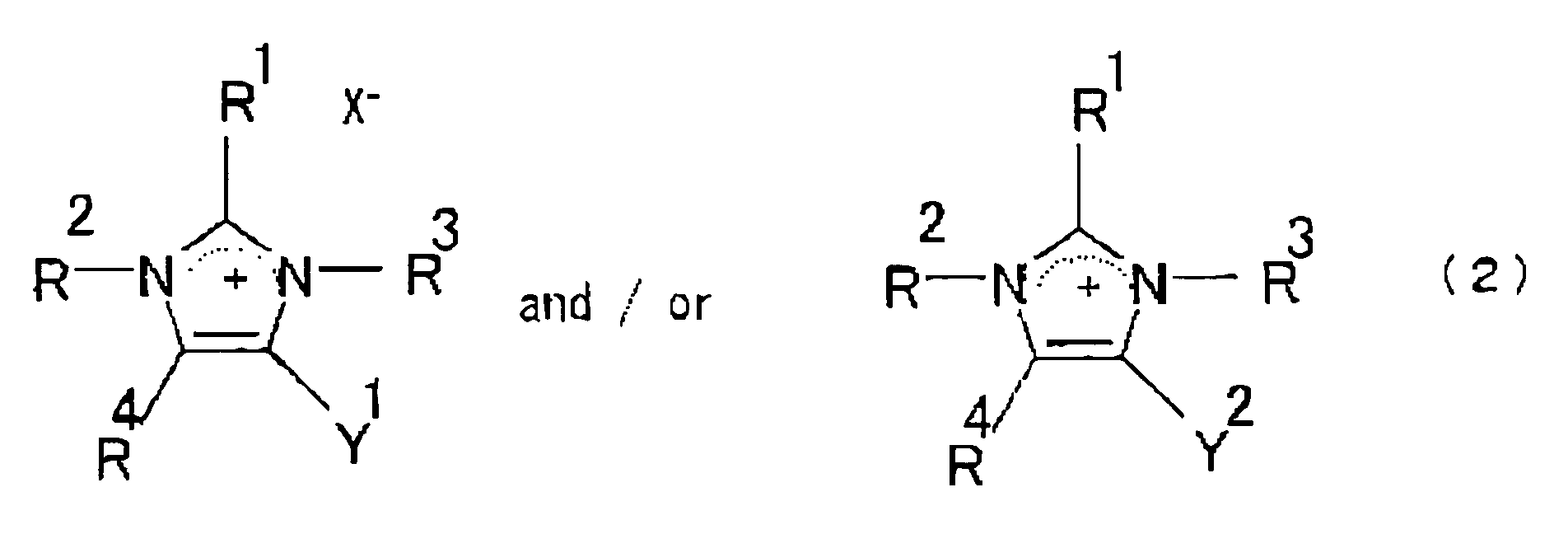
- the electrolyte salt (A) is generally obtained by a reaction for quaternary of a tertiary cyclic amidine with a carbonic ester, such as dialkyl carbonate, followed by subjecting the resultant carbonic ester salt to a salt exchange into the counterpart anion (X - ). Since carbon dioxide is generated (mixed) in the reaction system in the process of the reaction for quaternary, the cyclic amidinium salt is reacted with carbon dioxide, to obtain by-products of a imidazolium salt (B1) shown as the following formula (2), and a imidazolium salt (B2) shown as the formula (3).
- a carbonic ester such as dialkyl carbonate
- the electrolyte salt (A) may include the imidazolium salts (B1) and (B2) as impurities. These impurities would affect the voltage proof, resulting in correlating the performance deterioration with time of the electrochemical capacitor, and thus, those contents would be as little as possible.
- electrolyte salt (A) examples include 1,2,3-trimethyl imidazolium BF 4 - salt, 1,2,3,4-tetramethyl imidazolium BF 4 - salt, 1-ethyl-2,3-dimethyl imidazolium BF 4 - salt, 1,2,3-trimethyl imidazolium PF 6 - salt, 1,2,3,4-tetramethyl imidazolium PF 6 - salt, and 1-ethyl-2,3-dimethyl imidazolium PF 6 - salt.
- the imidazolium salts (B1) and (B2) may exist without the counterpart anion "X - ,” and in case of no counterpart anion "X - ,” electric charges in the molecule are balanced because of the group "Y 2 .”
- the imidazolium salts (B1) and (B2) may include the following compounds;
- the imidazolium salts (B1) of the present invention particularly include 1,2,3-trimethyl-4-carboxy imidazolium BF 4 - salt, 1-ethyl-2,3-dimethyl-4-carboxy imidazolium BF 4 - salt, 1-ethyl-2,3-dimethyl-5-- carboxy imidazolium BF 4 - salt, 1,2,3,4-tetramethyl-5-carboxy imidazolium BF 4 - salt, 1,2,3-trimethyl-4-carboxy imidazolium PF 6 - salt, 1-ethyl-2,3-dimethyl-4-carboxy imidazolium PF 6 - salt, 1-ethyl-2,3-dimethyl-5-carboxy imidazolium PF 6 - salt and 1,2,3,4-tetramethyl-5 -carboxy imidazolium PF 6 - salt, and compounds in which the carboxyl group in the above listed compounds are replaced with
- the imidazolium salts (B2) of the present invention particularly include 1,2,3-trimethyl-4,5-dicarboxy imidazolium BF 4 - salt, 1-ethyl-2,3-dimethyl-4,5-dicarboxy imidazolium BF 4 - salt, 1,2,3-trimethyl-4,5-dicarboxy imidazolium PF 6 - salt and 1-ethyl-2,3-dimethyl-4,5-dicarboxy imidazolium PF 6 - salt, and compounds in which the carboxyl group in the above listed compounds are replaced with carboxyoxy group.
- the content of the imidazolium salts (B1) and (B2) is preferably included as little as possible. In view of significant improvement of the voltage proof, it is preferable that these compounds are totally included at an amount of 10 mole % or less based on total molar numbers of the electrolyte salt - (A), the imidazolium salt (B1) and the imidazolium salt (B2). Also, it is more preferable that these compounds are included at an amount of 2 mole% or less, and in more particular at an amount of 1 mole % less, and in most particular, of 0.1 mole % or less. Within the range, the voltage proof are further improved, resulting in further improving the performance deterioration with time of the electrochemical capacitor.
- the content of the imidazolium salts (B1) and (B2) is quantitatively measured by means of a high performance liquid chromatography (HPLC).
- HPLC high performance liquid chromatography
- the HPLC may be operated in the condition of a column: a polymer coated filler; a mobile phase: a phosphoric acid buffering agent liquid (having a pH value of 2 to 3); a flow rate: 0.8 ml/min.; a detector: UV; and a temperature: 40°C.
- the calibration curve can be prepared with separation of the imidazolium salts (B1) and (B2), which are made as by-products in preparation of the electrolyte salt (A), by means of a separation HPLC (whose conditions are the same as the HPLC), or the electrolyte salt (A) may be combined with carbon dioxide in an autoclave.
- HPLC separation HPLC
- the electrolyte salt (A) may be combined with carbon dioxide in an autoclave.
- 1 H-NMR e.g., Device: AVANCE300 (manufactured by Nihon Bruker Corporation); solvent: deuterated dimethylsulfoxide; and frequency: 300MHz
- 19 F-NMR e.g., device: XL-300 (manufactured by Varian Corporation; solvent: deuterated dimethylsulfoxide; and frequency: 300MHz
- 13 C-NMR e.g., device: AL-300 (manufactured by JEOL (Nihon Denshi ) Corporation); solvent; deuterated dimethylsulfoxide; and frequency: 300MHz
- AL-300 manufactured by JEOL (Nihon Denshi ) Corporation
- solvent deuterated dimethylsulfoxide
- frequency: 300MHz The chemical structure of the electrolyte salt (A) may be identified in the same manner.
- the imidazolium salts (B1) and (B2) there are one way to inhibit generation of the imidazolium salts (B1) and (B2) in the process of the preparation of the electrolyte salt (A), and another way to remove the imidazolium salts (B1) and (B2) after the preparation of the electrolyte salt (A).
- the way to inhibit generation of the imidazolium salts (B1) and (B2) in the process of the preparation of the electrolyte salt (A) it may be applicable to reduce the concentration of carbon dioxide in the reaction system.
- the electrolyte salt (A) may be generally prepared, for example, by means of reacting N-alkyl imidazole (which may be obtained as a commercial product, or may be prepared by alkylation of an imidazole by an alkylation agent (such as dimethyl carbonate, diethyl carbonate, dipropyl carbonate, diisopropyl carbonate, methyl halide, ethyl halide, propyl halide, isopropyl halide, dimethyl sulfate, diethyl sulfate, dipropyl sulfate and diisopropyl sulfate)) with dialkyl carbonate (such as dimethyl carbonate, diethyl carbonate, dipropyl carbonate, and diisopropyl carbonate) in a proton polar solvent (such as an alcohol having a carbon number of 1 to 3, including methanol, ethanol, 1-propanol and 2-propanol) at a temperature of 100 to 180°
- the electrolyte salt (A) may be prepared by alkylation of N-alkyl imidazole by alkylation agent other than the dialkyl carbonate, such as methyl halide, ethyl halide, propyl halide, dimethyl sulfate, diethyl sulfate, dipropyl sulfate and diisopropyl sulfate.
- alkylation agent other than the dialkyl carbonate
- ion residues such as halogen ions and sulfate ion
- the proton polar solvent may be used at an amount of 10 to 1000 wt%, and in particular, of 50 to 800 wt%, and in more particular, of 100 to 600 wt%, and in most particular, of 200 to 400 wt%, based on the weight of N-alkyl imidazole.
- Carbon dioxide gas in the reaction system can be removed outside the system by means of adjusting a valve for releasing the pressure raised by the gas, which generates in the process of the reaction.
- a gas such as carbon dioxide can be removed from the reaction system by passing the gas through a cooling condenser for condensing a solvent such as methanol, which is returned into the reaction vessel.
- the pressure is preferably at 1 to 10 MPa, and more preferably at 2 to 9 MPa, and further more preferably at 3 to 8, and most preferably at 3.5 to 7 MPa.
- an inert gas such as nitrogen gas and argon gas can be injected into the system in order to release more amounts of carbon dioxide from the system.
- Carbon dioxide gas is preferably included in the reaction system in a molar number of 0.01 to 3, and in particular, of 0.02 to 2, and in more particular, of 0.03 to 1 and in most particular, of 0.04 to 0.1, based on that of N-alkyl imidazole,
- an adsorbent such as silica gel, activated carbon, activated alumina and molecular sieve (e.g., 3A 1/16 manufactured by Nacalai Tesque Corporation), a method for removing them by means of recrystallization, a method for washing them by using a solvent, a method for extracting by using a solvent, and etc, These methods may be used solely or in combination thereof.
- the recrystallization would be accomplished either by dissolving them into a solvent followed by lowering the temperature or by gradually evaporating the solvent, so as to deposit crystals, or by gradually adding a poor solvent so as to deposit crystals.
- the washing and extraction would be accomplished either by using a separating funnel in which crystals are suspended in a solvent followed by separating the crystals from the solvent, or by using a magnetic stirrer to suspend crystals in a solvent followed by separating the crystals from the solvent.
- the solvent useful for the recrystallization, washing and extraction may include an alcohol having a carbon number of 1 to 3 (such as methanol, ethanol, n-propanol and isopropanol); a ketone having a carbon number of 3 to 6 (such as acetone, methyl ethyl ketone, diethyl ketone and methyl isobutyl ketone); and an ether having a carbon number of 4 to 6 (such as diethyl ether, ethyl-n-propyl ether, ethyl isopropyl ether, di-n-propyl ether, diisopropyl ether, n-propyl isopropyl ether, dimethoxy ethane, methoxy ethoxy ethane and diethoxy ethane).
- an alcohol having a carbon number of 1 to 3 such as methanol, ethanol, n-propanol and isopropanol
- solvents may be used solely or in combination thereof.
- the solvent while be varied depending on the kind of the solvent, may be used in the process of the recrystallization, washing or extraction at an amount of 0.5 to 10 times as large as, and in particular, at an amount of 1 to 8 times as large as, and in more particular, 1.5 to 6 times as large as, and in most particular, 2 to 5 times as large as, the weight of electrolyte salt (A), in view of the amount necessary for dissolving the compounds (B1) and (B2) as impurities, and in view of less losing the electrolyte salt (A).
- the solvent for use in the washing or extraction may preferably have a temperature of 30°C or less, and in particular, of 20°C or less, and in more particular, of 10°C or less, and in most particular, of 0°C or less.
- a solvent having a low solubility of an electrolyte and a low polar property can be used, which may include hexane, heptane, toluene, xylene, etc.
- the electrolytic solution of the present invention may include a non-aqueous solvent.
- a known solvent may be appropriately selected as the non-aqueous solvent, with considering a solubility of the electrolytic salt (A) and an electrochemical stability thereof.
- the followings can be used. Among them, it may be possible to use the combination of two or more.
- non-aqueous solvents may be used as a mixture of two or more of the solvents.
- At least one non-aqueous solvent selected from the group consisting of propylene carbonate, ethylene carbonate, butylene carbonate, sulforan, methyl sulforan, acetonitrile, ⁇ - butyrolactone, dimethyl carbonate, ethyl methyl carbonate and diethyl carbonate.
- at least one non-aqueous solvent selected from the group consisting of propylene carbonate, ethylene carbonate, sulforan, acetonitrile and ⁇ - butyrolactone.
- a major component at least one non-aqueous solvent selected from the group consisting of propylene carbonate, sulforan and acetonitrile.
- the term "as a major component” means that such a solvent is included in an amount of 50 to 99wt%, and in particular, of 70 to 90wt%.
- a second solvent can be at least one selected from dimethyl carbonate, ethyl methyl carbonate and diethyl carbonate.
- dimethyl carbonate and ethyl methyl carbonate is selected as the second solvent.
- the second solvent is included in the non-aqueous solvent in an amount of 1 to 50 wt%, and in particular, in an amount of 10-30 wt%.
- the content of the non-aqueous solvent included in the electrolytic solution is preferably at 30 to 95 wt%, and in particular, at 40 to 90 wt%, and in more particular, at 50 to 85 wt%, and in most particular, at 60 to 80 wt%.
- the lower limit of the contents of the non-aqueous solvent included in the electrolytic solution is preferably at 30 wt%, and more preferably at 40 wt%, and further more preferably at 50 wt%, and most preferably at 60 wt%, and in a similar manner, the upper limit of the content is preferably at 95 wt%, and more preferably at 90 wt%, and further more preferably at 85 wt%, and most preferably at 80 wt%, Within the range, less precipitation of salts would occur at a low temperature, resulting in further improving the performance deterioration with time of the electrochemical capacitor.
- the water content in the electrolytic solution is, in view of electrochemical stability, preferably at 300 ppm or less, and in particular, at 100 ppm or less, and in more particular, at 50 ppm or less. Within the range, the performance deterioration with time of the electrochemical capacitor can be avoided.
- the water content in an electrolytic solution can be measured by means of Karl Fischer's method (JIS K0113-1997, coulometric titration method)
- the range of the water content may be adjusted within the defined range in the electrolytic solution, by means of using an electrolyte salt (A) which is previously dried fully and using a non-aqueous solvent which is previously dehydrated fully.
- Such drying may be carried out under a reduced pressure and under heated (for example, heated at a reduced pressure of 20 Torr and at a temperature of 150°C), so as to evaporate and remove an included small amount of water.
- dehydration can be accomplished by subjecting it to a heated dehydration under a reduced pressure (for example, heated at a reduced pressure of 100 Torr), or by using a dehydrating agent such as molecular sieve (3A 1/16, etc, manufactured by Nacalai Tesque Corporation), activated alumina powder, etc.
- a method of subjecting the electrolytic solution to a heated dehydration under a reduced pressure for example, heated at a reduced pressure of 100 Torr and at a temperature of 100°C
- a dehydrating agent such as molecular sieve, activated alumina powder, etc.
- these methods may be performed solely or in combination thereof.
- the methods of heating and drying the compound (A) under a reduced pressure, or method to add a molecular sieve into an electrolytic solution are preferably used.
- the electrolytic solution of the present invention may be adapted for an electrochemical capacitor.
- the electrochemical capacitor includes, as a fundamental structure thereof, electrodes, a collector, and a separator, and may have a case, gasket, etc. which are generally used in a capacitor.
- An electrolytic solution may be impregnated into an electrode and a separator inside a glove box, etc. in an atmosphere of argon (having a dew point of -50°C).
- the electrolytic solution of the present invention is preferably used in an electrical double layer capacitor (which may have a polar electrode as its electrode, using an activated carbon, etc.)
- the electrical double layer capacitor has, as a fundamental structure thereof, two polar electrodes, and a separator provided therebetween, which are impregnated with an electrolytic solution.
- the major component of the polar electrodes needs to be electrochemically inert with the electrolytic solution, and to have an appropriate electric conductivity.
- it may be preferably of graphite, a carbon material such as a polyacene organic semiconductor, etc., and as describe above, at least one of the positive electrode and the negative electrode is of a carbon material.
- a porous carbon material e.g., activated carbon
- the relative surface area of a porous carbon material is selected in considering a targeted capacitance per unit (F/m 2 ) and considering reduction of a dimension density due to the increase of the relative surface area.
- an activated carbon having a relative surface area of 30 to 2,500 m 2 /g based on the measurement by means of a BET method using a nitrogen adsorption method, and further in view of a large capacitance per volume, it would be preferable to use an activated carbon having the relative surface area of 300 to 2,300 m 2 /g.
- the electrolytic solution of the present invention may be also adapted for an aluminum electrolytic capacitor.
- the fundamental structure of the aluminum electrolytic capacitor is prepared by subjecting an aluminum foil, which is to be an electrode, to an electrochemical treatment to form an oxide film on the surface thereof, to make it functioning as a dielectric material, and providing an electrolytic paper impregnated with an electrolytic solution between the electrode and a counter electrode of an aluminum foil.
- the electrochemical capacitor of the present invention is in a form of coin type, wound type, and rectangular type.
- the electrolytic solution of the present invention may be preferably adapted either for the electric double layer capacitor or the aluminum electrolytic capacitor.
- the resultant reactant was distilled to obtain 50 parts of 1-ethyl-2-methylimidazole.
- 110 parts of 1-ethyl-2-methylimidazole, as prepared, 135 parts of dimethyl carbonate and 192 parts of methanol were put into an autoclave made of a stainless steel equipped with a cooling condenser and mixed homogenously. After nitrogen substitution, the temperature was then raised to 130°C while being sealed, so as to initiate a reaction. At the beginning, the pressure was approximately at 4.5Kg/cm 2 , but it was gradually raised due to generation of carbon dioxide, so that the gasses were appropriately released from the upper part of the cooling condenser, adjusted at a pressure of about 7 Kg/cm 2 or less.
- Example 1 400g of the white solid (1) obtained in Example 1 were added into 2000ml of methanol, and heated at a temperature of 60°C for dissolution, followed by subjecting them to filtration under heated, The filtrated liquid was gradually cooled to 15°C, and thereby deposited crystals were collected by filtration. The collected crystals were washed with methanol at a temperature of 15°C, followed by drying them under a reduced pressure, so as to obtain a white solid (2).
- Example 2 212 parts of the resultant white solid (2) obtained in Example 2 were dissolved wholly into a mixture solvent of propylene carbonate and ethylene carbonate (weight ratio of 1: 1), to obtain 1 liter of an electrolytic solution. Into 100 parts of the electrolyte solution, 3 parts of a molecular sieve were added, and left and dried them at a temperature of 25°C for a period of 60 hours, so as to obtain an electrolytic solution 3.
- the electrolytic solution had a water content of 5ppm.
- Example 4 400g of the white solid (3) obtained in Example 4 was added into 2000ml of methanol, and heated at a temperature of 60°C for dissolution, followed by subjecting them to filtration under heated. The filtrated liquid was gradually cooled to 15°C, and thereby deposited crystals were collected by filtration. The collected crystals were washed with methanol at a temperature of 15°C, followed by drying them under a reduced pressure, so as to obtain a white solid (4).
- Example 4 400g of the white solid (3) obtained in Example 4 was added into 500ml of acetone, and suspended them at a temperature of 25°C for a period of 5 hours, followed by subjecting them to filtration using a glass filter. The solids on the glass filter were washed with methanol at a temperature of 15°C, followed by drying them under a reduced pressure. The examinations of 1 H-NMR, 19 F-NMR, 13 C-NMR and HPLC resulted in showing that the white solid (5) included 99.9mol% of TMI ⁇ BF 4 , and 0.1mol%, in total, of 1,2,3-trimethyl-4-carboxylate imidazolium and 1,2,3-trimethyl-4-carboxy-5-carboxylate imidazolium.
- Example 6 212 parts of the resultant white solid (5) obtained in Example 6 were dissolved wholly into a mixture solvent of propylene carbonate and dimethyl carbonate (weight ratio of 7:3), to obtain 1 liter of an electrolytic solution. Into 100 parts of the electrolyte solution, 3 parts of a molecular sieve were added, and left and dried them at a temperature of 25°C for a period of 60 hours, so as to obtain an electrolytic solution 7. The electrolytic solution had a water content of 3 ppm.
- an electrolyte solution Into 100 parts of the electrolyte solution, 3 parts of a molecular sieve were added, and left and dried them at a temperature of 25°C for a period of 60 hours, so as to obtain an electrolytic solution 9.
- the electrolytic solution had a water content of 3ppm.
- Example 2 212g of the white solid (1) prepared in Example 1 was dissolved in sulforan to obtain 1 liter of an electrolyte solution. Into 100 parts of the electrolyte solution, 3 parts of a molecular sieve were added, and left and dried them at a temperature of 25°C for a period of 60 hours, so as to obtain an electrolytic solution 10.
- the electrolytic solution had a water content of 3ppm.
- Example 4 198g of the white solid (3) prepared in Example 4 was dissolved in sulforan to obtain 1 liter of an electrolyte solution. Into 100 parts of the electrolyte solution, 3 parts of a molecular sieve were added, and left and dried them at a temperature of 25°C for a period of 60 hours, so as to obtain an electrolytic solution 11.
- the electrolytic solution had a water content of 3ppm.
- the white solid (6) as obtained was dissolved in sulforan to obtain 1 liter of an electrolyte solution.
- an electrolyte solution Into 100 parts of the electrolyte solution, 3 parts of a molecular sieve were added, and left and dried them at a temperature of 25°C for a period of 60 hours, so as to obtain a comparative electrolytic solution 4.
- the electrolytic solution had a water content of 10ppm.
- electrochemical capacitors in type of a wound type were prepared to evaluate a self-discharge property and a capacitance retention rate, whose results are summarized in Table 1.
- electrolytic solutions 1 to 14 according to the present invention and the comparative electrolytic solutions 1 to 4 eighteen kinds of electrochemical capacitors in type of a wound type (having a size of 18mm in diameter and 150mm in length, a rated voltage: 2.3V, and positive and negative electrodes: activated carbon) were prepared, and the capacitors in type of a wound type were used to measure the self-discharge property, which was evaluated as a voltage proof of the electrolytic solution.
- the electrochemical capacitors of a wound type were charged at a temperature of 25°C at a voltage of 2.5V for a period of 24 hours, followed by leaving them at a temperature of 25°C for a period of 50 hours. Then, a voltage between the terminals of the wound type electrochemical capacitors was measured. The voltage between the terminals (remaining voltage), obtained in this measurement, was evaluated as the self-discharge property. The higher the remaining voltage is, the better (higher) the self-discharge property (voltage proof) is, and in other word, the lower the remaining voltage is, the worse (lower) the self-discharge property (voltage proof) is.
- Capacitance Retention Rate (%) [(capacitance after 1000 hours) / (capacitance at the beginning)] ⁇ 100
- the electrochemical capacitors using the electrolytic solutions 1 to 14 of the present invention have self-discharge properties and capacitance retention rates higher than those of the electrochemical capacitors using the comparative electrolytic solutions 1 to 4.
- the electrolytic solutions of the present invention significantly improve the performance deterioration with time of the electrochemical capacitors.
- the electrolytic solutions in Examples 1 to 14 of the present invention even in the case of application of an electrochemical capacitor and continuously subjecting it to a voltage, did not show an alkalinity to deteriorate a rubber packing for the prevention of leak, resulting in high reliability as to leak.
- the electrolytic solution of the present invention is superior in voltage proof so that the electrochemical capacitor using such electrolytic solution shows much less performance deterioration with time than conventional electrochemical capacitors. Therefore, it would be applicable to various electronic devices for memory backup, various power sources as a back-up power source, battery equipments which may be substituted with secondary batteries such as battery elements used in combination with solar batteries, power sources for driving motors requiring a large amount of electric current, power sources for power tools such as electric tools, and power sources for battery cars.
Landscapes
- Engineering & Computer Science (AREA)
- Power Engineering (AREA)
- Chemical & Material Sciences (AREA)
- Chemical Kinetics & Catalysis (AREA)
- Electrochemistry (AREA)
- Microelectronics & Electronic Packaging (AREA)
- Electric Double-Layer Capacitors Or The Like (AREA)
- Organic Low-Molecular-Weight Compounds And Preparation Thereof (AREA)
- Plural Heterocyclic Compounds (AREA)
Abstract
Description
Namely, the purpose of the present invention is to provide an electrolytic solution which may significantly improve an electrochemical capacitor in its performance deterioration with time.


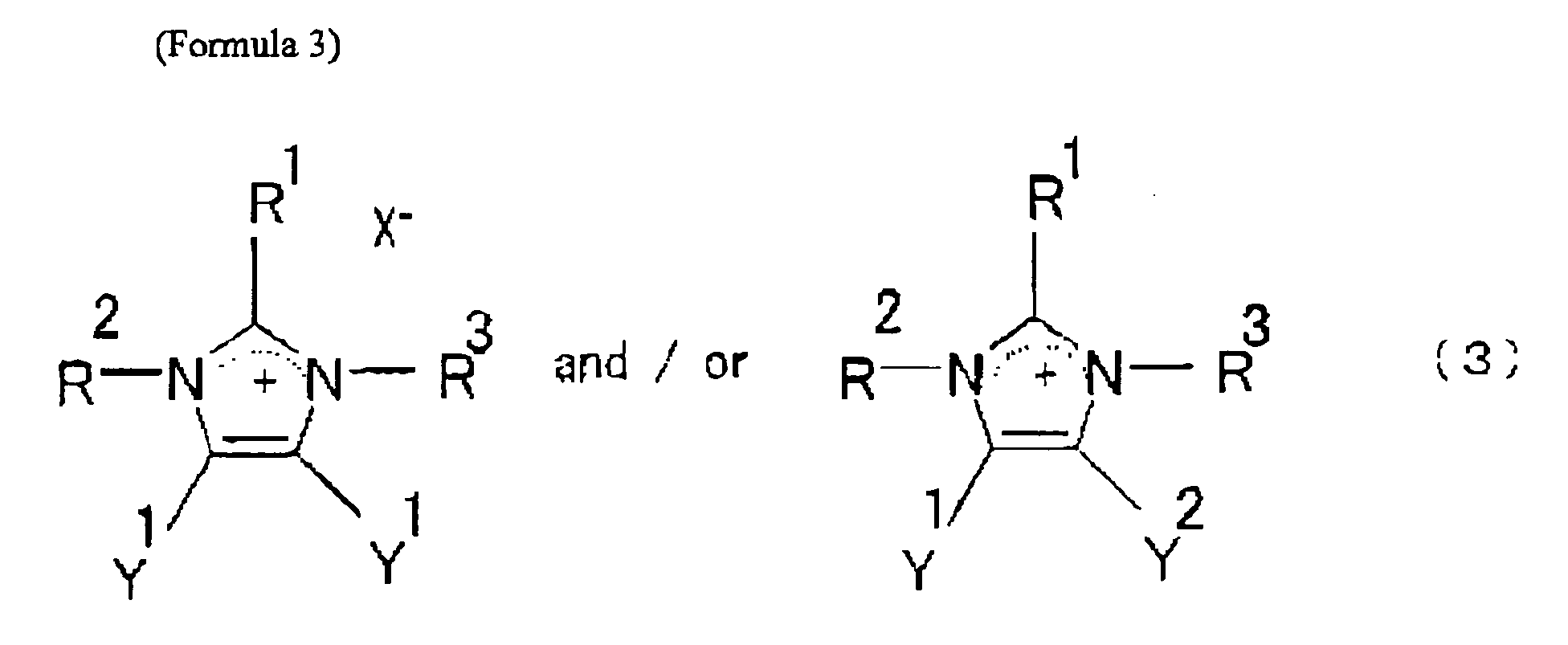
The imidazolium salts (B1) and (B2) may include the following compounds;
It would be noted that the chemical structures of the imidazolium salts (B1) and (B2) may be identified by means of a general organic chemical measurement. For example, they may be identified by means of 1H-NMR (e.g., Device: AVANCE300 (manufactured by Nihon Bruker Corporation); solvent: deuterated dimethylsulfoxide; and frequency: 300MHz); 19F-NMR (e.g., device: XL-300 (manufactured by Varian Corporation; solvent: deuterated dimethylsulfoxide; and frequency: 300MHz); and 13C-NMR (e.g., device: AL-300 (manufactured by JEOL (Nihon Denshi ) Corporation); solvent; deuterated dimethylsulfoxide; and frequency: 300MHz). The chemical structure of the electrolyte salt (A) may be identified in the same manner.
As the way to inhibit generation of the imidazolium salts (B1) and (B2) in the process of the preparation of the electrolyte salt (A), it may be applicable to reduce the concentration of carbon dioxide in the reaction system.
The electrolyte salt (A) may be generally prepared, for example, by means of reacting N-alkyl imidazole (which may be obtained as a commercial product, or may be prepared by alkylation of an imidazole by an alkylation agent (such as dimethyl carbonate, diethyl carbonate, dipropyl carbonate, diisopropyl carbonate, methyl halide, ethyl halide, propyl halide, isopropyl halide, dimethyl sulfate, diethyl sulfate, dipropyl sulfate and diisopropyl sulfate)) with dialkyl carbonate (such as dimethyl carbonate, diethyl carbonate, dipropyl carbonate, and diisopropyl carbonate) in a proton polar solvent (such as an alcohol having a carbon number of 1 to 3, including methanol, ethanol, 1-propanol and 2-propanol) at a temperature of 100 to 180°C under a pressurized condition (See JP Patent No. 2140853).
The electrolyte salt (A) may be prepared by alkylation of N-alkyl imidazole by alkylation agent other than the dialkyl carbonate, such as methyl halide, ethyl halide, propyl halide, dimethyl sulfate, diethyl sulfate, dipropyl sulfate and diisopropyl sulfate. However, it is preferable to alkylate the dialkyl carbonate in view of ion residues (such as halogen ions and sulfate ion).
The proton polar solvent may be used at an amount of 10 to 1000 wt%, and in particular, of 50 to 800 wt%, and in more particular, of 100 to 600 wt%, and in most particular, of 200 to 400 wt%, based on the weight of N-alkyl imidazole.
Carbon dioxide gas in the reaction system can be removed outside the system by means of adjusting a valve for releasing the pressure raised by the gas, which generates in the process of the reaction. Generally, only a gas such as carbon dioxide can be removed from the reaction system by passing the gas through a cooling condenser for condensing a solvent such as methanol, which is returned into the reaction vessel. In such case, the pressure is preferably at 1 to 10 MPa, and more preferably at 2 to 9 MPa, and further more preferably at 3 to 8, and most preferably at 3.5 to 7 MPa. Further, an inert gas such as nitrogen gas and argon gas can be injected into the system in order to release more amounts of carbon dioxide from the system. It may be applicable to add a chemical material to adsorb carbon dioxide (such as calcium oxide) into the system. However, it would be more preferable to release the gas by means of adjusting the valve than that, in view of ion residues.
Carbon dioxide gas is preferably included in the reaction system in a molar number of 0.01 to 3, and in particular, of 0.02 to 2, and in more particular, of 0.03 to 1 and in most particular, of 0.04 to 0.1, based on that of N-alkyl imidazole,
Also, the recrystallization would be accomplished either by dissolving them into a solvent followed by lowering the temperature or by gradually evaporating the solvent, so as to deposit crystals, or by gradually adding a poor solvent so as to deposit crystals.
The washing and extraction would be accomplished either by using a separating funnel in which crystals are suspended in a solvent followed by separating the crystals from the solvent, or by using a magnetic stirrer to suspend crystals in a solvent followed by separating the crystals from the solvent. The solvent useful for the recrystallization, washing and extraction may include an alcohol having a carbon number of 1 to 3 (such as methanol, ethanol, n-propanol and isopropanol); a ketone having a carbon number of 3 to 6 (such as acetone, methyl ethyl ketone, diethyl ketone and methyl isobutyl ketone); and an ether having a carbon number of 4 to 6 (such as diethyl ether, ethyl-n-propyl ether, ethyl isopropyl ether, di-n-propyl ether, diisopropyl ether, n-propyl isopropyl ether, dimethoxy ethane, methoxy ethoxy ethane and diethoxy ethane). These solvents may be used solely or in combination thereof. The solvent, while be varied depending on the kind of the solvent, may be used in the process of the recrystallization, washing or extraction at an amount of 0.5 to 10 times as large as, and in particular, at an amount of 1 to 8 times as large as, and in more particular, 1.5 to 6 times as large as, and in most particular, 2 to 5 times as large as, the weight of electrolyte salt (A), in view of the amount necessary for dissolving the compounds (B1) and (B2) as impurities, and in view of less losing the electrolyte salt (A). Also, the solvent for use in the washing or extraction, while be varied depending on the kind of the solvent, may preferably have a temperature of 30°C or less, and in particular, of 20°C or less, and in more particular, of 10°C or less, and in most particular, of 0°C or less.
As the poor solvent, a solvent having a low solubility of an electrolyte and a low polar property can be used, which may include hexane, heptane, toluene, xylene, etc.
- Ethers: acyclic ethers having a carbon number of 4 to 12 (such as diethyl ether, methyl isopropyl ether, ethyleneglycol dimethyl ether, diethyleneglycol dimethyl ether, triethyleneglycol diethyl ether, tetraethyleneglycol diethyl ether, diethyleneglycol diethyl ether, triethyleneglycol dimethyl ether, etc.); cyclic ethers having a carbon number of 4 to 12 (such as tetrahydrofuran, 1,3-dioxolan, 1,4-dioxane, 4-butyl dioxolan, crown ether (1,4,7,10,13,16-hexaoxa cyclooctadecan, etc.)
- Amidos: acyclic amides having a carbon number of 3 to 6 (such as N,N-dimethylformamide, N,N-dimethylacetamide, N,N-dimethylpropionamide, hexamethylphosphorylamide, etc.); and cyclic amides having a carbon number of 4 to 6 (such as pyrrolidinone, N-methylpyrrolidinone, N-vinylpyrrolidinone, etc.);
- carboxylate esters: acyclic esters having a carbon number of 3 to 8 (methyl acetate, methyl propionate, dimethyl adipate, etc.); and cyclic esters having a carbon number of 4 to 5 ( y -butyrolactone, α-acetyl- γ -butyrolactone, β -butyrolactone, γ - valerolactone, δ -valerolactone, etc.);
- nitriles: nitriles having a carbon number of 2 to 5 (such as acetonitrile, glutaronitrile, adiponitrile, methoxyacetonitrile, 3-methoxypropionitrile, 3-ethoxypropionitrile, acrylonitrile, etc.);
- -carbonates: acyclic carbonates having a carbon number of 3 to 4 (such as dimethyl carbonate, ethyl methyl carbonate, diethyl carbonate, etc.); and cyclic carbonates having a carbon number of 3 to 4 (such as ethylene carbonate, propylene carbonate, butylene carbonate, vinylene carbonate, etc.);
- sulfoxides: acyclic sulfoxides having a carbon number of 2 to 6 (such as dimethylsulfoxide, dipropylsulfoxide, etc.);
- sulfones: cyclic sulfones having a carbon number of 4 to 6 (such as sulforan, 3-methyl sulforan, 2,4-dimethyl sulforan, etc.);
- nitro compounds: nitromethane, nitroethane, etc.; and
- other cyclic compounds: N-methyl-2-oxazolidinone, 3,5-dimethyl-2-oxazolidinone, 1,3-dimethyl-2-imidazolidinone, etc.
The range of the water content may be adjusted within the defined range in the electrolytic solution, by means of using an electrolyte salt (A) which is previously dried fully and using a non-aqueous solvent which is previously dehydrated fully.
Such drying may be carried out under a reduced pressure and under heated (for example, heated at a reduced pressure of 20 Torr and at a temperature of 150°C), so as to evaporate and remove an included small amount of water.
Such dehydration can be accomplished by subjecting it to a heated dehydration under a reduced pressure (for example, heated at a reduced pressure of 100 Torr), or by using a dehydrating agent such as molecular sieve (3A 1/16, etc, manufactured by Nacalai Tesque Corporation), activated alumina powder, etc.
In addition to the above, there may be a method of subjecting the electrolytic solution to a heated dehydration under a reduced pressure (for example, heated at a reduced pressure of 100 Torr and at a temperature of 100°C) so as to evaporate and remove the including small amount of water, or to use a dehydrating agent such as molecular sieve, activated alumina powder, etc. These methods may be performed solely or in combination thereof. Among them, the methods of heating and drying the compound (A) under a reduced pressure, or method to add a molecular sieve into an electrolytic solution are preferably used.
110 parts of 1-ethyl-2-methylimidazole, as prepared, 135 parts of dimethyl carbonate and 192 parts of methanol were put into an autoclave made of a stainless steel equipped with a cooling condenser and mixed homogenously. After nitrogen substitution, the temperature was then raised to 130°C while being sealed, so as to initiate a reaction. At the beginning, the pressure was approximately at 4.5Kg/cm2, but it was gradually raised due to generation of carbon dioxide, so that the gasses were appropriately released from the upper part of the cooling condenser, adjusted at a pressure of about 7 Kg/cm2 or less. After 60 hours, they were cooled at 30°C, and the result of the reacted solution by means of 1H-NMR showed that 1-ethyl-2-methylimidazole was disappeared and 1-ethyl-2,3-dimethylimidazolium monomethyl carbonate was produced approximately under a quantitative theory. Into 428 parts of the resultant solution of 1-ethyl-2,3-dimethylimidazolium monomethyl carbonate, methanol and dimethyl carbonate, 205 parts of an aqueous solution of fluoroboric acid at a concentration of 42 wt% were gradually put in drops with stirring at a temperature of 25°C over a period of about 30 minutes. As putting them in drops, bubbles of carbon dioxide were generated. Finishing the dropping and the generation of the bubbles, all the solvents were removed at a pressure of 20 Torr and at a temperature of 150°C, so as to obtain 208 parts of a white solid (1). The examinations of 1H-NMR, 19F-NMR, 13C-NMR and HPLC resulted in showing that 98 mol% of 1-ethyl-2,3-dimethylimidazolium tetrafluoroborate (which is hereinafter shortened as "EDMI- BF4"), 2mol%, in total, of 1-ethyl-2,3-dimethyl-4-carboxylate imidazolium, 1-ethyl-2,3-dimethyl-5-carboxylate imidazolium, 1-ethyl-2,3-dimethyl-4-carboxylate-5-carboxy imidazolium and 1-ethyl-2,3-dimethyl-4-carboxy-5-carboxylate imidazolium. The HPLC analysis was performed in the conditions as described above. The conditions were the same in the following examples.
[0052]
[0053]
| Electrolyte | Content of (B1) and (B2) (mole %) | Solvent | Self-discharge property (V) | Capacitance Retention Rate (%) | |
| Example 1 | EDMI· BF4 | 2 | PC | 2.38 | 94 |
| Example 2 | EDMI·BF4 | 0.05 | PC | 2.42 | 96 |
| Example 3 | EDMI·BF4 | 0.05 | PC/EC | 2.43 | 97 |
| Example 4 | TMI· BF4 | 2 | PC | 2.38 | 95 |
| Example 5 | TMI· BF4 | 0.05 | PC | 2.45 | 97 |
| Example 6 | TMI· BF4 | 0.1 | PC | 2.43 | 96 |
| Example 7 | TMI· BF4 | 0.1 | PC/DM C | 2.44 | 97 |
| Example 8 | EDMI· BF4 | 0.05 | PC/DM C | 2.43 | 97 |
| Example 9 | EDMI· BF4 | 0.05 | PC/EMC | 2.43 | 97 |
| Example 10 | EDMI· BF4 | 2 | SL | 2.39 | 95 |
| Example 11 | TMI· BF4 | 2 | SL | 2.40 | 96 |
| Example 12 | TMI· BF4 | 0.1 | SL/DMC | 2.44 | 97 |
| Example 13 | EDMI· BF4 | 0.05 | SL/DMC | 2.44 | 97 |
| Example 14 | EDMI· BF4 | 0.05 | SL/EMC | 2.44 | 97 |
| Comparative Example 1 | EMI· BF4 | 2 | PC | 2.16 | 87 |
| Comparative Example 2 | DMI· BF4 | 2 | PC | 2.16 | 87 |
| Comparative Example 3 | EMI· BF4 | 2 | SL | 2.26 | 89 |
| Comparative Example 4 | DMI· BF4 | 2 | SL | 2.26 | 89 |
| EDMI- BF4: 1-ethyl-2,3-dimethylimidazolium tetrafluoroborate TMI- BF4: 1,2,3-trimethylimidazolium tetrafluoroborate EMI- BF4: 1-ethyl-3-methylimidazolium tetrafluoroborate DMI·BF4: 1,3-dimethylimidazolium tetrafluoroborate PC: propylene carbonate EC: ethylene carbonate DMC: dimethyl carbonate EMC: ethyl methyl carbonate SL: sulforan |
Claims (11)
- An electrolytic solution, comprising:where "R1," "R2," and "R3" independently represent an alkyl group having a carbon number of 1 to 3, "R4" and "R5" independently represent hydrogen atom or an alkyl group having a carbon number of 1 to 3, and "X-" represents a counterpart anion,an electrolyte salt (A) shown as the following formula (1),

- An electrolytic solution according to claim 1, wherein in the formula (1), "R1," "R2," and "R3" independently represent methyl group or ethyl group, and "R4" and "R5" independently represent hydrogen atom, methyl group or ethyl group.
- An electrolytic solution according to claim 1 or claim 2, wherein in the formula (1), "R1" represents methyl group.
- An electrolytic solution according to any of claims 1 to 3, further comprising a first imidazolium salt (B1) shown as the following formula (2), and a second imidazolium salt (B2) shown as the following formula (3):where "R1," "R2," and "R3" independently represent an alkyl group having a carbon number of 1 to 3, "R4" represents hydrogen atom or an alkyl group having a carbon number of 1 to 3, "X-" represents a counterpart anion, "Y1" represents carboxyl group (-CO2H) or carboxyoxy group (-OCO2H), and "Y2" represents carboxylate group (-CO2) or carboxylate oxy group (-OCO2 -), and
 where "R1," "R2," and "R3" independently represent an alkyl group having a carbon number of 1 to 3, "X-" represents a counterpart anion, "Y1" represents carboxyl group (-CO2H) or carboxyoxy group (-OCO2H), and "Y2" represents carboxylate group (-CO2 -) or carboxylate oxy group (-OCO2 -),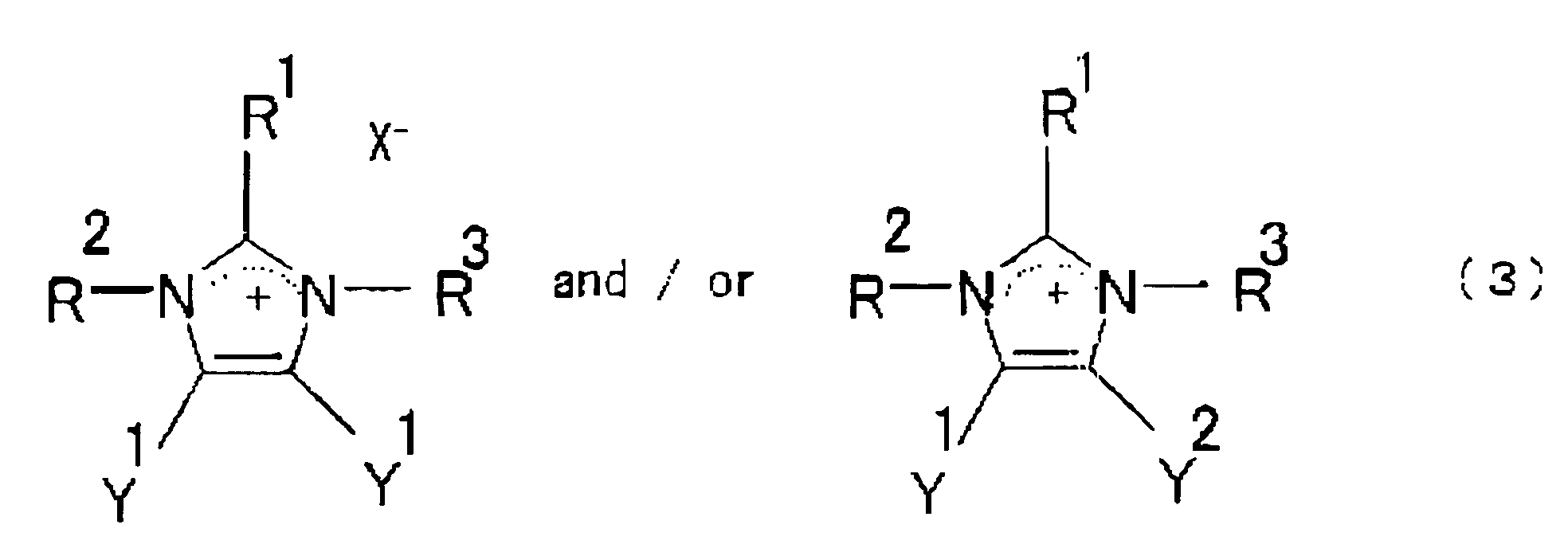
wherein the first imidazolium salt (B1) and the second imidazolium salt (B2) are totally included at an amount of 10 mole % or less in a total molar number of the electrolyte salt (A), the first imidazolium salt (B1) and the second imidazolium salt (B2). - An electrolytic solution according to any of claims I to 4, wherein the counterpart anion "X-" is selected from the group consisting of PF6 -, BF4 -, AsF6 -, SbF6 -, N(RfSO3)2 -, C(RfSO3)3 -, RfSO3 - (where "Rf" represents a fluoroalkyl group having a carbon number of 1 to 12), F-, ClO4 -, AlF4 -, AlCl4 -, TaF6 -, NbF6 -, SiF6 -, CN- and F(HF)n -, wherein "n" represents a number from 1 to 4.
- An electrolytic solution according to any of claims 1 to 5, wherein the electrolytic salt (A) comprises at least one cation selected from the group consisting of 1,2,3-trimethyl imidazolium, 1-ethyl-2,3-dimethyl imidazolium and 1,2,3,4-tetramethyl imidazolium.
- An electrolytic solution according to any of claims 1 to 6, wherein the electrolytic salt (A) is 1-ethyl-2,3-dimethyl imidazolium tetrafluoroborate.
- An electrolytic solution according to any of claims 1 to 7, further comprising a non-aqueous solvent.
- An electrolytic solution according to any of claims 1 to 7, further comprising at least one non-aqueous solvent selected from the group consisting of propylene carbonate, ethylene carbonate, butylene carbonate, sulforan, methyl sulforan, acetonitrile, γ- butyrolactone, dimethyl carbonate, ethyl methyl carbonate and diethyl carbonate.
- An electrochemical capacitor comprising a polarizable electrode impregnated with the electrolytic solution according to any of claims 1 to 9.
- An electrical double layer capacitor comprising the electrolytic solution according to any of claims 1 to 9.
Applications Claiming Priority (2)
| Application Number | Priority Date | Filing Date | Title |
|---|---|---|---|
| JP2003411396 | 2003-12-10 | ||
| JP2003411396 | 2003-12-10 |
Publications (3)
| Publication Number | Publication Date |
|---|---|
| EP1542248A2 true EP1542248A2 (en) | 2005-06-15 |
| EP1542248A3 EP1542248A3 (en) | 2008-07-16 |
| EP1542248B1 EP1542248B1 (en) | 2012-05-09 |
Family
ID=34510513
Family Applications (1)
| Application Number | Title | Priority Date | Filing Date |
|---|---|---|---|
| EP04029267A Expired - Lifetime EP1542248B1 (en) | 2003-12-10 | 2004-12-10 | An electrolytic solution for an electrochemical capacitor and an electrochemical capacitor using the same |
Country Status (6)
| Country | Link |
|---|---|
| US (2) | US20050127319A1 (en) |
| EP (1) | EP1542248B1 (en) |
| JP (2) | JP2008147701A (en) |
| KR (1) | KR100861331B1 (en) |
| CN (1) | CN1627460A (en) |
| TW (1) | TWI286332B (en) |
Cited By (2)
| Publication number | Priority date | Publication date | Assignee | Title |
|---|---|---|---|---|
| KR100879363B1 (en) | 2007-10-29 | 2009-01-19 | 경희대학교 산학협력단 | Imidazolium-based amphoteric ion substituted with ester group and electrolyte composition for lithium secondary battery comprising same |
| EP2306476A4 (en) * | 2008-06-24 | 2015-05-06 | Panasonic Ip Man Co Ltd | Activated carbon for electrochemical element and electrochemical element using the same |
Families Citing this family (36)
| Publication number | Priority date | Publication date | Assignee | Title |
|---|---|---|---|---|
| US20050127319A1 (en) * | 2003-12-10 | 2005-06-16 | Sanyo Chemical Industries, Ltd. | Electrolytic solution for an electrochemical capacitor and an electrochemical capacitor using the same |
| US7888412B2 (en) * | 2004-03-26 | 2011-02-15 | Board Of Trustees Of The University Of Alabama | Polymer dissolution and blend formation in ionic liquids |
| CA2614117A1 (en) * | 2005-06-29 | 2007-01-11 | The University Of Alabama | Ionic liquid reconstituted cellulose composites as solid support matrices |
| US8883193B2 (en) | 2005-06-29 | 2014-11-11 | The University Of Alabama | Cellulosic biocomposites as molecular scaffolds for nano-architectures |
| EP1947663B1 (en) * | 2005-09-29 | 2012-02-01 | Sanyo Chemical Industries, Ltd. | Electrolyte solution for electrochemical device and electrochemical device using same |
| AU2006302237C1 (en) | 2005-10-07 | 2012-11-08 | The University Of Alabama | Multi-functional ionic liquid compositions |
| JP2007158203A (en) * | 2005-12-08 | 2007-06-21 | Nichicon Corp | Electrolytic capacitor |
| US8128833B1 (en) * | 2006-06-19 | 2012-03-06 | Lithdyne International | Non-aqueous electrolyte |
| EP2257669B1 (en) | 2008-02-19 | 2017-03-22 | The Board Of Trustees Of The University Of Alabama | Ionic liquid systems for the processing of biomass, their components and/or derivatives, and mixtures thereof |
| US20110251377A1 (en) * | 2008-11-12 | 2011-10-13 | The Board Of Trustees Of The University Of Alabama | Ionic liquid systems for the processing of biomass, their components and/or derivatives, and mixtures thereof |
| WO2010078300A1 (en) | 2008-12-29 | 2010-07-08 | The Board Of Trustees Of The University Of Alabama | Dual functioning ionic liquids and salts thereof |
| US9096743B2 (en) | 2009-06-01 | 2015-08-04 | The Board Of Trustees Of The University Of Alabama | Process for forming films, fibers, and beads from chitinous biomass |
| US8784691B2 (en) | 2009-07-24 | 2014-07-22 | Board Of Trustees Of The University Of Alabama | Conductive composites prepared using ionic liquids |
| JP5573146B2 (en) * | 2009-12-21 | 2014-08-20 | パナソニック株式会社 | Electrochemical element |
| US8576541B2 (en) | 2010-10-04 | 2013-11-05 | Corning Incorporated | Electrolyte system |
| US9886727B2 (en) | 2010-11-11 | 2018-02-06 | Ikorongo Technology, LLC | Automatic check-ins and status updates |
| US9394375B2 (en) | 2011-03-25 | 2016-07-19 | Board Of Trustees Of The University Of Alabama | Compositions containing recyclable ionic liquids for use in biomass processing |
| US8982535B2 (en) * | 2011-11-16 | 2015-03-17 | Corning Incorporated | Cell design for high energy density electrochemical double layer capacitors |
| US20130120906A1 (en) * | 2011-11-16 | 2013-05-16 | Mark J. Soulliere | Cell design for high energy density electrochemical double layer capacitors |
| US10100131B2 (en) | 2014-08-27 | 2018-10-16 | The Board Of Trustees Of The University Of Alabama | Chemical pulping of chitinous biomass for chitin |
| US10982381B2 (en) | 2014-10-06 | 2021-04-20 | Natural Fiber Welding, Inc. | Methods, processes, and apparatuses for producing welded substrates |
| US10011931B2 (en) | 2014-10-06 | 2018-07-03 | Natural Fiber Welding, Inc. | Methods, processes, and apparatuses for producing dyed and welded substrates |
| CN104466237B (en) * | 2014-12-09 | 2017-02-22 | 上海交通大学 | Composite mesoporous silica (IL/SiO2) for encapsulating ionic liquid and preparation and application thereof |
| CN107210490A (en) * | 2015-02-04 | 2017-09-26 | 3M创新有限公司 | Electrochemical Cells Containing Lewis Acid:Lewis Base Complex Electrolyte Additives |
| WO2016157693A1 (en) * | 2015-03-31 | 2016-10-06 | パナソニックIpマネジメント株式会社 | Electrolytic capacitor |
| MX2018010421A (en) | 2016-03-25 | 2019-05-20 | Natural Fiber Welding Inc | Methods, processes, and apparatuses for producing welded substrates. |
| CN109196149B (en) | 2016-05-03 | 2021-10-15 | 天然纤维焊接股份有限公司 | Method, process and apparatus for producing dyed solder substrates |
| WO2017201173A1 (en) | 2016-05-20 | 2017-11-23 | Avx Corporation | Nonaqueous electrolyte for an ultracapacitor |
| KR102635455B1 (en) | 2016-05-20 | 2024-02-13 | 교세라 에이브이엑스 컴포넌츠 코포레이션 | Ultracapacitor for use at high temperatures |
| US10927191B2 (en) | 2017-01-06 | 2021-02-23 | The Board Of Trustees Of The University Of Alabama | Coagulation of chitin from ionic liquid solutions using kosmotropic salts |
| US10941258B2 (en) | 2017-03-24 | 2021-03-09 | The Board Of Trustees Of The University Of Alabama | Metal particle-chitin composite materials and methods of making thereof |
| WO2019027019A1 (en) * | 2017-08-04 | 2019-02-07 | 三洋化成工業株式会社 | Electrolytic capacitor additive, conductive polymer dispersion, electrolytic solution and electrolytic capacitor |
| TWI829660B (en) | 2017-11-11 | 2024-01-21 | 美商天然纖維焊接股份有限公司 | Yarn and welded yarn |
| CN110310842B (en) * | 2018-03-20 | 2022-03-18 | 中天超容科技有限公司 | Electrolyte of high-voltage capacitor, preparation method thereof and capacitor device |
| CN112662132B (en) * | 2020-12-22 | 2023-08-22 | 广东盈骅新材料科技有限公司 | Modified resin composition and its preparation method and application |
| US20250033968A1 (en) * | 2021-12-07 | 2025-01-30 | Evs Technologies, Inc. | Economical method for mass production of bis(fluorosulfonyl)imide metal salt solution |
Family Cites Families (24)
| Publication number | Priority date | Publication date | Assignee | Title |
|---|---|---|---|---|
| US5870275A (en) * | 1993-12-03 | 1999-02-09 | Sanyo Chemical Industries, Ltd. | Electrolyte and electronic component using same |
| EP0684620B1 (en) * | 1993-12-03 | 2003-06-04 | Sanyo Chemical Industries, Ltd. | Electrolytic solution and electrochemical element prepared therefrom |
| JP3751048B2 (en) | 1995-05-26 | 2006-03-01 | 松下電器産業株式会社 | Electrolytic solution and electrochemical device using the same |
| JPH1154375A (en) | 1997-08-07 | 1999-02-26 | Matsushita Electric Ind Co Ltd | Molten electrolyte for electric double layer capacitors |
| US5965054A (en) * | 1997-08-12 | 1999-10-12 | Covalent Associates, Inc. | Nonaqueous electrolyte for electrical storage devices |
| JP3249486B2 (en) | 1999-03-29 | 2002-01-21 | 三洋化成工業株式会社 | Method for producing electrolyte for non-aqueous electrolyte |
| JP2000285960A (en) | 1999-03-29 | 2000-10-13 | Sanyo Chem Ind Ltd | Manufacture of electrolyte for nonaqueous liquid electrolyte |
| JP3962176B2 (en) | 1999-05-14 | 2007-08-22 | 三洋化成工業株式会社 | Method for producing electrolyte for non-aqueous electrolyte |
| JP2001230159A (en) * | 2000-02-14 | 2001-08-24 | Matsushita Electric Ind Co Ltd | Electric double layer capacitor |
| WO2001093363A2 (en) * | 2000-05-26 | 2001-12-06 | Covalent Associates, Inc. | Non-flammable electrolytes |
| JP2001338846A (en) * | 2000-05-30 | 2001-12-07 | Matsushita Electric Ind Co Ltd | Electrochemical capacitor |
| JP2002008948A (en) * | 2000-06-19 | 2002-01-11 | Matsushita Electric Ind Co Ltd | Electric double layer capacitor |
| JP2002334815A (en) | 2001-05-10 | 2002-11-22 | Sanyo Chem Ind Ltd | Electric double layer capacitor |
| JP2003173934A (en) | 2001-09-28 | 2003-06-20 | Sanyo Chem Ind Ltd | Electrolytic solution for electrochemical capacitor and electrochemical capacitor using the same |
| US6991718B2 (en) | 2001-11-21 | 2006-01-31 | Sachem, Inc. | Electrochemical process for producing ionic liquids |
| JP2003243260A (en) * | 2001-12-11 | 2003-08-29 | Asahi Glass Co Ltd | Electric double layer capacitor |
| JP2003324039A (en) * | 2002-02-26 | 2003-11-14 | Sanyo Chem Ind Ltd | Electrolytic solution for electric double layer capacitor and electric double layer capacitor using the same |
| JP4116309B2 (en) | 2002-03-20 | 2008-07-09 | 三洋化成工業株式会社 | Electrolyte for electrochemical capacitors |
| US6535373B1 (en) * | 2002-06-12 | 2003-03-18 | Lithdyne International | Non-aqueous electrolyte |
| JP4067090B2 (en) * | 2002-10-03 | 2008-03-26 | シャープ株式会社 | TFT substrate and manufacturing method thereof |
| JP2004207451A (en) | 2002-12-25 | 2004-07-22 | Sanyo Chem Ind Ltd | Electrolyte |
| JP2004221557A (en) | 2002-12-25 | 2004-08-05 | Sanyo Chem Ind Ltd | Electrolyte |
| JP4377152B2 (en) | 2003-04-17 | 2009-12-02 | 三洋化成工業株式会社 | Method for producing electrolyte for non-aqueous electrolyte |
| US20050127319A1 (en) * | 2003-12-10 | 2005-06-16 | Sanyo Chemical Industries, Ltd. | Electrolytic solution for an electrochemical capacitor and an electrochemical capacitor using the same |
-
2004
- 2004-07-09 US US10/887,359 patent/US20050127319A1/en not_active Abandoned
- 2004-11-22 TW TW093135797A patent/TWI286332B/en not_active IP Right Cessation
- 2004-12-01 KR KR1020040099918A patent/KR100861331B1/en not_active Expired - Fee Related
- 2004-12-08 CN CNA2004100970165A patent/CN1627460A/en active Pending
- 2004-12-10 EP EP04029267A patent/EP1542248B1/en not_active Expired - Lifetime
-
2006
- 2006-01-27 US US11/340,679 patent/US7858242B2/en not_active Expired - Lifetime
-
2008
- 2008-02-06 JP JP2008025984A patent/JP2008147701A/en active Pending
- 2008-02-06 JP JP2008025983A patent/JP4804488B2/en not_active Expired - Fee Related
Cited By (2)
| Publication number | Priority date | Publication date | Assignee | Title |
|---|---|---|---|---|
| KR100879363B1 (en) | 2007-10-29 | 2009-01-19 | 경희대학교 산학협력단 | Imidazolium-based amphoteric ion substituted with ester group and electrolyte composition for lithium secondary battery comprising same |
| EP2306476A4 (en) * | 2008-06-24 | 2015-05-06 | Panasonic Ip Man Co Ltd | Activated carbon for electrochemical element and electrochemical element using the same |
Also Published As
| Publication number | Publication date |
|---|---|
| JP4804488B2 (en) | 2011-11-02 |
| TWI286332B (en) | 2007-09-01 |
| JP2008172261A (en) | 2008-07-24 |
| US20050127319A1 (en) | 2005-06-16 |
| JP2008147701A (en) | 2008-06-26 |
| CN1627460A (en) | 2005-06-15 |
| KR20050056868A (en) | 2005-06-16 |
| US7858242B2 (en) | 2010-12-28 |
| US20060118755A1 (en) | 2006-06-08 |
| TW200519996A (en) | 2005-06-16 |
| EP1542248A3 (en) | 2008-07-16 |
| EP1542248B1 (en) | 2012-05-09 |
| KR100861331B1 (en) | 2008-10-01 |
Similar Documents
| Publication | Publication Date | Title |
|---|---|---|
| EP1542248B1 (en) | An electrolytic solution for an electrochemical capacitor and an electrochemical capacitor using the same | |
| US8007680B2 (en) | Electrolyte solution for electrochemical device and electrochemical device using same | |
| JP2008218487A (en) | Electrolytic solution for electrochemical capacitor and electrochemical capacitor using the same | |
| EP2141712A1 (en) | Electrolyte, and electrolyte solution or electrochemical element comprising the same | |
| JP2012074528A (en) | Electrolytic solution for electric double layer capacitor, and electric double layer capacitor using the same | |
| EP3232455B1 (en) | Nonaqueous electrolyte solution for electric double layer capacitors | |
| JP2004221557A (en) | Electrolyte | |
| KR100836550B1 (en) | Electrolyte for electrochemical capacitor and electrochemical capacitor containing the same | |
| JP2005197666A (en) | Electrolytic solution for electrochemical capacitor and electrochemical capacitor using the same | |
| JP2005197665A (en) | Electrolytic solution for electrochemical capacitor and electrochemical capacitor | |
| JP2007335536A (en) | Electrolytic solution for electrochemical capacitor and electrochemical capacitor using the same | |
| JP5116654B2 (en) | Electrolyte and electrochemical device using quaternary ammonium salt electrolyte | |
| JP4997151B2 (en) | Electrolytic solution for electrochemical element and electrochemical element using the same | |
| JP2012109539A (en) | Electrolytic solution for electric double layer capacitor and electric double layer capacitor using the same | |
| JP2011192963A (en) | Electrolyte for electric double layer capacitor and electric double layer capacitor using the same | |
| JP5101260B2 (en) | Electrolyte and electrochemical device using quaternary ammonium salt electrolyte | |
| JP2010153560A (en) | Electrolyte using quaternary ammonium salt electrolyte, and electrochemical element | |
| JP2011155093A (en) | Electrolyte and electrochemical element using the same | |
| JP2011100777A (en) | Electrolyte and electrochemical element using the same | |
| JP4902998B2 (en) | Electrolytic solution for electrochemical capacitor and electrochemical capacitor using the same | |
| JP2013179204A (en) | Electrolyte for electric double layer capacitor | |
| JP2012044152A (en) | Quaternary ammonium salt electrolyte, and electrolytic solution and electrochemical element using the same | |
| JP2008277464A (en) | Quaternary ammonium salt electrolyte, electrolytic solution using the same, and electrochemical element | |
| JP2012069931A (en) | Electrolytic solution for electric double layer capacitor, and electric double layer capacitor using it | |
| KR102180586B1 (en) | Nonaqueous electrolyte solution for electric double layer capacitors |
Legal Events
| Date | Code | Title | Description |
|---|---|---|---|
| PUAI | Public reference made under article 153(3) epc to a published international application that has entered the european phase |
Free format text: ORIGINAL CODE: 0009012 |
|
| AK | Designated contracting states |
Kind code of ref document: A2 Designated state(s): AT BE BG CH CY CZ DE DK EE ES FI FR GB GR HU IE IS IT LI LT LU MC NL PL PT RO SE SI SK TR |
|
| AX | Request for extension of the european patent |
Extension state: AL BA HR LV MK YU |
|
| PUAL | Search report despatched |
Free format text: ORIGINAL CODE: 0009013 |
|
| AK | Designated contracting states |
Kind code of ref document: A3 Designated state(s): AT BE BG CH CY CZ DE DK EE ES FI FR GB GR HU IE IS IT LI LT LU MC NL PL PT RO SE SI SK TR |
|
| AX | Request for extension of the european patent |
Extension state: AL BA HR LV MK YU |
|
| RAP1 | Party data changed (applicant data changed or rights of an application transferred) |
Owner name: PANASONIC CORPORATION Owner name: SANYO CHEMICAL INDUSTRIES, LTD. |
|
| 17P | Request for examination filed |
Effective date: 20090108 |
|
| AKX | Designation fees paid |
Designated state(s): DE FR GB NL |
|
| 17Q | First examination report despatched |
Effective date: 20110202 |
|
| GRAP | Despatch of communication of intention to grant a patent |
Free format text: ORIGINAL CODE: EPIDOSNIGR1 |
|
| GRAS | Grant fee paid |
Free format text: ORIGINAL CODE: EPIDOSNIGR3 |
|
| GRAA | (expected) grant |
Free format text: ORIGINAL CODE: 0009210 |
|
| AK | Designated contracting states |
Kind code of ref document: B1 Designated state(s): DE FR GB NL |
|
| REG | Reference to a national code |
Ref country code: GB Ref legal event code: FG4D |
|
| REG | Reference to a national code |
Ref country code: DE Ref legal event code: R096 Ref document number: 602004037715 Country of ref document: DE Effective date: 20120712 |
|
| REG | Reference to a national code |
Ref country code: NL Ref legal event code: T3 |
|
| PLBE | No opposition filed within time limit |
Free format text: ORIGINAL CODE: 0009261 |
|
| STAA | Information on the status of an ep patent application or granted ep patent |
Free format text: STATUS: NO OPPOSITION FILED WITHIN TIME LIMIT |
|
| 26N | No opposition filed |
Effective date: 20130212 |
|
| REG | Reference to a national code |
Ref country code: DE Ref legal event code: R097 Ref document number: 602004037715 Country of ref document: DE Effective date: 20130212 |
|
| PGFP | Annual fee paid to national office [announced via postgrant information from national office to epo] |
Ref country code: GB Payment date: 20141210 Year of fee payment: 11 |
|
| PGFP | Annual fee paid to national office [announced via postgrant information from national office to epo] |
Ref country code: NL Payment date: 20141108 Year of fee payment: 11 Ref country code: FR Payment date: 20141208 Year of fee payment: 11 |
|
| PGFP | Annual fee paid to national office [announced via postgrant information from national office to epo] |
Ref country code: DE Payment date: 20151201 Year of fee payment: 12 |
|
| GBPC | Gb: european patent ceased through non-payment of renewal fee |
Effective date: 20151210 |
|
| REG | Reference to a national code |
Ref country code: NL Ref legal event code: MM Effective date: 20160101 |
|
| REG | Reference to a national code |
Ref country code: FR Ref legal event code: ST Effective date: 20160831 |
|
| PG25 | Lapsed in a contracting state [announced via postgrant information from national office to epo] |
Ref country code: GB Free format text: LAPSE BECAUSE OF NON-PAYMENT OF DUE FEES Effective date: 20151210 Ref country code: NL Free format text: LAPSE BECAUSE OF NON-PAYMENT OF DUE FEES Effective date: 20160101 |
|
| PG25 | Lapsed in a contracting state [announced via postgrant information from national office to epo] |
Ref country code: FR Free format text: LAPSE BECAUSE OF NON-PAYMENT OF DUE FEES Effective date: 20151231 |
|
| REG | Reference to a national code |
Ref country code: DE Ref legal event code: R119 Ref document number: 602004037715 Country of ref document: DE |
|
| PG25 | Lapsed in a contracting state [announced via postgrant information from national office to epo] |
Ref country code: DE Free format text: LAPSE BECAUSE OF NON-PAYMENT OF DUE FEES Effective date: 20170701 |