EP1538531A1 - Authentifizierungssystem, authentifizierungseinrichtung, endgeräteinrichtung und authentifizierungsverfahren - Google Patents
Authentifizierungssystem, authentifizierungseinrichtung, endgeräteinrichtung und authentifizierungsverfahren Download PDFInfo
- Publication number
- EP1538531A1 EP1538531A1 EP03795354A EP03795354A EP1538531A1 EP 1538531 A1 EP1538531 A1 EP 1538531A1 EP 03795354 A EP03795354 A EP 03795354A EP 03795354 A EP03795354 A EP 03795354A EP 1538531 A1 EP1538531 A1 EP 1538531A1
- Authority
- EP
- European Patent Office
- Prior art keywords
- random number
- authentication
- display
- password
- digit
- Prior art date
- Legal status (The legal status is an assumption and is not a legal conclusion. Google has not performed a legal analysis and makes no representation as to the accuracy of the status listed.)
- Withdrawn
Links
Images















Classifications
-
- G—PHYSICS
- G06—COMPUTING OR CALCULATING; COUNTING
- G06F—ELECTRIC DIGITAL DATA PROCESSING
- G06F21/00—Security arrangements for protecting computers, components thereof, programs or data against unauthorised activity
- G06F21/30—Authentication, i.e. establishing the identity or authorisation of security principals
- G06F21/31—User authentication
- G06F21/36—User authentication by graphic or iconic representation
-
- G—PHYSICS
- G06—COMPUTING OR CALCULATING; COUNTING
- G06F—ELECTRIC DIGITAL DATA PROCESSING
- G06F2221/00—Indexing scheme relating to security arrangements for protecting computers, components thereof, programs or data against unauthorised activity
- G06F2221/21—Indexing scheme relating to G06F21/00 and subgroups addressing additional information or applications relating to security arrangements for protecting computers, components thereof, programs or data against unauthorised activity
- G06F2221/2103—Challenge-response
Definitions
- the present invention relates to a user authentication apparatus and a user authentication method used for authenticating a user.
- a system is disclosed in Japanese Unexamined Patent Publication No. 2000-305899, where a user authentication apparatus and system making a user register not a password but a formula is disclosed.
- Fig. 2 shows a structure of the conventional user authentication apparatus shown in Japanese Unexamined Patent Publication No. 2000-305899.
- a user authentication apparatus 1 a terminal 2 provided in the user authentication apparatus 1, a management means 10, a registration renewal means 11, a random number generating means 12, a specifying means 13, a calculation means 14 and a judging means 15 are shown.
- the registration renewal means 11 receives a formula inputted from the terminal 2 and registers the formula into the management means 10, with having correspondence to a user ID.
- a corresponding relation between the user ID and the formula corresponding to the user authentication object is registered in the management means 10.
- the specifying means 13 specifies a formula corresponding to the user ID based on the managed data of the management means 10.
- the random number generating means 12 generates a random number, displays it on the display screen of the terminal apparatus 2, and notifies the generated random number to the calculation means 14.
- the calculation means 14 computes a numerical value used for user authentication, based on the random number generated by the random number generating means 12 and the formula specified by the specifying means 13.
- the judging means 15 executes the user authentication by judging whether a numerical value inputted through the terminal 2 in response to the random number presented by the random number generating means 12 coincides with the numerical value computed by the calculation means 14.
- the present invention aims to solve the above problems. It is an object of the present invention to provide a user authentication apparatus and a user authentication method of high security where a widely popularized password composed of characters or numbers is used, there is little load for the user at the time of authentication, and the danger of a password being guessed by a third person is low even when an input value is looked by the third person at the time of authentication.
- an authentication system including a terminal apparatus which a user utilizes and an authentication apparatus which communicates with the terminal apparatus and performs user authentication to the user, comprises:
- Fig. 1 is a block diagram showing a structure of an authentication system according to Embodiment 1.
- a terminal apparatus 101 a display part 102, an input part 103, a memory part (random number response value memory part) 104, a communication part (a receiving part and transmitting part) 105, a server apparatus (authentication apparatus) 106, a management part (password memory part) 107, a random number generating part 108, a calculation part (authentication value calculation part) 109, a judging part (authentication judging part) 110, a communication part 111, and a judging part (terminal side authentication judging part) 112 of the terminal apparatus 101 are provided.
- the memory part 104 is composed of a nonvolatile memory and can be attached/detached to/from the terminal apparatus 101.
- the management part 107 is composed of a hard disk apparatus, relates a user password with a user ID, and memorizes them.
- the random number generating part 108 generates a ten-digit random number.
- the random number generating part 108, the calculation part 109, and the judging part 110 are realized by programs. These programs are stored in a hard disk apparatus, a nonvolatile memory, a flexible disk, etc., and loaded onto the server apparatus 106 from them to be executed on CPU.
- the communication part 105 of the terminal apparatus 101 and the communication part 111 of the server apparatus 106 are linked through a network, such as radio communication, cable communication, and the Internet.
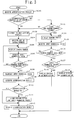
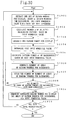
- Fig. 3 is a flowchart showing processing executed at the time of performing user authentication processing in the terminal apparatus 101.
- an authentication request including a user ID and an authentication type being authentication for the terminal apparatus 101 or being authentication for the server apparatus 106 is received from the input part 103 (S101). It is checked whether the received authentication request is to the terminal apparatus 101 or to the server apparatus 106 (S102).
- the authentication request including the user ID is transmitted to the server apparatus 106 through the communication part 105 (S103).
- the terminal apparatus 101 receives a set of random numbers for the authentication request transmitted through the communication part 105, from the server apparatus 106 (S104) and displays one random number in the received set of random numbers, on the display part 102 (S105).
- An input numerical value (response value) which the user input in response to the random number displayed on the display part 102 is received from the input part 103 (S106). It is checked whether all the random numbers received from the server apparatus 106 have been displayed on the display part 102 or not (S107). When there is a random number not having been displayed yet, the processing from S105 is repeated. When all the random numbers have been displayed, input numerical values (response value) inputted by the user are transmitted to the server apparatus 106 through the communication part 105 (S108) and an authentication result is received through the communication part 105 (S109).
- the received authentication request is to the terminal apparatus 101 at S102, it is checked whether random numbers and input numerical values corresponding to the random numbers are stored in the memory part (random number response value memory part) 104 or not (S113).
- the authentication request including the user ID is transmitted to the server apparatus 106 through the communication part 105 (S103).
- the judging part (terminal side authentication judging part) 112 compares all the input numerical values received through the input part 103 with all the input numerical values stored in the memory parts 104, and checks whether both of them coincide or not. (S117). When both of them coincide, success of the authentication is displayed on the display part 102 (S118) to finish the authentication processing. On the other hand, when the input numerical values do not coincide, failure of the authentication is displayed on the display part 102 (S119) to finish the authentication processing.
- Fig. 4 is a flowchart showing processing to be executed in the server apparatus 106 when an authentication request is received from the terminal apparatus 101.
- an authentication request including a user ID is received from the terminal apparatus 101 (S201). Then, it is checked whether the user ID included in the received authentication request has been registered in the management part 107 or not (S202). When the user ID has been registered in the management part 107, a password stored to be corresponding to the user ID is extracted (S203). On the other hand, when the user ID has not been registered in the management part 107, failure of the authentication is stored in the judging part 110 (S204). Next, in the random number generating part 108, random numbers needed for authenticating the user are generated (S205). According to Embodiment 1, since authentication is performed by using four input numerical values, four random numbers are generated for one authentication.
- a set of generated random numbers is transmitted to the terminal apparatus 101 through the communication part 111 (S206). Then, input numerical values (response value) are received from the terminal apparatus 101 (S207), and it is checked whether failure of the authentication has been recorded in the judging part 110 or not (S208). When failure of the authentication has not been recorded in the judging part 110, numerical values (authentication value) to be used for the authentication are calculated by the calculation part 109 (S209) and it is checked whether they coincide with the received input numerical value or not (S210).
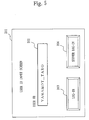
- Fig. 5 shows a user ID input screen which is displayed on the display part 102 at the time of receiving an authentication request from a user, at the terminal apparatus 101.
- a user ID input screen 201 a user ID input screen 201, a user ID input field 202, a log-in button 203 and a server log-in button 204 are provided.
- a user When starting authentication, a user inputs a user ID into the user ID input field 202 of the user ID input screen 201 through the input part 103.
- the authentication request including the user ID to the terminal apparatus 101 can be received at S101, by operating the log-in button 203.
- the authentication request including the user ID to the server apparatus 106 can be received at S101 by operating the server log-in button 204.
- Fig. 6 shows a response value input screen displayed on the display part 102 at S105 at the time of receiving an input numerical value (response value) from the user, in response to a random number, through the input part 103 at S106, in the terminal apparatus 101.
- a response value input screen 301, a random number 302 with digit numbers as a challenge value, and an input field 303 where a user inputs an input numerical value (response value) in response to the random number are provided. * or a numerical value itself is displayed in the input field 303 as an input numerical value.
- a character queue of a plurality of digits (in the present Embodiment, a four-digit number queue) is registered as a password for each user.
- the random number generating part 108 generates a random number for each digit of the password, transmits the random number generated for each digit to the terminal apparatus 101, and transmitted random numbers are displayed on the display part 102.
- the user inputs a calculation result obtained by using the random number displayed in 302, as an input numerical value, into the input field 303 through the input part 103 with respect to each of four numbers composing the password from the most significant digit in order.
- the user uses one number in one digit of the password and one random number displayed in 302 so as to calculate one input numerical value. Concretely, among numbers included in the random number, a number placed at a digit-position concerning a number of the password for which an input numerical value is being calculated, is added to the number of the password to obtain a total numerical value Then, only a numerical value in the ones place is input into the input field 303.
- the user repeats the input processing for each digit of the password until finishing inputting a calculation value concerning the last digit of the password.
- the value "2" which is in the most significant digit in the password is added to the value "6" which is in the 2nd digit from the most significant digit in the random numbers, and the first input value becomes "8" which is a value in the ones place of the added total value "8".
- the judging part (authentication judging part) 110 of the server apparatus 106 compares the authentication value Ans[i] used for authentication with the input numerical value (response value) from the terminal apparatus 101 with respect to each digit of the password, and judges whether the authentication is to be permitted or not by checking if both of them coincide or not.
- a numerical value to be input into the input part 103 of the terminal apparatus 101 is not the password itself but a value in the ones place of a total obtained by adding a number in the password to a numerical value in the displayed random numbers which is located at a digit-position indicated by the number in the password. Therefore, even when the input value at the time of authentication is looked by a third person, the danger that the password is guessed and unjustly used for authentication can be reduced.
- the password is a four-digit number according to the Embodiment 1, the password is not restricted to four digits.
- the maximum of the number of times of authentication failure is not settled in Embodiment 1. However, it is also acceptable to reject to receive authentication any more when failure of authentication is repeated more than the number of times prescribed beforehand.
- an area for memorizing the number of times of authentication failure is provided in the memory part 104 in the terminal apparatus 101. Then, when authentication succeeds at S110 and S117, 0 is set to the number of times of authentication failure in the memory part 104 , and when authentication fails at S117, one is added to the number of times of authentication failure in the memory part 104. Then, when the number of times of authentication failure becomes more than the number of times prescribed beforehand, if random numbers and input values for the random numbers have been memorized in the memory part 104, these numbers are deleted.
- an area for memorizing the number of times of authentication failure relating to a user ID for every user is provided in the management part 107. Then, when authentication succeeds at S210, 0 is set to the number of times of authentication failure of the user in the management part 107, and when authentication fails at S210, one is added to the number of times of authentication failure of the user in the management part 107.
- the number of times of authentication failure of this user becomes more than the number of times prescribed beforehand, failure of authentication is transmitted to the terminal apparatus 101, as an authentication result at S212.
- an input value is calculated by using a calculation value in the ones place of a total obtained by adding a number in the password to a value in the displayed random numbers which is located at a digit-position indicated by the number in the password.
- the input value is expressed as * in the input field 303 and the challenge value 302 displayed in the display part 102 is updated to be random numbers for the next password. Therefore, even if a value itself in the displayed random numbers which is located at a digit-position indicated by a number in the password is used as the input value, the danger of the password being guessed and unjustly used for authentication can be reduced even when the input value at the time of authentication is looked by a third person.
- Embodiment 1 a value in the ones place of a total obtained by adding a number in the password to a value in the displayed random numbers which is located at a digit-position indicated by the number in the password is used as a calculation value.
- a calculation value obtained by adding either one number in the numbers composing the password is also acceptable.
- Fig. 7 shows a response value input screen, in the above case, displayed on the display part 102 at the time of receiving an input numerical value (response value) from the user, in response to a random number, through the input part 103 at S106, in the terminal apparatus 101.
- a response value input screen 401 a random number 402 as a challenge value, and an input field 403 to which the user inputs a numerical value as a password in response to the random number are provided.
- the password being a four-digit
- the random number of 402 is punctuated every four digits from the most significant digit, and digit numbers and frames for blank space corresponding to the password are also displayed.
- * or a numerical value itself is displayed in the input field 403 as the input numerical value.
- a four-digit number is registered as a password for each user.
- the user inputs a calculation result obtained by using the random number displayed in 402, as an input numerical value, into the input field 403 through the input part 103, with respect to each of four numbers composing the password from the most significant digit in order.
- the user uses the password and one random number displayed in 402 so as to calculate one input numerical value.
- the first input value becomes “6” by adding the value "6" which is the 2nd digit from the most significant digit in the random numbers to the value "0" which is the 2nd digit from the most significant digit in the password.
- the judging part (authentication judging part) 110 of the server apparatus 106 compares the authentication value Ans[i] used for authentication with the input numerical value (response value) from the terminal apparatus 101 with respect to each digit of the password, and judges whether the authentication is to be permitted or not by checking if both of them coincide or not.
- a numerical value to be input into the input part 103 of the terminal apparatus 101 is not the password itself but a value in the ones place of a total obtained by adding a value in the displayed random number which is located at a digit-position indicated by a number in the password, to either one number in the numbers composing the password. Therefore, even when the input value at the time of authentication is looked by a third person, the danger that the password is guessed and unjustly used for authentication can be reduced.
- a numerical value to be input into the input part of the terminal apparatus is not a password itself, and user authentication can be performed by using a value obtained based on the password and the random number displayed in the terminal apparatus. Therefore, even when the input value at the time of authentication is looked by a third person, the danger that the password is guessed and unjustly used for authentication can be reduced.
- one random number is used as a challenge value when an input numerical value is calculated from one digit of a password.
- a plurality of random numbers is used as a challenge value for each digit of the password.
- An example where two random numbers are used as a challenge value for each digit of a password will be described below.
- a group of a plurality of random numbers for each digit of a password is called a random number group.
- a eight-digit number is used as a password, eight input numerical values are inputted at the time of authentication for the server apparatus, and five input numerical values are inputted at the time of authentication for the terminal apparatus.
- Fig. 8 is a block diagram showing a structure of an authentication system according to the present Embodiment.
- a terminal apparatus 501 a display part 502, an input part 503, a memory part 504, a conversion part (random number change part) 505, a judging part (terminal side authentication judging part) 506, a communication part (a transmitting part and a receiving part) 507, a server apparatus (authentication apparatus) 508, a management part (password memory part) 509, a random number generating part 510, a calculation part (authentication value calculation part) 511, a judging part (authentication judging part) 512 and a communication part 513 are provided.
- the memory part 504, the conversion part 505, and the judging part 506 are installed in an IC card 514, and concretely realized by programs. These programs are stored in a flash memory in the IC card and executed by CPU in the IC card. In addition, the IC card can be attached/detached to/from the terminal apparatus 501.
- the management part 509 is composed of a hard disk apparatus, relates a user password with a user ID, and memorizes them.
- the random number generating part 510 generates a ten-digit random number where no number at each digit is in duplicate.
- the random number generating part 510, the calculation part 511, and the judging part 512 are realized by programs. These programs are stored in a hard disk apparatus, a nonvolatile memory, a flexible disk, etc., and loaded onto the server apparatus 508 from them to be executed on CPU.
- the communication part 507 of the terminal apparatus 501 and the communication part 513 of the server apparatus 508 are linked through a network, such as radio communication, cable communication, and the Internet.
- Fig. 9 is a flowchart showing processing executed at the time of performing user authentication processing in the terminal apparatus 501.
- an authentication request including a user ID and an authentication type being authentication for the terminal apparatus 501 or being authentication for the server apparatus 508 is received from the input part 503 (S301).
- the authentication request including the user ID is transmitted to the server apparatus 508 through the communication part 507 (S303).
- the terminal apparatus 501 receives a set of random number groups in response to the authentication request transmitted through the communication part 507, from the server apparatus 508 (S304) and displays a random number group (a set of two random numbers) in the received set of random number groups on the display part 502 (S305).
- An input numerical value (response value) which the user input in response to the random number group displayed on the display part 502 is received from the input part 503 (S306). It is checked whether all the random number groups received from the server apparatus 508 have been displayed on the display part 502 or not (S307). When there is a random number group not having been displayed yet, the processing from S305 is repeated.
- the received authentication request is to the terminal apparatus 501 at S302, it is checked whether the random number groups and input numerical values corresponding to them are stored in the memory part 504 or not (S313).
- the authentication request including the user ID is transmitted to the server apparatus 508 through the communication part 507 (S303).
- the processing from S315 is repeated.
- the judging part (terminal side authentication judging part) 506 checks whether or not all the input numerical values received through the input part 503 coincide with all the input numerical values (authentication values) stored in the memory parts 504 (S318). When all of them coincide, success of the authentication is displayed on the display part 502 (S319) to finish the authentication processing. On the other hand, when the input numerical values do not coincide, failure of the authentication is displayed on the display part 502 (S320) to finish the authentication processing.
- Fig. 10 is a flowchart showing processing to be executed in the server apparatus 508 when an authentication request is received from the terminal apparatus 501.
- an authentication request including a user ID is received from the terminal apparatus 501 (S401). Then, it is checked whether the user ID included in the received authentication request has been registered in the management part 509 or not (S402). When the user ID has been registered in the management part 509, a password stored to be corresponding to the user ID is extracted (S403). On the other hand, when the user ID has not been registered in the management part 509, failure of the authentication is stored in the judging part 512 (S404). Next, in the random number generating part 510, random number groups, the number of which is needed for authenticating the user, are generated (S405).
- server authentication of Embodiment 2 since the authentication is performed by using eight input numerical values, sixteen random numbers (eight random number groups) are generated for performing authentication once. A set of generated random number groups is transmitted to the terminal apparatus 501 through the communication part 513 (S406). Then, in response to them, input numerical values (response values) are received from the terminal apparatus 501 (S407), and it is checked whether failure of the authentication has been recorded in the judging part 512 or not (S408). When failure of the authentication has not been recorded in the judging part 512, authentication values to be used for the authentication are calculated by the calculation part 511 (S409).
- the authentication value is compared with the received input numerical value, for each digit of the password, and both of them are checked whether they coincide or not (S410).
- S410 when the input numerical values received from the terminal apparatus 501 coincide with the authentication values calculated by the calculation part 511, success of the authentication is transmitted to the terminal apparatus 501 as a result of the authentication (S411).
- S412 when the input numerical values received from the terminal apparatus 501 do not coincide with the authentication values calculated by the calculation part 511, failure of the authentication is transmitted to the terminal apparatus 501 as a result of the authentication (S412).
- the check of S408 when failure of authentication is stored in the judging part 510, the failure of authentication stored in the judging part 512 is cleared and failure of the authentication is transmitted to the terminal apparatus 501 as a result of the authentication (S412).
- the user ID input screen 201 shown in Fig. 5 is displayed on the display part 502 like Embodiment 1.
- a user When starting authentication, a user inputs a user ID into the user ID input field 202 of the user ID input screen 201 displayed on the display part 502.
- the authentication request including the user ID to the terminal apparatus 501 can be received at S301, by operating the log-in button 203.
- the server log-in button 204 By operating the server log-in button 204, the authentication request including the user ID to the server apparatus 508 can be received at S301
- Fig. 11 shows a response value input screen displayed on the display part 502 at the time of receiving an input numerical value from the user, in response to a random number group, through the input part 503 at S306, in the terminal apparatus 501.
- a response value input screen 601 a random number group (two random numbers) 602 with a digit number, as a challenge value 1 and a challenge value 2, and an input field 603 where a user inputs an input numerical value (response value) in response to the random number are provided. * or a numerical value itself is displayed in the input field 603 as an input numerical value.
- a number queue of a eight-digit number is registered as a password for each user.
- the random number generating part 510 generates a random number group for each digit of the password, transmits the random number group generated for each digit to the terminal apparatus 501, and transmitted random number groups are displayed on the display part 502.
- the user inputs a calculation result obtained by using the random numbers displayed in 602, as an input numerical value, into the input field 603 through the input part 503, with respect to each of eight numbers composing the password from the most significant digit in order.
- the user uses two numbers in two digits of the password and two random numbers displayed in 602 so as to calculate one input numerical value.
- the next random number group is displayed on the display part. The user repeats the input processing for each digit of the password until finishing inputting a calculation value concerning the last digit of the password. For the last digit of the password, the first digit of the password is used as a next digit number.
- the displayed challenge value 1 is "3681350952”
- the displayed challenge value 2 is "2946312548”
- the 1st digit from the most significant digit in the password is "2” and the value at the next digit-position in the password is "0”
- the value "6” which is at the 2nd digit from the most significant digit in the challenge value 1 is added to the value "8” which is at the 10th digit from the most significant digit in the challenge value 2
- the first input value becomes "4" which is a value in the ones place of the total "14".
- Fig. 12 illustrates a response value input screen displayed on the display part 502 at the time of receiving an input numerical value (response value) from the user through the input part 503, in response to a random number group, in the terminal apparatus 501 at S315.
- a response value input screen 701 a random number group (two random numbers) 702 with a digit number, as a challenge value 1 and a challenge value 2, and an input field 703 where a user inputs an input numerical value (response value) in response to the random number group are provided. * or a numerical value itself is displayed in the input field 703 as the input numerical value.
- each first five values in the eight challenge values 1, the eight challenge values 2 and the eight input numerical values used for the authentication are memorized in the memory part 504.
- the conversion part (random number change part) 505 executes conversion of the challenge value 1, the challenge value 2, and the input numerical value memorized in the memory part 504, at S314.
- Fig. 13 is a flowchart showing conversion processing performed in the conversion part 505 in the terminal apparatus 501, at S314.
- i and j are integers from 1 to 10.
- an arbitrary numerical value is determined as a new input numerical value N (authentication value) and rewritten to the memory part 504 (S504).
- a new challenge value 1 is calculated based on the following matrix calculation formula (5505).
- CH1' C' ⁇ CH1 + [N-1,N-1,N-1,N-1,N-1,N-1,N-1,N-1,N-1,N-1,N-1] where CH1 denotes a matrix of 10 ⁇ 1 in which each digit of the challenge value 1 is an element, CH1' denotes a matrix of 1 ⁇ 10 in which each digit of a new challenge value is an element, and N denotes a new input numerical value N (authentication value) determined at S504.
- a new challenge value 2 is calculated based on the following formula (S506).
- CH2i (11 - CH1i) % 10 where i is an integer from 1 to 10, showing the number of digit.
- the challenge value 1 is "3681450972" and the challenge value 2 is "2946317508"
- the 1st digit from the most significant digit in the password is "2” and the value at the 2nd digit-position in the password is "0”
- the value "6” which is at the 2nd digit from the most significant digit in the challenge value 1 is added to the value "8" which is at the 10th digit from the most significant digit in the challenge value 2
- the first input value becomes "4" which is a value in the ones place of the total "14".
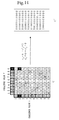
- Figs. 14 through 16 show the state of the group of the example being converted into a group of a new challenge value 1, a new challenge value 2, and a new input value by the conversion part 505.
- Fig. 14 shows the state of the matrix C' being generated based on the matrix C generated at S501.
- Fig. 15 shows the case of the new input numerical value N (authentication value) being "7”
- (b) shows the state of a new challenge value 1 being generated
- (c) shows the state of a new challenge value 2 being generated.
- Fig. 16 shows that the new input numerical value is "7" when the new matrix C is generated based on the new challenge value 1 and the new challenge value 2 and when the first two digits of the password are "20.”
- a numerical value to be input into the input part 503 of the terminal apparatus 501 is not the password itself but a value in the ones place of a total obtained by adding numbers in the displayed two random numbers, which are located at digit-positions indicated by each of two digits in the password. Therefore, even when the input value at the time of authentication is looked by a third person, the danger that the password is guessed and unjustly used for authentication can be reduced.
- sets of two random numbers and an input numerical value memorized in the memory part 504 when the authentication for the server apparatus 508 was successful are a part of eight sets of two random numbers and an input numerical value used for the authentication for the server apparatus 508, like 5 sets. However, it is also acceptable to memorize all the values of the eight sets and use them at the next time of authentication for the terminal apparatus 501.
- an eight-digit number is used as a password. However the password is not limited to the eight-digit number.
- the memory part 504 of the terminal apparatus 501 is provided in the IC card 514, and can be attached/detached to/from the terminal apparatus 501. It is also acceptable to divide the memory part 504 into two, to provide one in the IC card 514, to include the other one in the terminal apparatus 501, to memorize the input value at the last time of the authentication in the memory part in the IC card 514, to memorize the random number at the last time of the authentication in the memory apparatus included in the terminal apparatus 501, and therefore to separately store random numbers and input numerical values in response to them to be needed at the next time of the authentication for the terminal apparatus 501, in separate memory apparatuses. In this case, by separately possessing the terminal apparatus 501 and the IC card 514 at the time of not using them, it is possible to prevent the terminal apparatus 501 from being unjustly utilized.
- an eight-digit number is used as a password.
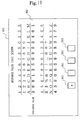
- a response value input screen 801 two random numbers 802 with a digit number, an alphabet, a special character, as a challenge value 1 and a challenge value 2, and an input field 803 where a user inputs an input numerical value (response value) in response to the random number are provided. * or a numerical value itself is displayed in the input field 803 as the input numerical value.
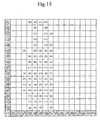
- authentication can be performed by converting a password into a numerical value based on the conversion table shown in Fig. 18, for example, and making comparison with an input numerical value at S410 based on the numerical value after the conversion.
- a password is received as an ASCII character queue and distinction between a capital letter and a small letter of the alphabet in the password is not made has been described.
- a password is a sign queue of eight-digit including numbers, alphabets and special characters.
- the length of the password is not limited to eight-digit.
- Embodiment 1 a four-digit number is used as a password.
- a password including not only a number but also an alphabet and a special character, by adding not only the display of digit of a number but also the notation of an alphabet and a special character to the password input screen as shown in Fig. 19.
- a response value input screen 901 a random number 902 with a digit number, an alphabet, a special character, as a challenge value, and an input field 903 where a user inputs an input numerical value (response value) in response to the random number are provided. * or a numerical value itself is displayed in the input field 903 as the input numerical value.
- authentication can be performed by converting a password into a numerical value based on the conversion table shown in Fig. 20, and calculating a value to be used for the authentication at S209 based on the numerical value after the conversion.
- a password is received as an ASCII character queue and distinction between a capital letter and a small letter of the alphabet in the password is not made has been described.
- the random number generating part 108 generates random number of 26 digits.
- the following formula is used for calculating a value used for authentication in S209.
- Ans[i] ((Rand[i] / 10 (26 - Pass[i]) ) % 10 + Pass[Pass[i] % 4]) % 10
- i is a number of an input value
- Ans is an array of values used for authentication
- Rand is an array of random numbers generated for authentication
- Pass is an array of numbers in the password from the most significant digit
- "/" denotes a calculation for obtaining a quotient of division
- % denotes a calculation for obtaining a remainder of division.
- Embodiment 1 and Embodiment 2 the case that when a user inputs an input numerical value into the input field of the password input screen, * is displayed so that the inputted numerical value may not be understood by a third person has been described. However, in order to prevent the error of a numerical value input, the numerical value inputted itself can be displayed in the input field.
- a numerical value to be input into the input part of the terminal apparatus is not a password itself, and user authentication can be performed by using a value obtained based on the password and random numbers displayed in the terminal apparatus. Therefore, even when the input value at the time of authentication is looked by a third person, the danger that the password is guessed and unjustly used for authentication can be reduced.
- random numbers are displayed on the terminal apparatus at the time of accessing the server apparatus, and authentication is performed at the server apparatus based on input numerical values which a user input in response to the random numbers.
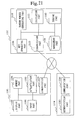
- Fig. 21 is a block diagram showing a structure of an authentication system according to the present Embodiment.
- the memory part 1104 is composed of an volatile memory included in the terminal apparatus 1101, and memorizes a private key of a user received from the authentication apparatus 1107.
- the authentication part 1105 is realized by programs. These programs are stored in a hard disk apparatus, a nonvolatile memory, a flexible disk, etc., and loaded onto the terminal apparatus 1101 from them to be executed on CPU.
- the key generating part 1108 generates a set of a private key and a public key.
- the management part 1109 is composed of a hard disk apparatus, relates a user password, a public key generated in the key generating part 1108, and the validity term of the public key with a user ID, and memorizes them.
- the random number generating part 1110 generates a ten-digit random number.
- the key generating part 1108, the random number generating part 1110, the calculation part 1111, and the judging part 1112 are realized by programs. These programs are stored in a hard disk apparatus, a nonvolatile memory, a flexible disk, etc., and loaded onto the authentication apparatus 1107 from them to be executed on CPU.
- the authentication part 1115 is realized by programs. These programs are stored in a hard disk apparatus, a nonvolatile memory, a flexible disk, etc., and loaded onto the service provide apparatus 1114 from them to be executed on CPU.
- the communication part 1106 of the terminal apparatus 1101, the communication part 1113 of the authentication apparatus 1107 and the communication part 116 of the service provide apparatus are linked through a network, such as radio communication, cable communication, and the Internet.
- Fig. 22 is a timing chart showing communication data between apparatuses and processing on each apparatus.
- the terminal apparatus 1101 transmits an authentication request 1202 including a user ID to the authentication apparatus 1107.
- the authentication apparatus 1107 When receiving the authentication request 1202, if the user ID included in the authentication request 1202 has been registered in the management part 1109, the authentication apparatus 1107 generates random number sets 1204 at 1203, the number of which is required for authenticating the user, and transmits them to the terminal apparatus 1101.
- the terminal apparatus 1101 displays the received random number sets 1204 on the display part 1102, receives all input numerical values 1206 inputted in response to the displayed random numbers sets at 1205, and transmits them to the authentication apparatus 1107.
- the authentication apparatus 1107 calculates authentication values to be used for authentication, by the calculation part 1111 based on the user password on the management part 1109 at 1207, and performs authentication depending upon whether they coincide with all the input numerical values 1206 or not
- the above stated processing can also be performed by either method of the Embodiment 1 or Embodiment 2.
- the key generating part 1108 generates a set of a private key 1209 and a public key 1212 at 1208, registers the public key 1212 with a validity term, relating to the user ID, in the management part 1109, and transmits the private key 1209 to the terminal apparatus 1101.
- an anonymous communication such as SSL (Secure Sockets Layer) communication by the public key of the authentication apparatus is used.
- the terminal apparatus 1101 transmits an authentication request 1210 including the user ID to the service provide apparatus 1114 which has been specified.
- the service provide apparatus 1114 transmits a key demand 1211 including the user ID, which is acquired from the received authentication request 1210, to the authentication apparatus 1107.
- the authentication apparatus 1107 acquires the user ID from the received key demand 1211, checks the validity term of the public key 1212 memorized to be relating with the user ID, in the management part 1109, and, if it is within the validity term, transmits the public key 1212 to the service provide apparatus 1114.
- the service provide apparatus 1114 receives the public key 1212 from the authentication apparatus 1107, the service provide apparatus 1114 generates arbitrary information by the authentication part 1115 as authentication information 1216 at 1213, encrypts it to be encryption information 1214 by using the received public key 1212, and transmits it to the terminal apparatus 1101.
- the terminal apparatus 1101 decrypts the received encryption information 1214 at 1215 to be authentication information 1216, using the private key 1209, by the authentication part (decryption part) 1105, and transmits the authentication information 1216 to the service provide apparatus 1114.
- the service provide apparatus 1114 performs authentication depending upon whether the received authentication information 1216 coincides with the authentication information 1216 before the encryption using the public key 1212. Then, only when the authentication is successful because both of the information coincide, service is rendered to the terminal apparatus 1101.
- a numerical value to be input into the input part of the terminal apparatus is not a password itself, and user authentication can be performed by using a value obtained based on the password and random numbers displayed on the terminal apparatus. Therefore, even when the input value at the time of authentication is looked by a third person, the danger that the password is guessed and unjustly used for authentication can be reduced.
- the above-mentioned authentication system can be applied to the authentication at a plurality of service provide apparatuses rendering service to a user, and even when utilizing a plurality of services, the user can utilize the service without inputting the password itself into the terminal apparatus. Therefore, the danger of the service being unjustly utilized can be reduced.
- Embodiments 1 through 3 authentication for the terminal apparatus is performed by using random numbers transmitted from the authentication apparatus.
- the case of the terminal apparatus independently performing user authentication will be explained.
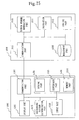
- Fig. 23 is a block diagram showing a structure of an authentication system according to Embodiment 4.
- a terminal apparatus 1301, a display part 1302, an input part 1303, a memory part 1304, a random number generating part 1305, a calculation part (authentication value calculation part) 1306, a judging part (authentication judging part) 1307 are provided.
- the memory part 1304, the random number generating part 1305, the calculation part 1306 and the judging part 1307 are installed in an IC card 1308, and concretely realized by programs. These programs are stored in a flash memory in the IC card and executed by CPU in the IC card.
- the IC card can be attached/detached to/from the terminal apparatus 1301.
- the memory part 1304 memorizes a password of a user to whom authentication is performed by the terminal apparatus 1301 and a private key of the user which is paired with a public key of the user.
- the password of the user is a sign queue of a plurality of digits like Embodiments 1 through 3.
- the random number generating part 1305 generates a ten-digit random number where no number at each digit is in duplicate.
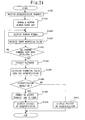
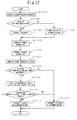
- Fig. 24 is a flowchart showing the processing performed at the time of performing user authentication processing in the terminal apparatus 1301.
- an authentication request is received from the input part 1302 (S1401).
- the terminal apparatus 1301 generates random number groups, the number of which is required for authenticating the user, in the random number generating part 1305 (S1402).
- random number groups (set of random numbers equal to or more than two) are displayed on the display part 1302 out of the generated random number groups (S1403).
- Input numerical values (response values) which the user input in response to the random number groups displayed on the display part 1302 are received from the input part 1303 (S1404), and it is checked whether all the random number groups generated by the random number generating part 1305 have been displayed on the display part 1302 or not (S1405).
- the response value input screen 801 of Fig. 17 which is the same as the one used in Embodiment 2 is displayed on the display part 1302.
- the calculation part 1306 calculates an authentication value for each digit of the password by using the following formula which is the same as the one used in Embodiment 2:
- Ans[i] ((Rand1 [i] / 10 (10 - Pass[i]) ) % 10 + (Rand2 [i] / 10 (10 - Pass [i+1]) ) % 10) % 10
- i is a number of an input value
- Ans is an array of values used for authentication
- Rand1 and Rand2 are arrays of two random numbers generated for authentication
- Pass is an array of numbers in the password from the most significant digit
- "/" denotes a calculation for obtaining a quotient of division
- "%" denotes a calculation for obtaining a remainder of division.
- the calculation part 1306 of the terminal apparatus 1301 perform authentication by obtaining authentication values based on a password including not only a number but an alphabet and a special character by using the conversion table shown in Fig. 18 which is the same as the one used in the Embodiment 2 in S1407, and by comparing them with input numerical values.
- a password is received as an ASCII character queue and distinction between a capital letter and a small letter of the alphabet in the password is not made has been described.
- a password is a sign queue of eight-digit including numbers, alphabets and special characters.
- the length of the password is not limited to eight-digit.
- a numerical value to be input into the input part of the terminal apparatus is not a password itself, and user authentication can be performed by using a value obtained based on the password and random number groups displayed in the terminal apparatus. Therefore, even when the input numerical value at the time of authentication is looked by a third person, the danger of unjustly using data in the terminal apparatus and in the IC card by guessing the password can be reduced.
- the authentication system of the present Embodiment can be used as the user authentication for an IC card in which a private key of a user being paired with a public key of the user is stored.
- the authentication system of high security can be utilized.
- a random number group (set of random numbers equal to or more than two) is used.
- Ans[i] ((Rand [i] / 10 (10 - Pass[i]) ) % 10 + Pass [i]) % 10
- i a number of an input value
- Ans is an array of values used for authentication
- Rand is an array of random numbers generated for authentication
- Pass is an array of numbers in the password from the most significant digit
- "/" denotes a calculation for obtaining a quotient of division
- "%” denotes a calculation for obtaining a remainder of division.
- the present Embodiment will describe the case that a set of a random number for display and a random number for background (random number for additional element) is used for each digit of a password, the random number for display is displayed, as a challenge value, on a prescribed background pattern on the response value input screen, a background pattern of each password candidate is determined based on the random number for background, and the password candidate is displayed on each background pattern.
- a queue of eight signs including numbers, alphabets, and special characters is used as a password, and eight input numerical values are input at the time of authentication for the server apparatus and authentication for the terminal.
- the random number for background is supposed to be a random number array composed of five ten-digit random numbers.
- Fig. 25 is a block diagram showing a structure of an authentication system according to the present Embodiment.
- a terminal apparatus 1501 a display part 1502, an input part 1503, a memory part 1504, a conversion part (random number change part) 1505, a judging part (terminal side authentication judging part) 1506, a communication part (a transmitting part and a receiving part) 1507, a server apparatus (authentication apparatus) 1508, a management part (password memory part) 1509, a random number generating part 1510, a calculation part (authentication value calculation part) 1511, a judging part (authentication judging part) 1512 and a communication part 1513 are provided.
- a background pattern determination part 1515 determines a background pattern (additional element) of each password candidate (reference sign group) on the response value input screen by using a random number for background (random number for additional element).
- the background pattern determination part 1515 is corresponding to an example of an additional element determination part.
- the memory part 1504, the conversion part 1505, and the judging part 1506 are concretely realized by programs, stored in a flash memory 1514 and loaded onto the terminal apparatus 1501 to be executed on CPU.
- the management part 1509 is composed of a hard disk apparatus, relates a user password with a user ID, and memorizes them.
- the random number generating part 1510 generates a set of a ten-digit random number where no number at each digit is in duplicate as a random number for display and an array of random number for background being composed of five ten-digit random numbers where no number at each digit is in duplicate as random numbers for background.
- the random number generating part 1510, the calculation part 1511, and the judging part 1512 are concretely realized by programs. These programs are stored in a hard disk apparatus, a nonvolatile memory, a flexible disk, etc., and loaded onto the server apparatus 1508 from them to be executed on CPU.
- the communication part 1507 of the terminal apparatus 1501 and the communication part 513 of the server apparatus 1508 are linked through a network, such as radio communication, cable communication, and the Internet.
- Fig. 26 is a flowchart showing processing executed at the time of performing user authentication processing in the terminal apparatus 1501.
- an authentication request including a user ID and an authentication type being authentication for the terminal apparatus 1501 or being authentication for the server apparatus 1508 is received from the input part 1503 (S1601).
- the authentication request including the user ID is transmitted to the server apparatus 1508 through the communication part 1507 (S1603).
- the terminal apparatus 1501 receives random number sets including random numbers for display and arrays of random numbers for background, in response to the authentication request transmitted through the communication part 1507, from the server apparatus 1508 (S1604) and displays random number for display in the received random number sets on the display part 1502 and displays a password candidate on a background pattern determined by the background pattern determination part 1515 based on an array of random numbers for background (S1605).
- the input numerical value (response value) which the user input in response to the random number displayed on the display part 1502 using the random number set is received from the input part 1503 (S1606), and it is checked whether random numbers were displayed on the display part 1502 by using all the random number sets received from the server apparatus 1508 (S1607).
- the processing from S1605 is repeated.
- the input numerical values (response value) inputted by the user is transmitted to the server apparatus 1508 through the communication part 1507 (S1608), and an authentication result is received through the communication part 1507 (S1609).
- the terminal apparatus stores the random number sets having been used for the authentication and the input numerical values in response to these random number sets in the memory part 1504 (S1611). Then, the authentication result received from the server apparatus 1508 is displayed on the display part 1502 (S1612) to finish the authentication processing.
- the received authentication request is to the terminal apparatus 1501 at S1602, it is checked whether the random number sets and input numerical values in response to the random number sets are stored in the memory part 1504 or not (S1613).
- the authentication request including the user ID is transmitted to the server apparatus 1508 through the communication part 1507 (S1603).
- the random number sets and the input numerical values in response to the random number sets are stored in the memory part 1504, these values on the memory part 1504 are converted by the conversion part (random number change part) 1505.
- a new input numerical value (authentication value) is computed based on a random number for display after the random number change and a random number for background after the random number change.
- the random numbers for display after the random number change, the random numbers for background after the random number change, and the new input numerical values are memorized in the memory part 1504 (S1614).
- the processing of S1614 is performed like the processing described in the Embodiment 2.
- the random number for display after the random number change is displayed on the display part 1502 using one random number set out of the random number sets after the conversion (random number set after the random number change) memorized in the memory part 1504, and a password candidate is displayed on the background pattern determined by the background pattern determination part 1515 based on the array of random numbers for background after the random number change (S1615).
- an input numerical value (response value) which the user input in response to the random number displayed on the display part 1502 using the random number set is received through the input part 1503 (S1616). It is checked whether the random numbers were displayed on the display part 1502 by using all the random number sets stored in the memory part 1504 or not (S1617). Then, when there is a random number set not having been displayed yet, the processing from S1615 is repeated. On the other hand, the random numbers have been displayed by using all the random number sets, the judging part (terminal side authentication judging part) 1506 checks whether or not all the input numerical values received through the input part 1503 coincide with all the input numerical values (authentication values) stored in the memory part 1504 (S1618).
- the random number sets and the numerical values are converted at S1614 .
- the judging part 1506 performs user authentication for the terminal apparatus by using the random numbers for display, the arrays of random numbers for background, and the input numerical values stored in the memory part 1504 without converting, as described in Embodiment 1.
- Fig. 27 is a flowchart showing processing to be executed in the server apparatus 1508 when an authentication request is received from the terminal apparatus 1501.
- an authentication request including a user ID is received from the terminal apparatus 1501 (S1701). Then, it is checked whether the user ID included in the received authentication request has been registered in the management part 1509 or not (S1702). When the user ID has been registered in the management part 1509, the password stored to be corresponding to the user ID is extracted (S1703). On the other hand, when the user ID has not been registered in the management part 1509, failure of the authentication is stored in the judging part 1512. Next, in the random number generating part 1510, random number sets (set of random number for display and random number for background), the number of which is required for the user authentication, are generated (S1705).
- an input numerical values (response value) are received from the terminal apparatus 1501 (S1707), and it is checked whether failure of the authentication has been recorded in the judging part 1512 or not (S1708).
- an authentication values to be used for the authentication are calculated by the calculation part 1511 (S1709).
- the authentication value is compared with the received input numerical value, for each digit of the password, and both of them are checked whether they coincide or not (S1710).
- the user ID input screen 201 shown in Fig. 5 is displayed on the display part 1502 like Embodiments 1 and 2.
- a user ID is input into the user ID input field 202 of the user ID input screen 201 displayed on the display part 1502.
- the authentication request including the user ID to the terminal apparatus 1501 can be received at S1601, by operating the log-in button 203.
- the authentication request including the user ID to the server apparatus 1508 can be received at S1601
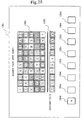
- Fig. 28 shows a response value input screen displayed on the display part 502 using a random number set at S1605, at the time of receiving the input numerical value from the user through the input part 1503 in terminal apparatus 1501 at S1606.
- a response value input screen 1801 a password candidate (reference sign group) display 1802 displaying numbers, alphabets, and special characters on the background pattern determined by the background pattern determination part 1515 based on the array of random numbers for background, a random number display 1803 displaying random numbers for display on a fixed background pattern, and an input field 1804 in which a user inputs an input numerical value (response value) in response to the random number are provided. * or a numerical value itself is displayed in the input field 1804 as an input numerical value.
- a password candidate is displayed in such way that a background pattern is added as an additional element to each sign (reference sign) included in the password candidate.
- the background pattern added to each sign is determined for each sign by the background pattern determination part 1515.
- the background pattern added to each sign is determined for every random number for display, and at the time of switching the display of a challenge value (random number for display), the display of the background pattern of each sign of the password candidate also changes.
- the background pattern of each digit of a challenge value (random number for display) is fixed.
- the memory part 1504 memorizes a background pattern array Patern[10] whose elements are background pattern codes of ten types to display different background patterns, and the background pattern determination part 1515 converts the value of each digit of the array BGRand[i][5] of random numbers for background for the i-th password, into a pattern code for screen drawing, using the pattern array for background and by the formula below in S1605 and S1615, and displays it as a background located at the m-th line from the top and the n-th from the left of the password candidate display 1802 of the response screen input 1801.
- BGPatern mn Patern[(BGRand [i][m-1] / 10 10-n ) % 10] where "/" denotes a calculation for obtaining a quotient of division, and "%” denotes a calculation for obtaining a remainder of division. This formula is repeated for all the digits of BGRand[i] (1 ⁇ m ⁇ 5,1 ⁇ n ⁇ 10).
- Patern[n-1] is displayed as the n-th background from the left and as a fixed background pattern of the random number display 1803 of the response screen input 1801.
- the user specifies a random number of one-digit by using the password candidate display 1802 and the random number display 1803. Concretely, finding a one-digit random number in the random number display 1803 which has the same background pattern as the objective character of the password in the password candidate display 1802, the user inputs the numerical value having been found into the input field 1804.
- the response value input screen 1801 using the next random number set is displayed on the display part 1502. The user repeats the input processing for each character of the password until the input of the response value for the last digit of the password finishes.
- the random number display 1803 and the password candidate display 1802 are updated using a random number set of the random number for display and the random number for background for the next character in the password.
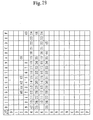
- the calculation part (authentication value calculation part) 1511 calculates an authentication value to be used for authentication, for each character of the password at S1709, by using the following formula including conversion of the password character into a numerical value, using the conversion table shown in Fig. 29.
- i is a number of an input value
- Ans[i] is an array of values used for authentication
- DispRand [i] is a ten-digit random number for display which is generated for authentication of the i-th password
- BGRand [i][5] is an array of random numbers for background whose elements are five ten-digit random numbers for background which are generated for authentication of the i-th password.
- Pass[i] is an array of characters in the password
- Trans (x) is a function relating to the character x, returning a numerical value obtained by using the conversion table shown in Fig. 26.
- "/" denotes a calculation for obtaining a quotient of division
- "%” denotes a calculation for obtaining a remainder of division.
- the above-stated contents of the calculation by the calculation part 1511 of the server apparatus 1508 corresponds to the processing performed by the user for the terminal apparatus 1501. That is, in the calculation part 1511, a calculation equivalent to such processing is done that with respect to each digit of password, a sign of password, a random number for display, and a random number for background respectively corresponding to a digit, are used to determine a background pattern(additional element) which is added to a sign corresponding to the sign of the password out of each sign(reference sign) in the password candidate display (reference sign group) displayed on the terminal apparatus, and that based on the determined background pattern(additional element) a value of a digit in the random number for display corresponding to the sign to which the determined background pattern is added is specified.
- An authentication value used for user authentication is computed for each digit of the password by this calculation.
- the conversion part (random number change part) 1505 converts the random number for display and the array of random numbers for background memorized in the memory part 1504 in S1614.
- Fig. 30 is a flowchart showing conversion processing performed in the conversion part 1505 in the terminal apparatus 1501 at S1614.
- m' which satisfies the following formula is calculated as a number m' of a background pattern expected to be selected at the next authentication time (S1905).
- (DispRand' [i] / 10 9-m' ) % 10 Ans'[i]
- a ten-digit random number R' where no number at each digit is in duplicate is generated as an element of an array BGRand'[i] of random numbers for background to be used at the next authentication time (S1906).
- Embodiment 5 background pattern codes of ten types for displaying different background patterns of ten types for drawing background are used.
- the display part 1502 of the terminal apparatus 1501 can react to color display, it is also acceptable to use color codes of ten types for displaying different colors of ten types for drawing of background.
- a background pattern and a color can also be used simultaneously for a background.
- the response value input screen 1801 is made of one screen in Embodiment 5, it is also acceptable to be made of two screens of a random number screen for displaying a password candidate and a random number for display and a background display screen for displaying a background by a random number for background. Then, it is possible to switch these two screens to display, at the time of pressing a prescribed key other than the number key of the input part 1503, or to switch from the random number display screen to the background display screen only while a prescribed key is being pressed. In this case, not only a drawing pattern and a color but also a sign, a pictorial symbol, etc. can be used for background.
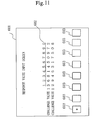
- Fig. 31 shows a response value input screen in the case of using a pictorial symbol as an additional element.
- a random number display screen 2001, a password candidate display 2002 of the random number display screen, a random number display 2003 of the random number display screen, an input field 2004 where a user inputs an input numerical value (response value) in response a random number, a background display screen 2005, a password candidate display background 2006 of the background display screen, a random number display background 2007 of the background display screen and an input field 2008 are provided.
- the display part 1501 When pressing of a prescribed key is input through the input part 1502 for the random number display screen 2001, the display part 1501 switches to the random number display screen 2005, and when pressing or releasing of the prescribed key is input through the input part 1502, the display part 1501 switches to the random number display screen 2001.
- a password is a sign queue of eight-digit including numbers, alphabets and special characters.
- the length of the password is not limited to eight-digit, and either longer or shorter than the eight digits is also acceptable.
- Embodiment 5 at the time of a user inputting an input numerical value into the input field at the password input screen, it is possible to perform user authentication by using a numerical value having the same additional element, such as a background pattern, a background color, or a pictorial symbol, as the password which the user memorizes, among the random numbers displayed on the terminal apparatus Therefore, even when the input value at the time of authentication is looked by a third person, the danger that the password is guessed and unjustly used for authentication can be reduced.
- a numerical value having the same additional element such as a background pattern, a background color, or a pictorial symbol
- the present Embodiment will describe an example of the case that a terminal apparatus independently performs user authentication by using an authentication method where a set of a random number for display and a random number for background (random number for additional element) is used for each digit of a password, and where a random number for display is displayed, as a challenge value, on a prescribed background pattern in a response value input screen, by using a background pattern of each password candidate based on a random number for background, and the password candidate is displayed on its background pattern.
- a queue of eight digits including numbers, alphabets, and special characters is used as a password, and eight input numerical values are input at the time of authentication for the terminal.
- the random number for background is supposed to be a random number array composed of five ten-digit random numbers.
- Fig. 32 is a block diagram showing a structure of an authentication system according to Embodiment 6.
- a terminal apparatus 2101 a display part 2102, an input part 2103, a memory part 2104, a random number generating part 2105, a calculation part (authentication value calculation part) 2106, and a judging part (authentication judging part) 2107 are provided.
- the memory part 2104, the random number generating part 2105, the calculation part 2106 and the judging part 2107 are installed in an IC card 2108, and concretely realized by programs. These programs are stored in a flash memory in the IC card and executed by CPU in the IC card.
- the IC card can be attached/detached to/from the terminal apparatus 2101.
- the memory part 2104 memorizes a password of a user who performs authentication through the terminal apparatus 2101.
- a background pattern determination part 2109 determines a background pattern (additional element) of each password candidate (reference sign group) on the response value input screen by using a random number for background (random number for additional element).
- the background pattern determination part 2109 is corresponding to an example of an additional element determination part.
- the random number generating part 2105 generates a set of a random number for display being a ten-digit random number where no number at each digit is in duplicate and a random number for background being an array of random numbers for background whose elements are five ten-digit random numbers where no number at each digit is in duplicate.
- Fig. 33 is a flowchart showing the processing executed in the terminal apparatus 2101 at the time of performing user authentication processing.
- the random number generating part 2105 generates random number sets (set of random number for display and random number for background), the number of which is required for the user authentication (S2002). Since authentication is performed based on eight input values according to Embodiment 6, eight sets of a random number for display being a ten-digit random number and an array of random numbers for background whose elements are five ten-digit random numbers generated for one authentication. That is, a set of a random number for display and an array of random numbers for background is generated for each digit of a password.
- the random number for display in the generated random number sets is displayed on the display part 2102, and a password candidate is displayed on a background pattern determined by the background pattern determination part 2109 based on the array of random numbers for background (S2003).
- Input numerical values (response values) which the user input in response to the random number displayed on the display part 2102 by using the random number set are received from the input part 2103 (S2004), and it is checked whether all the random number sets generated by the random number generating part 2105 have been displayed on the display part 2102 or not (S2005). Then, when there is a random number set not having been displayed yet, the processing from S2003 is repeated.
- the password memorized in the memory part 2104 is extracted (S2006), an authentication value to be used for the authentication is calculated in the calculation part 2106 (S2007) and, the judging part 2107 compares it with the input numerical value received for each digit of the password, and checks whether both of them coincide or not (S2008).
- S2008 when the input numerical value received from the input part 2103 coincides with the authentication value calculated by the calculation part 2005, access of the user to the terminal apparatus 2101 and the IC card 2108 is permitted (S2009), and success of the authentication is displayed on the display part 2102 (S2010).
- the input numerical value does not coincide, failure of the authentication is displayed on the display part 2102 (S2011).
- the response value input screen 1801 of Fig. 28 which is the same as the one used in Embodiment 5 is displayed on the display part 2102.
- the memory part 2104 memorizes a background pattern array Patern[10] whose elements are background pattern codes of ten types displayed by different background patterns, and the background pattern determination part 2109 converts the value of each digit of the array BGRand[i][5] of random numbers for background for the i-th password, into a pattern code for screen drawing, by using the pattern array for background and by the formula below in S2003, and displays it as a background of the one at the m-th line from the top and the n-th from the left of the password candidate display 1802 in the response screen input 1801.
- BGPatern mn Patern[(BGRand [i][m-1] / 10 10-n ) % 10] where "/" denotes a calculation for obtaining a quotient of division, and "%” denotes a calculation for obtaining a remainder of division. This formula is repeated for all the digits of BGRand[i] (1 ⁇ m ⁇ 5,1 ⁇ n ⁇ 10).
- Patern[n-1] is displayed as the n-th background from the left and as a fixed background pattern of the random number display 1803 of the response screen input 1801.
- the random number display 1803 and the password candidate display 1802 are updated by using a random number for display and a random number for background in the random number set for the next character in the password.
- the calculation part 2106 calculates an authentication value to be used for authentication, for each digit of the password, by using the following formula which is the same as the one used in Embodiment 5.
- i is a number of an input value
- Ans[i] is an array of values used for authentication
- DispRand [i] is a ten-digit random number for display which is generated for authentication of the i-th password
- BGRand [i][5] is an array of random numbers for background whose elements are five ten-digit random numbers for background which are generated for authentication of the i-th password.
- Pass[i] is an array of characters in the password
- Trans (x) is a function relating to the character x, returning a numerical value obtained by using the conversion table shown in Fig. 29 used in Embodiment 5.
- "/" denotes a calculation for obtaining a quotient of division
- "%" denotes a calculation for obtaining a remainder of division.
- the authentication value Ans[i] to be used for authentication is compared with the input numerical value (response value) from the input part 2103 of the terminal apparatus 2101 with respect to each character of the password, and it is judged whether the authentication is to be permitted or not by checking if both of them coincide or not.
- the terminal apparatus independently performs user authentication, at the time of a user inputting an input numerical value into the input field at the password input screen, it is possible to perform user authentication by using a numerical value having the same additional element, such as a background pattern, a background color, or a pictorial symbol, as the password which the user memorizes, among the random numbers displayed on the terminal apparatus.
- a numerical value having the same additional element such as a background pattern, a background color, or a pictorial symbol
- the danger that the password is guessed and unjustly used for authentication can be reduced.
- the authentication system including a terminal apparatus which a user utilizes and an authentication apparatus which communicates with the terminal apparatus and performs user authentication to the user, comprises:
- the authentication system has the following features:
- the terminal apparatus further includes:
- the authentication system has the following features.
- the terminal apparatus further includes:
- the authentication system according to Embodiments from 1 to 6 has the following features.
- the authentication apparatus In the authentication apparatus,
- the authentication system has the following features.
- the terminal apparatus further includes:
- the authentication system according to Embodiments from 1 to 6 has the following features.
- the authentication apparatus In the authentication apparatus,
- the authentication system according to Embodiments from 1 to 6 has the following features.
- the authentication apparatus In the authentication apparatus,
- the authentication system according to Embodiments from 1 to 6 has the following features.
- the authentication apparatus In the authentication apparatus,
- the authentication system has the following features.
- the terminal apparatus further includes:
- the authentication system has the following features.
- the terminal apparatus further includes:
- the authentication system according to Embodiments from 1 to 6 has the following features.
- the authentication apparatus In the authentication apparatus,
- the authentication system according to Embodiments from 1 to 6 has the following features.
- the authentication apparatus In the authentication apparatus,
- the authentication system has the following features.
- the terminal apparatus and the authentication apparatus can communicate with a service provide apparatus which provides service to the terminal apparatus,
- the authentication system includes a terminal apparatus which a user utilizes, an authentication apparatus which communicates with the terminal apparatus and performs user authentication to the user, and a service provide apparatus which can communicate with the terminal apparatus and the authentication apparatus and provides service to the terminal apparatus, wherein
- the authentication apparatus for communicating with a terminal apparatus which a user utilizes and performing user authentication to the user, includes:
- the authentication apparatus has the following features.
- the authentication apparatus In the authentication apparatus,
- the authentication apparatus has the following features.
- the authentication apparatus In the authentication apparatus,
- the terminal apparatus has the following features.
- the terminal apparatus which can communicate with an authentication apparatus for performing user authentication includes:
- the terminal apparatus has the following features.
- the terminal apparatus further includes:
- the terminal apparatus has the following features.
- the terminal apparatus further includes:
- the terminal apparatus has the following features.
- the terminal apparatus can communicate with the authentication apparatus which memorizes a sign queue of a plurality of digits as a password and generates a random number for each digit of the password,
- the terminal apparatus has the following features.
- the terminal apparatus In the terminal apparatus,
- the terminal apparatus has the following features.
- the terminal apparatus further includes:
- the terminal apparatus has the following features.
- the terminal apparatus can communicate with the authentication apparatus which memorizes a sign queue of a plurality of digits as a password and generates a random number group composed of random numbers equal to or more than two, for each digit of the password,
- the terminal apparatus has the following features.
- the terminal apparatus In the terminal apparatus,
- the terminal apparatus has the following features.
- the terminal apparatus further includes:
- the authentication method using a terminal apparatus which a user utilizes and an authentication apparatus which communicates with the terminal apparatus and performs user authentication to the user comprises steps of:
- the authentication method uses a terminal apparatus which a user utilizes, an authentication apparatus which communicates with the terminal apparatus and performs user authentication to the user, and a service provide apparatus which can communicate with the terminal apparatus and the authentication apparatus and provides service to the terminal apparatus.
- the authentication apparatus performs,
- the terminal apparatus has the following features.
- the terminal apparatus which performs user authentication to a user includes:
- the terminal apparatus has the following features.
- the terminal apparatus In the terminal apparatus,
- the terminal apparatus has the following features.
- the terminal apparatus In the terminal apparatus,
- the terminal apparatus has the following features.
- the terminal apparatus In the terminal apparatus,
- the terminal apparatus has the following features.
- the terminal apparatus In the terminal apparatus,
- the terminal apparatus has the following features.
- the terminal apparatus In the terminal apparatus,
- the terminal apparatus has the following features.
- the terminal apparatus In the terminal apparatus,
- the terminal apparatus has the following features.
- the terminal apparatus In the terminal apparatus,
- the terminal apparatus has the following features.
- the terminal apparatus In the terminal apparatus,
- the authentication method according to Embodiments from 1 to 6 has the following features.
- the authentication method of performing user authentication to a user includes steps of:
- the authentication system according to Embodiments from 1 to 6 has the following features.
- the terminal apparatus In the terminal apparatus,
- the authentication system according to Embodiments from 1 to 6 has the following features.
- the terminal apparatus In the terminal apparatus,
- the authentication system has the following features.
- the terminal apparatus further includes
- the authentication system has the following features.
- the terminal apparatus further includes
- the authentication system according to Embodiments from 1 to 6 has the following features.
- the terminal apparatus In the terminal apparatus,
- the authentication apparatus has the following features.
- the authentication apparatus In the authentication apparatus,
- the terminal apparatus has the following features.
- the terminal apparatus In the terminal apparatus,
- the terminal apparatus has the following features.
- the terminal apparatus In the terminal apparatus,
- the terminal apparatus has the following features.
- the terminal apparatus further includes,
- the terminal apparatus has the following features.
- the terminal apparatus further includes,
- the terminal apparatus has the following features.
- the terminal apparatus In the terminal apparatus,
- the terminal apparatus has the following features.
- the terminal apparatus In the terminal apparatus,
- the terminal apparatus has the following features.
- the terminal apparatus In the terminal apparatus,
- the terminal apparatus has the following features.
- the terminal apparatus In the terminal apparatus,
- the authentication system has the following features.
- the authentication system which is used for user authentication includes:
- the authentication system has a feature that the memory means, the calculation means, and the judging means are included in an IC card.
- the authentication system according to Embodiments from 1 to 6 has a feature that the memory means is composed of an independent memory apparatus which can be attached/detached to/from the terminal apparatus.
- the authentication system has the following features that the authentication system includes:
- the authentication system has a feature that the management means, the calculation means, and the judging means are included in an IC card.
- the authentication system including a terminal apparatus and a server apparatus which can communicate through a network, according to Embodiments from 1 to 6 has the following features.
- the terminal apparatus includes
- the server apparatus includes
- the authentication system including a terminal apparatus and a server apparatus which can communicate through a network, according to Embodiments from 1 to 6 has the following features.
- the terminal apparatus includes
- the server apparatus includes
- the authentication system has the following features.
- the terminal apparatus includes,
- the authentication system has the following features.
- the terminal apparatus includes,
- the authentication system has the following features.
- the terminal apparatus includes,
- the authentication system has a feature that the memory means and the judging means are included in an IC card.
- the authentication system has the following features.
- the terminal apparatus includes,
- the authentication system has a feature that the terminal apparatus includes the memory means, the conversion means and the judging means in an IC card.
- the authentication system according to Embodiments from 1 to 6 has a feature that the terminal apparatus and the memory apparatus can communicate through a network.
- the authentication system includes a user authentication apparatus used for user authentication and a service provide apparatus which provides service to the user.
- the user authentication apparatus includes a terminal apparatus and a server apparatus which can communicate through a network.
- the terminal apparatus includes
- the server apparatus includes
- the service provide apparatus includes an authentication means for requesting the public key of the user from the server apparatus for the authentication request received from the terminal apparatus, and performing authentication for the terminal apparatus with using the public key of the user received from the server apparatus.
- Embodiments from 1 to 6 it is possible to realize user authentication of high security with having little load for the user, because the user authentication is performed by using a plurality of random numbers.
- Embodiments from 1 to 6 it is possible to realize user authentication of high security even at a terminal apparatus of a simple equipment structure, because a plurality of random numbers transmitted from the authentication apparatus and a response value for a plurality of random numbers are utilized for the user authentication at the terminal apparatus.
- Embodiments from 1 to 6 it is possible to perform user authentication in the terminal apparatus independently of user authentication in the authentication apparatus, since the user authentication in the terminal apparatus is performed by generating new random numbers by changing the contents of a plurality of random numbers transmitted from the authentication apparatus. Therefore, user authentication of higher security can be realized in the terminal apparatus.
- Embodiments from 1 to 6 it is impossible for the third person to guess the password because user authentication is performed by generating a random number for each digit of the password and using a different random number for each digit of the password. Therefore, user authentication of high security can be realized.
- Embodiments from 1 to 6 it can be applied to the user authentication in the service provide apparatus to together use a private key and a public key. Therefore, the danger that service of the service provide apparatus is unjustly used can be avoided.
- Embodiments from 1 to 6 also with respect to user authentication in the terminal apparatus, user authentication is performed by generating a random number group composed of random numbers of equal to or more than two for each digit of the password and using a different random number group for each digit of the password. Therefore, it is impossible for the third person to guess the password, which realizes user authentication of high security in the terminal apparatus.
- user authentication is performed by judging an additional element of a reference sign corresponding to a sign of password, based on an additional element for each reference sign determined by random numbers for additional element, and by specifying a value of a digit in the random number for display corresponding to the reference sign, based on the additional element. Therefore, it is impossible for the third person to guess the password, which realizes user authentication of high security in the terminal apparatus.
Landscapes
- Engineering & Computer Science (AREA)
- Computer Security & Cryptography (AREA)
- Theoretical Computer Science (AREA)
- Computer Hardware Design (AREA)
- Software Systems (AREA)
- Physics & Mathematics (AREA)
- General Engineering & Computer Science (AREA)
- General Physics & Mathematics (AREA)
- Financial Or Insurance-Related Operations Such As Payment And Settlement (AREA)
- User Interface Of Digital Computer (AREA)
- Telephone Function (AREA)
- Mobile Radio Communication Systems (AREA)
Applications Claiming Priority (3)
| Application Number | Priority Date | Filing Date | Title |
|---|---|---|---|
| JP2002266521 | 2002-09-12 | ||
| JP2002266521 | 2002-09-12 | ||
| PCT/JP2003/011547 WO2004025488A1 (ja) | 2002-09-12 | 2003-09-10 | 認証システム及び認証装置及び端末装置及び認証方法 |
Publications (1)
| Publication Number | Publication Date |
|---|---|
| EP1538531A1 true EP1538531A1 (de) | 2005-06-08 |
Family
ID=31986645
Family Applications (1)
| Application Number | Title | Priority Date | Filing Date |
|---|---|---|---|
| EP03795354A Withdrawn EP1538531A1 (de) | 2002-09-12 | 2003-09-10 | Authentifizierungssystem, authentifizierungseinrichtung, endgeräteinrichtung und authentifizierungsverfahren |
Country Status (6)
| Country | Link |
|---|---|
| US (1) | US20050254650A1 (de) |
| EP (1) | EP1538531A1 (de) |
| JP (1) | JP3789462B2 (de) |
| CN (1) | CN1302408C (de) |
| AU (1) | AU2003262041A1 (de) |
| WO (1) | WO2004025488A1 (de) |
Cited By (3)
| Publication number | Priority date | Publication date | Assignee | Title |
|---|---|---|---|---|
| EP1845469A1 (de) * | 2006-04-12 | 2007-10-17 | Siemens Aktiengesellschaft | Authentifizierungsverfahren und Authentifizierungssystem |
| EP1987435A4 (de) * | 2006-02-09 | 2009-07-29 | Solmaze Co Ltd | Verfahren und vorrichtung für otp auf der basis von abfrage/antwort |
| EP2230648A1 (de) | 2009-03-17 | 2010-09-22 | Giesecke&Devrient | Einmalkennwortmaske zum Ableiten eines Einmalkennworts |
Families Citing this family (45)
| Publication number | Priority date | Publication date | Assignee | Title |
|---|---|---|---|---|
| US20050163401A1 (en) * | 2004-01-28 | 2005-07-28 | Techwell Inc. | Display image enhancement apparatus and method using adaptive interpolation with correlation |
| US7734929B2 (en) * | 2004-04-30 | 2010-06-08 | Hewlett-Packard Development Company, L.P. | Authorization method |
| GB0414712D0 (en) * | 2004-07-01 | 2004-08-04 | Ibm | Method and apparatus for critical data entry |
| CN100517418C (zh) * | 2004-11-26 | 2009-07-22 | 索尼计算机娱乐公司 | 电池和用于对电池进行认证的认证系统和认证方法 |
| JP2006155393A (ja) * | 2004-11-30 | 2006-06-15 | Toshiba Corp | サーバ融通装置、サーバ融通方法およびサーバ融通プログラム |
| US20090235085A1 (en) * | 2005-01-17 | 2009-09-17 | Seemant Shankar Mathur | Method and System for Secure Authentication and Data Exchange in Client Server Architecture |
| JP2006302116A (ja) * | 2005-04-22 | 2006-11-02 | Nec Corp | 認証システム、認証サーバ、端末装置、認証方法およびプログラム |
| JP2007041801A (ja) * | 2005-08-02 | 2007-02-15 | E Bank Corp | 取引システムの制御装置 |
| JP4952213B2 (ja) * | 2006-02-20 | 2012-06-13 | 富士通株式会社 | 電子機器及びパスワード入力プログラム |
| JP2009528601A (ja) * | 2006-03-01 | 2009-08-06 | ゲールツェン,ノーマン,フランク | 隠し演算と組み合わせて視覚的配列経路を介するインタフェースアクセスを保護するためのシステム |
| JP3996939B2 (ja) * | 2006-03-30 | 2007-10-24 | 株式会社シー・エス・イー | オフラインユーザ認証システム、その方法、およびそのプログラム |
| US7841000B2 (en) * | 2006-10-16 | 2010-11-23 | Lenovo (Singapore) Pte. Ltd. | Authentication password storage method and generation method, user authentication method, and computer |
| US8041954B2 (en) * | 2006-12-07 | 2011-10-18 | Paul Plesman | Method and system for providing a secure login solution using one-time passwords |
| WO2008086439A1 (en) | 2007-01-09 | 2008-07-17 | Visa U.S.A. Inc. | Contactless transaction |
| US20090044284A1 (en) * | 2007-08-09 | 2009-02-12 | Technology Properties Limited | System and Method of Generating and Providing a Set of Randomly Selected Substitute Characters in Place of a User Entered Key Phrase |
| JP5277606B2 (ja) * | 2007-10-18 | 2013-08-28 | 日本電気株式会社 | パスワード発行方法と携帯端末とパスワード認証方法 |
| JP2009163384A (ja) * | 2007-12-28 | 2009-07-23 | Kyodo Printing Co Ltd | データ入力システム及びデータ入力方法 |
| KR101515097B1 (ko) * | 2008-03-05 | 2015-04-27 | 삼성전자주식회사 | 무결성 확인 코드를 사용하는 패스워드 시스템, 패스워드생성 방법 및 패스워드 확인 방법 |
| CN102104484A (zh) * | 2009-12-22 | 2011-06-22 | 鸿富锦精密工业(深圳)有限公司 | 电子设备及密码保护方法 |
| US8731197B2 (en) * | 2010-03-09 | 2014-05-20 | Ebay Inc. | Secure randomized input |
| KR101151294B1 (ko) * | 2010-11-19 | 2012-06-08 | 황영만 | 능동형 보안 인증 제공 방법, 이를 지원하는 단말기 및 시스템 |
| FR2969777B1 (fr) * | 2010-12-22 | 2013-01-04 | Eads Defence & Security Sys | Procede d'activation d'un mecanisme, et dispositif mettant en oeuvre un tel procede. |
| US8898461B2 (en) * | 2011-03-03 | 2014-11-25 | Lenovo (Singapore) Pte. Ltd. | Battery authentication method and apparatus |
| KR101191035B1 (ko) * | 2011-03-14 | 2012-10-12 | 유종빈 | 전자단말기에서의 비밀번호 입력 방법 |
| US10678905B2 (en) | 2011-03-18 | 2020-06-09 | Lenovo (Singapore) Pte. Ltd. | Process for controlling battery authentication |
| WO2013089771A1 (en) * | 2011-12-16 | 2013-06-20 | Intel Corporation | Secure user attestation and authentication to a remote server |
| US9131370B2 (en) | 2011-12-29 | 2015-09-08 | Mcafee, Inc. | Simplified mobile communication device |
| CN102546408A (zh) * | 2011-12-30 | 2012-07-04 | 重庆拉土拉现代农业有限公司 | 基地农产品远程可视方法 |
| GB2498350B (en) * | 2012-01-09 | 2015-10-21 | Gopalan Ketheeswaran | Input device |
| US20130268687A1 (en) | 2012-04-09 | 2013-10-10 | Mcafee, Inc. | Wireless token device |
| US8819445B2 (en) | 2012-04-09 | 2014-08-26 | Mcafee, Inc. | Wireless token authentication |
| US9262592B2 (en) * | 2012-04-09 | 2016-02-16 | Mcafee, Inc. | Wireless storage device |
| US9547761B2 (en) | 2012-04-09 | 2017-01-17 | Mcafee, Inc. | Wireless token device |
| JP6184796B2 (ja) * | 2013-08-05 | 2017-08-23 | 株式会社 ネクストジェン | 認証キー管理システム |
| WO2015145786A1 (ja) * | 2014-03-28 | 2015-10-01 | 正昭 宮田 | 情報処理装置、情報処理システム、および情報処理方法、並びにプログラム |
| JP6148199B2 (ja) * | 2014-04-23 | 2017-06-14 | パスロジ株式会社 | ユーザ認証方法及びこれを実現するためのシステム並びにこれに用いられる情報通信端末 |
| KR101582862B1 (ko) * | 2014-05-19 | 2016-01-11 | 표성수 | 랜덤 수열에 기초한 비밀 번호 확인 방법 |
| CN104394050A (zh) * | 2014-11-20 | 2015-03-04 | 珠海格力电器股份有限公司 | 智能家居系统的连接方法及连接装置 |
| CN104820799A (zh) * | 2015-04-07 | 2015-08-05 | 深圳天珑无线科技有限公司 | 具有触摸显示屏的终端及其密码保护方法 |
| CN105357210B (zh) * | 2015-11-23 | 2018-04-13 | 贾如银 | 动态密码的生成方法 |
| CN105282738A (zh) * | 2015-11-24 | 2016-01-27 | 苏州铭冠软件科技有限公司 | 移动终端安全认证方法 |
| US20170154173A1 (en) * | 2015-11-27 | 2017-06-01 | Chao-Hung Wang | Array password authentication system and method thereof |
| CN108737346B (zh) * | 2017-04-21 | 2020-06-19 | 珠海格力电器股份有限公司 | 一种密码验证方法及其装置、服务器、通信系统 |
| KR102063678B1 (ko) * | 2018-08-20 | 2020-01-09 | 주식회사 이와이엘 | 모바일기기의 스머지 및 훔쳐보기 공격 방지를 위한 시스템 및 사용자 패턴 인증 방법 |
| US20250202869A1 (en) * | 2023-12-19 | 2025-06-19 | JumpCloud, Inc. | Offline multi-factor authentication |
Family Cites Families (9)
| Publication number | Priority date | Publication date | Assignee | Title |
|---|---|---|---|---|
| US5790667A (en) * | 1995-01-20 | 1998-08-04 | Matsushita Electric Industrial Co., Ltd. | Personal authentication method |
| JPH09330298A (ja) * | 1996-06-13 | 1997-12-22 | Mitsubishi Electric Corp | パスワード登録方法、認証方法、パスワード更新方法、パスワード登録システム、認証システムおよびパスワード更新システム |
| US5971272A (en) * | 1997-08-19 | 1999-10-26 | At&T Corp. | Secured personal identification number |
| JPH11345214A (ja) * | 1998-06-02 | 1999-12-14 | Toshiba Corp | 分散ネットワークコンピューティングシステム、同システムに於ける負荷分散/セキュリティ保証方法、及び記憶媒体 |
| US6918035B1 (en) * | 1998-07-31 | 2005-07-12 | Lucent Technologies Inc. | Method for two-party authentication and key agreement |
| JP3977548B2 (ja) * | 1999-04-21 | 2007-09-19 | 富士通株式会社 | ユーザ認証装置、ユーザ認証方法、ユーザ認証用カードおよびコンピュータ読み取り可能な記録媒体 |
| CN1282161A (zh) * | 1999-07-22 | 2001-01-31 | 刘明晶 | 网上身份认证和数据安全传送的系统和方法 |
| CN1332425A (zh) * | 2000-07-10 | 2002-01-23 | 黄金富 | 采用动态密码的认证付款的方法和相应的电子装置 |
| JP2003258787A (ja) * | 2002-02-26 | 2003-09-12 | Nippon Telegr & Teleph Corp <Ntt> | 電子証明書、電子証明書の発行および検証方法、装置、プログラム、プログラムの記録媒体 |
-
2003
- 2003-09-10 JP JP2004535923A patent/JP3789462B2/ja not_active Expired - Fee Related
- 2003-09-10 US US10/495,189 patent/US20050254650A1/en not_active Abandoned
- 2003-09-10 WO PCT/JP2003/011547 patent/WO2004025488A1/ja not_active Ceased
- 2003-09-10 EP EP03795354A patent/EP1538531A1/de not_active Withdrawn
- 2003-09-10 CN CNB038014807A patent/CN1302408C/zh not_active Expired - Fee Related
- 2003-09-10 AU AU2003262041A patent/AU2003262041A1/en not_active Abandoned
Non-Patent Citations (1)
| Title |
|---|
| See references of WO2004025488A1 * |
Cited By (3)
| Publication number | Priority date | Publication date | Assignee | Title |
|---|---|---|---|---|
| EP1987435A4 (de) * | 2006-02-09 | 2009-07-29 | Solmaze Co Ltd | Verfahren und vorrichtung für otp auf der basis von abfrage/antwort |
| EP1845469A1 (de) * | 2006-04-12 | 2007-10-17 | Siemens Aktiengesellschaft | Authentifizierungsverfahren und Authentifizierungssystem |
| EP2230648A1 (de) | 2009-03-17 | 2010-09-22 | Giesecke&Devrient | Einmalkennwortmaske zum Ableiten eines Einmalkennworts |
Also Published As
| Publication number | Publication date |
|---|---|
| JPWO2004025488A1 (ja) | 2006-01-12 |
| AU2003262041A1 (en) | 2004-04-30 |
| CN1585936A (zh) | 2005-02-23 |
| WO2004025488A1 (ja) | 2004-03-25 |
| AU2003262041A8 (en) | 2004-04-30 |
| JP3789462B2 (ja) | 2006-06-21 |
| CN1302408C (zh) | 2007-02-28 |
| US20050254650A1 (en) | 2005-11-17 |
Similar Documents
| Publication | Publication Date | Title |
|---|---|---|
| EP1538531A1 (de) | Authentifizierungssystem, authentifizierungseinrichtung, endgeräteinrichtung und authentifizierungsverfahren | |
| EP3319069B1 (de) | Verfahren zur authentifizierung eines benutzers mithilfe eines nichtsicheren endgeräts | |
| US5428349A (en) | Nondisclosing password entry system | |
| EP1489551A2 (de) | Biometrische Authentifizierung mittels verschiedenartiger biometrischer Daten | |
| NO316489B1 (no) | System, b¶rbar anordning og fremgangsmåte for digital autentisering, kryptering og signering ved generering av flyktige, men konsistente ogrepeterbare kryptonökler | |
| EP3889866A1 (de) | Verfahren und vorrichtungen zur bereitstellung und authentifizierung eines zweidimensionalen codes | |
| US20210234858A1 (en) | Authentication system, authentication method and authentication apparatus | |
| WO2003103217A1 (en) | Biometric authentication system | |
| EP2557507A3 (de) | Benutzerverifizierungsverfahren und Benutzerverifizierungssystem | |
| EP3134994A1 (de) | Verfahren zur verneblung von daten | |
| US20160117492A1 (en) | Method of authenticating a user holding a biometric certificate | |
| CN114862388A (zh) | 基于数字钱包的身份管理方法、计算机设备和存储介质 | |
| KR102073564B1 (ko) | Qr 코드 기반의 전자메뉴판을 이용한 주문 및 결제 방법과 시스템 | |
| JPH11122238A (ja) | ネットワークシステム | |
| CN115955364A (zh) | 一种网络竞价交易系统的用户身份信息保密方法及系统 | |
| US20080148352A1 (en) | Authenticating Device | |
| JP2000172644A (ja) | 本人認証方法及び本人認証装置 | |
| JP4793160B2 (ja) | 代理申請による個人情報保護システム及び個人情報保護方法 | |
| JPWO2006040820A1 (ja) | パスワード生成装置及びicカード及び認証装置 | |
| JP6721225B1 (ja) | ユーザ認証システム、ユーザ認証サーバ、およびユーザ認証方法 | |
| JP4540353B2 (ja) | 認証システム及び端末装置 | |
| BE1007075A3 (nl) | Telecommunicatienetwerk. | |
| EP3319067B1 (de) | Verfahren zur authentifizierung eines benutzers mithilfe eines nichtsicheren endgeräts | |
| WO2013058515A1 (en) | Login system and method with strengthened security | |
| EP3319001A1 (de) | Verfahren zur sicheren übertragung von geheimen daten an einen benutzer eines endgeräts |
Legal Events
| Date | Code | Title | Description |
|---|---|---|---|
| PUAI | Public reference made under article 153(3) epc to a published international application that has entered the european phase |
Free format text: ORIGINAL CODE: 0009012 |
|
| 17P | Request for examination filed |
Effective date: 20040511 |
|
| AK | Designated contracting states |
Kind code of ref document: A1 Designated state(s): AT BE BG CH CY CZ DE DK EE ES FI FR GB GR HU IE IT LI LU MC NL PT RO SE SI SK TR |
|
| AX | Request for extension of the european patent |
Extension state: AL LT LV MK |
|
| STAA | Information on the status of an ep patent application or granted ep patent |
Free format text: STATUS: THE APPLICATION HAS BEEN WITHDRAWN |
|
| 18W | Application withdrawn |
Effective date: 20050720 |