EP1537680B1 - Adaptive pilotst rungsl schung in cdma-systemen - Google Patents
Adaptive pilotst rungsl schung in cdma-systemen Download PDFInfo
- Publication number
- EP1537680B1 EP1537680B1 EP03751915A EP03751915A EP1537680B1 EP 1537680 B1 EP1537680 B1 EP 1537680B1 EP 03751915 A EP03751915 A EP 03751915A EP 03751915 A EP03751915 A EP 03751915A EP 1537680 B1 EP1537680 B1 EP 1537680B1
- Authority
- EP
- European Patent Office
- Prior art keywords
- finger
- signals
- intra
- interference cancellation
- pilot
- Prior art date
- Legal status (The legal status is an assumption and is not a legal conclusion. Google has not performed a legal analysis and makes no representation as to the accuracy of the status listed.)
- Expired - Lifetime
Links
- 230000003044 adaptive effect Effects 0.000 title description 7
- 238000000034 method Methods 0.000 claims abstract description 48
- 238000012545 processing Methods 0.000 claims abstract description 31
- 238000001228 spectrum Methods 0.000 claims abstract description 8
- 230000009467 reduction Effects 0.000 claims abstract description 3
- 230000002194 synthesizing effect Effects 0.000 claims abstract 5
- 238000012795 verification Methods 0.000 claims description 55
- 230000008569 process Effects 0.000 description 20
- 238000010586 diagram Methods 0.000 description 10
- 230000002452 interceptive effect Effects 0.000 description 9
- 230000008929 regeneration Effects 0.000 description 7
- 238000011069 regeneration method Methods 0.000 description 7
- 238000004891 communication Methods 0.000 description 6
- 230000005540 biological transmission Effects 0.000 description 5
- 239000002131 composite material Substances 0.000 description 5
- 230000007480 spreading Effects 0.000 description 4
- 230000001427 coherent effect Effects 0.000 description 3
- 238000012986 modification Methods 0.000 description 3
- 230000004048 modification Effects 0.000 description 3
- 230000007423 decrease Effects 0.000 description 2
- 230000000694 effects Effects 0.000 description 2
- 230000001172 regenerating effect Effects 0.000 description 2
- 230000004044 response Effects 0.000 description 2
- 230000002411 adverse Effects 0.000 description 1
- 238000013459 approach Methods 0.000 description 1
- 230000001419 dependent effect Effects 0.000 description 1
- 238000001514 detection method Methods 0.000 description 1
- 230000007246 mechanism Effects 0.000 description 1
- 230000000116 mitigating effect Effects 0.000 description 1
Images




Classifications
-
- H—ELECTRICITY
- H04—ELECTRIC COMMUNICATION TECHNIQUE
- H04B—TRANSMISSION
- H04B1/00—Details of transmission systems, not covered by a single one of groups H04B3/00 - H04B13/00; Details of transmission systems not characterised by the medium used for transmission
- H04B1/69—Spread spectrum techniques
- H04B1/707—Spread spectrum techniques using direct sequence modulation
- H04B1/7097—Interference-related aspects
- H04B1/7103—Interference-related aspects the interference being multiple access interference
- H04B1/7107—Subtractive interference cancellation
- H04B1/71075—Parallel interference cancellation
-
- H—ELECTRICITY
- H04—ELECTRIC COMMUNICATION TECHNIQUE
- H04B—TRANSMISSION
- H04B1/00—Details of transmission systems, not covered by a single one of groups H04B3/00 - H04B13/00; Details of transmission systems not characterised by the medium used for transmission
- H04B1/69—Spread spectrum techniques
- H04B1/707—Spread spectrum techniques using direct sequence modulation
- H04B1/7097—Interference-related aspects
- H04B1/711—Interference-related aspects the interference being multi-path interference
- H04B1/7115—Constructive combining of multi-path signals, i.e. RAKE receivers
- H04B1/712—Weighting of fingers for combining, e.g. amplitude control or phase rotation using an inner loop
-
- H—ELECTRICITY
- H04—ELECTRIC COMMUNICATION TECHNIQUE
- H04B—TRANSMISSION
- H04B2201/00—Indexing scheme relating to details of transmission systems not covered by a single group of H04B3/00 - H04B13/00
- H04B2201/69—Orthogonal indexing scheme relating to spread spectrum techniques in general
- H04B2201/707—Orthogonal indexing scheme relating to spread spectrum techniques in general relating to direct sequence modulation
- H04B2201/70701—Orthogonal indexing scheme relating to spread spectrum techniques in general relating to direct sequence modulation featuring pilot assisted reception
Definitions
- the present invention relates to Code Division Multiple Access (CDMA) communication systems and, in particular, to a technique for canceling pilot signal interference within such systems.
- CDMA Code Division Multiple Access
- CDMA Code-Division Multiple Access
- a "pilot" signal is often transmitted by a transmitter in order to facilitate the performance of a number of operations at a receiver.
- the pilot signal may be utilized by the receiver to establish timing and frequency synchronization with the transmitter, to estimate channel characteristics, and to facilitate coherent demodulation of transmitted data.
- Each pilot signal is typically uniquely associated with a particular base station in order to enable a mobile station to identify the base station from which a pilot signal is received. This association may be achieved by assigning each base station a different offset to employ when generating its PN sequence.
- Generation of a pilot signal is typically effected by "covering" a known data pattern with a known Walsh code and spreading the result with a known pseudo-noise (PN) sequence.
- PN pseudo-noise
- Rake receivers operative to implement diversity reception techniques are often deployed within CDMA systems to extract pilot, user traffic and other data from signal energy received over a channel.
- Each "finger" or diversity branch of the Rake receiver processes its assigned multipath component and recovers the associated pilot signal, user traffic and other data.
- Recovered pilot signal information is generally used to estimate the characteristics of the channel (e.g., amplitude and phase) needed for coherent detection within the Rake receiver.
- the pilot signal is generated so as to be orthogonal to the spreading codes assigned to system users so as not to engender interference during the data demodulation process.
- the various received multipath signal components will be mutually non-orthogonal and will hence create undesirable interference. Since the contribution of the pilot signal to the transmitted signal is generally somewhat substantial, multipath interference arising from non-orthogonal pilot components can degrade receiver performance.
- WO 98/43362 A2 discloses an apparatus and a method for receiving spread-spectrum signals. The method includes the steps of detecting a noisy user signal from a spread-spectrum signal including at least a first user signal (including data therein) and at least one pilot signal, and removing an interference effect of the pilot signal on the first user signal from the noisy user signal thereby to create a noise reduced user signal.
- WO 02/33840 A2 discloses techniques for canceling pilot interference in a wireless (e.g., CDMA) communication system.
- a received signal typically includes a number of signal instances (i.e., multipaths). For each multipath desired to be processed, the other multipaths act as interference on the desired multipath.
- the pilot is generated based on a known data pattern (e.g., all zeros) and covered with a known channelization code (e.g., a Walsh code of zero), then the pilot in an interfering multipath may be estimated as the spreading sequence at a time offset corresponding to the arrival time of that multipath.
- a known data pattern e.g., all zeros
- a known channelization code e.g., a Walsh code of zero
- the present invention is directed to a system and method for adaptively canceling interference within a received CDMA signal arising from the presence of pilot signal energy associated with its various multipath components.
- the present invention may be employed to effect adaptive cancellation of known Common Pilot Channels (CPICHs) present within the various multipath components of a received signal.
- CPICHs Common Pilot Channels
- the adaptive interference cancellation (AIC) process described herein may advantageously be implemented within minimal complexity.
- the information content and structure of the pilot channels to be cancelled are known a priori by user equipment. This enables implementation to be simplified relative to more complex approaches used for data channel interference mitigation.
- a received CDMA signal generally is comprised of a number of multipath components, each of which is typically separately processed by an associated "finger" of a CDMA receiver. From the perspective of a given multipath component, the multipath components processed by other receiver fingers constitute undesirable signal interference.
- the channels associated with the pilot signals of each interfering multipath component are estimated and corresponding channel models produced.
- a number of intra-finger pilot interference cancellation signals are then created by regenerating the pilot signals associated with each interfering multipath component and passing the regenerated pilot signals through these channel models.
- a composite inter-finger interference cancellation signal is then synthesized on the basis of these intra-finger pilot interference cancellation signals.
- the inter-finger interference cancellation signal is then subtracted from the digitized baseband signal processed by a given receiver finger in order to produce a "cleaned" signal from which undesirable pilot signal information has been substantially removed.
- An interference cancellation verification mechanism may also be employed in order to enable implementation of an adaptive interference cancellation strategy designed to mitigate the adverse consequences of any potential cancellation inaccuracy.
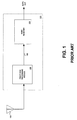
- FIG. 1 is a block diagram is provided of a conventional mobile unit receiver 100, within which may be implemented the adaptive pilot interference cancellation technique of the present invention.
- the mobile unit receiver 100 is presumed to be disposed within a mobile unit configured to operate within a CDMA communication system.
- the mobile unit receiver 100 includes a front-end processing module 104 which receives forward link signal components collected by an antenna 105.
- the forward link signal components arise upon transmission by a transmitter (not shown) of a CDMA communication signal though a multipath propagation environment to the mobile unit.
- a CDMA forward link transmitter is configured to transmit a multi-channel signal to a plurality of user stations. Specifically, the transmitter sends a Walsh pilot signal along with the plurality of data signals to the mobile units.
- Each of the plurality of data channels are encoded using a different Walsh code which is orthogonal to the Walsh code of other data channels and to the Walsh code of the pilot signal.
- the front-end processing module 104 filters, amplifies, downconverts and digitizes the received forward link signal in order to create a set of received data samples 106 provided to a Rake receiver module 110.
- the Rake receiver module 110 functions to generate recovered symbols on the basis of the data samples 106 provided by the front-end processing module 104.
- the Rake receiver module 110 is configured to process the multiple components of the received signal arriving via different signal paths, or "multipaths".
- multipaths As is known in the art, a Rake receiver provides an optimum structure for receiving signals in a multipath environment in the presence of minimal or no interference from other users.
- the principles of Rake receivers are well described in the art. See, e.g., " Introduction to Spread Spectrum Anti-multipath Technique and Their Applications to Urban Digital Radio" by G. L. Turin; Proceedings IEEE, Vol. 65, No. 3, Pages 328-353 March, 1980 , and " Digital Communications" by J. G. Proakis; McGraw-Hill, 1989 .
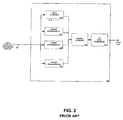
- the Rake receiver module 110 includes a number of diversity processing paths 214, or "finger" processors 214, each of which digitally process the data samples 106 corresponding to an instance of the forward link signal received over one such signal path.
- Each finger processor 214 processes a particular multipath component of the received signal. Such processing includes despreading the data samples 106 using a particular user's PN sequence in time alignment with the multipath signal being processed by the applicable finger processor 214.
- the resultant candidate symbol streams from the finger processors 214 are provided to a diversity combiner module 218, which synthesizes a single composite symbol stream on the basis of these candidate streams.
- a receive (RX) data processor 222 then receives and decodes the composite symbol stream from the diversity combiner module 218 in order to recover the user data and message information transmitted on the forward link.
- each of the finger processors 214 are used to demodulate and otherwise process an instance of the forward link signal received over a different air path of the multipath propagation environment.
- Each finger processor 214 is of substantially identical structure, but operates on the basis of different parameters characteristic of its associated air path (e.g., gain, phase and time delay).
- the Rake receiver module 110 further includes a pilot searcher 210 for detecting various multipath components of the pilot signal being received. This searching is effected using known techniques to correlate the received signal with a PN sequence associated with the pilot signal, thereby detecting the signals transmitted by different base stations and the multi-path components thereof.
- the pilot searcher 210 provides the detected offsets in the PN signal associated with each multipath component to a finger processor 214 assigned to process such multipath component.
- the phase reference provided by the detected pilot signals enables each finger processor 214 to perform a coherent demodulation of a given path of the incident multipath-distorted signal.
- the Rake receiver module 310 includes a number of finger processors 314, each of which digitally process data samples 306 corresponding to an instance of a forward link signal received from a base station (not shown) over a particular signal path.
- Each finger processor 314 processes a particular multipath component of the received signal. Such processing includes despreading the data samples 306 using a PN sequence in time alignment with the multipath signal being processed by the applicable finger processor 314.
- the resultant candidate symbol streams from the finger processors 314 are provided to a diversity combiner module 318, which synthesizes a single composite symbol stream on the basis of these candidate streams.
- a receive (RX) data processor 322 then receives and decodes the composite symbol stream from the diversity combiner module 318 in order to recover the user data and message information transmitted on the forward link. Except with regard to execution of the inventive interference cancellation process described below, the Rake receiver module 310 operates substantially similarly to the conventional Rake receiver module 110.
- each finger processor 314 includes an intra-finger interference cancellation (IC) module 340 configured to generate an intra-finger interference cancellation (IC) signal on the basis of the pilot signal component processed by such finger processor 314.
- the Rake receiver module 310 further includes an inter-finger interference cancellation module 320 operative to produce inter-finger interference cancellation (IC) signals on the basis of the plurality of intra finger IC signals received from the finger processors 314.
- Each inter-finger IC signal is applied with the appropriate timing synchronization to the applicable finger processor 314, which subtracts the inter-finger IC signal from the baseband data samples 306 of the received "dirty" or interference-laden signal to be processed by the finger processor 314. This results in generation of an interference-reduced baseband signal substantially devoid of pilot signal energy associated with any of the receiver finger processors 314.
- FIG. 4 provides a high-level block diagram of the intra-fmger interference cancellation module 340 disposed within each finger processor 314.
- the finger processing module 340 is configured for implementation within WCDMA systems, which are known to operate using a primary (P) and secondary (S) pilot signals. Accordingly, each finger processor 314 will experience interference arising from primary and secondary common pilot channel energy (CPICH) within the signal processed by each finger processor 314. That is, the different multipath components of the primary and secondary pilot signals respectively processed by different ones of the finger processors 314 tend to be commonly present within the received signal distributed to all finger processors 314.
- CPICH primary and secondary common pilot channel energy
- each intra-finger IC module 340 generates a P-CPICH intra-finger IC signal and an S-CPICH intra-finger IC signal on the basis of the primary and secondary pilot signal multipath components assigned by the pilot searcher 310 to be processed by the applicable finger processor 314.
- the received baseband data samples 306 are provided to an IC subtraction module 402 which cooperates with a finger decimation module 404 to produce a "cleaned" decimated sample stream 406.
- the IC subtraction module 402 operates to subtract the applicable inter-finger IC signal 520 generated by the inter-finger interference cancellation module 320 from the data samples 306.
- the resultant sample stream comprises the "cleaned" decimated data samples 406 used by various components of the intra-finger IC module 340 and finger processor 314.
- the decimated sample stream 406 is provided to a P-CPICH processing module 410 and an S-CPICH processing module 414 within the intra-finger IC module 340.
- the P-CPICH processing module 410 and the S-CPICH processing module 414 produce estimated models of the received primary and secondary pilot channels, respectively.
- a pair of primary pilot signals and a pair of secondary pilot signals are received at a mobile unit receiver incorporating the inventive Rake receiver 310.
- first and second estimated primary pilot channel models (P-CPICH1,2 ChEST) and first and second estimated secondary pilot channel models (S-CPICH1,2 ChEST) are respectively produced by the P-CPICH processing module 410 and the S-CPICH processing module 414.
- the P-CPICH1,2 ChEST and S-CPICH1,2 ChEST signals are provided to an AIC PS/CPICH signal regeneration module 418 and to a physical channel processing module 428.
- the AIC PS/CPICH signal regeneration module 418 produces an intra-finger IC signal 440 on the basis of the P-CPICH1,2 ChEST model signals and the S-CPICH1,2 ChEST model signals. More particularly, in the exemplary embodiment both a P-CPICH intra-finger IC signal and an S-CPICH intra-finger IC signal are produced and then combined within the AIC PS/CPICH signal regeneration module 418 in order to yield the intra-finger IC signal 440.
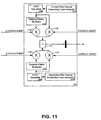
- FIG. 11 is a block diagrammatic representation of a particular implementation of the AIC PS/CPICH signal regeneration module 418.
- the module 418 includes a secondary pilot channel OVSF code generator 1106 disposed to produce an OVSF sequence corresponding to the secondary pilot channel.
- This OVSF sequence is scrambled by PN sequence 1102, which distinguishes the secondary pilot channel from user channels and the primary pilot channel.
- the scrambled output of the OVSF module 1106 is provided to an antenna pattern modulator 1110 as well as to a secondary pilot channel multiplier 1114.
- the antenna pattern modulator 1110 adds an additional modulation pattern to the S-CPICH channel in order to simulate the transmission of the S-CPICH signal from a base station (not shown) having two antennas.
- the output of the modulator 1110 is connected to a secondary pilot channel multiplier 1120, which is also provided with the S-CPICH2 ChEST model signal.
- the secondary pilot channel multiplier 1114 is provided with the S-CPICH1 ChEST model signal.
- the S-CPICH2 ChEST and S-CPICH1 ChEST model signals are each derived on the basis of transmissions from one of two antennas disposed at a remote base station (not shown).
- the results of the multiplications effected by the secondary pilot channel multipliers 1114, 1120 are provided to summer 1124.
- the module 418 also includes a primary pilot channel scrambling code generator 1130 disposed to produce a PN sequence corresponding to the primary pilot channel.
- This PN sequence is spread by an OVSF module 1132, which distinguishes the primary pilot channel from user channels and the secondary pilot channel.
- the output of the OVSF module 1132 is provided to an antenna pattern modulator 1134 as well as to a primary pilot channel multiplier 1138.
- the antenna pattern modulator 1134 adds an additional modulation pattern to the P-CPICH channel in order to simulate the transmission of the P-CPICH signal from a base station (not shown) having two antennas.
- the output of the modulator 1134 is connected to a primary pilot channel multiplier 11142, which is also provided with the P-CPICH2 ChEST model signal.
- the primary pilot channel multiplier 1138 is provided with the P-CPICH1 ChEST model signal.
- the P-CPICH2 ChEST and P-CPICH1 ChEST model signals are each derived on the basis of transmissions from one of two antennas disposed at a remote base station (not shown).
- the results of the multiplications effected by the primary pilot channel multipliers 1138, 1142 are provided to summer 1124. As shown, summer 1124 produces the intra-finger IC signal 440 by combining the signals produced by the primary pilot channel multipliers 1138, 1142 and the secondary pilot channel multipliers 1114, 1120.
- FIG. 5 a high-level block diagram is provided of the inter-finger interference cancellation module 320.
- the intra-finger IC signals 440 produced by the intra-finger IC module 340 of each finger processor 314 are provided to an IC signal gain adjustment unit 502 of the inter-finger interference cancellation module 320.
- the inter-finger IC signal 520 produced by the module 320 for a given finger processor 314 is generated by an IC summer 506 by combining a set of the intra-finger IC signals 440 previously weighted by the IC signal gain adjustment unit 502.
- the intra-finger IC signals 440 are also provided to a IC verification module 510 configured to verify the extent to which undesired pilot channel content associated with other finger processors 314 has been removed from the "cleaned" decimated data samples 406 of a given finger processor 314.
- the IC verification module 510 does not continuously operate upon each intra-finger IC signal 440, but instead successively processes these signals in a "round-robin" manner.
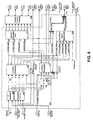
- FIG. 6 provides a more detailed representation of the intra-finger IC module 340.
- the finger decimation module 404 includes a decimation control block 604 and an on-time decimation module 608.
- the decimated sample stream generated by the finger decimation module 404 is provided to the P-CPICH processing module 410 and the S-CPICH processing module 414.
- the processing modules 410 and 414 respectively detect the P and S pilot channel components present in the decimated sample stream (at one sample per chip) and produce channel estimates of the air interfaces over which the respective P and S pilot channel components were received.
- channel estimation may be performed by the P-CPICH processing module 410 by passing the decimated sample stream through a filter matched to the waveform of the P pilot signal.
- the S-CPICH processing module 414 performs channel estimation by passing the decimated sample stream through a filter matched to the waveform of the S pilot signal. By comparing the filtered pilot signals to known replicas of the P and S pilot signals, the processing modules 410 and 414 respectively estimate the amplitude and phase of the P and S pilot channels and generate corresponding channel models. As shown, the channel estimates produced by the processing modules 410 and 414 are provided to a channel estimation multiplexer 616.
- the AIC PS/CPICH signal regeneration module 418 produces the applicable intra-finger IC signal 440 by regenerating the pilot channel components processed by the applicable finger processor 314.
- replicas of the known P and S pilot signals are each passed through the appropriate channel model in order to form P and S regenerated pilot signal components of the applicable intra-finger IC signal.
- the AIC PS/CPICH signal regeneration module 418 contains transmitter components (e.g.., spreading and scrambling modules) capable of generating such known P and S pilot signals.
- the sub-system 700 includes the IC signal gain adjustment unit 502, IC summer 506 and IC verification module 510.
- the signal gain adjustment unit 502 includes a plurality of IC_Gain elements 706 for adjusting the gain of the intra-finger IC signals 440 in accordance with a predefined amplitude weighting function.
- the amplitude weighting function assigns weights to each intra-finger IC signal 440 on the basis of the confidence in such signal as determined by the IC verification module 510.
- the IC verification module 510 assigns a "confidence" value to the intra-finger IC signal 440 of a given finger processor 314 based upon the extent to which it lacks undesired pilot signal energy associated with other such finger processors 314.
- the following gain settings for the IC-Gain elements 706 will preferably be available based upon the confidence values determined by the IC verification module 510: 0, 1, 2, 4, 8, 16.
- the '0' gain setting indicates that the applicable intra-finger IC signal 440 should be excluded from the inter-finger IC signal created by the IC summer 506.
- Each of the other gain settings is applied by multiplying both the I and Q components of the subject intra-finger IC signal by the assigned gain factor.
- the IC summer 506 performs a summation of all intra-finger IC signals 440 in order to produce a set of different inter-finger IC signals used by the finger processors 314 in canceling undesired common pilot channel interference.
- each finger processor 314 is configured to control the timing of the intra-finger IC signal 440 provided thereby to within the resolution of the sample rate. It follows that the intra-finger IC signals 440 from each finger processor 314 will arrive at the IC summer 506 at different sample instances (within one chip period).
- the IC summer 506 needs to be designed to accommodate the sample differences among the intra-finger IC signals 440 in connection with generation of the inter-finger IC signal 520 to be distributed to all finger processors 314. To this end, the IC summer 506 takes a chip-duration "snapshot" of all intra-finger IC signals 440, and thereby produces the inter-finger IC signal 520 corresponding to each finger processor 314 at the applicable sample rate. In the exemplary embodiment the IC summer module 506 produces a 9-bit number which is scaled down by implementing a viewport scaling function such that only the six (6) least significant bits (LSBs) are output therefrom.
- LSBs least significant bits
- the IC verification module 510 includes an IC verification multiplexer 810 for assigning ones of the intra-finger IC signals for verification by IC verification unit 820; more specifically, in the exemplary embodiment 6-bit intra-finger IC signal representations 442, typically comprised of the 6MSBs of the intra-finger IC signals 440, are verified via the IC verification unit 820.
- a circular counter 830 is incremented and a succeeding intra-finger IC signal 440 is selected for processing.
- the IC verification multiplexer 810 preferably assigns ones of the intra-finger IC signals 440 for verification on a round-robin basis. That is, only one of the intra-finger IC signals 440 is assigned via multiplexer 810 to the IC verification unit 820 at any give time. These assignments are generally made on an end-of-frame boundary of the applicable finger processor 314.
- the IC verification multiplexer 810 also preferably calculates gain factors 850 to be associated with respective finger processors 314. These gain factors 850 are used in the verification process and are computed by comparing content of the applicable intra-finger IC signal 440 both before and after active pilot cancellation in accordance with the invention. In particular, a new gain factor is calculated once per frame (plus/minus the relative finger timing offsets) for a given finger processor 314 and applied to such finger processor 314 until completion of the next verification procedure.
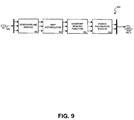
- FIG. 9 provides a representation of a P-CPICH1 verification sub-system 900 incorporated within the IC verification unit 820.
- the P-CPICH1 verification sub-system 900 operates substantially identically to the on-time P-CPICH processing module 410 which, as was discussed above, is used to derive estimates of channel parameters and received power.
- the P-CPICH1 verification sub-system 900 includes a descrambling module 904 to which is applied the decimated output 406 of the finger processor 314. Within the descrambling module 904, the descrambling operation is applied in phase with the pilot signal that is to be verified. Following descrambling, the resultant signal is despread using the chip accumulator 904 and scaled using the viewport 912. The remaining P-CPICH signal energy to which the finger processor 314 is exposed (which provides an estimate of the undesired residual pilot energy experienced by the finger processor 314) is then calculated by the power calculation module 916.
- the IC verification process effected by the verification sub-system 900 preferably only considers the P-CPICH1 signal.
- the efficacy of the interference cancellation process of the present invention may be assessed on a finger-by-finger basis.
- only interference cancellation with respect to the primary pilot channel is verified, it is expected that the extent of cancellation of primary and secondary pilot channel energy will be substantially identical.
- the verification sub-system 900 verifies that the common pilot channel interference within a given finger processor 314 has been successfully canceled by measuring the residual signal power (RSCP) left within the cleaned signal 406 of each finger processor 314 following performance of a pilot cancellation operation consistent with the invention.
- the magnitude of the resulting verification signal produced by the verification sub-system 900 varies inversely with the success of the pilot cancellation processing; that is, the magnitude of this verification signal decreases in response to decreases in the amount of common pilot channel interference detected to be associated with a given intra-finger IC signal.
- FIG. 10 is a flowchart representative of an IC verification process in accordance with the invention.
- a MUX operation involves assignment of the signals from each finger 314 on a round-robin basis to the P-CPICH1 verification sub-system 900 (steps 1002).
- a new reference finger 314 is assigned for verification once during every N outer time slots.
- processing continues with a VERIFICATION operation in which all interfering signals with respect to the reference finger 314 are identified (step 1006).
- the VERIFICATION operation is carried out by the P-CPICH1 verification sub-system 900 with respect to all such interfering signals, which results in N inner RSCP values measured on "cleaned" reference signals.
- this identification takes place on the end-of-slot boundaries associated with the interference finger.
- the scrambling code associated with the interfering finger 314 is assigned to the descrambling module 904 of the P-CPICH1 verification sub-system 900 (step 1006a) and the chip accumulator 908 is reset (step 1006b).
- the chip accumulator 908 then collects chips produced by the descrambling module 904 in response to descrambling of the cleaned signal over a particular slot using the scrambling code of the selected interfering finger 314 (step 1006c).
- the RSCP corresponding to this slot is then calculated on the basis of the current contents of the chip accumulator 908 and utilized in a VERIFICATION PARAMETER COMPUTATION routine (described below) (step 1006d). If N inner RSCP values have not yet been produced, the chip accumulator 908 is reset (step 1006b) and steps 1006c and 1006d are repeated; otherwise, the verification procedure is commenced (step 1006e).
- the VERIFICATION PARAMETER COMPUTATION routine (steps 1010) is employed to compute various parameters utilized during execution of the VERIFICATION operation (steps 1006).
- a division factor associated with each specific finger 314 is calculated by comparing the RSCP content of the applicable P-CPICH1 signal before and after interference cancellation. For example, consider the case in which the VERIFICATION operation pertains to determining the extent to which the pilot energy of a second finger processor 314 ("finger #2") is seen by a first finger processor ("finger #1). In this situation the intra-finger IC signal 440 produced by finger #2 would be compared with the output of the verification sub-system 900.
- the division factor is changed to increase the size of the inter-finger IC signal 520 subtracted from the received signal applied to finger #1.
- Each newly-computed division factor is stored within the verification sub-system 900 and utilized in subsequent verification operations before again being updated (step 1010b).
- the VERIFICATION operation is continued by determining whether steps 1006a-e have been performed with respect to each of the finger signals interfering with the finger 314. currently selected for verification (step 1006f). If not, steps 1006a-d are performed with respect to the next interfering finger signal identified pursuant to step 1002c; otherwise, it is determined whether the VERIFICATION operation has been carried out with respect to each finger 314 (step 1006g).
Landscapes
- Engineering & Computer Science (AREA)
- Computer Networks & Wireless Communication (AREA)
- Signal Processing (AREA)
- Noise Elimination (AREA)
- Mobile Radio Communication Systems (AREA)
Claims (10)
- Verfahren zur Interferenzreduzierung in einem
Spreizspektrumempfänger mit einem Rake-Empfänger, der eine Vielzahl von Fingern zum Verarbeiten einer Vielzahl von Datensignalen und einer assoziierten Vielzahl von Pilotsignalen aufweist, wobei das Verfahren umfasst:Erzeugen einer Vielzahl von Intra-Finger Interferenzbeseitigungssignalen mittels der Vielzahl von Pilotsignalen, wobei jedes der Intra-Finger Interferenzbeseitigungssignale mit einem der Vielzahl von Fingern assoziiert ist;Gewichten einiger der Vielzahl von Intra-Finger Interferenzbeseitigungssignalen, um einen Satz gewichteter Intra-Finger Interferenzbeseitigungssignale zu erzeugen;Synthetisieren wenigstens eines Inter-Finger Interferenzbeseitigungssignals in Übereinstimmung mit dem Satz gewichteter Intra-Finger Beseitigungssignale; undSubtrahieren des wenigstens einen Inter-Finger Beseitigungssignals von einem der Vielzahl von Datensignalen;dadurch gekennzeichnet, dass das Gewichten einiger der Vielzahl von Intra-Finger Interferenzbeseitigungssignalen umfasst:Zuteilen einer Vielzahl von Konfidenzwerten zu den einigen der Vielzahl von Intra-Finger Interferenzbeseitigungssignalen basierend auf dem Ausmaß, in dem die einigen der Vielzahl von Intra-Finger Interferenzbeseitigungssignalen einen Mangel an unerwünschter Pilotsignalenergie haben, die mit entsprechenden anderen der Vielzahl von Fingern assoziiert ist;Anpassen einer Vielzahl von Verstärkungswerten der einigen der Vielzahl von Intra-Finger Interferenzbeseitigungssignalen in Übereinstimmung mit einer vordefiniertenAmplitudengewichtungsfunktion basierend auf der Vielzahl von Konfidenzwerten der einigen der Vielzahl von Intra-Finger Interferenzbeseitigungssignalen. - Verfahren nach Anspruch 1, wobei die Vielzahl von Fingern aus N Fingern besteht, und wobei der Satz aus N-1 gewichteten Intra-Finger Interferenzbeseitigungssignalen besteht.
- Verfahren nach Anspruch 1, wobei das Synthetisieren des Weiteren das Erzeugen einer Vielzahl von Inter-Finger Beseitigungssignalen umfasst, die jeweils mit der Vielzahl von Fingern assoziiert sind, wobei jedes der Inter-Finger Beseitigungssignale in Übereinstimmung mit einer anderen Gruppe einiger des Satzes gewichteter Intra-Finger Interferenzbeseitigungssignale synthetisiert wird.
- Verfahren nach Anspruch 3, wobei das Subtrahieren des Weiteren das Subtrahieren jedes der Vielzahl von Inter-Finger Beseitigungssignalen von einem entsprechenden der Vielzahl von Datensignalen umfasst, was zu einer Vielzahl von interferenzreduzierten Datensignalen führt.
- Verfahren nach Anspruch 1, wobei das Erzeugen des Weiteren das Erstellen einer Vielzahl von Pilotkanalmodellen umfasst, wobei jedes der Vielzahl von Pilotkanalmodellen mit einem der Vielzahl von Fingern assoziiert ist.
- Verfahren nach Anspruch 1, wobei die Vielzahl von Pilotsignalen aus einer Vielzahl primärer Pilotsignale und einer entsprechenden Vielzahl sekundärer Pilotsignale besteht, wobei das Erzeugen des Weiteren das Erstellen einer Vielzahl primärer Pilotkanalmodelle entsprechend der Vielzahl primärer Pilotsignale und einer Vielzahl sekundärer Pilotkanalmodelle entsprechend der Vielzahl sekundärer Pilotsignale umfasst.
- Verfahren nach Anspruch 1, wobei die Vielzahl von Fingern aus N Fingern besteht;
wobei die Vielzahl von Datensignalen aus N Datensignalen besteht;
wobei die assoziierte Vielzahl von Pilotsignalen aus N assoziierten Pilotsignalen besteht; und
wobei die Vielzahl von Intra-Finger Interferenzbeseitigungssignalen aus N Intra-Finger Interferenzbeseitigungssignalen besteht;
wobei der Satz gewichteter Intra-Finger Interferenzbeseitigungssignale aus N gewichteten Intra-Finger Interferenzbeseitigungssignalen besteht, wobei das Verfahren umfasst:Erzeugen der N Intra-Finger Interferenzbeseitigungssignale mittels der N assoziierten Pilotsignale, wobei jedes der N Intra-Finger Interferenzbeseitigungssignale mit einem der N Finger assoziiert ist;Gewichten einiger der N Intra-Finger Interferenzbeseitigungssignale, um N gewichtete Intra-Finger Interferenzbeseitigungssignale zu erzeugen;Synthetisieren von N Inter-Finger Interferenzbeseitigungssignalen, wobei jedes der N Inter-Finger Interferenzbeseitigungssignale auf der Grundlage eines oder mehrerer der N gewichteten Intra-Finger Interferenzbeseitigungssignale synthetisiert wird; undSubtrahieren jedes der N Inter-Finger Interferenzbeseitigungssignale von einem entsprechenden der N Datensignale, wodurch N interferenzreduzierte Datensignale erzeugt werden. - Verfahren nach Anspruch 7, das des Weiteren das Bestimmen von Interferenzpegeln umfasst, die in den N interferenzreduzierten Datensignalen verbleiben.
- Spreizspektrumempfänger mit:einem Rake-Empfänger (310) mit N Fingern (314) zum Verarbeiten von N Datensignalen und N assoziierten Pilotsignalen, wobei jeder der N Finger (314) ein Intra-Finger Interferenzbeseitigungsmodul (340) aufweist, das so konfiguriert ist, dass es ein Intra-Finger Interferenzbeseitigungssignal mittels wenigstens einem der N assoziierten Pilotsignale erzeugt; undeinem Inter-Finger Interferenzbeseitigungsmodul (320) zum Synthetisieren von N lnter-Finger Interferenzbeseitigungssignalen, wobei jedes der N Inter-Finger Beseitigungssignale auf der Grundlage eines Satzes von intra-Finger interferenzbeseitigungssignalen synthetisiert wird;dadurch gekennzeichnet, dass das Inter-Finger Interferenzbeseitigungsmodul (320) aufweist:ein Interferenzbeseitigungs-Verifikationsmodul (510) zum Zuteilen einer Vielzahl von Konfidenzwerten zu einigen der N Intra-Finger Interferenzbeseitigungssignalen basierend auf dem Ausmaß, in dem die einigen der N Intra-Finger Interferenzbeseitigungssignale einen Mangel an unerwünschter Pilotsignalenergie haben, die mit entsprechenden anderen der N Finger (314) assoziiert ist;eine Verstärkungsanpassungseinheit (502) zum Gewichten der Intra-Finger Beseitigungssignale, um eine Vielzahl gewichteter Intra-Finger Beseitigungssignale zu erzeugen, wobei die Verstärkungsanpassungseinheit (502) so ausgelegt ist, dass sie eine Vielzahl von Verstärkungswerten der einigen der N Intra-Finger Interferenzbeseitigungssignale in Übereinstimmung mit einer vordefinierten Amplitudengewichtungsfunktion basierend auf der Vielzahl von Konfidenzwerten der einigen der N Intra-Finger Interferenzbeseitigungssignale anpasst, undeine Addiereinheit (506), die so ausgelegt ist, dass sie einige der Vielzahl gewichteter Intra-Finger Beseitigungssignale kombiniert.
- Empfänger nach Anspruch 9, wobei jedes der Intra-Finger Interferenzbeseitigungsmodule (340) eine Subtrahiereinheit aufweist, an die eines der N Inter-Finger Beseitigungssignale und eines der N Datensignale angelegt wird, was zu N interferenzreduzierten Datensignalen führt.
Applications Claiming Priority (3)
| Application Number | Priority Date | Filing Date | Title |
|---|---|---|---|
| US40736302P | 2002-08-29 | 2002-08-29 | |
| US407363P | 2002-08-29 | ||
| PCT/US2003/026871 WO2004021581A2 (en) | 2002-08-29 | 2003-08-26 | Adaptive pilot interference cancellation in cdma systems |
Publications (3)
| Publication Number | Publication Date |
|---|---|
| EP1537680A2 EP1537680A2 (de) | 2005-06-08 |
| EP1537680A4 EP1537680A4 (de) | 2010-04-21 |
| EP1537680B1 true EP1537680B1 (de) | 2012-03-07 |
Family
ID=31978468
Family Applications (1)
| Application Number | Title | Priority Date | Filing Date |
|---|---|---|---|
| EP03751915A Expired - Lifetime EP1537680B1 (de) | 2002-08-29 | 2003-08-26 | Adaptive pilotst rungsl schung in cdma-systemen |
Country Status (5)
| Country | Link |
|---|---|
| US (2) | US7103094B2 (de) |
| EP (1) | EP1537680B1 (de) |
| CN (1) | CN100344073C (de) |
| AU (1) | AU2003270021A1 (de) |
| WO (1) | WO2004021581A2 (de) |
Families Citing this family (33)
| Publication number | Priority date | Publication date | Assignee | Title |
|---|---|---|---|---|
| US8611311B2 (en) | 2001-06-06 | 2013-12-17 | Qualcomm Incorporated | Method and apparatus for canceling pilot interference in a wireless communication system |
| US7190749B2 (en) * | 2001-06-06 | 2007-03-13 | Qualcomm Incorporated | Method and apparatus for canceling pilot interference in a wireless communication system |
| US7787572B2 (en) | 2005-04-07 | 2010-08-31 | Rambus Inc. | Advanced signal processors for interference cancellation in baseband receivers |
| US8005128B1 (en) | 2003-09-23 | 2011-08-23 | Rambus Inc. | Methods for estimation and interference cancellation for signal processing |
| KR20050039156A (ko) * | 2003-10-24 | 2005-04-29 | 삼성전자주식회사 | 이동통신 시스템에서 다중신호 간섭 제거 장치 및 방법 |
| US7437135B2 (en) | 2003-10-30 | 2008-10-14 | Interdigital Technology Corporation | Joint channel equalizer interference canceller advanced receiver |
| US7400692B2 (en) | 2004-01-14 | 2008-07-15 | Interdigital Technology Corporation | Telescoping window based equalization |
| US20050169354A1 (en) * | 2004-01-23 | 2005-08-04 | Olson Eric S. | Systems and methods for searching interference canceled data |
| US7477710B2 (en) * | 2004-01-23 | 2009-01-13 | Tensorcomm, Inc | Systems and methods for analog to digital conversion with a signal cancellation system of a receiver |
| US7480356B2 (en) | 2004-12-08 | 2009-01-20 | Telefonaktiebolaget L M Ericsson (Publ) | Method of and system for path selection in rich multipath conditions |
| US7372895B2 (en) * | 2004-12-08 | 2008-05-13 | Telefonaktiebolaget Lm Ericsson (Publ) | Method of and system for delay estimation with minimized finger allocation |
| US8422955B2 (en) | 2004-12-23 | 2013-04-16 | Qualcomm Incorporated | Channel estimation for interference cancellation |
| US8406695B2 (en) * | 2004-12-23 | 2013-03-26 | Qualcomm Incorporated | Joint interference cancellation of pilot, overhead and traffic channels |
| US8442441B2 (en) * | 2004-12-23 | 2013-05-14 | Qualcomm Incorporated | Traffic interference cancellation |
| US8099123B2 (en) * | 2004-12-23 | 2012-01-17 | Qualcomm Incorporated | Adaptation of transmit subchannel gains in a system with interference cancellation |
| US7606295B2 (en) * | 2005-02-24 | 2009-10-20 | Interdigital Technology Corporation | Generalized rake receiver for wireless communication |
| US8036296B2 (en) | 2006-09-28 | 2011-10-11 | Broadcom Corporation | Method and system for achieving space and time diversity gain |
| US8472877B2 (en) | 2005-10-24 | 2013-06-25 | Qualcomm Incorporated | Iterative interference cancellation system and method |
| US8385388B2 (en) | 2005-12-06 | 2013-02-26 | Qualcomm Incorporated | Method and system for signal reconstruction from spatially and temporally correlated received samples |
| US8059739B2 (en) * | 2006-06-05 | 2011-11-15 | Telefonaktiebolaget Lm Ericsson | Method and apparatus for correcting data transmission errors |
| US20080069027A1 (en) * | 2006-09-20 | 2008-03-20 | Hongwei Kong | Method of interference cancellation in communication systems |
| CN101198087A (zh) * | 2006-12-08 | 2008-06-11 | 昂达博思公司 | 实现在移动通信系统中减少扇区间导频干扰的系统和方法 |
| US7756480B2 (en) * | 2007-02-16 | 2010-07-13 | Samsung Electronics Co., Ltd. | System and method for transmitter leak-over cancellation |
| US7949366B2 (en) * | 2007-11-29 | 2011-05-24 | Broadcom Corporation | Diversity receiver system with interference cancellation and methods for use therewith |
| US8040888B1 (en) * | 2007-12-17 | 2011-10-18 | Integrated Device Technology, Inc. | Packet switch with port route tables |
| US8559990B2 (en) * | 2010-02-05 | 2013-10-15 | Qualcomm Incorporated | Apparatus and method for enabling uplink beamforming transit diversity channel estimation |
| CN102195668B (zh) * | 2010-03-12 | 2015-08-05 | 上海摩波彼克半导体有限公司 | 移动通信系统中耙型接收器性能提升的耙指配置管理方法 |
| CN101873295B (zh) * | 2010-06-23 | 2013-02-06 | 新邮通信设备有限公司 | 信号处理方法与装置及信号接收方法与接收机 |
| US9178578B2 (en) * | 2011-01-10 | 2015-11-03 | Qualcomm Incorporated | Master-slave architecture in a closed loop transmit diversity scheme |
| WO2013000126A1 (zh) * | 2011-06-28 | 2013-01-03 | 中兴通讯股份有限公司 | 一种测量方法及装置 |
| US8837649B2 (en) * | 2012-06-26 | 2014-09-16 | Qualcomm Incorporated | Non-primary pilot channel discovery for interference cancellation |
| US9306654B2 (en) * | 2014-01-10 | 2016-04-05 | Qualcomm Incorporated | Opportunistic active interference cancellation using RX diversity antenna |
| US9628163B2 (en) * | 2014-03-25 | 2017-04-18 | Marvell International Ltd. | Low-complexity communication terminal with enhanced receive diversity |
Family Cites Families (11)
| Publication number | Priority date | Publication date | Assignee | Title |
|---|---|---|---|---|
| US6067292A (en) * | 1996-08-20 | 2000-05-23 | Lucent Technologies Inc | Pilot interference cancellation for a coherent wireless code division multiple access receiver |
| IL120538A (en) * | 1997-03-26 | 2000-11-21 | Dspc Tech Ltd | Method and apparatus for reducing spread-spectrum noise |
| US6570909B1 (en) * | 1999-07-09 | 2003-05-27 | Nokia Mobile Phones | Interference suppression in a CDMA receiver |
| US6404760B1 (en) * | 1999-07-19 | 2002-06-11 | Qualcomm Incorporated | CDMA multiple access interference cancellation using signal estimation |
| DE60011566T2 (de) * | 2000-04-07 | 2005-08-18 | Alcatel | Empfänger für ein CDMA Mobilfunkkommunikationssystem |
| JP4509297B2 (ja) * | 2000-04-26 | 2010-07-21 | 三菱電機株式会社 | スペクトル拡散受信装置 |
| US6680727B2 (en) * | 2000-10-17 | 2004-01-20 | Qualcomm Incorporated | Method and apparatus for canceling pilot interference in a CDMA communication system |
| US6865218B1 (en) * | 2000-11-27 | 2005-03-08 | Ericsson Inc. | Multipath interference reduction for a CDMA system |
| US20020131390A1 (en) * | 2001-03-09 | 2002-09-19 | Wen-Yi Kuo | Cancellation of non-orthogonal signal in CDMA wireless communications systems |
| US6580771B2 (en) * | 2001-03-30 | 2003-06-17 | Nokia Corporation | Successive user data multipath interference cancellation |
| GB2384660B (en) * | 2002-01-25 | 2004-11-17 | Toshiba Res Europ Ltd | Reciever processing systems |
-
2003
- 2003-08-26 AU AU2003270021A patent/AU2003270021A1/en not_active Abandoned
- 2003-08-26 US US10/649,335 patent/US7103094B2/en not_active Expired - Lifetime
- 2003-08-26 WO PCT/US2003/026871 patent/WO2004021581A2/en not_active Ceased
- 2003-08-26 EP EP03751915A patent/EP1537680B1/de not_active Expired - Lifetime
- 2003-08-26 CN CNB038203588A patent/CN100344073C/zh not_active Expired - Fee Related
-
2006
- 2006-06-14 US US11/452,840 patent/US7548580B2/en not_active Expired - Fee Related
Also Published As
| Publication number | Publication date |
|---|---|
| US20060233224A1 (en) | 2006-10-19 |
| AU2003270021A8 (en) | 2004-03-19 |
| WO2004021581A3 (en) | 2004-12-23 |
| CN100344073C (zh) | 2007-10-17 |
| WO2004021581A2 (en) | 2004-03-11 |
| EP1537680A4 (de) | 2010-04-21 |
| US7103094B2 (en) | 2006-09-05 |
| EP1537680A2 (de) | 2005-06-08 |
| CN1703841A (zh) | 2005-11-30 |
| AU2003270021A1 (en) | 2004-03-19 |
| US7548580B2 (en) | 2009-06-16 |
| US20040114674A1 (en) | 2004-06-17 |
Similar Documents
| Publication | Publication Date | Title |
|---|---|---|
| EP1537680B1 (de) | Adaptive pilotst rungsl schung in cdma-systemen | |
| US6034986A (en) | Method and apparatus for reducing spread spectrum noise | |
| US8391338B2 (en) | Methods for estimation and interference cancellation for signal processing | |
| US9036748B2 (en) | Interference cancellation in variable codelength systems for multi-access communication | |
| US6882678B2 (en) | Method and system for canceling multiple access interference in CDMA wireless communication system | |
| EP0696856A2 (de) | DS/CDMA Empfänger mit Interferenzunterdrückung zur Sicherstellung einer gewünschten Empfängsqualität in einem Schmalband-DS/CDMA-System | |
| JP2004538720A (ja) | 無線通信システムのためのパイロットフィルタの適応性のある選択 | |
| JP2009516991A (ja) | 無線通信のための準線形干渉消去 | |
| WO2000021208A2 (en) | Method and apparatus for interference cancellation in a rake receiver | |
| JP2004529590A (ja) | 無線通信システムにおけるパイロット干渉を除去するための方法および装置 | |
| EP1569355A2 (de) | Interferenzunterdrückung in einem Kodemultiplexvielfachzugriffsempfänger | |
| EP1563621B1 (de) | Verfahren und Vorrichtung zum Rake-kombinieren auf der Basis des Signal-zu-Interferenz-plus-Rausch-Verhältnis | |
| WO2002003561A1 (en) | Receiver and method of receiving a cdma signal in presence of interferers with unknown spreading factors | |
| US20020094020A1 (en) | Method and apparatus for reducing spread spectrum noise | |
| WO2009031964A2 (en) | Efficient computation of soft scaling factors for linear multi-user detector | |
| WO2013085455A2 (en) | Non-redundant equalization | |
| US7756191B2 (en) | Deconvolution searcher for wireless communication system | |
| JP2003505917A (ja) | モバイル無線チャネルのチャネルインパルス応答を推定する方法 |
Legal Events
| Date | Code | Title | Description |
|---|---|---|---|
| PUAI | Public reference made under article 153(3) epc to a published international application that has entered the european phase |
Free format text: ORIGINAL CODE: 0009012 |
|
| AK | Designated contracting states |
Kind code of ref document: A2 Designated state(s): AT BE BG CH CY CZ DE DK EE ES FI FR GB GR HU IE IT LI LU MC NL PT RO SE SI SK TR |
|
| AX | Request for extension of the european patent |
Extension state: AL LT LV MK |
|
| 17P | Request for examination filed |
Effective date: 20050623 |
|
| DAX | Request for extension of the european patent (deleted) | ||
| RBV | Designated contracting states (corrected) |
Designated state(s): DE FR GB |
|
| RIN1 | Information on inventor provided before grant (corrected) |
Inventor name: ROUX, PIETER, WILLEM Inventor name: VAN ROOYEN, PIETERBROADCOM CORPORATION |
|
| A4 | Supplementary search report drawn up and despatched |
Effective date: 20100318 |
|
| 17Q | First examination report despatched |
Effective date: 20100806 |
|
| REG | Reference to a national code |
Ref country code: DE Ref legal event code: R079 Ref document number: 60340209 Country of ref document: DE Free format text: PREVIOUS MAIN CLASS: H04B0001707000 Ipc: H04B0001710700 |
|
| RIC1 | Information provided on ipc code assigned before grant |
Ipc: H04B 1/711 20110101ALI20110816BHEP Ipc: H04B 1/7107 20110101AFI20110816BHEP |
|
| GRAP | Despatch of communication of intention to grant a patent |
Free format text: ORIGINAL CODE: EPIDOSNIGR1 |
|
| GRAS | Grant fee paid |
Free format text: ORIGINAL CODE: EPIDOSNIGR3 |
|
| GRAA | (expected) grant |
Free format text: ORIGINAL CODE: 0009210 |
|
| RIN1 | Information on inventor provided before grant (corrected) |
Inventor name: VAN ROOYEN, PIETER Inventor name: ROUX, PIETER, WILLEM |
|
| AK | Designated contracting states |
Kind code of ref document: B1 Designated state(s): DE FR GB |
|
| REG | Reference to a national code |
Ref country code: GB Ref legal event code: FG4D |
|
| REG | Reference to a national code |
Ref country code: DE Ref legal event code: R081 Ref document number: 60340209 Country of ref document: DE Owner name: AVAGO TECHNOLOGIES GENERAL IP (SINGAPORE) PTE., SG Free format text: FORMER OWNER: ZYRAY WIRELESS, INC., SAN DIEGO, CALIF., US |
|
| REG | Reference to a national code |
Ref country code: DE Ref legal event code: R096 Ref document number: 60340209 Country of ref document: DE Effective date: 20120503 |
|
| PLBE | No opposition filed within time limit |
Free format text: ORIGINAL CODE: 0009261 |
|
| STAA | Information on the status of an ep patent application or granted ep patent |
Free format text: STATUS: NO OPPOSITION FILED WITHIN TIME LIMIT |
|
| 26N | No opposition filed |
Effective date: 20121210 |
|
| REG | Reference to a national code |
Ref country code: DE Ref legal event code: R097 Ref document number: 60340209 Country of ref document: DE Effective date: 20121210 |
|
| REG | Reference to a national code |
Ref country code: FR Ref legal event code: ST Effective date: 20130430 |
|
| PG25 | Lapsed in a contracting state [announced via postgrant information from national office to epo] |
Ref country code: FR Free format text: LAPSE BECAUSE OF NON-PAYMENT OF DUE FEES Effective date: 20120831 |
|
| PGFP | Annual fee paid to national office [announced via postgrant information from national office to epo] |
Ref country code: GB Payment date: 20160830 Year of fee payment: 14 Ref country code: DE Payment date: 20160831 Year of fee payment: 14 |
|
| REG | Reference to a national code |
Ref country code: DE Ref legal event code: R081 Ref document number: 60340209 Country of ref document: DE Owner name: AVAGO TECHNOLOGIES GENERAL IP (SINGAPORE) PTE., SG Free format text: FORMER OWNER: ZYRAY WIRELESS, INC., SAN DIEGO, CALIF., US Ref country code: DE Ref legal event code: R082 Ref document number: 60340209 Country of ref document: DE Representative=s name: BOSCH JEHLE PATENTANWALTSGESELLSCHAFT MBH, DE |
|
| REG | Reference to a national code |
Ref country code: DE Ref legal event code: R119 Ref document number: 60340209 Country of ref document: DE |
|
| GBPC | Gb: european patent ceased through non-payment of renewal fee |
Effective date: 20170826 |
|
| PG25 | Lapsed in a contracting state [announced via postgrant information from national office to epo] |
Ref country code: DE Free format text: LAPSE BECAUSE OF NON-PAYMENT OF DUE FEES Effective date: 20180301 Ref country code: GB Free format text: LAPSE BECAUSE OF NON-PAYMENT OF DUE FEES Effective date: 20170826 |