EP1535025B1 - Dehnungsmessstreifen mit komprimierter symbologie - Google Patents
Dehnungsmessstreifen mit komprimierter symbologie Download PDFInfo
- Publication number
- EP1535025B1 EP1535025B1 EP03792970A EP03792970A EP1535025B1 EP 1535025 B1 EP1535025 B1 EP 1535025B1 EP 03792970 A EP03792970 A EP 03792970A EP 03792970 A EP03792970 A EP 03792970A EP 1535025 B1 EP1535025 B1 EP 1535025B1
- Authority
- EP
- European Patent Office
- Prior art keywords
- strain
- target
- ssr
- rosette
- compressed
- Prior art date
- Legal status (The legal status is an assumption and is not a legal conclusion. Google has not performed a legal analysis and makes no representation as to the accuracy of the status listed.)
- Expired - Lifetime
Links
- 238000000034 method Methods 0.000 claims abstract description 21
- 230000008859 change Effects 0.000 claims abstract description 9
- 238000004519 manufacturing process Methods 0.000 claims abstract description 3
- 239000011159 matrix material Substances 0.000 claims description 23
- 239000000463 material Substances 0.000 claims description 19
- 238000005259 measurement Methods 0.000 claims description 11
- 238000004364 calculation method Methods 0.000 claims description 6
- 238000009825 accumulation Methods 0.000 claims description 4
- 238000004590 computer program Methods 0.000 abstract description 7
- 230000003287 optical effect Effects 0.000 description 12
- 238000004458 analytical method Methods 0.000 description 10
- 238000004422 calculation algorithm Methods 0.000 description 5
- 238000005516 engineering process Methods 0.000 description 5
- 238000011068 loading method Methods 0.000 description 5
- 230000008901 benefit Effects 0.000 description 4
- 239000011248 coating agent Substances 0.000 description 4
- 238000000576 coating method Methods 0.000 description 4
- 238000001514 detection method Methods 0.000 description 4
- 230000006870 function Effects 0.000 description 4
- 230000000875 corresponding effect Effects 0.000 description 3
- 238000010586 diagram Methods 0.000 description 3
- 238000006073 displacement reaction Methods 0.000 description 3
- 239000007943 implant Substances 0.000 description 3
- 230000001960 triggered effect Effects 0.000 description 3
- 150000001875 compounds Chemical class 0.000 description 2
- 230000002596 correlated effect Effects 0.000 description 2
- 125000004122 cyclic group Chemical group 0.000 description 2
- 230000014509 gene expression Effects 0.000 description 2
- 239000003973 paint Substances 0.000 description 2
- 238000007781 pre-processing Methods 0.000 description 2
- 238000012545 processing Methods 0.000 description 2
- 238000001228 spectrum Methods 0.000 description 2
- 230000005483 Hooke's law Effects 0.000 description 1
- 238000004026 adhesive bonding Methods 0.000 description 1
- 230000015556 catabolic process Effects 0.000 description 1
- 239000002131 composite material Substances 0.000 description 1
- 230000006835 compression Effects 0.000 description 1
- 238000007906 compression Methods 0.000 description 1
- 238000012937 correction Methods 0.000 description 1
- 230000001186 cumulative effect Effects 0.000 description 1
- 238000006731 degradation reaction Methods 0.000 description 1
- 230000001419 dependent effect Effects 0.000 description 1
- 230000000694 effects Effects 0.000 description 1
- 239000013013 elastic material Substances 0.000 description 1
- 230000005684 electric field Effects 0.000 description 1
- 238000005530 etching Methods 0.000 description 1
- 230000001815 facial effect Effects 0.000 description 1
- 210000003709 heart valve Anatomy 0.000 description 1
- 210000001624 hip Anatomy 0.000 description 1
- 210000004394 hip joint Anatomy 0.000 description 1
- 238000003384 imaging method Methods 0.000 description 1
- 238000011835 investigation Methods 0.000 description 1
- 230000002427 irreversible effect Effects 0.000 description 1
- WABPQHHGFIMREM-UHFFFAOYSA-N lead(0) Chemical compound [Pb] WABPQHHGFIMREM-UHFFFAOYSA-N 0.000 description 1
- 238000012986 modification Methods 0.000 description 1
- 230000004048 modification Effects 0.000 description 1
- 238000010422 painting Methods 0.000 description 1
- 230000035945 sensitivity Effects 0.000 description 1
- 238000010008 shearing Methods 0.000 description 1
- 230000000638 stimulation Effects 0.000 description 1
- 238000001429 visible spectrum Methods 0.000 description 1
Images


Classifications
-
- G—PHYSICS
- G01—MEASURING; TESTING
- G01B—MEASURING LENGTH, THICKNESS OR SIMILAR LINEAR DIMENSIONS; MEASURING ANGLES; MEASURING AREAS; MEASURING IRREGULARITIES OF SURFACES OR CONTOURS
- G01B11/00—Measuring arrangements characterised by the use of optical techniques
- G01B11/16—Measuring arrangements characterised by the use of optical techniques for measuring the deformation in a solid, e.g. optical strain gauge
-
- G—PHYSICS
- G01—MEASURING; TESTING
- G01N—INVESTIGATING OR ANALYSING MATERIALS BY DETERMINING THEIR CHEMICAL OR PHYSICAL PROPERTIES
- G01N2203/00—Investigating strength properties of solid materials by application of mechanical stress
- G01N2203/02—Details not specific for a particular testing method
- G01N2203/06—Indicating or recording means; Sensing means
- G01N2203/0641—Indicating or recording means; Sensing means using optical, X-ray, ultraviolet, infrared or similar detectors
- G01N2203/0647—Image analysis
Definitions
- the present invention relates to strain gages, and particularly to a strain gage that can measure strain directly, as well as assess fatigue damage.
- the strain rosette is a fundamental of analytical strain analysis, as explained in the engineering text "Theory of Elasticity" by Timoshenko and Goodier:
- the strains, or unit elongations, on a surface are usually most conveniently measured by means of electric-resistance strain gages.
- the use of these gages is simple when the principal directions are known.
- One gage is placed along each principal direction and an analog of strain is measured and calibrated to indicate strains ⁇ 1 , ⁇ 2 .
- strain gages and particularly electrical resistance strain gages, measure extensions, and not shearing strain directly, it is convenient to measure the unit elongations in three directions at the point.
- Such a set of electrical resistance gages is commonly called a "strain rosette” because the gages are arranged in the pattern of a strain rosette; however, "strain rosette” is used here in its original sense (as set forth in the definitions below), rather than to denote a configuration of electrical resistance gages.
- a Mohr strain circle can be constructed for a strain rosette, and the differential equations of equilibrium for a small rectangular block of edges h , k , and unity can be derived.
- X , Y denote the components of body force per unit volume
- ⁇ x , ⁇ y , and ⁇ xy refer to the point x, y, the mid-point of the small rectangular block, and where ( ⁇ x ) 1 , ( ⁇ x ) 3 , etc.
- U.S. Patent No. 4,008,960 to Reytblatt discloses a photoelastic strain gauge coating comprising a sheet of photoelastic material of predetermined shape having a multiplicity of minute discontinuities or sets of discontinuities arranged in a predetermined grid.
- the predetermined shape and grid, together with boundary devices, provide a standard format to enable use of supporting computer programs.
- the coating is bonded to the workpiece surface to be analyzed, and then illuminated bipolarized light and photographed. The photograph is then magnified greatly to enable examination seriatim of the patterns at and about each discontinuity or set of discontinuities.
- the data thus obtained is processed, using the supporting computer programs to obtain a strain field of the portion of the workpiece covered by the coating.
- the technique of photoelastic coating requires that the birefringent material be bonded to a structure where stresses are to be measured when the structure is subjected to applied loads. Further, although Reytblatt describes a photoelastic strain gage, only the directions and differences in principal strains can be determined. Strain cannot be measured directly; it must be inferred from the stress measurements.
- Single-element strain gages, electrical resistance gages arranged in a rosette pattern employ analog techniques, rather than measuring strain directly.
- Previous optical correlation techniques calculate strains using a convolution integral, and also do not measure strain directly.
- Compressed symbol - a compressed symbology symbol.
- Compressed symbology - a general term used to describe a category of identification symbols that can be encoded with information, can be marked directly on the surface of a product, or applied to a film or other medium that is in turn bonded to the surface of a product, and can be scaled up or down to fit the application.
- Their structure is usually a matrix format, resembling a checkerboard.
- Edge - a dramatic change in pixel brightness values between regions. It is the point or points that has or have the greatest amount of contrast difference (change in intensity values) between pixels. See “Application of Data Matrix Identification Symbols to Aerospace Parts Using Direct Part Marking Methods/Techniques," NASA-HDBK-6003, July 2, 2001.
- Fatigue damage (accumulated damage) - the cumulative or irreversible damage incurred in materials caused by cyclic application of stresses and environments resulting in degradation of load carrying capacity. See “Application of Data Matrix Identification Symbols to Aerospace Parts Using Direct Part Marking Methods/Techniques," NASA-HDBK-6003, July 2, 2001.
- Quiet zone - areas of high reflectance (spaces) surrounding a machine readable symbol may be found in application and symbology specifications. Sometimes called “Clear Area” or “Margin.”
- Strain rosette - a pattern of intersecting lines on a surface along which linear strains are measured to find stresses at a point (stress at a point is a quantity calculated from data derived from the strain rosette).
- strain rosette - a strain rosette in the form of a compressed symbol that is defined in terms of its physical dimensions, and more particularly, of the end points of three intersecting line segments that define the strain rosette.
- the compressed symbol can be a two dimensional bar code matrix or other pattern in which the strain rosette is defined either a priori by manufacture or a posteriori by identification.
- Symbology a machine-readable pattern composed of quiet zone, finder pattern, and symbol characters (which include special functions and error detection and/or correction characters) required by a particular symbology
- the target comprises a symbolic strain rosette ("SSR"), and can be part of an overall image.
- SSR symbolic strain rosette
- the target can be applied directly or indirectly to the surface of a body for which strain is to be measured, or identified in a pre-existing pattern that defines the SSR.
- the target can be identified by observing naturally occurring marks or objects that define an SSR on a macroscopic or microscopic scale. Whether applied or identified, it can be covered by paint or other material.
- the target can also be embedded in the object for which strain is to be measured.
- the SSR can be a strain rosette contained in a "two dimensional bar code," particularly a Data Matrix symbol.
- the SSR can be identified in a pre-existing overall image.
- the SSR can be composed of a plurality of sub-images, each of which has a centroid, and can be monitored by the sensor to correlate the movement of the centroids of the sub-images of the SSR.
- the specific SSR must be associated with an object (by application or identification) in such a way that the deformation of the SSR and the deformation under load of the object with which it is associated (that is, to which it is applied or on which it is identified) bear a one-to-one relationship.
- the target comprising the SSR is monitored -- by an optical, magnetic, electromagnetic, acoustic, or other sensor, as appropriate -- either on a continuous basis, at random times triggered by an external event, or at pre-determined intervals.
- the images of the SSR are correlated to detect the movement of the centroids of the sub-images of the SSR being used or the sub-images identified in a non-SSR symbol, the movements are quantified and utilized in analytical expressions to determine strain in the directions of the coordinate system used corresponding to the plane of the surface under study.
- the movement of centroids is detected by a computer-implemented program which identifies the SSR, correlates the specific symbol/sub images (constituting the SSR) used, determines the displacement of the centroids of the sub-images of the SSR, and utilizes the data obtained as input for strain equations as described hereinafter and to yield and display strain in two dimensions.
- the target can naturally emit a detectable physical quantity (as, for example, a material that naturally emits a magnetic field), emit a detectable physical quantity upon external stimulation (as, for example, a material that creates a magnetic field when subjected to a current or a material that emits light when stimulated by an electric field), or reflect a detectable physical quantity; and the physical quantity can be a signal in any bandwidth of the electromagnetic spectrum (including the audio frequency range), or it can be a field such as a magnetic field.
- the target is scalable, in that it can be produced and sensed on a scale ranging from microscopic to macroscopic.
- the sensor observes the deformation of a target affixed to a surface or embedded in a material or an object, and the deformation of the target, if any, over time.
- the sensor is selected to be compatible with the detectable physical quantity emitted by the target and undertakes some pre-processing of the observed physical quantity to provide data representing the physical quantity to the computer.
- the computer implements programs that analyze the data, and store and display the data and strain calculation in real time as the object under study is submitted to loading resulting in strain.
- the technology is scalable with respect to the size of the object under study.
- the method employs correlation of the sub-images of one of several SSRs or the correlation of identified sub-images in a non-SSR symbol applied to a surface.
- the correlation can be optical, acoustical, magnetic, or electromagnetic.
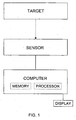
- FIGURE 1 is a diagrammatic view of a compressed symbology strain gage.
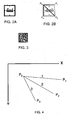
- FIGURE 2A shows a manufactured image configuration for a symbolic strain rosettes capable of serving as a target that satisfies the conditions for optically detecting strain when affixed to a surface undergoing load and deformation.
- FIGURE 2B shows the line segments and endpoints that define the symbolic strain rosette of FIGURE 2A .
- FIGURE 3 shows an overall image in the form of a Data Matrix symbol, in which is included a manufactured image configuration for symbolic strain rosettes capable of serving as a target that satisfies the conditions for optically detecting strain when the affixed to a surface undergoing load and deformation.
- FIGURE 4 shows three intersecting line segments that define a strain rosette.
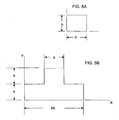
- FIGURE 5A shows a rectangular unit cell of a sub-image of a strain rosette.
- FIGURE 5B shows a T-shaped sub-image of a strain rosette.
- FIGURE 6A shows the SSR in the Data Matrix symbol of FIGURE 3 .
- FIGURE 6B shows the line segments and endpoints that define the symbolic strain rosette in the overall image shown in FIGURE 3 .
- FIGURE 7 is a sub-image of the strain rosette shown in FIGURE 6A .
- FIGURE 8 is a graph showing the range of applicability of the current technology and contrasts the technology with other methods of measuring strain.
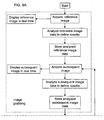
- FIGURE 9 shows the arrangement of FIGURES 9A and 9B .
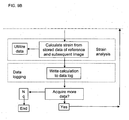
- FIGURES 9A and 9B together are a high level flow diagram illustrating the algorithm followed by the computer program.
- FIGURE 1 there is shown diagrammatically a compressed symbology strain gage, comprising a target, a sensor, and a computer.
- the target is a symbolic strain rosette ("SSR")that has been manufactured or identified.
- SSR symbolic strain rosette
- FIGURES 2A and 3 Two examples of targets are shown in FIGURES 2A and 3.
- FIGURE 2A is an SSR that contains a corporate logo as part of the symbol geometry
- FIGURE 3 is a two-dimensional bar code that incorporates an SSR.
- Both SSRs are examples of targets that satisfy the conditions for optically detecting strain when affixed to a surface undergoing load and deformation.
- the SSR is defined in terms of its physical dimensions.
- Engineering strain is a measure of the relative change in length per unit length of the end points of a line segment connecting the points relative to a reference configuration of the SSR. This reference configuration is usually taken to be an undeformed position (zero loading).
- Any quantity in an SSR used as a strain gage must identify a geometrical property that can describe a point. An example of such a point is the centroid of a group of symbols as shown in FIGURE 3 . Any other point that can be uniquely identified can be considered as a property of the SSR for the purpose of strain measurement. Therefore, since the strain is measured for many possible configurations of an SSR, the end points of the same line must be identified for all possible configurations.
- a strain rosette is defined in terms of a pattern of three intersecting line segments, as shown in FIGURE 4 .
- the length of line segment 1 is measured by the end points P 0 and P 1
- the length of line segment 2 is measured by the end points P 0 and P 2
- the length of line segment 3 is measured by end points P 0 and P 3 .
- FIGURE 2A When the definition of strain is applied to the compressed symbol of the SSR, then it is necessary to identify the line segments by the location of the endpoints.
- the SSR shown in FIGURE 2A is defined by the corner points of its outside boundary.
- FIGURE 2B illustrates the line segments and endpoints for the SSR shown in FIGURE 2A .
- the end points are defined by the corner points of the square boundary.
- An SSR that is defined a posteriori can be identified either by centroidal coordinates or by some other convenient geometry that locates three intersecting line segments that define a strain rosette.
- the overall image is a "two dimensional bar code" of the type developed by NASA to identify and track space shuttle parts, and the SSR is part of the information contained in the two dimensional bar code.
- the bar code pattern can be used to encode inventory data or a history of the object to which it is attached, as described in "A White Paper on Two Dimensional Symbols,” by Paul Mathans et al. (CSPI Vision Systems 1996). However, the target does not have to contain any inventory or history data to be read.
- the "two-dimensional bar code” is more formally referred to as a matrix code, a term that applies to two-dimensional codes that code data based on the position of black modules within a matrix. All of the black modules are the same dimension and it is the positions of the modules that code the data.
- Data Matrix is a type of two-dimensional matrix code containing dark and light square data modules. It is designed to pack a lot of information in a very small space; a Data Matrix symbol can store between one and 3116 numeric or 2335 alphanumeric characters.
- a Data Matrix symbol has a finder pattern of two solid lines and two alternating dark and light lines on the perimeter of the symbol. These patterns are used to indicate both orientation and printing density of the symbol.
- a two-dimensional imaging device such as a CCD camera is used to scan the symbology.
- Data Matrix symbol The information in a Data Matrix symbol is encoded by absolute dot position rather than relative dot position. While a Data Matrix symbol is easily scalable between a 1-mil square to a 14-inch square, the actual limits are dependent on the fidelity of the marking device and the optics of the sensor. Data Matrix symbols can be used for small item marking applications using a wide variety of printing and marking technologies.
- the SSR is defined in terms of the centroidal coordinates of the sub-images of the bar code, as discussed in greater detail hereinafter, and can be monitored by the sensor to correlate the movement of the centroids of the sub-images of the SSR.
- the linear quantities that define the strain rosette can be created using linear-edged shapes or curved-edged shapes. Circles can be used to create curved-edged SSRs.
- the target can be associated with an object by any means that results in the deformation of the SSR with the deformation under load.
- the deformation of the SSR and the object must bear a one-to-one relationship.
- the target can be associated with an object for which strain is to be measured by applying it directly or indirectly to the surface of the object, or by identifying it in a pre-existing pattern that defines an SSR. Whether applied or identified, the target can be embedded in the object for which strain is to be measured.
- Examples of application of a target include, but are not limited to:
- Examples of identification of a target include, but are not limited to:
- Examples of embedding of a target include, but are not limited to:
- the target can naturally emit a detectable physical quantity, create a detectable physical quantity, or reflect a detectable physical quantity.
- the detectable physical quantity can be a signal in any portion of the electromagnetic spectrum (including the audio frequency range), or it can be a field such as a magnetic field.
- the detectable physical quantity can be a signal that can be characterized as a grayscale image that can be converted into a bitmap file. Sensors that will sense various detectable physical quantities, including all these signals and fields, are commercially available.
- the target is scalable, in that it can be produced and sensed on a scale ranging from microscopic to macroscopic.
- the compressed symbology strain gage is applicable to very large applications such as viewing a target on earth from space to determine displacements/strain of the earth's surface or subsurface strains. All that is required is to match the sensor to the size of the target image and the detectable physical quantity emitted by the target.
- FIGURE 7 shows the range of applicability of the compressed symbology strain gage and contrasts the compressed symbology strain gage with other methods of measuring strain.
- Another advantage of the compressed symbology strain gage is that the range of strain measurements is easily from 0 to at least 50%, which permits measurements of strain in elastic materials such as rubber and plastic. The potential exits to cover measurements at the nanoscale level.
- a third, and major advantage of the compressed symbology strain gage is that subsurface strains can be measured. Subsurface measurements can have special applications in man-made composites.
- the compressed symbology strain gage also can be used in the assessment of fatigue damage (accumulation) in critical areas of structures or components of devices subjected to cyclic or other loadings. This is accomplished by observing the area of a component under study over a selected period of time during the normal usage of the area. The data can then be used to predict failure of the component.
- the sensor observes the deformation of a target affixed to a surface or embedded in a material by capturing the total image of the target and transmitting it to the computer.
- the sensor is selected to be compatible with the detectable physical quantity emitted by the target and undertakes some pre-processing of the observed physical quantity to provide data representing the physical quantity to the computer.
- the input signal to the sensor may be a grayscale image that can be converted into a bitmap file, although other inputs can be accommodated.
- the computer conventionally comprises memory for storing programs and data and a processor for implementing the programs and processing the data, and is associated with a display for displaying data.
- the computer implements programs that (1) identify the SSR and the changes therein as a function of time and change in the load, (2) translate the changes in the SSR into strain, and (3) display it in a suitable format.
- the display of the data can take place in real time.
- the technology is scalable with respect to the size of the object under study.
- the SSR is monitored by optical, magnetic, electromagnetic, acoustic, or other sensor, as appropriate - at successive periods of time, either on a continuous time, at random times triggered by an external event ,or on a programmed time basis.
- the sub-images of the SSR are correlated over time to detect the movement of the centroids of the sub-images, and the movements are quantified and utilized in analytical expressions to determine strain in the directions of the coordinate system used corresponding to the plane of the surface under study.
- the movement of the centroids is detected by a program implemented by the computer , which identifies the SSR and its sub-images, correlates the sub-images of the SSR over time, determines the displacement of the centroids of the sub-images of the SSR, and utilizes the data obtained as input for strain equations as described hereinafter and to yield and display strain in two dimensions.
- the mathematical basis of the invention is the correlation of the movement of the centroids of sub-images defining the SSR.
- the sub-images can be any geometric shape.
- the sub-image consists of one unit cell, which is a rectangle having a height h and a width b .
- the unit cells can be combined into, for example, a T shape (shown in FIGURE 5B ) consisting of a large rectangle and a small rectangle arranged next to each other, where the small rectangle is a single unit cell and the large rectangle is made up of k unit cells, where k is an integer (i.e., the size of the large rectangle is an integer multiple of the size of the small rectangle).
- sub-image 100a is the reference and consists of one cell of the type shown in FIGURE 5A ;
- sub-images 100b, 100c, and 100d are complex sub-images of the type shown in FIGURE 5B , and primarily measure movement in the X direction;
- sub-image 100e which like sub-image 100a consists of a single cell, measures movement in the X and Y directions;
- sub-images 100f, 100g, and 100h are complex sub-images that measure movement in the Y direction.
- a minimum configuration requires the four corner sub-images, sub-images 100a, 100c, 100e, and 100g.
- sub-images 100a-100h form an over-determined set for the strain rosette.
- the centroidal coordinates for each sub-image shown in FIGURE 6A are measured from the origin of a local coordinate system.
- the centroidal coordinates are designated X c , Y c .
- X and Y are the global coordinates of a two-dimensional sub-image.
- Equations 12 and 13 can now be used to continue to explain by an example an optical method for strain determination.
- the deformation of the SSR and the deformation under load of the object to which it is applied or on which it is identified must bear a one-to-one relationship.
- a 5 x 5 pixel array is selected for each cell and the strain rosette will have a 100-pixel subset for each sub-image.
- the following calculations relate the change, ⁇ S, in the centroids of the sub-images, with the strain induced by loading the surface under study.
- an SSR can be devised for any coordinate system or can be identified by analysis of a pre-existing symbol or other pattern so that it can be used as a target.
- the movement of the centroids of the sub-images of the target can be utilized with the strain equations written for the coordinate system used to determine strain optically and the computer program is applicable to any coordinate system and sub-image geometric shape.
- the algorithm comprises three basic stages, image grabbing, strain analysis, and data logging; and utilizes two types of images, a reference image, acquired either without application of a load or with a reference load on the object for which strain is to be measured, and subsequent images, acquired after the reference image in the presence of a load or change to the load on the object.
- the image grabbing stage comprises the following steps:
- the sensor acquires the reference image and outputs data representing the reference image to the computer .
- a program or programs implemented by the computer then analyzes the reference image data to define an SSR, and concurrently displays the reference image, preferably in real time, on a computer monitor or other display device.
- the computer stores the analyzed reference image data.
- the sensor acquires a subsequent image and outputs data representing that subsequent image (that is, the current subsequent image) to the computer.
- Acquisition of subsequent images can take place either continuously or at predetermined intervals, or it can be triggered by an external event such as the application of a load.
- the number of subsequent images thus can range from one to thousands.
- the program analyzes it to define an SSR, and concurrently displays the corresponding subsequent image, preferably in real time, on a computer monitor or other display device (preferably on the same monitor or other display device on which the reference image is being displayed, to facilitate comparison).
- the computer stores the analyzed subsequent image data for the current subsequent image.
- the strain analysis stage takes place following the image grabbing stage, and is carried out each time a subsequent image is acquired.
- the computer calculates the strain from the stored reference image data and the stored subsequent image data for the current subsequent image, based on the changes in the SSR as a function of time and change in the load. Thus, a new strain calculation is made for each subsequent image.
- the strain calculation can then be utilized as a display, as well as providing information on fatigue damage or strain hysteresis for materials of known and unknown mechanical properties, providing advance notice of an approaching failure point for materials of known mechanical properties, extrapolating a failure point for a material of unknown mechanical properties, or based on collected damage accumulation data.
- the data logging stage takes place following each iteration of the strain analysis stage.
- the program gets the current results and writes them to a log file.
- FIGURES 9A and 9B are for purposes of illustration, and some changes can be made in the algorithm without affecting the results.
- the display of the reference and subsequent images can take place sequentially with the analysis of those images, as well as substantially concurrently; the acquisition and display of the reference and/or the subsequent images can be initiated by an external event; and images can be recorded during an event and stored for processing at a later time.
Landscapes
- Physics & Mathematics (AREA)
- General Physics & Mathematics (AREA)
- Investigating Strength Of Materials By Application Of Mechanical Stress (AREA)
- Length Measuring Devices By Optical Means (AREA)
- Force Measurement Appropriate To Specific Purposes (AREA)
- Measurement Of Force In General (AREA)
- Length Measuring Devices With Unspecified Measuring Means (AREA)
Claims (10)
- Komprimiertes Symbologie-Dehnungsmessinstrument zum Messen von mindestens einem von beidem, einer Dehnung und einem Ermüdungsschaden eines Körpers, wobei das Dehnungsmessinstrument Folgendes umfasst:ein Ziel zum Abstrahlen einer erkennbaren physikalischen Größe, wobei das Ziel eine symbolische Dehnungsrosette in Form von einem komprimierten Symbol umfasst, das in Form von den Endpunkten von drei einander überschneidenden Liniensegmenten festgelegt ist, welche eine Dehnungsrosette festlegen, wobei das komprimierte Symbol ein Kennungssymbol in einem Matrixformat ist, das mit Informationen codiert werden kann, welche direkt auf der Oberfläche eines Produkts markiert oder auf einen Film oder auf ein anderes Medium, der beziehungsweise das auf die Oberfläche eines Produkts geklebt wird, aufgebracht werden können;ein Sensormittel, das dazu dient, Änderungen an dem Ziel zu erkennen, wenn ein Körper, zu dem das Ziel gehört, einer Last unterworfen wird, wobei das Ziel dem Körper so zugeordnet wird, dass eine Verformung der symbolischen Dehnungsrosette und eine Verformung unter der Last des Körpers eine Eins-zu-Eins-Beziehung aufweisen, undein Mittel, das dazu dient, die Dehnung auf der Grundlage von Änderungen an dem Ziel zu berechnen, wenn der Körper einer Last unterworfen wird,wobei das Sensormittel so ausgelegt ist, dass es die erkennbare physikalische Größe, die von dem Ziel abgestrahlt wird, vorverarbeitet und Daten ausgibt, die die physikalische Größe darstellen, wobei das Sensormittel mit der erkennbaren physikalischen Größe kompatibel ist;
wobei das komprimierte Symbologie-Dehnungsmessinstrument des Weiteren ein Mittel umfasst, das zur Auswertung der Daten dient, die von dem Sensormittel ausgegeben werden, um die symbolische Dehnungsrosette festzulegen; und ein Mittel, das zur Berechnung der Dehnung des Körpers dient, wobei die Berechnung direkt auf den vorverarbeiteten und ausgewerteten Daten beruht. - Verfahren zum direkten Messen von mindestens einem von beidem, einer Dehnung und einem Ermüdungsschaden an einem Körper, wobei das Verfahren die folgenden Schritte umfasst:Erkennen von Änderungen an einem Ziel, das eine erkennbare physikalische Größe abstrahlt, wenn ein Körper, zu dem das Ziel gehört, einer Last unterworfen wird; undBerechnen der Dehnung auf der Grundlage von Änderungen an dem Ziel, wenn der Körper einer Last unterworfen wird,wobei
das Ziel eine symbolische Dehnungsrosette ist und dem Körper so zugeordnet wird, dass eine Verformung der symbolischen Dehnungsrosette und eine Verformung unter der Last des Körpers eine Eins-zu-Eins-Beziehung aufweisen, und wobei die symbolische Dehnungsrosette die Form eines komprimierten Symbols hat, das in Form von den Endpunkten von drei einander überschneidenden Liniensegmenten festgelegt ist, welche eine Dehnungsrosette festlegen, wobei das komprimierte Symbol ein Kennungssymbol in einem Matrixformat ist, das mit Informationen codiert werden kann, welche direkt auf der Oberfläche eines Produkts markiert oder auf einen Film oder auf ein anderes Medium, der beziehungsweise das auf die Oberfläche eines Produkts geklebt wird, aufgebracht werden können, wobei die Änderungen an der symbolischen Dehnungsrosette in Abhängigkeit von der Zeit und einer Änderung der an den Körper angelegten Last ermittelt werden; und wobei die Änderungen an der symbolischen Dehnungsrosette in eine direkte Messung der Dehnung umgesetzt werden. - Verfahren nach Anspruch 2, dadurch gekennzeichnet, dass die Dehnungsrosette hergestellt wird und das Ziel dem Körper zugeordnet wird, indem die Dehnungsrosette auf den Körper angewendet wird.
- Verfahren nach Anspruch 2, dadurch gekennzeichnet, dass die Dehnungsrosette in einem bereits vorhandenen Muster ermittelt wird.
- Komprimiertes Symbologie-Dehnungsmessinstrument nach Anspruch 1, dadurch gekennzeichnet, dass die Dehnungsrosette mittels Herstellung festgelegt wird.
- Komprimiertes Symbologie-Dehnungsmessinstrument nach Anspruch 5, dadurch gekennzeichnet, dass die Dehnungsrosette in einem zweidimensionalen Barcode enthalten ist.
- Komprimiertes Symbologie-Dehnungsmessinstrument nach Anspruch 6, dadurch gekennzeichnet, dass der zweidimensionale Barcode ein Daten-Matrix-Symbol ist.
- Komprimiertes Symbologie-Dehnungsmessinstrument nach Anspruch 1, dadurch gekennzeichnet, dass das Ziel in einem bereits vorhandenen Muster ermittelt wird, das die Dehnungsrosette festlegt.
- Komprimiertes Symbologie-Dehnungsmessinstrument nach Anspruch 1, dadurch gekennzeichnet, dass es des Weiteren ein Mittel umfasst, um die Berechnung der Dehnung zur Bereitstellung von Informationen über einen Ermüdungsschaden oder eine Dehnungshysterese für Materialien mit bekannten und unbekannten mechanischen Eigenschaften zu verwenden, um eine Vorankündigung eines nahenden Ausfallpunkts für Materialien mit bekannten mechanischen Eigenschaften vorzusehen oder um einen Ausfallpunkt für ein Material mit unbekannten mechanischen Eigenschaften oder auf der Grundlage von erfassten Schadenakkumulationsdaten zu extrapolieren.
- Verfahren nach Anspruch 2, dadurch gekennzeichnet, dass es des Weiteren den Schritt der Verwendung der Berechnung der Dehnung umfasst, um Informationen über einen Ermüdungsschaden oder eine Dehnungshysterese für Materialien mit bekannten und unbekannten mechanischen Eigenschaften bereitzustellen, um eine Vorankündigung eines nahenden Ausfallpunkts für Materialien mit bekannten mechanischen Eigenschaften vorzusehen oder um einen Ausfallpunkt für ein Material mit unbekannten mechanischen Eigenschaften oder auf der Grundlage von erfassten Schadenakkumulationsdaten zu extrapolieren.
Applications Claiming Priority (3)
| Application Number | Priority Date | Filing Date | Title |
|---|---|---|---|
| US10/223,680 US6934013B2 (en) | 2002-08-20 | 2002-08-20 | Compressed symbology strain gage |
| US223680 | 2002-08-20 | ||
| PCT/US2003/022136 WO2004018965A1 (en) | 2002-08-20 | 2003-07-16 | Compressed symbology strain gauge |
Publications (2)
| Publication Number | Publication Date |
|---|---|
| EP1535025A1 EP1535025A1 (de) | 2005-06-01 |
| EP1535025B1 true EP1535025B1 (de) | 2008-12-10 |
Family
ID=31886679
Family Applications (1)
| Application Number | Title | Priority Date | Filing Date |
|---|---|---|---|
| EP03792970A Expired - Lifetime EP1535025B1 (de) | 2002-08-20 | 2003-07-16 | Dehnungsmessstreifen mit komprimierter symbologie |
Country Status (7)
| Country | Link |
|---|---|
| US (1) | US6934013B2 (de) |
| EP (1) | EP1535025B1 (de) |
| JP (1) | JP2005536739A (de) |
| AT (1) | ATE417243T1 (de) |
| AU (1) | AU2003251929A1 (de) |
| DE (1) | DE60325228D1 (de) |
| WO (1) | WO2004018965A1 (de) |
Families Citing this family (22)
| Publication number | Priority date | Publication date | Assignee | Title |
|---|---|---|---|---|
| US6874370B1 (en) | 2004-07-15 | 2005-04-05 | Reginald I. Vachon | Finite element analysis fatigue gage |
| US7477995B2 (en) * | 2005-02-03 | 2009-01-13 | Direct Measurements Inc. | Optical linear strain gage |
| US7533818B2 (en) * | 2005-06-28 | 2009-05-19 | Direct Measurements Inc. | Binary code symbol for non-linear strain measurement and apparatus and method for analyzing and measuring strain therewith |
| US8459567B2 (en) | 2006-08-17 | 2013-06-11 | Direct Measurements, Inc. | Non-linear strain gage incorporating a nested binary code symbol |
| CA2696946C (en) * | 2006-08-17 | 2013-05-28 | Direct Measurements, Inc. | Multi-format, binary code symbol for non-linear strain measurement |
| US8245578B2 (en) * | 2007-02-23 | 2012-08-21 | Direct Measurements, Inc. | Differential non-linear strain measurement using binary code symbol |
| US20090192731A1 (en) * | 2008-01-24 | 2009-07-30 | Halliburton Energy Services, Inc. | System and Method for Monitoring a Health State of Hydrocarbon Production Equipment |
| US8307715B2 (en) * | 2009-03-24 | 2012-11-13 | Direct Measurments, Inc. | Directly applied read and transmit—digital strain encoder and digital load cell |
| US8600147B2 (en) * | 2009-06-03 | 2013-12-03 | The United States of America as represented by the Secreatary of the Navy | System and method for remote measurement of displacement and strain fields |
| US20110106459A1 (en) * | 2009-10-29 | 2011-05-05 | Northrop Grumman Corporation | In-situ optical crack measurement using a dot pattern |
| CA2843892C (en) * | 2011-08-02 | 2019-08-27 | The Government Of The United States Of America, As Represented By The Secretary Of The Navy | System and method for remote full field three-dimensional displacement and strain measurements |
| US9798930B2 (en) | 2012-07-19 | 2017-10-24 | 3M Innovative Properties Company | Determining elongation of elastic bandage |
| US9311566B2 (en) | 2012-08-03 | 2016-04-12 | George Mason Research Foundation, Inc. | Method and system for direct strain imaging |
| WO2014178080A1 (en) * | 2013-05-03 | 2014-11-06 | Indian Council Of Medical Research | A non-contact method for measurement of strain profile at a location interposed within a soft deformable object with dynamic evolution of the strain under dynamic loading or fracture of the object |
| US9953408B2 (en) * | 2015-11-16 | 2018-04-24 | General Electric Company | Methods for monitoring components |
| US20170176269A1 (en) * | 2015-12-17 | 2017-06-22 | General Electric Company | Components with array-based strain sensors and methods for monitoring the same |
| US10024760B2 (en) * | 2015-12-17 | 2018-07-17 | General Electric Company | Methods for monitoring turbine components |
| JP6848281B2 (ja) * | 2016-09-12 | 2021-03-24 | 大日本印刷株式会社 | 変位量計測装置及び変位量計測システム |
| WO2018158994A1 (ja) * | 2017-02-28 | 2018-09-07 | パナソニックIpマネジメント株式会社 | 変位計測装置および変位計測方法 |
| CN110514329A (zh) * | 2019-08-08 | 2019-11-29 | 西安中星测控有限公司 | 一种无源二维码载荷传感器及其制备方法 |
| CN110514330A (zh) * | 2019-08-08 | 2019-11-29 | 西安中星测控有限公司 | 一种无源二维码压力传感器及其制备方法 |
| JP2023114944A (ja) * | 2022-02-07 | 2023-08-18 | 国立大学法人京都大学 | ひずみ解析システム、ひずみ解析方法 |
Family Cites Families (31)
| Publication number | Priority date | Publication date | Assignee | Title |
|---|---|---|---|---|
| US3474237A (en) * | 1966-10-03 | 1969-10-21 | Automation Ind Inc | Strain gage rosette calculator |
| JPS51140656A (en) * | 1975-05-28 | 1976-12-03 | Sumitomo Metal Ind Ltd | Method and apparatus for measuring plastic deformation quantity of ste el sheet |
| US4008960A (en) * | 1975-08-18 | 1977-02-22 | Reytblatt Zinovy V | Photoelastic strain gauge coating and method of using same |
| US4050818A (en) * | 1975-09-10 | 1977-09-27 | The United States Of America As Represented By The Secretary Of The Air Force | Method for determining changes in spacing between two positions of interest |
| US4014613A (en) * | 1975-09-10 | 1977-03-29 | The United States Of America As Represented By The Secretary Of The Air Force | Method and apparatus for determining changes in spacing between two positions of interest |
| US4288852A (en) * | 1979-11-28 | 1981-09-08 | General Motors Corporation | Method and apparatus for automatically determining sheet metal strain |
| JPS57125803A (en) | 1981-01-29 | 1982-08-05 | Toyoda Gosei Co Ltd | Method for measuring strain of sample surface |
| US5065331A (en) * | 1981-05-18 | 1991-11-12 | Vachon Reginald I | Apparatus and method for determining the stress and strain in pipes, pressure vessels, structural members and other deformable bodies |
| US4591996A (en) * | 1981-05-18 | 1986-05-27 | Vachon Reginald I | Apparatus and method for determining stress and strain in pipes, pressure vessels, structural members and other deformable bodies |
| US4722600A (en) * | 1986-10-14 | 1988-02-02 | Chiang Fu Pen | Apparatus and method for measuring strain |
| US4939354A (en) * | 1988-05-05 | 1990-07-03 | Datacode International, Inc. | Dynamically variable machine readable binary code and method for reading and producing thereof |
| US5053609A (en) * | 1988-05-05 | 1991-10-01 | International Data Matrix, Inc. | Dynamically variable machine readable binary code and method for reading and producing thereof |
| US5124536A (en) * | 1988-05-05 | 1992-06-23 | International Data Matrix, Inc. | Dynamically variable machine readable binary code and method for reading and producing thereof |
| JP2607936B2 (ja) * | 1988-10-05 | 1997-05-07 | 清水建設株式会社 | コンクリート部材のひびわれ計測方法 |
| US5047952A (en) * | 1988-10-14 | 1991-09-10 | The Board Of Trustee Of The Leland Stanford Junior University | Communication system for deaf, deaf-blind, or non-vocal individuals using instrumented glove |
| JP2676040B2 (ja) * | 1989-01-28 | 1997-11-12 | 清水建設株式会社 | コンクリート部材の面内変位計測方法 |
| US4969106A (en) * | 1989-02-27 | 1990-11-06 | Camsys, Inc. | Computerized method of determining surface strain distributions in a deformed body |
| US5671042A (en) * | 1992-02-18 | 1997-09-23 | Illinois Institute Of Technology | Holomoire strain analyzer |
| JPH05322557A (ja) * | 1992-05-18 | 1993-12-07 | Saginomiya Seisakusho Inc | 変形観測のための格子位置データ収集方法 |
| EP1383084A3 (de) * | 1993-10-27 | 2004-07-14 | Toshiba Engineering Corporation | Verfahren und Gerät zur Inspektion der Oberflächenunregelmässigkeit eines Gegenstandes |
| JPH07217622A (ja) * | 1994-02-07 | 1995-08-15 | Hino Motors Ltd | 鋲の塑性試験方法 |
| US5531122A (en) * | 1994-02-28 | 1996-07-02 | Caterpillar Inc. | Fatigue analysis and warning system |
| US5726907A (en) * | 1995-07-31 | 1998-03-10 | Southwest Research Institute | Biaxial non-contacting strain measurement using machine vision |
| JPH09257465A (ja) * | 1996-03-26 | 1997-10-03 | Toyota Motor Corp | 非接触式微小領域歪測定方法 |
| US5920383A (en) * | 1997-12-05 | 1999-07-06 | Ford Global Technologies, Inc. | Microscopic digital imaging strain gauge |
| US6189386B1 (en) | 1997-12-05 | 2001-02-20 | Ford Global Technologies, Inc. | Method of using a microscopic digital imaging strain gauge |
| JPH11173839A (ja) * | 1997-12-16 | 1999-07-02 | Moritex Corp | 構築物等の変形状態解析装置とこれに用いるデータレコ ーダ及びデータアナライザ |
| US6189356B1 (en) * | 2000-02-17 | 2001-02-20 | General Electric Company | Method and apparatus for peening |
| JP2002267422A (ja) | 2001-03-09 | 2002-09-18 | Nippon Koei Power Systems Co Ltd | クラック検出方法及びその装置 |
| JP4683516B2 (ja) * | 2001-05-16 | 2011-05-18 | 日本工営株式会社 | デジタルカメラを用いた構造物の亀裂変位計測方法 |
| US6718269B2 (en) * | 2001-12-13 | 2004-04-06 | International Business Machines Corporation | Apparatus, program product and method of estimating the stress intensity factor ratio of a material |
-
2002
- 2002-08-20 US US10/223,680 patent/US6934013B2/en not_active Expired - Lifetime
-
2003
- 2003-07-16 WO PCT/US2003/022136 patent/WO2004018965A1/en not_active Ceased
- 2003-07-16 DE DE60325228T patent/DE60325228D1/de not_active Expired - Lifetime
- 2003-07-16 AT AT03792970T patent/ATE417243T1/de not_active IP Right Cessation
- 2003-07-16 EP EP03792970A patent/EP1535025B1/de not_active Expired - Lifetime
- 2003-07-16 AU AU2003251929A patent/AU2003251929A1/en not_active Abandoned
- 2003-07-16 JP JP2004530826A patent/JP2005536739A/ja active Pending
Also Published As
| Publication number | Publication date |
|---|---|
| US20040036853A1 (en) | 2004-02-26 |
| WO2004018965B1 (en) | 2004-07-29 |
| ATE417243T1 (de) | 2008-12-15 |
| WO2004018965A1 (en) | 2004-03-04 |
| DE60325228D1 (de) | 2009-01-22 |
| JP2005536739A (ja) | 2005-12-02 |
| HK1078928A1 (en) | 2006-03-24 |
| EP1535025A1 (de) | 2005-06-01 |
| AU2003251929A1 (en) | 2004-03-11 |
| US6934013B2 (en) | 2005-08-23 |
Similar Documents
| Publication | Publication Date | Title |
|---|---|---|
| EP1535025B1 (de) | Dehnungsmessstreifen mit komprimierter symbologie | |
| US7477995B2 (en) | Optical linear strain gage | |
| EP1897036B1 (de) | Binärcodesymbol für messung von nicht linearem stress und vorrichtung und verfahren zum analysieren und messen desselben | |
| EP1782038B1 (de) | Finite-elemente-analyse-ermüdungsmessgerät | |
| US9046353B2 (en) | System and method for remote full field three-dimensional displacement and strain measurements | |
| US7878415B2 (en) | Segmented circular bar code | |
| CA2775040C (en) | Directly applied read and transmit - digital strain encoder and digital load cell | |
| JP6240206B2 (ja) | 変位場およびひずみ場の測定方法、および、材料試験機 | |
| US20110106459A1 (en) | In-situ optical crack measurement using a dot pattern | |
| US8249832B2 (en) | Correlation of inspection information and computer-aided design data for structural assessment | |
| Pop et al. | Identification algorithm for fracture parameters by combining DIC and FEM approaches | |
| US12572801B2 (en) | Method for characterizing a part through non-destructive inspection | |
| HK1078928B (en) | Compressed symbology strain gauge | |
| EP4028742B1 (de) | Vorrichtung zur messung von bodenkontaktspannungen | |
| HK1104085B (en) | Finite element analysis fatigue gage | |
| HK1104085A (en) | Finite element analysis fatigue gage | |
| Belloni | Innovative approaches for infrastructure monitoring through photogrammetry and deep learning | |
| MX2008000182A (en) | Binary code symbol and method and apparatus for analyzing and measuring same | |
| Pal | System Identification and Damage Detection Solutions: Sensor Fusion, Algorithms and Physics-Guided Learning | |
| CN121364104A (zh) | 一种基于三维数字图像与声发射的岩石破坏机制判别方法 | |
| ALEMDAR et al. | DEFORMATION MEASUREMENT IN A STEEL BRIDGE SYSTEM BY USING IMAGE PROCESSING METHOD | |
| Osten et al. | AN ACTIVE APPROACH FOR HIGH RESOLUTION MEASUREMENT OF TECHNICAL SURFACES |
Legal Events
| Date | Code | Title | Description |
|---|---|---|---|
| PUAI | Public reference made under article 153(3) epc to a published international application that has entered the european phase |
Free format text: ORIGINAL CODE: 0009012 |
|
| 17P | Request for examination filed |
Effective date: 20050318 |
|
| AK | Designated contracting states |
Kind code of ref document: A1 Designated state(s): AT BE BG CH CY CZ DE DK EE ES FI FR GB GR HU IE IT LI LU MC NL PT RO SE SI SK TR |
|
| AX | Request for extension of the european patent |
Extension state: AL LT LV MK |
|
| DAX | Request for extension of the european patent (deleted) | ||
| REG | Reference to a national code |
Ref country code: HK Ref legal event code: DE Ref document number: 1078928 Country of ref document: HK |
|
| 17Q | First examination report despatched |
Effective date: 20060913 |
|
| GRAP | Despatch of communication of intention to grant a patent |
Free format text: ORIGINAL CODE: EPIDOSNIGR1 |
|
| GRAS | Grant fee paid |
Free format text: ORIGINAL CODE: EPIDOSNIGR3 |
|
| GRAA | (expected) grant |
Free format text: ORIGINAL CODE: 0009210 |
|
| AK | Designated contracting states |
Kind code of ref document: B1 Designated state(s): AT BE BG CH CY CZ DE DK EE ES FI FR GB GR HU IE IT LI LU MC NL PT RO SE SI SK TR |
|
| REG | Reference to a national code |
Ref country code: GB Ref legal event code: FG4D |
|
| REG | Reference to a national code |
Ref country code: CH Ref legal event code: EP |
|
| REG | Reference to a national code |
Ref country code: IE Ref legal event code: FG4D |
|
| REF | Corresponds to: |
Ref document number: 60325228 Country of ref document: DE Date of ref document: 20090122 Kind code of ref document: P |
|
| PG25 | Lapsed in a contracting state [announced via postgrant information from national office to epo] |
Ref country code: SI Free format text: LAPSE BECAUSE OF FAILURE TO SUBMIT A TRANSLATION OF THE DESCRIPTION OR TO PAY THE FEE WITHIN THE PRESCRIBED TIME-LIMIT Effective date: 20081210 Ref country code: NL Free format text: LAPSE BECAUSE OF FAILURE TO SUBMIT A TRANSLATION OF THE DESCRIPTION OR TO PAY THE FEE WITHIN THE PRESCRIBED TIME-LIMIT Effective date: 20081210 Ref country code: FI Free format text: LAPSE BECAUSE OF FAILURE TO SUBMIT A TRANSLATION OF THE DESCRIPTION OR TO PAY THE FEE WITHIN THE PRESCRIBED TIME-LIMIT Effective date: 20081210 |
|
| NLV1 | Nl: lapsed or annulled due to failure to fulfill the requirements of art. 29p and 29m of the patents act | ||
| REG | Reference to a national code |
Ref country code: HK Ref legal event code: GR Ref document number: 1078928 Country of ref document: HK |
|
| PG25 | Lapsed in a contracting state [announced via postgrant information from national office to epo] |
Ref country code: ES Free format text: LAPSE BECAUSE OF FAILURE TO SUBMIT A TRANSLATION OF THE DESCRIPTION OR TO PAY THE FEE WITHIN THE PRESCRIBED TIME-LIMIT Effective date: 20090321 Ref country code: EE Free format text: LAPSE BECAUSE OF FAILURE TO SUBMIT A TRANSLATION OF THE DESCRIPTION OR TO PAY THE FEE WITHIN THE PRESCRIBED TIME-LIMIT Effective date: 20081210 Ref country code: BG Free format text: LAPSE BECAUSE OF FAILURE TO SUBMIT A TRANSLATION OF THE DESCRIPTION OR TO PAY THE FEE WITHIN THE PRESCRIBED TIME-LIMIT Effective date: 20090310 Ref country code: BE Free format text: LAPSE BECAUSE OF FAILURE TO SUBMIT A TRANSLATION OF THE DESCRIPTION OR TO PAY THE FEE WITHIN THE PRESCRIBED TIME-LIMIT Effective date: 20081210 Ref country code: RO Free format text: LAPSE BECAUSE OF FAILURE TO SUBMIT A TRANSLATION OF THE DESCRIPTION OR TO PAY THE FEE WITHIN THE PRESCRIBED TIME-LIMIT Effective date: 20081210 |
|
| PG25 | Lapsed in a contracting state [announced via postgrant information from national office to epo] |
Ref country code: CZ Free format text: LAPSE BECAUSE OF FAILURE TO SUBMIT A TRANSLATION OF THE DESCRIPTION OR TO PAY THE FEE WITHIN THE PRESCRIBED TIME-LIMIT Effective date: 20081210 Ref country code: SE Free format text: LAPSE BECAUSE OF FAILURE TO SUBMIT A TRANSLATION OF THE DESCRIPTION OR TO PAY THE FEE WITHIN THE PRESCRIBED TIME-LIMIT Effective date: 20090310 Ref country code: AT Free format text: LAPSE BECAUSE OF FAILURE TO SUBMIT A TRANSLATION OF THE DESCRIPTION OR TO PAY THE FEE WITHIN THE PRESCRIBED TIME-LIMIT Effective date: 20081210 Ref country code: PT Free format text: LAPSE BECAUSE OF FAILURE TO SUBMIT A TRANSLATION OF THE DESCRIPTION OR TO PAY THE FEE WITHIN THE PRESCRIBED TIME-LIMIT Effective date: 20090511 |
|
| PG25 | Lapsed in a contracting state [announced via postgrant information from national office to epo] |
Ref country code: SK Free format text: LAPSE BECAUSE OF FAILURE TO SUBMIT A TRANSLATION OF THE DESCRIPTION OR TO PAY THE FEE WITHIN THE PRESCRIBED TIME-LIMIT Effective date: 20081210 |
|
| PLBE | No opposition filed within time limit |
Free format text: ORIGINAL CODE: 0009261 |
|
| STAA | Information on the status of an ep patent application or granted ep patent |
Free format text: STATUS: NO OPPOSITION FILED WITHIN TIME LIMIT |
|
| PG25 | Lapsed in a contracting state [announced via postgrant information from national office to epo] |
Ref country code: DK Free format text: LAPSE BECAUSE OF FAILURE TO SUBMIT A TRANSLATION OF THE DESCRIPTION OR TO PAY THE FEE WITHIN THE PRESCRIBED TIME-LIMIT Effective date: 20081210 |
|
| 26N | No opposition filed |
Effective date: 20090911 |
|
| PG25 | Lapsed in a contracting state [announced via postgrant information from national office to epo] |
Ref country code: MC Free format text: LAPSE BECAUSE OF NON-PAYMENT OF DUE FEES Effective date: 20090731 |
|
| REG | Reference to a national code |
Ref country code: CH Ref legal event code: PL |
|
| PG25 | Lapsed in a contracting state [announced via postgrant information from national office to epo] |
Ref country code: LI Free format text: LAPSE BECAUSE OF NON-PAYMENT OF DUE FEES Effective date: 20090731 Ref country code: CH Free format text: LAPSE BECAUSE OF NON-PAYMENT OF DUE FEES Effective date: 20090731 |
|
| PG25 | Lapsed in a contracting state [announced via postgrant information from national office to epo] |
Ref country code: IE Free format text: LAPSE BECAUSE OF NON-PAYMENT OF DUE FEES Effective date: 20090716 |
|
| PG25 | Lapsed in a contracting state [announced via postgrant information from national office to epo] |
Ref country code: GR Free format text: LAPSE BECAUSE OF FAILURE TO SUBMIT A TRANSLATION OF THE DESCRIPTION OR TO PAY THE FEE WITHIN THE PRESCRIBED TIME-LIMIT Effective date: 20090311 |
|
| PG25 | Lapsed in a contracting state [announced via postgrant information from national office to epo] |
Ref country code: IT Free format text: LAPSE BECAUSE OF FAILURE TO SUBMIT A TRANSLATION OF THE DESCRIPTION OR TO PAY THE FEE WITHIN THE PRESCRIBED TIME-LIMIT Effective date: 20081210 |
|
| PG25 | Lapsed in a contracting state [announced via postgrant information from national office to epo] |
Ref country code: LU Free format text: LAPSE BECAUSE OF NON-PAYMENT OF DUE FEES Effective date: 20090716 |
|
| PG25 | Lapsed in a contracting state [announced via postgrant information from national office to epo] |
Ref country code: HU Free format text: LAPSE BECAUSE OF FAILURE TO SUBMIT A TRANSLATION OF THE DESCRIPTION OR TO PAY THE FEE WITHIN THE PRESCRIBED TIME-LIMIT Effective date: 20090611 |
|
| PG25 | Lapsed in a contracting state [announced via postgrant information from national office to epo] |
Ref country code: TR Free format text: LAPSE BECAUSE OF FAILURE TO SUBMIT A TRANSLATION OF THE DESCRIPTION OR TO PAY THE FEE WITHIN THE PRESCRIBED TIME-LIMIT Effective date: 20081210 |
|
| PG25 | Lapsed in a contracting state [announced via postgrant information from national office to epo] |
Ref country code: CY Free format text: LAPSE BECAUSE OF FAILURE TO SUBMIT A TRANSLATION OF THE DESCRIPTION OR TO PAY THE FEE WITHIN THE PRESCRIBED TIME-LIMIT Effective date: 20081210 |
|
| REG | Reference to a national code |
Ref country code: FR Ref legal event code: PLFP Year of fee payment: 14 |
|
| REG | Reference to a national code |
Ref country code: FR Ref legal event code: PLFP Year of fee payment: 15 |
|
| REG | Reference to a national code |
Ref country code: FR Ref legal event code: PLFP Year of fee payment: 16 |
|
| PGFP | Annual fee paid to national office [announced via postgrant information from national office to epo] |
Ref country code: FR Payment date: 20190621 Year of fee payment: 17 |
|
| PGFP | Annual fee paid to national office [announced via postgrant information from national office to epo] |
Ref country code: DE Payment date: 20190620 Year of fee payment: 17 Ref country code: GB Payment date: 20190624 Year of fee payment: 17 |
|
| REG | Reference to a national code |
Ref country code: DE Ref legal event code: R119 Ref document number: 60325228 Country of ref document: DE |
|
| GBPC | Gb: european patent ceased through non-payment of renewal fee |
Effective date: 20200716 |
|
| PG25 | Lapsed in a contracting state [announced via postgrant information from national office to epo] |
Ref country code: FR Free format text: LAPSE BECAUSE OF NON-PAYMENT OF DUE FEES Effective date: 20200731 Ref country code: GB Free format text: LAPSE BECAUSE OF NON-PAYMENT OF DUE FEES Effective date: 20200716 |
|
| PG25 | Lapsed in a contracting state [announced via postgrant information from national office to epo] |
Ref country code: DE Free format text: LAPSE BECAUSE OF NON-PAYMENT OF DUE FEES Effective date: 20210202 |