EP1534451B1 - Giessverfahren - Google Patents
Giessverfahren Download PDFInfo
- Publication number
- EP1534451B1 EP1534451B1 EP03716204A EP03716204A EP1534451B1 EP 1534451 B1 EP1534451 B1 EP 1534451B1 EP 03716204 A EP03716204 A EP 03716204A EP 03716204 A EP03716204 A EP 03716204A EP 1534451 B1 EP1534451 B1 EP 1534451B1
- Authority
- EP
- European Patent Office
- Prior art keywords
- article
- casting
- powder
- porous powder
- molten metal
- Prior art date
- Legal status (The legal status is an assumption and is not a legal conclusion. Google has not performed a legal analysis and makes no representation as to the accuracy of the status listed.)
- Expired - Lifetime
Links
Images

Classifications
-
- B—PERFORMING OPERATIONS; TRANSPORTING
- B22—CASTING; POWDER METALLURGY
- B22F—WORKING METALLIC POWDER; MANUFACTURE OF ARTICLES FROM METALLIC POWDER; MAKING METALLIC POWDER; APPARATUS OR DEVICES SPECIALLY ADAPTED FOR METALLIC POWDER
- B22F7/00—Manufacture of composite layers, workpieces, or articles, comprising metallic powder, by sintering the powder, with or without compacting wherein at least one part is obtained by sintering or compression
- B22F7/06—Manufacture of composite layers, workpieces, or articles, comprising metallic powder, by sintering the powder, with or without compacting wherein at least one part is obtained by sintering or compression of composite workpieces or articles from parts, e.g. to form tipped tools
-
- B—PERFORMING OPERATIONS; TRANSPORTING
- B22—CASTING; POWDER METALLURGY
- B22F—WORKING METALLIC POWDER; MANUFACTURE OF ARTICLES FROM METALLIC POWDER; MAKING METALLIC POWDER; APPARATUS OR DEVICES SPECIALLY ADAPTED FOR METALLIC POWDER
- B22F3/00—Manufacture of workpieces or articles from metallic powder characterised by the manner of compacting or sintering; Apparatus specially adapted therefor ; Presses and furnaces
- B22F3/10—Sintering only
- B22F3/105—Sintering only by using electric current other than for infrared radiant energy, laser radiation or plasma ; by ultrasonic bonding
-
- B—PERFORMING OPERATIONS; TRANSPORTING
- B22—CASTING; POWDER METALLURGY
- B22C—FOUNDRY MOULDING
- B22C9/00—Moulds or cores; Moulding processes
- B22C9/02—Sand moulds or like moulds for shaped castings
- B22C9/04—Use of lost patterns
-
- B—PERFORMING OPERATIONS; TRANSPORTING
- B22—CASTING; POWDER METALLURGY
- B22D—CASTING OF METALS; CASTING OF OTHER SUBSTANCES BY THE SAME PROCESSES OR DEVICES
- B22D19/00—Casting in, on, or around objects which form part of the product
-
- B—PERFORMING OPERATIONS; TRANSPORTING
- B22—CASTING; POWDER METALLURGY
- B22D—CASTING OF METALS; CASTING OF OTHER SUBSTANCES BY THE SAME PROCESSES OR DEVICES
- B22D19/00—Casting in, on, or around objects which form part of the product
- B22D19/14—Casting in, on, or around objects which form part of the product the objects being filamentary or particulate in form
-
- B—PERFORMING OPERATIONS; TRANSPORTING
- B22—CASTING; POWDER METALLURGY
- B22F—WORKING METALLIC POWDER; MANUFACTURE OF ARTICLES FROM METALLIC POWDER; MAKING METALLIC POWDER; APPARATUS OR DEVICES SPECIALLY ADAPTED FOR METALLIC POWDER
- B22F10/00—Additive manufacturing of workpieces or articles from metallic powder
- B22F10/10—Formation of a green body
- B22F10/14—Formation of a green body by jetting of binder onto a bed of metal powder
-
- B—PERFORMING OPERATIONS; TRANSPORTING
- B22—CASTING; POWDER METALLURGY
- B22F—WORKING METALLIC POWDER; MANUFACTURE OF ARTICLES FROM METALLIC POWDER; MAKING METALLIC POWDER; APPARATUS OR DEVICES SPECIALLY ADAPTED FOR METALLIC POWDER
- B22F10/00—Additive manufacturing of workpieces or articles from metallic powder
- B22F10/10—Formation of a green body
- B22F10/16—Formation of a green body by embedding the binder within the powder bed
-
- B—PERFORMING OPERATIONS; TRANSPORTING
- B22—CASTING; POWDER METALLURGY
- B22F—WORKING METALLIC POWDER; MANUFACTURE OF ARTICLES FROM METALLIC POWDER; MAKING METALLIC POWDER; APPARATUS OR DEVICES SPECIALLY ADAPTED FOR METALLIC POWDER
- B22F10/00—Additive manufacturing of workpieces or articles from metallic powder
- B22F10/60—Treatment of workpieces or articles after build-up
-
- B—PERFORMING OPERATIONS; TRANSPORTING
- B22—CASTING; POWDER METALLURGY
- B22F—WORKING METALLIC POWDER; MANUFACTURE OF ARTICLES FROM METALLIC POWDER; MAKING METALLIC POWDER; APPARATUS OR DEVICES SPECIALLY ADAPTED FOR METALLIC POWDER
- B22F3/00—Manufacture of workpieces or articles from metallic powder characterised by the manner of compacting or sintering; Apparatus specially adapted therefor ; Presses and furnaces
- B22F3/24—After-treatment of workpieces or articles
- B22F3/26—Impregnating
-
- B—PERFORMING OPERATIONS; TRANSPORTING
- B29—WORKING OF PLASTICS; WORKING OF SUBSTANCES IN A PLASTIC STATE IN GENERAL
- B29C—SHAPING OR JOINING OF PLASTICS; SHAPING OF MATERIAL IN A PLASTIC STATE, NOT OTHERWISE PROVIDED FOR; AFTER-TREATMENT OF THE SHAPED PRODUCTS, e.g. REPAIRING
- B29C67/00—Shaping techniques not covered by groups B29C39/00 - B29C65/00, B29C70/00 or B29C73/00
-
- B—PERFORMING OPERATIONS; TRANSPORTING
- B33—ADDITIVE MANUFACTURING TECHNOLOGY
- B33Y—ADDITIVE MANUFACTURING, i.e. MANUFACTURING OF THREE-DIMENSIONAL [3D] OBJECTS BY ADDITIVE DEPOSITION, ADDITIVE AGGLOMERATION OR ADDITIVE LAYERING, e.g. BY 3D PRINTING, STEREOLITHOGRAPHY OR SELECTIVE LASER SINTERING
- B33Y40/00—Auxiliary operations or equipment, e.g. for material handling
- B33Y40/20—Post-treatment, e.g. curing, coating or polishing
-
- C—CHEMISTRY; METALLURGY
- C22—METALLURGY; FERROUS OR NON-FERROUS ALLOYS; TREATMENT OF ALLOYS OR NON-FERROUS METALS
- C22C—ALLOYS
- C22C1/00—Making non-ferrous alloys
- C22C1/10—Alloys containing non-metals
- C22C1/1036—Alloys containing non-metals starting from a melt
-
- B—PERFORMING OPERATIONS; TRANSPORTING
- B22—CASTING; POWDER METALLURGY
- B22F—WORKING METALLIC POWDER; MANUFACTURE OF ARTICLES FROM METALLIC POWDER; MAKING METALLIC POWDER; APPARATUS OR DEVICES SPECIALLY ADAPTED FOR METALLIC POWDER
- B22F10/00—Additive manufacturing of workpieces or articles from metallic powder
- B22F10/60—Treatment of workpieces or articles after build-up
- B22F10/68—Cleaning or washing
-
- B—PERFORMING OPERATIONS; TRANSPORTING
- B22—CASTING; POWDER METALLURGY
- B22F—WORKING METALLIC POWDER; MANUFACTURE OF ARTICLES FROM METALLIC POWDER; MAKING METALLIC POWDER; APPARATUS OR DEVICES SPECIALLY ADAPTED FOR METALLIC POWDER
- B22F2998/00—Supplementary information concerning processes or compositions relating to powder metallurgy
- B22F2998/10—Processes characterised by the sequence of their steps
-
- B—PERFORMING OPERATIONS; TRANSPORTING
- B33—ADDITIVE MANUFACTURING TECHNOLOGY
- B33Y—ADDITIVE MANUFACTURING, i.e. MANUFACTURING OF THREE-DIMENSIONAL [3D] OBJECTS BY ADDITIVE DEPOSITION, ADDITIVE AGGLOMERATION OR ADDITIVE LAYERING, e.g. BY 3D PRINTING, STEREOLITHOGRAPHY OR SELECTIVE LASER SINTERING
- B33Y80/00—Products made by additive manufacturing
-
- Y—GENERAL TAGGING OF NEW TECHNOLOGICAL DEVELOPMENTS; GENERAL TAGGING OF CROSS-SECTIONAL TECHNOLOGIES SPANNING OVER SEVERAL SECTIONS OF THE IPC; TECHNICAL SUBJECTS COVERED BY FORMER USPC CROSS-REFERENCE ART COLLECTIONS [XRACs] AND DIGESTS
- Y02—TECHNOLOGIES OR APPLICATIONS FOR MITIGATION OR ADAPTATION AGAINST CLIMATE CHANGE
- Y02P—CLIMATE CHANGE MITIGATION TECHNOLOGIES IN THE PRODUCTION OR PROCESSING OF GOODS
- Y02P10/00—Technologies related to metal processing
- Y02P10/25—Process efficiency
Definitions
- the present invention relates to methods of casting metal and composite articles utilizing a mold, which mold comprises a porous powder article as a sacrificial pattern.
- the invention further relates to methods of producing such molds.
- the porous powder article is produced by a rapid prototyping process.
- a casting or cast article is simply an article that is produced by allowing a molten metal to solidify in a mold.
- a cast article takes the shape of the mold in which it was cast. Cast articles are used as components in many industrial and consumer products.
- molds may be made from other materials, for example, there are metal molds, graphite molds, and plaster molds.
- patterns are used in the making of the mold in which the casting is formed. Some patterns may be re-used hundreds or even thousands of times, while others are single-use patterns which are destroyed during the mold making process.
- Mold making is often a costly and time-consuming endeavor.
- the molds, or the patterns for the molds may be machined to exacting detail by skilled craftsmen, sometimes using complex and expensive automated machining processes.
- the mold or pattern making requirements of casting processes often lead to long delivery times for the first cast articles. For example, investment casting may require three months to prepare the first casting. Die castings and permanent mold casting may require even longer lead times, which may approach six months.
- designers of new products increasingly require short turnaround times as they may change a design several times from initial idea to final component.
- Rapid prototyping may be used by designers to quickly obtain a three-dimensional model of a new design.
- the term "rapid prototyping” refers to a class of technologies that construct physical models from Computer-Aided Design (CAD) data in relatively short time periods. Rapid prototyping is also known within the art as “solid free form fabrication processing.” Rapid prototyping methods are sometimes referred to "three dimensional printers," because they allow designers to quickly create tangible three-dimensional prototypes of their designs from a computer file, rather than just two-dimensional pictures.
- the models produced by rapid prototyping have many uses. For example, they make excellent visual aids for communicating ideas with co-workers or customers. Additionally, wax models made by rapid prototyping methods have been used as patterns in the lost wax casting process.
- the 3DP process is conceptually similar to ink-jet printing. However, instead of ink, the 3DP process deposits a polymer glue. This polymer glue is printed onto a powder layer according to a two-dimensional slice of a three-dimensional computer representation of the desired object.
- the SLS process builds an article by fusing together polymer-coated powder particles.
- a computer-driven laser beam scans each powder layer and fuses together the polymer coatings of adjacent particles to bind the particles together in the form of a cohesive article.
- the 3DP and SLS processes produce porous powder articles that typically consist of from about 30 to over 60 volume percent powder, depending on powder packing density and about 10 volume percent binder, with the remainder being void space.
- the porous powder article made by either of these processes is somewhat fragile and conventionally is thermally processed to yield a fully dense part having improved mechanical properties.
- a typical thermal process consists of debinding, powder sintering, and infiltrating the sintered article with a secondary molten metal.
- U.S. 2002/096306 discloses a method of infiltrating preformed porous components that may have been fabricated from particulates using a layered-manufacturing technique.
- the present invention provides a method of producing a casting mold, the method comprising the steps of:
- the method involves the use of a porous powder article that has a relative density of 30 to 50% as a sacrificial casting pattern.
- Relative density is expressed in terms of percentage and is the ratio of the density the porous powder article actually has to the density the article would have if it contained no porosity or polymer binder.
- a fully dense article has a relative density of 100%.
- the term "porous” is used in the phrase "porous powder article" to indicate that the powder article is not fully dense.
- the porous powder article has a low relative density, for example 30 to 40%, so as to allow for a correspondingly high portion of molten metal to be poured into the mold.
- a porous powder article consisting of powder bound together by a polymer binder is produced by a rapid prototyping technique.
- a casting mold is made using the porous powder article as a sacrificial pattern wherein the porous powder article is surrounded by casting sand in a casting flask.
- the flask assembly is heated to remove or decompose the porous powder article's polymer binder.
- Molten metal is cast into the mold comprising the porous powder article, wherein the porous powder article may melt or partially melt depending on the temperature of the molten metal and then solidifies together with the molten metal to form a cast article.
- the porous powder article is provided with a ceramic coating prior to surrounding it with the casting sand.
- Porous powder articles may also be produced by other processes. Examples of such processes include, but are not limited to, die compaction, cold isostatic pressing, and the sintering of loose powder in a form. Although, in some cases, the use of porous powder articles made by methods other than rapid prototyping processes as sacrificial casting patterns might not reduce the initial design-to-casting time, nonetheless, their use as such provides a heretofore unknown method of making casting molds.
- the porous powder article is used as a sacrificial casting pattern that determines the shape of the sand mold or ceramic shell that is formed about it. Like a conventional sacrificial casting pattern, the porous powder article is essentially destroyed during its one-time use. However, unlike a conventional sacrificial casting pattern, the powder that is its constituent material becomes an integral part of the cast article. In some cases, the powder of the porous powder article is wholly or partially melted by and mixes or alloys with the cast molten metal that is poured into the mold that contains the porous powder article. In other cases, the powder forms a composite material with the cast molten metal.
- Embodiments of the present invention which utilize a rapid prototyping process for making a porous powder article as a sacrificial pattern have the advantage that cast articles having complex shapes and internal features, such as passageways, can be cast in some cases without the need for a core insert in the mold.
- Another advantage of the present invention is that some of its embodiments produce cast articles which may provide a homogeneous microstructure and are metallurgically hardenable through heat treatment. In contrast, conventionally infiltrated rapid prototyped articles generally are neither homogeneous nor hardenable.
- Preferred embodiments of the present invention may be employed to produce complex, close tolerance cast articles.
- rapid prototyping is used to make a porous powder article that is subsequently used as a sacrificial pattern to make a casting mold. Rapid prototyping used with these embodiments may employ the following steps:
- Such embodiments of the present invention may use any type of rapid prototyping process known to those skilled in the art which are capable of producing a porous powder article.
- Two such processes which are particularly preferred are 3DP and SLS.
- porous powder articles made by a rapid prototyping process are distinguishable from porous powder articles made by other methods by their unique structural characteristics. This is because, unlike other shape making processes, rapid prototyping processes do not distort the shape of the powder particles or produce interfacial bonding of adjacent powder particles. Additionally, rapid prototyping processes are able to produce porous powder articles having internal features, e.g., passageways, that cannot be manufactured by other means.
- FIGS. 1A-D schematically illustrate successive steps in the creation of a porous powder article by a conventional rapid prototyping process.
- the porous powder article shown is a widget pattern 2.
- FIG. 1A illustrates the creation of a single layer of widget pattern 2 shown at a stage wherein the widget pattern 2 is only partially complete.
- the partially complete widget pattern 2 is surrounded by a powder bed 4 within the rapid prototyping machine 6.
- a roller 8 Evens out the top surface of the powder bed 4 distributing a powder layer 10 over the partially completed widget 2.
- a print head device 12 scans over the powder layer 10 to form a new top layer 14 for partially completed widget pattern 2.
- the print head device 12 may deliver a jet of a polymer binder into powder layer 10 to bind together adjacent powder particles.
- the print head device 12 may direct a laser beam into powder layer 10 to fuse together the polymer coatings of adjacent powder particles.
- the rightmost frame shows the new layer 14 completed. Piston 16, which supports the powder bed 4, is then indexed downward to accommodate the addition of powder to the powder bed 4 for making the next powder layer on widget pattern 2.
- FIG. 1B shows the widget pattern 2 at an intermediate stage after several more layers have been deposited.
- FIG. 1C shows the widget pattern 2 after the last layer has been printed.
- FIG. 1D shows the finished widget 2 after it has been removed from the powder bed 4 of the rapid prototyping machine 6. Note that widget pattern 2 contains internal passages 18, 20.
- Porous powder articles produced by rapid prototyping or other means are used as one-use patterns for casting molds.
- the porous powder article may be used to replace the foam or wax pattern in a process that is similar to the conventional lost foam or lost wax process casting process.
- Lost foam or lost wax processes are also known as investment casting processes, where the word "investment" is used to indicate that the expendable foam or wax pattern is covered with an outer layer of ceramic.
- the applied ceramic layer is made to create a solid shell around the foam or wax pattern.
- the coated pattern is heated to remove or lose the foam or wax.
- the resulting hollow ceramic shell may be supported by casting sand in a casting flask to make a casting mold.
- the ceramic shell also prevents the molten metal from contacting the surrounding casting sand.
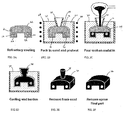
- Some embodiments of the present invention modify the conventional investment casting process in that the porous powder article that acts as the sacrificial pattern is not removed or lost prior to the casting of the molten metal, but instead combines with the cast molten metal to form the cast article. Such embodiments may include the following steps which are illustrated in FIGS. 2A-F.
- the porous powder article illustrated is widget pattern 2 from FIGS. 1A-D.
- the widget pattern 2 is coated with a ceramic to form a ceramic shell 22 on its exterior surface and on any interior surfaces it may have, for example, the surfaces of interior passageways 18, 20.
- the coating that forms ceramic shell 22 may be applied as in conventional investment casting, for example, by dipping, spraying, or pouring using a ceramic slurry.
- the wetting angle of the slurry with respect to the surface of the porous powder article, for example, widget pattern 2 should be greater than about 90 degrees in order to avoid infiltrating the slurry into the porous powder article.
- the coating may be dried under ambient conditions or special drying conditions, for example, in conditions that are obtainable in a heated oven.
- the ceramic may be any ceramic, including those that are conventionally used in investment casting, that is physically and chemically compatible with the molten metal that is to be cast and with the component materials of the porous powder article.
- the ceramic coated widget pattern 2 is surrounded by casting sand 24 within a vented casting flask 26. Due to the complexity of the geometry of a particular porous powder article, the casting sand 22 might not easily flow into certain areas, for example, passageways 18, 20 of widget pattern 2. The flow and proper compaction of the casting sand 24 around and into internal passageways 18, 20 of the widget pattern 2 can be enhanced by use of a vibration table. Care must be taken to compact the casting sand 24 without distorting the widget pattern 2 or the ceramic coating 22.
- a portion of the ceramic coating 22 Prior to surrounding the ceramic coated widget pattern 2 with the casting sand 24, a portion of the ceramic coating 22 is removed and a sprue 28 is set in place at that location to conduct the molten metal to the powder metal skeleton 29 of widget pattern 2.
- Gates and/or runners may also be used to help deliver the molten metal to the porous powder article.
- the porous powder article is designed and constructed to have integral gates and/or runners.
- the flask assembly 30 is preheated by a preheating means 32, for example, an oven or an air torch, to a temperature at which the binder in the widget pattern 2 is either partially or completely removed through evaporation or decomposition. Gases and vapors given off during this debinding process may exit through the sprue 28 and any gates and runners that are being used.
- the preheating also reduces the heat loss of the molten cast metal during the casting process.
- the preheating process may be conducted in air, but, more preferably, is conducted in a controlled atmosphere so that the surface condition of the metal powder of the porous powder article is optimized for the casting process.
- a protective atmosphere may be used to prevent the metal powder from oxidizing during the preheating. Examples of such protective atmospheres include hydrogen, nitrogen, argon, and combinations thereof.
- molten metal 34 is cast through the sprue 28 into the widget pattern 2.
- the molten metal 34 melts the powder skeleton 29 and takes on the geometry of the widget pattern 2.
- the molten metal 34 completely melts the powder of the skeleton 29, while in other embodiments the powder, in whole or in part, forms a composite with the molten metal 34.
- the casting step may be done either in air or under a protective atmosphere.
- the flask assembly 30 is cooled to solidify the cast molten metal 34.
- the solidified cast widget 36 is removed from the casting sand 24 and the ceramic coating 22 and the sprue 28 are removed from the cast widget 36.
- the sprue casting 38 is removed from the cast widget 36.
- the cast widget 36 may then be cleaned and inspected.
- a binder removal step is only necessary in cases where a binder must be removed from the porous powder article to prevent a deleterious reaction of the binder with the molten metal.
- no binder removal step is required, because the porous powder article contains little or no binder, as in some cases where the porous powder article is formed by in a process which uses the application of a compaction pressure to bond the powder together by mechanical interlocking or by contact-point welding.
- the binder removal step when used, may be done at any time prior to the casting step.
- the binder may be removed even before the coated porous powder article is placed in the casting flask.
- the coated porous powder article may be stored for a time period after binder removal and prior to placing it in the casting flask.
- the entire casting flask may be placed in storage after the binder removal and then later reheated prior to casting.
- preheating need only be done where it is necessary to prevent problems of premature solidification or to otherwise promote mold filling.
- the powder of the porous powder article is a metal powder that is completely melted by and mixes or alloys with the cast molten metal.
- the porous powder article is used as a pattern for a casting mold without a ceramic shell being formed on it.
- such embodiments may not produce as smooth a surface as those that use a ceramic shell and may require the use of a mold release agent or additional cleaning and additional care during mold making to avoid distorting the porous powder article, they eliminate the cost of producing and removing a ceramic shell.
- the use of a ceramic coating is preferred as the coating helps protect the structural integrity of the porous powder article prior to casting.
- any type of powder that is compatible with the selected article-forming process may be used to make the porous powder article.
- the type of powder is to be selected depending on the cast metal that is to be used and the properties that are desired for the cast article. In many cases, the powder chosen will be an elemental metal or a metal alloy, but ceramic powders and cermets may also be used.
- the powder may be iron or an iron alloy, including steel, for example, low carbon steel, medium carbon steel, high carbon steel, tool steel or stainless steel.
- the powder may also be nickel, a nickel alloy, aluminum, an aluminum alloy, titanium, a titanium alloy, copper, a copper alloy, magnesium, a magnesium alloy, zinc, a zinc alloy, an intermetallic compound, a refractory metal, or a refractory metal alloy.
- the powder and the cast metal will form a cast article which has a composite structure.
- the powder may have any type of particle shape.
- the relative density of the porous powder article be low, for example, in the range of 30-40%, irregular powder shapes are more preferable than spherical shapes in cases where the lower packing density attendant to irregular shaped powders results in the porous powder article having a low relative density.
- the cast metal may be any metal that is amenable to casting.
- the melting temperature of the cast metal can be higher or lower than that of the powder of the porous powder article.
- the casting metal and the powder of the porous powder article are of the same or similar compositions.
- the casting metal may be unalloyed aluminum and the powder an aluminum alloy.
- a widget of the same design that is shown in FIG. 2F as cast widget 36 is to be made of copper-tin bronze with a final composition of 90% copper and 10% tin.
- the widget is to be 3 cm wide, 1.5 cm high and 1 cm deep.
- a CAD file of a three-dimensional model of the widget is created.
- the CAD file is converted to an STP formatted file.
- a slicing algorithm is applied to the STP file to create a widget file that is to be used with a 3DP process rapid prototyping machine to create a porous powder article of the widget.
- a high tin bronze powder is acquired which has a composition of 80% copper and 20% tin and passes through a 140 mesh screen (106 micron opening size) and stands on a 325 mesh screen (45 micron opening size).
- a PROMETAL RTS 300 rapid prototyping machine manufactured by Extrude Hone Corporation of Irwin, Pennsylvania, U.S., utilizes the widget file and the high tin bronze powder to make, by the 3DP process, a porous powder article which has a relative density of 50%.
- the porous powder article is taken from the rapid prototyping machine and any excess powder is removed from the porous powder article. Gates and runners are attached to the porous powder article.
- a ceramic shell is coated onto the assembly of the porous particle article and its attached gates and runners by repeatedly dipping the assembly into a slurry of boron nitride and allowing the coating formed to dry. After the ceramic coating is created, the assembly is placed into a casting flask and a sprue is attached to the assembly. Casting sand is added to the casting flask and a vibration table is employed to help distribute the casting sand around the assembly, filling all internal and external voids, except those into which the molten metal is to be poured. A standard compaction technique is used to compact the casting sand around the assembly.
- the flask assembly is heated to about 790°C under a protective atmosphere of nitrogen to remove the polymer binder that was applied during the 3DP process from the porous powder article.
- pure copper is melted in a clay crucible at about 1200 °C by induction heating.
- the molten pure copper is poured into the sprue in the preheated flask assembly, which remains under the protective atmosphere of nitrogen.
- the molten pure copper flows into the porous powder article, melting and alloying with its powder and taking on its shape. After the casting solidifies and cools, it is removed from the casting sand.
- the ceramic coating is cleaned away, and the sprue, runner, and gates are removed from the widget
- the widget has a composition of 90% copper and 10% tin and is ready for inspection, finishing, testing, or use.
Landscapes
- Engineering & Computer Science (AREA)
- Chemical & Material Sciences (AREA)
- Manufacturing & Machinery (AREA)
- Mechanical Engineering (AREA)
- Materials Engineering (AREA)
- Metallurgy (AREA)
- Organic Chemistry (AREA)
- Composite Materials (AREA)
- Physics & Mathematics (AREA)
- Optics & Photonics (AREA)
- Powder Metallurgy (AREA)
- Jellies, Jams, And Syrups (AREA)
- Moulds For Moulding Plastics Or The Like (AREA)
- Transition And Organic Metals Composition Catalysts For Addition Polymerization (AREA)
- Molds, Cores, And Manufacturing Methods Thereof (AREA)
- Mold Materials And Core Materials (AREA)
Claims (16)
- Verfahren zur Herstellung einer Gussform, umfassend folgende Schritte:a) Herstellung eines Sinterpulver-Gegenstands (2), der eine relative Dichte im Bereich von 30% bis 50% hat, durch ein Festkörper-Freiform-Verfahren, undb) Herstellung einer Gussform für geschmolzenes Metall (34) unter Verwendung des Sinterpulver-Gegenstandes (2) als verlorene Form,wobei die Struktur des Sinterpulver-Gegenstands (2) im Wesentlichen während Giessens durch das geschmolzene Metall (34) zu zerstören ist, und das Pulver des Sinterpulver-Gegenstands (2) sich mit dem Gussteil (36) innig verbindet oder integriert, das sich bei Verfestigung des geformten geschmolzenen Metalls ergibt.
- Verfahren nach Anspruch 1, dadurch gekennzeichnet, dass das Festkörper-Freiformverfahren ausgewählt ist aus der Gruppe:dreidimensionales Pressen oder selektives Laser-Sintern.
- Verfahren nach einem der Ansprüche 1 oder 2, dadurch gekennzeichnet, dass die Herstellung des Sinterpulver-Gegenstands (2) wenigstens umfasst eines aus der Gruppe:ein Metallpulver, ein Keramikpulver und ein Cermet-Pulver.
- Verfahren nach einem der vorherigen Ansprüche, dadurch gekennzeichnet, dass der Sinterpulver-Gegenstand (2) mit einer keramischen Ummantelung (22) versehen wird.
- Verfahren nach Anspruch 4, dadurch gekennzeichnet, dass der Sinterpulver-Gegenstand (2) ein polymeres Bindemittel enthält, und dass das Verfahren weiterhin den Schritt des Befreiens des Sinterpulver-Gegenstands von dem polymeren Bindemittel nach dem Schritt des Versehens des Sinterpulver-Gegenstands mit einer keramischen Ummantelung umfasst.
- Verfahren nach Anspruch 5, dadurch gekennzeichnet, dass der Schritt des Befreiens von dem Bindemittel unter einer Schutzgasatmosphäre durchgeführt wird.
- Verfahren nach Anspruch 5 oder Anspruch 6, gekennzeichnet durch Lagerung des Sinterpulver-Gegenstands (2) nach dem Schritt des Befreiens des Sinterpulver-Gegenstands (2) von dem Bindemittel.
- Verfahren zur Herstellung eines Gussteils, wobei es umfasst:Herstellung einer Gussform durch das Verfahren gemäß einem der vorhergehenden Ansprücheund Gießen von geschmolzenem Metall (34) in die Gussform, in der sich das Pulver des Sinterpulver-Gegenstands (2) mit dem Gussartikel (36) innig verbindet oder integriert und der Schritt des Gießens des geschmolzenen Metalls (34) in die Gussform im Wesentlichen die Struktur des Sinterpulver-Gegenstands (2) zerstört.
- Verfahren nach Anspruch 8, dadurch gekennzeichnet, dass die Auswahl des Pulvers des Sinterpulver-Gegenstands (2) und des geschmolzenen Metalls (34) derart erfolgt, dass das Pulver und das geschmolzene Teil sich zu einem Komposite-Werkstoff nach dem Abkühlen nach dem Gießen verbinden.
- Verfahren nach Anspruch 8, dadurch gekennzeichnet, dass die Auswahl des Pulvers des Sinterpulver-Gegenstands (2) und des geschmolzenen Metalls (34) derart erfolgt, dass das geschmolzene Metall wenigstens teilweise das Pulver als Ergebnis des Gießens des geschmolzenen Metalls in die Gussform zum Schmelzen bringt.
- Verfahren nach einem der Ansprüche 8 bis 10, dadurch gekennzeichnet, dass die Gussform nach dem Verfahren nach einem der Ansprüche 1 bis 4 hergestellt wird, und dadurch, dass der Sinterpulver-Gegenstand (2) ein polymeres Bindemittel enthält, und das Verfahren weiterhin den Schritt des Befreiens des Sinterpulver-Gegenstands (2) von dem polymeren Bindemittel vor dem Schritt des Gießens umfasst.
- Verfahren nach einem der Ansprüche 8 bis 10, dadurch gekennzeichnet, dass die Gussform nach den Verfahren gemäß einem der Ansprüche 1 bis 4 hergestellt wird und das Verfahren außerdem den Schritt der Beheizung der Gussform umfasst.
- Verfahren nach Anspruch 12, gekennzeichnet durch die Lagerung der Gussform nach dem Schritt der Beheizung der Gussform.
- Verfahren nach einem der Ansprüche 8 bis 10, gekennzeichnet durch Beheizung der Gussform unmittelbar vor dem Gießen.
- Verfahren nach einem der Ansprüche 12 bis 14, dadurch gekennzeichnet, dass wenigstens einer der Schritte der Beheizung der Gussform und des Gießens unter einer Schutzgasatmosphäre durchgeführt wird.
- Verfahren nach Anspruch 6 oder Anspruch 15, dadurch gekennzeichnet, dass die Schutzgasatmosphäre wenigstens eines der Gase Wasserstoff, Stickstoff oder Argon umfasst.
Applications Claiming Priority (3)
| Application Number | Priority Date | Filing Date | Title |
|---|---|---|---|
| US40464202P | 2002-08-20 | 2002-08-20 | |
| US404642P | 2002-08-20 | ||
| PCT/US2003/005903 WO2004018132A1 (en) | 2002-08-20 | 2003-02-25 | Casting process and articles for performing the same |
Publications (2)
| Publication Number | Publication Date |
|---|---|
| EP1534451A1 EP1534451A1 (de) | 2005-06-01 |
| EP1534451B1 true EP1534451B1 (de) | 2007-02-14 |
Family
ID=31946733
Family Applications (1)
| Application Number | Title | Priority Date | Filing Date |
|---|---|---|---|
| EP03716204A Expired - Lifetime EP1534451B1 (de) | 2002-08-20 | 2003-02-25 | Giessverfahren |
Country Status (13)
| Country | Link |
|---|---|
| US (1) | US7461684B2 (de) |
| EP (1) | EP1534451B1 (de) |
| JP (1) | JP4421477B2 (de) |
| KR (1) | KR20050058404A (de) |
| CN (1) | CN1684786A (de) |
| AT (1) | ATE353729T1 (de) |
| AU (1) | AU2003219919A1 (de) |
| CA (1) | CA2496382A1 (de) |
| DE (1) | DE60311824T2 (de) |
| ES (1) | ES2281635T3 (de) |
| PT (1) | PT1534451E (de) |
| RU (1) | RU2311984C2 (de) |
| WO (1) | WO2004018132A1 (de) |
Cited By (2)
| Publication number | Priority date | Publication date | Assignee | Title |
|---|---|---|---|---|
| FR2961725A1 (fr) * | 2010-06-29 | 2011-12-30 | Peugeot Citroen Automobiles Sa | Procede de moulage a modele perdu |
| US10105769B2 (en) | 2014-04-17 | 2018-10-23 | Kennametal Inc. | Machining tool and method for manufacturing a machining tool |
Families Citing this family (91)
| Publication number | Priority date | Publication date | Assignee | Title |
|---|---|---|---|---|
| US20040206470A1 (en) * | 2003-04-18 | 2004-10-21 | William Marsh Rice University | Containerless infiltration with electromagnetic levitation |
| US7578335B2 (en) * | 2004-08-24 | 2009-08-25 | Gm Global Technology Operations, Inc. | Powder metal mold casting for three dimensional parts |
| US7141207B2 (en) * | 2004-08-30 | 2006-11-28 | General Motors Corporation | Aluminum/magnesium 3D-Printing rapid prototyping |
| US8575513B2 (en) * | 2006-07-06 | 2013-11-05 | Siemens Energy, Inc. | Rapid prototyping of ceramic articles |
| WO2008103984A2 (en) * | 2007-02-23 | 2008-08-28 | The Exone Company | Automated powdered infiltrant transfer apparatus and method |
| US20100044903A1 (en) * | 2007-02-23 | 2010-02-25 | The Exone Company | Automated infiltrant transfer apparatus and method |
| DE112008000475T5 (de) * | 2007-02-23 | 2010-07-08 | The Ex One Company | Austauschbarer Fertigungsbehälter für dreidimensionalen Drucker |
| GB2454010B (en) * | 2007-10-26 | 2009-11-11 | Castings Technology Internat | Casting a metal object |
| US20090169410A1 (en) * | 2007-12-31 | 2009-07-02 | Slaton David S | Method of forming a thermo pyrolytic graphite-embedded heatsink |
| DE102009041162A1 (de) * | 2009-09-11 | 2011-03-24 | Bayerische Motoren Werke Aktiengesellschaft | Verfahren zur Herstellung eines Gussteils |
| US8225841B1 (en) | 2011-01-03 | 2012-07-24 | James Avery Craftsman, Inc. | Central sprue for investment casting |
| US8424585B2 (en) | 2011-01-21 | 2013-04-23 | James Avery Craftsman, Inc. | Method and apparatus for creating a pattern |
| FR2981867B1 (fr) * | 2011-10-26 | 2016-02-12 | Snecma | Procede de fabrication d'une piece metallique pour turboreacteur d'aeronefs |
| US8567477B2 (en) * | 2012-02-29 | 2013-10-29 | Ford Global Technologies, Llc | Mold core for forming a molding tool |
| US20130221192A1 (en) * | 2012-02-29 | 2013-08-29 | Ford Motor Company | Interchangeable mold inserts |
| US9079803B2 (en) * | 2012-04-05 | 2015-07-14 | United Technologies Corporation | Additive manufacturing hybrid core |
| CN102886901A (zh) * | 2012-11-04 | 2013-01-23 | 张德胜 | 利用太阳能的三维打印线聚光光源和打印方法 |
| CA2891597A1 (en) | 2012-12-14 | 2014-06-19 | Western Michigan University Research Foundation | Patternless sand mold and core formation for rapid casting |
| US20140191439A1 (en) * | 2013-01-04 | 2014-07-10 | New York University | Continuous Feed 3D Manufacturing |
| US9579851B2 (en) | 2013-03-22 | 2017-02-28 | Markforged, Inc. | Apparatus for fiber reinforced additive manufacturing |
| US9815268B2 (en) | 2013-03-22 | 2017-11-14 | Markforged, Inc. | Multiaxis fiber reinforcement for 3D printing |
| US10953609B1 (en) | 2013-03-22 | 2021-03-23 | Markforged, Inc. | Scanning print bed and part height in 3D printing |
| US9694544B2 (en) | 2013-03-22 | 2017-07-04 | Markforged, Inc. | Methods for fiber reinforced additive manufacturing |
| US9186848B2 (en) | 2013-03-22 | 2015-11-17 | Markforged, Inc. | Three dimensional printing of composite reinforced structures |
| CA3121870A1 (en) | 2013-03-22 | 2014-09-25 | Markforged, Inc. | Three dimensional printing |
| US11237542B2 (en) | 2013-03-22 | 2022-02-01 | Markforged, Inc. | Composite filament 3D printing using complementary reinforcement formations |
| US9688028B2 (en) | 2013-03-22 | 2017-06-27 | Markforged, Inc. | Multilayer fiber reinforcement design for 3D printing |
| US10682844B2 (en) * | 2013-03-22 | 2020-06-16 | Markforged, Inc. | Embedding 3D printed fiber reinforcement in molded articles |
| US9156205B2 (en) | 2013-03-22 | 2015-10-13 | Markforged, Inc. | Three dimensional printer with composite filament fabrication |
| US9186846B1 (en) | 2013-03-22 | 2015-11-17 | Markforged, Inc. | Methods for composite filament threading in three dimensional printing |
| US9956725B2 (en) | 2013-03-22 | 2018-05-01 | Markforged, Inc. | Three dimensional printer for fiber reinforced composite filament fabrication |
| US9126365B1 (en) | 2013-03-22 | 2015-09-08 | Markforged, Inc. | Methods for composite filament fabrication in three dimensional printing |
| US9149988B2 (en) | 2013-03-22 | 2015-10-06 | Markforged, Inc. | Three dimensional printing |
| US11981069B2 (en) | 2013-03-22 | 2024-05-14 | Markforged, Inc. | Three dimensional printing of composite reinforced structures |
| RU2535704C1 (ru) * | 2013-04-18 | 2014-12-20 | Общество С Ограниченной Ответственностью "Группа "Магнезит" | Способ трехмерной печати огнеупорных изделий |
| US9415438B2 (en) | 2013-04-19 | 2016-08-16 | United Technologies Corporation | Method for forming single crystal parts using additive manufacturing and remelt |
| CN104139155A (zh) * | 2013-05-06 | 2014-11-12 | 福特汽车公司 | 用于生成模具组件的模的添加制备方法 |
| JP6475232B2 (ja) | 2013-06-05 | 2019-02-27 | マークフォージド,インコーポレーテッド | 繊維強化付加製造方法 |
| WO2015100084A1 (en) * | 2013-12-23 | 2015-07-02 | The Exone Company | Method of three-dimensional printing using a multi-component build powder |
| US20150197061A1 (en) * | 2014-01-15 | 2015-07-16 | Caterpillar Inc. | Customized laser metal powder 3d printed consumable weld inserts |
| DE102014207510B4 (de) | 2014-04-17 | 2021-12-16 | Kennametal Inc. | Zerspanungswerkzeug sowie Verfahren zum Herstellen eines Zerspanungswerkzeugs |
| KR102288589B1 (ko) * | 2014-08-02 | 2021-08-12 | 복셀젯 아게 | 특히 냉간 주조 방법에 사용되는 방법 및 주조 몰드 |
| US9643282B2 (en) | 2014-10-17 | 2017-05-09 | Kennametal Inc. | Micro end mill and method of manufacturing same |
| EP3209488B1 (de) * | 2014-10-23 | 2021-10-06 | Facebook Inc. | Herstellung von strukturinternen leiterbahnen und verbindungen für dreidimensionale hergestellte strukturen |
| KR102440771B1 (ko) | 2014-12-12 | 2022-09-06 | 마테리온 코포레이션 | 베릴륨을 포함하는 제품의 적층 가공 |
| EP3233334B1 (de) * | 2014-12-19 | 2020-10-07 | Roshan, Hathibelagal, M. | Stahlschaumstoff und verfahren zur herstellung eines stahlschaumstoffes |
| US10493522B2 (en) | 2014-12-19 | 2019-12-03 | Maynard Steel Casting Company | Steel foam and method for manufacturing steel foam |
| US9623480B2 (en) | 2014-12-19 | 2017-04-18 | Hathibelagal M. Roshan | Steel foam and method for manufacturing steel foam |
| AU2016215334A1 (en) * | 2015-02-03 | 2017-08-17 | The Nanosteel Company, Inc. | Infiltrated ferrous materials |
| KR101736108B1 (ko) * | 2015-06-09 | 2017-05-17 | 주식회사 대화알로이테크 | 써멧의 주조식 제조방법 및 그에 의해 제조된 써멧 |
| BG67021B1 (bg) * | 2015-07-14 | 2020-02-28 | „Принт Каст“ Оод | Метод за директно леене на отливки чрез послойно изграждане на монолитни композитни леярски форми с интегрирани сърца и система за послойно изграждане на монолитни композитни леярски форми с интегрирани сърца за директно леене на отливки |
| RU2614480C2 (ru) * | 2015-07-20 | 2017-03-28 | Федеральное государственное бюджетное образовательное учреждение высшего профессионального образования "Уфимский государственный авиационный технический университет" | Способ получения комбинированной формы для отливки сложных заготовок из титановых сплавов |
| RU168847U1 (ru) * | 2015-07-28 | 2017-02-21 | Публичное акционерное общество "Красногорский завод им. С.А. Зверева" | Пресс-форма для изготовления выплавляемых моделей |
| US10150184B2 (en) | 2015-10-21 | 2018-12-11 | Siemens Energy, Inc. | Method of forming a cladding layer having an integral channel |
| CN105834360B (zh) * | 2015-11-18 | 2018-03-06 | 连云港源钰金属制品有限公司 | 采用3d打印制作壳模的铸造方法 |
| RU2612480C1 (ru) * | 2015-12-07 | 2017-03-09 | Федеральное государственное бюджетное учреждение науки Институт физики прочности и материаловедения Сибирского отделения Российской академии наук (ИФПМ СО РАН) | Способ получения низкомодульных сплавов на основе системы титан-ниобий селективным лазерным сплавлением |
| CN105499492B (zh) * | 2015-12-15 | 2017-08-11 | 清华大学 | 非密实结构新铸型 |
| US10099283B2 (en) | 2015-12-17 | 2018-10-16 | General Electric Company | Method and assembly for forming components having an internal passage defined therein |
| US10137499B2 (en) | 2015-12-17 | 2018-11-27 | General Electric Company | Method and assembly for forming components having an internal passage defined therein |
| US10099284B2 (en) | 2015-12-17 | 2018-10-16 | General Electric Company | Method and assembly for forming components having a catalyzed internal passage defined therein |
| US10150158B2 (en) | 2015-12-17 | 2018-12-11 | General Electric Company | Method and assembly for forming components having internal passages using a jacketed core |
| US9579714B1 (en) | 2015-12-17 | 2017-02-28 | General Electric Company | Method and assembly for forming components having internal passages using a lattice structure |
| US10099276B2 (en) | 2015-12-17 | 2018-10-16 | General Electric Company | Method and assembly for forming components having an internal passage defined therein |
| US10046389B2 (en) | 2015-12-17 | 2018-08-14 | General Electric Company | Method and assembly for forming components having internal passages using a jacketed core |
| US9987677B2 (en) | 2015-12-17 | 2018-06-05 | General Electric Company | Method and assembly for forming components having internal passages using a jacketed core |
| US9968991B2 (en) | 2015-12-17 | 2018-05-15 | General Electric Company | Method and assembly for forming components having internal passages using a lattice structure |
| US10118217B2 (en) | 2015-12-17 | 2018-11-06 | General Electric Company | Method and assembly for forming components having internal passages using a jacketed core |
| US10335853B2 (en) | 2016-04-27 | 2019-07-02 | General Electric Company | Method and assembly for forming components using a jacketed core |
| US10286450B2 (en) | 2016-04-27 | 2019-05-14 | General Electric Company | Method and assembly for forming components using a jacketed core |
| FR3054149B1 (fr) | 2016-07-22 | 2019-04-05 | Safran | Procede de fabrication de moule carapace |
| RU2723684C2 (ru) * | 2016-10-20 | 2020-06-17 | Общество с ограниченной ответственностью "Редиус 168" | Способ формирования изделий |
| WO2018085430A1 (en) * | 2016-11-01 | 2018-05-11 | Shiloh Industries, Inc. | Composite part with external part cast around internal insert and method for producing the same |
| US20180134029A1 (en) * | 2016-11-14 | 2018-05-17 | Desktop Metal, Inc. | Controlling layer separation in stereolithographic fabrication |
| DE102017204968A1 (de) | 2017-03-23 | 2018-09-27 | Bayerische Motoren Werke Aktiengesellschaft | Verfahren zur Herstellung eines Gussteils |
| US10864676B2 (en) | 2017-06-01 | 2020-12-15 | Nike, Inc. | Methods of manufacturing articles utilizing foam particles |
| RU2674120C1 (ru) * | 2017-06-15 | 2018-12-04 | Общество с ограниченной ответственностью "Редиус 168" | Способ изготовления изделий в опоке |
| EP3421156B1 (de) * | 2017-06-30 | 2020-06-24 | Ansaldo Energia Switzerland AG | Giessverfahren zur herstellung einer schaufel für eine gasturbine |
| US11407034B2 (en) | 2017-07-06 | 2022-08-09 | OmniTek Technology Ltda. | Selective laser melting system and method of using same |
| CN107737926A (zh) * | 2017-09-18 | 2018-02-27 | 大族激光科技产业集团股份有限公司 | 一种多孔铝合金的激光增材制造方法 |
| CN107617722A (zh) * | 2017-09-26 | 2018-01-23 | 安徽伟工机械科技有限公司 | 一种应用消失模铸造工件的铸造方法 |
| DE102017221126A1 (de) * | 2017-11-27 | 2019-05-29 | Sms Group Gmbh | Walzgerüst |
| KR102075919B1 (ko) * | 2018-06-22 | 2020-05-19 | 한국생산기술연구원 | 바인더-제트 방식 3d 프린팅용 3차원 경량화 패턴 구조, 이를 이용한 주조 공정용 주형 및 주조공정 |
| CN109158542A (zh) * | 2018-09-14 | 2019-01-08 | 浙江省机电产品质量检测所 | 基于激光选区烧结的陶瓷型铸造ps整体模具及其快速铸造方法 |
| US11141787B2 (en) | 2018-10-10 | 2021-10-12 | Schlumberger Technology Corporation | Concurrent, layer-by-layer powder and mold fabrication for multi-functional parts |
| EP3861880B1 (de) | 2018-12-06 | 2024-02-21 | Nike Innovate C.V. | Artikel mit schaumstoffpartikeln und verfahren zur herstellung von artikeln unter verwendung von schaumstoffpartikeln |
| CN109622967B (zh) * | 2019-02-01 | 2021-03-12 | 上海交通大学 | 一种增材制造不锈钢-镁互锁双金属复杂形状零件的方法 |
| CN114945458A (zh) | 2019-11-19 | 2022-08-26 | 耐克创新有限合伙公司 | 制造具有泡沫颗粒的物品的方法 |
| US11548060B2 (en) | 2020-09-18 | 2023-01-10 | GM Global Technology Operations LLC | High heat-absorption core for manufacturing of castings |
| US11654476B2 (en) | 2020-09-28 | 2023-05-23 | GM Global Technology Operations LLC | Hybrid core for manufacturing of castings |
| CN112496262A (zh) * | 2020-10-20 | 2021-03-16 | 浙江省机电设计研究院有限公司 | 一种基于sls技术的铝合金铸件快速铸造工艺 |
| CN115319045B (zh) * | 2022-08-03 | 2024-11-22 | 三一集团有限公司 | 离心铸造模具及离心铸造模具的制造方法 |
Family Cites Families (43)
| Publication number | Priority date | Publication date | Assignee | Title |
|---|---|---|---|---|
| US3722574A (en) | 1971-06-29 | 1973-03-27 | United Aircraft Corp | Process of making magnesium oxide cores |
| US4093017A (en) * | 1975-12-29 | 1978-06-06 | Sherwood Refractories, Inc. | Cores for investment casting process |
| US4312398A (en) | 1979-09-28 | 1982-01-26 | The Boeing Company | Method of forming fiber and metal composite structures |
| US4476916A (en) | 1981-07-27 | 1984-10-16 | Nusbaum Henry J | Method of casting metal matrix composite in ceramic shell mold |
| US4491558A (en) * | 1981-11-05 | 1985-01-01 | Minnesota Mining And Manufacturing Company | Austenitic manganese steel-containing composite article |
| JPS6026821B2 (ja) * | 1982-03-29 | 1985-06-26 | 工業技術院長 | 粒子分散型複合材料の製造方法 |
| US4617979A (en) | 1984-07-19 | 1986-10-21 | Nikkei Kako Kabushiki Kaisha | Method for manufacture of cast articles of fiber-reinforced aluminum composite |
| RU2021881C1 (ru) * | 1986-10-17 | 1994-10-30 | Борд оф Риджентс, Дзе Юниверсити оф Тексас Систем | Способ изготовления детали и устройство для его осуществления |
| US4832105A (en) | 1988-01-13 | 1989-05-23 | The Interlake Corporation | Investment casting method and apparatus, and cast article produced thereby |
| US5119864A (en) | 1988-11-10 | 1992-06-09 | Lanxide Technology Company, Lp | Method of forming a metal matrix composite through the use of a gating means |
| US5197528A (en) | 1988-11-10 | 1993-03-30 | Lanxide Technology Company, Lp | Investment casting technique for the formation of metal matrix composite bodies and products produced thereby |
| US5553657A (en) | 1988-11-10 | 1996-09-10 | Lanxide Technology Company, Lp | Gating means for metal matrix composite manufacture |
| US5010945A (en) | 1988-11-10 | 1991-04-30 | Lanxide Technology Company, Lp | Investment casting technique for the formation of metal matrix composite bodies and products produced thereby |
| DE3907923C1 (de) | 1989-03-11 | 1989-12-07 | Messerschmitt-Boelkow-Blohm Gmbh, 8012 Ottobrunn, De | |
| US5204055A (en) | 1989-12-08 | 1993-04-20 | Massachusetts Institute Of Technology | Three-dimensional printing techniques |
| US5387380A (en) * | 1989-12-08 | 1995-02-07 | Massachusetts Institute Of Technology | Three-dimensional printing techniques |
| US5487420A (en) | 1990-05-09 | 1996-01-30 | Lanxide Technology Company, Lp | Method for forming metal matrix composite bodies by using a modified spontaneous infiltration process and products produced thereby |
| JPH0489155A (ja) * | 1990-08-02 | 1992-03-23 | Hitachi Metal Precision Ltd | 複合部を有する精密鋳造品の製造方法 |
| US5394930A (en) | 1990-09-17 | 1995-03-07 | Kennerknecht; Steven | Casting method for metal matrix composite castings |
| US5113925A (en) | 1990-10-09 | 1992-05-19 | Pcast Equipment Corporation | Investment casting of metal matrix composites |
| US5234045A (en) | 1991-09-30 | 1993-08-10 | Aluminum Company Of America | Method of squeeze-casting a complex metal matrix composite in a shell-mold cushioned by molten metal |
| DE4230970C1 (de) | 1992-09-16 | 1994-07-21 | Nolte Markus Dipl Ing Dipl Wir | Verfahren zur Herstellung von Feingussteilen |
| US5490882A (en) | 1992-11-30 | 1996-02-13 | Massachusetts Institute Of Technology | Process for removing loose powder particles from interior passages of a body |
| US5775402A (en) * | 1995-10-31 | 1998-07-07 | Massachusetts Institute Of Technology | Enhancement of thermal properties of tooling made by solid free form fabrication techniques |
| US5511603A (en) | 1993-03-26 | 1996-04-30 | Chesapeake Composites Corporation | Machinable metal-matrix composite and liquid metal infiltration process for making same |
| US5322109A (en) | 1993-05-10 | 1994-06-21 | Massachusetts Institute Of Technology, A Massachusetts Corp. | Method for pressure infiltration casting using a vent tube |
| JPH0747443A (ja) * | 1993-08-06 | 1995-02-21 | Yamagata Seimitsu Chuzo Kk | ロストワックス鋳造方法 |
| CA2134805A1 (en) * | 1993-11-29 | 1995-05-30 | Furgan Z. Shaikh | Rapidly making complex castings |
| CA2142636C (en) * | 1994-02-18 | 2005-09-20 | Salvatore Caldarise | Implantable articles with as-cast macrotextured surface regions and method of manufacturing the same |
| US5839329A (en) * | 1994-03-16 | 1998-11-24 | Baker Hughes Incorporated | Method for infiltrating preformed components and component assemblies |
| US5765624A (en) * | 1994-04-07 | 1998-06-16 | Oshkosh Truck Corporation | Process for casting a light-weight iron-based material |
| US5524696A (en) | 1994-08-05 | 1996-06-11 | General Motors Corporation | Method of making a casting having an embedded preform |
| GB2301545B (en) | 1995-06-02 | 1999-04-28 | Aea Technology Plc | The manufacture of composite materials |
| JP3454636B2 (ja) * | 1996-06-05 | 2003-10-06 | 理化学研究所 | 粉末積層法による三次元形状創成方法 |
| AU5245598A (en) * | 1996-11-08 | 1998-05-29 | Nu-Cast Inc. | Improved truss structure design |
| JPH1121639A (ja) * | 1997-07-01 | 1999-01-26 | Aisin Seiki Co Ltd | プリフォームの製造方法 |
| US6148899A (en) | 1998-01-29 | 2000-11-21 | Metal Matrix Cast Composites, Inc. | Methods of high throughput pressure infiltration casting |
| JP2000330468A (ja) * | 1999-05-18 | 2000-11-30 | Hitachi Ltd | 模型製作方法および装置 |
| US6776219B1 (en) * | 1999-09-20 | 2004-08-17 | Metal Matrix Cast Composites, Inc. | Castable refractory investment mold materials and methods of their use in infiltration casting |
| US6405785B1 (en) * | 2000-01-28 | 2002-06-18 | Mold-Masters Limited | Injection molding component with heating element and method of making |
| US6397922B1 (en) * | 2000-05-24 | 2002-06-04 | Massachusetts Institute Of Technology | Molds for casting with customized internal structure to collapse upon cooling and to facilitate control of heat transfer |
| US6585930B2 (en) * | 2001-04-25 | 2003-07-01 | Extrude Hone Corporation | Method for article fabrication using carbohydrate binder |
| US20030024611A1 (en) | 2001-05-15 | 2003-02-06 | Cornie James A. | Discontinuous carbon fiber reinforced metal matrix composite |
-
2003
- 2003-02-25 AU AU2003219919A patent/AU2003219919A1/en not_active Abandoned
- 2003-02-25 AT AT03716204T patent/ATE353729T1/de not_active IP Right Cessation
- 2003-02-25 PT PT03716204T patent/PT1534451E/pt unknown
- 2003-02-25 RU RU2005107702/02A patent/RU2311984C2/ru not_active IP Right Cessation
- 2003-02-25 US US10/416,148 patent/US7461684B2/en not_active Expired - Lifetime
- 2003-02-25 ES ES03716204T patent/ES2281635T3/es not_active Expired - Lifetime
- 2003-02-25 DE DE60311824T patent/DE60311824T2/de not_active Expired - Lifetime
- 2003-02-25 CN CNA038234793A patent/CN1684786A/zh active Pending
- 2003-02-25 KR KR1020057002911A patent/KR20050058404A/ko not_active Abandoned
- 2003-02-25 JP JP2004530767A patent/JP4421477B2/ja not_active Expired - Fee Related
- 2003-02-25 WO PCT/US2003/005903 patent/WO2004018132A1/en not_active Ceased
- 2003-02-25 EP EP03716204A patent/EP1534451B1/de not_active Expired - Lifetime
- 2003-02-25 CA CA002496382A patent/CA2496382A1/en not_active Abandoned
Cited By (3)
| Publication number | Priority date | Publication date | Assignee | Title |
|---|---|---|---|---|
| FR2961725A1 (fr) * | 2010-06-29 | 2011-12-30 | Peugeot Citroen Automobiles Sa | Procede de moulage a modele perdu |
| US10105769B2 (en) | 2014-04-17 | 2018-10-23 | Kennametal Inc. | Machining tool and method for manufacturing a machining tool |
| US10646936B2 (en) | 2014-04-17 | 2020-05-12 | Kennametal Inc. | Machining tool and method for manufacturing a machining tool |
Also Published As
| Publication number | Publication date |
|---|---|
| DE60311824T2 (de) | 2007-10-31 |
| JP4421477B2 (ja) | 2010-02-24 |
| DE60311824D1 (de) | 2007-03-29 |
| US20040140078A1 (en) | 2004-07-22 |
| AU2003219919A1 (en) | 2004-03-11 |
| JP2005536353A (ja) | 2005-12-02 |
| US7461684B2 (en) | 2008-12-09 |
| CN1684786A (zh) | 2005-10-19 |
| KR20050058404A (ko) | 2005-06-16 |
| WO2004018132A1 (en) | 2004-03-04 |
| EP1534451A1 (de) | 2005-06-01 |
| ES2281635T3 (es) | 2007-10-01 |
| CA2496382A1 (en) | 2004-03-04 |
| RU2311984C2 (ru) | 2007-12-10 |
| PT1534451E (pt) | 2007-05-31 |
| RU2005107702A (ru) | 2005-09-10 |
| ATE353729T1 (de) | 2007-03-15 |
Similar Documents
| Publication | Publication Date | Title |
|---|---|---|
| US7461684B2 (en) | Casting process and articles for performing same | |
| Cheah et al. | Rapid prototyping and tooling techniques: a review of applications for rapid investment casting | |
| EP1089844B1 (de) | Verfahren zur herstellung von feuerfesten formkörpern | |
| US6581671B2 (en) | System for infiltrating preformed components and component assemblies | |
| US8770260B2 (en) | Method for rapid generation of multiple investment cast parts such as turbine or compressor wheels | |
| JP2021042475A (ja) | ベリリウムを含有する物品の付加製造 | |
| EP0968062B1 (de) | Verfahren zur herstellung von völlig dichten metallformen | |
| JP2003129862A (ja) | タービン翼の製造方法 | |
| US20170246678A1 (en) | Casting with first metal components and second metal components | |
| CA2958680A1 (en) | Casting with graded core components | |
| Kruth et al. | Advances in selective laser sintering | |
| EP3431206B1 (de) | Vorrichtung und verfahren zur feingusskernherstellung | |
| EP1037723A1 (de) | Verfahren zur herstellung von keramikformen unter verwendung von verlorenen metallmodellen | |
| Amon | Shape deposition manufacturing with microcasting | |
| Bugle et al. | RAPID NET SHAPE. | |
| Fussell et al. | A sprayed steel tool for permanent mold casting of aluminum | |
| Prinz et al. | A Sprayed Steel Tool for Permanent Mold Casting of Aluminum* PS Fussell, EP Patrick | |
| Agarwal et al. | Rapid Tooling for Forging Dies | |
| Greulich et al. | Application of rapid prototyping in the foundry industry | |
| HK1027520B (en) | Method of constructing fully dense metal molds | |
| HK1027520A (en) | Method of constructing fully dense metal molds |
Legal Events
| Date | Code | Title | Description |
|---|---|---|---|
| PUAI | Public reference made under article 153(3) epc to a published international application that has entered the european phase |
Free format text: ORIGINAL CODE: 0009012 |
|
| 17P | Request for examination filed |
Effective date: 20050315 |
|
| AK | Designated contracting states |
Kind code of ref document: A1 Designated state(s): AT BE BG CH CY CZ DE DK EE ES FI FR GB GR HU IE IT LI LU MC NL PT SE SI SK TR |
|
| AX | Request for extension of the european patent |
Extension state: AL LT LV MK RO |
|
| 17Q | First examination report despatched |
Effective date: 20050603 |
|
| DAX | Request for extension of the european patent (deleted) | ||
| RAP1 | Party data changed (applicant data changed or rights of an application transferred) |
Owner name: EX ONE CORPORATION |
|
| RIN1 | Information on inventor provided before grant (corrected) |
Inventor name: LIU, JIANXIN Inventor name: RYNERSON, MICHAEL, L. |
|
| 17Q | First examination report despatched |
Effective date: 20050603 |
|
| RTI1 | Title (correction) |
Free format text: CASTING PROCESS |
|
| GRAP | Despatch of communication of intention to grant a patent |
Free format text: ORIGINAL CODE: EPIDOSNIGR1 |
|
| GRAS | Grant fee paid |
Free format text: ORIGINAL CODE: EPIDOSNIGR3 |
|
| GRAA | (expected) grant |
Free format text: ORIGINAL CODE: 0009210 |
|
| AK | Designated contracting states |
Kind code of ref document: B1 Designated state(s): AT BE BG CH CY CZ DE DK EE ES FI FR GB GR HU IE IT LI LU MC NL PT SE SI SK TR |
|
| PG25 | Lapsed in a contracting state [announced via postgrant information from national office to epo] |
Ref country code: DK Free format text: LAPSE BECAUSE OF FAILURE TO SUBMIT A TRANSLATION OF THE DESCRIPTION OR TO PAY THE FEE WITHIN THE PRESCRIBED TIME-LIMIT Effective date: 20070214 Ref country code: CH Free format text: LAPSE BECAUSE OF FAILURE TO SUBMIT A TRANSLATION OF THE DESCRIPTION OR TO PAY THE FEE WITHIN THE PRESCRIBED TIME-LIMIT Effective date: 20070214 Ref country code: FI Free format text: LAPSE BECAUSE OF FAILURE TO SUBMIT A TRANSLATION OF THE DESCRIPTION OR TO PAY THE FEE WITHIN THE PRESCRIBED TIME-LIMIT Effective date: 20070214 Ref country code: SI Free format text: LAPSE BECAUSE OF FAILURE TO SUBMIT A TRANSLATION OF THE DESCRIPTION OR TO PAY THE FEE WITHIN THE PRESCRIBED TIME-LIMIT Effective date: 20070214 Ref country code: BE Free format text: LAPSE BECAUSE OF FAILURE TO SUBMIT A TRANSLATION OF THE DESCRIPTION OR TO PAY THE FEE WITHIN THE PRESCRIBED TIME-LIMIT Effective date: 20070214 Ref country code: NL Free format text: LAPSE BECAUSE OF FAILURE TO SUBMIT A TRANSLATION OF THE DESCRIPTION OR TO PAY THE FEE WITHIN THE PRESCRIBED TIME-LIMIT Effective date: 20070214 Ref country code: LI Free format text: LAPSE BECAUSE OF FAILURE TO SUBMIT A TRANSLATION OF THE DESCRIPTION OR TO PAY THE FEE WITHIN THE PRESCRIBED TIME-LIMIT Effective date: 20070214 Ref country code: AT Free format text: LAPSE BECAUSE OF FAILURE TO SUBMIT A TRANSLATION OF THE DESCRIPTION OR TO PAY THE FEE WITHIN THE PRESCRIBED TIME-LIMIT Effective date: 20070214 |
|
| REG | Reference to a national code |
Ref country code: GB Ref legal event code: FG4D |
|
| PG25 | Lapsed in a contracting state [announced via postgrant information from national office to epo] |
Ref country code: MC Free format text: LAPSE BECAUSE OF NON-PAYMENT OF DUE FEES Effective date: 20070228 |
|
| REG | Reference to a national code |
Ref country code: CH Ref legal event code: EP |
|
| REF | Corresponds to: |
Ref document number: 60311824 Country of ref document: DE Date of ref document: 20070329 Kind code of ref document: P |
|
| REG | Reference to a national code |
Ref country code: IE Ref legal event code: FG4D |
|
| PG25 | Lapsed in a contracting state [announced via postgrant information from national office to epo] |
Ref country code: SE Free format text: LAPSE BECAUSE OF FAILURE TO SUBMIT A TRANSLATION OF THE DESCRIPTION OR TO PAY THE FEE WITHIN THE PRESCRIBED TIME-LIMIT Effective date: 20070514 |
|
| PG25 | Lapsed in a contracting state [announced via postgrant information from national office to epo] |
Ref country code: BG Free format text: LAPSE BECAUSE OF EXPIRATION OF PROTECTION Effective date: 20070515 |
|
| REG | Reference to a national code |
Ref country code: PT Ref legal event code: SC4A Free format text: AVAILABILITY OF NATIONAL TRANSLATION Effective date: 20070423 |
|
| RAP2 | Party data changed (patent owner data changed or rights of a patent transferred) |
Owner name: THE EX ONE COMPANY |
|
| NLV1 | Nl: lapsed or annulled due to failure to fulfill the requirements of art. 29p and 29m of the patents act | ||
| ET | Fr: translation filed | ||
| REG | Reference to a national code |
Ref country code: CH Ref legal event code: PL |
|
| REG | Reference to a national code |
Ref country code: ES Ref legal event code: FG2A Ref document number: 2281635 Country of ref document: ES Kind code of ref document: T3 |
|
| PG25 | Lapsed in a contracting state [announced via postgrant information from national office to epo] |
Ref country code: SK Free format text: LAPSE BECAUSE OF FAILURE TO SUBMIT A TRANSLATION OF THE DESCRIPTION OR TO PAY THE FEE WITHIN THE PRESCRIBED TIME-LIMIT Effective date: 20070214 |
|
| PLBE | No opposition filed within time limit |
Free format text: ORIGINAL CODE: 0009261 |
|
| STAA | Information on the status of an ep patent application or granted ep patent |
Free format text: STATUS: NO OPPOSITION FILED WITHIN TIME LIMIT |
|
| PG25 | Lapsed in a contracting state [announced via postgrant information from national office to epo] |
Ref country code: CZ Free format text: LAPSE BECAUSE OF FAILURE TO SUBMIT A TRANSLATION OF THE DESCRIPTION OR TO PAY THE FEE WITHIN THE PRESCRIBED TIME-LIMIT Effective date: 20070214 |
|
| 26N | No opposition filed |
Effective date: 20071115 |
|
| PG25 | Lapsed in a contracting state [announced via postgrant information from national office to epo] |
Ref country code: IE Free format text: LAPSE BECAUSE OF NON-PAYMENT OF DUE FEES Effective date: 20070226 |
|
| PG25 | Lapsed in a contracting state [announced via postgrant information from national office to epo] |
Ref country code: IT Free format text: LAPSE BECAUSE OF FAILURE TO SUBMIT A TRANSLATION OF THE DESCRIPTION OR TO PAY THE FEE WITHIN THE PRESCRIBED TIME-LIMIT Effective date: 20070214 Ref country code: GR Free format text: LAPSE BECAUSE OF FAILURE TO SUBMIT A TRANSLATION OF THE DESCRIPTION OR TO PAY THE FEE WITHIN THE PRESCRIBED TIME-LIMIT Effective date: 20070515 |
|
| REG | Reference to a national code |
Ref country code: GB Ref legal event code: 732E |
|
| REG | Reference to a national code |
Ref country code: PT Ref legal event code: PC4A Owner name: THE EX ONE COMPANY, US Effective date: 20080609 |
|
| REG | Reference to a national code |
Ref country code: FR Ref legal event code: TP |
|
| PG25 | Lapsed in a contracting state [announced via postgrant information from national office to epo] |
Ref country code: EE Free format text: LAPSE BECAUSE OF FAILURE TO SUBMIT A TRANSLATION OF THE DESCRIPTION OR TO PAY THE FEE WITHIN THE PRESCRIBED TIME-LIMIT Effective date: 20070214 |
|
| PG25 | Lapsed in a contracting state [announced via postgrant information from national office to epo] |
Ref country code: CY Free format text: LAPSE BECAUSE OF FAILURE TO SUBMIT A TRANSLATION OF THE DESCRIPTION OR TO PAY THE FEE WITHIN THE PRESCRIBED TIME-LIMIT Effective date: 20070214 |
|
| PG25 | Lapsed in a contracting state [announced via postgrant information from national office to epo] |
Ref country code: LU Free format text: LAPSE BECAUSE OF NON-PAYMENT OF DUE FEES Effective date: 20070225 |
|
| PG25 | Lapsed in a contracting state [announced via postgrant information from national office to epo] |
Ref country code: TR Free format text: LAPSE BECAUSE OF FAILURE TO SUBMIT A TRANSLATION OF THE DESCRIPTION OR TO PAY THE FEE WITHIN THE PRESCRIBED TIME-LIMIT Effective date: 20070214 Ref country code: HU Free format text: LAPSE BECAUSE OF FAILURE TO SUBMIT A TRANSLATION OF THE DESCRIPTION OR TO PAY THE FEE WITHIN THE PRESCRIBED TIME-LIMIT Effective date: 20070815 |
|
| PGFP | Annual fee paid to national office [announced via postgrant information from national office to epo] |
Ref country code: ES Payment date: 20100312 Year of fee payment: 8 Ref country code: PT Payment date: 20100210 Year of fee payment: 8 |
|
| PGFP | Annual fee paid to national office [announced via postgrant information from national office to epo] |
Ref country code: DE Payment date: 20110223 Year of fee payment: 9 Ref country code: FR Payment date: 20110218 Year of fee payment: 9 |
|
| PGFP | Annual fee paid to national office [announced via postgrant information from national office to epo] |
Ref country code: GB Payment date: 20110223 Year of fee payment: 9 |
|
| REG | Reference to a national code |
Ref country code: PT Ref legal event code: MM4A Free format text: LAPSE DUE TO NON-PAYMENT OF FEES Effective date: 20110825 |
|
| PG25 | Lapsed in a contracting state [announced via postgrant information from national office to epo] |
Ref country code: PT Free format text: LAPSE BECAUSE OF NON-PAYMENT OF DUE FEES Effective date: 20110825 |
|
| REG | Reference to a national code |
Ref country code: ES Ref legal event code: FD2A Effective date: 20120411 |
|
| PG25 | Lapsed in a contracting state [announced via postgrant information from national office to epo] |
Ref country code: ES Free format text: LAPSE BECAUSE OF NON-PAYMENT OF DUE FEES Effective date: 20110226 |
|
| GBPC | Gb: european patent ceased through non-payment of renewal fee |
Effective date: 20120225 |
|
| REG | Reference to a national code |
Ref country code: FR Ref legal event code: ST Effective date: 20121031 |
|
| REG | Reference to a national code |
Ref country code: DE Ref legal event code: R119 Ref document number: 60311824 Country of ref document: DE Effective date: 20120901 |
|
| PG25 | Lapsed in a contracting state [announced via postgrant information from national office to epo] |
Ref country code: FR Free format text: LAPSE BECAUSE OF NON-PAYMENT OF DUE FEES Effective date: 20120229 Ref country code: GB Free format text: LAPSE BECAUSE OF NON-PAYMENT OF DUE FEES Effective date: 20120225 |
|
| PG25 | Lapsed in a contracting state [announced via postgrant information from national office to epo] |
Ref country code: DE Free format text: LAPSE BECAUSE OF NON-PAYMENT OF DUE FEES Effective date: 20120901 |