EP1534127B1 - System und verfahren zur vorhersage des einsetzens von herzpathologie mit fraktaler analyse - Google Patents
System und verfahren zur vorhersage des einsetzens von herzpathologie mit fraktaler analyse Download PDFInfo
- Publication number
- EP1534127B1 EP1534127B1 EP03724280A EP03724280A EP1534127B1 EP 1534127 B1 EP1534127 B1 EP 1534127B1 EP 03724280 A EP03724280 A EP 03724280A EP 03724280 A EP03724280 A EP 03724280A EP 1534127 B1 EP1534127 B1 EP 1534127B1
- Authority
- EP
- European Patent Office
- Prior art keywords
- time
- lead
- lsum
- leads
- log
- Prior art date
- Legal status (The legal status is an assumption and is not a legal conclusion. Google has not performed a legal analysis and makes no representation as to the accuracy of the status listed.)
- Expired - Lifetime
Links
Images



Classifications
-
- A—HUMAN NECESSITIES
- A61—MEDICAL OR VETERINARY SCIENCE; HYGIENE
- A61B—DIAGNOSIS; SURGERY; IDENTIFICATION
- A61B5/00—Measuring for diagnostic purposes; Identification of persons
- A61B5/24—Detecting, measuring or recording bioelectric or biomagnetic signals of the body or parts thereof
- A61B5/316—Modalities, i.e. specific diagnostic methods
- A61B5/318—Heart-related electrical modalities, e.g. electrocardiography [ECG]
- A61B5/346—Analysis of electrocardiograms
-
- A—HUMAN NECESSITIES
- A61—MEDICAL OR VETERINARY SCIENCE; HYGIENE
- A61B—DIAGNOSIS; SURGERY; IDENTIFICATION
- A61B5/00—Measuring for diagnostic purposes; Identification of persons
- A61B5/24—Detecting, measuring or recording bioelectric or biomagnetic signals of the body or parts thereof
- A61B5/316—Modalities, i.e. specific diagnostic methods
- A61B5/318—Heart-related electrical modalities, e.g. electrocardiography [ECG]
-
- A—HUMAN NECESSITIES
- A61—MEDICAL OR VETERINARY SCIENCE; HYGIENE
- A61B—DIAGNOSIS; SURGERY; IDENTIFICATION
- A61B5/00—Measuring for diagnostic purposes; Identification of persons
- A61B5/24—Detecting, measuring or recording bioelectric or biomagnetic signals of the body or parts thereof
- A61B5/316—Modalities, i.e. specific diagnostic methods
- A61B5/318—Heart-related electrical modalities, e.g. electrocardiography [ECG]
- A61B5/346—Analysis of electrocardiograms
- A61B5/349—Detecting specific parameters of the electrocardiograph cycle
-
- A—HUMAN NECESSITIES
- A61—MEDICAL OR VETERINARY SCIENCE; HYGIENE
- A61B—DIAGNOSIS; SURGERY; IDENTIFICATION
- A61B5/00—Measuring for diagnostic purposes; Identification of persons
- A61B5/24—Detecting, measuring or recording bioelectric or biomagnetic signals of the body or parts thereof
- A61B5/316—Modalities, i.e. specific diagnostic methods
- A61B5/318—Heart-related electrical modalities, e.g. electrocardiography [ECG]
- A61B5/346—Analysis of electrocardiograms
- A61B5/349—Detecting specific parameters of the electrocardiograph cycle
- A61B5/358—Detecting ST segments
Definitions
- This invention is directed to the prediction of acute cardiac activity from the fractal analysis of spatial loops generated from the synthesized leads of an electrocardiogram ("ECG") derived from three measured leads belonging to the set of routinely used leads, including the standard 12-lead ECG.
- ECG electrocardiogram
- the ECG is a record of the electrical activity of the heart that is a commonly used diagnostic screening test in many medical settings.
- the standard ECG record includes 12 lead waveforms, denoted as I, II, III, aVR, aVL, aVF, V1, V2, V3, V4, V5, and V6, arranged in a specific order that is interpreted by a physician using pattern recognition techniques.
- the ECG is acquired by physicians, nurses or other specially trained technicians using specialized hardware and equipment. In the usual configuration, 10 electrodes are placed on the body torso to measure the electrical potentials that define the standard 12 leads. Other lead systems have been tested over the years.
- VCG Frank vectorcardiogram
- rhythm monitor It is usual in the practice of medicine to place patients with potential cardiac abnormalities on a rhythm monitor, a specially designed hardware equipment that displays only one ECG lead but which has the capability of measuring 3 different leads. There are some manufacturers who have designed rhythm monitors that can display three leads as well but the usual display format is still one lead. With this equipment, the patient has 3 to 4 electrodes placed on the body torso to acquire the 3 different lead configurations. While the patient is connected to the rhythm monitor, if a standard 12 lead ECG is ordered, the technician will then place all of the additional electrodes for the separate acquisition of the ECG.
- the efficiency of acquiring an ECG would be improved if there existed a process by which the standard 12 lead ECG, the 3 lead VCG, the 4 right chest leads, or the 3 left posterior leads could be acquired instantaneously on demand from the rhythm monitor rather than the usual ECG machine, using fewer than standard number of electrodes.
- Nicklas et al., in United States Patent No. 5,058,598 , invented a system for synthesizing ECG leads based on developing a patient-specific transform. This system could synthesize a 12 lead ECG based on receiving data from 3 leads. However, this system required first acquiring a complete n-lead ECG from a patient in the usual manner in order to compute a patient specific transformation, which would then be applied subsequent ECG data acquired from that patient. This is cumbersome, as the resulting transformation is applicable to only one patient and needs to be stored in a medium that must be accessible for use during the patient's hospital stay. In addition, the Nicklas transformation may also have a time dependency, indicating that the patient transform may change with time such that the transformation may need to be re-computed for each subsequent encounter with that patient for diagnostic accuracy.
- a method according to the preamble of claim 1 is known from WO9809226 .
- the present invention solves the aforementioned problems by using the mathematical techniques of abstract factor analysis and the simplex optimization algorithm to derive a universal transformation matrix that is applicable to all patients and is independent of time.
- This universal transformation matrix is thus applicable when needed and does not require the acquisition of a complete n-lead ECG for each patient prior to its implementation.
- ECG training set ⁇ ⁇ ⁇ ⁇ ⁇ ⁇ ⁇ ⁇ ⁇ ⁇ ⁇ ⁇ ⁇ ⁇ ⁇ ⁇ ⁇ ⁇ ⁇ ⁇ ⁇ ⁇ ⁇ ⁇ ⁇ ⁇ ⁇ ⁇ ⁇ ⁇ ⁇ ⁇ ⁇ ⁇ ⁇ ⁇ ⁇ ⁇ ⁇ ⁇ ⁇ ⁇ ⁇ ⁇ ⁇ ⁇ ⁇ ⁇ ⁇ ⁇ ⁇ ⁇ ⁇ ⁇ ⁇ ⁇ ⁇ ⁇ ⁇ ⁇ ⁇ ⁇ ⁇ ⁇ ⁇ ⁇ ⁇ ⁇ ⁇ ⁇ ⁇ ⁇ ⁇ ⁇ ⁇ ⁇ ⁇ ⁇ ⁇ ⁇ ⁇ ⁇ ⁇ ⁇ ⁇ ⁇ ⁇ ⁇ ⁇ ⁇ ⁇ ⁇ ⁇ ⁇ ⁇ ⁇ ⁇ ⁇ ⁇ ⁇ ⁇ ⁇ ⁇ ⁇ ⁇ ⁇ ⁇ ⁇ ⁇ ⁇ ⁇ ⁇ ⁇ ⁇ ⁇ ⁇ ⁇ ⁇ ⁇ ⁇ ⁇ ⁇ ⁇ ⁇ ⁇
- the abstract factor analysis (“AFA”) technique is applied to each ECG voltage-time data array training set in order to minimize the error in the measured arrays.
- the final step is then to apply the simplex optimization technique (“SOP") in order to derive a universal transformation matrix applicable to all patients, and is time independent.
- This universal transformation matrix can then be applied to a standard measured 3 lead subsystem to derive the standard 12 lead ECG as well as other systems, and can generate up to 22 leads to enable a more accurate interpretation of cardiac electrical activity.
- These derived ECG values are approximately 98% accurate when compared to observed lead measurements.
- the standard 3 lead system used to synthesize the 12 lead ECG are the measured I, aVF and V2 leads that belong to the standard 12-lead system.
- This measured lead set is conventional and familiar to clinical staff and are thus easy to apply.
- the application of abstract factor analysis and simplex optimization are described in the inventor's copending application, "SYSTEM AND METHOD FOR SYNTHESIZING LEADS OF AN ELECTROCARDIOGRAM", patent application serial number 10/150,719, filed on May 17, 2002 . Since this lead set approximates an orthogonal system, these lead vectors can be plotted against each other in a 3-dimensional space to yield a space curve whose properties can be correlated with coronary pathologies.
- the properties of the 3-dimensional spatial curve can be characterized by calculating the fractal indices of the curves, and the values of these fractal indices are predictive of acute cardiac syndromes.
- the full cycle of cardiac activity is represented by a wave known as the PQRST wave, defined by Einthoven, Arch. ges Phys. 150:275, 1913 , reprinted in Am. Heart J. 40:163, 1950, translation by H.E. Huff and P. Sekelj .
- This wave represents full contraction and relaxation of the heart.
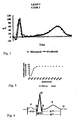
- An example of a PQRST wave is shown in FIG. 4 .
- One complete heart cycle averages 1/72 seconds.
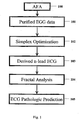
- FIG. 1 A flow chart illustrating the overall process of the invention is depicted in FIG. 1 .
- the first step, shown in block 100, is the application of abstract factor analysis to a training data set.
- Abstract factor analysis (“AFA") is applied to the entire n-lead ECG measured data matrix in this invention to "pretreat" the training set of ECGs, from which the transformation matrix is derived via simplex optimization, so as to minimize the inherent error in this training set.
- AFA abstract factor analysis
- AFA abstract factor analysis
- FIG. 2 A comparison of ECG values for lead I as measured and as predicted through AFA is shown in FIG. 2 , showing close agreement.
- the ECG can be represented in an n-dimensional system by a linear sum of product terms.
- Abstract factor analysis identifies n, the number of factors influencing the data set, K, the transformation coefficient matrix, and X , the abstract lead-vector set.
- AFA NxM data matrix [V] of voltage-time measurements, where N is the number of leads, and M is the number of data points.
- a covariance matrix is diagonalized to yield a set of eigenvalues ⁇ j that can be ordered by magnitude.
- Each eigenvalue ⁇ j corresponds to an orthogonal basis eigenvector X j .
- M is typically 300 measurements over one complete cycle.
- Multiple training sets of the NxM matrix are subjected to the AFA technique.
- FIG. 3 is a graph of the cumulative percentage variance as a function of ⁇ j and illustrates that most of the information content of the system is contained in the first 3 eigenvalues.
- AFA demonstrates that 3 leads can account for approximately 98-99% of the information content of a 12-lead ECG.
- the resulting transformation matrix [K] is a 3x12 matrix of purified ECG data, as indicated in block 101 of FIG. 1 .
- the full 12 lead set of measurements can be calculated by multiplying the transformation matrix [K] by the 3xM voltage-time data matrix for the 3 measured leads. This result can easily be generalized to a system with an arbitrary number of leads, hence our n-lead ECG terminology.
- SOP simplex optimization technique
- Simplex optimization which is different from the simplex algorithm used for minimizing constrained linear systems, is a method for finding a maximum for a multiple variable function when the underlying function may be unknown.
- R P + (P - W), where P is the centroid of the figure when the worst value point is eliminated.
- the new simplex is defined to be B, R, and N, and the process is restarted.
- the values of the other leads are calculated as functions of a 3-lead set, preferably ⁇ I, aVF, V2 ⁇ .
- the simplex will be a 3-dimensional figure defined by 4 points that represent the starting values of ⁇ I, aVF, V2 ⁇ .
- the results of this optimization were used to define, at step 103, an Nx3 universal transformation matrix [K] such that when multiplied by a vector comprising the 3 leads ⁇ I, aVF, V2 ⁇ for a particular time yield a full n-lead ECG.
- the [K] matrix was calculated for the full PP cycle of the heart beat as well for segments within the PP cycle, such as the PR interval, the QRS interval, the SP interval, and the QT interval.
- the accuracy of the optimization was checked and validated by comparing the derived values and coefficients for the II, III, aVR, and aVL leads with measured values for those leads.
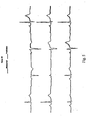
- a comparison of a synthesized ECG based on values derived from simplex optimization with a measured ECG is depicted in FIG. 5 .
- the inventor has verified through the application of AFA that ⁇ 98-99% of the information displayed thereon can be reproduced from the measurement of just 3 leads. Since these leads are approximately orthogonal, values takes at the same time can be plotted against each other in 3-dimensional space, resulting in a spatial ECG loop. Virtually all of the information in a 12-lead ECG is in the 3-dimensional spatial ECG loop.
- the inventor has verified that the information content of lead configurations of up to 22 leads can be reproduced from just 3 measured leads. By increasing the lead space to 22 leads, clinicians can more accurately diagnose cardiac pathology, such as right heart infarction or posterior infarction.
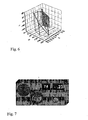
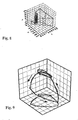
- FIG. 6 A typical 3-dimensional ("3D") spatial loop for a normal male heart is shown in FIG. 6 .
- This type of display can easily be built into a standard heart monitor, shown in FIG. 7 , that incorporates the single wave configuration as currently exists.
- This spatial loop can also be printed for the patient medical record.
- the 3D spatial loop displayed in FIG. 8 represents an acute inferior MI.
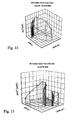
- FIGS 12 and 13 Another example of the comparison of 3D spatial loops for normal cardiac activity versus acute MI cardiac activity can be found in FIGS 12 and 13 .
- the vectorial forces of cardiac potentials are shown in a counter-clockwise 3D spatial ECG loop depicted in FIG. 9 .
- the 3-dimensional spatial ECG loops can serve as teaching devices to educate clinicians in the field of cardiac electrophysiology.
- the cardiac electrical vector traces a loop in time in N-dimensions, where N is the number of leads.
- N is the number of leads.
- Abstracts factor analysis has demonstrated that we can take N as equal to 3, and thus we plot leads I, aVF and V2 against each other as they are approximately orthogonal.
- the spatial loop cannot be regarded as a curve in an N-dimensional space, where N is the number of leads.
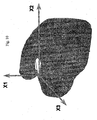
- This spatial loop has a defined surface area, defined by triangles swept out by the loop vector as it advances in time. This is illustrated in FIG. 10 .
- the length structure and surface area defined by this spatial loop can yield information characterizing the pathologic state of a patient.
- a fractal index can be calculated from the spatial loop at step 104 of FIG.
- this index can predict the presence or absence of pathologic acute coronary syndromes ("ACS") at step 105 of FIG. 1 .
- This index can also serve as a trigger upon which the synthesized ECG can be automatically printed, saving time and money, and possibly a patient's life as the diagnosis of ACS can be made at the point of service, possible before symptoms develop.
- This spatial curve can be characterized by various fractal indices.
- the time rate of change in index values from a baseline value are also predictive of cardiac activity.
- a fractal index can be calculated from the sequence of triangles formed with area A(t) and perimeter L(t), as shown in FIG. 11 .
- the variance in a function of the fractal index on a beat-to-beat basis is a measurement of autonomic activity.
- These fractal indices can be calculated by a device such as the modified portable bedside heart monitor depicted in FIG. 7 .
- a method of calculating a fractal index for a spatial loop useful in the analysis of ECGs is based on a calculation of a fractal index adapted for a planar curve as described in Katz for 2 dimensional X-Y data.
- the Katz paper provides examples of this formula applied to several basic waveforms of 30 points each in Katz's Fig. 1 .
- the method of Katz's formula for D in X-Y data can be readily applied to the spatial loops defined by the ECG lead values, for spatial loops in any dimension.
- the fractal dimension for an N-dimensional loop it is useful to define some preliminary quantities.
- D is a length in an N-dimensional space
- L is an arc segment in the N-dimensional space defined by the difference between D(t k ) and D(t k-1 ), the length at the previous time t k-1 .
- the time t k can be thought of as k ⁇ t, where ⁇ t is a unit of time.
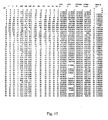
- FIG. 17 depicts a spreadsheet table of lead values measured 46 times over the ST-segment of the cardiac cycle. These lead values are for the standard 12-lead set, which is I, II, III, aVR, aVL, aVF, V1, V2, V3, V4, V5, and V6.
- the columns labeled "D”, “L”, “DD”, “LSUM”, and the “Y” column of "FD” correspond to values for, respectively, D(t k ), L (t k ) , DD (t k ) , LSUM (t k ) , and FD(k), as defined above.
- the columns labeled "ST” and "X” are values of the time interval counter, k.
- the time rate of change of FD as a function of k as k increases can also be readily calculated for the spatial loops.
- the inventor has found that the time derivative of FD, hereinafter referred to as FD', is an excellent predictor of ACS because FD' separates into negative and positive values based on normal versus abnormal cardiac activity, respectively. This separation of values is graphically illustrated in FIGS. 14 , 15 and 16 .
- the crossover of FD' from negative to positive values can serve as a trigger for generating an alarm and for automatically printing the synthesized ECGs, saving time and money, and possibly a patient's life.
- the fact that the crossover of FD' is predictive of the onset of MI allows the diagnosis of ACS to be made at the point of service, possibly before symptoms of ACS actually develop. This time difference can make the difference in saving a patient's life.
- the method of the invention can be implemented on any computer system using any available programming language.
- One embodiment of the invention is implemented using Microsoft Visual Basic executing on a personal computer running the Windows operating system.
- the invention is not limited to this implementation, however, and implementations is other programming languages executing on other machines, such as the Mackintosh, or workstations running under the Unix operating system or variants thereof, such as Linux, are within the scope of the invention.
- the method of the invention can be implemented in a standard heart monitor that has been modified to acquire 3 leads in phase, display a 3D spatial loop, calculate a fractal index for that loop and monitor the time rate of change of the fractal index.
- modifications can be accomplished by the addition of dedicated, computer hardware and software to the monitor.
- This software can be programmed with the universal transformation matrix claimed in the inventor's co-pending application to calculate an N-lead ECG from the three acquired leads, and to display the spatial loop and to calculate the fractal index and monitor its time rate of change.
- the modified monitor can print the full N-lead ECG and sound or indicate an alarm when a change in the time derivative of the fractal index indicates the onset of cardiac pathology.
Landscapes
- Health & Medical Sciences (AREA)
- Life Sciences & Earth Sciences (AREA)
- Cardiology (AREA)
- Heart & Thoracic Surgery (AREA)
- Molecular Biology (AREA)
- Pathology (AREA)
- Engineering & Computer Science (AREA)
- Biomedical Technology (AREA)
- Physics & Mathematics (AREA)
- Medical Informatics (AREA)
- Biophysics (AREA)
- Surgery (AREA)
- Animal Behavior & Ethology (AREA)
- General Health & Medical Sciences (AREA)
- Public Health (AREA)
- Veterinary Medicine (AREA)
- Measurement And Recording Of Electrical Phenomena And Electrical Characteristics Of The Living Body (AREA)
- Measuring Pulse, Heart Rate, Blood Pressure Or Blood Flow (AREA)
- Investigating Or Analysing Biological Materials (AREA)
Claims (16)
- Verfahren zum Vorhersagen einer Herzpathologie, das die Schritte umfasst, dass:mehrere Kanalwerte als Funktion der Zeit für einen Satz von Elektrokardiogrammkanälen erlangt werden;eine räumliche Kurve aus den Kanalwerten für mindestens drei Kanäle definiert wird;dadurch gekennzeichnet, dass ein fraktaler Index als Funktion der Zeit für die räumliche Kurve berechnet wird; unddie zeitliche Änderung des fraktalen Index überwacht wird, wobei eine negative zeitliche Änderung des fraktalen Index eine normale Herztätigkeit angibt und eine positive zeitliche Änderung des fraktalen Index eine pathologische Herztätigkeit angibt.
- Verfahren nach Anspruch 1,
das ferner den Schritt umfasst, dass die Kanalwerte aus Elektrodenauslesungen berechnet werden, die von an einem Patienten befestigten Elektroden erfasst werden. - Verfahren nach Anspruch 1,
wobei der Satz von Elektrokardiogrammkanälen von 3 bis zu etwa 80 Kanälen umfasst, und wobei der komplette Satz von Elektrokardiogrammkanälen aus einer Teilmenge von mindestens 3 Elektrokardiogrammkanälen berechnet werden kann, indem eine universelle Transformationsmatrix verwendet wird. - Verfahren nach Anspruch 1,
wobei der fraktale Index durch die Gleichung
definiert ist, wobei:tk = kδt die Zeit nach k Intervallen der Zeiteinheit δt ist;
 N die Anzahl an Elektrokardiogrammkanälen darstellt; undxi(tk) den Wert des i-ten Kanals in dem N-Kanalsatz zur Zeit tk darstellt.
 - Verfahren nach Anspruch 1,
wobei der fraktale Index durch die Gleichung
definiert ist, wobeitk = kδt die Zeit nach k Intervallen der Zeiteinheit δt ist;



wobei D(tk) = (ΣN i=1 xi 2(tk))1/2 und N die Anzahl an Elektrokardiogrammkanälen darstellt; und xi(tk) den Wert des i-ten Kanals in dem N-Kanalsatz zur Zeit tk darstellt.
 - Verfahren nach Anspruch 1,
wobei der fraktale Index durch die Gleichung
definiert ist, wobeitk = kδt die Zeit nach k Intervallen der Zeiteinheit δt ist;




wobei D(tk) = (ΣN i=1 xi 2(tk))1/2 und N die Anzahl an Elektrokardiogrammkanälen darstellt; und xi(tk) den Wert des i-ten Kanals in dem N-Kanalsatz zur Zeit tk darstellt.
 - Verfahren nach Anspruch 1,
das ferner den Schritt umfasst, dass die räumliche Schleife an einem Herzmonitor angezeigt wird. - Verfahren nach Anspruch 1,
das ferner die Schritte umfasst, dass die Werte des fraktalen Index an einem Herzmonitor angezeigt werden und die Werte des fraktalen Index an dem Herzmonitor gespeichert werden. - Vorrichtung zum Überwachen der Herztätigkeit, umfassend:ein Mittel zum Erlangen mehrerer Kanalwerte als Funktion der Zeit für einen Satz von Elektrokardiogrammkanälen;ein Mittel zum Definieren einer räumlichen Kurve aus den Kanalwerten von mindestens drei Kanälen;gekennzeichnet durchein Mittel zum Berechnen eines fraktalen Index als Funktion der Zeit für die räumliche Kurve; undein Mittel zum Überwachen der zeitlichen Änderung des fraktalen Index, wobei eine negative zeitliche Änderung des fraktalen Index eine normale Herztätigkeit angibt und eine positive zeitliche Änderung des fraktalen Index eine pathologische Herztätigkeit angibt.
- Vorrichtung nach Anspruch 9,
ferner umfassend ein Mittel zum Berechnen der Kanalwerte aus Elektrodenauslesungen, die von an einem Patienten befestigten Elektroden erfasst werden. - Vorrichtung nach Anspruch 9,
wobei der Satz von Elektrokardiogrammkanälen von 3 bis zu etwa 80 Kanälen umfasst, und ferner umfassend ein Mittel zum Berechnen des kompletten Satzes von Elektrokardiogrammkanälen aus einer Teilmenge von mindestens 3 Elektrokardiogrammkanälen, indem eine universelle Transformationsmatrix verwendet wird. - Vorrichtung nach Anspruch 9,
wobei der fraktale Index durch die Gleichung
definiert ist, wobei:tk = kδt die Zeit nach k Intervallen der Zeiteinheit δt ist;
 N die Anzahl an Elektrokardiogrammkanälen darstellt; undxi(tk) den Wert des i-ten Kanals in dem N-Kanalsatz zur Zeit tk darstellt.
 - Vorrichtung nach Anspruch 9,
wobei der fraktale Index durch die Gleichung
definiert ist, wobeitk = kδt die Zeit nach k Intervallen der Zeiteinheit δt ist;



wobei D(tk) = (ΣN i=1 xi 2(tk))1/2 und N die Anzahl an Elektrokardiogrammkanälen darstellt; und xi(tk) den Wert des i-ten Kanals in dem N-Kanalsatz zur Zeit tk darstellt.
 - Vorrichtung nach Anspruch 9,
wobei der fraktale Index durch die Gleichung
definiert ist, wobeitk = kδt die Zeit nach k Intervallen der Zeiteinheit δt ist;



wobei D(tk) = (ΣN i=1 xi 2(tk))1/2 und N die Anzahl an Elektrokardiogrammkanälen darstellt; und xi(tk) den Wert des i-ten Kanals in dem N-Kanalsatz zur Zeit tk darstellt.
 - Vorrichtung nach Anspruch 9,
ferner umfassend ein Mittel zum Anzeigen der räumlichen Schleife. - Vorrichtung nach Anspruch 9,
ferner umfassend ein Mittel zum Anzeigen der Werte des fraktalen Index und zum Speichern der Werte des fraktalen Index.
Applications Claiming Priority (3)
| Application Number | Priority Date | Filing Date | Title |
|---|---|---|---|
| US10/187,662 US6920349B2 (en) | 2002-07-01 | 2002-07-01 | System and method for predicting the onset of cardiac pathology using fractal analysis |
| US187662 | 2002-07-01 | ||
| PCT/US2003/013071 WO2004002304A1 (en) | 2002-07-01 | 2003-04-28 | System and method for predicting the onset of cardiac pathology using fractal analysis |
Publications (3)
| Publication Number | Publication Date |
|---|---|
| EP1534127A1 EP1534127A1 (de) | 2005-06-01 |
| EP1534127A4 EP1534127A4 (de) | 2010-02-10 |
| EP1534127B1 true EP1534127B1 (de) | 2011-04-13 |
Family
ID=29780060
Family Applications (1)
| Application Number | Title | Priority Date | Filing Date |
|---|---|---|---|
| EP03724280A Expired - Lifetime EP1534127B1 (de) | 2002-07-01 | 2003-04-28 | System und verfahren zur vorhersage des einsetzens von herzpathologie mit fraktaler analyse |
Country Status (11)
| Country | Link |
|---|---|
| US (1) | US6920349B2 (de) |
| EP (1) | EP1534127B1 (de) |
| JP (1) | JP4724417B2 (de) |
| CN (1) | CN1681434A (de) |
| AT (1) | ATE505133T1 (de) |
| AU (1) | AU2003231150B2 (de) |
| CA (1) | CA2491470C (de) |
| DE (1) | DE60336729D1 (de) |
| ES (1) | ES2370890T3 (de) |
| WO (1) | WO2004002304A1 (de) |
| ZA (1) | ZA200500879B (de) |
Families Citing this family (14)
| Publication number | Priority date | Publication date | Assignee | Title |
|---|---|---|---|---|
| US7117108B2 (en) * | 2003-05-28 | 2006-10-03 | Paul Ernest Rapp | System and method for categorical analysis of time dependent dynamic processes |
| JP2005079834A (ja) * | 2003-08-29 | 2005-03-24 | Pentax Corp | 色変換マトリクス算出方法および画像信号処理装置 |
| IL163796A0 (en) * | 2004-08-30 | 2005-12-18 | Gribova Orna A | Device for detecting changes in blood glucose level or dardiovacular condition |
| US8303507B2 (en) * | 2004-09-07 | 2012-11-06 | Kabushiki Kaisha Toshiba | Ultrasonic doppler diagnostic apparatus and measuring method of diagnostic parameter |
| US8219600B2 (en) * | 2006-10-10 | 2012-07-10 | Michael Epelbaum | Generating and applying analytic measurements |
| US7840259B2 (en) * | 2006-11-30 | 2010-11-23 | General Electric Company | Method and system for electrocardiogram evaluation |
| US8321005B2 (en) * | 2009-10-13 | 2012-11-27 | Siemens Medical Solutions Usa, Inc. | System for continuous cardiac pathology detection and characterization |
| US8296108B2 (en) * | 2010-04-02 | 2012-10-23 | Yugen Kaisha Suwa Torasuto | Time series data analyzer, and a computer-readable recording medium recording a time series data analysis program |
| KR101510522B1 (ko) | 2013-07-17 | 2015-04-10 | 건국대학교 산학협력단 | 심전도 신호 분류 시스템 |
| WO2015095577A1 (en) * | 2013-12-20 | 2015-06-25 | St. Jude Medical, Cardiology Division, Inc. | Coaxial electrode catheters for extracting electrophysiologic parameters |
| US10602946B2 (en) * | 2015-12-30 | 2020-03-31 | Vectracor, Inc. | Mobile cardiac monitoring device |
| DE102021100558B3 (de) | 2021-01-13 | 2022-05-05 | Oliver Hein | Verfahren und Vorrichtung zur technischen Unterstützung der Analyse von messtechnisch erfassten Signalen, die einen zeit- und raumabhängigen Signalverlauf aufweisen |
| KR102670032B1 (ko) * | 2021-08-17 | 2024-05-28 | 주식회사 메디컬에이아이 | 2유도 심전도 데이터를 이용한 복수개의 표준 심전도 데이터 생성 시스템 |
| CN117100283B (zh) * | 2023-07-26 | 2024-05-03 | 兴化市人民医院 | 一种十二导联心电图的生成方法和装置 |
Family Cites Families (8)
| Publication number | Priority date | Publication date | Assignee | Title |
|---|---|---|---|---|
| US4850370A (en) * | 1987-07-22 | 1989-07-25 | Dower Gordon E | Method and apparatus for sensing and analyzing electrical activity of the human heart |
| US5058598A (en) * | 1990-08-03 | 1991-10-22 | Nicklas John M | Method and apparatus for synthesizing leads of an electrocardiogram |
| US5161539A (en) * | 1991-05-09 | 1992-11-10 | Physio-Control | Method and apparatus for performing mapping-type analysis including use of limited electrode sets |
| US6021345A (en) * | 1991-05-17 | 2000-02-01 | Cedars-Sinai Medical Center | Methods for detecting propensity for fibrillation using an electrical restitution curve |
| GB9310604D0 (en) * | 1993-05-21 | 1993-07-07 | British Tech Group | Analysis of heart waveforms |
| WO1995003739A1 (en) * | 1993-08-03 | 1995-02-09 | Peter Walter Kamen | A method of measuring autonomic activity of a patient |
| US5471991A (en) * | 1993-11-16 | 1995-12-05 | Trustees Of The University Of Pennsylvania | Wavelet analysis of fractal systems |
| US6144877A (en) * | 1998-08-11 | 2000-11-07 | The United States Of America As Represented By The Department Of Health And Human Services | Determining the hurst exponent for time series data |
-
2002
- 2002-07-01 US US10/187,662 patent/US6920349B2/en not_active Expired - Lifetime
-
2003
- 2003-04-28 DE DE60336729T patent/DE60336729D1/de not_active Expired - Lifetime
- 2003-04-28 CN CNA038195801A patent/CN1681434A/zh active Pending
- 2003-04-28 AU AU2003231150A patent/AU2003231150B2/en not_active Ceased
- 2003-04-28 EP EP03724280A patent/EP1534127B1/de not_active Expired - Lifetime
- 2003-04-28 WO PCT/US2003/013071 patent/WO2004002304A1/en not_active Ceased
- 2003-04-28 JP JP2004517524A patent/JP4724417B2/ja not_active Expired - Lifetime
- 2003-04-28 AT AT03724280T patent/ATE505133T1/de not_active IP Right Cessation
- 2003-04-28 CA CA2491470A patent/CA2491470C/en not_active Expired - Fee Related
- 2003-04-28 ES ES03724280T patent/ES2370890T3/es not_active Expired - Lifetime
-
2005
- 2005-01-31 ZA ZA2005/00879A patent/ZA200500879B/en unknown
Also Published As
| Publication number | Publication date |
|---|---|
| US6920349B2 (en) | 2005-07-19 |
| ZA200500879B (en) | 2005-10-26 |
| WO2004002304A1 (en) | 2004-01-08 |
| AU2003231150A1 (en) | 2004-01-19 |
| AU2003231150B2 (en) | 2008-05-29 |
| JP4724417B2 (ja) | 2011-07-13 |
| CN1681434A (zh) | 2005-10-12 |
| JP2005531359A (ja) | 2005-10-20 |
| ES2370890T3 (es) | 2011-12-23 |
| EP1534127A1 (de) | 2005-06-01 |
| US20040002661A1 (en) | 2004-01-01 |
| CA2491470A1 (en) | 2004-01-08 |
| HK1076702A1 (en) | 2006-01-27 |
| DE60336729D1 (de) | 2011-05-26 |
| EP1534127A4 (de) | 2010-02-10 |
| ATE505133T1 (de) | 2011-04-15 |
| CA2491470C (en) | 2013-02-26 |
Similar Documents
| Publication | Publication Date | Title |
|---|---|---|
| US6901285B2 (en) | System and method for synthesizing leads of an electrocardiogram | |
| US6119035A (en) | Method and system for synthesizing the 12-lead electrocardiogram | |
| EP1534127B1 (de) | System und verfahren zur vorhersage des einsetzens von herzpathologie mit fraktaler analyse | |
| WO2001091627A2 (en) | System and device for multi-scale analysis and representation of electrocardiographic data | |
| CN109069046B (zh) | Ecg训练和技能提高 | |
| EP2057942B1 (de) | Modellierung der elektrischen Aktivität eines Herzes mittels Einzeldipol, gleichzeitige Subjektbeurteilung und messungsbezogene Bedingungen | |
| US8843193B2 (en) | TWA measuring apparatus and TWA measuring method | |
| EP2865328B1 (de) | Elektrokardiogrammmessvorrichtung und synthetisiertes Elektrokardiogrammerzeugungsverfahren | |
| HK1076702B (en) | System and method for predicting the onset of cardiac pathology using fractal analysis | |
| HK1075596B (en) | System and method for synthesizing leads of an electrocardiogram |
Legal Events
| Date | Code | Title | Description |
|---|---|---|---|
| PUAI | Public reference made under article 153(3) epc to a published international application that has entered the european phase |
Free format text: ORIGINAL CODE: 0009012 |
|
| 17P | Request for examination filed |
Effective date: 20050121 |
|
| AK | Designated contracting states |
Kind code of ref document: A1 Designated state(s): AT BE BG CH CY CZ DE DK EE ES FI FR GB GR HU IE IT LI LU MC NL PT RO SE SI SK TR |
|
| AX | Request for extension of the european patent |
Extension state: AL LT LV MK |
|
| DAX | Request for extension of the european patent (deleted) | ||
| REG | Reference to a national code |
Ref country code: HK Ref legal event code: DE Ref document number: 1076702 Country of ref document: HK |
|
| A4 | Supplementary search report drawn up and despatched |
Effective date: 20100113 |
|
| RIC1 | Information provided on ipc code assigned before grant |
Ipc: A61B 5/0452 20060101AFI20100528BHEP |
|
| GRAP | Despatch of communication of intention to grant a patent |
Free format text: ORIGINAL CODE: EPIDOSNIGR1 |
|
| GRAS | Grant fee paid |
Free format text: ORIGINAL CODE: EPIDOSNIGR3 |
|
| GRAA | (expected) grant |
Free format text: ORIGINAL CODE: 0009210 |
|
| AK | Designated contracting states |
Kind code of ref document: B1 Designated state(s): AT BE BG CH CY CZ DE DK EE ES FI FR GB GR HU IE IT LI LU MC NL PT RO SE SI SK TR |
|
| REG | Reference to a national code |
Ref country code: GB Ref legal event code: FG4D |
|
| REG | Reference to a national code |
Ref country code: CH Ref legal event code: EP |
|
| REG | Reference to a national code |
Ref country code: IE Ref legal event code: FG4D |
|
| REF | Corresponds to: |
Ref document number: 60336729 Country of ref document: DE Date of ref document: 20110526 Kind code of ref document: P |
|
| REG | Reference to a national code |
Ref country code: DE Ref legal event code: R096 Ref document number: 60336729 Country of ref document: DE Effective date: 20110526 |
|
| REG | Reference to a national code |
Ref country code: HK Ref legal event code: GR Ref document number: 1076702 Country of ref document: HK |
|
| REG | Reference to a national code |
Ref country code: NL Ref legal event code: T3 |
|
| PG25 | Lapsed in a contracting state [announced via postgrant information from national office to epo] |
Ref country code: SE Free format text: LAPSE BECAUSE OF FAILURE TO SUBMIT A TRANSLATION OF THE DESCRIPTION OR TO PAY THE FEE WITHIN THE PRESCRIBED TIME-LIMIT Effective date: 20110413 Ref country code: PT Free format text: LAPSE BECAUSE OF FAILURE TO SUBMIT A TRANSLATION OF THE DESCRIPTION OR TO PAY THE FEE WITHIN THE PRESCRIBED TIME-LIMIT Effective date: 20110816 |
|
| PG25 | Lapsed in a contracting state [announced via postgrant information from national office to epo] |
Ref country code: GR Free format text: LAPSE BECAUSE OF FAILURE TO SUBMIT A TRANSLATION OF THE DESCRIPTION OR TO PAY THE FEE WITHIN THE PRESCRIBED TIME-LIMIT Effective date: 20110714 Ref country code: BE Free format text: LAPSE BECAUSE OF FAILURE TO SUBMIT A TRANSLATION OF THE DESCRIPTION OR TO PAY THE FEE WITHIN THE PRESCRIBED TIME-LIMIT Effective date: 20110413 Ref country code: FI Free format text: LAPSE BECAUSE OF FAILURE TO SUBMIT A TRANSLATION OF THE DESCRIPTION OR TO PAY THE FEE WITHIN THE PRESCRIBED TIME-LIMIT Effective date: 20110413 Ref country code: AT Free format text: LAPSE BECAUSE OF FAILURE TO SUBMIT A TRANSLATION OF THE DESCRIPTION OR TO PAY THE FEE WITHIN THE PRESCRIBED TIME-LIMIT Effective date: 20110413 Ref country code: MC Free format text: LAPSE BECAUSE OF NON-PAYMENT OF DUE FEES Effective date: 20110430 Ref country code: CY Free format text: LAPSE BECAUSE OF FAILURE TO SUBMIT A TRANSLATION OF THE DESCRIPTION OR TO PAY THE FEE WITHIN THE PRESCRIBED TIME-LIMIT Effective date: 20110413 Ref country code: SI Free format text: LAPSE BECAUSE OF FAILURE TO SUBMIT A TRANSLATION OF THE DESCRIPTION OR TO PAY THE FEE WITHIN THE PRESCRIBED TIME-LIMIT Effective date: 20110413 |
|
| REG | Reference to a national code |
Ref country code: CH Ref legal event code: PL |
|
| REG | Reference to a national code |
Ref country code: ES Ref legal event code: FG2A Ref document number: 2370890 Country of ref document: ES Kind code of ref document: T3 Effective date: 20111223 |
|
| PG25 | Lapsed in a contracting state [announced via postgrant information from national office to epo] |
Ref country code: CZ Free format text: LAPSE BECAUSE OF FAILURE TO SUBMIT A TRANSLATION OF THE DESCRIPTION OR TO PAY THE FEE WITHIN THE PRESCRIBED TIME-LIMIT Effective date: 20110413 Ref country code: LI Free format text: LAPSE BECAUSE OF NON-PAYMENT OF DUE FEES Effective date: 20110430 Ref country code: CH Free format text: LAPSE BECAUSE OF NON-PAYMENT OF DUE FEES Effective date: 20110430 Ref country code: EE Free format text: LAPSE BECAUSE OF FAILURE TO SUBMIT A TRANSLATION OF THE DESCRIPTION OR TO PAY THE FEE WITHIN THE PRESCRIBED TIME-LIMIT Effective date: 20110413 |
|
| REG | Reference to a national code |
Ref country code: IE Ref legal event code: MM4A |
|
| PLBE | No opposition filed within time limit |
Free format text: ORIGINAL CODE: 0009261 |
|
| STAA | Information on the status of an ep patent application or granted ep patent |
Free format text: STATUS: NO OPPOSITION FILED WITHIN TIME LIMIT |
|
| PG25 | Lapsed in a contracting state [announced via postgrant information from national office to epo] |
Ref country code: DK Free format text: LAPSE BECAUSE OF FAILURE TO SUBMIT A TRANSLATION OF THE DESCRIPTION OR TO PAY THE FEE WITHIN THE PRESCRIBED TIME-LIMIT Effective date: 20110413 Ref country code: SK Free format text: LAPSE BECAUSE OF FAILURE TO SUBMIT A TRANSLATION OF THE DESCRIPTION OR TO PAY THE FEE WITHIN THE PRESCRIBED TIME-LIMIT Effective date: 20110413 Ref country code: RO Free format text: LAPSE BECAUSE OF FAILURE TO SUBMIT A TRANSLATION OF THE DESCRIPTION OR TO PAY THE FEE WITHIN THE PRESCRIBED TIME-LIMIT Effective date: 20110413 |
|
| 26N | No opposition filed |
Effective date: 20120116 |
|
| PG25 | Lapsed in a contracting state [announced via postgrant information from national office to epo] |
Ref country code: IE Free format text: LAPSE BECAUSE OF NON-PAYMENT OF DUE FEES Effective date: 20110428 |
|
| REG | Reference to a national code |
Ref country code: DE Ref legal event code: R097 Ref document number: 60336729 Country of ref document: DE Effective date: 20120116 |
|
| REG | Reference to a national code |
Ref country code: DE Ref legal event code: R082 Ref document number: 60336729 Country of ref document: DE Representative=s name: MANITZ, FINSTERWALD & PARTNER GBR, DE |
|
| REG | Reference to a national code |
Ref country code: DE Ref legal event code: R081 Ref document number: 60336729 Country of ref document: DE Owner name: VECTRACOR, INC., US Free format text: FORMER OWNER: DAVID M. SCHRECK, SUMMIT, US Effective date: 20120827 Ref country code: DE Ref legal event code: R082 Ref document number: 60336729 Country of ref document: DE Representative=s name: MANITZ, FINSTERWALD & PARTNER GBR, DE Effective date: 20120827 Ref country code: DE Ref legal event code: R082 Ref document number: 60336729 Country of ref document: DE Representative=s name: MANITZ FINSTERWALD PATENTANWAELTE PARTMBB, DE Effective date: 20120827 Ref country code: DE Ref legal event code: R081 Ref document number: 60336729 Country of ref document: DE Owner name: VECTRACOR, INC., US Free format text: FORMER OWNER: SCHRECK, DAVID M., SUMMIT, US Effective date: 20120827 Ref country code: DE Ref legal event code: R081 Ref document number: 60336729 Country of ref document: DE Owner name: VECTRACOR, INC., TOTOWA, US Free format text: FORMER OWNER: SCHRECK, DAVID M., SUMMIT, N.J., US Effective date: 20120827 |
|
| REG | Reference to a national code |
Ref country code: GB Ref legal event code: 732E Free format text: REGISTERED BETWEEN 20120927 AND 20121003 |
|
| PG25 | Lapsed in a contracting state [announced via postgrant information from national office to epo] |
Ref country code: LU Free format text: LAPSE BECAUSE OF NON-PAYMENT OF DUE FEES Effective date: 20110428 |
|
| PG25 | Lapsed in a contracting state [announced via postgrant information from national office to epo] |
Ref country code: BG Free format text: LAPSE BECAUSE OF FAILURE TO SUBMIT A TRANSLATION OF THE DESCRIPTION OR TO PAY THE FEE WITHIN THE PRESCRIBED TIME-LIMIT Effective date: 20110713 |
|
| REG | Reference to a national code |
Ref country code: NL Ref legal event code: SD Effective date: 20130808 |
|
| PG25 | Lapsed in a contracting state [announced via postgrant information from national office to epo] |
Ref country code: HU Free format text: LAPSE BECAUSE OF FAILURE TO SUBMIT A TRANSLATION OF THE DESCRIPTION OR TO PAY THE FEE WITHIN THE PRESCRIBED TIME-LIMIT Effective date: 20110413 |
|
| REG | Reference to a national code |
Ref country code: ES Ref legal event code: PC2A Owner name: VECTRACOR, INC Effective date: 20131119 |
|
| REG | Reference to a national code |
Ref country code: FR Ref legal event code: TP Owner name: VECTRACOR, INC., US Effective date: 20131212 |
|
| REG | Reference to a national code |
Ref country code: FR Ref legal event code: PLFP Year of fee payment: 14 |
|
| REG | Reference to a national code |
Ref country code: FR Ref legal event code: PLFP Year of fee payment: 15 |
|
| REG | Reference to a national code |
Ref country code: FR Ref legal event code: PLFP Year of fee payment: 16 |
|
| PGFP | Annual fee paid to national office [announced via postgrant information from national office to epo] |
Ref country code: FR Payment date: 20200312 Year of fee payment: 18 |
|
| PGFP | Annual fee paid to national office [announced via postgrant information from national office to epo] |
Ref country code: ES Payment date: 20200504 Year of fee payment: 18 Ref country code: NL Payment date: 20200417 Year of fee payment: 18 Ref country code: TR Payment date: 20200529 Year of fee payment: 18 |
|
| PGFP | Annual fee paid to national office [announced via postgrant information from national office to epo] |
Ref country code: IT Payment date: 20200312 Year of fee payment: 18 Ref country code: GB Payment date: 20200416 Year of fee payment: 18 |
|
| REG | Reference to a national code |
Ref country code: DE Ref legal event code: R079 Ref document number: 60336729 Country of ref document: DE Free format text: PREVIOUS MAIN CLASS: A61B0005045200 Ipc: A61B0005349000 |
|
| REG | Reference to a national code |
Ref country code: NL Ref legal event code: MM Effective date: 20210501 |
|
| GBPC | Gb: european patent ceased through non-payment of renewal fee |
Effective date: 20210428 |
|
| PG25 | Lapsed in a contracting state [announced via postgrant information from national office to epo] |
Ref country code: FR Free format text: LAPSE BECAUSE OF NON-PAYMENT OF DUE FEES Effective date: 20210430 Ref country code: GB Free format text: LAPSE BECAUSE OF NON-PAYMENT OF DUE FEES Effective date: 20210428 |
|
| PGFP | Annual fee paid to national office [announced via postgrant information from national office to epo] |
Ref country code: DE Payment date: 20211016 Year of fee payment: 19 |
|
| PG25 | Lapsed in a contracting state [announced via postgrant information from national office to epo] |
Ref country code: NL Free format text: LAPSE BECAUSE OF NON-PAYMENT OF DUE FEES Effective date: 20210501 |
|
| REG | Reference to a national code |
Ref country code: ES Ref legal event code: FD2A Effective date: 20220704 |
|
| PG25 | Lapsed in a contracting state [announced via postgrant information from national office to epo] |
Ref country code: ES Free format text: LAPSE BECAUSE OF NON-PAYMENT OF DUE FEES Effective date: 20210429 |
|
| REG | Reference to a national code |
Ref country code: DE Ref legal event code: R119 Ref document number: 60336729 Country of ref document: DE |
|
| PG25 | Lapsed in a contracting state [announced via postgrant information from national office to epo] |
Ref country code: DE Free format text: LAPSE BECAUSE OF NON-PAYMENT OF DUE FEES Effective date: 20221103 |
|
| PG25 | Lapsed in a contracting state [announced via postgrant information from national office to epo] |
Ref country code: IT Free format text: LAPSE BECAUSE OF NON-PAYMENT OF DUE FEES Effective date: 20200428 |
|
| P01 | Opt-out of the competence of the unified patent court (upc) registered |
Effective date: 20230405 |
|
| PG25 | Lapsed in a contracting state [announced via postgrant information from national office to epo] |
Ref country code: TR Free format text: LAPSE BECAUSE OF NON-PAYMENT OF DUE FEES Effective date: 20210428 |
|
| PG25 | Lapsed in a contracting state [announced via postgrant information from national office to epo] |
Ref country code: IT Free format text: LAPSE BECAUSE OF NON-PAYMENT OF DUE FEES Effective date: 20210428 |