EP1532700B1 - Seal for an electrochemical cell - Google Patents
Seal for an electrochemical cell Download PDFInfo
- Publication number
- EP1532700B1 EP1532700B1 EP03791795A EP03791795A EP1532700B1 EP 1532700 B1 EP1532700 B1 EP 1532700B1 EP 03791795 A EP03791795 A EP 03791795A EP 03791795 A EP03791795 A EP 03791795A EP 1532700 B1 EP1532700 B1 EP 1532700B1
- Authority
- EP
- European Patent Office
- Prior art keywords
- vent
- seal member
- electrochemical cell
- cell
- cover
- Prior art date
- Legal status (The legal status is an assumption and is not a legal conclusion. Google has not performed a legal analysis and makes no representation as to the accuracy of the status listed.)
- Expired - Lifetime
Links
Images


Classifications
-
- H—ELECTRICITY
- H01—ELECTRIC ELEMENTS
- H01M—PROCESSES OR MEANS, e.g. BATTERIES, FOR THE DIRECT CONVERSION OF CHEMICAL ENERGY INTO ELECTRICAL ENERGY
- H01M50/00—Constructional details or processes of manufacture of the non-active parts of electrochemical cells other than fuel cells, e.g. hybrid cells
- H01M50/30—Arrangements for facilitating escape of gases
- H01M50/342—Non-re-sealable arrangements
- H01M50/3425—Non-re-sealable arrangements in the form of rupturable membranes or weakened parts, e.g. pierced with the aid of a sharp member
-
- H—ELECTRICITY
- H01—ELECTRIC ELEMENTS
- H01M—PROCESSES OR MEANS, e.g. BATTERIES, FOR THE DIRECT CONVERSION OF CHEMICAL ENERGY INTO ELECTRICAL ENERGY
- H01M50/00—Constructional details or processes of manufacture of the non-active parts of electrochemical cells other than fuel cells, e.g. hybrid cells
- H01M50/10—Primary casings; Jackets or wrappings
- H01M50/183—Sealing members
- H01M50/186—Sealing members characterised by the disposition of the sealing members
- H01M50/188—Sealing members characterised by the disposition of the sealing members the sealing members being arranged between the lid and terminal
-
- H—ELECTRICITY
- H01—ELECTRIC ELEMENTS
- H01M—PROCESSES OR MEANS, e.g. BATTERIES, FOR THE DIRECT CONVERSION OF CHEMICAL ENERGY INTO ELECTRICAL ENERGY
- H01M50/00—Constructional details or processes of manufacture of the non-active parts of electrochemical cells other than fuel cells, e.g. hybrid cells
- H01M50/10—Primary casings; Jackets or wrappings
- H01M50/183—Sealing members
- H01M50/19—Sealing members characterised by the material
- H01M50/193—Organic material
-
- H—ELECTRICITY
- H01—ELECTRIC ELEMENTS
- H01M—PROCESSES OR MEANS, e.g. BATTERIES, FOR THE DIRECT CONVERSION OF CHEMICAL ENERGY INTO ELECTRICAL ENERGY
- H01M50/00—Constructional details or processes of manufacture of the non-active parts of electrochemical cells other than fuel cells, e.g. hybrid cells
- H01M50/10—Primary casings; Jackets or wrappings
- H01M50/102—Primary casings; Jackets or wrappings characterised by their shape or physical structure
- H01M50/107—Primary casings; Jackets or wrappings characterised by their shape or physical structure having curved cross-section, e.g. round or elliptic
-
- Y—GENERAL TAGGING OF NEW TECHNOLOGICAL DEVELOPMENTS; GENERAL TAGGING OF CROSS-SECTIONAL TECHNOLOGIES SPANNING OVER SEVERAL SECTIONS OF THE IPC; TECHNICAL SUBJECTS COVERED BY FORMER USPC CROSS-REFERENCE ART COLLECTIONS [XRACs] AND DIGESTS
- Y02—TECHNOLOGIES OR APPLICATIONS FOR MITIGATION OR ADAPTATION AGAINST CLIMATE CHANGE
- Y02E—REDUCTION OF GREENHOUSE GAS [GHG] EMISSIONS, RELATED TO ENERGY GENERATION, TRANSMISSION OR DISTRIBUTION
- Y02E60/00—Enabling technologies; Technologies with a potential or indirect contribution to GHG emissions mitigation
- Y02E60/10—Energy storage using batteries
Definitions
- This invention generally relates to ventable seals for pressurized containers and, more particularly, to ventable seals for electrochemical cells.
- Electrochemical cells such as cylindrical alkaline electrochemical cells, employ two electrochemically active material and an aqueous electrolyte.
- the electrochemically active materials are typically manganese dioxide and zinc. These materials are conventionally housed in a cylindrical elongated container that is open on one end so that the electrochemically active materials and electrolyte can be inserted therein during the cell manufacturing process.
- a closure assembly that incorporates a disc shaped polymeric seal member, a rigid inner cover and an elongated metallic current collector that projects through the center of the seal member, closes the open end of the container.
- the seal member usually includes a hub, which surrounds the collector, and a thin diaphragm integrally molded into the central region of the seal body. The function of the diaphragm is to rupture and release gas from within the cell when the internal pressure becomes too high.
- the collector provides a conductive path between the zinc and one of the cell's terminal covers which is located on an end of the cell.
- vent assemblies have been made more volume efficient by redesigning them to require fewer components and yet operate more reliably than previously known vent assemblies. As the volume occupied by the vent assembly has decreased, the problem of a vented seal "resealing" against another component of the vent assembly has become more apparent.
- the simultaneous production of gas and increase in temperature causes the polymeric seal, which is typically made of nylon, to become soft and lose some of its structural rigidity.
- the thin ventable portion of the seal may become elongated due to both the heating of the nylon and the increase in internal pressure. Consequently, when the softened and distorted seal ruptures in response to the pressure buildup, an initial quantity of gas may escape from within the cell but the tear in the ruptured seal may be resealed when the softened ruptured seal contacts the smooth inner surface of the terminal cover and reseals against the terminal cover.
- This problem is particularly acute with low volume vent assemblies wherein the distance between the seal member and other components, such as the cell's cover, is very small. If the ruptured seal does reseal against the cover and the cell continues to generate gas, the cell may eventually experience a crimp release wherein the crimped connection between the seal and container is broken and the vent assembly is forcefully ejected from the container.
- US 6,270,918 B1 discloses a seal assembly that utilizes a seal member and an inner cover with openings incorporated therein.
- the seal member directly abuts the inner cover.
- An outer cover is secured to the seal assembly and forms a contact terminal of the cell. If the cell's pressure increases beyond an acceptable limit, the seal member ruptures thereby allowing gas to escape through the openings in both the inner cover and contact terminal. While the described seal assembly does safely vent an electrochemical cell, the seal assembly relies upon the use of the inner cover. Unfortunately, the inner cover occupies space within the cell that could be better used to store more of the cell's electrochemically active materials.
- US-A-5 422 201 describes an electrochemical cell including a current collector assembly having a current collector, a seal and a compression means, wherein the compression means and collector exert minimum tension and maximum compressive stresses on the seal thereby avoiding leakage of electrolyte either through or around the seal. At least one portion of the seal body may be made thinner in cross-section than the reinforced areas so that the seal can rupture if the cell's internal pressure exceeds a predetermined limit. An arc shaped groove or vent line is not described.
- the present invention provides an electrochemical cell with a vent assembly that reliably prevents resealing of a vented seal member.
- the vent assembly occupies a minimum amount of space within the cell and is inexpensive to produce.
- the electrochemical cell of the present invention comprises
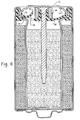
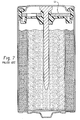
- FIG. 3 there is shown a cross-sectional view of an assembled electrochemical cell of this invention.
- the cell components are the container 10, first electrode 12 positioned adjacent the interior surface of container 10, separator 14 contacting the interior surface 16 of first electrode 12, second electrode 18 disposed within the cavity defined by separator 14 and vent assembly 20 secured to container 10.
- Container 10 has an open end 22, a closed end 24 and a sidewall 26 therebetween.
- the closed end 24, sidewall 26 and vent assembly 20 define a cavity in which the cell's electrodes are housed.
- seal member 28 Shown in Figs. 1 and 2 is an embodiment of seal member 28 which has several sections that perform a variety of functions.
- the perimeter of seal member 28 is defined by upstanding wall 34 which forms an electrically insulating barrier between container 10 which serves as the current collector for first electrode 12, and terminal cover 32 which serves as the external contact for second electrode 18.
- the interior surface of perimeter wall 34 also referred to herein as the upstanding wall, forms one side of a cover reception channel 76 in seal member 28 into which the rollback edge 36 of cover 32 is inserted.
- buttress wall 38 Located adjacent the interior surface of rollback edge 36 is buttress wall 38 which extends above diaphragm region 40.
- diaphragm region 40 includes an elbow 42 which joins two annular sections of diaphragm 40 at an obtuse angle.
- vent flap 48 When diaphragm 40 responds to an excessive increase in internal pressure by inverting and tearing at vent line 44, diaphragm 40 forms a vent flap 48, see Figs. 5 and 6 , with a distal end 50 and a proximate end 52. Vent flap 48 is specifically designed to rotate toward terminal cover 32 so that an opening 78 is created in seal member 28. Pressurized gas within the cell escapes to the environment beyond the cell by passing through the vented opening in the seal member and then through opening 54 in terminal cover 32. Vent flap 48 is made to rotate around hinge area 56, which is located at the proximate end 52 of vent flap 48. In a preferred embodiment, hinge area 56 forms an arc that is concentric with the central opening 30 in seal member 28.
- Hinge 56 is the arc shaped line in the seal member about which the vent flap rotates when the seal is ruptured.
- the hinge coincides with at least a portion of first edge 64 of diaphragm 40.
- the hinge forms an arc or a circle that is concentric with the vent assembly's longitudinal axis.
- Abutting and defining another edge of diaphragm 40 is second edge 66.
- First edge 64 and second edge 66 are concentric with one another and the vent assembly's longitudinal axis.
- Second edge 66 comprises a grooved section and a nongrooved section.
- the grooved section defines the location of vent 44.
- the nongrooved section forms a nonventable interface between a portion of diaphragm 40 and hub 70.
- the nonventable interface forms anchor 82.
- the function of anchor 82 is to secure vent flap 48 to both diaphragm region 40 and hub 70, thereby ensuring that vent flap 48 does not contact terminal cover 32 and form a 360° seal against the interior surface of the terminal cover when the cell's internal pressure causes seal member 28 to rupture at vent line 44.
- the arc formed by vent line 44 should be at least 180°, more preferably approximately 220° and most preferably not more than 250°.
- the portion of diaphragm 40 that abuts hub 70 and does not include vent line 44 forms an anchor 82.
- the arc formed by anchor 82 should be at least 30°, more preferably approximately 100° and most preferably less than 180°.
- opening 78 is formed by tearing the diaphragm at vent line 44. Opening 78 may extend from one end of vent line 44 to the other end of vent line 44 provided opening 78 does not extend into the nongrooved section of second edge 66. Alternatively, opening 78 may extend around a portion of vent line 44 as shown in Fig. 4 .
- the size of opening 78 is not critical provided it is large enough for the gas within the cell to rapidly escape when the cell vents.
- the arc of anchor 82 and the arc of vent line 44 form a complete circle.
- vent flap 48 Relative to the elevation of the vent assembly's longitudinal axis 58, the elevations of hinge 56, terminal cover 32 and vent line 44 in seal member 28 are critical to preventing the resealing of vent flap 48 against the interior surface of cover 32. If the distal end 50 of vent flap 48 is allowed to contact cover 32 and the cell continues to generate gas after the diaphragm has ruptured, as would occur when a cell has been inserted backwards in a multicell device and is subsequently charged by the other cells, then the flap is forcefully pressed against cover 32 thereby blocking further release of gas through the seal member and cover. If the internal pressure exceeds the container's ability to remain crimped over the perimeter of the seal member, then the vent assembly may be rapidly expelled from the container. Some of the cell's other components, such as electrolyte and portions of the anode, may also be forcefully thrown from the container.
- the elevation of the hinge must be closer to the elevation of the vent than to the elevation of the cover's central portion.
- the elevations of the hinge, vent and cover are determined relative to the longitudinal axis 58 of vent assembly 20.
- the longitudinal axis 58 of the vent assembly is concentric with the longitudinal axis of container 10.
- the highest elevation within the vent assembly is the surface of the terminal cover's central portion. Any point along the vent assembly's axis that is between the terminal cover and the end of current collector 30 that contacts second electrode 18 is considered to be lower than the highest elevation.
- the elevation of any feature in the vent assembly is determined by connecting a straight line from the feature in question to the vent assembly's longitudinal axis provided the axis and straight line meet at a right angle.
- the feature with its straight line closest to the surface of terminal cover 32 is considered to be higher in elevation than the other feature.
- the elevations of cover 32, hinge 56 and vent 44, relative to the longitudinal axis of the vent assembly correspond to points A, B and C, respectively.
- the elevation of hinge 56 (point B) must be closer to the elevation of vent 44 (point C) than to the elevation of the junction of collector 30 and the cover's central portion (point A).
- the elevation of hinge 56 is greater than the elevation of vent 44.
- vent flap 48 which is forced to rotate through the vent deflection zone, toward cover 32, by the pressurized gas as it escapes from the cell.
- the vent deflection zone is the space between diaphragm 40 and terminal cover 32. In Fig. 3 , the vent deflection zone is identified with parallel diagonal lines. To ensure proper operation of the vent assembly, the vent deflection zone should not be obstructed with any objects that would impede movement of the vent flap. For example, the existence of a support member 62, shown in Fig. 7 , would inhibit proper operation of the vent flap. Consequently, in a preferred embodiment, the vent assembly of this invention includes a seal member, a current collector and a single cover that also functions as one of the cell's terminals.
- hub base 68 Inwardly disposed from second edge 66 is hub base 68, hub 70 and collector 30.
- Hub base 68 is thicker than diaphragm 40.
- Hub 70 abuts hub base 68 at a right angle.
- Hub 70 defines central opening 30 in seal member 28.
- Seal member 28 is typically made as a single component by injection molding a polymeric material into a cavity and then allowing the part to solidify.
- Materials from which the seal member may be made include: nylon 6, 6; polypropylene; and impact modified polystyrene as described in US 6,306,537 .
- vent assembly An optional component of the vent assembly shown in Figs. 3 and 6 is compression brushing 46.
- the exterior circumferential surface 72 of the compression bushing is made to align with vent 44.
- vent assemblies that do not include a compression bushing the vent is made to align with the outside diameter of hub 70.
- Terminal cover 32 is a generally cup-shaped component made of nickel-plated steel.
- the perimeter 36 of cover 32 is formed by rolling back the edge of the cover upon itself to create a double thickness of material that is approximately perpendicular to the central portion 74 of cover 32. Between the covered central portion and its perimeter, the cover is contoured through a series of bends. The cover's central region 74 is recessed relative to the cover's rolled back edge 36.
- cover 32 When cover 32 is inserted into the seal member's cover reception cavity 76 and the vent assembly is crimped into the open end of container 10, the cover acts like a spring that compresses the seal member's upstanding wall 34 against the interior surface of container 10.
- the vent assembly does not need to include a separate component to force the seal member's perimeter wall against the container.
- First electrode 12 is a mixture of manganese dioxide, graphite and an aqueous solution containing potassium hydroxide.
- the electrode is formed by disposing a quantity of the mixture into the open ended container and then using a ram to mold the mixture into a solid tubular shape that defines a cavity which is concentric with the sidewall of the container.
- the cathode may be formed by preforming a plurality of rings from the mixture comprising manganese dioxide and then inserting the rings into the container to form the tubularly shaped first electrode.
- Second electrode 18 is a homogenous mixture of an aqueous alkaline electrolyte, zinc powder, and a gelling agent such as crosslinked polyacrylic acid.
- the aqueous alkaline electrolyte comprises an alkaline metal hydroxide such as potassium hydroxide, sodium hydroxide, or mixtures thereof. Potassium hydroxide is preferred.
- the gelling agent suitable for use in a cell of this invention can be a crosslinked polyacrylic acid, such as Carbopol 940®, which is available from Noveon, Inc., Cleveland, Ohio, USA. Carboxymethylcellulose, polyacrylamide and sodium polyacrylate are examples of other gelling agents that are suitable for use in an alkaline electrolyte solution.
- the zinc powder may be pure zinc or an alloy comprising an appropriate amount of one or more of the metals selected from the group consisting of indium, lead, bismuth, lithium, calcium and aluminum.
- a suitable anode mixture contains 67 weight percent zinc powder, 0.50 weight percent gelling agent and 32.5 weight percent alkaline electrolyte having 40 weight percent potassium hydroxide.
- the quantity of zinc can range from 63 percent by weight to 70 percent by weight of the anode.
- Other components such as gassing inhibitors, organic or inorganic anticorrosive agents, binders or surfactants may be optionally added to the ingredients listed above.
- gassing inhibitors or anticorrosive agents can include indium salts (such as indium hydroxide), perfluoroalkyl ammonium salts, alkali metal sulfides, etc.
- surfactants can include polyethylene oxide, polyethylene alkylethers, perfluoroalkyl compounds, and the like.
- the second electrode may be manufactured by combining the ingredients described above into a ribbon blender or drum mixer and then working the mixture into a wet slurry.
- Electrolyte suitable for use in a cell of this invention is a "thirty-seven percent by weight aqueous solution of potassium hydroxide.
- the electrolyte may be incorporated into the cell by disposing a quantity of the fluid electrolyte into the cavity defined by the first electrode.
- the electrolyte may also be introduced into the cell by allowing the gelling medium to absorb an aqueous solution of potassium hydroxide during the process used to manufacture the second electrode.
- the method used to incorporate electrolyte into the cell is not critical provided the electrolyte is in contact with the first electrode 12, second electrode 18 and separator 14.
- a quantity of an aqueous potassium hydroxide solution is incorporated into the cell.
- the solution serves as the cell's electrolyte.
- the electrolyte may be incorporated into the cell by allowing the gelling agent in the second electrode to absorb the electrolyte during the electrode manufacturing process which occurs prior to inserting the second electrode into the coiled separator.
- a quantity of electrolyte may be dispensed into the partially completed cell any time after the first electrode has been inserted into the container and prior to closing the cell.
- Separator 14 may be made from nonwoven fibers.
- One of the separator's functions is to provide a barrier at the interface of the first and second electrodes.
- the barrier must be electrically insulating and ionically permeable.
Landscapes
- Chemical & Material Sciences (AREA)
- Chemical Kinetics & Catalysis (AREA)
- Electrochemistry (AREA)
- General Chemical & Material Sciences (AREA)
- Gas Exhaust Devices For Batteries (AREA)
- Sealing Battery Cases Or Jackets (AREA)
Applications Claiming Priority (3)
| Application Number | Priority Date | Filing Date | Title |
|---|---|---|---|
| US229406 | 2002-08-28 | ||
| US10/229,406 US20040043286A1 (en) | 2002-08-28 | 2002-08-28 | Seal for an electrochemical cell |
| PCT/US2003/026722 WO2004021470A2 (en) | 2002-08-28 | 2003-08-27 | Seal for an electrochemical cell |
Publications (2)
| Publication Number | Publication Date |
|---|---|
| EP1532700A2 EP1532700A2 (en) | 2005-05-25 |
| EP1532700B1 true EP1532700B1 (en) | 2008-12-17 |
Family
ID=31976212
Family Applications (1)
| Application Number | Title | Priority Date | Filing Date |
|---|---|---|---|
| EP03791795A Expired - Lifetime EP1532700B1 (en) | 2002-08-28 | 2003-08-27 | Seal for an electrochemical cell |
Country Status (8)
| Country | Link |
|---|---|
| US (3) | US20040043286A1 (enExample) |
| EP (1) | EP1532700B1 (enExample) |
| JP (1) | JP5009499B2 (enExample) |
| CN (1) | CN100353587C (enExample) |
| AT (1) | ATE418164T1 (enExample) |
| AU (1) | AU2003265699A1 (enExample) |
| DE (1) | DE60325378D1 (enExample) |
| WO (1) | WO2004021470A2 (enExample) |
Families Citing this family (13)
| Publication number | Priority date | Publication date | Assignee | Title |
|---|---|---|---|---|
| JP2007048730A (ja) * | 2005-07-15 | 2007-02-22 | Matsushita Electric Ind Co Ltd | アルカリ乾電池 |
| ES2275419B1 (es) * | 2005-07-27 | 2008-04-16 | Celaya Emparanza Y Galdos, S.A. Cegasa | "dispositivo de seguridad en cierres estancos de pilas electroquimicas". |
| US20080166626A1 (en) * | 2007-01-05 | 2008-07-10 | Yoppolo Robert A | End cap seal assembly for an electrochemical cell |
| JP4811539B2 (ja) * | 2009-04-09 | 2011-11-09 | トヨタ自動車株式会社 | 電池、車両及び電池使用機器 |
| JP5679181B2 (ja) * | 2010-02-22 | 2015-03-04 | Fdkエナジー株式会社 | 筒型電池用ガスケット、筒型電池 |
| WO2013072468A2 (en) * | 2011-11-16 | 2013-05-23 | Johnson Controls Advanced Power Solutions Gmbh | Pressure relief element, pressure relief device and battery |
| WO2015038643A1 (en) * | 2013-09-10 | 2015-03-19 | Encell Technology, Inc. | Gas channeling separator inlays for alkaline batteries |
| US10270137B1 (en) | 2014-04-04 | 2019-04-23 | Olaeris, Inc. | Battery status and failure detector |
| WO2016059618A1 (en) * | 2014-10-17 | 2016-04-21 | Gp Batteries International Limited | Batteries |
| JP6986346B2 (ja) * | 2016-12-19 | 2021-12-22 | Fdk株式会社 | 円筒形アルカリ電池 |
| CN114868305B (zh) * | 2019-12-18 | 2025-10-28 | 松下新能源株式会社 | 圆筒形电池 |
| KR102888309B1 (ko) * | 2020-05-29 | 2025-11-18 | 주식회사 엘지에너지솔루션 | 이차 전지 및 이의 제조 방법 |
| CN114883757A (zh) * | 2022-05-31 | 2022-08-09 | 远景动力技术(江苏)有限公司 | 一种圆柱电池及电子设备 |
Family Cites Families (15)
| Publication number | Priority date | Publication date | Assignee | Title |
|---|---|---|---|---|
| DE1254726B (de) * | 1962-06-01 | 1967-11-23 | Varta Pertrix Union Ges Mit Be | Mit einem Entgasungsventil versehenes galvanisches Element |
| JP2825868B2 (ja) * | 1989-08-31 | 1998-11-18 | 日立マクセル株式会社 | 筒形アルカリ電池 |
| US5227261A (en) * | 1991-10-15 | 1993-07-13 | Eveready Battery Company, Inc. | Cylindrical electrochemical cells with a diaphragm seal |
| US5422201A (en) * | 1993-08-04 | 1995-06-06 | Eveready Battery Company, Inc. | Current collector assembly for an electrochemical cell |
| JP3248332B2 (ja) * | 1994-02-25 | 2002-01-21 | 松下電器産業株式会社 | アルカリ電池 |
| JPH09245758A (ja) * | 1996-03-08 | 1997-09-19 | Sony Corp | 単3型アルカリ電池 |
| US5925478A (en) * | 1997-06-25 | 1999-07-20 | Eveready Battery Company, Inc. | V-shaped gasket for galvanic cells |
| JP3948120B2 (ja) * | 1998-06-15 | 2007-07-25 | ソニー株式会社 | ガスケットとガスケットの成形方法及びこのガスケットを用いた円筒形アルカリ電池 |
| US6306537B2 (en) * | 1998-12-29 | 2001-10-23 | Eveready Battery Company, Inc. | Impact modified polystyrene seals for galvanic cells |
| US6270918B1 (en) * | 1999-02-08 | 2001-08-07 | Eveready Battery Company, Inc. | Low profile ventable seal for an electrochemical cell |
| US6270919B1 (en) * | 1999-04-27 | 2001-08-07 | Eveready Battery Company, Inc. | Electrochemical cell having low profile seal assembly with anti-resealing vent |
| US6312850B1 (en) * | 1999-09-14 | 2001-11-06 | Eveready Battery Company, Inc. | Current collector and seal assembly for electrochemical cell |
| US6291100B1 (en) * | 1999-09-15 | 2001-09-18 | Irma America, Inc. | Electrode composition comprising doped tungsten oxides and electrochemical cell comprising same |
| US6620543B2 (en) * | 2001-08-09 | 2003-09-16 | Eveready Battery Company, Inc. | Electrochemical cell having can vent and cover terminal |
| JP4186468B2 (ja) * | 2002-01-21 | 2008-11-26 | Fdk株式会社 | アルカリ電池用の封口ガスケット |
-
2002
- 2002-08-28 US US10/229,406 patent/US20040043286A1/en not_active Abandoned
-
2003
- 2003-08-27 JP JP2004531492A patent/JP5009499B2/ja not_active Expired - Lifetime
- 2003-08-27 AT AT03791795T patent/ATE418164T1/de not_active IP Right Cessation
- 2003-08-27 DE DE60325378T patent/DE60325378D1/de not_active Expired - Lifetime
- 2003-08-27 EP EP03791795A patent/EP1532700B1/en not_active Expired - Lifetime
- 2003-08-27 AU AU2003265699A patent/AU2003265699A1/en not_active Abandoned
- 2003-08-27 CN CNB038205378A patent/CN100353587C/zh not_active Expired - Lifetime
- 2003-08-27 WO PCT/US2003/026722 patent/WO2004021470A2/en not_active Ceased
-
2004
- 2004-10-13 US US10/964,039 patent/US7527891B2/en not_active Expired - Lifetime
-
2009
- 2009-03-26 US US12/411,712 patent/US7704632B2/en not_active Expired - Lifetime
Also Published As
| Publication number | Publication date |
|---|---|
| AU2003265699A8 (en) | 2004-03-19 |
| CN100353587C (zh) | 2007-12-05 |
| JP2005536855A (ja) | 2005-12-02 |
| US20040043286A1 (en) | 2004-03-04 |
| WO2004021470A2 (en) | 2004-03-11 |
| ATE418164T1 (de) | 2009-01-15 |
| JP5009499B2 (ja) | 2012-08-22 |
| CN1679180A (zh) | 2005-10-05 |
| US7704632B2 (en) | 2010-04-27 |
| US20090181287A1 (en) | 2009-07-16 |
| AU2003265699A1 (en) | 2004-03-19 |
| EP1532700A2 (en) | 2005-05-25 |
| WO2004021470A3 (en) | 2004-12-02 |
| US20050084744A1 (en) | 2005-04-21 |
| US7527891B2 (en) | 2009-05-05 |
| DE60325378D1 (de) | 2009-01-29 |
Similar Documents
| Publication | Publication Date | Title |
|---|---|---|
| US7704632B2 (en) | Electrochemical cell having a vent assembly with a rupturable seal member | |
| US7491464B2 (en) | Alkaline cell with flat housing | |
| EP1456894B1 (en) | Electrochemical cell having venting current collector and seal assembly | |
| US6733917B1 (en) | Seal for pressurized container with a rupturable seal | |
| US7294429B2 (en) | Alkaline cell with flat housing | |
| EP1476910B1 (en) | Seal for an electrochemical cell | |
| US7351495B2 (en) | Method of adding electrolyte to a gap between the cathode and separator of an alkaline cell | |
| EP1595298B1 (en) | Electrochemical cell with low volume cover assembly | |
| EP1716607A2 (en) | Alkaline cell with flat housing | |
| HK1069483B (en) | Electrochemical cell having venting current collector and seal assembly | |
| HK1084241A1 (en) | Electrochemical cell with low volume cover assembly | |
| HK1084241B (en) | Electrochemical cell with low volume cover assembly |
Legal Events
| Date | Code | Title | Description |
|---|---|---|---|
| PUAI | Public reference made under article 153(3) epc to a published international application that has entered the european phase |
Free format text: ORIGINAL CODE: 0009012 |
|
| 17P | Request for examination filed |
Effective date: 20050202 |
|
| AK | Designated contracting states |
Kind code of ref document: A2 Designated state(s): AT BE BG CH CY CZ DE DK EE ES FI FR GB GR HU IE IT LI LU MC NL PT RO SE SI SK TR |
|
| AX | Request for extension of the european patent |
Extension state: AL LT LV MK |
|
| DAX | Request for extension of the european patent (deleted) | ||
| RIN1 | Information on inventor provided before grant (corrected) |
Inventor name: JANMEY, ROBERT, M. |
|
| 17Q | First examination report despatched |
Effective date: 20071017 |
|
| GRAP | Despatch of communication of intention to grant a patent |
Free format text: ORIGINAL CODE: EPIDOSNIGR1 |
|
| GRAS | Grant fee paid |
Free format text: ORIGINAL CODE: EPIDOSNIGR3 |
|
| GRAA | (expected) grant |
Free format text: ORIGINAL CODE: 0009210 |
|
| AK | Designated contracting states |
Kind code of ref document: B1 Designated state(s): AT BE BG CH CY CZ DE DK EE ES FI FR GB GR HU IE IT LI LU MC NL PT RO SE SI SK TR |
|
| REG | Reference to a national code |
Ref country code: GB Ref legal event code: FG4D |
|
| REG | Reference to a national code |
Ref country code: CH Ref legal event code: EP |
|
| REG | Reference to a national code |
Ref country code: IE Ref legal event code: FG4D |
|
| REF | Corresponds to: |
Ref document number: 60325378 Country of ref document: DE Date of ref document: 20090129 Kind code of ref document: P |
|
| PG25 | Lapsed in a contracting state [announced via postgrant information from national office to epo] |
Ref country code: SI Free format text: LAPSE BECAUSE OF FAILURE TO SUBMIT A TRANSLATION OF THE DESCRIPTION OR TO PAY THE FEE WITHIN THE PRESCRIBED TIME-LIMIT Effective date: 20081217 Ref country code: FI Free format text: LAPSE BECAUSE OF FAILURE TO SUBMIT A TRANSLATION OF THE DESCRIPTION OR TO PAY THE FEE WITHIN THE PRESCRIBED TIME-LIMIT Effective date: 20081217 Ref country code: NL Free format text: LAPSE BECAUSE OF FAILURE TO SUBMIT A TRANSLATION OF THE DESCRIPTION OR TO PAY THE FEE WITHIN THE PRESCRIBED TIME-LIMIT Effective date: 20081217 |
|
| NLV1 | Nl: lapsed or annulled due to failure to fulfill the requirements of art. 29p and 29m of the patents act | ||
| PG25 | Lapsed in a contracting state [announced via postgrant information from national office to epo] |
Ref country code: ES Free format text: LAPSE BECAUSE OF FAILURE TO SUBMIT A TRANSLATION OF THE DESCRIPTION OR TO PAY THE FEE WITHIN THE PRESCRIBED TIME-LIMIT Effective date: 20090328 Ref country code: RO Free format text: LAPSE BECAUSE OF FAILURE TO SUBMIT A TRANSLATION OF THE DESCRIPTION OR TO PAY THE FEE WITHIN THE PRESCRIBED TIME-LIMIT Effective date: 20081217 Ref country code: EE Free format text: LAPSE BECAUSE OF FAILURE TO SUBMIT A TRANSLATION OF THE DESCRIPTION OR TO PAY THE FEE WITHIN THE PRESCRIBED TIME-LIMIT Effective date: 20081217 Ref country code: BG Free format text: LAPSE BECAUSE OF FAILURE TO SUBMIT A TRANSLATION OF THE DESCRIPTION OR TO PAY THE FEE WITHIN THE PRESCRIBED TIME-LIMIT Effective date: 20090317 |
|
| PG25 | Lapsed in a contracting state [announced via postgrant information from national office to epo] |
Ref country code: SE Free format text: LAPSE BECAUSE OF FAILURE TO SUBMIT A TRANSLATION OF THE DESCRIPTION OR TO PAY THE FEE WITHIN THE PRESCRIBED TIME-LIMIT Effective date: 20090317 Ref country code: PT Free format text: LAPSE BECAUSE OF FAILURE TO SUBMIT A TRANSLATION OF THE DESCRIPTION OR TO PAY THE FEE WITHIN THE PRESCRIBED TIME-LIMIT Effective date: 20090518 Ref country code: CZ Free format text: LAPSE BECAUSE OF FAILURE TO SUBMIT A TRANSLATION OF THE DESCRIPTION OR TO PAY THE FEE WITHIN THE PRESCRIBED TIME-LIMIT Effective date: 20081217 Ref country code: AT Free format text: LAPSE BECAUSE OF FAILURE TO SUBMIT A TRANSLATION OF THE DESCRIPTION OR TO PAY THE FEE WITHIN THE PRESCRIBED TIME-LIMIT Effective date: 20081217 |
|
| PG25 | Lapsed in a contracting state [announced via postgrant information from national office to epo] |
Ref country code: SK Free format text: LAPSE BECAUSE OF FAILURE TO SUBMIT A TRANSLATION OF THE DESCRIPTION OR TO PAY THE FEE WITHIN THE PRESCRIBED TIME-LIMIT Effective date: 20081217 |
|
| PLBE | No opposition filed within time limit |
Free format text: ORIGINAL CODE: 0009261 |
|
| STAA | Information on the status of an ep patent application or granted ep patent |
Free format text: STATUS: NO OPPOSITION FILED WITHIN TIME LIMIT |
|
| PG25 | Lapsed in a contracting state [announced via postgrant information from national office to epo] |
Ref country code: DK Free format text: LAPSE BECAUSE OF FAILURE TO SUBMIT A TRANSLATION OF THE DESCRIPTION OR TO PAY THE FEE WITHIN THE PRESCRIBED TIME-LIMIT Effective date: 20081217 |
|
| 26N | No opposition filed |
Effective date: 20090918 |
|
| PG25 | Lapsed in a contracting state [announced via postgrant information from national office to epo] |
Ref country code: MC Free format text: LAPSE BECAUSE OF NON-PAYMENT OF DUE FEES Effective date: 20090831 |
|
| REG | Reference to a national code |
Ref country code: CH Ref legal event code: PL |
|
| PG25 | Lapsed in a contracting state [announced via postgrant information from national office to epo] |
Ref country code: CH Free format text: LAPSE BECAUSE OF NON-PAYMENT OF DUE FEES Effective date: 20090831 Ref country code: LI Free format text: LAPSE BECAUSE OF NON-PAYMENT OF DUE FEES Effective date: 20090831 |
|
| REG | Reference to a national code |
Ref country code: FR Ref legal event code: ST Effective date: 20100430 |
|
| PG25 | Lapsed in a contracting state [announced via postgrant information from national office to epo] |
Ref country code: FR Free format text: LAPSE BECAUSE OF NON-PAYMENT OF DUE FEES Effective date: 20090831 Ref country code: IE Free format text: LAPSE BECAUSE OF NON-PAYMENT OF DUE FEES Effective date: 20090827 |
|
| PG25 | Lapsed in a contracting state [announced via postgrant information from national office to epo] |
Ref country code: GR Free format text: LAPSE BECAUSE OF FAILURE TO SUBMIT A TRANSLATION OF THE DESCRIPTION OR TO PAY THE FEE WITHIN THE PRESCRIBED TIME-LIMIT Effective date: 20090318 |
|
| PG25 | Lapsed in a contracting state [announced via postgrant information from national office to epo] |
Ref country code: IT Free format text: LAPSE BECAUSE OF FAILURE TO SUBMIT A TRANSLATION OF THE DESCRIPTION OR TO PAY THE FEE WITHIN THE PRESCRIBED TIME-LIMIT Effective date: 20081217 |
|
| PG25 | Lapsed in a contracting state [announced via postgrant information from national office to epo] |
Ref country code: LU Free format text: LAPSE BECAUSE OF NON-PAYMENT OF DUE FEES Effective date: 20090827 |
|
| PG25 | Lapsed in a contracting state [announced via postgrant information from national office to epo] |
Ref country code: HU Free format text: LAPSE BECAUSE OF FAILURE TO SUBMIT A TRANSLATION OF THE DESCRIPTION OR TO PAY THE FEE WITHIN THE PRESCRIBED TIME-LIMIT Effective date: 20090618 |
|
| PG25 | Lapsed in a contracting state [announced via postgrant information from national office to epo] |
Ref country code: TR Free format text: LAPSE BECAUSE OF FAILURE TO SUBMIT A TRANSLATION OF THE DESCRIPTION OR TO PAY THE FEE WITHIN THE PRESCRIBED TIME-LIMIT Effective date: 20081217 |
|
| PG25 | Lapsed in a contracting state [announced via postgrant information from national office to epo] |
Ref country code: CY Free format text: LAPSE BECAUSE OF FAILURE TO SUBMIT A TRANSLATION OF THE DESCRIPTION OR TO PAY THE FEE WITHIN THE PRESCRIBED TIME-LIMIT Effective date: 20081217 |
|
| REG | Reference to a national code |
Ref country code: DE Ref legal event code: R082 Ref document number: 60325378 Country of ref document: DE Representative=s name: VON KREISLER SELTING WERNER - PARTNERSCHAFT VO, DE Ref country code: DE Ref legal event code: R081 Ref document number: 60325378 Country of ref document: DE Owner name: ENERGIZER BRANDS, LLC (N.D.GES.D. STAATES DELA, US Free format text: FORMER OWNER: EVEREADY BATTERY CO., INC., WESTLAKE, OHIO, US Ref country code: DE Ref legal event code: R082 Ref document number: 60325378 Country of ref document: DE Representative=s name: DOMPATENT VON KREISLER SELTING WERNER - PARTNE, DE |
|
| REG | Reference to a national code |
Ref country code: GB Ref legal event code: 732E Free format text: REGISTERED BETWEEN 20161013 AND 20161019 |
|
| REG | Reference to a national code |
Ref country code: DE Ref legal event code: R079 Ref document number: 60325378 Country of ref document: DE Free format text: PREVIOUS MAIN CLASS: H01M0002120000 Ipc: H01M0050300000 |
|
| PGFP | Annual fee paid to national office [announced via postgrant information from national office to epo] |
Ref country code: GB Payment date: 20220707 Year of fee payment: 20 Ref country code: DE Payment date: 20220608 Year of fee payment: 20 |
|
| PGFP | Annual fee paid to national office [announced via postgrant information from national office to epo] |
Ref country code: BE Payment date: 20220718 Year of fee payment: 20 |
|
| P01 | Opt-out of the competence of the unified patent court (upc) registered |
Effective date: 20230526 |
|
| P02 | Opt-out of the competence of the unified patent court (upc) changed |
Effective date: 20230703 |
|
| REG | Reference to a national code |
Ref country code: DE Ref legal event code: R071 Ref document number: 60325378 Country of ref document: DE |
|
| REG | Reference to a national code |
Ref country code: GB Ref legal event code: PE20 Expiry date: 20230826 |
|
| REG | Reference to a national code |
Ref country code: BE Ref legal event code: MK Effective date: 20230827 |
|
| PG25 | Lapsed in a contracting state [announced via postgrant information from national office to epo] |
Ref country code: GB Free format text: LAPSE BECAUSE OF EXPIRATION OF PROTECTION Effective date: 20230826 |