EP1531508A2 - Brennstoffzellensystem - Google Patents
Brennstoffzellensystem Download PDFInfo
- Publication number
- EP1531508A2 EP1531508A2 EP04025326A EP04025326A EP1531508A2 EP 1531508 A2 EP1531508 A2 EP 1531508A2 EP 04025326 A EP04025326 A EP 04025326A EP 04025326 A EP04025326 A EP 04025326A EP 1531508 A2 EP1531508 A2 EP 1531508A2
- Authority
- EP
- European Patent Office
- Prior art keywords
- water
- fuel cell
- storage device
- water storage
- cell system
- Prior art date
- Legal status (The legal status is an assumption and is not a legal conclusion. Google has not performed a legal analysis and makes no representation as to the accuracy of the status listed.)
- Withdrawn
Links
- 239000000446 fuel Substances 0.000 title claims abstract description 88
- XLYOFNOQVPJJNP-UHFFFAOYSA-N water Substances O XLYOFNOQVPJJNP-UHFFFAOYSA-N 0.000 claims abstract description 331
- 238000005192 partition Methods 0.000 claims abstract description 27
- 230000033001 locomotion Effects 0.000 claims description 19
- 230000001133 acceleration Effects 0.000 claims description 16
- 238000010926 purge Methods 0.000 claims description 5
- 230000003247 decreasing effect Effects 0.000 claims description 4
- 238000000034 method Methods 0.000 claims description 3
- 239000008400 supply water Substances 0.000 claims description 2
- 239000007787 solid Substances 0.000 description 13
- 239000001257 hydrogen Substances 0.000 description 8
- 229910052739 hydrogen Inorganic materials 0.000 description 8
- 229920005597 polymer membrane Polymers 0.000 description 7
- UFHFLCQGNIYNRP-UHFFFAOYSA-N Hydrogen Chemical compound [H][H] UFHFLCQGNIYNRP-UHFFFAOYSA-N 0.000 description 6
- 230000000694 effects Effects 0.000 description 6
- 229920000642 polymer Polymers 0.000 description 6
- 230000007423 decrease Effects 0.000 description 5
- 238000002474 experimental method Methods 0.000 description 4
- -1 hydrogen ions Chemical class 0.000 description 3
- QVGXLLKOCUKJST-UHFFFAOYSA-N atomic oxygen Chemical compound [O] QVGXLLKOCUKJST-UHFFFAOYSA-N 0.000 description 2
- 239000002826 coolant Substances 0.000 description 2
- 239000003792 electrolyte Substances 0.000 description 2
- 239000001301 oxygen Substances 0.000 description 2
- 229910052760 oxygen Inorganic materials 0.000 description 2
- 230000002411 adverse Effects 0.000 description 1
- 238000004891 communication Methods 0.000 description 1
- 238000001816 cooling Methods 0.000 description 1
- 238000005516 engineering process Methods 0.000 description 1
- 239000012530 fluid Substances 0.000 description 1
- 238000007710 freezing Methods 0.000 description 1
- 230000008014 freezing Effects 0.000 description 1
- 239000007789 gas Substances 0.000 description 1
- 239000010416 ion conductor Substances 0.000 description 1
- 150000002500 ions Chemical class 0.000 description 1
- 239000012528 membrane Substances 0.000 description 1
- 238000012986 modification Methods 0.000 description 1
- 230000004048 modification Effects 0.000 description 1
- 239000007800 oxidant agent Substances 0.000 description 1
- 230000001590 oxidative effect Effects 0.000 description 1
- 229920006395 saturated elastomer Polymers 0.000 description 1
- 238000012546 transfer Methods 0.000 description 1
Images





Classifications
-
- H—ELECTRICITY
- H01—ELECTRIC ELEMENTS
- H01M—PROCESSES OR MEANS, e.g. BATTERIES, FOR THE DIRECT CONVERSION OF CHEMICAL ENERGY INTO ELECTRICAL ENERGY
- H01M8/00—Fuel cells; Manufacture thereof
- H01M8/04—Auxiliary arrangements, e.g. for control of pressure or for circulation of fluids
- H01M8/04291—Arrangements for managing water in solid electrolyte fuel cell systems
-
- H—ELECTRICITY
- H01—ELECTRIC ELEMENTS
- H01M—PROCESSES OR MEANS, e.g. BATTERIES, FOR THE DIRECT CONVERSION OF CHEMICAL ENERGY INTO ELECTRICAL ENERGY
- H01M8/00—Fuel cells; Manufacture thereof
- H01M8/04—Auxiliary arrangements, e.g. for control of pressure or for circulation of fluids
- H01M8/04007—Auxiliary arrangements, e.g. for control of pressure or for circulation of fluids related to heat exchange
- H01M8/04029—Heat exchange using liquids
-
- H—ELECTRICITY
- H01—ELECTRIC ELEMENTS
- H01M—PROCESSES OR MEANS, e.g. BATTERIES, FOR THE DIRECT CONVERSION OF CHEMICAL ENERGY INTO ELECTRICAL ENERGY
- H01M8/00—Fuel cells; Manufacture thereof
- H01M8/04—Auxiliary arrangements, e.g. for control of pressure or for circulation of fluids
- H01M8/04082—Arrangements for control of reactant parameters, e.g. pressure or concentration
- H01M8/04089—Arrangements for control of reactant parameters, e.g. pressure or concentration of gaseous reactants
- H01M8/04119—Arrangements for control of reactant parameters, e.g. pressure or concentration of gaseous reactants with simultaneous supply or evacuation of electrolyte; Humidifying or dehumidifying
- H01M8/04156—Arrangements for control of reactant parameters, e.g. pressure or concentration of gaseous reactants with simultaneous supply or evacuation of electrolyte; Humidifying or dehumidifying with product water removal
- H01M8/04164—Arrangements for control of reactant parameters, e.g. pressure or concentration of gaseous reactants with simultaneous supply or evacuation of electrolyte; Humidifying or dehumidifying with product water removal by condensers, gas-liquid separators or filters
-
- Y—GENERAL TAGGING OF NEW TECHNOLOGICAL DEVELOPMENTS; GENERAL TAGGING OF CROSS-SECTIONAL TECHNOLOGIES SPANNING OVER SEVERAL SECTIONS OF THE IPC; TECHNICAL SUBJECTS COVERED BY FORMER USPC CROSS-REFERENCE ART COLLECTIONS [XRACs] AND DIGESTS
- Y02—TECHNOLOGIES OR APPLICATIONS FOR MITIGATION OR ADAPTATION AGAINST CLIMATE CHANGE
- Y02E—REDUCTION OF GREENHOUSE GAS [GHG] EMISSIONS, RELATED TO ENERGY GENERATION, TRANSMISSION OR DISTRIBUTION
- Y02E60/00—Enabling technologies; Technologies with a potential or indirect contribution to GHG emissions mitigation
- Y02E60/30—Hydrogen technology
- Y02E60/50—Fuel cells
Definitions
- the present invention relates to a fuel cell system having water circulation means, by which water, stored in a water storage device, is cyclically supplied to a fuel cell, and technology for appropriately taking water out of the water storage device.
- solid polymer type fuel cells As fuel cells for use in fuel cell systems, solid polymer type fuel cells have heretofore been known to be suitable for use in automobiles.
- the solid polymer type fuel cells refer to structures wherein a solid polymer membrane is interposed as an electrolyte membrane between a hydrogen electrode and an air electrode. With such solid polymer type fuel cells, reaction occurs to cause hydrogen gas to be separated into hydrogen ions and electrons on the hydrogen electrode while oxidant gas reacts with the hydrogen ions and the electrons on the air electrode to create water. When this takes place, the solid polymer membrane functions as an ion conductor to allow the hydrogen ions to transfer through the solid polymer membrane toward the air electrode.
- the solid polymer membrane With the solid polymer type fuel cell, the solid polymer membrane is saturated with water to have a function as an ion-conducting electrolyte while having a function to separate hydrogen and oxygen from one another.
- the solid polymer type fuel cell having such characteristics, as the solid polymer membrane encounters a shortage of water content, ion resistance increases to cause hydrogen and oxygen to mix with one another, resulting in a difficulty in generating electric power. For this reason, a need arises for supplying the solid polymer membrane with water from an outside to positively humidify the same.
- a certain type of humidifying means for humidifying the solid polymer membrane, including technique for humidifying hydrogen to be supplied.
- the humidifying means of such kind has undertaken the form of a circulation channel incorporated in the fuel cell system including a fuel cell and a humidifier while storing humidifying water in a water storage device so as to allow water to be cyclically supplied to these devices from an inside of the water storage device at a demanded flow rate.
- Japanese Patent provisional Publication No. 9-147892 proposes a fuel cell system that during start-up of the fuel cell system, water is supplied to a circulation channel and an inside of a fuel cell and during halt of the fuel cell, water is returned to a water storage device.
- the present invention has an object to provide a fuel cell system wherein even when a vehicle is applied with acceleration like in leaning, turning, accelerating and decelerating motions of the vehicle, water deviation occurring in a water takeoff region of a water storage device can be eliminated to overcome an issue of an intake of air for thereby realizing smooth supply of water.
- a fuel cell system comprises a fuel cell, a water storage device, having partition walls, by which an inside of the water storage device is divided into a plurality of regions, a water circulating section operative to cyclically supply water, stored in the water storage device, to the fuel cell, and a water purge section operative to permit water in the fuel cell and water in the water circulating section to return to the water storage device during a halt of the fuel cell, wherein the plurality of partition walls include communicating bores through which water is admitted to flow into a region, closer to a center among the divided regions, or to flow into the other regions during movement of water stored in the water storage device.
- Fig. 1 typically shows one structural example of a water delivery system of a fuel cell system of a first embodiment according to the present invention.
- the water delivery system is comprised of a fuel cell 1 that generates electric power, a water storage device 2 in which water is stored, a water supply channel 3 and water return channel 4 through which water is cyclically supplied, and a water pump 5 through which water is circulated.
- a water supply channel 3 Connected to the water supply channel 3 are an airflow line 6 through which pressurized air required for water purging is introduced, and valves 7a, 7b by which the water supply channel 3 is shut off during water purging.
- a valve 8 disposed in the airflow line 6 is a valve 8 that blocks the introduction of pressurized air during normal operation.
- the fuel cell 1 is cyclically supplied with water by means of the water supply channel 3 and the water return channel 4. Also, during a halt of the fuel cell 1, requisite pressurized air is introduced through the airflow line 6 to perform water purging, whereupon water, inside the fuel cell 1 and associated component parts of the circulation channel, is returned to the water storage device 2.
- the water storage device 2 is formed in a substantially cuboid configuration and installed on a vehicle, such as a fuel cell powered automobile, such that the water storage device 2 has a short side orientated in a fore and aft direction of the vehicle and a long side orientated in a widthwise direction of the vehicle.
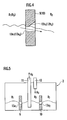
- Fig. 2 shows an internal structure of the water storage device 2. Due to the elongated structure of the water storage device 2 aligned in the widthwise direction of the vehicle as set forth above, water deviation occurs as a result of a binding effect (a so-called virtual force) acting in a direction opposite to an accelerating direction (as shown by an arrow A 1 ) caused by leftward or rightward turning motions of the vehicle and to overcome this issue, the water storage device 2 is provided with two pieces of partition walls 9, 10 to divide an inside of the water storage device 2 into three regions along the widthwise direction of the vehicle. The presence of the two pieces of partition walls 9, 10 allows the inside of the water storage device 2 to be divided into three regions R 1 , R 2 , R 3 .
- a binding effect a so-called virtual force
- a water guide pipe 11 playing a role as a base end portion of the water supply channel 3 forming the water delivery system, which extends in the middle region R 2 toward an area close proximity to a bottom portion thereof and a water return pipe 12, forming a distal end portion of the water return channel 4, which extends to an upper area of the middle region R 2 .
- Water inside the water storage device 2 is drawn by the water pump 5 from the region R 2 through the water guide pipe 11 (as shown by an arrow A 2 ) and circulated through the circulation channel, whereupon water is returned through the water return pipe 12 back to the region R 2 again (as shown by an arrow A 3 ).
- communicating bores 13a 1 , 13a 2 that provide fluid communication between adjacent regions to admit water to flow in a longitudinal direction (along the widthwise direction of the vehicle) of the water storage device 2.
- the communicating bores 13a 1 , 13a 2 take the form of apertures each formed in an elongated opening shape that is longer in a horizontal direction (along the widthwise direction of the vehicle) than in a vertical direction (along a vertical direction of the vehicle) as shown in Fig. 3. That is, the opening shapes of the communicating bores 13a 1 , 13a 2 have a dimension W in the horizontal direction remarkably greater than a dimension H in the vertical direction (as expressed as W>H).
- the notches 14a 11 , 14a 12 (14a 21 , 14a 22 ) are contemplated to ease water to flow from the regions R 1 , R 3 to the region R 2 .
- the communicating bores 13a 1 , 13a 2 are chamfered at sides facing the region R 2 , as shown in Fig. 4, to form slopes 13b 1 , 13b 2 .
- the height L at which the communicating bores 13a 1 , 13a 2 are formed on the partition walls 9, 10 are set to a level that is lower than a water level appearing after start-up so as to ensure water to flow into the region R 2 . Additionally, in order to minimize adverse affect caused by a leaned attitude during a halt of the vehicle, the communicating bores 13a 1 , 13a 2 are formed in the respective partition walls 9, 10 at positions close proximity to a center in a fore and aft direction of the vehicle.
- start-up achievement capability is meant the capability of the water pump 5 that is available to discharge water at a water circulation rate demanded for the fuel cell system during a phase in which the water storage device 2 reaches a bankfull stage at a halt of the system and during a subsequent phase after the fuel cell system has started up and associated various component parts are filled with water.
- an intake of air encountered by the water pump 5" is meant the phenomenon where water deviation occurs inside the water storage device 2 due to the binding effect accompanied by the acceleration caused by leaning and turning motions of the vehicle during acceleration or deceleration thereof and a water level exceptionally drops in the region, to which the water guide pipe 11 is inserted, to cause the water pump 5 to encounter the intake of air with a resultant difficulty in maintaining a discharge pressure
- counter measures for an intake of air is meant the counter measures to be undertaken to preclude the occurrence of such intake of air.
- the start-up achievement capability can be obtained by the provision of the partition walls 9, 10 formed with the communicating bores 13a 1 , 13a 2 , respectively, which are ensured to have appropriate opening surface areas Ad.
- the two partition walls 9, 10 divide the inside of the water storage device 2 into the three regions R 1 , R 2 , R 3 along the widthwise direction of the vehicle as set forth above.
- the opening surface areas Ad of the communicating bores 13a 1 , 13a 2 are set to have adequately large values, water is able to quickly flows from the adjacent regions R 1 , R 3 into the region R 2 to prevent the water level in the region R 2 from becoming lower than the lower end of the water guide pipe 11. Accordingly, the discharge pressure of the water pump 5 can be maintained during a phase in which the fuel cell system has started up and a subsequent phase in which the various parts of the system are filled with water.
- the opening surface areas Ad of the communicating bore 13a 1 , 13a 2 formed in the respective partition walls 9, 10 it is preferable for the opening surface areas Ad of the communicating bore 13a 1 , 13a 2 formed in the respective partition walls 9, 10 to be large.
- the amount of water to be drawn by the water pump 5 it is preferable for the amount of water to be drawn by the water pump 5 to be reduced as small as possible. This is because the presence of less amount of water to be drawn by the water pump 5 decreases a drop in water level in the region R 2 .
- the opening shapes of the communicating bores 13a 1 , 13a 2 are formed to ensure the respective opening surface areas Ad each with an elongated configuration aligned in the horizontal direction, thereby increasing the flow of water from the regions R 1 , R 3 into the region R 2 as much as possible.
- the inside of the water storage device 2 is divided by the two partition walls 9, 10 into three regions R 1 , R 2 , R 3 along the widthwise direction of the vehicle and with the water level remaining after start-up of the system, if the vehicle is steered to turn leftward or rightward, water begins to deviate to one side of the water storage device 2 due to the binding effect applied in the direction (as shown by an arrow A 4 ) opposite to the direction in which the acceleration acts (as shown by the arrow A 1 ) during the turning motion of the vehicle as shown in Fig. 7. That is, if the acceleration G as a result of the turning motion is applied in the direction as shown by the arrow A 1 in Fig. 7, water remaining in the region R 2 flows through the communicating bore 13a 1 , formed in the partition wall 9, into the region R 1 and water remaining in the region R 3 flows through the communicating bore 13a 2 , formed in the partition wall 10, into the region R 2 .
- the opening surface areas Ad of the communicating bores 13a 1 , 13a 2 may be preferably as small as possible and the volume of water to be drawn by the water pump 5 may be preferably reduced as small as possible. Accordingly, considering both the start-up achievement capability and the counter measures for the intake of air, it is preferable for the opening surface areas Ad of the communicating bores 13a 1 , 13a 2 to be set to fall in a range of As ⁇ Ad ⁇ Ag.
- a reference “As” designates the minimum opening surface area that makes it possible to maintain a water level available for water to be taken out of the water storage device 2 after water has been taken out of the water storage device 2 in a volume required to fill up the fuel cell 1 and the circulation path (involving an inside of the water supply channel 3, an inside of the water return channel 4 and insides of associated component parts of these channels) during start-up of the system, or during a process in which water is being taken out.
- a reference “Ag” designates the maximum opening surface area that makes it possible to maintain a water level available for water to be taken out of the water storage device 2 during a phase in which the acceleration G is applied due to fore and aft movements or leftward or rightward turning motions of the vehicle.
- the partition walls 9, 10 divide the inside of the water storage device 2 into the three regions R 1 , R 2 , R 3 to allow the water pump 5 to take water out or return water to the region R 2 while permitting the water flow among the regions R 1 , R 2 , R 3 through the communicating bores 13a 1 , 13a 2 formed in the respective partition walls 9, 10.
- appropriately determining the opening surface areas Ad of the communicating bores 13a 1 , 13a 2 and controlling the flow rate of water enables water deviation to be minimized in the region R 2 , from which water is taken out of the water storage device 2, for thereby enabling to maintain an appropriate water level. Consequently, with the fuel cell system of the presently filed embodiment, smooth supply of water can be realized.
- a fuel cell system of a second embodiment further includes, in addition to the structure of the first embodiment described above, a controller 15 for controlling the flow rate of the water pump 5.
- the other structure is identical to that of the first embodiment and description of the same is herein omitted.
- the controller 15 decreases a discharge rate (the volume of water to be taken out of the region R 2 ) of the water pump 5 after a given time interval has elapsed when water begins to be taken out of the water storage device 2 during start-up, ensuring the water level of the region R 2 . This prevents the water pump 5 from encountering the intake of air, making it possible to allow a discharge pressure of the water pump 5 to be appropriately maintained.
- An elapsed time, in which the discharge pressure of the water pump 5 is caused to decrease, varies depending on various factors of the fuel cell system and is preliminarily acquired based on experiments or calculations. Also, arrangement is made such that at a timing in which the operation to fill up water in the inside of the fuel cell 1 and the inside of the water circulation path is terminated and the operation is shifted into normal operation, the discharge rate of the water pump 5 is restored to a prescribed discharge rate to allow the water pump 5 to take water out of the region R 2 at a standard flow rate.
- Fig. 9 is a flowchart illustrating a basic sequence of operations to be executed by the controller 15 in the fuel cell system of the presently filed embodiment for controlling the flow rate of the water pump 5.
- the water pump 5 is started up, followed by start-up of the fuel cell system, to begin the taking out of water from the region R 2 in the water storage device 2 at the standard water flow rate (step S1).
- the operation is started to measure time with a timer incorporated in the controller 15 (step S2) and discrimination is made to find whether the time measured by the timer reaches a given timer T1 (an elapsed time, which is preliminarily acquired on the experiments and calculations, before the discharge rate of the water pump 5 is decreased) (step S3).
- step S4 the discharge rate of the water pump 5 is decreased by a given value. Thereafter, discrimination is made to find whether the time measured by the timer reaches a given timer T2 (a time before the inside of the fuel cell 1 and the inside of the water circulation path are completely filled with water) (step S5) and at a stage in which the time measured by the timer exceeds the given time T2, the discharge rate of the water pump 5 is restored to the prescribed discharge rate (step S6).
- T2 a time before the inside of the fuel cell 1 and the inside of the water circulation path are completely filled with water
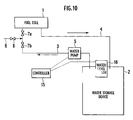
- a fuel cell system of a third embodiment further includes, in addition to the structure of the second embodiment described above, a water level sensor 16 for measuring the water level in the region R 2 inside the water storage device 2 as shown in Fig. 10.
- the other structure is identical to that of the second embodiment and description of the same is herein omitted.
- the fuel cell system is arranged to allow the water level sensor 16 to monitor the water level in the region R 2 inside the water storage device 2 during start-up for controlling such that when the water level in the region R 2 drops below a given water level, the discharge rate of the water pump 5 is lowered to ensure the water level in the region R 2 .
- This allows the water pump 5 to be prevented from encountering the intake of air, like in the second embodiment set forth above, thereby making it possible to allow the discharge rate of the water pump 5 to be appropriately maintained.
- the given water level, at which the discharge rate of the water pump 5 is switched over, depends on a limit in the intake of air encountered by the water pump 5 and is preliminarily acquired on experiments and calculations.
- the fuel cell system is arranged such that at a timing in which the water level in the region R 2 exceeds the given water level, the discharge rate of the water pump 5 is restored to the standard discharge rate to allow water to be taken out of region R 2 in a standard volume.
- Fig. 11 is a flowchart illustrating a basic sequence of operations to be executed by the controller 15 in the fuel cell system of the presently filed embodiment for controlling the flow rate of the water pump 5.
- the water pump 5 is started up, followed by start-up of the fuel cell system, to begin the taking out of water from the region R 2 in the water storage device 2 at a standard flow rate (step S11).
- the operation is executed to measure the water level in the region R 2 with the water level sensor 16 installed in the water storage device 2 (step S12) and discrimination is made to find whether the measured water level drops below a given water level Ls (a water level preliminarily acquired on the experiments and calculations) (step S13).
- the discharge rate of the water pump 5 is decreased by a given value (step S14). Thereafter, the water level sensor 16 measures the water level in the region R 2 (step S15) and discrimination is made to find whether the measured water level is recovered to a value exceeding the given water level Ls (step S16). At a stage in which the measured water level exceeds the given water level Ls, the discharge rate of the water pump 5 is restored to the prescribed discharge rate (step S17).
Landscapes
- Life Sciences & Earth Sciences (AREA)
- Engineering & Computer Science (AREA)
- Manufacturing & Machinery (AREA)
- Sustainable Development (AREA)
- Sustainable Energy (AREA)
- Chemical & Material Sciences (AREA)
- Chemical Kinetics & Catalysis (AREA)
- Electrochemistry (AREA)
- General Chemical & Material Sciences (AREA)
- Fuel Cell (AREA)
Applications Claiming Priority (2)
| Application Number | Priority Date | Filing Date | Title |
|---|---|---|---|
| JP2003375656 | 2003-11-05 | ||
| JP2003375656A JP2005141975A (ja) | 2003-11-05 | 2003-11-05 | 燃料電池システム |
Publications (1)
| Publication Number | Publication Date |
|---|---|
| EP1531508A2 true EP1531508A2 (de) | 2005-05-18 |
Family
ID=34431276
Family Applications (1)
| Application Number | Title | Priority Date | Filing Date |
|---|---|---|---|
| EP04025326A Withdrawn EP1531508A2 (de) | 2003-11-05 | 2004-10-25 | Brennstoffzellensystem |
Country Status (3)
| Country | Link |
|---|---|
| US (1) | US20050112444A1 (de) |
| EP (1) | EP1531508A2 (de) |
| JP (1) | JP2005141975A (de) |
Families Citing this family (2)
| Publication number | Priority date | Publication date | Assignee | Title |
|---|---|---|---|---|
| JP7121689B2 (ja) * | 2019-05-09 | 2022-08-18 | 本田技研工業株式会社 | 燃料電池車両及び液体状態推定方法 |
| CN114243058B (zh) * | 2021-11-08 | 2023-07-18 | 东风汽车集团股份有限公司 | 燃料电池系统及其气液分离装置、控制方法和控制装置 |
Family Cites Families (2)
| Publication number | Priority date | Publication date | Assignee | Title |
|---|---|---|---|---|
| IT1077423B (it) * | 1977-07-27 | 1985-05-04 | Alfa Romeo Spa | Serbatoio del combutstibile per un autoveicolo |
| US5700595A (en) * | 1995-06-23 | 1997-12-23 | International Fuel Cells Corp. | Ion exchange membrane fuel cell power plant with water management pressure differentials |
-
2003
- 2003-11-05 JP JP2003375656A patent/JP2005141975A/ja active Pending
-
2004
- 2004-10-25 EP EP04025326A patent/EP1531508A2/de not_active Withdrawn
- 2004-11-01 US US10/976,911 patent/US20050112444A1/en not_active Abandoned
Also Published As
| Publication number | Publication date |
|---|---|
| US20050112444A1 (en) | 2005-05-26 |
| JP2005141975A (ja) | 2005-06-02 |
Similar Documents
| Publication | Publication Date | Title |
|---|---|---|
| CN102136591B (zh) | 燃料电池系统 | |
| US8518588B2 (en) | Fuel cell system | |
| JP2009123517A (ja) | 燃料電池システム及びその制御方法 | |
| WO2012011501A1 (ja) | 燃料電池システム及びその運転方法 | |
| JP7267880B2 (ja) | 燃料電池システム | |
| JP2004273427A (ja) | 燃料電池システム | |
| JP2002313403A (ja) | 燃料電池システムの生成水排出方法 | |
| US11563223B2 (en) | Method of starting operation of fuel cell system at low temperature, and the fuel cell system | |
| CN111916796B (zh) | 燃料电池车辆以及液体状态估计方法 | |
| JP2008262735A (ja) | 燃料電池システム及び排出弁の制御方法 | |
| JP2008103190A (ja) | 燃料電池システム及びその排水制御方法 | |
| US20050112444A1 (en) | Fuel cell system | |
| JP2008311160A (ja) | 燃料電池システム | |
| JP2013182690A (ja) | 燃料電池システム | |
| JP4618294B2 (ja) | 燃料電池システム | |
| JP4891961B2 (ja) | 燃料電池システム | |
| JP5324838B2 (ja) | 燃料電池システム及びその運転方法 | |
| JP2007073280A (ja) | 燃料電池システム | |
| JP2015164092A (ja) | 燃料電池システム | |
| JP2004152532A (ja) | 燃料電池の状態判定装置および燃料電池システム | |
| JP2005071751A (ja) | 燃料電池システム | |
| JP2006156017A (ja) | 燃料電池システム | |
| JP5437089B2 (ja) | 燃料電池システム | |
| JP2013182688A (ja) | 燃料電池システム | |
| JP2009076261A (ja) | 燃料電池システム及びその起動方法 |
Legal Events
| Date | Code | Title | Description |
|---|---|---|---|
| PUAI | Public reference made under article 153(3) epc to a published international application that has entered the european phase |
Free format text: ORIGINAL CODE: 0009012 |
|
| 17P | Request for examination filed |
Effective date: 20041025 |
|
| AK | Designated contracting states |
Kind code of ref document: A2 Designated state(s): AT BE BG CH CY CZ DE DK EE ES FI FR GB GR HU IE IT LI LU MC NL PL PT RO SE SI SK TR |
|
| AX | Request for extension of the european patent |
Extension state: AL HR LT LV MK |
|
| STAA | Information on the status of an ep patent application or granted ep patent |
Free format text: STATUS: THE APPLICATION HAS BEEN WITHDRAWN |
|
| 18W | Application withdrawn |
Effective date: 20070323 |