EP1529856A1 - Spinndüse zur Herstellung von Garnen mit kreisförmigem Querschnitt und Verfahren zu deren Herstellung - Google Patents
Spinndüse zur Herstellung von Garnen mit kreisförmigem Querschnitt und Verfahren zu deren Herstellung Download PDFInfo
- Publication number
- EP1529856A1 EP1529856A1 EP04256711A EP04256711A EP1529856A1 EP 1529856 A1 EP1529856 A1 EP 1529856A1 EP 04256711 A EP04256711 A EP 04256711A EP 04256711 A EP04256711 A EP 04256711A EP 1529856 A1 EP1529856 A1 EP 1529856A1
- Authority
- EP
- European Patent Office
- Prior art keywords
- circular cross
- filament
- orifice
- perimeter
- yarn
- Prior art date
- Legal status (The legal status is an assumption and is not a legal conclusion. Google has not performed a legal analysis and makes no representation as to the accuracy of the status listed.)
- Granted
Links
- 238000000034 method Methods 0.000 title claims abstract description 30
- 238000001125 extrusion Methods 0.000 claims abstract description 34
- 239000000155 melt Substances 0.000 claims abstract description 7
- 229920000642 polymer Polymers 0.000 claims description 24
- 238000004804 winding Methods 0.000 claims description 8
- 239000004677 Nylon Substances 0.000 claims description 6
- 230000001143 conditioned effect Effects 0.000 claims description 6
- 229920001778 nylon Polymers 0.000 claims description 6
- 238000010791 quenching Methods 0.000 claims description 6
- 230000000171 quenching effect Effects 0.000 claims description 4
- 239000012530 fluid Substances 0.000 claims description 3
- 230000000087 stabilizing effect Effects 0.000 claims description 3
- 238000009987 spinning Methods 0.000 description 9
- 208000012886 Vertigo Diseases 0.000 description 7
- 239000004952 Polyamide Substances 0.000 description 5
- 229920002647 polyamide Polymers 0.000 description 5
- 229920002302 Nylon 6,6 Polymers 0.000 description 4
- GWEVSGVZZGPLCZ-UHFFFAOYSA-N Titan oxide Chemical compound O=[Ti]=O GWEVSGVZZGPLCZ-UHFFFAOYSA-N 0.000 description 4
- 238000004519 manufacturing process Methods 0.000 description 4
- 238000005452 bending Methods 0.000 description 3
- 239000004744 fabric Substances 0.000 description 3
- 238000004140 cleaning Methods 0.000 description 2
- 230000000052 comparative effect Effects 0.000 description 2
- BDAGIHXWWSANSR-UHFFFAOYSA-N methanoic acid Natural products OC=O BDAGIHXWWSANSR-UHFFFAOYSA-N 0.000 description 2
- OSWFIVFLDKOXQC-UHFFFAOYSA-N 4-(3-methoxyphenyl)aniline Chemical compound COC1=CC=CC(C=2C=CC(N)=CC=2)=C1 OSWFIVFLDKOXQC-UHFFFAOYSA-N 0.000 description 1
- 238000009835 boiling Methods 0.000 description 1
- 230000007547 defect Effects 0.000 description 1
- 235000019253 formic acid Nutrition 0.000 description 1
- 239000002932 luster Substances 0.000 description 1
- 238000005259 measurement Methods 0.000 description 1
- 238000012986 modification Methods 0.000 description 1
- 230000004048 modification Effects 0.000 description 1
- 239000000049 pigment Substances 0.000 description 1
- 230000006641 stabilisation Effects 0.000 description 1
- 238000011105 stabilization Methods 0.000 description 1
- 229920002994 synthetic fiber Polymers 0.000 description 1
- 239000012209 synthetic fiber Substances 0.000 description 1
- 238000009864 tensile test Methods 0.000 description 1
- 238000010998 test method Methods 0.000 description 1
- 239000004408 titanium dioxide Substances 0.000 description 1
- 239000002699 waste material Substances 0.000 description 1
- XLYOFNOQVPJJNP-UHFFFAOYSA-N water Substances O XLYOFNOQVPJJNP-UHFFFAOYSA-N 0.000 description 1
Images


Classifications
-
- D—TEXTILES; PAPER
- D01—NATURAL OR MAN-MADE THREADS OR FIBRES; SPINNING
- D01F—CHEMICAL FEATURES IN THE MANUFACTURE OF ARTIFICIAL FILAMENTS, THREADS, FIBRES, BRISTLES OR RIBBONS; APPARATUS SPECIALLY ADAPTED FOR THE MANUFACTURE OF CARBON FILAMENTS
- D01F6/00—Monocomponent artificial filaments or the like of synthetic polymers; Manufacture thereof
- D01F6/58—Monocomponent artificial filaments or the like of synthetic polymers; Manufacture thereof from homopolycondensation products
- D01F6/60—Monocomponent artificial filaments or the like of synthetic polymers; Manufacture thereof from homopolycondensation products from polyamides
-
- D—TEXTILES; PAPER
- D01—NATURAL OR MAN-MADE THREADS OR FIBRES; SPINNING
- D01D—MECHANICAL METHODS OR APPARATUS IN THE MANUFACTURE OF ARTIFICIAL FILAMENTS, THREADS, FIBRES, BRISTLES OR RIBBONS
- D01D4/00—Spinnerette packs; Cleaning thereof
- D01D4/02—Spinnerettes
-
- D—TEXTILES; PAPER
- D01—NATURAL OR MAN-MADE THREADS OR FIBRES; SPINNING
- D01D—MECHANICAL METHODS OR APPARATUS IN THE MANUFACTURE OF ARTIFICIAL FILAMENTS, THREADS, FIBRES, BRISTLES OR RIBBONS
- D01D5/00—Formation of filaments, threads, or the like
- D01D5/253—Formation of filaments, threads, or the like with a non-circular cross section; Spinnerette packs therefor
Definitions
- spinneret wiping The cycle time between spinneret wiping events, where each event is necessitated by a build up of the undesirable deposits, is the spinneret wipe life. It is desirable from a process efficiency and continuity standpoint to have a longer spinneret wiping cycle or wipe life.
- the cross sectional shape of a filament is determined by the cross sectional profiled shape of the extrusion orifice.
- a trilobate profile filament yarn is produced by means of a spinneret plate with multiple orifices of trilobate shape.
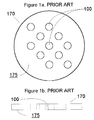
- a circular profile filament yarn is produced by a spinneret plate, illustrated at 170 in Figs. 1a and 1b with multiple orifices 100 of circular shape.
- Applicants have observed that wiping cycles for production of trilobal profile filaments were in general longer times than those times observed for circular profile cross-section filaments.
- a non-circular cross-section spinneret capillary orifice or extrusion orifice with a cross-sectional area substantially the same as the area of a circular cross-section spinneret capillary, but having a perimeter measure greater than the perimeter of a circular cross-section spinneret capillary, provides greater time interval between spinneret plate wiping events.
- This non-circular cross-sectional shape of the extrusion capillary when used to extrude filaments of circular cross-sectional shape, extends the spinneret wipe life by lessening the amount of thermal deposits. This thereby extends the time between wipe cycles. As a result of increased wipe life, the productivity of the process is increased.
- a melt extrusion spinneret plate having at least one capillary orifice for producing at least a single filament of circular cross sectional shape, said capillary orifice having a non-circular shape.
- the capillary orifice has a profiled shape with at least five 5 radially arranged legs, and preferably up to twelve 12 legs. More preferred are eight radially arranged legs.
- a process for making a nylon filament of circular cross sectional shape comprising the steps of: supplying a polymer to a spin beam where the melted polymer is passed to a spin pack and through a spinneret plate having at least a single capillary orifice of non-circular shape, extruding at least a polymer single filament with a jet velocity substantially the same as that jet velocity employed when using a circular cross-section capillary orifice, quenching the freshly extruded filaments with conditioned air, drawing the filament, and winding the filament.
- an apparatus comprising a melt extrusion spinneret plate comprising at least a single non-circular capillary orifice for making a nylon filament of circular cross sectional shape.
- a schematic representation of a single capillary orifice is shown in Figure 3b.
- the non-circular capillary orifice of the spinneret plate for producing a single filament of circular cross sectional shape has a perimeter of non-circular cross sectional shape.
- the perimeter is characterized by a perimeter measure p c , and an extrusion area, wherein, the perimeter measure p c , is greater than either of: 2 ⁇ R and 2 ⁇ r.
- the non-circular capillary orifice of the preferred melt extrusion spinneret plate has a perimeter measure p c of about 2 to about 10 times greater than either of 2 ⁇ R and 2 ⁇ r.
- the non-circular capillary orifice of the preferred melt extrusion spinneret plate has about 5 to about 12 radially arranged legs.
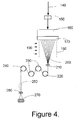
- the polymer is then extruded through a spinneret plate 170, shown in Figs. 2a, 2b and 4.
- the spinneret plate has at least a single capillary orifice 110.
- the capillary orifices correspond to each individual filament comprising the yarn (as represented in side elevation by Fig. 2b and plan view by Fig. 2a).
- Figure 3b is a representation the capillary orifices of the present invention as compared to a circular capillary orifice of the prior art represented in Fig. 3a.
- G ⁇ (melt) D 2 (capillary) ( ⁇ /4) v (extrusion) .
- ⁇ is the polymer melt density (e.g. for melted nylon 6,6 @ 290°C equal to 1.0 gram per cm 3 )
- v is the velocity of the filament.
- v (extrusion) G (4/ ⁇ ) D 2 (capillary) ⁇ (melt)
- the perimeter increase in the capillary orifice of the present invention with an unaltered extrusion velocity is thought to provide a longer length of time between spinneret plate wiping events.
- the polymer is extruded at a jet velocity in the range of 20 centimeters per second to 80 centimeters per second.
- spinneret plate of the invention having extrusion orifices of non-circular cross section, to spin filaments of circular cross sectional shape provides a process with a reduced need for spinneret wiping due to bent filaments.
- the number of bent filaments at the exit side 175 of the face of the spinneret plate 170 with the present invention may be counted directly by observation and recorded for a typical eight-hour shift after spinneret plate wiping. The record is indicative of how robust the process is from a bent filament production rate.
- the spinneret wipe life expressed as the time for 10% of all single filaments in the yarn bundle to appear bent at the exit side of the capillary on the spinneret plate face is also recorded. Measuring the time to 10% bent filaments is performed directly by observation and a direct count by an operator illuminating the spinneret plate face within the quench cabinet.
- the yarn produced according to the process represented by Figures 4 is a drawn yarn with elongation of 22 to about 60%, the boiling water shrinkage is in the range of 3 to about 10%, the yarn tenacity is the range of 3 to about 7 grams per denier, and the RV of the yarn can be varied and controlled well within a range of about 40 to about 60.
- the yarn is a dull luster multifilament polyamide yarn.
- a preferred nylon filament of the invention is delustered with a pigment such as titanium dioxide in an amount of 0.03 to 3 per cent by weight.
- a derived parameter characterizing the superior properties of this yarn is called the Yarn Quality and found by the product of the yarn tenacity (grams per denier) and the square root of the % elongation, as in Equation 3.
- YARN QUALITY tenacity x (elongation) 1 ⁇ 2
- the Yarn Quality is an approximation to the measure of yarn "toughness.”
- the area under the yarn load elongation curve is proportional to the work done to elongate the yarn.
- the load elongation curve is the stress-strain curve.
- Yarn tenacity and the yarn elongation are determined according to ASTM method D 2256-80 using an INSTRON tensile test apparatus (Instron Corp., Canton, Massachusetts, USA 02021) and a constant cross head speed. Tenacity is expressed as grams of force per denier, the elongation percent is the increase in length of the specimen as a percentage of the original length at breaking load.
- Polymer relative viscosity RV is measured using the formic acid method according to ASTM D789-86.
- a yarn of 40 denier (44 dtex) and 13 filaments was prepared from a nylon 66 polymer of 51.5 RV which contained 1.5% by weight TiO 2 .
- This polymer was melted in an extruder and fed to a spinning machine (shown schematically in Figure 4.) which was used to prepare the yarn, by a process of quenching in conditioned air, converging and treating the yarn with a primary spinning oil, drawing the yarn using unheated godets, stabilizing the yarn with a heated fluid, interlacing the yarn and winding on at a speed of about 5300 meters per minute.
- the spinneret plate had 13 non-circular cross-sectional shape cross-sectionally shaped capillaries with 9 radially protruding "legs", as shown in Figure 3b.
- the perimeter measure of a single capillary, represented in Figure 3a., was 120 micrometers. Under these spinning conditions, the jet velocity of the polymer through this capillary was 100 feet per minute (50.8 cm per second).
- the spinneret plate 170 on the capillary exit face 175 required wiping each 10 hours of yarn winding since at least 10% of the filaments were bent.
- the yarn produced had a circular cross-sectional shape.
- the RV, the tenacity and elongation of the wound up 40-13 yarn was measured.
- the RV was 52.5.
- the tenacity and elongation measurements were used to calculate a "yarn quality" parameter using Equation 3.
- the parameter is related to the yarn toughness or work needed to draw the yarn and found here to be 33.1.
- a yarn of 40 denier (44 dtex) and 13 filaments was prepared by treating a nylon 66 polymer (51.5 RV) was melted in an extruder and fed to a spinning machine which was used to prepare the 40-13 yarn, by a process of quenching in conditioned air, converging and treating the yarn with a primary spinning oil, drawing the yarn using unheated godets, stabilizing the yarn with a heated fluid, interlacing the yarn and winding on at a speed of about 5300 meters per minute.
- the spinneret plate had 13 circular cross-sectionally shaped capillaries, as shown in Figure 3a.
- the jet velocity of the polymer through this capillary was 100 feet per minute (50.8 cm per second).
- the spinneret plate 170 on the capillary exit face 175 required wiping each 1.5 hours of yarn winding, since at least 10% of the filaments were bent.
- the tenacity and elongation of the wound up 40-13 yarn was measured exactly as in the example of the invention.
- the measured RV was of this yarn was 52.5 RV as before.
- the tenacity and elongation were used to calculate a "yarn quality" parameter, which was found to be 31.5 using Equation 3.
Landscapes
- Engineering & Computer Science (AREA)
- Textile Engineering (AREA)
- Mechanical Engineering (AREA)
- Chemical & Material Sciences (AREA)
- Chemical Kinetics & Catalysis (AREA)
- General Chemical & Material Sciences (AREA)
- Spinning Methods And Devices For Manufacturing Artificial Fibers (AREA)
- Artificial Filaments (AREA)
- Yarns And Mechanical Finishing Of Yarns Or Ropes (AREA)
Applications Claiming Priority (2)
| Application Number | Priority Date | Filing Date | Title |
|---|---|---|---|
| US10/698,163 US7165963B2 (en) | 2003-10-31 | 2003-10-31 | Spinneret for producing circular cross section yarn and process for making the same |
| US698163 | 2003-10-31 |
Publications (2)
| Publication Number | Publication Date |
|---|---|
| EP1529856A1 true EP1529856A1 (de) | 2005-05-11 |
| EP1529856B1 EP1529856B1 (de) | 2009-02-25 |
Family
ID=34435493
Family Applications (1)
| Application Number | Title | Priority Date | Filing Date |
|---|---|---|---|
| EP04256711A Expired - Lifetime EP1529856B1 (de) | 2003-10-31 | 2004-10-29 | Spinndüse zur Herstellung von Garnen mit kreisförmigem Querschnitt und Verfahren zu deren Herstellung |
Country Status (6)
| Country | Link |
|---|---|
| US (1) | US7165963B2 (de) |
| EP (1) | EP1529856B1 (de) |
| JP (1) | JP2005139604A (de) |
| KR (1) | KR20050041953A (de) |
| DE (1) | DE602004019615D1 (de) |
| TW (1) | TWI300099B (de) |
Citations (5)
| Publication number | Priority date | Publication date | Assignee | Title |
|---|---|---|---|---|
| GB919047A (en) * | 1960-07-29 | 1963-02-20 | Ici Ltd | Melt spinning process |
| GB964459A (en) * | 1961-10-26 | 1964-07-22 | Monsanto Chemicals | Artificial textile filaments and spinnerets for their production |
| FR2542329A1 (fr) * | 1983-03-09 | 1984-09-14 | Kashima Oil | Procede de filage d'une mesophase d'origine petroliere |
| FR2554834A1 (fr) * | 1983-11-10 | 1985-05-17 | Kashima Oil | Procede de production de fibres de carbone |
| US5432002A (en) | 1992-07-03 | 1995-07-11 | Rhone-Poulenc Viscosuisse S.A. | Shaped-section fine-fibre filament yarn and method of producing it |
Family Cites Families (3)
| Publication number | Priority date | Publication date | Assignee | Title |
|---|---|---|---|---|
| DE2732265C2 (de) * | 1977-07-16 | 1985-01-17 | Hoechst Ag, 6230 Frankfurt | Spinndüse |
| US5154908A (en) * | 1985-09-12 | 1992-10-13 | Clemson University | Carbon fibers and method for producing same |
| US6673442B2 (en) * | 2000-05-25 | 2004-01-06 | E.I. Du Pont De Nemours And Company | Multilobal polymer filaments and articles produced therefrom |
-
2003
- 2003-10-31 US US10/698,163 patent/US7165963B2/en not_active Expired - Fee Related
-
2004
- 2004-10-29 DE DE602004019615T patent/DE602004019615D1/de not_active Expired - Fee Related
- 2004-10-29 TW TW093133025A patent/TWI300099B/zh not_active IP Right Cessation
- 2004-10-29 EP EP04256711A patent/EP1529856B1/de not_active Expired - Lifetime
- 2004-10-29 KR KR1020040087147A patent/KR20050041953A/ko not_active Withdrawn
- 2004-10-29 JP JP2004317011A patent/JP2005139604A/ja not_active Withdrawn
Patent Citations (5)
| Publication number | Priority date | Publication date | Assignee | Title |
|---|---|---|---|---|
| GB919047A (en) * | 1960-07-29 | 1963-02-20 | Ici Ltd | Melt spinning process |
| GB964459A (en) * | 1961-10-26 | 1964-07-22 | Monsanto Chemicals | Artificial textile filaments and spinnerets for their production |
| FR2542329A1 (fr) * | 1983-03-09 | 1984-09-14 | Kashima Oil | Procede de filage d'une mesophase d'origine petroliere |
| FR2554834A1 (fr) * | 1983-11-10 | 1985-05-17 | Kashima Oil | Procede de production de fibres de carbone |
| US5432002A (en) | 1992-07-03 | 1995-07-11 | Rhone-Poulenc Viscosuisse S.A. | Shaped-section fine-fibre filament yarn and method of producing it |
Also Published As
| Publication number | Publication date |
|---|---|
| EP1529856B1 (de) | 2009-02-25 |
| JP2005139604A (ja) | 2005-06-02 |
| DE602004019615D1 (de) | 2009-04-09 |
| TWI300099B (en) | 2008-08-21 |
| TW200526827A (en) | 2005-08-16 |
| US20050093199A1 (en) | 2005-05-05 |
| US7165963B2 (en) | 2007-01-23 |
| KR20050041953A (ko) | 2005-05-04 |
Similar Documents
| Publication | Publication Date | Title |
|---|---|---|
| TWI496966B (zh) | 聚酯單絲、及其製造方法、及使用其之網版用紗之製造方法 | |
| KR101580883B1 (ko) | 폴리아미드 극세 섬유 및 그 용융 방사 방법과 장치 | |
| CN101476169A (zh) | 一种高强度细旦锦纶6全牵伸丝的生产方法 | |
| TWI294926B (en) | Polyester fine false twisting textured yarn, and methods for producing the same | |
| US6620505B1 (en) | Poly(trimethylene terephthalate) modified cross-section yarn | |
| EP0708848B1 (de) | Spinnverfahren von polyamiden mittels wässriger abschreckung | |
| WO2019146600A1 (ja) | ポリアミドマルチフィラメントおよびそれを用いたレース編物 | |
| US3640670A (en) | Spinnerette for extruding t-shaped filaments | |
| US7165963B2 (en) | Spinneret for producing circular cross section yarn and process for making the same | |
| JP2007077547A (ja) | 極細ポリアミドマルチフィラメントの製造方法およびポリアミドマルチフィラメント糸の溶融紡糸装置 | |
| US6572967B1 (en) | Poly(trimethylene terephthalate) multifilament yarn | |
| US8052906B2 (en) | Polyamide yarn process | |
| JP7722185B2 (ja) | ポリアミドモノフィラメント | |
| KR100231195B1 (ko) | 세섬도 모노필라멘트용 방사구금장치 | |
| JP3998667B2 (ja) | ポリトリメチレンテレフタレート異型糸 | |
| JP2006336117A (ja) | ポリエステル中空糸の製造方法 | |
| US3734993A (en) | Method for extruding t-shaped filaments | |
| JP5262038B2 (ja) | 熱可塑性繊維の製造方法およびその製造装置 | |
| JP2007009342A (ja) | 合成マルチフィラメント糸の製造方法 | |
| HK40031563A (en) | Polyamide multifilament and knitted lace manufactured using same | |
| JP2006316356A (ja) | 溶融紡糸口金 | |
| JPH0693514A (ja) | ポリエステル太細糸の製造法 |
Legal Events
| Date | Code | Title | Description |
|---|---|---|---|
| PUAI | Public reference made under article 153(3) epc to a published international application that has entered the european phase |
Free format text: ORIGINAL CODE: 0009012 |
|
| AK | Designated contracting states |
Kind code of ref document: A1 Designated state(s): AT BE BG CH CY CZ DE DK EE ES FI FR GB GR HU IE IT LI LU MC NL PL PT RO SE SI SK TR |
|
| AX | Request for extension of the european patent |
Extension state: AL HR LT LV MK |
|
| 111Z | Information provided on other rights and legal means of execution |
Free format text: ATBEBGCHCYCZDEDKEEESFIFRGBGRHUIEITLUMCNLPLPTROSESISKTR Effective date: 20050823 |
|
| 17P | Request for examination filed |
Effective date: 20051024 |
|
| AKX | Designation fees paid |
Designated state(s): DE FR GB |
|
| 17Q | First examination report despatched |
Effective date: 20070807 |
|
| RAP1 | Party data changed (applicant data changed or rights of an application transferred) |
Owner name: INVISTA TECHNOLOGIES S.A.R.L. |
|
| GRAP | Despatch of communication of intention to grant a patent |
Free format text: ORIGINAL CODE: EPIDOSNIGR1 |
|
| GRAS | Grant fee paid |
Free format text: ORIGINAL CODE: EPIDOSNIGR3 |
|
| GRAA | (expected) grant |
Free format text: ORIGINAL CODE: 0009210 |
|
| AK | Designated contracting states |
Kind code of ref document: B1 Designated state(s): DE FR GB |
|
| REG | Reference to a national code |
Ref country code: GB Ref legal event code: FG4D |
|
| REF | Corresponds to: |
Ref document number: 602004019615 Country of ref document: DE Date of ref document: 20090409 Kind code of ref document: P |
|
| REG | Reference to a national code |
Ref country code: GB Ref legal event code: 732E Free format text: REGISTERED BETWEEN 20090507 AND 20090513 |
|
| PLBE | No opposition filed within time limit |
Free format text: ORIGINAL CODE: 0009261 |
|
| STAA | Information on the status of an ep patent application or granted ep patent |
Free format text: STATUS: NO OPPOSITION FILED WITHIN TIME LIMIT |
|
| 26N | No opposition filed |
Effective date: 20091126 |
|
| REG | Reference to a national code |
Ref country code: FR Ref legal event code: ST Effective date: 20100630 |
|
| PG25 | Lapsed in a contracting state [announced via postgrant information from national office to epo] |
Ref country code: FR Free format text: LAPSE BECAUSE OF NON-PAYMENT OF DUE FEES Effective date: 20091102 Ref country code: DE Free format text: LAPSE BECAUSE OF NON-PAYMENT OF DUE FEES Effective date: 20100501 |
|
| PG25 | Lapsed in a contracting state [announced via postgrant information from national office to epo] |
Ref country code: GB Free format text: LAPSE BECAUSE OF NON-PAYMENT OF DUE FEES Effective date: 20091029 |