EP1529626A2 - Verfahren zur Herstellung von Kontaktlinsen mit abgemessener Sauerstoffbeaufschlagung - Google Patents
Verfahren zur Herstellung von Kontaktlinsen mit abgemessener Sauerstoffbeaufschlagung Download PDFInfo
- Publication number
- EP1529626A2 EP1529626A2 EP05075153A EP05075153A EP1529626A2 EP 1529626 A2 EP1529626 A2 EP 1529626A2 EP 05075153 A EP05075153 A EP 05075153A EP 05075153 A EP05075153 A EP 05075153A EP 1529626 A2 EP1529626 A2 EP 1529626A2
- Authority
- EP
- European Patent Office
- Prior art keywords
- mold
- contact lens
- seconds
- oxygen
- gaseous environment
- Prior art date
- Legal status (The legal status is an assumption and is not a legal conclusion. Google has not performed a legal analysis and makes no representation as to the accuracy of the status listed.)
- Withdrawn
Links
- QVGXLLKOCUKJST-UHFFFAOYSA-N atomic oxygen Chemical compound [O] QVGXLLKOCUKJST-UHFFFAOYSA-N 0.000 title claims abstract description 54
- 239000001301 oxygen Substances 0.000 title claims abstract description 54
- 229910052760 oxygen Inorganic materials 0.000 title claims abstract description 54
- 238000004519 manufacturing process Methods 0.000 title claims abstract description 36
- 238000000034 method Methods 0.000 title claims description 25
- 230000008569 process Effects 0.000 title description 11
- 230000003287 optical effect Effects 0.000 claims abstract description 38
- 239000011541 reaction mixture Substances 0.000 claims abstract description 32
- 238000007789 sealing Methods 0.000 claims abstract description 30
- 239000000463 material Substances 0.000 claims description 29
- 239000004793 Polystyrene Substances 0.000 claims description 23
- 229920002223 polystyrene Polymers 0.000 claims description 15
- 238000006243 chemical reaction Methods 0.000 abstract description 12
- 238000006116 polymerization reaction Methods 0.000 description 33
- 239000000203 mixture Substances 0.000 description 20
- 239000000178 monomer Substances 0.000 description 14
- 238000001746 injection moulding Methods 0.000 description 12
- 230000001105 regulatory effect Effects 0.000 description 10
- 239000011261 inert gas Substances 0.000 description 9
- 239000004033 plastic Substances 0.000 description 9
- 229920003023 plastic Polymers 0.000 description 9
- 239000003570 air Substances 0.000 description 8
- 239000012080 ambient air Substances 0.000 description 8
- 229920000642 polymer Polymers 0.000 description 7
- IJGRMHOSHXDMSA-UHFFFAOYSA-N Atomic nitrogen Chemical compound N#N IJGRMHOSHXDMSA-UHFFFAOYSA-N 0.000 description 6
- NIXOWILDQLNWCW-UHFFFAOYSA-N acrylic acid group Chemical group C(C=C)(=O)O NIXOWILDQLNWCW-UHFFFAOYSA-N 0.000 description 6
- 230000007547 defect Effects 0.000 description 6
- 230000032798 delamination Effects 0.000 description 6
- 150000003254 radicals Chemical class 0.000 description 6
- 230000002939 deleterious effect Effects 0.000 description 5
- 239000007789 gas Substances 0.000 description 5
- 230000009467 reduction Effects 0.000 description 5
- 229920002818 (Hydroxyethyl)methacrylate Polymers 0.000 description 4
- WOBHKFSMXKNTIM-UHFFFAOYSA-N Hydroxyethyl methacrylate Chemical compound CC(=C)C(=O)OCCO WOBHKFSMXKNTIM-UHFFFAOYSA-N 0.000 description 4
- CERQOIWHTDAKMF-UHFFFAOYSA-N Methacrylic acid Chemical compound CC(=C)C(O)=O CERQOIWHTDAKMF-UHFFFAOYSA-N 0.000 description 4
- 238000012550 audit Methods 0.000 description 4
- 230000003247 decreasing effect Effects 0.000 description 4
- 230000008021 deposition Effects 0.000 description 4
- 230000000694 effects Effects 0.000 description 4
- 238000002474 experimental method Methods 0.000 description 4
- 238000002347 injection Methods 0.000 description 4
- 239000007924 injection Substances 0.000 description 4
- 238000000465 moulding Methods 0.000 description 4
- SMZOUWXMTYCWNB-UHFFFAOYSA-N 2-(2-methoxy-5-methylphenyl)ethanamine Chemical compound COC1=CC=C(C)C=C1CCN SMZOUWXMTYCWNB-UHFFFAOYSA-N 0.000 description 3
- 230000008901 benefit Effects 0.000 description 3
- 230000007423 decrease Effects 0.000 description 3
- 230000036571 hydration Effects 0.000 description 3
- 238000006703 hydration reaction Methods 0.000 description 3
- 125000005395 methacrylic acid group Chemical group 0.000 description 3
- 229910052757 nitrogen Inorganic materials 0.000 description 3
- 230000035699 permeability Effects 0.000 description 3
- -1 polypropylene Polymers 0.000 description 3
- NLAIHECABDOZBR-UHFFFAOYSA-M sodium 2,2-bis(2-methylprop-2-enoyloxymethyl)butyl 2-methylprop-2-enoate 2-hydroxyethyl 2-methylprop-2-enoate 2-methylprop-2-enoate Chemical compound [Na+].CC(=C)C([O-])=O.CC(=C)C(=O)OCCO.CCC(COC(=O)C(C)=C)(COC(=O)C(C)=C)COC(=O)C(C)=C NLAIHECABDOZBR-UHFFFAOYSA-M 0.000 description 3
- VVQNEPGJFQJSBK-UHFFFAOYSA-N Methyl methacrylate Chemical compound COC(=O)C(C)=C VVQNEPGJFQJSBK-UHFFFAOYSA-N 0.000 description 2
- 239000004743 Polypropylene Substances 0.000 description 2
- 238000010521 absorption reaction Methods 0.000 description 2
- 238000000429 assembly Methods 0.000 description 2
- 230000000712 assembly Effects 0.000 description 2
- 230000015572 biosynthetic process Effects 0.000 description 2
- 230000001276 controlling effect Effects 0.000 description 2
- 239000003431 cross linking reagent Substances 0.000 description 2
- 239000008246 gaseous mixture Substances 0.000 description 2
- 230000006698 induction Effects 0.000 description 2
- 238000007689 inspection Methods 0.000 description 2
- 238000004806 packaging method and process Methods 0.000 description 2
- 229920001155 polypropylene Polymers 0.000 description 2
- 238000012545 processing Methods 0.000 description 2
- 238000012360 testing method Methods 0.000 description 2
- 238000009489 vacuum treatment Methods 0.000 description 2
- XLYOFNOQVPJJNP-UHFFFAOYSA-N water Substances O XLYOFNOQVPJJNP-UHFFFAOYSA-N 0.000 description 2
- QRIMLDXJAPZHJE-UHFFFAOYSA-N 2,3-dihydroxypropyl 2-methylprop-2-enoate Chemical compound CC(=C)C(=O)OCC(O)CO QRIMLDXJAPZHJE-UHFFFAOYSA-N 0.000 description 1
- DPBJAVGHACCNRL-UHFFFAOYSA-N 2-(dimethylamino)ethyl prop-2-enoate Chemical compound CN(C)CCOC(=O)C=C DPBJAVGHACCNRL-UHFFFAOYSA-N 0.000 description 1
- XMLYCEVDHLAQEL-UHFFFAOYSA-N 2-hydroxy-2-methyl-1-phenylpropan-1-one Chemical compound CC(C)(O)C(=O)C1=CC=CC=C1 XMLYCEVDHLAQEL-UHFFFAOYSA-N 0.000 description 1
- OMIGHNLMNHATMP-UHFFFAOYSA-N 2-hydroxyethyl prop-2-enoate Chemical compound OCCOC(=O)C=C OMIGHNLMNHATMP-UHFFFAOYSA-N 0.000 description 1
- GNSFRPWPOGYVLO-UHFFFAOYSA-N 3-hydroxypropyl 2-methylprop-2-enoate Chemical compound CC(=C)C(=O)OCCCO GNSFRPWPOGYVLO-UHFFFAOYSA-N 0.000 description 1
- DBCAQXHNJOFNGC-UHFFFAOYSA-N 4-bromo-1,1,1-trifluorobutane Chemical group FC(F)(F)CCCBr DBCAQXHNJOFNGC-UHFFFAOYSA-N 0.000 description 1
- HRPVXLWXLXDGHG-UHFFFAOYSA-N Acrylamide Chemical compound NC(=O)C=C HRPVXLWXLXDGHG-UHFFFAOYSA-N 0.000 description 1
- MYMOFIZGZYHOMD-UHFFFAOYSA-N Dioxygen Chemical compound O=O MYMOFIZGZYHOMD-UHFFFAOYSA-N 0.000 description 1
- WHNWPMSKXPGLAX-UHFFFAOYSA-N N-Vinyl-2-pyrrolidone Chemical compound C=CN1CCCC1=O WHNWPMSKXPGLAX-UHFFFAOYSA-N 0.000 description 1
- 229920005372 Plexiglas® Polymers 0.000 description 1
- 239000004372 Polyvinyl alcohol Substances 0.000 description 1
- OKKRPWIIYQTPQF-UHFFFAOYSA-N Trimethylolpropane trimethacrylate Chemical compound CC(=C)C(=O)OCC(CC)(COC(=O)C(C)=C)COC(=O)C(C)=C OKKRPWIIYQTPQF-UHFFFAOYSA-N 0.000 description 1
- XTXRWKRVRITETP-UHFFFAOYSA-N Vinyl acetate Chemical compound CC(=O)OC=C XTXRWKRVRITETP-UHFFFAOYSA-N 0.000 description 1
- 230000002411 adverse Effects 0.000 description 1
- 230000009286 beneficial effect Effects 0.000 description 1
- 238000005266 casting Methods 0.000 description 1
- 230000001010 compromised effect Effects 0.000 description 1
- 230000001419 dependent effect Effects 0.000 description 1
- 150000005690 diesters Chemical class 0.000 description 1
- 229910001882 dioxygen Inorganic materials 0.000 description 1
- STVZJERGLQHEKB-UHFFFAOYSA-N ethylene glycol dimethacrylate Substances CC(=C)C(=O)OCCOC(=O)C(C)=C STVZJERGLQHEKB-UHFFFAOYSA-N 0.000 description 1
- 239000011521 glass Substances 0.000 description 1
- VOZRXNHHFUQHIL-UHFFFAOYSA-N glycidyl methacrylate Chemical compound CC(=C)C(=O)OCC1CO1 VOZRXNHHFUQHIL-UHFFFAOYSA-N 0.000 description 1
- 239000000017 hydrogel Substances 0.000 description 1
- 125000002887 hydroxy group Chemical group [H]O* 0.000 description 1
- 239000003999 initiator Substances 0.000 description 1
- OMNKZBIFPJNNIO-UHFFFAOYSA-N n-(2-methyl-4-oxopentan-2-yl)prop-2-enamide Chemical compound CC(=O)CC(C)(C)NC(=O)C=C OMNKZBIFPJNNIO-UHFFFAOYSA-N 0.000 description 1
- 230000000704 physical effect Effects 0.000 description 1
- 230000000379 polymerizing effect Effects 0.000 description 1
- 229920002451 polyvinyl alcohol Polymers 0.000 description 1
- 230000000063 preceeding effect Effects 0.000 description 1
- 230000002028 premature Effects 0.000 description 1
- 238000003825 pressing Methods 0.000 description 1
- 230000005855 radiation Effects 0.000 description 1
- 238000007348 radical reaction Methods 0.000 description 1
- 238000003860 storage Methods 0.000 description 1
- 150000005846 sugar alcohols Polymers 0.000 description 1
- 239000012815 thermoplastic material Substances 0.000 description 1
- 238000012546 transfer Methods 0.000 description 1
- 125000000391 vinyl group Chemical group [H]C([*])=C([H])[H] 0.000 description 1
- 229920002554 vinyl polymer Polymers 0.000 description 1
Images




Classifications
-
- B—PERFORMING OPERATIONS; TRANSPORTING
- B29—WORKING OF PLASTICS; WORKING OF SUBSTANCES IN A PLASTIC STATE IN GENERAL
- B29D—PRODUCING PARTICULAR ARTICLES FROM PLASTICS OR FROM SUBSTANCES IN A PLASTIC STATE
- B29D11/00—Producing optical elements, e.g. lenses or prisms
- B29D11/00009—Production of simple or compound lenses
- B29D11/00038—Production of contact lenses
- B29D11/00125—Auxiliary operations, e.g. removing oxygen from the mould, conveying moulds from a storage to the production line in an inert atmosphere
- B29D11/0023—Transferring contact lenses
-
- B—PERFORMING OPERATIONS; TRANSPORTING
- B29—WORKING OF PLASTICS; WORKING OF SUBSTANCES IN A PLASTIC STATE IN GENERAL
- B29D—PRODUCING PARTICULAR ARTICLES FROM PLASTICS OR FROM SUBSTANCES IN A PLASTIC STATE
- B29D11/00—Producing optical elements, e.g. lenses or prisms
- B29D11/00009—Production of simple or compound lenses
- B29D11/00038—Production of contact lenses
- B29D11/00125—Auxiliary operations, e.g. removing oxygen from the mould, conveying moulds from a storage to the production line in an inert atmosphere
-
- B—PERFORMING OPERATIONS; TRANSPORTING
- B29—WORKING OF PLASTICS; WORKING OF SUBSTANCES IN A PLASTIC STATE IN GENERAL
- B29D—PRODUCING PARTICULAR ARTICLES FROM PLASTICS OR FROM SUBSTANCES IN A PLASTIC STATE
- B29D11/00—Producing optical elements, e.g. lenses or prisms
- B29D11/00009—Production of simple or compound lenses
- B29D11/0048—Moulds for lenses
- B29D11/00519—Reusable moulds
-
- B—PERFORMING OPERATIONS; TRANSPORTING
- B29—WORKING OF PLASTICS; WORKING OF SUBSTANCES IN A PLASTIC STATE IN GENERAL
- B29L—INDEXING SCHEME ASSOCIATED WITH SUBCLASS B29C, RELATING TO PARTICULAR ARTICLES
- B29L2011/00—Optical elements, e.g. lenses, prisms
- B29L2011/0016—Lenses
- B29L2011/0041—Contact lenses
-
- B—PERFORMING OPERATIONS; TRANSPORTING
- B29—WORKING OF PLASTICS; WORKING OF SUBSTANCES IN A PLASTIC STATE IN GENERAL
- B29L—INDEXING SCHEME ASSOCIATED WITH SUBCLASS B29C, RELATING TO PARTICULAR ARTICLES
- B29L2031/00—Other particular articles
- B29L2031/757—Moulds, cores, dies
-
- Y—GENERAL TAGGING OF NEW TECHNOLOGICAL DEVELOPMENTS; GENERAL TAGGING OF CROSS-SECTIONAL TECHNOLOGIES SPANNING OVER SEVERAL SECTIONS OF THE IPC; TECHNICAL SUBJECTS COVERED BY FORMER USPC CROSS-REFERENCE ART COLLECTIONS [XRACs] AND DIGESTS
- Y10—TECHNICAL SUBJECTS COVERED BY FORMER USPC
- Y10S—TECHNICAL SUBJECTS COVERED BY FORMER USPC CROSS-REFERENCE ART COLLECTIONS [XRACs] AND DIGESTS
- Y10S425/00—Plastic article or earthenware shaping or treating: apparatus
- Y10S425/808—Lens mold
Definitions
- This invention relates to the manufacture of polymer contact lenses in an environment that requires the presence of oxygen at the optical surfaces of the contact lens mold in which the contact lens material is reacted.
- each lens is molded from a reaction mixture, which can be a reactive monomer or prepolymer mixture.
- the molding is done by a casting process in which the mixture to be polymerized is deposited into one first mold half or section, often referred to as a front curve, then a second mold half or section, often referred to as a back curve is assembled onto the first mold half, and the assembled mold sections are subjected to conditions resulting in polymerization or reaction of the mixture into a contact lens having the shape of the cavity formed between the two mold halves.
- These mold halves are usually formed from thermoplastic materials transparent to uv radiation such as polystyrene or polypropylene.
- the polymerization process may be inhibited to such an extent that the contact lenses will not have the desired physical properties. It is known that this is due to the O 2 being adsorbed onto and absorbed into the plastic mold halves. It is known that O 2 on and in the plastic halves adversely affects the polymerization of the lens material.
- the effect of O 2 on the photopolymerization process is that it strongly inhibits radical-induced polymerization. Polymerization is suppressed until O 2 has been consumed by reaction with radicals until the monomer is able to compete successfully with O 2 for initiator radicals.
- Two types of systems have been identified: closed and open. Both types of systems apply to the present invention.
- the effect of O 2 absorbed onto and into the mold on photopolymerization of the reaction mixture is expected to disrupt polymerization at the lens surface, i.e. to cause differential polymerization at the lens surface relative to the lens bulk. This disruption causes more loose polymer ends at the surface due to (premature) termination of polymerization by O 2 .
- These shorter chain polymers at the surface of the lens tend to have lower cross link density, less chain entanglement, and more tackiness than the polymer chains in the bulk of the lens. These factors result in reduced mechanical strength and increased water content at the lens surface relative to these properties in the lens bulk.
- lenses are isotropic in nature. As O 2 is introduced to the lens surface and not to the lens bulk during polymerization, lenses become less isotropic in nature and more anisotropic, and control of final lens properties within specified tolerance ranges is compromised.
- contact lens manufacture has been carried out in a reduced O 2 environment, and/or the reaction mixture is treated to remove dissolved O 2 prior to polymerization.
- this has resulted in the use of techniques such as physical enclosure of the process and use of large quantities of nitrogen to blanket the assembly and pre-assembly areas.
- This technique includes the plastic mold halves within the blanketed area since the boundary layer of gases on the plastic surfaces will include O 2 if not so protected.
- the percent O 2 in the atmosphere surrounding the plastic molds halves is monitored and kept below 0.5 percent, the other 99.5 percent of the atmosphere is the inert gas.
- EP Appln. No. 95937446.3 discloses a process in which plastic molds are treated prior to dosing with the reactive monomer mix to remove substantially all of the O 2 .
- the removal of the O 2 can be accomplished by contacting the mold pieces with an inert gas or by using a vacuum. Molds that were not treated to remove the O 2 provided contact lenses with high percentages of defects.
- This invention addresses the need to increase the yields in contact lens manufacturing lines by reducing the percentage of contact lenses which are rejected due to defects.
- This invention provides a method of manufacturing a contact lens comprising the step of:
- This invention further provides a method of manufacturing a contact lens comprising the steps of:
- Delamination sites are defects formed on the surface of the contact lens, and are surface voids where no contact lens material is present.
- the delamination sites or voids are typically 5-20 microns in depth and may cover large portions of the contact lens surface.
- the delamination sites look like puddles, so they may be referred to as puddles.
- Puddles are formed during the reaction or polymerization of the reaction mixture, e.g. polymerizable mixture, to form the contact lens polymer. It is hypothesized that a puddle is formed when the reaction mixture reacts and shrinks quickly away from the surface of a mold section.
- the mold sections may be designed to accommodate some shrinkage of the reaction mixture, the reaction mixture shrinks faster than the mold sections can accomodate. Puddles are not defects formed during the demold step (when the contact lens is removed from the contact lens mold), because they are present on the contact lens after polymerization of the reaction mixture which occurs before the demold step.
- the percent of contact lenses having puddle defects has decreased from in some cases over 40% to less than 1%.
- Contact lenses with puddle defects are discarded in the inspection step during their manufacture. A decrease in the discarded lenses leads to an increased yield, which has a significant impact on the manufacturing costs per contact lens.
- increasing the amount of oxygen present in the enclosed volumes in the production line to the levels specified by this invention will decrease the amount of inert gas, N 2 or other inert gas, which also leads to cost reductions.
- This invention relates to a process for manufacturing polymeric contact lenses in molds.
- the invention provides that the mold sections or halves are exposed to and/or have absorbed a quantity of oxygen within a specified range or are exposed to a gaseous environment having a specified concentration of O 2 .
- the oxygen in and on the molds beneficialally interferes with the reaction of the contact lens reaction mixture (reactive monomer, polymerization mixture, or prepolymer mixture) which forms the contact lens in the mold, and thereby decreases the occurance of delamination sites in the contact lens. It is hypothesized that the oxygen slows the reaction so that the material does not quickly shrink away from the optical surfaces of the mold.
- the contact lens mold used in this invention can be one or more piece molds.
- the contact lens mold comprises a front curve and back curve which are typically of plastic, e. g. polystyrene, polypropylene, or the like. Polystyrene is the preferred plastic.
- the front curves and back curves collectively referred to as mold sections, are preferably made in one or more injection molding machines, in injection molds. After the front and back curves are made, the lens is cast molded in a cavity formed when the front and back curves are assembled together (closed) to form a lens mold assembly.
- the front and back curves are assembled with the reaction mixture, which forms the lens, within the cavity.
- Polymerization typically photopolymerization of the reaction mixture takes place with the front and back curves assembled, and later the lens mold assembly is opened to remove the lens.
- the assembly and pre-assembly processes are carried out at normal processing temperatures, for example 50°F to 98°F.
- the molds can be reusable molds made from durable materials, such as, glass or polymers.
- the reaction mixture used to form the contact lens in the process of this invention can be any reactive monomer mixture or prepolymer material comprising any lens polymerizable or cross-linkable material which undergoes an oxygen-sensitive reaction, e.g. a free radical reaction.
- the reaction mixture can be degassed or non-degassed.
- the acrylic or methacrylic monomer system of U.S. Patent No. Re. 27,401 which is a combination of an acrylic or methacrylic acid monoester with a minor amount of a diester of acrylic or methacrylic acid can be utilized in the present invention.
- the monoesters are hydrophilic hydroxy esters of acrylic or methacrylic acids and a polyhydric alcohol.
- polymerization systems in which vinyl, acrylic or methacrylic monomers are copolymerized with such materials as hydroxyethyl acrylate, vinyl pyrrolidone, acrylaminds, or the like can be used.
- polyvinyl alcohol, hydroxyethylmethacrylate, methylmethacrylate, hydroxypropylmethacrylate, glycidylmethacrylate, diacetoneacrylamide or vinyl acetate can be used in combination with acrylamide, hydroxyethylacryulate, acrylic acid, or glycerylmethacrylate, and dimethylamino ethyl acrylate.
- the polymerizable acrylic monomer is hydroxy ethyl methacrylate (HEMA) and most preferably, the polymerizable acrylic monomer is a combination of a major portion of HEMA combined with a minor portion of another monomer, which is preferably methacrylic acid (MAA).
- HEMA hydroxy ethyl methacrylate
- MAA methacrylic acid
- a small amount of a crosslinking agent with a functionality of 2 or greater may be added to the monomer or monomer mixture.
- a preferred crosslinking agent is ethylene glycol dimethacrylate, and 1,1,1-trimethyloyl propane trimethacrylate (TMPTMA).
- the reaction mixture preferably comprises a photoinitiator, such as 2-hydroxy-2-methyl-1-phenyl-propan-1-one.
- the contact lenses made by the process of this invention are preferably hydrogels which comprise 40-75% water.
- the amount of O 2 of most concern is that amount of O 2 that might become available during polymerization to the polymerizing surfaces of the reaction mixture adjacent to the optical surfaces of the mold halves.
- the optical surfaces of the contact lens mold are the inside surfaces of the mold which define the shape of the contact lens, and are adjacent to the contact lens reaction mixture.
- the mold halves dosing and sealing steps, and any transport step or steps to and between the dosing and sealing steps preferably should be carried out in a gaseous environment that allows the optical surfaces of the contact lens mold to absorb more O 2 than had been provided for in the earlier manufacturing processes just prior to closing the mold in the sealing step, but not so much O 2 that the base curve dimensions fall out of specification. That is, there is a range of oxygen present on the optical surfaces of the contact lens mold which provides decreased puddles in the contact lenses manufactured, but does not negatively impact the base curve of the contact lenses.
- polymeric mold sections are formed in injection molding machines.
- mold sections are produced at a location away from the contact lens manufacturing line. Prior to their introduction into the manufacturing line to produce contact lenses, the mold sections are treated to remove the oxygen, for example, by an eight hour vacuum cycle.
- the mold sections are injection-molded immediately prior to molding which preferably eliminates the need for the vacuum cycle to evacuate the O 2 ; however, the injection molding machine may or may not be enclosed by a regulated gaseous environment.
- the exposure to O 2 is established from the opening of the injection molds used to make the mold halves or the removal of the mold halves from the vacuum treatment which exposes the mold halves to a gaseous environment comprising O 2 until the optical mold surfaces of the mold and preferably the reaction mixture are sealed from the surrounding gaseous environment (air or otherwise).
- the gaseous environment may be ambient air, an inert and O 2 gas mixture if at least some of the production equipment is enclosed, or ambient air and then an inert gas and O 2 mixture if at least some of the production equipment, but not the injection molding machine is enclosed.
- the gaseous environment to which the mold sections are exposed can be an inert gas mixture by enclosing the production equipment.
- the enclosure can be built using plexiglass to create an enclosed environment in which the concentration of one or more gases can be regulated, using instruments which measure concentrations and control the valves on gas storage containers.
- the mold sections may be exposed to a combination of ambient air and a regulated gaseous environment if the injection molding machine is exposed to air.
- the mold sections are quickly shuttled into the regulated enviroment comprising the inert gaseous mixture.
- the mold sections may be produced in an injection molding machine and exposed to ambient air for less than 70 seconds, more preferably for between 1 to less than 70 seconds until the optical mold surfaces and reaction material are sealed from the gaseous environment. This process does not require any regulated inert gaseous environments and is further described in EP-A-1 016 517.
- the seating or closing step usually occurs by assembling the mold sections, putting one section on top of the other section and pressing the mold sections together; however, the sealing step can be accomplished in alternative ways.
- the only requirement for the sealing step is that the optical surfaces of the contact lens mold are no longer exposed to the gaseous environment comprising oxygen; therefore, for example, the dosing step may be a sealing step too, for example, for a one-piece mold with a small opening for the input of the reaction mixture.
- the polymerization mixture is placed or dosed into the mold halves prior to sealing or closing the optical mold surfaces and preferably the polymerization mixture away from the gaseous environment.
- the polymerization mixture is dosed into a front curve (mold half) and the back curve (mold half) is placed onto the front curve which closes the contact lens mold, with the reaction mixture contained therein to form the lens mold assembly.
- the lens mold assembly is closed the polymerization mixture and two optical mold surfaces are no longer exposed to the gaseous environment. It has been found that there is a significant reduction in the number of puddles present on the surfaces of contact lenses if the amount of O 2 that is absorbed by the optical surfaces of the mold sections is carefully regulated, and is more than previously disclosed in the prior art.
- the amount of O 2 is preferably regulated in this method by exposing the contact lens mold to a specified concentration of O 2 just prior to said sealing step.
- the sealing step directly follows the exposure, and preferably the sealing step occurs in the same gaseous environment having the specified concentration of O 2 to which the molds were exposed. If not, the sealing step preferably occurs within 10 seconds, more preferably within 5 seconds following the exposure of the mold to the gaseous environment comprising the specified concentration of O 2 .
- This invention provides a method of manufacturing a contact lens, wherein said optical surfaces of said contact lens mold have between from 0.13 x 10 -9 to 2.6 x 10 -9 moles/cm 2 O 2 , more preferably between from 0.17 x 10 -9 to 2.4 x 10 -9 moles/cm 2 O 2 , and most preferably between from 0.37 x 10 -9 to 2.1 x 10 -9 moles/cm 2 O 2 , available to reduce the reaction rate of the reaction mixture adjacent to the optical surface of said molds.
- This invention further provides a method of manufacturing a contact lens, wherein said optical surfaces of said contact lens mold are exposed to a gaseous environment just prior to the time of sealing the mold sections comprising greater than 0.5 percent O 2 , preferably greater than 0.6 percent O 2 , or preferably greater than 0.5 to 20 or 21 percent O 2 , more preferably between from 0.6 to 20 or 21 percent O 2 , more preferably between from 0.8 to 20 percent O 2 , and most preferably between from 0.8 to 15 percent O 2 , which provides for the absorption of enough O 2 to absorb into the optical surfaces of the mold sections to prevent the formation of puddles on the surface of the contact lens during curing or reaction of the reaction mixture.
- a gaseous environment comprising greater than 21 percent O 2 , i.e., more O 2 than is present in the ambient environment might be necessary to get the benefits of this invention if the processing speeds are such, and/or the absorption characteristics of the mold section materials require a higher percent O 2 to provide for the desired reduction in the formation of puddles.
- the amount of time that the mold sections are exposed to ambient air should be less than 70 seconds, preferably between 1 and 70 seconds, more preferably between and 2 and 57-seconds, and most preferably between 3 and 45 seconds to provide for a reduction in the percent contact lenses having puddles without sacrificing lens properties.
- the percent O 2 present in the otherwise inert gasous environment present in the enclosure around the mold sections is at least 0.6 percent, the most preferred being from 1 to 5 percent.
- the exposure time is preferably greater than 20 seconds, more preferably from 30 to 4,000 seconds, most preferably from 80 to 4000 seconds.
- the exposure time is preferably greater than 80 seconds, more preferably from 125 to 10,000 seconds, most preferably from 160 to 3,600 seconds.
- the mold sections are produced in an injection molding machine, treated (in a vacuum) to remove absorbed and adsorbed O 2 and placed into a regulated enclosed gaseous environment just after, that is within 3 seconds, more preferably less than 1 second after removal from the treatment.
- the percent O 2 present in the otherwise inert gasous environment present in the enclosure around the mold sections is greater than 0.5 percent, more preferably 0.6 to 2 percent, most preferrably 0.6 to 1 percent.
- the exposure time is preferably greater than 80 seconds, more preferably from 100 to 4,000 seconds, most preferably from 200 to 4,000 seconds.
- the exposure time of the optical surfaces of the mold should be between 20 to 1300 seconds, more preferably 30 to 800 seconds. If the gaseous environment is 5 to 10 percent oxygen, the exposure time of the optical surfaces of the mold should be between 40 to 300 seconds. more preferably 60 to 190 seconds. For any embodiment, if the gaseous environment is 0.6 to 4, more preferably 0.6 to 3 and most preferably 0.6 to 2.5 percent oxygen, the exposure time of the optical surfaces of the contact lens mold can be unlimited without having a negative impact on the contact lens parameters.
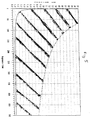
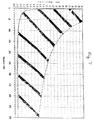
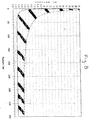
- the operating ranges of this invention which provide decreased delamination sites in contact lens produced according to this invention are in the hatched area shown in Figs. 4 and 5.
- the operating ranges are the O 2 concentration in the gaseous environment to which the contact lens mold is exposed to just prior to sealing the mold, and the corresponding exposure times for that concentration of O 2 .
- the preferred operating ranges are shown in Figs. 6 and 7, and the most preferred operating ranges are shown in Figs. 8 and 9.
- the data points used to generate the Figs. 4 and 5 were the same, the only difference is the time axis.
- Fig. 5 shows in more detail the curve between 0 and 500 seconds.
- the other pairs of figures, that is, Figs. 6 and 7, and Figs. 8 and 9 differ only by the time axis also.
- Contact lenses comprising Etafilcon A were produced in three types of manufacturing lines, indicated as Manufacturing Lines A, B, and C in the table below.
- Mold sections were prepared by a supplier, packaged and shipped to Vistakon. Prior to their use, essentially all the molecular oxygen was removed from the mold sections by exposing the mold sections to vacuum for a minimum of 8 hours, then the molds were held in a nitrogen environment. Only after the mold sections were inserted into the manufacturing line was oxygen introduced. The levels of oxygen are recorded in the table below.
- Lens mold sections were injection molded and transferred to an enclosed environment for which the oxygen level was controlled prior and through the dosing and assembling sealing steps. Mold sections were exposed to atmospheric oxygen for a maximum of 15 seconds during transfer to the enclosed environment. Mold sections were then exposed to the levels of oxygen in the controlled environment as recorded in the table.
- Lens mold sections were injection molded and transferred to the deposition sealing, curing, demolding, and hydration steps. The mold sections were exposed to air for the time specified within the table. 50 finished lenses per run were inspected for puddles and measured for base curve, power, center thickness and diameter. In all cases, there were no puddles present on finished lenses and the lenses met the specified parameter requirements. No tunnel audits were performed.
- the base curve is the parameter of the contact lens that most sensitive to changes caused by oxygen.
- An acceptable base curve sample is defined when: (Label Target - Sample Average) /3 x (Sample Standard Deviation) > 1.00. All the contact lenses tested above were acceptable.
- Sample percent puddles are acceptable when the rate of puddles measured during the in-process tunnel audit is less than 3.5%, more preferably less than 3.0% and most preferably less than 2%.
- the amount of O 2 absorbed into a unit cross-sectional volume of the mold halves can be determined, because it is a function of the permeability of the mold material, the mean thickness (L) of said volume as measured perpendicular to the surfaces exposed to O 2 , the concentration gradient of O 2 , and the amount of time the mold halves are exposed to O 2 .
- the diffusivity of O 2 in polystyrene at room temperature (25° C) is 1.1 x 10 -7 cm 2 /sec.
- the solubility of O 2 in polystyrene at room termperature (25° C) is 5.5 x 10 -2 cm 3 (STP)/(cm 3 bar), or 2.45 x 10 -6 moles/(cm 3 bar). If the temperature and materials are fixed, then the amount of O 2 of most concern at any given time simplifies to a function of thickness, O 2 concentration gradient and time. If the thickness and concentration gradient are fixed, then this amount of O 2 becomes a function of time. The thickness is fixed by back curve and front curve mold geometry. The concentration gradient is fixed by assuming that the front curve and back curve material (e.g.
- polystyrene is essentially degassed either during the injection molding process or by vacuum treatment, and by knowing or controlling the O 2 concentration of the environment surrounding the mold halves.
- the total amount of O 2 of most concern is then calculated by knowing the exposure time to O 2 and by summing the total number of unit volumes making up the optical surfaces of the mold halves and the immediate vicinity thereof. If the environment surrounding the mold halves is air, then the exposure time is known as the air exposure time.
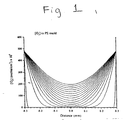
- This formula was used to generate Fig. 1 which shows the amount of O 2 in a 0.6 mm thick polystyrene mold as a function of the position across the thickness at various times after injection molding in ambient air.
- the lines on Fig. 1 represent various times after initial exposure.
- Figure 1 shows that if the mold exposure time to oxygen is not unlimited, then a parabolic oxygen concentration will be formed, with the oxygen content in the mold decreasing as one moves toward the interior of the mold.
- the amount of O 2 which is available to interfere with the polymerization reaction at 70 seconds is 2.6 x 10 -9 moles/cm 2
- at 57 seconds is 2.4 x 10 -9 moles/cm 2
- at 45 seconds is 2.1 x 10 -9 moles/cm 2 for each of the surfaces of the front and back curves.
- the exposure time for the new material equivalent to a 70 second exposure time for polystyrene both molds being exposed to the same concentration of O 2 would be calculated as follows:
- the same calculation can be used to determine the range of exposure times for a new contact lens mold material at any concentration of O 2 to get the benefit of this invention, by using the operating ranges for polystyrene specifically disclosed herein, and shown in Figs. 4 to 9 at the same concentration, when the solubility and diffusivity of the new material is known or can be determined.
- the exposure time or concentration of O 2 may also be increased by using an inert gas, like nitrogen, in and around the injection molding region wherein the plastic mold halves are produced, for example, for pressurized gas ejection of the mold halves from the mold.
- the inert gas in this area would provide a boundary layer of the inert gas around the front and back curves which would slow the uptake of O 2 when the front and back curves mold halves are subsequently exposed thereto.
Landscapes
- Engineering & Computer Science (AREA)
- Health & Medical Sciences (AREA)
- Manufacturing & Machinery (AREA)
- Ophthalmology & Optometry (AREA)
- Mechanical Engineering (AREA)
- Eyeglasses (AREA)
- Casting Or Compression Moulding Of Plastics Or The Like (AREA)
- Moulds For Moulding Plastics Or The Like (AREA)
Applications Claiming Priority (3)
| Application Number | Priority Date | Filing Date | Title |
|---|---|---|---|
| US570104 | 2000-05-12 | ||
| US09/570,104 US6610220B1 (en) | 1998-12-28 | 2000-05-12 | Process of manufacturing contact lenses with measured exposure to oxygen |
| EP01304252A EP1153732A3 (de) | 2000-05-12 | 2001-05-11 | Verfahren zur Herstellung von Kontaktlinsen mit abgemessener Sauerstoffbeaufschlagung |
Related Parent Applications (1)
| Application Number | Title | Priority Date | Filing Date |
|---|---|---|---|
| EP01304252.8 Division | 2001-05-11 |
Publications (2)
| Publication Number | Publication Date |
|---|---|
| EP1529626A2 true EP1529626A2 (de) | 2005-05-11 |
| EP1529626A3 EP1529626A3 (de) | 2005-06-15 |
Family
ID=24278235
Family Applications (2)
| Application Number | Title | Priority Date | Filing Date |
|---|---|---|---|
| EP05075153A Withdrawn EP1529626A3 (de) | 2000-05-12 | 2001-05-11 | Verfahren zur Herstellung von Kontaktlinsen mit abgemessener Sauerstoffbeaufschlagung |
| EP01304252A Withdrawn EP1153732A3 (de) | 2000-05-12 | 2001-05-11 | Verfahren zur Herstellung von Kontaktlinsen mit abgemessener Sauerstoffbeaufschlagung |
Family Applications After (1)
| Application Number | Title | Priority Date | Filing Date |
|---|---|---|---|
| EP01304252A Withdrawn EP1153732A3 (de) | 2000-05-12 | 2001-05-11 | Verfahren zur Herstellung von Kontaktlinsen mit abgemessener Sauerstoffbeaufschlagung |
Country Status (11)
| Country | Link |
|---|---|
| US (1) | US6610220B1 (de) |
| EP (2) | EP1529626A3 (de) |
| JP (1) | JP2002036258A (de) |
| KR (1) | KR100827554B1 (de) |
| CN (1) | CN1196582C (de) |
| AR (1) | AR028457A1 (de) |
| AU (1) | AU782811B2 (de) |
| BR (1) | BRPI0101968B1 (de) |
| CA (1) | CA2347392C (de) |
| HK (1) | HK1043765B (de) |
| SG (1) | SG101971A1 (de) |
Cited By (1)
| Publication number | Priority date | Publication date | Assignee | Title |
|---|---|---|---|---|
| WO2007146365A3 (en) * | 2006-06-07 | 2008-03-27 | Johnson & Johnson Vision Care | Decreased lens delamination during ophthalmic lens manufacture |
Families Citing this family (8)
| Publication number | Priority date | Publication date | Assignee | Title |
|---|---|---|---|---|
| US20080131593A1 (en) * | 2004-01-29 | 2008-06-05 | Powell P Mark | Contact lens mold printing systems and processes |
| SG191444A1 (en) * | 2006-12-21 | 2013-07-31 | Novartis Ag | High intensity uv mold pretreatment |
| JP5363503B2 (ja) * | 2007-12-31 | 2013-12-11 | ボーシュ アンド ローム インコーポレイティド | 眼科デバイスを含むバイオメディカルデバイスを形成するためのキャスティングモールド |
| US20090295004A1 (en) * | 2008-06-02 | 2009-12-03 | Pinsly Jeremy B | Silicone hydrogel contact lenses displaying reduced protein uptake |
| TW201141693A (en) * | 2010-03-25 | 2011-12-01 | Johnson & Johnson Vision Care | Ophthalmic lens mold treatment |
| US10209534B2 (en) | 2012-03-27 | 2019-02-19 | Johnson & Johnson Vision Care, Inc. | Increased stiffness center optic in soft contact lenses for astigmatism correction |
| JP6155457B2 (ja) * | 2013-01-11 | 2017-07-05 | 株式会社メニコンネクト | 多層コンタクトレンズおよびその製造方法 |
| US11125916B2 (en) | 2016-07-06 | 2021-09-21 | Johnson & Johnson Vision Care, Inc. | Silicone hydrogels comprising N-alkyl methacrylamides and contact lenses made thereof |
Family Cites Families (28)
| Publication number | Priority date | Publication date | Assignee | Title |
|---|---|---|---|---|
| US4018853A (en) | 1974-11-21 | 1977-04-19 | Warner-Lambert Company | Crosslinked, hydrophilic rods of pyrrolidone-methacrylate graft copolymers |
| US4054624A (en) | 1974-11-21 | 1977-10-18 | Warner-Lambert Company | Preparing a hydrated contact lens |
| FR2402525A1 (fr) | 1977-09-12 | 1979-04-06 | Toray Industries | Procede de fabrication de compositions de lentilles de contact molles et nouveaux produits ainsi obtenus |
| US4208365A (en) | 1978-12-20 | 1980-06-17 | National Patent Development Corporation | Method and apparatus for molding toric contact lenses |
| US4495313A (en) | 1981-04-30 | 1985-01-22 | Mia Lens Production A/S | Preparation of hydrogel for soft contact lens with water displaceable boric acid ester |
| US4640489A (en) | 1981-04-30 | 1987-02-03 | Mia-Lens Production A/S | Mold for making contact lenses, either the male or female mold sections being relatively more flexible |
| EP0106517A3 (de) * | 1982-09-11 | 1985-10-23 | Iain Sinclair | Transportvorrichtung |
| US4609337A (en) | 1983-12-06 | 1986-09-02 | Ceskoslovenska Akademie Ved | Apparatus for inserting molds filled with a monomer mixture into rotating polymerization columns |
| US4680336A (en) | 1984-11-21 | 1987-07-14 | Vistakon, Inc. | Method of forming shaped hydrogel articles |
| CA1263208A (en) | 1985-12-19 | 1989-11-28 | Kirk K.S. Hwang | Method and apparatus for making optical devices |
| FR2598350B1 (fr) | 1986-05-06 | 1989-11-17 | Bp Chimie Sa | Procede et dispositif pour degazer et pour transformer en granules des particules de polyolefines obtenues par polymerisation en phase gazeuse |
| US4889664A (en) | 1988-11-25 | 1989-12-26 | Vistakon, Inc. | Method of forming shaped hydrogel articles including contact lenses |
| US5039459A (en) | 1988-11-25 | 1991-08-13 | Johnson & Johnson Vision Products, Inc. | Method of forming shaped hydrogel articles including contact lenses |
| US5230840A (en) | 1990-09-14 | 1993-07-27 | The Furukawa Electric Co., Ltd. | Method of manufacturing thermoplastic/resin molded optical member |
| US5219965A (en) | 1990-11-27 | 1993-06-15 | Bausch & Lomb Incorporated | Surface modification of polymer objects |
| US5271875A (en) | 1991-09-12 | 1993-12-21 | Bausch & Lomb Incorporated | Method for molding lenses |
| US5391589A (en) | 1991-12-10 | 1995-02-21 | Seiko Epson Corporation | Contact lens and method of producing a contact lens |
| US5248467A (en) | 1992-07-27 | 1993-09-28 | Cushman William B | Injection of molding material into molds that may contain cores and/or fibers |
| US5310571A (en) | 1992-09-01 | 1994-05-10 | Allergan, Inc. | Chemical treatment to improve oxygen permeability through and protein deposition on hydrophilic (soft) and rigid gas permeable (RGP) contact lenses |
| US5326505A (en) | 1992-12-21 | 1994-07-05 | Johnson & Johnson Vision Products, Inc. | Method for treating an ophthalmic lens mold |
| IL113691A0 (en) | 1994-06-10 | 1995-08-31 | Johnson & Johnson Vision Prod | Low oxygen molding of soft contact lenses |
| US5804107A (en) | 1994-06-10 | 1998-09-08 | Johnson & Johnson Vision Products, Inc. | Consolidated contact lens molding |
| US5555504A (en) | 1994-06-10 | 1996-09-10 | Johnson & Johnson Vision Products, Inc. | Production line tracking and quality control system |
| US5760100B1 (en) * | 1994-09-06 | 2000-11-14 | Ciba Vision Corp | Extended wear ophthalmic lens |
| US5681510A (en) * | 1994-10-13 | 1997-10-28 | Bausch & Lomb Incorporated | Method for treating plastic mold pieces |
| US6007229A (en) | 1997-06-05 | 1999-12-28 | Johnson & Johnson Vision Products, Inc. | Rapid robotic handling of mold parts used to fabricate contact lenses |
| JP2000159527A (ja) * | 1998-11-27 | 2000-06-13 | Sony Corp | メニスカスレンズとその製造方法 |
| US6241918B1 (en) * | 1998-12-28 | 2001-06-05 | Johnson & Johnson Vision Care, Inc. | Process of manufacturing contact lenses in ambient environment |
-
2000
- 2000-05-12 US US09/570,104 patent/US6610220B1/en not_active Expired - Lifetime
-
2001
- 2001-05-10 CA CA2347392A patent/CA2347392C/en not_active Expired - Lifetime
- 2001-05-11 EP EP05075153A patent/EP1529626A3/de not_active Withdrawn
- 2001-05-11 EP EP01304252A patent/EP1153732A3/de not_active Withdrawn
- 2001-05-11 AU AU43839/01A patent/AU782811B2/en not_active Ceased
- 2001-05-11 SG SG200102821A patent/SG101971A1/en unknown
- 2001-05-12 KR KR1020010025999A patent/KR100827554B1/ko not_active Expired - Lifetime
- 2001-05-12 CN CNB011226439A patent/CN1196582C/zh not_active Expired - Fee Related
- 2001-05-14 JP JP2001143671A patent/JP2002036258A/ja active Pending
- 2001-05-14 BR BRPI0101968A patent/BRPI0101968B1/pt not_active IP Right Cessation
- 2001-05-14 AR ARP010102286A patent/AR028457A1/es active IP Right Grant
-
2002
- 2002-07-22 HK HK02105416.3A patent/HK1043765B/zh not_active IP Right Cessation
Non-Patent Citations (1)
| Title |
|---|
| None * |
Cited By (1)
| Publication number | Priority date | Publication date | Assignee | Title |
|---|---|---|---|---|
| WO2007146365A3 (en) * | 2006-06-07 | 2008-03-27 | Johnson & Johnson Vision Care | Decreased lens delamination during ophthalmic lens manufacture |
Also Published As
| Publication number | Publication date |
|---|---|
| BR0101968A (pt) | 2001-12-26 |
| CA2347392C (en) | 2010-04-06 |
| AR028457A1 (es) | 2003-05-07 |
| CA2347392A1 (en) | 2001-11-12 |
| HK1043765B (zh) | 2005-12-02 |
| EP1153732A2 (de) | 2001-11-14 |
| EP1153732A3 (de) | 2003-11-12 |
| KR20010104297A (ko) | 2001-11-24 |
| KR100827554B1 (ko) | 2008-05-07 |
| AU4383901A (en) | 2001-11-15 |
| JP2002036258A (ja) | 2002-02-05 |
| US6610220B1 (en) | 2003-08-26 |
| EP1529626A3 (de) | 2005-06-15 |
| SG101971A1 (en) | 2004-02-27 |
| BRPI0101968B1 (pt) | 2016-06-28 |
| HK1043765A1 (en) | 2002-09-27 |
| CN1334188A (zh) | 2002-02-06 |
| AU782811B2 (en) | 2005-09-01 |
| CN1196582C (zh) | 2005-04-13 |
Similar Documents
| Publication | Publication Date | Title |
|---|---|---|
| EP0785854B2 (de) | Verfahren zur behandlung von kunststoffgiessformen | |
| US7143990B2 (en) | Apparatus and method for the production of ophthalmic lenses | |
| CN1058104A (zh) | 软质隐形眼镜水合法 | |
| US6610220B1 (en) | Process of manufacturing contact lenses with measured exposure to oxygen | |
| CA2293069C (en) | Process of manufacturing contact lenses in ambient environment | |
| HK1073087A (en) | Process of manufacturing contact lenses with measured exposure to oxygen | |
| HK1027780B (en) | Process of manufacturing contact lenses in ambient environment | |
| TW200906604A (en) | Methods of releasing and hydrating ophthalmic lenses | |
| MXPA97002638A (en) | Method for treating plast mold pieces | |
| HK1142853A (en) | Methods of releasing and hydrating ophthalmic lenses |
Legal Events
| Date | Code | Title | Description |
|---|---|---|---|
| PUAI | Public reference made under article 153(3) epc to a published international application that has entered the european phase |
Free format text: ORIGINAL CODE: 0009012 |
|
| PUAL | Search report despatched |
Free format text: ORIGINAL CODE: 0009013 |
|
| AC | Divisional application: reference to earlier application |
Ref document number: 1153732 Country of ref document: EP Kind code of ref document: P |
|
| AK | Designated contracting states |
Kind code of ref document: A2 Designated state(s): DE FR GB IE IT |
|
| AK | Designated contracting states |
Kind code of ref document: A3 Designated state(s): DE FR GB IE IT |
|
| REG | Reference to a national code |
Ref country code: HK Ref legal event code: DE Ref document number: 1073087 Country of ref document: HK |
|
| 17P | Request for examination filed |
Effective date: 20051124 |
|
| AKX | Designation fees paid |
Designated state(s): DE FR GB IE IT |
|
| 17Q | First examination report despatched |
Effective date: 20070222 |
|
| STAA | Information on the status of an ep patent application or granted ep patent |
Free format text: STATUS: THE APPLICATION IS DEEMED TO BE WITHDRAWN |
|
| 18D | Application deemed to be withdrawn |
Effective date: 20070905 |
|
| REG | Reference to a national code |
Ref country code: HK Ref legal event code: WD Ref document number: 1073087 Country of ref document: HK |