EP1528476B1 - Programm, informationsverarbeitungsverfahren und -einrichtung - Google Patents
Programm, informationsverarbeitungsverfahren und -einrichtung Download PDFInfo
- Publication number
- EP1528476B1 EP1528476B1 EP03771415.1A EP03771415A EP1528476B1 EP 1528476 B1 EP1528476 B1 EP 1528476B1 EP 03771415 A EP03771415 A EP 03771415A EP 1528476 B1 EP1528476 B1 EP 1528476B1
- Authority
- EP
- European Patent Office
- Prior art keywords
- processing apparatus
- information processing
- service
- provider
- consumer
- Prior art date
- Legal status (The legal status is an assumption and is not a legal conclusion. Google has not performed a legal analysis and makes no representation as to the accuracy of the status listed.)
- Expired - Lifetime
Links
Images









Classifications
-
- G—PHYSICS
- G06—COMPUTING OR CALCULATING; COUNTING
- G06F—ELECTRIC DIGITAL DATA PROCESSING
- G06F15/00—Digital computers in general; Data processing equipment in general
-
- G—PHYSICS
- G06—COMPUTING OR CALCULATING; COUNTING
- G06F—ELECTRIC DIGITAL DATA PROCESSING
- G06F9/00—Arrangements for program control, e.g. control units
- G06F9/06—Arrangements for program control, e.g. control units using stored programs, i.e. using an internal store of processing equipment to receive or retain programs
- G06F9/46—Multiprogramming arrangements
- G06F9/50—Allocation of resources, e.g. of the central processing unit [CPU]
- G06F9/5005—Allocation of resources, e.g. of the central processing unit [CPU] to service a request
- G06F9/5027—Allocation of resources, e.g. of the central processing unit [CPU] to service a request the resource being a machine, e.g. CPUs, Servers, Terminals
- G06F9/5055—Allocation of resources, e.g. of the central processing unit [CPU] to service a request the resource being a machine, e.g. CPUs, Servers, Terminals considering software capabilities, i.e. software resources associated or available to the machine
-
- G—PHYSICS
- G06—COMPUTING OR CALCULATING; COUNTING
- G06F—ELECTRIC DIGITAL DATA PROCESSING
- G06F9/00—Arrangements for program control, e.g. control units
-
- H—ELECTRICITY
- H04—ELECTRIC COMMUNICATION TECHNIQUE
- H04L—TRANSMISSION OF DIGITAL INFORMATION, e.g. TELEGRAPHIC COMMUNICATION
- H04L67/00—Network arrangements or protocols for supporting network services or applications
- H04L67/50—Network services
- H04L67/51—Discovery or management thereof, e.g. service location protocol [SLP] or web services
-
- H—ELECTRICITY
- H04—ELECTRIC COMMUNICATION TECHNIQUE
- H04L—TRANSMISSION OF DIGITAL INFORMATION, e.g. TELEGRAPHIC COMMUNICATION
- H04L67/00—Network arrangements or protocols for supporting network services or applications
- H04L67/50—Network services
- H04L67/54—Presence management, e.g. monitoring or registration for receipt of user log-on information, or the connection status of the users
-
- H—ELECTRICITY
- H04—ELECTRIC COMMUNICATION TECHNIQUE
- H04W—WIRELESS COMMUNICATION NETWORKS
- H04W68/00—User notification, e.g. alerting and paging, for incoming communication, change of service or the like
-
- H—ELECTRICITY
- H04—ELECTRIC COMMUNICATION TECHNIQUE
- H04W—WIRELESS COMMUNICATION NETWORKS
- H04W92/00—Interfaces specially adapted for wireless communication networks
- H04W92/16—Interfaces between hierarchically similar devices
- H04W92/18—Interfaces between hierarchically similar devices between terminal devices
Definitions
- the present invention relates to programs and information processing methods and apparatuses, particularly to a program and an information processing method and apparatus with which a connection can be formed reliably between apparatuses having different capabilities.
- RTSP Real Time Streaming Protocol
- IETF RFC 2326 (Real Time Streaming Protocol)
- SDP Session Description Protocol
- IETF RFC 2327 (SDP: Session Description Protocol, IETF RFC 2327, April 1998, ⁇ http://www.ietf.org/rfc/rfc/2327.txt>).
- the document WO 01/86394 A2 shows a method and apparatus for obtaining service capability credentials.
- a service provider publishes an XML advertisement within a space.
- Such a space is defined as a service.
- a client looking for service providers receives the XML advertisement from the space.
- the data within the XML advertisement is used for running the service by the client.
- the present invention has been made in view of the situation described above, and it aims at allowing a connection to be established quickly and reliably with a device of the other party, reliably irrespective of the capability of the device of the other party, serving to improve usability.
- a first computer program according to the invention comprises software code adapted to perform a process on a consumer information processing apparatus for exchanging information with a provider information processing apparatus via a network.
- the program comprises:
- the program may further include an accessing step of making an access based on the connection information without connecting to the second information processing apparatus.
- the requests in the first step and in the second step and the sending in the first sending step may use a messaging function or an Info/Query function of instant messaging.
- the first receiving step may receive, together with the identification information, a provider entity identifier for identifying an entity that acts as a provider who provides the service
- the program may further include a storing step of storing the provider entity identifier and a user entity identifier for identifying an entity that acts as a user who uses the service, such that the provider entity identifier and the user entity identifier are associated with each other.
- the program may further include a third receiving step of receiving invitation information of invitation for using the service, sent by the first information processing apparatus.
- the program may further include a second sending step of sending information indicating acceptance or rejection when the invitation information is received by the processing in the third receiving step.
- the sending in the second sending step may use a messaging function or an Info/Query function of instant messaging.
- the first sending step may send information regarding usage of the service that can be provided, on condition that the information indicating acceptance has been sent by the processing in the second sending step.
- the provider entity identifier and the user entity identifier may be included.
- a reference number for identifying the information indicating acceptance or rejection, the provider entity identifier, and the user entity identifier may be included in the information indicating acceptance or rejection.
- An information processing method for a consumer information processing apparatus for exchanging information with a provider information processing apparatus via a network comprises:
- a consumer information processing apparatus for exchanging information with a provider information processing apparatus via a network comprises:
- a second computer program comprises software code adapted to perform a process for exchanging information between a consumer information processing apparatus and a provider information processing apparatus via a network.
- the program comprises:
- a second information processing method for an information processing system for exchanging information between a provider information processing apparatus and a consumer information processing apparatus via a network comprises:
- a second information processing system for exchanging information between a provider information processing apparatus and a consumer information processing apparatus via a network comprises:
- Fig. 1 shows an example configuration of a network system according to the present invention.
- personal computers 11 and 12 and PDA (Personal Digital Assistants) 13 are connected to a media instant message server (Media IM Server) 14.
- an application server 15 is connected to the media IM server 14 via the Internet 1.
- a media IM client #1 is implemented as middleware.
- a media IM client #2 is implemented as middleware.
- a media IM client #3 is implemented as middleware.
- a media IM client #4 is implemented as middleware.
- the application server 15 provides print services #1 to #7 to users accessing the application server 15.
- the media IM server 14 controls instant message processing among these media IM clients #1 to #4.
- Fig. 2 shows the software configuration.
- the media IM clients #1 to #4 described above are shown as media IM client middleware 32.
- the media IM client middleware 32 is provided between an IP network transport layer 31 and an API (Application Program Interface) 33.
- the API 33 executes interface processing between applications #1 to #N and the media IM client middleware 32.
- the media IM client middleware 32 executes interface processing between the API 33 and the IP network transport layer 31.
- the applications #1 to #N respectively constitute service entities.
- an application that provides a service acts as a service provider 51
- an application that receives the service i.e., that consumes the service
- the application #n in the example shown in Fig. 3 acts as a service consumer 52.
- the service provider 51 and the service consumer 52 execute a negotiation process for connection via media IM clients #P1 and #C1 respectively associated therewith, using a presence function, messaging function, or Info/Query function of instant messaging. After confirming by the negotiation that mutual connection is possible, the service provider 51 and the service consumer 52 execute a connection process by peer to peer (P2P).
- P2P peer to peer
- the service provider 51 and the service consumer 52 respectively constitute service entities.
- a single application may consist entirely of a service entity in some cases, or consist of a set of service entities.
- a single service entity corresponds to a single application.
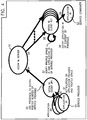
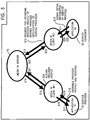
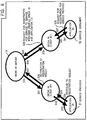
- connection process will be described in detail with reference to flowcharts shown in Figs. 4 to 7 .
- step S1 the application #1 acting as the service provider 51 instructs the media IM client #P1 to announce a profile space ID representing types of services that it can provide to buddies registered in a roster.
- the media IM client #P1 Upon receiving the instruction in step S2, the media IM client #P1, in step S3, notifies the buddies that have been registered in the roster of the profile space ID by presence.
- a buddy refers to a party involved in message communication with a user (or a media IM client) in an instant messaging service provided by the media IM server 14.
- a buddy is information represented by a user ID, a nickname associated with a user ID, or the like, registered in advance in the media IM server 14.
- a roster refers to a list of buddies, i.e., a list of user IDs (or nicknames) of other users (or other media IM clients) specified by a user (or a media IM client) as parties involved in message communication. Rosters for respective users are unitarily managed by the media IM server 14.
- the user of the media IM client #P1 has specified a user of the media IM client #C1 as a party involved in message communication
- the user (a user ID or the like) of the user of the media IM client #C1 is registered as a buddy in a roster associated with the media IM client #P1.
- the user of the media IM client #P1 has specified the user of the media IM client #P1 as a party involved in message communication
- the user of the media IM client #P1 is registered as a buddy in a roster associated with the media IM client #C1.
- parties involved in order to execute message communication by instant messaging, parties involved must be mutually registered in advance in rosters as buddies. For example, if a first user of a media IM client has registered a second user of another media IM client as a buddy in a roster and if the second user has not registered the first user as a buddy in the client of the second user, in order to execute message communication, the first user must be registered by the second user as a buddy in a roster prior to message communication.
- the roster is provided as required from the media IM server 14 to the media IM client, and is displayed in the form of a GUI (Graphical User Interface) on a display or the like.
- the media IM server 14 supplies to the media IM client icons that allow the user to readily recognize intended buddies, and information relating to the buddies (e.g., information representing whether or not communication is possible), such as presence, as well as the roster described above.
- the media client upon receiving the roster and related information, displays the buddies in the roster in association with the icons and presence.
- the rosters described above may be managed by a server provided particularly for unitarily managing the rosters.
- Profile space IDs and application IDs are registered in advance and managed by an administrator of an application platform that allows negotiation of profiles at an application level based on a presence function, messaging function, and Info/Query function of instant messaging, such as the network system shown in Fig. 1 .
- the service consumer 52 is allowed to identify contents based on the IDs.
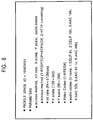
- Fig. 8 shows an example of a profile space for defining an MPEG-4 streaming server application that runs on the personal computer 11.
- the profile space is an M dimensional space that represent services provided by the personal computer, and is constituted by a profile space ID that serves as an ID for identifying each profile space and M dimensional parameters.
- the profile space ID is "10000001”
- the parameters include "access method”, "bit rate (link speed)", “X scale”, “Y scale”, and "audio codec”.
- the value of the access method representing a protocol used for communication, is 1 (RTSP/TCP+RTP/UDP) or 2 (HTTP tunnelling).
- the value of the bit rate representing a rate of a communication line that is connected, is 6 k to 512 kbps.
- the value of the X scale representing a screen size in a horizontal direction, is 128 pixels to 352 pixels.
- the value of the Y scale, representing a screen size in a vertical direction is 96 pixels to 288 pixels.
- the access method in the profile represents a protocol used for communication, for example, either RTSP (Real Time Streaming Protocol)/TCP (Transmission Control Protocol) + RTP (Real Time Transport Protocol)/UDP (User Datagram Protocol) represented by number 1 or HTTP (Hyper Text Transfer Protocol) tunnelling represented by number 2.
- the bit rate represents a data transfer rate of a communication line that is used. That is, the bit rate serves as information for determining an MPEG-4 data transfer rate of an MPEG-4 streaming service provided by the application #1.
- the video codec representing a method of video compression and expansion is MPEG-4.
- the audio codec representing a method of audio compression and expansion is one of none, CELP (Code Excited Linear Predictive) 8k, CELP 16k, AAC (Advanced Audio Coding) 16k, AAC 32k, AAC 44.1k, and AAC 48k.
- the media IM server 14 upon receiving the notification from the media IM client #P1 in step S4, the media IM server 14, in step S5, announces the notification to each buddy in the roster.
- the media IM client #C1 which is one of the buddies (the service consumer 52) that receive the announcement, upon receiving the notification in step S6, determines (verifies) in step S7 whether the profile is acceptable for the media IM client #C1 based on the profile space ID and the application ID of the service provider 51 (the ID of the application #1 in this example). This is possible since, as described earlier, each participant in the system is allowed to identify content of the profile (functions of a device of another party involved, as shown in Fig. 8 ) based on these IDs.
- each of the media IM clients (i.e., the personal computers 11 and 12, and the like) stores in advance a table in which application IDs and profile IDs are associated with type of parameters included in profiles and sets of values that the parameters are allowed to take on, and information regarding applications that act as service consumers, as shown in Fig. 8 .
- the media IM client refers to the table that it holds, identifies types of parameters included in a profile associated with the application ID and the profile ID obtained in step S6 and a set of values that the parameters are allowed to take on, and determines, based on the information that it holds regarding the application, whether the parameters identified (the profile associated with the parameters) are compatible with the functions of the application that acts as a service consumer (i.e., whether the parameters are acceptable).
- the table defining association between IDs and contents may be stored in each device (the personal computers 11 and 12, and the like), or in a predetermined server (e.g., the media IM server 14). In that case, a user may be billed each time the user uses the table for verification. This allows an administrator of the media IM server 14 to earn profit.
- the media IM client #C1 determines that the content of the profile for which presence has been received from the service provider 51 is acceptable for the service consumer, in step S8, the media IM client #C1 notifies the content of the profile (a profile associated with the profile space ID, shown in Fig. 8 ) of the application #n that acts as the service consumer 52 capable of accepting the profile. In step S9, the application #n receives the notification from the media IM client #C1.
- Each of the media IM clients having received the announcement from the service provider (steps S4 to S6), ignores the announcement if it is determined by the verification in step S7 that an application that suitably acts as a service consumer does not exist.
- the application #n acting as the service consumer 52 instructs the media IM client #C1 to obtain detailed information of the service provided by the service provider 51.
- the media IM client #C1 Upon receiving the instruction in step S11, the media IM client #C1, in step S12, using the messaging function or Info/Query function, requests transmission of a provider profile including a part of or all the parameters of the parameter set of the profile space of the service provided by the service provider 51, described earlier.
- the request includes destination information for specifying the service provider 51.
- a response for acknowledgement of reception is supplied from the recipient to the sender.
- the application #1 of the media IM client #P1 obtains a roster from the media IM server 14
- the media IM client #P1 uses the Info/Query function to supply a GET command or the like to the media IM server 14.
- the media IM server 14 supplies a response acknowledging reception to the application #1 via the media IM client #P1 at the source of the command.
- the application #1 is allowed to confirm that the GET command has been supplied to the media IM server 14.
- an application Since an acknowledge response is supplied from a destination to a source at the application level as described above, an application is allowed to send a notification or request reliably to a destination by using the Info/Query function.
- the notification or request by the Info/Query function, and the notification or request by the messaging function, described above, can be used by media IM servers as well as media IM clients, and can be used, for example, as a notification or request between media IM clients as well as a notification or request between a media IM client and a media IM server.
- notifications or requests by the Info/Query function or the messaging function may include any data regardless of content, such as messages and parameters, as well as commands.
- the media IM client #P1, the media IM client #C1, and the media IM server 14 exchange data (including notifications, requests, and the like) using the messaging function or the Info/Query function.
- the media IM client #P1 or the like may send a provider profile using either the messaging function or the Info/Query function. It is to be noted that when a provider profile is sent using the Info/Query function, a response to the transmission of the provider file is supplied from the destination to the source of the transmission.
- the media IM server 14 Upon receiving the request from the media IM client #C1 in step S13, the media IM server 14, in step S14, sends the request to the media IM client #P1. Upon receiving the request from the media IM server 14 in step S15, the media IM client #P1, in step S16, supplies the request to the application #1 acting as the service provider 51.
- the application #1 Upon receiving the request from the media IM client #P1 in step S17, the application #1, in step S18, assembles a provider profile that is to be provided to the service consumer 52, and sends the provider profile to the media IM client #P1.
- the content of the provider file generated by the application #1 specifically sets ranges of values of parameters that the service provider 51 can actually provide to the service consumer 52 with consideration of runtime environments such as network link speed and CPU load status.
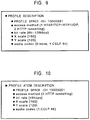
- Fig. 9 shows an example of a provider profile generated as described above.
- the provider profile is represented as a profile description.
- Fig. 9 shows an example where the application #1 acting as the service provider 51 only supports a viewing angle corresponding to VGA (Video Graphics Array) (160 pixels x 120 pixels or 320 pixels x 240 pixels), and is connected to a network equivalent to a PHS (Personal Handyphone System) (a network with a maximum link speed of 128 kbps).
- VGA Video Graphics Array
- PHS Personal Handyphone System
- the viewing angle is limited only to 160 pixels x 120 pixels (X scale x Y scale) of the range defined by the profile space shown in Fig. 8 .
- the profile space ID is "10000001", indicating that the profile description corresponds to the profile space shown in Fig. 8 . That is, as described earlier, when the media IM client #C1 requests a provider profile in step S12, in response to the request, a profile description (provider profile) corresponding to the profile space ID supplied by the media IM client #P1 in step S3 is generated, as shown in Fig. 9 .
- the access method in Fig. 9 is either RTSP/TCP+RTP/UDP or HTTP tunnelling.
- the bit rate is 6 kpbs to 128 kbps.
- the audio codec is none or CELP 8k.
- the media IM client #P1 Upon receiving a response for the provider profile from the application #1 in step S19, the media IM client #P1, in step S20, returns the response to the application #n using the messaging function or the Info/Query function.
- the media IM server 14 Upon receiving the reply from the media IM client #P1 in step S21, the media IM server 14, in step S22, sends the reply to the media IM client #C1.
- the media IM client #C1 Upon receiving the reply in step S23, the media IM client #C1, in step S24, sends the reply to the application #n.
- the application #n receives the reply from the service provider 51 (including the provider profile shown in Fig. 9 ).
- the application #n checks matching (performs a comparison) between the provider profile of the service provider 51, received by the processing in step S25, and a consumer profile that the application #n itself generates.
- the provider profile is a profile created by the application #1 based on the profile space of the content determined by the media IM client #C1 as acceptable by the service consumer. That is, the profile space corresponding to the provider profile is also supported by the application #n acting as the service consumer.
- the application #n is allowed to execute the same process as in the case where the application #1 creates a provider profile, thereby creating a profile including a part of or all the parameters in a parameter set of the profile space supported by the service consumer (i.e., a consumer profile).
- the application #n checks matching between the received provider profile of the service provider 51 and the consumer profile created as described above.
- the provider profile (profile description) presented by the service provider is represented by numeric values only.
- the service provider 51 is allowed to readily verify matching simply by a one-dimensional comparison with ranges of values of parameters included in its own profile.
- a dimension herein refers to the effective number of parameters. That is, the service consumer 52 compares, one by one, the range of values of each parameter of the consumer profile with the range of values of the corresponding parameter of the provider profile.
- the service consumer 52 determines that matching is confirmed.
- the application #n requests the service provider 51 to register itself (i.e., the service consumer 52) to the service provided.
- the media IM client #C1 requests the service provider 51 for registration to the service, using the messaging function or the Info/Query function, i.e., requests registration of the service consumer 52 as a receiver of the service through registration of the application ID of the application #n of the service consumer 52.
- the profile space ID and the application ID are included in the request.
- the media IM server 14 Upon receiving the request from the media IM client #C1 in step S29, the media IM server 14, in step S30, sends the request to the media IM client #P1.
- the media IM client #P1 Upon receiving the request from the media IM server 14 in step S31, the media IM client #P1, in step S32, sends the request to the application #1.
- the application #1 receives the registration request from the service consumer 52.
- the application #1 acting as the service provider 51 registers the service consumer 52 in association with the service provided to the service consumer 52 by the processing in step S18. More specifically, the application ID of the application #n of the service consumer 52 is registered in association with the profile space ID.
- the information regarding the service consumer 52 is used when the application #1 provides a service. That is, the application #1 refers to the registered information, and provides a service to an application of the service consumer 52 (an application corresponding to the application ID) based on the information.
- step S34 the application #1 instructs the media IM client #P1 to issue a response to the request for registration to the service, supplied from the service consumer 52 (i.e., information indicating whether registration of the application #n has been completed), the request being a request for registering the application ID of the application #n of the service consumer 52 in association with the profile space ID to thereby register the service consumer 52 as a receiver of the service.
- the media IM client #P1 in step S36, issues a notification of a registration result that serves as a response to the request supplied thereto, using the messaging function or the Info/Query function.
- the media IM server 14 Upon receiving the notification of the registration result in step S37, the media IM server 14, in step S38, sends the notification to the media IM client #C1.
- the media IM client #C1 Upon receiving the notification in step S39, the media IM client #C1, in step S40, sends the notification to the application #n.
- the application #n receives the notification of the registration result.
- step S42 the application #n determines, as a profile atom, parameters for assuring connectivity based on the profile description from the service provider 51 (i.e., the provider profile received by the processing in step S25). That is, parameters that allow the application #n to use data sent by the application #1 as it is (parameters acceptable by the application #n) are determined.
- Fig. 10 shows an example of the description of the profile atom.
- the profile space ID is "10000001", indicating that the profile atom corresponds to the profile space shown in Fig. 8 . That is, as described earlier, upon receiving a profile description (provider profile) corresponding to the profile space ID, created and supplied by the media IM client #P1 in response to a request from the media IM client #C1, the media IM client #C1 creates a consumer profile corresponding to the profile space ID, and compares the consumer profile with the provider profile supplied thereto.
- a profile description provider profile
- the media IM client #C1 executes registration to the service provided, identifies ranges of parameters for assuring connectivity from the ranges of the respective parameters included in the profile space corresponding to the profiles, thereby generating a profile atom including parameters in those ranges, as shown in Fig. 10 .
- the access method is HTTP tunnelling. That is, as the access method in the provider profile shown in Fig. 9 , access method associated with number 2 is selected.
- the bit rate is 48 kbps, the X scale is 160, and the Y scale is 120.
- the audio codec is CELP 8k.
- step S42 the application #n issues a connect request to which the profile atom determined as described above is attached.
- the media IM client #C1 in step S44, sends the request to the service provider 51 using the messaging function or the Info/Query function.
- the media IM server 14 in step S46, sends the request to the media IM client #P1.
- the media IM client #P1 in step S48, sends the request to the application #1.
- the application #1 receives the request.
- the application #1 Upon receiving the request, the application #1, in step S50, sends to the service consumer 52 a response including connection information needed by the service consumer 52 (i.e., the application #n) to connect to the service provider 51 (i.e., the application #1).
- the connection information may be, for example, a URI (Uniform Resource Identifier) representing an address of the service provider 51 that is accessed when the service consumer 52 connects to the service provider 51 (service URI).
- URI Uniform Resource Identifier
- the response sent by the processing in step S50 by the application #1 is received by the media IM client #P1 in step S51.
- the media IM client #P1 sends the response to the service consumer 52 using the messaging function or the Info/Query function.
- the media IM server 14 Upon receiving the response from the media IM client #P1 in step S53, the media IM server 14, in step S54, sends the response to the media IM client #C1.
- the media IM client #C1 Upon receiving the response from the media IM server 14 in step S55, the media IM client #C1, in step S56, sends the response to the application #n.
- the application #n receives the response.
- the application #1 After instructing sending of a response in step S50, the application #1 waits for a direct access (not via the media IM server 14) from the application #n. Thus, in step S58, the application #n accesses the service URL (Uniform Resource Locator) of the application #1 by peer to peer, not via the media IM server 14. In step S59, the application #1 accepts the peer-to-peer access to the URL by the application #n.
- the service URL Uniform Resource Locator
- the application #1 and the application #n are allowed to exchange information by peer to peer.
- the service provider 51 is an entity that provides a service (provider).
- the service consumer 52 is an entity that receives and uses a service provided (user).
- the provider and user of a service is relative; for example, when one of the personal computers 11 and 12 provides a service, the other uses the service.
- the personal computer 11 is capable of acting both as the service provider 51 and the service consumer 52.
- the personal computer 11 has the application #n and the media IM client #C1 as a user of a service as well as the application #1 and the media IM client #P1 as a provider of a service.
- the personal computer 12 has the application #1 and the media IM client #P1 as a provider of a service as well as the application #n and the media IM client #C1 as a user of a service.
- new protocol architecture for allowing negotiation of profiles at the application level is implemented based on the presence function, messaging function, and Info/Query function of instant messaging.
- applications mounted on various devices having different capabilities such as personal computers and mobile devices, are allowed to connect to each other readily and reliably.
- a system that allows rich media information including various information such as text, audio, music, moving pictures, and still pictures to be transmitted by peer-to-peer communication can be implemented.
- applications (service entities) for which connectivity is finally assured are allowed to communicate with each other by peer to peer. Accordingly, a user is allowed to exchange information readily and reliably without performing special operations.
- the applications (service entities) described above may be applied to commercial application servers on the Internet 1 as well as personal computers and network-enabled CE (Consumer Electronics) devices.
- an application for a commercial print service is run as a service provider on the media IM client #4.
- the personal computers 11 and 12 and the PDA 13 shown in Fig. 1 are allowed to use, via the Internet 1, the print service provided by the application server 15, by executing the procedure described above with the application server 15.
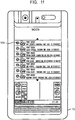
- a list of service providers can be displayed as a buddy list, for example, as shown in Fig. 11 .
- a list of service providers that can be used by a print service application acting as a service consumer on the media IM client #3 implemented on the PDA 13 is shown.
- status of commercial services can be expressed in detail and flexibly in relation to service consumers.
- a lamp icon 13A indicates whether or not a commercial service is in operation.
- a commercial service in operation is indicated by green
- a commercial service not in operation is indicated by red.
- detailed status is displayed as status information.
- status can be displayed on an application basis depending on the other party involved, using a user interface and the presence function.
- Fig. 12 shows an example configuration of the personal computer 11. Although not shown, another personal computer 12 is similarly configured. Thus, Fig. 12 is also referred to, when appropriate, as the configuration of the personal computer 12.
- a CPU (Central Processing Unit) 121 executes various processes according to programs stored in a ROM (Read Only Memory) 122 or programs loaded into a RAM (Random Access Memory) 123 from a storage unit 128.
- the RAM 123 also stores, as required, data needed by the CPU 121 for executing various processes.
- the CPU 121, the ROM 122, and the RAM 123 are connected to each other via a bus 124.
- the bus 124 is also connected to an input/output interface 125.
- the input/output interface 125 is connected to an input unit 126 including a keyboard and a mouse, an output unit including a display implemented by a CRT (Cathode Ray Tube) or an LCD (Liquid Crystal Display) and a speaker, a storage unit 128 implemented by a hard disk or the like, and a communication unit 129 implemented by a modem, a terminal adaptor, or the like.
- the communication unit 129 executes communication processes via a network including the Internet.
- the input/output interface 125 is connected to a drive 130 as required.
- the application #1 (the service provider 51) and the media IM client #P1, or the application #n (the service consumer 52) and the media IM client #C1, described earlier, are loaded by the CPU 121 to the RAM 123 and are then executed.
- the service consumer 52 sends a profile atom to the service provider 51 by the processing in step S42 shown in Fig. 7 , allowing use of a service.
- a service for example, a service in which an image captured by a fixed camera is provided from the service provider 51 to the service consumer 52.
- the service provider 51 that provides an image captured by a fixed camera only has to provide the image based on a request for providing an image, supplied from the service consumer 52 that receives the image provided.
- a service can be readily implemented by the system described above.
- the system described above lacks compatibility.
- the service provider 51 that makes a call is not allowed to make a call until it receives a request from the service consumer 52 that receives the call.
- a service cannot be implemented simply by the system described above.
- processing in steps S101 to S109 shown in Fig. 13 is executed instead of the processing in steps S1 to S9 shown in Fig. 4 .
- the processing in steps S101 to S109 shown in Fig. 13 basically corresponds to the processing in steps S1 to S9 shown in Fig. 4 .
- the following description will be directed only to the difference therebetween.
- step S103 processing in step S103 corresponding to step S3 shown in Fig. 4 and processing in step S107 corresponding to step S7 shown in Fig. 4 .
- the media IM client #P1 sends a profile space ID and a provider application ID to the media IM server 14 in step S3
- the processing in step S103 additionally sends a provider end point.
- the provider end point is a provider entity identifier for identifying an entity that acts as a provider that provides a service.
- the application #1 is allowed to have one or more service entities as entities that provide services.
- a provider end point is an identifier for identifying a target service entity from among the one or more service entities.
- the media client #C1 verifies whether the media IM client #1 is capable of accepting the profile based on the profile space ID and the application ID of the service provider 51 (the ID of the application #1) in step S7 shown in Fig. 4 , in addition to the verification, in the processing in step S107, the media IM client #C1 stores association between a provider end point and a consumer end point, included in a notification from the media IM client #P1, received by the processing in step S106.
- the consumer end point is a user entity identifier for identifying an entity that acts as a user that uses a service.
- the application #n is allowed to have one or more service entities as entities that use services.
- a consumer end point is an identifier for identifying a target service entity from among the one or more service entities.
- steps S101 to S109 shown in Fig. 13 processing corresponding to steps S1 to S9 shown in Fig. 4
- the processing in steps S10 to S25 shown in Fig. 5 is executed.
- the provider end point stored by the processing in step S107 is included as information specifying a service provider. That is, this allows the service consumer 52 (the application #n) to obtain detailed information of a service provided by the service provider 51 (the application #1).
- steps S126 to S141 basically corresponds to the processing in steps S26 to S41 shown in Fig. 6 .
- processing in step S128 corresponding to step S28 shown in Fig. 6 and processing in step S131 corresponding to step S31 shown in Fig. 6 differ from the processing in step S28 and the processing in step S31 shown in Fig. 6 .
- the media IM client #C1 issues a request for registration to the service to the application #1, based on a request for registration to the service from the application #n.
- the processing in step S128 further adds a provider end point and a consumer end point.
- the provider end point and the consumer end point are those for which association has been stored by the processing in step S107 shown in Fig. 13 .
- step S31 shown in Fig. 6 the media IM client #P1, upon receiving a request from the media IM server 14, only sends the request to the application #1 in step S32.
- the media IM client #P1 upon receiving a request from the media IM server 14, executes a process of reading a provider end point and a consumer end point included therein and registering these end points in association with each other.
- association between a provider and point and a consumer end point is stored.
- the other processing is the same as in the case shown in Fig. 6 .
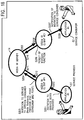
- FIG. 15 schematically shows a state where service provider entities and service consumer entities have been registered by the media IM client #P1 through step S131 described above.
- three service provider entities represented by ID1 to ID3 and two service consumer entities represented by ID4 and ID5 are registered at the media IM client #P1.
- one service provider entity represented by ID1 is associated with two service consumer entities represented by ID4 and ID5.
- one service consumer entity represented by ID4 is associated with three service consumer entities ID1, ID2, and ID3.
- a service entity is an entity that provides or uses a service
- the application #1 (and also the application #n) is allowed to have one or more service entities. That is, usually, the application #1 is allowed to provide more than one services.
- the application #1 is allowed to provide one or more services.
- the application #n usually uses not only one but two or more services. For example, in the case of a telephone application, a service of exchanging audio and video and a service of exchanging text can be provided between a service provider and a service consumer. Thus, the application ID cannot be used as a service ID, and a service entity as an entity representing a service is defined separately from the application.
- steps S201 to S212 shown in Fig. 18 are further executed prior to processing in steps S142 to S159 (connect-request process) shown in Fig. 21 , which will be described later.
- step S201 the application #1 requests, based on an instruction by a user, invocation of a method for prompting (inviting) a service consumer specified by a user to use a service provided by the application #1.
- This invitation process in the case of a telephone application, corresponds to a process of making a call to a telephone of the other party.
- the media IM client #P1 in step S203, sends Invite method for prompting the service consumer specified to use the service (access the service), using the messaging function or the Info/Query function of instant messaging.
- the Invite method includes a reference number for identifying the method (Invite Reference), and also includes the provider end point and the consumer end point, registered by the processing in step S131.
- a method is a term in object-oriented programming, meaning an operation on an object having "data” and “procedure” (i.e., an operation that invokes execution of the "procedure” of the object). That is, Invite method in this case is a method that invokes the media IM client #C1 to execute a "service usage" procedure of the media IM client #C1.
- the media IM client #P1 adds to Invite method a provider end point identifying a service provider entity that provides a service of interest and a consumer end point identifying a service consumer entity that uses the service. Accordingly, the media IM client #C1 is allowed to accurately identify a service entity of interest from among a plurality of service entities.
- Invite method of interest can be identified when a service provider cancels Invite method it has issued or when a consumer responds to Invite method by Accept method or Reject method as will be described with reference to Fig. 20 .
- the media IM client #P1 may alternatively send Invite method to all the service consumers that have been registered based on requests for registration to service from the application #n in step S126 shown in Fig. 14 , instead of sending Invite method to a service consumer specified by the application #1.
- the media IM server 14 Upon receiving Invite method transmitted from the media IM client #P1 in step S204, the media IM server 14 sends Invite method to the media IM client #1.
- the media IM client #C1 Upon receiving Invite method transmitted from the media IM server 14 in step S206, the media IM client #C1 notifies the application #n of Invite method in step S207. Upon receiving the notification from the media IM client #C1 in step S208, the application #n notifies the user of the service consumer 52 (service users) of the notification, using video, audio, GUI (Graphical User Interface), or the like.
- the media IM client #C1 may control the operation status of the application #n by activating the application #n or controlling the operation of the application #n, allowing the application #n to obtain notification information supplied from the application #1. Accordingly, users are allowed to receive notifications reliably.
- the media IM client #C1 Upon receiving Invite method from the media IM server 14 in step S206, the media IM client #C1, in step S209, issues a notification of reception as a result of Info/Query function.
- the media IM server 14 Upon receiving the notification from the media IM client #C1 in step S210, the media IM server 14, in step S211, further sends the notification to the media IM client #P1.
- the media IM client #P1 receives this notification in step S212.
- the media IM client #P1 is allowed to know that the message based on the Info/Query function, issued in step S203, has been properly received by the media IM client #C1.
- a destination of data does not send a response to transmission of the data to a source of the data. That is, the media IM client #C1, even if it obtains data sent by the messaging function, does not send a response to the data (notification that the data has been received).
- Invite method is sent using the messaging function, a notification based on the Info/Query function is not issued.
- the user of the application #1 is allowed to push a service to the user (consumer) of the application #n.
- the service provider 51 is allowed to cancel an invitation that has once been issued.
- a process executed in that case will be described with reference to Fig. 19 .
- the cancellation process corresponds, for example, in the case of a telephone application, to a process in which a caller quits a call while calling up a party to be called.
- This process can be executed by the service provider 51 after Invite method shown in Fig. 18 is issued and before Accept or Reject method is transmitted from a consumer as will be described later with reference to Fig. 20 .
- the user of the application #1 acting as the service provider 51 if the user wishes, for some reason, to cancel Invite method it has issued to the service consumer 52 by the processing shown in Fig. 18 , instructs the wish to the application #1.
- the application #1 Upon receiving the instruction from the user, the application #1, in step S231, instructs the media IM client #P1 to cancel the invitation.
- the media IM client #P1 Upon receiving the instruction for cancellation of invitation from the application #1 in step S232, the media IM client #P1, in step S233, issues Cancel method using the messaging function or the Info/Query function.
- Cancel method includes a reference number (Invite Reference) for identifying Invite method relating to the cancellation.
- Cancel method includes a provider end point for identifying a service provider entity concerned and a consumer end point for identifying a service consumer entity concerned.
- the media IM server 14 Upon receiving Cancel method from the media IM client #P1 in step S234, the media IM server 14, sends Cancel method to the media IM client #C1 in step S235.
- the media IM client #C1 identifies an invitation canceled based on a provider end point, a consumer end point, and a reference number (Invite Reference), and in step S237, notifies the application #n that the invitation has been canceled.
- the application #n Upon receiving the notification of cancellation from the media IM client #C1 in step S238, the application #n notifies the user that the invitation has been cancelled, using video, audio, GUI, or the like, similarly to the case where an invitation is received.
- step S239 the media IM client #C1, using the Info/Query function, notifies the media IM server 14 that Cancel method has been received from the media IM server 14.
- the media IM server 14 Upon receiving the notification of the result of the Info/Query in step S240, the media IM server 14 sends the notification to the media IM client #P1 in step S241.
- the media IM client #P1 receives the notification from the media IM server 14.
- the media IM client #P1 is allowed to confirm that Cancel method invoked in step S233 has been properly received by the media IM client #C1.
- the user of the service consumer 52 when it has received the notification of cancellation by the processing shown in Fig. 19 and described above, is not allowed to reply to an invitation described later with reference to Fig. 20 .
- the service provider 51 when it issues Cancel method after issuing Invite method shown in Fig. 18 , does not have to wait so that a reply from the service consumer 52 can be received.
- the service provider 51 when it does not issue Cancel method after issuing Invite method shown in Fig. 18 , waits so that a reply from the service consumer 52 can be received.
- This reply process for example, in the case of a telephone application, corresponds to a process in which a receiver responds to a telephone call.
- the application #n Upon receiving the instruction of reply of acceptance or rejection from the user, the application #n, in step S261, requests the media IM client #C1 to invoke a method corresponding to the reply. Upon receiving the instruction from the application #n in step S262, the media IM client #C1, in step S263, sends a reply to the instruction from the application #n. If the instruction from the application #n instructs acceptance, the media IM client #C1 invokes Accept method, while invoking Reject method if the instruction instructs rejection. In either of these methods, a reference number (Invite Reference) for identifying Invite method concerned is included. Furthermore, the Accept method or Reject method includes a provider end point for identifying a provider service entity concerned and a consumer end point for identifying a consumer service entity concerned.
- the media IM client #1 invokes the Accept method or Reject method using the messaging function or the Info/Query function of IM.
- the media IM server 14 Upon receiving the Accept method or Reject method from the media IM client #C1 in step S264, the media IM server 14 sends the method to the media IM client #P1 in step S265.
- the media IM client #P1 Upon receiving the Accept method or Reject method from the media IM server 14 in step S266, the media IM client #P1 identifies which invitation the reply relates to based on a provider end point, a consumer end point, and a reference number (Invite Reference) included in the Accept method or Reject method, and in step S267, notifies the application #1 that a reply relating to the invitation issued by the processing in step S201 has been received from the service consumer 52.
- a reference number Invite Reference
- step S268 upon receiving the reply from the media IM client #P1, the application #1 notifies the user of the service provider 51 that the invitation has been accepted (when Accept method is received) or rejected (when Reject method is received).
- the user of the service provider 51 is allowed to know the result of reply by the user of the service consumer 52 to the invitation issued.
- the media IM client #P1 Upon receiving the Accept method or Reject method from the media IM server 14 by the processing in step S266, the media IM client #P1, in step S269, issues a notification of the result of Info/Query to the media IM server 14, indicating reception.
- the media IM server 14 Upon receiving the notification from the media IM client #P1 in step S270, the media IM server 14 sends the notification to the media IM client #C1 in step S271.
- the media IM client #C1 receives the notification from the media IM server 14.
- the media IM client #C1 is allowed to confirm that the Accept method or Reject method issued in step S263 has been received by the media IM client #P1.
- the application #1 waits for a subsequent connection request from the application #n. Then, the user of the service consumer 52 executes processing in steps S142 to S159 shown in Fig. 21 instead of the processing in steps S42 to S59 shown in Fig. 7 (executes a connection request) to use the service provided by the service provider 51.
- steps S142 to S159 basically corresponds to the processing in steps S42 to S59 shown in Fig. 7 ; however, processing in step S144, which corresponds to step S44 shown in Fig. 7 , differs from the processing in step S44 shown in Fig. 7 .
- the media IM client #C1 sends a connection request from the application #n, using the messaging function or the Info/Query function, to the service provider 51.
- a provider end point and a consumer end point are additionally attached.
- the service provider 51 need not wait for a connection request from the service consumer 52.
- media IM clients and applications have been described above as separate, media IM clients and applications may be integrated.
- a service consumer is notified of identification information by a service provider.
- the service consumer is allowed to readily and quickly determine, based on the notification, whether it is possible for the service consumer to use a function of the service provider.
- the service consumer is allowed to readily and quickly determine whether the service can be used. Furthermore, the load of traffic on a transmission path between the service provider and the service consumer is reduced.
- connection information When an access based on the connection information is accepted, it becomes possible to actually communicate with the service consumer.
- a plurality of services can be managed.
- a service By registering the provider entity identifier and a user entity identifier such that these identifiers are associated with each other, a service can be managed on a basis of association between an entity that provides the service and an entity that uses the service.
- a push-type service By sending invitation information, a push-type service can be provided.
- invitation information can be sent using instant messaging.
- cancellation information can be sent using instant messaging.
- a service of a service provider can be identified without receiving detailed information from the beginning.
- the service By requesting registration of itself to the service, the service can be used more efficiently.
- connection information for directly connecting to the provider By receiving connection information for directly connecting to the provider, it becomes possible to receive the service directly from the service provider.
- connection information By making an access based on the connection information, it becomes possible to exchange information directly with the service provider.
- the request for sending of detailed information, the request for registration of itself, and the sending of information regarding use of the service that can be provided may use the messaging function or the Info/Query function, allowing use of instant messaging.
- the provider entity identifier and a user entity identifier can be stored such that these identifiers are associated with each other, allowing management of use of a plurality of services based on what has been stored.
- a push-type service By receiving invitation information, a push-type service can be received.
- the invitation information can be accepted or rejected at an own will.
- the provider entity identifier By including a reference number, the provider entity identifier, and the user entity identifier in the information indicating acceptance or rejection, it becomes possible to accurately identify a service to be accepted or rejected.
- the services described above can be applied to cases where various information, such as video data, audio data, and other data is exchanged, and also to cases where various services are exchanged.
- various information processing apparatuses can be used, without limitation to consumer electronics (CE) devices such as personal computers and PDAs.
- CE consumer electronics
- the processing described above may be executed by hardware in the case of network-enabled CE equipment or the like. Obviously, the processing may be executed by software.
- the recording medium may be a package media carrying the programs, provided to a user for providing programs separately from a main unit of the apparatus, such as a magnetic disk 141 (including a floppy disk), an optical disk 142 (including a CD-ROM (Compact Disk-Read Only Memory) and a DVD (Digital Versatile Disk)), a magneto-optical disk 143 (including an MD (Mini-Disk)), or a semiconductor memory 144.
- the recording medium may be the ROM 122 or a hard disk included in the storage unit 128, carrying the programs, provided as included in advance in the main unit of the apparatus.
- steps defining the programs recorded on the recording medium may include processes that are executed sequentially in the orders described, and also include processes that are executed in parallel or individually, not necessarily sequentially.
- a system refers to the entirety of apparatuses constituted of a plurality of apparatuses.
- a service can be exchanged between information processing apparatuses.
- a connection can be established reliably and a service can be exchanged between apparatuses having different capabilities, quickly and readily without imposing a burden on a user.
Landscapes
- Engineering & Computer Science (AREA)
- Theoretical Computer Science (AREA)
- Software Systems (AREA)
- Computer Networks & Wireless Communication (AREA)
- Signal Processing (AREA)
- Physics & Mathematics (AREA)
- General Engineering & Computer Science (AREA)
- General Physics & Mathematics (AREA)
- Computer Hardware Design (AREA)
- Information Transfer Between Computers (AREA)
Claims (15)
- Computerprogramm, das Softwarecode umfasst, das dafür ausgelegt ist, einen Prozess in einer Verbraucher-Informationsverarbeitungsvorrichtung (52) zum Austauschen von Informationen mit einer Anbieter-Informationsverarbeitungsvorrichtung (51) über ein Netz auszuführen, wobei das Programm Folgendes umfasst:einen ersten Empfangsschritt des Empfangens von Identifikationsinformationen zum Identifizieren eines Dienstes, der bereitgestellt werden kann, und eines Anbieter-Entitäts-Identifizierers zum Identifizieren einer Entität, die als ein Anbieter wirkt, der den Dienst bereitstellt, von der Anbieter-Informationsverarbeitungsvorrichtung (51) über eine Server-Informationsverarbeitungsvorrichtung (14) in dem Netz, des Speicherns von Informationen, die die Identifikationsinformationen zum Identifizieren eines Dienstes, der bereitgestellt werden kann, den Parametern und Mengen von Werten, die die Parameter annehmen dürfen, zuordnen, im Voraus und des Bestimmens, dass der Dienst kompatibel ist, falls die unter Verwendung der Identifikationsinformationen zum Identifizieren eines Dienstes identifizierten Parameter mit den Funktionen einer Anwendung, die als ein Dienstverbraucher wirkt, kompatibel sind;einen ersten Aufforderungsschritt des Aufforderns der Anbieter-Informationsverarbeitungsvorrichtung (51) über die Server-Informationsverarbeitungsvorrichtung (14), ausführliche Informationen hinsichtlich des Dienstes, der bereitgestellt werden kann, zu senden;einen zweiten Aufforderungsschritt des Aufforderns der Anbieter-Informationsverarbeitungsvorrichtung (51) über die Server-Informationsverarbeitungsvorrichtung (14), die Verbraucher-Informationsverarbeitungsvorrichtung (52) für den Dienst, der bereitgestellt werden kann, zu registrieren;einen ersten Sendeschritt des Sendens von Informationen hinsichtlich der Verwendung des Dienstes, der bereitgestellt werden kann, über die Server-Informationsverarbeitungsvorrichtung (14) an die Anbieter-Informationsverarbeitungsvorrichtung (51); undeinen zweiten Empfangsschritt des Empfangens von Verbindungsinformationen von der Anbieter-Informationsverarbeitungsvorrichtung (51) über die Server-Informationsverarbeitungsvorrichtung (14) zum direkten Verbinden mit der Anbieter-Informationsverarbeitungsvorrichtung (51).
- Programm nach Anspruch 1,
das ferner einen Zugriffsschritt zum Ausführen eines direkten Zugriffs auf die Anbieter-Informationsverarbeitungsvorrichtung basierend auf den Verbindungsinformationen umfasst. - Programm nach Anspruch 1,
wobei die Aufforderungen in dem ersten Aufforderungsschritt und in dem zweiten Aufforderungsschritt und das Senden in dem ersten Sendeschritt eine Nachrichtenübermittlungsfunktion oder eine Informations-/Abfragefunktion der sofortigen Nachrichtenübermittlung verwenden. - Programm nach Anspruch 1,
wobei das Programm ferner einen Speicherschritt des Speicherns des Anbieter-Entitäts-Identifizierers und eines Anwender-Entitäts-Identifizierers zum Identifizieren einer Entität, die als ein Anwender wirkt, der den Dienst verwendet, umfasst, so dass der Anbieter-Entitäts-Identifizierer und der Anwender-Entitäts-Identifizierer einander zugeordnet sind. - Programm nach Anspruch 4,
das ferner einen dritten Empfangsschritt des Empfangens von Einladungsinformationen der Einladung zum Verwenden des Dienstes, die von der Anbieter-Informationsverarbeitungsvorrichtung gesendet werden, umfasst. - Programm nach Anspruch 5,
das ferner einen zweiten Sendeschritt des Sendens von Informationen umfasst, die die Annahme oder die Ablehnung angeben, wenn die Einladungsinformationen durch die Verarbeitung in dem dritten Empfangsschritt empfangen werden. - Programm nach Anspruch 6,
wobei das Senden in dem zweiten Sendeschritt eine Nachrichtenübermittlungsfunktion oder eine Informations-/Abfragefunktion der sofortigen Nachrichtenübermittlung verwendet. - Programm nach Anspruch 6,
wobei, wenn der dritte Empfangsschritt ausgeführt worden ist, der erste Sendeschritt die Informationen hinsichtlich der Verwendung des Dienstes, der bereitgestellt werden kann, unter der Bedingung sendet, dass die Informationen, die die Annahme angeben, durch die Verarbeitung in dem zweiten Sendeschritt gesendet worden sind. - Programm nach Anspruch 8,
wobei in dem ersten Sendeschritt der Anbieter-Entitäts-Identifizierer und der Anwender-Entitäts-Identifizierer enthalten sind. - Programm nach Anspruch 6, wobei in dem zweiten Sendeschritt eine Bezugszahl zum Identifizieren der Informationen, die die Annahme oder die Ablehnung angeben, der Anbieter-Entitäts-Identifizierer und der Anwender-Entitäts-Identifizierer in den Informationen, die die Annahme oder die Ablehnung angeben, enthalten sind.
- Informationsverarbeitungsverfahren für eine Verbraucher-Informationsverarbeitungsvorrichtung zum Austauschen von Informationen mit einer Anbieter-Informationsverarbeitungsvorrichtung über ein Netz, wobei das Informationsverarbeitungsverfahren Folgendes umfasst:einen ersten Empfangsschritt des Empfangens von Identifikationsinformationen zum Identifizieren eines Dienstes, der bereitgestellt werden kann, und eines Anbieter-Entitäts-Identifizierers zum Identifizieren einer Entität, die als ein Anbieter wirkt, der den Dienst bereitstellt, von der Anbieter-Informationsverarbeitungsvorrichtung über eine Server-Informationsverarbeitungsvorrichtung in dem Netz, des Speicherns von Informationen, die die Identifikationsinformationen zum Identifizieren eines Dienstes, der bereitgestellt werden kann, den Parametern und Mengen von Werten, die die Parameter annehmen dürfen, zuordnen, im Voraus und des Bestimmens, dass der Dienst kompatibel ist, falls die unter Verwendung der Identifikationsinformationen zum Identifizieren eines Dienstes identifizierten Parameter mit den Funktionen einer Anwendung, die als ein Dienstverbraucher wirkt, kompatibel sind;einen ersten Aufforderungsschritt des Aufforderns der Anbieter-Informationsverarbeitungsvorrichtung über die Server-Informationsverarbeitungsvorrichtung, ausführliche Informationen hinsichtlich des Dienstes, der bereitgestellt werden kann, zu senden;einen zweiten Aufforderungsschritt des Aufforderns der Anbieter-Informationsverarbeitungsvorrichtung über die Server-Informationsverarbeitungsvorrichtung, die Verbraucher-Informationsverarbeitungsvorrichtung für den Dienst, der bereitgestellt werden kann, zu registrieren;einen Sendeschritt des Sendens von Informationen hinsichtlich der Verwendung des Dienstes, der bereitgestellt werden kann, über die Server-Informationsverarbeitungsvorrichtung an die Anbieter-Informationsverarbeitungsvorrichtung; undeinen zweiten Empfangsschritt des Empfangens von Verbindungsinformationen von der Anbieter-Informationsverarbeitungsvorrichtung über die Server-Informationsverarbeitungsvorrichtung zum direkten Verbinden mit der Anbieter-Informationsverarbeitungsvorrichtung.
- Verbraucher-Informationsverarbeitungsvorrichtung (52) zum Austauschen von Informationen mit einer Anbieter-Informationsverarbeitungsvorrichtung (51) über ein Netz, wobei die Verbraucher-Informationsverarbeitungsvorrichtung (52) Folgendes umfasst:erste Empfangsmittel zum Empfangen von Identifikationsinformationen zum Identifizieren eines Dienstes, der bereitgestellt werden kann, und eines Anbieter-Entitäts-Identifizierers zum Identifizieren einer Entität, die als ein Anbieter wirkt, der den Dienst bereitstellt, von der Anbieter-Informationsverarbeitungsvorrichtung (51) über eine Server-Informationsverarbeitungsvorrichtung (14) in dem Netz, Speichern von Informationen, die die Identifikationsinformationen zum Identifizieren eines Dienstes, der bereitgestellt werden kann, den Parametern und Mengen von Werten, die die Parameter annehmen dürfen, zuordnen, im Voraus und Bestimmen, dass der Dienst kompatibel ist, falls die unter Verwendung der Identifikationsinformationen zum Identifizieren eines Dienstes identifizierten Parameter mit den Funktionen einer Anwendung, die als ein Dienstverbraucher wirkt, kompatibel sind;erste Aufforderungsmittel zum Auffordern der Anbieter-Informationsverarbeitungsvorrichtung (51) über die Server-Informationsverarbeitungsvorrichtung (14), ausführliche Informationen hinsichtlich des Dienstes, der bereitgestellt werden kann, zu senden;zweite Aufforderungsmittel zum Auffordern der Anbieter-Informationsverarbeitungsvorrichtung (51) über die Server-Informationsverarbeitungsvorrichtung (14), die Verbraucher-Informationsverarbeitungsvorrichtung (52) für den Dienst, der bereitgestellt werden kann, zu registrieren;Sendemittel zum Senden von Informationen hinsichtlich der Verwendung des Dienstes, der bereitgestellt werden kann, über die Server-Informationsverarbeitungsvorrichtung (14) an die Anbieter-Informationsverarbeitungsvorrichtung (51); undzweite Empfangsmittel zum Empfangen von Verbindungsinformationen von der Anbieter-Informationsverarbeitungsvorrichtung (51) über die Server-Informationsverarbeitungsvorrichtung (14) zum direkten Verbinden mit der Anbieter-Informationsverarbeitungsvorrichtung (51).
- Computerprogramm, das Softwarecode umfasst, das dafür ausgelegt ist, einen Prozess zum Austauschen von Informationen zwischen einer Verbraucher-Informationsverarbeitungsvorrichtung und einer Anbieter-Informationsverarbeitungsvorrichtung über ein Netz auszuführen, wobei das Programm Folgendes umfasst:einen ersten Meldeschritt des Meldens von Identifikationsinformationen zum Identifizieren eines Dienstes, der bereitgestellt werden kann, und Ausgeben eines Anbieter-Entitäts-Identifizierers zum Identifizieren einer Entität, die als ein Anbieter wirkt, der den Dienst bereitstellt, über eine Server-Informationsverarbeitungsvorrichtung in dem Netz an die Verbraucher-Informationsverarbeitungsvorrichtung, wobei die Verbraucher-Informationsverarbeitungsvorrichtung dafür ausgelegt ist, unter Verwendung der Identifikationsinformationen zum Identifizieren eines Dienstes, der durch den Anbieter, der den Anbieter-Entitäts-Identifizierer aufweist, bereitgestellt wird, zu bestimmen, ob der Dienst kompatibel ist;einen zweiten Meldeschritt des Meldens von ausführlichen Informationen hinsichtlich des Dienstes, der bereitgestellt werden kann, basierend auf einer Aufforderung von der Verbraucher-Informationsverarbeitungsvorrichtung über die Server-Informationsverarbeitung an die Verbraucher-Informationsverarbeitungsvorrichtung;einen dritten Meldeschritt des Meldens, dass die Verbraucher-Informationsverarbeitungsvorrichtung für den Dienst, der bereitgestellt werden kann, registriert worden ist, basierend auf einer Aufforderung von der Verbraucher-Informationsverarbeitungsvorrichtung und des Meldens von Verbindungsinformationen, um es zu ermöglichen, dass die Verbraucher-Informationsverarbeitungsvorrichtung, die registriert worden ist, sich direkt mit der Anbieter-Informationsverarbeitungsvorrichtung verbindet, basierend auf einer Aufforderung von der Verbraucher-Informationsverarbeitungsvorrichtung über die Server-Informationsverarbeitungsvorrichtung an die Verbraucher-Informationsverarbeitungsvorrichtung;einen ersten Empfangsschritt des Empfangens der Identifikationsinformationen und eines Anbieter-Entitäts-Identifizierers zum Identifizieren einer Entität, die als ein Anbieter wirkt, der den Dienst bereitstellt, von der Anbieter-Informationsverarbeitungsvorrichtung über die Server-Informationsverarbeitungsvorrichtung, des Speicherns von Informationen, die die Identifikationsinformationen zum Identifizieren eines Dienstes, der bereitgestellt werden kann, den Parametern und Mengen von Werten, die die Parameter annehmen dürfen, zuordnet, im Voraus und des Bestimmens, dass der Dienst kompatibel ist, falls die unter Verwendung der Identifikationsinformationen zum Identifizieren eines Dienstes identifizierten Parameter mit den Funktionen einer Anwendung, die als ein Dienstverbraucher wirkt, kompatibel sind;einen ersten Aufforderungsschritt des Aufforderns der Anbieter-Informationsverarbeitungsvorrichtung über die Server-Informationsverarbeitungsvorrichtung, ausführliche Informationen hinsichtlich des Dienstes, der bereitgestellt werden kann, zu senden;einen zweiten Aufforderungsschritt des Aufforderns der Anbieter-Informationsverarbeitungsvorrichtung über die Server-Informationsverarbeitungsvorrichtung, die Verbraucher-Informationsverarbeitungsvorrichtung für den Dienst, der bereitgestellt werden kann, zu registrieren;einen Sendeschritt des Sendens von Informationen hinsichtlich der Verwendung des Dienstes, der bereitgestellt werden kann, über die Server-Informationsverarbeitungsvorrichtung an die Anbieter-Informationsverarbeitungsvorrichtung; undeinen zweiten Empfangsschritt des Empfangens von Verbindungsinformationen von der Anbieter-Informationsverarbeitungsvorrichtung über die Server-Informationsverarbeitungsvorrichtung zum direkten Verbinden mit der Anbieter-Informationsverarbeitungsvorrichtung.
- Informationsverarbeitungsverfahren für ein Informationsverarbeitungssystem zum Austauschen von Informationen zwischen einer Anbieter-Informationsverarbeitungsvorrichtung (51) und einer Verbraucher-Informationsverarbeitungsvorrichtung (52) über ein Netz, wobei das Informationsverarbeitungsverfahren Folgendes umfasst:einen ersten Meldeschritt (S3) des Meldens von Identifikationsinformationen zum Identifizieren eines Dienstes, der bereitgestellt werden kann, und Ausgeben eines Anbieter-Entitäts-Identifizierers zum Identifizieren einer Entität, die als ein Anbieter wirkt, der den Dienst bereitstellt, über eine Server-Informationsverarbeitungsvorrichtung (14) in dem Netz an die Verbraucher-Informationsverarbeitungsvorrichtung (52), wobei die Verbraucher-Informationsverarbeitungsvorrichtung (52) dafür ausgelegt ist, unter Verwendung der Identifikationsinformationen zum Identifizieren eines Dienstes, der durch den Anbieter, der den Anbieter-Entitäts-Identifizierer aufweist, bereitgestellt wird, zu bestimmen (S7), ob der Dienst kompatibel ist;einen zweiten Meldeschritt (S20) des Meldens von ausführlichen Informationen hinsichtlich des Dienstes, der bereitgestellt werden kann, basierend auf einer Aufforderung von der Verbraucher-Informationsverarbeitungsvorrichtung (52) über die Server-Informationsverarbeitung (14) an die Verbraucher-Informationsverarbeitungsvorrichtung (52);einen dritten Meldeschritt (S36) des Meldens, dass die Verbraucher-Informationsverarbeitungsvorrichtung (52) für den Dienst, der bereitgestellt werden kann, registriert worden ist, basierend auf einer Aufforderung von der Verbraucher-Informationsverarbeitungsvorrichtung (52) und des Meldens von Verbindungsinformationen, um es zu ermöglichen, dass die Verbraucher-Informationsverarbeitungsvorrichtung (52), die registriert worden ist, sich direkt mit der Anbieter-Informationsverarbeitungsvorrichtung (51) verbindet, basierend auf einer Aufforderung von der Verbraucher-Informationsverarbeitungsvorrichtung (52) über die Server-Informationsverarbeitungsvorrichtung (14) an die Verbraucher-Informationsverarbeitungsvorrichtung (52);einen ersten Empfangsschritt (S6) des Empfangens der Identifikationsinformationen und eines Anbieter-Entitäts-Identifizierers zum Identifizieren einer Entität, die als ein Anbieter wirkt, der den Dienst bereitstellt, von der Anbieter-Informationsverarbeitungsvorrichtung (51) über die Server-Informationsverarbeitungsvorrichtung (14), des Speicherns von Informationen, die die Identifikationsinformationen zum Identifizieren eines Dienstes, der bereitgestellt werden kann, den Parametern und Mengen von Werten, die die Parameter annehmen dürfen, zuordnen, im Voraus und des Bestimmens, dass der Dienst kompatibel ist, falls die unter Verwendung der Identifikationsinformationen zum Identifizieren eines Dienstes identifizierten Parameter mit den Funktionen einer Anwendung, die als ein Dienstverbraucher wirkt, kompatibel sind;einen ersten Aufforderungsschritt (S 12) des Aufforderns der Anbieter-Informationsverarbeitungsvorrichtung (51) über die Server-Informationsverarbeitungsvorrichtung (14), ausführliche Informationen hinsichtlich des Dienstes, der bereitgestellt werden kann, zu senden;einen zweiten Aufforderungsschritt (S28) des Aufforderns der Anbieter-Informationsverarbeitungsvorrichtung (51) über die Server-Informationsverarbeitungsvorrichtung (14), die Verbraucher-Informationsverarbeitungsvorrichtung (52) für den Dienst, der bereitgestellt werden kann, zu registrieren;einen Sendeschritt des Sendens von Informationen hinsichtlich der Verwendung des Dienstes, der bereitgestellt werden kann, über die Server-Informationsverarbeitungsvorrichtung (14) an die Anbieter-Informationsverarbeitungsvorrichtung (51); undeinen zweiten Empfangsschritt (S55) des Empfangens von Verbindungsinformationen von der Anbieter-Informationsverarbeitungsvorrichtung (51) über die Server-Informationsverarbeitungsvorrichtung (14) zum direkten Verbinden mit der Anbieter-Informationsverarbeitungsvorrichtung (51).
- Informationsverarbeitungssystem zum Austauschen von Informationen zwischen einer Anbieter-Informationsverarbeitungsvorrichtung (51) und einer Verbraucher-Informationsverarbeitungsvorrichtung (52) über ein Netz, wobei das Informationsverarbeitungssystem Folgendes umfasst:erste Meldemittel zum Melden von Identifikationsinformationen zum Identifizieren eines Dienstes, der bereitgestellt werden kann, und Ausgeben eines Anbieter-Entitäts-Identifizierers zum Identifizieren einer Entität, die als ein Anbieter wirkt, der den Dienst bereitstellt, über eine Server-Informationsverarbeitungsvorrichtung (14) in dem Netz an die Verbraucher-Informationsverarbeitungsvorrichtung (52), wobei die Verbraucher-Informationsverarbeitungsvorrichtung (52) dafür ausgelegt ist, unter Verwendung der Identifikationsinformationen zum Identifizieren eines Dienstes, der durch den Anbieter, der den Anbieter-Entitäts-Identifizierer aufweist, bereitgestellt wird, zu bestimmen, ob der Dienst kompatibel ist;zweite Meldemittel zum Melden von ausführlichen Informationen hinsichtlich des Dienstes, der bereitgestellt werden kann, basierend auf einer Aufforderung von der Verbraucher-Informationsverarbeitungsvorrichtung (52) über die Server-Informationsverarbeitung (14) an die Verbraucher-Informationsverarbeitungsvorrichtung (52);dritte Meldemittel zum Melden, dass die Verbraucher-Informationsverarbeitungsvorrichtung (52) für den Dienst, der bereitgestellt werden kann, registriert worden ist, basierend auf einer Aufforderung von der Verbraucher-Informationsverarbeitungsvorrichtung (52) und Melden von Verbindungsinformationen, um es zu ermöglichen, dass die Verbraucher-Informationsverarbeitungsvorrichtung (52), die registriert worden ist, sich direkt mit der Anbieter-Informationsverarbeitungsvorrichtung (51) verbindet, basierend auf einer Aufforderung von der Verbraucher-Informationsverarbeitungsvorrichtung (52) über die Server-Informationsverarbeitungsvorrichtung (14) an die Verbraucher-Informationsverarbeitungsvorrichtung (52);erste Empfangsmittel zum Empfangen der Identifikationsinformationen und eines Anbieter-Identitäts-Identifizierers zum Identifizieren einer Entität, die als ein Anbieter wirkt, der den Dienst bereitstellt, von der Anbieter-Informationsverarbeitungsvorrichtung (51) über die Server-Informationsverarbeitungsvorrichtung (14), Speichern von Informationen, die die Identifikationsinformationen zum Identifizieren eines Dienstes, der bereitgestellt werden kann, den Parametern und Mengen von Werten, die die Parameter annehmen dürfen, zuordnen, im Voraus und Bestimmen, dass der Dienst kompatibel ist, falls die unter Verwendung der Identifikationsinformationen zum Identifizieren eines Dienstes identifizierten Parameter mit den Funktionen einer Anwendung, die als ein Dienstverbraucher wirkt, kompatibel sind;erste Aufforderungsmittel zum Auffordern der Anbieter-Informationsverarbeitungsvorrichtung (51) über die Server-Informationsverarbeitungsvorrichtung (14), ausführliche Informationen hinsichtlich des Dienstes, der bereitgestellt werden kann, zu senden;zweite Aufforderungsmittel zum Auffordern der Anbieter-Informationsverarbeitungsvorrichtung (51) über die Server-Informationsverarbeitungsvorrichtung (14), die Verbraucher-Informationsverarbeitungsvorrichtung (52) für den Dienst, der bereitgestellt werden kann, zu registrieren;Sendemittel zum Senden von Informationen hinsichtlich der Verwendung des Dienstes, der bereitgestellt werden kann, über die Server-Informationsverarbeitungsvorrichtung (14) an die Anbieter-Informationsverarbeitungsvorrichtung (51); undzweite Empfangsmittel zum Empfangen von Verbindungsinformationen von der Anbieter-Informationsverarbeitungsvorrichtung (51) über die Server-Informationsverarbeitungsvorrichtung (14) zum direkten Verbinden der Verbraucher-Informationsverarbeitungsvorrichtung mit der Anbieter-Informationsverarbeitungsvorrichtung (51).
Applications Claiming Priority (5)
| Application Number | Priority Date | Filing Date | Title |
|---|---|---|---|
| JP2002221129 | 2002-07-30 | ||
| JP2002221129 | 2002-07-30 | ||
| JP2002260805 | 2002-09-06 | ||
| JP2002260805 | 2002-09-06 | ||
| PCT/JP2003/009631 WO2004012087A1 (ja) | 2002-07-30 | 2003-07-30 | プログラム、情報処理方法および装置 |
Publications (3)
| Publication Number | Publication Date |
|---|---|
| EP1528476A1 EP1528476A1 (de) | 2005-05-04 |
| EP1528476A4 EP1528476A4 (de) | 2011-03-16 |
| EP1528476B1 true EP1528476B1 (de) | 2016-03-09 |
Family
ID=31190324
Family Applications (1)
| Application Number | Title | Priority Date | Filing Date |
|---|---|---|---|
| EP03771415.1A Expired - Lifetime EP1528476B1 (de) | 2002-07-30 | 2003-07-30 | Programm, informationsverarbeitungsverfahren und -einrichtung |
Country Status (6)
| Country | Link |
|---|---|
| US (2) | US7886064B2 (de) |
| EP (1) | EP1528476B1 (de) |
| JP (1) | JP4411545B2 (de) |
| KR (1) | KR100991221B1 (de) |
| CN (1) | CN100343835C (de) |
| WO (1) | WO2004012087A1 (de) |
Families Citing this family (23)
| Publication number | Priority date | Publication date | Assignee | Title |
|---|---|---|---|---|
| US7636922B2 (en) * | 2004-05-03 | 2009-12-22 | Microsoft Corporation | Generic user interface command architecture |
| US20060093119A1 (en) * | 2004-11-03 | 2006-05-04 | Wilson Richard A Jr | Leveraging real-time communications client |
| US20060098722A1 (en) * | 2004-11-09 | 2006-05-11 | Osamu Tanaka | Repeating installation, communication speed adjusting method, program, and recording medium |
| JPWO2006077935A1 (ja) * | 2005-01-21 | 2008-06-19 | 松下電器産業株式会社 | Avサーバ機器 |
| US20060242236A1 (en) * | 2005-04-22 | 2006-10-26 | Microsoft Corporation | System and method for extensible computer assisted collaboration |
| US7752253B2 (en) * | 2005-04-25 | 2010-07-06 | Microsoft Corporation | Collaborative invitation system and method |
| US8787967B2 (en) * | 2005-08-23 | 2014-07-22 | Sony Corporation | Communication terminals with pull-based digital information distribution capability and pull-based methods for digital information distribution |
| JP4568246B2 (ja) * | 2006-03-30 | 2010-10-27 | 株式会社東芝 | サーバ装置 |
| CN101512515B (zh) * | 2006-08-01 | 2017-05-03 | 三星电子株式会社 | 管理用户优选简档的系统和方法 |
| CN101616169B (zh) | 2008-06-23 | 2013-03-13 | 华为技术有限公司 | 选择服务提供实体的方法、系统、服务选择实体、服务管理实体 |
| CA2815569C (en) | 2010-10-25 | 2016-03-01 | Research In Motion Limited | System and method for enabling applications to communicate using a peer-to-peer (p2p) system |
| US9124436B2 (en) | 2010-12-16 | 2015-09-01 | Cellco Partnership | Intelligent automated data usage upgrade recommendation |
| US9043455B1 (en) * | 2011-04-06 | 2015-05-26 | Cellco Partnership | Universal data remote |
| US9723092B1 (en) | 2011-04-07 | 2017-08-01 | Cellco Partnership | Universal data remote application framework |
| US9198038B2 (en) * | 2011-06-13 | 2015-11-24 | Qualcomm Incorporated | Apparatus and methods of identity management in a multi-network system |
| US8953490B2 (en) | 2012-03-02 | 2015-02-10 | Blackberry Limited | Methods and apparatus for use in facilitating Wi-Fi peer-to-peer (P2P) wireless networking |
| JP6168839B2 (ja) * | 2013-05-15 | 2017-07-26 | キヤノン株式会社 | 情報処理装置、その制御方法、プログラム |
| US9843548B2 (en) * | 2014-12-09 | 2017-12-12 | American Megatrends, Inc. | System and method of user-to-machine and machine-to-machine communication through instant messaging |
| US11388040B2 (en) | 2018-10-31 | 2022-07-12 | EXFO Solutions SAS | Automatic root cause diagnosis in networks |
| US11645293B2 (en) | 2018-12-11 | 2023-05-09 | EXFO Solutions SAS | Anomaly detection in big data time series analysis |
| US11138163B2 (en) * | 2019-07-11 | 2021-10-05 | EXFO Solutions SAS | Automatic root cause diagnosis in networks based on hypothesis testing |
| EP3866395B1 (de) | 2020-02-12 | 2024-05-22 | EXFO Solutions SAS | Verfahren und system zur bestimmung der grundursachendiagnose von ereignissen, die während des betriebs eines kommunikationsnetzwerks auftreten |
| US12052134B2 (en) | 2021-02-02 | 2024-07-30 | Exfo Inc. | Identification of clusters of elements causing network performance degradation or outage |
Family Cites Families (32)
| Publication number | Priority date | Publication date | Assignee | Title |
|---|---|---|---|---|
| JP2519390B2 (ja) * | 1992-09-11 | 1996-07-31 | インターナショナル・ビジネス・マシーンズ・コーポレイション | デ―タ通信方法及び装置 |
| US6424623B1 (en) * | 1996-10-15 | 2002-07-23 | Motorola, Inc. | Virtual queuing system using proximity-based short-range wireless links |
| US6636733B1 (en) * | 1997-09-19 | 2003-10-21 | Thompson Trust | Wireless messaging method |
| FI980427A7 (fi) * | 1998-02-25 | 1999-08-26 | Ericsson Telefon Ab L M | Menetelmä, järjestely ja laite todentamiseen |
| JP2000115233A (ja) | 1998-09-29 | 2000-04-21 | Nippon Telegr & Teleph Corp <Ntt> | Ipネットワーク区間性能及び状態測定方法 |
| US6654801B2 (en) * | 1999-01-04 | 2003-11-25 | Cisco Technology, Inc. | Remote system administration and seamless service integration of a data communication network management system |
| JP3587352B2 (ja) | 1999-02-04 | 2004-11-10 | 富士通株式会社 | ネットワーク通信性能測定方法及び装置並びにネットワーク通信性能測定プログラムを格納したコンピュータ読取り可能な記録媒体 |
| CN1206602C (zh) * | 1999-06-17 | 2005-06-15 | 国际商业机器公司 | 因特网环境下综合负载分配和资源管理的系统和方法 |
| US7174564B1 (en) * | 1999-09-03 | 2007-02-06 | Intel Corporation | Secure wireless local area network |
| US7010492B1 (en) * | 1999-09-30 | 2006-03-07 | International Business Machines Corporation | Method and apparatus for dynamic distribution of controlled and additional selective overlays in a streaming media |
| DE60020518T2 (de) * | 2000-03-01 | 2006-06-29 | Sony International (Europe) Gmbh | Verwaltung von Benutzerprofilen |
| US7231517B1 (en) * | 2000-03-03 | 2007-06-12 | Novell, Inc. | Apparatus and method for automatically authenticating a network client |
| EP1266488A2 (de) * | 2000-03-20 | 2002-12-18 | AT & T Corp. | Verfahren und vorrichtung zur koordinierung der benutzerauswahl von dienstanbietern über ein breitbandiges kommunikationsnetz |
| US6826609B1 (en) * | 2000-03-31 | 2004-11-30 | Tumbleweed Communications Corp. | Policy enforcement in a secure data file delivery system |
| JP2001313666A (ja) * | 2000-04-27 | 2001-11-09 | Ntt Communications Kk | インスタント・メッセージ通信システム |
| US6898618B1 (en) * | 2000-05-09 | 2005-05-24 | Sun Microsystems, Inc. | Client-specified display services in a distributed computing environment |
| US7716492B1 (en) * | 2000-05-09 | 2010-05-11 | Oracle America, Inc. | Method and apparatus to obtain service capability credentials |
| US7546337B1 (en) * | 2000-05-18 | 2009-06-09 | Aol Llc, A Delaware Limited Liability Company | Transferring files |
| US8719562B2 (en) * | 2002-10-25 | 2014-05-06 | William M. Randle | Secure service network and user gateway |
| US20010051981A1 (en) * | 2000-06-05 | 2001-12-13 | Microsoft Corporation | Methods and systems for discovering object-exchange resources on a network |
| JP2002007296A (ja) * | 2000-06-22 | 2002-01-11 | Ntt Communications Kk | コミュニケーション制御方法及びシステム及びコミュニケーション制御プログラムを格納した記憶媒体 |
| JP2002033733A (ja) | 2000-07-17 | 2002-01-31 | Sharp Corp | ホストコンピュータとネットワークシステム |
| US7088720B1 (en) * | 2000-08-07 | 2006-08-08 | Sbc Technology Resources, Inc. | Multiservice use of network connection capability under user-to-network interface signaling |
| US7594030B2 (en) * | 2000-11-22 | 2009-09-22 | Microsoft Corporation | Locator and tracking service for peer to peer resources |
| US20070136817A1 (en) * | 2000-12-07 | 2007-06-14 | Igt | Wager game license management in a peer gaming network |
| US7225156B2 (en) * | 2001-07-11 | 2007-05-29 | Fisher Douglas C | Persistent dynamic payment service |
| US7085840B2 (en) * | 2001-10-29 | 2006-08-01 | Sun Microsystems, Inc. | Enhanced quality of identification in a data communications network |
| US7130921B2 (en) * | 2002-03-15 | 2006-10-31 | International Business Machines Corporation | Centrally enhanced peer-to-peer resource sharing method and apparatus |
| US6978316B2 (en) * | 2002-03-27 | 2005-12-20 | International Business Machines Corporation | Messaging system and method with transcoder filtering of baseline message representations |
| US7174382B2 (en) * | 2002-04-09 | 2007-02-06 | Hewlett-Packard Development Company, L.P. | Interest-based connections in peer-to-peer networks |
| US7062253B2 (en) * | 2002-04-10 | 2006-06-13 | Sprint Spectrum L.P. | Method and system for real-time tiered rating of communication services |
| US7089313B2 (en) * | 2002-07-25 | 2006-08-08 | Matsushita Electric Industrial Co., Ltd. | Protocol independent communication system for mobile devices |
-
2003
- 2003-07-30 US US10/490,207 patent/US7886064B2/en not_active Expired - Fee Related
- 2003-07-30 KR KR1020047004734A patent/KR100991221B1/ko not_active Expired - Fee Related
- 2003-07-30 JP JP2005505580A patent/JP4411545B2/ja not_active Expired - Fee Related
- 2003-07-30 CN CNB038011824A patent/CN100343835C/zh not_active Expired - Fee Related
- 2003-07-30 WO PCT/JP2003/009631 patent/WO2004012087A1/ja not_active Ceased
- 2003-07-30 EP EP03771415.1A patent/EP1528476B1/de not_active Expired - Lifetime
-
2008
- 2008-03-28 US US12/057,525 patent/US8281016B2/en not_active Expired - Fee Related
Also Published As
| Publication number | Publication date |
|---|---|
| CN1564985A (zh) | 2005-01-12 |
| US20080183875A1 (en) | 2008-07-31 |
| KR20050023211A (ko) | 2005-03-09 |
| WO2004012087A1 (ja) | 2004-02-05 |
| EP1528476A1 (de) | 2005-05-04 |
| JPWO2004012087A1 (ja) | 2005-11-24 |
| JP4411545B2 (ja) | 2010-02-10 |
| KR100991221B1 (ko) | 2010-11-04 |
| US20040255031A1 (en) | 2004-12-16 |
| CN100343835C (zh) | 2007-10-17 |
| US7886064B2 (en) | 2011-02-08 |
| EP1528476A4 (de) | 2011-03-16 |
| US8281016B2 (en) | 2012-10-02 |
Similar Documents
| Publication | Publication Date | Title |
|---|---|---|
| US8281016B2 (en) | Program and information processing method and apparatus | |
| KR100924692B1 (ko) | 데이터 전송시스템, 정보처리장치 및 방법, 데이터중계장치 및 방법과, 기록매체 | |
| JP4610163B2 (ja) | プレゼンス管理の実現 | |
| KR100967126B1 (ko) | 피어-투-피어 그룹 관리 프레임워크 및 방법론 | |
| US20130254315A1 (en) | Remote control using instant messaging | |
| US20100205298A1 (en) | Method, system and computer program to enable semantic mediation for SIP events through support of dynamically binding to and changing of application semantics of SIP events | |
| US20060004924A1 (en) | Method and system providing support for location and service category service discovery in a SIP environment using a SIP event package, forking and AOR registration | |
| JP2012512448A (ja) | 個人データを公開するために通信機器間の仮想関係を作成する方法及び構成 | |
| US20090143086A1 (en) | Method and apparatus for managing status information in wireless instant messaging system | |
| EP1526461B1 (de) | Programm, informationsverarbeitungsverfahren und -einrichtung und datenstruktur | |
| KR101973531B1 (ko) | 복수의 클라이언트 간의 어플리케이션 자동 공유 방법 및 장치 | |
| US7779115B2 (en) | Method and apparatus for processing client capability information over a network | |
| CN102227719B (zh) | 在线服务聚合 | |
| US8224975B1 (en) | Web service initiation protocol for multimedia and voice communication over internet protocol | |
| KR101773183B1 (ko) | 통신 시스템에서 세션 히스토리 송수신 방법 | |
| KR101524311B1 (ko) | 통신 시스템에서 그룹 메시징 세션 생성 방법 및 그 시스템 | |
| CN102668494B (zh) | 在属于第一用户的终端与属于第二用户的至少一个终端之间的数据交换会话的监视 | |
| US8953582B2 (en) | Information delivery system and information delivery method using the same | |
| KR101689196B1 (ko) | 통신 시스템에서 세션 히스토리 송수신 방법 | |
| HK1120958A (en) | Information delivery system and information delivery method using the same | |
| KR20070010349A (ko) | 통신 환경에서의 데이터 확인 방법 및 장치 | |
| CN105072097A (zh) | 用于在移动通信网络中提供聊天/VoIP服务的方法以及网络服务器和移动用户设备 |
Legal Events
| Date | Code | Title | Description |
|---|---|---|---|
| PUAI | Public reference made under article 153(3) epc to a published international application that has entered the european phase |
Free format text: ORIGINAL CODE: 0009012 |
|
| 17P | Request for examination filed |
Effective date: 20040329 |
|
| AK | Designated contracting states |
Kind code of ref document: A1 Designated state(s): AT BE BG CH CY CZ DE DK EE ES FI FR GB GR HU IE IT LI LU MC NL PT RO SE SI SK TR |
|
| AX | Request for extension of the european patent |
Extension state: AL LT LV MK |
|
| RIC1 | Information provided on ipc code assigned before grant |
Ipc: 7G 06F 13/00 A |
|
| DAX | Request for extension of the european patent (deleted) | ||
| RBV | Designated contracting states (corrected) |
Designated state(s): DE FR GB NL |
|
| A4 | Supplementary search report drawn up and despatched |
Effective date: 20110216 |
|
| RIC1 | Information provided on ipc code assigned before grant |
Ipc: H04L 29/08 20060101ALI20110210BHEP Ipc: H04L 12/56 20060101ALI20110210BHEP Ipc: G06F 13/00 20060101AFI20050614BHEP |
|
| 17Q | First examination report despatched |
Effective date: 20110727 |
|
| REG | Reference to a national code |
Ref country code: DE Ref legal event code: R079 Ref document number: 60348634 Country of ref document: DE Free format text: PREVIOUS MAIN CLASS: G06F0013000000 Ipc: G06F0009500000 |
|
| GRAP | Despatch of communication of intention to grant a patent |
Free format text: ORIGINAL CODE: EPIDOSNIGR1 |
|
| RIC1 | Information provided on ipc code assigned before grant |
Ipc: H04W 92/18 20090101ALI20150928BHEP Ipc: G06F 9/50 20060101AFI20150928BHEP Ipc: H04L 29/08 20060101ALI20150928BHEP Ipc: H04W 68/00 20090101ALI20150928BHEP |
|
| INTG | Intention to grant announced |
Effective date: 20151020 |
|
| GRAS | Grant fee paid |
Free format text: ORIGINAL CODE: EPIDOSNIGR3 |
|
| GRAA | (expected) grant |
Free format text: ORIGINAL CODE: 0009210 |
|
| AK | Designated contracting states |
Kind code of ref document: B1 Designated state(s): DE FR GB NL |
|
| REG | Reference to a national code |
Ref country code: GB Ref legal event code: FG4D |
|
| REG | Reference to a national code |
Ref country code: DE Ref legal event code: R096 Ref document number: 60348634 Country of ref document: DE |
|
| REG | Reference to a national code |
Ref country code: NL Ref legal event code: FP |
|
| REG | Reference to a national code |
Ref country code: DE Ref legal event code: R097 Ref document number: 60348634 Country of ref document: DE |
|
| PLBE | No opposition filed within time limit |
Free format text: ORIGINAL CODE: 0009261 |
|
| STAA | Information on the status of an ep patent application or granted ep patent |
Free format text: STATUS: NO OPPOSITION FILED WITHIN TIME LIMIT |
|
| 26N | No opposition filed |
Effective date: 20161212 |
|
| PG25 | Lapsed in a contracting state [announced via postgrant information from national office to epo] |
Ref country code: FR Free format text: LAPSE BECAUSE OF NON-PAYMENT OF DUE FEES Effective date: 20160801 |
|
| REG | Reference to a national code |
Ref country code: FR Ref legal event code: ST Effective date: 20170331 |
|
| PGFP | Annual fee paid to national office [announced via postgrant information from national office to epo] |
Ref country code: NL Payment date: 20190719 Year of fee payment: 17 |
|
| PGFP | Annual fee paid to national office [announced via postgrant information from national office to epo] |
Ref country code: DE Payment date: 20190719 Year of fee payment: 17 |
|
| PGFP | Annual fee paid to national office [announced via postgrant information from national office to epo] |
Ref country code: GB Payment date: 20190719 Year of fee payment: 17 |
|
| REG | Reference to a national code |
Ref country code: DE Ref legal event code: R119 Ref document number: 60348634 Country of ref document: DE |
|
| REG | Reference to a national code |
Ref country code: NL Ref legal event code: MM Effective date: 20200801 |
|
| GBPC | Gb: european patent ceased through non-payment of renewal fee |
Effective date: 20200730 |
|
| PG25 | Lapsed in a contracting state [announced via postgrant information from national office to epo] |
Ref country code: NL Free format text: LAPSE BECAUSE OF NON-PAYMENT OF DUE FEES Effective date: 20200801 Ref country code: GB Free format text: LAPSE BECAUSE OF NON-PAYMENT OF DUE FEES Effective date: 20200730 |
|
| PG25 | Lapsed in a contracting state [announced via postgrant information from national office to epo] |
Ref country code: DE Free format text: LAPSE BECAUSE OF NON-PAYMENT OF DUE FEES Effective date: 20210202 |