EP1525751B1 - Procede de reproduction adaptative d'images video - Google Patents
Procede de reproduction adaptative d'images video Download PDFInfo
- Publication number
- EP1525751B1 EP1525751B1 EP04746850A EP04746850A EP1525751B1 EP 1525751 B1 EP1525751 B1 EP 1525751B1 EP 04746850 A EP04746850 A EP 04746850A EP 04746850 A EP04746850 A EP 04746850A EP 1525751 B1 EP1525751 B1 EP 1525751B1
- Authority
- EP
- European Patent Office
- Prior art keywords
- video
- temporal
- frames
- motion
- complexity
- Prior art date
- Legal status (The legal status is an assumption and is not a legal conclusion. Google has not performed a legal analysis and makes no representation as to the accuracy of the status listed.)
- Expired - Lifetime
Links
Images





Classifications
-
- G—PHYSICS
- G11—INFORMATION STORAGE
- G11B—INFORMATION STORAGE BASED ON RELATIVE MOVEMENT BETWEEN RECORD CARRIER AND TRANSDUCER
- G11B27/00—Editing; Indexing; Addressing; Timing or synchronising; Monitoring; Measuring tape travel
- G11B27/10—Indexing; Addressing; Timing or synchronising; Measuring tape travel
- G11B27/102—Programmed access in sequence to addressed parts of tracks of operating record carriers
- G11B27/105—Programmed access in sequence to addressed parts of tracks of operating record carriers of operating discs
-
- G—PHYSICS
- G11—INFORMATION STORAGE
- G11B—INFORMATION STORAGE BASED ON RELATIVE MOVEMENT BETWEEN RECORD CARRIER AND TRANSDUCER
- G11B27/00—Editing; Indexing; Addressing; Timing or synchronising; Monitoring; Measuring tape travel
- G11B27/005—Reproducing at a different information rate from the information rate of recording
-
- G—PHYSICS
- G11—INFORMATION STORAGE
- G11B—INFORMATION STORAGE BASED ON RELATIVE MOVEMENT BETWEEN RECORD CARRIER AND TRANSDUCER
- G11B27/00—Editing; Indexing; Addressing; Timing or synchronising; Monitoring; Measuring tape travel
- G11B27/10—Indexing; Addressing; Timing or synchronising; Measuring tape travel
- G11B27/19—Indexing; Addressing; Timing or synchronising; Measuring tape travel by using information detectable on the record carrier
- G11B27/28—Indexing; Addressing; Timing or synchronising; Measuring tape travel by using information detectable on the record carrier by using information signals recorded by the same method as the main recording
-
- H—ELECTRICITY
- H04—ELECTRIC COMMUNICATION TECHNIQUE
- H04N—PICTORIAL COMMUNICATION, e.g. TELEVISION
- H04N5/00—Details of television systems
- H04N5/76—Television signal recording
- H04N5/78—Television signal recording using magnetic recording
- H04N5/782—Television signal recording using magnetic recording on tape
- H04N5/783—Adaptations for reproducing at a rate different from the recording rate
-
- H—ELECTRICITY
- H04—ELECTRIC COMMUNICATION TECHNIQUE
- H04N—PICTORIAL COMMUNICATION, e.g. TELEVISION
- H04N9/00—Details of colour television systems
- H04N9/79—Processing of colour television signals in connection with recording
- H04N9/80—Transformation of the television signal for recording, e.g. modulation, frequency changing; Inverse transformation for playback
- H04N9/804—Transformation of the television signal for recording, e.g. modulation, frequency changing; Inverse transformation for playback involving pulse code modulation of the colour picture signal components
- H04N9/8042—Transformation of the television signal for recording, e.g. modulation, frequency changing; Inverse transformation for playback involving pulse code modulation of the colour picture signal components involving data reduction
Definitions
- This invention relates generally to processing videos, and more particularly to adaptively playing compressed videos based on visual complexity.
- Video summarization is a process that generates the gist or main points of video content in a reduced and compact form.
- video summaries are generated by selecting a subset of frames from the original video to produce a summary video that is shorter video than the original video.
- a summary can include selected still frames and/or short selected continuous sequences to convey the essence of the original video.
- the summary can be presented in the order of the selected frames, as a story board, or as a mosaic. It is also possible to summarize a video textually or verbally.
- video summarization is based on user input and video content.
- the analysis of the content can be based on low-level features such as texture, motion, color, contrast, luminance, etc., and high-level semantic features such genre, dramatic intensity, humor, action level, beauty, lyricism, etc.
- Adaptive playback is a process that presents a video in a time-warped manner.
- the video play speed is selectively increased or decreased by changing the frame rate, or by selectively dropping frames to increase the play speed, or adding frames to decrease the play speed.
- the adaptive playback of a video is shorter than the original video and the playback conveys the essence of the content of the video, then it can be considered as a type of summary.
- the adaptive playback of a video is longer than the original video. For example, if the video contains a complex scene or a lot of motion, then playing the video at a slower speed can provide the viewer with a better sense of the details of the video. That type of adaptive playback is an amplification or augmentation of the video, rather than a summary.
- the main purpose of a summary is to output the essence of the video in a shorter amount of time, and therefore the process is basically grounded on content analysis.
- the main purpose of adaptive playback is to improve the perception of the video to the human visual system, where the improvement is based on the video's visual complexity. Therefore, the focus of the adaptation is based more on psycho-physical characteristics of the video rather than content, and the process is more of a presentation technique, than a content analysis method.
- summarization can be viewed as a reduction in redundancy. This can be done by clustering similar video frames, and selecting representative frames from the from clusters, see Yeung et al., "Efficient matching and clustering of video shots," ICIP '95, pp. 338-341,1995, Zhong et al., "Clustering methods for video browsing and annotation,” SPIE Storage and Retrieval for Image and Video Databases IV, pp. 239-246,1996, and Ferman et al., "Efficient filtering and clustering methods for temporal video segmentation and visual summarization," J. Vis. Commun. & Image Rep., 9:336-351, 1998.
- a significance measure is assigning to the different parts of the video. Subsequently, less significant parts can be filtered, see Ma et al., "A User Attention Model for Video Summarization," ACM Multimedia '02, pp. 533-542, December 2002.
- the prior art video processing methods have mainly focused on providing comprehensible summaries considering the content.
- different methods are required to adaptively play videos at different speeds according to visual complexity. These methods should consider how fast the human eye can follow the flow of action as a function of spatial and temporal complexity.
- KADIR ASKIN PEKER "Video indexing and summarization using motion activity” January 2001 (2001-01), NEW JERSEY INSTITUTE OF TECHNOLOGY, XP002297451, presents video-indexing techniques using low-level motion activity characteristics and their application to video summerization.
- a number of low-level, compressed domain motion vector based descriptors are described which estimate the subjective level of motion activity of video clips.
- a new descriptor for the spatial distribution of motion activity in a scene is proposed. This descriptor has excellent query retrieval performance.
- an approach to video summerization and skimming through video using motion activity is presented. This approach is based on allocation of playback time to video segments proportional to the motion activity of the segments.
- the invention provides a measure of spatio-temporal complexity (STC) in a video that can be used to determine how fast or slow the video should be played to match human perceptual limits. Alternatively, this measure enables one to determine the spatio-temporal filtering required for an acceptable playing speed of the video.
- STC spatio-temporal complexity
- the spatio-temporal complexity is measured directly from the video so that the content can be played forward from any point.
- the adaptive playback method according to the invention is based on vision characteristics of the human visual system, and thus, the method is independent of content characteristics and semantics as would be required for video summaries.
- the method according to the invention can be applied to a wide range of videos independent of their content.
- the method can be used for low temporal summarization, where the perceived content and temporal continuity are preserved over time, and the risk of missing an important event is minimized.
- the video can be played in two alternative ways.
- an optimal speed at which the video can be played is determined to maximize perception.
- the visual complexity which is partly a function of the spatial complexity, can be reduced by filtering high frequency spatial components and by spatio-temporal smoothing. Reducing the visual complexity does not mean that certain portions of the video are eliminated, as in the case of a summary, but rather that less time is required to convey the content through the human visual system, impendent of what that content is.
- the visual complexity measure according to the invention does not imply any semantic inferences.
- the play speed is adapted to the low-level physical characteristics of the content, rather than to the high-level cognitive stages.
- the adaptive playback is more a presentation method than a semantic content analysis.
- the adaptive playback according to the invention is complimentary to known summarization methods.
- Our invention adaptively plays a video at a speed adjusted for acceptable comprehension of its content, independent of what that content is.
- Our play speed is primarily a function of scene complexity and the processing capacity of the human visual system. These factors greatly affect the frame processing time of the human visual system.
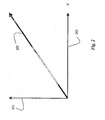
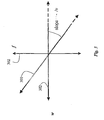
- the Fourier transform of this signal is also a line 301 passing through the origin, with slope ⁇ 1 v , where w 302 is the temporal frequency, and f 303 is the spatial frequency.
- a 1-D signal translation has its spectrum lying on a line passing through the origin.
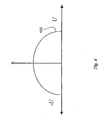
- Figure 4 shows a band-limited signal with a bandwidth of (- U , U) 401.
- the spatio-temporal (Fourier) transform is a line 501 extending from ( U , - v . U ) to (- U , -v.U ).
- replicas of the Fourier transform of the original signal are generated on the temporal frequency axis ⁇ in the transform domain, each of which is ⁇ s apart, where ⁇ s is the temporal sampling frequency.
- a temporally sampled bandwidth-limited signal 601 is perceived the same as a continuous version, as long as the sampled replicas 602 lie outside a window 610 of visibility, and Watson et al.
- the replicas 602 lie outside the window of visibility as long as ⁇ s ⁇ ⁇ 1 ⁇ + ⁇ U, where l is an edge of the window of visibility on the temporal frequency axis.
- the sampling frequency ⁇ s has to be at least 2. ⁇ . U to avoid aliasing.
- a comparison of the aliasing and the window of visibility constraints are illustrated in Figures 7 and 8 having temporal spectrums 701 and 801 for the sampled signals. In computer graphics, aliasing is frequently handled using spatial smoothing or motion blur. Therefore, the temporal bandwidth of the visual stimuli is the limiting factor on the temporal sampling frequency.
- the temporal bandwidth for translating a 1-D signal is v .U.
- Figure 10 shows a 2D sinusoid with a frequency vector f 1001 perpendicular to a wave front 1002.
- a vector v 1003 shows a translation of the velocity.
- the sinusoid is cos ( 2 ⁇ 1 N x + 2 ⁇ 4 N y ) , where the origin is at the upper left corner, and a positive y-axis is shown downward.
- Each 1-D cross-section of the 2D sinusoid is a 1-D sinusoid.
- f ⁇ (0.5, 2), which points in a highest frequency direction, i.e., along the gradient.
- Each DCT coefficient contributes a value equal to its energy to histogram bins corresponding to ⁇ 1 and ⁇ 2 in a spatio-temporal complexity histogram, as described below.
- a global motion model can be fitted to the blocks to further reduce spurious motion vectors. However, this would also affect motion of foreground objects. However, if the application permits, then global motion fitting, especially through iterated weighted least squares, can increase the reliability of the motion vector field. Model fitting also eliminates the problem of intra-coded macro-blocks. In the context of tracking moving objects according to the human visual system, it makes sense to treat moving objects differently than the mainly static background.
- the spatio-temporal complexity histogram enables us to measure the energy that lies above a given temporal frequency. This measure is used to adjust the summarization factor or play speed for each video frame or segment so that the perceived quality is constant over all frames of the video.
- a more compact measure can be used. For example, an average or a certain percentile can be used as a single representative measure for the spatio-temporal complexity of a video segment.
- the spatio-temporal complexity histogram is analogous to a power spectrum, while a single number is similar to a bandwidth measure.
- the visual complexity measure is an approximation of the temporal bandwidth of a video segment.
- the temporal bandwidth could be determined by a 3D fast Fourier transform (FFT) or DCT.
- FFT 3D fast Fourier transform
- DCT 3D fast Fourier transform
- the estimated temporal bandwidth in the form of a spatio-temporal complexity measure can be higher than a highest possible frequency given the temporal sampling rate. This is due to a number of factors, such as the inherent error in motion vectors, the low resolution of the block-based motion vector field, the motion residuals of the blocks, the linear motion assumption over a number of frames, and so forth. etc.
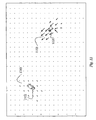
- the pixel movements, motion vectors 1103, can be larger than the size of the object.
- the spatio-temporal complexity in such an area can be as high as 1.6 for some macro-blocks, where 0.5 is the temporal aliasing limit.
- the spatio-temporal complexity is still a good approximation and an intuitive indicator of the visual scene complexity because it combines two important visual complexity components, the spatial detail and the motion activity level of a video frame.
- the human visual system can perceive spatial resolutions up to about 60 cycles/degree. However, this number varies by luminance, contrast and foveal location of the stimuli.
- Watson et. al. report spatial resolution limits of 6 to 17 cycles/degree, which reflects imperfect lighting and contrast that is more likely to be found in videos of ordinary scenes, outside of controlled or studio settings.
- the temporal frequency limit reported under the same conditions is around 30 Hz, which is comparable to movie and television frame rates of 24 and 25 or 30 fps.
- the recommended horizontal viewing angle is about 10° for standard resolution TV and 30° for HDTV.
- the VCD format has horizontal and vertical resolutions, e.g., at 352x240 NTSC MPEG-1, that are almost half that of the DVD, e.g., at 720x480 NTSC MPEG-2, and is accepted as close to VHS quality.
- VCD high-quality spatial resolution limit
- VHS acceptable quality resolution
- 7 cycles/degree low-end acceptable resolution
- the visual temporal frequency limit ⁇ 1 because this rate is close enough to the estimated real value, and is determined considering the human visual system. Also, it defines the highest temporal frequency in the original content. Under this condition, a highest temporal frequency allowed by the window of visibility constraint is equal to the Nyquist frequency for the original frame rate. For example, a DCT block that has significant energy at one of the (8, n) or (m, 8) coefficients can have only 1 pixel/frame motion in that direction.
- the original spatio-temporal complexity value is sometime above the aliasing limit, as shown in Figure 11.
- the overall object can still be seen, the video needs to be played at a slower speed before details can be discerned. In real life, this corresponds to the eyes tracking a fast moving object, which decreases the effective speed and increases the allowed spatial resolution at a given speed.
- spatio-temporal filtering or motion blur can be applied to avoid aliasing.
- the spatio-temporal complexity histogram allows us to determine the amount of energy that has to be filtered for a given play speed. Then, the various parts of the video can be speeded up so as to have the same level of loss throughout the entire video. If the simpler, single number spatio-temporal complexity measure is used, video segments are speeded up inversely proportional to their spatio-temporal complexity values.
- Spatio-temporal smoothing is a filtering operation in 3D space including spatial and temporal dimensions.
- Temporal filtering is achieved by a weighted average of buffered frames in the MPEG decoder.
- the temporal filtering removes a part of the video signal that lies outside the window of visibility, which in our case is equivalent to the temporal aliasing limits. Because the temporal bandwidth of the video segment is the product of the spatial bandwidth and the motion, we can reduce the temporal bandwidth by spatial filtering as well as temporal smoothing.
- Coring is a well-known technique for removing noise from images.
- the technique transforms a noise-degraded image into a frequency-domain representation. This is followed by reducing the image transform coefficients by a non-linear coring function. After an inverse transforming on the cored coefficients, the noise-reduced image is obtained.
- the unfiltered video can be used even though it includes some artifacts.
- Another application dependent modification that can be employed is the smoothing and/or quantization of the spatio-temporal complexity curve for the video sequence.
- a continuous change of the play speed is not feasible or desirable.
- the play speed can be determined for a given minimum length of time, e.g., for each shot.
- the allowed play speed can be limited to a set of predetermined values as those possible with commercial video and DVD players.
- the temporal distortion of the video can be minimized by using a quantization of the visual complexity, by smoothing and filtering of the visual complexity, by a piece-wise linear approximation of the visual complexity so that the visual complexity is substantially linear, or by assigning a constant visual complexity to a consistent temporal segment of the video, e.g., a shot.
- Figures 13 and 14 further illustrate the difference between the prior art motion activity measure and the spatio-temporal complexity measure according to the invention.
- Figure 13 plots the motion activity and spatial-temporal complexity (STC) as a function of frames for a basketball video segment in the MPEG7 test set. The two measures are similar except the last part, ⁇ frame 550, which is a close up on a player.
- the spatio-temporal complexity measure is substantially lower because the images are larger with less detail compared to wide angle shots of all of the players.
- Figure 14 plots a shot of an empty golf fairway, followed by a tee shot, and players walking to the next green.
- the basic idea of the invention is to use a measure of spatio-temporal complexity of a video to control an adaptive playback of the video.
- the spatio-temporal complexity can be approximated by multiplying the bandwidth (spatial) by the velocity (temporal).
- the bandwidth in the spatial domain is measured in 2D real images with translation of pure sinusoids.
- the top level concept of the invention measures the spatial bandwidth and the temporal bandwidths or spectrum.
- the temporal frequency components scale up or down proportionally. This is true even if the video is not sampled in time or space, e.g., NTSC analog video.
- the spatial bandwidth can be measured in a number of ways, e.g., by taking the 3D FFT of a given video segment, or the analog Fourier transform when the video is analog.
- the temporal bandwidth can be estimated by taking the dot-product of spatial frequency components and their velocities.
- the video can be compressed or uncompressed, or digital or analog.
- This dot-product is the spatio-temporal complexity of a given video segment.
- the visual complexity of the video includes both the spatial and the temporal bandwidth, the temporal bandwidth is the determining factor in adaptive playback of digital video.
- the image can be decomposed into those components by using a 2D FFT.
- the temporal frequency components resulting from the motion can be determined of each spatial component by using the dot-product estimation.
- the motion in scenes of most videos is usually much more complicated than a simple pan. Therefore, the invention uses macroblock motion vectors in the compressed domain.
- each spatial frequency component making up a specific macroblock is moving with a velocity given by the block motion vector associated with that block.
- the temporal bandwidth (motion) at each point can be determined through optical flow analysis.
- For the spatial bandwidth we can use a window around each pixel and compute a short-time FFT, and the like. Then, we can determine the spatio-temporal complexity at each pixel or pixel neighborhood, using the window.
- the compressed video example we describe is a special case where the window is the macroblock, and the motion is described by block motion vectors.
- the amount of texture at a pixel is closely related to the gradient of the intensity at that pixel.
- the optical flow can also be determined from the gradient.
Landscapes
- Compression Or Coding Systems Of Tv Signals (AREA)
- Image Analysis (AREA)
- Television Signal Processing For Recording (AREA)
Claims (19)
- Procédé de reproduction adaptative d'images vidéo comprenant :la détermination d'une fréquence spatiale des données de pixel dans une image de la vidéo ;la détermination d'une vitesse temporelle de pixels correspondants entre ladite image et une autre image de la vidéo ;la multiplication de la fréquence spatiale par la vitesse temporelle en vue d'obtenir une mesure de complexité visuelle des images de la vidéo ; etla reproduction des images de la vidéo à une vitesse qui correspond à la complexité visuelle,caractérisée en ce que la fréquence spatiale et la vitesse temporelle sont des vecteurs 2D et en ce que la complexité visuelle est obtenue par un produit scalaire de la fréquence spatiale par les vecteurs de vitesse temporelle.
- Procédé selon la revendication 1 dans lequel la vidéo est compressée.
- Procédé selon la revendication 2 dans lequel la fréquence spatiale est mesurée à partir des coefficients de transformée en cosinus discrète des pixels dans les images et la vitesse temporelle est mesurée à partir des vecteurs de mouvement de pixels correspondants entre les images.
- Procédé selon la revendication 3 dans lequel les fonctions de base de la transformation en cosinus discrète sont incluses dans une formule :


- Procédé selon la revendication 4 dans lequel chaque fonction de base est une superposition de deux sinusoïdes 2D, l'une ayant une fréquence spatiale égale à


- Procédé selon la revendication 5 dans lequel un vecteur de mouvement spécifique est

- Procédé selon la revendication 6 dans lequel la complexité visuelle résultant du coefficient de cosinus discrète et les vecteurs de mouvement sont


- Procédé selon la revendication 3 comprenant en outre :le rejet des vecteurs de mouvement ayant une texture faible ;le filtrage médian des vecteurs de mouvement ; etl'application d'un modèle de mouvement global aux vecteurs de mouvement en vue de réduire le nombre de vecteurs de mouvement incorrects.
- Procédé selon la revendication 3 dans lequel la vidéo compressée comprend des images I et P, images comprenant en outre :la détermination des coefficients de transformation en cosinus discrète des images P par l'application d'une compensation de mouvement ; etla détermination des vecteurs de mouvement pour les images I par l'interpolation des vecteurs de mouvement des images P.
- Procédé selon la revendication 1 comprenant en outre :le calcul de la moyenne de la complexité visuelle sur un ensemble d'images en vue de déterminer la complexité d'un segment vidéo.
- Procédé selon la revendication 1 comprenant en outre :l'application d'un flou dû au mouvement pendant la reproduction de la vidéo afin de réduire le battement.
- Procédé selon la revendication 1 dans lequel une vitesse de reproduction est inversement proportionnelle à la complexité visuelle.
- Procédé selon la revendication 1 comprenant en outre :l'application du « coring » en vue du filtrage spatial de la vidéo pendant la reproduction.
- Procédé selon la revendication 1 dans lequel la vidéo n'est pas compressée.
- Procédé selon la revendication 1 dans lequel une distorsion temporelle de la vidéo est réduite pendant la reproduction.
- Procédé selon la revendication 15 dans lequel le processus de réduction utilise une quantification de la complexité visuelle.
- Procédé selon la revendication 15 dans lequel le processus de réduction utilise un lissage et un filtrage de la complexité visuelle.
- Procédé selon la revendication 15 dans lequel le processus de réduction construit une approximation linéaire fragment par fragment de la complexité visuelle jusqu'à obtenir sa quasi linéarité.
- Procédé selon la revendication 15 dans lequel le processus de réduction attribue une complexité visuelle à un segment temporel cohérent de la vidéo.
Applications Claiming Priority (3)
| Application Number | Priority Date | Filing Date | Title |
|---|---|---|---|
| US10/616,546 US7406123B2 (en) | 2003-07-10 | 2003-07-10 | Visual complexity measure for playing videos adaptively |
| US616546 | 2003-07-10 | ||
| PCT/JP2004/009381 WO2005006764A1 (fr) | 2003-07-10 | 2004-06-25 | Procede de reproduction adaptative d'images video |
Publications (2)
| Publication Number | Publication Date |
|---|---|
| EP1525751A1 EP1525751A1 (fr) | 2005-04-27 |
| EP1525751B1 true EP1525751B1 (fr) | 2006-08-30 |
Family
ID=34062389
Family Applications (1)
| Application Number | Title | Priority Date | Filing Date |
|---|---|---|---|
| EP04746850A Expired - Lifetime EP1525751B1 (fr) | 2003-07-10 | 2004-06-25 | Procede de reproduction adaptative d'images video |
Country Status (6)
| Country | Link |
|---|---|
| US (1) | US7406123B2 (fr) |
| EP (1) | EP1525751B1 (fr) |
| JP (1) | JP4597983B2 (fr) |
| CN (1) | CN100393134C (fr) |
| DE (1) | DE602004002171T2 (fr) |
| WO (1) | WO2005006764A1 (fr) |
Families Citing this family (24)
| Publication number | Priority date | Publication date | Assignee | Title |
|---|---|---|---|---|
| US20050125821A1 (en) * | 2003-11-18 | 2005-06-09 | Zhu Li | Method and apparatus for characterizing a video segment and determining if a first video segment matches a second video segment |
| KR100643273B1 (ko) * | 2004-05-27 | 2006-11-10 | 삼성전자주식회사 | 비디오 워터마킹 방법 및 장치와, 비디오 워터마킹을 이용한 비디오 콘텐츠 보호방법 및 장치 |
| CN100486299C (zh) * | 2004-12-21 | 2009-05-06 | 索尼株式会社 | 图像处理装置和图像处理方法 |
| US8780957B2 (en) | 2005-01-14 | 2014-07-15 | Qualcomm Incorporated | Optimal weights for MMSE space-time equalizer of multicode CDMA system |
| WO2006099082A2 (fr) | 2005-03-10 | 2006-09-21 | Qualcomm Incorporated | Classification de contenus pour traitement multimedia |
| US8879635B2 (en) | 2005-09-27 | 2014-11-04 | Qualcomm Incorporated | Methods and device for data alignment with time domain boundary |
| US8654848B2 (en) | 2005-10-17 | 2014-02-18 | Qualcomm Incorporated | Method and apparatus for shot detection in video streaming |
| US8948260B2 (en) | 2005-10-17 | 2015-02-03 | Qualcomm Incorporated | Adaptive GOP structure in video streaming |
| CA2640834C (fr) | 2005-11-15 | 2014-08-19 | Yissum Research Development Company Of The Hebrew University Of Jerusalem | Procede et systeme pour la production de synopsis video |
| US8949235B2 (en) * | 2005-11-15 | 2015-02-03 | Yissum Research Development Company Of The Hebrew University Of Jerusalem Ltd. | Methods and systems for producing a video synopsis using clustering |
| US9131164B2 (en) | 2006-04-04 | 2015-09-08 | Qualcomm Incorporated | Preprocessor method and apparatus |
| EP3297272A1 (fr) | 2007-02-01 | 2018-03-21 | Yissum Research Development Company of the Hebrew University of Jerusalem Ltd. | Procédé et système pour indexer une vidéo et un synopsis vidéo |
| KR101033442B1 (ko) * | 2008-06-12 | 2011-05-09 | 주식회사 몬도시스템즈 | 영상 처리 시스템에서 비트 레이트를 제어하는 장치 및방법 |
| KR20100095833A (ko) | 2009-02-23 | 2010-09-01 | 주식회사 몬도시스템즈 | Roi 의존형 압축 파라미터를 이용하여 영상을 압축하는 장치 및 방법 |
| US8745186B2 (en) * | 2009-03-31 | 2014-06-03 | Canon Kabushiki Kaisha | Network streaming of a video media from a media server to a media client |
| US8510462B2 (en) * | 2009-03-31 | 2013-08-13 | Canon Kabushiki Kaisha | Network streaming of a video media from a media server to a media client |
| US20100251293A1 (en) * | 2009-03-31 | 2010-09-30 | Canon Kabushiki Kaisha | Network streaming of a video media from a media server to a media client |
| EP2502227A1 (fr) * | 2009-11-18 | 2012-09-26 | Nokia Corp. | Traitement de données |
| US8458362B2 (en) * | 2010-09-30 | 2013-06-04 | Comcast Cable Communications, Llc | Delivering content in multiple formats |
| US20130083852A1 (en) * | 2011-09-30 | 2013-04-04 | Broadcom Corporation | Two-dimensional motion compensation filter operation and processing |
| EP2654015A1 (fr) * | 2012-04-21 | 2013-10-23 | General Electric Company | Procédé, système et support lisible sur ordinateur pour le traitement dýune image vidéo médicale |
| CN108881171A (zh) * | 2018-05-21 | 2018-11-23 | 赵慧卿 | 一种基于异步时分复用技术的多路视频并发流优化方法 |
| US12513303B2 (en) | 2022-09-23 | 2025-12-30 | Bitmovin Gmbh | Video encoding complexity predictor |
| US12501084B2 (en) * | 2022-09-26 | 2025-12-16 | Bitmovin Gmbh | Efficient two-pass encoding scheme for adaptive live streaming |
Family Cites Families (9)
| Publication number | Priority date | Publication date | Assignee | Title |
|---|---|---|---|---|
| US5596418A (en) * | 1990-08-17 | 1997-01-21 | Samsung Electronics Co., Ltd. | Deemphasis and subsequent reemphasis of high-energy reversed-spectrum components of a folded video signal |
| JPH06266747A (ja) * | 1993-03-12 | 1994-09-22 | Sharp Corp | Dct/逆dct演算装置 |
| GB9315852D0 (en) * | 1993-07-30 | 1993-09-15 | Video Logic Ltd | Shading three-dimensional images |
| US6181742B1 (en) * | 1998-01-26 | 2001-01-30 | International Business Machines Corporation | Single pass target allocation for video encoding |
| KR100303727B1 (ko) * | 1998-04-28 | 2001-09-24 | 구자홍 | 동영상의적응적디스플레이속도자동조절장치와방법 |
| EP1078518B1 (fr) * | 1998-05-05 | 2003-01-08 | Thomson Licensing S.A. | Reproduction a une vitesse et/ou dans un sens de lecture differents de la lecture normale de signaux codes sous format mpeg |
| JP2000285597A (ja) * | 1999-03-31 | 2000-10-13 | Sony Corp | 情報処理装置および方法、並びに媒体 |
| US7003038B2 (en) | 1999-09-27 | 2006-02-21 | Mitsubishi Electric Research Labs., Inc. | Activity descriptor for video sequences |
| JP2001238182A (ja) * | 2000-02-23 | 2001-08-31 | Sanyo Electric Co Ltd | 画像再生装置および画像再生方法 |
-
2003
- 2003-07-10 US US10/616,546 patent/US7406123B2/en not_active Expired - Fee Related
-
2004
- 2004-06-25 JP JP2006518507A patent/JP4597983B2/ja not_active Expired - Fee Related
- 2004-06-25 WO PCT/JP2004/009381 patent/WO2005006764A1/fr not_active Ceased
- 2004-06-25 DE DE602004002171T patent/DE602004002171T2/de not_active Expired - Lifetime
- 2004-06-25 EP EP04746850A patent/EP1525751B1/fr not_active Expired - Lifetime
- 2004-06-25 CN CNB2004800005423A patent/CN100393134C/zh not_active Expired - Fee Related
Also Published As
| Publication number | Publication date |
|---|---|
| US20050018881A1 (en) | 2005-01-27 |
| CN100393134C (zh) | 2008-06-04 |
| EP1525751A1 (fr) | 2005-04-27 |
| JP4597983B2 (ja) | 2010-12-15 |
| DE602004002171D1 (de) | 2006-10-12 |
| CN1698385A (zh) | 2005-11-16 |
| DE602004002171T2 (de) | 2007-09-20 |
| WO2005006764A1 (fr) | 2005-01-20 |
| JP2007527141A (ja) | 2007-09-20 |
| US7406123B2 (en) | 2008-07-29 |
Similar Documents
| Publication | Publication Date | Title |
|---|---|---|
| EP1525751B1 (fr) | Procede de reproduction adaptative d'images video | |
| Shen et al. | A fast algorithm for video parsing using MPEG compressed sequences | |
| JP4666784B2 (ja) | ビデオシーケンスのキーフレーム抽出方法及びビデオシーケンスのキーフレーム抽出装置 | |
| CN102177705B (zh) | 用于平滑图像边缘以去除不规则的系统、方法和装置 | |
| Joyce et al. | Temporal segmentation of video using frame and histogram space | |
| KR20010089770A (ko) | 동적 임계치를 사용하는 비주얼 인덱싱 시스템에 대한중요 장면 검출 및 프레임 필터링 | |
| US6862372B2 (en) | System for and method of sharpness enhancement using coding information and local spatial features | |
| US7469010B2 (en) | Extracting key frames from a video sequence | |
| US20110188583A1 (en) | Picture signal conversion system | |
| US20100303150A1 (en) | System and method for cartoon compression | |
| US20140320534A1 (en) | Image processing apparatus, and image processing method | |
| EP1979908A2 (fr) | Extraction d'images clefs candidates d'un clip vidéo | |
| Yuen | Coding artifacts and visual distortions | |
| JP2004529578A (ja) | ビデオ信号中の字幕の検出 | |
| EP1506525B1 (fr) | Systeme et procede d'amelioration de la nettete d'une video numerique codee | |
| Kim et al. | Fast scene change detection for personal video recorder | |
| US20110187924A1 (en) | Frame rate conversion device, corresponding point estimation device, corresponding point estimation method and corresponding point estimation program | |
| Peker et al. | Adaptive fast playback-based video skimming using a compressed-domain visual complexity measure | |
| JP2007512750A (ja) | ビデオ信号における局所的な画像空間−時間細部の検出 | |
| WO2004090812A1 (fr) | Conversion spatiale d'images | |
| JP2003519971A (ja) | カット検出におけるフォールスポジティブを低減するための方法及び装置 | |
| US8582882B2 (en) | Unit for and method of segmentation using average homogeneity | |
| KR101098300B1 (ko) | 공간 신호 변환 | |
| US20070047643A1 (en) | Video data compression | |
| CN1608377A (zh) | 用于隔行视频的信号自适应的空间缩放 |
Legal Events
| Date | Code | Title | Description |
|---|---|---|---|
| PUAI | Public reference made under article 153(3) epc to a published international application that has entered the european phase |
Free format text: ORIGINAL CODE: 0009012 |
|
| 17P | Request for examination filed |
Effective date: 20050217 |
|
| AK | Designated contracting states |
Kind code of ref document: A1 Designated state(s): AT BE BG CH CY CZ DE DK EE ES FI FR GB GR HU IE IT LI LU MC NL PL PT RO SE SI SK TR |
|
| AX | Request for extension of the european patent |
Extension state: AL HR LT LV MK |
|
| 17Q | First examination report despatched |
Effective date: 20050705 |
|
| GRAP | Despatch of communication of intention to grant a patent |
Free format text: ORIGINAL CODE: EPIDOSNIGR1 |
|
| RAP1 | Party data changed (applicant data changed or rights of an application transferred) |
Owner name: MITSUBISHI DENKI KABUSHIKI KAISHA |
|
| DAX | Request for extension of the european patent (deleted) | ||
| RBV | Designated contracting states (corrected) |
Designated state(s): DE FR GB |
|
| GRAS | Grant fee paid |
Free format text: ORIGINAL CODE: EPIDOSNIGR3 |
|
| GRAA | (expected) grant |
Free format text: ORIGINAL CODE: 0009210 |
|
| AK | Designated contracting states |
Kind code of ref document: B1 Designated state(s): DE FR GB |
|
| REG | Reference to a national code |
Ref country code: GB Ref legal event code: FG4D |
|
| REF | Corresponds to: |
Ref document number: 602004002171 Country of ref document: DE Date of ref document: 20061012 Kind code of ref document: P |
|
| ET | Fr: translation filed | ||
| PLBE | No opposition filed within time limit |
Free format text: ORIGINAL CODE: 0009261 |
|
| STAA | Information on the status of an ep patent application or granted ep patent |
Free format text: STATUS: NO OPPOSITION FILED WITHIN TIME LIMIT |
|
| 26N | No opposition filed |
Effective date: 20070531 |
|
| REG | Reference to a national code |
Ref country code: GB Ref legal event code: 746 Effective date: 20100615 |
|
| PGFP | Annual fee paid to national office [announced via postgrant information from national office to epo] |
Ref country code: GB Payment date: 20140625 Year of fee payment: 11 |
|
| PGFP | Annual fee paid to national office [announced via postgrant information from national office to epo] |
Ref country code: DE Payment date: 20140618 Year of fee payment: 11 |
|
| PGFP | Annual fee paid to national office [announced via postgrant information from national office to epo] |
Ref country code: FR Payment date: 20140609 Year of fee payment: 11 |
|
| REG | Reference to a national code |
Ref country code: DE Ref legal event code: R119 Ref document number: 602004002171 Country of ref document: DE |
|
| GBPC | Gb: european patent ceased through non-payment of renewal fee |
Effective date: 20150625 |
|
| REG | Reference to a national code |
Ref country code: FR Ref legal event code: ST Effective date: 20160229 |
|
| PG25 | Lapsed in a contracting state [announced via postgrant information from national office to epo] |
Ref country code: DE Free format text: LAPSE BECAUSE OF NON-PAYMENT OF DUE FEES Effective date: 20160101 Ref country code: GB Free format text: LAPSE BECAUSE OF NON-PAYMENT OF DUE FEES Effective date: 20150625 |
|
| PG25 | Lapsed in a contracting state [announced via postgrant information from national office to epo] |
Ref country code: FR Free format text: LAPSE BECAUSE OF NON-PAYMENT OF DUE FEES Effective date: 20150630 |