EP1524594B1 - Utilizing SIMD instructions within Montgomery multiplication - Google Patents
Utilizing SIMD instructions within Montgomery multiplication Download PDFInfo
- Publication number
- EP1524594B1 EP1524594B1 EP04018745A EP04018745A EP1524594B1 EP 1524594 B1 EP1524594 B1 EP 1524594B1 EP 04018745 A EP04018745 A EP 04018745A EP 04018745 A EP04018745 A EP 04018745A EP 1524594 B1 EP1524594 B1 EP 1524594B1
- Authority
- EP
- European Patent Office
- Prior art keywords
- array
- instructions
- simd
- instruction
- modulus
- Prior art date
- Legal status (The legal status is an assumption and is not a legal conclusion. Google has not performed a legal analysis and makes no representation as to the accuracy of the status listed.)
- Expired - Lifetime
Links
Images


Classifications
-
- G—PHYSICS
- G06—COMPUTING OR CALCULATING; COUNTING
- G06F—ELECTRIC DIGITAL DATA PROCESSING
- G06F7/00—Methods or arrangements for processing data by operating upon the order or content of the data handled
- G06F7/60—Methods or arrangements for performing computations using a digital non-denominational number representation, i.e. number representation without radix; Computing devices using combinations of denominational and non-denominational quantity representations, e.g. using difunction pulse trains, STEELE computers, phase computers
- G06F7/72—Methods or arrangements for performing computations using a digital non-denominational number representation, i.e. number representation without radix; Computing devices using combinations of denominational and non-denominational quantity representations, e.g. using difunction pulse trains, STEELE computers, phase computers using residue arithmetic
- G06F7/728—Methods or arrangements for performing computations using a digital non-denominational number representation, i.e. number representation without radix; Computing devices using combinations of denominational and non-denominational quantity representations, e.g. using difunction pulse trains, STEELE computers, phase computers using residue arithmetic using Montgomery reduction
-
- G—PHYSICS
- G06—COMPUTING OR CALCULATING; COUNTING
- G06F—ELECTRIC DIGITAL DATA PROCESSING
- G06F9/00—Arrangements for program control, e.g. control units
- G06F9/06—Arrangements for program control, e.g. control units using stored programs, i.e. using an internal store of processing equipment to receive or retain programs
- G06F9/30—Arrangements for executing machine instructions, e.g. instruction decode
-
- G—PHYSICS
- G06—COMPUTING OR CALCULATING; COUNTING
- G06F—ELECTRIC DIGITAL DATA PROCESSING
- G06F9/00—Arrangements for program control, e.g. control units
- G06F9/06—Arrangements for program control, e.g. control units using stored programs, i.e. using an internal store of processing equipment to receive or retain programs
- G06F9/44—Arrangements for executing specific programs
Definitions
- the invention relates to computer architectures that support SIMD (Single Instruction, Multiple Data) instructions.
- SIMD Single Instruction, Multiple Data
- SIMD Single Instruction, Multiple Data
- Each such instruction performs one operation on multiple sets of data.
- multiple simultaneous instances of one operation are used to process different data.
- one instruction might perform several independent subtractions or other mathematical operations (but the same operation everywhere).
- the Pentium® 4 microprocessor from Intel Corporation is one example of a computer architecture that is capable of executing SIMD instructions.
- the microprocessor utilizes 144 instructions, known as SSE2 (Streaming SIMD Extensions 2) instructions, to operate on data stored in registers.
- SSE2 Streaming SIMD Extensions 2
- the microprocessor has eight 128-bit integer registers, each of which can hold multiple sets of data, such as two 64-bit integers, four 32-bit integers, eight 16-bit integers, or sixteen 8-bit integers.
- Each individual SSE2 instruction performs one operation on the multiple data sets contained in a register, possibly with inputs from another register.
- the SSE2 instructions reduce the overall number of instructions used to execute a particular program task, thereby increasing overall performance.
- Security is one example where computers are called upon to perform many rigorous operations.
- Security functions employ complex cryptographic algorithms that often use exponentiation operations (e.g., the RSA algorithm) involving many modular multiplication and operations. It is a continuing goal to find ways to reduce computations in complex algorithms and thereby improve performance.
- Montgomery multiplication is a well-known algorithm for modular multiplication which avoids division. It achieves this by reducing double-length products from the right rather than from the left.
- Schwemmlein J et al: "RNS-Modulo Reduction Upon a Restricted Base Value Set and its Applicability to RSA Cryptography" Computers & Security, Elsevier Science Publishers. Amsterdam, NL, vol. 17, no. 7, 1998, pages 637-650 concerns the RNS modulo reduction scheme.
- Montgomery's reduction scheme has been adopted to RNS modulo reduction. This RNS modulo reduction scheme is considered, and an algorithm, which is suitable for SIMD like parallel machines, is provided.
- Fig. 1 illustrates a computer architecture that supports SIMD instructions.
- Fig. 2 illustrates use of SIMD instructions within Montgomery multiplication (which performs modular multiplication), and the placement of data values in registers.
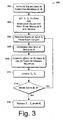
- Fig. 3 is a flow diagram of a process for performing Montgomery multiplication on the computer architecture of Fig. 1 .
- Montgomery multiplication is a widely used, division-free, algorithm for modular multiplication.
- the following disclosure describes use of two-way SIMD (Single Instruction, Multiple Data) instructions within Montgomery multiplication. While Montgomery multiplication may be implemented on various computer architectures that support SIMD instructions, one particular implementation will be described in the context of a computer architecture that supports SIMD instructions operating on two independent operands.
- Fig. 1 shows a computer architecture 100 that can be configured to implement use of two-way SIMD instructions for Montgomery multiplication.
- the computer architecture 100 includes a microprocessor 102 and memory 104.
- the microprocessor 102 has one or more ALUs (Arithmetic Logic Units) 106(1), ..., 106(N) to manage mathematical operations, such as adding and multiplying, and logical operators like OR, AND, XOR, and so forth, as well as right and left shifts.
- the microprocessor 102 further includes one or more registers 108(1), ..., 108(M) to hold intermediate values and final results produced by the ALUs 106.
- microprocessor 102 is an Intel® IA-32 microprocessor, which has two ALUs 106 and eight 128-bit integer registers 108.
- the registers 108 are also known as XMM registers. Compilers from Intel Corporation and Microsoft Corporation support user access to these XMM registers without requiring the user to write assembly code.
- the computer architecture 100 supports SIMD instructions.
- the Intel® IA-32 microprocessor supports SSE2 (Streaming SIMD Extensions 2) instructions.
- the SSE2 instruction set principally enhances audio and video compression processes, bringing several enhancements dedicated to boost MPEG 2 encoding and file encrypting processes.
- the SSE2 instruction set includes 144 instructions that support, among other things, 128-bit SIMD integer arithmetic operations.
- the SSE2 instructions are also intended to assist in vectorizing a program. If, for example, one is operating on 32-bit data, then each 128-bit XMM register can hold four 32-bit values. Using SSE2 instructions, these four 32-bit operands can be processed with a single instruction, and four 32-bit results obtained
- a sequence of SIMD instructions 110 is used to implement Montgomery multiplication, which is an algorithm for modular multiplication.
- the instructions are shown generally as residing in microprocessor 102, but they may be executed within any of ALUs 106(1)-106(N). These instructions direct the processor to perform computations involved in the Montgomery multiplication, perhaps during modular exponentiations in the cryptographic function.
- n 1 and n 2 be integers with n 2 > 0.
- modular multiplication starts with a positive integer modulus N , which is assumed to be fixed herein. Given two integers a and b , their modular product, modmul( a , b ), is defined to be rem( ab , N ).
- modmul( a , b ) is defined to be rem( ab , N ).
- N ' with N N' ⁇ 1 (mod R ). The value of N' depends only on N (and R ), and need be computed only once per modulus N .
- the Montgomery product, montmul( a , b ) is defined as the integer r' such that 0 ⁇ r' ⁇ N and ab ⁇ r ⁇ R mod N
- the function "tomont” is a multiplicative homomorphism (meaning that images of products are products of images) from Z/ N Z to Z / N Z if modmul is used to define multiplication on the domain and montmul to define multiplication on the image.
- Z / N Z denotes the integers modulo N .
- the function montmul( A , B ) will be T 1 - T 2 (when T 1 ⁇ T 2 ) or T 1 - T 2 + N (when T 1 ⁇ T 2 ).
- the T 1 update adds a multiple of B whereas the T 2 update adds a multiple of N .
- the multipliers mul 1 and mul 2 are single precision (i.e., 0 ⁇ mul 1 , mu l 2 ⁇ r ).
- the instructions needed to update T 1 are very similar to those needed to update T 2 .
- the computer architecture 100 illustrated in Fig. 1 employs SIMD instructions 110 (and in our particular example, SSE2 instructions) to update simultaneously the arrays T 1 and T 2 used in Montgomery multiplication, montmul( A , B ).
- SIMD instructions 110 and in our particular example, SSE2 instructions
- This process involves, in part, processing digits of A in a right-to-left manner and interleaving results of the multiplications involving B (i.e., mul 1 * B [ i ]) and modulus N (i.e., mul 2 * N [ i ]) that are used to update arrays T 1 and T 2 . This will be described in more detail below.
- each 128-bit register 108 can hold four 32-bit values.
- a loop can then be written as follows: This loop can be partially unrolled (by the programmer or the compiler) so the generated code resembles:
- One SSE2 instruction loads four 32-bit data values ( x [ i 4+3], x [ i 4+2], x [ i 4+1], x [ i 4]) from contiguous memory locations into an XMM register.
- Another SSE2 instruction loads ( y [ i 4+3], y [ i 4+2], y [ i 4+1], y [ i 4]) to a different XMM register.
- a single PADDD instruction forms all four 32-bit sums, as follows: x ⁇ i ⁇ 4 + 3 + y ⁇ i ⁇ 4 + 3 , x ⁇ i ⁇ 4 + 2 , y ⁇ i ⁇ 4 + 2 , x ⁇ i ⁇ 4 + 1 + y ⁇ i ⁇ 4 + 1 , x i ⁇ 4 + y i ⁇ 4 .
- the four sums are then put into contiguous locations of the z array.
- the compiler can reserve four 32-bit registers to hold the loop index i 4 and the array addresses x , y , z , rather than clutter those registers with data values such as x [ i 4].
- the inner loop of the pseudocode [Update Code 1] translates easily.
- three of the eight XMM registers 108(1), 108(2), and 108(3) hold the pairs ( sum 1 , sum 2 ), ( mul 1 , mul 2 ), and ( r -1, r -1). All three registers are initialized before starting the inner loop.
- the inner loop body loads the pairs ( B [ i ], N [ i ]) and ( T 1 [ i ], T 2 [ i ]) into XMM registers 108(4) and 108(5), as represented by the two load instructions INST1: LOAD and INST2: LOAD in Fig. 2 .
- Two SSE2 instructions “PADDQ”, which add two 64-bit values, are then used to yield: with the updated ( sum 1 , sum 2 ) being placed in another XMM register 108(6) (i.e., INST4: PADDQ and INST5: PADDQ in Fig. 2 ).
- a copy operation (i.e., INST6: MOVDQA) makes a replica of ( sum 1 , sum 2 ).
- one SSE2 instruction "PAND” i.e., a 128-bit AND, which is the same as two 64-bit ANDs) with ( r -1, r - 1)
- a store operation i.e., INST8: STORE
- the PAND destroys one copy of ( sum 1 , sum 2 ) but the other is preserved.
- an SSE2 operation "PSRLQ” i.e., right shift 64-bit data with zero fill) by 32 bits provides the following results (i.e., INST9: PSRLQ):
- the inner loop body needs only two loads, one multiply, two adds, one copy, one bitwise AND, one store, one shift - nine SSE2 instructions to update one element of array T 1 and the corresponding element of array T 2 .
- the Microsoft Visual Studio .NET and Intel ® IA-32 compilers have intrinsics that allow a user to generate this type of code without using assembly language.
- the problem is avoided by interleaving the B and N arrays into one temporary array with 128-bit elements (and properly aligned).
- the copies can be made early in montmul. The cost of these copies is negligible when k is large since each copied pair of elements will later be accessed k times.
- the elements of arrays T 1 and T 2 can be interleaved within an array with 128-bit elements.
- the final rem( T 1 - T 2 , N ) computation will store its output in standard form (i.e., adjacent 32-bit words).
- Fig. 3 shows a process 300 for using SIMD instructions within Montgomery multiplication.
- the process 300 may be performed, for example, by computer architecture 100 and will be described with reference to both Figs. 1 and 2 .
- the process 300 is illustrated as a series of blocks, where each block represents an operation or functionality performed by the computer architecture.
- the operations or functions may be performed in software, firmware, and/or hardware.
- the blocks may be used to represent instructions stored on a medium, that when executed, perform the recited functionality.
- the values used in computing the function montmul( A , B ) are initialized. These values include integer inputs A, B, temporary arrays T 1 , T 2 , and modulus N .
- temporary arrays T 1 , T 2 are set to zero. Values for input B and modulus N are interleaved into a vector and a pair of elements from these arrays will fit in one of the registers (e.g., register 108(4) in Fig. 2 ).
- an iterative loop begins to process the digits of input A , from right-to-left.
- the processor determines what multiple mul 2 of modulus N allows the update arrays T 1 , T 2 to end with the same digit(s).
- the multiplication (digit of A ) times B i.e., mul 1 * B [ i ] in the pseudocode Update Code 1
- multiplication of the determined multiple times modulus N i.e., mul 2 * N [ i ] in the pseudocode Update Code 1 are performed.
- the arrays T 1 , T 2 are updated.
- the multiplication AB is interleaved with the multiplication qN in the Montgomery multiplication.
- the loop continues until all digits in input A have been processed, as represented by decision block 314.
- the result T 1 - T 2 (mod N ) is returned.
- the remaining portion of this section uses the example values in the multiple-precision implementation described above using SIMD instructions.
- N' 109
- N' [0] 9.
- the low order digit of the product AB, or 056088, is 8.
- the next step looks at the tens' digit 1 in the resulting value 054510.
- Multiples of 456 will be added to array T 1 for computing the multiplication AB while multiples of 789 will be added to array T 2 for computing the reduction of qN.
- Both T 1 and T 2 will remain nonnegative.
- the present T 2 0 ends in a zero.
- the modulus N i.e., 789
- the present T 2 157 ends in a 7.
- the modulus N i.e., 789
- the two elements of temp are integers from 0 to 99.
- the inputs to the temp computation are integers from 0 to 9 and the output ranges from 0 to 99.
- this corresponds to inputs of 0 to 2 32 - 1 and outputs of 0 to 2 64 - 1.
- Example source code for implementing the pseudocode [Update Code 1] is provided below.
- ptr_roundup_m128i( temps ) takes a temporary array address aligned on a 4-byte boundary, and returns whichever of temps, temps+4, temps+8, temps +12 is aligned on a 16-byte boundary. Given a 128-bit value x, the SSE2_digit2( x ) macro returns the value in bits 63-32 of x , and the SSE2_digit0( x ) macro returns the value in bits 31-0 of x .
- digit_t, digit_tc, DWORDREG, DWORDREGC are all 32-bit types.
- the trailing "c” or “C” identifies a constant operand.
Landscapes
- Engineering & Computer Science (AREA)
- General Physics & Mathematics (AREA)
- Physics & Mathematics (AREA)
- Theoretical Computer Science (AREA)
- Mathematical Analysis (AREA)
- Pure & Applied Mathematics (AREA)
- Mathematical Optimization (AREA)
- Computational Mathematics (AREA)
- General Engineering & Computer Science (AREA)
- Software Systems (AREA)
- Computing Systems (AREA)
- Mathematical Physics (AREA)
- Executing Machine-Instructions (AREA)
- Advance Control (AREA)
- Organic Low-Molecular-Weight Compounds And Preparation Thereof (AREA)
Applications Claiming Priority (2)
| Application Number | Priority Date | Filing Date | Title |
|---|---|---|---|
| US686316 | 2003-10-15 | ||
| US10/686,316 US7532720B2 (en) | 2003-10-15 | 2003-10-15 | Utilizing SIMD instructions within montgomery multiplication |
Publications (3)
| Publication Number | Publication Date |
|---|---|
| EP1524594A2 EP1524594A2 (en) | 2005-04-20 |
| EP1524594A3 EP1524594A3 (en) | 2006-04-12 |
| EP1524594B1 true EP1524594B1 (en) | 2008-11-05 |
Family
ID=34377640
Family Applications (1)
| Application Number | Title | Priority Date | Filing Date |
|---|---|---|---|
| EP04018745A Expired - Lifetime EP1524594B1 (en) | 2003-10-15 | 2004-08-06 | Utilizing SIMD instructions within Montgomery multiplication |
Country Status (7)
| Country | Link |
|---|---|
| US (1) | US7532720B2 (https=) |
| EP (1) | EP1524594B1 (https=) |
| JP (1) | JP4662744B2 (https=) |
| KR (1) | KR101103893B1 (https=) |
| CN (1) | CN100437548C (https=) |
| AT (1) | ATE413642T1 (https=) |
| DE (1) | DE602004017559D1 (https=) |
Families Citing this family (22)
| Publication number | Priority date | Publication date | Assignee | Title |
|---|---|---|---|---|
| US20040249782A1 (en) * | 2003-06-04 | 2004-12-09 | International Business Machines Corporation | Method and system for highly efficient database bitmap index processing |
| DE602004027943D1 (de) * | 2003-11-16 | 2010-08-12 | Sandisk Il Ltd | Verbesserte natürliche montgomery-exponentenmaskierung |
| KR100530372B1 (ko) * | 2003-12-20 | 2005-11-22 | 삼성전자주식회사 | 사이드채널 공격을 방지할 수 있는 타원곡선 암호화 방법 |
| US7664810B2 (en) * | 2004-05-14 | 2010-02-16 | Via Technologies, Inc. | Microprocessor apparatus and method for modular exponentiation |
| JP5027422B2 (ja) * | 2006-02-09 | 2012-09-19 | ルネサスエレクトロニクス株式会社 | 剰余演算処理装置 |
| US8036379B2 (en) * | 2006-03-15 | 2011-10-11 | Microsoft Corporation | Cryptographic processing |
| KR20120077164A (ko) | 2010-12-30 | 2012-07-10 | 삼성전자주식회사 | Simd 구조를 사용하는 복소수 연산을 위한 사용하는 장치 및 방법 |
| CN102431508B (zh) * | 2011-10-12 | 2014-06-11 | 奇瑞汽车股份有限公司 | 太阳能汽车天窗供电控制方法、系统以及汽车 |
| WO2013089750A1 (en) * | 2011-12-15 | 2013-06-20 | Intel Corporation | Methods to optimize a program loop via vector instructions using a shuffle table and a blend table |
| EP2856303B1 (en) * | 2012-05-30 | 2017-08-02 | Intel Corporation | Vector and scalar based modular exponentiation |
| US10095516B2 (en) | 2012-06-29 | 2018-10-09 | Intel Corporation | Vector multiplication with accumulation in large register space |
| US9355068B2 (en) | 2012-06-29 | 2016-05-31 | Intel Corporation | Vector multiplication with operand base system conversion and re-conversion |
| JP5852594B2 (ja) * | 2013-01-15 | 2016-02-03 | 日本電信電話株式会社 | 多倍長整数演算装置、多倍長整数演算方法、プログラム |
| CN104951279B (zh) * | 2015-05-27 | 2018-03-20 | 四川卫士通信息安全平台技术有限公司 | 一种基于NEON引擎的向量化Montgomery模乘器的设计方法 |
| IL239880B (en) * | 2015-07-09 | 2018-08-30 | Kaluzhny Uri | Simplified montgomery multiplication |
| CN106452723B (zh) * | 2016-12-13 | 2017-05-31 | 深圳市全同态科技有限公司 | 一种基于模运算的全同态加密处理方法 |
| JP7286239B2 (ja) * | 2019-02-28 | 2023-06-05 | ルネサスエレクトロニクス株式会社 | 演算処理方法、演算処理装置、及び半導体装置 |
| US20230042366A1 (en) * | 2021-07-23 | 2023-02-09 | Cryptography Research, Inc. | Sign-efficient addition and subtraction for streamingcomputations in cryptographic engines |
| US12008369B1 (en) | 2021-08-31 | 2024-06-11 | Apple Inc. | Load instruction fusion |
| WO2023199440A1 (ja) * | 2022-04-13 | 2023-10-19 | 日本電気株式会社 | 符号付き整数の剰余積計算装置、符号付き整数の剰余積計算方法及び、プログラム |
| US12217060B1 (en) | 2022-09-23 | 2025-02-04 | Apple Inc. | Instruction fusion |
| US12288066B1 (en) | 2022-09-23 | 2025-04-29 | Apple Inc. | Operation fusion for instructions bridging execution unit types |
Family Cites Families (11)
| Publication number | Priority date | Publication date | Assignee | Title |
|---|---|---|---|---|
| FR2726667B1 (fr) * | 1994-11-08 | 1997-01-17 | Sgs Thomson Microelectronics | Procede de mise en oeuvre de multiplication modulaire selon la methode montgomery |
| US6202077B1 (en) * | 1998-02-24 | 2001-03-13 | Motorola, Inc. | SIMD data processing extended precision arithmetic operand format |
| JP3869947B2 (ja) * | 1998-08-04 | 2007-01-17 | 株式会社日立製作所 | 並列処理プロセッサ、および、並列処理方法 |
| US7240204B1 (en) | 2000-03-31 | 2007-07-03 | State Of Oregon Acting By And Through The State Board Of Higher Education On Behalf Of Oregon State University | Scalable and unified multiplication methods and apparatus |
| JP2002007112A (ja) * | 2000-06-20 | 2002-01-11 | Sony Corp | 剰余演算計算方法および剰余演算計算装置 |
| JP3785044B2 (ja) * | 2001-01-22 | 2006-06-14 | 株式会社東芝 | べき乗剰余計算装置、べき乗剰余計算方法及び記録媒体 |
| JP2002229445A (ja) * | 2001-01-30 | 2002-08-14 | Mitsubishi Electric Corp | べき乗剰余演算器 |
| CN1375765A (zh) * | 2001-03-19 | 2002-10-23 | 深圳市中兴集成电路设计有限责任公司 | 一种快速大数模乘运算电路 |
| US7107305B2 (en) * | 2001-10-05 | 2006-09-12 | Intel Corporation | Multiply-accumulate (MAC) unit for single-instruction/multiple-data (SIMD) instructions |
| EP1459167B1 (en) * | 2001-12-14 | 2006-01-25 | Koninklijke Philips Electronics N.V. | Pipelined core in montgomery multiplier |
| US7266577B2 (en) * | 2002-05-20 | 2007-09-04 | Kabushiki Kaisha Toshiba | Modular multiplication apparatus, modular multiplication method, and modular exponentiation apparatus |
-
2003
- 2003-10-15 US US10/686,316 patent/US7532720B2/en not_active Expired - Lifetime
-
2004
- 2004-08-06 DE DE602004017559T patent/DE602004017559D1/de not_active Expired - Lifetime
- 2004-08-06 AT AT04018745T patent/ATE413642T1/de not_active IP Right Cessation
- 2004-08-06 EP EP04018745A patent/EP1524594B1/en not_active Expired - Lifetime
- 2004-08-25 KR KR1020040067024A patent/KR101103893B1/ko not_active Expired - Lifetime
- 2004-09-15 JP JP2004269033A patent/JP4662744B2/ja not_active Expired - Lifetime
- 2004-10-15 CN CNB2004100855415A patent/CN100437548C/zh not_active Expired - Lifetime
Also Published As
| Publication number | Publication date |
|---|---|
| CN100437548C (zh) | 2008-11-26 |
| EP1524594A3 (en) | 2006-04-12 |
| EP1524594A2 (en) | 2005-04-20 |
| US7532720B2 (en) | 2009-05-12 |
| ATE413642T1 (de) | 2008-11-15 |
| JP2005122141A (ja) | 2005-05-12 |
| DE602004017559D1 (de) | 2008-12-18 |
| JP4662744B2 (ja) | 2011-03-30 |
| CN1607518A (zh) | 2005-04-20 |
| KR101103893B1 (ko) | 2012-01-12 |
| KR20050036698A (ko) | 2005-04-20 |
| US20050084099A1 (en) | 2005-04-21 |
Similar Documents
| Publication | Publication Date | Title |
|---|---|---|
| EP1524594B1 (en) | Utilizing SIMD instructions within Montgomery multiplication | |
| US7346159B2 (en) | Generic modular multiplier using partial reduction | |
| Chung et al. | Asymmetric squaring formulae | |
| Bos et al. | Montgomery arithmetic from a software perspective | |
| Pessl et al. | Curved tags–a low-resource ecdsa implementation tailored for rfid | |
| US20070116270A1 (en) | Calculating unit for reducing an input number with respect to a modulus | |
| US7240204B1 (en) | Scalable and unified multiplication methods and apparatus | |
| US7558817B2 (en) | Apparatus and method for calculating a result of a modular multiplication | |
| CN101981542B (zh) | 多项式数据处理运算 | |
| Buell et al. | A multiprecise integer arithmetic package | |
| Zhang et al. | Code Generation for Cryptographic Kernels using Multi-word Modular Arithmetic on GPU | |
| Hars | Modular inverse algorithms without multiplications for cryptographic applications | |
| US8364740B2 (en) | Device and method for calculating a result of a modular multiplication with a calculating unit smaller than the operands | |
| Ahmadi et al. | Parallel Formulations of Scalar Multiplication on Koblitz Curves. | |
| Barbosa et al. | On the automatic construction of indistinguishable operations | |
| Gopal et al. | Fast and constant-time implementation of modular exponentiation | |
| US20070100926A1 (en) | Device and method for calculating a multiplication addition operation and for calculating a result of a modular multiplication | |
| Oliveira et al. | Koblitz curves over quadratic fields | |
| US8364737B2 (en) | Device and method for calculating a result of a sum with a calculating unit with limited word length | |
| Bernard | Scalable hardware implementing high-radix Montgomery multiplication algorithm | |
| Großschadl et al. | Optimized RISC architecture for multiple-precision modular arithmetic | |
| Rezaei et al. | Bit-parallel ECC coprocessor resistant to differential power analysis attacks in gf (2m) | |
| Barbosa et al. | First steps toward a cryptography-aware language and compiler | |
| Lorenz | Efficient Multiplication of Somewhat Small Integers Using Number-Theoretic Transforms | |
| Großschädl | Architectural support for long integer modulo arithmetic on RISC-based smart cards |
Legal Events
| Date | Code | Title | Description |
|---|---|---|---|
| PUAI | Public reference made under article 153(3) epc to a published international application that has entered the european phase |
Free format text: ORIGINAL CODE: 0009012 |
|
| AK | Designated contracting states |
Kind code of ref document: A2 Designated state(s): AT BE BG CH CY CZ DE DK EE ES FI FR GB GR HU IE IT LI LU MC NL PL PT RO SE SI SK TR |
|
| AX | Request for extension of the european patent |
Extension state: AL HR LT LV MK |
|
| PUAL | Search report despatched |
Free format text: ORIGINAL CODE: 0009013 |
|
| AK | Designated contracting states |
Kind code of ref document: A3 Designated state(s): AT BE BG CH CY CZ DE DK EE ES FI FR GB GR HU IE IT LI LU MC NL PL PT RO SE SI SK TR |
|
| AX | Request for extension of the european patent |
Extension state: AL HR LT LV MK |
|
| 17P | Request for examination filed |
Effective date: 20060904 |
|
| 17Q | First examination report despatched |
Effective date: 20061018 |
|
| AKX | Designation fees paid |
Designated state(s): AT BE BG CH CY CZ DE DK EE ES FI FR GB GR HU IE IT LI LU MC NL PL PT RO SE SI SK TR |
|
| 17Q | First examination report despatched |
Effective date: 20061018 |
|
| GRAP | Despatch of communication of intention to grant a patent |
Free format text: ORIGINAL CODE: EPIDOSNIGR1 |
|
| GRAS | Grant fee paid |
Free format text: ORIGINAL CODE: EPIDOSNIGR3 |
|
| GRAA | (expected) grant |
Free format text: ORIGINAL CODE: 0009210 |
|
| AK | Designated contracting states |
Kind code of ref document: B1 Designated state(s): AT BE BG CH CY CZ DE DK EE ES FI FR GB GR HU IE IT LI LU MC NL PL PT RO SE SI SK TR |
|
| REG | Reference to a national code |
Ref country code: GB Ref legal event code: FG4D |
|
| REG | Reference to a national code |
Ref country code: CH Ref legal event code: EP |
|
| REG | Reference to a national code |
Ref country code: IE Ref legal event code: FG4D |
|
| REF | Corresponds to: |
Ref document number: 602004017559 Country of ref document: DE Date of ref document: 20081218 Kind code of ref document: P |
|
| NLV1 | Nl: lapsed or annulled due to failure to fulfill the requirements of art. 29p and 29m of the patents act | ||
| PG25 | Lapsed in a contracting state [announced via postgrant information from national office to epo] |
Ref country code: ES Free format text: LAPSE BECAUSE OF FAILURE TO SUBMIT A TRANSLATION OF THE DESCRIPTION OR TO PAY THE FEE WITHIN THE PRESCRIBED TIME-LIMIT Effective date: 20090216 Ref country code: AT Free format text: LAPSE BECAUSE OF FAILURE TO SUBMIT A TRANSLATION OF THE DESCRIPTION OR TO PAY THE FEE WITHIN THE PRESCRIBED TIME-LIMIT Effective date: 20081105 |
|
| PG25 | Lapsed in a contracting state [announced via postgrant information from national office to epo] |
Ref country code: PL Free format text: LAPSE BECAUSE OF FAILURE TO SUBMIT A TRANSLATION OF THE DESCRIPTION OR TO PAY THE FEE WITHIN THE PRESCRIBED TIME-LIMIT Effective date: 20081105 Ref country code: NL Free format text: LAPSE BECAUSE OF FAILURE TO SUBMIT A TRANSLATION OF THE DESCRIPTION OR TO PAY THE FEE WITHIN THE PRESCRIBED TIME-LIMIT Effective date: 20081105 Ref country code: SI Free format text: LAPSE BECAUSE OF FAILURE TO SUBMIT A TRANSLATION OF THE DESCRIPTION OR TO PAY THE FEE WITHIN THE PRESCRIBED TIME-LIMIT Effective date: 20081105 Ref country code: FI Free format text: LAPSE BECAUSE OF FAILURE TO SUBMIT A TRANSLATION OF THE DESCRIPTION OR TO PAY THE FEE WITHIN THE PRESCRIBED TIME-LIMIT Effective date: 20081105 |
|
| PG25 | Lapsed in a contracting state [announced via postgrant information from national office to epo] |
Ref country code: EE Free format text: LAPSE BECAUSE OF FAILURE TO SUBMIT A TRANSLATION OF THE DESCRIPTION OR TO PAY THE FEE WITHIN THE PRESCRIBED TIME-LIMIT Effective date: 20081105 Ref country code: BG Free format text: LAPSE BECAUSE OF FAILURE TO SUBMIT A TRANSLATION OF THE DESCRIPTION OR TO PAY THE FEE WITHIN THE PRESCRIBED TIME-LIMIT Effective date: 20090205 Ref country code: RO Free format text: LAPSE BECAUSE OF FAILURE TO SUBMIT A TRANSLATION OF THE DESCRIPTION OR TO PAY THE FEE WITHIN THE PRESCRIBED TIME-LIMIT Effective date: 20081105 Ref country code: BE Free format text: LAPSE BECAUSE OF FAILURE TO SUBMIT A TRANSLATION OF THE DESCRIPTION OR TO PAY THE FEE WITHIN THE PRESCRIBED TIME-LIMIT Effective date: 20081105 Ref country code: DK Free format text: LAPSE BECAUSE OF FAILURE TO SUBMIT A TRANSLATION OF THE DESCRIPTION OR TO PAY THE FEE WITHIN THE PRESCRIBED TIME-LIMIT Effective date: 20081105 |
|
| PG25 | Lapsed in a contracting state [announced via postgrant information from national office to epo] |
Ref country code: PT Free format text: LAPSE BECAUSE OF FAILURE TO SUBMIT A TRANSLATION OF THE DESCRIPTION OR TO PAY THE FEE WITHIN THE PRESCRIBED TIME-LIMIT Effective date: 20090406 Ref country code: CZ Free format text: LAPSE BECAUSE OF FAILURE TO SUBMIT A TRANSLATION OF THE DESCRIPTION OR TO PAY THE FEE WITHIN THE PRESCRIBED TIME-LIMIT Effective date: 20081105 Ref country code: SE Free format text: LAPSE BECAUSE OF FAILURE TO SUBMIT A TRANSLATION OF THE DESCRIPTION OR TO PAY THE FEE WITHIN THE PRESCRIBED TIME-LIMIT Effective date: 20090205 |
|
| PLBE | No opposition filed within time limit |
Free format text: ORIGINAL CODE: 0009261 |
|
| STAA | Information on the status of an ep patent application or granted ep patent |
Free format text: STATUS: NO OPPOSITION FILED WITHIN TIME LIMIT |
|
| PG25 | Lapsed in a contracting state [announced via postgrant information from national office to epo] |
Ref country code: SK Free format text: LAPSE BECAUSE OF FAILURE TO SUBMIT A TRANSLATION OF THE DESCRIPTION OR TO PAY THE FEE WITHIN THE PRESCRIBED TIME-LIMIT Effective date: 20081105 |
|
| 26N | No opposition filed |
Effective date: 20090806 |
|
| PG25 | Lapsed in a contracting state [announced via postgrant information from national office to epo] |
Ref country code: MC Free format text: LAPSE BECAUSE OF NON-PAYMENT OF DUE FEES Effective date: 20090831 |
|
| REG | Reference to a national code |
Ref country code: CH Ref legal event code: PL |
|
| PG25 | Lapsed in a contracting state [announced via postgrant information from national office to epo] |
Ref country code: CH Free format text: LAPSE BECAUSE OF NON-PAYMENT OF DUE FEES Effective date: 20090831 Ref country code: LI Free format text: LAPSE BECAUSE OF NON-PAYMENT OF DUE FEES Effective date: 20090831 |
|
| REG | Reference to a national code |
Ref country code: IE Ref legal event code: MM4A |
|
| PG25 | Lapsed in a contracting state [announced via postgrant information from national office to epo] |
Ref country code: IE Free format text: LAPSE BECAUSE OF NON-PAYMENT OF DUE FEES Effective date: 20090806 |
|
| PG25 | Lapsed in a contracting state [announced via postgrant information from national office to epo] |
Ref country code: GR Free format text: LAPSE BECAUSE OF FAILURE TO SUBMIT A TRANSLATION OF THE DESCRIPTION OR TO PAY THE FEE WITHIN THE PRESCRIBED TIME-LIMIT Effective date: 20090206 |
|
| PG25 | Lapsed in a contracting state [announced via postgrant information from national office to epo] |
Ref country code: LU Free format text: LAPSE BECAUSE OF NON-PAYMENT OF DUE FEES Effective date: 20090806 |
|
| PG25 | Lapsed in a contracting state [announced via postgrant information from national office to epo] |
Ref country code: HU Free format text: LAPSE BECAUSE OF FAILURE TO SUBMIT A TRANSLATION OF THE DESCRIPTION OR TO PAY THE FEE WITHIN THE PRESCRIBED TIME-LIMIT Effective date: 20090506 |
|
| PG25 | Lapsed in a contracting state [announced via postgrant information from national office to epo] |
Ref country code: TR Free format text: LAPSE BECAUSE OF FAILURE TO SUBMIT A TRANSLATION OF THE DESCRIPTION OR TO PAY THE FEE WITHIN THE PRESCRIBED TIME-LIMIT Effective date: 20081105 |
|
| PG25 | Lapsed in a contracting state [announced via postgrant information from national office to epo] |
Ref country code: CY Free format text: LAPSE BECAUSE OF FAILURE TO SUBMIT A TRANSLATION OF THE DESCRIPTION OR TO PAY THE FEE WITHIN THE PRESCRIBED TIME-LIMIT Effective date: 20081105 |
|
| REG | Reference to a national code |
Ref country code: DE Ref legal event code: R082 Ref document number: 602004017559 Country of ref document: DE Representative=s name: GRUENECKER, KINKELDEY, STOCKMAIR & SCHWANHAEUS, DE |
|
| REG | Reference to a national code |
Ref country code: GB Ref legal event code: 732E Free format text: REGISTERED BETWEEN 20150115 AND 20150121 |
|
| REG | Reference to a national code |
Ref country code: DE Ref legal event code: R081 Ref document number: 602004017559 Country of ref document: DE Owner name: MICROSOFT TECHNOLOGY LICENSING, LLC, REDMOND, US Free format text: FORMER OWNER: MICROSOFT CORP., REDMOND, WASH., US Effective date: 20150126 Ref country code: DE Ref legal event code: R082 Ref document number: 602004017559 Country of ref document: DE Representative=s name: GRUENECKER PATENT- UND RECHTSANWAELTE PARTG MB, DE Effective date: 20150126 |
|
| REG | Reference to a national code |
Ref country code: FR Ref legal event code: TP Owner name: MICROSOFT TECHNOLOGY LICENSING, LLC, US Effective date: 20150724 |
|
| REG | Reference to a national code |
Ref country code: FR Ref legal event code: PLFP Year of fee payment: 13 |
|
| REG | Reference to a national code |
Ref country code: FR Ref legal event code: PLFP Year of fee payment: 14 |
|
| REG | Reference to a national code |
Ref country code: FR Ref legal event code: PLFP Year of fee payment: 15 |
|
| P01 | Opt-out of the competence of the unified patent court (upc) registered |
Effective date: 20230505 |
|
| PGFP | Annual fee paid to national office [announced via postgrant information from national office to epo] |
Ref country code: IT Payment date: 20230720 Year of fee payment: 20 Ref country code: GB Payment date: 20230720 Year of fee payment: 20 |
|
| PGFP | Annual fee paid to national office [announced via postgrant information from national office to epo] |
Ref country code: FR Payment date: 20230720 Year of fee payment: 20 Ref country code: DE Payment date: 20230720 Year of fee payment: 20 |
|
| REG | Reference to a national code |
Ref country code: DE Ref legal event code: R071 Ref document number: 602004017559 Country of ref document: DE |
|
| REG | Reference to a national code |
Ref country code: GB Ref legal event code: PE20 Expiry date: 20240805 |
|
| PG25 | Lapsed in a contracting state [announced via postgrant information from national office to epo] |
Ref country code: GB Free format text: LAPSE BECAUSE OF EXPIRATION OF PROTECTION Effective date: 20240805 |
|
| PG25 | Lapsed in a contracting state [announced via postgrant information from national office to epo] |
Ref country code: GB Free format text: LAPSE BECAUSE OF EXPIRATION OF PROTECTION Effective date: 20240805 |