EP1523121B1 - Verfahren zur Prüfung der Bitfehlerrate eines Gerätes gemäss statistischem Sicherheitsniveau - Google Patents
Verfahren zur Prüfung der Bitfehlerrate eines Gerätes gemäss statistischem Sicherheitsniveau Download PDFInfo
- Publication number
- EP1523121B1 EP1523121B1 EP03022922A EP03022922A EP1523121B1 EP 1523121 B1 EP1523121 B1 EP 1523121B1 EP 03022922 A EP03022922 A EP 03022922A EP 03022922 A EP03022922 A EP 03022922A EP 1523121 B1 EP1523121 B1 EP 1523121B1
- Authority
- EP
- European Patent Office
- Prior art keywords
- ber
- distribution
- error ratio
- samples
- limit
- Prior art date
- Legal status (The legal status is an assumption and is not a legal conclusion. Google has not performed a legal analysis and makes no representation as to the accuracy of the status listed.)
- Expired - Lifetime
Links
- 238000012360 testing method Methods 0.000 title claims abstract description 104
- 238000000034 method Methods 0.000 title claims abstract description 14
- 238000009826 distribution Methods 0.000 claims abstract description 71
- 238000000926 separation method Methods 0.000 claims description 15
- 230000000295 complement effect Effects 0.000 claims description 6
- 230000006870 function Effects 0.000 description 9
- 230000001186 cumulative effect Effects 0.000 description 8
- 238000004088 simulation Methods 0.000 description 7
- 230000010354 integration Effects 0.000 description 5
- 238000002474 experimental method Methods 0.000 description 4
- 230000033590 base-excision repair Effects 0.000 description 3
- 238000010276 construction Methods 0.000 description 3
- 230000001419 dependent effect Effects 0.000 description 3
- 238000013461 design Methods 0.000 description 3
- 238000005259 measurement Methods 0.000 description 3
- 238000000528 statistical test Methods 0.000 description 3
- 238000012800 visualization Methods 0.000 description 3
- 238000013459 approach Methods 0.000 description 2
- NRTLIYOWLVMQBO-UHFFFAOYSA-N 5-chloro-1,3-dimethyl-N-(1,1,3-trimethyl-1,3-dihydro-2-benzofuran-4-yl)pyrazole-4-carboxamide Chemical compound C=12C(C)OC(C)(C)C2=CC=CC=1NC(=O)C=1C(C)=NN(C)C=1Cl NRTLIYOWLVMQBO-UHFFFAOYSA-N 0.000 description 1
- 238000004458 analytical method Methods 0.000 description 1
- 230000001413 cellular effect Effects 0.000 description 1
- 238000004891 communication Methods 0.000 description 1
- 230000007423 decrease Effects 0.000 description 1
- 238000011161 development Methods 0.000 description 1
- 230000018109 developmental process Effects 0.000 description 1
- 238000010586 diagram Methods 0.000 description 1
- 238000005315 distribution function Methods 0.000 description 1
- 238000005562 fading Methods 0.000 description 1
- 238000012986 modification Methods 0.000 description 1
- 230000004048 modification Effects 0.000 description 1
- 230000008450 motivation Effects 0.000 description 1
- 238000005192 partition Methods 0.000 description 1
- 238000013518 transcription Methods 0.000 description 1
- 230000035897 transcription Effects 0.000 description 1
- 230000001052 transient effect Effects 0.000 description 1
Images


Classifications
-
- H—ELECTRICITY
- H04—ELECTRIC COMMUNICATION TECHNIQUE
- H04L—TRANSMISSION OF DIGITAL INFORMATION, e.g. TELEGRAPHIC COMMUNICATION
- H04L1/00—Arrangements for detecting or preventing errors in the information received
- H04L1/24—Testing correct operation
-
- H—ELECTRICITY
- H04—ELECTRIC COMMUNICATION TECHNIQUE
- H04L—TRANSMISSION OF DIGITAL INFORMATION, e.g. TELEGRAPHIC COMMUNICATION
- H04L1/00—Arrangements for detecting or preventing errors in the information received
- H04L1/20—Arrangements for detecting or preventing errors in the information received using signal quality detector
- H04L1/203—Details of error rate determination, e.g. BER, FER or WER
Definitions
- the invention concerns a method for testing the error ratio BER of a device under test against a specified allowable error ratio.
- the statistical test can be an example of the test of a digital receiver for example for cellular mobile phones as a Device Under Test (DUT).
- the test shall decide if the DUT fulfils a specified Bit Error Ratio (BER) or not. The true BER is not target of the test.
- BER Bit Error Ratio
- the invention derives and exploits the knowledge, that the test is governed by the 3 parameters above Confidence level, Test time and Selectivity.
- test time and Confidence level only without awareness of Selectivity In the state of the art the test could actually be optimised according to only the two parameters Test time and Confidence level only without awareness of Selectivity.
- ne ne / ne ! ⁇ e - NE
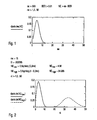
- the Poisson distribution shown in Fig. 1 , has the variable ne and is characterized by the parameter NE. Real probabilities to find ne between two limits are calculated by integrating between such limits.
- Poisson distribution is an approximation: Independent error occurrence is described by the binomial distribution. If the BER approaches 0 the Poisson distribution approximates the binomial distribution.
- Poisson Distributions and the Chi Squared Distribution have a relationship. Just the form is different.
- the experiment, the Poisson distribution is based on, is: having observed a certain number of samples ns, the number of events ne is counted to calculate the ratio ne/ns.
- the experiment, the Chi Square distribution is based on, is: having observed a certain number of events ne, the number of samples ns is counted to calculate the ratio ne/ns. Poisson and Chi Square are valid only if ne ⁇ ns.
- qchisq (D, ne)
- qchisq is the inverse cumulative chi square function.
- NI is the integration variable.
- NE real) is the integration limit.
- ne discretrete is tuned such that the integral is consistent.
- Equation (3) This is usually called the Inverse Cumulative Chi Square function.
- Equation (4) is the solution for another target. This is usually called the Inverse Cumulative Poisson function.
- (3) returns a greater NE than (4) returns with respect to ne.
- (3) returns a continuous NE, (4) returns a discrete ne.
- the result of the inverse cumulative operation is NE low .
- the final mean value NE can be found with high probability (100% - 2*0.0085%) in the range from NE low to NE high , called confidence range.
- the confidence range increases proportional to SQR ne, which means, it increases absolutely, but decreases relatively to the measured number of errors.
- FIG. 3 An example of the early fail and the early pass limit are displayed in Fig. 3 .
- an unfavourable test can last infinite time, when the measured BER stays in between the limits. This requires an artificial stop condition.
- Whichever ne is proposed as a final stop condition, e.g. ne 200, the test can leave the area between the Early Pass and the Early Fail limit through the open end of the right side of Fig. 3 .
- This situation needs an arbitrary pass or fail decision, e.g. pass, if the test hits the vertical 200 error line.
- This situation has the following drawback:
- the test has two different qualities. A good one with wrong decision risk D, when the test hits an early pass or early fail limit, and a worse and variable one, when the test hits the vertical 200 error line.
- D is the wrong decision probability based on the statistical totality of samples with BER on the limit.
- F is the wrong decision probability based on the statistical totality of DUTs with BER on the limit. The same holds for a bad DUT, hitting the early pass limit.
- D the wrong decision probability at a single test step and F the wrong decision probability for the entire test.
- F the wrong decision probability for the entire test.
- An exact theory is not available for this problem. It is proposed to derive D from F by the following simulation: A large population of DUTs with BER on the limit is simulated and decided against the early pass and early fail bound, with a free D-parameter in the early pass and fail limit. The simulation will show, that a certain fraction F (D ⁇ F ⁇ 1) falsely fails.
- the complementary simulation is: A large population of DUTs with M*BER (bad DUT) is simulated and decided against the early pass and early fail bound, with a free D-parameter in the early pass and fail limit. The simulation will show, that a certain fraction F (D ⁇ F ⁇ 1) falsely passes. Both false decision fractions are approximately equal and represent the wrong decision probability F for the entire test. D is tuned such that F corresponds to the predefined wrong decision probability.
- the distribution of errors is considered in the totality of samples for one DUT. This assumes that the error events occurred independently and the BER is time independent. Furthermore, a distribution function is applied which is valid only for small BER (lim ⁇ 0). From the statistics of errors in the totality of samples the theory returned a pass and a fail limit dependent on the wrong decision probability D (0 ⁇ D ⁇ 1).
- the pass and fail limit can be calculated at any instant of the test (ordinal of error), however it may be used for decision just once at a predefined instant. The result at this instant can be pass, fail or undecided.
- D is: One DUT is measured by determining BER at the predefined instant. If the BER at the predefined instant hits the pass ⁇ fail limit, it is decided accordingly and a wrong decision probability D is accepted.
- the method to achieve the target was the following: A large number of DUTs with equal BER has been simulated, passed and failed against the pass fail limits derived with the above discussed. D has been tuned down, until a fraction F of the DUTs behaved according to the new definition (0 ⁇ D ⁇ F ⁇ 1).
- BAD DUT Factor M>1 The notion of BAD DUT Factor M>1 was introduced as follows: A bad DUT is normally failed, however it may falsely pass with a wrong decision probability F. A good DUT on the specified limit is normally passed, however it may falsely fail with a wrong decision probability F. With the bad DUT factor M it could have been ensured that the early fail limit and the early pass limit intersect and the test was reliably finalised after a finite time.
- the early pass limit is constructed by using an empirically or analytically derived distribution for a specific number of devices each having the specified allowable error ratio by separating a specific portion of the best devices from the distribution for a specific number of erroneous samples and proceeding further with the remaining part of the distribution for an incremented number of erroneous samples.
- a statistical test for example the test of a digital receiver as a Device Under Test DUT, is discussed hereafter.
- the test shall decide if the DUT fulfils a specified Bit Error Ratio BER or not. The true BER is not target of the test.
- the test has 3 dimensions of quality:
- the preliminary BER is continuously determined and entered into the diagram as shown in Fig. 5 .
- the DUT is decided accordingly.
- the interpretation is as follows:
- the pseudo random generator represents the BER characteristics of the DUT. Errors occur independently and the true BER is time independent.
- the set of all rows represent the BER(ne) evolution of the population of DUTs.
- the ne th column represents the BER (ne) of all DUTs when the ne th error occurs.
- BER characteristics can be simulated with corresponding generators: e.g. we can re-use a modified form system simulations, deriving the receiver BER (including channel decoder) under fading conditions, creating non independent and time variant bit errors.
- the first point of the early pass limit is constructed by the following rules: Take the left column and separate the DD (e.g.1%) best from the (1-DD) (e.g.99%) worst DUTs.
- the BER value at the separation point of the worst of DD best DUTs marks a point of the early pass limit.
- the best DUTs are from now on regarded as pass and leave the population and the worst DUTs are regarded as undecided and are processed in the same way to construct the next point of the early pass limit by using column 1 with column 2.
- the second point of the early pass limit is constructed as follows: Using column 1(left) with column 2, however disregarding all lines with already passed DUTs we repeat the process. We separate the DD(e.g.1%) best from the (1-DD) (e.g.99%) worst DUTs. The BER value at the separation point marks the second point of the early pass limit. The best DUTs are from now on regarded as pass and leave the population and the worst DUTs are regarded as undecided and are processed in the same way to construct the next point of the early pass limit.
- an early pass limit EPL in Fig. 7 is constructed (controlled) and an early fail limit EFL in Fig. 7 gets implicitly (uncontrolled).
- the horizontal line represents the true BER. This is the basis for construction.
- the early pass limit may intersect the true BER due to deformation of the distribution.
- the good decided DUTs leave the distribution and shift the undecided part distribution towards the bad direction.
- a certain DD is selected (e.g. 1% of the current undecided population) and the separation process until FF is repeated until (e.g. 99% of the initial population) is decided pass.
- the undecided rest is declared fail. This guarantees a limited test time. In this example this needs 229 steps.
- FF is the pass probability for the entire test.
- DD is the pass probability for a single test step.
- DD is selected so that it passes a constant partition of the remaining undecided population.
- a smaller DD is used and the separation process is repeated more often to reach the final pass probability, e.g. separate 0.5% per step. This needs 459 steps to separate 99% of the initial population. Obviously the test keeps a pass probability at 99%. Some test time is lost. The quality, gained by this trade-off, is selectivity.
- a DUT on the specified BER limit passes with 99% probability according to the construction.
- the pass probability for that DUT can be determined, which is a little ⁇ lower than the specified limit.
- the ratio ( ⁇ pass probability) to ( ⁇ BER) is the selectivity of the test.
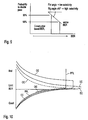
- a visualisation of selectivity is shown in Fig. 8 and Fig. 9 .
- the number of samples NS is minimized in the following sense: The maximum number of samples in the test is limited and the actual number of samples is dependent on the quality of the DUT.
- Max NS is the maximum number of samples. This number can be predefined or derived.
- Mean NS (specified limit) is the mean number of samples in a test, when the DUT is on the specified limit. The actual number of samples in an individual test is not predictable. Mean NS (better) is the mean number of samples in a test, when the DUT is better than the specified limit. The actual number of samples in an individual test is not predictable, however the smaller, the more extreme the quality of the DUT. This is a strong motivation to design DUTs better than the specification, as it saves test time.
- a DUT on the limit shall be passed with FF% probability.
- FF near 1 and correct with respect to pass is the conventional understanding of correct decision probability. However the principal can be used for any FF (0 ⁇ FF ⁇ 1) and it is free to understand correct with respect to fail.
- To optimize test time we should construct (control) the pass limit and get the fail limit implicitly (uncontrolled), and not vice versa. The reason is the following: By nature a bad DUT is decided faster than a good one, see Fig.7 at constant test time. So it is advantageous to optimize for a good DUT and disregard any optimisation for the bad DUT which is decided faster anyhow. If it is free to trade FF against the specified BER-limit, it is optimal for test time, to select an FF near 1. The reason is that this way the majority of the test is controlled and optimized and the minority is left uncontrolled.
- selectivity describes the behaviour of the test, if the DUT deviates from the specified limit. As defined above, selectivity is a differential. However it can be used as a ratio of differences. Selectivity is approximately pass probability - the complement of the pass probability wich is the fail probability / Bad DUT BER - Specified DUT BER . This concept corresponds approximately to the former concept of Bad DUT factor M.
- DD is the pass probability for a single test step.
- DD is the parameter which controls the test in all parameters: Correct Decision Probability, Test Time and Selectivity.
- the pass fail limit PFL shown in Fig. 10 , was discussed above.
- the separation process was done only from the good side of the distribution. It is optimal fast for the 99% pass decided DUTs and is superior over the other curves for better DUTs. No optimisation effort is done for those 1% DUTs, which are decided fail. It is inferior for worse DUTs.
- a compromise of test time with respect to pass and fail is done for the compromise curve CC in Fig. 10 .
- the separation process is done from the good side and the bad side of the distribution simultaneously.
- E.g. 99% hit the pass curve e.g. 0.5 % hit the vertical fail line, 0.5% hit the fail curve.
- the 99% pass decided DUTs are decided a little bit slower.
- the fail decided DUTs are decided a little bit faster in average.
- the ne th column represents the BERs (ne) of all DUTs when the ne th error occurs.
- BER(ne) ne is divided by the sum of samples from the left to including column ne.
- the T 2 (ns) part-distribution is suited to construct the second point of the early pass limit as follows: Separate the DD best from the (1-DD) worst part of the distribution. The BER value at the separation point marks the second point of the early pass limit. The part-distribution of the best DUTs are from now on regarded as pass and the part-distribution of the worst DUTs are regarded as undecided. It is called U 2 (ns) and is the basis for the next step. This way we can construct the early pass limit point by point.
Landscapes
- Engineering & Computer Science (AREA)
- Computer Networks & Wireless Communication (AREA)
- Signal Processing (AREA)
- Quality & Reliability (AREA)
- Detection And Prevention Of Errors In Transmission (AREA)
- Monitoring And Testing Of Transmission In General (AREA)
- Maintenance And Management Of Digital Transmission (AREA)
- Dc Digital Transmission (AREA)
- Tests Of Electronic Circuits (AREA)
- Testing, Inspecting, Measuring Of Stereoscopic Televisions And Televisions (AREA)
Claims (4)
- Verfahren mit den nachfolgenden Schritten, um die Fehlerrate eines Prüflings (Gerät unter Test) gegenüber einer vorgegebenen zulässigen Fehlerrate zu prüfen:- Messen von ns Sample (Prüfwerten) der Ausgabe des Prüflings, wobei von diesen ns Sample ne fehlerhafte Sample erkannt werden,- Definieren von BER(ne) = ne/ns als vorläufige Fehlerrate und- Entscheiden, dass ein Prüfling besteht, wenn die vorläufige Fehlerrate BRE(ne) kleiner ist, als eine Grenze zum frühzeitigen Bestehen EPL(ne),wobei die Grenze zum frühzeitigen Bestehen durch Nutzung einer empirisch abgeleiteten Verteilung für eine vorgegebene Anzahl von Prüflingen, die jeweils genau die vorgegebene zulässige Fehlerrate aufweisen, geschaffen wird, indem ein bestimmter Anteil DD der besten Prüflinge von der Verteilung für eine bestimmte Anzahl von fehlerhaften Sample ne getrennt wird und mit dem verbleibenden Teil der Verteilung für eine inkrementierte Anzahl an fehlerhaften Samples fortgefahren wird,
wobei der erste Punkt EPL(ne = 1) der Grenze zum frühzeitigen Bestehen geschaffen wird, indem die empirisch abgeleitete Verteilung gemäß den folgenden Schritten benutzt wird:- Simulieren des Fehlerverhaltens einer großen Anzahl an Prüflingen, von denen jedes eine vorgegebene zulässige Fehlerrate aufweist,- Festhalten der Anzahl n1 an Sampeln für jeden einzelnen Prüfling bis der erste Fehler auftritt,- Berechnen der vorläufigen Fehlerrate BER(ne=1) des ersten Fehlers mit BER(ne=1) = 1/n1 für jeden einzelnen Prüfling,- Trennen der besten DD Prüflinge und Ausweisen eines Trennungspunktes, welcher die vorläufige Fehlerrate BER(ne=1) des schlechtesten der besten DD Prüflinge als den ersten Punkt EPL(ne=1) der Grenze zum frühzeitigen Bestehen kennzeichnet,und wobei die nächsten Punkte der Grenze zum frühzeitigen Bestehen mit den folgenden Schritten geschaffen werden:- Simulieren des Fehlerverhaltens der verbleibenden Prüflinge,- Festhalten der Anzahl ni der Sample für jeden einzelnen Prüfling bis der nächste Fehler auftritt,- Berechnen der vorläufigen Fehlerrate BER(ne) des nächsten Fehlers miteinzelnen Prüfling, - Trennen der besten DD Prüflinge und Ausweisen eines Trennungspunktes, welcher die vorläufige Fehlerrate BER(ne) des schlechtesten der besten DD Prüflinge als den nächsten Punkt EPL(ne) der Grenze zum frühzeitigen Bestehen kennzeichnet und- Wiederholen der oberen Schritte zum Schaffen des nächsten Punktes der Grenze zum frühzeitigen Bestehen.
 - Verfahren zum Prüfen der Fehlerrate gemäß Anspruch 1,
dadurch gekennzeichnet,
dass die Simulation des Fehlerverhaltens durch einen Zufallsgenerator oder einen Pseudo-Zufallsgenerator durchgeführt wird. - Verfahren mit den nachfolgenden Schritten, um die Fehlerrate eines Prüflings (Gerät unter Test) gegenüber einer vorgegebenen zulässigen Fehlerrate zu prüfen:- Messen von ns Sample der Ausgabe des Prüflings, wobei von diesen ns Sample ne fehlerhafte Sample erkannt werden,- Definieren von BER(ne)=ne/ns als vorläufige Fehlerrate und- Entscheiden, dass ein Prüfling besteht, wenn die vorläufige Fehlerrate BRE(ne) kleiner ist, als eine Grenze zum frühzeitigen Bestehen EPL(ne),wobei die Grenze zum frühzeitigen Bestehen durch Nutzung einer analytisch abgeleiteten Verteilung für eine bestimmte Anzahl von Prüflingen, die jeweils genau die vorgegebene zulässige Fehlerrate aufweisen, geschaffen wird, indem ein bestimmter Anteil DD der besten Prüflinge von der Verteilung für eine bestimmte Anzahl von fehlerhaften Sample ne getrennt wird und mit dem verbleibenden Teil der Verteilung für eine inkrementierte Anzahl an fehlerhaften Samples fortgefahren wird,
wobei der erste Punkt EPL(ne = 1) der Grenze zum frühzeitigen Bestehen geschaffen wird, indem die analytisch abgeleitete Verteilung gemäß den folgenden Schritten benutzt wird:- Definieren einer ersten vorläufigen Verteilung
mit
BER als wahrer Fehlerrate des Prüflings und
P1 als Wahrscheinlichkeit einen ersten Fehler ne = 1 nach ns Sampeln zu finden,- Trennen des DD besten Teils von dem 1-DD schlechtesten Teil der Verteilung P1 und Ausweisen des Trennungspunktes des DD besten Teils von dem 1-DD schlechtesten Teil als den ersten Punkt (ne=1) der Grenze zum frühzeitigen Bestehen und- Definieren des 1-DD schlechtesten Teils der ersten vorläufigen Verteilung P1 als eine erste Verteilung U1 von unentschiedenen Prüflingenund wobei die nächsten Punkte der Grenze zum frühzeitigen Bestehen mit den folgenden Schritten geschaffen werden:- Definieren einer nächsten vorläufigen Verteilung
mit
T2 (ns) als der Wahrscheinlichkeit den nächsten Fehler nach ns Sampeln zu finden unter Berücksichtigung der Minderung der besten Prüflinge (DUT) durch den vorherigen Schritt und * als die Faltungsfunktion- Trennen des DD besten Teils von dem 1-DD schlechtesten Teil der Verteilung T2 und Ausweisen des Trennungspunktes des DD besten Teils von dem 1-DD schlechtesten Teil als den nächsten Punkt EPL(ne) der Grenze zum frühzeitigen Bestehen.- Definieren des 1-DD schlechtesten Teils der Verteilung T2 als die nächste Verteilung U2 von unentschiedenen Prüflingen- Wiederholen der oberen Schritte für die nächsten Punkte der Grenze zum frühzeitigen Bestehen. - Verfahren zum Prüfen der Fehlerrate gemäß einem der Ansprüche 1 bis 3,
dadurch gekennzeichnet,
dass der bestimmte Anteil DD der besten Prüflinge im Hinblick auf die gewünschte Selektivität der Prüfung ausgewählt wird,
wobei die Selektivität der Prüfung durch folgende Formel definiert wird:
worin
PP die Wahrscheinlichkeit zum Bestehen ist,
CPP das Komplement zur Wahrscheinlichkeit zum Bestehen ist, welches die Wahrscheinlichkeit zum nicht Bestehen ist,
ERBD die Fehlerrate eines schlechten Prüflings ist und SAER die vorgegebene zulässige Fehlerrate ist.
Priority Applications (11)
| Application Number | Priority Date | Filing Date | Title |
|---|---|---|---|
| DE60331548T DE60331548D1 (de) | 2003-10-09 | 2003-10-09 | Verfahren zur Prüfung der Bitfehlerrate eines Gerätes gemäss statistischem Sicherheitsniveau |
| ES03022922T ES2340991T3 (es) | 2003-10-09 | 2003-10-09 | Procedimiento para la prueba de tasa de errores de bit de un dispositivo de acuerdo con el nivel estadistico de confianza. |
| DK03022922.3T DK1523121T3 (da) | 2003-10-09 | 2003-10-09 | Metode til test af bitfejlratio af en indretning imod et statistisk sikkerhedsniveau |
| AT03022922T ATE460025T1 (de) | 2003-10-09 | 2003-10-09 | Verfahren zur prüfung der bitfehlerrate eines gerätes gemäss statistischem sicherheitsniveau |
| EP03022922A EP1523121B1 (de) | 2003-10-09 | 2003-10-09 | Verfahren zur Prüfung der Bitfehlerrate eines Gerätes gemäss statistischem Sicherheitsniveau |
| JP2006529935A JP4576497B2 (ja) | 2003-10-09 | 2004-05-27 | 信頼水準、試験時間及び選択性に応じて装置のエラー率berを試験する方法 |
| PCT/EP2004/005727 WO2005041470A1 (en) | 2003-10-09 | 2004-05-27 | Method for testing the error ratio ber of a device according to confidence level, test time and selectivity |
| CA002505153A CA2505153A1 (en) | 2003-10-09 | 2004-05-27 | Method for testing the error ratio ber of a device according to confidence level, test time and selectivity |
| KR1020057005562A KR101004992B1 (ko) | 2003-10-09 | 2004-05-27 | 신뢰 수준, 시험 시간 및 선택도에 따라 장치의 에러률비이알을 시험하는 방법 |
| US10/575,339 US7895480B2 (en) | 2003-10-09 | 2004-05-27 | Method for testing the error ratio BER of a device according to confidence level, test time and selectivity |
| CN2004800280454A CN1860717B (zh) | 2003-10-09 | 2004-05-27 | 由置信度、测试时间和选择性测试设备的误码率差错率的方法 |
Applications Claiming Priority (1)
| Application Number | Priority Date | Filing Date | Title |
|---|---|---|---|
| EP03022922A EP1523121B1 (de) | 2003-10-09 | 2003-10-09 | Verfahren zur Prüfung der Bitfehlerrate eines Gerätes gemäss statistischem Sicherheitsniveau |
Publications (2)
| Publication Number | Publication Date |
|---|---|
| EP1523121A1 EP1523121A1 (de) | 2005-04-13 |
| EP1523121B1 true EP1523121B1 (de) | 2010-03-03 |
Family
ID=34306889
Family Applications (1)
| Application Number | Title | Priority Date | Filing Date |
|---|---|---|---|
| EP03022922A Expired - Lifetime EP1523121B1 (de) | 2003-10-09 | 2003-10-09 | Verfahren zur Prüfung der Bitfehlerrate eines Gerätes gemäss statistischem Sicherheitsniveau |
Country Status (11)
| Country | Link |
|---|---|
| US (1) | US7895480B2 (de) |
| EP (1) | EP1523121B1 (de) |
| JP (1) | JP4576497B2 (de) |
| KR (1) | KR101004992B1 (de) |
| CN (1) | CN1860717B (de) |
| AT (1) | ATE460025T1 (de) |
| CA (1) | CA2505153A1 (de) |
| DE (1) | DE60331548D1 (de) |
| DK (1) | DK1523121T3 (de) |
| ES (1) | ES2340991T3 (de) |
| WO (1) | WO2005041470A1 (de) |
Families Citing this family (10)
| Publication number | Priority date | Publication date | Assignee | Title |
|---|---|---|---|---|
| CN1992577B (zh) * | 2005-12-27 | 2010-10-13 | 大唐移动通信设备有限公司 | 获取无校验数据块译码误块数的方法及装置 |
| CN101163121B (zh) * | 2006-10-12 | 2011-06-01 | 财团法人工业技术研究院 | 通讯系统及其字码选择方法 |
| JP5122348B2 (ja) * | 2008-04-04 | 2013-01-16 | アンリツ株式会社 | ランダムエラー評価方法及びその評価装置 |
| US8606556B2 (en) * | 2010-01-11 | 2013-12-10 | International Business Machines Corporation | Circuit-level validation of computer executable device/circuit simulators |
| US8537480B1 (en) * | 2010-11-23 | 2013-09-17 | Western Digital Technologies, Inc. | Hard drive testing |
| US10666538B2 (en) | 2015-05-26 | 2020-05-26 | Litepoint Corporation | Method for testing a radio frequency (RF) data packet signal transceiver via a wireless signal path |
| US10491342B1 (en) | 2018-07-23 | 2019-11-26 | Hewlett Packard Enterprise Development Lp | Bit error ratio tests with two-sided bit error ratio frequentist intervals |
| CN109921867B (zh) * | 2019-01-24 | 2022-03-01 | 北京中科晶上科技股份有限公司 | 一种误码率提前判决方法和判决装置 |
| US10868642B1 (en) | 2019-09-20 | 2020-12-15 | Rohde & Schwarz Gmbh & Co. Kg | Method and system for early pass/fail determination |
| JP7673128B2 (ja) * | 2023-07-11 | 2025-05-08 | アンリツ株式会社 | 誤り率測定装置及び誤り率測定方法 |
Family Cites Families (6)
| Publication number | Priority date | Publication date | Assignee | Title |
|---|---|---|---|---|
| CN2130015Y (zh) * | 1992-08-06 | 1993-04-14 | 机械电子工业部石家庄第五十四研究所 | 一种多功能误码测试仪 |
| JP2000040201A (ja) * | 1998-07-22 | 2000-02-08 | Fuji Photo Film Co Ltd | デジタル記録システムのビットエラーレートの推定評価方法 |
| CA2298325A1 (en) * | 1999-03-01 | 2000-09-01 | Lucent Technologies, Inc. | Iterative differential detector |
| JP2001053651A (ja) * | 1999-08-09 | 2001-02-23 | Ricoh Co Ltd | 受信器、タイミング再生方法およびその方法をコンピュータに実行させるプログラムを記録したコンピュータ読み取り可能な記録媒体 |
| JP2002278762A (ja) * | 2001-03-19 | 2002-09-27 | Nippon Steel Corp | データクラスタリング方法 |
| WO2002089390A1 (en) * | 2001-04-26 | 2002-11-07 | Rohde & Schwarz Gmbh & Co. Kg | Method for testing the error ratio of a device |
-
2003
- 2003-10-09 DE DE60331548T patent/DE60331548D1/de not_active Expired - Lifetime
- 2003-10-09 ES ES03022922T patent/ES2340991T3/es not_active Expired - Lifetime
- 2003-10-09 DK DK03022922.3T patent/DK1523121T3/da active
- 2003-10-09 EP EP03022922A patent/EP1523121B1/de not_active Expired - Lifetime
- 2003-10-09 AT AT03022922T patent/ATE460025T1/de not_active IP Right Cessation
-
2004
- 2004-05-27 CA CA002505153A patent/CA2505153A1/en not_active Abandoned
- 2004-05-27 JP JP2006529935A patent/JP4576497B2/ja not_active Expired - Lifetime
- 2004-05-27 KR KR1020057005562A patent/KR101004992B1/ko not_active Expired - Lifetime
- 2004-05-27 US US10/575,339 patent/US7895480B2/en not_active Expired - Lifetime
- 2004-05-27 WO PCT/EP2004/005727 patent/WO2005041470A1/en not_active Ceased
- 2004-05-27 CN CN2004800280454A patent/CN1860717B/zh not_active Expired - Lifetime
Also Published As
| Publication number | Publication date |
|---|---|
| JP4576497B2 (ja) | 2010-11-10 |
| WO2005041470A1 (en) | 2005-05-06 |
| DE60331548D1 (de) | 2010-04-15 |
| US7895480B2 (en) | 2011-02-22 |
| DK1523121T3 (da) | 2010-06-28 |
| CN1860717A (zh) | 2006-11-08 |
| ES2340991T3 (es) | 2010-06-14 |
| JP2007508725A (ja) | 2007-04-05 |
| ATE460025T1 (de) | 2010-03-15 |
| KR20060108203A (ko) | 2006-10-17 |
| US20080320344A1 (en) | 2008-12-25 |
| CN1860717B (zh) | 2010-09-08 |
| KR101004992B1 (ko) | 2011-01-04 |
| CA2505153A1 (en) | 2005-05-06 |
| EP1523121A1 (de) | 2005-04-13 |
Similar Documents
| Publication | Publication Date | Title |
|---|---|---|
| EP1523121B1 (de) | Verfahren zur Prüfung der Bitfehlerrate eines Gerätes gemäss statistischem Sicherheitsniveau | |
| Covo et al. | A novel single-gamma approximation to the sum of independent gamma variables, and a generalization to infinitely divisible distributions | |
| US20030182293A1 (en) | Method for generating quantiles from data streams | |
| US7139987B2 (en) | Analog integrated circuit layout design | |
| US6745148B2 (en) | Intelligent test point selection for bit error rate tester-based diagrams | |
| EP1502377B1 (de) | Verfahren zum prüfen des fehlerverhältnisses einer einrichtung durch verwenden einer vorläufigen wahrscheinlichkeit | |
| US7426664B2 (en) | Method for testing the error ratio of a device | |
| EP1552716B1 (de) | Verfahren zur bewertung, ob eine zeitverzögerung besser als eine zeitgrenze ist | |
| EP1480368B1 (de) | Polynomiale Anpassung für Zittertrennung | |
| EP1645995A1 (de) | Parameter-einstellvorrichtung | |
| EP1253737A1 (de) | Verfahren zur Prüfung der Bitfehlerrate einer Vorrichtung | |
| CN118134055B (zh) | 一种考虑病害交叉影响的隧道病害发生概率预测方法 | |
| US7809051B2 (en) | Method to perform a statistical test in which the experiment is multinomial | |
| US20020165704A1 (en) | Method for extrapolating model parameters of spice | |
| JP2024144260A (ja) | 水位予測モデル構築方法、水位予測モデル構築プログラム、予測水位データ出力方法、予測水位データ出力プログラム、水位予測的中率算出方法及び水位予測的中率算出プログラム | |
| JP2026036381A (ja) | マススペクトル処理装置及び方法 | |
| Yilmaz et al. | Fast and accurate DPPM computation using model based filtering | |
| JP3601907B2 (ja) | 振動特性解析装置 | |
| CN102866949A (zh) | 一种基于假设检验的嵌入式基础软件可靠性评估方法 | |
| Horn et al. | Hedging options in the presence of microstructural noise | |
| Good | GX 7 Standard test versus early decision concept |
Legal Events
| Date | Code | Title | Description |
|---|---|---|---|
| PUAI | Public reference made under article 153(3) epc to a published international application that has entered the european phase |
Free format text: ORIGINAL CODE: 0009012 |
|
| 17P | Request for examination filed |
Effective date: 20040527 |
|
| AK | Designated contracting states |
Kind code of ref document: A1 Designated state(s): AT BE BG CH CY CZ DE DK EE ES FI FR GB GR HU IE IT LI LU MC NL PT RO SE SI SK TR |
|
| AX | Request for extension of the european patent |
Extension state: AL LT LV MK |
|
| AKX | Designation fees paid |
Designated state(s): AT BE BG CH CY CZ DE DK EE ES FI FR GB GR HU IE IT LI LU MC NL PT RO SE SI SK TR |
|
| 17Q | First examination report despatched |
Effective date: 20040927 |
|
| 17Q | First examination report despatched |
Effective date: 20040927 |
|
| GRAP | Despatch of communication of intention to grant a patent |
Free format text: ORIGINAL CODE: EPIDOSNIGR1 |
|
| RTI1 | Title (correction) |
Free format text: METHOD FOR TESTING THE ERROR RATIO BER OF A DEVICE ACCORDING TO CONFIDENCE LEVEL |
|
| RTI1 | Title (correction) |
Free format text: METHOD FOR TESTING THE BIT ERROR RATE OF A DEVICE ACCORDING TO A STATISTICAL CONFIDENCE LEVEL |
|
| GRAS | Grant fee paid |
Free format text: ORIGINAL CODE: EPIDOSNIGR3 |
|
| GRAA | (expected) grant |
Free format text: ORIGINAL CODE: 0009210 |
|
| AK | Designated contracting states |
Kind code of ref document: B1 Designated state(s): AT BE BG CH CY CZ DE DK EE ES FI FR GB GR HU IE IT LI LU MC NL PT RO SE SI SK TR |
|
| REG | Reference to a national code |
Ref country code: GB Ref legal event code: FG4D |
|
| REG | Reference to a national code |
Ref country code: CH Ref legal event code: EP |
|
| REG | Reference to a national code |
Ref country code: IE Ref legal event code: FG4D |
|
| REF | Corresponds to: |
Ref document number: 60331548 Country of ref document: DE Date of ref document: 20100415 Kind code of ref document: P |
|
| REG | Reference to a national code |
Ref country code: NL Ref legal event code: T3 |
|
| REG | Reference to a national code |
Ref country code: ES Ref legal event code: FG2A Ref document number: 2340991 Country of ref document: ES Kind code of ref document: T3 |
|
| REG | Reference to a national code |
Ref country code: SE Ref legal event code: TRGR |
|
| REG | Reference to a national code |
Ref country code: DK Ref legal event code: T3 |
|
| PG25 | Lapsed in a contracting state [announced via postgrant information from national office to epo] |
Ref country code: AT Free format text: LAPSE BECAUSE OF FAILURE TO SUBMIT A TRANSLATION OF THE DESCRIPTION OR TO PAY THE FEE WITHIN THE PRESCRIBED TIME-LIMIT Effective date: 20100303 Ref country code: SI Free format text: LAPSE BECAUSE OF FAILURE TO SUBMIT A TRANSLATION OF THE DESCRIPTION OR TO PAY THE FEE WITHIN THE PRESCRIBED TIME-LIMIT Effective date: 20100303 |
|
| PG25 | Lapsed in a contracting state [announced via postgrant information from national office to epo] |
Ref country code: GR Free format text: LAPSE BECAUSE OF FAILURE TO SUBMIT A TRANSLATION OF THE DESCRIPTION OR TO PAY THE FEE WITHIN THE PRESCRIBED TIME-LIMIT Effective date: 20100604 Ref country code: EE Free format text: LAPSE BECAUSE OF FAILURE TO SUBMIT A TRANSLATION OF THE DESCRIPTION OR TO PAY THE FEE WITHIN THE PRESCRIBED TIME-LIMIT Effective date: 20100303 Ref country code: RO Free format text: LAPSE BECAUSE OF FAILURE TO SUBMIT A TRANSLATION OF THE DESCRIPTION OR TO PAY THE FEE WITHIN THE PRESCRIBED TIME-LIMIT Effective date: 20100303 Ref country code: BE Free format text: LAPSE BECAUSE OF FAILURE TO SUBMIT A TRANSLATION OF THE DESCRIPTION OR TO PAY THE FEE WITHIN THE PRESCRIBED TIME-LIMIT Effective date: 20100303 Ref country code: CY Free format text: LAPSE BECAUSE OF FAILURE TO SUBMIT A TRANSLATION OF THE DESCRIPTION OR TO PAY THE FEE WITHIN THE PRESCRIBED TIME-LIMIT Effective date: 20100303 |
|
| PG25 | Lapsed in a contracting state [announced via postgrant information from national office to epo] |
Ref country code: CZ Free format text: LAPSE BECAUSE OF FAILURE TO SUBMIT A TRANSLATION OF THE DESCRIPTION OR TO PAY THE FEE WITHIN THE PRESCRIBED TIME-LIMIT Effective date: 20100303 Ref country code: SK Free format text: LAPSE BECAUSE OF FAILURE TO SUBMIT A TRANSLATION OF THE DESCRIPTION OR TO PAY THE FEE WITHIN THE PRESCRIBED TIME-LIMIT Effective date: 20100303 Ref country code: BG Free format text: LAPSE BECAUSE OF FAILURE TO SUBMIT A TRANSLATION OF THE DESCRIPTION OR TO PAY THE FEE WITHIN THE PRESCRIBED TIME-LIMIT Effective date: 20100603 |
|
| PLBE | No opposition filed within time limit |
Free format text: ORIGINAL CODE: 0009261 |
|
| STAA | Information on the status of an ep patent application or granted ep patent |
Free format text: STATUS: NO OPPOSITION FILED WITHIN TIME LIMIT |
|
| PG25 | Lapsed in a contracting state [announced via postgrant information from national office to epo] |
Ref country code: PT Free format text: LAPSE BECAUSE OF FAILURE TO SUBMIT A TRANSLATION OF THE DESCRIPTION OR TO PAY THE FEE WITHIN THE PRESCRIBED TIME-LIMIT Effective date: 20100705 |
|
| 26N | No opposition filed |
Effective date: 20101206 |
|
| PG25 | Lapsed in a contracting state [announced via postgrant information from national office to epo] |
Ref country code: MC Free format text: LAPSE BECAUSE OF NON-PAYMENT OF DUE FEES Effective date: 20101031 |
|
| REG | Reference to a national code |
Ref country code: CH Ref legal event code: PL |
|
| PG25 | Lapsed in a contracting state [announced via postgrant information from national office to epo] |
Ref country code: CH Free format text: LAPSE BECAUSE OF NON-PAYMENT OF DUE FEES Effective date: 20101031 Ref country code: LI Free format text: LAPSE BECAUSE OF NON-PAYMENT OF DUE FEES Effective date: 20101031 |
|
| PG25 | Lapsed in a contracting state [announced via postgrant information from national office to epo] |
Ref country code: IE Free format text: LAPSE BECAUSE OF NON-PAYMENT OF DUE FEES Effective date: 20101009 |
|
| PG25 | Lapsed in a contracting state [announced via postgrant information from national office to epo] |
Ref country code: LU Free format text: LAPSE BECAUSE OF NON-PAYMENT OF DUE FEES Effective date: 20101009 Ref country code: HU Free format text: LAPSE BECAUSE OF FAILURE TO SUBMIT A TRANSLATION OF THE DESCRIPTION OR TO PAY THE FEE WITHIN THE PRESCRIBED TIME-LIMIT Effective date: 20100904 |
|
| PG25 | Lapsed in a contracting state [announced via postgrant information from national office to epo] |
Ref country code: TR Free format text: LAPSE BECAUSE OF FAILURE TO SUBMIT A TRANSLATION OF THE DESCRIPTION OR TO PAY THE FEE WITHIN THE PRESCRIBED TIME-LIMIT Effective date: 20100303 |
|
| PGFP | Annual fee paid to national office [announced via postgrant information from national office to epo] |
Ref country code: FI Payment date: 20121022 Year of fee payment: 10 Ref country code: FR Payment date: 20121113 Year of fee payment: 10 |
|
| PGFP | Annual fee paid to national office [announced via postgrant information from national office to epo] |
Ref country code: GB Payment date: 20121023 Year of fee payment: 10 Ref country code: IT Payment date: 20121025 Year of fee payment: 10 Ref country code: SE Payment date: 20121024 Year of fee payment: 10 Ref country code: ES Payment date: 20121023 Year of fee payment: 10 |
|
| PGFP | Annual fee paid to national office [announced via postgrant information from national office to epo] |
Ref country code: NL Payment date: 20121018 Year of fee payment: 10 |
|
| REG | Reference to a national code |
Ref country code: NL Ref legal event code: V1 Effective date: 20140501 |
|
| REG | Reference to a national code |
Ref country code: SE Ref legal event code: EUG |
|
| GBPC | Gb: european patent ceased through non-payment of renewal fee |
Effective date: 20131009 |
|
| PG25 | Lapsed in a contracting state [announced via postgrant information from national office to epo] |
Ref country code: GB Free format text: LAPSE BECAUSE OF NON-PAYMENT OF DUE FEES Effective date: 20131009 |
|
| REG | Reference to a national code |
Ref country code: FR Ref legal event code: ST Effective date: 20140630 |
|
| PG25 | Lapsed in a contracting state [announced via postgrant information from national office to epo] |
Ref country code: IT Free format text: LAPSE BECAUSE OF NON-PAYMENT OF DUE FEES Effective date: 20131009 Ref country code: FI Free format text: LAPSE BECAUSE OF NON-PAYMENT OF DUE FEES Effective date: 20131009 Ref country code: NL Free format text: LAPSE BECAUSE OF NON-PAYMENT OF DUE FEES Effective date: 20140501 Ref country code: SE Free format text: LAPSE BECAUSE OF NON-PAYMENT OF DUE FEES Effective date: 20131010 Ref country code: FR Free format text: LAPSE BECAUSE OF NON-PAYMENT OF DUE FEES Effective date: 20131031 |
|
| REG | Reference to a national code |
Ref country code: ES Ref legal event code: FD2A Effective date: 20141107 |
|
| PG25 | Lapsed in a contracting state [announced via postgrant information from national office to epo] |
Ref country code: ES Free format text: LAPSE BECAUSE OF NON-PAYMENT OF DUE FEES Effective date: 20131010 |
|
| PGFP | Annual fee paid to national office [announced via postgrant information from national office to epo] |
Ref country code: DK Payment date: 20221021 Year of fee payment: 20 Ref country code: DE Payment date: 20221020 Year of fee payment: 20 |
|
| P01 | Opt-out of the competence of the unified patent court (upc) registered |
Effective date: 20230525 |
|
| REG | Reference to a national code |
Ref country code: DE Ref legal event code: R071 Ref document number: 60331548 Country of ref document: DE |
|
| REG | Reference to a national code |
Ref country code: DK Ref legal event code: EUP Expiry date: 20231009 |