EP1520895B1 - Verfahren zum Verbinden eines Bauteils - Google Patents
Verfahren zum Verbinden eines Bauteils Download PDFInfo
- Publication number
- EP1520895B1 EP1520895B1 EP03022314A EP03022314A EP1520895B1 EP 1520895 B1 EP1520895 B1 EP 1520895B1 EP 03022314 A EP03022314 A EP 03022314A EP 03022314 A EP03022314 A EP 03022314A EP 1520895 B1 EP1520895 B1 EP 1520895B1
- Authority
- EP
- European Patent Office
- Prior art keywords
- component
- laminate
- sheet
- border
- stiffness
- Prior art date
- Legal status (The legal status is an assumption and is not a legal conclusion. Google has not performed a legal analysis and makes no representation as to the accuracy of the status listed.)
- Expired - Lifetime
Links
- 238000000034 method Methods 0.000 title claims abstract description 43
- 239000000835 fiber Substances 0.000 claims abstract description 26
- 239000002131 composite material Substances 0.000 claims abstract description 24
- 238000010276 construction Methods 0.000 claims description 15
- 239000000463 material Substances 0.000 claims description 12
- 238000004026 adhesive bonding Methods 0.000 claims description 10
- 239000004411 aluminium Substances 0.000 claims description 10
- 229910052782 aluminium Inorganic materials 0.000 claims description 10
- XAGFODPZIPBFFR-UHFFFAOYSA-N aluminium Chemical compound [Al] XAGFODPZIPBFFR-UHFFFAOYSA-N 0.000 claims description 10
- 229910052751 metal Inorganic materials 0.000 claims description 9
- 239000002184 metal Substances 0.000 claims description 9
- OKTJSMMVPCPJKN-UHFFFAOYSA-N Carbon Chemical compound [C] OKTJSMMVPCPJKN-UHFFFAOYSA-N 0.000 claims description 8
- 229910052799 carbon Inorganic materials 0.000 claims description 8
- 239000011159 matrix material Substances 0.000 claims description 8
- 229910001374 Invar Inorganic materials 0.000 claims description 5
- 239000004593 Epoxy Substances 0.000 claims description 4
- 229910000831 Steel Inorganic materials 0.000 claims description 3
- RTAQQCXQSZGOHL-UHFFFAOYSA-N Titanium Chemical compound [Ti] RTAQQCXQSZGOHL-UHFFFAOYSA-N 0.000 claims description 3
- 230000002787 reinforcement Effects 0.000 claims description 3
- 239000010959 steel Substances 0.000 claims description 3
- 239000003365 glass fiber Substances 0.000 claims description 2
- 229920000728 polyester Polymers 0.000 claims description 2
- 239000000853 adhesive Substances 0.000 description 17
- 230000001070 adhesive effect Effects 0.000 description 17
- 229920000271 Kevlar® Polymers 0.000 description 1
- 239000000956 alloy Substances 0.000 description 1
- 229910045601 alloy Inorganic materials 0.000 description 1
- 239000011162 core material Substances 0.000 description 1
- 230000006378 damage Effects 0.000 description 1
- 230000001419 dependent effect Effects 0.000 description 1
- 239000004761 kevlar Substances 0.000 description 1
- 238000004519 manufacturing process Methods 0.000 description 1
- 238000012986 modification Methods 0.000 description 1
- 230000004048 modification Effects 0.000 description 1
- 239000011347 resin Substances 0.000 description 1
- 229920005989 resin Polymers 0.000 description 1
Images
Classifications
-
- F—MECHANICAL ENGINEERING; LIGHTING; HEATING; WEAPONS; BLASTING
- F16—ENGINEERING ELEMENTS AND UNITS; GENERAL MEASURES FOR PRODUCING AND MAINTAINING EFFECTIVE FUNCTIONING OF MACHINES OR INSTALLATIONS; THERMAL INSULATION IN GENERAL
- F16B—DEVICES FOR FASTENING OR SECURING CONSTRUCTIONAL ELEMENTS OR MACHINE PARTS TOGETHER, e.g. NAILS, BOLTS, CIRCLIPS, CLAMPS, CLIPS OR WEDGES; JOINTS OR JOINTING
- F16B11/00—Connecting constructional elements or machine parts by sticking or pressing them together, e.g. cold pressure welding
- F16B11/006—Connecting constructional elements or machine parts by sticking or pressing them together, e.g. cold pressure welding by gluing
-
- B—PERFORMING OPERATIONS; TRANSPORTING
- B64—AIRCRAFT; AVIATION; COSMONAUTICS
- B64C—AEROPLANES; HELICOPTERS
- B64C1/00—Fuselages; Constructional features common to fuselages, wings, stabilising surfaces or the like
- B64C2001/0054—Fuselage structures substantially made from particular materials
- B64C2001/0072—Fuselage structures substantially made from particular materials from composite materials
-
- F—MECHANICAL ENGINEERING; LIGHTING; HEATING; WEAPONS; BLASTING
- F16—ENGINEERING ELEMENTS AND UNITS; GENERAL MEASURES FOR PRODUCING AND MAINTAINING EFFECTIVE FUNCTIONING OF MACHINES OR INSTALLATIONS; THERMAL INSULATION IN GENERAL
- F16B—DEVICES FOR FASTENING OR SECURING CONSTRUCTIONAL ELEMENTS OR MACHINE PARTS TOGETHER, e.g. NAILS, BOLTS, CIRCLIPS, CLAMPS, CLIPS OR WEDGES; JOINTS OR JOINTING
- F16B19/00—Bolts without screw-thread; Pins, including deformable elements; Rivets
- F16B19/04—Rivets; Spigots or the like fastened by riveting
- F16B19/06—Solid rivets made in one piece
-
- Y—GENERAL TAGGING OF NEW TECHNOLOGICAL DEVELOPMENTS; GENERAL TAGGING OF CROSS-SECTIONAL TECHNOLOGIES SPANNING OVER SEVERAL SECTIONS OF THE IPC; TECHNICAL SUBJECTS COVERED BY FORMER USPC CROSS-REFERENCE ART COLLECTIONS [XRACs] AND DIGESTS
- Y02—TECHNOLOGIES OR APPLICATIONS FOR MITIGATION OR ADAPTATION AGAINST CLIMATE CHANGE
- Y02T—CLIMATE CHANGE MITIGATION TECHNOLOGIES RELATED TO TRANSPORTATION
- Y02T50/00—Aeronautics or air transport
- Y02T50/40—Weight reduction
Definitions
- the present invention relates to a method for securing a component having a high stiffness to a fibre composite laminate by adhesive bonding.
- High stiffness means in this disclosure that the component or part is of a stiff nature, but it may have a lower modulus of elasticity than another component here being considered to have a low stiffness, since it is thinner than the first one. The same reasoning is valid for "lower stiffness". Accordingly, said component to be secured may be of a material having a lower modulus of elasticity than the fibre composite laminate but still have a high sitffness, when it is thick enough.
- the fibre composite laminate may be of any known type, and such laminates are composed by a number of superimposed thin layers, each constituted by substantially parallel fibres embedded in a matrix, glued to each other for obtaining a body having a very high stiffness in relation to the weight thereof.
- the fibre composite laminate may also have a very high strength in relation to the weight thereof, but only in one direction of each layer. They are, however, comparatively weak and have a low stiffness in the direction transversal to the fibre direction.
- the layers are for that sake arranged with different fibre directions so as to obtain good properties in two dimensions. However, the properties will remain bad in the third direction (out of the plane of a sheet of such layers).
- the layers are arranged with different fibre directions for giving the laminate a strength being appropriate for each individual application.
- the layers may for instance be arranged for giving the laminate a strength being substantially uniform in said two dimensions, but they are often arranged so as to make the laminate stiffer in some direction than in another.
- fibre composite laminates are particularly interesting where a combination of a low weight and a high stiffness and strength is important, such as in space.
- US-S-4966802 relates to composites made of fibre reinforced resin elements joined by adhesive.
- US-A-4556592 concerns conductive joint seals for composite aircraft.
- the object of the present invention is to provide a method of the type defined in the introduction, which solves the problems discussed above to a large extent.
- This object is according to the invention obtained by providing such a method, in which a sheet having a substantially lower stiffness than the stiffness of the component is interposed between the component and the laminate so that the sheet extends and has its border substantially beyond the border of the component where the border of the latter is located in overlap with the laminate, and the sheet is affixed by adhesive bonding to the laminate as well as the component for securing them to each other.
- the component is secured to the laminate through said sheet having a substantially lower stiffness than the stiffness of the component.
- a sheet may without any problems be produced and adhesively bonded to the laminate, and the component may be manufactured without using any delicate process steps. Concentrations of shear and tension forces in the adhesive joint between the component and the sheet will be transferred to the adhesive joint between the sheet and the laminate at the border of the sheet while reducing these forces.
- substantially lower stiffness is to be interpreted as explained in the introduction. It does not necessarily mean that said sheet has a lower modulus of elasticity than the material of the component but this may even be higher and the thickness of the sheet then considerably lower. Furthermore, thanks to this substantially lower stiffness of said sheet it is efficiently avoided to introduce considerably higher load into a laminate layer than this may withstand. Accordingly, upon application of high loads the adhesive joint will rather break than the laminate, such as carbon fibres, in the laminate layer close to the sheet, which would result in a destruction of this laminate layer.
- it is a said sheet having a stiffness in the same order of magnitude as the stiffness of a laminate layer to which it is adhesively bonded that is interposed between the component and the laminate. This means that there will be no risk of introducing considerably higher loads into a laminate layer than this may withstand.
- the component is a component made of a metal that is secured to the fibre composite laminate, said metal preferably being aluminium, and it is a sheet of metal that is interposed between the component and the laminate.
- the experience and the knowledge within the field of adhesively bonding metal to metal is very broad, so that it will in such a case be comparatively easy to efficiently adhesively bond the component to said sheet.
- the component must not necessarily be made of metal.
- it is a sheet of a material having substantially the same coefficient of thermal expansion as said laminate that is interposed between the component and the laminate.
- a laminate has a coefficient of thermal expansion being very low, which means that the laminate will have substantially the same dimensions even if the temperature thereof would vary substantially.
- aluminium has a coefficient of thermal expansion being much higher, which means that shear and tension forces are introduced into the adhesive joint between a component of aluminium and a fibre composite laminate if these are adhesively bonded to each other.
- said component is secured to a laminate having a plurality of layers, each layer having substantially parallel carbon fibres embedded in a matrix, preferably an epoxy matrix.
- the method according to the invention is particularly well applicable to securing a component to such a laminate by adhesive bonding, since such a laminate has an optimum combination of weight and stiffness for being used in space, to which it then is for weight reasons preferred to secure components of aluminium resulting in the problems discussed above, but solved through the method according to the invention.
- a plurality of said sheets are superimposed and adhesively bonded to each other and interposed between the component and the laminate as a package, and the outer sheets of said package are adhesively bonded to the component and the laminate, respectively, so that for adjacent sheets said border of the sheet closest to the component is located at a shorter distance to said border of the component than said border of the other sheet.
- An alternative to this, which constitutes a further preferred embodiment of the invention, is to adhesively bond a sheet having a thickness being stepwisely reduced between said border of the component and said border of the sheet to the laminate and the component.
- the component is secured to a laminate forming a cover of reinforcement of a sandwich construction and the sheet is adhesively bonded to the laminate in the same step as the sandwich construction is cured.
- sandwich constructions are very advantageous for the use in space, since they constitute a construction being optimum from the weight point of view.
- the method is carried out as a part of a process for producing a product to be used in space. Advantages of such a method appear from the discussion above.
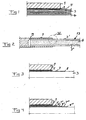
- a component 1 of for example aluminium having a high stiffness is adhesively bonded through an adhesive joint 2 to a fibre composite laminate 3.
- This laminate is composed by a plurality of superimposed layers 4 each having substantially parallel fibres embedded in a matrix.
- a typical thickness of such a layer 4 is 0.1-0.3 mm.
- the material of these layers may for instance be carbon fibres embedded in an epoxy matrix, glass fibres embedded in a polyester matrix or kevlar fibres embedded in a matrix. Concentrations of shear and tension forces in the adhesive joint will appear at the border 5 of the component where the border of the latter is located in overlap with the laminate. Such concentrations reduce the possibility to introduce load into the laminate in the same order of magnitude as the load for which the laminate is dimensioned. Furthermore, a substantial difference of the coefficient of thermal expansion of the material of the component with respect to the material of the laminate 3 results in a risk of introducing stresses destroying the adhesive joint or the laminate layer closest thereto when the temperature is changed substantially.
- a method for securing a component having a high stiffness to a fibre composite laminate by adhesive bonding according to the invention is illustrated through Figs 2 and 3 .
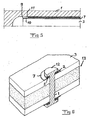
- the component 1 is here secured to a laminate 3', 3" forming a cover of reinforcement of a sandwich construction 13 on the respective side of an intermediate core material 6 of a comparatively low stiffness and strength. It is illustrated how a sheet 7 having, thanks to a much lower thickness than the thickness of the component 1, a substantially lower stiffness than the stiffness of the component is interposed between the component and the laminate so that the sheet extends and has its border 8 substantially beyond the border 5 of the component where the border of the latter is located in overlap with the laminate.
- the sheet is affixed by adhesively bonding to the laminate as well as to the component for securing them to each other.
- the distance between the border 8 of the sheet and that 5 of the component may typically be in the order of 2-8 mm.
- the sheet may typically have a thickness of 0.5-2 mm.
- the sheet 7 has preferably a stiffness in the same order of magnitude as the stiffness of a laminate layer to which it is adhesively bonded, which means that it is avoided to introduce considerably higher loads into the laminate layer than it may withstand. Furthermore, concentrations of shear and tension forces at the end of the adhesive joint at 5 are transferred to the sheet 7 and results in lower shear and tension forces in the region of the border 8.
- the sheet is preferably adhesively bonded to the sandwich construction in the same step as this is cured under high temperatures and pressures in a so-called autoclave.
- the low thickness of the sheet 7 makes it possible to handle it as if it would be a prepreg piece easy to handle.
- the sheet shall accordingly have a substantially lower stiffness than the stiffness of the component, and have substantially the same coefficient of thermal expansion as the laminate.
- Steel, titan or invar are preferred materials for the sheet in the case of a laminate of carbon fibre epoxy. Invar appears to be most preferred with respect to the coefficient of thermal expansion being nearly zero, especially when the Ni portion thereof is about 36 percent by weight.
- a component 1 of aluminium or another metal may be affixed by adhesive bonding through traditional adhesive joints and methods.
- Fig 4 illustrates how a plurality of said sheets 7', 7", 7"' are superimposed and adhesively bonded to each other and interposed between the component and the laminate as a package according to another preferred embodiment of the method according to the invention.
- the outer sheets 7', 7'" of said package are adhesively bonded to the component and the laminate, respectively, so that for adjacent sheets said border 8', 8" of the sheet closest to the component is located at a shorter distance to said border 5 of the component than said border 8", 8"' of the other sheet.
- the concentration of shear and tension forces at the border of the adhesive joint between the component and the sheet is by this reduced at each step so formed for making these forces low in the adhesive joint between the sheet 8"' and the laminate 3.
- Fig 2 It is shown in Fig 2 how the component is secured to the laminate close to a border 9 thereof so that is projects beyond the border of the laminate. A preferred way to proceed in such a case is illustrated in Fig 5 . It is shown how a sheet 7 is adhesively bonded to the laminate 3 so that a portion 10 thereof will be located in the region near said border 9 of the laminate, so that the component 1 is adhesively bonded to a surface of the sheet ending at a distance from said border of the laminate. This means that concentration of shear and tension forces at the adhesive joint border 11 between the component and the sheet will be distributed over a larger area and result in lower shear and tension forces next to the laminate at the border 9.
- the sheet (7) may be adhesively bonded to the laminate (3) so that a portion (10) thereof with a reduced thickness with respect to the rest of the sheet will be located in the region near said border (9) of the laminate, so that the component is adhesively bonded to a surface of the sheet ending at a distance from said border of the laminate.
- the invention is not restricted to the order of adhesively bonding the different pieces to each other described above, but this order may be different, so that the component may be adhesively bonded to said sheet simultaneously as the sheet is adhesively bonded to the laminate.
- the component may be adhesively bonded to a surface portion of the laminate distant from any border of the laminate.
- the lower stiffness of the sheet than of the component is preferably obtained by using a lower thickness for the former, such as less than 1 ⁇ 2 or 1 ⁇ 4 of the thickness of the component.
- a lower thickness for the former such as less than 1 ⁇ 2 or 1 ⁇ 4 of the thickness of the component.
Landscapes
- Engineering & Computer Science (AREA)
- General Engineering & Computer Science (AREA)
- Mechanical Engineering (AREA)
- Laminated Bodies (AREA)
- Pressure Welding/Diffusion-Bonding (AREA)
- Processing Of Terminals (AREA)
- Mechanical Coupling Of Light Guides (AREA)
- Standing Axle, Rod, Or Tube Structures Coupled By Welding, Adhesion, Or Deposition (AREA)
Claims (21)
- Verfahren zum Sichern einer eine hohe Steifigkeit aufweisenden Komponente (1) an einem Faserverbundlaminat (3) durch eine adhäsive Bindung, dadurch gekennzeichnet, dass eine, eine im Wesentlichen geringere Steifigkeit als die Steifigkeit der Komponente (1) aufweisende Folie (7) derart zwischen die Komponente (1) und das Laminat (3) eingefügt wird, dass die Folie (7) ihre Grenze (8) im Wesentlichen jenseits die Grenze (5) der Komponente(1) erstreckt und aufweist, wobei die Grenze (8) der letzteren überlappend mit dem Laminat (3) gelegen ist, und dadurch, dass die Folie (7) durch eine adhäsive Bindung sowohl am Laminat (3) als auch an der Komponente(1) angebracht ist, um sie zueinander zu sichern.
- Verfahren gemäß Anspruch 1, dadurch gekennzeichnet, dass es die eine Steifigkeit in der gleichen Größenordnung wie die Steifigkeit einer Laminatlage (4), zu der sie adhäsiv gebunden ist, aufweisende Folie (7) ist, die zwischen die Komponente (1) und das Laminat (3) eingefügt wird.
- Verfahren gemäß Anspruch 1 oder 2, dadurch gekennzeichnet, dass die geringere Steifigkeit der Folie (7) in Rekation zur Komponente (1) im Wesentlichen durch Verwenden einer eine im Wesentlichen geringere Dicke als die Komponente (1) nahe der Grenze (5) hiervon aufweisenden Folie (7) erhalten wird, vorteilhafterweise eine Dicke weniger als ½ und bevorzugt weniger als ein ¼ der Dicke der Komponente (1) wird.
- Verfahren gemäß einem der vorangegangen Ansprüche, dadurch gekennzeichnet, dass es eine aus Metall hergestellte Komponente (1) ist, die an das Faserverbundlaminat (3) gesichert wird.
- Verfahren gemäß Anspruch 4, dadurch gekennzeichnet, dass es eine aus Aluminium hergestellte Komponente (1) ist, die an das Faserverbundlaminat (3) gesichert wird.
- Verfahren gemäß einem der vorangegangen Ansprüche, dadurch gekennzeichnet, dass es eine Folie (7) aus Metall ist, die zwischen die Komponente (1) und das Laminat (3) eingefügt wird.
- Verfahren gemäß einem der vorangegangen Ansprüche, dadurch gekennzeichnet, dass es eine Folie (7) aus einem im Wesentlichen den gleichen Wärmeausdehnungskoeffizienten wie das Laminat (3) aufweisenden Material ist, die zwischen die Komponente(1) und das Laminat (3) eingefügt wird.
- Verfahren gemäß einem der vorangegangen Ansprüche, dadurch gekennzeichnet, dass es eine Folie (7) aus Stahl, Titan oder Invar ist, die zwischen die Komponente(1) und das Laminat (3) eingefügt wird.
- Verfahren gemäß einem der vorangegangen Ansprüche, dadurch gekennzeichnet, dass die Komponente (1) an ein eine Vielzahl von Lagen (4) aufweisendes Laminat (3) gesichert ist, wobei jede Lage (4) im Wesentlichen parallele, in eine Matrix eingebettete Kohlefasern aufweist.
- Verfahren gemäß Anspruch 9, dadurch gekennzeichnet, dass die Komponente (1) an ein Kohlefaser-Epoxy-Laminat (3) gesichert wird.
- Verfahren gemäß einem der vorangegangen Ansprüche, dadurch gekennzeichnet, dass die Komponente (1) an ein Glasfaser-Polyester-Laminat (3) gesichert wird.
- Verfahren gemäß einem der vorangegangen Ansprüche, dadurch gekennzeichnet, dass eine Vielzahl der Folien (7', 7'', 7''') übereinander gelegt und adhäsiv zueinander gebunden und zwischen die Komponente (1) und das Laminat (3) als eine Baugruppe eingefügt werden, und dadurch, dass die äußeren Folien (7', 7''') der Baugruppe entsprechend an die Komponente (1) und das Laminat (3) derart adhäsiv angebunden werden, dass, für benachbarte Folien, die Grenze (8', 8'') der am nächsten zur Komponente (1) gelegenen Folie (7', 7'') in einem geringeren Abstand zur Grenze (5) der Komponente gelegen ist als die Grenze (8'', 8''') der anderen Folie (7'', 7''').
- Verfahren gemäß einem der Ansprüche 1 bis 11, dadurch gekennzeichnet, dass eine Folie (7), die eine zwischen der Grenze (5) der Komponente und der Grenze (8) der Folie schrittweise reduzierte Dicke aufweist, adhäsiv am Laminat (3) und an der Komponente (1) angebunden ist.
- Verfahren gemäß einem der vorangegangen Ansprüche, dadurch gekennzeichnet, dass es eine, eine Dicke von 0, 5-2 mm aufweisende Folie (7) ist, die zwischen die Komponente (1) und das Laminat (3) eingefügt ist, und so dass der Abstand der Grenze (8) der Folie (7) zu der Grenze der Komponente (1) zumindest 2 mm beträgt, bevorzugt 2-8 mm.
- Verfahren gemäß einem der vorangegangen Ansprüche, dadurch gekennzeichnet, dass die Folie (7) in einem Schritt durch eine adhäsive Bindung am Laminat (3) fixiert wird, und die Komponente (1) in einem nachfolgenden separaten Schritt durch eine adhäsive Bindung an der Folie (7) fixiert wird.
- Verfahren gemäß einem der vorangegangen Ansprüche, dadurch gekennzeichnet, dass die Komponente (1) an einem eine Verstärkungsabdeckung eines Sandwich-Aufbaus (13) ausbildenden Laminat (3) gesichert wird.
- Verfahren gemäß den Ansprüchen 15 und 16, dadurch gekennzeichnet, dass die Folie (7) am Laminat (3) im gleichen Schritt adhäsiv angebunden wird wie der Sandwich-Aufbau (13) gebacken wird.
- Verfahren gemäß Anspruch 16 oder 17, dadurch gekennzeichnet, dass die Komponente ein sogenannter Einsatz (12) ist, der durch die Dicke des Sandwich-Aufbaus (13) eingesetzt wird, und dadurch, dass die, die Funktion einer Unterlage aufweisende Folie (7) verwendet wird, wenn der Einsatz an eine Außenfläche des durch das Laminat (3) ausgebildeten Sandwich-Aufbaus gesichert wird.
- Verfahren gemäß einem der Ansprüche 1 bis 17, dadurch gekennzeichnet, dass die Komponente (1) derart am Laminat (3) nahe einer Grenze (9) hiervon gesichert wird, dass sie über die Grenze (9) des Laminats (3) hinaus hervorsteht.
- Verfahren gemäß Anspruch 19, dadurch gekennzeichnet, dass die Folie (7) derart an das Laminat (3) adhäsiv angebunden wird, dass ein Abschnitt hiervon mit einer reduzierten Dicke bezüglich dem Rest der Folie (7) in der Region nahe der Grenze (9) des Laminats derart gelegen ist, dass die Komponente an eine in einem Abstand von der Grenze (9) des Laminats endenden Fläche der Folie (7) adhäsiv angebunden ist.
- Verwendung des Verfahrens gemäß einem der vorangegangen Ansprüche als Teil eines Vorgangs zum Herstellen eines im Weltraum zu verwendenden Produkts.
Priority Applications (4)
| Application Number | Priority Date | Filing Date | Title |
|---|---|---|---|
| DE60331146T DE60331146D1 (de) | 2003-10-03 | 2003-10-03 | Verfahren zum Verbinden eines Bauteils |
| EP03022314A EP1520895B1 (de) | 2003-10-03 | 2003-10-03 | Verfahren zum Verbinden eines Bauteils |
| ES03022314T ES2338541T3 (es) | 2003-10-03 | 2003-10-03 | Procedimiento para asegurar un componente. |
| AT03022314T ATE456636T1 (de) | 2003-10-03 | 2003-10-03 | Verfahren zum verbinden eines bauteils |
Applications Claiming Priority (1)
| Application Number | Priority Date | Filing Date | Title |
|---|---|---|---|
| EP03022314A EP1520895B1 (de) | 2003-10-03 | 2003-10-03 | Verfahren zum Verbinden eines Bauteils |
Publications (2)
| Publication Number | Publication Date |
|---|---|
| EP1520895A1 EP1520895A1 (de) | 2005-04-06 |
| EP1520895B1 true EP1520895B1 (de) | 2010-01-27 |
Family
ID=34306822
Family Applications (1)
| Application Number | Title | Priority Date | Filing Date |
|---|---|---|---|
| EP03022314A Expired - Lifetime EP1520895B1 (de) | 2003-10-03 | 2003-10-03 | Verfahren zum Verbinden eines Bauteils |
Country Status (4)
| Country | Link |
|---|---|
| EP (1) | EP1520895B1 (de) |
| AT (1) | ATE456636T1 (de) |
| DE (1) | DE60331146D1 (de) |
| ES (1) | ES2338541T3 (de) |
Cited By (1)
| Publication number | Priority date | Publication date | Assignee | Title |
|---|---|---|---|---|
| DE102011004775A1 (de) * | 2011-02-25 | 2012-08-30 | Airbus Operations Gmbh | Verfahren zum Herstellen einer Verbindung, Verbindung sowie Luft- oder Raumfahrzeug |
Families Citing this family (2)
| Publication number | Priority date | Publication date | Assignee | Title |
|---|---|---|---|---|
| US7393488B2 (en) | 2005-05-25 | 2008-07-01 | The Boeing Company | Methods of joining structures and joints formed thereby |
| DE102013222970B4 (de) | 2013-11-12 | 2023-07-27 | Deutsches Zentrum für Luft- und Raumfahrt e.V. | Verfahren zum Verbinden zweier Bauteile, Verbindungsabschnitt eines Bauteils und Bauteilverbund |
Family Cites Families (3)
| Publication number | Priority date | Publication date | Assignee | Title |
|---|---|---|---|---|
| US4556592A (en) * | 1981-09-25 | 1985-12-03 | The Boeing Company | Conductive joint seals for composite aircraft |
| US4966802A (en) * | 1985-05-10 | 1990-10-30 | The Boeing Company | Composites made of fiber reinforced resin elements joined by adhesive |
| SE516459C2 (sv) * | 2000-11-24 | 2002-01-15 | Saab Ericsson Space Ab | Konstruktion och förfarande vid bärraket eller satellit |
-
2003
- 2003-10-03 AT AT03022314T patent/ATE456636T1/de not_active IP Right Cessation
- 2003-10-03 ES ES03022314T patent/ES2338541T3/es not_active Expired - Lifetime
- 2003-10-03 DE DE60331146T patent/DE60331146D1/de not_active Expired - Lifetime
- 2003-10-03 EP EP03022314A patent/EP1520895B1/de not_active Expired - Lifetime
Non-Patent Citations (1)
| Title |
|---|
| DANIEL GAY: "MATERIAUX COMPOSITES", 1991, HERMES, PARIS, ISBN: 2-86601-116-3 * |
Cited By (2)
| Publication number | Priority date | Publication date | Assignee | Title |
|---|---|---|---|---|
| DE102011004775A1 (de) * | 2011-02-25 | 2012-08-30 | Airbus Operations Gmbh | Verfahren zum Herstellen einer Verbindung, Verbindung sowie Luft- oder Raumfahrzeug |
| DE102011004775B4 (de) * | 2011-02-25 | 2012-10-25 | Airbus Operations Gmbh | Verfahren zum Herstellen einer Verbindung, Verbindung sowie Luft- oder Raumfahrzeug |
Also Published As
| Publication number | Publication date |
|---|---|
| EP1520895A1 (de) | 2005-04-06 |
| ES2338541T3 (es) | 2010-05-10 |
| ATE456636T1 (de) | 2010-02-15 |
| DE60331146D1 (de) | 2010-03-18 |
Similar Documents
| Publication | Publication Date | Title |
|---|---|---|
| CN102514284B (zh) | 薄层层压材料 | |
| AU2006317054C1 (en) | Hybrid three-dimensional woven/laminated struts for composite structural applications | |
| US5227216A (en) | Fiber/metal laminate | |
| CA2473346C (en) | Lightweight structure particularly for aircraft | |
| US8317134B2 (en) | Stiffened casing for an aircraft or spacecraft with a laminate stringer of high rigidity and corresponding laminate stringer | |
| JP2002053098A (ja) | 飛行機用構造部材およびその製造方法並びに構造部材のための補強異形材 | |
| US7255916B2 (en) | Metallic layer material, reinforced with basalt fibers, as well as products made thereof | |
| CA2473350C (en) | Lightweight structure especially for an aircraft and method for making such a structure | |
| EP1520895B1 (de) | Verfahren zum Verbinden eines Bauteils | |
| EP1114771A1 (de) | Verbundwerkstoff, insbesondere für Segel | |
| JP4115702B2 (ja) | 橋梁用コードとして使用するためのテンションロッド | |
| JPH01110943A (ja) | Frp構造体とその製造方法 | |
| MOLODTSOV | Micro-mechanical analysis of prestressed fiber reinforced composite laminates | |
| JPH04366134A (ja) | 高強度繊維強化プラスチック | |
| JP2003042233A (ja) | 構造用frpベルトの継手構造 | |
| JPH0437532A (ja) | ハニカムサンドイッチ板 |
Legal Events
| Date | Code | Title | Description |
|---|---|---|---|
| PUAI | Public reference made under article 153(3) epc to a published international application that has entered the european phase |
Free format text: ORIGINAL CODE: 0009012 |
|
| AK | Designated contracting states |
Kind code of ref document: A1 Designated state(s): AT BE BG CH CY CZ DE DK EE ES FI FR GB GR HU IE IT LI LU MC NL PT RO SE SI SK TR |
|
| AX | Request for extension of the european patent |
Extension state: AL LT LV MK |
|
| 17P | Request for examination filed |
Effective date: 20050825 |
|
| AKX | Designation fees paid |
Designated state(s): AT BE BG CH CY CZ DE DK EE ES FI FR GB GR HU IE IT LI LU MC NL PT RO SE SI SK TR |
|
| 17Q | First examination report despatched |
Effective date: 20070418 |
|
| RAP1 | Party data changed (applicant data changed or rights of an application transferred) |
Owner name: SAAB AB |
|
| RAP1 | Party data changed (applicant data changed or rights of an application transferred) |
Owner name: RUAG AEROSPACE SWEDEN AB |
|
| GRAP | Despatch of communication of intention to grant a patent |
Free format text: ORIGINAL CODE: EPIDOSNIGR1 |
|
| GRAS | Grant fee paid |
Free format text: ORIGINAL CODE: EPIDOSNIGR3 |
|
| GRAA | (expected) grant |
Free format text: ORIGINAL CODE: 0009210 |
|
| AK | Designated contracting states |
Kind code of ref document: B1 Designated state(s): AT BE BG CH CY CZ DE DK EE ES FI FR GB GR HU IE IT LI LU MC NL PT RO SE SI SK TR |
|
| REG | Reference to a national code |
Ref country code: GB Ref legal event code: FG4D |
|
| REG | Reference to a national code |
Ref country code: CH Ref legal event code: EP |
|
| REG | Reference to a national code |
Ref country code: IE Ref legal event code: FG4D |
|
| REF | Corresponds to: |
Ref document number: 60331146 Country of ref document: DE Date of ref document: 20100318 Kind code of ref document: P |
|
| REG | Reference to a national code |
Ref country code: ES Ref legal event code: FG2A Ref document number: 2338541 Country of ref document: ES Kind code of ref document: T3 |
|
| REG | Reference to a national code |
Ref country code: NL Ref legal event code: VDEP Effective date: 20100127 |
|
| PG25 | Lapsed in a contracting state [announced via postgrant information from national office to epo] |
Ref country code: AT Free format text: LAPSE BECAUSE OF FAILURE TO SUBMIT A TRANSLATION OF THE DESCRIPTION OR TO PAY THE FEE WITHIN THE PRESCRIBED TIME-LIMIT Effective date: 20100127 |
|
| PG25 | Lapsed in a contracting state [announced via postgrant information from national office to epo] |
Ref country code: PT Free format text: LAPSE BECAUSE OF FAILURE TO SUBMIT A TRANSLATION OF THE DESCRIPTION OR TO PAY THE FEE WITHIN THE PRESCRIBED TIME-LIMIT Effective date: 20100527 Ref country code: NL Free format text: LAPSE BECAUSE OF FAILURE TO SUBMIT A TRANSLATION OF THE DESCRIPTION OR TO PAY THE FEE WITHIN THE PRESCRIBED TIME-LIMIT Effective date: 20100127 |
|
| PG25 | Lapsed in a contracting state [announced via postgrant information from national office to epo] |
Ref country code: FI Free format text: LAPSE BECAUSE OF FAILURE TO SUBMIT A TRANSLATION OF THE DESCRIPTION OR TO PAY THE FEE WITHIN THE PRESCRIBED TIME-LIMIT Effective date: 20100127 Ref country code: SI Free format text: LAPSE BECAUSE OF FAILURE TO SUBMIT A TRANSLATION OF THE DESCRIPTION OR TO PAY THE FEE WITHIN THE PRESCRIBED TIME-LIMIT Effective date: 20100127 |
|
| PG25 | Lapsed in a contracting state [announced via postgrant information from national office to epo] |
Ref country code: GR Free format text: LAPSE BECAUSE OF FAILURE TO SUBMIT A TRANSLATION OF THE DESCRIPTION OR TO PAY THE FEE WITHIN THE PRESCRIBED TIME-LIMIT Effective date: 20100428 Ref country code: SE Free format text: LAPSE BECAUSE OF FAILURE TO SUBMIT A TRANSLATION OF THE DESCRIPTION OR TO PAY THE FEE WITHIN THE PRESCRIBED TIME-LIMIT Effective date: 20100127 Ref country code: RO Free format text: LAPSE BECAUSE OF FAILURE TO SUBMIT A TRANSLATION OF THE DESCRIPTION OR TO PAY THE FEE WITHIN THE PRESCRIBED TIME-LIMIT Effective date: 20100127 Ref country code: EE Free format text: LAPSE BECAUSE OF FAILURE TO SUBMIT A TRANSLATION OF THE DESCRIPTION OR TO PAY THE FEE WITHIN THE PRESCRIBED TIME-LIMIT Effective date: 20100127 Ref country code: CY Free format text: LAPSE BECAUSE OF FAILURE TO SUBMIT A TRANSLATION OF THE DESCRIPTION OR TO PAY THE FEE WITHIN THE PRESCRIBED TIME-LIMIT Effective date: 20100127 Ref country code: BE Free format text: LAPSE BECAUSE OF FAILURE TO SUBMIT A TRANSLATION OF THE DESCRIPTION OR TO PAY THE FEE WITHIN THE PRESCRIBED TIME-LIMIT Effective date: 20100127 |
|
| PG25 | Lapsed in a contracting state [announced via postgrant information from national office to epo] |
Ref country code: CZ Free format text: LAPSE BECAUSE OF FAILURE TO SUBMIT A TRANSLATION OF THE DESCRIPTION OR TO PAY THE FEE WITHIN THE PRESCRIBED TIME-LIMIT Effective date: 20100127 Ref country code: BG Free format text: LAPSE BECAUSE OF FAILURE TO SUBMIT A TRANSLATION OF THE DESCRIPTION OR TO PAY THE FEE WITHIN THE PRESCRIBED TIME-LIMIT Effective date: 20100427 Ref country code: SK Free format text: LAPSE BECAUSE OF FAILURE TO SUBMIT A TRANSLATION OF THE DESCRIPTION OR TO PAY THE FEE WITHIN THE PRESCRIBED TIME-LIMIT Effective date: 20100127 |
|
| PLBE | No opposition filed within time limit |
Free format text: ORIGINAL CODE: 0009261 |
|
| STAA | Information on the status of an ep patent application or granted ep patent |
Free format text: STATUS: NO OPPOSITION FILED WITHIN TIME LIMIT |
|
| 26N | No opposition filed |
Effective date: 20101028 |
|
| PG25 | Lapsed in a contracting state [announced via postgrant information from national office to epo] |
Ref country code: DK Free format text: LAPSE BECAUSE OF FAILURE TO SUBMIT A TRANSLATION OF THE DESCRIPTION OR TO PAY THE FEE WITHIN THE PRESCRIBED TIME-LIMIT Effective date: 20100127 |
|
| PG25 | Lapsed in a contracting state [announced via postgrant information from national office to epo] |
Ref country code: MC Free format text: LAPSE BECAUSE OF NON-PAYMENT OF DUE FEES Effective date: 20101031 |
|
| REG | Reference to a national code |
Ref country code: CH Ref legal event code: PL |
|
| PG25 | Lapsed in a contracting state [announced via postgrant information from national office to epo] |
Ref country code: LI Free format text: LAPSE BECAUSE OF NON-PAYMENT OF DUE FEES Effective date: 20101031 Ref country code: CH Free format text: LAPSE BECAUSE OF NON-PAYMENT OF DUE FEES Effective date: 20101031 |
|
| PG25 | Lapsed in a contracting state [announced via postgrant information from national office to epo] |
Ref country code: IE Free format text: LAPSE BECAUSE OF NON-PAYMENT OF DUE FEES Effective date: 20101003 |
|
| PG25 | Lapsed in a contracting state [announced via postgrant information from national office to epo] |
Ref country code: HU Free format text: LAPSE BECAUSE OF FAILURE TO SUBMIT A TRANSLATION OF THE DESCRIPTION OR TO PAY THE FEE WITHIN THE PRESCRIBED TIME-LIMIT Effective date: 20100728 Ref country code: LU Free format text: LAPSE BECAUSE OF NON-PAYMENT OF DUE FEES Effective date: 20101003 |
|
| PG25 | Lapsed in a contracting state [announced via postgrant information from national office to epo] |
Ref country code: TR Free format text: LAPSE BECAUSE OF FAILURE TO SUBMIT A TRANSLATION OF THE DESCRIPTION OR TO PAY THE FEE WITHIN THE PRESCRIBED TIME-LIMIT Effective date: 20100127 |
|
| REG | Reference to a national code |
Ref country code: FR Ref legal event code: PLFP Year of fee payment: 14 |
|
| REG | Reference to a national code |
Ref country code: FR Ref legal event code: PLFP Year of fee payment: 15 |
|
| REG | Reference to a national code |
Ref country code: FR Ref legal event code: PLFP Year of fee payment: 16 |
|
| PG25 | Lapsed in a contracting state [announced via postgrant information from national office to epo] |
Ref country code: IT Free format text: LAPSE BECAUSE OF NON-PAYMENT OF DUE FEES Effective date: 20191003 |
|
| PGFP | Annual fee paid to national office [announced via postgrant information from national office to epo] |
Ref country code: GB Payment date: 20200916 Year of fee payment: 18 Ref country code: FR Payment date: 20200911 Year of fee payment: 18 |
|
| PGFP | Annual fee paid to national office [announced via postgrant information from national office to epo] |
Ref country code: DE Payment date: 20200922 Year of fee payment: 18 Ref country code: ES Payment date: 20201102 Year of fee payment: 18 |
|
| REG | Reference to a national code |
Ref country code: DE Ref legal event code: R119 Ref document number: 60331146 Country of ref document: DE |
|
| GBPC | Gb: european patent ceased through non-payment of renewal fee |
Effective date: 20211003 |
|
| PG25 | Lapsed in a contracting state [announced via postgrant information from national office to epo] |
Ref country code: GB Free format text: LAPSE BECAUSE OF NON-PAYMENT OF DUE FEES Effective date: 20211003 Ref country code: DE Free format text: LAPSE BECAUSE OF NON-PAYMENT OF DUE FEES Effective date: 20220503 |
|
| PG25 | Lapsed in a contracting state [announced via postgrant information from national office to epo] |
Ref country code: FR Free format text: LAPSE BECAUSE OF NON-PAYMENT OF DUE FEES Effective date: 20211031 |
|
| REG | Reference to a national code |
Ref country code: ES Ref legal event code: FD2A Effective date: 20221125 |
|
| PG25 | Lapsed in a contracting state [announced via postgrant information from national office to epo] |
Ref country code: ES Free format text: LAPSE BECAUSE OF NON-PAYMENT OF DUE FEES Effective date: 20211004 |