EP1520355B1 - Verbessertes sanftes weiterreichungsverfahren zur drahtlosen aufwärtskommunikation - Google Patents
Verbessertes sanftes weiterreichungsverfahren zur drahtlosen aufwärtskommunikation Download PDFInfo
- Publication number
- EP1520355B1 EP1520355B1 EP03735840A EP03735840A EP1520355B1 EP 1520355 B1 EP1520355 B1 EP 1520355B1 EP 03735840 A EP03735840 A EP 03735840A EP 03735840 A EP03735840 A EP 03735840A EP 1520355 B1 EP1520355 B1 EP 1520355B1
- Authority
- EP
- European Patent Office
- Prior art keywords
- signals
- signal
- backhauled
- communications network
- basestation
- Prior art date
- Legal status (The legal status is an assumption and is not a legal conclusion. Google has not performed a legal analysis and makes no representation as to the accuracy of the status listed.)
- Expired - Lifetime
Links
Images




Classifications
-
- H—ELECTRICITY
- H04—ELECTRIC COMMUNICATION TECHNIQUE
- H04B—TRANSMISSION
- H04B17/00—Monitoring; Testing
- H04B17/30—Monitoring; Testing of propagation channels
- H04B17/309—Measuring or estimating channel quality parameters
- H04B17/336—Signal-to-interference ratio [SIR] or carrier-to-interference ratio [CIR]
-
- H—ELECTRICITY
- H04—ELECTRIC COMMUNICATION TECHNIQUE
- H04B—TRANSMISSION
- H04B7/00—Radio transmission systems, i.e. using radiation field
- H04B7/02—Diversity systems; Multi-antenna system, i.e. transmission or reception using multiple antennas
- H04B7/022—Site diversity; Macro-diversity
-
- H—ELECTRICITY
- H04—ELECTRIC COMMUNICATION TECHNIQUE
- H04B—TRANSMISSION
- H04B7/00—Radio transmission systems, i.e. using radiation field
- H04B7/02—Diversity systems; Multi-antenna system, i.e. transmission or reception using multiple antennas
- H04B7/04—Diversity systems; Multi-antenna system, i.e. transmission or reception using multiple antennas using two or more spaced independent antennas
- H04B7/0491—Diversity systems; Multi-antenna system, i.e. transmission or reception using multiple antennas using two or more spaced independent antennas using two or more sectors, i.e. sector diversity
-
- H—ELECTRICITY
- H04—ELECTRIC COMMUNICATION TECHNIQUE
- H04L—TRANSMISSION OF DIGITAL INFORMATION, e.g. TELEGRAPHIC COMMUNICATION
- H04L1/00—Arrangements for detecting or preventing errors in the information received
- H04L1/004—Arrangements for detecting or preventing errors in the information received by using forward error control
-
- H—ELECTRICITY
- H04—ELECTRIC COMMUNICATION TECHNIQUE
- H04W—WIRELESS COMMUNICATION NETWORKS
- H04W36/00—Hand-off or reselection arrangements
- H04W36/16—Performing reselection for specific purposes
- H04W36/18—Performing reselection for specific purposes for allowing seamless reselection, e.g. soft reselection
-
- H—ELECTRICITY
- H04—ELECTRIC COMMUNICATION TECHNIQUE
- H04W—WIRELESS COMMUNICATION NETWORKS
- H04W36/00—Hand-off or reselection arrangements
- H04W36/24—Reselection being triggered by specific parameters
- H04W36/30—Reselection being triggered by specific parameters by measured or perceived connection quality data
-
- H—ELECTRICITY
- H04—ELECTRIC COMMUNICATION TECHNIQUE
- H04W—WIRELESS COMMUNICATION NETWORKS
- H04W16/00—Network planning, e.g. coverage or traffic planning tools; Network deployment, e.g. resource partitioning or cells structures
- H04W16/24—Cell structures
-
- Y—GENERAL TAGGING OF NEW TECHNOLOGICAL DEVELOPMENTS; GENERAL TAGGING OF CROSS-SECTIONAL TECHNOLOGIES SPANNING OVER SEVERAL SECTIONS OF THE IPC; TECHNICAL SUBJECTS COVERED BY FORMER USPC CROSS-REFERENCE ART COLLECTIONS [XRACs] AND DIGESTS
- Y02—TECHNOLOGIES OR APPLICATIONS FOR MITIGATION OR ADAPTATION AGAINST CLIMATE CHANGE
- Y02D—CLIMATE CHANGE MITIGATION TECHNOLOGIES IN INFORMATION AND COMMUNICATION TECHNOLOGIES [ICT], I.E. INFORMATION AND COMMUNICATION TECHNOLOGIES AIMING AT THE REDUCTION OF THEIR OWN ENERGY USE
- Y02D30/00—Reducing energy consumption in communication networks
- Y02D30/70—Reducing energy consumption in communication networks in wireless communication networks
Definitions
- the present invention relates to a method and apparatus for receiving backhauled communications signals and also a method and apparatus for backhauling uplink communications signals.
- the present invention is particularly related to soft handoff methods in wireless communications.
- wireless communications networks are typically formed from a plurality of basestations (also referred to as base transceiver stations, BTSs), each basestation being located in a cell which is a geographical region served by that basestation.
- BTSs base transceiver stations
- User terminals also referred to as user equipments (UEs)
- UEs are able to communicate with one or more of the basestations using wireless communications.
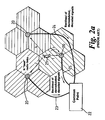
- FIG. 1 is a schematic diagram of a wireless communications network comprising a plurality of basestations 10 each within a tri-sectored cell 11. (In Figure 1 the sectors are represented by hexagonal shapes.) A plurality of UEs are shown, each represented by a dot 12. Two uplink signal paths from most of these UEs 12 are represented by lines, each to a different basestation 10. The darker of the two lines is intended to represent the uplink signal path giving the stronger signal received at the basestation.
- Arrows 1, 2 and 4 show paths to different basestations whereas arrows, 1 and 3 show paths to different sectors of the same basestation.
- the degree of soft handoff is said to be 4-way because four different uplink paths are used.
- Each of the basestations demodulates and decodes the uplink signal received from the UE 21.
- the resulting hard-decoded frames are then backhauled to a common point 22 as indicated by arrows 23, 24, 25.
- the common point is typically a selector bank subsystem (SBS) of a base station controller (BSC).
- a processor at the common point selects the "best" of the hard-decoded frames received from the different cell sites and discards the rest.
- the SBS chooses as the single survivor frame (for vocoder decode) one of the backhauled set (if possible) with a correct cyclic redundancy check (CRC) (i.e. a CRC which correctly corresponds to the decoded data).
- CRC cyclic redundancy check
- mDiversity Inc. describe a variation on this soft handoff scheme in their US patents US 6,349,094 and US 6,192,038 . They describe a plurality of collectors (similar to basestations) distributed at macro-diverse locations for receiving reverse channel (uplink) signals from users. Each of the collectors processes the uplink signals to yield one or more sequences of data bits as a burst and corresponding initial confidence metrics for each bit. The collectors forward the data bits and confidence metrics to an aggregator or common point. At the aggregator the data for the same user received from the multiple collectors is combined by using the confidence metrics to make a final decision on each bit.
- An object of the present invention is to provide an improved soft-handoff method which overcomes or at least mitigates one or more of the problems noted above.
- a method of receiving backhauled communication signals in a wireless communications network said method being carried out at a combiner node (such as a selector bank subsystem of a basestation controller) in the communications network.
- the method comprises the step of:-
- basestation is used here to include basestation sectors.
- the backhauled signals can be from two different sectors of a particular basestation.
- the backhauled signals are forward error correction (FEC) encoded. Because the backhauled signals are not decoded at the basestations the complexity of processing required at those basestations is reduced. Also, that process of decoding involves the loss of some information and the present invention enables that information to be retained and used at the combiner node. This is explained in more detail below.
- FEC forward error correction
- the backhauled encoded signals are modulated and have not undergone demodulation prior to reception at said node. This is advantageous because the processing required at the basestations is further reduced. However, in another embodiment, some demodulation is carried out at the basestations.
- the backhauled encoded signals comprise received signal values, and also signal-to-noise and interference-ratio estimates.
- the method further comprises combining each backhauled encoded signal received from a basestation in respect of the same user equipment by using maximal ratio combination to produce one backhauled encoded signal.
- This is advantageous because all the backhauled information is used to carry out the combination process and produce one encoded signal. This signal can then be demodulated and decoded.
- a method of backhauling uplink communication signals received from a user equipment in a wireless communications network said method being carried out at a basestation in the communications network.
- the method comprising the steps of:-
- the received signals are simply backhauled without being modified in any way.
- the received signals are partly processed, but without being decoded, before being backhauled. In both these cases information that would otherwise have been lost at the basestation during a decoding process is retained.
- the signals for backhauling are formed by processing the received uplink signals at the basestation in order to produce received signal values.
- processing to produce signal-to-noise and interference-ratio (SNIR) values can be done at the basestation. This provides the advantage that these values are relatively simple to compute and yet retain information which can be used later at a combiner node. For example the received signal values and SNIR values are produced subsequent to rake filtering and antenna array processing (AAP) processing.
- AAP antenna array processing
- the invention also encompasses a basestation for backhauling uplink communication signals received from a user equipment in a wireless communications network said basestation comprising:-
- a combiner for receiving backhauled communication signals in a wireless communications network said combiner being provided at a node in the communications network and comprising:-
- the invention also encompasses a communications network comprising a plurality of basestations as described above and preferably also at least one combiner as described above.
- a signal for backhauling from a basestation in a wireless communications network to a combiner node in the communications network said signal being formed from an uplink encoded, modulated signal from a user equipment, without decoding said signal.
- the signal comprises the full uplink encoded, modulated signal from the user equipment.
- the signal comprises received signal values derived from the uplink signal from the user equipment.
- the signal may also comprise signal-to-noise plus interference-ratio values derived from the uplink signal from the user equipment.
- Embodiments of the present invention are described below by way of example only. These examples represent the best ways of putting the invention into practice that are currently known to the Applicant although they are not the only ways in which this could be achieved.
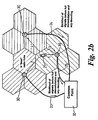
- Figure 2b is a schematic diagram of a wireless communications network in which improved soft-handoff is implemented according to the present invention.
- Figure 2b is similar to Figure 2a however the information that is backhauled comprises the received uplink signals before at least some of the demodulation and all of the decoding process has taken place. That is the basestations 30 do not carry out processing to fully demodulate and decode the uplink signals 1, 2, 3, 4 received from mobile telephone 21.
- the common point 32 comprises (or is able to access) a processor in order to combine the signals received from the backhaul process (see arrows 23, 24, 25) and then to complete the demodulation process and carry out decoding of those signals.
- FIG. 3 shows the prior art situation.
- Each large rectangle 34 represents a different basestation or basestation sector.
- a receive antenna structure 35 the output of which is provided to a Rake and antenna array processor (AAP) 36.
- AAP Rake and antenna array processor
- the Rake and AAP processor 36 performs the function of temporal and spatial processing of the user equipment signal on the multiple antennas to improve signal quality and the output of this processor comprises modulation symbols (corrupted by distortion, noise and interference).
- the output of the Rake and AAP processor 36 is provided to a demodulator 37 which demodulates the received signal and the resulting coded bits are provided to an FEC (Forward Error Correction) decode processor 38.
- FEC Forward Error Correction
- the resulting bit stream of "hard decisions" is backhauled to a common point 39. This is repeated for each basestation or basestation sector at which a signal from a particular UE is received and Figure 3 illustrates this using the lines 40.
- frame selection is carried out as described above for the prior art soft-handoff methods.
- the present invention recognises that in the prior art situation (e.g. Figure 3) useful information is discarded by the basestations or basestation sectors when making their bitwise hard decisions before backhaul.
- the backhauled information is typically in the form of blocks of decoded data corresponding to each Forward Error Correction (FEC) coded frame.
- FEC Forward Error Correction
- Such a block consists of hard bit-wise decisions (i.e. 1's or 0's), accompanied by a field of Cyclic Redundancy Check (CRC) bits.
- the present invention also recognises that there is further loss of useful information during the combining stage of the prior art.
- the common point or combiner receives a number of alternative decodes from different basestations, all corresponding to the same decoded FEC frame of user data. Some of these decodes may be error-free; some may be in error.
- the combiner examines the CRC field of each, in order to choose or select between them. The combiner selects, if possible, one of the received frames for which the CRC field is correct. The other received decodes of that FEC frame are then discarded. This constitutes a loss of useful information, and so the ultimate mean Frame Error Rate (FER) is higher then it need be.
- FER Frame Error Rate
- the present invention addresses these problems as now explained with reference to Figure 4.
- the prior art method discards useful information at both the basestations and the combiner. In the present invention this information is retained at both those stages. This improves the received FER for a given UE transmit power. Therefore the battery life of the UE is improved, and multi-user interference in the network is reduced so that capacity is enhanced.
- the Rake and AAP processor 46 produces received signal points and signal to noise plus interference ratio (SNIR) estimates. These are types of soft symbolwise metrics.
- the output of the rake and AAP processor 46 is in the form of a single receive signal value (RSV) per received modulation symbol, i.e. a complex number, defined to a required level of quantization and a signal-to-noise-plus-interference-ratio (SNIR) estimate (a real number).
- the RSV is substantially equal to the superposition of a) the transmitted modulation symbol from the UE (with perhaps some amplitude and phase errors due to distortion in the transmission) and b) some residual error term due to interference and receiver thermal noise.
- the RSV generation process is repeated at each basestation or basestation sector which receives signals from the particular UE and the results are backhauled to a common point. This is indicated by lines 47 in Figure 4.
- the backhauled information streams are combined using a combiner 48 as illustrated schematically in Figure 4.
- demodulation occurs as known in the art followed by FEC decoding 50 also as known in the art.
- FEC decoding 50 also as known in the art.
- the backhauled information is combined using Maximal Ratio Combination and after that a single combined demodulation and FEC decoding occurs.
- the combiner 48 or common point receives an FEC frame's worth of RSVs and SNIR values from each participating basestation.
- the number of RSVs per FEC frame per participating basestation is equal to the number of transmitted modulation symbols per FEC frame.
- the number of SNIR estimates per FEC frame per participating basestation is a function of the Doppler spread of the uplink propagation channel for the given UE.
- the combiner carries out the decoding of the FEC frame in the conventional manner, for example, by a) deriving channel soft metrics from the collection of RSVs and SNIR estimates at its disposal, and b) carrying out some suitable form of decoding such as soft-input-soft-output a-posteriori probability (SISO-APP) decoding or the soft output viterbi algorithm (SOVA).
- SISO-APP soft-input-soft-output a-posteriori probability
- SOVA soft output viterbi algorithm
- the FEC decoder of the present invention is making its decision on the information bits using all of the available information at the network's disposal (i.e. none is discarded), the resultant FER is lower, for a given UE transmit power.
- the battery life of the UEs is improved, multi-user interference within the network is minimised, and capacity is maximised.
- Simulation results described below with reference to Figure 6 indicate that the capacity gain as a result of using the present invention is of the order of 50% compared to the hard handoff case. This is when using up to 4 basestations as participants in the improved soft handoff process. In effect, the improved soft handoff process completely overcomes the capacity reduction due to the so-called. 'Other Cell Interference Factor (OCIF).
- OCIF 'Other Cell Interference Factor
- the OCIF is estimated to reduce uplink CDMA capacity for hard handoff in an embedded cell (compared to an isolated cell) by some 33%. Note that this 33% capacity reduction estimate assumes a Macrocellular basestation deployment. In certain alternative basestation deployments, such as Microcells or Picocells, the capacity reductions due to OCIF may be even greater. In effect, the process of the present invention reduces the whole CDMA uplink to one single, large isolated 'super-cell'. This has been achieved by sharing information more widely across the whole network.
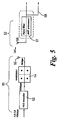
- FIG. 5 is a schematic diagram of a transmitter and receiver architecture according to the present invention.
- the transmitter architecture 51 is present at a user equipment and comprises as known in the art an FEC encoder 53 and a modulator 54.
- the uplink signal After the uplink signal has been processed by both those items it is transmitted using an antenna structure 55.
- the transmitted uplink is received by a plurality of basestations or basestation sectors and one of these is represented in Figure 5 by structures 52.
- a receive antenna structure 56 (which comprises a plurality of receive antennas in order that antenna array processing can be performed) receives the uplink signal and this is then processed using e.g., a rake filter and AAP processor 57 as mentioned above before being backhauled 58 to a common point.
- Figure 6 shows simulation results. This simulation was carried out to compare the performance of hard handoff (see line 61 in Figure 6), soft handoff (see line 62) and the improved soft handoff method (see line 63) of the present invention.
- the simulation used single-path static-channel results
- the curve labelled HHO in Figure 6 shows this performance result. Reading by eye from that curve we see a 1% FER at approximately 2.4 dB Eb/No and 10% FER at approximately 1.5 dB Eb/No.
- a 10% FER is the target for which we are aiming in a typical uplink traffic channel (e.g. for data transmission).
- improved soft handoff offers about 2.4 dB additional gain compared to soft handoff at 10% FER. This therefore allows a 2.4 dB reduction in UE transmit power (i.e. a 0.58 x factor) for the same FER assuming a coverage-limited (i.e. noise-limited) edge-of-cell UE.
- Preferably four basestations are used to backhaul information from a particular UE in the improved soft handoff method of the present invention.
- 4 way soft handoff i.e. using backhauled information from four basestations or basestation sectors
- Figure 7 is a graph of simulated capacity normalised to 1 way soft handoff against degree of soft handoff (on a log scale). The simulation was made assuming a tricellular network of 7 bases and 3 sectors per base. The processing gain was set at 4, asynchronous CDMA assumed with full sector antennas.
- the whole aggregate received signal from a remote basestation is transmitted back to a single point using digital or other suitable transmission techniques (e.g. analogue transmission techniques exploiting previously unused 'dark fibre').
- This 'Remote Radio' (RR) concept has the advantage of reducing the complexity of the basestations, and allows for even more sophisticated processing of the received signal at the common point.
- some of the embodiments described above involve carrying out some demodulation processing at the basestations and the rest at the common point. However, this is not essential. It is also possible to carry out all the demodulation processing at the basestations and none at the common point.
- a distributed 'Multi-User Detection' (MUD) process is carried out at the common point.
- Any suitable MUD process is used for example, as described in " Multi-user detection for DS-CDMA communications", S. Moshavi, IEEE Communications Magazine, October 1996 .
- this type of process 'shares' information between the FEC decoders for different UEs.
- MUD operates by decoding and removing inferior signals from unwanted user equipments. Performing this process at the common point allows improved detection which will increase the effectiveness of MUD.
- optical communications can be used between the basestations and the common point.
- the backhaul signals may be sent using wireless communications or in any other suitable manner.
Landscapes
- Engineering & Computer Science (AREA)
- Computer Networks & Wireless Communication (AREA)
- Signal Processing (AREA)
- Quality & Reliability (AREA)
- Physics & Mathematics (AREA)
- Electromagnetism (AREA)
- Mobile Radio Communication Systems (AREA)
Claims (20)
- Verfahren zum Empfang von zurücktransportierten Kommunikations-Signalen in einem drahtlosen Kommunikations-Netzwerk, wobei das Verfahren an einem Kombinationsknoten in dem Kommunikations-Netzwerk ausgeführt wird und den folgenden Schritt umfasst:i) Empfangen von zurücktransportierten codierten Signalen von einer Anzahl von Basisstationen in dem Kommunikations-Netzwerk, wobei die zurücktransportierten codierten Signale aus zumindest einigen Signalen von dem gleichen Benutzer-Gerät gebildet werden; und wobei die zurücktransportierten Signale keine Decodierung vor dem Empfang an dem Knoten durchlaufen haben, wobei die zurücktransportierten codierten Signale moduliert werden und keine Demodulation vor dem Empfang an dem Knoten durchlaufen haben.
- Verfahren nach Anspruch 1, bei dem die zurücktransportierten codierten Signale Empfangssignal-Werte umfassen.
- Verfahren nach Anspruch 1, bei dem die zurücktransportierten codierten Signale Signal-zu-Rauschen- und Störungen-Verhältnis-Schätzwerte umfassen.
- Verfahren nach Anspruch 1, das weiterhin die Kombination jedes zurücktransportierten codierten Signals, das von einer Basisstation bezüglich des gleichen Benutzer-Gerätes empfangen wurde, unter Verwendung einer Maximalverhältnis-Kombination umfasst, um das eine zurücktransportierte codierte Signal zu erzeugen.
- Verfahren nach Anspruch 4, das weiterhin die Demodulation des einen zurücktransportierten codierten Signals umfasst.
- Verfahren nach Anspruch 5, das weiterhin die Decodierung des demodulierten zurücktransportierten codierten Signals umfasst.
- Verfahren zum Zurücktransport von Aufwärtsstrecken-Kommunikations-Signalen, die von einem Benutzer-Gerät in einem drahtlosen Kommunikations-Netzwerk empfangen werden, wobei das Verfahren an einer Basisstation in dem Kommunikations-Netzwerk ausgeführt wird und die folgenden Schritte umfasst:i) Empfangen von codierten modulierten Aufwärtsstrecken-Signalen von einem Benutzer-Gerät in dem Kommunikations-Netzwerk;ii) Zurücktransport von Signalen, die aus den empfangenen Signalen gebildet werden, zu einem bestimmten Knoten in dem Kommunikations-Netzwerk, ohne dass die empfangenen Signale zunächst decodiert und demoduliert werden.
- Verfahren nach Anspruch 7, bei dem der Schritt ii) die Bildung der Signale zum Zurücktransport durch Verarbeiten der empfangenen Aufwärtsstrecken-Signale an der Basisstation zur Erzeugung von Empfangssignal-Werten umfasst.
- Verfahren nach Anspruch 8, bei dem die Verarbeitung der empfangenen Aufwärtsstrecken-Signale an der Basisstation weiterhin die Erzeugung von Signal-zu-Rauschen-plus-Störungen-Verhältnis- (SNIR-) Werten umfasst.
- Verfahren nach Anspruch 8, bei dem die Empfangssignal-Werte und die SNIR-Werte nachfolgend zu einer Rake-Filterungs- und Antennenanordnungs-Verarbeitungs- (AAP-) Verarbeitung erzeugt werden.
- Basisstation zum Zurücktransport von Aufwärtsstrecken-Kommunikations-Signalen, die von einem Benutzer-Gerät in einem drahtlosen Kommunikations-Netzwerk empfangen wurden, wobei die Basisstation Folgendes umfasst:i) einen Empfänger, der zum Empfang von codierten modulierten Aufwärtsstrecken-Signalen von einem Benutzer-Gerät in dem Kommunikations-Netzwerk angeordnet ist;ii) einen Ausgang, der zum Zurücktransport von aus dem empfangenen Signal gebildeten Signalen zu einem bestimmten Knoten in dem Kommunikations-Netzwerk ausgebildet ist, ohne zunächst die empfangenen Signale zu decodieren und zu demodulieren.
- Kombinationseinrichtung zum Empfang von zurücktransportierten Signalen in einem drahtlosen Kommunikations-Netzwerk, wobei die Kombinationseinrichtung an einem Knoten in dem Kommunikations-Netzwerk vorgesehen ist und Folgendes umfasst:i) einen Eingang, der zum Empfang von zurücktransportierten codierten Signalen von einer Anzahl von Basisstationen in dem Kommunikations-Netzwerk ausgebildet ist, wobei die zurücktransportierten codierten Signale von zumindest einigen Signalen von dem gleichen Benutzer-Gerät gebildet sind; und wobei die zurücktransportierten Signale keine Decodierung und Demodulation vor dem Empfang an dem Knoten durchlaufen haben.
- Kommunikations-Netzwerk, das eine Anzahl von Basisstationen gemäß Anspruch 11 umfasst.
- Kommunikations-Netzwerk, das zumindest eine Kombinationseinrichtung gemäß Anspruch 12 umfasst.
- Computerprogramm, das auf einem Computer lesbaren Medium verkörpert und durch einen Prozessor ausführbar ist, wobei das Computerprogramm Computer lesbaren Code zur Durchführung des Verfahrens nach Anspruch 1 umfasst.
- Computerprogramm, das auf einem Computer lesbaren Medium verkörpert ist und und von einem Prozessor ausführbar ist, wobei das Computerprogramm Computer lesbaren Code zur Durchführung des Verfahrens nach Anspruch 7 umfasst.
- Signal zum Zurücktransport von einer Basisstation in einem drahtlosen Kommunikations-Netzwerk zu einem Kombinations-Knoten in dem Kommunikations-Netzwerk, wobei das Signal aus einem codierten modulierten Aufwärtsstrecken-Signal von einem Benutzer-Gerät ohne Decodierung und Demodulation des Signals gebildet ist.
- Signal nach Anspruch 17, das das vollständige codierte modulierte Aufwärtsstrecken-Signal von dem Benutzer-Gerät umfasst
- Signal nach Anspruch 17, das Empfangssignal-Werte umfasst, die von dem Aufwärtsstrecken-Signal von dem Benutzer-Gerät abgeleitet sind.
- Signal nach Anspruch 17, das Signal-zu-Rauschen-plus-Störungen-Verhältnis-Werte umfasst, die aus dem Aufwärtsstrecken-Signal von dem Benutzer-Gerät abgeleitet sind.
Applications Claiming Priority (3)
| Application Number | Priority Date | Filing Date | Title |
|---|---|---|---|
| US10/180,609 US7483408B2 (en) | 2002-06-26 | 2002-06-26 | Soft handoff method for uplink wireless communications |
| US180609 | 2002-06-26 | ||
| PCT/GB2003/002733 WO2004004155A1 (en) | 2002-06-26 | 2003-06-25 | Improved soft handoff method for uplink wireless communications |
Publications (2)
| Publication Number | Publication Date |
|---|---|
| EP1520355A1 EP1520355A1 (de) | 2005-04-06 |
| EP1520355B1 true EP1520355B1 (de) | 2007-10-24 |
Family
ID=29778957
Family Applications (1)
| Application Number | Title | Priority Date | Filing Date |
|---|---|---|---|
| EP03735840A Expired - Lifetime EP1520355B1 (de) | 2002-06-26 | 2003-06-25 | Verbessertes sanftes weiterreichungsverfahren zur drahtlosen aufwärtskommunikation |
Country Status (6)
| Country | Link |
|---|---|
| US (1) | US7483408B2 (de) |
| EP (1) | EP1520355B1 (de) |
| KR (1) | KR101019086B1 (de) |
| AU (1) | AU2003236920A1 (de) |
| DE (1) | DE60317067T2 (de) |
| WO (1) | WO2004004155A1 (de) |
Families Citing this family (60)
| Publication number | Priority date | Publication date | Assignee | Title |
|---|---|---|---|---|
| US7295509B2 (en) | 2000-09-13 | 2007-11-13 | Qualcomm, Incorporated | Signaling method in an OFDM multiple access system |
| US9130810B2 (en) * | 2000-09-13 | 2015-09-08 | Qualcomm Incorporated | OFDM communications methods and apparatus |
| CN100492937C (zh) * | 2002-12-27 | 2009-05-27 | Nxp股份有限公司 | 具有多天线的移动终端及其方法 |
| WO2005036361A2 (en) * | 2003-10-08 | 2005-04-21 | Digital Fountain, Inc. | Fec-based reliability control protocols |
| US9148256B2 (en) * | 2004-07-21 | 2015-09-29 | Qualcomm Incorporated | Performance based rank prediction for MIMO design |
| US9137822B2 (en) | 2004-07-21 | 2015-09-15 | Qualcomm Incorporated | Efficient signaling over access channel |
| US9246560B2 (en) | 2005-03-10 | 2016-01-26 | Qualcomm Incorporated | Systems and methods for beamforming and rate control in a multi-input multi-output communication systems |
| US20060203794A1 (en) * | 2005-03-10 | 2006-09-14 | Qualcomm Incorporated | Systems and methods for beamforming in multi-input multi-output communication systems |
| US9154211B2 (en) * | 2005-03-11 | 2015-10-06 | Qualcomm Incorporated | Systems and methods for beamforming feedback in multi antenna communication systems |
| US8446892B2 (en) * | 2005-03-16 | 2013-05-21 | Qualcomm Incorporated | Channel structures for a quasi-orthogonal multiple-access communication system |
| US9520972B2 (en) | 2005-03-17 | 2016-12-13 | Qualcomm Incorporated | Pilot signal transmission for an orthogonal frequency division wireless communication system |
| US9143305B2 (en) | 2005-03-17 | 2015-09-22 | Qualcomm Incorporated | Pilot signal transmission for an orthogonal frequency division wireless communication system |
| US20090213950A1 (en) * | 2005-03-17 | 2009-08-27 | Qualcomm Incorporated | Pilot signal transmission for an orthogonal frequency division wireless communication system |
| US9461859B2 (en) | 2005-03-17 | 2016-10-04 | Qualcomm Incorporated | Pilot signal transmission for an orthogonal frequency division wireless communication system |
| US9184870B2 (en) | 2005-04-01 | 2015-11-10 | Qualcomm Incorporated | Systems and methods for control channel signaling |
| US9408220B2 (en) | 2005-04-19 | 2016-08-02 | Qualcomm Incorporated | Channel quality reporting for adaptive sectorization |
| US9036538B2 (en) | 2005-04-19 | 2015-05-19 | Qualcomm Incorporated | Frequency hopping design for single carrier FDMA systems |
| US8611284B2 (en) * | 2005-05-31 | 2013-12-17 | Qualcomm Incorporated | Use of supplemental assignments to decrement resources |
| US8879511B2 (en) * | 2005-10-27 | 2014-11-04 | Qualcomm Incorporated | Assignment acknowledgement for a wireless communication system |
| US8565194B2 (en) | 2005-10-27 | 2013-10-22 | Qualcomm Incorporated | Puncturing signaling channel for a wireless communication system |
| US8462859B2 (en) * | 2005-06-01 | 2013-06-11 | Qualcomm Incorporated | Sphere decoding apparatus |
| US8599945B2 (en) | 2005-06-16 | 2013-12-03 | Qualcomm Incorporated | Robust rank prediction for a MIMO system |
| US9179319B2 (en) * | 2005-06-16 | 2015-11-03 | Qualcomm Incorporated | Adaptive sectorization in cellular systems |
| US8885628B2 (en) | 2005-08-08 | 2014-11-11 | Qualcomm Incorporated | Code division multiplexing in a single-carrier frequency division multiple access system |
| US20070041457A1 (en) | 2005-08-22 | 2007-02-22 | Tamer Kadous | Method and apparatus for providing antenna diversity in a wireless communication system |
| US9209956B2 (en) * | 2005-08-22 | 2015-12-08 | Qualcomm Incorporated | Segment sensitive scheduling |
| US8644292B2 (en) * | 2005-08-24 | 2014-02-04 | Qualcomm Incorporated | Varied transmission time intervals for wireless communication system |
| US20070047495A1 (en) * | 2005-08-29 | 2007-03-01 | Qualcomm Incorporated | Reverse link soft handoff in a wireless multiple-access communication system |
| US9136974B2 (en) | 2005-08-30 | 2015-09-15 | Qualcomm Incorporated | Precoding and SDMA support |
| US9225416B2 (en) | 2005-10-27 | 2015-12-29 | Qualcomm Incorporated | Varied signaling channels for a reverse link in a wireless communication system |
| US8582509B2 (en) * | 2005-10-27 | 2013-11-12 | Qualcomm Incorporated | Scalable frequency band operation in wireless communication systems |
| US9144060B2 (en) * | 2005-10-27 | 2015-09-22 | Qualcomm Incorporated | Resource allocation for shared signaling channels |
| US9225488B2 (en) | 2005-10-27 | 2015-12-29 | Qualcomm Incorporated | Shared signaling channel |
| US9088384B2 (en) | 2005-10-27 | 2015-07-21 | Qualcomm Incorporated | Pilot symbol transmission in wireless communication systems |
| US8477684B2 (en) | 2005-10-27 | 2013-07-02 | Qualcomm Incorporated | Acknowledgement of control messages in a wireless communication system |
| US9210651B2 (en) | 2005-10-27 | 2015-12-08 | Qualcomm Incorporated | Method and apparatus for bootstraping information in a communication system |
| US9172453B2 (en) * | 2005-10-27 | 2015-10-27 | Qualcomm Incorporated | Method and apparatus for pre-coding frequency division duplexing system |
| US8045512B2 (en) * | 2005-10-27 | 2011-10-25 | Qualcomm Incorporated | Scalable frequency band operation in wireless communication systems |
| US8693405B2 (en) * | 2005-10-27 | 2014-04-08 | Qualcomm Incorporated | SDMA resource management |
| EP3379352A1 (de) * | 2005-10-28 | 2018-09-26 | Mojix, Inc. | Erkennung einer datenfolge aus einer folge von symbolen |
| US8582548B2 (en) * | 2005-11-18 | 2013-11-12 | Qualcomm Incorporated | Frequency division multiple access schemes for wireless communication |
| US8831607B2 (en) * | 2006-01-05 | 2014-09-09 | Qualcomm Incorporated | Reverse link other sector communication |
| US8064401B2 (en) * | 2006-07-14 | 2011-11-22 | Qualcomm Incorporated | Expedited handoff |
| JP5109707B2 (ja) * | 2008-02-19 | 2012-12-26 | コニカミノルタビジネステクノロジーズ株式会社 | 定着装置及び画像形成装置 |
| US8072311B2 (en) | 2008-04-14 | 2011-12-06 | Mojix, Inc. | Radio frequency identification tag location estimation and tracking system and method |
| US8400906B2 (en) * | 2009-03-11 | 2013-03-19 | Samsung Electronics Co., Ltd | Method and apparatus for allocating backhaul transmission resource in wireless communication system based on relay |
| US20100232384A1 (en) * | 2009-03-13 | 2010-09-16 | Qualcomm Incorporated | Channel estimation based upon user specific and common reference signals |
| US10172072B2 (en) | 2009-09-01 | 2019-01-01 | Zte Corporation | Connectionless modes for wireless machine to machine communications in wireless communication networks |
| US10028165B2 (en) * | 2009-09-01 | 2018-07-17 | Zte Corporation | Reverse link reliability through re-assembling multiple partially decoded connectionless frames in wireless communication networks |
| US9602316B2 (en) | 2011-03-07 | 2017-03-21 | Mojix, Inc. | Multiple symbol noncoherent soft output detector |
| US9008239B2 (en) | 2011-03-07 | 2015-04-14 | Mojix, Inc. | Collision detection using a multiple symbol noncoherent soft output detector |
| US9014023B2 (en) | 2011-09-15 | 2015-04-21 | International Business Machines Corporation | Mobile network services in a mobile data network |
| US8493898B2 (en) * | 2011-09-15 | 2013-07-23 | International Business Machines Corporation | Macro diversity in a mobile data network with edge breakout |
| US9681317B2 (en) | 2011-11-16 | 2017-06-13 | International Business Machines Corporation | Mitigating effects of predicted failures in a mobile network basestation due to weather |
| US8479271B1 (en) | 2011-12-20 | 2013-07-02 | International Business Machines Corporation | Hosting edge applications at the edge of a mobile data network |
| US9112792B2 (en) | 2012-04-10 | 2015-08-18 | International Business Machines Corporation | Hosting device-specific edge applications at the edge of a mobile data network |
| US9001733B2 (en) | 2012-07-17 | 2015-04-07 | International Business Machines Corporation | Offloading running a needed edge application to a neighboring basestation in a mobile data network |
| US8989141B2 (en) | 2012-07-17 | 2015-03-24 | International Business Machines Corporation | Transferring a session for user equipment to a different basestation running a needed edge application |
| US9883337B2 (en) | 2015-04-24 | 2018-01-30 | Mijix, Inc. | Location based services for RFID and sensor networks |
| US10144859B1 (en) * | 2017-07-20 | 2018-12-04 | Saudi Arabian Oil Company | Loss circulation compositions (LCM) having Portland cement clinker |
Family Cites Families (18)
| Publication number | Priority date | Publication date | Assignee | Title |
|---|---|---|---|---|
| US4369520A (en) * | 1979-03-22 | 1983-01-18 | Motorola, Inc. | Instantaneously acquiring sector antenna combining system |
| US5539749A (en) * | 1993-09-13 | 1996-07-23 | Siemens Aktiengesellschaft | Method for merging data streams |
| US6157668A (en) * | 1993-10-28 | 2000-12-05 | Qualcomm Inc. | Method and apparatus for reducing the average transmit power of a base station |
| CN1235436C (zh) | 1994-05-20 | 2006-01-04 | Ntt移动通信网株式会社 | 移动通信方法和使用可靠性信息的基站侧子系统装置 |
| US6192038B1 (en) * | 1995-10-18 | 2001-02-20 | Mdiversity Inc. | Method and apparatus for wireless communication employing aggregation for digital signals |
| US5987333A (en) * | 1997-09-30 | 1999-11-16 | Nortel Networks Corporation/Corporation Nortel Networks | Communications power control |
| JP3406831B2 (ja) * | 1998-03-19 | 2003-05-19 | 富士通株式会社 | 無線基地局のアレーアンテナシステム |
| US6792267B1 (en) * | 1998-05-29 | 2004-09-14 | Ericsson Inc. | Systems and methods for uplinking downsampled radiotelephone signals from cellular radiotelephone base stations to a cellular radio exchange |
| US6690944B1 (en) * | 1999-04-12 | 2004-02-10 | Nortel Networks Limited | Power control of a multi-subchannel mobile station in a mobile communication system |
| US6466558B1 (en) * | 1999-06-14 | 2002-10-15 | Qualcomm Incorporated | Selection mechanism for signal combining methods |
| FI19992829A7 (fi) * | 1999-12-30 | 2001-07-01 | Nokia Networks Oy | Datan lähetys radiojärjestelmässä lähettimeltä vastaanottimelle |
| EP1113694A1 (de) * | 1999-12-31 | 2001-07-04 | Mitsubishi Electric Information Technology Centre Europe B.V. | Methode zur Reduzierung der Überbelastung von Basisstationen |
| US6661853B1 (en) * | 2000-03-14 | 2003-12-09 | Motorola, Inc. | Method and apparatus for maximal-ratio combining of received frame data |
| US7133697B2 (en) * | 2001-05-14 | 2006-11-07 | Andrew Corporation | Translation unit for wireless communications system |
| EP1395075A1 (de) * | 2001-06-06 | 2004-03-03 | Matsushita Electric Industrial Co., Ltd. | Zellularfunkübertragungsvorrichtung und zellularfunkübertragungsverfahren |
| US20030027540A1 (en) * | 2001-07-31 | 2003-02-06 | Da Torre Serge Barbosa | Diversity combiner and associated methods |
| US20030081538A1 (en) * | 2001-10-18 | 2003-05-01 | Walton Jay R. | Multiple-access hybrid OFDM-CDMA system |
| US7301893B2 (en) * | 2001-11-21 | 2007-11-27 | Texas Instruments Incorporated | Linear space-time block code with block STTD structure |
-
2002
- 2002-06-26 US US10/180,609 patent/US7483408B2/en not_active Expired - Lifetime
-
2003
- 2003-06-25 DE DE60317067T patent/DE60317067T2/de not_active Expired - Lifetime
- 2003-06-25 KR KR1020047021142A patent/KR101019086B1/ko not_active Expired - Fee Related
- 2003-06-25 WO PCT/GB2003/002733 patent/WO2004004155A1/en not_active Ceased
- 2003-06-25 AU AU2003236920A patent/AU2003236920A1/en not_active Abandoned
- 2003-06-25 EP EP03735840A patent/EP1520355B1/de not_active Expired - Lifetime
Also Published As
| Publication number | Publication date |
|---|---|
| WO2004004155A1 (en) | 2004-01-08 |
| DE60317067D1 (de) | 2007-12-06 |
| US20040001460A1 (en) | 2004-01-01 |
| DE60317067T2 (de) | 2008-02-07 |
| KR20050016883A (ko) | 2005-02-21 |
| KR101019086B1 (ko) | 2011-03-07 |
| AU2003236920A1 (en) | 2004-01-19 |
| EP1520355A1 (de) | 2005-04-06 |
| US7483408B2 (en) | 2009-01-27 |
Similar Documents
| Publication | Publication Date | Title |
|---|---|---|
| US7483408B2 (en) | Soft handoff method for uplink wireless communications | |
| AU749517B2 (en) | Communications system handoff operation combining turbo coding and soft handoff techniques | |
| US9055545B2 (en) | Interference cancellation for wireless communications | |
| US7286612B2 (en) | Method of transmitting data from a transmitter to a receiver, and a radio system | |
| US9866334B2 (en) | Method to control the effects of out-of-cell interference in a wireless cellular system using backhaul transmission of decoded data and formats | |
| CN1330816A (zh) | 数字信号传输的方法和无线系统 | |
| US7020112B2 (en) | System and method for combining signals at multiple base station receivers | |
| US6353638B1 (en) | Method and system for digital signal transmission | |
| US20050148311A1 (en) | Method and apparatus for improved throughput in a communication system | |
| CN1277759A (zh) | 瑞克接收机 | |
| EP0922371B1 (de) | Verfahren und vorrichtung zur überwachung der kanalgüte für die zellenumschaltung in mobilfunksystemen | |
| EP1173959A1 (de) | Verfahren, empfänger und dekodierer, zur bestimmung von kanalbedingungen in drahtlosen kommunikationssystemen | |
| JP2004248275A (ja) | 無線送受信システム及びその方法 | |
| Chang et al. | Comparison of two convolutional orthogonal coding techniques for CDMA radio communications systems | |
| CN106452681B (zh) | 信号处理方法及设备 | |
| CN102487315A (zh) | 多源多中继协作通信方法、通信设备及协作通信系统 | |
| Papen | Improved soft handoff and macro-diversity for mobile radio | |
| Khattak et al. | Low backhaul distributed detection strategies for an interference limited uplink cellular system | |
| Orten et al. | Sequential decoding in future mobile communications | |
| US8825098B2 (en) | Method and apparatus for providing multi-rate broadcast services | |
| KR101678838B1 (ko) | 연정보와 경정보를 이용한 신호 협력 수신 방법 및 이를 수행하는 무선 통신 시스템 | |
| Sato et al. | Evaluation of a turbo decoder performance on the cdma2000 reverse link | |
| Hérault et al. | ASILUM: a platform to evaluate advanced combinations of smart antennas and multi-user detection for UMTS FDD and TDD | |
| Tsay et al. | Rate compatible punctured turbo code for LMDS systems | |
| HK1043894B (en) | Estimation method, receiver and decoder, of channel conditions in wireless communications |
Legal Events
| Date | Code | Title | Description |
|---|---|---|---|
| PUAI | Public reference made under article 153(3) epc to a published international application that has entered the european phase |
Free format text: ORIGINAL CODE: 0009012 |
|
| 17P | Request for examination filed |
Effective date: 20050126 |
|
| AK | Designated contracting states |
Kind code of ref document: A1 Designated state(s): AT BE BG CH CY CZ DE DK EE ES FI FR GB GR HU IE IT LI LU MC NL PT RO SE SI SK TR |
|
| AX | Request for extension of the european patent |
Extension state: AL LT LV MK |
|
| DAX | Request for extension of the european patent (deleted) | ||
| RBV | Designated contracting states (corrected) |
Designated state(s): DE FR GB |
|
| GRAP | Despatch of communication of intention to grant a patent |
Free format text: ORIGINAL CODE: EPIDOSNIGR1 |
|
| RIN1 | Information on inventor provided before grant (corrected) |
Inventor name: ROBSON, JULIUS, G Inventor name: BEVAN, DAVID |
|
| GRAS | Grant fee paid |
Free format text: ORIGINAL CODE: EPIDOSNIGR3 |
|
| GRAA | (expected) grant |
Free format text: ORIGINAL CODE: 0009210 |
|
| AK | Designated contracting states |
Kind code of ref document: B1 Designated state(s): DE FR GB |
|
| REG | Reference to a national code |
Ref country code: GB Ref legal event code: FG4D |
|
| REF | Corresponds to: |
Ref document number: 60317067 Country of ref document: DE Date of ref document: 20071206 Kind code of ref document: P |
|
| ET | Fr: translation filed | ||
| PLBE | No opposition filed within time limit |
Free format text: ORIGINAL CODE: 0009261 |
|
| STAA | Information on the status of an ep patent application or granted ep patent |
Free format text: STATUS: NO OPPOSITION FILED WITHIN TIME LIMIT |
|
| 26N | No opposition filed |
Effective date: 20080725 |
|
| REG | Reference to a national code |
Ref country code: GB Ref legal event code: 732E Free format text: REGISTERED BETWEEN 20130502 AND 20130508 |
|
| REG | Reference to a national code |
Ref country code: GB Ref legal event code: 732E Free format text: REGISTERED BETWEEN 20130509 AND 20130515 |
|
| REG | Reference to a national code |
Ref country code: FR Ref legal event code: TP Owner name: APPLE INC., US Effective date: 20130515 |
|
| REG | Reference to a national code |
Ref country code: DE Ref legal event code: R081 Ref document number: 60317067 Country of ref document: DE Owner name: APPLE INC., US Free format text: FORMER OWNER: NORTEL NETWORKS LTD., ST. LAURENT, CA Effective date: 20140313 Ref country code: DE Ref legal event code: R082 Ref document number: 60317067 Country of ref document: DE Representative=s name: BARDEHLE PAGENBERG PARTNERSCHAFT MBB PATENTANW, DE Effective date: 20130801 Ref country code: DE Ref legal event code: R082 Ref document number: 60317067 Country of ref document: DE Representative=s name: BARDEHLE PAGENBERG PARTNERSCHAFT MBB PATENTANW, DE Effective date: 20140313 Ref country code: DE Ref legal event code: R081 Ref document number: 60317067 Country of ref document: DE Owner name: APPLE INC., CUPERTINO, US Free format text: FORMER OWNER: NORTEL NETWORKS LTD., ST. LAURENT, QUEBEC, CA Effective date: 20140313 |
|
| REG | Reference to a national code |
Ref country code: FR Ref legal event code: PLFP Year of fee payment: 14 |
|
| REG | Reference to a national code |
Ref country code: FR Ref legal event code: PLFP Year of fee payment: 15 |
|
| REG | Reference to a national code |
Ref country code: FR Ref legal event code: PLFP Year of fee payment: 16 |
|
| PGFP | Annual fee paid to national office [announced via postgrant information from national office to epo] |
Ref country code: GB Payment date: 20220506 Year of fee payment: 20 Ref country code: FR Payment date: 20220510 Year of fee payment: 20 Ref country code: DE Payment date: 20220505 Year of fee payment: 20 |
|
| REG | Reference to a national code |
Ref country code: DE Ref legal event code: R071 Ref document number: 60317067 Country of ref document: DE |
|
| REG | Reference to a national code |
Ref country code: GB Ref legal event code: PE20 Expiry date: 20230624 |
|
| PG25 | Lapsed in a contracting state [announced via postgrant information from national office to epo] |
Ref country code: GB Free format text: LAPSE BECAUSE OF EXPIRATION OF PROTECTION Effective date: 20230624 |