EP1519906B1 - Verfahren zur herstellung von hochreinem methyl-tert.-butylether - Google Patents
Verfahren zur herstellung von hochreinem methyl-tert.-butylether Download PDFInfo
- Publication number
- EP1519906B1 EP1519906B1 EP03763642A EP03763642A EP1519906B1 EP 1519906 B1 EP1519906 B1 EP 1519906B1 EP 03763642 A EP03763642 A EP 03763642A EP 03763642 A EP03763642 A EP 03763642A EP 1519906 B1 EP1519906 B1 EP 1519906B1
- Authority
- EP
- European Patent Office
- Prior art keywords
- mtbe
- purity
- column
- methanol
- fraction
- Prior art date
- Legal status (The legal status is an assumption and is not a legal conclusion. Google has not performed a legal analysis and makes no representation as to the accuracy of the status listed.)
- Expired - Lifetime
Links
- BZLVMXJERCGZMT-UHFFFAOYSA-N Methyl tert-butyl ether Chemical compound COC(C)(C)C BZLVMXJERCGZMT-UHFFFAOYSA-N 0.000 title claims abstract description 123
- 238000004519 manufacturing process Methods 0.000 title claims abstract description 10
- OKKJLVBELUTLKV-UHFFFAOYSA-N Methanol Chemical compound OC OKKJLVBELUTLKV-UHFFFAOYSA-N 0.000 claims description 102
- 238000000034 method Methods 0.000 claims description 35
- XLYOFNOQVPJJNP-UHFFFAOYSA-N water Substances O XLYOFNOQVPJJNP-UHFFFAOYSA-N 0.000 claims description 17
- VQTUBCCKSQIDNK-UHFFFAOYSA-N Isobutene Chemical compound CC(C)=C VQTUBCCKSQIDNK-UHFFFAOYSA-N 0.000 claims description 16
- FVNIMHIOIXPIQT-UHFFFAOYSA-N 2-methoxybutane Chemical compound CCC(C)OC FVNIMHIOIXPIQT-UHFFFAOYSA-N 0.000 claims description 13
- 238000004508 fractional distillation Methods 0.000 claims description 10
- VXNZUUAINFGPBY-UHFFFAOYSA-N 1-Butene Chemical compound CCC=C VXNZUUAINFGPBY-UHFFFAOYSA-N 0.000 claims description 6
- IAQRGUVFOMOMEM-UHFFFAOYSA-N butene Natural products CC=CC IAQRGUVFOMOMEM-UHFFFAOYSA-N 0.000 claims description 4
- 239000000446 fuel Substances 0.000 abstract description 17
- 238000003786 synthesis reaction Methods 0.000 abstract description 10
- 239000002904 solvent Substances 0.000 abstract description 7
- DKGAVHZHDRPRBM-UHFFFAOYSA-N Tert-Butanol Chemical compound CC(C)(C)O DKGAVHZHDRPRBM-UHFFFAOYSA-N 0.000 description 49
- 239000000047 product Substances 0.000 description 18
- 239000000203 mixture Substances 0.000 description 16
- 238000004821 distillation Methods 0.000 description 15
- 229930195733 hydrocarbon Natural products 0.000 description 11
- -1 Grignard compounds Chemical class 0.000 description 7
- 150000002430 hydrocarbons Chemical class 0.000 description 7
- 238000000926 separation method Methods 0.000 description 7
- KAKZBPTYRLMSJV-UHFFFAOYSA-N Butadiene Chemical compound C=CC=C KAKZBPTYRLMSJV-UHFFFAOYSA-N 0.000 description 6
- 150000001336 alkenes Chemical class 0.000 description 6
- 238000002360 preparation method Methods 0.000 description 6
- 230000015572 biosynthetic process Effects 0.000 description 5
- 238000009835 boiling Methods 0.000 description 5
- 238000010992 reflux Methods 0.000 description 5
- 238000000605 extraction Methods 0.000 description 4
- NNPPMTNAJDCUHE-UHFFFAOYSA-N isobutane Chemical compound CC(C)C NNPPMTNAJDCUHE-UHFFFAOYSA-N 0.000 description 4
- 238000012856 packing Methods 0.000 description 4
- 125000000383 tetramethylene group Chemical group [H]C([H])([*:1])C([H])([H])C([H])([H])C([H])([H])[*:2] 0.000 description 4
- RTZKZFJDLAIYFH-UHFFFAOYSA-N Diethyl ether Chemical compound CCOCC RTZKZFJDLAIYFH-UHFFFAOYSA-N 0.000 description 3
- ZMXDDKWLCZADIW-UHFFFAOYSA-N N,N-Dimethylformamide Chemical compound CN(C)C=O ZMXDDKWLCZADIW-UHFFFAOYSA-N 0.000 description 3
- 238000006243 chemical reaction Methods 0.000 description 3
- 150000002170 ethers Chemical class 0.000 description 3
- 239000004744 fabric Substances 0.000 description 3
- 239000012535 impurity Substances 0.000 description 3
- 239000007788 liquid Substances 0.000 description 3
- 239000000463 material Substances 0.000 description 3
- 150000002978 peroxides Chemical class 0.000 description 3
- 239000011541 reaction mixture Substances 0.000 description 3
- 239000004215 Carbon black (E152) Substances 0.000 description 2
- LRHPLDYGYMQRHN-UHFFFAOYSA-N N-Butanol Chemical compound CCCCO LRHPLDYGYMQRHN-UHFFFAOYSA-N 0.000 description 2
- WYURNTSHIVDZCO-UHFFFAOYSA-N Tetrahydrofuran Chemical compound C1CCOC1 WYURNTSHIVDZCO-UHFFFAOYSA-N 0.000 description 2
- 150000001298 alcohols Chemical class 0.000 description 2
- 238000003776 cleavage reaction Methods 0.000 description 2
- 150000001875 compounds Chemical class 0.000 description 2
- 238000007700 distillative separation Methods 0.000 description 2
- 239000001282 iso-butane Substances 0.000 description 2
- 238000011068 loading method Methods 0.000 description 2
- 239000002184 metal Substances 0.000 description 2
- 229910052751 metal Inorganic materials 0.000 description 2
- IJDNQMDRQITEOD-UHFFFAOYSA-N n-butane Chemical compound CCCC IJDNQMDRQITEOD-UHFFFAOYSA-N 0.000 description 2
- 238000006384 oligomerization reaction Methods 0.000 description 2
- 150000002902 organometallic compounds Chemical class 0.000 description 2
- 239000004033 plastic Substances 0.000 description 2
- 229920003023 plastic Polymers 0.000 description 2
- 238000011084 recovery Methods 0.000 description 2
- 229930195734 saturated hydrocarbon Natural products 0.000 description 2
- 230000007017 scission Effects 0.000 description 2
- 238000010626 work up procedure Methods 0.000 description 2
- BHSCXSLROAKBKQ-UHFFFAOYSA-N 2-methoxy-2-methylpropane;2-methylprop-1-ene Chemical compound CC(C)=C.COC(C)(C)C BHSCXSLROAKBKQ-UHFFFAOYSA-N 0.000 description 1
- OKTJSMMVPCPJKN-UHFFFAOYSA-N Carbon Chemical compound [C] OKTJSMMVPCPJKN-UHFFFAOYSA-N 0.000 description 1
- RYGMFSIKBFXOCR-UHFFFAOYSA-N Copper Chemical compound [Cu] RYGMFSIKBFXOCR-UHFFFAOYSA-N 0.000 description 1
- ZAFNJMIOTHYJRJ-UHFFFAOYSA-N Diisopropyl ether Chemical compound CC(C)OC(C)C ZAFNJMIOTHYJRJ-UHFFFAOYSA-N 0.000 description 1
- LCGLNKUTAGEVQW-UHFFFAOYSA-N Dimethyl ether Chemical compound COC LCGLNKUTAGEVQW-UHFFFAOYSA-N 0.000 description 1
- 229910000831 Steel Inorganic materials 0.000 description 1
- 230000002378 acidificating effect Effects 0.000 description 1
- 150000001414 amino alcohols Chemical class 0.000 description 1
- QVGXLLKOCUKJST-UHFFFAOYSA-N atomic oxygen Chemical compound [O] QVGXLLKOCUKJST-UHFFFAOYSA-N 0.000 description 1
- 238000010533 azeotropic distillation Methods 0.000 description 1
- 239000006227 byproduct Substances 0.000 description 1
- 229910052799 carbon Inorganic materials 0.000 description 1
- 239000003054 catalyst Substances 0.000 description 1
- 230000003197 catalytic effect Effects 0.000 description 1
- 238000010276 construction Methods 0.000 description 1
- 229910052802 copper Inorganic materials 0.000 description 1
- 239000010949 copper Substances 0.000 description 1
- 230000007812 deficiency Effects 0.000 description 1
- 229910052571 earthenware Inorganic materials 0.000 description 1
- 238000004880 explosion Methods 0.000 description 1
- 238000000895 extractive distillation Methods 0.000 description 1
- 239000002816 fuel additive Substances 0.000 description 1
- 239000011521 glass Substances 0.000 description 1
- 238000005984 hydrogenation reaction Methods 0.000 description 1
- BAZQYVYVKYOAGO-UHFFFAOYSA-M loxoprofen sodium hydrate Chemical group O.O.[Na+].C1=CC(C(C([O-])=O)C)=CC=C1CC1C(=O)CCC1 BAZQYVYVKYOAGO-UHFFFAOYSA-M 0.000 description 1
- 239000012528 membrane Substances 0.000 description 1
- 239000002808 molecular sieve Substances 0.000 description 1
- 210000003739 neck Anatomy 0.000 description 1
- TVMXDCGIABBOFY-UHFFFAOYSA-N octane Chemical compound CCCCCCCC TVMXDCGIABBOFY-UHFFFAOYSA-N 0.000 description 1
- JRZJOMJEPLMPRA-UHFFFAOYSA-N olefin Natural products CCCCCCCC=C JRZJOMJEPLMPRA-UHFFFAOYSA-N 0.000 description 1
- 125000002524 organometallic group Chemical group 0.000 description 1
- 239000001301 oxygen Substances 0.000 description 1
- 229910052760 oxygen Inorganic materials 0.000 description 1
- 229910052573 porcelain Inorganic materials 0.000 description 1
- 239000003586 protic polar solvent Substances 0.000 description 1
- 238000000746 purification Methods 0.000 description 1
- 238000000066 reactive distillation Methods 0.000 description 1
- URGAHOPLAPQHLN-UHFFFAOYSA-N sodium aluminosilicate Chemical compound [Na+].[Al+3].[O-][Si]([O-])=O.[O-][Si]([O-])=O URGAHOPLAPQHLN-UHFFFAOYSA-N 0.000 description 1
- 238000001179 sorption measurement Methods 0.000 description 1
- 229910001220 stainless steel Inorganic materials 0.000 description 1
- 239000010935 stainless steel Substances 0.000 description 1
- 239000007858 starting material Substances 0.000 description 1
- 239000010959 steel Substances 0.000 description 1
- 239000000126 substance Substances 0.000 description 1
- YLQBMQCUIZJEEH-UHFFFAOYSA-N tetrahydrofuran Natural products C=1C=COC=1 YLQBMQCUIZJEEH-UHFFFAOYSA-N 0.000 description 1
- 238000007740 vapor deposition Methods 0.000 description 1
Images

Classifications
-
- C—CHEMISTRY; METALLURGY
- C07—ORGANIC CHEMISTRY
- C07C—ACYCLIC OR CARBOCYCLIC COMPOUNDS
- C07C41/00—Preparation of ethers; Preparation of compounds having groups, groups or groups
- C07C41/01—Preparation of ethers
- C07C41/34—Separation; Purification; Stabilisation; Use of additives
- C07C41/40—Separation; Purification; Stabilisation; Use of additives by change of physical state, e.g. by crystallisation
- C07C41/42—Separation; Purification; Stabilisation; Use of additives by change of physical state, e.g. by crystallisation by distillation
Definitions
- the invention relates to a process for the preparation of methyl tertiary butyl ether (MTBE) in grades suitable for organic synthesis and for use as a special solvent of fuel grade MTBE.
- MTBE methyl tertiary butyl ether
- Technical MTBE is a sought-after component in fuels for gasoline engines to increase the octane number. In this case, no too high demands are made in terms of purity.
- the content of methanol and tert-butanol may each be up to 1% by mass.
- technical MTBE may contain up to 0.5% by mass of C 4 - to C 8 hydrocarbons and up to 500 ppm of water (product information MTBE, Oxeno GmbH, 3/2001).
- Non-protic solvents with donor properties are used in the preparation of organometallic compounds, such as Grignard compounds, and their reactions.
- low ethers such as diethyl ether, diisopropyl ether, tetrahydrofuran or MTBE are often used.
- the first three mentioned ethers have the disadvantage of a low ignition temperature and a wide explosion range. Furthermore, they easily form peroxides in the presence of oxygen. Examples of accidents with peroxides, even fatal, are known from the relevant literature. For most applications MTBE can be used instead of the first ethers. MTBE has the advantage that it does not form peroxides.
- MTBE is derived from isobutene-containing C 4 olefin mixtures, for example the C 4 cut from steam crackers or FCC units. These mixtures consist essentially of butadiene, isobutene, 1-butene and the two 2-butenes, as well as the saturated hydrocarbons isobutane and n-butane.
- Conventional work-up procedures generally used for such C 4 cuts include the following steps: First, most of the butadiene is removed. Butadiene can be well marketed or there is a self-consumption, it is z. B. separated by extraction or extraction distillation. Otherwise it is hydrogenated to concentrations of from 1 to 0.1 mass% selectively to linear butenes.
- a hydrocarbon mixture remains (corresponding to raffinate I or hydrogenated Crack-C 4 ), which in addition to the saturated hydrocarbons (n-butane and isobutane), the olefins (isobutene, 1-butene and 2-butenes).
- This hydrocarbon mixture is reacted with methanol in the presence of an acidic catalyst, usually arranged in a fixed bed, resulting from the equilibrium position of most of the isobutene MTBE.
- the further work-up of this reaction mixture is carried out by distillation in a distillation column or in a reactive distillation column.
- the bottom product obtained in both cases is a technical MTBE (fuel grade)
- the impurities mainly methanol and butanol
- U.S. 3,726,942 describes an MTBE process in which methanol is removed from the crude MTBE obtained by distillation after the synthesis by distillation.
- US Pat. No. 3,846,088 discloses a process in which methanol is first removed by extraction with water from the crude MTBE and then the water dissolved in the MTBE is separated by azeotropic distillation with C 5 -C 10 paraffins.
- US 4,605,787 discloses an MTBE process in which methanol is separated from the crude MTBE recovered by distillation by adsorption on zeolitic molecular sieves (0.3 nm, 0.4 nm, 0.5 nm).
- the desired purity of MTBE can be obtained by separating technical MTBE by distillation into three fractions, namely a low boiler reaction, a middle fraction and a high boiler fraction.
- the low boiler fraction contains MTBE, methanol, water and small amounts of C 4 and C 5 components.
- the middle fraction consists of MTBE in the desired purity.
- the high boiler fraction contains in addition to MTBE tert-butyl alcohol (TBA), olefins formed by oligomerization of butenes, derivatives of these olefins and / or other by-products.
- TSA MTBE tert-butyl alcohol
- the present invention therefore provides a process for the preparation of MTBE having a purity greater than 99.7% from technical MTBE by fractional distillation, the technical MTBE being separated into a low boiler fraction containing MTBE, methanol and water, a mid-fraction containing MTBE in a purity greater than 99.7% and a high boiler fraction containing butene oligomers and TBA.
- the fractional distillation is carried out in a two-column system consisting of a main column and a side column, the low boiler fraction being obtained as the top product and the high boiler fraction as the bottom product of the main column and the middle fraction in the side column to the MTBE having a purity greater than 99.7 % is cleaned up.
- MTBE can also be produced with a purity greater than 99.8% or 99.9%.
- the percentages always refer to% by mass.
- the technical MTBE used is usually used as a fuel additive and has a maximum purity of 99.0%.
- the fractional distillation is carried out in at least two columns. Preferably, at least one dividing wall column is used.
- the dividing wall column is a column separated by a vertical wall into two parts. In this way, two distillation steps can be carried out in one apparatus, so that a column, and one or two heat exchangers can be saved.
- the investment and operating costs are relatively low.
- the resulting light and high boiler fractions can be returned without losses in a plant for the production of technical MTBE (fuel quality).
- both the low boiler and high boiler fractions can be recycled to the fuel MTBE stream.
- the low boiler fraction can be recycled to the MTBE synthesis, while the high boiler fraction can be used as the fuel component.
- the separation of the high-purity MTBE is carried out in one or more distillation columns.
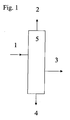
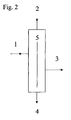
- Some possible embodiments are schematically shown in FIGS Fig. 1-3 shown.
- the Fig. 1 and 2 illustrate process variants in which the extraction of high purity MTBE be performed in a column.
- a conventional distillation column and the method according to Fig. 2 a dividing wall column is used.
- MTBE (technical grade) (1) is introduced into the distillation column (5).
- As the top product (2) a mixture of MTBE, methanol and water is removed.
- the bottom product (4) is a mixture of MTBE, tert-butyl alcohol (TBA), 2-methoxybutane (MSBE) and higher olefins.
- TSA tert-butyl alcohol
- MSBE 2-methoxybutane
- the high-purity MTBE (3) is taken off as a side take-off.
- MTBE in fuel quality (1) is introduced into the distillation column (2). Methanol and water are separated together with part of the MTBE as top product (3) and high-boiling impurities with the bottom (4).
- the side draw (5) is separated in the side column (6) in high-purity MTBE (7) and in a bottom product (8), which is returned to the first column. (Depending on the mode of operation of the secondary column (6), the side take-off (5) can be withdrawn in liquid or vapor form below or above the inlet (1).)
- MTBE is worked up to high purity MTBE in fuel grade.
- feedstocks are MTBE mixtures which may contain the low boilers methanol and water as adjuncts, as well as the high boilers TBA, oligomers of C 4 olefins, the alcohols derived therefrom and methyl ether and 2-methoxybutane (MSBE).
- a crude MTBE is used in the process according to the invention, which is obtained by reacting raffinate I or hydrogenated crack C 4 with methanol by known methods.
- This MTBE fuel grade typically has an MTBE content of 98 to 99.0 mass%, a C 8 hydrocarbons content of less than 0.5 mass%, a TBA of less than 1 mass%, a content of methanol of less than 1% by mass and a water content of less than 0.05% by mass and a content of 2-methoxybutane (MSBE) of up to 0.5% by mass.
- a pure MTBE (purity greater than 99.7%) containing 2-methoxybutane with less than 500 ppm by mass, in particular 100 to 300 Mass ppm be generated.
- an MTBE grade with less than 0.3% by mass of 2-methoxybutane as starting material.
- the production of an MTBE (fuel grade) with a 2-methoxybutane (MSBE) content of less than 0.25% by mass is described, for example, in US Pat DE 101 02 082.1 described.
- raw MTBE blends made by other means such as TBA and methanol may also be used.
- crude MTBE mixtures can also be worked up to give high-purity MTBE whose composition in this or that relationship does not correspond to the above information.
- the distillative recovery of high purity MTBE is carried out in one or more columns with internals consisting of trays, rotating internals, disordered and / or ordered packs.
- Columns used in the process according to the invention may have random beds with different packing. They can be made from almost all materials - steel, stainless steel, copper, carbon earthenware, porcelain, glass, plastics, etc. - and in various forms - spheres, rings with smooth or profiled surfaces, rings with inner webs or wall breakthroughs, wire mesh rings, calipers and spirals - consist.
- Packages with regular geometry may consist of sheets or fabrics, for example. Examples such packs are Sulzer metal or plastic BX packages, Sulzer lamellar packs Mellapack sheet metal, structural packings from Sulzer (Optiflow), Montz (BSH) and Kühni (Rombopack).
- the process of the invention can be carried out at reduced pressure, atmospheric pressure or overpressure.
- a preferred pressure range is 1.5-10 bar, especially 2-6 bar.
- the low boiler fraction consisting essentially of an MTBE / methanol azeotrope, is withdrawn at a head temperature which is between the boiling point of the MTBE / methanol azeotrope and the boiling point of the MTBE at distillation pressure.
- the high boiler fraction consisting mainly of MTBE and TBA is withdrawn at a temperature which is between the boiling point of the MTBE and the boiling point of the TBA at distillation pressure.
- the fractional distillation is carried out in a two-column system consisting of a main column and a side column, wherein the low boiler fraction is obtained as the top product and the high boiler fraction as the bottom product of the main column and the middle fraction in the side column with the desired MTBE purity of 99.7%.
- the MTBE with a purity of more than 99.7% can be obtained, depending on the mode of operation, as the top or bottom product of the side column.
- the other fractions, which do not contain the desired MTBE, can optionally be returned to the main column.
- One of these variants is in Fig. 3 outlined.
- the main column preferably has 20 to 100 theoretical plates, in particular 35 to 70 plates. Of these, usually accounting for 5 to 30 theoretical plates, in particular 10 to 20 plates on the rectifying section, 5 to 20 theoretical plates, in particular 5 to 15 plates on the Mitteilteil, and 10 to 50 theoretical plates, in particular 20 to 35 plates on the stripping section ,
- the main column is preferably operated at a reflux ratio of from 5 to 80, in particular from 10 to 50 kg / kg.
- the side column usually has 10 to 50 theoretical plates, in particular 20 to 35 plates.
- This column is preferably operated with a reflux ratio of 1 to 20, in particular with a from 2 to 10 kg / kg.
- the main column preferably has 25 to 130 theoretical plates, in particular 50 to 90 plates. Of these, as a rule, 5 to 30 theoretical plates, in particular 10 to 20 plates on the rectifying section, 10 to 50 theoretical plates, in particular 20 to 35 plates on the middle part, and 10 to 50 theoretical plates, in particular 20 to 35 plates on the stripping section ,
- the main column is preferably operated at a reflux ratio of from 30 to 600, in particular from 60 to 300 kg / kg
- the side column usually has 5 to 20 theoretical plates, in particular 5 to 15 plates.
- This column is preferably operated with a vapor deposition ratio of 0.2 to 2.5, in particular with a 0.4 to 1.5 kg / kg.
- the separated light-weight fraction contains up to 75% MTBE.
- the rest is essentially methanol. In addition, it may contain small amounts of water as well as C 4 and C 5 hydrocarbons.
- This stream can be fed into the synthesis reactor of an MTBE plant. If only a small portion of the raw MTBE (fuel grade) from an MTBE plant is upgraded to high purity MTBE, the low boiler fraction can be used as the fuel component.
- the high boiler fraction consists of more than 70%, mostly more than 85% MTBE.
- Farther contains TBA, 2-methoxybutane, oligomers of butenes and their derivatives. This fraction can also be used as a fuel component, optionally after hydrogenation of the olefins contained therein.
- the high-purity MTBE obtained by the process according to the invention has a purity of more than 99.7%, preferably 99.8%, particularly preferably 99.9%.
- the content of hydrocarbons is below 0.1, preferably below 0.02% by mass, the content of TBA below 0.05, preferably below 0.025% by mass, the content of methanol below 0.02, preferably below 0.01 mass -% and the content of water below 200, preferably below 100 ppm by mass. Because of its high purity, this MTBE can be used in the pharmaceutical sector, in analysis, as a solvent and extractant. It is particularly suitable as a solvent in organic syntheses, for example in the preparation of organometallic compounds and their reactions.
- MTBE which moreover has a content of 2-methoxybutane of less than 500 ppm by mass, is particularly suitable for the production of high-purity isobutene (by cleavage) in isobutene and methanol.
- Example 1 Separation of the low boilers from crude MTBE (fuel grade)
- the distillative removal of the low boilers was carried out continuously in a first 50 mm diameter column of the technical column.
- the column was filled with the Sulzer BX fabric packing and had 25 theoretical plates.
- Table 1 Composition of the streams in column 1 material
- Table 1 Composition in mass% column feed bottoms distillate C 4 / C 5 hydrocarbons 0.299 0.02 8,477 MTBE 97.897 98.741 73.164 2-methoxybutane 0.299 0.309 0,017 methanol 0,598 0,003 18.039 tert-butanol 0,798 0.825 0.001 water 0,010 ⁇ 0.001 0,302 C 8 hydrocarbons 0,100 0.103 ⁇ 0.001
- the distillative recovery of high-purity MTBE from the bottom product of the first column was carried out continuously in a second 50 mm diameter technical tower column.
- the column was filled with the Sulzer BX fabric packing and had 50 theoretical plates.
- Table 2 Composition of the streams in column 2 material Composition in mass% column feed bottoms distillate C 4 / C 5 hydrocarbons 0,021 ⁇ 0.001 0,025 MTBE 98.739 92.040 99.922 2-methoxybutane 0.309 1,775 0,050 methanol 0,003 ⁇ 0.001 0,004 tert-butanol 0.825 5,500 ⁇ 0.001 water ⁇ 0.001 ⁇ 0.001 ⁇ 0.001 C 8 hydrocarbons 0.103 0.687 ⁇ 0.001
- this MTBE is especially a good solvent for organometallic syntheses. Due to the low content of 2-methoxybutane, this MTBE is particularly suitable for the production of high-purity isobutene.
Landscapes
- Chemical & Material Sciences (AREA)
- Organic Chemistry (AREA)
- Crystallography & Structural Chemistry (AREA)
- Organic Low-Molecular-Weight Compounds And Preparation Thereof (AREA)
Description
- Die Erfindung betrifft ein Verfahren zur Herstellung von Methyl-tert.-butylether (MTBE) in Qualitäten, die für organische Synthesen und zur Verwendung als Speziallösemittel geeignet sind, aus MTBE in Kraftstoffqualität.
- Technisches MTBE ist eine gefragte Komponente in Kraftstoffen für Ottomotoren zur Erhöhung der Octanzahl. Dabei werden hinsichtlich der Reinheit keine allzu hohen Anforderungen gestellt. Der Gehalt an Methanol und tert.-Butanol darf jeweils bis zu 1 Massen-% betragen. Weiterhin kann technisches MTBE bis zu 0,5 Massen-% C4- bis C8-Kohlenwasserstoffe und bis zu 500 ppm Wasser enthalten (Produktinformation MTBE, Oxeno GmbH, 3/2001).
- Für den Pharmabereich und in der Analytik werden als Löse- und Extraktionsmittel hochreine Solvenzien verwendet. Bei der Herstellung von metallorganischen Verbindungen, beispielsweise Grignard-Verbindungen, und deren Umsetzungen werden nichtprotische Lösungsmittel mit Donoreigenschaften eingesetzt. Dazu werden häufig niedrige Ether, wie beispielsweise Diethylether, Diisopropylether, Tetrahydrofuran oder MTBE verwendet. Die drei zuerst genannten Ether haben den Nachteil einer niedrigen Zündtemperatur und eines weiten Explosionsbereichs. Weiterhin bilden sie in Gegenwart von Sauerstoff äußerst leicht Peroxide. Beispiele von Unfällen mit Peroxiden, sogar mit Todesfolge, sind aus der einschlägigen Literatur bekannt. Bei den meisten Anwendungen kann anstatt der zuerst genannten Ether MTBE eingesetzt werden. MTBE hat den Vorteil, dass es keine Peroxide bildet.
- MTBE wird aus isobutenhaltigen C4-Olefingemischen, beispielsweise dem C4-Schnitt aus Steamcrackern oder FCC-Einheiten, gewonnen. Diese Gemische bestehen im Wesentlichen aus Butadien, Isobuten, 1-Buten und den beiden 2-Butenen, sowie den gesättigten Kohlenwasserstoffen Isobutan und n-Butan. Übliche weltweit ausgeübte Aufarbeitungsverfahren für solche C4-Schnitte umfassen folgende Schritte: Zuerst wird der größte Teil des Butadiens entfernt. Kann Butadien gut vermarktet werden oder besteht ein Eigenverbrauch, wird es z. B. durch Extraktion oder Extraktionsdestillation abgetrennt. Im anderen Fall wird es bis zu Konzentrationen von 1 bis 0,1 Massen-% selektiv zu linearen Butenen hydriert. Zurück bleibt in beiden Fällen ein Kohlenwasserstoffgemisch (entsprechend Raffinat I bzw. hydriertes Crack-C4), das neben den gesättigten Kohlenwasserstoffen (n-Butan und Isobutan) die Olefine (Isobuten, 1-Buten und 2-Butene) enthält. Dieses Kohlenwasserstoffgemisch wird mit Methanol in Gegenwart eines sauren Katalysators, meistens im Festbett angeordnet, umgesetzt, wobei gemäß der Gleichgewichtslage aus dem größten Teil des Isobutens MTBE entsteht. Die weitere Aufarbeitung dieses Reaktionsgemisches erfolgt durch Destillation in einer Destillationskolonne oder in einer Reaktivdestillationskolonne. Als Sumpfprodukt wird in beiden Fällen ein technisches MTBE (Kraftstoffqualität) erhalten,
- Soll das so erhaltene technische MTBE höheren Reinheitsanforderungen genügen, so müssen die Verunreinigungen, hauptsächlich Methanol und Butanol abgetrennt werden.
- In der Literatur sind mehrere Verfahren zur Abtrennung von Methanol aus MTBE-Strömen bekannt. Bei einigen Verfahren wird das Methanol vor oder während der destillativen Trennung des Reaktionsgemisches der MTBE-Synthese entfernt. Bei anderen Verfahren wird das Methanol direkt aus dem technischen MTBE abgetrennt.
-
US 3 726 942 beschreibt ein MTBE-Verfahren, bei dem aus dem nach der Synthese durch Destillation gewonnenen Roh-MTBE Methanol durch Wasserwäsche entfernt wird.US 3 846 088 offenbart ein Verfahren, bei dem zunächst Methanol durch Extraktion mit Wasser aus dem Roh-MTBE entfernt wird und anschließend das im MTBE gelöste Wasser durch Azeotropdestillation mit C5-C10-Paraffinen abgetrennt wird. -
US 4 334 964 undUS 4 544 776 beschreiben Verfahren, bei denen das Methanol aus dem Reaktionsgemisch der MTBE-Synthese vor der destillativen Auftrennung mit Wasser ausgewaschen wird. -
US 4 605 787 offenbart ein MTBE-Verfahren, bei dem Methanol durch Adsorption an zeolithischen Molsieben (0,3 nm, 0,4 nm, 0,5 nm) aus dem durch Destillation gewonnenen Roh-MTBE abgetrennt wird. - Gemäß
EP 0 317 918 wird Methanol vor oder während der destillativen MTBE-Abtrennung mit Hilfe einer Membran entfernt. - Nach
DE 30 15 882 wird Methanol durch Extraktivdestillation aus Roh-MTBE abgetrennt. Als Extraktionsmittel wird dabei eine oder mehrere Verbindung aus den Gruppen der zwei-, dreiwertigen Alkohole, Aminoalkohole oder Dimethylformamid verwendet. - Die weitgehende Entfernung des im Roh-MTBE vorhandenen Methanols erfolgt nach
US 4 256 465 durch Abdestillieren des MTBE/Methanol-Azeotrops, unter Erhalt eines hochreinen MTBE-Stroms. Das Azeotrop kann in den MTBE-Synthesereaktor zurückgefahren werden. - Die oben genannten Verfahren haben den Mangel, dass sie zwar Methanol und ggf. Wasser aus dem Roh-MTBE entfernen, nicht jedoch andere Begleitstoffe, wie beispielsweise C8-Olefine, tert.- Butanol (TBA) oder 2-Methoxybutan (MSBE). Dies ist vermutlich darauf zurückzuführen, dass bei den bekannten Destillationsverfahren die Trennung so durchgeführt wird, dass MTBE als Sumpfprodukt (d. h. als Schwersieder) und ein Azeotrop von Methanol und MTBE bzw. ein Azeotrop von C4-Kohlenwasserstoffen mit Methanol als Kopfprodukt erhalten werden. Diese Trennung ist zur Herstellung von sehr reinem MTBE nicht geeignet, da MTBE und die Oligomerisierungsprodukte von Butenen (Di-Isobuten) in unzulässigen Mengen im MTBE verbleiben.
- Es bestand daher die Aufgabe, ein kostengünstiges Verfahren für die Herstellung von hochreinem Methyl-tert.-butylether aus technischen MTBE, (Kraftstoffqualität mit ca. 99 %iger Reinheit) zu entwickeln.
- Es wurde nun gefunden, dass die gewünschte Reinheit von MTBE erhalten werden kann, indem technisches MTBE destillativ in drei Fraktionen getrennt wird, nämlich eine Leichtsiederfiaktion, eine Mittelfraktion und eine Hochsiederfraktion. Die Leichtsiederfraktion enthält MTBE, Methanol, Wasser sowie geringe Mengen an C4- und C5-Komponenten. Die Mittelfraktion besteht aus MTBE in der gewünschten Reinheit. Die Hochsiederfraktion enthält neben MTBE tert.-Butylalkohol (TBA), Olefine, die durch Oligomerisierung von Butenen entstanden sind, Derivate dieser Olefine und/oder sonstige Nebenprodukte.
- Gegenstand der vorliegenden Erfindung ist daher ein Verfahren zur Herstellung von MTBE mit einer Reinheit größer als 99,7 % aus technischem MTBE durch fraktionierte Destillation, wobei das technische MTBE in eine Leichtsiederfraktion, enthaltend MTBE, Methanol und Wasser, eine Mittelfraktion enthaltend MTBE in einer Reinheit größer als 99,7 % und eine Hochsiederfraktion, enthaltend Butenoligomere und TBA getrennt wird. Hierbei wird die fraktionierte Destillation in einem Zweikolonnensystem, das aus einer Hauptkolonne und einer Seitenkolonne besteht, durchgeführt, wobei die Leichtsiederfraktion als Kopfprodukt und die Schwersiederfraktion als Sumpfprodukt der Hauptkolonne erhalten werden und die Mittelfraktion in der Seitenkolonne auf das MTBE mit einer Reinheit größer 99,7 % aufgereinigt wird.
- Mit dem Verfahren der Erfindung kann MTBE auch mit einer Reinheit größer 99,8 % oder 99,9 % erzeugt werden. Die Prozentangaben beziehen sich immer auf Massen-%. Das verwendete technische MTBE wird üblicherweise als Kraftstoffzuschlag eingesetzt und hat eine Reinheit von maximal 99,0 %.
- Die fraktionierte Destillation wird in mindestens zwei Kolonnen durchgeführt. Bevorzugt wird mindestens eine Trennwandkolonne eingesetzt.
- Die Trennwandkolonne ist eine Kolonne, die durch eine vertikale Wand in zwei Teile getrennt wird. Hierdurch können zwei Destillationsschritte in einem Apparat durchgeführt werden, so dass eine Kolonne, sowie ein oder zwei Wärmetauscher eingespart werden können.
- Das erfindungsgemäße Verfahren hat folgende Vorteile:
- Das Investment und die Betriebskosten sind relativ gering. Die anfallenden Leicht- und Hochsiederfraktionen können ohne Verluste in eine Anlage zur Herstellung von technischen MTBE (Kraftstoffqualität) zurückgeführt werden.
- Wenn das Produktionsmengenverhältnis von hochreinem MTBE zu MTBE mit Kraftstoffqualität gering ist, können sowohl die Leichtsieder-, als auch die Hochsiederfraktion in den Kraftstoff-MTBE-Strom zurückgeführt werden. Bei größeren Mengenverhältnissen kann die Leichtsiederfraktion in die MTBE-Synthese zurückgeführt werden, während die Hochsiederfraktion als Kraftstofflcomponente genutzt werden kann.
- Erfindungsgemäß wird die Abtrennung des hochreinen MTBE in einer oder mehreren Destillationskolonnen durchgeführt. Einige möglichen Ausführungsarten sind schematisch in den
Fig. 1-3 dargestellt. - Die
Fig. 1 und2 verdeutlichen Verfahrensvarianten, bei denen die Gewinnung von hochreinem MTBE in einer Kolonne durchgeführt werden. Der Unterschied dieser beiden Varianten besteht darin, dass bei dem Verfahren nachFig. 1 eine übliche Destillationskolonne und bei dem Verfahren nachFig. 2 eine Trennwandkolonne verwendet wird. MTBE (technische Qualität) (1) wird in die Destillationskolonne (5) eingeleitet. Als Kopfprodukt (2) wird ein Gemisch aus MTBE, Methanol und Wasser abgezogen. Als Sumpfprodukt (4) fällt ein Gemisch aus MTBE, tert.-Butylalkohol (TBA), 2-Methoxybutan (MSBE) und höhere Olefine an. Das hochreine MTBE (3) wird als Seitenabzug entnommen. - In der Verfahrensvariante nach
Fig. 3 wird MTBE in Kraftstoffqualität (1) in die Destillationskolonne (2) eingeleitet. Methanol und Wasser werden zusammen mit einem Teil des MTBE als Kopfprodukt (3) und hochsiedende Begleitstoffe mit dem Sumpf (4) abgetrennt. Der Seitenabzug (5) wird in der Seitenkolonne (6) in hochreines MTBE (7) und in ein Sumpfprodukt (8), das in die erste Kolonne zurückgeführt wird, aufgetrennt. (Dabei kann der Seitenabzug (5) je nach Fahrweise der Nebenkolonne (6) unterhalb oder oberhalb des Zulaufes (1) flüssig oder dampfförmig abgezogen werden.) - Nach dem erfindungsgemäßen Verfahren wird Roh-MTBE in Kraftstoffqualität zu hochreinem MTBE aufgearbeitet. Als Einsatzprodukte eignen sich MTBE-Gemische, die als Begleitstoffe die Leichtsieder Methanol und Wasser, sowie die Hochsieder TBA, Oligomere von C4-Olefinen, die davon abgeleiteten Alkohole und Methylether und 2-Methoxybutan (MSBE), enthalten können.
- Vorzugsweise wird im erfindungsgemäßen Verfahren ein Roh-MTBE eingesetzt, das durch Umsetzung von Raffinat I oder von hydriertem Crack-C4 mit Methanol nach bekannten Verfahren gewonnen wird. Dieses MTBE (Kraftstoffqualität) hat typischerweise einen MTBE-Gehalt von 98 bis 99,0 Massen-%, einen Gehalt an C8-Kohenwasserstoffe von weniger als 0,5 Massen-%, einen Gehalt an TBA von weniger als 1 Massen-%, einen Gehalt an Methanol von weniger als 1-Massen-% und einen Wassergehalt von weniger als 0,05 Massen-% sowie einen Gehalt von 2-Methoxybutan (MSBE) von bis zu 0,5 Massen-%.
- Mit dem erfindungsgemäßen Verfahren kann ein Rein-MTBE (Reinheit größer 99,7 %) mit einem Gehalt an 2-Methoxybutan mit weniger als 500 Massen-ppm, insbesondere 100 bis 300 Massen-ppm, erzeugt werden. Hierzu ist es zweckmäßig, aber nicht unbedingt erforderlich, eine MTBE-Qualität mit weniger als 0,3 Massen-% 2-Methoxybutan als Einsatzstoff zu verwenden. Die Herstellung eines MTBE (Kraftstoffqualität) mit einem 2-Methoxybutangehalt (MSBE) von unter 0,25 Massen-% wird beispielsweise in
DE 101 02 082.1 beschrieben. - Optional können auch Roh-MTBE-Gemische, die auf andere Art hergestellt wurden, wie beispielweise aus TBA und Methanol, verwendet werden.
- Es sei darauf hingewiesen, dass nach dem erfindungsgemäßen Verfahren auch Roh-MTBE-Gemische zu hochreinem MTBE aufgearbeitet werden können, deren Zusammensetzung in dieser oder jener Beziehung nicht den obigen Angaben entspricht.
- Die destillative Gewinnung von hochreinem MTBE wird in einer oder mehreren Kolonnen mit Einbauten, die aus Böden, rotierenden Einbauten, ungeordneten und/oder geordneten Packungen bestehen, durchgeführt.
- Bei den Kolonnenböden kommen folgende Typen zum Einsatz:
- Böden mit Bohrungen oder Schlitzen in der Bodenplatte.
- Böden mit Hälsen oder Kaminen, die von Glocken, Kappen oder Hauben überdeckt sind.
- Böden mit Bohrungen in der Bodenplatte, die von beweglichen Ventilen überdeckt sind.
- Böden mit Sonderkonstruktionen.
- In Kolonnen mit rotierenden Einbauten wird der Rücklauf entweder durch rotierende Trichter versprüht oder mit Hilfe eines Rotors als Film auf einer beheizten Rohrwand ausgebreitet.
- In dem erfindungsgemäßen Verfahren verwendete Kolonnen können regellose Schüttungen mit verschiedenen Füllkörpern aufweisen. Sie können aus fast allen Werkstoffen - Stahl, Edelstahl, Kupfer, Kohlenstoff Steingut, Porzellan, Glas, Kunststoffen usw. - und in verschiedenen Formen - Kugeln, Ringen mit glatten oder profilierten Oberflächen, Ringen mit Innenstegen oder Wanddurchbrüchen, Drahtnetzringen, Sattelkörper und Spiralen - bestehen.
- Packungen mit regelmäßiger Geometrie können z.B. aus Blechen oder Geweben bestehen. Beispiele solcher Packungen sind Sulzer Gewebepackungen BX aus Metall oder Kunststoff, Sulzer Lamellenpackungen Mellapack aus Metallblech, Strukturpackungen von Sulzer (Optiflow), Montz (BSH) und Kühni (Rombopack).
- Das erfindungsgemäße Verfahren kann bei Unterdruck, Normaldruck oder Überdruck durchgeführt werden. Ein bevorzugter Druckbereich ist 1,5-10 bar, insbesondere 2-6 bar.
- Die Leichtsiederfraktion, die im Wesentlichen aus einem MTBE/Methanol-Azeotrop besteht, wird bei einer Kopftemperatur abgezogen, die zwischen dem Siedepunkt des MTBE/Methanol-Azeotrops und dem Siedepunkt des MTBE bei Destillationsdruck liegt.
- Die Schwersiederfraktion, die hauptsächlich aus MTBE und TBA besteht, wird bei einer Temperatur abgezogen, die zwischen dem Siedepunkt des MTBE und dem Siedepunkt des TBA bei Destillationsdruck liegt.
- In einer speziellen Ausführung der Erfindung wird die fraktionierte Destillation in einem Zweikolonnensystem, das aus einer Hauptkolonne und einer Seitenkolonne besteht, durchgeführt, wobei die Leichtsiederfraktion als Kopfprodukt und die Schwersiederfraktion als Sumpfprodukt der Hauptkolonne erhalten werden und die Mittelfraktion in der Seitenkolonne auf das gewünschte MTBE mit einer Reinheit von 99,7 % aufgereinigt wird.
- Das MTBE mit einer Reinheit größer 99,7 % kann, je nach Fahrweise als Kopf oder Sumpfprodukt der Seitenkolonne erhalten werden. Die jeweils anderen Fraktionen, die nicht das gewünschte MTBE enthalten, können optional in die Hauptkolonne zurückgeführt werden. Eine dieser Varianten ist in
Fig. 3 skizziert. - Bei einer Anordnung des Seitenabzuges oberhalb des Feedbodens hat die Hauptkolonne bevorzugt 20 bis 100 theoretische Trennstufen, insbesondere 35 bis 70 Trennstufen. Davon entfallen in der Regel 5 bis 30 theoretische Trennstufen, insbesondere 10 bis 20 Trennstufen auf den Verstärkungsteil, 5 bis 20 theoretische Trennstufen, insbesondere 5 bis 15 Trennstufen auf den Mitteilteil, sowie 10 bis 50 theoretische Trennstufen, insbesondere 20 bis 35 Trennstufen auf den Abtriebsteil.
- Die Hauptkolonne wird bevorzugt mit einem Rücklaufverhältnis von 5 bis 80, insbesondere mit einem von 10 bis 50 kg/kg betrieben.
- Die Seitenkolonne hat meist 10 bis 50 theoretische Trennstufen, insbesondere 20 bis 35 Trennstufen. Diese Kolonne wird bevorzugt mit einem Rücklaufverhältnis von 1 bis 20, insbesondere mit einem von 2 bis 10 kg/kg betrieben.
- Wird der Seitenabzug der Hauptkolonne unterhalb des Feedbodens angeordnet, hat die Hauptkolonne bevorzugt 25 bis 130 theoretische Trennstufen, insbesondere 50 bis 90 Trennstufen. Davon entfallen in der Regel 5 bis 30 theoretische Trennstufen, insbesondere 10 bis 20 Trennstufen auf den Verstärkungsteil, 10 bis 50 theoretische Trennstufen, insbesondere 20 bis 35 Trennstufen auf den Mittelteil, sowie 10 bis 50 theoretische Trennstufen, insbesondere 20 bis 35 Trennstufen auf den Abtriebsteil.
- Bei dieser Anordnung wird die Hauptkolonne bevorzugt mit einem Rücklaufverhältnis von 30 bis 600, insbesondere mit einem von 60 bis 300 kg/kg betrieben
- Die Seitenkolonne hat dabei meist 5 bis 20 theoretische Trennstufen, insbesondere 5 bis 15 Trennstufen. Diese Kolonne wird bevorzugt mit einem Aufdampfverhältnis von 0,2 bis 2,5, insbesondere mit einem von 0,4 bis 1,5 kg/kg betrieben.
- Die abgetrennte Leichtsiedenraktion enthält bis zu 75 % MTBE. Der Rest ist im Wesentlichen Methanol. Darüber hinaus können in ihr geringe Mengen an Wasser sowie C4- und C5-Kohlenwasserstoffe enthalten sein. Dieser Strom kann in den Synthesereaktor einer MTBE-Anlage eingespeist werden. Wenn nur ein kleiner Teil des Roh-MTBE (Kraftstoff qualität) aus einer MTBE-Anlage zu hochreinem MTBE aufgearbeitet wird, kann die Leichtsiederfraktion als Kraftstoffkomponente verwendet werden.
- Es ist möglich, die Leicht- und/oder die Schwersiederfraktion in die fraktionierte Destillation, optional unter Ausschleusung eines Teilstroms zurückzuführen.
- Die Hochsiederfraktion besteht zu über 70 %, meistens zu über 85 % aus MTBE. Weiterhin enthält sie TBA, 2-Methoxybutan, Oligomere von Butenen und deren Derivate. Diese Fraktion kann, gegebenenfalls nach Hydrierung der darin enthaltenen Olefine, ebenfalls als Kraftstoffkomponente verwendet werden.
- Das nach dem erfindungsgemäßen Verfahren gewonnene hochreine MTBE hat eine Reinheit von über 99,7 %, bevorzugt 99,8 %, besonders bevorzugt 99,9 %. Der Gehalt an Kohlenwasserstoffen liegt unter 0,1, bevorzugt unter 0,02 Massen-%, der Gehalt an TBA unter 0,05, bevorzugt unter 0,025 Massen-%, der Gehalt an Methanol unter 0,02, bevorzugt unter 0,01 Massen-% und der Gehalt an Wasser unter 200, bevorzugt unter 100 Massen-ppm. Wegen seiner hohen Reinheit kann dieses MTBE im Pharmabereich, in der Analytik, als Löse- und Extraktionsmittel eingesetzt werden. Besonders geeignet ist es als Lösemittel in organischen Synthesen, beispielsweise bei der Herstellung von metallorganischen Verbindungen und deren Umsetzungen. MTBE, das darüber hinaus einen Gehalt an 2-Methoxybutan von weniger als 500 Massen-ppm aufweist, ist besonders gut für die Herstellung von hochreinem Isobuten (durch Rückspaltung) in Isobuten und Methanol geeignet.
- Ein solches Verfahren schließt sich zweckmäßig dem erfindungsgemäßen Verfahren zur MTBE-Aufreinigung an. Ein Verfahren zur Herstellung von hochreinem Isobuten durch katalytische Spaltung nach einem der Ansprüche 1 bis 10 hergestellten MTBE mit einer Reinheit von größer 99,7 % ist daher auch Gegenstand der vorliegenden Erfindung.
- Die folgenden Beispiele sollen die Erfindung erläutern, ohne ihre Anwendungsbreite einzuschränken, die sich aus der Beschreibung und den Patentansprüchen ergibt.
- Die destillative Abtrennung der Leichtsieder wurde kontinuierlich in einer ersten Technikumskolonne mit einem Durchmesser von 50 mm durchgeführt. Die Kolonne war mit der Gewebepackung Sulzer BX gefüllt und hatte 25 theoretische Trennstufen.
- Die Betriebsparameter waren wie folgt:
Zulaufmenge 14 kg/h Abgezogene Destillatmenge 0,5 kg/h Abgezogene Sumpfmenge 13,5 kg/h Zulauftemperatur 80°C Kopftemperatur 80,8 °C Sumpftemperatur 93,5 °C Druck (Kopf) 3 bar Zulaufboden 8. theoretische Trennstufe von unten Dampfbelastungsfaktor 0,75 Pa0,5 Flüssigkeitsbelastung 10-20 m3/(m2*h) Rücklaufverhältnis 6 kg/kg - Die Zusammensetzung von Kolonnenzufluss, Destillat und Sumpfprodukt wurde in Tabelle 1 zusammengefasst.
Tabelle 1: Zusammensetzung der Stoffströme in Kolonne 1 Stoff Zusammensetzung in Massen-% Kolonnenzulauf Sumpfprodukt Destillat C4/C5-Kohlenwasserstoffe 0,299 0,02 8,477 MTBE 97,897 98,741 73,164 2-Methoxybutan 0,299 0,309 0,017 Methanol 0,598 0,003 18,039 tert.-Butanol 0,798 0,825 0,001 Wasser 0,010 < 0,001 0,302 C8-Kohlenwasserstoffe 0,100 0,103 < 0,001 - Es wurde ein praktisch Wasser- und Methanol-freies MTBE als Sumpfprodukt abgetrennt.
- Die destillative Gewinnung des hochreinen MTBE aus dem Sumpfprodukt der ersten Kolonne wurde kontinuierlich in einer zweitenTechnikumskolonne mit einem Durchmesser von 50 mm durchgeführt. Die Kolonne war mit der Gewebepackung Sulzer BX gefüllt und hatte 50 theoretische Trennstufen.
- Die Betriebsparameter waren wie folgt:
Zulaufmenge 2,5 kg/h Abgezogene Destillatmenge 2,1 kg/h Abgezogene Sumpfmenge 0,4 kg/h Zulauftemperatur 94,7 °C Kopftemperatur 71,7 °C Sumpftemperatur 74,0 °C Druck (Kopf) 1,7 bar Zulaufboden 24. Trennstufe von unten Dampfbelastungsfaktor 0,75 Pa0,5 Flüssigkeitsbelastung 10m3/(m2/h) Rücklaufverhältnis 6 kg/kg - Die Zusammensetzung von Kolonnenzufluss, Destillat und Sumpfprodukt wurde in Tabelle 2 zusammengefasst.
Tabelle 2: Zusammensetzung der Stoffströme in Kolonne 2 Stoff Zusammensetzung in Massen-% Kolonnenzulauf Sumpfprodukt Destillat C4/C5-Kohlenwasserstoffe 0,021 <0,001 0,025 MTBE 98,739 92,040 99,922 2-Methoxybutan 0,309 1,775 0,050 Methanol 0,003 <0,001 0,004 tert.-Butanol 0,825 5,500 <0,001 Wasser <0,001 <0,001 <0,001 C8-Kohlenwasserstoffe 0,103 0,687 <0,001 - Es wurde ein MTBE in einer Reinheit von über 99,9 % als Destillat erhalten.Wegen seines geringen Gehalt an protischen Begleitstoffen (Wasser, Methanol, tert.-Butanol) ist dieses MTBE insbesondere ein gutes Lösemittel für metallorganische Synthesen. Wegen des geringen Gehalts an 2-Methoxybutan ist dieses MTBE besonders für die Herstellung von hochreinem Isobuten geeignet.
Claims (9)
- Verfahren zur Herstellung von MTBE mit einer Reinheit größer als 99,7 % aus technischem MTBE durch fraktionierte Destillation,
dadurch gekennzeichnet,
dass das technische MTBE in eine Leichtsiederfraktion, enthaltend MTBE, Methanol und Wasser, eine Mittelfraktion enthaltend MTBE in einer Reinheit größer als 99,7 % und eine Hochsiederfraktion, enthaltend TBA und Butenoligomere, getrennt wird, wobei die fraktionierte Destillation in einem Zweikolonnensystem, das aus einer Hauptkolonne und einer Seitenkolonne besteht, durchgeführt wird, und wobei die Leichtsiederfraktion als Kopfprodukt und die Schwersiederfraktion als Sumpfprodukt der Hauptkolonne erhalten werden und die Mittelfraktion in der Seitenkolonne auf das MTBE mit einer Reinheit größer 99,7 % aufgereinigt wird - Verfahren nach Anspruch 1,
dadurch gekennzeichnet,
dass die fraktionierte Destillation in mindestens einer Trennwandkolonne durchgeführt wird. - Verfahren nach Anspruch 1 oder 2,
dadurch gekennzeichnet,
dass das MTBE mit einer Reinheit größer 99,7 % als Kopfprodukt der Seitenkolonne erhalten wird. - Verfahren nach Anspruch 3,
dadurch gekennzeichnet,
dass das MTBE mit einer Reinheit größer 99,7 % als Sumpfprodukt der Seitenkolonne erhalten wird. - Verfahren nach einem der Ansprüche 1 bis 4,
dadurch gekennzeichnet,
dass die Fraktion der Seitenkolonne, die nicht das MTBE mit einer Reinheit größer 99,7 % enthält, in die Hauptkolonne zurückgeführt wird. - Verfahren nach einem der Ansprüche 1 bis 5,
dadurch gekennzeichnet,
dass das MTBE mit einer Reinheit größer 99,7 % einen Gehalt an 2-Methoxybutan von weniger als 500 Massen-ppm aufweist. - Verfahren nach einem der Ansprüche 1 bis 6,
dadurch gekennzeichnet,
dass die Leichtsiederfraktion in die fraktionierte Destillation zurückgeführt wird. - Verfahren nach einem der Ansprüche 1 bis 7,
dadurch gekennzeichnet,
dass die Hochsiederfraktion in die fraktionierte Destillation zurückgeführt wird. - Verfahren zur Herstellung von hochreinem Isobuten durch katalytische Spaltung des nach einem der Ansprüche 1 bis 8 hergestellten MTBE mit einer Reinheit von größer 99,7 %.
Applications Claiming Priority (3)
| Application Number | Priority Date | Filing Date | Title |
|---|---|---|---|
| DE10231051A DE10231051A1 (de) | 2002-07-10 | 2002-07-10 | Verfahren zur Herstellung von hochreinem Methyl-tert.-butylether |
| DE10231051 | 2002-07-10 | ||
| PCT/EP2003/006300 WO2004007412A1 (de) | 2002-07-10 | 2003-06-14 | Verfahren zur herstellung von hochreinem methyl-tert.-butylether |
Publications (2)
| Publication Number | Publication Date |
|---|---|
| EP1519906A1 EP1519906A1 (de) | 2005-04-06 |
| EP1519906B1 true EP1519906B1 (de) | 2009-02-25 |
Family
ID=29761818
Family Applications (1)
| Application Number | Title | Priority Date | Filing Date |
|---|---|---|---|
| EP03763642A Expired - Lifetime EP1519906B1 (de) | 2002-07-10 | 2003-06-14 | Verfahren zur herstellung von hochreinem methyl-tert.-butylether |
Country Status (11)
| Country | Link |
|---|---|
| US (1) | US7304188B2 (de) |
| EP (1) | EP1519906B1 (de) |
| JP (1) | JP4376182B2 (de) |
| KR (1) | KR100990628B1 (de) |
| CN (1) | CN100376529C (de) |
| AT (1) | ATE423756T1 (de) |
| AU (1) | AU2003242706A1 (de) |
| DE (2) | DE10231051A1 (de) |
| ES (1) | ES2322453T3 (de) |
| TW (1) | TWI306093B (de) |
| WO (1) | WO2004007412A1 (de) |
Families Citing this family (28)
| Publication number | Priority date | Publication date | Assignee | Title |
|---|---|---|---|---|
| DE10231051A1 (de) | 2002-07-10 | 2004-01-22 | Oxeno Olefinchemie Gmbh | Verfahren zur Herstellung von hochreinem Methyl-tert.-butylether |
| DE102005062722A1 (de) * | 2005-12-28 | 2007-07-12 | Oxeno Olefinchemie Gmbh | Verfahren zur Herstellung von Ethyl-tert.-Butylether aus technischen Mischungen von C4-Kohlenwasserstoffen |
| DE102005062700A1 (de) | 2005-12-28 | 2007-07-05 | Oxeno Olefinchemie Gmbh | Verfahren zur Herstellung von 1-Buten aus technischen Mischungen von C4-Kohlenwasserstoffen |
| DE102005062699A1 (de) * | 2005-12-28 | 2007-09-06 | Oxeno Olefinchemie Gmbh | Verfahren zur Feinreinigung von 1-Buten-haltigen Strömen |
| DE102006003492A1 (de) * | 2006-01-25 | 2007-07-26 | Oxeno Olefinchemie Gmbh | Verfahren zur Entwässerung von Ethanol |
| DE102006033415A1 (de) * | 2006-07-19 | 2008-01-31 | Oxeno Olefinchemie Gmbh | Verfahren zur Herstellung von Alkyl-tert.-butylethern mit optimierter Temperaturführung in den Reaktoren |
| DE102006040432A1 (de) * | 2006-08-29 | 2008-03-20 | Oxeno Olefinchemie Gmbh | Katalysator und Verfahren zur Herstellung von Isoolefinen |
| DE102006040434A1 (de) * | 2006-08-29 | 2008-03-06 | Oxeno Olefinchemie Gmbh | Verfahren zur Spaltung von MTBE |
| DE102006040430B4 (de) | 2006-08-29 | 2022-06-15 | Evonik Operations Gmbh | Verfahren zur Spaltung von MTBE |
| DE102006040431A1 (de) * | 2006-08-29 | 2008-03-20 | Oxeno Olefinchemie Gmbh | Verfahren zur Spaltung von MTBE |
| DE102006040433A1 (de) * | 2006-08-29 | 2008-03-13 | Oxeno Olefinchemie Gmbh | Verfahren zur Herstellung von Isoolefinen |
| BRPI0808893A2 (pt) * | 2007-03-14 | 2015-03-24 | Endicott Biofuels Ii Llc | Produção de combustíveis de biodiesel que possuem baixos níveis de glicerina e de enxofre |
| WO2008112910A1 (en) | 2007-03-14 | 2008-09-18 | Endicott Biofuels Ii, Llc | Methods for producing triol ethers by reactive distillation |
| WO2009017958A1 (en) | 2007-07-31 | 2009-02-05 | Endicott Biofuels Ii, Llc | Production of renewable diesel by pyrolysis and esterification |
| WO2009017957A1 (en) * | 2007-07-31 | 2009-02-05 | Endicott Biofuels Ii, Llc | Production of alkyl esters from high fatty acid feedstocks |
| US20090049739A1 (en) * | 2007-07-31 | 2009-02-26 | Endicott Biiofuels Ii, Llc | Production of Fuels with Superior Low Temperature Properties from Tall Oil or Fractionated Fatty Acids |
| US20090031618A1 (en) * | 2007-07-31 | 2009-02-05 | Endicott Biofuels Ii, Llc | Vacuum Distillation Process |
| US8105398B2 (en) * | 2007-08-27 | 2012-01-31 | Endicott Biofuels Ii, Llc | Production of ester-based fuels such as biodiesel from renewable starting materials |
| WO2009038865A1 (en) * | 2007-09-19 | 2009-03-26 | Endicott Biofuels Ii, Llc | Method for obtaining biodiesel, alternative fuels and renewable fuels tax credits and treatment |
| US20090076985A1 (en) * | 2007-09-19 | 2009-03-19 | Endicott Biofuels Ii, Llc | Method for Obtaining Biodiesel, Alternative Fuels and Renewable Fuels Tax Credits and Treatment |
| DE102010042774A1 (de) * | 2010-10-21 | 2012-04-26 | Evonik Oxeno Gmbh | Verfahren zur Aufreinigung von MTBE-haltigen Gemischen sowie zur Herstellung von Isobuten durch Spaltung von MTBE-haltigen Gemischen |
| CN104250205B (zh) * | 2013-06-25 | 2016-04-13 | 中国石油化工股份有限公司 | 甲基叔丁基醚的制备方法及其装置 |
| TWI580669B (zh) * | 2015-08-31 | 2017-05-01 | 台灣中油股份有限公司 | 二元醇第三丁基醚之合成方法 |
| CN106673946B (zh) * | 2015-11-10 | 2019-06-11 | 中国石油化工股份有限公司 | 一种mtbe和tba混合料制备异丁烯的方法 |
| EP3333146A1 (de) | 2016-12-08 | 2018-06-13 | Evonik Degussa GmbH | Kostengünstige herstellung von hochreinem methyl-tert.-butylether |
| KR102086563B1 (ko) | 2017-01-06 | 2020-03-09 | 주식회사 엘지화학 | 메틸 3급-부틸 에테르 제조방법 |
| MX2021002940A (es) * | 2018-09-12 | 2021-05-27 | Lummus Technology Inc | Uso de tecnologia de pared dividida para producir metanol de alta pureza. |
| WO2025265143A1 (en) * | 2024-06-21 | 2025-12-26 | Lummus Technology Llc | Concurrent production of high purity mtbe and high purity isobutylene with dividing wall column |
Family Cites Families (9)
| Publication number | Priority date | Publication date | Assignee | Title |
|---|---|---|---|---|
| US4182913A (en) * | 1976-11-22 | 1980-01-08 | Nippon Oil Company Ltd. | Method for producing methyl tert-butyl ether and fuel composition containing the same |
| US4918244A (en) * | 1987-05-04 | 1990-04-17 | Texaco Inc. | Preparation of MTBE from TBA and methanol |
| EP0466954A1 (de) * | 1990-07-17 | 1992-01-22 | CHEMICAL RESEARCH & LICENSING COMPANY | Katalytische Destillation |
| US5210327A (en) * | 1992-05-15 | 1993-05-11 | Uop | Etherification with skeletal olefin isomerization |
| FR2711986B1 (fr) * | 1993-11-05 | 1996-02-02 | Inst Francais Du Petrole | Procédé de séparation des composés oxygénés d'hydrocarbures, combinant une distillation et une perméation et son utilisation en éthérification. |
| DE10102082A1 (de) | 2000-10-19 | 2002-05-02 | Oxeno Olefinchemie Gmbh | Verfahren zur Herstellung von hochreinem Raffinat II und Methyl-tert.-butylether |
| DE10113381A1 (de) | 2001-02-13 | 2002-08-14 | Oxeno Olefinchemie Gmbh | Verfahren zur Herstellung von hochreinem Diisobuten |
| DE10231051A1 (de) | 2002-07-10 | 2004-01-22 | Oxeno Olefinchemie Gmbh | Verfahren zur Herstellung von hochreinem Methyl-tert.-butylether |
| EP1388528B1 (de) | 2002-08-06 | 2015-04-08 | Evonik Degussa GmbH | Verfahren zur Oligomerisierung von Isobuten in n-Buten-haltigen Kohlenwasserstoffströmen |
-
2002
- 2002-07-10 DE DE10231051A patent/DE10231051A1/de not_active Withdrawn
-
2003
- 2003-06-14 KR KR1020057000331A patent/KR100990628B1/ko not_active Expired - Fee Related
- 2003-06-14 JP JP2004520398A patent/JP4376182B2/ja not_active Expired - Fee Related
- 2003-06-14 EP EP03763642A patent/EP1519906B1/de not_active Expired - Lifetime
- 2003-06-14 ES ES03763642T patent/ES2322453T3/es not_active Expired - Lifetime
- 2003-06-14 CN CNB038162385A patent/CN100376529C/zh not_active Expired - Fee Related
- 2003-06-14 AU AU2003242706A patent/AU2003242706A1/en not_active Abandoned
- 2003-06-14 DE DE50311220T patent/DE50311220D1/de not_active Expired - Lifetime
- 2003-06-14 AT AT03763642T patent/ATE423756T1/de not_active IP Right Cessation
- 2003-06-14 US US10/519,397 patent/US7304188B2/en not_active Expired - Lifetime
- 2003-06-14 WO PCT/EP2003/006300 patent/WO2004007412A1/de not_active Ceased
- 2003-07-04 TW TW092118387A patent/TWI306093B/zh not_active IP Right Cessation
Also Published As
| Publication number | Publication date |
|---|---|
| US20060264681A1 (en) | 2006-11-23 |
| KR20050025948A (ko) | 2005-03-14 |
| US7304188B2 (en) | 2007-12-04 |
| ATE423756T1 (de) | 2009-03-15 |
| JP2005532400A (ja) | 2005-10-27 |
| WO2004007412A1 (de) | 2004-01-22 |
| EP1519906A1 (de) | 2005-04-06 |
| AU2003242706A1 (en) | 2004-02-02 |
| KR100990628B1 (ko) | 2010-10-29 |
| TW200418777A (en) | 2004-10-01 |
| ES2322453T3 (es) | 2009-06-22 |
| CN1665766A (zh) | 2005-09-07 |
| JP4376182B2 (ja) | 2009-12-02 |
| TWI306093B (en) | 2009-02-11 |
| DE50311220D1 (de) | 2009-04-09 |
| CN100376529C (zh) | 2008-03-26 |
| DE10231051A1 (de) | 2004-01-22 |
Similar Documents
| Publication | Publication Date | Title |
|---|---|---|
| EP1519906A1 (de) | Verfahren zur herstellung von hochreinem methyl-tert.-butylether | |
| DE102008007081B4 (de) | Verfahren zur Herstellung von n-Buten-Oligomeren und 1-Buten aus technischen Mischungen I von C4-Kohlenwasserstoffen | |
| EP2300397B1 (de) | Verfahren zur herstellung von isobuten durch spaltung von mtbe-haltigen gemischen | |
| DE3884352T2 (de) | Pervaporationsverfahren zur Trennung von Alkoholen von Äthern. | |
| EP1806330B1 (de) | Verfahren zur Herstellung von 1-Buten aus technischen Mischungen von C4-Kohlenwasserstoffen | |
| EP1199296B1 (de) | Verfahren zur Herstellung von hochreinem Raffinat II und Methyl-tert.-butylether | |
| EP1813588B1 (de) | Verfahren zur Herstellung von Ethyl-tert.-Butylether aus technischen Mischungen von C4-Kohlenwasserstoffen | |
| EP2630110B1 (de) | Verfahren zur aufreinigung von mtbe-haltigen gemischen sowie zur herstellung von isobuten durch spaltung von mtbe-haltigen gemischen | |
| EP1826193A1 (de) | Verfahren zur Entwässerung von Ethanol | |
| EP2545019B1 (de) | Verfahren zur destillativen gewinnung von rein-1,3-butadien aus roh-1,3-butadien | |
| WO2004018393A1 (de) | Verfahren zur herstellung von isobuten aus technischen methyl-tert.-butylether | |
| BE1018143A5 (de) | Verfahren zur herstellung von alkyl-tert-butylether und hochreinem raffinat ii. | |
| EP0726241B1 (de) | Verfahren zur Spaltung von Tertiärbutylalkohol in einer Reaktionsdestillationskolonne | |
| EP1462433B1 (de) | Verfahren zur Abtrennung von 2-Butanol aus tert.-Butanol/Wasser-Gemischen | |
| EP1575886B1 (de) | Verfahren zur herstellung von tert.-butanol mittels reaktivrektifikation | |
| EP1911736B1 (de) | Verfahren zur Herstellung von Alkyl-tert.-butylethern mit optimierter Temperaturführung in den Reaktoren | |
| DE3112277A1 (de) | Verfahren zur gewinnung von c(pfeil abwaerts)2(pfeil abwaerts)- bis c(pfeil abwaerts)4(pfeil abwaerts)-alkoholen aus deren waessrigen gemischen | |
| EP4660179A1 (de) | Verfahren zur herstellung von hochreinem 1-buten und von hochreinem isobutan | |
| DE2828664A1 (de) | Verfahren zum reinigen von methyl- tert.-butylaether von methanol | |
| DE10033958A1 (de) | Verfahren zur Reaktivdestillation |
Legal Events
| Date | Code | Title | Description |
|---|---|---|---|
| PUAI | Public reference made under article 153(3) epc to a published international application that has entered the european phase |
Free format text: ORIGINAL CODE: 0009012 |
|
| 17P | Request for examination filed |
Effective date: 20041206 |
|
| AK | Designated contracting states |
Kind code of ref document: A1 Designated state(s): AT BE BG CH CY CZ DE DK EE ES FI FR GB GR HU IE IT LI LU MC NL PT RO SE SI SK TR |
|
| AX | Request for extension of the european patent |
Extension state: AL LT LV MK |
|
| DAX | Request for extension of the european patent (deleted) | ||
| RIN1 | Information on inventor provided before grant (corrected) |
Inventor name: FILIPIAK, RICHARD Inventor name: DROSTE, WILHELM Inventor name: OBENAUS, FRITZ Inventor name: SCHOLZ, BERNHARD Inventor name: PETERS, UDO Inventor name: NEUMEISTER, JOACHIM Inventor name: NIERLICH, FRANZ Inventor name: PRAEFKE, JOCHEN Inventor name: MALZKORN, RAINER |
|
| 17Q | First examination report despatched |
Effective date: 20080529 |
|
| RAP1 | Party data changed (applicant data changed or rights of an application transferred) |
Owner name: EVONIK OXENO GMBH |
|
| GRAP | Despatch of communication of intention to grant a patent |
Free format text: ORIGINAL CODE: EPIDOSNIGR1 |
|
| GRAS | Grant fee paid |
Free format text: ORIGINAL CODE: EPIDOSNIGR3 |
|
| GRAA | (expected) grant |
Free format text: ORIGINAL CODE: 0009210 |
|
| AK | Designated contracting states |
Kind code of ref document: B1 Designated state(s): AT BE BG CH CY CZ DE DK EE ES FI FR GB GR HU IE IT LI LU MC NL PT RO SE SI SK TR |
|
| REG | Reference to a national code |
Ref country code: GB Ref legal event code: FG4D Free format text: NOT ENGLISH |
|
| REG | Reference to a national code |
Ref country code: CH Ref legal event code: EP |
|
| REG | Reference to a national code |
Ref country code: IE Ref legal event code: FG4D Free format text: LANGUAGE OF EP DOCUMENT: GERMAN |
|
| REF | Corresponds to: |
Ref document number: 50311220 Country of ref document: DE Date of ref document: 20090409 Kind code of ref document: P |
|
| REG | Reference to a national code |
Ref country code: ES Ref legal event code: FG2A Ref document number: 2322453 Country of ref document: ES Kind code of ref document: T3 |
|
| PG25 | Lapsed in a contracting state [announced via postgrant information from national office to epo] |
Ref country code: SI Free format text: LAPSE BECAUSE OF FAILURE TO SUBMIT A TRANSLATION OF THE DESCRIPTION OR TO PAY THE FEE WITHIN THE PRESCRIBED TIME-LIMIT Effective date: 20090225 Ref country code: FI Free format text: LAPSE BECAUSE OF FAILURE TO SUBMIT A TRANSLATION OF THE DESCRIPTION OR TO PAY THE FEE WITHIN THE PRESCRIBED TIME-LIMIT Effective date: 20090225 |
|
| PG25 | Lapsed in a contracting state [announced via postgrant information from national office to epo] |
Ref country code: SE Free format text: LAPSE BECAUSE OF FAILURE TO SUBMIT A TRANSLATION OF THE DESCRIPTION OR TO PAY THE FEE WITHIN THE PRESCRIBED TIME-LIMIT Effective date: 20090525 |
|
| REG | Reference to a national code |
Ref country code: IE Ref legal event code: FD4D |
|
| PG25 | Lapsed in a contracting state [announced via postgrant information from national office to epo] |
Ref country code: PT Free format text: LAPSE BECAUSE OF FAILURE TO SUBMIT A TRANSLATION OF THE DESCRIPTION OR TO PAY THE FEE WITHIN THE PRESCRIBED TIME-LIMIT Effective date: 20090812 Ref country code: CZ Free format text: LAPSE BECAUSE OF FAILURE TO SUBMIT A TRANSLATION OF THE DESCRIPTION OR TO PAY THE FEE WITHIN THE PRESCRIBED TIME-LIMIT Effective date: 20090225 Ref country code: DK Free format text: LAPSE BECAUSE OF FAILURE TO SUBMIT A TRANSLATION OF THE DESCRIPTION OR TO PAY THE FEE WITHIN THE PRESCRIBED TIME-LIMIT Effective date: 20090225 Ref country code: EE Free format text: LAPSE BECAUSE OF FAILURE TO SUBMIT A TRANSLATION OF THE DESCRIPTION OR TO PAY THE FEE WITHIN THE PRESCRIBED TIME-LIMIT Effective date: 20090225 Ref country code: IE Free format text: LAPSE BECAUSE OF FAILURE TO SUBMIT A TRANSLATION OF THE DESCRIPTION OR TO PAY THE FEE WITHIN THE PRESCRIBED TIME-LIMIT Effective date: 20090225 |
|
| PG25 | Lapsed in a contracting state [announced via postgrant information from national office to epo] |
Ref country code: SK Free format text: LAPSE BECAUSE OF FAILURE TO SUBMIT A TRANSLATION OF THE DESCRIPTION OR TO PAY THE FEE WITHIN THE PRESCRIBED TIME-LIMIT Effective date: 20090225 Ref country code: RO Free format text: LAPSE BECAUSE OF FAILURE TO SUBMIT A TRANSLATION OF THE DESCRIPTION OR TO PAY THE FEE WITHIN THE PRESCRIBED TIME-LIMIT Effective date: 20090225 |
|
| PLBE | No opposition filed within time limit |
Free format text: ORIGINAL CODE: 0009261 |
|
| STAA | Information on the status of an ep patent application or granted ep patent |
Free format text: STATUS: NO OPPOSITION FILED WITHIN TIME LIMIT |
|
| PG25 | Lapsed in a contracting state [announced via postgrant information from national office to epo] |
Ref country code: MC Free format text: LAPSE BECAUSE OF NON-PAYMENT OF DUE FEES Effective date: 20090630 Ref country code: BG Free format text: LAPSE BECAUSE OF FAILURE TO SUBMIT A TRANSLATION OF THE DESCRIPTION OR TO PAY THE FEE WITHIN THE PRESCRIBED TIME-LIMIT Effective date: 20090525 |
|
| REG | Reference to a national code |
Ref country code: CH Ref legal event code: PL |
|
| 26N | No opposition filed |
Effective date: 20091126 |
|
| PG25 | Lapsed in a contracting state [announced via postgrant information from national office to epo] |
Ref country code: CH Free format text: LAPSE BECAUSE OF NON-PAYMENT OF DUE FEES Effective date: 20090630 Ref country code: LI Free format text: LAPSE BECAUSE OF NON-PAYMENT OF DUE FEES Effective date: 20090630 |
|
| PG25 | Lapsed in a contracting state [announced via postgrant information from national office to epo] |
Ref country code: AT Free format text: LAPSE BECAUSE OF NON-PAYMENT OF DUE FEES Effective date: 20090614 |
|
| PG25 | Lapsed in a contracting state [announced via postgrant information from national office to epo] |
Ref country code: GR Free format text: LAPSE BECAUSE OF FAILURE TO SUBMIT A TRANSLATION OF THE DESCRIPTION OR TO PAY THE FEE WITHIN THE PRESCRIBED TIME-LIMIT Effective date: 20090526 |
|
| PG25 | Lapsed in a contracting state [announced via postgrant information from national office to epo] |
Ref country code: LU Free format text: LAPSE BECAUSE OF NON-PAYMENT OF DUE FEES Effective date: 20090614 |
|
| PG25 | Lapsed in a contracting state [announced via postgrant information from national office to epo] |
Ref country code: HU Free format text: LAPSE BECAUSE OF FAILURE TO SUBMIT A TRANSLATION OF THE DESCRIPTION OR TO PAY THE FEE WITHIN THE PRESCRIBED TIME-LIMIT Effective date: 20090826 |
|
| PG25 | Lapsed in a contracting state [announced via postgrant information from national office to epo] |
Ref country code: TR Free format text: LAPSE BECAUSE OF FAILURE TO SUBMIT A TRANSLATION OF THE DESCRIPTION OR TO PAY THE FEE WITHIN THE PRESCRIBED TIME-LIMIT Effective date: 20090225 |
|
| PG25 | Lapsed in a contracting state [announced via postgrant information from national office to epo] |
Ref country code: CY Free format text: LAPSE BECAUSE OF FAILURE TO SUBMIT A TRANSLATION OF THE DESCRIPTION OR TO PAY THE FEE WITHIN THE PRESCRIBED TIME-LIMIT Effective date: 20090225 |
|
| REG | Reference to a national code |
Ref country code: DE Ref legal event code: R081 Ref document number: 50311220 Country of ref document: DE Owner name: EVONIK DEGUSSA GMBH, DE Free format text: FORMER OWNER: EVONIK OXENO GMBH, 45772 MARL, DE Effective date: 20130905 |
|
| REG | Reference to a national code |
Ref country code: GB Ref legal event code: 732E Free format text: REGISTERED BETWEEN 20140327 AND 20140402 |
|
| REG | Reference to a national code |
Ref country code: ES Ref legal event code: PC2A Owner name: EVONIK DEGUSSA GMBH Effective date: 20140424 |
|
| REG | Reference to a national code |
Ref country code: NL Ref legal event code: SD Effective date: 20140502 |
|
| REG | Reference to a national code |
Ref country code: FR Ref legal event code: TP Owner name: EVONIK DEGUSSA GMBH, DE Effective date: 20140411 |
|
| REG | Reference to a national code |
Ref country code: ES Ref legal event code: PC2A Owner name: EVONIK DEGUSSA GMBH. Effective date: 20141008 |
|
| REG | Reference to a national code |
Ref country code: FR Ref legal event code: PLFP Year of fee payment: 13 |
|
| REG | Reference to a national code |
Ref country code: FR Ref legal event code: PLFP Year of fee payment: 14 |
|
| REG | Reference to a national code |
Ref country code: FR Ref legal event code: PLFP Year of fee payment: 15 |
|
| REG | Reference to a national code |
Ref country code: FR Ref legal event code: PLFP Year of fee payment: 16 |
|
| PGFP | Annual fee paid to national office [announced via postgrant information from national office to epo] |
Ref country code: NL Payment date: 20190327 Year of fee payment: 12 Ref country code: IT Payment date: 20190624 Year of fee payment: 17 |
|
| PGFP | Annual fee paid to national office [announced via postgrant information from national office to epo] |
Ref country code: FR Payment date: 20190619 Year of fee payment: 17 Ref country code: BE Payment date: 20190619 Year of fee payment: 17 |
|
| PGFP | Annual fee paid to national office [announced via postgrant information from national office to epo] |
Ref country code: GB Payment date: 20190619 Year of fee payment: 17 Ref country code: ES Payment date: 20190719 Year of fee payment: 17 |
|
| REG | Reference to a national code |
Ref country code: DE Ref legal event code: R081 Ref document number: 50311220 Country of ref document: DE Owner name: EVONIK OPERATIONS GMBH, DE Free format text: FORMER OWNER: EVONIK DEGUSSA GMBH, 45128 ESSEN, DE |
|
| REG | Reference to a national code |
Ref country code: BE Ref legal event code: HC Owner name: EVONIK OPERATIONS GMBH; DE Free format text: DETAILS ASSIGNMENT: CHANGE OF OWNER(S), CHANGEMENT DE NOM DU PROPRIETAIRE Effective date: 20200403 |
|
| REG | Reference to a national code |
Ref country code: NL Ref legal event code: HC Owner name: EVONIK OPERATIONS GMBH; DE Free format text: DETAILS ASSIGNMENT: CHANGE OF OWNER(S), CHANGE OF OWNER(S) NAME Effective date: 20200928 |
|
| REG | Reference to a national code |
Ref country code: NL Ref legal event code: MM Effective date: 20200701 |
|
| GBPC | Gb: european patent ceased through non-payment of renewal fee |
Effective date: 20200614 |
|
| REG | Reference to a national code |
Ref country code: BE Ref legal event code: MM Effective date: 20200630 |
|
| PG25 | Lapsed in a contracting state [announced via postgrant information from national office to epo] |
Ref country code: GB Free format text: LAPSE BECAUSE OF NON-PAYMENT OF DUE FEES Effective date: 20200614 Ref country code: FR Free format text: LAPSE BECAUSE OF NON-PAYMENT OF DUE FEES Effective date: 20200630 Ref country code: NL Free format text: LAPSE BECAUSE OF NON-PAYMENT OF DUE FEES Effective date: 20200701 |
|
| PG25 | Lapsed in a contracting state [announced via postgrant information from national office to epo] |
Ref country code: BE Free format text: LAPSE BECAUSE OF NON-PAYMENT OF DUE FEES Effective date: 20200630 |
|
| REG | Reference to a national code |
Ref country code: ES Ref legal event code: FD2A Effective date: 20211027 |
|
| PG25 | Lapsed in a contracting state [announced via postgrant information from national office to epo] |
Ref country code: IT Free format text: LAPSE BECAUSE OF NON-PAYMENT OF DUE FEES Effective date: 20200614 |
|
| PG25 | Lapsed in a contracting state [announced via postgrant information from national office to epo] |
Ref country code: ES Free format text: LAPSE BECAUSE OF NON-PAYMENT OF DUE FEES Effective date: 20200615 |
|
| PGFP | Annual fee paid to national office [announced via postgrant information from national office to epo] |
Ref country code: DE Payment date: 20220620 Year of fee payment: 20 |
|
| REG | Reference to a national code |
Ref country code: DE Ref legal event code: R071 Ref document number: 50311220 Country of ref document: DE |
|
| P01 | Opt-out of the competence of the unified patent court (upc) registered |
Effective date: 20230526 |