EP1518563B1 - Méthode pour stériliser un ballon, p. ex. d'un cathéter à ballonnet, au moyen de rayons ionisants - Google Patents
Méthode pour stériliser un ballon, p. ex. d'un cathéter à ballonnet, au moyen de rayons ionisants Download PDFInfo
- Publication number
- EP1518563B1 EP1518563B1 EP04022703A EP04022703A EP1518563B1 EP 1518563 B1 EP1518563 B1 EP 1518563B1 EP 04022703 A EP04022703 A EP 04022703A EP 04022703 A EP04022703 A EP 04022703A EP 1518563 B1 EP1518563 B1 EP 1518563B1
- Authority
- EP
- European Patent Office
- Prior art keywords
- balloon
- pouch
- ionizing radiation
- oxygen
- sterilization
- Prior art date
- Legal status (The legal status is an assumption and is not a legal conclusion. Google has not performed a legal analysis and makes no representation as to the accuracy of the status listed.)
- Expired - Lifetime
Links
Images
Classifications
-
- A—HUMAN NECESSITIES
- A61—MEDICAL OR VETERINARY SCIENCE; HYGIENE
- A61L—METHODS OR APPARATUS FOR STERILISING MATERIALS OR OBJECTS IN GENERAL; DISINFECTION, STERILISATION OR DEODORISATION OF AIR; CHEMICAL ASPECTS OF BANDAGES, DRESSINGS, ABSORBENT PADS OR SURGICAL ARTICLES; MATERIALS FOR BANDAGES, DRESSINGS, ABSORBENT PADS OR SURGICAL ARTICLES
- A61L2/00—Disinfection or sterilisation of materials or objects, in general; Accessories therefor
- A61L2/02—Disinfection or sterilisation of materials or objects, in general; Accessories therefor using physical processes
- A61L2/08—Radiation
- A61L2/087—Particle radiation, e.g. electron-beam, alpha or beta radiation
-
- A—HUMAN NECESSITIES
- A61—MEDICAL OR VETERINARY SCIENCE; HYGIENE
- A61L—METHODS OR APPARATUS FOR STERILISING MATERIALS OR OBJECTS IN GENERAL; DISINFECTION, STERILISATION OR DEODORISATION OF AIR; CHEMICAL ASPECTS OF BANDAGES, DRESSINGS, ABSORBENT PADS OR SURGICAL ARTICLES; MATERIALS FOR BANDAGES, DRESSINGS, ABSORBENT PADS OR SURGICAL ARTICLES
- A61L2/00—Disinfection or sterilisation of materials or objects, in general; Accessories therefor
- A61L2/02—Disinfection or sterilisation of materials or objects, in general; Accessories therefor using physical processes
- A61L2/08—Radiation
- A61L2/081—Gamma radiation
-
- A—HUMAN NECESSITIES
- A61—MEDICAL OR VETERINARY SCIENCE; HYGIENE
- A61L—METHODS OR APPARATUS FOR STERILISING MATERIALS OR OBJECTS IN GENERAL; DISINFECTION, STERILISATION OR DEODORISATION OF AIR; CHEMICAL ASPECTS OF BANDAGES, DRESSINGS, ABSORBENT PADS OR SURGICAL ARTICLES; MATERIALS FOR BANDAGES, DRESSINGS, ABSORBENT PADS OR SURGICAL ARTICLES
- A61L29/00—Materials for catheters, medical tubing, cannulae, or endoscopes or for coating catheters
- A61L29/14—Materials characterised by their function or physical properties, e.g. lubricating compositions
-
- B—PERFORMING OPERATIONS; TRANSPORTING
- B32—LAYERED PRODUCTS
- B32B—LAYERED PRODUCTS, i.e. PRODUCTS BUILT-UP OF STRATA OF FLAT OR NON-FLAT, e.g. CELLULAR OR HONEYCOMB, FORM
- B32B27/00—Layered products comprising a layer of synthetic resin
- B32B27/12—Layered products comprising a layer of synthetic resin next to a fibrous or filamentary layer
-
- B—PERFORMING OPERATIONS; TRANSPORTING
- B32—LAYERED PRODUCTS
- B32B—LAYERED PRODUCTS, i.e. PRODUCTS BUILT-UP OF STRATA OF FLAT OR NON-FLAT, e.g. CELLULAR OR HONEYCOMB, FORM
- B32B27/00—Layered products comprising a layer of synthetic resin
- B32B27/34—Layered products comprising a layer of synthetic resin comprising polyamides
-
- B—PERFORMING OPERATIONS; TRANSPORTING
- B32—LAYERED PRODUCTS
- B32B—LAYERED PRODUCTS, i.e. PRODUCTS BUILT-UP OF STRATA OF FLAT OR NON-FLAT, e.g. CELLULAR OR HONEYCOMB, FORM
- B32B27/00—Layered products comprising a layer of synthetic resin
- B32B27/36—Layered products comprising a layer of synthetic resin comprising polyesters
-
- B—PERFORMING OPERATIONS; TRANSPORTING
- B65—CONVEYING; PACKING; STORING; HANDLING THIN OR FILAMENTARY MATERIAL
- B65B—MACHINES, APPARATUS OR DEVICES FOR, OR METHODS OF, PACKAGING ARTICLES OR MATERIALS; UNPACKING
- B65B55/00—Preserving, protecting or purifying packages or package contents in association with packaging
- B65B55/02—Sterilising, e.g. of complete packages
- B65B55/12—Sterilising contents prior to, or during, packaging
- B65B55/16—Sterilising contents prior to, or during, packaging by irradiation
-
- A—HUMAN NECESSITIES
- A61—MEDICAL OR VETERINARY SCIENCE; HYGIENE
- A61L—METHODS OR APPARATUS FOR STERILISING MATERIALS OR OBJECTS IN GENERAL; DISINFECTION, STERILISATION OR DEODORISATION OF AIR; CHEMICAL ASPECTS OF BANDAGES, DRESSINGS, ABSORBENT PADS OR SURGICAL ARTICLES; MATERIALS FOR BANDAGES, DRESSINGS, ABSORBENT PADS OR SURGICAL ARTICLES
- A61L2103/00—Materials or objects being the target of disinfection or sterilisation
- A61L2103/15—Laboratory, medical or dentistry appliances, e.g. catheters or sharps
-
- B—PERFORMING OPERATIONS; TRANSPORTING
- B32—LAYERED PRODUCTS
- B32B—LAYERED PRODUCTS, i.e. PRODUCTS BUILT-UP OF STRATA OF FLAT OR NON-FLAT, e.g. CELLULAR OR HONEYCOMB, FORM
- B32B2250/00—Layers arrangement
- B32B2250/40—Symmetrical or sandwich layers, e.g. ABA, ABCBA, ABCCBA
-
- B—PERFORMING OPERATIONS; TRANSPORTING
- B32—LAYERED PRODUCTS
- B32B—LAYERED PRODUCTS, i.e. PRODUCTS BUILT-UP OF STRATA OF FLAT OR NON-FLAT, e.g. CELLULAR OR HONEYCOMB, FORM
- B32B2307/00—Properties of the layers or laminate
- B32B2307/70—Other properties
- B32B2307/74—Oxygen absorber
-
- B—PERFORMING OPERATIONS; TRANSPORTING
- B32—LAYERED PRODUCTS
- B32B—LAYERED PRODUCTS, i.e. PRODUCTS BUILT-UP OF STRATA OF FLAT OR NON-FLAT, e.g. CELLULAR OR HONEYCOMB, FORM
- B32B2439/00—Containers; Receptacles
- B32B2439/80—Medical packaging
Definitions
- This invention relates to intravascular balloon catheters and, in particular, the use of ionizing radiation for the sterilization of such devices.
- Surgical procedures employing balloons and medical devices incorporating those balloons have become routine. These procedures, such as angioplasty procedures, are conducted on narrow or obstructed openings in blood vessels, and other passageways in the body, to increase the flow through the obstructed areas. For example, in an angioplasty procedure, a dilatation balloon catheter is used to enlarge or open an occluded blood vessel which is partially restricted or obstructed due to the existence of a hardened stenosis or buildup within the vessel.
- This procedure requires that a balloon catheter be inserted into the patient's body and positioned within the vessel so that the balloon, when inflated, will dilate the site of the obstruction or stenosis so that the obstruction or stenosis is minimized, thereby resulting in increased blood flow through the vessel.
- Measurable characteristics of balloons in general, and more specifically of dilatation balloons include distensibility (the percent radial expansion with increased pressure), elastic stress response (repeatability of obtaining the same diameter at the same pressure during repeated inflation-deflation cycles), flexibility, tensile strength and optical clarity.
- balloons are increasingly being used to manufacture balloons, particularly dilatation balloons. It has been found that balloons can be formed by processing a polymeric material composed of polymer chains having sufficient regions of molecular structure with inter-molecular chain interaction to ensure the integrity and strength of the structure, as well as sufficient regions which permit sections of the polymer chains to "uncoil" to permit growth.
- Such balloons are (i) sufficiently distensible (i.e., about 5 to about 20%) to allow treatment of various sized arteries, (ii) have a high degree of elastic stress response (i.e., less than about 5.00), which permits the physician to treat multiple stenoses within the same artery without having to be concerned with increasing balloon diameter after repeated inflations, and (iii) have strength sufficient to treat hardened stenoses (i.e., greater than about 14,000 psi (96.5 MPa)). Therefore, balloons formed by such methods have an overall advantageous combination of these physical properties i.e., distensibility, elastic stress response and tensile strength, that are superior to those exhibited by other balloons of the related art.
- the sterilization method of the present invention may be used with balloons made from any material that is degraded by radiation doses typically used in ionizing radiation sterilization.
- Ethylene oxide sterilization is one method for sterilization of heat-sensitive or moisture-sensitive medical instruments including dilatation balloons and dilatation balloon catheters.
- ethylene oxide is highly flammable and explosive in air and must be used in an explosion-proof sterilizing chamber in a controlled environment.
- Ethylene oxide is also readily absorbed by many polymers and is not always easily desorbed or eliminated.
- Toxic emissions and residues of ethylene oxide present hazards to personnel, patients and the environment.
- the processing conditions employed during the ethylene oxide sterilization process can alter the composition and morphology of some polymeric materials, and hence their mechanical properties.
- ionizing radiation is used to designate the emission of electrons or highly accelerated, relatively heavy, nuclear particles such as protons, neutrons, alpha particles, deuterons, beta particles, or their analogs, directed in such a way that the particle is projected into the mass to be irradiated.
- Radiation sterilization includes the use of ultraviolet rays, electron beams, x-rays, gamma rays, and to a limited extent, gas plasma and microwave radiation.
- Sterilization by ionizing radiation is usually carried by using either gamma radiation, from Cobalt or Cesium sources, or electron beam (E-beam) irradiation.
- gamma radiation from Cobalt or Cesium sources
- E-beam electron beam
- One difference between the two sources is the dose rate or exposure time over which the dose is delivered.
- the dose rate for E-beam irradiation can be as high as 20 kGy/s compared to 1-10 kGy/hrs for Gamma radiation. Hence the exposure times are often considerably shorter for E-beam sterilization than for sterilization by gamma radiation.
- Sterilization by ionizing radiation is a consequence of the high-energy electrons released from the interaction of Gamma-ray photons or electron-beam particles with the material being sterilized.
- many secondary electrons and free radicals can be created in the vicinity of the original interaction site.
- the cascade is propagated until all the excess energy above the ionization threshold is dissipated.
- a shower of secondary electrons is generated.
- the high-energy photons and electrons can also initiate unwanted ionization events in polymeric material during sterilization.
- the effects vary greatly with the chemical structure of the polymer and the employed dose of radiation. Alterations in molecular structure, caused by the ionization processes, are manifested as changes in physical and mechanical properties of the polymer.
- the two major mechanisms of degradation that occur during the irradiation process are: (1) chain scission of the polymer molecule resulting in a reduction in molecular weight and (2) cross-linking of the polymer molecules which can lead to the formation of three dimensional network structures.
- the chemical composition of the polymer largely dictates the degradation mechanism, although the two mechanisms can sometimes occur simultaneously with the final properties being dictated by the net-effect.
- the degradation process is initiated when high-energy radiation interacts with the hydrocarbon polymeric molecule to generate macro-radicals, shown in the following reaction, where R-H is the polymer molecule and R • is the "cleaved" polymer chain which forms during irradiation:
- R-H is the polymer molecule
- R • is the "cleaved" polymer chain which forms during irradiation:
- Polymeric macro-radicals (R • ) rapidly combine with environmental oxygen, which is a very efficient radical scavenger, to form peroxide radicals as shown by the following reaction:
- Polymeric peroxide radicals (RO 2 • ) can then react with another hydrocarbon polymeric molecule to further propagate the degradation process:
- ionizing irradiation has been found to have a negative impact on the properties of dilatation balloons manufactured from certain polymers, such as polyamide block copolymers. Resultant physical changes can include embrittlement, discoloration, odor generation, stiffening, softening, enhancement of chemical resistance, and an increase or decrease in melt temperature.
- Various high-performance stabilizers have been found to be ineffective in preserving the physical properties of these polymers, probably due to high rates of the degradation reactions. Therefore, alternative methods and devices are needed to minimize the damage caused by ionizing radiation during sterilization of susceptible polymers.
- the invention in one aspect, provides a method of sterilizing a balloon susceptible to degradation by ionizing radiation, comprising: (a) packaging said balloon in a pouch capable of providing a barrier to atmospheric oxygen; (b) exposing said balloon enclosed in said pouch to a nitrogen gas flush sufficient to reduce the oxygen content in said pouch; and (c) exposing said balloon enclosed in said pouch to ionizing radiation, thereby avoiding the concomitant degradation associated with sterilization at atmospheric oxygen levels, and further wherein said pouch comprises: (a) a first layer comprising 12 ⁇ PET, 25.4 ⁇ WPE/Fol/Adhesive and 50 ⁇ Clear EZ Peel ® material; (b) a second layer comprising 2FS Uncoated Tyvek ® material, porosity 18-240 seconds by the Gurley porosimeter test; and (c) a third layer comprising 12 ⁇ PET, 25.4 ⁇ WPE/Foil/Adhesive and 50 ⁇ Clear EZ Peel ® material; wherein said second layer is between said first and third layers.
- Still another object of this invention is to provide a method whereby the environmental oxygen content is reduced during sterilization of balloons by ionizing radiation, thereby preventing and attenuating degradation reactions of polymeric materials.
- step (b) the nitrogen gas flush is sufficient to reduce the oxygen content within said pouch to less than 10%; and in step (c) said ionizing radiation is either gamma radiation or electron beam radiation at a dose of no greater than 100 kGy.
- the present invention contemplates a novel sterilization process for balloons manufactured from polyamide block copolymers or other polymers susceptible to degradation reactions induced by ionizing radiation.
- balloons and balloon catheters of the invention are packaged in a pouch capable of maintaining a low level of oxygen and a sterile environment within said pouch.
- the novel sterilization process also contemplates subjecting balloons and balloon catheters of the invention packaged in a pouch of the invention to an inert gas (e.g., nitrogen) to reduce oxygen content.
- an inert gas e.g., nitrogen
- the present invention provides a novel method of sterilization by ionizing radiation which will not adversely affect, to any significant degree, the desirable properties of dilatation balloons manufactured from polymers susceptible to degradation reactions.
- the balloons used in the novel sterilization process include balloons made from polymeric materials comprising regions of crystalline and rubbery material, referred to as "hard” and “soft” segments respectively.
- polymeric materials which have these alternating zones or regions include block copolymers, and physical mixtures of different polymers.
- block copolymers which may be used include polyester block copolymers, polyamide block copolymers and polyurethane block copolymers, and mixtures thereof.
- the mixtures which may be used include mixtures of nylon and polyamide block copolymers and polyethylene terephthalate and polyester block copolymers.
- the preferred block copolymer which can be used in accordance with the method of this invention is polyamide block copolymer.
- Commercially available polyamide block copolymers for use in the manufacture of balloons used in this invention include PEBAX ® material available from Atofina Chemicals, Inc. (Philadelphia, PA), VESTAMID ® material available from Huls America, Inc. (Piscataway, NJ), and GRILON ® material available from EMS-Chemie AG (Domat/EMS, Switzerland).
- the primary objective of the stabilization method is to reduce the oxygen concentration in the immediate environment of the susceptible polymer and product.
- a pouch is made, in accordance with the present invention, of a first layer comprising a material such as 12 ⁇ PET, 25.4 ⁇ WPE/Foil/Adhesive and 50 ⁇ Clear EZ Peel ® material; a second layer comprising a material such as 2FS Uncoated Tyvek ® material, porosity 18-240 seconds by the Gurley porosimeter test (100cc of air to pass through 1 square inch of Tyvek ® material); and a third layer comprising a material such as 12 ⁇ PET, 25.4 ⁇ WPE/Foil/Adhesive and 50 ⁇ Clear EZ Peel ® material (Perfecseal Ltd., Springtown Industrial Estate, Londonderry, BT48 0LY, Northern Ireland, UK); wherein the second layer is between the first and third layer
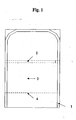
- FIG. 1 shows a preferred pouch suitable for use with the present invention.
- the preferred outer dimensions of the pouch are 250 mm ⁇ 2 mm and 375 mm ⁇ 2 mm.
- the oxygen absorber may be inserted through a pouch lip 4 preferably positioned 70 mm ⁇ 2 mm from the outer edge of the pouch.
- the above-mentioned oxygen absorber includes a variety of known materials such as those containing iron or a compound of iron, such as iron hydroxide, iron oxide, iron carbide, etc., as an active component.
- Typical commercial products of this type are AGELESSTM (manufactured by Mitsubishi Gas Chemical), MODURANTM (manufactured by Nippon Kayaku), and SECURTM (manufactured by Nippon Soda).
- the oxygen absorber shall be capable of withstanding a sterilization procedure by means of ionizing irradiation without being impaired and can be accommodated together with the pouch of the invention as is, or as prepackaged in a gas-permeable small bag.
- nitrogen gas flush and vacuum draw are used to reduce environmental oxygen content according to the following conditions described in example 1 below.
- the oxygen levels in the immediate environment of the susceptible polymer within the pouch are reduced to prevent and attenuate degradation reactions during ionizing radiation sterilization. It is preferred that the resulting oxygen content within the pouch is less than about 10%. Typically, the oxygen content is between about 5% and about 10%. Most preferably, the oxygen content is less than about 1%. Nitrogen flush pressure is typically about 10 psi (68.9 kPa), with higher pressures near about 30 psi preferred to achieve oxygen levels below about 1%.
- the sterilization method of the invention further comprises the use of ionizing radiation as a safer and more economic alternative to ethylene oxide sterilization.
- Sterilization by ionizing radiation can be performed by gamma irradiation, from Cobalt or Cesium sources, or electron beam (E-beam) irradiation.
- An example of a preferred method for ionizing irradiation comprises exposure to E-beam irradiation at about 50 kGy.
- the sterilization process is an important factor in determining the final physical characteristics of the balloons and balloon catheters of this invention. Therefore, the novel sterilization process is necessary to ensure a clinically useful and safe finished balloon and balloon catheter with preserved mechanical properties superior to those exhibited by the balloons sterilized with conventional methods.
- a pouch was made of a first layer comprising 12 ⁇ PET, 25.4 ⁇ WPE/Foil/Adhesive and 50 ⁇ Clear EZ Peel ® material; a second layer comprising 2FS Uncoated Tyvek ® material, porosity 18-240 seconds by the Gurley porosimeter test (100cc of air to pass through 1 square inch of Tyvek ® material); and a third layer comprising 12 ⁇ PET, 25.4 ⁇ WPE/Foil/Adhesive and 50 ⁇ Clear EZ Peel ® material; wherein the second layer was between the first and third layers.
- the Oxygen level within the pouch is reduced by a combination of nitrogen flush and vacuum draw-down with the final value being determined by the pressures and the times used in the evacuation and flushing processes.
- the actual sealing/flushing conditions used for this trial were as follows:
- Polyamide block copolymer balloons were packaged in a pouch as set forth in Example 1 and sterilized using E-beam dose of 50 ⁇ 8% KGy.
- Example 2 The following example demonstrates the improved balloon strength obtained by sterilization methods of this invention.
- Samples of polyamide block copolymer balloons were packaged as described in Example 1 or in standard Tyvek ® material pouches. The balloons were subjected to the sterilization process contemplated by this invention and described in Example 2.
Landscapes
- Health & Medical Sciences (AREA)
- General Health & Medical Sciences (AREA)
- Epidemiology (AREA)
- Life Sciences & Earth Sciences (AREA)
- Animal Behavior & Ethology (AREA)
- Public Health (AREA)
- Veterinary Medicine (AREA)
- Toxicology (AREA)
- Engineering & Computer Science (AREA)
- Mechanical Engineering (AREA)
- Materials For Medical Uses (AREA)
- Apparatus For Disinfection Or Sterilisation (AREA)
Claims (11)
- Procédé de stérilisation d'un ballonnet susceptible de se dégrader par rayonnement ionisant, consistant à :(a) emballer ledit ballonnet dans une poche capable de constituer une barrière contre l'oxygène atmosphérique et comprenant un absorbeur d'oxygène ;(b) exposer ledit ballonnet enfermé dans ladite poche à une purge à l'azote suffisante pour réduire le taux d'oxygène de ladite poche ; et à(c) exposer ledit ballonnet enfermé dans ladite poche à des rayonnements ionisants, évitant ainsi la dégradation concomitante associée à la stérilisation à certains taux d'oxygène atmosphérique, et en outre dans lequel ladite poche comprend : (a) une première couche comprenant 12µ de PET, 25,4µ WPE (weight per epoxy equivalent)/feuille/adhésif et 50µ de matériel EZ Peel® transparent;(b) une deuxième couche comprenant 2FS de Tyvek® non revêtu, une porosité comprise entre 18 et 240 secondes selon le test du porosimètre de Gurley ; et(c) une troisième couche comprenant 12µ de PET, 25,4µ WPE (weight per epoxy equivalent)/feuille/adhésif et 50µ de matériel EZ Peel® transparent;dans lequel ladite deuxième couche est située entre les première et troisième couches.
- Procédé selon la revendication 1 de stérilisation d'un ballonnet susceptible de se dégrader par rayonnement ionisant, consistant en outre à :(b) exposer ledit ballonnet enfermé dans ladite poche à une purge à l'azote suffisante pour réduire le taux d'oxygène de ladite poche à moins de 10 % ; et à(c) exposer ledit ballonnet enfermé dans ladite poche à des rayonnements ionisants, dans lequel lesdits rayonnements ionisants sont des rayonnements gamma ou des rayonnements par faisceau d'électrons à une dose maximum de 100 kGy.
- Procédé selon la revendication 1, dans lequel lesdits rayonnements ionisants sont des rayonnements gamma ou des rayonnements par faisceau d'électrons.
- Procédé selon la revendication 3, dans lequel lesdits rayonnements ionisants sont des rayonnements gamma administrés à un débit de dose compris entre 1 kGy/heure et 10 kGy/heure.
- Procédé selon la revendication 3, dans lequel lesdits rayonnements ionisants sont des rayonnements par faisceau d'électrons administrés à un débit de dose maximum de 20 kGy/s.
- Procédé selon l'une quelconque des revendications 2 à 5, dans lequel ladite purge à l'azote est administrée à une pression inférieure à 10 psi (68,9 kPa) et ledit taux d'oxygène est inférieur à 10 %.
- Procédé selon l'une quelconque des revendications précédentes, dans lequel ledit ballonnet fait partie d'un cathéter de dilatation à ballonnet.
- Procédé selon l'une quelconque des revendications précédentes, dans lequel ledit ballonnet est constitué d'un ou de plusieurs polymères séquencés sélectionnés dans le groupe constitué de copolymères séquencés de polyester, de copolymères séquencés de polyamide, de copolymères séquencés de polyuréthane, d'un mélange de copolymères séquencés de nylon et de polyamide et d'un mélange de copolymères séquencés de polyéthylène téréphtalate et de polyester.
- Procédé selon l'une quelconque des revendications précédentes, dans lequel ledit taux d'oxygène est compris entre 5 % et 10 %.
- Procédé selon l'une quelconque des revendications 1 à 12, dans lequel ledit taux d'oxygène est inférieur à 1 %.
- Procédé selon l'une quelconque des revendications précédentes dans lequel ladite poche comprend en outre un absorbeur d'oxygène.
Applications Claiming Priority (2)
| Application Number | Priority Date | Filing Date | Title |
|---|---|---|---|
| US671946 | 2003-09-29 | ||
| US10/671,946 US7695674B2 (en) | 2003-09-29 | 2003-09-29 | Method of sterilizing balloon with ionizing radiation |
Publications (2)
| Publication Number | Publication Date |
|---|---|
| EP1518563A1 EP1518563A1 (fr) | 2005-03-30 |
| EP1518563B1 true EP1518563B1 (fr) | 2009-07-08 |
Family
ID=34194857
Family Applications (1)
| Application Number | Title | Priority Date | Filing Date |
|---|---|---|---|
| EP04022703A Expired - Lifetime EP1518563B1 (fr) | 2003-09-29 | 2004-09-23 | Méthode pour stériliser un ballon, p. ex. d'un cathéter à ballonnet, au moyen de rayons ionisants |
Country Status (3)
| Country | Link |
|---|---|
| US (1) | US7695674B2 (fr) |
| EP (1) | EP1518563B1 (fr) |
| DE (1) | DE602004021884D1 (fr) |
Cited By (1)
| Publication number | Priority date | Publication date | Assignee | Title |
|---|---|---|---|---|
| KR20110053909A (ko) * | 2009-11-16 | 2011-05-24 | 코디스 코포레이션 | 생활성 코팅을 포함하는 의료 장치의 전자빔 살균 |
Families Citing this family (8)
| Publication number | Priority date | Publication date | Assignee | Title |
|---|---|---|---|---|
| ATE422852T1 (de) * | 2004-12-08 | 2009-03-15 | Perfecseal Inc | Sterilisierbares paket mit hoher sauerstoffbarriere |
| WO2007105067A1 (fr) * | 2006-03-14 | 2007-09-20 | Arterial Remodeling Technologies, S.A. | Procédé destiné à commander le positionnement de stents polymères |
| US8034287B2 (en) * | 2006-06-01 | 2011-10-11 | Abbott Cardiovascular Systems Inc. | Radiation sterilization of medical devices |
| US7520108B2 (en) | 2006-06-13 | 2009-04-21 | Tetra Laval Holdings & Finance Sa | Method of sterilizing packages |
| SE530589C2 (sv) * | 2006-12-11 | 2008-07-15 | Tetra Laval Holdings & Finance | Metod att bestråla föremål |
| US7959857B2 (en) | 2007-06-01 | 2011-06-14 | Abbott Cardiovascular Systems Inc. | Radiation sterilization of medical devices |
| JP2014516695A (ja) | 2011-05-18 | 2014-07-17 | バトリックス・メディカル・インコーポレイテッド | 血管安定化用被覆バルーン |
| US11077287B2 (en) | 2017-10-02 | 2021-08-03 | Anlvr, Llc | Non-occluding balloon for cardiovascular drug delivery |
Family Cites Families (15)
| Publication number | Priority date | Publication date | Assignee | Title |
|---|---|---|---|---|
| US4179338A (en) | 1977-09-19 | 1979-12-18 | Gordon Maurice R | Microbiological medium suitable for sterilization by ionizing radiation |
| FR2491871A1 (fr) | 1980-10-10 | 1982-04-16 | Ato Chimie | Perfectionnement a la sterilisation d'objets en polymeres halogeno-vinyliques par des rayonnements ionisants, et resines pour sa realisation |
| US4778656A (en) | 1984-02-10 | 1988-10-18 | General Electric Company | Method for enhancing ionizing radiation |
| JPS6274364A (ja) | 1985-09-27 | 1987-04-06 | 株式会社 ニツシヨ− | 医療用具 |
| US5014494A (en) | 1988-09-27 | 1991-05-14 | Sherwood Medical Company | Method of sterilizing medical articles |
| US5137688A (en) | 1990-11-29 | 1992-08-11 | General Electric Company | Irradiated articles molded from polycarbonate-polyamide blends |
| WO1993005825A1 (fr) | 1991-09-20 | 1993-04-01 | Baxter International Inc. | Procedes permettant de reduire la thrombogenicite de biomateriaux |
| SE9401986D0 (sv) | 1994-06-08 | 1994-06-08 | Pharmacia Ab | New process for sterilization and articles sterilized thereby |
| US5554120A (en) | 1994-07-25 | 1996-09-10 | Advanced Cardiovascular Systems, Inc. | Polymer blends for use in making medical devices including catheters and balloons for dilatation catheters |
| US5577368A (en) | 1995-04-03 | 1996-11-26 | Johnson & Johnson Professional, Inc. | Method for improving wear resistance of polymeric bioimplantable components |
| US5674292A (en) | 1995-06-07 | 1997-10-07 | Stryker Corporation | Terminally sterilized osteogenic devices and preparation thereof |
| US6520323B1 (en) * | 1998-10-29 | 2003-02-18 | Tres Fresh, Llc | Packaging system for extending the shelf life of food |
| US7150853B2 (en) | 2001-11-01 | 2006-12-19 | Advanced Cardiovascular Systems, Inc. | Method of sterilizing a medical device |
| EP2671538A1 (fr) * | 2003-01-16 | 2013-12-11 | Massachusetts General Hospital | Procédés de fabrication de matériau polymère résistant à l'oxydation |
| EP1589902A1 (fr) * | 2003-01-27 | 2005-11-02 | Medtronic Vascular Connaught | Emballage ameliore pour systemes de pose d'endoprothese |
-
2003
- 2003-09-29 US US10/671,946 patent/US7695674B2/en not_active Expired - Lifetime
-
2004
- 2004-09-23 DE DE602004021884T patent/DE602004021884D1/de not_active Expired - Lifetime
- 2004-09-23 EP EP04022703A patent/EP1518563B1/fr not_active Expired - Lifetime
Cited By (1)
| Publication number | Priority date | Publication date | Assignee | Title |
|---|---|---|---|---|
| KR20110053909A (ko) * | 2009-11-16 | 2011-05-24 | 코디스 코포레이션 | 생활성 코팅을 포함하는 의료 장치의 전자빔 살균 |
Also Published As
| Publication number | Publication date |
|---|---|
| US7695674B2 (en) | 2010-04-13 |
| US20050069452A1 (en) | 2005-03-31 |
| DE602004021884D1 (de) | 2009-08-20 |
| EP1518563A1 (fr) | 2005-03-30 |
Similar Documents
| Publication | Publication Date | Title |
|---|---|---|
| US6933026B2 (en) | Method to reduce damage caused by irradiation of halogenated polymers | |
| US4321232A (en) | Package and sterilizing process for same | |
| Harrington et al. | Sterilization and disinfection of biomaterials for medical devices | |
| EP0197217B1 (fr) | Procédé de stérilisation par irradiation au moyen d'un faisceau d'électrons | |
| US3758273A (en) | Processes for sterilizing polypropylene objects | |
| US5753182A (en) | Method for reducing the number of free radicals present in ultrahigh molecular weight polyethylene orthopedic components | |
| EP0474137B1 (fr) | Procédé de stérilisation à plasma et traitement pulsé avec des agents antimicrobiens | |
| US20050268573A1 (en) | Package of sensitive articles | |
| US7695674B2 (en) | Method of sterilizing balloon with ionizing radiation | |
| EP0665021B1 (fr) | Sterilisation radiochimique | |
| WO2005120395A2 (fr) | Systeme d'apport de stent protege et emballage | |
| AU2688495A (en) | A process for sterilisation by gamma-radiation and by the use of an oxygen absorber, a container and a medical article sterilised by the process | |
| US20110058982A1 (en) | Method for radiation sterilization of hydrophilic polymer-coated medical device | |
| AU2002305907B2 (en) | Method for sterilizing bioactive materials | |
| AU2002305907A1 (en) | Method for sterilizing bioactive materials | |
| WO1997029787A1 (fr) | Procede de reduction du nombre de radicaux libres presents dans des articles d'orthopedie a base de polyethylene a poids moleculaire tres eleve | |
| EP3721911B1 (fr) | Procédé pour la stérilisation de poches souples par irradiation à faisceau d'électrons | |
| US7357895B2 (en) | Method for sterilizing bioactive materials | |
| Shalaby et al. | Sterilization techniques for biotextiles for medical applications | |
| JPH0716286A (ja) | 電子線を用いた殺菌方法 | |
| US20020051729A1 (en) | Ultrapure sterilization of microbiological test media by electron beam irradiation | |
| EP4663575A1 (fr) | Corps emballé de produit en caoutchouc à usage médical, et procédé de stérilisation associé | |
| JP7184683B2 (ja) | 除染方法 | |
| Chamberlain et al. | Sterilization effects | |
| CN109641071A (zh) | 通过电子束辐照对柔性袋进行消毒的装置和对柔性袋进行消毒的方法 |
Legal Events
| Date | Code | Title | Description |
|---|---|---|---|
| PUAI | Public reference made under article 153(3) epc to a published international application that has entered the european phase |
Free format text: ORIGINAL CODE: 0009012 |
|
| AK | Designated contracting states |
Kind code of ref document: A1 Designated state(s): AT BE BG CH CY CZ DE DK EE ES FI FR GB GR HU IE IT LI LU MC NL PL PT RO SE SI SK TR |
|
| AX | Request for extension of the european patent |
Extension state: AL HR LT LV MK |
|
| 17P | Request for examination filed |
Effective date: 20050825 |
|
| AKX | Designation fees paid |
Designated state(s): DE FR GB IE IT |
|
| GRAP | Despatch of communication of intention to grant a patent |
Free format text: ORIGINAL CODE: EPIDOSNIGR1 |
|
| GRAS | Grant fee paid |
Free format text: ORIGINAL CODE: EPIDOSNIGR3 |
|
| GRAA | (expected) grant |
Free format text: ORIGINAL CODE: 0009210 |
|
| AK | Designated contracting states |
Kind code of ref document: B1 Designated state(s): DE FR GB IE IT |
|
| REG | Reference to a national code |
Ref country code: GB Ref legal event code: FG4D |
|
| REG | Reference to a national code |
Ref country code: IE Ref legal event code: FG4D |
|
| REF | Corresponds to: |
Ref document number: 602004021884 Country of ref document: DE Date of ref document: 20090820 Kind code of ref document: P |
|
| PLBE | No opposition filed within time limit |
Free format text: ORIGINAL CODE: 0009261 |
|
| STAA | Information on the status of an ep patent application or granted ep patent |
Free format text: STATUS: NO OPPOSITION FILED WITHIN TIME LIMIT |
|
| 26N | No opposition filed |
Effective date: 20100409 |
|
| PG25 | Lapsed in a contracting state [announced via postgrant information from national office to epo] |
Ref country code: GB Free format text: LAPSE BECAUSE OF NON-PAYMENT OF DUE FEES Effective date: 20091008 |
|
| PG25 | Lapsed in a contracting state [announced via postgrant information from national office to epo] |
Ref country code: IT Free format text: LAPSE BECAUSE OF FAILURE TO SUBMIT A TRANSLATION OF THE DESCRIPTION OR TO PAY THE FEE WITHIN THE PRESCRIBED TIME-LIMIT Effective date: 20090708 |
|
| REG | Reference to a national code |
Ref country code: FR Ref legal event code: PLFP Year of fee payment: 13 |
|
| REG | Reference to a national code |
Ref country code: FR Ref legal event code: PLFP Year of fee payment: 14 |
|
| REG | Reference to a national code |
Ref country code: FR Ref legal event code: PLFP Year of fee payment: 15 |
|
| PGFP | Annual fee paid to national office [announced via postgrant information from national office to epo] |
Ref country code: DE Payment date: 20180821 Year of fee payment: 15 Ref country code: FR Payment date: 20180822 Year of fee payment: 15 Ref country code: IE Payment date: 20180822 Year of fee payment: 15 |
|
| REG | Reference to a national code |
Ref country code: DE Ref legal event code: R119 Ref document number: 602004021884 Country of ref document: DE |
|
| PG25 | Lapsed in a contracting state [announced via postgrant information from national office to epo] |
Ref country code: IE Free format text: LAPSE BECAUSE OF NON-PAYMENT OF DUE FEES Effective date: 20190923 Ref country code: DE Free format text: LAPSE BECAUSE OF NON-PAYMENT OF DUE FEES Effective date: 20200401 |
|
| PG25 | Lapsed in a contracting state [announced via postgrant information from national office to epo] |
Ref country code: FR Free format text: LAPSE BECAUSE OF NON-PAYMENT OF DUE FEES Effective date: 20190930 |