EP1517393A2 - Methode und Vorrichtung zum Zusammenfügen einer Festoxid-Brennstoffzelle - Google Patents
Methode und Vorrichtung zum Zusammenfügen einer Festoxid-Brennstoffzelle Download PDFInfo
- Publication number
- EP1517393A2 EP1517393A2 EP04255641A EP04255641A EP1517393A2 EP 1517393 A2 EP1517393 A2 EP 1517393A2 EP 04255641 A EP04255641 A EP 04255641A EP 04255641 A EP04255641 A EP 04255641A EP 1517393 A2 EP1517393 A2 EP 1517393A2
- Authority
- EP
- European Patent Office
- Prior art keywords
- fuel cell
- fuel
- cell stack
- isolation device
- stack assembly
- Prior art date
- Legal status (The legal status is an assumption and is not a legal conclusion. Google has not performed a legal analysis and makes no representation as to the accuracy of the status listed.)
- Withdrawn
Links
Images





Classifications
-
- H—ELECTRICITY
- H01—ELECTRIC ELEMENTS
- H01M—PROCESSES OR MEANS, e.g. BATTERIES, FOR THE DIRECT CONVERSION OF CHEMICAL ENERGY INTO ELECTRICAL ENERGY
- H01M8/00—Fuel cells; Manufacture thereof
- H01M8/02—Details
- H01M8/0271—Sealing or supporting means around electrodes, matrices or membranes
- H01M8/0273—Sealing or supporting means around electrodes, matrices or membranes with sealing or supporting means in the form of a frame
-
- H—ELECTRICITY
- H01—ELECTRIC ELEMENTS
- H01M—PROCESSES OR MEANS, e.g. BATTERIES, FOR THE DIRECT CONVERSION OF CHEMICAL ENERGY INTO ELECTRICAL ENERGY
- H01M8/00—Fuel cells; Manufacture thereof
- H01M8/04—Auxiliary arrangements, e.g. for control of pressure or for circulation of fluids
- H01M8/04223—Auxiliary arrangements, e.g. for control of pressure or for circulation of fluids during start-up or shut-down; Depolarisation or activation, e.g. purging; Means for short-circuiting defective fuel cells
- H01M8/04246—Short circuiting means for defective fuel cells
-
- H—ELECTRICITY
- H01—ELECTRIC ELEMENTS
- H01M—PROCESSES OR MEANS, e.g. BATTERIES, FOR THE DIRECT CONVERSION OF CHEMICAL ENERGY INTO ELECTRICAL ENERGY
- H01M8/00—Fuel cells; Manufacture thereof
- H01M8/24—Grouping of fuel cells, e.g. stacking of fuel cells
- H01M8/241—Grouping of fuel cells, e.g. stacking of fuel cells with solid or matrix-supported electrolytes
- H01M8/2425—High-temperature cells with solid electrolytes
- H01M8/2432—Grouping of unit cells of planar configuration
-
- H—ELECTRICITY
- H01—ELECTRIC ELEMENTS
- H01M—PROCESSES OR MEANS, e.g. BATTERIES, FOR THE DIRECT CONVERSION OF CHEMICAL ENERGY INTO ELECTRICAL ENERGY
- H01M8/00—Fuel cells; Manufacture thereof
- H01M8/24—Grouping of fuel cells, e.g. stacking of fuel cells
- H01M8/2465—Details of groupings of fuel cells
- H01M8/2483—Details of groupings of fuel cells characterised by internal manifolds
-
- Y—GENERAL TAGGING OF NEW TECHNOLOGICAL DEVELOPMENTS; GENERAL TAGGING OF CROSS-SECTIONAL TECHNOLOGIES SPANNING OVER SEVERAL SECTIONS OF THE IPC; TECHNICAL SUBJECTS COVERED BY FORMER USPC CROSS-REFERENCE ART COLLECTIONS [XRACs] AND DIGESTS
- Y02—TECHNOLOGIES OR APPLICATIONS FOR MITIGATION OR ADAPTATION AGAINST CLIMATE CHANGE
- Y02E—REDUCTION OF GREENHOUSE GAS [GHG] EMISSIONS, RELATED TO ENERGY GENERATION, TRANSMISSION OR DISTRIBUTION
- Y02E60/00—Enabling technologies; Technologies with a potential or indirect contribution to GHG emissions mitigation
- Y02E60/30—Hydrogen technology
- Y02E60/50—Fuel cells
Definitions
- This invention relates generally to power generation, and more specifically, to methods and apparatus for assembling solid oxide fuel cells.
- a fuel cell is an electrochemical device that converts chemical energy produced by a reaction directly into electrical energy.
- Known fuel cells typically include an anode, also known as a fuel electrode, a cathode, also known as an oxidant electrode, and an electrolyte.
- Such fuel cells are electrochemical devices, similar to batteries, which react fuel and oxidant to produce electricity.
- fuel such as hydrogen and oxidant such as air are supplied continuously to the fuel cell such that it continues to produce power so long as such reactants are provided.
- a fuel cell produces electricity by catalyzing fuel and oxidant into ionized atomic hydrogen and oxygen at, respectively, the anode and cathode.
- the electrons removed from hydrogen in the ionization process at the anode are conducted to the cathode where they ionize the oxygen.
- the oxygen ions are conducted through the electrolyte where they combine with ionized hydrogen to form water as a waste product and complete the process.
- the electrolyte is otherwise impermeable to both fuel and oxidant and merely conducts oxygen ions.
- This series of electrochemical reactions is the sole means of generating electric power within the fuel cell. It is therefore desirable to reduce or eliminate any mixing of the reactants, as such mixing would result in a different combination such as combustion which produces no electric power and therefore reduces the efficiency of the fuel cell.
- Individual fuel cells produce power at low voltage, typically less than about 1 Volt per cell.
- the cells are therefore typically assembled in electrical series in a fuel cell stack to produce power at useful voltages.
- an interconnecting member is used to connect the adjacent fuel cells together in electrical series.
- fuel flows at a substantially equal flow rate to each of the fuel cells.
- the failure of a single fuel cell may cause the failure of the entire fuel stack.
- At least some known fuel stacks include a plurality of valves which are magnetically actuated from external to the cell to restrict fuel flow to the failed cell.
- actuating such valves will limit fuel flow to affected cells without isolating them electrically from the other cells, and as such, may severely limit the continued operation of the fuel cell stack.
- a conductor is inserted within the failed fuel cell to short-circuit the cell such that the fuel cell stack may be operable with the remaining fuel cells.
- the fuel cell stack can not be operated during the insertion of the conductor.
- returning the stack to a safe working and operating temperature may shorten the useful life of the stack due to thermal cycling damage.
- a fuel cell stack assembly in one aspect of the present invention, includes at least a first fuel cell and a second fuel cell electrically coupled together such that at least one sealed passage extends between the first and second fuel cells.
- Each of the fuel cells includes at least one hollow manifold that includes a wall extending between a first end and a second end. Each wall defines a chamber therein, and includes at least one opening extending therethrough in flow communication with the chamber.
- the fuel cell stack assembly also includes at least one fuel cell isolation device coupled in flow communication with each fuel cell hollow manifold. The at least one fuel cell isolation device is variably positionable during fuel cell stack assembly operation for selectively stopping fluid flow through at least one of the fuel cells.
- a fuel cell stack coupled in flow communication to an air source and a fuel source.
- the fuel cell stack includes at least three fuel cells coupled together in flow communication such that at least one sealed passage extends between the at least three fuel cells, and a plurality of interconnects that electrically couple the at least three fuel cells together such that at least one interconnect extends between each adjacent pair of fuel cells.
- the fuel cell stack also includes at least one fuel cell isolation device coupled in flow communication with each of the at least three fuel cells. The at least one fuel cell isolation device is selectively positionable during fuel cell stack operation to electrically isolate at least one of the fuel cells from the remaining fuel cells.
- a method for assembling a fuel cell stack includes electrically coupling a first fuel cell to a second fuel cell such that at least one seal passage extends between the first and second fuel cells, and coupling at least one fuel cell isolation device within the at least one seal passage such that the at least one fuel cell isolation device is variably positionable to electrically isolate at least one of the first and second fuel cells during operation of the fuel cell stack.
- a method for operating a fuel cell stack assembly including at least two fuel cells that are electrically coupled in series together. The method includes determining a fault exists within an operating fuel cell stack assembly, electrically isolating and stopping reactant flow to at least one of the fuel cells during operation of the fuel cell stack assembly, and continuing operation of the fuel cell stack assembly with at least one fuel cell electrically isolated from the remaining fuel cells within the fuel cell stack assembly.
- FIG 1 is a cross-sectional view of an exemplary fuel cell stack 10 that includes a plurality of fuel cells 12.
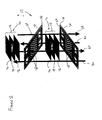
- Figure 2 is an exploded view of a portion of fuel cell stack 10.
- Figure 3 is a schematic top plan view of fuel cell stack 10.
- Fuel cell stack 10 is known as a planar, interconnect-supported fuel cell stack, in which adjacent fuel cells 12 are separated by a plurality of interconnects 14, such that at least one interconnect 14 extends between each pair of adjacent fuel cells 12. More specifically, fuel cells 12 are coupled together in series such that fuel cell stack 10 includes a top stack plate 16, a bottom stack plate 18, and a plurality of interconnects 14 that are positioned between top stack plate 16 and bottom stack plate 18.
- each interconnect 14 is hollow and includes outer surface 22 and an internal chamber 24 therein.
- top stack plate 16, bottom stack plate 18, and interconnects 14, are each sized identically. In an alternative embodiment, at least one of top stack plate 16, bottom stack plate 18, and/or interconnect 14 is sized differently than the remaining fuel cell stack components.
- Stack plates 16 and 18 are fabricated from an electrically-conductive material. For example, stack plates 16 and 18 may be fabricated from conductive materials capable of operating at higher temperatures as described herein, such as, any material that is electrically conductive, or any material that if subject to oxidation, its oxide is conductive.
- Each interconnect 14 is also fabricated from an electrically conductive material, such as, but not limited to, conductive materials capable of operating at higher temperatures as described herein, such as, but not limited to, a stainless steel.
- a plurality of seal members 30 extend between adjacent interconnects 14. More specifically, adjacent fuel cells 12 are separated by a plurality of seal members 30, respectively, such that fuel cells 12 form a planar arrangement of solid oxide fuel cells. Seals 30 facilitate electrically isolating adjacent fuel cells 12 to prevent short-circuiting between cells 12.
- Each seal members 30 typically comprises a hollow electrical insulator (not shown) that may be fabricated from, but is not limited to, a ceramic material. In one embodiment, seal members 30 are fabricated from, but are not limited to being fabricated from, mica or a glass-mica composite material.
- a plurality of sealed passages 32 are defined. More specifically, in the exemplary embodiment, fuel cell reactants are supplied to, and channeled from, fuel cell stack 10 through sealed passages 32. More specifically, in the exemplary embodiment, fuel and air are both internally manifolded, and as such, passages 32 include a fuel inlet manifold 36, a fuel outlet manifold 38, an oxidant or air inlet manifold 40, and an oxidant or air outlet manifold 42. In an alternative embodiment, the oxidant or air is externally manifolded through fuel cell stack 10.
- Each interconnect chamber 24 extends from a first side 44 of interconnect 14 to a second side 48 of stack 10. More specifically, in the exemplary embodiment, chamber 24 has a substantially rectangular cross-sectional profile. In another embodiment, chamber 24 has a non-rectangular cross-sectional profile. In another embodiment, chamber 24 includes flow guides, baffles, and/or channeling features to facilitate distributing fuel and oxidant within interconnect 14.
- openings 60 extend at least partially through interconnect 14 and are in flow communication with interconnect chamber 24.
- openings 60 are arranged in a substantially colinear configuration, i.e., openings 60 are arranged in a linear sequence within a plurality of rows.
- each fuel cell 12 is formed from a plurality layers 70. More specifically, in the exemplary embodiment, fuel cell 12 includes an anode layer 72, an electrolyte layer 74, and a cathode layer 76 coupled together such that electrolyte layer 74 is sandwiched between layers 72 and 76, and such that a seal member 78 extends between each fuel cell 12 and each adjacent interconnect 14. Fuel cells 12 are coupled within fuel cell stack 10 to enable electricity to be conducted from one fuel cell anode layer 72 to a cathode layer 76 of an adjacent cell 12.
- electrolyte layer 74 is fabricated from a material such as, but is not limited to, yttrium-stabilized zirconia (YSZ), and cathode layer 76 ma include, but is not limited to, lanthanum strontium manganate (LSM).
- YSZ yttrium-stabilized zirconia
- LSM lanthanum strontium manganate
- Adjacent interconnects 14 are coupled together such that an oxidant flow area 80 is defined therebetween.
- Each oxidant flow area 80 is coupled in flow communication to air inlet manifold 40 and air outlet manifold 42.
- a fuel such as, but not limited to, a prereformed fuel, and/or a hydrocarbon which is reformed within fuel cell stack 10, is supplied to fuel cell stack 10 through fuel inlet manifold 36. After entering inlet manifold 36, fuel is routed through each interconnect chamber 24. Fuel flows over and reacts with each anode layer 72 prior to being discharged from fuel stack 10 through fuel outlet 38. Fuel and oxidant react in each fuel cell 12, which are connected in series within stack 10, to build voltage to useful levels. More specifically, the fuel reacts electrochemically with oxygen, supplied to stack 10 through air inlet manifold 40, to generate direct current (DC) electricity with water as the main product.
- DC direct current
- stack 10 is arranged such that the fuel cell reactants flow through stack 10 in opposite directions. In another embodiment, stack 10 is arranged such that the flow directions of the reactants flow through stack 10 are substantially parallel and in the same flow direction. Current is generated as the fuel and oxidant react, and a voltage potential is generated across stack 10.
- Figure 4 is a side view of fuel cell isolation assembly 100 that may be used with fuel cell stack 10.
- at least one fuel cell 102 has been determined, as described in more detail below, to have failed or have been damaged to a degree that may adversely affect stack performance.
- fuel cell isolation assembly 100 facilitates isolating the damaged fuel cell 102 from the remaining fuel cells 12 without ceasing operation of stack 10.
- Each fuel cell isolation assembly 100 includes a jumper 110 and an actuator 112 that is coupled to jumper 110 for controlling movement of jumper 110.
- Jumper 110 is fabricated from an electrically-conductive material and includes a radially outer surface 114 and an opposite radially inner surface 116 that extend longitudinally between an upper sidewall 118 and a lower sidewall 120.
- Jumper 110 is arcuately-shaped and extends arcuately between a first endwall (not shown) and a second endwall 122.
- each jumper 110 is substantially semi-circular.
- Each jumper 110 has a length L 1 that is longer than a distance D 1 measured between adjacent interconnects 14. More specifically, distance D 1 is measured between an upper surface 123 of a first interconnect 14, and a lower surface 124 of an adjacent second interconnect 14. As described in more detail below, jumper length L 1 enables each jumper 110 to electrically connect a pair of adjacent interconnects 14 together.
- a pair of jumpers 126 and 128 are coupled across respective opposite ends 130 and 132 of a pair of interconnects 14. More specifically, in the exemplary embodiment, jumper 126 is positioned within fuel inlet manifold 36 and jumper 128 is positioned within fuel exit manifold 40 to isolate fuel cell 102. In an alternative embodiment, only jumper 110 is used to isolate fuel cell 102. In another alternative embodiment, jumpers 110 are positioned within fuel inlet manifold 36, fuel outlet manifold 38 (shown in Figure 3), air inlet manifold 40, and air outlet manifold 42 (shown in Figure 3). Accordingly, each jumper 110 is contoured to substantially match the curved contour defined by an inner surface 138 of each respective sealed passage 32.
- each jumper 110 facilitates reducing the cross-sectional area of each jumper 110 within each passage 32 such that flow through passage 32 remains substantially unobstructed until each jumper 110 is positioned to isolate a failed fuel cell 102. Moreover, the curved contour, and the semi-circular shape of each jumper 110 enables a jumper 110 being positioned to isolate a newly-detected failed fuel cell 102 to be moved by actuator 112 through a respective passage 32 and past a jumper 110 already coupled to electrically isolate a failed fuel cell 110.
- actuator 112 is actuated by at least one of, but not limited to, a linear motor, a screw gear, or any other mechanical means suitable for selectively positioning jumper 110 as described herein. In another embodiment, actuator 112 is actuated by at least one of, but not limited to, pneumatic pressure, hydraulic pressure, electro-magnetic force, and electric power.
- each jumper 110 is rotatably coupled to an actuator 112 such that longitudinal movement, and rotational movement, of each jumper 110 with respect to fuel cell stack 10 is controlled by actuator 112. Accordingly, each jumper 110 is variably positionable within each respective sealed passage 32 such that any fuel cell 12 may be selectively isolated as described herein. More specifically, during normal operation of fuel cell stack 10, each jumper 110 remains coupled within a respective sealed passage 32 in a ready position 139, wherein jumpers 110 are not electrically coupled to any interconnects. Ready position 139 enables jumpers 110 to remain coupled within sealed passage 32 such that fluid flow through each respective sealed passage 32 into cells 12 remains substantially unobstructed until jumpers 110 are positioned to isolate a failed cell 102.
- fuel cell stack 10 includes a plurality of jumpers 110 that are not movable longitudinally through sealed passages 32, but rather jumpers 110 are integral to each cell 12 and are only moveable between ready position 139 and against interconnects 14, as described herein.
- jumpers 110 and/or interconnects 14 incorporate conducting and non-conducting surfaces such that jumpers 110 only short-circuit cells 12 when rotated from ready position 139 to isolate the failed cell 102.
- jumpers 110 When coupled in position, jumpers 110 electrically connect a pair of adjacent interconnects 14 together such that the pair of interconnects are "shortcircuited.” More specifically, each jumper 110 is positioned such that an outer surface 140 of jumper 110 is electrically coupled to each interconnect 14 that is adjacent the damaged fuel cell 102. Each jumper outer surface 140 includes features 142 that facilitates establishing an electrical connection between each jumper 110 and each interconnect. In addition, the combination of the contour of each jumper 110 and jumper external surface features 142 facilitates sealing contact between each jumper 110 and each interconnect 14. For example, in one embodiment, at least one of a wire mesh, a brush, and/or a metallic seal extends outwardly from jumper outer surface 140 to facilitate electrical contact and sealing between each jumper 110 and each respective interconnect 14.
- a jumper 110 is positioned to isolate cell 102 from the remaining fuel cells 12 such that fuel cell stack operation may continue without interruption. More specifically, after cell 102 is detected, in the exemplary embodiment, jumper 110 is moved longitudinally into ready position 139 through the use of actuator 112. Jumper 110 is then rotated such that jumper outer surface is electrically coupled between a pair of adjacent interconnects 14, and more specifically, such that fuel cell 102 is electrically isolated from the remaining fuel cells 12.
- jumper 110 when jumper 110 has electrically isolated fuel cell 102, the combination of the jumper contour and jumper external surface 140 facilitates sealing between jumper 110 and the pair of interconnects 14 to substantially prevent fuel flow and/or fuel and air flow (depending on which sealed passage jumper 110 is coupled with respect to stack 10) to fuel cell 102.
- fuel cell stack 10 may continue operation. Moreover, if multiple cells 102 have failed, additional jumpers 110 may be installed within the same fuel cell stack passage 32, as described herein.
- the performance of each individual cell is continuously monitored, and upon detection of a failed cell, a jumper is positioned to isolate that particular cell.
- the voltage and performance of individual cells are not monitored, but rather the overall performance of the fuel cell stack is monitored and held determinative of a failed fuel cell. More specifically, when the performance of the stack is reduced, the reduced performance is indicative of a failed fuel cell.
- a jumper is moved through the fuel inlet manifold and is coupled against each fuel cell while continuously monitoring the output performance of the fuel cell stack. When the performance monitoring indicates that the cell stack performance has increased, the jumper is then locked in position within the fuel inlet manifold. If additional jumpers are available within other manifolds, then those jumpers are also placed in position relative to the detected failed fuel cell.
- the fuel cell stack is coupled to a processor and a controller which enables the performance of the stack to be continuously monitored such that upon detection of a failed cell, a jumper is automatically positioned and coupled to the stack to effectively isolate the failed cell.
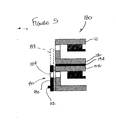
- FIG 5 is an enlarged schematic view of an alternative embodiment of fuel cell isolation assembly 180 that may be used with fuel cell stack 10.
- Fuel cell isolation assembly 180 is substantially similar to fuel cell isolation assembly 100 (shown in Figure 4) and components in fuel cell isolation assembly 180 that are identical to components of fuel cell isolation assembly 100 are identified in Figure 5 using the same reference numerals used in Figure 4. Accordingly, fuel cell isolation assembly 180 includes a jumper 182 that is controlled by actuator 112. Each jumper 182 includes a flow passageway 184 extending therethrough that in the exemplary embodiment, enables fuel flow to be supplied to each respective fuel cell 12. More specifically, fuel cell stack 10 includes a plurality of jumpers 182 that are each slidably coupled to a respective fuel cell 12 to selectively isolate that particular fuel cell 12 as described herein.
- each jumper 182 remains coupled within a respective sealed passage 32 in a ready position 190, wherein jumper passageway 184 is positioned to enable fuel flow to fuel cell 12, and such that fluid flow through each respective sealed passage 32 into every other cell 12 remains substantially unobstructed.
- jumper 182 is transitioned from ready position 190 into an isolation position 193 wherein that particular fuel cell 12 is isolated from the remaining fuel cells 12. More specifically, when transitioned into isolation position 193, passageway 184 is positioned against an insulating layer 194 extending between adjacent fuel cells 12 such that fuel flow to the failed cell 102 is prevented.
- FIG 6 is an enlarged schematic view of an alternative embodiment of fuel cell isolation assembly 200 that may be used with fuel cell stack 10.
- Fuel cell isolation assembly 200 is substantially similar to fuel cell isolation assembly 100 (shown in Figure 4) and components in fuel cell isolation assembly 200 that are identical to components of fuel cell isolation assembly 100 are identified in Figure 6 using the same reference numerals used in Figure 4. Accordingly, fuel cell isolation assembly 200 includes jumper 110 and actuator 112.
- Fuel cell assembly 200 also includes a jumper reloader system 202 that enables, as described in more detail below, additional jumpers 110 to be inserted within fuel cell stack 10 during operation of fuel cell stack 10.
- Jumper reloader system 202 includes an insertion housing 204 that is coupled in flow communication to fuel inlet manifold 36.
- additional jumper reloader systems are coupled to other sealed passages 32.
- a valve 206 such as a globe valve, is coupled between fuel inlet manifold 36 and insertion housing 204 to selectively control flow communication between manifold 36 and insertion housing 204. When valve 206 is in a closed position, insertion housing 204 is substantially isolated from fuel inlet manifold 36.
- valve 206 When valve 206 is rotated to an open position, fuel inlet manifold 36 and insertion housing 204 are coupled in flow communication, such that a jumper 110 may be inserted through valve 206 and into position, as described above in more detail, relative to a failed fuel cell 102 (shown in Figure 4.
- Housing 204 includes an actuator opening 210 and an access opening 212.
- Actuator opening 210 enables actuator 112 to be coupled to jumper 110 through housing 204 for controlling positioning of jumper 110.
- Access opening 212 is sized to receive jumpers 110 therethrough and includes a variably positioned door 214. When closed, door 214 substantially seals opening 210. When opened, door 214 enables additional jumpers 100 to be coupled to actuator 112 while fuel cell stack 10 remains in operation.
- valve 206 When a damaged or failed fuel cell 102 is detected, valve 206 is rotated to an open position, and a jumper 110 is positioned to isolate cell 102 from the remaining fuel cells 12, as described in more detail above.
- jumper reloader system 202 When an additional fuel cell 12 is determined to have failed, jumper reloader system 202 enables additional jumpers 110 to be installed while fuel cell stack 10 remains in operation.
- valve 206 is rotated closed to effectively isolate housing 204 from fuel inlet manifold 36.
- An additional jumper 110 is then coupled to actuator 112 through access door 214, and door 214 is then rotated closed to effectively seal access opening 212.
- Valve 206 is then opened and the additional jumper 110 is then moved into position relative to fuel cell stack 10.
- the curved contour, and the semi-circular shape of each jumper 110 enables the additional jumper 110 to be moved through manifold 36 and past a jumper 110 already coupled in position relative to fuel cell stack 10, while fuel cell stack 10 remains in operation.
- FIG 7 is a side view of another alternative embodiment of a fuel cell isolation device 250 that may be used with fuel cell stack 10.
- Fuel cell isolation assembly 250 is substantially similar to fuel cell isolation assembly 100 (shown in Figure 4) and fuel cell isolation assembly 200 (shown in Figure 6), and components in fuel cell isolation assembly 250 that are identical to components of fuel cell isolation assemblies 100 and/or 250 are identified in Figure 7 using the same reference numerals used in Figures 4 and 6. Accordingly, fuel cell isolation assembly 250 includes jumper 110 and actuator 112.
- Fuel cell assembly 250 also includes a jumper positioning system 252 that facilitates, as described in more detail below, positioning each jumper 110 in position relative to each fuel cell 12 coupled within stack 10.
- Jumper positioning system 252 includes a plurality of keyway assemblies 260 and at least one key 262.
- each keyway assembly 260 includes a support wall 264 that extends between adjacent interconnects 14 adjacent interconnect first end 44.
- keyway assemblies 260 are included in other sealed passages 32.
- Each support wall 264 includes a keyway 266 and a flow access opening 268 that, in the exemplary embodiment, enables fuel to flow from inlet manifold 36 between adjacent interconnects 14 and towards each fuel cell 12, as described in more detail above.
- Keyway 266 is defined within each support wall 264 and is sized to receive key 262 therein.
- keyway 266 is substantially dovetail-shaped. In alternative embodiments, keyway 266 is non-dovetailed shaped.
- Each key 266 extends radially outward from jumper outer surface 140 and is sized to be received within keyway 266 when jumper 110 is rotated into position relative to a failed fuel cell 102. Accordingly, when jumper 110 is rotated into position, and key 266 is received within keyway 266, jumper 110 is positioned relative to fuel cell 102 such that adjacent interconnects 14 are electrically coupled together as described in more detail above.
- the above-described fuel cell isolation assemblies enable a failed fuel cell to be electrically isolated without interrupting operation of the fuel cell stack.
- the isolation assemblies each include a jumper coupled to an actuator that controls movement of the isolation assemblies.
- the jumper is fabricated from an electrically conductive material and is sized to extend between adjacent interconnects such that the jumper may electrically connects a pair of adjacent interconnects. Accordingly, as a result, failed fuel cells may be isolated from the remaining fuel cells while the fuel cell stack remains operational and in a cost-effective and reliable manner.
- each fuel cell stack component can also be used in combination with other fuel cell stack components.
- the relative positions of the anode and the cathode within the stack may be exchanged, and similarly passages defined for fuel flow and oxidant may also be exchanged.
- each fuel cell isolation assembly can also be used in combination with other fuel cell isolation assemblies and with other fuel cell stack components.
Landscapes
- Life Sciences & Earth Sciences (AREA)
- Engineering & Computer Science (AREA)
- Manufacturing & Machinery (AREA)
- Sustainable Development (AREA)
- Sustainable Energy (AREA)
- Chemical & Material Sciences (AREA)
- Chemical Kinetics & Catalysis (AREA)
- Electrochemistry (AREA)
- General Chemical & Material Sciences (AREA)
- Fuel Cell (AREA)
Applications Claiming Priority (2)
| Application Number | Priority Date | Filing Date | Title |
|---|---|---|---|
| US665942 | 1991-03-06 | ||
| US10/665,942 US7358005B2 (en) | 2003-09-18 | 2003-09-18 | Methods and apparatus for isolating solid oxide fuel cells |
Publications (2)
| Publication Number | Publication Date |
|---|---|
| EP1517393A2 true EP1517393A2 (de) | 2005-03-23 |
| EP1517393A3 EP1517393A3 (de) | 2008-07-02 |
Family
ID=34194772
Family Applications (1)
| Application Number | Title | Priority Date | Filing Date |
|---|---|---|---|
| EP04255641A Withdrawn EP1517393A3 (de) | 2003-09-18 | 2004-09-16 | Methode und Vorrichtung zum Zusammenfügen einer Festoxid-Brennstoffzelle |
Country Status (4)
| Country | Link |
|---|---|
| US (1) | US7358005B2 (de) |
| EP (1) | EP1517393A3 (de) |
| JP (1) | JP2005100987A (de) |
| CN (1) | CN1599115A (de) |
Cited By (4)
| Publication number | Priority date | Publication date | Assignee | Title |
|---|---|---|---|---|
| WO2010005415A1 (en) * | 2008-07-09 | 2010-01-14 | Utc Power Corporation | Fuel cell stack conditioned to operate safely with failed cells |
| EP2898560A4 (de) * | 2012-09-21 | 2016-05-18 | Bloom Energy Corp | Systeme und verfahren zur umgehung von brennstoffzellen |
| DE102017211610A1 (de) | 2017-07-07 | 2019-01-10 | Audi Ag | Freischalten einer Brennstoffzelle |
| CN112864744A (zh) * | 2019-11-12 | 2021-05-28 | 现代自动车株式会社 | 可拆卸地安装到燃料电池的电池监测连接器 |
Families Citing this family (15)
| Publication number | Priority date | Publication date | Assignee | Title |
|---|---|---|---|---|
| US20060246331A1 (en) * | 2005-04-29 | 2006-11-02 | Steinbroner Matthew P | Partitioned fuel cell stacks and fuel cell systems including the same |
| US7927752B2 (en) * | 2007-03-09 | 2011-04-19 | GM Global Technology Operations LLC | Individual cell shorting during startup and shutdown using an integrated switch |
| JP5160811B2 (ja) * | 2007-05-16 | 2013-03-13 | 日本電信電話株式会社 | 固体酸化物形燃料電池スタック |
| TWI416791B (zh) * | 2007-07-04 | 2013-11-21 | Wistron Corp | 燃料電池之連接結構 |
| US20100216053A1 (en) * | 2007-07-09 | 2010-08-26 | Atomic Energy Council - Institute Of Nuclear Energy Research | Stack flow path of planar solid oxide fuel cell |
| JP5213014B2 (ja) * | 2007-08-02 | 2013-06-19 | 行政院原子能委員会核能研究所 | プレーナ式固体酸化物型燃料電池 |
| US8268504B2 (en) * | 2008-12-22 | 2012-09-18 | General Electric Company | Thermomechanical sealing of interconnect manifolds in fuel cell stacks |
| US8602996B2 (en) | 2010-06-01 | 2013-12-10 | Cardiac Pacemakers, Inc. | Integrating device-based sensors and bedside biomarker assays to detect worsening heart failure |
| KR101180157B1 (ko) | 2010-12-28 | 2012-09-05 | 주식회사 포스코 | 고체 산화물 연료전지의 불량 단위전지 처리장치 및 이의 설치 방법 |
| US8940030B1 (en) | 2011-01-28 | 2015-01-27 | Nuvasive, Inc. | Spinal fixation system and related methods |
| US8637202B2 (en) * | 2011-02-09 | 2014-01-28 | GM Global Technology Operations LLC | Device to minimize the buoyancy driven flows in vertically oriented headers |
| US8947110B2 (en) * | 2011-09-22 | 2015-02-03 | Nissan North America, Inc. | Suspension device for a membrane test system |
| DE102013004838A1 (de) | 2013-03-21 | 2013-09-26 | Daimler Ag | Brennstoffzellensystem und Verfahren zum Betreiben eines Brennstoffzellensystems |
| US20210143448A1 (en) * | 2019-11-12 | 2021-05-13 | Bryan M. Blackburn | Solid-state electrochemical devices having coated components |
| SE547653C2 (en) * | 2023-07-05 | 2025-11-04 | Powercell Sweden Ab | Fuel cell stack with a malfunctioning fuel cell unit |
Family Cites Families (28)
| Publication number | Priority date | Publication date | Assignee | Title |
|---|---|---|---|---|
| US3808534A (en) * | 1972-11-15 | 1974-04-30 | United Aircraft Corp | Intrinsically powered electronic monitor for fuel cells |
| US4397918A (en) * | 1982-04-08 | 1983-08-09 | Energy Research Corporation | Fuel cell stack shorting method and apparatus |
| US6488739B1 (en) | 1987-03-13 | 2002-12-03 | Bp Corporation North America Inc. | Oxygen production process |
| JP3360318B2 (ja) * | 1992-08-20 | 2002-12-24 | 富士電機株式会社 | 燃料電池発電装置 |
| IT1270878B (it) * | 1993-04-30 | 1997-05-13 | Permelec Spa Nora | Migliorata cella elettrochimica utilizzante membrane a scambio ionico e piatti bipolari metallici |
| KR100395611B1 (ko) * | 1994-03-21 | 2004-02-18 | 지텍 코포레이션 | 최적의압력분배를위한전기화학콘버터조립체 |
| DE19521312A1 (de) * | 1995-06-12 | 1996-12-19 | Max Planck Gesellschaft | Verfahren zur Identifizierung sekretorischer Gene aus Helicobacter pylori |
| EP0757398A1 (de) * | 1995-07-25 | 1997-02-05 | DORNIER GmbH | Anordnung von mehreren Brennstoffzellen-Stacks zu einem Modul |
| DE69601838T2 (de) * | 1995-07-28 | 1999-10-14 | Nippon Telegraph And Telephone Corp. | Brennstoffzelle mit Elektrolyten aus festem Oxid |
| US5549983A (en) * | 1996-01-22 | 1996-08-27 | Alliedsignal Inc. | Coflow planar fuel cell stack construction for solid electrolytes |
| IT1284887B1 (it) * | 1996-10-03 | 1998-05-22 | De Nora Spa | Metodo di esclusione di una cella elementare malfunzionante di un elettrolizzatore o di un generatore elettrochimico a membrana |
| EP0960448B1 (de) * | 1997-02-11 | 2002-04-10 | Fucellco, Incorporated | Brennstoffzellenstapel mit festen elektrolyten und deren anordnung |
| AUPO724997A0 (en) * | 1997-06-10 | 1997-07-03 | Ceramic Fuel Cells Limited | A fuel cell assembly |
| US5770327A (en) * | 1997-08-15 | 1998-06-23 | Northwestern University | Solid oxide fuel cell stack |
| DE19746616C1 (de) * | 1997-10-22 | 1999-01-21 | Forschungszentrum Juelich Gmbh | Verfahren und Einrichtungen zum Überbrücken von beschädigten Einzelzellen in Brennstoffzellenstapeln |
| US6096449A (en) * | 1997-11-20 | 2000-08-01 | Avista Labs | Fuel cell and method for controlling same |
| US6387556B1 (en) * | 1997-11-20 | 2002-05-14 | Avista Laboratories, Inc. | Fuel cell power systems and methods of controlling a fuel cell power system |
| US6030718A (en) * | 1997-11-20 | 2000-02-29 | Avista Corporation | Proton exchange membrane fuel cell power system |
| US7021603B2 (en) * | 1998-10-08 | 2006-04-04 | Wladyslaw Wygnaski | Electromagnetic actuator and integrated actuator and fluid flow control valve |
| US6296962B1 (en) * | 1999-02-23 | 2001-10-02 | Alliedsignal Inc. | Design for solid oxide fuel cell stacks |
| US6110612A (en) * | 1999-04-19 | 2000-08-29 | Plug Power Inc. | Structure for common access and support of fuel cell stacks |
| US6322919B1 (en) * | 1999-08-16 | 2001-11-27 | Alliedsignal Inc. | Fuel cell and bipolar plate for use with same |
| US6218038B1 (en) * | 1999-08-24 | 2001-04-17 | Plug Power, Inc. | Regulating a flow through a fuel cell |
| US6489050B1 (en) * | 1999-11-01 | 2002-12-03 | Technology Management, Inc. | Apparatus and method for cooling high-temperature fuel cell stacks |
| US6468682B1 (en) | 2000-05-17 | 2002-10-22 | Avista Laboratories, Inc. | Ion exchange membrane fuel cell |
| JP5437546B2 (ja) * | 2000-08-18 | 2014-03-12 | ヴァーサ パワー システムズ リミテッド | 高温ガスシール |
| ITMI20010458A1 (it) * | 2001-03-06 | 2002-09-06 | Nuvera Fuel Cells Europ Srl | Metodo di cortocircuitazione di una cella elettrochimica elementare malfunzionante di una struttura filtro-pressa |
| ITMI20012342A1 (it) * | 2001-11-08 | 2003-05-08 | Nuvera Fuel Cells Europ Srl | Metodo per riutilizzare collettori/distributori di corrente di un generatore elettrochimico a membrana |
-
2003
- 2003-09-18 US US10/665,942 patent/US7358005B2/en not_active Expired - Lifetime
-
2004
- 2004-09-16 EP EP04255641A patent/EP1517393A3/de not_active Withdrawn
- 2004-09-17 JP JP2004271147A patent/JP2005100987A/ja not_active Withdrawn
- 2004-09-20 CN CNA2004100798060A patent/CN1599115A/zh active Pending
Cited By (7)
| Publication number | Priority date | Publication date | Assignee | Title |
|---|---|---|---|---|
| WO2010005415A1 (en) * | 2008-07-09 | 2010-01-14 | Utc Power Corporation | Fuel cell stack conditioned to operate safely with failed cells |
| US9065126B2 (en) | 2008-07-09 | 2015-06-23 | Audi Ag | Fuel cell stack conditioned to operate safely with failed cells |
| EP2898560A4 (de) * | 2012-09-21 | 2016-05-18 | Bloom Energy Corp | Systeme und verfahren zur umgehung von brennstoffzellen |
| DE102017211610A1 (de) | 2017-07-07 | 2019-01-10 | Audi Ag | Freischalten einer Brennstoffzelle |
| US11101476B2 (en) | 2017-07-07 | 2021-08-24 | Audi Ag | Isolation of a fuel cell |
| DE102017211610B4 (de) | 2017-07-07 | 2026-03-26 | Audi Ag | Freischalten einer Brennstoffzelle |
| CN112864744A (zh) * | 2019-11-12 | 2021-05-28 | 现代自动车株式会社 | 可拆卸地安装到燃料电池的电池监测连接器 |
Also Published As
| Publication number | Publication date |
|---|---|
| CN1599115A (zh) | 2005-03-23 |
| US20050064254A1 (en) | 2005-03-24 |
| JP2005100987A (ja) | 2005-04-14 |
| US7358005B2 (en) | 2008-04-15 |
| EP1517393A3 (de) | 2008-07-02 |
Similar Documents
| Publication | Publication Date | Title |
|---|---|---|
| US7358005B2 (en) | Methods and apparatus for isolating solid oxide fuel cells | |
| US7329471B2 (en) | Methods and apparatus for assembling solid oxide fuel cells | |
| US10297854B2 (en) | Fuel cell stack | |
| US20090181269A1 (en) | Fuel cell stack, fuel cell system and method of operating fuel cell system | |
| EP1695409B1 (de) | Brennstoffzelle und brennstoffzellenstapel | |
| WO2005060029A2 (en) | Fuel cell and fuel cell stack | |
| AU2003259559A1 (en) | Bipolar plates assembly for a fuel cell | |
| EP1695408A2 (de) | Brennstoffzelle und brennstoffzellenstapel | |
| US7759014B2 (en) | Fuel cell having a seal member | |
| KR100675614B1 (ko) | 연료 전지 | |
| EP1695404B1 (de) | Brennstoffzelle und brennstoffzellenstapel | |
| EP1685621B1 (de) | Mehrzellenbrennstoffschicht und system | |
| US6787257B2 (en) | Method and apparatus for operating an electrochemical fuel cell | |
| US7629065B2 (en) | Fuel cell system with a first and second electrically conductive casing | |
| US20070259257A1 (en) | Handling an electrochemical cell stack | |
| JP5596112B2 (ja) | 密閉された燃料電池の積層体 | |
| KR100906902B1 (ko) | 셀 손상시 전류 공급을 위한 연료전지스택용 안전시스템 및그 제어방법 | |
| KR20200072156A (ko) | 연료전지 스택 및 이를 포함하는 연료전지 시스템 | |
| KR100580964B1 (ko) | 연료전지 | |
| JP2025179467A (ja) | 電気化学装置 | |
| US20060134495A1 (en) | Fuel cell system with cathode stream recirculation | |
| KR20250038083A (ko) | 다단형 전기화학적 수소 압축기 및 그 제어 방법 | |
| KR20050025489A (ko) | 연료전지의 공기 공급 장치 | |
| CA2538871A1 (en) | Fuel cell and fuel cell module therefor | |
| KR20100018421A (ko) | 유로판 및 이를 구비한 연료 전지 |
Legal Events
| Date | Code | Title | Description |
|---|---|---|---|
| PUAI | Public reference made under article 153(3) epc to a published international application that has entered the european phase |
Free format text: ORIGINAL CODE: 0009012 |
|
| AK | Designated contracting states |
Kind code of ref document: A2 Designated state(s): AT BE BG CH CY CZ DE DK EE ES FI FR GB GR HU IE IT LI LU MC NL PL PT RO SE SI SK TR |
|
| AX | Request for extension of the european patent |
Extension state: AL HR LT LV MK |
|
| PUAL | Search report despatched |
Free format text: ORIGINAL CODE: 0009013 |
|
| AK | Designated contracting states |
Kind code of ref document: A3 Designated state(s): AT BE BG CH CY CZ DE DK EE ES FI FR GB GR HU IE IT LI LU MC NL PL PT RO SE SI SK TR |
|
| AX | Request for extension of the european patent |
Extension state: AL HR LT LV MK |
|
| AKX | Designation fees paid | ||
| REG | Reference to a national code |
Ref country code: DE Ref legal event code: 8566 |
|
| STAA | Information on the status of an ep patent application or granted ep patent |
Free format text: STATUS: THE APPLICATION IS DEEMED TO BE WITHDRAWN |
|
| 18D | Application deemed to be withdrawn |
Effective date: 20090105 |