EP1516937A1 - High-strength cold rolled steel sheet and process for producing the same - Google Patents
High-strength cold rolled steel sheet and process for producing the same Download PDFInfo
- Publication number
- EP1516937A1 EP1516937A1 EP03733553A EP03733553A EP1516937A1 EP 1516937 A1 EP1516937 A1 EP 1516937A1 EP 03733553 A EP03733553 A EP 03733553A EP 03733553 A EP03733553 A EP 03733553A EP 1516937 A1 EP1516937 A1 EP 1516937A1
- Authority
- EP
- European Patent Office
- Prior art keywords
- less
- steel sheet
- rolled steel
- cold rolled
- high strength
- Prior art date
- Legal status (The legal status is an assumption and is not a legal conclusion. Google has not performed a legal analysis and makes no representation as to the accuracy of the status listed.)
- Granted
Links
Images




Classifications
-
- C—CHEMISTRY; METALLURGY
- C22—METALLURGY; FERROUS OR NON-FERROUS ALLOYS; TREATMENT OF ALLOYS OR NON-FERROUS METALS
- C22C—ALLOYS
- C22C38/00—Ferrous alloys, e.g. steel alloys
- C22C38/004—Very low carbon steels, i.e. having a carbon content of less than 0,01%
-
- C—CHEMISTRY; METALLURGY
- C22—METALLURGY; FERROUS OR NON-FERROUS ALLOYS; TREATMENT OF ALLOYS OR NON-FERROUS METALS
- C22C—ALLOYS
- C22C38/00—Ferrous alloys, e.g. steel alloys
- C22C38/06—Ferrous alloys, e.g. steel alloys containing aluminium
-
- C—CHEMISTRY; METALLURGY
- C22—METALLURGY; FERROUS OR NON-FERROUS ALLOYS; TREATMENT OF ALLOYS OR NON-FERROUS METALS
- C22C—ALLOYS
- C22C38/00—Ferrous alloys, e.g. steel alloys
- C22C38/04—Ferrous alloys, e.g. steel alloys containing manganese
-
- C—CHEMISTRY; METALLURGY
- C21—METALLURGY OF IRON
- C21D—MODIFYING THE PHYSICAL STRUCTURE OF FERROUS METALS; GENERAL DEVICES FOR HEAT TREATMENT OF FERROUS OR NON-FERROUS METALS OR ALLOYS; MAKING METAL MALLEABLE, e.g. BY DECARBURISATION OR TEMPERING
- C21D2211/00—Microstructure comprising significant phases
- C21D2211/002—Bainite
-
- C—CHEMISTRY; METALLURGY
- C21—METALLURGY OF IRON
- C21D—MODIFYING THE PHYSICAL STRUCTURE OF FERROUS METALS; GENERAL DEVICES FOR HEAT TREATMENT OF FERROUS OR NON-FERROUS METALS OR ALLOYS; MAKING METAL MALLEABLE, e.g. BY DECARBURISATION OR TEMPERING
- C21D2211/00—Microstructure comprising significant phases
- C21D2211/005—Ferrite
-
- C—CHEMISTRY; METALLURGY
- C21—METALLURGY OF IRON
- C21D—MODIFYING THE PHYSICAL STRUCTURE OF FERROUS METALS; GENERAL DEVICES FOR HEAT TREATMENT OF FERROUS OR NON-FERROUS METALS OR ALLOYS; MAKING METAL MALLEABLE, e.g. BY DECARBURISATION OR TEMPERING
- C21D2211/00—Microstructure comprising significant phases
- C21D2211/008—Martensite
-
- C—CHEMISTRY; METALLURGY
- C21—METALLURGY OF IRON
- C21D—MODIFYING THE PHYSICAL STRUCTURE OF FERROUS METALS; GENERAL DEVICES FOR HEAT TREATMENT OF FERROUS OR NON-FERROUS METALS OR ALLOYS; MAKING METAL MALLEABLE, e.g. BY DECARBURISATION OR TEMPERING
- C21D8/00—Modifying the physical properties of ferrous metals or ferrous alloys by deformation combined with, or followed by, heat treatment
- C21D8/02—Modifying the physical properties of ferrous metals or ferrous alloys by deformation combined with, or followed by, heat treatment during manufacturing of plates or strips
- C21D8/0221—Modifying the physical properties of ferrous metals or ferrous alloys by deformation combined with, or followed by, heat treatment during manufacturing of plates or strips characterised by the working steps
- C21D8/0236—Cold rolling
Definitions
- the present invention relates to a high strength cold rolled steel sheet suitable for inner and outer panels of automobile, and particularly relates to a high strength cold rolled steel sheet having excellent stretchability and a tensile strength of 370 to 590MPa and a method for manufacturing the same.
- the cold rolled steel sheet for inner and outer panels of automobile is required to have excellent stretchability, dent resistance, surface precision, anti-secondary working embrittlement, anti-aging, and surface appearance, and a high strength cold rolled steel sheet having such characteristics and a tensile strength of 370 to 590MPa is now strongly desired by automobile manufacturers.
- JP-A-5-78784 proposes a high strength cold rolled steel sheet having a tensile strength of 350 to 500MPa, which comprises a Ti-bearing ultra-low carbon steel added with a large amount of solid solution hardening elements such as Mn, Cr, Si, or P.
- JP-A-2001-207237 or JP-A-2002-322537 proposes a galvanized steel sheet (dual phase structure steel sheet: DP steel sheet) having a tensile strength of less than 500MPa, which comprises 0.010 to 0.06% C, 0.5% or less Si, not less than 0.5% to less than 2.0% Mn, 0.20% or less P, 0.01% or less S, 0.005 to 0.10% Al, 0.005% or less N, 1.0% or less Cr, wherein (Mn+1.3Cr) is 1.9 to 2.3%, and consists of ferrite phases and second phases (low temperature transformation phases) of 20% or less by area ratio containing martensite phases of 50% or more.
- DP steel sheet dual phase structure steel sheet having a tensile strength of less than 500MPa, which comprises 0.010 to 0.06% C, 0.5% or less Si, not less than 0.5% to less than 2.0% Mn, 0.20% or less P, 0.01% or less S, 0.005 to 0.10% Al,
- JP-A-5-78784 has poor anti-aging, bad surface appearance due to a large amount of Si causing a problem in plating, and poor anti-secondary working embrittlement due to a large amount of P.
- the DP steel sheet described in JP-A-2001-207237 or JP-A-2002-322537 does not have such problems since it is strengthened by second phases, however, it was found from the inventor's supplementary examination that the steel sheet did not always have sufficient stretchability and therefore it was not always applicable to outer panels of automobile.
- the present invention aims to provide a high strength cold rolled steel sheet having a tensile strength of 370 to 590MPa, which is applicable to outer panels of automobile such as door or hood produced mainly by stretch forming.
- the object is achieved by a high strength cold rolled steel sheet comprising ferrite phases and second phases, wherein the mean grain size of the ferrite phases is 20 ⁇ m or less, the volume fraction of the second phases is not less than 0.1% to less than 10%, the absolute value of in-plane anisotropy of r value
- is less than 0.15, and the thickness is 0. 4mm or more.
- the high strength cold rolled steel sheet for example, consists essentially of, by mass %, less than 0.05% C, 2.0% or less Si, 0.6 to 3.0% Mn, 0.08% or less P, 0.03% or less S, 0.01 to 0.1% Al, 0.01% or less N, and the balance of Fe.
- the high strength cold rolled steel sheet can be manufactured using a method comprising the steps of: cold rolling a hot rolled steel sheet having the above composition and containing second phases of 60% or more by volume fraction at a reduction rate of higher than 60% to lower than 85%, and continuously annealing the cold rolled steel sheet in an ⁇ + ⁇ region.
- the steel sheet should be strengthened by forming dual phase structure comprising ferrite phases and second phases having mainly martensite phases.
- the second phases comprising mainly martensite phases need to be dispersed uniformly in ferrite phases, which has a mean grain size of 20 ⁇ m or less, at a volume fraction of not less than 0.1% to less than 10%. Such second phases are precipitated at the grain boundaries of the ferrite phases.
- the mean grain size of ferrite phases exceeds 20 ⁇ m, orange peel is generated at press-forming, resulting in deterioration in surface appearance and deterioration in stretchability. Therefore, the mean grain size is made to be 20 ⁇ m or less, preferably 15 ⁇ m or less, and further preferably 12 ⁇ m or less.
- the volume fraction of second phases comprising mainly martensite phases is less than 0.1% or 10% or more, sufficient stretchability can not be obtained. Therefore, the volume fraction of second phases is made to be not less than 0.1% to less than 10%, and preferably not less than 0.5% to less than 8%.
- the second phases comprising mainly martensite phases may have retained ⁇ phases, bainite phases, pearlite phases, and carbides other than martensite phases in a range of 40% or less, preferably 20% or less, and further preferably 10% or less to attain the object of the present invention.
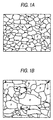
- Figs.1A and 1B are views schematically showing microstructure of a high strength cold rolled steel sheet of the present invention and a conventional DP steel sheet respectively.
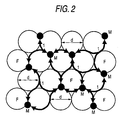
- fine second phases M are dispersed uniformly in uniform and fine ferrite phases F and along the grain boundaries of the ferrite phases F.
- coarse second phases M are dispersed nonuniformly in nonuniform and coarse ferrite phases F and along the grain boundaries of the ferrite phases F.
- difference between maximum value r max and minimum value r min of the r0, r45, and r90 is 0.25 or less, preferably 0.2 or less, and further preferably 0.15 or less. It is further effective that the r90 is 1.3 or less, preferably 1.25 or less, and further preferably 1.2 or less.
- Fig.3 shows a relationship between texture and stretchability, and it is confirmed that if the ratio of an X-ray intensity of ⁇ 111 ⁇ uvw> orientation to that of random texture sample as abscissa is 3.5 or more, and the difference between maximum intensity ratio and minimum intensity ratio of the orientation as ordinate is 0.9 or less, or if the steel sheet is more isotropic, excellent stretchability can be obtained.
- the ratio of the X-ray intensity of ⁇ 111 ⁇ uvw> orientation to that of random texture sample and the difference between maximum intensity ratio and minimum intensity ratio of the orientation are values obtained, for example, by the ODF analysis method using "RINT2000 series application software" (three dimensional pole figure data processing program).
- the ⁇ 111 ⁇ uvw> orientation is an orientation existing on the ⁇ fiber at 54.7° of ⁇ and at 45° of ⁇ 2 according to Bunge Type output.
- the present invention is limited to a high strength cold rolled steel sheet that can be produced at a reduction rate of lower than 85%, or a high strength cold rolled steel sheet having a thickness of 0.4mm or more, and therefore the tin plate is excluded from the present invention.
- the high strength cold rolled steel sheet of the present invention for example, consists essentially of, by mass %, less than 0.05% C, 2.0% or less Si, 0.6 to 3.0% Mn, 0.08% or less P, 0.03% or less S, 0.01 to 0.1% Al, 0.01% or less N, and the balance of Fe.
- C is an element required for improving strength of steel sheet, however, when the C content is 0.05% or more, stretchability is significantly deteriorated, in addition, it is not preferable from the viewpoint of weldability. Accordingly, the C content is made to be less than 0.05%.
- the C content is preferably 0.005% or more, and further preferably 0.007% or more.
- Si When Si content exceeds 2.0%, surface appearance is deteriorated, and plating adherence is significantly deteriorated. Accordingly, the Si content is made to be 2.0% or less, preferably 1.0% or less, and further preferably 0.6% or less.
- Mn is generally effective for preventing cracking of steel slab in hot working by precipitating S in steel sheet as MnS. Moreover, in the present invention, Mn of 0.6% or more needs to be added to stably form second phases. However, when the Mn content exceeds 3.0%, cost of slab significantly increases, besides formability of steel sheet is deteriorated. Accordingly, the Mn content is made to be 0.6 to 3.0%, and preferably not less than 0.8% to less than 2.5%.
- P When P content exceeds 0.08%, the anti-secondary working embrittlement is deteriorated, or alloying property of zinc plating is deteriorated. Accordingly, the P content is made to be 0.08% or less, and preferably 0.06% or less.
- S is a harmful element that deteriorates hot working performance of steel and increases sensibility to cracking of steel slab in hot working. Moreover, when the S content exceeds 0.03%, S is precipitated as fine MnS, resulting in deterioration in formability of steel sheet. Accordingly, the S content is made to be 0.03% or less, preferably 0.02% or less, and further preferably 0.015% or less. From the viewpoint of surface appearance, the S content is preferably 0.001% or more, and further preferably 0.002% or more.
- Al contributes to deoxidization of steel, and precipitates unnecessary solid solution N in steel as AlN. The effect is insufficient when Al is less than 0.01%, and saturates when Al exceeds 0.1%. Accordingly, the Al content is made to be 0.01 to 0.1%.
- the N content should be preferably few.
- the N content is made to be 0.01% or less, preferably 0.007% or less, and further preferably 0.005% or less.
- At least one element selected from 1% or less Cr, 1% or less Mo, 1% or less V, 0.01% or less B, 0.1% or less Ti, and 0.1% or less Nb is effectively added from the following reasons respectively.
- Cr, Mo: Cr and Mo are effective elements for improving hardenability and forming second phases stably. Moreover, they are also effective for suppressing softening of heat affected zone (HAZ) formed at welding.
- HAZ heat affected zone
- at least one of Cr and Mo of 0.005% or more is preferably added, and further preferably 0.01% or more.
- each of the contents of Cr and Mo is made to be 1% or less, preferably 0.8% or less, and further preferably 0.6% or less.
- V is effective for suppressing softening of HAZ formed at welding.
- V is preferably added 0. 005% or more, and further preferably 0.007% or more.
- the V content is made to be 1% or less, preferably 0.5% or less, and further preferably 0.3% or less.
- B is an effective element for improving hardenability and forming second phases stably.
- B is preferably added 0.0002% or more, and further preferably 0.0003% or more.
- the B content is made to be 0.01% or less, preferably 0.005% or less, and further preferably 0.003% or less.
- Ti, Nb Ti and Nb act to form nitrides and reduce unnecessary solid solution N in steel. Improvement of formability of steel sheet can be expected by reducing solid solution N with Ti or Nb instead of Al. To this end, at least one of Ti and Nb is preferably added 0.005% or more, and further preferable 0.008% or less. However, when each of the contents exceeds 0.1%, the effects are saturated, therefore each of the contents of Ti and Nb is made to be 0.1% or less, and preferably 0.08% or less. However, when Ti or Nb is added in excess of the amount required for reducing solid solution N, carbides of excessive Ti or Nb are formed, which prevents the stable formation of second phases, therefore it is not preferable.
- the high strength cold rolled steel sheet of the present invention can be manufactured by cold rolling a hot rolled steel sheet having the above composition and second phases of 60% or more by volume fraction at a reduction rate of higher than 60% to lower than 85%, and then continuously annealing the cold rolled steel sheet in an ⁇ + ⁇ region.
- the annealing temperature needs to be set in a range from Ac1 transformation point to (Ac1 transformation point+80°C) , and preferably Ac1 transformation point to (Ac1 transformation point+50°C).
- a hot rolled steel sheet before cold rolling contains second phases of 60% or more by volume fraction, preferably 70% or more, and further preferably 80% or more.
- the second phases in the hot rolled steel sheet are acicular ferrite phases, bainitic ferrite phases, bainite phases, martensite phases, or mixture phases of them.
- Fig.4 shows a relationship between reduction rate of cold rolling and
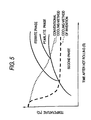
- a steel slab having composition within the scope of the present invention as described above is hot rolled at Ar3 transformation point or higher, and then cooled within two seconds after hot rolling and over a temperature range of 100°C or more at a cooling rate of 70°C/s or higher.
- the rapid cooling allows to suppress formation of ferrite phases as shown in the continuous cooling transformation diagram of Fig. 5.
- the time to start cooling after hot rolling is preferably within 1. 5sec, and further preferably within 1.2sec.
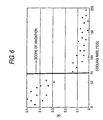
- Fig.6 shows a relationship between cooling rate after hot rolling and
- cooling temperature range ⁇ T is set to be 150°C.
- the cooling rate is 70°C/s or higher, the
- Fig.7 shows a relationship between cooling temperature range ⁇ T after hot rolling and
- the cooling rate is set to be 150°C/sec.
- the cooling temperature range ⁇ T is 100°C or more, the
- the cooling temperature range ⁇ T is preferably 130°C or more, and more preferably 160°C or more.
- Fig.8 shows a relationship between cooling conditions after hot rolling and annealing conditions and ⁇ r.
- the ⁇ r value is large.
- the small ⁇ r can be obtained at a normal reduction rate of cold rolling only when the hot rolling under the conditions of the present invention is combined with the continuous annealing in an ⁇ + ⁇ region. This is the point of the present invention.
- a slab may be hot rolled after being reheated in a furnace, or directly hot rolled without being reheated.
- the coiling after hot rolling may be conducted at a temperature at which second phases of 60% or more by volume fraction can be formed, and under the cooling conditions after hot rolling of the present invention, normal coiling temperature can be applicable.
- the continuous annealing can be performed in a present continuous annealing line or a present galvanization line.
- the high strength cold rolled steel sheet of the present invention may be subjected to electrolytic galvanization or hot-dip galvanization. Alloying treatment may be applicable after galvanization. Furthermore, coating may be performed after galvanization.
- Steels No.1 to 11 have composition within the scope of the present invention.
- Steels No.12 to 15 have any one of C content, Si content, and Mn content without the scope of the present invention.
- Steels No.1 to 11 of the present invention have an Ar3 transformation point of 820°C or higher, and an Ac1 transformation point and an Ac3 transformation point between 740°C and 850°C.
- the slabs were reheated to 1200°C, hot rolled at finishing temperatures shown in Table 2, cooled under the conditions of cooling start time, cooling rate, and cooling temperature range ⁇ T shown in Table 2, and then coiled at normal coiling temperatures, thereby hot rolled steel sheets were produced.
- the hot rolled steel sheets were pickled, cold rolled into 0.75mm in thickness at reduction rates shown in Table 2, and then subjected to continuous annealing in a continuous annealing line (CAL) or a continuous galvanizing line (CGL) , thereby cold rolled steel sheets No.1 to 30 having different tensile strength levels of 400MPa or less, more than 400MPa to not more than 500MPa, and more than 500MPa were produced.
- CAL continuous annealing line
- CGL continuous galvanizing line
- the annealing was carried out at soaking temperatures shown in Table 2. Some of the cold rolled steel sheets were subjected to galvanizing in an electrolytic galvanizing line (EGL). These cold rolled steel sheets were finally subjected to temper rolling at a reduction rate of 0.2 to 1.5%.
- ETL electrolytic galvanizing line
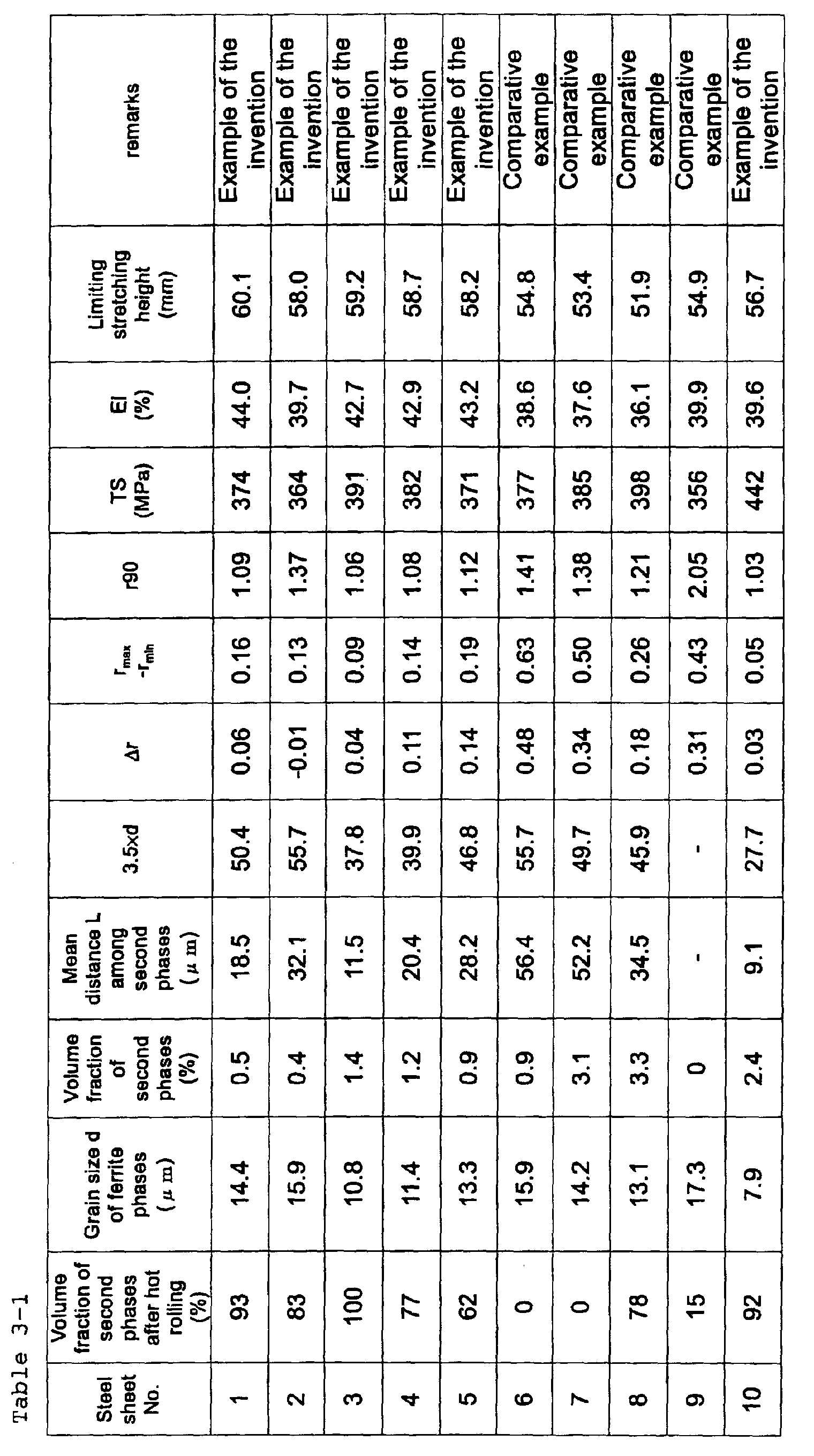
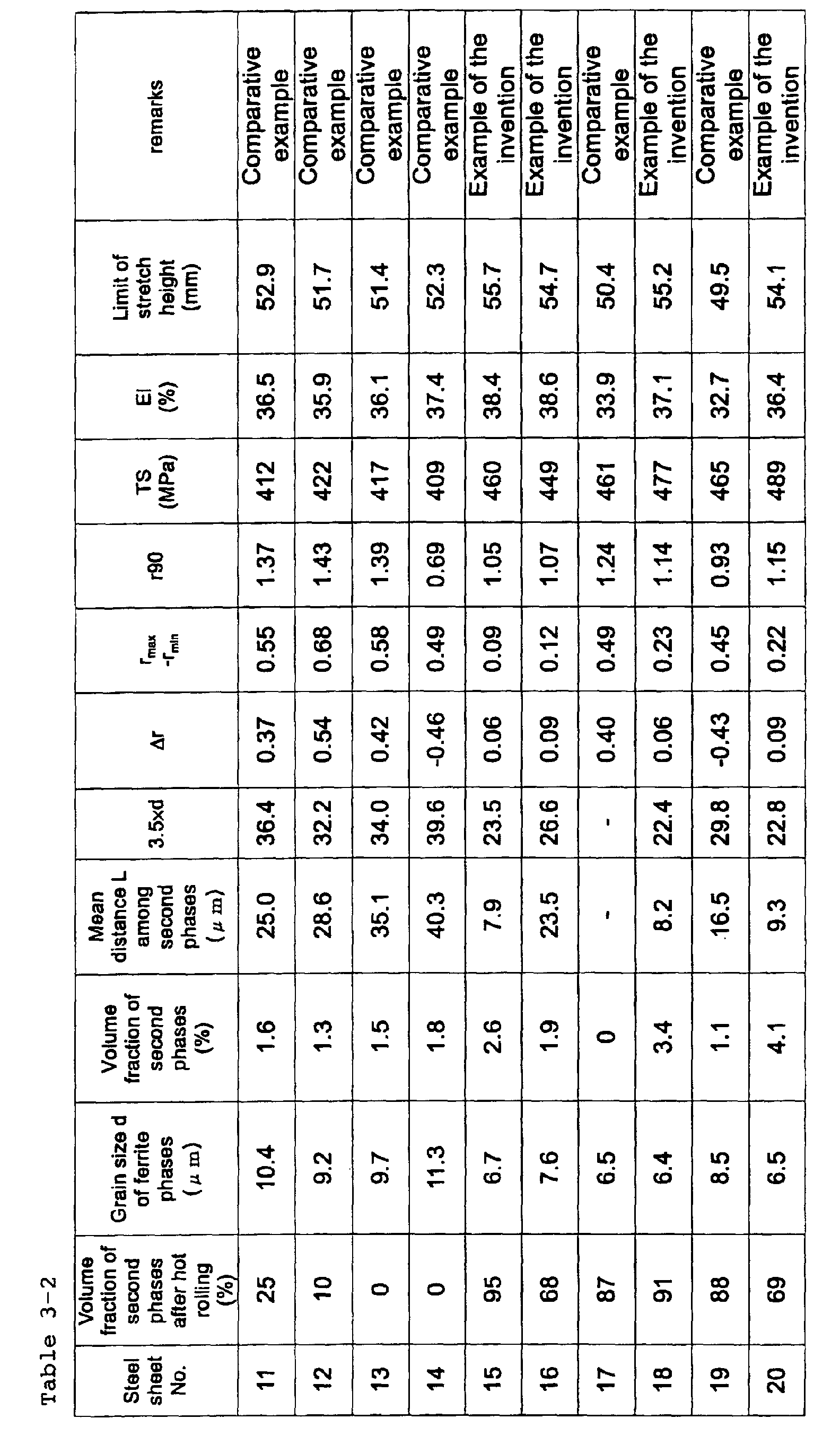
- Microstructures of the hot rolled steel sheet and the cold rolled steel sheet were observed using a scanning electron microscope, and the grain size of ferrite phases, the volume fraction of second phases, the mean distance among second phases were obtained through image analysis.
- JIS No.5 tensile test piece was used to measure r value and ⁇ r.
- tensile test was carried out using the JIS 5 tensile test piece to obtain tensile strength TS and elongation El in a direction perpendicular to the rolling direction.
- test piece 200mm by 200mm was stretch formed using a hemispherical punch of 150mm in diameter, thereby the limit of stretch height was measured.
Landscapes
- Chemical & Material Sciences (AREA)
- Engineering & Computer Science (AREA)
- Materials Engineering (AREA)
- Mechanical Engineering (AREA)
- Metallurgy (AREA)
- Organic Chemistry (AREA)
- Physics & Mathematics (AREA)
- Thermal Sciences (AREA)
- Crystallography & Structural Chemistry (AREA)
- Heat Treatment Of Sheet Steel (AREA)
- Heat Treatment Of Steel (AREA)
Abstract
Description



Claims (20)
- A high strength cold rolled steel sheet comprising ferrite phases and second phases, wherein the mean grain size of the ferrite phases is 20µm or less, the volume fraction of the second phases is not less than 0.1% to less than 10%, the absolute value of in-plane anisotropy of r value |Δr| is less than 0.15, and the thickness is 0.4mm or more.
- The high strength cold rolled steel sheet according to claim 1, wherein the mean distance L (µ m) among the adjacent second phases measured along the grain boundaries of the ferrite phases satisfies the following formula (1) when the mean grain size of the ferrite phases is assumed to be d (µm):
- The high strength cold rolled steel sheet according to claim 1, wherein the difference between maximum value rmax and minimum value rmin of r values at 0°, 45°, and 90° to a rolling direction, or r0, r45, and r90, is 0.25 or less.
- The high strength cold rolled steel sheet according to claim 2, wherein the difference between maximum value rmax and minimum value rmin of r values at 0°, 45°, and 90° to a rolling direction, or r0, r45, and r90, is 0.25 or less.
- The high strength cold rolled steel sheet according to claim 1, wherein the r value at 90° to a rolling direction, or r90, is 1.3 or less.
- The high strength cold rolled steel sheet according to claim 2, wherein the r value at 90° to a rolling direction, or r90, is 1.3 or less.
- The high strength cold rolled steel sheet according to claim 1 consisting essentially of, by mass %, less than 0.05% C, 2.0% or less Si, 0.6 to 3.0% Mn, 0.08% or less P, 0.03% or less S, 0.01 to 0.1% Al, 0.01% or less N, and the balance of Fe.
- The high strength cold rolled steel sheet according to claim 2 consisting essentially of, by mass %, less than 0.05% C, 2.0% or less Si, 0.6 to 3.0% Mn, 0.08% or less P, 0.03% or less S, 0.01 to 0.1% Al, 0.01% or less N, and the balance of Fe.
- The high strength cold rolled steel sheet according to claim 3 consisting essentially of, by mass %, less than 0.05% C, 2.0% or less Si, 0.6 to 3.0% Mn, 0.08% or less P, 0.03% or less S, 0.01 to 0.1% Al, 0.01% or less N, and the balance of Fe.
- The high strength cold rolled steel sheet according to claim 4 consisting essentially of, by mass %, less than 0.05% C, 2.0% or less Si, 0.6 to 3.0% Mn, 0.08% or less P, 0.03% or less S, 0.01 to 0.1% Al, 0.01% or less N, and the balance of Fe.
- The high strength cold rolled steel sheet according to claim 5 consisting essentially of, by mass %, less than 0.05% C, 2.0% or less Si, 0.6 to 3.0% Mn, 0.08% or less P, 0.03% or less S, 0.01 to 0.1% Al, 0.01% or less N, and the balance of Fe.
- The high strength cold rolled steel sheet according to claim 6 consisting essentially of, by mass %, less than 0.05% C, 2.0% or less Si, 0.6 to 3.0% Mn, 0.08% or less P, 0.03% or less S, 0.01 to 0.1% Al, 0.01% or less N, and the balance of Fe.
- The high strength cold rolled steel sheet according to claim 7 further containing at least one element selected from 1% or less Cr, 1% or less Mo, 1% or less V, 0.01% or less B, 0.1% or less Ti, and 0.1% or less Nb.
- The high strength cold rolled steel sheet according to claim 8 further containing at least one element selected from 1% or less Cr, 1% or less Mo, 1% or less V, 0.01% or less B, 0.1% or less Ti, and 0.1% or less Nb.
- The high strength cold rolled steel sheet according to claim 9 further containing at least one element selected from 1% or less Cr, 1% or less Mo, 1% or less V, 0.01% or less B, 0.1% or less Ti, and 0.1% or less Nb.
- The high strength cold rolled steel sheet according to claim 10 further containing at least one element selected from 1% or less Cr, 1% or less Mo, 1% or less V, 0.01% or less B, 0.1% or less Ti, and 0.1% or less Nb.
- The high strength cold rolled steel sheet according to claim 11 further containing at least one element selected from 1% or less Cr, 1% or less Mo, 1% or less V, 0.01% or less B, 0.1% or less Ti, and 0.1% or less Nb.
- The high strength cold rolled steel sheet according to claim 12 further containing at least one element selected from 1% or less Cr, 1% or less Mo, 1% or less V, 0.01% or less B, 0.1% or less Ti, and 0.1% or less Nb.
- A method for manufacturing a high strength cold rolled steel sheet comprising the steps of:cold rolling a hot rolled steel sheet having any one of compositions according to claims 7 to 18 and second phases of 60% or more by volume fraction at a reduction rate of higher than 60% to lower than 85%, andcontinuously annealing the cold rolled steel sheet in an α+γ region.
- The method according to claim 19, wherein a hot rolled steel sheet is cooled within two seconds after hot rolled at an Ar3 transformation temperature or higher, and over a temperature range of 100°C or more at a cooling rate of 70°C/s or higher.
Applications Claiming Priority (3)
| Application Number | Priority Date | Filing Date | Title |
|---|---|---|---|
| JP2002185093 | 2002-06-25 | ||
| JP2002185093 | 2002-06-25 | ||
| PCT/JP2003/007939 WO2004001084A1 (en) | 2002-06-25 | 2003-06-23 | High-strength cold rolled steel sheet and process for producing the same |
Publications (3)
| Publication Number | Publication Date |
|---|---|
| EP1516937A1 true EP1516937A1 (en) | 2005-03-23 |
| EP1516937A4 EP1516937A4 (en) | 2005-06-22 |
| EP1516937B1 EP1516937B1 (en) | 2008-03-05 |
Family
ID=29996722
Family Applications (1)
| Application Number | Title | Priority Date | Filing Date |
|---|---|---|---|
| EP03733553A Expired - Lifetime EP1516937B1 (en) | 2002-06-25 | 2003-06-23 | High-strength cold rolled steel sheet and process for producing the same |
Country Status (11)
| Country | Link |
|---|---|
| US (1) | US7559997B2 (en) |
| EP (1) | EP1516937B1 (en) |
| JP (1) | JPWO2004001084A1 (en) |
| KR (1) | KR100605355B1 (en) |
| CN (1) | CN100408711C (en) |
| AT (1) | ATE388249T1 (en) |
| CA (1) | CA2469022C (en) |
| DE (1) | DE60319534T2 (en) |
| MX (1) | MXPA04007457A (en) |
| TW (1) | TW573022B (en) |
| WO (1) | WO2004001084A1 (en) |
Cited By (2)
| Publication number | Priority date | Publication date | Assignee | Title |
|---|---|---|---|---|
| CN103451507A (en) * | 2013-08-29 | 2013-12-18 | 鞍钢股份有限公司 | Method for reducing inclusion defect rate of cold-rolled automobile sheet |
| US9816153B2 (en) | 2011-09-28 | 2017-11-14 | Jfe Steel Corporation | High strength steel sheet and method of manufacturing the same |
Families Citing this family (31)
| Publication number | Priority date | Publication date | Assignee | Title |
|---|---|---|---|---|
| JP4510488B2 (en) * | 2004-03-11 | 2010-07-21 | 新日本製鐵株式会社 | Hot-dip galvanized composite high-strength steel sheet excellent in formability and hole expansibility and method for producing the same |
| EP1735474B1 (en) * | 2004-03-25 | 2015-10-21 | Posco | Cold rolled steel sheet and hot dipped steel sheet with superior strength and bake hardenability and method for manufacturing the steel sheets |
| JP4445365B2 (en) | 2004-10-06 | 2010-04-07 | 新日本製鐵株式会社 | Manufacturing method of high-strength thin steel sheet with excellent elongation and hole expandability |
| US8273117B2 (en) * | 2005-06-22 | 2012-09-25 | Integran Technologies Inc. | Low texture, quasi-isotropic metallic stent |
| JP4715496B2 (en) * | 2005-12-15 | 2011-07-06 | Jfeスチール株式会社 | Method for producing cold-rolled steel sheets with excellent strain aging resistance and small in-plane anisotropy |
| JP4461112B2 (en) * | 2006-03-28 | 2010-05-12 | 株式会社神戸製鋼所 | High strength steel plate with excellent workability |
| KR20120040758A (en) * | 2006-12-20 | 2012-04-27 | 제이에프이 스틸 가부시키가이샤 | Cold-rolled steel sheet and process for producing the same |
| JP5088092B2 (en) * | 2007-10-30 | 2012-12-05 | Jfeスチール株式会社 | High-strength steel sheet excellent in deep drawability and manufacturing method thereof |
| JP2009263713A (en) * | 2008-04-24 | 2009-11-12 | Sumitomo Metal Ind Ltd | Cold-rolled steel sheet with high tensile strength, plated steel sheet with high tensile strength, and manufacturing method therefor |
| JP5446885B2 (en) * | 2010-01-06 | 2014-03-19 | 新日鐵住金株式会社 | Cold rolled steel sheet manufacturing method |
| JP5446886B2 (en) * | 2010-01-06 | 2014-03-19 | 新日鐵住金株式会社 | Cold rolled steel sheet manufacturing method |
| JP5187320B2 (en) * | 2010-01-06 | 2013-04-24 | 新日鐵住金株式会社 | Cold rolled steel sheet manufacturing method |
| JP5659604B2 (en) * | 2010-07-30 | 2015-01-28 | Jfeスチール株式会社 | High strength steel plate and manufacturing method thereof |
| JP5655436B2 (en) * | 2010-08-31 | 2015-01-21 | Jfeスチール株式会社 | High-strength steel sheet excellent in deep drawability and manufacturing method thereof |
| CN101956133B (en) * | 2010-10-29 | 2012-09-05 | 攀钢集团钢铁钒钛股份有限公司 | Low-yield strength anti-ageing continuous annealing cold-roll steel sheet and production method thereof |
| CN103228808B (en) * | 2010-11-29 | 2014-05-28 | 新日铁住金株式会社 | High-strength bake-hardening cold-rolled steel sheet and method for manufacturing same |
| JP5578288B2 (en) * | 2012-01-31 | 2014-08-27 | Jfeスチール株式会社 | Hot-rolled steel sheet for generator rim and manufacturing method thereof |
| TWI468534B (en) | 2012-02-08 | 2015-01-11 | 新日鐵住金股份有限公司 | High-strength cold-rolled steel sheet and manufacturing method thereof |
| BR112015001475B1 (en) * | 2012-07-31 | 2020-04-22 | Nippon Steel Corporation | COLD LAMINATED STEEL SHEET AND HAMMER MANUFACTURING METHOD |
| CN103060703B (en) | 2013-01-22 | 2015-09-23 | 宝山钢铁股份有限公司 | A kind of cold rolling diphasic strip steel of 780MPa level and manufacture method thereof |
| CN103993147B (en) * | 2014-05-12 | 2016-06-08 | 攀钢集团攀枝花钢铁研究院有限公司 | A kind of cold-rolled steel sheet and preparation method thereof |
| TWI507542B (en) * | 2014-08-08 | 2015-11-11 | China Steel Corp | Manufacturing method and application of fine crystal low carbon steel |
| KR101795918B1 (en) * | 2015-07-24 | 2017-11-10 | 주식회사 포스코 | Hot dip galvanized and galvannealed steel sheet having higher bake hardening and aging properties, and method for the same |
| JP6380781B1 (en) | 2017-02-13 | 2018-08-29 | Jfeスチール株式会社 | Cold rolled steel sheet and its manufacturing method |
| US12221661B2 (en) | 2019-02-15 | 2025-02-11 | Nippon Steel Corporation | Steel sheet and method for producing same |
| KR102556444B1 (en) * | 2020-12-29 | 2023-07-18 | 현대제철 주식회사 | Cold rolled steel sheet having excellent dent resistance property, galvanized steel sheet, and method of manufacturing the same |
| TWI768666B (en) * | 2021-01-20 | 2022-06-21 | 中國鋼鐵股份有限公司 | Cold-rolled steel material with high formability and method for producing the same |
| KR20230044048A (en) | 2021-09-24 | 2023-04-03 | 주식회사 포스코 | High strength cold rolled steel sheet having excellent surface quality and low mechanical property deviation and manufacturing method of the same |
| KR20230043352A (en) | 2021-09-24 | 2023-03-31 | 주식회사 포스코 | High strength cold rolled steel sheet having excellent surface quality and low mechanical property deviation and manufacturing method of the same |
| KR20230043353A (en) | 2021-09-24 | 2023-03-31 | 주식회사 포스코 | High strength cold rolled steel sheet having excellent surface quality and low mechanical property deviation and manufacturing method of the same |
| CN117966032A (en) * | 2022-10-26 | 2024-05-03 | 宝山钢铁股份有限公司 | A 35kg grade cold-rolled low-temperature resistant thin steel plate and a manufacturing method thereof |
Family Cites Families (22)
| Publication number | Priority date | Publication date | Assignee | Title |
|---|---|---|---|---|
| JPS60245728A (en) * | 1984-05-22 | 1985-12-05 | Kawasaki Steel Corp | Manufacture of high tension steel sheet having not less than 70% yield ratio and high ductility |
| CA1307956C (en) * | 1988-05-10 | 1992-09-29 | Raymond G. Spain | Method for making 3d fiber reinforced metal/glass matrix composite article |
| US5074926A (en) | 1989-11-16 | 1991-12-24 | Kawasaki Steel Corp. | High tensile cold rolled steel sheet and high tensile hot dip galvanized steel sheet having improved stretch flanging property and process for producing same |
| CN1025224C (en) * | 1989-11-16 | 1994-06-29 | 川崎制铁株式会社 | Cold-rolled high tonsion steel strip having excellent stretching and folding properties, and molten zinc coating steel strip, and process for manufacturing same |
| JP3016636B2 (en) | 1991-09-12 | 2000-03-06 | 新日本製鐵株式会社 | High strength cold rolled steel sheet with good formability |
| JP2669231B2 (en) * | 1991-10-26 | 1997-10-27 | 住友金属工業株式会社 | Manufacturing method of high r-value cold rolled steel sheet with small in-plane anisotropy |
| EP0612857B1 (en) | 1992-09-14 | 1999-07-28 | Nippon Steel Corporation | Ferrite single phase cold rolled steel sheet or fused zinc plated steel sheet for cold non-ageing deep drawing and method for manufacturing the same |
| JPH0741903A (en) * | 1993-08-02 | 1995-02-10 | Nippon Steel Corp | Hot-rolled steel sheet for deep drawing with excellent workability and small anisotropy and method for producing the same |
| JP2772237B2 (en) * | 1994-03-29 | 1998-07-02 | 川崎製鉄株式会社 | Method for producing ferritic stainless steel strip with small in-plane anisotropy |
| JP3449003B2 (en) * | 1994-12-20 | 2003-09-22 | Jfeスチール株式会社 | Steel plate for cans and manufacturing method thereof |
| CA2271639C (en) * | 1997-09-11 | 2006-11-14 | Kawasaki Steel Corporation | Hot rolled steel sheet having ultra fine grains with improved formability, and production of hot rolled or cold rolled steel sheet |
| JPH11343538A (en) | 1998-05-29 | 1999-12-14 | Kawasaki Steel Corp | Cold rolled steel sheet suitable for high-density energy beam welding and method for producing the same |
| JP2000239786A (en) * | 1999-02-18 | 2000-09-05 | Kawasaki Steel Corp | Base plate for cold rolling, cold rolled steel plate for deep drawing with small in-plane anisotropy, and method for producing the same |
| JP3800902B2 (en) * | 1999-03-19 | 2006-07-26 | Jfeスチール株式会社 | High carbon steel sheet for processing with small in-plane anisotropy and method for producing the same |
| JP3750789B2 (en) * | 1999-11-19 | 2006-03-01 | 株式会社神戸製鋼所 | Hot-dip galvanized steel sheet having excellent ductility and method for producing the same |
| CA2368504C (en) | 2000-02-29 | 2007-12-18 | Kawasaki Steel Corporation | High tensile strength cold rolled steel sheet having excellent strain age hardening characteristics and the production thereof |
| CN1158398C (en) | 2000-05-26 | 2004-07-21 | 杰富意钢铁株式会社 | Cold rolled steel sheet having strain age hardening property, galvanized steel sheet and manufacturing method thereof |
| JP4665302B2 (en) * | 2000-11-02 | 2011-04-06 | Jfeスチール株式会社 | High-tensile cold-rolled steel sheet having high r value, excellent strain age hardening characteristics and non-aging at room temperature, and method for producing the same |
| US20030015263A1 (en) * | 2000-05-26 | 2003-01-23 | Chikara Kami | Cold rolled steel sheet and galvanized steel sheet having strain aging hardening property and method for producing the same |
| US6543078B1 (en) | 2000-07-24 | 2003-04-08 | Eastman Kodak Company | Apparatus and method for cleaning object having generally irregular surface features |
| JP3907963B2 (en) | 2001-04-25 | 2007-04-18 | 株式会社神戸製鋼所 | Hot-dip galvanized steel sheet excellent in ductility and stretch formability and method for producing the same |
| CN1318438A (en) * | 2001-06-05 | 2001-10-24 | 宁波宝新不锈钢有限公司 | Cold rolling process of ferrite and martensitic stainless steel belt |
-
2003
- 2003-06-23 DE DE60319534T patent/DE60319534T2/en not_active Expired - Lifetime
- 2003-06-23 WO PCT/JP2003/007939 patent/WO2004001084A1/en not_active Ceased
- 2003-06-23 JP JP2004515550A patent/JPWO2004001084A1/en active Pending
- 2003-06-23 EP EP03733553A patent/EP1516937B1/en not_active Expired - Lifetime
- 2003-06-23 KR KR1020047010376A patent/KR100605355B1/en not_active Expired - Fee Related
- 2003-06-23 CA CA002469022A patent/CA2469022C/en not_active Expired - Fee Related
- 2003-06-23 CN CNB038028603A patent/CN100408711C/en not_active Expired - Fee Related
- 2003-06-23 US US10/496,433 patent/US7559997B2/en not_active Expired - Lifetime
- 2003-06-23 MX MXPA04007457A patent/MXPA04007457A/en active IP Right Grant
- 2003-06-23 AT AT03733553T patent/ATE388249T1/en active
- 2003-06-25 TW TW092117242A patent/TW573022B/en not_active IP Right Cessation
Cited By (2)
| Publication number | Priority date | Publication date | Assignee | Title |
|---|---|---|---|---|
| US9816153B2 (en) | 2011-09-28 | 2017-11-14 | Jfe Steel Corporation | High strength steel sheet and method of manufacturing the same |
| CN103451507A (en) * | 2013-08-29 | 2013-12-18 | 鞍钢股份有限公司 | Method for reducing inclusion defect rate of cold-rolled automobile sheet |
Also Published As
| Publication number | Publication date |
|---|---|
| US7559997B2 (en) | 2009-07-14 |
| KR20040066935A (en) | 2004-07-27 |
| JPWO2004001084A1 (en) | 2005-10-20 |
| TW573022B (en) | 2004-01-21 |
| DE60319534T2 (en) | 2009-03-26 |
| WO2004001084A1 (en) | 2003-12-31 |
| CN1625608A (en) | 2005-06-08 |
| TW200401040A (en) | 2004-01-16 |
| US20040261919A1 (en) | 2004-12-30 |
| EP1516937A4 (en) | 2005-06-22 |
| EP1516937B1 (en) | 2008-03-05 |
| CN100408711C (en) | 2008-08-06 |
| MXPA04007457A (en) | 2005-07-13 |
| CA2469022A1 (en) | 2003-12-31 |
| CA2469022C (en) | 2008-08-26 |
| DE60319534D1 (en) | 2008-04-17 |
| KR100605355B1 (en) | 2006-07-31 |
| ATE388249T1 (en) | 2008-03-15 |
Similar Documents
| Publication | Publication Date | Title |
|---|---|---|
| US7559997B2 (en) | High-strength cold rolled steel sheet and process for producing the same | |
| JP5365216B2 (en) | High-strength steel sheet and its manufacturing method | |
| JP4772927B2 (en) | High-strength steel sheet, hot-dip galvanized steel sheet, alloyed hot-dip galvanized steel sheet having excellent fatigue characteristics and elongation and impact characteristics, and methods for producing them | |
| JP5971434B2 (en) | High-strength hot-dip galvanized steel sheet excellent in stretch flangeability, in-plane stability and bendability of stretch flangeability, and manufacturing method thereof | |
| KR101264574B1 (en) | Method for producing high-strength steel plate having superior deep drawing characteristics | |
| CN102301027B (en) | High-strength hot-dip galvanized steel sheet and manufacturing method thereof | |
| CN101326300B (en) | Hot-dip zinc-coated steel sheets and process for production thereof | |
| KR101753510B1 (en) | High strength steel sheet having high young's modulus and method for manufacturing the same | |
| KR20040091751A (en) | Process for producing high tensile hot-dip zinc-coated steel sheet of excellent ductility and antifatigue properties | |
| US12258647B2 (en) | Steel sheet, member, and methods for manufacturing the same | |
| US12565691B2 (en) | Steel sheet, member, and methods for manufacturing the same | |
| US12565690B2 (en) | Steel sheet, member, and methods for manufacturing the same | |
| JP2001303186A (en) | Composite structure steel sheet excellent in burring workability and method for producing the same | |
| JP2005029867A (en) | High strength and high ductility galvanized steel sheet with excellent aging resistance and method for producing the same | |
| EP4636115A1 (en) | High strength steel sheet having high yield ratio, and manufacturing method therefor | |
| JP2002241897A (en) | Steel sheet with small fluctuations in yield strength and elongation at break and high formability and low yield ratio, and method for producing the same | |
| WO2022190958A1 (en) | Cold-rolled steel sheet and manufacturing method thereof | |
| JP2003213370A (en) | High-strength steel sheet, high-strength hot-dip galvanized steel sheet, high-strength alloyed hot-dip galvanized steel sheet excellent in shape freezing property and impact resistance and production method thereof | |
| JP2002206138A (en) | High-tensile cold-rolled steel sheet excellent in formability, strain age hardening characteristics and normal temperature aging resistance, and method for producing the same | |
| KR102845159B1 (en) | High-strength cold-rolled steel sheets, hot-dip galvanized steel sheets, and alloyed hot-dip galvanized steel sheets, and methods for producing them | |
| JP2007077510A (en) | High strength and high ductility galvanized steel sheet with excellent aging resistance and method for producing the same | |
| JP7288184B2 (en) | Method for producing hot-dip Zn-Al-Mg plated steel sheet | |
| JP2004307992A (en) | Composite structure cold rolled steel sheet excellent in surface distortion resistance and method for producing the same | |
| WO2023153096A1 (en) | Cold-rolled steel sheet |
Legal Events
| Date | Code | Title | Description |
|---|---|---|---|
| PUAI | Public reference made under article 153(3) epc to a published international application that has entered the european phase |
Free format text: ORIGINAL CODE: 0009012 |
|
| 17P | Request for examination filed |
Effective date: 20040617 |
|
| AK | Designated contracting states |
Kind code of ref document: A1 Designated state(s): AT BE BG CH CY CZ DE DK EE ES FI FR GB GR HU IE IT LI LU MC NL PT RO SE SI SK TR |
|
| A4 | Supplementary search report drawn up and despatched |
Effective date: 20050510 |
|
| RIC1 | Information provided on ipc code assigned before grant |
Ipc: 7C 21D 9/46 B Ipc: 7C 21D 8/04 B Ipc: 7C 22C 38/06 B Ipc: 7C 22C 38/04 A Ipc: 7C 21D 8/02 B |
|
| RBV | Designated contracting states (corrected) |
Designated state(s): AT BE DE FR GB NL |
|
| 17Q | First examination report despatched |
Effective date: 20060824 |
|
| GRAP | Despatch of communication of intention to grant a patent |
Free format text: ORIGINAL CODE: EPIDOSNIGR1 |
|
| GRAS | Grant fee paid |
Free format text: ORIGINAL CODE: EPIDOSNIGR3 |
|
| GRAA | (expected) grant |
Free format text: ORIGINAL CODE: 0009210 |
|
| AK | Designated contracting states |
Kind code of ref document: B1 Designated state(s): AT BE DE FR GB NL |
|
| REG | Reference to a national code |
Ref country code: GB Ref legal event code: FG4D |
|
| REF | Corresponds to: |
Ref document number: 60319534 Country of ref document: DE Date of ref document: 20080417 Kind code of ref document: P |
|
| ET | Fr: translation filed | ||
| PLBE | No opposition filed within time limit |
Free format text: ORIGINAL CODE: 0009261 |
|
| STAA | Information on the status of an ep patent application or granted ep patent |
Free format text: STATUS: NO OPPOSITION FILED WITHIN TIME LIMIT |
|
| 26N | No opposition filed |
Effective date: 20081208 |
|
| REG | Reference to a national code |
Ref country code: FR Ref legal event code: PLFP Year of fee payment: 14 |
|
| REG | Reference to a national code |
Ref country code: FR Ref legal event code: PLFP Year of fee payment: 15 |
|
| REG | Reference to a national code |
Ref country code: FR Ref legal event code: PLFP Year of fee payment: 16 |
|
| PGFP | Annual fee paid to national office [announced via postgrant information from national office to epo] |
Ref country code: NL Payment date: 20190515 Year of fee payment: 17 |
|
| PGFP | Annual fee paid to national office [announced via postgrant information from national office to epo] |
Ref country code: BE Payment date: 20190516 Year of fee payment: 17 |
|
| PGFP | Annual fee paid to national office [announced via postgrant information from national office to epo] |
Ref country code: AT Payment date: 20190528 Year of fee payment: 17 |
|
| REG | Reference to a national code |
Ref country code: NL Ref legal event code: MM Effective date: 20200701 |
|
| REG | Reference to a national code |
Ref country code: AT Ref legal event code: MM01 Ref document number: 388249 Country of ref document: AT Kind code of ref document: T Effective date: 20200623 |
|
| REG | Reference to a national code |
Ref country code: BE Ref legal event code: MM Effective date: 20200630 |
|
| PG25 | Lapsed in a contracting state [announced via postgrant information from national office to epo] |
Ref country code: NL Free format text: LAPSE BECAUSE OF NON-PAYMENT OF DUE FEES Effective date: 20200701 |
|
| PG25 | Lapsed in a contracting state [announced via postgrant information from national office to epo] |
Ref country code: BE Free format text: LAPSE BECAUSE OF NON-PAYMENT OF DUE FEES Effective date: 20200630 Ref country code: AT Free format text: LAPSE BECAUSE OF NON-PAYMENT OF DUE FEES Effective date: 20200623 |
|
| PGFP | Annual fee paid to national office [announced via postgrant information from national office to epo] |
Ref country code: DE Payment date: 20210525 Year of fee payment: 19 Ref country code: FR Payment date: 20210513 Year of fee payment: 19 |
|
| PGFP | Annual fee paid to national office [announced via postgrant information from national office to epo] |
Ref country code: GB Payment date: 20210526 Year of fee payment: 19 |
|
| REG | Reference to a national code |
Ref country code: DE Ref legal event code: R119 Ref document number: 60319534 Country of ref document: DE |
|
| GBPC | Gb: european patent ceased through non-payment of renewal fee |
Effective date: 20220623 |
|
| PG25 | Lapsed in a contracting state [announced via postgrant information from national office to epo] |
Ref country code: FR Free format text: LAPSE BECAUSE OF NON-PAYMENT OF DUE FEES Effective date: 20220630 |
|
| PG25 | Lapsed in a contracting state [announced via postgrant information from national office to epo] |
Ref country code: GB Free format text: LAPSE BECAUSE OF NON-PAYMENT OF DUE FEES Effective date: 20220623 Ref country code: DE Free format text: LAPSE BECAUSE OF NON-PAYMENT OF DUE FEES Effective date: 20230103 |