EP1516645A2 - Inflatable respirator hood - Google Patents
Inflatable respirator hood Download PDFInfo
- Publication number
- EP1516645A2 EP1516645A2 EP04255665A EP04255665A EP1516645A2 EP 1516645 A2 EP1516645 A2 EP 1516645A2 EP 04255665 A EP04255665 A EP 04255665A EP 04255665 A EP04255665 A EP 04255665A EP 1516645 A2 EP1516645 A2 EP 1516645A2
- Authority
- EP
- European Patent Office
- Prior art keywords
- hood
- wearer
- air
- head
- respirator
- Prior art date
- Legal status (The legal status is an assumption and is not a legal conclusion. Google has not performed a legal analysis and makes no representation as to the accuracy of the status listed.)
- Withdrawn
Links
Images


Classifications
-
- A—HUMAN NECESSITIES
- A62—LIFE-SAVING; FIRE-FIGHTING
- A62B—DEVICES, APPARATUS OR METHODS FOR LIFE-SAVING
- A62B17/00—Protective clothing affording protection against heat or harmful chemical agents or for use at high altitudes
- A62B17/04—Hoods
Definitions
- the present invention relates to a respirator hood, and, more particularly, to a respirator hood that fits comfortably over the head of a wearer and provides for efficient delivery of air to the interior of the hood and into the breathing zone of the wearer.
- a respirator hood is worn in combination with a positive pressure air source to protect against respiratory hazards, such as those found in pharmaceutical operations and healthcare facilities.
- a positive pressure air source to protect against respiratory hazards, such as those found in pharmaceutical operations and healthcare facilities.
- the respirator hood commonly includes an integral bib or shroud or a neck cuff of some kind, an internal suspension means, a face shield or some form of transparent lens in a front opening defined by the hood, and a port for connection to a positive pressure air source.
- respirator hoods are commonly constructed of a flexible material, such as that marketed and distributed by E.I. duPont de Nemours and Company of Wilmington, Delaware under the trademark Tychem®, the introduction of air into the interior of the hood has an inflating or ballooning effect that causes the hood to rise up relative to the head of the wearer.
- the present invention is a respirator hood that fits comfortably over the head of a wearer and provides for efficient delivery of air to the interior of the hood and into the breathing zone of the wearer.
- a hood made in accordance with the present invention is designed to fit over and around the head of a wearer and defines a front opening in which a transparent lens is received to protect the face of the wearer without obstructing vision.
- Air is provided through an inlet and is directed into a reservoir within the hood. From this reservoir, air is distributed to an inflatable neck cuff and one or more overhead channels that provide for efficient delivery of air to the interior of the hood and into the breathing zone of the wearer.
- the neck cuff is positioned at the lower portion of the hood and substantially circumscribes the opening through which a wearer inserts his head into the hood. Incoming air inflates the neck cuff. Since there is no exit or outlet from the neck cuff, it remains inflated, thus causing the neck cuff to exert maximum sealing pressure against the wearer's neck and also prevents the hood from rising up relative to the wearer's head due to the upward forces resulting from the introduction of air into the interior of the hood.
- Air is also directed from the reservoir into one or more overhead channels that provide for efficient delivery of air to the interior of the hood and into the breathing zone of the wearer.
- the hood is provided with three channels, although fewer or more channels could be incorporated into the hood without departing from the spirit and scope of the present invention.
- a hood made in accordance with the present invention could be provided with an integral exhalation valve that is designed to open and place the interior of the hood in fluid communication with the atmosphere should the air pressure within the hood exceed a predetermined value.
- the present invention relates to a respirator hood, and, more particularly, to a respirator hood that fits comfortably over the head of a wearer and provides for efficient delivery of air to the interior of the hood and into the breathing zone of the wearer.
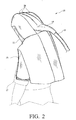
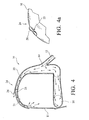
- Figures 1 and 2 are respective front and rear perspective views of an exemplary embodiment of a respirator hood 10 as worn by an individual, and Figure 3 is a sectional view of this exemplary embodiment.
- the hood 10 is designed to fit over and around the head of a wearer. Since this particular hood 10 is designed to provide respiratory protection, it is preferred that it be constructed of a lightweight, chemical-resistant material, such as that marketed and distributed by E.I. duPont de Nemours and Company of Wilmington Delaware under the trademark Tychem®.
- the hood 10 also defines a front opening in which a transparent lens 11 is received. The lens 11 protects the face of the wearer without obstructing vision, and thus, it is preferred that the lens 11 be splash and/or solvent resistant.
- air is provided (preferably by an external positive pressure air source) through an inlet 12 and is directed into a reservoir 14. From this reservoir, and as best illustrated in Figure 3, air is distributed to (a) an inflatable neck cuff 16, and (b) one or more overhead channels 20 that provide for efficient delivery of air to the interior of the hood 10 and into the breathing zone of the wearer.
- the neck cuff 16 is positioned at the lower portion of the hood 10 and substantially circumscribes the opening through which a wearer inserts his head into the hood 10.
- incoming air inflates the neck cuff 16.
- the neck cuff 16 remains inflated, thus causing the neck cuff 16 to exert maximum sealing pressure against the wearer's neck.
- the front portion of the neck cuff 16 fits under the wearer's chin. This position not only ensures proper sealing against the wearer's neck, but also prevents the hood 10 from rising up relative to the wearer's head due to the upward forces resulting form the introduction of air into the interior of the hood 10.
- the hood 10 may also include a retaining bib or skirt 18 that extends downwardly from the front portion of the hood 10 and serves to retain and restrain the neck cuff 16 from being forced outwardly, away from the wearer's chin.
- the bib 18 illustrated in Figures 1 and 2 includes one or more straps 17 that are designed to fit under the wearer's arms, retaining the bib 18 against the body of the wearer.
- the ends of the straps 17 are provided with hook and loop portions (not shown) adapted to mate with corresponding hook and loop portions 19 on the bib 18 to secure the straps 17 around the body of the wearer.
- such a retaining bib 18 could be integral to and formed as part of a larger bib which is used in conjunction with a protective body covering.
- the hood 10 is provided with three channels 20, although fewer or more channels could be incorporated into the hood 10 without departing from the spirit and scope of the present invention.
- the hood 10 include a section of non-rigid material 21 (preferably the same material that is used to construct the remainder of the hood 10) that is sewn or otherwise secured into the interior of the hood 20.
- the desired air delivery channels 20 are formed. These channels 20 define an air delivery path from the reservoir 14, over the wearer's head to the interior of the lens 11 and downwardly across the wearer's face into the wearer's breathing zone. Not only does this ensure the efficient delivery of air to the breathing zone, the directed air flow also reduces lens fog, which is created within the hood 10 due to the wearer's breathing, body heat, and perspiration.
- the hood 10 is preferably provided with three channels 20.
- multiple overhead channels 20 as opposed to a single, unitary channel, movement of the hood 10 due to the air flow from the rear of the hood 10 to the front of the hood is minimized.
- the cross-sectional area of the channel would be quite large and would extend quite far into the interior of the hood 10, reducing the available headroom within the interior of the hood 10.
- the hood 10 may be provided with an integral exhalation valve 24.
- the exhalation valve 24 is comprised of (a) an opening or aperture 25 through an exterior surface of the hood 10 such that there is fluid communication from the atmosphere into one of the air delivery channels 20, and (b) a covering 26 that extends over the opening or aperture 24.
- the covering is preferably bonded to the hood 10 using an adhesive or similar means, but is designed to overcome the bond and pull away from the hood 10, thus opening the valve 24 should the air pressure within the hood 10 exceed a predetermined value.
- the exhalation valve 24 could be positioned in various other locations without departing from the spirit and scope of the present invention, provided that the exhalation valve 24 serves to relieve pressure from the interior of the hood 10 when air pressure within the hood 10 exceeds a predetermined value.
- the exhalation valve 24 could be located in a side portion of the hood 10, in a lower portion of the hood 10 near the neck cuff 16, or adjacent the lens 11.
- multiple exhalation valves 24 could be incorporated into the hood 10 without departing from the spirit and scope of the present invention.
Landscapes
- Health & Medical Sciences (AREA)
- Toxicology (AREA)
- General Health & Medical Sciences (AREA)
- Business, Economics & Management (AREA)
- Emergency Management (AREA)
- Respiratory Apparatuses And Protective Means (AREA)
Abstract
Description
Claims (10)
- In a respirator hood (10) adapted to fit over and around the head of a wearer, and including a substantially transparent lens (11) received in a front opening of the hood, the improvement comprising:an inflatable neck cuff (16) positioned near a lower portion of the hood (10) and substantially circumscribing an opening through which the wearer inserts his head, said inflatable neck cuff (16) being supplied by an air source and inflated so as to exert a sealing pressure against the neck of the wearer and to prevent the hood from rising up relative to the head of the wearer.
- The respirator hood as recited in claim 1, and further comprising one or more overhead channels (20) which define an air delivery path (12, 14, 20) from the air source over the head of the wearer to the interior of the lens (11) and downwardly across the face of the wearer.
- The respirator hood as recited in claim 2, and further comprising an air reservoir (14), said air reservoir (14) receiving air from the air source and then distributing air to the inflatable neck cuff and said one or more overhead channels (20).
- The respirator hood as recited in claim 1, and further comprising an integral exhalation valve (24) in an exterior surface of said hood (10), said valve (24) opening when air pressure within the hood exceeds a predetermined value.
- The respirator hood as recited in claim 4, wherein said exhalation valve (24) includes an opening (25) through the exterior surface of said hood and a covering (26) that extends over the opening (25), said covering (26) being bonded to the hood, but overcoming the bond and pulling away from the hood to open said exhalation valve (24) should the air pressure within the hood exceed the predetermined value.
- A respirator hood adapted to fit over and around the head of a wearer, comprising:one or more overhead channels (20) which define an air delivery path from the air source over the head of the wearer to the interior of the lens (11) and downwardly across the face of the wearer.a substantially transparent lens (11) received in a front opening of the hood;an inflatable neck cuff (15) positioned near a lower portion of the hood and circumscribing an opening through which the wearer inserts his head, said inflatable neck cuff (16) being supplied by an air source and inflated so as to exert a sealing pressure against the neck of the wearer and to prevent the hood from rising up relative to the head of the wearer; and
- The respirator hood as recited in claim 6, and further comprising an air reservoir (14), said air reservoir receiving air from the air source and then distributing air to the inflatable neck cuff (16) and said one or more overhead channels(20).
- The respirator hood as recited in any one of claims 2 to 7, wherein there are at least three overhead channels (20).
- The respirator hood as recited in any one of the preceding claims, and further comprising an integral exhalation valve (24) in an exterior surface of said hood, said valve opening when air pressure within the hood exceeds a predetermined value.
- The respirator hood as recited in claim 9, wherein said exhalation valve (24) includes an opening through the exterior surface of said hood and a covering (26) that extends over the opening , said covering (26) being bonded to the hood, but overcoming the bond and pulling away from the hood to open said exhalation valve (24) should the air pressure within the hood exceed the predetermined value.
Applications Claiming Priority (4)
| Application Number | Priority Date | Filing Date | Title |
|---|---|---|---|
| US50429203P | 2003-09-18 | 2003-09-18 | |
| US504292P | 2003-09-18 | ||
| US10/761,569 US7156093B2 (en) | 2003-09-18 | 2004-01-21 | Inflatable respirator hood |
| US761569 | 2004-01-21 |
Publications (2)
| Publication Number | Publication Date |
|---|---|
| EP1516645A2 true EP1516645A2 (en) | 2005-03-23 |
| EP1516645A3 EP1516645A3 (en) | 2006-10-04 |
Family
ID=34198311
Family Applications (1)
| Application Number | Title | Priority Date | Filing Date |
|---|---|---|---|
| EP04255665A Withdrawn EP1516645A3 (en) | 2003-09-18 | 2004-09-17 | Inflatable respirator hood |
Country Status (2)
| Country | Link |
|---|---|
| US (1) | US7156093B2 (en) |
| EP (1) | EP1516645A3 (en) |
Cited By (6)
| Publication number | Priority date | Publication date | Assignee | Title |
|---|---|---|---|---|
| US9999546B2 (en) | 2014-06-16 | 2018-06-19 | Illinois Tool Works Inc. | Protective headwear with airflow |
| EP3335765A1 (en) * | 2016-12-15 | 2018-06-20 | Honeywell International Inc. | Emergency filter system for ventilated hood |
| CN111629791A (en) * | 2018-01-25 | 2020-09-04 | 李一珩 | Inflatable cover for breathing |
| US11027156B2 (en) | 2011-10-21 | 2021-06-08 | Honeywell International Inc. | Emergency filter system for ventilated hood |
| US11123582B2 (en) | 2011-10-21 | 2021-09-21 | Honeywell International Inc. | Emergency filter system for encapsulated suit |
| US11812816B2 (en) | 2017-05-11 | 2023-11-14 | Illinois Tool Works Inc. | Protective headwear with airflow |
Families Citing this family (21)
| Publication number | Priority date | Publication date | Assignee | Title |
|---|---|---|---|---|
| US20070272244A1 (en) * | 2006-04-25 | 2007-11-29 | Witmer Warner H | Fluidic barrier |
| EP3326697A1 (en) | 2007-03-23 | 2018-05-30 | 3M Innovative Properties Company | Respirator flow control apparatus and method |
| PL2131928T3 (en) * | 2007-03-23 | 2017-12-29 | 3M Innovative Properties Company | Air delivery apparatus for respirator hood |
| CN101815557B (en) | 2007-10-05 | 2012-12-19 | 3M创新有限公司 | Respirator flow control apparatus and method |
| AU2008321312B2 (en) * | 2007-11-12 | 2012-11-29 | 3M Innovative Properties Company | Respirator assembly with air flow direction control |
| JP5312473B2 (en) | 2007-11-28 | 2013-10-09 | スリーエム イノベイティブ プロパティズ カンパニー | Respirator system with removable head suspension |
| US8201273B2 (en) * | 2007-12-11 | 2012-06-19 | Sensormatic Electronics, LLC | Protective hood |
| CN201278830Y (en) * | 2008-06-30 | 2009-07-29 | 林净植 | All cover type bacteria proof mask |
| GB0915818D0 (en) * | 2009-09-10 | 2009-10-07 | Smiths Medical Int Ltd | Breathing apparatus |
| US20140304888A1 (en) * | 2013-04-16 | 2014-10-16 | Phoenix IT Management LLC | Head cover |
| CN111228670A (en) * | 2020-03-16 | 2020-06-05 | 福建霖美户外运动有限公司 | Positive pressure protection headgear |
| US11871803B2 (en) * | 2020-04-03 | 2024-01-16 | Lsi Solutions, Inc. | Wearable physical shield |
| USD912331S1 (en) * | 2020-04-20 | 2021-03-02 | Marty Gilman, Inc. | Isolation hood |
| USD945707S1 (en) * | 2020-04-20 | 2022-03-08 | Marty Gilman, Inc. | Isolation hood |
| CN111450437A (en) * | 2020-04-23 | 2020-07-28 | 李桂友 | a medical protective cover |
| GB2597292B (en) | 2020-07-20 | 2024-08-14 | Bae Systems Plc | Vibration decoupler |
| GB2599663A (en) * | 2020-10-07 | 2022-04-13 | Bae Systems Plc | Improvements in respirator hoods |
| WO2022061177A1 (en) * | 2020-09-21 | 2022-03-24 | Northwell Health, Inc. | Air filtering surgical helmet |
| US20230363483A1 (en) * | 2020-09-25 | 2023-11-16 | Ashok Shukla | A reusable head gear with replaceable microfilter assemblies powered air circulation, earthing and communication protocol |
| US20230364449A1 (en) * | 2020-09-25 | 2023-11-16 | Ashok Shukla | A re-usable personal protective equipment kit battery powered filtered air ventilation and communication device for protective shielding |
| CN112235008B (en) * | 2020-10-26 | 2021-10-01 | 河南工业大学 | A granary worker wearing protective device and personnel safety alarm system |
Family Cites Families (40)
| Publication number | Priority date | Publication date | Assignee | Title |
|---|---|---|---|---|
| US1917961A (en) * | 1931-01-02 | 1933-07-11 | Harry A Fee | Protective mask |
| US2296338A (en) * | 1939-07-29 | 1942-09-22 | Gen Motors Corp | Safety helmet |
| US3080586A (en) * | 1961-04-26 | 1963-03-12 | Harris E Steinke | Escape apparatus |
| GB1144317A (en) * | 1965-09-09 | 1969-03-05 | Ml Aviation Co Ltd | Improvements relating to airmens' helmets |
| US4057058A (en) * | 1976-05-11 | 1977-11-08 | Ostoja Kovacevic | Protection-hood or helmet-mask for use in environments dangerous to work |
| US4236514A (en) * | 1979-06-25 | 1980-12-02 | E. D. Bullard Company | Respiration system |
| DE2932348A1 (en) | 1979-08-09 | 1981-02-26 | Daimler Benz Ag | Protective helmet with air supply - has air inlet into gap between perforated inner skin and plain outer skin |
| US4411264A (en) * | 1980-07-25 | 1983-10-25 | Nuclear Power Outfitters | Supplied air respirator |
| FR2491339A1 (en) | 1980-10-02 | 1982-04-09 | Fenzy Cie Sa | Safety helmet for dangerous atmosphere - has automatic device connecting interior to atmosphere on respirable gas supply failure |
| US4484575A (en) * | 1983-01-13 | 1984-11-27 | E. D. Bullard Company | Loose fitting supplied air respirator hood |
| US4619254A (en) * | 1983-01-13 | 1986-10-28 | E. D. Bullard Company | Protective respirator hood with inner and outer bibs |
| US4552140A (en) * | 1983-04-29 | 1985-11-12 | Erie Manufacturing Co. | Emergency escape device |
| US4552150A (en) * | 1983-06-14 | 1985-11-12 | Fred Zacouto | Method and apparatus to assist cardiac muscle functioning |
| US4676236A (en) * | 1983-09-09 | 1987-06-30 | Gentex Corporation | Helmet airflow system |
| DE3707952A1 (en) | 1987-03-12 | 1988-09-22 | Ernst Dipl Ing Hoermann | Breathing mask for long-term operation |
| GB2203050B (en) | 1987-04-06 | 1991-07-31 | Cam Lock | Respirator |
| FR2614538A1 (en) | 1987-04-28 | 1988-11-04 | Grizard Jean | Ventilated hood, in particular for civil, military or medical protection |
| GB8815179D0 (en) * | 1988-06-25 | 1988-08-03 | Racal Safety Ltd | Differential pressure sensor |
| US5283914A (en) * | 1990-12-20 | 1994-02-08 | Coal Industry (Patents) Limited | Protective helmets |
| US5133344A (en) * | 1991-06-03 | 1992-07-28 | Environmental Safety First Industries, Inc. | Inflatable protective hood |
| NO178529C (en) * | 1991-08-27 | 1996-04-17 | Ottestad Nils T | Self-contained emergency breathing device |
| US5402535A (en) * | 1992-11-05 | 1995-04-04 | Conap, Inc. | Restraining inflatable neck guard |
| USH1316H (en) * | 1993-02-01 | 1994-06-07 | The United States Of America As Represented By The Secretary Of The Air Force | Disposable gas and toxic fume mask |
| US5495847A (en) * | 1995-05-17 | 1996-03-05 | Hu; Wei | Survival hood |
| US5797146A (en) * | 1996-11-21 | 1998-08-25 | Matich; Ronald D. | Breath deflector with seal |
| US6014971A (en) * | 1997-08-15 | 2000-01-18 | 3M Innovative Properties Company | Protective system for face and respiratory protection |
| US5819728A (en) * | 1997-10-07 | 1998-10-13 | Ritchie; Scott C. | Gas treatment hood |
| DE69940502D1 (en) * | 1998-01-16 | 2009-04-16 | Depuy Orthopaedics Inc | DEVICE FOR COVERING THE HEAD |
| US6012175A (en) * | 1998-03-11 | 2000-01-11 | No Fade Coatings, Inc. | Disposable safety hood with filtered ventilation tube |
| US6240567B1 (en) * | 1998-03-11 | 2001-06-05 | No Fade Coatings, Inc. | Disposable safety hood having unique air supply connector |
| US6371116B1 (en) * | 1999-06-24 | 2002-04-16 | Todd A. Resnick | Method and apparatus for pressurizing a protective hood enclosure with exhaled air |
| US6296204B1 (en) * | 1999-08-31 | 2001-10-02 | The B. F. Goodrich Company | Restraint system for a flight helmet |
| WO2001052675A2 (en) * | 2000-01-18 | 2001-07-26 | Stryker Instruments | Air filtration system including a helmet assembly |
| WO2001097915A2 (en) * | 2000-06-19 | 2001-12-27 | The Government Of The United States Of America, As Represented By The Secretary, Department Of Health And Human Services, Centers For Disease Control And Prevention | Flushed-seal respirator |
| US20030075173A1 (en) * | 2001-10-24 | 2003-04-24 | Daniel Shahaf | Inhalation protection apparatuses |
| US6681765B2 (en) * | 2001-12-18 | 2004-01-27 | Sheree H. Wen | Antiviral and antibacterial respirator mask |
| US6834646B2 (en) * | 2001-12-19 | 2004-12-28 | Testa Technologies T.T. Ltd. | Respiratory hood |
| ITMI20020121A1 (en) * | 2002-01-24 | 2003-07-24 | Starmed S R L | REFINEMENTS IN CASES FOR ARTIFICIAL BREATHING WITHOUT THE HELM OF MASKS |
| US6810532B2 (en) * | 2003-03-31 | 2004-11-02 | Anthony Wang Lee | Safety helmet with an air duct |
| DE10332899B3 (en) * | 2003-07-19 | 2004-09-30 | Dräger Safety AG & Co. KGaA | Respiratory equipment comprises an inner wall running along a visor to form an air channel, an air-conveying device connected to the air channel, gas outlet openings in the inner wall, and an air outlet opening |
-
2004
- 2004-01-21 US US10/761,569 patent/US7156093B2/en not_active Expired - Lifetime
- 2004-09-17 EP EP04255665A patent/EP1516645A3/en not_active Withdrawn
Cited By (10)
| Publication number | Priority date | Publication date | Assignee | Title |
|---|---|---|---|---|
| US11027156B2 (en) | 2011-10-21 | 2021-06-08 | Honeywell International Inc. | Emergency filter system for ventilated hood |
| US11123582B2 (en) | 2011-10-21 | 2021-09-21 | Honeywell International Inc. | Emergency filter system for encapsulated suit |
| US12133995B2 (en) | 2011-10-21 | 2024-11-05 | Honeywell International Inc. | Emergency filter system for ventilated hood |
| US12623096B2 (en) | 2011-10-21 | 2026-05-12 | Honeywell Safety Products Usa, Inc. | Emergency filter system for ventilated hood |
| US9999546B2 (en) | 2014-06-16 | 2018-06-19 | Illinois Tool Works Inc. | Protective headwear with airflow |
| US11166852B2 (en) | 2014-06-16 | 2021-11-09 | Illinois Tool Works Inc. | Protective headwear with airflow |
| EP3335765A1 (en) * | 2016-12-15 | 2018-06-20 | Honeywell International Inc. | Emergency filter system for ventilated hood |
| US11812816B2 (en) | 2017-05-11 | 2023-11-14 | Illinois Tool Works Inc. | Protective headwear with airflow |
| US12677902B2 (en) | 2017-05-11 | 2026-07-14 | Illinois Tool Works Inc. | Protective headwear with airflow |
| CN111629791A (en) * | 2018-01-25 | 2020-09-04 | 李一珩 | Inflatable cover for breathing |
Also Published As
| Publication number | Publication date |
|---|---|
| US20050061317A1 (en) | 2005-03-24 |
| US7156093B2 (en) | 2007-01-02 |
| EP1516645A3 (en) | 2006-10-04 |
Similar Documents
| Publication | Publication Date | Title |
|---|---|---|
| US7156093B2 (en) | Inflatable respirator hood | |
| US8640265B2 (en) | Protective hood | |
| US4352353A (en) | Protective clothing | |
| EP0841966B1 (en) | Quick donning goggles for use with breathing mask | |
| US8028700B2 (en) | Full face flexible oxygen mask for use with flight helmets | |
| US20090151055A1 (en) | Protective hood | |
| EP2444113B1 (en) | Respiratory interface device with flexible cover | |
| US7523750B2 (en) | Breathing respirator | |
| US20140144430A1 (en) | Protective Breathing Mask with Fabric Hood | |
| US20170113076A1 (en) | Clothing with built-in respiratory filter | |
| CA2223345A1 (en) | Full face helmet with breathing mask | |
| US9839798B2 (en) | Safety hood with a visor size-independent fastening on the head strap | |
| KR20160060702A (en) | Respiratory mask having a nose support extension | |
| WO2019207304A1 (en) | A breathing apparatus | |
| JP2005537117A (en) | Integrated respiratory mask | |
| JPH1128254A (en) | Hypoxia protection device used in hostile environment | |
| US20230090701A1 (en) | Wearable face mask | |
| EP3151924B1 (en) | A foldable respirator helmet | |
| US4848330A (en) | Respirator system | |
| EP0470791A2 (en) | Emergency escape breathing apparatus | |
| GB2247396A (en) | Emergency escape breathing apparatus | |
| KR102339309B1 (en) | Full face mask for self-contained breathing apparatus | |
| KR20180000473U (en) | Air supplied respirator with detachable protective clothing | |
| US7934497B1 (en) | Modular helmet-mask assembly | |
| US12102853B2 (en) | Personal protected-air system |
Legal Events
| Date | Code | Title | Description |
|---|---|---|---|
| PUAI | Public reference made under article 153(3) epc to a published international application that has entered the european phase |
Free format text: ORIGINAL CODE: 0009012 |
|
| AK | Designated contracting states |
Kind code of ref document: A2 Designated state(s): AT BE BG CH CY CZ DE DK EE ES FI FR GB GR HU IE IT LI LU MC NL PL PT RO SE SI SK TR |
|
| AX | Request for extension of the european patent |
Extension state: AL HR LT LV MK |
|
| PUAL | Search report despatched |
Free format text: ORIGINAL CODE: 0009013 |
|
| AK | Designated contracting states |
Kind code of ref document: A3 Designated state(s): AT BE BG CH CY CZ DE DK EE ES FI FR GB GR HU IE IT LI LU MC NL PL PT RO SE SI SK TR |
|
| AX | Request for extension of the european patent |
Extension state: AL HR LT LV MK |
|
| 17P | Request for examination filed |
Effective date: 20070129 |
|
| AKX | Designation fees paid |
Designated state(s): AT BE BG CH CY CZ DE DK EE ES FI FR GB GR HU IE IT LI LU MC NL PL PT RO SE SI SK TR |
|
| 17Q | First examination report despatched |
Effective date: 20070525 |
|
| STAA | Information on the status of an ep patent application or granted ep patent |
Free format text: STATUS: THE APPLICATION IS DEEMED TO BE WITHDRAWN |
|
| 18D | Application deemed to be withdrawn |
Effective date: 20080825 |