EP1516533A1 - Pestizidzusammensetzung und mittel, das pestizidrückstände abbaut - Google Patents
Pestizidzusammensetzung und mittel, das pestizidrückstände abbaut Download PDFInfo
- Publication number
- EP1516533A1 EP1516533A1 EP02741304A EP02741304A EP1516533A1 EP 1516533 A1 EP1516533 A1 EP 1516533A1 EP 02741304 A EP02741304 A EP 02741304A EP 02741304 A EP02741304 A EP 02741304A EP 1516533 A1 EP1516533 A1 EP 1516533A1
- Authority
- EP
- European Patent Office
- Prior art keywords
- metal
- agricultural
- agricultural chemical
- apatite
- residual
- Prior art date
- Legal status (The legal status is an assumption and is not a legal conclusion. Google has not performed a legal analysis and makes no representation as to the accuracy of the status listed.)
- Granted
Links
Images

Classifications
-
- A—HUMAN NECESSITIES
- A01—AGRICULTURE; FORESTRY; ANIMAL HUSBANDRY; HUNTING; TRAPPING; FISHING
- A01N—PRESERVATION OF BODIES OF HUMANS OR ANIMALS OR PLANTS OR PARTS THEREOF; BIOCIDES, e.g. AS DISINFECTANTS, AS PESTICIDES OR AS HERBICIDES; PEST REPELLANTS OR ATTRACTANTS; PLANT GROWTH REGULATORS
- A01N55/00—Biocides, pest repellants or attractants, or plant growth regulators, containing organic compounds containing elements other than carbon, hydrogen, halogen, oxygen, nitrogen and sulfur
- A01N55/02—Biocides, pest repellants or attractants, or plant growth regulators, containing organic compounds containing elements other than carbon, hydrogen, halogen, oxygen, nitrogen and sulfur containing metal atoms
-
- A—HUMAN NECESSITIES
- A01—AGRICULTURE; FORESTRY; ANIMAL HUSBANDRY; HUNTING; TRAPPING; FISHING
- A01N—PRESERVATION OF BODIES OF HUMANS OR ANIMALS OR PLANTS OR PARTS THEREOF; BIOCIDES, e.g. AS DISINFECTANTS, AS PESTICIDES OR AS HERBICIDES; PEST REPELLANTS OR ATTRACTANTS; PLANT GROWTH REGULATORS
- A01N25/00—Biocides, pest repellants or attractants, or plant growth regulators, characterised by their forms, or by their non-active ingredients or by their methods of application, e.g. seed treatment or sequential application; Substances for reducing the noxious effect of the active ingredients to organisms other than pests
- A01N25/32—Ingredients for reducing the noxious effect of the active substances to organisms other than pests, e.g. toxicity reducing compositions, self-destructing compositions
-
- A—HUMAN NECESSITIES
- A01—AGRICULTURE; FORESTRY; ANIMAL HUSBANDRY; HUNTING; TRAPPING; FISHING
- A01N—PRESERVATION OF BODIES OF HUMANS OR ANIMALS OR PLANTS OR PARTS THEREOF; BIOCIDES, e.g. AS DISINFECTANTS, AS PESTICIDES OR AS HERBICIDES; PEST REPELLANTS OR ATTRACTANTS; PLANT GROWTH REGULATORS
- A01N59/00—Biocides, pest repellants or attractants, or plant growth regulators containing elements or inorganic compounds
-
- A—HUMAN NECESSITIES
- A01—AGRICULTURE; FORESTRY; ANIMAL HUSBANDRY; HUNTING; TRAPPING; FISHING
- A01N—PRESERVATION OF BODIES OF HUMANS OR ANIMALS OR PLANTS OR PARTS THEREOF; BIOCIDES, e.g. AS DISINFECTANTS, AS PESTICIDES OR AS HERBICIDES; PEST REPELLANTS OR ATTRACTANTS; PLANT GROWTH REGULATORS
- A01N59/00—Biocides, pest repellants or attractants, or plant growth regulators containing elements or inorganic compounds
- A01N59/16—Heavy metals; Compounds thereof
-
- A—HUMAN NECESSITIES
- A62—LIFE-SAVING; FIRE-FIGHTING
- A62D—CHEMICAL MEANS FOR EXTINGUISHING FIRES OR FOR COMBATING OR PROTECTING AGAINST HARMFUL CHEMICAL AGENTS; CHEMICAL MATERIALS FOR USE IN BREATHING APPARATUS
- A62D3/00—Processes for making harmful chemical substances harmless or less harmful, by effecting a chemical change in the substances
-
- A—HUMAN NECESSITIES
- A62—LIFE-SAVING; FIRE-FIGHTING
- A62D—CHEMICAL MEANS FOR EXTINGUISHING FIRES OR FOR COMBATING OR PROTECTING AGAINST HARMFUL CHEMICAL AGENTS; CHEMICAL MATERIALS FOR USE IN BREATHING APPARATUS
- A62D3/00—Processes for making harmful chemical substances harmless or less harmful, by effecting a chemical change in the substances
- A62D3/10—Processes for making harmful chemical substances harmless or less harmful, by effecting a chemical change in the substances by subjecting to electric or wave energy or particle or ionizing radiation
- A62D3/17—Processes for making harmful chemical substances harmless or less harmful, by effecting a chemical change in the substances by subjecting to electric or wave energy or particle or ionizing radiation to electromagnetic radiation, e.g. emitted by a laser
- A62D3/176—Ultraviolet radiations, i.e. radiation having a wavelength of about 3nm to 400nm
Definitions
- the present invention relates to agricultural chemical components containing an ingredient for decomposing active agricultural chemical ingredients which are residual in the crops.
- the present invention also relates to decomposers for residual agricultural chemicals.
- agricultural chemicals When growing agricultural crops, a variety of agricultural chemicals are sprayed sometimes, for disease prevention, pest control and increased yield. Most of the agricultural chemicals are organic chemical compounds which include, within their molecules, a specific chemical structure that determines their characteristic behaviors as the chemical. A large number of these agricultural chemicals are highly toxic not only to pest insects and viruses but also to human bodies. Further, agricultural chemicals have strong influences on the ecology in the agricultural fields and their surroundings, and potentially destructive to the ecology. For these reasons, the molecular structure of agricultural chemicals is designed so that the agricultural chemicals will decompose naturally with the elapse of time.
- a first aspect of the present invention provides an agricultural chemical component.
- the agricultural chemical component includes an active agricultural chemical ingredient and a powder metal-modified apatite in which part of metal atoms in its apatite crystal structure are provided by an optically catalytic metal.
- the optically catalytic metal atom is a metal atom which is capable of working as a center of optical catalyst in the form of oxide.
- the apatite which provides the basic structure can be expressed in the following general formula: A x (BO y ) z X s
- the symbol A represents a metal such as Ca, Co, Ni, Cu, Al, La, Cr, Fe and Mg.
- the symbol B represents P, S and so on.
- the symbol X represents a hydroxyl (-OH), a halogen (e.g. F and Cl), and so on. More specifically, examples of the apatite which provides the basic structure of the metal-modified apatite include hydroxyapatite, fluoroapatite and chloroapatite.
- An apatite which can be used suitably in the present invention is a hydroxyapatite which is expressed in the above formula, with the symbol X provided by hydroxyl (-OH).
- CaHAP calcium hydroxyapatite
- Ca HAP Calcium hydroxyapatite
- Ca HAP can exchange ions with both cations and anions, and therefore is highly adsorbent. In particular, it is superb in adsorbing organic matters. For this reason, Ca HAP has been a subject of research in applied technology in many different fields including chromatography adsorbent, chemical sensor, and ion exchanger. Also, Ca HAP is a principal ingredient of animal hard tissues such as teeth and bones. Chicken born dust which contains Ca HAP is widely used as a phosphorus fertilizer.
- optical catalytic metal atoms contained in the metal-modified apatite used in the present invention include titanium (Ti) , zinc (Zn), tungsten (W), manganese (Mn), tin (Sn), indium (In) and iron (Fe).
- Some oxides of these metals constitute metal oxide semiconductors, and are known to work as optical catalyst.
- absorption of a light which has a level of energy equivalent to a band gap between the valence band and the conduction band causes transition of electrons from the valence band to the conduction band. Due to this transition of electrons, the valence band has electron holes.
- the electrons in the conduction band move to a matter adsorbed on the surface of the optically catalytic semiconductor, and this movement can chemically reduce the adsorbed matter.
- the electron holes in the valence band get electrons from the matter which is adsorbed on the surface of the optically catalytic semiconductor, and this behavior can oxidize the adsorbed matter.
- titanium oxide which has the optical catalyst capability
- the electrons which have moved to the conduction band reduce oxygen in the air, and produce supueroxide anion ( ⁇ O 2 - ).
- the electron holes in the valence band oxidize water which is adsorbed on the surface of titanium oxide, to produce hydroxy radicals ( ⁇ OH). Hydroxy radials are highly oxidative. Therefore, if the material which is adsorbed by the optical catalytic titanium oxide is an organicmatter for instance, working of the hydroxy radicals may eventually decompose the organic matter into water and carbon dioxide.
- Titanium oxide which is capable of promoting the oxidation-decomposition reaction, based on the optical catalytic function described as above, is used widely in antibacterial agent, sterilizers, antifouling agents, deodorants, and so on. It must be noted however, that titanium oxide itself is poor in adsorbing matters on its surface.
- optical catalytic partial structure When atoms of such an optical catalytic metal, which work as optical catalyst in the form of oxide, are taken into the apatite crystal structure as part of the metal atoms which provide the crystal structure of the apatite expressed in the formula (1), there is formed an optical catalytic partial structure within the apatite crystal structure which has an optical catalyst capability.
- the optical catalytic partial structure is, more specifically, thought to be built with the atoms of the optical catalytic metal which are taken into the apatite crystal structure in place of the metal atoms A in the formula (1) and oxygen atoms in the formula (1), having an equivalent structure to a metal oxide which has an optical catalyst capability.
- Metal-modified apatite which has the chemical structure as described exhibits more efficient decomposing capability in well-lighted environments due to its combined effect of a high level of adsorbing capability and a capability as an optical catalyst than optical catalysts provided by metal oxide semiconductors which are poor in adsorbing capability.
- the agricultural chemical component offered by the first aspect of the present invention it is possible to sufficiently reduce residual agricultural chemicals by effectively utilizing the decomposing capability of an optically catalytic metal-modified apatite.
- the metal-modified apatite according to the present invention there is a complex structure, of an atomic level, made of an apatite which has a superb ability to adsorb, and an optical catalyst as described earlier.
- the metal-modified apatite exhibits highly efficient decomposing capability to the active agricultural chemical ingredient, under well-lighted conditions such as during the daytime, based on a high adsorbing capability and an optical catalytic capability, and thus works as a superb residual-agricultural-chemical decomposer. Decreasing the amount of residual agricultural chemicals is preferable particularly in food crops in view of safety to human bodies.
- JP-A-7-187933 discloses a technique for fabricating particles which contain a complex structure, of an atomic level, of highly absorbent calcium phosphate and antibacterial silver.
- the complex structure has an improved antibacterial efficiency provided by silver.
- silver does not have a decomposing capability based on an optical catalytic principle. Therefore, the complex particle cannot work as a residual-agricultural-chemical decomposer.
- the agricultural chemical component according to the first aspect of the present invention is suitable for letting agricultural chemicals or active agricultural chemical ingredients exhibit their effects appropriately.
- application timing may not be as early as before, due to accelerated decomposition of the active agricultural chemical ingredient.
- the agricultural chemical components according to the present invention can be applied at the outbreak timing of the pest insect even if there is only a short time period from the pest outbreak timing to the harvest time.
- the agricultural chemical component according to the present invention has a higher level of freedom in terms of application timing than conventional agricultural chemical components, and therefore is suitable in letting the active agricultural chemical ingredient exhibit its effects.
- use of the agricultural chemical component according to the first aspect of the present invention enables to sufficiently reduce the residual agricultural chemicals while letting the active agricultural chemical ingredient exhibit its effect appropriately.
- the metal-modified apatite is coated with an organic film.
- a second aspect of the present invention provides a residual-agricultural-chemical decomposer.
- the residual-agricultural-chemical decomposer includes: a powder metal-modified apatite in whichpart of metal atoms in its apatite crystal structure is provided by an optically catalytic metal; and an organic film coating the metal-modified apatite.
- the organic film is transmissive to light.
- the metal-modified apatite is a calcium hydroxyapatite in which part of its Ca is substituted with Ti.
- a rate of Ti to a total amount of Ca and Ti in the metal-modified apatite is 3-11 mol%.
- the metal-modified apatite is decomposable by a soil microorganism system.
- An agricultural chemical component according to the present invention contains an active agricultural chemical ingredient and a residual-agricultural-chemical decomposer.
- the agricultural chemical component further contains a medium for appropriate dispersion and mixing of these components, and is stored in a light-blocking container.
- active agricultural chemical ingredient used herein means an organic chemical used for preventing a disease of an agricultural crop or to control insect pest from an agricultural crop, and includes chemicals which have beneficial effect or activity in killing insects, killing fungus, controlling viruses, killing mites, killing weed and so on.
- active agricultural chemical ingredients include fenitrothion, pyrimidifen, DDT, malathion, hexaconazole and proamatine.
- agricultural crops means plants grown by human being, and include grains, fruits, vegetables, flowers, turf and so on.
- the medium can be water for example, depending on the kind of chemical species of the agricultural chemical.
- the residual-agricultural-chemical decomposer according to the present invention is a metal-modified apatite in which the apatite crystal structure has part of its metal atoms provided by an optically catalytic metal.
- the optically catalytic metal atom is a metal atom which is capable of working as a center of optical catalyst in the form of oxide.
- the metal-modified apatite is Ti-Ca HAP in which part of Ca is substituted by Ti.
- Fig. 1 shows a surface chemical structure model of Ti-Ca HAP.
- inclusion of Ti provides an optical catalytic partial structure around the Ti within the apatite crystal structure.
- the metal-modified apatite should preferably contain the optically catalytic metal at a rate of 3-11 mol% with respect to a total metal content in its apatite crystal structure, in view of efficient improvement both in the adsorption by the metal-modified apatite and in the optical catalyst capability.
- Ti/(Ti+Ca) should preferably have a value 0.03-0.11 (mol ratio). If the ratio is greater than 11 mol%, the crystal structure may be distorted. If the ratio is smaller than 3 mol%, there is an excess of the adsorbing sites, and too much of the adsorbed matter may not be processed sufficiently at too few optical catalyst sites, resulting in insufficient decomposition.
- the agricultural chemical component according to the present embodiment contains, together with the active agricultural chemical ingredient, a powder of Ti-Ca HAP as described above, as the residual-agricultural-chemical decomposer.
- Ti-Ca HAP attaches to the agricultural crops together with the active agricultural chemical ingredient.
- the active agricultural chemical ingredient exhibits an activity as an agricultural chemical while being decomposed in the natural process.
- the active agricultural chemical ingredient is also decomposed by the Ti-Ca HAP under sunlight during the day for example.
- the titanium-oxide-like optical catalyst sites in the Ti-Ca HAP behave like titanium oxide, producing hydroxy radicals ( ⁇ OH) from adsorbed water, whereas the adsorbing sites adsorb the active agricultural chemical ingredient.
- the adsorbed active agricultural chemical ingredient moves on the surface of Ti-Ca HAP due to surface diffusion, to or near the optical catalyst sites, where it is oxidized and decomposed by the hydroxy radicals.
- the agricultural chemical component according to the present embodiment When using the agricultural chemical component according to the present embodiment, it is not necessary to apply the agricultural chemical component too earlier than the pest season in an attempt to reduce residual agricultural chemical, since the active agricultural chemical ingredient is decomposed at an increased rate.
- the agricultural chemical component can be applied at the time of pest season even if there is only a short time period from the pest season to the time of harvest.
- the agricultural chemical component according to the present invention has a higher level of freedom in terms of application timing than conventional agricultural chemical components, and therefore more suitable in letting the active agricultural chemical ingredient exhibit its effect.
- Ti-Ca HAP has a basic structure similar to the structure of Ca HAP. Therefore, once having decomposed the residual agricultural chemicals, Ti-Ca HAP may be washed into soil by rain for example, and then can be decomposed by bacteria and other microorganisms living in the soil. For this reason, multiple use of the agricultural chemical component according to the present embodiment in the same farm land will not cause eventual accumulation of the residual-agricultural-chemical decomposer. Further, since Ti-Ca HAP contains phosphorus acid and calcium, it works as a phosphorus fertilizer and a calcium fertilizer as it is decomposed. On the contrary, the optically catalytic titanium oxide is not decomposed by the soil system. Therefore, multiple use of an agricultural chemical component containing optically catalytic titanium oxide as a residual agricultural chemical component in the same farm land can result in an accumulation of the residual-agricultural-chemical decomposer in the soil, causing an adverse influence on the soil ecosystem.
- Ti-Ca HAP may be coated with an organic film.
- the coating where the coating is present, what is subjected to the decomposition under solar radiation is the organic coating itself. Therefore, decomposition of the active agricultural chemical ingredient by Ti-Ca HAP is hindered at the place covered with the coating, and as a result, the net rate of decomposition of the active agricultural chemical ingredient by Ti-Ca HAP is low for a desired period of time, i.e. for a period of time until the organic film has been decomposed and disappeared to an adequate level.
- Such an organic coating may be formed of e.g. gelatin, agar, natural and synthetic resins.
- the coating should have a thickness of 0.1-1 ⁇ m.
- Such an organic coating can be formed by first soaking a powder of Ti-Ca HAP into an organic solvent which contains an organic material for the organic coating, thereby having Ti-Ca HAP particles adsorb the organic material. Once the Ti-Ca HAP particles have adsorbed the organic material, the Ti-Ca HAP powder is taken out of the solvent, and dried. Alternatively, the solvent may be evaporated while containing the Ti-Ca HAP powder.
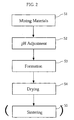
- Fig. 2 is a flowchart of a fabrication of the metal-modified apatite according to the present invention.
- a raw material mixing step S1 raw materials for forming the metal-modified apatite are mixed.
- chemical species representing the symbols A, BO y , and X in the formula (1) described earlier are added to a single aqueous solution, by respective predetermined amounts, and then mixed.
- the metal-modified apatite which is supposed to be formed is Ti-Ca HAP, calcium nitrate for example can be used as a Ca supplier.
- Phosphoric acid for example can be a PO 4 supplier.
- Hydroxyls are supplied from aqueous solution of alkalis such as aqueous solution of ammonia, aqueous solution of calcium hydroxide or sodium hydroxide, which will be used in a step of pH adjustment to be described later.
- the optically catalytic metal or Ti can be supplied from titanium chloride or titanium sulfide.
- the rate of the optically catalytic metal to a total metal content in the apatite crystal structure should preferably be in the range of 3-11 mol% as mentioned earlier. Therefore, in the material mixing step S1, it is preferable that the supply amount is determined for each of the raw materials, andadjustments are made to relative physical quantities to be supplied, so that the rate of the optical catalytic metal to a total metal content in the apatite crystal structure will become 3-11 mol%.
- a pH adjustment step S2 the raw material solution which has been prepared as the above is adjusted to a specific pH at which formation of the target metal-modified apatite commences.
- the pH adjustment can be made by using aqueous solution of ammonia, aqueous solution of calcium hydroxide, aqueous solution of sodium hydroxide and so on.
- the raw material solution should preferably be adjusted to a value in a range of pH 8-10.
- a formation step S3 formation of the metal-modified apatite is promoted, whereby crystallization of the target metal-modified apatite is promoted.
- the solution is aged at 100°C for six hours, to obtain highly crystallized optical catalytic metal.
- the coprecipitatation process in this step allows Ti ions to be taken into Ca positions in the apatite crystal structure, allowing Ti-Ca HAP to grow.
- a drying step S4 the metal-modified apatite which has been formed in the previous step is dried. Specifically, the powder of metal-modified apatite which has been separated in the formation step S3 is filtered, and then the sediment which has been filtered out is cleaned in pure water, and then dried.
- the drying temperature should preferably be 100-200°C. This step removes liquid components in the raw material solution from the metal-modified apatite.
- the powder metal-modified apatite thus fabricated undergoes a sintering step S5 as necessary.
- the metal-modified apatite is heated again, separately from heating in the drying step S4, whereby the metal-modified apatite is sintered.
- the sintering temperature should preferably be 580-660°C. In the case of Ti-Ca HAP for example, this sintering step improves optical catalyst activity.
- Ti-Ca HAP was made as the metal-modified apatite which serves as a residual-agricultural-chemical decomposer.
- a liter of decarbonated pure water was prepared.
- calcium nitrate, titanium sulfide and phosphoric acid were added and mixed in nitrogen atmosphere.
- the concentration of calcium nitrate was adjusted to 0.09 mol/L
- the concentration of titanium sulfite was adjusted to 0. 01 mol/L
- the concentration of phosphoric acid was adjusted to 0.06mol/L.
- the pH of the raw material solution was adjusted to 9.0 by adding ammonia water of the 15 mol/L.
- the raw material solution was aged at 100°C for six hours. Through these operations, the metal-modified apatite occurred and precipitated in the raw material solution, and the raw material solution became a suspension.
- the suspension was filtered, and the separated deposit was cleaned with five liters of pure water, and then dried in a dry oven at 70°C for 12 hours, to obtain Ti-Ca HAP which has an average size of 0.05 ⁇ m per grain.
- the abundance ratio of Ti to Ca was determined on the basis of quantitative analysis using ICP-AES (Plasma Emission Spectrometry).
- An agricultural chemical solution (Brand name: Sumithion, manufactured by Takeda Engei Co., Ltd.) which contains fenitrothion as an active agricultural chemical ingredient was diluted with water to 1000 times.
- the Ti-Ca HAP powder obtained as the above was mixed at a rate of 10wt%, to obtain an agricultural chemical component according to the present example.
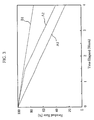
- Decomposition of residual agricultural chemical component contained in the agricultural chemical component prepared as the above was examined. Specifically, first, the agricultural chemical component was applied, by means of spin coating, on a glass plate which had a size of 50 mm x 50 mm. Next, a plurality of the glass plates thus coated with the agricultural chemical component were left in an outdoor environment for four weeks. At every half a week starting from the exposure, the active agricultural chemical ingredient was extracted from a predetermined amount of area on the glass plates, and an amount of residual agricultural chemical component was measured to see the rate of residual active agricultural chemical ingredient to the original amount. The measurement or quantification of the active agricultural chemical ingredient was made in two different methods, i.e. gas chromatography and mass spectroscopy. Results were plotted in Graph A1 in Fig. 3, with the horizontal axis representing time of exposure and the vertical axis representing the rate of residual active agricultural chemical ingredient.
- a residual-agricultural-chemical decomposer was prepared by coating the same Ti-Ca HAP powder as in Example 1 with gelatin. Specifically, first, gelatin was dissolved into water which has been heated to above 50°C, so that the final concentration would be 0.1 g/L. Next, the same Ti-Ca HAP powder as in Example 1 was added to the solution, and mixed for an hour under heating, thereby having Ti-Ca HAP particles adsorb the gelatin. Next, the Ti-Ca HAP was separated by filtration, and dried to obtain Ti-Ca HAP powder coated with a 0.1- ⁇ m gelatin film. A residual-agricultural-chemical decomposer according to the present Example was thus fabricated.
- An agricultural chemical solution (Brand name: Sumithion, manufactured by Takeda Engei Co., Ltd.) which contains fenitrothion as an active agricultural chemical ingredient was diluted with water to 1000 times.
- the Ti-Ca HAP powder obtained as the above was mixed at a rate of 10wt%, to obtain an agricultural chemical component according to the present example.
- the same residual agricultural chemical decomposition test was conducted by using the agricultural chemical component according to the present example, to obtain Graph A2 in Fig. 3.
- An agricultural chemical solution (Brand name: Sumithion, manufactured by Takeda Engei Co., Ltd.) which contains fenitrothion as an active agricultural chemical ingredient was diluted with water to 1000 times, to prepare an agricultural chemical component according to the present example, and the same residual agricultural chemical decomposition test was conducted by using the agricultural chemical component according to the present example, to obtain Graph B1 in Fig. 3.
- the active agricultural chemical ingredient used in the present examples and the comparative example decomposes naturally at a slow rate as shown in Graph Bl.
- Graph A1 and Graph B1 it will be understood that the active agricultural chemical ingredient decomposes more quickly than in the natural decomposition process if it contains an optically-catalytic metal-modified apatite or Ti-Ca HAP.
- the decomposition speed in Example 1 is about three times the decomposition speed in Comparative Example 1.
- Graph A1 and Graph A2 it will be understood that decomposition of the active agricultural chemical ingredient is slowed for a period of time and then promoted if the active agricultural chemical ingredient has its particles coated with an organic film or gelatin.
Landscapes
- Life Sciences & Earth Sciences (AREA)
- Health & Medical Sciences (AREA)
- General Health & Medical Sciences (AREA)
- Chemical & Material Sciences (AREA)
- Environmental Sciences (AREA)
- Zoology (AREA)
- Dentistry (AREA)
- Wood Science & Technology (AREA)
- Toxicology (AREA)
- Agronomy & Crop Science (AREA)
- Pest Control & Pesticides (AREA)
- Plant Pathology (AREA)
- Engineering & Computer Science (AREA)
- Business, Economics & Management (AREA)
- Emergency Management (AREA)
- General Chemical & Material Sciences (AREA)
- Chemical Kinetics & Catalysis (AREA)
- Inorganic Chemistry (AREA)
- Physics & Mathematics (AREA)
- Electromagnetism (AREA)
- Optics & Photonics (AREA)
- Catalysts (AREA)
- Agricultural Chemicals And Associated Chemicals (AREA)
- Processing Of Solid Wastes (AREA)
Applications Claiming Priority (1)
| Application Number | Priority Date | Filing Date | Title |
|---|---|---|---|
| PCT/JP2002/006370 WO2004000018A1 (ja) | 2002-06-25 | 2002-06-25 | 農薬組成物および残留農薬分解剤 |
Publications (3)
| Publication Number | Publication Date |
|---|---|
| EP1516533A1 true EP1516533A1 (de) | 2005-03-23 |
| EP1516533A4 EP1516533A4 (de) | 2008-07-23 |
| EP1516533B1 EP1516533B1 (de) | 2012-10-31 |
Family
ID=29808148
Family Applications (1)
| Application Number | Title | Priority Date | Filing Date |
|---|---|---|---|
| EP02741304A Expired - Lifetime EP1516533B1 (de) | 2002-06-25 | 2002-06-25 | Pestizidzusammensetzung und mittel, das pestizidrückstände abbaut |
Country Status (7)
| Country | Link |
|---|---|
| US (1) | US8030245B2 (de) |
| EP (1) | EP1516533B1 (de) |
| JP (1) | JP4436246B2 (de) |
| KR (1) | KR100590466B1 (de) |
| CN (2) | CN101147481A (de) |
| AU (1) | AU2002315894A1 (de) |
| WO (1) | WO2004000018A1 (de) |
Cited By (3)
| Publication number | Priority date | Publication date | Assignee | Title |
|---|---|---|---|---|
| US7579296B2 (en) * | 2005-03-01 | 2009-08-25 | Fujitsu Limited | Broad band light absorbing photocatalyst, process for producing thereof, broad band light absorbing photocatalyst composition, and molded article |
| EP1882415A3 (de) * | 2006-07-27 | 2011-12-28 | Fujitsu Ltd. | Mittel, Verfahren und System zum Schutz von Pflanzen vor Epidemien, Pflanze und Pflanzenbauverfahren |
| EP1945025A4 (de) * | 2005-11-10 | 2015-01-21 | Yeda Res & Dev | Verringerung bzw. vorbeugung gegen die verseuchung von unter der oberfläche befindlichen erdsubstanzen durch agrarchemikalien |
Families Citing this family (8)
| Publication number | Priority date | Publication date | Assignee | Title |
|---|---|---|---|---|
| JP4652776B2 (ja) * | 2004-11-11 | 2011-03-16 | 株式会社宇宙環境保全センター | 光触媒性複合組成物の製造方法、および光触媒性複合組成物 |
| JP2007252983A (ja) * | 2006-03-20 | 2007-10-04 | Fujitsu Ltd | 光触媒及びその製造方法、並びに成形体 |
| CA2794895A1 (en) * | 2010-03-31 | 2011-10-06 | Colorado State University Research Foundation | Liquid-gas interface plasma device |
| CN103159202B (zh) * | 2013-03-26 | 2014-12-10 | 陕西科技大学 | 一种含Sn(II)羟基磷灰石的制备方法 |
| CN103875659A (zh) * | 2014-03-19 | 2014-06-25 | 吴唐青 | 一种农药分解剂及其制备方法 |
| CN105994261A (zh) * | 2016-06-06 | 2016-10-12 | 佛山市聚成生化技术研发有限公司 | 一种光降解有机磷类农药杀虫剂的制备方法及由该方法制备的光降解有机磷类农药杀虫剂 |
| KR101972419B1 (ko) * | 2017-12-07 | 2019-04-25 | 이중혁 | 제충제 광분해 촉진제와 지연제 제조방법 및 이를 이용하여 제조된 제충제 광분해 촉진제 또는 지연제 및 광분해가 촉진되는 제충국제 제조방법 |
| CN113637480A (zh) * | 2021-06-28 | 2021-11-12 | 王一群 | 一种用于残留农药污染土壤的修复剂以及处理方法 |
Family Cites Families (13)
| Publication number | Priority date | Publication date | Assignee | Title |
|---|---|---|---|---|
| US4272398A (en) * | 1978-08-17 | 1981-06-09 | The United States Of America As Represented By The Secretary Of Agriculture | Microencapsulation process |
| JPH07187933A (ja) * | 1993-12-24 | 1995-07-25 | Sekisui Plastics Co Ltd | 土壌抗菌剤 |
| JP3600664B2 (ja) | 1995-09-25 | 2004-12-15 | サンエネルギー株式会社 | 植物の生育抑制剤及びその製造方法 |
| DE69840581D1 (de) * | 1997-12-25 | 2009-04-02 | Agency Ind Science Techn | Fotokatalysatorpulver zur reinigung der umwelt, darmgegenstand daraus, sowie verfahren zu deren herstellung |
| JP4189074B2 (ja) | 1999-02-24 | 2008-12-03 | 株式会社信州セラミックス | 光触媒機能体 |
| JP3678606B2 (ja) * | 1999-05-21 | 2005-08-03 | 富士通株式会社 | 金属修飾アパタイト及びその製造方法 |
| JP3458948B2 (ja) * | 1999-07-01 | 2003-10-20 | 博 河合 | 植物茎葉散布用組成物およびその使用方法 |
| US6407156B1 (en) * | 1999-09-08 | 2002-06-18 | Showa Denko Kabusiki Kaisha | Photocatalytic titanium dioxide powder, process for producing same, and applications thereof |
| US6274051B1 (en) * | 2000-06-08 | 2001-08-14 | The United States Of America As Represented By The Secretary Of The Navy | Method for neutralizing organophosphorus agricultural chemicals |
| JP3756759B2 (ja) | 2000-12-05 | 2006-03-15 | 独立行政法人産業技術総合研究所 | 環境浄化材及びその製造方法 |
| JP3697608B2 (ja) | 2001-03-30 | 2005-09-21 | 富士通株式会社 | 金属修飾アパタイト材料及びその製造方法 |
| JP3806061B2 (ja) * | 2002-05-21 | 2006-08-09 | 富士通株式会社 | 金属修飾アパタイト含有膜の形成方法、これに用いられるコーティング液、および金属修飾アパタイト含有膜で被覆された部位を有する電子機器 |
| JPWO2003102096A1 (ja) * | 2002-06-04 | 2005-09-29 | 富士通株式会社 | 建築資材用の抗菌防汚塗料およびこれにより塗装された建築資材 |
-
2002
- 2002-06-25 CN CNA2007101284814A patent/CN101147481A/zh active Pending
- 2002-06-25 JP JP2004515467A patent/JP4436246B2/ja not_active Expired - Lifetime
- 2002-06-25 AU AU2002315894A patent/AU2002315894A1/en not_active Abandoned
- 2002-06-25 KR KR1020047019948A patent/KR100590466B1/ko not_active Expired - Lifetime
- 2002-06-25 CN CNB028292006A patent/CN1327764C/zh not_active Expired - Lifetime
- 2002-06-25 WO PCT/JP2002/006370 patent/WO2004000018A1/ja not_active Ceased
- 2002-06-25 EP EP02741304A patent/EP1516533B1/de not_active Expired - Lifetime
-
2004
- 2004-12-16 US US11/012,103 patent/US8030245B2/en active Active
Cited By (3)
| Publication number | Priority date | Publication date | Assignee | Title |
|---|---|---|---|---|
| US7579296B2 (en) * | 2005-03-01 | 2009-08-25 | Fujitsu Limited | Broad band light absorbing photocatalyst, process for producing thereof, broad band light absorbing photocatalyst composition, and molded article |
| EP1945025A4 (de) * | 2005-11-10 | 2015-01-21 | Yeda Res & Dev | Verringerung bzw. vorbeugung gegen die verseuchung von unter der oberfläche befindlichen erdsubstanzen durch agrarchemikalien |
| EP1882415A3 (de) * | 2006-07-27 | 2011-12-28 | Fujitsu Ltd. | Mittel, Verfahren und System zum Schutz von Pflanzen vor Epidemien, Pflanze und Pflanzenbauverfahren |
Also Published As
| Publication number | Publication date |
|---|---|
| US8030245B2 (en) | 2011-10-04 |
| AU2002315894A1 (en) | 2004-01-06 |
| US20050159317A1 (en) | 2005-07-21 |
| KR100590466B1 (ko) | 2006-06-19 |
| EP1516533B1 (de) | 2012-10-31 |
| KR20050010033A (ko) | 2005-01-26 |
| CN1327764C (zh) | 2007-07-25 |
| CN101147481A (zh) | 2008-03-26 |
| JP4436246B2 (ja) | 2010-03-24 |
| WO2004000018A1 (ja) | 2003-12-31 |
| EP1516533A4 (de) | 2008-07-23 |
| CN1627899A (zh) | 2005-06-15 |
| JPWO2004000018A1 (ja) | 2005-10-20 |
Similar Documents
| Publication | Publication Date | Title |
|---|---|---|
| EP1882415A2 (de) | Mittel, Verfahren und System zum Schutz von Pflanzen vor Epidemien, Pflanze und Pflanzenbauverfahren | |
| US5296238A (en) | Microbicides | |
| RU2266649C1 (ru) | Жидкая композиция для стимуляции роста растений, включающая диоксид титана в форме наночастиц | |
| US8030245B2 (en) | Agricultural chemical component and decomposer for residual agricultural chemical | |
| EP1985675B1 (de) | Antibakterielle Farbe für Materialien und damit beschichtete Materialien | |
| US8188005B2 (en) | Liquid composition for promoting plant growth containing titanium dioxide nanoparticles | |
| EP2486785B1 (de) | Schutzbeutel | |
| Mansoor et al. | Impact of nanosized and bulk ZnO on germination and early growth response of Triticum aestivum | |
| JP5384216B2 (ja) | 植物栽培システム | |
| JP5287564B2 (ja) | 農薬組成物および残留農薬分解剤 | |
| DE69032045T2 (de) | Metallperoxide mit phosphaten als zusätze für pflanzen | |
| KR102792682B1 (ko) | 휴믹산이 코팅된 수산화인회석을 유효성분으로 포함하는 토양 유래 메탄가스 발생 저감용 조성물 및 이의 용도 | |
| Pakeerappa et al. | Role of nanomaterials in plant growth and nutrition | |
| CN101112193A (zh) | 植物的防疫剂、防疫方法、防疫系统及植物及其栽培方法 | |
| Parveen et al. | Assessing magnesium oxide nanoparticles (MgONPS) for improving growth and related parameters of chilli plant varieties | |
| Rao et al. | Photocatalytic degradation kinetics of pesticide residues in environmental soils using zinc ferrite nanoparticles | |
| Sharma et al. | Application of nanotechnology in agriculture | |
| Bhatt et al. | Capping of nanoparticles: an alternative approach for reducing nanoparticle toxicity in plants | |
| WO2003079824A1 (fr) | Procédé de conservation d'aliments au moyen d'apatite modifiée par un métal, et récipient alimentaire utilisé à cet effet | |
| Dixit et al. | Nanotechnology in the Detoxification of Agrochemical Residues | |
| Rani et al. | Synthesis and characteristic study of La/ZnO nanocomposites via hydrothermal route for pesticide degradation from agriculture aquatic waste | |
| CN114833189A (zh) | 一种净化剂及其制备工艺和应用 | |
| Nayyab Mansoor et al. | Impact of nanosized and bulk ZnO on germination and early growth response of Triticum aestivum. | |
| Margenot et al. | Environmental Science |
Legal Events
| Date | Code | Title | Description |
|---|---|---|---|
| PUAI | Public reference made under article 153(3) epc to a published international application that has entered the european phase |
Free format text: ORIGINAL CODE: 0009012 |
|
| 17P | Request for examination filed |
Effective date: 20050117 |
|
| AK | Designated contracting states |
Kind code of ref document: A1 Designated state(s): AT BE CH CY DE DK ES FI FR GB GR IE IT LI LU MC NL PT SE TR |
|
| AX | Request for extension of the european patent |
Extension state: AL LT LV MK RO SI |
|
| DAX | Request for extension of the european patent (deleted) | ||
| RBV | Designated contracting states (corrected) |
Designated state(s): DE FR GB |
|
| A4 | Supplementary search report drawn up and despatched |
Effective date: 20080620 |
|
| 17Q | First examination report despatched |
Effective date: 20101019 |
|
| REG | Reference to a national code |
Ref country code: DE Ref legal event code: R079 Ref document number: 60243956 Country of ref document: DE Free format text: PREVIOUS MAIN CLASS: A01N0025320000 Ipc: A01N0059160000 |
|
| GRAP | Despatch of communication of intention to grant a patent |
Free format text: ORIGINAL CODE: EPIDOSNIGR1 |
|
| RIC1 | Information provided on ipc code assigned before grant |
Ipc: A01N 59/16 20060101AFI20120427BHEP Ipc: A01N 25/32 20060101ALI20120427BHEP Ipc: A01N 25/08 20060101ALI20120427BHEP Ipc: A62D 3/00 20070101ALI20120427BHEP |
|
| RIN1 | Information on inventor provided before grant (corrected) |
Inventor name: WAKAMURA, MASATO |
|
| GRAS | Grant fee paid |
Free format text: ORIGINAL CODE: EPIDOSNIGR3 |
|
| GRAA | (expected) grant |
Free format text: ORIGINAL CODE: 0009210 |
|
| AK | Designated contracting states |
Kind code of ref document: B1 Designated state(s): DE FR GB |
|
| REG | Reference to a national code |
Ref country code: GB Ref legal event code: FG4D |
|
| REG | Reference to a national code |
Ref country code: DE Ref legal event code: R096 Ref document number: 60243956 Country of ref document: DE Effective date: 20121227 |
|
| PLBE | No opposition filed within time limit |
Free format text: ORIGINAL CODE: 0009261 |
|
| STAA | Information on the status of an ep patent application or granted ep patent |
Free format text: STATUS: NO OPPOSITION FILED WITHIN TIME LIMIT |
|
| 26N | No opposition filed |
Effective date: 20130801 |
|
| REG | Reference to a national code |
Ref country code: DE Ref legal event code: R097 Ref document number: 60243956 Country of ref document: DE Effective date: 20130801 |
|
| REG | Reference to a national code |
Ref country code: FR Ref legal event code: PLFP Year of fee payment: 15 |
|
| REG | Reference to a national code |
Ref country code: FR Ref legal event code: PLFP Year of fee payment: 16 |
|
| REG | Reference to a national code |
Ref country code: FR Ref legal event code: PLFP Year of fee payment: 17 |
|
| PGFP | Annual fee paid to national office [announced via postgrant information from national office to epo] |
Ref country code: DE Payment date: 20210602 Year of fee payment: 20 Ref country code: FR Payment date: 20210513 Year of fee payment: 20 |
|
| PGFP | Annual fee paid to national office [announced via postgrant information from national office to epo] |
Ref country code: GB Payment date: 20210602 Year of fee payment: 20 |
|
| REG | Reference to a national code |
Ref country code: DE Ref legal event code: R071 Ref document number: 60243956 Country of ref document: DE |
|
| REG | Reference to a national code |
Ref country code: GB Ref legal event code: PE20 Expiry date: 20220624 |
|
| PG25 | Lapsed in a contracting state [announced via postgrant information from national office to epo] |
Ref country code: GB Free format text: LAPSE BECAUSE OF EXPIRATION OF PROTECTION Effective date: 20220624 |