EP1515346A1 - Polyelectrolyte membrane and production method therefor - Google Patents
Polyelectrolyte membrane and production method therefor Download PDFInfo
- Publication number
- EP1515346A1 EP1515346A1 EP03760883A EP03760883A EP1515346A1 EP 1515346 A1 EP1515346 A1 EP 1515346A1 EP 03760883 A EP03760883 A EP 03760883A EP 03760883 A EP03760883 A EP 03760883A EP 1515346 A1 EP1515346 A1 EP 1515346A1
- Authority
- EP
- European Patent Office
- Prior art keywords
- polymer
- molten salt
- membrane
- microporous
- electrolyte membrane
- Prior art date
- Legal status (The legal status is an assumption and is not a legal conclusion. Google has not performed a legal analysis and makes no representation as to the accuracy of the status listed.)
- Granted
Links
Images


Classifications
-
- C—CHEMISTRY; METALLURGY
- C08—ORGANIC MACROMOLECULAR COMPOUNDS; THEIR PREPARATION OR CHEMICAL WORKING-UP; COMPOSITIONS BASED THEREON
- C08J—WORKING-UP; GENERAL PROCESSES OF COMPOUNDING; AFTER-TREATMENT NOT COVERED BY SUBCLASSES C08B, C08C, C08F, C08G or C08H
- C08J5/00—Manufacture of articles or shaped materials containing macromolecular substances
- C08J5/20—Manufacture of shaped structures of ion-exchange resins
- C08J5/22—Films, membranes or diaphragms
- C08J5/2206—Films, membranes or diaphragms based on organic and/or inorganic macromolecular compounds
- C08J5/2275—Heterogeneous membranes
-
- H—ELECTRICITY
- H01—ELECTRIC ELEMENTS
- H01B—CABLES; CONDUCTORS; INSULATORS; SELECTION OF MATERIALS FOR THEIR CONDUCTIVE, INSULATING OR DIELECTRIC PROPERTIES
- H01B1/00—Conductors or conductive bodies characterised by the conductive materials; Selection of materials as conductors
- H01B1/06—Conductors or conductive bodies characterised by the conductive materials; Selection of materials as conductors mainly consisting of other non-metallic substances
- H01B1/12—Conductors or conductive bodies characterised by the conductive materials; Selection of materials as conductors mainly consisting of other non-metallic substances organic substances
- H01B1/122—Ionic conductors
-
- H—ELECTRICITY
- H01—ELECTRIC ELEMENTS
- H01G—CAPACITORS; CAPACITORS, RECTIFIERS, DETECTORS, SWITCHING DEVICES, LIGHT-SENSITIVE OR TEMPERATURE-SENSITIVE DEVICES OF THE ELECTROLYTIC TYPE
- H01G11/00—Hybrid capacitors, i.e. capacitors having different positive and negative electrodes; Electric double-layer [EDL] capacitors; Processes for the manufacture thereof or of parts thereof
- H01G11/54—Electrolytes
- H01G11/56—Solid electrolytes, e.g. gels; Additives therein
-
- H—ELECTRICITY
- H01—ELECTRIC ELEMENTS
- H01M—PROCESSES OR MEANS, e.g. BATTERIES, FOR THE DIRECT CONVERSION OF CHEMICAL ENERGY INTO ELECTRICAL ENERGY
- H01M10/00—Secondary cells; Manufacture thereof
- H01M10/05—Accumulators with non-aqueous electrolyte
- H01M10/056—Accumulators with non-aqueous electrolyte characterised by the materials used as electrolytes, e.g. mixed inorganic/organic electrolytes
- H01M10/0564—Accumulators with non-aqueous electrolyte characterised by the materials used as electrolytes, e.g. mixed inorganic/organic electrolytes the electrolyte being constituted of organic materials only
- H01M10/0565—Polymeric materials, e.g. gel-type or solid-type
-
- H—ELECTRICITY
- H01—ELECTRIC ELEMENTS
- H01M—PROCESSES OR MEANS, e.g. BATTERIES, FOR THE DIRECT CONVERSION OF CHEMICAL ENERGY INTO ELECTRICAL ENERGY
- H01M4/00—Electrodes
- H01M4/02—Electrodes composed of, or comprising, active material
- H01M4/13—Electrodes for accumulators with non-aqueous electrolyte, e.g. for lithium-accumulators; Processes of manufacture thereof
- H01M4/131—Electrodes based on mixed oxides or hydroxides, or on mixtures of oxides or hydroxides, e.g. LiCoOx
-
- H—ELECTRICITY
- H01—ELECTRIC ELEMENTS
- H01M—PROCESSES OR MEANS, e.g. BATTERIES, FOR THE DIRECT CONVERSION OF CHEMICAL ENERGY INTO ELECTRICAL ENERGY
- H01M8/00—Fuel cells; Manufacture thereof
- H01M8/10—Fuel cells with solid electrolytes
- H01M8/1016—Fuel cells with solid electrolytes characterised by the electrolyte material
- H01M8/1018—Polymeric electrolyte materials
- H01M8/1041—Polymer electrolyte composites, mixtures or blends
- H01M8/1046—Mixtures of at least one polymer and at least one additive
- H01M8/1048—Ion-conducting additives, e.g. ion-conducting particles, heteropolyacids, metal phosphate or polybenzimidazole with phosphoric acid
-
- H—ELECTRICITY
- H01—ELECTRIC ELEMENTS
- H01M—PROCESSES OR MEANS, e.g. BATTERIES, FOR THE DIRECT CONVERSION OF CHEMICAL ENERGY INTO ELECTRICAL ENERGY
- H01M8/00—Fuel cells; Manufacture thereof
- H01M8/10—Fuel cells with solid electrolytes
- H01M8/1016—Fuel cells with solid electrolytes characterised by the electrolyte material
- H01M8/1018—Polymeric electrolyte materials
- H01M8/1058—Polymeric electrolyte materials characterised by a porous support having no ion-conducting properties
- H01M8/106—Polymeric electrolyte materials characterised by a porous support having no ion-conducting properties characterised by the chemical composition of the porous support
-
- C—CHEMISTRY; METALLURGY
- C08—ORGANIC MACROMOLECULAR COMPOUNDS; THEIR PREPARATION OR CHEMICAL WORKING-UP; COMPOSITIONS BASED THEREON
- C08J—WORKING-UP; GENERAL PROCESSES OF COMPOUNDING; AFTER-TREATMENT NOT COVERED BY SUBCLASSES C08B, C08C, C08F, C08G or C08H
- C08J2379/00—Characterised by the use of macromolecular compounds obtained by reactions forming in the main chain of the macromolecule a linkage containing nitrogen with or without oxygen, or carbon only, not provided for in groups C08J2361/00 - C08J2377/00
- C08J2379/04—Polycondensates having nitrogen-containing heterocyclic rings in the main chain; Polyhydrazides; Polyamide acids or similar polyimide precursors
- C08J2379/08—Polyimides; Polyester-imides; Polyamide-imides; Polyamide acids or similar polyimide precursors
-
- H—ELECTRICITY
- H01—ELECTRIC ELEMENTS
- H01M—PROCESSES OR MEANS, e.g. BATTERIES, FOR THE DIRECT CONVERSION OF CHEMICAL ENERGY INTO ELECTRICAL ENERGY
- H01M10/00—Secondary cells; Manufacture thereof
- H01M10/05—Accumulators with non-aqueous electrolyte
- H01M10/052—Li-accumulators
- H01M10/0525—Rocking-chair batteries, i.e. batteries with lithium insertion or intercalation in both electrodes; Lithium-ion batteries
-
- H—ELECTRICITY
- H01—ELECTRIC ELEMENTS
- H01M—PROCESSES OR MEANS, e.g. BATTERIES, FOR THE DIRECT CONVERSION OF CHEMICAL ENERGY INTO ELECTRICAL ENERGY
- H01M2300/00—Electrolytes
- H01M2300/0017—Non-aqueous electrolytes
- H01M2300/0025—Organic electrolyte
- H01M2300/0045—Room temperature molten salts comprising at least one organic ion
-
- H—ELECTRICITY
- H01—ELECTRIC ELEMENTS
- H01M—PROCESSES OR MEANS, e.g. BATTERIES, FOR THE DIRECT CONVERSION OF CHEMICAL ENERGY INTO ELECTRICAL ENERGY
- H01M2300/00—Electrolytes
- H01M2300/0017—Non-aqueous electrolytes
- H01M2300/0065—Solid electrolytes
- H01M2300/0082—Organic polymers
-
- Y—GENERAL TAGGING OF NEW TECHNOLOGICAL DEVELOPMENTS; GENERAL TAGGING OF CROSS-SECTIONAL TECHNOLOGIES SPANNING OVER SEVERAL SECTIONS OF THE IPC; TECHNICAL SUBJECTS COVERED BY FORMER USPC CROSS-REFERENCE ART COLLECTIONS [XRACs] AND DIGESTS
- Y02—TECHNOLOGIES OR APPLICATIONS FOR MITIGATION OR ADAPTATION AGAINST CLIMATE CHANGE
- Y02E—REDUCTION OF GREENHOUSE GAS [GHG] EMISSIONS, RELATED TO ENERGY GENERATION, TRANSMISSION OR DISTRIBUTION
- Y02E60/00—Enabling technologies; Technologies with a potential or indirect contribution to GHG emissions mitigation
- Y02E60/10—Energy storage using batteries
-
- Y—GENERAL TAGGING OF NEW TECHNOLOGICAL DEVELOPMENTS; GENERAL TAGGING OF CROSS-SECTIONAL TECHNOLOGIES SPANNING OVER SEVERAL SECTIONS OF THE IPC; TECHNICAL SUBJECTS COVERED BY FORMER USPC CROSS-REFERENCE ART COLLECTIONS [XRACs] AND DIGESTS
- Y02—TECHNOLOGIES OR APPLICATIONS FOR MITIGATION OR ADAPTATION AGAINST CLIMATE CHANGE
- Y02E—REDUCTION OF GREENHOUSE GAS [GHG] EMISSIONS, RELATED TO ENERGY GENERATION, TRANSMISSION OR DISTRIBUTION
- Y02E60/00—Enabling technologies; Technologies with a potential or indirect contribution to GHG emissions mitigation
- Y02E60/13—Energy storage using capacitors
-
- Y—GENERAL TAGGING OF NEW TECHNOLOGICAL DEVELOPMENTS; GENERAL TAGGING OF CROSS-SECTIONAL TECHNOLOGIES SPANNING OVER SEVERAL SECTIONS OF THE IPC; TECHNICAL SUBJECTS COVERED BY FORMER USPC CROSS-REFERENCE ART COLLECTIONS [XRACs] AND DIGESTS
- Y02—TECHNOLOGIES OR APPLICATIONS FOR MITIGATION OR ADAPTATION AGAINST CLIMATE CHANGE
- Y02E—REDUCTION OF GREENHOUSE GAS [GHG] EMISSIONS, RELATED TO ENERGY GENERATION, TRANSMISSION OR DISTRIBUTION
- Y02E60/00—Enabling technologies; Technologies with a potential or indirect contribution to GHG emissions mitigation
- Y02E60/30—Hydrogen technology
- Y02E60/50—Fuel cells
-
- Y—GENERAL TAGGING OF NEW TECHNOLOGICAL DEVELOPMENTS; GENERAL TAGGING OF CROSS-SECTIONAL TECHNOLOGIES SPANNING OVER SEVERAL SECTIONS OF THE IPC; TECHNICAL SUBJECTS COVERED BY FORMER USPC CROSS-REFERENCE ART COLLECTIONS [XRACs] AND DIGESTS
- Y02—TECHNOLOGIES OR APPLICATIONS FOR MITIGATION OR ADAPTATION AGAINST CLIMATE CHANGE
- Y02P—CLIMATE CHANGE MITIGATION TECHNOLOGIES IN THE PRODUCTION OR PROCESSING OF GOODS
- Y02P70/00—Climate change mitigation technologies in the production process for final industrial or consumer products
- Y02P70/50—Manufacturing or production processes characterised by the final manufactured product
Definitions
- the present invention relates to a polymer electrolyte membrane and, more particularly, a polymer electrolyte membrane useful in fuel cells, secondary batteries, electric double layer capacitors, electrolytic capacitors, etc.
- Secondary batteries such as lithium ion batteries contain a porous polymer membrane impregnated with an electrolytic solution as a separator between a cathode and an anode.
- the electrolytic solution is volatile and flammable, which is problematical for safety when leakage occurs.
- ammonium salts of certain kinds such as imidazolium salts and pyridinium salts, become liquid molten salts at 100°C or lower, particularly around room temperature, and exhibit high ionic conductivity at relatively low temperatures of 200°C or lower even in the absence of water or an organic solvent.
- application as an electrolyte of batteries, etc. has been studied. Being liquid, however, they are not easy to handle.
- several proposals have been made on a polymer electrolyte having a molten salt immobilized with a polymer.
- JP-A-8-245828 discloses a composition comprising an aliphatic quaternary ammonium salt of an organic carboxylic acid and a polymer, such as polyvinyl chloride, polyacrylonitrile or an aliphatic polyether.
- JP-A-7-118480 discloses a combination of a room-temperature molten salt and a polymer of a vinyl monomer having an alkyl quaternary ammonium salt structure.
- JP-A-10-83821, JP-A-2000-3620, and JP-A-2000-11753 propose an aliphatic molten salt type polymer synthesized from an imidazolium compound and an acid or an acid monomer. A.
- JP-A-10-265673 discloses a polymer composite comprising a non-fluorine polymer and an ionic liquid. Because all these compositions use a polymer the main chain of which is composed mainly of an aliphatic hydrocarbon group, they are inferior in durability characteristics including resistance to oxidation.
- JP-A-11-306858 discloses a composition of a vinylidene fluoride polymer and an imidazolium salt
- JP-A-11-86632 teach compositions comprising an acid group-containing perfluoropolymer and a molten salt.
- a composition containing a fluoropolymer is expected to have improved durability but is disadvantageous from the viewpoint of cost and environmental burdens involved in the production of fluoropolymers. It has therefore been demanded to develop an inexpensive and yet durable molten salt composition containing a hydrocarbon polymer.
- JP-A-11-86632 proposes a molten salt type polymer electrolyte having a porous polymer solid or a polymer thin film made of a polyanion resin (having negative charges introduced) impregnated with an imidazolium salt derivative.
- the proposed technique involves such post-treatments as introduction of a carboxyl group to a porous Teflon membrane using liquid ammonia and sodium or irradiation of a sodium polymethacrylate film with ⁇ -rays to make the film porous.
- a fluoropolymer has a lower glass transition temperature than room temperature and is therefore unreliable for mechanical strength in high temperature, and an aliphatic polymer can have poor durability against solvents or oxidation.
- the publication has no mention of the pore size of the porous polymer solid.
- JP-A-11-306858 proposes a solid polyelectrolyte composed of a fluoropolymer matrix containing an imidazolium salt and a lithium salt. It is virtually gel and liable to deformation under external pressure, which can pose a strength problem.
- a fluoropolymer has a lower glass transition temperature than room temperature and is therefore unreliable for mechanical strength in high temperatures.
- An object of the present invention is to provide an inexpensive and durable polymer electrolyte membrane which has a clearly defined microporous structure stably holding a molten salt, exhibits excellent mechanical strength, maintains its structure even in high temperatures, and secures high ion conductivity even in the absence of water or a solvent and processes of producing the polymer electrolyte membrane.
- the object is accomplished by the following polymer electrolyte membranes and processes of making the same.
- a polymer electrolyte membrane having a microporous polymer membrane having pores penetrating through the opposite sides thereof, the microporous polymer membrane containing a mixture of a polymer and a molten salt at a weight ratio of 1/99 to 99/1 and/or a molten salt.
- a polymer electrolyte membrane having a microporous polymer membrane having pores penetrating through the opposite sides thereof, the microporous polymer membrane containing a molten salt.
- a polymer electrolyte membrane comprising a microporous polymer membrane having pores penetrating through the opposite sides thereof and a mixture of a polymer and a molten salt at a weight ratio of 1/99 to 99/1 held in the pores of the microporous polymer membrane.
- a polymer electrolyte membrane comprising a microporous polymer membrane having pores penetrating through the opposite sides thereof and a mixture of a polymer and a molten salt at a weight ratio of 1/99 to 99/1 held in the pores and on both the opposite surfaces of the microporous polymer membrane.
- a polymer electrolyte membrane comprising a microporous polymer membrane having pores penetrating through the opposite sides thereof, a molten salt held in the pores, and a layer comprising a mixture of a polymer and a molten salt at a weight ratio of 1/99 to 99/1 provided on both the opposite surfaces of the microporous polymer membrane.
- a process of producing a polymer electrolyte membrane containing a molten salt comprising immersing a microporous polymer membrane having pores penetrating through the opposite sides thereof in a molten salt to infiltrate the molten salt into the pores of the microporous polymer membrane.
- a process of producing a polymer electrolyte membrane containing a mixture of a polymer and a molten salt comprising immersing a microporous polymer membrane having pores penetrating through the opposite sides thereof in a solution of a mixture of a polymer and a molten salt at a weight ratio of 1/99 to 99/1 in a solvent incapable of dissolving the microporous polymer membrane to infiltrate the solution into the microporous polymer membrane, and removing the solvent by drying to have the mixture of the polymer and the molten salt held in the microporous polymer membrane.
- a process of producing a polymer electrolyte membrane comprising immersing a microporous polymer membrane having pores penetrating through the opposite sides thereof in a molten salt to infiltrate the molten salt into the pores of the microporous polymer membrane, applying a solution of a mixture of a polymer and a molten salt at a weight ratio of 1/99 to 99/1 in a solvent incapable of dissolving the microporous polymer membrane to both sides of the microporous polymer membrane, and removing the solvent by drying to form a layer of the mixture of the polymer and the molten salt on both sides of the microporous polymer membrane.
- the microporous polymer membrane that can be used in the present invention is not particularly limited as long as it has open pores penetrating through both sides thereof. One which does not dissolve in the molten salt to be held is preferred. When a solvent is used, a microporous polymer membrane which does not dissolve in the solvent is preferred.
- the pores penetrating through the opposite sides may be either linear or nonlinear.
- Useful microporous polymer membranes include those of olefin polymers such as polyethylene and polypropylene, and those of aromatic polymers such as aromatic polyimide, aromatic polyether imide, aromatic polysulfone, aromatic polyether sulfone, polyphenylene oxide, polyphenylene sulfide, aromatic polyether ketone, aromatic polyether ether ketone, aromatic polyether ether ketone ketone, polybenzimidazole, polyquinoxaline, and polyphenylquinoxaline.
- aromatic polyimide such as aromatic polyimide, aromatic polyether imide, aromatic polysulfone, aromatic polyether sulfone, polyphenylene oxide, polyphenylene sulfide, aromatic polyether ketone, aromatic polyether ether ketone, aromatic polyether ether ketone ketone, polybenzimidazole, polyquinoxaline, and polyphenylquinoxaline.
- microporous polymer membrane made of a heat-resistant polymer that does not have a glass transition temperature below 100°C, still preferably below 120°C, particularly preferably below 150°C.
- Microporous polymer membranes made of the above-recited aromatic polymers can be mentioned as preferred examples of those made of such heat-resistant polymers.
- aromatic heat-resistant polymers of which the glass transition temperatures are so high that thermal decomposition precedes glass transition, which makes glass transition temperature measurement difficult.
- aromatic heat-resistant polymers include those described in Jyunji Furukawa, Sentan Kobunshi Zairyo Series 2 Koseino Hokozokukei Kobunshi Zairyo, Maruzen, Tokyo, 52 (1990), such as poly(p-phenylene), polybenzothiazole, and poly(p-phenylene pyromellitic imide).
- microporous polymer membrane which can be used in the invention can be prepared by known techniques, such as solvent casting, extrusion, melting, and stretching. Commercially available microporous polymer membranes may be utilized.
- the microporous polyolefin membrane can be obtained by stretching a polyolefin film, such as a polyethylene film or a polypropylene film, to make the film porous.
- a polyolefin film such as a polyethylene film or a polypropylene film
- a commercially available porous polyolefin film may be used as well.
- the microporous aromatic polymer membrane made of, for example, an aromatic polyether sulfone can be prepared by a general solvent casting method. Specifically, an aromatic polyether sulfone is dissolved in a water-miscible solvent in a prescribed concentration, casting the solution on a glass plate, immersing the coated glass plate in water to precipitate the polymer, followed by drying to obtain a microporous aromatic polymer membrane. A commercially available one can be used as well.
- the aromatic polyether sulfone may be synthesized in a known manner, or a commercially available product may be purchased.
- a microporous polymer membrane made of polyimide is particularly preferred in view of its heat resistance, dimensional stability especially in high temperature, solvent resistance, and thin film mechanical strength.
- Microporous polyimide membranes with pores penetrating through both sides thereof are disclosed, e.g., in JP-A-11-310658 and JP-A-2000-306568. They are prepared as follows. A solution is prepared from 0.3 to 60% by weight of a polyimide precursor and 40 to 99.7% by weight of a solvent. The solution is cast in the form of film. In order to regulate the rate of solvent exchange, a porous film of a polyolefin, etc. is superposed on the cast film. The resulting laminate is brought into contact with a solidifying solvent, thereby precipitating the polyimide precursor while forming fine pores. The porous polyimide precursor membrane is then converted to the corresponding microporous polyimide membrane with fine penetrating pores by thermal or chemical imidization process.
- the polyimide precursor is a polyamic acid or a partially imidized polyamic acid obtained by polymerizing monomers as a tetracarboxylic acid component and a diamine component, preferably monomers belonging to aromatic compounds.
- the polyimide precursor cyclizes on heat treatment or chemical treatment to become a polyimide resin.
- polyimide resin as used herein means a heat-resistant polymer having a degree of imidization of about 50% or more.
- the solvent of the polyimide precursor solution includes p-chlorophenol, N-methyl-2-pyrrolidone (NMP), pyridine, N,N-dimethylacetamide, N,N-dimethylformamide, dimethyl sulfoxide, tetramethylurea, phenol, and cresol.
- the polyimide precursor is obtained by dissolving approximately equimolar amounts of a tetracarboxylic acid component and a diamine component in the same organic solvent as used to dissolve the resulting polyimide precursor and polymerizing them.
- the polyimide precursor preferably has an inherent viscosity of 0.3 or greater, still preferably 0.5 to 7 (at 30°C ;at a concentration of 0.5 g in 100 ml NMP). When the polymerization is carried out at or above about 80°C, the polyimide precursor imidized partially by cyclization is obtained.
- the diamine component includes p-phenylenediamine, m-phenylenediamine, 4,4'-diaminodiphenyl ether, 3,3'-dimethyl-4,4'-diaminodiphenyl ether, 3,3'-diethoxy-4,4'-diaminodiphenyl ether, and 3,3'-dihydroxy-4,4'-diaminobiphenyl.
- diaminopyridine compounds e.g., 2,6-diaminopyridine, 3,6-diaminopyridine, 2,5-diaminopyridine, and 3,4-diaminopyridine.
- diamine components can be used either individually or as a mixture of two or more thereof. It is preferred that 3,3'-dihydroxy-4,4'-diaminobiphenyl be used in a proportion of at least 1 mol% based on the total diamine component. To use 1 mol% or more of 3,3'-dihydroxy-4,4'-diaminobiphenyl is effective in producing a microporous polymer membrane easy to impregnate with a polymer/molten salt mixture.
- the tetracarboxylic acid component preferably includes 3,3',4,4'-biphenyltetracarboxylic acid dianhydride and 2,3,3',4'-biphenyltetracarboxylic acid dianhydride. Also useful are 2,3,3',4'- or 3,3',4,4'-biphenyltetracarboxylic acid and a salt or ester derivative of 2,3,3',4'- or 3,3',4,4'-biphenyltetracarboxylic acid. These biphenyltetracarboxylic acid compounds can be used as a mixture of two or more thereof.
- the tetracarboxylic acid component may contain up to 10 mol%, preferably up to 5 mol%, based on the total tetracarboxylic acid component, of other tetracarboxylic acid compounds than the above-described biphenyltetracarboxylic acid compounds, such as pyromellitic acid, 3,3',4,4'-benzophenonetetracarboxylic acid, 2,2-bis(3,4-dicarboxyphenyl)propane, bis(3,4-dicarboxyphenyl) sulfone, bis(3,4-dicarboxyphenyl) ether, bis(3,4-dicarboxyphenyl) thioether, butanetetracarboxylic acid, and an anhydride, salt or ester derivative of these acids.
- biphenyltetracarboxylic acid compounds such as pyromellitic acid, 3,3',4,4'-benzophenonetetracarboxylic acid, 2,2-
- the microporous polymer membrane that can be used in the invention preferably has an average pore size of 0.01 to 50 ⁇ m, still preferably 0.05 to 10 ⁇ m.
- a membrane whose average pore size is too small is difficult to impregnate with a polymer/molten salt mixture or a molten salt.
- a membrane whose average pore size is too large is inferior in mechanical strength and incapable of stably holding a polymer/molten salt mixture or a molten salt.
- the microporous polymer membrane that can be used in the invention preferably has a void of 10 to 90% by volume, still preferably 20 to 80% by volume. With too small a void volume, the amount of a polymer/molten salt mixture or a molten salt that can be held is reduced, resulting in reduced ion conductivity. A membrane whose void is too large is inferior in mechanical strength and incapable of stably holding a polymer/molten salt mixture or a molten salt.
- the microporous polymer membrane that can be used in the invention preferably has a linear expansion coefficient of 0.5 to 10 x 10 -5 /°C and an air resistance (Gurley) porosity of 10 to 1000 sec/100 cc.
- the membrane thickness is selected according to the intended use. For example, the thickness is suitably 10 to 50 ⁇ m for lithium battery application and 10 to 250 ⁇ m for fuel cell application.
- the polymer of the polymer/molten salt mixture that is held in the microporous polymer membrane is not particularly limited as long as it can be held together with a molten salt.
- Useful polymers include vinyl polymers, such as polymers having an aliphatic main chain, including acrylic or methacrylic ester polymers, e.g., poly(methyl acrylate), poly(ethyl acrylate), poly(methyl methacrylate), and poly(ethyl methacrylate); halogen-containing polymers, e.g., polyvinyl chloride and polyvinylidene fluoride; styrene polymers, e.g., polystyrene and poly( ⁇ -methylstyrene); polyacrylonitrile; and polyvinyl acetate.
- aromatic polymers such as aromatic polyether sulfone, aromatic polysulfone, aromatic polyether ketone, aromatic polyether ether ketone, aromatic polyether ketone ketone, aromatic polyimi
- the polymer preferably is cation exchange group-containg polymer.
- Preferred cation exchange groups include a sulfonic group, a carboxyl group, and a phosphonic group.
- Such cation exchange group-containing polymers include cation exchange group-containing styrene polymers, such as poly(styrenesulfonic acid), poly(vinylbenzylsulfonic acid), a sulfo-containing styrene-(ethylene-butylene)-styrene triblock copolymer and a sulfo-containing styrene-(ethylene-propylene) block copolymer that are described in JP-T-2002-509152 and European Polymer Journal, vol.
- aromatic polymers such as aromatic polyether sulfone, aromatic polysulfone, aromatic polyether ketone, aromatic polyether ether ketone, aromatic polyether ketone ketone, aromatic polyimide, and polyphenylene oxide, which contain cation exchange groups.
- aromatic polymers such as aromatic polyether sulfone, aromatic polysulfone, aromatic polyether ketone, aromatic polyether ether ketone, aromatic polyether ketone ketone, aromatic polyimide, and polyphenylene oxide, which contain cation exchange groups.
- aromatic polymers such as aromatic polyether sulfone, aromatic polysulfone, aromatic polyether ketone, aromatic polyether ether ketone, aromatic polyether ketone ketone, aromatic polyimide, and polyphenylene oxide, which contain cation exchange groups.
- sulfo-containing aromatic polyether sulfone described in JP-A-61-43630, J. Membr. Sci., vol. 83, 211 (1993), J. Polym
- Patent Publication 20010021764A1 carboxyl-containing aromatic polyether sulfone described in Polymer, vol. 27, 1626 (1986), Polymer, vol. 42, 5973 (2001), and Polymer, vol. 34, 2836 (1993); sulfo-containing aromatic polyether ketone described in JP-A-57-25328, JP-A-57-25328, JP-A-6-93114, J. Membr. Sci., vol. 199, 167 (2002), J. Membr. Sci., vol. 173, 17 (2000), Polymer, vol. 28, 1009 (1987), Solid State Ionics, vol. 106, 219 (1998), Br. Polym. J., vol. 17,4 (1985), and Polym. Int., vol.
- the polymer may be a copolymer, which may be a random, block or graft copolymer.
- the cation exchange group-containing polymer preferably has an ion exchange capacity of 0.3 to 7 meq/g, still preferably 0.5 to 7 meq/g. Where the ion exchange capacity is less than that lower limit, the polymer tends to fail to retain a molten salt, allowing the molten salt to bleed out.
- the molten salt of the polymer/molten salt mixture that is held in the microporous polymer membrane preferably has a melting point of 100°C or lower, still preferably 80°C or lower, particularly preferably 60°C or lower.
- Known molten salts can be used.
- the molten salt is composed of cation components and anion components.
- Preferred molten salts include those that are liquid at room temperature, room-temperature molten salts, and ionic liquids.
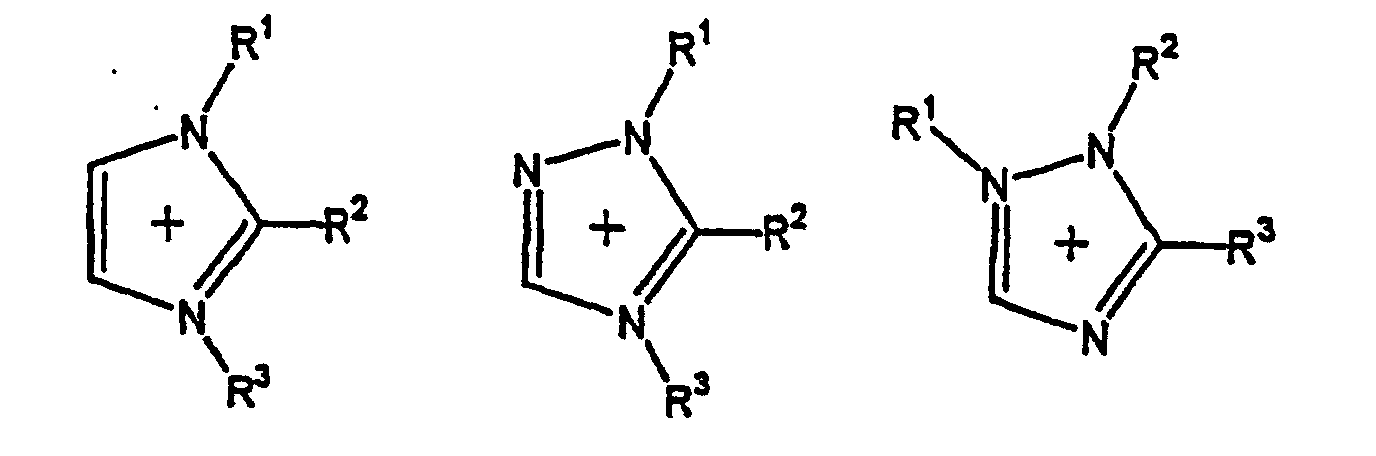
- the cation component composing the molten salt is preferably an ammonium ion in view of molten salt's stability and the like. Cations having the following structures can be mentioned as examples. wherein R 1 , R 2 , R 3 , R 4 , R 5 , R 6 and R 7 each represent a hydrogen atom or an alkyl group having 1 to 10 carbon atoms; and the rings may have substituents other than hydrogen atoms on their ring-forming carbon atoms.
- Cations having a cyclic structure preferably include those having an imidazole ring, a triazole ring, a pyrrolidine ring, a pyridine ring, a cyclohexane ring or a benzene ring. Each of these rings may be substituted.
- Cations having a straight-chain or branched alkyl group preferably include those having an alkyl group containing 1 to 10 carbon atoms, e.g., methyl, ethyl, propyl, isopropyl, n-butyl, isobutyl, sec-butyl, tert-butyl, pentyl or hexyl.
- Preferred of the above cations are an imidazolium cation, a triazolium cation, a tetraalkylammonium cation, a pyrrolidinium cation, and pyridinium cation.
- the anion component composing the molten salt preferably includes sulfonic acid, a sulfonic acid compound, a carboxylic acid, and an inorganic acid.
- Specific examples are (CF 3 SO 2 ) 3 C - , (CF 3 SO 2 ) 2 N - , CF 3 SO 3 - , C 4 F 9 SO 3 - , CF 3 CO 2 - , C 3 F 7 CO 2 - , BF 4 - ; PF 6 - , ClO 4 - , CH 3 SO 3 - , CH 3 CO 2 - , NO 3 - , NO 2 - , HSO 3 - , and halide ions.
- molten salts composed of the anion and cation components are known.
- the molten salts are synthesized by the methods described in Hiroyuki Ohno, Lithium Nijidenchino Gijyutukakushinto Syoraitenbo, NTS Inc., Tokyo, p. 79 (2001), R. Hagiwara et al., J. Fluorine Chem., vol. 105, 221 (2000), J. Sun et al., Electrochimica Acta., vol. 46, 1703 (2001), P. Bonhote et al., Inorg. Chem., vol. 35,1168 (1996), and D.R. McFarlane et al., Electrochim. Acta., vol. 45, 1271 (2000).
- the molten salts are obtained by the reaction between a basic nitrogen-containing compound and/or a halogen salt thereof and an acid and/or a metal salt thereof.
- Trifluoromethanesulfonates including 1,3-dimethylimidazolium trifluoromethanesulfonate, 1,3-diethylimidazolium trifluoromethanesulfonate, 1,2-dimethylimidazolium trifluoromethanesulfonate, 1,2-diethylimidazolium trifluoromethanesulfonate, 1-ethyl-3-methylimidazolium trifluoromethanesulfonate, 1-methyl-3-propylimidazolium trifluoromethanesulfonate, 2-ethyl-1-methylimidazolium trifluoromethanesulfonate, 1-ethyl-2-methylimidazolium trifluoromethanesulfonate, 1,2,3-trimethylimidazolium trifluoromethanesulfonate, 1,2-dimethyl-3-propylimidazolium trifluoromethanesulfonate, 1-
- Trifluoroacetates such as 1,3-dimethylimidazolium trifluoroacetate and 1-ethyl-3-methylimidazolium trifluoroacetate.
- Tetrafluoroborates such as 1,3-dimethylimidazolium tetrafluoroborate, 1,3-diethylimidazolium tetrafluoroborate, 1,2-dimethylimidazolium tetrafluoroborate, 1,2-diethylimidazolium tetrafluoroborate, 1-ethyl-3-methylimidazolium tetrafluoroborate, 1-methyl-3-propylimidazolium tetrafluoroborate, 2-ethyl-1-methylimidazolium tetrafluoroborate, 1-ethyl-2-methylimidazolium tetrafluoroborate, 1,2,3-trimethylimidazolium tetrafluoroborate, 1,2-dimethyl-3-propylimidazolium tetrafluoroborate, 1-methylimidazolium tetrafluoroborate, 1-ethylimidazolium tetrafluoroborate
- Hexafluorophosphates such as 1,3-dimethylimidazolium hexafluorophosphate and 1-butyl-3-methylimidazolium hexafluorophosphate.
- Tris(trifluoromethylsulfonyl)methides such as 1,3-dimethylimidazolium tris(trifluoromethylsulfonyl)methide, 1,3-diethylimidazolium tris(trifluoromethylsulfonyl)methide, 1,2-dimethylimidazolium tris(trifluoromethylsulfonyl)methide, 1,2-diethylimidazolium tris(trifluoromethylsulfonyl)methide, 1-ethyl-3-methylimidazolium tris(trifluoromethylsulfonyl)methide, 1-methyl-3-propylimidazolium tris(trifluoromethylsulfonyl)methide, 2-ethyl-1-methylimidazolium tris(trifluoromethylsulfonyl)methide, 1-ethyl-2-methylimidazolium tris(trifluor
- Methanesulfonates such as 1,3-dimethylimidazolium methanesulfonate, 1-methylimidazolium methanesulfonate, 1-ethylimidazolium methanesulfonate, and 1-vinylimidazolium methanesulfonate.
- Acetates such as 1,3-dimethylimidazolium acetate, 1-ethyl-3-methylimidazolium acetate, 1-methylimidazolium acetate, and 1-ethylimidazolium acetate.
- Nitrates such as 1,3-dimethylimidazolium nitrate, 1-ethyl-3-methylimidazolium nitrate, 1-methylimidazolium nitrate, 1-ethylimidazolium nitrate, and 1-vinylimidazolium nitrate.
- Nitrites such as 1,3-dimethylimidazolium nitrite and 1-ethyl-3-methylimidazolium nitrite.
- Sulfites such as 1,3-dimethylimidazolium sulfite, 1-methylimidazolium sulfite, 1-ethylimidazolium sulfite, and 1-vinylimidazolium sulfite.
- Chlorides such as 1,3-dimethylimidazolium chloride, 1-ethyl-3-methylimidazolium chloride, 1-methylimidazolium chloride, 1-ethylimidazolium chloride, 1-vinylimidazolium chloride, 1,2-dimethyl-1,2,4-triazolium chloride, and 1-butylpyridinium chloride.
- Bromides such as 1,3-dimethylimidazolium bromide, 1-ethyl-3-methylimidazolium bromide, 1-methylimidazolium bromide, 1-ethylimidazolium bromide, 1-vinylimidazolium bromide, and 1-butylpyridinium bromide.
- Bis(trifluoromethylsulfonyl)imides such as 1,3-dimethylimidazolium bis(trifluoromethylsulfonyl)imide, 1,3-diethylimidazolium bis(trifluoromethylsulfonyl)imide, 1,2-dimethylimidazolium bis(trifluoromethylsulfonyl)imide, 1,2-diethylimidazolium bis(trifluoromethylsulfonyl)imide, 1-ethyl-3-methylimidazolium bis(trifluoromethylsulfonyl)imide, 1-methyl-3-propylimidazolium bis(trifluoromethylsulfonyl)imide, 2-ethyl-1-methylimidazolium bis(trifluoromethylsulfonyl)imide, 1-ethyl-2-methylimidazolium bis(trifluoromethylsulfonyl)imide, 1,2,3-tri
- imidazolium salts are preferred for their low viscosity at room temperature. Too viscous molten salts are difficult to hold in the microporous polymer membrane.
- the polymer and molten salt mixture to be held in the microporous polymer membrane has a polymer/molten salt weight ratio of 1/99 to 99/1, preferably 5/95 to 95/5. If the proportion of the molten salt is lower than that lower limit, the ion conductivity is unfavorably small. If it exceeds the upper limit, the molten salt cannot be held stably.
- the content of the polymer/molten salt mixture is preferably 1 to 99% by weight, still preferably 5 to 95% by weight. That content is calculated using the following equation, in which W 1 is the weight of a microporous polymer membrane, and W 2 is the weight of a polymer electrolyte membrane, i.e., the weight of the microporous polymer membrane containing a polymer/molten salt mixture.
- the content of the mixture (wt%) (W 2 -W 1 )/W 2 x100
- the content of the mixture is smaller than that lower limit, the ion conductivity is reduced.
- the effect of using a microporous polymer membrane on structure retention is small.
- molten salt alone is held in the microporous polymer membrane
- the same molten salts as used in the polymer/molten salt mixture can be used.
- the molten salt content is preferably 1 to 90% by volume, still preferably 5 to 90% by volume.
- the molten salt content can be calculated using the following equation, where S and d mean the area and the thickness, respectively, of a microporous polymer membrane; and a and b represent the weight and the density, respectively, of an impregnating molten salt.
- Molten salt content (vol%) a/(Sxdxb)x100
- the polymer electrolyte membrane according to the invention in which the microporous polymer membrane with penetrating pores contains the polymer/molten salt mixture and/or the molten salt, preferably includes the following embodiments.
- the polymer electrolyte membrane containing a molten salt can be produced by immersing the microporous polymer membrane in a molten salt.
- the molten salt is thus allowed to fill the pores of the microporous polymer membrane and retained therein. If necessary, the molten salt is allowed to infiltrate under vacuum degassing and/or pressurizing to accelerate displacement of gas in the pores of the microporous polymer membrane with the molten salt and filling the pores of the microporous polymer membrane with the molten salt.
- the impregnating molten salt may be in the form of a solution in a solvent incapable of dissolving the microporous polymer membrane.
- the impregnated polymer membrane is dried by heating to remove the solvent.
- the solvent used to prepare the molten salt solution is not particularly limited provided that the microporous polymer membrane does not substantially dissolve therein, including amides, sulfones, alcohols, ethers, and ketones.
- suitable solvents are water, N,N-dimethylformamide, N,N-dimethylacetamide, N-methyl-2-pyrrolidone, 1,3-dimethyl-2-imidazolidinone, dimethyl sulfoxide, sulfolane, diphenyl sulfone, tetrahydrofuran, methanol, ethanol, isopropyl alcohol, ethylene glycol monomethyl ether, ethylene glycol monoethyl ether, propylene glycol monomethyl ether, diethyl ether, and acetone.
- the temperature of the molten salt or the molten salt solution to be infiltrated into the microporous polymer membrane is not particularly limited as long as it is within a range of from the melting point of the molten salt and/or the melting point of the solvent to the boiling point of the solvent and also not higher than the melting or decomposition temperature of the microporous polymer membrane and not higher than the decomposition temperature of the molten salt. It is carried out at, for example, a temperature of 0° to 300°C.
- the polymer electrolyte membrane containing a mixture of a polymer and a molten salt can be produced by immersing the microporous polymer membrane in a solution of the polymer/molten salt mixture in a solvent incapable of dissolving the microporous polymer membrane to allow the solution to impregnate the microporous polymer membrane and removing the solvent by drying. If necessary, the mixture solution is allowed to infiltrate with vacuum degassing and/or pressurizing to accelerate displacement of gas in the pores of the microporous polymer membrane with the solution and filling the pores of the microporous polymer membrane with the solution.
- the solvent for dissolving the polymer/molten salt mixture can be chosen with no limitation from among those useful in the preparation of the molten salt solution, provided that the microporous polymer membrane does not substantially dissolve therein.
- the temperature of the polymer/molten salt solution to be infiltrated into the microporous polymer membrane is not particularly limited as long as it is within a range of from the melting points of the molten salt and the solvent to the boiling point of the solvent and also not higher than the melting or decomposition temperature of the microporous polymer membrane and not higher than the decomposition temperature of the molten salt.
- the impregnation is carried out at, for example, a temperature of 0° to 300°C.
- the polymer electrolyte membrane containing a molten salt in the pores of the microporous polymer membrane and having a layer of a polymer/molten salt mixture provided on both sides of the microporous polymer membrane can be produced by immersing the microporous polymer membrane in the molten salt to infiltrate the molten salt into the pores of the microporous polymer membrane, applying a solution of the polymer/molten salt mixture in a solvent incapable of dissolving the microporous polymer membrane to both sides of the microporous polymer membrane, and removing the solvent by drying to form a layer of the polymer/molten salt mixture on both sides of the microporous polymer membrane.
- the molten salt is allowed to infiltrate with vacuum degassing and/or pressurizing to accelerate displacement of gas in the pores of the microporous polymer membrane with the molten salt and filling the pores of the microporous polymer membrane with the molten salt.
- the impregnating molten salt may be in the form of a solution in a solvent incapable of dissolving the microporous polymer membrane.
- the impregnated polymer membrane is dried by heating to remove the solvent.
- the solvent used to prepare the molten salt solution and the polymer/molten salt mixture solution can be chosen with no limitation from among those useful in the preparation of the molten salt solution used in the production of the polymer electrolyte membrane containing the molten salt, provided that the solvent does not substantially dissolve the microporous polymer membrane.
- the temperature of impregnating the microporous polymer membrane with the molten salt and the temperature of applying the polymer/molten salt mixture solution to the microporous polymer membrane are not particularly limited as long as they are within a range of from the melting points of the molten salt and the solvent to the boiling point of the solvent and also not higher than the melting or decomposition temperature of the microporous polymer membrane or not higher than the decomposition temperature of the molten salt.
- the impregnation and application are carried out at, for example, a temperature of 0° to 300°C.
- a surface active agent can be used for the purpose of facilitating penetration of the molten salt and the polymer/molten salt mixture solution into the microporous polymer membrane.
- the polymer electrolyte membrane can further contain an inorganic acid (e.g., phosphoric acid, hypophosphorous acid or sulfuric acid) or a salt thereof, a perfluoroalkylsulfonic acid having 1 to 14 carbon atoms or a salt thereof, a perfluoroalkylcarboxylic acid having 1 to 14 carbon atoms or a salt thereof, a tertiary amine compound (e.g., imidazole, pyridine or an aliphatic tertiary amine), or a salt of an alkali metal (e.g., lithium).
- an inorganic acid e.g., phosphoric acid, hypophosphorous acid or sulfuric acid
- a salt thereof e.g., a perfluoroalkylsulfonic acid having 1 to 14 carbon
- a polymer electrolyte membrane having an ion conductivity of, for example, 10 -4 Scm -1 or higher at 100°C can appropriately be obtained.
- the resulting solution was cast on a mirror-finished SUS plate.
- a microporous polyolefin film (UP-3025, available from Ube Industries, Ltd.) was superposed on the polyamic acid solution cast film as a solvent exchange rate regulatory material.
- the laminated film structure was immersed in methanol and then in water to obtain a polyamic acid microporous membrane.
- the membrane was fixed on a pin tenter and heated in the atmosphere at 320°C to obtain microporous polyimide membrane PI-1.
- the resulting membrane had the following characteristics. Tg: 275°C Average pore size: 0.18 ⁇ m. Void: 35% Air resistance (Gurley): 150 sec/100 cc Thickness: 31 ⁇ m Linear expansion coefficient: 3.830 x 10 -5 /°C
- N,N-dimethylacetamide as a solvent and, as diamine components, 4,4'-diaminodiphenyl ether and 3,3'-dihydroxy-4,4'-diaminobiphenyl at a molar ratio of 6/4.
- the mixture was stirred at 40°C in a nitrogen atmosphere to make a solution.
- To the solution was added an equimolar amount, based on the total diamine component, of 3,3',4,4'-biphenyltetracarboxylic acid dianhydride in several divided portions.
- N-ethylimidazolium trifluoromethanesulfonate (hereinafter referred to as EtIm+TfS-) as a colorless transparent liquid.
- EtIm+TfS- N-ethylimidazolium trifluoromethanesulfonate
- the solution was poured into a large quantity of water to precipitate a while solid, which was collected by filtration, washed twice with hot water and once with methanol, and dried under reduced pressure to obtain a copolymer.
- the solution viscosity ⁇ sp/c of the resulting copolymer was 0.55.
- the solution was poured into a large quantity of water to precipitate a white solid, which was collected by filtration.
- the solid was washed twice with hot water and then once with methanol and dried under reduced pressure to give hydrophobic segment prepolymer (a).
- the resulting polymer (a) had a solution viscosity ⁇ sp/c of 0.42.
- hydrophobic segment prepolymer (a) and 0.5 g of potassium carbonate were added to a mixture of 150 ml of N,N-dimethylacetamide and 100 ml of toluene, and the mixture was heated in a nitrogen stream up to 165°C while removing produced water together with toluene to prepare a solution of a potassium salt of polymer (a).
- the resulting solution of the hydrophobic segment prepolymer (a) potassium salt was added to the polymer (b) solution, and the mixture was stirred at 160°C for 1 hour.
- the mixed solution was poured into a large amount of water to precipitate a white solid.
- the solid was collected by filtration, washed twice with hot water and once with methanol, and dried in vacuo to obtain a copolymer.
- the resulting copolymer had a solution viscosity ⁇ sp/c of 0.63.
- a disk-shaped specimen having a diameter of 13 mm was cut out of the microporous polyimide membrane PI-1 prepared in Synthesis Example 1.
- the specimen of the microporous polyimide membrane was impregnated with EtIm+TfS- obtained in Synthesis Example 3 by vacuum suction. The vacuum suction was ended while both sides of the specimen were wet. The excess EtIm+TfS- was wiped off both sides with waxed paper. After the impregnation operation, the specimen became deeper in hue, indicating that EtIm+TfS- had been held in the fine pores.
- the content of Etlm+TfS- was found to be 19 vol% as calculated from the weight gain of the specimen.
- the results of measurement of ion conductivity of the impregnated specimen are shown in Table 1 and Fig. 1.
- the ion conductivity at 150°C was as high as 2.5 x 10 -4 Scm -1 .
- the specimen after the ion conductivity measurement retained its original shape with no changes in weight and thickness, proving stable in high temperature. No liquid was found attached to the electrodes, showing satisfactory capability of the membrane to hold EtIm+TfS-.
- Example 2 The same procedures as in Example 1 were followed, except for using the microporous polyimide membrane PI-2 obtained in Synthesis Example 2. After impregnation with EtIm+TfS-, the specimen turned deeper in hue, suggesting that Etlm+TfS- had been held in the fine pores. The EtIm+Tfs- content was found to be 66 vol% as calculated from the weight gain of the specimen. The results of measurement of ion conductivity of the impregnated specimen are shown in Table 1 and Fig. 1. The ion conductivity at 150°C was as high as 2.6 x 10 -3 Scm -1 . The specimen after the ion conductivity measurement retained its original shape with no changes in weight and thickness, proving stable in high temperature.
- microporous polyimide membrane PI-1 obtained in Synthesis Example 1 was used as such (without impregnation) as a specimen of ion conductivity measurement. No ion conductivity was exhibited.
- microporous polyimide membrane PI-2 obtained in Synthesis Example 2 was used as such (without impregnation) as a specimen of ion conductivity measurement. No ion conductivity was exhibited.
- the sulfo-containing polyether sulfone obtained in Synthesis Example 4 and EtIm+TfS- obtained in Synthesis Example 3 were dissolved in N,N-dimethylacetamide in concentrations of 6.72 wt% and 27.6 wt%, respectively (weight ratio: 20/80).
- a disk-shaped specimen having a diameter of 13 mm was cut out of the microporous polyimide membrane PI-2 obtained in Synthesis Example 2. The specimen was impregnated with the resulting solution by vacuum suction. The vacuum suction was ended while both sides of the specimen were wet.
- the specimen After both sides of the specimen were lightly wiped to remove the excess of the solution, it was dried in vacuo at 60°C for 2 hours, at 120°C for 12 hours, and at 150°C for 2 hours to remove the solvent. After the impregnation operation, the specimen became deeper in hue and was tacky on both sides, indicating that the sulfo-containing polyether sulfone and EtIm+TfS- had been held in the fine pores and on each side. The specimen's thickness increased from 75 ⁇ m to 108 ⁇ m. The content of the sulfo-containing polyether sulfone and EtIm+TfS- was found to be 74 wt% as calculated from the weight gain of the specimen.
- the sulfo-containing polyether sulfone obtained in Synthesis Example 6 and EtIm+TfS- obtained in Synthesis Example 3 were dissolved in N,N-dimethylacetamide each in a concentration of 12 wt% (weight ratio: 50/50).
- a disk-shaped specimen having a diameter of 13 mm was cut out of the microporous polyimide membrane PI-2 obtained in Synthesis Example 2.
- the specimen was impregnated with EtIm+TfS- by vacuum suction. The vacuum suction was ended while both sides of the specimen were wet. The specimen became deeper in hue, which indicated that EtIm+TfS- had been held therein.
- the above-prepared solution of the sulfo-containing polyether sulfone and EtIm+TfS- was applied to both sides of the impregnated specimen and dried in vacuo at 60°C for 2 hours, as 120°C for 12 hours, and at 150°C for 2 hours to remove the solvent.
- a film of the sulfo-containing polyether sulfone and EtIm+TfS- was thus formed on each side.
- the resulting specimen was tacky on both sides.
- the specimen's thickness increased from 75 ⁇ m to 127 ⁇ m.
- the content of the sulfo-containing polyether sulfone and EtIm+TfS- was found to be 79 wt% as calculated from the weight gain of the specimen.
- the results of measurement of ion conductivity of the impregnated specimen are shown in Table 3 and Fig. 3.
- the ion conductivity at 150°C was as high as 2.3 x 10 -3 Scm -1 .
- the present invention provides an inexpensive and yet durable polymer electrolyte membrane which exhibits excellent mechanical strength, maintains its structure even in high temperatures, stably holds a molten salt in its porous polymer membrane structure, shows high heat resistance, and secures high ionic conductivity in the absence of water or a solvent and is therefore useful in fuel cells, secondary batteries, electric double layer capacitors, electrolytic capacitors, and the like and processes of producing the same.
Landscapes
- Chemical & Material Sciences (AREA)
- Engineering & Computer Science (AREA)
- Chemical Kinetics & Catalysis (AREA)
- Electrochemistry (AREA)
- Manufacturing & Machinery (AREA)
- General Chemical & Material Sciences (AREA)
- Sustainable Energy (AREA)
- Materials Engineering (AREA)
- Sustainable Development (AREA)
- Life Sciences & Earth Sciences (AREA)
- Inorganic Chemistry (AREA)
- Power Engineering (AREA)
- Physics & Mathematics (AREA)
- Medicinal Chemistry (AREA)
- Condensed Matter Physics & Semiconductors (AREA)
- Spectroscopy & Molecular Physics (AREA)
- Composite Materials (AREA)
- Organic Chemistry (AREA)
- Polymers & Plastics (AREA)
- Health & Medical Sciences (AREA)
- Microelectronics & Electronic Packaging (AREA)
- Dispersion Chemistry (AREA)
- General Physics & Mathematics (AREA)
- Fuel Cell (AREA)
- Manufacture Of Macromolecular Shaped Articles (AREA)
- Conductive Materials (AREA)
- Manufacture Of Porous Articles, And Recovery And Treatment Of Waste Products (AREA)
- External Artificial Organs (AREA)
Abstract
Description


Tg: 275°C
Average pore size: 0.18 µm.
Void: 35%
Air resistance (Gurley): 150 sec/100 cc
Thickness: 31 µm
Linear expansion coefficient: 3.830 x 10⁻⁵/°C
Tg: 290°C
Average pore size: 0.12 µm.
Void: 68%
Air resistance (Gurley): 66 sec/100 cc
Thickness: 76 µm
Linear expansion coefficient: 4.634 x 10⁻⁵/°C
| Temperature (°C) | Ion Conductivity (Scm-1) | |
| Example 1 | Example 2 | |
| 50 | 5.1 x 10⁻⁵ | 4.7 x 10⁻⁴ |
| 80 | 1.1 x 10⁻⁴ | 7.1 x 10⁻⁴ |
| 120 | 1.4 x 10⁻⁴ | 1.6 x 10⁻³ |
| 150 | 2.5 x 10⁻⁴ | 2.6 x 10⁻³ |
| Temperature (°C) | Ion Conductivity (Scm-1) |
| 50 | 1.2 x 10⁻³ |
| 80 | 2.5 x 10⁻³ |
| 121 | 4.0 x 10⁻³ |
| 148 | 5.3 x 10⁻³ |
| Temperature (°C) | Ion Conductivity (Scm-1) |
| 49 | 1.1 x 10⁻⁴ |
| 79 | 3.6 x 10⁻⁴ |
| 120 | 1.3 x 10⁻³ |
| 150 | 2.3 × 10⁻³ |
Claims (22)
- A polymer electrolyte membrane comprising a microporous polymer membrane having pores penetrating through the opposite sides thereof, the microporous polymer membrane containing a mixture of a polymer and a molten salt at a weight ratio of 1/99 to 99/1 and/or a molten salt.
- The polymer electrolyte membrane according to claim 1, wherein the microporous polymer membrane contains the molten salt.
- The polymer electrolyte membrane according to claim 1, wherein the microporous polymer membrane holds the mixture of the polymer and the molten salt in the pores thereof.
- The polymer electrolyte membrane according to claim 1, wherein the microporous polymer membrane holds the mixture of the polymer and the molten salt in the pores thereof and on both sides thereof.
- The polymer electrolyte membrane according to claim 1, wherein the microporous polymer membrane contains the molten salt in the pores thereof and has a layer comprising the mixture of the polymer and the molten salt provided on both sides thereof.
- The polymer electrolyte membrane according to claim 1, wherein the microporous polymer membrane has an average pore size of 0.01 to 50 µm.
- The polymer electrolyte membrane according to claim 1, wherein the microporous polymer membrane comprises a heat-resistant polymer having no glass transition temperature below 100°C.
- The polymer electrolyte membrane according to claim 7, wherein the heat-resistant polymer is a heat-resistant aromatic polymer.
- The polymer electrolyte membrane according to claim 1, wherein the microporous polymer membrane is a microporous polyimide membrane.
- The polymer electrolyte membrane according to claim 9, wherein the polyimide constituting the microporous polyimide membrane comprises at least 1 mol% of 3,3'-dihydroxy-4,4'-diaminobiphenyl based on the total diamine component.
- The polymer electrolyte membrane according to claim 1, wherein the microporous polymer membrane has a percentage of void of 10 to 90% by volume.
- The polymer electrolyte membrane according to claim 1, wherein the polymer of the mixture is a cation exchange group-containing polymer.
- The polymer electrolyte membrane according to claim 12, wherein the cation exchange group is a sulfonic group, a carboxyl group or a phosphonic group, and the cation exchange group-containing polymer has an ion exchange capacity of 0.3 to 7 meq/g.
- The polymer electrolyte membrane according to claim 1, wherein the molten salt has an ammonium ion as a cation component.
- The polymer electrolyte membrane according to claim 1, which has a content of the mixture of the polymer and the molten salt of 1 to 99% by weight.
- The polymer electrolyte membrane according to claim 1, which has a content of the molten salt of 1 to 90% by volume.
- A process of producing a polymer electrolyte membrane containing a molten salt characterized by infiltrating the molten salt into pores of a microporous polymer membrane, comprising immersing the microporous polymer membrane having pores penetrating through the opposite sides thereof in the molten salt.
- The process of producing a polymer electrolyte membrane according to claim 17, wherein the molten salt is infiltrated into the pores of the microporous polymer membrane with vacuum degassing and/or pressurizing.
- A process of producing a polymer electrolyte membrane containing a mixture of a polymer and a molten salt characterized by having the mixture of a polymer and a molten salt held in a microporous polymer membrane, comprising immersing the microporous polymer membrane having pores penetrating through the opposite sides thereof in a solution of the mixture of a polymer and a molten salt at a weight ratio of 1/99 to 99/1 in a solvent incapable of dissolving the microporous polymer membrane and infiltrating the solution into the microporous polymer membrane and removing the solvent by drying.
- The process of producing a polymer electrolyte membrane according to claim 19, wherein the mixture is infiltrated into the microporous polymer membrane with vacuum degassing and/or pressurizing.
- A process of producing a polymer electrolyte membrane characterized by forming a layer of the mixture of a polymer and a molten salt on both sides of a microporous polymer membrane, comprising immersing the microporous polymer membrane having pores penetrating through the opposite sides thereof in a molten salt, infiltrating the molten salt into the pores of the microporous polymer membrane, applying a solution of a mixture of a polymer and a molten salt at a weight ratio of 1/99 to 99/1 in a solvent incapable of dissolving the microporous polymer membrane to both sides of the microporous polymer membrane, and removing the solvent by drying.
- The process of producing a polymer electrolyte membrane according to claim 21, wherein the molten salt is infiltrated into the pores of the microporous polymer membrane, with vacuum degassing and/or pressurizing.
Applications Claiming Priority (7)
| Application Number | Priority Date | Filing Date | Title |
|---|---|---|---|
| JP2002177965 | 2002-06-19 | ||
| JP2002177965 | 2002-06-19 | ||
| JP2002207804 | 2002-07-17 | ||
| JP2002207804 | 2002-07-17 | ||
| JP2002221156 | 2002-07-30 | ||
| JP2002221156 | 2002-07-30 | ||
| PCT/JP2003/007740 WO2004001771A1 (en) | 2002-06-19 | 2003-06-18 | Polyelectrolyte membrane and production method therefor |
Publications (3)
| Publication Number | Publication Date |
|---|---|
| EP1515346A1 true EP1515346A1 (en) | 2005-03-16 |
| EP1515346A4 EP1515346A4 (en) | 2006-07-26 |
| EP1515346B1 EP1515346B1 (en) | 2008-09-03 |
Family
ID=30003574
Family Applications (1)
| Application Number | Title | Priority Date | Filing Date |
|---|---|---|---|
| EP03760883A Expired - Lifetime EP1515346B1 (en) | 2002-06-19 | 2003-06-18 | Polyelectrolyte membrane and production method therefor |
Country Status (7)
| Country | Link |
|---|---|
| US (1) | US7544445B2 (en) |
| EP (1) | EP1515346B1 (en) |
| JP (1) | JP3992040B2 (en) |
| AT (1) | ATE407434T1 (en) |
| AU (1) | AU2003244261A1 (en) |
| DE (1) | DE60323367D1 (en) |
| WO (1) | WO2004001771A1 (en) |
Cited By (5)
| Publication number | Priority date | Publication date | Assignee | Title |
|---|---|---|---|---|
| WO2006096370A1 (en) * | 2005-03-04 | 2006-09-14 | Honeywell International Inc. | Polymer ionic electrolytes |
| EP1916733A1 (en) | 2006-10-27 | 2008-04-30 | Nissan Motor Co., Ltd. | Electrochemical cell and fuel cell using the same |
| EP1876611A4 (en) * | 2005-04-12 | 2009-12-09 | Sumitomo Chemical Co | DOUBLE LAYER ELECTRIC CAPACITOR |
| US7800886B2 (en) | 2005-04-12 | 2010-09-21 | Sumitomo Chemical Company, Limited | Electric double layer capacitor |
| FR2968136A1 (en) * | 2010-11-29 | 2012-06-01 | Univ Rouen | PROTON CONDUCTIVE COMPOSITE MEMBRANE FOR FUEL CELLS |
Families Citing this family (35)
| Publication number | Priority date | Publication date | Assignee | Title |
|---|---|---|---|---|
| JP2004311212A (en) * | 2003-04-07 | 2004-11-04 | Samsung Electronics Co Ltd | Proton conductive membrane, method for producing the same, and fuel cell |
| JP4802443B2 (en) * | 2003-07-23 | 2011-10-26 | トヨタ自動車株式会社 | Proton exchanger, proton exchange membrane, and fuel cell using the same |
| JP4351557B2 (en) | 2004-03-03 | 2009-10-28 | 本田技研工業株式会社 | Proton conductor |
| KR100959762B1 (en) * | 2004-07-19 | 2010-05-25 | 성균관대학교산학협력단 | Hydrogen ion conductive polymer electrolyte membrane and its manufacturing method |
| EP1796193B1 (en) * | 2004-09-03 | 2011-12-14 | Nissan Motor Co., Ltd. | Proton conductor and fuel cell using the same |
| JP2006299120A (en) * | 2005-04-21 | 2006-11-02 | Sumitomo Bakelite Co Ltd | Resin sheet and container for transporting electronic components and cover tape |
| JP4883263B2 (en) * | 2005-07-13 | 2012-02-22 | 日産自動車株式会社 | Ionic conductor and energy device |
| JP4644759B2 (en) * | 2005-07-22 | 2011-03-02 | 日産自動車株式会社 | Ionic conductor and fuel cell using the same |
| WO2007142731A2 (en) | 2006-04-04 | 2007-12-13 | The Regents Of The University Of California | High elastic modulus polymer electrolytes |
| US8268197B2 (en) * | 2006-04-04 | 2012-09-18 | Seeo, Inc. | Solid electrolyte material manufacturable by polymer processing methods |
| JP2007329106A (en) * | 2006-06-09 | 2007-12-20 | Canon Inc | POLYMER ELECTROLYTE, PROCESS FOR PRODUCING THE SAME, MEMBRANE ELECTRODE ASSEMBLY AND FUEL CELL |
| JP5186737B2 (en) * | 2006-07-05 | 2013-04-24 | 日産自動車株式会社 | Ion conductive electrolyte membrane, energy device using the same, and fuel cell |
| JP2008034212A (en) * | 2006-07-28 | 2008-02-14 | Nissan Motor Co Ltd | Ionic conductor, energy device and fuel cell |
| US8284539B2 (en) * | 2006-08-02 | 2012-10-09 | Ada Technologies, Inc. | High performance ultracapacitors with carbon nanomaterials and ionic liquids |
| CA2657462C (en) * | 2006-08-11 | 2016-05-17 | Toray Industries, Inc. | Polymer electrolyte material having high proton conductivity |
| EP2071584B1 (en) * | 2006-10-06 | 2012-02-01 | Kuraray Co., Ltd., Kurashiki Plant | Polymer solid electrolyte, electrochemical device, and actuator element |
| KR100954699B1 (en) * | 2007-12-21 | 2010-04-23 | 한국에너지기술연구원 | Optical crosslinked aromatic polymer composite membrane for fuel cell and manufacturing method thereof |
| US8236446B2 (en) * | 2008-03-26 | 2012-08-07 | Ada Technologies, Inc. | High performance batteries with carbon nanomaterials and ionic liquids |
| GB2472554B (en) * | 2008-05-05 | 2012-12-05 | Ada Technologies Inc | High performance carbon nanocomposites for ultracapacitors |
| US20100068594A1 (en) * | 2008-09-17 | 2010-03-18 | Samsung Electronics Co., Ltd. | Polymer electrolyte membrane, method of preparing the same, and fuel cell including the polymer electrolyte membrane |
| CN101386711B (en) * | 2008-10-24 | 2012-05-23 | 武汉大学 | Solid-liquid compound material and preparation method and application thereof |
| AU2009309069B2 (en) * | 2008-10-28 | 2014-01-09 | Arkema Inc. | Water flux polymer membranes |
| CN102575028B (en) * | 2009-10-09 | 2015-06-17 | 宇部兴产株式会社 | Colored polyimide molded body and method for producing the same |
| US8420732B2 (en) * | 2009-12-21 | 2013-04-16 | Pbi Performance Products, Inc. | Polybenzimidazole solution in an ionic liquid |
| JP5764956B2 (en) * | 2010-02-16 | 2015-08-19 | セントラル硝子株式会社 | Solid electrolyte membrane and method for producing the same |
| US8454832B2 (en) * | 2010-11-29 | 2013-06-04 | Saudi Arabian Oil Company | Supported ionic liquid membrane system and process for aromatic separation from hydrocarbon feeds |
| CN104335308B (en) | 2012-03-27 | 2019-03-08 | 约翰逊控制技术公司 | Capacitor electrodes with surface modification additives for lead-acid batteries |
| US9761862B2 (en) | 2012-03-27 | 2017-09-12 | Johnson Controls Technology Company | Polysulfone coating for high voltage lithium-ion cells |
| WO2013155507A1 (en) * | 2012-04-14 | 2013-10-17 | Seeo, Inc | Small domain-size multiblock copolymer electrolytes |
| US20130288153A1 (en) * | 2012-04-30 | 2013-10-31 | Moris Technology Center LLC | Sodium-Sulfur Battery |
| US9627691B2 (en) | 2013-02-07 | 2017-04-18 | Ada Technologies, Inc. | Metalized, three-dimensional structured oxygen cathode materials for lithium/air batteries and method for making and using the same |
| EP3353844B1 (en) | 2015-03-27 | 2022-05-11 | Mason K. Harrup | All-inorganic solvents for electrolytes |
| US10707531B1 (en) | 2016-09-27 | 2020-07-07 | New Dominion Enterprises Inc. | All-inorganic solvents for electrolytes |
| KR102236115B1 (en) * | 2019-10-07 | 2021-04-05 | 서울대학교산학협력단 | Separator for Secondary Battery and The Method for Manufacturing of The Same |
| KR102468658B1 (en) * | 2020-08-06 | 2022-11-21 | 서울대학교산학협력단 | Composite Membrane and Method for Manufacturing of Composite Membrane |
Family Cites Families (25)
| Publication number | Priority date | Publication date | Assignee | Title |
|---|---|---|---|---|
| JPH06287336A (en) | 1993-03-30 | 1994-10-11 | Tonen Corp | Polymer porous membrane and solid electrolyte membrane |
| JPH07179605A (en) * | 1993-06-18 | 1995-07-18 | Shin Etsu Chem Co Ltd | Polyimide and manufacturing method thereof |
| JPH0737604A (en) | 1993-07-26 | 1995-02-07 | Canon Inc | Battery |
| JP3407363B2 (en) | 1993-10-21 | 2003-05-19 | ソニー株式会社 | Polymer solid electrolyte |
| JPH08245828A (en) | 1995-03-08 | 1996-09-24 | Mitsubishi Chem Corp | Polymer compound complex |
| JP3262708B2 (en) * | 1996-03-26 | 2002-03-04 | 日本電信電話株式会社 | Composite polymer electrolyte membrane |
| JP4318324B2 (en) | 1996-07-17 | 2009-08-19 | 四国化成工業株式会社 | Method for preparing molten salt polymer for molten salt type polymer electrolyte and molten salt type polymer electrolyte |
| JP3426869B2 (en) | 1996-09-18 | 2003-07-14 | 株式会社東芝 | Non-aqueous electrolyte secondary battery |
| JPH10265673A (en) | 1997-03-25 | 1998-10-06 | Mitsubishi Chem Corp | Polymer compound composite and method for producing the same |
| JP4053630B2 (en) * | 1997-09-12 | 2008-02-27 | 株式会社東芝 | Nonaqueous electrolyte secondary battery |
| JP3817045B2 (en) | 1997-09-12 | 2006-08-30 | 四国化成工業株式会社 | Molten salt type polymer electrolyte |
| JP3587982B2 (en) | 1998-04-17 | 2004-11-10 | Tdk株式会社 | Polymer solid electrolyte and lithium secondary battery and electric double layer capacitor using the same |
| JP4107715B2 (en) | 1998-06-16 | 2008-06-25 | 四国化成工業株式会社 | Method for preparing imidazolium-based molten salt electrolyte |
| JP4092517B2 (en) | 1998-06-17 | 2008-05-28 | 四国化成工業株式会社 | Method for preparing imidazolium-based molten salt electrolyte |
| US6248480B1 (en) * | 1998-06-29 | 2001-06-19 | Sri International | High temperature polymer electrolytes |
| JP4338264B2 (en) | 1998-09-17 | 2009-10-07 | パナソニック株式会社 | Method for producing porous body |
| US6666969B1 (en) * | 1998-10-01 | 2003-12-23 | Tonen Chemical Corporation | Microporous polyolefin film and process for producing the same |
| JP2000182672A (en) | 1998-12-18 | 2000-06-30 | Japan Storage Battery Co Ltd | Non-aqueous electrolyte battery |
| FI107932B (en) * | 1999-02-16 | 2001-10-31 | Mikael Paronen | Polymer membranes and process for their preparation |
| CN1428012A (en) * | 2000-05-12 | 2003-07-02 | 株式会社汤浅 | Non-aqueous electrolyte lithium secondary battery |
| JP2001330968A (en) | 2000-05-18 | 2001-11-30 | Japan Atom Energy Res Inst | Composition containing heat-resistant resin precursor and pattern forming method using the composition |
| JP4513175B2 (en) * | 2000-06-16 | 2010-07-28 | ソニー株式会社 | Gel electrolyte and non-aqueous electrolyte battery |
| JP4011830B2 (en) * | 2000-06-20 | 2007-11-21 | 独立行政法人科学技術振興機構 | N-alkoxyalkylimidazolium salt, ionic liquid and ionic gel comprising the imidazolium salt |
| JP2003229336A (en) | 2002-02-04 | 2003-08-15 | Ube Ind Ltd | Electric double layer capacitor and electrode for the capacitor |
| JP2003257484A (en) | 2002-02-28 | 2003-09-12 | Ube Ind Ltd | Polyimide porous membrane composite and lithium ion electrolyte membrane |
-
2003
- 2003-06-18 AT AT03760883T patent/ATE407434T1/en not_active IP Right Cessation
- 2003-06-18 WO PCT/JP2003/007740 patent/WO2004001771A1/en not_active Ceased
- 2003-06-18 JP JP2004515508A patent/JP3992040B2/en not_active Expired - Fee Related
- 2003-06-18 DE DE60323367T patent/DE60323367D1/en not_active Expired - Lifetime
- 2003-06-18 AU AU2003244261A patent/AU2003244261A1/en not_active Abandoned
- 2003-06-18 US US10/518,026 patent/US7544445B2/en not_active Expired - Fee Related
- 2003-06-18 EP EP03760883A patent/EP1515346B1/en not_active Expired - Lifetime
Cited By (11)
| Publication number | Priority date | Publication date | Assignee | Title |
|---|---|---|---|---|
| US7955738B2 (en) | 2004-03-05 | 2011-06-07 | Honeywell International, Inc. | Polymer ionic electrolytes |
| WO2006096370A1 (en) * | 2005-03-04 | 2006-09-14 | Honeywell International Inc. | Polymer ionic electrolytes |
| EP1876611A4 (en) * | 2005-04-12 | 2009-12-09 | Sumitomo Chemical Co | DOUBLE LAYER ELECTRIC CAPACITOR |
| US7800886B2 (en) | 2005-04-12 | 2010-09-21 | Sumitomo Chemical Company, Limited | Electric double layer capacitor |
| EP1916733A1 (en) | 2006-10-27 | 2008-04-30 | Nissan Motor Co., Ltd. | Electrochemical cell and fuel cell using the same |
| US8071253B2 (en) | 2006-10-27 | 2011-12-06 | Nissan Motor Co., Ltd. | Electrochemical cell using an ionic conductor |
| US8535849B2 (en) | 2006-10-27 | 2013-09-17 | Nissan Motor Co., Ltd. | Electrochemical cell and fuel cell using an ionic conductor |
| FR2968136A1 (en) * | 2010-11-29 | 2012-06-01 | Univ Rouen | PROTON CONDUCTIVE COMPOSITE MEMBRANE FOR FUEL CELLS |
| WO2012072940A1 (en) * | 2010-11-29 | 2012-06-07 | Universite De Rouen | Proton-conducting composite membrane for fuel cells |
| US20140199613A1 (en) * | 2010-11-29 | 2014-07-17 | Universite De Rouen | Proton-conducting composite membrane for fuel cells |
| US9331353B2 (en) | 2010-11-29 | 2016-05-03 | Universite De Rouen | Proton-conducting composite membrane for fuel cells |
Also Published As
| Publication number | Publication date |
|---|---|
| AU2003244261A1 (en) | 2004-01-06 |
| JPWO2004001771A1 (en) | 2005-10-27 |
| EP1515346A4 (en) | 2006-07-26 |
| JP3992040B2 (en) | 2007-10-17 |
| US20050221193A1 (en) | 2005-10-06 |
| WO2004001771A1 (en) | 2003-12-31 |
| ATE407434T1 (en) | 2008-09-15 |
| US7544445B2 (en) | 2009-06-09 |
| DE60323367D1 (en) | 2008-10-16 |
| EP1515346B1 (en) | 2008-09-03 |
Similar Documents
| Publication | Publication Date | Title |
|---|---|---|
| EP1515346B1 (en) | Polyelectrolyte membrane and production method therefor | |
| US12463229B2 (en) | Bipolar ionomer membrane | |
| Zhang et al. | Sulfonated polysulfone proton exchange membrane influenced by a varied sulfonation degree for vanadium redox flow battery | |
| KR101494289B1 (en) | Polymer electrolyte composite, method for producing the same and energy storage comprising the polymer electrolyte composite | |
| CA2813564C (en) | Fluorine-based polymer electrolyte membrane | |
| EP2450907B1 (en) | Alkaline single ion conductors with high conductivity and transference number and methods for preparing the same | |
| US20020127474A1 (en) | Proton-selective conducting membranes | |
| EP1449886A1 (en) | Polyelectrolyte compositions | |
| Yang et al. | Sulfonated poly (phenylene oxide) membranes as promising materials for new proton exchange membranes | |
| JP2001514431A (en) | Composite solid polymer electrolyte membrane | |
| AU778365B2 (en) | Composite ion-exchange membranes | |
| DE112017007529T5 (en) | Polymer electrolyte membrane, membrane electrode assembly and fuel cell with solid polymer electrolyte | |
| CN107346829B (en) | Proton exchange membrane and synthesis method and application thereof | |
| AU2022373642B2 (en) | Proton-exchange membranes for electrochemical reactions | |
| Ghahramani et al. | Novel Single-ion conducting gel polymer electrolyte with honeycomb-like morphology prepared using brush copolymer for lithium-ion battery application | |
| JP5189394B2 (en) | Polymer electrolyte membrane | |
| KR102543046B1 (en) | Method for preparing hydroxide conductive PBI membrane | |
| JP2019525387A (en) | Ion exchange membrane and method for producing the same, membrane electrode assembly, and redox flow battery | |
| Ma | The fundamental studies of polybenzimidazole/phosphoric acid polymer electrolyte for fuel cells | |
| Li et al. | The preparation of porous proton exchange membranes via in situ polymerization | |
| Kim et al. | Development of hydrocarbon-based composite membranes with enhanced ion selectivity for vanadium redox flow batteries | |
| JP2023548874A (en) | Acid-base polymer blend membrane | |
| US20260066322A1 (en) | Proton exchange membrane comprising free radical scavenging polymer | |
| CA3013067C (en) | Bipolar ionomer membrane | |
| Li et al. | 2 Perfluorinated Polymer Electrolyte Membranes |
Legal Events
| Date | Code | Title | Description |
|---|---|---|---|
| PUAI | Public reference made under article 153(3) epc to a published international application that has entered the european phase |
Free format text: ORIGINAL CODE: 0009012 |
|
| 17P | Request for examination filed |
Effective date: 20041207 |
|
| AK | Designated contracting states |
Kind code of ref document: A1 Designated state(s): AT BE BG CH CY CZ DE DK EE ES FI FR GB GR HU IE IT LI LU MC NL PT RO SE SI SK TR |
|
| AX | Request for extension of the european patent |
Extension state: AL LT LV MK |
|
| DAX | Request for extension of the european patent (deleted) | ||
| A4 | Supplementary search report drawn up and despatched |
Effective date: 20060628 |
|
| 17Q | First examination report despatched |
Effective date: 20061011 |
|
| GRAP | Despatch of communication of intention to grant a patent |
Free format text: ORIGINAL CODE: EPIDOSNIGR1 |
|
| GRAS | Grant fee paid |
Free format text: ORIGINAL CODE: EPIDOSNIGR3 |
|
| GRAA | (expected) grant |
Free format text: ORIGINAL CODE: 0009210 |
|
| RAP1 | Party data changed (applicant data changed or rights of an application transferred) |
Owner name: UBE INDUSTRIES, LTD. |
|
| AK | Designated contracting states |
Kind code of ref document: B1 Designated state(s): AT BE BG CH CY CZ DE DK EE ES FI FR GB GR HU IE IT LI LU MC NL PT RO SE SI SK TR |
|
| REG | Reference to a national code |
Ref country code: GB Ref legal event code: FG4D |
|
| REG | Reference to a national code |
Ref country code: CH Ref legal event code: EP |
|
| REG | Reference to a national code |
Ref country code: IE Ref legal event code: FG4D |
|
| REF | Corresponds to: |
Ref document number: 60323367 Country of ref document: DE Date of ref document: 20081016 Kind code of ref document: P |
|
| PG25 | Lapsed in a contracting state [announced via postgrant information from national office to epo] |
Ref country code: ES Free format text: LAPSE BECAUSE OF FAILURE TO SUBMIT A TRANSLATION OF THE DESCRIPTION OR TO PAY THE FEE WITHIN THE PRESCRIBED TIME-LIMIT Effective date: 20081214 Ref country code: NL Free format text: LAPSE BECAUSE OF FAILURE TO SUBMIT A TRANSLATION OF THE DESCRIPTION OR TO PAY THE FEE WITHIN THE PRESCRIBED TIME-LIMIT Effective date: 20080903 |
|
| PG25 | Lapsed in a contracting state [announced via postgrant information from national office to epo] |
Ref country code: AT Free format text: LAPSE BECAUSE OF FAILURE TO SUBMIT A TRANSLATION OF THE DESCRIPTION OR TO PAY THE FEE WITHIN THE PRESCRIBED TIME-LIMIT Effective date: 20080903 Ref country code: SI Free format text: LAPSE BECAUSE OF FAILURE TO SUBMIT A TRANSLATION OF THE DESCRIPTION OR TO PAY THE FEE WITHIN THE PRESCRIBED TIME-LIMIT Effective date: 20080903 Ref country code: FI Free format text: LAPSE BECAUSE OF FAILURE TO SUBMIT A TRANSLATION OF THE DESCRIPTION OR TO PAY THE FEE WITHIN THE PRESCRIBED TIME-LIMIT Effective date: 20080903 |
|
| NLV1 | Nl: lapsed or annulled due to failure to fulfill the requirements of art. 29p and 29m of the patents act | ||
| PG25 | Lapsed in a contracting state [announced via postgrant information from national office to epo] |
Ref country code: BE Free format text: LAPSE BECAUSE OF FAILURE TO SUBMIT A TRANSLATION OF THE DESCRIPTION OR TO PAY THE FEE WITHIN THE PRESCRIBED TIME-LIMIT Effective date: 20080903 |
|
| PG25 | Lapsed in a contracting state [announced via postgrant information from national office to epo] |
Ref country code: BG Free format text: LAPSE BECAUSE OF FAILURE TO SUBMIT A TRANSLATION OF THE DESCRIPTION OR TO PAY THE FEE WITHIN THE PRESCRIBED TIME-LIMIT Effective date: 20081203 |
|
| PG25 | Lapsed in a contracting state [announced via postgrant information from national office to epo] |
Ref country code: SK Free format text: LAPSE BECAUSE OF FAILURE TO SUBMIT A TRANSLATION OF THE DESCRIPTION OR TO PAY THE FEE WITHIN THE PRESCRIBED TIME-LIMIT Effective date: 20080903 Ref country code: PT Free format text: LAPSE BECAUSE OF FAILURE TO SUBMIT A TRANSLATION OF THE DESCRIPTION OR TO PAY THE FEE WITHIN THE PRESCRIBED TIME-LIMIT Effective date: 20090203 Ref country code: RO Free format text: LAPSE BECAUSE OF FAILURE TO SUBMIT A TRANSLATION OF THE DESCRIPTION OR TO PAY THE FEE WITHIN THE PRESCRIBED TIME-LIMIT Effective date: 20080903 Ref country code: CZ Free format text: LAPSE BECAUSE OF FAILURE TO SUBMIT A TRANSLATION OF THE DESCRIPTION OR TO PAY THE FEE WITHIN THE PRESCRIBED TIME-LIMIT Effective date: 20080903 |
|
| PLBE | No opposition filed within time limit |
Free format text: ORIGINAL CODE: 0009261 |
|
| STAA | Information on the status of an ep patent application or granted ep patent |
Free format text: STATUS: NO OPPOSITION FILED WITHIN TIME LIMIT |
|
| PG25 | Lapsed in a contracting state [announced via postgrant information from national office to epo] |
Ref country code: DK Free format text: LAPSE BECAUSE OF FAILURE TO SUBMIT A TRANSLATION OF THE DESCRIPTION OR TO PAY THE FEE WITHIN THE PRESCRIBED TIME-LIMIT Effective date: 20080903 Ref country code: EE Free format text: LAPSE BECAUSE OF FAILURE TO SUBMIT A TRANSLATION OF THE DESCRIPTION OR TO PAY THE FEE WITHIN THE PRESCRIBED TIME-LIMIT Effective date: 20080903 |
|
| 26N | No opposition filed |
Effective date: 20090604 |
|
| PG25 | Lapsed in a contracting state [announced via postgrant information from national office to epo] |
Ref country code: IT Free format text: LAPSE BECAUSE OF FAILURE TO SUBMIT A TRANSLATION OF THE DESCRIPTION OR TO PAY THE FEE WITHIN THE PRESCRIBED TIME-LIMIT Effective date: 20080903 |
|
| PG25 | Lapsed in a contracting state [announced via postgrant information from national office to epo] |
Ref country code: SE Free format text: LAPSE BECAUSE OF FAILURE TO SUBMIT A TRANSLATION OF THE DESCRIPTION OR TO PAY THE FEE WITHIN THE PRESCRIBED TIME-LIMIT Effective date: 20081203 Ref country code: MC Free format text: LAPSE BECAUSE OF NON-PAYMENT OF DUE FEES Effective date: 20090630 |
|
| REG | Reference to a national code |
Ref country code: CH Ref legal event code: PL |
|
| PG25 | Lapsed in a contracting state [announced via postgrant information from national office to epo] |
Ref country code: CH Free format text: LAPSE BECAUSE OF NON-PAYMENT OF DUE FEES Effective date: 20090630 Ref country code: IE Free format text: LAPSE BECAUSE OF NON-PAYMENT OF DUE FEES Effective date: 20090618 Ref country code: LI Free format text: LAPSE BECAUSE OF NON-PAYMENT OF DUE FEES Effective date: 20090630 |
|
| PG25 | Lapsed in a contracting state [announced via postgrant information from national office to epo] |
Ref country code: GR Free format text: LAPSE BECAUSE OF FAILURE TO SUBMIT A TRANSLATION OF THE DESCRIPTION OR TO PAY THE FEE WITHIN THE PRESCRIBED TIME-LIMIT Effective date: 20081204 |
|
| PG25 | Lapsed in a contracting state [announced via postgrant information from national office to epo] |
Ref country code: LU Free format text: LAPSE BECAUSE OF NON-PAYMENT OF DUE FEES Effective date: 20090618 |
|
| PG25 | Lapsed in a contracting state [announced via postgrant information from national office to epo] |
Ref country code: HU Free format text: LAPSE BECAUSE OF FAILURE TO SUBMIT A TRANSLATION OF THE DESCRIPTION OR TO PAY THE FEE WITHIN THE PRESCRIBED TIME-LIMIT Effective date: 20090304 |
|
| PG25 | Lapsed in a contracting state [announced via postgrant information from national office to epo] |
Ref country code: TR Free format text: LAPSE BECAUSE OF FAILURE TO SUBMIT A TRANSLATION OF THE DESCRIPTION OR TO PAY THE FEE WITHIN THE PRESCRIBED TIME-LIMIT Effective date: 20080903 |
|
| PG25 | Lapsed in a contracting state [announced via postgrant information from national office to epo] |
Ref country code: CY Free format text: LAPSE BECAUSE OF FAILURE TO SUBMIT A TRANSLATION OF THE DESCRIPTION OR TO PAY THE FEE WITHIN THE PRESCRIBED TIME-LIMIT Effective date: 20080903 |
|
| REG | Reference to a national code |
Ref country code: FR Ref legal event code: PLFP Year of fee payment: 13 |
|
| PGFP | Annual fee paid to national office [announced via postgrant information from national office to epo] |
Ref country code: DE Payment date: 20150609 Year of fee payment: 13 Ref country code: GB Payment date: 20150617 Year of fee payment: 13 |
|
| PGFP | Annual fee paid to national office [announced via postgrant information from national office to epo] |
Ref country code: FR Payment date: 20150608 Year of fee payment: 13 |
|
| REG | Reference to a national code |
Ref country code: DE Ref legal event code: R119 Ref document number: 60323367 Country of ref document: DE |
|
| GBPC | Gb: european patent ceased through non-payment of renewal fee |
Effective date: 20160618 |
|
| REG | Reference to a national code |
Ref country code: FR Ref legal event code: ST Effective date: 20170228 |
|
| PG25 | Lapsed in a contracting state [announced via postgrant information from national office to epo] |
Ref country code: FR Free format text: LAPSE BECAUSE OF NON-PAYMENT OF DUE FEES Effective date: 20160630 Ref country code: DE Free format text: LAPSE BECAUSE OF NON-PAYMENT OF DUE FEES Effective date: 20170103 |
|
| PG25 | Lapsed in a contracting state [announced via postgrant information from national office to epo] |
Ref country code: GB Free format text: LAPSE BECAUSE OF NON-PAYMENT OF DUE FEES Effective date: 20160618 |