EP1512802B1 - Flammhemmfolie - Google Patents
Flammhemmfolie Download PDFInfo
- Publication number
- EP1512802B1 EP1512802B1 EP04019798A EP04019798A EP1512802B1 EP 1512802 B1 EP1512802 B1 EP 1512802B1 EP 04019798 A EP04019798 A EP 04019798A EP 04019798 A EP04019798 A EP 04019798A EP 1512802 B1 EP1512802 B1 EP 1512802B1
- Authority
- EP
- European Patent Office
- Prior art keywords
- film
- coating
- use according
- nanocapsules
- carrier film
- Prior art date
- Legal status (The legal status is an assumption and is not a legal conclusion. Google has not performed a legal analysis and makes no representation as to the accuracy of the status listed.)
- Expired - Lifetime
Links
Images
Classifications
-
- E—FIXED CONSTRUCTIONS
- E04—BUILDING
- E04B—GENERAL BUILDING CONSTRUCTIONS; WALLS, e.g. PARTITIONS; ROOFS; FLOORS; CEILINGS; INSULATION OR OTHER PROTECTION OF BUILDINGS
- E04B1/00—Constructions in general; Structures which are not restricted either to walls, e.g. partitions, or floors or ceilings or roofs
- E04B1/62—Insulation or other protection; Elements or use of specified material therefor
- E04B1/92—Protection against other undesired influences or dangers
- E04B1/94—Protection against other undesired influences or dangers against fire
-
- C—CHEMISTRY; METALLURGY
- C08—ORGANIC MACROMOLECULAR COMPOUNDS; THEIR PREPARATION OR CHEMICAL WORKING-UP; COMPOSITIONS BASED THEREON
- C08J—WORKING-UP; GENERAL PROCESSES OF COMPOUNDING; AFTER-TREATMENT NOT COVERED BY SUBCLASSES C08B, C08C, C08F, C08G or C08H
- C08J7/00—Chemical treatment or coating of shaped articles made of macromolecular substances
- C08J7/04—Coating
- C08J7/043—Improving the adhesiveness of the coatings per se, e.g. forming primers
-
- C—CHEMISTRY; METALLURGY
- C08—ORGANIC MACROMOLECULAR COMPOUNDS; THEIR PREPARATION OR CHEMICAL WORKING-UP; COMPOSITIONS BASED THEREON
- C08J—WORKING-UP; GENERAL PROCESSES OF COMPOUNDING; AFTER-TREATMENT NOT COVERED BY SUBCLASSES C08B, C08C, C08F, C08G or C08H
- C08J7/00—Chemical treatment or coating of shaped articles made of macromolecular substances
- C08J7/04—Coating
- C08J7/05—Forming flame retardant coatings or fire resistant coatings
-
- C—CHEMISTRY; METALLURGY
- C08—ORGANIC MACROMOLECULAR COMPOUNDS; THEIR PREPARATION OR CHEMICAL WORKING-UP; COMPOSITIONS BASED THEREON
- C08J—WORKING-UP; GENERAL PROCESSES OF COMPOUNDING; AFTER-TREATMENT NOT COVERED BY SUBCLASSES C08B, C08C, C08F, C08G or C08H
- C08J2367/00—Characterised by the use of polyesters obtained by reactions forming a carboxylic ester link in the main chain; Derivatives of such polymers
-
- C—CHEMISTRY; METALLURGY
- C08—ORGANIC MACROMOLECULAR COMPOUNDS; THEIR PREPARATION OR CHEMICAL WORKING-UP; COMPOSITIONS BASED THEREON
- C08J—WORKING-UP; GENERAL PROCESSES OF COMPOUNDING; AFTER-TREATMENT NOT COVERED BY SUBCLASSES C08B, C08C, C08F, C08G or C08H
- C08J2483/00—Characterised by the use of macromolecular compounds obtained by reactions forming in the main chain of the macromolecule a linkage containing silicon with or without sulfur, nitrogen, oxygen, or carbon only; Derivatives of such polymers
- C08J2483/02—Polysilicates
Definitions
- the present invention relates to a film suitable in particular for flame retardancy, to a process for producing the film and to the use of the film.
- the additives used today are usually prepared on Octabromdiphenylether or phosphorus-based - materials that are not safe for toxicological and / or environmental reasons.
- the coating compositions contain aqueous nanocomposite clay and clay polymer dispersions, respectively.
- an infrared-absorbing composition comprising transparent, thermoplastic polymers and surface-modified oxide particles with a particle size of ⁇ 200 nm and organic NIR absorber.
- the object of the present invention is to propose flame retardants or flame retardant devices which are not toxic to humans, animals and plants, and which do not release any additional toxic or corrosive flue gases in fires, have good recyling properties or are environmentally neutral.
- the object of the invention is achieved by means of the use of a film according to the wording of claim 1.
- the film for flame retardancy, wherein the film is characterized by a carrier film which has at least on one side a coating containing at least nanoscale particles based on ceramic and / or glassy and / or metal oxide materials.
- nanoscale particles or nanocapsules or nanoparticles based on ceramics, glass or metal oxide are held on the carrier film in particular suitable for mineral materials such as glass, ceramic or aramid fibers by means of an inorganic binder.
- the inorganic binder may be, for example, a binder based on water glass. It is also possible to use silanes or siloxanes, these materials possibly being foamed up when the nanoparticles are bound under heat action.
- the carrier film preferably consists of a polymer which has an increased temperature resistance having. Commonly used polyolefins, such as polyethylene or propylene propylene, tend to be ineligible, while, for example, polyester films, such as PET films, may well be used.
- the polymer film may additionally be reinforced by means of glass or mineral fibers, which increases the temperature resistance.
- high temperature resistant materials such as PTFE (polytetrafluoroethylene) or Teflon, these materials are probably not suitable for economic reasons.
- other high-temperature resistant materials such as polyphenylene oxide (Noryl) or hard paper tissue, as well as glass fabric, etc.
- the list of materials that can be used for the carrier film is by no means exhaustive and can be expanded by other suitable materials; polyimide films, for example, which are scarcely suitable for economic reasons, should be mentioned in this connection.
- the major advantage of using the mentioned nanocapsules in the coating of the carrier film is that they have a very high surface area and these capsules expand when exposed to heat and thus consume or destroy considerable energy. By extending the capsules thus a significant flame retardancy can be effected or can be prevented by the heat destruction a rapid spread of a fire.
- the nanocapsules proposed according to the invention are based on ceramics, with most of them being known ceramic materials are suitable for the production of the mentioned nanocapsules, in particular ceramic materials based on aluminum oxide, silicon oxide, etc. Nanocapsules based on ceramics are known and are available on the market, for example as so-called sol-gel binder systems, For example, the Institute for New Materials acc. GmbH in D-66123 Saarbruecke.
- flame-retardant particles but in addition to the previously described ceramic particles and particles in question, which are produced by means of so-called flame spraying, such as in particular particles based on metal oxide, such as aluminum oxynitrides or also based on ceramic or glass.
- nanocapsules those are also known which are filled with water, for example, which additionally increases the flame retardancy.
- the film proposed according to the invention can be arranged, for example in the form of a wallpaper or lining, an adhesive material or an adhesive is arranged on the back of the carrier film, wherein it is preferably in turn a temperature-resistant, hardly combustible material.
- the adhesive may also be an organic binder, for example a melamine resin-based adhesive, etc.
- a cover film as for example, a preferably siliconized cover film.
- the base of this siliconized cover sheet may be any suitable polymer, such as polyethylene based. This particular because temperature resistance and flammability are not an issue here, because in the application of the film-like arrangement, this cover is removed.
- a gel is used in which the mentioned ceramic-based nanocapsules are embedded.
- the preparation of the gel is carried out by means of a so-called sol-gel method by the nanoscale particles or nanocapsules are suspended with the addition of suitable additives until the mentioned gel has formed.
- the preparation of this gel is not in itself subject of the present invention and such gels containing ceramic-based nanocapsules are commercially available.
- the Institute for New Materials acc. GmbH in D-66123 Saar Hampshiren which offers such gels with nanocapsules on a ceramic basis.
- the production of the film-like arrangement preferably takes place via a multi-head coating system with the possibility of achieving a very fine and uniform distribution of the gel in which the capsules are embedded on the carrier film. This is achieved above all by clever combination of distribution rollers.
- the adhesive is applied to the back of the carrier film, which, as already mentioned above, preferably is a temperature-resistant, hardly inflammable adhesive.
- the lamination of the siliconized film also takes place on a system provided with pressure rollers and a dryer system.
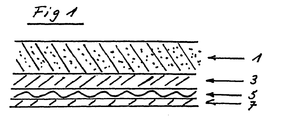
- a flame retardant or heat-damping layer 1 is applied containing nanocapsules based on ceramic, which in an inorganic, preferably transparent binder or adhesive are embedded.
- the binder may be based on water glass.
- the nanocapsules are based on any suitable ceramic material, such as based on alumina, silica, any metal carbides, oxides, etc., where appropriate, the nanocapsules may also have some moisture or are formed so-called water-filled.
- the binder used for embedding the nanocapsules also has a high Heat resistance features.
- the use of a binder based on water glass or silica is preferred.
- the nanocapsules used have a size of, for example, 5 to 20 nm, and the dosage of the coating may vary depending on the degree of fire retardancy. A typical value is for example 5 gms 9 / m 2 , whereby of course the dosage can be selected higher or lower.
- an adhesive 5 is arranged, which should be high temperature resistant and difficult to burn.
- Suitable for example, in addition to inorganic adhesives and adhesives on Menaminharzbasis.
- other adhesives can be used which have the mentioned properties.
- glues based on water glass or silicone glue are again suitable.
- a siliconized cover film 7 is arranged, which may be, for example, a polyethylene film.
- the layer thickness of this cover can be chosen differently, a typical value is for example 40 ⁇ .
- an alarm system which is based for example on a neander-shaped, conductive, fine thread, which is interrupted by the extreme expansion of the particles due to heat.
- the Interruption of a circuit due to damage of the fine thread for example, an alarm can be triggered, which indicates an extraordinary heat impact.
- the conductive thread may be, for example, a metal thread or else another suitable material, for example based on conductive carbon fibers, etc. It is essential that the material is damaged by heat or by the extreme extent of the nanoparticles, and on the other hand has a good electrical conductivity.
- the inventively proposed flame retardant film can now be used for example in the form of a wallpaper to protect the walls of a room against fire expansion.
- the substrate is cleaned accordingly, whereupon the siliconized cover film is removed and the flame retardant film is applied to the substrate.
- different flame retardant films can be used, provided with different dosing of the nanocapsules. If necessary, two foils, containing the nanocapsules, are applied one above the other. Although the inhibition threshold is not doubled but substantially increased.
- the present invention is by no means limited to the example described with reference to the figure, but in principle the film can be modified according to the requirements or supplemented by further layers. It is essential that the coating arranged on a carrier foil contains nanocapsules based on ceramics or metal oxide, which expand upon exposure to heat and thus absorb energy and cause flame retardation or a delay in the evolution of heat.
Landscapes
- Chemical & Material Sciences (AREA)
- Chemical Kinetics & Catalysis (AREA)
- Engineering & Computer Science (AREA)
- Architecture (AREA)
- Organic Chemistry (AREA)
- Polymers & Plastics (AREA)
- Medicinal Chemistry (AREA)
- Health & Medical Sciences (AREA)
- Civil Engineering (AREA)
- Structural Engineering (AREA)
- Physics & Mathematics (AREA)
- Electromagnetism (AREA)
- Laminated Bodies (AREA)
- Compositions Of Macromolecular Compounds (AREA)
- Fireproofing Substances (AREA)
- Shaping Of Tube Ends By Bending Or Straightening (AREA)
- Exchange Systems With Centralized Control (AREA)
Description
- Die vorliegende Erfindung betrifft eine Folie, geeignet insbesondere für Flammhemmung, ein Verfahren zur Herstellung der Folie sowie die Verwendung der Folie.
- Brände, insbesondere in Diskotheken, Theater, Restaurants oder anderen Lokalitäten, insbesondere mit temporären Dekorationen nehmen oft einen dramatischen Verlauf und führen zu zahlreichen Todesfällen und/oder verletzten Personen mit zum Teil gravierenden Brandverletzungen. Oft werden solche Brände durch unachtsamen Umgang mit Feuerzeugen, Raucherwaren oder durch unprofessionelle, elektrische Installationen mit der Gefahr von Funkenwurf ausgelöst, wobei sich die Brände aufgrund fehlender oder schlechter, flammhemmender Ausrüstung rasch verbreiten können. Wohl wird heute dem Brandschutz erhöhte Bedeutung beigemessen und durch flammhemmende Ausrüstung von Mobiliar und Einrichtungen sowie durch Anbringen von Flammschutzlackierungen bzw. flammhemmender Tapeten und Papiere kann der raschen Ausbreitung eines Brandes entgegengewirkt werden. Allerdings sind die heute verwendeten Additive in der Regel auf Octabromdiphenylether oder auf Phosphorbasis hergestellt - Materialien die aus toxikologischen und/oder umwelttechnischen Gründen nicht unbedenklich sind.
- Im
US Patent 6 414 070 wird eine Formulierung aus Nanokapseln bestehend aus einem Polyolefinepolymer vorgeschlagen, welche zusätzlich organisch modifizierten Ton und anorganische flammhemmende Mittel enthält. Folien und Laminate aus dem vorgeschlagenen Nanokomposit können als Flammhemmmittel verwendet werden. - Weiter beschreibt die
WO03/027017 - In der
DE-100 22 037 schliesslich wird eine Infrarotabsorbierende Zusammensetzung beschrieben, enthaltend transparente, thermoplastische Polymere sowie Oberflächenmodifizierte Oxidteilchen mit einer Teilchengrösse von < 200nm und organischem NIR-Absorber. - Die Aufgabe der vorliegenden Erfindung besteht darin, Flammschutzmittel bzw. flammhemmende Einrichtungen vorzuschlagen, welche nicht toxisch sind für Menschen, Tiere und Pflanzen, und welche bei Bränden keine zusätzlichen toxischen oder korrosiven Rauchgase freisetzen, gute Recyling-Eigenschaften aufweisen bzw. umweltneutral sind.
- Die erfindungsgemäss gestellte Aufgabe wird mittels der Verwendung einer Folie gemäss dem Wortlaut nach Anspruch 1 gelöst.
- Vorgeschlagen wird eine Verwendung der Folie für Flammhemmung, wobei die Folie gekennzeichnet ist durch eine Trägerfolie, welche mindestens auf einer Seite eine Beschichtung aufweist, enthaltend mindestens nanoskalische Teilchen auf Basis von keramischen und/oder glasartigen und/oder metalloxidischen Werkstoffen.
- Diese nanoskalischen Teilchen oder auch genannt Nanokapseln oder Nanopartikel auf Keramik-, Glas- oder Metalloxidbasis sind mittels eines anorganischen Bindemittels insbesondere geeignet für mineralische Werkstoffe, wie Glas, Keramik oder Aramidfasern auf der Trägerfolie gehalten. Beim anorganischen Bindemittel kann es sich beispielsweise um ein Bindemittel auf Basis Wasserglas handeln. Auch Silane oder Siloxane sind geeignet, wobei diese Materialien beim Binden der Nanopartikel gegebenenfalls unter Hitzewirkung aufgeschäumt werden. Die Trägerfolie besteht bevorzugt aus einem Polymeren, welches eine erhöhte Temperaturfestigkeit aufweist. Üblicherweise verwendete Polyolefine, wie Polyethylen oder Propolypropylen sind eher nicht geeignet, währenddem beispielsweise Polyesterfolien, wie beispielsweise PET-Folien durchaus verwendet werden können. Die Polymerfolie kann zusätzlich mittels Glas oder Mineralfasern verstärkt sein, was die Temperaturfestigkeit erhöht. Selbstverständlich wäre es vorteilhaft, hochtemperaturfeste Materialien zu verwenden, wie beispielsweise PTFE (Polytetrafluorethylen) oder Teflon, wobei diese Materialien aus wirtschaftlichen Gründen wohl eher nicht geeignet sind. Aber auch andere hochtemperaturfeste Materialien, wie beispielsweise Polyphenyloxid (Noryl) oder Hartpapiergewebe, wie auch Glashartgewebe, etc. können durchaus als Trägerfolien verwendet werden. Die Liste der für die Trägerfolie verwendbaren Materialien ist keinesfalls abschliessend und kann durch weitere geeignete Materialien erweitert werden, in diesem Zusammenhang zu erwähnen sind beispielsweise auch Polyimidfolien, welche aber wiederum aus ökonomischen Gründen wohl kaum in Frage kommen.
- Der grosse Vorteil der Verwendung der erwähnten Nanokapseln in der Beschichtung der Trägerfolie liegt darin, dass diese eine sehr hohe Oberfläche aufweisen und sich diese Kapseln bei Hitzeinwirkung ausdehnen und damit erhebliche Energie verbrauchen bzw. vernichten. Durch das Ausdehnen der Kapseln kann somit eine erhebliche Flammhemmung bewirkt werden bzw. kann durch die Wärmevernichtung ein schnelles Ausbreiten eines Brandes verhütet werden. Wie oben erwähnt, sind die erfindungsgemäss vorgeschlagenen Nanokapseln auf keramischer Basis, wobei weitgehendst alle bekannten keramischen Materialien für die Herstellung der erwähnten Nanokapseln in Frage kommen, wie insbesondere keramische Werkstoffe, basierend auf Aluminiumoxid, Siliziumoxid, etc. Auf keramischer Basis aufgebaute Nanokapseln sind bekannt und sind auf dem Markt erhältlich, beispielsweise als sogenannte Sol-Gel-Bindemittel-Systeme, beispielsweise vom Institut Für Neue Materialien gem. GmbH in D-66123 Saarbrücke.
- Als flammhemmende Partikel kommen aber nebst den vorab beschriebenen Keramikpartikel auch Partikel in Frage, welche mittels sogenannten Flammsprühverfahren hergestellt werden, wie insbesondere Partikel auf metalloxidischer Basis, wie beispielsweise Aluminiumoxinitride oder ebenfalls auf Keramik- oder Glasbasis.
- Bezüglich Nanokapseln sind auch solche bekannt, welche beispielsweise mit Wasser gefüllt sind, was die Flammhemmwirkung zusätzlich erhöht.
- Damit die erfindungsgemäss vorgeschlagene, Folie, beispielsweise in Form einer Tapete oder Verkleidung, angeordnet werden kann, ist auf der Rückseite der Trägerfolie ein Klebstoffmaterial bzw. ein Kleber angeordnet, wobei es sich vorzugsweise wiederum ein temperaturbeständiges, schwer brennbares Material handelt. Im Gegensatz zum Bindemittel für das Anordnen der Nanokapseln kann es sich beim Kleber auch um ein organisches Bindemittel handeln, wie beispielsweise um einen Kleber auf Melaminharzbasis, etc. Um den Kleber vor der Applikation der folienartigen Anordnung zu schützen ist dieser vorzugsweise mit einer Abdeckfolie überdeckt, wie beispielsweise einer vorzugsweise silikonisierten Abdeckfolie. Die Basis dieser silikonisierten Abdeckfolie kann irgendein geeignetes Polymer sein, wie beispielsweise auf Polyethylenbasis. Dies insbesondere deshalb, weil hier Temperaturfestigkeit und Brennbarkeit kein Thema sind, weil bei der Applikation der folienartigen Anordnung diese Abdeckfolie entfernt wird.
- Für die Herstellung der erfindungsgemäss vorgeschlagenen Folie wird ein Gel verwendet, in welchem die erwähnten Nanokapseln auf Keramikbasis eingebettet sind. Die Herstellung des Gels erfolgt dabei mittels eines sogenannten Sol-Gel-Verfahrens, indem die nanoskalischen Teilchen bzw. Nanokapseln unter Zusatz geeigneter Additive so lange suspendiert werden, bis sich das erwähnte Gel gebildet hat. Die Herstellung dieses Gels ist an sich nicht Gegenstand der vorliegenden Erfindung und derartige Gele, beinhaltend Nanokapseln auf keramischer Basis, sind im Handel erhältlich. Erneut sei auf das Institut Für Neue Materialien gem. GmbH in D-66123 Saarbrücken verwiesen, welches derartige Gele mit Nanokapseln auf keramischer Basis anbietet. Die Herstellung der folienartigen Anordnung erfolgt vorzugsweise über eine Mehrkopfbeschichtungsanlage mit der Möglichkeit, eine sehr feine und gleichmässige Verteilung des Gels, in welchem die Kapseln eingebettet sind auf der Trägerfolie zu erreichen. Dies wird vor allem durch geschickte Kombination von Verteilwalzen erreicht.
- In analoger Art und Weise wird der Kleber auf der Rückseite der Trägerfolie aufgebracht, wobei es sich, wie bereits oben erwähnt, vorzugsweise um einen temperaturbeständigen, schwer brennbaren Kleber handelt. Schliesslich die Lamination der silikonisierten Folie geschieht ebenfalls auf einer mit Andruckwalzen und einem Trocknersystem versehenen Anlage.
- Ein Beispiel einer erfindungsgemässen Folie ist in der beigefügten Figur im Querschnitt dargestellt.
- Auf einer Trägerfolie 3, beispielsweise bestehend aus Polyester wie PET, welche eine Schichtdicke von beispielsweise zwischen 20 und 30µ aufweisen kann ist eine flammhemmende bzw. wärmedämpfende Schicht 1 aufgebracht, enthaltend Nanokapseln auf keramischer Basis, welche in einem anorganischen, vorzugsweise transparenten Bindemittel bzw. Kleber eingebettet sind. Wie bereits oben erwähnt, kann es sich beim Bindemittel um ein solches auf Basis Wasserglas handeln. Die Nanokapseln basieren auf irgendeinem geeigneten, keramischen Material, wie beispielsweise auf Basis Aluminiumoxid, Siliziumoxid, irgendwelchen Metallkarbiden, Oxiden, etc., wobei die Nanokapseln gegebenenfalls auch eine gewisse Feuchtigkeit aufweisen können bzw. sogenannt wassergefüllt ausgebildet sind. Da die mit den Nanokapseln gefüllte Beschichtung, insbesondere beim Entfalten der Flammhemmung bzw. Wärmedämpfung, welche sich durch Ausdehnung der Kapseln bei Hitzewirkung einstellt, eine möglichst hohe Hitzefestigkeit aufweisen soll ist es wesentlich, dass das für das Einbetten der Nanokapseln verwendete Bindemittel ebenfalls über eine hohe Hitzebeständigkeit verfügt. Aus diesem Grunde ist die Verwendung eines Bindemittels auf Basis von Wasserglas bzw. Kieselsäure bevorzugt.
- Die verwendeten Nanokapseln weisen eine Grösse von beispielsweise 5 bis 20nm auf, und die Dosierung der Beschichtung kann unterschiedlich sein, je nach dem wie gross der Grad der Brandhemmung sein soll. Ein typischer Wert ist beispielsweise 5 gms 9/m2, wobei selbstverständlich die Dosierung höher bzw. geringer gewählt werden kann.
- Auf der Rückseite der Trägerfolie 3 ist ein Kleber 5 angeordnet, welcher hochtemperaturfest und schwer brennbar sein soll. Geeignet sind beispielsweise nebst anorganischen Klebern auch Klebstoffe auf Menaminharzbasis. Selbstverständlich können auch andere Kleber verwendet werden, welche über die erwähnten Eigenschaften verfügen. Geeignet sind beispielsweise wiederum Kleber auf Wasserglasbasis oder Silikonkleber.
- Schliesslich als Schutz der Klebeschicht 5 ist eine silikonisierte Abdeckfolie 7 angeordnet, bei welcher es sich beispielsweise um eine Polyethylenfolie handeln kann. Auch die Schichtdicke dieser Abdeckfolie kann unterschiedlich gewählt werden, ein typischer Wert ist beispielsweise 40µ.
- Gemäss einer weiteren Ausführungsvariante ist es möglich, gleichzeitig mit der Beschichtung der Folie mit den Nanokapseln ein Alarmsystem einzubringen, welches z.B. auf einem neanderförmig eingelegten, leitenden, feinen Faden beruht, der durch die extreme Ausdehnung der Partikel infolge Hitzeeinwirkung unterbrochen wird. Die Unterbrechung eines Stromkreises infolge der Beschädigung des feinen Fadens kann beispielsweise ein Alarm ausgelöst werden, der auf eine ausserordentliche Hitzeeinwirkung hindeutet. So kann in diesem Fall beispielsweise über einen elektronischen Alarmvermittler in einem frühen Brandstadium alarmiert werden, und die Rettungsmassnahmen können so rechtzeitig eingeleitet bzw. massiv erleichtert werden. Beim leitenden Faden kann es sich beispielsweise um einen Metallfaden handeln oder aber auch um ein anderes, geeignetes Material, beispielsweise auf Basis auf leitenden Kohlenstofffasern, etc. Wesentlich ist, dass das Material unter Hitzeeinwirkung bzw. durch die extreme Ausdehnung der Nanopartikel beschädigt wird, und andererseits eine gute elektrische Leitfähigkeit aufweist.
- Die erfindungsgemäss vorgeschlagene Flammhemmfolie kann nun beispielsweise im Sinne einer Tapete verwendet werden, um die Wände eines Raumes gegen Brandausdehnung zu schützen. Selbstverständlich können auch nur einzelne speziell zu sichernde Wände oder besonderen Risiken ausgesetzte Stellen mit der Flammhemmfolie geschützt werden, oder irgendwelche Gegenstände, welche zumindest im Sinne einer Verzögerung gegen das Ausbreiten eines Feuers zu schützen sind. Wesentlich ist, dass vor dem Anbringen der Flammhemmfolie der Untergrund entsprechend gereinigt wird, worauf die silikonisierte Abdeckfolie entfernt und die Flammhemmfolie auf dem Untergrund aufgebracht wird. Wie bereits oben erwähnt, können je nach den Anforderungen unterschiedliche Flammhemmfolien verwendet werden, versehen mit unterschiedlicher Dosierung der Nanokapseln. Falls notwendig können auch zwei Folien, enthaltend die Nanokapseln, übereinander aufgebracht werden. Die Hemmschwelle wird dadurch zwar nicht verdoppelt jedoch substantiell erhöht.
- Die vorliegende Erfindung ist selbstverständlich keinesfalls auf das unter Bezug der Figur beschriebene Beispiel beschränkt, sondern grundsätzlich kann die Folie entsprechend den Anforderungen modifiziert oder durch weitere Schichten ergänzt werden. Wesentlich ist, dass die auf einer Trägerfolie angeordnete Beschichtung Nanokapseln auf keramischer oder metalloxidischer Basis enthält, welche sich bei Hitzeinwirkung ausdehnen und so Energie absorbieren und eine Flammhemmung bewirken bzw. eine Verzögerung der Wärmeentwicklung.
Claims (13)
- Verwendung einer Folie als Flammhemmfolie mit einer Trägerfolie, mindestens aufweisend eine flammhemmende Beschichtung, dadurch gekennzeichnet, dass die Beschichtung nanoskalische Teilchen bzw. Nanokapseln auf Basis von keramischen und/oder glasartigen Werkstoffen und/oder auf Basis von metalloxidischen Werkstoffen enthält, und dass die Trägerfolie auf der, der Beschichtung gegenüberliegenden Seite einen Kleber (5) aufweist.
- Verwendung nach Anspruch 1, dadurch gekennzeichnet, dass die nanoskalischen Teilchen bzw. Nanokapseln auf Keramik-, Glas- oder Metalloxidbasis mittels eines anorganischen Bindemittels, insbesondere geeignet für mineralische Werkstoffe, auf der Trägerfolie gehalten werden.
- Verwendung nach Anspruch 2, dadurch gekennzeichnet, dass das Bindemittel auf Basis Wasserglas hergestellt ist.
- Verwendung nach Anspruch 2, dadurch gekennzeichnet, dass als Bindemittel Silane oder Siloxane verwendet werden.
- Verwendung nach einem der Ansprüche 1 bis 4, dadurch gekennzeichnet, dass die Trägerfolie eine Polymerfolie ist beispielsweise auf Basis Polyester, wie auf Basis PET.
- Verwendung nach einem der Ansprüche 1 bis 5, dadurch gekennzeichnet, dass die nanoskalischen Teilchen bzw. Nanokapseln eine gewisse Feuchtigkeit aufweisen bzw. mit Wasser gefüllt sind.
- Verwendung nach einem der Ansprüche 1 bis 6, dadurch gekennzeichnet, dass die Trägerfolie auf der der Beschichtung gegenüberliegenden Seite einen Kleber (5) aufweist, welcher eine hohe Temperaturbeständigkeit aufweist, sowie schwer brennbar ist.
- Verwendung nach einem der Ansprüche 1 bis 7, dadurch gekennzeichnet, dass der Kleber mittels einer silikonisierten Polymerfolie (7) überdeckt ist.
- Verwendung nach einem der Ansprüche 1 bis 8, dadurch gekennzeichnet, dass mindestens eine Beschichtung vorgesehen ist, vorzugsweise die Beschichtung enthaltend nanoskalische Teilchen bzw. Nanokapseln, mit Mitteln versehen ist bilden einen geschlossenen elektrischen Kreis, wobei die Mittel unter Hitzeeinwirkung bzw. Ausdehnung der Nanopartikel derart beschädigt werden, dass der elektrische Kreis unterbrochen wird, und weiter Alarmmittel vorgesehen sind, welche bei Unterbrechung des Stromkreises auslösbar sind.
- Verwendung nach Anspruch 9, dadurch gekennzeichnet, dass in der mindestens einen Schicht ein elektrisch leitender feiner Faden, vorzugsweise neanderförmig, angeordnet ist, welcher durch Hitzeeinwirkung und/oder Ausdehnung der Nanopartikel derart beschädigt wird, dass der Stromkreis unterbrochen wird.
- Verfahren zur Herstellung einer Folie gemäss der Verwendung nach einem der Ansprüche 1 bis 10, dadurch gekennzeichnet, dass ein Gel, enthaltend die Nanokapseln, mittels einer Mehrkopfbeschichtungsanlage auf die Trägerfolie aufgebracht und mittels mindestens einer Verteilwalze weitgehendst gleichmässig verteilt wird.
- Folie definiert nach einem der Ansprüche 1 bis 10 als Wandverkleidung, Tapete, Deckenverkleidung, etc. für das Flammhemmausrüsten bzw. als Brandverzögerungsschutz in Räumen bzw. Zimmern.
- Folie nach einem der Ansprüche 1 bis 10 für das Brandhemmausrüsten von Diskotheken, Theatern, Restaurants und anderen öffentlichen Lokalitäten.
Priority Applications (1)
| Application Number | Priority Date | Filing Date | Title |
|---|---|---|---|
| PL04019798T PL1512802T3 (pl) | 2003-09-03 | 2004-08-20 | Folia ognioodporna |
Applications Claiming Priority (2)
| Application Number | Priority Date | Filing Date | Title |
|---|---|---|---|
| CH15112003 | 2003-09-03 | ||
| CH15112003 | 2003-09-03 |
Publications (2)
| Publication Number | Publication Date |
|---|---|
| EP1512802A1 EP1512802A1 (de) | 2005-03-09 |
| EP1512802B1 true EP1512802B1 (de) | 2008-03-05 |
Family
ID=34120766
Family Applications (1)
| Application Number | Title | Priority Date | Filing Date |
|---|---|---|---|
| EP04019798A Expired - Lifetime EP1512802B1 (de) | 2003-09-03 | 2004-08-20 | Flammhemmfolie |
Country Status (5)
| Country | Link |
|---|---|
| EP (1) | EP1512802B1 (de) |
| AT (1) | ATE388282T1 (de) |
| DE (1) | DE502004006389D1 (de) |
| ES (1) | ES2301907T3 (de) |
| PL (1) | PL1512802T3 (de) |
Cited By (1)
| Publication number | Priority date | Publication date | Assignee | Title |
|---|---|---|---|---|
| DE102008004276A1 (de) * | 2008-01-08 | 2009-07-09 | Marc Robert Maute | Beschichtungserzeugnis |
Families Citing this family (5)
| Publication number | Priority date | Publication date | Assignee | Title |
|---|---|---|---|---|
| JP2011255660A (ja) * | 2010-05-10 | 2011-12-22 | Nitto Denko Corp | 耐シガレット性を有する難燃ポリマー部材、難燃性物品及び難燃化方法 |
| DE202021103749U1 (de) | 2021-07-13 | 2022-10-20 | REHAU Industries SE & Co. KG | Wand- und/oder Deckenverkleidung |
| DE202021103754U1 (de) | 2021-07-13 | 2022-10-20 | REHAU Industries SE & Co. KG | Wand- und/oder Deckenverkleidung |
| DE202021103746U1 (de) | 2021-07-13 | 2022-10-21 | REHAU Industries SE & Co. KG | Wand- und/oder Deckenverkleidung |
| CN114950166A (zh) * | 2022-06-08 | 2022-08-30 | 浙江金海高科股份有限公司 | 非对称阻燃性复合膜、其制备方法以及应用 |
Family Cites Families (7)
| Publication number | Priority date | Publication date | Assignee | Title |
|---|---|---|---|---|
| DE19720269A1 (de) * | 1997-05-14 | 1998-11-19 | Inst Neue Mat Gemein Gmbh | Nanokomposit für thermische Isolierzwecke |
| DE19816136A1 (de) * | 1998-04-09 | 1999-10-14 | Inst Neue Mat Gemein Gmbh | Nanostrukturierte Formkörper und Schichten und deren Herstellung über stabile wasserlösliche Vorstufen |
| DE19840009A1 (de) * | 1998-09-02 | 2000-03-09 | Inst Neue Mat Gemein Gmbh | Verfahren zur Herstellung thermisch verformter, mit einem Sol-Gel-Lack beschichteter Substrate |
| DE19952040A1 (de) * | 1999-10-28 | 2001-05-03 | Inst Neue Mat Gemein Gmbh | Substrat mit einem abriebfesten Diffusionssperrschichtsystem |
| US6414070B1 (en) * | 2000-03-08 | 2002-07-02 | Omnova Solutions Inc. | Flame resistant polyolefin compositions containing organically modified clay |
| DE10022037A1 (de) * | 2000-05-05 | 2001-11-08 | Bayer Ag | IR-absorbierende Zusammensetzungen |
| WO2003027017A1 (en) * | 2001-09-27 | 2003-04-03 | Rohm And Haas Company | Modified clays and methods for making and using the same |
-
2004
- 2004-08-20 ES ES04019798T patent/ES2301907T3/es not_active Expired - Lifetime
- 2004-08-20 AT AT04019798T patent/ATE388282T1/de not_active IP Right Cessation
- 2004-08-20 EP EP04019798A patent/EP1512802B1/de not_active Expired - Lifetime
- 2004-08-20 PL PL04019798T patent/PL1512802T3/pl unknown
- 2004-08-20 DE DE502004006389T patent/DE502004006389D1/de not_active Expired - Lifetime
Cited By (1)
| Publication number | Priority date | Publication date | Assignee | Title |
|---|---|---|---|---|
| DE102008004276A1 (de) * | 2008-01-08 | 2009-07-09 | Marc Robert Maute | Beschichtungserzeugnis |
Also Published As
| Publication number | Publication date |
|---|---|
| PL1512802T3 (pl) | 2008-08-29 |
| ATE388282T1 (de) | 2008-03-15 |
| EP1512802A1 (de) | 2005-03-09 |
| DE502004006389D1 (de) | 2008-04-17 |
| ES2301907T3 (es) | 2008-07-01 |
Similar Documents
| Publication | Publication Date | Title |
|---|---|---|
| AU656719B2 (en) | Instumescent fire-retardant and electrically-conductive coating material | |
| DE69124806T2 (de) | Kohlenstoffaserverstärkte beschichtungen | |
| EP3538719B1 (de) | Vakuumisolationspaneel | |
| DE19702239A1 (de) | Mehrschichtige Verbundmaterialien, die mindestens eine aerogelhaltige Schicht und mindestens eine Schicht, die Polyethylenterephthalat-Fasern enthält, aufweisen, Verfahren zu ihrer Herstellung sowie ihre Verwendung | |
| WO1998032709A1 (de) | Mehrschichtige verbundmaterialien, die mindestens eine aerogelhaltige schicht und mindestens eine weitere schicht aufweisen, verfahren zu ihrer herstellung sowie ihre verwendung | |
| EP0850206A1 (de) | Aerogel- und klebstoffhaltiges verbundmaterial, verfahren zu seiner herstellung sowie seine verwendung | |
| DE102014116984A1 (de) | Nicht brennbarer Schichtstoff | |
| EP4182500A1 (de) | Aerogel-haltige isolationsschicht | |
| EP1512802A1 (de) | Flammhemmfolie | |
| EP1028202B1 (de) | Schall- und Wärmedämmittel | |
| DE2228016A1 (de) | Verfahren zum Verbinden eines Äthylenpolymerisates mit einem nichtkeramischen Substrat | |
| EP4282225A1 (de) | Flächenheizelement und verfahren zu dessen herstellung | |
| EP0589461A1 (de) | Feuerfestes Material, Verfahren zu seiner Herstellung und seine Verwendung | |
| DE102016111689B4 (de) | Brandschutzabdeckung | |
| DE102018131205A1 (de) | Geschützte Infrarot-Wandflächenheizung mit flexiblem Heizgewebe | |
| EP2944732A1 (de) | Brandschutzplatte | |
| DE202007002766U1 (de) | Dünnstein-Heizung | |
| DE102012111865B4 (de) | Brandschutzvorrichtung | |
| EP3186315B1 (de) | Ohne offene flamme aktivierbare abdichtungsbahn mit schmelzklebstoff beschichtung und verfahren zu deren applikation | |
| EP4452627A1 (de) | Brandschutzschichtverbund zur verwendung als präventives brandschutzmaterial | |
| DE102015103893B4 (de) | Brandschutz für Holzwerkstoffplatten | |
| WO2023117297A1 (de) | Verbundmaterial als hitze-, brand- und/oder rauchschutzmaterial | |
| DE4447408A1 (de) | Flexibles bahnenförmiges und mechanisch belastbares Flächengebilde mit einer integrierten, im Niederspannungsbereich betreibbaren Flächenheizung und Verfahrenzur Herstellung | |
| KR20170068887A (ko) | 우드 블라인드용 난연 코팅 조성물 및 이 조성물이 도포된 난연 우드 블라인드 | |
| DE10116574A1 (de) | Wärmedämmatte bestehend aus mehreren Lagen absorptionsreduzierter Luftpolsterfolie mit aufkaschierter, aufgedampfter Reflexionsschicht und alle Lagen mit T-Endfäden fixiert |
Legal Events
| Date | Code | Title | Description |
|---|---|---|---|
| PUAI | Public reference made under article 153(3) epc to a published international application that has entered the european phase |
Free format text: ORIGINAL CODE: 0009012 |
|
| AK | Designated contracting states |
Kind code of ref document: A1 Designated state(s): AT BE BG CH CY CZ DE DK EE ES FI FR GB GR HU IE IT LI LU MC NL PL PT RO SE SI SK TR |
|
| AX | Request for extension of the european patent |
Extension state: AL HR LT LV MK |
|
| 17P | Request for examination filed |
Effective date: 20050906 |
|
| AKX | Designation fees paid |
Designated state(s): AT BE BG CH CY CZ DE DK EE ES FI FR GB GR HU IE IT LI LU MC NL PL PT RO SE SI SK TR |
|
| GRAP | Despatch of communication of intention to grant a patent |
Free format text: ORIGINAL CODE: EPIDOSNIGR1 |
|
| GRAS | Grant fee paid |
Free format text: ORIGINAL CODE: EPIDOSNIGR3 |
|
| GRAA | (expected) grant |
Free format text: ORIGINAL CODE: 0009210 |
|
| AK | Designated contracting states |
Kind code of ref document: B1 Designated state(s): AT BE BG CH CY CZ DE DK EE ES FI FR GB GR HU IE IT LI LU MC NL PL PT RO SE SI SK TR |
|
| REG | Reference to a national code |
Ref country code: GB Ref legal event code: FG4D Free format text: NOT ENGLISH |
|
| REG | Reference to a national code |
Ref country code: CH Ref legal event code: EP |
|
| REG | Reference to a national code |
Ref country code: CH Ref legal event code: NV Representative=s name: TROESCH SCHEIDEGGER WERNER AG |
|
| REG | Reference to a national code |
Ref country code: IE Ref legal event code: FG4D Free format text: LANGUAGE OF EP DOCUMENT: GERMAN |
|
| REF | Corresponds to: |
Ref document number: 502004006389 Country of ref document: DE Date of ref document: 20080417 Kind code of ref document: P |
|
| REG | Reference to a national code |
Ref country code: ES Ref legal event code: FG2A Ref document number: 2301907 Country of ref document: ES Kind code of ref document: T3 |
|
| PG25 | Lapsed in a contracting state [announced via postgrant information from national office to epo] |
Ref country code: FI Free format text: LAPSE BECAUSE OF FAILURE TO SUBMIT A TRANSLATION OF THE DESCRIPTION OR TO PAY THE FEE WITHIN THE PRESCRIBED TIME-LIMIT Effective date: 20080305 |
|
| REG | Reference to a national code |
Ref country code: PL Ref legal event code: T3 |
|
| NLV1 | Nl: lapsed or annulled due to failure to fulfill the requirements of art. 29p and 29m of the patents act | ||
| PG25 | Lapsed in a contracting state [announced via postgrant information from national office to epo] |
Ref country code: SI Free format text: LAPSE BECAUSE OF FAILURE TO SUBMIT A TRANSLATION OF THE DESCRIPTION OR TO PAY THE FEE WITHIN THE PRESCRIBED TIME-LIMIT Effective date: 20080305 |
|
| REG | Reference to a national code |
Ref country code: IE Ref legal event code: FD4D |
|
| PG25 | Lapsed in a contracting state [announced via postgrant information from national office to epo] |
Ref country code: PT Free format text: LAPSE BECAUSE OF FAILURE TO SUBMIT A TRANSLATION OF THE DESCRIPTION OR TO PAY THE FEE WITHIN THE PRESCRIBED TIME-LIMIT Effective date: 20080805 Ref country code: SE Free format text: LAPSE BECAUSE OF FAILURE TO SUBMIT A TRANSLATION OF THE DESCRIPTION OR TO PAY THE FEE WITHIN THE PRESCRIBED TIME-LIMIT Effective date: 20080605 Ref country code: NL Free format text: LAPSE BECAUSE OF FAILURE TO SUBMIT A TRANSLATION OF THE DESCRIPTION OR TO PAY THE FEE WITHIN THE PRESCRIBED TIME-LIMIT Effective date: 20080305 Ref country code: SK Free format text: LAPSE BECAUSE OF FAILURE TO SUBMIT A TRANSLATION OF THE DESCRIPTION OR TO PAY THE FEE WITHIN THE PRESCRIBED TIME-LIMIT Effective date: 20080305 Ref country code: CZ Free format text: LAPSE BECAUSE OF FAILURE TO SUBMIT A TRANSLATION OF THE DESCRIPTION OR TO PAY THE FEE WITHIN THE PRESCRIBED TIME-LIMIT Effective date: 20080305 |
|
| PG25 | Lapsed in a contracting state [announced via postgrant information from national office to epo] |
Ref country code: RO Free format text: LAPSE BECAUSE OF FAILURE TO SUBMIT A TRANSLATION OF THE DESCRIPTION OR TO PAY THE FEE WITHIN THE PRESCRIBED TIME-LIMIT Effective date: 20080305 |
|
| ET | Fr: translation filed | ||
| PLBE | No opposition filed within time limit |
Free format text: ORIGINAL CODE: 0009261 |
|
| STAA | Information on the status of an ep patent application or granted ep patent |
Free format text: STATUS: NO OPPOSITION FILED WITHIN TIME LIMIT |
|
| PG25 | Lapsed in a contracting state [announced via postgrant information from national office to epo] |
Ref country code: IE Free format text: LAPSE BECAUSE OF FAILURE TO SUBMIT A TRANSLATION OF THE DESCRIPTION OR TO PAY THE FEE WITHIN THE PRESCRIBED TIME-LIMIT Effective date: 20080305 Ref country code: DK Free format text: LAPSE BECAUSE OF FAILURE TO SUBMIT A TRANSLATION OF THE DESCRIPTION OR TO PAY THE FEE WITHIN THE PRESCRIBED TIME-LIMIT Effective date: 20080305 |
|
| 26N | No opposition filed |
Effective date: 20081208 |
|
| PG25 | Lapsed in a contracting state [announced via postgrant information from national office to epo] |
Ref country code: MC Free format text: LAPSE BECAUSE OF NON-PAYMENT OF DUE FEES Effective date: 20080831 |
|
| PG25 | Lapsed in a contracting state [announced via postgrant information from national office to epo] |
Ref country code: BG Free format text: LAPSE BECAUSE OF FAILURE TO SUBMIT A TRANSLATION OF THE DESCRIPTION OR TO PAY THE FEE WITHIN THE PRESCRIBED TIME-LIMIT Effective date: 20080605 Ref country code: EE Free format text: LAPSE BECAUSE OF FAILURE TO SUBMIT A TRANSLATION OF THE DESCRIPTION OR TO PAY THE FEE WITHIN THE PRESCRIBED TIME-LIMIT Effective date: 20080305 |
|
| PG25 | Lapsed in a contracting state [announced via postgrant information from national office to epo] |
Ref country code: BE Free format text: LAPSE BECAUSE OF NON-PAYMENT OF DUE FEES Effective date: 20080831 |
|
| PG25 | Lapsed in a contracting state [announced via postgrant information from national office to epo] |
Ref country code: CY Free format text: LAPSE BECAUSE OF FAILURE TO SUBMIT A TRANSLATION OF THE DESCRIPTION OR TO PAY THE FEE WITHIN THE PRESCRIBED TIME-LIMIT Effective date: 20080305 |
|
| PG25 | Lapsed in a contracting state [announced via postgrant information from national office to epo] |
Ref country code: AT Free format text: LAPSE BECAUSE OF NON-PAYMENT OF DUE FEES Effective date: 20080820 |
|
| PG25 | Lapsed in a contracting state [announced via postgrant information from national office to epo] |
Ref country code: LU Free format text: LAPSE BECAUSE OF NON-PAYMENT OF DUE FEES Effective date: 20080820 Ref country code: HU Free format text: LAPSE BECAUSE OF FAILURE TO SUBMIT A TRANSLATION OF THE DESCRIPTION OR TO PAY THE FEE WITHIN THE PRESCRIBED TIME-LIMIT Effective date: 20080906 |
|
| PG25 | Lapsed in a contracting state [announced via postgrant information from national office to epo] |
Ref country code: TR Free format text: LAPSE BECAUSE OF FAILURE TO SUBMIT A TRANSLATION OF THE DESCRIPTION OR TO PAY THE FEE WITHIN THE PRESCRIBED TIME-LIMIT Effective date: 20080305 |
|
| PG25 | Lapsed in a contracting state [announced via postgrant information from national office to epo] |
Ref country code: GR Free format text: LAPSE BECAUSE OF FAILURE TO SUBMIT A TRANSLATION OF THE DESCRIPTION OR TO PAY THE FEE WITHIN THE PRESCRIBED TIME-LIMIT Effective date: 20080606 |
|
| PGFP | Annual fee paid to national office [announced via postgrant information from national office to epo] |
Ref country code: PL Payment date: 20130528 Year of fee payment: 10 |
|
| PGFP | Annual fee paid to national office [announced via postgrant information from national office to epo] |
Ref country code: DE Payment date: 20130814 Year of fee payment: 10 Ref country code: CH Payment date: 20130827 Year of fee payment: 10 Ref country code: ES Payment date: 20130711 Year of fee payment: 10 |
|
| PGFP | Annual fee paid to national office [announced via postgrant information from national office to epo] |
Ref country code: GB Payment date: 20130814 Year of fee payment: 10 Ref country code: FR Payment date: 20130808 Year of fee payment: 10 |
|
| PGFP | Annual fee paid to national office [announced via postgrant information from national office to epo] |
Ref country code: IT Payment date: 20130809 Year of fee payment: 10 |
|
| REG | Reference to a national code |
Ref country code: DE Ref legal event code: R119 Ref document number: 502004006389 Country of ref document: DE |
|
| REG | Reference to a national code |
Ref country code: CH Ref legal event code: PL |
|
| GBPC | Gb: european patent ceased through non-payment of renewal fee |
Effective date: 20140820 |
|
| PG25 | Lapsed in a contracting state [announced via postgrant information from national office to epo] |
Ref country code: CH Free format text: LAPSE BECAUSE OF NON-PAYMENT OF DUE FEES Effective date: 20140831 Ref country code: LI Free format text: LAPSE BECAUSE OF NON-PAYMENT OF DUE FEES Effective date: 20140831 Ref country code: IT Free format text: LAPSE BECAUSE OF NON-PAYMENT OF DUE FEES Effective date: 20140820 |
|
| REG | Reference to a national code |
Ref country code: DE Ref legal event code: R119 Ref document number: 502004006389 Country of ref document: DE Effective date: 20150303 |
|
| REG | Reference to a national code |
Ref country code: FR Ref legal event code: ST Effective date: 20150430 |
|
| PG25 | Lapsed in a contracting state [announced via postgrant information from national office to epo] |
Ref country code: GB Free format text: LAPSE BECAUSE OF NON-PAYMENT OF DUE FEES Effective date: 20140820 Ref country code: DE Free format text: LAPSE BECAUSE OF NON-PAYMENT OF DUE FEES Effective date: 20150303 |
|
| PG25 | Lapsed in a contracting state [announced via postgrant information from national office to epo] |
Ref country code: FR Free format text: LAPSE BECAUSE OF NON-PAYMENT OF DUE FEES Effective date: 20140901 |
|
| PG25 | Lapsed in a contracting state [announced via postgrant information from national office to epo] |
Ref country code: PL Free format text: LAPSE BECAUSE OF NON-PAYMENT OF DUE FEES Effective date: 20140820 |
|
| REG | Reference to a national code |
Ref country code: PL Ref legal event code: LAPE |
|
| REG | Reference to a national code |
Ref country code: ES Ref legal event code: FD2A Effective date: 20160108 |
|
| PG25 | Lapsed in a contracting state [announced via postgrant information from national office to epo] |
Ref country code: ES Free format text: LAPSE BECAUSE OF NON-PAYMENT OF DUE FEES Effective date: 20140821 |