EP1512754B1 - Reagenz zum Nachweis des TDH Gens von Vibrio Parahaemolyticus - Google Patents
Reagenz zum Nachweis des TDH Gens von Vibrio Parahaemolyticus Download PDFInfo
- Publication number
- EP1512754B1 EP1512754B1 EP04020604A EP04020604A EP1512754B1 EP 1512754 B1 EP1512754 B1 EP 1512754B1 EP 04020604 A EP04020604 A EP 04020604A EP 04020604 A EP04020604 A EP 04020604A EP 1512754 B1 EP1512754 B1 EP 1512754B1
- Authority
- EP
- European Patent Office
- Prior art keywords
- rna
- sequence
- oligonucleotide
- seq
- dna
- Prior art date
- Legal status (The legal status is an assumption and is not a legal conclusion. Google has not performed a legal analysis and makes no representation as to the accuracy of the status listed.)
- Expired - Lifetime
Links
Images

Classifications
-
- C—CHEMISTRY; METALLURGY
- C12—BIOCHEMISTRY; BEER; SPIRITS; WINE; VINEGAR; MICROBIOLOGY; ENZYMOLOGY; MUTATION OR GENETIC ENGINEERING
- C12Q—MEASURING OR TESTING PROCESSES INVOLVING ENZYMES, NUCLEIC ACIDS OR MICROORGANISMS; COMPOSITIONS OR TEST PAPERS THEREFOR; PROCESSES OF PREPARING SUCH COMPOSITIONS; CONDITION-RESPONSIVE CONTROL IN MICROBIOLOGICAL OR ENZYMOLOGICAL PROCESSES
- C12Q1/00—Measuring or testing processes involving enzymes, nucleic acids or microorganisms; Compositions therefor; Processes of preparing such compositions
- C12Q1/68—Measuring or testing processes involving enzymes, nucleic acids or microorganisms; Compositions therefor; Processes of preparing such compositions involving nucleic acids
- C12Q1/6876—Nucleic acid products used in the analysis of nucleic acids, e.g. primers or probes
- C12Q1/6888—Nucleic acid products used in the analysis of nucleic acids, e.g. primers or probes for detection or identification of organisms
- C12Q1/689—Nucleic acid products used in the analysis of nucleic acids, e.g. primers or probes for detection or identification of organisms for bacteria
-
- C—CHEMISTRY; METALLURGY
- C12—BIOCHEMISTRY; BEER; SPIRITS; WINE; VINEGAR; MICROBIOLOGY; ENZYMOLOGY; MUTATION OR GENETIC ENGINEERING
- C12Q—MEASURING OR TESTING PROCESSES INVOLVING ENZYMES, NUCLEIC ACIDS OR MICROORGANISMS; COMPOSITIONS OR TEST PAPERS THEREFOR; PROCESSES OF PREPARING SUCH COMPOSITIONS; CONDITION-RESPONSIVE CONTROL IN MICROBIOLOGICAL OR ENZYMOLOGICAL PROCESSES
- C12Q1/00—Measuring or testing processes involving enzymes, nucleic acids or microorganisms; Compositions therefor; Processes of preparing such compositions
- C12Q1/68—Measuring or testing processes involving enzymes, nucleic acids or microorganisms; Compositions therefor; Processes of preparing such compositions involving nucleic acids
- C12Q1/6844—Nucleic acid amplification reactions
-
- C—CHEMISTRY; METALLURGY
- C12—BIOCHEMISTRY; BEER; SPIRITS; WINE; VINEGAR; MICROBIOLOGY; ENZYMOLOGY; MUTATION OR GENETIC ENGINEERING
- C12Q—MEASURING OR TESTING PROCESSES INVOLVING ENZYMES, NUCLEIC ACIDS OR MICROORGANISMS; COMPOSITIONS OR TEST PAPERS THEREFOR; PROCESSES OF PREPARING SUCH COMPOSITIONS; CONDITION-RESPONSIVE CONTROL IN MICROBIOLOGICAL OR ENZYMOLOGICAL PROCESSES
- C12Q1/00—Measuring or testing processes involving enzymes, nucleic acids or microorganisms; Compositions therefor; Processes of preparing such compositions
- C12Q1/68—Measuring or testing processes involving enzymes, nucleic acids or microorganisms; Compositions therefor; Processes of preparing such compositions involving nucleic acids
- C12Q1/6844—Nucleic acid amplification reactions
- C12Q1/6865—Promoter-based amplification, e.g. nucleic acid sequence amplification [NASBA], self-sustained sequence replication [3SR] or transcription-based amplification system [TAS]
-
- C—CHEMISTRY; METALLURGY
- C12—BIOCHEMISTRY; BEER; SPIRITS; WINE; VINEGAR; MICROBIOLOGY; ENZYMOLOGY; MUTATION OR GENETIC ENGINEERING
- C12Q—MEASURING OR TESTING PROCESSES INVOLVING ENZYMES, NUCLEIC ACIDS OR MICROORGANISMS; COMPOSITIONS OR TEST PAPERS THEREFOR; PROCESSES OF PREPARING SUCH COMPOSITIONS; CONDITION-RESPONSIVE CONTROL IN MICROBIOLOGICAL OR ENZYMOLOGICAL PROCESSES
- C12Q2563/00—Nucleic acid detection characterized by the use of physical, structural and functional properties
- C12Q2563/107—Nucleic acid detection characterized by the use of physical, structural and functional properties fluorescence
-
- C—CHEMISTRY; METALLURGY
- C12—BIOCHEMISTRY; BEER; SPIRITS; WINE; VINEGAR; MICROBIOLOGY; ENZYMOLOGY; MUTATION OR GENETIC ENGINEERING
- C12Q—MEASURING OR TESTING PROCESSES INVOLVING ENZYMES, NUCLEIC ACIDS OR MICROORGANISMS; COMPOSITIONS OR TEST PAPERS THEREFOR; PROCESSES OF PREPARING SUCH COMPOSITIONS; CONDITION-RESPONSIVE CONTROL IN MICROBIOLOGICAL OR ENZYMOLOGICAL PROCESSES
- C12Q2563/00—Nucleic acid detection characterized by the use of physical, structural and functional properties
- C12Q2563/173—Nucleic acid detection characterized by the use of physical, structural and functional properties staining/intercalating agent, e.g. ethidium bromide
-
- Y—GENERAL TAGGING OF NEW TECHNOLOGICAL DEVELOPMENTS; GENERAL TAGGING OF CROSS-SECTIONAL TECHNOLOGIES SPANNING OVER SEVERAL SECTIONS OF THE IPC; TECHNICAL SUBJECTS COVERED BY FORMER USPC CROSS-REFERENCE ART COLLECTIONS [XRACs] AND DIGESTS
- Y02—TECHNOLOGIES OR APPLICATIONS FOR MITIGATION OR ADAPTATION AGAINST CLIMATE CHANGE
- Y02A—TECHNOLOGIES FOR ADAPTATION TO CLIMATE CHANGE
- Y02A50/00—TECHNOLOGIES FOR ADAPTATION TO CLIMATE CHANGE in human health protection, e.g. against extreme weather
- Y02A50/30—Against vector-borne diseases, e.g. mosquito-borne, fly-borne, tick-borne or waterborne diseases whose impact is exacerbated by climate change
Definitions
- the present invention relates to a detection reagent for detecting Vibrio parahaemolyticus in clinical examinations, public health examinations, food evaluations and food poisoning examinations.
- Vibrio parahaemolyticus is commonly known as a causative organism of infectious food poisoning. In contrast to 95% or more of Vibrio parahaemolyticus isolated from gastroenteritis patients being Kanagawa phenomenon-positive bacteria demonstrating hemolytic activity in Wagatsuma medium, 99% of the bacteria isolated from fish and water are Kanagawa phenomenon-negative. Thus, there is considered to be a close relationship between pathogenic Vibrio parahaemolyticus and the Kanagawa phenomenon.
- TDH thermostable direct hemolysin
- TRH TDH-related hemolysin
- Vibrio parahaemolyticus comprising evaluation for Kanagawa phenomenon following enrichment culturing or isolation culturing are known, methods which detect a specific sequence present in the Vibrio parahaemolyticus gene or an RNA derived from said gene following the amplification of such a sequence are preferable in terms of sensitivity, speed and ease of procedure.
- a method that amplifies a target nucleic acid at a constant temperature is particularly preferable in terms of automation of a testing system.
- an RNA amplification process in which a double-strand RNA-DNA is formed by producing a cDNA with an RNA-dependent DNA polymerase using a specific sequence of an RNA derived from said TDH gene as a template, as well as a first primer having a sequence complementary to said specific sequence, and a second primer having a sequence homologous to said specific sequence, wherein the first primer or second primer has a sequence in which a promoter sequence of an RNA polymerase is added to the 5' end of one of the primers, degrading the RNA of the double-strand RNA-DNA by ribonuclease H, thereby producing a single-strand DNA, and producing a double-strand DNA having the promoter sequence capable of transcribing the RNA composed of the RNA sequence or the sequence complementary to the RNA sequence with a DNA-dependent DNA polymerase using said single-strand DNA as a template, wherein said double-strand DNA produces an RNA transcription product in the presence of the RNA polymerase
- the RNA amplification process is carried out in the presence of an oligonucleotide that has been labeled with an intercalator fluorescent pigment, and the detection is carried out by measuring the fluorescent intensity of the reaction solution; wherein, the sequence of said oligonucleotide is complementary to at least a portion of the sequence of the RNA transcription product and, in the situation where complementary binding of said oligonucleotide to said RNA transcription product occurs, the fluorescent properties of the reaction solution change in comparison with the situation where no complex is formed.
- Japanese Unexamined Patent Publication No. 2001-340086 describes that when TDH RNA is detected in an initial RNA amount of 10 3 copies, the increasing rate of the fluorescent intensity ratio with time is significantly slower that than when the initial amount is 10 4 copies. As a result, even with a reaction time of 30 minutes, the fluorescent intensity ratio is 2.0 at the most. Further, even when the initial RNA amount is 0 copies, the fluorescent intensity ratio tends to increase, and as a result, when detecting TDH RNA at an initial RNA amount of 10 2 copies, even with a reaction time of 30 minutes, a significant increase of the fluorescent intensity ratio cannot be observed.
- the object of the present invention is to provide a detection reagent for TDH RNA that has superior sensitivity and speed.
- thermostable direct hemolysin (TDH) RNA of Vibrio parahaemolyticus having a superior sensitivity and a higher speed
- the inventors of the present invention developed a reagent capable of detecting TDH, even at an initial RNA amount of 10 2 copies, within a period of 20 minutes.
- the present invention relates to a detection reagent for use in detecting the TDH gene of Vibrio parahaemolyticus, present in a sample that is used in a detection method using an RNA amplification process, comprising the steps of:
- an oligonucleotide having a sequence complementary to the aforementioned first primer with its sequence from the 5' end to the 3' end being reversed should be used as the first primer
- an oligonucleotide having a sequence complementary to the aforementioned second primer with its sequence from the 5' end to the 3' end being reversed should be used as the second primer.
- the aforementioned RNA amplification process is carried out in the presence of a cleaving oligonucleotide that cleaves the aforementioned target RNA at the 5' end of the aforementioned specific sequence and has a sequence complementary to the region adjacent to and overlapping with the 5' end of said specific sequence.
- Said oligonucleotide is preferably an oligonucleotide consisting of the sequence listed as SEQ. ID No. 4, 5 or 6.
- the aforementioned RNA amplification process is carried out in the presence of an oligonucleotide labeled with an intercalator fluorescent pigment, and the detection of the thermostable direct hemolysin of Vibrio parahaemolyticus is carried out by measuring the fluorescent intensity of the reaction solution.
- the sequence of said oligonucleotide is complementary to at least a portion of the sequence of the mRNA transcription product, and in the situation where complementary binding of said oligonucleotide to said RNA transcription product occurs, the fluorescent properties of the reaction solution change in comparison with the situation where no complex is formed.
- the aforementioned oligonucleotide consists of at least 10 contiguous bases in any of the sequences listed as SEQ. ID No. 3.
- the entire length of the base sequences listed in each of the sequence listings can be used for the first and second primers, respectively, as about 10 bases are sufficient for specific binding to a specific nucleic acid sequence or the like, a combination of at least 10 contiguous bases in each sequence may also be used.
- the amplification process of the present invention includes the NASBA method, 3SR method or, for example, the RNA detection method (TRC method) described in Japanese Unexamined Patent Publication No. 2000-014400 , which amplifies TDH RNA by concerted action of reverse transcriptase and RNA polymerase (by reacting them under a condition where the reverse transcriptase and RNA polymerase act in concert).
- TRC method RNA detection method described in Japanese Unexamined Patent Publication No. 2000-014400
- temperature it is preferably 35 to 50°C.
- a preferable method for cleaving the target RNA in this manner preferably consists of cleaving the target RNA with ribonuclease H or the like by adding an oligonucleotide having a sequence complementary to the region adjacent to and overlapping with the 5' end of the specific sequence (cleaving oligonucleotide).
- Said oligonucleotide is preferably an oligonucleotide consisting of a sequence listed as SEQ. ID No. 4, 5 or 6.
- the 3' end hydroxyl group is preferably chemically modified, for example, aminated, in order to suppress an elongation reaction from the 3' end.
- the aforementioned nucleic acid amplification is preferably carried out in the presence of an oligonucleotide labeled with an intercalator fluorescent pigment followed by measurement of the change in the fluorescent properties of the reaction solution.
- the intercalator fluorescent pigment is bound to the phosphorous atom in the oligonucleotide by means of a linker
- the intercalator portion that forms a double strand with the target nucleic acid intercalates to the double strand portion resulting in a change in fluorescent properties, thereby resulting in the characteristic of not requiring separation and analysis ( Ishiguro, T. et al. (1996) Nucleic Acid Res. 24 (24) 4992-4997 ).
- the sequence bound by said oligonucleotide may be any sequence specific for TDH RNA, and although there are no particular limitations thereon, a sequence consisting of at least 10 contiguous bases in the sequence listed as SEQ. ID No. 3 or its complementary sequence is preferable.
- the hydroxyl group at the 3' end of said oligonucleotide is preferably chemically modified (such as by an addition of glycolic acid) to suppress the elongation reaction which may occur by using this oligonucleotide as a primer.
- TDH RNA of Vibrio parahaemolyticus can be amplified and detected in a single tube, at a constant temperature and in a single step, rapidly and with high sensitivity, thereby facilitating application to automation.
- TDH RNA of Vibrio parahaemolyticus was compared for combinations (a) through (i) shown in Table 1.
- Table 1 A sample of a standard RNA (616 bases) comprising base numbers 1 through 610 of TDH2 RNA of Vibrio parahaemolyticus (the base numbering of the RNA are in accordance with Nishibuchi, et al., Appl. Environ.
- RNA diluent 10 mM Tris-HCl buffer (pH 8.0), 1 mM EDTA, 5 mM DTT, 0.5 U/ ⁇ L RNase inhibitor (Takara Bio)
- Composition of Reaction Solution (concentrations are shown as the concentration in the final reaction solution volume of 30 ⁇ L) 60 mM Tris-HCl buffer (pH 8.6) 17 mM magnesium chloride 110 mM potassium chloride 6 U RNase inhibitor 1 mM DTT 0.25 mM each of dATP, dCTP, dGTP and dTTP 3.6 mM ITP 3.0 mM each of ATP, CTP, GTP and UTP 0.16 ⁇ M cleaving oligonucleotide 1.0 ⁇ M second primer 1.0 ⁇ M first primer 15 nM oligonucleotide labeled with intercalator pigment (YO-TDH2-S-G, SEQ ID. No.
- the "rise time” result (the time required for the ratio in the fluorescence increase to reach 1.2 times the sum of the negative control sample's average value plus 3 standard deviations) obtained by using each oligonucleotide combination is shown in Table 2.
- Table 1 Combination Cleaving Oligo.
- Second primer First primer Amplification product length (bases) (a) TD-S22 TD-F23 TD-R20 202 (b) TD-S22 TD-F23 TD-R24 206 (c) TD-S22 TD-F23 TD-R27 209 (d) TD-S26 TD-F26 TD-R20 202 (e) TD-S26 TD-F26 TD-R24 206 (f) TD-S26 TD-F26 TD-R27 209 (g) TD-S30 TD-F29 TD-R20 202 (h) TD-S30 TD-F29 TD-R24 206 (i) TD-S30 TD-F29 TD-R27 209
- Table 1 shows the combinations of the first primer, the second primer and the cleaving oligonucleotide used in the experimental system along with the lengths of the specific bands amplified using those combinations.
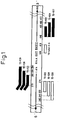
- the locations and amplified regions of the oligonucleotides in TDH RNA of Vibrio parahaemolyticus are shown for each of the oligonucleotide combinations in Fig. 1 .
- the hydroxyl group on the 3' end of the base sequence of the cleaving oligonucleotide was aminated.
- the region from the 1st "A” to the 22nd “A” from the 5' end of the base sequence of the second primer is a T7 promoter region, and the subsequent region from the 23rd "G” to the 28th "A” is an enhancer sequence.
- TD-S26 SEQ. ID No. 5, base nos. 249 to 274)
- TD-S30 SEQ. ID No. 6, base nos. 245 to 274)
- Table 2 shows the results of measuring TDH2 RNA at 10 3 and 10 4 copies/test using the combinations of oligonucleotides shown in Table 1. All of the combinations of oligonucleotides shown in Table 1 detected TDH2 RNA within 30 minutes.
- the detection method of the invention of the present application is useful for detecting TDH RNA of Vibrio parahaemolyticus rapidly and with high sensitivity.
Landscapes
- Chemical & Material Sciences (AREA)
- Life Sciences & Earth Sciences (AREA)
- Organic Chemistry (AREA)
- Proteomics, Peptides & Aminoacids (AREA)
- Analytical Chemistry (AREA)
- Zoology (AREA)
- Wood Science & Technology (AREA)
- Health & Medical Sciences (AREA)
- Engineering & Computer Science (AREA)
- Biophysics (AREA)
- Immunology (AREA)
- Microbiology (AREA)
- Molecular Biology (AREA)
- Biotechnology (AREA)
- Physics & Mathematics (AREA)
- Biochemistry (AREA)
- Bioinformatics & Cheminformatics (AREA)
- General Engineering & Computer Science (AREA)
- General Health & Medical Sciences (AREA)
- Genetics & Genomics (AREA)
- Chemical Kinetics & Catalysis (AREA)
- Measuring Or Testing Involving Enzymes Or Micro-Organisms (AREA)
Claims (4)
- Detektionsreagenz zur Verwendung beim Detektieren des in einer Probe vorhandenen thermostabilen direkten Hämolysin-(TDH-)Gens von Vibrio parahaemolyticus, das in einem Detektionsverfahren unter Anwendung eines RNA-Amplifikationsvorgangs verwendet wird, welches die Stufen:- Produktion einer cDNA mit einer RNA-abhängigen DNA-Polymerase unter Verwendung einer speziellen Sequenz einer von diesem TDH-Gen abgeleiteten RNA als Template sowie eines ersten Primers mit einer Sequenz, die zu dieser speziellen Sequenz komplementär ist, und eines zweiten Primers mit einer Sequenz, die zu dieser speziellen Sequenz homolog ist, wodurch sich eine doppelsträngige RNA-DNA bildet,- Abbau des RNA-Teils der doppelsträngigen RNA-DNA durch Ribonuclease H, wodurch eine einsträngige DNA produziert wird, und- Produktion einer doppelsträngigen DNA mit der Promotorsequenz, die in der Lage ist, die RNA, die sich aus der speziellen RNA-Sequenz oder der zu dieser speziellen RNA-Sequenz komplementären Sequenz zusammensetzt, mit einer DNA-abhängigen DNA-Polymerase unter Verwendung der einsträngigen DNA als Template zu transkribieren, umfasst, wobei- die doppelsträngige DNA ein RNA-Transkriptionsprodukt in Gegenwart der RNA-Polymerase produziert und dieses RNA-Transkriptionsprodukt als Template für die anschließende cDNA-Synthese mit der RNA-abhängigen DNA-Polymerase dient,wobei das Reagenz- als ersten Primer ein Oligonucleotid, das aus der Sequenz, die als SEQ ID Nr. 2, SEQ ID Nr. 10 oder SEQ ID Nr. 11 aufgezählt ist, besteht, und- als zweiten Primer ein Oligonucleotid, das aus der Sequenz, die als SEQ ID Nr. 7, SEQ ID Nr. 8 oder SEQ ID Nr. 9 aufgezählt ist, besteht,umfasst.
- Detektionsreagenz nach Anspruch 1, wobei der RNA-Amplifikationsvorgang in Gegenwart eines spaltenden Oligonucleotids durchgeführt wird, das die Target-RNA am 5'-Ende der speziellen Sequenz spaltet und eine Sequenz besitzt, die zu der Region, die an das 5'-Ende der speziellen Sequenz angrenzt und mit diesem überlappt, komplementär ist, wobei dieses Oligonucleotid ein solches ist, das aus einer Sequenz besteht, die als SEQ ID Nr. 4, 5 oder 6 aufgezählt ist.
- Detektionsreagenz nach Anspruch 1 oder 2, wobei der RNA-Amplifikationsvorgang in Gegenwart eines Oligonucleotids durchgeführt wird, das mit einem interkalierten Fluoreszenzpigment markiert worden ist, und die Detektion des thermostabilen direkten Hämolysins von Vibrio parahaemolyticus durch die Messung der Fluoreszenzintensität der Reaktionslösung durchgeführt wird, wobei die Sequenz des Oligonucleotids zu mindestens einem Teil der Sequenz des mRNA-Transkriptionsprodukts komplementär ist, und dann, wenn das komplementäre Binden dieses Oligonucleotids an dieses RNA-Transkriptionsprodukt stattfindet, sich die Fluoreszenzeigenschaften der Reaktionslösung im Vergleich mit dem Vorgang, bei welchem sich kein Komplex bildet, verändern.
- Detektionsreagenz nach Anspruch 3, wobei das Oligonucleotid, das mit dem interkalierten Fluoreszenzpigment markiert ist, aus mindestens 10 aneinander angrenzenden Basen der als SEQ ID Nr. 3 aufgezählten Sequenz besteht.
Applications Claiming Priority (2)
| Application Number | Priority Date | Filing Date | Title |
|---|---|---|---|
| JP2003314130 | 2003-09-05 | ||
| JP2003314130A JP2005080530A (ja) | 2003-09-05 | 2003-09-05 | 腸炎ビブリオ菌の耐熱性溶血毒素遺伝子の検出試薬 |
Publications (2)
| Publication Number | Publication Date |
|---|---|
| EP1512754A1 EP1512754A1 (de) | 2005-03-09 |
| EP1512754B1 true EP1512754B1 (de) | 2009-10-07 |
Family
ID=34131904
Family Applications (1)
| Application Number | Title | Priority Date | Filing Date |
|---|---|---|---|
| EP04020604A Expired - Lifetime EP1512754B1 (de) | 2003-09-05 | 2004-08-31 | Reagenz zum Nachweis des TDH Gens von Vibrio Parahaemolyticus |
Country Status (6)
| Country | Link |
|---|---|
| US (1) | US20050112629A1 (de) |
| EP (1) | EP1512754B1 (de) |
| JP (1) | JP2005080530A (de) |
| KR (1) | KR20050027012A (de) |
| CN (1) | CN1637153B (de) |
| DE (1) | DE602004023462D1 (de) |
Families Citing this family (3)
| Publication number | Priority date | Publication date | Assignee | Title |
|---|---|---|---|---|
| CN101178363B (zh) * | 2007-10-19 | 2010-10-27 | 华南理工大学 | 副溶血弧菌恒温基因扩增检测试剂盒及方法 |
| US20150299775A1 (en) * | 2012-09-06 | 2015-10-22 | Charles R. Lovell | Pcr primers for detection of vibrio parahaemolyticus thermostable direct hemolysin (tdh) and tdh-related hemolysin genes |
| CN104450596A (zh) * | 2014-12-31 | 2015-03-25 | 山东农业大学 | 展示副溶血弧菌tdh的迟缓爱德华菌菌蜕及构建方法 |
Family Cites Families (7)
| Publication number | Priority date | Publication date | Assignee | Title |
|---|---|---|---|---|
| US6582908B2 (en) * | 1990-12-06 | 2003-06-24 | Affymetrix, Inc. | Oligonucleotides |
| JP3189000B2 (ja) * | 1994-12-01 | 2001-07-16 | 東ソー株式会社 | 特定核酸配列の検出方法 |
| US6036572A (en) * | 1998-03-04 | 2000-03-14 | Sze; Chau-King | Drive for toy with suction cup feet |
| JP4438110B2 (ja) * | 1998-07-01 | 2010-03-24 | 東ソー株式会社 | 標的核酸の定量方法 |
| DE60014762T2 (de) * | 1999-05-24 | 2005-10-13 | Tosoh Corp., Shinnanyo | Methode zum Nachweis von Ribonukleinsäuren |
| JP2001340086A (ja) * | 2000-05-31 | 2001-12-11 | Tosoh Corp | 腸炎ビブリオ菌の耐熱性溶血毒遺伝子の検出法 |
| US6562955B2 (en) * | 2000-03-17 | 2003-05-13 | Tosoh Corporation | Oligonucleotides for detection of Vibrio parahaemolyticus and detection method for Vibrio parahaemolyticus using the same oligonucleotides |
-
2003
- 2003-09-05 JP JP2003314130A patent/JP2005080530A/ja active Pending
-
2004
- 2004-08-30 US US10/928,160 patent/US20050112629A1/en not_active Abandoned
- 2004-08-31 EP EP04020604A patent/EP1512754B1/de not_active Expired - Lifetime
- 2004-08-31 DE DE602004023462T patent/DE602004023462D1/de not_active Expired - Lifetime
- 2004-09-03 KR KR1020040070358A patent/KR20050027012A/ko not_active Withdrawn
- 2004-09-03 CN CN200410090526XA patent/CN1637153B/zh not_active Expired - Fee Related
Also Published As
| Publication number | Publication date |
|---|---|
| DE602004023462D1 (de) | 2009-11-19 |
| US20050112629A1 (en) | 2005-05-26 |
| KR20050027012A (ko) | 2005-03-17 |
| CN1637153B (zh) | 2010-06-09 |
| JP2005080530A (ja) | 2005-03-31 |
| CN1637153A (zh) | 2005-07-13 |
| EP1512754A1 (de) | 2005-03-09 |
Similar Documents
| Publication | Publication Date | Title |
|---|---|---|
| EP1512753B1 (de) | Reagens zur Detektion des thermostable direct hemolysin-related Hemolysin Gens von vibrio parahaemolyticus | |
| EP1134292B1 (de) | Oligonukleotide zur Detektion von 'Vibrio parahaemolyticus' und Detektionsverfahren für 'Vibrio parahaemolyticus' unter Verwendung der gleichen Oligonukleotide | |
| US20090181365A1 (en) | Norovirus detection reagent | |
| EP1988176B1 (de) | Verfahren für den Nachweis säurebeständiger Bakterien mittels ribosomaler RNA als Ziel | |
| US7345161B2 (en) | Detection reagent for shiga toxin family gene of entero-hemorrhagic Escherichia coli | |
| EP1512754B1 (de) | Reagenz zum Nachweis des TDH Gens von Vibrio Parahaemolyticus | |
| KR20100083133A (ko) | 레지오넬라속균 rRNA 증폭용 프라이머, 검출방법 및 검출 키트 | |
| JP2013000093A (ja) | 同じ属に属する菌またはウイルスの同定方法 | |
| EP1411117B1 (de) | Auf NASBA basiertes Detektionsverfahren zur Detektion des Tuberkelbazillus | |
| EP1612284B1 (de) | Verfahren zur Detektion und Quantifizierung von Cytomegalovirus | |
| JP2012135234A (ja) | 結核菌検出オリゴヌクレオチドプローブ及びそれを利用した検出方法 | |
| EP1475445B1 (de) | Verfahren zur Detektion von Mikro-Metastasen | |
| US6630300B2 (en) | Oligonucleotides and method for characterizing and detecting Genogroup II type small round structured virus | |
| JP2003284565A (ja) | 非定型抗酸菌Mycobacteriumintracellulare検出のためのオリゴヌクレオチドおよび検出法 | |
| EP1236806B1 (de) | Oligonukleotide und Verfahren zur Detektion von Verotoxin | |
| EP1352974A1 (de) | Oligonukleotide zum Nachweis des untypischen Mycobacteriums Mycobacterium avium und Nachweisverfahren | |
| JP2001340086A (ja) | 腸炎ビブリオ菌の耐熱性溶血毒遺伝子の検出法 | |
| JP2021087365A (ja) | プライマー及び百日咳菌 rRNAの検出方法 | |
| JP2005245434A (ja) | ノロウイルスの検出試薬 | |
| JP2001340087A (ja) | 腸炎ビブリオ菌の耐熱性溶血毒類似溶血毒遺伝子の検出法 | |
| JP2001340088A (ja) | 腸炎ビブリオ菌の毒素遺伝子の検出法 |
Legal Events
| Date | Code | Title | Description |
|---|---|---|---|
| PUAI | Public reference made under article 153(3) epc to a published international application that has entered the european phase |
Free format text: ORIGINAL CODE: 0009012 |
|
| AK | Designated contracting states |
Kind code of ref document: A1 Designated state(s): AT BE BG CH CY CZ DE DK EE ES FI FR GB GR HU IE IT LI LU MC NL PL PT RO SE SI SK TR |
|
| AX | Request for extension of the european patent |
Extension state: AL HR LT LV MK |
|
| 17P | Request for examination filed |
Effective date: 20050805 |
|
| AKX | Designation fees paid |
Designated state(s): DE FR GB IT |
|
| 17Q | First examination report despatched |
Effective date: 20060602 |
|
| GRAP | Despatch of communication of intention to grant a patent |
Free format text: ORIGINAL CODE: EPIDOSNIGR1 |
|
| GRAC | Information related to communication of intention to grant a patent modified |
Free format text: ORIGINAL CODE: EPIDOSCIGR1 |
|
| GRAS | Grant fee paid |
Free format text: ORIGINAL CODE: EPIDOSNIGR3 |
|
| GRAA | (expected) grant |
Free format text: ORIGINAL CODE: 0009210 |
|
| AK | Designated contracting states |
Kind code of ref document: B1 Designated state(s): DE FR GB IT |
|
| REG | Reference to a national code |
Ref country code: GB Ref legal event code: FG4D |
|
| REF | Corresponds to: |
Ref document number: 602004023462 Country of ref document: DE Date of ref document: 20091119 Kind code of ref document: P |
|
| PLBE | No opposition filed within time limit |
Free format text: ORIGINAL CODE: 0009261 |
|
| STAA | Information on the status of an ep patent application or granted ep patent |
Free format text: STATUS: NO OPPOSITION FILED WITHIN TIME LIMIT |
|
| 26N | No opposition filed |
Effective date: 20100708 |
|
| PGFP | Annual fee paid to national office [announced via postgrant information from national office to epo] |
Ref country code: IT Payment date: 20100823 Year of fee payment: 7 Ref country code: FR Payment date: 20100825 Year of fee payment: 7 Ref country code: DE Payment date: 20100820 Year of fee payment: 7 |
|
| PGFP | Annual fee paid to national office [announced via postgrant information from national office to epo] |
Ref country code: GB Payment date: 20100825 Year of fee payment: 7 |
|
| GBPC | Gb: european patent ceased through non-payment of renewal fee |
Effective date: 20110831 |
|
| REG | Reference to a national code |
Ref country code: FR Ref legal event code: ST Effective date: 20120430 |
|
| PG25 | Lapsed in a contracting state [announced via postgrant information from national office to epo] |
Ref country code: IT Free format text: LAPSE BECAUSE OF NON-PAYMENT OF DUE FEES Effective date: 20110831 |
|
| REG | Reference to a national code |
Ref country code: DE Ref legal event code: R119 Ref document number: 602004023462 Country of ref document: DE Effective date: 20120301 |
|
| PG25 | Lapsed in a contracting state [announced via postgrant information from national office to epo] |
Ref country code: GB Free format text: LAPSE BECAUSE OF NON-PAYMENT OF DUE FEES Effective date: 20110831 Ref country code: FR Free format text: LAPSE BECAUSE OF NON-PAYMENT OF DUE FEES Effective date: 20110831 |
|
| PG25 | Lapsed in a contracting state [announced via postgrant information from national office to epo] |
Ref country code: DE Free format text: LAPSE BECAUSE OF NON-PAYMENT OF DUE FEES Effective date: 20120301 |
|
| P01 | Opt-out of the competence of the unified patent court (upc) registered |
Effective date: 20230523 |