EP1510406A1 - Fahrzeug-Bildschirmeinrichtung - Google Patents
Fahrzeug-Bildschirmeinrichtung Download PDFInfo
- Publication number
- EP1510406A1 EP1510406A1 EP03019499A EP03019499A EP1510406A1 EP 1510406 A1 EP1510406 A1 EP 1510406A1 EP 03019499 A EP03019499 A EP 03019499A EP 03019499 A EP03019499 A EP 03019499A EP 1510406 A1 EP1510406 A1 EP 1510406A1
- Authority
- EP
- European Patent Office
- Prior art keywords
- screen
- display device
- screen assembly
- vehicle display
- holding device
- Prior art date
- Legal status (The legal status is an assumption and is not a legal conclusion. Google has not performed a legal analysis and makes no representation as to the accuracy of the status listed.)
- Granted
Links
- 230000008878 coupling Effects 0.000 claims description 46
- 238000010168 coupling process Methods 0.000 claims description 46
- 238000005859 coupling reaction Methods 0.000 claims description 46
- 230000001154 acute effect Effects 0.000 claims description 2
- 230000002349 favourable effect Effects 0.000 description 3
- 238000003780 insertion Methods 0.000 description 2
- 230000037431 insertion Effects 0.000 description 2
- 238000000034 method Methods 0.000 description 2
- 230000008719 thickening Effects 0.000 description 2
- 230000005540 biological transmission Effects 0.000 description 1
- 238000004091 panning Methods 0.000 description 1
- 230000000007 visual effect Effects 0.000 description 1
Images


Classifications
-
- B—PERFORMING OPERATIONS; TRANSPORTING
- B60—VEHICLES IN GENERAL
- B60R—VEHICLES, VEHICLE FITTINGS, OR VEHICLE PARTS, NOT OTHERWISE PROVIDED FOR
- B60R11/00—Arrangements for holding or mounting articles, not otherwise provided for
- B60R11/02—Arrangements for holding or mounting articles, not otherwise provided for for radio sets, television sets, telephones, or the like; Arrangement of controls thereof
- B60R11/0229—Arrangements for holding or mounting articles, not otherwise provided for for radio sets, television sets, telephones, or the like; Arrangement of controls thereof for displays, e.g. cathodic tubes
- B60R11/0235—Arrangements for holding or mounting articles, not otherwise provided for for radio sets, television sets, telephones, or the like; Arrangement of controls thereof for displays, e.g. cathodic tubes of flat type, e.g. LCD
-
- B—PERFORMING OPERATIONS; TRANSPORTING
- B60—VEHICLES IN GENERAL
- B60R—VEHICLES, VEHICLE FITTINGS, OR VEHICLE PARTS, NOT OTHERWISE PROVIDED FOR
- B60R11/00—Arrangements for holding or mounting articles, not otherwise provided for
- B60R2011/0042—Arrangements for holding or mounting articles, not otherwise provided for characterised by mounting means
- B60R2011/0049—Arrangements for holding or mounting articles, not otherwise provided for characterised by mounting means for non integrated articles
- B60R2011/0078—Quick-disconnect two-parts mounting means
Definitions
- the present invention relates to a vehicle screen device having a screen assembly and a holding device.
- the present invention is based on the object, a vehicle screen device to improve so that this as possible as possible in the simplest possible way Versatile and yet easy to handle.
- the screen assembly attached to the coupling arrangement of the holding device is the screen assembly reliably and stably attached to the interior structure of the vehicle. A vehicle occupant may therefore be reproduced by the screen assembly look at visual representations. Because the screen assembly releasably attachable is, it is also independently usable outside the vehicle, for example as Table TV.
- the vehicle screen device according to the invention is therefore versatile used. By removing the screen assembly from the or attaching the screen arrangement on the coupling arrangement of the holding device is the Handling the vehicle screen device easily and accurately.
- the screen assembly via the holding device with data and / or Energy be supplied.
- the screen layout can also be operated independently of its own energy source.
- the holding device via a rod-like inner structure of the vehicle, preferably the struts of a headrest, with data and / or energy supplied be.
- the holding device can save space and free of obstructions be supplied with any data and / or power through any cables that may be freed up.
- the screen assembly to the holding device releasably suspended and hinged in a coupling position to the holding arrangement zoom be. In this way, the screen assembly is easy on the fixture mountable.
- the screen assembly via a slot-like support joint be suspended on the fixture.
- the support joint can at least partially the weight record the screen layout.
- Particularly preferred may be in the coupled state between the screen assembly and the holding device may be provided with a releasable plug connection, which a coupling force of the screen assembly forms on the holding device.
- This is the screen assembly attachable by simply plugging the holding device and fixed by the coupling force to the holding device.
- At least one guide element be provided on the screen assembly and / or the holding device, with which the coupling of the screen assembly to the holding device at least in sections directed is feasible. This brings the screen assembly and the fixture when coupling at least partially in a defined relative position to each other. In particular, this makes the insertion of the connector easier.
- the screen assembly and / or the holding device a Have release device with which the screen assembly from its coupling position at least in sections, is solvable.
- the screen arrangement is comfortable be brought into a position relative to the holding device, in which the screen assembly is detachable from the holding device.
- the release device may be formed like a lever, with a first lever portion, the release device is operable and with a second Lever section a release of the screen assembly from the coupling position is possible.
- the lever-like design of the release device is the release of the screen assembly easy to handle from the coupling position.
- the lever serves as a transmission gear.
- the screen assembly, a screen module and a base module have, which along a common side pivotally connected to each other are. Due to the pivoting the screen module is both when the Screen arrangement is operated separately from the vehicle as well as when the Screen assembly is attached to the fixture, in a desired inclination regarding the viewing direction of a viewer brought. In particular, this means different spatial positions of the base module compensated.
- the screen module in the folded state tight fitting be provided on the base module.
- the unit takes off screen module and base module in the folded state little space.
- the thickness of the display module and the base module in parallel folded state is less than or about equal to the diameter of the joint be.
- the screen module and the base module are aligned in parallel folded state about with the joint or are dominated by this.
- the base module in an unfolded state on the back of the Screen module are at a sharp or approximately right angle with the base module lock in.
- the screen module is tip over by the Base module on a support, such as a desk, supported when the screen assembly operated separately.
- Particularly favorable can be approximately coaxial with the pivot axis of screen module and Base module housing outside be provided at least one headphone jack.
- a volume control be provided. This retains the volume control when the screen module and basic module are pivoted relative to each other its relative position both in terms of the screen module and the base module at.
- At least one antenna may be provided, which in a retracted Position forms an integral outer shape of the screen assembly and in one extended position protrudes outstanding. This makes the antenna light tangible and manageable. In the extended position, the antenna is in one good reception position. In the retracted position, the antenna is compact at the Screen arrangement provided and easily accessible there.
- the antenna between the retracted and the extended Be pivotable position This makes the antenna easy to move from one to the other Position can be brought.
- the antenna can be removable. This allows an exposure of all areas covered by the antenna.
- the screen assembly is external Antenna signals can be supplied.
- the antenna connection with the antenna removed can be accessed be. This ensures that the antenna of the screen assembly and an external antenna can only be used alternatively.
- the screen arrangement in uncoupled Condition be placed on a flat surface operable.
- This can be the Screen device, for example, use as a table unit. So she can be a user For example, use on the desk and then in the case of need Install vehicle.
- the screen arrangement as a satellite receiver for an additional TV be formed.
- the screen layout be used in the sense of a supplementary device for the additional television set, whereby it receives the satellite signals and for example via a video output to the additionally connected TV. It may optionally the antenna for recording the data, preferably digitally to be received data, take care of them and pass them on to the TV. So the screen layout as wireless terminal for an external screen of the TV.
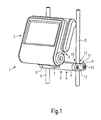
- FIG. 1 shows a vehicle screen device 1 according to the invention, which has a screen arrangement 2 and a holding device 3 has. This is the screen layout 2 in a releasably connected to a coupling arrangement 4 of the holding device. 3 coupled state.
- the holding device 3 is not on an inner structure of a attached vehicle attached.
- the internal structure is through Headrest rods 5 represents a vehicle seat, not shown.
- the holding device 3 has a fastening part 6, with which the holding device 3 is attached to the headrest rods 5.
- the fastening part 6 is curved over an arc formed carrier element 7 with the coupling arrangement 4 of the holding device 3 connected.
- the fastening part 6 has a central part 8 and on the outside releasably attachable Holding jaws 9 on.
- the middle part 8 has on both sides on the outside approximately semi-cylindrical Recesses 10 and the holding jaws 9 each have approximately semi-cylindrical inside Recesses 11 on.
- In attached to the middle part 8 state of the holding jaws 9 is by the semi-cylindrical recesses 10, 11 each one Clamping bore 12 is formed through each of which a headrest rod 5 is guided.
- the holding jaws 9 are each fastened by means of screws 13 to the central part 8. By Tighten the screws 13 come the semi-cylindrical recesses 10, 11th each clamped to the respective headrest rod 5 to the plant.
- the screen assembly 2 is about the holding device 3 with data and electrical Energy supplied.
- the holding device 3 is in turn via at least one of Headrest rods 5 supplied with data and electrical energy.
- the support member 7 is hollow, wherein electrical cables are thereby from the Attachment 6 are guided to the coupling assembly 4.
- the coupling arrangement 4 indicates its upper end 14 parallel to a top 15 extending a support projection 16 on.
- the support projection 16 extends approximately wedge-shaped from the body 18 of the Coupling arrangement 4 and is above the top 15 via.
- An outside surface 19 the support projection 16 is a continuation of a coupling main surface 17 of Coupling arrangement 4.
- the coupling main surface 17 is located on a side of the Screen assembly 2 in the coupled state directly opposite.
- first connector part 21 of the coupling main surface 17 arranged approximately transversely projecting.
- the first connector part 21 has a first plug part 22, which in this embodiment a male, electrical connector part is.
- first plug-in guides 23 are provided, which in this embodiment female, mechanical plug recesses are.
- the screen assembly 2 is shown, a screen module 24 and a Base module 25 which along a common side 27 via a pivot joint 26 are pivotally connected together.
- the screen module 24 and the base module 25 are shown folded parallel to one another. Therein, the thickness 28 of the display module 24 and the thickness 29 of the base module 25 together approximately equal to the diameter 30 of the joint 26th
- the thicknesses 28, 29 together also be smaller than the diameter 30 of the pivot joint 26.
- the display module 24 and the base module 25 close together.
- the display module 24 and the base module 25 may be pointed or include an approximately right angle 31 with each other.
- the angle is 31 as an angle between a back side 32 of the display module 24 and the base module 25 understood.
- the screen module 24 has a screen 33 on a front side 34.
- a headphone jack 36 is provided on the outside of the housing.
- a volume control 38 is provided on a right side 37 of the screen assembly 2.
- the volume control 38 about the pivot axis 35th rotatable.
- a menu selector 40 is arranged on a left side 39 of the screen assembly 2 . The menu selector 40 is rotatable about the pivot axis 35 in this embodiment of the invention.
- an antenna 41, 42 is provided on the base module 25 is in each case with respect to the right and the left side 37, 39 of the Screen assembly 2 on the outside an antenna 41, 42 is provided.
- the first and second antennas 41, 42 are separate from each other by one to the pivot axis 35 of the pivot joint 26 parallel antenna pivot axis 43 between a retracted Position 44, 45 and an extended position 46, 47 pivotally.
- In their retracted positions 44, 45 form the antennas 41, 42 each have an integral outer shape the base module 25 and cover ports and / or switches.
- the antenna pivot axis 43 is located in the region of an outer side 48 of the base module 25, which is opposite to the pivot joint 26. In the area of the antenna pivot axis 43, the antennas 41, 42 each formed approximately arcuately thickened. The thickenings 49, 50 extend in the direction of a back 51 of the base module 25. The back 51 of the base module 25 is in the folded state the screen assembly 2 facing away from the screen module 24.
- the screen assembly 2 in the folded state is perspective shown from behind.
- the back 51 of the base module 25 is shown.
- the Rear 51 has between the outside 48 of the base module 25 and a hinge side 52 of the base module 25 on a flat area 53.
- Adjacent to the plains Region 53 is in the range and parallel to the outside 48 is an approximately rounded hump 54 provided on the back 51.
- the hump 54 with respect to the flat area 53rd approximately transversely to the outside.
- Adjacent to the flat region 53, the hump 54 a rounded throat 55 on.
- the thickenings 49, 50 of the antennas 41, 42 correlate to the hump 54 of the throat 55.
- a elongated recess 56 formed approximately slit-like.
- the recess 56 of the support projection 16 of the coupling assembly 4 at least can be inserted in sections. In this way, the screen assembly 2 be hung on the holding device 3. Accordingly, the recess form 56 of the base module 25 and the support projection 16 of the coupling arrangement. 4 when the screen assembly 2 is detachably mounted on the holding device 3, an approximately slit-like support joint.
- the slot-like support joint allows pivoting of the screen assembly. 2 relative to the holding device 3 about a support axis 57.
- the support axis 57 extends approximately in the region of the bottom of the recess 56 on the side of the base module 25 and approximately in the region of an upper edge 58 of the support projection 16 of the coupling arrangement 4, wherein the upper edge 58 comes to the bottom 59 of the recess 56 to the plant.
- the Screen assembly 2 is in attached to the holding device 3 state to the Support axis 57 can be pivoted to the holding device 3.
- the base module 25 In the area between a hinge side 52 and the pivot joint 26, the base module 25 a joint connection 60 on. In a central region 61 is the joint connection 60 trained in depth. In the recess 62 is a second connector part 63 provided.
- the second connector part has a second connector part 64 auf, in this embodiment of the invention a to the first plug part 22 of the Coupling 4 matching, female electrical connector part is.
- the first plug part 22 is at least partially inserted into the second plug part 64.
- the second connector part 64 second plug guides 65 are arranged.
- the second Plug guides 65 are in this embodiment of the invention to the first Plug-in guides 23 of the coupling assembly 4 matching, about pen-like male mechanical Plug guides.
- the second plug guides 65 are in the first plug-in guides 23 at least partially insertable.
- first Plug connection parts 21 of the coupling arrangement 4 and the second connector part 63 of the base module 25 a detachable plug connection of the screen assembly. 2 and the holding device 3 can be realized.
- first and second plug connection parts 22, 63 are each a clamping force of the plug connection to overcome, which represents a coupling force of the connector.
- the coupling force will be an unintentional release of the screen assembly 2 from the fixture 3 prevented.
- the coupling force becomes generated by the first and second connector part 22, 64.
- a release device 66 on the release device 66 is formed approximately like a lever and runs in sections inside the base module 25.
- the release device 66 has a first lever portion 67 which is formed like a button and a second lever portion 68 is opposite.
- the second lever portion 68 has two Thrust cam 69 on.
- the first lever portion 67 is through an opening 70 in the central region of a base module side Part 71 of the pivot joint 26 exposed and accessible from the outside.
- the pressing cams 69 are in the inner region of the recess 62 of the joint connection 60 at least in sections before and are each outside the second connector part 63.
- the release device 66 is approximately parallel to the inside of the base module 25 Swivel axis 35 extending, not shown Amsterdamsvorlegischwenkachse between a retraction position and a release position pivotally. In Figure 4, the release device 66 shown in their retracted position.
- Figure 5 shows a portion of the screen assembly 2, wherein the release device 66 is in its release position.
- the release device is by pressing fingers 72 on the first lever portion 67 against a spring force of a not shown Return spring moved to the release position.
- the first Lever portion 67 deeper in the opening 70 than in the retracted position of the release device 66.
- the pressing cams 69 each protrude at least in sections in the release position over the hinge connection 60 protruding from the recess 62 forth.
- the screen assembly 2 is suspended in a on the holding device 3 Shown position. In this case, close the back 51 of the base module 25 and the coupling main surface 17 of the coupling assembly 4 is still an acute angle with each other.
- the Screen assembly 2 By pivoting the screen assembly 2 to the holding device 3 is the Screen assembly 2 brought into their coupling position 73 shown in Figure 7.
- the screen assembly 2 continues to the holding device. 3 mounted, the back 51 of the base module is located approximately in the coplanar alignment to the coupling main surface 17 of the coupling arrangement 4.
- the connector is made.
- the release device 66 To release the screen assembly 2 from its coupling position 73, the release device 66, as shown in Figure 5, operated by means of the fingers 72.
- the press Thrust cam 69 respectively against pressing surfaces 75, the outside adjacent to next the first connector part 21 are provided, see. Figure 2.
- the pressing surfaces 75 are approximately coplanar with the coupling main surface 17 of the coupling arrangement 4 on lateral Paragraphs 76 formed.
- the lateral paragraphs 76 protrude approximately perpendicularly from the Coupling main surface 17 and are integral with the first connector part 21 formed.
- the antennas 41, 42 are in extended positions 46, 47 shown.
- the antennas 41, 42 were each separately around the antenna pivot axis 43 shot.
- In their extended positions 46, 47 are the antennas 41, 42nd from the base module 25.
- the terminals 79 may be audio Trade inputs and / or outputs, it can be a power supply input provided and a switch may be an on / off switch of the screen assembly 2 act.
- the antennas 41, 42 are removable. When removed, external antenna connections each being approximately coaxial with the antenna pivot axis 43 are provided on the base module 25. About these external antenna connections is the Screen arrangement 2 supplied with external antenna signals.
- the screen arrangement 2 is in a state separated from the holding arrangement 3 shown, wherein the screen module 24 opposite the base module 25 unfolded is.
- the base module 25 lies with its underside approximately flat on a table top 90 on.
- the first antenna 41 is in the extended position 46, wherein the Longitudinal direction of the antenna 41 extends approximately transversely to a footprint 83, on which the Screen arrangement 2 is.
- a terminal 79 disposed adjacent to the pivot joint 26 as a power supply terminal 81 trained.
- the power supply terminal 81 is a power supply cable 82 with its power supply plug 84 inserted. In this way, the screen layout 2 powered by external energy.
- an antenna joint 85 of the first antenna 41 is shown.
- the first antenna 41 is movable about the antenna pivot axis 43.
- the first antenna 41 is detached, one is inside the antenna joint 85 arranged external antenna connector accessible.
- the Antenna 41 When used in the uncoupled state shown in Figure 8 is on the Antenna 41 received a satellite signal, preferably in digital form.
- the Video output 79 is the base module via a line 92 with an external television 91, which is shown here only schematically and a complete television and / or video system can correspond.
- the screen device is used as a satellite receiver, in the form of a sideline with the TV 91 connected provides the data for the operation of the television 91.
- the screen layout can serve as a wireless terminal with the help of the antennas.
- the invention described as a vehicle screen device invention does not necessarily have in a vehicle such as a car. Conceivable in the sense of a vehicle are also other uses that can be attached to other structures, which can also be stationary, for example. In these cases, the inventive Screen device can be used as a mobile screen device, from the coupled state to the uncoupled state and vice versa can be brought.
Landscapes
- Engineering & Computer Science (AREA)
- Mechanical Engineering (AREA)
- Fittings On The Vehicle Exterior For Carrying Loads, And Devices For Holding Or Mounting Articles (AREA)
Abstract
Description
- Figur 1
- eine perspektivische Ansicht auf eine erfindungsgemäße Fahrzeug-Bildschirmeinrichtung,
- Figur 2
- eine perspektivische Ansicht auf eine Haltevorrichtung der Fahrzeug-Bildschirmeinrichtung aus Figur 1,
- Figur 3
- eine vordere, perspektivische Ansicht auf eine Bildschirmanordnung der Fahrzeug-Bildschirmeinrichtung aus Figur 1,
- Figur 4
- eine hintere, perspektivische Ansicht auf die Bildschirmanordnung aus Figur 3,
- Figur 5
- eine ausschnittsweise Ansicht auf eine Lösevorrichtung der Bildschirmanordnung in betätigtem Zustand,
- Figur 6
- eine Darstellung des Befestigungsvorganges der Bildschirmanordnung an der Haltevorrichtung,
- Figur 7
- eine seitliche Ansicht auf die Fahrzeug-Bildschirmeinrichtung, wobei die Bildschirmanordnung an der Haltevorrichtung befestigt ist und
- Figur 8
- eine perspektivische Ansicht auf die Bildschirmanordnung in separatem, betriebsbereitem Zustand.
Claims (22)
- Fahrzeug-Bildschirmeinrichtung (1) mit einer Bildschirmanordnung (2) und einer Haltevorrichtung (3), welche an einer Innenstruktur des Fahrzeugs befestigbar ist, wobei die Bildschirmanordnung (2) lösbar an einer Koppelanordnung (4) der Haltevorrichtung (3) ankoppelbar ist und in abgekoppeltem Zustand separat davon betreibbar ist.
- Fahrzeug-Bildschirmeinrichtung nach Anspruch 1,
dadurch gekennzeichnet, dass die Bildschirmanordnung (2) über die Haltevorrichtung (3) mit Daten und/oder Energie versorgbar ist. - Fahrzeug-Bildschirmeinrichtung nach einem der Ansprüche 1 oder 2,
dadurch gekennzeichnet, dass die Haltevorrichtung (3) über eine stabartige Innenstruktur des Fahrzeugs, vorzugsweise die Streben (5) einer Kopfstütze, mit Daten und/oder Energie versorgbar ist. - Fahrzeug-Bildschirmeinrichtung nach wenigstens einem der vorhergehenden Ansprüche,
dadurch gekennzeichnet, dass die Bildschirmanordnung (2) an der Haltevorrichtung (3) lösbar einhängbar und eingehängt in eine Koppelstellung (73) an die Haltevorrichtung (3) heranschwenkbar ist. - Fahrzeug-Bildschirmeinrichtung nach wenigstens einem der vorhergehenden Ansprüche,
dadurch gekennzeichnet, dass die Bildschirmanordnung (2) über ein schlitzartiges Auflagegelenk (16, 56) an der Haltevorrichtung (3) einhängbar ist. - Fahrzeug-Bildschirmeinrichtung nach wenigstens einem der vorhergehenden Ansprüche,
dadurch gekennzeichnet, dass in angekoppeltem Zustand (73) zwischen der Bildschirmanordnung (2) und der Haltevorrichtung (3) eine lösbare Steckverbindung (21, 63) vorgesehen ist, welche eine Kopplungskraft der Bildschirmanordnung (2) an der Haltevorrichtung (3) bildet. - Fahrzeug-Bildschirmeinrichtung nach wenigstens einem der vorhergehenden Ansprüche,
dadurch gekennzeichnet, dass wenigstens ein Führungselement (23, 65) an der Bildschirmanordnung (2) und/oder der Haltevorrichtung (3) vorgesehen ist, mit welchem das Ankoppeln der Bildschirmanordnung (2) an die Haltevorrichtung (3) wenigstens abschnittsweise gerichtet führbar ist. - Fahrzeug-Bildschirmeinrichtung nach wenigstens einem der vorhergehenden Ansprüche,
dadurch gekennzeichnet, dass die Bildschirmanordnung (2) und/oder die Haltevorrichtung (3) eine Lösevorrichtung (66) aufweist, mit welcher die Bildschirmanordnung (2) aus ihrer Koppelstellung (73) wenigstens abschnittsweise lösbar ist. - Fahrzeug-Bildschirmeinrichtung nach Anspruch 8,
dadurch gekennzeichnet, dass die Lösevorrichtung (66) hebelartig ausgebildet ist, wobei mit einem ersten Hebelabschnitt (67) die Lösevorrichtung (66) bedienbar ist und mit einem zweiten Hebelabschnitt (68) ein Lösen der Bildschirmanordnung (2) aus der Koppelstellung (73) möglich ist. - Fahrzeug-Bildschirmeinrichtung nach wenigstens einem der vorhergehenden Ansprüche,
dadurch gekennzeichnet, dass die Bildschirmanordnung (2) ein Bildschirmmodul (24) und ein Basismodul (25) aufweist, welche längs einer gemeinsamen Seite (27) schwenkbar (35) miteinander verbunden sind. - Fahrzeug-Bildschirmeinrichtung nach Anspruch 10,
dadurch gekennzeichnet, dass das Bildschirmmodul (24) in zusammengeklapptem Zustand eng anliegend an dem Basismodul (25) vorgesehen ist. - Fahrzeug-Bildschirmeinrichtung nach Anspruch 10 oder 11,
dadurch gekennzeichnet, dass die Dicke (28, 29) des Bildschirmmoduls (24) und des Basismoduls (25) im parallel zueinander geklappten Zustand kleiner oder etwa gleich dem Durchmesser (30) des Gelenkes (26) ist. - Fahrzeug-Bildschirmeinrichtung nach wenigstens einem der Ansprüche 10 bis 12,
dadurch gekennzeichnet, dass sich das Basismodul (24) in einem aufgeklappten Zustand rückseitig des Bildschirmmoduls (25) befindet und einen spitzen oder etwa rechten Winkel (31) mit dem Basismodul (25) einschließt. - Fahrzeug-Bildschirmeinrichtung nach wenigstens einem der Ansprüche 10 bis 13,
dadurch gekennzeichnet, dass etwa koaxial zu der Schwenkachse (35) von Bildschirmmodul (24) und Basismodul (25) gehäuseaußenseitig wenigstens ein Kopfhöreranschluss (36) vorgesehen ist. - Fahrzeug-Bildschirmeinrichtung nach wenigstens einem der Ansprüche 10 bis 14,
dadurch gekennzeichnet, dass etwa koaxial zu der Schwenkachse (35) von Bildschirmmodul (24) und Basismodul (25) gehäuseaußenseitig ein Lautstärkeregler (38) vorgesehen ist. - Fahrzeug-Bildschirmeinrichtung nach wenigstens einem der vorhergehenden Ansprüche,
dadurch gekennzeichnet, dass mindestens eine Antenne (41, 42) vorgesehen ist, welche in einer eingefahrenen Stellung (44, 45) eine integrale Außenform der Bildschirmanordnung (2) bildet und in einer ausgefahrenen Stellung (46, 47) davon hervorragend absteht. - Fahrzeug-Bildschirmeinrichtung nach Anspruch 16,
dadurch gekennzeichnet, dass die Antenne zwischen der eingefahrenen (44, 45) und der ausgefahrenen Stellung (46, 47) verschwenkbar ist. - Fahrzeug-Bildschirmeinrichtung nach einem der Ansprüche 16 oder 17,
dadurch gekennzeichnet, dass die Antenne (41, 42) abnehmbar ist. - Fahrzeug-Bildschirmeinrichtung nach wenigstens einem der Ansprüche 16 bis 18,
dadurch gekennzeichnet, dass etwa koaxial zu einer Schwenkachse (43) der Antenne (41, 42) ein Antennenanschluss für eine externe Antenne vorgesehen ist. - Fahrzeug-Bildschirmeinrichtung nach Anspruch 19,
dadurch gekennzeichnet, dass der Antennenanschluss bei abgenommener Antenne (41, 42) zugänglich ist. - Fahrzeug-Bildschirmeinrichtung nach wenigstens einem der vorhergehenden Ansprüche,
dadurch gekennzeichnet, dass die Bildschirmanordnung (2) in abgekoppeltem Zustand auf einer ebenen Unterlage (90) aufgestellt betreibbar ist. - Fahrzeug-Bildschirmeinrichtung nach wenigstens einem der vorhergehenden Ansprüche,
dadurch gekennzeichnet, dass die Bildschirmanordnung (2) als Satellitenempfänger für ein zusätzliches Fernsehgerät (91) ausgebildet ist.
Priority Applications (3)
| Application Number | Priority Date | Filing Date | Title |
|---|---|---|---|
| EP03019499A EP1510406B1 (de) | 2003-08-28 | 2003-08-28 | Fahrzeug-Bildschirmeinrichtung |
| AT03019499T ATE529298T1 (de) | 2003-08-28 | 2003-08-28 | Fahrzeug-bildschirmeinrichtung |
| US10/926,767 US9007447B2 (en) | 2003-08-28 | 2004-08-26 | Vehicle visual display system |
Applications Claiming Priority (1)
| Application Number | Priority Date | Filing Date | Title |
|---|---|---|---|
| EP03019499A EP1510406B1 (de) | 2003-08-28 | 2003-08-28 | Fahrzeug-Bildschirmeinrichtung |
Publications (2)
| Publication Number | Publication Date |
|---|---|
| EP1510406A1 true EP1510406A1 (de) | 2005-03-02 |
| EP1510406B1 EP1510406B1 (de) | 2011-10-19 |
Family
ID=34089632
Family Applications (1)
| Application Number | Title | Priority Date | Filing Date |
|---|---|---|---|
| EP03019499A Expired - Lifetime EP1510406B1 (de) | 2003-08-28 | 2003-08-28 | Fahrzeug-Bildschirmeinrichtung |
Country Status (3)
| Country | Link |
|---|---|
| US (1) | US9007447B2 (de) |
| EP (1) | EP1510406B1 (de) |
| AT (1) | ATE529298T1 (de) |
Cited By (2)
| Publication number | Priority date | Publication date | Assignee | Title |
|---|---|---|---|---|
| GB2419457A (en) * | 2004-10-20 | 2006-04-26 | Visteon Global Tech Inc | Vehicle multimedia system having a safety interlock mechanism |
| GB2422948A (en) * | 2005-02-05 | 2006-08-09 | Delta Electronics Inc | Entertainment system with portable display |
Families Citing this family (13)
| Publication number | Priority date | Publication date | Assignee | Title |
|---|---|---|---|---|
| US20060105819A1 (en) * | 2004-11-12 | 2006-05-18 | Bryant Liao | Portable electronic device's docking cradle on vechicle |
| US8081964B1 (en) | 2005-03-28 | 2011-12-20 | At&T Mobility Ii Llc | System, method and apparatus for wireless communication between a wireless mobile telecommunications device and a remote wireless display |
| GB0609240D0 (en) | 2006-05-10 | 2006-06-21 | Mitchell Ciaran | Seat top console for vehicle entertainment and accessories |
| EP1988361A1 (de) * | 2007-05-04 | 2008-11-05 | Harman Becker Automotive Systems GmbH | Multimediasystem |
| US8261309B2 (en) * | 2008-06-09 | 2012-09-04 | Audiovox Corporation | Mobile entertainment system with retrieval of audio and video media content from a remote library |
| US8203657B2 (en) * | 2008-07-11 | 2012-06-19 | Audiovox Corporation | Inductively powered mobile entertainment system |
| US9584783B2 (en) * | 2012-05-21 | 2017-02-28 | Omri KRIEZMAN | Vehicle projection systems and method |
| DE202015100700U1 (de) * | 2014-02-13 | 2015-05-28 | Tiny Love Ltd. | Kleinkinder-Spielvorrichtung |
| KR101604004B1 (ko) * | 2014-11-18 | 2016-03-16 | 현대자동차주식회사 | 차량용 에이브이 장치 |
| US9421892B1 (en) * | 2015-01-29 | 2016-08-23 | Toyota Motor Engineering & Manufacturing North America, Inc. | Headrest with retainer |
| KR101762637B1 (ko) * | 2016-04-08 | 2017-07-28 | 현대자동차주식회사 | 디스크 장치, 그를 가지는 차량 및 그 제어방법 |
| US10960828B2 (en) * | 2018-11-06 | 2021-03-30 | GM Global Technology Operations LLC | Rear seat entertainment bracket with swivel ball positioning |
| US20260084530A1 (en) * | 2024-09-24 | 2026-03-26 | GM Global Technology Operations LLC | Vehicle deployable control for automated vehicles |
Citations (6)
| Publication number | Priority date | Publication date | Assignee | Title |
|---|---|---|---|---|
| JPH0310476A (ja) * | 1989-06-07 | 1991-01-18 | Matsushita Electric Ind Co Ltd | 車載用ディスプレー装置 |
| DE9407193U1 (de) * | 1994-05-05 | 1994-09-29 | Offen, Rolf-Dieter, 13407 Berlin | Kfz-Sitz |
| FR2787403A1 (fr) * | 1998-12-21 | 2000-06-23 | Ashir Roni Zaghdoun | Dispositif de montage d'un ecran video dans un vehicule automobile |
| EP1197394A2 (de) * | 2000-10-14 | 2002-04-17 | Robert Bosch Gmbh | Elektrisches Gerät mit Halterung und Abdeckung |
| DE10120465A1 (de) * | 2001-04-26 | 2002-11-21 | Bosch Gmbh Robert | Vorrichtung für die Anzeige und Bedienung von Fahrzeugfunktionen in einem Fahrzeug sowie Halterung für eine Vorrichtung und Bussystem |
| EP1260412A2 (de) * | 2001-05-23 | 2002-11-27 | Robert Bosch Gmbh | Bedienteil für eine Fahrerinformationsvorrichtung |
Family Cites Families (21)
| Publication number | Priority date | Publication date | Assignee | Title |
|---|---|---|---|---|
| DE19528456A1 (de) * | 1995-08-03 | 1997-02-06 | Opel Adam Ag | Umlegbare Kopfstütze, insbesondere für Kraftfahrzeuge |
| US6006462A (en) * | 1997-11-28 | 1999-12-28 | Media Services International, Ltd. | Hanging display and method for vehicles |
| US6216927B1 (en) * | 1998-08-03 | 2001-04-17 | Ronald Meritt | Mounting system for releasably and securely mounting an entertainment accessory within an automobile |
| US6231017B1 (en) * | 1999-02-16 | 2001-05-15 | D. Scott Watkins | Mount bar for video recording and display devices |
| US6663155B1 (en) * | 1999-10-27 | 2003-12-16 | Meridian Automotive Sytems, Inc. | Vehicular console with adjustably-mounted video display unit |
| US6183335B1 (en) * | 1999-12-10 | 2001-02-06 | Christine Petersen | Suspended display arrangement for vehicles |
| WO2001064481A2 (en) * | 2000-03-02 | 2001-09-07 | Donnelly Corporation | Video mirror systems incorporating an accessory module |
| AUPQ762800A0 (en) * | 2000-05-19 | 2000-06-15 | Interactive Advertising Pty Ltd | Advertising system and method |
| US6522955B1 (en) * | 2000-07-28 | 2003-02-18 | Metallic Power, Inc. | System and method for power management |
| EP1260407B1 (de) * | 2001-05-25 | 2012-01-11 | Johnson Controls GmbH | Fahrzeugsitz mit integriertem Bildschirmgerät |
| US20030018975A1 (en) * | 2001-07-18 | 2003-01-23 | Stone Christopher J. | Method and system for wireless audio and video monitoring |
| US20030065560A1 (en) * | 2001-10-02 | 2003-04-03 | International Business Machines Corporation | Adjusting energy efficiency incentives according to current energy efficiency technology |
| US20030076453A1 (en) * | 2001-10-24 | 2003-04-24 | Ma Hsi Kuang | Flat display with securing device |
| TW549269U (en) * | 2001-12-28 | 2003-08-21 | Sheng-Tau Jou | Fixed type vehicular interior accessories with several setting positions |
| US20040069826A1 (en) * | 2002-06-11 | 2004-04-15 | Scott Neil | Positional holder for retaining a cylindrical or semi-cylindrical device |
| US6669285B1 (en) * | 2002-07-02 | 2003-12-30 | Eric Park | Headrest mounted video display |
| US7036879B2 (en) * | 2002-08-14 | 2006-05-02 | Johnson Safety, Inc. | Headrest-mounted monitor |
| US20040080213A1 (en) * | 2002-10-28 | 2004-04-29 | Chang Chung L. | Mobile video system |
| US8243215B2 (en) * | 2002-11-04 | 2012-08-14 | Audiovox Corporation | Hood for vehicle seat headrest including a video system |
| US7149078B2 (en) * | 2003-05-15 | 2006-12-12 | Audiovox Corporation | Video display system |
| US7111814B1 (en) * | 2003-09-17 | 2006-09-26 | David Newman | Mounting arm |
-
2003
- 2003-08-28 EP EP03019499A patent/EP1510406B1/de not_active Expired - Lifetime
- 2003-08-28 AT AT03019499T patent/ATE529298T1/de active
-
2004
- 2004-08-26 US US10/926,767 patent/US9007447B2/en not_active Expired - Fee Related
Patent Citations (6)
| Publication number | Priority date | Publication date | Assignee | Title |
|---|---|---|---|---|
| JPH0310476A (ja) * | 1989-06-07 | 1991-01-18 | Matsushita Electric Ind Co Ltd | 車載用ディスプレー装置 |
| DE9407193U1 (de) * | 1994-05-05 | 1994-09-29 | Offen, Rolf-Dieter, 13407 Berlin | Kfz-Sitz |
| FR2787403A1 (fr) * | 1998-12-21 | 2000-06-23 | Ashir Roni Zaghdoun | Dispositif de montage d'un ecran video dans un vehicule automobile |
| EP1197394A2 (de) * | 2000-10-14 | 2002-04-17 | Robert Bosch Gmbh | Elektrisches Gerät mit Halterung und Abdeckung |
| DE10120465A1 (de) * | 2001-04-26 | 2002-11-21 | Bosch Gmbh Robert | Vorrichtung für die Anzeige und Bedienung von Fahrzeugfunktionen in einem Fahrzeug sowie Halterung für eine Vorrichtung und Bussystem |
| EP1260412A2 (de) * | 2001-05-23 | 2002-11-27 | Robert Bosch Gmbh | Bedienteil für eine Fahrerinformationsvorrichtung |
Non-Patent Citations (1)
| Title |
|---|
| PATENT ABSTRACTS OF JAPAN vol. 015, no. 121 (E - 1049) 25 March 1991 (1991-03-25) * |
Cited By (5)
| Publication number | Priority date | Publication date | Assignee | Title |
|---|---|---|---|---|
| GB2419457A (en) * | 2004-10-20 | 2006-04-26 | Visteon Global Tech Inc | Vehicle multimedia system having a safety interlock mechanism |
| GB2419457B (en) * | 2004-10-20 | 2006-10-11 | Visteon Global Tech Inc | Vehicle multimedia system having a safety interlock mechanism |
| US7158377B2 (en) | 2004-10-20 | 2007-01-02 | Visteon Golbal Technologies, Inc. | Vehicle multimedia system having a safety interlock mechanism |
| GB2422948A (en) * | 2005-02-05 | 2006-08-09 | Delta Electronics Inc | Entertainment system with portable display |
| GB2422948B (en) * | 2005-02-05 | 2008-04-16 | Delta Electronics Inc | Entertainment system and portable display apparatus thereof |
Also Published As
| Publication number | Publication date |
|---|---|
| EP1510406B1 (de) | 2011-10-19 |
| US9007447B2 (en) | 2015-04-14 |
| ATE529298T1 (de) | 2011-11-15 |
| US20050116943A1 (en) | 2005-06-02 |
Similar Documents
| Publication | Publication Date | Title |
|---|---|---|
| EP1510406A1 (de) | Fahrzeug-Bildschirmeinrichtung | |
| DE69313209T2 (de) | Gelenkiger, vorspringender stecker | |
| DE69431234T2 (de) | Elektronisches Gerät mit abnehmbarem Bedienungspanel | |
| EP0376066B1 (de) | Bediengerät | |
| DE102011116097B4 (de) | Haltevorrichtung | |
| DE69826815T2 (de) | Positionverstellbare Handgriffhalterung für Laufbildkamera | |
| WO2009040079A2 (de) | Vorrichtung zum anbringen eines monitors | |
| DE202007014410U1 (de) | Halter für elektronische Vorrichtungen | |
| DE102008030877A1 (de) | Wandstütze für ein Flachbildschirm-Fernsehgerät mit einstellbarem Blickwinkel | |
| DE112007000719T5 (de) | Modulares Befestigungssystem für elektronische Einrichtungen | |
| DE102011053607A1 (de) | Halter für ein elektronisches Gerät | |
| DE102014201024A1 (de) | Verriegelungslösevorrichtung für eine Kamera | |
| DE202005001986U1 (de) | Universalgelenkanordnung zwischen einem Gerätehalter und einem Tragarm oder einer Konsole | |
| DE102004035871A1 (de) | Multifunktionales Stecksystem | |
| EP3628579A1 (de) | Antriebsvorrichtung für ein elektrofahrrad mit schwenkbarem motorsteckverbinder | |
| DE2414021C3 (de) | Scharnier für eine lösbare mechanische Verbindung zweier elektrischer Einrichtungen | |
| EP0634308B1 (de) | Einrichtung mit einer Halterung und einem Kabel für ein Handfunktelefon | |
| EP0788331A1 (de) | Klemmkupplung zur festlegung von knochenschrauben | |
| EP1666308B1 (de) | Gerätehaltekonsole mit universell verstellbarer Halteplatte | |
| EP1588898B1 (de) | Fahrzeug-Bildschirmeinrichtung | |
| DE19800129C2 (de) | Zigarrenanzünder-Stecker | |
| DE3943634C2 (de) | Elektronisches Gerät | |
| DE2715654A1 (de) | Fotografische kamera flacher bauart und elektronenblitzgeraet | |
| DE102023202221B3 (de) | Verfahren und Vorrichtung zur Ausrichtung einer Kamera auf eine Anhängerkupplung | |
| DE20311038U1 (de) | Halterung für eine Kamera |
Legal Events
| Date | Code | Title | Description |
|---|---|---|---|
| PUAI | Public reference made under article 153(3) epc to a published international application that has entered the european phase |
Free format text: ORIGINAL CODE: 0009012 |
|
| AK | Designated contracting states |
Kind code of ref document: A1 Designated state(s): AT BE BG CH CY CZ DE DK EE ES FI FR GB GR HU IE IT LI LU MC NL PT RO SE SI SK TR |
|
| AX | Request for extension of the european patent |
Extension state: AL LT LV MK |
|
| 17P | Request for examination filed |
Effective date: 20050405 |
|
| AKX | Designation fees paid |
Designated state(s): AT BE BG CH CY CZ DE DK EE ES FI FR GB GR HU IE IT LI LU MC NL PT RO SE SI SK TR |
|
| 17Q | First examination report despatched |
Effective date: 20101015 |
|
| GRAP | Despatch of communication of intention to grant a patent |
Free format text: ORIGINAL CODE: EPIDOSNIGR1 |
|
| GRAS | Grant fee paid |
Free format text: ORIGINAL CODE: EPIDOSNIGR3 |
|
| GRAA | (expected) grant |
Free format text: ORIGINAL CODE: 0009210 |
|
| AK | Designated contracting states |
Kind code of ref document: B1 Designated state(s): AT BE BG CH CY CZ DE DK EE ES FI FR GB GR HU IE IT LI LU MC NL PT RO SE SI SK TR |
|
| REG | Reference to a national code |
Ref country code: GB Ref legal event code: FG4D Free format text: NOT ENGLISH |
|
| REG | Reference to a national code |
Ref country code: CH Ref legal event code: EP |
|
| REG | Reference to a national code |
Ref country code: IE Ref legal event code: FG4D |
|
| REG | Reference to a national code |
Ref country code: DE Ref legal event code: R096 Ref document number: 50314017 Country of ref document: DE Effective date: 20111222 |
|
| REG | Reference to a national code |
Ref country code: NL Ref legal event code: VDEP Effective date: 20111019 |
|
| REG | Reference to a national code |
Ref country code: IE Ref legal event code: FD4D |
|
| PG25 | Lapsed in a contracting state [announced via postgrant information from national office to epo] |
Ref country code: SI Free format text: LAPSE BECAUSE OF FAILURE TO SUBMIT A TRANSLATION OF THE DESCRIPTION OR TO PAY THE FEE WITHIN THE PRESCRIBED TIME-LIMIT Effective date: 20111019 Ref country code: SE Free format text: LAPSE BECAUSE OF FAILURE TO SUBMIT A TRANSLATION OF THE DESCRIPTION OR TO PAY THE FEE WITHIN THE PRESCRIBED TIME-LIMIT Effective date: 20111019 Ref country code: GR Free format text: LAPSE BECAUSE OF FAILURE TO SUBMIT A TRANSLATION OF THE DESCRIPTION OR TO PAY THE FEE WITHIN THE PRESCRIBED TIME-LIMIT Effective date: 20120120 Ref country code: NL Free format text: LAPSE BECAUSE OF FAILURE TO SUBMIT A TRANSLATION OF THE DESCRIPTION OR TO PAY THE FEE WITHIN THE PRESCRIBED TIME-LIMIT Effective date: 20111019 Ref country code: PT Free format text: LAPSE BECAUSE OF FAILURE TO SUBMIT A TRANSLATION OF THE DESCRIPTION OR TO PAY THE FEE WITHIN THE PRESCRIBED TIME-LIMIT Effective date: 20120220 |
|
| PG25 | Lapsed in a contracting state [announced via postgrant information from national office to epo] |
Ref country code: CY Free format text: LAPSE BECAUSE OF FAILURE TO SUBMIT A TRANSLATION OF THE DESCRIPTION OR TO PAY THE FEE WITHIN THE PRESCRIBED TIME-LIMIT Effective date: 20111019 |
|
| PG25 | Lapsed in a contracting state [announced via postgrant information from national office to epo] |
Ref country code: DK Free format text: LAPSE BECAUSE OF FAILURE TO SUBMIT A TRANSLATION OF THE DESCRIPTION OR TO PAY THE FEE WITHIN THE PRESCRIBED TIME-LIMIT Effective date: 20111019 Ref country code: CZ Free format text: LAPSE BECAUSE OF FAILURE TO SUBMIT A TRANSLATION OF THE DESCRIPTION OR TO PAY THE FEE WITHIN THE PRESCRIBED TIME-LIMIT Effective date: 20111019 Ref country code: SK Free format text: LAPSE BECAUSE OF FAILURE TO SUBMIT A TRANSLATION OF THE DESCRIPTION OR TO PAY THE FEE WITHIN THE PRESCRIBED TIME-LIMIT Effective date: 20111019 Ref country code: EE Free format text: LAPSE BECAUSE OF FAILURE TO SUBMIT A TRANSLATION OF THE DESCRIPTION OR TO PAY THE FEE WITHIN THE PRESCRIBED TIME-LIMIT Effective date: 20111019 Ref country code: BG Free format text: LAPSE BECAUSE OF FAILURE TO SUBMIT A TRANSLATION OF THE DESCRIPTION OR TO PAY THE FEE WITHIN THE PRESCRIBED TIME-LIMIT Effective date: 20120119 Ref country code: IE Free format text: LAPSE BECAUSE OF FAILURE TO SUBMIT A TRANSLATION OF THE DESCRIPTION OR TO PAY THE FEE WITHIN THE PRESCRIBED TIME-LIMIT Effective date: 20111019 |
|
| PLBE | No opposition filed within time limit |
Free format text: ORIGINAL CODE: 0009261 |
|
| STAA | Information on the status of an ep patent application or granted ep patent |
Free format text: STATUS: NO OPPOSITION FILED WITHIN TIME LIMIT |
|
| PG25 | Lapsed in a contracting state [announced via postgrant information from national office to epo] |
Ref country code: IT Free format text: LAPSE BECAUSE OF FAILURE TO SUBMIT A TRANSLATION OF THE DESCRIPTION OR TO PAY THE FEE WITHIN THE PRESCRIBED TIME-LIMIT Effective date: 20111019 Ref country code: RO Free format text: LAPSE BECAUSE OF FAILURE TO SUBMIT A TRANSLATION OF THE DESCRIPTION OR TO PAY THE FEE WITHIN THE PRESCRIBED TIME-LIMIT Effective date: 20111019 |
|
| 26N | No opposition filed |
Effective date: 20120720 |
|
| REG | Reference to a national code |
Ref country code: DE Ref legal event code: R097 Ref document number: 50314017 Country of ref document: DE Effective date: 20120720 |
|
| BERE | Be: lapsed |
Owner name: HARMAN BECKER AUTOMOTIVE SYSTEMS G.M.B.H. Effective date: 20120831 |
|
| REG | Reference to a national code |
Ref country code: CH Ref legal event code: PL |
|
| PG25 | Lapsed in a contracting state [announced via postgrant information from national office to epo] |
Ref country code: MC Free format text: LAPSE BECAUSE OF NON-PAYMENT OF DUE FEES Effective date: 20120831 |
|
| PG25 | Lapsed in a contracting state [announced via postgrant information from national office to epo] |
Ref country code: ES Free format text: LAPSE BECAUSE OF FAILURE TO SUBMIT A TRANSLATION OF THE DESCRIPTION OR TO PAY THE FEE WITHIN THE PRESCRIBED TIME-LIMIT Effective date: 20120130 Ref country code: LI Free format text: LAPSE BECAUSE OF NON-PAYMENT OF DUE FEES Effective date: 20120831 Ref country code: CH Free format text: LAPSE BECAUSE OF NON-PAYMENT OF DUE FEES Effective date: 20120831 |
|
| PG25 | Lapsed in a contracting state [announced via postgrant information from national office to epo] |
Ref country code: BE Free format text: LAPSE BECAUSE OF NON-PAYMENT OF DUE FEES Effective date: 20120831 |
|
| PG25 | Lapsed in a contracting state [announced via postgrant information from national office to epo] |
Ref country code: FI Free format text: LAPSE BECAUSE OF FAILURE TO SUBMIT A TRANSLATION OF THE DESCRIPTION OR TO PAY THE FEE WITHIN THE PRESCRIBED TIME-LIMIT Effective date: 20111019 |
|
| REG | Reference to a national code |
Ref country code: AT Ref legal event code: MM01 Ref document number: 529298 Country of ref document: AT Kind code of ref document: T Effective date: 20120831 |
|
| PG25 | Lapsed in a contracting state [announced via postgrant information from national office to epo] |
Ref country code: AT Free format text: LAPSE BECAUSE OF NON-PAYMENT OF DUE FEES Effective date: 20120831 |
|
| PG25 | Lapsed in a contracting state [announced via postgrant information from national office to epo] |
Ref country code: TR Free format text: LAPSE BECAUSE OF FAILURE TO SUBMIT A TRANSLATION OF THE DESCRIPTION OR TO PAY THE FEE WITHIN THE PRESCRIBED TIME-LIMIT Effective date: 20111019 |
|
| PG25 | Lapsed in a contracting state [announced via postgrant information from national office to epo] |
Ref country code: LU Free format text: LAPSE BECAUSE OF NON-PAYMENT OF DUE FEES Effective date: 20120828 |
|
| PG25 | Lapsed in a contracting state [announced via postgrant information from national office to epo] |
Ref country code: HU Free format text: LAPSE BECAUSE OF FAILURE TO SUBMIT A TRANSLATION OF THE DESCRIPTION OR TO PAY THE FEE WITHIN THE PRESCRIBED TIME-LIMIT Effective date: 20030828 |
|
| REG | Reference to a national code |
Ref country code: FR Ref legal event code: PLFP Year of fee payment: 13 |
|
| PGFP | Annual fee paid to national office [announced via postgrant information from national office to epo] |
Ref country code: FR Payment date: 20150817 Year of fee payment: 13 |
|
| REG | Reference to a national code |
Ref country code: FR Ref legal event code: ST Effective date: 20170428 |
|
| PG25 | Lapsed in a contracting state [announced via postgrant information from national office to epo] |
Ref country code: FR Free format text: LAPSE BECAUSE OF NON-PAYMENT OF DUE FEES Effective date: 20160831 |
|
| REG | Reference to a national code |
Ref country code: DE Ref legal event code: R082 Ref document number: 50314017 Country of ref document: DE Representative=s name: MAUCHER JENKINS PATENTANWAELTE & RECHTSANWAELT, DE |
|
| PGFP | Annual fee paid to national office [announced via postgrant information from national office to epo] |
Ref country code: GB Payment date: 20220721 Year of fee payment: 20 Ref country code: DE Payment date: 20220616 Year of fee payment: 20 |
|
| P01 | Opt-out of the competence of the unified patent court (upc) registered |
Effective date: 20230526 |
|
| REG | Reference to a national code |
Ref country code: DE Ref legal event code: R071 Ref document number: 50314017 Country of ref document: DE |
|
| REG | Reference to a national code |
Ref country code: GB Ref legal event code: PE20 Expiry date: 20230827 |
|
| PG25 | Lapsed in a contracting state [announced via postgrant information from national office to epo] |
Ref country code: GB Free format text: LAPSE BECAUSE OF EXPIRATION OF PROTECTION Effective date: 20230827 |