EP1510245B1 - Production method for an exhaust gas purification catalyst - Google Patents
Production method for an exhaust gas purification catalyst Download PDFInfo
- Publication number
- EP1510245B1 EP1510245B1 EP04019434A EP04019434A EP1510245B1 EP 1510245 B1 EP1510245 B1 EP 1510245B1 EP 04019434 A EP04019434 A EP 04019434A EP 04019434 A EP04019434 A EP 04019434A EP 1510245 B1 EP1510245 B1 EP 1510245B1
- Authority
- EP
- European Patent Office
- Prior art keywords
- exhaust gas
- acid
- purification catalyst
- catalyst
- temperature
- Prior art date
- Legal status (The legal status is an assumption and is not a legal conclusion. Google has not performed a legal analysis and makes no representation as to the accuracy of the status listed.)
- Expired - Lifetime
Links
- 239000003054 catalyst Substances 0.000 title claims description 65
- 238000000746 purification Methods 0.000 title claims description 50
- 238000004519 manufacturing process Methods 0.000 title claims description 14
- 239000002131 composite material Substances 0.000 claims description 40
- OKTJSMMVPCPJKN-UHFFFAOYSA-N Carbon Chemical compound [C] OKTJSMMVPCPJKN-UHFFFAOYSA-N 0.000 claims description 19
- 229910052799 carbon Inorganic materials 0.000 claims description 19
- 238000000034 method Methods 0.000 claims description 14
- 150000001875 compounds Chemical class 0.000 claims description 10
- OFOBLEOULBTSOW-UHFFFAOYSA-N Malonic acid Chemical compound OC(=O)CC(O)=O OFOBLEOULBTSOW-UHFFFAOYSA-N 0.000 claims description 9
- 229910002651 NO3 Inorganic materials 0.000 claims description 9
- 150000002762 monocarboxylic acid derivatives Chemical class 0.000 claims description 7
- NHNBFGGVMKEFGY-UHFFFAOYSA-N Nitrate Chemical compound [O-][N+]([O-])=O NHNBFGGVMKEFGY-UHFFFAOYSA-N 0.000 claims description 6
- 125000002887 hydroxy group Chemical group [H]O* 0.000 claims description 6
- 150000001735 carboxylic acids Chemical class 0.000 claims description 4
- 229920000642 polymer Polymers 0.000 claims description 4
- 238000001035 drying Methods 0.000 claims description 2
- 238000001704 evaporation Methods 0.000 claims description 2
- KDLHZDBZIXYQEI-UHFFFAOYSA-N palladium Substances [Pd] KDLHZDBZIXYQEI-UHFFFAOYSA-N 0.000 description 54
- 239000007789 gas Substances 0.000 description 49
- MWUXSHHQAYIFBG-UHFFFAOYSA-N nitrogen oxide Inorganic materials O=[N] MWUXSHHQAYIFBG-UHFFFAOYSA-N 0.000 description 28
- 229910002091 carbon monoxide Inorganic materials 0.000 description 19
- 229930195733 hydrocarbon Natural products 0.000 description 16
- UGFAIRIUMAVXCW-UHFFFAOYSA-N Carbon monoxide Chemical compound [O+]#[C-] UGFAIRIUMAVXCW-UHFFFAOYSA-N 0.000 description 15
- 239000004215 Carbon black (E152) Substances 0.000 description 14
- 239000006185 dispersion Substances 0.000 description 14
- 230000001965 increasing effect Effects 0.000 description 14
- 150000002430 hydrocarbons Chemical class 0.000 description 12
- 239000000203 mixture Substances 0.000 description 12
- KRKNYBCHXYNGOX-UHFFFAOYSA-N citric acid Chemical compound OC(=O)CC(O)(C(O)=O)CC(O)=O KRKNYBCHXYNGOX-UHFFFAOYSA-N 0.000 description 10
- 229910052761 rare earth metal Inorganic materials 0.000 description 10
- 150000002910 rare earth metals Chemical class 0.000 description 10
- 239000000243 solution Substances 0.000 description 10
- 229910000510 noble metal Inorganic materials 0.000 description 8
- 150000001732 carboxylic acid derivatives Chemical class 0.000 description 7
- QTBSBXVTEAMEQO-UHFFFAOYSA-N Acetic acid Chemical compound CC(O)=O QTBSBXVTEAMEQO-UHFFFAOYSA-N 0.000 description 6
- RGHNJXZEOKUKBD-SQOUGZDYSA-N D-gluconic acid Chemical compound OC[C@@H](O)[C@@H](O)[C@H](O)[C@@H](O)C(O)=O RGHNJXZEOKUKBD-SQOUGZDYSA-N 0.000 description 6
- AEMRFAOFKBGASW-UHFFFAOYSA-N Glycolic acid Chemical compound OCC(O)=O AEMRFAOFKBGASW-UHFFFAOYSA-N 0.000 description 6
- MUBZPKHOEPUJKR-UHFFFAOYSA-N Oxalic acid Chemical compound OC(=O)C(O)=O MUBZPKHOEPUJKR-UHFFFAOYSA-N 0.000 description 6
- PNEYBMLMFCGWSK-UHFFFAOYSA-N aluminium oxide Inorganic materials [O-2].[O-2].[O-2].[Al+3].[Al+3] PNEYBMLMFCGWSK-UHFFFAOYSA-N 0.000 description 6
- HHLFWLYXYJOTON-UHFFFAOYSA-N glyoxylic acid Chemical compound OC(=O)C=O HHLFWLYXYJOTON-UHFFFAOYSA-N 0.000 description 6
- JVTAAEKCZFNVCJ-UHFFFAOYSA-N lactic acid Chemical compound CC(O)C(O)=O JVTAAEKCZFNVCJ-UHFFFAOYSA-N 0.000 description 6
- FYDKNKUEBJQCCN-UHFFFAOYSA-N lanthanum(3+);trinitrate Chemical compound [La+3].[O-][N+]([O-])=O.[O-][N+]([O-])=O.[O-][N+]([O-])=O FYDKNKUEBJQCCN-UHFFFAOYSA-N 0.000 description 6
- 238000011156 evaluation Methods 0.000 description 5
- 239000000843 powder Substances 0.000 description 5
- BJEPYKJPYRNKOW-REOHCLBHSA-N (S)-malic acid Chemical compound OC(=O)[C@@H](O)CC(O)=O BJEPYKJPYRNKOW-REOHCLBHSA-N 0.000 description 4
- -1 CO HC Chemical class 0.000 description 4
- BJEPYKJPYRNKOW-UHFFFAOYSA-N alpha-hydroxysuccinic acid Natural products OC(=O)C(O)CC(O)=O BJEPYKJPYRNKOW-UHFFFAOYSA-N 0.000 description 4
- 238000002485 combustion reaction Methods 0.000 description 4
- 238000007796 conventional method Methods 0.000 description 4
- 239000001630 malic acid Substances 0.000 description 4
- 235000011090 malic acid Nutrition 0.000 description 4
- XLYOFNOQVPJJNP-UHFFFAOYSA-N water Substances O XLYOFNOQVPJJNP-UHFFFAOYSA-N 0.000 description 4
- WWZKQHOCKIZLMA-UHFFFAOYSA-N Caprylic acid Natural products CCCCCCCC(O)=O WWZKQHOCKIZLMA-UHFFFAOYSA-N 0.000 description 3
- RGHNJXZEOKUKBD-UHFFFAOYSA-N D-gluconic acid Natural products OCC(O)C(O)C(O)C(O)C(O)=O RGHNJXZEOKUKBD-UHFFFAOYSA-N 0.000 description 3
- FEWJPZIEWOKRBE-JCYAYHJZSA-N Dextrotartaric acid Chemical compound OC(=O)[C@H](O)[C@@H](O)C(O)=O FEWJPZIEWOKRBE-JCYAYHJZSA-N 0.000 description 3
- FEWJPZIEWOKRBE-UHFFFAOYSA-N Tartaric acid Natural products [H+].[H+].[O-]C(=O)C(O)C(O)C([O-])=O FEWJPZIEWOKRBE-UHFFFAOYSA-N 0.000 description 3
- 239000002253 acid Substances 0.000 description 3
- 235000015165 citric acid Nutrition 0.000 description 3
- 239000004567 concrete Substances 0.000 description 3
- 229910052593 corundum Inorganic materials 0.000 description 3
- 238000002425 crystallisation Methods 0.000 description 3
- 230000008025 crystallization Effects 0.000 description 3
- 239000000174 gluconic acid Substances 0.000 description 3
- 235000012208 gluconic acid Nutrition 0.000 description 3
- 239000004310 lactic acid Substances 0.000 description 3
- 235000014655 lactic acid Nutrition 0.000 description 3
- 229910052746 lanthanum Inorganic materials 0.000 description 3
- 239000000463 material Substances 0.000 description 3
- 229910052763 palladium Inorganic materials 0.000 description 3
- GPNDARIEYHPYAY-UHFFFAOYSA-N palladium(ii) nitrate Chemical compound [Pd+2].[O-][N+]([O-])=O.[O-][N+]([O-])=O GPNDARIEYHPYAY-UHFFFAOYSA-N 0.000 description 3
- 239000002245 particle Substances 0.000 description 3
- 239000011975 tartaric acid Substances 0.000 description 3
- 235000002906 tartaric acid Nutrition 0.000 description 3
- 238000012360 testing method Methods 0.000 description 3
- 229910052723 transition metal Inorganic materials 0.000 description 3
- 150000003624 transition metals Chemical class 0.000 description 3
- 229910001845 yogo sapphire Inorganic materials 0.000 description 3
- ALRHLSYJTWAHJZ-UHFFFAOYSA-N 3-hydroxypropionic acid Chemical compound OCCC(O)=O ALRHLSYJTWAHJZ-UHFFFAOYSA-N 0.000 description 2
- ATRRKUHOCOJYRX-UHFFFAOYSA-N Ammonium bicarbonate Chemical compound [NH4+].OC([O-])=O ATRRKUHOCOJYRX-UHFFFAOYSA-N 0.000 description 2
- FERIUCNNQQJTOY-UHFFFAOYSA-N Butyric acid Chemical compound CCCC(O)=O FERIUCNNQQJTOY-UHFFFAOYSA-N 0.000 description 2
- VYPSYNLAJGMNEJ-UHFFFAOYSA-N Silicium dioxide Chemical compound O=[Si]=O VYPSYNLAJGMNEJ-UHFFFAOYSA-N 0.000 description 2
- 235000011054 acetic acid Nutrition 0.000 description 2
- OBETXYAYXDNJHR-UHFFFAOYSA-N alpha-ethylcaproic acid Natural products CCCCC(CC)C(O)=O OBETXYAYXDNJHR-UHFFFAOYSA-N 0.000 description 2
- 239000001099 ammonium carbonate Substances 0.000 description 2
- 235000012501 ammonium carbonate Nutrition 0.000 description 2
- 238000006243 chemical reaction Methods 0.000 description 2
- 230000006866 deterioration Effects 0.000 description 2
- XBDQKXXYIPTUBI-UHFFFAOYSA-N dimethylselenoniopropionate Natural products CCC(O)=O XBDQKXXYIPTUBI-UHFFFAOYSA-N 0.000 description 2
- POULHZVOKOAJMA-UHFFFAOYSA-N dodecanoic acid Chemical compound CCCCCCCCCCCC(O)=O POULHZVOKOAJMA-UHFFFAOYSA-N 0.000 description 2
- 230000000694 effects Effects 0.000 description 2
- 238000010438 heat treatment Methods 0.000 description 2
- KQNPFQTWMSNSAP-UHFFFAOYSA-N isobutyric acid Chemical compound CC(C)C(O)=O KQNPFQTWMSNSAP-UHFFFAOYSA-N 0.000 description 2
- 229910052751 metal Inorganic materials 0.000 description 2
- 239000002184 metal Substances 0.000 description 2
- BDAGIHXWWSANSR-UHFFFAOYSA-N methanoic acid Natural products OC=O BDAGIHXWWSANSR-UHFFFAOYSA-N 0.000 description 2
- FBUKVWPVBMHYJY-UHFFFAOYSA-N nonanoic acid Chemical compound CCCCCCCCC(O)=O FBUKVWPVBMHYJY-UHFFFAOYSA-N 0.000 description 2
- 235000006408 oxalic acid Nutrition 0.000 description 2
- YGSDEFSMJLZEOE-UHFFFAOYSA-N salicylic acid Chemical compound OC(=O)C1=CC=CC=C1O YGSDEFSMJLZEOE-UHFFFAOYSA-N 0.000 description 2
- CWERGRDVMFNCDR-UHFFFAOYSA-N thioglycolic acid Chemical compound OC(=O)CS CWERGRDVMFNCDR-UHFFFAOYSA-N 0.000 description 2
- NQPDZGIKBAWPEJ-UHFFFAOYSA-N valeric acid Chemical compound CCCCC(O)=O NQPDZGIKBAWPEJ-UHFFFAOYSA-N 0.000 description 2
- QBYIENPQHBMVBV-HFEGYEGKSA-N (2R)-2-hydroxy-2-phenylacetic acid Chemical compound O[C@@H](C(O)=O)c1ccccc1.O[C@@H](C(O)=O)c1ccccc1 QBYIENPQHBMVBV-HFEGYEGKSA-N 0.000 description 1
- OBETXYAYXDNJHR-SSDOTTSWSA-M (2r)-2-ethylhexanoate Chemical compound CCCC[C@@H](CC)C([O-])=O OBETXYAYXDNJHR-SSDOTTSWSA-M 0.000 description 1
- BNGXYYYYKUGPPF-UHFFFAOYSA-M (3-methylphenyl)methyl-triphenylphosphanium;chloride Chemical compound [Cl-].CC1=CC=CC(C[P+](C=2C=CC=CC=2)(C=2C=CC=CC=2)C=2C=CC=CC=2)=C1 BNGXYYYYKUGPPF-UHFFFAOYSA-M 0.000 description 1
- RBNPOMFGQQGHHO-UHFFFAOYSA-N -2,3-Dihydroxypropanoic acid Natural products OCC(O)C(O)=O RBNPOMFGQQGHHO-UHFFFAOYSA-N 0.000 description 1
- GYSCBCSGKXNZRH-UHFFFAOYSA-N 1-benzothiophene-2-carboxamide Chemical compound C1=CC=C2SC(C(=O)N)=CC2=C1 GYSCBCSGKXNZRH-UHFFFAOYSA-N 0.000 description 1
- VBSTXRUAXCTZBQ-UHFFFAOYSA-N 1-hexyl-4-phenylpiperazine Chemical compound C1CN(CCCCCC)CCN1C1=CC=CC=C1 VBSTXRUAXCTZBQ-UHFFFAOYSA-N 0.000 description 1
- XYHKNCXZYYTLRG-UHFFFAOYSA-N 1h-imidazole-2-carbaldehyde Chemical compound O=CC1=NC=CN1 XYHKNCXZYYTLRG-UHFFFAOYSA-N 0.000 description 1
- CVKMFSAVYPAZTQ-UHFFFAOYSA-N 2-methylhexanoic acid Chemical compound CCCCC(C)C(O)=O CVKMFSAVYPAZTQ-UHFFFAOYSA-N 0.000 description 1
- GWYFCOCPABKNJV-UHFFFAOYSA-M 3-Methylbutanoic acid Natural products CC(C)CC([O-])=O GWYFCOCPABKNJV-UHFFFAOYSA-M 0.000 description 1
- OSWFIVFLDKOXQC-UHFFFAOYSA-N 4-(3-methoxyphenyl)aniline Chemical compound COC1=CC=CC(C=2C=CC(N)=CC=2)=C1 OSWFIVFLDKOXQC-UHFFFAOYSA-N 0.000 description 1
- AWQSAIIDOMEEOD-UHFFFAOYSA-N 5,5-Dimethyl-4-(3-oxobutyl)dihydro-2(3H)-furanone Chemical compound CC(=O)CCC1CC(=O)OC1(C)C AWQSAIIDOMEEOD-UHFFFAOYSA-N 0.000 description 1
- 229910052684 Cerium Inorganic materials 0.000 description 1
- RBNPOMFGQQGHHO-UWTATZPHSA-N D-glyceric acid Chemical compound OC[C@@H](O)C(O)=O RBNPOMFGQQGHHO-UWTATZPHSA-N 0.000 description 1
- ODBLHEXUDAPZAU-ZAFYKAAXSA-N D-threo-isocitric acid Chemical compound OC(=O)[C@H](O)[C@@H](C(O)=O)CC(O)=O ODBLHEXUDAPZAU-ZAFYKAAXSA-N 0.000 description 1
- GHVNFZFCNZKVNT-UHFFFAOYSA-N Decanoic acid Natural products CCCCCCCCCC(O)=O GHVNFZFCNZKVNT-UHFFFAOYSA-N 0.000 description 1
- 229910052688 Gadolinium Inorganic materials 0.000 description 1
- ODBLHEXUDAPZAU-FONMRSAGSA-N Isocitric acid Natural products OC(=O)[C@@H](O)[C@H](C(O)=O)CC(O)=O ODBLHEXUDAPZAU-FONMRSAGSA-N 0.000 description 1
- 239000005639 Lauric acid Substances 0.000 description 1
- 229910052779 Neodymium Inorganic materials 0.000 description 1
- IWYDHOAUDWTVEP-UHFFFAOYSA-N R-2-phenyl-2-hydroxyacetic acid Natural products OC(=O)C(O)C1=CC=CC=C1 IWYDHOAUDWTVEP-UHFFFAOYSA-N 0.000 description 1
- JACRWUWPXAESPB-QMMMGPOBSA-N Tropic acid Natural products OC[C@H](C(O)=O)C1=CC=CC=C1 JACRWUWPXAESPB-QMMMGPOBSA-N 0.000 description 1
- 238000010521 absorption reaction Methods 0.000 description 1
- 150000007513 acids Chemical class 0.000 description 1
- 239000000654 additive Substances 0.000 description 1
- 230000032683 aging Effects 0.000 description 1
- 229910052784 alkaline earth metal Inorganic materials 0.000 description 1
- 125000004429 atom Chemical group 0.000 description 1
- 239000002585 base Substances 0.000 description 1
- UKXSKSHDVLQNKG-UHFFFAOYSA-N benzilic acid Chemical compound C=1C=CC=CC=1C(O)(C(=O)O)C1=CC=CC=C1 UKXSKSHDVLQNKG-UHFFFAOYSA-N 0.000 description 1
- 229940087675 benzilic acid Drugs 0.000 description 1
- GONOPSZTUGRENK-UHFFFAOYSA-N benzyl(trichloro)silane Chemical compound Cl[Si](Cl)(Cl)CC1=CC=CC=C1 GONOPSZTUGRENK-UHFFFAOYSA-N 0.000 description 1
- GWYFCOCPABKNJV-UHFFFAOYSA-N beta-methyl-butyric acid Natural products CC(C)CC(O)=O GWYFCOCPABKNJV-UHFFFAOYSA-N 0.000 description 1
- 230000000903 blocking effect Effects 0.000 description 1
- 229910052681 coesite Inorganic materials 0.000 description 1
- 229910052906 cristobalite Inorganic materials 0.000 description 1
- 235000019253 formic acid Nutrition 0.000 description 1
- 239000000446 fuel Substances 0.000 description 1
- MWFSXYMZCVAQCC-UHFFFAOYSA-N gadolinium(iii) nitrate Chemical compound [Gd+3].[O-][N+]([O-])=O.[O-][N+]([O-])=O.[O-][N+]([O-])=O MWFSXYMZCVAQCC-UHFFFAOYSA-N 0.000 description 1
- 230000000977 initiatory effect Effects 0.000 description 1
- 150000002500 ions Chemical group 0.000 description 1
- 229910052741 iridium Inorganic materials 0.000 description 1
- FZLIPJUXYLNCLC-UHFFFAOYSA-N lanthanum atom Chemical compound [La] FZLIPJUXYLNCLC-UHFFFAOYSA-N 0.000 description 1
- 229960002510 mandelic acid Drugs 0.000 description 1
- 238000005259 measurement Methods 0.000 description 1
- 238000002156 mixing Methods 0.000 description 1
- 239000004570 mortar (masonry) Substances 0.000 description 1
- FUZZWVXGSFPDMH-UHFFFAOYSA-N n-hexanoic acid Natural products CCCCCC(O)=O FUZZWVXGSFPDMH-UHFFFAOYSA-N 0.000 description 1
- CFYGEIAZMVFFDE-UHFFFAOYSA-N neodymium(3+);trinitrate Chemical compound [Nd+3].[O-][N+]([O-])=O.[O-][N+]([O-])=O.[O-][N+]([O-])=O CFYGEIAZMVFFDE-UHFFFAOYSA-N 0.000 description 1
- HBEQXAKJSGXAIQ-UHFFFAOYSA-N oxopalladium Chemical compound [Pd]=O HBEQXAKJSGXAIQ-UHFFFAOYSA-N 0.000 description 1
- 125000004430 oxygen atom Chemical group O* 0.000 description 1
- 229910003445 palladium oxide Inorganic materials 0.000 description 1
- FJKROLUGYXJWQN-UHFFFAOYSA-N papa-hydroxy-benzoic acid Natural products OC(=O)C1=CC=C(O)C=C1 FJKROLUGYXJWQN-UHFFFAOYSA-N 0.000 description 1
- 229910052697 platinum Inorganic materials 0.000 description 1
- 235000019260 propionic acid Nutrition 0.000 description 1
- IUVKMZGDUIUOCP-BTNSXGMBSA-N quinbolone Chemical compound O([C@H]1CC[C@H]2[C@H]3[C@@H]([C@]4(C=CC(=O)C=C4CC3)C)CC[C@@]21C)C1=CCCC1 IUVKMZGDUIUOCP-BTNSXGMBSA-N 0.000 description 1
- 239000012495 reaction gas Substances 0.000 description 1
- 230000009257 reactivity Effects 0.000 description 1
- 229910052703 rhodium Inorganic materials 0.000 description 1
- 229960004889 salicylic acid Drugs 0.000 description 1
- 239000000377 silicon dioxide Substances 0.000 description 1
- 239000006104 solid solution Substances 0.000 description 1
- 230000006641 stabilisation Effects 0.000 description 1
- 238000011105 stabilization Methods 0.000 description 1
- 229910052682 stishovite Inorganic materials 0.000 description 1
- 229910052717 sulfur Inorganic materials 0.000 description 1
- 125000004434 sulfur atom Chemical group 0.000 description 1
- 238000004227 thermal cracking Methods 0.000 description 1
- NJRXVEJTAYWCQJ-UHFFFAOYSA-N thiomalic acid Chemical compound OC(=O)CC(S)C(O)=O NJRXVEJTAYWCQJ-UHFFFAOYSA-N 0.000 description 1
- ODBLHEXUDAPZAU-UHFFFAOYSA-N threo-D-isocitric acid Natural products OC(=O)C(O)C(C(O)=O)CC(O)=O ODBLHEXUDAPZAU-UHFFFAOYSA-N 0.000 description 1
- 229910052905 tridymite Inorganic materials 0.000 description 1
- 229940005605 valeric acid Drugs 0.000 description 1
Images

Classifications
-
- B—PERFORMING OPERATIONS; TRANSPORTING
- B01—PHYSICAL OR CHEMICAL PROCESSES OR APPARATUS IN GENERAL
- B01D—SEPARATION
- B01D53/00—Separation of gases or vapours; Recovering vapours of volatile solvents from gases; Chemical or biological purification of waste gases, e.g. engine exhaust gases, smoke, fumes, flue gases, aerosols
- B01D53/34—Chemical or biological purification of waste gases
- B01D53/92—Chemical or biological purification of waste gases of engine exhaust gases
- B01D53/94—Chemical or biological purification of waste gases of engine exhaust gases by catalytic processes
- B01D53/9445—Simultaneously removing carbon monoxide, hydrocarbons or nitrogen oxides making use of three-way catalysts [TWC] or four-way-catalysts [FWC]
- B01D53/945—Simultaneously removing carbon monoxide, hydrocarbons or nitrogen oxides making use of three-way catalysts [TWC] or four-way-catalysts [FWC] characterised by a specific catalyst
-
- B—PERFORMING OPERATIONS; TRANSPORTING
- B01—PHYSICAL OR CHEMICAL PROCESSES OR APPARATUS IN GENERAL
- B01J—CHEMICAL OR PHYSICAL PROCESSES, e.g. CATALYSIS OR COLLOID CHEMISTRY; THEIR RELEVANT APPARATUS
- B01J23/00—Catalysts comprising metals or metal oxides or hydroxides, not provided for in group B01J21/00
- B01J23/002—Mixed oxides other than spinels, e.g. perovskite
-
- B—PERFORMING OPERATIONS; TRANSPORTING
- B01—PHYSICAL OR CHEMICAL PROCESSES OR APPARATUS IN GENERAL
- B01J—CHEMICAL OR PHYSICAL PROCESSES, e.g. CATALYSIS OR COLLOID CHEMISTRY; THEIR RELEVANT APPARATUS
- B01J23/00—Catalysts comprising metals or metal oxides or hydroxides, not provided for in group B01J21/00
- B01J23/38—Catalysts comprising metals or metal oxides or hydroxides, not provided for in group B01J21/00 of noble metals
- B01J23/54—Catalysts comprising metals or metal oxides or hydroxides, not provided for in group B01J21/00 of noble metals combined with metals, oxides or hydroxides provided for in groups B01J23/02 - B01J23/36
- B01J23/56—Platinum group metals
- B01J23/63—Platinum group metals with rare earths or actinides
-
- B—PERFORMING OPERATIONS; TRANSPORTING
- B01—PHYSICAL OR CHEMICAL PROCESSES OR APPARATUS IN GENERAL
- B01J—CHEMICAL OR PHYSICAL PROCESSES, e.g. CATALYSIS OR COLLOID CHEMISTRY; THEIR RELEVANT APPARATUS
- B01J37/00—Processes, in general, for preparing catalysts; Processes, in general, for activation of catalysts
- B01J37/0009—Use of binding agents; Moulding; Pressing; Powdering; Granulating; Addition of materials ameliorating the mechanical properties of the product catalyst
- B01J37/0018—Addition of a binding agent or of material, later completely removed among others as result of heat treatment, leaching or washing,(e.g. forming of pores; protective layer, desintegrating by heat)
-
- B—PERFORMING OPERATIONS; TRANSPORTING
- B01—PHYSICAL OR CHEMICAL PROCESSES OR APPARATUS IN GENERAL
- B01J—CHEMICAL OR PHYSICAL PROCESSES, e.g. CATALYSIS OR COLLOID CHEMISTRY; THEIR RELEVANT APPARATUS
- B01J2523/00—Constitutive chemical elements of heterogeneous catalysts
-
- B—PERFORMING OPERATIONS; TRANSPORTING
- B01—PHYSICAL OR CHEMICAL PROCESSES OR APPARATUS IN GENERAL
- B01J—CHEMICAL OR PHYSICAL PROCESSES, e.g. CATALYSIS OR COLLOID CHEMISTRY; THEIR RELEVANT APPARATUS
- B01J37/00—Processes, in general, for preparing catalysts; Processes, in general, for activation of catalysts
- B01J37/02—Impregnation, coating or precipitation
- B01J37/0215—Coating
-
- B—PERFORMING OPERATIONS; TRANSPORTING
- B01—PHYSICAL OR CHEMICAL PROCESSES OR APPARATUS IN GENERAL
- B01J—CHEMICAL OR PHYSICAL PROCESSES, e.g. CATALYSIS OR COLLOID CHEMISTRY; THEIR RELEVANT APPARATUS
- B01J37/00—Processes, in general, for preparing catalysts; Processes, in general, for activation of catalysts
- B01J37/08—Heat treatment
-
- Y—GENERAL TAGGING OF NEW TECHNOLOGICAL DEVELOPMENTS; GENERAL TAGGING OF CROSS-SECTIONAL TECHNOLOGIES SPANNING OVER SEVERAL SECTIONS OF THE IPC; TECHNICAL SUBJECTS COVERED BY FORMER USPC CROSS-REFERENCE ART COLLECTIONS [XRACs] AND DIGESTS
- Y02—TECHNOLOGIES OR APPLICATIONS FOR MITIGATION OR ADAPTATION AGAINST CLIMATE CHANGE
- Y02A—TECHNOLOGIES FOR ADAPTATION TO CLIMATE CHANGE
- Y02A50/00—TECHNOLOGIES FOR ADAPTATION TO CLIMATE CHANGE in human health protection, e.g. against extreme weather
- Y02A50/20—Air quality improvement or preservation, e.g. vehicle emission control or emission reduction by using catalytic converters
-
- Y—GENERAL TAGGING OF NEW TECHNOLOGICAL DEVELOPMENTS; GENERAL TAGGING OF CROSS-SECTIONAL TECHNOLOGIES SPANNING OVER SEVERAL SECTIONS OF THE IPC; TECHNICAL SUBJECTS COVERED BY FORMER USPC CROSS-REFERENCE ART COLLECTIONS [XRACs] AND DIGESTS
- Y02—TECHNOLOGIES OR APPLICATIONS FOR MITIGATION OR ADAPTATION AGAINST CLIMATE CHANGE
- Y02T—CLIMATE CHANGE MITIGATION TECHNOLOGIES RELATED TO TRANSPORTATION
- Y02T10/00—Road transport of goods or passengers
- Y02T10/10—Internal combustion engine [ICE] based vehicles
- Y02T10/12—Improving ICE efficiencies
Definitions
- the present invention relates to a production method for a purification catalyst for exhaust gas in which nitrogen oxides (NOx), hydrocarbon (HC), and carbon monoxide (CO) contained in exhaust gas emitted from an internal combustion engine (for example, in a vehicle) can be simultaneously and effectively reduced, thereby reducing the undesirable components of the exhaust gas.
- NOx nitrogen oxides
- HC hydrocarbon
- CO carbon monoxide
- noble metal elements Pt, Rh, Pd, Ir
- Al 2 O 3 which is a support having a high specific surface area
- additives such as La, Ce, or Nd.
- noble metals can be combined with various elements by making composite oxides, the composite oxides can exhibit various properties compared to the noble metal alone, and performances for purifying exhaust gas can be improved.
- a purification catalyst for exhaust gas having superior heat resistance can be obtained in mixed condition or solid-solution condition of Pd-based composite oxides and transition metal-based composite oxides.
- a heat-resistant catalyst in which a Pd-based composite oxide comprising at least one element selected from rare earth metals and alkali earth metals and a composite oxide comprising at least one element selected from transition metals are mutually dissolved or used in a mixture, is disclosed in Japanese Unexamined Patent Application Publication No. 10-277393 .
- the purification catalyst for exhaust gas is composed of the Pd-based composite oxide, heat resistance can be improved based on stabilization of fine Pd particles.
- sintering-proof property of the Pd-based composite oxide is obtained by mixing the Pd-based composite and transition metal-based composite oxide, heat resistance can be improved.
- US5234881A , JP61209045A and JP4027433A each disclose a catalyst for purifying exhaust gas from automotive vehicles comprising Pd-based composite oxide containing at least one element selected from rare earth materials.
- the catalyst comprises a binary La-Pd oxide such as La 4 PdO 7 and the burning temperature is 900 or 1050°.
- JP4027433A a catalyst consisting of palladium oxide covered or surrounded with multiple oxides of palladium and lanthanum is described.
- the catalyst comprises Ln 2 PdO 4 .
- the burning temperature is 550 to 750°.
- the present invention was completed in view of the above-mentioned circumstances, and an object of the present invention is to provide a production method for a purification catalyst for exhaust gas comprising Ln 2 PdO 4 and Ln 4 PdO 7 .
- the present invention is defined by the appended claims.
- the inventors researched purification catalysts for exhaust gas and production methods therefor having superior purification properties to realize the above-mentioned object. As a result, it became clear that even if the same amount of noble metals as in a conventional technique is used, Pd can exist more around the surface of the catalyst, Pd dispersion can be greatly improved, growth of Pd particles can be restrained, and purification properties can be improved, by using a Pd-based composite oxide containing rare earth metals in the purification catalyst for exhaust gas.
- Pd based composite oxides such as La 2 PdO 4 or La 4 PdO 7
- elements except for Pd act as a blocking material among each kind of Pd-based composite oxides
- the distance between atoms of each Pd-based composite oxide can be maintained to some extent, and initial Pd dispersion and heat resistance can be further improved.
- Pd dispersion in the Pd-based composite oxide can be sufficiently maintained and purification properties can be improved even in the case in which the Pd-based composite oxide is burned at a lower temperature than in a conventional technique.
- the present invention was completed in view of these facts.
- the purification catalyst for exhaust gas produced by the present invention comprises Pd-based composite oxide containing at least one element selected from rare earth metals, obtainable by a process of adding at least one compound selected from the group of compounds including carboxylic acid of carbon number 2 to 20 having a OH group or a SH group, dicarboxylic acid of carbon number 2 or 3, and monocarboxylic acid of carbon number 1 to 20 to an aqueous Pd-nitrate solution of the composition element of oxide, and burning at a temperature of less than 900°C.
- the Pd-based composite oxide is a Pd-based rare earth composite oxide, namely Ln 2 PdO 4 and Ln 4 PdO 7 (Ln: rare earth metals).
- Ln for example, La, Nd or Gd can be selected.
- the Pd-based composite oxide is produced in a process in which at least one kind selected from a group of compounds (carboxylic acid of carbon number 2 to 20 having a OH group or a SH group, dicarboxylic acid of carbon number 2 or 3, or monocarboxylic acid of carbon number 1 to 20) is added to an aqueous Pd-nitrate solution of composition element of the Pd-based composite oxide.
- a group of compounds carboxylic acid of carbon number 2 to 20 having a OH group or a SH group, dicarboxylic acid of carbon number 2 or 3, or monocarboxylic acid of carbon number 1 to 20
- an oxycarboxylic acid or a compound in which an oxygen atom of a OH group in an oxycarbolylic acid is substituted with a sulfur atom can be selected:
- the carbon numbers of these carboxylic acids is in the range from 2 to 20, more desirably from 2 to 12, further desirably from 2 to 8, and most desirably from 2 to 6 in view of solubility in water.
- the carbon number of the monocarboxylic acid is in the range from 1 to 20, more desirably from 1 to 12, further desirably from 1 to 8, and most desirably from 1 to 6 in view of solubility in water.
- carboxylic acid of carbon number 2 to 20 having a OH group or a SH group glycolic acid, mercaptosuccinic acid, thioglycolic acid, lactic acid, ⁇ -hydroxy propionic acid, malic acid, tartaric acid, citric acid, iso-citric acid, allo-citric acid, gluconic acid, glyoxylic acid, glyceric acid, mandelic acid, tropic acid, benzilic acid, and salicylic acid may be mentioned.
- the monocarboxylic acid formic acid, acetic acid, propionic acid, butyric acid, isobutyric acid, valeric acid, isovaleric acid, hexanoic acid, heptanoic acid, 2-methyl hexanoic acid, octanoic acid, 2-ethyl hexanoic acid, nonanoic acid, decanoic acid, and lauric acid may be mentioned.
- acetic acid oxalic acid, malonic acid, glycolic acid, lactic acid, malic acid, tartaric acid, glyoxylic acid, citric acid, and gluconic acid
- oxalic acid, malonic acid glycolic acid, lactic acid, malic acid, tartaric acid, glyoxylic acid, citric acid, and gluconic acid
- a production method for such a purification catalyst for exhaust gas comprises:Pd-based composite oxide namely Ln 2 PdO 4 and Ln 4 PdO 7 , the method comprising: adding at least one compound selected from the group of compounds including carboxylic acid of carbon number 2 to 20 having a OH group and a SH group, dicarboxylic acid of carbon number 2 or 3, and monocarboxylic acid of carbon number 1 to 20 to an aqueous Pd-nitrate solution of the at least one rare earth metal, and burning at a temperature of less than 900°C.
- the production method for the purification catalyst for exhaust gas of the present invention is a method which can produce the purification catalyst for exhaust gas desirably.
- the production method has at least one compound selected from a group of compounds (carboxylic acid of carbon number 2 to 20; dicarboxylic acid of carbon number 2 or 3, and monocarboxylic acid of carbon number 1 to 20) which is added to aqueous nitrate solution of the composition element of a composite oxide in the production of the purification catalyst for exhaust gas of a Pd-based composite oxide, namely Ln 2 PdO 4 and Ln 4 PdO 7 .
- the explanation of the production method is a summary of the present invention.
- the inventors further researched about a concrete use of the above-mentioned invention, and it became clear that the purification catalyst for exhaust gas produced can be desirably used in an internal combustion engine, in particular, in engines of vehicles.
- the purification catalyst device for exhaust gas of vehicles produced includes a Pd-based composite oxide comprising Ln 2 PdO 4 and Ln 4 PdO 7 , and in that the Pd-based composite oxide purifies exhaust gas from vehicles.
- a purification catalyst for exhaust gas including a Pd-based composite oxide
- Pd can exist more around the surface of the catalyst compared to the conventional catalyst, Pd dispersion is greatly improved, and growth of Pd particles can be restrained even in the case in which the same amount of metal is used as in the conventional catalyst.
- purification properties can be improved. That is to say, as shown in Fig. 1 , Pd 2+ is preferably dispersed on supporting material in the Pd-based composite oxide of the present invention (in Fig. 1 , Ln means rare earth metal).
- Fig. 2 shows PdO as a conventional purification catalyst for exhaust gas.
- Fig. 2 there are some parts where Pd 2+ is desirably dispersed; however, Pd partially exists in a metallic state having low reactivity with exhaust gas. Therefore, the present invention is advantageous from the viewpoint that the production technique for purification catalyst for exhaust gas which can efficiently purify and reduce nitrogen oxides (NOx), hydrocarbons (HC), and carbon monoxide (CO) contained in exhaust gas of internal combustion engines of vehicles simultaneously, can be provided.
- NOx nitrogen oxides
- HC hydrocarbons
- CO carbon monoxide
- neodymium nitrate was used to obtain a purification catalyst for exhaust gas of Nd 2 PdO 4 .
- Other conditions were the same as in Sample 1.
- a mixture solution of palladium nitrate and lanthanum nitrate was neutralized by ammonium carbonate and the solution was condensed, to obtain a mixture paste. After thermal cracking was performed at 750°C, the mixture was burned at 1000°C for 3 hours to obtain a uniform phase powder of La 4 PdO 7 . The powder was crushed and mixed with alumina, and a predetermined amount of the powder was supported by a honeycomb to obtain a purification catalyst for exhaust gas of La 4 PdO 7 .
- Table 3 shows 50% purifying temperature and purified ratio at 400°C of CO, HC, and NO in the temperature increasing test of the catalyst after the durability treatment.
- Table 1 Catalyst. Vol. 60 cc Reaction temperature 30 to 400°C Temperature increasing rate 30°C/min Flow amount 25L/min Lean-Rich changing duration 0.5 second Reaction gas Lean Rich CO 0.34% 0.86% H 2 0.11% 0.28% CO 2 14% 14% HC 1200 ppm 1200 ppm O 2 0.69% 0.38% NO x 500 ppm 500 ppm H 2 O 10% 10%
- Samples 1 to 3 exhibit relatively low 50% purifying temperature and high purified ratio at 400°C.
- Samples 4 and 5 exhibit high 50% purifying temperature and low purified ratio at 400°C in both the initial catalyst and the catalyst after durability treatment.
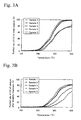
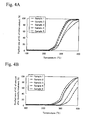
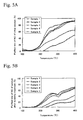
- FIG. 3A to 5B relationships of purified ratio and temperature of CO, HC, and NO of the purification catalysts for exhaust gas of Samples 1 to 5 are shown in Figs. 3A to 5B .
- 3A , 4A , and 5A show temperature increasing properties of initial catalyst and 3B, 4B, and 5B show temperature increasing properties of the catalyst after durability treatment.
- Samples 1 to 3 exhibit superior purification properties than Samples 4 and 5 at more than about 200°C.
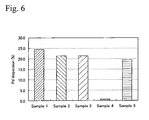
- Samples 1 to 3 exhibit superior purification properties than Samples 4 and 5 as is described above. Furthermore, to support the results, evaluation of Pd dispersion was performed. Practically, a purification catalyst for exhaust gas of Samples 1 to 5 was measured by a CO absorption method at a gas temperature of 50°C. To measure the absorbed amount of CO, a CO pulse method was employed, and as a preliminary treatment, each purification catalyst for exhaust gas was exposed to O 2 at 400°C for 15 minutes and H 2 at 400°C for 15 minutes. The measurement temperature was 50°C. The amount of Pd was 0.75 g/L. The results are shown in Fig. 6 .
- Samples 1 to 3 exhibit higher Pd dispersion than Samples 4 and 5 more than 20% higher in every case.
- reasons for extremely low dispersion in Sample 4 is that the purification catalyst for exhaust gas comprises a mixture of PdO and Al 2 O 3 , and that there are some parts where Pd does not exist at all.
- reasons for low dispersion in Sample 5 compared to Samples 1 to 3 is that a mixture solution of palladium nitrate and lanthanum nitrate was neutralized by ammonium carbonate and condensed to obtain a mixture paste, and a uniform phase powder of La 4 PdO 7 was obtained.
- the purification catalyst for exhaust gas described can be applied to an internal combustion engine of vehicles or the like which is required to effectively purify and reduce nitrogen oxides (NO x ), hydrocarbons (HC), and carbon monoxide (CO) in exhaust gas simultaneously.
- NO x nitrogen oxides
- HC hydrocarbons
- CO carbon monoxide
- Pd-based composite oxide containing at least one element selected from rare earth metals is used. Therefore, a composite oxide having the same amount of noble metal as in a conventional technique can be burned at a lower temperature. As a result, a purification catalyst for exhaust gas having superior purification properties in which deterioration of Pd dispersion by crystallization is prevented, and a production method therefor can be provided.
Landscapes
- Chemical & Material Sciences (AREA)
- Engineering & Computer Science (AREA)
- Materials Engineering (AREA)
- Chemical Kinetics & Catalysis (AREA)
- Organic Chemistry (AREA)
- Health & Medical Sciences (AREA)
- Combustion & Propulsion (AREA)
- Biomedical Technology (AREA)
- Environmental & Geological Engineering (AREA)
- Analytical Chemistry (AREA)
- General Chemical & Material Sciences (AREA)
- Oil, Petroleum & Natural Gas (AREA)
- Exhaust Gas Treatment By Means Of Catalyst (AREA)
- Catalysts (AREA)
- Exhaust Gas After Treatment (AREA)
Description
- The present invention relates to a production method for a purification catalyst for exhaust gas in which nitrogen oxides (NOx), hydrocarbon (HC), and carbon monoxide (CO) contained in exhaust gas emitted from an internal combustion engine (for example, in a vehicle) can be simultaneously and effectively reduced, thereby reducing the undesirable components of the exhaust gas.
- For purifying exhaust gas containing, for example, CO, HC, NO, and NO2, it is well known that noble metal elements (Pt, Rh, Pd, Ir) exhibit high performances. Therefore, it is preferable to employ the above-mentioned noble metal elements in the purification catalyst for exhaust gas. These noble metals are generally supported or mixed with Al2O3 which is a support having a high specific surface area, with additives such as La, Ce, or Nd. On the other hand, noble metals can be combined with various elements by making composite oxides, the composite oxides can exhibit various properties compared to the noble metal alone, and performances for purifying exhaust gas can be improved. Furthermore, it is known that a purification catalyst for exhaust gas having superior heat resistance can be obtained in mixed condition or solid-solution condition of Pd-based composite oxides and transition metal-based composite oxides.
- As such a purification catalyst for exhaust gas, a heat-resistant catalyst in which a Pd-based composite oxide comprising at least one element selected from rare earth metals and alkali earth metals and a composite oxide comprising at least one element selected from transition metals are mutually dissolved or used in a mixture, is disclosed in Japanese Unexamined Patent Application Publication No.
10-277393 - However, it is necessary to burn at more than 1000°C to form the Pd-based composite oxide in the above-mentioned current technique. Therefore, crystallization proceeds and Pd dispersion is deteriorated, and as a result, superior purification property cannot be obtained. Therefore, a purification catalyst for exhaust gas having superior purification property in which deterioration of Pd dispersion by crystallization is prevented even if composite oxide having the same amount of noble metal as in a conventional technique is burned at a lower temperature, is required.
-
US5234881A ,JP61209045A JP4027433A US5234881A , the catalyst comprises a binary La-Pd oxide such as La4PdO7 and the burning temperature is 900 or 1050°. InJP4027433A - In
JP61209045A - The present invention was completed in view of the above-mentioned circumstances, and an object of the present invention is to provide a production method for a purification catalyst for exhaust gas comprising Ln2PdO4 and Ln4PdO7. The present invention is defined by the appended claims.
- The inventors researched purification catalysts for exhaust gas and production methods therefor having superior purification properties to realize the above-mentioned object. As a result, it became clear that even if the same amount of noble metals as in a conventional technique is used, Pd can exist more around the surface of the catalyst, Pd dispersion can be greatly improved, growth of Pd particles can be restrained, and purification properties can be improved, by using a Pd-based composite oxide containing rare earth metals in the purification catalyst for exhaust gas. Furthermore, by causing multiple Pd based composite oxides such as La2PdO4 or La4PdO7 to coexist, elements except for Pd act as a blocking material among each kind of Pd-based composite oxides, the distance between atoms of each Pd-based composite oxide can be maintained to some extent, and initial Pd dispersion and heat resistance can be further improved. Furthermore, in a process of heating treatment of the Pd-based composite oxide, Pd dispersion in the Pd-based composite oxide can be sufficiently maintained and purification properties can be improved even in the case in which the Pd-based composite oxide is burned at a lower temperature than in a conventional technique. The present invention was completed in view of these facts. The purification catalyst for exhaust gas produced by the present invention comprises Pd-based composite oxide containing at least one element selected from rare earth metals, obtainable by a process of adding at least one compound selected from the group of compounds including carboxylic acid of
carbon number 2 to 20 having a OH group or a SH group, dicarboxylic acid ofcarbon number carbon number 1 to 20 to an aqueous Pd-nitrate solution of the composition element of oxide, and burning at a temperature of less than 900°C. - The Pd-based composite oxide is a Pd-based rare earth composite oxide, namely Ln2PdO4 and Ln4PdO7 (Ln: rare earth metals). As the Ln, for example, La, Nd or Gd can be selected.
- The Pd-based composite oxide is produced in a process in which at least one kind selected from a group of compounds (carboxylic acid of
carbon number 2 to 20 having a OH group or a SH group, dicarboxylic acid ofcarbon number carbon number 1 to 20) is added to an aqueous Pd-nitrate solution of composition element of the Pd-based composite oxide. - As the carboxylic acid of
carbon number 2 to 20, an oxycarboxylic acid or a compound in which an oxygen atom of a OH group in an oxycarbolylic acid is substituted with a sulfur atom, can be selected: - The carbon numbers of these carboxylic acids is in the range from 2 to 20, more desirably from 2 to 12, further desirably from 2 to 8, and most desirably from 2 to 6 in view of solubility in water.
- The carbon number of the monocarboxylic acid is in the range from 1 to 20, more desirably from 1 to 12, further desirably from 1 to 8, and most desirably from 1 to 6 in view of solubility in water. Furthermore, as a concrete example of the carboxylic acid of
carbon number 2 to 20 having a OH group or a SH group, glycolic acid, mercaptosuccinic acid, thioglycolic acid, lactic acid, β-hydroxy propionic acid, malic acid, tartaric acid, citric acid, iso-citric acid, allo-citric acid, gluconic acid, glyoxylic acid, glyceric acid, mandelic acid, tropic acid, benzilic acid, and salicylic acid may be mentioned. As a concrete example of the monocarboxylic acid, formic acid, acetic acid, propionic acid, butyric acid, isobutyric acid, valeric acid, isovaleric acid, hexanoic acid, heptanoic acid, 2-methyl hexanoic acid, octanoic acid, 2-ethyl hexanoic acid, nonanoic acid, decanoic acid, and lauric acid may be mentioned. In the above-mentioned acids, it is preferable to use acetic acid, oxalic acid, malonic acid, glycolic acid, lactic acid, malic acid, tartaric acid, glyoxylic acid, citric acid, and gluconic acid, and more preferable to use oxalic acid, malonic acid, glycolic acid, lactic acid, malic acid, tartaric acid, glyoxylic acid, citric acid, and gluconic acid. - Furthermore, according to the invention, a production method for such a purification catalyst for exhaust gas comprises:Pd-based composite oxide namely Ln2PdO4 and Ln4PdO7, the method comprising: adding at least one compound selected from the group of compounds including carboxylic acid of
carbon number 2 to 20 having a OH group and a SH group, dicarboxylic acid ofcarbon number carbon number 1 to 20 to an aqueous Pd-nitrate solution of the at least one rare earth metal, and burning at a temperature of less than 900°C. - The production method for the purification catalyst for exhaust gas of the present invention is a method which can produce the purification catalyst for exhaust gas desirably. The production method has at least one compound selected from a group of compounds (carboxylic acid of
carbon number 2 to 20; dicarboxylic acid ofcarbon number carbon number 1 to 20) which is added to aqueous nitrate solution of the composition element of a composite oxide in the production of the purification catalyst for exhaust gas of a Pd-based composite oxide, namely Ln2PdO4 and Ln4PdO7. - In such a production method for a purification catalyst for exhaust gas, it is desirable that a process to produce carboxylic acid complex polymer by evaporating and drying the aqueous nitrate solution and a burning process of the carboxylic complex polymer be contained. Furthermore, the burning temperature in the burning process is less than 900°C.
- The explanation of the production method is a summary of the present invention. The inventors further researched about a concrete use of the above-mentioned invention, and it became clear that the purification catalyst for exhaust gas produced can be desirably used in an internal combustion engine, in particular, in engines of vehicles.
- That is to say, the purification catalyst device for exhaust gas of vehicles produced includes a Pd-based composite oxide comprising Ln2PdO4 and Ln4PdO7, and in that the Pd-based composite oxide purifies exhaust gas from vehicles.
- Described is a purification catalyst for exhaust gas including a Pd-based composite oxide, and in the present invention, since a rare earth metal is added to the Pd-based composite oxide, Pd can exist more around the surface of the catalyst compared to the conventional catalyst, Pd dispersion is greatly improved, and growth of Pd particles can be restrained even in the case in which the same amount of metal is used as in the conventional catalyst. As a result, purification properties can be improved. That is to say, as shown in
Fig. 1 , Pd2+ is preferably dispersed on supporting material in the Pd-based composite oxide of the present invention (inFig. 1 , Ln means rare earth metal). On the other hand,Fig. 2 shows PdO as a conventional purification catalyst for exhaust gas. InFig. 2 , there are some parts where Pd2+ is desirably dispersed; however, Pd partially exists in a metallic state having low reactivity with exhaust gas. Therefore, the present invention is advantageous from the viewpoint that the production technique for purification catalyst for exhaust gas which can efficiently purify and reduce nitrogen oxides (NOx), hydrocarbons (HC), and carbon monoxide (CO) contained in exhaust gas of internal combustion engines of vehicles simultaneously, can be provided. As a nitrogen oxide, NO, NO2 or the like can be mentioned. -
-
Fig. 1 is a drawing showing the Pd dispersion condition of Pd-based composite oxide which is included in the purification catalyst for exhaust gas of the present invention. -
Fig. 2 is a drawing showing the Pd dispersion condition of Pd-based oxide which is included in a conventional purification catalyst for exhaust gas. -
Figs. 3A and 3B are graphs showing the relationship of purified rate of CO and temperature in each purification catalyst for exhaust gas ofSamples 1 to 5; 3A is a graph showing a temperature increasing property of initial catalyst, and 3B is a graph showing a temperature increasing property of a catalyst after durability treatment. -
Figs. 4A and 4B are graphs showing a relationship of purified rate of HC and temperature in each purification catalyst for exhaust gas ofSample 1 to 5; 4A is a graph showing a temperature increasing property of initial catalyst, and 4B is a graph showing a temperature increasing property of a catalyst after durability treatment. -
Figs. 5A and 5B are graphs showing a relationship of purified rate of NO and temperature in each purification catalyst for exhaust gas ofSample 1 to 5; 5A is a graph showing a temperature increasing property of initial catalyst, and 5B is a graph showing a temperature increasing property of a catalyst after durability treatment. -
Fig. 6 is a graph showing Pd dispersion in each purification catalyst for exhaust gas ofSamples 1 to 5. - 1.94 g (0.007 mol) of lanthanum nitrate, 6.23 g (0.014 mol) of palladium nitrate, and 3.75 g (0.028 mol) of malic acid were dissolved in 100 ml of ion exchanged water to prepare a nitrate solution of mixed metal. The solution was placed on a hot plate stirrer to be evaporated and dried while agitating at 250°C. It was put in an alumina crucible, and the temperature was increased at 2.5°C/min up to 350°C in a muffle furnace. The heat treatment at 350°C was performed for 3 hours to prepare an interim burned sample in which base nitrate was removed.
- After the interim burned sample was crushed for 15 minutes in a mortar, it was put in an alumina crucible again, and the temperature was increased at 5°C/min up to 750°C in a muffle furnace. The temperature was maintained at 750°C for 3 hours. The catalyst powder (interim burned sample), water, crushing ball, and SiO2 sol were put in a container and crushed and mixed for 14 hours by a ball mill. After that, a predetermined amount of the mixture was supported on a honeycomb, and the temperature was held at 750°C for 3 hours to obtain a purification catalyst for exhaust gas of La2PdO4.
- Instead of lanthanum nitrate in
Sample 1, neodymium nitrate was used to obtain a purification catalyst for exhaust gas of Nd2PdO4. Other conditions were the same as inSample 1. - Instead of lanthanum nitrate in
Sample 1, gadolinium nitrate was used to obtain a purification catalyst for exhaust gas of Gd2PdO4. Other conditions were the same as inSample 1. - Instead of lanthanum nitrate in
Sample 1, aluminum nitrate was used to obtain a purification catalyst for exhaust gas comprising mixture of PdO and Al2O3. Other conditions were the same as inSample 1. - A mixture solution of palladium nitrate and lanthanum nitrate was neutralized by ammonium carbonate and the solution was condensed, to obtain a mixture paste. After thermal cracking was performed at 750°C, the mixture was burned at 1000°C for 3 hours to obtain a uniform phase powder of La4PdO7. The powder was crushed and mixed with alumina, and a predetermined amount of the powder was supported by a honeycomb to obtain a purification catalyst for exhaust gas of La4PdO7.
- In each purification catalyst for exhaust gas obtained as described above, evaluation of initial activity in and activity after durability treatment was performed. The initial evaluation was performed as follows. Model exhaust gases having air-fuel ratio of 14.3 and 14.9 are repeatedly caused to flow in cycles of 0.5 second (1 Hz) in each catalyst. Flowing amount per unit time and unit volume was regarded to 50000 h-1. Reaction temperature was 30 to 400°C. Durability treatment was an aging treatment of 900°C x 200 hours. Under these conditions, evaluation was performed after the durability treatment. Table 1 shows the condition of temperature increasing test, and Tables 2 and 3 show the results of each evaluation of activity. That is to say, Table 2 shows 50% purifying temperature and purified ratio at 400°C of CO, HC, and NO in the temperature increasing test of the initial catalyst. Table 3 shows 50% purifying temperature and purified ratio at 400°C of CO, HC, and NO in the temperature increasing test of the catalyst after the durability treatment.
Table 1 Catalyst. Vol. 60 cc Reaction temperature 30 to 400°C Temperature increasing rate 30°C/min Flow amount 25L/min Lean-Rich changing duration 0.5 second Reaction gas Lean Rich CO 0.34% 0.86% H2 0.11% 0.28% CO2 14% 14% HC 1200 ppm 1200 ppm O2 0.69% 0.38% NOx 500 ppm 500 ppm H2O 10% 10% Table 2 50% Purifying temperature (°C) Purified ratio at 400°C (%) CO HC NOx CO HC NOx Sample 1 268 278 224 90.1 89.9 84.5 Sample 2262 272 237 91.3 99.0 86.9 Sample 3277 287 229 89.9 98.9 84.7 Sample 4303 315 >400 80.7 94.6 49.1 Sample 5308 310 324 76.1 98.4 63.8 Table 3 50% Purifying temperature (°C) Purified ratio at 400°C (%) CO HC NOx CO HC NOx Sample 1 315 328 330 81.0 97.0 66.9 Sample 2304 316 314 81.3 97.0 68.4 Sample 3312 325 339 80.1 96.8 64.9 Sample 4382 382 >400 58.0 64.8 24.3 Sample 5345 358 >400 69.0 87.1 40.6 - As is clear from Tables 2 and 3,
Samples 1 to 3 exhibit relatively low 50% purifying temperature and high purified ratio at 400°C. On the other hand,Samples - Next, relationships of purified ratio and temperature of CO, HC, and NO of the purification catalysts for exhaust gas of
Samples 1 to 5 are shown inFigs. 3A to 5B . In theseFigs, 3A ,4A , and5A show temperature increasing properties of initial catalyst and 3B, 4B, and 5B show temperature increasing properties of the catalyst after durability treatment. As is clear from these Figs.,Samples 1 to 3 exhibit superior purification properties thanSamples -
Samples 1 to 3 exhibit superior purification properties thanSamples Samples 1 to 5 was measured by a CO absorption method at a gas temperature of 50°C. To measure the absorbed amount of CO, a CO pulse method was employed, and as a preliminary treatment, each purification catalyst for exhaust gas was exposed to O2 at 400°C for 15 minutes and H2 at 400°C for 15 minutes. The measurement temperature was 50°C. The amount of Pd was 0.75 g/L. The results are shown inFig. 6 . - As is clear from
Fig. 6 ,Samples 1 to 3 exhibit higher Pd dispersion thanSamples Fig. 6 , reasons for extremely low dispersion inSample 4 is that the purification catalyst for exhaust gas comprises a mixture of PdO and Al2O3, and that there are some parts where Pd does not exist at all. Furthermore, reasons for low dispersion inSample 5 compared toSamples 1 to 3 is that a mixture solution of palladium nitrate and lanthanum nitrate was neutralized by ammonium carbonate and condensed to obtain a mixture paste, and a uniform phase powder of La4PdO7 was obtained. - The purification catalyst for exhaust gas described can be applied to an internal combustion engine of vehicles or the like which is required to effectively purify and reduce nitrogen oxides (NOx), hydrocarbons (HC), and carbon monoxide (CO) in exhaust gas simultaneously.
- Pd-based composite oxide containing at least one element selected from rare earth metals is used. Therefore, a composite oxide having the same amount of noble metal as in a conventional technique can be burned at a lower temperature. As a result, a purification catalyst for exhaust gas having superior purification properties in which deterioration of Pd dispersion by crystallization is prevented, and a production method therefor can be provided.
Claims (2)
- A production method for the purification catalyst for exhaust gas comprising Ln2PdO4 and Ln4PdO7,
adding at least one compound selected from the group of compounds including carboxylic acid of carbon number 2 to 20 having a OH group or a SH group, dicarboxylic acid of carbon number 2 or 3, and monocarboxylic acid of carbon number 1 to 20 to an aqueous nitrate solution of composite element of the Pd-based composite oxide, and
burning at a temperature of less than 900°C. - The production method of the purification catalyst for exhaust gas according to claim 1, wherein the method comprises:preparing a carboxylic acid complex polymer by evaporating and drying the aqueous nitrate solution of composite element of the Pd-based composite oxide; andburning the carboxylic acid complex polymer at a temperature of less than 900°C.
Applications Claiming Priority (4)
| Application Number | Priority Date | Filing Date | Title |
|---|---|---|---|
| JP2003299553 | 2003-08-25 | ||
| JP2003299553 | 2003-08-25 | ||
| JP2003322754 | 2003-09-16 | ||
| JP2003322754A JP3843091B2 (en) | 2003-08-25 | 2003-09-16 | Exhaust gas purification catalyst, method for producing the same, and exhaust gas purification catalyst device for vehicles |
Publications (2)
| Publication Number | Publication Date |
|---|---|
| EP1510245A1 EP1510245A1 (en) | 2005-03-02 |
| EP1510245B1 true EP1510245B1 (en) | 2011-05-04 |
Family
ID=34106946
Family Applications (1)
| Application Number | Title | Priority Date | Filing Date |
|---|---|---|---|
| EP04019434A Expired - Lifetime EP1510245B1 (en) | 2003-08-25 | 2004-08-16 | Production method for an exhaust gas purification catalyst |
Country Status (5)
| Country | Link |
|---|---|
| US (1) | US7259127B2 (en) |
| EP (1) | EP1510245B1 (en) |
| JP (1) | JP3843091B2 (en) |
| CN (1) | CN1305563C (en) |
| DE (1) | DE602004032500D1 (en) |
Families Citing this family (6)
| Publication number | Priority date | Publication date | Assignee | Title |
|---|---|---|---|---|
| JP3843090B2 (en) * | 2003-09-12 | 2006-11-08 | 本田技研工業株式会社 | Exhaust gas purification catalyst, method for producing the same, and exhaust gas purification catalyst device for vehicles |
| JP5028857B2 (en) * | 2006-04-28 | 2012-09-19 | 日産自動車株式会社 | Exhaust gas purification catalyst and method for producing the same |
| JP5216001B2 (en) * | 2006-10-05 | 2013-06-19 | 株式会社日本触媒 | Catalyst for treating exhaust gas containing organic acid and method for treating exhaust gas containing organic acid |
| CN101209417B (en) * | 2006-12-26 | 2010-10-06 | 比亚迪股份有限公司 | Complex and catalyst containing precious metal oxide and rare earth metal oxide |
| US20100093526A1 (en) * | 2007-02-08 | 2010-04-15 | Daihatsu Motor Co., Ltd. | Catalyst composition |
| US9101876B2 (en) * | 2009-02-25 | 2015-08-11 | Applied Hybrid Energy Pty Ltd. | Carbon capture |
Family Cites Families (24)
| Publication number | Priority date | Publication date | Assignee | Title |
|---|---|---|---|---|
| CA1066686A (en) * | 1974-04-25 | 1979-11-20 | Alan Lauder | Metal oxide catalytic compositions |
| US4182694A (en) * | 1974-04-25 | 1980-01-08 | E. I. Du Pont De Nemours & Company | Ruthenium-containing perovskite catalysts |
| SE433178B (en) * | 1975-10-31 | 1984-05-14 | Johnson Matthey Co Ltd | Catalytic converter for the cleaning of car exhaust of the general type A? 71XM? 71YO? 71Z |
| FR2530489B1 (en) * | 1982-07-26 | 1987-02-27 | Pro Catalyse | PROCESS FOR THE MANUFACTURE OF CATALYSTS FOR THE TREATMENT OF EXHAUST GASES FROM INTERNAL COMBUSTION ENGINES |
| JPS61209045A (en) | 1985-03-13 | 1986-09-17 | Nissan Motor Co Ltd | Catalyst for purifying exhaust gas |
| CN1007878B (en) * | 1985-04-01 | 1990-05-09 | 中国科学院大连化学物理研究所 | Platinum-rare earth catalyst for regenerating carbon dioxide laser gas impurity and preparation method thereof |
| CN1021412C (en) | 1988-10-26 | 1993-06-30 | 中国科学院生态环境研究中心 | Honeycomb catalyst of rare earth composite oxide type containing noble metal and its preparing method |
| JPH0817942B2 (en) | 1989-08-09 | 1996-02-28 | トヨタ自動車株式会社 | Exhaust purification catalyst manufacturing method |
| JP3145383B2 (en) | 1990-05-21 | 2001-03-12 | バブコツク日立株式会社 | High temperature combustion catalyst and method for producing the same |
| US5234881A (en) | 1992-06-05 | 1993-08-10 | Ford Motor Company | Binary LA-PA oxide catalyst and method of making the catalyst |
| JPH06100319A (en) | 1992-09-18 | 1994-04-12 | Toyota Central Res & Dev Lab Inc | Perovskite structure composite oxide and method for producing the same |
| JP3375358B2 (en) * | 1993-01-29 | 2003-02-10 | マツダ株式会社 | Exhaust gas purification catalyst |
| JP3273820B2 (en) | 1993-02-26 | 2002-04-15 | 株式会社三徳 | Cerium-containing composite oxide having oxygen absorbing / releasing ability and method for producing the same |
| US6069111A (en) * | 1995-06-02 | 2000-05-30 | Nissan Motor Co., Ltd. | Catalysts for the purification of exhaust gas and method of manufacturing thereof |
| KR0166148B1 (en) * | 1995-09-05 | 1998-12-15 | 강박광 | Method for preparing a highly dispersed mixed metal oxide supported catalyst |
| DE19713103A1 (en) * | 1996-03-28 | 1997-10-02 | Mazda Motor | Palladium-carrying exhaust gas purification catalyst |
| US5977017A (en) * | 1996-04-10 | 1999-11-02 | Catalytic Solutions, Inc. | Perovskite-type metal oxide compounds |
| JP3733687B2 (en) | 1997-04-08 | 2006-01-11 | トヨタ自動車株式会社 | Heat-resistant catalyst and method for producing the same |
| US6043188A (en) * | 1997-11-14 | 2000-03-28 | Hyundai Motor Company | Process for manufacturing palladium ternary catalyst |
| US6576200B1 (en) * | 1998-08-28 | 2003-06-10 | Daihatsu Motor Co., Ltd. | Catalytic converter for automotive pollution control, and oxygen-storing complex oxide used therefor |
| JP2001269578A (en) * | 2000-01-19 | 2001-10-02 | Toyota Motor Corp | Exhaust gas purification catalyst |
| US20020032123A1 (en) * | 2000-02-23 | 2002-03-14 | Ford Global Technologies, Inc. | Exhaust gas catalyst and method of manufacturing same |
| CN1160153C (en) * | 2001-08-28 | 2004-08-04 | 黄钊仁 | Method for improving performance of palladium catalyst with perovskite oxide ABO3 |
| CN1214867C (en) * | 2003-03-24 | 2005-08-17 | 中国科学院生态环境研究中心 | A kind of preparation method of perovskite composite oxide supported palladium catalyst |
-
2003
- 2003-09-16 JP JP2003322754A patent/JP3843091B2/en not_active Expired - Fee Related
-
2004
- 2004-08-16 DE DE602004032500T patent/DE602004032500D1/en not_active Expired - Lifetime
- 2004-08-16 EP EP04019434A patent/EP1510245B1/en not_active Expired - Lifetime
- 2004-08-17 US US10/919,486 patent/US7259127B2/en not_active Expired - Lifetime
- 2004-08-25 CN CNB2004100570656A patent/CN1305563C/en not_active Expired - Fee Related
Non-Patent Citations (1)
| Title |
|---|
| MARTIN ANDERSSON: "Structural, thermal and thermodynamic properties of some Ln-Pd oxides and their behaviour as catalyst precursors", 1999, STOCKHOLM * |
Also Published As
| Publication number | Publication date |
|---|---|
| EP1510245A1 (en) | 2005-03-02 |
| JP3843091B2 (en) | 2006-11-08 |
| US20050059546A1 (en) | 2005-03-17 |
| CN1597102A (en) | 2005-03-23 |
| DE602004032500D1 (en) | 2011-06-16 |
| US7259127B2 (en) | 2007-08-21 |
| CN1305563C (en) | 2007-03-21 |
| JP2005095703A (en) | 2005-04-14 |
Similar Documents
| Publication | Publication Date | Title |
|---|---|---|
| USRE44802E1 (en) | Cerium-zirconium composite metal oxide | |
| US3957691A (en) | Catalyst for treating exhaust gas from engine vehicles | |
| EP3072588B1 (en) | Catalyst for purification of exhaust gas, nox storage-reduction catalyst, and method for purifying exhaust gas | |
| JP2005066559A (en) | Exhaust gas treatment catalyst and exhaust gas treatment method | |
| EP1510245B1 (en) | Production method for an exhaust gas purification catalyst | |
| EP1516855B1 (en) | Cerium-zirconium composite metal oxide with a cerium oxide core surrounded by zirconium oxide | |
| JPH0929093A (en) | Exhaust gas purification catalyst and method for producing the same | |
| AU2004271828B2 (en) | Catalyst for clarifying exhaust gas and method for preparation thereof, and exhaust gas clarification catalyst device for vehicle | |
| US20090004081A1 (en) | Exhaust gas purifying catalyst composition containing zeolite for reducing hydrogen sulfide | |
| US20050153836A1 (en) | Purification catalyst for exhaust gas, production method therefor, and purification catalyst device for exhaust gas | |
| EP1661619B1 (en) | Method for the production of an exhaust gas clarifying catalyst | |
| US7589045B2 (en) | Exhaust gas purifying catalyst and exhaust gas purifying device therewith for vehicle | |
| EP0788828A2 (en) | NOx decomposition catalyst and exhaust gas purifier using said catalyst | |
| JPH05277369A (en) | Catalyst for purification of exhaust gas | |
| EP1721655B1 (en) | Hydrogen sulfide generation-suppressed catalyst | |
| US7338917B2 (en) | Purification catalyst for exhaust gas | |
| JP3152681B2 (en) | Phosphoric acid composition and catalyst for NOx reductive decomposition using the same | |
| JPH04235742A (en) | Aldehyde decomposing catalyst for purifyying exhaust gas | |
| JP3152680B2 (en) | Phosphoric acid composition and catalyst for NOx reductive decomposition using the same | |
| JPH07114961B2 (en) | Exhaust gas purification catalyst manufacturing method | |
| JP2005199122A (en) | Exhaust gas purification catalyst, production method thereof, and exhaust gas purification catalyst device for vehicles | |
| JPH09313941A (en) | Oxide catalyst material for removing nitrogen oxide and method for removing nitrogen oxide | |
| JPH09141102A (en) | Oxide catalyst material for removing nitrogen oxide and method for removing nitrogen oxide | |
| JPH1133401A (en) | Oxide catalyst material for removing nitrogen oxides and method for removing nitrogen oxides | |
| JPH09299793A (en) | Nitrogen oxide decomposition catalyst and device for purifying exhaust gas with same |
Legal Events
| Date | Code | Title | Description |
|---|---|---|---|
| PUAI | Public reference made under article 153(3) epc to a published international application that has entered the european phase |
Free format text: ORIGINAL CODE: 0009012 |
|
| 17P | Request for examination filed |
Effective date: 20040816 |
|
| AK | Designated contracting states |
Kind code of ref document: A1 Designated state(s): AT BE BG CH CY CZ DE DK EE ES FI FR GB GR HU IE IT LI LU MC NL PL PT RO SE SI SK TR |
|
| AX | Request for extension of the european patent |
Extension state: AL HR LT LV MK |
|
| AKX | Designation fees paid |
Designated state(s): DE GB |
|
| 17Q | First examination report despatched |
Effective date: 20070220 |
|
| GRAP | Despatch of communication of intention to grant a patent |
Free format text: ORIGINAL CODE: EPIDOSNIGR1 |
|
| RTI1 | Title (correction) |
Free format text: PRODUCTION METHOD FOR A EXHAUST GAS PURIFICATION CATALYST |
|
| GRAS | Grant fee paid |
Free format text: ORIGINAL CODE: EPIDOSNIGR3 |
|
| RIN1 | Information on inventor provided before grant (corrected) |
Inventor name: SUZUKI, NORIHIKO Inventor name: MATSUO, YUICHI Inventor name: KIGUCHI, KAZUNORI |
|
| RTI1 | Title (correction) |
Free format text: PRODUCTION METHOD FOR AN EXHAUST GAS PURIFICATION CATALYST |
|
| GRAA | (expected) grant |
Free format text: ORIGINAL CODE: 0009210 |
|
| RAP1 | Party data changed (applicant data changed or rights of an application transferred) |
Owner name: HONDA MOTOR CO., LTD. |
|
| AK | Designated contracting states |
Kind code of ref document: B1 Designated state(s): DE GB |
|
| REG | Reference to a national code |
Ref country code: GB Ref legal event code: FG4D |
|
| REF | Corresponds to: |
Ref document number: 602004032500 Country of ref document: DE Date of ref document: 20110616 Kind code of ref document: P |
|
| REG | Reference to a national code |
Ref country code: DE Ref legal event code: R096 Ref document number: 602004032500 Country of ref document: DE Effective date: 20110616 |
|
| PLBE | No opposition filed within time limit |
Free format text: ORIGINAL CODE: 0009261 |
|
| STAA | Information on the status of an ep patent application or granted ep patent |
Free format text: STATUS: NO OPPOSITION FILED WITHIN TIME LIMIT |
|
| 26N | No opposition filed |
Effective date: 20120207 |
|
| REG | Reference to a national code |
Ref country code: DE Ref legal event code: R097 Ref document number: 602004032500 Country of ref document: DE Effective date: 20120207 |
|
| PGFP | Annual fee paid to national office [announced via postgrant information from national office to epo] |
Ref country code: GB Payment date: 20120815 Year of fee payment: 9 |
|
| REG | Reference to a national code |
Ref country code: DE Ref legal event code: R084 Ref document number: 602004032500 Country of ref document: DE Effective date: 20130513 |
|
| GBPC | Gb: european patent ceased through non-payment of renewal fee |
Effective date: 20130816 |
|
| PG25 | Lapsed in a contracting state [announced via postgrant information from national office to epo] |
Ref country code: GB Free format text: LAPSE BECAUSE OF NON-PAYMENT OF DUE FEES Effective date: 20130816 |
|
| PGFP | Annual fee paid to national office [announced via postgrant information from national office to epo] |
Ref country code: DE Payment date: 20170808 Year of fee payment: 14 |
|
| REG | Reference to a national code |
Ref country code: DE Ref legal event code: R119 Ref document number: 602004032500 Country of ref document: DE |
|
| PG25 | Lapsed in a contracting state [announced via postgrant information from national office to epo] |
Ref country code: DE Free format text: LAPSE BECAUSE OF NON-PAYMENT OF DUE FEES Effective date: 20190301 |