EP1508081B1 - Method and apparatus for providing a decoupled power management state - Google Patents
Method and apparatus for providing a decoupled power management state Download PDFInfo
- Publication number
- EP1508081B1 EP1508081B1 EP03729134A EP03729134A EP1508081B1 EP 1508081 B1 EP1508081 B1 EP 1508081B1 EP 03729134 A EP03729134 A EP 03729134A EP 03729134 A EP03729134 A EP 03729134A EP 1508081 B1 EP1508081 B1 EP 1508081B1
- Authority
- EP
- European Patent Office
- Prior art keywords
- state
- power
- power state
- acpi
- host
- Prior art date
- Legal status (The legal status is an assumption and is not a legal conclusion. Google has not performed a legal analysis and makes no representation as to the accuracy of the status listed.)
- Expired - Lifetime
Links
Images

Classifications
-
- G—PHYSICS
- G06—COMPUTING OR CALCULATING; COUNTING
- G06F—ELECTRIC DIGITAL DATA PROCESSING
- G06F1/00—Details not covered by groups G06F3/00 - G06F13/00 and G06F21/00
- G06F1/26—Power supply means, e.g. regulation thereof
- G06F1/32—Means for saving power
- G06F1/3203—Power management, i.e. event-based initiation of a power-saving mode
Definitions
- the present invention relates to a novel system for providing a decoupled power management state. More specifically, the present invention provides a system, e.g., a computer system or network, with one or more alternate power management states that allow resources of a host system to remain operational while the operating system (OS) is in a sleep mode or state.
- OS operating system
- ACPI Advanced Configuration Power Interface
- centralizing power management in the OS may provide some advantages, it also creates disadvantages as computing devices are increasingly deployed in a network environment, especially where real-time responses are prized.
- computers in a home environment can be networked in such a manner that resources in each computer can be shared, e.g., a host computer having a large storage device having a plurality of stored video and/or streams or a host computer having a DVD drive.
- a remote computer To access the stored video and/or streams or the DVD drive, a remote computer must communicate its request to the OS of the host computer.
- the host computer has been turned "on" for some time, the power management functions of the OS would likely have placed the system in a power saving state.
- the host computer In order to service the request of the remote computer, the host computer must be revived or awaken to an operating state which may require a substantial amount of time.
- U.S. Pat. 6,199,134 discloses a computer system having South bridge logic that connects an expansion bus to one or more secondary expansion busses and peripheral devices.
- the South bridge logic includes internal control devices that are targets for masters on the expansion bus.
- the target devices couple to the expansion bus through a common expansion target interface, which monitors and translates master cycles on the expansion bus on behalf of the target devices.
- the South bridge includes an ACPI/power management logic capable of supporting a Device Idle mode in which selected I/O device may be placed in a low power state.
- US Pat. 6,092,209 discloses a system for managing power consumption in a personal computer, specifically peripheral devices including the display and other external devices such as disk drives, CD-ROM drives, modems and the like.
- a software and hardware architecture is provided for managing the power consumption of peripheral devices through their device drivers and a global event messaging scheme.
- a set of power events is defined which are delivered to device drivers, through an associated power management handler. Each driver can make the decision as to whether that power event should affect its coupled device's power state.
- US Pat. 6, 065,122 discloses a computer system having bridge logic that couples peripheral devices to a CPU and main memory and includes power management logic and a programmable interrupt controller.
- the power management logic includes control logic, a stop clock register, an alternate stop clock register, and a wakeup event register.
- the present invention is a novel method and apparatus for providing a decoupled power management state. More specifically, the present invention decouples the operating system's perspective of the power management state from that of the actual hardware state of a host resource. Namely, the resources of a host computer can still operate and provide functionality while the host operating system is "off", while still providing power saving to the host system and user.
- the general function of the operating system is to interface the user to the host resources for general applications.
- the host resources can service the user or other external clients (e. g. , networked operations) without the involvement of operating system (e. g. , playing a CD or a DVD).
- decoupled power management is accomplished through BIOS intervention when entering and exiting power management (PM) states by allowing the BIOS to be called where states are saved/restored without interference from the OS.
- PM power management
- real-time state management and control of peripherals of the host computer can be realized even though the system may be in a temporary "off" state. Having to wait for the operating system to boot or a state to be restored will defeat most applications that require real-time responses.
- FIG. 1 illustrates a block diagram of a system 100 for providing a decoupled power management state of the present invention.
- FIG. 1 illustrates a system 100 of the present invention as implemented using a general purpose computer.
- the computer system 100 comprises a processor (CPU) 110, a memory 120, e.g., random access memory (RAM) and/or read only memory (ROM), a plurality of power state control registers 140, various input/output devices 130, (e.g., storage devices, including but not limited to, a tape drive, a floppy drive, a hard disk drive, a compact disk (CD) drive or a digital videodisk (DVD) drive, a receiver, a transmitter, a speaker, a display, a speech signal input device, e.g., a microphone, a keyboard, a keypad, a mouse, an A/D converter, and the like) and a basic input/output system (BIOS) 150.
- BIOS basic input/output system
- the power state control registers 140 can be implemented as one or more physical devices (e.g., registers) that are coupled to the CPU 110 through a communication channel.
- the power state control registers 140 can be represented by one or more software applications (or even a combination of software and hardware, e.g., using application specific integrated circuits (ASIC)), where the software is loaded from a storage medium, (e.g., a magnetic or optical drive or diskette) and operated by the CPU in the memory 120 of the computer.
- the power state control registers 140 can be represented by Field Programmable Gate Arrays (FPGA) having control bits.
- the power state control registers 140 (including associated methods and data structures) of the present invention can be stored on a computer readable medium, e.g., RAM memory, magnetic or optical drive or diskette and the like.
- power state control registers 140 comprise OS controlled standard registers 140a (e.g., standard ACPI registers) and power state abstraction registers 140b of the present invention.
- OS controlled standard registers 140a can be ACPI status/enable registers that form the event model for power management.
- state abstraction registers 140b are used in the present invention to abstract the state(s) stored in the standard registers to another system or device defined state.
- the BIOS 150 can be perceived as built-in software that determines what a computer can do without accessing programs from a disk.
- the BIOS contains all the code required to control I/O devices, e.g., the keyboard, display screen, disk drives, serial communications, and a number of miscellaneous functions.
- the BIOS is typically deployed as a ROM chip that resides within the computer (e.g., known as a ROM BIOS). This ensures that the BIOS will always be available and will not be damaged by disk failures. It also ensures that it is possible for a computer to boot itself.
- the BIOS 150 in conjunction with the power state control registers 140 provide a decoupled power management approach that is described in detail below.
- host system 100 can be deployed in a network. As such, host system 100 may receive requests from external clients on path 105 to access its resources.
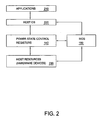
- FIG. 2 illustrates a block diagram of the relationship between software and hardware components of computer system 100 for providing a decoupled power management state.
- software applications 210 communicate with host resources via host operating system 220.
- the host OS 220 will direct the system to enter into a power management state by communicating with the power state control registers 140.
- the power state control registers 140 in conjunction with the BIOS 150 will cause the host resources, e.g., hardware devices such as disk, CD, or DVD drives to enter a particular power management state.
- the power state control registers 140 in conjunction with the BIOS 150 will only selectively comply with the requests of the host OS 140.
- the hardware devices are not placed into a power management state as directed by the OS and instead are left in an operational state.
- the host OS is not informed of this non-compliance and, in fact, the active states of the hardware devices are hidden from the host OS.
- a computer system (or more appropriately, its operating system) is often implemented with some form of power management policy, e.g., in accordance with ACPI or other power management standards.
- the purpose of these power management standards is to unify power management in the operating system of the computer, thereby allowing inexpensive power managed hardware to support very elaborate power management policies.
- ACPI specifies a plurality of global states (Gx states, i.e., G0:Working; G1:Sleeping; G2:Soft Off and G3:Mechanical Off), a plurality of sleeping states (Sx states) and a plurality of processor power states (Cx states).
- Gx states global states apply to the entire system and are visible to the user
- sleeping states are types of sleeping states within the global state, G1.
- the Sx states are defined in the ACPI as follows:
- Processor power states are processor power consumption and thermal management states within the global working state, G0.
- the Cx states are defined in the ACPI as follows:
- Gx, Sx and Cx states are further defined in greater detail in the ACPI standard, which is herein incorporated by reference.
- the different sleeping states as defined in the ACPI provide different degrees of power savings and associated latency in reviving the system.
- the time necessary to have the system awaken may range from over one minute (e.g., S5 with the greatest amount of power savings) to a few seconds (e.g., S1 with the least amount of power savings).
- S5 with the greatest amount of power savings
- S1 with the least amount of power savings
- the system is in a sleep state, its resources are inaccessible without first reviving the computer system, i.e., communicating with the OS of the computer system 100.
- there is a dichotomy between the need to save power and the need to access the resources of the host computer without the associated latency penalty.
- the present invention provides a decoupled power management approach, where the operating system of the host computer is deceived into believing that its power saving policies have been implemented.
- Another perspective of the present invention is that the hardware states are intentionally hidden from the host operating system, in direct contrast to the ACPI specification that promotes operating system-directed configuration and power management. Namely, when the host operating system directs the system into one of the predefined sleeping states as defined by the ACPI standard, the system translates that request in accordance with the instructions stored within the present power state control registers 140. In some instances, the operating system's power management requests are followed, whereas in other instances, the operating system's power management requests are ignored in part or in whole.
- power state control registers 140 are deployed. These eight 32-bit power state control registers control how each system power state is executed. The BIOS 150 can modify these as needed, but at a minimum, the BIOS will set up these registers whenever the computer system powers on from a mechanical power off. Table 1 labels these eight registers as (MCP_ACPI_xx_CTL). For each power state control register, Table 1 provides an operating system requested state (e.g., processor power state Cx or a sleeping state Sx), a state description, and the actual state that is implemented by the present invention.
- processor power state Cx or a sleeping state Sx
- state description e.g., processor power state Cx or a sleeping state Sx
- processor power states e.g., C0 and C1
- sleeping states e.g., S2
- Table 1 all the processor power states (e.g., C0 and C1) or sleeping states (e.g., S2) are represented in Table 1, because no power saving actions are taken for these states.
- processor power states e.g., C0 and C1
- sleeping states e.g., S2
- Table 1 all the processor power states (e.g., C0 and C1) or sleeping states (e.g., S2) are represented in Table 1, because no power saving actions are taken for these states.
- processor power states e.g., C0 and C1
- sleeping states e.g., S2
- the operating system's requested state is C2, where the clock is stopped and the cache is still snoopable. Responsive to this OS request, the present invention complies and sets processor power state to C2.
- the operating system's requested state is C3, where the CPU is in a sleep mode and the cache is not snoopable. Responsive to this OS request, the present invention does not comply and sets the processor power state to C2 instead.
- the operating system's requested state is C4 or VID/FID, where the CPU may request a voltage/frequency change. Responsive to this OS request, the present invention does not comply and sets the processor power state to C2 instead. Alternatively, the present invention may comply in part, e.g., setting the processor power state to C2, but allowing the voltage/frequency change to be effected.
- the operating system's requested state is S1, where the system is in standby. Responsive to this OS request, the present invention complies and sets sleeping state to S1.
- the operating system's requested state is S3, where the system is suspended to RAM, i.e., where the CPU saves all its states to RAM memory. Responsive to this OS request, the present invention does not comply and sets the sleeping state to S1 instead.
- the operating system's requested state is S3, where the system is suspended to disk, i.e., where the CPU saves all its states to a disk. Responsive to this OS request, the present invention does not comply and sets sleeping state to S1 instead.
- the operating system's requested state is S5, where the system is in soft off. Responsive to this OS request, the present invention complies and sets sleeping state to S5.
- the operating system's requested state is a system specific state.
- the eighth register is implemented as an extra or optional register to address a system specific state or to allow state expansion.
- These power state control registers 140 in effect, drive a power down state machine. Namely, the state machine based off the register for each state, will decide what is to be done in accordance with instructions stored within each register.
- SLP_S5# or SLP_S3# This allows either SLP_S5# or SLP_S3# to assert first. On deassertion, the delay for SLP_S5# is still set by the SLP_S3_DLY, and SLP_S3# and SLP_S5# will deassert simultaneously. See the Activation Delay table below. 18- 16 SLP S3 DLY. This controls the delay from PCI RST# activation to SLP_S3# activation. SLP_S3# is typically used to turn off the main power supply rails. See the Activation Delay table below. 15- 13 PCIRST DLY. This controls the delay from SLP_S1# activation to PCI_RST# activation. PCI_RST# is used to reset all the system logic.
- Bit 31 of each power state control register is reserved. The use of this particular bit can be implemented at a later time pursuant to a specific application.
- Bits 30-28 define a system management action field (SMAF). This field is used to optionally inform the CPU as to what actions are currently being taken.
- SMAF system management action field
- PME_WAK field This field is used to define whether the system will wake from a power management event (PME) event or PME input. PMEs are use in Sx states to signal that the system should be woken up. In one embodiment, the PME_WAK field is set to "1" for Sx states and "0" for the Cx states.
- Bit 26 defines a SMI_WAK field. This field is used to define whether the system will wake from a system management interrupt (SMI) event. SMIs are used whenever it is desirable to give control to the SMM routine and take control away from the OS. This field is used to wake the CPU for an alternate function that is not defined in the ACPI standard. For example, one may use SMI# wake event as an alternative to PMEs.
- SMI system management interrupt
- Bit 25 defines an IRQ_WAK field. This field is used to define whether the system will wake from an interrupt event. Namely, this field is used to wake the CPU for an alternate function that is not defined in the ACPI standard, e.g., waking the CPU with an interrupt.
- Bit 24 defines a ARB_REQ_WAK field. This field is used to define whether the system will wake from a Bus Master Request event.
- a Bus Master Request event is when any bus master that is not the CPU, wants to use the bus.
- the ACPI standard uses this in C3 if it has not flushed the cache to system memory. This wakes the CPU up so that it's cache can be snooped. Namely, this field is used to wake the CPU for an alternate function that is not defined in the ACPI standard.
- Bits 23-22 define a resume delay (RSM_DLY) field.
- This field is implemented to define a period of time that must elapse before the CPU is awaken, i.e., not waking the CPU too early.
- This field can be used to address effects caused by implementing power saving operations, e.g., lock up may occur in a power supply if power is switched off and on too quickly and so on.
- Bits 21-19 define a SLP_S5_DLY field that controls power supply rails. Specifically, this field controls the delay from a PCI reset (PCI_RST#) activation to SLP_S5# activation, where SLP_S5# is typically employed to turn off the main memory power.
- PCI_RST# PCI reset
- Bits 18-16 define a SLP_S3_DLY field that controls power supply rails. Specifically, this field controls the delay from a PCI reset (PCI_RST#) activation to SLP_S3# activation, where SLP_S3# is typically employed to turn off the main power supply rails, i.e., turning the power off to the CPU.
- PCI_RST# PCI reset
- SLP_S3# is typically employed to turn off the main power supply rails, i.e., turning the power off to the CPU.
- Bits 15-13 define a PCIRST_DLY field that controls power supply rails. Specifically, this field controls the delay from a SLP_S3# activation to a PCI reset (PCI_RST#) activation, where PCI-RST# is employed to reset all the system logic. Namely, this field defines whether to put the system into a reset.
- PCI_RST# PCI reset
- Bits 12-10 define a SLP_S1_DLY field that controls power supply rails. Specifically, this field controls the delay from a LDT_STP# activation to SLP_S1# activation, where SLP_S1# is typically employed to power an LED that indicates whether the motherboard is asleep or not.
- the LDT_STP# is a pin that directs whether the CPU bus is to be disconnected or not. LDT is also know as the HyperTransport Bus. It is a point-to-point bus designed by AMD. The LDT_STP# pin causes this bus protocol to "stop".
- Bit 9 defines a CPUSLP_EN field that controls the CPU SLP# activation. It should be noted that the ACPI defines a sleeping/wake logic that is controlled via two bit fields: Sleep Enable (SLP_EN) and Sleep Type (SLP_TYPx). The type of sleep state desired is programmed into the SLP_TYPx field and upon assertion of the SLP_EN the hardware will sequence the system into the defined sleeping state.
- SLP_EN Sleep Enable
- SLP_TYPx Sleep Type
- Bits 8-6 define a LDTSTP_DLY field that controls the delay from the Stop Grant Special cycle (the CPU's response to STPCLK# assertion) activation to LDT_STP# activation.
- LDT_STP# is used to disconnect the LDT Bus.
- Bits 5-3 define a STPCLK_DLY field that controls the delay from the power management command to the activation to STPCLK# activation, where STPCLK# is used to put the CPU in a Stop Grant state.
- Bit 2 defines an arbiter override (ARB_OVR) field that is used to allow devices to still access system memory for non-coherent accesses even though the Arbiter is Disabled.
- ARB_OVR arbiter override
- PM2_CNT_BLK register block in accordance with the ACPI standard contains a single bit for the arbiter disable function. Namely, this bit is implemented to override that bit.
- Bit 1 defines a system management interrupt (SMI) enable field. This field determines whether a SMI# is caused.
- SI system management interrupt
- Bit 0 defines a state enable (ST_EN) field. This bit must be set for the rest of the bits in this register to be executed, except for the SMI bit which is operated on regardless.
- each power state control register 140 is only illustrative in a particular embodiment. Those skilled in the art will realize that these fields can be implemented in part (i.e., implementing only a subset of the above fields), in different orders, in different sizes or using different parameters than those disclosed above.
- each power state control register 140 is implemented in anticipation of being deployed in an ACPI compliant system.
- those skilled in the art will realize that the present invention can be adapted so that it can be deployed in a system that may comply with other power management standards.
- the present invention is implemented using state abstraction registers as disclosed above, the present invention is not so limited. Namely, the abstraction can be stored in fixed logic or it can even be read from a ROM when needed.
- the main approach of the present Invention is to abstract the standard registers to another system or device defined state.
- One advantage of the present invention is that the power state control registers 140 can be deployed in a system where the host OS presumes that a particular power management standard, e.g., ACPI, is being followed. In this manner, an alternate power management scheme can be implemented using the present invention without the need to modify the host OS. This is a significant advantage because a computing system manufacturer may desire an alternate power management scheme, while still being able to use standard operating systems without having to address incompatibility issues.
- a particular power management standard e.g., ACPI
- Table 3a discloses specific standard settings for various bits of the power state control registers in accordance with processor power states (Cx) and sleeping states (Sx). In other words, these settings would be ACPI compliant.
- Table 3a Bits C2 C3 S1 S3 S4 S5 Field 31 0 0 0 0 0 0 0 Reserved 30:28 000 000 000 000 000 000 SMAF. 27 0 1 1 1 1 PME WAK. 26 0 0 0 0 0 SMI WAK. 25 1 1 0 0 0 0 0 0 IRQ WAK. 24 0 1 0 0 0 0 ARB REQ_WAK . 23:22 00 00 00 00 00 00 00 00 00 00 RSM DLY.
- Table 3b discloses modified settings for various bits of the power state control registers in accordance with processor power states (Cx) and sleeping states (Sx). In other words, these modified settings would cause the actual implemented states as shown above in Table 1.
- Tables 4 and 5 are illustrative delay tables. Although the present invention discloses an activation delay table 4 and PCI_RST activation delay table 5 with a plurality of specific delay values, it should be noted that other delay values can be implemented to address a particular application.
- Table 4 Delay Value Activation Delay from Previous Signal 000 Signal is not activated.
Landscapes
- Engineering & Computer Science (AREA)
- Theoretical Computer Science (AREA)
- Physics & Mathematics (AREA)
- General Engineering & Computer Science (AREA)
- General Physics & Mathematics (AREA)
- Power Sources (AREA)
- Charge And Discharge Circuits For Batteries Or The Like (AREA)
- Control Of Electric Motors In General (AREA)
Applications Claiming Priority (3)
| Application Number | Priority Date | Filing Date | Title |
|---|---|---|---|
| US10/156,706 US6848057B2 (en) | 2002-05-28 | 2002-05-28 | Method and apparatus for providing a decoupled power management state |
| US156706 | 2002-05-28 | ||
| PCT/US2003/016521 WO2003100589A1 (en) | 2002-05-28 | 2003-05-23 | Method and apparatus for providing a decoupled power management state |
Publications (3)
| Publication Number | Publication Date |
|---|---|
| EP1508081A1 EP1508081A1 (en) | 2005-02-23 |
| EP1508081A4 EP1508081A4 (en) | 2006-01-11 |
| EP1508081B1 true EP1508081B1 (en) | 2009-07-22 |
Family
ID=29582319
Family Applications (1)
| Application Number | Title | Priority Date | Filing Date |
|---|---|---|---|
| EP03729134A Expired - Lifetime EP1508081B1 (en) | 2002-05-28 | 2003-05-23 | Method and apparatus for providing a decoupled power management state |
Country Status (7)
| Country | Link |
|---|---|
| US (1) | US6848057B2 (https=) |
| EP (1) | EP1508081B1 (https=) |
| JP (1) | JP4422017B2 (https=) |
| AT (1) | ATE437393T1 (https=) |
| AU (1) | AU2003233694A1 (https=) |
| DE (1) | DE60328483D1 (https=) |
| WO (1) | WO2003100589A1 (https=) |
Families Citing this family (30)
| Publication number | Priority date | Publication date | Assignee | Title |
|---|---|---|---|---|
| US6675303B1 (en) * | 1999-09-29 | 2004-01-06 | 2Micro International Limited | PC card controller with advanced power management reset capabilities |
| KR100424484B1 (ko) * | 2001-07-05 | 2004-03-24 | 엘지전자 주식회사 | 중앙 처리 장치용 전원 공급기 |
| US7117379B2 (en) * | 2002-08-14 | 2006-10-03 | Intel Corporation | Method and apparatus for a computing system having an active sleep mode |
| US7058829B2 (en) * | 2002-08-14 | 2006-06-06 | Intel Corporation | Method and apparatus for a computing system having an active sleep mode CPU that uses the cache of a normal active mode CPU |
| JP4078644B2 (ja) * | 2003-01-08 | 2008-04-23 | ソニー株式会社 | 情報処理装置および方法、並びにプログラム |
| US7114090B2 (en) | 2003-02-14 | 2006-09-26 | Intel Corporation | Computing system with operational low power states |
| US7254730B2 (en) * | 2003-02-14 | 2007-08-07 | Intel Corporation | Method and apparatus for a user to interface with a mobile computing device |
| US7080271B2 (en) | 2003-02-14 | 2006-07-18 | Intel Corporation | Non main CPU/OS based operational environment |
| TW591372B (en) * | 2003-05-15 | 2004-06-11 | High Tech Comp Corp | Power control method of portable electronic device, portable electronic device and electronic system |
| US7437575B2 (en) * | 2003-05-29 | 2008-10-14 | Dell Products L.P. | Low power mode for device power management |
| US20050182978A1 (en) | 2004-02-17 | 2005-08-18 | Anderson Jason M. | Always ready computing device |
| JP4833560B2 (ja) * | 2004-02-17 | 2011-12-07 | マイクロソフト コーポレーション | 常時動作可能なコンピューティングデバイス |
| US9146600B2 (en) | 2006-10-11 | 2015-09-29 | Texas Instruments Incorporated | Array and peripheral power control decoded from circuitry and registers |
| US7949794B2 (en) | 2006-11-02 | 2011-05-24 | Intel Corporation | PCI express enhancements and extensions |
| TWI358025B (en) * | 2007-04-17 | 2012-02-11 | Via Tech Inc | Methods and systems for centralized dynamic link c |
| US8086885B2 (en) * | 2007-12-14 | 2011-12-27 | Nokia Corporation | Runtime control of system performance |
| US8286014B2 (en) | 2008-03-25 | 2012-10-09 | Intel Corporation | Power management for a system on a chip (SoC) |
| US7783819B2 (en) | 2008-03-31 | 2010-08-24 | Intel Corporation | Integrating non-peripheral component interconnect (PCI) resources into a personal computer system |
| US7861027B2 (en) | 2008-05-30 | 2010-12-28 | Intel Corporation | Providing a peripheral component interconnect (PCI)-compatible transaction level protocol for a system on a chip (SoC) |
| US20100318824A1 (en) * | 2009-06-10 | 2010-12-16 | Seagate Technology Llc | Storage device with advanced power management |
| US9104499B2 (en) | 2010-12-21 | 2015-08-11 | Qualcomm Incorporated | System for minimizing resource latency between processor application states in a portable computing device by scheduling resource state set transitions |
| US9285856B2 (en) * | 2010-12-21 | 2016-03-15 | Qualcomm Incorporated | Method and system for rapid entry into and for rapid exiting from sleep states for processors of a portable computing device |
| US8370667B2 (en) * | 2010-12-22 | 2013-02-05 | Intel Corporation | System context saving based on compression/decompression time |
| US10042650B2 (en) * | 2011-03-23 | 2018-08-07 | Lenovo (Beijing) Co., Ltd. | Computer startup method, startup apparatus, state transition method and state transition apparatus |
| US8954980B2 (en) | 2011-11-11 | 2015-02-10 | Qualcomm Incorporated | Conserving power through work load estimation for a portable computing device using scheduled resource set transitions |
| US9442739B2 (en) * | 2011-11-22 | 2016-09-13 | Intel Corporation | Collaborative processor and system performance and power management |
| US9229524B2 (en) * | 2012-06-27 | 2016-01-05 | Intel Corporation | Performing local power gating in a processor |
| US20170177068A1 (en) * | 2015-12-17 | 2017-06-22 | Intel Corporation | Systems, methods and devices for standby power savings |
| US10108252B2 (en) * | 2016-03-03 | 2018-10-23 | Dell Products L.P. | Method and system for intelligent load line control of information handling systems |
| US10372184B2 (en) * | 2016-06-28 | 2019-08-06 | Renesas Electronics America Inc. | Method and apparatus for implementing power modes in microcontrollers using power profiles |
Family Cites Families (9)
| Publication number | Priority date | Publication date | Assignee | Title |
|---|---|---|---|---|
| US6092209A (en) * | 1994-10-04 | 2000-07-18 | Intel Corporation | Method and apparatus for managing power consumption of peripheral devices of personal computers |
| US5919264A (en) * | 1997-03-03 | 1999-07-06 | Microsoft Corporation | System and method for using data structures to share a plurality of power resources among a plurality of devices |
| JP3943665B2 (ja) * | 1997-09-01 | 2007-07-11 | 株式会社東芝 | スリープ制御方法、およびイベント通知方法 |
| US6131166A (en) | 1998-03-13 | 2000-10-10 | Sun Microsystems, Inc. | System and method for cross-platform application level power management |
| US6065122A (en) * | 1998-03-13 | 2000-05-16 | Compaq Computer Corporation | Smart battery power management in a computer system |
| US6199134B1 (en) * | 1998-03-13 | 2001-03-06 | Compaq Computer Corporation | Computer system with bridge logic that asserts a system management interrupt signal when an address is made to a trapped address and which also completes the cycle to the target address |
| US6122748A (en) * | 1998-03-31 | 2000-09-19 | Compaq Computer Corporation | Control of computer system wake/sleep transitions |
| US6360327B1 (en) * | 1999-03-12 | 2002-03-19 | Compaq Information Technologies Group, L.P. | System with control registers for managing computer legacy peripheral devices using an advanced configuration power interface software power management system |
| US6681336B1 (en) * | 1999-06-18 | 2004-01-20 | Kabushiki Kaisha Toshiba | System and method for implementing a user specified processing speed in a computer system and for overriding the user specified processing speed during a startup and shutdown process |
-
2002
- 2002-05-28 US US10/156,706 patent/US6848057B2/en not_active Expired - Lifetime
-
2003
- 2003-05-23 AT AT03729134T patent/ATE437393T1/de not_active IP Right Cessation
- 2003-05-23 WO PCT/US2003/016521 patent/WO2003100589A1/en not_active Ceased
- 2003-05-23 EP EP03729134A patent/EP1508081B1/en not_active Expired - Lifetime
- 2003-05-23 JP JP2004507977A patent/JP4422017B2/ja not_active Expired - Lifetime
- 2003-05-23 AU AU2003233694A patent/AU2003233694A1/en not_active Abandoned
- 2003-05-23 DE DE60328483T patent/DE60328483D1/de not_active Expired - Lifetime
Also Published As
| Publication number | Publication date |
|---|---|
| EP1508081A4 (en) | 2006-01-11 |
| WO2003100589A1 (en) | 2003-12-04 |
| ATE437393T1 (de) | 2009-08-15 |
| US6848057B2 (en) | 2005-01-25 |
| JP2005527906A (ja) | 2005-09-15 |
| AU2003233694A1 (en) | 2003-12-12 |
| JP4422017B2 (ja) | 2010-02-24 |
| DE60328483D1 (https=) | 2009-09-03 |
| US20030226043A1 (en) | 2003-12-04 |
| EP1508081A1 (en) | 2005-02-23 |
Similar Documents
| Publication | Publication Date | Title |
|---|---|---|
| EP1508081B1 (en) | Method and apparatus for providing a decoupled power management state | |
| US6360327B1 (en) | System with control registers for managing computer legacy peripheral devices using an advanced configuration power interface software power management system | |
| US6711691B1 (en) | Power management for computer systems | |
| US6085330A (en) | Control circuit for switching a processor between multiple low power states to allow cache snoops | |
| US7430673B2 (en) | Power management system for computing platform | |
| US6760850B1 (en) | Method and apparatus executing power on self test code to enable a wakeup device for a computer system responsive to detecting an AC power source | |
| US7353413B2 (en) | Computer system power policy adjustment in response to an affirmative indication from a user | |
| US6125450A (en) | Stop clock throttling in a computer processor through disabling bus masters | |
| JP4875710B2 (ja) | ゼロ電圧プロセッサスリープ状態のための方法および装置 | |
| CN101356508B (zh) | 用于优化动态存储器大小调整的等待时间的方法和系统 | |
| US20110078475A1 (en) | Transitioning a Computing Platform to a Low Power System State | |
| US5625807A (en) | System and method for enabling and disabling a clock run function to control a peripheral bus clock signal | |
| CN102902345A (zh) | 图形子系统中用于进入和退出睡眠模式的系统和方法 | |
| JP2000010907A (ja) | 情報処理装置 | |
| JP4202754B2 (ja) | バス結合された回路ブロックのための電力管理の方法及び構成 | |
| TWI470410B (zh) | 電子系統及其電源管理方法 | |
| US20040199697A1 (en) | Mobile computer and base station | |
| JP4846862B2 (ja) | 情報処理装置および省電力制御方法 | |
| US7636861B2 (en) | Bus technique for controlling power states of blades in a blade enclosure | |
| US20060168457A1 (en) | Power conservation technique for blade computer systems | |
| JP3568592B2 (ja) | 周辺バスクロック信号を制御するためのコンピュータシステムおよびその方法 | |
| US20110231679A1 (en) | Energy saving device | |
| US7634672B2 (en) | Power saving method of central processing unit | |
| CN120762520B (zh) | 一种上下电控制系统、方法及存储介质 | |
| KR101285665B1 (ko) | 수면 모드를 지원하는 멀티 코어 시스템 온 칩 |
Legal Events
| Date | Code | Title | Description |
|---|---|---|---|
| PUAI | Public reference made under article 153(3) epc to a published international application that has entered the european phase |
Free format text: ORIGINAL CODE: 0009012 |
|
| 17P | Request for examination filed |
Effective date: 20041126 |
|
| AK | Designated contracting states |
Kind code of ref document: A1 Designated state(s): AT BE BG CH CY CZ DE DK EE ES FI FR GB GR HU IE IT LI LU MC NL PT RO SE SI SK TR |
|
| AX | Request for extension of the european patent |
Extension state: AL LT LV MK |
|
| REG | Reference to a national code |
Ref country code: HK Ref legal event code: DE Ref document number: 1070153 Country of ref document: HK |
|
| DAX | Request for extension of the european patent (deleted) | ||
| A4 | Supplementary search report drawn up and despatched |
Effective date: 20051128 |
|
| 17Q | First examination report despatched |
Effective date: 20060523 |
|
| GRAP | Despatch of communication of intention to grant a patent |
Free format text: ORIGINAL CODE: EPIDOSNIGR1 |
|
| GRAS | Grant fee paid |
Free format text: ORIGINAL CODE: EPIDOSNIGR3 |
|
| GRAA | (expected) grant |
Free format text: ORIGINAL CODE: 0009210 |
|
| AK | Designated contracting states |
Kind code of ref document: B1 Designated state(s): AT BE BG CH CY CZ DE DK EE ES FI FR GB GR HU IE IT LI LU MC NL PT RO SE SI SK TR |
|
| REG | Reference to a national code |
Ref country code: GB Ref legal event code: FG4D |
|
| REG | Reference to a national code |
Ref country code: CH Ref legal event code: EP |
|
| REG | Reference to a national code |
Ref country code: IE Ref legal event code: FG4D |
|
| REF | Corresponds to: |
Ref document number: 60328483 Country of ref document: DE Date of ref document: 20090903 Kind code of ref document: P |
|
| NLV1 | Nl: lapsed or annulled due to failure to fulfill the requirements of art. 29p and 29m of the patents act | ||
| PG25 | Lapsed in a contracting state [announced via postgrant information from national office to epo] |
Ref country code: SE Free format text: LAPSE BECAUSE OF FAILURE TO SUBMIT A TRANSLATION OF THE DESCRIPTION OR TO PAY THE FEE WITHIN THE PRESCRIBED TIME-LIMIT Effective date: 20090722 Ref country code: ES Free format text: LAPSE BECAUSE OF FAILURE TO SUBMIT A TRANSLATION OF THE DESCRIPTION OR TO PAY THE FEE WITHIN THE PRESCRIBED TIME-LIMIT Effective date: 20091102 Ref country code: AT Free format text: LAPSE BECAUSE OF FAILURE TO SUBMIT A TRANSLATION OF THE DESCRIPTION OR TO PAY THE FEE WITHIN THE PRESCRIBED TIME-LIMIT Effective date: 20090722 Ref country code: FI Free format text: LAPSE BECAUSE OF FAILURE TO SUBMIT A TRANSLATION OF THE DESCRIPTION OR TO PAY THE FEE WITHIN THE PRESCRIBED TIME-LIMIT Effective date: 20090722 |
|
| PG25 | Lapsed in a contracting state [announced via postgrant information from national office to epo] |
Ref country code: NL Free format text: LAPSE BECAUSE OF FAILURE TO SUBMIT A TRANSLATION OF THE DESCRIPTION OR TO PAY THE FEE WITHIN THE PRESCRIBED TIME-LIMIT Effective date: 20090722 Ref country code: SI Free format text: LAPSE BECAUSE OF FAILURE TO SUBMIT A TRANSLATION OF THE DESCRIPTION OR TO PAY THE FEE WITHIN THE PRESCRIBED TIME-LIMIT Effective date: 20090722 |
|
| PG25 | Lapsed in a contracting state [announced via postgrant information from national office to epo] |
Ref country code: BG Free format text: LAPSE BECAUSE OF FAILURE TO SUBMIT A TRANSLATION OF THE DESCRIPTION OR TO PAY THE FEE WITHIN THE PRESCRIBED TIME-LIMIT Effective date: 20091022 Ref country code: PT Free format text: LAPSE BECAUSE OF FAILURE TO SUBMIT A TRANSLATION OF THE DESCRIPTION OR TO PAY THE FEE WITHIN THE PRESCRIBED TIME-LIMIT Effective date: 20091122 |
|
| PG25 | Lapsed in a contracting state [announced via postgrant information from national office to epo] |
Ref country code: DK Free format text: LAPSE BECAUSE OF FAILURE TO SUBMIT A TRANSLATION OF THE DESCRIPTION OR TO PAY THE FEE WITHIN THE PRESCRIBED TIME-LIMIT Effective date: 20090722 Ref country code: RO Free format text: LAPSE BECAUSE OF FAILURE TO SUBMIT A TRANSLATION OF THE DESCRIPTION OR TO PAY THE FEE WITHIN THE PRESCRIBED TIME-LIMIT Effective date: 20090722 Ref country code: CZ Free format text: LAPSE BECAUSE OF FAILURE TO SUBMIT A TRANSLATION OF THE DESCRIPTION OR TO PAY THE FEE WITHIN THE PRESCRIBED TIME-LIMIT Effective date: 20090722 Ref country code: EE Free format text: LAPSE BECAUSE OF FAILURE TO SUBMIT A TRANSLATION OF THE DESCRIPTION OR TO PAY THE FEE WITHIN THE PRESCRIBED TIME-LIMIT Effective date: 20090722 |
|
| PLBE | No opposition filed within time limit |
Free format text: ORIGINAL CODE: 0009261 |
|
| STAA | Information on the status of an ep patent application or granted ep patent |
Free format text: STATUS: NO OPPOSITION FILED WITHIN TIME LIMIT |
|
| PG25 | Lapsed in a contracting state [announced via postgrant information from national office to epo] |
Ref country code: BE Free format text: LAPSE BECAUSE OF FAILURE TO SUBMIT A TRANSLATION OF THE DESCRIPTION OR TO PAY THE FEE WITHIN THE PRESCRIBED TIME-LIMIT Effective date: 20090722 Ref country code: SK Free format text: LAPSE BECAUSE OF FAILURE TO SUBMIT A TRANSLATION OF THE DESCRIPTION OR TO PAY THE FEE WITHIN THE PRESCRIBED TIME-LIMIT Effective date: 20090722 |
|
| 26N | No opposition filed |
Effective date: 20100423 |
|
| PG25 | Lapsed in a contracting state [announced via postgrant information from national office to epo] |
Ref country code: GR Free format text: LAPSE BECAUSE OF FAILURE TO SUBMIT A TRANSLATION OF THE DESCRIPTION OR TO PAY THE FEE WITHIN THE PRESCRIBED TIME-LIMIT Effective date: 20091023 |
|
| PG25 | Lapsed in a contracting state [announced via postgrant information from national office to epo] |
Ref country code: MC Free format text: LAPSE BECAUSE OF NON-PAYMENT OF DUE FEES Effective date: 20100531 |
|
| REG | Reference to a national code |
Ref country code: CH Ref legal event code: PL |
|
| REG | Reference to a national code |
Ref country code: FR Ref legal event code: ST Effective date: 20110131 |
|
| PG25 | Lapsed in a contracting state [announced via postgrant information from national office to epo] |
Ref country code: LI Free format text: LAPSE BECAUSE OF NON-PAYMENT OF DUE FEES Effective date: 20100531 Ref country code: CH Free format text: LAPSE BECAUSE OF NON-PAYMENT OF DUE FEES Effective date: 20100531 |
|
| PG25 | Lapsed in a contracting state [announced via postgrant information from national office to epo] |
Ref country code: IT Free format text: LAPSE BECAUSE OF FAILURE TO SUBMIT A TRANSLATION OF THE DESCRIPTION OR TO PAY THE FEE WITHIN THE PRESCRIBED TIME-LIMIT Effective date: 20090722 |
|
| PG25 | Lapsed in a contracting state [announced via postgrant information from national office to epo] |
Ref country code: IE Free format text: LAPSE BECAUSE OF NON-PAYMENT OF DUE FEES Effective date: 20100523 |
|
| PG25 | Lapsed in a contracting state [announced via postgrant information from national office to epo] |
Ref country code: FR Free format text: LAPSE BECAUSE OF NON-PAYMENT OF DUE FEES Effective date: 20100531 |
|
| REG | Reference to a national code |
Ref country code: HK Ref legal event code: WD Ref document number: 1070153 Country of ref document: HK |
|
| PG25 | Lapsed in a contracting state [announced via postgrant information from national office to epo] |
Ref country code: CY Free format text: LAPSE BECAUSE OF FAILURE TO SUBMIT A TRANSLATION OF THE DESCRIPTION OR TO PAY THE FEE WITHIN THE PRESCRIBED TIME-LIMIT Effective date: 20090722 |
|
| PG25 | Lapsed in a contracting state [announced via postgrant information from national office to epo] |
Ref country code: LU Free format text: LAPSE BECAUSE OF NON-PAYMENT OF DUE FEES Effective date: 20100523 Ref country code: HU Free format text: LAPSE BECAUSE OF FAILURE TO SUBMIT A TRANSLATION OF THE DESCRIPTION OR TO PAY THE FEE WITHIN THE PRESCRIBED TIME-LIMIT Effective date: 20100123 |
|
| PG25 | Lapsed in a contracting state [announced via postgrant information from national office to epo] |
Ref country code: TR Free format text: LAPSE BECAUSE OF FAILURE TO SUBMIT A TRANSLATION OF THE DESCRIPTION OR TO PAY THE FEE WITHIN THE PRESCRIBED TIME-LIMIT Effective date: 20090722 |
|
| REG | Reference to a national code |
Ref country code: DE Ref legal event code: R082 Ref document number: 60328483 Country of ref document: DE Representative=s name: KRAUS & WEISERT PATENTANWAELTE PARTGMBB, DE |
|
| PGFP | Annual fee paid to national office [announced via postgrant information from national office to epo] |
Ref country code: GB Payment date: 20220426 Year of fee payment: 20 Ref country code: DE Payment date: 20220420 Year of fee payment: 20 |
|
| REG | Reference to a national code |
Ref country code: DE Ref legal event code: R071 Ref document number: 60328483 Country of ref document: DE |
|
| REG | Reference to a national code |
Ref country code: GB Ref legal event code: PE20 Expiry date: 20230522 |
|
| PG25 | Lapsed in a contracting state [announced via postgrant information from national office to epo] |
Ref country code: GB Free format text: LAPSE BECAUSE OF EXPIRATION OF PROTECTION Effective date: 20230522 |