EP1507410A1 - Reprogrammierbarer Steuersignalgenerator für Videosignale - Google Patents
Reprogrammierbarer Steuersignalgenerator für Videosignale Download PDFInfo
- Publication number
- EP1507410A1 EP1507410A1 EP04017521A EP04017521A EP1507410A1 EP 1507410 A1 EP1507410 A1 EP 1507410A1 EP 04017521 A EP04017521 A EP 04017521A EP 04017521 A EP04017521 A EP 04017521A EP 1507410 A1 EP1507410 A1 EP 1507410A1
- Authority
- EP
- European Patent Office
- Prior art keywords
- video
- microsequencers
- control signal
- timing generator
- flags
- Prior art date
- Legal status (The legal status is an assumption and is not a legal conclusion. Google has not performed a legal analysis and makes no representation as to the accuracy of the status listed.)
- Withdrawn
Links
Images


Classifications
-
- G—PHYSICS
- G06—COMPUTING OR CALCULATING; COUNTING
- G06F—ELECTRIC DIGITAL DATA PROCESSING
- G06F9/00—Arrangements for program control, e.g. control units
- G06F9/06—Arrangements for program control, e.g. control units using stored programs, i.e. using an internal store of processing equipment to receive or retain programs
- G06F9/30—Arrangements for executing machine instructions, e.g. instruction decode
- G06F9/30145—Instruction analysis, e.g. decoding, instruction word fields
-
- H—ELECTRICITY
- H04—ELECTRIC COMMUNICATION TECHNIQUE
- H04N—PICTORIAL COMMUNICATION, e.g. TELEVISION
- H04N21/00—Selective content distribution, e.g. interactive television or video on demand [VOD]
- H04N21/40—Client devices specifically adapted for the reception of or interaction with content, e.g. set-top-box [STB]; Operations thereof
- H04N21/41—Structure of client; Structure of client peripherals
- H04N21/426—Internal components of the client ; Characteristics thereof
-
- H—ELECTRICITY
- H04—ELECTRIC COMMUNICATION TECHNIQUE
- H04N—PICTORIAL COMMUNICATION, e.g. TELEVISION
- H04N21/00—Selective content distribution, e.g. interactive television or video on demand [VOD]
- H04N21/40—Client devices specifically adapted for the reception of or interaction with content, e.g. set-top-box [STB]; Operations thereof
- H04N21/41—Structure of client; Structure of client peripherals
- H04N21/426—Internal components of the client ; Characteristics thereof
- H04N21/42607—Internal components of the client ; Characteristics thereof for processing the incoming bitstream
- H04N21/4263—Internal components of the client ; Characteristics thereof for processing the incoming bitstream involving specific tuning arrangements, e.g. two tuners
-
- H—ELECTRICITY
- H04—ELECTRIC COMMUNICATION TECHNIQUE
- H04N—PICTORIAL COMMUNICATION, e.g. TELEVISION
- H04N5/00—Details of television systems
- H04N5/44—Receiver circuitry for the reception of television signals according to analogue transmission standards
- H04N5/46—Receiver circuitry for the reception of television signals according to analogue transmission standards for receiving on more than one standard at will
-
- H—ELECTRICITY
- H04—ELECTRIC COMMUNICATION TECHNIQUE
- H04N—PICTORIAL COMMUNICATION, e.g. TELEVISION
- H04N5/00—Details of television systems
- H04N5/76—Television signal recording
- H04N5/91—Television signal processing therefor
- H04N5/913—Television signal processing therefor for scrambling ; for copy protection
- H04N2005/91357—Television signal processing therefor for scrambling ; for copy protection by modifying the video signal
- H04N2005/91364—Television signal processing therefor for scrambling ; for copy protection by modifying the video signal the video signal being scrambled
-
- H—ELECTRICITY
- H04—ELECTRIC COMMUNICATION TECHNIQUE
- H04N—PICTORIAL COMMUNICATION, e.g. TELEVISION
- H04N7/00—Television systems
- H04N7/025—Systems for the transmission of digital non-picture data, e.g. of text during the active part of a television frame
- H04N7/035—Circuits for the digital non-picture data signal, e.g. for slicing of the data signal, for regeneration of the data-clock signal, for error detection or correction of the data signal
Definitions
- the present invention relates to video processing, and more particularly to the generation of time-dependent control signals for video signals.
- analog video signal formats include National TV System Committee (NTSC), Phase Alternation Line Rate (PAL), and Sequential Couleur Avec Memoire (SECAM) television signals.
- Example digital video signal formats include ITU-R-656 and Digital Video Interface (DVI).
- video processing devices such as a televisions or cable set-top boxes, must be able to insert control signals within video signals as they are being processed for display. Such control signals are needed to support outputting video signals in different formats and to implement a variety of value added features including, for example, copy protection features, such as those contained within MACROVISION copy protection process standards.
- MACROVISION is a trademark of Macrovision Corporation.
- MACROVISION copy protection technologies are designed to allow content owners to protect their videocassettes, digital Pay-Per-View (PPV) programs and digital video discs (DVD) from unauthorized recording on VCRs.
- MACROVISION copy protection allows consumers to view, but not record, programs that are distributed via digital set-top box decoders.
- the direct broadcast satellite (DBS) operator or cable system operator transmits a software command from the uplink center or headend to its set-top decoders.
- An integrated circuit inside the decoder receives the command and adds the copy protection waveform to the video destined for the TV.
- the copy-protected signal is transparent on original program viewing, but causes copies made on the majority of VCRs to degrade to the extent that they no longer have entertainment value.
- MACROVISION's PPV copy protection technology degrades unauthorized copies on approximately 95 percent of the TV and VCR combinations in the market today. Virtually all digital set-tops in North America have copy protection capability, as do the majority of digital set-top boxes in international markets.
- the MACROVISION copy protection process requires that integrated circuitry within a video processing device dynamically adjust to copy protection information transmitted with a video stream.
- the MACROVISION copy protection process is an evolving one in which the formats used periodically change. For example, the current MACROVISION copy protection process has been revised and updated several times, and is currently on Revision 7.1.S1.
- Implementation of the MACROVISION copy protection process has been previously implemented in hardware because of the need to quickly process MACROVISION input signals and generate control signals to adjust an output video signal. As a result, when revisions to the standard are made, updating deployed video processing devices that have used hardware to implement the MACROVISION standard is difficult.
- the present invention provides systems and methods for generation of time-dependent control signals for video signals.
- a system is provided that includes a set of microsequencers, a programmable combinational logic (PCL) module, shared memory, an arbiter for sharing of memory by the microsequencers, stacks containing registers for microsequencer control, and a control interface.
- the system can efficiently provide control signals for video signals, implement the MACROVISION copy protection process, and provide other value added features.
- the method includes accessing programs from shared memory, such that a set of microsequencers can generate flags. These flags are then processed to generate one or more control signals used to support the outputting of video signals including those requiring MACROVISION copy protection.
- a timing generator for use within a video processing device comprises:
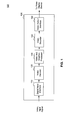
- FIG. 1 is a diagram of a video processing system, according to an embodiment of the invention.
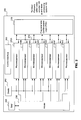
- FIG. 2 is a diagram of a timing generator, according to an embodiment of the present invention.
- FIG. 3 is a diagram a timing generator designed for use with MACROVISION copy protection processes, according to an embodiment of the invention.
- FIG. 4 is a diagram of programmable combinational logic, according to an embodiment of the invention.
- FIG. 5 is a flowchart of a method to generate a time-dependent control signal for video signals, according to an embodiment of the invention.
- FIG. 1 provides a diagram of an example video processing system 100, according to an embodiment of the invention.
- a video processing system such as video processing system 100, receives video input signals and manipulates the stream to properly format an output video stream.
- a video processing system, such as video processing system 100 can also integrate graphics and text (e.g., teletext) into the video stream and output a reformatted video stream.
- video processing system 100 can be used to implement value added features, such as copy protection features.
- Video processing system 100 will typically be located within a video processing device, such as a television or cable set-top box.
- Video processing system 100 includes video input interface 110, video decoder 120, video and graphics processor 130, video encoder 140 and video output interface 150.
- Video input interface 110 receives a video input signal that can be either digital or analog.
- Video decoder 120 can support decoding and encoding of both analog and video input signals, and is coupled to the output of video input interface 110.
- Video decoder 120 can support high quality decoding of a standard definition analog composite video broadcasting signal (CVBS) and S-Video signals, for example.
- CVBS standard definition analog composite video broadcasting signal
- S-Video signals for example.
- video decoder 120 can decode digital video signals that comply with the International Telecommunications Union (ITU) standard ITU-R-656 at varying resolutions including 525i, 625i, and 240p.
- ITU International Telecommunications Union
- Video and graphics processor 130 includes a variety of functions for processing video and graphics, including integrating video and graphics, and is coupled to the output of video decoder 120.
- video and graphics processor 130 can include MPEG graphics and video feeders, video scalers, capture blocks, and video compositors for combining video and graphics, and the like.
- Video encoder 140 can support both standard and high definition video signals, and is coupled to the output of video and graphics processor 130.
- video encoder 140 can support a variety of analog video standards (e.g., NTSC, PAL, SECAM, 480i, 480p, 720p, and 1080i), as well as digital video standards (e.g., ITU-R-656 and support for digital video interface (DVI) encoding).
- Video encoder 140 performs a variety of functions to encode an output video stream.
- video encoder 140 includes a color space converter to convert the input color to any component-color format.
- the video encoder 140 contains filters to determine a video channel's frequency response as required by the various video standards.
- Video encoder 140 can occasionally stall video signal processing to insert blanking signals into the video stream.
- these blanking signals can be quite elaborate - merging syncs, backporchs, pseudo syncs, automatic gain control (AGC) bursts, color burst envelops, and vertical blanking intervals.
- video encoder 140 can manipulate a video signal to support copy protection features, such as those of MACROVISION.
- Video output interface 150 can include a set of analog and digital output interfaces to support a multitude of video standards, and is coupled to the output of video encoder 140. Video output interface 150 can be coupled to a video processing device, such as a television, a monitor, or a cable set top box to display a video signal or for further processing. Video processing system 100 can be implemented on a single integrated circuit or on multiple integrated circuits.
- FIG. 2 provides a diagram of timing generator 200, according to an embodiment of the present invention.
- a timing generator such as timing generator 200
- timing generator 200 can produce a variety of time-dependent control signals for various video formats, both digital and analog. For example, these can include horizontal and vertical synchronization signals and active video signals. Additional control signals for composite formats involve timing of the sub-carrier bursts (color bursts and bottles).
- Timing generator 200 can also generate control signals required for MACROVISION encoding, such as color stripe, AGC and pseudo sync pulses, reduced sync, and back porch pulses. Timing generator 200 specifies when these control signals should occur. Other portions of video encoder 140 or video processing system 100 actually insert or combine these signals.
- Example control signals that can be generated by timing generator 200 are as follows:
- Timing generator 200 includes a set of microsequencers, such as microsequencers 205A through 205G; programmable combinational logic (PCL) module 210; random access memory 220; arbiter 230; stacks 240; and control interface 250.
- PCL programmable combinational logic
- timing generator 200 can be implemented on a single integrated circuit.
- Each microsequencer 205 is a microcontroller operating independently of each other, but in a coordinated manner. When synchronized, microsequencers 205A through 205G generate proper timing signals indirectly by outputting flags that are combined in PCL module 210 to produce control signals. Each microsequencer includes a counter (not shown) to sustain timing and generate a flag or set of flags for a specified amount of time. Microsequencers 205A through 205G are fully configurable and capable of supporting all current video standards.
- microsequencers 205A through 205G The differences between microsequencers 205A through 205G are (1) the number of flags maintained, (2) how the flags are fed as events to other microsequencers for coordinated operation, (3) how the flags are provided to PCL module 210 and (4) whether a particular microsequencer can be restarted. As is explained with reference to FIG. 3, microsequencers 205A through 205G can be partitioned in a variety of ways, such that tasks are distributed efficiently across the microsequencers.
- the outputs of microsequencers are coupled to PCL module 210 and to each other along a bus structure 270 that allows operation of the microsequencers to be coordinated.
- PCL module 210 contains logic that allows a system programmer to select which combination of microsequencer flags generates control signals to be forwarded to other elements of a video encoder, such as video encoder 140. Specific examples related to control signals used for MACROVISION are discussed below. PCL module 210 has its output coupled to a variety of other elements within a video encoder that use the control signals to manipulate the video signals being processed.
- Random access memory (RAM) 220 contains programs used by the microsequencers.
- the programs for all microsequencers 205A through 205G exist within RAM 220 to increase timing generator 200 flexibility and reduce gates needed in the implementation of timing generator 200. That is, RAM 220 is a shared resource among all microsequencers 205A through 205G.
- RAM 220 there are multiple programs running concurrently.
- the programs contained within RAM 220 are based on a microsequencer instruction set. Each command within the instruction set has four fields. These fields include a three bit opcode field that determines the command type and a one bit return flag field that determines whether to return from a subroutine.
- each command contains an eight bit field, referred to as the flag field, which is used to set flags within a microsequencer, select addresses, or to select which microsequencer to restart.
- Another twelve bit field referred to as the count/register field, specifies a count or a register stack to select from stacks 240. The count parameter specifies how long a certain flag should be output by a microsequencer.
- Arbiter 230 fetches instructions from RAM 230 for each microsequencer 205 in the set of microsequencers. Arbiter 230 provides arbitration of requests from microsequencers 205A through 205G to access memory resources within RAM 230
- Stacks 240 comprises set of eight 16 bit shift registers. The registers are loaded with data that is accessed by the microsequencers based on the programs being run within RAM 220.
- Control interface 250 provides a means for a host or other components to provide administrative instructions to timing generator 200.
- control interface 250 can be used to receive an indication that MACROVISION copy processing process should begin. Upon receipt of such instruction, the proper information can be loaded into registers and the appropriate programs run from RAM 220.
- microsequencers and the specific function that each microsequencer performs is flexible. In alternate embodiments, any number of microsequencers can be used. However, typically between two and ten microsequencers will be used. In addition to the number of microsequencers, the specific function performed by each of the microsequencers can be varied based on the primary functions that timing generator 200 will perform.
- FIG. 3 is a diagram of an example timing generator 300 that has been designed to support MACROVISION copy protection process, according to an embodiment of the invention.
- Timing generator 300 is the same as timing generator 200 except that the design of the microsequencers, programs, and programmable combinational logic has been optimized to support MACROVISION copy protection process.
- timing generator 300 includes a set of microsequencers, such as microsequencers 305A through 305G; programmable combinational logic (PCL) module 310; random access memory 320; arbiter 330; stacks 340; and control interface 350.
- PCL programmable combinational logic
- timing generator 300 The components of timing generator 300 are similar to those of timing generator 200, except that each of microsequencers 350A through 350G have been designed to perform specific operations in support of MACROVISION copy protection process.
- microsequencer 350A is configured to provide flags supporting the horizontal standard for MACROVISION.
- microsequencer 350B is configured to support the vertical standard.
- Microsequencer 350C is configured to support the horizontal AGC/PS standard.
- Microsequencer 350D is configured to support the vertical AGC/PS standard.
- Microsequencer 350E is configured to support the back porch signal requirement.
- Microsequencer 350F is configured to support the vertical color stripe.
- microsequencer 350G is configured to support the horizontal color stripe.
- Configuring the microseqencers for a particular function entails providing programs to produce specific sets of flags associated with the function corresponding to the particular microsequencer.
- logic within programmable combinational logic module 310 is configured to expect certain flags from each of the microsequencer and to produce the appropriate control signal based on those flags.
- Timing Generator 300 provides one embodiment on how to implement the MACROVISION copy protection process, and is not intended to limit the scope of the invention. Based on the teachings herein, individuals skilled in the relevant arts will be able to discern additional embodiments.
- FIG. 4 provides a diagram of programmable combinational logic, according to an embodiment of the invention.
- FIG. 4 provides explicit notation showing how flags that are output from microsequencers can be used to generate control signals by application of logic within a programmable combinational logic module, such as PCL module 310.
- the logic diagram includes multiplexers 405A through 405E, AND gates 410A through 410E, OR gate 420 and multiplexers 425A through 425D.
- the programmable logic within a PCL module is configured to mimic the operation of these types of devices to produce the desired control signal.
- the principal flag inputs are from microsequencer 350A (horizontal standard) and microsequencer 350B (vertical standard).
- microsequencer 350A and 350B provide sufficient insight to individuals skilled in the relevant arts to understand the construction of the programmable combinational logic.
- Microsequencer 350A produces three flags: H sync H equalization , and H serration .
- Microsequencer 350B also produces three flags: V sync , V equal only , and V not equalization .
- Each of multiplexers 405A through 405E receives as inputs a low signal, a high signal, an output from multiplexer 425A, an output from multiplexer 425B, the V not equalization flag, the V equal flag and the V sync flag.
- multiplexer 405A has a register controlled input, such that only the V not equalization input will be permitted through.
- the register controlled input allows modification of the programmable combinational logic in a PCL module, such that the logic can be easily adapted for changes to the MACROVISION standard or for other purposes.
- V not equalization is a 1
- multiplexer 405A will transmit a 1
- V not equalization is a 0
- multiplexer 405A will transmit a 0.
- the output of multiplexer 405A is input into AND gate 410A.
- the other input of AND gate 410A is the H sync flag from microsequencer 350A. Therefore, when both H sync and V not equalization are a 1, AND gate 410A will output a 1.
- AND gate 410A will output a 0.
- the output of AND gate 410A is input into OR gate 420 to generate the Sync control signal.
- the Sync control signal will be a 1.
- whether the Sync control signal is a 1 will be controlled by the other AND gates that are coupled to OR gate 420.
- Multiplexer 405B has a register controlled input, such that only the V equal only input will be permitted through. In this case, when V equal only is a 1, multiplexer 405B will transmit a 1, and when V equal only is a 0, multiplexer 405B will transmit a 0.
- the output of multiplexer 405B is input into AND gate 410B.
- the other input of AND gate 410B is the H equalization flag from microsequencer 350A. Therefore, when both H equalization and V equal only are a 1, AND gate 410B will output a 1. In all other cases, AND gate 410B will output a 0.
- the output of AND gate 410B is input into OR gate 420 to generate the Sync control signal. Thus, if both H equalization and V equal only are both a 1, the Sync control signal will be a 1. In all other cases, whether the Sync control signal is a 1 will be controlled by the other AND gates that are coupled to OR gate 420.
- Multiplexer 405C has a register controlled input, such that only the V sync input will be permitted through. In this case, when V sync is a 1, multiplexer 405C will transmit a 1, and when V sync is a 0, multiplexer 405C will transmit a 0.
- the output of multiplexer 405C is input into AND gate 410C.
- the other input of AND gate 410C is the H serration flag from microsequencer 350A. Therefore, when both H serration and V sync are a 1, AND gate 410C will output a 1. In all other cases, AND gate 414C will output a 0.
- the output of AND gate 410C is input into OR gate 420 to generate the Sync control signal. Thus, if both H serration and V sync are both a 1, the Sync control signal will be a 1. In all other cases, whether the Sync control signal is a 1 will be controlled by the other AND gates that are coupled to OR gate 420.
- Multiplexer 405D has a register controlled input, such that only the input received from the output of multiplexer 425A will be permitted through. In this case, when the output of multiplexer 425A is a 1, multiplexer 405D will transmit a 1, and when the output of multiplexer 425A is a 0, multiplexer 405D will transmit a 0.
- the output of multiplexer 405D is input into AND gate 410D.
- the other input of AND gate 410D is the output of multiplexer 425C. Therefore, when both outputs from multiplexers 425A and 425C are a 1, AND gate 410D will output a 1. In all other cases, AND gate 410D will output a 0.
- the output of AND gate 410D is input into OR gate 420 to generate the Sync control signal.
- OR gate 420 receives the Sync control signal from multiplexers 425A and 425C and controls the Sync control signal.
- the Sync control signal will be a 1.
- whether the Sync control signal is a 1 will be controlled by the other AND gates that are coupled to OR gate 420.
- the inputs into multiplexers 425A and 425C will be other flags from microsequencers, subject to the desired functionality.
- Multiplexer 405E has a register controlled input, such that only the input received from the output of multiplexer 425B will be permitted through. In this case, when the output of multiplexer 425B is a 1, multiplexer 405D will transmit a 1, and when the output of multiplexer 425B is a 0, multiplexer 405E will transmit a 0.
- the output of multiplexer 405E is input into AND gate 410E.
- the other input of AND gate 410E is the output of multiplexer 425D. Therefore, when both outputs from multiplexers 425B and 425D are a 1, AND gate 410E will output a 1. In all other cases, AND gate 410E will output a 0.
- the output of AND gate 410E is input into OR gate 420 to generate the Sync control signal.
- OR gate 420 receives the Sync control signal.
- the Sync control signal will be a 1.
- whether the Sync control signal is a 1 will be controlled by the other AND gates that are coupled to OR gate 420.
- the inputs into multiplexers 425B and 425D will be other flags from microsequencers, subject to the desired functionality.
- FIG. 5 is a flowchart of method 500 to generate a time-dependent control signal for video signals, according to an embodiment of the invention.
- Method 500 begins in step 505.
- a set of flags is generated.
- a set of flags can be generated by some or all of the microsequencers 205A through 205G executing programs that were accessed from RAM 220.
- arbiter 230 can arbitrate access from the microsequencers, such that microsequencers can request programs simultaneously and arbiter 230 will arbitrate the access.
- microsequencer 350A can generate flags H sync , H equalization and H serration .
- microsequencer 350B can generate flags V sync , V equal only and V not equalization .
- a control signal is generated.
- the flags generated by microsequencer 350A and microsequencer 350B can be provided to PCL module 310 where the programmable combination logic described with reference to FIG. 4 can be applied to the flags to generate a Sync control signal, depending on the values of the flags.
- control signal is output.
- a Sync, AGC or back porch control signal can be provided to a V/H blank generator located within video encoder 140 to instruct a V/H blank generator to insert a blank line.
- step 520 a determination is made as to whether the control signal should continue to be output. For example, when generating a MACROVISION color stripe for a PAL signal, a color stripe replaces the color burst for two to five consecutive lines. Thus, the control signals must be output for a particular period of time to ensure that the color stripe is provided for the time is takes to output two to five lines. In this case, the programs running the microsequencers would contain counters to ensure that the appropriate flags were produced for the needed amount of time. If a determination is made that the control signal should end, method 500 proceeds to step 525.
- step 525 the microsequencers are reset to stop producing the current flags, and a new program is loaded to begin producing the next set of flags necessary. Method 500 then proceeds back to step 505 to begin the process over with new programs loaded for the microsequencers.
- step 520 If a determination is made that the control signal should not end in step 520, method 500 proceeds to step 530. In step 530 a determination is made whether processing should be terminated. If a determination is made that processing should end, method 500 proceeds to step 535, and method 500 ends. If a determination is made that processing should not end, method 500 returns to step 510 to continue to generate the control signal.
Landscapes
- Engineering & Computer Science (AREA)
- Multimedia (AREA)
- Signal Processing (AREA)
- Software Systems (AREA)
- Theoretical Computer Science (AREA)
- Physics & Mathematics (AREA)
- General Engineering & Computer Science (AREA)
- General Physics & Mathematics (AREA)
- Television Signal Processing For Recording (AREA)
Applications Claiming Priority (2)
| Application Number | Priority Date | Filing Date | Title |
|---|---|---|---|
| US10/640,627 US7555125B2 (en) | 2003-08-14 | 2003-08-14 | Systems and methods for generation of time-dependent control signals for video signals |
| US640627 | 2003-08-14 |
Publications (1)
| Publication Number | Publication Date |
|---|---|
| EP1507410A1 true EP1507410A1 (de) | 2005-02-16 |
Family
ID=33565264
Family Applications (1)
| Application Number | Title | Priority Date | Filing Date |
|---|---|---|---|
| EP04017521A Withdrawn EP1507410A1 (de) | 2003-08-14 | 2004-07-23 | Reprogrammierbarer Steuersignalgenerator für Videosignale |
Country Status (2)
| Country | Link |
|---|---|
| US (1) | US7555125B2 (de) |
| EP (1) | EP1507410A1 (de) |
Families Citing this family (5)
| Publication number | Priority date | Publication date | Assignee | Title |
|---|---|---|---|---|
| US7489362B2 (en) | 2003-03-04 | 2009-02-10 | Broadcom Corporation | Television functionality on a chip |
| EP2387995A1 (de) | 2006-03-30 | 2011-11-23 | PTC Therapeutics, Inc. | Verfahren zur Produktion von funktionellem Protein aus DNA mit Nonsense-Mutation und Behandlung von damit assoziierten Erkrankungen |
| US8457122B2 (en) * | 2007-08-01 | 2013-06-04 | Broadcom Corporation | Multiport switch for cascaded ethernet AV device networking |
| US8393008B2 (en) * | 2008-05-21 | 2013-03-05 | Microsoft Corporation | Hardware-based output protection of multiple video streams |
| US20090317057A1 (en) * | 2008-06-24 | 2009-12-24 | Hua Wu | Apparatus and method for selectively outputting hd/sd signals as high definition video according to copy protection |
Citations (2)
| Publication number | Priority date | Publication date | Assignee | Title |
|---|---|---|---|---|
| US6381747B1 (en) * | 1996-04-01 | 2002-04-30 | Macrovision Corp. | Method for controlling copy protection in digital video networks |
| EP1244007A2 (de) * | 2001-03-21 | 2002-09-25 | Broadcom Corporation | Dynamische Mikrokodemodifikation |
Family Cites Families (3)
| Publication number | Priority date | Publication date | Assignee | Title |
|---|---|---|---|---|
| US5694588A (en) * | 1993-05-07 | 1997-12-02 | Texas Instruments Incorporated | Apparatus and method for synchronizing data transfers in a single instruction multiple data processor |
| JP3449106B2 (ja) * | 1996-03-06 | 2003-09-22 | ソニー株式会社 | ビデオ信号処理装置、ビデオ信号処理方法並びにビデオ信号記録/再生装置 |
| US6826352B1 (en) * | 2000-03-29 | 2004-11-30 | Macrovision Corporation | Dynamic video copy protection system |
-
2003
- 2003-08-14 US US10/640,627 patent/US7555125B2/en not_active Expired - Lifetime
-
2004
- 2004-07-23 EP EP04017521A patent/EP1507410A1/de not_active Withdrawn
Patent Citations (2)
| Publication number | Priority date | Publication date | Assignee | Title |
|---|---|---|---|---|
| US6381747B1 (en) * | 1996-04-01 | 2002-04-30 | Macrovision Corp. | Method for controlling copy protection in digital video networks |
| EP1244007A2 (de) * | 2001-03-21 | 2002-09-25 | Broadcom Corporation | Dynamische Mikrokodemodifikation |
Non-Patent Citations (2)
| Title |
|---|
| CHAOUI J ET AL: "OMAP: Enabling Multimedia Applications in Third Generation (3G) Wireless Terminals", TEXAS INSTRUMENTS WHITE PAPER, XX, XX, 1 December 2000 (2000-12-01), pages 1 - 12, XP002314534 * |
| KAINKA B: "MICROCONTROLLER. ÖDRIVEN UART", ELEKTOR ELECTRONICS, ELEKTOR ELECTRONICS, GB, vol. 19, no. 217, 1 December 1993 (1993-12-01), pages 80 - 83, XP000417219, ISSN: 0268-4519 * |
Also Published As
| Publication number | Publication date |
|---|---|
| US7555125B2 (en) | 2009-06-30 |
| US20050036764A1 (en) | 2005-02-17 |
Similar Documents
| Publication | Publication Date | Title |
|---|---|---|
| US7061509B2 (en) | Method and apparatus for keying of secondary video into primary video | |
| US8212928B2 (en) | Method of and apparatus for maintaining smooth video transition between distinct applications | |
| US20100091187A1 (en) | Method and audio/video device for processing caption information | |
| JP4568468B2 (ja) | 2つの異なるビデオプログラムを同時に記録及び表示するための方法及び装置 | |
| EP0840512A2 (de) | Integrierte Audio-/Video-Schaltungsanordnung | |
| US8421921B1 (en) | Post processing displays with on-screen displays | |
| KR20080091843A (ko) | 그래픽 오버레이 정보 통신 방법 및 장치 | |
| US7835400B2 (en) | Method for data packet substitution | |
| EP1154643B1 (de) | System und Methode zur Verwendung einer einzigen OSD Pixmap für verschiedene Darstellungsgrössen mit Hilfe mehrerer Header | |
| US6573946B1 (en) | Synchronizing video streams with different pixel clock rates | |
| US7680279B2 (en) | Image display system | |
| US7555125B2 (en) | Systems and methods for generation of time-dependent control signals for video signals | |
| CN100574387C (zh) | 具有外部输入锁定操作的显示装置 | |
| JP4753274B2 (ja) | 混在信号集積回路における単一ピン・リセットのための方法および集積回路 | |
| US20020075294A1 (en) | Digital broadcast receiving device and digital broadcast receiving method | |
| US7782399B2 (en) | System and a method to avoid on-screen fluctuations due to input signal changes while in an OSD or graphic centric mode | |
| KR100320458B1 (ko) | 아날로그/디지털 티브이 수신기의 오에스디 표시장치 | |
| KR0123767B1 (ko) | 텔레비젼 자화면내 온 스크린 디스플레이 구현회로 | |
| US10341600B2 (en) | Circuit applied to television and associated image display method | |
| KR100238965B1 (ko) | 동기 신호를 이용한 색상 데이터 처리 방법 | |
| JP2003125308A (ja) | 画像表示制御システム | |
| JP2002010206A (ja) | 映像信号出力装置及び映像信号出力方法 | |
| KR20040078816A (ko) | 디지털 방송 수신기 | |
| HK1055873B (en) | Method and apparatus for simultaneous recording and displaying two different video programs | |
| JP2008042445A (ja) | 半導体集積回路 |
Legal Events
| Date | Code | Title | Description |
|---|---|---|---|
| PUAI | Public reference made under article 153(3) epc to a published international application that has entered the european phase |
Free format text: ORIGINAL CODE: 0009012 |
|
| AK | Designated contracting states |
Kind code of ref document: A1 Designated state(s): AT BE BG CH CY CZ DE DK EE ES FI FR GB GR HU IE IT LI LU MC NL PL PT RO SE SI SK TR |
|
| AX | Request for extension of the european patent |
Extension state: AL HR LT LV MK |
|
| 17P | Request for examination filed |
Effective date: 20050816 |
|
| AKX | Designation fees paid |
Designated state(s): DE FR GB |
|
| RAP1 | Party data changed (applicant data changed or rights of an application transferred) |
Owner name: BROADCOM CORPORATION |
|
| 17Q | First examination report despatched |
Effective date: 20110208 |
|
| APBK | Appeal reference recorded |
Free format text: ORIGINAL CODE: EPIDOSNREFNE |
|
| APBN | Date of receipt of notice of appeal recorded |
Free format text: ORIGINAL CODE: EPIDOSNNOA2E |
|
| APBR | Date of receipt of statement of grounds of appeal recorded |
Free format text: ORIGINAL CODE: EPIDOSNNOA3E |
|
| APAF | Appeal reference modified |
Free format text: ORIGINAL CODE: EPIDOSCREFNE |
|
| RAP1 | Party data changed (applicant data changed or rights of an application transferred) |
Owner name: AVAGO TECHNOLOGIES GENERAL IP (SINGAPORE) PTE. LTD |
|
| RAP1 | Party data changed (applicant data changed or rights of an application transferred) |
Owner name: AVAGO TECHNOLOGIES INTERNATIONAL SALES PTE. LIMITE |
|
| RIC1 | Information provided on ipc code assigned before grant |
Ipc: H04N 5/913 20060101AFI20041025BHEP Ipc: H04N 5/00 20110101ALI20041025BHEP |
|
| APBT | Appeal procedure closed |
Free format text: ORIGINAL CODE: EPIDOSNNOA9E |
|
| STAA | Information on the status of an ep patent application or granted ep patent |
Free format text: STATUS: THE APPLICATION HAS BEEN WITHDRAWN |
|
| 18W | Application withdrawn |
Effective date: 20210128 |