EP1507099A1 - Chain drive system - Google Patents
Chain drive system Download PDFInfo
- Publication number
- EP1507099A1 EP1507099A1 EP04017239A EP04017239A EP1507099A1 EP 1507099 A1 EP1507099 A1 EP 1507099A1 EP 04017239 A EP04017239 A EP 04017239A EP 04017239 A EP04017239 A EP 04017239A EP 1507099 A1 EP1507099 A1 EP 1507099A1
- Authority
- EP
- European Patent Office
- Prior art keywords
- chain
- sliding surfaces
- lubricating oil
- hard carbon
- drive system
- Prior art date
- Legal status (The legal status is an assumption and is not a legal conclusion. Google has not performed a legal analysis and makes no representation as to the accuracy of the status listed.)
- Granted
Links
Images


Classifications
-
- F—MECHANICAL ENGINEERING; LIGHTING; HEATING; WEAPONS; BLASTING
- F16—ENGINEERING ELEMENTS AND UNITS; GENERAL MEASURES FOR PRODUCING AND MAINTAINING EFFECTIVE FUNCTIONING OF MACHINES OR INSTALLATIONS; THERMAL INSULATION IN GENERAL
- F16H—GEARING
- F16H57/00—General details of gearing
- F16H57/04—Features relating to lubrication or cooling or heating
- F16H57/041—Coatings or solid lubricants, e.g. anti-seize layers or pastes
-
- F—MECHANICAL ENGINEERING; LIGHTING; HEATING; WEAPONS; BLASTING
- F16—ENGINEERING ELEMENTS AND UNITS; GENERAL MEASURES FOR PRODUCING AND MAINTAINING EFFECTIVE FUNCTIONING OF MACHINES OR INSTALLATIONS; THERMAL INSULATION IN GENERAL
- F16C—SHAFTS; FLEXIBLE SHAFTS; ELEMENTS OR CRANKSHAFT MECHANISMS; ROTARY BODIES OTHER THAN GEARING ELEMENTS; BEARINGS
- F16C33/00—Parts of bearings; Special methods for making bearings or parts thereof
- F16C33/02—Parts of sliding-contact bearings
- F16C33/04—Brasses; Bushes; Linings
- F16C33/16—Sliding surface consisting mainly of graphite
-
- F—MECHANICAL ENGINEERING; LIGHTING; HEATING; WEAPONS; BLASTING
- F16—ENGINEERING ELEMENTS AND UNITS; GENERAL MEASURES FOR PRODUCING AND MAINTAINING EFFECTIVE FUNCTIONING OF MACHINES OR INSTALLATIONS; THERMAL INSULATION IN GENERAL
- F16C—SHAFTS; FLEXIBLE SHAFTS; ELEMENTS OR CRANKSHAFT MECHANISMS; ROTARY BODIES OTHER THAN GEARING ELEMENTS; BEARINGS
- F16C5/00—Crossheads; Constructions of connecting-rod heads or piston-rod connections rigid with crossheads
-
- F—MECHANICAL ENGINEERING; LIGHTING; HEATING; WEAPONS; BLASTING
- F16—ENGINEERING ELEMENTS AND UNITS; GENERAL MEASURES FOR PRODUCING AND MAINTAINING EFFECTIVE FUNCTIONING OF MACHINES OR INSTALLATIONS; THERMAL INSULATION IN GENERAL
- F16C—SHAFTS; FLEXIBLE SHAFTS; ELEMENTS OR CRANKSHAFT MECHANISMS; ROTARY BODIES OTHER THAN GEARING ELEMENTS; BEARINGS
- F16C9/00—Bearings for crankshafts or connecting-rods; Attachment of connecting-rods
- F16C9/04—Connecting-rod bearings; Attachments thereof
-
- F—MECHANICAL ENGINEERING; LIGHTING; HEATING; WEAPONS; BLASTING
- F16—ENGINEERING ELEMENTS AND UNITS; GENERAL MEASURES FOR PRODUCING AND MAINTAINING EFFECTIVE FUNCTIONING OF MACHINES OR INSTALLATIONS; THERMAL INSULATION IN GENERAL
- F16G—BELTS, CABLES, OR ROPES, PREDOMINANTLY USED FOR DRIVING PURPOSES; CHAINS; FITTINGS PREDOMINANTLY USED THEREFOR
- F16G13/00—Chains
- F16G13/02—Driving-chains
- F16G13/06—Driving-chains with links connected by parallel driving-pins with or without rollers so-called open links
-
- C—CHEMISTRY; METALLURGY
- C10—PETROLEUM, GAS OR COKE INDUSTRIES; TECHNICAL GASES CONTAINING CARBON MONOXIDE; FUELS; LUBRICANTS; PEAT
- C10M—LUBRICATING COMPOSITIONS; USE OF CHEMICAL SUBSTANCES EITHER ALONE OR AS LUBRICATING INGREDIENTS IN A LUBRICATING COMPOSITION
- C10M2207/00—Organic non-macromolecular hydrocarbon compounds containing hydrogen, carbon and oxygen as ingredients in lubricant compositions
- C10M2207/28—Esters
- C10M2207/287—Partial esters
- C10M2207/289—Partial esters containing free hydroxy groups
-
- C—CHEMISTRY; METALLURGY
- C10—PETROLEUM, GAS OR COKE INDUSTRIES; TECHNICAL GASES CONTAINING CARBON MONOXIDE; FUELS; LUBRICANTS; PEAT
- C10N—INDEXING SCHEME ASSOCIATED WITH SUBCLASS C10M RELATING TO LUBRICATING COMPOSITIONS
- C10N2030/00—Specified physical or chemical properties which is improved by the additive characterising the lubricating composition, e.g. multifunctional additives
- C10N2030/06—Oiliness; Film-strength; Anti-wear; Resistance to extreme pressure
-
- C—CHEMISTRY; METALLURGY
- C10—PETROLEUM, GAS OR COKE INDUSTRIES; TECHNICAL GASES CONTAINING CARBON MONOXIDE; FUELS; LUBRICANTS; PEAT
- C10N—INDEXING SCHEME ASSOCIATED WITH SUBCLASS C10M RELATING TO LUBRICATING COMPOSITIONS
- C10N2040/00—Specified use or application for which the lubricating composition is intended
- C10N2040/25—Internal-combustion engines
-
- C—CHEMISTRY; METALLURGY
- C10—PETROLEUM, GAS OR COKE INDUSTRIES; TECHNICAL GASES CONTAINING CARBON MONOXIDE; FUELS; LUBRICANTS; PEAT
- C10N—INDEXING SCHEME ASSOCIATED WITH SUBCLASS C10M RELATING TO LUBRICATING COMPOSITIONS
- C10N2080/00—Special pretreatment of the material to be lubricated, e.g. phosphatising or chromatising of a metal
Definitions
- the invention relates to a chain drive system having parts sliding on each other with less friction resistance and wear so as to increase in durability, prevent secular deteriorations in system performance and obtain, when used to transmit the rotation of a crankshaft to a valve driving camshaft in an internal combustion engine, improvements in engine performance and fuel efficiency.
- Japanese Laid-Open Patent Publication No. 6-264993 discloses one type of chain drive system to transmit the rotation of a crankshaft to a pair of valve driving camshafts in an internal combustion engine, which includes a crankshaft sprocket connected to the crankshaft, camshaft sprockets connected to the respective camshafts, a chain looped over the crankshaft sprocket and the camshaft sprockets, a chain guide that guides the chain in a proper chain drive direction and a chain tensioner unit that controls a tension in the chain hydraulically.
- a roller chain or a silent chain is usable, as proposed in Japanese Laid-Open Patent Publication No. 11-190406.
- the chain generally includes a plurality of chain plates coupled together by pins. Due to the sliding friction between the pin and the chain plate and between any two adjacent chain plates, however, there arise various problems such as energy loss, noise, wear and chain elongation. In addition, the performance deteriorations (such as control timing delay) of the chain drive system may be caused by the chain elongation.
- the chain tensioner unit includes a slack guide, a tensioner body and a plunger slidably engaged in the tensioner body to press the slack guide against the chain, so as to control the movement of the chain, apply an initial tension to the chain and thereby prevent the chain from flapping at an engine start.
- a slack guide a tensioner body and a plunger slidably engaged in the tensioner body to press the slack guide against the chain, so as to control the movement of the chain, apply an initial tension to the chain and thereby prevent the chain from flapping at an engine start.
- a chain drive system comprising: a drive sprocket; a driven sprocket; a chain looped over the drive sprocket and the driven sprocket; the chain and the sprocket having respective sliding surfaces slidable relative to each other in the presence of lubricating oil; any adjacent chain components of the chain having respective sliding surfaces slidable relative to each other in the presence of lubricating oil; at least one of the sliding surfaces between the chain and the sprocket and at least one of the sliding surfaces between any adjacent chain components having hard carbon coatings formed on base portions thereof; and each of the hard carbon coatings having a hydrogen content of 10 atomic% or less.
- a chain drive system comprising: a drive sprocket; a driven sprocket; a chain looped over the drive sprocket and the driven sprocket; the chain and the sprocket having respective sliding surfaces slidable relative to each other; any adjacent chain components of the chain having respective sliding surfaces slidable relative to each other; at least one of the sliding surfaces between the chain and the sprocket and at least one of the sliding surfaces between any adjacent chain components having hard carbon coatings formed on base portions thereof; each of the hard carbon coatings having a hydrogen content of 10 atomic% or less; and a lubricant being supplied to lubricate the sliding surfaces between the chain and the sprocket and the sliding surfaces between any adjacent chain components.
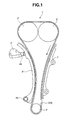
- FIG. 1 is a schematic view of a chain drive system according to one embodiment of the present invention.
- FIG. 2A is a plan view of a silent chain usable in the chain drive system of FIG. 1.
- FIG. 2B is an enlarged perspective view of chain components of the silent chain of FIG. 2A.
- FIG. 3A is a plain view of a roller chain usable in the chain drive system of FIG. 1.
- FIG. 3B is an enlarged perspective view of chain components of the roller chain of FIG. 3A.
- FIGS. 4A, 4B, 4C and 4D are examples of the formation of thin coating films of hard carbon on the silent chain of FIG. 2A
- FIGS. 5A, 5B, 5C and 5D are examples of the formation of thin coating films of hard carbon on the roller chain of FIG. 3A.
- chain drive system 1 includes first sprocket 2 (as a drive sprocket), a pair of second and third sprockets 3 and 4 (as driven sprockets) and silent chain 5 or roller chain 6.
- Chain 5 or 6 is formed with chain components and looped over first and second sprockets 2, 3 and 4 so as to move in a chain driving direction (as indicated by an arrow in FIG. 1).
- Chain drive system 1 further includes chain guide 7 and a chain tensioner unit provided with slack guide 8 and tensioner 9 to control a tension applied to chain 5 or 6, as shown in FIG. 1.
- Chain guide 7 is disposed between first and third sprockets 2 and 4 to guide the movement of chain 5 or 6 in the chain driving direction properly.
- Slack guide 8 is disposed between first and second sprockets 2 and 3 and supported pivotally by pivot shaft 8a.
- Tensioner 9 has plunger 9a slidably engaged in the tensioner body so that plunger 9a projects to press slack guide 8 against chain 5 or 6.
- These system parts 2, 3, 4, 5 or 6, 7, 8 and 9 are lubricated with a lubricating oil so as to reduce the sliding friction therebetween.
- At least one of the sliding surfaces between sprocket 2, 3, 4 and chain 5, 6, at least one of the sliding surfaces between any two opposite chain components of chain 5, 6, at least one of the sliding surfaces between chain 5, 6 and guide 7, 8, at least one of the sliding surfaces between slack guide 8 and pivot shaft 8a and at least one of the sliding surfaces between plunger 9a and the tensioner body have thin coatings of hard carbon Fc.
- silent chain 5 has a plurality of chain plates 51 coupled together by pins 52 as shown in FIGS. 2A and 2B.
- chain plates 51 and pins 52 act as the chain components.
- Each chain plate 51 has two gear teeth 51a arranged at the inner radius side of chain 5, i.e., at the side of chain plate 51 facing sprockets 2, 3 and 4.
- Pin hole 51b is formed in chain plate 51, and pin 52 is engaged in pin hole 51b to couple one chain plate 51 to another.
- the outer cylindrical portion of pin 52 comes into sliding contact with the inner cylindrical portion of pin hole 51b.
- the outer cylindrical portions of pins 52 and the inner cylindrical portions of pin holes 51b are covered with hard carbon coatings Fc, respectively, as shown in FIG. 4A.
- either the outer cylindrical portions of pins 52 or the inner cylindrical portions of pin holes 51b may be covered with hard carbon coatings Fc.
- the outer lateral portion of chain plate 51 arranged at the outer radius side of chain 5 comes into sliding contact with the guide portion of chain guide 7 and slack guide 8.
- the outer lateral portions of chain plates 51 are covered with hard carbon coatings Fc, respectively. It is alternatively possible to apply hard carbon coatings Fc to the guide portions of chain guide 7 and slack guide 8 with hard carbon coatings Fc instead of applying hard carbon coatings Fc to the outer lateral portions of chain plates 51, or possible to apply hard carbon coatings Fc to all of the outside lateral portions of chain plates 51 and the guide portions of chain guide 7 and slack guide 8.
- each chain plate 51 come into sliding contact with the plate portions of any adjacent chain plates 51.
- the plate portions of chain plates 51 are covered with hard carbon coatings Fc, respectively, as shown in FIG. 4C.
- either one of the plate portions of each chain plate 51 may be covered with hard carbon coating Fc.
- the gear teeth portion of chain plate 51 comes into sliding contact with the gear portions of sprockets 2, 3 and 4. As shown in FIG. 4D, the gear teeth portions of chain plates 51 are covered with hard carbon coatings Fc, respectively. It is alternatively possible to apply hard carbon coatings Fc to the gear portions of sprockets 2, 3 and 4 instead of applying hard carbon coatings Fc to the gear teeth portions of chain plates 51, or possible to apply hard carbon coatings Fc to all of the gear teeth portions of chain plates 51 and the gear portions of sprocket 2, 3 and 4.
- roller chain 6 has a plurality of oval chain plates 61 coupled together by bushings 62 and pins 63.
- chain plates 61, bushings 62 and pins 63 act as the chain components.
- Pin hole 61a is formed in each chain plate 61, and bushing 62 and pin 53 are slidably engaged in pin hole 61 a to couple one chain plate 61 to another.
- the outer cylindrical portion of pin 63 comes in sliding contact with the inner cylindrical portion of pin hole 61a and the inner cylindrical portion of bushing 62.
- the outer cylindrical portions of pins 63, the inner cylindrical portions of pin holes 61 a and the inner cylindrical portions of bushings 62 are covered with hard carbon coatings Fc, respectively, as shown in FIG. 5A.
- either the outer cylindrical portions of pins 63 or the inner cylindrical portions of pin holes 61a and bushings 62 may be covered with hard carbon coatings Fc.
- the outer lateral portion of chain plate 61 comes into sliding contact with the guide portions of chain guide 7 and slack guide 8. As shown in FIG. 5B, the outer lateral portions of chain plates 61 are covered with hard carbon coatings Fc, respectively. It is alternatively apply hard carbon coatings Fc to the guide portions of chain guide 7 and slack guide 8 instead of applying hard carbon coatings Fc to the outer lateral portions of chain plates 61, or possible to apply hard carbon coatings Fc to all of the outer lateral portions of chain plates 61 and the guide portions of chain guide 7 and slack guide 8.
- the opposite plate portions of chain plate 61 come into sliding contact with the plate portions of any adjacent chain plates 61.
- the plate portions of chain plates 61 are covered with hard carbon coatings Fc, respectively, as shown in FIG. 5C.
- either one of the plate portions of each chain plate 61 may be covered with hard carbon coating Fc.
- the outer cylindrical portion of bushing 62 comes into sliding contact with the gear portions of sprockets 2, 3 and 4. As shown in FIG. 5D, the outer cylindrical portions of bushings 62 are covered with hard carbon coatings Fc, respectively. It is alternatively possible to apply hard carbon coatings Fc to the gear portions of sprockets 2, 3 and 4 instead of applying hard carbon coatings Fc to the outer cylindrical portions of bushings 62, or possible to apply hard carbon coatings Fc to all of the outer cylindrical portions of bushings 62 and the gear portions of sprocket 2, 3 and 4.
- bearing portion of slack guide 8 and the outer portion of pivot shaft 8a are slidable on each other.
- either or both of the bearing portion of slack guide 8 and the outer cylindrical portion of pivot shaft 8a are covered with hard carbon coatings Fc.
- the outer portion of plunger 9a and the bearing portion of the tensioner body are also slidable on each other, and either or both of the outer portion of plunger 9a and the bearing portion of the tensioner body are covered with hard carbon coatings Fc.
- Hard carbon coatings Fc are generally made of amorphous carbon material, such as diamond-like carbon (DLC) material, in which carbon elements exist in both sp 2 and sp 3 hybridizations to form a composite structure of graphite and diamond.
- DLC diamond-like carbon
- Specific examples of the DLC material include hydrogen-free amorphous carbon (a-C), hydrogen-containing amorphous carbon (a-C:H) and/or metal carbide or metal carbon (MeC) that contains as a part a metal element of titanium (Ti) or molybdenum (Mo).
- hard carbon coatings Fc has a hydrogen content of 10 atomic% or less, more preferably 1.0 atomic% or less, in order to reduce the sliding friction between any adjacent two sliding surfaces of sprockets 2, 3, 4, chain 5 or 6, chain guide 7, slack guide 8 and tensioner 9 and thereby provide stable sliding characteristics for sprockets 2, 3, 4, chain 5 or 6, chain guide 7, slack guide 8 and tensioner 9.
- the hydrogen content of each hard carbon coating Fc is controlled to 1.0 atomic% or less.
- Such hard carbon coatings Fc low in hydrogen content can be formed a physical vapor deposition (PVD) process, e.g., arc ion plating, in which the coating atmosphere contains substantially no hydrogen and hydrogen-containing compounds.
- PVD physical vapor deposition
- the base portions of sprockets 2, 3,4, chain 5 or 6, chain guide 7, slack guide 8 and tensioner 9 are preferably finished to have an average surface roughness Ra of not greater than 0.3 ⁇ m in a condition that hard carbon coatings Fc have not yet been formed on the base portions of sprockets 2, 3, 4, chain 5 or 6, chain guide 7, slack guide 8 and tensioner 9. If the surface roughness Ra exceeds 0.3 ⁇ m, the surface roughness projections of hard carbon coating Fc increase a local Hertz's contact pressure to the opposite sliding surface. This results in an increase of the occurrence of cracking in hard carbon coating Fc.
- the surface roughness Ra is explained as a center line average surface roughess "Ra 75 " according to JIS B0601 in the present embodiment.
- the lubricating oil is preferably prepared by blending a base oil with at least one of an ashless fatty-ester friction modifier and an ashless aliphatic-amine friction modifier so as to reduce the friction between the sliding parts effectively.
- the base oil is not particularly limited, and can be selected from any commonly used lube base compounds, such as mineral oils, synthetic oils and fats.
- mineral oils include normal paraffin oils and paraffin-based or naphthene-based oils prepared by extracting lubricating oil fractions from petroleum by atmospheric or reduced-pressure distillation, and then, purifying the obtained lubricating oil fractions with any of the following treatments: solvent deasphalting, solvent extraction, hydrocracking, solvent dewaxing, hydro-refining, wax isomerization, surfuric acid treatment and clay refining.
- the lubricating oil fraction is generally purified by hydro- or solvent-refining, it is preferable to use the mineral oil prepared by purifying the lubricating oil fraction with deep hydrocraking process or GTL (Gas-to-Liquid) wax isomerization process for reduction of an aromatics content in the oil.
- GTL Gas-to-Liquid wax isomerization process
- synthetic oils include: poly- ⁇ -olefins (PAO), such as 1-octene oligomer, 1-decene oligomer and ethylene-propylene oligomer, and hydrogenated products thereof; isobutene oligomer and hydrogenated product thereof; isoparaffines; alkylbenzenes; alkylnaphthalenes; diesters, such as ditridecyl glutarate, dioctyl adipate, diisodecyl adipate, ditridecyl adipate and dioctyl sebacate; polyol esters, such as trimethylolpropane esters (e.g.
- poly- ⁇ -olefins such as 1-octene oligomer and 1-decene oligomer, and hydrogenated products thereof.
- the above base oil compounds can be used alone or in combination thereof.
- the base oil a mixture of two or more base oil compounds, there is no particular limitation to the mixing ratio of the base oil compounds.
- the sulfur content of the base oil is not particularly restricted, and is preferably 0.2% or less, more preferably 0.1% or less, still more preferably 0.05% or lower, based on the total mass of the base oil. It is desirable to use the hydro-refined mineral oil or the synthetic oil because the hydro-refined mineral oil and the synthetic oil each have a sulfur content of not more than 0.005% or substantially no sulfur content (not more than 5 ppm).
- the aromatics content of the base oil is not also particularly restricted.
- the aromatics content is defined as the amount of an aromatics fraction determined according to ASTM D2549.
- the aromatic content of the base oil is preferably 15% or less, more preferably 10% or less, and still more preferably 5% or less, based on the total mass of the base oil.
- the lubricating oil undesirably deteriorates in oxidation stability when the aromatics content of the base oil exceeds 15%.
- the kinematic viscosity of the base oil is not particularly restricted.
- the kinematic viscosity of the base oil is preferably 2 mm 2 /s or higher, more preferably 3 mm 2 /s or higher, and at the same time, is preferably 20 mm 2 /s or lower, more preferably 10 mm 2 /s or lower, still more preferably 8 mm 2 /s or lower, as measured at 100°C.
- the kinematic viscosity of the base oil is less than 2 mm 2 /s at 100°C, there is a possibility that the lubricating oil fails to provide sufficient wear resistance and causes a considerable evaporation loss.
- the kinematic viscosity of the base oil exceeds 20 mm 2 /s at 100°C, there is a possibility that the lubricating oil fails to provide low-friction characteristics and deteriorates in low-temperature performance.
- the viscosity index of the base oil is not particularly restricted, and is preferably 80 or higher, more preferably 100 or higher, most preferably 120 or higher, to use the lubricating oil in an internal combustion engine.
- the base oil has a higher viscosity index, the lubricating oil becomes less consumed and can attain good low-temperature viscosity properties.
- fatty-ester friction modifier and the aliphatic-amine friction modifier there may be used fatty acid esters and aliphatic amines each having C 6 -C 30 straight or branched hydrocarbon chains, preferably C 8 -C 24 straight or branched hydrocarbon chains, more preferably C 10 -C 20 straight or branched hydrocarbon chains.
- fatty acid esters and aliphatic amines each having C 6 -C 30 straight or branched hydrocarbon chains, preferably C 8 -C 24 straight or branched hydrocarbon chains, more preferably C 10 -C 20 straight or branched hydrocarbon chains.
- C 6 -C 30 straight or branched hydrocarbon chains of the fatty-ester and aliphatic-amine friction modifiers include: alkyl groups, such as hexyl, heptyl, octyl, nonyl, decyl, undecyl, dodecyl, tridecyl, tetradecyl, pentadecyl, hexadecyl, heptadecyl, octadecyl, nonadecyl, icosyl, heneicosyl, docosyl, tricosyl, tetracosyl, pentacosyl, hexacosyl, heptacosyl, octacosyl, nonacosyl and triacontyl; and alkenyl groups, such as hexenyl, heptenyl, octenyl, nonenyl, decenyl, undecenyl, dodecy
- the fatty acid esters are preferably exemplified by esters of fatty acids having the above C 6 -C 30 hydrocarbon groups and monohydric or polyhydric aliphatic alcohols. Specific examples of such fatty acid esters include glycerol monooleate, glycerol dioleate, sorbitan monooleate and sorbitan dioleate.
- the aliphatic amines are preferably exemplified by aliphatic monoamines and alkylene oxide adducts thereof, aliphatic polyamines, imidazolines and derivatives thereof each having the above C 6 -C 30 hydrocarbon groups.
- aliphatic amines include: aliphatic amine compounds, such as laurylamine, lauryldiethylamine, lauryldiethanolamine, dodecyldipropanolamine, palmitylamine, stearylamine, stearyltetraethylenepentamine, oleylamine, oleylpropylenediamine, oleyldiethanolamine and N-hydroxyethyloleylimidazolyne; alkylene oxide adducts of the above aliphatic amine compounds, such as N,N-dipolyoxyalkylene-N-alkyl or alkenyl (C 6 -C 28 ) amines; and acid-modified compounds prepared by reacting the above aliphatic amine compounds with C 2 -C 30 monocarboxylic acids (such as fatty acids) or C 2 -C 30 polycarboxylic acids (such as oxalic acid, phthalic acid, trimellitic acid and p
- the amount of the fatty-ester friction modifier and/or the aliphatic-amine friction modifier contained in the lubricating oil is not particularly restricted, and is preferably 0.05 to 3.0%, more preferably 0.1 to 2.0%, and most preferably 0.5 to 1.4%, based on the total mass of the lubricating oil.
- the amount of the fatty-ester friction modifier and/or the aliphatic-amine friction modifier in the lubricating oil is less than 0.05%, there is a possibility of failing to obtain a sufficient friction reducing effect.
- the lubricating oil may preferably include polybutenyl succinimide and/or a derivative thereof.
- polybutenyl succinimide there may be used compounds represented by the following general formulas (1) and (2).
- PIB represents a polybutenyl group derived from polybutene having a number-average molecular weight of 900 to 3500, preferably 1000 to 2000, that can be prepared by polymerizing high-purity isobutene or a mixture of 1-butene and isobutene in the presence of a boron fluoride catalyst or aluminum chloride catalyst.
- the number-average molecular weight of the polybutene is less than 900, there is a possibility of failing to provide a sufficient detergent effect.
- the number-average molecular weight of the polybutene exceeds 3500, the polybutenyl succinimide tends to deteriorate in low-temperature fluidity.
- the polybutene may be purified, before used for the production of the polybutenyl succinimide, by removing trace amounts of fluorine and chlorine residues resulting from the above polybutene production catalyst with any suitable treatment (such as adsorption process or washing process) in such a way as to control the amount of the fluorine and chlorine residues in the polybutene to 50 ppm or less, desirably 10 ppm or less, more desirably 1 ppm or less.
- any suitable treatment such as adsorption process or washing process
- n represents an integer of 1 to 5, preferably 2 to 4, in the formulas (1) and (2) in the formulas (1) and (2) in view of the detergent effect.
- the polybutenyl succinimide can be prepared by reacting a chloride of the polybutene, or the polybutene from which fluorine and chlorine residues are sufficiently removed, with maleic anhydride at 100 to 200°C to form polybutenyl succinate, and then, reacting the polybutenyl succinate with polyamine (such as diethylene triamine, triethylene tetramine, tetraethylene pentamine or pentaethylene hexamine).
- polyamine such as diethylene triamine, triethylene tetramine, tetraethylene pentamine or pentaethylene hexamine.
- polybutenyl succinimide derivative there may be used boron- or acid-modified compounds obtained by reacting the polybutenyl succinimides of the formula (1) or (2) with boron compounds or oxygen-containing organic compounds so as to neutralize or amidate the whole or part of the remaining amino and/or imide groups.
- boron-containing polybutenyl succinimides especially boron-containing bis(polybutenyl)succinimide, are preferably used.
- the content ratio of nitrogen to boron (B/N) by mass in the boron-containing polybutenyl succinimide compound is usually 0.1 to 3, preferably 0.2 to 1.
- the boron compound used for producing the polybutenyl succinimide derivative can be a boric acid, a borate or a boric acid ester.
- the boric acid include orthoboric acid, metaboric acid and tetraboric acid.
- Specific examples of the borate include: ammonium salts, such as ammonium borates, e.g., ammonium metaborate, ammonium tetraborate, ammonium pentaborate and ammonium octaborate.
- boric acid ester examples include: esters of boric acids and alkylalcohols (preferably C 1 -C 6 alkylalcohols), such as monomethyl borate, dimethyl borate, trimethyl borate, monoethyl borate, diethyl borate, triethyl borate, monopropyl borate, dipropyl borate, tripropyl borate, monobutyl borate, dibutyl borate and tributyl borate.
- alkylalcohols preferably C 1 -C 6 alkylalcohols
- the oxygen-containing organic compound used for producing the polybutenyl succinimide derivative can be any of C 1 -C 30 monocarboxylic acids, such as formic acid, acetic acid, glycolic acid, propionic acid, lactic acid, butyric acid, valeric acid, caproic acid, enanthic acid, caprylic acid, pelargonic acid, capric acid, undecylic acid, lauric acid, tridecanoic acid, myristic acid, pentadecanoic acid, palmitic acid, margaric acid, stearic acid, oleic acid, nonadecanoic acid and eicosanoic acid; C 2 -C 30 polycarboxylic acids, such as oxalic acid, phthalic acid, trimellitic acid and pyromellitic acid, and anhydrides and esters thereof; C 2 -C 6 alkylene oxides; and hydroxy(poly)oxyalkylene carbonates.
- monocarboxylic acids such as
- the amount of the polybutenyl succinimide and/or polybutenyl succinimide derivative contained in the lubricating oil is not particularly restricted, and is preferably 0.1 to 15%, more preferably 1.0 to 12%, based on the total mass of the lubricating oil.
- the amount of the polybutenyl succineimide and/or polybutenyl succinimide derivative in the lubricating oil is less than 0.1%, there is a possibility of failing to attain a sufficient detergent effect.
- the amount of the polybutenyl succineimide and/or polybutenyl succinimide derivative in the lubricating oil exceeds 15%, the lubricating oil may deteriorate in demulsification ability. In addition, it is uneconomical to add such a large amount of the polybutenyl succineimide and/or polybutenyl succinimide derivative in the lubricating oil.
- the lubricating oil may preferably include zinc dithiophosphate.
- zinc dithiophosphate there may be used compounds represented by the following general formula (3).
- R 4 , R 5 , R 6 and R 7 each represent C 1 -C 24 hydrocarbon groups.
- the C 1 -C 24 hydrocarbon group is preferably a C 1 -C 24 straight- or branched-chain alkyl group, a C 3 -C 24 straight- or branched-chain alkenyl group, a C 5 -C 13 cycloalkyl or straight- or branched-chain alkylcycloalkyl group, a C 6 -C 18 aryl or straight- or branched-chain alkylaryl group or a C 7 -C 19 arylalkyl group.
- the above alkyl group or alkenyl group can be primary, secondary or tertiary.
- R 4 , R 5 , R 6 and R 7 include: alkyl groups, such as methyl, ethyl, propyl, butyl, pentyl, hexyl, heptyl, octyl, nonyl, decyl, undecyl, dodecyl, tridecyl, tetradecyl, pentadecyl, hexadecyl, heptadecyl, octadecyl, nonadecyl, icosyl, heneicosyl, docosyl, tricosyl and tetracosyl; alkenyl groups, such as propenyl, isopropenyl, butenyl, butadienyl, pentenyl, hexenyl, heptenyl, octenyl, nonenyl, decenyl, undecenyl, dodecenyl, tridecyl
- the zinc dithiophosphate compounds are preferably exemplified by zinc diisopropyldithiophosphate, zinc diisobutyldithiophosphate, zinc di-sec-butyldithiophosphate, zinc di-sec-pentyldithiophosphate, zinc di-n-hexyldithiophosphate, zinc di-sec-hexyldithiophosphate, zinc di-octyldithiophosphate, zinc di-2-ethylhexyldithiophosphate, zinc di-n-decyldithiophosphate zinc di-n-dodecyldithiophosphate, and zinc diisotridecyldithiophosphate.
- the amount of the zinc dithiophosphate contained in the lubricating oil is not particularly restricted.
- the zinc dithiophosphate is preferably contained in an amount of 0.1% or less, more preferably in an amount of 0.06% or less, most preferably in a minimum effective amount, in terms of the phosphorus element based on the total mass of the lubricating oil.
- the amount of the zinc dithiophosphate in the lubricating oil exceeds 0.1%, there is a possibility of inhibiting the friction reducing effect of the ashless fatty-ester friction modifier and/or the ashless aliphatic-amine friction modifier.
- the production method of the zinc dithiophosphate is not particularly restricted, and the zinc dithiophosphate can be prepared by any known method.
- the zinc dithiophosphate may be prepared by reacting alcohols or phenols having the above R 4 , R 5 , R 6 and R 7 hydrocarbon groups with phosphorous pentasulfide (P 2 O 5 ) to form dithiophosphoric acid, and then, neutralizing the dithiophosphoric acid with zinc oxide.
- P 2 O 5 phosphorous pentasulfide
- the molecular structure of zinc dithiophosphate differs according to the alcohols or phenols used as a raw material for the zinc dithiophosphate production.
- the above zinc dithiophosphate compounds can be used alone or in the form of a mixture of two or more thereof.
- the above-specified lubricating oil produces a large friction reducing effect on the sliding friction between any two opposite sliding surfaces of the system parts 2, 3, 4, 5 or 6, 7, 8 and 9 especially when either or both of the opposite system parts 2, 3, 4, 5 or 6, 7, 8 and 9 are covered with hard carbon coatings Fc.
- the lubricating oil may further contain any other additive or additives, such as a metallic detergent, an antioxidant, a viscosity index improver, a friction modifier other than the above-mentioned fatty-ester friction modifier and aliphatic-amine friction modifier, an ashless dispersant other than the above-mentioned polybutenyl succinimide and polybutenyl succinimide derivative, an anti-wear agent or extreme-pressure agent, a rust inhibitor, a nonionic surfactant, a demulsifier, a metal deactivator and/or an anti-foaming agent.
- a metallic detergent such as a metallic detergent, an antioxidant, a viscosity index improver, a friction modifier other than the above-mentioned fatty-ester friction modifier and aliphatic-amine friction modifier, an ashless dispersant other than the above-mentioned polybutenyl succinimide and polybutenyl succinimide derivative, an anti-wear agent or extreme
- the metallic detergent can be selected from any metallic detergent compound commonly used for engine lubricants.
- the metallic detergent include sulfonates, phenates and salicylates of alkali metals, such as sodium (Na) and potassium (K), or alkali-earth metals, such as calcium (Ca) and magnesium (Mg); and a mixture of two or more thereof.
- sodium and calcium sulfonates, sodium and calcium phenates, and sodium and calcium salicylates are suitably used.
- the total base number and amount of the metallic detergent can be selected in accordance with the properties required of the lubricating oil.
- the total base number of the metallic detergent is usually 0 to 500 mgKOH/g, preferably 150 to 400 mgKOH/g, as measured by perchloric acid method according to ISO 3771.
- the amount of the metallic detergent is usually 0.1 to 10% based on the total mass of the lubricating oil.
- the antioxidant can be selected from any antioxidant compounds commonly used for engine lubricants.
- Specific examples of the antioxidant include: phenolic antioxidants, such as 4,4'-methylenebis(2,6-di-tert-butylphenol) and octadecyl-3-(3,5-di-tert-butyl-4-hydroxyphenyl)propionate; amino antioxidants, such as phenyl- ⁇ -naphthylamine, alkylphenyl- ⁇ -naphthylamine and alkyldiphenylamine; and mixtures of two or more thereof.
- the amount of the antioxidant is usually 0.01 to 5% based on the total mass of the lubricating oil.
- non-dispersion type polymethacrylate viscosity index improvers such as copolymers of one or more kinds of methacrylates and hydrogenated products thereof
- dispersion type polymethacrylate viscosity index improvers such as copolymers of methaclylates further including nitrogen compounds
- other viscosity index improvers such as copolymers of ethylene and ⁇ -olefins (e.g.
- the molecular weight of the viscosity index improver needs to be selected in view of the shear stability.
- the number-average molecular weight of the viscosity index improver is desirably in a range of 5000 to 1000000, more desirably 100000 to 800000, for the dispersion or non-dispersion type polymethacrylate; in a range of 800 to 5000 for the polyisobutylene or hydrogenated product thereof; and in a range of 800 to 300000, more desirably 10000 to 200000 for the ethylene/ ⁇ -olefin copolymer or hydrogenated product thereof.
- the above viscosity index improving compounds can be used alone or in the form of a mixture of two or more thereof.
- the amount of the viscosity index improver is preferably 0.1 to 40.0% based on the total mass of the lubricating oil.
- the friction modifier other than the above-mentioned fatty-ester friction modifier and aliphatic-amine friction modifier can be exemplified by ashless friction modifiers, such as boric acid esters, higher alcohols and aliphatic ethers, and metallic friction modifiers, such as molybdenum dithiophosphate, molybdenum dithiocarbamate and molybdenum disulfide.
- ashless friction modifiers such as boric acid esters, higher alcohols and aliphatic ethers
- metallic friction modifiers such as molybdenum dithiophosphate, molybdenum dithiocarbamate and molybdenum disulfide.
- the ashless dispersant other than the above-mentioned polybutenyl succinimide and polybutenyl succinimide derivative can be any of polybutenylbenzylamines and polybutenylamines each having polybutenyl groups of which the number-average molecular weight is 900 to 3500, polybutenyl succinimides having polybutenyl groups of which the number-average molecular weight is less than 900, and derivatives thereof.
- anti-friction agent or extreme-pressure agent there may be used: disulfides, sulfurized fats, olefin sulfides, phosphate esters having one to three C 2 -C 20 hydrocarbon groups, thiophosphate esters, phosphite esters, thiophosphite esters and amine salts of these esters.
- rust inhibitor there may be used: alkylbenzene sulfonates, dinonylnaphthalene sulfonates, esters of alkenylsuccinic acids and esters of polyalcohols.
- noisy polyalkylene glycol surfactants such as polyoxyethylene alkylethers, polyoxyethylene alkylphenylethers and polyoxyethylene alkylnaphthylethers.
- the metal deactivator can be exemplified by imidazolines, pyrimidine derivatives, thiazole and benzotriazole.
- the anti-foaming agent can be exemplified by silicones, fluorosilicones and fluoroalkylethers.
- Each of the friction modifier other than the fatty-ester and aliphatic-amine friction modifiers, the ashless dispersant other than the polybutenyl succinimide and polybutenyl succinimide derivative, the anti-wear agent or extreme-pressure agent, the rust inhibitor and the demulsifier is usually contained in an amount of 0.01 to 5% based on the total mass of the lubricating oil, the metal deactivator is usually contained in an amount of 0.005 to 1% based on the total mass of the lubricating oil, and the anti-foaming agent is usually contained in an amount of 0.0005 to 1% based on the total mass of the lubricating oil.
- either or both of the opposite sliding surfaces between the chain components 51, 52, or 61, 62, 63 have hard carbon coatings Fc low in hydrogen content according to the present embodiment.
- the chain components 51, 52, or 61, 62, 63 are thus allowed to slide relative to each other with less friction resistance and wear in the presence of the above-specified lubricating oil. This makes it possible to reduce energy loss and noise caused by the movement of chain 5, 6, prevent the elongation of chain 5, 6 due to wear and thereby improve the durability of chain 5, 6.
- chain drive system 1 is used to control the timing of transmitting the rotation of a drive shaft (i.e. a crankshaft) to a driven shaft (i.e.
- the performance deteriorations (such as control timing delay) of the engine can be prevented from occurring due to the chain elongation.
- the formation of hard carbon coating Fc allows a decrease in the pressure-receiving area of chain 5, 6 in a case where the allowable level of chain elongation is set constant.
- the width of chain 5, 6 and the diameter of pins 52, 63 can be thus made smaller for the miniaturization of chain drive system 1.
- chain 5 or 6 are allowed to slide relative to sprockets 2, 3, 4, chain guide 7 and slack guide 8 with less friction and wear in the presence of the above-specified lubricating oil. This also makes it possible to reduce possible to reduce energy loss and noise caused by the sliding contact of chain 5, 6 with sprockets 2, 3, 4, chain guide 7 and slack guide 8 and to lower the wear-resistant grades of the materials of chain 5 or 6, sprockets 2, 3, 4, chain guide 7 and slack guide 8 for cost reduction.
- At least one of the opposite sliding surfaces between slack guide 8 and pivot shaft 8a and at least one of the opposite sliding surfaces between the tensioner body and plunger 9a have hard carbon coatings Fc low in hydrogen content according to the present embodiment.
- the clearance between the tensioner body and plunger 9a can be decreased to avoid the occurrence of oil leakage during an engine stop and thereby improve the responsivity of tensioner 9 at an engine start. This makes it possible to avoid abnormal sounds due to the flap of chain 5, 6 etc.
- Chain drive system 1 can therefore attain good low-friction characteristics and durability and provide, when chain drive system 1 is used to control the timing of transmitting the rotation of a drive shaft (i.e. a crankshaft) to a driven shaft (i.e. a valve driving camshaft) in an internal combustion engine, great improvements in engine performance and fuel efficiency without secular deteriorations.
- a drive shaft i.e. a crankshaft
- a driven shaft i.e. a valve driving camshaft
- hard carbon coatings Fc can be applied to any other sliding machine parts.
Landscapes
- Engineering & Computer Science (AREA)
- General Engineering & Computer Science (AREA)
- Mechanical Engineering (AREA)
- Lubricants (AREA)
- Devices For Conveying Motion By Means Of Endless Flexible Members (AREA)
Abstract
Description
- The present application is related to the following applications: U.S. Patent Application Ser. No. 09/545,181 (based on Japanese Patent Application Hei-11-102205 filed on April 9, 1999); U.S. Patent Application Ser. No. 10/468,713, which is the national phase of PCT Application No. JP02/10057 (based on Japanese Patent Application 2001-117680 filed on April 17, 2001); U.S. Patent Application Ser. No. 10/355,099 (based on Japanese Patent Application 2002-45576 filed on February 22, 2002); U.S. Patent Application Ser. No. 10/682,559 (based on Japanese Patent Application No. 2002-302205 filed on October 16, 2002); and U.S. Patent Application Ser. No. 10/692,853 (based on Japanese Patent Application 2002-322322 filed on October 16, 2002).
- The invention relates to a chain drive system having parts sliding on each other with less friction resistance and wear so as to increase in durability, prevent secular deteriorations in system performance and obtain, when used to transmit the rotation of a crankshaft to a valve driving camshaft in an internal combustion engine, improvements in engine performance and fuel efficiency.
- Japanese Laid-Open Patent Publication No. 6-264993 discloses one type of chain drive system to transmit the rotation of a crankshaft to a pair of valve driving camshafts in an internal combustion engine, which includes a crankshaft sprocket connected to the crankshaft, camshaft sprockets connected to the respective camshafts, a chain looped over the crankshaft sprocket and the camshaft sprockets, a chain guide that guides the chain in a proper chain drive direction and a chain tensioner unit that controls a tension in the chain hydraulically. In the above type of chain drive system, either a roller chain or a silent chain is usable, as proposed in Japanese Laid-Open Patent Publication No. 11-190406.
- The chain generally includes a plurality of chain plates coupled together by pins. Due to the sliding friction between the pin and the chain plate and between any two adjacent chain plates, however, there arise various problems such as energy loss, noise, wear and chain elongation. In addition, the performance deteriorations (such as control timing delay) of the chain drive system may be caused by the chain elongation.
- Further, the chain tensioner unit includes a slack guide, a tensioner body and a plunger slidably engaged in the tensioner body to press the slack guide against the chain, so as to control the movement of the chain, apply an initial tension to the chain and thereby prevent the chain from flapping at an engine start. Although it is desirable to minimize a clearance between the tensioner body and the plunger in order to avoid oil leakage during an engine stop and to facilitate the application of an initial tension to the chain, the sliding friction between the tensioner body and the plunger increases with decrease in the clearance between the tensioner body and the plunger. When the sliding friction between the tensioner body and the plunger is increased, the tensioner body and the plunger become subjected to severe wear so that there arises a higher possibility of oil leakage. Also, the tensioner's response to the input from the chain becomes deteriorated. It follows that the chain tensioner unit cannot control the chain movement properly, thereby resulting in chain flapping.
- There arise still other problems, such energy loss, noise and wear caused by the sliding friction between the chain and the sprocket and between the chain and the chain guide, strength reduction and early part replacement.
- It is therefore an object of the present invention to provide a chain drive system having opposite parts sliding on each other with less friction resistance and wear so as to prevent energy loss and noise and to increase in durability for improvements in the operation performance and efficiency of any instrument, such as an internal combustion engine, equipped with the chain drive system.
- As a result of extensive researches, it has been found by the present inventors that a pair of opposite sliding parts shows considerably improved low-friction characteristic and durability in the presence of a specific lubricating oil when either or both of the sliding parts are covered with thin coating films of hard carbon. The present invention is based on the above finding.
- According to a first aspect of the present invention, there is provided a chain drive system, comprising: a drive sprocket; a driven sprocket; a chain looped over the drive sprocket and the driven sprocket; the chain and the sprocket having respective sliding surfaces slidable relative to each other in the presence of lubricating oil; any adjacent chain components of the chain having respective sliding surfaces slidable relative to each other in the presence of lubricating oil; at least one of the sliding surfaces between the chain and the sprocket and at least one of the sliding surfaces between any adjacent chain components having hard carbon coatings formed on base portions thereof; and each of the hard carbon coatings having a hydrogen content of 10 atomic% or less.
- According to a second aspect of the present invention, there is provided a chain drive system, comprising: a drive sprocket; a driven sprocket; a chain looped over the drive sprocket and the driven sprocket; the chain and the sprocket having respective sliding surfaces slidable relative to each other; any adjacent chain components of the chain having respective sliding surfaces slidable relative to each other; at least one of the sliding surfaces between the chain and the sprocket and at least one of the sliding surfaces between any adjacent chain components having hard carbon coatings formed on base portions thereof; each of the hard carbon coatings having a hydrogen content of 10 atomic% or less; and a lubricant being supplied to lubricate the sliding surfaces between the chain and the sprocket and the sliding surfaces between any adjacent chain components.
- The other objects and features of the invention will also become understood from the following description.
- FIG. 1 is a schematic view of a chain drive system according to one embodiment of the present invention.
- FIG. 2A is a plan view of a silent chain usable in the chain drive system of FIG. 1.
- FIG. 2B is an enlarged perspective view of chain components of the silent chain of FIG. 2A.
- FIG. 3A is a plain view of a roller chain usable in the chain drive system of FIG. 1.
- FIG. 3B is an enlarged perspective view of chain components of the roller chain of FIG. 3A.
- FIGS. 4A, 4B, 4C and 4D are examples of the formation of thin coating films of hard carbon on the silent chain of FIG. 2A
- FIGS. 5A, 5B, 5C and 5D are examples of the formation of thin coating films of hard carbon on the roller chain of FIG. 3A.
- The present invention will be described below in detail. In the following description, all percentages (%) are by mass unless otherwise specified.
- As shown in FIG. 1, chain drive system 1 according to one exemplary embodiment of the present invention includes first sprocket 2 (as a drive sprocket), a pair of second and
third sprockets 3 and 4 (as driven sprockets) andsilent chain 5 orroller chain 6.Chain second sprockets chain guide 7 and a chain tensioner unit provided withslack guide 8 andtensioner 9 to control a tension applied tochain Chain guide 7 is disposed between first andthird sprockets 2 and 4 to guide the movement ofchain guide 8 is disposed between first andsecond sprockets pivot shaft 8a.Tensioner 9 has plunger 9a slidably engaged in the tensioner body so that plunger 9a projects to pressslack guide 8 againstchain system parts - In the present embodiment, at least one of the sliding surfaces between
sprocket chain chain chain slack guide 8 andpivot shaft 8a and at least one of the sliding surfaces betweenplunger 9a and the tensioner body have thin coatings of hard carbon Fc. - More specifically,
silent chain 5 has a plurality ofchain plates 51 coupled together bypins 52 as shown in FIGS. 2A and 2B. (In this case,chain plates 51 andpins 52 act as the chain components.) Eachchain plate 51 has twogear teeth 51a arranged at the inner radius side ofchain 5, i.e., at the side ofchain plate 51 facingsprockets Pin hole 51b is formed inchain plate 51, andpin 52 is engaged inpin hole 51b to couple onechain plate 51 to another. - The outer cylindrical portion of
pin 52 comes into sliding contact with the inner cylindrical portion ofpin hole 51b. The outer cylindrical portions ofpins 52 and the inner cylindrical portions ofpin holes 51b are covered with hard carbon coatings Fc, respectively, as shown in FIG. 4A. Alternatively, either the outer cylindrical portions ofpins 52 or the inner cylindrical portions ofpin holes 51b may be covered with hard carbon coatings Fc. - The outer lateral portion of
chain plate 51 arranged at the outer radius side of chain 5 (opposite to the gear teeth side) comes into sliding contact with the guide portion ofchain guide 7 andslack guide 8. As shown in FIG. 4B, the outer lateral portions ofchain plates 51 are covered with hard carbon coatings Fc, respectively. It is alternatively possible to apply hard carbon coatings Fc to the guide portions ofchain guide 7 andslack guide 8 with hard carbon coatings Fc instead of applying hard carbon coatings Fc to the outer lateral portions ofchain plates 51, or possible to apply hard carbon coatings Fc to all of the outside lateral portions ofchain plates 51 and the guide portions ofchain guide 7 andslack guide 8. - The opposite plate portions of each
chain plate 51 come into sliding contact with the plate portions of anyadjacent chain plates 51. The plate portions ofchain plates 51 are covered with hard carbon coatings Fc, respectively, as shown in FIG. 4C. Alternatively, either one of the plate portions of eachchain plate 51 may be covered with hard carbon coating Fc. - The gear teeth portion of
chain plate 51 comes into sliding contact with the gear portions ofsprockets chain plates 51 are covered with hard carbon coatings Fc, respectively. It is alternatively possible to apply hard carbon coatings Fc to the gear portions ofsprockets chain plates 51, or possible to apply hard carbon coatings Fc to all of the gear teeth portions ofchain plates 51 and the gear portions ofsprocket - As shown in FIGS. 3A and 3B,
roller chain 6 has a plurality ofoval chain plates 61 coupled together bybushings 62 and pins 63. (In this case,chain plates 61,bushings 62 and pins 63 act as the chain components.)Pin hole 61a is formed in eachchain plate 61, andbushing 62 and pin 53 are slidably engaged inpin hole 61 a to couple onechain plate 61 to another. - The outer cylindrical portion of
pin 63 comes in sliding contact with the inner cylindrical portion ofpin hole 61a and the inner cylindrical portion ofbushing 62. The outer cylindrical portions ofpins 63, the inner cylindrical portions of pin holes 61 a and the inner cylindrical portions ofbushings 62 are covered with hard carbon coatings Fc, respectively, as shown in FIG. 5A. Alternatively, either the outer cylindrical portions ofpins 63 or the inner cylindrical portions ofpin holes 61a andbushings 62 may be covered with hard carbon coatings Fc. - The outer lateral portion of
chain plate 61 comes into sliding contact with the guide portions ofchain guide 7 andslack guide 8. As shown in FIG. 5B, the outer lateral portions ofchain plates 61 are covered with hard carbon coatings Fc, respectively. It is alternatively apply hard carbon coatings Fc to the guide portions ofchain guide 7 andslack guide 8 instead of applying hard carbon coatings Fc to the outer lateral portions ofchain plates 61, or possible to apply hard carbon coatings Fc to all of the outer lateral portions ofchain plates 61 and the guide portions ofchain guide 7 andslack guide 8. - The opposite plate portions of
chain plate 61 come into sliding contact with the plate portions of anyadjacent chain plates 61. The plate portions ofchain plates 61 are covered with hard carbon coatings Fc, respectively, as shown in FIG. 5C. Alternatively, either one of the plate portions of eachchain plate 61 may be covered with hard carbon coating Fc. - The outer cylindrical portion of
bushing 62 comes into sliding contact with the gear portions ofsprockets bushings 62 are covered with hard carbon coatings Fc, respectively. It is alternatively possible to apply hard carbon coatings Fc to the gear portions ofsprockets bushings 62, or possible to apply hard carbon coatings Fc to all of the outer cylindrical portions ofbushings 62 and the gear portions ofsprocket - Further, the bearing portion of
slack guide 8 and the outer portion ofpivot shaft 8a are slidable on each other. Although not specifically shown in the drawings, either or both of the bearing portion ofslack guide 8 and the outer cylindrical portion ofpivot shaft 8a are covered with hard carbon coatings Fc. - The outer portion of
plunger 9a and the bearing portion of the tensioner body are also slidable on each other, and either or both of the outer portion ofplunger 9a and the bearing portion of the tensioner body are covered with hard carbon coatings Fc. - Hard carbon coatings Fc are generally made of amorphous carbon material, such as diamond-like carbon (DLC) material, in which carbon elements exist in both sp2 and sp3 hybridizations to form a composite structure of graphite and diamond. Specific examples of the DLC material include hydrogen-free amorphous carbon (a-C), hydrogen-containing amorphous carbon (a-C:H) and/or metal carbide or metal carbon (MeC) that contains as a part a metal element of titanium (Ti) or molybdenum (Mo).
- The coefficient of friction between any adjacent two sliding surfaces of
sprockets chain chain guide 7,slack guide 8 andtensioner 9 increases with the hydrogen content of hard carbon coating Fc. It is thus preferable that hard carbon coatings Fc has a hydrogen content of 10 atomic% or less, more preferably 1.0 atomic% or less, in order to reduce the sliding friction between any adjacent two sliding surfaces ofsprockets chain chain guide 7,slack guide 8 andtensioner 9 and thereby provide stable sliding characteristics forsprockets chain chain guide 7,slack guide 8 andtensioner 9. In the present embodiment, the hydrogen content of each hard carbon coating Fc is controlled to 1.0 atomic% or less. Such hard carbon coatings Fc low in hydrogen content can be formed a physical vapor deposition (PVD) process, e.g., arc ion plating, in which the coating atmosphere contains substantially no hydrogen and hydrogen-containing compounds. To lower the hydrogen content of hard carbon coatings Fc, it may be desirable to bake a reaction vessel and supporting fixtures and to clean the base portions ofsprockets chain chain guide 7,slack guide 8 and tensioner 9 (i.e., the gear portions ofsprockets chain plate 51, the outer cylindrical portion ofpin 52, the inner cylindrical portion ofpin hole 51b, the outer lateral portion and plate portions ofchain plate 61, the outer cylindrical portion ofpin 63, the inner cylindrical portion ofpin hole 61 a, the inner and outer cylindrical portions ofbushing 62, the guide portion ofchain guide 7 andslack guide 8, the bearing portion ofslack guide 8, the outer portion ofpivot shaft 8a, the outer portion ofplunger 9a, the bearing portion of the tensioner body) before the formation of hard carbon coatings Fc. - Furthermore, the base portions of
sprockets chain chain guide 7,slack guide 8 andtensioner 9 are preferably finished to have an average surface roughness Ra of not greater than 0.3 µm in a condition that hard carbon coatings Fc have not yet been formed on the base portions ofsprockets chain chain guide 7,slack guide 8 andtensioner 9. If the surface roughness Ra exceeds 0.3 µm, the surface roughness projections of hard carbon coating Fc increase a local Hertz's contact pressure to the opposite sliding surface. This results in an increase of the occurrence of cracking in hard carbon coating Fc. Herein, the surface roughness Ra is explained as a center line average surface roughess "Ra75" according to JIS B0601 in the present embodiment. - The lubricating oil is preferably prepared by blending a base oil with at least one of an ashless fatty-ester friction modifier and an ashless aliphatic-amine friction modifier so as to reduce the friction between the sliding parts effectively.
- The base oil is not particularly limited, and can be selected from any commonly used lube base compounds, such as mineral oils, synthetic oils and fats.
- Specific examples of the mineral oils include normal paraffin oils and paraffin-based or naphthene-based oils prepared by extracting lubricating oil fractions from petroleum by atmospheric or reduced-pressure distillation, and then, purifying the obtained lubricating oil fractions with any of the following treatments: solvent deasphalting, solvent extraction, hydrocracking, solvent dewaxing, hydro-refining, wax isomerization, surfuric acid treatment and clay refining. Although the lubricating oil fraction is generally purified by hydro- or solvent-refining, it is preferable to use the mineral oil prepared by purifying the lubricating oil fraction with deep hydrocraking process or GTL (Gas-to-Liquid) wax isomerization process for reduction of an aromatics content in the oil.
- Specific examples of the synthetic oils include: poly-α-olefins (PAO), such as 1-octene oligomer, 1-decene oligomer and ethylene-propylene oligomer, and hydrogenated products thereof; isobutene oligomer and hydrogenated product thereof; isoparaffines; alkylbenzenes; alkylnaphthalenes; diesters, such as ditridecyl glutarate, dioctyl adipate, diisodecyl adipate, ditridecyl adipate and dioctyl sebacate; polyol esters, such as trimethylolpropane esters (e.g. trimethylolpropane caprylate, trimetylolpropane pelargonate and trimethylolpropane isostearate) and pentaerythritol esters (e.g. pentaerythritol-2-ethyl hexanoate and pentaerythritol pelargonate); polyoxyalkylene glycols; dialkyl diphenyl ethers; and polyphenyl ethers. Among others, preferred are poly-α-olefins, such as 1-octene oligomer and 1-decene oligomer, and hydrogenated products thereof.
- The above base oil compounds can be used alone or in combination thereof. In the case of using as the base oil a mixture of two or more base oil compounds, there is no particular limitation to the mixing ratio of the base oil compounds.
- The sulfur content of the base oil is not particularly restricted, and is preferably 0.2% or less, more preferably 0.1% or less, still more preferably 0.05% or lower, based on the total mass of the base oil. It is desirable to use the hydro-refined mineral oil or the synthetic oil because the hydro-refined mineral oil and the synthetic oil each have a sulfur content of not more than 0.005% or substantially no sulfur content (not more than 5 ppm).
- The aromatics content of the base oil is not also particularly restricted. Herein, the aromatics content is defined as the amount of an aromatics fraction determined according to ASTM D2549. In order for the lubricating oil to maintain low-friction characteristics suitably for use in an internal combustion engine over an extended time period, the aromatic content of the base oil is preferably 15% or less, more preferably 10% or less, and still more preferably 5% or less, based on the total mass of the base oil. The lubricating oil undesirably deteriorates in oxidation stability when the aromatics content of the base oil exceeds 15%.
- The kinematic viscosity of the base oil is not particularly restricted. To use the lubricating oil in an internal combustion engine, the kinematic viscosity of the base oil is preferably 2 mm2/s or higher, more preferably 3 mm2/s or higher, and at the same time, is preferably 20 mm2/s or lower, more preferably 10 mm2/s or lower, still more preferably 8 mm2/s or lower, as measured at 100°C. When the kinematic viscosity of the base oil is less than 2 mm2/s at 100°C, there is a possibility that the lubricating oil fails to provide sufficient wear resistance and causes a considerable evaporation loss. When the kinematic viscosity of the base oil exceeds 20 mm2/s at 100°C, there is a possibility that the lubricating oil fails to provide low-friction characteristics and deteriorates in low-temperature performance.
- In the case of using two or more base oil compounds in combination, it is not necessary to limit the kinematic viscosity of each base oil compound to within such a specific range so for as the kinematic viscosity of the mixture of the base oil compounds at 100°C is in the above-specified range.
- The viscosity index of the base oil is not particularly restricted, and is preferably 80 or higher, more preferably 100 or higher, most preferably 120 or higher, to use the lubricating oil in an internal combustion engine. When the base oil has a higher viscosity index, the lubricating oil becomes less consumed and can attain good low-temperature viscosity properties.
- As the fatty-ester friction modifier and the aliphatic-amine friction modifier, there may be used fatty acid esters and aliphatic amines each having C6-C30 straight or branched hydrocarbon chains, preferably C8-C24 straight or branched hydrocarbon chains, more preferably C10-C20 straight or branched hydrocarbon chains. When the carbon number of the hydrocarbon chain of the friction modifier is not within the range of 6 to 30, there arises a possibility of failing to produce a desired friction reducing effect. Specific examples of the C6-C30 straight or branched hydrocarbon chains of the fatty-ester and aliphatic-amine friction modifiers include: alkyl groups, such as hexyl, heptyl, octyl, nonyl, decyl, undecyl, dodecyl, tridecyl, tetradecyl, pentadecyl, hexadecyl, heptadecyl, octadecyl, nonadecyl, icosyl, heneicosyl, docosyl, tricosyl, tetracosyl, pentacosyl, hexacosyl, heptacosyl, octacosyl, nonacosyl and triacontyl; and alkenyl groups, such as hexenyl, heptenyl, octenyl, nonenyl, decenyl, undecenyl, dodecenyl, tridecenyl, tetradecenyl, pentadecenyl, hexadecenyl, heptadecenyl, octadecenyl, nonadecenyl, icosenyl, heneicosenyl, docosenyl, tricosenyl, tetracosenyl, pentacosenyl, hexacosenyl, heptacosenyl, octacosenyl, nonacosenyl and triacontenyl. The above alkyl and alkenyl groups include all possible isomers.
- The fatty acid esters are preferably exemplified by esters of fatty acids having the above C6-C30 hydrocarbon groups and monohydric or polyhydric aliphatic alcohols. Specific examples of such fatty acid esters include glycerol monooleate, glycerol dioleate, sorbitan monooleate and sorbitan dioleate.
- The aliphatic amines are preferably exemplified by aliphatic monoamines and alkylene oxide adducts thereof, aliphatic polyamines, imidazolines and derivatives thereof each having the above C6-C30 hydrocarbon groups. Specific examples of such aliphatic amines include: aliphatic amine compounds, such as laurylamine, lauryldiethylamine, lauryldiethanolamine, dodecyldipropanolamine, palmitylamine, stearylamine, stearyltetraethylenepentamine, oleylamine, oleylpropylenediamine, oleyldiethanolamine and N-hydroxyethyloleylimidazolyne; alkylene oxide adducts of the above aliphatic amine compounds, such as N,N-dipolyoxyalkylene-N-alkyl or alkenyl (C6-C28) amines; and acid-modified compounds prepared by reacting the above aliphatic amine compounds with C2-C30 monocarboxylic acids (such as fatty acids) or C2-C30 polycarboxylic acids (such as oxalic acid, phthalic acid, trimellitic acid and pyromellitic acid) so as to neutralize or amidate the whole or part of the remaining amino and/or imino groups. Above all, N,N-dipolyoxyethylene-N-oleylamine is preferably used.
- The amount of the fatty-ester friction modifier and/or the aliphatic-amine friction modifier contained in the lubricating oil is not particularly restricted, and is preferably 0.05 to 3.0%, more preferably 0.1 to 2.0%, and most preferably 0.5 to 1.4%, based on the total mass of the lubricating oil. When the amount of the fatty-ester friction modifier and/or the aliphatic-amine friction modifier in the lubricating oil is less than 0.05%, there is a possibility of failing to obtain a sufficient friction reducing effect. When the amount of the fatty-ester friction modifier and/or the aliphatic-amine friction modifier in the lubricating oil exceeds 3.0%, there is a possibility that the solubility of the friction modifier or modifiers in the base oil becomes so low that the lubricating oil deteriorates in storage stability to cause precipitations.
- The lubricating oil may preferably include polybutenyl succinimide and/or a derivative thereof.
- As the polybutenyl succinimide, there may be used compounds represented by the following general formulas (1) and (2).


- In the formulas (1) and (2), PIB represents a polybutenyl group derived from polybutene having a number-average molecular weight of 900 to 3500, preferably 1000 to 2000, that can be prepared by polymerizing high-purity isobutene or a mixture of 1-butene and isobutene in the presence of a boron fluoride catalyst or aluminum chloride catalyst. When the number-average molecular weight of the polybutene is less than 900, there is a possibility of failing to provide a sufficient detergent effect. When the number-average molecular weight of the polybutene exceeds 3500, the polybutenyl succinimide tends to deteriorate in low-temperature fluidity. The polybutene may be purified, before used for the production of the polybutenyl succinimide, by removing trace amounts of fluorine and chlorine residues resulting from the above polybutene production catalyst with any suitable treatment (such as adsorption process or washing process) in such a way as to control the amount of the fluorine and chlorine residues in the polybutene to 50 ppm or less, desirably 10 ppm or less, more desirably 1 ppm or less.
- Further, n represents an integer of 1 to 5, preferably 2 to 4, in the formulas (1) and (2) in the formulas (1) and (2) in view of the detergent effect.
- The production method of the polybutenyl succinimide is not particularly restricted. For example, the polybutenyl succinimide can be prepared by reacting a chloride of the polybutene, or the polybutene from which fluorine and chlorine residues are sufficiently removed, with maleic anhydride at 100 to 200°C to form polybutenyl succinate, and then, reacting the polybutenyl succinate with polyamine (such as diethylene triamine, triethylene tetramine, tetraethylene pentamine or pentaethylene hexamine).
- As the polybutenyl succinimide derivative, there may be used boron- or acid-modified compounds obtained by reacting the polybutenyl succinimides of the formula (1) or (2) with boron compounds or oxygen-containing organic compounds so as to neutralize or amidate the whole or part of the remaining amino and/or imide groups. Among others, boron-containing polybutenyl succinimides, especially boron-containing bis(polybutenyl)succinimide, are preferably used. The content ratio of nitrogen to boron (B/N) by mass in the boron-containing polybutenyl succinimide compound is usually 0.1 to 3, preferably 0.2 to 1.
- The boron compound used for producing the polybutenyl succinimide derivative can be a boric acid, a borate or a boric acid ester. Specific examples of the boric acid include orthoboric acid, metaboric acid and tetraboric acid. Specific examples of the borate include: ammonium salts, such as ammonium borates, e.g., ammonium metaborate, ammonium tetraborate, ammonium pentaborate and ammonium octaborate. Specific examples of the boric acid ester include: esters of boric acids and alkylalcohols (preferably C1-C6 alkylalcohols), such as monomethyl borate, dimethyl borate, trimethyl borate, monoethyl borate, diethyl borate, triethyl borate, monopropyl borate, dipropyl borate, tripropyl borate, monobutyl borate, dibutyl borate and tributyl borate.
- The oxygen-containing organic compound used for producing the polybutenyl succinimide derivative can be any of C1-C30 monocarboxylic acids, such as formic acid, acetic acid, glycolic acid, propionic acid, lactic acid, butyric acid, valeric acid, caproic acid, enanthic acid, caprylic acid, pelargonic acid, capric acid, undecylic acid, lauric acid, tridecanoic acid, myristic acid, pentadecanoic acid, palmitic acid, margaric acid, stearic acid, oleic acid, nonadecanoic acid and eicosanoic acid; C2-C30 polycarboxylic acids, such as oxalic acid, phthalic acid, trimellitic acid and pyromellitic acid, and anhydrides and esters thereof; C2-C6 alkylene oxides; and hydroxy(poly)oxyalkylene carbonates.
- The amount of the polybutenyl succinimide and/or polybutenyl succinimide derivative contained in the lubricating oil is not particularly restricted, and is preferably 0.1 to 15%, more preferably 1.0 to 12%, based on the total mass of the lubricating oil. When the amount of the polybutenyl succineimide and/or polybutenyl succinimide derivative in the lubricating oil is less than 0.1%, there is a possibility of failing to attain a sufficient detergent effect. When the amount of the polybutenyl succineimide and/or polybutenyl succinimide derivative in the lubricating oil exceeds 15%, the lubricating oil may deteriorate in demulsification ability. In addition, it is uneconomical to add such a large amount of the polybutenyl succineimide and/or polybutenyl succinimide derivative in the lubricating oil.
- Further, the lubricating oil may preferably include zinc dithiophosphate.
- As the zinc dithiophosphate, there may be used compounds represented by the following general formula (3).

- In the formula (3), R4, R5, R6 and R7 each represent C1-C24 hydrocarbon groups. The C1-C24 hydrocarbon group is preferably a C1-C24 straight- or branched-chain alkyl group, a C3-C24 straight- or branched-chain alkenyl group, a C5-C13 cycloalkyl or straight- or branched-chain alkylcycloalkyl group, a C6-C18 aryl or straight- or branched-chain alkylaryl group or a C7-C19 arylalkyl group. The above alkyl group or alkenyl group can be primary, secondary or tertiary. Specific examples of R4, R5, R6 and R7 include: alkyl groups, such as methyl, ethyl, propyl, butyl, pentyl, hexyl, heptyl, octyl, nonyl, decyl, undecyl, dodecyl, tridecyl, tetradecyl, pentadecyl, hexadecyl, heptadecyl, octadecyl, nonadecyl, icosyl, heneicosyl, docosyl, tricosyl and tetracosyl; alkenyl groups, such as propenyl, isopropenyl, butenyl, butadienyl, pentenyl, hexenyl, heptenyl, octenyl, nonenyl, decenyl, undecenyl, dodecenyl, tridecenyl, tetradecenyl, pentadecenyl, hexadecenyl, heptadecenyl, octadecenyl (oleyl), nonadecenyl, icosenyl, heneicosenyl, docosenyl, tricosenyl and tetracosenyl; cycloalkyl groups, such as cyclopentyl, cyclohexyl and cycloheptyl; alkylcycloalkyl groups, such as methylcyclopentyl, dimethylcyclopentyl, ethylcyclopentyl, propylcyclopentyl, ethylmethylcyclopentyl, trimethylcyclopentyl, diethylcyclopentyl, ethyldimethylcyclopentyl, propylmethylcyclopentyl, propylethylcyclopentyl, di-propylcyclopentyl, propylethylmethylcyclopentyl, methylcyclohexyl, dimethylcyclohexyl, ethylcyclohexyl, propylcyclohexyl, ethylmethylcyclohexyl, trimethylcyclohexyl, diethylcyclohexyl, ethyldimethylcyclohexyl, propylmethylcyclohexyl, propyl ethyl cyclohexyl, di-propylcyclohexyl, propylethylmethylcyclohexyl, methylcycloheptyl, dimethylcycloheptyl, ethylcycloheptyl, propylcycloheptyl, ethylmethylcycloheptyl, trimethylcycloheptyl, diethylcycloheptyl, ethyldimethylcycloheptyl, propylmethylcycloheptyl, propylethylcycloheptyl, di-propylcycloheptyl and propylethylmethylcycloheptyl; aryl groups, such as phenyl and naphthyl; alkylaryl groups, such as tolyl, xylyl, ethylphenyl, propylphenyl, ethylmethylphenyl, trimethylphenyl, butylphenyl, propylmethylphenyl, diethylphenyl, ethyldimethylphenyl, tetramethylphenyl, pentylphenyl, hexylphenyl, heptylphenyl, octylphenyl, nonylphenyl, decylphenyl, undecylphenyl and dodecylphenyl; and arylalkyl groups, such as benzyl, methylbenzyl, dimethylbenzyl, phenethyl, methylphenethyl and dimethylphenethyl. The above hydrocarbon groups include all possible isomers. Above all, preferred are C1-C18 straight- or branched-chain alkyl group and C6-C18 aryl or straight- or branched-chain alkylaryl group.
- The zinc dithiophosphate compounds are preferably exemplified by zinc diisopropyldithiophosphate, zinc diisobutyldithiophosphate, zinc di-sec-butyldithiophosphate, zinc di-sec-pentyldithiophosphate, zinc di-n-hexyldithiophosphate, zinc di-sec-hexyldithiophosphate, zinc di-octyldithiophosphate, zinc di-2-ethylhexyldithiophosphate, zinc di-n-decyldithiophosphate zinc di-n-dodecyldithiophosphate, and zinc diisotridecyldithiophosphate.
- The amount of the zinc dithiophosphate contained in the lubricating oil is not particularly restricted. In order to obtain a larger friction reducing effect, the zinc dithiophosphate is preferably contained in an amount of 0.1% or less, more preferably in an amount of 0.06% or less, most preferably in a minimum effective amount, in terms of the phosphorus element based on the total mass of the lubricating oil. When the amount of the zinc dithiophosphate in the lubricating oil exceeds 0.1%, there is a possibility of inhibiting the friction reducing effect of the ashless fatty-ester friction modifier and/or the ashless aliphatic-amine friction modifier.
- The production method of the zinc dithiophosphate is not particularly restricted, and the zinc dithiophosphate can be prepared by any known method. For example, the zinc dithiophosphate may be prepared by reacting alcohols or phenols having the above R4, R5, R6 and R7 hydrocarbon groups with phosphorous pentasulfide (P2O5) to form dithiophosphoric acid, and then, neutralizing the dithiophosphoric acid with zinc oxide. It is noted that the molecular structure of zinc dithiophosphate differs according to the alcohols or phenols used as a raw material for the zinc dithiophosphate production.
- The above zinc dithiophosphate compounds can be used alone or in the form of a mixture of two or more thereof. In the case of using two or more zinc dithiophosphate compounds in combination, there is no particular limitation to the mixing ratio of the zinc dithiophosphate compounds.
- The above-specified lubricating oil produces a large friction reducing effect on the sliding friction between any two opposite sliding surfaces of the
system parts opposite system parts - In order to improve the properties required of the lubricating oil for use in an internal combustion engine, the lubricating oil may further contain any other additive or additives, such as a metallic detergent, an antioxidant, a viscosity index improver, a friction modifier other than the above-mentioned fatty-ester friction modifier and aliphatic-amine friction modifier, an ashless dispersant other than the above-mentioned polybutenyl succinimide and polybutenyl succinimide derivative, an anti-wear agent or extreme-pressure agent, a rust inhibitor, a nonionic surfactant, a demulsifier, a metal deactivator and/or an anti-foaming agent.
- The metallic detergent can be selected from any metallic detergent compound commonly used for engine lubricants. Specific examples of the metallic detergent include sulfonates, phenates and salicylates of alkali metals, such as sodium (Na) and potassium (K), or alkali-earth metals, such as calcium (Ca) and magnesium (Mg); and a mixture of two or more thereof. Among others, sodium and calcium sulfonates, sodium and calcium phenates, and sodium and calcium salicylates are suitably used. The total base number and amount of the metallic detergent can be selected in accordance with the properties required of the lubricating oil. The total base number of the metallic detergent is usually 0 to 500 mgKOH/g, preferably 150 to 400 mgKOH/g, as measured by perchloric acid method according to ISO 3771. The amount of the metallic detergent is usually 0.1 to 10% based on the total mass of the lubricating oil.
- The antioxidant can be selected from any antioxidant compounds commonly used for engine lubricants. Specific examples of the antioxidant include: phenolic antioxidants, such as 4,4'-methylenebis(2,6-di-tert-butylphenol) and octadecyl-3-(3,5-di-tert-butyl-4-hydroxyphenyl)propionate; amino antioxidants, such as phenyl-α-naphthylamine, alkylphenyl-α-naphthylamine and alkyldiphenylamine; and mixtures of two or more thereof. The amount of the antioxidant is usually 0.01 to 5% based on the total mass of the lubricating oil.
- As the viscosity index improver, there may be used: non-dispersion type polymethacrylate viscosity index improvers, such as copolymers of one or more kinds of methacrylates and hydrogenated products thereof; dispersion type polymethacrylate viscosity index improvers, such as copolymers of methaclylates further including nitrogen compounds; and other viscosity index improvers, such as copolymers of ethylene and α-olefins (e.g. propylene, 1-butene and 1-pentene) and hydrogenated products thereof, polyisobutylenes and hydrogenated products thereof, styrene-diene hydrogenated copolymers, styrene-maleate anhydride copolymers and polyalkylstyrenes. The molecular weight of the viscosity index improver needs to be selected in view of the shear stability. For example, the number-average molecular weight of the viscosity index improver is desirably in a range of 5000 to 1000000, more desirably 100000 to 800000, for the dispersion or non-dispersion type polymethacrylate; in a range of 800 to 5000 for the polyisobutylene or hydrogenated product thereof; and in a range of 800 to 300000, more desirably 10000 to 200000 for the ethylene/α-olefin copolymer or hydrogenated product thereof. The above viscosity index improving compounds can be used alone or in the form of a mixture of two or more thereof. The amount of the viscosity index improver is preferably 0.1 to 40.0% based on the total mass of the lubricating oil.
- The friction modifier other than the above-mentioned fatty-ester friction modifier and aliphatic-amine friction modifier can be exemplified by ashless friction modifiers, such as boric acid esters, higher alcohols and aliphatic ethers, and metallic friction modifiers, such as molybdenum dithiophosphate, molybdenum dithiocarbamate and molybdenum disulfide.
- The ashless dispersant other than the above-mentioned polybutenyl succinimide and polybutenyl succinimide derivative can be any of polybutenylbenzylamines and polybutenylamines each having polybutenyl groups of which the number-average molecular weight is 900 to 3500, polybutenyl succinimides having polybutenyl groups of which the number-average molecular weight is less than 900, and derivatives thereof.
- As the anti-friction agent or extreme-pressure agent, there may be used: disulfides, sulfurized fats, olefin sulfides, phosphate esters having one to three C2-C20 hydrocarbon groups, thiophosphate esters, phosphite esters, thiophosphite esters and amine salts of these esters.
- As the rust inhibitor, there may be used: alkylbenzene sulfonates, dinonylnaphthalene sulfonates, esters of alkenylsuccinic acids and esters of polyalcohols.
- As the nonionic surfactant and demulsifier, there may be used: noionic polyalkylene glycol surfactants, such as polyoxyethylene alkylethers, polyoxyethylene alkylphenylethers and polyoxyethylene alkylnaphthylethers.
- The metal deactivator can be exemplified by imidazolines, pyrimidine derivatives, thiazole and benzotriazole.
- The anti-foaming agent can be exemplified by silicones, fluorosilicones and fluoroalkylethers.
- Each of the friction modifier other than the fatty-ester and aliphatic-amine friction modifiers, the ashless dispersant other than the polybutenyl succinimide and polybutenyl succinimide derivative, the anti-wear agent or extreme-pressure agent, the rust inhibitor and the demulsifier is usually contained in an amount of 0.01 to 5% based on the total mass of the lubricating oil, the metal deactivator is usually contained in an amount of 0.005 to 1% based on the total mass of the lubricating oil, and the anti-foaming agent is usually contained in an amount of 0.0005 to 1% based on the total mass of the lubricating oil.
- As described above, either or both of the opposite sliding surfaces between the
chain components chain components chain chain chain chain chain pins chain chain sprockets chain guide 7 andslack guide 8 with less friction and wear in the presence of the above-specified lubricating oil. This also makes it possible to reduce possible to reduce energy loss and noise caused by the sliding contact ofchain sprockets chain guide 7 andslack guide 8 and to lower the wear-resistant grades of the materials ofchain sprockets chain guide 7 andslack guide 8 for cost reduction. - Similarly, at least one of the opposite sliding surfaces between
slack guide 8 andpivot shaft 8a and at least one of the opposite sliding surfaces between the tensioner body andplunger 9a have hard carbon coatings Fc low in hydrogen content according to the present embodiment. This makes it possible to reduce the pivot friction ofslack guide 8 and improve the response oftensioner 9 to the input fromchain plunger 9a can be decreased to avoid the occurrence of oil leakage during an engine stop and thereby improve the responsivity oftensioner 9 at an engine start. This makes it possible to avoid abnormal sounds due to the flap ofchain - Chain drive system 1 can therefore attain good low-friction characteristics and durability and provide, when chain drive system 1 is used to control the timing of transmitting the rotation of a drive shaft (i.e. a crankshaft) to a driven shaft (i.e. a valve driving camshaft) in an internal combustion engine, great improvements in engine performance and fuel efficiency without secular deteriorations.
- It should be noted that hard carbon coatings Fc can be applied to any other sliding machine parts. For example, it has been proved that, when hard carbon coatings Fc are applied to a sliding portion between a crankpin and the crankpin bearing (called "big end") of a connecting rod and to a sliding portion between a crankshaft bearing and a crank journal, the sliding friction between these engine parts can be reduced by about 70% to obtain a nearly 2.2% improvement in engine fuel efficiency without any loss of the seizure resistant of the engine parts.
- The entire contents of Japanese Patent Application No. 2003-207494 (filed on August 13, 2003) are herein incorporated by reference.
- Although the present invention has been described with reference to specific embodiments of the invention, the invention is not limited to the above-described embodiments. Various modification and variation of the embodiments described above will occur to those skilled in the art in light of the above teaching. The scope of the invention is defined with reference to the following claims.
Claims (14)
- A chain drive system (1), comprising:a drive sprocket (2);a driven sprocket (3; 4);a chain (5; 6) looped over the drive sprocket (2) and the driven sprocket (3; 4);the chain (5; 6) and the sprocket (2; 3; 4) having respective sliding surfaces slidable relative to each other in the presence of lubricating oil;any adjacent chain components (51, 52; 61, 62, 63) of the chain (5; 6) having respective sliding surfaces slidable relative to each other in the presence of lubricating oil;at least one of said sliding surfaces between the chain (5; 6) and the sprocket (2; 3; 4) and at least one of said sliding surfaces between any adjacent chain components (51, 52; 61, 62, 63) having hard carbon coatings (Fc) formed on base portions thereof; andeach of the hard carbon coatings (Fc) having a hydrogen content of 10 atomic% or less.
- A chain drive system (1), comprising:a drive sprocket (2);a driven sprocket (3; 4);a chain (5; 6) looped over the drive sprocket (2) and the driven sprocket (3; 4);the chain (5; 6) and the sprocket (2; 3; 4) having respective sliding surfaces slidable relative to each other;any adjacent chain components (51, 52; 61; 62, 63) of the chain (5; 6) having respective sliding surfaces slidable relative to each other;at least one of said sliding surfaces between the chain (5; 6) and the sprocket (2; 3; 4) and at least one of said sliding surfaces between any adjacent chain components (51, 52; 61, 62, 63) having hard carbon coatings (Fc) formed on base portions thereof;each of the hard carbon coatings (Fc) having a hydrogen content of 10 atomic% or less; anda lubricating oil being supplied to lubricate said sliding surfaces between the chain (5; 6) and the sprocket (2; 3; 4) and said sliding surfaces between any adjacent chain components (51, 52; 61, 62, 63).
- A chain drive system (1) according to Claim 1 or 2, further comprising a chain guide (7) that guides the chain (5; 6) in a chain drive direction;
the chain (5; 6) and the chain guide (7) having respective sliding lubricated with the lubricating oil so as to slide relative to each other; and
at least one of said sliding surfaces between the chain (5; 6) and the chain guide (7) having a hard carbon coating (Fc) formed on a base portion thereof with a hydrogen content of 10 atomic% or less. - A chain drive system (1) according to any one of Claims 1 to 3, further comprising:a slack guide (8) supported pivotally;a tensioner (9) having a tensioner body and a plunger (9a) slidably engaged in the tensioner body to press the slack guide (8) against the chain (5; 6);the chain (5; 6) and the slack guide (8) having respective sliding surfaces lubricated with the lubricating oil so as to slide relative to each other; andat least one of said sliding surfaces between the chain (5; 6) and the slack guide (8) having a hard carbon coating (Fc) formed on a base portion thereof with a hydrogen content of 10 atomic% or less.
- A chain drive system (1) according to Claim 4, further comprising a pivot shaft (8a) to support the slack guide (8) in such a manner that the slack guide (8) pivots about the pivot shaft (8a);
the slack guide (8) and the pivot shaft (8a) having respective sliding surfaces lubricated with the lubricating oil so as to slide relative to each other; and
at least one of said sliding surfaces between the slack guide (8) and the pivot shaft (8a) having a hard carbon coating (Fc) formed on a base portion thereof with a hydrogen content of 10 atomic% or less. - A chain drive system (1) according to Claim 4 or 5,
the tensioner body and the plunger (9a) having respective sliding surfaces lubricated with the lubricating oil so as to slide relative to each other; and
at least one of said sliding surfaces between the tensioner body and the plunger (9a) having a hard carbon coating (Fc) formed on a base portion thereof with a hydrogen content of 10 atomic% or less. - A chain drive system (1) according to any one of Claims 1 to 6, wherein each of the hard carbon coatings (Fc) has a hydrogen content of 1.0 atomic% or less.
- A chain drive system (1) according to any one of Claims 1 to 7, wherein the lubricating oil contains at least one friction modifier selected from the group consisting of an ashless fatty-ester friction modifier and an ashless aliphatic-amine friction modifier.
- A chain drive system (1) according to Claim 8, wherein said at lease one friction modifier has a C6-C30 hydrocarbon group, and is contained in an amount of 0.05 to 3.0 % by mass based on a total mass of the lubricating oil.
- A chain drive system (1) according to any one of Claims 1 to 9, wherein the lubricating oil contains polybutenyl succinimide and/or a derivative thereof.
- A chain drive system (1) according to Claim 10, wherein the polybutenyl succinimide and/or derivative thereof is contained in an amount of 0.1 to 15% by mass based on a total mass of the lubricating oil.
- A chain drive system (1) according to any one of Claims 1 to 11, wherein the lubricating oil contains zinc dithiophosphate in an amount of 0.1% or less by mass in terms of phosphorus element based on a total mass of the lubricating oil.
- A chain drive system (1) according to any one of Claims 1 to 12, wherein the hard carbon coatings (Fc) are formed by arc ion plating.
- A chain drive system (1) according to any one of Claims 1 to 13, wherein any of said base portions has a surface roughness Ra of 0.03 µm or smaller in a condition that the hard carbon coating (Fc) has not yet been formed on the base portion.
Applications Claiming Priority (2)
| Application Number | Priority Date | Filing Date | Title |
|---|---|---|---|
| JP2003207494A JP4117553B2 (en) | 2003-08-13 | 2003-08-13 | Chain drive |
| JP2003207494 | 2003-08-13 |
Publications (2)
| Publication Number | Publication Date |
|---|---|
| EP1507099A1 true EP1507099A1 (en) | 2005-02-16 |
| EP1507099B1 EP1507099B1 (en) | 2007-04-18 |
Family
ID=33562590
Family Applications (1)
| Application Number | Title | Priority Date | Filing Date |
|---|---|---|---|
| EP04017239A Expired - Lifetime EP1507099B1 (en) | 2003-08-13 | 2004-07-21 | Chain drive system |
Country Status (5)
| Country | Link |
|---|---|
| US (1) | US7572200B2 (en) |
| EP (1) | EP1507099B1 (en) |
| JP (1) | JP4117553B2 (en) |
| CN (1) | CN1318780C (en) |
| DE (1) | DE602004005932T2 (en) |
Families Citing this family (32)
| Publication number | Priority date | Publication date | Assignee | Title |
|---|---|---|---|---|
| JP3555844B2 (en) * | 1999-04-09 | 2004-08-18 | 三宅 正二郎 | Sliding member and manufacturing method thereof |
| US8458879B2 (en) * | 2001-07-03 | 2013-06-11 | Advanced Bio Prosthetic Surfaces, Ltd., A Wholly Owned Subsidiary Of Palmaz Scientific, Inc. | Method of fabricating an implantable medical device |
| JP2004138128A (en) | 2002-10-16 | 2004-05-13 | Nissan Motor Co Ltd | Sliding members for automobile engines |
| US6969198B2 (en) | 2002-11-06 | 2005-11-29 | Nissan Motor Co., Ltd. | Low-friction sliding mechanism |
| JP3891433B2 (en) * | 2003-04-15 | 2007-03-14 | 日産自動車株式会社 | Fuel injection valve |
| EP1479946B1 (en) * | 2003-05-23 | 2012-12-19 | Nissan Motor Co., Ltd. | Piston for internal combustion engine |
| EP1482190B1 (en) | 2003-05-27 | 2012-12-05 | Nissan Motor Company Limited | Rolling element |
| JP2005008851A (en) * | 2003-05-29 | 2005-01-13 | Nissan Motor Co Ltd | Cutting oil for machining tool with hard carbon thin film and machining tool with hard carbon thin film |
| JP2004360649A (en) | 2003-06-06 | 2004-12-24 | Nissan Motor Co Ltd | Engine piston pin |
| JP4863152B2 (en) * | 2003-07-31 | 2012-01-25 | 日産自動車株式会社 | gear |
| CN101760286B (en) * | 2003-08-06 | 2013-03-20 | 日产自动车株式会社 | Low friction sliding mechanism, low friction agent composition, and method of reducing friction |
| JP2005054617A (en) | 2003-08-08 | 2005-03-03 | Nissan Motor Co Ltd | Valve mechanism |
| JP4973971B2 (en) * | 2003-08-08 | 2012-07-11 | 日産自動車株式会社 | Sliding member |
| JP4539205B2 (en) | 2003-08-21 | 2010-09-08 | 日産自動車株式会社 | Refrigerant compressor |
| US7771821B2 (en) * | 2003-08-21 | 2010-08-10 | Nissan Motor Co., Ltd. | Low-friction sliding member and low-friction sliding mechanism using same |
| EP1508611B1 (en) * | 2003-08-22 | 2019-04-17 | Nissan Motor Co., Ltd. | Transmission comprising low-friction sliding members and transmission oil therefor |
| JP4756531B2 (en) * | 2005-03-04 | 2011-08-24 | 大同工業株式会社 | Double-sided drive silent chain and double-sided drive silent chain transmission using the same |
| JP2007198461A (en) * | 2006-01-25 | 2007-08-09 | Hitachi Metals Techno Ltd | Chain-sprocket mechanism |
| CN101809317B (en) * | 2007-09-27 | 2012-11-14 | 大同工业株式会社 | Link chain |
| JP4509161B2 (en) * | 2007-10-24 | 2010-07-21 | 株式会社椿本チエイン | Engine transmission chain |
| CN102829614B (en) * | 2012-09-20 | 2015-04-29 | 天津市永昌焊丝有限公司 | Welding rod drying equipment used for manufacturing electrode rods |
| CN102912409A (en) * | 2012-11-12 | 2013-02-06 | 江苏矽研半导体科技有限公司 | Transmission system for electroplating device |
| JP5808775B2 (en) * | 2013-07-05 | 2015-11-10 | 株式会社椿本チエイン | Lubricant composition for chain and chain |
| US9476485B2 (en) * | 2014-03-14 | 2016-10-25 | Ford Global Technologies, Llc | Diamond-like carbon coating on chain guides and tensioning arms for internal combustion engines |
| CN105176638B (en) * | 2015-06-30 | 2018-05-08 | 上海禾泰特种润滑科技股份有限公司 | Chain greasisng oil complexing agent and preparation method thereof |
| US10323205B2 (en) | 2016-05-05 | 2019-06-18 | Afton Chemical Corporation | Lubricant compositions for reducing timing chain stretch |
| CN107152496B (en) * | 2017-05-17 | 2019-02-15 | 杭州萧山万隆机械有限公司 | One kind exempting from lubricating chain roller |
| US20180346839A1 (en) | 2017-06-05 | 2018-12-06 | Afton Chemical Corporation | Methods for improving resistance to timing chain wear with a multi-component detergent system |
| IT201800006552A1 (en) * | 2018-06-21 | 2019-12-21 | Articulated chain for the transmission of motion in secondary transmission systems of motorcycles. | |
| CN111661682B (en) * | 2020-06-05 | 2022-03-15 | 南通润邦重机有限公司 | Embedded scraper ship unloader with fixed tail pulley |
| US11608477B1 (en) | 2021-07-31 | 2023-03-21 | Afton Chemical Corporation | Engine oil formulations for low timing chain stretch |
| EP4549779A1 (en) * | 2022-06-30 | 2025-05-07 | Daido Kogyo Co., Ltd. | Chain |
Citations (8)
| Publication number | Priority date | Publication date | Assignee | Title |
|---|---|---|---|---|
| US3211647A (en) * | 1958-12-31 | 1965-10-12 | Exxon Research Engineering Co | Hypoid gear lubricants for slip-lock differentials |
| US4031023A (en) * | 1976-02-19 | 1977-06-21 | The Lubrizol Corporation | Lubricating compositions and methods utilizing hydroxy thioethers |
| US4783368A (en) * | 1985-11-06 | 1988-11-08 | Kanegafuchi Kagaku Kogyo Kabushiki Kaisha | High heat conductive insulated substrate and method of manufacturing the same |
| US4974498A (en) * | 1987-03-31 | 1990-12-04 | Jerome Lemelson | Internal combustion engines and engine components |
| JPH06264993A (en) * | 1993-03-12 | 1994-09-20 | Nissan Motor Co Ltd | Chain drive for internal combustion engine |
| WO1997014555A1 (en) * | 1995-10-03 | 1997-04-24 | Advanced Refractory Technologies, Inc. | Diamond-like nanocomposite thin films for automotive powertrain component coatings |
| JP2001064005A (en) * | 1999-08-27 | 2001-03-13 | Sumitomo Electric Ind Ltd | Coated sliding member and manufacturing method thereof |
| EP1300608A2 (en) * | 2001-10-02 | 2003-04-09 | Tsubakimoto Chain Co. | Movable lever for transmission chain |
Family Cites Families (450)
| Publication number | Priority date | Publication date | Assignee | Title |
|---|---|---|---|---|
| US1461A (en) | 1839-12-31 | Improvement in fire-arms | ||
| US1551764A (en) * | 1922-04-08 | 1925-09-01 | Whitney Mfg Co | Power-transmission chain |
| DE643034C (en) | 1934-09-24 | 1937-03-22 | Tito Brunetti | Safety device for internal combustion engines |
| US2716972A (en) | 1952-02-04 | 1955-09-06 | Farny Paul | Lubrication of engine valves by fuel leakage |
| CH316412A (en) | 1952-02-19 | 1956-10-15 | Hoechst Ag | Hydraulic fluid |
| NL104477C (en) | 1957-03-05 | |||
| US5462772A (en) | 1957-06-27 | 1995-10-31 | Lemelson; Jerome H. | Methods for forming artificial diamond |
| US4874596A (en) | 1957-06-27 | 1989-10-17 | Lemelson Jerome H | Production of crystalline structures |
| US4702808A (en) | 1957-06-27 | 1987-10-27 | Lemelson Jerome H | Chemical reaction apparatus and method |
| US4385880A (en) | 1957-06-27 | 1983-05-31 | Lemelson Jerome H | Shock wave processing apparatus |
| US5021628A (en) | 1970-11-30 | 1991-06-04 | Lemelson Jerome H | Apparatus and method for reacting on matter |
| US5131941A (en) | 1959-04-08 | 1992-07-21 | Lemelson Jerome H | Reaction apparatus and method |
| US5552675A (en) | 1959-04-08 | 1996-09-03 | Lemelson; Jerome H. | High temperature reaction apparatus |
| NL137370C (en) | 1963-08-02 | |||
| US3846162A (en) | 1968-10-21 | 1974-11-05 | Texas Instruments Inc | Metal carbonitride coatings |
| SE351012B (en) * | 1970-10-01 | 1972-11-13 | Atlas Copco Ab | |
| US4367130A (en) * | 1970-11-30 | 1983-01-04 | Lemelson Jerome H | Chemical reaction |
| JPS526318Y2 (en) | 1972-02-29 | 1977-02-09 | ||
| JPS533446B2 (en) * | 1973-11-01 | 1978-02-07 | ||
| AT382215B (en) | 1982-09-20 | 1987-01-26 | Miba Gleitlager Ag | HYDRODYNAMIC SLIDING BEARING |
| US4554208A (en) | 1983-12-27 | 1985-11-19 | General Motors Corporation | Metal bearing surface having an adherent score-resistant coating |
| EP0159936B1 (en) * | 1984-04-20 | 1987-06-24 | Institut Français du Pétrole | Process for the preparation of polysulfurised olefins, products so obtained and their use as additives for lubricants |
| US4755237A (en) | 1984-11-26 | 1988-07-05 | Lemelson Jerome H | Methods for making cutting tools |
| US4712982A (en) | 1985-03-25 | 1987-12-15 | Kabushiki Kaisha Toyoda Jidoshokki Seisakusho | Variable displacement wobble plate type compressor with guide means for wobble plate |
| JPS62111106U (en) | 1985-12-29 | 1987-07-15 | ||
| US4755426A (en) | 1986-01-18 | 1988-07-05 | Hitachi Maxell, Ltd. | Magnetic recording medium and production of the same |
| US4933058A (en) | 1986-01-23 | 1990-06-12 | The Gillette Company | Formation of hard coatings on cutting edges |
| GB8602627D0 (en) | 1986-02-04 | 1986-03-12 | Exxon Chemical Patents Inc | Marine lubricating composition |
| JPH0763135B2 (en) | 1986-09-05 | 1995-07-05 | 日本電気株式会社 | Semiconductor integrated logic circuit |
| US5096352A (en) * | 1987-03-31 | 1992-03-17 | Lemelson Jerome H | Diamond coated fasteners |
| US5255929A (en) | 1987-03-31 | 1993-10-26 | Lemelson Jerome H | Blade for ice skate |
| US5332348A (en) | 1987-03-31 | 1994-07-26 | Lemelson Jerome H | Fastening devices |
| US4859493A (en) | 1987-03-31 | 1989-08-22 | Lemelson Jerome H | Methods of forming synthetic diamond coatings on particles using microwaves |
| US5360227A (en) | 1987-03-31 | 1994-11-01 | Lemelson Jerome H | Skis and runners |
| US5067826A (en) | 1987-03-31 | 1991-11-26 | Lemelson Jerome H | Ball and roller bearings and bearing components |
| US5040501A (en) | 1987-03-31 | 1991-08-20 | Lemelson Jerome H | Valves and valve components |
| US5132587A (en) | 1987-03-31 | 1992-07-21 | Lemelson Jerome H | Spark plug electrodes |
| US6083570A (en) | 1987-03-31 | 2000-07-04 | Lemelson; Jerome H. | Synthetic diamond coatings with intermediate amorphous metal bonding layers and methods of applying such coatings |
| US5288556A (en) * | 1987-03-31 | 1994-02-22 | Lemelson Jerome H | Gears and gear assemblies |
| JP2599383B2 (en) | 1987-04-11 | 1997-04-09 | 出光興産 株式会社 | Lubricating oil composition |
| JP2555284B2 (en) | 1987-05-14 | 1996-11-20 | 出光興産株式会社 | Lubricant composition with improved temperature characteristics |
| US4831977A (en) | 1987-07-17 | 1989-05-23 | Ethyl Corporation | Pistons with wear resistant solid film lubricant coatings |
| GB2208753B (en) | 1987-08-13 | 1991-06-26 | Commw Of Australia | Improvements in plasma generators |
| JPH0542616Y2 (en) | 1987-08-19 | 1993-10-27 | ||
| DE3885827T2 (en) | 1987-09-18 | 1994-03-17 | American Telephone & Telegraph | Hermetically sealed, optical fibers. |
| US5000541A (en) * | 1987-09-18 | 1991-03-19 | At&T Bell Laboratories | Hermetically sealed optical fibers |
| JPH0195382A (en) | 1987-10-08 | 1989-04-13 | Oki Electric Ind Co Ltd | Automatic paper money defraying apparatus |
| WO1989006338A1 (en) | 1988-01-04 | 1989-07-13 | The Commonwealth Of Australia | Infrared signature control mechanism |
| FI79351C (en) | 1988-01-18 | 1989-12-11 | Asko Anttila | FOERFARANDE OCH ANORDNING FOER YTBELAEGGNING AV MATERIAL. |
| GB8801366D0 (en) | 1988-01-21 | 1988-02-17 | Secr Defence | Infra red transparent materials |
| US5190824A (en) * | 1988-03-07 | 1993-03-02 | Semiconductor Energy Laboratory Co., Ltd. | Electrostatic-erasing abrasion-proof coating |
| US4834400A (en) | 1988-03-15 | 1989-05-30 | University Of New Mexico | Differential surface roughness dynamic seals and bearings |
| US4898131A (en) | 1988-03-18 | 1990-02-06 | Honda Giken Kogyo K.K. | Valve actuating mechanism for internal combustion mechanism |
| DE3809734C1 (en) | 1988-03-23 | 1989-05-03 | Helmut Prof. Dr. 7805 Boetzingen De Haberland | |
| US5866195A (en) * | 1988-03-31 | 1999-02-02 | Lemelson; Jerome H. | Methods for forming diamond-coated superconductor wire |
| DE3815457A1 (en) * | 1988-05-06 | 1989-11-16 | Sipra Patent Beteiligung | KNITTING MACHINE |
| JPH0536004Y2 (en) | 1988-07-08 | 1993-09-13 | ||
| US5202156A (en) * | 1988-08-16 | 1993-04-13 | Canon Kabushiki Kaisha | Method of making an optical element mold with a hard carbon film |
| GB8821944D0 (en) | 1988-09-19 | 1988-10-19 | Gillette Co | Method & apparatus for forming surface of workpiece |
| US4988421A (en) * | 1989-01-12 | 1991-01-29 | Ford Motor Company | Method of toughening diamond coated tools |
| US4919974A (en) * | 1989-01-12 | 1990-04-24 | Ford Motor Company | Making diamond composite coated cutting tools |
| US4992082A (en) * | 1989-01-12 | 1991-02-12 | Ford Motor Company | Method of toughening diamond coated tools |
| US5187021A (en) * | 1989-02-08 | 1993-02-16 | Diamond Fiber Composites, Inc. | Coated and whiskered fibers for use in composite materials |
| US4981717A (en) | 1989-02-24 | 1991-01-01 | Mcdonnell Douglas Corporation | Diamond like coating and method of forming |
| US4943345A (en) | 1989-03-23 | 1990-07-24 | Board Of Trustees Operating Michigan State University | Plasma reactor apparatus and method for treating a substrate |
| JPH0620464B2 (en) | 1989-04-03 | 1994-03-23 | 信越化学工業株式会社 | Medical incision, press-fitting device and method of manufacturing the same |
| JP2795911B2 (en) | 1989-07-13 | 1998-09-10 | 出光興産株式会社 | Lubricating oil composition |
| JPH0814014B2 (en) | 1989-08-11 | 1996-02-14 | 日本鋼管株式会社 | Welded steel pipe |
| AU631037B2 (en) | 1989-12-28 | 1992-11-12 | Kabushiki Kaisha Toyota Chuo Kenkyusho | Hard and lubricant thin film of amorphous carbon-hydrogen-silicon, iron base metallic material coated therewith, and the process for producing the same |
| US5087608A (en) * | 1989-12-28 | 1992-02-11 | Bell Communications Research, Inc. | Environmental protection and patterning of superconducting perovskites |
| JPH07118832B2 (en) | 1989-12-29 | 1995-12-18 | ダイキン工業株式会社 | Data transmission device and air conditioner operation control device |
| US5112025A (en) | 1990-02-22 | 1992-05-12 | Tdk Corporation | Molds having wear resistant release coatings |
| JP2514097B2 (en) | 1990-03-15 | 1996-07-10 | 帝国ピストンリング株式会社 | Cylinder liner |
| US5349265A (en) | 1990-03-16 | 1994-09-20 | Lemelson Jerome H | Synthetic diamond coated electrodes and filaments |
| USH1210H (en) | 1990-04-04 | 1993-07-06 | Surface hardening of reprographic machine components by coating or treatment processes | |
| US5568391A (en) | 1990-05-29 | 1996-10-22 | Mckee; Lance D. | Automated tile mosaic creation system |
| JP2777750B2 (en) | 1990-07-31 | 1998-07-23 | エクソン・ケミカル・パテンツ・インク | Synergistic blend of amine / amide and ester / alcohol friction modifiers for improving fuel economy of internal combustion engines |
| GB9019219D0 (en) | 1990-09-01 | 1990-10-17 | Atomic Energy Authority Uk | Diamond-like carbon coatings |
| JPH0796750B2 (en) | 1990-10-13 | 1995-10-18 | ワイケイケイ株式会社 | Color changer for continuous spray dyeing |
| US5190807A (en) | 1990-10-18 | 1993-03-02 | Diamonex, Incorporated | Abrasion wear resistant polymeric substrate product |
| EP0484699B1 (en) * | 1990-11-05 | 1993-08-18 | Detlev Dr. Repenning | Friction pairing and its method of manufacture |
| FR2669689B1 (en) | 1990-11-23 | 1994-12-30 | Renault | CONNECTING ROD WITHOUT FOOT PAD AND METHOD FOR PRODUCING THE SAME. |
| US5127314A (en) | 1990-11-30 | 1992-07-07 | General Motors Corporation | Compensating cam socket plate torque restraint assembly for a variable displacement compressor |
| US5143634A (en) | 1991-01-17 | 1992-09-01 | Amoco Corporation | Anti-wear engine and lubricating oil |
| CA2060823C (en) | 1991-02-08 | 2002-09-10 | Naoya Omori | Diamond-or diamond-like carbon-coated hard materials |
| CA2065581C (en) | 1991-04-22 | 2002-03-12 | Andal Corp. | Plasma enhancement apparatus and method for physical vapor deposition |
| DE69230822T2 (en) | 1991-04-26 | 2000-12-07 | The Gilette Co.(N.D.Ges.Des Staates Delaware), Boston | RAZOR BLADE |
| US5142785A (en) | 1991-04-26 | 1992-09-01 | The Gillette Company | Razor technology |
| US5352493A (en) | 1991-05-03 | 1994-10-04 | Veniamin Dorfman | Method for forming diamond-like nanocomposite or doped-diamond-like nanocomposite films |
| US5718976A (en) | 1991-05-03 | 1998-02-17 | Advanced Refractory Technologies, Inc. | Erosion resistant diamond-like nanocomposite coatings for optical components |
| US5232568A (en) | 1991-06-24 | 1993-08-03 | The Gillette Company | Razor technology |
| DE4125165A1 (en) | 1991-07-30 | 1993-02-04 | Hoechst Ceram Tec Ag | BURNED, CERAMIC PRODUCT WITH A STRUCTURED SURFACE AND METHOD FOR THE PRODUCTION THEREOF |
| ZA928617B (en) * | 1991-11-15 | 1993-05-11 | Gillette Co | Shaving system. |
| US5669144A (en) | 1991-11-15 | 1997-09-23 | The Gillette Company | Razor blade technology |
| US5334306A (en) | 1991-12-11 | 1994-08-02 | At&T Bell Laboratories | Metallized paths on diamond surfaces |
| US5255783A (en) | 1991-12-20 | 1993-10-26 | Fluoroware, Inc. | Evacuated wafer container |
| US5317938A (en) | 1992-01-16 | 1994-06-07 | Duke University | Method for making microstructural surgical instruments |
| US5295305B1 (en) * | 1992-02-13 | 1996-08-13 | Gillette Co | Razor blade technology |
| AU651268B2 (en) | 1992-02-18 | 1994-07-14 | Idemitsu Kosan Co. Ltd | Mannich reaction product and process for producing the same and use of the product |
| US5359170A (en) | 1992-02-18 | 1994-10-25 | At&T Global Information Solutions Company | Apparatus for bonding external leads of an integrated circuit |
| RU2004586C1 (en) | 1992-04-07 | 1993-12-15 | Транснациональна межотраслева компани "Нокпекс" | Method for production of lubricating oil |
| CA2131098C (en) | 1992-04-15 | 1999-07-06 | Ricardo Bloch | Lubricant composition containing mixed friction modifiers |
| CA2132523C (en) | 1992-04-15 | 1999-08-03 | Ricardo Alfredo Bloch | Lubricant compositions containing alkoxylated amine and sulfurized hydrocarbyl phenol friction modifiers |
| GB9211402D0 (en) | 1992-05-29 | 1992-07-15 | Univ Manchester | Sensor devices |
| US5443032A (en) | 1992-06-08 | 1995-08-22 | Air Products And Chemicals, Inc. | Method for the manufacture of large single crystals |
| US5299937A (en) | 1992-07-29 | 1994-04-05 | Si Diamond Technology, Inc. | Dental instruments having diamond-like working surface |
| US5851962A (en) | 1992-08-18 | 1998-12-22 | Ethyl Japan Corporation | Lubricant composition for wet clutch or wet brake |
| US5237967A (en) | 1993-01-08 | 1993-08-24 | Ford Motor Company | Powertrain component with amorphous hydrogenated carbon film |
| US5249554A (en) | 1993-01-08 | 1993-10-05 | Ford Motor Company | Powertrain component with adherent film having a graded composition |
| EP0619504A1 (en) | 1993-04-08 | 1994-10-12 | Optische Werke G. Rodenstock | Antireflection coating |
| JP3348794B2 (en) | 1993-04-09 | 2002-11-20 | 住友電気工業株式会社 | Adjusting shim |
| JPH06340081A (en) | 1993-04-19 | 1994-12-13 | Xerox Corp | Printing head maintenance device for full-width ink jet printer |
| JPH06320744A (en) | 1993-04-19 | 1994-11-22 | Xerox Corp | Wet wiping maintenance device for full-width ink jet printer |
| USH1471H (en) | 1993-04-26 | 1995-08-01 | Braun David J | Metal substrate double sided circuit board |
| USH1461H (en) | 1993-05-10 | 1995-07-04 | The United States Of America As Represented By The Secretary Of The Army | Abrasion resistant diamond like coating for optical fiber and method of forming the coating |
| US5380196A (en) | 1993-05-13 | 1995-01-10 | Minnesota Mining And Manufacturing Company | Orthodontic bracket with archwire slot liner |
| US5358402A (en) | 1993-05-13 | 1994-10-25 | Minnesota Mining & Manufacturing Company | Ceramic orthodontic bracket with archwire slot liner |
| DE4316012C2 (en) | 1993-05-13 | 1998-09-24 | Gehring Gmbh & Co Maschf | Process for finishing workpiece surfaces |
| WO1994026425A1 (en) | 1993-05-17 | 1994-11-24 | Mcdonnell Douglas Corporation | Laser absorption wave deposition process |
| US5433977A (en) | 1993-05-21 | 1995-07-18 | Trustees Of Boston University | Enhanced adherence of diamond coatings by combustion flame CVD |
| KR0134942B1 (en) | 1993-06-11 | 1998-06-15 | 이다가끼 유끼오 | Amorphous hard carbon film and its manufacturing method |
| US5794801A (en) | 1993-08-16 | 1998-08-18 | Lemelson; Jerome | Material compositions |
| JPH07103238B2 (en) | 1993-09-27 | 1995-11-08 | 東芝シリコーン株式会社 | Method for producing polyorganosilsesquioxane fine particles |
| JPH0790553A (en) | 1993-09-27 | 1995-04-04 | Shojiro Miyake | Sliding member and its production |
| BE1008229A3 (en) | 1993-10-29 | 1996-02-20 | Vito | METHOD FOR APPLYING A WEAR PROTECTIVE LAYER TO A SUBSTRATE |
| US5482602A (en) * | 1993-11-04 | 1996-01-09 | United Technologies Corporation | Broad-beam ion deposition coating methods for depositing diamond-like-carbon coatings on dynamic surfaces |
| US5401543A (en) * | 1993-11-09 | 1995-03-28 | Minnesota Mining And Manufacturing Company | Method for forming macroparticle-free DLC films by cathodic arc discharge |
| US5447208A (en) | 1993-11-22 | 1995-09-05 | Baker Hughes Incorporated | Superhard cutting element having reduced surface roughness and method of modifying |
| EP0661470A3 (en) | 1993-12-27 | 1996-08-14 | Starlite Ind | Sliding Bearing and Counter Parts. |
| JPH07197068A (en) * | 1993-12-30 | 1995-08-01 | Tonen Corp | Lubricating oil composition |
| US5731046A (en) * | 1994-01-18 | 1998-03-24 | Qqc, Inc. | Fabrication of diamond and diamond-like carbon coatings |
| US5479069A (en) | 1994-02-18 | 1995-12-26 | Winsor Corporation | Planar fluorescent lamp with metal body and serpentine channel |
| US5541566A (en) | 1994-02-28 | 1996-07-30 | Olin Corporation | Diamond-like carbon coating for magnetic cores |
| US5593719A (en) * | 1994-03-29 | 1997-01-14 | Southwest Research Institute | Treatments to reduce frictional wear between components made of ultra-high molecular weight polyethylene and metal alloys |
| JPH07286649A (en) | 1994-04-18 | 1995-10-31 | Nippon Seiko Kk | Toroidal type continuously variable transmission |
| JP2789163B2 (en) | 1994-04-18 | 1998-08-20 | 本田技研工業株式会社 | High hardness metal coating |
| CZ293994B6 (en) | 1994-04-25 | 2004-09-15 | The Gillette Company | Razor blade, process for its manufacture and shaving unit |
| BE1008338A5 (en) | 1994-04-26 | 1996-04-02 | Cobrain Nv | Multi-frequency inductive method and device for working material. |
| EP0752018A4 (en) | 1994-05-12 | 1998-09-02 | Qqc Inc | Surface treatment techniques |
| US5516729A (en) | 1994-06-03 | 1996-05-14 | Advanced Micro Devices, Inc. | Method for planarizing a semiconductor topography using a spin-on glass material with a variable chemical-mechanical polish rate |
| AU2706895A (en) | 1994-08-01 | 1996-03-04 | Catarina Pankl | Connecting rod |
| US5464667A (en) | 1994-08-16 | 1995-11-07 | Minnesota Mining And Manufacturing Company | Jet plasma process and apparatus |
| US5630275A (en) | 1994-08-23 | 1997-05-20 | Warner-Lambert Company | Multi-blade razor head with improved performance |
| US5551959A (en) | 1994-08-24 | 1996-09-03 | Minnesota Mining And Manufacturing Company | Abrasive article having a diamond-like coating layer and method for making same |
| US6197428B1 (en) | 1994-08-26 | 2001-03-06 | Deposition Sciences, Inc. | Gemstones and decorative objects comprising a substrate and an optical interference film |
| US5619889A (en) | 1994-10-11 | 1997-04-15 | Fed Corporation | Method of making microstructural surgical instruments |
| AU4194896A (en) | 1994-10-18 | 1996-05-06 | Edsi, Inc. | Apparatus for depositing a layer of material on a substrate |
| US5461648A (en) | 1994-10-27 | 1995-10-24 | The United States Of America As Represented By The Secretary Of The Navy | Supercritical water oxidation reactor with a corrosion-resistant lining |
| US5975686A (en) | 1994-10-31 | 1999-11-02 | Hewlett-Packard Company | Regulator for a free-ink inkjet pen |
| US5529815A (en) | 1994-11-03 | 1996-06-25 | Lemelson; Jerome H. | Apparatus and method for forming diamond coating |
| JP2678349B2 (en) | 1994-11-10 | 1997-11-17 | 日本特殊陶業株式会社 | Ceramic piston pin manufacturing method |
| WO1996024488A1 (en) | 1995-02-01 | 1996-08-15 | Si Diamond Technology, Inc. | Diamond coated copper optics |
| DE19507086C2 (en) | 1995-03-01 | 1997-01-30 | Danfoss As | Water hydraulic control valve |
| US5458927A (en) | 1995-03-08 | 1995-10-17 | General Motors Corporation | Process for the formation of wear- and scuff-resistant carbon coatings |
| US5901021A (en) | 1995-05-19 | 1999-05-04 | Sanyo Electric Co., Ltd. | Thin-film magnetic head |
| US5616372A (en) | 1995-06-07 | 1997-04-01 | Syndia Corporation | Method of applying a wear-resistant diamond coating to a substrate |
| US5714202A (en) * | 1995-06-07 | 1998-02-03 | Lemelson; Jerome H. | Synthetic diamond overlays for gas turbine engine parts having thermal barrier coatings |
| US5688557A (en) | 1995-06-07 | 1997-11-18 | Lemelson; Jerome H. | Method of depositing synthetic diamond coatings with intermediates bonding layers |
| US5834708A (en) | 1995-06-08 | 1998-11-10 | Spectra-Physics Scanning Systems, Inc. | Multiple plane weigh platter for multiple plane scanning systems |
| SE521725C2 (en) | 1995-09-20 | 2003-12-02 | Uponor Innovation Ab | Hollow product of thermoplastic material and methods for extrusion thereof |
| US5927897A (en) | 1995-07-14 | 1999-07-27 | Attar; Adil | Housingless abrasion resistant pavement marker |
| CN1199503A (en) | 1995-08-14 | 1998-11-18 | 纳幕尔杜邦公司 | fluorescent light |
| DE19530511C1 (en) | 1995-08-18 | 1997-02-20 | Alcan Gmbh | Pistons for internal combustion engines |
| AUPN547495A0 (en) | 1995-09-15 | 1995-10-12 | Uponor B.V. | Sizing apparatus |
| US6468642B1 (en) | 1995-10-03 | 2002-10-22 | N.V. Bekaert S.A. | Fluorine-doped diamond-like coatings |
| EP0856042B9 (en) | 1995-10-18 | 2011-12-21 | Infineum USA L.P. | Automatic transmission with an automatic transmission fluid of improved friction durability |
| DE69632145T2 (en) | 1995-11-02 | 2004-08-26 | Wright Medical Technology Inc., Arlington | BALL AND PAN JOINT PROSTHESIS WITH LOW WEAR |
| JPH09164693A (en) | 1995-11-27 | 1997-06-24 | Xerox Corp | Liquid ink printer equipped with consumable goods for maintenance |
| US5790146A (en) | 1995-12-04 | 1998-08-04 | Xerox Corporation | Fluid applicator for maintenance of liquid ink printers |
| US5672054A (en) | 1995-12-07 | 1997-09-30 | Carrier Corporation | Rotary compressor with reduced lubrication sensitivity |
| AT409409B (en) | 1996-01-30 | 2002-08-26 | Glyco Metall Werke | SLIDING BEARING ELEMENT WITH LUBRICANTS |
| US5824387A (en) | 1996-02-05 | 1998-10-20 | Seagate Technology, Inc. | Magnetic disc with carbon protective layer having regions differing in hardness |
| DE19704224A1 (en) | 1996-02-19 | 1997-08-21 | Volkswagen Ag | Connection between lifting piston and connecting rod in vehicle engines |
| US6753635B2 (en) | 1996-04-05 | 2004-06-22 | Hi Per Con | Management of contact spots between an electrical brush and substrate |
| WO2000025410A1 (en) | 1998-10-23 | 2000-05-04 | Kuhlmann Wilsdorf Doris | Management of contact spots between an electrical brush and substrate |
| US5871805A (en) * | 1996-04-08 | 1999-02-16 | Lemelson; Jerome | Computer controlled vapor deposition processes |
| WO1997039876A1 (en) | 1996-04-19 | 1997-10-30 | Toray Industries, Inc. | Aromatic polyamide film, method of manufacturing the same and magnetic recording medium using the same film |
| US5952102A (en) | 1996-05-13 | 1999-09-14 | Ceramatec, Inc. | Diamond coated WC and WC-based composites with high apparent toughness |
| EP0949200A1 (en) | 1996-06-05 | 1999-10-13 | R-Amtech International, Inc. | Method for forming conformal diamond-type carbon coatings, hard diamond-type carbon coating and porous filtration element using the same |
| EP0816112A3 (en) | 1996-07-02 | 1998-10-07 | Corning Incorporated | Method and apparatus for printing color filters |
| DE19781069C2 (en) | 1996-07-08 | 1999-12-16 | Citizen Watch Co Ltd | A guide bush and method of forming a hard carbon layer over a guide bushing |
| US5783261A (en) | 1996-07-11 | 1998-07-21 | Ford Global Technologies, Inc. | Using a coated fuel injector and method of making |
| WO1998002715A1 (en) | 1996-07-12 | 1998-01-22 | Phase Metrics | Coatings for simultaneous control of tribological and optical properties of interferometric reference surfaces |
| JP3026425B2 (en) * | 1996-07-12 | 2000-03-27 | 治 高井 | Method for producing hard thin film and hard thin film |
| JPH1082390A (en) | 1996-07-18 | 1998-03-31 | Sanyo Electric Co Ltd | Sliding member, compressor and rotary compressor |
| US6656329B1 (en) | 1996-08-28 | 2003-12-02 | Premark Rwp Holdings, Inc. | Coated pressing surfaces for abrasion resistant laminate and making laminates therefrom |
| US5945214C1 (en) | 1996-08-28 | 2002-04-23 | Premark Rwp Holdings Inc | Diboride coated pressing surfaces for abrasion resistant laminate and making pressing surfaces |
| TW385275B (en) | 1996-08-29 | 2000-03-21 | Toray Industries | Aromatic polyamide-based resin molding, a process therefor and magnetic recording medium made from the molding |
| DE19635736C2 (en) * | 1996-09-03 | 2002-03-07 | Saxonia Umformtechnik Gmbh | Diamond-like coating |
| US5976707A (en) | 1996-09-26 | 1999-11-02 | Kennametal Inc. | Cutting insert and method of making the same |
| SE9603540D0 (en) | 1996-09-27 | 1996-09-27 | Ingvar Eriksson | Orthopedic device |
| US5910940A (en) | 1996-10-08 | 1999-06-08 | Polaroid Corporation | Storage medium having a layer of micro-optical lenses each lens generating an evanescent field |
| US6311524B1 (en) | 2000-07-14 | 2001-11-06 | 3M Innovative Properties Company | Accelerated method for increasing the photosensitivity of a glassy material |
| US5775817A (en) | 1996-11-04 | 1998-07-07 | General Motors Corporation | Fracture process with bore distortion controls |
| JP3199225B2 (en) | 1996-12-12 | 2001-08-13 | 株式会社椿本チエイン | Silent chain |
| JPH10184914A (en) | 1996-12-26 | 1998-07-14 | Teikoku Piston Ring Co Ltd | Combination of piston ring and cylinder liner |
| KR100247065B1 (en) | 1997-01-22 | 2000-03-15 | 윤종용 | Optical disc having protective folms |
| US5778841A (en) | 1997-02-26 | 1998-07-14 | Cummins Engine Company, Inc. | Camshaft for internal combustion engines |
| TW385332B (en) | 1997-02-27 | 2000-03-21 | Idemitsu Kosan Co | Refrigerating oil composition |
| JP4024899B2 (en) | 1997-03-26 | 2007-12-19 | 出光興産株式会社 | Refrigerator oil composition |
| US6543394B2 (en) | 1997-03-03 | 2003-04-08 | Science Applications International Corp. | Four-cycle fuel-lubricated internal combustion engine |
| JP3236795B2 (en) | 1997-03-18 | 2001-12-10 | 大同メタル工業株式会社 | Plain bearing |
| US5849675A (en) | 1997-04-10 | 1998-12-15 | Chevron Chemical Company | Hydraulic system using an improved antiwear hydraulic fluid |
| WO1998047141A1 (en) | 1997-04-16 | 1998-10-22 | Digital Papyrus Corporation | Phase change media compatible with air bearing flying head |
| RU2114210C1 (en) | 1997-05-30 | 1998-06-27 | Валерий Павлович Гончаренко | Process of formation of carbon diamond-like coat in vacuum |
| US6030398A (en) | 1997-05-30 | 2000-02-29 | Summit Technology, Inc. | Surgical microtomes |
| US6305416B1 (en) | 1997-06-09 | 2001-10-23 | Flexcon Industries | Actuator valve for pressure switch for a fluidic system |
| JP3439949B2 (en) * | 1997-06-09 | 2003-08-25 | 帝国ピストンリング株式会社 | Hard coating material, sliding member coated therewith, and method of manufacturing the same |
| US6893720B1 (en) | 1997-06-27 | 2005-05-17 | Nissin Electric Co., Ltd. | Object coated with carbon film and method of manufacturing the same |
| JPH1122423A (en) | 1997-06-30 | 1999-01-26 | Fuji Oozx Inc | Aluminum alloy tappet and its manufacture |
| US6377422B1 (en) | 1997-07-08 | 2002-04-23 | Seagate Technology Llc | Disc head with contact protection feature |
| US5958261A (en) | 1997-07-17 | 1999-09-28 | General Electric Company | Apparatus for welding with preheated filler material |
| US6938493B2 (en) * | 1997-07-21 | 2005-09-06 | Helix Technology Corporation | Apparatus and methods for heat loss pressure measurement |
| US6023979A (en) | 1997-07-21 | 2000-02-15 | Helix Technology | Apparatus and methods for heat loss pressure measurement |
| US6658941B1 (en) | 1997-07-21 | 2003-12-09 | Helix Technology Corporation | Apparatus and methods for heat loss pressure measurement |
| KR100407845B1 (en) | 1997-08-15 | 2003-12-01 | 시게이트 테크놀로지 엘엘씨 | Slider for disc storage system |
| US6071597A (en) | 1997-08-28 | 2000-06-06 | 3M Innovative Properties Company | Flexible circuits and carriers and process for manufacture |
| NL1007046C2 (en) * | 1997-09-16 | 1999-03-17 | Skf Ind Trading & Dev | Coated rolling bearing. |
| US5885942A (en) | 1997-09-23 | 1999-03-23 | Nch Corporation | Multifunctional lubricant additive |
| US6494881B1 (en) | 1997-09-30 | 2002-12-17 | Scimed Life Systems, Inc. | Apparatus and method for electrode-surgical tissue removal having a selectively insulated electrode |
| JP3355306B2 (en) | 1997-09-30 | 2002-12-09 | 帝国ピストンリング株式会社 | piston ring |
| JP3885375B2 (en) | 1997-09-30 | 2007-02-21 | 帝国ピストンリング株式会社 | piston ring |
| US6156439A (en) | 1997-10-21 | 2000-12-05 | General Electric Company | Coating for preventing formation of deposits on surfaces contacting hydrocarbon fluids and method therefor |
| WO1999022694A2 (en) | 1997-10-30 | 1999-05-14 | King Christopher R | Automated hair isolation and processing system |
| US6015597A (en) | 1997-11-26 | 2000-01-18 | 3M Innovative Properties Company | Method for coating diamond-like networks onto particles |
| US6726993B2 (en) | 1997-12-02 | 2004-04-27 | Teer Coatings Limited | Carbon coatings, method and apparatus for applying them, and articles bearing such coatings |
| US7094502B2 (en) | 1997-12-12 | 2006-08-22 | Alcon Inc. | Methods for transferring holographic images into metal surfaces |
| US5881444A (en) | 1997-12-12 | 1999-03-16 | Aluminum Company Of America | Techniques for transferring holograms into metal surfaces |
| US20040003638A1 (en) * | 1997-12-12 | 2004-01-08 | Schaefer Mark W. | Transfer of holographic images into metal sporting and fitness products |
| AU2416199A (en) | 1997-12-23 | 1999-07-19 | Alfar International Ltd | A field electron emitter and a method for producing it |
| JPH11190406A (en) | 1997-12-26 | 1999-07-13 | Suzuki Motor Corp | Power transmission device for internal combustion engine |
| US6190514B1 (en) * | 1997-12-30 | 2001-02-20 | Premark Rwp Holdings, Inc. | Method for high scan sputter coating to produce coated, abrasion resistant press plates with reduced built-in thermal stress |
| US6028393A (en) * | 1998-01-22 | 2000-02-22 | Energy Conversion Devices, Inc. | E-beam/microwave gas jet PECVD method and apparatus for depositing and/or surface modification of thin film materials |
| NL1008593C2 (en) | 1998-03-13 | 1999-09-14 | Skf Eng & Res Centre Bv | Actuator with improved accuracy. |
| WO1999047810A1 (en) | 1998-03-19 | 1999-09-23 | Sumitomo Electric Industries, Ltd. | Combination of shim and cam |
| JP3939431B2 (en) | 1998-04-03 | 2007-07-04 | 日産自動車株式会社 | Valve mechanism of internal combustion engine |
| DE19815989A1 (en) | 1998-04-09 | 1999-10-21 | Uti Holding & Man Ag | Piston-cylinder assembly e.g. for an ic engine |
| US6106919A (en) | 1998-04-16 | 2000-08-22 | Digital Papyrus Corporation | Phase change media compatible with air bearing flying head |
| FI980884L (en) | 1998-04-22 | 1999-10-23 | Valmet Corp | Parts of a paper/board or finishing machine that are subject to high wear and tear and a method for manufacturing these parts |
| US6016000A (en) * | 1998-04-22 | 2000-01-18 | Cvc, Inc. | Ultra high-speed chip semiconductor integrated circuit interconnect structure and fabrication method using free-space dielectrics |
| US6124198A (en) | 1998-04-22 | 2000-09-26 | Cvc, Inc. | Ultra high-speed chip interconnect using free-space dielectrics |
| AU4174999A (en) | 1998-04-30 | 1999-11-23 | Evgeny Invievich Givargizov | Stabilized and controlled electron sources, matrix systems of the electron sources, and method for production thereof |
| TW430827B (en) | 1998-05-22 | 2001-04-21 | Advanced Refractory Tech | Resistors with low temperature coefficient of resistance and methods of making |
| ATE255427T1 (en) | 1998-06-03 | 2003-12-15 | Blue Medical Devices B V | STENTS WITH DIAMOND-LIKE COATING |
| DE19825860A1 (en) | 1998-06-10 | 1999-12-16 | Elgan Diamantwerkzeuge Gmbh & | Piston ring for piston engine, with diamond-like coating |
| GB2338716B (en) | 1998-06-26 | 2003-04-02 | Mclaughlin James A | An apparatus and a method for coating diamond like carbon (DLC) or other vacuum depositable coatings onto a substrate |
| JP2000087218A (en) * | 1998-09-10 | 2000-03-28 | Kobe Steel Ltd | High adhesion carbon film forming material and its production |
| JP3767200B2 (en) | 1998-09-17 | 2006-04-19 | 日産自動車株式会社 | Piston for internal combustion engine |
| US6273793B1 (en) * | 1998-09-23 | 2001-08-14 | Seagate Technology Llc | Apparatus and method for reducing disc surface asperities to sub-microinch height |
| JP2000110719A (en) | 1998-10-05 | 2000-04-18 | Matsushita Electric Ind Co Ltd | Hermetic and open compressors |
| GB2342660B (en) | 1998-10-12 | 2000-09-27 | Univ Houston | Process for producing a carbon film on a substrate |
| JP3737291B2 (en) | 1998-10-12 | 2006-01-18 | 株式会社神戸製鋼所 | Diamond-like carbon hard multilayer film molded body |
| US6322431B1 (en) | 1998-10-13 | 2001-11-27 | Seagate Technology Llc | Burnish head with ion milled aerodynamic pads configured in an elliptical pattern |
| KR20010080107A (en) | 1998-10-13 | 2001-08-22 | 스프레이그 로버트 월터 | Head suspension with flexible circuit interconnect for reduced moisture permeability |
| JP2000120870A (en) | 1998-10-15 | 2000-04-28 | Teikoku Piston Ring Co Ltd | Piston ring |
| WO2000024554A1 (en) | 1998-10-27 | 2000-05-04 | Mcneil-Ppc, Inc. | Method of forming an improved support member for a fabric and film forming device |
| JP4331292B2 (en) | 1998-10-30 | 2009-09-16 | 株式会社リケン | Composite diamond-like carbon coating with low wear and excellent adhesion |
| FI104103B (en) | 1998-11-09 | 1999-11-15 | Valmet Corp | coating Pole |
| US6255262B1 (en) | 1998-11-09 | 2001-07-03 | Exxon Chemical Patents Inc. | High hydroxyl content glycerol di-esters |
| FI982570A7 (en) | 1998-11-27 | 2000-05-28 | Neste Chemicals Oy | Method and apparatus for determining the viscoelastic properties of process fluids and its use |
| WO2000047402A1 (en) | 1998-12-02 | 2000-08-17 | Advanced Refractory Technologies, Inc. | Fluorine-doped diamond-like coatings |
| WO2000035000A1 (en) | 1998-12-08 | 2000-06-15 | Cvc Products, Inc. | Ultra high-speed semiconductor integrated circuit interconnect structure and fabrication method using free-space dielectric |
| KR100325521B1 (en) | 1998-12-10 | 2002-04-17 | 윤종용 | Method for manufacturing fluid injector and fluid injector manufactured thereby |
| JP2000186293A (en) * | 1998-12-21 | 2000-07-04 | Tonen Corp | Lubricating oil composition for diesel engine |
| JP4251738B2 (en) | 1998-12-25 | 2009-04-08 | 住友電気工業株式会社 | Hard coating and covering member |
| WO2000044032A1 (en) | 1999-01-20 | 2000-07-27 | N.V. Bekaert S.A. | Wear-resistant electromechanical contacts |
| US6296552B1 (en) | 1999-01-29 | 2001-10-02 | Seagate Technology Llc | Burnishing head with fly height control spacer |
| US6401058B1 (en) | 1999-02-12 | 2002-06-04 | Wayne State University | Reciprocating system for simulating friction and wear |
| US6572935B1 (en) | 1999-03-13 | 2003-06-03 | The Regents Of The University Of California | Optically transparent, scratch-resistant, diamond-like carbon coatings |
| GB2348158A (en) | 1999-03-16 | 2000-09-27 | Teer Coatings Ltd | Lubricated cutting |
| US6170156B1 (en) * | 1999-03-24 | 2001-01-09 | General Motors Corporation | Gear tooth smoothing and shaping process |
| DE60042155D1 (en) | 1999-03-24 | 2009-06-18 | Second Sight Medical Prod Inc | RETINAL COLOR PROSTHESIS FOR THE COLOR REHABILITATION |
| ATE240577T1 (en) | 1999-03-26 | 2003-05-15 | Pennzoil Quaker State Co | MAGNETIC RECORDING MEDIUM WITH LUBRICANT |
| JP3927724B2 (en) | 1999-04-01 | 2007-06-13 | 東燃ゼネラル石油株式会社 | Lubricating oil composition for internal combustion engines |
| JP3555844B2 (en) | 1999-04-09 | 2004-08-18 | 三宅 正二郎 | Sliding member and manufacturing method thereof |
| US6929727B2 (en) | 1999-04-12 | 2005-08-16 | G & H Technologies, Llc | Rectangular cathodic arc source and method of steering an arc spot |
| CA2268659C (en) | 1999-04-12 | 2008-12-30 | Vladimir I. Gorokhovsky | Rectangular cathodic arc source and method of steering an arc spot |
| US6645354B1 (en) | 2000-04-07 | 2003-11-11 | Vladimir I. Gorokhovsky | Rectangular cathodic arc source and method of steering an arc spot |
| US6570172B2 (en) | 1999-05-12 | 2003-05-27 | Plasmion Corporation | Magnetron negative ion sputter source |
| JP3051404B1 (en) | 1999-05-19 | 2000-06-12 | 川崎重工業株式会社 | Tappet |
| JP2000339083A (en) | 1999-05-28 | 2000-12-08 | Sanyo Electric Co Ltd | Input device |
| RU2153782C1 (en) | 1999-06-02 | 2000-07-27 | Закрытое акционерное общество "Патинор Коутингс Лимитед" | Pulse source of carbon plasma |
| GB9913438D0 (en) | 1999-06-09 | 1999-08-11 | Imperial College | A rotary pump |
| WO2000078504A1 (en) | 1999-06-19 | 2000-12-28 | Speedfam-Ipec Corporation | Method and apparatus for increasing the lifetime of a workpiece retaining structure and conditioning a polishing surface |
| MY123377A (en) * | 1999-07-05 | 2006-05-31 | Honda Motor Co Ltd | Sliding members and piston for internal combustion engines |
| EP2000560B1 (en) | 1999-07-08 | 2013-10-02 | Sumitomo Electric Industries, Ltd | Hard coating and coated member |
| US6626949B1 (en) | 1999-07-14 | 2003-09-30 | Biopro, Inc. | Diamond coated joint implant |
| US6333298B1 (en) | 1999-07-16 | 2001-12-25 | Infineum International Limited | Molybdenum-free low volatility lubricating oil composition |
| US6368676B1 (en) | 1999-07-20 | 2002-04-09 | Diversified Technologies, Inc. | Method of coating an article |
| US6083313A (en) | 1999-07-27 | 2000-07-04 | Advanced Refractory Technologies, Inc. | Hardcoats for flat panel display substrates |
| US6482778B2 (en) | 1999-08-11 | 2002-11-19 | Ethyl Corporation | Zinc and phosphorus containing transmission fluids having enhanced performance capabilities |
| US6173913B1 (en) * | 1999-08-25 | 2001-01-16 | Caterpillar Inc. | Ceramic check for a fuel injector |
| US6205291B1 (en) * | 1999-08-25 | 2001-03-20 | A. O. Smith Corporation | Scale-inhibiting heating element and method of making same |
| JP3748349B2 (en) | 1999-08-26 | 2006-02-22 | 富士写真フイルム株式会社 | Master for lithographic printing plate |
| US6439986B1 (en) * | 1999-10-12 | 2002-08-27 | Hunatech Co., Ltd. | Conditioner for polishing pad and method for manufacturing the same |
| WO2001033065A1 (en) | 1999-10-29 | 2001-05-10 | Nippon Piston Ring Co., Ltd. | Combination of cylinder liner and piston ring of internal combustion engine |
| US6733513B2 (en) | 1999-11-04 | 2004-05-11 | Advanced Bioprosthetic Surfaces, Ltd. | Balloon catheter having metal balloon and method of making same |
| US6761736B1 (en) | 1999-11-10 | 2004-07-13 | St. Jude Medical, Inc. | Medical article with a diamond-like carbon coated polymer |
| US6849085B2 (en) * | 1999-11-19 | 2005-02-01 | Advanced Bio Prosthetic Surfaces, Ltd. | Self-supporting laminated films, structural materials and medical devices manufactured therefrom and method of making same |
| US6379383B1 (en) | 1999-11-19 | 2002-04-30 | Advanced Bio Prosthetic Surfaces, Ltd. | Endoluminal device exhibiting improved endothelialization and method of manufacture thereof |
| US6537310B1 (en) * | 1999-11-19 | 2003-03-25 | Advanced Bio Prosthetic Surfaces, Ltd. | Endoluminal implantable devices and method of making same |
| US6684759B1 (en) * | 1999-11-19 | 2004-02-03 | Vladimir Gorokhovsky | Temperature regulator for a substrate in vapor deposition processes |
| US6386468B1 (en) | 1999-11-29 | 2002-05-14 | Ceramoptec Industries, Inc. | Mechano-chemical flourination: improved method of fullerene fluorination |
| WO2001040537A1 (en) | 1999-11-30 | 2001-06-07 | The Regents Of The University Of California | Method for producing fluorinated diamond-like carbon films |
| TW490703B (en) | 1999-12-13 | 2002-06-11 | Axcelis Tech Inc | Diamond-like coated component in an ion implanter for reduced x-ray emissions |
| US6471979B2 (en) | 1999-12-29 | 2002-10-29 | Estrogen Vascular Technology, Llc | Apparatus and method for delivering compounds to a living organism |
| EP1278493A4 (en) | 1999-12-29 | 2006-09-27 | Cell Medical Inc X | Apparatus and method for delivering compounds to a living organism |
| US7054162B2 (en) | 2000-02-14 | 2006-05-30 | Safenet, Inc. | Security module system, apparatus and process |
| US6715693B1 (en) | 2000-02-15 | 2004-04-06 | Caterpillar Inc | Thin film coating for fuel injector components |
| WO2001061182A1 (en) | 2000-02-15 | 2001-08-23 | Caterpillar Inc. | Thin film coatings for fuel injector components |
| AU3706401A (en) | 2000-02-16 | 2001-08-27 | Fullerene Internat Corp | Diamond/carbon nanotube structures for efficient electron field emission |
| WO2001062372A1 (en) | 2000-02-23 | 2001-08-30 | Schlom, Leslie | A heat exchanger for cooling and for a pre-cooler for turbine intake air conditioning |
| JP4560964B2 (en) | 2000-02-25 | 2010-10-13 | 住友電気工業株式会社 | Amorphous carbon coated member |
| US6684513B1 (en) * | 2000-02-29 | 2004-02-03 | The Gillette Company | Razor blade technology |
| US6316734B1 (en) | 2000-03-07 | 2001-11-13 | 3M Innovative Properties Company | Flexible circuits with static discharge protection and process for manufacture |
| US6695865B2 (en) * | 2000-03-20 | 2004-02-24 | Advanced Bio Prosthetic Surfaces, Ltd. | Embolic protection device |
| JP3630297B2 (en) * | 2000-03-23 | 2005-03-16 | 日産自動車株式会社 | Toroidal continuously variable transmission for automobiles |
| US6439845B1 (en) | 2000-03-23 | 2002-08-27 | Kidney Replacement Services, P.C. | Blood pump |
| JP4730753B2 (en) | 2000-03-23 | 2011-07-20 | 株式会社神戸製鋼所 | Diamond-like carbon hard multilayer film and members with excellent wear resistance and sliding resistance |
| US6399215B1 (en) | 2000-03-28 | 2002-06-04 | The Regents Of The University Of California | Ultrafine-grained titanium for medical implants |
| JP2001280236A (en) | 2000-03-29 | 2001-10-10 | Taiho Kogyo Co Ltd | Swash plate compressor and swash plate compressor |
| JP2001295576A (en) | 2000-04-12 | 2001-10-26 | Japan National Oil Corp | Bit device |
| DE10018143C5 (en) | 2000-04-12 | 2012-09-06 | Oerlikon Trading Ag, Trübbach | DLC layer system and method and apparatus for producing such a layer system |
| JP3936197B2 (en) | 2000-04-14 | 2007-06-27 | シーゲイト テクノロジー エルエルシー | Ultra-thin protective coating for magnetic materials |
| WO2001079583A2 (en) | 2000-04-14 | 2001-10-25 | Technology International, Inc. | Diamonds having improved durability |
| US6592519B1 (en) | 2000-04-28 | 2003-07-15 | Medtronic, Inc. | Smart microfluidic device with universal coating |
| JP4007440B2 (en) | 2000-04-28 | 2007-11-14 | 三宅 正二郎 | Hard carbon film sliding member |
| US6919001B2 (en) | 2000-05-01 | 2005-07-19 | Intevac, Inc. | Disk coating system |
| US6753042B1 (en) | 2000-05-02 | 2004-06-22 | Itac Limited | Diamond-like carbon thin film coating process |
| GB0011115D0 (en) | 2000-05-09 | 2000-06-28 | Infineum Int Ltd | Lubricating oil compositions |
| JP4017317B2 (en) * | 2000-06-05 | 2007-12-05 | 東燃ゼネラル石油株式会社 | Lubricating oil composition for automatic transmission |
| US6914919B2 (en) * | 2000-06-19 | 2005-07-05 | Cymer, Inc. | Six to ten KHz, or greater gas discharge laser system |
| JP2002031040A (en) | 2000-07-12 | 2002-01-31 | Kayaba Ind Co Ltd | Surface treatment structure of hydraulic piston pump / motor sliding part |
| ATE326046T1 (en) | 2000-08-09 | 2006-06-15 | Koninkl Philips Electronics Nv | PROCESS FOR PRODUCTION OF A MAGNETIC HEAD WITH PLANAR WINDING |
| US6324060B1 (en) | 2000-08-15 | 2001-11-27 | Hul Chun Hsu | Heat transfer interface |
| IL144688A0 (en) | 2000-09-01 | 2002-06-30 | Premark Rwp Holdings Inc | Polishing of press plates coated with titanium diboride |
| DE10139123A1 (en) * | 2000-09-06 | 2002-03-14 | Luk Lamellen & Kupplungsbau | Linked chain incorporating discs with nitrogen enriched surface layers, notably for the adjustable and continuous conical plates of reduction gear mechanisms |
| DE60140617D1 (en) | 2000-09-20 | 2010-01-07 | Camco Int Uk Ltd | POLYCRYSTALLINE DIAMOND WITH A SURFACE ENRICHED ON CATALYST MATERIAL |
| US6592985B2 (en) * | 2000-09-20 | 2003-07-15 | Camco International (Uk) Limited | Polycrystalline diamond partially depleted of catalyzing material |
| EP2145870B1 (en) | 2000-09-20 | 2011-09-07 | Camco International (UK) Limited | Polycrystaline diamond with a surface depleted of catalyzing material |
| JP4954429B2 (en) | 2000-09-20 | 2012-06-13 | キャムコ、インターナショナル、(ユーケイ)、リミテッド | Polycrystalline diamond with a surface depleted of catalytic material |
| EP1190791B1 (en) | 2000-09-20 | 2010-06-23 | Camco International (UK) Limited | Polycrystalline diamond cutters with working surfaces having varied wear resistance while maintaining impact strength |
| DE10046956C2 (en) | 2000-09-21 | 2002-07-25 | Federal Mogul Burscheid Gmbh | Thermally applied coating for piston rings made of mechanically alloyed powders |
| DE10061397B4 (en) | 2000-09-29 | 2004-04-08 | Desch Antriebstechnik Gmbh & Co. Kg | Planetary gear and planetary bearings and their components |
| US6821189B1 (en) | 2000-10-13 | 2004-11-23 | 3M Innovative Properties Company | Abrasive article comprising a structured diamond-like carbon coating and method of using same to mechanically treat a substrate |
| US20020051286A1 (en) | 2000-10-27 | 2002-05-02 | Honeywell, Inc. | Wavlength specific coating for mirrored optics and method for reducing reflection of white light |
| US6871700B2 (en) * | 2000-11-17 | 2005-03-29 | G & H Technologies Llc | Thermal flux regulator |
| US6739238B2 (en) | 2000-11-20 | 2004-05-25 | Nissan Motor Co., Ltd. | Sliding structure for a reciprocating internal combustion engine and a reciprocating internal combustion engine using the sliding structure |
| FR2817267B1 (en) | 2000-11-28 | 2003-08-29 | Essilor Int | METHOD OF DEPOSITING ANTI-REFLECTIVE COLD LAYER ON ORGANIC SUBSTRATE |
| JP4948725B2 (en) | 2000-12-05 | 2012-06-06 | 三星ダイヤモンド工業株式会社 | Chip holder |
| WO2002046831A1 (en) | 2000-12-06 | 2002-06-13 | OBE OHNMACHT & BAUMGäRTNER GMBH & CO. KG | Sprung hinge for spectacles |
| DE60132754T2 (en) | 2000-12-20 | 2009-03-05 | Fujifilm Corporation | Lithographic printing plate precursor |
| US6537429B2 (en) * | 2000-12-29 | 2003-03-25 | Lam Research Corporation | Diamond coatings on reactor wall and method of manufacturing thereof |
| US6729527B2 (en) | 2001-01-30 | 2004-05-04 | Kulicke & Soffa Investments, Inc. | Bonding tool with polymer coating |
| WO2002062113A1 (en) * | 2001-02-01 | 2002-08-08 | Zakrytoe Aktsionernoe Obschestvo 'patinor Coatings Limited' | Impulsive source of carbon plasma |
| JP3712052B2 (en) | 2001-02-09 | 2005-11-02 | 日産自動車株式会社 | Low friction sliding member |
| US20020151441A1 (en) | 2001-02-14 | 2002-10-17 | Sanjay Srinivasan | Automatic transmission fluids with improved anti-shudder properties |
| US6761532B2 (en) | 2001-03-14 | 2004-07-13 | Vascor, Inc. | Touch down of blood pump impellers |
| DE10112132A1 (en) * | 2001-03-14 | 2002-09-19 | Bayerische Motoren Werke Ag | Cylinder crankcase for a liquid-cooled internal combustion engine |
| US20020130219A1 (en) | 2001-03-19 | 2002-09-19 | Parseghian Van R. | System for restraining aircraft delivery carts |
| US6855791B2 (en) | 2002-07-09 | 2005-02-15 | Signature Control Systems | Process and apparatus for improving and controlling the vulcanization of natural and synthetic rubber compounds |
| US20040133301A1 (en) | 2002-07-09 | 2004-07-08 | Signature Control Systems | Process and apparatus for improving and controlling the vulcanization of natural and synthetic rubber compounds |
| JP3292199B2 (en) | 2001-03-22 | 2002-06-17 | 住友電気工業株式会社 | Rubber mold, method for manufacturing rubber mold, and method for molding rubber |
| US20020175476A1 (en) | 2001-03-30 | 2002-11-28 | Nippon Piston Ring Co., Ltd. | Piston ring, and combined structure of piston ring and ring groove of piston |
| JP2003113941A (en) | 2001-03-30 | 2003-04-18 | Nippon Piston Ring Co Ltd | Piston ring and combination structure of piston ring and ring groove of piston |
| WO2002080996A1 (en) | 2001-04-03 | 2002-10-17 | Franz Herbst | Medical implant and method for producing the same |
| JP3587379B2 (en) | 2001-04-17 | 2004-11-10 | 日産自動車株式会社 | Automotive engine valve train shims and lifters, and combinations of these with camshafts |
| WO2002085237A2 (en) | 2001-04-25 | 2002-10-31 | General Plasma, Llc | Diamond-like coating, method of its plating and dental bur with the said diamond-like coating |
| JP4578716B2 (en) | 2001-05-08 | 2010-11-10 | 株式会社デンソー | Gasoline lubricated sliding member |
| US6729350B2 (en) | 2001-05-25 | 2004-05-04 | Upchurch Scientific, Inc. | Valve for use with capillary tubing |
| NL1018190C2 (en) | 2001-05-31 | 2002-12-03 | Skf Ab | Coolant lubricated rolling bearing. |
| US6962751B2 (en) * | 2001-06-13 | 2005-11-08 | Sumitomo Electric Industries, Ltd. | Amorphous carbon coated tools and method of producing the same |
| JP2003013799A (en) | 2001-06-27 | 2003-01-15 | Honda Motor Co Ltd | Aluminum alloy piston for internal combustion engine and method of manufacturing the same |
| JP2003013163A (en) | 2001-07-03 | 2003-01-15 | Toyota Motor Corp | Powder aluminum alloy sliding member and combination of cylinder and piston ring |
| JP4749613B2 (en) | 2001-07-12 | 2011-08-17 | Jx日鉱日石エネルギー株式会社 | Lubricating oil composition for internal combustion engines |
| JP2003025117A (en) | 2001-07-17 | 2003-01-29 | Nachi Fujikoshi Corp | Diamond coated cutting tool |
| US6701627B2 (en) | 2001-07-26 | 2004-03-09 | American Saw & Mfg. Company, Inc. | Composite utility knife blade |
| US7712222B2 (en) | 2001-07-26 | 2010-05-11 | Irwin Industrial Tool Company | Composite utility blade, and method of making such a blade |
| US6666328B2 (en) | 2001-08-07 | 2003-12-23 | Stapell/Guider Corporation | Long wear conveyor assembly |
| JP4701568B2 (en) | 2001-09-14 | 2011-06-15 | 住友電気工業株式会社 | Covering member for metal forming machine |
| AU2002337418A1 (en) | 2001-10-05 | 2003-04-22 | Unichema Chemie B.V. | Lubricant or fuel composition comprising an amide as friction-reducing additive |
| JP2003147508A (en) | 2001-11-07 | 2003-05-21 | Sumitomo Electric Ind Ltd | Carbon film, method for forming carbon film, and carbon film-coated member |
| ATE509272T1 (en) | 2001-11-09 | 2011-05-15 | 3Dbiosurfaces Technologies Llc | SUBSTRATES WITH HIGH SURFACE AREA FOR MICROARRAYS AND METHOD FOR PRODUCING SAME |
| DE10158683A1 (en) | 2001-11-23 | 2003-06-05 | Tea Gmbh | Functional fluid based on glycols, polyglycols and/or polyol esters, useful for cooling and lubrication, especially in internal combustion engines, includes polysuccinimide |
| JP2003184883A (en) | 2001-12-20 | 2003-07-03 | Nissan Motor Co Ltd | Bearing sliding member |
| US6982510B1 (en) | 2001-12-20 | 2006-01-03 | Seagate Technology Llc | Low profile fluid dynamic bearing |
| US20030166474A1 (en) * | 2002-01-31 | 2003-09-04 | Winemiller Mark D. | Lubricating oil compositions with improved friction properties |
| JP3555891B2 (en) * | 2002-02-22 | 2004-08-18 | 新日本石油株式会社 | Low friction sliding material and lubricating oil composition used therefor |
| US7246699B2 (en) * | 2002-03-08 | 2007-07-24 | Frost Links, Inc. | Conveyor chain |
| ATE481338T1 (en) | 2002-03-08 | 2010-10-15 | Frost Links Inc | CONVEYOR CHAIN |
| GB0205959D0 (en) | 2002-03-14 | 2002-04-24 | Teer Coatings Ltd | Apparatus and method for applying diamond-like carbon coatings |
| JP2003269549A (en) * | 2002-03-19 | 2003-09-25 | Tsubakimoto Chain Co | Anti-abrasion chain |
| JP2003301888A (en) * | 2002-04-12 | 2003-10-24 | Tsubakimoto Chain Co | Silent chain |
| JP2004003435A (en) | 2002-04-23 | 2004-01-08 | Denso Corp | Fuel injection valve for internal combustion engine and method of manufacturing the same |
| US20030202763A1 (en) | 2002-04-24 | 2003-10-30 | Starodubov Dmitry S. | Method for forming a protective coating on an optical fiber |
| FI20020909A0 (en) | 2002-05-14 | 2002-05-14 | Perlos Oyj | Inhaler, component of an inhaler and method of manufacturing the same |
| US20040011900A1 (en) * | 2002-05-22 | 2004-01-22 | Jens Gebhardt | Fuel injector assembly |
| WO2003105134A1 (en) | 2002-06-07 | 2003-12-18 | Seagate Technology Llc | Slider deposits for control of pole-to-disc spacing |
| WO2004001804A2 (en) | 2002-06-19 | 2003-12-31 | Ziegler Byron J | Device for generation of reactive ions |
| JP2004033513A (en) | 2002-07-04 | 2004-02-05 | Mizuno Corp | Wood golf club head |
| US7422370B2 (en) * | 2002-08-06 | 2008-09-09 | Seagate Technology Llc | Hydraulic compensation for magnetically biased fluid dynamic bearing motor |
| US6780177B2 (en) | 2002-08-27 | 2004-08-24 | Board Of Trustees Of The University Of Arkansas | Conductive interstitial thermal therapy device |
| AU2003272378A1 (en) | 2002-09-12 | 2004-04-30 | X-Cell Medical, Inc. | Apparatus and method for delivering compounds to a living organism |
| US20040063805A1 (en) | 2002-09-19 | 2004-04-01 | Pacetti Stephen D. | Coatings for implantable medical devices and methods for fabrication thereof |
| CA2499071C (en) | 2002-09-20 | 2014-06-03 | Enventure Global Technology | Self-lubricating expansion mandrel for expandable tubular |
| JP4063026B2 (en) | 2002-09-24 | 2008-03-19 | 日産自動車株式会社 | Control device for internal combustion engine |
| US7086362B2 (en) | 2002-09-27 | 2006-08-08 | Nissan Motor Co., Ltd. | Automotive engine valve mechanism system shim and lifter of these and cam shaft |
| US6745742B2 (en) | 2002-10-07 | 2004-06-08 | Siegfried Meyer | Connecting rod structure |
| MXPA05003906A (en) | 2002-10-12 | 2005-10-05 | Intellimats Llc | Floor display system with variable image orientation. |
| JP2004138128A (en) | 2002-10-16 | 2004-05-13 | Nissan Motor Co Ltd | Sliding members for automobile engines |
| GB0224779D0 (en) | 2002-10-24 | 2002-12-04 | Barnes Charles F J | Information storage system |
| US6969198B2 (en) | 2002-11-06 | 2005-11-29 | Nissan Motor Co., Ltd. | Low-friction sliding mechanism |
| WO2004043631A1 (en) | 2002-11-07 | 2004-05-27 | Honeywell International Inc. | Die cast sputter targets |
| KR20050086775A (en) | 2002-11-26 | 2005-08-30 | 푸로스트 인코포레이티드 | Journal bearing for trolley wheel |
| US7387081B2 (en) | 2003-01-23 | 2008-06-17 | 3M Innovative Properties Company | Plasma reactor including helical electrodes |
| US20040146262A1 (en) | 2003-01-23 | 2004-07-29 | 3M Innovative Properties Company | Frozen-fluid fiber guide |
| US7299749B2 (en) | 2003-02-10 | 2007-11-27 | Fujifilm Corporation | Lithographic printing plate support and production method thereof |
| GB0303158D0 (en) | 2003-02-12 | 2003-03-19 | Scion Sprays Ltd | An electrostatic atomiser |
| WO2004078424A2 (en) | 2003-03-05 | 2004-09-16 | Irwin Industrial Tool Company | Composite utility blade, and method of making such a blade |
| US20040186585A1 (en) | 2003-03-21 | 2004-09-23 | Lawrence Feiwell | Sphere-on-sphere ankle prosthesis |
| JP3891433B2 (en) * | 2003-04-15 | 2007-03-14 | 日産自動車株式会社 | Fuel injection valve |
| US7327535B2 (en) | 2003-05-08 | 2008-02-05 | Sae Magnetics (H.K.) Ltd. | Hybrid coating for magnetic heads |
| US20040222594A1 (en) | 2003-05-08 | 2004-11-11 | Dresser-Rand Company | Oil film sealing device for a rotating shaft |
| EP1479946B1 (en) * | 2003-05-23 | 2012-12-19 | Nissan Motor Co., Ltd. | Piston for internal combustion engine |
| EP1482190B1 (en) | 2003-05-27 | 2012-12-05 | Nissan Motor Company Limited | Rolling element |
| US20040241019A1 (en) | 2003-05-28 | 2004-12-02 | Michael Goldowsky | Passive non-contacting smart bearing suspension for turbo blood-pumps |
| JP2005008851A (en) | 2003-05-29 | 2005-01-13 | Nissan Motor Co Ltd | Cutting oil for machining tool with hard carbon thin film and machining tool with hard carbon thin film |
| JP2004360649A (en) | 2003-06-06 | 2004-12-24 | Nissan Motor Co Ltd | Engine piston pin |
| US20050001201A1 (en) | 2003-07-03 | 2005-01-06 | Bocko Peter L. | Glass product for use in ultra-thin glass display applications |
| EP1498597A1 (en) | 2003-07-17 | 2005-01-19 | Sorevi S.A. | Piston with a skirt having a low coefficient of friction |
| ATE350512T1 (en) | 2003-07-25 | 2007-01-15 | Bekaert Sa Nv | SUBSTRATE WITH INTERMEDIATE COATING AND HARD CARBON COATING |
| US7144403B2 (en) | 2003-07-29 | 2006-12-05 | Alcon, Inc. | Surgical knife |
| JP4863152B2 (en) * | 2003-07-31 | 2012-01-25 | 日産自動車株式会社 | gear |
| WO2005014760A1 (en) | 2003-08-06 | 2005-02-17 | Nippon Oil Corporation | System having dlc contacting faces, method for lubricating the system and lubricating oil for the system |
| JP2005054617A (en) * | 2003-08-08 | 2005-03-03 | Nissan Motor Co Ltd | Valve mechanism |
| JP4973971B2 (en) | 2003-08-08 | 2012-07-11 | 日産自動車株式会社 | Sliding member |
| DE602004010207T2 (en) | 2003-08-11 | 2008-09-25 | Nissan Motor Co., Ltd., Yokohama | Fuel-lubricated device |
| DE602004008547T2 (en) * | 2003-08-13 | 2008-05-21 | Nissan Motor Co., Ltd., Yokohama | Structure for connecting a piston to a crankshaft |
| DE10337559A1 (en) | 2003-08-14 | 2005-03-10 | Stankiewicz Gmbh | Mold for the production of molded foam bodies |
| US7771821B2 (en) | 2003-08-21 | 2010-08-10 | Nissan Motor Co., Ltd. | Low-friction sliding member and low-friction sliding mechanism using same |
| JP4539205B2 (en) | 2003-08-21 | 2010-09-08 | 日産自動車株式会社 | Refrigerant compressor |
| EP1508611B1 (en) | 2003-08-22 | 2019-04-17 | Nissan Motor Co., Ltd. | Transmission comprising low-friction sliding members and transmission oil therefor |
| WO2005025844A1 (en) | 2003-09-02 | 2005-03-24 | New Medium Enterprises, Inc | Multilayer reflective information carrier and method for manufacturing thereof |
| WO2005021851A1 (en) | 2003-09-03 | 2005-03-10 | Nv Bekaert Sa | Coated rapier |
| ITTO20030135U1 (en) | 2003-09-04 | 2005-03-05 | Lgl Electronics Spa | SELF-ADJUSTING BRAKING DEVICE FOR WEAVING FRAMES WITH WEAVING FRAMES |
| US20050139395A1 (en) | 2003-10-09 | 2005-06-30 | Farzad Shaygan | Drill bit with a moissanite (silicon carbide) cutting element |
| CA2542041C (en) | 2003-10-10 | 2014-12-09 | Cellular Bioengineering, Inc. | Methods and compositions for growing corneal endothelial and related cells on biopolymers and creation of artifical corneal transplants |
| EP1675940A2 (en) | 2003-10-10 | 2006-07-05 | Ge Ming Lui | Composition and methods for cell culturing and tissue culture platforms |
| WO2005042064A1 (en) | 2003-10-31 | 2005-05-12 | Ventracor Limited | Improved blood pump comprising polymeric components |
| EP1697659A1 (en) | 2003-11-10 | 2006-09-06 | The Timken Company | Differential with thin film coating at cross shaft and processes for manufacturing the same |
-
2003
- 2003-08-13 JP JP2003207494A patent/JP4117553B2/en not_active Expired - Fee Related
-
2004
- 2004-07-21 EP EP04017239A patent/EP1507099B1/en not_active Expired - Lifetime
- 2004-07-21 DE DE602004005932T patent/DE602004005932T2/en not_active Expired - Lifetime
- 2004-08-10 US US10/914,276 patent/US7572200B2/en not_active Expired - Fee Related
- 2004-08-13 CN CNB2004100574854A patent/CN1318780C/en not_active Expired - Fee Related
Patent Citations (8)
| Publication number | Priority date | Publication date | Assignee | Title |
|---|---|---|---|---|
| US3211647A (en) * | 1958-12-31 | 1965-10-12 | Exxon Research Engineering Co | Hypoid gear lubricants for slip-lock differentials |
| US4031023A (en) * | 1976-02-19 | 1977-06-21 | The Lubrizol Corporation | Lubricating compositions and methods utilizing hydroxy thioethers |
| US4783368A (en) * | 1985-11-06 | 1988-11-08 | Kanegafuchi Kagaku Kogyo Kabushiki Kaisha | High heat conductive insulated substrate and method of manufacturing the same |
| US4974498A (en) * | 1987-03-31 | 1990-12-04 | Jerome Lemelson | Internal combustion engines and engine components |
| JPH06264993A (en) * | 1993-03-12 | 1994-09-20 | Nissan Motor Co Ltd | Chain drive for internal combustion engine |
| WO1997014555A1 (en) * | 1995-10-03 | 1997-04-24 | Advanced Refractory Technologies, Inc. | Diamond-like nanocomposite thin films for automotive powertrain component coatings |
| JP2001064005A (en) * | 1999-08-27 | 2001-03-13 | Sumitomo Electric Ind Ltd | Coated sliding member and manufacturing method thereof |
| EP1300608A2 (en) * | 2001-10-02 | 2003-04-09 | Tsubakimoto Chain Co. | Movable lever for transmission chain |
Non-Patent Citations (2)
| Title |
|---|
| PATENT ABSTRACTS OF JAPAN vol. 0186, no. 77 (M - 1727) 20 December 1994 (1994-12-20) * |
| PATENT ABSTRACTS OF JAPAN vol. 2000, no. 20 10 July 2001 (2001-07-10) * |
Also Published As
| Publication number | Publication date |
|---|---|
| DE602004005932T2 (en) | 2007-08-30 |
| JP4117553B2 (en) | 2008-07-16 |
| JP2005061441A (en) | 2005-03-10 |
| EP1507099B1 (en) | 2007-04-18 |
| US7572200B2 (en) | 2009-08-11 |
| CN1318780C (en) | 2007-05-30 |
| CN1580611A (en) | 2005-02-16 |
| DE602004005932D1 (en) | 2007-05-31 |
| US20050037879A1 (en) | 2005-02-17 |
Similar Documents
| Publication | Publication Date | Title |
|---|---|---|
| EP1507099B1 (en) | Chain drive system | |
| US8575076B2 (en) | Sliding member and production process thereof | |
| US7228786B2 (en) | Engine piston-pin sliding structure | |
| US7146956B2 (en) | Valve train for internal combustion engine | |
| EP1507088B1 (en) | Structure for connecting piston to crankshaft | |
| US7427162B2 (en) | Rolling element | |
| EP1479946B1 (en) | Piston for internal combustion engine | |
| US6806242B2 (en) | Low-friction sliding mechanism | |
| US7322749B2 (en) | Low-friction sliding mechanism | |
| US8530051B2 (en) | High strength gear, power transmission mechanism using same, and production method for high strength gear | |
| US20050098134A1 (en) | Valve lifter for internal combustion engine | |
| US20040242435A1 (en) | Hard-carbon coated machine tool and cutting oil composition therefor |
Legal Events
| Date | Code | Title | Description |
|---|---|---|---|
| PUAI | Public reference made under article 153(3) epc to a published international application that has entered the european phase |
Free format text: ORIGINAL CODE: 0009012 |
|
| 17P | Request for examination filed |
Effective date: 20040721 |
|
| AK | Designated contracting states |
Kind code of ref document: A1 Designated state(s): AT BE BG CH CY CZ DE DK EE ES FI FR GB GR HU IE IT LI LU MC NL PL PT RO SE SI SK TR |
|
| AX | Request for extension of the european patent |
Extension state: AL HR LT LV MK |
|
| AKX | Designation fees paid |
Designated state(s): DE FR GB |
|
| GRAP | Despatch of communication of intention to grant a patent |
Free format text: ORIGINAL CODE: EPIDOSNIGR1 |
|
| GRAS | Grant fee paid |
Free format text: ORIGINAL CODE: EPIDOSNIGR3 |
|
| GRAA | (expected) grant |
Free format text: ORIGINAL CODE: 0009210 |
|
| AK | Designated contracting states |
Kind code of ref document: B1 Designated state(s): DE FR GB |
|
| RIN1 | Information on inventor provided before grant (corrected) |
Inventor name: HIRATA, TAKUYA Inventor name: HAMADA, TAKAHIRO Inventor name: MURATA, TAKASHI Inventor name: KANO, MAKOTO Inventor name: YAMAGUCHI, MASASHI Inventor name: MABUCHI, YUTAKA |
|
| REF | Corresponds to: |
Ref document number: 602004005932 Country of ref document: DE Date of ref document: 20070531 Kind code of ref document: P |
|
| ET | Fr: translation filed | ||
| PLBE | No opposition filed within time limit |
Free format text: ORIGINAL CODE: 0009261 |
|
| STAA | Information on the status of an ep patent application or granted ep patent |
Free format text: STATUS: NO OPPOSITION FILED WITHIN TIME LIMIT |
|
| 26N | No opposition filed |
Effective date: 20080121 |
|
| REG | Reference to a national code |
Ref country code: FR Ref legal event code: PLFP Year of fee payment: 13 |
|
| REG | Reference to a national code |
Ref country code: FR Ref legal event code: PLFP Year of fee payment: 14 |
|
| REG | Reference to a national code |
Ref country code: FR Ref legal event code: PLFP Year of fee payment: 15 |
|
| PGFP | Annual fee paid to national office [announced via postgrant information from national office to epo] |
Ref country code: FR Payment date: 20190619 Year of fee payment: 16 |
|
| PGFP | Annual fee paid to national office [announced via postgrant information from national office to epo] |
Ref country code: DE Payment date: 20190710 Year of fee payment: 16 |
|
| PGFP | Annual fee paid to national office [announced via postgrant information from national office to epo] |
Ref country code: GB Payment date: 20190717 Year of fee payment: 16 |
|
| REG | Reference to a national code |
Ref country code: DE Ref legal event code: R119 Ref document number: 602004005932 Country of ref document: DE |
|
| GBPC | Gb: european patent ceased through non-payment of renewal fee |
Effective date: 20200721 |
|
| PG25 | Lapsed in a contracting state [announced via postgrant information from national office to epo] |
Ref country code: GB Free format text: LAPSE BECAUSE OF NON-PAYMENT OF DUE FEES Effective date: 20200721 Ref country code: FR Free format text: LAPSE BECAUSE OF NON-PAYMENT OF DUE FEES Effective date: 20200731 |
|
| PG25 | Lapsed in a contracting state [announced via postgrant information from national office to epo] |
Ref country code: DE Free format text: LAPSE BECAUSE OF NON-PAYMENT OF DUE FEES Effective date: 20210202 |