EP1506962B1 - Nitrogen-containing aromatic heterocycles - Google Patents
Nitrogen-containing aromatic heterocycles Download PDFInfo
- Publication number
- EP1506962B1 EP1506962B1 EP04025700A EP04025700A EP1506962B1 EP 1506962 B1 EP1506962 B1 EP 1506962B1 EP 04025700 A EP04025700 A EP 04025700A EP 04025700 A EP04025700 A EP 04025700A EP 1506962 B1 EP1506962 B1 EP 1506962B1
- Authority
- EP
- European Patent Office
- Prior art keywords
- group
- optionally substituted
- groups
- compound
- hydrate
- Prior art date
- Legal status (The legal status is an assumption and is not a legal conclusion. Google has not performed a legal analysis and makes no representation as to the accuracy of the status listed.)
- Expired - Lifetime
Links
- 0 CC1*(C)CCC1 Chemical compound CC1*(C)CCC1 0.000 description 22
Classifications
-
- C—CHEMISTRY; METALLURGY
- C07—ORGANIC CHEMISTRY
- C07D—HETEROCYCLIC COMPOUNDS
- C07D213/00—Heterocyclic compounds containing six-membered rings, not condensed with other rings, with one nitrogen atom as the only ring hetero atom and three or more double bonds between ring members or between ring members and non-ring members
- C07D213/02—Heterocyclic compounds containing six-membered rings, not condensed with other rings, with one nitrogen atom as the only ring hetero atom and three or more double bonds between ring members or between ring members and non-ring members having three double bonds between ring members or between ring members and non-ring members
- C07D213/04—Heterocyclic compounds containing six-membered rings, not condensed with other rings, with one nitrogen atom as the only ring hetero atom and three or more double bonds between ring members or between ring members and non-ring members having three double bonds between ring members or between ring members and non-ring members having no bond between the ring nitrogen atom and a non-ring member or having only hydrogen or carbon atoms directly attached to the ring nitrogen atom
- C07D213/60—Heterocyclic compounds containing six-membered rings, not condensed with other rings, with one nitrogen atom as the only ring hetero atom and three or more double bonds between ring members or between ring members and non-ring members having three double bonds between ring members or between ring members and non-ring members having no bond between the ring nitrogen atom and a non-ring member or having only hydrogen or carbon atoms directly attached to the ring nitrogen atom with hetero atoms or with carbon atoms having three bonds to hetero atoms with at the most one bond to halogen, e.g. ester or nitrile radicals, directly attached to ring carbon atoms
- C07D213/72—Nitrogen atoms
- C07D213/73—Unsubstituted amino or imino radicals
-
- A—HUMAN NECESSITIES
- A61—MEDICAL OR VETERINARY SCIENCE; HYGIENE
- A61K—PREPARATIONS FOR MEDICAL, DENTAL OR TOILETRY PURPOSES
- A61K31/00—Medicinal preparations containing organic active ingredients
- A61K31/33—Heterocyclic compounds
- A61K31/395—Heterocyclic compounds having nitrogen as a ring hetero atom, e.g. guanethidine or rifamycins
- A61K31/435—Heterocyclic compounds having nitrogen as a ring hetero atom, e.g. guanethidine or rifamycins having six-membered rings with one nitrogen as the only ring hetero atom
- A61K31/47—Quinolines; Isoquinolines
- A61K31/4706—4-Aminoquinolines; 8-Aminoquinolines, e.g. chloroquine, primaquine
-
- A—HUMAN NECESSITIES
- A61—MEDICAL OR VETERINARY SCIENCE; HYGIENE
- A61K—PREPARATIONS FOR MEDICAL, DENTAL OR TOILETRY PURPOSES
- A61K31/00—Medicinal preparations containing organic active ingredients
- A61K31/33—Heterocyclic compounds
- A61K31/395—Heterocyclic compounds having nitrogen as a ring hetero atom, e.g. guanethidine or rifamycins
- A61K31/435—Heterocyclic compounds having nitrogen as a ring hetero atom, e.g. guanethidine or rifamycins having six-membered rings with one nitrogen as the only ring hetero atom
- A61K31/47—Quinolines; Isoquinolines
- A61K31/4738—Quinolines; Isoquinolines ortho- or peri-condensed with heterocyclic ring systems
- A61K31/4745—Quinolines; Isoquinolines ortho- or peri-condensed with heterocyclic ring systems condensed with ring systems having nitrogen as a ring hetero atom, e.g. phenantrolines
-
- A—HUMAN NECESSITIES
- A61—MEDICAL OR VETERINARY SCIENCE; HYGIENE
- A61K—PREPARATIONS FOR MEDICAL, DENTAL OR TOILETRY PURPOSES
- A61K31/00—Medicinal preparations containing organic active ingredients
- A61K31/33—Heterocyclic compounds
- A61K31/395—Heterocyclic compounds having nitrogen as a ring hetero atom, e.g. guanethidine or rifamycins
- A61K31/495—Heterocyclic compounds having nitrogen as a ring hetero atom, e.g. guanethidine or rifamycins having six-membered rings with two or more nitrogen atoms as the only ring heteroatoms, e.g. piperazine or tetrazines
- A61K31/505—Pyrimidines; Hydrogenated pyrimidines, e.g. trimethoprim
- A61K31/517—Pyrimidines; Hydrogenated pyrimidines, e.g. trimethoprim ortho- or peri-condensed with carbocyclic ring systems, e.g. quinazoline, perimidine
-
- A—HUMAN NECESSITIES
- A61—MEDICAL OR VETERINARY SCIENCE; HYGIENE
- A61K—PREPARATIONS FOR MEDICAL, DENTAL OR TOILETRY PURPOSES
- A61K31/00—Medicinal preparations containing organic active ingredients
- A61K31/33—Heterocyclic compounds
- A61K31/395—Heterocyclic compounds having nitrogen as a ring hetero atom, e.g. guanethidine or rifamycins
- A61K31/495—Heterocyclic compounds having nitrogen as a ring hetero atom, e.g. guanethidine or rifamycins having six-membered rings with two or more nitrogen atoms as the only ring heteroatoms, e.g. piperazine or tetrazines
- A61K31/505—Pyrimidines; Hydrogenated pyrimidines, e.g. trimethoprim
- A61K31/519—Pyrimidines; Hydrogenated pyrimidines, e.g. trimethoprim ortho- or peri-condensed with heterocyclic rings
-
- A—HUMAN NECESSITIES
- A61—MEDICAL OR VETERINARY SCIENCE; HYGIENE
- A61P—SPECIFIC THERAPEUTIC ACTIVITY OF CHEMICAL COMPOUNDS OR MEDICINAL PREPARATIONS
- A61P17/00—Drugs for dermatological disorders
- A61P17/06—Antipsoriatics
-
- A—HUMAN NECESSITIES
- A61—MEDICAL OR VETERINARY SCIENCE; HYGIENE
- A61P—SPECIFIC THERAPEUTIC ACTIVITY OF CHEMICAL COMPOUNDS OR MEDICINAL PREPARATIONS
- A61P19/00—Drugs for skeletal disorders
- A61P19/02—Drugs for skeletal disorders for joint disorders, e.g. arthritis, arthrosis
-
- A—HUMAN NECESSITIES
- A61—MEDICAL OR VETERINARY SCIENCE; HYGIENE
- A61P—SPECIFIC THERAPEUTIC ACTIVITY OF CHEMICAL COMPOUNDS OR MEDICINAL PREPARATIONS
- A61P27/00—Drugs for disorders of the senses
- A61P27/02—Ophthalmic agents
-
- A—HUMAN NECESSITIES
- A61—MEDICAL OR VETERINARY SCIENCE; HYGIENE
- A61P—SPECIFIC THERAPEUTIC ACTIVITY OF CHEMICAL COMPOUNDS OR MEDICINAL PREPARATIONS
- A61P29/00—Non-central analgesic, antipyretic or antiinflammatory agents, e.g. antirheumatic agents; Non-steroidal antiinflammatory drugs [NSAID]
-
- A—HUMAN NECESSITIES
- A61—MEDICAL OR VETERINARY SCIENCE; HYGIENE
- A61P—SPECIFIC THERAPEUTIC ACTIVITY OF CHEMICAL COMPOUNDS OR MEDICINAL PREPARATIONS
- A61P3/00—Drugs for disorders of the metabolism
- A61P3/08—Drugs for disorders of the metabolism for glucose homeostasis
- A61P3/10—Drugs for disorders of the metabolism for glucose homeostasis for hyperglycaemia, e.g. antidiabetics
-
- A—HUMAN NECESSITIES
- A61—MEDICAL OR VETERINARY SCIENCE; HYGIENE
- A61P—SPECIFIC THERAPEUTIC ACTIVITY OF CHEMICAL COMPOUNDS OR MEDICINAL PREPARATIONS
- A61P35/00—Antineoplastic agents
-
- A—HUMAN NECESSITIES
- A61—MEDICAL OR VETERINARY SCIENCE; HYGIENE
- A61P—SPECIFIC THERAPEUTIC ACTIVITY OF CHEMICAL COMPOUNDS OR MEDICINAL PREPARATIONS
- A61P35/00—Antineoplastic agents
- A61P35/04—Antineoplastic agents specific for metastasis
-
- A—HUMAN NECESSITIES
- A61—MEDICAL OR VETERINARY SCIENCE; HYGIENE
- A61P—SPECIFIC THERAPEUTIC ACTIVITY OF CHEMICAL COMPOUNDS OR MEDICINAL PREPARATIONS
- A61P37/00—Drugs for immunological or allergic disorders
-
- A—HUMAN NECESSITIES
- A61—MEDICAL OR VETERINARY SCIENCE; HYGIENE
- A61P—SPECIFIC THERAPEUTIC ACTIVITY OF CHEMICAL COMPOUNDS OR MEDICINAL PREPARATIONS
- A61P37/00—Drugs for immunological or allergic disorders
- A61P37/02—Immunomodulators
- A61P37/06—Immunosuppressants, e.g. drugs for graft rejection
-
- A—HUMAN NECESSITIES
- A61—MEDICAL OR VETERINARY SCIENCE; HYGIENE
- A61P—SPECIFIC THERAPEUTIC ACTIVITY OF CHEMICAL COMPOUNDS OR MEDICINAL PREPARATIONS
- A61P43/00—Drugs for specific purposes, not provided for in groups A61P1/00-A61P41/00
-
- A—HUMAN NECESSITIES
- A61—MEDICAL OR VETERINARY SCIENCE; HYGIENE
- A61P—SPECIFIC THERAPEUTIC ACTIVITY OF CHEMICAL COMPOUNDS OR MEDICINAL PREPARATIONS
- A61P9/00—Drugs for disorders of the cardiovascular system
-
- A—HUMAN NECESSITIES
- A61—MEDICAL OR VETERINARY SCIENCE; HYGIENE
- A61P—SPECIFIC THERAPEUTIC ACTIVITY OF CHEMICAL COMPOUNDS OR MEDICINAL PREPARATIONS
- A61P9/00—Drugs for disorders of the cardiovascular system
- A61P9/10—Drugs for disorders of the cardiovascular system for treating ischaemic or atherosclerotic diseases, e.g. antianginal drugs, coronary vasodilators, drugs for myocardial infarction, retinopathy, cerebrovascula insufficiency, renal arteriosclerosis
-
- C—CHEMISTRY; METALLURGY
- C07—ORGANIC CHEMISTRY
- C07D—HETEROCYCLIC COMPOUNDS
- C07D207/00—Heterocyclic compounds containing five-membered rings not condensed with other rings, with one nitrogen atom as the only ring hetero atom
- C07D207/02—Heterocyclic compounds containing five-membered rings not condensed with other rings, with one nitrogen atom as the only ring hetero atom with only hydrogen or carbon atoms directly attached to the ring nitrogen atom
- C07D207/30—Heterocyclic compounds containing five-membered rings not condensed with other rings, with one nitrogen atom as the only ring hetero atom with only hydrogen or carbon atoms directly attached to the ring nitrogen atom having two double bonds between ring members or between ring members and non-ring members
- C07D207/34—Heterocyclic compounds containing five-membered rings not condensed with other rings, with one nitrogen atom as the only ring hetero atom with only hydrogen or carbon atoms directly attached to the ring nitrogen atom having two double bonds between ring members or between ring members and non-ring members with hetero atoms or with carbon atoms having three bonds to hetero atoms with at the most one bond to halogen, e.g. ester or nitrile radicals, directly attached to ring carbon atoms
-
- C—CHEMISTRY; METALLURGY
- C07—ORGANIC CHEMISTRY
- C07D—HETEROCYCLIC COMPOUNDS
- C07D213/00—Heterocyclic compounds containing six-membered rings, not condensed with other rings, with one nitrogen atom as the only ring hetero atom and three or more double bonds between ring members or between ring members and non-ring members
- C07D213/02—Heterocyclic compounds containing six-membered rings, not condensed with other rings, with one nitrogen atom as the only ring hetero atom and three or more double bonds between ring members or between ring members and non-ring members having three double bonds between ring members or between ring members and non-ring members
- C07D213/04—Heterocyclic compounds containing six-membered rings, not condensed with other rings, with one nitrogen atom as the only ring hetero atom and three or more double bonds between ring members or between ring members and non-ring members having three double bonds between ring members or between ring members and non-ring members having no bond between the ring nitrogen atom and a non-ring member or having only hydrogen or carbon atoms directly attached to the ring nitrogen atom
- C07D213/24—Heterocyclic compounds containing six-membered rings, not condensed with other rings, with one nitrogen atom as the only ring hetero atom and three or more double bonds between ring members or between ring members and non-ring members having three double bonds between ring members or between ring members and non-ring members having no bond between the ring nitrogen atom and a non-ring member or having only hydrogen or carbon atoms directly attached to the ring nitrogen atom with substituted hydrocarbon radicals attached to ring carbon atoms
- C07D213/26—Radicals substituted by halogen atoms or nitro radicals
-
- C—CHEMISTRY; METALLURGY
- C07—ORGANIC CHEMISTRY
- C07D—HETEROCYCLIC COMPOUNDS
- C07D213/00—Heterocyclic compounds containing six-membered rings, not condensed with other rings, with one nitrogen atom as the only ring hetero atom and three or more double bonds between ring members or between ring members and non-ring members
- C07D213/02—Heterocyclic compounds containing six-membered rings, not condensed with other rings, with one nitrogen atom as the only ring hetero atom and three or more double bonds between ring members or between ring members and non-ring members having three double bonds between ring members or between ring members and non-ring members
- C07D213/04—Heterocyclic compounds containing six-membered rings, not condensed with other rings, with one nitrogen atom as the only ring hetero atom and three or more double bonds between ring members or between ring members and non-ring members having three double bonds between ring members or between ring members and non-ring members having no bond between the ring nitrogen atom and a non-ring member or having only hydrogen or carbon atoms directly attached to the ring nitrogen atom
- C07D213/60—Heterocyclic compounds containing six-membered rings, not condensed with other rings, with one nitrogen atom as the only ring hetero atom and three or more double bonds between ring members or between ring members and non-ring members having three double bonds between ring members or between ring members and non-ring members having no bond between the ring nitrogen atom and a non-ring member or having only hydrogen or carbon atoms directly attached to the ring nitrogen atom with hetero atoms or with carbon atoms having three bonds to hetero atoms with at the most one bond to halogen, e.g. ester or nitrile radicals, directly attached to ring carbon atoms
- C07D213/62—Oxygen or sulfur atoms
- C07D213/63—One oxygen atom
- C07D213/68—One oxygen atom attached in position 4
-
- C—CHEMISTRY; METALLURGY
- C07—ORGANIC CHEMISTRY
- C07D—HETEROCYCLIC COMPOUNDS
- C07D213/00—Heterocyclic compounds containing six-membered rings, not condensed with other rings, with one nitrogen atom as the only ring hetero atom and three or more double bonds between ring members or between ring members and non-ring members
- C07D213/02—Heterocyclic compounds containing six-membered rings, not condensed with other rings, with one nitrogen atom as the only ring hetero atom and three or more double bonds between ring members or between ring members and non-ring members having three double bonds between ring members or between ring members and non-ring members
- C07D213/04—Heterocyclic compounds containing six-membered rings, not condensed with other rings, with one nitrogen atom as the only ring hetero atom and three or more double bonds between ring members or between ring members and non-ring members having three double bonds between ring members or between ring members and non-ring members having no bond between the ring nitrogen atom and a non-ring member or having only hydrogen or carbon atoms directly attached to the ring nitrogen atom
- C07D213/60—Heterocyclic compounds containing six-membered rings, not condensed with other rings, with one nitrogen atom as the only ring hetero atom and three or more double bonds between ring members or between ring members and non-ring members having three double bonds between ring members or between ring members and non-ring members having no bond between the ring nitrogen atom and a non-ring member or having only hydrogen or carbon atoms directly attached to the ring nitrogen atom with hetero atoms or with carbon atoms having three bonds to hetero atoms with at the most one bond to halogen, e.g. ester or nitrile radicals, directly attached to ring carbon atoms
- C07D213/72—Nitrogen atoms
- C07D213/74—Amino or imino radicals substituted by hydrocarbon or substituted hydrocarbon radicals
-
- C—CHEMISTRY; METALLURGY
- C07—ORGANIC CHEMISTRY
- C07D—HETEROCYCLIC COMPOUNDS
- C07D213/00—Heterocyclic compounds containing six-membered rings, not condensed with other rings, with one nitrogen atom as the only ring hetero atom and three or more double bonds between ring members or between ring members and non-ring members
- C07D213/02—Heterocyclic compounds containing six-membered rings, not condensed with other rings, with one nitrogen atom as the only ring hetero atom and three or more double bonds between ring members or between ring members and non-ring members having three double bonds between ring members or between ring members and non-ring members
- C07D213/04—Heterocyclic compounds containing six-membered rings, not condensed with other rings, with one nitrogen atom as the only ring hetero atom and three or more double bonds between ring members or between ring members and non-ring members having three double bonds between ring members or between ring members and non-ring members having no bond between the ring nitrogen atom and a non-ring member or having only hydrogen or carbon atoms directly attached to the ring nitrogen atom
- C07D213/60—Heterocyclic compounds containing six-membered rings, not condensed with other rings, with one nitrogen atom as the only ring hetero atom and three or more double bonds between ring members or between ring members and non-ring members having three double bonds between ring members or between ring members and non-ring members having no bond between the ring nitrogen atom and a non-ring member or having only hydrogen or carbon atoms directly attached to the ring nitrogen atom with hetero atoms or with carbon atoms having three bonds to hetero atoms with at the most one bond to halogen, e.g. ester or nitrile radicals, directly attached to ring carbon atoms
- C07D213/72—Nitrogen atoms
- C07D213/75—Amino or imino radicals, acylated by carboxylic or carbonic acids, or by sulfur or nitrogen analogues thereof, e.g. carbamates
-
- C—CHEMISTRY; METALLURGY
- C07—ORGANIC CHEMISTRY
- C07D—HETEROCYCLIC COMPOUNDS
- C07D213/00—Heterocyclic compounds containing six-membered rings, not condensed with other rings, with one nitrogen atom as the only ring hetero atom and three or more double bonds between ring members or between ring members and non-ring members
- C07D213/02—Heterocyclic compounds containing six-membered rings, not condensed with other rings, with one nitrogen atom as the only ring hetero atom and three or more double bonds between ring members or between ring members and non-ring members having three double bonds between ring members or between ring members and non-ring members
- C07D213/04—Heterocyclic compounds containing six-membered rings, not condensed with other rings, with one nitrogen atom as the only ring hetero atom and three or more double bonds between ring members or between ring members and non-ring members having three double bonds between ring members or between ring members and non-ring members having no bond between the ring nitrogen atom and a non-ring member or having only hydrogen or carbon atoms directly attached to the ring nitrogen atom
- C07D213/60—Heterocyclic compounds containing six-membered rings, not condensed with other rings, with one nitrogen atom as the only ring hetero atom and three or more double bonds between ring members or between ring members and non-ring members having three double bonds between ring members or between ring members and non-ring members having no bond between the ring nitrogen atom and a non-ring member or having only hydrogen or carbon atoms directly attached to the ring nitrogen atom with hetero atoms or with carbon atoms having three bonds to hetero atoms with at the most one bond to halogen, e.g. ester or nitrile radicals, directly attached to ring carbon atoms
- C07D213/78—Carbon atoms having three bonds to hetero atoms, with at the most one bond to halogen, e.g. ester or nitrile radicals
- C07D213/81—Amides; Imides
-
- C—CHEMISTRY; METALLURGY
- C07—ORGANIC CHEMISTRY
- C07D—HETEROCYCLIC COMPOUNDS
- C07D213/00—Heterocyclic compounds containing six-membered rings, not condensed with other rings, with one nitrogen atom as the only ring hetero atom and three or more double bonds between ring members or between ring members and non-ring members
- C07D213/02—Heterocyclic compounds containing six-membered rings, not condensed with other rings, with one nitrogen atom as the only ring hetero atom and three or more double bonds between ring members or between ring members and non-ring members having three double bonds between ring members or between ring members and non-ring members
- C07D213/04—Heterocyclic compounds containing six-membered rings, not condensed with other rings, with one nitrogen atom as the only ring hetero atom and three or more double bonds between ring members or between ring members and non-ring members having three double bonds between ring members or between ring members and non-ring members having no bond between the ring nitrogen atom and a non-ring member or having only hydrogen or carbon atoms directly attached to the ring nitrogen atom
- C07D213/60—Heterocyclic compounds containing six-membered rings, not condensed with other rings, with one nitrogen atom as the only ring hetero atom and three or more double bonds between ring members or between ring members and non-ring members having three double bonds between ring members or between ring members and non-ring members having no bond between the ring nitrogen atom and a non-ring member or having only hydrogen or carbon atoms directly attached to the ring nitrogen atom with hetero atoms or with carbon atoms having three bonds to hetero atoms with at the most one bond to halogen, e.g. ester or nitrile radicals, directly attached to ring carbon atoms
- C07D213/78—Carbon atoms having three bonds to hetero atoms, with at the most one bond to halogen, e.g. ester or nitrile radicals
- C07D213/81—Amides; Imides
- C07D213/82—Amides; Imides in position 3
-
- C—CHEMISTRY; METALLURGY
- C07—ORGANIC CHEMISTRY
- C07D—HETEROCYCLIC COMPOUNDS
- C07D215/00—Heterocyclic compounds containing quinoline or hydrogenated quinoline ring systems
- C07D215/02—Heterocyclic compounds containing quinoline or hydrogenated quinoline ring systems having no bond between the ring nitrogen atom and a non-ring member or having only hydrogen atoms or carbon atoms directly attached to the ring nitrogen atom
- C07D215/16—Heterocyclic compounds containing quinoline or hydrogenated quinoline ring systems having no bond between the ring nitrogen atom and a non-ring member or having only hydrogen atoms or carbon atoms directly attached to the ring nitrogen atom with hetero atoms or with carbon atoms having three bonds to hetero atoms with at the most one bond to halogen, e.g. ester or nitrile radicals, directly attached to ring carbon atoms
- C07D215/18—Halogen atoms or nitro radicals
-
- C—CHEMISTRY; METALLURGY
- C07—ORGANIC CHEMISTRY
- C07D—HETEROCYCLIC COMPOUNDS
- C07D215/00—Heterocyclic compounds containing quinoline or hydrogenated quinoline ring systems
- C07D215/02—Heterocyclic compounds containing quinoline or hydrogenated quinoline ring systems having no bond between the ring nitrogen atom and a non-ring member or having only hydrogen atoms or carbon atoms directly attached to the ring nitrogen atom
- C07D215/16—Heterocyclic compounds containing quinoline or hydrogenated quinoline ring systems having no bond between the ring nitrogen atom and a non-ring member or having only hydrogen atoms or carbon atoms directly attached to the ring nitrogen atom with hetero atoms or with carbon atoms having three bonds to hetero atoms with at the most one bond to halogen, e.g. ester or nitrile radicals, directly attached to ring carbon atoms
- C07D215/20—Oxygen atoms
- C07D215/22—Oxygen atoms attached in position 2 or 4
- C07D215/233—Oxygen atoms attached in position 2 or 4 only one oxygen atom which is attached in position 4
-
- C—CHEMISTRY; METALLURGY
- C07—ORGANIC CHEMISTRY
- C07D—HETEROCYCLIC COMPOUNDS
- C07D215/00—Heterocyclic compounds containing quinoline or hydrogenated quinoline ring systems
- C07D215/02—Heterocyclic compounds containing quinoline or hydrogenated quinoline ring systems having no bond between the ring nitrogen atom and a non-ring member or having only hydrogen atoms or carbon atoms directly attached to the ring nitrogen atom
- C07D215/16—Heterocyclic compounds containing quinoline or hydrogenated quinoline ring systems having no bond between the ring nitrogen atom and a non-ring member or having only hydrogen atoms or carbon atoms directly attached to the ring nitrogen atom with hetero atoms or with carbon atoms having three bonds to hetero atoms with at the most one bond to halogen, e.g. ester or nitrile radicals, directly attached to ring carbon atoms
- C07D215/36—Sulfur atoms
-
- C—CHEMISTRY; METALLURGY
- C07—ORGANIC CHEMISTRY
- C07D—HETEROCYCLIC COMPOUNDS
- C07D215/00—Heterocyclic compounds containing quinoline or hydrogenated quinoline ring systems
- C07D215/02—Heterocyclic compounds containing quinoline or hydrogenated quinoline ring systems having no bond between the ring nitrogen atom and a non-ring member or having only hydrogen atoms or carbon atoms directly attached to the ring nitrogen atom
- C07D215/16—Heterocyclic compounds containing quinoline or hydrogenated quinoline ring systems having no bond between the ring nitrogen atom and a non-ring member or having only hydrogen atoms or carbon atoms directly attached to the ring nitrogen atom with hetero atoms or with carbon atoms having three bonds to hetero atoms with at the most one bond to halogen, e.g. ester or nitrile radicals, directly attached to ring carbon atoms
- C07D215/38—Nitrogen atoms
-
- C—CHEMISTRY; METALLURGY
- C07—ORGANIC CHEMISTRY
- C07D—HETEROCYCLIC COMPOUNDS
- C07D215/00—Heterocyclic compounds containing quinoline or hydrogenated quinoline ring systems
- C07D215/02—Heterocyclic compounds containing quinoline or hydrogenated quinoline ring systems having no bond between the ring nitrogen atom and a non-ring member or having only hydrogen atoms or carbon atoms directly attached to the ring nitrogen atom
- C07D215/16—Heterocyclic compounds containing quinoline or hydrogenated quinoline ring systems having no bond between the ring nitrogen atom and a non-ring member or having only hydrogen atoms or carbon atoms directly attached to the ring nitrogen atom with hetero atoms or with carbon atoms having three bonds to hetero atoms with at the most one bond to halogen, e.g. ester or nitrile radicals, directly attached to ring carbon atoms
- C07D215/48—Carbon atoms having three bonds to hetero atoms with at the most one bond to halogen
-
- C—CHEMISTRY; METALLURGY
- C07—ORGANIC CHEMISTRY
- C07D—HETEROCYCLIC COMPOUNDS
- C07D239/00—Heterocyclic compounds containing 1,3-diazine or hydrogenated 1,3-diazine rings
- C07D239/02—Heterocyclic compounds containing 1,3-diazine or hydrogenated 1,3-diazine rings not condensed with other rings
- C07D239/24—Heterocyclic compounds containing 1,3-diazine or hydrogenated 1,3-diazine rings not condensed with other rings having three or more double bonds between ring members or between ring members and non-ring members
- C07D239/28—Heterocyclic compounds containing 1,3-diazine or hydrogenated 1,3-diazine rings not condensed with other rings having three or more double bonds between ring members or between ring members and non-ring members with hetero atoms or with carbon atoms having three bonds to hetero atoms with at the most one bond to halogen, directly attached to ring carbon atoms
- C07D239/32—One oxygen, sulfur or nitrogen atom
- C07D239/34—One oxygen atom
-
- C—CHEMISTRY; METALLURGY
- C07—ORGANIC CHEMISTRY
- C07D—HETEROCYCLIC COMPOUNDS
- C07D239/00—Heterocyclic compounds containing 1,3-diazine or hydrogenated 1,3-diazine rings
- C07D239/02—Heterocyclic compounds containing 1,3-diazine or hydrogenated 1,3-diazine rings not condensed with other rings
- C07D239/24—Heterocyclic compounds containing 1,3-diazine or hydrogenated 1,3-diazine rings not condensed with other rings having three or more double bonds between ring members or between ring members and non-ring members
- C07D239/28—Heterocyclic compounds containing 1,3-diazine or hydrogenated 1,3-diazine rings not condensed with other rings having three or more double bonds between ring members or between ring members and non-ring members with hetero atoms or with carbon atoms having three bonds to hetero atoms with at the most one bond to halogen, directly attached to ring carbon atoms
- C07D239/32—One oxygen, sulfur or nitrogen atom
- C07D239/42—One nitrogen atom
-
- C—CHEMISTRY; METALLURGY
- C07—ORGANIC CHEMISTRY
- C07D—HETEROCYCLIC COMPOUNDS
- C07D239/00—Heterocyclic compounds containing 1,3-diazine or hydrogenated 1,3-diazine rings
- C07D239/02—Heterocyclic compounds containing 1,3-diazine or hydrogenated 1,3-diazine rings not condensed with other rings
- C07D239/24—Heterocyclic compounds containing 1,3-diazine or hydrogenated 1,3-diazine rings not condensed with other rings having three or more double bonds between ring members or between ring members and non-ring members
- C07D239/28—Heterocyclic compounds containing 1,3-diazine or hydrogenated 1,3-diazine rings not condensed with other rings having three or more double bonds between ring members or between ring members and non-ring members with hetero atoms or with carbon atoms having three bonds to hetero atoms with at the most one bond to halogen, directly attached to ring carbon atoms
- C07D239/46—Two or more oxygen, sulphur or nitrogen atoms
- C07D239/47—One nitrogen atom and one oxygen or sulfur atom, e.g. cytosine
-
- C—CHEMISTRY; METALLURGY
- C07—ORGANIC CHEMISTRY
- C07D—HETEROCYCLIC COMPOUNDS
- C07D239/00—Heterocyclic compounds containing 1,3-diazine or hydrogenated 1,3-diazine rings
- C07D239/70—Heterocyclic compounds containing 1,3-diazine or hydrogenated 1,3-diazine rings condensed with carbocyclic rings or ring systems
- C07D239/72—Quinazolines; Hydrogenated quinazolines
- C07D239/86—Quinazolines; Hydrogenated quinazolines with hetero atoms directly attached in position 4
- C07D239/88—Oxygen atoms
-
- C—CHEMISTRY; METALLURGY
- C07—ORGANIC CHEMISTRY
- C07D—HETEROCYCLIC COMPOUNDS
- C07D249/00—Heterocyclic compounds containing five-membered rings having three nitrogen atoms as the only ring hetero atoms
- C07D249/02—Heterocyclic compounds containing five-membered rings having three nitrogen atoms as the only ring hetero atoms not condensed with other rings
- C07D249/04—1,2,3-Triazoles; Hydrogenated 1,2,3-triazoles
-
- C—CHEMISTRY; METALLURGY
- C07—ORGANIC CHEMISTRY
- C07D—HETEROCYCLIC COMPOUNDS
- C07D261/00—Heterocyclic compounds containing 1,2-oxazole or hydrogenated 1,2-oxazole rings
- C07D261/02—Heterocyclic compounds containing 1,2-oxazole or hydrogenated 1,2-oxazole rings not condensed with other rings
- C07D261/06—Heterocyclic compounds containing 1,2-oxazole or hydrogenated 1,2-oxazole rings not condensed with other rings having two or more double bonds between ring members or between ring members and non-ring members
- C07D261/10—Heterocyclic compounds containing 1,2-oxazole or hydrogenated 1,2-oxazole rings not condensed with other rings having two or more double bonds between ring members or between ring members and non-ring members with hetero atoms or with carbon atoms having three bonds to hetero atoms with at the most one bond to halogen, e.g. ester or nitrile radicals, directly attached to ring carbon atoms
- C07D261/14—Nitrogen atoms
-
- C—CHEMISTRY; METALLURGY
- C07—ORGANIC CHEMISTRY
- C07D—HETEROCYCLIC COMPOUNDS
- C07D277/00—Heterocyclic compounds containing 1,3-thiazole or hydrogenated 1,3-thiazole rings
- C07D277/02—Heterocyclic compounds containing 1,3-thiazole or hydrogenated 1,3-thiazole rings not condensed with other rings
- C07D277/20—Heterocyclic compounds containing 1,3-thiazole or hydrogenated 1,3-thiazole rings not condensed with other rings having two or three double bonds between ring members or between ring members and non-ring members
- C07D277/32—Heterocyclic compounds containing 1,3-thiazole or hydrogenated 1,3-thiazole rings not condensed with other rings having two or three double bonds between ring members or between ring members and non-ring members with hetero atoms or with carbon atoms having three bonds to hetero atoms with at the most one bond to halogen, e.g. ester or nitrile radicals, directly attached to ring carbon atoms
- C07D277/38—Nitrogen atoms
- C07D277/44—Acylated amino or imino radicals
- C07D277/48—Acylated amino or imino radicals by radicals derived from carbonic acid, or sulfur or nitrogen analogues thereof, e.g. carbonylguanidines
-
- C—CHEMISTRY; METALLURGY
- C07—ORGANIC CHEMISTRY
- C07D—HETEROCYCLIC COMPOUNDS
- C07D307/00—Heterocyclic compounds containing five-membered rings having one oxygen atom as the only ring hetero atom
- C07D307/02—Heterocyclic compounds containing five-membered rings having one oxygen atom as the only ring hetero atom not condensed with other rings
- C07D307/34—Heterocyclic compounds containing five-membered rings having one oxygen atom as the only ring hetero atom not condensed with other rings having two or three double bonds between ring members or between ring members and non-ring members
- C07D307/56—Heterocyclic compounds containing five-membered rings having one oxygen atom as the only ring hetero atom not condensed with other rings having two or three double bonds between ring members or between ring members and non-ring members with hetero atoms or with carbon atoms having three bonds to hetero atoms with at the most one bond to halogen, e.g. ester or nitrile radicals, directly attached to ring carbon atoms
- C07D307/68—Carbon atoms having three bonds to hetero atoms with at the most one bond to halogen
-
- C—CHEMISTRY; METALLURGY
- C07—ORGANIC CHEMISTRY
- C07D—HETEROCYCLIC COMPOUNDS
- C07D319/00—Heterocyclic compounds containing six-membered rings having two oxygen atoms as the only ring hetero atoms
- C07D319/04—1,3-Dioxanes; Hydrogenated 1,3-dioxanes
- C07D319/06—1,3-Dioxanes; Hydrogenated 1,3-dioxanes not condensed with other rings
-
- C—CHEMISTRY; METALLURGY
- C07—ORGANIC CHEMISTRY
- C07D—HETEROCYCLIC COMPOUNDS
- C07D401/00—Heterocyclic compounds containing two or more hetero rings, having nitrogen atoms as the only ring hetero atoms, at least one ring being a six-membered ring with only one nitrogen atom
- C07D401/02—Heterocyclic compounds containing two or more hetero rings, having nitrogen atoms as the only ring hetero atoms, at least one ring being a six-membered ring with only one nitrogen atom containing two hetero rings
- C07D401/04—Heterocyclic compounds containing two or more hetero rings, having nitrogen atoms as the only ring hetero atoms, at least one ring being a six-membered ring with only one nitrogen atom containing two hetero rings directly linked by a ring-member-to-ring-member bond
-
- C—CHEMISTRY; METALLURGY
- C07—ORGANIC CHEMISTRY
- C07D—HETEROCYCLIC COMPOUNDS
- C07D401/00—Heterocyclic compounds containing two or more hetero rings, having nitrogen atoms as the only ring hetero atoms, at least one ring being a six-membered ring with only one nitrogen atom
- C07D401/02—Heterocyclic compounds containing two or more hetero rings, having nitrogen atoms as the only ring hetero atoms, at least one ring being a six-membered ring with only one nitrogen atom containing two hetero rings
- C07D401/12—Heterocyclic compounds containing two or more hetero rings, having nitrogen atoms as the only ring hetero atoms, at least one ring being a six-membered ring with only one nitrogen atom containing two hetero rings linked by a chain containing hetero atoms as chain links
-
- C—CHEMISTRY; METALLURGY
- C07—ORGANIC CHEMISTRY
- C07D—HETEROCYCLIC COMPOUNDS
- C07D401/00—Heterocyclic compounds containing two or more hetero rings, having nitrogen atoms as the only ring hetero atoms, at least one ring being a six-membered ring with only one nitrogen atom
- C07D401/14—Heterocyclic compounds containing two or more hetero rings, having nitrogen atoms as the only ring hetero atoms, at least one ring being a six-membered ring with only one nitrogen atom containing three or more hetero rings
-
- C—CHEMISTRY; METALLURGY
- C07—ORGANIC CHEMISTRY
- C07D—HETEROCYCLIC COMPOUNDS
- C07D405/00—Heterocyclic compounds containing both one or more hetero rings having oxygen atoms as the only ring hetero atoms, and one or more rings having nitrogen as the only ring hetero atom
- C07D405/02—Heterocyclic compounds containing both one or more hetero rings having oxygen atoms as the only ring hetero atoms, and one or more rings having nitrogen as the only ring hetero atom containing two hetero rings
- C07D405/12—Heterocyclic compounds containing both one or more hetero rings having oxygen atoms as the only ring hetero atoms, and one or more rings having nitrogen as the only ring hetero atom containing two hetero rings linked by a chain containing hetero atoms as chain links
-
- C—CHEMISTRY; METALLURGY
- C07—ORGANIC CHEMISTRY
- C07D—HETEROCYCLIC COMPOUNDS
- C07D405/00—Heterocyclic compounds containing both one or more hetero rings having oxygen atoms as the only ring hetero atoms, and one or more rings having nitrogen as the only ring hetero atom
- C07D405/14—Heterocyclic compounds containing both one or more hetero rings having oxygen atoms as the only ring hetero atoms, and one or more rings having nitrogen as the only ring hetero atom containing three or more hetero rings
-
- C—CHEMISTRY; METALLURGY
- C07—ORGANIC CHEMISTRY
- C07D—HETEROCYCLIC COMPOUNDS
- C07D409/00—Heterocyclic compounds containing two or more hetero rings, at least one ring having sulfur atoms as the only ring hetero atoms
- C07D409/02—Heterocyclic compounds containing two or more hetero rings, at least one ring having sulfur atoms as the only ring hetero atoms containing two hetero rings
- C07D409/12—Heterocyclic compounds containing two or more hetero rings, at least one ring having sulfur atoms as the only ring hetero atoms containing two hetero rings linked by a chain containing hetero atoms as chain links
-
- C—CHEMISTRY; METALLURGY
- C07—ORGANIC CHEMISTRY
- C07D—HETEROCYCLIC COMPOUNDS
- C07D413/00—Heterocyclic compounds containing two or more hetero rings, at least one ring having nitrogen and oxygen atoms as the only ring hetero atoms
- C07D413/02—Heterocyclic compounds containing two or more hetero rings, at least one ring having nitrogen and oxygen atoms as the only ring hetero atoms containing two hetero rings
- C07D413/12—Heterocyclic compounds containing two or more hetero rings, at least one ring having nitrogen and oxygen atoms as the only ring hetero atoms containing two hetero rings linked by a chain containing hetero atoms as chain links
-
- C—CHEMISTRY; METALLURGY
- C07—ORGANIC CHEMISTRY
- C07D—HETEROCYCLIC COMPOUNDS
- C07D417/00—Heterocyclic compounds containing two or more hetero rings, at least one ring having nitrogen and sulfur atoms as the only ring hetero atoms, not provided for by group C07D415/00
- C07D417/02—Heterocyclic compounds containing two or more hetero rings, at least one ring having nitrogen and sulfur atoms as the only ring hetero atoms, not provided for by group C07D415/00 containing two hetero rings
- C07D417/12—Heterocyclic compounds containing two or more hetero rings, at least one ring having nitrogen and sulfur atoms as the only ring hetero atoms, not provided for by group C07D415/00 containing two hetero rings linked by a chain containing hetero atoms as chain links
-
- C—CHEMISTRY; METALLURGY
- C07—ORGANIC CHEMISTRY
- C07D—HETEROCYCLIC COMPOUNDS
- C07D417/00—Heterocyclic compounds containing two or more hetero rings, at least one ring having nitrogen and sulfur atoms as the only ring hetero atoms, not provided for by group C07D415/00
- C07D417/14—Heterocyclic compounds containing two or more hetero rings, at least one ring having nitrogen and sulfur atoms as the only ring hetero atoms, not provided for by group C07D415/00 containing three or more hetero rings
-
- C—CHEMISTRY; METALLURGY
- C07—ORGANIC CHEMISTRY
- C07D—HETEROCYCLIC COMPOUNDS
- C07D471/00—Heterocyclic compounds containing nitrogen atoms as the only ring hetero atoms in the condensed system, at least one ring being a six-membered ring with one nitrogen atom, not provided for by groups C07D451/00 - C07D463/00
- C07D471/02—Heterocyclic compounds containing nitrogen atoms as the only ring hetero atoms in the condensed system, at least one ring being a six-membered ring with one nitrogen atom, not provided for by groups C07D451/00 - C07D463/00 in which the condensed system contains two hetero rings
- C07D471/04—Ortho-condensed systems
-
- C—CHEMISTRY; METALLURGY
- C07—ORGANIC CHEMISTRY
- C07D—HETEROCYCLIC COMPOUNDS
- C07D487/00—Heterocyclic compounds containing nitrogen atoms as the only ring hetero atoms in the condensed system, not provided for by groups C07D451/00 - C07D477/00
- C07D487/02—Heterocyclic compounds containing nitrogen atoms as the only ring hetero atoms in the condensed system, not provided for by groups C07D451/00 - C07D477/00 in which the condensed system contains two hetero rings
- C07D487/04—Ortho-condensed systems
-
- C—CHEMISTRY; METALLURGY
- C07—ORGANIC CHEMISTRY
- C07D—HETEROCYCLIC COMPOUNDS
- C07D491/00—Heterocyclic compounds containing in the condensed ring system both one or more rings having oxygen atoms as the only ring hetero atoms and one or more rings having nitrogen atoms as the only ring hetero atoms, not provided for by groups C07D451/00 - C07D459/00, C07D463/00, C07D477/00 or C07D489/00
- C07D491/02—Heterocyclic compounds containing in the condensed ring system both one or more rings having oxygen atoms as the only ring hetero atoms and one or more rings having nitrogen atoms as the only ring hetero atoms, not provided for by groups C07D451/00 - C07D459/00, C07D463/00, C07D477/00 or C07D489/00 in which the condensed system contains two hetero rings
- C07D491/04—Ortho-condensed systems
-
- C—CHEMISTRY; METALLURGY
- C07—ORGANIC CHEMISTRY
- C07D—HETEROCYCLIC COMPOUNDS
- C07D495/00—Heterocyclic compounds containing in the condensed system at least one hetero ring having sulfur atoms as the only ring hetero atoms
- C07D495/02—Heterocyclic compounds containing in the condensed system at least one hetero ring having sulfur atoms as the only ring hetero atoms in which the condensed system contains two hetero rings
- C07D495/04—Ortho-condensed systems
Definitions
- the present invention relates to novel compounds which are effective for prevention and treatment of various diseases associated with abnormal angiogenesis, and to medical compositions such as angiogenesis inhibitors and antitumor agents comprising the novel compounds.
- Angiogenesis is an essential biological phenomenon for fetal vascular formation and morphological and functional development of organs. New blood vessels are assembled through several processes including endothelial cell migration, proliferation and tube formation, and the participation of mast cells, lymphocytes, interstitial cells and the like has been shown to be important in this process ( J. Folkman and Y. Shing, J. Biol. Chem., 267, 10931, 1992 ). In adult individuals, physiological angiogenesis occurs during the female estrous cycle, but pathological increase in angiogenesis in adult individuals is known to be connected with onset or progression of various diseases.
- angiogenesis specific diseases associated with abnormal angiogenesis include cancer, rheumatoid arthritis, atherosclerosis, diabetic retinopathy, angioma, psoriasis, and the like ( J. Folkman, N. Engl. J. Med., 333, 1757, 1995 ).
- the literature has indicated angiogenesis dependency for solid tumor growth, and angiogenesis inhibitors are therefore promising as new therapeutic agents for intractable solid tumors ( J. Folkman, J. Natl. Cancer Inst., 82, 4, 1990 ).
- WO99/00357 mentions biphenylurea derivatives which have an inhibiting action on raf kinase and an antitumor effect, but their angiogenesis-inhibiting effect is not disclosed.
- WO00/43366 describes quinoline derivatives and quinazoline derivatives which exhibit a weak karyomorphism-altering effect on A375 human melanoma cells in vitro and an antiproliferative effect on endothelial cells stimulated by vascular epithelial growth factor (VEGF), and which thus have an antitumor effect, but their effect on angiogenic factors other than VEGF is not disclosed.
- VEGF vascular epithelial growth factor
- angiogenesis-inhibiting compounds which are useful as drugs.
- clinically effective compounds that exhibit excellent angiogenesis-inhibiting effects and high usefulness as medicines have not yet been discovered.
- the invention relates to:
- the invention is not limited to such specific isomers and encompasses all isomers and isomer mixtures, including geometric isomers, asymmetric carbon-derived optical isomers, stereoisomers and tautomers, implied by the structures of the compounds.
- the compounds of the invention also include those that have been metabolized in the body by oxidation, reduction, hydrolysis, conjugation or the like, and still exhibit the desired activity, while the invention further encompasses all compounds which undergo metabolism such as oxidation, reduction, hydrolysis, etc. in the body to produce the compounds of the invention.
- Solvates including those with water, are also encompassed by the invention.
- halogen atom refers to halogen atoms such as fluorine, chlorine, bromine and iodine, with fluorine, chlorine and bromine being preferred.
- C 1-6 alkyl group refers to a linear or branched alkyl group of 1 to 6 carbons, and as specific examples there may be mentioned methyl, ethyl, n-propyl, i-propyl, n-butyl, i-butyl, sec-butyl, t-butyl, n-pentyl, i-pentyl, sec-pentyl, t-pentyl, neopentyl, 1-methylbutyl, 2-methylbutyl, 1,1-dimethylpropyl, 1,2-dimethylpropyl, n-hexyl, i-hexyl, 1-methylpentyl, 2-methylpentyl, 3-methylpentyl, 1,1-dimethylbutyl, 1,2-dimethylbutyl, 2,2-dimethylbutyl, 1,3-dimethylbutyl, 2,3-dimethylbutyl, 3,3-d
- C 1-6 alkylene group refers to a divalent group derived by removing one hydrogen atom from the aforementioned "C 1-6 alkyl group", and as specific examples there may be mentioned methylene, ethylene, methylethylene, propylene, ethylethylene, 1,1-dimethylethylene, 1,2-dimethylethylene, trimethylene, 1-methyltrimethylene, 1-ethyltrimethylene, 2-methyltrimethylene, 1,1-dimethyltrimethylene, tetramethylene, pentamethylene and hexamethylene.
- C 2-6 alkenyl group refers to a linear or branched alkenyl group of 2 to 6 carbons, and it is a substituent with a double bond in a "C 1-6 alkyl group” of 2 or more carbons.
- ethenyl 1-propen-1-yl, 2-propen-1-yl, 3-propen-1-yl, 1-buten-1-yl, 1-buten-2-yl, 1-buten-3-yl, 1-buten-4-yl, 2-buten-1-yl, 2-buten-2-yl, 1-methyl-1-propen-1-yl, 2-methyl-1-propen-1-yl, 1-methyl-2-propen-1-yl, 2-methyl-2-propen-1-yl, 1-methyl-1-buten-1-yl, 2-methyl-1-buten-1-yl, 3-methyl-1-buten-1-yl, 1-methyl-2-buten-1-yl, 2-methyl-2-buten-1-yl, 3-methyl-2-buten-1-yl, 1-methyl-3-buten-1-yl, 2-methyl-3-buten-1-yl, 3-methyl-3-buten-1-yl, 1-ethyl-1-buten-1-yl, 2-ethyl-1-buten-1-yl, 2-ethyl
- C 2-6 alkynyl group refers to a linear or branched alkynyl group of 2 to 6 carbons, and it is a substituent with a triple bond in a "C 1-6 alkyl group” of 2 or more carbons.
- ethynyl 1-propyn-1-yl, 2-propyn-1-yl, 3-propyn-1-yl, 1-butyn-1-yl, 1-butyn-2-yl, 1-butyn-3-yl, 1-butyn-4-yl, 2-butyn-1-yl, 2-butyn-2-yl, 1-methyl-1-propyn-1-yl, 2-methyl-1-propyn-1-yl, 1-methyl-2-propyn-1-yl, 2-methyl-2-propyn-1-yl, 1-methyl-1-butyn-1-yl, 2-methyl-1-butyn-1-yl, 3-methyl-1-butyn-1-yl, 1-methyl-2-butyn-1-yl, 2-methyl-2-butyn-1-yl, 3-methyl-2-butyn-1-yl, 1-methyl-3-butyn-1-yl, 2-methyl-3-butyn-1-yl, 3-methyl-3-butyn-1-yl, 1-ethynyl, 1-e
- C 3-8 cycloalkyl group refers to a cyclic alkyl group of 3 to 8 carbons, and as specific examples there may be mentioned cyclopropyl, cyclobutyl, cyclopentyl and cyclohexyl, with cyclopropyl being preferred.
- C 3-8 cycloalkenyl group refers to a cyclic alkenyl group of 3 to 8 carbons, and as specific examples there may be mentioned cyclopentenyl and cyclohexenyl.
- C 3-8 cycloalkynyl group refers to a cyclic alkynyl group of 3 to 8 carbons, and as a specific example there may be mentioned cyclohexynyl.
- C 3-8 cycloalkyloxy group corresponds to the aforementioned C 3-8 cycloalkyl group having an oxygen atom bonded at the end, and as specific examples there may be mentioned cyclopropyloxy, cyclobutyloxy, cyclopentyloxy and cyclohexyloxy.
- C 3-8 alicyclic hydrocarbon group refers to a cyclic hydrocarbon of 3 to 8 carbons, and it is a substituent whose definition includes that of the aforementioned "C 3-8 cycloalkyl group”, “C 3-8 cycloalkenyl group” and “C 3-8 cycloalkynyl group”, with cyclopropyl being preferred.
- C 1-6 alkoxy group refers to a substituent wherein the aforementioned "C 1-6 alkyl group” is bonded to an oxygen atom, and as specific examples there may be mentioned methoxy, ethoxy, n-propoxy, i-propoxy, n-butoxy, i-butoxy, sec-butoxy, t-butoxy, n-pentyloxy, i-pentyloxy, sec-pentyloxy, t-pentyloxy, neopentyloxy, 1-methylbutoxy, 2-methylbutoxy, 1,1-dimethylpropoxy, 1,2-dimethylpropoxy, n-hexyloxy, i-hexyloxy, 1-methylpentyloxy, 2-methylpentyloxy, 3-methylpentyloxy, 1,1-dimethylbutoxy, 1,2-dimethylbutoxy, 2,2-dimethylbutoxy, 1,3-dimethylbutoxy, 2,3-dimethylbutoxy, 2,3-dimethylbutoxy
- C 2-7 acyl group refers to a substituent wherein a carbonyl group is bonded to the end of the aforementioned "C 1-6 alkyl group", “C 2-6 alkenyl group” or “C 2-6 alkynyl group” or phenyl group, and as specific examples there may be mentioned acetyl, propionyl, butyryl, isobutyryl, valeryl, isovaleryl, pivaloyl, hexanoyl, octanoyl, acryloyl, methacryloyl, crotonyl and benzoyl, preferably acetyl, propionyl, butyryl, isobutyryl, valeryl, isovaleryl, pivaloyl, hexanoyl, octanoyl, acryloyl, methacryloyl, crotonyl and benzoyl, more preferably acetyl
- C 2-7 alkoxycarbonyl group refers to a substituent wherein a carbonyl group is bonded to the aforementioned "C 1-6 alkoxy group", and as specific examples there may be mentioned methoxycarbonyl, ethoxycarbonyl, n-propoxycarbonyl, i-propoxycarbonyl, sec-propoxycarbonyl, n-butoxycarbonyl, i-butoxycarbonyl, 1,2-dimethylpropoxycarbonyl and 2-ethylpropoxycarbonyl.
- n- indicates a normal type or primary substituent
- sec- indicates a secondary substituent
- t- indicates a tertiary substituent
- i- indicates an iso type substituent
- C 1-6 alkylenedioxy group refers to a substituent having oxygen atoms at each end of a divalent group derived by removing one more hydrogen atom from a "C 1-6 alkyl group", and as specific examples there may be mentioned methylenedioxy, ethylenedioxy, propylenedioxy, butylenedioxy, pentylenedioxy and hexylenedioxy.
- C 6-14 aryl group refers to an aromatic ring group of 6 or 14 carbons, and as specific examples there may be mentioned benzene, pentalene, indene, naphthalene, azulene, heptalene, biphenylene, indacene, acenaphthylene, fluorene, phenalene, phenanthrene and anthracene, and preferably benzene, pentalene, indene, naphthalene and azulene.
- hetero atom refers to, specifically, an oxygen atom, sulfur atom, nitrogen atom, phosphorus, arsenic, antimony, silicon, germanium, tin, lead, boron, mercury or the like, and preferably an oxygen atom, sulfur atom or nitrogen atom.
- 5- to 14-membered aromatic heterocyclic group refers to an aromatic cyclic group having 5 to 14 atoms forming the cyclic ring and including at least one hetero atom such as nitrogen, sulfur or oxygen among the atoms forming the cyclic ring.
- nitrogen-containing aromatic heterocycles such as pyrrole, pyridine, pyridone, pyridazine, pyrimidine, pyrazine, pyrazole, imidazole, triazole, tetrazole, indole, isoindole, indolizine, purine, indazole, quinoline, isoquinoline, quinolizine, phthalazine, naphthyridine, quinoxaline, quinazoline, cinnoline, pteridine, imidazopyridine, imidazotriazine, pyrazinopyridazine, acridine, phenanthridine, carbazole, carbazoline, perimidine, phenanthroline, phenacene, oxadiazole, benzimidazole, pyrrolopyridine, pyrrolopyrimidine and pyridopyrimidine; sulfur-containing aromatic heterocycles such as pyrrole,
- 5- to 14-membered non-aromatic heterocyclic group refers to a non-aromatic cyclic group having 5 to 14 atoms forming the cyclic ring and including at least one hetero atom such as nitrogen, sulfur or oxygen among the atoms forming the cyclic ring.
- non-aromatic heterocycles such as pyrrolidinyl, pyrrolinyl, piperidinyl, piperazinyl, N-methylpiperazinyl, imidazolinyl, pyrazolidinyl, imidazolidinyl, morpholinyl, tetrahydropyranyl, azetidinyl, oxetanyl, oxathiolanyl, pyridone, 2-pyrrolidone, ethyleneurea, 1,3-dioxolane, 1,3-dioxane, 1,4-dioxane, phthalimide and succinimide.
- non-aromatic heterocycles such as pyrrolidinyl, pyrrolinyl, piperidinyl, piperazinyl, N-methylpiperazinyl, imidazolinyl, pyrazolidinyl, imidazolidinyl, morpholinyl, tetrahydr
- the "5- to 14-membered non-aromatic heterocyclic group” there may be mentioned preferably, pyrrolidinyl, piperidinyl and morpholinyl, and more preferably pyrrolidinyl, piperidinyl, morpholinyl and pyrrole.
- 5- to 14-membered heterocyclic group refers to an aromatic or non-aromatic cyclic group having 5 to 14 atoms forming the cyclic ring and including at least one hetero atom such as nitrogen, sulfur or oxygen among the atoms forming the cyclic ring, which is a "5-to 14-membered aromatic heterocyclic group” in the former case and a “5- to 14-membered non-aromatic heterocyclic group” in the latter case.
- Specific examples of the "5- to 14-membered heterocyclic group” therefore include specific examples of the "5- to 14-membered aromatic heterocyclic group” and specific examples of the "5- to 14-membered non-aromatic heterocyclic group”.
- the "5- to 14-membered heterocyclic group” there may be mentioned preferably pyrrolidinyl, piperidinyl, morpholinyl, pyrrole, pyridine, pyridone, pyrimidine, imidazole, indole, quinoline, isoquinoline, quinolizine, phthalazine, naphthyridine, quinazoline, cinnoline, acridine, phenacene, thiophene, benzothiophene, furan, pyran, benzofuran, thiazole, benzothiazole, phenothiazine and carbostyryl, more preferably pyrrolidinyl, piperidinyl, morpholinyl, pyrrole, pyridine, thiophene, benzothiophene, thiazole, benzothiazole, quinoline, quinazoline, cinnoline and carbostyryl, and even more preferably
- 6- to 14-membered aromatic heterocyclic group refers to those substituents defined by “5- to 14-membered aromatic heterocyclic group” which have 6 to 14 atoms forming the cyclic ring.
- pyridine pyridone, pyrimidine, indole, quinoline, isoquinoline, quinolizine, phthalazine, naphthyridine, quinazoline, cinnoline, acridine, benzothiophene, benzofuran, thiazole, benzothiazole and phenothiazine.
- 6- to 14-membered heterocyclic group refers to those substituents defined by “5- to 14-membered heterocyclic group” which have 6 to 14 atoms forming the cyclic ring.
- piperidinyl piperazinyl, N-methylpiperazinyl, morpholinyl, tetrahydropyranyl, 1,4-dioxane and phthalimide.
- 5- to 14-membered heterocyclic-C 1-6 alkyl group refers to a "C 1-6 alkyl group” substituted at substitutable positions with a “5- to 14-membered heterocyclic group", and as specific examples there may be mentioned 2-pyridylmethyl, 3-pyridylmethyl and 2-quinolinomethyl.
- a “leaving group” in the sense used throughout the present specification may be any group commonly known as a leaving group in chemical synthesis, with no special restrictions, and as specific examples there may be mentioned halogen atoms such as chlorine, bromine and iodine; alkylthio groups such as methylthio, ethylthio and propylthio; arylthio groups such as phenylthio, toluylthio and 2-pyridylthio; alkylsulfonyloxy groups such as methanesulfonyloxy, trifluoromethanesulfonyloxy, ethanesulfonyloxy and propanesulfonyloxy; arylsulfonyloxy groups such as benzenesulfonyloxy and p-toluenesulfonyloxy; alkanoyloxy groups such as acetoxy and trifluoroacetoxy; alkoxy groups such as methoxy,
- substituents are (1) halogens, (2) hydroxyl, (3) thiol, (4) nitro, (5) nitrile, (6) oxo, (7) azido, (8) guanidino, (9) hydrazino, (10) isocyano, (11) cyanate, (12) isocyanate, (13) thiocyanate, (14) isothiocyanate, (15) nitroso, (16) carbamido (ureido), (17) formyl, (18) C 1-6 imidoyl, (19) optionally halogenated or hydroxylated C 1-6 alkyl groups, C 2-6 alkenyl groups, C 2-6 alkynyl groups, C 3-6 cycloalkyl groups, C 3-6 cycloalkenyl groups, C 3-6 cycloalkynyl groups, C 1-6 al
- optionally substituted means optionally substituted with a substituent, specific examples of which are hydroxyl; thiol; nitro; morpholino; thiomorpholino; halogens such as fluorine, chlorine, bromine and iodine; nitrile; azide; formyl; alkyl groups such as methyl, ethyl, propyl, isopropyl and butyl; alkenyl groups such as vinyl, allyl and propenyl; alkynyl groups such as ethynyl, butynyl and propargyl, alkoxy groups corresponding to lower alkyl groups, such as methoxy, ethoxy, propoxy and butoxy; halogenoalkyl groups such as fluoromethyl, difluoromethyl, trifluoromethyl and fluoroethyl; hydroxyalkyl groups such as hydroxymethyl, hydroxyethyl and hydroxypropyl; guanidino; formimido
- C 1-6 imidoyl group refers to, for example, formimidoyl, hexaneimidoyl, succinimidoyl, or the like.
- ring A when ring A is a 5- to 14-membered heterocyclic group, it is preferably one selected from among pyridine, pyrimidine, pyridopyrimidine, isoquinoline, phthalazine, quinoline, quinazoline, pyrimidopyrimidine, quinoxaline, pyridopyridine, pyrrolopyridine, pyrrolopyrimidine, indole, pyrazolopyridine, pyrazolopyrimidine, thienopyridine, thienopyrimidine, benzothiazole, thiazolopyridine, thiazolopyrimidine, benzimidazole, imidazopyridine, imidazopyrimidine, thiazole, imidazole, pyrazole, benzofuran, furopyridine, furopyrimidine, benzoxazole, oxazolopyridine, oxazolopyrimidine, pyridopyrimidin-7-one, pyr
- quinoline quinoline
- pyridine pyrrolopyrimidine, pyrimidine, quinazoline
- pyridopyridine pyridopyrimidine
- pyrazolopyrimidine thiazolopyridine
- furopyridine and thienopyrimidine quinoline, pyridine, pyrrolopyrimidine, thienopyrimidine, pyrimidine and furopyridine, although there is no limitation to these.
- Y is a group with a hetero atom, such as a 5- to 14-membered heterocyclic group
- the invention naturally encompasses compounds wherein a substituent such as X or T g1 is bonded at the hetero atom.
- a g is an optionally substituted C 6-14 aryl group or an optionally substituted 5- to 14-membered heterocyclic group
- X g is a single bond, -O-, -S-, a C 1-6 alkylene group, -SO-, -SO 2 - or -N(R g3 )- (wherein R g3 is a hydrogen atom, an optionally substituted C 1-6 alkyl group or an optionally substituted C 2-7 acyl group)
- Y g is an optionally substituted C 6-14 aryl group, an optionally substituted 5- to 14-membered heterocyclic group, an optionally substituted C 1-8 alkyl group, an optionally substituted C 3-8 alicyclic hydrocarbon group, an optionally substituted C 6-14 aryl-C 1-6 alkyl group, an optionally substituted 5- to 14-membered heteroaryl-C 1-6 alkyl group, -(CH 2 ) g SO 2 - (wherein
- the leaving group may be, for example, a halogen or a trifluoromethanesulfonyl group.
- solvent used for the reaction is preferably one with low reactivity for the starting materials, and as examples there may be mentioned 1-methylpyrrolidone, dimethylformamide, chlorbenzene, and the like.
- An organic or inorganic base may also be added.
- the reaction time may be from 10 minutes to 30 hours, and the reaction temperature from room temperature to reflux temperature.
- R 300 , R 301 , W, W 11 , R 1 , R 2 and Y have the same definitions as above;
- X sa1 is an oxygen or sulfur atom;
- R sa4 has the same definition as R 2 above;
- R sa5 is an optionally substituted C 1-6 alkyl group or optionally substituted C 1-6 aryl group;
- compound (a-6) is compound (a-61) or compound (a-62);
- R sa70 is an optionally substituted C 1-6 alkyl group;
- G 1 is an optionally substituted nitrogen atom or oxygen atom;
- U is a leaving group;
- n and s are each integers of 0 to 6;
- R sa90 is a nitro or amino group;
- R sa82 is an amino-protecting group such as t-butoxycarbonyl or benzyl; and
- the synthesis may be carried out by the known method reported in Tetrahedron, 53, 1743(1997 ).
- an aniline derivative having any desired substituents (a-1) may be reacted with an orthoester derivative such as trimethyl orthoformate or triethyl orthoformate and Meldrum acid in an alcohol such as ethanol to obtain compound (a-2).
- the reaction temperature may be from room temperature to reflux temperature, and the reaction time from 10 minutes to 30 hours.
- Compound (a-2) is then heated in a mixed solvent of phenyl ether, biphenyl, etc. or Dowtherm A to obtain compound (a-3).
- the reaction temperature may be from 40°C to reflux temperature, and the reaction time from 10 minutes to 30 hours.
- Compound (a-3) may be reacted with a chlorinating agent such as phosphorus oxychloride or thionyl chloride to obtain compound (a-4).
- a chlorinating agent such as phosphorus oxychloride or thionyl chloride
- the reaction solvent used may be phosphorus oxychloride, thionyl chloride, benzene, toluene or the like, the reaction temperature from room temperature to reflux temperature, and the reaction time from 10 minutes to 30 hours.
- reaction solvent may be 1-methylpyrrolidone, dimethylformamide, chlorbenzene, 2,6-lutidine, or the like.
- the reaction may be conducted with addition of a base, for example, an organic base such as diisopropylethylamine or 2,6-lutidine, or an inorganic base such as potassium carbonate.
- the reaction time may be from 10 minutes to 30 hours and the reaction temperature from room temperature to reflux temperature.
- reaction solvent used may be 1-methylpyrrolidone, dimethylsulfoxide, or the like.
- a base such as sodium hydride may be used for the reaction.
- the reaction time may be from 10 minutes to 30 hours and the reaction temperature from room temperature to reflux temperature.
- Step of reduction reaction of the nitro compound (a-5) to an amino compound (a-61). This may be carried out under conditions commonly employed for reduction of nitro groups to amino groups. Specifically, there may be mentioned reduction with iron-ammonium chloride, iron-hydrochloric acid or iron-acetic acid, or catalytic reduction with palladium hydroxide-hydrogen.
- the reaction solvent may be methanol, ethanol, tetrahydrofuran, dimethylformamide or the like, and catalytic reduction may be conducted at ordinary pressure or under pressurization.
- the reaction time may be from 10 minutes to 30 hours and the reaction temperature from room temperature to reflux temperature.
- the amino compound (a-61) may be reacted with an aldehyde derivative or ketone derivative and the resultant imine reduced with a reducing agent such as sodium cyanoborohydride to obtain compound (a-62).
- a reducing agent such as sodium cyanoborohydride
- the amino compound (a-61) may be reacted with an acid chloride derivative or acid anhydride in the presence of a base and then reduced with a reducing agent such as lithium aluminum hydride to obtain compound (a-62).
- the reaction solvent used may be chloroform, toluene, acetonitrile, dimethylformamide, dimethylsulfoxide or the like.
- the reaction time may be from 10 minutes to 30 hours and the reaction temperature from below freezing to reflux temperature.
- the reaction may also be conducted with addition of an organic base such as sodium hydride, triethylamine or pyridine or an inorganic base such as potassium carbonate or sodium carbonate.
- the reaction solvent used may be chloroform, toluene, acetonitrile, dimethylformamide, dimethylsulfoxide or the like.
- the reaction time may be from 10 minutes to 30 hours and the reaction temperature from below freezing to reflux temperature.
- the reaction may also be conducted with addition of an organic base such as sodium hydride, triethylamine or pyridine or an inorganic base such as potassium carbonate or sodium carbonate.
- the reaction solvent used may be dimethylsulfoxide, dimethylformamide, tetrahydrofuran or the like, the reaction time from 10 minutes to 30 hours and the reaction temperature from 0°C to reflux temperature.
- the reaction may be conducted using a base such as pyridine.
- the reaction solvent used may be dimethylsulfoxide, dimethylformamide, tetrahydrofuran or the like, the reaction time from 10 minutes to 30 hours, and the reaction temperature from 0°C to reflux temperature.
- the reaction may be conducted using a base such as triethylamine.
- the reaction solvent used may be dimethylsulfoxide, dimethylformamide or the like, the reaction time from 10 minutes to 30 hours, and the reaction temperature from room temperature to reflux temperature.
- the reaction solvent used may be 1-methylpyrrolidone, dimethylformamide, chlorbenzene, or the like.
- the reaction may be conducted with addition of a suitable base, for example, an organic base such as diisopropylethylamine, or an inorganic base such as potassium carbonate or sodium hydride.
- the reaction time may be from 10 minutes to 30 hours and the reaction temperature from room temperature to reflux temperature.
- the reaction may be conducted using a base such as potassium carbonate.
- the reaction solvent used may be dimethylformamide or the like, the reaction time from 10 minutes to 30 hours and the reaction temperature from room temperature to reflux temperature.
- a sulfide reagent such as sodium sulfide, phosphorus pentasulfide or the like may be reacted with the quinolone (a-5) to obtain the corresponding thioquinolone.
- the reaction solvent used may be diglyme, the reaction temperature from room temperature to reflux temperature, and the reaction time from 10 minutes to 30 hours.
- reaction solvent used may be dimethylformamide or the like, the reaction temperature from room temperature to reflux temperature, and the reaction time from 10 minutes to 30 hours.
- An appropriate base such as pyridine may also be used. (wherein the symbols have the same definitions given above.)
- the solvent used may be 1-methylpyrrolidone, dimethylformamide, chlorbenzene, or the like.
- the reaction may be conducted with addition of a suitable base, for example, an organic base such as diisopropylethylamine, or an inorganic base such as potassium carbonate.
- the reaction time may be from 10 minutes to 30 hours, and the reaction temperature from room temperature to reflux temperature.
- the reaction may be conducted using a solvent such as toluene, a catalyst, for example, a palladium derivative such as tris(dibenzylideneacetone)dipalladium(0) or a phosphine derivative such as 2,2'-bis(diphenylphosphino)-1,1'-binaphthyl), and a base such as t-butoxypotassium.
- the reaction temperature may be from about 50°C to reflux temperature, and the reaction time from about 1 hour to 10 hours.
- the reaction is conducted using ethanol, water or the like, with the action of an acid such as hydrochloric acid.
- the reaction temperature may be from 0°C to about 100°C, and the reaction time from 10 minutes to about 10 hours.
- This may be accomplished by catalytic reduction or the like using palladium carbon-hydrogen.
- the reaction solvent may be methanol, ethanol, tetrahydrofuran, or the like, and catalytic reduction may be conducted at ordinary pressure or under pressurization. Triethylamine or the like may also be used as a base.
- the reaction time may be from 10 minutes to 30 hours and the reaction temperature from room temperature to reflux temperature. (wherein the symbols have the same definitions given above.)
- An N-alkylphthalimide derivative may be reacted with compound (a-3) and deprotection accomplished with hydrazine hydrate or the like to obtain the target compound (2a-11).
- the solvent used may be dimethylformamide, tetrahydrofuran or the like, the reaction temperature from room temperature to reflux temperature, and the reaction time from 10 minutes to 30 hours. Potassium carbonate or the like may also be used as the base.
- Diethyl ethoxymethylenemalonate may be reacted with an aniline derivative (a-1) to obtain compound (3a-1).
- the reaction proceeds without a solvent.
- the reaction temperature may be about 100°C, and the reaction time from 30 minutes to several hours.
- Step of cyclization Compound (3a-1) may be heated from about 200°C to about 260°C in a biphenyl ether/biphenyl mixed solvent for cyclization to obtain the target compound (3a-2).
- the reaction time may be from 30 minutes to 10 hours.
- Step of chlorination The same procedure as in ⁇ Step A-3> may be carried out to obtain the chlorinated compound (3a-3) from compound (3a-2).
- the reaction may be conducted under the same conditions as for ⁇ Step A-4> above.
- the reagent used may be the aforementioned isocyanate derivative (a-82) or carbamate derivative (a-81).
- the reaction may be conducted under the same conditions as for ⁇ Step A-7>, ⁇ Step A-8> and ⁇ Step A-9> above. (wherein the symbols have the same definitions given above.)
- Step of introducing a substituent at the 3-position of the indole Compound (b-4) may be reacted with a halogenating agent such as N-chlorosuccinimide or N-bromosuccinimide, or with phosphorus oxychloride or a thionyl chloride/dimethylformamide mixed reagent to obtain compound (b-5).
- a halogenating agent such as N-chlorosuccinimide or N-bromosuccinimide
- phosphorus oxychloride or a thionyl chloride/dimethylformamide mixed reagent to obtain compound (b-5).
- the reaction solvent used may be 2-propanol, tetrahydrofuran, acetonitrile, dimethylformamide or the like, the reaction temperature from 0°C to reflux temperature, and the reaction time from 10 minutes to 30 hours.
- General formula (G4-1) may be synthesized according to the process described in WO97/02266 , PCT/EP96/02728 or Journal of Medicinal Chemistry, 1996, Vol.39, No.12, 2285-2292 .
- Step of synthesizing an imidate Ethyl cyanoacetate may be reacted with hydrochloric acid in a solvent such as dioxane to obtain the target imidate compound (c-2).
- the reaction temperature is preferably from near 0°C to room temperature, and the reaction time may be from a few hours to several days.
- Step of synthesizing an amidine Compound (c-2) may be reacted with ammonia gas in ethanol to obtain the target amidine compound (c-3).
- the reaction temperature may be from near 0°C to room temperature, and the reaction time may be several hours.
- Step of synthesizing a pyrrole derivative Compound (c-3) may be reacted with an ⁇ -haloketone derivative (c-31) in ethanol to obtain the target pyrrole derivative (c-4).
- the reaction temperature may be from room temperature to reflux temperature, and the reaction time from a few hours to several days.
- Ring-closing reaction of pyrrole ring to pyrrolopyrimidine ring may be reacted with formamide and formic acid to obtain the target compound (c-5).
- the solvent used may be dimethylformamide.
- the reaction temperature may be from near 100°C to reflux temperature, and the reaction time from a few hours to several days.
- Step of chlorination The same procedure as in ⁇ Step A-3> may be carried out to obtain the target chlorinated compound (c-6). (wherein the symbols have the same definitions given above.)
- Compound (c-70) may be reacted with compound (c-71) in the presence of 2,6-lutidine, in darkness under a nitrogen atmosphere, to obtain the target compound (c-8).
- the reaction solvent used may be dichloromethane or the like, the reaction temperature from 0°C to room temperature, and the reaction time from 1 hour to 30 hours.
- Step of chlorination Compound (2c-1) may be reacted with thionyl chloride to obtain the target compound (2c-2).
- the reaction solvent used may be thionyl chloride, the reaction temperature may be reflux temperature, and the reaction time from a few hours to several days.
- the carboxylic acid derivative (2c-2) may be reacted with tert-butanol, benzyl alcohol, trimethylsilyl alcohol or the like in the presence of diphenylphosphoryl azide and triethylamine to obtain the target carbamate derivative (2c-3).
- the reaction solvent used may be tert-butanol, benzyl alcohol, dimethylformamide, toluene or the like, the reaction temperature from room temperature to reflux temperature, and the reaction time from 10 minutes to 30 hours.
- the target compound (2c-4) may be obtained by using a base to generate an anion at the 3-position of pyridine, reacting iodine therewith to obtain an iodinated compound, and then conducting decarbamating reaction.
- the reaction solvent for the iodination may be tetrahydrofuran, diethyl ether or the like, the reaction temperature from -78°C to room temperature, and the reaction time from 10 minutes to 30 hours.
- the base used may be n-butyllithium or the like, and a base such as N,N,N',N'-tetramethylethenediamine may also be added as appropriate.
- the reaction solvent used for the decarbamating reaction may be water, an alcohol or the like, as an acid there may be used aqueous hydrobromic acid, aqueous hydrochloric acid or the like, the reaction temperature may be from room temperature to reflux temperature, and the reaction time may be from 1 minute to several hours.
- the iodo compound (2c-5) Coupling reaction between the iodo compound (2c-5) and an acetylene derivative.
- the iodo compound may be reacted with (trimethyl)acetylene in the presence of tetrakis(triphenylphosphine) palladium, copper (I) iodide or the like to obtain the target compound (2c-6).
- the reaction solvent used may be dimethylformamide or the like, the reaction temperature from room temperature to reflux temperature, and the reaction time from 10 minutes to 30 hours.
- Compound (2c-6) may be heated in the presence of copper (I) iodide to obtain the target cyclized compound (2c-7).
- the reaction solvent used may be dimethylformamide or the like, the reaction temperature from 80°C to reflux temperature, and the reaction time from 5 minutes to 10 hours.
- Synthesis may be carried out by the same procedure as in ⁇ Step 2A-3>.
- the 2-chloropyrimidine derivative (d-2) may be reacted with ammonia to obtain the target amino compound (d-3).
- the reaction solvent used may be ethanol, tetrahydrofuran or the like, the reaction temperature from 0°C to reflux temperature, and the reaction time from 10 minutes to 30 hours.
- the target compound (d-9) may be obtained under common catalytic reduction conditions with palladium hydroxide-hydrogen or the like.
- the reaction solvent used may be methanol, ethanol, tetrahydrofuran, dimethylformamide or the like, and catalytic reduction may be conducted at ordinary pressure or under pressurization.
- the reaction time may be from 10 minutes to 30 hours and the reaction temperature from room temperature to reflux temperature.
- Decarbamating reaction Compound (2d-1) may be reacted with an acid to obtain the target amine derivative (2d-2).
- the solvent used may be water, dioxane, tetrahydrofuran, methanol, ethanol or the like, the reaction temperature from room temperature to reflux temperature and the reaction time from 10 minutes to 30 hours.
- the acid used may be hydrochloric acid, hydrobromic acid, trifluoroacetic acid, or the like.
- Compound (2d-2) may be used in the same procedure from ⁇ Step D-6> to ⁇ Step D-8> of Production Method 5-1 to obtain a urea derivative (2d-3).
- Compound (e-1) may be reacted with ethyl acrylate in the presence of a catalyst such as palladium acetate and a tertiary amine such as tributylamine, to obtain the target compound (e-2).
- the reaction solvent used may be dimethylformamide or the like, the reaction temperature from 100°C to reflux temperature, and the reaction time from 5 minutes to 30 hours.
- Compound (e-2) may be reacted in the presence of palladium carbon-hydrogen for reduction of the double bond, cyclization and nitro group reduction.
- the reaction solvent used may be methanol, ethanol, tetrahydrofuran, dimethylformaldehyde or the like, and catalytic reduction may be conducted at ordinary pressure or under pressurization.
- the reaction time may be from 10 minutes to 30 hours and the reaction temperature from room temperature to reflux temperature.
- the reaction solvent used may be methanol or the like, with light irradiation performed in the presence of 2'-acetonaphthone to obtain the target compound (e-4).
- the reaction time may be from 10 minutes to 30 hours. (wherein the symbols have the same definitions given above.)
- Compound (2e-1) may be reacted with sulfuric acid and fuming nitric acid to obtain the target compound (2e-2).
- the reaction solvent used may be sulfuric acid, fuming nitric acid or the like, the reaction temperature from 0°C to room temperature, and the reaction time from 10 minutes to 30 hours.
- Compound (2e-2) may be reacted with sulfuric acid to obtain the target compound (2e-3).
- the reaction solvent used may be sulfuric acid or the like, the reaction temperature from 0°C to reflux temperature, and the reaction time from 10 minutes to 30 hours.
- the target nitro compound (2e-4) may be obtained by nucleophilic substitution of compound ⁇ 2e-3> using any desired nitro group-containing nucleophilic agent and 1-methylpyrrolidone, dimethylformamide, chlorbenzene or the like as the reaction solvent.
- the reaction may be conducted with addition of an appropriate base, for example, an organic base such as diisopropylethylamine, or an inorganic base such as potassium carbonate.
- the reaction time may be from 10 minutes to 30 hours and the reaction temperature from room temperature to reflux temperature.
- the diamine compound (2e-5) may be reacted with a carboxylic acid to obtain the target compound (2e-6).
- the reaction solvent used may be pyrophosphoric acid or the like, the reaction temperature from room temperature to reflux temperature, and the reaction time from 10 minutes to 30 hours.
- Polyphosphoric acid, phosphorus pentoxide or the like may be used as a dehydrating agent. (wherein the symbols have the same definitions given above.)
- This synthesis may be carried out according to the process described in Journal of Heterocyclic Chemistry, 35, 1313(1998 ).
- An ⁇ -haloketone derivative (3e-1) may be reacted with malononitrile to synthesize compound (3e-2).
- the reaction solvent used may be dimethylformamide or the like, the reaction temperature from 0°C to reflux temperature, and the reaction time from 30 minutes to about 30 hours. Diethylamine may be used as the base.
- Step of forming furopyrimidine ring Compound (3e-2) may be heated at about 200°C in formamide with addition of acetic anhydride to obtain the target compound (3e-3).
- the reaction time may be about a few hours.
- Compound (3e-3) may be reacted with dibromomethane and isoamyl nitrite to obtain the target bromo compound (3e-4).
- the reaction solvent used may be dibromomethane, the reaction temperature from room temperature to reflux temperature, and the reaction time from 30 minutes to 30 hours.
- the urea derivative (II) may be obtained using compound (a-03) or (a-04) with an appropriate combination of the conditions in ⁇ Step A-5> to ⁇ Step A-11> in Production Method 2-1.
- compound (a-03) or (a-04) may be, for example, (2c-7), (2c-92), (e-4), (3e-5), (e-3) or (e-6).
- An aldehyde derivative may be reductively reacted with compound (o-1) to obtain the target compound (o-2).
- the reaction solvent used may be acetic acid, tetrahydrofuran, dichloroethane, dichloromethane, methanol or the like, the reaction temperature from 0°C to reflux temperature, and the reaction time from 30 minutes to 30 hours.
- the reducing agent used may be sodium triacetoxyborohydride, sodium borohydride, or the like.
- Compound (o-2) may be reacted with a chloroformate derivative to obtain the target compound (o-3).
- the reaction solvent used may be tetrahydrofuran, dichloromethane or the like, the reaction temperature from 0°C to reflux temperature, and the reaction time from 30 minutes to 30 hours. Pyridine, triethylamine or the like may be used as the base.
- Step of reducing nitro group to amino group The same procedure as in ⁇ Step A-5> may be carried out to obtain compound (o-4).
- the target compound (o-5) may be obtained by reacting the amino group and carbamate group in the molecule.
- the reaction solvent used may be tetrahydrofuran, dimethylformamide, dimethylsulfoxide, acetonitrile or the like, the reaction temperature from 0°C to reflux temperature, and the reaction time from 30 minutes to 30 hours.
- Sodium hydride, pyridine, triethylamine or the like may be used as the base.
- Step of reducing nitro group to amino group The same procedure as in ⁇ Step A-5> may be carried out to obtain the target diamine compound (o-6).
- the target compound (o-5) may be obtained by condensing the two amino groups in the molecule using phosgene, triphosgene, 1-ethyl-3-(3-dimethylaminopropyl) carbodiimide hydrochloride, (1H-1,2,3-benzotriazol-1-yloxy)(tri(dimethylamino))phosphonium hexafluorophosphate, 1-ethyl-3-(3-dimethylaminopropyl)carbodiimide hydrochloride, 1,1-carbonyldiimidazole or the like as the condensing agent.
- the reaction solvent used may be tetrahydrofuran, dimethylformamide, dimethylsulfoxide, acetonitrile or the like, the reaction temperature from 0°C to reflux temperature, and the reaction time from 30 minutes to 30 hours.
- Sodium hydride, pyridine, triethylamine or the like may be appropriately used as the base.
- This may be accomplished by appropriately employing common organic reactions such as oxidation, reduction, esterification, amidation, protection, deprotection, hydrolysis, dehydration, rearrangement, nucleophilic reaction, nucleophilic substitution or aromatic electrophilic substitution.
- common organic reactions such as oxidation, reduction, esterification, amidation, protection, deprotection, hydrolysis, dehydration, rearrangement, nucleophilic reaction, nucleophilic substitution or aromatic electrophilic substitution.
- the substituent conversion on ring A may be carried out by the methods shown below, for example.
- (1) the following reactions may be appropriately combined, (2) their products may be used as intermediates as well as final products, and (3) the reactions may be used not only for conversion of substituents directly bonded to ring A, but also for conversion of substituents at positions not directly bonded to but within substituents on ring A.
- G 1 is an optionally substituted nitrogen atom or oxygen atom, and the remaining symbols have the same definitions given above.
- ester compound (h-1) Reduction of ester compound (h-1) to alcohol compound (h-2).
- the reducing agent used may be lithium borohydride, lithium aluminum hydride or the like, the reaction solvent diethyl ether, tetrahydrofuran or the like, the reaction temperature from 0°C to reflux temperature and the reaction time from 10 minutes to 30 hours.
- the oxidizing agent used may be manganese dioxide, pyridium chlorochromate (PCC), pyridium dichromate (PDC) or the like, the reaction solvent chloroform, dichloromethane, toluene or the like, the reaction temperature from 0°C to reflux temperature and the reaction time from 30 minutes to 30 hours.
- Compound (h-4) may be obtained by reaction of an amino derivative with the aldehyde derivative (h-3) to form an imine, followed by reduction with sodium cyanoborohydride or the like.
- the reaction solvent used may be methanol, tetrahydrofuran or the like, the reaction time from 10 minutes to 30 hours and the reaction temperature from 0°C to reflux temperature. (wherein the symbols have the same definitions given above.)
- the same procedure as in ⁇ Step H-2> may be carried out to synthesize the target compound (h-7).
- the target compound (h-10) may be obtained from compound (h-9) by common catalytic reduction (palladium-carbon, palladium hydroxide-hydrogen or the like).
- the reaction solvent used may be tetrahydrofuran, methanol, ethanol or the like.
- the reaction time may be from 10 minutes to 30 hours, and the reaction temperature from 0°C to reflux temperature. Trifluoroacetic acid, hydrochloric acid or the like may be added as an acid.
- a base such as potassium hydroxide, sodium hydroxide, calcium carbonate, sodium carbonate or the like may be used for the reaction.
- the reaction time may be from 10 minutes to 30 hours, and the reaction temperature from 0°C to reflux temperature.
- the solvent used may be water, tetrahydrofuran or the like.
- Compound (2h-3) may be obtained by reacting compound (2h-2) and an amine derivative in the presence of a condensing agent.
- condensing agents there may be used 1-ethyl-3-(3-dimethylaminopropyl) carbodiimide hydrochloride, (1H-1,2,3-benzotriazol-1-yloxy)(tri(dimethylamino))phosphonium hexafluorophosphate, or the like.
- the reaction time may be from 10 minutes to 30 hours, and the reaction temperature from 0°C to reflux temperature.
- the solvent used may be dimethylformamide, tetrahydrofuran, or the like.
- ester (2h-4) by condensation of carboxylic acid and an alcohol.
- Compound (2h-3) may be obtained by reaction of compound (2h-2) and an alcohol derivative in the presence of a condensing agent.
- a condensing agent there may be used 1-ethyl-3-(3-dimethylaminopropyl) carbodiimide hydrochloride, or the like.
- the reaction time may be from 10 minutes to 30 hours, and the reaction temperature from 0°C to reflux temperature.
- the solvent used may be dimethylformamide, tetrahydrofuran, or the like. (wherein the symbols have the same definitions given above.)
- the same procedure as in ⁇ Step 2H-1> may be carried out to synthesize compound (2h-6) from compound (2h-5).
- the reaction solvent used may be tetrahydrofuran, diethyl ether or the like
- the dehydrating agent used may be thionyl chloride, trifluoroacetic anhydride, dicyclohexyl carbodiimide or the like
- the base used may be pyridine, triethylamine or the like.
- the reaction temperature may be from 0°C to reflux temperature, and the reaction time from 30 minutes to 30 hours.
- Step of acylating amino group Compound (3h-1) may be reacted with an acid chloride, acid anhydride or the like to obtain the target compound (3h-2).
- the reaction solvent used may be tetrahydrofuran or the like, the reaction temperature from 0°C to reflux temperature, and the reaction time from 10 minutes to 30 hours.
- Triethylamine or the like may be used as the base. (wherein the symbols have the same definitions given above.)
- Compound (3h-3) may be reacted with an acid chloride, acid anhydride or the like to obtain the target compound (3h-4).
- the reaction solvent used may be tetrahydrofuran, pyridine or the like, the reaction temperature from 0°C to reflux temperature, and the reaction time from 10 minutes to 30 hours. Triethylamine, pyridine or the like may be used as the base.
- the reaction solvent used may be dimethylformamide or the like, the reaction temperature from 100°C to reflux temperature, and the reaction time from 10 minutes to 30 hours. Potassium carbonate or the like may be used as the base. (wherein the symbols have the same definitions given above.)
- Compound (3h-5) may be reacted with a sulfonyl chloride derivative to obtain the target compound (3h-6).
- the reaction solvent used may be tetrahydrofuran, dimethylformamide or the like, the reaction temperature from 0°C to reflux temperature, and the reaction time from 10 minutes to 30 hours.
- Triethylamine, pyridine or the like may be used as the base. (wherein the symbols have the same definitions given above.)
- Compound (3h-8) may be obtained from compound (3h-7) by ordinary catalytic reduction (palladium-carbon, palladium hydroxide-carbon and hydrogen, etc.).
- the solvent used may be tetrahydrofuran, methanol, ethanol or the like.
- the reaction time may be from 10 minutes to 30 hours and the reaction temperature from 0°C to reflux temperature. Trifluoroacetic acid, hydrochloric acid or the like may be added as an acid.
- a carboxylic acid derivative (i-1) may be reacted with benzyl alcohol in the presence of diphenylphosphoryl azide and triethylamine to obtain compound (i-2) from compound (i-1).
- the reaction solvent used may be benzyl alcohol, dimethylformamide, toluene or the like, the reaction temperature from room temperature to reflux temperature, and the reaction time from 10 minutes to 30 hours.
- An amino compound (i-5) may be obtained from compound (i-4) by reaction with a base such as bromine water, sodium hydroxide or the like.
- the reaction solvent used maybe water or the like, the reaction temperature from room temperature to reflux temperature, and the reaction time from 10 minutes to 10 hours.
- Compound (m-1) may be reacted with a peracid to obtain the target compound (m-2).
- the peracid used may be 3-chloroperbenzoic acid, the reaction solvent methylene chloride, chloroform or the like, the reaction time from 10 minutes to 30 hours and the reaction temperature from 0°C to room temperature.
- Step of introducing substituent into aromatic ring by electrophilic reaction An electrophilic reagent may be reacted with compound (2m-1) to obtain compound (2m-2)
- the electrophilic reagent used for the reaction may be, as specific examples, Vilsmeier reagent (which may be prepared from dimethylformamide or N-methylformanilide and phosphorus oxychloride), N-chlorosuccinimide, N-bromosuccinimide, a combination of acyl chloride and a Lewis acid (for example, aluminum chloride, titanium tetrachloride, etc.) or a reagent represented by the formula These allow introduction of formyl, chloro, bromo, acyl and dimethylaminomethyl groups, respectively.
- the reaction solvent used maybe dimethylformamide, acetonitrile, dichloromethane, toluene or the like.
- the reaction temperature may be from 0°C to reflux temperature, and the reaction time from 10 minutes to 30 hours.
- the reaction may be conducted in the same manner as the conventional method for deprotection of a phenol group protected with a benzyl group.
- the reagent used may be, for example, trifluoroacetic acid-thioanisole, palladium hydroxide-hydrogen, platinum oxide-hydrogen, or the like.
- the reaction solvent used may be trifluoroacetic acid, dimethylformamide or the like, the reaction time from 10 minutes to 30 hours and the reaction temperature from room temperature to reflux temperature. (wherein R sa90 is an amino or nitro group, and the other symbols have the same definitions given above.)
- the reaction may be conducted under the same conditions as in ⁇ Step Q-1> above.
- the reaction solvent used may be dimethylformamide, dimethylsulfoxide, tetrahydrofuran or the like, the reaction time from 10 minutes to 30 hours, and the reaction temperature from 0°C to reflux temperature.
- the reaction may also employ a base, and specifically, for example, potassium carbonate, cesium carbonate or the like.
- alkyl halide derivative (R sa71 -U) in the reaction there may be mentioned (1) alkylthio halide derivatives represented by the formula: R sa80 S-(CH 2 ) s -Cl (wherein s is an integer of 1-6, and the other symbols have the same definitions given above), (2) alkyl halide derivatives represented by the formula: Br-(CH 2 ) s -Cl (wherein s is an integer of 1-6), (3) propylene oxide derivatives represented by the formula: (wherein U is a leaving group), (4) compounds represented by the formula: (wherein U is a leaving group, R sa82 is an amino-protecting group such as t-butoxycarbonyl or benzyl, and s is an integer of 1-6), and (5) alkyl halide derivatives substituted with C 1-6 alkoxy groups. (wherein R sa73 is hydrogen or 2-(trimethylsilyl)ethoxymethyl, and the other symbols have
- Step of reaction with a phenol derivative (r-4) to introduce the substituent R sa71 may be introduced by the same procedure as in ⁇ Step R-1>. (wherein the symbols have the same definitions given above.)
- Step of triflating the hydroxyl group Compound (r-6) may be reacted with a triflating reagent such as paranitrophenyl triflate or the like to obtain the target compound (r-7).
- the reaction solvent used may be dimethylformamide or the like, the reaction temperature from 0°C to reflux temperature and the reaction time from 10 minutes to 30 hours. Potassium carbonate or the like may be used as a base.
- Step of converting the triflate group to a cyano group Compound (r-7) may be reacted with a cyanating reagent such as zinc cyanide (Zn(CN) 2 ) or the like to obtain the target compound (r-8).
- the catalyst used may be tetrakistriphenylphosphine palladium.
- the reaction solvent used may be dimethylformamide, the reaction temperature from room temperature to reflux temperature, and the reaction time from 10 minutes to 30 hours. (wherein the symbols have the same definitions given above.)
- the reaction solvent used may be methylene chloride, chloroform or the like, the reaction time from 10 minutes to 30 hours and the reaction temperature from 0°C to room temperature.
- a nucleophilic agent which may be used include nitrogen-containing aromatic derivatives such as triazole or imidazole, amine derivatives such as morpholine or pyrrolidine, and alcohol derivatives, phenol derivatives, thiol derivatives and the like.
- the reaction solvent used may be dimethylformamide, tetrahydrofuran, or the like, the reaction time from 10 minutes to 30 hours and the reaction temperature from 0°C to reflux temperature, and potassium carbonate, sodium hydride or the like may be used as a base.
- R sa82 is an amino-protecting group such as t-butoxycarbonyl or benzyl, and the remaining symbols have the same definitions given above.
- Compound (r-90) or compound (r-91) wherein the amino group protected with a protecting group may be subjected to amino-deprotection reaction, and the deprotected amino group then alkylated.
- Compound (p-1) may be reacted with an alcohol derivative (p-2) in the presence of a base such as sodium hydride to obtain compound (p-3).
- the synthesis may be carried out by reaction in a solvent such as 1-methylpyrrolidone or N,N-dimethylformamide.
- the reaction time may be from 10 minutes to 30 hours, and the reaction temperature from 0°C to reflux temperature.
- Reaction for obtaining carbamate derivative It may be obtained by reacting an amino derivative with phenyl chloroformate.
- the reaction solvent used may be tetrahydrofuran, dimethylformamide or the like, the reaction temperature from 0°C to reflux temperature, and the reaction time from 30 minutes to 30 hours.
- reaction is carried out while appropriately protecting the reactive functional groups such as amino, hydroxyl and carboxyl.
- amino-protecting groups there may be used any groups conventionally known as protecting groups for amino groups in organic synthesis, with no particular restrictions, and as specific examples there may be mentioned substituted or unsubstituted lower alkanoyl groups such as formyl, acetyl, chloroacetyl, dichloroacetyl, propionyl, phenylacetyl, phenoxyacetyl and thienylacetyl; substituted or unsubstituted lower alkoxycarbonyl groups such as benzyloxycarbonyl, t-butoxycarbonyl and p-nitrobenzyloxycarbonyl; substituted lower alkyl groups such as methyl, t-butyl, 2,2,2-trichloroethyl, trityl, p-methoxybenzyl, p-nitrobenzyl, diphenylmethyl and pivaloyloxymethyl; substituted silyl groups such as trimethylsilyl and t-butyldimethylsily
- These protecting groups may be removed by ordinary methods such as hydrolysis or reduction, depending on the type of protecting group used.
- hydroxyl-protecting groups there may be used any groups conventionally known as protecting groups for hydroxyl groups in organic synthesis, with no particular restrictions, and as specific examples there may be mentioned lower alkylsilyl groups such as trimethylsilyl and t-butyldimethylsilyl; lower alkoxymethyl groups such as methoxymethyl and 2-methoxyethoxymethyl; tetrahydropyranyl; aralkyl groups such as benzyl, p-methoxybenzyl, 2,4-dimethoxybenzyl, o-nitrobenzyl, p-nitrobenzyl and trityl; acyl groups such as formyl and acetyl; lower alkoxycarbonyl groups such as t-butoxycarbonyl, 2-iodoethoxycarbonyl and 2,2,2-trichloroethoxycarbonyl; alkenyloxycarbonyl groups such as 2-propenyloxycarbonyl, 2-chloro-2-propenyloxycarbony
- These protecting groups may be removed by ordinary methods such as hydrolysis or reduction, depending on the type of protecting group used.
- carboxyl-protecting groups there may be used any groups conventionally known as protecting groups for carboxyl groups in organic synthesis, with no particular restrictions, and as specific examples there may be mentioned linear or branched lower alkyl groups of 1-4 carbons such as methyl, ethyl, isopropyl and t-butyl; halogeno lower alkyl groups such as 2-iodoethyl and 2,2,2-trichloroethyl; lower alkoxymethyl groups such as methoxymethyl, ethoxymethyl and isobutoxymethyl; lower aliphatic acyloxymethyl groups such as butyryloxymethyl and pivaloyloxymethyl; 1-lower alkoxycarbonyloxyethyl groups such as 1-methoxycarbonyloxyethyl and 1-ethoxycarbonyloxyethyl, aralkyl groups such as benzyl, p-methoxybenzyl, o-nitrobenzyl and p-nitrobenzyl; benzhydryl,
- These protecting groups may be removed by ordinary methods such as hydrolysis or reduction, depending on the type of protecting group used.
- esters of the carboxyl groups so long as they are ones commonly used in organic synthesis, and they include physiologically acceptable esters which are hydrolyzed under physiological conditions.
- alkyl groups of 1 to 6 carbons aryl groups of 6 to 12 carbons, aralkyl groups of 7 to 20 carbons such as benzyl, heteroarylalkyl groups of 7 to 20 carbons, 4-methoxybenzyl, alkanoyloxyalkyl groups such as acetoxymethyl, propionyloxymethyl or pivaloxymethyl, alkoxycarbonyloxyalkyl groups such as methoxycarbonyloxymethyl ethoxycarbonyloxymethyl or 2-methoxycarbonyloxyethyl, (5-methyl-2-oxo-1,3-dioxo-4-yl)-methyl, and the like.
- the solvents to be used for the invention are not particularly restricted so long as they do not impede the reaction and are solvents commonly used in organic synthesis, and as examples there may be mentioned lower alcohols such as methanol, ethanol, propanol and butanol, polyalcohols such as ethyleneglycol and glycerin, ketones such as acetone, methylethyl ketone, diethyl ketone and cyclohexanone, ethers such as diethyl ether, isopropyl ether, tetrahydrofuran, dioxane, 2-methoxyethanol and 1,2-dimethoxyethane, nitriles such as acetonitrile and propionitrile, esters such as methyl acetate, ethyl acetate, isopropyl acetate, butyl acetate and diethyl phthalate, halogenated hydrocarbons such as dichloromethane, chloroform, carbon tetrach
- bases there are no particular restrictions on bases uses so long as they are commonly known as bases for organic synthesis, and as specific examples there may be mentioned sodium carbonate, sodium bicarbonate, potassium carbonate, sodium hydride, potassium hydride, t-butoxypotassium, pyridine, dimethylaminopyridine, trimethylamine, triethylamine, N,N-diisopropylethylamine, N-methylmorpholine, N-methylpyrrolidine, N-methylpiperidine, N,N-dimethylaniline, 1,8-diazabicyclo[5,4,0]undeca-7-ene (DBU), pyridine, 4-dimethylaminopyridine, picoline, lutidine, quinoline, isoquinoline, sodium hydroxide, potassium hydroxide, lithium hydroxide, butyllithium, and sodium or potassium alcoholates such as sodium methylate, potassium methylate and sodium ethylate.
- DBU 1,8-diazabicyclo[5,4,0]
- halogenating agents conventionally used for synthesis of acid halides, for example, phosgene, diphosgene (phosgene dimer), triphosgene (phosgene trimer), thionyl chloride, thionyl bromide, phosphorus trichloride, phosphorus tribromide, phosphorus oxychloride, phosphorus pentachloride, trichloromethyl chloroformate and oxalyl chloride, as well as Vilsmeier reagents obtained by reacting these halogenating agents with acid amides or phosphoric amides.
- phosgene diphosgene
- triphosgene phosgene trimer
- thionyl chloride thionyl bromide
- phosphorus trichloride phosphorus tribromide
- phosphorus oxychloride phosphorus pentachloride
- trichloromethyl chloroformate and oxalyl chloride as
- contact hydrogenating catalysts such as NaBH 4 , LiBH 4 , Zn(BH 4 ) 2 , Me 4 NBH(OAc) 3 , NaBH 3 CN, Selectride, Super Hydride (LiBHEt 3 ), LiAlH 4 , DIBAL, LiAlH (t-BuO) 3 , Red-al and binap, as well as platinum, palladium, rhodium, ruthenium, nickel, and the like.
- contact hydrogenating catalysts such as NaBH 4 , LiBH 4 , Zn(BH 4 ) 2 , Me 4 NBH(OAc) 3 , NaBH 3 CN, Selectride, Super Hydride (LiBHEt 3 ), LiAlH 4 , DIBAL, LiAlH (t-BuO) 3 , Red-al and binap, as well as platinum, palladium, rhodium, ruthenium, nickel, and the like.
- purification may be accomplished by any desired ordinary treatment method, such as column chromatography using silica gel or an adsorption resin, or recrystallization from a suitable solvent.
- the term "pharmacologically acceptable salt” is not particularly restrictive on the type of salt, and as examples of such salts there may be mentioned inorganic acid addition salts such as hydrochloric acid salts, sulfuric acid salts, carbonic acid salts, bicarnobate salts, hydrobromic acid salts and hydriodic acid salts; organic carboxylic acid addition salts such as acetic acid salts, maleic acid salts, lactic acid salts, tartaric acid salts and trifluoroacetic acid salts; organic sulfonic acid addition salts such as methanesulfonic acid salts, hydroxymethanesulfonic acid salts, hydroxyethanesulfonic acid salts, benzenesulfonic acid salts, toluenesulfonic acid salts and taurine salts; amine addition salts such as trimethylamine salts, triethylamine salts, pyridine salts, procaine salts, picoline salts;
- the dosage of a medicine according to the invention will differ depending on the severity of symptoms, patient age, gender and weight, administration form and type of disease, but administration may usually be from 100 ⁇ g to 10 g per day for adults, either at once or in divided doses.
- Common excipients may also be used for formulation, with inclusion of components ordinarily used as starting materials for formulation of pharmaceutical preparations by common methods.
- Such components include animal and vegetable oils (soybean oil, beef tallow, synthetic glycerides, etc.), hydrocarbons (liquid paraffin, squalane, solid paraffin, etc.), ester oils (octyldodecyl myristate, isopropyl myristate, etc.), higher alcohols (cetostearyl alcohol, behenyl alcohol, etc.), silicone resins, silicone oils, surfactants (polyoxyethylene fatty acid esters, sorbitan fatty acid esters, glycerin fatty acid esters, polyoxyethylenesorbitan fatty acid esters, polyoxyethylene hydrogenated castor oil, polyoxyethylenepolyoxypropylene block copolymer, etc.), water-soluble polymers (hydroxyethyl cellulose, polyacrylic acid, carboxyvinyl polymer, polyethyleneglycol, polyvinylpyrrolidone, methyl cellulose, etc.), alcohols (ethanol, isopropanol, etc.
- inorganic acids hydroochloric acid, phosphoric acid, etc.
- alkali metal salts of inorganic acids sodium phosphate, etc.
- inorganic bases sodium hydroxide, etc.
- organic acids lower fatty acids, citric acid, lactic acid, etc.
- alkali metal salts of organic acids sodium citrate, sodium lactate, etc.
- organic bases arginine, ethanolamine, etc.
- the compounds of the invention exhibit powerful in vitro inhibition of 1) invasive tube formation by vascular endothelial cells induced by a combination of angiogenic factors, 2) tube formation by vascular endothelial cells specifically induced by single angiogenic factors, and 3) receptor kinases for various angiogenic factors.
- these compound groups having such activity there were also found compounds that inhibit proliferation of cancer cells. Invasion and tube formation by endothelial cells are an important process in angiogenesis, and therefore compounds with inhibiting action against them exhibit angiogenesis-inhibiting effects.
- angiogenesis in the body is known to depend not on a single angiogenic factor but rather on the additive and synergistic effect of multiple angiogenic factors ((1) Koolwijk P, van Erck MGM, de Vree WJA, Vermeer MA, Weich HA, Hane maaijer R, van Hinsbergh VWM. Cooperative effect of TNF-alpha, bFGF and VEGF on the formation of tubular structures of human microvascular endothelial cells in a fibrin matrix. Role of urokinase activity. J. Cell Biol. 1996, 132, P1177-1188 .; (2) Tallquist MD, Soriano P, Klinghoffer RA. Growth factor signaling pathways in vascular development.
- the compounds of the invention which inhibit tube formation induced by multiple angiogenic factors produced by cancer cells and the like are expected to exhibit powerful angiogenesis inhibition in vivo, and should be highly useful as angiogenesis inhibitors.
- biochemical activity of the compounds of the invention and their function and effect as medicines may be evaluated by the methods described below.
- Pharmacological Test Example 1 Inhibition against invasive tube formation by vascular endothelial cells in response to stimulation by angiogenic factor mixture
- HUVECs were recovered using trypsin-EDTA and then suspended in human endothelial serum free medium basal growth medium (hereinafter abbreviated as SFM, purchased from GIBCO BRL), and 0.4 ml of the cell suspension (1.4 x 10 5 cells) was seeded onto the hardened fibrin gel and cultured for approximately 4 hours in a 5% CO 2 incubator (37°C).
- SFM human endothelial serum free medium basal growth medium
- the medium was exchanged with 1.5 ml of freshly prepared SFM solution containing the angiogenic factor mixture and test substance.
- SFM solution containing the angiogenic factor mixture and test substance.
- 0.4 ml of a 3.3 mg/ml MTT solution dissolved in PBS (purchased from Sigma Corp.) was added and culturing was performed for approximately 1 hour in a 5% CO 2 incubator (37°C).
- the number of tubes formed in the fibrin gel stained with MTT was scored based on microscope observation. Specifically, the number of tubes formed in the absence of the test substance was designated as +++, while - was assigned if absolutely no tubes formed.
- Pharmacological Test Example 2 Inhibition against sandwich tube formation by vascular endothelial cells in response to stimulation by angiogenic factor
- HAVECs Human Umbilical Vein Endothelial Cells
- the HUVECs were recovered using trypsin-EDTA and then suspended in human endothelial serum free medium (SFM, purchased from GIBCO BRL) containing added angiogenic factors [20 ng/ml FGF2 (purchased from GIBCO BRL) and 10 ng/ml EGF (purchased from GIBCO BRL), or 25 ng/ml VEGF (purchased from Wako Pure Chemical Industries Co., Ltd.) and 10 ng/ml EGF, or 30 ng/ml HGF (purchased from R&D Co.) and 10 ng/ml EGF], and the cell suspension was added at 0.4 ml to each well (with the cell counts differing slightly according to the HUVEC lot), and cultured overnight in a 5% CO 2 incubator (37°C).
- SFM human endothelial serum free medium
- the medium on the upper layer was aspirated off, and then 0.4 ml of an ice-cooled mixture of collagen:5x RPMI 1640:reconstitution buffer (all purchased from Nitta Gelatin, Inc.) at 7:2:1 was superposed into each well prior to stationing for 4 hours in a 5% CO 2 incubator (37°C) for gelling. After adding 1.5 ml of an SFM solution containing each of the aforementioned angiogenic factors and a diluted test substance onto the upper layer, culturing was performed in a 5% CO 2 incubator (37°C).
- the ratio of the total length of the tubes formed in the well containing the test substance with respect to the total length of the tubes formed in the well containing no test substance was expressed as a percentage, and the concentration of each test substance required for 50% inhibition of tube formation (IC 50 ) was determined from the ratio value.
- Table 2 [Pharmacological Test Example 2: Inhibition against sandwich tube formation by vascular endothelial cells in response to stimulation by VEGF]
- Example No. IC 50 (nM) Example No. IC 50 (nM) 3 0.02 5 1.4 7 0.9 9 0.6 34 23 37 0.3 46 1.5 50 15 52 0.9 59 0.3 63 22 70 36 73 26 105 13
- This assay is used to determine inhibition of a test substance on tyrosine kinase activity.
- DNA coding for the cytoplasmic domain of VEGFR2 is obtained by total cDNA synthesis ( Edwards M, International Biotechnology Lab 5(3), 19-25, 1987 ) or by cloning. Expression in an appropriate expression system can produce a polypeptide with tyrosine kinase activity.
- the cytoplasmic domain of VEGFR2 obtained by expression of recombinant protein in, for example, insect cells has been found to exhibit intrinsic tyrosine kinase activity.
- VEGFR2 Genbank Accession No. L04947
- cytoplasmic fragment starting from lysine 398 (FGFR1, Genbank Accession No. X52833), the cytoplasmic fragment starting from lysine 558 (PDGFR ⁇ , Genbank Accession No. M21616) or the cytoplasmic fragment starting from lysine 974 (HGFR, Genbank Accession No. J02958) may be cloned and expressed by the same method for use in assays for other tyrosine kinases.
- EGFR was purchased from Sigma Co. (Product No. E-2645).
- Sf9 cells were infected with the VEGFR2 recombinant virus and collected after 48 hours. The collected cells were rinsed with ice-cooled phosphate buffered saline (PBS) and then resuspended using 20 ml of ice-cooled Lysis Buffer (50 mM Tris-HCl (pH 8.5), 5 mM 2-mercaptoethanol, 100 mM KCl, 1 mM phenylmethylsulfonyl fluoride, 1% (v/v) NP-40) per 1.5 x 10 8 cells. The suspension was centrifuged at 12,000 rpm for 30 minutes at 4°C and the supernatant was obtained.
- PBS ice-cooled phosphate buffered saline
- Lysis Buffer 50 mM Tris-HCl (pH 8.5), 5 mM 2-mercaptoethanol, 100 mM KCl, 1 mM phenylmethylsulfonyl fluoride, 1%
- the supernatant was added to a Ni-NTA agarose column (3 ml, purchased from Qiagen) equilibrated with Buffer A ⁇ 20 mM Tris-HCl (pH 8.5), 5 mM 2-mercaptoethanol, 500 mM KCl, 20 mM imidazole, 10% (v/v) glycerol).
- Buffer A ⁇ 20 mM Tris-HCl (pH 8.5), 5 mM 2-mercaptoethanol, 500 mM KCl, 20 mM imidazole, 10% (v/v) glycerol.
- Buffer A was washed with 30 ml of Buffer A, and then with 6 ml of Buffer B ⁇ 20 mM Tris-HCl (pH 8.5), 5 mM 2-mercaptoethanol, 1M KCl, 10% (v/v) glycerol ⁇ , and finally with 6 ml of Buffer A.
- the tyrosine kinase reaction was conducted as follows. In the case of VEGFR2, for example, 10 ⁇ l of a kinase reaction solution ⁇ 200 mM Hepes (pH 7.4), 80 mM MgCl 2 , 16 mM MnCl 2 , 2 mM Na 3 VO 4 ⁇ , 250 ng of biotin-bound poly(Glu4:Tyr1) (biotin-poly(GT), purchased from CIS Diagnostics Co.) (6 ⁇ l of a 15-fold dilution with distilled water), 15 ng of His6-VEGFR2 (10 ⁇ l of a 240-fold dilution with 0.4% BSA solution) and the test substance dissolved in dimethylsulfoxide (4 ⁇ l of a 100-fold dilution with 0.1% BSA solution) were added into each well of a 96-well round-bottom plate (NUNC Co., Product No.
- the tyrosine phosphorylated biotin-poly(GT) was measured by the Homogenous Time-Resolved Fluorescence (HTRF) method ( Analytical Biochemistry, 269, 94-104, 1999 ). Specifically, the kinase reaction solution was transferred to a 96-well black half-plate (Product No.
- the tyrosine phosphorylation rate for the biotin-poly(GT) was expressed as the delta F% value as described in the HTRF Standard Experiment Methods text by CIS Diagnostics Co.
- the delta F% value in the presence of the test substance was determined as a ratio (%) with the delta F% value with addition of His6-VEGFR2 in the absence of the test substance defined as 100% and the delta F% value in the absence of both the test substance and His6-VEGFR2 defined as 0%. This ratio (%) was used to calculate the test substance concentration required for 50% inhibition of VEGFR2 kinase activity (IC 50 ).
- Measurement of inhibition against FGFR1, EGFR and HGFR kinase activity was conducted using 15 ng of His6-FGFR1, 23 ng of EGFR and 30 ng of His6-HGFR, respectively, according to the tyrosine kinase reaction and HTRF method described above.
- Measurement of inhibition against PDGFR ⁇ kinase activity was conducted using 50 ng of His6-PDGFR ⁇ according to the tyrosine kinase reaction described above, followed by detection of tyrosine phosphorylated biotin-poly(GT) by the following method.
- the kinase reaction solution was added to a 96-well streptavidin-coated plate (Product No. 15129, Pierce Chemical) and incubated at room temperature for 30 minutes. After rinsing 3 times with 150 ⁇ l of a rinsing solution ⁇ 20 mM Tris-HCl (pH 7.6), 137 mM NaCl, 0.05% Tween-20, 0.1% BSA ⁇ , 70 ⁇ l of anti-phosphotyrosine (PY20)-HRP conjugate (Product No.
- Cancer cells for example, KP-4 human pancreatic cancer cells
- normal cells for example, IEC-18 rat ileal epithelial cells
- RPMI 1640 medium containing 10% FBS (purchased from Nissui Pharmaceutical Co., Ltd.) every 3-4 days, and cells in the growth phase were used.
- trypsin-EDTA trypsin-EDTA
- the cells were counted and a 0.1 ml cell suspension of each diluted with 10% FBS-containing RPMI 1640 medium (to 2 x 10 3 cells/well for KP-4 and 8 x 10 2 cells/well for IEC18) was spread onto a 96-well plate for cell culturing.
- Culturing was performed overnight in a 5% CO 2 incubator (37°C), and then a 0.1 ml solution of the test substance diluted with 10% FBS-containing RPMI 1640 was added and culturing was continued in a 5% CO 2 incubator (37°C).
- a 0.1 ml solution of the test substance diluted with 10% FBS-containing RPMI 1640 was added and culturing was continued in a 5% CO 2 incubator (37°C).
- 0.05 ml of a 3.3 mg/ml MTT solution purchasedd from Sigma Co.
- the absorbance of each well was measured using an MTP-32 plate reader (Corona Electric) at a measuring wavelength of 540 nm and a reference wavelength of 660 nm.
- the absorbance ratio in the substance-added well was determined as a percentage with respect to the absorbance of the well without addition of the test substance, and this ratio was used to calculate the test substance concentration required for 50% inhibition of cell growth (IC 50 ).
- L6 (rat myloblasts) were subcultured in 10% FBS-containing D-MEM medium (purchased from Nissui Pharmaceutical Co., Ltd.) every 3-4 days, and cells in the growth phase were used. The cells were recovered using trypsin-EDTA and rinsed once with 10% FBS-free D-MEM medium, and the cells were counted. After spreading 0.1 ml of a cell suspension diluted with 10% FBS-free D-MEM medium onto a Type I collagen-coated 96-well tissue culturing plate at 5 x 10 3 cells/well, culturing was performed overnight in a 5% CO 2 incubator (37°C).
- the absorbance of each well was measured using an TP-32 plate reader (Corona Electric) at a measuring wavelength of 415 nm and a reference wavelength of 660 nm.
- the absorbance ratio in the substance-added well was determined as a percentage with respect to the absorbance of the well without addition of the test substance, and this ratio was used to calculate the test substance concentration required for 50% inhibition of cell growth (IC 50 ).
- the cells were cultured at 37°C either in 5% CO 2 or under low (1%) oxygen conditions.
- EGM-2 medium purchased from Clonetics Corp.
- the cells were lysed using TRIZOL reagent (purchased from GIBCO BRL) according to the manufacturer's protocol. Specifically, it was accomplished as follows. A 1 ml portion of TRIZOL reagent is added per 10 cm 2 culturing area, and pipetting is carried out several times to collect the cells.
- aqueous layer is transferred to a fresh tube, isopropyl alcohol (purchased from Wako Pure Chemical Industries Co., Ltd.) is added in a proportion of 0.5 ml to 1 ml of TRIZOL reagent used, and the mixture is allowed to stand at room temperature for 10 minutes and then centrifuged (12,000 x g, 10 min, 4°C). The obtained precipitate is rinsed with 75% ethanol (purchased from Wako Pure Chemical Industries Co., Ltd.) and then air-dried and supplied as total mRNA for the following procedure.
- isopropyl alcohol purchased from Wako Pure Chemical Industries Co., Ltd.
- RNA may be quantitated by techniques such as Northern blotting analysis, DNA microarray, RT-PCR, quantitative PCR and the like, with DNA microarray and quantitative PCR being preferred. Explanations of these techniques are provided below, but are not intended to be limitative on the invention.
- RNA was used as template to synthesize double-stranded cDNA with a SuperScript Choice System (purchased from GIBCO BRL) and T7-d(T) 24 primer, and then this cDNA was used as template for synthesis of biotinylated cRNA.
- SuperScript Choice System purchased from GIBCO BRL
- the obtained cDNA was purified with phenol/chloroform (purchased from Ambion, Inc.), and an RNA Transcript Labeling Kit (purchased from Enzo Diagnostics, Inc.) was used for labeling with biotinylated UTP and CTP according to the manufacturer's protocol.
- the reaction product was purified with an RNeasy column (purchased from Qiagen), and then heating was performed for 35 minutes at 94°C in 200 mM Tris acetate (pH 8.1), 150 mM magnesium acetate and 50 mM potassium acetate, for fragmentation of the cRNA.
- the fragmented cRNA is hybridized with a GeneChip (purchased from Affymetrix Corp.) Hu6800/Human Cancer G110 Array or an equivalent product, in 100 mM MES, 1M sodium salt, 20 mM EDTA, 0.01% Tween20, for example, at 45°C for 16 hours.
- the GeneChip is rinsed and dyed according to protocol EukGE-WS2 included with the Affymetrix fluidics station or the optimum protocol for the array used.
- the dyeing is carried out using streptavidin-phycoerythrin (purchased from Molecular Probe) and biotinylated anti-streptavidin goat antibody (purchased from Vector Laboratories).
- the dyed GeneChip is scanned using an HP argon-ion laser confocal microscope (purchased from Hewlett Packard Co.), and the fluorescent intensity is measured. The fluorescence was measured with excitation at 488 nm and emission at 570 nm.
- RNA quantitation the average of the difference (perfect match hybridization signal - mismatch signal) is determined for each probe family, and the gene expression is judged as having significantly "increased” or “decreased” if the value is 5 or greater and the RNA quantities are disparate under 2 conditions, and preferably if they are disparate by a factor of 1.8 or greater.
- Quantitative PCR is accomplished in the following manner using SYBR Green (purchased from Applied Biosystems) and an ABI Prism 7700 Sequence Detection System (purchased from Perkin-Elmer Applied Biosystems) or an equivalent apparatus.
- the procedure is carried out by the two stages of reverse transcription and PCR reaction.
- dNTP reverse transcription of the first stage
- oligo d(T) 16 primer primer to primer
- RNase Inhibitor and Multiscribe Reverse Transcriptase purchased from Perkin-Elmer Applied Biosystems
- the reaction is suspended by heating at 95°C for 5 minutes.
- the obtained cDNA is then supplied to the PCR reaction of the second stage.
- the PCR reaction is carried out in a reaction system comprising, for example, 4 ng cDNA, 1 ⁇ SYBR PCR buffer, 3 mM MgCl 2 , 200 ⁇ M each dATP, dCTP and dGTP, 400 ⁇ M dUTP, 200 nM primer pair, 0.01 U/ ⁇ l AmpErase UNG and 0.025 U/ ⁇ l Ampli Taq Gold DNA Polymerase (purchased from Perkin-Elmer Applied Biosystems).
- the reaction was conducted under conditions with 50°C for 2 minutes and 95°C for 10 minutes followed by 40 cycles of 95°C for 20 seconds, 55°C for 20 seconds and 72°C for 30 seconds.
- the primers and probes are designed using Primer Expression (purchased from Perkin-Elmer Applied Biosystems) or equivalent software.
- the different test substances are compared while compensating the quantitative values based on the mRNA level of a housekeeping gene having low transcription level fluctuation, preferably GAPDH, in each specimen.
- VEGF Vascular Endothelial Growth Factor
- PCR was conducted using a human placenta cDNA library (purchased from Toyobo Co., Ltd.) as the template and the VEGF sequences 5'CCGGATCCATGAACTTTCTGCTG3' and 5'GTGAATTCTGTATCGATCGTT3' as primers. After completion of the PCR reaction, the 5' ends were phosphorylated and an approximately 600 bp DNA band was separated by 1.2% agarose gel electrophoresis. After polymerization by self-ligation, the cDNA was cut with EcoRI and BamHI and inserted into the EcoRI and BamHI sites of vector pUC19. This was used to transform E. coli JM83, and plasmids were recovered from the transformed clones. A VEGF cDNA fragment was cut out of the plasmids with HindIII and EcoRI and then inserted into an expression vector containing the neomycin resistance gene.
- the KP-1/VEGF cells were prepared to 5 x 10 5 cells/ml, and 0.5 ml thereof was dispensed into each well of a 24-well plate and cultured at 37°C for 24 hours.
- the culture supernatants were collected and the VEGF levels thereof measured using a VEGF measuring kit (purchased from IBL Co., Ltd.) for confirmation of high expression.
- Millipore rings (purchased from Nihon Millipore) were sealed with 0.45 ⁇ m Durapore TM filter membranes (purchased from Nihon Millipore) to create chambers.
- KP-1/VEGF human pancreatic cancer cells (3 x 10 6 ) suspended in 0.17 ml of collagen gel were injected into each chamber through the injection port, and the chambers were sealed. Approximately 10 ml of air was then injected in the dorsal skin of 6-week-old C57BL/6N female mice under anesthesia to produce pouches, and the prepared chambers were transplanted therein. About 6 hours after completing transplantation, a test substance suspended in 0.5% methyl cellulose was orally administered (0.1 ml/10 g body weight), and this was continued once a day for the next 4 days.
- mice On the 4th day after transplanting the chambers, 0.2 ml of 51 Cr (Amersham Pharmacia)-labeled mouse erythrocytes (2.5 x 10 6 cpm/ml) were injected through the caudal veins of each of the mice with the transplanted chambers. After a prescribed period, the skin in contact with the chamber was excised and frozen, the section in direct contact with the chamber was precisely cut off, and the radioactivity was measured with a ⁇ -counter. The blood volume was calculated from the radioactivity and used as an index of the in vivo angiogenesis-inducing activity. The angiogenesis volume was recorded as this measured blood volume minus the blood volume obtained with transplantation of a chamber containing only collagen gel. The experiment was conducted using 10 mice in the control (solvent-administered) group and 5 mice in each compound-administered group.
- Pharmacological Test Example 8 Evaluation of antitumor activity on KP-1/VEGF cells in subcutaneous xenograft models
- VEGF high-expressing pancreatic cancer cells suspended in PBS at a concentration of 1 x 10 7 cells/ml were transplanted under the right flank skin of 6-week-old female Balb/c (nu/nu) mice in a volume of 0.1 ml.
- the test substance was orally administered over a period of 2 weeks with a schedule of 5 days per week.
- the test substance was suspended in 0.5% methyl cellulose for an administered volume of 0.1 ml/10 g body weight.
- the tumor size was measured twice a week using a micrometer caliper.
- the tumor volume was determined by measuring the long and short diameters of the tumor with a micrometer caliper, and calculating 1/2 x (long diameter x short diameter x short diameter). The experiment was conducted using 10 mice in the control (solvent-administered) group and 5 mice in each test substance-administered group.
- VEGF high-expressing pancreatic cancer cells KP-1/VEGF
- PBS VEGF high-expressing pancreatic cancer cells
- the test substance was orally administered over a period of 10 weeks with a schedule of 5 days per week.
- the test substance was suspended in 0.5% methyl cellulose for an administered volume of 0.1 ml/10 g body weight.
- Body weight was periodically measured twice per week during the test period, and the presence of ascites accumulation was recorded based on appearance. The survival period was based on tabulating the number of mice which died up until completion of the experiment. Tumor weight was measured in individuals suitable for postmortem autopsy. The experiment was conducted using 8 to 10 mice per group.
- novel compounds that exhibit (1) powerful inhibiting action against invasive tube formation by vascular endothelial cells induced by an angiogenic factor mixture comprising Epidermal Growth Factor (EGF)/VEGF/Fibroblast Growth Factor 2 (FGF2)/Hepatocyte Growth Factor (HGF)/Tumor Necrosis Factor alpha (TNF- ⁇ ), (2) powerful inhibiting action against tube formation by vascular endothelial cells specifically induced by single angiogenic factors (for example, VEGF, FGF, HGF and other such factors), and 3) powerful inhibiting action against receptor kinases for various angiogenic factors. It is further possible to provide novel compounds which are highly useful as medicines.
- EGF Epidermal Growth Factor
- FGF2 Fibroblast Growth Factor 2
- HGF Hepatocyte Growth Factor
- TNF- ⁇ Tumor Necrosis Factor alpha
- group of compounds with the action of (1) to (3) described above there may also be provided a group of compounds with tumor cell growth-inhibiting action.
- angiogenesis in the body is known to depend not on a single angiogenic factor but rather on the additive and synergistic effect of multiple angiogenic factors ((1) Koolwijk P, van Erck MGM, de Vree WJA, Vermeer MA, Weich HA, Hane maaijer R, van Hinsbergh VWM. Cooperative effect of TNF-alpha, bFGF and VEGF on the formation of tubular structures of human microvascular endothelial cells in a fibrin matrix. Role of urokinase activity. J. Cell Biol. 1996, 132, P1177-1188 .; (2) Tallquist MD, Soriano P, Klinghoffer RA. Growth factor signaling pathways in vascular development. Oncogene 1999, 18, P7917-7932 .).
- the compounds of the invention which inhibit tube formation induced by multiple angiogenic factors produced by cancer cells and the like are expected to exhibit powerful angiogenesis inhibition in vivo, and should be highly useful as angiogenesis inhibitors.
- the compounds of the invention may be useful as prophylactic or therapeutic agents for diseases for which angiogenesis inhibition is effective, and specifically as angiogenesis inhibitors, antitumor agents, angioma treatment agents, cancer metastasis inhibitors, retinal neovascularization treatment agents, diabetic retinopathy treatment agents, general inflammatory disease treatment agents, inflammatory disease treatment agents for deformant arthritis, rheumatoid arthritis, psoriasis, delayed hypersensitivity reaction and the like, or atherosclerosis treatment agents, and particularly as antitumor agents, based on their angiogenesis inhibition.
- a suspension of sodium hydride (1.55 g, 30.8301 mmol, 60% in oil) in hexane was allowed to stand, and after removing the supernatant, dimethylformamide (25 ml) was added thereto to form a suspension and 1H-1,2,3-triazole (1.5 ml, 25.8867 mmol) was added dropwise while cooling on ice. This was stirred at room temperature for 5 minutes to thorough dissolution, and then 1-bromo-3-chloropropane (2.82 ml, 28.4754 mmol) was added and the mixture was stirred at room temperature for 8 hours.
- 6-Cyano-7-(2-methoxyethoxy)-4-(4-nitrophenoxy)quinoline (1.8 g), iron (1.8 g) and ammonium chloride (3.6 g) were suspended in an ethanol (30 ml)-water (7 ml) mixed solvent and the suspension was heated and stirred at 80°C for 2 hours. After completion of the reaction, the reaction mixture was filtered with celite and washed in ethyl acetate. The organic layer was washed with saturated brine, dried over magnesium sulfate and concentrated. The obtained solid was washed with ether and dried to obtain 1.2 g of the title compound.
- the 4-(4-aminophenoxy)-6-cyano-7-(2-methoxyethoxy)quinoline (3.354 g, 10.0 mmol) obtained in Production Example 10 was dissolved in dimethylformamide (35 ml) under a nitrogen atmosphere, and then the solution was cooled in an ice water bath, pyridine (2.43 ml, 30.0 mmol) and phenyl chloroformate (1.38 ml, 11.0 mmol) were added in that order, and the mixture was stirred at room temperature for 3 hours. Water (40 ml) was added to the reaction solution and the precipitated crystals were filtered out.
- the filtrate was extracted with ethyl acetate, and the organic layer was washed with water and saturated brine and dried over anhydrous sodium sulfate.
- the drying agent was filtered off, and the crystals obtained by concentration under reduced pressure were combined with the previous crystals, suspended in hexane-ethyl acetate (5:1) and stirred overnight, after which the crystals were filtered out and dried under reduced pressure to obtain the title compound (4.334 g, 9.52 mmol, 95.2%) as light brown crystals.
- the 4-(4-amino-3-fluorophenoxy)-6-cyano-7-(2-methoxyethoxy)quinoline (2500 mg) obtained in Production Example 12 was dissolved in 20 ml of dimethylformamide and 1.7 ml of pyridine, and the solution was cooled to 0°C under a nitrogen atmosphere. After adding 0.97 ml of phenyl chlorocarbonate to the solution, it was stirred at room temperature for 2 hours. Ethyl acetate and water were added to the reaction solution for distribution, and the organic layer was washed with water and saturated brine in that order, dried over anhydrous sodium sulfate and then concentrated under reduced pressure to obtain 3.7 g of a residue.
- the 4-(4-aminophenoxy)-6-cyano-7-methoxyquinoline (747 mg) obtained in Production Example 14 was dissolved in 7 ml of dimethylformamide and 0.34 ml of pyridine, and the solution was cooled to 0°C under a nitrogen atmosphere. After adding 0.34 ml of phenyl chlorocarbonate to the solution, it was stirred at room temperature for 2 hours. Ethyl acetate and water were added to the reaction solution, and the precipitated solid was filtered out to obtain 590 mg of the title compound as light brown crystals (56% yield).
- the intermediates were synthesized in the following manner.
- the intermediates were synthesized in the following manner.
- the intermediates were synthesized in the following manner.
- the title compound (27 mg) was obtained from 86 mg of the 1- ⁇ 2-chloro-4-[6-(4-hydroxyphenyl)-7-(2-trimethylsilanylethoxymethyl)-7H-pyrrolo[2,3-d]pyrimidin-4-yloxy]-2-phenyl ⁇ -3-cyclopropylurea synthesized in Production Example 3-7, using 104 mg of 1-(2-chloroethyl)pyrrolidine hydrochloride and 126 mg of potassium carbonate, in the same manner as Production Example 3-8.
- the title compound (28 mg) was obtained from 96 mg of the 1- ⁇ 2-chloro-4-[6-(4-hydroxyphenyl)-7-(2-trimethylsilanylethoxymethyl)-7H-pyrrolo[2,3-d]pyrimidin-4-yloxy]-2-phenyl ⁇ -3-cyclopropylurea synthesized in Production Example 3-7, using 146 mg of 1-(3-chloropropyl)pyrrolidine, 150 mg of potassium carbonate and 15 mg of potassium iodide, in the same manner as Production Example 3-8.
- the reaction system was filtered with a Kiriyama funnel, 0.1 ml of diethylamine was added to the filtrate, and the mixture was stirred at 70°C for 8 hours. Water was then added, and liquid separation and extraction were performed with ethyl acetate and tetrahydrofuran. The organic layer was concentrated and subjected to NH silica gel column chromatography (hexane-ethyl acetate) to obtain 24 mg of the title compound.
- the title compound (62 mg) was obtained from 127 mg of 1- ⁇ 2-chloro-4-[6-(4-hydroxyphenyl)-7-(2-trimethylsilanylethoxymethyl)-7H-pyrrolo[2,3-d]pyrimidin-4-yloxy]-2-phenyl ⁇ -3-cyclopropylurea, using 154 mg of (2R)-(-)-glycidyl p-toluenesulfonate, 155 mg of potassium carbonate and 0.15 ml of diethylamine, in the same manner as Production Example 3-9.
- the title compound (30 mg) was obtained from 81 mg of 1- ⁇ 2-chloro-4-[6-(4-hydroxyphenyl)-7-(2-trimethylsilanylethoxymethyl)-7H-pyrrolo[2,3-d]pyrimidin-4-yloxy]-2-phenyl ⁇ -3-cyclopropylurea, using 98 mg of (2S)-(+)-glycidyl p-toluenesulfonate, 99 mg of potassium carbonate and 0.1 ml of pyrrolidine, in the same manner as Production Example 3-9.
- the title compound (72 mg) was obtained from 128 mg of 1- ⁇ 2-chloro-4-[6-(4-hydroxyphenyl)-7-(2-trimethylsilanylethoxymethyl)-7H-pyrrolo[2,3-d]pyrimidin-4-yloxy]phenyl ⁇ -3-cyclopropylurea, using 155 mg of (2R)-(-)-glycidyl p-toluenesulfonate, 156 mg of potassium carbonate and 0.13 ml of pyrrolidine, in the same manner as Production Example 3-9.
- the solid was dissolved in 10 ml of tetrahydrofuran, 10 ml of toluene and 10 ml of acetonitrile under reflux, and then 0.1 ml of 4-fluorophenyl isocyanate was added and the mixture was stirred for 2 hours. It was then returned to room temperature, and the reaction system was concentrated, subjected to silica gel column chromatography and dried to obtain 33 mg of the title compound.
- the intermediates were synthesized in the following manner.
- the intermediate were synthesized in the following manner.
- the intermediates were synthesized in the following manner.
- the intermediates were synthesized in the following manner.
- the intermediates were synthesized in the following manner.
- the organic layer was concentrated, 1 ml of tetrahydrofuran and 1 ml of 2N aqueous sodium hydroxide were added to the reside, and the mixture was stirred at room temperature for 5 minutes. After neutralization with 1N hydrochloric acid, liquid separation and extraction were performed with an ethyl acetate-tetrahydrofuran (5:1) mixed solvent. The organic layer was concentrated and the residue was subjected to silica gel column chromatography (hexane-ethyl acetate) to obtain 5 mg of the title compound.
- the intermediates were synthesized in the following manner.
- N-[4-(2-Cyclopropyl-3H-imidazo[4,5-b]pyridin-4-yl)oxyphenyl]-N'-(4-fluorophenyl)urea 25 mg
- iodomethane 13 mg
- potassium carbonate 26 mg
- dimethylformamide 5 ml
- the intermediate was synthesized in the following manner.
- the silica gel was charged into a dry column packed with NH type silica gel, and column purification was performed (ethyl acetate). The organic solvent was distilled off under reduced pressure, and methanol and water were added to the residue for solidification to obtain 15 mg of the target substance as a white powder.
- Phenyl N-cyclopropylcarbamate 120 mg was added to a solution of 260 mg of 5-[(2- ⁇ [4-(4-hydroxypiperidino)butanoyl] amino ⁇ -4-pyridyl)oxy]indole, 53 mg of sodium hydride (60% in oil) and 5 ml of dimethylformamide while stirring at room temperature. After stirring for 10 minutes, water was added and extraction was performed with ethyl acetate. NH type silica gel was added to the ethyl acetate layer, the solvent was distilled off under reduced pressure and the reaction product was adsorbed onto the silica gel.
- the target substance was obtained using 5-[(2- ⁇ [2-(4-hydroxypiperidino)acetyl]amino ⁇ -4-pyridyl)oxy]indole, in the same manner as Example 36.
- the intermediate was obtained in the following manner.
- Bromoacetyl chloride (2.14 g) was added to a solution of 2.0 g of N1-cyclopropyl-5-[(2-amino-4-pyridyl)oxy]-1H-1-indolecarboxamide, 2.3 ml of triethylamine and 20 ml of tetrahydrofuran while stirring at room temperature. After stirring for 30 minutes, water was added and extraction was performed with ethyl acetate. The extract was passed through a glass filter coated with silica gel.
- the silica gel was thoroughly washed with ethyl acetate, and then the ethyl acetate layers were combined and subjected to distillation under reduced pressure to obtain 900 mg of a greenish-brown oil.
- the 900 mg of oil was stirred at 70°C for 35 minutes together with 640 mg of 4-hydroxypiperidine, 1.2 g of potassium carbonate and 20 ml of dimethylformamide.
- Water was added and extraction was performed with ethyl acetate. The extract was washed 3 times with water and once with brine, and then passed through a glass filter coated with silica gel.
- the target substance was obtained using 5-[(2- ⁇ [2-(4-hydroxypiperidino)acetyl]amino ⁇ -4-pyridyl)oxy]indolephenyl and N-(2-fluoroethyl)carbamate, in the same manner as Example 35.
- the target substance was obtained using 5-[(2- ⁇ [3-(4-hydroxypiperidino)propionyl]amino ⁇ -4-pyridyl)oxy]indole, in the same manner as Example 35.
- the intermediate was obtained in the following manner.
- 3-Bromopropionyl chloride (1.4 ml) was added to a solution of 2.0 g of N1-cyclopropyl-5-[(2-amino-4-pyridyl)oxy]-1H-1-indolecarboxamide, 2.3 ml of triethylamine and 80 ml of tetrahydrofuran, while stirring on ice. After stirring for 10 minutes, stirring was continued at room temperature for 10 minutes, water was added and extraction was performed with ethyl acetate. The extract was passed through a glass filter coated with silica gel.
- the silica gel was thoroughly washed with ethyl acetate, and then the ethyl acetate layers were combined and subjected to distillation under reduced pressure to obtain 1.7 g of a faint yellow oil.
- a 900 mg portion of the oil was stirred at 70°C for 30 minutes together with 470 mg of 4-hydroxypiperidine, 880 mg of potassium carbonate and 10 ml of dimethylformamide. Water was added and extraction was performed with ethyl acetate.
- N1-(2-Fluoroethyl)-5-[(2-amino-4-pyridyl)oxy]-1H-1-indolecarboxamide 500 mg
- 1-tert-butyloxycarbonylpiperidine-4-carboxylic acid 440 mg
- benzotriazol-1-yloxytris(dimethylamino)phosphonium hexafluorophosphate Bop Reagent
- Triethylamine (0.44 ml) and dimethylformamide (10 ml) were stirred at room temperature for 17 hours.
- the target substance was obtained using N1-cyclopropyl-5-[(2- ⁇ [(1-tert-butyloxycarbonyl-4-piperidyl)carbonyl]amino ⁇ -4-pyridyl)oxy]-1H-1-indolecarboxamide, in the same manner as Example 41.
- the target substance was obtained using N1-cyclopropyl-5-[(2-amino-4-pyridyl)oxy]-1H-1-indolecarboxamide, in the same manner as Production Example 41-1.
- the target substance was obtained using N1-cyclopropyl-5-( ⁇ 2-[(4-piperidylcarbonyl)amino]-4-pyridyl ⁇ oxy)-1H-1-indolecarboxamide, in the same manner as Example 42.
- the target substance was obtained using N1-phenyl-5-( ⁇ 2-[(4-piperidylcarbonyl)amino]-4-pyridyl ⁇ oxy)-1H-1-indolecarboxamide, in the same manner Example 42.
- the target substance was obtained using tert-butyl 4- ⁇ [(4- ⁇ [1-(anilinocarbonyl)-1H-5-indolyl]oxy ⁇ -2-pyridyl)amino] carbonyl ⁇ -1-piperidine carboxylate, in the same manner as Example 41.
- the target substance was obtained using N1-phenyl-5-( ⁇ 2-[(4-piperidylcarbonyl)amino]-4-pyridyl ⁇ oxy)-1H-1-indolecarboxamide and cyclopropanecarboxyaldehyde, in the same manner as Example 42.
- the silica gel was washed thoroughly with ethyl acetate, the ethyl acetate layers were combined and subjected to distillation under reduced pressure, and the residue was solidified with ethyl acetate and hexane to obtain 80 mg of a colorless powder.
- the target substance was obtained using t-butyl 4-( ⁇ [9-(3-chloro-4- ⁇ [(cyclopropylamino) carbonyl]amino ⁇ phenoxy)-2-pyridyl]amino ⁇ carbonyl)-1-piperidine carboxylate, in the same manner as Example 47.
- the target substance was obtained using N4- ⁇ 4-(3-chloro-4- ⁇ [(4-fluoroanilino)carbonyl]amino ⁇ phenoxy)-2-pyridyl]-4-piperidinecarboxamide, in the same manner as Example 199.
- the target substance was obtained using tert-butyl 4- ⁇ 2-[(4- ⁇ 4-[(anilinocarbonyl)amino]-3-chlorophenoxy ⁇ -2-pyridyl)amino]-2-oxoethyl ⁇ -1-piperidine carboxylate, in the same manner as Example 47.
- Phenyl chloroformate (210 mg) was added dropwise to a solution of 570 mg of tert-butyl 4-(2- ⁇ [4-(4-amino-3-chlorophenoxyl)-2-pyridyl]amino ⁇ -2-oxoethyl)-1-piperidinecarboxylate, 110 mg of pyridine and 5 ml of dimethylformamide while stirring at room temperature, and the mixture was further stirred for 30 minutes. Water was added and extraction was performed with ethyl acetate. The organic layer was washed twice with water and once with brine, and then silica gel was added and the solvent was distilled off under reduced pressure.
- the reaction solution was returned to room temperature, NH type silica gel was added, the solvent was distilled off under reduced pressure and the reaction product was adsorbed onto the silica gel.
- the target substance was obtained using tert-butyl 4- ⁇ 2-[(4- ⁇ [1-(anilinocarbonyl)-1H-5-indolyl]oxy ⁇ -2-pyridyl)amino]-2-oxoethyl ⁇ -1-piperidinecarboxylate, in the same manner as Example 47.
- N1-Phenyl-5-[(2-amino-4-pyridyl)oxy]-1H-1-indolecarboxamide 500 mg
- 2-[1-(tert-butoxycarbonyl)-4-piperidyl]acetic acid 350 mg
- benzotriazol-1-yltris(dimethylamino)phosphonium hexafluorophosphate 640 mg
- triethylamine 0.4 ml
- dimethylformamide 5 ml
Landscapes
- Chemical & Material Sciences (AREA)
- Organic Chemistry (AREA)
- Health & Medical Sciences (AREA)
- Medicinal Chemistry (AREA)
- General Health & Medical Sciences (AREA)
- Animal Behavior & Ethology (AREA)
- Life Sciences & Earth Sciences (AREA)
- Pharmacology & Pharmacy (AREA)
- Veterinary Medicine (AREA)
- Public Health (AREA)
- Nuclear Medicine, Radiotherapy & Molecular Imaging (AREA)
- General Chemical & Material Sciences (AREA)
- Chemical Kinetics & Catalysis (AREA)
- Bioinformatics & Cheminformatics (AREA)
- Engineering & Computer Science (AREA)
- Epidemiology (AREA)
- Immunology (AREA)
- Diabetes (AREA)
- Heart & Thoracic Surgery (AREA)
- Cardiology (AREA)
- Rheumatology (AREA)
- Physical Education & Sports Medicine (AREA)
- Emergency Medicine (AREA)
- Urology & Nephrology (AREA)
- Vascular Medicine (AREA)
- Endocrinology (AREA)
- Transplantation (AREA)
- Ophthalmology & Optometry (AREA)
- Pain & Pain Management (AREA)
- Oncology (AREA)
- Obesity (AREA)
- Dermatology (AREA)
- Orthopedic Medicine & Surgery (AREA)
- Hematology (AREA)
- Pharmaceuticals Containing Other Organic And Inorganic Compounds (AREA)
- Plural Heterocyclic Compounds (AREA)
- Nitrogen Condensed Heterocyclic Rings (AREA)
- Pyridine Compounds (AREA)
- Quinoline Compounds (AREA)
- Organic Low-Molecular-Weight Compounds And Preparation Thereof (AREA)
Abstract
Description
- The present invention relates to novel compounds which are effective for prevention and treatment of various diseases associated with abnormal angiogenesis, and to medical compositions such as angiogenesis inhibitors and antitumor agents comprising the novel compounds.
- Angiogenesis is an essential biological phenomenon for fetal vascular formation and morphological and functional development of organs. New blood vessels are assembled through several processes including endothelial cell migration, proliferation and tube formation, and the participation of mast cells, lymphocytes, interstitial cells and the like has been shown to be important in this process (J. Folkman and Y. Shing, J. Biol. Chem., 267, 10931, 1992). In adult individuals, physiological angiogenesis occurs during the female estrous cycle, but pathological increase in angiogenesis in adult individuals is known to be connected with onset or progression of various diseases. Specific diseases associated with abnormal angiogenesis include cancer, rheumatoid arthritis, atherosclerosis, diabetic retinopathy, angioma, psoriasis, and the like (J. Folkman, N. Engl. J. Med., 333, 1757, 1995). In particular, the literature has indicated angiogenesis dependency for solid tumor growth, and angiogenesis inhibitors are therefore promising as new therapeutic agents for intractable solid tumors (J. Folkman, J. Natl. Cancer Inst., 82, 4, 1990).
- The prior art includes compounds based on a urea structure, described in
WO99/00357 WO00/43366 WO99/00357 WO00/43366 - As mentioned above, it is ardently desired to provide angiogenesis-inhibiting compounds which are useful as drugs. However, clinically effective compounds that exhibit excellent angiogenesis-inhibiting effects and high usefulness as medicines have not yet been discovered.
- It is an object of the present invention to investigate and discover angiogenesis-inhibiting compounds which (1) exhibit antitumor activity through a powerful angiogenesis-inhibiting effect or a powerful angiogenesis-inhibiting and cancer cells growth-inhibiting effect, (2) are highly useful as drug materials in terms of their properties, biokinetics and safety, and (3) are useful for amelioration, prevention and treatment of various diseases associated with abnormal increase in angiogenesis.
- As a result of much diligent research in light of the circumstances described above, the present inventors have succeeded in synthesizing novel compounds represented by the following general formula (II) and their salts or hydrates, and have completed the present invention upon discovering that the compounds of general formula (II) and their salts or hydrates exhibit an excellent angiogenesis-inhibiting effect.
- Specifically, the invention relates to:
- <1> a compound represented by the following general formula:


a pharmacologically acceptable salt thereof or a hydrate of the foregoing. - <2> A compound represented by the following general formula:


X is an oxygen atom, a sulfur atom, -SO- or -SO2; Y is an optionally substituted C6-14 aryl group, an optionally substituted 5- to 14-membered aromatic heterocyclic group or an optionally substituted C1-6 alkylene group; E is a single bond or -NR2-; R1 and R2 are each independently a hydrogen atom, an optionally substituted C1-6 alkyl group, an optionally substituted C1-6 alkenyl group, an optionally substituted C2-6 alkynyl group, an optionally substituted C3-8 alicyclic hydrocarbon group, an optionally substituted C2-7 acyl group or an optionally substituted C2-7 alkoxycarbonyl group; and Z is a group represented by the formula -Z11-Z12 (wherein Z11 is a single bond, an oxygen atom, a sulfur atom, -CO-, -SO2- or an optionally substituted C1-6 alkylene group and Z11 is a hydrogen atom, an optionally substituted C1-6 alkyl group, an optionally substituted C2-6 alkenyl group, an optionally substituted C2-6 alkynyl group, an optionally substituted C3-8 alicyclic hydrocarbon group, an optionally substituted C6-14 aryl group, an optionally substituted 5- to 14-membered heterocyclic group, an optionally substituted 5- to 14-membered aromatic heterocyclic group or a group represented by the formula:
a pharmacologically acceptable salt thereof or a hydrate of the foregoing. - <3> A compound according to <1> or <2>, a pharmacologically acceptable salt of the compound or a hydrate of the foregoing, wherein X is an oxygen atom or a sulfur atom.
- <4> A compound according to any one of <1> to <3>, a pharmacologically salt of the compound or a hydrate of the foregoing, wherein Z is an optionally substituted cyclopropyl group, an optionally substituted 2-thiazolyl group or a group represented by the formula:

- <5> A compound according to any one of <1> to <4>, a pharmacologically acceptable salt of the compound or a hydrate of the foregoing, wherein E is a group represented by the formula -NR2-(wherein R2 has the same definition as R2 in <1>), and Y is an optionally substituted phenyl group, an optionally substituted pyridyl group or a group represented by the formula:

- <6> A compound according to any one of <1> to <4>, a pharmacologically acceptable salt of the compound or a hydrate of the foregoing, wherein E is a single bond, and Y is a further optionally substituted group represented by the formula:

- <7> A compound according to claim 1 represented by the following general formula:


a pharmacologically acceptable salt thereof or a hydrate of the foregoing. - <8>. A compound according to <2> represented by the following general formula:


a pharmacologically acceptable salt thereof or a hydrate of the foregoing. - <9> A compound according to <2> or <8>, a pharmacologically acceptable salt of the compound or a hydrate of the foregoing, wherein Rc11 is a group represented by the formula:


- <10> A compound according to <1> or <2> represented by the following formula:


a pharmacologically acceptable salt thereof or a hydrate of the foregoing. - <11> A compound according to <1> or <2> represented by the following general formula:


a pharmacologically acceptable salt thereof or a hydrate of the foregoing. - <12> A compound according to <1> or <2> a pharmacologically acceptable salt of the compound or a hydrate of the foregoing, wherein said compound is a compound selected from N4-(4-{4-[(anilinocarbonyl)amino]-3-chlorophenoxy}-2-pyridyl)-1-methyl-4-piperidinecarboxamide, N1-phenyl-3-chloro-5-[(2-([(1-methyl-4-piperidyl)carbonyl]amino)-4-pyridyl)oxy]-1H-indolecarboxamide, N4-[4-3-chloro-4-([(4-fluoroanlino)carbonyl]amino}phenoxy)-2-pyridyl]-1-methyl-4-piperidinecarboxamide, 1-(2-chloro-4-(6-[4-(2-diethylaminoethoxy)-phenyl]-7H-pyrrolo[2,3-d]pyrimidin-4-yloxy}phenyl)-3-cyclopropylurea, 1-[2-chloro-4-[6-[4-((2R)-2-hydroxy-3-diethylaminoproxy)-phenyl]-7H-pyrrolo[2,3-d]pyrimidin-4-yloxy]-phenyl)-3-cyclopropylurea, 1-(2-chloro-2-(6-[4-((2R)-2-hydroxy-3-pyrrolidinopropoxy)-phenyl]-7H-pyrrolo[2,3-d]pyrimidin-4-yloxy}-phenyl)-3-cyclopropylurea and 1-(2-chloro-4-{6-[4-(2-diethylaminopropoxy)-phenyl]-7H-pyrrolo[2,3 d)pyrimidin-4-yloxy}phenyl)-3-cyclopropylurea.
- <13> a medicament comprising the compound according to <1> to <12>, a pharmacologically acceptable salt thereof or a hydrate of the foregoing as the active ingredient;
- <14> a pharmaceutical composition comprising the compound according to <1> to <12>, a pharmacologically acceptable salt thereof or a hydrate of the foregoing together with a pharmacologically acceptable carrier.
- <15> the use of the compound according to <1> to <12>, a pharmacologically acceptable salt thereof or a hydrate of the foregoing for the manufacture of a prophylactic or therapeutic agent for a disease for which angiogenesis inhibition is effective, an angiogenesis inhibitor, an antitumor agent, a therapeutic agent for angioma, a cancer metastasis inhibitor, a therapeutic agent for retinal neovascularization, a therapeutic agent for inflammatory disease such as deformant arthritis, rheumatoid arthritis, psoriasis and delayed hypersensitivity reaction, a therapeutic agent for atherosclerosis, a therapeutic agent for pancreatic cancer, gastric cancer, colon cancer, breast cancer, prostate cancer, lung cancer, renal cancer, brain tumour, blood cancer and ovarian cancer, an angiogenesis inhibition-based antitumor agent
- The present invention will now be explained in greater detail.
- Several of the structural formulas given for compounds throughout the present specification will represent a specific isomer for convenience, but the invention is not limited to such specific isomers and encompasses all isomers and isomer mixtures, including geometric isomers, asymmetric carbon-derived optical isomers, stereoisomers and tautomers, implied by the structures of the compounds. Moreover, the compounds of the invention also include those that have been metabolized in the body by oxidation, reduction, hydrolysis, conjugation or the like, and still exhibit the desired activity, while the invention further encompasses all compounds which undergo metabolism such as oxidation, reduction, hydrolysis, etc. in the body to produce the compounds of the invention. Solvates, including those with water, are also encompassed by the invention.
- The terms used throughout the present specification will now be defined.
- The term "halogen atom" as used throughout the present specification refers to halogen atoms such as fluorine, chlorine, bromine and iodine, with fluorine, chlorine and bromine being preferred.
- The term "C1-6 alkyl group" as used throughout the present specification refers to a linear or branched alkyl group of 1 to 6 carbons, and as specific examples there may be mentioned methyl, ethyl, n-propyl, i-propyl, n-butyl, i-butyl, sec-butyl, t-butyl, n-pentyl, i-pentyl, sec-pentyl, t-pentyl, neopentyl, 1-methylbutyl, 2-methylbutyl, 1,1-dimethylpropyl, 1,2-dimethylpropyl, n-hexyl, i-hexyl, 1-methylpentyl, 2-methylpentyl, 3-methylpentyl, 1,1-dimethylbutyl, 1,2-dimethylbutyl, 2,2-dimethylbutyl, 1,3-dimethylbutyl, 2,3-dimethylbutyl, 3,3-dimethylbutyl, 1-ethylbutyl, 2-ethylbutyl, 1,1,2-trimethylpropyl, 1,2,2-trimethylpropyl, 1-ethyl-1-methylpropyl and 1-ethyl-2-methylpropyl, preferably methyl, ethyl, n-propyl, i-propyl, n-butyl, i-butyl, sec-butyl, t-butyl, n-pentyl, i-pentyl, sec-pentyl, t-pentyl, neopentyl, 1-methylbutyl, 2-methylbutyl, 1,1-dimethylpropyl, 1,2-dimethylpropyl, n-hexyl and i-hexyl, more preferably methyl, ethyl, n-propyl, i-propyl, n-butyl, i-butyl, sec-butyl, t-butyl, n-pentyl, i-pentyl, sec-pentyl, t-pentyl, neopentyl, 1-methylbutyl, 2-methylbutyl, 1,1-dimethylpropyl and 1,2-dimethylpropyl, even more preferably methyl, ethyl, n-propyl, i-propyl, n-butyl, i-butyl, sec-butyl and t-butyl, and most preferably methyl, ethyl, n-propyl and i-propyl.
- The term "C1-6 alkylene group" as used throughout the present specification refers to a divalent group derived by removing one hydrogen atom from the aforementioned "C1-6 alkyl group", and as specific examples there may be mentioned methylene, ethylene, methylethylene, propylene, ethylethylene, 1,1-dimethylethylene, 1,2-dimethylethylene, trimethylene, 1-methyltrimethylene, 1-ethyltrimethylene, 2-methyltrimethylene, 1,1-dimethyltrimethylene, tetramethylene, pentamethylene and hexamethylene.
- The term "C2-6 alkenyl group" as used throughout the present specification refers to a linear or branched alkenyl group of 2 to 6 carbons, and it is a substituent with a double bond in a "C1-6 alkyl group" of 2 or more carbons. As specific examples there may be mentioned ethenyl, 1-propen-1-yl, 2-propen-1-yl, 3-propen-1-yl, 1-buten-1-yl, 1-buten-2-yl, 1-buten-3-yl, 1-buten-4-yl, 2-buten-1-yl, 2-buten-2-yl, 1-methyl-1-propen-1-yl, 2-methyl-1-propen-1-yl, 1-methyl-2-propen-1-yl, 2-methyl-2-propen-1-yl, 1-methyl-1-buten-1-yl, 2-methyl-1-buten-1-yl, 3-methyl-1-buten-1-yl, 1-methyl-2-buten-1-yl, 2-methyl-2-buten-1-yl, 3-methyl-2-buten-1-yl, 1-methyl-3-buten-1-yl, 2-methyl-3-buten-1-yl, 3-methyl-3-buten-1-yl, 1-ethyl-1-buten-1-yl, 2-ethyl-1-buten-1-yl, 3-ethyl-1-buten-1-yl, 1-ethyl-2-buten-1-yl, 2-ethyl-2-buten-1-yl, 3-ethyl-2-buten-1-yl, 1-ethyl-3-buten-1-yl, 2-ethyl-3-buten-1-yl, 3-ethyl-3-buten-1-yl, 1,1-dimethyl-1-buten-1-yl, 1,2-dimethyl-1-buten-1-yl, 1,3-dimethyl-1-buten-1-yl, 2,2-dimethyl-1-buten-1-yl, 3,3-dimethyl-1-buten-1-yl, 1,1-dimethyl-2-buten-1-yl, 1,2-dimethyl-2-buten-1-yl, 1,3-dimethyl-2-buten-1-yl, 2,2-dimethyl-2-buten-1-yl, 3,3-dimethyl-2-buten-1-yl, 1,1-dimethyl-3-buten-1-yl, 1,2-dimethyl-3-buten-1-yl, 1,3-dimethyl-3-buten-1-yl, 2,2-dimethyl-3-buten-1-yl, 3,3-dimethyl-3-buten-1-yl, 1-penten-1-yl, 2-penten-1-yl, 3-penten-1-yl, 4-penten-1-yl, 1-penten-2-yl, 2-penten-2-yl, 3-penten-2-yl, 4-penten-2-yl, 1-penten-3-yl, 2-penten-3-yl, 1-methyl-1-penten-1-yl, 2-methyl-1-penten-1-yl, 3-methyl-1-penten-1-yl, 4-methyl-1-penten-1-yl, 1-methyl-2-penten-1-yl, 2-methyl-2-penten-1-yl, 3-methyl-2-penten-1-yl, 4-methyl-2-penten-1-yl, 1-methyl-3-penten-1-yl, 2-methyl-3-penten-1-yl, 3-methyl-3-penten-1-yl, 4-methyl-3-penten-1-yl, 1-methyl-4-penten-1-yl, 2-methyl-4-penten-1-yl, 3-methyl-4-penten-1-yl, 4-methyl-4-penten-1-yl, 1-methyl-1-penten-2-yl, 2-methyl-1-penten-2-yl, 3-methyl-1-penten-2-yl, 4-methyl-1-penten-2-yl, 1-methyl-2-penten-2-yl, 2-methyl-2-penten-2-yl, 3-methyl-2-penten-2-yl, 4-methyl-2-penten-2-yl, 1-methyl-3-penten-2-yl, 2-methyl-3-penten-2-yl, 3-methyl-3-penten-2-yl, 4-methyl-3-penten-2-yl, 1-methyl-4-penten-2-yl, 2-methyl-4-penten-2-yl, 3-methyl-4-penten-2-yl, 4-methyl-4-penten-2-yl, 1-methyl-1-penten-3-yl, 2-methyl-1-penten-3-yl, 3-methyl-1-penten-3-yl, 4-methyl-1-penten-3-yl, 1-methyl-2-penten-3-yl, 2-methyl-2-penten-3-yl, 3-methyl-2-penten-3-yl, 4-methyl-2-penten-3-yl, 1-hexen-1-yl, 1-hexen-2-yl, 1-hexen-3-yl, 1-hexen-4-yl, 1-hexen-5-yl, 1-hexen-6-yl, 2-hexen-1-yl, 2-hexen-2-yl, 2-hexen-3-yl, 2-hexen-4-yl, 2-hexen-5-yl, 2-hexen-6-yl, 3-hexen-1-yl, 3-hexen-2-yl, 3-hexen-3-yl, preferably ethenyl, 1-propen-1-yl, 2-propen-1-yl, 3-propen-1-yl, 1-buten-1-yl, 1-buten-2-yl, 1-buten-3-yl, 1-buten-4-yl, 2-buten-1-yl, 2-buten-2-yl, 1-methyl-1-propen-1-yl, 2-methyl-1-propen-1-yl, 1-methyl-2-propen-1-yl, 2-methyl-2-propen-1-yl, 1-methyl-1-buten-1-yl, 2-methyl-1-buten-1-yl, 3-methyl-1-buten-1-yl, 1-methyl-2-buten-1-yl, 2-methyl-2-buten-1-yl, 3-methyl-2-buten-1-yl, 1-methyl-3-buten-1-yl, 2-methyl-3-buten-1-yl, 3-methyl-3-buten-1-yl, 1-ethyl-1-buten-1-yl, 2-ethyl-1-buten-1-yl, 3-ethyl-1-buten-1-yl, 1-ethyl-2-buten-1-yl, 2-ethyl-2-buten-1-yl, 3-ethyl-2-buten-1-yl, 1-ethyl-3-buten-1-yl, 2-ethyl-3-buten-1-yl, 3-ethyl-3-buten-1-yl, 1,1-dimethyl-1-buten-1-yl, 1,2-dimethyl-1-buten-1-yl, 1,3-dimethyl-1-buten-1-yl, 2,2-dimethyl-1-buten-1-yl, 3,3-dimethyl-1-buten-1-yl, 1,1-dimethyl-2-buten-1-yl, 1,2-dimethyl-2-buten-1-yl, 1,3-dimethyl-2-buten-1-yl, 2,2-dimethyl-2-buten-1-yl, 3,3-dimethyl-2-buten-1-yl, 1,1-dimethyl-3-buten-1-y1, 1,2-dimethyl-3-buten-1-yl, 1,3-dimethyl-3-buten-1-yl, 2,2-dimethyl-3-buten-1-yl and 3,3-dimethyl-3-buten-1-yl, more preferably ethenyl, 1-propen-1-yl, 2-propen-1-yl, 3-propen-1-yl, 1-buten-1-yl, 1-buten-2-yl, 1-buten-3-yl, 1-buten-4-yl, 2-buten-1-yl, 2-buten-2-yl, 1-methyl-1-propen-1-yl, 2-methyl-1-propen-1-yl, 1-methyl-2-propen-1-yl, 2-methyl-2-propen-1-yl, 1-methyl-1-buten-1-yl, 2-methyl-1-buten-1-yl, 3-methyl-1-buten-1-yl, 1-methyl-2-buten-1-yl, 2-methyl-2-buten-1-yl, 3-methyl-2-buten-1-yl, 1-methyl-3-buten-1-yl, 2-methyl-3-buten-1-yl and 3-methyl-3-buten-1-yl, and most preferably ethenyl, 1-propen-1-yl, 2-propen-1-yl, 3-propeen-1-yl, 1-buten-1-yl, 1-buten-2-yl, 1-buten-3-yl, 1-buten-4-yl, 2-buten-1-yl and 2-buten-2-yl.
- The term "C2-6 alkynyl group" as used throughout the present specification refers to a linear or branched alkynyl group of 2 to 6 carbons, and it is a substituent with a triple bond in a "C1-6 alkyl group" of 2 or more carbons. As specific examples there may be mentioned ethynyl, 1-propyn-1-yl, 2-propyn-1-yl, 3-propyn-1-yl, 1-butyn-1-yl, 1-butyn-2-yl, 1-butyn-3-yl, 1-butyn-4-yl, 2-butyn-1-yl, 2-butyn-2-yl, 1-methyl-1-propyn-1-yl, 2-methyl-1-propyn-1-yl, 1-methyl-2-propyn-1-yl, 2-methyl-2-propyn-1-yl, 1-methyl-1-butyn-1-yl, 2-methyl-1-butyn-1-yl, 3-methyl-1-butyn-1-yl, 1-methyl-2-butyn-1-yl, 2-methyl-2-butyn-1-yl, 3-methyl-2-butyn-1-yl, 1-methyl-3-butyn-1-yl, 2-methyl-3-butyn-1-yl, 3-methyl-3-butyn-1-yl, 1-ethyl-1-butyn-1-yl, 2-ethyl-1-butyn-1-yl, 3-ethyl-1-butyn-1-yl, 1-ethyl-2-butyn-1-yl, 2-ethyl-2-butyn-1-yl, 3-ethyl-2-butyn-1-yl, 1-ethyl-3-butyn-1-yl, 2-ethyl-3-butyn-1-yl, 3-ethyl-3-butyn-1-yl, 1,1-dimethyl-1-butyn-1-yl, 1,2-dimethyl-1-butyn-1-yl, 1,3-dimethyl-1-butyn-1-yl, 2,2-dimethyl-1-butyn-1-yl, 3,3-dimethyl-1-butyn-1-yl, 1,1-dimethyl-2-butyn-1-yl, 1,2-dimethyl-2-butyn-1-yl, 1,3-dimethyl-2-butyn-1-yl, 2,2-dimethyl-2-butyn-1-yl, 3,3-dimethyl-2-butyn-1-yl, 1,1-dimethyl-3-butyn-1-yl, 1,2-dimethyl-3-butyn-1-yl, 1,3-dimethyl-3-butyn-1-yl, 2,2-dimethyl-3-butyn-1-yl, 3,3-dimethyl-3-butyn-1-yl, 1-pentyn-1-yl, 2-pentyn-1-yl, 3-pentyn-1-yl, 4-pentyn-1-yl, 1-pentyn-2-yl, 2-pentyn-2-yl, 3-pentyn-2-yl, 4-pentyn-2-yl, 1-pentyn-3-yl, 2-pentyn-3-yl, 1-methyl-1-pentyn-1-yl, 2-methyl-1-pentyn-1-yl, 3-methyl-1-pentyn-1-yl, 4-methyl-1-pentyn-1-yl, 1-methyl-2-pentyn-1-yl, 2-methyl-2-pentyn-1-yl, 3-methyl-2-pentyn-1-yl, 4-methyl-2-pentyn-1-yl, 1-methyl-3-pentyn-1-yl, 2-methyl-3-pentyn-1-yl, 3-methyl-3-pentyn-1-yl, 4-methyl-3-pentyn-1-yl, 1-methyl-4-pentyn-1-yl, 2-methyl-4-pentyn-1-yl, 3-methyl-4-pentyn-1-yl, 4-methyl-4-pentyn-1-yl, 1-methyl-1-pentyn-2-yl, 2-methyl-1-pentyn-2-yl, 3-methyl-1-pentyn-2-yl, 4-methyl-1-pentyn-2-yl, 1-methyl-2-pentyn-2-yl, 2-methyl-2-pentyn-2-yl, 3-methyl-2-pentyn-2-yl, 4-methyl-2-pentyn-2-yl, 1-methyl-3-pentyn-2-yl, 2-methyl-3-pentyn-2-yl, 3-methyl-3-pentyn-2-yl, 4-methyl-3-pentyn-2-yl, 1-methyl-4-pentyn-2-yl, 2-methyl-4-pentyn-2-yl, 3-methyl-4-pentyn-2-yl, 4-methyl-4-pentyn-2-yl, 1-methyl-1-pentyn-3-yl, 2-methyl-l-pentyn-3-yl, 3-methyl-1-pentyn-3-yl, 4-methyl-1-pentyn-3-yl, 1-methyl-2-pentyn-3-yl, 2-methyl-2-pentyn-3-yl, 3-methyl-2-pentyn-3-yl, 4-methyl-2-pentyn-3-yl, 1-hexyn-1-yl, 1-hexyn-2-yl, 1-hexyn-3-yl, 1-hexyn-4-yl, 1-hexyn-5-yl, 1-hexyn-6-yl, 2-hexyn-1-yl, 2-hexyn-2-yl, 2-hexyn-3-yl, 2-hexyn-4-yl, 2-hexyn-5-yl, 2-hexyn-6-yl, 3-hexyn-1-yl, 3-hexyn-2-yl and 3-hexyn-3-yl, preferably ethynyl, 1-propyn-1-yl, 2-propyn-1-yl, 3-propyn-1-yl, 1-butyn-1-yl, 1-butyn-2-yl, 1-butyn-3-yl, 1-butyn-4-yl, 2-butyn-1-yl, 2-butyn-2-yl, 1-methyl-1-propyn-1-yl, 2-methyl-1-propyn-1-yl, 1-methyl-2-propyn-1-yl, 2-methyl-2-propyn-1-yl, 1-methyl-1-butyn-1-yl, 2-methyl-1-butyn-1-yl, 3-methyl-1-butyn-1-yl, 1-methyl-2-butyn-1-yl, 2-methyl-2-butyn-1-yl, 3-methyl-2-butyn-1-yl, 1-methyl-3-butyn-1-yl, 2-methyl-3-butyn-1-yl, 3-methyl-3-butyn-1-yl, 1-ethyl-1-butyn-1-yl, 2-ethyl-1-butyn-1-yl, 3-ethyl-1-butyn-1-yl, 1-ethyl-2-butyn-1-yl, 2-ethyl-2-butyn-1-yl, 3-ethyl-2-butyn-1-yl, 1-ethyl-3-butyn-1-yl, 2-ethyl-3-butyn-1-yl, 3-ethyl-3-butyn-1-yl, 1,1-dimethyl-1-butyn-1-yl, 1,2-dimethyl-1-butyn-1-yl, 1,3-dimethyl-1-butyn-1-yl, 2,2-dimethyl-1-butyn-1-yl, 3,3-dimethyl-1-butyn-1-yl, 1,1-dimethyl-2-butyn-1-yl, 1,2-dimethyl-2-butyn-1-yl, 1,3-dimethyl-2-butyn-1-yl, 2,2-dimethyl-2-butyn-1-yl, 3,3-dimethyl-2-butyn-1-yl, 1,1-dimethyl-3-butyn-1-yl, 1,2-dimethyl-3-butyn-1-yl, 1,3-dimethyl-3-butyn-1-yl, 2,2-dimethyl-3-butyn-1-yl and 3,3-dimethyl-3-butyn-1-yl, more preferably ethynyl, 1-propyn-1-yl, 2-propyn-1-yl, 3-propyn-1-yl, 1-butyn-1-yl, 1-butyn-2-yl, 1-butyn-3-yl, 1-butyn-4-yl, 2-butyn-1-yl, 2-butyn-2-yl, 1-methyl-1-propyn-1-yl, 2-methyl-1-propyn-1-yl, 1-methyl-2-propyn-1-yl, 2-methyl-2-propyn-1-yl, 1-methyl-1-butyn-1-yl, 2-methyl-1-butyn-1-yl, 3-methyl-1-butyn-1-yl, 1-methyl-2-butyn-1-yl, 2-methyl-2-butyn-1-yl, 3-methyl-2-butyn-1-yl, 1-methyl-3-butyn-1-yl, 2-methyl-3-butyn-1-yl and 3-methyl-3-butyn-1-yl, even more preferably ethynyl, 1-propyn-1-yl, 2-propyn-1-yl, 3-propyn-1-yl, 1-butyn-1-yl, 1-butyn-2-yl, 1-butyn-3-yl, 1-butyn-4-yl, 2-butyn-1-yl and 2-butyn-2-yl, and most preferably ethynyl, 1-propyn-1-yl, 2-propyn-1-yl and 3-propyn-1-yl.
- The term "C3-8 cycloalkyl group" as used throughout the present specification refers to a cyclic alkyl group of 3 to 8 carbons, and as specific examples there may be mentioned cyclopropyl, cyclobutyl, cyclopentyl and cyclohexyl, with cyclopropyl being preferred.
- The term "C3-8 cycloalkenyl group" as used throughout the present specification refers to a cyclic alkenyl group of 3 to 8 carbons, and as specific examples there may be mentioned cyclopentenyl and cyclohexenyl.
- The term "C3-8 cycloalkynyl group" as used throughout the present specification refers to a cyclic alkynyl group of 3 to 8 carbons, and as a specific example there may be mentioned cyclohexynyl.
- The term "C3-8 cycloalkyloxy group" as used throughout the present specification corresponds to the aforementioned C3-8 cycloalkyl group having an oxygen atom bonded at the end, and as specific examples there may be mentioned cyclopropyloxy, cyclobutyloxy, cyclopentyloxy and cyclohexyloxy.
- The term "C3-8 alicyclic hydrocarbon group" as used throughout the present specification refers to a cyclic hydrocarbon of 3 to 8 carbons, and it is a substituent whose definition includes that of the aforementioned "C3-8 cycloalkyl group", "C3-8 cycloalkenyl group" and "C3-8 cycloalkynyl group", with cyclopropyl being preferred.
- The term "C1-6 alkoxy group" as used throughout the present specification refers to a substituent wherein the aforementioned "C1-6 alkyl group" is bonded to an oxygen atom, and as specific examples there may be mentioned methoxy, ethoxy, n-propoxy, i-propoxy, n-butoxy, i-butoxy, sec-butoxy, t-butoxy, n-pentyloxy, i-pentyloxy, sec-pentyloxy, t-pentyloxy, neopentyloxy, 1-methylbutoxy, 2-methylbutoxy, 1,1-dimethylpropoxy, 1,2-dimethylpropoxy, n-hexyloxy, i-hexyloxy, 1-methylpentyloxy, 2-methylpentyloxy, 3-methylpentyloxy, 1,1-dimethylbutoxy, 1,2-dimethylbutoxy, 2,2-dimethylbutoxy, 1,3-dimethylbutoxy, 2,3-dimethylbutoxy, 3,3-dimethylbutoxy, 1-ethylbutoxy, 2-ethylbutoxy, 1,1,2-trimethylpropoxy, 1,2,2-trimethylpropoxy, 1-ethyl-1-methylpropoxy and 1-ethyl-2-methylpropoxy, preferably methoxy, ethoxy, n-propoxy, i-propoxy, n-butoxy, i-butoxy, sec-butoxy, t-butoxy, n-pentyloxy, i-pentyloxy, sec-pentyloxy, t-pentyloxy, neopentyloxy, 1-methylbutoxy, 2-methylbutoxy, 1,1-dimethylpropoxy, 1,2-dimethylpropoxy, n-hexyloxy and i-hexyloxy, more preferably methoxy, ethoxy, n-propoxy, i-propoxy, n-butoxy, i-butoxy, sec-butoxy, t-butoxy, n-pentyloxy, i-pentyloxy, sec-pentyloxy, t-pentyloxy, neopentyloxy, 1-methylbutoxy, 2-methylbutoxy, 1,1-dimethylpropoxy and 1,2-dimethylpropoxy, even more preferably methoxy, ethoxy, n-propoxy, i-propoxy, n-butoxy, i-butoxy, sec-butoxy and t-butoxy, and most preferably methoxy, ethoxy, n-propoxy and i-propoxy.
- The term "C2-7 acyl group" as used throughout the present specification refers to a substituent wherein a carbonyl group is bonded to the end of the aforementioned "C1-6 alkyl group", "C2-6 alkenyl group" or "C2-6 alkynyl group" or phenyl group, and as specific examples there may be mentioned acetyl, propionyl, butyryl, isobutyryl, valeryl, isovaleryl, pivaloyl, hexanoyl, octanoyl, acryloyl, methacryloyl, crotonyl and benzoyl, preferably acetyl, propionyl, butyryl, isobutyryl, valeryl, isovaleryl, pivaloyl, hexanoyl, octanoyl, acryloyl, methacryloyl, crotonyl and benzoyl, more preferably acetyl, propionyl, butyryl, isobutyryl, valeryl, isovaleryl, pivaloyl, hexanoyl, octanoyl and benzoyl, even more preferably acetyl, propionyl, butyryl, isobutyryl and benzoyl, and most preferably acetyl, propionyl and benzoyl.
- The term "C2-7 alkoxycarbonyl group" as used throughout the present specification refers to a substituent wherein a carbonyl group is bonded to the aforementioned "C1-6 alkoxy group", and as specific examples there may be mentioned methoxycarbonyl, ethoxycarbonyl, n-propoxycarbonyl, i-propoxycarbonyl, sec-propoxycarbonyl, n-butoxycarbonyl, i-butoxycarbonyl, 1,2-dimethylpropoxycarbonyl and 2-ethylpropoxycarbonyl.
- The term "n-" as used throughout the present specification indicates a normal type or primary substituent, "sec-" indicates a secondary substituent, "t-" indicates a tertiary substituent and "i-" indicates an iso type substituent.
- The term "C1-6 alkylenedioxy group" as used throughout the present specification refers to a substituent having oxygen atoms at each end of a divalent group derived by removing one more hydrogen atom from a "C1-6 alkyl group", and as specific examples there may be mentioned methylenedioxy, ethylenedioxy, propylenedioxy, butylenedioxy, pentylenedioxy and hexylenedioxy.
- The term "C6-14 aryl group" as used throughout the present specification refers to an aromatic ring group of 6 or 14 carbons, and as specific examples there may be mentioned benzene, pentalene, indene, naphthalene, azulene, heptalene, biphenylene, indacene, acenaphthylene, fluorene, phenalene, phenanthrene and anthracene, and preferably benzene, pentalene, indene, naphthalene and azulene.
- The term "hetero atom" as used throughout the present specification refers to, specifically, an oxygen atom, sulfur atom, nitrogen atom, phosphorus, arsenic, antimony, silicon, germanium, tin, lead, boron, mercury or the like, and preferably an oxygen atom, sulfur atom or nitrogen atom.
- The term "5- to 14-membered aromatic heterocyclic group" as used throughout the present specification refers to an aromatic cyclic group having 5 to 14 atoms forming the cyclic ring and including at least one hetero atom such as nitrogen, sulfur or oxygen among the atoms forming the cyclic ring. As specific examples there may be mentioned nitrogen-containing aromatic heterocycles such as pyrrole, pyridine, pyridone, pyridazine, pyrimidine, pyrazine, pyrazole, imidazole, triazole, tetrazole, indole, isoindole, indolizine, purine, indazole, quinoline, isoquinoline, quinolizine, phthalazine, naphthyridine, quinoxaline, quinazoline, cinnoline, pteridine, imidazopyridine, imidazotriazine, pyrazinopyridazine, acridine, phenanthridine, carbazole, carbazoline, perimidine, phenanthroline, phenacene, oxadiazole, benzimidazole, pyrrolopyridine, pyrrolopyrimidine and pyridopyrimidine; sulfur-containing aromatic heterocycles such as thiophene and benzothiophene; oxygen-containing aromatic heterocycles such as furan, pyran, cyclopentapyran, benzofuran and isobenzofuran; and aromatic heterocycles comprising 2 or more hetero atoms selected from among nitrogen, sulfur and oxygen, such as thiazole, thiadizole, isothiazole, benzoxazole, benzothiazole, benzothiadiazole, phenothiazine, isoxazole, furazan, phenoxazine, pyrazoloxazole, imidazothiazole, thienofuran, furopyrrole, pyridoxazine, furopyridine, furopyrimidine, thienopyrimidine and oxazole. As examples of the "5- to 14-membered aromatic heterocyclic group" there may be mentioned preferably, pyridine, pyridone, pyrimidine, imidazole, indole, quinoline, isoquinoline, quinolizine, phthalazine, naphthyridine, quinazoline, cinnoline, acridine, phenacene, thiophene, benzothiophene, furan, pyran, benzofuran, thiazole, benzthiazole, phenothiazine, pyrrolopyrimidine, furopyridine and thienopyrimidine, more preferably pyridine, thiophene, benzothiophene, thiazole, benzothiazole, quinoline, quinazoline, cinnoline, pyrrolopyrimidine, pyrimidine, furopyridine and thienopyrimidine.
- The term "5- to 14-membered non-aromatic heterocyclic group" as used throughout the present specification refers to a non-aromatic cyclic group having 5 to 14 atoms forming the cyclic ring and including at least one hetero atom such as nitrogen, sulfur or oxygen among the atoms forming the cyclic ring. As specific examples there may be mentioned non-aromatic heterocycles such as pyrrolidinyl, pyrrolinyl, piperidinyl, piperazinyl, N-methylpiperazinyl, imidazolinyl, pyrazolidinyl, imidazolidinyl, morpholinyl, tetrahydropyranyl, azetidinyl, oxetanyl, oxathiolanyl, pyridone, 2-pyrrolidone, ethyleneurea, 1,3-dioxolane, 1,3-dioxane, 1,4-dioxane, phthalimide and succinimide. As examples of the "5- to 14-membered non-aromatic heterocyclic group" there may be mentioned preferably, pyrrolidinyl, piperidinyl and morpholinyl, and more preferably pyrrolidinyl, piperidinyl, morpholinyl and pyrrole.
- The term "5- to 14-membered heterocyclic group" as used throughout the present specification refers to an aromatic or non-aromatic cyclic group having 5 to 14 atoms forming the cyclic ring and including at least one hetero atom such as nitrogen, sulfur or oxygen among the atoms forming the cyclic ring, which is a "5-to 14-membered aromatic heterocyclic group" in the former case and a "5- to 14-membered non-aromatic heterocyclic group" in the latter case. Specific examples of the "5- to 14-membered heterocyclic group" therefore include specific examples of the "5- to 14-membered aromatic heterocyclic group" and specific examples of the "5- to 14-membered non-aromatic heterocyclic group".
- As the "5- to 14-membered heterocyclic group" there may be mentioned preferably pyrrolidinyl, piperidinyl, morpholinyl, pyrrole, pyridine, pyridone, pyrimidine, imidazole, indole, quinoline, isoquinoline, quinolizine, phthalazine, naphthyridine, quinazoline, cinnoline, acridine, phenacene, thiophene, benzothiophene, furan, pyran, benzofuran, thiazole, benzothiazole, phenothiazine and carbostyryl, more preferably pyrrolidinyl, piperidinyl, morpholinyl, pyrrole, pyridine, thiophene, benzothiophene, thiazole, benzothiazole, quinoline, quinazoline, cinnoline and carbostyryl, and even more preferably thiazole, quinoline, quinazoline, cinnoline and carbostyryl.
- The term "6- to 14-membered aromatic heterocyclic group" as used throughout the present specification refers to those substituents defined by "5- to 14-membered aromatic heterocyclic group" which have 6 to 14 atoms forming the cyclic ring. As specific examples there may be mentioned pyridine, pyridone, pyrimidine, indole, quinoline, isoquinoline, quinolizine, phthalazine, naphthyridine, quinazoline, cinnoline, acridine, benzothiophene, benzofuran, thiazole, benzothiazole and phenothiazine.
- The term "6- to 14-membered heterocyclic group" as used throughout the present specification refers to those substituents defined by "5- to 14-membered heterocyclic group" which have 6 to 14 atoms forming the cyclic ring. As specific examples there may be mentioned piperidinyl, piperazinyl, N-methylpiperazinyl, morpholinyl, tetrahydropyranyl, 1,4-dioxane and phthalimide.
- The term "C6-14 aryl-C1-6 alkyl group [= aralkyl group]" as used throughout the present specification refers to a "C1-6 alkyl group" substituted at substitutable positions with a "C6-14 aryl group", and as specific examples there may be mentioned benzyl, phenethyl, 3-phenylpropyl, 4-phenylbutyl, 5-phenylpentyl, 6-phenylhexyl, 1-naphthylmethyl, 2-naphthylmethyl, 1- naphthylethyl, 2-naphthylethyl, 1-naphthylpropyl and 2- naphthylpropyl, preferably benzyl, phenethyl, 3-phenylpropyl, 4-phenylbutyl, 5-phenylpentyl, 6-phenylhexyl, 1-naphthylmethyl, 2-naphthylmethyl, 1-naphthylethyl, 2-naphthylethyl, 1-naphthylpropyl and 2-naphthylpropyl, more preferably benzyl, phenethyl, 3-phenylpropyl, 4-phenylbutyl, 5-phenylpentyl, 6-phenylhexyl, 1-naphthylmethyl, 2-naphthylmethyl, even more preferably benzyl, phenethyl, 3-phenylpropyl, 4-phenylbutyl, and most preferably benzyl and phenethyl.
- The term "5- to 14-membered heterocyclic-C1-6 alkyl group" as used throughout the present specification refers to a "C1-6 alkyl group" substituted at substitutable positions with a "5- to 14-membered heterocyclic group", and as specific examples there may be mentioned 2-pyridylmethyl, 3-pyridylmethyl and 2-quinolinomethyl.
- A "leaving group" in the sense used throughout the present specification may be any group commonly known as a leaving group in chemical synthesis, with no special restrictions, and as specific examples there may be mentioned halogen atoms such as chlorine, bromine and iodine; alkylthio groups such as methylthio, ethylthio and propylthio; arylthio groups such as phenylthio, toluylthio and 2-pyridylthio; alkylsulfonyloxy groups such as methanesulfonyloxy, trifluoromethanesulfonyloxy, ethanesulfonyloxy and propanesulfonyloxy; arylsulfonyloxy groups such as benzenesulfonyloxy and p-toluenesulfonyloxy; alkanoyloxy groups such as acetoxy and trifluoroacetoxy; alkoxy groups such as methoxy, ethoxy and propoxy; alkylamino groups such as methylamino, ethylamino, propylamino and butylamino; dialkylamino groups such as dimethylamino, diethylamino, dipropylamino, methylethylamino, ethylpropylamino and methylpropylamino; and substituted phosphoryloxy groups such as diphenoxyphosphoryloxy. Preferred are halogen atoms such as chlorine, bromine and iodine, and trifluoromethanesulfonyloxy.
- The term "optionally substituted" as used throughout the present specification is synonymous with "optionally having one or more substituents in any desired combination at substitutable positions", and specific examples of substituents are (1) halogens, (2) hydroxyl, (3) thiol, (4) nitro, (5) nitrile, (6) oxo, (7) azido, (8) guanidino, (9) hydrazino, (10) isocyano, (11) cyanate, (12) isocyanate, (13) thiocyanate, (14) isothiocyanate, (15) nitroso, (16) carbamido (ureido), (17) formyl, (18) C1-6 imidoyl, (19) optionally halogenated or hydroxylated C1-6 alkyl groups, C2-6 alkenyl groups, C2-6 alkynyl groups, C3-6 cycloalkyl groups, C3-6 cycloalkenyl groups, C3-6 cycloalkynyl groups, C1-6 alkoxy groups, C2-6 alkenyloxy groups, C2-6 alkynyloxy groups, C3-6 cycloalkyloxy groups, C1-6 alkylthio groups, C2-6 alkenylthio groups, C2-6 alkynylthio groups, C3-6 cycloalkylthio groups or C1-6 alkylenedioxy groups, (20) C6-14 aryl groups, (21) 5- to 14-membered heterocyclic groups, (22) carboxyl, (23) trifluoromethyl, (24) C6-14 aryl-C1-6 alkyl groups, (25) 5- to 14-membered heterocyclic C1-6 alkyl groups or (26) the group represented by the formula -VXX1 -VXX2 -VXX3 -VXX4 (wherein VXX1, VXX2 and VXX3 are each independently 1) a single bond, 2) oxygen, 3) sulfur, 4) -CO-, 5) -SO-, 6) -SO2-, 7) -NRXX1-, 8)-CONRXX1-, 9) -NRXX21CO-, 10) -SO2NRXX1-, 11) -NRXX1SO2-, 12) -O-CO-, 13) -C (O) O-, 14) -NRXX1C(O)O-, 15) -NRXX1C(O)NRXX2-, 16) -O-C(O)NRXX1-, 17) -O-C (O) O-, 18) a C1-6 alkylene group, 19) a C2-6 alkenyl group, 20) a C1-6 alkynyl group, 21) a C3-8 alicyclic hydrocarbon group, 22) a C6-14 aryl group, 23) a 5- to 14-membered heterocyclic group or 24) a 5- to 14-membered aromatic heterocyclic group; and VXX4, RXX1 and RXX2 are each independently 1) hydrogen, 2) a C1-6 alkyl group, 3) a C2-6 alkenyl group, 4) a C1-6 alkynyl group, 5) a C3-8 alicyclic hydrocarbon group, 6) a C6-14 aryl group, 7) a 5- to 14-membered heterocyclic group, 8) a 5- to 14-membered aromatic heterocyclic group or 9) a C1-6 alkoxy group.)
- Thus, "optionally substituted" means optionally substituted with a substituent, specific examples of which are hydroxyl; thiol; nitro; morpholino; thiomorpholino; halogens such as fluorine, chlorine, bromine and iodine; nitrile; azide; formyl; alkyl groups such as methyl, ethyl, propyl, isopropyl and butyl; alkenyl groups such as vinyl, allyl and propenyl; alkynyl groups such as ethynyl, butynyl and propargyl, alkoxy groups corresponding to lower alkyl groups, such as methoxy, ethoxy, propoxy and butoxy; halogenoalkyl groups such as fluoromethyl, difluoromethyl, trifluoromethyl and fluoroethyl; hydroxyalkyl groups such as hydroxymethyl, hydroxyethyl and hydroxypropyl; guanidino; formimidoyl; acetoimidoyl; carbamoyl; thiocarbamoyl; carbamoylalkyl groups such as carbamoylmethyl and carbamoylethyl; alkylcarbamoyl groups such as methylcarbamoyl and dimethylcarbamoyl; carbamide; alkanoyl groups such as acetyl; amino; alkylamino groups such as methylamino, ethylamino and isopropylamino; dialkylamino groups such as dimethylamino, methylethylamino and diethylamino; aminoalkyl groups such as aminomethyl, aminoethyl and aminopropyl; carboxy; alkoxycarbonyl groups such as methoxycarbonyl, ethoxycarbonyl and propoxycarbonyl; alkoxycarbonylalkyl groups such as methoxycarbonylmethyl, ethoxycarbonylmethyl, propoxycarbonylmethyl, methoxycarbonylethyl, ethoxycarbonylethyl and propoxycarbonylethyl; alkyloxyalkyl groups such as methyloxymethyl, methyloxyethyl, ethyloxymethyl and ethyloxyethyl; alkylthioalkyl groups such as methylthiomethyl, methylthioethyl, ethylthiomethyl and ethylthioethyl; aminoalkylaminoalkyl groups such as aminomethylaminomethyl and aminoethylaminomethyl; alkylcarbonyloxy groups such as methylcarbonyloxy, ethylcarbonyloxy and isopropylcarbonyloxy; arylalkoxyalkoxyalkyl groups such as oxymethyl and benzyloxyethyloxyethyl; hydroxyalkoxyalkyl groups such as hydroxyethyloxymethyl and hydroxyethyloxyethyl; arylalkoxyalkyl groups such as benzyloxymethyl, benzyloxyethyl and benzyloxypropyl; quaternary ammonio groups such as trimethylammonio, methylethylmethylammonio and triethylammonio; cycloalkyl groups such as cyclopropyl, cyclobutyl, cyclopentyl and cyclohexyl; cycloalkenyl groups such as cyclopropenyl, cyclobutenyl, cyclopentenyl and cyclohexenyl; aryl groups such as phenyl, pyridinyl, thienyl, furyl and pyrrolyl; alkylthio groups such as methylthio, ethylthio, propylthio and butylthio; arylthio groups such as phenylthio, pyridinylthio, thienylthio, furylthio and pyrrolylthio; aryl lower alkyl groups such as benzyl, trityl and dimethoxytrityl; substituted sulfonyl groups such as sulfonyl, mesyl and p-toluenesulfonyl; aroyl groups such as benzoyl; halogenoaryl groups such as fluorophenyl and bromophenyl; and oxyalkoxy groups such as methylenedioxy.
- The term "C1-6 imidoyl group" as used throughout the present specification refers to, for example, formimidoyl, hexaneimidoyl, succinimidoyl, or the like.
- Throughout the present specification, when ring A is a 5- to 14-membered heterocyclic group, it is preferably one selected from among pyridine, pyrimidine, pyridopyrimidine, isoquinoline, phthalazine, quinoline, quinazoline, pyrimidopyrimidine, quinoxaline, pyridopyridine, pyrrolopyridine, pyrrolopyrimidine, indole, pyrazolopyridine, pyrazolopyrimidine, thienopyridine, thienopyrimidine, benzothiazole, thiazolopyridine, thiazolopyrimidine, benzimidazole, imidazopyridine, imidazopyrimidine, thiazole, imidazole, pyrazole, benzofuran, furopyridine, furopyrimidine, benzoxazole, oxazolopyridine, oxazolopyrimidine, pyridopyrimidin-7-one, pyrazine, pyridazine, pyridone, pyrimidone, oxyindole, pyrazoloquinazoline, pyrazoloquinoline, pyrroloquinazoline, pyrroloquinoline, isoindolin-1-one, isoazaindolin-1-one, isoflavone, benzopyran-4-one, benzimidazolin-2-one, 1,3-dioxo-1,3-dihydroisoindole, 2,3-dihydro-pyrrolopyridin-2-one, 2,3-dihydro-pyrroloquinolin-2-one, imidazol-2-one, benzene, naphthalene, oxazole, isoxazole, isothiazole and quinazolin-4-one. There may be mentioned as preferred groups, quinoline, pyridine, pyrrolopyrimidine, pyrimidine, quinazoline, pyridopyridine, pyridopyrimidine, pyrazolopyrimidine, thiazolopyridine, furopyridine and thienopyrimidine, and as more preferred groups, quinoline, pyridine, pyrrolopyrimidine, thienopyrimidine, pyrimidine and furopyridine, although there is no limitation to these.
- In cases where Y is a group with a hetero atom, such as a 5- to 14-membered heterocyclic group, the invention naturally encompasses compounds wherein a substituent such as X or Tg1 is bonded at the hetero atom.
- Production methods for the compounds of the invention will now be described. Various methods may be imagined for production of compounds of the invention represented by general formulas (I) and (II) with synthesis carried out by ordinary chemical synthesis means, and the following are representative examples of methods for their production.
-


- In formula (a-01), U represents a leaving group. The other symbols have the same definitions as above.
- The leaving group may be, for example, a halogen or a trifluoromethanesulfonyl group. There are no particular restrictions on the solvent used for the reaction, though it is preferably one with low reactivity for the starting materials, and as examples there may be mentioned 1-methylpyrrolidone, dimethylformamide, chlorbenzene, and the like. An organic or inorganic base may also be added. The reaction time may be from 10 minutes to 30 hours, and the reaction temperature from room temperature to reflux temperature.
- In the following formulas for the representative production methods Z, R300, R301, W, W11, R1, R2 and Y have the same definitions as above; Xsa1 is an oxygen or sulfur atom; Rsa4 has the same definition as R2 above; Rsa5 is an optionally substituted C1-6 alkyl group or optionally substituted C1-6 aryl group; compound (a-6) is compound (a-61) or compound (a-62); Rsa70 is an optionally substituted C1-6 alkyl group; G1 is an optionally substituted nitrogen atom or oxygen atom; U is a leaving group; n and s are each integers of 0 to 6; Rsa90 is a nitro or amino group; Rsa82 is an amino-protecting group such as t-butoxycarbonyl or benzyl; and Rsa1, Rsa2, Rsa3, Rsa50, Rsa60, Rsa71 and Rsa80 independently are defined as substituents selected from among the substituents for ring A mentioned above.
- Representative production method for compound (G2) represented by:


- Steps of cyclization from an aniline derivative (a-1) to a quinolone derivative (a-3). The synthesis may be carried out by the known method reported in Tetrahedron, 53, 1743(1997).
- Specifically, an aniline derivative having any desired substituents (a-1) may be reacted with an orthoester derivative such as trimethyl orthoformate or triethyl orthoformate and Meldrum acid in an alcohol such as ethanol to obtain compound (a-2). The reaction temperature may be from room temperature to reflux temperature, and the reaction time from 10 minutes to 30 hours.
- Compound (a-2) is then heated in a mixed solvent of phenyl ether, biphenyl, etc. or Dowtherm A to obtain compound (a-3). The reaction temperature may be from 40°C to reflux temperature, and the reaction time from 10 minutes to 30 hours.
- Chlorination step. Compound (a-3) may be reacted with a chlorinating agent such as phosphorus oxychloride or thionyl chloride to obtain compound (a-4). The reaction solvent used may be phosphorus oxychloride, thionyl chloride, benzene, toluene or the like, the reaction temperature from room temperature to reflux temperature, and the reaction time from 10 minutes to 30 hours.
- Step of reacting compound (a-4) with compound (a-42) to obtain a nitro compound (a-5). The reaction solvent may be 1-methylpyrrolidone, dimethylformamide, chlorbenzene, 2,6-lutidine, or the like. The reaction may be conducted with addition of a base, for example, an organic base such as diisopropylethylamine or 2,6-lutidine, or an inorganic base such as potassium carbonate. The reaction time may be from 10 minutes to 30 hours and the reaction temperature from room temperature to reflux temperature.
- Step of reacting compound (a-4) with compound (a-43) to obtain an amino compound (a-61). The reaction solvent used may be 1-methylpyrrolidone, dimethylsulfoxide, or the like. A base such as sodium hydride may be used for the reaction. The reaction time may be from 10 minutes to 30 hours and the reaction temperature from room temperature to reflux temperature.
- Step of reduction reaction of the nitro compound (a-5) to an amino compound (a-61). This may be carried out under conditions commonly employed for reduction of nitro groups to amino groups. Specifically, there may be mentioned reduction with iron-ammonium chloride, iron-hydrochloric acid or iron-acetic acid, or catalytic reduction with palladium hydroxide-hydrogen. The reaction solvent may be methanol, ethanol, tetrahydrofuran, dimethylformamide or the like, and catalytic reduction may be conducted at ordinary pressure or under pressurization. The reaction time may be from 10 minutes to 30 hours and the reaction temperature from room temperature to reflux temperature.
- Step of alkylation of the amino compound (a-61). The amino compound (a-61) may be reacted with an aldehyde derivative or ketone derivative and the resultant imine reduced with a reducing agent such as sodium cyanoborohydride to obtain compound (a-62).
- Alternatively, the amino compound (a-61) may be reacted with an acid chloride derivative or acid anhydride in the presence of a base and then reduced with a reducing agent such as lithium aluminum hydride to obtain compound (a-62).
- Step of reacting a carbamate derivative (a-81) with the amino derivative (a-61) or compound (a-62) to obtain a urea derivative (a-10). The reaction solvent used may be chloroform, toluene, acetonitrile, dimethylformamide, dimethylsulfoxide or the like. The reaction time may be from 10 minutes to 30 hours and the reaction temperature from below freezing to reflux temperature. The reaction may also be conducted with addition of an organic base such as sodium hydride, triethylamine or pyridine or an inorganic base such as potassium carbonate or sodium carbonate.
- Step of reacting an isocyanate derivative (a-82) with the amino derivative (a-61) or compound (a-62) to obtain compound (a-7). The reaction solvent used may be chloroform, toluene, acetonitrile, dimethylformamide, dimethylsulfoxide or the like. The reaction time may be from 10 minutes to 30 hours and the reaction temperature from below freezing to reflux temperature. The reaction may also be conducted with addition of an organic base such as sodium hydride, triethylamine or pyridine or an inorganic base such as potassium carbonate or sodium carbonate.
- Step of reacting compound (a-7) and compound (a-83) in the presence of a base such as pyridine to obtain a urea derivative (a-10). The reaction solvent used may be dimethylsulfoxide, dimethylformamide, tetrahydrofuran or the like, the reaction time from 10 minutes to 30 hours and the reaction temperature from 0°C to reflux temperature.
- Step of reacting a carbamating reagent (a-84) such as phenylchloroformate with the amino compound (a-61) or compound (a-62) to obtain a carbamate derivative (a-9). The reaction may be conducted using a base such as pyridine. The reaction solvent used may be dimethylsulfoxide, dimethylformamide, tetrahydrofuran or the like, the reaction time from 10 minutes to 30 hours, and the reaction temperature from 0°C to reflux temperature.
- Step of reacting an amine derivative (a-85) with the carbamate derivative (a-9) to obtain a urea derivative (a-10). The reaction may be conducted using a base such as triethylamine. The reaction solvent used may be dimethylsulfoxide, dimethylformamide or the like, the reaction time from 10 minutes to 30 hours, and the reaction temperature from room temperature to reflux temperature.
- Alternative production method to compound (a-10):

- Step of reacting a phenol derivative (a-12) having urea as a part of its structure, with a 4-chloroquinoline derivative (a-4) to obtain the target compound (a-11) by one direct step. The reaction solvent used may be 1-methylpyrrolidone, dimethylformamide, chlorbenzene, or the like. The reaction may be conducted with addition of a suitable base, for example, an organic base such as diisopropylethylamine, or an inorganic base such as potassium carbonate or sodium hydride. The reaction time may be from 10 minutes to 30 hours and the reaction temperature from room temperature to reflux temperature.
- Alternative production method to compound (a-5) and compound (a-61):
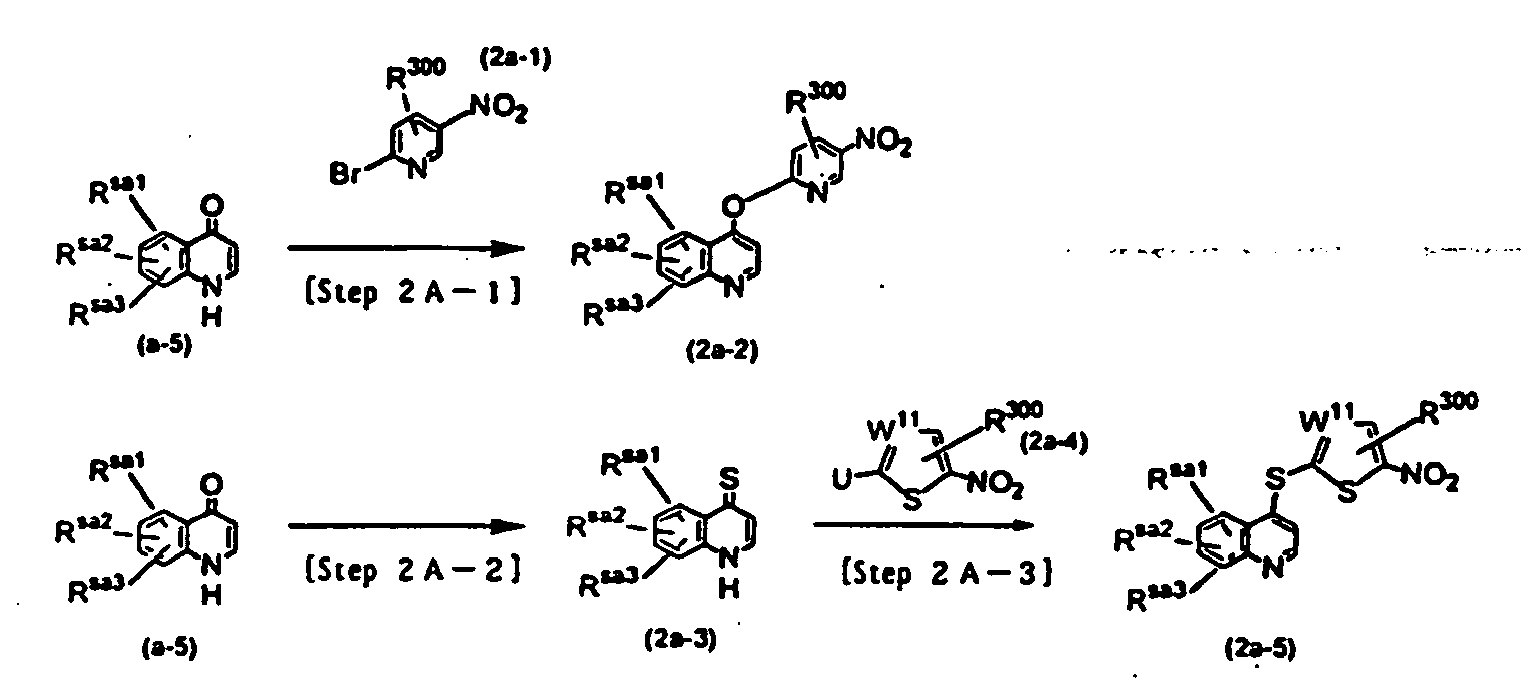
- Step of reacting a pyridine derivative (2a-1) with compound (a-5) to obtain compound (2a-2). The reaction may be conducted using a base such as potassium carbonate. The reaction solvent used may be dimethylformamide or the like, the reaction time from 10 minutes to 30 hours and the reaction temperature from room temperature to reflux temperature.
- Step of converting a quinolone (a-5) to a thioquinolone (2a-3). A sulfide reagent such as sodium sulfide, phosphorus pentasulfide or the like may be reacted with the quinolone (a-5) to obtain the corresponding thioquinolone. The reaction solvent used may be diglyme, the reaction temperature from room temperature to reflux temperature, and the reaction time from 10 minutes to 30 hours.
- Step of reacting the thioquinolone (2a-3) with compound (2a-4) to obtain compound (2a-5). The reaction solvent used may be dimethylformamide or the like, the reaction temperature from room temperature to reflux temperature, and the reaction time from 10 minutes to 30 hours. An appropriate base such as pyridine may also be used.

- Step of reacting a hydroxypyridine derivative (2a-6) with compound (a-4) to obtain compound (2a-7). The solvent used may be 1-methylpyrrolidone, dimethylformamide, chlorbenzene, or the like. The reaction may be conducted with addition of a suitable base, for example, an organic base such as diisopropylethylamine, or an inorganic base such as potassium carbonate. The reaction time may be from 10 minutes to 30 hours, and the reaction temperature from room temperature to reflux temperature.
- Step of palladium coupling reaction between compound (2a-7) and an imine derivative to obtain compound (2a-8). The reaction may be conducted using a solvent such as toluene, a catalyst, for example, a palladium derivative such as tris(dibenzylideneacetone)dipalladium(0) or a phosphine derivative such as 2,2'-bis(diphenylphosphino)-1,1'-binaphthyl), and a base such as t-butoxypotassium. The reaction temperature may be from about 50°C to reflux temperature, and the reaction time from about 1 hour to 10 hours.
- Step of obtaining an amino derivative (2a-9) from compound (2a-8). The reaction is conducted using ethanol, water or the like, with the action of an acid such as hydrochloric acid. The reaction temperature may be from 0°C to about 100°C, and the reaction time from 10 minutes to about 10 hours.
- Step of dechlorination of compound (2a-9) to obtain compound (2a-10). This may be accomplished by catalytic reduction or the like using palladium carbon-hydrogen. The reaction solvent may be methanol, ethanol, tetrahydrofuran, or the like, and catalytic reduction may be conducted at ordinary pressure or under pressurization. Triethylamine or the like may also be used as a base. The reaction time may be from 10 minutes to 30 hours and the reaction temperature from room temperature to reflux temperature.

- A step of converting a quinolone compound (a-3) into a 4-aminoalkoxyquinoline (2a-11). An N-alkylphthalimide derivative may be reacted with compound (a-3) and deprotection accomplished with hydrazine hydrate or the like to obtain the target compound (2a-11). The solvent used may be dimethylformamide, tetrahydrofuran or the like, the reaction temperature from room temperature to reflux temperature, and the reaction time from 10 minutes to 30 hours. Potassium carbonate or the like may also be used as the base.
- Alternative production method to compound (a-4):

- Step of obtaining an enamine (3a-1). Diethyl ethoxymethylenemalonate may be reacted with an aniline derivative (a-1) to obtain compound (3a-1). The reaction proceeds without a solvent. The reaction temperature may be about 100°C, and the reaction time from 30 minutes to several hours.
- Step of cyclization. Compound (3a-1) may be heated from about 200°C to about 260°C in a biphenyl ether/biphenyl mixed solvent for cyclization to obtain the target compound (3a-2). The reaction time may be from 30 minutes to 10 hours.
- Step of chlorination. The same procedure as in <Step A-3> may be carried out to obtain the chlorinated compound (3a-3) from compound (3a-2).
- Representative production method for compound (G3) represented by:


- Step of reacting compound (a-4) with an indole derivative (b-2) to obtain compound (b-1). The reaction may be conducted under the same conditions as for <Step A-4> above.
- Step of obtaining a urea derivative (b-3) from compound (b-1). The reagent used may be the aforementioned isocyanate derivative (a-82) or carbamate derivative (a-81). The reaction may be conducted under the same conditions as for <Step A-7>, <Step A-8> and <Step A-9> above.

- Step of introducing a substituent at the 3-position of the indole. Compound (b-4) may be reacted with a halogenating agent such as N-chlorosuccinimide or N-bromosuccinimide, or with phosphorus oxychloride or a thionyl chloride/dimethylformamide mixed reagent to obtain compound (b-5). The reaction solvent used may be 2-propanol, tetrahydrofuran, acetonitrile, dimethylformamide or the like, the reaction temperature from 0°C to reflux temperature, and the reaction time from 10 minutes to 30 hours.
- Representative production method for compound (G4-1) represented by:


- General formula (G4-1) may be synthesized according to the process described in
WO97/02266 PCT/EP96/02728 or Journal of Medicinal Chemistry, 1996, Vol.39, No.12, 2285-2292. - Step of synthesizing an imidate. Ethyl cyanoacetate may be reacted with hydrochloric acid in a solvent such as dioxane to obtain the target imidate compound (c-2). The reaction temperature is preferably from near 0°C to room temperature, and the reaction time may be from a few hours to several days.
- Step of synthesizing an amidine. Compound (c-2) may be reacted with ammonia gas in ethanol to obtain the target amidine compound (c-3). The reaction temperature may be from near 0°C to room temperature, and the reaction time may be several hours.
- Step of synthesizing a pyrrole derivative. Compound (c-3) may be reacted with an α-haloketone derivative (c-31) in ethanol to obtain the target pyrrole derivative (c-4). The reaction temperature may be from room temperature to reflux temperature, and the reaction time from a few hours to several days.
- Ring-closing reaction of pyrrole ring to pyrrolopyrimidine ring. Compound (c-4) may be reacted with formamide and formic acid to obtain the target compound (c-5). The solvent used may be dimethylformamide. The reaction temperature may be from near 100°C to reflux temperature, and the reaction time from a few hours to several days.
- Step of chlorination. The same procedure as in <Step A-3> may be carried out to obtain the target chlorinated compound (c-6).

- Reaction for introduction of substituent at 5-position of a pyrrole derivative (c-70). Compound (c-70) may be reacted with compound (c-71) in the presence of 2,6-lutidine, in darkness under a nitrogen atmosphere, to obtain the target compound (c-8). The reaction solvent used may be dichloromethane or the like, the reaction temperature from 0°C to room temperature, and the reaction time from 1 hour to 30 hours.
- The same procedure as in <Step C-4> may be carried out to obtain compound (c-9).
- The same procedure as in <Step A-3> may be carried out to obtain compound (c-10).
- Representative production method for compound (G4-2) represented by:


- Step of chlorination. Compound (2c-1) may be reacted with thionyl chloride to obtain the target compound (2c-2). The reaction solvent used may be thionyl chloride, the reaction temperature may be reflux temperature, and the reaction time from a few hours to several days.
- Rearrangement from carboxylic acid to a carbamate derivative (2c-3). The carboxylic acid derivative (2c-2) may be reacted with tert-butanol, benzyl alcohol, trimethylsilyl alcohol or the like in the presence of diphenylphosphoryl azide and triethylamine to obtain the target carbamate derivative (2c-3). The reaction solvent used may be tert-butanol, benzyl alcohol, dimethylformamide, toluene or the like, the reaction temperature from room temperature to reflux temperature, and the reaction time from 10 minutes to 30 hours.
- Iodination reaction. The target compound (2c-4) may be obtained by using a base to generate an anion at the 3-position of pyridine, reacting iodine therewith to obtain an iodinated compound, and then conducting decarbamating reaction. The reaction solvent for the iodination may be tetrahydrofuran, diethyl ether or the like, the reaction temperature from -78°C to room temperature, and the reaction time from 10 minutes to 30 hours. The base used may be n-butyllithium or the like, and a base such as N,N,N',N'-tetramethylethenediamine may also be added as appropriate. The reaction solvent used for the decarbamating reaction may be water, an alcohol or the like, as an acid there may be used aqueous hydrobromic acid, aqueous hydrochloric acid or the like, the reaction temperature may be from room temperature to reflux temperature, and the reaction time may be from 1 minute to several hours.
- The same procedure as in <Step A-4> may be carried out to obtain the target compound (2c-5).
- Coupling reaction between the iodo compound (2c-5) and an acetylene derivative. The iodo compound may be reacted with (trimethyl)acetylene in the presence of tetrakis(triphenylphosphine) palladium, copper (I) iodide or the like to obtain the target compound (2c-6). The reaction solvent used may be dimethylformamide or the like, the reaction temperature from room temperature to reflux temperature, and the reaction time from 10 minutes to 30 hours.
- Cyclization reaction. Compound (2c-6) may be heated in the presence of copper (I) iodide to obtain the target cyclized compound (2c-7). The reaction solvent used may be dimethylformamide or the like, the reaction temperature from 80°C to reflux temperature, and the reaction time from 5 minutes to 10 hours.
- Alternative production method to compound (2c-7) in Production Method 4-2:

- Conversion of ketone (2c-8) to thioketone (2c-90). Synthesis may be carried out by the same procedure as in <Step 2A-2).
- Synthesis may be carried out by the same procedure as in <Step 2A-3>.
- Representative production method for compound (G5-1) represented by:


- The same procedure as in <Step A-4> may be carried out to obtain the target compound (d-2).
- Step of amination of chloro group. The 2-chloropyrimidine derivative (d-2) may be reacted with ammonia to obtain the target amino compound (d-3). The reaction solvent used may be ethanol, tetrahydrofuran or the like, the reaction temperature from 0°C to reflux temperature, and the reaction time from 10 minutes to 30 hours.
- Reduction of nitro compound (d-3) to amino compound (d-4). The same procedure as in <Step A-5> may be carried out to obtain the target amino compound (d-4).
- The same procedure as in <Step A-7> may be carried out to obtain the target urea compound (d-5).

- The same procedure as in <Step A-4> may be carried out to obtain the target compound (d-8).
- Step of dechlorination and nitro group reduction. The target compound (d-9) may be obtained under common catalytic reduction conditions with palladium hydroxide-hydrogen or the like. The reaction solvent used may be methanol, ethanol, tetrahydrofuran, dimethylformamide or the like, and catalytic reduction may be conducted at ordinary pressure or under pressurization. The reaction time may be from 10 minutes to 30 hours and the reaction temperature from room temperature to reflux temperature.
- The same procedure as in <Step A-7> may be carried out to obtain the target urea compound (d-10).
- Representative production method for compound (G5-2) represented by:


- Decarbamating reaction. Compound (2d-1) may be reacted with an acid to obtain the target amine derivative (2d-2). The solvent used may be water, dioxane, tetrahydrofuran, methanol, ethanol or the like, the reaction temperature from room temperature to reflux temperature and the reaction time from 10 minutes to 30 hours. The acid used may be hydrochloric acid, hydrobromic acid, trifluoroacetic acid, or the like.
- Compound (2d-2) may be used in the same procedure from <Step D-6> to <Step D-8> of Production Method 5-1 to obtain a urea derivative (2d-3).
- Alternative production method for compounds (G6-1), (G6-2) and (G6-3) represented by:


- Coupling reaction between iodo compound and ethyl acrylate. Compound (e-1) may be reacted with ethyl acrylate in the presence of a catalyst such as palladium acetate and a tertiary amine such as tributylamine, to obtain the target compound (e-2). The reaction solvent used may be dimethylformamide or the like, the reaction temperature from 100°C to reflux temperature, and the reaction time from 5 minutes to 30 hours.
- Reduction of double bond, followed by cyclization and nitro group reduction. Compound (e-2) may be reacted in the presence of palladium carbon-hydrogen for reduction of the double bond, cyclization and nitro group reduction. The reaction solvent used may be methanol, ethanol, tetrahydrofuran, dimethylformaldehyde or the like, and catalytic reduction may be conducted at ordinary pressure or under pressurization. The reaction time may be from 10 minutes to 30 hours and the reaction temperature from room temperature to reflux temperature.
- Isomerization of double bond by light irradiation followed by cyclization. The reaction solvent used may be methanol or the like, with light irradiation performed in the presence of 2'-acetonaphthone to obtain the target compound (e-4). The reaction time may be from 10 minutes to 30 hours.

- Nitration reaction. Compound (2e-1) may be reacted with sulfuric acid and fuming nitric acid to obtain the target compound (2e-2). The reaction solvent used may be sulfuric acid, fuming nitric acid or the like, the reaction temperature from 0°C to room temperature, and the reaction time from 10 minutes to 30 hours.
- Rearrangement of nitro group. Compound (2e-2) may be reacted with sulfuric acid to obtain the target compound (2e-3). The reaction solvent used may be sulfuric acid or the like, the reaction temperature from 0°C to reflux temperature, and the reaction time from 10 minutes to 30 hours.
- The target nitro compound (2e-4) may be obtained by nucleophilic substitution of compound <2e-3> using any desired nitro group-containing nucleophilic agent and 1-methylpyrrolidone, dimethylformamide, chlorbenzene or the like as the reaction solvent. The reaction may be conducted with addition of an appropriate base, for example, an organic base such as diisopropylethylamine, or an inorganic base such as potassium carbonate. The reaction time may be from 10 minutes to 30 hours and the reaction temperature from room temperature to reflux temperature.
- Reduction of nitro group to amino group. The same procedure as in <Step A-5> may be carried out to obtain the target compound (2e-5).
- Condensation of a carboxylic acid and the diamine (2e-5). The diamine compound (2e-5) may be reacted with a carboxylic acid to obtain the target compound (2e-6). The reaction solvent used may be pyrophosphoric acid or the like, the reaction temperature from room temperature to reflux temperature, and the reaction time from 10 minutes to 30 hours. Polyphosphoric acid, phosphorus pentoxide or the like may be used as a dehydrating agent.

- This synthesis may be carried out according to the process described in Journal of Heterocyclic Chemistry, 35, 1313(1998). An α-haloketone derivative (3e-1) may be reacted with malononitrile to synthesize compound (3e-2). The reaction solvent used may be dimethylformamide or the like, the reaction temperature from 0°C to reflux temperature, and the reaction time from 30 minutes to about 30 hours. Diethylamine may be used as the base.
- Step of forming furopyrimidine ring. Compound (3e-2) may be heated at about 200°C in formamide with addition of acetic anhydride to obtain the target compound (3e-3). The reaction time may be about a few hours.
- Bromination reaction. Compound (3e-3) may be reacted with dibromomethane and isoamyl nitrite to obtain the target bromo compound (3e-4). The reaction solvent used may be dibromomethane, the reaction temperature from room temperature to reflux temperature, and the reaction time from 30 minutes to 30 hours.
- The same procedure as in <Step A-4> may be carried out to obtain compound (3e-5).

- The same procedure as in <Step A-1> may be carried out to obtain compound (3e-7).
- The same procedure as in <Step A-2> may be carried out to obtain compound (3e-8).
- The same procedure as in <Step A-3> may be carried out to obtain compound (3e-9).


- Representative production method for compound (II) represented by:

- (1) Compound (a-01) represented by the formula:

Compound (II) may be produced using compound (a-01) under the reaction conditions described in <Step A-4> to <Step A-11> in Production Method 2-1 above, the reaction conditions described in Production Method 2-2 above, the reaction conditions described in Production Method 2-3 above and the reaction conditions described in Production Method 3 above. - (2)

- The urea derivative (II) may be obtained using compound (a-03) or (a-04) with an appropriate combination of the conditions in <Step A-5> to <Step A-11> in Production Method 2-1. Specifically, compound (a-03) or (a-04) may be, for example, (2c-7), (2c-92), (e-4), (3e-5), (e-3) or (e-6).
- Representative synthesis method for compound represented by:


- Step of reductive amination. An aldehyde derivative may be reductively reacted with compound (o-1) to obtain the target compound (o-2). The reaction solvent used may be acetic acid, tetrahydrofuran, dichloroethane, dichloromethane, methanol or the like, the reaction temperature from 0°C to reflux temperature, and the reaction time from 30 minutes to 30 hours. The reducing agent used may be sodium triacetoxyborohydride, sodium borohydride, or the like.
- Carbamating step. Compound (o-2) may be reacted with a chloroformate derivative to obtain the target compound (o-3). The reaction solvent used may be tetrahydrofuran, dichloromethane or the like, the reaction temperature from 0°C to reflux temperature, and the reaction time from 30 minutes to 30 hours. Pyridine, triethylamine or the like may be used as the base.
- Step of reducing nitro group to amino group. The same procedure as in <Step A-5> may be carried out to obtain compound (o-4).
- Intramolecular cyclization step. The target compound (o-5) may be obtained by reacting the amino group and carbamate group in the molecule. The reaction solvent used may be tetrahydrofuran, dimethylformamide, dimethylsulfoxide, acetonitrile or the like, the reaction temperature from 0°C to reflux temperature, and the reaction time from 30 minutes to 30 hours. Sodium hydride, pyridine, triethylamine or the like may be used as the base.
- Alternative production method for compound (o-5).

- Step of reducing nitro group to amino group. The same procedure as in <Step A-5> may be carried out to obtain the target diamine compound (o-6).
- Intramolecular cyclization step. The target compound (o-5) may be obtained by condensing the two amino groups in the molecule using phosgene, triphosgene, 1-ethyl-3-(3-dimethylaminopropyl) carbodiimide hydrochloride, (1H-1,2,3-benzotriazol-1-yloxy)(tri(dimethylamino))phosphonium hexafluorophosphate, 1-ethyl-3-(3-dimethylaminopropyl)carbodiimide hydrochloride, 1,1-carbonyldiimidazole or the like as the condensing agent. The reaction solvent used may be tetrahydrofuran, dimethylformamide, dimethylsulfoxide, acetonitrile or the like, the reaction temperature from 0°C to reflux temperature, and the reaction time from 30 minutes to 30 hours. Sodium hydride, pyridine, triethylamine or the like may be appropriately used as the base.
- Conversion of substituent on ring A of compound (II) represented by
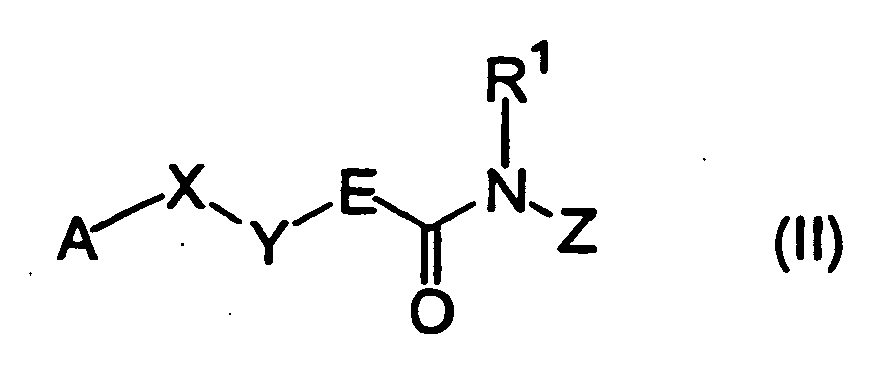
- This may be accomplished by appropriately employing common organic reactions such as oxidation, reduction, esterification, amidation, protection, deprotection, hydrolysis, dehydration, rearrangement, nucleophilic reaction, nucleophilic substitution or aromatic electrophilic substitution.
- Specifically, the substituent conversion on ring A may be carried out by the methods shown below, for example. In addition, (1) the following reactions may be appropriately combined, (2) their products may be used as intermediates as well as final products, and (3) the reactions may be used not only for conversion of substituents directly bonded to ring A, but also for conversion of substituents at positions not directly bonded to but within substituents on ring A.
-

- Reduction of ester compound (h-1) to alcohol compound (h-2). The reducing agent used may be lithium borohydride, lithium aluminum hydride or the like, the reaction solvent diethyl ether, tetrahydrofuran or the like, the reaction temperature from 0°C to reflux temperature and the reaction time from 10 minutes to 30 hours.
- Oxidation of alcohol compound (h-2) to aldehyde compound (h-3). The oxidizing agent used may be manganese dioxide, pyridium chlorochromate (PCC), pyridium dichromate (PDC) or the like, the reaction solvent chloroform, dichloromethane, toluene or the like, the reaction temperature from 0°C to reflux temperature and the reaction time from 30 minutes to 30 hours.
- Reductive amination reaction. Compound (h-4) may be obtained by reaction of an amino derivative with the aldehyde derivative (h-3) to form an imine, followed by reduction with sodium cyanoborohydride or the like. The reaction solvent used may be methanol, tetrahydrofuran or the like, the reaction time from 10 minutes to 30 hours and the reaction temperature from 0°C to reflux temperature.

- Reduction of an ester compound (h-5) to an alcohol compound (h-6). The same procedure as in <Step H-1> may be carried out to synthesize the target compound (h-6).
- Oxidation of alcohol compound (h-6) to an aldehyde compound (h-7). The same procedure as in <Step H-2> may be carried out to synthesize the target compound (h-7).
- Reductive amination reaction. The same procedure as in <Step H-3> may be carried out to obtain the target compound (h-8) from compound (h-7).

- Reduction of cyano group to aminomethyl group. The target compound (h-10) may be obtained from compound (h-9) by common catalytic reduction (palladium-carbon, palladium hydroxide-hydrogen or the like). The reaction solvent used may be tetrahydrofuran, methanol, ethanol or the like. The reaction time may be from 10 minutes to 30 hours, and the reaction temperature from 0°C to reflux temperature. Trifluoroacetic acid, hydrochloric acid or the like may be added as an acid.
-

- Step of hydrolyzing ester in compound (2h-1) to obtain compound (2h-2). A base such as potassium hydroxide, sodium hydroxide, calcium carbonate, sodium carbonate or the like may be used for the reaction. The reaction time may be from 10 minutes to 30 hours, and the reaction temperature from 0°C to reflux temperature. The solvent used may be water, tetrahydrofuran or the like.
- Synthesis of amide derivative (2h-3) by condensation of carboxylic acid and amine derivative. Compound (2h-3) may be obtained by reacting compound (2h-2) and an amine derivative in the presence of a condensing agent. As condensing agents there may be used 1-ethyl-3-(3-dimethylaminopropyl) carbodiimide hydrochloride, (1H-1,2,3-benzotriazol-1-yloxy)(tri(dimethylamino))phosphonium hexafluorophosphate, or the like. The reaction time may be from 10 minutes to 30 hours, and the reaction temperature from 0°C to reflux temperature. The solvent used may be dimethylformamide, tetrahydrofuran, or the like.
- Synthesis of ester (2h-4) by condensation of carboxylic acid and an alcohol. Compound (2h-3) may be obtained by reaction of compound (2h-2) and an alcohol derivative in the presence of a condensing agent. As the condensing agent there may be used 1-ethyl-3-(3-dimethylaminopropyl) carbodiimide hydrochloride, or the like. The reaction time may be from 10 minutes to 30 hours, and the reaction temperature from 0°C to reflux temperature. The solvent used may be dimethylformamide, tetrahydrofuran, or the like.

- Step of obtaining compound (2h-6) by hydrolysis of ester in compound (2h-5). The same procedure as in <Step 2H-1> may be carried out to synthesize compound (2h-6) from compound (2h-5).
- Synthesis of amide derivative (2h-7) by condensation of carboxylic acid derivative (2h-6) and amino derivative. The same procedure as in <Step 2H-2> may be carried out to synthesize compound (2h-7) from compound (2h-6).

- Step of obtaining nitrile derivative (2h-9) by dehydration of carbamoyl compound (2h-8). The reaction solvent used may be tetrahydrofuran, diethyl ether or the like, the dehydrating agent used may be thionyl chloride, trifluoroacetic anhydride, dicyclohexyl carbodiimide or the like, and the base used may be pyridine, triethylamine or the like. The reaction temperature may be from 0°C to reflux temperature, and the reaction time from 30 minutes to 30 hours.
-

- Step of acylating amino group. Compound (3h-1) may be reacted with an acid chloride, acid anhydride or the like to obtain the target compound (3h-2). The reaction solvent used may be tetrahydrofuran or the like, the reaction temperature from 0°C to reflux temperature, and the reaction time from 10 minutes to 30 hours. Triethylamine or the like may be used as the base.


- Acylation step. Compound (3h-3) may be reacted with an acid chloride, acid anhydride or the like to obtain the target compound (3h-4). The reaction solvent used may be tetrahydrofuran, pyridine or the like, the reaction temperature from 0°C to reflux temperature, and the reaction time from 10 minutes to 30 hours. Triethylamine, pyridine or the like may be used as the base.
- Cyclization reaction. The reaction solvent used may be dimethylformamide or the like, the reaction temperature from 100°C to reflux temperature, and the reaction time from 10 minutes to 30 hours. Potassium carbonate or the like may be used as the base.

- Sulfonamidation step. Compound (3h-5) may be reacted with a sulfonyl chloride derivative to obtain the target compound (3h-6). The reaction solvent used may be tetrahydrofuran, dimethylformamide or the like, the reaction temperature from 0°C to reflux temperature, and the reaction time from 10 minutes to 30 hours. Triethylamine, pyridine or the like may be used as the base.

- De-benzyloxycarbonylation step. Compound (3h-8) may be obtained from compound (3h-7) by ordinary catalytic reduction (palladium-carbon, palladium hydroxide-carbon and hydrogen, etc.). The solvent used may be tetrahydrofuran, methanol, ethanol or the like. The reaction time may be from 10 minutes to 30 hours and the reaction temperature from 0°C to reflux temperature. Trifluoroacetic acid, hydrochloric acid or the like may be added as an acid.
-

- Rearrangement of carboxylic acid to amino derivative (i-2). A carboxylic acid derivative (i-1) may be reacted with benzyl alcohol in the presence of diphenylphosphoryl azide and triethylamine to obtain compound (i-2) from compound (i-1). The reaction solvent used may be benzyl alcohol, dimethylformamide, toluene or the like, the reaction temperature from room temperature to reflux temperature, and the reaction time from 10 minutes to 30 hours.
- The same procedure as in <Step A-4>, <Step A-5> and <Step A-7> may be carried out to synthesize compound (i-3) from compound (i-2).

- Step of rearrangement of carbamoyl group to amino group. An amino compound (i-5) may be obtained from compound (i-4) by reaction with a base such as bromine water, sodium hydroxide or the like. The reaction solvent used maybe water or the like, the reaction temperature from room temperature to reflux temperature, and the reaction time from 10 minutes to 10 hours.
-

- Conversion of methylthio group to methylsulfone group. Compound (m-1) may be reacted with a peracid to obtain the target compound (m-2). The peracid used may be 3-chloroperbenzoic acid, the reaction solvent methylene chloride, chloroform or the like, the reaction time from 10 minutes to 30 hours and the reaction temperature from 0°C to room temperature.
-

- Step of introducing substituent into aromatic ring by electrophilic reaction. An electrophilic reagent may be reacted with compound (2m-1) to obtain compound (2m-2) The electrophilic reagent used for the reaction may be, as specific examples, Vilsmeier reagent (which may be prepared from dimethylformamide or N-methylformanilide and phosphorus oxychloride), N-chlorosuccinimide, N-bromosuccinimide, a combination of acyl chloride and a Lewis acid (for example, aluminum chloride, titanium tetrachloride, etc.) or a reagent represented by the formula

-

- Step of deprotection of hydroxyl-protecting group of compound (q-1). The reaction may be conducted in the same manner as the conventional method for deprotection of a phenol group protected with a benzyl group. Specifically, the reagent used may be, for example, trifluoroacetic acid-thioanisole, palladium hydroxide-hydrogen, platinum oxide-hydrogen, or the like. The reaction solvent used may be trifluoroacetic acid, dimethylformamide or the like, the reaction time from 10 minutes to 30 hours and the reaction temperature from room temperature to reflux temperature.

- Step of deprotection of hydroxyl-protecting group of compound (q-3). The reaction may be conducted under the same conditions as in <Step Q-1> above.
-

- Step of reacting compound (r-1) with an electrophilic reagent such as an alkyl halide derivative (r-2) to obtain compound (r-3). The reaction solvent used may be dimethylformamide, dimethylsulfoxide, tetrahydrofuran or the like, the reaction time from 10 minutes to 30 hours, and the reaction temperature from 0°C to reflux temperature. The reaction may also employ a base, and specifically, for example, potassium carbonate, cesium carbonate or the like.
- As specific examples for the alkyl halide derivative (Rsa71-U) in the reaction there may be mentioned (1) alkylthio halide derivatives represented by the formula: Rsa80S-(CH2)s-Cl (wherein s is an integer of 1-6, and the other symbols have the same definitions given above), (2) alkyl halide derivatives represented by the formula: Br-(CH2)s-Cl (wherein s is an integer of 1-6), (3) propylene oxide derivatives represented by the formula:
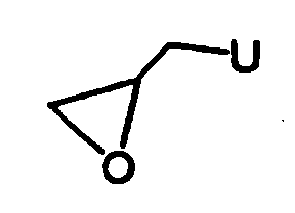


- Step of reaction with a phenol derivative (r-4) to introduce the substituent Rsa71. The substituent Rsa71 may be introduced by the same procedure as in <Step R-1>.

- Step of triflating the hydroxyl group. Compound (r-6) may be reacted with a triflating reagent such as paranitrophenyl triflate or the like to obtain the target compound (r-7). The reaction solvent used may be dimethylformamide or the like, the reaction temperature from 0°C to reflux temperature and the reaction time from 10 minutes to 30 hours. Potassium carbonate or the like may be used as a base.
- Step of converting the triflate group to a cyano group. Compound (r-7) may be reacted with a cyanating reagent such as zinc cyanide (Zn(CN)2) or the like to obtain the target compound (r-8). The catalyst used may be tetrakistriphenylphosphine palladium. The reaction solvent used may be dimethylformamide, the reaction temperature from room temperature to reflux temperature, and the reaction time from 10 minutes to 30 hours.
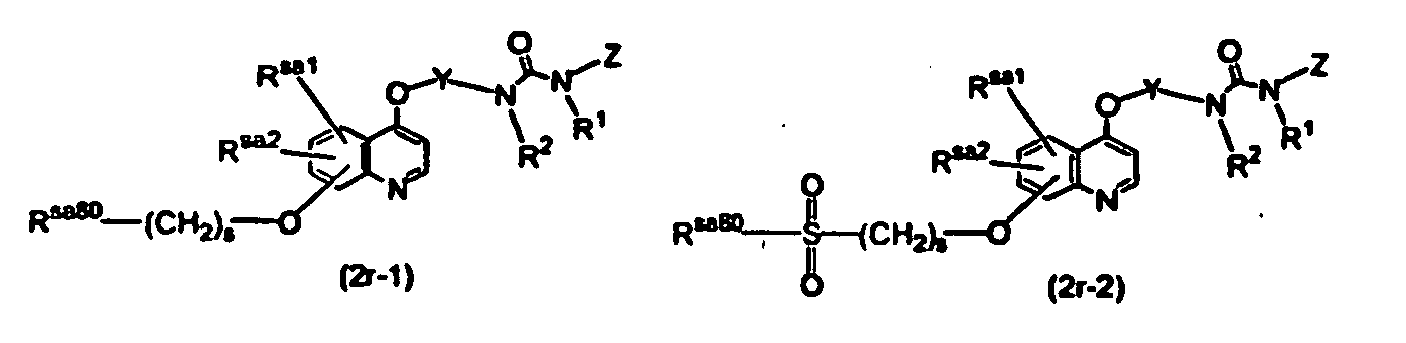

- Step of reacting compound (r-3) which has a thioether group in substituent Rsa71, with an oxidizing agent such as 3-chloroperbenzoic acid to obtain compound (2r-2). The reaction solvent used may be methylene chloride, chloroform or the like, the reaction time from 10 minutes to 30 hours and the reaction temperature from 0°C to room temperature.
- Step of reacting a nucleophilic agent with compound (r-3) having a leaving group, for example, a halogen atom such as chlorine, bromine or iodine or a methanesulfonyloxy group, or an epoxide group or the like in substituent Rsa71, to obtain compound (2r-1) or compound (2r-4). Specific examples of nucleophilic agents which may be used include nitrogen-containing aromatic derivatives such as triazole or imidazole, amine derivatives such as morpholine or pyrrolidine, and alcohol derivatives, phenol derivatives, thiol derivatives and the like.
- The reaction solvent used may be dimethylformamide, tetrahydrofuran, or the like, the reaction time from 10 minutes to 30 hours and the reaction temperature from 0°C to reflux temperature, and potassium carbonate, sodium hydride or the like may be used as a base.
-

- Compound (r-90) or compound (r-91) wherein the amino group protected with a protecting group may be subjected to amino-deprotection reaction, and the deprotected amino group then alkylated.
- (1) Amino-deprotecting step. The deprotecting reagent used may be trifluoroacetic acid, hydrochloric acid or the like. When the protecting group is benzyl, the deprotecting reaction may be conducted by common catalytic reduction (palladium hydroxide-hydrogen or the like). The solvent used may be trifluoroacetic acid, methanol, ethanol or the like. The reaction time may be from 10 minutes to 30 hours and the reaction temperature from 0°C to reflux temperature.
- (2) Step of alkylating deprotected amino group. The deprotected amino derivative may be reacted with an aldehyde derivative or ketone derivative to form an imine, which is then reduced with a reducing agent such as sodium cyanoborohydride to obtain compound (2r-3). The reaction solvent used may be methanol, tetrahydrofuran or the like, the reaction time from 10 minutes to 30 hours, and the reaction temperature from 0°C to reflux temperature.
- Alternative synthesis method for compound represented by:

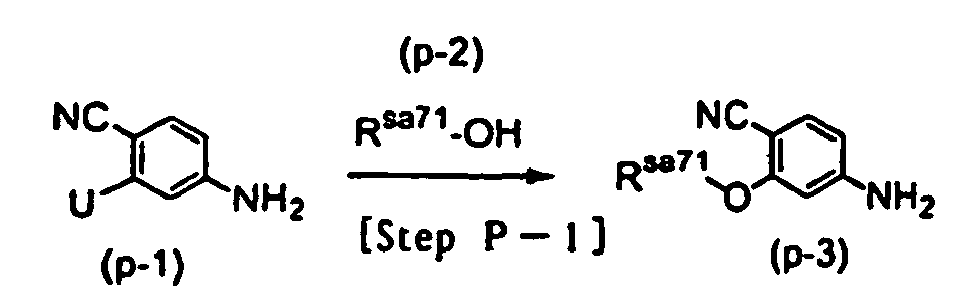
- Compound (p-1) may be reacted with an alcohol derivative (p-2) in the presence of a base such as sodium hydride to obtain compound (p-3). The synthesis may be carried out by reaction in a solvent such as 1-methylpyrrolidone or N,N-dimethylformamide. The reaction time may be from 10 minutes to 30 hours, and the reaction temperature from 0°C to reflux temperature.
- Alternative synthesis method for compound represented by:


- Reaction for obtaining carbamate derivative. It may be obtained by reacting an amino derivative with phenyl chloroformate. The reaction solvent used may be tetrahydrofuran, dimethylformamide or the like, the reaction temperature from 0°C to reflux temperature, and the reaction time from 30 minutes to 30 hours.
- The reaction is carried out while appropriately protecting the reactive functional groups such as amino, hydroxyl and carboxyl.
- As amino-protecting groups there may be used any groups conventionally known as protecting groups for amino groups in organic synthesis, with no particular restrictions, and as specific examples there may be mentioned substituted or unsubstituted lower alkanoyl groups such as formyl, acetyl, chloroacetyl, dichloroacetyl, propionyl, phenylacetyl, phenoxyacetyl and thienylacetyl; substituted or unsubstituted lower alkoxycarbonyl groups such as benzyloxycarbonyl, t-butoxycarbonyl and p-nitrobenzyloxycarbonyl; substituted lower alkyl groups such as methyl, t-butyl, 2,2,2-trichloroethyl, trityl, p-methoxybenzyl, p-nitrobenzyl, diphenylmethyl and pivaloyloxymethyl; substituted silyl groups such as trimethylsilyl and t-butyldimethylsilyl; substituted silylalkoxyalkyl groups such as trimethylsilylmethoxymethyl, trimethylsilylethoxymethyl, t-butyldimethylsilylmethoxymethyl and t-butyldimethylsilylethoxymethyl; or substituted or unsubstituted benzylidene groups such as benzylidene, salicylidene, p-nitrobenzylidene, m-chlorbenzylidene, 3,5-di(t-butyl)-4-hydroxybenzylidene and 3,5-di(t-butyl)benzylidene.
- These protecting groups may be removed by ordinary methods such as hydrolysis or reduction, depending on the type of protecting group used.
- As hydroxyl-protecting groups there may be used any groups conventionally known as protecting groups for hydroxyl groups in organic synthesis, with no particular restrictions, and as specific examples there may be mentioned lower alkylsilyl groups such as trimethylsilyl and t-butyldimethylsilyl; lower alkoxymethyl groups such as methoxymethyl and 2-methoxyethoxymethyl; tetrahydropyranyl; aralkyl groups such as benzyl, p-methoxybenzyl, 2,4-dimethoxybenzyl, o-nitrobenzyl, p-nitrobenzyl and trityl; acyl groups such as formyl and acetyl; lower alkoxycarbonyl groups such as t-butoxycarbonyl, 2-iodoethoxycarbonyl and 2,2,2-trichloroethoxycarbonyl; alkenyloxycarbonyl groups such as 2-propenyloxycarbonyl, 2-chloro-2-propenyloxycarbonyl, 3-methoxycarbonyl-2-propenyloxycarbonyl, 2-methyl-2-propenyloxycarbonyl, 2-butenyloxycarbonyl and cinnamyloxycarbonyl; and aralkyloxycarbonyl groups such as benzyloxycarbonyl, p-methoxybenzyloxycarbonyl, o-nitrobenzyloxycarbonyl and p-nitrobenzyloxycarbonyl.
- These protecting groups may be removed by ordinary methods such as hydrolysis or reduction, depending on the type of protecting group used.
- As carboxyl-protecting groups there may be used any groups conventionally known as protecting groups for carboxyl groups in organic synthesis, with no particular restrictions, and as specific examples there may be mentioned linear or branched lower alkyl groups of 1-4 carbons such as methyl, ethyl, isopropyl and t-butyl; halogeno lower alkyl groups such as 2-iodoethyl and 2,2,2-trichloroethyl; lower alkoxymethyl groups such as methoxymethyl, ethoxymethyl and isobutoxymethyl; lower aliphatic acyloxymethyl groups such as butyryloxymethyl and pivaloyloxymethyl; 1-lower alkoxycarbonyloxyethyl groups such as 1-methoxycarbonyloxyethyl and 1-ethoxycarbonyloxyethyl, aralkyl groups such as benzyl, p-methoxybenzyl, o-nitrobenzyl and p-nitrobenzyl; benzhydryl, phthalidyl, and the like.
- These protecting groups may be removed by ordinary methods such as hydrolysis or reduction, depending on the type of protecting group used.
- There are no particular restrictions on esters of the carboxyl groups so long as they are ones commonly used in organic synthesis, and they include physiologically acceptable esters which are hydrolyzed under physiological conditions. As specific examples there may be mentioned alkyl groups of 1 to 6 carbons, aryl groups of 6 to 12 carbons, aralkyl groups of 7 to 20 carbons such as benzyl, heteroarylalkyl groups of 7 to 20 carbons, 4-methoxybenzyl, alkanoyloxyalkyl groups such as acetoxymethyl, propionyloxymethyl or pivaloxymethyl, alkoxycarbonyloxyalkyl groups such as methoxycarbonyloxymethyl ethoxycarbonyloxymethyl or 2-methoxycarbonyloxyethyl, (5-methyl-2-oxo-1,3-dioxo-4-yl)-methyl, and the like.
- The solvents to be used for the invention are not particularly restricted so long as they do not impede the reaction and are solvents commonly used in organic synthesis, and as examples there may be mentioned lower alcohols such as methanol, ethanol, propanol and butanol, polyalcohols such as ethyleneglycol and glycerin, ketones such as acetone, methylethyl ketone, diethyl ketone and cyclohexanone, ethers such as diethyl ether, isopropyl ether, tetrahydrofuran, dioxane, 2-methoxyethanol and 1,2-dimethoxyethane, nitriles such as acetonitrile and propionitrile, esters such as methyl acetate, ethyl acetate, isopropyl acetate, butyl acetate and diethyl phthalate, halogenated hydrocarbons such as dichloromethane, chloroform, carbon tetrachloride, 1,2-dichloroethane, trichloroethylene and tetrachloroethylene, aromatic compounds such as benzene, toluene, xylene, monochlorbenzene, nitrobenzene, indene, pyridine, quinoline, collidine and phenol, hydrocarbons such as pentane, cyclohexane, hexane, heptane, octane, isooctane, petroleum benzine and petroleum ether, amines such as ethanolamine, diethylamine, triethylamine, pyrrolidine, piperidine, piperazine, morpholine, aniline, dimethylaniline, benzylamine and toluidine, amides such as formamide, N-methylpyrrolidone, N,N-dimethylimidazolone, N,N-dimethylacetamide and N,N-dimethylformamide, phosphoric/phosphorous amides such as hexamethylphosphosphoric triamide and hexamethylphosphorous triamide, and water, as well as other commonly used solvents, either alone or in mixtures of two or more, with no particular restrictions on the solvent ratio.
- There are no particular restrictions on bases uses so long as they are commonly known as bases for organic synthesis, and as specific examples there may be mentioned sodium carbonate, sodium bicarbonate, potassium carbonate, sodium hydride, potassium hydride, t-butoxypotassium, pyridine, dimethylaminopyridine, trimethylamine, triethylamine, N,N-diisopropylethylamine, N-methylmorpholine, N-methylpyrrolidine, N-methylpiperidine, N,N-dimethylaniline, 1,8-diazabicyclo[5,4,0]undeca-7-ene (DBU), pyridine, 4-dimethylaminopyridine, picoline, lutidine, quinoline, isoquinoline, sodium hydroxide, potassium hydroxide, lithium hydroxide, butyllithium, and sodium or potassium alcoholates such as sodium methylate, potassium methylate and sodium ethylate.
- As specific examples of halogenating agents to be used there may be mentioned halogenating agents conventionally used for synthesis of acid halides, for example, phosgene, diphosgene (phosgene dimer), triphosgene (phosgene trimer), thionyl chloride, thionyl bromide, phosphorus trichloride, phosphorus tribromide, phosphorus oxychloride, phosphorus pentachloride, trichloromethyl chloroformate and oxalyl chloride, as well as Vilsmeier reagents obtained by reacting these halogenating agents with acid amides or phosphoric amides.
- There are no particular restrictions on reducing agents so long as they are ones commonly used in organic synthesis, and as examples there may be mentioned contact hydrogenating catalysts such as NaBH4, LiBH4, Zn(BH4)2, Me4NBH(OAc)3, NaBH3CN, Selectride, Super Hydride (LiBHEt3), LiAlH4, DIBAL, LiAlH (t-BuO)3, Red-al and binap, as well as platinum, palladium, rhodium, ruthenium, nickel, and the like.
- After completion of the reaction, purification may be accomplished by any desired ordinary treatment method, such as column chromatography using silica gel or an adsorption resin, or recrystallization from a suitable solvent.
- Throughout the present specification, the term "pharmacologically acceptable salt" is not particularly restrictive on the type of salt, and as examples of such salts there may be mentioned inorganic acid addition salts such as hydrochloric acid salts, sulfuric acid salts, carbonic acid salts, bicarnobate salts, hydrobromic acid salts and hydriodic acid salts; organic carboxylic acid addition salts such as acetic acid salts, maleic acid salts, lactic acid salts, tartaric acid salts and trifluoroacetic acid salts; organic sulfonic acid addition salts such as methanesulfonic acid salts, hydroxymethanesulfonic acid salts, hydroxyethanesulfonic acid salts, benzenesulfonic acid salts, toluenesulfonic acid salts and taurine salts; amine addition salts such as trimethylamine salts, triethylamine salts, pyridine salts, procaine salts, picoline salts, dicyclohexylamine salts, N,N'-dibenzylethylenediamine salts, N-methylglucamine salts, diethanolamine salts, triethanolamine salts, tris(hydroxymethylamino)methane salts and phenethylbenzylamine salts; and amino acid addition salts such as arginine salts, lysine salts, serine salts, glycine salts, aspartic acid salts and glutamic acid salts.
- The dosage of a medicine according to the invention will differ depending on the severity of symptoms, patient age, gender and weight, administration form and type of disease, but administration may usually be from 100 µg to 10 g per day for adults, either at once or in divided doses.
- There are no particular restrictions on the form of administration of a medicine according to the invention, and it may usually be administered orally or parenterally by conventional methods.
- Common excipients, binders, glossy agents, coloring agents, taste correctors and the like, and if necessary stabilizers, emulsifiers, absorption promoters, surfactants and the like, may also be used for formulation, with inclusion of components ordinarily used as starting materials for formulation of pharmaceutical preparations by common methods.
- Examples of such components which may be used include animal and vegetable oils (soybean oil, beef tallow, synthetic glycerides, etc.), hydrocarbons (liquid paraffin, squalane, solid paraffin, etc.), ester oils (octyldodecyl myristate, isopropyl myristate, etc.), higher alcohols (cetostearyl alcohol, behenyl alcohol, etc.), silicone resins, silicone oils, surfactants (polyoxyethylene fatty acid esters, sorbitan fatty acid esters, glycerin fatty acid esters, polyoxyethylenesorbitan fatty acid esters, polyoxyethylene hydrogenated castor oil, polyoxyethylenepolyoxypropylene block copolymer, etc.), water-soluble polymers (hydroxyethyl cellulose, polyacrylic acid, carboxyvinyl polymer, polyethyleneglycol, polyvinylpyrrolidone, methyl cellulose, etc.), alcohols (ethanol, isopropanol, etc.), polyhydric alcohols (glycerin, propyleneglycol, dipropyleneglycol, sorbitol, etc.), sugars (glucose, sucrose, etc.), inorganic powders (silicic anhydride, aluminium magnesium silicate, aluminium silicate, etc.), purified water and the like. For pH adjustment there may be used inorganic acids (hydrochloric acid, phosphoric acid, etc.), alkali metal salts of inorganic acids (sodium phosphate, etc.), inorganic bases (sodium hydroxide, etc.), organic acids (lower fatty acids, citric acid, lactic acid, etc.), alkali metal salts of organic acids (sodium citrate, sodium lactate, etc.), and organic bases (arginine, ethanolamine, etc.). If necessary, preservatives, antioxidants and the like may also be added.
- The compounds of the invention exhibit powerful in vitro inhibition of 1) invasive tube formation by vascular endothelial cells induced by a combination of angiogenic factors, 2) tube formation by vascular endothelial cells specifically induced by single angiogenic factors, and 3) receptor kinases for various angiogenic factors. Among these compound groups having such activity there were also found compounds that inhibit proliferation of cancer cells. Invasion and tube formation by endothelial cells are an important process in angiogenesis, and therefore compounds with inhibiting action against them exhibit angiogenesis-inhibiting effects. In addition, angiogenesis in the body is known to depend not on a single angiogenic factor but rather on the additive and synergistic effect of multiple angiogenic factors ((1) Koolwijk P, van Erck MGM, de Vree WJA, Vermeer MA, Weich HA, Hane maaijer R, van Hinsbergh VWM. Cooperative effect of TNF-alpha, bFGF and VEGF on the formation of tubular structures of human microvascular endothelial cells in a fibrin matrix. Role of urokinase activity. J. Cell Biol. 1996, 132, P1177-1188.; (2) Tallquist MD, Soriano P, Klinghoffer RA. Growth factor signaling pathways in vascular development. Oncogene 1999, 18, P7917-7932.). Thus, the compounds of the invention which inhibit tube formation induced by multiple angiogenic factors produced by cancer cells and the like are expected to exhibit powerful angiogenesis inhibition in vivo, and should be highly useful as angiogenesis inhibitors.
- The biochemical activity of the compounds of the invention and their function and effect as medicines (angiogenesis-inhibiting activity, antitumor activity, etc.) may be evaluated by the methods described below.
- The following is a list of abbreviations used in the pharmacological test examples described below.
-
- DNA: Deoxyribonucleic Acid
- VEGFR2: Vascular Endothelial Growth Factor Receptor 2 human placenta: human placenta
- Hepes: N-[2-Hydroxyethyl]piperazine-N'-[2-ethanesulfoni c acid]
- MgCl2: Magnesium chloride
- MnCl2: Manganese chloride
- Na3VO4: Sodium Orthovanadate (V)
- ATP: Adenosine 5'-Triphosphate
- EDTA: Ethylenediaminetetraacetic acid
- HTRF: Homogenous Time-Resolved Fluorescence
- FGFR1: Fibroblast Growth Factor Receptor 1
- PDGFRβ: Platelet-Derived Growth Factor Receptor β
- HGFR: Hepatocyte Growth Factor Receptor
- EGFR: Epidermal Growth Factor Receptor
- Tris: Tris(hydroxymethyl)aminomethane
- NaCl: Sodium chloride
- BSA: Bovine Serum Albumin
- HRP: Horseradish peroxidase
- EGTA: N,N,N',N'-Tetraacetic acid
- SDS: Sodium Dodecyl Sulfate
- NP-40: Nonidet P-40
- PCR: Polymerase Chain Reaction
- RT-PCR: Reverse Transcription-Polymerase Chain Reaction
- RNA: Ribonucleic Acid
- cDNA: complementary DNA
- cRNA: complementary RNA
- dNTP: dATP, dCTP, dGTP, dTTP
- UTP: Uridine 5'-Triphosphate
- CTP: Cytidine 5'-Triphosphate
- dATP: 2'-Deoxyadenosine 5'-Triphosphate
- dCTP: 2'-Deoxycytidine 5'-Triphosphate
- dGTP: 2'-Deoxyguanosine 5'-Triphosphate
- dUTP: 2'-Deoxyuridine 5'-Triphosphate
- GAPDH: Glyceraldehyde 3-Phosphate Dehydrogenease
- FBS: Fetal Bovine Serum
- PBS: Phosphate Buffered Saline
- MTT: (3-[4,5-Dimethlythiazol-2-yl]-2,5-diphenyltetrazoli
- um bromide; Thiazolyl blue
- DMSO: Dimethyl Sulfoxide
- PDGF: Platelet-Derived Growth Factor
- EGF: Epidermal Growth Factor
- FGF2: Fibroblast Growth Factor 2
- VEGF: Vascular Endothelial Growth Factor
- HGF: Hepatocyte Growth Factor
- TNF-α: Tumor Necrosis Factor alpha
- FCS: Fetal Bovine Serum (Fetal Calf Serum)
- EGM-2: Endothelial cell Growth Medium-2
- Human Umbilical Vein Endothelial Cells (HUVECs) were isolated according to a reported method (Shinseikagaku Jikken Koza [New Biochemistry Experiment Lectures], "Saibo Baiyo Gijutsu" [Cell Culturing Techniques], p.197-202), and were cultured in a 5% CO2 incubator (37°C) using EGM-2 medium (purchased from Clonetics Corp.) until the cells reached confluency. After adding 0.4 ml of bovine fibrinogen (purchased from Sigma Co.) to the inner well of a Transwell culturing plate (purchased from Coster Inc.), it was hardened with 0.7 units/ml of thrombin (purchased from Sigma Co.). The HUVECs were recovered using trypsin-EDTA and then suspended in human endothelial serum free medium basal growth medium (hereinafter abbreviated as SFM, purchased from GIBCO BRL), and 0.4 ml of the cell suspension (1.4 x 10⁵ cells) was seeded onto the hardened fibrin gel and cultured for approximately 4 hours in a 5% CO2 incubator (37°C). After 4 hours, there was added to the outer chamber of the Transwell 1.5 ml of an SFM solution containing a mixture of angiogenic factors {10 ng/ml EGF (purchased from GIBCO BRL), 30 ng/ml FGF2 (purchased from GIBCO BRL), 75 ng/ml VEGF (purchased from Wako Pure Chemical Industries Co., Ltd.), 50 ng/ml HGF (purchased from R&D Co.) and 7.5 ng/ml TNF-α (purchased from Genzyme Corp.) [The concentrations of the angiogenic factors differed slightly according to the HUVEC lot.]} and a diluted test substance, and culturing was carried out in a 5% CO2 incubator (37°C). On the 2nd and 4th days after adding the test substance, the medium was exchanged with 1.5 ml of freshly prepared SFM solution containing the angiogenic factor mixture and test substance. Upon aspirating off the culture supernatant in the inner well on the 6th day after the initial addition of the test substance, 0.4 ml of a 3.3 mg/ml MTT solution dissolved in PBS (purchased from Sigma Corp.) was added and culturing was performed for approximately 1 hour in a 5% CO2 incubator (37°C). The number of tubes formed in the fibrin gel stained with MTT was scored based on microscope observation. Specifically, the number of tubes formed in the absence of the test substance was designated as +++, while - was assigned if absolutely no tubes formed. The number of tubes formed in the presence of the test substance was scored on the 5-level scale of +++, ++, +, +/-, - to evaluate the strength of inhibition of the test substance.
Table 1 [Pharmacological Test Example 1: Inhibition against invasive tube formation by vascular endothelial cells in response to stimulation by angiogenic factor mixture] Example No. 0.01 µM 0.1 µM 1.0 µM 3 +/- - - 22 + +/- +/- 37 +/- - - 60 +/- - - - Human Umbilical Vein Endothelial Cells (HUVECs) were isolated by the same method as in Pharmacological Test Example 1, and were cultured in a 5% CO2 incubator (37°C) using EGM-2 medium (purchased from Clonetics Corp.) until the cells reached confluency.
- An ice-cooled mixture of collagen:5x RPMI 1640:reconstitution buffer (all purchased from Nitta Gelatin, Inc.) at 7:2:1 was dispensed at 0.4 ml into each well of a 24-well plate, and then stationed for 40 minutes in a 5% CO2 incubator (37°C) for gelling. The HUVECs were recovered using trypsin-EDTA and then suspended in human endothelial serum free medium (SFM, purchased from GIBCO BRL) containing added angiogenic factors [20 ng/ml FGF2 (purchased from GIBCO BRL) and 10 ng/ml EGF (purchased from GIBCO BRL), or 25 ng/ml VEGF (purchased from Wako Pure Chemical Industries Co., Ltd.) and 10 ng/ml EGF, or 30 ng/ml HGF (purchased from R&D Co.) and 10 ng/ml EGF], and the cell suspension was added at 0.4 ml to each well (with the cell counts differing slightly according to the HUVEC lot), and cultured overnight in a 5% CO2 incubator (37°C). On the following day, the medium on the upper layer was aspirated off, and then 0.4 ml of an ice-cooled mixture of collagen:5x RPMI 1640:reconstitution buffer (all purchased from Nitta Gelatin, Inc.) at 7:2:1 was superposed into each well prior to stationing for 4 hours in a 5% CO2 incubator (37°C) for gelling. After adding 1.5 ml of an SFM solution containing each of the aforementioned angiogenic factors and a diluted test substance onto the upper layer, culturing was performed in a 5% CO2 incubator (37°C). Upon aspirating off the culture supernatant in each well on the 4th day after addition of the test substance, 0.4 ml of a 3.3 mg/ml MTT solution dissolved in PBS (purchased from Sigma Corp.) was added to each well and culturing was performed for approximately 2 hours in a 5% CO2 incubator (37°C). The tubes formed in the collagen gel of each well were stained by the MTT, the tube images were loaded into a computer (Macintosh), and the total length of the tubes was determined by image analysis software "MacScope" (purchased from Mitani Corp.). The ratio of the total length of the tubes formed in the well containing the test substance with respect to the total length of the tubes formed in the well containing no test substance was expressed as a percentage, and the concentration of each test substance required for 50% inhibition of tube formation (IC50) was determined from the ratio value.
Table 2 [Pharmacological Test Example 2: Inhibition against sandwich tube formation by vascular endothelial cells in response to stimulation by VEGF] Example No. IC50 (nM) Example No. IC50 (nM) 3 0.02 5 1.4 7 0.9 9 0.6 34 23 37 0.3 46 1.5 50 15 52 0.9 59 0.3 63 22 70 36 73 26 105 13 - This assay is used to determine inhibition of a test substance on tyrosine kinase activity. DNA coding for the cytoplasmic domain of VEGFR2 is obtained by total cDNA synthesis (Edwards M, International Biotechnology Lab 5(3), 19-25, 1987) or by cloning. Expression in an appropriate expression system can produce a polypeptide with tyrosine kinase activity. The cytoplasmic domain of VEGFR2 obtained by expression of recombinant protein in, for example, insect cells has been found to exhibit intrinsic tyrosine kinase activity. For VEGFR2 (Genbank Accession No. L04947), the 1.7 kb DNA fragment described by Terman et al. (Oncogene, 6(9), 1677-1683, 1991), coding for the cytoplasmic domain, beginning with lysine 791 and including the termination codon, was isolated from a human placental cDNA library (purchased from Clontech Laboratories, Inc.) and cloned in a Baculovirus expression vector (pFastBacHis, purchased from GIBCO BRL). The recombinant construct was transfected into insect cells (Spondoptea frugiperda9 (Sf9)) to prepare a recombinant Baculovirus. (Instructions for preparation and use of recombinant Baculovirus may be found in standard texts, such as "Bac-To-Bac Baculovirus Expression System" (GIBCO BRL).) The cytoplasmic fragment starting from lysine 398 (FGFR1, Genbank Accession No. X52833), the cytoplasmic fragment starting from lysine 558 (PDGFRβ, Genbank Accession No. M21616) or the cytoplasmic fragment starting from lysine 974 (HGFR, Genbank Accession No. J02958) may be cloned and expressed by the same method for use in assays for other tyrosine kinases. EGFR was purchased from Sigma Co. (Product No. E-2645).
- For expression of the VEGFR2 tyrosine kinase, Sf9 cells were infected with the VEGFR2 recombinant virus and collected after 48 hours. The collected cells were rinsed with ice-cooled phosphate buffered saline (PBS) and then resuspended using 20 ml of ice-cooled Lysis Buffer (50 mM Tris-HCl (pH 8.5), 5 mM 2-mercaptoethanol, 100 mM KCl, 1 mM phenylmethylsulfonyl fluoride, 1% (v/v) NP-40) per 1.5 x 10⁸ cells. The suspension was centrifuged at 12,000 rpm for 30 minutes at 4°C and the supernatant was obtained.
- The supernatant was added to a Ni-NTA agarose column (3 ml, purchased from Qiagen) equilibrated with Buffer A {20 mM Tris-HCl (pH 8.5), 5 mM 2-mercaptoethanol, 500 mM KCl, 20 mM imidazole, 10% (v/v) glycerol). The column was washed with 30 ml of Buffer A, and then with 6 ml of Buffer B {20 mM Tris-HCl (pH 8.5), 5 mM 2-mercaptoethanol, 1M KCl, 10% (v/v) glycerol}, and finally with 6 ml of Buffer A. After washing, it was eluted with 6 ml of Buffer C {20 mM Tris-HCl (pH 8.5), 5 mM 2-mercaptoethanol, 100 mM KCl, 100 mM imidazole, 10% (v/v) glycerol). The eluate was placed on a dialysis membrane (purchased from Spectrum Laboratories) and dialyzed with a dialysis buffer {20 mM Tris-HCl (pH 7.5), 10% (v/v) glycerol, 1 mM dithiothreitol, 0.1 mM Na3VO4, 0.1 mM EGTA). After dialysis, it was supplied for SDS-electrophoresis, and the recombinant protein (His6-VEGFR2, cytoplasmic domain of VEGFR2 fused with 6 histidine residues at the N-terminus) detected at a molecular weight of approximately 100 kDa with Coumassie Brilliant Blue staining was assayed using BSA (bovine serum albumin, purchased from Sigma Co.) as the standard substance, and stored at -80°C until use. Using the same method for the cytoplasmic domains of FGFR1, PDGFRβ and HGFR yielded respective recombinant proteins fused with 6 histidine residues at the N-termini (His6-FGFR1, His6-PDGFRβ or His6-HGFR).
- The tyrosine kinase reaction was conducted as follows. In the case of VEGFR2, for example, 10 µl of a kinase reaction solution {200 mM Hepes (pH 7.4), 80 mM MgCl2, 16 mM MnCl2, 2 mM Na3VO4}, 250 ng of biotin-bound poly(Glu4:Tyr1) (biotin-poly(GT), purchased from CIS Diagnostics Co.) (6 µl of a 15-fold dilution with distilled water), 15 ng of His6-VEGFR2 (10 µl of a 240-fold dilution with 0.4% BSA solution) and the test substance dissolved in dimethylsulfoxide (4 µl of a 100-fold dilution with 0.1% BSA solution) were added into each well of a 96-well round-bottom plate (NUNC Co., Product No. 163320), to a total of 30 µl. Next, 10 µl of 4 µM ATP (diluted with distilled water) was added prior to incubation at 30°C for 10 minutes, and then 10 µl of 500 mM EDTA (pH 8.0) was added.
- The tyrosine phosphorylated biotin-poly(GT) was measured by the Homogenous Time-Resolved Fluorescence (HTRF) method (Analytical Biochemistry, 269, 94-104, 1999). Specifically, the kinase reaction solution was transferred to a 96-well black half-plate (Product No. 3694, Coster, Inc.), 7.5 ng of europium cryptate-labeled anti-phosphotyrosine antibody (Eu(K)-PY20, purchased from CIS Diagnostics Co.) (25 µl of a 250-fold dilution with 20 mM Hepes (pH 7.0), 0.5 M KF, 0.1% BSA solution) and 250 ng of XL665-labeled streptavidin (XL665-SA, purchased from CIS Diagnostics Co.) (25 µl of a 62.5-fold dilution with 20 mM Hepes (pH 7.0), 0.5 M KF and 0.1% BSA solution) were added thereto, the mixture was allowed to stand at room temperature for 30 minutes, and then the fluorescent intensity was measured at 665 nm and 620 nm under irradiation with an excitation wavelength of 337 nm using a Discovery HTRF Microplate Analyzer (Packard Co.). The tyrosine phosphorylation rate for the biotin-poly(GT) was expressed as the delta F% value as described in the HTRF Standard Experiment Methods text by CIS Diagnostics Co. The delta F% value in the presence of the test substance was determined as a ratio (%) with the delta F% value with addition of His6-VEGFR2 in the absence of the test substance defined as 100% and the delta F% value in the absence of both the test substance and His6-VEGFR2 defined as 0%. This ratio (%) was used to calculate the test substance concentration required for 50% inhibition of VEGFR2 kinase activity (IC50).
- Measurement of inhibition against FGFR1, EGFR and HGFR kinase activity was conducted using 15 ng of His6-FGFR1, 23 ng of EGFR and 30 ng of His6-HGFR, respectively, according to the tyrosine kinase reaction and HTRF method described above.
- Measurement of inhibition against PDGFRβ kinase activity was conducted using 50 ng of His6-PDGFRβ according to the tyrosine kinase reaction described above, followed by detection of tyrosine phosphorylated biotin-poly(GT) by the following method.
- Specifically, the kinase reaction solution was added to a 96-well streptavidin-coated plate (Product No. 15129, Pierce Chemical) and incubated at room temperature for 30 minutes. After rinsing 3 times with 150 µl of a rinsing solution {20 mM Tris-HCl (pH 7.6), 137 mM NaCl, 0.05% Tween-20, 0.1% BSA}, 70 µl of anti-phosphotyrosine (PY20)-HRP conjugate (Product No. P-11625, Transduction Laboratories) {2000-fold dilution with 20 mM Tris-HCl (pH 7.6), 137 mM NaCl, 0.05% Tween-20, 1% BSA} was added thereto and incubation was performed at room temperature for 1 hour. After incubation, it was rinsed 3 times with 150 µl of the rinsing solution, and 100 µl of TMB Membrane Peroxidase Substrate (Product No. 50-5077-03, Funakoshi Co., Ltd.) was added to initiate the reaction. After stationing at room temperature for 10 minutes, 100 µl of 1 M phosphoric acid was added to suspend the reaction, and the absorbance at 450 nm was measured with a microplate reader (BIO KINETICS READER EL304, Bio-Tek Instruments). The absorbance ratio in the presence of the test substance was determined with respect to 100% as the absorbance with addition of His6-PDGFRβ and no test substance, and 0% as the absorbance without addition of the test substance or His6-PDGFRβ. This absorbance ratio was used to calculate the test substance concentration required for 50% inhibition of PDGFRβ kinase activity (IC50).
Table 3 [Pharmacological Test Example 3: Inhibition against VEGFR2 kinase] Example No. IC50 (nM) Example No. IC50 (nM) 9 25 23 356 28 12 32 59 35 14 56 9.2 70 26 73 5.9 75 13 91 14 - Cancer cells (for example, KP-4 human pancreatic cancer cells) or normal cells (for example, IEC-18 rat ileal epithelial cells) were subcultured in RPMI 1640 medium containing 10% FBS (purchased from Nissui Pharmaceutical Co., Ltd.) every 3-4 days, and cells in the growth phase were used. After recovering the cells using trypsin-EDTA, the cells were counted and a 0.1 ml cell suspension of each diluted with 10% FBS-containing RPMI 1640 medium (to 2 x 10³ cells/well for KP-4 and 8 x 10² cells/well for IEC18) was spread onto a 96-well plate for cell culturing. Culturing was performed overnight in a 5% CO2 incubator (37°C), and then a 0.1 ml solution of the test substance diluted with 10% FBS-containing RPMI 1640 was added and culturing was continued in a 5% CO2 incubator (37°C). On the 3rd day after addition of the test substance, 0.05 ml of a 3.3 mg/ml MTT solution (purchased from Sigma Co.) was added, and culturing was continued in the 5% CO2 incubator (37°C) for approximately 2 hours. After aspirating off of the culture supernatant and DMSO dissolution of the formazan produced in each well, the absorbance of each well was measured using an MTP-32 plate reader (Corona Electric) at a measuring wavelength of 540 nm and a reference wavelength of 660 nm. The absorbance ratio in the substance-added well was determined as a percentage with respect to the absorbance of the well without addition of the test substance, and this ratio was used to calculate the test substance concentration required for 50% inhibition of cell growth (IC50).
- L6 (rat myloblasts) were subcultured in 10% FBS-containing D-MEM medium (purchased from Nissui Pharmaceutical Co., Ltd.) every 3-4 days, and cells in the growth phase were used. The cells were recovered using trypsin-EDTA and rinsed once with 10% FBS-free D-MEM medium, and the cells were counted. After spreading 0.1 ml of a cell suspension diluted with 10% FBS-free D-MEM medium onto a Type I collagen-coated 96-well tissue culturing plate at 5 x 10³ cells/well, culturing was performed overnight in a 5% CO2 incubator (37°C). On the following day, 0.05 ml of a solution of the test substance diluted with 10% FBS-free D-MEM medium was added, with almost simultaneous addition of 0.05 ml of a 40 nM PDGF solution (10 nM final concentration), and culturing was continued in the 5% CO2 incubator (37°C). On the 3rd day after addition of the test substance, 0.01 ml of WST-1 solution (purchased from Wako Pure Chemical Industries Co., Ltd.) was added to each well, and culturing was continued in the 5% CO2 incubator (37°C) for approximately 3 hours until coloration. The absorbance of each well was measured using an TP-32 plate reader (Corona Electric) at a measuring wavelength of 415 nm and a reference wavelength of 660 nm. The absorbance ratio in the substance-added well was determined as a percentage with respect to the absorbance of the well without addition of the test substance, and this ratio was used to calculate the test substance concentration required for 50% inhibition of cell growth (IC50).
- The cells were cultured at 37°C either in 5% CO2 or under low (1%) oxygen conditions. In the case of HUVEC, for example, EGM-2 medium (purchased from Clonetics Corp.) was used for culturing at 37°C under 5% CO2 conditions. At a prescribed time after reaction with the test substance, the cells were lysed using TRIZOL reagent (purchased from GIBCO BRL) according to the manufacturer's protocol. Specifically, it was accomplished as follows. A 1 ml portion of TRIZOL reagent is added per 10 cm2 culturing area, and pipetting is carried out several times to collect the cells. After centrifuging the sample, the obtained supernatant is allowed to stand at room temperature for 5 minutes, and then chloroform (purchased from Junsei Chemical Co., Ltd.) is added in a proportion of 0.2 ml with respect to 1 ml of TRIZOL reagent used. The solution is vigorously shaken and stirred for 15 seconds and allowed to stand at room temperature for 2-3 minutes, and then centrifuged (12,000 x g, 10 min, 4°C). After centrifugation, the aqueous layer is transferred to a fresh tube, isopropyl alcohol (purchased from Wako Pure Chemical Industries Co., Ltd.) is added in a proportion of 0.5 ml to 1 ml of TRIZOL reagent used, and the mixture is allowed to stand at room temperature for 10 minutes and then centrifuged (12,000 x g, 10 min, 4°C). The obtained precipitate is rinsed with 75% ethanol (purchased from Wako Pure Chemical Industries Co., Ltd.) and then air-dried and supplied as total mRNA for the following procedure.
- The RNA may be quantitated by techniques such as Northern blotting analysis, DNA microarray, RT-PCR, quantitative PCR and the like, with DNA microarray and quantitative PCR being preferred. Explanations of these techniques are provided below, but are not intended to be limitative on the invention.
- 1) Quantitation with a DNA microarray (Schena M. et al., Science, 270 (5235), 467-70, 1995 and Lockhart, D.J. et al., Nature Biotechnology, 14 (13), 1675-1680, 1996) is carried out in the following manner.
- The initially obtained RNA was used as template to synthesize double-stranded cDNA with a SuperScript Choice System (purchased from GIBCO BRL) and T7-d(T)24 primer, and then this cDNA was used as template for synthesis of biotinylated cRNA.
- Specifically, 5 µg T7-d(T)24 primer, 1 x first strand buffer, 10 mM DTT, 500 µM dNTP mix and 20 unit/µl SuperScript II Reverse Transcriptase were added to 10 pg of RNA, and reaction was conducted at 42°C for 1 hour to synthesize single-stranded cDNA. Next, 1 x second strand buffer, 200 µM dNTP mix, 67 U/ml DNA ligase, 270 U/ml DNA polymerase I and 13 U/ml RNaseH were added and reaction was conducted at 16°C for 2 hours to synthesize double-stranded cDNA. Finally, 67 U/ml T4 DNA polymerase I was added for reaction at 16°C for 5 minutes, after which 10 µl of 0.5 M EDTA (purchased from Sigma Co.) was added to suspend the reaction.
- The obtained cDNA was purified with phenol/chloroform (purchased from Ambion, Inc.), and an RNA Transcript Labeling Kit (purchased from Enzo Diagnostics, Inc.) was used for labeling with biotinylated UTP and CTP according to the manufacturer's protocol. The reaction product was purified with an RNeasy column (purchased from Qiagen), and then heating was performed for 35 minutes at 94°C in 200 mM Tris acetate (pH 8.1), 150 mM magnesium acetate and 50 mM potassium acetate, for fragmentation of the cRNA.
- The fragmented cRNA is hybridized with a GeneChip (purchased from Affymetrix Corp.) Hu6800/Human Cancer G110 Array or an equivalent product, in 100 mM MES, 1M sodium salt, 20 mM EDTA, 0.01% Tween20, for example, at 45°C for 16 hours. After hybridization, the GeneChip is rinsed and dyed according to protocol EukGE-WS2 included with the Affymetrix fluidics station or the optimum protocol for the array used. The dyeing is carried out using streptavidin-phycoerythrin (purchased from Molecular Probe) and biotinylated anti-streptavidin goat antibody (purchased from Vector Laboratories). The dyed GeneChip is scanned using an HP argon-ion laser confocal microscope (purchased from Hewlett Packard Co.), and the fluorescent intensity is measured. The fluorescence was measured with excitation at 488 nm and emission at 570 nm.
- All of the quantitative data analysis was carried out using GeneChip software (purchased from Affymetrix Corp.) or Genespring (purchased from Silicon Genetics). For RNA quantitation, the average of the difference (perfect match hybridization signal - mismatch signal) is determined for each probe family, and the gene expression is judged as having significantly "increased" or "decreased" if the value is 5 or greater and the RNA quantities are disparate under 2 conditions, and preferably if they are disparate by a factor of 1.8 or greater.
- Quantitative PCR is accomplished in the following manner using SYBR Green (purchased from Applied Biosystems) and an ABI Prism 7700 Sequence Detection System (purchased from Perkin-Elmer Applied Biosystems) or an equivalent apparatus.
- The procedure is carried out by the two stages of reverse transcription and PCR reaction. In the reverse transcription of the first stage, dNTP, oligo d(T)16 primer, RNase Inhibitor and Multiscribe Reverse Transcriptase (purchased from Perkin-Elmer Applied Biosystems) are added to the obtained RNA, the temperature is kept at 25°C for 10 minutes, and then heating is effected at 48°C for 30 minutes. The reaction is suspended by heating at 95°C for 5 minutes.
- The obtained cDNA is then supplied to the PCR reaction of the second stage. The PCR reaction is carried out in a reaction system comprising, for example, 4 ng cDNA, 1 × SYBR PCR buffer, 3 mM MgCl2, 200 µM each dATP, dCTP and dGTP, 400 µM dUTP, 200 nM primer pair, 0.01 U/µl AmpErase UNG and 0.025 U/µl Ampli Taq Gold DNA Polymerase (purchased from Perkin-Elmer Applied Biosystems). The reaction was conducted under conditions with 50°C for 2 minutes and 95°C for 10 minutes followed by 40 cycles of 95°C for 20 seconds, 55°C for 20 seconds and 72°C for 30 seconds. The primers and probes are designed using Primer Expression (purchased from Perkin-Elmer Applied Biosystems) or equivalent software. The different test substances are compared while compensating the quantitative values based on the mRNA level of a housekeeping gene having low transcription level fluctuation, preferably GAPDH, in each specimen.
- PCR was conducted using a human placenta cDNA library (purchased from Toyobo Co., Ltd.) as the template and the VEGF sequences 5'CCGGATCCATGAACTTTCTGCTG3' and 5'GTGAATTCTGTATCGATCGTT3' as primers. After completion of the PCR reaction, the 5' ends were phosphorylated and an approximately 600 bp DNA band was separated by 1.2% agarose gel electrophoresis. After polymerization by self-ligation, the cDNA was cut with EcoRI and BamHI and inserted into the EcoRI and BamHI sites of vector pUC19. This was used to transform E. coli JM83, and plasmids were recovered from the transformed clones. A VEGF cDNA fragment was cut out of the plasmids with HindIII and EcoRI and then inserted into an expression vector containing the neomycin resistance gene.
- After overnight culturing of KP-1 human pancreatic cancer cells (3 x 10⁶ cells) with 10% FCS-containing RPMI 1640 medium, an Effectene Transfection Reagent Kit (purchased from Qiagen) was used for introduction of 3 pg of VEGF expression vector into the KP-1 cells. After culturing in 10% FCS-containing RPMI 1640 medium also containing 600 µg/ml of Geneticin, the high-expressing drug-resistant cells were selected as VEGF high-expressing KP-1 cells (KP-1/VEGF).
- The KP-1/VEGF cells were prepared to 5 x 10⁵ cells/ml, and 0.5 ml thereof was dispensed into each well of a 24-well plate and cultured at 37°C for 24 hours. The culture supernatants were collected and the VEGF levels thereof measured using a VEGF measuring kit (purchased from IBL Co., Ltd.) for confirmation of high expression.
- Millipore rings (purchased from Nihon Millipore) were sealed with 0.45 µm Durapore™ filter membranes (purchased from Nihon Millipore) to create chambers. KP-1/VEGF human pancreatic cancer cells (3 x 10⁶) suspended in 0.17 ml of collagen gel were injected into each chamber through the injection port, and the chambers were sealed. Approximately 10 ml of air was then injected in the dorsal skin of 6-week-old C57BL/6N female mice under anesthesia to produce pouches, and the prepared chambers were transplanted therein. About 6 hours after completing transplantation, a test substance suspended in 0.5% methyl cellulose was orally administered (0.1 ml/10 g body weight), and this was continued once a day for the next 4 days.
- On the 4th day after transplanting the chambers, 0.2 ml of 51Cr (Amersham Pharmacia)-labeled mouse erythrocytes (2.5 x 10⁶ cpm/ml) were injected through the caudal veins of each of the mice with the transplanted chambers. After a prescribed period, the skin in contact with the chamber was excised and frozen, the section in direct contact with the chamber was precisely cut off, and the radioactivity was measured with a γ-counter. The blood volume was calculated from the radioactivity and used as an index of the in vivo angiogenesis-inducing activity. The angiogenesis volume was recorded as this measured blood volume minus the blood volume obtained with transplantation of a chamber containing only collagen gel. The experiment was conducted using 10 mice in the control (solvent-administered) group and 5 mice in each compound-administered group.
- VEGF high-expressing pancreatic cancer cells (KP-1/VEGF) suspended in PBS at a concentration of 1 x 10⁷ cells/ml were transplanted under the right flank skin of 6-week-old female Balb/c (nu/nu) mice in a volume of 0.1 ml. When the tumor volume reached approximately 100 mm3, the test substance was orally administered over a period of 2 weeks with a schedule of 5 days per week. The test substance was suspended in 0.5% methyl cellulose for an administered volume of 0.1 ml/10 g body weight. The tumor size was measured twice a week using a micrometer caliper. The tumor volume was determined by measuring the long and short diameters of the tumor with a micrometer caliper, and calculating 1/2 x (long diameter x short diameter x short diameter). The experiment was conducted using 10 mice in the control (solvent-administered) group and 5 mice in each test substance-administered group.
- After abdominal section of 6- to 7-week-old female Balb/c (nu/nu) mice under anesthesia and exposure of the pancreases, VEGF high-expressing pancreatic cancer cells (KP-1/VEGF) suspended in PBS at a concentration of 1 x 10⁷ cells/ml were directly transplanted into each pancreas head at a volume of 0.1 ml. Upon the 4th week after transplantation, the test substance was orally administered over a period of 10 weeks with a schedule of 5 days per week. The test substance was suspended in 0.5% methyl cellulose for an administered volume of 0.1 ml/10 g body weight. Body weight was periodically measured twice per week during the test period, and the presence of ascites accumulation was recorded based on appearance. The survival period was based on tabulating the number of mice which died up until completion of the experiment. Tumor weight was measured in individuals suitable for postmortem autopsy. The experiment was conducted using 8 to 10 mice per group.
- According to the present invention, it is possible to provide novel compounds that exhibit (1) powerful inhibiting action against invasive tube formation by vascular endothelial cells induced by an angiogenic factor mixture comprising Epidermal Growth Factor (EGF)/VEGF/Fibroblast Growth Factor 2 (FGF2)/Hepatocyte Growth Factor (HGF)/Tumor Necrosis Factor alpha (TNF-α), (2) powerful inhibiting action against tube formation by vascular endothelial cells specifically induced by single angiogenic factors (for example, VEGF, FGF, HGF and other such factors), and 3) powerful inhibiting action against receptor kinases for various angiogenic factors. It is further possible to provide novel compounds which are highly useful as medicines.
- Among the group of compounds with the action of (1) to (3) described above there may also be provided a group of compounds with tumor cell growth-inhibiting action.
- Incidentally, angiogenesis in the body is known to depend not on a single angiogenic factor but rather on the additive and synergistic effect of multiple angiogenic factors ((1) Koolwijk P, van Erck MGM, de Vree WJA, Vermeer MA, Weich HA, Hane maaijer R, van Hinsbergh VWM. Cooperative effect of TNF-alpha, bFGF and VEGF on the formation of tubular structures of human microvascular endothelial cells in a fibrin matrix. Role of urokinase activity. J. Cell Biol. 1996, 132, P1177-1188.; (2) Tallquist MD, Soriano P, Klinghoffer RA. Growth factor signaling pathways in vascular development. Oncogene 1999, 18, P7917-7932.).
- Thus, the compounds of the invention which inhibit tube formation induced by multiple angiogenic factors produced by cancer cells and the like are expected to exhibit powerful angiogenesis inhibition in vivo, and should be highly useful as angiogenesis inhibitors. Moreover, the compounds of the invention may be useful as prophylactic or therapeutic agents for diseases for which angiogenesis inhibition is effective, and specifically as angiogenesis inhibitors, antitumor agents, angioma treatment agents, cancer metastasis inhibitors, retinal neovascularization treatment agents, diabetic retinopathy treatment agents, general inflammatory disease treatment agents, inflammatory disease treatment agents for deformant arthritis, rheumatoid arthritis, psoriasis, delayed hypersensitivity reaction and the like, or atherosclerosis treatment agents, and particularly as antitumor agents, based on their angiogenesis inhibition.
- The present invention will now be explained in further and more concrete detail through the following examples, with the implied understanding that these examples are in no way limitative on the invention.
- A suspension of sodium hydride (1.55 g, 30.8301 mmol, 60% in oil) in hexane was allowed to stand, and after removing the supernatant, dimethylformamide (25 ml) was added thereto to form a suspension and 1H-1,2,3-triazole (1.5 ml, 25.8867 mmol) was added dropwise while cooling on ice. This was stirred at room temperature for 5 minutes to thorough dissolution, and then 1-bromo-3-chloropropane (2.82 ml, 28.4754 mmol) was added and the mixture was stirred at room temperature for 8 hours. After adding water while cooling on ice, the mixture was extracted with diethyl ether and then with ethyl acetate, washed with saturated brine and dried over anhydrous magnesium sulfate, the solvent was distilled off under reduced pressure, and the isomers were separated by NH silica gel column chromatography (hexane-ethyl acetate) and purified to obtain low polarity 2-(3-chloropropyl)-1,2,3-triazole (0.429 g, 2.9466 mmol, 11.38%) and high polarity 1-(3-chloropropyl)-1,2,3-triazole (0.910 g, 6.2504 mmol, 24.15%) as colorless oils.
- 1H-NMR Spectrum (CDCl3) δ(ppm) : 2.42 (2H, tt, J = 6.4 Hz, 6.4 Hz), 3.54 (2H, t, J = 6.4 Hz), 4.64 (2H, t, J = 6.4 Hz), 7.61 (2H, s).
- 1H-NMR Spectrum (CDCl3) δ(ppm) : 2.41 (2H, m), 3.52 (2H, d, J = 6.0 Hz), 4.60 (2H, d, J = 6.4 Hz), 7.61 (1H, d, J = 0.8 Hz), 7.72 (1H, d, J = 0.8 Hz).
- 3-(4-Pyridyl)-1-propanol (2.68 g, 19.3724 mmol) was dissolved in dichloromethane (100 ml), triphenylphosphine (5.6 g. 21.3096 mmol) was added, and then N-chlorosuccinimide (2.6 g, 19.3724 mmol) was gradually added while cooling on ice prior to stirring overnight. After distilling off the solvent under reduced pressure, the residue was dissolved in ethyl acetate and extracted with 1N hydrochloric acid. Upon neutralization with saturated sodium bicarnobate water, the mixture was extracted with ethyl acetate, washed with saturated brine and dried over anhydrous magnesium sulfate, and the solvent was distilled off under reduced pressure to obtain the title compound (2,375 g, 15.2605 mmol, 78.77%) as a yellowish-brown oil. This was used without further purification for the following reaction.
1H-NMR Spectrum (CDCl3) δ(ppm) : 2.11 (2H, m), 2.80 (2H, t, J = 7.6 Hz), 3.54 (2H, t, J =6.4 Hz), 7.14 (2H, dd, J = 1.6 Hz, 4.4 Hz), 8.52 (2H, dd, J = 1.6 Hz, 4.4 Hz). - 3-Fluoro-4-nitrophenol (5.0 g, 31.83 mmol) was dissolved in ethyl acetate (50 ml) and tetrahydrofuran (75 ml), and then palladium carbon (2.0 g) was added and the mixture was stirred for 8.5 hours at room temperature under a hydrogen atmosphere. The catalyst was filtered off, the filtrate was washed with ethanol, the solvent was distilled off under reduced pressure and the obtained crystals were washed with addition of hexane:ethanol = 1:1. The crystals were filtered out, washed with diethyl ether and dried by aspiration to obtain the title compound (1.62 g, 12.74 mmol, 40.61%) as light yellow crystals.
1H-NMR Spectrum (DMSO-d6) δ(ppm) : 4.35 (1H, brs), 6.32 (1H, dd, J = 2.4 Hz, 8.4 Hz), 6.39-6.45 (1H, m), 6.57 (1H, dd, J = 8.4 Hz, 10.4 Hz). - 4-Amino-3-fluoronitrophenol (500 mg, 3.9333 mmol) was dissolved in tetrahydrofuran (15 ml), 2,4-difluoro isocyanate (0.56 ml, 4.7199 mmol) was added dropwise, and the mixture was heated to reflux for 1 hour under a nitrogen atmosphere. After allowing the mixture to cool, the solvent was distilled off under reduced pressure, and the obtained crystals were washed with addition of hexane:ethanol = 1:1. The crystals were filtered out, washed with hexane:ethanol = 1:1 and dried by aspiration to obtain the title compound (960 mg, 3.4016 mmol, 86.48%) as light violet crystals.
1H-NMR Spectrum (DMSO-d6) δ(ppm) : 6.54 (1H, m), 6.60 (1H, ddd, J = 2.4 Hz, 2.4 Hz, 8.8 Hz), 7.00 (1H, m), 7.27 (1H, ddd, J = 2.8 Hz, 9.0 Hz, 11.6 Hz), 7.69 (1H, m), 8.07 (1H, ddd, J = 6.0 Hz, 9.0 Hz, 9.0 Hz), 8.53 (1H, s), 8.72 (1H, s), 9.56 (1H, s). - To the 7-benzyloxy-4-chloro-6-cyanoquinoline (2.60 g, 8.83 mmol) described in
WO98/13350
1H-NMR Spectrum (DMSO-d6) δ(ppm): 5.48 (2H, s), 6.89 (1H, d, J=6.1Hz), 7.30-7.60 (8H, m), 7.78 (1H, s), 8.36-8.41 (2H, m), 8.80 (1H, s), 8.85 (1H, d, J=6.1Hz). - Iron powder (0.6 g), ammonium chloride (1.4 g), ethanol (100 ml) and water (30 ml) were added to the 7-benzyloxy-6-cyano-4-(4-nitrophenoxy)quinoline obtained in Production Example 5, and the mixture was stirred at 90°C for 2.5 hours. The reaction system was returned to room temperature and then filtered with celite, the filtrate was subjected to liquid separation, and the organic layer was washed with water and saturated brine in that order, dried over sodium sulfate and then concentrated to dryness under reduced pressure to obtain 1.31 g of a crude product containing the target substance. The crude product was used directly for the following reaction. (Production Example 7).
1H-NMR Spectrum(CDCl3) δ(ppm):3.75 (2H, br), 5.35 (2H, s), 6.46 (1H, d, J=5.2Hz), 6.75-6.78 (2H, m), 6.94-6.97 (2H, m), 7.35 (1H, d, J=7.6Hz), 7.42 (2H, t, J=6.8Hz), 7.50-7.55 (3H, m), 8.63 (1H, d, J=5.2Hz), 8.72 (1H, s). - The 7-benzyloxy-4-chloro-6-cyanoquinoline (8.82 g, 30.0 mmol) described in
WO98/13350
1H-NMR Spectrum (CDCl3) δ(ppm): 5.37 (2H, s), 6.73 (1H, d, J = 5.2 Hz), 7.07-7.13 (2H, m), 7.33-7.45 (3H, m), 7.50-7.56 (2H, m), 7.60 (1H, s), 8.21-8.27 (1H, m), 8.55 (1H, s), 8.83 (1H, d, J = 5.2 Hz). - The 7-benzyloxy-6-cyano-4-(3-fluoro-4-nitrophenoxy) quinoline (5.30 g, 12.8 mmol) obtained in Production Example 7, iron (3.57 g, 64.0 mmol) and ammonium chloride (6.85 g, 128 mmol) were suspended in an ethanol (120 ml)-water (30 ml) mixed solvent, and the suspension was heated and stirred at 100°C for 3 hours. After completion of the reaction, the reaction mixture was filtered with celite and washed in an ethyl acetate (500 ml)-N,N-dimethylformamide DMF (50 ml) mixed solvent. The organic layer was washed with water and saturated brine, dried over magnesium sulfate and concentrated. The obtained solid was recrystallized from an ethyl acetate-hexane mixed solvent and then dried to obtain the title compound (2.53 g, 6.56 mmol, 51%) as light brown crystals.
1H-NMR Spectrum (CDCl3) δ(ppm) :3.80 (2H, brs), 5.35 (2H, s), 6.48 (1H, d, J = 5.3 Hz), 6.78-6.90 (3H, m), 7.32-7.44 (3H, m), 7.51 (1H, s), 7.52-7.56 (2H, m), 8.66 (1H, d, J = 5.3 Hz), 8.69 (1H, s). - A mixture of 4-chloro-6-7-(2-methoxyethoxy)quinoline (3 g), 4-nitrophenol (3.17 g) and 2,6-lutidine (2.7 ml) was heated and stirred in an oil bath at 155°C for 1.5 hours. After completion of the reaction, ethyl acetate was added, and the precipitated solid was filtered out. The solid was washed with 1N sodium hydroxide water and then with water and dried to obtain 1.8 g of the title compound.
1H-NMR (DMSO-d6) δ(ppm) : 3.36 (3H, s), 3.76-3.79 (2H, m), 4.41-4.44 (2H, m), 6.85 (1H, d, J= 5.2 Hz), 7.54 (2H, d, J= 9.2 Hz), 7.68 (1H, s), 8.37 (2H, d, J= 9.2 HZ), 8.74 (1H, s), 8.83(1H, d, J= 5.2 Hz). - 6-Cyano-7-(2-methoxyethoxy)-4-(4-nitrophenoxy)quinoline (1.8 g), iron (1.8 g) and ammonium chloride (3.6 g) were suspended in an ethanol (30 ml)-water (7 ml) mixed solvent and the suspension was heated and stirred at 80°C for 2 hours. After completion of the reaction, the reaction mixture was filtered with celite and washed in ethyl acetate. The organic layer was washed with saturated brine, dried over magnesium sulfate and concentrated. The obtained solid was washed with ether and dried to obtain 1.2 g of the title compound.
1H-NMR (DMSO-d6) δ(ppm): 3.36 (3H, s), 3.75-3.78 (2H, m), 4.38-4.41 (2H, m), 5.19 (2H, brd), 6.45 (1H, d, J= 5.2 Hz), 6.65 (2H, d, J= 8.8 Hz), 6.93 (2H, d, J= 8.8 Hz), 7.59 (1H, s), 8.68 (1H, d, J= 5.2 HZ), 8.71 (1H, s). - 4-Chloro-6-cyano-7-(2-methoxyethoxy)quinoline (1.7 g) and 3-fluoro-4-nitrophenol (2.0 g) were suspended in chlorobenzene (20 ml), and the suspension was heated to reflux for 6 hours. After completion of the reaction, the solvent was distilled off, ethyl acetate was added, and a solid precipitated. The solid was filtered out and washed with ether, washed with 1N sodium hydroxide water and with water, and then dried to obtain 1.55 g of the title compound.
1H-NMR(DMSO-d6) δ(ppm): 3.38 (3H, s), 3.78-3.81 (2H, m), 4.44-4.47 (2H, m), 7.02 (1H, d, J= 5.2 Hz), 7.33-7.37 (1H, m), 7.69 (1H, dd, J=2.8 Hz, J=12 Hz), 7.72 (1H, s), 8.33 (1H, t, J= 8.8 HZ), 8.75 (1H, s), 8.88 (1H, d, J= 5.2 Hz). - The title compound (1.23 g) was obtained from the nitro compound (1.55 g) obtained in Production Example 11, in the same manner as Production Example 10.
1H-NMR(DMSO-d6) δ(ppm): 3.38 (3H, s), 3.78-3.81 (2H, m), 4.42-4.44 (2H, m), 5.25-5.27 (2H, brd), 6.54 (1H, d, J= 5.2 Hz), 6.87-6.89 (2H, m), 7.10-7.14 (1H, m), 7.62 (1H, s), 8.72 (1H, d, J= 5.2 HZ), 8.74 (1H, s). - A mixture of 4-chloro-6-cyano-7-methoxyquinoline (0.35 g) obtained in the same manner as Production Example 7, 4-nitrophenol (0.36 g) and 2,6-lutidine (0.25 ml) was heated and stirred in an oil bath at 170°C. After completion of the reaction, water and ethyl acetate were added to the reaction mixture for extraction. The organic layer was washed with an aqueous saturated sodium bicarnobate solution and saturated brine, dried over magnesium sulfate and concentrated. The obtained residue was passed through an NH silica gel column (Fuji Silysia Chemical), eluted with a solvent (ethyl acetate:hexane = 1:2) and concentrated to obtain 0.2 g of the title compound.
1H-NMR(DMSO-d6) δ(ppm): 4.06 (3H, s), 6.87 (1H, d, J= 5.6 Hz), 7.54 (2H, d, J= 8.8Hz), 7.65 (1H, s), 8.36 (2H, d, J= 8.8Hz), 8.75 (1H, s), 8.84(1H, d, J= 5.6Hz). - The title compound (0.17 g) was obtained from 6-cyano-7-methoxy-4-(4-nitrophenoxy)quinoline (0.2 g) in the same manner as Production Example 10.
1H-NMR(DMSO-d6) δ(ppm): 4.06 (3H, s), 5.15-5.20 (2H, m), 6.46 (1H, d, J= 5.6 Hz), 6.66 (2H, d, J= 8.8Hz), 6.93 (2H, d, J= 8.8 Hz), 7.56 (1H, s), 8.69 (1H, d, J= 5.6Hz), 8.71(1H, s). - The title compound (0.33 g) was obtained from 4-chloro-6-cyano-7-methoxyquinoline (0.5 g) obtained in the same manner as Production Example 7, in the same manner as Production Example 13.
1H-NMR(DMSO-d6) δ(ppm): 4.07 (3H, s), 7.00 (1H, d, J= 5.2 Hz), 7.30-7.34 (1H, m), 7.65 (1H, dd, J= 2.8 Hz, J= 12 Hz), 7.66 (1H, s), 8.30 (1H, t, J= 8.8 Hz), 8.72(1H, s), 8.87 (1H, d, J= 5.2Hz). - The title compound (0.24 g) was obtained from 6-cyano-4-(3-fluoro-4-nitrophenoxy)-7-methoxyquinoline (0.32 g) in the same manner as Production Example 10.
1H-NMR(DMSO-d6) δ(ppm): 4.06 (3H, s), 5.26 (2H, brs), 6.54 (1H, d, J= 5.2 Hz), 6.85-6.91 (2H, m), 7.11 (1H, dd, J= 2.0 Hz, J= 11.2 Hz), 7.59 (1H, s), 8.72 (1H, d, J= 5.2Hz), 8.73 (1H, s). - The 4-(4-aminophenoxy)-6-cyano-7-(2-methoxyethoxy)quinoline (3.354 g, 10.0 mmol) obtained in Production Example 10 was dissolved in dimethylformamide (35 ml) under a nitrogen atmosphere, and then the solution was cooled in an ice water bath, pyridine (2.43 ml, 30.0 mmol) and phenyl chloroformate (1.38 ml, 11.0 mmol) were added in that order, and the mixture was stirred at room temperature for 3 hours. Water (40 ml) was added to the reaction solution and the precipitated crystals were filtered out. The filtrate was extracted with ethyl acetate, and the organic layer was washed with water and saturated brine and dried over anhydrous sodium sulfate. The drying agent was filtered off, and the crystals obtained by concentration under reduced pressure were combined with the previous crystals, suspended in hexane-ethyl acetate (5:1) and stirred overnight, after which the crystals were filtered out and dried under reduced pressure to obtain the title compound (4.334 g, 9.52 mmol, 95.2%) as light brown crystals.
1H-NMR Spectrum (CDCl3) δ(ppm): 3.53 (3H, s), 3.91 (2H, t, J=4.4Hz), 4.38 (2H, t, J=4.4Hz), 6.49 (1H, d, J=5.2Hz), 7.07 (1H, br), 7.17-7.32 (5H, m), 7.40-7.45 (2H, m), 7.44 (1H, s), 7.59 (2H, d, J=8.8Hz), 8.67 (1H, d, J=5.6Hz), 8.70 (1H, s). - The 4-(4-amino-3-fluorophenoxy)-6-cyano-7-(2-methoxyethoxy)quinoline (2500 mg) obtained in Production Example 12 was dissolved in 20 ml of dimethylformamide and 1.7 ml of pyridine, and the solution was cooled to 0°C under a nitrogen atmosphere. After adding 0.97 ml of phenyl chlorocarbonate to the solution, it was stirred at room temperature for 2 hours. Ethyl acetate and water were added to the reaction solution for distribution, and the organic layer was washed with water and saturated brine in that order, dried over anhydrous sodium sulfate and then concentrated under reduced pressure to obtain 3.7 g of a residue. This was dissolved in tetrahydrofuran, and then n-hexane was added and the precipitated solid was filtered out to obtain 2.2 g of the title compound as light brown crystals (67% yield).
1H-NMR Spectrum (CDCl3) δ(ppm) : 3.36 (3H, s), 3.89-3.94 (2H, m), 4.34-4.39 (2H, m), 6.52 (1H, d, J=5.6Hz), 7.01-7.06 (2H, m), 7.21-7.30 (4H, m), 7.40-7.45 (2H, m), 7.49 (1H, s), 8.26 (1H, brs), 8.66 (1H, s), 8.70 (1H, d, J=5.6Hz). - The 4-(4-aminophenoxy)-6-cyano-7-methoxyquinoline (747 mg) obtained in Production Example 14 was dissolved in 7 ml of dimethylformamide and 0.34 ml of pyridine, and the solution was cooled to 0°C under a nitrogen atmosphere. After adding 0.34 ml of phenyl chlorocarbonate to the solution, it was stirred at room temperature for 2 hours. Ethyl acetate and water were added to the reaction solution, and the precipitated solid was filtered out to obtain 590 mg of the title compound as light brown crystals (56% yield).
1H-NMR Spectrum (DMSO-d6) δ(ppm) : 4.04 (3H, s), 6.52 (1H, d, J=5.6Hz), 7.20-7.30 (5H, m), 7.40-7.46 (2H, m), 7.60 (1H, s), 7.62-7.68 (2H, m), 8.72 (1H, d, J=5.6Hz), 8.75 (1H, s), 10.4 (1H, brs). - After adding 4,6-dichloropyrimidine (750 mg) to a suspension of 4-nitrophenol (700 mg) and sodium hydride (60%)(200 mg) in dimethylformamide (13 ml) at 0°C, the mixture was heated and stirred at 80°C for 1.5 hours. The reaction solution was poured into saturated brine and extracted with ethyl acetate. The organic layer was dried over magnesium sulfate and then concentrated. The obtained residue was passed through an NH silica gel column (Fuji Silysia Chemical), eluted with a solvent (ethyl acetate-hexane = 1-4) and concentrated to obtain 700 mg of the title compound.
1H-NMR(DMSO-d6) δ(ppm): 7.08 (1H, d, J= 0.8 Hz), 7.30-7.37 (2H, m), 8.32-8.36 (2H, m), 8.60 (1H, d, J= 0.8 Hz). - After adding 26 ml of trifluoroacetic acid and 2.6 ml of thioanisole to 2.6 g of 7-benzyloxy-6-cyano-4-(3-fluoro-4-nitrophenoxy)quinoline 2.6 g, the mixture was stirred at 70-72°C for 15 hours and returned to room temperature, and then the reaction system was concentrated, saturated sodium bicarnobate water and methanol were added to the residue, and the precipitated yellow crystals were filtered out. Drying yielded 2.61 g of crystals. To 640 mg of the crystals there were added 950 mg of iron, 1.8 g of ammonium chloride, 10 ml of ethanol, 10 ml of tetrahydrofuran, and 10 ml of water, the mixture was refluxed for 1 hour, the reaction system was filtered with celite, ethyl acetate and water were added to the filtrate for liquid separation and extraction, and the organic layer was concentrated to dryness to obtain 355 mg of the title compound.
1H-NMR Spectrum: (DMSOd6) 5.22 (2H, s), 6.42 (1H, d, J=5.8Hz), 6.80-6.90 (2H, m), 7.08 (2H, d, J=12.0Hz), 8.60-8.65 (2H, m), 11.60 (1H, brs) - 1-Amino-3-methylthiobenzene (1.27 ml, 10 mmol) was dissolved in tetrahydrofuran (10 ml), and then triethylamine (1.46 ml, 10.5 mmol) and phenyl chloroformate (1.32 ml, 10.5 mmol) were added dropwise in that order at room temperature under a nitrogen atmosphere and the mixture was stirred overnight. The reaction solution was distributed between ethyl acetate and water, and the organic layer was washed with saturated brine and dried over anhydrous sodium sulfate. After distilling off the solvent and drying under reduced pressure, the residue was dissolved in dichloromethane (50 ml), and 3-chloroperbenzoic acid (4.93 g, 20 mmol) was gradually added while cooling in an ice water bath. An aqueous saturated solution of sodium thiosulfate was added to the reaction solution, and then the insoluble portion was filtered off, and extraction with ethyl acetate was followed by washing with an aqueous saturated solution of sodium carbonate and drying over anhydrous sodium sulfate. The solvent was distilled off, and the residue was purified by silica gel column chromatography (ethyl acetate-hexane = 1:1) to obtain the title compound (2.545 g, 8.74 mmol, 87.4%) as white crystals.
1H-NMR Spectrum (CDCl3) δ(ppm): 3.07 (3H, s), 7.18-7.29 (4H, m), 7.40-7.44 (2H, m), 7.55 (1H, t, J=8.0Hz), 7.68 (1H, d, J=8.0Hz), 7.80 (1H, d, J=8.0Hz), 8.05 (1H, s). - 4-Amino-2-chlorobenzonitrile (3 g) was dissolved in 1-methyl-2-pyrrolidone (10 ml), and then sodium methoxide (2.12 g) was added and the mixture was heated and stirred for 7 hours at 100°C. The reaction solution was poured into an aqueous saturated solution of ammonium chloride and extracted with ethyl acetate, and the organic layer was dried over magnesium sulfate and concentrated. The obtained residue was subjected to NH silica gel column chromatography and eluted with a solvent (ethyl acetate:n-hexane = 1:2) to obtain an aniline compound (1.26 g). The aniline compound (1.26 g) was heated to reflux in ethanol together with ethoxymethylene-Meldrum acid (1.7 g). The solid which precipitated after 2 hours was filtered out, washed with ethanol and then dried to obtain the title compound (1.9 g).
1H-NMR Spectrum (DMSO-d6) δ(ppm): 1.66 (6H, s), 3.94 (3H, s), 7.21-7.26 (1H, m), 7.46-7.50 (1H, m), 7.72 (1H, d, J=8.4Hz), 8.70 (1H, s). - 4-[(2,2-Dimethyl-4,6-dioxo[1,3]dioxane-5-ylidenemethyl) amino]-2-methoxybenzonitrile (1.9 g) was heated for cyclization in the same manner as Production Example 457-3, to obtain the title compound (1.08 g) as a solid.
1H-NMR Spectrum (DMSO-d6) δ(ppm): 3.96 (3H, s), 6.02 (1H, d, J=7.6Hz), 7.06 (1H, s), 7.89 (1H, d, J=7.6Hz), 8.30 (1H, s). - After mixing methyl 4-chloro-7-methoxyquinoline-6-carboxylate (described in
WO0050405
1H-NMR Spectrum(DMSO-d6) δ(ppm) : 3.86(3H,s), 3.97(3H,s), 6.38(1H,d,J = 5.2Hz), 6.46(1H,s), 6.98(1H,d,J = 8.8Hz), 7.44-7.52(4H,m), 8.60-8.65(2H,m), 11.29(1H,s). - The 7-methoxy-4-oxo-1,4-dihydroquinoline-6-carbonitrile (8.0 g) described in
WO9813350
1H-NMR Spectrum (DMSO-d6) δ(ppm) : 3.33(3H, s), 3.71-3.73(2H, m), 4.21-4.22(2H, m), 6.28 (1H, d, J=7.2Hz), 7.15 (1H, s), 8.59 (1H, d, J=7.2Hz), 8.40 (1H, s) - 4-(4-Aminophenoxy)-7-(2-methoxyethoxy)-6-cyanoquinoline (109 mg, 0.325 mmol) was dissolved in toluene (5 ml) while heating, and then 4-fluorophenyl isocyanate (0.057 ml, 0.488 mmol) was added and the mixture was heated to reflux for 1 hour. After cooling, the precipitated crystals were filtered out, washed with ethyl acetate and dried under reduced pressure to obtain the title compound (148 mg, 0.311 mmol, 96.4%) as white crystals.
1H-NMR Spectrum (DMSO-d6) δ(ppm): 3.36 (3H, s), 3.76-3.79 (2H, m), 4.41-4.43 (2H, m), 6.52 (1H, d, J=5.2Hz), 7.11 (2H, t, J=9.0Hz), 7.23 (2H, d, J=9.0Hz), 7.46 (2H, q, J=4.8Hz), 7.57-7.62 (3H, m), 8.71-8.76 (3H, m), 8.82 (1H, s). - 4-(4-Aminophenoxy)-5,6-dimethyl-7H-pyrrolo[2,3-d]-pyrimidine was dissolved in toluene (16 mg) (0.8 ml) and acetonitrile (0.5 ml) under reflux, and then 4-fluorophenyl isocyanate (7.9 µM) was added. The mixture was stirred for 1 hour and returned to room temperature, and then the reaction system was concentrated, diethyl ether was added to the residue, and the resulting crystals were filtered out. The crystals were washed with diethyl ether to obtain the title compound (5 mg).
MS m/z 392(M + H)
1H-NMR(DMSO-d6)δ(ppm): 2.29(3H, s), 2.31(3H, s), 7.00-7.16 (4H, m), 7.38-7.50 (4H, m), 8.10(1H, s), 8.50(2H, s), 11.75(1H, s) - The intermediates were synthesized in the following manner.
- After adding para-nitrophenol (121 mg), potassium carbonate (133 mg) and dimethylformamide (1 ml) to the 4-chloro-5,6-7H-pyrrolo[2,3-d]-pyrimidine (88 mg) described in Journal of Medicinal Chemistry, 1996, Vol.39, No.12, 2285-2292, the mixture was stirred at 135-190°C for 72 hours. This was returned to room temperature, water was added, extraction was performed with a tetrahydrofuran and ethyl acetate mixed solution, and then the organic layer was washed with saturated brine, dried over anhydrous sodium sulfate and concentrated to dryness. The obtained crystals were washed with diethyl ether to obtain the title compound (90 mg).
MS m/z 285(M + H)
1H-NMR(DMSO-d6)δ(ppm): 2.28(3H, s), 2.32(3H, s), 7.50(2H, d, J=9.5 Hz), 8.20(1H, s), 8.30(2H, d, J=9.5 Hz), 11.98(1H, s) - After adding iron powder (0.1 g), ammonium chloride (0.2 g), ethanol (4 ml) and water (1 ml) to the 4-(nitrophenoxy)-5,6-dimethyl-7H-pyrrolo[2,3-d]-pyrimidine (80 mg) synthesized by the intermediate synthesis method described above, the mixture was stirred at 75-82°C for 1.5 hours. After returning the reaction system to room temperature and adding tetrahydrofuran (3 ml) and ethyl acetate (3 ml), the mixture was filtered with celite, the filtrate was subjected to liquid separation, and the organic layer was washed with water and saturated brine in that order, dried over sodium sulfate, concentrated to dryness under reduced pressure and washed with diethyl ether to obtain the title compound (22 mg).
MS m/z 255(M + H)
1H-NMR(DMSO-d6)δ(ppm): 2.27(3H, s), 2.29(3H, s), 4.90-5.00 (2H, m), 6.52-6.88 (4H, m), 8.06(1H, s), 11.66(1H, s) - After dissolving 4-amino(3-aminophenoxy)-5,6-dimethyl-7H-pyrrolo[2,3-d]-pyrimidine (27 mg) in toluene (1 ml) and acetonitrile (0.5 ml) under reflux, 4-fluorophenyl isocyanate (13.3 µM) was added. Upon stirring for 1 hour, the mixture was returned to room temperature and the precipitated crystals were filtered out to obtain the title compound (26 mg).
MS (ESI) m/z 392 (M + 1)
1H-NMR(DMSO-d6)δ(ppm): 2.31(3H, s), 2.46-2.50(3H, m), 6.78-7.48 (8H, m), 8.14(1H, s), 8.52(1H, s), 8.82(1H, s), 11.79(1H, s) - The intermediates were synthesized in the following manner.
- After adding 3-nitrophenol (243 mg), potassium carbonate (268 mg) and dimethylformamide (2 ml) to the 4-chloro-5,6-dimethyl-7H-pyrrolo[2,3-d]-pyrimidine (177 mg) described in Journal of Medicinal Chemistry, 1996, Vol.39, No.12, 2285-2292, the mixture was stirred at 120-130°C for 72 hours. This was returned to room temperature, water was added, extraction was performed with a tetrahydrofuran and ethyl acetate mixed solution, and then the organic layer was washed with saturated brine, dried over anhydrous sodium sulfate and concentrated to dryness. The obtained crystals were washed with diethyl ether to obtain the title compound (130 mg).
MS (ESI) m/z 285 (M + 1)
1H-NMR(DMSO-d6)δ(ppm): 2.31(3H, s), 2.46-2.50 (3H, m ), 7.70-8.18(5H, m), 11.89(1H, s) - After adding iron powder (0.12 g), ammonium chloride (0.24 g), ethanol (5 ml) and water (1 ml) to the 4-(3-nitrophenoxy)-5,6-dimethyl-7H-pyrrolo[2,3-d]-pyrimidine (110 mg) synthesized by the intermediate synthesis method described above, the mixture was stirred at 80-90°C for 3 hours. After returning the reaction system to room temperature and adding tetrahydrofuran (3 ml) and ethyl acetate (3 ml), the mixture was filtered with celite, the filtrate was subjected to liquid separation and extraction with ethyl acetate, and the organic layer was washed with water and saturated brine in that order. It was then dried over sodium sulfate, concentrated to dryness under reduced pressure and washed with diethyl ether to obtain the title compound (37 mg).
1H-NMR(DMSO-d6)δ(ppm): 2.27(3H, s), 2.29(3H, s), 5.15-5.24 (2H, m), 6.28 (1H, d, J=8.1Hz), 6.32(1H, s), 6.40 (1H, d, J=8.1Hz), 7.01 (1H, t, J=8.1Hz), 8.12(1H, s), 11.72 (1H, s). - 1-{2-Chloro-4-[6-[4-(2-diethylaminoethoxy)-phenyl]-7-(2-trimethylsilanylethoxymethyl)-7H-pyrrolo[2,3-d]pyrimidin-4-yloxy]-phenyl}-3-cyclopropylurea (40 mg, 0.0601 mmol) was dissolved in 1 ml of tetrahydrofuran, and then 0.5 ml (8.3 equivalents) of tetrabutylammonium fluoride (1M tetrahydrofuran solution) was added dropwise and the mixture was refluxed for 2 hours. After returning to room temperature, 3 ml of water was added, the mixture was allowed to stand for 3 hours, and the precipitating crystals were filtered out, washed with water and ether:hexane = 1:1 and dried under reduced pressure to obtain 22 mg of the title compound.
MS Spectrum(ESI):535(M+1),
1H-NMR Spectrum: (DMSOd6) 0.40-0.54(2H,m),0.70-0.80(2H,m), 1.06(6H,t, J=7.8Hz) 2.55-2.70(5H,m), 2.88(2H,t, J=7.8Hz), 4.18(2H,t, J=7.8Hz), 7.01(1H, d, J=1.7Hz), 7.12(2H, d, J=8.4Hz), 7.23(1H, d, J=2.5Hz), 7.27(1H, dd, J=8.8Hz, J'=2.5Hz ), 7.41(1H, d, J=2.5Hz),7.97(2H, d, J=8.4Hz), 8.01(1H, s), 8.24(1H, d, J=8.8Hz), 8.36(1H, s),12.68(1H, brs) - The intermediates were synthesized in the following manner.
- After adding 700 ml of ethanol to 50.7 g of ethyl 2-amidinoacetate hydrochloride (a publicly known compound described in Liebigs Ann. Chem., 1895(1977)), the mixture was stirred at room temperature, 22.3 g of sodium ethoxide (1 equivalent with respect to ethyl 2-amidinoacetate hydrochloride) was added, and the mixture was stirred for 15 minutes under a nitrogen atmosphere. To this there was added 49.9 g of 1-(4-benzyloxyphenyl)-2-bromoethanone (publicly known compound described in Journal of Heterocyclic Chemistry, vol.2, 310(1965) and Journal of Medicinal Chemistry, vol.17, 55(1974)), and the mixture was stirred for 36 hours at room temperature under a nitrogen atmosphere. Water was added, ethyl acetate was used for liquid separation and extraction, and then the organic layer was dried over sodium sulfate and concentrated to dryness to obtain 56.7 g of the title compound.
1H-NMR Spectrum: (DMSOd6) 1.32 (3H, t, J=7.3Hz),4.10(2H,q, J=7.3Hz), 5.08(2H, s,), 5.62(2H, s), 6.30 (1H, d, J=2.2Hz), 6.95 (2H, d, J=7.9Hz), 7.28-7.47 (7H, m), 10.67(1H,brs) - After adding 84 ml of formic acid, 338 ml of formamide and 169 ml of dimethylformamide to 56.7 g of the ethyl 2-amino-5-(4-benzyloxyphenyl)-1H-pyrrole-3-carboxylate synthesized in Production Example 3-1, the mixture was stirred at 140°C for 48 hours and then allowed to stand at room temperature for 24 hours. The precipitated solid was filtered out and dried under reduced pressure to obtain 41 g of the title compound.
1H-NMR Spectrum: (DMSOd6) 5.12(2H, s), 6.78(1H, s),7.03(2H, d, J=7.0Hz), 7.28-7.47(5H, m), 7.73(2H, d, J=7.0Hz), 7.82(1H, s),11.80(1H,brs), 12.20(1H,brs) - After adding 200 ml of phosphorus oxychloride to 20 g of the 6-(4-benzyloxyphenyl)-7H-pyrrolo[2,3-d]pyrimidin-4-ol synthesized in Production Example 3-2, the mixture was stirred at 140°C for 3 hours and the reaction mixture was cooled to room temperature and the reaction mixture was concentrated. Ice water was added to the residue, and liquid separation and extraction were performed with an ethyl acetate:tetrahydrofuran (5:1) mixed solvent. The organic layer was washed with water and saturated brine, dried over sodium sulfate and concentrated to dryness to obtain 12 g of the title compound.
1H-NMR Spectrum: (DMSOd6) 5.18(2H, s),6.97(1H, d, J=2.4Hz),7.12(2H, d, J=7.5Hz), 7.30-7.50(5H, m), 7.94(2H, d, J=7.5Hz), 8.70(1H, s), 12.90(1H,brs) - After adding 0.381 g (1.3 equivalents) of sodium hydride (60% dispersion, Aldrich) to a.solution of 2.46 g of the 6-(4-benzyloxyphenyl)-4-chloro-7H-pyrrolo[2,3-d]pyrimidine synthesized in Production Example 3-3 in dimethylformamide (30 ml), the mixture was stirred at room temperature for 40 minutes, 1.68 ml (1.3 equivalents) of 2-(chloromethoxy)ethyltrimethylsilane was added, the mixture was stirred at room temperature overnight, and then 20 ml of water and 1 ml of acetic acid were added and liquid separation and extraction were performed with an ethyl acetate:tetrahydrofuran (5:1) mixed solvent. The organic layer was dried over sodium sulfate, concentrated and subjected to NH silica gel column chromatography (ethyl acetate) to obtain 2.83 g of the title compound.
1H-NMR Spectrum: (DMSOd6) -0.10(9H, s), 0.84(2H,t, J=8.0Hz), 3.62(2H,t, J=8.0Hz),5.20(2H, s), 5.61(2H, s),6.81(1H, s), 7.19(2H, d, J=7.7Hz), 7.33-7.52(5H, m), 7.88(2H, d, J=7.7Hz), 8.70(1H, s) - After adding 12 ml of dimethylsulfoxide to the 6-(4-benzyloxyphenyl)-4-chloro-7-(2-trimethylsilanylethoxymethyl)-7H-pyrrolo[2,3-d]pyrimidine synthesized in Production Example 3-4, 141 mg (1.5 equivalents) of sodium hydride (60% dispersion, Aldrich) and 507 mg (1.5 equivalents) of 4-amino-3-chlorophenol were added while stirring, and stirring was then continued at room temperature for 10 minutes and then at 135-140°C for 4 hours. The mixture was returned to room temperature, water was added, and liquid separation and extraction were performed with an ethyl acetate:tetrahydrofuran (5:1) mixed solvent. The organic layer was dried over sodium sulfate, concentrated and subjected to NH silica gel column chromatography (hexane-ethyl acetate) to obtain 1.20 g of the title compound.
1H-NMR Spectrum: (DMSOd6) -0.90(9H, s), 0.85(2H,t, J=8.0Hz), 3.61(2H,t, J=8.0Hz),5.18(2H, s), 5.34(2H, s), 5.59(2H, s),6.64(1H, s,), 6.85(1H, d, J=8.0Hz),6.95-6.99(1H, m ), 7.15-7.20(3H, m ), 7.30-7.55(5H, m ),7.71(2H, d, J=8.0Hz), 8.41(1H, d, J=1.4Hz) - After dissolving 334 mg of the 4-[6-(4-benzyloxyphenyl)-7-(2-trimethylsilanylethoxymethyl)-7H-pyrrolo[2,3-d]pyrimidin-4-yloxy]-2-chlorophenylamine synthesized in Production Example 3-5 in 4 ml of dimethylformamide, 0.066 ml (1.4 equivalents) of pyridine and 0.102 ml (1.4 equivalents) of phenyl chlorocarbonate were added, and after stirring at room temperature for 2.5 hours, 0.09 ml (2.2 equivalents) of cyclopropylamine was added and the mixture was stirred overnight. Water was added, liquid separation and extraction were performed with ethyl acetate, and the organic layer was washed with saturated brine, dried over sodium sulfate, concentrated and subjected to silica gel column chromatography (hexane-ethyl acetate) to obtain 330 mg of the title compound.
MS Spectrum(ESI): 656(M+1),678(M+23),
1H-NMR Spectrum: (DMSOd6) -0.09(9H, s), 0.90-0.46(2H,m), 0.63-0.70(2H,m), 0.87(2H,t, J=7.8Hz), 2.43-2.62(1H,m), 3.62(2H,t, J=7.8Hz),5.20(2H, s), 5.60(2H, s),6.75(1H, s), 7.15-7.53 (9H, m), 7.73(2H, d, J=8.6Hz), 7.94(1H, s), 7.93(1H, s), 8.18(1H, d, J=9.0Hz), 8.41(1H, d, J=1.8Hz) - After dissolving 260 mg of the 1-{4-[6-(4-benzyloxyphenyl)-7-(2-trimethylsilanylethoxymethyl)-7H-pyrrolo[2,3-d]pyrimidin-4-yloxy]-2-chlorophenyl}-3-cyclopropylurea synthesized in Production Example 3-6 in 10 ml of ethanol and 5 ml of tetrahydrofuran, 100 mg of platinum oxide was added and the mixture was shirred overnight at room temperature and normal pressure under a hydrogen atmosphere. It was then filtered with celite and concentrated under reduced pressure. The residue was subjected to silica gel column chromatography (hexane-ethyl acetate) to obtain 160 mg of the title compound.
1H-NMR Spectrum: (DMSOd6) -0.09(9H, s), 0.40-0.46(2H,m), 0.63-0.70(2H,m), 0.86(2H,t, J=8.1Hz), 2.53-2.62(1H,m), 3.62(2H,t, J=8.1Hz), 5.58(2H, s,), 6.67(1H, s,), 6.90(2H, d., J=8.2Hz), 7.13-7.22 (2H, m), 7.43-7.47(1H, m),7.60(2H, d, J=8.2Hz), 7.93(1H, s), 8.17(1H, d, J=9.1Hz), 8.40(1H, s), 9.38(1H,brs) - After dissolving 113 mg of the 1-{2-chloro-4-[6-(4-hydroxyphenyl)-7-(2-trimethylsilanylethoxymethyl)-7H-pyrrolo[2,3-d]pyrimidin-4-yloxy]-2-phenyl}-3-cyclopropylurea synthesized in Production Example 3-7 in 1 ml of dimethylformamide, 120 mg (3.5 equivalents) of 2-chloroethyldiethylamine hydrochloride and 138 mg (5 equivalents) of potassium carbonate were added and the mixture was stirred at 80°C for 15 hours. The mixture was then returned to room temperature, water was added, and liquid separation and extraction were performed with ethyl acetate. The organic layer was dried over sodium sulfate, concentrated and subjected to NH silica gel column chromatography (hexane-ethyl acetate) to obtain 40 mg of the title compound. MS Spectrum(ESI):665(M+1),
1H-NMR Spectrum: (DMSOd6) -0.09(9H, s), 0.40-0.47(2H,m), 0.63-0.70(2H,m), 0.87(2H,t, J=8.9Hz), 0.99(6H,t, J=8.0Hz) 2.52-2.62(5H,m), 2,80(2H,t, J=8.0Hz), 3.62(2H,t, J=8.9Hz), 4.10(2H,t, J=8.0Hz), 5.60(2H, s,), 6.72(1H, s), 7.08(2H, d, J=8.1Hz), 7.17(1H, d, J=3.2Hz), 7.21(1H, dd, J=3.2, 8.4Hz), 7.46(1H, d, J=3.2Hz),7.71(2H, d, J=8.1Hz), 7.94(1H, s,), 8.18(1H, d, J=8.4Hz), 8.40(1H, s,) - The title compound (13 mg) was obtained from 25 mg of 1-{2-chloro-4-[6-[4-(2-pyrrolidinoethoxy)-phenyl]-7-(2-trimethylsilanylethoxymethyl)-7H-pyrrolo[2,3-d]pyrimidin-4-yloxy]-phenyl}-3-cyclopropylurea, in the same manner as Example 3.
MS Spectrum(ESI) :533(M+1),
1H-NMR Spectrum: (DMSOd6) 0.40-0.45(2H,m),0.60-0.70(2H,m), 1.65-1.72(4H,m), 2.47-2.60(5H,m,covered by DMSO peak), 2.70(2H,t, J=7.6Hz), 4.12(2H,t, J=7.6Hz), 6.82(1H, s), 7.02(2H, d, J=8.5Hz), 7.13(1H, d, J=2.6Hz), 7.17(1H, dd, J=2.6, 8.5Hz), 7.41(1H, d, J=2.6Hz),7.87(2H, d, J=8.5Hz), 7.91(1H, s), 8.14(1H, d, J=8.5Hz), 8.26(1H, s),12.59(1H, brs) - The title compound (27 mg) was obtained from 86 mg of the 1-{2-chloro-4-[6-(4-hydroxyphenyl)-7-(2-trimethylsilanylethoxymethyl)-7H-pyrrolo[2,3-d]pyrimidin-4-yloxy]-2-phenyl}-3-cyclopropylurea synthesized in Production Example 3-7, using 104 mg of 1-(2-chloroethyl)pyrrolidine hydrochloride and 126 mg of potassium carbonate, in the same manner as Production Example 3-8.
MS Spectrum(ESI):663(M+1),
1H-NMR Spectrum: (DMSOd6) -0.09 (9H, s), 0.40-0.44(2H,m), 0.61-0.69(2H,m), 0.85(2H,t, J=8.0Hz), 1.61-1.76(4H,m), 2.44-2.61(5H,m, covered by DMSO peak), 2.86(2H,t, J=8.0Hz), 3.61(2H,t, J=8.0Hz), 4.13(2H,t, J=8.0Hz), 5.79(2H, s), 6.72(1H, s), 7.09(2H, d, J=8.7Hz), 7.15(1H, d, J=8.7Hz), 7.20(1H, dd, J=2.5, 8.7Hz), 7.44(1H, d, J=2.5Hz),7.71(2H, d, J=8.7Hz), 7.93(1H, s), 8.16(1H, d, J=8.7Hz), 8.39(1H, s) - The title compound (11 mg) was obtained from 28 mg of 1-{2-chloro-4-[6-[4-(2-(1-pyrrolidino)propoxy)phenyl]-7-(2-trimethylsilanylethoxymethyl)-7H-pyrrolo[2,3-d]pyrimidin-4-yloxy]phenyl}-3-cyclopropylurea, in the same manner as Example 3.
MS Spectrum(ESI):547(M+1), - The title compound (28 mg) was obtained from 96 mg of the 1-{2-chloro-4-[6-(4-hydroxyphenyl)-7-(2-trimethylsilanylethoxymethyl)-7H-pyrrolo[2,3-d]pyrimidin-4-yloxy]-2-phenyl}-3-cyclopropylurea synthesized in Production Example 3-7, using 146 mg of 1-(3-chloropropyl)pyrrolidine, 150 mg of potassium carbonate and 15 mg of potassium iodide, in the same manner as Production Example 3-8.
MS Spectrum(ESI):677(M+1),
1H-NMR Spectrum: (DMSOd6) -0.09(9H, s), 0.39-0.47(2H,m), 0.63-0.70(2H,m), 0.87(2H,t, J=8.0Hz), 1.63-1.73(4H,m), 1.88-1.96(2H,m), 2.40-2.62(7H, m, covered by DMSO peak), 3.61(2H,t, J=8.1Hz), 4.09(2H,t, J=6.6Hz), 5.60(2H, s), 6.72(1H, s), 7.08(2H, d, J=8.9Hz), 7.16(1H, d, J=2.6Hz), 7.21(1H, dd, J=2.4, 8.9Hz), 7.46(1H, d, J=2.6Hz),7.71(2H, d, J=8.9Hz), 7.95(1H, s), 8.18(1H, d, J=8.9Hz), 8.40(1H, s) - The title compound (11 mg) was obtained from 22 mg of 1-{2-chloro-4-[6-[4-((2S)-2-hydroxy-3-diethylaminopropoxy)phenyl]-7-(2-trimethylsilanylethoxymethyl)-7H-pyrrolo[2,3-d]pyrimidin-4-yloxy]phenyl}-3-cyclopropylurea, in the same manner as Example 3.
MS Spectrum (ESI) :565(M+1),
1H-NMR Spectrum: (DMSOd6) 0.40-0.47(2H,m),0.63-0.70(2H,m), 0.96(6H,t, J=6.6Hz) 2.45-2.63(7H,m,covered by DMSO peak), 3.80-4.10(3H,m), 6.93(1H, s,), 7.04(2H, d, J=8.6Hz), 7.15(1H, d, J=2.2Hz), 7.19(1H, dd, J=2.2, 8.6Hz), 7.43(1H, d, J=2.2Hz),7.88(2H, d, J=8.6Hz), 7.93(1H, s), 8.16(1H, d, J=8.6Hz), 8.28(1H, s), 12.60(1H, brs) - After dissolving 75 mg of the 1-{2-chloro-4-[6-(4-hydroxyphenyl)-7-(2-trimethylsilanylethoxymethyl)-7H-pyrrolo[2,3-d]pyrimidin-4-yloxy]-2-phenyl}-3-cyclopropylurea synthesizes in Production Example 3-7 in 1 ml of dimethylformamide, 91 mg (3 equivalents) of (2S)-(+)-glycidyl p-toluenesulfonate and 92 mg (5 equivalents) of potassium carbonate were added, and the mixture was stirred at 75°C for 8 hours. After returning it to room temperature, the reaction system was filtered with a Kiriyama funnel, 0.1 ml of diethylamine was added to the filtrate, and the mixture was stirred at 70°C for 8 hours. Water was then added, and liquid separation and extraction were performed with ethyl acetate and tetrahydrofuran. The organic layer was concentrated and subjected to NH silica gel column chromatography (hexane-ethyl acetate) to obtain 24 mg of the title compound.
MS Spectrum(ESI):695(M+1),
1H-NMR Spectrum: (DMSOd6) -0.09(9H, s), 0.39-0.47(2H,m), 0.63-0.70(2H,m), 0.86(2H,t, J=8.3Hz), 0.97(6H,t, J=7.0Hz), 2.38-2.60(7H,m), 3.61(2H,t, J=8.3Hz), 3.83-4.11(3H,m), 4.82(1H, brs), 5.59(2H, s), 6.73(1H, s), 7.08(2H, d, J=8.5Hz), 7.18(1H, d, J=2.7Hz), 7.21(1H, dd, J=2.7, 8.5Hz), 7.45(1H, d, J=2.7Hz),7.71(2H, d, J=8.5Hz), 7.94(1H, s,), 8.18(1H, d, J=8.5Hz), 8.40(1H, s,) - The title compound (11 mg) was obtained from 22 mg of 1-{2-chloro-4-[6-[4-((2R)-2-hydroxy-3-diethylaminopropoxy)phenyl]-7-(2-trimethylsilanylethoxymethyl)-7H-pyrrolo[2,3-d]pyrimidin-4-yloxy]phenyl}-3-cyclopropylurea, in the same manner as Example 3.
MS Spectrum(ESI):565(M+1),
1H-NMR Spectrum: (DMSOd6) 0.40-0.47(2H,m), 0.63-0.70(2H,m), 0.96(6H,t, J=6.6Hz) 2.45-2.63(7H,m, covered by DMSO peak), 3.80-4.10(3H,m), 6.93(1H, s,), 7.04(2H, d, J=8.6Hz), 7.16(1H, d, J=2.2Hz), 7.19(1H, dd, J=2.2, 8.6Hz), 7.43(1H, d, J=2.2Hz),7.89(2H, d, J=8.6Hz), 7.94(1H, s), 8.16(1H, d, J=8.6Hz), 8.28(1H, s) 12.60(1H, brs) - The title compound (62 mg) was obtained from 127 mg of 1-{2-chloro-4-[6-(4-hydroxyphenyl)-7-(2-trimethylsilanylethoxymethyl)-7H-pyrrolo[2,3-d]pyrimidin-4-yloxy]-2-phenyl}-3-cyclopropylurea, using 154 mg of (2R)-(-)-glycidyl p-toluenesulfonate, 155 mg of potassium carbonate and 0.15 ml of diethylamine, in the same manner as Production Example 3-9.
MS Spectrum(ESI):695(M+1),
1H-NMR Spectrum: (DMSOd6) -0.09(9H, s), 0.39-0.47(2H,m), 0.63-0.70(2H,m), 0.86(2H,t, J=8.3Hz), 0.97(6H,t, J=7.0Hz) 2.38-2.60(7H,m, covered by DMSO peak), 3.61(2H,t, J=8.3Hz), 3.83-4.11(3H,m), 4.82(1H, brs), 5.60(2H, s), 6.73(1H, s), 7.09(2H, d, J=8.5Hz), 7.16(1H, d, J=2.7Hz), 7.20(1H, dd, J=2.7, 8.5Hz), 7.45(1H, d, J=2.7Hz),7.71(2H, d, J=8.5Hz), 7.94(1H, s), 8.18(1H, d, J=8.5Hz), 8.40(1H, s) - The title compound (14 mg) was obtained from 30 mg of 1-{2-chloro-4-[6-[4-(2-hydroxy-3-pyrrolidinopropoxy)phenyl]-7-(2-trimethylsilanylethoxymethyl)-7H-pyrrolo[2,3-d]pyrimidin-4-yloxy]phenyl}-3-cyclopropylurea, in the same manner as Example 3.
MS Spectrum(ESI):563(M+1),
1H-NMR Spectrum: (DMSOd6) 0.40-0.47(2H,m), 0.60-0.70(2H,m), 1.62-1.74(4H,m), 2.40-2.70(7H,m, covered by DMSO peak), 3.88-4.10(3H,m), 4.92(1H, brs) 6.94(1H, s), 7.04(2H), d, J=8.6Hz), 7.15(1H, d, J=2.4Hz), 7.20(1H, dd, J=2.4, 8.6Hz), 7.44(1H, d, J=2.4Hz),7.88(2H, d, J=8.6Hz), 7.94(1H, s,), 8.16(1H, d, J=8.6Hz), 8.28(1H, s) 12.60(1H, brs) - The title compound (30 mg) was obtained from 81 mg of 1-{2-chloro-4-[6-(4-hydroxyphenyl)-7-(2-trimethylsilanylethoxymethyl)-7H-pyrrolo[2,3-d]pyrimidin-4-yloxy]-2-phenyl}-3-cyclopropylurea, using 98 mg of (2S)-(+)-glycidyl p-toluenesulfonate, 99 mg of potassium carbonate and 0.1 ml of pyrrolidine, in the same manner as Production Example 3-9.
MS Spectrum(ESI):693(M+1),
1H-NMR Spectrum: (DMSOd6) -0.09(9H, s), 0.40-0.46(2H,m), 0.62-0.70(2H,m), 0.87(2H,t, J=8.4Hz), 1.62-1.72(4H,m), 2.40-2.68(7H,m, covered by DMSO peak), 3.62(2H,t, J=8.4Hz), 3.90-4.10(3H,m), 4.92(1H, brs), 5.60(2H, s,), 6.72(1H, s,), 7.10(2H, d, J=8.8Hz), 7.17(1H, d, J=2.4Hz), 7.21(1H, dd, J=2.4, 8.8Hz), 7.46(1H, d, J=2.4Hz),7.71(2H, d, J=8.8Hz), 7.95(1H, s), 8.18(1H, d, J=8.8Hz), 8.41(1H, s) - The title compound (24 mg) was obtained from 70 mg of 1-{2-chloro-4-[6-[4-(2-hydroxy-3-pyrrolidinopropoxy)phenyl]-7-(2-trimethylsilanylethoxymethyl)-7H-pyrrolo[2,3-d]pyrimidin-4-yloxy]phenyl}-3-cyclopropylurea, in the same manner as Example 3.
MS Spectrum(ESI):563(M+1),
1H-NMR Spectrum: (DMSOd6) 0.40-0.47(2H,m), 0.60-0.70(2H,m), 1.73-1.87(4H,m), 2.49-2.60(7H,m, covered by DMSO peak), 3.94-4.19(3H,m), 4.92(1H, brs) 6.94(1H, d, J=1.2Hz), 7.06(2H, d, J=8.6Hz), 7.15-7.22(2H,m), 7.43(1H, d, J=2.4Hz),7.91(2H, d, J=8.6Hz), 7,96(1H, s), 8.17(1H, d, J=8.6Hz), 8.29(1H, s) 12.61(1H, brs) - The title compound (72 mg) was obtained from 128 mg of 1-{2-chloro-4-[6-(4-hydroxyphenyl)-7-(2-trimethylsilanylethoxymethyl)-7H-pyrrolo[2,3-d]pyrimidin-4-yloxy]phenyl}-3-cyclopropylurea, using 155 mg of (2R)-(-)-glycidyl p-toluenesulfonate, 156 mg of potassium carbonate and 0.13 ml of pyrrolidine, in the same manner as Production Example 3-9.
MS Spectrum(ESI):693(M+1),
1H-NMR Spectrum: (DMSOd6) -0.09(9H, s), 0.40-0.46(2H,m), 0.60-0.70(2H,m), 0.87(2H,t, J=8.4Hz), 1.62-1.72(4H,m), 2.40-2.68(7H,m, covered by DMSO peak), 3.61(2H,t, J=8.4Hz), 3.90-4.10(3H,m), 4.92(1H, brs,), 5.60(2H, s,), 6.72(1H, s), 7.09(2H, d, J=8.8Hz), 7.16(1H, d, J=2.4Hz), 7.20(1H, dd, J=2.4, 8.8Hz), 7.45(1H, d, J=2.4Hz),7.71(2H, d, J=8.8Hz), 7.95(1H, s), 8.18(1H, d, J=8.8Hz), 8.40(1H, s) - The title compound (2 mg) was obtained from 17 mg of 1-{2-chloro-4-[6-[4-(2-diethylaminopropoxy)phenyl]-7-(2-trimethylsilanylethoxymethyl)-7H-pyrrolo[2,3-d]pyrimidin-4-yloxy]phenyl}-3-cyclopropylurea, in the same manner as Example 3.
MS Spectrum(ESI):549(M+1), - After dissolving 255 mg of the 4-[6-(4-benzyloxyphenyl)-7-(2-trimethylsilanylethoxymethyl)-7H-pyrrolo[2,3-d]pyrimidin-4-yloxy]-2-chlorophenylamine synthesized in Production Example 3-5 in 10 ml of ethanol and 3 ml of tetrahydrofuran, 100 mg of platinum oxide was added and the mixture was stirred overnight at room temperature under normal pressure in a hydrogen atmosphere. After filtering with celite, the filtrate was concentrated under reduced pressure. The residue was subjected to silica gel column chromatography (hexane-ethyl acetate) to obtain 105 mg of the title compound.
1H-NMR Spectrum: (DMSOd6) -0.09 (9H, s), 0.83(2H,t, J=7.8Hz), 3.52(2H,t, J=7.8Hz), 5.33(2H, s), 5.54(2H, s), 6.55 (1H, s), 6.83(1H, d, J=8.8Hz), 6.88(2H, d, J=8.8Hz), 6.94(1H, dd, J=2.4, 8.8Hz), 7.17(1H, d, J=2.4Hz), 7.58 (2H, d, J=8.8Hz), 8.35(1H, s), 9.84(1H,brs) - After dissolving 47 mg of the 4-[4-(4-amino-3-chlorophenoxy)-7-(2-trimethylsilanylethoxymethyl)-7H-pyrrolo[2,3-d]pyrimidin-6-yl]phenol synthesized in Production Example 10-1 in 0.5 ml of dimethylformamide, there were added 56 mg (3.1 equivalents) of (3-chloropropyl)diethylamine hydrochloride and 94 mg (7 equivalents) of potassium carbonate, and the mixture was stirred at 80°C for 24 hours. It was then returned to room temperature, water was added, and liquid separation and extraction were performed with an ethyl acetate:tetrahydrofuran (5:1) mixed solvent. The organic layer was dried over sodium sulfate, concentrated and subjected to NH silica gel column chromatography (hexane-ethyl acetate) to obtain 49 mg of the title compound.
Ms Spectrum (ESI) : 596 (M+1), - After dissolving the 2-chloro-4-[6-[4-(3-diethylaminopropoxy)phenyl]-7-(2-trimethylsilanylethoxymethyl)-7H-pyrrolo[2,3-d]pyrimidin-4-yloxy]phenylamine synthesized in Production Example 10-2 in 0.6 ml of dimethylsulfoxide, 23 mg of phenyl cyclopropylcarbamate was added and the mixture was stirred at 80°C for 1.5 hours. After further adding 75 mg of phenyl cyclopropylcarbamate and stirring at 100°C for 5 hours, 70 mg of the same reagent was added prior to stirring overnight. The mixture was then returned to room temperature, water was added, and liquid separation and extraction were performed with an ethyl acetate:tetrahydrofuran (5:1) mixed solvent. The organic layer was dried over sodium sulfate, concentrated and subjected to NH silica gel column chromatography (hexane-ethyl acetate) to obtain 18 mg of the title compound.
MS Spectrum(ESI):679(M+1), - After adding 323 mg of iron powder, 12 ml of ethanol and 2.4 ml of water to 4-(5-nitrothiazol-2-ylsulfanyl)-6-phenyl-7H-pyrrolo[2,3-d]pyrimidine, the mixture was stirred at 80°C for 10 minutes and then returned to room temperature, after which 7.5 my of potassium carbonate was added, the mixture was filtered with celite, and ethyl acetate and water were added to the filtrate for liquid separation and extraction. The organic layer was washed with saturated brine, dried over anhydrous sodium sulfate, filtered with plug cotton and concentrated to dryness to obtain 310 mg of a solid. The solid was dissolved in 10 ml of tetrahydrofuran, 10 ml of toluene and 10 ml of acetonitrile under reflux, and then 0.1 ml of 4-fluorophenyl isocyanate was added and the mixture was stirred for 2 hours. It was then returned to room temperature, and the reaction system was concentrated, subjected to silica gel column chromatography and dried to obtain 33 mg of the title compound.
1H-NMR Spectrum: (DMSOd6) 6.71 (1H, s,), 7.12 (2H, m), 7.36-7.52 (5H, m), 7.62 (1H, s), 7.92 (2H, d, J=8.1Hz), 8.55 (1H, s), 9.12 (1H, s), 10.24 (1H, s), 12.82 (1H, brs) - The intermediates were synthesized in the following manner.
- After adding 6.19 g of phosphorus pentasulfide, 6.24 g of sodium bicarbonate and 25 ml of diglyme to 2.45 g of the 6-phenyl-7H-pyrrolo[2,3-d]pyrimidin-4-ol described in
WO97/02266 PCT/EP96/02728 , and stirring the mixture for 1 hour, an additional 3 g of phosphorus pentasulfide and 3 g of sodium bicarbonate were added and the mixture was stirred for 1 hour. There were further added another 3 g of phosphorus pentasulfide and 3 g of sodium bicarbonate, and the mixture was stirred for 1 hour. It was then returned to room temperature, water was added, the mixture was stirred for 10 minutes, and the precipitated crystals were filtered out., washed with water and dried to obtain 2.5 g of the title compound.
1H-NMR Spectrum: (DMSOd6) 7.05 (1H, d, J=2.1Hz), 7.32 (1H, t, J=7.9Hz), 7.43 (2H, t, J=7.9Hz), 7.88 (2H, d, J=7.9Hz),8.05(1H, s),12.68(1H,brs), 13.36(1H,brs) - After adding 1.06 g of 2-bromo-5-nitrothiazole and 15 ml of dimethylformamide to 6-phenyl-7H-pyrrolo[2,3-d]pyrimidine-4-thiol, the mixture was stirred at room temperature for 3 hours, and then 0.45 ml of pyridine was added and the mixture was stirred overnight. Water was added, and the precipitated crystals were filtered out, blow-dried and dried under reduced pressure to obtain 1.20 g of the title compound.
1H-NMR Spectrum: (DMSOd6) 7.26 (1H, J=2.4Hz), 7.36-7.54 (3H, m), 8.01 (2H, d, J=7.8Hz), 8.90 (1H, s,), 8.94 (1H, s,), 13.11 (1H,brs), - After adding 265 mg of phenyl 2-thiazoylcarbamate and 10 ml of dimethylsulfoxide to 354 mg of 5-(6-phenyl-7H-pyrrolo[2,3-d]pyrimidin-4-ylsulfanyl)-2-thiophenylamine, the mixture was stirred at 80°C for 2 hours. Ethyl acetate and water were added for liquid separation and extraction, the organic layer was concentrated and subjected to silica gel column chromatography and dried, and the obtained solid was washed with ether to obtain 170 mg of the title compound.
1H-NMR Spectrum: (DMSOd6) 6. 55 (1H,brs), 6.94 (1H, d, J=4.2Hz), 7.05 (1H, d, J=1.9Hz), 7.26 (1H, d, J=4.2Hz), 7.28-7.50(4H, m), 7.82-7.90 (3H, m),8.49(1H, s), 10.42 (1H, brs), 12.54 (1H,brs) - The intermediate were synthesized in the following manner.
- After adding 1.05 g of 2-bromo-5-nitrothiophene, 0.95 g of potassium carbonate and 15 ml of dimethylformamide to the 6-phenyl-7H-pyrrolo[2,3-d]pyrimidine-4-thiol synthesized in Production Example 11-1 and stirring the mixture overnight at room temperature, water was added and the precipitated crystals were filtered out, blow-dried and dried under reduced pressure to obtain 1.30 g of the title compound.'
1H-NMR Spectrum: (DMSOd6) 7.08 (1H, s), 7.40 (1H, t, J=8.0Hz), 7.48 (2H, t, J=8.0Hz), 7.56 (1H, d, J=4.1Hz), 7.98 (2H, d, J=8.0Hz), 8.16 (1H, d, J=4.1Hz), 8.70(1H, s),1 2.68(1H,brs) - After adding 543 mg of iron powder, 1.06 g of ammonium chloride, 10 ml of dimethylformamide, 20 ml of ethanol and 5 ml of water to the 4-(5-nitro-2-thiophenylsulfanyl)-6-phenyl-7H-pyrrolo[2,3-d]pyrimidine synthesized in Production Example 12-1, the mixture was stirred at 90°C for 2 hours, 30 ml of tetrahydrofuran was added, and then the mixture was returned to room temperature and filtered with celite, and ethyl acetate and water were added to the filtrate for liquid separation and extraction. The organic layer was dried over anhydrous sodium sulfate, filtered with plug cotton and concentrated to dryness to obtain 435 mg of the title compound.
MS Spectrum(ESI):325(M+1)
1H-NMR Spectrum: (DMSOd6) 5.98 (1H, d, J=4.2Hz), 6.24(2H, s), 6.27 (1H, d, J=2.0Hz), 7.00 (1H, d, J=4.2Hz), 7.30-7.50(3H, m), 7.80 (2H, d, J=7.6Hz), 8.46(1H, s), 12.63(1H,brs) - After dissolving 90 mg of ethyl 4-(4-aminophenoxy)-7H-pyrrolo[2,3-d]pyrimidine-6-carboxylate in 3 ml of toluene and 1 ml of acetonitrile at 110°C, 16.6 µl of 4-fluorophenyl isocyanate was added and the mixture was stirred for 1 hour under reflux. After standing at room temperature, the precipitated crystals were filtered out and dried to obtain 110 mg of the title compound.
1H-NMR Spectrum: (DMSOd6) 1.31(3H, t, J=7.9 Hz), 4.32(2H, q, J=7.9 Hz), 7.07-7.54(9H, m), 8.42(1H, s), 8.72(1H, s), 8.76(1H, s),13.03(1H,brs) - The intermediates were synthesized in the following manner.
- After adding 390 mg of 4-nitrophenol, 703 mg of potassium carbonate and 8.7 ml of dimethylformamide to 577 mg of the 4-chloroethoxycarbonyl-7H-pyrrolo[2,3-d]pyrimidine described in
WO9702266(A1
1H-NMR Spectrum: (DMSOd6) 1.33 (3H, t, J=7.9 Hz), 4.35(2H, q, J=7.9 Hz),7.28(1H, s), 7.56-7.64(2H, m), 8.30-8.38(2H, m), 8.46(1H, s),13.21(1H,brs) - After adding 110 mg of iron powder, 220 mg of ammonium chloride, 10 ml of ethanol and 2 ml of water to 4-(4-nitrophenoxy)-7H-pyrrolo[2,3-d]pyrimidine-6-carboxylic acid ethyl ester, the mixture was stirred at 80-85°C for 2.5 hours. After returning the mixture to room temperature, 20 ml of tetrahydrofuran was added, the mixture was stirred for 5 minutes and filtered with celite, and 100 ml of ethyl acetate and 50 ml of water were added to the filtrate for liquid separation and extraction. The organic layer was washed with saturated brine, dried over anhydrous sodium sulfate, filtered with plug cotton and concentrated to dryness to obtain 90 mg of the title compound.
1H-NMR Spectrum: (DMSOd6) 1.31(3H, t, J=7.9 Hz), 4.31(2H, q, J=7.9 Hz), 5.10(2H, s), 6.56-6.62(2H, m), 6.86-9.92(3H, m), 8.40(1H, s),12.98(1H,brs) - After adding 7 ml of ethanol, 7 ml of water and 31 mg of lithium hydroxide monohydrate to 75 mg of the 4-{4-[3-(4-fluorophenyl)ureido]phenoxy)-7H-pyrrolo[2,3-d]pyrimidine-6-carboxylic acid ethyl ester synthesized in Example 13 and stirring the mixture at 40-45°C for 24 hours, it was neutralized with 2N HC1 and concentrated to dryness to obtain 40 mg of the title compound.
1H-NMR Spectrum: (DMSOd6) 6.83(1H, s),7.06-7.16(2H, m), 7.19 (2H, m), 7.44-7.48 (2H, m), 7.51(2H, d, J=8.0Hz), 8.39(1H, s), 8.72(1H, s), 8.76(1H, s),12.88(1H,brs) - After adding 1 ml of dimethylformamide, 47 µl of triethylamine, 18.5 µl of diphenylphosphoryl azide and 8.2 µl of 1-methylpiperazine to 12 mg of the 4-{4-[3-(4-fluorophenyl)ureido]phenoxy)-7H-pyrrolo[2,3-d]pyrimidine-6-carboxylic acid synthesized in Example 14, the mixture was stirred overnight at room temperature. Water was added, and the mixture was subjected to liquid separation and extraction with an ethyl acetate-tetrahydrofuran mixed solvent and to NH silica gel column chromatography (ethyl acetate-methanol) to obtain 27 mg of the title compound.
1H-NMR Spectrum: (DMSOd6) 2.18 (3H, s), 2.28-2.48(4H, m), 3.58-3.70(4H, m), 6.56(1H, s), 7.06-7.56(8H, m), 8.36(1H, d, J=1.7 Hz), 8.78 (1H, s), 8.89(1H, s), 12.67(1H,brs) - After adding 0.8 ml of dimethylformamide, 21 µl of triethylamine, 9.5 µl of diphenylphosphoryl azide (DPPA) and 6.5 µl of 4-(3-aminopropyl)morpholine to 12 mg of the 4-{4-[3-(4-fluorophenyl)ureidolphenoxy)-7H-pyrrolo[2,3-d]pyrimidine-6-carboxylic acid synthesized in Production Example 14, the mixture was stirred at room temperature for 2 days. Saturated aqueous ammonium chloride solution was added, liquid separation and extraction were performed with an ethyl acetate-tetrahydrofuran mixed solvent, and the organic layer was washed with saturated brine, dried over anhydrous sodium sulfate, filtered with plug cotton and concentrated to dryness to obtain 9 mg of the title compound.
MS Spectrum(ESI):534(M+1)
1H-NMR Spectrum: (DMSOd6) 1.62-1.74(2H, m), 2.20-2.42(6H, m), 2.88-2.98(2H, m), 3.46-3.62(4H, m), 7.06-7.56(9H, m), 8.34(1H, s), 8.84-8.90(2H, m), 12.68(1H,brs) - After adding 9 ml of tetrahydrofuran to 55 mg of the 4-{4-[3-(4-fluorophenyl)ureido]phenoxy)-7H-pyrrolo[2,3-d]pyrimidine-6-carboxylic acid ethyl ester synthesized in Example 13 and stirring the mixture, 25 mg of lithium aluminum hydride was added at room temperature and the mixture was stirred for 2 days. Water was then added, liquid separation and extraction were performed with an ethyl acetate-tetrahydrofuran mixed solvent, and the organic layer was filtered with celite and concentrated to dryness to obtain 35 mg of the title compound.
MS Spectrum(ESI):394(M+1),416(M+23)
1H-NMR Spectrum: (DMSOd6) 4.55(2H, d, J=6.7 Hz), 5.32 (1H, t, J=6.7 Hz), 6.84(1H, s), 7.06-7.55 (8H, m), 8.22(1H, s), 8.74(1H, s), 8.76(1H, s),12.11(1H,brs) - After adding 3 ml of chloroform and 50 mg of manganese.dioxide to 18 mg of 1-(4-fluorophenyl)-3-[4-(6-hydroxymethyl-7H-pyrrolo[2,3-d]pyrimidin-4-yloxy)phenyl]urea, the mixture was stirred overnight at room temperature. Tetrahydrofuran and ethyl acetate were added to the reaction system, and the mixture was filtered with celite and concentrated to dryness to obtain 16 mg of the title compound.
1H-NMR Spectrum: (DMSOd6) 6.82(1H, s), 7.03-7.60 (8H, m), 8.46(1H, s), 8.71(1H, s), 8.75(1H, s), 9.86(1H, s), 13.08(1H,brs) - After adding 0.5 ml of tetrahydrofuran, 10 µl of morpholine and 26 mg of triacetoxyborohydride to the 1-(4-fluorophenyl)-3-[4-(6-formyl-7H-pyrrolo[2,3-d]pyrimidin-4-yloxy)phenyl]urea synthesized in Example 18, the mixture was stirred overnight at room temperature. The reaction system was subjected to liquid separation and extraction with a tetrahydrofuran-ethyl acetate mixed solvent, and then dried over anhydrous sodium sulfate and concentrated to dryness to obtain 5 mg of the title compound.
MS Spectrum(ESI):463(M+1) - After adding 0.4 ml of tetrahydrofuran, 11 µl of 1-methylpiperazine and 23 mg of sodium triacetoxyborohydride to the 1-(4-fluorophenyl)-3-[4-(6-formyl-7H-pyrrolo[2,3-d]pyrimidin-4-yloxy)phenyl]urea synthesized in Example 18, the mixture was stirred overnight at room temperature. The reaction system was subjected to liquid separation and extraction with a tetrahydrofuran-ethyl acetate mixed solvent, and then dried over anhydrous sodium sulfate and concentrated to dryness to obtain 5 mg of the title compound.
MS Spectrum(ESI):476(M+1) - After dissolving 40 mg of 4-(6-phenyl-7H-pyrrolo[2,3-d]pyrimidin-4-yloxy)phenylamine in 4.5 ml of toluene and 4.5 ml of acetonitrile at 110°C, 4-fluorophenyl isocyanate (16.6 µl) was added and the mixture was stirred for 1 hour. After returning the mixture to room temperature, the precipitated crystals were filtered out and dried to obtain 37 mg of the title compound.
MS Spectrum(ESI):440(M+1),462(M+23)
1H-NMR Spectrum: (DMSOd6) 7.02(1H, s), 7.06-7.52 (11H, m), 7.94 (2H, d, J=8.0Hz), 8.28(1H, s), 8.77(1H, s), 8.79(1H, s), 12.68(1H,brs) - The intermediates were synthesized in the following manner.
- After adding 123 mg of 4-nitrophenol, 136 mg of potassium carbonate and 1.5 ml of dimethylformamide to 113 mg of the 4-chloro-6-phenyl-7H-pyrrolo[2,3-d]pyrimidine described in
WO97/02266 PCT/EP96/02728 , and stirring the mixture for 15 hours at 130-135°C, and additional 60 mg of 4-nitrophenol and 75 mg of potassium carbonate were added and the mixture was stirred for 6 hours. After returning the mixture to room temperature, water was added, liquid separation and extraction were performed with an ethyl acetate-tetrahydrofuran mixed solvent, and the solid obtained by concentration to dryness was washed with ether to obtain 112 mg of the title compound.
1H-NMR Spectrum: (DMSOd6) 7.13(1H, s), 7.37 (1H, t, J=7.7 Hz), 7.47 (2H, t, J=7.7 Hz), 7.56-7.61 (2H, m), 7.74-8.00(2H, m), 8.30-8.38 (3H, m), 12.82(1H,brs) - After adding 110 mg of iron powder, 220 mg of ammonium chloride, 10 ml of ethanol and 2 ml of water to 110 mg of 4-(4-nitrophenoxy)-6-phenyl-7H-pyrrolo[2,3-d]pyrimidine, the mixture was stirred at 80-85°C for 2.5 hours. After returning the mixture to room temperature, 20 ml of tetrahydrofuran was added, and the mixture was stirred for 5 minutes and filtered with celite, after which 100 ml of ethyl acetate and 50 ml of water were added to the filtrate for liquid separation and extraction. The organic layer was washed with saturated brine, dried over anhydrous sodium sulfate, filtered with plug cotton and concentrated to dryness to obtain 90 mg of the title compound.
MS spectrum(ESI) m/z 303(M + 1)
1H-NMR Spectrum: (DMSOd6) 5.04(2H,brs) 6.57-6.61(2H, m), 6.84-6.90(3H, m), 7.34 (1H, t, J=7.7 Hz), 7.45 (2H, t, J=7.7 Hz), 7.87 (2H, t, J=7.7 Hz),8.26(1H,s) 12.61 (1H,brs) - The title compound (24 mg) was obtained by reacting 3-fluorophenyl isocyanate (14 µl) with 36 mg of 4-(6-phenyl-7H-pyrrolo[2,3-d]pyrimidin-4-yloxy)phenylamine, in the same manner as Example 21.
MS Spectrum(ESI):440(M+1),462(M+23)
1H-NMR Spectrum: (DMSOd6) 7.02(1H, s,), 7.08-7.54 (11H, m), 7.94 (2H, d, J=8.0Hz), 8.28(1H, s,), 8.88(1H, s,), 9.00(1H, s,), 12.68(1H,brs) - After adding 30 mg of phenyl cyclopropylcarbamate and 0.5 ml of dimethylsulfoxide to 40 mg of 4-(6-phenyl-7H-pyrrolo[2,3-d]pyrimidin-4-yloxy)phenylamine, the mixture was stirred at 80°C for 4 hours. The mixture was returned to room temperature, water was added, liquid separation and extraction were performed with ethyl acetate, and the solid obtained by concentration to dryness was washed with ether to obtain 6 mg of the title compound.
1H-NMR Spectrum: (DMSOd6) 0.30-0.40(2H,m), 0.55-0.65(2H,m), 2.43-2.57(1H,m,coverd by DMSO peak), 6.20(1H, brs), 6.60(2H,d,J=8.90 Hz), 6.83(1H, s), 6.87-6.91 (1H, m), 7.10-7.16 (1H, m), 7.30-7.50 (3H, m), 7.90 (2H, d, J=8.1Hz), 8.26(1H,d,J=0.4 Hz), 8.92(1H, brs,), 12.60(1H,brs) - After adding 492 mg of phenyl 2-thiazoylcarbamate to 520 mg of 4-(6-phenyl-7H-pyrrolo[2,3-d]pyrimidin-4-yloxy)phenylamine, the mixture was stirred at 80°C for 4 hours. The precipitated crystals were filtered out and washed with ethyl acetate and tetrahydrofuran to obtain 275 mg of the title compound.
1H-NMR Spectrum: (DMSOd6) 7.03(1H, d, J=2.0Hz), 7.10(1H, d, J=3.0Hz), 7.18-7.50(7H, m), 7.54 (2H, d, J=8.7Hz), 7.74 (2H, d, J=8.0Hz), 8.29(1H, s,), 9.10(1H, s,), 12.69(1H,brs) - The title compound (26 mg) was obtained from 36 mg of 2-fluoro-4-(6-phenyl-7H-pyrrolo[2,3-d]pyrimidin-4-yloxy)phenylamine, in the same manner as Example 21.
1H-NMR Spectrum: (DMSOd6) 7.05-7.18 (4H, m), 7.30-7.50 (6H, m),7.94 (2H, d, J=8.1Hz), 8.21(1H, t, J=10.4Hz), 8.32(1H, s), 8.55 (1H, d, J=1.9Hz), 9.09(1H, s), 12.73(1H,brs) - The intermediates were synthesized in the following manner.
- After adding 328 mg of 3-fluoro-4-nitrophenol, 0.22 ml of 2,6-lutidine and 0.9 ml of N-methylpyrrolidine to 360 mg of the 4-chloro-6-phenyl-7H-pyrrolo[2,3-d]pyrimidine described in
WO97/0226 PCT/EP96/02728 and stirring the mixture overnight at 130°C, it was returned to room temperature, water was added, the precipitated solid was filtered out and washed with water and diethyl ether, and the collected solid was dried to obtain 112 mg of the title compound.
1H-NMR Spectrum: (DMSOd6) 7.14(1H, s), 7.34-7.44 (2H, m), 7.48 (2H, t, J=7.8 Hz), 7.73 (1H, dd, J=2.5 Hz, 11.8 Hz), 7. 89 (2H, d, J=7.8 Hz), 8.28 (1H, t, J=8.5 Hz), 8.40(1H, d, J=1.3 Hz), 12.87(1H,brs) - The title compound (118 mg) was obtained from 125 mg of the 4-(3-fluoro-4-nitrophenoxy)-6-phenyl-7H-pyrrolo[2,3-d]pyrimidine synthesized by the intermediate synthesis method described above, in the same manner as Production Example 21-2.
1H-NMR Spectrum: (DMSOd6) 5.10(2H, s), 6.78-7.04 (4H, m), 7.37 (1H, t, J=7.9 Hz), 7.47(2H, t, J=7.9 Hz), 7.92(2H, d, J=7.9 Hz), 8.38(1H, s), 12.67(1H,brs) - The title compound (27 mg) was obtained from 33 mg of 2-fluoro-4-(6-phenyl-7H-pyrrolo[2,3-d]pyrimidin-4-yloxy)phenylamine, in the same manner as Example 21.
1H-NMR Spectrum: (DMSOd6) 6.78(1H, dt, J=3.3, 9.5Hz), 7.06-7.52 (8H, m), 7.97 (2H, t, J=8.2Hz), 8.11(1H, t, J=9.5Hz), 8.42(1H, s), 8.62(1H, s), 8.62(1H, s), 9.28 (1H, s), 12.73(1H,brs) - The title compound (27 mg) was obtained from 42 mg of 2-fluoro-4-(6-phenyl-7H-pyrrolo[2,3-d]pyrimidin-4-yloxy)phenylamine, in the same manner as Example 21.
1H-NMR Spectrum: (DMSOd6) 7.06-7.16 (3H, m), 7.12-7.44 (3H, m), 7.47 (2H, t, J=8.1Hz), 7.96 (2H, d, J=8.1Hz), 8.12 (1H, t, J=9.1Hz), 8.32(1H, s), 8.96(1H, brs), 10.78 (1H, brs), 12.73(1H,brs) - After dissolving 30 mg of 5-[6-(4-benzyloxyphenyl)-7-(2-trimethylsilanylethoxymethyl)-7H-pyrrolo[2,3-d]pyrimidin-4-yloxy]indole-1-carboxylic ethylamide in 1 ml of trifluoroacetic acid and 0.1 ml of thioanisole, the mixture was stirred at 50-55°C. The mixture was then returned to room temperature, saturated sodium bicarnobate water was added to alkalinity, and liquid separation and extraction were performed with an ethyl acetate-tetrahydrofuran (5:1) mixed solvent. The organic layer was concentrated, 1 ml of tetrahydrofuran and 1 ml of 2N aqueous sodium hydroxide were added to the reside, and the mixture was stirred at room temperature for 5 minutes. After neutralization with 1N hydrochloric acid, liquid separation and extraction were performed with an ethyl acetate-tetrahydrofuran (5:1) mixed solvent. The organic layer was concentrated and the residue was subjected to silica gel column chromatography (hexane-ethyl acetate) to obtain 5 mg of the title compound.
MS Spectrum(ESI):468(M+55); (M+Na+MeOH)
1H-NMR Spectrum: (DMSOd6) 1.18(3H,t, J=6.7Hz), 3.20-3.50(2H, m, covered by H2O peak), 6.67(1H, d, J=3.5Hz), 6.78(1H, s,), 6.83(2H, d, J=8.4Hz), 7.12 (1H, dd, J=2.2, 8.4Hz), 7.44(1H, d, J=2.2Hz), 7.74(2H, d, J=8.4Hz), 7.89(1H, d, J=3.3Hz), 8.16-8.22(2H, m), 8.25(1H, d, J=8.4Hz), 9.80(1H, brs,), 12.45(1H, brs), - After dissolving 1.5 ml of tetrahydrofuran in 22 mg of 5-[6-(4-benzyloxyphenyl)-7-(2-trimethylsilanylethoxymethyl)-7H-pyrrolo[2,3-d]pyrimidin-4-yloxy]-indole-1-carboxylic ethylamide, a 1M solution of tetrabutylammonium fluoride in tetrahydrofuran was added and the mixture was refluxed for 2 hours. After returning it to room temperature, water was added and the precipitated crystals were filtered out and subjected to silica gel column chromatography (hexane-ethyl acetate) to obtain 2 mg of the title compound.
1H-NMR Spectrum: (DMSOd6) 5.17(2H, s), 6.40-6.43 (1H, m ), 6.80(1H, s,), 6.93(1H, dd, J=2.5, 8.8Hz), 7.10(2H, d, J=8.8Hz), 7.30-7.50(8H, m), 7.83(2H, d, J=8.8Hz), 8.20(1H, s), 11.19(1H, brs), 12.51(1H, brs), - The intermediates were synthesized in the following manner.
- After adding 1.9 ml of dimethylformamide, 180 mg of 5-hydroxyindole and 112 mg of potassium carbonate to 190 mg of 6-(4-benzyloxyphenyl)-4-chloro-7-(2-trimethylsilanylethoxymethyl)-7H-pyrrolo[2,3-d]pyrimidine, the mixture was stirred at 135-140°C for 4 hours. After returning it to room temperature, water was added, and liquid separation and extraction were performed with an ethyl acetate:tetrahydrofuran (5:1) mixed solvent. The organic layer was concentrated and subjected to NH silica gel column chromatography (hexane-ethyl acetate) to obtain 90 mg of the title compound.
MS Spectrum(ESI):563(M+1)
1H-NMR Spectrum: (DMSOd6)-0.09(9H, s), 0.87(2H,t, J=8.4Hz), 3.62(2H,t, J=8.4Hz) 5.19(2H, s), 5.59(2H, s), 6.42-6.46(1H, m ), 6.65(1H, s), 6.83(2H, d, J=8.4Hz), 6.97(1H, dd, J=2.6, 8.6Hz), 7.16(2H, d, J=8.6Hz), 7.32-7.50(8H, m), 7.70(2H, d, J=8.6Hz), 8.37(1H, d, J=1.7Hz), 11.21(1H, brs). - After dissolving 6-(4-benzyloxyphenyl)-4-(1H-5-indolyloxy)-7-(2-trimethylsilanylethoxymethyl)-7H-pyrrolo[2,3-d]pyrimidine (81 mg) in 1 ml of dimethylformamide, 7 mg of sodium hydride (60% dispersion) was added, the mixture was stirred at room temperature for 5 minutes, and then 31 mg of phenyl ethylcarbamate was added and the mixture was stirred for another 2 hours. Water was then added, and ethyl acetate was used for liquid separation and extraction. The organic layer was concentrated and subjected to silica gel column chromatography (hexane-ethyl acetate) to obtain 62 mg of the title compound.
MS Spectrum(ESI):634(M+1), 688(M+55); (M+Na+MeOH)
1H-NMR Spectrum: (DMSOd6)-0.09(9H, s,), 0.87(3H,t, J=8.5Hz), 1.20(2H,t, J=6.7Hz), 3.10-3.70(4H, m, covered by H2O peak), 5.20(2H,s), 5.60(2H,s), 6.67(1H, s,), 6.70(1H, d, J=3.8Hz), 7.12-7.20(3H, m ), 7.30-7.52(6H, m ), 7.72(2H, d, J=9.0Hz), 7.91(1H, d, J=3.8Hz), 8.23(1H, t, J=5.9Hz), 8.29(1H, d, J=9.0Hz), 8.38(1H, s) - N-[4-(2-Cyclopropyl-3H-imidazo[4,5-b]pyridin-4-yl)oxyphenyl]-N'-(4-fluorophenyl)urea (25 mg), iodomethane (13 mg), potassium carbonate (26 mg) and dimethylformamide (5 ml) were stirred at 70°C for 20 minutes. Water was added, extraction was performed with ethyl acetate, and then silica gel was added to the extract and the solvent was distilled off under reduced pressure. The silica gel was charged into a dry column packed with silica gel and purified by column chromatography (ethyl acetate, followed by ethyl acetate:methanol = 10:1) to obtain 3 mg of the target substance as a white powder.
1H-NMR(CDCl3) δ(ppm): 1.13-1.19 (2H, m), 1.28-1.35 (2H, m), 2.03-2.11 (1H, m), 3.95 (3H, s), 6.43 (1H, d, J= 5.6Hz), 6.95-7.04 (4H, m), 7.26-7.35 (4H, m), 8.19 (1H, d, J= 5.6Hz). - 4-(4-Aminophenoxy)-2-butylaminopyridine (54 mg), p-fluorophenyl isocyanate (34.5 mg) and tetrahydrofuran (5 ml) were stirred at room temperature for 2.5 hours. After adding NH type silica gel to the reaction solution, the solvent was distilled off under reduced pressure, and the reaction product was adsorbed onto the silica gel. The silica gel was charged into a dry column packed with NH type silica gel, and column purification was performed (hexane:ethyl acetate = 1:1, followed by ethyl acetate). The solvent was distilled off under reduced pressure and the residue was solidified with ethyl acetate-hexane to obtain 15 mg of the target substance as a light yellow powder.
1H-NMR(DMSO-d6) δ(ppm): 0.87 (3H, t, J= 7.2Hz), 1.30 (2H, tq, J= 7.2Hz, 7.2Hz), 1.44 (2H, tt, J= 7.2Hz, 7.2Hz), 3.16 (2H, q, J= 7.2Hz), 5.80 (1H, d, J= 2.0Hz), 6.09 (1H, ddd, J= 5.0Hz, 2.0Hz, 2.0Hz), 6.45 (1H, dd, J= 5.0Hz, 5.0Hz), 7.03-7.18 (4H, m), 7.43-7.55 (4H, m), 7.83 (1H, dd, J= 5.0Hz, 2.0Hz), 8.70 (1H, s), 8.74 (1H, s). - The intermediate was synthesized in the following manner.
- After dissolving 80 mg of 4-(4-aminophenoxy)-2-butyrylaminopyridine in 8 ml of tetrahydrofuran, 67 mg of lithium aluminum hydride was added while stirring at room temperature, and the mixture was stirred at 70°C for 10 minutes. Water was added, extraction was performed with ethyl acetate, and then silica gel was added to the extract and the solvent was distilled off under reduced pressure. The silica gel was charged into a dry column packed with silica gel and purified by column chromatography (ethyl acetate) to obtain 54 mg of the target substance as a brown oil.
1H-NMR(CDCl3) δ(ppm): 0.93 (3H, t, J= 7.2Hz), 1.40 (2H, tq, J= 7.2Hz, 7.2Hz), 1.56 (2H, tt, J= 7.2Hz, 7.2Hz), 3.14 (2H, q, J= 7.2Hz), 5.82 (1H, d, J= 2.0Hz), 6.14 (1H, dd, J= 6.0Hz, 2.0Hz), 6.66-6.74 (2H, m), 6.86-6.94 (2H, m), 7.87 (1H, d, J= 6.0Hz). - Ethyl (E)-3-[2-amino-4-(4-{[(4-fluoroanilino)carbonyl] amino}phenoxy)-3-pyridyl]-2-propenoate (200 mg), cyclopropanecarbonyl chloride (58 mg), triethylamine (0.1 m), tetrahydrofuran (4 ml) and dimethylformamide (1 ml) were stirred.at room temperature for 20 minutes. A small amount of water was added dropwise and the precipitated solid was filtered out to obtain 130 mg of a faint yellow solid.
1H-NMR(DMSO-d6) δ(ppm): 0.74 (4H, m), 1.21 (3H, t, J= 7.2Hz), 1.88-1.95 (1H, m), 4.14 (2H, q, J= 7.2Hz), 6.53 (1H, d, J= 5.6Hz), 6.90 (1H, d, J= 16Hz), 7.07-7.19 (4H, m), 7.40-7.48 (3H, m), 7.55 (2H, d, J= 8.0Hz), 8.21 (1H, d, J= 5.6Hz), 8.72 (1H, s), 8.81 (1H, s), 10.61 (1H, s). - The intermediates were obtained in the following manner.
- Ethyl (E)-3-[2-amino-4-(4-nitrophenoxy)-3-pyridyl]-2-propenoate (350 mg), iron powder (700 mg), ammonium chloride (1.4 g), dimethylformamide (7 ml), ethanol (2 ml) and water (2 ml) were stirred at 100°C for 20 minutes. The mixture was filtered with celite, and then water and ethyl acetate were added for extraction. The organic layer was washed 5 times with aqueous ammonium chloride solution and then dried over magnesium sulfate. The drying agent was filtered off and the solvent was distilled off under reduced pressure to obtain 230 mg of the target substance as a light yellow solid.
1H-NMR(CDCl3) δ(ppm): 1.33 (3H, t, J= 7.2Hz), 3.68 (2H, brs), 4.26 (2H, q, J= 7.2Hz), 4.87 (2H, bs), 6.02 (1H, d, J= 6.0Hz), 6.68 (1H, d, J= 16Hz), 6.70 (2H, d, J= 8.8Hz, 6.87 (2H, d, J= 8.8Hz), 7.82 (1H, d, J= 6.0Hz), 7.85 (1H, d, J= 16Hz). - Ethyl(E)-3-[2-amino-4-(4-aminophenoxy)-3-pyridyl]-2-propenoate (230 mg), p-fluorophenyl isocyanate (0.11 ml) and tetrahydrofuran (6 ml) were stirred at room temperature for 30 minutes. After adding NH type silica gel to the reaction solution, the solvent was distilled off under reduced pressure, and the reaction product was adsorbed onto the silica gel. The silica gel was charged into a dry column packed with NH type silica gel, and column purification was performed (ethyl acetate). The solvent was distilled off under reduced pressure to obtain 200 mg of a white solid.
1H-NMR(DMSO-d6) δ(ppm): 1.22 (3H, t, J= 7.2Hz), 4.14 (2H, q, J= 7.2Hz), 5.83 (1H, d, J= 5.6Hz), 6.41 (2H, brs), 6.62 (1H, d, J= 16Hz), 7.04-7.14 (4H, m), 7.40-7.53 (4H, m), 7.72 (1H, d, J= 16Hz), 7.79 (1H, d, J= 5.6Hz), 8.69 (1H, s), 8.75 (1H, s). - After dissolving 90 mg of 4-(1H-pyrrolo[2,3-blpyridin-4-yloxy)aniline in ethyl acetate at room temperature, 0.05 ml of parafluorophenyl isocyanate was added dropwise. The precipitated white crystals were filtered out to obtain 65 mg of the target substance.
1H-NMR(DMSO-d6) δ(ppm): 6.21 (1H, d, J= 3.6Hz), 6.38 (1H, d, J= 5.6Hz), 7.08-7.18 (4H, m), 7.34 (1H, d, J= 3.6Hz), 7.43-7.56 (4H, m), 8.06 (1H, d, J= 5.6Hz), 8.72 (1H, s), 8.76 (1H, s), 11.72 (1H, s). - The intermediates were obtained in the following manner.
- 4-(4-Nitrophenoxy)-3-iodo-pyridineamine (1.5 g), (trimethylsilyl)acetylene (1.5 ml), tetrakis(triphenylphosphine) palladium(0) (480 mg), copper (I) iodide (80 mg), dimethylformamide (3 ml) and triethylamine (3 ml) were stirred at 100°C for 35 minutes. After returning the mixture to room temperature, water was added and extraction was performed with ethyl acetate. NH type silica gel was added to the extract, the solvent was distilled off under reduced pressure, and the reaction product was adsorbed onto the silica gel. The silica gel was charged into a dry column packed with NH type silica gel, and column purification was performed (hexane:ethyl acetate = 4:1). The solvent was distilled off under reduced pressure, and ethyl acetate and hexane were added to the residue for solidification to obtain 560 mg of the target substance as a faint brown powder.
1H-NMR(DMSO-d6) δ(ppm): 0.30 (9H, s), 6.60 (1H, d, J= 5.6Hz), 6.67 (2H, brs), 7.47 (2H, d, J= 8.0Hz), 8.24 (1H, d, J= 5.6Hz), 8.52 (2H, d, J= 8.0Hz). - 4-(4-Nitrophenoxy)-3-[2-(1,1,1-trimethylsilyl)-1-ethynyl]-2-pyridinamine (560 mg), copper (I) iodide (680 mg) and dimethylformamide (5 ml) were stirred for 25 minutes under reflux. After filtering out the insoluble portion, NH type silica gel was added to the reaction solution, the solvent was distilled off under reduced pressure, and the reaction product was adsorbed onto the silica gel. The silica gel was charged into a dry column packed with NH type silica gel, and column purification was performed (hexane:ethyl acetate = 2:1, followed by 1:1). The solvent was distilled off under reduced pressure to obtain 84 mg of a light yellow solid.
1H-NMR(DMSO-d6) δ(ppm): 6.14 (1H, d, J= 3.6Hz), 6.78 (1H, d, J= 5.2Hz), 7.28 (2H, d, J= 9.2Hz), 7.43 (1H, d, J= 3.6Hz), 8.21 (1H, d, J= 5.2Hz), 8.27 (2H, d, J= 9.2Hz), 11.92 (1H, brs). - 4-(4-Nitrophenoxy)-1H-pyrrolo[2,3-b]pyridine (84 mg), iron powder (160 mg), ammonium chloride (320 ml), dimethylformamide (4 ml), ethanol (2 ml) and water (2 ml) were stirred at 100°C for 15 minutes. The mixture was filtered with celite, and then water and ethyl acetate were added for extraction. The organic layer was washed 5 times with aqueous ammonium chloride solution and then dried over magnesium sulfate. The drying agent was filtered off and the solvent was distilled off under reduced pressure to obtain 230 mg of the target substance as a brown oil.
1H-NMR(CDCl3) δ(ppm): 6.41 (1H, d, J= 3.6Hz), 6.42 (1H, d, J= 5.6Hz), 6.74 (2H, d, J= 8.8Hz), 7.00 (2H, d, J= 8.8Hz), 7.20 (1H, d, J=3.6Hz), 8.11 (1H, d, J= 5.6Hz), 10.00 (1H, brs). - After adding 57 mg of cyclopropanecarbonyl chloride to a solution of N-(4-{[2-amino-3-(1-ethynyl)-4-pyridyl]oxy}phenyl)-N'-(4-fluorophenyl)urea (100 mg), triethylamine (0.12 ml) and tetrahydrofuran (5 ml) while stirring at room temperature, stirring was continued for 1.5 hours. After adding NH type silica gel to the reaction solution, the solvent was distilled off under reduced pressure, and the reaction product was adsorbed onto the silica gel. The silica gel was charged into a dry column packed with NH type silica gel, and column purification was performed (ethyl acetate). The organic solvent was distilled off under reduced pressure, and methanol and water were added to the residue for solidification to obtain 15 mg of the target substance as a white powder.
1H-NMR(DMSO-d6) δ(ppm): 0.97-1.03 (8H, m), 1.93-2.02 (2H, m), 4.75 (1H, s), 6.74 (1H, d, J= 5.6Hz), 7.08-7.20 (4H, m), 7.42-7.49 (2H, m), 7.56 (2H, d, J= 8.8Hz), 8.35 (1H, d, J= 5.6Hz), 8.72 (1H, s), 8.81 (1H, s). - The intermediates were obtained in the following manner.
- 4-(4-Nitrophenoxy)-3-[2-(1,1,1-trimethylsilyl)-1-ethynyl]-2-pyridineamine (560 mg), tetrabutylammonium fluoride (1.0 M solution in tetrahydrofuran, 1 ml) and tetrahydrofuran (2 ml) were stirred at room temperature for 10 minutes. Aqueous ammonium chloride solution and ethyl acetate were added for extraction, and the extract was passed through a glass filter coated with Silica gel. The silica gel was thoroughly washed with ethyl acetate and the ethyl acetate was distilled off under reduced pressure to obtain 400 mg of the target substance as a brown powder.
1H-NMR(DMSO-d6) δ(ppm): 4.52 (1H, s), 6.23 (1H, d, J= 5.6Hz), 6.46 (2H, brs), 7.24 (2H, d, J= 7.2Hz), 7.94 (1H, d, J= 5.6Hz), 8.27 (2H, d, J= 7.2Hz). - 3-(1-Ethynyl)-4-(4-nitrophenoxy)-2-pyridinamine (400 mg), iron powder (8.00 mg), ammonium chloride (1.6 g), dimethylformamide (3 ml), ethanol (1 ml) and water (1 ml) were stirred at 100°C for 30 minutes. The mixture was filtered with celite, and then water and ethyl acetate were added to the filtrate for extraction. The organic layer was washed 5 times with aqueous ammonium chloride solution and then dried over magnesium sulfate. The drying agent was filtered off and the solvent was distilled off under reduced pressure to obtain 260 mg of the target substance as a brown solid.
1H-NMR(CDCl3) δ(ppm): 3.63 (1H, s), 3.64 (2H, brs), 5.12 (2H, brs), 5.95 (1H, d, J= 5.6Hz), 6.69 (2H, dd, J= 6.4Hz, 2.0Hz), 6.91 (2H, dd, J= 6.4Hz, 2.0Hz), 7.81 (1H, d, J= 5.6Hz). - 4-(4-Aminophenoxy)-3-(1-ethynyl) -2-pyridinamine (260 mg), para-fluorophenyl isocyanate (0.13 ml) and tetrahydrofuran (5 ml) were stirred at room temperature for 20 hours. Water was added to the reaction solution, the tetrahydrofuran was distilled off, and then a small amount of ethyl acetate was added and the precipitated solid was filtered off to obtain 20 mg of a light brown solid.
1H-NMR(DMSO-d6) δ(ppm): 4.53 (1H, s), 5.80 (1H, d, J= 5.6Hz), 6.22 (2H, brs), 7.00-7.15 (4H, m), 7.40-7.53 (4H, m), 7.76 (1H, d, J= 5.6Hz), 8.69 (1H, s), 8.73 (1H, s). - Phenyl N-cyclopropylcarbamate (120 mg) was added to a solution of 260 mg of 5-[(2-{[4-(4-hydroxypiperidino)butanoyl] amino}-4-pyridyl)oxy]indole, 53 mg of sodium hydride (60% in oil) and 5 ml of dimethylformamide while stirring at room temperature. After stirring for 10 minutes, water was added and extraction was performed with ethyl acetate. NH type silica gel was added to the ethyl acetate layer, the solvent was distilled off under reduced pressure and the reaction product was adsorbed onto the silica gel. The silica gel was charged into a dry column packed with NH type silica gel, and purification was performed by column chromatography (chloroform:methanol = 30:1). The solvent was distilled off under reduced pressure, and the residue was dissolved in ethyl acetate and washed twice with 1N aqueous sodium hydroxide. After drying over sodium sulfate, the solvent was distilled off under reduced pressure to obtain 20 mg of the target substance as a white powder.
1H-NMR(DMSO-d6) δ(ppm): 0.57-0.64 (2H, m), 0.68-0.75 (2H, m), 1.24-1.34 (2H, m), 1.55-1.67 (4H, m), 1.83-1.94 (2H, m), 2.17 (2H, t, J= 7.2Hz), 2.28 (2H, t, J= 7.2Hz), 2.55-2.66 (2H, m), 2.73-2.80 (1H, m), 3.30-3.40 (1H, m), 4.47 (1H, d, J= 3.6Hz), 6.62(1H, dd, J= 5.6Hz, 2.4Hz), 6.64 (1H, d, J= 3.6Hz), 7.04 (1H, dd, J= 8.8Hz, 2.4Hz), 7.36 (1H, d, J= 2.4Hz), 7.61 (1H, d, J= 2.4Hz), 7.87 (1H, d, J= 3.6Hz), 8.12 (1H, d, J= 5.6Hz), 8.25-8.30 (2H, m), 10.40 (1H, s). - The target substance was obtained using phenyl N-(2-fluoroethyl)carbamate, in the same manner as Example 36.
1H-NMR(DMSO-d6) δ(ppm): 1.24-1.35 (2H, m), 1.57-1.67 (4H, m), 1.88 (2H, t, J= 10.4Hz), 2.17 (2H, t, J= 7.2Hz), 2.28 (2H, t, J= 7.2Hz), 2.56-2.55 (2H, m), 3.30-3.40 (1H, m), 3.55 (1H, q, J= 4.8Hz), 3.61 (1H, q, J= 4.8Hz), 4.48 (1H, d, J= 4.0Hz), 4.52 (1H, t, J= 4.8Hz), 4.64 (1H, t, J= 4.8Hz), 6.62 (1H, dd, J= 5.6Hz, 2.4Hz), 6.70 (1H, d, J= 3.6Hz), 7.05 (1H, dd, J= 8.8Hz, 2.4Hz), 7.38 (1H, d, J= 2.4Hz, 7.62 (1H, d, J= 2.4Hz), 7.95 (1H, d, J= 3.6Hz), 8.12 (1H, d, J= 5.6Hz), 8.28 (1H, d, J= 8.8Hz), 8.44-8.49 (1H, m), 10.41 (1H, s). - The target substance was obtained using phenyl isocyanate, in the same manner as Example 35.
1H-NMR(DMSO-d6) δ(ppm): 1.24-1.35 (2H, m), 1.57-1.67 (4H, m), 1.84-1.96 (2H, m), 2.18 (2H, t, J= 6.8Hz), 2.29 (2H, t, J= 6.8Hz), 2.56-2.66 (2H, m), 3.30-3.40 (1H, m), 4.48 (1H, d, J= 4.4Hz), 6.65 (1H, dd, J= 5.6Hz, 2.4Hz), 6.77 (1H, d, J= 3.6Hz), 7.09 (1H, dd, J= 8.8Hz, 2.4Hz), 7.10-7.16 (1H, m), 7.35-7.41 (2H, m), 7.43 (1H, d, J= 2.4Hz), 7.62-7.67 (3H, m), 8.10-8.15 (2H, m), 8.27 (1H, d, J= 8.8Hz), 10.10 (1H, s), 10.42 (1H, s). - The target substance was obtained using 5-[(2-{[2-(4-hydroxypiperidino)acetyl]amino}-4-pyridyl)oxy]indole, in the same manner as Example 36.
1H-NMR(DMSO-d6) δ(ppm): 0.58-0.63 (2H, m), 0.69-0.75 (2H, m), 1.35-1.45 (2H, m), 1.66-1.74 (2H, m), 2.17-2.25 (2H, m), 2.64-2.72 (2H, m), 2.72-2.80 (1H, m), 3.04 (2H, s), 3.38-3.49 (1H, m), 4.57 (1H, d, J= 4.4Hz), 6.65 (1H, d, J= 3.6Hz), 6.68 (1H, dd, J= 5.6Hz,2.4Hz), 7.05 (1H, dd, J= 8.8Hz, 2.4Hz), 7.38 (1H, d, J= 2.8Hz), 7.59 (1H, d, J= 2.8Hz), 7.87 (1H, d, J= 3.6Hz), 8.15 (1H, d, J= 5.6Hz), 8.27-8.82 (2H, m), 9.85 (1H, s). - The intermediate was obtained in the following manner.
- Bromoacetyl chloride (2.14 g) was added to a solution of 2.0 g of N1-cyclopropyl-5-[(2-amino-4-pyridyl)oxy]-1H-1-indolecarboxamide, 2.3 ml of triethylamine and 20 ml of tetrahydrofuran while stirring at room temperature. After stirring for 30 minutes, water was added and extraction was performed with ethyl acetate. The extract was passed through a glass filter coated with silica gel. The silica gel was thoroughly washed with ethyl acetate, and then the ethyl acetate layers were combined and subjected to distillation under reduced pressure to obtain 900 mg of a greenish-brown oil. The 900 mg of oil was stirred at 70°C for 35 minutes together with 640 mg of 4-hydroxypiperidine, 1.2 g of potassium carbonate and 20 ml of dimethylformamide. Water was added and extraction was performed with ethyl acetate. The extract was washed 3 times with water and once with brine, and then passed through a glass filter coated with silica gel. The silica gel was washed thoroughly with ethyl acetate, and the solvent was distilled off under reduced pressure to obtain 530 mg of the target substance as a light yellow powder.
1H-NMR(DMSO-d6) δ(ppm): 1.35-1.47 (2H, m), 1.68-1.75 (2H, m), 2.21 (2H, t, J= 10.00Hz), 2.64-2.74 (2H, m), 3.03 (2H, s), 3.40-3.50 (1H, m), 4.57 (1H, d, J= 4.0Hz), 6.42 (1H, s), 6.63 (1H, dd, J= 5.6Hz, 2.4Hz), 6.86 (1H, dd, J= 8.8Hz, 2.4Hz), 7.30 (1H, s), 7.42 (1H, d, J= 2.4Hz), 7.45 (1H, d, J= 8.8Hz), 7.59 (1H, d, J= 2.4Hz), 8.12 (1H, d, J= 5.6Hz), 9.81 (1H, s), 11.25 (1H, s).. - The target substance was obtained using 5-[(2-{[2-(4-hydroxypiperidino)acetyl]amino}-4-pyridyl)oxy]indolephenyl and N-(2-fluoroethyl)carbamate, in the same manner as Example 35.
1H-NMR(DMSO-d6) δ(ppm): 1.35-1.45 (2H, m), 1.66-1.74 (2H, m), 2.21 (2H, t, J= 10.0Hz), 2.65-2.72 (2H, m), 3.04 (2H, s), 3.38-3.50 (1H, m), 3.55 (1H, q, J= 4.8Hz), 3.62 (1H, q, J= 4.8Hz), 4.52 (1H, t, J= 4.8Hz), 4.56 (1H, d, J= 4.4Hz), 4.64 (1H, t, J= 4.8Hz), 6.67 (1H, dd, J= 5.6Hz, 2.4Hz), 6.70 (1H, d, J= 3.6Hz), 7.06 (1H, dd, J= 8.8Hz, 2.4Hz), 7.40 (1H, d, J= 2.4Hz), 7.60 (1H, d, J= 2.4Hz), 7.95 (1H, d, J= 3.6Hz), 8.15 (1H, d, J= 5.6Hz), 8.30 (1H, d, J= 8.8Hz), 8.47 (1H, t, J= 4.8Hz), 9.85 (1H, s). - The target substance was obtained using 5-[(2-{[3-(4-hydroxypiperidino)propionyl]amino}-4-pyridyl)oxy]indole, in the same manner as Example 35.
1H-NMR(DMSO-d6) δ(ppm): 0.58-0.64 (2H, m), 0.70-0.76 (2H, m), 1.29-1.91 (2H, m), 1.62-1.72 (2H, m), 1.95-2.06 (2H, m), 2.38-2.58 (4H, m), 2.63-2.73 (2H, m), 2.70-2.80 (1H, m), 3.35-3.46 (1H, m), 4.51 (1H, s), 6.61-6.66 (2H, m), 7.04 (1H, dd, J= 8.8Hz, 2.4Hz), 7.36 (1H, d, J= 2.4Hz), 7.59 (1H, d, J= 2.4HZ), 7.87 (1H, d, J= 3.6Hz), 8.13 (1H, d, J= 5.6Hz), 8.25-8.30 (2H, m), 10.77 (1H, s). - The intermediate was obtained in the following manner.
- 3-Bromopropionyl chloride (1.4 ml) was added to a solution of 2.0 g of N1-cyclopropyl-5-[(2-amino-4-pyridyl)oxy]-1H-1-indolecarboxamide, 2.3 ml of triethylamine and 80 ml of tetrahydrofuran, while stirring on ice. After stirring for 10 minutes, stirring was continued at room temperature for 10 minutes, water was added and extraction was performed with ethyl acetate. The extract was passed through a glass filter coated with silica gel. The silica gel was thoroughly washed with ethyl acetate, and then the ethyl acetate layers were combined and subjected to distillation under reduced pressure to obtain 1.7 g of a faint yellow oil. A 900 mg portion of the oil was stirred at 70°C for 30 minutes together with 470 mg of 4-hydroxypiperidine, 880 mg of potassium carbonate and 10 ml of dimethylformamide. Water was added and extraction was performed with ethyl acetate. NH type silica gel was added to the ethyl acetate layer, the solvent was distilled off under reduced pressure and the reaction product was adsorbed onto the silica gel: The silica gel was charged into a dry column packed with NH type silica gel, and purification was performed by column chromatography (chloroform:methanol = 100:3). The solvent was distilled off under reduced pressure to obtain 170 mg of the target substance as a white powder.
1H-NMR(DMSO-d6) δ(ppm): 1.29-1.42 (2H, m), 1.62-1.72 (2H, m), 2.00 (2H, t, J= 7.2Hz, 2.37-2.55 (4H, m), 2.62-2.72 (2H, m), 3.35-3.46 (1H, m), 4.52 (1H, d, J= 4.0Hz), 6.42 (1H, s), 6.59 (1H, dd, J= 5.6Hz, 2.4Hz), 6.85 (1H, dd, J=8.8Hz, 2.4Hz), 7.29 (1H, s), 7.41 (1H, d, J= 2.4Hz), 7.44 (1H, d, J= 8.8Hz), 7.59 (1H, d, J= 2.4Hz), 8.10 (1H, d, J= 5.6Hz), 10.74 (1H, s), 11.22 (1H, s). - After dissolving 160 mg of N1-(2-fluoroethyl)-5-[(2-{[(1-tert-butyloxycarbonyl-4-piperidyl)carbonyl]amino}-4-pyridyl)oxy]-1H-1-indolecarboxamide in 10 ml of trifluoroacetic acid, the solution was stirred at room temperature for 10 minutes. Ethyl acetate and sodium bicarnobate water were added to alkalinity for liquid separation. The ethyl acetate layer was washed once with brine and dried over magnesium sulfate. The solvent was distilled off under reduced pressure to obtain 86 mg of a colorless powder.
1H-NMR(DMSO-d6) δ(ppm): 1.60-1.73 (2H, m), 1.83-1.91 (2H, m), 2.65-2.73 (1H, m), 2.77-2.87 (2H, m), 3.22-3.32 (2H, m), 3.55 (1H, q, J= 5.2Hz), 3.62 (1H, q, J= 5.2Hz), 4.52 (1H, t, J= 5.2Hz), 4.64 (1H, t, J= 5.2Hz), 6.67 (1H, dd, J= 5.6Hz, 2.4Hz), 6.70 (1H, d, J= 3.6Hz), 7.05 (1H, dd, J= 8.8Hz, 2.4Hz), 7.38 (1H, d, J= 2.4Hz), 7.59 (1H, d, J= 2.4Hz), 7.96 (1H, d, J= 3.6Hz), 8.16 (1H, d, J= 5.6Hz), 8.29 (1H, d, J= 8.8Hz), 8.49 (1H, t, J= 5.2Hz), 10.59 (1H, s). - The intermediates were obtained in the following manner.
- N1-(2-Fluoroethyl)-5-[(2-amino-4-pyridyl)oxy]-1H-1-indolecarboxamide (500 mg), 1-tert-butyloxycarbonylpiperidine-4-carboxylic acid (440 mg), benzotriazol-1-yloxytris(dimethylamino)phosphonium hexafluorophosphate (Bop Reagent) (840 mg), triethylamine (0.44 ml) and dimethylformamide (10 ml) were stirred at room temperature for 17 hours. Water was added, extraction was performed with ethyl acetate, NH type silica gel was added to the extract, the solvent was distilled off under reduced pressure and the reaction product was adsorbed onto the silica gel. The silica gel was charged into a dry column packed with NH type silica gel, and column purification was performed (hexane:ethyl acetate = 1:1). The solvent was distilled off under reduced pressure to obtain 160 mg of the target substance as a white powder.
1H-NMR(DMSO-d6) δ(ppm): 1.28-1.40 (2H, m), 1.36 (9H, s), 1.64-1.72 (2H, m), 2.54-2.80 (3H, m), 3.55 (1H, q, J= 5.2Hz), 3.61 (1H, q, J= 5.2Hz), 3.86-3.96 (2H, m), 4.52 (1H, t, J= 5.2Hz), 4.64 (1H, t, J= 5.2Hz), 6.66 (1H, dd, J= 5.6Hz, 2.4Hz), 6.70 (1H, d, J= 3.6Hz), 7.05 (1H, dd, J= 8.8Hz, 2.4Hz), 7.38 (1H, d, J= 2.4Hz), 7.59 (1H, d, J= 2.4Hz), 7.95 (1H, d, J= 3.6Hz), 8.14 (1H, d, J= 5.6Hz), 8.28 (1H, d, J= 8.8Hz), 8.48 (1H, t, J= 5.2Hz), 10.49 (1H, s). - N1-Cyclopropyl-5-({2-[(4-piperidylcarbonyl)amino]-4-pyridyl}oxy)-1H-1-indolecarboxamide (70 mg), formaldehyde (37% in water, 0.1 ml), acetic acid (20 mg) and tetrahydrofuran (5 ml) were stirred at room temperature for 5 minutes, and then 70 mg of sodium triacetoxyborohydride was added prior to additional stirring for 10 minutes. Sodium bicarnobate water was added and extraction was performed with ethyl acetate. The extract was passed through a glass filter coated with NH type silica gel. The silica gel was thoroughly washed with ethyl acetate, and the ethyl acetate layers were combined and subjected to distillation under reduced pressure to obtain 40 mg of a colorless powder.
1H-NMR (DMSO-d6) δ(ppm): 1.95-1.56 (2H, m), 1.59-1.68 (2H, m), 1.73-1.83 (2H, m), 2.09 (3H, s), 2.30-2.40 (1H, m), 2.69-2.77 (2H, m), 3.56 (1H, q, J= 5.2Hz), 3.62 (1H, q, J= 5.2Hz), 4.52 (1H, t, J= 5.2Hz), 4.64 (1H, t, J= 5.2Hz), 6.65 (1H, dd, J= 5.6Hz, 2.4Hz), 6.70 (1H, d, J= 3.6Hz), 7.05 (1H, dd, J= 8.8Hz, 2.4Hz), 7.38 (1H, d, J= 2.4Hz), 7.60 (1H, d, J= 2.4Hz), 7.95 (1H, d, J= 3.6Hz), 8.13 (1H, d, J= 5.6Hz), 8.29 (1H, d, J= 8.8Hz), 8.48 (1H, t, J= 5.2Hz), 10.41 (1H, s). - The target substance was obtained using N1-cyclopropyl-5-[(2-{[(1-tert-butyloxycarbonyl-4-piperidyl)carbonyl]amino}-4-pyridyl)oxy]-1H-1-indolecarboxamide, in the same manner as Example 41.
1H-NMR(DMSO-d6) δ(ppm): 0.59-0.66 (2H, m), 0.67-0.75 (2H, m), 1.30-1.43 (2H, m), 1.54-1.62 (2H, m), 2.36-2.45 (2H, m), 2.45-2.54 (1H, m), 2.73-2.80 (1H, m), 2.86-2.94 (2H, m), 6.60-6.67 (2H, m), 7.04 (1H, dd, J= 8.8Hz, 2.4Hz), 7.36 (1H, d, J= 2.4Hz), 7.60 (1H, d, J= 2.4Hz), 7.92 (1H, d, J= 2.4Hz), 8.13 (1H, d, J= 5.6Hz), 8.29 (1H, d, J= 8.8Hz), 8.34 (1H, s) 10.36 (1H, s). - The intermediates were obtained in the following manner.
- The target substance was obtained using N1-cyclopropyl-5-[(2-amino-4-pyridyl)oxy]-1H-1-indolecarboxamide, in the same manner as Production Example 41-1.
1H-NMR(DMSO-d6) δ(ppm): 0.59-0.64 (2H, m), 0.70-0.75 (2H, m), 1.28-1.42 (11H, m), 1.64-1.71 (2H, m), 2.55-2.82 (4H, m), 3.87-3.97 (2H, m), 6.64-6.68 (2H, m), 7.03 (1H, dd, J= 8.8Hz, 2.4Hz), 7.36 (1H, d, J= 2.4Hz), 7.59 (1H, d, J= 2.4Hz), 7.87 (1H, d, J= 3.6Hz), 8.14 (1H, d, J= 5.6Hz), 8.27 (1H, s), 8.29 (1H, d, J= 8.8Hz), 10.48 (1H, s). - The target substance was obtained using N1-cyclopropyl-5-({2-[(4-piperidylcarbonyl)amino]-4-pyridyl}oxy)-1H-1-indolecarboxamide, in the same manner as Example 42.
1H-NMR(DMSO-d6) δ(ppm): 0.59-0.65 (2H, m), 0.70-0.76 (2H, m), 1.43-1.56 (2H, m), 1.59-1.68 (2H, m), 1.70-1.81 (2H, m), 2.09 (3H, s), 2.30-2.40 (1H, m), 2.69-2.80 (3H, m), 6.62-6.70 (2H, m), 7.04 (1H, dd, J= 8.8Hz, 2.4Hz), 7.36 (1H, d, J= 2.4Hz), 7.59 (1H, d, J= 2.4Hz), 7.87 (1H, d, J= 3.6Hz), 8.13 (1H, d, J= 5.6Hz), 8.27-8.83 (2H, m), 10.41 (1H, s). - The target substance was obtained using N1-phenyl-5-({2-[(4-piperidylcarbonyl)amino]-4-pyridyl}oxy)-1H-1-indolecarboxamide, in the same manner Example 42.
1H-NMR(DMSO-d6) δ(ppm): 1.44-1.56 (2H, m); 1.59-1.67 (2H, m), 1.73-1.82 (2H, m), 2.09 (3H, s), 2.30-2.44 (1H, s), 2.69-2.76 (2H, s), 6.66-6.70 (1H, m), 6.77 (1H, d, J= 3.6Hz), 7.07-7.15 (2H, m), 7.35-7.45 (3H, m), 7.60-7.68 (3H, m), 8.10-8.18 (2H, m), 8.27 (1H, d, J= 8.8Hz), 10.10 (1H, s), 10.42 (1H, s). - The intermediates were obtained in the following manner.
- After adding 28 mg of sodium hydride (60% in oil) to a solution of 3.0 g of 5-[(2-amino-4-pyridyl)oxy]-1H-indole in dimethylformamide at room temperature and stirring the mixture for 5 minutes, 1.6 g of phenyl isocyanate was added and the mixture was stirred for 20 minutes. Water was added, extraction was performed with ethyl acetate and the organic layer was washed with water, and then silica gel was added and the solvent was distilled off under reduced pressure. The silica gel was charged into a dry column packed with silica gel and purified by column chromatography (ethyl acetate), to obtain 3.4 g of a colorless powder.
1H-NMR(DMSO-d6) δ(ppm): 5.77 (1H, d, J= 2.4Hz), 5.85 (2H, s), 6.14 (1H, dd, J= 5.6Hz, 2.4Hz), 6.75. (1H, d, J= 4.0Hz), 7.06 (1H, dd, J= 8.8Hz, 2.4Hz), 7.13 (1H, dd, J= 8.0Hz, 8.0Hz), 7.36-7.43 (3H, m), 7.64 (2H, d, J= 8.0Hz), 7.77 (1H, d, J= 5.6Hz), 8.10 (1H, d, J= 4.0Hz), 8.25 (1H, d, J= 8.8Hz), 10.08 (1H, s). - The target substance was obtained using N1-phenyl-5-[(2-amino-4-pyridyl)oxy]-1H-1-indolecarboxamide, in the same manner as Production Example 41-1.
1H-NMR(DMSO-d6) δ(ppm): 1.38-1.41 (11H, m), 1.64-1.72 (2H, m), 2.52-2.75 (3H, m), 3.87-3.97 (2H, m), 6.68 (1H, dd, J= 5.6Hz, 2.4Hz), 6.77 (1H, d, J= 3.6Hz), 7.09 (1H, dd, J=8.8Hz, 2.4Hz), 7.13 (1H, dd, J= 7.2Hz, 7.2Hz), 7.38 (2H, dd, J= 7.2Hz, 7.2Hz), 7.43 (1H, d, J= 2.4Hz), 7.61 (1H, d, J= 2.4Hz), 7.65 (2H, d, J=7.2Hz), 8.13 (1H, d, J= 3.6Hz), 8.15 (1H, d, J= 5.6Hz), 8.27 (1H, d, J= 8.8Hz), 10.10 (1H, s), 10.50 (1H, s). - The target substance was obtained using tert-butyl 4-{[(4-{[1-(anilinocarbonyl)-1H-5-indolyl]oxy}-2-pyridyl)amino] carbonyl}-1-piperidine carboxylate, in the same manner as Example 41.
1H-NMR(DMSO-d6) δ(ppm): 1.32-1.43 (2H, m), 1.55-1.63 (2H, m), 2.37-2.53 (3H, m), 2.88-2.95 (2H, m), 6.67 (1H, dd, J= 5.6Hz, 2.4Hz), 6.77 (1H, d, J= 3.6Hz), 7.09 (1H, dd, J= 8.8Hz, 2.4Hz), 7.13 (1H, dd, J= 7.2Hz, 7.2Hz), 7.38 (2H, dd, J= 7.2Hz, 7.2Hz), 7.43 (1H, 2.4Hz), 7.62-7.67 (3H, m), 8.13 (1H, d, J= 3.6Hz), 8.15 (1H, d, J= 5.6Hz), 8.27 (1H, d, J= 8.8Hz), 10.10 (1H, bs), 10, 40 (1H, s). - The target substance was obtained using N1-phenyl-5-({2-[(4-piperidylcarbonyl)amino]-4-pyridyl}oxy)-1H-1-indolecarboxamide and cyclopropanecarboxyaldehyde, in the same manner as Example 42.
1H-NM(DMSO-d6) δ(ppm): 0.00-0.06 (2H, m), 0.39-0.45 (2H, m), 0.72-0.82 (1H, m), 1.46-1.59 (2H, m), 1.60-1.70 (2H, m), 1.80-1.90 (2H, m), 2.10 (2H, d, J= 6.0Hz), 2.33-2.43 (1H, m), 2.90-3.00 (2H, m), 6.67 (1H, dd, J= 5.6Hz, 2.4Hz), 6.76 (1H, d, J= 3.6Hz), 7.06-7.16 (2H, m), 7.35-7.45 (3H, m), 7.60-7.68 (3H, m), 8.12 (1H, d, J=3.6Hz), 8.14 (1H, d, J= 5.6Hz), 8.27 (1H, d, J= 8.8Hz), 10.09 (1H, s), 10.40 (1H, s). - After dissolving 120 mg of t-butyl 4-{[(4-{4-[(anilinocarbonyl)amino] -3-chlorophenoxy}-2-pyridyl)amino]carbonyl}-1-piperidine carboxylate in 5 ml of trifluoroacetic acid, the solution was stirred at room temperature for 5 minutes. Sodium bicarnobate water and 5N aqueous sodium hydroxide were added and extraction was performed with ethyl acetate. The extract was washed with brine and dried over sodium sulfate. The drying agent was filtered off, and the solvent was distilled off under reduced pressure. After adding 5 ml of tetrahydrofuran, 26 mg of acetic acid, 92 mg of sodium triacetoxyborohydride and 0.5 ml of formaldehyde (37% in water) to the residue, the mixture was stirred at room temperature for 10 minutes. Sodium bicarnobate water and 5N aqueous sodium hydroxide were added to the reaction solution, and extraction was performed with ethyl acetate. The extract was washed with brine and then passed through a glass filter coated with NH type silica gel. The silica gel was washed thoroughly with ethyl acetate, the ethyl acetate layers were combined and subjected to distillation under reduced pressure, and the residue was solidified with ethyl acetate and hexane to obtain 80 mg of a colorless powder.
1H-NMR(DMSO-d6) δ(ppm): 1.48-1.62 (2H, m), 1.62-1.72 (2H, m), 1.76-1.86 (2H, m), 2.12 (3H, s), 2.34-2.44 (1H, m), 2.72-2.81 (2H, m), 6.68 (1H, dd, J= 5.6Hz, 2.4Hz), 6.98 (1H, dd, J= 7.2Hz, 7.2Hz), 7.15 (1H, dd, J= 8.8Hz, 2.4Hz), 7.29 (2H, dd, J= 7.2Hz, 7.2Hz), 7.38 (1H, d, J= 2.4Hz), 7.46 (2H, d, J= 7.2Hz), 7.66 (1H, d, J= 2.4Hz), 8.17 (1H, d, J= 5.6Hz), 8.22 (1H, d, J= 8.8Hz), 8.38 (1H, s), 9.42 (1H, s), 10.49 (1H, s). - 2-Amino-4-(4-amino-3-chlorophenoxy)pyridine (600 mg), 1-t-butyloxycarbonylpiperidine-4-carboxylic acid (700 mg), benzotriazol-1-yloxytris(dimethylamino)phosphonium hexafluorophosphate (Bop Reagent) (1.4 g), triethylamine (0.71 ml) and dimethylformamide (10 ml) were stirred at 60°C for 3.5 hours and then at room temperature for 19 hours. Water was added to the reaction solution, extraction was performed with ethyl acetate and the organic layer was washed with water, after which silica gel was added and the solvent was distilled off under reduced pressure. The silica gel was charged into a dry column packed with silica gel, and purification was performed by column chromatography (hexane:ethyl acetate = 1:1, followed by ethyl acetate) to obtain 660 mg of a reddish-brown powder.
1H-NMR(DMSO-d6) δ(ppm): 1.30-1.45 (11H, m), 1.65-1.74 (2H, m), 2.56-2.76 (3H, m), 3.88-4.03 (2H, m), 5.37 (2H, s), 6.59 (1H, dd, J= 5.6Hz, 2.4Hz), 6.82-6.88 (2H, m), 6.07 (1H, d, J= 2.4Hz), 7.57 (1H, d, J= 2.4Hz), 8.12 (1H, d, J= 5.6Hz), 10.48 (1H, s). - After adding 0.21 ml of phenyl chloroformate to a solution of 660 mg of t-butyl 4-({[4-(4-amino-3-chlorophenoxy) -2-pyridyl]amino}carbonyl)-1-piperidine carboxylate, 0.14 ml of pyridine and 10 ml of tetrahydrofuran while stirring at room temperature, the mixture was further stirred for 13 hours. Water was added to the reaction solution, extraction was performed with ethyl acetate and the organic layer was washed with water, after which silica gel was added and the solvent was distilled off under reduced pressure. The silica gel was charged into a dry column packed with silica gel, and purification was performed by column chromatography (hexane:ethyl acetate = 1:1, followed by ethyl acetate) to obtain 500 mg of a colorless oil.
1H-NMR(DMSO-d6) δ(ppm): 1.30-1.45 (11H, m), 1.67-1.77 (2H, m), 2.58-2.80 (3H, m), 3.88-4.00 (2H, m), 6.71 (1H, dd, J= 5.6Hz, 2.4Hz), 7.17-7.28 (4H, m), 7.37-7.46 (3H, m), 7.67 (1H, d, J= 2.4Hz), 7.79 (1H, d, J= 8.8Hz), 8.20 (1H, d, J= 5.6Hz), 9.78 (1H, bs), 10.58 (1H, s). - t-Butyl 4-{[(4-{3-chloro-4-[(phenoxycarbonyl) amino]phenoxy}-2-pyridyl)amino]carbonyl}-1-piperidine carboxylate (250 mg), aniline (84 mg) and dimethylformamide (3 ml) were stirred at 130°C for 70 minutes. The mixture was returned to room temperature, water was added and extraction was performed with ethyl acetate. Silica gel was added to the extract, the solvent was distilled off under reduced pressure, and the reaction product was adsorbed onto the silica gel. The silica gel was charged into a dry column packed with silica gel, and column purification was performed (hexane:ethyl acetate = 1:1, followed by ethyl acetate). The solvent was distilled off under reduced pressure to obtain 120 mg of a colorless oil.
1H-NMR(DMSO-d6) δ(ppm): 1.28-1.45 (11H, m), 1.67-1.75 (2H, m), 2.57-2.80 (3H, m), 3.87-4.03 (2H, m), 6.69 (1H, dd, J= 5.6Hz, 2.4Hz), 6.93 (1H, dd, J= 7.2Hz, 7.2Hz), 7.15 (1H, dd, J= 8.8Hz, 2.4Hz), 7.28 (2H, dd, J= 7.2Hz, 7.2Hz), 7.39 (1H, d, J= 2.4Hz), 7.45 (2H, d, J= 7.2Hz), 7.64 (1H, d, J= 2.4Hz), 8.18 (1H, d, J= 5.6Hz), 8.21 (1H, d, J= 8.8Hz), 8.36 (1H, s), 9.33 (1H, s), 10.55 (1H, s). - The target substance was obtained using t-butyl 4-({[9-(3-chloro-4-{[(cyclopropylamino) carbonyl]amino}phenoxy)-2-pyridyl]amino}carbonyl)-1-piperidine carboxylate, in the same manner as Example 47.
1H-NMR(DMSO-d6) δ(ppm): 0.38-0.48 (2H, brs), 0.60-0.70 (2H, m), 1.50-1.85 (6H, m), 2.11(3H, s), 2.33-2.45 (1H, m), 2.45-2.58 (1H, m), 2.70-2.80 (2H, m), 6.66 (1H, dd, J= 5.6Hz, 2.4Hz), 7.09 (1H, dd, J= 8.8Hz, 2.4Hz), 7.16 (1H, d, J=2.4Hz), 7.32 (1H, d, J= 2.4Hz), 7.62 (1H, s), 7.93 (1H, s), 8.16 (1H, d, J= 5.6Hz), 8.20 (1H, d, J= 8.8Hz), 10.46 (1H, s). - The intermediates were obtained in the following manner.
- The target substance was obtained using cyclopropylamine with the starting material synthesized in Production Example 47-2, in the same manner as Production Example 47-3.
1H-NMR(DMSO-d6) δ(ppm): 0.38-0.44 (2H, m), 0.60-0.68 (2H, m), 1.30-1.44 (11H, m), 1.67-1.74 (2H, m), 2.50-2.80 (4H, m), 3.88-4.00 (2H, m), 6.67 (1H, dd, J=5.6Hz, 2.4Hz), 7.09 (1H, dd, J= 8.8Hz, 2.4Hz), 7.16 (1H, d, J= 2.4Hz), 7.32 (1H, d, J= 2.4Hz), 7.61 (1H, s), 7.93 (1H, s), 8.16 (1H, d, J= 5.6Hz), 8.20 (1H, d, J= 8.8Hz), 10.54 (1H, s). - After dissolving 320 mg of t-butyl 4-{[4-(3-chloro-4-{[(4-fluoroanilino) carbonyl]amino}phenoxy)-2-pyridyl]amino}carbonyl)-1-piperidinecarboxylate in 10 ml of trifluoroacetic acid, the solution was stirred at room temperature for 5 minutes. Ethyl acetate and sodium bicarnobate water were added to alkalinity for liquid separation. The ethyl acetate layer was washed once with brine and then dried over magnesium sulfate. The solvent was distilled off under reduced pressure to obtain 240 mg of a colorless powder.
1H-NMR(DMSO-d6) δ(ppm): 1.36-1.48 (2H, m), 1.58-1.66 (2H, m), 2.39-2.58 (3H, m), 2.89-2.98 (2H, m), 6.67 (1H, dd, J= 5.6Hz, 2.4Hz), 7.09-7.18 (3H, m), 7.38 (1H, d, J= 2.4Hz), 7.44-7.50 (2H, m), 7.66 (1H, d, J= 2.4Hz), 8.15 (2H, m), 8.38 (1H, s), 9.48 (1H, s), 10.44 (1H, s). - The intermediates were obtained in the following manner.
- The target substance was obtained using parafluoroaniline with the starting material synthesized in Production Example 47-2, in the same manner as Production Example 47-3.
1H-NMR(DMSO-d6) δ(ppm): 1.32-1.46 (11H, m), 1.66-1.75 (2H, m), 2.56-2.78 (3H, m), 3.88-4.00 (2H, m), 6.69 (1H, dd, J= 5.6Hz, 2.4Hz), 7.10-7.18 (3H, m), 7.38 (1H, d, J= 2.4Hz), 7.43-7.50 (2H, m), 7.64 (1H, d, J= 2.4Hz), 8.17-8.23 (2H, m), 8.37 (1H, s), 9.45 (1H, s), 10.55 (1H, s). - The target substance was obtained using N4-{4-(3-chloro-4-{[(4-fluoroanilino)carbonyl]amino}phenoxy)-2-pyridyl]-4-piperidinecarboxamide, in the same manner as Example 199.
1H-NMR(DMSO-d6) δ(ppm): 1.98-1.60 (2H, m), 1.62-1.70 (2H, m), 1.74-1.83 (2H, m), 2.11 (3H, s), 2.33-2.43 (1H, m), 2.70-2.78 (2H, m), 6.68 (1H, dd, J= 5.6Hz, 2.4Hz), 7.10-7.20 (3H, m), 7.39 (1H, d, J= 2.4Hz), 7.44-7.50 (2H, m), 7.65 (1H, d, J= 2.4Hz), 8.16-8.23 (2H, m), 8.33 (1H, s), 9.41 (1H, s), 10.47 (1H, s). - The target substance was obtained using tert-butyl 4-{2-[(4-{4-[(anilinocarbonyl)amino]-3-chlorophenoxy}-2-pyridyl)amino]-2-oxoethyl}-1-piperidine carboxylate, in the same manner as Example 47.
1H-NMR(DMSO-d6) δ(ppm): 1.10-1.20 (2H, m), 1.50-1.70 (3H, m), 1.72-1.80 (2H, m), 2.08 (3H, s), 2.24 (2H, d, J= 6.8Hz), 2.63-2.72 (2H, m), 6.66 (1H, d, J= 5.6Hz, 2.4Hz), 6.97 (1H, dd, J=7.2Hz, 7.2Hz), 7.14 (1H, dd, J= 8.8Hz, 2.4Hz, 7.28 (2H, dd, J= 7.2Hz, 7.2Hz), 7.39 (1H, d, J= 2.4Hz), 7.47 (2H, d, J= 7.2Hz), 7.68 (1H, d, J= 2.4Hz), 8.16 (1H, d, J= 5.6Hz), 8.20 (1H, d, J= 8.8Hz), 8.40 (1H, s), 9.42 (1H, s), 10.48 (1H, s). - The intermediates were obtained in the following manner.
- 2-Amino-4-(4-amino-3-chlorophenoxy)pyridine (1.0 g), Bop reagent (1.9 g), triethylamine (1.2 ml), 2-[1-(tert-butoxycarbonyl)-4-piperidyl]acetic acid (1.0 g) and dimethylformamide (10 ml) were stirred at 60°C for 2 hours and then at room temperature for 18 hours. Water was added to the reaction solution, and extraction was performed with ethyl acetate. Silica gel was added to the extract solution and the solvent was distilled off under reduced pressure. The silica gel was charged into a dry column packed with silica gel, and purification was performed by column chromatography (hexane:ethyl acetate = 1:1) to obtain 570 mg of a light brown oil.
1H-NMR(DMSO-d6) δ(ppm): 0.95-1.07 (2H, m), 1.36 (9H, s), 1.53-1.62 (2H, m), 1.30-1.43 (1H, m), 2.25 (2H, d, J= 7.2Hz), 2.55-2.75 (2H, m), 3.80-3.92 (2H, m), 5.37 (2H, s), 6.58 (1H, dd, J= 5.6Hz, 2.4Hz), 6.80-6.90 (2H, m), 7.07 (1H, d, J= 2.4Hz), 7.61 (1H, d, J= 2.4Hz), 8.11 (1H, d, J= 5.6Hz), 10.43 (1H, s). - Phenyl chloroformate (210 mg) was added dropwise to a solution of 570 mg of tert-butyl 4-(2-{[4-(4-amino-3-chlorophenoxyl)-2-pyridyl]amino}-2-oxoethyl)-1-piperidinecarboxylate, 110 mg of pyridine and 5 ml of dimethylformamide while stirring at room temperature, and the mixture was further stirred for 30 minutes. Water was added and extraction was performed with ethyl acetate. The organic layer was washed twice with water and once with brine, and then silica gel was added and the solvent was distilled off under reduced pressure. This was then charged into a dry column packed with silica gel and purification was performed by column chromatography (hexane:ethyl acetate = 1:1, followed by ethyl acetate), to obtain 440 mg of tert-butyl 4-{2-[(4-{3-chloro-4-[(phenoxycarbonyl)amino]phenoxy}-2-pyridyl)amino]-2-oxoethyl}-1-piperidinecarboxylate as a light yellow oil. After adding 71 mg of aniline and 5 ml of dimethylformamide to the oil, it was stirred at 130°C for 15 minutes. The reaction solution was returned to room temperature, NH type silica gel was added, the solvent was distilled off under reduced pressure and the reaction product was adsorbed onto the silica gel. The silica gel was charged into a dry column packed with NH type silica gel, and column purification was performed (hexane:ethyl acetate = 1:1). The solvent was distilled off under reduced pressure to obtain 180 mg of the target substance.
1H-NMR(DMSO-d6) δ(ppm): 0.94-1.06 (2H, m), 1.36 (9H, s), 1.53-1.61 (2H, m), 1.80-1.92 (1H, m), 2.27 (2H, d, J= 6.8Hz), 2.55-2.75 (2H, m), 3.80-3.90 (2H, m), 6.67 (1H, dd, J= 5.6Hz, 2.4Hz), 6.98 (1H, dd, J= 7.2Hz, 7.2Hz), 7.15 (1H, dd, J= 8.8Hz, 2.4Hz), 7.28 (2H, dd, J= 7.2Hz, 7.2Hz), 7.39 (1H, d, J= 2.4Hz), 7.45 (2H, d, J= 7.2Hz), 7.67 (1H, s), 8.17 (1H, d, J= 5.6Hz), 8.21 (1H, d, J= 8.8Hz), 8.36 (1H, s), 9.38 (1H, s), 10.50 (1H, s). - The target substance was obtained using tert-butyl 4-{2-[(4-{[1-(anilinocarbonyl)-1H-5-indolyl]oxy}-2-pyridyl)amino]-2-oxoethyl}-1-piperidinecarboxylate, in the same manner as Example 47.
1H-NMR(DMSO-d6) δ(ppm): 1.08-1.20 (2H, m), 1.48-1.66 (3H, m), 1.71-1.80 (2H, m), 2.07 (3H, s), 2.22 (2H, d, J= 7.2Hz), 2.62-2.69 (2H, m), 6.65 (1H, dd, J= 5.6Hz, 2.4Hz), 6.77 (1H, d, J= 3.6Hz), 7.07-7.16 (2H, m), 7.38 (2H, dd, J= 7.2Hz, 7.2Hz), 7.43 (1H, d, J= 2.4Hz), 7.60-7.68 (3H, m), 8.10-8.17 (2H, m), 8.27 (1H, d, J= 8.8Hz), 10.09 (1H, s), 10.43 (1H, s). - The intermediates were obtained in the following manner.
- N1-Phenyl-5-[(2-amino-4-pyridyl)oxy]-1H-1-indolecarboxamide (500 mg), 2-[1-(tert-butoxycarbonyl)-4-piperidyl]acetic acid (350 mg), benzotriazol-1-yltris(dimethylamino)phosphonium hexafluorophosphate (640 mg), triethylamine (0.4 ml) and dimethylformamide (5 ml) were stirred at 60°C for 1 hour and then at room temperature for 19 hours. Water was added to the reaction solution and extraction was performed with ethyl acetate. The organic layer was washed twice with water and once with brine, and then silica gel was added and the solvent was distilled off under reduced pressure. The silica gel was then charged into a dry column packed with silica gel and purification was performed by column chromatography (hexane:ethyl acetate = 1:1, followed by ethyl acetate), to obtain 220 mg of a colorless oil.
1H-NMR(DMSO-d6) δ(ppm): 0.92-1.08 (2H, m), 1.36 (9H, s), 1.50-1.62 (2H, m), 1.77-1.90 (1H, m), 2.24 (2H, d, J= 6.8Hz), 2.55-2.77 (2H, m), 3.78-3.93 (2H, m), 6.66 (1H, dd, J= 5.6Hz, 2.4Hz), 6.77 (1H, d, J= 3.6Hz), 7.08-7.16 (2H, m), 7.35-7.46 (3H, m), 7.60-7.68 (3H, m), 8.10-8.18 (2H, m), 8.27 (1H, d, J= 8.8Hz), 10.09 (1H, s), 10.44 (1H, s). - After dissolving 260 mg of tert-butyl 4-{[(4-{[1-(anilinocarbonyl)-3-chloro-1H-5-indolyl]oxy}-2-pyridyl)amino]carbonyl}-1-piperidinecarboxylate in 5 ml of trifluoroacetic acid, the solution was stirred at room temperature for 5 minutes. Sodium bicarnobate water and 5N aqueous sodium hydroxide were added, and the mixture was extracted with ethyl acetate and dried over magnesium sulfate. The drying agent was filtered off and the solvent was distilled off under reduced pressure to obtain 200 mg of N1-phenyl-3-chloro-5-[(2-{[(4-piperidyl)carbonyl]amino}-4-pyridyl)oxy]-1H-1-indolecarboxamide as a faint yellow solid. After adding 0.5 ml of formaldehyde (37% in water), 170 mg of sodium triacetoxyborohydride, 50 mg of acetic acid and 5 ml of tetrahydrofuran to the solid, the mixture was stirred at room temperature for 10 minutes. Sodium bicarnobate water and 5N aqueous sodium hydroxide were added, extraction was performed with ethyl acetate, and the extract was washed once with brine. The obtained ethyl acetate solution was passed through a glass filter coated with NH type silica gel. The silica gel was washed with ethyl acetate, and the solvent was distilled off under reduced pressure to obtain 210 mg of a faint yellow oil. The oil was solidified from a hexane and ethyl acetate mixed solvent to obtain 90 mg of a powder.
1H-NMR(DMSO-d6) δ(ppm): 1.44-1.56 (2H, m), 1.60-1.68 (2H, m), 1.73-1.82 (2H, m), 2.09 (3H, s), 2.30-2.45 (1H, m), 2.70-2.76 (2H, m), 6.69 (1H, dd, J= 5.6Hz, 2.4Hz), 7.14 (1H, dd, J= 7.2Hz, 7.2Hz), 7.22 (1H, dd, J= 8.8Hz, 2.4Hz), 7.34-7.42 (3H, m), 7.60-7.66 (3H, m), 8.17 (1H, d, J= 5.6Hz), 8.33 (1H, d, J= 8.8Hz), 8.38 (1H, s), 10.12 (1H, s), 10.45 (1H, s). - The intermediates were obtained in the following manner.
- 5-[(2-Amino-4-pyridyl)oxy]-1H-1-indole (1.0 g), N-chlorosuccinimide (650 mg) and isopropanol (20 ml) were stirred at 80°C for 25 minutes. Water was added to the reaction solution and extraction was performed with ethyl acetate. The extract was passed through a glass filter coated with NH type silica gel. The silica gel was washed with ethyl acetate, and the solvent was distilled off under reduced pressure to obtain 1.3 g of a reddish-brown oil.
1H-NMR(DMSO-d6) δ(ppm): 5.73 (1H, d, J= 2.4Hz), 5.82 (2H, s), 6.13 (1H, dd, J= 5.6Hz, 2.4Hz), 6.93 (1H, dd, J= 8.8Hz, 2.4Hz), 7.15 (1H, d, J= 2.4Hz), 7.48 (1H, d, J= 8.8Hz), 7.58 (1H, d, J= 2.4Hz), 7.75 (1H, d, J= 5.6Hz), 11.48 (1H, s). - Phenyl isocyanate was added dropwise to a solution of 1.3 g of 5-[(2-amino-4-pyridyl)oxy]-3-chloro-1H-1-indole, 180 mg of sodium hydride and 15 ml of dimethylformamide, and the mixture was stirred for 20 minutes. Water was added to the reaction solution and extraction was performed with ethyl acetate. Silica gel was added to the extract and the solvent was distilled off under reduced pressure. The silica gel was charged into a dry column packed with silica gel and purification was performed by column chromatography (hexane:ethyl acetate = 1:1, followed by ethyl acetate), to obtain 380 mg of a light red oil.
1H-NMR(DMSO-d6) δ(ppm): 5.79 (1H, d, J= 2.4Hz), 5.89 (2H, s), 6.16 (1H, dd, J= 5.6Hz, 2.4Hz), 7.12-7.20 (2H, m), 7.28 (1H, d, J= 2.4Hz), 7.35-7.42 (2H, m), 7.64 (2H, d, J= 8.0Hz), 7.79 (1H, d, J= 5.6Hz), 8.31 (1H, d, J= 8.8Hz), 8.35 (1H, s), 10.09 (1H, s). - The target substance was obtained using N1-phenyl-5-[(2-amino-4-pyridyl)oxy]-3-chloro-1H-1-indolecarboxamide, in the same manner as Production Example 52-1.
1H-NMR(DMSO-d6) δ(ppm): 1.30-1.43 (11H, m), 1.65-1.73 (2H, m), 2.55-2.75 (3H, m), 3.87-4.00 (2H, m), 6.70 (1H, dd, J= 5.6Hz, 2.4Hz), 7.14 (1H, dd, J= 7.2Hz, 7.2Hz), 7.22 (1H, dd, J= 8.8Hz, 2.4Hz), 7.32-7.42 (3H, m), 7.60-7.67 (3H, m), 8.17 (1H, d, J= 5.6Hz), 8.32 (1H, d, J= 8.8Hz), 8.38 (1H, s), 10.12 (1H, s), 10.53 (1H, s). - N-(4-Fluorophenyl)-N'-(4-{[2-(4-chlorobutyrylamino)-4-pyridyl]oxy}phenyl)urea (56 mg), potassium carbonate (46 mg) and dimethylformamide (2 ml) were stirred at 150°C for 15 minutes. Water and ethyl acetate were added for extraction, and the extract was passed through a glass filter coated with silica gel. The silica gel was washed with ethyl acetate, and the organic layer was distilled off under reduced pressure. Ethyl acetate and hexane were added to the residue, and the precipitated solid was filtered out to obtain 21 mg of a faint brown powder.
1H-NMR(DMSO-d6) (δppm): 1.98 (2H, tt, J= 7.6Hz, 7.6Hz), 2.50 (2H, t, J= 7.6Hz), 3.95 (2H, t, J= 7.6Hz), 6.70 (1H, d, J= 5.6Hz), 7.05-7.15 (4H, m), 7.45 (2H, dd, J= 8.4Hz, 5.2Hz), 7.52 (2H, d, J= 9.2Hz), 7.84 (1H, s), 8.22 (1H, d, J= 5.6Hz), 8.77 (1H, s), 8.83 (1H, s). - The intermediates were obtained in the following manner.
- 2-Amino-4-(4-nitrophenoxy)pyridine (300 mg), 4-chlorobutyryl chloride (0.18 ml), triethylamine (0.77 ml), dimethylformamide (1 ml) and tetrahydrofuran (1 ml) were stirred at room temperature for 10 minutes, and then silica gel was added to the reaction solution, the solvent was distilled off under reduced pressure and the reaction product was adsorbed onto the silica gel. The silica gel was charged into a dry column packed with silica gel, for column purification (hexane:ethyl acetate = 3:1, followed by 2:1 and 1:1). The solvent was distilled off under reduced pressure, and then 300 mg of iron powder, 600 mg of ammonium chloride, 2 ml of DMF, 1 ml of ethanol and 1 ml of water were added to 150 mg of the resulting residue and the mixture was stirred at 100°C for 20 minutes. After filtration with celite, water and ethyl acetate were added for extraction. The organic layer was washed 5 times with aqueous ammonium chloride solution and then dried over magnesium sulfate. The drying agent was filtered off and the solvent was distilled off under reduced pressure to obtain 110 mg of the target substance as an oil.
1H-NMR(DMSO-d6) δ(ppm): 1.95 (2H, tt, J= 6.8Hz, 6.8Hz), 2.48 (2H, t, J= 6.8Hz), 3.62 (2H, t, J= 6.8Hz), 5.10 (2H, brs), 6.55 (1H, dd, J= 5.6Hz, 1.2Hz), 6.59 (2H, d, J= 8.4Hz), 6.79 (2H, d, J= 8.4Hz), 7.57 (1H, d, J= 1.2Hz), 8.09 (1H, d, J= 5.6Hz). - 4-{[2-(4-Chlorobutyrylamino)-4-pyridyl]oxy}aniline (100 mg), p-fluorophenyl isocyanate (0.037 ml) and tetrahydrofuran (3 ml) were stirred at room temperature for 25 minutes. Water and ethyl acetate were added to the reaction solution for extraction, NH type silica gel was added to the extract, the solvent was distilled off under reduced pressure and the reaction product was adsorbed onto the silica gel. The silica gel was charged into a dry column packed with NH type silica gel, and column purification was performed (hexane:ethyl acetate = 1:1, followed by ethyl acetate and ethyl acetate:methanol = 10:1). The solvent was distilled off under reduced pressure to obtain 56 mg of the target substance as a white solid.
1H-NMR(DMSO-d6) δ(ppm): 1.95 (2H, tt, J= 7.2Hz, 7.2Hz), 2.46 (2H, t, J= 7.2Hz), 3.62 (2H, t, J= 7.2Hz), 6.63 (1H, d, J= 5.6Hz), 7.04-7.16 (4H, m), 7.40-7.48 (2H, m), 7.51 (2H, d, J= 8.8Hz), 7.62 (1H, s), 8.15 (1H, d, J= 5.6Hz), 8.71 (1H, s), 8.76 (1H, s), 10.52 (1H, brs). - 4-(2-Cyclobutanecarbonylaminopyridin-4-yl)oxyaniline (130 mg), phenyl N-(2-thiazolyl)carbamate (110 mg) and dimethylsulfoxide (3 ml) were stirred at 80°C for 30 minutes. Water and ethyl acetate were added to the reaction solution for extraction, and the ethyl acetate layer was washed 5 times with aqueous ammonium chloride solution and then dried.over magnesium sulfate. The drying agent was filtered off, the solvent was distilled off under reduced pressure, ethyl acetate was added to the residue and the precipitated solid was filtered out to obtain 130 mg of the target substance as a light brown solid.
1H-NMR(DMSO-d6) δ(ppm): 1.68 (1H, m), 1.80-1.93 (1H, m), 1.95-2.10 (2H, m), 2.05-2.18 (2H, m), 3.25-3.35 (1H, m), 6.64 (1H, d, J= 5.6Hz), 7.06-7.17 (3H, m), 7.36 (1H, d, J= 1.6Hz), 7.56 (2H, d, J= 8.0Hz), 7.66 (1H, s), 8.14 (1H, d, J= 5.6Hz), 9.15 (1H, brs), 10.29 (1H, s). - The intermediates were obtained in the following manner.
- 2-Amino-4-(4-nitrophenoxy)pyridine (1.0 g), cyclobutyryl chloride (1.1 g), triethylamine (1.9 ml) and tetrahydrofuran (20 ml) were stirred at room temperature for 40 minutes. After adding water and ethyl acetate for extraction, the extract solution was distilled off under reduced pressure and the residue was purified with a column (hexane:ethyl acetate = 1:1) packed with NH type silica gel. The purified product was further purified by silica gel chromatography (hexane:ethyl acetate = 4:1, followed by 3:1). The initially eluted substance was the target substance, of which 720 mg was obtained as a colorless oil.
1H-NMR(DMSO-d6) δ(ppm): 1.62-1.96 (8H, m), 2.10-2.23 (4H, m), 3.35-3.45 (2H, m), 7.20 (1H, d, J= 5.6Hz), 7.23 (1H, s), 7.40 (2H, d, J= 9.2Hz), 8.33 (2H, d, J= 9.2Hz), 8.49 (1H, d, J= 5.6Hz). - The second eluted substance was 2-cyclobutanecarbonylamino (4-nitrophenoxy)pyridine, of which 560 mg was obtained as white crystals.
1H-NMR(DMSO-d6) δ(ppm): 1.66-1.80 (1H, m), 1.80-1.94 (1H, m), 1.98-2.20 (4H, m), 3.26-3.36 (1H, m), 6.83 (1H, d, J= 5.6Hz), 7.38 (2H, d, J= 9.2Hz), 7.81 (1H, s), 8.27 (1H, d, J= 5.6Hz), 8.31 (2H, d, J= 9.2Hz). - N1-Cyclobutanecarbonyl-N1-[4-(4-nitrophenoxy)-2-pyridyl]-1-cyclobutanecarboxamide (720 mg), iron powder (1.4 g), ammonium chloride (2.4 g), dimethylformamide (52 ml), ethanol (2 ml) and water (2 ml) were stirred at 100°C for 15 minutes. The mixture was filtered with celite, and then water and ethyl acetate were added for extraction. The organic layer was washed 5 times with aqueous ammonium chloride solution and then dried over magnesium sulfate. The drying agent was filtered off, the solvent was distilled off under reduced pressure, ethyl acetate and hexane were added to the residue and the precipitated solid was filtered out to obtain 130 mg of a solid.
1H-NMR(DMSO-d6) δ(ppm): 1.68-1.80 (1H, m), 1.80-1.93 (1H, m), 1.96-2.19 (4H, m), 3.23-3.34 (1H, m), 5.10 (2H, brs), 6.55 (1H, d, J= 5.6Hz), 6.59 (2H, d, J= 8.4Hz), 6.79 (2H, d, J= 8.4Hz), 7.61 (1H, s), 8.07 (1H, d, J= 5.6Hz), 10.22 (1H, brs). - 2-Amino-4-(4-amino-3-chlorophenoxy)pyridine (2.6 g), cyclopropanecarbonyl chloride (2.3 g), triethylamine (4.6 ml) and tetrahydrofuran (30 ml) were stirred at room temperature for 10 minutes. Water was added, extraction was performed with ethyl acetate, and the mixture was dried over magnesium sulfate. The drying agent was filtered off and the solvent was distilled off under reduced pressure to obtain 3.69 g of a brown oil. A 900 mg portion of the obtained oil was stirred together with 0.37 ml of triethylamine and 10 mi of tetrahydrofuran, while 0.3 ml of phenyl chloroformate was added dropwise at room temperature. After stirring for 15 minutes, 1 ml of cyclopropylamine was added and stirring was continued for 22 hours. Silica gel was added to the reaction solution, the solvent was distilled off under reduced pressure, and the reaction product was adsorbed onto the silica gel. The silica gel was charged into a dry column packed with silica gel, and purification was performed by column chromatography (hexane:ethyl acetate = 1:1, followed by ethyl acetate) to obtain 38 mg of the target substance as a brown solid.
1H-NMR(DMSO-d6) δ(ppm): 0.40-0.52 (2H, m), 0.60-0.70 (2H, m), 0.70-0.85 (4H, m), 1.91-2.00 (1H, m), 2.50-2.70 (1H, m), 6.67 (1H, dd, J= 5.6Hz, 2.8Hz), 7.11 (1H, dd, J= 8.4Hz, 2.8Hz), 7.17 (1H, d, J= 2.8Hz), 7.33 (1H, d, J= 2.8Hz), 7.61 (1H, d, J= 2.8Hz), 7.94 (1H, s), 8.18 (1H, d, J= 5.6Hz), 8.20 (1H, d, J= 8.4Hz), 10.84 (1H, s). - The intermediates were obtained in the following manner.
- The publicly known compound 2-amino-4-chloropyridine (5.0 g), 4-amino-3-chlorophenol (11 g), sodium hydride (60% in oil) (3.1 g) and dimethylsulfoxide (80 ml) were stirred at 160°C for 9.5 hours. Water was added, extraction was performed with ethyl acetate, and the extract solution was washed 5 times with water. The extract solution was then passed through a glass filter coated with silica gel. The silica gel was washed with ethyl acetate, the ethyl acetate layers were combined, and the solvent was distilled off under reduced pressure to obtain 5.1 g of a dark violet solid.
1H-NMR(DMSO-d6) δ(ppm): 5.32 (2H, s), 5.72 (1H, s), 5.86 (2H, bs), 6.07 (1H, d, J= 6.4Hz), 6.83 (2H, s), 7.01 (1H, s), 7.72 (1H, d, J= 6.4Hz). - A mixture of 67 mg of N1-[5-bromo-4-(4-amino-3-chlorophenoxy)-2-pyridyl]-N1-cyclopropylcarbonyl)-1-cyclopropanecarboxamide, 52 mg of pyridine and 5 ml of dimethylformamide was cooled to 0°C, and 54 mg of phenyl chloroformate was added. After 40 minutes, 80 mg of cyclopropanecarbonyl chloride was added and the mixture was stirred at 60°C for 20 minutes. The mixture was returned to room temperature, water was added, and extraction was performed with ethyl acetate. Silica gel was added to the extract solution and the solvent was distilled off under reduced pressure. The Silica gel was charged into a dry column packed with silica gel, and purification was performed by column chromatography (hexane:ethyl acetate = 1:1). Methanol was added to the residue to obtain 11 mg of the target substance as a white solid.
1H-NMR(DMSO-d6) δ(ppm): 0.40 (2H, brs), 0.65 (2H, m), 0.72 (4H, brs), 1.90 (1H, brs), 2.55 (1H, brs), 7.11 (1H, d, J= 9.2Hz), 7.19 (1H, s), 7.38 (1H, s), 7.56 (1H, s), 7.96 (1H, s), 8.22 (1H, d, J= 9.2Hz), 8.42 (1H, s), 10.94 (1H, s). - The intermediates were obtained in the following manner.
- 2-Amino-4-(4-amino-3-chlorophenoxy)pyridine (1.0 g), N-bromosuccinimide (0.78 g) and isopropanol (10 ml) were stirred for 15 minutes under reflux. The mixture was returned to room temperature, water was added, and extraction was performed with ethyl acetate. Silica gel was added to the extract solution and the solvent was distilled off under reduced pressure. The silica gel was charged into a dry column packed with silica gel, and purification was performed by column chromatography (hexane:ethyl acetate = 2:1, followed by 1:1, ethyl acetate) to obtain 400 mg of the target substance as a brown oil.
1H-NMR(DMSO-d6) δ(ppm): 5.39 (2H, brs), 5.68 (1H, s), 6.06 (2H, brs), 6.85 (1H, s), 6.86 (1H, d, J= 2.4Hz), 7.09 (1H, d, J= 2.4Hz), 7.90 (1H, s). - Cyclopropanecarbonyl chloride (260 mg) was added to a solution of 400 mg of 2-amino-3-bromo-4-(4-amino-3-chlorophenoxy)pyridine, 0.53 ml of triethylamine and 5 ml of tetrahydrofuran while stirring at room temperature. After 40 minutes, silica gel was added to the reaction solution and the solvent was distilled off under reduced pressure. The silica gel was charged into a dry column packed with silica gel, and purification was performed by column chromatography (hexane:ethyl acetate = 2:1, followed by 1:1, ethyl acetate) to obtain 67 mg of the target substance.
1H-NMR(DMSO-d6) δ(ppm): 0.66-1.00 (8H, m), 1.85-1.96 (2H, m), 5.45 (2H, brs), 6.77 (1H, s), 6.84 (1H, d, J= 8.8Hz), 6.92 (1H, dd, J= 8.8Hz, 2.8Hz), 7.17 (1H, d, J= 2.8Hz), 8.66 (1H, s). - Phenylchloroformate (110 mg) was added to a solution of 96 mg of N1-[4-(4-amino-3,5-dichlorophenoxy)-2-pyridyl]-N1-cyclopropylcarbonyl)-1-cyclopropanecarboxamide, 0.076 ml of pyridine and 5 ml of dimethylformamide while stirring. After continuing stirring for 30 minutes, 0.5 ml of cyclopropylamine was added and the mixture was heated at 70°C for 10 minutes. The mixture was returned to room temperature, water was added, and extraction was performed with ethyl acetate. Silica gel was added to the extract solution and the solvent was distilled off under reduced pressure. The silica gel was charged into a dry column packed with silica gel, and purification was performed by column chromatography (ethyl acetate). Methanol was added to the residue for solidification to obtain 4.8 mg of the target substance as a light brown solid.
1H-NMR(DMSO-d6) δ(ppm): 0.42 (2H, s), 0.57-0.66 (2H, m), 0.70-0.83 (4H, m), 1.92-2.01 (1H, m), 2.43-2.53 (1H, m), 6.62 (1H, s), 6.71 (1H, d, J= 5.6Hz), 7.39 (2H, s), 7.69 (1H, s), 7.89 (1H, s), 8.22 (1H, d, J= 5.6Hz), 10.89 (1H, s). - The intermediates were obtained in the following manner.
- 2-Amino-4-(4-amino-3-chlorophenoxy)pyridine (700 mg), N-chlorosuccinimide (0.44 g) and isopropanol (10 ml) were stirred at 80°C for 1 hour. The mixture was returned to room temperature, water was added, and extraction was performed with ethyl acetate. Silica gel was added to the extract solution and the solvent was distilled off under reduced pressure. The silica gel was charged into a dry column packed with silica gel, and purification was performed by column chromatography (ethyl acetate), to obtain 120 mg of a brown oil.
1H-NMR(DMSO-d6) δ(ppm): 5.47 (2H, brs), 5.73 (1H, d, J= 2.4Hz), 5.90 (2H, brs), 6.09 (1H, dd, J= 5.6Hz, 2.4Hz), 7.13 (2H, s), 7.75 (1H, d, J= 5.6Hz). - Cyclopropanecarbonyl chloride (93 mg) was added to a solution of 120 mg of 2-amino-4-(4-amino-3,5-dichlorophenoxy)pyridine, 0.19 ml of triethylamine and 5 ml of tetrahydrofuran while stirring at room temperature. After 20 minutes, silica gel was added to the reaction solution and the solvent was distilled off under reduced pressure. The silica gel was charged into a dry column packed with silica gel, and purification was performed by column chromatography (ethyl acetate) to obtain 120 mg of a brown oil.
1H-NMR(DMSO-d6) δ(ppm): 0.82-0.98 (8H, m), 1.86-1.96 (2H, m), 5.55 (2H, brs), 6.95 (1H, dd, J= 5.6Hz, 2.4Hz), 7.03 (1H, d, J= 2.4Hz), 7.24 (2H, s), 8.38 (1H, d, J= 5.6Hz). - Cyclopropanecarbonyl chloride (51 mg) was added to a solution of 100 mg of N1-cyclopropyl-5-[(2-amino-4-pyridyl)oxy]-1H-1-indolecarboxamide and 49 mg of triethylamine in tetrahydrofuran at 0°C. After 20 minutes of stirring, silica gel was added to the reaction solution, the solvent was distilled off under reduced pressure, and the reaction product was adsorbed onto the silica gel. The silica gel was charged into a dry column packed with silica gel, and purification was performed by column chromatography (hexane:ethyl acetate = 1:1, followed by ethyl acetate), after which water was added to the residue to obtain 19 mg of the target substance as a white solid.
1H-NMR(DMSO-d6) δ(ppm): 0.57-0.63 (2H, m), 0.68-0.75 (2H, m), 0.83-0.96 (6H, m), 1.86-1.94 (2H, m), 2.73-2.80 (1H, m), 6. 66 (1H, d, J= 3.6Hz), 6.91 (1H, d, J= 5.6Hz), 6.98 (1H, d, J= 2.4Hz), 7.08 (1H, dd, J= 9.2Hz, 2.4Hz), 7.41 (1H, d, J= 2.4Hz), 7.87 (1H, d, J= 3.6Hz), 8.26-8.32 (2H, m), 8.38 (1H, d, J= 5.6Hz). - The intermediates were obtained in the following manner.
- 2-Amino-4-chloropyridine (2.0 g), 5-hydroxyindole (4.1 g), sodium hydride (60% in oil, 1.25 g) and dimethylsulfoxide (20 ml) were stirred at 160°C for 9.5 hours. Water was added, extraction was performed with ethyl acetate, and purification was performed by silica gel column chromatography (hexane:ethyl acetate = 1:1, ethyl acetate). The solvent was distilled off under reduced pressure, a small amount of ethyl acetate was added to the residue and the solid was filtered out to obtain 490 mg of a light brown solid.
1H-NMR(DMSO-d6) δ(ppm): 5.72 (1H, d, J= 2.0Hz), 5.78 (2H, brs), 6.10 (1H, d, J= 5.6Hz), 6.41 (1H, d, J= 2.0Hz), 6.82 (1H, d, J= 8.4Hz), 7.25 (1H, s), 7.36-7.7.44 (2H, m), 7.73 (1H, d, J= 5.6Hz), 11.15 (1H, s). - After adding 28 mg of sodium hydride (60% in oil) to a solution.of 150 mg of 5-[(2-amino-4-pyridyl)oxy]-1H-indole in dimethylformamide at room temperature and stirring for 5 minutes, the mixture was cooled to 0°C, 124 mg of phenyl N-cyclopropylcarbamate was added and the mixture was further stirred for 30 minutes. Water was added, extraction was performed with ethyl acetate, the organic layer was washed 3 times with water and once with aqueous ammonium chloride solution, and then silica gel was added and the solvent was distilled off under reduced pressure. The silica gel was charged into a dry column packed with silica gel and purification was performed by column chromatography (hexane:ethyl acetate = 1:1, followed by ethyl acetate), to obtain 2.4 g of a colorless powder.
1H-NMR(DMSO-d6) δ(ppm): 0.57-0.64 (2H, m), 0.68-0.76 (2H, m), 2.72-2.79 (1H, m), 5.74 (1H, d, J= 2.4Hz), 5.83 (2H, brs), 6.12 (1H, dd, J= 5.6Hz, 2.4Hz), 6.64 (1H, d, J= 3.6Hz), 7.01 (1H, dd, J= 9.2Hz, 2.4Hz), 7.32 (1H, d, J= 2.4Hz), 7.75 (1H, d, J= 5.6Hz), 7.84 (1H, d, J= 3.6Hz), 8.24 (1H, s)., 8.25 (1H, d, J= 9.2Hz). - N1-Cyclopropyl-5-({2-[di(cyclopropylcarbonyl)amino]-4-pyridyl}oxy)-1H-1-indolecarboxamide (190 mg), ammonium chloride (660 mg), dimethylformamide (5 ml), water (5 ml) and ethanol (5 ml) were stirred at 100°C for 1 hour. Water and ethyl acetate were added for extraction, and the extract was washed 6 times with water. After drying over magnesium sulfate, the drying agent was filtered off and the solvent was distilled off under reduced pressure. Ethyl acetate was added to the residue and the precipitated solid was filtered out to obtain 66 mg of a white powder.
1H-NMR(DMSO-d6) δ(ppm): 0.57-0.64 (2H, m), 0.66-0.78 (6H, m), 1.88-1.98 (1H, m), 2.72-2.80 (1H, m), 6.63-6.69 (2H, m), 7.04 (1H, d, J= 8.8Hz), 7.36 (1H, s), 7.56 (1H, s), 7.87 (1H, d, J= 3.6Hz), 8.14 (1H, d, J= 5.6Hz), 8.26 (1H, d, J= 8.8Hz), 8.28 (1H, s), 10.55 (1H, s). - N1-Cyclopropyl-5-[(2-amino-4-pyridyl)oxy]-1H-1-indolecarboxamide (830 mg), succinic anhydride (270 mg)and toluene (30 ml) were refluxed together for 30 minutes. After adding 50 ml of acetic anhydride and 82 mg of sodium acetate to the reaction solution, the mixture was stirred at 80°C for 15 minutes. The solvent was distilled off under reduced pressure, and the residue was purified by silica gel chromatography (ethyl acetate). The second eluted substance was N1-cyclopropyl-5-{[2-(2,5-dioxotetrahydro-1H-1-pyrrolyl)-4-pyridyl]oxy}-1H-1-indolecarboxamide, of which 440 mg was obtained as a colorless powder.
- 1H-NMR(DMSO-d6) δ(ppm): 0.57-0.63 (2H, m), 0.70-0.75 (2H, m), 2.70-2.80 (1H, m), 2.71 (4H, s), 6.66 (1H, d, J= 3.6Hz), 6.76 (1H, d, J= 2.4Hz), 7.03 (1H, dd, J= 5.6Hz, 2.4Hz), 7.10 (1H, dd, J= 9.2Hz, 2.4Hz), 7.43 (1H, d, J= 2.4Hz), 7.87 (1H, d, J= 3.6Hz), 8.29 (1H, s), 8.30 (1H, d, J= 9.2Hz), 8.42 (1H, d, J= 5.6Hz).
- The first eluted substance was a mixture of N1-cyclopropyl-5-{[2-(diacetylamino)-4-pyridyl]oxy}-1H-1-indolecarboxamide and N1-cyclopropyl-5-{[2-(acetylamino)-4-pyridyl]oxy}-1H-1-indolecarboxamide. The mixture was purified by silica gel chromatography (chloroform:methanol = 50:1). The first eluted substance was N1-cyclopropyl-5-{[2-(diacetylamino)-4-pyridyl-]oxy}-1H-1-indolecarboxamide, of which 45 mg was obtained as a white powder.
- 1H-NMR(DMSO-d6) δ(ppm): 0.57-0.63 (2H, m), 0.70-0.75 (2H, m), 2.13 (6H, s), 2.74-2.80 (1H, m), 6.66 (1H, d, J= 3.6Hz), 6.96 (1H, dd, J= 5.6Hz, 2.4Hz), 6.99 (1H, d, J= 2.4Hz), 7.09 (1H, dd, J= 9.2Hz, 2.4Hz), 7.43 (1H, d, J= 2.4Hz), 7.87 (1H, d, J= 3.6Hz), 8.28 (1H, s), 8.30 (1H, d, J= 9.2Hz), 8.38 (1H, d, J= 5.6Hz).
- The second eluted substance was N1-cyclopropyl-5-{[2-(acetylamino)-4-pyridyl]oxy}-1H-1-indolecarboxamide, which was solidified from ethyl acetate-hexane to obtain 28 mg.
- 1H-NMR(DMSO-d6) δ(ppm): 0.57-0.63 (2H, m), 0.70-0.75 (2H, m), 2.00 (3H, s), 2.72-2.80 (1H, m), 6.62 (1H, d, J= 5.6Hz, 2.4Hz), 6.65 (1H, d, J= 3.6Hz), 7.04 (1H, dd, J= 9.2Hz, 2.4Hz), 7.36 (1H, d, J= 2.4Hz), 7.60 (1H, s), 7.87 (1H, d, J= 3.6Hz), 8.13 (1H, d, J= 9.2H), 8.25-8.30(2H, m), 10.47 (1H, s).
- N1-cyclopropyl-5-[(2-amino-4-pyridyl)oxy]-1H-1-indolecarboxamide (400 mg), 2-chloroethyl isocyanate (150 mg) and tetrahydrofuran (5 ml) were stirred at 80°C for 1.5 hours. The mixture was returned to room temperature, silica gel was added, and the solvent was distilled off under reduced pressure. The silica gel was charged into a dry column packed with silica gel, and purification was performed by column chromatography (hexane:ethyl acetate = 1:1, followed by ethyl acetate) to obtain 280 mg of a colorless powder.
1H-NMR(DMSO-d6) δ(ppm): 0.57-0.63 (2H, m), 0.70-0.75 (2H, m), 2.73-2.80 (1H, m), 3.42 (2H, q, J= 6.0Hz), 3.61 (2H, t, J=6.0Hz), 6.52 (1H, dd, J= 5.6Hz, 2.4Hz), 6.65 (1H, d, J= 3.6Hz), 6.85 (1H, d, J= 2.4Hz), 7.04 (1H, dd, J= 8.8Hz, 2.4Hz), 7.35 (1H, d, J= 2.4Hz), 7.86 (1H, d, J= 3.6Hz), 8.04 (1H, d, J= 5.6Hz), 8.27 (1H, s), 8.28 (1H, d, J= 8.8Hz), 8.34 (1H, brs), 9.19 (1H, s). - Cyclopropanecarbonyl chloride (330 mg) was added to a solution of 400 mg of N1-(2-fluoroethyl)-5-[(2-amino-4-pyridyl)oxy]-1H-1-indolecarboxamide and 0.53 ml of triethylamine in tetrahydrofuran at room temperature. After stirring for 15 minutes, water and ethyl acetate were added for extraction. The extract was dried over magnesium sulfate and then passed through a glass filter coated with silica gel. The solvent was distilled off under reduced pressure to obtain 490 mg of an oil. After adding 1.5 g of ammonium chloride, 10 ml of dimethylformamide, 10 inl of water and 10 ml of ethanol to the residue, the mixture was stirred at 110°C for 1.5 hours. After returning it to room temperature, water was added and extraction was performed with ethyl acetate. Silica gel was added to the extract solution, and the solvent was distilled off under reduced pressure for adsorption onto the silica gel. The silica gel was charged into a dry column packed with silica gel and purification was performed by column chromatography (ethyl acetate). Ethyl acetate and hexane were added to the residue for solidification to obtain 180 mg of the target substance as a white solid.
1H-NMR(DMSO-d6) δ(ppm): 0.64-0.80 (4H, m), 1.88-1.97 (1H, m), 3.50-3.65 (2H, m), 4.52 (1H, t, J= 4.8Hz), 4.64 (1H, t, J= 4.8Hz), 6.65 (1H, dd, J= 5.6Hz, 2.4Hz), 6.69 (1H, d, J= 3.6Hz), 7.05 (1H, dd, J= 8.8Hz, 2.4Hz), 7.38 (1H, d, J= 2.4Hz), 7.57 (1H, d, J= 2.4Hz), 7.95 (1H, d, J= 3.6Hz), 8.14 (1H, d, J= 5.6Hz), 8.27 (1H, d, J= 8.8Hz), 8.47 (1H, t, J= 5.6Hz), 10.77 (1H, s). - The intermediates were obtained in the following manner.
- Sodium hydride (60% in oil) (360 mg) was added to a solution of 2.0 g of 5-[(2-amino-4-pyridyl)oxy]-1H-indole in 30 ml of dimethylformamide at room temperature. After stirring for 5 minutes, the mixture was placed in an ice bath and 1.8 g of phenyl N-(2-fluoroethyl)carbamate was added while cooling. The mixture was returned to room temperature and stirred for 30 minutes, after which water was added and extraction was performed with ethyl acetate. The extract was passed through a glass filter coated with silica gel. The ethyl acetate layer was washed once with sodium bicarnobate water and dried over magnesium sulfate. The drying agent was filtered off to obtain 1.93 g of a faint brown powder.
1H-NMR(DMSO-d6) δ(ppm): 3.52-3.64 (2H, m), 4.52 (1H, t, J= 4.8Hz), 4.64 (1H, t, J= 4.8Hz), 5.75 (1H, d, J= 2.4Hz), 5.82 (2H, brs), 6.12 (1H, dd, J=5.6Hz, 2.4Hz), 6.68 (1H, d, J= 3.6Hz), 7.02 (1H, dd, J= 8.8Hz, 2.4Hz), 7.33 (1H, d, J= 2.4Hz), 7.76 (1H, d, J= 5.6Hz), 7.92 (1H, d, J= 3.6Hz), 8.26 (1H, d, J= 8.8Hz), 8.44 (1H, t, J= 5.2Hz). - The 5-(6,7-dimethoxyquinolin-4-yloxy)pyridin-2-ylamine (44.5 mg, 0.150 mmol) obtained in Production Example 222-4 and thiazol-2-ylcarbamic acid phenyl ester (39.6 mg, 0.180 mmol) were stirred in dimethylsulfoxide (1 ml) at 85°C for 2 hours. The reaction solution was distributed between ethyl acetate and water, the organic layer was washed with water and saturated brine and dried over anhydrous magnesium sulfate, the drying agent was filtered off and the filtrate was distilled off under reduced pressure. The obtained crude product was subjected to silica gel column chromatography (eluent - ethyl acetate:methanol = 30:1), and the fraction containing the target substance was concentrated, suspended in ethyl acetate and diluted with hexane, after which the crystals were filtered out, washed with hexane and then blow-dried to obtain the title compound (46.7 mg, 0.110 mmol, 74%) as colorless crystals.
1H-NMR Spectrum (DMSO-d6)δ(ppm): 3.95 (3H, s), 3.96 (3H, s), 6.53 (1H, d, J = 5.2 Hz), 7.20 (1H, d, J = 3.4 Hz), 7.41 (1H, s), 7.43 (1H, d, J = 3.4 Hz), 7.54 (1H, s), 7.80-7.86 (2H, m), 8.36-8.39 (1H, m), 8.49 (1H, d, J = 5.2 Hz), 9.92 (1H, br s), 11.55 (1H, br s). - The intermediates were synthesized in the following manner.
- After dissolving 2-aminothiazole (5.01 g, 50.0 mmol) and pyridine (7.91 g, 100 mmol) in dimethylformamide (50 ml), phenyl chloroformate (8.22 g, 52.5 mmol) was added while cooling on ice, and the mixture was stirred at room temperature for 1 hour. The reaction solution was distributed between an ethyl acetate-tetrahydrofuran mixed solvent and water, the organic layer was washed with water and saturated brine and dried over anhydrous magnesium sulfate, the drying agent was filtered off and the filtrate was distilled off under reduced pressure. After adding ethyl acetate and then hexane to the obtained crude product, the precipitated crystals were filtered out and blow-dried to obtain the title compound (10.6 g, 48.1 mmol, 96%) as colorless crystals.
1H-NMR Spectrum (CDCl3)δ(ppm): 6.97 (1H, d, J = 3.4 Hz), 7.24-7.32 (3H, m), 7.40-7.46 (2H, m), 7.52 (1H, d, J = 3.4 Hz), 13.19 (1H, s). - The title compound (118 mg) was obtained as a solid from 4-(6-(pyridin-2-yl)-7H-pyrrolo[2,3-d]pyrimidin-4-yloxy)phenylamine (90 mg) and 3-fluorophenyl isocyanate, in the same manner as in Reference Example 1.
1H-NMR Spectrum (DMSO-d6) δ(ppm): 6.74-6.80 (1H, m), 7.11-7.15 (1H, m), 7.20 (2H, d, J=8.8Hz), 7.23 (1H, s), 7.29 (1H, t, J=7.6Hz), 7.34-7.38 (1H, m), 7.46-7.51 (1H, d, m), 7.52 (2H, d, J=8.8Hz), 7.87-7.92 (1H, m), 8.08 (1H, d, J=8.0Hz), 8.31 (1H, s), 8.63-8.66 (1H, m), 8.82 (1H, br s), 8.93 (1H, br s), 12.78 (1H, br s). - The intermediates were synthesized in,the following manner.
- The title compound (1.0 g) was obtained as a solid from 4-chloro-6-(pyridin-2-yl)-7H-pyrrolo[2,3-d]pyrimidine (0.8 g) and nitrophenol (1.45 g), by the same procedure as in Production Example 7.
1H-NMR Spectrum (DMSO-d6) δ(ppm): 7.33 (1H, s), 7.37 (1H, dd, J=4.8Hz, J=7.2Hz), 7.59 (2H, d, J=9.2Hz), 7.88-7.94 (1H, m), 8.12 (1H, d, J=7.2Hz), 8.33 (2H, d, J=9.2Hz), 8.38 (1H, s), 8.66 (1H, d, J=4.8Hz), 12.92 (1H, br s). - The title compound (0.4 g) was obtained as a solid from 4-(4-nitrophenoxy)-6-(pyridin-2-yl)-7-H-pyrrolo[2,3-d]pyrimidine (1.0 g), in the same manner as Production Example 8.
1H-NMR Spectrum (DMSO-d6) δ(ppm): 5.06 (2H, br s), 6.60 (2H, d, J=8.8Hz), 6.90 (2H, d, J=8.8Hz), 7.07 (1H, s), 7.32-7.36 (1H, m), 7.86-7.91 (1H, m), 8.03 (1H, d, J= 8.0Hz), 8.29 (1H, s), 8.64 (1H, d, J=4Hz), 12.71 (1H, br s). - The title compound (120 mg) was obtained as a solid from 4-(6-(pyridin-2-yl)-7H-pyrrolo[2,3-d]pyrimidin-4-yloxy)phenylamine (100 mg) and 4-fluorophenyl isocyanate, in the same manner as in Reference Example 1.
1H-NMR Spectrum (DMSO-d6) δ(ppm): 7.11 (2H, t, J=8.8Hz), 7.19 (2H, d, J=8.8Hz), 7.22 (1H, s), 7.35 (1H, dd, J=7.2Hz, J=7.6Hz), 7.43-7.48 (2H, m), 7.51 (2H, d, J=8.8Hz), 7.87-7.92 (1H, m), 8.08 (1H, d, J=8.0Hz), 8.32 (1H, s), 8.64-8.66 (1H, m), 8.73 (1H, br s), 8.75 (1H, br s), 12.78 (1H, br s). - 4-(6-(Pyridin-2-yl)-7H-pyrrolo[2,3-d]pyrimidin-4-yloxy)phenylamine (100 mg) and (thiazol-2-yl)carbamic acid phenyl ester (116 mg) were heated and stirred in dimethylsulfoxide (2.5 ml) at 80°C for 1 hour, in the same manner as Example 224, to obtain the title compound (110 mg) as a solid.
1H-NMR Spectrum (DMSO-d6) δ(ppm) : 7.10 (1H, d, J=3.6Hz), 7.23 (2H, d, J=8.8Hz), 7.24 (1H, s), 7.34-7.40 (2H, m), 7.55 (2H, d, J=8.8Hz), 7.87-7.93 (1H, m), 8.09 (1H, d, J=8.0Hz), 8.32 (1H, s), 8.63-8.67 (1H, m), 9.06 (1H, br s), 12.79 (1H, br s). - The title compound (110 mg) was obtained as a solid from 2-fluoro-4-(6-(pyridin-2-yl)-7H-pyrrolo[2,3-d]pyrimidin-4-yloxy)phenylamine (100 mg) and 4-fluorophenyl isocyanate, by the same procedure as in Reference Example 1.
1H-NMR Spectrum (DMSO-d6) δ(ppm): 7.07-7.16 (3H, m), 7.28 (1H, s), 7.33-7.38 (2H, m), 7.42-7.48 (2H, m), 7.87-7.93 (1H, m), 8.08-8.14 (2H, m), 8.33 (1H, s), 8.53-8.56 (1H, m), 8.64-8.66 (1H, m), 9.08 (1H, br s), 12.83 (1H, br s). - The intermediates were synthesized in the following manner.
- The title compound (0.75 g) was obtained as a solid from the 4-chloro-6-(pyridin-2-yl)-7H-pyrrolo[2,3-d]pyrimidine (0.7 g) described in
WO9702266 PCT/EP96/02728 and fluoronitrophenol (0.95 g), in the same manner as Production Example 7.
1H-NMR Spectrum (DMSO-d6) δ(ppm) : 7.34-7.45 (3H, m), 7.74 (1H, dd, J=2.4Hz, J=12.4Hz), 7.89-7.94 (1H, m), 8.12 (1H, d, J=8.0Hz), 8.28 (1H, t, J=8.8Hz), 8.41 (1H, s), 8.65-8.68 (1H, m), 12.96 (1H, br s). - The title compound (450 mg) was obtained as a solid from 4-(3-fluoro-4-nitrophenoxy)-6-(pyridin-2-yl)-7H-pyrrolo[2,3-d]pyrimidine (750 mg), by the same procedure as in Production Example 8.
1H-NMR Spectrum (DMSO-d6) δ(ppm): 5.10 (2H, br s), 6.79-6.83 (2H, m), 7.01-7.05 (1H, m), 7.16 (1H, s), 7.32-7.38 (1H, m), 7.86-7.92 (1H, m), 8.06 (1H, d, J=7.6Hz), 8.31 (1H, s), 8.64 (1H, d, J=4.4Hz), 12.75 (1H, br s). - The title compound (30 mg) was obtained as a solid from 2-fluoro-4-(6-(pyridin-2-yl)-7H-pyrrolo[2,3-d]pyrimidin-4-yloxy)phenylamine (100 mg) and 3-fluorophenyl isocyanate, in the same manner as Reference Example 1.
1H-NMR Spectrum (DMSO-d6) δ(ppm): 6.76-6.83 (1H, m), 7.11 (2H, d, J=8.8Hz), 7.27-7.39 (4H, m), 7.48-7.53 (1H, m), 7.87-7.94 (1H, m), 8.11 (2H, d, J=8.8Hz), 8.34 (1H, s), 8.61-8.65 (1H, m), 8.66 (1H, br d, J=4.0Hz), 9.27 (1H, br s), 12.83 (1H, br s). - The title compound (100 mg) was obtained as a solid from 2-fluoro-4-(6-(pyridin-2-yl)-7H-pyrrolo[2,3-d]pyrimidin-4-yloxy)phenylamine (100 mg) and (thiazol-2-yl)carbamic acid phenyl ester (109 mg), by the same procedure as in Example 224.
1H-NMR Spectrum (DMSO-d6) δ(ppm): 7.07-7.17 (2H, m), 7.29 (1H, s), 7.35-7.44 (3H, m), 7.87-7.95 (1H, m), 8.08-8.15 (2H, m)., 8.34 (1H, s), 8.66 (1H, br d, J=4.0Hz), 8.99 (1H, br), 10.81(1H, brs), 12.83(1H, brs). - The title compound (15 mg) was obtained as a solid from 2-fluoro-4-(6-(pyridin-2-yl)-7H-pyrrolo[2,3-d]pyrimidin-4-yloxy)phenylamine (75 mg) and cyclopropylcarbamic acid phenyl ester (66 mg), in the same manner as in Reference Example 2.
1H-NMR Spectrum (DMSO-d6) δ(ppm): 0.37-0.42 (2H, m), 0.60-0.66 (2H, m), 2.49-2.57 (1H, m), 6.76 (1H, d, J=2.4Hz), 7.01-7.05 (1H, m), 7.24-7.29 (2H, m), 7.33-7.37 (1H, m), 7.86-7.92 (1H, m), 8.05-8.12 (2H, m), 8.13-8.16 (1H, m), 8.32 (1H, s), 8.62-8.66 (1H, m), 12.79 (1H, br s). - A mixture of 2-cyclopropyl-7-(4-aminophenyloxy)-3H-imidazo[4,5-b]pyridine (130 mg), p-fluorophenyl isocyanate (0.06 ml), tetrahydrofuran (5 ml) and dimethylformamide (0.5 ml) was stirred at room temperature for 35 minutes. NH type silica gel was added to the reaction solution, the solvent was distilled off under reduced pressure and the reaction product was adsorbed onto the silica gel. The silica gel was charged into a dry column packed with NH type silica gel, and column purification was performed (ethyl acetate, followed by ethyl acetate:methanol = 10:1). The obtained residue was solidified from ethyl acetate-methanol-hexane to obtain 38 mg of the target substance as a gray solid.
H-NMR(DMSO-d6) δ(ppm): 1.02-1.12 (4H, m), 2.04-2.14 (1H, m), 6.34 (0.75H, d, J= 5.6Hz), 6.35 (0.25H, d, J= 5.6 Hz), 7.05-7.18 (4H, m), 7.40-7.55 (4H, m), 7.98 (0.75H, d, J= 5.6Hz), 8.07 (0.25H, d, J= 5.6Hz) 8.69 (0.75H, s), 8.70 (0.25H, s), 8.73 (0.75H, s), 8.76 (0.25H, s). - The starting material was obtained in the following manner.
- 4-Chloro-2-nitroaminopyridine (9.3 g) was added in small portions at a time to 60 ml of ice-cooled concentrated sulfuric acid. When the addition was complete, the ice bath was immediately removed and the mixture was stirred at room temperature for 2.5 hours. The reaction solution was developed in ice and concentrated ammonia water was added to pH 5. The precipitated solid was filtered out and blow-dried at 60°C to obtain 11.2 g of a yellow solid. The 11.2 g of the solid was added to a mixture of 10.8 g of p-nitrophenol, 17 ml of Hunig's base and 34 ml of 1-methyl-2-pyrrolidinone, and the mixture was heated and stirred at 120°C for 3 hours. After returning the mixture to room temperature, 50 ml of water was added and the precipitated solid was filtered out. It was then blow-dried at 60°C to obtain 4.77 g of a solid. The 4.77 g of solid was dissolved in 100 ml of tetrahydrofuran, 2.0 g of palladium carbon (Pd-C (10%, wet)) was added and the mixture was refluxed under normal pressure for 24 hours. After filtering off the Pd-C, the solvent was distilled off under reduced pressure to obtain 5.2 g of a reddish-brown oil. The 5.2 g of oil was added to a mixture of 4.6 g of cyclopropanecarboxylic acid and 50 ml of phosphoric acid, and the mixture was heated and stirred at 160°C for 5 hours. The reaction solution was developed in ice, neutralized with 5N aqueous sodium hydroxide and extracted with ethyl acetate. The extract was dried over magnesium sulfate, and the solvent was distilled off under reduced pressure. The obtained residue was purified by NH type silica gel (chloroform:methanol = 10:1). The residue obtained by distilling off the solvent under reduced pressure was dissolved in a small amount of ethyl acetate, the solution was allowed to stand, and the precipitated solid was filtered out to obtain 130 mg of the target substance as a blackish-violet solid.
1H-NMR(DMSO-d6) δ(ppm): 1.00-1.12 (4H, m), 2.05-2.14 (1H, m), 5.08 (2H, bs), 6.23 (1H, d, J= 5.6Hz), 6.61 (2H, d, J= 8.8 Hz), 6.83 (1.5H, d, J= 8.8 Hz), 6.90 (0.5H, d, J= 8.8Hz), 7.92 (0.75H, d, J= 5.6Hz), 8.01 (0.25H, d, J= 5.6Hz), 12.75(0.75H, s), 12.85(0.25H, s). - After adding 70 mg of cyclobutanecarbonyl chloride to a solution of 100 mg of N-[4-(2-aminopyridin-4-yl)oxyphenyl]-N'-(4-fluorophenyl)urea, 0.12 ml of triethylamine and 10 ml of tetrahydrofuran stirred at room temperature, the mixture was further stirred for 15 minutes. NH type silica gel was added to the reaction solution, the solvent was distilled off under reduced pressure and the reaction product was adsorbed onto the silica gel. The silica gel was charged into a dry column packed with NH type silica gel, and column purification was performed (chloroform:methanol = 40:1). The obtained residue was solidified from ethyl acetate-methanol-hexane to obtain 64 mg of the target substance as a white solid.
1H-NMR(DMSO-d6) δ(ppm): 1.68-1.78 (1H, m), 1.80-1.92 (1H, m), 1.95-2.18 (4H, m), 3.24-3.34 (1H, m), 6.63 (1H, dd, J= 5.6 Hz, J= 2.4Hz), 7.05-7.15 (4H, m), 7.42-7.49 (2H, m), 7.52 (2H, d, J= 8.8Hz), 7.66 (1H, d, J= 2.4Hz), 8.13 (1H, d, J= 5.6Hz), 8.71 (1H, s), 8.77 (1H, s), 10.29(1H, s). - The starting materials were obtained in the following manner.
- A mixture of 15.88 g of 2-amino-4-chloropyridine 34.5 g of p-nitrophenol, 52 ml of Hunig's base and 100 ml of 1-methyl-2-pyrrolidinone was stirred at 160°C for 15 hours. Water was added, extraction was performed with ethyl acetate, and the solvent was distilled off under reduced pressure. The residue was purified by column chromatography (hexane:ethyl acetate = 1:1) using NH type silica gel to obtain 3.24 g of the target substance as a light yellow solid.
1H-NMR(DMSO-d6) δ(ppm): 6.04 (1H, d, J= 2.4Hz), 6.12 (2H, brs), 6.26 (1H, dd, J= 6.0Hz, J= 2.4Hz), 7.32 (2H, d, J= 8.8Hz), 7.92 (1H, d, J= 6.0Hz), 8.31 (2H, d, J= 8.8Hz). - After adding 1 g of 2-amino-4-(4-nitrophenoxy)pyridine to a mixture of 2.0 g of iron powder, 4.0 g of ammonium chloride, 30 ml of ethanol, 30 ml of dimethylformamide and 15 ml of water, the mixture was vigorously stirred at 100°C for 10 minutes. The reaction solution was filtered with celite and the solvent was distilled off under reduced pressure to obtain 0.53 g of the target substance as a solid.
1H-NMR(DMSO-d6) d(ppm): 5.04 (2H, bs), 5.72 (1H, d, J= 1.6Hz), 5.81 (2H, brs), 6.05 (1H, dd, J= 5.6Hz, J= 1.6Hz), 6.57 (2H, d, J= 8.8Hz), 6.75 (2H, d, J= 8.8Hz), 7.70 (1H, d, J= 5.6Hz). - After dissolving 0.53 g of 2-amino-4-(4-aminophenoxy)pyridine in a mixture of 20 ml of tetrahydrofuran and 10 ml of dimethylformamide, 0.36 ml of p-fluorophenyl isocyanate was added and the mixture was stirred for 1 hour. NH type silica gel was added to the reaction solution, the solvent was distilled off under reduced pressure and the reaction product was adsorbed onto the silica gel. The silica gel was charged into a dry column packed with NH type silica gel, and column purification was performed (chloroform:methanol = 20:1, followed by 10:1). The solvent was distilled off under reduced pressure to obtain 610 mg of the target substance as a white powder.
1H-NMR (DMSO-d6) δ(ppm): 5.78 (1H, s), 5.87 (1H, s), 5.89 (1H, s), 6.09-6.13 (1H, m), 7.00-7.15 (4H, m), 7.42-7.52 (4H, m), 7.77 (1H, dd, J= 6.0Hz, J= 1.6Hz), 8.69 (1H, s), 8.73 (1H, s). - The following samples were synthesized by the same procedure as in Example 72.
- 1H-NMR(DMSO-d6) δ(ppm): 0.85 (3H, t, J= 7.2Hz), 1.52 (2H, tq, J= 7.2Hz, J= 7.2Hz), 2.30 (2H, t, J= 7.2Hz), 6.63 (1H, dd, J= 5.6Hz, J= 2.0Hz), 7.06-7.16 (4H, m), 7.42-7.50 (2H, m), 7.52 (2H, d, J= 8.8Hz), 7.65 (1H, d, J= 2.0Hz), 8.14 (1H, d, J= 5.6Hz), 8.72 (1H, s), 8.77 (1H, s), 10.45(1H, s).
- 1H-NMR(DMSO-d6) δ(ppm): 1.14 (3H, t, J= 7.2Hz), 1.74 (2H, tt, J= 7.2Hz, J= 7.2Hz), 2.26 (2H, t, J= 7.2Hz), 2.35 (2H, t, J= 7.2Hz), 4.01 (2H, q, J= 7.2Hz), 6.62 (1H, dd, J= 6.0Hz, J= 2.4Hz), 7.05-7.15 (4H, m), 7.41-7.49 (2H, m), 7.51 (2H, d, J= 8.8Hz), 7. 62 (1H, d, J= 2.4Hz), 8.14 (1H, d, J= 6.0Hz,), 8.70 (1H, s), 8.76 (1H, s).
- 1H-NMR(DMSO-d6) δ(ppm): 6.75 (1H, dd, J= 5.6Hz, J= 2.4Hz), 7.06-7.18 (4H, m), 7.42-7.58 (5H, m), 7.75 (1H, 2.4Hz), 8.22 (2H, m), 8.72 (2H, brs), 8.78 (1H, s), 9.06 (1H, s).
- N-{4-[2-(4-Ethoxycarbonylbutyryl)aminopyridin-4-yl]oxyphenyl}-N'-(4-fluorophenyl)urea (22 mg), 2N aqueous sodium hydroxide (1 ml), methanol (2 ml) and dimethylformamide (1 ml) were stirred together at 80°C for 20 minutes. After returning the mixture to room temperature, 0.4 ml of 5N aqueous hydrochloric acid was added and the precipitated solid was filtered out to obtain 16 mg of the target substance as a white solid.
1H-NMR (DMSO-d6) δ(ppm): 1.72 (2H, tt, J= 7.2Hz, J= 7.2Hz), 2.20 (2H, t, J= 7.2Hz), 2.36 (2H, t, J= 7.2Hz), 6.62 (1H, dd, J= 6.0Hz, J= 2.0Hz), 7.05-7.15 (4H, m), 7.41-7.49 (2H, m), 7.52 (2H, d, J= 8.8Hz), 7.63 (1H, d, J= 2.0Hz), 8.14 (1H, d, J= 6.0Hz), 8.71 (1H, s), 8.76 (1H, s), 10.46 (1H, s), 12.03(1H, s). - After adding 100 mg of 4-(4-Aminophenoxy)-2-[(cyclopropylmethyl)aminocarbonyl]pyridine to 5 ml of tetrahydrofuran, 0.075 ml of p-fluorophenyl isocyanate was added at room temperature and the mixture was stirred for 1 hour. NH type silica gel was added to the reaction solution, the solvent was distilled off under reduced pressure and the reaction product was adsorbed onto the silica gel. The silica gel was charged into a dry column packed with NH type silica gel, and column purification was performed (hexane:ethyl acetate = 1:1, followed by ethyl acetate and ethyl acetate:methanol = 10:1). The solvent was distilled off under reduced pressure, ethyl acetate and hexane were added to the residue, and the precipitated solid was filtered out to obtain 25 mg of the target substance as a light yellow powder.
1H-NMR(DMSO-d6) δ(ppm): 0.21 (2H, bs), 0.38 (2H, bs), 1.02 (1H, bs), 3.12 (2H, dd, J= 6.0Hz, 6.0Hz), 7.07-7.21 (5H, m), 7.37 (1H, s), 7.43-7.51 (2H, m), 7.56 (2H, d, J= 8.0Hz), 8.49 (1H, d, J= 5.2Hz), 8.74 (1H, s), 8.81 (1H, s), 8.83 (1H, t, J= 6.0Hz). - The starting materials were obtained in the following manner.
- 4-Chloro-2-carboxypyridine (2.0 g), (aminomethyl)cyclopropane hydrochloride (1.7 g), 1-ethyl-3-(3-diethylaminopropyl)carbodiimide hydrochloride (WSC) (2.9 g), 1-hydroxybenzotriazole (HOBt) (2.3 g), triethylamine (2.1 ml) and tetrahydrofuran (30 ml) were stirred together at room temperature for 2 hours. Water was added, extraction was performed with ethyl acetate, and then silica gel was added to the extract and the solvent was distilled off under reduced pressure. The silica gel was charged into a dry column packed with silica gel and purified by column chromatography (hexane:ethyl acetate = 4:1, followed by 2:1) to obtain 1.5mg of the target substance as a yellow oil.
1H-NMR(DMSO-d6) δ(ppm): 0.19-0.30 (2H, m), 0.36-0.43 (2H, m), 0.99-1.09 (1H, m), 3.15 (2H, dd, J= 6.4Hz, J= 6.4Hz), 7.75 (1H, d, J= 5.6Hz), 8.01 (1H, s), 8.62 (1H, d, J=. 5.6Hz), 8.90 (1H, t, J= 6.4Hz). - 4-Chloro-2-[(cyclopropylmethyl)aminocarbonyl]pyridine (1.5 g), p-nitrophenol (2.0 g), Hunig's base (3.1 ml) and 1-methyl-2-pyrrolidinone (6.2 ml) were stirred together at 160°C for 3 hours. Water was added, extraction was performed with ethyl acetate, and the solvent was distilled off under reduced pressure. The residue was purified by column chromatography (hexane:ethyl acetate = 4:1, followed by 2:1) using NH type silica gel to obtain 0.35 g of the target substance as a colorless oil.
1H-NMR(DMSO-d6) δ(ppm): 0.19-0.24 (2H, m), 0.36-0.41 (2H, m), 1.02 (1H, bs), 3.13 (2H, dd, J= 6.4Hz, J= 6.4Hz), 7.34 (1H, dd, J= 5.6Hz, J= 1.6Hz), 7.44 (2H, d, J= 8.8Hz), 7.55 (1H, d, J= 1.6Hz), 8.33 (2H, d, J= 8.8Hz), 8.61 (1H, d, J= 5.6Hz), 8.90 (1H, t, J= 6.4Hz). - After adding 0.35 g of 2-[(cyclopropylmethyl) aminocarbonyl]-4-(4-nitrophenoxy)pyridine to a mixture of 0.7 g of iron powder, 1.4 g of ammonium chloride, 10 ml of ethanol, 10 ml of dimethylformamide and 5 ml of water, the mixture was vigorously stirred at 100°C for 20 minutes. The reaction solution was filtered with celite and the solvent was distilled off under reduced pressure to obtain 0.37 g of the target substance as a light brown oil.
1H-NMR(DMSO-d6) δ(ppm): 0.20-0.30 (2H, m), 0.38-0.44 (2H, m), 0.99-1.10 (1H, m), 3.13 (2H, dd, J= 6.4Hz, J= 6.4Hz), 5.14-5.19(2H, m), 6.65 (2H, d, J= 8.8Hz), 6.87 (2H, d, J= 8.8Hz), 7.10 (1H, dd, J= 5.6Hz, J= 2.8Hz), 7.35 (1H, d, J= 2.8Hz), 8.47 (1H, d, J= 5.6Hz), 8.81 (1H, t, J= 6.4Hz). - Phenyl N-{4-[2-(butyroylamino)pyridin-4-yl]oxyphenyl}carbamate (0.116 g), cyclopropylamine (0.034 g), triethylamine (0.041 ml) and tetrahydrofuran (10 ml) were heated together in a sealed tube at 100°C for 1 hour. NH type silica gel was added to the reaction solution, the solvent was distilled off under reduced pressure and the reaction product was adsorbed onto the silica gel. The silica gel was charged into a dry column packed with NH type silica gel, and column purification was performed (ethyl acetate). The solvent was distilled off under reduced pressure, ethyl acetate and hexane were added to the residue, and the precipitated solid was filtered out to obtain 20 mg of the target substance as a white solid.
1H-NMR(DMSO-d6) δ(ppm): 0.38-0.45 (2H, m), 0.61-0.67 (2H, m), 0.86 (3H, t, J= 7.2Hz), 1.54 (2H, tq, J= 7.2Hz, J= 7.2Hz), 2.31 (2H, t, J= 7.2Hz), 2.48-2.58 (1H, m), 6.42 (1H, s), 6.62 (1H, dd, J= 5.6Hz, J= 2.0Hz), 7.05 (2H, d, J= 8.8Hz), 7.49 (2H, d, J= 8.8Hz), 7.64 (1H, d, J= 2.0Hz), 8.15 (1H, d, J= 5.6Hz), 8.41 (1H, s), 10.82 (1H, s). - The starting materials were obtained in the following manner.
- Butyroyl chloride (0.93 ml) was added dropwise to a stirred solution of 2-amino-4-(4-nitrophenoxy)pyridine (1.0 g), triethylamine (1.8 ml) and tetrahydrofuran (20 ml) at room temperature. After stirring for 1 hour, water was added, extraction was performed with ethyl acetate, the extract was dried over magnesium sulfate and the solvent was distilled off under reduced pressure. The residue was purified by silica gel chromatography (hexane:ethyl acetate = 2:1) to obtain 0.6 g of the target substance as a colorless oil.
1H-NMR(CDCl3) δ(ppm): 0.99 (3H, t, J= 7.2Hz), 1.73 (2H, tq, J= 7.2Hz, J= 7.2Hz), 2.36 (2H, t, J= 7.2Hz), 6.72 (1H, dd, J= 5.6Hz, 2.4Hz), 7.21 (2H, d, J= 8.8Hz), 7.95 (1H, d, J= 2.4Hz), 8.22 (1H, d, J= 5.6Hz), 8.25 (1H, brs), 8.30 (2H, d, J= 8.8Hz). - A mixture of 0.6 g of 2-butyrylamino-4-(4-nitrophenoxy)pyridine, 1.2 g of iron powder, 2.8 g of ammonium chloride, 10 ml of ethanol, 10 ml of dimethylformamide and 5 ml of water was vigorously stirred at 100°C for 10 minutes. The reaction was filtered with celite, the solvent was distilled off under reduced pressure, and then water was added to the filtrate and extraction was performed with ethyl acetate. The extract was dried over magnesium sulfate and the solvent distilled off under reduced pressure to obtain 0.6 g of the target substance as a light yellow solid.
1H-NMR(DMSO=d6) δ(ppm): 0.86 (3H, t, J= 7.2Hz), 1.54 (2H, tq, J= 7.2Hz, J= 7.2Hz), 2.30 (2H, t, J= 7.2Hz), 5.06-5.15(2H, m), 6.56 (1H, dd, J= 5.6Hz, J= 2.4Hz), 6.61 (2H, d, J= 8.8Hz), 6.81 (2H, d, J= 8.8Hz), 7.61 (1H, d, J= 2.4Hz), 8.10 (1H, d, J= 5.6Hz), 10.38(1H, s). - Phenyl chloroformate (0.14 ml) was added dropwise to an ice-cooled stirred solution of 4-(4-aminophenoxy)-2-(butyrylamino)pyridine (0.3 g), triethylamine (0.14 ml) and tetrahydrofuran (10 ml). The cooling bath was removed and the mixture was stirred at room temperature overnight. Silica gel was added to the reaction solution, the solvent was distilled.off under reduced pressure and the reaction product was adsorbed onto the silica gel. The silica gel was charged into a dry column packed with silica gel, and column purification was performed (hexane:ethyl acetate = 2:1, followed by 1:1). The solvent was distilled off under reduced pressure to obtain the target substance as a colorless solid.
1H-NMR(DMSO-d6) δ(ppm): 0.86 (3H, t, J= 7.2Hz), 1.54 (2H, tq, J= 7.2Hz, J= 7.2Hz), 2.31 (2H, t, J= 7,2Hz), 6.64-6.80 (1H, m), 7.16 (2H, d, J= 8.8Hz), 7.22-7.31 (3H, m), 7.41-7.48 (2H, m), 7.60 (2H, d, J= 8.8Hz), 7.66 (1H, d, J= 2.0Hz), 8.17 (1H, dd, J= 5.6Hz, J= 2.0Hz) 10.72 (1H, s), 10.90 (1H, s). - N,N-Dimethylmethyleneammonium iodide (Eschenmoser's salt) (29.5 mg) and dimethylformamide (1.5 ml) were added to 1-(3-fluorophenyl)-3-[4-(6-phenyl-7H-pyrrolo[2,3-d]pyrimidin-4-yloxy)phenyl]urea (50 mg), and the mixture was stirred overnight at 100°C, after which water was added and liquid separation and extraction were performed with ethyl acetate. The organic layer was concentrated, dried under reduced pressure and subjected to NH silica gel column chromatography (ethyl acetate/methanol) to obtain 20 mg of the title compound.
MS Spectrum(ESI) : 497 (M+1)
1H-NMR Spectrum: (DMSOd6) 2.26(6H, s), 3.64 (2H, s), 6.73-6.80 (1H, m), 6.85(1H, s), 7.08-7.58(10H, m), 8.00 (1H, d, J=7.7Hz), 8.26 (1H, d, J=0.9Hz), 8.82(1H, s), 8.92(1H, s), 12.54(1H,brs) - After dissolving 38 mg of 1-{4-[6-(4-benzyloxyphenyl)-7-(2-trimethylsilanylethoxymethyl)-7H-pyrrolo[2,3-d]pyrimidin-4-yloxy]-2-chlorophenyl}-3-cyclopropylurea in 0.8 ml of tetrahydrofuran, 0.2 ml of tetrabutylammonium fluoride (1 M tetrahydrofuran solution) was added dropwise and the mixture was refluxed for 2 hours. It was then returned to room temperature, water was added, and liquid separation and extraction were performed with ethyl acetate and tetrahydrofuran. The organic layer was washed with water and saturated brine, concentrated and dried under reduced pressure to obtain 26 mg of the title compound.
1H-NMR Spectrum: (DMSOd6) 0.39-0.44(2H,m), 0.60-0.70(2H,m), 2.50-2.60(1H,m), 5.18(2H, s ), 6.93(1H, s ), 7.09-7.50(10H,m), 7.89(2H, d, J=8.1Hz), 7.92(1H, s ), 8.13 (1H, d, J=8.1Hz), 8.28 (1H, d, J=1.0Hz ), 12.60(1H, brs) - After adding 2 ml of trifluoroacetic acid and 0.1 ml of thioanisole to 24 mg of 1-{4-[6-(4-benzyloxyphenyl)-7H-pyrrolo[2,3-d]pyrimidin-4-yloxy]-2-chlorophenyl}-3-cyclopropylurea, the mixture was stirred at 45°C for 30 minutes. The reaction mixture was concentrated under reduced pressure, saturated sodium bicarnobate water was added to alkalinity, and then liquid separation and extraction were performed with ethyl acetate and tetrahydrofuran. The organic layer was washed with saturated brine, dried over anhydrous sodium sulfate, concentrated and dried under reduced pressure to obtain 15 mg of the title compound.
1H-NMR Spectrum: (DMSOd6) 0.39-0.44(2H,m), 0.60-0.67 (2H,m), 2.52-2.60(1H,m), 6.80-6.88 (3H,m), 7.12 (1H, d, J=2.0Hz), 7.27(1H, dd, J=9.0Hz, J'=2.0Hz ), 7.40(1H, d, J=2.0Hz),7.76(2H, d, J=9.0Hz), 7.91(1H, s ), 8.13(1H, d, J=9.0Hz), 8.25 (1H, d, J=1.0Hz), 9.77(1H, brs), 12.50(1H, brs) - After adding 600 mg of iron powder, 1.1 g of ammonium chloride, 10 ml of ethanol, 20 ml of tetrahydrofuran and 10 ml of water to 550 mg of 6-(4-benzyloxyphenyl)-4-(4-nitrophenoxy)-7H-pyrrolo[2,3-d]pyrimidine, the mixture was stirred at 80-85°C for 1.5 hours. Upon returning the mixture to room temperature, it was filtered with celite, and ethyl acetate and water were added to the filtrate for liquid separation and extraction. The organic layer was dried over anhydrous sodium sulfate, filtered with plug cotton and concentrated to dryness to obtain 493 mg of an amino compound-containing crude product. After dissolving 490 mg of the crude product in 10 ml of toluene and 10 ml of acetonitrile at 90°C, 0.3 ml of 3-fluorophenyl isocyanate was added and the mixture was stirred for 1 hour. After cooling to room temperature, the precipitated crystals were filtered out and dried to obtain 450 mg of the title compound.
1H-NMR Spectrum: (DMSOd6) 5.17 (2H, s)., 6.77(1H, dt, J=2.9, 7.8Hz), 6.88 (1H, d, J=1.2Hz), 7.08-7.53 (14H, m), 7.88 (2H, d, J=9.1Hz), 8.25(1H, s), 8.75 (1H, s), 8.98(1H, s), 12.56(1H,brs) - After dissolving 377 mg of 1-{4-[6-(4-benzyloxyphenyl)-7H-pyrrolo[2,3-d]pyrimidin-4-yloxy]phenyl}-3-(3-fluorophenyl)urea in 4 ml of trifluoroacetic acid and 0.4 ml of thioanisole, the solution was stirred at 45°C for 40 minutes. It was then returned to room temperature, potassium carbonate was added to alkalinity, and liquid separation and extraction were performed with an ethyl acetate-tetrahydrofuran (5:1) mixed solvent. The organic layer was concentrated to dryness to obtain 310 mg of the title compound.
1H-NMR Spectrum: (DMSOd6) 6.70-6.80 (2H, m), 6.82(2H,d, J=8.3Hz), 7.10-7.52(7H, m), 7.75 (2H, d, J=8.3Hz), 8.23(1H, s),8.85(1H, s), 8.98(1H, s), 8.98(1H, s), 12.48(1H,brs) - After dissolving 114 mg of 1-(3-fluorophenyl)-3-{4-[6-(4-hydroxyphenyl)-7H-pyrrolo[2,3-d]pyrimidin-4-yloxy]phenyl}urea in 2 ml of dimethylformamide, there were added 44 mg (ca. 1 equivalent) of 2-chloroethyldiethylamine hydrochloride and 63 mg (2.5 equivalents) of potassium bicarbonate, and the mixture was stirred at 50-60°C for 16 hours. There were then added 17 mg of 2-chloroethyldiethylamine hydrochloride, 20 mg of potassium bicarbonate and 1 ml of dimethylformamide, and the mixture was stirred overnight at the same temperature. It was then returned to room temperature, water was added, and liquid separation and extraction were performed with ethyl acetate-tetrahydrofuran. The organic layer was washed with water and saturated brine, concentrated and subjected to NH silica gel column chromatography (hexane-ethyl acetate) to obtain 33 mg of a crude solid containing the title compound. This was washed with ethyl acetate to obtain 5 mg of the title compound.
MS Spectrum(ESI):555(M+1),
1H-NMR Spectrum: (DMSOd6) 0.96(6H,t, J=7.4Hz) 2.53(4H,q, J=7.4Hz), 2.78(2H,t, J=6.2Hz), 4.06(2H,t, J=6.2Hz), 6.74-6.88(2H, m), 7.02(2H,d, J=9.0Hz), 7.09-7.54(7H, m), 7.86 (2H, d, J=9.0Hz), 8.25 (1H, s), 8.83(1H, brs), 8.96(1H, brs), 12.50(1H,brs) - The intermediate was synthesized in the following manner.
- After adding 2.97 of potassium carbonate and 30 ml of dimethylformamide to 3.09 g of 4-nitrophenol and stirring the mixture at 130°C for 10 minutes, 2.49 g of 6-(4-benzyloxyphenyl)-4-chloro-7H-pyrrolo[2,3-d]pyrimidine was added and the mixture was further stirred at 130°C for 5 hours and at 135°C overnight. After returning the mixture to room temperature, water was added, the precipitated solid was filtered out and subjected to NH silica gel column chromatography (ethyl acetate) and silica gel column chromatography (ethyl acetate), and then ether and ethyl acetate were added prior to sonication. The solid was filtered out to obtain 1.2 g of the title compound.
1H-NMR Spectrum: (DMSOd6) 5.18(2H, s), 6.99 (1H, d, J=1.7 Hz), 7.08-7.13(2H, m), 7.28-7.48(5H, m), 7.53-7.60 (2H, m), 7.88-7.93(2H, m), 8.30-8.35 (3H, m), 12.71(1H,brs) - After adding 646 mg of 4-nitrophenol, 817 mg of potassium carbonate and 6.3 ml of dimethylformamide to 630 mg of 4-chloro-6-(4-pyrrolidin-1-ylphenyl)-7H-pyrrolo[2,3-d]pyrimidine, the mixture was stirred overnight at 130°C. Water was added, liquid separation and extraction were performed with ethyl acetate, and the organic layer was washed with water and saturated brine and concentrated to dryness to obtain 510 mg of a solid. After adding to the solid 500 mg of iron powder, 1 g of ammonium chloride, 20 ml of ethanol, 10 ml of tetrahydrofuran 10 ml and 3 ml of water, the mixture was stirred at 80°C for 2 hours. Upon returning the mixture to room temperature, it was filtered with celite, and ethyl acetate, tetrahydrofuran and water were added to the filtrate for liquid separation and extraction, after which the organic layer was dried over anhydrous sodium sulfate, filtered with plug cotton and concentrated to dryness to obtain 380 mg of a crude product. After adding thereto 5 ml of toluene, 5 ml of acetonitrile and 5 ml of tetrahydrofuran for dissolution at 100°C, the solution was stirred for 1 hour. It was then allowed to cool to room temperature and the precipitated crystals were filtered out, washed with ether and dried under reduced pressure to obtain 40 mg of the title compound.
MS Spectrum(ESI;nega):509(M+1)
1H-NMR Spectrum: (DMSOd6) 1.85-2.02(4H, m), 3.10-3.32(4H, m), 6.42(1H,d, J=8.2Hz), 6.60(1H,d, J=8.2Hz), 6.70-6.80(2H, m), 7.02-7.53(9H, m), 8.00(1H, s), 8.99(1H, s), 9.17(1H, s), 11.81(1H,brs) - The intermediates were synthesized in the following manner.
- After adding 150 ml of ethanol to 13.8 g of 2-amidino-ethyl acetate ester hydrochloride (publicly known compound described in Liebigs Ann. Chem., 1895(1977)), there was further added 5.94 g of sodium ethoxide (0.97 equivalent with respect to the 2-amidino-ethyl acetate ester hydrochloride) at 0°C and the mixture was stirred for 10 minutes under a nitrogen atmosphere. There was further added 12 g of 2-bromo-1-(4-pyrrolidine-1-phenyl)ethanone (Lancaster), and the mixture was stirred at room temperature for 48 hours. Ethyl acetate was added prior to sonication, the solid was filtered out, and the filtrate was concentrated and subjected to silica gel column chromatography (ethyl acetate) to obtain 4.82 g of the title compound.
1H-NMR Spectrum: (DMSOd6) 1.22(3H,d,J=7.3Hz), 1.88-1.98(4H,m), 3.16-3.24(4H,m), 4.06-4.14(2H, m), 5.52 (2H, s), 6.13(1H, d, J=2.8Hz), 6.48(2H, d, J=8.8Hz), 7.28(2H, d, J=8.8Hz), 10.48(1H, s) - After adding 8 ml of formic acid, 31.8 ml of formamide and 15.9 ml of dimethylformamide to 4.80 g of 2-amino-5-(4-pyrrolidine-1-phenyl)-1H-pyrrole-3-carboxylic acid ethyl ester and stirring the mixture at 140°C for 48 hours, it was allowed to stand at room temperature for 24 hours. The precipitated solid was filtered out and dried under reduced pressure to obtain 3.0 g of the title compound.
1H-NMR Spectrum: (DMSOd6) 1.86-2.00(4H, m), 3.08-3.13(4H, m), 6.54(2H,d, J=8.8Hz), 6.62 (1H, s), 7.61(2H,d, J=8.8Hz), 7.78 (1H, s), 12.40(1H,brs) - After adding 20 ml of phosphorous oxychloride to 1.9 g of 6-(4-pyrrolidin-1-ylphenyl)-7H-pyrrolo[2,3-d]pyrimidin-4-ol and stirring the mixture at 140°C for 3 hours, the reaction system was returned to room temperature and concentrated. Ice water was added to the residue, sodium bicarbonate was used for neutralization, and liquid separation and extraction were performed with ethyl acetate. The organic layer was dried over sodium sulfate and concentrated to dryness to obtain 12 g of a crude product containing the title compound.
1H-NMR Spectrum: (DMSOd6) 1.86-2.02(4H, m), 3.10-3.32 (4H, m), 6.60(2H,d, J=8.9Hz), 6.77(1H,d,J=2.0Hz), 7.81(2H,d,J=8.9Hz), 8.46(1H, s), 12.70(1H,brs) - 6-(4-Aminophenoxy)pyrimidin-4-ylamine (88.9 mg, 0.440 mmol) and phenyl isocyanate (52.4 mg, 0.440 mmol) were stirred together for 3 hours in dimethylformamide (2 ml) at room temperature. The reaction solution was distributed between ethyl acetate and water, the organic layer was washed with water and saturated brine and dried over anhydrous magnesium sulfate, the drying agent was filtered off and the filtrate was distilled off under reduced pressure. The obtained crude product was suspended in ethyl acetate, the suspension was diluted with hexane, and the crystals were filtered out, washed with hexane and then blow-dried to obtain the title compound (98.0 mg, 0.305 mmol, 69%) as colorless crystals.
1H-NMR Spectrum (DMSO-d6)δ(ppm): 5.66 (1H, s), 6.81 (2H, br s), 6.94-6.99 (1H, m), 7.03-7.08 (2H, m), 7.25-7.32 (2H, m), 7.43-7.52 (4H, m), 8.07 (1H, s), 8.74 (1H, s), 8.80 (1H, s). - The intermediates were synthesized in the following manner.
- 2,4-Dichloropyrimidine (2.98 g, 20.0 mmol), 4-nitrophenol (2.78 g, 20.0 mmol) and potassium carbonate (4.15 g, 30.0 mmol) were stirred together in dimethylformamide (20 ml) at room temperature for 15 hours. The reaction solution was distributed between ethyl acetate and water, the organic layer was washed with water and saturated brine and dried over anhydrous magnesium sulfate, the drying agent was filtered off and the filtrate was distilled off under reduced pressure. The obtained crude product was subjected to silica gel column chromatography (eluent - ethyl acetate:hexane = 1:4), and the fraction containing the target substance was concentrated to obtain the title compound (3.89 g, 15.5 mmol, 77%) as colorless crystals.
1H-NMR Spectrum (CDCl3)δ(ppm): 7.08 (1H, d, J = 0.6 Hz), 7.32-7.37 (2H, m), 8.32-8.37 (2H, m), 8.60 (1H, d, J = 0.6 Hz). - 4-Chloro-6-(4-nitrophenoxy)pyrimidine (1.04 g, 4.00 mmol) was heated and stirred in an ammonia-ethanol solution (14%, 10 ml) at 110°C for 15 minutes using an autoclave. The reaction solution was distributed between ethyl acetate and water, the organic layer was washed with 1N aqueous sodium hydroxide, water and saturated brine and dried over anhydrous magnesium sulfate, the drying agent was filtered off and the filtrate was distilled off under reduced pressure. The obtained crude product was subjected to silica gel column chromatography (eluent - ethyl acetate:hexane = 1:1), and the fraction containing the target substance was concentrated to obtain the title compound (306 mg, 1.32 mmol, 33%) as colorless crystals.
1H-NMR Spectrum (CDCl3)δ(ppm): 5.00 (2H, br s), 6.03 (1H, s), 7.25-7.32 (2H, m), 8.26-8.33 (3H, m). - After suspending 6-(4-nitrophenoxy)pyrimidin-4-ylamine (306 mg, 1.32 mmol), iron powder (369 mg, 6.60 mmol) and ammonium chloride (706 mg, 13.2 mmol) in an ethanol (20 ml)-water (5 ml) mixed solvent, the suspension was heated and stirred at 80°C for 20 minutes. After completion of the reaction, the reaction mixture was filtered with celite and washed in ethyl acetate. The organic layer was washed with saturated brine and dried over anhydrous magnesium sulfate, the drying agent was filtered off and the filtrate was concentrated to obtain the title compound (266 mg, 1.32 mmol, 100%) as light yellow crystals.
1H-NMR Spectrum (DMSO-d6)δ(ppm): 5.05 (2H, br s), 5.55 (1H, s), 6.57-6.62 (2H, m), 6.73 (2H, br s), 6.77-6.82 (2H, m), 8.04 (1H, s). - N-(4-(6-Aminopyrimidin-4-yloxy)phenyl)-N'-phenylurea (60.0 mg, 0.187 mmol) was heated and stirred in an acetic anhydride (1 ml)-pyridine (1 ml) mixed solvent at 60°C for 18 hours. After returning the reaction solution to room temperature, it was poured into water and the precipitated crystals were filtered out, washed with water and methanol and blow-dried to obtain the title compound (35.0 mg, 0.096 mmol, 52%) as colorless crystals.
1H-NMR Spectrum (DMSO-d6)δ(ppm): 2.11 (3H, s), 6.94-7.00 (1H, m), 7.10-7.15 (2H, m), 7.25-7.31 (2H, m), 7.44-7.54 (5H, m), 8.49 (1H, d, J= 0.4 Hz), 8.72 (1H, s), 8.80 (1H, s), 10.94 (1H, s). - The title compound (100 mg, 0.295 mmol, 65%) was obtained as colorless crystals from 6-(4-aminophenoxy)pyrimidin-4-ylamine (88.9 mg, 0.440 mmol) and 4-fluorophenyl isocyanate (60.3 mg, 0.440 mmol), by the same procedure as in Example 86.
1H-NMR Spectrum (DMSO-d6)δ(ppm): 5.66 (1H, d, J = 0.6 Hz), 6.81 (2H, br s), 7.04-7.15 (4H, m), 7.44-7.52 (4H, m), 8.07 (1H, d, J = 0.6 Hz), 8.84 (1H, s), 8.85 (1H, s). - The title compound (56 mg, 0.147 mmol, 79%) was obtained as colorless crystals from N-(4-(6-aminopyrimidin-4-yloxy)phenyl)-N'-(4-fluorophenylurea) (60.0 mg, 0.176 mmol), by the same procedure as in Example 87.
1H-NMR Spectrum (DMSO-d6)δ(ppm): 2.11 (3H, s), 7.09-7.16 (4H, m), 7.44-7.54 (5H, m), 8.49 (1H, s), 8.80 (1H, s), 8.83 (1H, s), 10.94 (1H, s). - 6-(4-Aminophenoxy)pyrimidin-4-ylamine (88.9 mg, 0.440 mmol) and (3-methylsulfonylphenyl)carbamic acid phenyl ester (128 mg, 0.440 mmol) were stirred in dimethylsulfoxide (2 ml) at 85°C for 18 hours. The reaction solution was distributed between ethyl acetate and water, the organic layer was washed with 1N aqueous sodium hydroxide, water and saturated brine and dried over anhydrous magnesium sulfate, the drying agent was filtered off and the filtrate was distilled off under reduced pressure. The obtained crude product was subjected to silica gel column chromatography (eluent - ethyl acetate:methanol = 30:1), the fraction containing the target substance was concentrated and suspended in ethyl acetate, the suspension was diluted with hexane and the crystals were filtered out, washed with hexane and blow-dried to obtain the title compound (75.0 mg, 0.188 mmol, 43%) as colorless crystals.
1H-NMR Spectrum (DMSO-d6)δ(ppm): 3.20 (3H, s), 5.67 (1H, s), 6. 82 (2H, br s), 7.04-7.12 (2H, m), 7.44-7.59 (4H, m), 7.65-7.70 (1H, m), 8.07 (1H, s), 8.16-8.19 (1H, m), 8.92 (1H, br s), 9.19 (1H, br s). - The title compound (13 mg, 0.029 mmol, 24%) was obtained as colorless crystals from N-(4-(6-aminopyrimidin-4-yloxy)phenyl)-N'-(3-methylsulfonylphenyl)urea (50.0 mg, 0.125 mmol), by the same procedure as in Example 87.
1H-NMR Spectrum (DMSO-d6)δ(ppm): 2.11 (3H, s), 3.20 (3H, s), 7.11-7.17 (2H, m), 7.50-7.59 (5H, m), 7.66-7.70 (1H, m), 8.16-8.19 (1H, m), 8.50 (1H, s), 9.01 (1H, br s), 9.28 (1H, br s), 10.95 (1H, s). - The title compound (105 mg, 0.327 mmol, 65%) was obtained as colorless crystals from 4-(4-aminophenoxy)pyrimidin-2-ylamine (101 mg, 0.500 mmol) and phenyl isocyanate (59.6 mg, 0.500 mmol), by the same procedure as in Example 86.
1H-NMR Spectrum (DMSO-d6)δ(ppm): 6.07 (1H, d, J = 5.8 Hz), 6.61 (2H, br s), 6.94-6.99 (1H, m), 7.05-7.10 (2H, m), 7.25-7.31 (2H, m), 7.43-7.51 (4H, m), 8.08 (1H, d, J = 5.8 Hz), 8.74 (1H, br s), 8.79 (1H, br s) - The intermediates were synthesized in the following manner.
- 2-Amino-4,6-dichloropyrimidine (3.28 g, 20.0 mmol), 4-nitrophenol (2.78 g, 20.0 mmol), and potassium carbonate (4.15 g, 30.0 mmol) were heated and stirred in dimethylformamide (20 ml) at 100°C for 3 hours. After returning the reaction solution to room temperature, it was poured into ice water (100 ml) and the precipitated crystals were filtered out, washed with water and blow-dried to obtain the title compound (4.93 g, 18.5 mmol, 92%) as colorless crystals.
1H-NMR Spectrum (DMSO-d6)δ(ppm): 6.43 (1H, s), 7.25 (2H, br s), 7.46-7.52 (2H, m), 8.28-8.34 (2H, m). - After suspending 4-chloro-6-(4-nitrophenoxy)pyrimidin-2-ylamine (1.60 g, 1.32 mmol) in a methanol (30 ml)-tetrahydrofuran (30 ml) mixed solvent, palladium hydroxide-carbon (300 mg) was added and the mixture was stirred at room temperature for 18 hours under a hydrogen atmosphere. The catalyst was filtered off by celite filtration, and after washing with ethanol, the filtrate was distilled off under reduced pressure. The obtained crude product was subjected to silica gel column chromatography (eluent - ethyl acetate:hexane = 3:1), and the fraction containing the target substance was concentrated to obtain the title compound (910 mg, 4.50 mmol, 75%) as colorless crystals.
1H-NMR Spectrum (DMSO-d6) δ(ppm): 5.01 (2H, br s), 5.93 (1H, d, J = 5.4 Hz), 6.50-6.60 (4H, m), 6.76-6.82 (2H, m), 8.03 (1H, d, J = 5.4 Hz). - The title compound (105 mg, 0.309 mmol, 62%) was obtained as colorless crystals from 4-(4-aminophenoxy)pyrimidin-2-ylamine (101 mg, 0.500 mmol) and 4-fluorophenyl isocyanate (68.6 mg, 0.500 mmol), by the same procedure as in Example 86.
1H-NMR Spectrum (DMSO-d6) δ(ppm): 6.06 (1H, d, J = 5.6 Hz), 6.61 (2H, br s), 7.05-7.15 (4H, m), 7.44-7.52 (4H, m), 8.08 (1H, d, J = 5.6 Hz), 8.75-8.79 (2H, m). - The title compound (96 mg, 0.240 mmol, 48%) was obtained as colorless crystals from 4-(4-aminophenoxy)pyrimidin-2-ylamine (101 mg, 0.500 mmol) and (3-methylsulfonylphenyl)carbamic acid phenyl ester (146 mg, 0.500 mmol), by the same procedure as in Example 90.
1H-NMR Spectrum (DMSO-d6) δ(ppm): 3.20 (3H, s), 6.07 (1H, d, J = 5.8 Hz), 6.61 (2H, br s), 7.06-7.12 (2H, m), 7.46-7.59 (4H, m), 7.65-7.70 (1H, m), 8.09 (1H, d, J = 5.8 Hz), 8.16-8.19 (1H, m), 8.89 (1H, br s), 9.18 (1H, br s). - N-(6-(4-Aminophenoxy)pyrimidin-4-yl)phenylamine (55.6 mg, 0.200 mmol) and phenyl isocyanate (26.1 mg, 0.220 mmol) were stirred together in dimethylformamide (1 ml) at room temperature for 12 hours. The reaction solution was distributed between ethyl acetate and water, the organic layer was washed with water and saturated brine and dried over anhydrous magnesium sulfate, the drying agent was filtered off and the filtrate was distilled off under reduced pressure. The obtained crude product was suspended in ethyl acetate, the suspension was diluted with hexane, and the crystals were filtered out, washed with hexane and then blow-dried to obtain the title compound (69.0 mg, 0.174 mmol, 87%) as colorless crystals.
1H-NMR Spectrum (DMSO-d6) δ(ppm): 6.06 (1H, d, J = 1.6 Hz), 6.95-7.02 (2H, m), 7.11-7.16 (2H, m), 7.25-7.34 (4H, m), 7.44-7.50 (2H, m), 7.50-7.56 (2H, m), 7.58-7.63 (2H, m), 8.35 (1H, d, J = 1.6 Hz), 8.71 (1H, s), 8.79 (1H, s), 9.54 (1H, s). - The intermediates were synthesized in the following manner.
- 4-Chloro-6-(4-nitrophenoxy)pyrimidine (508 mg, 2.00 mmol) and aniline (559 mg, 6.00 mmol) were heated and stirred in 1-methylpyrrolidone (5 ml) at 90°C for 3 hours. The reaction solution was distributed between ethyl acetate and water, the organic layer was washed with water and saturated brine and dried over anhydrous magnesium sulfate, the drying agent was filtered off and the filtrate was distilled off under reduced pressure. The obtained crude product was subjected to silica gel column chromatography (eluent - ethyl acetate:hexane = 1:3), and the fraction containing the target substance was concentrated to obtain the title compound (508 mg, 1.65 mmol, 82%) as colorless crystals.
1H-NMR Spectrum (CDCl3) δ(ppm): 6.34 (1H, s), 7.03 (1H, br s), 7.21-7.35 (5H, m), 7.40-7.46 (2H, m), 8.26-8.32 (2H, m), 8.35 (1H, s). - After suspending N-(6-(4-nitrophenoxy)pyrimidin-4-yl)phenylamine (508 mg, 1.65 mmol), iron powder (461 mg, 8.25 mmol) and ammonium chloride (882 mg, 16.5 mmol) in an ethanol (16 ml)-water (4 ml) mixed solvent, the suspension was heated and stirred at 80°C for 20 minutes. Upon completion of the reaction, the reaction mixture was filtered with celite and washed in ethyl acetate. The organic layer was washed with saturated brine and dried over anhydrous magnesium sulfate, the drying agent was filtered off and the filtrate was distilled off under reduced pressure. The obtained crude product was suspended in ethyl acetate, the suspension was diluted with hexane, and the crystals were filtered out, washed with hexane and then blow-dried to obtain the title compound (387 mg, 1.39 mmol, 84%) as colorless crystals.
1H-NMR Spectrum (CDCl3) δ(ppm): 3.64 (2H, br s), 6.17 (1H, d, J = 0.8 Hz), 6.67-6.73 (2H, m), 6. 77 (1H, br s), 6.89-6.95 (2H, m), 7.14-7.20 (1H, m), 7.26-7.32 (2H, m), 7.35-7.41 (2H, m), 8.37 (1H, d, J = 0.8 Hz). - N-(6-(4-Aminophenoxy)pyrimidin-4-yl)phenylamine (55.6 mg, 0.200 mmol) and (3-methylsulfonylphenyl)carbamic acid phenyl ester (63.8 mg, 0.220 mmol) were heated and stirred in dimethylsulfoxide (1 ml) at 85°C for 2 hours. The reaction solution was distributed between ethyl acetate and water, the organic layer was washed with 1N aqueous sodium hydroxide, water and saturated brine and dried over anhydrous magnesium sulfate, the drying agent was filtered off and the filtrate was distilled off under reduced pressure. The obtained crude product was suspended in ethyl acetate, the suspension was diluted with hexane, and the crystals were filtered out, washed with hexane and then blow-dried to obtain the title compound (77.0 mg, 0.162 mmol, 81%) as colorless crystals.
1H-NMR Spectrum (DMSO-d6) δ(ppm): 3.20 (3H, s), 6.07 (1H, s), 6.98-7.03 (1H, m), 7.12-7.17 (2H, m), 7.28-7.34 (2H, m), 7.50-7.63 (6H, m), 7.66-7.72 (1H, m), 8.17-8.20 (1H, m), 8.34 (1H, s), 8.93 (1H, br s), 9.19 (1H, br s), 9.54 (1H, s). - N-(6-(4-Aminophenoxy)pyrimidin-4-yl)-4-methylsulfanylphenylamine (194 mg, 0.600 mmol) and phenyl isocyanate (78.6 mg, 0.660 mmol) were stirred in dimethylformamide (2 ml) at room temperature for 18 hours. The reaction solution was distributed between ethyl acetate and water, the organic layer was washed with water and saturated brine and dried over anhydrous magnesium sulfate, the drying,agent was filtered off and the filtrate was distilled off under reduced pressure. The obtained crude product was suspended in ethyl acetate, the suspension was diluted with hexane, and the crystals were filtered out, washed with hexane and then blow-dried to obtain the title compound (250 mg, 0.564 mmol, 94%) as colorless crystals.
1H-NMR Spectrum (DMSO-d6) δ(ppm): 2.44 (3H, s), 6.03 (1H, d, J = 1.6 Hz), 6.95-7.00 (1H, m), 7.10-7.15 (2H, m), 7.22-7.32 (4H, m), 7.44-7.50 (2H, m), 7.50-7.60 (4H, m), 8.34 (1H, d, J = 1.6 Hz), 8.73 (1H, br s), 8.81 (1H, br s), 9.56 (1H, s). - The intermediates were synthesized in the following manner.
- 4-Chloro-6-(4-nitrophenoxy)pyrimidine (2.33 g, 9.25 mmol), 4-(methylthio)aniline (1.29 g, 9.25 mmol) and diisopropylethylamine (1.79 g, 13.9 mmol) were heated and stirred in 1-methylpyrrolidone (10 ml) at 80°C for 18 hours. The reaction solution was distributed between ethyl acetate and water, the organic layer was washed with 1N aqueous sodium hydroxide, water and saturated brine and dried over anhydrous magnesium sulfate, the drying agent was filtered off and the filtrate was distilled off under reduced pressure. The obtained crude product was subjected to silica gel column chromatography (eluent - ethyl acetate:hexane = 1:3), the fraction containing the target substance was concentrated and suspended in ethyl acetate, the suspension was diluted with hexane and the crystals were filtered out, washed with hexane and blow-dried to obtain the title compound (620 mg, 1.75 mmol, 19%) as colorless crystals.
1H-NMR Spectrum (CDCl3) δ(ppm): 2.51 (3H, s), 6.28 (1H, d, J = 1.0 Hz), 6.99 (1H, br s), 7.23-7.34 (6H, m), 8.26-8.32 (2H, m), 8.34 (1H, d, J = 1.0 Hz). - N-(6-(4-Nitrophenoxy)pyrimidin-4-yl)-4-methylsulfanylphenylamine (620 mg, 1.75 mmol), iron powder (489 mg, 8.75 mmol) and ammonium chloride (936 mg, 17.5 mmol) were suspended in an ethanol (16 ml)-water (4 ml) mixed solvent and the suspension was heated and stirred at 80°C for 1 hour. Upon completion of the reaction, the reaction mixture was filtered with celite and washed in an ethyl acetate-tetrahydrofuran mixed solvent. The organic layer was washed with water and saturated brine and dried over anhydrous magnesium sulfate, the drying agent was filtered off and the filtrate was distilled off under reduced pressure. The obtained crude product was suspended in ethyl acetate, the suspension was diluted with hexane, and the crystals were filtered out, washed with hexane and then blow-dried to obtain the title compound (392 mg, 1.21 mmol, 69%) as colorless crystals.
1H-NMR Spectrum (CDCl3) δ(ppm): 2.49 (3H, s), 3.65 (2H, br s), 6.10 (1H, d, J = 1.0 Hz), 6.66-6.72 (2H, m), 6.76 (1H, br s), 6.88-6.94 (2H, m), 7.21-7.30 (4H, m), 8.35 (1H, d, J = 1.0 Hz). - N-(6-(4-Aminophenoxy)pyrimidin-4-yl)-4-methylsulfanylphenylamine (194 mg, 0.600 mmol) and (3-methylsulfonylphenyl)carbamic acid phenyl ester (192 mg, 0.660 mmol) were heated and stirred in dimethylsulfoxide (2 ml) at 85°C for 18 hours. The reaction solution was distributed between ethyl acetate and water, the organic layer was washed with water and saturated brine and dried over anhydrous magnesium sulfate, the drying agent was filtered off and the filtrate was distilled off under reduced pressure. The obtained crude product was subjected to silica gel column chromatography (eluent - ethyl acetate), the fraction containing the target substance was concentrated and suspended in ethyl acetate, the suspension was diluted with hexane and the crystals were filtered out, washed with hexane and blow-dried to obtain the title compound (297 mg, 0.569 mmol, 95%) as colorless crystals.
1H-NMR Spectrum (DMSO-d6) δ(ppm): 2.44 (3H, s), 3.20 (3H, s), 6.04 (1H, d, J = 0.8 Hz), 7.12-7.17 (2H, m), 7.22-7.27 (2H, m), 7.50-7.63 (6H, m), 7.67-7.71 (1H, m), 8.17-8.20 (1H, m), 8.34 (1H, d, J = 0.8 Hz), 8.92 (1H, s), 9.17 (1H, s), 9.56 (1H, s). - N-(4-(6-(4-Methylsulfanylphenylamino)pyrimidin-4-yloxy)phenyl)-N'-phenylurea (180 mg, 0.406 mmol) and 3-chloroperbenzoic acid (200 mg, 0.812 mmol) were stirred in dichloromethane (6 ml) at room temperature for 12 hours. A saturated aqueous sodium thiosulfate solution was added to suspend the reaction, and then the reaction solution was distributed between ethyl acetate and water, the organic layer was washed with 1N aqueous sodium hydroxide, water and saturated brine and dried over anhydrous magnesium sulfate, the drying agent was filtered off and the filtrate was distilled off under reduced pressure. The obtained crude product was subjected to silica gel column chromatography (eluent - ethyl acetate:hexane = 3:1), the fraction containing the target substance was concentrated and suspended in ethyl acetate, the suspension was diluted with hexane and the crystals were filtered out, washed with hexane and blow-dried to obtain the title compound (137 mg, 0.288 mmol, 71%) as colorless crystals.
1H-NMR Spectrum (DMSO-d6) δ(ppm): 3.16 (3H, s), 6.18 (1H, s), 6.97-7.02 (1H, m), 7.13-7.19 (2H, m), 7.27-7.33 (2H, m), 7.46-7.51 (2H, m), 7.53-7.59 (2H, m), 7.81-7.87 (2H, m), 7.89-7.94 (2H, m), 8.47 (1H, s), 8.72 (1H, s), 8.81 (1H, s), 10.06 (1H, s). - The title compound (157 mg, 0.284 mmol, 64%) was obtained as colorless crystals from N-(3-methylsulfonylphenyl)-N'-(4-(6-(4-methylsulfanylphenylamino)pyrimidin-4-yloxy)phenyl)urea (230 mg, 0.441 mmol), by the same procedure as in Example 99.
1H-NMR Spectrum (DMSO-d6) δ(ppm): 3.16 (3H, s), 3.20 (3H, s), 6.19 (1H, d, J = 1.0 Hz), 7.04-7.10 (2H, m), 7.50-7.60 (4H, m), 7.66-7.70 (1H, m), 7.82-7.88 (2H, m), 7.88-7.94 (2H, m), 8.17-8.20 (1H, m), 8.97 (1H, d, J = 1.0 Hz), 8.95 (1H, s), 9.19 (1H, s), 10.06 (1H, s). - N-(4-(6-Chloropyrimidin-4-yloxy)phenyl)-N'-phenylurea (68.0 mg, 0.200 mmol) and 4-fluoroaniline (111 mg, 1.00 mmol) were heated and stirred in 1-methylpyrrolidone (1 ml) at 130°C for 3 hours. The reaction solution was distributed between ethyl acetate and water, the organic layer was washed with saturated aqueous sodium bicarbonate, water and saturated brine and dried over anhydrous magnesium sulfate, the drying agent was filtered off and the filtrate was distilled off under reduced pressure. The obtained crude product was suspended in ethyl acetate, the suspension was diluted with hexane, and the crystals were filtered out, washed with hexane and then blow-dried to obtain the title compound (33.0 mg, 0.079 mmol, 40%) as colorless crystals.
1H-NMR Spectrum (DMSO-d6) δ(ppm): 6.00 (1H, d, J = 0.8 Hz), 6.95-7.00 (1H, m), 7.10-7.19 (4H, m), 7.26-7.32 (2H, m), 7.44-7.50 (2H, m), 7.50-7.56 (2H, m), 7.57-7.63 (2H, m), 8.33 (1H, d, J = 0.8 Hz), 8.68 (1H, s), 8.76 (1H, s), 9.56 (1H, s). - The intermediates were synthesized in the following manner.
- 4-Chloro-6-(4-nitrophenoxy)pyrimidine (2.52 g, 10.0 mmol), iron powder (2.79 g, 50.0 mmol) and ammonium chloride (5.35 g, 100 mmol) were suspended in an ethanol (100 ml)-water (25 ml) mixed solvent and the suspension was heated and stirred at 80°C for 1 hour. Upon completion of the reaction, the reaction mixture was filtered with celite and washed in an ethanol-ethyl acetate mixed solvent. The organic layer was washed with water and saturated brine and dried over anhydrous magnesium sulfate, the drying agent was filtered off and the filtrate was distilled off under reduced pressure. The obtained crude product was subjected to silica gel column chromatography (eluent - ethyl acetate:hexane = 2:3), and the fraction containing the target substance was concentrated to obtain the title compound (1.74 g, 7.85 mmol, 79%) as colorless crystals.
1H-NMR Spectrum (CDCl3) δ(ppm): 3.71 (2H, br s), 6.70-6.75 (2H, m), 6.84 (1H, s), 6.90-6.95 (2H, m), 8.60 (1H, s). - 4-(6-Chloropyrimidin-4-yloxy)phenylamine (663 mg, 3.00 mmol) and phenyl isocyanate (393 mg, 3.30 mmol) were stirred in dimethylformamide (5 ml) at room temperature for 18 hours. The reaction solution was poured into water and the precipitated crystals were filtered out, washed with water and ethanol and blow-dried to obtain the title compound (988 mg, 2.91 mmol, 97%) as colorless crystals.
1H-NMR Spectrum (DMSO-d6) δ(ppm): 6.94-7.00 (1H, m), 7.14-7.20 (2H, m), 7.25-7.32 (2H, m), 7.33 (1H, d, J = 0.8 Hz), 7.43-7.49 (2H, m), 7.50-7.56 (2H, m)., 8.65 (1H, d, J = 0.8 Hz), 8.70 (1H, s), 8.78 (1H, s). - N-(4-(6-Chloropyrimidin-4-yloxy)phenyl)-N'-phenylurea (68.0 mg, 0.200 mmol) and 3-fluoroaniline (111 mg, 1.00 mmol) were heated and stirred in 1-methylpyrrolidone (1 ml) at 150°C for 90 minutes. The reaction solution was distributed between ethyl acetate and water, the organic layer was washed with saturated aqueous sodium bicarbonate, water and saturated brine and dried over anhydrous magnesium sulfate, the drying agent was filtered off and the filtrate was distilled off under reduced pressure. The obtained crude product was suspended in ethyl acetate, the suspension was diluted with hexane, and the crystals were filtered out, washed with hexane and then blow-dried to obtain the title compound (43.0 mg, 0.104 mmol, 52%) as colorless crystals.
1H-NMR Spectrum (DMSO-d6) δ(ppm): 6.09 (1H, s), 6.77-6.83 (1H, m), 6.95-7.00 (1H, m), 7.11-7.17 (2H, m), 7.26-7.36 (4H, m), 7.45-7.50 (2H, m), 7.50-7.55 (2H, m), 7.71-7.77 (1H, m), 8.42 (1H, s), 8.69 (1H, s), 8.77 (1H, s), 9.76 (1H, s). - N-(4-(6-Chloropyrimidin-4-yloxy)phenyl)-N'-phenylurea (68.0 mg, 0.200 mmol) and 2-fluoroaniline (111 mg, 1.00 mmol) were heated and stirred in 1-methylpyrrolidone (1 ml) at 170°C for 3 hours. The reaction solution was distributed between ethyl acetate and water, the organic layer was washed with saturated aqueous sodium bicarbonate, water and saturated brine and dried over anhydrous magnesium sulfate, the drying agent was filtered off and the filtrate was distilled off under reduced pressure. The obtained crude product was subjected to silica gel column chromatography (eluent - ethyl acetate:hexane =.3:2), the fraction containing the target substance was concentrated and suspended in ethyl acetate, the suspension was diluted with hexane and the crystals were filtered out, washed with hexane and blow-dried to obtain the title compound (26.0 mg, 0.062 mmol, 31%) as colorless crystals.
1H-NMR Spectrum (DMSO-d6) δ(ppm): 6.17 (1H, d, J = 0.8 Hz), 6.95-7.00 (1H, m), 7.10-7.19 (4H, m), 7.22-7.32 (3H, m), 7.45-7.50 (2H, m), 7.50-7.55 (2H, m), 7.86-7.93 (1H, m), 8.29 (1H, d, J = 0.8 Hz), 8.69 (1H, s), 8.76 (1H, s), 9.32 (1H, s). - N-(4-(6-Chloropyrimidin-4-yloxy)phenyl)-N'-phenylurea (68.0 mg, 0.200 mmol) and 3,5-difluoroaniline (129 mg, 1.00 mmol) were heated and stirred in 1-methylpyrrolidone (1 ml) at 170°C for 3 hours. The reaction solution was distributed between ethyl acetate and water, the organic layer was washed with saturated aqueous sodium bicarbonate, water and saturated brine and dried over, anhydrous magnesium sulfate, the drying agent was filtered off and the filtrate was distilled off under reduced pressure. The obtained crude product was subjected to silica gel column chromatography (eluent - ethyl acetate:hexane = 1:1), the fraction containing the target substance was concentrated and suspended in ethyl acetate, the suspension was diluted with hexane and the crystals were filtered out, washed with hexane and blow-dried to obtain the title compound (17.5 mg, 0.040 mmol, 20%) as colorless crystals.
1H-NMR Spectrum (DMSO-d6) δ(ppm): 6.09 (1H, s), 6.77-6.85 (1H, m), 6.95-7.00 (1H, m), 7.13-7.19 (2H, m), 7.27-7.33 (2H, m), 7.38-7.50 (4H, m), 7.50-7.58 (2H, m), 8.46 (1H, s), 8.69 (1H, s), 8.78 (1H, s), 9.94 (1H, s). - N-(4-(6-Chloropyrimidin-4-yloxy)phenyl)-N'-phenylurea (68.0 mg, 0.200 mmol) and 3,4,5-trimethoxyaniline (183 mg, 1.00 mmol) were heated and stirred in 1-methylpyrrolidone (1 ml) at 150°C for 2 hours. The reaction solution was distributed between ethyl acetate and water, the organic layer was washed with saturated aqueous sodium bicarbonate, water and saturated brine and dried over anhydrous magnesium sulfate, the drying agent was filtered off and the filtrate was distilled off under reduced pressure. The obtained crude product was subjected to silica gel column chromatography (eluent - ethyl acetate:hexane = 3:1), the fraction containing the target substance was concentrated, converted to a hydrochloride with 1N hydrochloric acid and suspended in methanol, the suspension was diluted with ethyl acetate and the crystals were filtered out, washed with ethyl acetate and blow-dried to obtain the title compound (50.0 mg, 0.095 mmol, 48%) as light green crystals.
1H-NMR Spectrum (DMSO-d6) δ(ppm): 3.61 (3H, s), 3.74 (6H, s), 6.03 (1H, s), 6.90 (2H, s), 6.95-7.00 (1H, m), 7.10-7.16 (2H, m), 7.27-7.33 (2H, m), 7.45-7.50 (2H, m), 7.50-7.55 (2H, m), 8.36 (1H, s), 8.91 (1H, s), 9.02 (1H, s), 9.55 (1H, s). - N-(4-(6-Chloropyrimidin-4-yloxy)phenyl)-N'-phenylurea (68.0 mg, 0.200 mmol) and N-methylaniline (107 mg, 1.00 mmol) were heated and stirred in 1-methylpyrrolidone (1 ml) at 130°C for 36 hours. The reaction solution was distributed between ethyl acetate and water, the organic layer was washed with water and saturated brine and dried over anhydrous magnesium sulfate, the drying agent was filtered off and the filtrate was distilled off under reduced pressure. The obtained crude product was subjected to silica gel column chromatography (eluent - ethyl acetate:hexane = 1:1), the fraction containing the target substance was concentrated and suspended in ethyl acetate, the suspension was diluted with hexane and the crystals were filtered out, washed with hexane and blow-dried to obtain the title compound (38 mg, 0.092 mmol, 46%) as colorless crystals.
1H-NMR Spectrum (DMSO-d6) δ(ppm): 3.42 (3H, s), 5.75 (1H, s), 6.95-7.03 (3H, m), 7.25-7.38 (5H, m), 7.41-7.50 (6H; m), 8.27 (1H, s), 8.64 (1H, s), 8.68 (1H, s). - After dissolving 37 mg of 4-(4-(4-(3-chloro-4-(3-cyclopropylureido)phenoxy)-7-(2-trimethylsilanylethoxymethyl)-7H-pyrrolo[2,3-d]pyrimidin-6-yl)phenoxymethyl)piperidine-1-carboxylic acid tert-butyl ester in 1 ml of trifluoroacetic acid, the mixture was stirred at room temperature for 2 hours. The reaction system was concentrated under reduced pressure, saturated sodium bicarnobate water was added to alkalinity and liquid separation and extraction were performed with ethyl acetate. The organic layer was dried over sodium sulfate and concentrated to dryness to obtain the 25 mg of the title compound.
MS Spectrum(ESI):533(M+1). - After adding 2 ml of methanol, 2 ml of methylene chloride, 0.05 ml of 37% aqueous formaldehyde and 4.4 µl of acetic acid to 24 mg of 1-(2-chloro-4-{6-[4-(piperidin-4-ylmethoxy)phenyl]-7H-pyrrolo[2,3-d]pyrimidin-4-yloxy}-2-phenyl)-3-cyclopropylurea, 30 mg of triacetoxyborohydride was added while stirring, which was continued at room temperature for 40 minutes. Water was added, extraction was performed with an ethyl acetate-tetrahydrofuran (5:1) mixed solvent, and the extract was concentrated and subjected to NH silica gel column chromatography to obtain 12 mg of the title compound.
MS Spectrum(ESI):547(M+1), - After adding 38 mg of 4-bromomethylpiperidine-1-carboxylic acid tert-butyl ester, 59 mg of potassium carbonate and 1 ml of dimethylformamide to 60 mg of 1-{2-chloro-4-[6-(4-hydroxyphenyl)-7-(2-trimethylsilanylethoxymethyl)-7H-pyrrolo[2,3-d]pyrimidin-4-yloxy]-2-phenyl)-3-cyclopropylurea, the mixture was stirred at 70-75°C for 6 hours. It was then returned to room temperature, water was added, and liquid separation and extraction were performed with ethyl acetate. The organic layer was dried over sodium sulfate and concentrated to dryness to obtain 63 mg of the title compound.
MS Spectrum(ESI):786(M+23), - After dissolving 65 mg of N-cyclopropyl-N'-(4-(6-(4-(2-diethylaminoethoxy)-phenyl)-7-(2-trimethylsilanylethoxymethyl)-7H-pyrrolo[2,3-d]pyrimidin-4-yloxy)-2-fluorophenyl)urea in 2 ml of tetrahydrofuran, there was added dropwise 0.5 ml of tetrabutylammonium fluoride (1M tetrahydrofuran solution) and the mixture was refluxed for 3 hours. After returning it to room temperature, water was added, the mixture was stirred, and the precipitated crystals were filtered out, washed with water and ether-hexane (1:1) and dried under reduced pressure to obtain 25 mg of the title compound.
MS Spectrum(ESI):519(M+1),
1H-NMR Spectrum: (DMSOd6) 0.38-0.43(2H,m), 0.62-0.68(2H,m), 0.99(6H,t, J=7.3Hz) 2.53-2.61(5H,m), 2.80(2H,t, J=6.9Hz), 4.08(2H,t, J=6.9Hz), 6.79-6.84(1H,m),6.91(1H, s), 7.01-7.07(3H,m), 7.26(1H, dd, J=2.9, 11.2Hz),7.88(2H, d, J=9.0Hz), 8.05-8.16(1H,m), 8.18(1H, brs), 8.28(1H,s), 12.68(1H, brs) - The intermediates were synthesized in the following manner.
- After adding 248 mg of 3-fluoro-4-nitrophenol, 0.208 ml of 2,6-lutidine and 1 ml of N-methylpyrrolidine to 490 mg of 6-(4-benzyloxyphenyl)-4-chloro-7-(2-trimethylsilanylethoxymethyl)-7H-pyrrolo[2,3-d]pyrimidine, the mixture was stirred at 130°C for 24 hours. After returning it to room temperature, water was added, liquid separation and extraction were performed with an ethyl acetate-tetrahydrofuran mixed solvent, and the organic layer was washed with saturated brine, dried over sodium sulfate, concentrated and subjected to NH silica gel column chromatography (ethyl acetate) to obtain 472 mg of the title compound.
1H-NMR Spectrum: (DMSOd6) -0.08(9H,s), 0.87(2H, t, J=7.4Hz), 3.63(2H, t, J=7.4Hz), 5.20(2H, s), 5.61(2H, s), 6.83(1H, s), 7.00-7.80(11H,m), 8.30(1H, t, J=8.6Hz), 8.40(1H,s). - After adding 400 mg of iron powder, 1 g of ammonium chloride, 20 ml of ethanol, 10 ml of tetrahydrofuran and 10 ml of water to 470 mg of 6-(4-benzyloxyphenyl)-4-(3-fluoro-4-nitrophenoxy)-7-(trimethylsilanylethoxymethyl)-7H-pyrrolo[2,3-d]pyrimidine, the mixture was stirred at 85°C for 3 hours. After returning it to room temperature, it was filtered with celite, and ethyl acetate and water were added to the filtrate for liquid separation and extraction. The organic layer was washed with saturated brine, dried over anhydrous sodium sulfate, filtered with plug cotton, concentrated and subjected to NH silica gel column chromatography (hexane-ethyl acetate) to obtain 263 mg of the title compound.
MS Spectrum(ESI):557(M+1).
1H-NMR Spectrum: (DMSOd6) -0.09(9H,s), 0.85(2H, t, J=8.9Hz), 3.61(2H, t, J=8.9Hz), 5.09-5.13(2H,m),5.19(2H, s), 5.59(2H, s), 6.60(1H, s), 6.79-6.73(2H,m), 7.03(1H, d, J=11.5Hz), 7.16(2H, d, J=9.6Hz), 7.32-7.50(5H,m), 7.70(2H, d, J=9.6Hz), 8.40(1H,s). - After dissolving 261 mg of 4-[6-(4-benzyloxyphenyl)-7-(trimethylsilanylethoxymethyl)-7H-pyrrolo[2,3-d]pyrimidin-4-yloxy]-2-fluorophenylamine in 3 ml of dimethylformamide, 0.053 ml of pyridine and 0.082 ml of phenyl chlorocarbonate were added, the mixture was stirred at room temperature for 2 hours, 0.081 ml of cyclopropylamine was added and the mixture was further stirred overnight. Water was added, liquid separation and extraction were performed with ethyl acetate, and the organic layer was washed with saturated brine, dried over sodium sulfate, concentrated and subjected to silica gel column chromatography (hexane-ethyl acetate) to obtain 265 mg of the title compound.
1H-NMR Spectrum: (DMSOd6) -0.09(9H,s), 0.38-0.43(2H,m), 0.60-0.70(2H,m), 0.87(2H, t, J=7.5Hz), 2.50-2.60(1H,m), 3.61(2H, t, J=7.5Hz), 5.20(2H, s), 5.60(2H, s), 6.61(1H, s), 6.68-6.72(1H,m), 7.04(1H, d, J=8.3Hz), 7.18(2H, d, J=9.0Hz), 7.28(1H, dd, J=3.4, 11.7Hz), 7.32-7.53(5H,m), 7.72(2H, d, J=9.0Hz), 8.10(1H, t, J=8.2Hz), 8.18(1H,brs), 8.40(1H,s). - After dissolving 263 mg of 1-(4-(6-(4-benzyloxyphenyl)-7-(2-trimethylsilanylethoxymethyl)-7H-pyrrolo[2,3-d]pyrimidin-4-yloxy)-2-fluorophenyl)-3-cyclopropylurea in 7 ml of ethanol and 3 ml of tetrahydrofuran, 30 mg of platinum oxide was added and the mixture was stirred overnight at room temperature and ordinary pressure under a hydrogen atmosphere, after which it was filtered with celite and concentrated under reduced pressure. The residue was subjected to silica gel column chromatography (hexane-ethyl acetate) to obtain 160 mg of the title compound.
1H-NMR Spectrum: (DMSOd6) -0.08 (9H, s), 0.39-0.43(2H,m), 0.61-0.68(2H,m), 0.86(2H, t, J=7.5Hz), 2.50-2.60(1H,m), 3.61(2H, t, J=7.5Hz), 5.58(2H, s), 6.63(1H, s), 6.78-6.82(1H,m), 6.90(2H, d, J=8.6Hz), 7.01-7.07(1H, m,), 7.28(1H, dd, J=3.3, 11.9Hz), 7.60(2H, d, J=8.6Hz), 8.06-8.13(1H, m,), 8.19(1H,brs),8.40(1H,s). - After dissolving 100 mg of N-cyclopropyl-N'-(2-fluoro-4-(6-(4-hydroxyphenyl)-7-(2-trimethylsilanylethoxymethyl)-7H-pyrrolo[2,3-d]pyrimidin-4-yloxy)-2-phenyl)urea in 1 ml of dimethylformamide, 110 mg of 2-chloroethyldiethylamine hydrochloride and 126 mg of potassium carbonate were added and the mixture was stirred at 80°C for 15 hours. The mixture was then returned to room temperature, water was added, and liquid separation and extraction were performed with an ethyl acetate-tetrahydrofuran mixed solvent. The organic layer was washed with saturated brine, dried over sodium sulfate, concentrated and subjected to NH silica gel column chromatography (hexane-ethyl acetate) to obtain 67 mg of the title compound.
MS Spectrum(ESI):649(M+1). - The title compound (30 mg) was obtained from 63 mg of N-cyclopropyl-N'-(2-fluoro-4-(6-(4-(2R)-2-hydroxy-3-pyrrolidinopropoxy)phenyl)-7-(2-trimethylsilanylethoxymethyl)-7H-pyrrolo[2,3-d]pyrimidin-4-yloxy)-phenyl)urea, by the same procedure as in Example 110.
MS Spectrum(ESI):547(M+1),
1H-NMR Spectrum: (DMSOd6) 0.38-0.43(2H,m), 0.60-0.69(2H,m), 1.65-1.72(4H,m), 2.45-2.70(7H,m, covered by DMSO peak), 3.90-4.10(3H,m), 4.96(1H, brs) 6.91(1H, s), 6.76-6.80(1H,m),7.01-7.07(3H,m), 7.26(1H, dd, J=10.9, 2.4Hz), 7.88 (2H, d, J=9.1Hz), 8.06-8.14(1H, m,), 8.15(1H, brs,), 8.28(1H, s,) 12.60(1H, brs) - The intermediate was synthesized in the following manner.
- After dissolving N-cyclopropyl-N'-(2-fluoro-4-(6-(4-hydroxyphenyl)-7-(2-trimethylsilanylethoxymethyl)-7H-pyrrolo[2,3-d]pyrimidin-4-yloxy)phenyl)urea (89 mg) in dimethylformamide (2 ml), there were added p-toluenesulfonic acid (2R)-(-)-glycidyl ester (111 mg, 3 equivalents) and potassium carbonate (112 mg, 5 equivalents), and the mixture was stirred overnight at 65°C. It was then returned to room temperature and stationed, and the supernatant was decanted (1.8 ml portion of dimethylformamide). After adding 0.1 ml of pyrrolidine thereto, the mixture was stirred at 65°C for 3 hours. Water was then added and liquid separation and extraction were performed with ethyl acetate-tetrahydrofuran. The organic layer was concentrated and subjected to NH silica gel column chromatography (hexane-ethyl acetate) to obtain 63 mg of the title compound.
MS Spectrum(ESI):677(M+1). - The title compound (1 mg) was obtained from 5 mg of N-cyclopropyl-N'-(4-(6-(4-(3-diethylamino-(2R)-2-hydroxypropoxy)-phenyl])-7-(2-trimethylsilanylethoxymethyl)- 7H-pyrrolo[2,3-d]pyrimidin-4-yloxy)-2-fluorophenyl)urea, by the same procedure as in Example 110.
MS Spectrum(ESI):549(M+1). - The intermediate was synthesized in the following manner.
- After dissolving N-cyclopropyl-N'-(2-fluoro-4-(6-(4-hydroxyphenyl)-7-(2-trimethylsilanylethoxymethyl)-7H-pyrrolo[2,3-d]pyrimidin-4-yloxy)-2-phenyl)urea (89 mg) in dimethylformamide (2 ml), there were added p-toluenesulfonic acid (2R)-(-)-glycidyl ester (111 mg, 3 equivalents) and potassium carbonate (112 mg, 5 equivalents), and the mixture was stirred overnight at 65°C. It was then returned to room temperature and stationed, and the supernatant was decanted (0.2 ml portion of dimethylformamide). After adding 1 ml of tetrahydrofuran and 0.4 ml of diethylamine thereto, the mixture was stirred at 65°C for 30 minutes. Water was then added and liquid separation and extraction were performed with ethyl acetate-tetrahydrofuran. The organic layer was concentrated and subjected to NH silica gel column chromatography (hexane-ethyl acetate) to obtain 5 mg of the title compound.
MS Spectrum(ESI):679(M+1). - The structural formulas for the compounds obtained in the preceding Production Example and Examples are shown below in Tables 4 and 5.


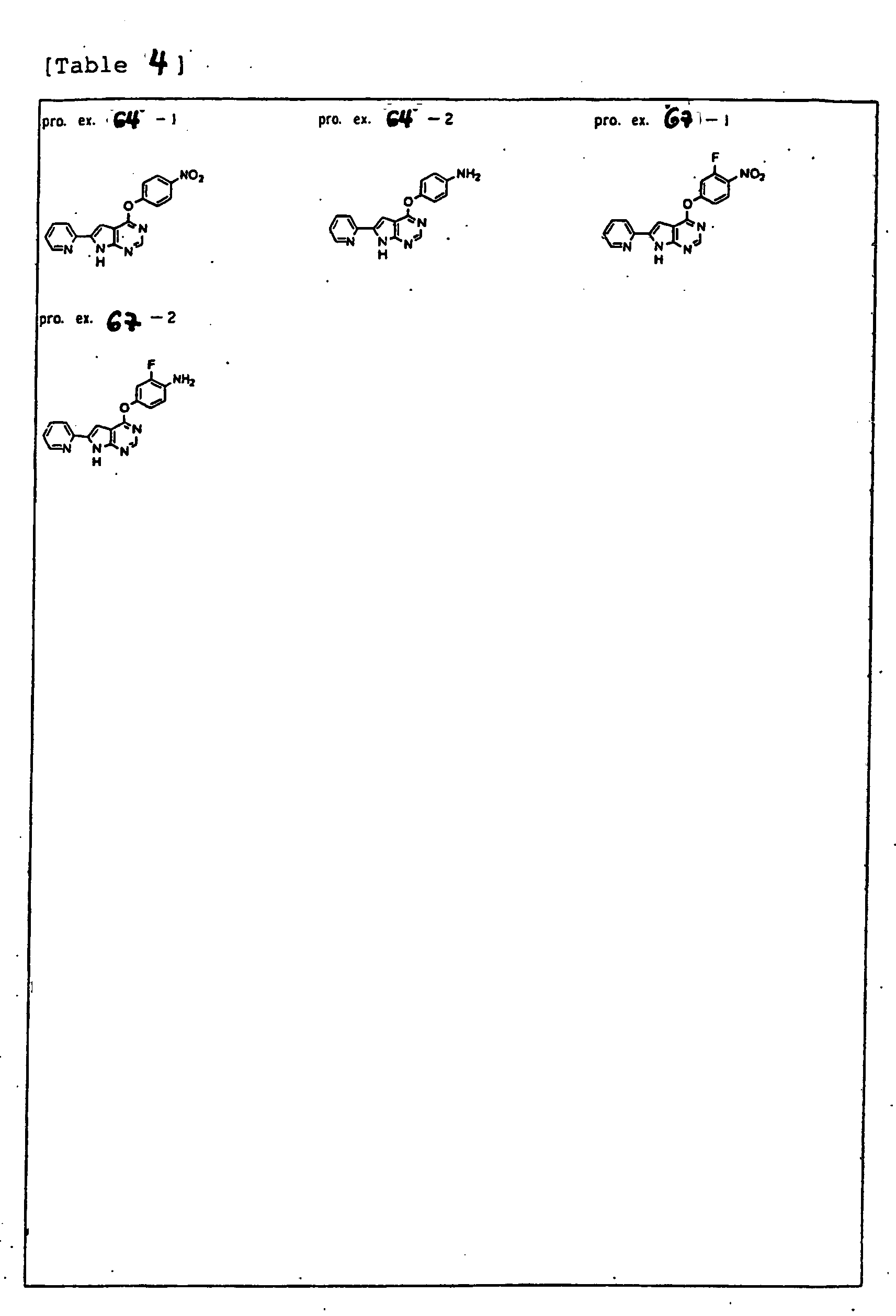


Claims (29)
- A compound represented by the following general formula:


a pharmacologically acceptable salt thereof or a hydrate of the foregoing. - A compound represented by the following general formula:


a pharmacologically acceptable salt thereof or a hydrate of the foregoing. - A compound according to claim 1 or 2, a pharmacologically acceptable salt of the compound or a hydrate of the foregoing, wherein X is an oxygen atom or a sulfur atom.
- A compound according to any one of claims 1 to 3, a pharmacologically salt of the compound or a hydrate of the foregoing, wherein Z is an optionally substituted cyclopropyl group, an optionally substituted 2-thiazolyl group or a group represented by the formula:

- A compound according to any one of claims 1 to 4, a pharmacologically acceptable salt of the compound or a hydrate of the foregoing, wherein E is a group represented by the formula -NR2-(wherein R2 has the same definition as R2 in claim 1), and Y is an optionally substituted phenyl group, an optionally substituted pyridyl group or a group represented by the formula:

- A compound according to any one of claims 1 to 4, a pharmacologically acceptable salt of the compound or a hydrate of the foregoing, wherein E is a single bond, and Y is a further optionally substituted group represented by the formula:

- A compound according to claim 1 represented by the following general formula:


a pharmacologically acceptable salt thereof or a hydrate of the foregoing. - A compound according to claim 2 represented by the following general formula:


a pharmacologically acceptable salt thereof or a hydrate of the foregoing. - A compound according to claim 2 or 8, a pharmacologically acceptable salt of the compound or a hydrate of the foregoing, wherein Rc11 is a group represented by the formula:


- A compound according to claim 1 or 2 represented by the following formula:
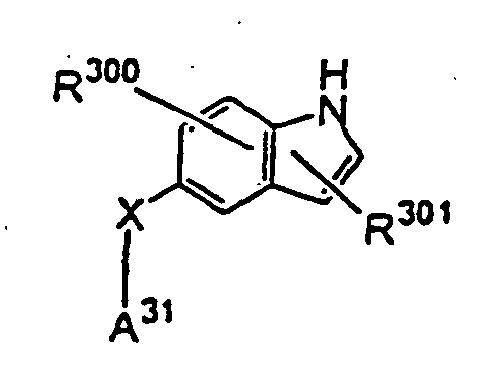


a pharmacologically acceptable salt thereof or a hydrate of the foregoing. - A compound according to claim 1 or 2 represented by the following general formula:


- A compound according to claim 1 or 2, a pharmacologically acceptable salt of the compound or a hydrate of the foregoing, wherein said compound is a compound selected from N4- (4-{4-[(anilinocarbonyl)amino]-3-chlorophenoxy}-2-pyridyl)-1-methyl-4-piperidinecarboxamide, N1-phenyl-3-chloro-5-[(2-{[(1-methyl-4-piperidyl)carbonyl]amino}-4-pyridyl)oxy]-1H-1-indolecarboxamide, N4-[4-(3-chloro-4-([(4-fluoroanilino)carbonyl]amino}phenoxy)-2-pyridyl]-1-methyl-4-piperidinecarboxamide, 1-(2-chloro-4-[6-[4-(2-diethylaminoethoxy)-phenyl]-7H-pyrrolo[2,3-d]pyrimidin-4-yloxy}phenyl)-3-cyclopropylurea, 1-(2-chloro-4-{6-[4-((2R)-2-hydroxy-3-diethylaminopropoxy)-phenyl]-7H-pyrrolo[2,3-d]pyrimidin-4-yloxy]-phenyl}-3-cyclopropylurea, 1-(2-chloro-4-{6-[4-((2R)-2-hydroxy-3-pyrrolidinopropoxy)-phenyl]-7H-pyrrolo[2,3-d]pyrimidin-4-yloxy}-phenyl)-3-cyclopropylurea and 1-(2-chloro-4-{6-[4-(2-diethylaminopropoxy)-phenyl]-7H-pyrrolo [2, 3-d]pyrimidin-4-yloxy}phenyl)-3-cyclopropylurea.
- A medicament comprising as an active ingredient, a compound according to any one of claims 1 to 12, a pharmacologically acceptable salt thereof or a hydrate of the foregoing.
- A pharmaceutical composition comprising a compound according to any one of claims 1 to 12, a pharmacologically acceptable salt thereof or a hydrate of the forgoing, together with a pharmacologically acceptable carrier.
- The use of a compound according to any one of claims 1 to 12, a pharmacologically acceptable salt thereof or a hydrate of the foregoing for the manufacture of a prophylactic or a therapeutic agent for a disease for which angiogenesis inhibitions is effective.
- The use of a compound according to any one of claims 1 to 12, a pharmacologically acceptable salt thereof or a hydrate of the foregoing for the manufacture of a angiogenesis inhibitor.
- The use of a compound according to any one of claims 1 to 12, a pharmacologically acceptable salt thereof or a hydrate of the foregoing for the manufacture of an antitumor agent.
- The use of a compound according to any one of claims 1 to 12, a pharmacologically acceptable salt thereof or a hydrate of the foregoing for the manufacture of a therapeutic agent of angioma.
- The use of a compound according to any one of claims 1 to 12, a pharmacologically acceptable salt thereof or a hydrate of the foregoing for the manufacture of a cancer metastasis inhibitor.
- The use of a compound according to any one of claims 1 to 12, a pharmacologically acceptable salt thereof or a hydrate of the foregoing for the manufacture of a therapeutic agent for retinal neovascularization.
- The use of a compound according to any one of claims 1 to 12, a pharmacologically acceptable salt thereof or a hydrate of the foregoing for the manufacture of a therapeutic agent for an inflammatory disease.
- The use according to claim 21, wherein the inflammatory disease is selected from deformant arthritis, rheumatoid arthritis, psoriasis and delayed hypersensitivity reaction.
- The use of a compound according to any one of claims 1 to 12, a pharmacologically acceptable salt thereof or a hydrate of the foregoing for the manufacture of a therapeutic agent for atherosclerosis.
- The use of a compound according to any one of claims 1 to 12, a pharmacologically acceptable salt thereof or a hydrate of the foregoing for the manufacture of a therapeutic agent for a pancreatic cancer, a gastric cancer, a colon cancer, a breast cancer, a prostate cancer, a lung cancer, a renal cancer, a brain tumor, a blood cancer or an ovarian cancer.
- The use of a compound according to any one of claims 1 to 12, a pharmacologically acceptable salt thereof or a hydrate of the foregoing for the manufacture of an angiogenesis inhibition-based antitumor agent.
- A compound according to any one of claims 1 to 12, a pharmacologically acceptable salt thereof or a hydrate of the foregoing for use as a medicament.
- A compound according to any one of claims 1 to 12, a pharmacologically acceptable salt thereof or a hydrate of the foregoing for use as an antitumor agent.
- A compound according to any one of claims 1 to 12, a pharmacologically acceptable salt thereof or a hydrate of the foregoing for use as a cancer metastasis inhibitor.
- A compound according to any one of claims 1 to 12, a pharmacologically acceptable salt thereof or a hydrate of the foregoing for use in treatment of angioma, retinal neovascularization, inflammatory disease, atherosclerosis, pancreatic cancer, gastric cancer, colon cancer, breast cancer, prostate cancer, lung cancer, renal cancer, brain tumor, blood cancer or ovarian cancer.
Applications Claiming Priority (7)
| Application Number | Priority Date | Filing Date | Title |
|---|---|---|---|
| JP2000320420 | 2000-10-20 | ||
| JP2000320420 | 2000-10-20 | ||
| JP2000386195 | 2000-12-20 | ||
| JP2000386195 | 2000-12-20 | ||
| JP2001046685 | 2001-02-22 | ||
| JP2001046685 | 2001-02-22 | ||
| EP01976786A EP1415987B1 (en) | 2000-10-20 | 2001-10-19 | Nitrogenous aromatic ring compounds as anti cancer agents |
Related Parent Applications (1)
| Application Number | Title | Priority Date | Filing Date |
|---|---|---|---|
| EP01976786A Division EP1415987B1 (en) | 2000-10-20 | 2001-10-19 | Nitrogenous aromatic ring compounds as anti cancer agents |
Publications (3)
| Publication Number | Publication Date |
|---|---|
| EP1506962A2 EP1506962A2 (en) | 2005-02-16 |
| EP1506962A3 EP1506962A3 (en) | 2005-03-02 |
| EP1506962B1 true EP1506962B1 (en) | 2008-07-02 |
Family
ID=27344984
Family Applications (3)
| Application Number | Title | Priority Date | Filing Date |
|---|---|---|---|
| EP01976786A Expired - Lifetime EP1415987B1 (en) | 2000-10-20 | 2001-10-19 | Nitrogenous aromatic ring compounds as anti cancer agents |
| EP06023078A Expired - Lifetime EP1777218B1 (en) | 2000-10-20 | 2001-10-19 | Process for the preparation of 4-phenoxy quinoline derivatives |
| EP04025700A Expired - Lifetime EP1506962B1 (en) | 2000-10-20 | 2001-10-19 | Nitrogen-containing aromatic heterocycles |
Family Applications Before (2)
| Application Number | Title | Priority Date | Filing Date |
|---|---|---|---|
| EP01976786A Expired - Lifetime EP1415987B1 (en) | 2000-10-20 | 2001-10-19 | Nitrogenous aromatic ring compounds as anti cancer agents |
| EP06023078A Expired - Lifetime EP1777218B1 (en) | 2000-10-20 | 2001-10-19 | Process for the preparation of 4-phenoxy quinoline derivatives |
Country Status (25)
| Country | Link |
|---|---|
| US (5) | US7253286B2 (en) |
| EP (3) | EP1415987B1 (en) |
| JP (3) | JP3712393B2 (en) |
| KR (2) | KR100589032B1 (en) |
| CN (3) | CN101029022B (en) |
| AT (3) | ATE399766T1 (en) |
| AU (4) | AU9598601A (en) |
| BE (1) | BE2015C055I2 (en) |
| CA (1) | CA2426461C (en) |
| CY (2) | CY1107491T1 (en) |
| DE (3) | DE60134679D1 (en) |
| DK (1) | DK1415987T3 (en) |
| ES (2) | ES2282299T3 (en) |
| FR (1) | FR15C0070I2 (en) |
| HU (2) | HU230302B1 (en) |
| IL (3) | IL155447A0 (en) |
| LU (1) | LU92858I2 (en) |
| MX (1) | MX242553B (en) |
| NL (1) | NL300764I1 (en) |
| NO (4) | NO326781B1 (en) |
| NZ (1) | NZ525324A (en) |
| PT (1) | PT1415987E (en) |
| RU (1) | RU2264389C3 (en) |
| TW (1) | TWI304061B (en) |
| WO (1) | WO2002032872A1 (en) |
Cited By (9)
| Publication number | Priority date | Publication date | Assignee | Title |
|---|---|---|---|---|
| US8815241B2 (en) | 2005-11-07 | 2014-08-26 | Eisai R&D Management Co., Ltd. | Use of combination of anti-angiogenic substance and c-kit kinase inhibitor |
| US8865737B2 (en) | 2006-08-28 | 2014-10-21 | Eisai R&D Management Co., Ltd. | Antitumor agent for undifferentiated gastric cancer |
| US8962650B2 (en) | 2011-04-18 | 2015-02-24 | Eisai R&D Management Co., Ltd. | Therapeutic agent for tumor |
| US8962655B2 (en) | 2007-01-29 | 2015-02-24 | Eisai R&D Management Co., Ltd. | Composition for treatment of undifferentiated gastric cancer |
| US8969344B2 (en) | 2005-08-02 | 2015-03-03 | Eisai R&D Management Co., Ltd. | Method for assay on the effect of vascularization inhibitor |
| US9006256B2 (en) | 2006-05-18 | 2015-04-14 | Eisai R&D Management Co., Ltd. | Antitumor agent for thyroid cancer |
| US9012458B2 (en) | 2010-06-25 | 2015-04-21 | Eisai R&D Management Co., Ltd. | Antitumor agent using compounds having kinase inhibitory effect in combination |
| US9334239B2 (en) | 2012-12-21 | 2016-05-10 | Eisai R&D Management Co., Ltd. | Amorphous form of quinoline derivative, and method for producing same |
| US9504746B2 (en) | 2004-09-17 | 2016-11-29 | Eisai R&D Management Co., Ltd. | Pharmaceutical compositions of 4-(3-chloro-4-(cyclopropylaminocarbonyl)aminophenoxy)-7-methoxy-6-quinolinecarboxamide |
Families Citing this family (288)
| Publication number | Priority date | Publication date | Assignee | Title |
|---|---|---|---|---|
| US7517880B2 (en) * | 1997-12-22 | 2009-04-14 | Bayer Pharmaceuticals Corporation | Inhibition of p38 kinase using symmetrical and unsymmetrical diphenyl ureas |
| CA2359244C (en) | 1999-01-13 | 2013-10-08 | Bayer Healthcare Llc | .omega.-carboxy aryl substituted diphenyl ureas as p38 kinase inhibitors |
| US7351834B1 (en) | 1999-01-13 | 2008-04-01 | Bayer Pharmaceuticals Corporation | ω-Carboxyaryl substituted diphenyl ureas as raf kinase inhibitors |
| US8124630B2 (en) | 1999-01-13 | 2012-02-28 | Bayer Healthcare Llc | ω-carboxyaryl substituted diphenyl ureas as raf kinase inhibitors |
| EP1415987B1 (en) | 2000-10-20 | 2007-02-28 | Eisai R&D Management Co., Ltd. | Nitrogenous aromatic ring compounds as anti cancer agents |
| DE60208364T2 (en) * | 2001-04-27 | 2006-09-28 | Kirin Beer K.K. | CHINOLINE DERIVATIVES WITH AN AZOLYL GROUP AND CHINAZOLINE DERIVATIVES |
| ES2259707T3 (en) * | 2001-05-14 | 2006-10-16 | Novartis Ag | OXAZOLO AND FUROPIRIMIDINAS AND ITS USE IN DRUGS MEDICINES. |
| CA2454538A1 (en) | 2001-06-22 | 2003-01-03 | Kirin Beer Kabushiki Kaisha | Quinoline derivatives and quinazoline derivatives capable of inhibiting autophosphorylation of hepatocyte growth factor receptors, and pharmaceutical composition comprising the same |
| GB0119249D0 (en) | 2001-08-07 | 2001-10-03 | Novartis Ag | Organic compounds |
| US7323469B2 (en) | 2001-08-07 | 2008-01-29 | Novartis Ag | 7H-pyrrolo[2,3-d]pyrimidine derivatives |
| WO2003033472A1 (en) * | 2001-10-17 | 2003-04-24 | Kirin Beer Kabushiki Kaisha | Quinoline or quinazoline derivatives inhibiting auto- phosphorylation of fibroblast growth factor receptors |
| US20030216396A1 (en) | 2002-02-11 | 2003-11-20 | Bayer Corporation | Pyridine, quinoline, and isoquinoline N-oxides as kinase inhibitors |
| EP2324825A1 (en) | 2002-02-11 | 2011-05-25 | Bayer Healthcare LLC | Aryl ureas with angiogenesis inhibiting activity |
| JP4542783B2 (en) * | 2002-03-05 | 2010-09-15 | エーザイ・アール・アンド・ディー・マネジメント株式会社 | Antitumor agent comprising a combination of a sulfonamide-containing heterocyclic compound and an angiogenesis inhibitor |
| US7598258B2 (en) | 2002-05-01 | 2009-10-06 | Kirin Beer Kabushiki Kaisha | Quinoline derivatives and quinazoline derivatives inhibiting autophosphorylation of macrophage colony stimulating factor receptor |
| TW200406374A (en) * | 2002-05-29 | 2004-05-01 | Novartis Ag | Diaryl urea derivatives useful for the treatment of protein kinase dependent diseases |
| EP2270006A1 (en) | 2002-08-08 | 2011-01-05 | Amgen, Inc | Pyridazine derivatives useful as vanilloid receptor ligands |
| WO2004020434A1 (en) | 2002-08-30 | 2004-03-11 | Eisai Co., Ltd. | Azaarene derivatives |
| JP3763414B2 (en) * | 2002-10-21 | 2006-04-05 | 麒麟麦酒株式会社 | Crystal form of N- {2-chloro-4-[(6,7-dimethoxy-4-quinolyl) oxy] phenyl} -N '-(5-methyl-3-isoxazolyl) urea salt |
| EP1566379A4 (en) * | 2002-10-29 | 2005-11-09 | Kirin Brewery | QUINOLINE AND QUINAZOLINE DERIVATIVES INHIBITING THE AUTOPHOSPHORYLATION OF FLT3 AND MEDICAL COMPOSITIONS CONTAINING SAME |
| AR041992A1 (en) * | 2002-11-06 | 2005-06-08 | Smithkline Beecham Corp | PIRIDINIL BENZOHETEROCICLIC COMPOSITE, PHARMACEUTICAL COMPOSITION THAT INCLUDES IT AND ITS USE TO PREPARE IT |
| UY28213A1 (en) | 2003-02-28 | 2004-09-30 | Bayer Pharmaceuticals Corp | NEW CYANOPIRIDINE DERIVATIVES USEFUL IN THE TREATMENT OF CANCER AND OTHER DISORDERS. |
| EP1604665B1 (en) | 2003-03-10 | 2011-05-11 | Eisai R&D Management Co., Ltd. | C-kit kinase inhibitor |
| PL1611088T3 (en) * | 2003-04-07 | 2009-11-30 | Pharmacyclics Inc | Hydroxamates as therapeutic agents |
| DK1613604T3 (en) * | 2003-04-16 | 2006-10-30 | Huntsman Adv Mat Switzerland | 1-imidazolylmethyl-substituted 2-naphthols and their use as accelerators for low temperature curing |
| WO2004101526A1 (en) * | 2003-04-22 | 2004-11-25 | Eisai Co., Ltd. | Polymorphous crystal of 4-(3-chloro-4-(cyclopropylaminocarbonyl)aminophenoxy)-7-methoxy-6-qunolinecarboxamide and method for preparation thereof |
| US7253166B2 (en) | 2003-04-22 | 2007-08-07 | Irm Llc | 6-phenyl-7H-pyrrolo[2,3-d]pyrimidine compounds that induce neuronal differentiation in embryonic stem cells |
| AR044519A1 (en) | 2003-05-02 | 2005-09-14 | Novartis Ag | DERIVATIVES OF PIRIDIN-TIAZOL AMINA AND PIRIMIDIN-TIAZOL AMINA |
| DE602004007382T2 (en) | 2003-05-20 | 2008-04-17 | Bayer Pharmaceuticals Corp., West Haven | DIARYL UREAS FOR PDGFR MEDIATED DISEASES |
| WO2005003100A2 (en) | 2003-07-03 | 2005-01-13 | Myriad Genetics, Inc. | 4-arylamino-quinazolines as activators of caspases and inducers of apoptosis |
| WO2006074147A2 (en) | 2005-01-03 | 2006-07-13 | Myriad Genetics, Inc. | Nitrogen containing bicyclic compounds and therapeutical use thereof |
| US8309562B2 (en) | 2003-07-03 | 2012-11-13 | Myrexis, Inc. | Compounds and therapeutical use thereof |
| DK1663978T3 (en) | 2003-07-23 | 2008-04-07 | Bayer Pharmaceuticals Corp | Fluoro-substituted omega-carboxyaryl-diphenylurea for the treatment and prevention of diseases and disorders |
| WO2005019174A1 (en) * | 2003-08-20 | 2005-03-03 | Axys Pharmaceuticals, Inc. | Acetylene derivatives as inhibitors of histone deacetylase |
| CA2744997A1 (en) * | 2003-09-26 | 2005-04-07 | Exelixis, Inc. | C-met modulators and method of use |
| MXPA06003615A (en) * | 2003-09-30 | 2006-06-05 | Amgen Inc | Vanilloid receptor ligands and their use in treatments. |
| WO2005044788A1 (en) | 2003-11-11 | 2005-05-19 | Eisai Co., Ltd. | Urea derivative and process for producing the same |
| US20050267182A1 (en) * | 2003-11-13 | 2005-12-01 | Ambit Biosciences Corporation | Urea derivatives as FLT-3 modulators |
| TW200529849A (en) * | 2003-11-28 | 2005-09-16 | Novartis Ag | Diaryl urea derivatives in the treatment of protein kinase dependent diseases |
| DE10357510A1 (en) * | 2003-12-09 | 2005-07-07 | Bayer Healthcare Ag | Heteroaryl-substituted benzenes |
| JP4503022B2 (en) | 2003-12-23 | 2010-07-14 | ファイザー・インク | New quinoline derivatives |
| KR100839554B1 (en) * | 2003-12-25 | 2008-06-20 | 에자이 알앤드디 매니지먼트 가부시키가이샤 | Determination of salts of 4- (3-chloro-4- (cyclopropylaminocarbonyl) aminophenoxy) -7-methoxy-6-quinolinecarboxamide or solvates thereof and preparation method thereof |
| JP4932495B2 (en) * | 2004-01-23 | 2012-05-16 | アムゲン インコーポレイテッド | Compound and method of use |
| CA2553433A1 (en) * | 2004-01-23 | 2005-08-11 | Amgen Inc. | Quinoline quinazoline pyridine and pyrimidine compounds and their use in the treatment of inflammation angiogenesis and cancer |
| MY139645A (en) | 2004-02-11 | 2009-10-30 | Amgen Inc | Vanilloid receptor ligands and their use in treatments |
| JP2007522233A (en) | 2004-02-11 | 2007-08-09 | アムジエン・インコーポレーテツド | Vanilloid receptor ligands and their use in therapy |
| TW200530236A (en) | 2004-02-23 | 2005-09-16 | Chugai Pharmaceutical Co Ltd | Heteroaryl phenylurea |
| EP1719762B1 (en) * | 2004-02-27 | 2012-06-27 | Eisai R&D Management Co., Ltd. | Novel pyridine derivative and pyrimidine derivative (1) |
| DE102004017438A1 (en) * | 2004-04-08 | 2005-11-03 | Bayer Healthcare Ag | Hetaryloxy-substituted phenylaminopyrimidines |
| US7459562B2 (en) | 2004-04-23 | 2008-12-02 | Bristol-Myers Squibb Company | Monocyclic heterocycles as kinase inhibitors |
| TW200538453A (en) | 2004-04-26 | 2005-12-01 | Bristol Myers Squibb Co | Bicyclic heterocycles as kinase inhibitors |
| JP2007535565A (en) | 2004-04-30 | 2007-12-06 | バイエル ファーマシューティカルス コーポレーション | Substituted pyrazolyl urea derivatives useful for the treatment of cancer |
| AP2204A (en) * | 2004-05-06 | 2011-02-07 | Warner Lambert Co | 4-phenylamino-quinazolin-6-yl-amides. |
| AU2005245386B2 (en) | 2004-05-07 | 2008-11-27 | Amgen Inc. | Nitrogenated heterocyclic derivatives as protein kinase modulators and use for the treatment of angiogenesis and cancer |
| WO2005121125A1 (en) * | 2004-06-09 | 2005-12-22 | Pfizer Inc. | Ether-linked heteroaryl compounds |
| US20050288290A1 (en) * | 2004-06-28 | 2005-12-29 | Borzilleri Robert M | Fused heterocyclic kinase inhibitors |
| CN100577663C (en) * | 2004-06-28 | 2010-01-06 | 布里斯托尔-迈尔斯·斯奎布公司 | Fused Heterocyclic Kinase Inhibitors |
| US7432373B2 (en) | 2004-06-28 | 2008-10-07 | Bristol-Meyers Squibb Company | Processes and intermediates useful for preparing fused heterocyclic kinase inhibitors |
| US7439246B2 (en) | 2004-06-28 | 2008-10-21 | Bristol-Myers Squibb Company | Fused heterocyclic kinase inhibitors |
| WO2006014325A2 (en) * | 2004-07-02 | 2006-02-09 | Exelixis, Inc. | C-met modulators and method of use |
| US7507748B2 (en) * | 2004-07-22 | 2009-03-24 | Amgen Inc. | Substituted aryl-amine derivatives and methods of use |
| CA2573538C (en) * | 2004-07-30 | 2014-11-25 | Methylgene Inc. | Inhibitors of vegf receptor and hgf receptor signaling |
| US8772269B2 (en) | 2004-09-13 | 2014-07-08 | Eisai R&D Management Co., Ltd. | Use of sulfonamide-including compounds in combination with angiogenesis inhibitors |
| EP1797877A4 (en) | 2004-09-13 | 2010-12-15 | Eisai Co Ltd | Joint use of sulfonamide based compound with angiogenesis inhibitor |
| PE20060664A1 (en) | 2004-09-15 | 2006-08-04 | Novartis Ag | BICYCLE AMIDAS AS KINASE INHIBITORS |
| GB0421525D0 (en) * | 2004-09-28 | 2004-10-27 | Novartis Ag | Inhibitors of protein kineses |
| US20070054916A1 (en) * | 2004-10-01 | 2007-03-08 | Amgen Inc. | Aryl nitrogen-containing bicyclic compounds and methods of use |
| AU2005301608B2 (en) | 2004-11-02 | 2012-09-13 | Msd K.K. | Aryloxy-substituted benzimidazole derivatives |
| US7652009B2 (en) | 2004-11-30 | 2010-01-26 | Amgem Inc. | Substituted heterocycles and methods of use |
| US8258145B2 (en) | 2005-01-03 | 2012-09-04 | Myrexis, Inc. | Method of treating brain cancer |
| EP1844050B1 (en) * | 2005-02-03 | 2009-01-14 | Vertex Pharmaceuticals, Inc. | Pyrrolopyrimidines useful as inhibitors of protein kinase |
| WO2006089311A1 (en) | 2005-02-15 | 2006-08-24 | Amgen Inc. | Vanilloid receptor ligands and their use in treatments |
| JO2787B1 (en) | 2005-04-27 | 2014-03-15 | امجين إنك, | Substituted Amid derivatives & methods of use |
| KR20080016659A (en) | 2005-05-20 | 2008-02-21 | 버텍스 파마슈티칼스 인코포레이티드 | Pyrrolopyridines useful as inhibitors of protein kinase |
| JP5148499B2 (en) * | 2005-05-20 | 2013-02-20 | メチルジーン インコーポレイテッド | Inhibitors of VEGF receptor and HGF receptor signaling |
| US7550483B2 (en) | 2005-06-23 | 2009-06-23 | Eisai R&D Management Co., Ltd. | Amorphous salt of 4-(3-chloro-4-(cyclopropylaminocarbonyl)aminophenoxy)-7-methoxy-6-quinolinecarboxamide and process for preparing the same |
| AU2006260148B9 (en) * | 2005-06-23 | 2009-09-17 | Eisai R&D Managment Co., Ltd. | Amorphous salt of 4-(3-chloro-4-(cyclopropylaminocarbonyl)aminophenoxy)- 7-methoxy-6-quinolinecarboxamide and process for producing the same |
| MX2007015679A (en) | 2005-06-30 | 2008-02-21 | Amgen Inc | Bis-aryl kinase inhibitors and their use in the treatment of inflammation, angiogenesis and cancer. |
| TW200740820A (en) * | 2005-07-05 | 2007-11-01 | Takeda Pharmaceuticals Co | Fused heterocyclic derivatives and use thereof |
| CA2614544C (en) | 2005-07-13 | 2013-09-10 | Banyu Pharmaceutical Co., Ltd. | Heterocycle-substituted benzimidazole derivative |
| WO2007015569A1 (en) | 2005-08-01 | 2007-02-08 | Eisai R & D Management Co., Ltd. | Method for prediction of the efficacy of vascularization inhibitor |
| EP1921078B1 (en) * | 2005-08-05 | 2013-01-09 | Chugai Seiyaku Kabushiki Kaisha | Multikinase inhibitor |
| CN101277689B (en) * | 2005-08-08 | 2011-01-12 | 詹森药业有限公司 | Thiazolopyrimidine kinase inhibitors |
| PL1889836T3 (en) * | 2005-08-24 | 2013-10-31 | Eisai R&D Man Co Ltd | Novel pyridine derivative and pyrimidine derivative (3) |
| EP1938842A4 (en) * | 2005-09-01 | 2013-01-09 | Eisai R&D Man Co Ltd | Method for preparation of pharmaceutical composition having improved disintegradability |
| GT200600411A (en) * | 2005-09-13 | 2007-05-21 | Novartis Ag | COMBINATIONS THAT INCLUDE AN INHIBITOR OF THE RECEIVER OF THE VASCULAR ENDOTELIAL GROWTH FACTOR |
| CA2623958C (en) | 2005-09-30 | 2013-05-28 | Banyu Pharmaceutical Co., Ltd. | 2-heteroaryl-substituted indole derivative |
| AU2006309171A1 (en) * | 2005-10-28 | 2007-05-10 | Irm Llc | Compounds and compositions as protein kinase inhibitors |
| WO2007061127A1 (en) * | 2005-11-22 | 2007-05-31 | Eisai R & D Management Co., Ltd. | Anti-tumor agent for multiple myeloma |
| TW201018662A (en) | 2005-12-12 | 2010-05-16 | Astrazeneca Ab | Alkylsulphonamide quinolines |
| CA2634084C (en) | 2005-12-21 | 2015-04-07 | Roger Smith | Substituted pyrimidine derivatives useful in the treatment of cancer and other disorders |
| WO2007071752A2 (en) * | 2005-12-21 | 2007-06-28 | Novartis Ag | Pyrimidinyl aryl urea derivatives being fgf inhibitors |
| TW200804349A (en) * | 2005-12-23 | 2008-01-16 | Kalypsys Inc | Novel substituted pyrimidinyloxy ureas as inhibitors of protein kinases |
| US7868177B2 (en) | 2006-02-24 | 2011-01-11 | Amgen Inc. | Multi-cyclic compounds and method of use |
| AU2007221049A1 (en) * | 2006-02-28 | 2007-09-07 | Amgen Inc. | Cinnoline and quinazoline derivates as phosphodiesterase 10 inhibitors |
| UY30183A1 (en) * | 2006-03-02 | 2007-10-31 | Astrazeneca Ab | QUINOLINE DERIVATIVES |
| GB0604937D0 (en) * | 2006-03-10 | 2006-04-19 | Novartis Ag | Organic compounds |
| GB0605120D0 (en) | 2006-03-14 | 2006-04-26 | Novartis Ag | Organic Compounds |
| PE20080145A1 (en) | 2006-03-21 | 2008-02-11 | Janssen Pharmaceutica Nv | TETRAHYDRO-PYRIMIDOAZEPINE AS MODULATORS OF TRPV1 |
| EP2024328A2 (en) | 2006-05-05 | 2009-02-18 | TK Holdings Inc. | Gas generant compositions |
| US7692024B2 (en) * | 2006-05-05 | 2010-04-06 | Tk Holdings, Inc. | Gas generant compositions |
| US20080004273A1 (en) * | 2006-05-30 | 2008-01-03 | Stephane Raeppel | Inhibitors of protein tyrosine kinase activity |
| EP2044939A1 (en) * | 2006-06-29 | 2009-04-08 | Eisai R&D Management Co., Ltd. | Therapeutic agent for liver fibrosis |
| US20080004253A1 (en) * | 2006-06-30 | 2008-01-03 | Bryan James Branstetter | Thiazolopyrimidine modulators of TRPV1 |
| BRPI0714665A2 (en) | 2006-08-04 | 2012-03-13 | Takeda Pharmaceutical Company Limited | COMPOSITE, PRODUCT, PHARMACEUTICAL AGENT, AND METHOD FOR CANCER PROPHYLAXY OR TREATMENT |
| CN101454311B (en) | 2006-08-23 | 2013-03-27 | 卫材R&D管理有限公司 | Salts of phenoxypyridine derivatives and their crystals and their preparation methods |
| US7790885B2 (en) * | 2006-08-31 | 2010-09-07 | Eisai R&D Management Co., Ltd. | Process for preparing phenoxypyridine derivatives |
| KR101432318B1 (en) | 2006-08-31 | 2014-08-20 | 에자이 알앤드디 매니지먼트 가부시키가이샤 | Process for producing phenoxypyridine derivative |
| US8002915B2 (en) * | 2006-09-30 | 2011-08-23 | Tk Holdings, Inc. | Gas generant compositions |
| US8470859B2 (en) | 2006-10-23 | 2013-06-25 | Takeda Pharmaceutical Company Limited | Iminopyridine derivative and use thereof |
| US8563573B2 (en) | 2007-11-02 | 2013-10-22 | Vertex Pharmaceuticals Incorporated | Azaindole derivatives as CFTR modulators |
| WO2008079292A1 (en) | 2006-12-20 | 2008-07-03 | Amgen Inc. | Heterocyclic compounds and their use in treating inflammation, angiogenesis and cancer |
| US8080552B2 (en) | 2006-12-22 | 2011-12-20 | Hoffmann-La Roche Inc. | Pyrimidyl derivatives as protein kinase inhibitors |
| PT2099442E (en) * | 2006-12-26 | 2015-02-10 | Pharmacyclics Inc | Method of using histone deacetylase inhibitors and monitoring biomarkers in combination therapy |
| KR20090108086A (en) * | 2007-01-19 | 2009-10-14 | 에자이 알앤드디 매니지먼트 가부시키가이샤 | Pancreatic cancer treatment composition |
| EA201201640A1 (en) * | 2007-01-30 | 2013-09-30 | Фармасайкликс, Инк. | METHODS FOR DETERMINING CANCER STABILITY TO INHIBITORS HISTONEDEISETHYLASE |
| MX2009008103A (en) * | 2007-02-09 | 2009-08-18 | Takeda Pharmaceutical | Fused ring compounds as partial agonists of ppar-gamma. |
| US8148532B2 (en) | 2007-03-14 | 2012-04-03 | Guoqing Paul Chen | Spiro substituted compounds as angiogenesis inhibitors |
| CA2684950A1 (en) * | 2007-04-20 | 2008-10-30 | Deciphera Pharmaceuticals, Llc | Kinase inhibitors useful for the treatment of myleoproliferative diseases and other proliferative diseases |
| US20110189167A1 (en) * | 2007-04-20 | 2011-08-04 | Flynn Daniel L | Methods and Compositions for the Treatment of Myeloproliferative Diseases and other Proliferative Diseases |
| US20110160305A1 (en) * | 2007-05-01 | 2011-06-30 | Marty Jones | Oral Delivery of Therapeutic Doses of Glutathione |
| CL2008001626A1 (en) | 2007-06-05 | 2009-06-05 | Takeda Pharmaceuticals Co | Compounds derived from fused heterocycles, a pharmaceutical agent that comprises them and their use in the prophylaxis and treatment of cancer. |
| JP5270553B2 (en) * | 2007-08-23 | 2013-08-21 | 武田薬品工業株式会社 | Heterocyclic compounds and uses thereof |
| EP2183254B1 (en) | 2007-08-29 | 2017-06-21 | MethylGene Inc. | Inhibitors of protein tyrosine kinase activity |
| WO2009035949A2 (en) * | 2007-09-13 | 2009-03-19 | Arete Therapeutics, Inc. | Soluble epoxide hydrolase inhibitors |
| CN101896065B (en) | 2007-10-11 | 2013-12-18 | 葛兰素史密斯克莱有限责任公司 | sEH inhibitors and their use |
| EP2220078B1 (en) * | 2007-10-29 | 2013-05-22 | Amgen, Inc | Benzomorpholine derivatives and methods of use |
| TWI440638B (en) * | 2007-10-30 | 2014-06-11 | Otsuka Pharma Co Ltd | Heterocyclic compound and pharmaceutical composition thereof |
| CN101848895B (en) * | 2007-11-09 | 2013-10-23 | 卫材R&D管理有限公司 | Combined use of angiogenesis inhibitory substance and antitumor platinum complex |
| JP5544296B2 (en) * | 2007-11-16 | 2014-07-09 | ライジェル ファーマシューティカルズ, インコーポレイテッド | Carboxamide, sulfonamide, and amine compounds for metabolic disorders |
| RU2472509C2 (en) * | 2007-11-16 | 2013-01-20 | Эбботт Лэборетриз | Method of treating arthritis |
| JP2009132660A (en) | 2007-11-30 | 2009-06-18 | Eisai R & D Management Co Ltd | Composition for treating esophageal cancer |
| ES2553340T3 (en) | 2007-12-12 | 2015-12-07 | Rigel Pharmaceuticals, Inc. | Carboxamide, sulfonamide and amine compounds for metabolic disorders |
| WO2009078999A1 (en) | 2007-12-17 | 2009-06-25 | Janssen Pharmaceutica N.V. | Imidazolo-, oxazolo-, and thiazolopyrimidine modulators of trpv1 |
| KR20100093129A (en) | 2007-12-20 | 2010-08-24 | 노파르티스 아게 | Thiazole derivatives used as pi 3 kinase inhibitors |
| US8558000B2 (en) | 2008-01-23 | 2013-10-15 | Bristol-Myers Squibb Company | 4-pyridinone compounds and their use for cancer |
| US20100324087A1 (en) * | 2008-01-29 | 2010-12-23 | Eisai R&D Management Co., Ltd. | Combined use of angiogenesis inhibitor and taxane |
| US20090227556A1 (en) * | 2008-01-31 | 2009-09-10 | Eisai R&D Management Co., Ltd. | Receptor tyrosine kinase inhibitors comprising pyridine and pyrimidine derivatives |
| JPWO2009104520A1 (en) * | 2008-02-18 | 2011-06-23 | エーザイ・アール・アンド・ディー・マネジメント株式会社 | Method for producing phenoxypyridine derivative (2) |
| WO2009109035A1 (en) * | 2008-03-05 | 2009-09-11 | Methylgene Inc. | Inhibitors of protein tyrosine kinase activity |
| PL2947072T3 (en) | 2008-03-17 | 2017-05-31 | Ambit Biosciences Corporation | 1-(3-(6,7-dimethoxyquinazolin-4-yloxy)phenyl)-3-(5-(1,1,1-trifluoro-2-methylpropan-2-yl)isoxazol-3-yl)urea as raf kinase modulator in the treatment of cancer diseases |
| RU2503664C2 (en) * | 2008-04-10 | 2014-01-10 | Тайхо Фармасьютикал Ко., Лтд. | Acyl thiourea derivative or salt thereof and use thereof |
| EP2297153B1 (en) | 2008-04-21 | 2015-05-27 | Lexicon Pharmaceuticals, Inc. | Limk2 inhibitors, compositions comprising them, and methods of their use |
| CL2009000964A1 (en) * | 2008-04-23 | 2010-03-26 | Takeda Pharmaceuticals Co | Compounds derived from 1-aryl-2-imino-1,2-dihydropyridine-3-carboxamide, alpha 1d adrenergic receptor antagonist, pharmaceutical composition comprising them; and its use for the treatment or prophylaxis of diseases of the lower urinary tract. |
| US20110039892A1 (en) * | 2008-04-23 | 2011-02-17 | Takeda Pharmaceutical Company Limited | Iminopyridine derivative and use thereof |
| US8481569B2 (en) | 2008-04-23 | 2013-07-09 | Takeda Pharmaceutical Company Limited | Iminopyridine derivatives and use thereof |
| JP5658138B2 (en) * | 2008-04-23 | 2015-01-21 | ライジェル ファーマシューティカルズ, インコーポレイテッド | Carboxamide compounds for the treatment of metabolic disorders |
| KR101667822B1 (en) * | 2008-04-30 | 2016-10-19 | 내셔날 헬스 리서치 인스티튜트 | Fused bicyclic pyrimidine compounds as aurora kinase inhibitors |
| NZ589019A (en) | 2008-05-05 | 2012-10-26 | Merck Frosst Canada Ltd | 3, 4 - substituted piperidine derivatives as renin inhibitors |
| WO2009151910A2 (en) * | 2008-05-25 | 2009-12-17 | Wyeth | Combination product of receptor tyrosine kinase inhibitor and fatty acid synthase inhibitor for treating cancer |
| CA2727103A1 (en) * | 2008-07-03 | 2010-01-07 | Merck Patent Gmbh | Naphthyridinones as aurora kinase inhibitors |
| US8211911B2 (en) | 2008-08-19 | 2012-07-03 | Guoqing Paul Chen | Compounds as kinase inhibitors |
| HRP20140395T1 (en) | 2008-08-20 | 2014-06-06 | Zoetis Llc | PIROLO [2,3-d] PIRIMIDINE COMPOUNDS |
| UA104147C2 (en) | 2008-09-10 | 2014-01-10 | Новартис Аг | PYROLIDINDICARBONIC ACID DERIVATIVE AND ITS APPLICATION IN THE TREATMENT OF PROLIFERATIVE DISEASES |
| EP2331530B8 (en) | 2008-09-26 | 2013-12-25 | National Health Research Institutes | Fused multicyclic compounds as protein kinase inhibitors |
| CA2740746A1 (en) * | 2008-10-14 | 2010-04-22 | Ning Xi | Compounds comprising a spiro-ring and and methods of use |
| US8697874B2 (en) | 2008-12-01 | 2014-04-15 | Takeda Pharmaceutical Company Limited | Heterocyclic compound and use thereof |
| JO3101B1 (en) | 2008-12-02 | 2017-09-20 | Takeda Pharmaceuticals Co | Benzothiazole derivatives as anticancer agents |
| JO3265B1 (en) | 2008-12-09 | 2018-09-16 | Novartis Ag | Pyridyloxyindoles Inhibitors of VEGF-R2 and Use Thereof for Treatment of Disease |
| EA038195B1 (en) | 2009-01-16 | 2021-07-22 | Экселиксис, Инк. | SMALL SALT N- (4 - {[6,7-BIS- (METHYLOXY) QUINOLIN-4-YL] OXY} PHENYL) -N '- (4-FLUOROPHENYL) CYCLOPROPAN-1,1-DICARBOXAMIDE AND ITS USE FOR CANCER TREATMENT KIDNEY AND LIVER |
| EP2408300B1 (en) * | 2009-03-21 | 2016-05-11 | Sunshine Lake Pharma Co., Ltd. | Amino ester derivatives, salts thereof and methods of use |
| WO2010108503A1 (en) | 2009-03-24 | 2010-09-30 | Life & Brain Gmbh | Promotion of neuronal integration in neural stem cell grafts |
| US8603521B2 (en) | 2009-04-17 | 2013-12-10 | Pharmacyclics, Inc. | Formulations of histone deacetylase inhibitor and uses thereof |
| CN101671301B (en) * | 2009-05-05 | 2014-02-26 | 江苏省药物研究所有限公司 | Heterocyclic substituted diphenylurea derivatives and uses thereof |
| US8293753B2 (en) | 2009-07-02 | 2012-10-23 | Novartis Ag | Substituted 2-carboxamide cycloamino ureas |
| US20110112121A1 (en) * | 2009-07-06 | 2011-05-12 | Joerg Berghausen | Pharmaceutical Compositions and Solid Forms |
| UA108618C2 (en) | 2009-08-07 | 2015-05-25 | APPLICATION OF C-MET-MODULATORS IN COMBINATION WITH THEMOSOLOMID AND / OR RADIATION THERAPY FOR CANCER TREATMENT | |
| BR112012003592B8 (en) * | 2009-08-19 | 2021-05-25 | Eisai R&D Man Co Ltd | pharmaceutical composition containing quinoline derivative |
| US8614234B2 (en) * | 2009-09-03 | 2013-12-24 | Allergan, Inc. | Compounds as tyrosine kinase modulators |
| US8802868B2 (en) | 2010-03-25 | 2014-08-12 | Vertex Pharmaceuticals Incorporated | Solid forms of (R)-1(2,2-difluorobenzo[D][1,3]dioxo1-5-yl)-N-(1-(2,3-dihydroxypropyl-6-fluoro-2-(1-hydroxy-2-methylpropan2-yl)-1H-Indol-5-yl)-Cyclopropanecarboxamide |
| CN105130948A (en) | 2010-04-22 | 2015-12-09 | 弗特克斯药品有限公司 | Pharmaceutical compositions and administrations thereof |
| US20130225581A1 (en) | 2010-07-16 | 2013-08-29 | Kyowa Hakko Kirin Co., Ltd | Nitrogen-containing aromatic heterocyclic derivative |
| KR101032732B1 (en) * | 2010-07-29 | 2011-05-06 | 김선자 | Security window frame |
| EP2423208A1 (en) | 2010-08-28 | 2012-02-29 | Lead Discovery Center GmbH | Pharmaceutically active compounds as Axl inhibitors |
| CA2826773C (en) * | 2011-02-24 | 2019-07-16 | Emory University | Jab1 blocking compositions for ossification and methods related thereto |
| WO2012166899A2 (en) | 2011-06-03 | 2012-12-06 | Eisai R&D Management Co., Ltd. | Biomarkers for predicting and assessing responsiveness of thyroid and kidney cancer subjects to lenvatinib compounds |
| EA031153B1 (en) | 2011-06-10 | 2018-11-30 | Мерк Патент Гмбх | Use of pyrimidine compounds with btk inhibitory activity |
| NZ621221A (en) | 2011-09-13 | 2016-07-29 | Pharmacyclics Llc | Formulations of histone deacetylase inhibitor in combination with bendamustine and uses thereof |
| WO2013048949A2 (en) * | 2011-09-26 | 2013-04-04 | Bristol-Myers Squibb Company | Selective nr2b antagonists |
| TWI594986B (en) * | 2011-12-28 | 2017-08-11 | Taiho Pharmaceutical Co Ltd | Antineoplastic agent effect enhancer |
| CN103508961B (en) | 2012-06-26 | 2015-07-22 | 中美冠科生物技术(太仓)有限公司 | Antitumor drug |
| JP2015530378A (en) * | 2012-08-29 | 2015-10-15 | メルク パテント ゲゼルシャフト ミット ベシュレンクテル ハフツングMerck Patent Gesellschaft mit beschraenkter Haftung | DDR2 inhibitors for the treatment of osteoarthritis |
| AR094812A1 (en) | 2013-02-20 | 2015-08-26 | Eisai R&D Man Co Ltd | DERIVED FROM MONOCYCLIC PYRIDINE AS AN FGFR INHIBITOR |
| WO2014170648A1 (en) | 2013-04-19 | 2014-10-23 | Astrazeneca Ab | A nk3 receptor antagonist compound (nk3ra) for use in a method for the treatment of polycystic ovary syndrome (pcos) |
| CN105264380B (en) * | 2013-05-14 | 2017-09-05 | 卫材R&D管理有限公司 | Biomarkers for predicting and evaluating responsiveness of endometrial cancer subjects to lenvatinib compounds |
| AU2014299699B2 (en) | 2013-06-26 | 2019-10-10 | Eisai R&D Management Co., Ltd. | Use of eribulin and lenvatinib as combination therapy for treatment of cancer |
| US9421208B2 (en) | 2013-08-02 | 2016-08-23 | Pharmacyclics Llc | Methods for the treatment of solid tumors |
| CN103509005B (en) * | 2013-09-26 | 2015-04-08 | 苏州海特比奥生物技术有限公司 | Quinazoline compound as well as preparation method and application thereof |
| WO2015150995A1 (en) * | 2014-04-04 | 2015-10-08 | Pfizer Inc. | Bicyclic-fused heteroaryl or aryl compounds and their use as irak4 inhibitors |
| JP6543268B2 (en) | 2014-04-15 | 2019-07-10 | バーテックス ファーマシューティカルズ インコーポレイテッドVertex Pharmaceuticals Incorporated | Pharmaceutical composition for treating a disease mediated by a cystic fibrosis transmembrane conductance regulator |
| MX369646B (en) * | 2014-08-18 | 2019-11-15 | Eisai R&D Man Co Ltd | Salt of monocyclic pyridine derivative and crystal thereof. |
| CA2957005C (en) * | 2014-08-28 | 2021-10-12 | Eisai R&D Management Co., Ltd. | High-purity quinoline derivative and method for manufacturing same |
| MA40774A (en) * | 2014-10-01 | 2017-08-08 | Respivert Ltd | DIARYLEUREA DERIVATIVES AS KINASE P38 INHIBITORS |
| CN105985289B (en) * | 2015-02-15 | 2018-12-21 | 正大天晴药业集团股份有限公司 | A kind of pleasure cuts down the preparation method for Buddhist nun |
| SG11201706630UA (en) | 2015-02-25 | 2017-09-28 | Eisai R&D Man Co Ltd | Method for suppressing bitterness of quinoline derivative |
| WO2016140717A1 (en) | 2015-03-04 | 2016-09-09 | Merck Sharp & Dohme Corp. | Combination of a pd-1 antagonist and a vegfr/fgfr/ret tyrosine kinase inhibitor for treating cancer |
| AU2016237222B2 (en) | 2015-03-25 | 2021-04-29 | Eisai R&D Management Co., Ltd. | Therapeutic agent for bile duct cancer |
| US10654808B2 (en) | 2015-04-07 | 2020-05-19 | Guangdong Raynovent Biotech Co., Ltd. | Tyrosine kinase inhibitor and pharmaceutical composition comprising same |
| BR112017027227B1 (en) | 2015-06-16 | 2023-12-12 | Eisai R&D Management Co., Ltd | ANTI-CANCER AGENT |
| JP6553726B2 (en) | 2015-08-20 | 2019-07-31 | エーザイ・アール・アンド・ディー・マネジメント株式会社 | Tumor therapeutic agent |
| RS61719B1 (en) * | 2015-08-27 | 2021-05-31 | Pfizer | Bicyclic-fused heteroaryl or aryl compounds as irak4 modulators |
| CA3001969C (en) | 2015-12-17 | 2023-10-03 | Eisai R&D Management Co., Ltd. | Therapeutic agent for breast cancer |
| CN107266363A (en) * | 2016-04-06 | 2017-10-20 | 杭州华东医药集团新药研究院有限公司 | Methanesulfonic acid pleasure is cut down for the preparation method of Buddhist nun's impurity of the drug |
| CZ2016240A3 (en) | 2016-04-27 | 2017-11-08 | Zentiva, K.S. | Salts of lenvatinib |
| EA202092442A3 (en) | 2016-06-07 | 2021-08-31 | Джакобио Фармасьютикалс Ко., Лтд. | NEW HETEROCYCLIC DERIVATIVES USED AS SHP2 INHIBITORS |
| CN106243124B (en) * | 2016-07-29 | 2018-03-09 | 湖北民族学院 | A kind of Thienopyrimidine carbamide compounds and its preparation method and application |
| WO2018026877A1 (en) | 2016-08-05 | 2018-02-08 | Calitor Sciences, Llc | Process for preparing substituted quinolin-4-ol compounds |
| CN107698562A (en) * | 2016-08-09 | 2018-02-16 | 殷建明 | A kind of quinoline and application thereof |
| TWI603962B (en) | 2016-09-10 | 2017-11-01 | 國立清華大學 | Thioxo-containiing oxazine compound and the synthesis method thereof |
| WO2018059534A1 (en) * | 2016-09-30 | 2018-04-05 | 广东众生药业股份有限公司 | Crystal form and salt form of and preparation method for tyrosine kinase inhibitor |
| JP7105774B2 (en) | 2016-12-01 | 2022-07-25 | イグナイタ インコーポレイテッド | Methods for treating cancer |
| RU2019123542A (en) | 2016-12-29 | 2021-02-01 | Др. Редди'З Лабораториз Лимитед | FORMS OF LENVATINIB MESILATE SOLID PHASE |
| CN108299294A (en) * | 2017-01-11 | 2018-07-20 | 江苏恒瑞医药股份有限公司 | A kind of pleasure is cut down for the preparation method of Buddhist nun's impurity |
| CN106810512B (en) * | 2017-01-18 | 2019-09-10 | 江苏省中医药研究院 | IDH2 mutant inhibitor and application thereof |
| CN110049969A (en) * | 2017-02-07 | 2019-07-23 | 恩瑞生物医药科技(上海)有限公司 | Quinoline compound, its preparation method and its medical use |
| US12303505B2 (en) | 2017-02-08 | 2025-05-20 | Eisai R&D Management Co., Ltd. | Tumor-treating pharmaceutical composition |
| MX2021007061A (en) | 2017-02-15 | 2022-10-07 | Taiho Pharmaceutical Co Ltd | Pharmaceutical composition. |
| CN109311817B (en) * | 2017-02-28 | 2022-04-22 | 深圳市塔吉瑞生物医药有限公司 | Substituted nitrogen-containing aromatic ring compounds and uses thereof |
| CN107115344B (en) * | 2017-03-23 | 2019-06-14 | 广东众生睿创生物科技有限公司 | Use of tyrosine kinase inhibitor in the preparation of a medicament for preventing and/or treating fibrotic diseases |
| WO2018172984A1 (en) | 2017-03-23 | 2018-09-27 | Jacobio Pharmaceuticals Co., Ltd. | Novel heterocyclic derivatives useful as shp2 inhibitors |
| PL3384901T3 (en) | 2017-04-04 | 2025-01-13 | Synthon B.V. | Pharmaceutical composition comprising lenvatinib mesylate |
| BR112019023064A2 (en) | 2017-05-16 | 2020-06-09 | Eisai R&D Man Co Ltd | treatment of hepatocellular carcinoma |
| JP2021506735A (en) * | 2017-05-26 | 2021-02-22 | イクノス サイエンシズ エスエー | New MAP4K1 inhibitor |
| CN107513057A (en) * | 2017-09-06 | 2017-12-26 | 南京医科大学 | One kind pleasure is cut down for the weary oxygen activation prodrug of Buddhist nun and its application |
| WO2019049956A1 (en) | 2017-09-08 | 2019-03-14 | 大鵬薬品工業株式会社 | Antitumor agent and antitumor effect potentiator |
| US11161817B2 (en) | 2017-09-28 | 2021-11-02 | Chongqing Pharmaceutical Industrial Research Institute Co. Ltd. | Quinoline derivative and use thereof as tyrosine kinase inhibitor |
| CN107739335A (en) * | 2017-12-01 | 2018-02-27 | 南京奇可药业有限公司 | A kind of pleasure cuts down the synthetic method for Buddhist nun |
| WO2019121406A1 (en) * | 2017-12-18 | 2019-06-27 | Chiesi Farmaceutici S.P.A. | Azaindole derivatives as rho-kinase inhibitors |
| AU2017444054B2 (en) * | 2017-12-21 | 2021-10-07 | Hefei Institutes Of Physical Science, Chinese Academy Of Sciences | Class of pyrimidine derivative kinase inhibitors |
| MA51570A (en) | 2018-01-10 | 2020-11-18 | Eisai R&D Man Co Ltd | POLYTHERAPIES FOR THE TREATMENT OF HEPATOCELLULAR CARCINOMA |
| GEAP202415420A (en) * | 2018-01-26 | 2024-12-25 | Exelixis Inc | Compounds for the treatment of kinase-dependent disorders |
| CN111936487B (en) | 2018-01-26 | 2024-07-09 | 埃克塞里艾克西斯公司 | Compounds for the treatment of kinase dependent disorders |
| US10583133B2 (en) | 2018-03-12 | 2020-03-10 | Shilpa Medicare Limited | Pharmaceutical compositions of lenvatinib |
| CN108623521B (en) * | 2018-03-22 | 2020-09-04 | 盐城师范学院 | A kind of preparation method of lenvatinib |
| JPWO2019189241A1 (en) | 2018-03-28 | 2021-03-18 | エーザイ・アール・アンド・ディー・マネジメント株式会社 | Hepatocellular carcinoma therapeutic agent |
| JP7401460B2 (en) | 2018-05-14 | 2023-12-19 | メルク・シャープ・アンド・ドーム・エルエルシー | Biomarkers for combination therapy including lenvatinib and PD-1 antagonists |
| CN110483482A (en) | 2018-05-15 | 2019-11-22 | 北京诺诚健华医药科技有限公司 | Indoline -1- Carbox amide, preparation method and its in application pharmaceutically |
| CN110590839B (en) * | 2018-06-13 | 2022-04-05 | 四川海思科制药有限公司 | Levatinib derivative and preparation method and application thereof |
| CN108690013A (en) * | 2018-07-02 | 2018-10-23 | 秦继伟 | Ben Bing [d]Thiazole and its application as EGFR inhibitor in treatment of cancer |
| CN108570044A (en) * | 2018-07-02 | 2018-09-25 | 秦继伟 | A kind of purposes of amides compound and its synthetic method and treating cancer |
| CN110845408A (en) * | 2018-08-20 | 2020-02-28 | 润佳(苏州)医药科技有限公司 | Isotopically enriched lenvatinib |
| PT3620452T (en) | 2018-09-07 | 2021-07-06 | Indena Spa | Process for the preparation of lenvatinib |
| KR20210137422A (en) | 2018-09-25 | 2021-11-17 | 블랙 다이아몬드 테라퓨틱스, 인코포레이티드 | Quinazoline derivatives, compositions, methods for their preparation and uses thereof as tyrosine kinase inhibitors |
| CN112839935A (en) | 2018-09-26 | 2021-05-25 | 北京加科思新药研发有限公司 | Novel heterocyclic derivatives useful as SHP2 inhibitors |
| EP3860605B9 (en) | 2018-10-04 | 2024-07-03 | Synthon B.V. | Pharmaceutical composition comprising lenvatinib besylate |
| PT3632436T (en) | 2018-10-04 | 2022-07-22 | Synthon Bv | Pharmaceutical composition comprising lenvatinib salts |
| JP7564097B2 (en) | 2018-10-05 | 2024-10-08 | エーザイ・アール・アンド・ディー・マネジメント株式会社 | Biomarkers for Therapies Containing Sorafenib Compounds |
| JP7431226B2 (en) | 2018-10-05 | 2024-02-14 | エーザイ・アール・アンド・ディー・マネジメント株式会社 | Biomarkers for combination therapy including lenvatinib and everolimus |
| CN111116468A (en) * | 2018-10-31 | 2020-05-08 | 正大天晴药业集团股份有限公司 | Quinolines or pharmaceutically acceptable salts thereof for the treatment of pancreatic cancer |
| CA3124330A1 (en) | 2018-12-21 | 2020-06-25 | Daiichi Sankyo Company, Limited | Combination of antibody-drug conjugate and kinase inhibitor |
| JP2020100598A (en) | 2018-12-25 | 2020-07-02 | 公益財団法人応用生化学研究所 | Lenvatinib derivative, and composition for pharmaceutical research and tumor therapeutic agent using the same |
| NL2022471B1 (en) | 2019-01-29 | 2020-08-18 | Vationpharma B V | Solid state forms of oclacitinib |
| AU2020240382B2 (en) | 2019-03-19 | 2022-08-25 | Voronoi Inc. | Heteroaryl derivative, method for producing same, and pharmaceutical composition comprising same as effective component |
| CN109776432B (en) * | 2019-03-21 | 2020-07-24 | 广州六顺生物科技股份有限公司 | A kind of multi-target kinase inhibitor, pharmaceutical composition and preparation method and application of multi-target kinase inhibitor |
| AU2020255907A1 (en) | 2019-04-01 | 2021-10-28 | Chiome Bioscience Inc. | Medicament for treating cancer |
| CA3135921C (en) * | 2019-04-03 | 2024-04-16 | Primegene (Beijing) Co., Ltd. | Quinolyl-containing compound and pharmaceutical composition, and use thereof |
| KR102913995B1 (en) * | 2019-04-12 | 2026-01-16 | 내셔날 헬스 리서치 인스티튜트 | Heterocyclic compounds as kinase inhibitors for therapeutic use |
| CN114144410A (en) | 2019-07-19 | 2022-03-04 | 阿纳格纳斯生物技术股份有限公司 | Polyarylurea derivatives and their use in the treatment of muscular diseases |
| KR20220062503A (en) | 2019-08-02 | 2022-05-17 | 씨티티큐-아케소 (상하이) 바이오메드. 테크. 컴퍼니, 리미티드 | Anti-PD-1 Antibodies and Pharmaceutical Uses Thereof |
| CN112300286A (en) | 2019-08-02 | 2021-02-02 | 康方药业有限公司 | anti-CTLA 4-anti-PD-1 bispecific antibodies and uses thereof |
| CN110437223B (en) * | 2019-08-06 | 2022-11-25 | 江苏千之康生物医药科技有限公司 | Thiazolone derivative of lenetinic acid and application thereof |
| CN119390683A (en) | 2019-08-15 | 2025-02-07 | 黑钻治疗公司 | Alkynylquinazoline compounds |
| WO2021211857A1 (en) | 2020-04-15 | 2021-10-21 | Alkermes Pharma Ireland Limited | Immunostimulatory agents in combination with angiogenesis inhibitors |
| WO2021217537A1 (en) * | 2020-04-30 | 2021-11-04 | 天津睿创康泰生物技术有限公司 | Crystal form of lenvatinib free base and preparation method therefor |
| PH12022553024A1 (en) | 2020-05-08 | 2024-05-20 | Halia Therapeutics Inc | Inhibitors of nek7 kinase |
| US20230210853A1 (en) * | 2020-05-08 | 2023-07-06 | Halia Therapeutics, Inc. | Targeted nek7 inhibition for modulation of the nlrp3 inflammasome |
| CN112194623A (en) * | 2020-10-16 | 2021-01-08 | 四川伊诺达博医药科技有限公司 | Synthetic method of key intermediate of lenvatinib derivative |
| WO2022146022A1 (en) * | 2020-12-29 | 2022-07-07 | 주식회사 티씨노바이오사이언스 | Novel naphthyridinone derivative having inhibitory activity against ectonucleotide pyrophosphatase-phosphodiesterase and use thereof |
| CN116669726A (en) * | 2020-12-29 | 2023-08-29 | 谛希诺生物科技有限公司 | Novel naphthyridone derivatives having exonucleotide pyrophosphatase-phosphodiesterase inhibitory activity and uses thereof |
| EP4029501A1 (en) | 2021-01-19 | 2022-07-20 | Anagenesis Biotechnologies | Combination of polyaromatic urea derivatives and glucocorticoid or hdac inhibitor for the treatment of diseases or conditions associated with muscle cells and/or satellite cells |
| WO2022226182A1 (en) * | 2021-04-22 | 2022-10-27 | Halia Therapeutics, Inc. | Nek7 inhibitors |
| CN113372270A (en) * | 2021-06-24 | 2021-09-10 | 江西国药有限责任公司 | Lunvatinib and preparation method thereof |
| CN113582924A (en) * | 2021-09-09 | 2021-11-02 | 四川国康药业有限公司 | Multi-target tyrosine kinase inhibitor and preparation method and application thereof |
| EP4147689A1 (en) | 2021-09-13 | 2023-03-15 | Lotus Pharmaceutical Co., Ltd. | Lenvatinib formulation |
| KR20240115979A (en) | 2021-11-08 | 2024-07-26 | 프로젠토스 테라퓨틱스, 인크. | Platelet-derived growth factor receptor (PDGFR) alpha inhibitors and uses thereof |
| CN115124534B (en) * | 2021-11-23 | 2023-09-15 | 中山大学 | Non-nucleotide PRMT5 small molecule inhibitors, preparation methods and uses |
| CN116120284A (en) * | 2022-01-29 | 2023-05-16 | 武汉众诚康健生物医药科技有限公司 | A kind of indole derivative and its application |
| MX2024010261A (en) | 2022-03-31 | 2024-08-30 | Eisai R&D Man Co Ltd | LIPOSOME COMPOSITION AND PHARMACEUTICAL COMPOSITION CONTAINING LIPOSOMES. |
| WO2023225300A2 (en) * | 2022-05-20 | 2023-11-23 | Emory University | Compounds and pharmaceutical compositions useful for managing sickle cell disease and conditions related thereto |
| JP2025517908A (en) | 2022-05-24 | 2025-06-12 | 第一三共株式会社 | Dosage regimens for anti-CDH6 antibody-drug conjugates |
| EP4289427A1 (en) * | 2022-06-10 | 2023-12-13 | Anagenesis Biotechnologies | Dihydro[1,8]naphthyridin-7-one and pyrido[3,2-b][1,4]oxazin-3-one for use in treating cancer, and metastases in particular. |
| CN116375789B (en) * | 2023-02-09 | 2025-03-21 | 北京大学第一医院 | Antitumor compound, preparation method thereof, pharmaceutical composition and application |
| CN117342985B (en) * | 2023-06-02 | 2025-06-20 | 山东新时代药业有限公司 | A preparation method of lenvatinib intermediate |
| CN116751161A (en) * | 2023-06-28 | 2023-09-15 | 中国人民解放军军事科学院军事医学研究院 | Quinoline compound, preparation method thereof, pharmaceutical composition and medical application |
| WO2025253311A1 (en) | 2024-06-04 | 2025-12-11 | Hetero Labs Limited | 1,2-dicarboxamide compounds as kinase inhibitors |
| WO2026074526A1 (en) | 2024-10-04 | 2026-04-09 | Hetero Labs Limited | 1,2-dicarboxamide compounds as kinase inhibitors |
| CN120289432B (en) * | 2025-06-12 | 2025-09-05 | 上海健康医学院 | Quinoline compound with aurora kinase B and epidermal growth factor receptor dual inhibition effect and application thereof |
| WO2026027799A2 (en) | 2025-08-18 | 2026-02-05 | Synthon B.V. | Amorphous solid form and pharmaceutical compositions of lenvatinib besylate |
Family Cites Families (193)
| Publication number | Priority date | Publication date | Assignee | Title |
|---|---|---|---|---|
| US189629A (en) * | 1877-04-17 | Improvement in adjustable elastic buckets for chain-pumps | ||
| CU22545A1 (en) | 1994-11-18 | 1999-03-31 | Centro Inmunologia Molecular | OBTAINING A CHEMICAL AND HUMANIZED ANTIBODY AGAINST THE RECEPTOR OF THE EPIDERMAL GROWTH FACTOR FOR DIAGNOSTIC AND THERAPEUTIC USE |
| US4526988A (en) | 1983-03-10 | 1985-07-02 | Eli Lilly And Company | Difluoro antivirals and intermediate therefor |
| EP0154434B1 (en) | 1984-02-17 | 1993-01-27 | Genentech, Inc. | Human transforming growth factor and precursor or fragment thereof, cells, dna, vectors and methods for their production, compositions and products containing them, and related antibodies and diagnostic methods |
| US4716102A (en) * | 1984-08-15 | 1987-12-29 | Regents Of The University Of California | Purified AIDS-associated virus ARV-2 |
| DE3587500T2 (en) | 1984-12-04 | 1993-12-16 | Lilly Co Eli | Tumor treatment in mammals. |
| JPS62168137A (en) * | 1985-12-20 | 1987-07-24 | Fuji Photo Film Co Ltd | Silver halide color photographic sensitive material and its processing method |
| CA1339136C (en) | 1987-07-01 | 1997-07-29 | Sailesh Amilal Varia | Amorphous form of aztreonam |
| AU4128089A (en) | 1988-09-15 | 1990-03-22 | Rorer International (Overseas) Inc. | Monoclonal antibodies specific to human epidermal growth factor receptor and therapeutic methods employing same |
| US4983615A (en) | 1989-06-28 | 1991-01-08 | Hoechst-Roussel Pharmaceuticals Inc. | Heteroarylamino- and heteroaryloxypyridinamine compounds which are useful in treating skin disorders |
| JPH0340486A (en) | 1989-07-07 | 1991-02-21 | Asahi Chem Ind Co Ltd | Printed wiring board |
| JP2980326B2 (en) | 1989-08-31 | 1999-11-22 | 株式会社東芝 | Disk controller |
| US5180818A (en) | 1990-03-21 | 1993-01-19 | The University Of Colorado Foundation, Inc. | Site specific cleavage of single-stranded dna |
| GB9105677D0 (en) | 1991-03-19 | 1991-05-01 | Ici Plc | Heterocyclic compounds |
| US5367057A (en) | 1991-04-02 | 1994-11-22 | The Trustees Of Princeton University | Tyrosine kinase receptor flk-2 and fragments thereof |
| CA2102780C (en) | 1991-05-10 | 2007-01-09 | Alfred P. Spada | Bis mono-and bicyclic aryl and heteroaryl compounds which inhibit egf and/or pdgf receptor tyrosine kinase |
| US5710158A (en) | 1991-05-10 | 1998-01-20 | Rhone-Poulenc Rorer Pharmaceuticals Inc. | Aryl and heteroaryl quinazoline compounds which inhibit EGF and/or PDGF receptor tyrosine kinase |
| US5721237A (en) | 1991-05-10 | 1998-02-24 | Rhone-Poulenc Rorer Pharmaceuticals Inc. | Protein tyrosine kinase aryl and heteroaryl quinazoline compounds having selective inhibition of HER-2 autophosphorylation properties |
| JPH04341454A (en) | 1991-05-16 | 1992-11-27 | Canon Inc | seat storage device |
| US5750376A (en) | 1991-07-08 | 1998-05-12 | Neurospheres Holdings Ltd. | In vitro growth and proliferation of genetically modified multipotent neural stem cells and their progeny |
| WO1993024627A1 (en) | 1992-06-03 | 1993-12-09 | Case Western Reserve University | Bandage for continuous application of biologicals |
| GB9221220D0 (en) | 1992-10-09 | 1992-11-25 | Sandoz Ag | Organic componds |
| GB9323290D0 (en) | 1992-12-10 | 1994-01-05 | Zeneca Ltd | Quinazoline derivatives |
| JPH07176103A (en) | 1993-12-20 | 1995-07-14 | Canon Inc | Magneto-optical recording / reproducing system, magnetic head and magneto-optical recording medium used therefor |
| GB9326136D0 (en) | 1993-12-22 | 1994-02-23 | Erba Carlo Spa | Biologically active 3-substituted oxindole derivatives useful as anti-angiogenic agents |
| IL112249A (en) | 1994-01-25 | 2001-11-25 | Warner Lambert Co | Pharmaceutical compositions containing di and tricyclic pyrimidine derivatives for inhibiting tyrosine kinases of the epidermal growth factor receptor family and some new such compounds |
| US6811779B2 (en) | 1994-02-10 | 2004-11-02 | Imclone Systems Incorporated | Methods for reducing tumor growth with VEGF receptor antibody combined with radiation and chemotherapy |
| JP3660391B2 (en) | 1994-05-27 | 2005-06-15 | 株式会社東芝 | Manufacturing method of semiconductor device |
| JPH0848078A (en) | 1994-08-05 | 1996-02-20 | Nippon Paper Ind Co Ltd | Heat-sensitive recorder |
| GB9510757D0 (en) | 1994-09-19 | 1995-07-19 | Wellcome Found | Therapeuticaly active compounds |
| US5656454A (en) | 1994-10-04 | 1997-08-12 | President And Fellows Of Harvard College | Endothelial cell-specific enhancer |
| IL115256A0 (en) | 1994-11-14 | 1995-12-31 | Warner Lambert Co | 6-Aryl pyrido (2,3-d) pyrimidines and naphthyridines and their use |
| GB9424249D0 (en) | 1994-12-01 | 1995-01-18 | T & N Technology Ltd | Brake pads |
| JPH08176138A (en) | 1994-12-19 | 1996-07-09 | Mercian Corp | Isocoumarin derivative |
| US5658374A (en) | 1995-02-28 | 1997-08-19 | Buckman Laboratories International, Inc. | Aqueous lecithin-based release aids and methods of using the same |
| US5624937A (en) * | 1995-03-02 | 1997-04-29 | Eli Lilly And Company | Chemical compounds as inhibitors of amyloid beta protein production |
| US6579314B1 (en) | 1995-03-10 | 2003-06-17 | C.R. Bard, Inc. | Covered stent with encapsulated ends |
| DE69536015D1 (en) | 1995-03-30 | 2009-12-10 | Pfizer Prod Inc | Quinazolinone derivatives |
| GB9508538D0 (en) | 1995-04-27 | 1995-06-14 | Zeneca Ltd | Quinazoline derivatives |
| EP0831829B1 (en) | 1995-06-07 | 2003-08-20 | Pfizer Inc. | Heterocyclic ring-fused pyrimidine derivatives |
| US5880141A (en) | 1995-06-07 | 1999-03-09 | Sugen, Inc. | Benzylidene-Z-indoline compounds for the treatment of disease |
| GB9514265D0 (en) | 1995-07-13 | 1995-09-13 | Wellcome Found | Hetrocyclic compounds |
| JP3493903B2 (en) * | 1995-09-29 | 2004-02-03 | 株式会社デンソー | Semiconductor device |
| AR004010A1 (en) | 1995-10-11 | 1998-09-30 | Glaxo Group Ltd | HETERO CYCLIC COMPOUNDS |
| GB9520822D0 (en) | 1995-10-11 | 1995-12-13 | Wellcome Found | Therapeutically active compounds |
| US6346398B1 (en) | 1995-10-26 | 2002-02-12 | Ribozyme Pharmaceuticals, Inc. | Method and reagent for the treatment of diseases or conditions related to levels of vascular endothelial growth factor receptor |
| WO1997017329A1 (en) * | 1995-11-07 | 1997-05-15 | Kirin Beer Kabushiki Kaisha | Quinoline derivatives and quinazoline derivatives inhibiting autophosphorylation of growth factor receptor originating in platelet and pharmaceutical compositions containing the same |
| US5849759A (en) | 1995-12-08 | 1998-12-15 | Berlex Laboratories, Inc. | Naphthyl-substituted benzimidazole derivatives as anti-coagulants |
| JPH09176103A (en) | 1995-12-28 | 1997-07-08 | Nitto Chem Ind Co Ltd | Method for producing halomethylbiphenyl derivative |
| GB9604361D0 (en) | 1996-02-29 | 1996-05-01 | Pharmacia Spa | 4-Substituted pyrrolopyrimidine compounds as tyrosine kinase inhibitors |
| NZ332173A (en) | 1996-04-17 | 2000-06-23 | Du Pont Pharm Co | N-(amidinophenyl)-n'-(subst.)-3h-2,4-benzodiazepin-3-one derivatives as factor xa inhibitors |
| CA2258093A1 (en) | 1996-06-28 | 1998-01-08 | Mark E. Duggan | Fibrinogen receptor antagonists |
| HRP970371A2 (en) | 1996-07-13 | 1998-08-31 | Kathryn Jane Smith | Heterocyclic compounds |
| EA199900021A1 (en) | 1996-07-13 | 1999-08-26 | Глаксо, Груп Лимитед | BICYCLIC HETEROAROMATIC COMPOUNDS AS PROTEINTHYROSINKINASE INHIBITORS |
| DE69716916T2 (en) | 1996-07-13 | 2003-07-03 | Glaxo Group Ltd., Greenford | CONDENSED HETEROCYCLIC COMPOUNDS AS PROTEIN KINASE INHIBITORS |
| RU2196137C2 (en) * | 1996-08-08 | 2003-01-10 | Зенека Лимитед | Quinazoline derivatives and their use as inhibitors of vessel endothelium growth factor |
| AU733551B2 (en) | 1996-09-25 | 2001-05-17 | Astrazeneca Ab | Qinoline derivatives inhibiting the effect of growth factors such as VEGF |
| EP0930305B1 (en) | 1996-09-30 | 2003-05-14 | Nihon Nohyaku Co., Ltd. | 1,2,3-thiadiazole derivatives and salts thereof, disease controlling agents for agricultural and horticultural use, and method for the use thereof |
| EP0837063A1 (en) | 1996-10-17 | 1998-04-22 | Pfizer Inc. | 4-Aminoquinazoline derivatives |
| CA2272705C (en) | 1996-11-27 | 2003-03-18 | Pfizer Inc. | Fused bicyclic pyrimidine derivatives |
| JP2001511131A (en) | 1997-01-29 | 2001-08-07 | イーライ・リリー・アンド・カンパニー | Treatment of premenstrual discomfort |
| CO4950519A1 (en) | 1997-02-13 | 2000-09-01 | Novartis Ag | PHTHALAZINES, PHARMACEUTICAL PREPARATIONS THAT UNDERSTAND THEM AND THE PROCESS FOR THEIR PREPARATION |
| JP4495257B2 (en) * | 1997-02-19 | 2010-06-30 | バーレツクス ラボラトリーズ インコーポレーテツド | N-heterocyclic derivatives as NOS inhibitors |
| US6090556A (en) | 1997-04-07 | 2000-07-18 | Japan Science & Technology Corporation | Method for quantitatively determining the expression of a gene |
| WO1998050346A2 (en) | 1997-04-18 | 1998-11-12 | Smithkline Beecham Plc | Acetamide and urea derivatives, process for their preparation and their use in the treatment of cns disorders |
| AU7585498A (en) | 1997-05-23 | 1998-12-11 | Bayer Corporation | Inhibition of p38 kinase activity by aryl ureas |
| US6093742A (en) | 1997-06-27 | 2000-07-25 | Vertex Pharmaceuticals, Inc. | Inhibitors of p38 |
| WO1999001738A2 (en) | 1997-06-30 | 1999-01-14 | University Of Maryland, Baltimore | Heparin binding-epidermal growth factor in the diagnosis of interstitial cystitis |
| JP3765918B2 (en) | 1997-11-10 | 2006-04-12 | パイオニア株式会社 | Light emitting display and driving method thereof |
| JP4194678B2 (en) * | 1997-11-28 | 2008-12-10 | キリンファーマ株式会社 | Quinoline derivative and pharmaceutical composition containing the same |
| ES2154253T3 (en) | 1997-12-22 | 2012-01-27 | Bayer Healthcare Llc | INHIBITION OF THE ACTIVITY OF P38 CINASA USING REPLACED HETEROCYCLIC UREAS. |
| EP1049664B1 (en) | 1997-12-22 | 2005-03-16 | Bayer Pharmaceuticals Corporation | Inhibition of raf kinase using symmetrical and unsymmetrical substituted diphenyl ureas |
| WO1999032110A1 (en) | 1997-12-22 | 1999-07-01 | Bayer Corporation | INHIBITION OF p38 KINASE ACTIVITY USING ARYL AND HETEROARYL SUBSTITUTED HETEROCYCLIC UREAS |
| HUP0101704A3 (en) | 1997-12-22 | 2002-12-28 | Bayer Corp Pittsburgh | Kinease substituted heterocyclic ureas with raf inhibition activity and pharmaceutical compositions containing them |
| GB9800575D0 (en) | 1998-01-12 | 1998-03-11 | Glaxo Group Ltd | Heterocyclic compounds |
| RS49779B (en) | 1998-01-12 | 2008-06-05 | Glaxo Group Limited, | BICYCLIC HETEROAROMATIC COMPOUNDS AS PROTEIN TYROSINE KINASE INHIBITORS |
| PL343007A1 (en) | 1998-02-25 | 2001-07-30 | Genetics Inst | Inhibitors of phospholipase enzymes |
| UA60365C2 (en) | 1998-06-04 | 2003-10-15 | Пфайзер Продактс Інк. | Isothiazole derivatives, a method for preparing thereof, a pharmaceutical composition and a method for treatment of hyperproliferative disease of mammal |
| ES2188254T3 (en) | 1998-11-19 | 2003-06-16 | Warner Lambert Co | N- (4- (3-CHLORO-4-FLUORO-PHENYLAMINE) -7- (3-MORFOLIN-4-IL-PROPOXI) -QUIN AZOLIN-6-IL) -ACRILAMADA, AN IRREVERSIBLE THYROSINE KINASE INHIBITOR. |
| EP1140840B1 (en) | 1999-01-13 | 2006-03-22 | Bayer Pharmaceuticals Corp. | -g(v)-carboxyaryl substituted diphenyl ureas as raf kinase inhibitors |
| UA73492C2 (en) | 1999-01-19 | 2005-08-15 | Aromatic heterocyclic compounds as antiinflammatory agents | |
| CA2361057C (en) * | 1999-01-22 | 2010-04-06 | Kazuo Kubo | Quinoline derivatives and quinazoline derivatives |
| UA71945C2 (en) | 1999-01-27 | 2005-01-17 | Pfizer Prod Inc | Substituted bicyclic derivatives being used as anticancer agents |
| JP3270834B2 (en) | 1999-01-27 | 2002-04-02 | ファイザー・プロダクツ・インク | Heteroaromatic bicyclic derivatives useful as anticancer agents |
| BRPI0017548B8 (en) | 1999-02-10 | 2023-05-02 | Astrazeneca Ab | COMPOUND |
| GB9904103D0 (en) | 1999-02-24 | 1999-04-14 | Zeneca Ltd | Quinoline derivatives |
| JP2000328080A (en) | 1999-03-12 | 2000-11-28 | Shin Etsu Chem Co Ltd | Low friction treatment for seat belts |
| RS49836B (en) | 1999-03-31 | 2008-08-07 | Pfizer Products Inc., | PROCEDURES AND INTERMEDIATES FOR OBTAINING ANTI-CANCIN UNITS |
| IL145941A (en) | 1999-04-28 | 2007-08-19 | Univ Texas | Compositions and methods for cancer treatment by selectively inhibiting vegf |
| AU4778500A (en) | 1999-05-20 | 2000-12-12 | Takeda Chemical Industries Ltd. | Composition containing ascorbic acid salt |
| JP4304357B2 (en) | 1999-05-24 | 2009-07-29 | 独立行政法人理化学研究所 | How to create a full-length cDNA library |
| PE20010306A1 (en) | 1999-07-02 | 2001-03-29 | Agouron Pharma | INDAZOLE COMPOUNDS AND PHARMACEUTICAL COMPOSITIONS CONTAINING THEM USEFUL FOR THE INHIBITION OF PROTEIN KINASE |
| US6534535B1 (en) * | 1999-08-12 | 2003-03-18 | Millennium Pharmaceuticals, Inc. | Inhibitors of factor Xa |
| CO5200835A1 (en) | 1999-09-28 | 2002-09-27 | Bayer Corp | PIRIDINES AND REPLACED PIRIDACINES WITH ANGIOGENESIS INHIBITION ACTIVITY |
| UA75054C2 (en) | 1999-10-13 | 2006-03-15 | Бьорінгер Інгельхайм Фарма Гмбх & Ко. Кг | Substituted in position 6 indolinones, producing and use thereof as medicament |
| JP2001131071A (en) | 1999-10-29 | 2001-05-15 | Meiji Seika Kaisha Ltd | Amorphous substance and medical composition containing amorphous substance |
| US20080241835A1 (en) * | 1999-11-01 | 2008-10-02 | Genentech, Inc. | Differentially expressed genes involved in angiogenesis, the polypeptides encoded thereby, and methods of using the same |
| CA2389751A1 (en) | 1999-11-01 | 2001-05-10 | Curagen Corporation | Differentially expressed genes involved in angiogenesis, the polypeptides encoded thereby, and methods of using the same |
| MXPA02004879A (en) * | 1999-11-16 | 2002-08-30 | Boehringer Ingelheim Pharma | Urea derivatives as anti inflammatory agents. |
| UA75055C2 (en) | 1999-11-30 | 2006-03-15 | Пфайзер Продактс Інк. | Benzoimidazole derivatives being used as antiproliferative agent, pharmaceutical composition based thereon |
| JP5004392B2 (en) | 1999-12-22 | 2012-08-22 | スージェン, インク. | Method for regulating c-kit tyrosine protein kinase function using indolinone compounds |
| US7135466B2 (en) | 1999-12-24 | 2006-11-14 | Kirin Beer Kabushiki Kaisha | Quinoline and quinazoline derivatives and drugs containing the same |
| ES2238335T3 (en) * | 1999-12-24 | 2005-09-01 | Kyowa Hakko Kogyo Co., Ltd. | CONDENSED PURINE DERIVATIVES. |
| AR034118A1 (en) | 2000-02-15 | 2004-02-04 | Sugen Inc | COMPOUNDS OF 2-INDOLINONES REPLACED WITH PROTEINQUINASE INHIBITING PIRROLS; YOUR PHARMACEUTICAL AND INTERMEDIARY SYNTHESIS COMPOSITIONS |
| WO2001096390A2 (en) | 2000-06-09 | 2001-12-20 | Corixa Corporation | Compositions and methods for the therapy and diagnosis of colon cancer |
| WO2002016348A1 (en) | 2000-08-09 | 2002-02-28 | Astrazeneca Ab | Antiangiogenic bicyclic derivatives |
| EP1415987B1 (en) | 2000-10-20 | 2007-02-28 | Eisai R&D Management Co., Ltd. | Nitrogenous aromatic ring compounds as anti cancer agents |
| TWI283575B (en) * | 2000-10-31 | 2007-07-11 | Eisai Co Ltd | Medicinal compositions for concomitant use as anticancer agent |
| TW558430B (en) * | 2000-11-01 | 2003-10-21 | Kao Corp | Cleaning device |
| AU2002223684A1 (en) | 2000-11-22 | 2002-06-03 | Novartis Pharma Gmbh | Combination comprising an agent decreasing vegf activity and an agent decreasing egf activity |
| AU2002232439A1 (en) | 2000-11-29 | 2002-06-11 | Glaxo Group Limited | Benzimidazole derivatives useful as tie-2 and/or vegfr-2 inhibitors |
| AU2002254152A1 (en) | 2001-03-08 | 2002-09-24 | Millennium Pharmaceuticals | (homo) piperazine substituted quinolines for inhibiting the phosphorylation of kinases |
| CN1309421C (en) | 2001-04-06 | 2007-04-11 | 惠氏公司 | Antineoplastic combinations |
| DE60208364T2 (en) | 2001-04-27 | 2006-09-28 | Kirin Beer K.K. | CHINOLINE DERIVATIVES WITH AN AZOLYL GROUP AND CHINAZOLINE DERIVATIVES |
| BR0209647A (en) | 2001-05-16 | 2004-07-27 | Novartis Ag | A combination comprising n- {5- [4- (4-methyl-piperazine-methyl) -benzoylamido] -2-methyl-phenyl} -4- (3-pyridyl) -2-pyrimidine-amine and a chemotherapeutic agent |
| CA2454538A1 (en) | 2001-06-22 | 2003-01-03 | Kirin Beer Kabushiki Kaisha | Quinoline derivatives and quinazoline derivatives capable of inhibiting autophosphorylation of hepatocyte growth factor receptors, and pharmaceutical composition comprising the same |
| GB0117144D0 (en) | 2001-07-13 | 2001-09-05 | Glaxo Group Ltd | Process |
| GB0119467D0 (en) | 2001-08-09 | 2001-10-03 | Smithkline Beecham Plc | Novel compound |
| US7063946B2 (en) | 2001-09-10 | 2006-06-20 | Meso Scale Technologies, Llc. | Methods, reagents, kits and apparatus for protein function analysis |
| CA2460845A1 (en) | 2001-09-20 | 2003-03-27 | Ab Science | Use of potent, selective and non toxic c-kit inhibitors for treating interstitial cystitis |
| AU2002338807A1 (en) | 2001-09-27 | 2003-04-14 | Novartis Ag | Use of c-kit inhibitors for the treatment of myeloma |
| US20030225152A1 (en) | 2001-09-27 | 2003-12-04 | Andrews Steven W. | 3-(Arylamino)methylene-1, 3-dihydro-2h-indol-2-ones as kinase inhibitors |
| EP1435959A2 (en) | 2001-10-09 | 2004-07-14 | University of Cincinnati | Inhibitors of the egf receptor for the treatment of thyroid cancer |
| WO2003033472A1 (en) | 2001-10-17 | 2003-04-24 | Kirin Beer Kabushiki Kaisha | Quinoline or quinazoline derivatives inhibiting auto- phosphorylation of fibroblast growth factor receptors |
| IL161921A0 (en) | 2001-11-27 | 2005-11-20 | Wyeth Corp | 3-Cyanoquinolines as inhibitors of egf-r and her2 kinases |
| GB0201508D0 (en) * | 2002-01-23 | 2002-03-13 | Novartis Ag | Organic compounds |
| JP4542783B2 (en) | 2002-03-05 | 2010-09-15 | エーザイ・アール・アンド・ディー・マネジメント株式会社 | Antitumor agent comprising a combination of a sulfonamide-containing heterocyclic compound and an angiogenesis inhibitor |
| EP1488239A2 (en) | 2002-03-20 | 2004-12-22 | Dana-Farber Cancer Institute, Inc. | Methods and compositions for the identification, assessment, and therapy of small cell lung cancer |
| US7598258B2 (en) | 2002-05-01 | 2009-10-06 | Kirin Beer Kabushiki Kaisha | Quinoline derivatives and quinazoline derivatives inhibiting autophosphorylation of macrophage colony stimulating factor receptor |
| UA77303C2 (en) | 2002-06-14 | 2006-11-15 | Pfizer | Derivatives of thienopyridines substituted by benzocondensed heteroarylamide useful as therapeutic agents, pharmaceutical compositions and methods for their use |
| AU2003251968A1 (en) | 2002-07-16 | 2004-02-02 | Children's Medical Center Corporation | A method for the modulation of angiogenesis |
| US7169936B2 (en) | 2002-07-23 | 2007-01-30 | Boehringer Ingelheim Pharma Gmbh & Co. Kg | Indolinone derivatives substituted in the 6-position, their preparation and their use as medicaments |
| WO2004020434A1 (en) | 2002-08-30 | 2004-03-11 | Eisai Co., Ltd. | Azaarene derivatives |
| JP2006504745A (en) | 2002-10-09 | 2006-02-09 | コーザン バイオサイエンシス インコーポレイテッド | Epo D and 5-FU / gemcitabine |
| GB0223380D0 (en) | 2002-10-09 | 2002-11-13 | Astrazeneca Ab | Combination therapy |
| EP1552833B1 (en) | 2002-10-16 | 2016-12-28 | Takeda Pharmaceutical Company Limited | Process for producing an amorphous optically active isomer of lansoprazole |
| JP4749660B2 (en) | 2002-10-16 | 2011-08-17 | 武田薬品工業株式会社 | Stable solid formulation |
| EP1566379A4 (en) | 2002-10-29 | 2005-11-09 | Kirin Brewery | QUINOLINE AND QUINAZOLINE DERIVATIVES INHIBITING THE AUTOPHOSPHORYLATION OF FLT3 AND MEDICAL COMPOSITIONS CONTAINING SAME |
| AU2003276453A1 (en) | 2002-11-06 | 2004-06-07 | Cyclacel Limited | Pharmaceutical composition comprising a cdk inhibitor and gemcitabine |
| GB0226434D0 (en) | 2002-11-13 | 2002-12-18 | Astrazeneca Ab | Combination product |
| ITSV20020056A1 (en) | 2002-11-14 | 2004-05-15 | Alstom Transp Spa | DEVICE AND METHOD OF VERIFICATION OF LOGIC SOFTWARE MOTORS TO COMMAND RAILWAY SYSTEMS, IN PARTICULAR OF STATION SYSTEMS |
| AR042042A1 (en) | 2002-11-15 | 2005-06-08 | Sugen Inc | COMBINED ADMINISTRATION OF AN INDOLINONE WITH A CHEMOTHERAPEUTIC AGENT FOR CELL PROLIFERATION DISORDERS |
| CA2511970C (en) | 2003-01-14 | 2012-06-26 | Cytokinetics, Inc. | Urea derivatives useful in the treatment of heart failure |
| NL1022425C2 (en) | 2003-01-17 | 2004-08-03 | Trespa Int Bv | Phenolic resin, use of such a phenolic resin and a molded part produced therewith. |
| JP3581361B1 (en) | 2003-02-17 | 2004-10-27 | 株式会社脳機能研究所 | Brain activity measurement device |
| BRPI0408005A (en) | 2003-03-05 | 2006-02-14 | Celgene Corp | compound, pharmaceutical composition, methods for inhibiting angiogenesis, pde4 activity in a cell and cancer cell proliferation, for inhibiting or reducing tubulin polymerization or tubulin stability in a cell, to treat or ameliorate an inflammatory disorder, a cancer and a central nervous system disorder and to target, block or destroy tumor vasculature function and tumor vessel endothelium |
| EP1604665B1 (en) | 2003-03-10 | 2011-05-11 | Eisai R&D Management Co., Ltd. | C-kit kinase inhibitor |
| KR20050108389A (en) | 2003-03-14 | 2005-11-16 | 다이쇼 세이야꾸 가부시끼가이샤 | Monoclonal antibody and hybridoma producing the same |
| WO2004080966A1 (en) | 2003-03-14 | 2004-09-23 | Ono Pharmaceutical Co., Ltd. | Nitrogen-containing heterocyclic derivatives and drugs containing the same as the active ingredient |
| DE10317649A1 (en) | 2003-04-17 | 2004-11-04 | Robert Bosch Gmbh | Method and device for operating an internal combustion engine in push mode |
| WO2004101526A1 (en) | 2003-04-22 | 2004-11-25 | Eisai Co., Ltd. | Polymorphous crystal of 4-(3-chloro-4-(cyclopropylaminocarbonyl)aminophenoxy)-7-methoxy-6-qunolinecarboxamide and method for preparation thereof |
| JP2005008534A (en) * | 2003-06-17 | 2005-01-13 | Soc De Conseils De Recherches & D'applications Scientifiques (Scras) | Anticancer agent and cancer treatment method |
| US20060167027A1 (en) | 2003-07-10 | 2006-07-27 | Wedge Stephen R | Use of the quinazoline derivative zd6474 combined with platinum compounds and optionally ionising radiation in the treatment of diseases associated with angiogenesis and/or increased vascular permeability |
| CA2535242A1 (en) | 2003-08-15 | 2005-02-24 | Ab Science | Use of c-kit inhibitors for treating type ii diabetes |
| WO2005021531A1 (en) | 2003-08-21 | 2005-03-10 | Osi Pharmaceuticals, Inc. | N-substituted benzimidazolyl c-kit inhibitors |
| US20080085902A1 (en) | 2003-09-23 | 2008-04-10 | Guido Bold | Combination Of A Vegf Receptor Inhibitor Or With A Chemotherapeutic Agent |
| CA2744997A1 (en) | 2003-09-26 | 2005-04-07 | Exelixis, Inc. | C-met modulators and method of use |
| JP2005124034A (en) | 2003-10-20 | 2005-05-12 | Nippon Telegr & Teleph Corp <Ntt> | Line setting method that enables identification of caller and call back to caller |
| WO2005044788A1 (en) | 2003-11-11 | 2005-05-19 | Eisai Co., Ltd. | Urea derivative and process for producing the same |
| TW200529849A (en) | 2003-11-28 | 2005-09-16 | Novartis Ag | Diaryl urea derivatives in the treatment of protein kinase dependent diseases |
| WO2005056764A2 (en) | 2003-12-05 | 2005-06-23 | Compound Therapeutics, Inc. | Inhibitors of type 2 vascular endothelial growth factor receptors |
| KR100839554B1 (en) | 2003-12-25 | 2008-06-20 | 에자이 알앤드디 매니지먼트 가부시키가이샤 | Determination of salts of 4- (3-chloro-4- (cyclopropylaminocarbonyl) aminophenoxy) -7-methoxy-6-quinolinecarboxamide or solvates thereof and preparation method thereof |
| EP1719762B1 (en) | 2004-02-27 | 2012-06-27 | Eisai R&D Management Co., Ltd. | Novel pyridine derivative and pyrimidine derivative (1) |
| KR20050091462A (en) | 2004-03-12 | 2005-09-15 | 한국과학기술연구원 | Furopyrimidine compound and ddr2 tyrosine kinase activity inhibitor comprising the same |
| KR100986945B1 (en) | 2004-06-03 | 2010-10-12 | 에프. 호프만-라 로슈 아게 | Treatment with gemcitabine and EVF-inhibitors |
| US8772269B2 (en) | 2004-09-13 | 2014-07-08 | Eisai R&D Management Co., Ltd. | Use of sulfonamide-including compounds in combination with angiogenesis inhibitors |
| EP1797877A4 (en) | 2004-09-13 | 2010-12-15 | Eisai Co Ltd | Joint use of sulfonamide based compound with angiogenesis inhibitor |
| ATE428421T1 (en) | 2004-09-17 | 2009-05-15 | Eisai R&D Man Co Ltd | MEDICAL COMPOSITION WITH IMPROVED STABILITY AND REDUCED GELING PROPERTIES |
| US20060079494A1 (en) | 2004-09-27 | 2006-04-13 | Santi Daniel V | Specific kinase inhibitors |
| CA2586420A1 (en) | 2004-11-22 | 2007-04-12 | King Pharmaceuticals Research & Development, Inc. | Enhancing treatment of cancer and hif-1 mediated disoders with adenosine a3 receptor antagonists |
| JP2008523072A (en) | 2004-12-07 | 2008-07-03 | ルーカス ファーマシューティカルズ, インコーポレイテッド | Inhibitors of protein kinases |
| WO2006090931A1 (en) | 2005-02-28 | 2006-08-31 | Eisai R & D Management Co., Ltd. | Novel concomitant use of sulfonamide compound with anti-cancer agent |
| JPWO2006090930A1 (en) | 2005-02-28 | 2008-07-24 | エーザイ・アール・アンド・ディー・マネジメント株式会社 | New combination of sulfonamide compounds |
| DE102005017446B4 (en) * | 2005-04-15 | 2008-06-05 | Südzucker AG Mannheim/Ochsenfurt | Temperature control during alkaline extraction |
| US7550483B2 (en) | 2005-06-23 | 2009-06-23 | Eisai R&D Management Co., Ltd. | Amorphous salt of 4-(3-chloro-4-(cyclopropylaminocarbonyl)aminophenoxy)-7-methoxy-6-quinolinecarboxamide and process for preparing the same |
| AU2006260148B9 (en) | 2005-06-23 | 2009-09-17 | Eisai R&D Managment Co., Ltd. | Amorphous salt of 4-(3-chloro-4-(cyclopropylaminocarbonyl)aminophenoxy)- 7-methoxy-6-quinolinecarboxamide and process for producing the same |
| JP2009502960A (en) | 2005-07-27 | 2009-01-29 | ザ・ボード・オブ・リージェンツ・オブ・ザ・ユニバーシティ・オブ・テキサス・システム | Combination comprising gemcitabine and tyrosine kinase inhibitor for the treatment of pancreatic cancer |
| WO2007015569A1 (en) | 2005-08-01 | 2007-02-08 | Eisai R & D Management Co., Ltd. | Method for prediction of the efficacy of vascularization inhibitor |
| EP1925676A4 (en) | 2005-08-02 | 2010-11-10 | Eisai R&D Man Co Ltd | METHOD FOR ANALYZING THE EFFECT OF A VASCULARIZATION INHIBITOR |
| CN101316590B (en) | 2005-11-07 | 2011-08-03 | 卫材R&D管理有限公司 | combined use of angiogenesis inhibitor and c-kit kinase inhibitor |
| WO2007061127A1 (en) | 2005-11-22 | 2007-05-31 | Eisai R & D Management Co., Ltd. | Anti-tumor agent for multiple myeloma |
| AR059066A1 (en) * | 2006-01-27 | 2008-03-12 | Amgen Inc | COMBINATIONS OF THE ANGIOPOYETINE INHIBITOR -2 (ANG2) AND THE VASCULAR ENDOTELIAL GROWTH FACTOR INHIBITOR (VEGF) |
| WO2007136103A1 (en) | 2006-05-18 | 2007-11-29 | Eisai R & D Management Co., Ltd. | Antitumor agent for thyroid cancer |
| US8238322B2 (en) * | 2006-06-30 | 2012-08-07 | Nokia Corporation | Optimizing of channel allocation in a wireless communications system |
| KR101472600B1 (en) * | 2006-08-28 | 2014-12-15 | 에자이 알앤드디 매니지먼트 가부시키가이샤 | Antitumor agent for undifferentiated gastric cancer |
| US20080057195A1 (en) * | 2006-08-31 | 2008-03-06 | United Technologies Corporation | Non-line of sight coating technique |
| KR20090108086A (en) | 2007-01-19 | 2009-10-14 | 에자이 알앤드디 매니지먼트 가부시키가이샤 | Pancreatic cancer treatment composition |
| EP2119707B1 (en) | 2007-01-29 | 2015-01-14 | Eisai R&D Management Co., Ltd. | Composition for treatment of undifferentiated-type of gastric cancer |
| CA2680161A1 (en) | 2007-03-05 | 2008-09-12 | Kyowa Hakko Kirin Co., Ltd. | Pharmaceutical composition |
| EP2133095A4 (en) | 2007-03-05 | 2012-09-26 | Kyowa Hakko Kirin Co Ltd | Pharmaceutical composition |
| CN101848895B (en) | 2007-11-09 | 2013-10-23 | 卫材R&D管理有限公司 | Combined use of angiogenesis inhibitory substance and antitumor platinum complex |
| EP2259844A4 (en) * | 2008-03-05 | 2012-02-01 | Vicus Therapeutics Llc | COMPOSITIONS AND METHODS FOR MUCOSITIS AND ONCOLOGY THERAPIES |
| AU2009246263B2 (en) | 2008-05-14 | 2014-08-21 | Amgen Inc. | Combinations VEGF(R) inhibitors and hepatocyte growth factor (c-Met) inhibitors for the treatment of cancer |
-
2001
- 2001-10-19 EP EP01976786A patent/EP1415987B1/en not_active Expired - Lifetime
- 2001-10-19 RU RU2003114740A patent/RU2264389C3/en active Protection Beyond IP Right Term
- 2001-10-19 KR KR1020057020292A patent/KR100589032B1/en not_active Expired - Fee Related
- 2001-10-19 AT AT04025700T patent/ATE399766T1/en not_active IP Right Cessation
- 2001-10-19 EP EP06023078A patent/EP1777218B1/en not_active Expired - Lifetime
- 2001-10-19 HU HU0302603A patent/HU230302B1/en active Protection Beyond IP Right Term
- 2001-10-19 IL IL15544701A patent/IL155447A0/en active IP Right Grant
- 2001-10-19 MX MXPA03003362 patent/MX242553B/en active IP Right Grant
- 2001-10-19 TW TW090125928A patent/TWI304061B/en active
- 2001-10-19 AT AT01976786T patent/ATE355275T1/en active
- 2001-10-19 DE DE60134679T patent/DE60134679D1/en not_active Expired - Lifetime
- 2001-10-19 JP JP2002536056A patent/JP3712393B2/en not_active Expired - Lifetime
- 2001-10-19 PT PT01976786T patent/PT1415987E/en unknown
- 2001-10-19 EP EP04025700A patent/EP1506962B1/en not_active Expired - Lifetime
- 2001-10-19 CN CN2007100070979A patent/CN101029022B/en not_active Expired - Lifetime
- 2001-10-19 DE DE60137273T patent/DE60137273D1/en not_active Expired - Lifetime
- 2001-10-19 DK DK01976786T patent/DK1415987T3/en active
- 2001-10-19 CN CNA2007100070964A patent/CN101024627A/en active Pending
- 2001-10-19 DE DE60126997T patent/DE60126997T2/en not_active Expired - Lifetime
- 2001-10-19 ES ES01976786T patent/ES2282299T3/en not_active Expired - Lifetime
- 2001-10-19 AU AU9598601A patent/AU9598601A/en active Pending
- 2001-10-19 AU AU2001295986A patent/AU2001295986B2/en active Active
- 2001-10-19 WO PCT/JP2001/009221 patent/WO2002032872A1/en not_active Ceased
- 2001-10-19 KR KR1020037005506A patent/KR100600550B1/en not_active Expired - Lifetime
- 2001-10-19 NZ NZ525324A patent/NZ525324A/en not_active IP Right Cessation
- 2001-10-19 ES ES06023078T patent/ES2318649T3/en not_active Expired - Lifetime
- 2001-10-19 CA CA2426461A patent/CA2426461C/en not_active Expired - Lifetime
- 2001-10-19 CN CNB018197108A patent/CN1308310C/en not_active Expired - Lifetime
- 2001-10-19 AT AT06023078T patent/ATE419239T1/en not_active IP Right Cessation
-
2003
- 2003-04-14 NO NO20031731A patent/NO326781B1/en not_active IP Right Cessation
- 2003-04-15 IL IL155447A patent/IL155447A/en active Protection Beyond IP Right Term
- 2003-04-18 US US10/420,466 patent/US7253286B2/en not_active Expired - Lifetime
-
2005
- 2005-04-21 JP JP2005124034A patent/JP4354929B2/en not_active Expired - Lifetime
- 2005-12-02 US US11/293,785 patent/US7612092B2/en not_active Expired - Lifetime
-
2006
- 2006-02-03 US US11/347,749 patent/US20060160832A1/en not_active Abandoned
- 2006-07-19 AU AU2006203099A patent/AU2006203099A1/en not_active Abandoned
- 2006-11-16 AU AU2006236039A patent/AU2006236039B2/en not_active Expired
-
2007
- 2007-05-18 CY CY20071100675T patent/CY1107491T1/en unknown
- 2007-09-12 NO NO20074657A patent/NO20074657L/en not_active Application Discontinuation
-
2008
- 2008-02-21 IL IL189677A patent/IL189677A0/en unknown
- 2008-10-02 US US12/244,227 patent/US7973160B2/en not_active Expired - Fee Related
-
2009
- 2009-05-21 JP JP2009123432A patent/JP5086304B2/en not_active Expired - Lifetime
-
2011
- 2011-01-07 US US12/986,638 patent/US8372981B2/en not_active Expired - Fee Related
-
2015
- 2015-10-08 NO NO2015021C patent/NO2015021I1/en not_active IP Right Cessation
- 2015-10-16 CY CY2015037C patent/CY2015037I1/en unknown
- 2015-10-16 NL NL300764C patent/NL300764I1/nl unknown
- 2015-10-19 FR FR15C0070C patent/FR15C0070I2/en active Active
- 2015-10-22 BE BE2015C055C patent/BE2015C055I2/fr unknown
- 2015-10-23 LU LU92858C patent/LU92858I2/en unknown
-
2016
- 2016-02-10 HU HUS1600009C patent/HUS1600009I1/en unknown
-
2024
- 2024-04-29 NO NO2024019C patent/NO2024019I1/en unknown
Cited By (10)
| Publication number | Priority date | Publication date | Assignee | Title |
|---|---|---|---|---|
| US9504746B2 (en) | 2004-09-17 | 2016-11-29 | Eisai R&D Management Co., Ltd. | Pharmaceutical compositions of 4-(3-chloro-4-(cyclopropylaminocarbonyl)aminophenoxy)-7-methoxy-6-quinolinecarboxamide |
| US8969344B2 (en) | 2005-08-02 | 2015-03-03 | Eisai R&D Management Co., Ltd. | Method for assay on the effect of vascularization inhibitor |
| US9006240B2 (en) | 2005-08-02 | 2015-04-14 | Eisai R&D Management Co., Ltd. | Method for assay on the effect of vascularization inhibitor |
| US8815241B2 (en) | 2005-11-07 | 2014-08-26 | Eisai R&D Management Co., Ltd. | Use of combination of anti-angiogenic substance and c-kit kinase inhibitor |
| US9006256B2 (en) | 2006-05-18 | 2015-04-14 | Eisai R&D Management Co., Ltd. | Antitumor agent for thyroid cancer |
| US8865737B2 (en) | 2006-08-28 | 2014-10-21 | Eisai R&D Management Co., Ltd. | Antitumor agent for undifferentiated gastric cancer |
| US8962655B2 (en) | 2007-01-29 | 2015-02-24 | Eisai R&D Management Co., Ltd. | Composition for treatment of undifferentiated gastric cancer |
| US9012458B2 (en) | 2010-06-25 | 2015-04-21 | Eisai R&D Management Co., Ltd. | Antitumor agent using compounds having kinase inhibitory effect in combination |
| US8962650B2 (en) | 2011-04-18 | 2015-02-24 | Eisai R&D Management Co., Ltd. | Therapeutic agent for tumor |
| US9334239B2 (en) | 2012-12-21 | 2016-05-10 | Eisai R&D Management Co., Ltd. | Amorphous form of quinoline derivative, and method for producing same |
Also Published As
Similar Documents
| Publication | Publication Date | Title |
|---|---|---|
| EP1415987B1 (en) | Nitrogenous aromatic ring compounds as anti cancer agents | |
| JP2004502687A (en) | Quinazoline ditosylate compound | |
| EP2287155A1 (en) | Acylthiourea compound or salt thereof, and use of the compound or the salt | |
| BG64825B1 (en) | Bicyclic heteroaromatic compounds, process for their preparation, pharmaceutical compositions and the use thereof as proteinthyrosine kinase inhibitors | |
| KR20190003941A (en) | Fluorine-substituted cyclopropylamine-based compounds, their preparation, drug compositions and uses | |
| WO2017114383A1 (en) | Novel kinase inhibitor against wild-type egfr and mutated egfr | |
| EP3760633B1 (en) | Oxazino-quinazoline and oxazino-quinazoline type compound, preparation method therefor, and uses thereof | |
| JP2020529465A (en) | Substituted pyrazolopyrimidine useful as a kinase inhibitor | |
| CN103664903A (en) | Benzoazepine compounds and preparation method and application thereof | |
| HK40042713B (en) | Oxazino-quinazoline and oxazino-quinazoline type compound, preparation method therefor, and uses thereof | |
| HK40042713A (en) | Oxazino-quinazoline and oxazino-quinazoline type compound, preparation method therefor, and uses thereof |
Legal Events
| Date | Code | Title | Description |
|---|---|---|---|
| PUAI | Public reference made under article 153(3) epc to a published international application that has entered the european phase |
Free format text: ORIGINAL CODE: 0009012 |
|
| PUAL | Search report despatched |
Free format text: ORIGINAL CODE: 0009013 |
|
| AC | Divisional application: reference to earlier application |
Ref document number: 1415987 Country of ref document: EP Kind code of ref document: P |
|
| AK | Designated contracting states |
Kind code of ref document: A2 Designated state(s): AT BE CH CY DE DK ES FI FR GB GR IE IT LI LU MC NL PT SE TR |
|
| AK | Designated contracting states |
Kind code of ref document: A3 Designated state(s): AT BE CH CY DE DK ES FI FR GB GR IE IT LI LU MC NL PT SE TR |
|
| 17P | Request for examination filed |
Effective date: 20050414 |
|
| RIN1 | Information on inventor provided before grant (corrected) |
Inventor name: TAKAHASHI,KEIKO, C/O EISAI CO., LTD. Inventor name: OBAISHI, HIROSHI, C/O EISAI CO, LTD. Inventor name: WATANABE, TATSUO, EISAI CO, LTD. Inventor name: TAKAKO, YOSHIBA, C/O EISAI CO., LTD. Inventor name: KAMATA, JUNICHI, C/O EISAI CO., LTD. Inventor name: TSURUOKA, AKIHIKO, C/O EISAI CO., LTD. Inventor name: MATSUI JUNJI, C/O EISAI CO., LTD. Inventor name: FUNAHASHI, YASUHIRO, C/O EISAI CO., LTD. Inventor name: FUKUDA, YOSHIO, C/O EISAI CO., LTD. Inventor name: MATSUSHIMA, TOMOHIRO, C/O EISAI CO.,LTD. Inventor name: MATSUI KENJI, C/O EISAI CO., LTD. Inventor name: MATSUKURA, MASAYUKI, C/O EISAI CO.,LTD. Inventor name: HANEDA, TORU, EISAI CO., LTD. KASHIMA PLANT Inventor name: MIYAZAKI, KAZUKI, C/O EISAI CO., LTD Inventor name: SUZUKI, YASUYUKI, C/O EISAI CO., LTD Inventor name: ARIMOTO, ITARU, C/O EISAI CO. LTD. Inventor name: SUZUKI, SACHI, C/O EISAI CO, LTD. Inventor name: NAKAMURA, KATSUJI, C/O EISAI CO, LTD. Inventor name: YAMAGUCHI, ATSUMI, C/O EISAI CO, LTD. Inventor name: MIMURA, FUSAYO, C/O EISAI CO., LTD. Inventor name: YAMAMOTO YUJI, C/O EISAI CO., LTD. Inventor name: NOMOTO, KEN-ICHI, C/O EISAI RESEARCH INSTITUTE |
|
| AKX | Designation fees paid |
Designated state(s): AT BE CH CY DE DK ES FI FR GB GR IE IT LI LU MC NL PT SE TR |
|
| 17Q | First examination report despatched |
Effective date: 20060410 |
|
| RAP1 | Party data changed (applicant data changed or rights of an application transferred) |
Owner name: EISAI R&D MANAGEMENT CO., LTD. |
|
| GRAP | Despatch of communication of intention to grant a patent |
Free format text: ORIGINAL CODE: EPIDOSNIGR1 |
|
| GRAS | Grant fee paid |
Free format text: ORIGINAL CODE: EPIDOSNIGR3 |
|
| GRAA | (expected) grant |
Free format text: ORIGINAL CODE: 0009210 |
|
| RIN1 | Information on inventor provided before grant (corrected) |
Inventor name: SUZUKI, YASUYUKI, C/O EISAI CO., LTD Inventor name: YOSHIBA, TAKAKO,C/O EISAI CO., LTD. Inventor name: NAKAMURA, KATSUJI, C/O EISAI CO, LTD. Inventor name: WATANABE, TATSUO, EISAI CO, LTD. Inventor name: MIYAZAKI, KAZUKI, C/O EISAI CO., LTD Inventor name: MATSUKURA, MASAYUKI, C/O EISAI CO.,LTD. Inventor name: MIMURA, FUSAYO, C/O EISAI CO., LTD. Inventor name: NOMOTO, KEN-ICHI, C/O EISAI RESEARCH INSTITUTE Inventor name: MATSUSHIMA, TOMOHIRO, C/O EISAI CO.,LTD. Inventor name: FUKUDA, YOSHIO, C/O EISAI CO., LTD. Inventor name: HANEDA, TORU, EISAI CO., LTD. KASHIMA PLANT Inventor name: TSURUOKA, AKIHIKO, C/O EISAI CO., LTD. Inventor name: FUNAHASHI, YASUHIRO, C/O EISAI CO., LTD. Inventor name: YAMAMOTO YUJI, C/O EISAI CO., LTD. Inventor name: ARIMOTO, ITARU, C/O EISAI CO. LTD. Inventor name: MATSUI JUNJI, C/O EISAI CO., LTD. Inventor name: SUZUKI, SACHI, C/O EISAI CO, LTD. Inventor name: YAMAGUCHI, ATSUMI, C/O EISAI CO, LTD. Inventor name: TAKAHASHI,KEIKO, C/O EISAI CO., LTD. Inventor name: KAMATA, JUNICHI, C/O EISAI CO., LTD. Inventor name: MATSUI KENJI, C/O EISAI CO., LTD. Inventor name: OBAISHI, HIROSHI, C/O EISAI CO, LTD. |
|
| AC | Divisional application: reference to earlier application |
Ref document number: 1415987 Country of ref document: EP Kind code of ref document: P |
|
| AK | Designated contracting states |
Kind code of ref document: B1 Designated state(s): AT BE CH CY DE DK ES FI FR GB GR IE IT LI LU MC NL PT SE TR |
|
| REG | Reference to a national code |
Ref country code: GB Ref legal event code: FG4D |
|
| REG | Reference to a national code |
Ref country code: CH Ref legal event code: EP |
|
| REF | Corresponds to: |
Ref document number: 60134679 Country of ref document: DE Date of ref document: 20080814 Kind code of ref document: P |
|
| REG | Reference to a national code |
Ref country code: IE Ref legal event code: FG4D |
|
| PG25 | Lapsed in a contracting state [announced via postgrant information from national office to epo] |
Ref country code: NL Free format text: LAPSE BECAUSE OF FAILURE TO SUBMIT A TRANSLATION OF THE DESCRIPTION OR TO PAY THE FEE WITHIN THE PRESCRIBED TIME-LIMIT Effective date: 20080702 |
|
| NLV1 | Nl: lapsed or annulled due to failure to fulfill the requirements of art. 29p and 29m of the patents act | ||
| PG25 | Lapsed in a contracting state [announced via postgrant information from national office to epo] |
Ref country code: ES Free format text: LAPSE BECAUSE OF FAILURE TO SUBMIT A TRANSLATION OF THE DESCRIPTION OR TO PAY THE FEE WITHIN THE PRESCRIBED TIME-LIMIT Effective date: 20081013 Ref country code: PT Free format text: LAPSE BECAUSE OF FAILURE TO SUBMIT A TRANSLATION OF THE DESCRIPTION OR TO PAY THE FEE WITHIN THE PRESCRIBED TIME-LIMIT Effective date: 20081202 |
|
| PG25 | Lapsed in a contracting state [announced via postgrant information from national office to epo] |
Ref country code: AT Free format text: LAPSE BECAUSE OF FAILURE TO SUBMIT A TRANSLATION OF THE DESCRIPTION OR TO PAY THE FEE WITHIN THE PRESCRIBED TIME-LIMIT Effective date: 20080702 Ref country code: FI Free format text: LAPSE BECAUSE OF FAILURE TO SUBMIT A TRANSLATION OF THE DESCRIPTION OR TO PAY THE FEE WITHIN THE PRESCRIBED TIME-LIMIT Effective date: 20080702 |
|
| PG25 | Lapsed in a contracting state [announced via postgrant information from national office to epo] |
Ref country code: BE Free format text: LAPSE BECAUSE OF FAILURE TO SUBMIT A TRANSLATION OF THE DESCRIPTION OR TO PAY THE FEE WITHIN THE PRESCRIBED TIME-LIMIT Effective date: 20080702 |
|
| PG25 | Lapsed in a contracting state [announced via postgrant information from national office to epo] |
Ref country code: DK Free format text: LAPSE BECAUSE OF FAILURE TO SUBMIT A TRANSLATION OF THE DESCRIPTION OR TO PAY THE FEE WITHIN THE PRESCRIBED TIME-LIMIT Effective date: 20080702 |
|
| PLBE | No opposition filed within time limit |
Free format text: ORIGINAL CODE: 0009261 |
|
| STAA | Information on the status of an ep patent application or granted ep patent |
Free format text: STATUS: NO OPPOSITION FILED WITHIN TIME LIMIT |
|
| PG25 | Lapsed in a contracting state [announced via postgrant information from national office to epo] |
Ref country code: MC Free format text: LAPSE BECAUSE OF NON-PAYMENT OF DUE FEES Effective date: 20081031 |
|
| REG | Reference to a national code |
Ref country code: CH Ref legal event code: PL |
|
| 26N | No opposition filed |
Effective date: 20090403 |
|
| REG | Reference to a national code |
Ref country code: IE Ref legal event code: MM4A |
|
| PG25 | Lapsed in a contracting state [announced via postgrant information from national office to epo] |
Ref country code: IT Free format text: LAPSE BECAUSE OF FAILURE TO SUBMIT A TRANSLATION OF THE DESCRIPTION OR TO PAY THE FEE WITHIN THE PRESCRIBED TIME-LIMIT Effective date: 20080702 |
|
| PG25 | Lapsed in a contracting state [announced via postgrant information from national office to epo] |
Ref country code: LI Free format text: LAPSE BECAUSE OF NON-PAYMENT OF DUE FEES Effective date: 20081031 Ref country code: IE Free format text: LAPSE BECAUSE OF NON-PAYMENT OF DUE FEES Effective date: 20081019 Ref country code: CH Free format text: LAPSE BECAUSE OF NON-PAYMENT OF DUE FEES Effective date: 20081031 |
|
| PG25 | Lapsed in a contracting state [announced via postgrant information from national office to epo] |
Ref country code: SE Free format text: LAPSE BECAUSE OF FAILURE TO SUBMIT A TRANSLATION OF THE DESCRIPTION OR TO PAY THE FEE WITHIN THE PRESCRIBED TIME-LIMIT Effective date: 20081002 |
|
| PG25 | Lapsed in a contracting state [announced via postgrant information from national office to epo] |
Ref country code: LU Free format text: LAPSE BECAUSE OF NON-PAYMENT OF DUE FEES Effective date: 20081019 Ref country code: CY Free format text: LAPSE BECAUSE OF FAILURE TO SUBMIT A TRANSLATION OF THE DESCRIPTION OR TO PAY THE FEE WITHIN THE PRESCRIBED TIME-LIMIT Effective date: 20080702 |
|
| PG25 | Lapsed in a contracting state [announced via postgrant information from national office to epo] |
Ref country code: TR Free format text: LAPSE BECAUSE OF FAILURE TO SUBMIT A TRANSLATION OF THE DESCRIPTION OR TO PAY THE FEE WITHIN THE PRESCRIBED TIME-LIMIT Effective date: 20080702 |
|
| PG25 | Lapsed in a contracting state [announced via postgrant information from national office to epo] |
Ref country code: GR Free format text: LAPSE BECAUSE OF FAILURE TO SUBMIT A TRANSLATION OF THE DESCRIPTION OR TO PAY THE FEE WITHIN THE PRESCRIBED TIME-LIMIT Effective date: 20081003 |
|
| REG | Reference to a national code |
Ref country code: FR Ref legal event code: PLFP Year of fee payment: 15 |
|
| REG | Reference to a national code |
Ref country code: FR Ref legal event code: PLFP Year of fee payment: 16 |
|
| REG | Reference to a national code |
Ref country code: FR Ref legal event code: PLFP Year of fee payment: 17 |
|
| REG | Reference to a national code |
Ref country code: FR Ref legal event code: PLFP Year of fee payment: 18 |
|
| PGFP | Annual fee paid to national office [announced via postgrant information from national office to epo] |
Ref country code: DE Payment date: 20201022 Year of fee payment: 20 Ref country code: FR Payment date: 20201021 Year of fee payment: 20 Ref country code: GB Payment date: 20201022 Year of fee payment: 20 |
|
| REG | Reference to a national code |
Ref country code: DE Ref legal event code: R071 Ref document number: 60134679 Country of ref document: DE |
|
| REG | Reference to a national code |
Ref country code: GB Ref legal event code: PE20 Expiry date: 20211018 |
|
| PG25 | Lapsed in a contracting state [announced via postgrant information from national office to epo] |
Ref country code: GB Free format text: LAPSE BECAUSE OF EXPIRATION OF PROTECTION Effective date: 20211018 |