EP1505093A1 - Hydrogel of (semi)interpenetrating network structure and process for producing the same - Google Patents
Hydrogel of (semi)interpenetrating network structure and process for producing the same Download PDFInfo
- Publication number
- EP1505093A1 EP1505093A1 EP03747538A EP03747538A EP1505093A1 EP 1505093 A1 EP1505093 A1 EP 1505093A1 EP 03747538 A EP03747538 A EP 03747538A EP 03747538 A EP03747538 A EP 03747538A EP 1505093 A1 EP1505093 A1 EP 1505093A1
- Authority
- EP
- European Patent Office
- Prior art keywords
- network structure
- hydrogel
- monomer component
- monomer
- crosslinking
- Prior art date
- Legal status (The legal status is an assumption and is not a legal conclusion. Google has not performed a legal analysis and makes no representation as to the accuracy of the status listed.)
- Granted
Links
Images




Classifications
-
- C—CHEMISTRY; METALLURGY
- C08—ORGANIC MACROMOLECULAR COMPOUNDS; THEIR PREPARATION OR CHEMICAL WORKING-UP; COMPOSITIONS BASED THEREON
- C08F—MACROMOLECULAR COMPOUNDS OBTAINED BY REACTIONS ONLY INVOLVING CARBON-TO-CARBON UNSATURATED BONDS
- C08F265/00—Macromolecular compounds obtained by polymerising monomers on to polymers of unsaturated monocarboxylic acids or derivatives thereof as defined in group C08F20/00
-
- C—CHEMISTRY; METALLURGY
- C08—ORGANIC MACROMOLECULAR COMPOUNDS; THEIR PREPARATION OR CHEMICAL WORKING-UP; COMPOSITIONS BASED THEREON
- C08F—MACROMOLECULAR COMPOUNDS OBTAINED BY REACTIONS ONLY INVOLVING CARBON-TO-CARBON UNSATURATED BONDS
- C08F283/00—Macromolecular compounds obtained by polymerising monomers on to polymers provided for in subclass C08G
-
- A—HUMAN NECESSITIES
- A61—MEDICAL OR VETERINARY SCIENCE; HYGIENE
- A61L—METHODS OR APPARATUS FOR STERILISING MATERIALS OR OBJECTS IN GENERAL; DISINFECTION, STERILISATION OR DEODORISATION OF AIR; CHEMICAL ASPECTS OF BANDAGES, DRESSINGS, ABSORBENT PADS OR SURGICAL ARTICLES; MATERIALS FOR BANDAGES, DRESSINGS, ABSORBENT PADS OR SURGICAL ARTICLES
- A61L27/00—Materials for grafts or prostheses or for coating grafts or prostheses
- A61L27/50—Materials characterised by their function or physical properties, e.g. injectable or lubricating compositions, shape-memory materials, surface modified materials
- A61L27/52—Hydrogels or hydrocolloids
-
- C—CHEMISTRY; METALLURGY
- C08—ORGANIC MACROMOLECULAR COMPOUNDS; THEIR PREPARATION OR CHEMICAL WORKING-UP; COMPOSITIONS BASED THEREON
- C08F—MACROMOLECULAR COMPOUNDS OBTAINED BY REACTIONS ONLY INVOLVING CARBON-TO-CARBON UNSATURATED BONDS
- C08F220/00—Copolymers of compounds having one or more unsaturated aliphatic radicals, each having only one carbon-to-carbon double bond, and only one being terminated by only one carboxyl radical or a salt, anhydride ester, amide, imide or nitrile thereof
- C08F220/02—Monocarboxylic acids having less than ten carbon atoms; Derivatives thereof
- C08F220/52—Amides or imides
- C08F220/54—Amides, e.g. N,N-dimethylacrylamide or N-isopropylacrylamide
- C08F220/58—Amides, e.g. N,N-dimethylacrylamide or N-isopropylacrylamide containing oxygen in addition to the carbonamido oxygen, e.g. N-methylolacrylamide, N-(meth)acryloylmorpholine
- C08F220/585—Amides, e.g. N,N-dimethylacrylamide or N-isopropylacrylamide containing oxygen in addition to the carbonamido oxygen, e.g. N-methylolacrylamide, N-(meth)acryloylmorpholine and containing other heteroatoms, e.g. 2-acrylamido-2-methylpropane sulfonic acid [AMPS]
-
- C—CHEMISTRY; METALLURGY
- C08—ORGANIC MACROMOLECULAR COMPOUNDS; THEIR PREPARATION OR CHEMICAL WORKING-UP; COMPOSITIONS BASED THEREON
- C08J—WORKING-UP; GENERAL PROCESSES OF COMPOUNDING; AFTER-TREATMENT NOT COVERED BY SUBCLASSES C08B, C08C, C08F, C08G or C08H
- C08J3/00—Processes of treating or compounding macromolecular substances
- C08J3/02—Making solutions, dispersions, lattices or gels by other methods than by solution, emulsion or suspension polymerisation techniques
-
- C—CHEMISTRY; METALLURGY
- C08—ORGANIC MACROMOLECULAR COMPOUNDS; THEIR PREPARATION OR CHEMICAL WORKING-UP; COMPOSITIONS BASED THEREON
- C08L—COMPOSITIONS OF MACROMOLECULAR COMPOUNDS
- C08L2205/00—Polymer mixtures characterised by other features
- C08L2205/04—Polymer mixtures characterised by other features containing interpenetrating networks
Definitions
- This invention relates to a hydrogel of a semi-interpenetrating structure or an interpenetrating structure, having a high content of water and an excellent mechanical strength, and a process for producing the same.
- Polymer gels possess a number of interesting properties which solids or liquids cannot singly have, such as low surface friction property, permeability for materials and organism-like positive motorial property against external stimulations.
- PVA polyvinyl alcohol
- PHEMA poly-2-hydroxyethyl methacrylate
- this invention aims to provide a hydrogel having a high content of water and an excellent mechanical strength while exploiting the characteristics of a gel for retaining shapes.
- This invention (1) is a hydrogel of a semi-interpenetrating network structure or an interpenetrating network structure, obtainable by polymerizing and crosslinking a first monomer component to form a network structure; introducing a second monomer component into the network structure; and polymerizing and optionally crosslinking the second monomer component, characterized in that 10 mol% or more of the first monomer component is an unsaturated monomer having an electric charge, 60 mol% or more of the second monomer component is an electrically neutral unsaturated monomer, the molar ratio of the first monomer component to the second monomer component is from 1:2 to 1:100, and when the second monomer component is polymerized and crosslinked, the degree of crosslinking is set to be lower than the degree of crosslinking of the first monomer component being polymerized and crosslinked.
- This invention (2) is the hydrogel according to the invention (1), wherein the unsaturated monomer having an electric charge is an unsaturated monomer having an acidic group and/or a basic group.
- This invention (3) is the hydrogel according to the invention (2), wherein the acidic group is selected from the group consisting of a carboxyl group, a phosphate group and a sulfonic group.
- This invention (4) is the hydrogel according to the invention (3), wherein the unsaturated monomer having an acidic group is 2-acrylamido-2-methylpropane sulfonic acid, acrylic acid, methacrylic acid or a salt thereof.
- This invention (5) is the hydrogel according to any one of the inventions (1) to (4), wherein the electrically neutral unsaturated monomer is acrylamide, N-isopropyl acrylamide, vinylpyridine, styrene, methyl methacrylate, a fluorine-containing unsaturated monomer (for example, trifluoroethyl acrylate), hydroxyethyl acrylate or vinyl acetate.
- the electrically neutral unsaturated monomer is acrylamide, N-isopropyl acrylamide, vinylpyridine, styrene, methyl methacrylate, a fluorine-containing unsaturated monomer (for example, trifluoroethyl acrylate), hydroxyethyl acrylate or vinyl acetate.
- This invention (6) is the hydrogel according to any one of the inventions (1) to (5), wherein the hydrogel further contains a metal ion, and at least part of the first monomer component and the second monomer component has a group capable of forming a complex with the metal ion.
- This invention (7) is the hydrogel according to any one of the inventions (1) to (6), wherein the network structure based on the first monomer component has a degree of crosslinking of 0.1 to 50 mol% and the network structure based on the second monomer component has a degree of crosslinking of 0.001 to 20 mol%.
- This invention (8) is the hydrogel according to any one of the inventions (1) to (7), which has a water content of 10% or more.
- This invention (9) is the hydrogel according to any one of the inventions (1) to (8), which has a compression stress at rupture of 1 to 100 MPa.
- This invention (10) is the hydrogel according to any one of the inventions (1) to (9), which has a tensile stress at rupture of 0.1 to 100 MPa.
- This invention (11) is the hydrogel according to any one of the inventions (1) to (10), which is stress-dispersing.
- This invention (12) is the hydrogel according to any one of the inventions (1) to (11), which has a degree of shrinkage of 20 to 95%.
- This invention (13) is an article using the hydrogel of any one of the inventions (1) to (12).
- This invention (14) is the article according to the invention (13), which is selected from a diaper, a sanitary product, a sustained-release material, a construction material, a building material, a communication material, a soil conditioner, a contact lens, an intraocular lens, a hollow fiber, an artificial cartilage, an artificial organ, a material for fuel cells, a battery diaphragm, an impact-resistant material and a cushion.
- This invention is a process for producing a hydrogel of a semi-interpenetrating network structure or an interpenetrating network structure, comprising the steps of:
- This invention (16) is the process according to the invention (15), wherein the unsaturated monomer having an electric charge is an unsaturated monomer having an acidic group and/or a basic group.
- This invention (17) is the process according to the invention (16), wherein the acidic group is selected from the group consisting of a carboxyl group, a phosphate group and a sulfonic group.
- This invention (18) is the process according to the invention (17), wherein the unsaturated monomer having an acidic group is 2-acrylamido-2-methylpropane sulfonic acid, acrylic acid, methacrylic acid or a salt thereof.
- This invention (19) is the process according to any one of the inventions (15) to (18), wherein the electrically neutral unsaturated monomer is acrylamide, N-isopropyl acrylamide, vinylpyridine, styrene, methyl methacrylate, a fluorine-containing unsaturated monomer (for example, trifluoroethyl acrylate), hydroxyethyl acrylate or vinyl acetate.
- the electrically neutral unsaturated monomer is acrylamide, N-isopropyl acrylamide, vinylpyridine, styrene, methyl methacrylate, a fluorine-containing unsaturated monomer (for example, trifluoroethyl acrylate), hydroxyethyl acrylate or vinyl acetate.
- This invention (20) is the process according to any one of the inventions (15) to (19), wherein the hydrogel further contains a metal ion, and at least part of the first monomer component and the second monomer component.has a group capable of forming a complex with the metal ion.
- This invention (21) is the process according to any one of the inventions (15) to (20), wherein the network structure based on the first monomer component has a degree of crosslinking of 0.1 to 50 mol% and the network structure based on the second monomer component has a degree of crosslinking of 0.001 to 20 mol%.
- This invention (22) is the process according to any one of Claims (15) to (21), wherein the hydrogel has a water content of 10% or more.
- This invention (23) is the process according to any one of the inventions (15) to (22), wherein the hydrogel has a compression stress at rupture of 1 to 100 MPa.
- This invention (24) is the process according to any one of the inventions (15) to (23), wherein the hydrogel has a tensile stress at rupture of 0.1 to 100 MPa.
- This invention (25) is the process according to any one of the inventions (15) to (24), wherein the hydrogel is stress-dispersing.
- This invention (26) is the process according to any one of the inventions (15) to (25), wherein the hydrogel has a degree of shrinkage of 20 to 95%.
- hydrogel of an interpenetrating network structure refers to a gel in which a network structure as a base is uniformly entwined with another network structure throughout the gel, with a result that multiple network structures are formed within the gel.
- a hydrogel is composed of a first network structure A having multiple crosslinking points 1 and a second network structure B having multiple crosslinking points 2, these first and second network structures A and B being physically entwined with each other through their networks.
- hydrogel of a semi-interpenetrating network structure refers to a gel in which a network structure as a base is uniformly entwined with a linear polymer throughout the gel, with a result that multiple network structures are formed within the gel.
- a gel is composed of a first network structure C having multiple crosslinking points 3 and a linear polymer D, the first network structure C and the linear polymer D being physically entwined with each other through their networks.
- Figs. 1 and 2 the first network structures A and C are drawn in bolder lines than'the second network structure B and the linear polymer D, but only for convenience.
- “hydrogel of an interpenetrating network structure” and “hydrogel of a semi-interpenetrating network structure” conceptually encompass gels, not only of the double network type, but also of a triple, quadruple or more network type.
- degree of crosslinking refers to a ratio of the mol concentration of a crosslinker to the mol concentration of a charged monomer, which is expressed in percentage. In reality, a slight amount of monomer may fail to be involved in polymerization or a slight amount of crosslinker may fail to be involved in crosslinking; in such cases, however, the degree of crosslinking herein is to be defined as above.
- water content weight of water / (weight of water + weight of dry gel) X 100 (%).
- hydrogel refers to a gel in which solvent is water; however, an inappreciable amount of water-soluble solvent (an alcohol, for example) etc. may be included.
- compression stress at rupture is calculated by the formula (force at rupture under compression / original cross sectional area) and “compression strain at rupture” is calculated by the formula (original length - length at rupture under compression) / original length X 100%. These may be determined according to Method A below.
- Gel is sliced into a disk 9 mm in diameter and 5 mm in thickness, and the gel is interposed between two flat plates and compressed using a TENSILON® tensile tester (manufactured by ORIENTEC, Model: RTC-1310A) for compression stress at rupture.
- the rate of compression is to be 10% per minute.
- Tensile stress at rupture is calculated by the formula (force at rupture under tension / original cross sectional area) and “tensile strain at rupture” is calculated by the formula (length at rupture under tension - original length) / original length X 100%. These may be determined according to Method B below.
- Gel is sliced into a rectangle 5 cm in length, 5 mm in width and 3 mm in thickness, and the gel is grabbed at the both ends using a special-purpose fixture (chuck) and subjected to a test with a TENSILON® tensile tester (manufactured by ORIENTEC, Model: 1310A).
- the stress at rupture is designated a tensile stress at rupture ⁇ .
- the rate of tension is to be 10% per minute.
- degree of shrinkage refers to a ratio of the weight of gel equilibrated and swollen in saline water to the weight of gel equilibrated and swollen in pure water, which is expressed in percentage, to be determined according to Method C below.
- Gel is cut to a size 2 X 2 X 2 cm 3 , placed in 500 ml of distilled water at 20°C, and equilibrated and swollen for one day. After being equilibrated and swollen, the gel is removed from the water and weighed with a balance. The gel is then placed in 500 ml of 0.1 mol/l aqueous solution of sodium chloride at 20°C, immersed for one day for equilibrium and swelling and then removed before weighing.
- water-insoluble monomer refers a monomer, 0.1 g or less of which dissolves, when introduced in an amount of 1 g into 100 ml of water at normal temperature and pressure.
- water-soluble monomer refers to a monomer, dissolution of which exceeds the above value at normal temperature and pressure.
- a first feature of this invention is that 10 mol% or more of the first monomer component is an unsaturated monomer having an electric charge, and 60 mol% or more of the second monomer component is an electrically neutral unsaturated monomer.
- the first monomer component is an unsaturated monomer having an electric charge
- 60 mol% or more of the second monomer component is an electrically neutral unsaturated monomer.
- an unsaturated monomer having an electric charge an unsaturated monomers having an acidic group (for example, a carboxyl group, a phosphate group and a sulfonic group) and/or a basic group (for example, an amino group), such as 2-acrylamido-2-methylpropane sulfonic acid, acrylic acid, methacrylic acid or a salt thereof may preferably be mentioned.
- an acidic group for example, a carboxyl group, a phosphate group and a sulfonic group
- a basic group for example, an amino group
- acrylamide N-isopropyl acrylamide, vinylpyridine, styrene, methyl methacrylate, a fluorine-containing unsaturated monomer (for example, trifluoroethyl acrylate), hydroxyethyl acrylate or vinyl acetate may be mentioned for example.
- the amount of the unsaturated monomer having an electric charge in the first monomer component is 10 mol% or more, and preferably 100 mol% in relation to the first monomer component.
- the amount of the unsaturated monomer having no electric charges in the second monomer component is 10 mol% or more, and preferably 100 mol% in relation to the second monomer component.
- a second feature of this invention is that the molar ratio of the first monomer component to the second monomer component in the hydrogel is from 1:2 to 1:100, preferably 1:3 to 1:50, and more preferably 1:3 to 1:30.
- the gel is made possible to provide the gel with properties, such as mechanical strength, which have never been available heretofore.
- Introduction of an electrically neutral unsaturated monomer at such high ratios is made possible only by polymerizing and crosslinking a first monomer component to form a network structure (first network structure) in which a group having an electric charge (for example, a carboxylic group) is present at a certain amount or more, and then introducing the electrically neutral unsaturated monomer.
- the amount of monomer in the gel is determined by elemental analysis.
- the amount is given by subtracting the amount of monomers which was not polymerized from the amount of monomers used for the production.
- a third feature of this invention is that when the second monomer component is polymerized and crosslinked, the degree of crosslinking is set to be lower than the degree of crosslinking of the first monomer component being polymerized and crosslinked.
- the degree of crosslinking of the second network structure (the network structure formed by polymerizing and crosslinking the second monomer component) is made lower than that of the first network structure, an extreme exemplification of which is the form of a hydrogel of a semi-interpenetrating network structure in which the degree of crosslinking of the second network structure is zero (that is, the second monomer component is polymerized, but not crosslinked).
- the amount of crosslinker used for the formation of the first network structure and that for the second network structure are adjusted as appropriate in relation to the starting monomers for the network structures. Provision is made so that preferably the first network structure has a degree of crosslinking of 0.1 to 50 mol% and the second network structure has a degree of crosslinking of 0.001 to 20 mol%, more preferably the first network structure has a degree of crosslinking of 1 to 20 mol% and the second network structure has a degree of crosslinking of 0.01 to 5 mol%, and most preferably the first network structure has a degree of crosslinking of 2 to 10 mol% and the second network structure has a degree of crosslinking of 0.05 to 1 mol%. In order to lower the water content of the gel (that is, to lower the degree of swelling) or to harden the gel (that is, to increase the elasticity) in particular, the degrees of crosslinking for the both structures may be increased.
- the first monomer component is not particularly limited as long as it contains 10 mol% or more of an unsaturated monomer having an electric charge and, for example, an electrically neutral unsaturated monomer, which is indispensably used as a second monomer component, may be used.
- the second monomer component is not particularly limited as long as it contains 60 mol% or more of an electrically neutral unsaturated monomer and, for example, an unsaturated monomer having an electric charge, which is indispensably used as a first monomer component, may be used.
- Examples include 2-acrylamido-2-methylpropane sulfonic acid (AMPS), acrylamide (AAm), acrylic acid (AA), methacrylic acid, N-isopropyl acrylamide, vinylpyridine, hydroxyethyl acrylate, vinyl acetate, dimethyl siloxane, styrene (St), methyl methacrylate (MMA) and trifluoroethyl acrylate (TFE).
- polysaccharides such as gellan, hyaluronic acid, carageenan, chitin and alginic acid as well as proteins, such as gelatin and collagen may also be used.
- An organic polymer to be used may be identical or different among the first network structure, the second network structure (a hydrogel of an interpenetrating network structure) and the linear polymer (a hydrogel of a semi-interpenetrating network structure). When raw materials different from each other are used, hydrogels having higher dynamic properties will be obtained.
- water-insoluble monomers it is preferable to use as organic monomers as raw materials both water-insoluble monomers and water-soluble monomers. This is based on a novel finding that an excellent mechanical strength is afforded when a water-insoluble monomer is partly used.
- a water-insoluble monomer may be used for the first network structure only, for the second network structure (a hydrogel of an interpenetrating structure) or the linear polymer (a hydrogel of a semi-interpenetrating network structure) only or for the both.
- the ratio of the water-insoluble monomer to the water-soluble monomer is preferably 9.9:1.1 to 0.1:9.9.
- the ratio of the water-soluble monomer to the water-insoluble monomer be 0:100 to 1:99 in the first network structure and 0:100 to 10:90 in the second network structure or the linear polymer. Moreover, it is even more preferable that the ratio of the water-soluble monomer to the water-insoluble monomer be 0:100 to 1:99 in the first network structure and 0:100 to 5:95 in the second network structure.
- the content of the hydrophobic monomer may be increased.
- water-insoluble monomers examples include fluorine-containing monomers, such as 2,2,2-trifluoroethyl methyl acrylate, 2,2,3,3,3-pentafluoropropyl methacrylate, 3-(perfluorobutyl)-2-hydroxypropyl methacrylate, 1H,1H,9H-hexadecafluoronony methacrylate, 2,2,2-trifluoroethyl acrylate, 2,3,4,5,6-pentafluorostyrene and vinylidene fluoride.
- fluorine-containing monomers such as 2,2,2-trifluoroethyl methyl acrylate, 2,2,3,3,3-pentafluoropropyl methacrylate, 3-(perfluorobutyl)-2-hydroxypropyl methacrylate, 1H,1H,9H-hexadecafluoronony methacrylate, 2,2,2-trifluoroethyl acrylate, 2,3,4,5,6-p
- a monomer having a group capable of forming a complex with a metal ion and introduce a metal ion therefor into the gel to form a complex in the gel.
- increasing the proportion of complex formation in the gel, that is, the metal introduction can decrease the water content and increase the mechanical strength.
- the monomer having a group capable of forming a complex with a metal ion may be used for the first network structure only, for the second network structure (a hydrogel of an interpenetrating structure) or the linear polymer (a hydrogel of a semi-interpenetrating network structure) only or for the both.
- a preferable embodiment is one wherein a complex is formed with a metal ion in the first network structure.
- the metal content is preferably from 0.03 mol/l to 1 mol/l, and more preferably from 0.01 mol/l to 0.3 mol/l.
- the content of the monomer having a group capable of forming a complex is preferably from 10 to 100 mol%, and more preferably from 30 to 100 mol% in relation to the total monomer amount composing the first network structure.
- the ratio of the monomer having a group capable of forming a complex is preferably from 1:1 to 1:1000, and more preferably from 1:10 to 1:100.
- the metal ion is not particularly limited as long as it is capable of forming a complex, examples of which include zinc, iron, nickel, cobalt and chromium ions.
- a group capable of forming a complex with a metal ion refers to a group capable of forming a complex with a selected metal, examples of which include a carboxyl group, a sulfonic group and a phosphate group when a polyvalent metal, such as zinc, iron, nickel, cobalt or chromium is selected as a metal ion.
- a monomer having a group capable of forming a complex with a metal ion acrylic acid, methacrylic acid, itaconic acid, styrene sulfonic acid and vinyl phosphoric acid may be mentioned.
- this gel has a compression stress at rupture of preferably 1 to 100 MPa, more preferably 5 to 50 MPa, and most preferably 10 to 40 MPa.
- the gel has a tensile stress at rupture of preferably 0.1 to 100 MPa, more preferably 0.1 to 50 MPa, and most preferably 0.5 to 5 MPa.
- the gel according to this invention has a water content of 10% or more, more preferably 50% or more, and even more preferably 85% or more.
- the upper limit of the water content is not particularly defined, but is usually 99.9% or less, preferably 99% or less, and more preferably 95% or less for the purpose of retaining mechanical strength, etc.
- the gel according to this invention has a degree of shrinkage of preferably 20 to 95%, more preferably 60 to 95%, and most preferably 70 to 95%. Since conventional gels show severe shrinkage upon immersion in saline water, they are deprived of applications as biomaterials. Having the physical properties as mentioned above is of great significance with respect to the provisions of possibilities for such applications. Such a low degree of shrinkage can provide advantages that the absorptive ability will not lessen when the gel is utilized in, for example, diapers. Usefulness is also found in utilizing the gel in seawater.
- a process for producing the gel according to this invention will nextly be described.
- a solution containing a second monomer component (which contains 60% or more of an electrically neutral unsaturated monomer) and a polymerization initiator (as well as a crosslinker, in the case of a hydrogel of an interpenetrating network structure) is prepared.
- a gel having a first network structure (a single network gel formed by polymerizing and crosslinking a first monomer component which contains 10 mol% or more of an unsaturated monomer having an electric charge) is immersed in this solution and left for a sufficient period of time, during which the second monomer component and the polymerization initiator (as well as a crosslinker, in the case of a hydrogel of an interpenetrating network structure) will diffuse into the gel.
- the gel is then removed from the solution, and the second monomer component in the gel is polymerized (and crosslinked, in the case of a hydrogel of an interpenetrating network structure) to thereby form a second network structure (in the case of a hydrogel of an interpenetrating network structure) or a linear polymer (in the case of a semi-interpenetrating network structure) so that a gel having a double network structure may be produced.
- Polymerization initiators to be used for forming the first network structure, the second network structure (in the case of a gel of an interpenetrating network structure) and the linear polymer (in the case of a semi-interpenetrating network structure) are not particularly limited and a variety of them may be used depending on the organic monomers to be polymerized.
- a water-soluble thermal catalyst such as potassium persulfate or a redox initiator such as potassium persulfate-sodium thiosulfate may be used in the case of thermally polymerizing AMPS, AAm or AA as an organic monomer, and 2-oxoglutaric acid may be used as a photosensitizer in the case of photopolymerization.
- thermal catalysts that are soluble in organic solvents such as azobisisobutyronitrile (AIBN) and benzoyl peroxide (BPO) may be used in the case of thermally polymerizing St as an organic monomer, and benzophenone as a photosensitizer may be used in the case of photopolymerization.
- AIBN azobisisobutyronitrile
- BPO benzoyl peroxide
- crosslinkers to be used for forming the first network structure and the second network structure are not particularly limited and a variety of them may be selected depending on the organic monomers to be crosslinked.
- N,N'-methylenbisacrylamide and ethylene glycol dimethacrylate may be used in the case of using AMPS, Am or AA as an organic monomer and in the case of using St as an organic monomer, respectively.
- the solvent for the solution for immersing the gel having the first network structure is preferably the same as the solvent in the gel having the first network structure, in view of that any adverse effect on the gel to be immersed in the solution may be prevented and the double-network structure (a hydrogel of an interpenetrating structure) and the linear polymer (a hydrogel of an semi-interpenetrating structure) may be entwined well with the network of the first network structure.
- the solvent to be eventually contained in the gel (water) may be water as a solvent from the production stage or may be water which replaces a solvent after production.
- the obtained hydrogel of a (semi)interpenetrating network structure is dried in vacuo and then immersed in the metal salt solution. According to this manipulation, a complex may efficiently be formed with the metal ion by reducing the distance between the networks.
- polymerization reaction of the first monomer component diffused throughout the gel having the first network structure may be made either by heating or by irradiation with light such as ultraviolet radiation.
- the polymerization reaction is conducted under such conditions that the first network structure of the gel may not be destroyed.
- a crosslinker and a reaction initiator at predetermined concentrations, together with the second monomer component are mixed into the solvent to diffuse throughout the gel having the first network structure.
- the gel having the first network structure is immersed in the second monomer solution containing the crosslinker to diffuse at a low temperature for 24 hours. In order to avoid crosslinking during diffusion, a temperature at or below the room temperature, or around 4°C, is preferred.
- the gel exhibits high compression and tensile stresses at rupture and a chemical resistance, and possesses flexibility, permeability for materials and impact resistance as a gel so that the gel has a wide range of applications as water-absorbing materials, water-retaining materials, industrial materials and biosubstitution materials.
- diapers, sanitary products, sustained-release agents, construction materials, building materials, communication materials (for example, bearings, cables, couplings therefor), soil conditioners, contact lenses, intraocular lenses, hollow fibers, artificial cartilages, artificial joints, artificial organs (for example, artificial blood vessels, artificial skins), materials for fuel cells, battery diaphragms, impact-resistant materials and cushions may be mentioned.
- usefulness of the gel according to this invention is great with respect to absorbing materials (for example, diapers, construction materials) for which a strength of 1 MPa or more is required, contact lenses and intraocular lenses for which a strength of 5 MPa or more is required and artificial kidneys (hollow fibers) for which a strength of 10 MPa or more is required, because gels have never existed having such strengths at a solvent content of 10% or more.
- materials for example, diapers, construction materials
- contact lenses and intraocular lenses for which a strength of 5 MPa or more is required
- artificial kidneys for which a strength of 10 MPa or more is required
- a frame having outer sides of 80 mm X 80 mm and a width of 5 mm was cut out and a groove of 3 mm was bored on a location on the frame.
- the silicone frame was interposed between two glass plates each having an area of 100 mm X 100 mm and a thickness of 3 mm to assemble a polymerization reactor.
- the deoxygenated solution was poured into an opening of the silicone plate placed on one of the glass plates of the polymerization reactor and the other glass plate was superposed on the silicone plate to seal around the opening.
- polymerization was carried out using a UV lamp having a wavelength of 365 nm (22 W, 0.34 A) to irradiate ultraviolet radiation at a normal temperature for six hours to prepare an AMPS gel (a first network structure) having a degree of crosslinking of 4 mol%.
- the immersion solution and 4 g of the single-network type gel were placed in a sealed container having a sufficiently larger volume than the gel.
- the container was stored in a refrigerator at 4°C for 24 hours to allow the monomer, the crosslinker and the initiator in the immersion solution to diffuse and penetrate into the gel.
- the container was gently shaken occasionally for the purpose of evening out the concentration of the immersion solution.
- the gel was removed from the immersion solution, cut to an appropriate size and then held between two glass plates of 100 mm in width, 100 mm in length and 3 mm in thickness, avoiding inclusion of bubbles.
- a UV lamp having a wavelength of 365 nm 22 W, 0.34 A was used to irradiate ultraviolet radiation at a normal temperature for six hours, during which the AAm monomer diffused throughout the gel was polymerized to give a double-network type gel.
- the second network structure of the double-network type gel had a degree of crosslinking of 0.1 mol%.
- polymerization was carried out using a UV lamp having a wavelength of 365 nm (22 W, 0.34 A) to irradiate ultraviolet radiation at a normal temperature for six hours to prepare an AA gel having a degree of crosslinking of 1 mol%.
- the immersion solution and 4 g of the single-network type gel were placed in a sealed container having a sufficiently larger volume than the gel.
- the container was stored in a refrigerator at 4°C for 24 hours to allow the monomer, the crosslinker and the initiator in the immersion solution to diffuse and penetrate into the gel.
- the container was gently shaken occasionally for the purpose of evening out the concentration of the immersion solution.
- the gel was removed from the immersion solution, cut to an appropriate size and then held between two glass plates of 100 mm in width, 100 mm in length and 3 mm in thickness, avoiding inclusion of bubbles.
- a UV lamp having a wavelength of 365 nm (22 W, 0.34 A) was used to irradiate ultraviolet radiation at a normal temperature for six hours, during which the AAm monomer diffused throughout the gel was polymerized to give a double-network type gel.
- the second network structure of the double-network type gel had a degree of crosslinking of 0.1 mol%.
- Example 2 In a similar manner as Example 1, but altering the ratio between the monomers composing the first and second network structures and also altering the degrees of crosslinking of the first and second network structures, mechanical strength was determined.
- an abbreviated designation is used for each double-network type gel, consisting of first monomer concentration (M), monomer name and degree of crosslinking (mol%)-second monomer concentration (M), monomer name and degree of crosslinking (mol%) in the mentioned order.
- a double-network type gel in which a first network structure is PAMS having a monomer concentration of 1 M and a degree of crosslinking of 4 mol%, and a second network structure is PAAm having a monomer concentration of 1 M and a degree of crosslinking of 0.1 mol% is designated as 1PAMPS4-1PAAm0.1.
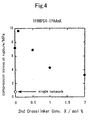
- the monomer concentrations here are those at the time of production and differ from the monomer amounts in the final gel. In other words, when the concentrations of the first and second monomers are both 1 M for example, their molar ratio in the final gel obtained will not be 1:1.
- the first network structure has an electric charge, and therefore, swells largely in the neutral solution of the second monomer in water.
- AMPS and TFEA were mixed at a ratio of 1:5 into DMSO to a concentration of 3.0 ml/l, 1 mol% of a crosslinker MBAA and 0.2 mol% of a polymerization initiator ⁇ -ketoglutaric acid were added and synthesis was carried out by UV polymerization.
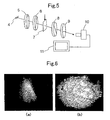
- Fig. 5 Test system used for this occasion is shown in Fig. 5.
- a light source 4 a He-Ne laser (Model 127, Spectra-Physics Laser, Inc.) was used.
- the axis of a polarizer 5 was vertically oriented and the axis of an analyzer 9 was horizontally oriented.
- the fast axes of two 1/4 plates 6 and 8 were set at ⁇ /4 and - ⁇ /4 radians respectively in relation to the axes of the polarizer 5 and the analyzer 9.
- Photoelastic images were recorded with a cooled CCD camera (C4742-95, Hamamatsu Co., Japan) linked with a personal computer 11 (the entire image area includes 1280 X 1024 pixels).
- Fig. 7 illustrates the relationship between the normalized power and the degree of crosslinking and it is seen from this drawing that the normalized power is the lowest when the degree of crosslinking is around 0.1 mol% with respect to any strain.
Landscapes
- Chemical & Material Sciences (AREA)
- Health & Medical Sciences (AREA)
- Medicinal Chemistry (AREA)
- Chemical Kinetics & Catalysis (AREA)
- Polymers & Plastics (AREA)
- Organic Chemistry (AREA)
- Dispersion Chemistry (AREA)
- Animal Behavior & Ethology (AREA)
- Oral & Maxillofacial Surgery (AREA)
- Transplantation (AREA)
- Epidemiology (AREA)
- Life Sciences & Earth Sciences (AREA)
- Dermatology (AREA)
- General Health & Medical Sciences (AREA)
- Public Health (AREA)
- Veterinary Medicine (AREA)
- Addition Polymer Or Copolymer, Post-Treatments, Or Chemical Modifications (AREA)
- Materials For Medical Uses (AREA)
- Graft Or Block Polymers (AREA)
- Colloid Chemistry (AREA)
- Absorbent Articles And Supports Therefor (AREA)
- Prostheses (AREA)
- Physical Or Chemical Processes And Apparatus (AREA)
- Compositions Of Macromolecular Compounds (AREA)
- Macromonomer-Based Addition Polymer (AREA)
Abstract
Description
10 mol% or more of the first monomer component is an unsaturated monomer having an electric charge,
60 mol% or more of the second monomer component is an electrically neutral unsaturated monomer,
the molar ratio of the first monomer component to the second monomer component is from 1:2 to 1:100, and
when the second monomer component is polymerized and crosslinked, the degree of crosslinking is set to be lower than the degree of crosslinking of the first monomer component being polymerized and crosslinked.
| C (%) | H (%) | N (%) | ||
| double-network type gel | theoretical | 50.30 | 6.29 | 9.78 |
| found | 48.98 | 6.60 | 9.49 |
| monomer for polymerization, degree of crosslinking in parentheses | AMPS (15 mol%) | AA (2 mol%) |
| degree of swelling | 12 | 90 |
| compression stress at rupture (MPa) | 0.9 | 0.1 |
| compression strain at rupture (%) | 30 | 63 |
| Ex. | degree of crosslink of first network structure (mol%) | degree of crosslink of second network structure (mol%) | comp. stress at rupture (MPa) | comp. strain at rupture (%) | water content | degree of shrinkage | monomer ratio 1st:2nd |
| 1 | 4 | 0.1 | 9.7 | 82 | 92 | 78 | 1:10 |
| 2 | 1 | 0.1 | 3 | 95 | 91 | 80 | 1:15 |
| sample name | PAMPS:PAAm | degree of swelling | initial modulus (MPa) | breaking strength (MPa) | breaking strain (%) |
| 1PAMPS4-0.5PAAm0.1 | 1:6 | 13 | 0.41 | 2.3 | 64 |
| 1PAMPS4-1PAAm0.1 | 1:10 | 12 | 0.37 | 9.5 | 82 |
| 1PAMPS4-2PAAm0.1 | 1:20 | 6.9 | 0.60 | 17 | 89 |
| 1PAMPS4-3PAAm0.1 | 1:30 | 5.2 | 0.75 | 15 | 86 |
| 1PAMPS4-5PAAm0.1 | 1:53 | 4.9 | 0.90 | 9.4 | 80 |
| Ex. | degree of crosslink of first network structure (mol%) | degree of crosslink of second network structure (mol%) | tensile stress at rupture (MPa) | tensile strain at rupture (%) | water content (%) | degree of shrinkage (%) | monomer ratio 1st:2nd |
| 4 | 1.0 | 0.1 | 2.2 | 410 | 29 | 100 | 1:6 |
| degree of swelling | initial modulus (MPa) | stress at rupture (MPa) | strain at rupture (%) | water content (%) | degree of shrinkage (%) | |
| reference (swollen in pure water) | 12 | 0.35 | 0.7 | 100 | 92 | 78 |
| Zn2+ (0.01 M) | 9 | 0.25 | 1.0 | 100 | 89 | 75 |
| Zn2+ (0.1 M) | 7 | 0.31 | 14.8 | 89 | 86 | 58 |
| Zn2+ (1M) | 3 | 0.30 | 17.6 | 88 | 67 | 25 |
| Fe3+ (0.01M) | 4 | 0.21 | 41.2 | 95 | 75 | 33 |
| Fe3+ (0.1 M) | 6 | 0.14 | 15.8 | 88 | 83 | 50 |
| Fe3+ (0.3 M) | 6 | 0.13 | 14.2 | 88 | 83 | 50 |
These hydrogels were cut to 60 X 30 X 10 mm.
Claims (26)
- A hydrogel of a semi-interpenetrating network structure or an interpenetrating network structure, obtainable by polymerizing and crosslinking a first monomer component to form a network structure; introducing a second monomer component into the network structure; and polymerizing and optionally crosslinking the second monomer component, characterized in that
10 mol% or more of the first monomer component is an unsaturated monomer having an electric charge,
60 mol% or more of the second monomer component is an electrically neutral unsaturated monomer,
the molar ratio of the first monomer component to the second monomer component is from 1:2 to 1:100, and
when the second monomer component is polymerized and crosslinked, the degree of crosslinking is set to be lower than the degree of crosslinking of the first monomer component being polymerized and crosslinked. - The hydrogel according to Claim 1, wherein the unsaturated monomer having an electric charge is an unsaturated monomer having an acidic group and/or a basic group.
- The hydrogel according to Claim 2, wherein the acidic group is selected from the group consisting of a carboxyl group, a phosphate group and a sulfonic group.
- The hydrogel according to Claim 3, wherein the unsaturated monomer having an acidic group is 2-acrylamido-2-methylpropane sulfonic acid, acrylic acid, methacrylic acid or a salt thereof.
- The hydrogel according to any one of Claims 1 to 4, wherein the electrically neutral unsaturated monomer is acrylamide, N-isopropyl acrylamide, vinylpyridine, styrene, methyl methacrylate, a fluorine-containing unsaturated monomer (for example, trifluoroethyl acrylate), hydroxyethyl acrylate or vinyl acetate.
- The hydrogel according to any one of Claims 1 to 5, wherein the hydrogel further contains a metal ion, and at least part of the first monomer component and the second monomer component has a group capable of forming a complex with the metal ion.
- The hydrogel according to any one of Claims 1 to 6, wherein the network structure based on the first monomer component has a degree of crosslinking of 0.1 to 50 mol% and the network structure based on the second monomer component has a degree of crosslinking of 0.001 to 20 mol%.
- The hydrogel according to any one of Claims 1 to 7, which has a water content of 10% or more.
- The hydrogel according to any one of Claims 1 to 8, which has a compression stress at rupture of 1 to 100 MPa.
- The hydrogel according to any one of Claims 1 to 9, which has a tensile stress at rupture of 0.1 to 100 MPa.
- The hydrogel according to any one of Claims 1 to 10, which is stress-dispersing.
- The hydrogel according to any one of Claims 1 to 11, which has a degree of shrinkage of 20 to 95%.
- An article using the hydrogel as defined in any one of Claims 1 to 12.
- The article according to Claim 13, which is selected from a diaper, a sanitary product, a sustained-release agent, a construction material, a building material, a communication material, a soil conditioner, a contact lens, an intraocular lens, a hollow fiber, an artificial cartilage, an artificial organ, a material for fuel cells, a battery diaphragm, an impact-resistant material and a cushion.
- A process for producing a hydrogel of a semi-interpenetrating network structure or an interpenetrating network structure, comprising the steps of:polymerizing and crosslinking a first monomer component, of which 10 mol% or more is an unsaturated monomer having an electric charge, to form a first network structure; andintroducing a second monomer component, of which 60 mol% or more is an electrically neutral unsaturated monomer, into the first network structure and then polymerizing the second monomer component thereby to form a polymer in the first network structure; or optionally, further crosslinking the second monomer component thereby to form a second network structure in the first network structure, wherein when the second monomer component is polymerized and crosslinked, the degree of crosslinking is set to be lower than the degree of crosslinking of the first monomer component being polymerized and crosslinked and wherein the molar ratio of the first monomer component to the second monomer component is from 1:2 to 1:100.
- The process according to Claim 15, wherein the unsaturated monomer having an electric charge is an unsaturated monomer having an acidic group and/or a basic group.
- The process according to Claim 16, wherein the acidic group is selected from the group consisting of a carboxyl group, a phosphate group and a sulfonic group.
- The process according to Claim 17, wherein the unsaturated monomer having an acidic group is 2-acrylamido-2-methylpropane sulfonic acid, acrylic acid, methacrylic acid or a salt thereof.
- The process according to any one of Claims 15 to 18, wherein the electrically neutral unsaturated monomer is acrylamide, N-isopropyl acrylamide, vinylpyridine, styrene, methyl methacrylate, a fluorine-containing unsaturated monomer (for example, trifluoroethyl acrylate), hydroxyethyl acrylate or vinyl acetate.
- The process according to any one of Claims 15 to 19, wherein the hydrogel further contains a metal ion, and at least part of the first monomer component and the second monomer component has a group capable of forming a complex with the metal ion.
- The process according to any one of Claims 15 to 20, wherein the network structure based on the first monomer component has a degree of crosslinking of 0.1 to 50 mol% and the network structure based on the second monomer component has a degree of crosslinking of 0.001 to 20 mol%.
- The process according to any one of Claims 15 to 21, wherein the hydrogel has a water content of 10% or more.
- The process according to any one of Claims 15 to 22, wherein the hydrogel has a compression stress at rupture of 1 to 100 MPa.
- The process according to any one of Claims 15 to 23, wherein the hydrogel has a tensile stress at rupture of 0.1 to 100 MPa.
- The process according to any one of Claims 15 to 24, wherein the hydrogel is stress-dispersing.
- The process according to any one of Claims 15 to 25, wherein the hydrogel has a degree of shrinkage of 20 to 95%.
Applications Claiming Priority (3)
| Application Number | Priority Date | Filing Date | Title |
|---|---|---|---|
| WOPCT/JP02/04358 | 2002-05-01 | ||
| PCT/JP2002/004358 WO2003093327A1 (en) | 2002-05-01 | 2002-05-01 | Gel having multiple network structure and method for preparation thereof |
| PCT/JP2003/004556 WO2003093337A1 (en) | 2002-05-01 | 2003-04-10 | Hydrogel of (semi)interpenetrating network structure and process for producing the same |
Publications (3)
| Publication Number | Publication Date |
|---|---|
| EP1505093A1 true EP1505093A1 (en) | 2005-02-09 |
| EP1505093A4 EP1505093A4 (en) | 2008-09-10 |
| EP1505093B1 EP1505093B1 (en) | 2010-09-29 |
Family
ID=29287946
Family Applications (1)
| Application Number | Title | Priority Date | Filing Date |
|---|---|---|---|
| EP03747538A Expired - Lifetime EP1505093B1 (en) | 2002-05-01 | 2003-04-10 | Hydrogel of (semi)interpenetrating network structure and process for producing the same |
Country Status (9)
| Country | Link |
|---|---|
| US (1) | US8029824B2 (en) |
| EP (1) | EP1505093B1 (en) |
| JP (1) | JP4381297B2 (en) |
| KR (1) | KR101002147B1 (en) |
| CN (1) | CN1304444C (en) |
| AT (1) | ATE482984T1 (en) |
| AU (2) | AU2002309026A1 (en) |
| DE (1) | DE60334374D1 (en) |
| WO (2) | WO2003093327A1 (en) |
Cited By (3)
| Publication number | Priority date | Publication date | Assignee | Title |
|---|---|---|---|---|
| EP1779875A4 (en) * | 2004-06-18 | 2011-08-24 | Univ Hokkaido Nat Univ Corp | ARTIFICIAL ARTICULAR MENISCUS OF THE KNEE |
| EP2439227A1 (en) * | 2007-08-03 | 2012-04-11 | Zimmer, Inc. | Method of forming a multi-polymer hydrogel article |
| US9919076B2 (en) | 2007-12-07 | 2018-03-20 | Laboratoires Vivacy | Biodegradable single-phase cohesive hydrogels |
Families Citing this family (81)
| Publication number | Priority date | Publication date | Assignee | Title |
|---|---|---|---|---|
| JP5059407B2 (en) * | 2004-06-25 | 2012-10-24 | 国立大学法人北海道大学 | Gel, production method thereof, water-absorbent resin, lubricant, and cell culture substrate |
| JP4752047B2 (en) * | 2004-06-30 | 2011-08-17 | 国立大学法人北海道大学 | Method for producing cell culture substrate and cell culture method |
| US8821583B2 (en) * | 2004-10-05 | 2014-09-02 | The Board Of Trustees Of The Leland Stanford Junior University | Interpenetrating polymer network hydrogel |
| US7857849B2 (en) * | 2004-10-05 | 2010-12-28 | The Board Of Trustees Of The Leland Stanford Junior Iniversity | Artificial corneal implant |
| US20090088846A1 (en) * | 2007-04-17 | 2009-04-02 | David Myung | Hydrogel arthroplasty device |
| US20060287721A1 (en) * | 2004-10-05 | 2006-12-21 | David Myung | Artificial cornea |
| US7857447B2 (en) * | 2004-10-05 | 2010-12-28 | The Board Of Trustees Of The Leland Stanford Junior University | Interpenetrating polymer network hydrogel contact lenses |
| US7909867B2 (en) * | 2004-10-05 | 2011-03-22 | The Board Of Trustees Of The Leland Stanford Junior University | Interpenetrating polymer network hydrogel corneal prosthesis |
| JP2006213868A (en) * | 2005-02-04 | 2006-08-17 | Hokkaido Univ | Gel and method for producing the same |
| US20110184513A1 (en) * | 2005-10-04 | 2011-07-28 | David Myung | Artificial corneal implant |
| JP5166282B2 (en) * | 2006-11-29 | 2013-03-21 | 国立大学法人北海道大学 | Bone filler for cartilage tissue regeneration treatment |
| EP2112933A4 (en) * | 2007-02-16 | 2011-01-12 | Univ Leland Stanford Junior | HYDROGEL WITH COLD CURVED INTERFERENCE POLYMERIC NETWORK |
| JP5132958B2 (en) * | 2007-03-15 | 2013-01-30 | 株式会社シード | Hydrogel ophthalmic lens used for gene therapy |
| EP2457539B1 (en) * | 2007-04-17 | 2019-12-25 | The Board of Trustees of the Leland Stanford Junior University | Hydrogel arthroplasty device |
| JP5324070B2 (en) * | 2007-08-27 | 2013-10-23 | スリーエム イノベイティブ プロパティズ カンパニー | Polymer gel structure and method for producing the same |
| JP4915867B2 (en) * | 2007-08-31 | 2012-04-11 | 国立大学法人北海道大学 | Composite material comprising interpenetrating network structure gel and predetermined adherent material, method for producing the same, and method for adhering interpenetrating network structure gel to predetermined adherent material |
| CN101396569B (en) * | 2007-09-27 | 2013-04-10 | 北京师范大学 | Composite hydrogel using organism tissue as bracket, preparation method and use thereof |
| US8293510B2 (en) | 2007-11-16 | 2012-10-23 | University Of Kansas | Method of preparing a hydrogel network encapsulating cells |
| JP5200213B2 (en) * | 2008-02-05 | 2013-06-05 | 国立大学法人北海道大学 | Polymer gel and method for producing the same |
| JP5644036B2 (en) * | 2008-02-08 | 2014-12-24 | 三菱レイヨン株式会社 | Hydrogel and method for producing the same |
| WO2009099210A1 (en) * | 2008-02-08 | 2009-08-13 | Mitsubishi Rayon Co., Ltd. | Hydrogel and process for producing the same |
| WO2009117737A2 (en) * | 2008-03-21 | 2009-09-24 | Biomimedica, Inc | Methods, devices and compositions for adhering hydrated polymer implants to bone |
| JP2009259793A (en) * | 2008-03-24 | 2009-11-05 | Toyota Central R&D Labs Inc | Strong acid crosslinking type compound electrolyte |
| GB0807154D0 (en) | 2008-04-18 | 2008-05-21 | Univ Aston | Intervertebral disc |
| JP2009269974A (en) * | 2008-05-02 | 2009-11-19 | Three M Innovative Properties Co | Gel composition, method for producing the same, and shock absorbing material produced by using the same |
| JP2009298971A (en) * | 2008-06-16 | 2009-12-24 | Hokkaido Univ | Polymer gel and its production method |
| US20120209396A1 (en) | 2008-07-07 | 2012-08-16 | David Myung | Orthopedic implants having gradient polymer alloys |
| WO2010005992A1 (en) | 2008-07-07 | 2010-01-14 | Biomimedica, Inc. | Hydrophilic interpenetrating polymer networks derived from hydrophobic polymers |
| EP2323670A4 (en) | 2008-08-05 | 2013-12-25 | Biomimedica Inc | Polyurethane-grafted hydrogels |
| JPWO2010024300A1 (en) * | 2008-08-26 | 2012-01-26 | 国立大学法人北海道大学 | Bone filling type cartilage tissue regeneration inducer |
| JP5133209B2 (en) * | 2008-11-10 | 2013-01-30 | 三菱レイヨン株式会社 | Organogel and method for producing the same |
| EP2962682B1 (en) * | 2008-12-11 | 2018-03-28 | Massachusetts Institute Of Technology | Method of making a contact lens drug delivery device |
| KR100994747B1 (en) * | 2008-12-31 | 2010-12-07 | 주식회사 인터로조 | Hydrogel Contact Lenses with Improved Wetting |
| WO2010096704A2 (en) | 2009-02-19 | 2010-08-26 | Alex Garfield Bonner | Porous interpenetrating polymer network |
| JP5138632B2 (en) * | 2009-04-30 | 2013-02-06 | 三菱レイヨン株式会社 | Pregel solution and polymer composition, and method for producing polymer composition |
| CA2761909A1 (en) * | 2009-05-14 | 2010-11-18 | Central Michigan University | Composition and method of preparation of polysaccharide gel-based artificial, biodegradable skin scaffolds |
| JP5704382B2 (en) * | 2009-11-30 | 2015-04-22 | 三菱レイヨン株式会社 | Gel, gel dried body, and production method thereof |
| JP5556406B2 (en) * | 2010-06-15 | 2014-07-23 | 三菱レイヨン株式会社 | Gel and method for producing the same |
| JP5850417B2 (en) * | 2010-08-04 | 2016-02-03 | 国立大学法人北海道大学 | Polymer gel and method for producing the same |
| US20130217829A1 (en) | 2010-08-27 | 2013-08-22 | David Myung | "hydrophobic and hydrophilic interpenetrating polymer networks derived from hydrophobic polymers and methods of preparing the same" |
| CN102453187B (en) * | 2010-10-25 | 2013-11-27 | 南京大学 | Polymer hydrogel for absorbing heavy metals and preparation method and application thereof |
| JP2014506177A (en) | 2011-01-10 | 2014-03-13 | バイオミメディカ インコーポレイテッド | Orthopedic implant with gradient polymer alloy |
| CN102199246B (en) * | 2011-04-11 | 2013-02-27 | 南京大学 | Three-element copolymerized hydrogel, preparation method thereof and application thereof in water treatment |
| WO2013052105A2 (en) | 2011-10-03 | 2013-04-11 | Biomimedica, Inc. | Polymeric adhesive for anchoring compliant materials to another surface |
| AU2012340699A1 (en) | 2011-11-21 | 2014-06-19 | Biomimedica, Inc. | Systems, devices, and methods for anchoring orthopaedic implants to bone |
| CN103520777B (en) * | 2013-10-08 | 2014-12-10 | 天津工业大学 | Highly-tough hole-adjustable gel artificial blood vessel and making method thereof |
| JP6119568B2 (en) * | 2013-11-15 | 2017-04-26 | 東亞合成株式会社 | High strength gel |
| JP6388494B2 (en) * | 2014-05-30 | 2018-09-12 | シャープ株式会社 | Hose and manufacturing method thereof, shower head and shower hose unit |
| US9715130B2 (en) * | 2014-08-21 | 2017-07-25 | Johnson & Johnson Vision Care, Inc. | Methods and apparatus to form separators for biocompatible energization elements for biomedical devices |
| JP6577709B2 (en) | 2014-12-26 | 2019-09-18 | 三星電子株式会社Samsung Electronics Co.,Ltd. | Gel production method and acoustic coupler gel |
| JP6608160B2 (en) * | 2015-04-08 | 2019-11-20 | 国立大学法人北海道大学 | Polymer gel and method for producing the same |
| WO2017027590A1 (en) | 2015-08-10 | 2017-02-16 | Hyale Surgical, Inc. | Interpenetrating polymer networks |
| US11077228B2 (en) | 2015-08-10 | 2021-08-03 | Hyalex Orthopaedics, Inc. | Interpenetrating polymer networks |
| JP6692080B2 (en) * | 2016-05-30 | 2020-05-13 | 住友化学株式会社 | Method for producing DN gel film |
| JP6795344B2 (en) * | 2016-07-13 | 2020-12-02 | 地方独立行政法人東京都立産業技術研究センター | Hydrogel and method for producing hydrogel |
| JP2018150458A (en) * | 2017-03-13 | 2018-09-27 | 積水化成品工業株式会社 | Hydrogel, production method and use thereof |
| JP2018172563A (en) * | 2017-03-31 | 2018-11-08 | 住友化学株式会社 | Gel with interpenetrating network structure |
| KR20200026294A (en) * | 2017-08-01 | 2020-03-10 | 가부시키가이샤 시드 | Endoscope Hood |
| CN107994103B (en) * | 2017-12-28 | 2023-07-18 | 江苏穿越光电科技有限公司 | A perovskite quantum dot flip-chip LED light source |
| EP3757160B1 (en) | 2018-02-21 | 2023-09-06 | Bridgestone Corporation | Production method for vulcanized rubber composition |
| JP7248967B2 (en) * | 2018-04-23 | 2023-03-30 | 国立大学法人北海道大学 | Hydrogel and method for producing hydrogel |
| US10869950B2 (en) | 2018-07-17 | 2020-12-22 | Hyalex Orthopaedics, Inc. | Ionic polymer compositions |
| US10410542B1 (en) | 2018-07-18 | 2019-09-10 | Simulated Inanimate Models, LLC | Surgical training apparatus, methods and systems |
| CN110746614A (en) * | 2018-07-24 | 2020-02-04 | 西安交通大学 | A kind of preparation method of impact-resistant high-strength physical hydrogel and application thereof |
| CN109503755B (en) * | 2018-09-12 | 2020-10-27 | 江汉大学 | Temperature-sensitive polymer single-ion conductive intelligent gel and preparation method thereof |
| JP7357857B2 (en) * | 2018-10-24 | 2023-10-10 | 株式会社 資生堂 | Method for manufacturing pseudo skin |
| KR102084099B1 (en) * | 2018-11-28 | 2020-03-04 | 삼성에스디아이 주식회사 | Composition for heat-resistance layer, separator for rechargeable lithium battery including heat-resistance layer formed therefrom and rechargeable lithium battery including the same |
| US12202977B2 (en) | 2019-08-28 | 2025-01-21 | Bridgestone Corporation | Rubber composition and tire |
| JPWO2021039408A1 (en) | 2019-08-28 | 2021-03-04 | ||
| JP7678468B2 (en) * | 2019-11-12 | 2025-05-16 | 国立研究開発法人産業技術総合研究所 | Polymer composite and method for producing same |
| WO2021187530A1 (en) * | 2020-03-19 | 2021-09-23 | 三菱ケミカル株式会社 | High strength gel |
| JP7345434B2 (en) | 2020-06-08 | 2023-09-15 | 株式会社ブリヂストン | pneumatic tires |
| CN112999412B (en) * | 2021-03-10 | 2022-04-12 | 苏州大学 | Hydrogel dressing for wound healing and preparation method thereof |
| CN113232560A (en) * | 2021-04-17 | 2021-08-10 | 南京航空航天大学 | Child safety seat based on artificial cartilage bionic material and negative Poisson ratio structure |
| WO2022249904A1 (en) * | 2021-05-25 | 2022-12-01 | 国立大学法人北海道大学 | Hydrogel, method for producing hydrogel, and method for producing molded article |
| CN113712191B (en) * | 2021-09-07 | 2023-09-22 | 上海交通大学 | A kind of preparation method of ready-to-eat high simulation vegetarian hairy tripe |
| JP2024541906A (en) | 2021-10-23 | 2024-11-13 | シミュレーテッド イナニメイト モデルズ エルエルシー | PROCEDURE GUIDANCE AND TRAINING DEVICE, METHOD, AND SYSTEM |
| MX2024010372A (en) | 2022-02-28 | 2024-09-02 | Kimberly Clark Co | High-capacity superabsorbent materials and methods of making same. |
| MX2024010371A (en) | 2022-02-28 | 2024-08-30 | Kimberly Clark Co | High-capacity superabsorbent materials and methods of making same. |
| CN115716925A (en) * | 2022-11-30 | 2023-02-28 | 常州先进制造技术研究所 | Preparation method of a ternary interpenetrating network high conductivity thermogel composite material with synergistic effect |
| CN116574276A (en) * | 2023-06-08 | 2023-08-11 | 北京工业大学 | Flexible self-adhesive self-repairing naked eye stress and strain detection sticker |
Family Cites Families (22)
| Publication number | Priority date | Publication date | Assignee | Title |
|---|---|---|---|---|
| US4071508A (en) | 1975-02-11 | 1978-01-31 | Plastomedical Sciences, Inc. | Anionic hydrogels based on hydroxyalkyl acrylates and methacrylates |
| JPH0655876B2 (en) * | 1989-08-23 | 1994-07-27 | 新技術事業団 | Acrylamide-acrylic acid IPN |
| JP2762632B2 (en) | 1989-11-27 | 1998-06-04 | 味の素株式会社 | Biological tissue substitute |
| DE69124749T2 (en) * | 1990-04-27 | 1997-06-12 | Nippon Catalytic Chem Ind | Process for the production of salt-resistant resin |
| EP0569542A1 (en) * | 1991-01-31 | 1993-11-18 | Massachusetts Institute Of Technology | Interpenetrating-polymer network phase-transition gels |
| IT1260154B (en) | 1992-07-03 | 1996-03-28 | Lanfranco Callegaro | HYALURONIC ACID AND ITS DERIVATIVES IN INTERPENETRATING POLYMERS (IPN) |
| JPH06200224A (en) * | 1992-12-28 | 1994-07-19 | Nitto Chem Ind Co Ltd | Highly adhesive hydrogel composition |
| JPH10500148A (en) * | 1994-03-04 | 1998-01-06 | ユニバーシティ オブ ワシントン | Block and graft copolymers and related methods |
| JP3538741B2 (en) * | 1995-05-23 | 2004-06-14 | 独立行政法人 科学技術振興機構 | Composite stimulus-responsive biodegradable polymer hydrogel |
| GB9816826D0 (en) | 1998-07-31 | 1998-09-30 | First Water Ltd | Bioadhesive compositions |
| JPH1032019A (en) * | 1996-07-17 | 1998-02-03 | Matsushita Electric Ind Co Ltd | Polymer electrolyte and lithium polymer battery using the same |
| US6271278B1 (en) * | 1997-05-13 | 2001-08-07 | Purdue Research Foundation | Hydrogel composites and superporous hydrogel composites having fast swelling, high mechanical strength, and superabsorbent properties |
| US6235433B1 (en) * | 1997-12-19 | 2001-05-22 | Nec Corporation | High molecular gel electrolyte and secondary battery using the same |
| WO2000002937A1 (en) | 1998-07-08 | 2000-01-20 | Sunsoft Corporation | Interpenetrating polymer network hydrophilic hydrogels for contact lens |
| JP3879303B2 (en) | 1999-02-08 | 2007-02-14 | 富士ゼロックス株式会社 | Volume modulation type light control material, volume modulation type light control composition, and optical element |
| JP2000351806A (en) * | 1999-04-07 | 2000-12-19 | Dainippon Ink & Chem Inc | Polymerizable composition, method for producing porous body using the composition, and microfiltration membrane produced by the method |
| JP4389008B2 (en) * | 1999-11-09 | 2009-12-24 | 独立行政法人産業技術総合研究所 | Organogel composite spherical inorganic porous particles and method for producing the same |
| US6629997B2 (en) | 2000-03-27 | 2003-10-07 | Kevin A. Mansmann | Meniscus-type implant with hydrogel surface reinforced by three-dimensional mesh |
| JP2002105344A (en) * | 2000-09-28 | 2002-04-10 | Fuji Xerox Co Ltd | High molecular gel composition, method for producing the same and optical element using the same |
| JP5048183B2 (en) * | 2001-01-22 | 2012-10-17 | 国立大学法人北海道大学 | Low friction hydrogel having linear polymer and method for producing the same |
| JP3679350B2 (en) | 2001-05-28 | 2005-08-03 | 株式会社ナムコ | Program, information storage medium and computer system |
| WO2006013612A1 (en) | 2004-06-18 | 2006-02-09 | Hokkaido Technology Licensing Office Co., Ltd. | Artificial semilunar cartilage |
-
2002
- 2002-05-01 WO PCT/JP2002/004358 patent/WO2003093327A1/en not_active Ceased
- 2002-05-01 AU AU2002309026A patent/AU2002309026A1/en not_active Abandoned
-
2003
- 2003-04-10 JP JP2004501476A patent/JP4381297B2/en not_active Expired - Lifetime
- 2003-04-10 US US10/513,070 patent/US8029824B2/en not_active Expired - Fee Related
- 2003-04-10 AU AU2003236042A patent/AU2003236042A1/en not_active Abandoned
- 2003-04-10 EP EP03747538A patent/EP1505093B1/en not_active Expired - Lifetime
- 2003-04-10 KR KR1020047017413A patent/KR101002147B1/en not_active Expired - Fee Related
- 2003-04-10 AT AT03747538T patent/ATE482984T1/en not_active IP Right Cessation
- 2003-04-10 DE DE60334374T patent/DE60334374D1/en not_active Expired - Lifetime
- 2003-04-10 WO PCT/JP2003/004556 patent/WO2003093337A1/en not_active Ceased
- 2003-04-10 CN CNB038097125A patent/CN1304444C/en not_active Expired - Lifetime
Cited By (4)
| Publication number | Priority date | Publication date | Assignee | Title |
|---|---|---|---|---|
| EP1779875A4 (en) * | 2004-06-18 | 2011-08-24 | Univ Hokkaido Nat Univ Corp | ARTIFICIAL ARTICULAR MENISCUS OF THE KNEE |
| EP2439227A1 (en) * | 2007-08-03 | 2012-04-11 | Zimmer, Inc. | Method of forming a multi-polymer hydrogel article |
| US9919076B2 (en) | 2007-12-07 | 2018-03-20 | Laboratoires Vivacy | Biodegradable single-phase cohesive hydrogels |
| US10207024B2 (en) | 2007-12-07 | 2019-02-19 | Laboratoires Vivacy | Biodegradable single-phase cohesive hydrogels |
Also Published As
| Publication number | Publication date |
|---|---|
| AU2002309026A1 (en) | 2003-11-17 |
| ATE482984T1 (en) | 2010-10-15 |
| JP4381297B2 (en) | 2009-12-09 |
| KR20050018669A (en) | 2005-02-23 |
| KR101002147B1 (en) | 2010-12-17 |
| EP1505093A4 (en) | 2008-09-10 |
| WO2003093327A1 (en) | 2003-11-13 |
| EP1505093B1 (en) | 2010-09-29 |
| CN1304444C (en) | 2007-03-14 |
| WO2003093337A1 (en) | 2003-11-13 |
| US20050147685A1 (en) | 2005-07-07 |
| US8029824B2 (en) | 2011-10-04 |
| DE60334374D1 (en) | 2010-11-11 |
| JPWO2003093337A1 (en) | 2005-09-08 |
| CN1649921A (en) | 2005-08-03 |
| AU2003236042A1 (en) | 2003-11-17 |
Similar Documents
| Publication | Publication Date | Title |
|---|---|---|
| US8029824B2 (en) | Hydrogel of (semi) interpenetrating network structure and process for producing the same | |
| US7857447B2 (en) | Interpenetrating polymer network hydrogel contact lenses | |
| US8025696B2 (en) | Artificial meniscus and process of making thereof | |
| JP4379778B2 (en) | Drug sustained-release ophthalmic lens | |
| JP2010510347A (en) | Porous polymer material with crosslinkable wetting agent | |
| CN1328067A (en) | Process for preparing temp-sensitive porous poly(N-isopropyl acrylamide) aqueogel | |
| JP6628396B2 (en) | Gel material for 3D printer | |
| CN113801262A (en) | High-strength gel and preparation method thereof | |
| CN108864366B (en) | Preparation method of HEMA/NVP binary copolymer porous hydrogel | |
| US20110166247A1 (en) | Interpenetrating polymer network hydrogel contact lenses | |
| JP5059407B2 (en) | Gel, production method thereof, water-absorbent resin, lubricant, and cell culture substrate | |
| Bajpai et al. | Water sorption dynamics of a binary copolymeric hydrogel of 2-hydroxyethyl methacrylate (HEMA) | |
| US11492433B2 (en) | Hydrogel and method for producing hydrogel | |
| JP2002212452A (en) | Low-friction hydrogel having linear polymer and its production method | |
| JPH0379608A (en) | Acrylamide-acrylic acid ipn | |
| JP2006213868A (en) | Gel and method for producing the same | |
| JP2008163055A (en) | High-strength gel and method for producing the gel | |
| US20190343959A1 (en) | Biocampatible and Biodegradable Anionic Hydrogel System | |
| JP4879554B2 (en) | Method for producing post-imprintable hydrogel material | |
| JP5850417B2 (en) | Polymer gel and method for producing the same | |
| KR20220114445A (en) | Electric field sensitive hydrogel actuator and manufacturing method thereof | |
| WO2005023877A1 (en) | Water-absorbing resin and method for manufacturing the same | |
| Franklin | Development and optimisation of polymeric matrices for use in biomolecular devices. | |
| JPH0465847B2 (en) |
Legal Events
| Date | Code | Title | Description |
|---|---|---|---|
| PUAI | Public reference made under article 153(3) epc to a published international application that has entered the european phase |
Free format text: ORIGINAL CODE: 0009012 |
|
| 17P | Request for examination filed |
Effective date: 20041126 |
|
| AK | Designated contracting states |
Kind code of ref document: A1 Designated state(s): AT BE BG CH CY CZ DE DK EE ES FI FR GB GR HU IE IT LI LU MC NL PT RO SE SI SK TR |
|
| A4 | Supplementary search report drawn up and despatched |
Effective date: 20080812 |
|
| RAP1 | Party data changed (applicant data changed or rights of an application transferred) |
Owner name: NATIONAL UNIVERSITY CORPORATION HOKKAIDO UNIVERSIT |
|
| 17Q | First examination report despatched |
Effective date: 20091005 |
|
| GRAP | Despatch of communication of intention to grant a patent |
Free format text: ORIGINAL CODE: EPIDOSNIGR1 |
|
| GRAS | Grant fee paid |
Free format text: ORIGINAL CODE: EPIDOSNIGR3 |
|
| GRAA | (expected) grant |
Free format text: ORIGINAL CODE: 0009210 |
|
| AK | Designated contracting states |
Kind code of ref document: B1 Designated state(s): AT BE BG CH CY CZ DE DK EE ES FI FR GB GR HU IE IT LI LU MC NL PT RO SE SI SK TR |
|
| REG | Reference to a national code |
Ref country code: GB Ref legal event code: FG4D |
|
| REG | Reference to a national code |
Ref country code: CH Ref legal event code: EP |
|
| REG | Reference to a national code |
Ref country code: IE Ref legal event code: FG4D |
|
| REF | Corresponds to: |
Ref document number: 60334374 Country of ref document: DE Date of ref document: 20101111 Kind code of ref document: P |
|
| PG25 | Lapsed in a contracting state [announced via postgrant information from national office to epo] |
Ref country code: FI Free format text: LAPSE BECAUSE OF FAILURE TO SUBMIT A TRANSLATION OF THE DESCRIPTION OR TO PAY THE FEE WITHIN THE PRESCRIBED TIME-LIMIT Effective date: 20100929 Ref country code: AT Free format text: LAPSE BECAUSE OF FAILURE TO SUBMIT A TRANSLATION OF THE DESCRIPTION OR TO PAY THE FEE WITHIN THE PRESCRIBED TIME-LIMIT Effective date: 20100929 |
|
| REG | Reference to a national code |
Ref country code: NL Ref legal event code: VDEP Effective date: 20100929 |
|
| PG25 | Lapsed in a contracting state [announced via postgrant information from national office to epo] |
Ref country code: SI Free format text: LAPSE BECAUSE OF FAILURE TO SUBMIT A TRANSLATION OF THE DESCRIPTION OR TO PAY THE FEE WITHIN THE PRESCRIBED TIME-LIMIT Effective date: 20100929 |
|
| PG25 | Lapsed in a contracting state [announced via postgrant information from national office to epo] |
Ref country code: GR Free format text: LAPSE BECAUSE OF FAILURE TO SUBMIT A TRANSLATION OF THE DESCRIPTION OR TO PAY THE FEE WITHIN THE PRESCRIBED TIME-LIMIT Effective date: 20101230 Ref country code: SE Free format text: LAPSE BECAUSE OF FAILURE TO SUBMIT A TRANSLATION OF THE DESCRIPTION OR TO PAY THE FEE WITHIN THE PRESCRIBED TIME-LIMIT Effective date: 20100929 |
|
| PG25 | Lapsed in a contracting state [announced via postgrant information from national office to epo] |
Ref country code: PT Free format text: LAPSE BECAUSE OF FAILURE TO SUBMIT A TRANSLATION OF THE DESCRIPTION OR TO PAY THE FEE WITHIN THE PRESCRIBED TIME-LIMIT Effective date: 20110131 Ref country code: CZ Free format text: LAPSE BECAUSE OF FAILURE TO SUBMIT A TRANSLATION OF THE DESCRIPTION OR TO PAY THE FEE WITHIN THE PRESCRIBED TIME-LIMIT Effective date: 20100929 Ref country code: SK Free format text: LAPSE BECAUSE OF FAILURE TO SUBMIT A TRANSLATION OF THE DESCRIPTION OR TO PAY THE FEE WITHIN THE PRESCRIBED TIME-LIMIT Effective date: 20100929 Ref country code: EE Free format text: LAPSE BECAUSE OF FAILURE TO SUBMIT A TRANSLATION OF THE DESCRIPTION OR TO PAY THE FEE WITHIN THE PRESCRIBED TIME-LIMIT Effective date: 20100929 Ref country code: RO Free format text: LAPSE BECAUSE OF FAILURE TO SUBMIT A TRANSLATION OF THE DESCRIPTION OR TO PAY THE FEE WITHIN THE PRESCRIBED TIME-LIMIT Effective date: 20100929 Ref country code: NL Free format text: LAPSE BECAUSE OF FAILURE TO SUBMIT A TRANSLATION OF THE DESCRIPTION OR TO PAY THE FEE WITHIN THE PRESCRIBED TIME-LIMIT Effective date: 20100929 Ref country code: IT Free format text: LAPSE BECAUSE OF FAILURE TO SUBMIT A TRANSLATION OF THE DESCRIPTION OR TO PAY THE FEE WITHIN THE PRESCRIBED TIME-LIMIT Effective date: 20100929 |
|
| PG25 | Lapsed in a contracting state [announced via postgrant information from national office to epo] |
Ref country code: BE Free format text: LAPSE BECAUSE OF FAILURE TO SUBMIT A TRANSLATION OF THE DESCRIPTION OR TO PAY THE FEE WITHIN THE PRESCRIBED TIME-LIMIT Effective date: 20100929 |
|
| PG25 | Lapsed in a contracting state [announced via postgrant information from national office to epo] |
Ref country code: ES Free format text: LAPSE BECAUSE OF FAILURE TO SUBMIT A TRANSLATION OF THE DESCRIPTION OR TO PAY THE FEE WITHIN THE PRESCRIBED TIME-LIMIT Effective date: 20110109 |
|
| PLBE | No opposition filed within time limit |
Free format text: ORIGINAL CODE: 0009261 |
|
| STAA | Information on the status of an ep patent application or granted ep patent |
Free format text: STATUS: NO OPPOSITION FILED WITHIN TIME LIMIT |
|
| PG25 | Lapsed in a contracting state [announced via postgrant information from national office to epo] |
Ref country code: DK Free format text: LAPSE BECAUSE OF FAILURE TO SUBMIT A TRANSLATION OF THE DESCRIPTION OR TO PAY THE FEE WITHIN THE PRESCRIBED TIME-LIMIT Effective date: 20100929 |
|
| 26N | No opposition filed |
Effective date: 20110630 |
|
| REG | Reference to a national code |
Ref country code: DE Ref legal event code: R097 Ref document number: 60334374 Country of ref document: DE Effective date: 20110630 |
|
| PG25 | Lapsed in a contracting state [announced via postgrant information from national office to epo] |
Ref country code: MC Free format text: LAPSE BECAUSE OF NON-PAYMENT OF DUE FEES Effective date: 20110430 |
|
| REG | Reference to a national code |
Ref country code: CH Ref legal event code: PL |
|
| PG25 | Lapsed in a contracting state [announced via postgrant information from national office to epo] |
Ref country code: LI Free format text: LAPSE BECAUSE OF NON-PAYMENT OF DUE FEES Effective date: 20110430 Ref country code: CH Free format text: LAPSE BECAUSE OF NON-PAYMENT OF DUE FEES Effective date: 20110430 |
|
| REG | Reference to a national code |
Ref country code: IE Ref legal event code: MM4A |
|
| PG25 | Lapsed in a contracting state [announced via postgrant information from national office to epo] |
Ref country code: IE Free format text: LAPSE BECAUSE OF NON-PAYMENT OF DUE FEES Effective date: 20110410 |
|
| PG25 | Lapsed in a contracting state [announced via postgrant information from national office to epo] |
Ref country code: LU Free format text: LAPSE BECAUSE OF NON-PAYMENT OF DUE FEES Effective date: 20110410 Ref country code: CY Free format text: LAPSE BECAUSE OF FAILURE TO SUBMIT A TRANSLATION OF THE DESCRIPTION OR TO PAY THE FEE WITHIN THE PRESCRIBED TIME-LIMIT Effective date: 20100929 |
|
| PG25 | Lapsed in a contracting state [announced via postgrant information from national office to epo] |
Ref country code: TR Free format text: LAPSE BECAUSE OF FAILURE TO SUBMIT A TRANSLATION OF THE DESCRIPTION OR TO PAY THE FEE WITHIN THE PRESCRIBED TIME-LIMIT Effective date: 20100929 Ref country code: BG Free format text: LAPSE BECAUSE OF FAILURE TO SUBMIT A TRANSLATION OF THE DESCRIPTION OR TO PAY THE FEE WITHIN THE PRESCRIBED TIME-LIMIT Effective date: 20101229 |
|
| PG25 | Lapsed in a contracting state [announced via postgrant information from national office to epo] |
Ref country code: HU Free format text: LAPSE BECAUSE OF FAILURE TO SUBMIT A TRANSLATION OF THE DESCRIPTION OR TO PAY THE FEE WITHIN THE PRESCRIBED TIME-LIMIT Effective date: 20100929 |
|
| REG | Reference to a national code |
Ref country code: FR Ref legal event code: PLFP Year of fee payment: 14 |
|
| REG | Reference to a national code |
Ref country code: FR Ref legal event code: PLFP Year of fee payment: 15 |
|
| REG | Reference to a national code |
Ref country code: FR Ref legal event code: PLFP Year of fee payment: 16 |
|
| PGFP | Annual fee paid to national office [announced via postgrant information from national office to epo] |
Ref country code: GB Payment date: 20220420 Year of fee payment: 20 Ref country code: FR Payment date: 20220420 Year of fee payment: 20 Ref country code: DE Payment date: 20220420 Year of fee payment: 20 |
|
| REG | Reference to a national code |
Ref country code: DE Ref legal event code: R071 Ref document number: 60334374 Country of ref document: DE |
|
| REG | Reference to a national code |
Ref country code: GB Ref legal event code: PE20 Expiry date: 20230409 |
|
| PG25 | Lapsed in a contracting state [announced via postgrant information from national office to epo] |
Ref country code: GB Free format text: LAPSE BECAUSE OF EXPIRATION OF PROTECTION Effective date: 20230409 |