EP1504745A1 - Composition de maquillage de matières kératiniques notamment de fibres kératiniques, comme les cils. - Google Patents
Composition de maquillage de matières kératiniques notamment de fibres kératiniques, comme les cils. Download PDFInfo
- Publication number
- EP1504745A1 EP1504745A1 EP04300523A EP04300523A EP1504745A1 EP 1504745 A1 EP1504745 A1 EP 1504745A1 EP 04300523 A EP04300523 A EP 04300523A EP 04300523 A EP04300523 A EP 04300523A EP 1504745 A1 EP1504745 A1 EP 1504745A1
- Authority
- EP
- European Patent Office
- Prior art keywords
- wax
- composition
- equal
- waxes
- composition according
- Prior art date
- Legal status (The legal status is an assumption and is not a legal conclusion. Google has not performed a legal analysis and makes no representation as to the accuracy of the status listed.)
- Granted
Links
Classifications
-
- A—HUMAN NECESSITIES
- A61—MEDICAL OR VETERINARY SCIENCE; HYGIENE
- A61K—PREPARATIONS FOR MEDICAL, DENTAL OR TOILETRY PURPOSES
- A61K8/00—Cosmetics or similar toiletry preparations
- A61K8/18—Cosmetics or similar toiletry preparations characterised by the composition
- A61K8/30—Cosmetics or similar toiletry preparations characterised by the composition containing organic compounds
- A61K8/64—Proteins; Peptides; Derivatives or degradation products thereof
- A61K8/65—Collagen; Gelatin; Keratin; Derivatives or degradation products thereof
-
- A—HUMAN NECESSITIES
- A61—MEDICAL OR VETERINARY SCIENCE; HYGIENE
- A61K—PREPARATIONS FOR MEDICAL, DENTAL OR TOILETRY PURPOSES
- A61K8/00—Cosmetics or similar toiletry preparations
- A61K8/18—Cosmetics or similar toiletry preparations characterised by the composition
- A61K8/30—Cosmetics or similar toiletry preparations characterised by the composition containing organic compounds
- A61K8/31—Hydrocarbons
-
- A—HUMAN NECESSITIES
- A61—MEDICAL OR VETERINARY SCIENCE; HYGIENE
- A61K—PREPARATIONS FOR MEDICAL, DENTAL OR TOILETRY PURPOSES
- A61K8/00—Cosmetics or similar toiletry preparations
- A61K8/18—Cosmetics or similar toiletry preparations characterised by the composition
- A61K8/72—Cosmetics or similar toiletry preparations characterised by the composition containing organic macromolecular compounds
- A61K8/81—Cosmetics or similar toiletry preparations characterised by the composition containing organic macromolecular compounds obtained by reactions involving only carbon-to-carbon unsaturated bonds
- A61K8/8141—Compositions of homopolymers or copolymers of compounds having one or more unsaturated aliphatic radicals, each having only one carbon-to-carbon double bond, and at least one being terminated by only one carboxyl radical, or of salts, anhydrides, esters, amides, imides or nitriles thereof; Compositions of derivatives of such polymers
- A61K8/8152—Homopolymers or copolymers of esters, e.g. (meth)acrylic acid esters; Compositions of derivatives of such polymers
-
- A—HUMAN NECESSITIES
- A61—MEDICAL OR VETERINARY SCIENCE; HYGIENE
- A61K—PREPARATIONS FOR MEDICAL, DENTAL OR TOILETRY PURPOSES
- A61K8/00—Cosmetics or similar toiletry preparations
- A61K8/18—Cosmetics or similar toiletry preparations characterised by the composition
- A61K8/72—Cosmetics or similar toiletry preparations characterised by the composition containing organic macromolecular compounds
- A61K8/81—Cosmetics or similar toiletry preparations characterised by the composition containing organic macromolecular compounds obtained by reactions involving only carbon-to-carbon unsaturated bonds
- A61K8/817—Compositions of homopolymers or copolymers of compounds having one or more unsaturated aliphatic radicals, each having only one carbon-to-carbon double bond, and at least one being terminated by a single or double bond to nitrogen or by a heterocyclic ring containing nitrogen; Compositions or derivatives of such polymers, e.g. vinylimidazol, vinylcaprolactame, allylamines (Polyquaternium 6)
- A61K8/8182—Copolymers of vinyl-pyrrolidones. Compositions of derivatives of such polymers
-
- A—HUMAN NECESSITIES
- A61—MEDICAL OR VETERINARY SCIENCE; HYGIENE
- A61K—PREPARATIONS FOR MEDICAL, DENTAL OR TOILETRY PURPOSES
- A61K8/00—Cosmetics or similar toiletry preparations
- A61K8/18—Cosmetics or similar toiletry preparations characterised by the composition
- A61K8/92—Oils, fats or waxes; Derivatives thereof, e.g. hydrogenation products thereof
-
- A—HUMAN NECESSITIES
- A61—MEDICAL OR VETERINARY SCIENCE; HYGIENE
- A61K—PREPARATIONS FOR MEDICAL, DENTAL OR TOILETRY PURPOSES
- A61K8/00—Cosmetics or similar toiletry preparations
- A61K8/18—Cosmetics or similar toiletry preparations characterised by the composition
- A61K8/92—Oils, fats or waxes; Derivatives thereof, e.g. hydrogenation products thereof
- A61K8/922—Oils, fats or waxes; Derivatives thereof, e.g. hydrogenation products thereof of vegetable origin
-
- A—HUMAN NECESSITIES
- A61—MEDICAL OR VETERINARY SCIENCE; HYGIENE
- A61Q—SPECIFIC USE OF COSMETICS OR SIMILAR TOILETRY PREPARATIONS
- A61Q1/00—Make-up preparations; Body powders; Preparations for removing make-up
- A61Q1/02—Preparations containing skin colorants, e.g. pigments
- A61Q1/10—Preparations containing skin colorants, e.g. pigments for eyes, e.g. eyeliner, mascara
Definitions
- the present invention relates to the makeup of keratin materials especially keratin fibers, such as eyelashes, eyebrows and hair, and more especially to the makeup of the eyelashes.
- the composition according to the invention can be in the form of a mascara, an eyebrow product, an eyeliner or a make-up product hair. More particularly, the invention relates to a mascara. It may include makeup composition, a composition to be applied on or under a make-up, still say respectively "top-coat” or “base-coat”, or even of an eyelash treatment composition.
- keratinous fiber makeup compositions and in particular eyelashes consist of at least one wax or a mixture of waxes dispersed in a liquid phase. It is mainly through the amount of wax and other non-volatile ingredients, reflected by the dry matter content of the composition, that the application specificities sought for the compositions, such as for example their fluidity, their covering power and / or their curling power, as well as their thickening power (also called charging or makeup power).
- aqueous mascaras so-called “cream mascaras”, presented under form of emulsion of waxes in water and, on the other hand, anhydrous or weak mascaras water content and / or water-soluble solvents, called “waterproof mascaras”, formulated in the state dispersion of waxes in non-aqueous solvents.
- cream mascaras anhydrous or weak mascaras water content and / or water-soluble solvents
- waterproof mascaras formulated in the state dispersion of waxes in non-aqueous solvents.
- the present invention relates more particularly to the field of makeup compositions for keratin fibers with a low content of water and / or solvents water-soluble, so-called “waterproof mascaras", in the form of a dispersion of wax (s) in non-aqueous solvents.
- these compositions have a dry matter content between 15% and 45% by weight relative to the total weight of the composition.
- this value range in dry matter is generally unsatisfactory in terms of makeup rendering. But if we try to increase this dry matter content beyond this value, there is a rapid problem with lack of fluidity.
- the makeup composition becomes too thick on application and does not additionally presents the deformability necessary for its homogeneous application over the entire eyelash surface.
- a microscopic observation shows that in this type of composition, the particles of waxes are generally in the form of aggregates.
- the object of the present invention is precisely to propose a composition makeup or care of keratin materials having a high content of dry, allowing in particular to obtain a makeup more thickening than that obtained with the traditional "waterproof" type compositions, while preserving a Consistency compatible with the intended use in make-up.
- composition could be obtained by using in the composition a particular polymer namely a polymer that is both soluble in the non-aqueous solvent medium of the composition and having a crystallizable portion.
- a particular polymer namely a polymer that is both soluble in the non-aqueous solvent medium of the composition and having a crystallizable portion.
- such a polymer allows to significantly improve the dispersion of the wax particles in the liquid phase.
- Another object of the present invention is, according to another of its aspects, a process for preparing a composition as defined above comprising at least less the continuous mixing of at least one wax and at least one soluble polymer in a non-aqueous solvent and having a crystallizable portion, while passing from a temperature greater than the melting temperature of said wax at room temperature by a continuous cooling.
- the subject of the present invention is also a process for the preparation of a composition as defined above comprising at least one dispersion step at least one wax in the form of particles having a size ranging from 0.5 ⁇ m to 30 ⁇ m, in particular ranging from 1 to 20 ⁇ m, in a mixture comprising at least one non-solvent aqueous solution and at least one polymer soluble in said solvent and having at least a portion crystallizable, said mixture being at a lower temperature than the melting temperature of said wax in the form of particles.
- the present invention also relates to the use of at least one polymer soluble in a non-aqueous solvent and having at least one crystallizable portion and from minus one wax in the form of particles having a size ranging from 0.5 ⁇ m to 30 ⁇ m, in 1 to 20 ⁇ m, for the preparation of a fiber makeup composition keratin, and in particular of a composition according to the invention.
- the present invention furthermore relates to a process for making keratinous fibers, in which the keratinous fibers, in particular the eyelashes, a composition as defined above or as obtained by one of the processes as defined above.
- compositions of the invention furthermore have a drying speed higher than conventional waterproof compositions, which allows of course to reduce the time required for the implementation of the method of makeup and the risk of trimming eyelash makeup on the adjacent eyelid. This also allows, if necessary, to be able to apply several layers of said composition in a satisfactory time and thereby further enhance the thickening effect of makeup obtained with these compositions.
- the "dry matter content” refers to the non-volatile matter content.
- This quantity of dry matter is measured by heating of the sample by infrared rays of 2 ⁇ m to 3.5 ⁇ m wavelength.
- the substances contained in said compositions which have a vapor pressure high, evaporate under the effect of this radiation.
- the measure of weight loss the sample makes it possible to determine the "dry extract” of the composition.
- the measurement protocol is as follows:
- composition About 1 g of the composition is spread on a metal cup. This, after introduction into the desiccator, is subject to a temperature setpoint of 120 ° C for one hour.
- Dry extract 100 x (dry mass / wet mass).
- compositions according to the invention are characterized in particular by a in dry matter greater than 45% by weight, in particular ranging from 46 to 80%, in from 48 to 70% and more particularly from 50 to 65% by weight with respect to total weight of the composition.
- composition according to the invention comprises at least one soluble polymer in the non-aqueous solvent medium and having at least one crystallizable portion.
- Polymer soluble in said non-aqueous medium solvent means a polymer which, when it is introduced alone in an amount of dry matter of at least greater than 0.01% by weight and for a quantity corresponding to that envisaged for the desired final composition, is soluble in said non-aqueous solvent medium at room temperature, generally of the order of 25 ° C, and at atmospheric pressure (750 mm Hg, ie 10 5 Pa).
- the polymer according to the invention is generally composed of minus two repetitive patterns of different nature (copolymer).
- the polymers used in the invention are generally of synthetic origin and are characterized by molar masses ranging from 200 to 1000 000 g / mol, in particular from 500 to 500 000 g / mol and more particularly from 1000 to 300 000 g / mol.
- the polymers used in the present invention are solubilized and noncrystallized copolymers in the medium at room temperature and necessarily comprise at least one crystallizable part designated A and at least one non-crystallizable part called amorphous, designated B.
- the crystallizable portion of the polymers used in the present invention represents at least 5%, in particular at least 10% and at most 50%, and more particularly 30 to 50% by weight of the total weight of each polymer.
- the crystallizable part A of a copolymer according to the invention can be represented by a pendant chain linked to the skeleton of said polymer and / or an integrated sequence directly in this skeleton and / or at least one terminal chain.
- These copolymers can be of any chemical structure: random copolymers, sequenced, grafted and / or dendrimers.
- the amorphous part of a copolymer according to the invention can be represented by a pendant chain linked to the skeleton of said copolymer and / or a sequence integrated directly into this skeleton and / or at least one terminal chain.
- the random copolymers are preferably crystallizable pendant chain polymers which comprise units resulting from the polymerization of at least two monomers, at least one of which has a crystallizable hydrophobic side chain designated X which can be represented by the formula I: with M representing an atom of the polymer backbone, S representing a spacer, C representing a crystallizable group.
- Crystallizable "-SC” chains may be aliphatic or aromatic, linear, branched or cyclic, optionally fluorinated or perfluorinated.
- “S” represents in particular a (CH 2 ) n or (CH 2 CH 2 O) n or (CH 2 O) group, linear branched or cyclic, with n being an integer ranging from 0 to 22.
- “S” represents Is a linear group.
- “S” and “C” are different.
- crystallizable "-SC” chains are aliphatic hydrocarbon chains, they comprise hydrocarbon alkyl chains having at least 11 carbon atoms and at most 40 carbon atoms and in particular at most 24 carbon atoms. These include aliphatic chains or alkyl chains having at least 12 carbon atoms and in particular it is C 12 -C 24 alkyl chains. When it is about fluorinated or perfluorinated alkyl chains, they comprise at least 6 fluorinated carbon atoms and in particular at least 11 carbon atoms of which at least 6 carbon atoms are fluorinated.
- Examples of pendent polymer (s) crystallizable (s) include those containing units resulting from the polymerization of one or more of the following monomers: alkyl (meth) acrylates saturated with the alkyl group at C 12 -C 24 , perfluoroalkyl (meth) acrylates with a C 12 -C 15 perfluoroalkyl group, N-alkyl (meth) acrylamides with C 12 to C 24 alkyl group with or without a fluorine atom vinyl or allyl esters with alkyl chains or perfluoro (alkyl) with C 12 to C 24 alkyl group (with at least 6 fluorine atoms for a perfluoroalkyl chain), vinyl ethers with alkyl chains or perfluoro (alkyl) with the C 12 to C 24 alkyl group and at least 6 fluorine atoms for a perfluoroalkyl chain, the C 12 to C 24 alpha-olefins, for example
- copolymers of linear and saturated C 12 to C 30 alkyl-containing vinyl esters constituting the crystallizable portion A and linear or C 4 to C 30 branched or cyclic C 4 to C 10 alkyl vinyl esters and or unsaturated constituent amorphous part B there may be mentioned in particular copolymers of vinyl acetate and vinyl stearate or allyl stearate such as the allyl stearate copolymer and vinyl acetate sold under the denomination of "Mexomère PQ®" by the company CHIMEX.
- the chains crystallizable hydrocarbon and / or fluorinated as defined above are borne by a monomer which may be a diacid, a diol, a diamine or a diisocyanate.
- copolymers consist of at least two types of different chemical nature of which one is crystallizable and constitutes Part A. In the case block copolymers, at least one of the amorphous B sequences must be soluble in the middle.
- These polymers may have a single crystallizable block or a repetition of crystallizable sequences. In the latter case, these crystallizable sequences may be of identical or different chemical nature.
- copolymers according to the invention it is possible mention in particular ethylene / vinyl acetate copolymers, copolymers ethylene / maleic anhydride, hydrogenated butadiene / isoprene block copolymers and ethylene / maleic anhydride / vinyl acetate terpolymers.
- the polymer soluble in the non-aqueous solvent medium and having at least one crystallizable portion or a mixture of such polymers may be present in the composition according to the invention in a proportion ranging from 0.01% to 30%, in particular from 0.1% to 20%, and in particular from 1 to 10% by weight relative to the total weight of the composition.
- composition according to the invention comprises a non-aqueous solvent medium.
- This medium is likely to form a continuous phase and contains, as its the name suggests, at least one non-aqueous solvent which is usually a volatile compound, not soluble in water and liquid at room temperature and atmospheric pressure.
- volatile compound means any compound (or non-aqueous medium) capable of evaporating on contact with the skin or the keratin fiber in less than one hour at room temperature and atmospheric pressure.
- the volatile compound is a volatile cosmetic compound which is liquid at ambient temperature, in particular having a non-zero vapor pressure at ambient temperature and atmospheric pressure, in particular having a vapor pressure ranging from 0.13 Pa to 40,000 Pa (10 -3). at 300 mm Hg), in particular ranging from 1.3 Pa to 13 000 Pa (0.01 to 100 mm Hg), and more particularly ranging from 1.3 Pa to 1300 Pa (0.01 to 10 mm Hg), Hg).
- non-volatile compound means a compound remaining on the skin or the keratin fiber at room temperature and atmospheric pressure, for at least several hours and having in particular a vapor pressure of less than 10 -3 mmHg (0.degree. , 13Pa).
- the content of volatile compound, insoluble in water and liquid at temperature ambient temperature is generally from 5 to 55%, especially from 10 to 50%, and in particular from 20 to 45% by weight relative to the total weight of the composition.
- the volatile compound not soluble in water and liquid at room temperature is in particular an oil or a cosmetically acceptable organic solvent.
- cosmetically acceptable means a compound whose use is compatible with an application on keratinous fibers and on the skin.
- non-aqueous solvent medium of the composition according to the invention may comprise a mixture of such compounds.
- the volatile oils may be hydrocarbon oils, oils silicone, fluorinated oils or mixtures thereof.
- hydrocarbon oil an oil containing mainly hydrogen and carbon atoms and optionally oxygen, nitrogen, sulfur, phosphorus.
- the volatile hydrocarbon-based oils may be chosen from hydrocarbon-based oils containing from 8 to 16 carbon atoms, and especially branched C 8 -C 16 alkanes, for instance C 8 -C 16 isoalkanes of petroleum origin (also called isoparaffins), such as isododecane (also called 2,2,4,4,6-pentamethylheptane), isodecane, isohexadecane, and for example the oils sold under the trade names "Isopars®” or "permetyls®", branched C 8 -C 16 esters, isohexyl neopentanoate, and mixtures thereof.
- Other volatile hydrocarbon oils such as petroleum distillates, especially those sold under the name "Shell Solt®” by Shell, can also be used.
- volatile oils for example volatile linear or cyclic silicone oils, in particular those having a viscosity ⁇ 6 centistokes (6.10 -6 m 2 / s), and having in particular from 2 to 10 atoms silicon, these silicones optionally having alkyl or alkoxy groups having from 1 to 22 carbon atoms.
- volatile silicone oil that can be used in the invention, there may be mentioned in particular octamethylcyclotetrasiloxane, decamethylcyclopentasiloxane, dodecamethylcyclohexasiloxane, heptamethylhexyltrisiloxane, heptamethyloctyltrisiloxane, hexamethylisiloxane, octamethyltrisiloxane and decamethyl tetrasiloxane, dodecamethylpentasiloxane and mixtures thereof.
- volatile organic solvents especially fluorinated solvents such as nonafluoromethoxy butane or perfluoromethylcyclopentane.
- the volatile compound which is not soluble in water and which is liquid at ambient temperature is chosen from volatile hydrocarbon oils having 8 to 16 carbon atoms and mixtures thereof.
- the non-aqueous solvent medium may also comprise at least one non-volatile compound, not soluble in water and liquid at room temperature, especially at least one non-volatile oil, which may be chosen in particular from oils hydrocarbon and / or silicone and / or fluorinated non-volatile.
- the non-volatile silicone oils that can be used in the composition according to the invention may be non-volatile polydimethylsiloxanes (PDMSs), polydimethylsiloxanes having alkyl or alkoxy groups, during and / or in end of the silicone chain, groups each having from 2 to 24 carbon atoms, phenyl silicones such as phenyl trimethicones, phenyl dimethicones, phenyl trimethylsiloxy diphenylsiloxanes, diphenyl dimethicones, diphenyls methyldiphenyl trisiloxanes, 2-phenylethyl trimethylsiloxysilicates;
- PDMSs non-volatile polydimethylsiloxanes
- phenyl silicones such as phenyl trimethicones, phenyl dimethicones, phenyl trimethylsiloxy diphenylsiloxanes, diphenyl dimethicones,
- the fluorinated oils that can be used in the composition of the invention are fluorosilicone oils, fluorinated polyethers, fluorinated silicones such as as described in EP-A-847752.
- the content of non-volatile compound, non-soluble in water and liquid to ambient temperature is generally from 0.01 to 30% by weight, in particular from 0.1 to 25% by weight, relative to the total weight of the composition.
- compositions according to the invention comprise water and / or at least one water-soluble solvent.
- water-soluble solvent in the present invention a liquid compound at room temperature and miscible with water (miscibility in water greater than 50% by weight at 25 ° C and atmospheric pressure).
- the water-soluble solvents that can be used in the compositions according to the invention are generally moreover, volatile.
- lower monoalcohols having 1 to 5 carbon atoms such as ethanol and isopropanol
- glycols having 2 to 8 carbon atoms such as ethylene glycol, propylene glycol, 1,3-butylene glycol and dipropylene glycol, C 3 and C 4 ketones and C 2 -C 4 aldehydes.
- the water and / or the water-soluble solvent (s) can be introduced as in the formulation according to the invention or incorporated therein through, from one or several ingredients constituting said composition. So water can be especially introduced into the composition through the introduction of latex or pseudolatex, i.e., aqueous dispersion of polymer particles.
- the content of water and / or solvent (s) water-soluble in said compositions is however less than or equal to 20% and is generally greater than or equal to 0.5% by weight relative to the total weight of the composition.
- the water content and / or water-soluble solvent (s) in the compositions of the invention may in particular vary from 1 to 18% and more particularly from 2 to 15% by weight relative to the total weight of the composition.
- compositions according to the invention comprise a wax or a mixture of waxes in a content greater than 3% by weight relative to the total weight of the composition.
- the wax considered in the context of the present invention is in a manner general a lipophilic compound, solid at room temperature (25 ° C), to change reversible solid / liquid state, having a melting point greater than or equal to 30 ° C go up to 200 ° C and in particular up to 120 ° C.
- the waxes that are suitable for the invention may have a point of melting greater than or equal to 45 ° C, and in particular greater than or equal to 55 ° C.
- the melting point corresponds to the temperature the most endothermic peak observed in thermal analysis (DSC) as described in ISO 11357-3 standard; 1999.
- the melting point of wax can be measured using a differential scanning calorimeter (DSC), for example the calorimeter sold under the denomination "MDSC 2920" by the company TA Instruments.
- the measurement protocol is as follows:
- a 5 mg sample of wax placed in a crucible is subjected to a first rise in temperature from -20 ° C to 100 ° C, at the heating rate of 10 ° C / minute, then cooled from 100 ° C to -20 ° C at a cooling rate of 10 ° C / minute and finally subjected to a second temperature rise from -20 ° C to 100 ° C at a heating rate of 5 ° C / minute.
- the variation of the power difference absorbed by the crucible is measured empty and through the crucible containing the wax sample as a function of temperature.
- the melting point of the compound is the value of the temperature corresponding to the top of the peak of the curve representing the variation of the difference of power absorbed in temperature function.
- the waxes that may be used in the compositions according to the invention are chosen from waxes, solid, at room temperature of animal, vegetable, mineral or synthetic and mixtures thereof.
- the waxes that can be used in the compositions according to the invention generally have a hardness ranging from 0.01 MPa to 15 MPa, in particular greater than 0.05 MPa and in particular greater than 0.1 MPa.
- the hardness is determined by measuring the compressive strength measured at 20 ° C using the texturometer sold under the name "TA-TX2i®” by the company RHEO, equipped with a cylinder-shaped stainless steel mobile with a diameter of 2 mm measuring the evolution of the force (compressive force or stretching force) (F) in function of time, during the following operation:
- the mobile is moved at a speed of 0.1 mm / s and then enters the wax up to a penetration depth of 0.3 mm.
- the mobile is held stationary for 1 second (corresponding to relaxation time) and then removed at a speed of 0.1 mm / s.
- the force compression force
- the force compresses the force to the maximum compression force measured between the surface of the mobile and the wax at the time of their contact. The value this force is expressed in MPa.
- the wax is melted at a temperature equal to the melting point of the wax + 20 ° C.
- the melted wax is poured into a container of 30 mm in diameter and 20 mm deep.
- the wax is recrystallized at room temperature (25 ° C) for 24 hours, then the wax is kept for at least 1 hour at 20 ° C before making the hardness measurement.
- waxes which are suitable for the invention, mention may in particular be made of hydrocarbon waxes such as beeswax, lanolin wax, insect waxes China, sumac wax, paraffins, certain polyethylene waxes and copolymers waxy as well as their esters.
- hydrocarbon waxes such as beeswax, lanolin wax, insect waxes China, sumac wax, paraffins, certain polyethylene waxes and copolymers waxy as well as their esters.
- waxes obtained by catalytic hydrogenation of animal or vegetable oils having fatty chains, linear or branched, C 8 -C 32 there may also be mentioned waxes obtained by catalytic hydrogenation of animal or vegetable oils having fatty chains, linear or branched, C 8 -C 32 .
- isomérz jojoba oil such as trans isomerized partially hydrogenated jojoba oil manufactured or marketed by Desert Whale under the trade reference "Iso-Jojoba-50®”
- silicone waxes and fluorinated waxes.
- compositions according to the invention may comprise at least one so-called sticky wax, that is to say having a tack greater than or equal to 0.7 Ns and a hardness less than or equal to 3.5 MPa.
- a sticky wax may in particular make it possible to obtain a cosmetic composition which is easily applied to keratinous fibers, having a good grip on keratin fibers and which leads to the formation of a makeup smooth, homogeneous and thickening.
- the tacky wax used may have in particular a tack ranging from 0.7 N.s to N.sup.3, in particular greater than or equal to 1 N.s, especially ranging from 1 N.s to 20 N.s, in particular greater than or equal to 2 N.s, in particular ranging from 2 N.s to 10 N.s, and in particular ranging from 2 Ns to 5 Ns.
- the stickiness of the wax is determined by measuring the evolution of the force (compressive force or stretching force) as a function of time, at 20 ° C using the texturometer sold under the name "TA-TX2i®" by the company RHEO, equipped with a mobile cone-shaped acrylic polymer forming an angle of 45 °.
- the measurement protocol is as follows:
- the wax is melted at a temperature equal to the melting point of the wax + 10 ° C.
- the melted wax is cast in a container 25 mm in diameter and 20 mm in diameter. depth.
- the wax is recrystallized at room temperature (25 ° C.) for 24 hours so that the surface of the wax is flat and smooth, then the wax is kept for minus 1 hour at 20 ° C before measuring the adhesive.
- the mobile of the texturometer is moved at the speed of 0.5 mm / s, then enters in wax to a depth of penetration of 2 mm.
- the mobile is held stationary for 1 second (corresponding to the relaxation time) then is removed at a speed of 0.5 mm / s.
- the force decreases strongly until it becomes zero, then, when the mobile is removed, the force (stretching force) becomes negative and then increases again to the value 0.
- the pantyhose corresponds to the integral of the force versus time curve for the part of the curve corresponding to the negative values of the force (stretching force).
- the value of the tights is expressed in N.s.
- the sticky wax that can be used generally has a lower hardness or 3.5 MPa, in particular ranging from 0.01 MPa to 3.5 MPa, in particular ranging from 0.05 MPa at 3 MPa, or even from 0.1 MPa to 2.5 MPa.
- the hardness is measured according to the protocol described above.
- C 20 -C 40 alkyl (hydroxystearyloxy) stearate (the alkyl group comprising from 20 to 40 carbon atoms), alone or as a mixture, in particular a 12- (12'-hydroxystearyloxy) can be used.
- Such a wax is especially sold under the names "Kester Wax K” 82 P® and Kester Wax K 80 P® by KOSTER KEUNEN.
- the waxes mentioned above generally have a melting point starting less than 45 ° C.
- compositions according to the invention may comprise at least one wax having a high starting point of melting, that is to say generally greater than or equal to 45 ° C, in particular greater than or equal to 50 ° C or very high that is to say generally greater than or equal to 55 ° C and in particular greater than or equal to 60 ° C.
- the starting melting point of the wax can be measured at using a differential scanning calorimeter (D.S.C.), for example the calorimeter sold under the name "MDSC2920®” by the company TA Instruments.
- the measurement protocol is the same as that described for the measurement of the point fusion.
- the starting melting point hereinafter abbreviated as "pf com .
- pf com The starting melting point
- the wax content having a high melting point, or very high in the compositions according to the invention may be particularly important and especially greater than or equal to 20% by weight.
- waxes implemented according to the invention in the form of fragments of higher dimension are hereinafter referred to as "traditional waxes”.
- micro waxes that can be used in the compositions according to the invention, mention may be made in particular of carnauba micro-waxes such as marketed under the name "MicroCare 350®” by the company MICRO POWDERS, micro-waxes of synthetic wax such as that marketed under the denomination of "MicroEase 114S®” by the company MICRO POWDERS, micro waxes consisting of a mixture of carnauba wax and polyethylene wax such as those marketed under the names “Micro Care 300®” and “310®” by the company MICRO POWDERS, the micro waxes made of a mixture of carnauba wax and synthetic wax such as that marketed under the name “Micro Care 325® "by the company MICRO POWDERS, polyethylene micro-waxes such as those sold under the names "Micropoly 200®", “220®”, “220L®” and “250S®” by the company MICRO POWDERS and polytetrafluoroethylene
- micro-waxes such as for example the micro-wax of carnauba, micro-wax of synthetic wax "MicroEase 114S®", or the micro wax made of a mixture of carnauba wax and synthetic wax «MicroCare 325® "have an initial melting point greater than or equal to 45 ° C.
- composition according to the invention it is of course possible to use a mixture of waxes and in particular use one or more waxes of traditional type such in particular a sticky wax and / or a wax having a higher melting point or equal to 45 ° C, and one or more waxes called micro waxes.
- the composition according to the invention generally contains from 10 to 70% by weight of waxes. In particular, it can contain from 15 to 65%, more particularly from 20 to 60%, or even 25 to 55% by weight of wax (es) relative to the total weight of the composition.
- the wax or the mixture of waxes is present in the compositions according to the invention in the form of a dispersion of particles in the non-solvent medium aqueous.
- the wax particles may have various shapes. They can in particular, be substantially spherical.
- composition according to the invention may comprise according to a mode of particular embodiment at least one film-forming polymer.
- film-forming polymer means a polymer capable of forming on its own or in the presence of an auxiliary film-forming agent, a continuous and adherent film on a support, especially on keratin materials.
- polymers liposoluble materials comprising less than 30% by weight of crystallizable part in the conditions of the invention and in particular not containing them.
- film-forming polymers that can be used in the composition of this invention, there may be mentioned synthetic polymers, radical type or type polycondensate, polymers of natural origin, and mixtures thereof.
- a liposoluble polymer By way of example of a liposoluble polymer, mention may be made of copolymers vinyl ester (the vinyl group being directly attached to the oxygen atom of the ester group and the vinyl ester having a saturated hydrocarbon radical, linear or branched, from 1 to 24 carbon atoms, linked to the carbonyl ester group) and at least one other monomer which may be a vinyl ester (different from the vinyl ester already present), a alkylvinyl ether (in which the alkyl group contains from 2 to 24 carbon atoms), or an ester allyl or methallylic (having a saturated hydrocarbon radical, linear or branched, of 1 to 24 carbon atoms, linked to the carbonyl ester group).
- copolymers can be crosslinked using crosslinking agents which can be either of the vinyl type or of the type allyl or methallyl, such as tetraallyloxyethane, divinylbenzene, divinyl octanedioate, divinyl dodecanedioate, and octadecanedioate divinyl.
- crosslinking agents which can be either of the vinyl type or of the type allyl or methallyl, such as tetraallyloxyethane, divinylbenzene, divinyl octanedioate, divinyl dodecanedioate, and octadecanedioate divinyl.
- copolymers examples include copolymers: acetate vinyl laurate, vinyl propionate / allyl laurate, propionate vinyl / vinyl laurate, and 2,2-dimethyl-2 allyl pentanoate / vinyl laurate.
- liposoluble film-forming polymers mention may also be made of liposoluble homopolymers, and in particular those resulting from homopolymerisation vinyl esters having 9 to 22 carbon atoms or acrylates or methacrylates alkyl radicals, alkyl radicals having from 2 to 24 carbon atoms.
- liposoluble homopolymers examples include: vinyl polylaurate and lauryl poly (meth) acrylates, these poly (meth) acrylates may be cross-linked with ethylene glycol dimethacrylate or tetraethylene glycol.
- the liposoluble copolymers and homopolymers defined above are known and in particular described in application FR-A-2232303; they can have a weight molecular weight average ranging from 2,000 to 500,000 and in particular from 4,000 to 200,000.
- Liposoluble film-forming polymers that can be used in the invention also include polyalkylenes, and in particular copolymers of C 2 -C 20 alkenes, such as polybutene, and alkylcelluloses with a linear or branched alkyl radical, whether or not saturated with C 1 at C 8, such as ethylcellulose and propylcellulose, copolymers of vinylpyrrolidone (VP) and in particular copolymers of vinylpyrrolidone and of C 2 to C 40 and in particular C 3 to C 20 alkene.
- polyalkylenes and in particular copolymers of C 2 -C 20 alkenes, such as polybutene, and alkylcelluloses with a linear or branched alkyl radical, whether or not saturated with C 1 at C 8, such as ethylcellulose and propylcellulose, copolymers of vinylpyrrolidone (VP) and in particular copolymers of vinylpyrrolidone and of C 2 to C 40 and in particular C
- copolymers of VP that can be used in the invention, mention may be made of the copolymers of VP / vinyl acetate, VP / ethyl methacrylate, polyvinylpyrrolidone (PVP) butylated, VP / ethyl methacrylate / methacrylic acid, VP / eicosene, VP / hexadecene, VP / triacontene, VP / styrene and VP / acrylic acid / lauryl methacrylate.
- PVP polyvinylpyrrolidone
- the film-forming polymer may also be present in the composition the form of particles dispersed in an aqueous phase or in a solvent phase non-aqueous, generally known as latex or pseudolatex.
- aqueous phase or in a solvent phase non-aqueous, generally known as latex or pseudolatex.
- latex or pseudolatex The techniques of Preparation of these dispersions are well known to those skilled in the art.
- the film-forming polymer may be present in the composition according to the invention in a solids content ranging from 0.1% to 30% by weight relative to the total weight of the composition, in particular from 0.5% to 25% by weight, and more particularly of 1% at 20% by weight.
- composition according to the invention may comprise a plasticizing agent promoting the formation of a film with the film-forming polymer.
- a plasticizer can be chosen from all the compounds known to those skilled in the art as being likely to fulfill the function sought.
- composition according to the invention may also comprise at least one coloring matter such as pulverulent materials, fat-soluble dyes, water soluble dyes.
- the pulverulent dyestuffs may be chosen from pigments and mother-of-pearl.
- the pigments may be white or colored, mineral and / or organic, coated or not.
- inorganic pigments mention may be made of titanium dioxide, optionally treated on the surface, oxides of zirconium, zinc or cerium, as well as oxides of iron or chromium, manganese violet, ultramarine blue, hydrate chrome and ferric blue.
- organic pigments mention may be made of carbon black, D & C type pigments, and lacquers based on cochineal carmine, barium, strontium, calcium, aluminum.
- the nacres can be chosen from white pearlescent pigments such as mica coated with titanium or bismuth oxychloride, the colored pearlescent pigments such as titanium mica with iron oxides, titanium mica with especially ferric blue or chromium oxide, titanium mica with an organic pigment of the aforementioned type as well as pearlescent pigments based on bismuth oxychloride.
- the fat-soluble dyes are, for example, Sudan Red, D & C Red 17, D & C Green 6, ⁇ -carotene, soybean oil, Sudan Brown, D & C Yellow 11, D & C Violet 2, D & C Orange 5, yellow quinoline, annatto.
- Its dyestuffs may be present in a content ranging from 0.01 to 30% by weight relative to the total weight of the composition.
- composition according to the invention may further comprise at least one charge.
- the fillers can be chosen from those well known to the man of the and commonly used in cosmetic compositions.
- Charges can be mineral or organic, lamellar or spherical.
- talc talc, mica, silica, kaolin, polyamide powders such as Nylon® marketed under the "Orgasol®” by the company ATOCHEM, poly- ⁇ -alanine and polyethylene, tetrafluoroethylene polymer powders such as Teflon®, lauroyl-lysine, starch, boron nitride, polymeric hollow microspheres such as those of polyvinylidene chloride / acrylonitrile such as those marketed under the name "Expancel®” by the company NOBEL INDUSTRY, acrylic powders such as those marketed under the denomination "Polytrap®" by the company Dow Corning, the particles of polymethyl methacrylate and silicone resin microbeads (“Tospearls®”) TOSHIBA, for example), precipitated calcium
- the charges may represent from 0.1 to 25%, in particular from 1 to 20% by weight relative to the total weight of the composition.
- composition of the invention may furthermore comprise any additive cosmetically acceptable, in particular chosen from those usually used in cosmetics such as antioxidants, preservatives, fragrances, neutralisers, plasticizers, thickeners or gelling agents, fibers, cosmetic active ingredients and their mixtures.
- additive cosmetically acceptable in particular chosen from those usually used in cosmetics such as antioxidants, preservatives, fragrances, neutralisers, plasticizers, thickeners or gelling agents, fibers, cosmetic active ingredients and their mixtures.
- the gelling agents that can be used in the compositions according to the invention are generally lipophilic and may be organic or inorganic, polymeric or molecular.
- inorganic lipophilic gelling agents there may be mentioned optionally modified clays, such as hectorites modified with a C 10 to C 22 fatty acid ammonium chloride, such as hectorite modified with di-stearyl dimethyl ammonium chloride such as that, for example, that marketed under the name "Bentone 38V®” by the company ELEMENTIS.
- optionally modified clays such as hectorites modified with a C 10 to C 22 fatty acid ammonium chloride, such as hectorite modified with di-stearyl dimethyl ammonium chloride such as that, for example, that marketed under the name "Bentone 38V®” by the company ELEMENTIS.
- the hydrophobic fumed silica has in particular a particle size which may be nanometric to micrometric, for example ranging from about 5 to 200 nm.
- Polymeric organic lipophilic gelling agents are, for example, partially or fully crosslinked elastomeric organopolysiloxanes of three-dimensional structure, such as those sold under the names "KSG6®”, “KSG16®” and “KSG18®” by the company SHIN-ETSU.
- esters of dextrin and of fatty acid such as palmitates of dextrin, in particular such as those sold under the names "Rheopearl TL®” or “Rheopearl KL®” by the company CHIBA FLOUR.
- composition according to the invention may further comprise fibers which allow an improvement of the lengthening effect.
- fiber is meant an object of length L and diameter D such that L be much greater than D, D being the diameter of the circle in which the section fiber.
- the ratio L / D (or form factor) is chosen from the range ranging from 3.5 to 2500, in particular from 5 to 500, and more particularly from 5 to 150.
- the fibers that can be used in the composition of the invention may be fibers of synthetic or natural origin, mineral or organic. They can be short or long, unitary or organized, for example braided, hollow or full. Their shape can be arbitrary and in particular of circular or polygonal section (square, hexagonal or octagonal) depending on the specific application envisaged. In particular, their ends are blunt and / or polished to avoid injury.
- the fibers have a length ranging from 1 ⁇ m to 10 mm, in particularly from 0.1 mm to 5 mm and more particularly from 1 mm to 3.5 mm.
- Their section may be in a circle of diameter ranging from 2 nm to 500 ⁇ m, in particular ranging from 100 nm to 100 ⁇ m and more particularly from 1 ⁇ m to 50 ⁇ m.
- the weight or title of fiber is often given in denier or decitex and represents the weight in gram for 9 km of wire.
- the fibers according to the invention may in particular have a title chosen from range from 0.15 to 30 deniers and in particular from 0.18 to 18 deniers.
- the fibers can be those used in the manufacture of textiles and silk fibers, cotton, wool, flax, cellulose fibers (notably extracted from wood, vegetables or seaweed), rayon, polyamide ("Nylon®”), viscose, acetate, especially rayon acetate, poly- (p-phenylene terephthalamide) (or aramid) including "Kevlar®", polymer acrylic, in particular polymethyl methacrylate or poly-2-hydroxyethyl methacrylate, polyolefin and especially polyethylene or polypropylene, glass, silica, carbon in particular graphite form, polytetrafluoroethylene (as "Teflon®”), insoluble collagen, polyesters, polyvinyl chloride or vinylidene, polyvinyl alcohol, polyacrylonitrile, chitosan, polyurethane, polyethylene phthalate, fibers formed from a mixture of polymers such as those mentioned above, such as polyamide / polyester fibers.
- Fibers used in surgery such as fibers can also be used resorbable synthetics prepared from glycolic acid and caprolactone ("Monocryl®” from JOHNSON &JOHNSON); synthetic resorbable fibers copolymer type of lactic acid and glycolic acid (“Vicryl®” from JOHNSON &JOHNSON); polyester terephthalic fibers (“Ethibond®” from JOHNSON & JOHNSON) and stainless steel wire (“Steel®” from JOHNSON & JOHNSON).
- the fibers may or may not be treated on the surface, coated or not.
- coated fibers that may be used in the invention, mention may be made of polyamide fibers coated with copper sulphide for an anti-static effect (for example the "R-STAT®” of at RHODIA) or another polymer allowing a particular organization of the fibers (specific surface treatment) or surface treatment inducing effects of colors / holograms ("Lurex®” fiber from SILDOREX, for example).
- fibers of synthetic origin and in particular organic fibers such as those used in surgery.
- insoluble fibers it is possible to use insoluble fibers in water.
- the fibers that can be used in the composition according to the invention are in particular fibers of polyamide, cellulose, poly-p-phenylene terephthalamide or polyethylene.
- Their length (L) can range from 0.1 mm to 5 mm, in particular from 0.25 mm to 1.6 mm and their average diameter may range from 1 ⁇ m to 50 ⁇ m.
- polyamide fibers marketed by Etableaus P. Bonte under the name of "Polyamide 0.9 Dtex 3 mm®" having an average diameter of 6 ⁇ m, a title of about 0.9 dtex and a length ranging from 0.3 mm to 5 mm.
- Fibers of celluloses or rayon having an average diameter of 50 ⁇ m and a length ranging from 0.5 mm to 6 mm as those sold under the name of "Natural Ray flock fiber RC1BE - N003 - M04® "by the company CLAREMONT FLOCK.
- polyethylene fibers such as those sold under the name "Shurt Stuff 13 099 F®” by the company MINI FIBERS.
- composition according to the invention may also comprise so-called fibers "Rigid”, as opposed to the fibers mentioned above, which are not fibers rigid.
- the rigid fibers initially substantially straight, when placed in a dispersing environment, do not see their shape significantly modified, which is expressed by the angular condition defined below, reflecting a shape that can be to qualify as always, substantially straight, linear.
- This angle condition reflects the fiber rigidity which can hardly be expressed by another parameter for objects having a size as small as rigid fibers.
- the rigidity of the fibers results in the following angular condition: advantageously at least 50% by number, in particular at least 75% by number, and more particularly at least 90% by number of fibers are such that the angle formed between the tangent to the longitudinal central axis of the fiber and the straight line connecting said end at the point on the longitudinal central axis of the fiber corresponding to half the length of the fiber is less than 15 ° and the angle formed between the tangent to the longitudinal central axis fiber at a point midway along the fiber and the straight line connecting one of the ends at the point on the central longitudinal axis of the fiber corresponding to half of the length of fiber is less than or equal to 15 °, for the same length of fiber ranging from 0.8 mm to 5 mm, in particular ranging from 1 mm to 4 mm, more particularly from 1 mm to 3 mm, or even 2 mm.
- the angle is measured at both ends of the fiber and at a point midway along the fiber, in other words, one in this case performs three measurements and the average of the measured angles is smaller or equal to 15 °.
- the tangent at every point of the fiber, forms an angle less than 15 °.
- the angle formed by the tangent at a point of the fiber is the angle formed between the tangent to the longitudinal central axis of the fiber at the point of the fiber and the straight connecting the end of the fiber closest to that point to the point on the axis longitudinal center of the fiber corresponding to half the length of the fiber.
- the rigid fibers that can be used in the composition according to the invention have the same length of fiber or a substantially identical length.
- a medium in which are dispersed the rigid fibers at a fiber concentration of 1% by weight, a majority of rigid fibers, ie at least 50% by number of the fibers rigid materials, in particular at least 75% by number of the rigid fibers, and more particularly at least 90% by number of the rigid fibers, must satisfy the angular condition defined above.
- the measurement leading to the value of the angle is made for the same length of fibers, this length is in the range from 0.8 mm to 5 mm, in particular from 1 to 4 mm, more particularly from 1 to 3 mm, or even 2 mm.
- the medium in which the observation is made is a dispersing medium ensuring a good dispersion of rigid fibers, for example water, an aqueous gel of clay or associative polyurethane.
- a dispersing medium ensuring a good dispersion of rigid fibers, for example water, an aqueous gel of clay or associative polyurethane.
- a sample of the composition or prepared dispersion is placed between slide and coverslip for microscopic observation with a lens allowing a magnification of 2.5 and with a full field vision. Vision full field allows to see the fibers in their entirety.
- the rigid fibers may be selected from the fibers of a polymer synthetic material selected from polyesters, polyurethanes, acrylic polymers, polyolefins, polyamides, in particular non-aromatic polyamides and aromatic polyimide amides.
- Particularly preferred rigid fibers are polymide-amide fibers aromatics.
- Polyimide-amide yarns or fibers which can be used for compositions of the invention are described, for example, in the document by R. PIGEON and P. ALLARD, Applied Macromolecular Chemistry, 40/41 (1974), pages 139-158 (No 600), or else in the documents US-A-3 802 841, FR-A-2 079 785, EP-A1-0 360 728, EP-A-0 549 494, to which reference may be made.
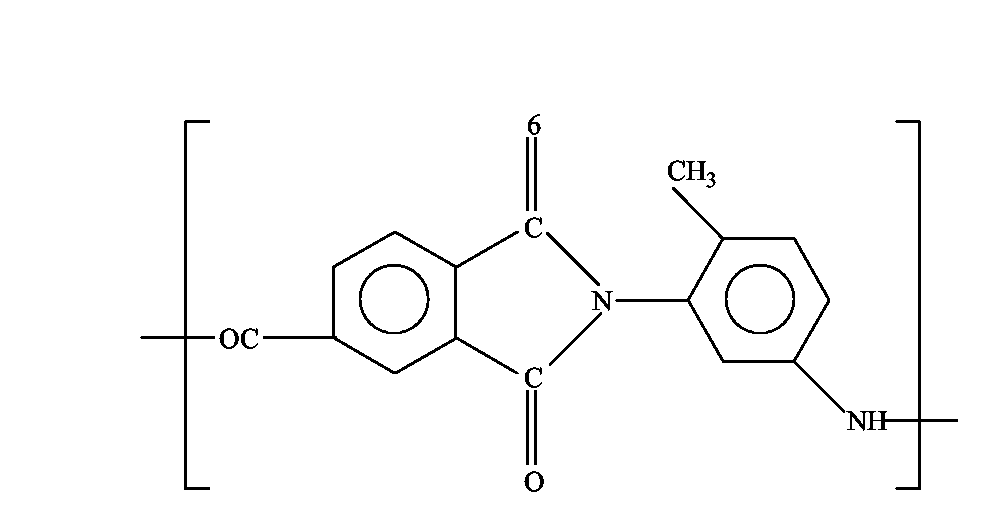
- the preferred aromatic polyimide-amide fibers are polyimide-amide fibers comprising repeating units of the formula: obtained by polycondensation of toluylene diisocyanate and trimellitic anhydride.
- the fibers may be present in the composition according to the invention in one content ranging from 0.01% to 10% by weight, relative to the total weight of the composition, in particularly from 0.1% to 5% by weight, and more particularly from 0.3% to 3% by weight.
- cosmetic active agents that can be used in compositions according to the invention may be mentioned in particular emollients, moisturizers, vitamins and especially solar filters.
- composition according to the invention can be further characterized by its viscoelastic behavior, in particular using different rheological parameters.
- a material is said to be viscoelastic when, under the effect of shear, it has both the characteristics of a purely elastic material, that is, capable of storing energy and the characteristics of a purely viscous, ie able to dissipate energy.
- the viscoelastic behavior of the compositions in accordance with the invention can be characterized by its stiffness modulus G, its elasticity ⁇ and its flow threshold ⁇ c ; these parameters are particularly defined in the book "Initiation to rheology", G. Couarraze and JL Grossiord, 2nd edition, 1991, Edition Lavoisier-Tec 1 Doc.
- the viscoelastic linear domain is generally defined by the fact that the material response (i.e. deformation) is at any time directly proportional to the value of the applied force (i.e. stress).
- the constraints applied are weak and the material undergoes deformations without modifying its structure microscopic. Under these conditions, the material is studied "at rest” and in a non destructive.
- the composition thus sheared undergoes a stress ⁇ (t) and responds according to a deformation ⁇ (t) corresponding to micro deformations for which the modulus of rigidity varies little depending on the imposed constraint.
- the modulus of rigidity G (corresponding to the ratio of ⁇ o over ⁇ o ) and the elasticity ⁇ (corresponding to the phase shift angle of the stress applied with respect to the measured strain) are thus measured as a function of the stress ⁇ (t) applied.
- the deformation of the composition is measured for the stress zone in which the variation of modulus of rigidity G and of elasticity ⁇ is less than 7% (area of microdeformations) and the so-called "plateau" parameters Gp are thus determined. and ⁇ p .
- the viscoelastic behavior of the compositions according to the invention can be in particular characterized by a plateau rigidity module Gp of less than or equal to 35,000 Pa, in particular less than or equal to 30 000 Pa, in particular less than or equal to 28 000 Pa, and more particularly less than or equal to 25,000 Pa, or even 20,000 Pa.
- Gp plateau rigidity module
- compositions in accordance with the invention may also have a yield point ⁇ c ranging from 10 Pa to 200 Pa, and in particular ranging from 20 Pa to 100 Pa.
- compositions according to the invention depends in particular of the nature of the wax or waxes used. It depends in particular on the fact that waxes are of traditional type or micro wax type as defined above. For waxes of the traditional type, it depends more on the starting melting point of said wax.
- the wax (es) used are of the type and have a melting point of less than 45 ° C.
- compositions of the invention can be prepared from standard way by heating the waxes until complete fusion then introduction into a volatile nonaqueous solvent. The mixture thus obtained is subjected to stirring mechanical until cooling to room temperature.
- the soluble polymer in the non-aqueous solvent medium and having a crystallizable portion according to the invention is usually introduced with the volatile nonaqueous solvent but can also be posteriorly.
- Water and / or water-soluble solvent (s) and any ingredients may be introduced in the starting materials or possibly during cooling or in the finished composition.
- the wax (es) used are of the type traditional. Their starting melting point may be less than, equal to or greater than 45 ° C.
- the makeup compositions of the keratinous fibers are generally obtained by heating the wax or a mixture of several waxes to a temperature above the melting temperature of the wax having the melting point higher until complete melting, then continuous mixing and cooling to ambient temperature.
- the polymer soluble in the solvent non-aqueous and having a crystallizable portion is added before the implementation of the mixing.
- the non-aqueous solvent may be added during mixing or previously in the implementation thereof, separately or with said solvent-soluble polymer non-aqueous and having a crystallizable portion.
- the kneading operation can be carried out, for example, in a grinding mill. cylinders having two cylinders rotating in opposite directions between which the dough passes or more advantageously in a continuous twin screw mixer which makes it possible to obtain a paste of very consistent quality reproducibly.
- the water and / or the water-soluble solvent (s) and any additional ingredients may be introduced into the starting materials or possibly during mixing during the cooling or in the finished composition.
- This method of preparation of the compositions has in particular the advantage of allow incorporation of heat-sensitive compounds as certain assets given that it allows their introduction at a temperature compatible with their stability and thanks to low residence time in the mixer.
- the wax (es) used are micro waxes as defined above.
- such a wax can be used directly at a temperature below its melting temperature.
- the particles of micro waxes are directly dispersed in the continuous phase, and not in forming them via melting / recrystallization steps.
- This step of dispersing the wax may in particular be carried out at a temperature below the melting temperature of the wax and especially at temperature ambient, which is of course advantageous in terms of ease of implementation of the process of preparation.
- non-aqueous solvent is chosen from those defined above.
- the water and / or the solvent (s) water-soluble (s) and / or additional ingredients as defined above may be added, depending on the case, either in the starting materials or in the composition completed.
- the process for the preparation of compositions uses both at least one wax of traditional type and at least one micro wax as defined above.
- one generally introduces first the traditional wax or the mixture of waxes of traditional type in forms melts, to the mixture containing at least one non-aqueous solvent, and at least one polymer soluble in said solvent and having a crystallizable portion and then stirred or kneaded. mixture thus obtained during its cooling.
- the micro wax or the mixture of micro waxes are introduced only when the temperature of the mixture containing the wax type traditional is less than the melting temperature of said micro wax or lower than the melting temperature of the micro wax of the mixture of micro waxes having the temperature of lowest melting, and especially at room temperature.
- water and / or water-soluble solvent (s) and ingredients may be added, depending on the case, either in the starting materials or in the finished composition, that is, when the composition is kneaded, during the course of the cooling.
- the subject of the present invention is also a process for making up fibers in which the keratinous fibers, in particular the eyelashes, are applied to a composition as defined above.
- compositions of the invention may in particular be applied to eyelashes, using a brush or comb.
- the thickening effect of the makeup, using the composition of the invention can moreover, by specifically selecting the device for the application of said composition.
- a mixture comprising at least one of the constituents of the solvent medium non-aqueous and at least one polymer soluble in said medium and having at least a part crystallizable, heated to a temperature of 45 ° C, then cooled to temperature At ambient temperature, the dyestuffs and the gelling agent are dispersed with stirring. Under agitation, the wax is then added in the form of microparticles, as well as, if appropriate, the remaining ingredients of the composition.
- the water and / or the water-soluble solvent (s) are dispersed in particular gradually with stirring.
- a mixture comprising at least one of the constituents of the solvent medium non-aqueous and at least one polymer soluble in said medium and having at least a part crystallizable, heated to a temperature of 45 ° C, then cooled to temperature At ambient temperature, the dyestuffs and the gelling agent are dispersed with stirring. The mixture obtained is then heated to 45 ° C and then the mixture of traditional waxes previously heated until complete fusion is added gradually. We leave the mixture thus obtained return to room temperature with stirring. We then add the wax in the form of microparticles and, where appropriate, the remaining ingredients of the composition.
- the water and / or the water-soluble solvent (s) are dispersed in particular gradually with stirring.
- the measurement of the dry matter content is carried out according to the protocol described previously.
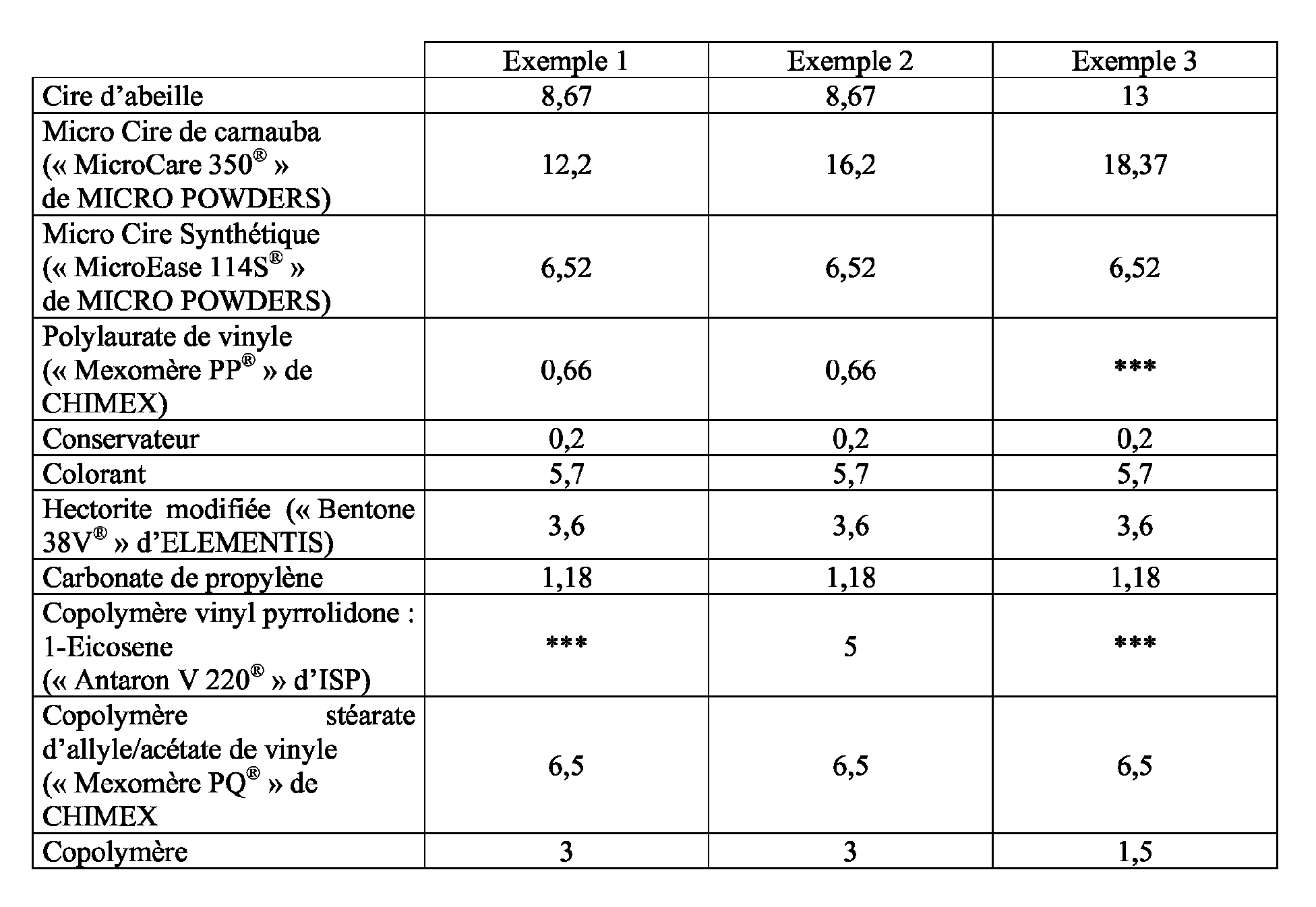
- compositions of these mascaras are presented in Table I below (in this table, the amounts indicated are in percent by weight and expressed relative to the total weight of the composition).
- compositions of Examples 1 and 2 comprise water at levels respective amounts of 6.5 and 2.1% by weight relative to the total weight of the composition, the water from the latexes used, namely the "Mexomère PAM®” from the company CHIMEX and the “Daitosol 5000 AD®” from the company DAITO KASEY KOGYO.
- compositions obtained thus have a dry matter content particularly high while maintaining a modulus of stiffness sufficiently low for allow their use in satisfactory conditions.
- the mascaras obtained are easily applied to the eyelashes and allow to obtain a thick makeup eyelashes.
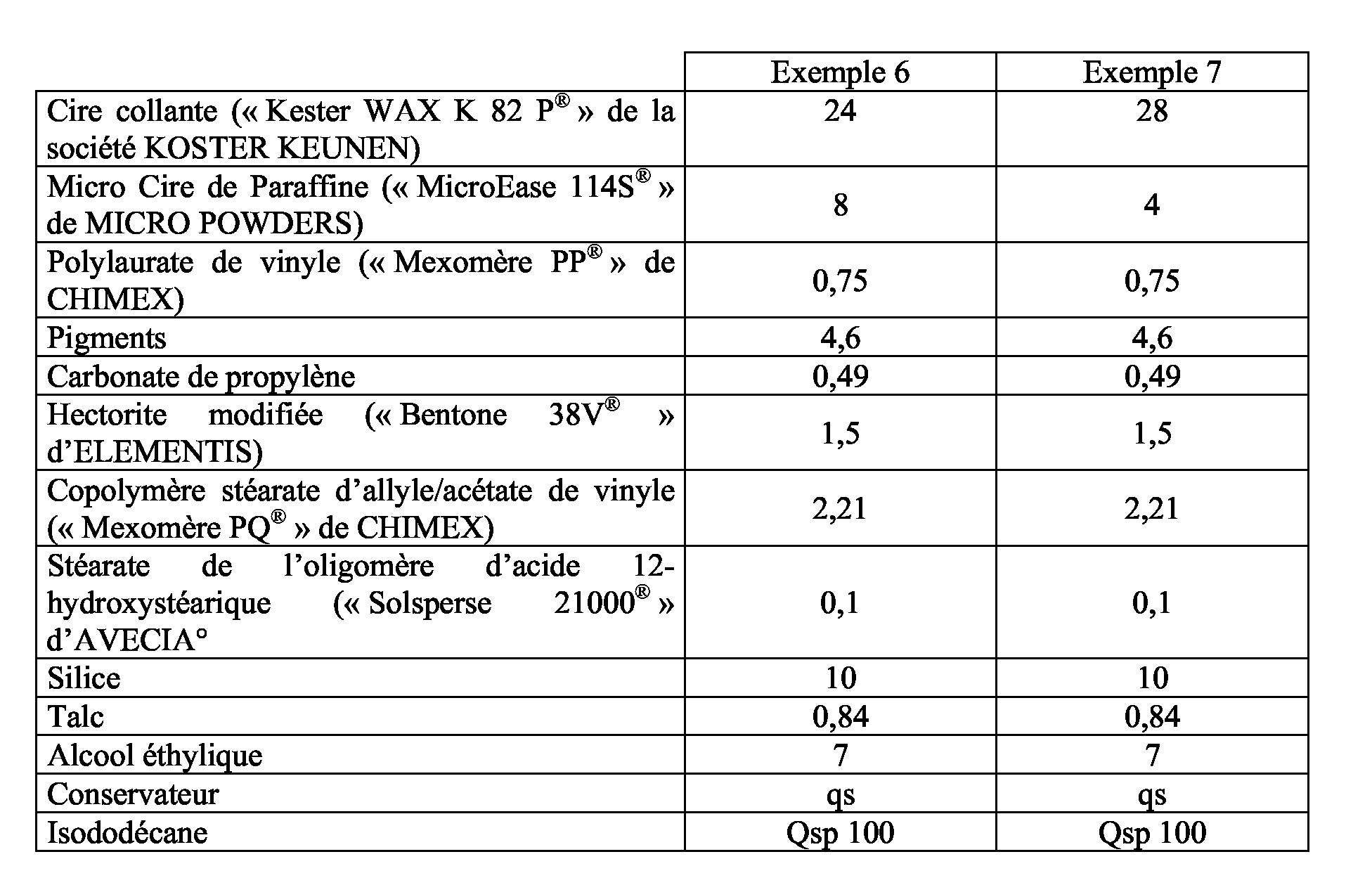
- composition obtained therefore also has a dry matter content particularly high, combined with a modulus of rigidity sufficiently low to allow its use in satisfactory conditions.
- the mascara is easily applied to the eyelashes and provides a makeup thick eyelashes and not sticky: eyelashes are well separated.
- This composition has a solids content of 48.28% by weight relative to the total weight of the composition.
Landscapes
- Life Sciences & Earth Sciences (AREA)
- Health & Medical Sciences (AREA)
- Animal Behavior & Ethology (AREA)
- General Health & Medical Sciences (AREA)
- Public Health (AREA)
- Veterinary Medicine (AREA)
- Birds (AREA)
- Epidemiology (AREA)
- Chemical & Material Sciences (AREA)
- Oil, Petroleum & Natural Gas (AREA)
- Cosmetics (AREA)
- Compositions Of Macromolecular Compounds (AREA)
Abstract
Description
ladite composition possédant une teneur en matière sèche supérieure à 45 % en poids par rapport au poids total de la composition.
- « partie cristallisable A », un enchaínement d'au moins 5 motifs de répétition et tel que si l'on prenait l'homopolymère correspondant à ce motif de répétition, il serait caractérisé par un taux de cristallinité supérieur à 30%,
- « partie amorphe B », un enchaínement d'au moins 5 motifs de répétition et tel que si l'on prenait l'homopolymère correspondant à ce motif de répétition, il serait caractérisé par un taux de cristallinité inférieur à 5%, voire nul,
- « séquence intégrée au squelette», un groupement d'atomes constitué par la répétition d'une unité monomère, faisant partie de la chaíne principale du polymère,
- «chaíne pendante ou groupement latéral », un groupement d'atomes figurant une ramification au niveau du squelette du polymère, et
- « chaíne terminale » un groupement d'atome situé à l'une au moins des extrémités du squelette.

- des copolymères séquencés d'oléfine ou de cyclooléfine à chaíne
cristallisable comme ceux issus de la polymérisation séquencée :
- de cyclobutène, cyclohexène, cyclooctène, norbornène (c'est-à-dire bicyclo(2,2,1)heptène-2), 5-méthylnorbornène, 5-éthylnorbornène, 5,6-diméthylnorbornène, 5,5,6-triméthyl norbomène, 5-éthylidène-norbomène, 5-phényl-norbonène, 5-benzylnorbornène, 5-vinyl norbomène, 1,4,5,8-diméthano-1,2,3,4,4a,5,8a-octahydronaphtalène, dicyclopentadiène ou de leurs mélanges,
- avec l'éthylène, propylène, 1-butène, 3-méthyl-1-butène, 1-hexène, 4-méthyl-1-pentène, 1-octène, 1-décène, 1-éicosène ou leurs mélanges,
- les copolymères séquencés poly(butylènetéréphtalate)-b-poly(isoprène) hydrogénés séquencés ou multiséquencés, cités dans l'article "Study of morphological and mechanical properties of PP/PBT" de B. Boutevin et al., Polymer Bulletin, 34,117-123 (1995),
- les copolymères séquencés poly(éthylène)-b-copoly(éthylène/propylène) cités dans les articles "Morphology of semi-crystalline block copolymers of ethylene-(ethylene-alt-propylene)" de P. Rangarajan et al., Macromolecules, 26, 4640-4645 (1993) et " Polymer agregates with crystalline cores : the system poly(ethylene)-poly(ethylene-propylene)" de P. Richter et al., Macromolécules, 30, 1053-1068 (1997), et
- les copolymères séquencés poly(éthylène)-b-poly(éthyléthylène) cités dans l'article général "Cristallization in block copolymers" de I.W. Hamley, Advances in Polymer Science, vol 148, 113-137 (1999).
- les polycondensats de type polyamide résultant de la condensation entre (α) au moins un acide choisi parmi les acides dicarboxyliques comprenant au moins 32 atomes de carbone tels que les acides gras dimères et (β) un alkylène diamine et en particulier l'éthylène diamine, dans lequel le polymère polyamide comprend au moins un groupe acide carboxylique terminal estérifié ou amidifié avec au moins un mono alcool ou une mono amine comprenant de 12 à 30 atomes de carbone linéaires et saturés, et en particulier, les copolymères d'éthylène diamine/dilinoléate de stéaryle tel que celui commercialisé sous la dénomination « Uniclear 100 VG® » par la Société ARIZONA CHEMICAL ; et
- les polycondensats polyesters lipophiles dont les extrémités sont estérifiées par un acide ou un alcool cristallisable constitué d'une chaíne carbonée linéaire saturée en C12 à C30, et en particulier, l'acide 12-polyhydroxystéarique dont au moins une des extrémités est estérifiée par l'acide stéarique, tel que le « Solsperse 21000® » commercialisé par la société AVECIA.
- les huiles hydrocarbonées d'origine végétale telles que les triglycérides constitués d'esters d'acides gras et de glycérol dont les acides gras peuvent avoir des longueurs de chaínes variées de C4 à C24, ces derniers pouvant être linéaires ou ramifiées, saturées ou insaturées ; ces huiles sont notamment les huiles de germe de blé, de tournesol, de pépins de raisin, de sésame, de maïs, d'abricot, de ricin, de karité, d'avocat, d'olive, de soja, l'huile d'amande douce, de palme, de colza, de coton, de noisette, de macadamia, de jojoba, de luzerne, de pavot, de potimarron, de sésame, de courge, de colza, de cassis, d'onagre, de millet, d'orge, de quinoa, de seigle, de carthame, de bancoulier, de passiflore, de rosier muscat ; ou encore les triglycérides des acides caprylique/caprique comme ceux vendus par la société STEARINERIES DUBOIS ou ceux vendus sous les dénominations de « Miglyol 810® », « 812® » et « 818® » par la société DYNAMIT NOBEL,
- les éthers de synthèse ayant de 10 à 40 atomes de carbone ;
- les hydrocarbures linéaires ou ramifiés, d'origine minérale ou synthétique tels que la vaseline, les polydécènes, le polyisobutène hydrogéné tel que le parléam, le squalane, et leurs mélanges;
- les esters de synthèse comme les huiles de formule R1COOR2 dans laquelle R1 représente le reste d'un acide gras linéaire ou ramifié comportant de 1 à 40 atomes de carbone et R2 représente une chaíne hydrocarbonée notamment ramifiée contenant de 1 à 40 atomes de carbone à condition que R1 + R2 soit ≥ 10, comme par exemple l'huile de Purcellin (octanoate de cétostéaryle), le myristate d'isopropyle, le palmitate d'isopropyle, le benzoate d'alcool en C12 à C15, le laurate d'hexyle, l'adipate de diisopropyle, l'isononanoate d'isononyle, le palmitate de 2-éthyl-hexyle, l'isostéarate d'isostéarate, des octanoates, décanoates ou ricinoléates d'alcools ou de polyalcools comme le dioctanoate de propylène glycol ; les esters hydroxylés comme le lactate d'isostéaryle, le malate de diisostéaryle ; et les esters du pentaérythritol ;
- les alcools gras liquides à température ambiante à chaíne carbonée ramifiée et/ou insaturée ayant de 12 à 26 atomes de carbone comme l'octyl dodécanol, l'alcool isostéarylique, l'alcool oléique, le 2-hexyldécanol, le 2-butyloctanol, le 2-undécylpentadécanol ;
- les acides gras supérieurs tels que l'acide oléique, l'acide linoléique, l'acide linolénique ;

- des groupements triméthylsiloxyle, qui sont notamment obtenus par traitement de silice pyrogénée en présence de l'hexaméthyldisilazane. Des silices ainsi traitées sont dénommées « Silica silylate » selon le CTFA (6ème édition, 1995). Elles sont par exemple commercialisées sous les références «Aerosil R812® » par la société DEGUSSA, « CAB-O-SIL TS-530®» par la société CABOT,
- des groupements diméthylsilyloxyle ou polydiméthylsiloxane, qui sont notamment obtenus par traitement de silice pyrogénée en présence de polydiméthylsiloxane ou du diméthyldichlorosilane. Des silices ainsi traitées sont dénommées « Silica diméthyl silylate » selon le CTFA (6ème édition, 1995). Elles sont par exemple commercialisées sous les références «Aerosil R972® », et «Aerosil R974® » par la société DEGUSSA, « CAB-O-SIL TS-610® » et « CAB-O-SIL TS-720® » par la société CABOT.
- de polyesters, telles que celles obtenues par découpe de fils vendus sous les dénominations « FIBRE 255-100-R11-242T TAILLE 3 MM (section octalobée)® », « FIBRE 265-34-R11-56T TAILLE 3 MM (section ronde)® », « FIBRE COOLMAX 50-34-591 TAILLE 3 MM (section tétralobée)® » par la société DUPONT DE NEMOURS ;
- de polyamide, telles que celles vendues sous les dénominations « TRILOBAL NYLON 0.120-1.8 DPF® » ; « TRILOBAL NYLON 0.120-18 DPF® » ; « NYLON 0.120-6 DPF® » par la société CELLUSUEDE PRODUCTS ; ou obtenues par découpe de fils vendus sous la dénomination « FIBRE NOMEX BRAND 430 TAILLE 3 MM® » par la société DUPONT DE NEMOURS ;
- de polyimide-amide telles que celles vendues sous les dénomination « KERMEL® », « KERMEL TECH® » par la société RHODIA ;
- de poly-(p-phénylène-téréphtalamide) (ou d'aramide) notamment vendues sous la dénomination « Kevlar® » par la société DUPONT DE NEMOURS ;
- des fibres à structure multicouche comprenant des couches alternées de polymères choisis parmi les polyesters, les polymères acryliques, les polyamides, telles que celles décrites dans les documents EP-A-6921217, EP-A-686858 et US-A-5472798. De telles fibres sont vendues sous les dénominations « Morphotex® », « Teijin Tetron Morphotex® » par la société TEIJIN.
- température d'entrée : 100 °C
- température de sortie : 20 °C
- débit = 3 kg/h
- vitesse des vis : 600 tours/min.
- température de mesure 25 °C,
- palier de 180 sec à 25 °C avant le début de la mesure,
- balayage en contrainte de 1 à 10 000 Pa,
- fréquence de mesure : 1 Hz.


- Cire collante
(« Kester Wax K 82 P® » de la société KOSTER KEUNEN) 32 g - Palmitate de dextrine (« Rheopearl KL® » de CHIBA FLOUR) 5,32 g
- Copolymère acétate de vinyle/stéarate d'allyle (65/35)
(« Mexomère PQ® » de CHIMEX) 2,2 g - Polylaurate de vinyle (« Mexomère PP® » de CHIMEX) 0,75 g
- Stéarate de l'oligomère de l'acide 12-hydroxystéarique
(« Solsperse 21000® » d'AVECIA) 0,10 g - Silice 10 g
- Talc 0,84 g
- Pigments 4,62 g
- Conservateurs qs
- Alcool éthylique à 96 degrés non dénaturé 3 g
- Isododécane 40,96 g

- Cire microcristalline (« Microwax HW® » de PARAMELT) 30 g
- Pigments 9,24 g
- Amidon de riz 1,68 g
- Copolymère acétate de vinyle/stéarate d'allyle
(« Mexomère PQ® » de CHIMEX) 4,42 g - Polylaurate de vinyle (« Mexomère PP® » de CHIMEX) 1,5 g
- Hectorite modifiée (« Bentone 38V® » d'ELEMENTIS) 0,63 g
- Carbonate de propylène 0,21 g
- Alcool éthylique 3,0 g
- Stéarate de l'oligomère d'acide 12-hydroxystéarique
(« Solsperse 21000® » d'AVECIA) 0,2 g - Conservateur 0,4 g
- Isododécane 48,72 g
Claims (43)
- Composition cosmétique de maquillage de fibres kératiniques, caractérisée en ce qu'elle comprend :(i) un milieu solvant non aqueux,(ii) au moins une cire en une teneur supérieure à 3 % en poids par rapport au poids total de la composition,(iii) au moins un polymère soluble dans ledit milieu solvant et ayant au moins une partie cristallisable, et(iv) de l'eau et/ou au moins un solvant hydrosoluble, l'eau et/ou le(s) solvant(s) hydrosoluble(s) étant présents en une teneur totale inférieure ou égale à 20 % en poids par rapport au poids total de la composition, et
qu'elle possède une teneur en matière sèche supérieure à 45 % en poids par rapport au poids total de la composition. - Composition selon la revendication 1, caractérisée en ce que la teneur en matière sèche est de 46 à 80 %, en particulier de 48 à 70 %, et notamment de 50 à 65 % en poids par rapport au poids total de la composition.
- Composition selon l'une quelconque des revendications précédentes, caractérisé en ce que ledit polymère a une masse molaire allant de 200 à 1000 000 g/mol, en particulier de 500 à 500 000 g/mol et plus particulièrement de 1000 à 300 000 g/mol.
- Composition selon l'une quelconque des revendications précédentes, caractérisée en ce que ladite partie cristallisable représente au moins 5 %, en particulier au moins 10 % et au plus 50 %, et plus particulièrement de 30 à 50 % en poids du poids total dudit polymère.
- Composition selon l'une quelconque des revendications précédentes, caractérisée en ce que ledit polymère est choisi parmi les copolymères de (méth)acrylates d'alkyles linéaires et saturés en C12 à C30 et de (méth)acrylates d'alkyles en C4 à C10 linéaires ou en C4 à C30 ramifiés ou cycliques et/ou insaturés, les copolymères d'esters vinyliques à groupes alkyles linéaires et saturés en C12 à C30 et d'esters vinyliques à groupes alkyles en C4 à C10 linéaires, ou en C4 à C30 ramifiés ou cycliques et/ou insaturés, les polycondensats de type polyamide résultant de la condensation entre (α) au moins un acide choisi parmi les acides dicarboxyliques comprenant au moins 32 atomes de carbone et (β) un alkylène diamine, ledit polycondensat comprenant au moins un groupe acide carboxylique terminal estérifié ou amidifié avec au moins un mono alcool ou un mono amine comprenant de 12 à 30 atomes de carbone linéaires et saturés et les polycondensats polyesters lipophiles dont les extrémités sont estérifiées par un acide ou un alcool cristallisable constitué d'une chaíne carbonée linéaire saturée en C12 à C30.
- Composition selon l'une quelconque des revendications précédentes, caractérisée en ce que ledit polymère est choisi parmi les copolymères acétate de vinyle/stéarate de vinyle, acétate de vinyle/stéarate d'allyle, acétate de vinyle/éthylène, éthylène diamine/dilinoléate de stéaryle, les copolymères séquencés butadiène hydrogéné/isoprène et l'acide 12-polyhydroxystéarique dont au moins une des extrémités est estérifiée par l'acide stéarique.
- Composition selon l'une quelconque des revendications précédentes, caractérisée en ce que ledit polymère est présent en une teneur allant de 0,01 à 30 %, notamment de 0,1 à 20 %, et en particulier de 1 à 10 % en poids par rapport au poids total de la composition.
- Composition selon l'une quelconque des revendications précédentes, caractérisée en ce que ledit milieu solvant non aqueux contient au moins un composé volatil non soluble dans l'eau et liquide à température ambiante.
- Composition selon la revendication 8, caractérisée en ce que ledit composé volatil non soluble dans l'eau est choisi parmi les huiles hydrocarbonées, siliconées et/ou fluorées, les solvants organiques et leurs mélanges, et en particulier parmi les huiles hydrocarbonées ayant de 8 à 16 atomes de carbone et leurs mélanges.
- Composition selon l'une quelconque des revendications 8 et 9, caractérisée en ce que ledit composé volatil non soluble dans l'eau est présent dans la composition en une teneur allant de 5 à 55 %, notamment de 10 à 50 % et en particulier de 20 à 45 % en poids par rapport au poids total de la composition.
- Composition selon l'une quelconque des revendications précédentes, caractérisée en ce que ledit solvant hydrosoluble est choisi parmi les monoalcools inférieurs ayant de 1 à 5 atomes de carbone, les glycols ayant de 2 à 8 atomes de carbone, les cétones en C3 et C4 et les aldéhydes en C2 à C4.
- Composition selon l'une quelconque des revendications précédentes, caractérisée en ce que la teneur en eau et/ou solvant(s) hydrosoluble(s) est supérieure ou égale à 0,5 %, notamment allant de 1 à 18 %, et en particulier de 2 à 15 % en poids par rapport au poids total de la composition.
- Composition selon l'une quelconque des revendications précédentes, caractérisée en ce que la cire est choisie parmi les cires, solides et rigides à température ambiante ayant un point de fusion supérieur ou égal à 30 °C, en particulier supérieur ou égal à 45 °C, notamment supérieur ou égal à 55 °C.
- Composition selon l'une quelconque des revendications précédentes, caractérisée en ce que la cire est choisie parmi les cires hydrocarbonées comme la cire d'abeille, la cire de lanoline, les cires d'insectes de Chine, la cire de sumac, les paraffines, les cires de polyéthylène, les copolymères cireux ainsi que leurs esters ; les cires obtenues par hydrogénation catalytique d'huiles animales ou végétales ayant des chaínes grasses, linéaires ou ramifiées en C8-C32 comme l'huile de jojoba partiellement hydrogénée isomérisée trans, l'huile de tournesol hydrogénée, l'huile de ricin hydrogénée, l'huile de coprah hydrogénée, l'huile de lanoline hydrogénée et le tétrastéarate de di-(triméthylol-1,1,1 propane) et les cires obtenues par hydrogénation d'huile de ricin estérifiée avec l'alcool cétylique.
- Composition selon l'une quelconque des revendications 1 à 13, caractérisée en ce que la cire est choisie parmi les cires possédant un collant supérieur ou égal à 0,7 N.s, en particulier supérieur ou égal à 1 N.s, et une dureté inférieure ou égale à 3,5 MPa.
- Composition selon la revendication 15, caractérisée en ce que ladite cire est choisie parmi les (hydroxystéaryloxy) stéarate d'alkyle en C20-C40.
- Composition selon l'une quelconque des revendications 1 à 13, caractérisée en ce que ladite cire est choisie parmi les cires ayant un point de fusion commençante supérieur ou égal à 45 °C, notamment supérieur ou égal à 50 °C, en particulier supérieur ou égal à 55 °C et plus particulièrement supérieur ou égal à 60 °C.
- Composition selon la revendication 17, caractérisée en ce que ladite cire est choisie parmi la cire de carnauba, la cire de son de riz, la cire de Candellila, la cire d'Ouricurry, la cire de montan, l'ozokérite, les cires obtenues par la synthèse de Fisher-Tropsch, l'huile de jojoba hydrogénée, le tétrabéhénate de di-(triméthylol-1,1,1 propane), les cires obtenues par hydrogénation catalytique d'huile d'olive estérifiée avec l'alcool stéarylique, les cires microcristallines et des cires de polyéthylène.
- Composition selon l'une quelconque des revendications précédentes, caractérisée en ce que la teneur totale en cire est de 10 à 70 %, notamment de 15 à 65 %, en particulier de 20 à 60 %, et plus particulièrement de 25 à 55 % en poids par rapport au poids total de la composition.
- Composition selon l'une quelconque des revendications précédentes, caractérisée en ce qu'elle comprend en outre au moins un polymère filmogène.
- Composition selon l'une quelconque des revendications précédentes, caractérisée en ce qu'elle comprend en outre au moins une matière colorante.
- Composition selon l'une quelconque des revendications précédentes, caractérisée en ce qu'elle comprend en outre au moins une charge.
- Composition selon l'une quelconque des revendications précédentes, caractérisée en ce qu'elle comprend en outre au moins un additif cosmétiquement acceptable choisi parmi les antioxydants, les conservateurs, les parfums, les neutralisants, les plastifiants, les fibres, les gélifiants, les actifs cosmétiques et leurs mélanges.
- Composition selon l'une quelconque des revendications précédentes, caractérisée en ce qu'elle possède un module de rigidité plateau Gp inférieur ou égal à 30 000 Pa, notamment inférieur ou égal à 28 000 Pa, en particulier inférieur ou égal à 25 000 Pa et plus particulièrement inférieur ou égal à 20 000 Pa.
- Composition selon l'une quelconque des revendications précédentes,
caractérisée en ce qu'elle possède un seuil d'écoulement τc mesuré par rhéologie oscillatoire (γ = 1 Hz) variant de 10 à 200 Pa et notamment de 20 à 100 Pa. - Procédé de préparation d'une composition telle que définie selon l'une quelconque des revendications 1 à 25, caractérisé en ce qu'il comprend au moins le malaxage en continu d'au moins une cire et d'au moins un polymère soluble dans un solvant non aqueux et ayant une partie cristallisable, en passant d'une température supérieure à la température de fusion de ladite cire à la température ambiante par un refroidissement en continu.
- Procédé selon la revendication 26, caractérisé en ce qu'il met en oeuvre un malaxeur bi-vis en continu.
- Procédé selon l'une quelconque des revendications 26 et 27, caractérisé en ce que l'on ajoute soit préalablement audit malaxage soit au cours dudit malaxage au moins un solvant non aqueux.
- Procédé de préparation d'une composition telle que définie selon l'une quelconque des revendications 1 à 25, caractérisé en ce qu'il comprend au moins une étape de dispersion d'au moins une cire à l'état de particules ayant une dimension allant de 0,5 µm à 30 µm, dans un mélange comprenant au moins un solvant non aqueux et au moins un polymère soluble dans ledit solvant non aqueux et ayant au moins une partie cristallisable, ledit mélange étant à une température inférieure à celle de fusion de ladite cire à l'état de particules.
- Procédé de préparation selon la revendication précédente, caractérisé en ce que la dispersion est effectuée à température ambiante.
- Procédé de préparation selon l'une quelconque des revendications 29 et 30, caractérisé en ce que ladite dimension est de 1 à 20 µm, et en particulier de 5 à 10 µm.
- Procédé selon l'une quelconque des revendications 29 à 31, caractérisé en ce que ladite cire est choisie parmi la cire de carnauba, la cire synthétique, les cires constituées d'un mélange de cire de carnauba et de cire de polyéthylène, les cires constituées d'un mélange de cire de carnauba et de cire synthétique, les cires de polyéthylène et les cires de polytétrafluoroéthylène.
- Procédé selon l'une quelconque des revendications 29 à 32, caractérisé en ce que l'on a préalablement introduit au moins une cire telle définie selon l'une quelconque des revendications 13 à 18 sous forme fondue dans ledit mélange, puis laissé le mélange refroidir sous agitation ou malaxage jusqu'à une température au moins inférieure à celle de fusion de ladite cire à l'état de particules.
- Procédé selon l'une quelconque des revendications 28 à 33, caractérisé en ce que ledit solvant non aqueux est tel que défini dans l'une quelconque des revendications 8 à 10.
- Procédé selon l'une quelconque des revendications 26 à 34, caractérisé en ce que ledit polymère soluble dans ledit solvant non aqueux et ayant au moins une partie cristallisable est tel que défini dans l'une quelconque des revendications 3 à 7.
- Utilisation d'au moins un polymère soluble dans un solvant non aqueux et ayant au moins une partie cristallisable et d'au moins une cire à l'état de particules ayant une dimension allant de 0,5 µm à 30 µm pour la préparation d'une composition de maquillage des fibres kératiniques.
- Utilisation selon la revendication 36, caractérisée en ce que ledit polymère soluble dans un solvant non aqueux et ayant au moins une partie cristallisable est tel que défini dans les revendications 3 à 7.
- Utilisation selon l'une quelconque des revendications 36 et 37, caractérisée en ce que ladite cire est telle que définie dans l'une quelconque des revendications 31 et 32.
- Utilisation selon l'une quelconque des revendications 36 à 38, caractérisée en ce que ladite composition comprend de l'eau et/ou un solvant hydrosoluble, en une teneur totale inférieure ou égale à 20 % en poids par rapport au poids total de la composition.
- Utilisation selon l'une quelconque des revendications 36 à 39, caractérisée en ce que ladite composition possède une teneur en matière sèche supérieure à 45 %, notamment supérieure ou égale à 46 %, en particulier supérieure ou égale à 48 % et plus particulièrement supérieure ou égale à 50 % en poids par rapport au poids total de la composition.
- Utilisation selon l'une quelconque des revendications 36 à 40, caractérisée en ce que ladite composition possède un module de rigidité plateau inférieur ou égal à 30 000 Pa, notamment inférieur ou égal à 28 000 Pa, en particulier inférieur ou égal à 25 000 Pa et plus particulièrement inférieur ou égal à 20 000 Pa.
- Utilisation selon l'une quelconque des revendications 36 à 41, caractérisée en ce que ladite composition est telle que définie dans l'une quelconque des revendications 1 à 25.
- Procédé de maquillage des fibres kératiniques, caractérisé en ce que l'on applique sur lesdites fibres kératiniques notamment les cils, une composition telle que définie dans l'une quelconque des revendications 1 à 25 ou telle qu'obtenue par le procédé tel que défmi dans l'une quelconque des revendications 26 à 35.
Applications Claiming Priority (2)
| Application Number | Priority Date | Filing Date | Title |
|---|---|---|---|
| FR0309711 | 2003-08-06 | ||
| FR0309711A FR2858550B1 (fr) | 2003-08-06 | 2003-08-06 | Composition de maquillage de matieres keratiniques notamment de fibres keratiniques, comme les cils. |
Publications (2)
| Publication Number | Publication Date |
|---|---|
| EP1504745A1 true EP1504745A1 (fr) | 2005-02-09 |
| EP1504745B1 EP1504745B1 (fr) | 2009-04-08 |
Family
ID=33548315
Family Applications (1)
| Application Number | Title | Priority Date | Filing Date |
|---|---|---|---|
| EP04300523A Expired - Lifetime EP1504745B1 (fr) | 2003-08-06 | 2004-08-06 | Composition de maquillage de matières kératiniques notamment de fibres kératiniques, comme les cils. |
Country Status (9)
| Country | Link |
|---|---|
| US (1) | US20050169949A1 (fr) |
| EP (1) | EP1504745B1 (fr) |
| JP (2) | JP4751586B2 (fr) |
| KR (1) | KR100753620B1 (fr) |
| CN (1) | CN100594874C (fr) |
| AT (1) | ATE427733T1 (fr) |
| DE (1) | DE602004020429D1 (fr) |
| ES (1) | ES2325076T3 (fr) |
| FR (1) | FR2858550B1 (fr) |
Cited By (1)
| Publication number | Priority date | Publication date | Assignee | Title |
|---|---|---|---|---|
| US7763291B2 (en) | 2004-07-22 | 2010-07-27 | Mitsui Norin Co., Ltd. | Tea polyphenol composition and method for producing the same |
Families Citing this family (23)
| Publication number | Priority date | Publication date | Assignee | Title |
|---|---|---|---|---|
| US20060260633A1 (en) * | 2005-05-19 | 2006-11-23 | Wyatt Peter J | Cosmetic composition system with thickening benefits |
| EP2026678B1 (fr) * | 2006-06-08 | 2017-04-05 | Noxell Corporation | Applicateur de grande taille à surface optimalisée pour produits cosmétiques |
| US9345649B2 (en) | 2006-12-21 | 2016-05-24 | Avon Products, Inc. | Cosmetic composition containing novel fractal particle-based gels |
| JP4859708B2 (ja) * | 2007-03-01 | 2012-01-25 | 花王株式会社 | 乳化化粧料又は油性化粧料の製造方法 |
| FR2921265B1 (fr) * | 2007-09-20 | 2014-03-14 | Oreal | Composition cosmetique de maquillage et/ou de soin comprenant une association de deux cires et d'une charge |
| US8114883B2 (en) | 2007-12-04 | 2012-02-14 | Landec Corporation | Polymer formulations for delivery of bioactive materials |
| US20090148393A1 (en) * | 2007-12-11 | 2009-06-11 | Avon Products, Inc. | Multistep Cosmetic Compositions |
| TWI411448B (zh) | 2007-12-27 | 2013-10-11 | Avon Prod Inc | 適合用於化妝品之光學模糊色素組合物 |
| US9056053B2 (en) * | 2008-01-08 | 2015-06-16 | Avon Products, Inc | Nanoparticle compositions providing enhanced color for cosmetic formulations |
| FR2932985B1 (fr) * | 2008-06-25 | 2011-03-18 | Chanel Parfums Beaute | Composition cosmetique renfermant un silicone acrylate et une cire polyester. |
| FR2936419B1 (fr) * | 2008-09-30 | 2010-10-01 | Oreal | Composition de maquillage des cils et ensemble de conditionnement. |
| WO2012092546A2 (fr) * | 2010-12-30 | 2012-07-05 | L'oreal S.A. | Compositions de mascara contenant une cire micronisée dispersible dans l'huile et une cire dispersible dans l'eau |
| US20120171141A1 (en) * | 2010-12-30 | 2012-07-05 | L'oreal S.A. | Emulsions containing a micronized wax |
| US9040027B2 (en) * | 2010-12-30 | 2015-05-26 | L'oréal | Compositions containing a micronized wax |
| WO2012091960A2 (fr) * | 2010-12-30 | 2012-07-05 | L'oreal S.A. | Compositions de mascara contenant une cire micronisée dispersible dans de l'huile |
| US20130224142A1 (en) * | 2010-12-30 | 2013-08-29 | L'oreal | Mascara compositions containing a micronized wax and a nonionic polycondensate |
| FR2993453B1 (fr) * | 2012-07-20 | 2016-05-13 | Oreal | Composition cosmetique de revetement des fibres keratiniques |
| US9408785B2 (en) | 2012-10-15 | 2016-08-09 | L'oreal | Hair styling compositions containing aqueous wax dispersions |
| US10626294B2 (en) | 2012-10-15 | 2020-04-21 | L'oreal | Aqueous wax dispersions containing volatile solvents |
| US10413496B2 (en) | 2012-10-15 | 2019-09-17 | L'oreal | Aqueous wax dispersions |
| FR3011738B1 (fr) * | 2013-10-11 | 2015-10-23 | Oreal | Composition cosmetique de revetement des fibres keratiniques |
| US10561596B2 (en) | 2014-04-11 | 2020-02-18 | L'oreal | Compositions and dispersions containing particles comprising a polymer |
| JP6995472B2 (ja) | 2016-10-31 | 2022-01-14 | ロレアル | 自然な皮膚明色化効果のための組成物 |
Citations (5)
| Publication number | Priority date | Publication date | Assignee | Title |
|---|---|---|---|---|
| US5925337A (en) * | 1990-03-01 | 1999-07-20 | L'oreal | Waterproof composition for covering the eyelashes, and process for the preparation thereof |
| EP1201221A2 (fr) * | 2000-10-27 | 2002-05-02 | L'oreal | Composition cosmétique comprenant des fibres et une cire |
| FR2844195A1 (fr) * | 2002-09-06 | 2004-03-12 | Oreal | Mascara comprenant une cire collante |
| FR2844188A1 (fr) * | 2002-09-06 | 2004-03-12 | Oreal | Composition cosmetique comprenant un melange de cire |
| WO2004022010A1 (fr) * | 2002-09-06 | 2004-03-18 | L'oreal | Composition de maquillage des fibres keratiniques, notamment des cils |
Family Cites Families (47)
| Publication number | Priority date | Publication date | Assignee | Title |
|---|---|---|---|---|
| FI55686C (fi) * | 1970-02-12 | 1979-09-10 | Rhodiaceta | Foerfarande foer framstaellning av blanka vaermebestaendiga polyamidimidfibrer |
| LU67772A1 (fr) * | 1973-06-08 | 1975-03-06 | ||
| FR2478485A1 (fr) * | 1980-03-24 | 1981-09-25 | Oreal | Compositions cosmetiques ou pharmaceutiques sous forme d'emulsions stables du type huile-dans-l'eau |
| FR2520253A1 (fr) * | 1982-01-28 | 1983-07-29 | Oreal | Nouveau systeme emulsionnant a base d'un condensat de proteines, d'un sterol polyoxyethylene et de phosphatide et son utilisation en cosmetique |
| FR2605505B1 (fr) * | 1986-10-24 | 1989-06-02 | Oreal | Brosse pour l'application de produits cosmetiques |
| PH25566A (en) * | 1987-04-01 | 1991-08-08 | Plough | Non-aqueous suncare composition having high spf values |
| US5480632A (en) * | 1987-09-16 | 1996-01-02 | Maybelline, Inc. | Non-aqueous cosmetic compositions with high solids content |
| FR2659011B1 (fr) * | 1990-03-01 | 1994-09-30 | Oreal | Composition resistante a l'eau pour le revetement des cils, et son procede de preparation. |
| US5270209A (en) * | 1991-06-28 | 1993-12-14 | Elizabeth Arden Company, Division Of Conopco, Inc. | Method for distinguishing cosmetic sticks containing water |
| FR2679444B1 (fr) * | 1991-07-25 | 1995-04-07 | Oreal | Utilisation comme agents epaississants des huiles, dans une composition cosmetique huileuse, d'une association de deux copolymeres. |
| US6258916B1 (en) * | 1991-12-24 | 2001-07-10 | Rhone-Poulenc Fibres | Process for spinning from solution of polyamide-imides (PAI) based on tolylene or meta-phenylene diisocyanates and fibers thus obtained |
| US5756635A (en) * | 1991-12-24 | 1998-05-26 | Rhone-Poulenc Fibres | Process for spinning from solution of polyamide-imides (PAI) based on tolylene or met-phenylene diisocyanates and fibres thus obtained |
| FR2701198B1 (fr) * | 1993-02-08 | 1995-04-21 | Oreal | Brosse de maquillage et procédé de fabrication d'une telle brosse. |
| FR2706126B1 (fr) * | 1993-06-08 | 1995-07-21 | Oreal | Composition cosmétique contenant un pseudo-latex ayant des propriétés de rémanence. |
| US5472798A (en) * | 1993-07-16 | 1995-12-05 | Nissan Motor Co., Ltd. | Coloring structure having reflecting and interfering functions |
| FR2711138B1 (fr) * | 1993-10-12 | 1995-11-24 | Oreal | Céramides, leur procédé de préparation et leurs applications en cosmétique et en dermopharmacie. |
| FR2715038B1 (fr) * | 1994-01-14 | 1996-03-15 | Oreal | Brosse pour appliquer un produit cosmétique, notamment du mascara. |
| FR2715306B1 (fr) * | 1994-01-25 | 1996-03-15 | Oreal | Composition cosmétique ou dermopharmaceutique sous forme de pâte souple et procédé de préparation de ladite composition. |
| US5534265A (en) * | 1994-08-26 | 1996-07-09 | The Procter & Gamble Company | Thickened nonabrasive personal cleansing compositions |
| US6274152B1 (en) * | 1994-10-25 | 2001-08-14 | Revlon Consumer Products Corporation | Cosmetic compositions |
| IL115693A (en) * | 1994-10-25 | 2000-08-13 | Revlon Consumer Prod Corp | Cosmetic compositions with improved transfer resistance |
| FR2729077A1 (fr) * | 1995-01-05 | 1996-07-12 | Oreal | Composition cosmetique sous forme d'une pate souple et procede de preparation |
| FR2734716B1 (fr) * | 1995-06-01 | 1997-08-14 | Oreal | Composition cosmetique sous forme de pate souple et son procede de preparation |
| FR2737113B1 (fr) * | 1995-07-28 | 1997-09-05 | Oreal | Procede de preparation d'une composition comprenant un compose sensible a la chaleur et composition obtenue |
| DE19541968C2 (de) * | 1995-11-10 | 2000-01-13 | Beiersdorf Ag | Stabile kohlenwasserstofffreie kosmetische oder dermatologische Oleogele und W/O-Emulsionen |
| FR2745481B1 (fr) * | 1996-02-29 | 1998-04-30 | Oreal | Brosse progressive pour appliquer un produit cosmetique, notamment du mascara |
| FR2751214B1 (fr) * | 1996-07-17 | 1998-12-04 | Oreal | Composition comprenant un composant hydrophile, et l'association d'un compose volatil et d'un compose gras pateux, et utilisation de ladite association |
| BR9705926A (pt) * | 1996-11-26 | 1999-04-27 | Oreal | Composição tópica utilização e processo para limitar diminuir e/ou impedir a transfêrencia de uma composição |
| FR2758336B1 (fr) * | 1997-01-10 | 1999-02-12 | Oreal | Utilisation d'un composant particulier pour ameliorer le photochromisme d'un compose initialement photochrome |
| US5959009A (en) * | 1997-10-31 | 1999-09-28 | E-L Management Corp | Mascara waterproofing composition |
| US6802841B2 (en) * | 1998-06-04 | 2004-10-12 | Curon Medical, Inc. | Systems and methods for applying a selected treatment agent into contact with tissue to treat sphincter dysfunction |
| FR2782003B1 (fr) * | 1998-08-10 | 2000-10-13 | Oreal | Composition de maquillage ou de soin sans transfert a base d'isoparaffines et de cires synthetiques fonctionnalisees |
| FR2787318B1 (fr) * | 1998-12-21 | 2002-10-11 | Oreal | Composition de revetement des fibres keratiniques |
| ATE338525T1 (de) * | 1999-03-25 | 2006-09-15 | 3M Innovative Properties Co | Nicht stechendes überzugsmittel |
| FR2791566B1 (fr) * | 1999-03-31 | 2001-05-11 | Oreal | Composition contenant un actif instable en milieu oxydant, et ses utilisations notamment cosmetiques |
| FR2795635B1 (fr) * | 1999-06-30 | 2006-09-15 | Oreal | Mascara comprenant des polymeres filmogenes |
| FR2801501B1 (fr) * | 1999-11-30 | 2003-02-28 | Oreal | Composition cosmetique comprenant une cire |
| FR2815850B1 (fr) * | 2000-10-27 | 2003-02-14 | Oreal | Composition cosmetique filmogene |
| JP3817519B2 (ja) * | 2000-11-15 | 2006-09-06 | ロレアル | ポリマー粒子分散液と顔料分散液を含有する化粧品用組成物 |
| US6964773B1 (en) * | 2000-11-22 | 2005-11-15 | L'oreal S.A. | Transfer resistant anhydrous cosmetic composition |
| FR2819400B1 (fr) * | 2001-01-15 | 2004-12-03 | Oreal | Composition cosmetique de maquillage ou de soin des matieres keratiniques comprenant un melange de polymeres |
| JP2002234819A (ja) * | 2001-02-08 | 2002-08-23 | Kose Corp | マスカラ用下地化粧料 |
| US7211244B2 (en) * | 2001-07-16 | 2007-05-01 | L'oreal, S.A. | Mascara comprising solid particles |
| US6716420B2 (en) * | 2001-10-05 | 2004-04-06 | L′Oreal | Methods of use and of making a mascara comprising at least one coloring agent and at least one heteropolymer |
| US7923002B2 (en) * | 2002-09-06 | 2011-04-12 | L'oreal S.A. | Composition for coating keratin fibres comprising a tacky wax |
| US20060099231A1 (en) * | 2002-09-06 | 2006-05-11 | De La Poterie Valerie | Make-up composition for keratin fibres such as eyelashes |
| ATE367142T1 (de) * | 2002-09-06 | 2007-08-15 | Oreal | Verfahren zur dekorativen behandlung der wimpern mit einem überzugsmittel, das ein klebriges wachs enthält |
-
2003
- 2003-08-06 FR FR0309711A patent/FR2858550B1/fr not_active Expired - Lifetime
-
2004
- 2004-08-05 US US10/911,671 patent/US20050169949A1/en not_active Abandoned
- 2004-08-05 KR KR1020040061769A patent/KR100753620B1/ko not_active Expired - Fee Related
- 2004-08-06 ES ES04300523T patent/ES2325076T3/es not_active Expired - Lifetime
- 2004-08-06 AT AT04300523T patent/ATE427733T1/de not_active IP Right Cessation
- 2004-08-06 JP JP2004230776A patent/JP4751586B2/ja not_active Expired - Fee Related
- 2004-08-06 DE DE602004020429T patent/DE602004020429D1/de not_active Expired - Lifetime
- 2004-08-06 EP EP04300523A patent/EP1504745B1/fr not_active Expired - Lifetime
- 2004-08-06 CN CN200410062684A patent/CN100594874C/zh not_active Expired - Fee Related
-
2008
- 2008-02-29 JP JP2008050550A patent/JP2008179647A/ja active Pending
Patent Citations (6)
| Publication number | Priority date | Publication date | Assignee | Title |
|---|---|---|---|---|
| US5925337A (en) * | 1990-03-01 | 1999-07-20 | L'oreal | Waterproof composition for covering the eyelashes, and process for the preparation thereof |
| EP1201221A2 (fr) * | 2000-10-27 | 2002-05-02 | L'oreal | Composition cosmétique comprenant des fibres et une cire |
| FR2844195A1 (fr) * | 2002-09-06 | 2004-03-12 | Oreal | Mascara comprenant une cire collante |
| FR2844188A1 (fr) * | 2002-09-06 | 2004-03-12 | Oreal | Composition cosmetique comprenant un melange de cire |
| WO2004022010A1 (fr) * | 2002-09-06 | 2004-03-18 | L'oreal | Composition de maquillage des fibres keratiniques, notamment des cils |
| WO2004022009A1 (fr) * | 2002-09-06 | 2004-03-18 | L'oreal | Composition de maquillage des fibres keratiniques notamment des fibres keratiniques comme les cils |
Non-Patent Citations (1)
| Title |
|---|
| RANGARAJAN PRATIMA ; REGISTER RICHARD A ; FETTERS LEWIS J: "Morphology of semicrystalline block copolymers of ethylene-(ethylene-alt-propylene)", MACROMOLECULES, vol. 26, no. 17, 1993, pages 4640 - 4645, XP002276349 * |
Cited By (1)
| Publication number | Priority date | Publication date | Assignee | Title |
|---|---|---|---|---|
| US7763291B2 (en) | 2004-07-22 | 2010-07-27 | Mitsui Norin Co., Ltd. | Tea polyphenol composition and method for producing the same |
Also Published As
| Publication number | Publication date |
|---|---|
| KR100753620B1 (ko) | 2007-08-29 |
| US20050169949A1 (en) | 2005-08-04 |
| KR20050016175A (ko) | 2005-02-21 |
| FR2858550B1 (fr) | 2007-05-18 |
| DE602004020429D1 (de) | 2009-05-20 |
| EP1504745B1 (fr) | 2009-04-08 |
| JP2008179647A (ja) | 2008-08-07 |
| ATE427733T1 (de) | 2009-04-15 |
| JP4751586B2 (ja) | 2011-08-17 |
| FR2858550A1 (fr) | 2005-02-11 |
| ES2325076T3 (es) | 2009-08-25 |
| JP2005053918A (ja) | 2005-03-03 |
| CN100594874C (zh) | 2010-03-24 |
| CN1602834A (zh) | 2005-04-06 |
Similar Documents
| Publication | Publication Date | Title |
|---|---|---|
| EP1534218B1 (fr) | Composition de maquillage des fibres keratiniques notamment des fibres keratiniques comme les cils | |
| EP1504745B1 (fr) | Composition de maquillage de matières kératiniques notamment de fibres kératiniques, comme les cils. | |
| EP1516611B1 (fr) | Composition cosmétique contenant des dispersions de cires dans des huiles volatiles. | |
| EP1417951B1 (fr) | Composition cosmétique de maquillage pour les fibres kératiniques | |
| EP1552806B1 (fr) | Composition de maquillage des fibres kératiniques à tenue dans le temps prolongée | |
| US20060099231A1 (en) | Make-up composition for keratin fibres such as eyelashes | |
| FR2864894A1 (fr) | Composition de revetement des fibres keratiniques ayant un extrait sec eleve comprenant un polymere sequence et des fibres | |
| EP1704896A1 (fr) | Kit de maquillage et/ou de soin susceptible de procurer un effet volumateur | |
| EP1563825B1 (fr) | Composition de revêtement des fibres kératiniques comprenant une cire collante et des fibres | |
| EP1563824B1 (fr) | Composition de revêtement des fibres kératiniques comprenant une cire microcristalline collante et des fibres | |
| EP1410787B1 (fr) | Composition cosmétique de maquillage pour les fibres kératiniques | |
| FR3031304A1 (fr) | Compositions comprenant au moins une huile et au moins un polyester | |
| FR2883471A1 (fr) | Composition de revetement des fibres keratiniques comprenant une phase aqueuse continue et au moins une huile volatile | |
| EP1695692A2 (fr) | Composition de revêtement des fibres kératiniques comprenant une cire alcool gras et un polymère cellulosique | |
| FR2873571A1 (fr) | Composition cosmetique pour le maquillage des fibres keratiniques comprenant une huile alkyltrisiloxane volatile | |
| FR2898055A1 (fr) | Composition cosmetique comprenant de la zeolite et une argile organophile | |
| FR2932383A1 (fr) | Composition cosmetique de maquillage pour les fibres keratiniques |
Legal Events
| Date | Code | Title | Description |
|---|---|---|---|
| PUAI | Public reference made under article 153(3) epc to a published international application that has entered the european phase |
Free format text: ORIGINAL CODE: 0009012 |
|
| 17P | Request for examination filed |
Effective date: 20040806 |
|
| AK | Designated contracting states |
Kind code of ref document: A1 Designated state(s): AT BE BG CH CY CZ DE DK EE ES FI FR GB GR HU IE IT LI LU MC NL PL PT RO SE SI SK TR |
|
| AX | Request for extension of the european patent |
Extension state: AL HR LT LV MK |
|
| AKX | Designation fees paid |
Designated state(s): AT BE BG CH CY CZ DE DK EE ES FI FR GB GR HU IE IT LI LU MC NL PL PT RO SE SI SK TR |
|
| 17Q | First examination report despatched |
Effective date: 20060315 |
|
| GRAP | Despatch of communication of intention to grant a patent |
Free format text: ORIGINAL CODE: EPIDOSNIGR1 |
|
| RIC1 | Information provided on ipc code assigned before grant |
Ipc: A61Q 1/10 20060101ALI20080909BHEP Ipc: A61K 8/31 20060101AFI20080909BHEP Ipc: A61K 8/92 20060101ALI20080909BHEP Ipc: A61K 8/81 20060101ALI20080909BHEP |
|
| GRAS | Grant fee paid |
Free format text: ORIGINAL CODE: EPIDOSNIGR3 |
|
| GRAA | (expected) grant |
Free format text: ORIGINAL CODE: 0009210 |
|
| AK | Designated contracting states |
Kind code of ref document: B1 Designated state(s): AT BE BG CH CY CZ DE DK EE ES FI FR GB GR HU IE IT LI LU MC NL PL PT RO SE SI SK TR |
|
| REG | Reference to a national code |
Ref country code: GB Ref legal event code: FG4D Free format text: NOT ENGLISH |
|
| REG | Reference to a national code |
Ref country code: CH Ref legal event code: EP |
|
| REG | Reference to a national code |
Ref country code: IE Ref legal event code: FG4D |
|
| REF | Corresponds to: |
Ref document number: 602004020429 Country of ref document: DE Date of ref document: 20090520 Kind code of ref document: P |
|
| PG25 | Lapsed in a contracting state [announced via postgrant information from national office to epo] |
Ref country code: SI Free format text: LAPSE BECAUSE OF FAILURE TO SUBMIT A TRANSLATION OF THE DESCRIPTION OR TO PAY THE FEE WITHIN THE PRESCRIBED TIME-LIMIT Effective date: 20090408 |
|
| REG | Reference to a national code |
Ref country code: ES Ref legal event code: FG2A Ref document number: 2325076 Country of ref document: ES Kind code of ref document: T3 |
|
| NLV1 | Nl: lapsed or annulled due to failure to fulfill the requirements of art. 29p and 29m of the patents act | ||
| REG | Reference to a national code |
Ref country code: IE Ref legal event code: FD4D |
|
| PG25 | Lapsed in a contracting state [announced via postgrant information from national office to epo] |
Ref country code: AT Free format text: LAPSE BECAUSE OF FAILURE TO SUBMIT A TRANSLATION OF THE DESCRIPTION OR TO PAY THE FEE WITHIN THE PRESCRIBED TIME-LIMIT Effective date: 20090408 Ref country code: PT Free format text: LAPSE BECAUSE OF FAILURE TO SUBMIT A TRANSLATION OF THE DESCRIPTION OR TO PAY THE FEE WITHIN THE PRESCRIBED TIME-LIMIT Effective date: 20090908 Ref country code: FI Free format text: LAPSE BECAUSE OF FAILURE TO SUBMIT A TRANSLATION OF THE DESCRIPTION OR TO PAY THE FEE WITHIN THE PRESCRIBED TIME-LIMIT Effective date: 20090408 |
|
| PG25 | Lapsed in a contracting state [announced via postgrant information from national office to epo] |
Ref country code: NL Free format text: LAPSE BECAUSE OF FAILURE TO SUBMIT A TRANSLATION OF THE DESCRIPTION OR TO PAY THE FEE WITHIN THE PRESCRIBED TIME-LIMIT Effective date: 20090408 Ref country code: SE Free format text: LAPSE BECAUSE OF FAILURE TO SUBMIT A TRANSLATION OF THE DESCRIPTION OR TO PAY THE FEE WITHIN THE PRESCRIBED TIME-LIMIT Effective date: 20090708 Ref country code: PL Free format text: LAPSE BECAUSE OF FAILURE TO SUBMIT A TRANSLATION OF THE DESCRIPTION OR TO PAY THE FEE WITHIN THE PRESCRIBED TIME-LIMIT Effective date: 20090408 |
|
| PG25 | Lapsed in a contracting state [announced via postgrant information from national office to epo] |
Ref country code: DK Free format text: LAPSE BECAUSE OF FAILURE TO SUBMIT A TRANSLATION OF THE DESCRIPTION OR TO PAY THE FEE WITHIN THE PRESCRIBED TIME-LIMIT Effective date: 20090408 Ref country code: EE Free format text: LAPSE BECAUSE OF FAILURE TO SUBMIT A TRANSLATION OF THE DESCRIPTION OR TO PAY THE FEE WITHIN THE PRESCRIBED TIME-LIMIT Effective date: 20090408 Ref country code: IE Free format text: LAPSE BECAUSE OF FAILURE TO SUBMIT A TRANSLATION OF THE DESCRIPTION OR TO PAY THE FEE WITHIN THE PRESCRIBED TIME-LIMIT Effective date: 20090408 Ref country code: RO Free format text: LAPSE BECAUSE OF FAILURE TO SUBMIT A TRANSLATION OF THE DESCRIPTION OR TO PAY THE FEE WITHIN THE PRESCRIBED TIME-LIMIT Effective date: 20090408 Ref country code: CZ Free format text: LAPSE BECAUSE OF FAILURE TO SUBMIT A TRANSLATION OF THE DESCRIPTION OR TO PAY THE FEE WITHIN THE PRESCRIBED TIME-LIMIT Effective date: 20090408 |
|
| PLBE | No opposition filed within time limit |
Free format text: ORIGINAL CODE: 0009261 |
|
| STAA | Information on the status of an ep patent application or granted ep patent |
Free format text: STATUS: NO OPPOSITION FILED WITHIN TIME LIMIT |
|
| PG25 | Lapsed in a contracting state [announced via postgrant information from national office to epo] |
Ref country code: SK Free format text: LAPSE BECAUSE OF FAILURE TO SUBMIT A TRANSLATION OF THE DESCRIPTION OR TO PAY THE FEE WITHIN THE PRESCRIBED TIME-LIMIT Effective date: 20090408 |
|
| BERE | Be: lapsed |
Owner name: L'OREAL Effective date: 20090831 |
|
| 26N | No opposition filed |
Effective date: 20100111 |
|
| PG25 | Lapsed in a contracting state [announced via postgrant information from national office to epo] |
Ref country code: MC Free format text: LAPSE BECAUSE OF NON-PAYMENT OF DUE FEES Effective date: 20090831 Ref country code: BG Free format text: LAPSE BECAUSE OF FAILURE TO SUBMIT A TRANSLATION OF THE DESCRIPTION OR TO PAY THE FEE WITHIN THE PRESCRIBED TIME-LIMIT Effective date: 20090708 |
|
| REG | Reference to a national code |
Ref country code: CH Ref legal event code: PL |
|
| PG25 | Lapsed in a contracting state [announced via postgrant information from national office to epo] |
Ref country code: CH Free format text: LAPSE BECAUSE OF NON-PAYMENT OF DUE FEES Effective date: 20090831 Ref country code: LI Free format text: LAPSE BECAUSE OF NON-PAYMENT OF DUE FEES Effective date: 20090831 |
|
| PG25 | Lapsed in a contracting state [announced via postgrant information from national office to epo] |
Ref country code: BE Free format text: LAPSE BECAUSE OF NON-PAYMENT OF DUE FEES Effective date: 20090831 |
|
| PG25 | Lapsed in a contracting state [announced via postgrant information from national office to epo] |
Ref country code: GR Free format text: LAPSE BECAUSE OF FAILURE TO SUBMIT A TRANSLATION OF THE DESCRIPTION OR TO PAY THE FEE WITHIN THE PRESCRIBED TIME-LIMIT Effective date: 20090709 |
|
| PG25 | Lapsed in a contracting state [announced via postgrant information from national office to epo] |
Ref country code: LU Free format text: LAPSE BECAUSE OF NON-PAYMENT OF DUE FEES Effective date: 20090806 |
|
| PG25 | Lapsed in a contracting state [announced via postgrant information from national office to epo] |
Ref country code: HU Free format text: LAPSE BECAUSE OF FAILURE TO SUBMIT A TRANSLATION OF THE DESCRIPTION OR TO PAY THE FEE WITHIN THE PRESCRIBED TIME-LIMIT Effective date: 20091009 |
|
| PG25 | Lapsed in a contracting state [announced via postgrant information from national office to epo] |
Ref country code: TR Free format text: LAPSE BECAUSE OF FAILURE TO SUBMIT A TRANSLATION OF THE DESCRIPTION OR TO PAY THE FEE WITHIN THE PRESCRIBED TIME-LIMIT Effective date: 20090408 |
|
| PG25 | Lapsed in a contracting state [announced via postgrant information from national office to epo] |
Ref country code: CY Free format text: LAPSE BECAUSE OF FAILURE TO SUBMIT A TRANSLATION OF THE DESCRIPTION OR TO PAY THE FEE WITHIN THE PRESCRIBED TIME-LIMIT Effective date: 20090408 |
|
| REG | Reference to a national code |
Ref country code: FR Ref legal event code: PLFP Year of fee payment: 12 |
|
| REG | Reference to a national code |
Ref country code: FR Ref legal event code: PLFP Year of fee payment: 13 |
|
| REG | Reference to a national code |
Ref country code: FR Ref legal event code: PLFP Year of fee payment: 14 |
|
| REG | Reference to a national code |
Ref country code: FR Ref legal event code: PLFP Year of fee payment: 15 |
|
| PGFP | Annual fee paid to national office [announced via postgrant information from national office to epo] |
Ref country code: ES Payment date: 20180903 Year of fee payment: 15 Ref country code: FR Payment date: 20180712 Year of fee payment: 15 Ref country code: IT Payment date: 20180823 Year of fee payment: 15 Ref country code: DE Payment date: 20180724 Year of fee payment: 15 |
|
| PGFP | Annual fee paid to national office [announced via postgrant information from national office to epo] |
Ref country code: GB Payment date: 20180801 Year of fee payment: 15 |
|
| REG | Reference to a national code |
Ref country code: DE Ref legal event code: R119 Ref document number: 602004020429 Country of ref document: DE |
|
| GBPC | Gb: european patent ceased through non-payment of renewal fee |
Effective date: 20190806 |
|
| PG25 | Lapsed in a contracting state [announced via postgrant information from national office to epo] |
Ref country code: DE Free format text: LAPSE BECAUSE OF NON-PAYMENT OF DUE FEES Effective date: 20200303 Ref country code: FR Free format text: LAPSE BECAUSE OF NON-PAYMENT OF DUE FEES Effective date: 20190831 |
|
| PG25 | Lapsed in a contracting state [announced via postgrant information from national office to epo] |
Ref country code: GB Free format text: LAPSE BECAUSE OF NON-PAYMENT OF DUE FEES Effective date: 20190806 Ref country code: IT Free format text: LAPSE BECAUSE OF NON-PAYMENT OF DUE FEES Effective date: 20190806 |
|
| REG | Reference to a national code |
Ref country code: ES Ref legal event code: FD2A Effective date: 20210105 |
|
| PG25 | Lapsed in a contracting state [announced via postgrant information from national office to epo] |
Ref country code: ES Free format text: LAPSE BECAUSE OF NON-PAYMENT OF DUE FEES Effective date: 20190807 |