EP1503897B1 - Fluorescent articles having multiple film layers - Google Patents
Fluorescent articles having multiple film layers Download PDFInfo
- Publication number
- EP1503897B1 EP1503897B1 EP03723946.4A EP03723946A EP1503897B1 EP 1503897 B1 EP1503897 B1 EP 1503897B1 EP 03723946 A EP03723946 A EP 03723946A EP 1503897 B1 EP1503897 B1 EP 1503897B1
- Authority
- EP
- European Patent Office
- Prior art keywords
- fluorescent
- film
- underlayer
- overlayer
- article
- Prior art date
- Legal status (The legal status is an assumption and is not a legal conclusion. Google has not performed a legal analysis and makes no representation as to the accuracy of the status listed.)
- Expired - Lifetime
Links
- 239000011159 matrix material Substances 0.000 claims description 79
- 229920000642 polymer Polymers 0.000 claims description 68
- 239000000975 dye Substances 0.000 claims description 64
- 239000007850 fluorescent dye Substances 0.000 claims description 64
- 239000004417 polycarbonate Substances 0.000 claims description 55
- 229920000515 polycarbonate Polymers 0.000 claims description 55
- 239000004926 polymethyl methacrylate Substances 0.000 claims description 52
- 229920003229 poly(methyl methacrylate) Polymers 0.000 claims description 48
- 239000006096 absorbing agent Substances 0.000 claims description 29
- 238000012216 screening Methods 0.000 claims description 21
- 239000004925 Acrylic resin Substances 0.000 claims description 20
- 229920000178 Acrylic resin Polymers 0.000 claims description 20
- VVZRKVYGKNFTRR-UHFFFAOYSA-N 12h-benzo[a]xanthene Chemical class C1=CC=CC2=C3CC4=CC=CC=C4OC3=CC=C21 VVZRKVYGKNFTRR-UHFFFAOYSA-N 0.000 claims description 16
- UJVBZCCNLAAMOV-UHFFFAOYSA-N 2h-1,2-benzothiazine Chemical class C1=CC=C2C=CNSC2=C1 UJVBZCCNLAAMOV-UHFFFAOYSA-N 0.000 claims description 14
- 239000000203 mixture Substances 0.000 claims description 14
- 238000009472 formulation Methods 0.000 claims description 11
- 238000000034 method Methods 0.000 claims description 11
- 125000002080 perylenyl group Chemical class C1(=CC=C2C=CC=C3C4=CC=CC5=CC=CC(C1=C23)=C45)* 0.000 claims description 11
- CSHWQDPOILHKBI-UHFFFAOYSA-N peryrene Natural products C1=CC(C2=CC=CC=3C2=C2C=CC=3)=C3C2=CC=CC3=C1 CSHWQDPOILHKBI-UHFFFAOYSA-N 0.000 claims description 11
- -1 perylene imides Chemical class 0.000 claims description 8
- 229920001230 polyarylate Polymers 0.000 claims description 8
- PQJUJGAVDBINPI-UHFFFAOYSA-N 9H-thioxanthene Chemical compound C1=CC=C2CC3=CC=CC=C3SC2=C1 PQJUJGAVDBINPI-UHFFFAOYSA-N 0.000 claims description 7
- 239000004800 polyvinyl chloride Substances 0.000 claims description 7
- 238000010276 construction Methods 0.000 claims description 6
- 229920000915 polyvinyl chloride Polymers 0.000 claims description 6
- 239000011347 resin Substances 0.000 claims description 6
- 229920005989 resin Polymers 0.000 claims description 6
- 239000004611 light stabiliser Substances 0.000 claims description 5
- 239000002952 polymeric resin Substances 0.000 claims description 5
- 229920003002 synthetic resin Polymers 0.000 claims description 5
- 229920001577 copolymer Polymers 0.000 claims description 4
- 239000004793 Polystyrene Substances 0.000 claims description 3
- 238000004519 manufacturing process Methods 0.000 claims description 3
- 229920002285 poly(styrene-co-acrylonitrile) Polymers 0.000 claims description 3
- 229920000728 polyester Polymers 0.000 claims description 3
- 229920002223 polystyrene Polymers 0.000 claims description 3
- 229920002635 polyurethane Polymers 0.000 claims description 3
- 239000004814 polyurethane Substances 0.000 claims description 3
- 150000005075 thioxanthenes Chemical class 0.000 claims description 3
- 108010043121 Green Fluorescent Proteins Proteins 0.000 claims description 2
- 238000005299 abrasion Methods 0.000 claims 1
- 238000001228 spectrum Methods 0.000 claims 1
- 239000010408 film Substances 0.000 description 143
- 239000010410 layer Substances 0.000 description 108
- NIXOWILDQLNWCW-UHFFFAOYSA-N acrylic acid group Chemical group C(C=C)(=O)O NIXOWILDQLNWCW-UHFFFAOYSA-N 0.000 description 23
- 239000003086 colorant Substances 0.000 description 19
- 239000002356 single layer Substances 0.000 description 13
- 239000000654 additive Substances 0.000 description 11
- 150000001875 compounds Chemical class 0.000 description 10
- 239000000463 material Substances 0.000 description 10
- 238000013459 approach Methods 0.000 description 9
- 239000000126 substance Substances 0.000 description 9
- 238000005562 fading Methods 0.000 description 8
- QUAMTGJKVDWJEQ-UHFFFAOYSA-N octabenzone Chemical compound OC1=CC(OCCCCCCCC)=CC=C1C(=O)C1=CC=CC=C1 QUAMTGJKVDWJEQ-UHFFFAOYSA-N 0.000 description 8
- 229920006353 Acrylite® Polymers 0.000 description 7
- 230000000694 effects Effects 0.000 description 7
- 238000002156 mixing Methods 0.000 description 7
- 230000032683 aging Effects 0.000 description 6
- 239000004431 polycarbonate resin Substances 0.000 description 6
- 229920005668 polycarbonate resin Polymers 0.000 description 6
- LEVFXWNQQSSNAC-UHFFFAOYSA-N 2-(4,6-diphenyl-1,3,5-triazin-2-yl)-5-hexoxyphenol Chemical compound OC1=CC(OCCCCCC)=CC=C1C1=NC(C=2C=CC=CC=2)=NC(C=2C=CC=CC=2)=N1 LEVFXWNQQSSNAC-UHFFFAOYSA-N 0.000 description 5
- SWZOQAGVRGQLDV-UHFFFAOYSA-N 4-[2-(4-hydroxy-2,2,6,6-tetramethylpiperidin-1-yl)ethoxy]-4-oxobutanoic acid Chemical compound CC1(C)CC(O)CC(C)(C)N1CCOC(=O)CCC(O)=O SWZOQAGVRGQLDV-UHFFFAOYSA-N 0.000 description 5
- 229920006397 acrylic thermoplastic Polymers 0.000 description 5
- 239000004005 microsphere Substances 0.000 description 5
- ISXSCDLOGDJUNJ-UHFFFAOYSA-N tert-butyl prop-2-enoate Chemical compound CC(C)(C)OC(=O)C=C ISXSCDLOGDJUNJ-UHFFFAOYSA-N 0.000 description 5
- 238000012360 testing method Methods 0.000 description 5
- OLFNXLXEGXRUOI-UHFFFAOYSA-N 2-(benzotriazol-2-yl)-4,6-bis(2-phenylpropan-2-yl)phenol Chemical compound C=1C(N2N=C3C=CC=CC3=N2)=C(O)C(C(C)(C)C=2C=CC=CC=2)=CC=1C(C)(C)C1=CC=CC=C1 OLFNXLXEGXRUOI-UHFFFAOYSA-N 0.000 description 4
- 239000004609 Impact Modifier Substances 0.000 description 4
- 230000000996 additive effect Effects 0.000 description 4
- 230000008901 benefit Effects 0.000 description 4
- 239000011230 binding agent Substances 0.000 description 4
- 230000015556 catabolic process Effects 0.000 description 4
- 238000006731 degradation reaction Methods 0.000 description 4
- 230000009977 dual effect Effects 0.000 description 4
- 229920001109 fluorescent polymer Polymers 0.000 description 4
- 239000011521 glass Substances 0.000 description 4
- 125000001841 imino group Chemical group [H]N=* 0.000 description 4
- 230000007774 longterm Effects 0.000 description 4
- 230000005855 radiation Effects 0.000 description 4
- 239000004429 Calibre Substances 0.000 description 3
- FMRHJJZUHUTGKE-UHFFFAOYSA-N Ethylhexyl salicylate Chemical compound CCCCC(CC)COC(=O)C1=CC=CC=C1O FMRHJJZUHUTGKE-UHFFFAOYSA-N 0.000 description 3
- 150000001412 amines Chemical class 0.000 description 3
- 239000011324 bead Substances 0.000 description 3
- 239000012965 benzophenone Substances 0.000 description 3
- 230000005540 biological transmission Effects 0.000 description 3
- 238000004049 embossing Methods 0.000 description 3
- 230000001747 exhibiting effect Effects 0.000 description 3
- 239000001046 green dye Substances 0.000 description 3
- 230000003993 interaction Effects 0.000 description 3
- FTWUXYZHDFCGSV-UHFFFAOYSA-N n,n'-diphenyloxamide Chemical class C=1C=CC=CC=1NC(=O)C(=O)NC1=CC=CC=C1 FTWUXYZHDFCGSV-UHFFFAOYSA-N 0.000 description 3
- 229920000058 polyacrylate Polymers 0.000 description 3
- 230000008569 process Effects 0.000 description 3
- 230000011664 signaling Effects 0.000 description 3
- 230000000007 visual effect Effects 0.000 description 3
- 229910052724 xenon Inorganic materials 0.000 description 3
- 235000005881 Calendula officinalis Nutrition 0.000 description 2
- OWYWGLHRNBIFJP-UHFFFAOYSA-N Ipazine Chemical compound CCN(CC)C1=NC(Cl)=NC(NC(C)C)=N1 OWYWGLHRNBIFJP-UHFFFAOYSA-N 0.000 description 2
- 229920005372 Plexiglas® Polymers 0.000 description 2
- 241000736851 Tagetes Species 0.000 description 2
- RWCCWEUUXYIKHB-UHFFFAOYSA-N benzophenone Chemical compound C=1C=CC=CC=1C(=O)C1=CC=CC=C1 RWCCWEUUXYIKHB-UHFFFAOYSA-N 0.000 description 2
- QRUDEWIWKLJBPS-UHFFFAOYSA-N benzotriazole Chemical compound C1=CC=C2N[N][N]C2=C1 QRUDEWIWKLJBPS-UHFFFAOYSA-N 0.000 description 2
- 239000012964 benzotriazole Substances 0.000 description 2
- XITRBUPOXXBIJN-UHFFFAOYSA-N bis(2,2,6,6-tetramethylpiperidin-4-yl) decanedioate Chemical compound C1C(C)(C)NC(C)(C)CC1OC(=O)CCCCCCCCC(=O)OC1CC(C)(C)NC(C)(C)C1 XITRBUPOXXBIJN-UHFFFAOYSA-N 0.000 description 2
- 239000011248 coating agent Substances 0.000 description 2
- 238000000576 coating method Methods 0.000 description 2
- MCPKSFINULVDNX-UHFFFAOYSA-N drometrizole Chemical compound CC1=CC=C(O)C(N2N=C3C=CC=CC3=N2)=C1 MCPKSFINULVDNX-UHFFFAOYSA-N 0.000 description 2
- 239000003623 enhancer Substances 0.000 description 2
- 230000002708 enhancing effect Effects 0.000 description 2
- 230000006870 function Effects 0.000 description 2
- 125000004836 hexamethylene group Chemical group [H]C([H])([*:2])C([H])([H])C([H])([H])C([H])([H])C([H])([H])C([H])([H])[*:1] 0.000 description 2
- 238000010030 laminating Methods 0.000 description 2
- 238000004020 luminiscence type Methods 0.000 description 2
- 238000005259 measurement Methods 0.000 description 2
- 239000000178 monomer Substances 0.000 description 2
- 239000001048 orange dye Substances 0.000 description 2
- 239000008188 pellet Substances 0.000 description 2
- 229920006289 polycarbonate film Polymers 0.000 description 2
- 125000002924 primary amino group Chemical group [H]N([H])* 0.000 description 2
- 230000006641 stabilisation Effects 0.000 description 2
- 238000011105 stabilization Methods 0.000 description 2
- 239000003981 vehicle Substances 0.000 description 2
- FHNFHKCVQCLJFQ-UHFFFAOYSA-N xenon atom Chemical compound [Xe] FHNFHKCVQCLJFQ-UHFFFAOYSA-N 0.000 description 2
- MXAPNMOBJKFMFC-UHFFFAOYSA-N (6,6-dihydroxycyclohexa-2,4-dien-1-yl)-(2,4-dihydroxyphenyl)methanone Chemical compound OC1=CC(O)=CC=C1C(=O)C1C(O)(O)C=CC=C1 MXAPNMOBJKFMFC-UHFFFAOYSA-N 0.000 description 1
- STEYNUVPFMIUOY-UHFFFAOYSA-N 4-Hydroxy-1-(2-hydroxyethyl)-2,2,6,6-tetramethylpiperidine Chemical compound CC1(C)CC(O)CC(C)(C)N1CCO STEYNUVPFMIUOY-UHFFFAOYSA-N 0.000 description 1
- 238000012935 Averaging Methods 0.000 description 1
- MUXOBHXGJLMRAB-UHFFFAOYSA-N Dimethyl succinate Chemical compound COC(=O)CCC(=O)OC MUXOBHXGJLMRAB-UHFFFAOYSA-N 0.000 description 1
- 239000004610 Internal Lubricant Substances 0.000 description 1
- ISWSIDIOOBJBQZ-UHFFFAOYSA-N Phenol Chemical compound OC1=CC=CC=C1 ISWSIDIOOBJBQZ-UHFFFAOYSA-N 0.000 description 1
- 239000013036 UV Light Stabilizer Substances 0.000 description 1
- 230000002745 absorbent Effects 0.000 description 1
- 239000002250 absorbent Substances 0.000 description 1
- 230000004308 accommodation Effects 0.000 description 1
- 230000009471 action Effects 0.000 description 1
- 239000000853 adhesive Substances 0.000 description 1
- 230000001070 adhesive effect Effects 0.000 description 1
- 239000012790 adhesive layer Substances 0.000 description 1
- XAGFODPZIPBFFR-UHFFFAOYSA-N aluminium Chemical compound [Al] XAGFODPZIPBFFR-UHFFFAOYSA-N 0.000 description 1
- 229910052782 aluminium Inorganic materials 0.000 description 1
- 230000009286 beneficial effect Effects 0.000 description 1
- 150000008366 benzophenones Chemical class 0.000 description 1
- 150000001565 benzotriazoles Chemical class 0.000 description 1
- QVBXNCYILVOQRY-UHFFFAOYSA-N benzoxanthene yellow Chemical compound [NH3+]CCO.[NH3+]CCO.O1C2=C(S([O-])(=O)=O)C=C(S([O-])(=O)=O)C=C2C2=CC=C3C(=O)N(CCO)C(=O)C4=CC=C1C2=C43 QVBXNCYILVOQRY-UHFFFAOYSA-N 0.000 description 1
- 230000033228 biological regulation Effects 0.000 description 1
- SODJJEXAWOSSON-UHFFFAOYSA-N bis(2-hydroxy-4-methoxyphenyl)methanone Chemical compound OC1=CC(OC)=CC=C1C(=O)C1=CC=C(OC)C=C1O SODJJEXAWOSSON-UHFFFAOYSA-N 0.000 description 1
- 230000000903 blocking effect Effects 0.000 description 1
- 239000001045 blue dye Substances 0.000 description 1
- 230000001413 cellular effect Effects 0.000 description 1
- 238000012505 colouration Methods 0.000 description 1
- 239000013039 cover film Substances 0.000 description 1
- 230000007547 defect Effects 0.000 description 1
- 230000007812 deficiency Effects 0.000 description 1
- 238000001514 detection method Methods 0.000 description 1
- 238000011161 development Methods 0.000 description 1
- 230000018109 developmental process Effects 0.000 description 1
- 238000009792 diffusion process Methods 0.000 description 1
- 238000005516 engineering process Methods 0.000 description 1
- 230000007613 environmental effect Effects 0.000 description 1
- 230000002349 favourable effect Effects 0.000 description 1
- 238000010438 heat treatment Methods 0.000 description 1
- 230000001771 impaired effect Effects 0.000 description 1
- 238000010348 incorporation Methods 0.000 description 1
- 238000009434 installation Methods 0.000 description 1
- 239000012939 laminating adhesive Substances 0.000 description 1
- 238000003475 lamination Methods 0.000 description 1
- ORECYURYFJYPKY-UHFFFAOYSA-N n,n'-bis(2,2,6,6-tetramethylpiperidin-4-yl)hexane-1,6-diamine;2,4,6-trichloro-1,3,5-triazine;2,4,4-trimethylpentan-2-amine Chemical compound CC(C)(C)CC(C)(C)N.ClC1=NC(Cl)=NC(Cl)=N1.C1C(C)(C)NC(C)(C)CC1NCCCCCCNC1CC(C)(C)NC(C)(C)C1 ORECYURYFJYPKY-UHFFFAOYSA-N 0.000 description 1
- 230000003287 optical effect Effects 0.000 description 1
- 239000000049 pigment Substances 0.000 description 1
- 229920002959 polymer blend Polymers 0.000 description 1
- 238000007639 printing Methods 0.000 description 1
- 238000012545 processing Methods 0.000 description 1
- 239000011253 protective coating Substances 0.000 description 1
- 239000011241 protective layer Substances 0.000 description 1
- 238000010791 quenching Methods 0.000 description 1
- 238000002310 reflectometry Methods 0.000 description 1
- 229940116351 sebacate Drugs 0.000 description 1
- CXMXRPHRNRROMY-UHFFFAOYSA-L sebacate(2-) Chemical compound [O-]C(=O)CCCCCCCCC([O-])=O CXMXRPHRNRROMY-UHFFFAOYSA-L 0.000 description 1
- 230000035807 sensation Effects 0.000 description 1
- 239000003381 stabilizer Substances 0.000 description 1
- 230000000153 supplemental effect Effects 0.000 description 1
- 238000005382 thermal cycling Methods 0.000 description 1
- 229920001169 thermoplastic Polymers 0.000 description 1
- 239000004416 thermosoftening plastic Substances 0.000 description 1
- 238000012795 verification Methods 0.000 description 1
- 150000003736 xenon Chemical class 0.000 description 1
Images


Classifications
-
- B—PERFORMING OPERATIONS; TRANSPORTING
- B32—LAYERED PRODUCTS
- B32B—LAYERED PRODUCTS, i.e. PRODUCTS BUILT-UP OF STRATA OF FLAT OR NON-FLAT, e.g. CELLULAR OR HONEYCOMB, FORM
- B32B27/00—Layered products comprising a layer of synthetic resin
- B32B27/18—Layered products comprising a layer of synthetic resin characterised by the use of special additives
- B32B27/20—Layered products comprising a layer of synthetic resin characterised by the use of special additives using fillers, pigments, thixotroping agents
-
- B—PERFORMING OPERATIONS; TRANSPORTING
- B32—LAYERED PRODUCTS
- B32B—LAYERED PRODUCTS, i.e. PRODUCTS BUILT-UP OF STRATA OF FLAT OR NON-FLAT, e.g. CELLULAR OR HONEYCOMB, FORM
- B32B27/00—Layered products comprising a layer of synthetic resin
- B32B27/06—Layered products comprising a layer of synthetic resin as the main or only constituent of a layer, which is next to another layer of the same or of a different material
- B32B27/08—Layered products comprising a layer of synthetic resin as the main or only constituent of a layer, which is next to another layer of the same or of a different material of synthetic resin
-
- B—PERFORMING OPERATIONS; TRANSPORTING
- B32—LAYERED PRODUCTS
- B32B—LAYERED PRODUCTS, i.e. PRODUCTS BUILT-UP OF STRATA OF FLAT OR NON-FLAT, e.g. CELLULAR OR HONEYCOMB, FORM
- B32B27/00—Layered products comprising a layer of synthetic resin
- B32B27/30—Layered products comprising a layer of synthetic resin comprising vinyl (co)polymers; comprising acrylic (co)polymers
- B32B27/308—Layered products comprising a layer of synthetic resin comprising vinyl (co)polymers; comprising acrylic (co)polymers comprising acrylic (co)polymers
-
- B—PERFORMING OPERATIONS; TRANSPORTING
- B32—LAYERED PRODUCTS
- B32B—LAYERED PRODUCTS, i.e. PRODUCTS BUILT-UP OF STRATA OF FLAT OR NON-FLAT, e.g. CELLULAR OR HONEYCOMB, FORM
- B32B27/00—Layered products comprising a layer of synthetic resin
- B32B27/36—Layered products comprising a layer of synthetic resin comprising polyesters
- B32B27/365—Layered products comprising a layer of synthetic resin comprising polyesters comprising polycarbonates
-
- G—PHYSICS
- G02—OPTICS
- G02B—OPTICAL ELEMENTS, SYSTEMS OR APPARATUS
- G02B5/00—Optical elements other than lenses
- G02B5/12—Reflex reflectors
- G02B5/122—Reflex reflectors cube corner, trihedral or triple reflector type
- G02B5/124—Reflex reflectors cube corner, trihedral or triple reflector type plural reflecting elements forming part of a unitary plate or sheet
-
- G—PHYSICS
- G02—OPTICS
- G02B—OPTICAL ELEMENTS, SYSTEMS OR APPARATUS
- G02B5/00—Optical elements other than lenses
- G02B5/12—Reflex reflectors
- G02B5/126—Reflex reflectors including curved refracting surface
- G02B5/128—Reflex reflectors including curved refracting surface transparent spheres being embedded in matrix
-
- B—PERFORMING OPERATIONS; TRANSPORTING
- B32—LAYERED PRODUCTS
- B32B—LAYERED PRODUCTS, i.e. PRODUCTS BUILT-UP OF STRATA OF FLAT OR NON-FLAT, e.g. CELLULAR OR HONEYCOMB, FORM
- B32B2307/00—Properties of the layers or laminate
- B32B2307/40—Properties of the layers or laminate having particular optical properties
- B32B2307/422—Luminescent, fluorescent, phosphorescent
-
- B—PERFORMING OPERATIONS; TRANSPORTING
- B32—LAYERED PRODUCTS
- B32B—LAYERED PRODUCTS, i.e. PRODUCTS BUILT-UP OF STRATA OF FLAT OR NON-FLAT, e.g. CELLULAR OR HONEYCOMB, FORM
- B32B2590/00—Signboards, advertising panels, road signs
-
- Y—GENERAL TAGGING OF NEW TECHNOLOGICAL DEVELOPMENTS; GENERAL TAGGING OF CROSS-SECTIONAL TECHNOLOGIES SPANNING OVER SEVERAL SECTIONS OF THE IPC; TECHNICAL SUBJECTS COVERED BY FORMER USPC CROSS-REFERENCE ART COLLECTIONS [XRACs] AND DIGESTS
- Y10—TECHNICAL SUBJECTS COVERED BY FORMER USPC
- Y10T—TECHNICAL SUBJECTS COVERED BY FORMER US CLASSIFICATION
- Y10T428/00—Stock material or miscellaneous articles
- Y10T428/31504—Composite [nonstructural laminate]
-
- Y—GENERAL TAGGING OF NEW TECHNOLOGICAL DEVELOPMENTS; GENERAL TAGGING OF CROSS-SECTIONAL TECHNOLOGIES SPANNING OVER SEVERAL SECTIONS OF THE IPC; TECHNICAL SUBJECTS COVERED BY FORMER USPC CROSS-REFERENCE ART COLLECTIONS [XRACs] AND DIGESTS
- Y10—TECHNICAL SUBJECTS COVERED BY FORMER USPC
- Y10T—TECHNICAL SUBJECTS COVERED BY FORMER US CLASSIFICATION
- Y10T428/00—Stock material or miscellaneous articles
- Y10T428/31504—Composite [nonstructural laminate]
- Y10T428/31507—Of polycarbonate
-
- Y—GENERAL TAGGING OF NEW TECHNOLOGICAL DEVELOPMENTS; GENERAL TAGGING OF CROSS-SECTIONAL TECHNOLOGIES SPANNING OVER SEVERAL SECTIONS OF THE IPC; TECHNICAL SUBJECTS COVERED BY FORMER USPC CROSS-REFERENCE ART COLLECTIONS [XRACs] AND DIGESTS
- Y10—TECHNICAL SUBJECTS COVERED BY FORMER USPC
- Y10T—TECHNICAL SUBJECTS COVERED BY FORMER US CLASSIFICATION
- Y10T428/00—Stock material or miscellaneous articles
- Y10T428/31504—Composite [nonstructural laminate]
- Y10T428/31551—Of polyamidoester [polyurethane, polyisocyanate, polycarbamate, etc.]
-
- Y—GENERAL TAGGING OF NEW TECHNOLOGICAL DEVELOPMENTS; GENERAL TAGGING OF CROSS-SECTIONAL TECHNOLOGIES SPANNING OVER SEVERAL SECTIONS OF THE IPC; TECHNICAL SUBJECTS COVERED BY FORMER USPC CROSS-REFERENCE ART COLLECTIONS [XRACs] AND DIGESTS
- Y10—TECHNICAL SUBJECTS COVERED BY FORMER USPC
- Y10T—TECHNICAL SUBJECTS COVERED BY FORMER US CLASSIFICATION
- Y10T428/00—Stock material or miscellaneous articles
- Y10T428/31504—Composite [nonstructural laminate]
- Y10T428/31786—Of polyester [e.g., alkyd, etc.]
-
- Y—GENERAL TAGGING OF NEW TECHNOLOGICAL DEVELOPMENTS; GENERAL TAGGING OF CROSS-SECTIONAL TECHNOLOGIES SPANNING OVER SEVERAL SECTIONS OF THE IPC; TECHNICAL SUBJECTS COVERED BY FORMER USPC CROSS-REFERENCE ART COLLECTIONS [XRACs] AND DIGESTS
- Y10—TECHNICAL SUBJECTS COVERED BY FORMER USPC
- Y10T—TECHNICAL SUBJECTS COVERED BY FORMER US CLASSIFICATION
- Y10T428/00—Stock material or miscellaneous articles
- Y10T428/31504—Composite [nonstructural laminate]
- Y10T428/31855—Of addition polymer from unsaturated monomers
Definitions
- This invention generally relates to polymers having fluorescent colorants. More particularly, the invention relates to articles having fluorescent properties and being composed of multiple layers which together provide important properties. Such properties provide desired brightness and chromaticity which shows excellent resistance to weathering and/or overall color durability.
- Articles incorporating fluorescent dyes into polymeric matrices are extensively known in the art for various applications including signage, vehicle markings roadway markings, and other applications where high visibility is desired and beneficial for any number of reasons, including safety, information dissemination, visibility, visual signaling, and quick detection. In some applications, it is important to meet and maintain certain color standards and/or certain durability standards.
- these polymer systems containing fluorescent colorants are structured in the form of a sheeting which exhibits fluorescing properties.
- Particularly suitable applications for these types of films loaded with fluorescent colorants are in connection with uses where signaling is a primary function of the article.
- these take the form of signage which can benefit by exhibiting fluorescing action.
- Traffic safety and informational signs have been known to incorporate films having fluorescent colorants which enhance visibility of the signs. These include traffic signs for various modes of transportation, highway safety visual signaling articles, reflectors, roadway markers, highway markers, street signage, and other types of articles which can benefit from enhanced visibility.
- Certain types of signage need to have long-term durability, which is a big hurdle because most fluorescent colorants have poor ultraviolet light stability.
- McKenzie U.S. Patent No. 3,190,178 generally illustrates so-called encapsulated lens retroreflective articles. This includes sheeting of beads encapsulated into polymer, at times referred to as high intensity products. For white sheeting, these have a typical coefficient of retroreflection of about 300 cd/1x/m 2 .
- a third general category of retroreflective sheeting incorporates microprismatic optical elements which provide exceptional reflectivity, typically between about 400 and about 1600 cd/1x/m 2 depending upon the specific product construction and geometry of the cube corner elements.
- Cube corner retroreflective sheetings are described in Rowland U.S. Patent No. 3,684,348 , Hoopman U.S. Patent No. 4,588,258 , Burns U.S. Patent No. 5,605,761 , and White U.S. Patent No. 6,110,566 .
- Publications such as Rowland U.S. Patent No. 3,810,804 , and Pricone U.S. Patents No. 4,601,861 and No. 4,486,363 illustrate the manufacture of articles of this type.
- the art includes retroreflective sheeting by which thermoplastics are embossed into prismatic sheeting.
- the present invention finds application in products having these principal types of retroreflective construction.
- UV ultraviolet
- This art includes Japanese Patent Publication No. 2-16042 (Application No. 63-165914 ) of Koshiji, Phillips PCT Publication No. WO99/48961 and No. WO00/47407 , and Pavelka U.S. Patent No. 5,387,458 .
- the Japanese Publication indicates that UV additives are useful to protect fluorescent sheeting.
- the PCT publications relate to fluorescent polyvinyl chloride (PVC) film with a UV light screening layer having UV additives which screen 425 nanometers (nm) and lower.
- PVC fluorescent polyvinyl chloride
- This U.S. Patent No. 5,387,458 incorporates a UV screening layer for a film of selected polymers containing selected fluorescent dyes.
- HALS type hindered amine light stabilizer type
- Art in this area includes Burns U.S. Patent No. 5,605,761 and White U.S. Patent No. 6,110,566 .
- the former proposes the combination of particular fluorescent dyes and HALS in a polycarbonate matrix.
- the latter proposes low molecular weight HALS and a thioxanthene dye within a solventless PVC resin.
- UV screening layer such as that taught by the art noted above in an attempt to protect the base fluorescent polymeric matrix layer.
- a UV light screening layer is made by dissolving UV light absorbing compounds into a transparent polymeric matrix.
- the art discloses fluorescent articles consisting of a UV light screening layer deposited in front of a fluorescent color layer.
- the UV screening layer is intended to absorb a defined range of UV light.
- UV light has a wavelength range of from 290 nm to 380 nm.
- Certain art also suggests moving somewhat into the visible range, such as up to about 400 nm or 410 nm and below. Often, approaches such as these fail to consider and/or address potential interaction between the UV absorber in the screening layer and the fluorescent dye within the underlying colored layer.
- UV screening is intended to address the outdoor durability problem, several difficulties can arise.
- One concern is that the UV light absorbing compounds of these screening layers can leach out with time or can diffuse or migrate into the underlying fluorescent layer. This diffusion can actually accelerate fading of the fluorescent colorant in certain instances.
- Acrylic polymers have advantages over polymers such as polycarbonate. Typical in this regard is polymethylmethacrylate (PMMA). Compared to other polymers such as polycarbonate, such acrylics are inexpensive, easier to process and are less susceptible to UV light degradation. For example, after a few years of outdoor exposure, polycarbonate can develop a hazy and/or yellow appearance. Acrylics, however, can withstand such outdoor weathering for a significantly longer time before the development of such defects.
- PMMA polymethylmethacrylate
- GB 2300596 and US 5005873 relate to laminates with fluorescent properties used for marking and verification of authenticity.
- EP 1008440 discloses a method of controlling the colouration of a layered coating structure applied to the surface of vehicles.
- the coating structure presents different hues with a varying angle.
- WO 98/14802 discloses a sheeted article bearing a fluorescent legend.
- the fluorescent dyes presented in separate layers are identical.
- a second approach is to blend multiple fluorescent dyes together. Such an approach raises serious compatibility issues, both between the dyes themselves and between one or both of the dyes and the polymer matrix within which they would be loaded. Light durability also is an issue. Different dyes have different compatibility with different polymers due to differences between or among chemical structures. Durability of a given fluorescent colorant is different in different polymer matrices. One dye may have unfavorable interactions with another dye within a polymer matrix. Also, even the same dye can have different light durability in different polymer matrices.
- the third possible approach is for the polymer matrix to contain a blend of a non-fluorescent dye with a fluorescent dye.
- the issues noted above for multiple fluorescent dyes in the same polymer matrix are raised for this option as well. The issues could be even more difficult due to the typical greater chemical difference between a fluorescent dye and a non-fluorescent dye. Additionally, there is a chance that the non-fluorescent dye may interfere with the fluorescent properties of the fluorescent dye, which may dramatically reduce brightness of the sheeting. A non-fluorescent dye can quench the overall fluorescing of the fluorescent dye.
- the current state of the art also is in need of a solution to this coloration problem.
- the provider of such articles does not have the ability to solve this coloration problem by dictating coloration.
- coloration is dictated to the user, and dye color availability is limited by dye suppliers.
- articles are provided which achieve fluorescent coloration which can be manipulated to realize target coloration needs while at the same time being light stable, particularly against ultraviolet radiation.
- the invention uses a multi-layer approach. At least two layers, such as films, are provided, one on top of the other. Each includes a dye or pigment. In many applications, multiple layers will each contain a fluorescent dye.
- One of the layers embodies a highly UV-light resistant and durable polymer. Preferably this is a layer which overlies another layer; that is, this first layer lies between the second layer and the environment or source of UV radiation. When viewed from the environment, the coloration exhibited by the combined dyed layers provides coloration parameters needed to meet a target coloration dictated by a given standard.
- a general object of the present invention is to provide products or articles which are UV light stable and achieve desired coloration, as well as a method for preparing such products or articles.
- An aspect of the present invention is that it provides improved fluorescent coloration articles which achieve desired coloration values while presenting durability attributes that are extremely well suited for exterior or outdoor usage, including under a variety of weather conditions.
- Another aspect of this invention is that it provides an improved product and method which incorporate the use of multiple film layers that are suitable for use as fluorescent laminate of retroreflective sheeting for various uses.
- Another aspect of the present invention is that it provides an improved fluorescent colored retroreflective sheeting suitable for use in manufacturing traffic safety and informational signage.
- Another aspect of the present invention is that it can provide light-stable fluorescent yellow-green retroreflective sheeting for school zone crossing signs, pedestrian cross-walk signs and the like which provide coloration desired for signage of this type.
- Another aspect of this invention is that it provides an approach for utilizing weatherable polymers such as acrylic polymer matrices in a fluorescent system which is both light stable and strong enough for extended-time use under harsh environmental conditions such as those encountered by signage in outdoor use.
- Another aspect of this invention is that the articles provided are composed of multiple layers which alone are unsuitable, but together are suitable to create a light-durable, properly colored article.
- Another aspect of the present invention is the providing of a dual film which exhibits fluorescent coloration for retroreflective sheeting that has suitable durability and coloration when the dual sheets are combined but not when they are used separately.
- Another aspect of the present invention is the providing of a dual film which provides fluorescent yellow-green coloration for retroreflective sheeting that has suitable durability and coloration when the dual sheets are combined but not when they are used separately.
- the present invention is directed toward fluorescent sheeting having multiple film layers which provide superior light stability and target fluorescent coloration parameters.
- Various embodiments of the invention are illustrated in the drawings. In each instance, an overlayer polymer having a fluorescent dye is combined with an underlayer of a polymer matrix having coloration attributes which combine with the overlayer to provide the target coloration and superior light stability.
- Fig. 1 illustrates multiple layered film sheeting, generally designated as 21. This sheeting material is embodied in retroreflective form. An overlayer 22 and an underlayer 23 are shown. Each layer includes a dye, preferably a fluorescent dye. In this embodiment, the dyed underlayer 23 itself has retroreflective elements.
- retroreflective elements such as those shown in this embodiment can be undyed or clear.
- a retroreflective layer 23a is provided which is made of a clear polymer which is suitable for embossing or forming corner cubes.
- the multiple layers of dyed polymer are a separate overlayer 22a and underlayer 22b, neither of which has any reflective elements.
- Underlayer 23 or layer 23a has a multiplicity of microprismatic retroreflective elements disposed on the rear surface of this layer.
- These retroreflective elements are known in the art and are described in such references as Hoopman U.S. Patent No. 4,588,258 and Appledorn U.S. Patent No. 4,775,219 .
- This prismatic construction can be manufactured in accordance with Rowland U.S. Patent No. 3,810,804 and Pricone U.S. Patents No. 4,486,363 and No. 4,601,861 , for example. Any suitable process and equipment can be used to form the microprismatic retroreflective elements 24 on the underlayer 23 or layer 23a, or otherwise provide them on this layer.
- the retroreflective feature provided by the microprismatic elements 24 is illustrated by the arrowed light pattern shown in Fig. 1 and Fig. 1A .
- This simplified light pattern shows an incident beam reflected twice by the article to provide the parallel reflected beam.
- Fig. 2 shows a similar retroreflective multiple layer film.
- This embodiment adds a cap or cover layer 25. This is added when there is a need for enhanced scratch resistance, graffiti protection and/or added UV screening properties.
- this cover layer 25 is conventional in formulation and manner of application.
- Such a cap or cover layer may be selected to have properties desirable for the front surface of a sign or the like, such as dew resistance and/or ease of printing.
- the layers are laminated together such as by heat and/or pressure application by conventional equipment.
- optional tie layers could be presented between layers.
- a laminating adhesive could be included to the extent deemed necessary for a particular construction or end use needs. Whenever included, any such tie layer or layers should be selected so as to not significantly detract from the properties to which the multiple layered fluorescent article according to the invention is directed.
- a surface of one or more of the layers can be preprinted with desired indicia so that a finished laminar or multiple-layered structure has the desired indicia on an inner surface, such as disclosed in U.S. Patents No. 5,213,872 and No. 5,310,436 .
- desired indicia such as disclosed in U.S. Patents No. 5,213,872 and No. 5,310,436 .
- Other variations along these lines will be apparent to those skilled in the art of retroreflective sheeting or other alternative structural arrangement of interest for articles according to the invention.
- Fig. 3 This illustrates how the present invention can be incorporated into an enclosed lens retroreflective sheeting article.
- Enclosed lens retroreflective sheeting is well known in the art, an early teaching in this regard being Palmquist U.S. Patent No. 2,407,680 .
- This technology can incorporate lenses such as glass microspheres embedded in a sheeting structure with a flat, transparent cover film.
- glass microspheres 26 are embedded in underlayer 23.
- a specularly reflective layer 27 is provided in accordance with known art; for example, this may be vacuum deposited aluminum.
- the retroreflective nature of this enclosed lens structure is illustrated by the simplified two-dimensional arrowed light beam path which is shown to pass through the overlayer 22, the underlayer 23, into and through the microspheres, into and through the medium 28, and back.
- this overlayer 22 and underlayer 23 laminated together and have an adhesive layer (not shown) which is transparent to join the beads 26 and the underlayer.
- the beads are embedded in the adhesive much as the underlayer 23 embeds the tops of the beads in Fig. 3 .
- Fig. 4 illustrates how the present invention can be incorporated into an encapsulated lens retroreflective article.
- the encapsulated lens sheeting retroreflective features and structure are well known in the art.
- a mono layer of lenses such as glass microspheres is partially embedded in a binder layer, with the films sealed to the binder layer such that the lenses are encapsulated within hermetically sealed cells.
- glass microspheres 31 are embedded in binder layer 32.
- the underlayer 23 is sealed to the binder layer to hermetically seal the lenses.
- the illustrated lenses 31 have their own reflective surfaces 33 to provide reflection according to the pattern indicated by the arrowed light path which is illustrated in Fig. 4 .
- a fluorescent article according to the invention incorporates multiple polymer matrices.
- a fluorescent dye is included in one or both of the overlayer and underlayer.
- a fluorescent dye is included in a polymer matrix of overlayer 22 and within the polymer matrix of underlayer 23.
- the dye in each separate layer is different. This facilitates an important feature of the present invention to provide a multiple layer film which exhibits the fluorescent color needed for a particular application without having to physically place the dyes in the same matrix.
- Matrix polymers for the underlayer can be varied. Examples include polycarbonates, polyesters, polystyrenes, styreneacrylonitrile copolymers, polyurethanes, polyvinyl chloride, polymers formed from acrylic resins, polyarylates, copolyestercarbonates, and copolymers and combinations thereof.
- the overlayer and underlayer can be of different polymers.
- the overlayer is formed from an acrylic resin.
- the underlayer need not be particularly weatherable and can be of a type in need of protection from weathering in harsher conditions.
- a preferred underlayer polymer is polycarbonate.
- acrylic resins can be suitable for use in the underlayer.
- UV absorbers and HALS components can be included in any given polymer matrix.
- the polymer matrix makes up a substantial percent by weight of the layers.
- the polymer component ranges between about 90 and about 99.99 weight percent of the formulation making up each polymer matrix, preferably between about 95 and about 99 weight percent.
- Each dye is present at a level of between about 0.01 and about 1.5 weight percent of the total weight of each matrix formulation, preferably between about 0.02 and about 1. weight percent.
- a UV absorber is provided at levels between about 0.1 and about 5 weight percent, preferably between about 0.3 and about 3 weight percent, based upon the total weight of the polymer matrix formulation.
- HALS component When a HALS component is present, it will be at between about 0.1 and about 2 weight percent, preferably between about 0.3 and about 1.5 weight percent, based upon the total weight of the formulation making up each polymer matrix.
- the acrylic resin be formulated to minimize the amounts of performance enhancers such as impact modifiers or internal lubricants and the like. It also is believed to be useful if the amount of acrylic monomer present be minimized. Without being bound by any particular theory, it is believed at the present time that such performance enhancers or residual monomers can negatively impact a fluorescent colorant in an acrylic matrix, thereby potentially accelerating fluorescence degradation upon exposure to light, primarily UV-light. It is presently believed that this effect is heightened when combined with moisture, thermal cycling and ultraviolet radiation. Polymethyl methacrylate is a preferred acrylic resin. A particular acrylic resin which responds to these objectives is sold under the trade designation "ZKV-001E" from Cyro Industries. Other possible resins exist, such as Plexiglas PSR-9, available from Atofina.
- coloration is provided in each of the overlayer and underlayer by a fluorescent dye.
- Dyes in this regard include benzoxanthenes, benzothiazines, perylene imides, thioxanthenes, thioindigoids. Combining films with dyes having different coloration properties has been found to be useful according to the invention in order to create an article of a fluorescent color which can be tailored to meet certain real or perceived industry needs.
- Dyes of the benzoxanthene type have been found to be particularly suitable for inclusion within the overlayer component according to the present invention.
- a particularly preferred fluorescent benzoxanthene dye is the yellow-green dye available under the trade name "Lumofast Yellow 3G" from DayGlo Color Corporation. Multiple versions of this dye may exist. When included within a polymethyl methacrylate matrix of an overlayer according to the invention, such a dye gives excellent daytime luminance. It can be used in a range of about 0.2 to about 1.5 weight percent, preferably in the range of about 0.3 and about 1.3 weight percent, based upon the total weight of the matrix formulation.
- the weight loading of the fluorescent dye will depend upon the thickness of the sheet and the desired color intensity for a particular end use. For example, retroreflective articles generally require that this fluorescent dye should be of sufficient transparency such that the retroreflective function of the article is not significantly impaired.
- Another class of dyes which finds particular application in the present articles are benzothiazine dyes.
- the underlayer can include fluorescent orange and/or red colorations.
- a thioxanthene dye of use in this regard is Marigold Orange D-315, available from DayGlo Color Corporation.
- Others are Lumogen F Orange 240 and Lumogen F Red 300, each being perylene imides available from BASF.
- Fluorescent blue and green dyes also can be utilized.
- Other dyes include perylene esters and thioindigoid dyes.
- UV absorbers can delay or prevent degradation of the fluorescent dye component.
- suitable benzotriazoles, benzophenones, and oxalanilides are UV absorbers which may delay fading of fluorescent dyes and enhance fluorescent durability.
- Benzotriazole UV absorbers are valuable within fluorescent colored polycarbonate matrix systems, particularly in the underlayer of multiple layered articles. UV absorbers showing good compatibility with benzothiazine dyes are useful when such dyes are incorporated within a polymer matrix layer.
- benzotriazole UV light absorbers include 2-(2H-benzotriazol-2-yl)-4,6-bis(1-methyl-1-henylethyl)phenol, sold under the trade name "Tinuvin 234" by Ciba-Geigy; and 2-(4,6-diphenyl-1,3,5-triazine-2-yl)-5(hexyl)oxyphenol sold commercially by Ciba-Geigy as "Tinuvin 1577".
- benzophenone UV light absorbers examples include 2-hydroxy-4-n-octoxybenzophenone commercially available from Great Lakes Chemical Corporation under the trade name "Lowilite 22", 2,2-dihydroxy-4,4-dimethoxybenzophenone available under the trade name "Uvinul 3049” from BASF; and 2,2',2,4'-tetrahydroxybenzophenone available under the trade name "Uvinul 3050” from BASF. It has been found that these benzophenone type of UV absorbers are particularly useful for a fluorescent colored acrylic matrix.
- oxalanilide UV absorber 2-ethyl,2'-ethoxy-oxalanilide sold under the trade name "Sanduvor VSU" by Clariant.
- Other oxalanilide UV absorbers are available. Individuals skilled in the art will recognize that many other UV light absorbers exist and may be suitable for use in the present invention.
- HALS hindered amine light stabilizers
- Oligomeric or polymeric HALS compounds having molecular weights of about 1500 and greater provide enhanced fluorescence durability.
- a combination of UV absorber and HALS compound generally helps to further prevent color fading and enhances color durability.
- Particularly suitable HALS compounds are oligomeric hindered amine compounds from Great Lakes Chemical under the trade name "Lowilite 62", or "Tinuvin 622" available from Ciba-Geigy.
- HALS compounds include: dimethyl succinate polymer with 4-hydroxy-2,2,6,6-tetramethyl-1-piperidineethanol commercially available from Ciba Specialty Additives as "Tinuvin 622"; poly[[6-[(1,1,3,3,-tetramethyl butyl) amino]-s-triazine-2,4-diyl][[(2,2,6,6,-tetramethyl-4-piperidyl)imino] hexamethylene [(2,2,6,6-tetramethyl-4-piperidyl)imino]] commercially available from Ciba Specialty Additives under the trade name Chimassorb 944; "Tinuvin 791" which is available from Ciba Specialty Additives and is a blend of poly[[6-1,1,3,3,-tetramethylbutyl)amino]-s-triazine-2,4-diyl][[(2,2,6,6,-tetramethyl-4-piperidyl)imino]
- the cover or cap layer can further enhance fluorescence durability of the articles by providing an ultraviolet light screening layer having an ultraviolet light absorbing compound or compounds incorporated into this layer.
- the cap or cover layer can include a polymer which is itself an absorber of ultraviolet light.
- a polyarylate matrix is suitable in this regard.
- the invention provides durable fluorescent articles with desired colors.
- two colored fluorescent films create one durable fluorescent article.
- Each such film contains a fluorescent dye and UV additives within a polymer matrix.
- the overlayer is a relatively durable colored fluorescent film, and the underlayer is a colored fluorescent film of any satisfactory type. When joined together, they achieve the desired fluorescent color. Each color alone need not provide the required fluorescent coloration.
- the overlayer has UV screening properties provided for the underlayer which are stronger compared to a conventional UV screening layer such as a cap or cover layer.
- the combination of the overlayer and underlayer according to the invention provides a superior light stable fluorescent article with a color which can be tailored to vary from fluorescent colors available from dye manufactures. Each single film alone cannot achieve these properties.
- a preferred embodiment When a fluorescent yellow green retroreflective sheeting is required for particular uses, such as for extremely visible school zone or pedestrian crossing signs, a preferred embodiment combines two layers, neither of which would be suitable by itself to provide this type of signage.
- the overlayer is an acrylic matrix having a benzoxanthene dye
- the underlayer is a polycarbonate matrix having a benzothiazine dye.
- an acrylic matrix having a benzoxanthene dye has three distinct issues when used alone. Its yellow green color does not provide coloration in terms of chromaticity which meets industry accepted criteria. While its fluorescence properties are excellent, its coloration is outside of the target chromaticity, having excessive green tones.
- impact modifiers typically important for acrylics in many uses such as outdoor signage, negatively impact the light stability of benzoxanthene dyes within acrylics.
- acrylic films typically are too brittle to be used in retroreflective sheeting applications. Handling during processing or installation would potentially crack or otherwise damage the acrylic-based sheeting.
- acrylics which have been found to achieve good light stability alone have been found to be insufficient for extended long-term outdoor use.
- the benzothiazine dye in polycarbonate matrix experiences issues which make it inadequate to be used outside of the combination according to the invention.
- This polymer and dye combination does not fluoresce to the degree needed for this application.
- its chromaticity is suitable for applications such as school zone crossing signs, its daytime luminescence parameter, known as "Y%" in the art, is too low.
- polycarbonate resin films are not sufficiently light stable for extended long term applications without some sort of protective coating, laminate or UV screening layer.
- benzothiazine dyes could find some protection with acrylic materials, their light fastness actually is lower when they are within an acrylic polymeric material than within polycarbonate.
- the fluorescent sheeting having multiple layers achieves the target fluorescent color, such as yellow green color, while the high degree of benzoxanthene fluorescing offsets the lower fluorescence contributed by the benzothiazine dye. That is, the resulting coloricity and daytime luminescence factor "Y%" are nearly identical to the target values. Surprisingly, these effects achieve more than an averaging of values provided by the respective overlayer and underlayer.
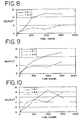
- the exceptional light stability provides a very light stable multiple film fluorescent sheeting. It also has been determined that the overlayer of the preferred benzoxanthene containing acrylic matrix acts as a UV light absorbing layer for the underlayer and protects same from UV light degradation. This is illustrated by Fig. 7 , discussed further in Example 5, in the context of a yellow-green fluorescent sheeting.
- the underlayer typically is a polymer which is very strong and impact resistant to support the overlayer polymer, resulting in a laminate which is not brittle.
- the polycarbonate matrix of the underlayer acts as a support layer for the polyacrylic overlayer. The result is a multiple film fluorescent sheeting which is not too brittle for uses exhibiting abusive conditions, such as outdoor signage and the like.
- Thicknesses of the overlayer 22, of the underlayer 23, and of the cap layer 25 can vary somewhat depending upon the particular article being prepared.
- the overlayer will have a thickness of between about 2 mils and about 20 mils (0.05 mm to 0.5 mm), more typically between about 3 mils and about 10 mils (0.075 mm to 0.25 mm).
- a typical underlayer will have a thickness of between about 2 mils and about 20 mils (0.05 mm to 0.5 mm), more typically between about 3 mils and about 10 mils (0.075 mm to 0.25 mm).
- a cap layer When a cap layer is included, its thickness ranges between about 1 mil and about 10 mils (0.025 mm to 0.25 mm), more typically between about 2 mils and about 5 mils (0.05 mm to 0.125 mm).
- the films used in these Examples were made using a laboratory Killion single screw extruder with three heating zones or with the use of a Brabender mixer.
- a mixture of the indicated polymer resins, the indicated dye and other additives such as UV light stabilizer and/or HALS was extruded into a film of about 6 mils (0.15 mm) thick.
- the temperature zone settings were at 490°F, 460°F and 440°F.
- the temperature zone settings typically were at 530°F, 540°F and 550°F.
- the screw speed was 27 rpm. When the mixer was used, the equipment was a C.W.
- Brabender Plasti-Corder Prep-Mixer The material was compounded through melt mixing of polymer resins and other components and then converted into films of approximately 6 mils (0.150 mm) using a heated platen press. Mixing temperatures were between 230°C and 270°C, depending upon the particular polymer resin, and the mixing speed was 100 rpm for a time of between about 3 and about 6 minutes. The thus prepared different films were laminated together at about 185°C using a Hot Roll Laminator M from Cheminstruments.
- An overlayer film of a polymethyl methacrylate matrix was prepared by blending an acrylic resin (Acrylite Plus ZK-V-001E, a Cyro trade designation), 0.8 weight percent benzoxanthene fluorescent dye (Lumofast Yellow 3G, a DayGlo trade designation), together with 1.0 weight percent UV absorber (Lowilite 22, a Great Lakes Chemical trade designation), and 0.5 weight percent HALS (Lowilite 62, a Great Lakes Chemical trade designation).
- This single-layer PMMA was designated Sample 1-1.
- a polycarbonate matrix underlayer film was made by blending polycarbonate resin (Calibre 303EP, a Dow Chemical designation) with 0.06 weight percent benzothiazine fluorescent dye (Huron Yellow D-417, a DayGlo trade designation).
- This single polycarbonate (PC) film was designated as Sample 1-2-1.
- Sample 1-2-2 was a multiple film laminate of Sample 1-1 on Sample 1-2-1.
- PC underlayer film was prepared from the same polycarbonate resin as sample 1-2-1, together with 0.05 weight percent Huron Yellow D-417 fluorescent dye, and 1.5 weight percent UV absorber (Tinuvin 1577, a trade designation of Ciba Geigy). This was designated as Sample 1-3-1.
- Sample 1-3-2 was a multiple layer film of Sample 1-1 laminated on Sample 1-3-1.
- a further PC underlayer film was prepared using the same polycarbonate resin, this time combined with 0.05 weight percent Huron Yellow D-417 fluorescent dye, 1 weight percent Tinuvin 1577 UV absorber, and 0.3 weight percent HALS component (Tinuvin 622, a trade designation of Ciba Geigy).
- PC underlayer film was prepared. This was composed of polycarbonate resin (Calibre-302, a trade designation of Dow Chemical), 0.08 weight percent Huron Yellow D-417, and 0.3 weight percent HALS component (Tinuvin 622). This was Sample 1-5-1 Sample 1-5-2 was a lamination of film Sample 1-1 on film Sample 1-5-1.
- polycarbonate resin Calibre-302, a trade designation of Dow Chemical
- Huron Yellow D-417 0.08 weight percent Huron Yellow D-417
- HALS component Tinuvin 622
- Each of the five single films identified above and each of the four two layer laminated films was subjected to accelerated weathering testing.
- Each sample was placed into a Xenon Arc accelerated "Weather-O-Meter", and the amount of fading was monitored through routine color measurements on a HunterLab LS-6000 colorimeter.
- the instrument used a D65 light source, 2° observer and a 0/45 geometric configuration, and all color measurements were recorded in terms of the CIE 1931 Standard Colorimetric System.
- the ⁇ E* degree of color shift versus time of artificial weathering was determined. A small value of the ⁇ E* color shift, such as a shift of about 2 or 3 ⁇ E* units is barely detectible to the human eye.
- test methodology used for the Xenon arc weathering is outlined in ASTM G26-90, Section 1.3.1. Borosilicate inner and outer filters were used, and the irradiance level was set to 0.35W/m 2 at 340 nm.
- the Table I data show that large color shifts were indicated for the single film components.
- the two layer films showed improved durability of fluorescent properties when compared with the individual single layer films.
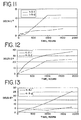
- Fig. 8 which plots the ⁇ E* value versus time of accelerated weathering for the single PC film 1-2-1 and for the PMMA/PC two layer film 1-2-2.
- the same type of plot is provided in Fig. 9 for single PC film 1-3-1 and four two layer PMMA/PC film 1-3-2.
- Fig. 10 plots the Table I data for single PC film 1-4-1 and for two layer PMMA/PC film 1-4-2.
- Fig. 11 plots the weathering data for single PC film 1-5-1 and for the two layer PMMA/PC film 1-5-2, the weathering being particularly minimal for this two layer film.
- a single layer polymethyl methacrylate film matrix was prepared by combining an acrylic resin, namely Acrylite Plus ZK-V-001E, a trade designation of Cyro, having incorporated thereinto 0.8 weight percent Lumofast Yellow 3G fluorescent dye from DayGlo. This was designated as Sample 2-1.
- a single polycarbonate matrix film was prepared from Calibre 303EP pellets of Dow Chemical with 0.05 weight percent Huron Yellow D-417 fluorescent dye and 1.5 weight percent Tinuvin 1577 UV absorber. This was designated as Sample 2-2.
- Sample 2-3 was a two layer PMMA/PC film of Sample 2-1 laminated on Sample 2-2.
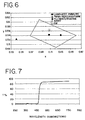
- the CIE "x” and "y” color chromaticity coordinates are useful to compare these films with a color standard used and acknowledged in the art. They can be compared with those of a target fluorescent yellow green which meet the chromaticity requirements of the industry. These color coordinates for fluorescent yellow green are: (0.387, 0.610), (0.460, 0.540), (0.421, 0.486) and (0.368, 0.539).
- Fig. 5 provides a plot of the fluorescent yellow green color box required of the industry, as defined by these "x", "y” color coordinates noted above. Films exhibiting chromaticity coordinates ("x" and "y") within this defined box can be considered to be generally acceptable.
- the "Y%" coordinate is in a third dimension, which can be visualized as projecting above the two dimensions of the Fig. 5 two dimensional box. Generally, a larger “Y%” indicates a greater degree of fluorescence and thus greater desirability in the present context.
- the "Y%” value is a total luminance factor. It is a standard measure of the amount of light (electromagnetic radiant power which is visually detectible by the normal human observer) radiating from a surface weighted by the eye's efficiency to convert the light to luminous sensation. It is defined as the ratio of the total luminance of a specimen to that of a perfect diffuser illuminated and viewed under the same conditions.
- the two layer film provides a fluorescent yellow green shading with favorable values. It is noted that the "Y%" of the two layer film is greater than the average of the two "Y%” values for the individual films.
- Example 2 The films of Example 2 were converted into retroreflective road sign sheeting through the use of a well-known embossing technique to provide a structure as generally shown in Fig. 1 .
- embossing technique for this embossing process, a plurality of microprismatic corner cube elements were formed directly into the rear surface of the fluorescent film. Then, a finished retroreflective sheeting was made by bonding a white backing film to the embossed film in a repeating cellular pattern.
- the color coordinates ("x”, “y”) and luminance factor (“Y%”) values of the finished retroreflective sheeting are shown in Table III.
- the "x”, “y” and “Y%” values of commercial fluorescent yellow green products also are shown.
- the "Y%” value for the two color layer PMMA/PC product Its “Y%” is higher than either color film which it contains, and it is closer to the commercial products than to the individual films.
- Retroreflective Sheeting Type x y Y% Avery Dennison T-7513 Fluorescent Yellow-Green 0.4076 0.5641 92.94 3M 3983 Fluorescent Yellow Green 0.4069 0.5704 95.28 PMMA single color film 0.3404 0.5260 85.95 PC single color film 0.4302 0.5417 83.9 PMMA/PC two color layer 0.4067 0.5433 89.75
- Two single layer films were prepared with the same fluorescent dye, namely 0.06 weight percent Huron Yellow D-417.
- One of the polymer matrices was a polycarbonate, Calibre 303-EP, while the other polymer was an acrylic matrix made from Acrylite Plus ZK-V-001E.
- the polymethyl methacrylate showed excessive fading after only 200 hours of accelerated weathering, the ⁇ E* being 36.70, indicating that the light stability of the fluorescent dye in the host acrylic matrix was very poor. Contrary to this result, the same benzothiazine dye showed much better light stability in the polycarbonate resin, indicating that it is a suitable host for this fluorescent dye.
- the ⁇ E* was only 2.55.
- a polymethyl methacrylate film of 6 mils thickness was prepared. It contained 0.8 weight percent of Lumofast Yellow 3G dye, 1.0 weight percent of Lowilite 22 UV absorber, and 0.5 weight percent Lowilite 62 HALS component. Light transmission data were recorded. They are plotted in Fig. 7 as a light transmission curve. It is noted that almost all of the light below 460 nm was blocked by the film due to the presence of the dye and the UV absorber. This Example indicates that the fluorescent yellow green PMMA film is a strong light screener for other fluorescent colored films, illustrating its effectiveness as an overlayer in accordance with the invention.
- a fluorescent yellow green overlayer film was prepared with the same formulation as Sample 1-1 in Example 1. This polymethyl methacrylate film was designated as Sample 4-1.
- a fluorescent orange PMMA underlayer film was made by blending acrylic resin pellets (Atohaas VO-45, a trade designation of Atohaas) with an orange fluorescent thioxanthene dye, namely 0.25 weight percent of Marigold.
- Orange D-315 a trade designation of DayGlo, 1 weight percent Tinuvin 234 UV absorber and 0.5 weight percent Tinuvin T-144 UV absorber. This was designated as Sample 4-2-1.
- a two layer article was prepared by laminating Sample 4-1 film on a Sample 4-2-1 film. This was designated as sample 4-2-2.
- Another fluorescent orange underlayer film was prepared in a PMMA matrix.
- the acrylic resin was Plexiglas PSR-9, a trade designation of Atofina, with perylene imide fluorescent dyes from BASF, namely 0.2 weight percent Lumogen F Orange 240 and 0.025 weight percent Lumogen F Red 300. This was designated as Sample 4-3-1.
- a two layer film was prepared by laminating the Sample 4-1 overlayer on the Sample 4-3-1 underlayer. This was designated as a Sample 4-3-2.
- QUV is an accelerated weathering tester in which polymer samples are exposed under UV light.
- the light lamps used in the test emanated 340 nm light.
- the conditions used were based on ASTM G 53-88.
- Sample 1-3-2 gave a ⁇ E* reading of 0.83 at 200 hours of accelerated exposure time, a ⁇ E* reading of 1.63 at 1500 hours, and a ⁇ E* reading of 3.23 at 3000 hours.
- the ⁇ E* reading at 200 hours was 1.27.
- the ⁇ E* reading was 3.8, and at 3000 hours, the ⁇ E* reading was 3.56. All of these indicate excellent light exposure durability.
- a fluorescent yellow sheeting having multiple film layers is prepared.
- the overlayer is an acrylic matrix made from Acrylite Plus ZK-V-001E from Cyro, 0.8 weight percent of Lumofast Yellow 3G from DayGlo, 1 weight percent UV absorber, and 0.5 weight percent HALS component.
- the underlayer is an acrylic matrix made from Acrylite Plus Exp-140 from Cyro and 0.3 weight percent Lumogen F Orange 240 (a perylene dye from BASF).
- UV absorbers if desired, are added, selected from Lowilite 22, Tinuvin 234, and Tinuvin P.
- a HALS component selected from Lowilite 62 and Tinuvin 770, also maybe added as needed.
- the overlayer is an acrylic matrix made from Acrylite Plus EXP-140 from Cyro, and 0.16 weight percent Lumogen F Orange 240 from BASF.
- the underlayer is an acrylic matrix made from Acrylite Plus EXP-140 and 0.3 weight percent Lumogen F Yellow from BASF.
- UV absorbers if desired, are added, selected from Tinuvin 234, Tinuvin P, Uvinul 3049, and Lowilite 22.
- a fluorescent yellow green sheeting having multiple film layers is prepared.
- the overlayer is a polymer blend matrix containing polyarylate made from U-Polymer U-6000 from Unitika, Japan, and 0.8 weight percent Lumofast Yellow 3G from Day-Glo. No UV additive is needed.
- the underlayer is a polycarbonate matrix made from polycarbonate and 0.05% Huron Yellow D 417. No UV additive is needed.
- a fluorescent yellow green sheeting having multiple film layers is prepared.
- the overlayer is a polymer matrix containing copolyestercarbonate, Sollx from GE, and 0.8 weight percent Lumofast Yellow 3G from Day-Glo. No UV additive is needed.
- the underlayer is a polycarbonate matrix made from polycarbonate and 0.05% Huron Yellow D 417. No UV additive is needed.
Landscapes
- Physics & Mathematics (AREA)
- General Physics & Mathematics (AREA)
- Optics & Photonics (AREA)
- Laminated Bodies (AREA)
- Manufacture Of Macromolecular Shaped Articles (AREA)
- Compositions Of Macromolecular Compounds (AREA)
- Illuminated Signs And Luminous Advertising (AREA)
Applications Claiming Priority (3)
| Application Number | Priority Date | Filing Date | Title |
|---|---|---|---|
| US10/135,537 US7264880B2 (en) | 2002-04-30 | 2002-04-30 | Fluorescent articles having multiple film layers |
| US135537 | 2002-04-30 | ||
| PCT/US2003/010841 WO2003093006A1 (en) | 2002-04-30 | 2003-04-09 | Fluorescent articles having multiple film layers |
Publications (2)
| Publication Number | Publication Date |
|---|---|
| EP1503897A1 EP1503897A1 (en) | 2005-02-09 |
| EP1503897B1 true EP1503897B1 (en) | 2016-11-02 |
Family
ID=29249473
Family Applications (1)
| Application Number | Title | Priority Date | Filing Date |
|---|---|---|---|
| EP03723946.4A Expired - Lifetime EP1503897B1 (en) | 2002-04-30 | 2003-04-09 | Fluorescent articles having multiple film layers |
Country Status (12)
| Country | Link |
|---|---|
| US (2) | US7264880B2 (enExample) |
| EP (1) | EP1503897B1 (enExample) |
| JP (1) | JP4610330B2 (enExample) |
| KR (1) | KR100972524B1 (enExample) |
| CN (1) | CN1649732B (enExample) |
| AU (1) | AU2003230842B2 (enExample) |
| BR (2) | BRPI0309588B1 (enExample) |
| CA (1) | CA2480519C (enExample) |
| ES (1) | ES2607803T3 (enExample) |
| MX (1) | MXPA04009570A (enExample) |
| RU (1) | RU2299231C2 (enExample) |
| WO (1) | WO2003093006A1 (enExample) |
Families Citing this family (31)
| Publication number | Priority date | Publication date | Assignee | Title |
|---|---|---|---|---|
| US6110566A (en) * | 1997-10-23 | 2000-08-29 | 3M Innovative Properties Company | Stabilization of fluorescent dyes in vinyl articles using hindered amine light stabilizers |
| US7618709B2 (en) * | 2002-04-30 | 2009-11-17 | Avery Dennison Corporation | Fluorescent articles having multiple film layers |
| US7264880B2 (en) * | 2002-04-30 | 2007-09-04 | Avery Dennison Corporation | Fluorescent articles having multiple film layers |
| US20050154098A1 (en) * | 2004-01-09 | 2005-07-14 | Reflexite Corporation | Fade-resistant fluorescent retroreflective articles |
| WO2005093691A2 (en) * | 2004-03-12 | 2005-10-06 | Avery Dennison Corporation | Emergency information sign |
| EP1723453A1 (en) * | 2004-03-12 | 2006-11-22 | Avery Dennison Corporation | Lighting system with a passive phosphorescent light source |
| CN100504971C (zh) * | 2004-03-12 | 2009-06-24 | 艾利丹尼森公司 | 紧急情况信息标记 |
| WO2005093697A1 (en) | 2004-03-12 | 2005-10-06 | Avery Dennison Corporation | Emergency information lighting system |
| CA2629944C (en) * | 2005-10-27 | 2016-02-09 | Avery Dennison Corporation | Fluorescent article having multiple layers |
| DE102006011436A1 (de) * | 2006-03-07 | 2007-09-13 | Sibylle Wagner-Quinte | Kunststoffverbund |
| KR101175618B1 (ko) | 2006-08-15 | 2012-08-22 | 패놀램 인더스트리즈 인터내셔널, 아이엔씨. | 멀티-컬러 광발광 물질이 통합되는 장식용 라미네이트 |
| US20080268228A1 (en) | 2007-04-27 | 2008-10-30 | Panolam Industries International, Inc. | Multi-colored decorative laminate |
| US7674515B2 (en) * | 2006-10-23 | 2010-03-09 | Avery Dennison Corporation | Fluorescent polycarbonate articles |
| CN101903175B (zh) * | 2007-12-20 | 2015-05-27 | Lg化学株式会社 | 多层丙烯酸延迟膜及其制备方法 |
| EP2367033A1 (en) * | 2008-01-14 | 2011-09-21 | Avery Dennison Corporation | Retroreflector for use in touch screen applications and positions sensing system |
| US8906187B2 (en) * | 2008-06-25 | 2014-12-09 | Colgate-Palmolive Company | Method of making shoulder/nozzles with film barrier liners |
| DE102009007124B4 (de) * | 2009-02-02 | 2019-01-10 | Hans-Erich Gubela sen. | Retroreflektor mit einem Farbfilter für optische Sensoren und Reflexionslichtschranken |
| US8322868B2 (en) * | 2009-05-12 | 2012-12-04 | Avery Dennison Corporation | Durable fluorescent articles having multiple film layers |
| EP2510424B1 (en) | 2009-12-11 | 2016-10-19 | Avery Dennison Corporation | Position sensing systems for use in touch screens and prismatic film used therein |
| US9204598B2 (en) | 2013-05-27 | 2015-12-08 | Saudi Basic Indsutries Corporation | Solar energy funneling using thermoplastics for agricultural applications |
| KR102217293B1 (ko) * | 2013-07-01 | 2021-02-19 | 쓰리엠 이노베이티브 프로퍼티즈 캄파니 | 용매계 상부코트를 포함하는 재귀반사성 시트 |
| TWI516520B (zh) | 2014-10-31 | 2016-01-11 | 財團法人工業技術研究院 | 波長轉換聚合物、其製法及包含其之波長轉換裝置 |
| KR101647389B1 (ko) * | 2014-12-29 | 2016-08-10 | 도레이케미칼 주식회사 | 2층 구조의 공압출 재귀반사필름 및 이의 제조방법 |
| KR101647385B1 (ko) * | 2014-12-29 | 2016-08-10 | 도레이케미칼 주식회사 | 2층 구조의 공압출 재귀반사필름 및 이의 제조방법 |
| KR101647392B1 (ko) * | 2014-12-29 | 2016-08-10 | 도레이케미칼 주식회사 | 2층 구조의 공압출 재귀반사필름 및 이의 제조방법 |
| DE202016101032U1 (de) * | 2016-02-26 | 2016-03-17 | Büchel Industriebeteiligungen GmbH | Warndreieck |
| CN106760966A (zh) * | 2016-11-28 | 2017-05-31 | 尤晓丽 | 一种锁孔可视贴 |
| EP3450163B1 (en) * | 2017-08-30 | 2019-07-17 | Evonik Röhm GmbH | Brittle acrylic films and forgery prevention labels comprising the same |
| JPWO2020022063A1 (ja) * | 2018-07-23 | 2021-08-05 | 三菱ケミカル株式会社 | 再帰反射シート用アクリル樹脂フィルムおよび再帰反射シート |
| EP4010743A1 (en) * | 2019-08-05 | 2022-06-15 | Avery Dennison Corporation | Retroreflective films comprising fluorescent dyes |
| JP2023550733A (ja) * | 2020-11-17 | 2023-12-05 | アベリー・デニソン・コーポレイション | 印刷可能フィルム |
Family Cites Families (43)
| Publication number | Priority date | Publication date | Assignee | Title |
|---|---|---|---|---|
| US2001A (en) * | 1841-03-12 | Sawmill | ||
| US9A (en) * | 1836-08-10 | Thomas Blanchard | Method of riveting plank or made blocks | |
| US463260A (en) * | 1891-11-17 | Valve foe steam engines | ||
| US2A (en) * | 1826-12-15 | 1836-07-29 | John Goulding | Mode of manufacturing wool or other fibrous materials |
| US812896A (en) * | 1904-07-13 | 1906-02-20 | Alvaro R Stokesbury | Rein-supporter. |
| US3830682A (en) | 1972-11-06 | 1974-08-20 | Rowland Dev Corp | Retroreflecting signs and the like with novel day-night coloration |
| US4601861A (en) | 1982-09-30 | 1986-07-22 | Amerace Corporation | Methods and apparatus for embossing a precision optical pattern in a resinous sheet or laminate |
| US4486363A (en) | 1982-09-30 | 1984-12-04 | Amerace Corporation | Method and apparatus for embossing a precision optical pattern in a resinous sheet |
| GB2189800B (en) | 1986-04-07 | 1990-03-14 | Michael Anthony West | Marking of articles |
| JP2844339B2 (ja) * | 1988-07-05 | 1999-01-06 | 日本カーバイド工業株式会社 | 蛍光発色シート |
| CA2026161A1 (en) * | 1990-06-25 | 1991-12-26 | Thomas C. Dipietro | Fluorescent pigments |
| US5117304A (en) | 1990-09-21 | 1992-05-26 | Minnesota Mining And Manufacturing Company | Retroreflective article |
| ZA918849B (en) | 1990-12-06 | 1992-08-26 | Minnesota Mining & Mfg | Articles exhibiting durable fluorescence |
| RU2063057C1 (ru) * | 1993-07-08 | 1996-06-27 | Обособленное научно-исследовательское подразделение по солнечной и точной оптике при Научно-производственном объединении "Астрофизика" | Световозвращающий экран (варианты) и способ его изготовления (варианты) |
| US5614286A (en) | 1993-10-20 | 1997-03-25 | Minnesota Mining And Manufacturing Company | Conformable cube corner retroreflective sheeting |
| WO1996017012A1 (en) | 1994-11-28 | 1996-06-06 | Minnesota Mining And Manufacturing Company | Articles exhibiting durable colour and/or fluorescent properties |
| DE69611756T2 (de) | 1995-03-01 | 2001-09-13 | Noboru Katagiri | Farbverbundstoff mit langnachleuchtenden eigenschaften und farbgegenstände mit langnachleuchtenden eigenschaften |
| JP3127198B2 (ja) * | 1995-03-01 | 2001-01-22 | 森井 壽▲ひろ▼ | 有彩色残光性複合体および有彩色残光性物品 |
| GB2300596B (en) | 1995-05-10 | 1998-11-04 | Portals Ltd | Composite material having fluorescent features |
| US5920429A (en) | 1995-09-29 | 1999-07-06 | Minnesota Mining And Manufacturing Company | Fluorescent dye blends |
| US5672643A (en) | 1995-09-29 | 1997-09-30 | Minnesota Mining And Manufacturing Company | Fluorescent dye blends |
| US5674622A (en) | 1995-09-29 | 1997-10-07 | Minnesota Mining And Manufacturing Company | Fluorescent dye blends |
| RU2101779C1 (ru) * | 1996-04-26 | 1998-01-10 | Константин Борисович Демидов | Световозвращающий материал с изображением знака |
| US6015214A (en) | 1996-05-30 | 2000-01-18 | Stimsonite Corporation | Retroreflective articles having microcubes, and tools and methods for forming microcubes |
| JP3974959B2 (ja) * | 1996-09-30 | 2007-09-12 | スリーエム カンパニー | 再帰反射性情報表示シートの製造方法 |
| US6110566A (en) | 1997-10-23 | 2000-08-29 | 3M Innovative Properties Company | Stabilization of fluorescent dyes in vinyl articles using hindered amine light stabilizers |
| US6001936A (en) | 1997-10-24 | 1999-12-14 | 3M Innovative Properties Company | Dye enhanced durability through controlled dye environment |
| WO1999048961A2 (en) | 1998-01-21 | 1999-09-30 | Reflexite Corporation | Extended life fluorescence polyvinyl chloride sheeting |
| JP2000212554A (ja) * | 1998-11-20 | 2000-08-02 | Idemitsu Kosan Co Ltd | 蛍光変換媒体及びそれを用いた表示装置 |
| SE9904080D0 (sv) * | 1998-12-03 | 1999-11-11 | Ciba Sc Holding Ag | Fotoinitiatorberedning |
| JP3430094B2 (ja) | 1998-12-10 | 2003-07-28 | 日産自動車株式会社 | 塗装構造 |
| WO2000047407A1 (en) | 1999-02-12 | 2000-08-17 | Reflexite Corporation | Extended life fluorescence polyvinyl chloride sheeting |
| JP2001092393A (ja) * | 1999-09-24 | 2001-04-06 | Shiina:Kk | 発光シート |
| JP2001174809A (ja) * | 1999-12-15 | 2001-06-29 | Asahi Kasei Corp | 面状偏光発光体 |
| US6375776B1 (en) | 2000-01-24 | 2002-04-23 | Avery Dennison Corporation | Method for forming multi-layer laminates with microstructures |
| US6312132B1 (en) | 2000-09-12 | 2001-11-06 | 3M Innovative Properties Company | Fluorescent red article and retroreflective article made therefrom |
| US6972147B1 (en) * | 2000-11-09 | 2005-12-06 | Avery Dennison Corporation | Fluorescent polymeric articles fabricated from U.V. light absorbing polymer |
| US6514594B1 (en) * | 2000-11-09 | 2003-02-04 | Avery Dennison Corporation | Fluorescent polymeric articles having screening layer formed from U.V. light absorbing polymer |
| US6531205B1 (en) * | 2001-02-14 | 2003-03-11 | Avery Dennison Corporation | Fluorescent yellow retroreflective sheeting |
| US7618709B2 (en) * | 2002-04-30 | 2009-11-17 | Avery Dennison Corporation | Fluorescent articles having multiple film layers |
| US7264880B2 (en) * | 2002-04-30 | 2007-09-04 | Avery Dennison Corporation | Fluorescent articles having multiple film layers |
| DE10332650A1 (de) * | 2003-07-18 | 2005-02-10 | Kronos International, Inc. | Verfahren zur Oberflächenbehandlung eines Titandioxid-Pigments |
| CA2629944C (en) * | 2005-10-27 | 2016-02-09 | Avery Dennison Corporation | Fluorescent article having multiple layers |
-
2002
- 2002-04-30 US US10/135,537 patent/US7264880B2/en not_active Expired - Lifetime
-
2003
- 2003-04-09 AU AU2003230842A patent/AU2003230842B2/en not_active Expired
- 2003-04-09 CN CN038096374A patent/CN1649732B/zh not_active Expired - Lifetime
- 2003-04-09 WO PCT/US2003/010841 patent/WO2003093006A1/en not_active Ceased
- 2003-04-09 KR KR1020047017514A patent/KR100972524B1/ko not_active Expired - Lifetime
- 2003-04-09 MX MXPA04009570A patent/MXPA04009570A/es not_active Application Discontinuation
- 2003-04-09 JP JP2004501162A patent/JP4610330B2/ja not_active Expired - Lifetime
- 2003-04-09 ES ES03723946.4T patent/ES2607803T3/es not_active Expired - Lifetime
- 2003-04-09 CA CA 2480519 patent/CA2480519C/en not_active Expired - Lifetime
- 2003-04-09 BR BRPI0309588-6A patent/BRPI0309588B1/pt unknown
- 2003-04-09 BR BRPI0309588-6A patent/BR0309588A/pt active IP Right Grant
- 2003-04-09 RU RU2004134736A patent/RU2299231C2/ru active
- 2003-04-09 EP EP03723946.4A patent/EP1503897B1/en not_active Expired - Lifetime
-
2007
- 2007-04-02 US US11/731,888 patent/US7618710B2/en not_active Expired - Lifetime
Also Published As
| Publication number | Publication date |
|---|---|
| MXPA04009570A (es) | 2005-07-14 |
| BR0309588A (pt) | 2007-03-06 |
| US7264880B2 (en) | 2007-09-04 |
| JP2005528248A (ja) | 2005-09-22 |
| US7618710B2 (en) | 2009-11-17 |
| KR20050005462A (ko) | 2005-01-13 |
| RU2004134736A (ru) | 2005-05-10 |
| US20070184278A1 (en) | 2007-08-09 |
| BRPI0309588B1 (pt) | 2019-10-08 |
| AU2003230842B2 (en) | 2008-08-28 |
| KR100972524B1 (ko) | 2010-07-28 |
| ES2607803T3 (es) | 2017-04-04 |
| CA2480519A1 (en) | 2003-11-13 |
| RU2299231C2 (ru) | 2007-05-20 |
| CN1649732B (zh) | 2010-05-26 |
| CN1649732A (zh) | 2005-08-03 |
| AU2003230842A1 (en) | 2003-11-17 |
| CA2480519C (en) | 2010-10-05 |
| WO2003093006A1 (en) | 2003-11-13 |
| JP4610330B2 (ja) | 2011-01-12 |
| EP1503897A1 (en) | 2005-02-09 |
| US20030203211A1 (en) | 2003-10-30 |
Similar Documents
| Publication | Publication Date | Title |
|---|---|---|
| US7618710B2 (en) | Fluorescent articles having multiple film layers | |
| US7618709B2 (en) | Fluorescent articles having multiple film layers | |
| EP2620280B1 (en) | Fluorescent articles having multiple film layers | |
| US20100290119A1 (en) | Durable fluorescent articles having multiple film layers | |
| US8034436B2 (en) | Fluorescent article having multiple layers |
Legal Events
| Date | Code | Title | Description |
|---|---|---|---|
| PUAI | Public reference made under article 153(3) epc to a published international application that has entered the european phase |
Free format text: ORIGINAL CODE: 0009012 |
|
| 17P | Request for examination filed |
Effective date: 20041130 |
|
| AK | Designated contracting states |
Kind code of ref document: A1 Designated state(s): AT BE BG CH CY CZ DE DK EE ES FI FR GB GR HU IE IT LI LU MC NL PT RO SE SI SK TR |
|
| AX | Request for extension of the european patent |
Extension state: AL LT LV MK |
|
| RIN1 | Information on inventor provided before grant (corrected) |
Inventor name: DOCKUS, KIMBERLY, A. Inventor name: BUONI, DREW, J. Inventor name: WEI, GUANG-XUE |
|
| RIC1 | Information provided on ipc code assigned before grant |
Ipc: G02B 5/124 20060101ALI20160321BHEP Ipc: B32B 27/36 20060101ALI20160321BHEP Ipc: B32B 27/30 20060101ALI20160321BHEP Ipc: B32B 27/20 20060101AFI20160321BHEP Ipc: B32B 27/08 20060101ALI20160321BHEP Ipc: G02B 5/128 20060101ALI20160321BHEP |
|
| GRAP | Despatch of communication of intention to grant a patent |
Free format text: ORIGINAL CODE: EPIDOSNIGR1 |
|
| INTG | Intention to grant announced |
Effective date: 20160513 |
|
| GRAS | Grant fee paid |
Free format text: ORIGINAL CODE: EPIDOSNIGR3 |
|
| GRAA | (expected) grant |
Free format text: ORIGINAL CODE: 0009210 |
|
| AK | Designated contracting states |
Kind code of ref document: B1 Designated state(s): AT BE BG CH CY CZ DE DK EE ES FI FR GB GR HU IE IT LI LU MC NL PT RO SE SI SK TR |
|
| REG | Reference to a national code |
Ref country code: GB Ref legal event code: FG4D |
|
| REG | Reference to a national code |
Ref country code: AT Ref legal event code: REF Ref document number: 841411 Country of ref document: AT Kind code of ref document: T Effective date: 20161115 Ref country code: CH Ref legal event code: EP |
|
| REG | Reference to a national code |
Ref country code: NL Ref legal event code: FP |
|
| REG | Reference to a national code |
Ref country code: IE Ref legal event code: FG4D |
|
| REG | Reference to a national code |
Ref country code: DE Ref legal event code: R096 Ref document number: 60349555 Country of ref document: DE |
|
| REG | Reference to a national code |
Ref country code: AT Ref legal event code: MK05 Ref document number: 841411 Country of ref document: AT Kind code of ref document: T Effective date: 20161102 |
|
| REG | Reference to a national code |
Ref country code: FR Ref legal event code: PLFP Year of fee payment: 15 |
|
| PG25 | Lapsed in a contracting state [announced via postgrant information from national office to epo] |
Ref country code: GR Free format text: LAPSE BECAUSE OF FAILURE TO SUBMIT A TRANSLATION OF THE DESCRIPTION OR TO PAY THE FEE WITHIN THE PRESCRIBED TIME-LIMIT Effective date: 20170203 Ref country code: SE Free format text: LAPSE BECAUSE OF FAILURE TO SUBMIT A TRANSLATION OF THE DESCRIPTION OR TO PAY THE FEE WITHIN THE PRESCRIBED TIME-LIMIT Effective date: 20161102 |
|
| PG25 | Lapsed in a contracting state [announced via postgrant information from national office to epo] |
Ref country code: FI Free format text: LAPSE BECAUSE OF FAILURE TO SUBMIT A TRANSLATION OF THE DESCRIPTION OR TO PAY THE FEE WITHIN THE PRESCRIBED TIME-LIMIT Effective date: 20161102 Ref country code: AT Free format text: LAPSE BECAUSE OF FAILURE TO SUBMIT A TRANSLATION OF THE DESCRIPTION OR TO PAY THE FEE WITHIN THE PRESCRIBED TIME-LIMIT Effective date: 20161102 Ref country code: PT Free format text: LAPSE BECAUSE OF FAILURE TO SUBMIT A TRANSLATION OF THE DESCRIPTION OR TO PAY THE FEE WITHIN THE PRESCRIBED TIME-LIMIT Effective date: 20170302 |
|
| PG25 | Lapsed in a contracting state [announced via postgrant information from national office to epo] |
Ref country code: RO Free format text: LAPSE BECAUSE OF FAILURE TO SUBMIT A TRANSLATION OF THE DESCRIPTION OR TO PAY THE FEE WITHIN THE PRESCRIBED TIME-LIMIT Effective date: 20161102 Ref country code: SK Free format text: LAPSE BECAUSE OF FAILURE TO SUBMIT A TRANSLATION OF THE DESCRIPTION OR TO PAY THE FEE WITHIN THE PRESCRIBED TIME-LIMIT Effective date: 20161102 Ref country code: EE Free format text: LAPSE BECAUSE OF FAILURE TO SUBMIT A TRANSLATION OF THE DESCRIPTION OR TO PAY THE FEE WITHIN THE PRESCRIBED TIME-LIMIT Effective date: 20161102 Ref country code: DK Free format text: LAPSE BECAUSE OF FAILURE TO SUBMIT A TRANSLATION OF THE DESCRIPTION OR TO PAY THE FEE WITHIN THE PRESCRIBED TIME-LIMIT Effective date: 20161102 Ref country code: CZ Free format text: LAPSE BECAUSE OF FAILURE TO SUBMIT A TRANSLATION OF THE DESCRIPTION OR TO PAY THE FEE WITHIN THE PRESCRIBED TIME-LIMIT Effective date: 20161102 |
|
| REG | Reference to a national code |
Ref country code: DE Ref legal event code: R097 Ref document number: 60349555 Country of ref document: DE |
|
| PG25 | Lapsed in a contracting state [announced via postgrant information from national office to epo] |
Ref country code: BG Free format text: LAPSE BECAUSE OF FAILURE TO SUBMIT A TRANSLATION OF THE DESCRIPTION OR TO PAY THE FEE WITHIN THE PRESCRIBED TIME-LIMIT Effective date: 20170202 |
|
| PLBE | No opposition filed within time limit |
Free format text: ORIGINAL CODE: 0009261 |
|
| STAA | Information on the status of an ep patent application or granted ep patent |
Free format text: STATUS: NO OPPOSITION FILED WITHIN TIME LIMIT |
|
| 26N | No opposition filed |
Effective date: 20170803 |
|
| PG25 | Lapsed in a contracting state [announced via postgrant information from national office to epo] |
Ref country code: SI Free format text: LAPSE BECAUSE OF FAILURE TO SUBMIT A TRANSLATION OF THE DESCRIPTION OR TO PAY THE FEE WITHIN THE PRESCRIBED TIME-LIMIT Effective date: 20161102 |
|
| REG | Reference to a national code |
Ref country code: CH Ref legal event code: PL |
|
| REG | Reference to a national code |
Ref country code: IE Ref legal event code: MM4A |
|
| PG25 | Lapsed in a contracting state [announced via postgrant information from national office to epo] |
Ref country code: MC Free format text: LAPSE BECAUSE OF FAILURE TO SUBMIT A TRANSLATION OF THE DESCRIPTION OR TO PAY THE FEE WITHIN THE PRESCRIBED TIME-LIMIT Effective date: 20161102 |
|
| PG25 | Lapsed in a contracting state [announced via postgrant information from national office to epo] |
Ref country code: LU Free format text: LAPSE BECAUSE OF NON-PAYMENT OF DUE FEES Effective date: 20170409 Ref country code: LI Free format text: LAPSE BECAUSE OF NON-PAYMENT OF DUE FEES Effective date: 20170430 Ref country code: CH Free format text: LAPSE BECAUSE OF NON-PAYMENT OF DUE FEES Effective date: 20170430 |
|
| REG | Reference to a national code |
Ref country code: FR Ref legal event code: PLFP Year of fee payment: 16 |
|
| PG25 | Lapsed in a contracting state [announced via postgrant information from national office to epo] |
Ref country code: IE Free format text: LAPSE BECAUSE OF NON-PAYMENT OF DUE FEES Effective date: 20170409 |
|
| PG25 | Lapsed in a contracting state [announced via postgrant information from national office to epo] |
Ref country code: HU Free format text: LAPSE BECAUSE OF FAILURE TO SUBMIT A TRANSLATION OF THE DESCRIPTION OR TO PAY THE FEE WITHIN THE PRESCRIBED TIME-LIMIT; INVALID AB INITIO Effective date: 20030409 |
|
| PG25 | Lapsed in a contracting state [announced via postgrant information from national office to epo] |
Ref country code: CY Free format text: LAPSE BECAUSE OF NON-PAYMENT OF DUE FEES Effective date: 20161102 |
|
| PGFP | Annual fee paid to national office [announced via postgrant information from national office to epo] |
Ref country code: GB Payment date: 20220325 Year of fee payment: 20 |
|
| PGFP | Annual fee paid to national office [announced via postgrant information from national office to epo] |
Ref country code: NL Payment date: 20220322 Year of fee payment: 20 Ref country code: FR Payment date: 20220324 Year of fee payment: 20 Ref country code: BE Payment date: 20220322 Year of fee payment: 20 |
|
| REG | Reference to a national code |
Ref country code: DE Ref legal event code: R081 Ref document number: 60349555 Country of ref document: DE Owner name: AVERY DENNISON CORPORATION, MENTOR, US Free format text: FORMER OWNER: AVERY DENNISON CORP., PAINESVILLE, OHIO, US |
|
| PGFP | Annual fee paid to national office [announced via postgrant information from national office to epo] |
Ref country code: IT Payment date: 20220413 Year of fee payment: 20 Ref country code: ES Payment date: 20220511 Year of fee payment: 20 Ref country code: DE Payment date: 20220318 Year of fee payment: 20 |
|
| REG | Reference to a national code |
Ref country code: BE Ref legal event code: PD Owner name: AVERY DENNISON CORPORATION; US Free format text: DETAILS ASSIGNMENT: CHANGE OF OWNER(S), OTHER; FORMER OWNER NAME: AVERY DENNISON CORPORATION Effective date: 20220602 |
|
| PGFP | Annual fee paid to national office [announced via postgrant information from national office to epo] |
Ref country code: TR Payment date: 20220406 Year of fee payment: 20 |
|
| REG | Reference to a national code |
Ref country code: DE Ref legal event code: R071 Ref document number: 60349555 Country of ref document: DE |
|
| REG | Reference to a national code |
Ref country code: NL Ref legal event code: MK Effective date: 20230408 |
|
| REG | Reference to a national code |
Ref country code: BE Ref legal event code: MK Effective date: 20230409 |
|
| REG | Reference to a national code |
Ref country code: GB Ref legal event code: PE20 Expiry date: 20230408 |
|
| REG | Reference to a national code |
Ref country code: ES Ref legal event code: FD2A Effective date: 20230602 |
|
| P01 | Opt-out of the competence of the unified patent court (upc) registered |
Effective date: 20230526 |
|
| PG25 | Lapsed in a contracting state [announced via postgrant information from national office to epo] |
Ref country code: ES Free format text: LAPSE BECAUSE OF EXPIRATION OF PROTECTION Effective date: 20230410 |
|
| PG25 | Lapsed in a contracting state [announced via postgrant information from national office to epo] |
Ref country code: GB Free format text: LAPSE BECAUSE OF EXPIRATION OF PROTECTION Effective date: 20230408 |