EP1503574A2 - Stochastisches Halbtonrasterungsverfahren - Google Patents
Stochastisches Halbtonrasterungsverfahren Download PDFInfo
- Publication number
- EP1503574A2 EP1503574A2 EP04018127A EP04018127A EP1503574A2 EP 1503574 A2 EP1503574 A2 EP 1503574A2 EP 04018127 A EP04018127 A EP 04018127A EP 04018127 A EP04018127 A EP 04018127A EP 1503574 A2 EP1503574 A2 EP 1503574A2
- Authority
- EP
- European Patent Office
- Prior art keywords
- matrix
- gray level
- pixels
- target gray
- filled
- Prior art date
- Legal status (The legal status is an assumption and is not a legal conclusion. Google has not performed a legal analysis and makes no representation as to the accuracy of the status listed.)
- Granted
Links
- 238000000034 method Methods 0.000 title claims abstract description 50
- 238000012216 screening Methods 0.000 title claims abstract description 17
- 239000011159 matrix material Substances 0.000 claims abstract description 89
- 238000005259 measurement Methods 0.000 claims abstract description 9
- 238000003384 imaging method Methods 0.000 description 5
- 230000003252 repetitive effect Effects 0.000 description 4
- 238000004364 calculation method Methods 0.000 description 2
- 230000001419 dependent effect Effects 0.000 description 2
- 238000010586 diagram Methods 0.000 description 2
- 238000009792 diffusion process Methods 0.000 description 1
- 230000000694 effects Effects 0.000 description 1
- 230000002349 favourable effect Effects 0.000 description 1
- 238000007429 general method Methods 0.000 description 1
- 230000003993 interaction Effects 0.000 description 1
- 238000005457 optimization Methods 0.000 description 1
Images




Classifications
-
- H—ELECTRICITY
- H04—ELECTRIC COMMUNICATION TECHNIQUE
- H04N—PICTORIAL COMMUNICATION, e.g. TELEVISION
- H04N1/00—Scanning, transmission or reproduction of documents or the like, e.g. facsimile transmission; Details thereof
- H04N1/40—Picture signal circuits
- H04N1/405—Halftoning, i.e. converting the picture signal of a continuous-tone original into a corresponding signal showing only two levels
- H04N1/4051—Halftoning, i.e. converting the picture signal of a continuous-tone original into a corresponding signal showing only two levels producing a dispersed dots halftone pattern, the dots having substantially the same size
Definitions
- the present invention relates to halftone screening, and more specifically to a new method for stochastic screening.
- the process of generating a binary image from a continuous-tone image is often referred to as screening and is often implemented by comparing continuous-tone pixel values with those of a dither matrix of threshold values, commonly referred to as "screen”.
- Stochastic screening otherwise known as frequency-modulated screening or dispersed-dithered screening, is based on producing a well-dispersed pattern of isolated dots at spaced pixel locations, the average surface coverage by these dots being equal to a continuous-tone image gray level value represented in a specific location.
- Data-dependent screening methods being easy to implement and computationally inexpensive, exhibit quasi-periodic patterns visible to the human eye; when used on high-resolution imaging devices, the spatial frequencies of prevailing local quasi-periodic patterns are such that the resulting effect provides an unpleasant visible appearance. Such methods are therefore used mostly on low-resolution printing devices.
- Repetitive matrix-based methods are better suited for high-resolution imaging devices, such as imagesetters, platesetters, digital printing presses and high-resolution inkjet printers. Several different factors reduce image quality when using repetitive matrix-based stochastic screens.
- high-resolution frequencies present in the pixel distribution inside the matrix, contribute to an overall "noisy" appearance of the image, especially on relatively large areas with a uniform gray level.
- a method of creating a threshold matrix for stochastic screening comprising the steps of:
- the step of obtaining dot-gain measurements comprises obtaining dot-gain measurements of pixel agglomerates.
- a method of creating a threshold matrix for stochastic screening for an initial target gray level comprising the steps of:
- the method additionally comprises the steps of:
- the method additionally comprises the steps of:
- the merit function represents dot-gain of pixels and/or pixel agglomerates.
- the geometrical function represents halftone dot shapes, such as a square or a circle.
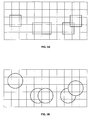
- the present invention deals with the aforementioned limitations of existing stochastic screening methods by using the actual size and shape of imaged pixel and/or pixel agglomerate instead of the nominal one, in the stage of calculating appropriate threshold matrices.
- a matrix with desirable blue-noise-like characteristics is created from actual imaged pixels and/or pixel agglomerates, taking into account their overlap when placed in close proximity (as in midtone and shadow image regions).
- Such matrix produces, for a target combination of imager and imaged media - for each threshold level of an image - an imaged pattern with desirable spatial characteristics and with surface coverage substantially equal to the one required by the gray level being imaged.
- the method consists of building a threshold matrix according to actual characteristics of the imaging device (such as pixel shape and physical dot gain), by using actual dot pattern instead of nominal dot pattern at every algorithm step dealing with choosing position for dot placement, such as merit comparisons of alternative possible dot placement positions, and substituting the actual dot pattern for a nominal dot pattern at every subsequent step of the algorithm for creating the chosen threshold matrix.
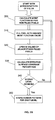
- Fig. 1 is a flowchart illustrating one exemplary embodiment of the present invention.
- the stochastic screen patterns are built from scratch; namely, the process starts with an empty matrix.
- step 100 a merit function is calculated for all non-filled pixels in the matrix.
- step 110 the pixel with the highest merit function value is filled, followed by updating the values of all adjacent non-filled pixels (step 120).
- step 130 the effective surface coverage percent is calculated and compared, in step 140, with the required gray level. If the required gray level has not been reached yet, the process returns to step 100 for further filling of the matrix. Otherwise, if the required gray level, or its nearest system value has been achieved, the stochastic screen pattern for that gray level is saved, in step 150.
- Fig. 1 is suitable for a process of creating stochastic screen pattern for a monotonous series of gray levels, starting from the brightest level and ending with the darkest level in the series.
- the screen patterns created by the process of Fig. 1 are combined to create a threshold matrix.
- Figs. 2A through 2C are flowcharts illustrating another embodiment of the present invention.
- the process of creating stochastic screen patterns starts with an existing nominal pattern for some nominal system value Vstart.
- This nominal pattern may have been created by any known method for creating stochastic screen patterns.
- step 210 the values of non-filled pixels adjacent (having a common side or comer) to filled pixels are updated, according to the relevant geometrical function F(x,y), followed by calculation of merit function M1 for all filled pixels (step 220), to find a best candidate for removal, and calculation of merit function M2 for all non-filled pixels (step 230), to find a best candidate for filling.
- step 240 the pixel with the highest M1 value is swapped with the pixel with the highest M2 value and in step 250 values of non-filled pixels are updated accordingly.
- step 260 The global merit function is now calculated (step 260) and the difference ⁇ M between the previous and new merit functions is tested for acceptability (step 270).
- ⁇ M will be acceptable as long as it is positive, namely, the overall merit value is increasing, or till some other predefined optimization criterion is reached. If the difference ⁇ M is acceptable, the process returns to step 220, to try to further optimize the screen pattern.
- step 290 the process terminates with a created screen pattern for some actual system value Vact, generally not equal to Vstart.
- the screen pattern is saved for the nominal value Vact.
- Fig. 2B screen patterns are created for gray levels with higher black percentage.
- merit function M2 for all non-filled pixels is calculated in step 300.
- step 310 the pixel with the highest merit function value is filled, followed by updating the values of all adjacent non-filled pixels (step 320).
- step 330 the new effective surface coverage percent is calculated. The effective surface coverage is compared with the required gray level in step 340. If the required gray level has not been achieved yet, the process returns to step 300 for further filling. Otherwise, the created screen pattern is stored for the nominal gray level and the process returns to step 300, to create the screen pattern for the next (darker) gray level.
- step 360 the pixel with the highest merit function value is removed, followed by updating the values of all adjacent non-filled pixels (step 380).
- step 390 the new effective surface coverage percent is calculated. The effective surface coverage is compared with the required gray level in step 400. If the required gray level has not been achieved yet, the process returns to step 360 for further removing. Otherwise, the created screen pattern is stored for the nominal gray level and the process returns to step 360, to create the screen pattern for the next (brighter) gray level.
- the screen patterns created by the processes of Figs.2A through 2C are combined to create a threshold matrix.
- the merit function in the above description relates to the relative desirability of choosing a specific non-filled pixel as a candidate for filling, as compared with other pixels from a plurality of non-filled pixels or, alternatively, the relative desirability of choosing a specific filled pixel as a candidate for converting to a non-filled pixel, as compared to other pixels from a plurality of filled pixels.
- the merit function may be constructed using any known method of creating stochastic screen pattern, for example, void-and-cluster method.
- Fig. 4 is a diagram of the distribution of the coverage percentage of 4x4 pixel tiles, 50% black.
- the dashed line denotes use of prior art matrix with an appropriate X-curve.
- the solid line denotes use of a matrix built according to the method of the present invention.
- Fig. 5 is a diagram of the distribution of the coverage percentage of 4x4 pixel tiles, 33% black.
- the dashed line denotes use of prior art matrix with an appropriate X-curve.
- the solid line denotes use of a matrix built according to the method of the present invention.
Landscapes
- Engineering & Computer Science (AREA)
- Multimedia (AREA)
- Signal Processing (AREA)
- Image Processing (AREA)
- Facsimile Image Signal Circuits (AREA)
Applications Claiming Priority (2)
| Application Number | Priority Date | Filing Date | Title |
|---|---|---|---|
| US630844 | 2000-08-02 | ||
| US10/630,844 US7277204B2 (en) | 2003-07-31 | 2003-07-31 | Stochastic halftone screening method |
Publications (3)
| Publication Number | Publication Date |
|---|---|
| EP1503574A2 true EP1503574A2 (de) | 2005-02-02 |
| EP1503574A3 EP1503574A3 (de) | 2005-08-17 |
| EP1503574B1 EP1503574B1 (de) | 2013-01-16 |
Family
ID=33541502
Family Applications (1)
| Application Number | Title | Priority Date | Filing Date |
|---|---|---|---|
| EP04018127A Expired - Lifetime EP1503574B1 (de) | 2003-07-31 | 2004-07-30 | Stochastisches Halbtonrasterungsverfahren |
Country Status (3)
| Country | Link |
|---|---|
| US (1) | US7277204B2 (de) |
| EP (1) | EP1503574B1 (de) |
| CA (1) | CA2475812A1 (de) |
Cited By (2)
| Publication number | Priority date | Publication date | Assignee | Title |
|---|---|---|---|---|
| WO2009020522A1 (en) * | 2007-08-03 | 2009-02-12 | Eastman Kodak Company | Method for generating stochastic dither matrix |
| CN100559835C (zh) * | 2005-10-27 | 2009-11-11 | 帆宣系统科技股份有限公司 | 影像动态对比伸张的方法及其装置 |
Families Citing this family (7)
| Publication number | Priority date | Publication date | Assignee | Title |
|---|---|---|---|---|
| US20090034006A1 (en) * | 2007-08-03 | 2009-02-05 | Blondal Daniel J | Stochastic halftone images based on screening parameters |
| WO2012123969A2 (en) * | 2011-03-14 | 2012-09-20 | Indian Institute Of Technology Bombay | Methods for generating multi-level pseudo-random sequences |
| US9036212B2 (en) | 2012-01-06 | 2015-05-19 | Ricoh Production Print Solutions LLC | Halftone screen generation mechanism |
| US8797601B2 (en) * | 2012-03-22 | 2014-08-05 | Xerox Corporation | Method and system for preserving image quality in an economy print mode |
| US8773722B2 (en) | 2012-04-05 | 2014-07-08 | Infoprint Solutions Company Llc | Hybrid halftone generation mechanism using change in pixel error |
| US9124841B2 (en) | 2013-11-26 | 2015-09-01 | Xerox Corporation | Connected component analysis with multi-thresholding to segment halftones |
| US9332155B2 (en) | 2014-02-04 | 2016-05-03 | Ricoh Company, Ltd. | Digital image halftone conversion with selective enhancement |
Citations (1)
| Publication number | Priority date | Publication date | Assignee | Title |
|---|---|---|---|---|
| US6014500A (en) | 1998-06-01 | 2000-01-11 | Xerox Corporation | Stochastic halftoning screening method |
Family Cites Families (12)
| Publication number | Priority date | Publication date | Assignee | Title |
|---|---|---|---|---|
| US5309526A (en) * | 1989-05-04 | 1994-05-03 | At&T Bell Laboratories | Image processing system |
| US5469268A (en) * | 1991-02-22 | 1995-11-21 | At&T Corp. | Display model-based error criterion halftoning |
| DE69324432T2 (de) * | 1992-10-15 | 1999-12-16 | Digital Equipment Corp., Maynard | Erzeugung von Schablonen mit homogener Verteilung binärer Elemente, anwendbar bei Halbton-Bildwiedergabe |
| US5473439A (en) * | 1992-10-23 | 1995-12-05 | At&T Corp. | Model-based halftoning of color images |
| US5469515A (en) * | 1993-05-03 | 1995-11-21 | Lin; Qian | Halftone image formation using dither matrix generated based upon printed symbol models |
| DE69417832T2 (de) * | 1993-09-28 | 1999-08-12 | Hewlett-Packard Co., Palo Alto, Calif. | Digitale Halbtonrasterwiedergabe eines Grautonbildes mit frequenzabhängiger diagonaler Korrelation |
| EP0680196B1 (de) * | 1994-04-29 | 2000-07-12 | Adobe Systems Inc. | Verfahren zur Erzeugung einer Schwellenmatrix |
| US5832122A (en) * | 1995-03-24 | 1998-11-03 | Fuji Photo Film Co., Ltd. | Method of processing image data |
| JP2002044446A (ja) * | 2000-07-21 | 2002-02-08 | Fuji Xerox Co Ltd | 画像処理装置および画像処理方法、ならびにハーフトーン画像生成用閾値マトリックスの作成方法 |
| US6710778B2 (en) * | 2001-02-12 | 2004-03-23 | Lexmark International, Inc. | Method for halftoning using a difference weighting function |
| JP4204000B2 (ja) * | 2003-12-02 | 2009-01-07 | 株式会社リコー | ディザマトリクス作成方法および装置、画像処理方法および装置、画像形成方法および装置、プログラムおよび記録媒体 |
| US20060197992A1 (en) * | 2005-03-02 | 2006-09-07 | Xerox Corporation | Stochastic screens for rendering devices with high-addressability |
-
2003
- 2003-07-31 US US10/630,844 patent/US7277204B2/en not_active Expired - Fee Related
-
2004
- 2004-07-26 CA CA002475812A patent/CA2475812A1/en not_active Abandoned
- 2004-07-30 EP EP04018127A patent/EP1503574B1/de not_active Expired - Lifetime
Patent Citations (1)
| Publication number | Priority date | Publication date | Assignee | Title |
|---|---|---|---|---|
| US6014500A (en) | 1998-06-01 | 2000-01-11 | Xerox Corporation | Stochastic halftoning screening method |
Cited By (2)
| Publication number | Priority date | Publication date | Assignee | Title |
|---|---|---|---|---|
| CN100559835C (zh) * | 2005-10-27 | 2009-11-11 | 帆宣系统科技股份有限公司 | 影像动态对比伸张的方法及其装置 |
| WO2009020522A1 (en) * | 2007-08-03 | 2009-02-12 | Eastman Kodak Company | Method for generating stochastic dither matrix |
Also Published As
| Publication number | Publication date |
|---|---|
| US7277204B2 (en) | 2007-10-02 |
| EP1503574A3 (de) | 2005-08-17 |
| US20050024685A1 (en) | 2005-02-03 |
| EP1503574B1 (de) | 2013-01-16 |
| CA2475812A1 (en) | 2005-01-31 |
Similar Documents
| Publication | Publication Date | Title |
|---|---|---|
| JP5058247B2 (ja) | マルチレベルハーフトーンスクリーン及びそのセット | |
| JP2925325B2 (ja) | 連続色調画像をハーフトーン化して効率的に送受信する方法及びその方法を実現するファクシミリ装置 | |
| EP0409915B1 (de) | Digitale halbtonrasterung mit minimalvisuellen modulationsmustern | |
| EP0749231B1 (de) | Verfahren und Gerät zur Halbtonwiedergabe von Grautonbildern unter Verwendung einer Maskierung mit blauem Rauschen | |
| US5543941A (en) | Method and apparatus for halftone rendering of a gray image using a blue noise mask | |
| US5543935A (en) | Halftoning method using space filling curves | |
| US7626730B2 (en) | Method of making a multilevel halftone screen | |
| JPH11331577A (ja) | 連続ト―ン画像出力方法 | |
| JP2000333010A (ja) | 階調依存型誤差拡散ハーフトーン化方法 | |
| EP1366618B1 (de) | Verfahren und system zur fehlerdiffusion bei teilhalbtonpunkten | |
| EP1422925A2 (de) | Verfahren und Apparat zur Anwendung von stochastischem Halbtonrasterungsverfahren mit anamorphen Bildpunkten | |
| US6704123B1 (en) | Method for applying tonal correction to a binary halftone image | |
| US6335989B1 (en) | Halftone printing using donut filters | |
| US7580074B2 (en) | Digital halftoning technique based on 1-D multi-scale dot assignment | |
| EP1503574A2 (de) | Stochastisches Halbtonrasterungsverfahren | |
| US7460276B2 (en) | Systems and methods for rank-order error diffusion image processing | |
| US20040113958A1 (en) | Sub-dot phase modulation for computer to plate inkjet system | |
| JP3762800B2 (ja) | 網目スクリーンの作成方法 | |
| JPH0785272A (ja) | 周波数変調ハーフトーン画像および作成方法 | |
| US6515770B1 (en) | Dither mask generation with calibration-independent number of threshold levels | |
| KR101098713B1 (ko) | 디더 마스크 생성 방법과 이를 포함하는 이미지 하프토닝 방법, 디더 마스크 생성 장치 및 컴퓨터 판독가능 매체 | |
| EP1401190A2 (de) | Unterpunktphasenmodulation für Tintenstrahlsysteme vom Rechner zur Platte | |
| EP2187616A1 (de) | Bilddatenverarbeitung für den Druck | |
| EP1416718A2 (de) | Transformation eines Eingangsbildes zur Herstellung eines Ausgangsbildes | |
| Bartels | Reducing patterns in the FM part of tile-based hybrid screens |
Legal Events
| Date | Code | Title | Description |
|---|---|---|---|
| PUAI | Public reference made under article 153(3) epc to a published international application that has entered the european phase |
Free format text: ORIGINAL CODE: 0009012 |
|
| AK | Designated contracting states |
Kind code of ref document: A2 Designated state(s): AT BE BG CH CY CZ DE DK EE ES FI FR GB GR HU IE IT LI LU MC NL PL PT RO SE SI SK TR |
|
| AX | Request for extension of the european patent |
Extension state: AL HR LT LV MK |
|
| PUAL | Search report despatched |
Free format text: ORIGINAL CODE: 0009013 |
|
| AK | Designated contracting states |
Kind code of ref document: A3 Designated state(s): AT BE BG CH CY CZ DE DK EE ES FI FR GB GR HU IE IT LI LU MC NL PL PT RO SE SI SK TR |
|
| AX | Request for extension of the european patent |
Extension state: AL HR LT LV MK |
|
| 17P | Request for examination filed |
Effective date: 20060127 |
|
| AKX | Designation fees paid |
Designated state(s): BE DE FR GB |
|
| RAP1 | Party data changed (applicant data changed or rights of an application transferred) |
Owner name: KODAK IL LTD. |
|
| 17Q | First examination report despatched |
Effective date: 20070212 |
|
| GRAP | Despatch of communication of intention to grant a patent |
Free format text: ORIGINAL CODE: EPIDOSNIGR1 |
|
| GRAS | Grant fee paid |
Free format text: ORIGINAL CODE: EPIDOSNIGR3 |
|
| GRAA | (expected) grant |
Free format text: ORIGINAL CODE: 0009210 |
|
| AK | Designated contracting states |
Kind code of ref document: B1 Designated state(s): BE DE FR GB |
|
| REG | Reference to a national code |
Ref country code: GB Ref legal event code: FG4D |
|
| REG | Reference to a national code |
Ref country code: DE Ref legal event code: R096 Ref document number: 602004040773 Country of ref document: DE Effective date: 20130314 |
|
| PLBE | No opposition filed within time limit |
Free format text: ORIGINAL CODE: 0009261 |
|
| STAA | Information on the status of an ep patent application or granted ep patent |
Free format text: STATUS: NO OPPOSITION FILED WITHIN TIME LIMIT |
|
| 26N | No opposition filed |
Effective date: 20131017 |
|
| BERE | Be: lapsed |
Owner name: KODAK IL LTD. Effective date: 20130731 |
|
| REG | Reference to a national code |
Ref country code: DE Ref legal event code: R097 Ref document number: 602004040773 Country of ref document: DE Effective date: 20131017 |
|
| GBPC | Gb: european patent ceased through non-payment of renewal fee |
Effective date: 20130730 |
|
| REG | Reference to a national code |
Ref country code: FR Ref legal event code: ST Effective date: 20140331 |
|
| PG25 | Lapsed in a contracting state [announced via postgrant information from national office to epo] |
Ref country code: GB Free format text: LAPSE BECAUSE OF NON-PAYMENT OF DUE FEES Effective date: 20130730 Ref country code: BE Free format text: LAPSE BECAUSE OF NON-PAYMENT OF DUE FEES Effective date: 20130731 |
|
| PG25 | Lapsed in a contracting state [announced via postgrant information from national office to epo] |
Ref country code: FR Free format text: LAPSE BECAUSE OF NON-PAYMENT OF DUE FEES Effective date: 20130731 |
|
| PGFP | Annual fee paid to national office [announced via postgrant information from national office to epo] |
Ref country code: DE Payment date: 20150731 Year of fee payment: 12 |
|
| REG | Reference to a national code |
Ref country code: DE Ref legal event code: R119 Ref document number: 602004040773 Country of ref document: DE |
|
| PG25 | Lapsed in a contracting state [announced via postgrant information from national office to epo] |
Ref country code: DE Free format text: LAPSE BECAUSE OF NON-PAYMENT OF DUE FEES Effective date: 20170201 |