EP1502968A1 - SOFT MAGNETIC Co-BASED METALLIC GLASS ALLOY - Google Patents
SOFT MAGNETIC Co-BASED METALLIC GLASS ALLOY Download PDFInfo
- Publication number
- EP1502968A1 EP1502968A1 EP03745951A EP03745951A EP1502968A1 EP 1502968 A1 EP1502968 A1 EP 1502968A1 EP 03745951 A EP03745951 A EP 03745951A EP 03745951 A EP03745951 A EP 03745951A EP 1502968 A1 EP1502968 A1 EP 1502968A1
- Authority
- EP
- European Patent Office
- Prior art keywords
- metallic glass
- glass
- atomic
- alloy
- soft magnetic
- Prior art date
- Legal status (The legal status is an assumption and is not a legal conclusion. Google has not performed a legal analysis and makes no representation as to the accuracy of the status listed.)
- Withdrawn
Links
Images


Classifications
-
- H—ELECTRICITY
- H01—ELECTRIC ELEMENTS
- H01F—MAGNETS; INDUCTANCES; TRANSFORMERS; SELECTION OF MATERIALS FOR THEIR MAGNETIC PROPERTIES
- H01F1/00—Magnets or magnetic bodies characterised by the magnetic materials therefor; Selection of materials for their magnetic properties
- H01F1/01—Magnets or magnetic bodies characterised by the magnetic materials therefor; Selection of materials for their magnetic properties of inorganic materials
- H01F1/03—Magnets or magnetic bodies characterised by the magnetic materials therefor; Selection of materials for their magnetic properties of inorganic materials characterised by their coercivity
- H01F1/12—Magnets or magnetic bodies characterised by the magnetic materials therefor; Selection of materials for their magnetic properties of inorganic materials characterised by their coercivity of soft-magnetic materials
- H01F1/14—Magnets or magnetic bodies characterised by the magnetic materials therefor; Selection of materials for their magnetic properties of inorganic materials characterised by their coercivity of soft-magnetic materials metals or alloys
- H01F1/147—Alloys characterised by their composition
- H01F1/153—Amorphous metallic alloys, e.g. glassy metals
- H01F1/15316—Amorphous metallic alloys, e.g. glassy metals based on Co
-
- C—CHEMISTRY; METALLURGY
- C22—METALLURGY; FERROUS OR NON-FERROUS ALLOYS; TREATMENT OF ALLOYS OR NON-FERROUS METALS
- C22C—ALLOYS
- C22C45/00—Amorphous alloys
- C22C45/04—Amorphous alloys with nickel or cobalt as the major constituent
Definitions
- the present invention relates to a soft magnetic Co-based metallic glass alloy having low coercive force and high glass forming ability.
- Fe-P-C-based metallic glass As for metallic glasses, there have heretofore been known Fe-P-C-based metallic glass which was first produced in the 1960s, (Fe, Co, Ni)-P-B-based alloy, (Fe, Co, Ni)-Si-B-based alloy, (Fe, Co, Ni)-(Zr, Hf, Nb)-based alloy and (Fe, Co, Ni)-(Zr, Hf, Nb)-B-based alloy which were produced in the 1970s.
- Co-based soft magnetic metallic glass alloys are formed through a single-roll process in the form of a thin strip (or film, ribbon) having a relatively high coercive force.
- the present invention provides a soft magnetic Co-based metallic glass alloy with high glass forming ability, which has a supercooled-liquid temperature interval ( ⁇ T ⁇ ) of 40 K or more, a reduced glass-transition temperature (T g / T m ) of 0.59 or more and a coercive force (Hc) of 2.0 A/m or less.
- ⁇ T ⁇ supercooled-liquid temperature interval
- T g / T m reduced glass-transition temperature
- Hc coercive force
- the metallic glass alloy is represented by the following composition formula: [Co 1-n-(a+b) Fe n B a Si b ] 100- ⁇ M ⁇ , wherein each of a, b and n represents an atomic ratio satisfying the following relations: 0.1 ⁇ a ⁇ 0.17; 0.06 ⁇ b ⁇ 0.15; 0.18 ⁇ a + b ⁇ 0.3; and 0 ⁇ n ⁇ 0.08, M representing one or more elements selected from the group consisting of Zr, Nb, Ta, Hf, Mo, Ti, V, Cr, Pd and W, and ⁇ satisfying the following relation: 3 atomic% ⁇ ⁇ ⁇ 10 atomic%.
- a primary component or Co is an element playing a role in creating magnetism. This roll is critical to obtain high saturation magnetization and excellent soft magnetic characteristics.
- the alloy composition includes about 56 to 80 atomic% of Co.
- the metal element Fe is added in an amount of about 8 atomic% or less, preferably in the range of 2 to 6 atomic%, to effectively reduce a coercive force to 1.5 A/m or less.
- the metalloid elements B and Si play a role in forming an amorphous phase. This role is critical to obtain a stable amorphous structure.
- the atomic ratio of Co-Fe-B-Si is set such that the total of n + a + b is in the range of 0.18 to and 0.38, and the remainder is Co. If the total of n + a + b is deviated from this range, it will be difficult to form an amorphous phase. It is required to contain both B and Si. If either one of B and Si is deviated from the above composition range, the glass forming ability will be deteriorated to cause difficulties in forming a bulk metallic glass.
- the addition of the element M is effective to provide enhanced glass forming ability.
- the element M is added in the range of 3 atomic% to 10 atomic%. If the element M is deviated from this range and less than 3 atomic%, the supercooled-liquid temperature interval ( ⁇ T ⁇ ) will undesirably disappear. If the element M is greater than 10 atomic%, the saturation magnetization will be undesirably reduced.
- the alloy with the above composition of the present invention may further contain 3 atomic% or less of one or more elements selected from the group consisting of P, C, Ga and Ge.
- the addition of the one or more elements allows a coercive force to have a reduced value ranging from 1.5 A/m to 0.75 A/m, or provides enhanced soft magnetic characteristics.
- the content of the one or more elements becomes greater than 3 atomic%, the resulting reduced content of Co will cause a decrease in saturation magnetization.
- the content of the one or more elements is set at 3 atomic% or less.
- any deviation from the composition ranges defined as above causes deteriorated glass forming ability to create/grow crystals during the process of solidifying liquid metal so as to form a mixed structure of a glass phase and a crystal phase. If the deviation from the composition range becomes larger, an obtained structure will have only a crystal phase without any glass phase.
- the alloy of the present invention has high glass forming ability.
- the alloy can be formed as a metallic glass round bar with a diameter of 1.5 mm through a copper-mold casting process. Further, at the same cooling rate, the alloy can be formed as a thin wire with a maximum diameter of 0.4 mm through an in-rotating-water spinning process or a metallic glass powder with a maximum particle diameter of 0.5 mm through an atomization process.
- FIG. 5 is a schematic side view of an apparatus used in preparing an alloy sample with a diameter of 0.5 to 2 mm through a metal-mold casting process.
- a molten alloy 1 having a given composition was first prepared through an arc melting process.
- the alloy 1 was inserted into a silica tube 3 having a front end formed with a small opening (diameter: 0.5 mm) 2, and heated/melted using a high-frequency coil 4.
- the silica tube 3 was disposed immediately above a copper mold 6 formed with a vertical hole 5 having a diameter of 0.5 to 2 mm to serve as a casting space, and a given pressure (1.0 Kg/cm 2 ) of argon gas was applied onto the molten metal 1 in the silica tube 3 to inject the molten metal 1 from the small opening 2 of the silica tube 3 into the hole 5 of the copper mold 6.
- the injected molten metal was left uncontrolled and solidified to obtain a cast bar having a diameter of 0.5 mm and a length of 50 mm.
- Table 1 shows the respective alloy compositions of Inventive Examples 1 to 10 and Comparative Examples 1 to 7, and the respective glass transition temperatures (T g ) and crystallization temperatures (T ⁇ ) of Inventive Examples 1 to 10 measured using a differential scanning calorimeter. Further, the generated heat value of a sample due to crystallization was measured using a differential scanning calorimeter, and compared with that of a completely vitrified thin strip prepared through a single-roll rapid liquid cooling process to evaluate the volume fraction of a glass phase (Vf-amo.) contained in the sample.
- T g glass transition temperatures
- T ⁇ crystallization temperatures
- Table 1 also shows the respective saturation magnetizations (Is) and coercive forces (Hc) of Inventive Examples I to 10 measured using a vibrating-sample magnetometer and an I-H loop tracer. Further, the vitrification in each of the cast bars of Inventive Examples 1 to 10 and Comparative Examples 1 to 7 was checked through X-ray diffraction analysis, and the sample sections were observed by an optical microscope.
- Comparative Examples 1 and 2 which contain the element M in an amount of 3 atomic% or less or contains no element M were crystalline in the form of a cast bar with a diameter of 0.5 mm.
- Comparative Example 3 contains Nb as the element M, the content of Nb is 11 atomic% which is deviated from the alloy composition range of the present invention. As a result, it was crystalline in the form of a cast bar with a diameter of 0.5 mm.
- Comparative Examples 4 to 7 contain the element M in the range of 1 to 10 atomic%, no Si or B is contained therein or the content of Si or B is deviated from the range of "a" or "b" in the composition formula.
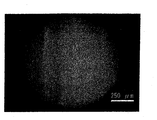
- FIG. 1 is an optical micrograph showing the sectional structure of the cast bar with a diameter of 1.0 mm obtained in Inventive Example 2. As shown in FIG. 1, except for casting defects and polishing marks, no contrast of crystal particles is observed in the optical micrograph. This clearly proves the formation of a metallic glass.
- FIG. 2 shows thermal analysis curves of the ribbon materials obtained in Inventive Examples 11, 12 and 13 and Comparative Example 2. As seen in FIG. 2, when the content of Nb is in the range of 4 to 8 atomic%, a wide ⁇ T ⁇ of 40 K or more can be obtained.
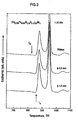
- FIG. 3 shows thermal analysis curves of the cast bar obtained in Inventive Example 2, a cast bar having the same composition as that of Inventive Example 2 and a diameter of 0.5 mm, and the ribbon material obtained in Inventive Example 11. As seen in FIG. 3, there is not any difference between the ribbon material and the bulk material.
- FIG. 4 shows I-H hysteresis curves of the cast bar obtained in Inventive Example 2 and the ribbon obtained in Inventive Example 11, based on the measurement of their magnetic characteristics using a vibrating-sample magnetometer. These curves show that both Inventive Examples 2 and 11 exhibit excellent soft magnetic characteristics.
- the Co-base metallic glass alloy of the present invention has excellent glass forming ability which achieves a critical thickness or diameter of 1.5 mm or more and allows a metallic glass to be obtained through a copper-mold casting process.
- the present invention can practically provide a large metallic glass product having excellent soft magnetic characteristics and high saturation magnetization.
Landscapes
- Chemical & Material Sciences (AREA)
- Engineering & Computer Science (AREA)
- Materials Engineering (AREA)
- Mechanical Engineering (AREA)
- Metallurgy (AREA)
- Organic Chemistry (AREA)
- Physics & Mathematics (AREA)
- Electromagnetism (AREA)
- Dispersion Chemistry (AREA)
- Power Engineering (AREA)
- Soft Magnetic Materials (AREA)
- Continuous Casting (AREA)
Abstract
Description
| Alloy Composition | Diameter (mm) | Tg (K) | Tχ (k) | Tχ -Tg (K) | Tg/Tm | Vf-amo. | Is (T) | Hc (A/m) | |
| Inventive Example 1 | (Co0.75B0.15Si0.10)96Nb 4 | 1.0 | 810 | 850 | 40 | 0.60 | 100 | 0.61 | 1.8 |
| Inventive Example 2 | (Co0.705Fe 0.045B 0.15Si 0.10)96Nb 4 | 1.0 | 820 | 862 | 42 | 0.61 | 100 | 0.60 | 1.5 |
| Inventive Example 3 | (Co0.705Fe 0.045B0.15Si 0.10)94Nb 6 | 1.5 | 850 | 890 | 40 | 0.63 | 100 | 0.42 | 1.2 |
| Inventive Example 4 | (Co0.705Fe0.045B0.15Si0.10)92Nb 8 | 1.5 | 875 | 915 | 40 | 0.64 | 100 | 0.38 | 1.0 |
| Inventive Example 5 | (Co0.705Fe0.045B0.15Si0.10)96Zr 4 | 1.0 | 800 | 845 | 45 | 0.59 | 100 | 0.70 | 1.5 |
| Inventive Example 6 | (Co0.705Fe0.045B0.15Si0.10)94Zr 6 | 1.5 | 815 | 865 | 50 | 0.60 | 100 | 0.64 | 1.0 |
| Inventive Example 7 | (Co0.705Fe 0.045B 0.15Si 0.10)96Hf 4 | 0.5 | 820 | 865 | 45 | 0.59 | 100 | 0.60 | 1.5 |
| Inventive Example 8 | (Co0.705Fe0.045B0.15Si0.10)94Hf 6 | 1.0 | 825 | 875 | 50 | 0.60 | 100 | 0.75 | 1.2 |
| Inventive Example 9 | (Co 0.705Fe 0.045B0.15Si 0.10)96Ta 4 | 0.5 | 830 | 875 | 45 | 0.59 | 100 | 0.58 | 1.4 |
| Inventive Example 10 | (Co0.70Fe0.04Ga0.03B0.14Si0.09)96Nb 4 | 1.5 | 815 | 870 | 55 | 0.60 | 100 | 0.59 | 0.75 |
| Comparative Example 1 | Co 70.5Fe4.5B15Si 10 | 0.5 | crystalline | ||||||
| Comparative Example 2 | (Co0.705Fe 0.045B0.15Si 0.10)98 Nb 2 | 0.5 | crystalline | ||||||
| Comparative Example 3 | (Co0.705Fe 0.045B0.15Si 0.10)89Nb11 | 0.5 | crystalline | ||||||
| Comparative Example 4 | (Co 0.8B 0.2)96Nb 4 | 0.5 | crystalline | ||||||
| Comparative Example 5 | (Co 0.8Si 0.2)96Nb4 | 0.5 | crystalline | ||||||
| Comparative Example 6 | (Co 0.7B0.2Si 0.1)96Nb4 | 0.5 | crystalline | ||||||
| Comparative Example 7 | (Co 0.7B 0.1Si 0.2)96Nb4 | 0.5 | crystalline |
Claims (2)
- A soft magnetic Co-based metallic glass alloy with high glass forming ability, which has a supercooled-liquid temperature interval (ΔTχ) of 40 K or more, a reduced glass-transition temperature (Tg / Tm) of 0.59 or more and a coercive force of 2.0 A/m or less, said metallic glass alloy being represented by the following composition formula:
M represents one or more elements selected from the group consisting of Zr, Nb, Ta, Hf, Mo, Ti, V, Cr, Pd and W, and
χ satisfies the following relation: 3 atomic% ≤ χ ≤ 10 atomic%. - The soft magnetic Co-based metallic glass alloy as defined in claim 1, which contains 3 atomic% or less of one or more elements selected from the group consisting of P, C, Ga and Ge.
Applications Claiming Priority (3)
| Application Number | Priority Date | Filing Date | Title |
|---|---|---|---|
| JP2002108352 | 2002-04-10 | ||
| JP2002108352A JP3560591B2 (en) | 2002-04-10 | 2002-04-10 | Soft magnetic Co-based metallic glass alloy |
| PCT/JP2003/004417 WO2003085151A1 (en) | 2002-04-10 | 2003-04-07 | SOFT MAGNETIC Co-BASED METALLIC GLASS ALLOY |
Publications (2)
| Publication Number | Publication Date |
|---|---|
| EP1502968A1 true EP1502968A1 (en) | 2005-02-02 |
| EP1502968A4 EP1502968A4 (en) | 2008-08-06 |
Family
ID=28786513
Family Applications (1)
| Application Number | Title | Priority Date | Filing Date |
|---|---|---|---|
| EP03745951A Withdrawn EP1502968A4 (en) | 2002-04-10 | 2003-04-07 | COBALT-BASED METALLIC GLASS ALLOY WITH TEMPORARY MAGNET |
Country Status (4)
| Country | Link |
|---|---|
| US (1) | US7223310B2 (en) |
| EP (1) | EP1502968A4 (en) |
| JP (1) | JP3560591B2 (en) |
| WO (1) | WO2003085151A1 (en) |
Cited By (3)
| Publication number | Priority date | Publication date | Assignee | Title |
|---|---|---|---|---|
| CN100507063C (en) * | 2006-06-26 | 2009-07-01 | 大连理工大学 | Co-Based Co-Si-B-Nb Bulk Amorphous Alloy |
| CN102011049A (en) * | 2010-11-22 | 2011-04-13 | 北京航空航天大学 | Ta-doped FeCo-based soft magnetic alloy and preparation method thereof |
| CN104630569A (en) * | 2015-01-21 | 2015-05-20 | 厦门大学 | Co-V based high-temperature alloy containing high-temperature ordered gamma' strengthening phase and preparation method of alloy |
Families Citing this family (9)
| Publication number | Priority date | Publication date | Assignee | Title |
|---|---|---|---|---|
| WO2007046437A1 (en) | 2005-10-19 | 2007-04-26 | The Circle For The Promotion Of Science And Engineering | Corrosion-resistant heat-resistant alloy for molding die and die for molding optical device |
| JP5067835B2 (en) * | 2006-11-24 | 2012-11-07 | 国立大学法人群馬大学 | Method for manufacturing magnetic recording medium |
| JP4758925B2 (en) * | 2007-02-28 | 2011-08-31 | セイコーエプソン株式会社 | Co-based metallic glass alloy, magnetic core, electromagnetic transducer and watch |
| US7771545B2 (en) * | 2007-04-12 | 2010-08-10 | General Electric Company | Amorphous metal alloy having high tensile strength and electrical resistivity |
| JP5413772B2 (en) * | 2009-01-08 | 2014-02-12 | セイコーエプソン株式会社 | Co-based metallic glass alloy, magnetic core, electromagnetic transducer and watch |
| JP2010165393A (en) * | 2009-01-13 | 2010-07-29 | Fujitsu Ltd | Vertical magnetic recording medium, method of manufacturing the same, and magnetic recorder |
| JP2010165392A (en) * | 2009-01-13 | 2010-07-29 | Fujitsu Ltd | Perpendicular magnetic recording medium, method for manufacturing the same, and magnetic recording device |
| US8313588B2 (en) | 2009-10-30 | 2012-11-20 | General Electric Company | Amorphous magnetic alloys, associated articles and methods |
| US12618125B2 (en) * | 2019-12-27 | 2026-05-05 | Tdk Corporation | Soft magnetic alloy powder, magnetic core, magnetic component and electronic device |
Family Cites Families (7)
| Publication number | Priority date | Publication date | Assignee | Title |
|---|---|---|---|---|
| JPH04143239A (en) | 1990-10-04 | 1992-05-18 | Hitachi Metals Ltd | Superfine crystalline magnetic alloy and its manufacture |
| JP2633813B2 (en) | 1994-10-25 | 1997-07-23 | 株式会社東芝 | Manufacturing method of reactor for switching circuit |
| US5976274A (en) * | 1997-01-23 | 1999-11-02 | Akihisa Inoue | Soft magnetic amorphous alloy and high hardness amorphous alloy and high hardness tool using the same |
| JPH10226856A (en) * | 1997-02-19 | 1998-08-25 | Alps Electric Co Ltd | Manufacturing method of metallic glass alloy |
| JP4216918B2 (en) | 1997-03-25 | 2009-01-28 | 独立行政法人科学技術振興機構 | Co-based amorphous soft magnetic alloy |
| EP0899353B1 (en) * | 1997-08-28 | 2004-05-12 | Alps Electric Co., Ltd. | Method of sintering an iron-based high-hardness glassy alloy |
| JP4128721B2 (en) * | 2000-03-17 | 2008-07-30 | 株式会社東芝 | Information record article |
-
2002
- 2002-04-10 JP JP2002108352A patent/JP3560591B2/en not_active Expired - Fee Related
-
2003
- 2003-04-07 WO PCT/JP2003/004417 patent/WO2003085151A1/en not_active Ceased
- 2003-04-07 US US10/510,642 patent/US7223310B2/en not_active Expired - Fee Related
- 2003-04-07 EP EP03745951A patent/EP1502968A4/en not_active Withdrawn
Cited By (4)
| Publication number | Priority date | Publication date | Assignee | Title |
|---|---|---|---|---|
| CN100507063C (en) * | 2006-06-26 | 2009-07-01 | 大连理工大学 | Co-Based Co-Si-B-Nb Bulk Amorphous Alloy |
| CN102011049A (en) * | 2010-11-22 | 2011-04-13 | 北京航空航天大学 | Ta-doped FeCo-based soft magnetic alloy and preparation method thereof |
| CN102011049B (en) * | 2010-11-22 | 2012-09-05 | 北京航空航天大学 | Ta-doped FeCo-based soft magnetic alloy and preparation method thereof |
| CN104630569A (en) * | 2015-01-21 | 2015-05-20 | 厦门大学 | Co-V based high-temperature alloy containing high-temperature ordered gamma' strengthening phase and preparation method of alloy |
Also Published As
| Publication number | Publication date |
|---|---|
| JP3560591B2 (en) | 2004-09-02 |
| JP2003301247A (en) | 2003-10-24 |
| US7223310B2 (en) | 2007-05-29 |
| US20050178476A1 (en) | 2005-08-18 |
| EP1502968A4 (en) | 2008-08-06 |
| WO2003085151A1 (en) | 2003-10-16 |
Similar Documents
| Publication | Publication Date | Title |
|---|---|---|
| JP4288687B2 (en) | Amorphous alloy composition | |
| Inoue et al. | Ferromagnetic bulk glassy alloys | |
| Inoue | Bulk amorphous alloys with soft and hard magnetic properties | |
| US5976274A (en) | Soft magnetic amorphous alloy and high hardness amorphous alloy and high hardness tool using the same | |
| Shen et al. | Bulk glassy Fe-Ga-PCB-Si alloys with high glass-forming ability, high saturation magnetization and good soft magnetic properties | |
| US7357844B2 (en) | Soft magnetic metallic glass alloy | |
| US7223310B2 (en) | Soft magnetic co-based metallic glass alloy | |
| JP3877893B2 (en) | High permeability metal glass alloy for high frequency | |
| Aykol et al. | Solidification behavior, glass forming ability and thermal characteristics of soft magnetic Fe–Co–B–Si–Nb–Cu bulk amorphous alloys | |
| JP3442375B2 (en) | Amorphous soft magnetic alloy | |
| EP2320436B1 (en) | Amorphous magnetic alloys, associated articles and methods | |
| JP3756405B2 (en) | Soft magnetic, high strength Fe-Co-Ni based metallic glass alloy | |
| Stoica et al. | Preparation of bulk amorphous Fe–Cr–Mo–Ga–P–C–B alloys by copper mold casting | |
| JP3948898B2 (en) | Fe-based amorphous alloy with high saturation magnetization and good soft magnetic properties | |
| JP4216918B2 (en) | Co-based amorphous soft magnetic alloy | |
| JPH11131199A (en) | Soft magnetic metallic glass alloy | |
| Lopez et al. | Microstructure and soft magnetic properties of Finemet-type ribbons obtained by twin-roller melt-spinning | |
| JPS642658B2 (en) | ||
| JP2001152301A (en) | Soft magnetic metallic glass alloy | |
| JP3749801B2 (en) | Soft magnetic metallic glass alloy | |
| Kane et al. | Mössbauer and magnetic studies of (Fe100− xCox) 62 Nb8B30 (X= 0, 33, 50) alloys | |
| JP3713265B2 (en) | Ultra-high strength Co-based bulk metallic glass alloy | |
| Shen et al. | Bulk glassy Fe78-xCoxGa2P12C4B4 alloys with high saturation magnetization and good soft magnetic properties | |
| JP4694325B2 (en) | Co-Fe soft magnetic metallic glass alloy | |
| JP2004263232A5 (en) |
Legal Events
| Date | Code | Title | Description |
|---|---|---|---|
| PUAI | Public reference made under article 153(3) epc to a published international application that has entered the european phase |
Free format text: ORIGINAL CODE: 0009012 |
|
| 17P | Request for examination filed |
Effective date: 20041108 |
|
| AK | Designated contracting states |
Kind code of ref document: A1 Designated state(s): AT BE BG CH CY CZ DE DK EE ES FI FR GB GR HU IE IT LI LU MC NL PT RO SE SI SK TR |
|
| RIC1 | Information provided on ipc code assigned before grant |
Ipc: H01F 1/153 20060101AFI20080626BHEP Ipc: C22C 45/04 20060101ALI20080626BHEP Ipc: C22C 19/07 20060101ALI20080626BHEP |
|
| A4 | Supplementary search report drawn up and despatched |
Effective date: 20080707 |
|
| 17Q | First examination report despatched |
Effective date: 20081126 |
|
| STAA | Information on the status of an ep patent application or granted ep patent |
Free format text: STATUS: THE APPLICATION IS DEEMED TO BE WITHDRAWN |
|
| 18D | Application deemed to be withdrawn |
Effective date: 20111101 |