TECHNICAL FIELD
The present invention relates to (fluoroalkyl)benzene derivatives and a
process for producing the same. More particularly, the invention relates to
impurity-reduced, high-purity (fluoroalkyl)benzenecarboxylic acid derivatives,
especially 3,5-bis(trifluoromethyl)benzoic acid and derivatives thereof, which
are useful in the fields of medicines, electronic materials, etc., and a process for
producing the same. The high-purity (fluoroalkyl)benzenecarboxylic acid
derivatives are useful as intermediate materials for the production of
medicines, electronic materials such as photoresists, and functional chemical
products.
BACKGROUND ARTS
In recent years, fluorine-containing compounds have been noticed in
various fields of applications such as medicines and electronic materials
because of peculiar properties thereof, and have been used in numerous
application fields by utilizing their functions attributable to fluorine atoms.
Therefore, various methods for effectively introducing fluorine atoms into
compounds have been studied. Conventionally known fluorination techniques
include, for example, a direct fluorination method using a fluorine gas, a so-called
halogen exchange method in which a compound containing a halogen
atom such as chlorine and bromine is reacted with HF or KF to replace the
halogen atom with fluorine, a method using a combination of hydrogen fluoride
with a base such as pyridine and triethylamine, a method using a hypervalent
iodine, e.g., IF5, an electrolytic fluorination method, etc. In the present
invention, the "halogen" means halogens other than fluorine unless otherwise
specified.
Among these methods, the halogen-fluorine exchange method has been
extensively used because fluorine atoms can be introduced relatively easily
and aimed fluorine-containing compounds can be produced easily, although the
use of halogen compounds as the starting materials is somewhat undesirable.
The details about the techniques for producing fluorine compounds by the
halogen-fluorine exchange method are described, for example, in Adv. Fluorine
Chem., 1963, (3), p. 181. This document describes the halogen-fluorine
exchange reaction between halogen-containing aliphatic compounds, aromatic
compounds, branched aromatic compounds, heterocyclic compounds, carboxylic
acids, sulfonic acids, silicon compounds or phosphorus compounds with
fluorine compounds such as HF, KF, SbF3 and SbF5.
The halogen-fluorine exchange reaction requires a halogenated
precursor corresponding to the aimed compound. There are also many well
known techniques for introducing halogens to produce such a halogenated
precursor, for example, a method using chlorine gas, iron chloride, phosphorus
trichloride, phosphorus pentachloride, thionyl chloride, sulfuryl chloride,
aluminum chloride, chloroform, carbon tetrachloride, titanium chloride,
phosgene, N-chlorosuccinimide, etc.; and a method using zeolites such as
zeolite X, Y, L and β and mordenite together with chlorine gas, thionyl chloride,
sulfuryl chloride or the like for improving selectivity of the halogenation.
In the photochlorination using chlorine gas under irradiation of light,
even low-reactive molecules such as methane are effectively converted into
methyl chloride by a free-radical chain reaction. This method is useful for
chlorinating side chains of aliphatic or aromatic compounds. For example,
Kirk-Othmer, "Encyclopedia of Chemical Technology", 4th edition, describes
the production of benzyl chloride from toluene as an example of the
photochlorination of side chain of aromatic compounds.
Not limited merely to aliphatic or aromatic hydrocarbons, the
photohalogenation is widely applied to various compounds such as heterocyclic
compounds, carboxylic acids, sulfonic acids, silicon compounds and
phosphorus-containing compounds.
For example, JP 2001-294551 A discloses a method for producing 3,5-bis(trichloromethyl)benzoyl
chlorides by the photochlorination of 3,5-dimethylbenzoyl
chlorides.
This method has been also disclosed in French Patent No. 820696 (1937).
The French Patent teaches a method for chlorinating branched methyl group
of methyl-containing benzenecarboxylic acids by chlorine gas, and describes in
Example 10 an actual procedure for producing 3,5-bis(trichloromethyl)benzoyl
chloride from 3,5-dimethylbenzoyl chloride by introducing chlorine atom under
irradiation of light. Further, U.S. Patent No. 2,181,554 (1939) discloses a
method for producing 3,5-bis(trifluoromethyl)benzoyl fluoride from 3,5-bis(trichloromethyl)benzoyl
chloride by the halogen exchange. Concerning the
photohalogenation, there are so many other documents to make it difficult to
comprehensively review them.
The above known photohalogenation methods and halogen-fluorine
exchange methods are extensively used for introducing fluorine atoms to
various compounds. Since these methods use a halogenated compound as a
precursor for introducing fluorine atoms, the final products inevitably contain
halogens as impurities. The impurities such as residual halogens, residual
metals and residual alkali or alkaline earth metals generally affect adversely
in the application fields of medicine and electronic materials, and should be
reduced to a ppb level or less in some cases. The residual halogens, for
example, in medical applications pyrogen or other trace impurities tend to
significantly affect human health and in electronic material applications such
as photoresists the residual chlorine causes corrosion of electronic devices.
The residual metals, for example, residual Pd migrates to cause defective
insulation or defective operation. Sb remaining in chemically-amplified
positive photoresists causes a positive-negative reversal during the irradiation
of X-ray or electron beams. U, Th, etc., remaining in sealing materials cause
soft error. Thus, the residual impurity elements have adverse influences in
many cases. Therefore, it has been strongly required to minimize the content
of impurities such as residual halogens and residual metals.
DISCLOSURE OF THE INVENTION
An object of the present invention is to provide (fluoroalkyl)benzene
derivatives having their contents of impurities such as residual halogens and
residual metals reduced which are useful as intermediates for the production
of functional chemical products such as medicines and electronic materials,
and a simple process for producing the (fluoroalkyl)benzene derivatives by
photohalogenation and halogen-fluorine exchange.
As a result of extensive research for solving the above problems in the
process for producing (fluoroalkyl)benzene derivatives by subjecting
industrially readily available alkylbenzene derivatives to photohalogenation
and then halogen-fluorine exchange, the inventors have found that the
residual amount of impurity halogens and impurity elements can be
drastically reduced by conducting the photohalogenation after reducing the
content of transition metals in the alkylbenzene derivatives to a limited value
or less and then allowing the halogen-fluorine exchange using HF to proceed
sufficiently under specific conditions, and if required, by optionally combining
a purification step such as crystallization, distillation and thermal contact
with hydrocarbons. The invention has been accomplished on the basis of this
finding.
Thus, the invention provides a process for producing a high-purity
(fluoroalkyl)benzene derivative comprising:
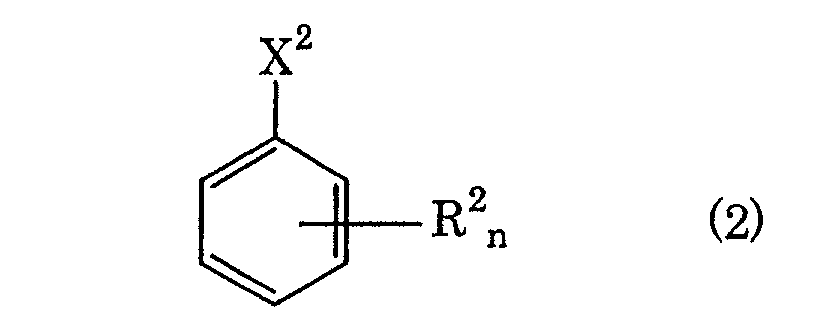
wherein a total content of group 3 to group 12 transition metals in the
alkylbenzene derivative is reduced to 500 ppm or less in terms of atomic basis;
and 10 mol or more HF is used per one mole of the (haloalkyl)benzene
derivative.
PREFERRED EMBODIMENT TO CARRY OUT THE INVENTION
The alkylbenzene derivatives represented by the formula (1) which are
used in the first step for the side chain halogenation (except for fluorination) in
the invention have at least one branched alkyl group which can be halogenated
and may further have a plurality of substituent groups other than the
branched alkyl groups.
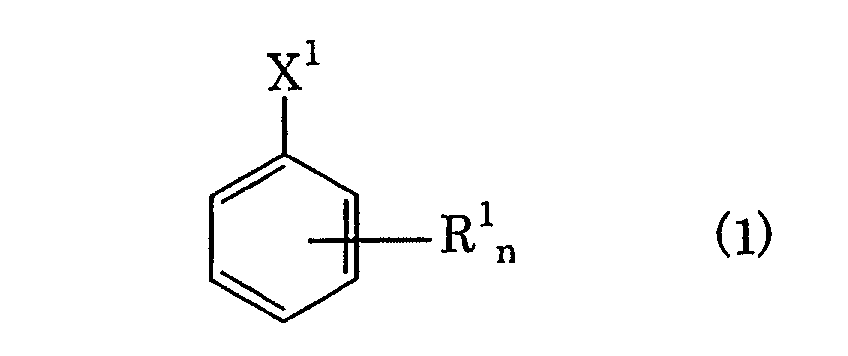
The alkylbenzene derivatives used as the starting materials in the
invention are represented by the following formula (1):
In the formula (1), X1 represents hydrogen, hydroxyl, alkyl preferably C1
to C24 alkyl, aryl such as phenyl, halogen inclusive of fluorine, formyl, carboxyl,
nitro, amino, hydroxymethyl, aminomethyl, carbamoyl, sulfonic acid group, or
halogenocarbonyl inclusive of fluorocarbonyl. X1 also represents
alkyloxycarbonyl preferably (C1 to C8 alkyl)oxycarbonyl, alkylcarbonyl
preferably (C1 to C8 alkyl)carbonyl, arylcarbonyl, alkyloxy preferably (C1 to C8
alkyl)oxy, or aryloxy, each being optionally substituted. Examples of the
substituent groups for alkylcarbonyl, arylcarbonyl, alkyloxy or aryloxy include
halogens inclusive of fluorine, hydroxyl, alkyl and alkyloxy. Preferred X1 are
carboxyl, cyano, hydroxyl, formyl and amino.
R1 represents carboxyl, halogenocarbonyl inclusive of fluorocarbonyl,
alkyloxycarbonyl preferably (C1 to C8 alkyl)oxycarbonyl, aryloxycarbonyl,
substituted or unsubstituted alkyl preferably C1 to C8 alkyl, or substituted or
unsubstituted aryl, with the proviso that at least one of R1 is alkyl. Examples
of the substituent groups for alkyl or aryl include methyl, ethyl, propyl,
isopropyl, phenyl and methylphenyl. Preferred R1 are methyl, ethyl, propyl
and isopropyl.
Specific examples of the alkylbenzene derivatives include
alkylbenzaldehydes such as 4-methylbenzaldehyde, 4-ethylbenzaldehyde, 2,4-dimethylbenzaldehyde,
2,5-dimethylbenzaldehyde, 3,4-dimethylbenzaldehyde,
3,5-dimethylbenzaldehyde, 2,4,5-trimethylbenzaldehyde, 2,4,6-trimethylbenzaldehyde,
4-isopropylbenzaldehyde, 4-isobutylbenzaldehyde, 4-methylbiphenylaldehyde,
4-ethylbiphenylaldehyde, 4-n-propylbiphenylaldehyde,
4-n-butylbiphenylaldehyde and
methyltetralinaldehyde; benzenecarboxylic acids such as 2-methylbenzoic acid,
3-methylbenzoic acid, 4-methylbenzoic acid, 4-ethylbenzoic acid, 2,4-dimethylbenzoic
acid, 2,5-dimethylbenzoic acid, 3,4-dimethylbenzoic acid, 3,5-dimethylbenzoic
acid, 2,4,5-trimethylbenzoic acid, 2,4,6-trimethylbenzoic acid,
4-isopropylbenzoic acid, 4-isobutylbenzoic acid, 4-methylbiphenylcarboxylic
acid, 4-ethylbiphenylcarboxylic acid, 4-n-propylbiphenylcarboxylic acid, 4-n-butylbiphenylcarboxylic
acid and methyltetralincarboxylic acid; acid halides
derived from the above benzenecarboxylic acids; alkylphenols such as 2,4-dimethylphenol,
2,5-dimethylphenol, 3,4-dimethylphenol and 3,5-dimethylphenol;
other compounds such as 3,5-dimethylhalogenobenzenes, 4-chloro-3,5-dimethylphenol,
N,N-diethyl-m-toluamide, 2,4-dimethylbenzenesulfonic
acid and dixylylmethane; and position isomers of the
above compounds.
The total content of group 3 to group 12 transition metals in the
alkylbenzene derivative (hereinafter refer to as "transition metal content") is
500 ppm or less and preferably 100 ppm or less in terms of atomic basis. In
particular, the content of Fe is preferably 50 ppm or less. When the transition
metal content is more than 500 ppm, in addition to the aimed side chain
halogenation, side reactions such as nucleus halogenation to aromatic ring
tend to occur. By-products produced increase the residual halogen impurities
in the final products. If the transition metal content in the starting material is
more than 500 ppm, the starting material is used after reducing the transition
metal content to 500 ppm or less by distillation or adsorption treatment with
activated carbon, silica gel, alumina, activated clay, ion-exchange resin, etc.
The transition metal content can be reduced to 10 ppm or less industrially.
The side chain halogenation in the invention is preferably conducted by
a photohalogenation method, although known techniques such as a method of
using chlorine gas, bromine gas, iron chloride, phosphorus trichloride,
phosphorus pentachloride, thionyl chloride, sulfuryl chloride, aluminum
chloride, chloroform, carbon tetrachloride, titanium tetrachloride, phosgene
and N-chlorosuccinimide, and a method using zeolites such as zeolites X, Y, L
and β, and mordenite together with chlorine gas, thionyl chloride, sulfuryl
chloride, etc. can be applicable. The photohalogenation of side chains of
aromatic compounds is widely used in industrial process and uses chlorine,
bromine and iodine as the halogen source, with chlorine being preferred
because of its low costs. The halogens to be used are not particularly restricted
as long as they are industrially available, and preferably dried so as to have a
water content of 100 ppm or less. Although not critical, the supplying amount
of the halogen is preferably 50 to 3,000 parts by weight based on 100 parts by
weight of the alkylbenzene derivative, and the supplying rate is preferably 0.1
g/min or more. Chlorine may be usually supplied to a reaction solution in a
gaseous state by bubbling. Bromine or iodine are supplied to a reaction
solution in a liquid or solid state. The halogenation is performed under a
pressure of 0.05 to 0.5 MPa, usually under atmospheric pressure. The
temperature for halogenation is 50 to 250°C and preferably 80 to 200°C. When
the temperature reaches a predetermined temperature, the supply of halogen
is started to initiate the reaction. The reaction time is preferably 0.5 to 24 h.
The halogenation of the side chains of the alkylbenzene derivative is
conducted under the exposure to light. The source of light is not particularly
restricted. In industrial process, a high reactivity and a high selectivity to the
side chain halogenation can be obtained by disposing a source of light such as a
mercury lamp and a tungsten lamp to a reactor. In place of exposure to light,
the use of a radical generator such as benzoyl peroxide and 2,2-azobis(isobutylonitrile)
is effective to enhance the reactivity. An amount as
small as 0.001 to 0.01 part by weight of the radical generator based on one part
by weight of the starting alkylbenzene derivative is sufficient for the purpose.
The radical generator may be effectively used under exposure to light without
causing any problems.
If the starting alkylbenzene derivative is liquid under the conditions for
the side chain halogenation, the use of a solvent is not necessarily required.
However, solvents inert to the halogenation such as o-dichlorobenzene,
chlorobenzene, carbon tetrachloride and benzonitrile may be used to facilitate
handling of the starting material. The amount of the solvent to be used is
preferably 0.5 to 100 parts by weight and more preferably 1 to 50 parts by
weight based on one part by weight of the starting alkylbenzene derivative.
By the first step of side chain halogenation of the invention, a
corresponding (haloalkyl)benzene derivative is obtained. Examples thereof
include (haloalkyl)benzenecarboxylic acids such as 2-(trihalomethyl)benzoic
acids, 3-(trihalomethyl)benzoic acids, 4-(trihalomethyl)benzoic acids, 4-(trihaloethyl)benzoic
acids, 4-(pentahaloethyl)benzoic acids, 2,4-bis(trihalomethyl)benzoic
acids, 2,5-bis(trihalomethyl)benzoic acids, 3,4-bis(trihalomethyl)benzoic
acids, 3,5-bis(trihalomethyl)benzoic acids, 2,4,5-tris(trihalomethyl)benzoic
acids, 2,4,6-tris(trihalomethyl)benzoic acids, 4-(trihaloisopropyl)benzoic
acids, 4-(hexahaloisopropyl)benzoic acids, 4-(trihaloisobutyl)benzoic
acids, 4-(hexahaloisobutyl)benzoic acids, 4-(trihalomethyl)biphenylcarboxylic
acids, 4-(pentahaloethyl)biphenylcarboxylic
acids, 4-(hexahalo-n-propyl)biphenylcarboxylic acids, 4-(hexahalo-n-butyl)biphenylcarboxylic
acids and (trihalomethyl)tetralincarboxylic acids; acid
halides of these acids; and (haloalkyl)phenols such as 2,4-bis(trihalomethyl)phenols,
2,5-bis(trihalomethyl)phenols, 3,4-bis(trihalomethyl)phenols
and 3,5-bis(trihalomethyl)phenols. The obtained
(haloalkyl)benzene derivative may be directly used in the subsequent step, but
are preferably subjected to known purification treatments such as distillation
and crystallization to minimize the content of impurities.
The second step of the invention is the halogen-fluorine exchange in
which the (haloalkyl)benzene derivative obtained in the first step is converted
into a corresponding (fluoroalkyl)benzene derivative. The halogen-fluorine
exchange may be performed, for example, by a known method described in Adv.
Fluorine Chem., 1963, (3), 181.
HF is preferably used in the halogen-fluorine exchange, optionally
together with an acid having a Hammett acidity function H0 of -10 or less such
as ClSO3H, FSO3H and CF3SO3H or a Lewis acid such as BF3, SbF5 and TaF5.
These acids or Lewis acids may be used in an amount of 0.001 to 0.1 mol per
one mole of HF. Generally, HF is introduced into a pressure reactor together
with the (haloalkyl)benzene derivative for the reaction. Alternatively, HF may
be introduced into a reactor after the reactor containing the (haloalkyl)benzene
derivative is heated to a desired temperature. Since HCl is generated with the
progress of the reaction, it is preferred to prevent the increase in the inner
pressure of the system by a suitable method such as exhaustion through a
back-pressure valve.
HF is used in an amount of 10 to 500 mol and preferably 20 to 200 mol
per one mole of the (haloalkyl)benzene derivative as a substrate. When less
than 10 mol, the halogen-fluorine exchange does not proceed sufficiently,
thereby not only failing to produce the aimed (fluoroalkyl)benzene derivative
at a high yield, but also causing a large amount of halogen compounds to
remain as impurities in the product.
Although the halogen-fluorine exchange proceeds at room temperature,
it is preferred to adequately select the reaction temperature from the range of
20 to 400°C depending upon the kind of (haloalkyl)benzene derivative to allow
the reaction to proceed sufficiently. For example, the halogen-fluorine
exchange of the (haloalkyl)benzenecarboxylic acids is usually performed at
100°C or higher, preferably 150 to 200°C for 0.1 to 20 h, while preferably
performed at 20 to 100°C for 0.1 to 20 h in case of the (haloalkyl)phenols.
Examples of the (fluoroalkyl)benzene derivatives obtained by the
halogen-fluorine exchange include (fluoroalkyl)benzenecarboxylic acids such as
2-(trifluoromethyl)benzoic acid, 3-(trifluoromethyl)benzoic acid, 4-(trifluoromethyl)benzoic
acid, 4-(trifluoroethyl)benzoic acid, 4-(pentafluoroethyl)benzoic
acid, 2,4-bis(trifluoromethyl)benzoic acid, 2,5-bis(trifluoromethyl)benzoic
acid, 3,4-bis(trifluoromethyl)benzoic acid, 3,5-bis(trifluoromethyl)benzoic
acid, 2,4,5-tris(trifluoromethyl)benzoic acid, 2,4,6-tris(trifluoromethyl)benzoic
acid, 4-(trifluoroisopropyl)benzoic acid, 4-(hexafluoroisopropyl)benzoic
acid, 4-(trifluoroisobutyl)benzoic acid, 4-(hexafluoroisobutyl)benzoic
acid, 4-(trifluoromethyl)biphenylcarboxylic acid, 4-(trifluoroethyl)biphenylcarboxylic
acid, 4-(pentafluoroethyl)biphenylcarboxylic
acid, 4-(trifluoro-n-propyl)biphenylcarboxylic acid, 4-(hexafluoro-n-propyl)biphenylcarboxylic
acid, 4-(n-trifluorobutyl)biphenylcarboxylic acid, 4-(n-hexafluorobutyl)biphenylcarboxylic
acid and
(trifluoromethyl)tetralincarboxylic acid; acid fluorides of these acids; and
(fluoroalkyl)phenols such as 2,4-bis(trifluoromethyl)phenol, 2,5-bis(trifluoromethyl)phenol,
3,4-bis(trifluoromethyl)phenol and 3,5-bis(trifluoromethyl)phenol.
By carrying out the first and second steps under the conditions
mentioned above, the content of halogen impurities (halogens other than
fluorine in the (fluoroalkyl)benzene derivatives) in the (fluoroalkyl)benzene
derivatives produced in the second step is reduced to 1% by weight or less and
preferably 0.5% by weight or less in terms of halogen atoms, and the content of
metal impurities is reduced to 100 ppm or less and preferably 50 ppm or less in
terms of metal atoms.
When the product of the halogen-fluorine exchange is a
(fluoroalkyl)benzenecarboxylic acid fluoride, the impurities therein is further
reduced by suitably combining distillation, sublimation, crystallization, etc.
after removing excess HF and HCl remaining after the halogen-fluorine
exchange. The method for removal of the excess HF and residual HCl is not
particularly restricted. For example, the excess HF and residual HCl are
removed at room temperature or by slightly heating in a halogen-fluorine
exchange reactor. By introducing an inert gas such as nitrogen gas into the
reaction system, the removal is accelerated. This operation may be performed
either under atmospheric pressure or reduced pressure.
Also, the reaction product solution may be supplied to a distillation
column under reflux of an organic solvent, where HF and HCl are vaporized by
the heat of solvent vapor and separated form the product by gas-liquid
separation. The reaction product moves into the bottom of the distillation
column, and the vaporized HF and HCl pass through a reflux condenser and
separated in a downstream condenser. The recovered liquid HF is reused.
The solvent usable in this procedure is preferably hydrocarbons that are
capable of dissolving the reaction product and are inert thereto, with hexane,
benzene, toluene, xylene, etc. being preferably used. The temperature and
pressure for operating the procedure may be appropriately determined
depending upon the solvent used.
After the above procedures, the reaction product,
(fluoroalkyl)benzenecarboxylic acid fluoride, may be converted into various
fluoroalkyl compounds directly or after further purified by distillation.
The fluoroalkyl compounds referred to herein may be
(fluoroalkyl)benzenecarboxylic acids, (fluoroalkyl)benzenecarboxylic acid
halides, (fluoroalkyl)benzenecarboxylic acid esters, (fluoroalkyl)benzaldehydes,
(fluoroalkyl)benzonitriles, (fluoroalkyl)benzenecarboxylamides, etc. The
fluoroalkyl compounds may be purified after reacting the (fluoroalkyl)benzene
derivatives obtained by removing HF and HCI remaining after the halogen-fluorine
exchange reaction with water, tetrahalogenosilicon, alcohol, ammonia,
etc. Alternatively, a purified (fluoroalkyl)benzenecarboxylic acid fluoride
obtained by the distillation of the reaction product mixture form the halogen-fluorine
exchange is converted into the fluoroalkyl compound, which is then
purified. The purification method includes distillation, crystallization,
sublimation, etc. By any one of the methods or any combination thereof, the
fluoroalkyl compounds reduced in impurities are obtained.
In case of producing the (fluoroalkyl)benzenecarboxylic acid, a crude
product obtained by removing residual HF and HCl from the reaction solution
after the halogen-fluorine exchange or a purified
(fluoroalkyl)benzenecarboxylic acid fluoride obtained by distilling the crude
product is reacted with water. The reaction proceeds merely by contacting
with water, but may be conducted under heating. The use of a water-immiscible
solvent such as ether which is capable of dissolving both the
(fluoroalkyl)benzenecarboxylic acid fluoride and the
(fluoroalkyl)benzenecarboxylic acid being produced is recommended because
these compounds are easily separated from water. After completion of the
reaction with water or removal of the solvent by distillation, the precipitated
crude (fluoroalkyl)benzenecarboxylic acid may be purified by crystallization
from a non-polar hydrocarbon organic solvent, for example, aliphatic
hydrocarbons such as pentane, hexane and heptane, and aromatic
hydrocarbons such as benzene, toluene and xylene, with hexane, benzene and
toluene being preferred because of flexibility and easiness of recovery. These
solvent may be used singly or in combination of two or more.
The crude (fluoroalkyl)benzenecarboxylic acid is dissolved in the solvent
usually at 50 to 200°C and preferably at a reflux temperature of the solvent for
easiness of operation. The amount of the solvent to be used may be
appropriately determined depending upon the kind of solvent, dissolving
temperature, intended purity of the product, etc., and preferably, 1 to 50 times
the crude (fluoroalkyl)benzenecarboxylic acid by weight. The solution
prepared by dissolution under heating is immediately filtered while hot to
remove impurities. After removal of the impurities, the decoloring treatment
using activated carbon or adsorbent may be made, if required. The solution
after removal of the impurities is then cooled to around room temperature or
lower to precipitate crystals of the aimed compounds. The precipitated
crystals are separated by a solid-liquid separation such as filtration and
centrifugal separation which are generally used. The crystals as-separated
have a much lower content of impurities, but may be further rinsed, if required.
If a further removal of impurities is required, the above procedures are
repeated until reaching the desired purity. The impurity-reduced
(fluoroalkyl)benzenecarboxylic acids produced by the invention can be
converted to (fluoroalkyl)benzyl alcohols by hydrogenation. The
(fluoroalkyl)benzyl alcohols can be converted to corresponding
(fluoroalkyl)benzyl bromides by substitution reaction at hydroxyl group by
using hydrogen bromide, etc.
The (fluoroalkyl)benzenecarboxylic acid chloride is produced by the
reaction of the (fluoroalkyl)benzenecarboxylic acid fluoride after the halogen-fluorine
exchange mentioned above with silicon tetrachloride, or the reaction of
the purified (fluoroalkyl)benzenecarboxylic acid with phosphoryl chloride,
thionyl chloride, phosphorus chloride, etc. In particular, the production of the
acid chlorides from carboxylic acids are easy and various methods have been
known. For example, the purified (fluoroalkyl)benzenecarboxylic acid is
dissolved in acetonitrile, and then excess of thionyl chloride is added to the
solution. The reaction is completed by maintaining the solution at a reflux
temperature for several hours. The catalyst is usually not required, but zinc
chloride, pyridine, triethylamine, etc. can be used as the catalyst. A high-purity
(fluoroalkyl)benzenecarboxylic acid chloride is obtained by removing the
solvent and excess thionyl chloride from the reaction product and then
distilling by a distillation column. If the further removal of impurities is
required, the distillation procedure is repeated, preferably in combination with
molecular distillation.
The (fluoroalkyl)benzaldehyde can be produced by catalytically reducing
the (fluoroalkyl)benzenecarboxylic acid chloride with hydrogen in a solvent
such as xylene and toluene. The catalytic reduction of the
(fluoroalkyl)benzenecarboxylic acid chloride is known as Rosenmund method.
Although poor in duplicability in some cases, a successful result is obtained by
adding quinoline-S (prepared from quinoline and sulfur) in the presence of a
hydrogen chloride capturer such as amines and pyridine or a base such as
sodium acetate. The catalyst for reduction is preferably palladium-carbon, etc.
After the catalytic reduction, the reaction mixture is filtered to remove the
catalyst and impurities and distilled preferably after washed with water, etc.
Thus, according to the invention, impurity-reduced (fluoroalkyl)benzaldehydes
are produced. If the further removal of impurities is required, the distillation
procedure is repeated, preferably in combination with molecular distillation.
The (fluoroalkyl)benzenecarboxylic acid ester is produced by the reaction
of the (fluoroalkyl)benzenecarboxylic acid fluoride, which may be a crude
product obtained by removing residual HF and HCl from the product of
halogen-fluorine exchange or may be a purified product obtained by distilling
the crude product, with alcohol such as methyl alcohol and ethyl alcohol. This
reaction is a well known method for producing esters from acid halides, and
may be conducted, for example, by dropping the product into excess methanol.
HF generated during the reaction is preferably recovered by a partial
condenser for reuse, or may be captured by a coexisting base such as pyridine
and triethylamine. The reaction proceeds at room temperature, but is
completed for several hours at elevated temperatures under heating. When
the base is not used, the reaction is preferably conducted at the reflux
temperature of methanol to promote the removal of HF being generated. A
high-purity methyl (fluoroalkyl)benzenecarboxylate is obtained by removing
the excess methanol from the reaction solution by distillation, removing
impurities such as HF and base, if still remain, by a suitable method such as
filtration and washing with water, and distilling the resultant product. If the
further removal of impurities is required, the distillation procedure is repeated,
preferably in combination with molecular distillation.
The (fluoroalkyl)benzenecarboxylamide is produced by the reaction of
the (fluoroalkyl)benzenecarboxylic acid fluoride, which may be a crude product
obtained by removing residual HF and HCl from the product of halogen-fluorine
exchange or may be a purified product obtained by distilling the crude
product, with ammonia, primary amine or secondary amine. This reaction is
also a well known method for producing acid amides from acid halides
similarly to the method for producing ester derivatives. The reaction is
conducted, for example, by dropping the (fluoroalkyl)benzenecarboxylic acid
fluoride into a liquid ammonia at arbitrary temperatures. To capture the
generated HF, it is preferred to use ammonia excessively or to add a tertiary
amine. When ammonia or low-boiling amines having a high vapor pressure
are used, the reaction can be performed in the two-phase system of an aqueous
ammonia solution and an organic solvent. In this reaction system, since the
salt of HF enters into the aqueous phase, the burden of the purification in the
subsequent step is reduced. After the reaction, the excess ammonia, etc., are
removed by distillation and the impurities are removed by washing with water.
Then, as in the case of the production of the (fluoroalkyl)benzenecarboxylic
acids, a purified (fluoroalkyl)benzenecarboxylamide is obtained by
crystallization from a solvent such as hexane. If the further removal of
impurities is required, the above procedures are repeated.
The (fluoroalkyl)benzenecarboxylamides can be converted into
(fluoroalkyl)benzonitriles by dehydration using a dehydrating agent. This
reaction is a well known method for conversion of primary amides into nitriles,
and a dehydrating agent such as phosphorus pentoxide, phosphorus
pentachloride and thionyl chloride is usable. Alternatively, the
(fluoroalkyl)benzonitriles can be produced also by the dehydration in the
presence of ammonia of the starting (fluoroalkyl)benzenecarboxylic acids in the
presence of methanesulfonamide and phosphorus pentachloride, or in the
presence of p-toluenesulfonamide or urea together with a catalyst such as
H3PO4. After removing the solvent, ammonia, etc., the obtained reaction
product is distilled to obtain high-purity (fluoroalkyl)benzonitriles. If the
further removal of impurities is required, the distillation procedure is repeated,
preferably in combination with molecular distillation.
As described above, the present invention makes it possible to reduce
the residual amounts of halogens and metals of the (fluoroalkyl)benzene
derivatives even when they are produced by the photohalogenation and the
halogen-fluorine exchange which are simple but involve a problem of residual
impurities such as halogens, thereby enabling the production of high-purity
fluoroalkyl compounds which are useful as intermediates for the production of
functional chemical products such as medicines and electronic materials.
The present invention will be described in more detail by reference to
the following examples, reference example and comparative examples, but it
should be noted that the examples are not intended to limit the invention
thereto.
REFERENCE EXAMPLE Production of 3,5-dimethylbenzoyl chloride
Method A
Into a 1-L three-necked flask equipped with a nitrogen gas inlet and a
reflux condenser, were charged 300 g (2 mol) of 3,5-dimethylbenzoic acid, 391 g
(2 mol) of (trichloromethyl)benzene and 0.28 g (0.0017 mol) of iron (III)
chloride as a catalyst. The reaction solution was heated to 60°C while stirring
under a nitrogen flow and maintained there for 30 min. The reaction was
allowed to further proceed at 130°C for 130 min. During the reaction,
hydrogen chloride generated was washed away and captured by an aqueous
alkali solution. The result of gas chromatographic analysis of the reaction
product solution showed the production of 324 g (1.92 mol) of the aimed 3,5-dimethylbenzoyl
chloride (yield: 96%). By vacuum distillation, 292.7 g (1.74
mol) of 3,5-dimethylbenzoyl chloride was isolated (yield: 87%).
Method B
Into the same apparatus as used in the method A, were charged 300 g (2
mol) of 3,5-dimethylbenzoic acid and 357.2 g (3 mol) of thionyl chloride. The
temperature was raised to 80°C while stirring in a nitrogen atmosphere to
allow the reaction to proceed for 3 h under reflux. During the reaction, sulfur
dioxide and hydrogen chloride generated were washed away and captured by
an aqueous alkali solution. The result of analysis of the reaction product
solution showed the production of 310 g (1.84 mol) of the aimed 3,5-dimethylbenzoyl
chloride (yield: 92%). By vacuum distillation, 287 g (1.7 mol)
of 3,5-dimethylbenzoyl chloride was isolated (yield: 85%).
Method C:
Into a 2-L three-necked flask equipped with a gas blowing tube, a reflux
condenser and a stirrer, were charged 269.7 g (2 mol) of 3,5-dimehtylbenzaldehyde
and 800 g of o-dichlorobenzene. The temperature of the
reaction system was controlled to 5°C while introducing a nitrogen gas. After
bubbling the reaction solution by blowing a nitrogen gas for one hour, the feed
of nitrogen was stopped and the feed of chlorine was started. Simultaneously
with the feed of chlorine, the irradiation of light from a mercury lamp was
started. The photochlorination was completed after 6 h. The quantitative
analysis by gas chromatography showed the production of 1.4 mol of 3,5-dimethylbenzoyl
chloride (yield: 70%). By vacuum distillation, 236 g (1.4 mol)
of 3,5-dimethylbenzoyl chloride was isolated (yield: 68%). The results of total
elements analysis by ICP showed that a total content of residual group 3 to
group 12 metals was 500 ppm or lower in which the highest was 10 ppm of Fe
and the second highest was 30 ppm of Zn.
EXAMPLE 1
Production of 3,5-bis(trifluoromethyl)benzoic acid
(1) Production of 3,5-bis(trichloromethyl)benzoyl chloride
A 500-mL four-necked flask equipped with a tube for receiving a highpressure
mercury lamp, a chlorine gas blowing tube and a reflux condenser
was charged with 250 g of 3,5-dimethylbenzoyl chloride obtained by the
method A of Reference Example and the temperature was raised under
nitrogen flow. When the inner temperature reached 140°C, nitrogen was
changed to chlorine gas, and simultaneously, the photochlorination of
branched methyl group was started by the irradiation of light from the
mercury lamp. The reaction solution was analyzed by gas chromatography at
regular intervals, and the reaction was continued until only the peak
attributable to the aimed 3,5-bis(trichloromethyl)benzoyl chloride was
observed. The time required for completing the photochlorination reaction was
22 h, during which 729.1 g of chlorine (1.2 times the stoichiometric amount)
was supplied. The conversion of 3,5-dimethylbenzoyl chloride was 100% and
the yield of 3,5-bis(trichloromethyl)benzoyl chloride was 95%.
By collecting a main fraction of 146-147°C/3 mmHg by vacuum
distillation, 517.5 g of 3,5-bis(trichloromethyl)benzoyl chloride was obtained
(yield: 93%). The results of ICP analysis showed that the distillation-purified
3,5-bis(trichloromethyl)benzoyl chloride contained Ti, Zr, V, Nb, Cr, Mo, W, Mn,
Fe, Ru, Co, Rh and Ni in an amount of 10 ppm or lower for each.
(2) Production of 3,5-bis(trifluoromethyl)benzoyl fluoride
A 300-mL Hastelloy C autoclave equipped with a reflux condenser was
charged with 50 g (0.133 mol) of the 3,5-bis(trichloromethyl)benzoyl chloride
prepared above. After replacing the inner atmosphere of the autoclave by
nitrogen, 80 g (4 mol) of anhydrous hydrogen fluoride (HF) was introduced.
The contents were heated to 150°C under stirring to proceed the reaction by
maintaining the temperature for 13 h. As the reaction proceeded, the inner
pressure of the autoclave became higher than the vapor pressure of HF
because of the generation of hydrogen chloride. Therefore, the inner pressure
was maintained at 3 MPa by purging the generated hydrogen chloride through
a valve disposed downstream the reflux condenser. When the pressure rise
was almost not noticed, the autoclave was cooled to terminate the reaction.
After removing the unreacted hydrogen fluoride and residual hydrogen
chloride by suction under reduce pressure, the reaction product solution in the
autoclave was transferred into a closed container kept under nitrogen
atmosphere. A portion of the reaction product solution was sampled and
analyzed by gas chromatography. The result showed that the aimed product,
i.e., 3,5-bis(trifluoromethyl)benzoyl fluoride resulted from the complete
replacement of chlorines with fluorines is produced in an amount of 0.11 mol
(yield: 83%). The purity determined by gas chromatography was 99.8%. The
residual chlorine content estimated from the purity was 1% by weight or lower.
(3) Production of 3,5-bis(trifluoromethyl)benzoic acid
The crude 3,5-bis(trifluoromethyl)benzoyl fluoride as-prepared above
was added to a mixed solvent of 100 g of ether and 100 g of ice water. By
mixing, 3,5-bis(trifluoromethyl)benzoyl fluoride was gradually hydrolyzed into
3,5-bis(trifluoromethyl)benzoic acid with evolution of heat. By removing the
ether solvent by distillation under reduced pressure, 0.11 mol of crude 3,5-bis(trifluoromethyl)benzoic
acid was obtained. Then, the crude 3,5-bis(trifluoromethyl)benzoic
acid was dissolved in hexane at its reflux
temperature, filtered while being hot, and then crystallized at 0°C to obtain
acicular crystals of 3,5-bis(trifluoromethyl)benzoic acid. The yielded amount
was 0.094 mol (recovery: 85%).
The purity of crystals determined by gas chromatography was 99.9% or
higher. As a result of quantitative analysis using an oxyhydrogen flame
combustion apparatus, the total content of impurity chlorine in the crystals
was 500 ppm. The content of ionic chlorine was 50 ppm when determined by
dissolving the crystals in diethyl ether and extracting the solution with water.
The total elements analysis by ICP showed that none of Li, Na, K, Mg, Ca, Sr,
Ba, Sc, Y, Ti, Zr, V, Nb, Cr, Mo, W, Mn, Fe, Ru, Co, Rh, Ni, Pd, Pt, Cu, Ag, Au,
Zn, Cd, Al, In, Si, Sn, Pb, P, Sb and S were detected. The lower detection
limits of the total elements analysis by ICP apparatus were 100 ppm for In and
Sb; 50 ppm for Li, K, Pt, Pb and P; 20 ppm for Ti, W, Mo and Al; and 1 to10
ppm or lower for other elements. The IPC quantitative analysis was
separately repeated on group 1 and group 2 elements by increasing the
accuracy of measurement. The content was 10 ppm or less for each case.
EXAMPLE 2
Production of 3,5-bis(trifluoromethyl)benzoic acid
3,5-Bis(trifluoromethyl)benzoyl fluoride (28 g) obtained after completion
of the chlorine-fluorine exchange using HF in Example 1 was distilled to collect
22.5 g of a 78-83°C/50 mmHg fraction. Subsequently, the fraction was treated
in the same manner as in Example 1 to obtain 20 g (0.08 mol) of acicular
crystals of 3,5-bis(trifluoromethyl)benzoic acid.
The purity of the product determined by gas chromatography was 99.9%
or higher, and the total content of impurity chlorine remained was 50 ppm or
lower. The total elements analysis by ICP showed that none of Li, Na, K, Mg,
Ca, Sr, Ba, Sc, Y, Ti, Zr, V, Nb, Cr, Mo, W, Mn, Fe, Ru, Co, Rh, Ni, Pd, Pt, Cu,
Ag, Au, Zn, Cd, Al, In, Si, Sn, Pb, P, Sb and S were detected. The content
determined by the ICP quantitative analysis was 10 ppm or lower for each of
group 1 and group 2 elements.
EXAMPLE 3
Production of 3,5-bis(trifluoromethyl)benzoyl chloride
By distilling 280 g of 3,5-bis(trifluoromethyl)benzoyl fluoride obtained
after the chlorine-fluorine exchange using HF in the same manner as in
Example 1, 225 g of a 78-83°C/50 mmHg fraction was collected. After adding 5
g of aluminum chloride, the fraction was maintained at 40°C. Then, after
adding 49 g of silicon tetrachloride over 2 h, the reaction was further continued
for 2 h. The reaction product mixture was mixed with molecular sieves,
filtered and then supplied to a distillation column in which benzene was
refluxed, thereby removing low-boiling components. The bottom liquid of the
distillation column was filtered and then distilled under a reduced pressure of
11 mmHg to collect 156 g of a 69-70°C fraction. The obtained product was
identified as the aimed 3,5-bis(trifluoromethyl)benzoyl chloride by NMR
analysis. The purity determined by gas chromatography was 99.9% or higher.
The results of ICP total elements analysis showed that none of Li, Na, K, Mg,
Ca, Sr, Ba, Sc, Y, Ti, Zr, V, Nb, Cr, Mo, W, Mn, Fe, Ru, Co, Rh, Ni, Pd, Pt, Cu,
Ag, Au, Zn, Cd, Al, In, Si, Sn, Pb, P, Sb and S were detected, and the content of
each of group 1 and group 2 elements was 1 ppm or lower.
EXAMPLE 4
Production of methyl 3,5-bis(trifluoromethyl)benzoate
Into 25.9 g (0.8 mol) of methanol, 13.8 g (0.053 mol) of the fraction of 3,5-bis(trifluoromethyl)benzoyl
fluoride obtained after the chlorine-fluorine
exchange using HF in the same manner as in Example 2 was added dropwise
over 60 min. Then, the reaction was allowed to proceed at 40°C for 4 h. By gas
chromatographic analysis, the production of 14.2 g (0.052 mol) of the aimed
methyl 3,5-bis(trifluoromethyl)benzoate was confirmed (yield: 98%, selectivity:
100%). By vacuum distillation, 13.9 g (0.05 mol) of methyl 3,5-bis(trifluoromethyl)benzoate
was isolated (yield: 96%). The purity determined
by gas chromatography was 99% or higher. The results of ICP total elements
analysis showed that none of Li, Na, K, Mg, Ca, Sr, Ba, Sc, Y, Ti, Zr, V, Nb, Cr,
Mo, W, Mn, Fe, Ru, Co, Rh, Ni, Pd, Pt, Cu, Ag, Au, Zn, Cd, Al, In, Si, Sn, Pb, P,
Sb and S were detected, and the content of each of group 1 and group 2
elements was 1 ppm or lower.
EXAMPLE 5
Production of 3,5-bis(trifluoromethyl)benzaldehyde
Into a 1-L autoclave, were charged 100 g (0.36 mol) of 3,5-bis(trifluoromethyl)benzoyl
chloride produced in the same manner as in
Example 3, 350 g of dry toluene, 90 g (1.08 mol) of anhydrous sodium acetate
and 10.9 g of 10% palladium-carbon. After adding 21.7 g (0.17 mol) of
quinoline and 3.6 g (0.11 mol) of sulfur, the contents were refluxed under
heating for 5 h. Then, quinoline-S diluted by dry xylene to 250 ml was added.
After evacuating the autoclave, the inner pressure was adjusted to 1 MPa by
introducing hydrogen. While successively supplying hydrogen to maintain the
inner pressure at 1 MPa, the contents were stirred at room temperature for
one hour. The temperature was raised to 50°C and the stirring was continued
for 2 h. Then, the temperature was returned to room temperature and the
stirring was continued for 24 h to complete the reaction. After returning the
inner pressure to atmospheric pressure, the reaction product solution was
filtered and then washed with toluene. The filtrate was successively washed
with a 5% sodium carbonate aqueous solution and water, and then dried over
anhydrous sodium sulfate. After removing anhydrous sodium sulfate by
filtration and toluene by distillation, the obtained product was analyzed by gas
chromatography.
It was confirmed that 65.4 g (0.27 mol) of the aimed 3,5-bis(trifluoromethyl)benzaldehyde
was produced (yield: 76%). By vacuum
distillation, 63.0 g (0.27 mol) of 3,5-bis(trifluoromethyl)benzaldehyde was
isolated (yield: 72%). The purity determined by gas chromatography was 99%
or higher. The results of ICP total elements analysis showed that none of Li,
Na, K, Mg, Ca, Sr, Ba, Sc, Y, Ti, Zr, V, Nb, Cr, Mo, W, Mn, Fe, Ru, Co, Rh, Ni,
Pd, Pt, Cu, Ag, Au, Zn, Cd, Al, In, Si, Sn, Pb, P, Sb and S were detected, and
the content of each of group 1 and group 2 elements was 1 ppm or lower.
EXAMPLE 6
Production of 3,5-bis(trifluoromethyl)phenol
(1) Production of 3,5-bis(trifluoromethyl)acetophenone
A mixture of 9.0 g (0.0345 mol) of 3,5-bis(trifluoromethyl)benzoyl
fluoride obtained in the same manner as in Example 2 and 16 mL of HMPA
was stirred at room temperature for 30 min. After mixing 5 mL (0.0361 mol) of
tetramethyltin and 14 mg (0.018 mol) of a palladium-phosphine catalyst
(PhCH2Pd(PPh3)2Cl), the temperature was raised to 65°C. After stirring for
one hour, the temperature was lowered to room temperature and 20 mL of
water was mixed to separate an organic phase. After extracting the aqueous
phase with 10 mL of diethyl ether, the collected organic solvent phase was
washed four times with each 20 mL of water. After dried over magnesium
sulfate, the organic phase was analyzed by gas chromatography. It was
confirmed that 7.25 g (0.0283 mol) of the aimed 3,5-bis(trifluoromethyl)acetophenone
was produced (yield: 82%). By vacuum
distillation, 3,5-bis(trifluoromethyl)acetophenone was isolated (yield: 77%).
(2) Production of 3,5-bis(trifluoromethyl)phenol
A mixture of 100 g (0.39 mol) of 3,5-bis(trifluoromethyl)acetophenone
obtained above, 155.2 g of (0.74 mol) of trifluoroacetic anhydride and 400 ml of
chloroform was stirred at 0°C in a nitrogen atmosphere. After adding 19.7 g
(0.52 mol) of a 90% hydrogen peroxide aqueous solution from a dropping funnel
over 30 min and stirring the mixture for one our, the temperature was raised
to 70°C to proceed the reaction for 5 h. After completion of the reaction, the
temperature was returned to room temperature. The reaction product solution
was poured into a separating funnel containing a saturated brine and washed
with water. The organic phase separated was analyzed by gas
chromatography. It was confirmed that 57.5 g (0.25 mol) of the aimed 3,5-bis(trifluoromethyl)phenol
was produced (yield: 67%). By vacuum distillation,
53.3 g (0.23 mol) of 3,5-bis(trifluoromethyl)phenol was isolated (yield: 63%).
The purity determined by gas chromatography was 99% or higher. The results
of ICP total elements analysis showed that none of Li, Na, K, Mg, Ca, Sr, Ba,
Sc, Y, Ti, Zr, V, Nb, Cr, Mo, W, Mn, Fe, Ru, Co, Rh, Ni, Pd, Pt, Cu, Ag, Au, Zn,
Cd, Al, In, Si, Sn, Pb, P, Sb and S were detected, and the content of each of
group 1 and group 2 elements was 1 ppm or lower.
EXAMPLE 7
Production of 3,5-bis(trifluoromethyl)benzamide
Into a three-necked flask containing 65.5 ml (3.8 mol) of ice-cooled
aqueous ammonia and 300 g of toluene, was added dropwise 100 g (0.38 mol) of
3,5-bis(trifluoromethyl)benzoyl fluoride obtained in the same manner as in
Example 2 over one hour. After the dropwise addition, the temperature was
adjusted to 30°C to initiate the reaction. The reaction was continued for 5 h.
The results of gas chromatographic analysis of the toluene phase showed that
98.8 g (0.38 mol) of the aimed 3,5-bis(trifluoromethyl)benzamide was produced
(yield: 98%; selectivity: 100%). By the crystallization in the same manner as in
Example 2, 93.9 g (0.37 mol) of 3,5-bis(trifluoromethyl)benzamide was isolated
(yield: 95%). The purity determined by gas chromatography was 99% or higher.
The results of ICP total elements analysis showed that none of Li, Na, K, Mg,
Ca, Sr, Ba, Sc, Y, Ti, Zr, V, Nb, Cr, Mo, W, Mn, Fe, Ru, Co, Rh, Ni, Pd, Pt, Cu,
Ag, Au, Zn, Cd, Al, In, Si, Sn, Pb, P, Sb and S were detected, and the content of
each of group 1 and group 2 elements was 1 ppm or lower.
EXAMPLE 8
Production of 3,5-bis(trifluoromethyl)benzonitrile
Into a 2-L three-necked flask, were charged 300 g (1.17 mol) of 3,5-bis(trifluoromethyl)benzamide
obtained in the same manner as in Example 7,
183.6 g (0.7 mol) of triphenylphosphine, 107.7 g (0.7 mol) of carbon
tetrachloride and 400 ml of tetrahydrofuran. The liquid mixture was heated to
60°C under stirring to proceed the reaction for 180 min. After adding 6 g (0.04
mol) of phosphorus pentoxide, a distillation apparatus was fitted to the flask to
collect 237.1 g of a 155°C fraction by the distillation under atmospheric
pressure. The results of analyzing the fraction by gas chromatography showed
that 0.99 mol of the aimed 3,5-bis(trifluoromethyl)benzonitrile having a purity
of 99.8% was produced (yield: 85%). The results of ICP total elements analysis
showed that none of Li, Na, K, Mg, Ca, Sr, Ba, Sc, Y, Ti, Zr, V, Nb, Cr, Mo, W,
Mn, Fe, Ru, Co, Rh, Ni, Pd, Pt, Cu, Ag, Au, Zn, Cd, Al, In, Si, Sn, Pb, P, Sb and
S were detected, and the content of each of group 1 and group 2 elements was 1
ppm or lower.
EXAMPLE 9
Production of 3,5-bis(trifluoromethyl)benzyl alcohol
Into 460 ml (0.46 mol) of a 1.0 M diethyl ether solution of aluminum
lithium hydride cooled to 0°C, 80 g (0.31 mol) of 3,5-bis(trifluoromethyl)benzoic
acid obtained in the same manner as in Example 2 was gradually added. The
reaction solution was heated to the reflux temperature (35°C) while stirring
under a nitrogen flow to continue the reaction for 10 h. After completion of the
reaction, the reaction solution was cooled to 0°C and 20 ml of water was added
over 15 min. Then, 20 ml of a 15% sodium hydroxide aqueous solution and 60
ml of water were gradually added. After stirring for 30 min, the organic phase
was separated by filtration and dried over anhydrous sodium sulfate. After
removing anhydrous sodium sulfate by filtration, the organic phase was
analyzed by gas chromatography. It was confirmed that 58.6 g (0.24 mol) of
the aimed 3,5-bis(trifluoromethyl)benzyl alcohol was produced (yield: 78%;
selectivity: 91%). By vacuum distillation after removing ether, 55.9 g (0.23
mol) of 3,5-bis(trifluoromethyl)benzyl alcohol was isolated (yield: 74%). The
purity determined by gas chromatography was 99% or higher. The results of
ICP total elements analysis showed that none of Li, Na, K, Mg, Ca, Sr, Ba, Sc,
Y, Ti, Zr, V, Nb, Cr, Mo, W, Mn, Fe, Ru, Co, Rh, Ni, Pd, Pt, Cu, Ag, Au, Zn, Cd,
Al, In, Si, Sn, Pb, P, Sb and S were detected, and the content of each of group 1
and group 2 elements was 1 ppm or lower.
EXAMPLE 10
Production of 3,5-bis(trifluoromethyl)benzylamine
Into a 300-mL autoclave, were charged 145.3 g (0.60 mol) of 3,5-bis(trifluoromethyl)benzaldehyde
obtained in the same manner as in Example
5, 60 mL of a cooled ethanol solution containing 10.3 g (0.60 mol) of liquid
ammonia and 2 g of Raney nickel. The mixture was heated to 40°C while
stirring under a hydrogen pressure (9 MPa) to proceed the reaction for one
hour. The reaction was continued at 70°C for 30 min and then the reaction
product solution was discharged. After removing the catalyst by filtration, the
reaction solution was analyzed by gas chromatography. It was confirmed that
128.9 g (0.53 mol) of the aimed 3,5-bis(trifluoromethyl)benzylamine was
produced (yield: 89%; selectivity: 93%). By vacuum distillation, 124.0 g (0.51
mol) of 3,5-bis(trifluoromethyl)benzylamine was isolated (yield: 85%). The
purity determined by gas chromatography was 99% or higher. The results of
ICP total elements analysis showed that none of Li, Na, K, Mg, Ca, Sr, Ba, Sc,
Y, Ti, Zr, V, Nb, Cr, Mo, W, Mn, Fe, Ru, Co, Rh, Ni, Pd, Pt, Cu, Ag, Au, Zn, Cd,
Al, In, Si, Sn, Pb, P, Sb and S were detected, and the content of each of group 1
and group 2 elements was 1 ppm or lower.
EXAMPLE 11
Production of m-(trifluoromethyl)benzoyl fluoride
The procedure of Example 2 was repeated except for using m-(trichloromethyl)benzoyl
chloride as the starting compound instead of 3,5-bis(trichloromethyl)benzoyl
chloride. The yield and selectivity of the aimed m-(trifluoromethyl)benzoyl
fluoride were 92% and 98%, respectively. The purity
determined by gas chromatography was 99% or higher. The results of ICP
total elements analysis showed that none of Li, Na, K, Mg, Ca, Sr, Ba, Sc, Y, Ti,
Zr, V, Nb, Cr, Mo, W, Mn, Fe, Ru, Co, Rh, Ni, Pd, Pt, Cu, Ag, Au, Zn, Cd, Al, In,
Si, Sn, Pb, P, Sb and S were detected, and the content of each of group 1 and
group 2 elements was 1 ppm or lower.
COMPARATIVE EXAMPLE 1
The procedure of Example 1 was repeated except for using 3,5-dimethylbenzyl
chloride containing 570 ppm of Fe, 220 ppm of Zn and 130 ppm
of Sn. The yield of the chloride after the photochlorination was 86%, whereas
95% in Example 1. The purity of 3,5-bis(trifluoromethyl)benzoyl fluoride
obtained by HF exchange reaction was 89%, and the residual of total impurity
chlorine was 2.3% by weight.
COMPARATIVE EXAMPLE 2
In the fluorine exchange reaction using HF, the procedure of Example 1
was repeated except for using HF 8 times the substrate by mole. Although the
yield of the chloride after the photochlorination was 94.8%, the purity of 3,5-bis(trifluoromethyl)benzoyl
fluoride was 12% and the residual of total chlorine
was 12.6% by weight after the HF exchange reaction.
COMPARATIVE EXAMPLE 3
The procedure of Example 1 was repeated except that the temperature
and time of the fluorine exchange using HF were changed to 130°C and 5 h.
The yield and selectivity of 3,5-bis(trifluoromethyl)benzoyl fluoride were 28%
and 41%, respectively. The purity of 3,5-bis(trifluoromethyl)benzoyl fluoride
was 58%.
COMPARATIVE EXAMPLE 4
The procedure of Comparative Example 3 was repeated except for
changing the reaction temperature and reaction time to 100°C and 45 h. The
yield and selectivity of 3,5-bis(trifluoromethyl)benzoyl fluoride were 49% and
58%, respectively.
COMPARATIVE EXAMPLE 5
The procedure of Example 1 was repeated except for changing the
charging molar ratio of HF to 20 times, the reaction temperature to 130°C and
the reaction time to 12 h. The yield and selectivity of 3,5-bis(trifluoromethyl)benzoyl
fluoride were 2.9% and 4.2%, respectively.
COMPARATIVE EXAMPLE 6
The procedure of Comparative Example 5 was repeated except for
changing the charging molar ratio of HF to 30 times. The yield and selectivity
of 3,5-bis(trifluoromethyl)benzoyl fluoride were 69% and 89%, respectively.
COMPARATIVE EXAMPLE 7
The procedure of Comparative Example 5 was repeated except for
changing the charging molar ratio of HF to 40 times. The yield and selectivity
of 3,5-bis(trifluoromethyl)benzoyl fluoride were 70% and 90%, respectively.
COMPARATIVE EXAMPLE 8
The procedure of Example 4 was repeated except for changing the
reaction temperature to 130°C and the molar ratio of HF to 8. The yield of
methyl 3,5-bis(trifluoromethyl)benzoate was 3.4% and the residual of the total
chlorine was 3.1% by weight.
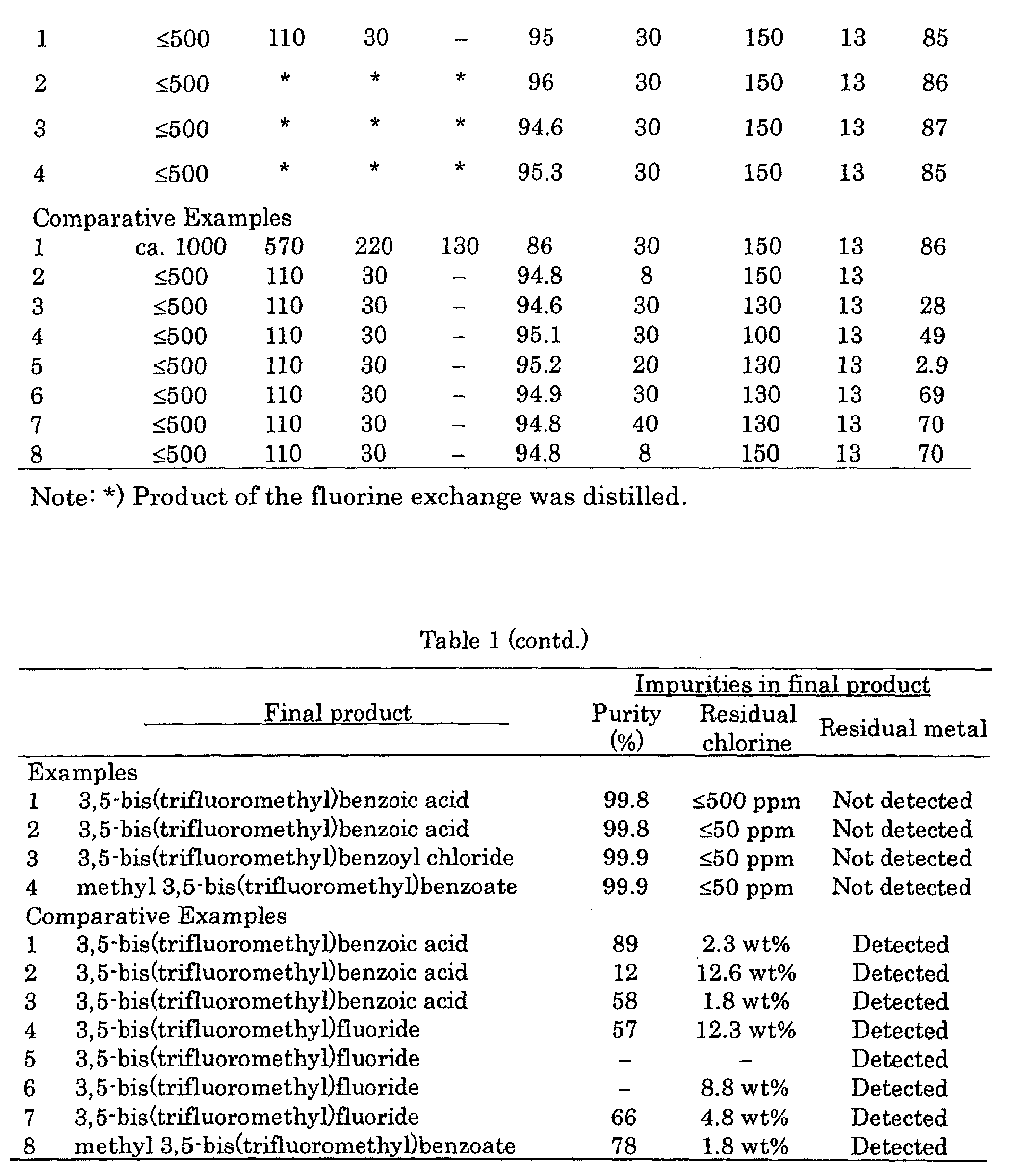
In the following Table 1, the results of Examples 1 to 4 and Comparative
Examples 1 to 8 are compared.
The procedure of Example 1 was repeated except for using 3-(trichloromethyl)benzoyl
chloride as the starting material instead of 3,5-bis(trichloromethyl)benzoyl
chloride. The yield and selectivity of the aimed 3-(trifluoromethyl)benzoic
acid were 92% and 98%, respectively.
EXAMPLE 13
4-(Trifluoromethyl)benzoic acid
The procedure of Example 1 was repeated except for using 4-(trichloromethyl)benzoyl
chloride as the starting material instead of 3,5-bis(trichloromethyl)benzoyl
chloride. The yield of the aimed 4-(trifluoromethyl)benzoic
acid was 93%.
EXAMPLE 14
2,4-Bis(trifluoromethyl)benzoic acid
The procedure of Example 1 was repeated except for using 2,4-bis(trichloromethyl)benzoyl
chloride as the starting material instead of 3,5-bis(trichloromethyl)benzoyl
chloride. The yield and selectivity of the aimed
2,4-bis(trifluoromethyl)benzoic acid were 87% and 97%, respectively.
EXAMPLE 15
3,4-Bis(trifluoromethyl)benzoic acid
The procedure of Example 1 was repeated except for using 3,4-bis(trichloromethyl)benzoyl
chloride as the starting material instead of 3,5-bis(trichloromethyl)benzoyl
chloride. The yield and selectivity of the aimed
3,4-bis(trifluoromethyl)benzoic acid were 88% and 98%, respectively.
EXAMPLE 16
4-Trifluoromethylbiphenylcarboxylic acid
The procedure of Example 1 was repeated except for using 4-trichloromethylbiphenylcarboxylic
acid chloride as the starting material
instead of 3,5-bis(trichloromethyl)benzoyl chloride. The yield and selectivity of
the aimed 4-trifluoromethylbiphenylcarboxylic acid were 90% and 96%,
respectively.
EXAMPLES 17 to 31
In the same manner as in Examples 2 to 16, each (fluoroalkyl)benzene
derivative was produced. To reduce the impurities, the crystallization was
conducted twice in Example 17 and the final distillation was repeated in the
other examples. The purity, residual halogen content and residual metal
content of the (fluoroalkyl)benzene derivatives are collectively shown in Table
2.
| | Final product | Impurities in final product |
| | | Purity (%) | Residual chlorine (ppm) | Residual metal |
| Examples |
| 17 | 3,5-bis(trifluoromethyl)benzoic acid | ≥99.9 | ≤10 | Not detected |
| 18 | 3,5-bis(trifluoromethyl)benzoyl chloride | ≥99.9 | ≤10 | Not detected |
| 19 | methyl 3,5-bis(trifluoromethyl)benzoate | ≥99.9 | ≤10 | Not detected |
| 20 | 3,5-bis(trifluoromethyl)benzaldehyde | ≥99.9 | ≤10 | Not detected |
| 21 | 3,5-bis(trifluoromethyl)phenol | ≥99.9 | ≤10 | Not detected |
| 22 | 3,5-bis(trifluoromethyl)benzamide | ≥99.9 | ≤10 | Not detected |
| 23 | 3,5-bis(trifluoromethyl)benzonitrile | ≥99.9 | ≤10 | Not detected |
| 24 | 3,5-bis(trifluoromethyl)benzyl alcohol | ≥99.9 | ≤10 | Not detected |
| 25 | 3,5-bis(trifluoromethyl)benzylamine | ≥99.9 | ≤10 | Not detected |
| 26 | 3-trifluoromethylbenzoyl fluoride | ≥99.9 | ≤10 | Not detected |
| 27 | 3-trifluoromethylbenzoic acid | ≥99.9 | ≤10 | Not detected |
| 28 | 4-trifluoromethylbenzoic acid | ≥99.9 | ≤10 | Not detected |
| 29 | 2,4-bis(trifluoromethyl)benzoic acid | ≥99.9 | ≤10 | Not detected |
| 30 | 3,4-bis(trifluoromethyl)benzoic acid | ≥99.9 | ≤10 | Not detected |
| 31 | 4-trifluoromethylbiphenylcarboxylic acid | ≥99.9 | ≤10 | Not detected |
| Residual metals: Li, Na, K, Mg, Ca, Sr, Ba, Sc, Y, Ti, Zr, V, Nb, Cr, Mo, W, Mn, Fe, Ru, Co, Rh, Ni, Pd, Pt, Cu, Ag, Au, Zn, Cd, Al, In, Si, Sn, Pb, P, Sb, S |
In the same manner as in Examples 17 to 31 except for changing the
molar ratio of HF for the halogen-fluorine exchange to 8, each
(fluoroalkyl)benzene derivative was produced. Any of the produced
(fluoroalkyl)benzene derivatives contained residual metals in an amount of at
least 50 ppm. The residual chlorine content was 1.1% by weight in minimum.
The purity of the (fluoroalkyl)benzene derivatives was only 62% at best.
INDUSTRIAL APPLICABILITY
In the known halogen-fluorine exchange for the production of
(fluoroalkyl)benzene derivatives, it has been difficult to reduce the halogen
impurity. The invention provides a method for producing (fluoroalkyl)benzene
derivatives with reduced impurities such as halogens, which are useful as
intermediates for functional chemical products such as medicines and
electronic materials.