EP1499735B1 - Optimierung von transgenexpression in säugetierzellen - Google Patents
Optimierung von transgenexpression in säugetierzellen Download PDFInfo
- Publication number
- EP1499735B1 EP1499735B1 EP03732299A EP03732299A EP1499735B1 EP 1499735 B1 EP1499735 B1 EP 1499735B1 EP 03732299 A EP03732299 A EP 03732299A EP 03732299 A EP03732299 A EP 03732299A EP 1499735 B1 EP1499735 B1 EP 1499735B1
- Authority
- EP
- European Patent Office
- Prior art keywords
- utr
- vector
- transgene
- wpre
- cells
- Prior art date
- Legal status (The legal status is an assumption and is not a legal conclusion. Google has not performed a legal analysis and makes no representation as to the accuracy of the status listed.)
- Expired - Lifetime
Links
- 108700019146 Transgenes Proteins 0.000 title claims abstract description 93
- 230000014509 gene expression Effects 0.000 title claims description 132
- 210000004962 mammalian cell Anatomy 0.000 title abstract description 37
- 238000005457 optimization Methods 0.000 title description 2
- 239000013598 vector Substances 0.000 claims abstract description 102
- 230000001105 regulatory effect Effects 0.000 claims abstract description 62
- 210000004027 cell Anatomy 0.000 claims abstract description 61
- 230000001124 posttranscriptional effect Effects 0.000 claims abstract description 58
- 230000002068 genetic effect Effects 0.000 claims abstract description 47
- 238000000034 method Methods 0.000 claims abstract description 39
- 239000000203 mixture Substances 0.000 claims abstract description 11
- 108020005345 3' Untranslated Regions Proteins 0.000 claims description 132
- 108091093126 WHP Posttrascriptional Response Element Proteins 0.000 claims description 100
- 210000002569 neuron Anatomy 0.000 claims description 67
- 239000013612 plasmid Substances 0.000 claims description 34
- 108020004999 messenger RNA Proteins 0.000 claims description 31
- 108010025020 Nerve Growth Factor Proteins 0.000 claims description 29
- 108090000623 proteins and genes Proteins 0.000 claims description 23
- 239000012634 fragment Substances 0.000 claims description 15
- 238000001890 transfection Methods 0.000 claims description 13
- 230000001404 mediated effect Effects 0.000 claims description 11
- 208000015122 neurodegenerative disease Diseases 0.000 claims description 10
- 241000700605 Viruses Species 0.000 claims description 9
- 230000004770 neurodegeneration Effects 0.000 claims description 9
- 230000008488 polyadenylation Effects 0.000 claims description 8
- 238000000338 in vitro Methods 0.000 claims description 7
- 208000018737 Parkinson disease Diseases 0.000 claims description 5
- 206010002026 amyotrophic lateral sclerosis Diseases 0.000 claims description 4
- 238000004519 manufacturing process Methods 0.000 claims description 4
- 239000003550 marker Substances 0.000 claims description 4
- 238000013518 transcription Methods 0.000 claims description 4
- 230000035897 transcription Effects 0.000 claims description 4
- 241000702421 Dependoparvovirus Species 0.000 claims description 3
- 102000004190 Enzymes Human genes 0.000 claims description 3
- 108090000790 Enzymes Proteins 0.000 claims description 3
- 241000713666 Lentivirus Species 0.000 claims description 3
- 239000003814 drug Substances 0.000 claims description 3
- 239000003937 drug carrier Substances 0.000 claims description 3
- 239000003102 growth factor Substances 0.000 claims description 3
- 208000015181 infectious disease Diseases 0.000 claims description 3
- 239000000546 pharmaceutical excipient Substances 0.000 claims description 3
- 241000701161 unidentified adenovirus Species 0.000 claims description 3
- FWMNVWWHGCHHJJ-SKKKGAJSSA-N 4-amino-1-[(2r)-6-amino-2-[[(2r)-2-[[(2r)-2-[[(2r)-2-amino-3-phenylpropanoyl]amino]-3-phenylpropanoyl]amino]-4-methylpentanoyl]amino]hexanoyl]piperidine-4-carboxylic acid Chemical compound C([C@H](C(=O)N[C@H](CC(C)C)C(=O)N[C@H](CCCCN)C(=O)N1CCC(N)(CC1)C(O)=O)NC(=O)[C@H](N)CC=1C=CC=CC=1)C1=CC=CC=C1 FWMNVWWHGCHHJJ-SKKKGAJSSA-N 0.000 claims description 2
- 208000024827 Alzheimer disease Diseases 0.000 claims description 2
- 108090000695 Cytokines Proteins 0.000 claims description 2
- 102000004127 Cytokines Human genes 0.000 claims description 2
- 208000023105 Huntington disease Diseases 0.000 claims description 2
- 108060003951 Immunoglobulin Proteins 0.000 claims description 2
- 102000007072 Nerve Growth Factors Human genes 0.000 claims description 2
- 241000283984 Rodentia Species 0.000 claims description 2
- 102000018358 immunoglobulin Human genes 0.000 claims description 2
- 239000003446 ligand Substances 0.000 claims description 2
- 239000003900 neurotrophic factor Substances 0.000 claims description 2
- 230000002207 retinal effect Effects 0.000 claims description 2
- 241001430294 unidentified retrovirus Species 0.000 claims description 2
- 230000001276 controlling effect Effects 0.000 claims 1
- 230000001225 therapeutic effect Effects 0.000 abstract description 9
- 230000000069 prophylactic effect Effects 0.000 abstract description 2
- 238000011160 research Methods 0.000 abstract description 2
- 108020003589 5' Untranslated Regions Proteins 0.000 description 75
- 108091000117 Tyrosine 3-Monooxygenase Proteins 0.000 description 62
- 102000048218 Tyrosine 3-monooxygenases Human genes 0.000 description 62
- 108060001084 Luciferase Proteins 0.000 description 46
- 230000000694 effects Effects 0.000 description 45
- 239000005089 Luciferase Substances 0.000 description 43
- 210000004498 neuroglial cell Anatomy 0.000 description 34
- 102000015336 Nerve Growth Factor Human genes 0.000 description 27
- 108091023045 Untranslated Region Proteins 0.000 description 23
- 230000001537 neural effect Effects 0.000 description 18
- 230000001965 increasing effect Effects 0.000 description 17
- 102000034615 Glial cell line-derived neurotrophic factor Human genes 0.000 description 16
- 108091010837 Glial cell line-derived neurotrophic factor Proteins 0.000 description 16
- 210000003061 neural cell Anatomy 0.000 description 14
- 241000700159 Rattus Species 0.000 description 13
- 210000003169 central nervous system Anatomy 0.000 description 11
- 210000002950 fibroblast Anatomy 0.000 description 11
- 108091032973 (ribonucleotides)n+m Proteins 0.000 description 10
- 108020004414 DNA Proteins 0.000 description 10
- 230000006870 function Effects 0.000 description 8
- 108090000765 processed proteins & peptides Proteins 0.000 description 8
- 150000007523 nucleic acids Chemical class 0.000 description 7
- 229920001184 polypeptide Polymers 0.000 description 7
- 102000004196 processed proteins & peptides Human genes 0.000 description 7
- 230000003612 virological effect Effects 0.000 description 7
- 241000829100 Macaca mulatta polyomavirus 1 Species 0.000 description 6
- 230000001413 cellular effect Effects 0.000 description 6
- 238000002474 experimental method Methods 0.000 description 6
- 108020004707 nucleic acids Proteins 0.000 description 6
- 102000039446 nucleic acids Human genes 0.000 description 6
- 239000000047 product Substances 0.000 description 6
- 230000002195 synergetic effect Effects 0.000 description 6
- 108090000331 Firefly luciferases Proteins 0.000 description 5
- 238000000692 Student's t-test Methods 0.000 description 5
- 238000010276 construction Methods 0.000 description 5
- 230000003247 decreasing effect Effects 0.000 description 5
- 201000010099 disease Diseases 0.000 description 5
- 208000037265 diseases, disorders, signs and symptoms Diseases 0.000 description 5
- 101150082979 gdnf gene Proteins 0.000 description 5
- 238000001415 gene therapy Methods 0.000 description 5
- 230000002518 glial effect Effects 0.000 description 5
- 238000001727 in vivo Methods 0.000 description 5
- 230000007246 mechanism Effects 0.000 description 5
- 210000002966 serum Anatomy 0.000 description 5
- 238000003146 transient transfection Methods 0.000 description 5
- 239000013603 viral vector Substances 0.000 description 5
- 101100480719 Rattus norvegicus Mapt gene Proteins 0.000 description 4
- 108091036066 Three prime untranslated region Proteins 0.000 description 4
- 230000033228 biological regulation Effects 0.000 description 4
- 239000002299 complementary DNA Substances 0.000 description 4
- 238000004520 electroporation Methods 0.000 description 4
- 210000005260 human cell Anatomy 0.000 description 4
- 238000002347 injection Methods 0.000 description 4
- 239000007924 injection Substances 0.000 description 4
- 239000002773 nucleotide Substances 0.000 description 4
- 125000003729 nucleotide group Chemical group 0.000 description 4
- 230000008569 process Effects 0.000 description 4
- 238000012545 processing Methods 0.000 description 4
- 238000011282 treatment Methods 0.000 description 4
- 108091028043 Nucleic acid sequence Proteins 0.000 description 3
- 108010052090 Renilla Luciferases Proteins 0.000 description 3
- 108091023040 Transcription factor Proteins 0.000 description 3
- 244000309466 calf Species 0.000 description 3
- 210000004748 cultured cell Anatomy 0.000 description 3
- 238000005516 engineering process Methods 0.000 description 3
- 230000002708 enhancing effect Effects 0.000 description 3
- 238000001476 gene delivery Methods 0.000 description 3
- 230000004031 neuronal differentiation Effects 0.000 description 3
- 210000000056 organ Anatomy 0.000 description 3
- 239000002243 precursor Substances 0.000 description 3
- 102000004169 proteins and genes Human genes 0.000 description 3
- 230000000638 stimulation Effects 0.000 description 3
- 210000001519 tissue Anatomy 0.000 description 3
- 231100000419 toxicity Toxicity 0.000 description 3
- 230000001988 toxicity Effects 0.000 description 3
- 238000012546 transfer Methods 0.000 description 3
- 238000013519 translation Methods 0.000 description 3
- 102000040650 (ribonucleotides)n+m Human genes 0.000 description 2
- 206010003571 Astrocytoma Diseases 0.000 description 2
- 239000006144 Dulbecco’s modified Eagle's medium Substances 0.000 description 2
- 108010043121 Green Fluorescent Proteins Proteins 0.000 description 2
- 102000004144 Green Fluorescent Proteins Human genes 0.000 description 2
- 108091005904 Hemoglobin subunit beta Proteins 0.000 description 2
- 102100021519 Hemoglobin subunit beta Human genes 0.000 description 2
- 241000282412 Homo Species 0.000 description 2
- 101000823051 Homo sapiens Amyloid-beta precursor protein Proteins 0.000 description 2
- 108091034117 Oligonucleotide Proteins 0.000 description 2
- 101100068253 Rattus norvegicus Gdnf gene Proteins 0.000 description 2
- 101000606117 Rattus norvegicus Tyrosine 3-monooxygenase Proteins 0.000 description 2
- 108020004511 Recombinant DNA Proteins 0.000 description 2
- 241000242739 Renilla Species 0.000 description 2
- 108700008625 Reporter Genes Proteins 0.000 description 2
- 230000001580 bacterial effect Effects 0.000 description 2
- 230000008901 benefit Effects 0.000 description 2
- 239000003153 chemical reaction reagent Substances 0.000 description 2
- 238000010367 cloning Methods 0.000 description 2
- 230000001186 cumulative effect Effects 0.000 description 2
- 230000006743 cytoplasmic accumulation Effects 0.000 description 2
- 230000001419 dependent effect Effects 0.000 description 2
- 238000011161 development Methods 0.000 description 2
- VYFYYTLLBUKUHU-UHFFFAOYSA-N dopamine Chemical compound NCCC1=CC=C(O)C(O)=C1 VYFYYTLLBUKUHU-UHFFFAOYSA-N 0.000 description 2
- 239000005090 green fluorescent protein Substances 0.000 description 2
- 210000003958 hematopoietic stem cell Anatomy 0.000 description 2
- 102000046783 human APP Human genes 0.000 description 2
- 230000037361 pathway Effects 0.000 description 2
- 239000013600 plasmid vector Substances 0.000 description 2
- 238000000746 purification Methods 0.000 description 2
- 230000028327 secretion Effects 0.000 description 2
- 125000006850 spacer group Chemical group 0.000 description 2
- 230000004936 stimulating effect Effects 0.000 description 2
- 239000006228 supernatant Substances 0.000 description 2
- 230000001228 trophic effect Effects 0.000 description 2
- 238000011144 upstream manufacturing Methods 0.000 description 2
- QRBLKGHRWFGINE-UGWAGOLRSA-N 2-[2-[2-[[2-[[4-[[2-[[6-amino-2-[3-amino-1-[(2,3-diamino-3-oxopropyl)amino]-3-oxopropyl]-5-methylpyrimidine-4-carbonyl]amino]-3-[(2r,3s,4s,5s,6s)-3-[(2s,3r,4r,5s)-4-carbamoyl-3,4,5-trihydroxy-6-(hydroxymethyl)oxan-2-yl]oxy-4,5-dihydroxy-6-(hydroxymethyl)- Chemical compound N=1C(C=2SC=C(N=2)C(N)=O)CSC=1CCNC(=O)C(C(C)=O)NC(=O)C(C)C(O)C(C)NC(=O)C(C(O[C@H]1[C@@]([C@@H](O)[C@H](O)[C@H](CO)O1)(C)O[C@H]1[C@@H]([C@](O)([C@@H](O)C(CO)O1)C(N)=O)O)C=1NC=NC=1)NC(=O)C1=NC(C(CC(N)=O)NCC(N)C(N)=O)=NC(N)=C1C QRBLKGHRWFGINE-UGWAGOLRSA-N 0.000 description 1
- 108010085238 Actins Proteins 0.000 description 1
- 102000007469 Actins Human genes 0.000 description 1
- 108010088751 Albumins Proteins 0.000 description 1
- 102000009027 Albumins Human genes 0.000 description 1
- 102000007592 Apolipoproteins Human genes 0.000 description 1
- 108010071619 Apolipoproteins Proteins 0.000 description 1
- 102000014914 Carrier Proteins Human genes 0.000 description 1
- 108010005939 Ciliary Neurotrophic Factor Proteins 0.000 description 1
- 102100031614 Ciliary neurotrophic factor Human genes 0.000 description 1
- 108091062157 Cis-regulatory element Proteins 0.000 description 1
- 108020004705 Codon Proteins 0.000 description 1
- 102000008186 Collagen Human genes 0.000 description 1
- 108010035532 Collagen Proteins 0.000 description 1
- 238000003718 Dual-Luciferase Reporter Assay System Methods 0.000 description 1
- 102000006539 ELAV-Like Protein 4 Human genes 0.000 description 1
- 238000002965 ELISA Methods 0.000 description 1
- 238000008157 ELISA kit Methods 0.000 description 1
- YQYJSBFKSSDGFO-UHFFFAOYSA-N Epihygromycin Natural products OC1C(O)C(C(=O)C)OC1OC(C(=C1)O)=CC=C1C=C(C)C(=O)NC1C(O)C(O)C2OCOC2C1O YQYJSBFKSSDGFO-UHFFFAOYSA-N 0.000 description 1
- 241000713730 Equine infectious anemia virus Species 0.000 description 1
- 108091092584 GDNA Proteins 0.000 description 1
- 102000002464 Galactosidases Human genes 0.000 description 1
- 108010093031 Galactosidases Proteins 0.000 description 1
- 241000700721 Hepatitis B virus Species 0.000 description 1
- 101001046426 Homo sapiens cGMP-dependent protein kinase 1 Proteins 0.000 description 1
- 206010021143 Hypoxia Diseases 0.000 description 1
- 108010002350 Interleukin-2 Proteins 0.000 description 1
- 108091092195 Intron Proteins 0.000 description 1
- ZDXPYRJPNDTMRX-VKHMYHEASA-N L-glutamine Chemical compound OC(=O)[C@@H](N)CCC(N)=O ZDXPYRJPNDTMRX-VKHMYHEASA-N 0.000 description 1
- 229930182816 L-glutamine Natural products 0.000 description 1
- 241000254158 Lampyridae Species 0.000 description 1
- 108091026898 Leader sequence (mRNA) Proteins 0.000 description 1
- 241000124008 Mammalia Species 0.000 description 1
- 102000029749 Microtubule Human genes 0.000 description 1
- 108091022875 Microtubule Proteins 0.000 description 1
- 241000699666 Mus <mouse, genus> Species 0.000 description 1
- 241000699660 Mus musculus Species 0.000 description 1
- 108091061960 Naked DNA Proteins 0.000 description 1
- 229930193140 Neomycin Natural products 0.000 description 1
- 206010056677 Nerve degeneration Diseases 0.000 description 1
- 206010029260 Neuroblastoma Diseases 0.000 description 1
- LTQCLFMNABRKSH-UHFFFAOYSA-N Phleomycin Natural products N=1C(C=2SC=C(N=2)C(N)=O)CSC=1CCNC(=O)C(C(O)C)NC(=O)C(C)C(O)C(C)NC(=O)C(C(OC1C(C(O)C(O)C(CO)O1)OC1C(C(OC(N)=O)C(O)C(CO)O1)O)C=1NC=NC=1)NC(=O)C1=NC(C(CC(N)=O)NCC(N)C(N)=O)=NC(N)=C1C LTQCLFMNABRKSH-UHFFFAOYSA-N 0.000 description 1
- 108010035235 Phleomycins Proteins 0.000 description 1
- 108090000608 Phosphoric Monoester Hydrolases Proteins 0.000 description 1
- 102000004160 Phosphoric Monoester Hydrolases Human genes 0.000 description 1
- CZPWVGJYEJSRLH-UHFFFAOYSA-N Pyrimidine Chemical compound C1=CN=CN=C1 CZPWVGJYEJSRLH-UHFFFAOYSA-N 0.000 description 1
- 102000044126 RNA-Binding Proteins Human genes 0.000 description 1
- 108700020471 RNA-Binding Proteins Proteins 0.000 description 1
- 239000012980 RPMI-1640 medium Substances 0.000 description 1
- 101001000154 Schistosoma mansoni Phosphoglycerate kinase Proteins 0.000 description 1
- 108010056354 Ubiquitin C Proteins 0.000 description 1
- 241000700618 Vaccinia virus Species 0.000 description 1
- 108700005077 Viral Genes Proteins 0.000 description 1
- 108020000999 Viral RNA Proteins 0.000 description 1
- 206010047571 Visual impairment Diseases 0.000 description 1
- 241001492404 Woodchuck hepatitis virus Species 0.000 description 1
- JLCPHMBAVCMARE-UHFFFAOYSA-N [3-[[3-[[3-[[3-[[3-[[3-[[3-[[3-[[3-[[3-[[3-[[5-(2-amino-6-oxo-1H-purin-9-yl)-3-[[3-[[3-[[3-[[3-[[3-[[5-(2-amino-6-oxo-1H-purin-9-yl)-3-[[5-(2-amino-6-oxo-1H-purin-9-yl)-3-hydroxyoxolan-2-yl]methoxy-hydroxyphosphoryl]oxyoxolan-2-yl]methoxy-hydroxyphosphoryl]oxy-5-(5-methyl-2,4-dioxopyrimidin-1-yl)oxolan-2-yl]methoxy-hydroxyphosphoryl]oxy-5-(6-aminopurin-9-yl)oxolan-2-yl]methoxy-hydroxyphosphoryl]oxy-5-(6-aminopurin-9-yl)oxolan-2-yl]methoxy-hydroxyphosphoryl]oxy-5-(6-aminopurin-9-yl)oxolan-2-yl]methoxy-hydroxyphosphoryl]oxy-5-(6-aminopurin-9-yl)oxolan-2-yl]methoxy-hydroxyphosphoryl]oxyoxolan-2-yl]methoxy-hydroxyphosphoryl]oxy-5-(5-methyl-2,4-dioxopyrimidin-1-yl)oxolan-2-yl]methoxy-hydroxyphosphoryl]oxy-5-(4-amino-2-oxopyrimidin-1-yl)oxolan-2-yl]methoxy-hydroxyphosphoryl]oxy-5-(5-methyl-2,4-dioxopyrimidin-1-yl)oxolan-2-yl]methoxy-hydroxyphosphoryl]oxy-5-(5-methyl-2,4-dioxopyrimidin-1-yl)oxolan-2-yl]methoxy-hydroxyphosphoryl]oxy-5-(6-aminopurin-9-yl)oxolan-2-yl]methoxy-hydroxyphosphoryl]oxy-5-(6-aminopurin-9-yl)oxolan-2-yl]methoxy-hydroxyphosphoryl]oxy-5-(4-amino-2-oxopyrimidin-1-yl)oxolan-2-yl]methoxy-hydroxyphosphoryl]oxy-5-(4-amino-2-oxopyrimidin-1-yl)oxolan-2-yl]methoxy-hydroxyphosphoryl]oxy-5-(4-amino-2-oxopyrimidin-1-yl)oxolan-2-yl]methoxy-hydroxyphosphoryl]oxy-5-(6-aminopurin-9-yl)oxolan-2-yl]methoxy-hydroxyphosphoryl]oxy-5-(4-amino-2-oxopyrimidin-1-yl)oxolan-2-yl]methyl [5-(6-aminopurin-9-yl)-2-(hydroxymethyl)oxolan-3-yl] hydrogen phosphate Polymers Cc1cn(C2CC(OP(O)(=O)OCC3OC(CC3OP(O)(=O)OCC3OC(CC3O)n3cnc4c3nc(N)[nH]c4=O)n3cnc4c3nc(N)[nH]c4=O)C(COP(O)(=O)OC3CC(OC3COP(O)(=O)OC3CC(OC3COP(O)(=O)OC3CC(OC3COP(O)(=O)OC3CC(OC3COP(O)(=O)OC3CC(OC3COP(O)(=O)OC3CC(OC3COP(O)(=O)OC3CC(OC3COP(O)(=O)OC3CC(OC3COP(O)(=O)OC3CC(OC3COP(O)(=O)OC3CC(OC3COP(O)(=O)OC3CC(OC3COP(O)(=O)OC3CC(OC3COP(O)(=O)OC3CC(OC3COP(O)(=O)OC3CC(OC3COP(O)(=O)OC3CC(OC3COP(O)(=O)OC3CC(OC3COP(O)(=O)OC3CC(OC3CO)n3cnc4c(N)ncnc34)n3ccc(N)nc3=O)n3cnc4c(N)ncnc34)n3ccc(N)nc3=O)n3ccc(N)nc3=O)n3ccc(N)nc3=O)n3cnc4c(N)ncnc34)n3cnc4c(N)ncnc34)n3cc(C)c(=O)[nH]c3=O)n3cc(C)c(=O)[nH]c3=O)n3ccc(N)nc3=O)n3cc(C)c(=O)[nH]c3=O)n3cnc4c3nc(N)[nH]c4=O)n3cnc4c(N)ncnc34)n3cnc4c(N)ncnc34)n3cnc4c(N)ncnc34)n3cnc4c(N)ncnc34)O2)c(=O)[nH]c1=O JLCPHMBAVCMARE-UHFFFAOYSA-N 0.000 description 1
- 150000001413 amino acids Chemical group 0.000 description 1
- 230000003321 amplification Effects 0.000 description 1
- 238000004458 analytical method Methods 0.000 description 1
- 210000004507 artificial chromosome Anatomy 0.000 description 1
- 210000001130 astrocyte Anatomy 0.000 description 1
- 230000006736 behavioral deficit Effects 0.000 description 1
- 230000027455 binding Effects 0.000 description 1
- 108091008324 binding proteins Proteins 0.000 description 1
- 230000008436 biogenesis Effects 0.000 description 1
- 230000015572 biosynthetic process Effects 0.000 description 1
- 108010006025 bovine growth hormone Proteins 0.000 description 1
- 210000004556 brain Anatomy 0.000 description 1
- 102100022422 cGMP-dependent protein kinase 1 Human genes 0.000 description 1
- -1 cationic lipid Chemical class 0.000 description 1
- 238000004113 cell culture Methods 0.000 description 1
- 239000013592 cell lysate Substances 0.000 description 1
- 230000003833 cell viability Effects 0.000 description 1
- 239000013043 chemical agent Substances 0.000 description 1
- 238000007385 chemical modification Methods 0.000 description 1
- 238000003776 cleavage reaction Methods 0.000 description 1
- 229920001436 collagen Polymers 0.000 description 1
- 230000002301 combined effect Effects 0.000 description 1
- 230000000295 complement effect Effects 0.000 description 1
- 150000001875 compounds Chemical class 0.000 description 1
- 238000007796 conventional method Methods 0.000 description 1
- 239000012228 culture supernatant Substances 0.000 description 1
- 210000000805 cytoplasm Anatomy 0.000 description 1
- 230000007850 degeneration Effects 0.000 description 1
- 230000004069 differentiation Effects 0.000 description 1
- 230000029087 digestion Effects 0.000 description 1
- 229960003638 dopamine Drugs 0.000 description 1
- 210000005064 dopaminergic neuron Anatomy 0.000 description 1
- 231100000673 dose–response relationship Toxicity 0.000 description 1
- 210000002919 epithelial cell Anatomy 0.000 description 1
- 230000005745 host immune response Effects 0.000 description 1
- 238000009396 hybridization Methods 0.000 description 1
- 230000007954 hypoxia Effects 0.000 description 1
- 230000006872 improvement Effects 0.000 description 1
- 238000003780 insertion Methods 0.000 description 1
- 230000037431 insertion Effects 0.000 description 1
- 238000002955 isolation Methods 0.000 description 1
- 231100000518 lethal Toxicity 0.000 description 1
- 230000001665 lethal effect Effects 0.000 description 1
- 238000012417 linear regression Methods 0.000 description 1
- 210000004185 liver Anatomy 0.000 description 1
- 238000004020 luminiscence type Methods 0.000 description 1
- 230000012976 mRNA stabilization Effects 0.000 description 1
- 239000000463 material Substances 0.000 description 1
- 239000002609 medium Substances 0.000 description 1
- 230000004060 metabolic process Effects 0.000 description 1
- 210000004688 microtubule Anatomy 0.000 description 1
- 230000009456 molecular mechanism Effects 0.000 description 1
- 238000012544 monitoring process Methods 0.000 description 1
- 210000003205 muscle Anatomy 0.000 description 1
- 210000000663 muscle cell Anatomy 0.000 description 1
- 229960004927 neomycin Drugs 0.000 description 1
- 210000001577 neostriatum Anatomy 0.000 description 1
- 230000014511 neuron projection development Effects 0.000 description 1
- 239000002858 neurotransmitter agent Substances 0.000 description 1
- 238000003199 nucleic acid amplification method Methods 0.000 description 1
- 238000001668 nucleic acid synthesis Methods 0.000 description 1
- 210000004940 nucleus Anatomy 0.000 description 1
- 238000004806 packaging method and process Methods 0.000 description 1
- 230000002688 persistence Effects 0.000 description 1
- 208000028591 pheochromocytoma Diseases 0.000 description 1
- 229920000642 polymer Polymers 0.000 description 1
- 230000008092 positive effect Effects 0.000 description 1
- 230000003389 potentiating effect Effects 0.000 description 1
- 238000002360 preparation method Methods 0.000 description 1
- 230000001737 promoting effect Effects 0.000 description 1
- 238000011552 rat model Methods 0.000 description 1
- 210000001525 retina Anatomy 0.000 description 1
- 230000007017 scission Effects 0.000 description 1
- 239000012679 serum free medium Substances 0.000 description 1
- 210000003491 skin Anatomy 0.000 description 1
- 230000000087 stabilizing effect Effects 0.000 description 1
- 210000003523 substantia nigra Anatomy 0.000 description 1
- 230000008685 targeting Effects 0.000 description 1
- 238000004448 titration Methods 0.000 description 1
- 239000003053 toxin Substances 0.000 description 1
- 231100000765 toxin Toxicity 0.000 description 1
- 108700012359 toxins Proteins 0.000 description 1
- 230000002103 transcriptional effect Effects 0.000 description 1
- 238000011830 transgenic mouse model Methods 0.000 description 1
- 241000701447 unidentified baculovirus Species 0.000 description 1
Images


Classifications
-
- C—CHEMISTRY; METALLURGY
- C07—ORGANIC CHEMISTRY
- C07K—PEPTIDES
- C07K14/00—Peptides having more than 20 amino acids; Gastrins; Somatostatins; Melanotropins; Derivatives thereof
- C07K14/005—Peptides having more than 20 amino acids; Gastrins; Somatostatins; Melanotropins; Derivatives thereof from viruses
-
- A—HUMAN NECESSITIES
- A61—MEDICAL OR VETERINARY SCIENCE; HYGIENE
- A61K—PREPARATIONS FOR MEDICAL, DENTAL OR TOILETRY PURPOSES
- A61K48/00—Medicinal preparations containing genetic material which is inserted into cells of the living body to treat genetic diseases; Gene therapy
- A61K48/005—Medicinal preparations containing genetic material which is inserted into cells of the living body to treat genetic diseases; Gene therapy characterised by an aspect of the 'active' part of the composition delivered, i.e. the nucleic acid delivered
- A61K48/0066—Manipulation of the nucleic acid to modify its expression pattern, e.g. enhance its duration of expression, achieved by the presence of particular introns in the delivered nucleic acid
-
- A—HUMAN NECESSITIES
- A61—MEDICAL OR VETERINARY SCIENCE; HYGIENE
- A61P—SPECIFIC THERAPEUTIC ACTIVITY OF CHEMICAL COMPOUNDS OR MEDICINAL PREPARATIONS
- A61P21/00—Drugs for disorders of the muscular or neuromuscular system
-
- A—HUMAN NECESSITIES
- A61—MEDICAL OR VETERINARY SCIENCE; HYGIENE
- A61P—SPECIFIC THERAPEUTIC ACTIVITY OF CHEMICAL COMPOUNDS OR MEDICINAL PREPARATIONS
- A61P25/00—Drugs for disorders of the nervous system
- A61P25/02—Drugs for disorders of the nervous system for peripheral neuropathies
-
- A—HUMAN NECESSITIES
- A61—MEDICAL OR VETERINARY SCIENCE; HYGIENE
- A61P—SPECIFIC THERAPEUTIC ACTIVITY OF CHEMICAL COMPOUNDS OR MEDICINAL PREPARATIONS
- A61P25/00—Drugs for disorders of the nervous system
- A61P25/14—Drugs for disorders of the nervous system for treating abnormal movements, e.g. chorea, dyskinesia
-
- A—HUMAN NECESSITIES
- A61—MEDICAL OR VETERINARY SCIENCE; HYGIENE
- A61P—SPECIFIC THERAPEUTIC ACTIVITY OF CHEMICAL COMPOUNDS OR MEDICINAL PREPARATIONS
- A61P25/00—Drugs for disorders of the nervous system
- A61P25/14—Drugs for disorders of the nervous system for treating abnormal movements, e.g. chorea, dyskinesia
- A61P25/16—Anti-Parkinson drugs
-
- A—HUMAN NECESSITIES
- A61—MEDICAL OR VETERINARY SCIENCE; HYGIENE
- A61P—SPECIFIC THERAPEUTIC ACTIVITY OF CHEMICAL COMPOUNDS OR MEDICINAL PREPARATIONS
- A61P25/00—Drugs for disorders of the nervous system
- A61P25/28—Drugs for disorders of the nervous system for treating neurodegenerative disorders of the central nervous system, e.g. nootropic agents, cognition enhancers, drugs for treating Alzheimer's disease or other forms of dementia
-
- A—HUMAN NECESSITIES
- A61—MEDICAL OR VETERINARY SCIENCE; HYGIENE
- A61P—SPECIFIC THERAPEUTIC ACTIVITY OF CHEMICAL COMPOUNDS OR MEDICINAL PREPARATIONS
- A61P27/00—Drugs for disorders of the senses
- A61P27/02—Ophthalmic agents
-
- C—CHEMISTRY; METALLURGY
- C07—ORGANIC CHEMISTRY
- C07K—PEPTIDES
- C07K14/00—Peptides having more than 20 amino acids; Gastrins; Somatostatins; Melanotropins; Derivatives thereof
- C07K14/435—Peptides having more than 20 amino acids; Gastrins; Somatostatins; Melanotropins; Derivatives thereof from animals; from humans
- C07K14/46—Peptides having more than 20 amino acids; Gastrins; Somatostatins; Melanotropins; Derivatives thereof from animals; from humans from vertebrates
- C07K14/47—Peptides having more than 20 amino acids; Gastrins; Somatostatins; Melanotropins; Derivatives thereof from animals; from humans from vertebrates from mammals
- C07K14/4701—Peptides having more than 20 amino acids; Gastrins; Somatostatins; Melanotropins; Derivatives thereof from animals; from humans from vertebrates from mammals not used
- C07K14/4711—Alzheimer's disease; Amyloid plaque core protein
-
- C—CHEMISTRY; METALLURGY
- C12—BIOCHEMISTRY; BEER; SPIRITS; WINE; VINEGAR; MICROBIOLOGY; ENZYMOLOGY; MUTATION OR GENETIC ENGINEERING
- C12N—MICROORGANISMS OR ENZYMES; COMPOSITIONS THEREOF; PROPAGATING, PRESERVING, OR MAINTAINING MICROORGANISMS; MUTATION OR GENETIC ENGINEERING; CULTURE MEDIA
- C12N15/00—Mutation or genetic engineering; DNA or RNA concerning genetic engineering, vectors, e.g. plasmids, or their isolation, preparation or purification; Use of hosts therefor
- C12N15/09—Recombinant DNA-technology
- C12N15/63—Introduction of foreign genetic material using vectors; Vectors; Use of hosts therefor; Regulation of expression
- C12N15/79—Vectors or expression systems specially adapted for eukaryotic hosts
- C12N15/85—Vectors or expression systems specially adapted for eukaryotic hosts for animal cells
-
- C—CHEMISTRY; METALLURGY
- C12—BIOCHEMISTRY; BEER; SPIRITS; WINE; VINEGAR; MICROBIOLOGY; ENZYMOLOGY; MUTATION OR GENETIC ENGINEERING
- C12N—MICROORGANISMS OR ENZYMES; COMPOSITIONS THEREOF; PROPAGATING, PRESERVING, OR MAINTAINING MICROORGANISMS; MUTATION OR GENETIC ENGINEERING; CULTURE MEDIA
- C12N2730/00—Reverse transcribing DNA viruses
- C12N2730/00011—Details
- C12N2730/10011—Hepadnaviridae
- C12N2730/10111—Orthohepadnavirus, e.g. hepatitis B virus
- C12N2730/10122—New viral proteins or individual genes, new structural or functional aspects of known viral proteins or genes
-
- C—CHEMISTRY; METALLURGY
- C12—BIOCHEMISTRY; BEER; SPIRITS; WINE; VINEGAR; MICROBIOLOGY; ENZYMOLOGY; MUTATION OR GENETIC ENGINEERING
- C12N—MICROORGANISMS OR ENZYMES; COMPOSITIONS THEREOF; PROPAGATING, PRESERVING, OR MAINTAINING MICROORGANISMS; MUTATION OR GENETIC ENGINEERING; CULTURE MEDIA
- C12N2830/00—Vector systems having a special element relevant for transcription
- C12N2830/48—Vector systems having a special element relevant for transcription regulating transport or export of RNA, e.g. RRE, PRE, WPRE, CTE
Definitions
- the present invention relates to vectors, compositions and methods for delivering transgenes into mammalian cells.
- the invention also relates to genetic constructs and recombinant cells suitable to produce such vectors.
- the invention more particularly relates to a vector suitable for transgene delivery into mammalian cells, wherein said vector comprises a chimeric genetic construct comprising a transgene operably linked to at least two distinct posttranscriptional regulatory elements functional in mammalian cells.
- This invention can be used in experimental, research, therapeutic or prophylactic areas.
- WPRE Another regulatory element (WPRE), similar in function to the HPRE, has been described in the woodchuck hepatitis virus (Donello et al , 1998). This element has the most uniform and generally greatest effect in enhancing transgene expression. WPRE substantially increases expression of transgenes in transfected (Loeb et al , 1999) and infected cultured cells (Loeb et al , 1999; Zufferey et al , 1999; Schambach et al , 2000; Ramezani et al , 2000) when incorporated into the 3' untranslated region.
- WPRE enhancement is not well understood, but is thought to be posttranscriptional: possibly, WPRE functions by stimulating various steps of RNA processing, including polyadenylation and RNA export (Huang et al , 1999; Loeb et al , 2000).
- flanking regions of eukaryotic mRNAs have come under increasing scrutiny as many contain a number of signal elements that contribute to mRNA stability or efficiency of translation.
- signal elements that contribute to mRNA stability or efficiency of translation.
- Such elements have not been tested in plasmid or viral vectors.
- One hypothesis of the authors of the invention was that they would be useful for gene transfer by decreasing the vector load needed to obtain substantial expression in a particular target cell or organ.
- the present invention now provides compositions and constructs (e.g., chimeric genes, vectors, cells, etc.) allowing improved gene expression into mammalian cells, in vitro, ex vivo or in vivo .
- the invention stems from the discovery that highly increased gene expression levels can be obtained in mammalian cells, particularly in neural cells, by providing an appropriate combination of regulatory elements.
- the invention shows that combinations of several posttranscriptional regulatory elements in a chimeric genetic construct or vector unexpectedly lead to high levels of gene expression in mammalian cells, up to a 26 fold-increase as compared to control experiments.
- the present application shows that such particular genetic constructs or chimeric genes are fully active in various backbones, including in viral vectors, thereby conferring additional advantages in terms of efficiency of gene delivery and expression.
- a first aspect of the present invention resides in a vector suitable for transgene delivery into mammalian cells, particularly in neural cells, wherein said vector comprises a chimeric genetic construct comprising a transgene operably linked to at least two distinct posttranscriptional regulatory elements functional in mammalian cells.
- the posttranscriptional regulatory elements are more preferably able to stabilize RNAs and/or to increase their processing.
- Particular constructs according to this invention comprise 2, 3 or 4 distinct posttranscriptional regulatory elements, which are operably linked together so as to cooperate in providing increased transgene expression.
- Preferred vectors are plasmids or viral vectors.
- Another aspect of this invention resides in a chimeric genetic construct comprising a transgene operably linked to at least two distinct posttranscriptional regulatory elements functional in mammalian cells.
- a further aspect of the invention relates to a recombinant cell comprising a chimeric genetic construct or a vector as mentioned above.
- the present invention also relates to the use of a genetic construct, a vector or a recombinant cell as disclosed above, for the manufacture of a medicament to treat a human disease, particularly a neurodegenerative disease.
- a further aspect of the invention relates to a composition
- a composition comprising a chimeric genetic construct, a vector or a recombinant cell as disclosed above and a pharmaceutically acceptable excipient or carrier.
- the invention also concerns a method of expressing a transgene in a mammalian cell in vitro, ex vivo or in vivo , the method comprising:
- the method is particularly suited for the expression of a transgene in neural cells, especially in glial cells and/or neuronal cells, but also in other cellular types such as fibroblasts, in culture or in a subject.
- the method may be used to express various transgenes, such as therapeutic products, enzymes, neurotransmitters, toxins, growth factors, etc.
- the results obtained in the context of the present invention provide important information regarding the development of optimal gene transfer vectors for gene therapy as well as for the study of gene function.
- the present invention is directed to genetic constructs and vectors suitable for efficient and improved transgene delivery and expression into mammalian cells, particularly into neural cells, typically of human origin.
- the invention is based, inter alia, on the use of particular combinations of regulatory elements which allow an optimized gene expression into human cells.
- the present invention thus describes the use of particularly advantageous posttranscriptional regulatory elements which, when operably combined and linked to a transgene, allow high-level transgene expression in cells.
- transgene expression in cells of various phenotypes including neuronal cells (PC12, NGF-treated PC12, SKNSH for example), glial cells (C6, U-87MG for example) and other cellular types such as fibroblats, was substantially enhanced by combinations of appropriate posttranscriptional regulatory elements.
- the present invention is thus directed to genetic constructs and vectors suitable for efficient and improved transgene delivery and expression into mammalian cells, wherein said vector comprises a chimeric genetic construct comprising a transgene operably linked to at least two distinct posttranscriptional regulatory elements functional in mammalian cells.
- chimeric genetic construct means a nucleic acid construct artificially created (e.g., by assembling of various nucleic acids) using recombinant DNA techniques, such as ligation, cloning, digestion, hybridizations, etc.
- the chimeric genetic construct typically comprises a transgene encoding a biological product of interest, said transgene being operably linked to regulatory sequences such as, for instance, promoter, posttranscriptional regulatory elements, polyA region, targeting moiety, etc.
- the chimeric genetic construct may further comprise a tag to facilitate purification or monitoring, such as a myc tag, a poly-histidine tag, etc.
- the chimeric genetic construct may be single-stranded or, more preferably double-stranded. It may be on the form of DNA or RNA.
- the chimeric genetic construct may be prepared by various techniques, including nucleic acid synthesis, amplification or isolation from libraries, chemical modification, etc.
- operably linked means combined, fused or associated so as to functionaly cooperate or interact.
- the nucleic acids may be directly fused to each other, or separated by spacer regions that do not alter the properties of each compound of the chimeric genetic construct.
- the posttranscriptional regulatory element may be located upstream or dowstream from the transgene, in the same or inverse orientation. Furthermore, several copies of the postranscriptional regulatory elements may be used.
- the term "operably linked” generally indicates that the promoter regulates expression of the transgene and that the posttranscriptional regulatory elements affect the transductional expression of the transgene.
- spacer regions include cloning sites, cleavage sites, etc.
- posttranscriptional regulatory elements coming from the flanking regions of eukaryotic mRNAs may be used, in combination, in the preparation of chimeric genetic constructs or vectors of this invention.
- the posttranscriptional regulatory element contain a number of signal elements that contribute to mRNA stability or efficiency of translation. As used in the present invention, they confer increased stability to mRNAs and lead to high levels of gene expression in mammalian cells, particularly in neural cells.
- An object of the invention thus relates to a vector wherein at least one posttranscriptional regulatory element comprises all or a portion of a UTR region of a eukaryotic mRNA.
- the inventors of the present invention tested various elements and sequences from eukaryotic mRNAs that could enhance transgene expression in mammalian cells: i) WPRE, ii) a fragment of the 3'UTR of rat tau mRNA, iii) a fragment of the 3'UTR of rat tyrosine hydroxylase (TH) mRNA, and vi) a fragment of the 5'UTR of human Alzheimer Amyloid Precursor (APP) mRNA.
- WPRE ii) a fragment of the 3'UTR of rat tau mRNA
- TH rat tyrosine hydroxylase
- APP Alzheimer Amyloid Precursor
- WPRE gave the highest level of expression. Further enhancements are observed when WPRE is combined with sequences corresponding to the 5' or 3' untranslated regions (UTR) of eukaryotic mRNAs (tau 3'UTR, TH 3'UTR and APP 5'UTR).
- UTR 5' or 3' untranslated regions
- WPRE is a cis-acting RNA sequence required for the cytoplasmic accumulation of RNAs.
- the authors of the present invention have discovered that this element has also the most uniform and generally greatest effect in enhancing transgene expression in mammalian neural cells.
- WPRE substantially increases expression of transgenes in transfected and infected cultured cells when incorporated into the 3' untranslated region.
- the mechanism of WPRE is posttranscriptional. It has been demonstrated that WPRE functions by stimulating various steps of RNA processing, including polyadenylation and RNA export.
- the invention thus comprises a vector as described above, wherein at least one posttranscriptional regulatory element comprises a WPRE element.
- a preferred aspect of the invention relates to a vector as described above, wherein said WPRE element comprises all or a functional fragment of SEQ ID NO: 1.
- the invention also includes a vector as described above, wherein at least one posttranscriptional regulatory element comprises all or a portion of a UTR region of a eukaryotic mRNA.
- the UTR region may be selected from a fragment of the WPRE, of the 5'UTR of human Alzheimer Amyloid Precursor (APP) mRNA (APP5'UTR), of the 3'UTR of rat tau mRNA (tau 3'UTR), of the 3'UTR of rat tyrosine hydroxylase (TH 3'UTR) mRNA or of a functional portion thereof.
- a particular object of the present invention relates to a vector as described above suitable for transgene delivery into mammalian cells, wherein at least one posttranscriptional regulatory element is an APP 5'UTR region.
- APP 5'UTR region comprises all or a functional fragment of the Smal-Nrul SEQ ID NO: 2 (nucleotides 50-144).
- a particular vector of this invention thus comprises a chimeric genetic construct comprising a transgene operably linked to a WPRE element and to an APP 5' UTR region.
- the present invention also relates to a vector as described above suitable for transgene delivery into mammalian cells, wherein at least one posttranscriptional regulatory element is a tau 3'UTR region.
- tau 3'UTR region comprises all or a functional fragment (nucleotides 2519-2760) of SEQ ID NO: 3.
- the invention shows that in neuronal cell lines, WPRE and both tau 3'UTR and APP 5'UTR have a synergistic effect on expression (up to about 26 times basal level).
- Another particular object of the present invention thus concerns a vector suitable for transgene delivery into mammalian cells, for example in neural cells, wherein said vector comprises a chimeric genetic construct comprising a transgene operably linked to a WPRE element, an APP5'UTR region and a tau3'UTR region.
- the present invention also relates to a vector as described above suitable for transgene delivery into mammalian cells, wherein at least one posttranscriptional regulatory element is a TH 3'UTR region.
- TH3'UTR region comprises all or a functional fragment of SEQ ID NO: 4 (part of pTH51).
- a further particular object of the present invention concerns a vector suitable for transgene delivery into neural cells, wherein said vector comprises a chimeric genetic construct comprising a transgene operably linked to a WPRE element, an APP5'UTR region, a tau3'UTR region and a TH3'UTR region.
- the present invention thus also concerns a vector as described above further comprising an intron.
- the vector or chimeric genetic construct as described above further comprises a promoter controling transcription of the transgene in said mammalian cells.
- a promoter controling transcription of the transgene in said mammalian cells may be used in the context of the present invention. They may be strong or weak, tissue-specific or ubiquitous, regulated or constitutive. Any promoter may generally be used as long as it is transcriptionnally functional in the targeted cell populations. It may thus be a viral promoter, a cellular promoter (house-keeping promoters, for example), a bacterial promoter, etc.
- viral promoters may be selected from CMV, SV40, LTR, TK, etc.
- Cellular promoters may be chosen from the promoters of the ⁇ -actin, PGK, apolipoprotein, albumin and Ubiquitin C genes, and bacterial promoters may be selected from pLac, pTrp, T7, pTAC, etc. Most preferred promoters are viral or cellular promoters, as well as various combinations thereof or synthetic promoters.
- the invention also includes a vector as described above, wherein said vector further comprises a marker gene.
- the "marker gene”, as used herein, may be any gene or nucleic acid sequence whose expression can be detected, observed or measured by any known technique (auxotrophy, fluorescence, luminescence, resistance, etc.).
- Various genes may thus be used as a marker gene in the context of the present invention, including, without limitation,. the hygromycin, neomycin or phleomycin resistance genes as well as a gene coding for luciferase, phosphatase alcaline, galactosidase, lactamase or green fluorescent protein (GFP), for instance.
- GFP green fluorescent protein
- a further object of the present invention relates to a vector as described above, wherein said vector further comprises a polyadenylation signal operably linked to said transgene and posttranscriptionnal regulatory elements.
- Preferred polyadenylation signals are the SV40 polyadenylation signal and the bovine growth hormone polyadenylation signal.
- the vector according to the present invention may be of various types and origins, such as, a plasmid, a recombinant virus, a cosmid, an artificial chromosome, an episome, etc.
- Most preferred vectors are plasmids or viral vectors, in particular plasmids and recombinant viruses.
- Typical examples include plasmids, such as those derived from commercially available plasmids, in particular pUC, pcDNA, pBR, etc.
- viruses such as replication-defective adenovirus (e.g., Ad5, Ad2), replication-defective adeno-associated virus (rAAVs) or replication-defective retrovirus, including replication-defective lentiviruses, for example (MLV, FLV, HIV, EIAV, etc.), baculoviruses or vaccinia viruses.
- Recombinant viruses may be prepared using known techniques (e.g., packaging cells, transient transfection, helper plasmids or viruses, etc.). The choice of the vector may be made by the skilled person depending on the target cell, population, tissue or organism.
- Preferred vectors are able to infect or transfect mammalian cells in vitro, ex vivo or in vivo .
- the vectors of the present invention comprise a transgene.
- the transgene may be any nucleic acid coding for a biological product (RNA, polypeptides, etc.).
- the nucleic acid may be a cDNA, an rRNA, a tRNA, a gDNA, preferably a cDNA.
- this invention can be used to produce any polypeptide of interest, e.g., any polypeptide having biological or immune properties.
- the invention can be used to simultaneously express or target several distinct chimeric genetic constructs encoding distinct polypeptides in cells, to further expand the scope of activities or reconstitute complex molecules.
- the encoded polypeptide may be any polypeptide and is preferably selected from a cytokine (IL-2, TNF, IFN, etc.), a ligand, a receptor, an immunoglobulin, a growth factor, a neurotrophic factor (e.g., GDNF, CNTF, NT, PDGF, SCF, etc.), an enzyme or a portion thereof.
- a cytokine IL-2, TNF, IFN, etc.
- a ligand e.g., IL-2, TNF, IFN, etc.
- an immunoglobulin e.g., a growth factor, a neurotrophic factor (e.g., GDNF, CNTF, NT, PDGF, SCF, etc.), an enzyme or a portion thereof.
- a neurotrophic factor e.g., GDNF, CNTF, NT, PDGF, SCF, etc.
- compositions and methods according to the invention surprisingly enhance the capacity of vector delivery systems to produce therapeutic products in mammalian cells, particularly in the neural cells of the CNS.
- the experimental part of this application demonstrates an enhancement of transgene expression in particular in neural cells of both phenotypes, neuronal and glial and also in fibroblasts.
- the combination of posttranscriptional regulatory elements act synergistically to increase expression, resulting in up to 10- and 26-fold enhancements in glial and neuronal cell lines, respectively, the combination of WPRE and APP 5'UTR allowing a 6-fold increase expression in fibroblasts.
- combinations of these elements allow therapeutic effects to be obtained in a subject with substantially less vector, thereby decreasing both the side effects associated with viral injection and the number of copies of transgenes required per cell for therapeutic effects.
- the invention indeed includes a recombinant cell comprising a chimeric genetic construct as described above.
- Preferred recombinant host cells are mammalian cells. These can be primary cells or established cell lines. Illustrative examples include fibroblasts, neuronal and glial cells as well as their progenitor or precursor cells.
- the present invention also describes the use of a chimeric genetic construct, vector or recombinant cell as described above for the manufacture of a medicament for treatring a human disease, in particular a neurodegenerative disease.
- the neurodegenerative disease may be selected from Parkinson's disease, Alzheimer's disease, amyotrophic lateral sclerosis (ALS), Huntington's disease and retinal degenerative diseases.
- a further object of the invention relates to a composition
- a composition comprising a chimeric genetic construct, a vector or a recombinant cell as described above and a pharmaceutically acceptable excipient or carrier and to the use of said composition for treating a human disease as described above.
- a particular object of the present invention relates to a viral-mediated delivery of the trophic factor GDNF to treat Parkinson disease.
- GDNF indeed reverses or prevents the structural and functional correlates of nigrostriatal degeneration.
- the invention also provides a method of expressing a transgene in a mammalian cell in vivo, in vitro or ex vivo , the method comprising:
- mammalian cells are preferably selected from glial (C6, U-87MG for example), neuronal cells (PC12, NGF-treated PC12, SKNSH for example) and other cellular types such as fibroblasts.
- the mammal is preferably a human or a rodent (for example a mouse or a rat).
- the invention may also be used in other tissues, organs or cell types, such as hematopoietic cells, fibroblasts, epithelial cells, muscle cells (smooth and skeletic).
- Particular organs include CNS, brain, retina, liver, skin, muscle, etc.
- the genetic construct can be introduced into mammalian cells by any conventional method, such as by naked DNA technique, cationic lipid-mediated transfection, polymer-mediated transfection, peptide-mediated transfection, virus-mediated infection, physical or chemical agents or treatments, etc.
- transient transfection is sufficient to express the relevant chimeric gene so that it is not necessary to create stable cell lines or to optimize the transfection conditions.
- the chimeric genetic construct or vector may be introduced into mammalian cells during step b) preferably by virus-mediated infection, e.g. stereotaxic injection into the CNS (striatum and/or substantia nigra), or by plasmid-mediated transfection, e.g. electroporation.
- a particular method of expressing a transgene in glial cells according to the invention is the method comprising:
- Another particular method of expressing a transgene in fibroblasts according to the invention is the method comprising:
- a further particular method of expressing a transgene in neuronal cells according to the invention is the method comprising:
- Another method of expressing a transgene in neuronal cells according to the invention is the method comprising:
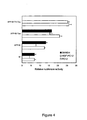
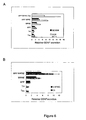
- Figure 4 Optimised combinations of posttranscriptional regulatory elements in neuronal cell lines.
- PC12 cells were transfected with various amount of pluc-tau, pluc-TH, pAPP-luc and pluc-WPRE (2-16 ⁇ g / 1.5x10 6 cells). Luciferase activity obtained with each construct was normalized and expressed as described in Fig.1 .
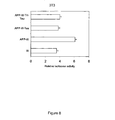
- Figure 6 Stimulation of GDNF secretion with combinations of posttranscriptional regulatory elements in neuronal and glial cell lines.
- 3T3 cells were transfected with 58 fmoles ( ⁇ 0.2 ⁇ g) of pluc-WPRE pAPP-luc-WPRE, pAPP-luc-WPRE-TH and pAPP-luc-WPRE-TH-tau. Luciferase activity obtained with each construct was normalized and expressed as described in Figure 1 .
- Firefly luciferase plasmids were derived from pGL3-Control (Promega).
- GDNF plasmids are derived from pgdnf, which was generated by insertion of the entire rat GDNF cDNA (Bilang-Bleuel et al, 1997) into the BamHI site of pcDNA3 (Invitrogen) dowstream from the CMV promoter.
- the 241-bp fragment containing nucleotides 2519-2760 of the rat tau 3'UTR was provided by I.
- the fragment containing the first 90 bp of the rat TH 3'UTR was derived from pTH51 (fragment Kpnl-Apal; Grima et al , 1985).
- the 600-bp WPRE was provided by Dr D.Trono (Department of Genetics and Microbiology, Switzerland). These elements (WPRE, sequences from tau 3'UTR and TH 3'UTR) and combinations thereof were inserted into the luciferase and gdnf genes at a position corresponding to the 3' end of the mRNA by blunt-end ligation into the Xbal site and Apal site, respectively.
- tau 3'UTR sequences from tau 3'UTR, TH 3'UTR and APP 5'UTR are designated as tau 3'UTR, TH 3'UTR and APP 5'UTR in the text and tau, TH and APP in plasmid constructions, respectively.
- PC12 cells (rat pheochromocytoma) were grown in RPMI-1640 medium (Sigma) supplemented with 10% horse serum (Sigma) and 5% foetal calf serum (Sigma) and maintained at 37°C in 5% CO2.
- RPMI-1640 medium Sigma
- foetal calf serum Sigma
- NGF treatment 1.25x10 5 cells were plated on collagen-coated 12-well plates and grown in DMEM (Sigma) supplemented with 1% foetal calf serum and 50 ng/ml of NGF (Sigma). NGF was added every 2 days for six or eight days.
- SKNSH human neuroblastoma
- C6 rat astrocytoma
- U-87MG human astrocytoma
- 1.5-2.0 x 10 6 cells (PC12, SKNSH, C6 and U-87MG) were re-suspended in 0.2 ml of serum-free medium and transfected by electroporation with 580 or 58 fmoles ( ⁇ 2 or 0.2 ⁇ g) of one of the reporter plasmids and 0.02 ⁇ g of a Renilla luciferase plasmid (pRL-SV40; Promega) as an internal control to correct for differences in transfection efficiency.
- a Biorad gene pulser at 190 V (PC12), 150 V (SKNSH) and 250 V (C6 and U-87MG), 960 ⁇ F for 50ms was used for electroporation.
- NGF-treated PC12 transfections were performed using the Lipofectamine Plus Reagent (Gibco Life Technologies). NGF-treated PC12 cells were transfected with mixtures of 330 or 33 fmoles ( ⁇ 1.1 or 0.11 ⁇ g) of one of the reporter plasmids, 0.11 ⁇ g of pRL-SV40, and a carrier DNA (pBluescript, Stratagene) to give a total of 0.5 ⁇ g of DNA, and 5 ⁇ l of both Plus Reagent and Lipofectamine. Cells were harvested 48 h after transfection. Firefly and Renilla luciferase activities were measured using the Dual-Luciferase Reporter Assay System (Promega).
- GDNF protein concentrations in cell supernatants were determined using an ELISA kit (Promega). Firefly luciferase activity and GDNF concentration were normalized to the Renilla luciferase activity in the cell extract. For each line, three to five independent transfection experiments were performed.
- WPRE, tau 3'UTR, TH 3'UTR and APP 5'UTR was tested to enhance luciferase expression in neural cells.
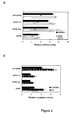
- reporter plasmids each of the four elements was placed either in the 3' or 5' end of the firefly luciferase reporter gene ( Fig. 1A ). All the constructions were made in the pGL3-Control vector, which was used as a control plasmid.
- WPRE, tau3'UTR and TH3'UTR were inserted between the stop codon of the luciferase and the SV40 polyadenylation signal (pluc-WPRE, pluc-tau and pluc-TH).
- APP 5'UTR was placed between the SV40 promoter and the Kozak sequence (pAPP-luc). Luciferase expression from each vector was analysed by transient transfections of cell lines of neuronal (SKNSH and PC12 both treated and not treated with NGF to enhance neuronal differentiation) and glial (U-87M and C6) phenotypes. Both human cell lines (SKNSH, U-87MG) and rat cell lines (PC12, C6) were used because rats are widely used for developing CNS gene therapy protocols. Luciferase expression from pGL3-Control vector was assigned as 1.0 and activity of all other vectors is expressed relative to this value.
- luciferase expression was 4.5-fold the control value in C6 and 2.6-fold in U-87MG ( Fig. 1B , b).
- APP 5'UTR also increased luciferase expression in both neuronal and glial cell lines.
- tau 3'UTR and TH 3'UTR yielded over 1.9 to 2.5-fold higher expression in neuronal cells and 1.6 to 2.0-fold higher expression in glial cells.
- tau 3'UTR and TH 3'UTR failed to increase luciferase expression significantly.
- tau 3'UTR and TH 3'UTR doubled expression (1.8 and 1.6 for tau 3'UTR, 2.0 and 1.9 with TH 3'UTR).
- tau 3'UTR and TH 3'UTR increased expression 1.5-fold and 1.4-fold, respectively.
- luciferase expression was significantly enhanced by WPRE, APP 5'UTR, tau 3'UTR and TH 3'UTR in neuronal cell lines and by WPRE or APP 5'UTR in glial cell lines.
- WPRE posttranscriptional regulatory elements
- WPRE had the strongest capability of promoting luciferase expression in both neuronal and glial cells
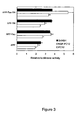
- said WPRE was tested with each of the other elements (tau 3'UTR, TH 3'UTR and APP 5'UTR).
- a series of vectors combining pairs of elements were obtained by inserting the WPRE downstream from the luciferase gene in pluc-tau, pluc-TH and pAPP-luc ( Fig. 2A ).
- Figure 7 shows the combined effects of WPRE and tau, of WPRE and TH 3'UTR, of WPRE and APP 5'UTR, relative to that of the individual elements ( Figure 7 , compare lines 1,2,3 and 7 with lines 8,9 and 10).
- WPRE acts in synergy with the eucaryotic elements on expression in neuronal and glial cell lines.
- GDNF expression was enhanced by tau 3'UTR, APP 5'UTR and WPRE in PC12 and NGF-treated PC12.
- GDNF expression was increased with WPRE and APP 5'UTR ( Fig.6B ).
- TH 3'UTR did not significantly enhance GDNF secretion, it thus was not used in the subsequent constructions.
- the results were similar to those with the luciferase gene, indicating that activity of these elements is not specific to the transgene.
- WPRE combined with APP 5'UTR in SKNSH, glial cells (C6, U-87MG) and with APP 5'UTR and tau 3'UTR were then tested in neuronal cells (PC12, NGF-treated PC12).
- the invention now allows the use of posttranscriptional regulatory elements for high-level gene expression in the CNS.
- the rationale for using neural cell-specific DNA regulatory elements is that target CNS cells contain neural trans-acting factors that normally interact with these elements.
- the only elements which were supposed to increase efficiency of steps of the posttranscriptional pathway in neuronal and/or astrocyte cells were WPRE and sequences from rat tau 3'UTR, rat TH 3'UTR and human APP 5'UTR.
- WPRE have the largest effect on transgene expression in neural cell lines of both human and rat origin. It substantially enhances expression, especially in neuronal cells. These high levels of enhancement are similar with those observed in other transfected and infected cultured cell types (Zufferey et al , 1999; Loeb et al , 1999). Effects of tau 3'UTR, TH 3'UTR and APP 5'UTR on gene expression are not as pronounced. APP 5'UTR doubles expression in both neuronal and glial cells whereas tau 3'UTR and TH 3'UTR also double expression but only in neuronal cells.
- tau 3'UTR Unlike WPRE, that evolved to ensure high level of expression of viral genes by cumulating different functions, posttranscriptional regulatory elements from tau 3'UTR, TH 3'UTR and APP 5'UTR are involved in the regulation of expression of specific genes. The effects of these sequences are moderate and specific to the cell type.
- the sequence from tau 3'UTR stabilizes tau mRNA and ensures that it is localized near the microtubules during neuronal differentiation. This process is mediated by the neuron-specific ELAV-like HuD RNA-binding protein (Aranda-Abreu et al , 1999). The expression of this protein only in neurons explains the neurospecificity of the tau 3'UTR effect.
- TH 3'UTR contains a 28-base sequence that is a stabilizing element necessary for both constitutive and hypoxia-regulated stability of TH mRNA. This sequence is recognized by poly(C)-binding protein, PCBP (Holcik and Liebhaber, 1997; Paulding and Czyzyk-Krzeska, 1999).
- PCBP Since PCBP appears to be ubiquitous (Aasheim et al , 1994; Leffers et al , 1995) and TH 3'UTR stimulates expression only in neuronal cells it will further be important to determine how PCBP is regulated to understand the mechanism of stimulation by TH 3'UTR.
- the four posttranscriptional regulatory elements tau 3'UTR, TH 3'UTR, APP 5'UTR and WPRE have synergistic effects on expression when they are combined. This synergy suggests that the functions of these elements are not redundant. Presumably WPRE, APP 5'UTR, tau 3'UTR and TH 3'UTR improve the efficiency of different steps in the posttranscriptional pathway or act at the same step but with different mechanisms. It has been shown previously that different steps are affected by these sequences. APP 5'UTR regulates mRNA translation (Rogers et al , 1999).
- Posttranscriptional regulation may become rate limiting.
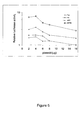
- the invention shows that the effects of WPRE, APP 5'UTR, tau 3'UTR and TH 3'UTR depend on the number of copies of the transgenes: the effects of the four elements on expression decreased with increasing dose of plasmid transfected. This suggests a titration of trans-acting factors by their target sequences and the fact that posttranscriptional processes mediated by these elements become rate limiting. This is presumably due to either low abundance of trans-acting factors in cells or high numbers of copies of mRNA transcribed by the strong SV40 promoter or both. It is interesting to note that in transient transfections, a fraction of the cells takes up a large proportion of the transfecting molecules.
- GDNF is a potent trophic factor for CNS dopamine-containing neurons (Bilang-bleuel et al , 1997; Kordower et al , 2000) and a potential candidate for the treatment of Parkinson disease.
- the present invention demonstrates that improvement of posttranscriptionnal processes with the cis-acting elements tau 3'UTR, TH 3'UTR, APP 5'UTR and WPRE can further increase expression of an already well expressed transgene provided that mRNA concentrations in expressing cells are not too high, which would interfere with its regulated metabolism.
- Optimal combinations for high-level expression are association between WPRE and APP 5'UTR in glial cells and association between WPRE and tau 3'UTR and APP 5'UTR in neuronal cells.
Landscapes
- Health & Medical Sciences (AREA)
- Life Sciences & Earth Sciences (AREA)
- Chemical & Material Sciences (AREA)
- Engineering & Computer Science (AREA)
- Organic Chemistry (AREA)
- General Health & Medical Sciences (AREA)
- Genetics & Genomics (AREA)
- Medicinal Chemistry (AREA)
- Bioinformatics & Cheminformatics (AREA)
- Biomedical Technology (AREA)
- Neurology (AREA)
- Veterinary Medicine (AREA)
- Biochemistry (AREA)
- Pharmacology & Pharmacy (AREA)
- Molecular Biology (AREA)
- Animal Behavior & Ethology (AREA)
- Public Health (AREA)
- Nuclear Medicine, Radiotherapy & Molecular Imaging (AREA)
- Neurosurgery (AREA)
- Zoology (AREA)
- General Chemical & Material Sciences (AREA)
- Biophysics (AREA)
- Chemical Kinetics & Catalysis (AREA)
- Biotechnology (AREA)
- Proteomics, Peptides & Aminoacids (AREA)
- Wood Science & Technology (AREA)
- Gastroenterology & Hepatology (AREA)
- General Engineering & Computer Science (AREA)
- Epidemiology (AREA)
- Virology (AREA)
- Toxicology (AREA)
- Psychology (AREA)
- Physics & Mathematics (AREA)
- Plant Pathology (AREA)
- Microbiology (AREA)
- Psychiatry (AREA)
- Hospice & Palliative Care (AREA)
- Orthopedic Medicine & Surgery (AREA)
- Physical Education & Sports Medicine (AREA)
- Ophthalmology & Optometry (AREA)
Claims (26)
- Ein Vektor geeignet für die Zufuhr von einem Transgen in neuronale Säugetierzellen, wobei der Vektor ein chimäres genetisches Konstrukt umfasst, das ein Transgen operabel mit mindestens zwei unterschiedlichen posttranskriptionalen regulatorischen Elementen verknüpft umfasst, wobei die posttranskriptionalnen regulatorischen Elemente funktional in Zellen sind, und wobei einer dieser posttranskriptionalen regulatorischen Elemente die tau 3'UTR Region einer eukaryotischen mRNA oder ein funktioneller Teil davon ist, und der andere ein komplettes oder ein funktionaler Teil eines WPRE Elementes ist.
- Der Vektor nach Anspruch 1, wobei der Vektor ein chimäres genetisches Konstrukt umfasst, das ein Transgen operabel mit einem WPRE Element, einer APP5'UTR Region und einer tau3'UTR Region verknüpft umfasst.
- Der Vektor nach Anspruch 2, wobei der Vektor ein chimäres genetisches Konstrukt umfasst, das ein Transgen operabel mit einem WPRE Element, einer APP5'UTR Region, einer tau3'UTR Region und einer TH3'UTR Region verknüpft umfasst.
- Der Vektor nach einem der Ansprüche 1 bis 3, wobei das WPRE Element die SEQ ID NO: 1 oder ein funktionelles Fragment davon umfasst.
- Der Vektor nach einem der Ansprüche 2 oder 3, wobei die APP5'UTR Region die SEQ ID NO: 2 oder ein funktionelles Fragment davon umfasst.
- Der Vektor nach einem der Ansprüche 1 bis 5, wobei die tau3'UTR Region die SEQ ID NO: 3 oder ein funktionelles Fragment davon umfasst.
- Der Vektor nach Anspruch 3 oder 4, wobei die TH3'UTR Region die SEQ ID NO: 4 oder ein funktionelles Fragment davon umfasst.
- Der Vektor nach einem der vorhergehenden Ansprüche, wobei der Vektor ferner einen Promotor umfasst, der die Transkription des Transgens in der neuronalen Säugetierzelle reguliert.
- Der Vektor nach einem der vorhergehenden Ansprüche, wobei der Vektor ferner ein Markergen umfasst.
- Der Vektor nach einem der vorhergehenden Ansprüche, wobei der Vektor ferner ein Polyadenylierungs-Signal umfasst, das operabel mit dem Transgen verknüpft ist.
- Der Vektor nach einem der vorhergehenden Ansprüche, wobei der Vektor ausgewählt ist aus einem Plasmid und einem rekombinanten Virus.
- Der Vektor nach Anspruch 11, wobei der Vektor ein replikationsdefizienter Adenovirus, ein replikationsdefizienter Adeno-assozüerter Virus oder ein replikationsdefizienter Retrovirus einschließlich eines replikationsdefizienten Lentivirus ist.
- Der Vektor nach einem der vorhergehenden Ansprüche, wobei das Transgen ausgewählt ist aus einem Transgen kodierend einen Wachstumsfaktor, einen neurotrophischen Faktor, ein Cytokin, einen Liganden, einen Rezeptor, ein Immunoglobulin und ein Enzym.
- Eine rekombinante Zelle umfassend ein chimäres genetisches Konstrukt wie in einem der Ansprüche 1 bis 13 beschrieben oder einen Vektor nach einem der Ansprüche 1 bis 13.
- Verwendung eines Vektors nach einem der Ansprüche 1 bis 13 oder einer rekombinanten Zelle nach Anspruch 14 für die Herstellung eines Medikamentes zur Behandlung einer menschlichen neurogenerativen Erkrankung.
- Eine Zusammensetzung umfassend ein chimäres genetisches Konstrukt wie in einem der Ansprüche 1 bis 13 beschrieben, einen Vektor nach einem der Ansprüche 1 bis 13 oder eine rekombinante Zelle nach Anspruch 14 und einen pharmazeutisch verträglichen Hilfsstoff oder Träger.
- Die Zusammensetzung nach Anspruch 16 zur Behandlung einer humanen neurogenerativen Erkrankung.
- Die Verwendung nach Anspruch 15 oder die Zusammensetzung nach Anspruch 17, wobei die neurogenerative Erkrankung ausgewählt ist aus der Parkinson-Krankheit, der Alzheimer-Krankheit, der Amyotrophen Lateralsklerose (ALS), der Huntington Krankheit und einer degenerative Erkrankung der Retina.
- Ein Vektor nach einem der Ansprüche 1 bis 13 oder eine rekombinante Zelle nach Anspruch 14 zur Behandlung einer humanen neurodegenerativen Erkrankung.
- Ein Verfahren zur Expression eines Transgens in einer neuronalen Säugetierzelle in vitro oder ex vivo, wobei das Verfahren die folgenden Schritte umfasst:a. zur Verfügungstellen eines chimären genetischen Konstruktes umfassend das Transgen operabel mit mindestens zwei unterschiedlichen posttranskriptionalen regulatorischen Elementen verknüpft, wobei einer dieser posttranskriptionalen regulatorischen Elemente die tau 3'UTR Region einer eukaryotischen mRNA oder ein funktioneller Teil davon ist, und der andere ein komplettes oder ein funktionaler Teil eines WPRE Elementes ist, undb. Einbringen des Konstruktes in neuronale Säugetierzellen, wobei das Einbringen zur Expression des Transgens in den neuronalen Säugetierzellen führt.
- Das Verfahren nach Anspruch 20, umfassend:a. zur Verfügungstellen eines Vektors nach einem der Ansprüche 1 bis 13, undb. Einbringen des Vektors in neuronale Säugetierzellen, wobei das Einbringen zur Expression des Transgens in den neuronalen Säugetierzellen führt.
- Das Verfahren nach Anspruch 21, wobei die neuronale Säugetierzelle eine humane neuronale Zelle oder eine neuronale Nagetierzelle ist.
- Das Verfahren nach einem der Ansprüche 20 bis 22, wobei das chimäre genetische Konstrukt oder der Vektor durch Virus-vermittelte Infektion in die neuronalen Säugetierzellen eingebracht wird.
- Das Verfahren nach einem der Ansprüche 20 bis 22, wobei das chimäre genetische Konstrukt oder der Vektor durch Plasmid-vermittelte Transfektion in die Zellen eingebracht wird.
- Ein in vitro Verfahren zur Expression eines Transgens in neuronalen Zellen, wobei das Verfahren die folgenden Schritte umfasst:a. zur Verfügungstellen eines chimären genetischen Konstruktes umfassend das Transgen operabel verknüpft mit posttranskriptionalen regulatorischen Elementen, wobei die posttranskriptionalen regulatorischen Elemente ein WPRE Element kombiniert mit einem APP5'UTR und einem tau3'UTR oder einem Teil davon umfassen, undb. Einbringen des Konstruktes in neuronale Zellen, wobei das Einbringen zur Expression des Transgens in den neuronalen Zellen führt
- Ein in vitro Verfahren zur Expression eines Transgens in neuronalen Zellen, wobei das Verfahren die folgenden Schritte umfasst:a. zur Verfügungstellen eines chimären genetischen Konstruktes umfassend das Transgen operabel verknüpft mit posttranskriptionalen regulatorischen Elementen, wobei die posttranskriptionalen regulatorischen Elemente ein WPRE Element kombiniert mit einem APP5'UTR, einem tau3'UTR und einem TH3'UTR oder einem Teil davon umfassen,b. Einbringen des Konstruktes in neuronale Zellen, wobei das Einbringen zur Expression des Transgens in den neuronalen Zellen führt.
Priority Applications (1)
| Application Number | Priority Date | Filing Date | Title |
|---|---|---|---|
| EP03732299A EP1499735B1 (de) | 2002-04-30 | 2003-04-29 | Optimierung von transgenexpression in säugetierzellen |
Applications Claiming Priority (4)
| Application Number | Priority Date | Filing Date | Title |
|---|---|---|---|
| EP20020291091 EP1361277A1 (de) | 2002-04-30 | 2002-04-30 | Optimierung von Transgenexpression in Säugetierzellen |
| EP02291091 | 2002-04-30 | ||
| PCT/EP2003/004457 WO2003093485A2 (en) | 2002-04-30 | 2003-04-29 | Optimization of transgene expression in mammalian cells |
| EP03732299A EP1499735B1 (de) | 2002-04-30 | 2003-04-29 | Optimierung von transgenexpression in säugetierzellen |
Publications (2)
| Publication Number | Publication Date |
|---|---|
| EP1499735A2 EP1499735A2 (de) | 2005-01-26 |
| EP1499735B1 true EP1499735B1 (de) | 2009-08-05 |
Family
ID=29225738
Family Applications (2)
| Application Number | Title | Priority Date | Filing Date |
|---|---|---|---|
| EP20020291091 Withdrawn EP1361277A1 (de) | 2002-04-30 | 2002-04-30 | Optimierung von Transgenexpression in Säugetierzellen |
| EP03732299A Expired - Lifetime EP1499735B1 (de) | 2002-04-30 | 2003-04-29 | Optimierung von transgenexpression in säugetierzellen |
Family Applications Before (1)
| Application Number | Title | Priority Date | Filing Date |
|---|---|---|---|
| EP20020291091 Withdrawn EP1361277A1 (de) | 2002-04-30 | 2002-04-30 | Optimierung von Transgenexpression in Säugetierzellen |
Country Status (8)
| Country | Link |
|---|---|
| US (1) | US20060051331A1 (de) |
| EP (2) | EP1361277A1 (de) |
| JP (1) | JP4393375B2 (de) |
| AT (1) | ATE438727T1 (de) |
| AU (1) | AU2003239823A1 (de) |
| CA (1) | CA2483050A1 (de) |
| DE (1) | DE60328673D1 (de) |
| WO (1) | WO2003093485A2 (de) |
Families Citing this family (19)
| Publication number | Priority date | Publication date | Assignee | Title |
|---|---|---|---|---|
| DE102005046490A1 (de) * | 2005-09-28 | 2007-03-29 | Johannes-Gutenberg-Universität Mainz | Modifikationen von RNA, die zu einer erhöhten Transkriptstabilität und Translationseffizienz führen |
| US20110086904A1 (en) * | 2007-09-17 | 2011-04-14 | The Trustees Of The University Of Pennsylvania | GENERATION OF HYPERSTABLE mRNAs |
| CA2807552A1 (en) | 2010-08-06 | 2012-02-09 | Moderna Therapeutics, Inc. | Engineered nucleic acids and methods of use thereof |
| LT4108671T (lt) | 2010-10-01 | 2025-01-10 | Modernatx, Inc. | Modifikuoti nukleozidai, nukleotidai, nukleorūgštys bei jų panaudojimas |
| US8710200B2 (en) | 2011-03-31 | 2014-04-29 | Moderna Therapeutics, Inc. | Engineered nucleic acids encoding a modified erythropoietin and their expression |
| US9464124B2 (en) | 2011-09-12 | 2016-10-11 | Moderna Therapeutics, Inc. | Engineered nucleic acids and methods of use thereof |
| SMT202200229T1 (it) | 2011-10-03 | 2022-07-21 | Modernatx Inc | Nucleosidi, nucleotidi e acidi nucleici modificati e loro usi |
| RU2649364C2 (ru) | 2011-12-16 | 2018-04-02 | Модерна Терапьютикс, Инк. | Составы на основе модифицированного нуклеозида, нуклеотида и нуклеиновой кислоты |
| US9572897B2 (en) | 2012-04-02 | 2017-02-21 | Modernatx, Inc. | Modified polynucleotides for the production of cytoplasmic and cytoskeletal proteins |
| US9283287B2 (en) | 2012-04-02 | 2016-03-15 | Moderna Therapeutics, Inc. | Modified polynucleotides for the production of nuclear proteins |
| AU2013243954A1 (en) | 2012-04-02 | 2014-10-30 | Moderna Therapeutics, Inc. | Modified polynucleotides for the production of cosmetic proteins and peptides |
| US10501512B2 (en) | 2012-04-02 | 2019-12-10 | Modernatx, Inc. | Modified polynucleotides |
| US20140275229A1 (en) * | 2012-04-02 | 2014-09-18 | Moderna Therapeutics, Inc. | Modified polynucleotides encoding udp glucuronosyltransferase 1 family, polypeptide a1 |
| EP2684892A1 (de) * | 2012-07-13 | 2014-01-15 | Association Française contre les Myopathies | Zusammensetzungen und Verfahren zur Therapie des Gens der Muskeldystrophie des Typs Duchenne |
| HRP20220607T1 (hr) | 2012-11-26 | 2022-06-24 | Modernatx, Inc. | Terminalno modificirana rna |
| US8980864B2 (en) | 2013-03-15 | 2015-03-17 | Moderna Therapeutics, Inc. | Compositions and methods of altering cholesterol levels |
| BR112016007255A2 (pt) | 2013-10-03 | 2017-09-12 | Moderna Therapeutics Inc | polinucleotídeos que codificam receptor de lipoproteína de baixa densidade |
| US11827680B2 (en) | 2014-11-06 | 2023-11-28 | Case Western Reserve University | Compounds and methods of treating usher syndrome III |
| US20230108025A1 (en) * | 2020-03-13 | 2023-04-06 | Wisconsin Alumni Research Foundation | Kir 7.1 gene therapy vectors and methods of using the same |
Family Cites Families (1)
| Publication number | Priority date | Publication date | Assignee | Title |
|---|---|---|---|---|
| DE69614527T2 (de) * | 1995-05-22 | 2002-05-16 | The Government Of The United States Of America, As Represented By The Secretary National Institute Of Health | Retrovirale vektoren aus gefluegel-sarcom-leukoseviren ermoeglichen den transfer von genen in saeugetierzellen und ihre therapeutischen anwendungen |
-
2002
- 2002-04-30 EP EP20020291091 patent/EP1361277A1/de not_active Withdrawn
-
2003
- 2003-04-29 AT AT03732299T patent/ATE438727T1/de not_active IP Right Cessation
- 2003-04-29 AU AU2003239823A patent/AU2003239823A1/en not_active Abandoned
- 2003-04-29 WO PCT/EP2003/004457 patent/WO2003093485A2/en not_active Ceased
- 2003-04-29 CA CA002483050A patent/CA2483050A1/en not_active Abandoned
- 2003-04-29 US US10/511,343 patent/US20060051331A1/en not_active Abandoned
- 2003-04-29 EP EP03732299A patent/EP1499735B1/de not_active Expired - Lifetime
- 2003-04-29 JP JP2004501621A patent/JP4393375B2/ja not_active Expired - Fee Related
- 2003-04-29 DE DE60328673T patent/DE60328673D1/de not_active Expired - Fee Related
Also Published As
| Publication number | Publication date |
|---|---|
| EP1361277A1 (de) | 2003-11-12 |
| WO2003093485A2 (en) | 2003-11-13 |
| EP1499735A2 (de) | 2005-01-26 |
| US20060051331A1 (en) | 2006-03-09 |
| AU2003239823A8 (en) | 2003-11-17 |
| AU2003239823A1 (en) | 2003-11-17 |
| DE60328673D1 (de) | 2009-09-17 |
| WO2003093485A3 (en) | 2004-03-25 |
| JP4393375B2 (ja) | 2010-01-06 |
| CA2483050A1 (en) | 2003-11-13 |
| JP2005523725A (ja) | 2005-08-11 |
| ATE438727T1 (de) | 2009-08-15 |
Similar Documents
| Publication | Publication Date | Title |
|---|---|---|
| EP1499735B1 (de) | Optimierung von transgenexpression in säugetierzellen | |
| AU2022204199B2 (en) | Gene editing of deep intronic mutations | |
| KR102879598B1 (ko) | 무세포 합성으로부터 수득된 폐쇄 말단 DNA 벡터 및 ceDNA 벡터를 수득하는 방법 | |
| AU2020282352B2 (en) | Compositions and methods for selective gene regulation | |
| RU2757058C2 (ru) | Индуцируемые каспазы и способы использования | |
| KR20230043869A (ko) | Aav 벡터를 사용한 플라코필린-2(pkp2) 유전자 요법 | |
| KR20210119416A (ko) | 폐쇄-말단 dna (cedna), 및 유전자 또는 핵산 치료 관련 면역 반응을 감소시키는 방법에서의 이의 용도 | |
| KR20200107949A (ko) | 조작된 dna 결합 단백질 | |
| US20240042058A1 (en) | Tissue-specific methods and compositions for modulating a genome | |
| AU2018319637B2 (en) | Expression control using a regulatable intron | |
| JP2024533316A (ja) | ゲノムを調節するための方法及び組成物 | |
| CN117015605A (zh) | 使用工程化rna通过利用内源性adar进行靶向rna编辑 | |
| US20220040329A1 (en) | Inducible expression cassette, and uses thereof | |
| CN117545842A (zh) | SMN1和miR-23a在治疗脊髓性肌萎缩中的协同效应 | |
| KR20230003477A (ko) | 비-바이러스성 dna 벡터 및 인자 ix 치료제 발현을 위한 이의 용도 | |
| KR20230003478A (ko) | 비-바이러스성 dna 벡터 및 고셰 치료제 발현을 위한 이의 용도 | |
| AU2022213255B2 (en) | Gene therapy for treating neurodegenerative diseases | |
| KR20220109346A (ko) | 신경 퇴행성 질환의 치료를 위한 유전자 요법 | |
| RU2829367C2 (ru) | ДНК С ЗАМКНУТЫМИ КОНЦАМИ (зкДНК) И ПРИМЕНЕНИЕ В СПОСОБАХ УМЕНЬШЕНИЯ ИММУННОГО ОТВЕТА, СВЯЗАННОГО С ГЕННОЙ ТЕРАПИЕЙ ИЛИ ТЕРАПИЕЙ НУКЛЕИНОВОЙ КИСЛОТОЙ | |
| RU2839898C2 (ru) | Синергетическое действие SMN1 и miR-23a при лечении спинальной мышечной атрофии | |
| RU2800026C2 (ru) | МОДИФИЦИРОВАННАЯ ДНК С ЗАМКНУТЫМИ КОНЦАМИ (зкДНК) | |
| RU2816963C2 (ru) | МОДИФИЦИРОВАННАЯ ДНК С ЗАМКНУТЫМИ КОНЦАМИ (зкДНК), СОДЕРЖАЩАЯ СИММЕТРИЧНЫЕ МОДИФИЦИРОВАННЫЕ ИНВЕРТИРОВАННЫЕ КОНЦЕВЫЕ ПОВТОРЫ | |
| CN120189530A (zh) | 基因编辑系统及其应用 | |
| HK40106789A (zh) | Smn1和mir-23a在治疗脊髓性肌萎缩中的协同效应 | |
| HK40102897A (zh) | 使用工程化rna通过利用内源性adar进行靶向rna编辑 |
Legal Events
| Date | Code | Title | Description |
|---|---|---|---|
| PUAI | Public reference made under article 153(3) epc to a published international application that has entered the european phase |
Free format text: ORIGINAL CODE: 0009012 |
|
| 17P | Request for examination filed |
Effective date: 20041014 |
|
| AK | Designated contracting states |
Kind code of ref document: A2 Designated state(s): AT BE BG CH CY CZ DE DK EE ES FI FR GB GR HU IE IT LI LU MC NL PT RO SE SI SK TR |
|
| AX | Request for extension of the european patent |
Extension state: AL LT LV MK |
|
| 17Q | First examination report despatched |
Effective date: 20080723 |
|
| GRAP | Despatch of communication of intention to grant a patent |
Free format text: ORIGINAL CODE: EPIDOSNIGR1 |
|
| GRAS | Grant fee paid |
Free format text: ORIGINAL CODE: EPIDOSNIGR3 |
|
| GRAA | (expected) grant |
Free format text: ORIGINAL CODE: 0009210 |
|
| AK | Designated contracting states |
Kind code of ref document: B1 Designated state(s): AT BE BG CH CY CZ DE DK EE ES FI FR GB GR HU IE IT LI LU MC NL PT RO SE SI SK TR |
|
| REG | Reference to a national code |
Ref country code: GB Ref legal event code: FG4D |
|
| REG | Reference to a national code |
Ref country code: CH Ref legal event code: EP |
|
| REG | Reference to a national code |
Ref country code: IE Ref legal event code: FG4D |
|
| REF | Corresponds to: |
Ref document number: 60328673 Country of ref document: DE Date of ref document: 20090917 Kind code of ref document: P |
|
| PG25 | Lapsed in a contracting state [announced via postgrant information from national office to epo] |
Ref country code: ES Free format text: LAPSE BECAUSE OF FAILURE TO SUBMIT A TRANSLATION OF THE DESCRIPTION OR TO PAY THE FEE WITHIN THE PRESCRIBED TIME-LIMIT Effective date: 20091116 Ref country code: AT Free format text: LAPSE BECAUSE OF FAILURE TO SUBMIT A TRANSLATION OF THE DESCRIPTION OR TO PAY THE FEE WITHIN THE PRESCRIBED TIME-LIMIT Effective date: 20090805 Ref country code: SE Free format text: LAPSE BECAUSE OF FAILURE TO SUBMIT A TRANSLATION OF THE DESCRIPTION OR TO PAY THE FEE WITHIN THE PRESCRIBED TIME-LIMIT Effective date: 20090805 Ref country code: FI Free format text: LAPSE BECAUSE OF FAILURE TO SUBMIT A TRANSLATION OF THE DESCRIPTION OR TO PAY THE FEE WITHIN THE PRESCRIBED TIME-LIMIT Effective date: 20090805 |
|
| NLV1 | Nl: lapsed or annulled due to failure to fulfill the requirements of art. 29p and 29m of the patents act | ||
| PG25 | Lapsed in a contracting state [announced via postgrant information from national office to epo] |
Ref country code: SI Free format text: LAPSE BECAUSE OF FAILURE TO SUBMIT A TRANSLATION OF THE DESCRIPTION OR TO PAY THE FEE WITHIN THE PRESCRIBED TIME-LIMIT Effective date: 20090805 Ref country code: NL Free format text: LAPSE BECAUSE OF FAILURE TO SUBMIT A TRANSLATION OF THE DESCRIPTION OR TO PAY THE FEE WITHIN THE PRESCRIBED TIME-LIMIT Effective date: 20090805 |
|
| PG25 | Lapsed in a contracting state [announced via postgrant information from national office to epo] |
Ref country code: BG Free format text: LAPSE BECAUSE OF FAILURE TO SUBMIT A TRANSLATION OF THE DESCRIPTION OR TO PAY THE FEE WITHIN THE PRESCRIBED TIME-LIMIT Effective date: 20091105 Ref country code: PT Free format text: LAPSE BECAUSE OF FAILURE TO SUBMIT A TRANSLATION OF THE DESCRIPTION OR TO PAY THE FEE WITHIN THE PRESCRIBED TIME-LIMIT Effective date: 20091205 |
|
| PG25 | Lapsed in a contracting state [announced via postgrant information from national office to epo] |
Ref country code: RO Free format text: LAPSE BECAUSE OF FAILURE TO SUBMIT A TRANSLATION OF THE DESCRIPTION OR TO PAY THE FEE WITHIN THE PRESCRIBED TIME-LIMIT Effective date: 20090805 Ref country code: EE Free format text: LAPSE BECAUSE OF FAILURE TO SUBMIT A TRANSLATION OF THE DESCRIPTION OR TO PAY THE FEE WITHIN THE PRESCRIBED TIME-LIMIT Effective date: 20090805 Ref country code: DK Free format text: LAPSE BECAUSE OF FAILURE TO SUBMIT A TRANSLATION OF THE DESCRIPTION OR TO PAY THE FEE WITHIN THE PRESCRIBED TIME-LIMIT Effective date: 20090805 Ref country code: CZ Free format text: LAPSE BECAUSE OF FAILURE TO SUBMIT A TRANSLATION OF THE DESCRIPTION OR TO PAY THE FEE WITHIN THE PRESCRIBED TIME-LIMIT Effective date: 20090805 |
|
| PG25 | Lapsed in a contracting state [announced via postgrant information from national office to epo] |
Ref country code: SK Free format text: LAPSE BECAUSE OF FAILURE TO SUBMIT A TRANSLATION OF THE DESCRIPTION OR TO PAY THE FEE WITHIN THE PRESCRIBED TIME-LIMIT Effective date: 20090805 |
|
| PLBE | No opposition filed within time limit |
Free format text: ORIGINAL CODE: 0009261 |
|
| STAA | Information on the status of an ep patent application or granted ep patent |
Free format text: STATUS: NO OPPOSITION FILED WITHIN TIME LIMIT |
|
| PG25 | Lapsed in a contracting state [announced via postgrant information from national office to epo] |
Ref country code: BE Free format text: LAPSE BECAUSE OF FAILURE TO SUBMIT A TRANSLATION OF THE DESCRIPTION OR TO PAY THE FEE WITHIN THE PRESCRIBED TIME-LIMIT Effective date: 20090805 |
|
| 26N | No opposition filed |
Effective date: 20100507 |
|
| PG25 | Lapsed in a contracting state [announced via postgrant information from national office to epo] |
Ref country code: GR Free format text: LAPSE BECAUSE OF FAILURE TO SUBMIT A TRANSLATION OF THE DESCRIPTION OR TO PAY THE FEE WITHIN THE PRESCRIBED TIME-LIMIT Effective date: 20091106 |
|
| PG25 | Lapsed in a contracting state [announced via postgrant information from national office to epo] |
Ref country code: MC Free format text: LAPSE BECAUSE OF NON-PAYMENT OF DUE FEES Effective date: 20100430 |
|
| REG | Reference to a national code |
Ref country code: CH Ref legal event code: PL |
|
| GBPC | Gb: european patent ceased through non-payment of renewal fee |
Effective date: 20100429 |
|
| REG | Reference to a national code |
Ref country code: FR Ref legal event code: ST Effective date: 20101230 |
|
| PG25 | Lapsed in a contracting state [announced via postgrant information from national office to epo] |
Ref country code: IE Free format text: LAPSE BECAUSE OF NON-PAYMENT OF DUE FEES Effective date: 20100429 |
|
| PG25 | Lapsed in a contracting state [announced via postgrant information from national office to epo] |
Ref country code: LI Free format text: LAPSE BECAUSE OF NON-PAYMENT OF DUE FEES Effective date: 20100430 Ref country code: CH Free format text: LAPSE BECAUSE OF NON-PAYMENT OF DUE FEES Effective date: 20100430 Ref country code: DE Free format text: LAPSE BECAUSE OF NON-PAYMENT OF DUE FEES Effective date: 20101103 |
|
| PG25 | Lapsed in a contracting state [announced via postgrant information from national office to epo] |
Ref country code: IT Free format text: LAPSE BECAUSE OF FAILURE TO SUBMIT A TRANSLATION OF THE DESCRIPTION OR TO PAY THE FEE WITHIN THE PRESCRIBED TIME-LIMIT Effective date: 20090805 Ref country code: GB Free format text: LAPSE BECAUSE OF NON-PAYMENT OF DUE FEES Effective date: 20100429 |
|
| PG25 | Lapsed in a contracting state [announced via postgrant information from national office to epo] |
Ref country code: FR Free format text: LAPSE BECAUSE OF NON-PAYMENT OF DUE FEES Effective date: 20100430 |
|
| PG25 | Lapsed in a contracting state [announced via postgrant information from national office to epo] |
Ref country code: CY Free format text: LAPSE BECAUSE OF FAILURE TO SUBMIT A TRANSLATION OF THE DESCRIPTION OR TO PAY THE FEE WITHIN THE PRESCRIBED TIME-LIMIT Effective date: 20090805 |
|
| PG25 | Lapsed in a contracting state [announced via postgrant information from national office to epo] |
Ref country code: HU Free format text: LAPSE BECAUSE OF FAILURE TO SUBMIT A TRANSLATION OF THE DESCRIPTION OR TO PAY THE FEE WITHIN THE PRESCRIBED TIME-LIMIT Effective date: 20100206 Ref country code: LU Free format text: LAPSE BECAUSE OF NON-PAYMENT OF DUE FEES Effective date: 20100429 |
|
| PG25 | Lapsed in a contracting state [announced via postgrant information from national office to epo] |
Ref country code: TR Free format text: LAPSE BECAUSE OF FAILURE TO SUBMIT A TRANSLATION OF THE DESCRIPTION OR TO PAY THE FEE WITHIN THE PRESCRIBED TIME-LIMIT Effective date: 20090805 |