EP1499022A1 - Procédé et dispositif de génération de nombres aléatoires fondés sur des oxcillateurs chaotiques - Google Patents
Procédé et dispositif de génération de nombres aléatoires fondés sur des oxcillateurs chaotiques Download PDFInfo
- Publication number
- EP1499022A1 EP1499022A1 EP04102975A EP04102975A EP1499022A1 EP 1499022 A1 EP1499022 A1 EP 1499022A1 EP 04102975 A EP04102975 A EP 04102975A EP 04102975 A EP04102975 A EP 04102975A EP 1499022 A1 EP1499022 A1 EP 1499022A1
- Authority
- EP
- European Patent Office
- Prior art keywords
- signal
- source according
- physical
- xor
- output
- Prior art date
- Legal status (The legal status is an assumption and is not a legal conclusion. Google has not performed a legal analysis and makes no representation as to the accuracy of the status listed.)
- Granted
Links
Images



Classifications
-
- H—ELECTRICITY
- H04—ELECTRIC COMMUNICATION TECHNIQUE
- H04L—TRANSMISSION OF DIGITAL INFORMATION, e.g. TELEGRAPHIC COMMUNICATION
- H04L9/00—Cryptographic mechanisms or cryptographic arrangements for secret or secure communications; Network security protocols
- H04L9/001—Cryptographic mechanisms or cryptographic arrangements for secret or secure communications; Network security protocols using chaotic signals
-
- G—PHYSICS
- G06—COMPUTING OR CALCULATING; COUNTING
- G06F—ELECTRIC DIGITAL DATA PROCESSING
- G06F7/00—Methods or arrangements for processing data by operating upon the order or content of the data handled
- G06F7/58—Random or pseudo-random number generators
- G06F7/588—Random number generators, i.e. based on natural stochastic processes
-
- H—ELECTRICITY
- H03—ELECTRONIC CIRCUITRY
- H03B—GENERATION OF OSCILLATIONS, DIRECTLY OR BY FREQUENCY-CHANGING, BY CIRCUITS EMPLOYING ACTIVE ELEMENTS WHICH OPERATE IN A NON-SWITCHING MANNER; GENERATION OF NOISE BY SUCH CIRCUITS
- H03B29/00—Generation of noise currents and voltages
-
- H—ELECTRICITY
- H03—ELECTRONIC CIRCUITRY
- H03K—PULSE TECHNIQUE
- H03K3/00—Circuits for generating electric pulses; Monostable, bistable or multistable circuits
- H03K3/84—Generating pulses having a predetermined statistical distribution of a parameter, e.g. random pulse generators
Definitions
- the invention particularly relates to a source and a device for random number generation.
- the first family has the disadvantage of being less safe at the level of the hazard produced, although the latter may be of good quality. Indeed, it is easy to cut the external source, or even to modulate it according to a predetermined pattern.
- the second family helps to secure the hazard production.
- the present invention relates in particular to the use of sources random binary based on dynamic oscillators or oscillators chaotic.
- Delay elements can be logical "ANDs".
- It may comprise a digital low-pass filter arranged before the first element of delay.
- the filter comprises for example a mux controlled by a detector of change of state of the signal, this filter being placed between the output of the function of loopback and the entry of the delay line.
- the invention also relates to a binary random source having at least one physical source having one or more of aforementioned features and at least one digital sampler of the actual variable produced by the physical source.
- a binary random source comprising one or several dynamic oscillators sensitive to the electronic noise of operation of the circuit in which they are placed.
- the dynamic variable each oscillator is sampled at a regular time interval for produce unpredictable and non-reproducible binary values.
- This delay line is for example divided into k blocks of Ni delay elements, for i between 1 and k.
- the parameters of the oscillator can be adapted so that the oscillation produced has a chaotic behavior.
- Figure 3 represents the datagram obtained by visualizing on a oscilloscope the evolution of the voltage of an asynchronous oscillator according to the present invention.
- Figure 4 shows a particular example where the function of loopback is an affine function.
- the first delay element of each block is connected to one of the Entries of the affine loopback function.
- the loopback function refines must check the condition of no fixed points described below.
- Linear functions are a special case of affine functions, obtained by setting the parameter c 0 of their expression to 0 .
- the function f is strictly affine if the parameter c 0 of its expression is equal to 1.
- the physical source or oscillator dynamic range includes a filter F intended to reduce the response time of the chaotic signal to coincide with the response time of elements of delay. This makes it possible to overcome problems denaturation of the signal when the latter passes through the delay elements.
- the filter is placed in each dynamic oscillator between the output of the loopback function and the input of the line of elements of delay, as shown in Figure 5.
- the sampled signal is the signal at the output of the loopback function, just before the input of the filtered.
- the number of delay elements to use for the delay line The filter is variable and depends on the component used. This number is chosen large enough so that the signal is substantially conserved when it crosses the line of delay elements of the oscillator. It is also chosen so that the filter does not distort the chaotic character of the oscillating signal and transforms the oscillator into a simple shift register asynchronous, which has the effect of distorting the random nature of sampling.
- Figure 7 schematizes the structure of a binary source comprises a dynamic oscillator as described in FIGS. 2 to 6 and a sampler.
- the function of the sampler is, in particular, to transform at each clock stroke, the actual value of the dynamic variable of a oscillator, in a binary value.
- the sampler consists of elements Logic synchronized by the clock.
- the samplers consist of an assembly of D flip-flops, and the sampled variable is the signal of the oscillator taken at the output of the loopback function, that is the signal that is fed back into the line delay elements (see Figure 4).
- Figure 8 shows a first example of a sampler consisting of a D flip-flop.
- the actual dynamic variable generated by the dynamic oscillator is sampled by the flip-flop D.
- the output of this can still present metastable states, which will be solved the next rocker.
- the usual operation of a rocker is the following: at each Clockwise H, the latch stores the binary value present on its input, while offering on its output the binary value stored in the shot previous clock. This binary value is a real variable. Every clock tick, the latch deduces from this real variable a binary value and memorize it. In this mode of operation, the rocker acts as a measuring tool.
- the statistical properties of the source are independent of variations in the frequency of circuit operation, as well as temperature variations environment in which the circuit operates.
- the bias the equidistribution depends linearly on the supply voltage of the circuit.
- FIGS 9 and 10 show two other embodiments samplers.
- the sampler comprises three flip-flops D 1 , D 2 , D 3 , an inverter I and one or exclusive "XOR".
- the inverter I is arranged between two flip-flops D 2 , D 3 .
- the inverter I is arranged before the two flip-flops D 2 , D 3 .
- the output of such samplers may have states metastables that are solved on the next scale.
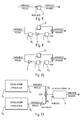
- FIGS 11 to 13 schematize binary source structures random with two dynamic oscillators. These structures have the advantage of providing binary sources insensitive to variations in external operating conditions.
- the binary source is composed of two identical dynamic oscillators O 1 , O 2 .
- the output S 1 of the oscillator O 1 is connected to a first input E 1 of an "XOR” and the output S 2 of the second oscillator O 2 passes through an inverter I before being connected to another input E 1 of the "XOR”.
- the output of the "XOR” is then sampled by a flip-flop D.
- the output of this flip-flop can still have metastable states that will be solved in a next flip-flop.
- FIG. 12 represents a binary source comprising two identical dynamic oscillators O 1 , O 2 .
- the output S 1 of one of the oscillators O 1 is sampled by a sampler of the type of that of FIG. 10.
- the output S 2 of the other oscillator O 2 passes through an inverter I before being sampled by a sampler of the type of FIG. 10.
- the outputs of the two samplers ECH 1 , ECH 2 are connected to two inputs of an "XOR".
- the binary source described in FIG. 13 consists of two different oscillators O 3 , O 4 .
- the output of each oscillator is sampled by an ECH 3 , ECH 4 sampler of the type of that of FIG. 10.
- the outputs of these two samplers are connected to the inputs of an "XOR".
- the second is an ACTEL PROASIC A500K050 PQFP208.
- the delay elements of the present dynamic oscillators in the binary sources are "AND" doors which one of the inputs constitutes the input of the delay element, and whose output constitutes the output of the delay element.
- the other door entry "AND” is set to 1 throughout the duration of the chaotic oscillation and can even, if desired, serve as a switch to start the chaotic oscillation.
- This guy element is sufficient to delay the signal passing through the door.
- the filter described in Figure 6 allows in particular to compensate the response time an oscillator present in this component.
- the structure of the binary random source is modular, i.e. that we can assemble several identical or different oscillators with multiple samplers to get a new structure of binary random source.
- Binary random sources according to the present invention can be in the form of a sequence of instructions in language VHDL, which encodes chaotic oscillators and samplers constituting said sources. These binary random sources are therefore directly usable by circuit manufacturers to create random number generators, by inserting the VHDL code of the binary sources directly into the VHDL code of their circuit. This allows furthermore, relative portability from one component to another, although ensure that there are no problems related to techno-dependence or to the compilo-dependency.
- random sources described above are easily implementable in dedicated cryptographic components, in which all the cryptographic material is present: generator of hazard, of pseudo-random, encryption algorithm, etc.
Landscapes
- Engineering & Computer Science (AREA)
- Physics & Mathematics (AREA)
- Theoretical Computer Science (AREA)
- General Physics & Mathematics (AREA)
- Mathematical Optimization (AREA)
- Pure & Applied Mathematics (AREA)
- Mathematical Analysis (AREA)
- General Engineering & Computer Science (AREA)
- Computational Mathematics (AREA)
- Computer Security & Cryptography (AREA)
- Computer Networks & Wireless Communication (AREA)
- Signal Processing (AREA)
- Stabilization Of Oscillater, Synchronisation, Frequency Synthesizers (AREA)
- Oscillators With Electromechanical Resonators (AREA)
- Measuring Or Testing Involving Enzymes Or Micro-Organisms (AREA)
- Complex Calculations (AREA)
- Analogue/Digital Conversion (AREA)
Abstract
Description
Un générateur de nombres aléatoires est un dispositif basé sur la mesure de quantités physiques non reproductibles pour produire des nombres aléatoires. Il existe à ce jour deux familles de générateurs de nombres aléatoires :
- ceux basés sur la mesure d'une quantité extérieure (naturelle), imprédictible a priori (fluctuations de température ambiante, de niveau sonore, ou de pression atmosphérique, trajectoire de la souris sur l'ordinateur, temps de frappe au clavier, ...),
- ceux dont le fonctionnement est indépendant des conditions extérieures d'utilisation (mesure en milieu isolé du bruit thermique d'une résistance,
- Les oscillateurs chaotiques selon l'invention présentent un signal qui se rapproche le plus possible d'un signal de bruit blanc qui est considéré comme le plus aléatoire des signaux. Les oscillateurs chaotiques présentent une forte dépendance aux conditions initiales et donc une forte sensibilité au bruit électronique interne du circuit intégré dans lequel ils sont placés. La non reproductibilité de la suite binaire produite est favorisée, ainsi que l'absence de couplage des oscillations propres de ces oscillateurs avec la fréquence d'horloge de l'échantillonnage.
- Lors de l'échantillonnage, les bascules D agissent comme des instruments de mesure qui renvoient à chaque coup d'horloge une valeur binaire d'autant plus aléatoire que le signal de sortie des bascules est métastable, ce qui rajoute de l'indétermination et donc de l'aléa.
- Le signal d'entrée des bascules D asynchrone contribue à ce que le signal de sortie des bascules soit métastable.
- La place utilisée par les oscillateurs chaotiques à l'intérieur des composants est réduite.
- Les oscillateurs dynamiques peuvent être démarrés ou arrêtés selon la demande et de fait les composants consomment peu d'énergie.
- Les sources aléatoires binaires fournissent de l'aléa à un débit relativement élevé, et en tout cas suffisant pour les applications cryptographiques.
- La figure 1 un schéma de fonctionnement synchrone d'un circuit numérique,
- La figure 2 un exemple de structure d'un oscillateur dynamique,
- La figure 3 le signal issu de l'oscillateur de la figure 4,
- La figure 4 un exemple de la figure 2 avec un rebouclage affine,
- La figure 5 un oscillateur à rebouclage affine filtré,
- La figure 6 une architecture de filtre passe-bas numérique
- La figure 7 une source binaire comprenant un oscillateur tel que décrit à la figure 2,
- Les figures 8, 9 et 10 trois types d'échantillonneurs,
- La figure 11 une structure d'une source binaire à deux oscillateurs identiques,
- Les figures 12 et 13 deux structures de source binaire,
Le principe du filtre passe-bas numérique est le suivant :
- Le XORF détecte un changement entre le signal issu du mux et ce même signal retardé par la ligne d'éléments de retard, et pilote le mux en conséquence.
- Si deux signaux sont égaux, le mux laisse passer le signal présent sur son entrée 0, c'est-à-dire le signal présent à l'entrée du filtre.
- Si ces deux signaux sont différents, le mux laisse passer le signal présent sur son entrée 1, c'est-à-dire le signal présent à la sortie du mux.
- Tant qu'aucun changement du signal d'entrée du filtre n'intervient, le signal présent à la sortie du filtre est le signal présent à son entrée.
- Si un changement de valeur du signal intervient sur l'entrée du filtre, ce changement est propagé à la sortie du filtre, à l'entrée 1 du mux, ainsi qu'au détecteur de changement d'état du signal.
- Le signal présent à la sortie du filtre est alors stabilisé à sa nouvelle valeur sur une durée correspondant au temps de retard de la ligne d'éléments de retard du détecteur de changement d'état du signal, après quoi le détecteur repositionne le mux à 0 pour laisser à nouveau passer le signal présent à l'entrée du filtre.
Claims (11)
- Source physique permettant de générer des variables aléatoires, caractérisée en ce qu'elle comporte au moins un ou plusieurs éléments de retard (N1, N2,...Nk) et une fonction booléenne de rebouclage sans points fixes.
- Source physique selon la revendication 1 caractérisée en ce que la fonction booléenne est une fonction strictement affine avec un nombre impair d'entrées.
- Source physique selon la revendication 1 caractérisée en ce que les éléments de retard sont des « ET » logiques.
- Source physique selon l'une des revendications 1 à 3 caractérisée en ce qu'elle comporte au moins un filtre (F) disposé avant les éléments de retard (Ni).
- Source physique selon la revendication 4 caractérisée en ce qu'elle comporte un filtre passe-bas numérique (Fpb) disposé avant le premier élément de retard, le filtre comportant un mux (M) piloté par un détecteur (C) de changement d'état du signal, ce filtre étant placé entre la sortie de la fonction de rebouclage et l'entrée de la ligne à retard.
- Source physique selon la revendication 5 caractérisée en ce que le détecteur de changement d'état du signal comporte un « XOR ».
- Source physique selon la revendication 6 caractérisée en ce que la première entrée du « XOR » reçoit le signal issu de la sortie du mux, et que la deuxième entrée du « XOR » reçoit ce même signal retardé par la ligne de retard, la sortie du « XOR » pilotant le mux.
- Source aléatoire binaire caractérisée en ce qu'elle comporte au moins une source physique selon l'une des revendications 1 à 7 et au moins un échantillonneur numérique de la variable réelle produite par la source physique.
- Source aléatoire binaire selon la revendication 8 caractérisée en ce que un échantillonneur comporte trois bascules D, un inverseur et un « OU » exclusif.
- Source aléatoire binaire selon la revendication 8 caractérisée en ce qu'elle comporte deux sources physiques identiques.
- Source aléatoire binaire selon la revendication 8 caractérisée en ce qu'elle comporte deux sources physiques différentes.
Applications Claiming Priority (2)
| Application Number | Priority Date | Filing Date | Title |
|---|---|---|---|
| FR0308218 | 2003-07-04 | ||
| FR0308218A FR2857172B1 (fr) | 2003-07-04 | 2003-07-04 | Procede et dispositif de generation de nombres aleatoires fondes sur des oscillateurs chaotiques |
Publications (2)
| Publication Number | Publication Date |
|---|---|
| EP1499022A1 true EP1499022A1 (fr) | 2005-01-19 |
| EP1499022B1 EP1499022B1 (fr) | 2006-08-09 |
Family
ID=33462516
Family Applications (1)
| Application Number | Title | Priority Date | Filing Date |
|---|---|---|---|
| EP04102975A Expired - Lifetime EP1499022B1 (fr) | 2003-07-04 | 2004-06-25 | Procédé et dispositif de génération de nombres aléatoires fondés sur des oxcillateurs chaotiques |
Country Status (4)
| Country | Link |
|---|---|
| EP (1) | EP1499022B1 (fr) |
| AT (1) | ATE336104T1 (fr) |
| DE (1) | DE602004001814T2 (fr) |
| FR (1) | FR2857172B1 (fr) |
Cited By (1)
| Publication number | Priority date | Publication date | Assignee | Title |
|---|---|---|---|---|
| CN110727157A (zh) * | 2019-10-31 | 2020-01-24 | 太原理工大学 | 一种布尔混沌光的产生装置 |
Citations (7)
| Publication number | Priority date | Publication date | Assignee | Title |
|---|---|---|---|---|
| US3742381A (en) * | 1971-06-09 | 1973-06-26 | California Inst Of Techn | Wideband digital pseudo gaussian noise generator |
| US4611183A (en) * | 1984-04-30 | 1986-09-09 | Motorola, Inc. | Digital decorrelating random data generator |
| EP0365930A2 (fr) * | 1988-10-28 | 1990-05-02 | International Business Machines Corporation | Circuit de génération de nombres aléatoires |
| EP0616429A1 (fr) * | 1993-01-19 | 1994-09-21 | Siemens Aktiengesellschaft | Procédé et circuit pour générer d'une séquence pseudo-aléatoire et leur utilisation |
| US6065029A (en) * | 1998-05-26 | 2000-05-16 | N*Able Technologies, Inc. | Method and system for providing a random number generator |
| WO2001048594A2 (fr) * | 1999-12-02 | 2001-07-05 | Honeywell, Inc. | Registre informatique a decalage a rebouclage lineaire |
| US20030081775A1 (en) * | 2001-10-03 | 2003-05-01 | Pitney Bowes | Method and system for securing a printhead in a closed system metering device |
-
2003
- 2003-07-04 FR FR0308218A patent/FR2857172B1/fr not_active Expired - Fee Related
-
2004
- 2004-06-25 AT AT04102975T patent/ATE336104T1/de not_active IP Right Cessation
- 2004-06-25 EP EP04102975A patent/EP1499022B1/fr not_active Expired - Lifetime
- 2004-06-25 DE DE602004001814T patent/DE602004001814T2/de not_active Expired - Lifetime
Patent Citations (7)
| Publication number | Priority date | Publication date | Assignee | Title |
|---|---|---|---|---|
| US3742381A (en) * | 1971-06-09 | 1973-06-26 | California Inst Of Techn | Wideband digital pseudo gaussian noise generator |
| US4611183A (en) * | 1984-04-30 | 1986-09-09 | Motorola, Inc. | Digital decorrelating random data generator |
| EP0365930A2 (fr) * | 1988-10-28 | 1990-05-02 | International Business Machines Corporation | Circuit de génération de nombres aléatoires |
| EP0616429A1 (fr) * | 1993-01-19 | 1994-09-21 | Siemens Aktiengesellschaft | Procédé et circuit pour générer d'une séquence pseudo-aléatoire et leur utilisation |
| US6065029A (en) * | 1998-05-26 | 2000-05-16 | N*Able Technologies, Inc. | Method and system for providing a random number generator |
| WO2001048594A2 (fr) * | 1999-12-02 | 2001-07-05 | Honeywell, Inc. | Registre informatique a decalage a rebouclage lineaire |
| US20030081775A1 (en) * | 2001-10-03 | 2003-05-01 | Pitney Bowes | Method and system for securing a printhead in a closed system metering device |
Cited By (1)
| Publication number | Priority date | Publication date | Assignee | Title |
|---|---|---|---|---|
| CN110727157A (zh) * | 2019-10-31 | 2020-01-24 | 太原理工大学 | 一种布尔混沌光的产生装置 |
Also Published As
| Publication number | Publication date |
|---|---|
| EP1499022B1 (fr) | 2006-08-09 |
| ATE336104T1 (de) | 2006-09-15 |
| DE602004001814T2 (de) | 2007-03-29 |
| DE602004001814D1 (de) | 2006-09-21 |
| FR2857172B1 (fr) | 2006-04-28 |
| FR2857172A1 (fr) | 2005-01-07 |
Similar Documents
| Publication | Publication Date | Title |
|---|---|---|
| Herrero-Collantes et al. | Quantum random number generators | |
| Yuan et al. | Robust random number generation using steady-state emission of gain-switched laser diodes | |
| EP0083303B1 (fr) | Base de temps à quartz compensée en température et montre utilisant la base de temps | |
| US8583712B2 (en) | Multi-bit sampling of oscillator jitter for random number generation | |
| Kinniment et al. | Design of an on-chip random number generator using metastability | |
| Fishburn et al. | A 19.6 ps, FPGA-based TDC with multiple channels for open source applications | |
| EP1730608B1 (fr) | Procédé de génération d'un signal d'horloge atomique a piégeage cohérent de population et horloge atomique correspondante | |
| US9430192B2 (en) | Method and system for generating random numbers | |
| FR2899352A1 (fr) | Generateur de nombres aleatoires | |
| FR3133458A1 (fr) | Circuit de génération de séquence temporelle | |
| EP4354279B1 (fr) | Generation de nombres vraiment aleatoires a echantillonnage coherent en technologie fd-soi | |
| EP1157258B1 (fr) | Methode et dispositif de mesure du temps de propagation d'un signal, en particulier d'un signal ultrasonore | |
| FR3135549A1 (fr) | Generateur de nombres aleatoires a transistors double grilles fd-soi lvt polarises en mode fbb | |
| EP3465375A1 (fr) | Circuit d'arbitrage temporel | |
| EP1499022B1 (fr) | Procédé et dispositif de génération de nombres aléatoires fondés sur des oxcillateurs chaotiques | |
| FR3116604A1 (fr) | Procédé de calibrage d'un capteur de température à oscillateur en anneau | |
| FR2468252A1 (fr) | Oscillateur | |
| FR2914076A1 (fr) | Generateur de signaux aleatoires et generateur de nombres aleatoires | |
| Simka et al. | Model of a true random number generator aimed at cryptographic applications | |
| EP0909373B1 (fr) | Procede et dispositif de mesure d'un debit de fluide en ecoulement | |
| Chernov et al. | Towards Self-testing Quantum Random Number Generators in Integrated Design | |
| EP4075156A1 (fr) | Procédé d exploitation d'un magnétomètre a pompage optique champ nul opéré dans un champ ambiant non nul | |
| FR2905040A1 (fr) | Procede d'elaboration d'un mot numerique representatif d'un rapport non-entier entre les periodes respectives de deux signaux, et dispositif correspondant | |
| FR2914808A1 (fr) | Dispositif d'extraction d'horloge et de donnees numeriques sans reglage externe | |
| Tehranipoor et al. | True Random Number Generators |
Legal Events
| Date | Code | Title | Description |
|---|---|---|---|
| PUAI | Public reference made under article 153(3) epc to a published international application that has entered the european phase |
Free format text: ORIGINAL CODE: 0009012 |
|
| AK | Designated contracting states |
Kind code of ref document: A1 Designated state(s): AT BE BG CH CY CZ DE DK EE ES FI FR GB GR HU IE IT LI LU MC NL PL PT RO SE SI SK TR |
|
| AX | Request for extension of the european patent |
Extension state: AL HR LT LV MK |
|
| 17P | Request for examination filed |
Effective date: 20050713 |
|
| AKX | Designation fees paid |
Designated state(s): AT BE BG CH CY CZ DE DK EE ES FI FR GB GR HU IE IT LI LU MC NL PL PT RO SE SI SK TR |
|
| GRAP | Despatch of communication of intention to grant a patent |
Free format text: ORIGINAL CODE: EPIDOSNIGR1 |
|
| GRAS | Grant fee paid |
Free format text: ORIGINAL CODE: EPIDOSNIGR3 |
|
| GRAA | (expected) grant |
Free format text: ORIGINAL CODE: 0009210 |
|
| AK | Designated contracting states |
Kind code of ref document: B1 Designated state(s): AT BE BG CH CY CZ DE DK EE ES FI FR GB GR HU IE IT LI LU MC NL PL PT RO SE SI SK TR |
|
| PG25 | Lapsed in a contracting state [announced via postgrant information from national office to epo] |
Ref country code: IT Free format text: LAPSE BECAUSE OF FAILURE TO SUBMIT A TRANSLATION OF THE DESCRIPTION OR TO PAY THE FEE WITHIN THE PRESCRIBED TIME-LIMIT;WARNING: LAPSES OF ITALIAN PATENTS WITH EFFECTIVE DATE BEFORE 2007 MAY HAVE OCCURRED AT ANY TIME BEFORE 2007. THE CORRECT EFFECTIVE DATE MAY BE DIFFERENT FROM THE ONE RECORDED. Effective date: 20060809 Ref country code: AT Free format text: LAPSE BECAUSE OF FAILURE TO SUBMIT A TRANSLATION OF THE DESCRIPTION OR TO PAY THE FEE WITHIN THE PRESCRIBED TIME-LIMIT Effective date: 20060809 Ref country code: FI Free format text: LAPSE BECAUSE OF FAILURE TO SUBMIT A TRANSLATION OF THE DESCRIPTION OR TO PAY THE FEE WITHIN THE PRESCRIBED TIME-LIMIT Effective date: 20060809 Ref country code: IE Free format text: LAPSE BECAUSE OF FAILURE TO SUBMIT A TRANSLATION OF THE DESCRIPTION OR TO PAY THE FEE WITHIN THE PRESCRIBED TIME-LIMIT Effective date: 20060809 Ref country code: SI Free format text: LAPSE BECAUSE OF FAILURE TO SUBMIT A TRANSLATION OF THE DESCRIPTION OR TO PAY THE FEE WITHIN THE PRESCRIBED TIME-LIMIT Effective date: 20060809 Ref country code: PL Free format text: LAPSE BECAUSE OF FAILURE TO SUBMIT A TRANSLATION OF THE DESCRIPTION OR TO PAY THE FEE WITHIN THE PRESCRIBED TIME-LIMIT Effective date: 20060809 Ref country code: NL Free format text: LAPSE BECAUSE OF FAILURE TO SUBMIT A TRANSLATION OF THE DESCRIPTION OR TO PAY THE FEE WITHIN THE PRESCRIBED TIME-LIMIT Effective date: 20060809 Ref country code: RO Free format text: LAPSE BECAUSE OF FAILURE TO SUBMIT A TRANSLATION OF THE DESCRIPTION OR TO PAY THE FEE WITHIN THE PRESCRIBED TIME-LIMIT Effective date: 20060809 Ref country code: CZ Free format text: LAPSE BECAUSE OF FAILURE TO SUBMIT A TRANSLATION OF THE DESCRIPTION OR TO PAY THE FEE WITHIN THE PRESCRIBED TIME-LIMIT Effective date: 20060809 Ref country code: SK Free format text: LAPSE BECAUSE OF FAILURE TO SUBMIT A TRANSLATION OF THE DESCRIPTION OR TO PAY THE FEE WITHIN THE PRESCRIBED TIME-LIMIT Effective date: 20060809 |
|
| REG | Reference to a national code |
Ref country code: GB Ref legal event code: FG4D Free format text: NOT ENGLISH |
|
| REG | Reference to a national code |
Ref country code: CH Ref legal event code: EP |
|
| REG | Reference to a national code |
Ref country code: IE Ref legal event code: FG4D Free format text: LANGUAGE OF EP DOCUMENT: FRENCH |
|
| REF | Corresponds to: |
Ref document number: 602004001814 Country of ref document: DE Date of ref document: 20060921 Kind code of ref document: P |
|
| PG25 | Lapsed in a contracting state [announced via postgrant information from national office to epo] |
Ref country code: BG Free format text: LAPSE BECAUSE OF FAILURE TO SUBMIT A TRANSLATION OF THE DESCRIPTION OR TO PAY THE FEE WITHIN THE PRESCRIBED TIME-LIMIT Effective date: 20061109 Ref country code: DK Free format text: LAPSE BECAUSE OF FAILURE TO SUBMIT A TRANSLATION OF THE DESCRIPTION OR TO PAY THE FEE WITHIN THE PRESCRIBED TIME-LIMIT Effective date: 20061109 Ref country code: SE Free format text: LAPSE BECAUSE OF FAILURE TO SUBMIT A TRANSLATION OF THE DESCRIPTION OR TO PAY THE FEE WITHIN THE PRESCRIBED TIME-LIMIT Effective date: 20061109 |
|
| PG25 | Lapsed in a contracting state [announced via postgrant information from national office to epo] |
Ref country code: ES Free format text: LAPSE BECAUSE OF FAILURE TO SUBMIT A TRANSLATION OF THE DESCRIPTION OR TO PAY THE FEE WITHIN THE PRESCRIBED TIME-LIMIT Effective date: 20061120 |
|
| GBT | Gb: translation of ep patent filed (gb section 77(6)(a)/1977) |
Effective date: 20061121 |
|
| PG25 | Lapsed in a contracting state [announced via postgrant information from national office to epo] |
Ref country code: PT Free format text: LAPSE BECAUSE OF FAILURE TO SUBMIT A TRANSLATION OF THE DESCRIPTION OR TO PAY THE FEE WITHIN THE PRESCRIBED TIME-LIMIT Effective date: 20070109 |
|
| NLV1 | Nl: lapsed or annulled due to failure to fulfill the requirements of art. 29p and 29m of the patents act | ||
| REG | Reference to a national code |
Ref country code: IE Ref legal event code: FD4D |
|
| PLBE | No opposition filed within time limit |
Free format text: ORIGINAL CODE: 0009261 |
|
| STAA | Information on the status of an ep patent application or granted ep patent |
Free format text: STATUS: NO OPPOSITION FILED WITHIN TIME LIMIT |
|
| 26N | No opposition filed |
Effective date: 20070510 |
|
| BERE | Be: lapsed |
Owner name: THALES Effective date: 20070630 |
|
| PG25 | Lapsed in a contracting state [announced via postgrant information from national office to epo] |
Ref country code: MC Free format text: LAPSE BECAUSE OF NON-PAYMENT OF DUE FEES Effective date: 20070630 |
|
| PG25 | Lapsed in a contracting state [announced via postgrant information from national office to epo] |
Ref country code: BE Free format text: LAPSE BECAUSE OF NON-PAYMENT OF DUE FEES Effective date: 20070630 |
|
| PG25 | Lapsed in a contracting state [announced via postgrant information from national office to epo] |
Ref country code: GR Free format text: LAPSE BECAUSE OF FAILURE TO SUBMIT A TRANSLATION OF THE DESCRIPTION OR TO PAY THE FEE WITHIN THE PRESCRIBED TIME-LIMIT Effective date: 20061110 |
|
| PG25 | Lapsed in a contracting state [announced via postgrant information from national office to epo] |
Ref country code: EE Free format text: LAPSE BECAUSE OF FAILURE TO SUBMIT A TRANSLATION OF THE DESCRIPTION OR TO PAY THE FEE WITHIN THE PRESCRIBED TIME-LIMIT Effective date: 20060809 |
|
| PGRI | Patent reinstated in contracting state [announced from national office to epo] |
Ref country code: IT Effective date: 20080801 |
|
| REG | Reference to a national code |
Ref country code: CH Ref legal event code: PL |
|
| PG25 | Lapsed in a contracting state [announced via postgrant information from national office to epo] |
Ref country code: LI Free format text: LAPSE BECAUSE OF NON-PAYMENT OF DUE FEES Effective date: 20080630 Ref country code: CH Free format text: LAPSE BECAUSE OF NON-PAYMENT OF DUE FEES Effective date: 20080630 |
|
| PG25 | Lapsed in a contracting state [announced via postgrant information from national office to epo] |
Ref country code: CY Free format text: LAPSE BECAUSE OF FAILURE TO SUBMIT A TRANSLATION OF THE DESCRIPTION OR TO PAY THE FEE WITHIN THE PRESCRIBED TIME-LIMIT Effective date: 20060809 Ref country code: LU Free format text: LAPSE BECAUSE OF NON-PAYMENT OF DUE FEES Effective date: 20070625 |
|
| PG25 | Lapsed in a contracting state [announced via postgrant information from national office to epo] |
Ref country code: HU Free format text: LAPSE BECAUSE OF FAILURE TO SUBMIT A TRANSLATION OF THE DESCRIPTION OR TO PAY THE FEE WITHIN THE PRESCRIBED TIME-LIMIT Effective date: 20070210 Ref country code: TR Free format text: LAPSE BECAUSE OF FAILURE TO SUBMIT A TRANSLATION OF THE DESCRIPTION OR TO PAY THE FEE WITHIN THE PRESCRIBED TIME-LIMIT Effective date: 20060809 |
|
| PGFP | Annual fee paid to national office [announced via postgrant information from national office to epo] |
Ref country code: GB Payment date: 20140625 Year of fee payment: 11 |
|
| PGFP | Annual fee paid to national office [announced via postgrant information from national office to epo] |
Ref country code: IT Payment date: 20140611 Year of fee payment: 11 Ref country code: DE Payment date: 20140618 Year of fee payment: 11 |
|
| REG | Reference to a national code |
Ref country code: DE Ref legal event code: R119 Ref document number: 602004001814 Country of ref document: DE |
|
| PG25 | Lapsed in a contracting state [announced via postgrant information from national office to epo] |
Ref country code: IT Free format text: LAPSE BECAUSE OF FAILURE TO SUBMIT A TRANSLATION OF THE DESCRIPTION OR TO PAY THE FEE WITHIN THE PRESCRIBED TIME-LIMIT Effective date: 20150625 |
|
| GBPC | Gb: european patent ceased through non-payment of renewal fee |
Effective date: 20150625 |
|
| PG25 | Lapsed in a contracting state [announced via postgrant information from national office to epo] |
Ref country code: GB Free format text: LAPSE BECAUSE OF NON-PAYMENT OF DUE FEES Effective date: 20150625 Ref country code: DE Free format text: LAPSE BECAUSE OF NON-PAYMENT OF DUE FEES Effective date: 20160101 |
|
| REG | Reference to a national code |
Ref country code: FR Ref legal event code: PLFP Year of fee payment: 13 |
|
| REG | Reference to a national code |
Ref country code: FR Ref legal event code: PLFP Year of fee payment: 14 |
|
| REG | Reference to a national code |
Ref country code: FR Ref legal event code: PLFP Year of fee payment: 15 |
|
| PGFP | Annual fee paid to national office [announced via postgrant information from national office to epo] |
Ref country code: FR Payment date: 20190603 Year of fee payment: 16 |
|
| PG25 | Lapsed in a contracting state [announced via postgrant information from national office to epo] |
Ref country code: FR Free format text: LAPSE BECAUSE OF NON-PAYMENT OF DUE FEES Effective date: 20200630 |