EP1498705B1 - Verfahren und Einrichtung zum Wiegen für eine Waschmaschine und dessen Verwendung in einem System zur Ablaufverfolgung - Google Patents
Verfahren und Einrichtung zum Wiegen für eine Waschmaschine und dessen Verwendung in einem System zur Ablaufverfolgung Download PDFInfo
- Publication number
- EP1498705B1 EP1498705B1 EP04291675A EP04291675A EP1498705B1 EP 1498705 B1 EP1498705 B1 EP 1498705B1 EP 04291675 A EP04291675 A EP 04291675A EP 04291675 A EP04291675 A EP 04291675A EP 1498705 B1 EP1498705 B1 EP 1498705B1
- Authority
- EP
- European Patent Office
- Prior art keywords
- tub
- force sensor
- washing machine
- load
- weighing
- Prior art date
- Legal status (The legal status is an assumption and is not a legal conclusion. Google has not performed a legal analysis and makes no representation as to the accuracy of the status listed.)
- Expired - Lifetime
Links
- 238000005406 washing Methods 0.000 title claims abstract description 53
- 238000005303 weighing Methods 0.000 title claims abstract description 47
- 238000000034 method Methods 0.000 title claims abstract description 19
- 238000012545 processing Methods 0.000 claims abstract description 32
- 238000006243 chemical reaction Methods 0.000 claims abstract description 9
- 238000005259 measurement Methods 0.000 claims description 24
- XLYOFNOQVPJJNP-UHFFFAOYSA-N water Substances O XLYOFNOQVPJJNP-UHFFFAOYSA-N 0.000 claims description 14
- 238000006073 displacement reaction Methods 0.000 claims description 7
- 238000013016 damping Methods 0.000 claims description 6
- 238000005452 bending Methods 0.000 claims description 4
- 230000006641 stabilisation Effects 0.000 claims description 3
- 230000008569 process Effects 0.000 abstract description 9
- 239000004744 fabric Substances 0.000 abstract 1
- 238000012360 testing method Methods 0.000 description 11
- 241000206607 Porphyra umbilicalis Species 0.000 description 4
- 239000003599 detergent Substances 0.000 description 4
- 230000008901 benefit Effects 0.000 description 3
- 238000010586 diagram Methods 0.000 description 3
- 238000001514 detection method Methods 0.000 description 2
- 238000011105 stabilization Methods 0.000 description 2
- 241000135309 Processus Species 0.000 description 1
- 238000013461 design Methods 0.000 description 1
- 230000000694 effects Effects 0.000 description 1
- 230000006870 function Effects 0.000 description 1
- 238000005468 ion implantation Methods 0.000 description 1
- 238000010412 laundry washing Methods 0.000 description 1
- 239000000463 material Substances 0.000 description 1
- 230000007246 mechanism Effects 0.000 description 1
- 230000010355 oscillation Effects 0.000 description 1
- 210000001747 pupil Anatomy 0.000 description 1
- 230000004044 response Effects 0.000 description 1
- 239000000523 sample Substances 0.000 description 1
- 229910001220 stainless steel Inorganic materials 0.000 description 1
- 239000010935 stainless steel Substances 0.000 description 1
- 239000010409 thin film Substances 0.000 description 1
- 230000001131 transforming effect Effects 0.000 description 1
Images


Classifications
-
- G—PHYSICS
- G01—MEASURING; TESTING
- G01G—WEIGHING
- G01G19/00—Weighing apparatus or methods adapted for special purposes not provided for in the preceding groups
- G01G19/52—Weighing apparatus combined with other objects, e.g. furniture
- G01G19/56—Weighing apparatus combined with other objects, e.g. furniture combined with handles of tools or household implements
-
- D—TEXTILES; PAPER
- D06—TREATMENT OF TEXTILES OR THE LIKE; LAUNDERING; FLEXIBLE MATERIALS NOT OTHERWISE PROVIDED FOR
- D06F—LAUNDERING, DRYING, IRONING, PRESSING OR FOLDING TEXTILE ARTICLES
- D06F34/00—Details of control systems for washing machines, washer-dryers or laundry dryers
- D06F34/14—Arrangements for detecting or measuring specific parameters
- D06F34/18—Condition of the laundry, e.g. nature or weight
-
- D—TEXTILES; PAPER
- D06—TREATMENT OF TEXTILES OR THE LIKE; LAUNDERING; FLEXIBLE MATERIALS NOT OTHERWISE PROVIDED FOR
- D06F—LAUNDERING, DRYING, IRONING, PRESSING OR FOLDING TEXTILE ARTICLES
- D06F2103/00—Parameters monitored or detected for the control of domestic laundry washing machines, washer-dryers or laundry dryers
- D06F2103/02—Characteristics of laundry or load
- D06F2103/04—Quantity, e.g. weight or variation of weight
-
- D—TEXTILES; PAPER
- D06—TREATMENT OF TEXTILES OR THE LIKE; LAUNDERING; FLEXIBLE MATERIALS NOT OTHERWISE PROVIDED FOR
- D06F—LAUNDERING, DRYING, IRONING, PRESSING OR FOLDING TEXTILE ARTICLES
- D06F2105/00—Systems or parameters controlled or affected by the control systems of washing machines, washer-dryers or laundry dryers
- D06F2105/02—Water supply
-
- D—TEXTILES; PAPER
- D06—TREATMENT OF TEXTILES OR THE LIKE; LAUNDERING; FLEXIBLE MATERIALS NOT OTHERWISE PROVIDED FOR
- D06F—LAUNDERING, DRYING, IRONING, PRESSING OR FOLDING TEXTILE ARTICLES
- D06F2105/00—Systems or parameters controlled or affected by the control systems of washing machines, washer-dryers or laundry dryers
- D06F2105/58—Indications or alarms to the control system or to the user
Definitions
- the present invention relates to the field of laundry.
- the invention more particularly relates to a device and a weighing method for washing machine as well as a use of the device in a traceability system.
- the use of scales by laundry staff to weigh dirty laundry before machine introduction is a tedious solution requiring many manipulations.
- washing machines equipped with four feet weighing sensor lifting the entire machine.
- Such a weighing system is expensive and prevents fixing the washing machine to the ground.
- the risk of vibration is greatly increased during operation of the washing machine.
- Washing machines with weight sensors are known from the prior art in US-A-5165260, DE-B-1157578, DE-A-3933785.
- the present invention therefore aims to overcome one or more of the disadvantages of the prior art by defining a washing machine weighing device of simpler design and to directly weigh and accurately the tank and its contents.
- the invention relates to a weighing device for a washing machine of the type equipped with a raised tank having a degree of freedom in a vertical component, said device comprising a lifting means actuated by a control member, a sensor and a user interface connected to a processing unit, characterized in that the lifting means comprises an upper free end supporting the force sensor, the processing unit controlling the control member so that the lifting means pupil from a low position to a determined high position where the force sensor is supported by at least one fulcrum with the bottom of the washing machine, conversion means being connected to an electrical output of the force sensor for transforming a signal representative of the weight of the tank with its contents into data representative of the charge introduced into the tank, the representative data es of the load being transmitted to acquisition means of the processing unit.
- the lifting means comprises an electric motor cylinder provided with a worm controlled upwardly and downwardly by the control member.
- the electric jack is wedged on a support provided with at least one substantially horizontal spar and with a device movable vertically along at least one rail, the movable device being secured to the rail. upper end of the jack to form an anti-rotation device for the jack.
- the force sensor comprises a test body and at least one strain gauge. integral with the test body to measure the mechanical deformation of the latter.
- the force sensor comprises a test body consisting of an S-bar to which is bonded at least one active strain gauge measuring the bending of the test body.
- the user interface comprises means for displaying information representative of the load data introduced and weighing triggering means operable when the lifting means is in a low position.
- the electrical output of the force sensor provides a voltage signal, between 0 and 10V, representative of the weight exerted on the sensor, the voltage signal being continuously transformed into load data by the conversion means.
- the processing unit comprising a load data exploitation program for extracting a first measurement after the lapse of a specified time interval for setting the vacuum tank, then using this first measurement to zero and to display on the display means representative measures of the added charge in the tank.
- the tank is suspended from a frame by damping means and the arrangement of the force sensor in the lower position of the lifting means corresponds to a displacement greater than the maximum displacement of the tank allowed by the damping means.
- Another object of the invention is to provide a precise weighing method carried out directly of the laundry introduced into a washing machine.
- the load determined before water supply is taken into account by a washing machine management machine of the washing machine to calculate the amount of water to be supplied and thus optimize the load ratio.
- the determined time interval substantially corresponds to the stabilization time of the measured value for the weight of the tank before loading.
- Another object of the invention is to allow the use of the weighing device in a laundry traceability system.
- This object is achieved by using the weighing device according to the invention in a laundry traceability system, characterized in that the data representative of the load introduced into the tank of the washing machine for a washing cycle on a date and a given time are transmitted from the acquisition means of the processing unit to a file for storing traceability parameters of a machine washing cycles management automaton, a recording command being sent to the controller's processing unit when a wash cycle is programmed
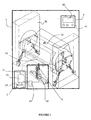
- the weighing device is applicable to washing machines (3) of the type equipped with a raised tank (31).
- the weighing device comprises a lifting means actuated by a control member (13), a force sensor (6) and a user interface (4) connected to a processing unit (2).
- the lifting means comprises a motor cylinder electric provided with a worm driven up and down by the control member (13).
- Other robust lifting means can naturally be envisaged, for example a hydraulic cylinder, a cable system or any other known system.
- this lifting means has an upper free end (11) which supports the force sensor (6).
- the force is a vector and is characterized by an amplitude, a direction and a point of support.
- the term "force” used in the expression "force sensor” is used to denote any cause capable of producing, preventing, modifying the movement of a mechanism, or of deforming it.
- the force sensor (6) is arranged to be sensitive to a vertical component to enable measurement of the weight of the laundry loaded in the tub (31) of the washing machine.
- the assembly formed by the jack (10) and the force sensor (6) is positioned under the tank (31).
- the processing unit (2) provided with at least one microprocessor (20), controls the control member (13) so that the jack (10) rises from a low position to a high position. determined where the force sensor (6) is supported by at least one point of support with the underside of tank (31).
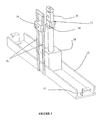
- the jack (10) with electric motorization is wedged on a support provided with at least one substantially horizontal spar (12) and arranged for example longitudinally or across the washing machine ( 3).
- the support also comprises a mobile device (15) vertically along one or more rails (16), the mobile device (15) being secured to the upper end (11) of the cylinder (10) to form an anti rotation for the cylinder (10).
- Fixing the movable device (15) to the jack (10) can be carried out with in particular a fixing rod (14) or any usual fastening element.
- the tank (31) is suspended from a frame secured to the frame (30) by damping means (35) and the arrangement of the force sensor (6) is sufficiently far from the bottom of the tank (31) in the lower position of the jack (10). This position of the sensor (6) remote from the tank (31) corresponds to a displacement greater than the maximum displacement of the tank (31) allowed by the damping means (35).
- the support of the jack (10) may comprise fastening means (17) to the frame (30) or any fixed element of the washing machine (3), in order to wedge the jack (10) when it starts in constraint by raising the sensor and the tank (31).
- the two longitudinal members (12) in FIG. 2 are for example made of stainless steel or other similar resistance material for locking the jack during weighing.
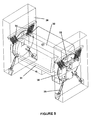
- the washing machine (3) may be of the type equipped with a plurality of dampers (35) supporting the raised tank (31).
- the drum (32) is mounted in the bowl (31) which is held by springs (34). It is understood that the tank assembly (31) with the drum (32) has a degree of freedom to move vertically, which allows the weighing of this set.
- the washing machine (3) is further equipped with an unbalance detector (33) and a counterweight sidewall (36).
- the force sensor (6) is lifted by the jack (10) to come into contact with the underside of the tank (31) when it is not yet loaded. Then the loading causes an increase in the reaction of the sensor (6) in response to the increase of the weight of the tank and its contents.
- the force sensor (6) thus arranged makes it possible to measure the load of laundry which is placed in the drum (32) of the washing machine (3).
- conversion means (21) are connected to an electrical output of the force sensor (6) to transform the signal representative of the weight of the tank with its content delivered by the sensor (6). in data representative of the charge introduced into the tank (31). The data representative of the charge obtained are transmitted to acquisition means (22) of the processing unit (2).
- These acquisition means (22) comprise for example a memory for storing the load data of the laundry introduced into the drum (32) of the tank (31).
- the user interface (4) comprises means (40) for displaying information representative of these load data introduced for informing an operator in real time of the quantity of laundry already introduced into the machine (3).
- the user interface also comprises triggering means (41) weighing, operable when the lifting means is in the low position. These triggering means consist for example of a button which causes a series of operations leading to tare the tank (31) empty.
- the force sensor comprises a test body and at least one strain gauge integral with the test body to measure the mechanical deformation of the latter.
- the test body of the force sensor (6) consists of an S-bar.
- One or more active strain gauges are glued to this test body to measure the bending of the test body when the cylinder is in the high position.
- the force sensor (6) with S-bar is for example equipped with 4 glued active gauges measuring the bending of the test body.
- Such a sensor (6) eliminates friction phenomena and ensures high repeatability of measurements and excellent accuracy, of the order of 100g. For the display of the weighing result on the user interface (4), the accuracy can be brought to 1 kg or 0.1 kg.
- the resolution allowed with such a sensor (6) is also extremely high.
- the gauges used may be diffused piezoresistive gauges, ion implantation, thin film, epitaxial.
- the force sensor (6) is sufficiently strong to equip large capacity washing machines, accepting a load of laundry weighing more than 65 kg.
- the sensor (6) comprises for example a test body capable of withstanding a load of the order of 200 kg.
- the weighing process according to the invention first starts with an initial control step (50) by using the triggering means of the user interface (4).
- the operator for example presses a button (41) command to trigger this process.
- This control button (41) can trigger the only weighing function or enable the start of a washing cycle starting with the weighing process according to the invention.
- the initial control step (50) provides the control member (13) with a signal for actuating the raising of the jack (10) initially in the down position, the jack being moved up to at a determined high position substantially corresponding to the level of the bottom of the tank, the force sensor (6) disposed at the end of the jack (10) lifting the tank (31).
- the step (51) for raising the jack (10) brings the force sensor (6) to a point of support from below the tank (31).
- a force sensor (6) with several branches to bear in different parts of the tank.
- a step (52) of calibration of the tank (31) is carried out by a first measurement of the sensor (6) carried out after the lapse of a determined time interval to from the support of the force sensor (6) under the tank (31).
- This time interval is provided for the position of the tank (31) to stabilize. Indeed, the contact of the sensor (6) lifting the tank (31) causes oscillations due to the reaction of the holding means of the tank (31) constituted by the springs (34) and the dampers (35).
- the time interval thus also corresponds to the stabilization time of the measured value for the weight of the tank before loading.
- the duration of this time interval may be for example between 10 and 20 seconds.
- the force sensor (6) once in contact with the tank (31), can be used to measure the weight of the tank (31) and its contents.
- the sensor (6) has for example an electrical output providing a voltage signal between 0 and 10V to represent the weight exerted on the sensor (6). This voltage signal is continuously transformed into load data by the conversion means (21). Thus, when the sensor (6) is in the high position, it is the voltage signal is representative of the weight of the tank and its contents, the load data corresponding to the mass raised.
- the processing unit (2) comprises a program for exploiting the load data to extract, after the lapse of the determined time interval for setting the empty tank, the first measurement used to tare the tank.
- this program makes it possible, from this first measurement, to zero and thus to display on the display means (40) measurements representative of the added charge in the tank (31).
- this first measurement may be replaced by an average measurement calculated from a plurality of measurements made after the determined time interval.
- the laundry loading step (5) is performed after the zeroing step (53) subsequent to the setting step (52), as illustrated in FIG. step (53) of zeroing includes zeroing the display of the load data on the display means (40), which then allows an operator to be able to continuously monitor the amount of charge introduced into the washing machine (3).
- the end of the loading is detected (500) for example by closing one or more doors of the washing machine or by actuating a start button or continuing a wash cycle, or combination of these events.
- the weighing process continues after loading by a step (54) of determination by the processing unit (2) of the feed introduced into the tank (31).
- This step (54) comprises processing at least a second measurement performed by the force sensor (6) after the detection (500) of the end of the loading and before water supply. This second measurement therefore allows the determination of the load of introduced laundry.
- This second measure can naturally correspond to an average measurement obtained from a plurality of measurements made after detection (500) of the end of loading and before water supply.
- the weighing process ends with a step (55) for disengaging the force sensor (6) by actuating the cylinder (10) to descend to its initial low position.
- a normal wash cycle can then be performed.
- a step (56) for dosing the quantity of water and / or detergents can be carried out at this stage by using the value of the laundry load introduced into the tank (31) determined during step (54). load determination.
- the determined load before water supply is taken into account by a machine washing cycles management automat of the washing machine to calculate the quantity of water and possibly the quantity of detergent products to provide and thus optimize the load ratio.
- the quantities of water and detergents can thus be adjusted according to the weight of the laundry.
- the doses provided for maximum load can thus be reduced when the load of laundry is actually less than the capacity of the machine.
- the machine for managing washing cycles of the washing machine can very well integrate the processing unit (2).
- the weighing process makes it possible to maintain parameters relating to the load of laundry.
- the recording of charge parameters obtained with the device according to the invention as well as possibly operating parameters such as temperature allows the constitution of a traceability system for washing machine. It is therefore understood that the device can be used in such a system, the data representative of the charge introduced into the tank (31) at a given date and time being transmitted from the acquisition means (22) of the unit of processing (2) to a file for storing traceability parameters of a machine for managing washing cycles of the washing machine.
- a registration order is for example sent to the processing unit by the management controller when a wash cycle is programmed.
- the automaton can very well integrate the processing unit (2).
- FIG. 4 shows an exemplary connection diagram that can be associated with the processing unit (2), with the force sensor (6) for collecting load data and a temperature sensor (63) coupled to a converter temperature (64).
- the temperature probe is for example of the Pt100 type.
- the force sensor (6) is connected to a signal conditioner (65) itself supplied with unidirectional current by a rectifier transformer (66).
- the processing unit (2) comprises a supply interface for example connected to the energy sources (600) which supply the rectifying transformer (66).
- the unit (2) comprises two electronic processing boards (61, 62), the first board (61) being of the input / output type and receiving data from the force sensor (6) and the temperature converter (64). through its input interface.
- the second card (62) includes an output interface for controlling control of the jack (10).
- This second card drives a reversing relay (130) of the jack, the latter (10) being supplied with unidirectional current during the step of raising (51) or disengaging (55) by a rectifier card (67) connected to a transformer (68).
- One of the advantages of the device according to the invention lies in the ease of integrating it with a laundry washing machine. Furthermore, the device is completely separable from the tank, the jack being lifted only for the time of weighing. before starting the normal wash cycle.
- Another advantage of the invention is to allow to weigh only the tank and what it contains, not the entire washing machine.
Landscapes
- Physics & Mathematics (AREA)
- General Physics & Mathematics (AREA)
- Engineering & Computer Science (AREA)
- Textile Engineering (AREA)
- Control Of Washing Machine And Dryer (AREA)
- Cleaning By Liquid Or Steam (AREA)
Claims (12)
- Einrichtung zum Wiegen für eine Waschmaschine (3) vom Typ mit hochgestellter Waschtrommel (31), die einen einer vertikalen Komponenten entsprechenden Freiheitsgrad aufweist, wobei die o. g. Einrichtung eine von einem Steuerorgan (13) betätigte Hebevorrichtung, einen Kraftwandler (6) und eine mit einer Ablaufsteuereinheit (2) verbundene Benutzerschnittstelle (4) umfasst, dadurch gekennzeichnet, dass die Hebevorrichtung einen freien oberen Ansatz (11) aufweist, die den Kraftwandler (6) trägt, und die Ablaufsteuereinheit (2) das Steuerorgan (13) zum Anheben der Hebevorrichtung aus einer tiefen Stellung in eine vorbestimmte hohe Stellung steuert, in der der Kraftwandler (6) in mindestens einem Stützpunkt den unteren Teil der Waschtrommel (31) der Waschmaschine (3) berührt, wobei Wandlerinstrumente (21) an einen elektrischen Anschluss des Kraftwandlers (6) angeschlossen sind, um ein für das Gewicht der Waschtrommel samt ihrem Inhalt kennzeichnendes Signal in kennzeichnende Daten für die in die Waschtrommel (31) eingeführte Ladung umzuwandeln, wobei diese die Ladung kennzeichnenden Daten den Verarbeitungsmitteln (22) der Ablaursteuereinheit (2) zugeführt werden.
- Einrichtung zum Wiegen nach Anspruch 1, wobei die Hebevorrichtung aus einer Hebereinrichtung (10) mit Elektromotor besteht, die mit einer Endlosschraube versehen ist, die beim Auf- und Absteigen von dem Steuerorgan (13) gesteuert wird.
- Einrichtung zum Wiegen nach Anspruch 2, wobei die elektrische Hebeeinrichtung (10) auf einem Träger befestigt ist, der mit mindestens einem im Wesentlichen horizontalen Holm (12) und einer auf der Vertikalen entlang mindestens einer Schiene beweglichen Vorrichtung (15) versehen ist, wobei die bewegliche Vorrichtung (15) mit dem oberen Ansatz (11) der Hebeeinrichtung (10) fest verbunden ist, um eine Antirotations-Vorrichtung für die Hebeeinrichtung (10) zu bilden.
- Einrichtung zum Wiegen nach einem der Ansprüche 1 bis 3, wobei der Kraftwandler (6) einen Probekörper und mindestens einen mit dem Probekörper fest verbundenen extensiometrischen Prüfstab beinhaltet, um die mechanische Verformung von Letzterem zu messen.
- Einrichtung zum Wiegen nach einem der Ansprüche 1 bis 3, wobei der Kraftwandler (6) einen Probekörper umfasst, der aus einem S-förmigen Stab besteht, mit dem mindestens ein aktives Tensiometer, das die Biegung des Probekörpers misst, verbunden ist.
- Einrichtung zum Wiegen nach einem der Ansprüche 1 bis 5, wobei die Benutzerschnittstelle ein Anzeigeteil (40) für kennzeichnende Informationen über die Daten der eingeführten Ladung sowie Auslösemittel (41) eines Wiegevorgangs, die im Moment, wenn sich die Hebevorrichtung in einer tiefen Stellung befindet, betätigt werden können, umfasst.
- Einrichtung zum Wiegen nach einem der Ansprüche 1 bis 6, wobei der elektrische Anschluss des Kraftwandlers (6) ein Spannungssignal zwischen 1 und 10 V liefert, das für das auf den Kraftwandler (6) einwirkende Gewicht kennzeichnend ist, wobei das Spannungssignal kontinuierlich mittels der Wandlerinstrumente (21) in der Ladung entsprechende Daten umgewandelt wird, wobei die Ablaufsteuereinheit (2) ein Programm zur Verarbeitung der der Ladung entsprechende Daten umfasst, um eine erste Messung nach Ablauf eines für die Austarierung der leeren Waschtrommel (31) vorgesehenen vorbestimmten Zeitintervalls auszuführen, um dann diese erste Messung zur Nulleinstellung zu verwenden und somit auf dem Anzeigeteil (40) für die der Waschtrommel (31) zugeführte Ladung kennzeichnende Messungen anzuzeigen.
- Einrichtung zum Wiegen nach einem der Ansprüche 1 bis 7, wobei die Waschtrommel (31) an einem Chassis mittels Dämpfungselementen (35) aufgehängt ist, und die Anordnung des Kraftwandlers (6) in der tiefen Stellung der Hebevorrichtung einer über die maximale von den Dämpfungselementen (35) erlaubten Verschiebung der Waschtrommel (31) hinausgehenden Verschiebung entspricht.
- Verfahren zum Wiegen für eine Waschmaschine vom Typ mit hochgestellter Waschtrommel, die einen einer vertikalen Komponenten entsprechenden Freiheitsgrad aufweist, mit einer Wiegeeinrichtung nach einem der Ansprüche 1 bis 8, wobei das genannte Verfahren dadurch gekennzeichnet ist, dass es dem Beladen der Waschmaschine (3) vorausgehend die folgenden Schritte umfasst:- Verwendung der Benutzerschnittstelle (4) durch einen Betreiber, um einen Wiegevorgang auszulösen,- Anheben der vom Steuerorgan (13) betätigten Hebevorrichtung in eine vorbestimmte hohe Stellung zum Heranführen des Kraftwandlers (6) zu mindestens einem Stützpunkt mit dem unteren Teil der Waschtrommel (31) der Waschmaschine (3),- Austarieren der Waschtrommel (31) durch mindestens eine nach Ablauf eines vorbestimmten Zeitintervalls ausgeführte erste Messung des Wandlers (6), ausgehend vom Zeitpunkt der Abstützung des Kraftwandlers (6) unter der Waschtrommel (31), wobei die erste Messung von der Ablaufsteuereinheit (2) zur Nulleinstellung der Daten, welche für die in die Waschtrommel (31) eingeführte Ladung kennzeichnend ist, verwendet wird, wobei die für die Ladung kennzeichnenden Daten auf einer Anzeige der Benutzerschnittstelle (4) angezeigt werden,- nach dem Beladen der Waschmaschine (3) und vor der Wasseraufnahme einen Schritt zur Bestimmung der in die Waschtrommel (31) eingeführten Ladung durch die Ablaufsteuereinheit (2) durch Verarbeitung von mindestens einer zweiten, vom Kraftwandler (6) ausgeführten Messung und einen Schritt zur Trennung des Kraftwandlers (6) durch Absenken der Hebevorrichtung.
- Verfahren zum Wiegen nach Anspruch 9, wobei die vor der Wasseraufnahme bestimmte Ladung von einem automatischen System zur Verwaltung der Waschzyklen der Waschmaschine (3) erfasst wird, um die aufzunehmende Wassermenge zur Optimierung des Ladungsverhältnisses zu berechnen.
- Verfahren zum Wiegen nach Anspruch 9 oder 10, wobei das vorbestimmte Zeitintervall möglichst genau der Dauer des Einpendelns des für das Gewicht der Waschtrommel (31) vor dem Beladen gemessenen Wertes entspricht.
- Verwendung der Einrichtung zum Wiegen nach einem der Ansprüche 1 bis 8 bei einem Wäscheerkennungssystem, dadurch gekennzeichnet, dass die der in die Waschtrommel (31) der Waschmaschine (3) zu einem bestimmten Datum und einer bestimmten Uhrzeit eingeführt Ladung entsprechenden Daten, von den Aufnahmemitteln (22) der Ablaufsteuereinheit (2) einer Speicherdatei für Erkennungsparameter eines automatischen Systems zur Verwaltung der Waschzyklen der Waschmaschine (3) zugeführt werden, wobei ein Registrierbefehl von dem automatischen Verwaltungssystem zur Ablaufsteuereinheit (2) in dem Zeitpunkt versandt wird, wenn ein Waschzyklus programmiert wird.
Priority Applications (1)
| Application Number | Priority Date | Filing Date | Title |
|---|---|---|---|
| SI200430218T SI1498705T1 (sl) | 2003-07-18 | 2004-07-02 | Postopek in naprava za tehtanje v pralnem stroju in njihova uporaba pri sledenju |
Applications Claiming Priority (2)
| Application Number | Priority Date | Filing Date | Title |
|---|---|---|---|
| FR0308849 | 2003-07-18 | ||
| FR0308849A FR2857745B1 (fr) | 2003-07-18 | 2003-07-18 | Procede et dispositif de pesage pour machine a laver, utilisation dans un systeme de tracabilite |
Publications (2)
| Publication Number | Publication Date |
|---|---|
| EP1498705A1 EP1498705A1 (de) | 2005-01-19 |
| EP1498705B1 true EP1498705B1 (de) | 2006-12-13 |
Family
ID=33462568
Family Applications (1)
| Application Number | Title | Priority Date | Filing Date |
|---|---|---|---|
| EP04291675A Expired - Lifetime EP1498705B1 (de) | 2003-07-18 | 2004-07-02 | Verfahren und Einrichtung zum Wiegen für eine Waschmaschine und dessen Verwendung in einem System zur Ablaufverfolgung |
Country Status (5)
| Country | Link |
|---|---|
| EP (1) | EP1498705B1 (de) |
| AT (1) | ATE348318T1 (de) |
| DE (1) | DE602004003637D1 (de) |
| FR (1) | FR2857745B1 (de) |
| SI (1) | SI1498705T1 (de) |
Families Citing this family (3)
| Publication number | Priority date | Publication date | Assignee | Title |
|---|---|---|---|---|
| DE102005042382A1 (de) * | 2005-09-06 | 2007-03-08 | Herbert Kannegiesser Gmbh | Verfahren zum Aufteilen eines Wäschepostens und Vorrichtung zur Behandlung von Wäsche |
| EP2659050B1 (de) * | 2010-12-27 | 2015-10-14 | Arçelik Anonim Sirketi | Waschmaschine mit einem lastsensor |
| US20130312202A1 (en) | 2011-08-15 | 2013-11-28 | Whirlpool Corporation | Method for real time determination during loading of volumetric load size in a laundry treating appliance |
Family Cites Families (3)
| Publication number | Priority date | Publication date | Assignee | Title |
|---|---|---|---|---|
| DE1157578B (de) * | 1958-07-26 | 1963-11-21 | Constructa Werke G M B H | Waschmaschine mit einer in Abhaengigkeit von der Waeschemenge selbsttaetig gesteuerten Einstellvorrichtung fuer den Flottenstand |
| DE3933785A1 (de) * | 1988-11-18 | 1991-04-18 | Licentia Gmbh | Beladungsmengenanzeige, insbesondere bei haushaltwaschmaschinen |
| JPH04500474A (ja) * | 1989-05-03 | 1992-01-30 | ベーエスゲー―シャルトテヒニク ゲゼルシャフト ミット ベシュレンクテル ハフツング ウント コンパニー コマンディト ゲゼルシャフト | 洗濯機 |
-
2003
- 2003-07-18 FR FR0308849A patent/FR2857745B1/fr not_active Expired - Fee Related
-
2004
- 2004-07-02 DE DE602004003637T patent/DE602004003637D1/de not_active Expired - Lifetime
- 2004-07-02 AT AT04291675T patent/ATE348318T1/de not_active IP Right Cessation
- 2004-07-02 EP EP04291675A patent/EP1498705B1/de not_active Expired - Lifetime
- 2004-07-02 SI SI200430218T patent/SI1498705T1/sl unknown
Also Published As
| Publication number | Publication date |
|---|---|
| SI1498705T1 (sl) | 2007-06-30 |
| EP1498705A1 (de) | 2005-01-19 |
| FR2857745B1 (fr) | 2005-09-02 |
| FR2857745A1 (fr) | 2005-01-21 |
| DE602004003637D1 (de) | 2007-01-25 |
| ATE348318T1 (de) | 2007-01-15 |
Similar Documents
| Publication | Publication Date | Title |
|---|---|---|
| CN102460062B (zh) | 布料厚度测量装置及布料厚度测量方法 | |
| EP1498705B1 (de) | Verfahren und Einrichtung zum Wiegen für eine Waschmaschine und dessen Verwendung in einem System zur Ablaufverfolgung | |
| US10495557B2 (en) | Hardness tester and hardness testing method | |
| US10823604B2 (en) | Combination weighing device which uses different parameters to control conveying units | |
| CN101080616B (zh) | 带有风挡的电子秤 | |
| WO2019058433A1 (ja) | 液体クロマトグラフ及び液量検知方法 | |
| JP2008057988A (ja) | デジタル重量計 | |
| US20160041086A1 (en) | Lubrication control system and related method of use | |
| JP5066456B2 (ja) | 燃料量検出装置 | |
| EP0214169B1 (de) | Vorrichtung zur auswertung psychotropisch wirkender medikamente bei versuchstieren | |
| JPH04500998A (ja) | レベル表示器付き熱可塑性樹脂溶融装置 | |
| US10969317B2 (en) | Hardness testing system using multiple depth measurements and related methods | |
| US9568353B2 (en) | Measurement system, measurement method of measurement device, measurement device, and non-transitory storage medium encoded with computer readable control program, capable of completing measurement in simple manner and promptly | |
| KR20190023709A (ko) | 연속측정 비중계 및 비중 연속측정 방법 | |
| JP6971008B2 (ja) | 含水率連続測定方法および含水率連続測定装置 | |
| US11474015B2 (en) | Viscosity measurement unit and viscometer | |
| CN119984463B (zh) | 动态称重系统、积分仪的测量精度推荐方法、装置及设备 | |
| EP1108993A3 (de) | Vorrichtung und Verfahren zum Wiegen eines sich bewegenden Objektes | |
| JP2008202939A (ja) | 電子天びん | |
| CN208254585U (zh) | 智能重锤料位计 | |
| EP1219947A1 (de) | Verfahren zur penetrometrischen Messung der Konsistenz von Substanzen und Vorrichtung zur Umsetzung des Verfahrens | |
| FR2581184A1 (fr) | Systeme de mesure de masse a plateau de pesee et transducteur mecano-electrique. | |
| RU25084U1 (ru) | Весовой дозатор дискретного действия с устройством компенсации веса тары | |
| EP3470836A1 (de) | Gerät zum messen der absorptionsfähigkeit eines absorbierenden papiers | |
| KR101638356B1 (ko) | 커피자판기의 원료통 매진감지 장치 |
Legal Events
| Date | Code | Title | Description |
|---|---|---|---|
| PUAI | Public reference made under article 153(3) epc to a published international application that has entered the european phase |
Free format text: ORIGINAL CODE: 0009012 |
|
| AK | Designated contracting states |
Kind code of ref document: A1 Designated state(s): AT BE BG CH CY CZ DE DK EE ES FI FR GB GR HU IE IT LI LU MC NL PL PT RO SE SI SK TR |
|
| AX | Request for extension of the european patent |
Extension state: AL HR LT LV MK |
|
| AKX | Designation fees paid | ||
| 17P | Request for examination filed |
Effective date: 20050905 |
|
| RBV | Designated contracting states (corrected) |
Designated state(s): AT BE BG CH CY CZ DE DK EE ES FI FR GB GR HU IE IT LI LU MC NL PL PT RO SE SI SK TR |
|
| REG | Reference to a national code |
Ref country code: DE Ref legal event code: 8566 |
|
| GRAP | Despatch of communication of intention to grant a patent |
Free format text: ORIGINAL CODE: EPIDOSNIGR1 |
|
| GRAS | Grant fee paid |
Free format text: ORIGINAL CODE: EPIDOSNIGR3 |
|
| GRAA | (expected) grant |
Free format text: ORIGINAL CODE: 0009210 |
|
| AK | Designated contracting states |
Kind code of ref document: B1 Designated state(s): AT BE BG CH CY CZ DE DK EE ES FI FR GB GR HU IE IT LI LU MC NL PL PT RO SE SI SK TR |
|
| PG25 | Lapsed in a contracting state [announced via postgrant information from national office to epo] |
Ref country code: IE Free format text: LAPSE BECAUSE OF FAILURE TO SUBMIT A TRANSLATION OF THE DESCRIPTION OR TO PAY THE FEE WITHIN THE PRESCRIBED TIME-LIMIT Effective date: 20061213 Ref country code: IT Free format text: LAPSE BECAUSE OF FAILURE TO SUBMIT A TRANSLATION OF THE DESCRIPTION OR TO PAY THE FEE WITHIN THE PRESCRIBED TIME-LIMIT;WARNING: LAPSES OF ITALIAN PATENTS WITH EFFECTIVE DATE BEFORE 2007 MAY HAVE OCCURRED AT ANY TIME BEFORE 2007. THE CORRECT EFFECTIVE DATE MAY BE DIFFERENT FROM THE ONE RECORDED. Effective date: 20061213 Ref country code: FI Free format text: LAPSE BECAUSE OF FAILURE TO SUBMIT A TRANSLATION OF THE DESCRIPTION OR TO PAY THE FEE WITHIN THE PRESCRIBED TIME-LIMIT Effective date: 20061213 Ref country code: AT Free format text: LAPSE BECAUSE OF FAILURE TO SUBMIT A TRANSLATION OF THE DESCRIPTION OR TO PAY THE FEE WITHIN THE PRESCRIBED TIME-LIMIT Effective date: 20061213 Ref country code: RO Free format text: LAPSE BECAUSE OF FAILURE TO SUBMIT A TRANSLATION OF THE DESCRIPTION OR TO PAY THE FEE WITHIN THE PRESCRIBED TIME-LIMIT Effective date: 20061213 Ref country code: SK Free format text: LAPSE BECAUSE OF FAILURE TO SUBMIT A TRANSLATION OF THE DESCRIPTION OR TO PAY THE FEE WITHIN THE PRESCRIBED TIME-LIMIT Effective date: 20061213 Ref country code: NL Free format text: LAPSE BECAUSE OF FAILURE TO SUBMIT A TRANSLATION OF THE DESCRIPTION OR TO PAY THE FEE WITHIN THE PRESCRIBED TIME-LIMIT Effective date: 20061213 Ref country code: PL Free format text: LAPSE BECAUSE OF FAILURE TO SUBMIT A TRANSLATION OF THE DESCRIPTION OR TO PAY THE FEE WITHIN THE PRESCRIBED TIME-LIMIT Effective date: 20061213 |
|
| REG | Reference to a national code |
Ref country code: GB Ref legal event code: FG4D Free format text: NOT ENGLISH |
|
| REG | Reference to a national code |
Ref country code: CH Ref legal event code: EP |
|
| REG | Reference to a national code |
Ref country code: IE Ref legal event code: FG4D Free format text: LANGUAGE OF EP DOCUMENT: FRENCH |
|
| REF | Corresponds to: |
Ref document number: 602004003637 Country of ref document: DE Date of ref document: 20070125 Kind code of ref document: P |
|
| PG25 | Lapsed in a contracting state [announced via postgrant information from national office to epo] |
Ref country code: BG Free format text: LAPSE BECAUSE OF FAILURE TO SUBMIT A TRANSLATION OF THE DESCRIPTION OR TO PAY THE FEE WITHIN THE PRESCRIBED TIME-LIMIT Effective date: 20070313 Ref country code: SE Free format text: LAPSE BECAUSE OF FAILURE TO SUBMIT A TRANSLATION OF THE DESCRIPTION OR TO PAY THE FEE WITHIN THE PRESCRIBED TIME-LIMIT Effective date: 20070313 |
|
| PG25 | Lapsed in a contracting state [announced via postgrant information from national office to epo] |
Ref country code: DE Free format text: LAPSE BECAUSE OF FAILURE TO SUBMIT A TRANSLATION OF THE DESCRIPTION OR TO PAY THE FEE WITHIN THE PRESCRIBED TIME-LIMIT Effective date: 20070314 |
|
| PG25 | Lapsed in a contracting state [announced via postgrant information from national office to epo] |
Ref country code: ES Free format text: LAPSE BECAUSE OF FAILURE TO SUBMIT A TRANSLATION OF THE DESCRIPTION OR TO PAY THE FEE WITHIN THE PRESCRIBED TIME-LIMIT Effective date: 20070324 |
|
| PG25 | Lapsed in a contracting state [announced via postgrant information from national office to epo] |
Ref country code: PT Free format text: LAPSE BECAUSE OF FAILURE TO SUBMIT A TRANSLATION OF THE DESCRIPTION OR TO PAY THE FEE WITHIN THE PRESCRIBED TIME-LIMIT Effective date: 20070514 |
|
| NLV1 | Nl: lapsed or annulled due to failure to fulfill the requirements of art. 29p and 29m of the patents act | ||
| GBV | Gb: ep patent (uk) treated as always having been void in accordance with gb section 77(7)/1977 [no translation filed] |
Effective date: 20061213 |
|
| PLBE | No opposition filed within time limit |
Free format text: ORIGINAL CODE: 0009261 |
|
| STAA | Information on the status of an ep patent application or granted ep patent |
Free format text: STATUS: NO OPPOSITION FILED WITHIN TIME LIMIT |
|
| 26N | No opposition filed |
Effective date: 20070914 |
|
| PG25 | Lapsed in a contracting state [announced via postgrant information from national office to epo] |
Ref country code: GB Free format text: LAPSE BECAUSE OF FAILURE TO SUBMIT A TRANSLATION OF THE DESCRIPTION OR TO PAY THE FEE WITHIN THE PRESCRIBED TIME-LIMIT Effective date: 20061213 |
|
| PG25 | Lapsed in a contracting state [announced via postgrant information from national office to epo] |
Ref country code: MC Free format text: LAPSE BECAUSE OF NON-PAYMENT OF DUE FEES Effective date: 20070731 Ref country code: GR Free format text: LAPSE BECAUSE OF FAILURE TO SUBMIT A TRANSLATION OF THE DESCRIPTION OR TO PAY THE FEE WITHIN THE PRESCRIBED TIME-LIMIT Effective date: 20070314 |
|
| PG25 | Lapsed in a contracting state [announced via postgrant information from national office to epo] |
Ref country code: EE Free format text: LAPSE BECAUSE OF FAILURE TO SUBMIT A TRANSLATION OF THE DESCRIPTION OR TO PAY THE FEE WITHIN THE PRESCRIBED TIME-LIMIT Effective date: 20061213 |
|
| REG | Reference to a national code |
Ref country code: CH Ref legal event code: PL |
|
| PG25 | Lapsed in a contracting state [announced via postgrant information from national office to epo] |
Ref country code: LI Free format text: LAPSE BECAUSE OF NON-PAYMENT OF DUE FEES Effective date: 20080731 Ref country code: CH Free format text: LAPSE BECAUSE OF NON-PAYMENT OF DUE FEES Effective date: 20080731 |
|
| PG25 | Lapsed in a contracting state [announced via postgrant information from national office to epo] |
Ref country code: CY Free format text: LAPSE BECAUSE OF FAILURE TO SUBMIT A TRANSLATION OF THE DESCRIPTION OR TO PAY THE FEE WITHIN THE PRESCRIBED TIME-LIMIT Effective date: 20061213 Ref country code: LU Free format text: LAPSE BECAUSE OF NON-PAYMENT OF DUE FEES Effective date: 20070702 Ref country code: DK Free format text: LAPSE BECAUSE OF FAILURE TO SUBMIT A TRANSLATION OF THE DESCRIPTION OR TO PAY THE FEE WITHIN THE PRESCRIBED TIME-LIMIT Effective date: 20070313 |
|
| PG25 | Lapsed in a contracting state [announced via postgrant information from national office to epo] |
Ref country code: TR Free format text: LAPSE BECAUSE OF FAILURE TO SUBMIT A TRANSLATION OF THE DESCRIPTION OR TO PAY THE FEE WITHIN THE PRESCRIBED TIME-LIMIT Effective date: 20061213 Ref country code: HU Free format text: LAPSE BECAUSE OF FAILURE TO SUBMIT A TRANSLATION OF THE DESCRIPTION OR TO PAY THE FEE WITHIN THE PRESCRIBED TIME-LIMIT Effective date: 20070614 |
|
| REG | Reference to a national code |
Ref country code: FR Ref legal event code: PLFP Year of fee payment: 13 |
|
| PGFP | Annual fee paid to national office [announced via postgrant information from national office to epo] |
Ref country code: CZ Payment date: 20160622 Year of fee payment: 13 |
|
| PGFP | Annual fee paid to national office [announced via postgrant information from national office to epo] |
Ref country code: FR Payment date: 20160427 Year of fee payment: 13 |
|
| PGFP | Annual fee paid to national office [announced via postgrant information from national office to epo] |
Ref country code: SI Payment date: 20160621 Year of fee payment: 13 |
|
| PGFP | Annual fee paid to national office [announced via postgrant information from national office to epo] |
Ref country code: BE Payment date: 20160729 Year of fee payment: 13 |
|
| PG25 | Lapsed in a contracting state [announced via postgrant information from national office to epo] |
Ref country code: CZ Free format text: LAPSE BECAUSE OF NON-PAYMENT OF DUE FEES Effective date: 20170702 |
|
| REG | Reference to a national code |
Ref country code: FR Ref legal event code: ST Effective date: 20180330 |
|
| PG25 | Lapsed in a contracting state [announced via postgrant information from national office to epo] |
Ref country code: FR Free format text: LAPSE BECAUSE OF NON-PAYMENT OF DUE FEES Effective date: 20170731 Ref country code: SI Free format text: LAPSE BECAUSE OF NON-PAYMENT OF DUE FEES Effective date: 20170703 |
|
| REG | Reference to a national code |
Ref country code: BE Ref legal event code: MM Effective date: 20170731 |
|
| REG | Reference to a national code |
Ref country code: SI Ref legal event code: KO00 Effective date: 20180320 |
|
| PG25 | Lapsed in a contracting state [announced via postgrant information from national office to epo] |
Ref country code: BE Free format text: LAPSE BECAUSE OF NON-PAYMENT OF DUE FEES Effective date: 20170731 |