EP1493852B1 - Polyethylennaphthalat-Fasern mit hoher Festigkeit - Google Patents
Polyethylennaphthalat-Fasern mit hoher Festigkeit Download PDFInfo
- Publication number
- EP1493852B1 EP1493852B1 EP04001841A EP04001841A EP1493852B1 EP 1493852 B1 EP1493852 B1 EP 1493852B1 EP 04001841 A EP04001841 A EP 04001841A EP 04001841 A EP04001841 A EP 04001841A EP 1493852 B1 EP1493852 B1 EP 1493852B1
- Authority
- EP
- European Patent Office
- Prior art keywords
- yarn
- polyethylene naphthalate
- cord
- fiber
- melt
- Prior art date
- Legal status (The legal status is an assumption and is not a legal conclusion. Google has not performed a legal analysis and makes no representation as to the accuracy of the status listed.)
- Expired - Lifetime
Links
- 239000000835 fiber Substances 0.000 title claims abstract description 43
- -1 polyethylene naphthalate Polymers 0.000 claims abstract description 87
- 229920003207 poly(ethylene-2,6-naphthalate) Polymers 0.000 claims abstract description 58
- 239000011112 polyethylene naphthalate Substances 0.000 claims abstract description 58
- VYPSYNLAJGMNEJ-UHFFFAOYSA-N silicon dioxide Inorganic materials O=[Si]=O VYPSYNLAJGMNEJ-UHFFFAOYSA-N 0.000 claims abstract description 46
- 239000000377 silicon dioxide Substances 0.000 claims abstract description 32
- 238000000034 method Methods 0.000 claims abstract description 26
- 238000001816 cooling Methods 0.000 claims abstract description 17
- 239000000463 material Substances 0.000 claims abstract description 14
- 230000002787 reinforcement Effects 0.000 claims abstract description 13
- 238000002074 melt spinning Methods 0.000 claims abstract description 6
- 239000007787 solid Substances 0.000 claims abstract description 6
- 229920001971 elastomer Polymers 0.000 claims abstract description 5
- 239000011324 bead Substances 0.000 claims description 18
- 238000002844 melting Methods 0.000 claims description 11
- 230000008018 melting Effects 0.000 claims description 11
- 238000010438 heat treatment Methods 0.000 claims description 8
- 239000002245 particle Substances 0.000 claims description 8
- 239000012298 atmosphere Substances 0.000 claims description 5
- 229910021485 fumed silica Inorganic materials 0.000 claims description 4
- 239000004816 latex Substances 0.000 claims description 3
- 229920000126 latex Polymers 0.000 claims description 3
- 230000000704 physical effect Effects 0.000 abstract description 10
- 229920000642 polymer Polymers 0.000 description 27
- 238000009987 spinning Methods 0.000 description 20
- 230000000052 comparative effect Effects 0.000 description 11
- 238000006116 polymerization reaction Methods 0.000 description 9
- 238000005809 transesterification reaction Methods 0.000 description 9
- 230000008569 process Effects 0.000 description 8
- 239000000155 melt Substances 0.000 description 7
- 229920000139 polyethylene terephthalate Polymers 0.000 description 7
- LYCAIKOWRPUZTN-UHFFFAOYSA-N Ethylene glycol Chemical compound OCCO LYCAIKOWRPUZTN-UHFFFAOYSA-N 0.000 description 6
- GWEVSGVZZGPLCZ-UHFFFAOYSA-N Titan oxide Chemical compound O=[Ti]=O GWEVSGVZZGPLCZ-UHFFFAOYSA-N 0.000 description 6
- 239000003017 thermal stabilizer Substances 0.000 description 6
- 239000003054 catalyst Substances 0.000 description 5
- 230000000694 effects Effects 0.000 description 5
- 239000000203 mixture Substances 0.000 description 5
- RXOHFPCZGPKIRD-UHFFFAOYSA-L naphthalene-2,6-dicarboxylate Chemical compound C1=C(C([O-])=O)C=CC2=CC(C(=O)[O-])=CC=C21 RXOHFPCZGPKIRD-UHFFFAOYSA-L 0.000 description 5
- 229920001778 nylon Polymers 0.000 description 5
- 238000006068 polycondensation reaction Methods 0.000 description 5
- 239000005020 polyethylene terephthalate Substances 0.000 description 5
- 238000005979 thermal decomposition reaction Methods 0.000 description 5
- WXNZTHHGJRFXKQ-UHFFFAOYSA-N 4-chlorophenol Chemical compound OC1=CC=C(Cl)C=C1 WXNZTHHGJRFXKQ-UHFFFAOYSA-N 0.000 description 4
- 239000004677 Nylon Substances 0.000 description 4
- 229910000831 Steel Inorganic materials 0.000 description 4
- 239000000945 filler Substances 0.000 description 4
- 229940090668 parachlorophenol Drugs 0.000 description 4
- 239000002685 polymerization catalyst Substances 0.000 description 4
- 238000010791 quenching Methods 0.000 description 4
- 230000000171 quenching effect Effects 0.000 description 4
- 230000009467 reduction Effects 0.000 description 4
- 239000010959 steel Substances 0.000 description 4
- 239000000853 adhesive Substances 0.000 description 3
- 230000001070 adhesive effect Effects 0.000 description 3
- 238000004519 manufacturing process Methods 0.000 description 3
- 229920000728 polyester Polymers 0.000 description 3
- 239000007790 solid phase Substances 0.000 description 3
- 239000002904 solvent Substances 0.000 description 3
- QPFMBZIOSGYJDE-UHFFFAOYSA-N 1,1,2,2-tetrachloroethane Chemical compound ClC(Cl)C(Cl)Cl QPFMBZIOSGYJDE-UHFFFAOYSA-N 0.000 description 2
- 229920000297 Rayon Polymers 0.000 description 2
- KKEYFWRCBNTPAC-UHFFFAOYSA-N Terephthalic acid Chemical compound OC(=O)C1=CC=C(C(O)=O)C=C1 KKEYFWRCBNTPAC-UHFFFAOYSA-N 0.000 description 2
- WNLRTRBMVRJNCN-UHFFFAOYSA-N adipic acid Chemical compound OC(=O)CCCCC(O)=O WNLRTRBMVRJNCN-UHFFFAOYSA-N 0.000 description 2
- 230000002411 adverse Effects 0.000 description 2
- 239000004760 aramid Substances 0.000 description 2
- 229920006231 aramid fiber Polymers 0.000 description 2
- WERYXYBDKMZEQL-UHFFFAOYSA-N butane-1,4-diol Chemical compound OCCCCO WERYXYBDKMZEQL-UHFFFAOYSA-N 0.000 description 2
- 229910052681 coesite Inorganic materials 0.000 description 2
- 229910052906 cristobalite Inorganic materials 0.000 description 2
- 230000009477 glass transition Effects 0.000 description 2
- 239000004615 ingredient Substances 0.000 description 2
- QQVIHTHCMHWDBS-UHFFFAOYSA-N isophthalic acid Chemical compound OC(=O)C1=CC=CC(C(O)=O)=C1 QQVIHTHCMHWDBS-UHFFFAOYSA-N 0.000 description 2
- BDJRBEYXGGNYIS-UHFFFAOYSA-N nonanedioic acid Chemical compound OC(=O)CCCCCCCC(O)=O BDJRBEYXGGNYIS-UHFFFAOYSA-N 0.000 description 2
- 239000002964 rayon Substances 0.000 description 2
- 229920005989 resin Polymers 0.000 description 2
- 239000011347 resin Substances 0.000 description 2
- CXMXRPHRNRROMY-UHFFFAOYSA-N sebacic acid Chemical compound OC(=O)CCCCCCCCC(O)=O CXMXRPHRNRROMY-UHFFFAOYSA-N 0.000 description 2
- 238000000926 separation method Methods 0.000 description 2
- 230000003068 static effect Effects 0.000 description 2
- 229910052682 stishovite Inorganic materials 0.000 description 2
- VZGDMQKNWNREIO-UHFFFAOYSA-N tetrachloromethane Chemical compound ClC(Cl)(Cl)Cl VZGDMQKNWNREIO-UHFFFAOYSA-N 0.000 description 2
- 239000004408 titanium dioxide Substances 0.000 description 2
- 229910052905 tridymite Inorganic materials 0.000 description 2
- 229910052725 zinc Inorganic materials 0.000 description 2
- DNIAPMSPPWPWGF-VKHMYHEASA-N (+)-propylene glycol Chemical compound C[C@H](O)CO DNIAPMSPPWPWGF-VKHMYHEASA-N 0.000 description 1
- YPFDHNVEDLHUCE-UHFFFAOYSA-N 1,3-propanediol Substances OCCCO YPFDHNVEDLHUCE-UHFFFAOYSA-N 0.000 description 1
- PXGZQGDTEZPERC-UHFFFAOYSA-N 1,4-cyclohexanedicarboxylic acid Chemical compound OC(=O)C1CCC(C(O)=O)CC1 PXGZQGDTEZPERC-UHFFFAOYSA-N 0.000 description 1
- OONPLQJHBJXVBP-UHFFFAOYSA-N 3-(2-phenylethenyl)phthalic acid Chemical compound OC(=O)C1=CC=CC(C=CC=2C=CC=CC=2)=C1C(O)=O OONPLQJHBJXVBP-UHFFFAOYSA-N 0.000 description 1
- 235000003403 Limnocharis flava Nutrition 0.000 description 1
- 244000278243 Limnocharis flava Species 0.000 description 1
- CTQNGGLPUBDAKN-UHFFFAOYSA-N O-Xylene Chemical compound CC1=CC=CC=C1C CTQNGGLPUBDAKN-UHFFFAOYSA-N 0.000 description 1
- ISWSIDIOOBJBQZ-UHFFFAOYSA-N Phenol Chemical compound OC1=CC=CC=C1 ISWSIDIOOBJBQZ-UHFFFAOYSA-N 0.000 description 1
- OAICVXFJPJFONN-UHFFFAOYSA-N Phosphorus Chemical compound [P] OAICVXFJPJFONN-UHFFFAOYSA-N 0.000 description 1
- 238000010521 absorption reaction Methods 0.000 description 1
- 239000002253 acid Substances 0.000 description 1
- 239000000654 additive Substances 0.000 description 1
- 230000000996 additive effect Effects 0.000 description 1
- 235000011037 adipic acid Nutrition 0.000 description 1
- 239000001361 adipic acid Substances 0.000 description 1
- 229910052787 antimony Inorganic materials 0.000 description 1
- 238000007664 blowing Methods 0.000 description 1
- 229910052791 calcium Inorganic materials 0.000 description 1
- 230000008859 change Effects 0.000 description 1
- 239000012141 concentrate Substances 0.000 description 1
- 238000011109 contamination Methods 0.000 description 1
- 238000007796 conventional method Methods 0.000 description 1
- 229920001577 copolymer Polymers 0.000 description 1
- 239000013078 crystal Substances 0.000 description 1
- 238000002425 crystallisation Methods 0.000 description 1
- 230000008025 crystallization Effects 0.000 description 1
- 238000005520 cutting process Methods 0.000 description 1
- 230000003247 decreasing effect Effects 0.000 description 1
- 230000006866 deterioration Effects 0.000 description 1
- 150000001991 dicarboxylic acids Chemical class 0.000 description 1
- 238000007598 dipping method Methods 0.000 description 1
- 238000001035 drying Methods 0.000 description 1
- 238000004043 dyeing Methods 0.000 description 1
- 230000007613 environmental effect Effects 0.000 description 1
- 239000003822 epoxy resin Substances 0.000 description 1
- 230000002349 favourable effect Effects 0.000 description 1
- 229910052732 germanium Inorganic materials 0.000 description 1
- 150000002334 glycols Chemical class 0.000 description 1
- XXMIOPMDWAUFGU-UHFFFAOYSA-N hexane-1,6-diol Chemical compound OCCCCCCO XXMIOPMDWAUFGU-UHFFFAOYSA-N 0.000 description 1
- BHEPBYXIRTUNPN-UHFFFAOYSA-N hydridophosphorus(.) (triplet) Chemical compound [PH] BHEPBYXIRTUNPN-UHFFFAOYSA-N 0.000 description 1
- 230000007062 hydrolysis Effects 0.000 description 1
- 230000006872 improvement Effects 0.000 description 1
- 238000007373 indentation Methods 0.000 description 1
- 239000012948 isocyanate Substances 0.000 description 1
- 150000002513 isocyanates Chemical class 0.000 description 1
- 230000007774 longterm Effects 0.000 description 1
- 239000000314 lubricant Substances 0.000 description 1
- 229910052748 manganese Inorganic materials 0.000 description 1
- 238000005259 measurement Methods 0.000 description 1
- 238000002156 mixing Methods 0.000 description 1
- 125000005487 naphthalate group Chemical group 0.000 description 1
- RXOHFPCZGPKIRD-UHFFFAOYSA-N naphthalene-2,6-dicarboxylic acid Chemical compound C1=C(C(O)=O)C=CC2=CC(C(=O)O)=CC=C21 RXOHFPCZGPKIRD-UHFFFAOYSA-N 0.000 description 1
- 239000012299 nitrogen atmosphere Substances 0.000 description 1
- 230000003647 oxidation Effects 0.000 description 1
- 238000007254 oxidation reaction Methods 0.000 description 1
- 229910052698 phosphorus Inorganic materials 0.000 description 1
- 239000011574 phosphorus Substances 0.000 description 1
- 229920000647 polyepoxide Polymers 0.000 description 1
- 229920006267 polyester film Polymers 0.000 description 1
- 229920000166 polytrimethylene carbonate Polymers 0.000 description 1
- 239000000843 powder Substances 0.000 description 1
- 230000003014 reinforcing effect Effects 0.000 description 1
- 230000000630 rising effect Effects 0.000 description 1
- 239000000126 substance Substances 0.000 description 1
- 230000001502 supplementing effect Effects 0.000 description 1
- 230000002194 synthesizing effect Effects 0.000 description 1
- 238000009283 thermal hydrolysis Methods 0.000 description 1
- 229910052718 tin Inorganic materials 0.000 description 1
- 229910052719 titanium Inorganic materials 0.000 description 1
- 239000010936 titanium Substances 0.000 description 1
- XLYOFNOQVPJJNP-UHFFFAOYSA-N water Substances O XLYOFNOQVPJJNP-UHFFFAOYSA-N 0.000 description 1
- 239000008096 xylene Substances 0.000 description 1
Images
Classifications
-
- B—PERFORMING OPERATIONS; TRANSPORTING
- B60—VEHICLES IN GENERAL
- B60C—VEHICLE TYRES; TYRE INFLATION; TYRE CHANGING; CONNECTING VALVES TO INFLATABLE ELASTIC BODIES IN GENERAL; DEVICES OR ARRANGEMENTS RELATED TO TYRES
- B60C9/00—Reinforcements or ply arrangement of pneumatic tyres
- B60C9/0042—Reinforcements made of synthetic materials
-
- D—TEXTILES; PAPER
- D01—NATURAL OR MAN-MADE THREADS OR FIBRES; SPINNING
- D01F—CHEMICAL FEATURES IN THE MANUFACTURE OF ARTIFICIAL FILAMENTS, THREADS, FIBRES, BRISTLES OR RIBBONS; APPARATUS SPECIALLY ADAPTED FOR THE MANUFACTURE OF CARBON FILAMENTS
- D01F1/00—General methods for the manufacture of artificial filaments or the like
- D01F1/02—Addition of substances to the spinning solution or to the melt
- D01F1/10—Other agents for modifying properties
-
- D—TEXTILES; PAPER
- D01—NATURAL OR MAN-MADE THREADS OR FIBRES; SPINNING
- D01F—CHEMICAL FEATURES IN THE MANUFACTURE OF ARTIFICIAL FILAMENTS, THREADS, FIBRES, BRISTLES OR RIBBONS; APPARATUS SPECIALLY ADAPTED FOR THE MANUFACTURE OF CARBON FILAMENTS
- D01F6/00—Monocomponent artificial filaments or the like of synthetic polymers; Manufacture thereof
- D01F6/58—Monocomponent artificial filaments or the like of synthetic polymers; Manufacture thereof from homopolycondensation products
- D01F6/62—Monocomponent artificial filaments or the like of synthetic polymers; Manufacture thereof from homopolycondensation products from polyesters
-
- D—TEXTILES; PAPER
- D02—YARNS; MECHANICAL FINISHING OF YARNS OR ROPES; WARPING OR BEAMING
- D02G—CRIMPING OR CURLING FIBRES, FILAMENTS, THREADS, OR YARNS; YARNS OR THREADS
- D02G3/00—Yarns or threads, e.g. fancy yarns; Processes or apparatus for the production thereof, not otherwise provided for
- D02G3/44—Yarns or threads characterised by the purpose for which they are designed
- D02G3/48—Tyre cords
-
- D—TEXTILES; PAPER
- D10—INDEXING SCHEME ASSOCIATED WITH SUBLASSES OF SECTION D, RELATING TO TEXTILES
- D10B—INDEXING SCHEME ASSOCIATED WITH SUBLASSES OF SECTION D, RELATING TO TEXTILES
- D10B2321/00—Fibres made from polymers obtained by reactions only involving carbon-to-carbon unsaturated bonds
- D10B2321/02—Fibres made from polymers obtained by reactions only involving carbon-to-carbon unsaturated bonds polyolefins
- D10B2321/021—Fibres made from polymers obtained by reactions only involving carbon-to-carbon unsaturated bonds polyolefins polyethylene
-
- Y—GENERAL TAGGING OF NEW TECHNOLOGICAL DEVELOPMENTS; GENERAL TAGGING OF CROSS-SECTIONAL TECHNOLOGIES SPANNING OVER SEVERAL SECTIONS OF THE IPC; TECHNICAL SUBJECTS COVERED BY FORMER USPC CROSS-REFERENCE ART COLLECTIONS [XRACs] AND DIGESTS
- Y10—TECHNICAL SUBJECTS COVERED BY FORMER USPC
- Y10T—TECHNICAL SUBJECTS COVERED BY FORMER US CLASSIFICATION
- Y10T428/00—Stock material or miscellaneous articles
- Y10T428/29—Coated or structually defined flake, particle, cell, strand, strand portion, rod, filament, macroscopic fiber or mass thereof
- Y10T428/2913—Rod, strand, filament or fiber
-
- Y—GENERAL TAGGING OF NEW TECHNOLOGICAL DEVELOPMENTS; GENERAL TAGGING OF CROSS-SECTIONAL TECHNOLOGIES SPANNING OVER SEVERAL SECTIONS OF THE IPC; TECHNICAL SUBJECTS COVERED BY FORMER USPC CROSS-REFERENCE ART COLLECTIONS [XRACs] AND DIGESTS
- Y10—TECHNICAL SUBJECTS COVERED BY FORMER USPC
- Y10T—TECHNICAL SUBJECTS COVERED BY FORMER US CLASSIFICATION
- Y10T428/00—Stock material or miscellaneous articles
- Y10T428/29—Coated or structually defined flake, particle, cell, strand, strand portion, rod, filament, macroscopic fiber or mass thereof
- Y10T428/2913—Rod, strand, filament or fiber
- Y10T428/2927—Rod, strand, filament or fiber including structurally defined particulate matter
-
- Y—GENERAL TAGGING OF NEW TECHNOLOGICAL DEVELOPMENTS; GENERAL TAGGING OF CROSS-SECTIONAL TECHNOLOGIES SPANNING OVER SEVERAL SECTIONS OF THE IPC; TECHNICAL SUBJECTS COVERED BY FORMER USPC CROSS-REFERENCE ART COLLECTIONS [XRACs] AND DIGESTS
- Y10—TECHNICAL SUBJECTS COVERED BY FORMER USPC
- Y10T—TECHNICAL SUBJECTS COVERED BY FORMER US CLASSIFICATION
- Y10T428/00—Stock material or miscellaneous articles
- Y10T428/29—Coated or structually defined flake, particle, cell, strand, strand portion, rod, filament, macroscopic fiber or mass thereof
- Y10T428/2913—Rod, strand, filament or fiber
- Y10T428/2933—Coated or with bond, impregnation or core
- Y10T428/2964—Artificial fiber or filament
- Y10T428/2967—Synthetic resin or polymer
- Y10T428/2969—Polyamide, polyimide or polyester
Definitions
- the present invention relates to a high tenacity polyethylene naphthalate fiber with superior processability and drawability, which is produced from a polyethylene naphthalate polymer containing a silica compound.
- the fiber of the present invention provides a dipped cord having excellent dimensional stability and tenacity.
- a polyethylene naphthalate fiber having high tenacity, high thermal resistance and excellent dimensional stability is suitable for use as industrial yarns and rubber-reinforcing yarns in products such as tires, belts and hoses, and can exhibit optimal physical properties, particularly for tire cord applications.
- As the existing tire cord material polyethylene terephthalate, nylon, rayon and aramid fibers, etc., were mainly used, but the rayon and aramid fibers cause environmental problems and require high production cost, and the polyethylene terephthalate and nylon fibers are relatively inferior in tenacity and dimensional stability at high temperature.
- a polyethylene naphthalate fiber which is most frequently used as a reinforcement material of tires, can be produced in a similar equipment to a production equipment of the polyethylene terephthalate fiber and also has high tenacity and thermal resistance, and excellent dimensional stabilities such as high elasticity and low shrinkage, so that it is highly favorable for use as a fibrous reinforcement material of high value-added, high performance tires.
- Polyethylene-2,6-naphthalates have higher glass transition temperature, crystallization temperature, melting temperature and melting viscosity, than polyethylene terephthalates, due to their bulky naphthalate units.
- polyethylene terephthalates due to their bulky naphthalate units.
- to enhance their spinnability upon spinning i.e., to reduce the melting viscosity of their melt upon spinning, they have been spun at a temperature relatively higher than the conventional spinning temperature (310 to 320 °C) of polyethylene terephthalates.
- Japanese Patent No. 2945130 describes a method of producing polyethylene-2,6-naphthalate fibers with high strength and modulus by controlling the spinning speed and spinning draft ratio and changing the drawing temperature, instead of increasing the spinning temperature.
- Japanese patent laid-open publication No. Sho 62-143938 discloses a method for synthesizing a polyethylene naphthalate polymer, wherein a thermal stabilizer is used to prevent polyethylene naphthalate from thermal decomposition and thus to reduce the concentration of the carboxyl-terminal groups, such that a polyethylene naphthalate yarn produced from this polymer has high tenacity.
- the polyethylene naphthalate has a higher viscosity and 30-50 °C higher glass transition temperature than the polyethylene terephthalate and thus has inferior processability during spinning and drawing processes.
- such problems are not completely solved by the prior art.
- the present inventors have conducted intensive studies to solve such problems, and consequently, found that when silica, which is mainly used as an additive for polyester films and was reported in use for the high-speed spinning of some polyesters, pluff reduction and an improvement in dyeing property, is added in the melt polymerization step of polyethylene naphthalate, the resulting polyethylene naphthalate has excellent spinnability upon melt-spinning even at low temperature, and when the spinning draft ratio and drawing temperature of the polymer are optimized based on this excellent spinnability, the physical properties of the resulting fiber can be improved.
- the present invention was perfected.
- an object of the present invention is to provide a high tenacity polyethylene naphthalate fiber having superior dimensional stability and strength that is useful for the production of tire cords, in which the polyethylene naphthalate fiber is produced by a method wherein silica is added in the melt polymerization step of producing polyethylene naphthalate to make the resulting polymer has excellent spinnability upon melt-spinning even at low temperature, and the spinning draft ratio and drawing temperature of the polymer is optimized based on this excellent spinnability.
- the present invention provides a polyethylene naphthalate fiber produced by a method comprising the steps of: (A) melt-spinning a solid phase-polymerized polyethylene-2,6-naphthalate chip containing ethylene-2,6-naphthalate units at more than 85 mole% and a silica compound at an amount of 50 to 1000 ppm and having an intrinsic viscosity of 0.70-1.20, to produce a melt-spun yarn; (B) passing the melt-spun yarn through a retarded cooling zone and a cooling zone to solidify the yarn; (C) withdrawing the yarn at such a speed that the undrawn yarn has a birefringence of 0.001-0.1; and (D) subjecting the undrawn yarn to multi-stage drawing at a total draw ratio of at least 1.5 and a drawing temperature of 50-250 °C, wherein the polyethylene naphthalate fiber has the following physical properties: (1) an intrinsic viscosity of 0.60-1.
- the silica compound is preferably fumed silica.
- the content of the silica compound is 50-1,000 ppm.
- the content of the silica compound is more preferably 150-500 ppm.
- the silica compound preferably has an average particle size of 1-1,000 nm.
- the degree of crystal orientation of the polymer as measured by WAXS analysis is preferably decreased by the addition of the silica compound compared to the case where the silica compound is not added.
- the polyethylene naphthalate fiber preferably has a fineness of 500-3,000 deniers.
- a heating zone having an atmosphere temperature of 300-400 °C and a length of 300-500 mm is preferably placed just before and adjacent to the cooling zone in the step (B).
- the present invention provides a dipped cord produced by plying and cabling two strands of the polyethylene naphthalate fiber produced according to the above method and treating the cabled fiber with resorcinol-formalin-latex (RFL), wherein the dipped cord has the following physical properties: (a) a sum of elongation at 2.25 g/d load (E 2.25 ) and free shrinkage (FS) of less than 5.5%, and (b) a tenacity of at least 6.0 g/d.
- RTL resorcinol-formalin-latex
- the dipped cord is preferably used as a reinforcement material of rubber products.
- the dipped cord preferably has a fineness of 1,000-8,000 deniers.
- the present invention provides a pneumatic radial tire having an aspect ratio of less than 0.65, which comprises a pair of parallel bead cores, at least one radial carcass ply wound around the bead cores, a belt layer formed on the outer circumferential side of the carcass ply, a belt-reinforcing circumferential layer formed on the outer circumferential side of the belt layer, in which the carcass ply comprises the inventive dipped cord of the polyethylene naphthalate fiber containing 50 to 1000 ppm of the silica compound.
- the carcass ply is preferably used in one or two layers.
- the reinforcement density of the dipped cord in the carcass ply is preferably 15-35 EPI.
- the dipped cord preferably has a twist number of 250-500 TPM.
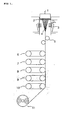
- FIG. 1 schematically illustrates a process for producing a polyethylene naphthalate fiber of the present invention
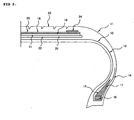
- FIG. 2 schematically shows the structure of an automobile tire comprising high strength polyethylene naphthalate dipped tire according to the present invention.
- 11 tire 12 carcass layer 13 carcass layer-reinforcing cord 14 ply turn-up 15 bead region 16 bead core 17 bead filler 18 belt structure 19 cap ply 20 belt ply 21, 22 belt cord 23 tread 24 edge ply 25 cap ply cord
- the polyethylene naphthalate chip which is used in the present invention contains at least 85 mol% of ethylene-2,6-naphthalate units.
- the polyethylene-2,6-naphthalate polymer is composed essentially of polyethylene-2,6-naphthalate units.
- the polyethylene-2,6-naphthalate may incorporate, as copolymer units, minor amounts of units derived from one or more ester-forming ingredients other than ethylene glycol and 2,6-naphthalene dicarboxylic acid or its derivatives.
- ester-forming ingredients which may be copolymerized with the polyethylene terephthalate units include glycols such as 1,3-propanediol, 1,4-butanediol and 1,6-hexanediol, etc., and dicarboxylic acids such as terephthalic acid, isophthalic acid, hexahydroterephthalic acid, stilbene dicarboxylic acid, dibenzoic acid, adipic acid, sebacic acid and azelaic acid, etc.
- glycols such as 1,3-propanediol, 1,4-butanediol and 1,6-hexanediol, etc.
- dicarboxylic acids such as terephthalic acid, isophthalic acid, hexahydroterephthalic acid, stilbene dicarboxylic acid, dibenzoic acid, adipic acid, sebacic acid and azelaic acid, etc.
- the polyethylene naphthalate chip which is used in the present invention is preferably prepared by a method comprising the steps of: mixing a solid or melt of naphthalene-2,6-dimethylcarboxylate (NDC) is mixed with ethylene glycol in a weight ratio of 1.6-2.2 at 190 °C and optionally heating and dissolving the mixture; subjecting the mixture to transesterification at 180-230 °C under atmospheric pressure in the presence of a transesterification catalyst (e.g., Zn, Mn, Mg, Pb, Ca and Co), to produce bis-hydroxyethyl naphthalate or its oligomer having a polymerization degree of less than 10, the catalyst being used at the amount of 0.01-0.1 mole% relative to the mole of the naphthalene-2,6-dicarboxylate; adding a polymerization catalyst (e.g., Sb, Ti, Ge, Zn and Sn) and a phosphorus or phosphorous-based thermal stabilize
- the produced polymer is subjected to transesterification at 190-240 °C for about 2-4 hours and to polycondensation at 280-290 °C for about 2-3 hours, thereby producing a raw chip having an intrinsic viscosity of about 0.40-0.70. Then, the raw chip is subjected to solid phase polymerization at a temperature of 225-260 °C in vacuum to produce a solid phase-polymerized polymer having an intrinsic viscosity of 0.70-1.20 and a moisture content of less than 30 ppm.
- the silica compound is added in the transesterification or polycondensation step at the amount of 50-1,000 ppm. If it is used at less than 50 ppm, its effect to improve the spinnability of the polymer will be insignificant since the amount of the silica compound is too low. If it is used at more than 1,000 ppm, an excess of the silica compound will act as a foreign substance to cause problems in spinning.
- the silica compound contained in the polymer has effects in that it acts to reduce the elongational viscosity of the polymer in a spinneret upon spinning, concentrates the stress of a drawn yarn and renders the drawn yarn lubricant, so that a maximum draw ratio at which an undrawn yarn is not broken is increased and the number of yarn breakages upon spinning is reduced, thereby increasing the processability of the yarn.
- the silica compound preferably has an average particle size of 1-1,000 nm. If it is produced into a size smaller than 1 nm, it will have increased costs and thus will have reduced economic efficiency, and if it has a size larger than 1,000 nm, it will result in a reduction of spinnability of the polymer.
- the content ratio between the transesterification catalyst Mn and the thermal stabilizer P, (Mn/P), is less than 2.0. If the Mn/P content ratio is more than 2.0, oxidation will be promoted during the solid phase polymerization, to deteriorate the physical properties of a spun yarn.
- FIG. 1 schematically shows a producing process of a polyethylene naphthalate fiber according to one preferred embodiment of the present invention.
- the polyethylene naphthalate chip is melt-spun through a pack and nozzles at a relatively low temperature of 300-318 °C in order to prevent a reduction in viscosity of the polymer caused by thermal decomposition and hydrolysis.
- a unit such as a static mixer can be preferably placed above the pack.
- the melt-spun yarn formed in the step (A) is solidified by passing it through a cooling zone.
- a heating unit may be placed over a section from just below the nozzles to the start point of the cooling zone, i.e., hood length. This section is called the retarded cooling zone or the heating zone, and has a 300 to 500 mm length and is maintained at a temperature of 300 to 400 °C.
- the cooling zone 3 a quenching method which is selected from open quenching, circular closed quenching, radial outflow quenching and the like depending on a blowing method of cooling air can be applied.
- the solidified yarn 4 from the cooling zone 3 may be oiled to 0.5-1.0% by an oil-feeding unit 5.
- the solidified yarn is withdrawn with a withdrawing roller in such a speed that the undrawn yarn has a birefringence of 0.001-0.1.
- a preferred speed at which the solidified yarn is withdrawn is 200-4,000 m/min. If the birefringence of the undrawn yarn is lower than 0.001, tension will not be applied to the undrawn yarn to make the yarn guide unstable such that the spun yarn becomes non-uniform. If the birefringence is higher than 0.1, the drawability of the undrawn yarn will be reduced to make subsequent drawing difficult, thereby lowering the tenacity of the yarn.
- the yarn passed through the withdrawing roller 6 is subjected to multi-stage drawing through a series of drawing rollers using either a separate drawing process or preferably a spin draw process, to produce a final drawn yarn.
- the temperature at the second drawing stage is controlled in the range of 100 to 210 °C. More specifically, the undrawn yarn is predrawn to an extent of 1-10%, and then it is drawn to a first draw ratio of 1.2-7 at a temperature of 80-200 °C and a second draw ratio of 1.2-2.0 at a temperature of 130-200 °C.
- a steam-jet technique may be applied to increase the maximum draw ratio of the yarn.
- the drawn yarn may be heat-set at a temperature of 200-260 °C and relaxed to an extent of 2-4%, in accordance with the conventional method.
- the polyethylene naphthalate fiber produced by the method of the present invention has an intrinsic viscosity of 0.60-1.10, a tenacity of 8.0-11 g/d, an elongation of 6.0-15%, a birefringence of at least 0.35, a density of 1.355-1.368, a melting point of 267-280 °C, and a shrinkage of 1-5%.
- the drawn polyethylene naphthalate fiber produced by the inventive method may be converted into a dipped cord by the conventional process.
- a conventional adhesive solution e.g., isocyanate, epoxy resin, parachlorophenol (PCP) resin and resorcinol-formaline-latex (RFL)
- PCP parachlorophenol
- RTL resorcinol-formaline-latex
- the resulting cord yarn is heat-set and stretched at a temperature of 225-255 °C for 45-80 seconds at a stretch ratio of 2.0-6.0% in a hot stretching zone, and then, it is dipped again in a conventional adhesive solution (e.g., RFL), and dried at a temperature of 130-170 °C for 90-120 seconds.
- a conventional adhesive solution e.g., RFL
- the dried cord yarn is heat-set at a temperature of 225-255 °C for a period of 45 to 80 seconds at a stretch ratio of -4.0 to 2.0%, to obtain a dipped cord having a good dimensional stability, represented by the sum of E 2.25 (elongation at 2.25 g/d load) and FS (free shrinkage) being less than 5.5%, and a tenacity of at least 6.0 g/d.
- the dipped cord produced by the present invention is used as a material for producing a carcass ply of pneumatic radial tires.
- a cord as shown in FIG. 2 is produced. More concretely, a carcass cord 13 made of the dipped polyethylene naphthalate cord produced by the present invention has a total denier of 2,000d-8,000d.
- a carcass ply 12 comprises at least one layer of the tire cord 13 for carcass ply reinforcement.
- the reinforcement density of the dipped cord in the carcass ply is preferably 15-35 EPI. If the reinforcement density is lower than 15 EPI, the mechanical properties of the carcass ply will be lowered rapidly, whereas if it exceeds 35 EPI, disadvantages with respect to economic efficiency will be caused.
- the carcass ply 12 with a radial direction outer ply turn-up 14 comprises carcass cords, preferably in one or two layers.
- the carcass cord 13 for reinforcement is oriented at an angle of 85-90° with respect to the circumferential direction of a tire 11.
- the reinforcing carcass cord 13 is oriented at an angle of 90° with respect to the circumferential direction of the tire.
- the ply turn-up 14 preferably has a height of about 40-80% relative to the maximum section height of the tire.
- the ply turn-up has a width of less than 40% relative to the maximum section width, its effect of supplementing the rigidity of tire sidewalls will be excessively reduced, whereas if it is higher than 80%, an excessive increase in rigidity of the tire sidewalls will be caused, resulting in an adverse effect on ride comfort.
- a bead region 15 of the tire 11 has a non-expandable annular bead core 16.
- This bead core is preferably made of a continuously wound single-filament steel wire.
- a high-strength steel wire with a diameter of 0.95-1.00 mm is formed into a 4x4 structure or a 4x5 structure.
- the bead region has a bead filler 17.
- the bead filler needs to have a hardness higher than a certain level, and preferably a shore A hardness of more than 40.
- the tire 11 is reinforced with a structure of a belt 18 and a cap ply 19 at its crown portion.
- the belt structure 18 comprises two cut belt plies 20.
- a cord 21 of the belt plies 20 is oriented at about 20° with respect to the circumferential direction of the tire.
- the cord 21 of the belt plies is disposed in the opposite direction to a cord 22 of another ply.
- the belt 18 may comprise an optional number of plies, and preferably can be disposed at an angle range of 16-24°.
- the belt 18 acts to provide lateral rigidity so as to minimize the rising of a tread 23 from the road surface during the running of the tire.
- the cords 21 and 22 of the belt 18 are made of steel cords in a 2+2 structure, but may also have other structures.
- the upper portion of the belt 18 is reinforced with a cap ply 21 and an edge ply 24.
- a cap ply cord 25 within the cap ply 19 is disposed in the parallel direction to the circumferential direction of the tire and serves to inhibit a change in size by high-speed running of the tire.
- the cap ply cord 25 is made of a material having high shrinkage stress at high temperature.
- one layer of the cap ply 19 and one layer of the edge ply 21 may be used, one or two layer of the cap ply and one or two layers of the edge ply are preferably used.
- the present invention provides the high tenacity polyethylene naphthalate fiber having improved physical properties, which is produced by the method wherein the silica compound is added in the melt polymerization step of producing the polyethylene naphthalate polymer to make the resulting polymer has excellent spinnability upon melt spinning even at low temperature, and the spinning draft ratio and drawing temperature of the polymer is optimized based on this excellent spinnability.
- the dipped cord produced from the high tenacity polyethylene naphthalate fiber of the present invention has excellent dimensional stability and high tenacity, so that it can be advantageously employed as a reinforcement material of rubber products such as tires and belts.
- C is the sample concentration(g/100ml).
- the tenacity and elongation of a sample was determined in accordance with ASTM D 885 at a sample length of 250 mm, a tensile speed of 300 mm/min. and 80 turns/m under a standard atmosphere(20°C, 65% relative humidity), using Instron 5565 (Instron Co., Ltd, USA).
- the density ( ⁇ ) of a sample was determined using a xylene/carbon tetrachloride density gradient column at 23°C.
- the gradient column was prepared and calibrated according to ASTM D 1505 at a density range of 1.34 to 1.41 g/cm 3 .
- the elongation at 4.5 g/d load was measured on the S-S tenacity and elongation curve for and original yarn sample, and the elongation at 2.25 g/d load, for a dipped cord sample.
- the dimensional stability(%) of a dipped cord which is related to the tire sidewall indentations(SWI) and tire handling properties, is determined by the modulus at a given shrinkage, and the sum E 2.25 (elongation at 2.25 g/d load) + FS(free shrinkage) is a good indicator of the dimensional stability for a dipped cord processed under a particular heat-treatment condition, and the lower the sum, the better the dimensional stability.
- the birefringence of a sample was determined using a polarizing light microscope equipped with a Berek compensator.
- a sample was powdered, and 2 mg of the sample powder was put in a pan and sealed. Then, the sample was heated at a rate of 20°C per 1 minute from room temperature to 290°C using Perkin-Elmer DSC 7 under a nitrogen atmosphere and the temperature at the maximum heat-absorption peak was set as the melting point.
- the number of yarn breakages was calculated according to the following equation (4): Number of yarn breakages / day x position
- Naphthalate-2,6-dimethylcarboxylate was subjected to transesterification at a temperature of 190-240 °C in the presence of Mn as a transesterification catalyst and then subjected to polycondensation at a temperature of 240-290 °C in the presence of Sb as a polymerization catalyst and P as a thermal stabilizer.
- fumed silica particles with an average particle size of 10 nm were added such an amount that the resulting polymer contains 300 ppm of the fumed silica.
- the transesterification catalyst was used at the amount of 0.2 mole% relative to the mole of the naphthalene-2,6-dicarboxylate
- the polymerization catalyst was used at the amount of 0.03 mole% relative to the mole of the naphthalene-2,6-dicarboxylate
- the thermal stabilizer was used at 0.02 mole%.
- the produced polymer was subjected to solid phase polymerization to produce a solid phase-polymerized polyethylene naphthalate chip having an intrinsic viscosity (I.V.) of 1.0 and a moisture content of 20 ppm.
- the produced chip was melt-spun through an extruder at 316 °C and a discharge rate of 440 g/min. At this time, the polymer being melt-spun was mixed uniformly in a polymer transporting pipe using a static mixer composed of five units.
- the spun yarn was solidified by passing successively it through a 40 cm-long heating zone of a 370 °C atmosphere temperature located just below the nozzles, and a 530 mm-long cooling zone in which a cooling air of 20 °C was blown at a rate of 0.5 m/sec.
- the solidified yarn was oiled and withdrawn at a rate of 380 m/min to form an undrawn yarn, which was predrawn to the extent of 5%, and then, drawn in two stages.
- the first stage drawing was performed at a draw ratio of 5.15 at 150 °C
- the second stage drawing at a draw ratio of 1.2 at 170 °C.
- the drawn yarn was heat-set at 230 °C, relaxed to 3% and wound to form a 1,500 denier final drawn yarn.
- Drawn yarns were produced in the same manner as in Example 1 except that the particle size and content of the silica, and the draw ratio of the yarn, were changed as given in Table 1.
- Comparative Examples 1 and 2 containing no silica and Comparative Examples 3 and 4 containing the silica compound at an amount out of a suitable range did not show stable processability under conditions with a such excellent physical properties as in Examples.
- Comparative Example 5 containing titanium dioxide, which is generally used in the spinning of polyester fibers also showed insignificant effects.
- the maximum draw ratio in Table 1 means a draw ratio above which the yarn is broken upon its drawing.
- Example 2 Two strands of the drawn yarn produced by Example 1 were plied and cabled with 390 turns/m to produce a cord yarn.
- the cord yarn was dipped in an adhesive solution of parachlorophenol (PCP) resin and RFL in a dipping tank, dried and stretched at 170 °C for 150 seconds at a stretch ratio of 1.0% in a drying zone, heat-set at 240 °C for 150 seconds in a hot stretching zone, dipped in RFL, dried at 170 °C for 100 seconds, and then, heat-set at 240 °C for 40 seconds at a stretch ratio of - 1.0%, to obtain a dipped cord.
- PCP parachlorophenol
- a radial tire which was manufactured using the dipped polyethylene naphthalate cord had a carcass layer which has a ply turn-up extending radially outward therefrom and comprises one layer of the dipped polyethylene naphthalate cord.
- This carcass cord had a specification given in Table 2 below, and was oriented at an angle of 90 ° with respect to the circumferential direction of the tire.
- the ply turn-up 14 had a height of 40-80% relative to the maximum section height of the tire.
- the bead portion 15 had the bead core 16 made of a high strength steel wire with a 0.95-1.00 mm diameter in a 4x4 structure, and the bead filler 17 with a shore A hardness of more than 40.
- the upper portion of the belt 18 was reinforced with a belt-reinforcing layer consisting of one layer of the cap ply 19 and one layer of the edge ply 24.
- a cap ply cord in the cap ply 19 was disposed parallel to the circumferential direction of the tire.
- a tire was manufactured in the same manner as in Example 4 except that the drawn polyethylene naphthalate yarn containing no silica compound, which had been produced by Comparative Example 1, was used.
- a tire was manufactured in the same manner as in Example 4 except that the drawn polyethylene naphthalate yarn containing titanium dioxide, which had been produced by Comparative Example 5, was used.
- the inventive tire which used polyethylene naphthalate fibers containing silica has a lower weight than the tires of Comparative Examples 6 and 7 having a PEN cord at their carcass, such that its rotation resistance can be reduced.
- the inventive tire whose carcass comprises the PEN cord produced by the present invention has excellent ride comfort and handling stability, reduced noise, and improved uniformity.
- the silica compound is added at an amount of 50 to 1000 ppm in the melt polymerization step to produce the polymer having excellent spinnability.
- the polyethylene naphthalate fiber produced from this polymer has improved physical properties, such as high tenacity.
- the dipped cord produced from this yarn has excellent dimensional stability and tenacity such that it can be advantageously employed as a reinforcement material of rubber products, such as tires and belts, or in other industrial applications.
- the polyethylene-2,6-naphthalate fiber produced by the inventive method is suitable for various applications requiring high tensile strength, tensile strain resistance and high thermal resistance, while it has excellent processability so that it shows a reduced number of yarn breakages even in long-term spinning.
Landscapes
- Engineering & Computer Science (AREA)
- Textile Engineering (AREA)
- Chemical & Material Sciences (AREA)
- Chemical Kinetics & Catalysis (AREA)
- General Chemical & Material Sciences (AREA)
- Mechanical Engineering (AREA)
- Manufacturing & Machinery (AREA)
- Tires In General (AREA)
- Artificial Filaments (AREA)
- Yarns And Mechanical Finishing Of Yarns Or Ropes (AREA)
- Compositions Of Macromolecular Compounds (AREA)
Claims (15)
- Polyethylennaphthalat-Faser, die durch ein Verfahren hergestellt ist, das folgende Schritte umfasst:(A) Schmelzspinnen eines festphasen-polymerisierten Polyethylen-2,6-naphthalat-Chips, enthaltend mehr als 85 Mol% Ethylen-2,6-naphthalat-Einheiten und eine Silicaverbindung in einer Menge von 50 bis 1.000 ppm, mit einer intrinsischen Viskosität von 0,70-1,20, um ein schmelzgesponnenes Garn zu erzeugen,(B) Durchführen des schmelzgesponnenen Garns durch eine Zone einer verzögerten Kühlung und eine Kühlzone zur Verfestigung des Garns,(C) Wegziehen des Garns mit einer solchen Geschwindigkeit, dass das ungezogene Garn eine Doppelbrechung von 0,001-0,1 hat, und(D) Unterwerfen des ungezogenen Garns einem mehrstufigen Ziehen mit einem Gesamtzugverhältnis von mindestens 1,5 und einer Zugtemperatur von 50-250°C, wobei die Polyethylennaphthalat-Faser einige Eigenschaften hat von (1) einer intrinsischen Viskosität von 0,60-1,10, (2) einer Zähigkeit von 8,0-11 g/d, (3) einer Bruchdehnung von 6,0-15 %, (4) einer Doppelbrechung von mindestens 0,35, (5) einer Dichte von 1,355-1,368, (6) einem Schmelzpunkt von 267-280°C und (7) einer Schrumpfung von 1-5 %.
- Polyethylennaphthalat-Faser gemäß Anspruch 1, die eine Feinheit von 500 bis 3.000 Denier aufweist.
- Polyethylennaphthalat-Faser gemäß Anspruch 1, wobei die Silicaverbindung Kieselpuder ist.
- Polyethylennaphthalat-Faser gemäß Anspruch 1, wobei der Gehalt der Silicaverbindung 150-500 ppm beträgt.
- Polyethylennaphthalat-Faser gemäß Anspruch 1, wobei die Silicaverbindung eine mittlere Partikelgröße von 1-1.000 nm hat.
- Polyethylennaphthalat-Faser gemäß Anspruch 1, wobei die Heizzone mit einer Atmosphärentemperatur von 300-400°C genau vor und angrenzend an die Kühlzone in dem Schritt (B) angeordnet ist.
- Polyethylennaphthalat-Faser gemäß Anspruch 1, wobei die Heizzone in einer Länge von 300-500 mm genau vor und angrenzend an die Kühlzone in dem Schritt (B) angeordnet ist.
- Imprägnierter Cord, der hergestellt ist durch Übereinanderlegen und Verdrillen von 2 Strängen der Polyethylennaphthalat-Faser gemäß Anspruch 1, gefolgt von einer Resorcin-Formalin-Latex-Behandlung, wobei der Cord aufweist: (1) Einen Dimensionsstabilitätsindex, der durch die Summe von E2,25 (Dehnung bei 2,25 g/d Last) und einem FS (freie Schrumpfung) von 5,5 % oder weniger wiedergegeben ist, und (2) eine Zähigkeit von mindestens 6,0 g/d.
- Kautschuk/Gummiprodukte, die den imprägnierten Cord gemäß Anspruch 8 als Verstärkungsmaterial enthalten.
- Luftgürtelreifen mit einem Querschnittsverhältnis von weniger als 0,65, der aufweist:Ein Paar von parallelen Wulstkernen, mindestens eine radiale Karkassenlage, die um die Wulstkerne herum gewunden ist;eine Gürtellage, die auf der äußeren Umfangsseite der Karkassenlage gebildet ist,eine in Umfangsrichtung verlaufende gürtelverstärkende Lage, die auf der äußeren Umfangsseite der Gürtellage gebildet ist, wobei die Karkassenlage einen imprägnierten Polyethylennaphthalat-Cord aufweist, der (eine) Silicaverbindung(en) in einer Menge von 50 bis 1.000 ppm enthält.
- Luftgürtelreifen gemäß Anspruch 10, wobei die Karkassenlage in einer Schicht geformt ist.
- Luftgürtelreifen gemäß Anspruch 10, wobei die Karkassenlage in zwei Schichten geformt ist.
- Luftgürtelreifen gemäß Anspruch 10, wobei die Verstärkungsdichte des imprägnierten Cords in der Karkassenlage 15-35 EPI ist.
- Luftgürtelreifen gemäß Anspruch 10, wobei der imprägnierte Cord eine Verdrehungszahl von 250-500 TPM hat.
- Luftgürtelreifen gemäß Anspruch 10, wobei der imprägnierte Cord eine Feinheit von 1.000 bis 6.000 Denier hat.
Applications Claiming Priority (2)
| Application Number | Priority Date | Filing Date | Title |
|---|---|---|---|
| KR2003043257 | 2003-06-30 | ||
| KR10-2003-0043257A KR100499220B1 (ko) | 2003-06-30 | 2003-06-30 | 방사성이 우수한 고강력 폴리에틸렌-2,6-나프탈레이트섬유 및 이의 제조방법 |
Publications (2)
| Publication Number | Publication Date |
|---|---|
| EP1493852A1 EP1493852A1 (de) | 2005-01-05 |
| EP1493852B1 true EP1493852B1 (de) | 2008-11-05 |
Family
ID=33432440
Family Applications (1)
| Application Number | Title | Priority Date | Filing Date |
|---|---|---|---|
| EP04001841A Expired - Lifetime EP1493852B1 (de) | 2003-06-30 | 2004-01-28 | Polyethylennaphthalat-Fasern mit hoher Festigkeit |
Country Status (9)
| Country | Link |
|---|---|
| US (1) | US6955854B2 (de) |
| EP (1) | EP1493852B1 (de) |
| JP (1) | JP3835803B2 (de) |
| KR (1) | KR100499220B1 (de) |
| CN (1) | CN1273658C (de) |
| AT (1) | ATE413480T1 (de) |
| CA (1) | CA2455209C (de) |
| DE (1) | DE602004017543D1 (de) |
| ES (1) | ES2314303T3 (de) |
Families Citing this family (13)
| Publication number | Priority date | Publication date | Assignee | Title |
|---|---|---|---|---|
| WO2005019509A1 (en) * | 2003-08-22 | 2005-03-03 | Hyosung Corporation | High tenacity polyethylene-2,6-naphthalate fibers |
| JP4616658B2 (ja) * | 2005-01-31 | 2011-01-19 | 帝人ファイバー株式会社 | 不織布 |
| EP1719828A1 (de) * | 2005-05-06 | 2006-11-08 | Diolen Industrial Fibers B.V. | Reifencord und Verfahren zu seiner Herstellung |
| CN101517137B (zh) | 2006-09-08 | 2011-11-09 | 可隆株式会社 | 制备全芳族聚酰胺丝的方法以及由该方法制备的全芳族聚酰胺丝 |
| JP4847312B2 (ja) * | 2006-12-27 | 2011-12-28 | 帝人ファイバー株式会社 | 不織布用バインダー繊維およびその製造方法 |
| JP4928308B2 (ja) * | 2007-02-28 | 2012-05-09 | 帝人ファイバー株式会社 | 産業資材用ポリエチレンナフタレート繊維とその製造方法 |
| BRPI0813803A2 (pt) * | 2007-07-03 | 2014-12-30 | Gates Corp | Correia de transmissão de energia |
| JP2011058126A (ja) * | 2009-09-10 | 2011-03-24 | Teijin Fibers Ltd | 樹脂ホース補強用繊維及びそれを用いてなる樹脂ホース |
| KR101235255B1 (ko) | 2010-12-06 | 2013-02-20 | 주식회사 삼양사 | 나노 실리카 입자가 포함된 고강도 폴리에틸렌 멀티필라멘트 연신사의 제조방법 |
| FR3009238B1 (fr) * | 2013-07-30 | 2016-10-28 | Michelin & Cie | Pneu radial a structure de ceinture allegee |
| KR101559517B1 (ko) * | 2014-01-16 | 2015-10-19 | 주식회사 효성 | 치수안정성이 우수한 폴리에스테르 타이어 코드 및 이의 제조방법 |
| JP7151217B2 (ja) * | 2018-07-03 | 2022-10-12 | 横浜ゴム株式会社 | 空気入りラジアルタイヤ |
| JP6919744B1 (ja) * | 2020-04-27 | 2021-08-18 | 住友ゴム工業株式会社 | タイヤ |
Family Cites Families (9)
| Publication number | Priority date | Publication date | Assignee | Title |
|---|---|---|---|---|
| JPS525612B2 (de) | 1971-12-13 | 1977-02-15 | ||
| JPS5016739A (de) | 1973-06-14 | 1975-02-21 | ||
| CA1233009A (en) | 1983-09-14 | 1988-02-23 | Celanese Corporation | High speed process for forming fully drawn polyester yarn |
| JPH0625267B2 (ja) | 1985-12-17 | 1994-04-06 | ダイアホイルヘキスト株式会社 | 高密度磁気記録媒体用ポリエチレン−2,6−ナフタレ−トフイルム |
| FR2658840B1 (fr) | 1989-12-20 | 1994-02-11 | Rhone Poulenc Fibres | Procede pour l'obtention de fils pet avec une meilleure productivite. |
| JP2945130B2 (ja) | 1990-11-28 | 1999-09-06 | 帝人株式会社 | タイヤコードまたはベルト材補強用ナフタレートポリエステル繊維およびその製造法 |
| DE4320593A1 (de) * | 1993-06-22 | 1995-01-05 | Akzo Nobel Nv | Multifilament-Garn aus Polyäthylennaphthalat und Verfahren zu seiner Herstellung |
| JP3555809B2 (ja) * | 1995-06-19 | 2004-08-18 | 株式会社ブリヂストン | ラジアルタイヤ |
| KR100402839B1 (ko) * | 2001-05-10 | 2003-10-22 | 주식회사 효성 | 고강력 폴리에틸렌 나프탈레이트 섬유 |
-
2003
- 2003-06-30 KR KR10-2003-0043257A patent/KR100499220B1/ko not_active Expired - Fee Related
-
2004
- 2004-01-07 JP JP2004001879A patent/JP3835803B2/ja not_active Expired - Fee Related
- 2004-01-14 CA CA2455209A patent/CA2455209C/en not_active Expired - Fee Related
- 2004-01-23 US US10/763,543 patent/US6955854B2/en not_active Expired - Lifetime
- 2004-01-28 EP EP04001841A patent/EP1493852B1/de not_active Expired - Lifetime
- 2004-01-28 ES ES04001841T patent/ES2314303T3/es not_active Expired - Lifetime
- 2004-01-28 AT AT04001841T patent/ATE413480T1/de not_active IP Right Cessation
- 2004-01-28 DE DE602004017543T patent/DE602004017543D1/de not_active Expired - Lifetime
- 2004-02-06 CN CNB2004100031379A patent/CN1273658C/zh not_active Expired - Fee Related
Also Published As
| Publication number | Publication date |
|---|---|
| US6955854B2 (en) | 2005-10-18 |
| JP3835803B2 (ja) | 2006-10-18 |
| KR20050003123A (ko) | 2005-01-10 |
| ES2314303T3 (es) | 2009-03-16 |
| KR100499220B1 (ko) | 2005-07-01 |
| CA2455209A1 (en) | 2004-12-30 |
| CN1273658C (zh) | 2006-09-06 |
| EP1493852A1 (de) | 2005-01-05 |
| ATE413480T1 (de) | 2008-11-15 |
| CA2455209C (en) | 2010-03-16 |
| DE602004017543D1 (de) | 2008-12-18 |
| JP2005023505A (ja) | 2005-01-27 |
| CN1576404A (zh) | 2005-02-09 |
| US20040265578A1 (en) | 2004-12-30 |
Similar Documents
| Publication | Publication Date | Title |
|---|---|---|
| US20070116951A1 (en) | High tenacity polyethylene-2, 6-naphthalate fibers | |
| US6511747B1 (en) | High strength polyethylene naphthalate fiber | |
| CN111278665B (zh) | 聚酯轮胎帘线和使用该聚酯轮胎帘线的子午线轮胎 | |
| EP1493852B1 (de) | Polyethylennaphthalat-Fasern mit hoher Festigkeit | |
| US12281196B2 (en) | Polyester tire cord having excellent heat resistance, and tire comprising same | |
| KR101734892B1 (ko) | 치수안정성이 우수한 폴리에틸렌테레프탈레이트 원사의 제조방법 | |
| KR102227154B1 (ko) | 내열성이 우수한 폴리에스터 타이어 코드 및 그를 포함하는 타이어 | |
| KR100630263B1 (ko) | 카카스 층에 하이브리드 코드를 이용한 고성능 래디얼 타이어 | |
| KR20120069340A (ko) | 폴리에스터 멀티필라멘트를 이용한 래디얼 공기입 타이어 | |
| KR20110078137A (ko) | 고성능 래디얼 타이어 | |
| KR100630269B1 (ko) | 고성능 래디얼 타이어 | |
| CA2569255C (en) | Pneumatic radial tire | |
| KR100674673B1 (ko) | 하이브리드 코드를 사용한 고성능 래디얼 타이어 | |
| KR100556034B1 (ko) | 고성능 래디얼 타이어 | |
| KR20050066055A (ko) | 폴리에틸렌 나프탈레이트 타이어 코드 및 이를 이용한고성능 타이어 | |
| KR100584695B1 (ko) | 폴리에틸렌-2,6-나프탈레이트 섬유를 이용한 고성능래디얼 타이어 | |
| KR100761518B1 (ko) | 하이브리드 딥코드의 제조 방법 및 이를 이용한 래디얼타이어 | |
| KR100548642B1 (ko) | 폴리에틸렌 나프탈레이트를 이용한 고성능 래디얼 타이어 | |
| KR100595992B1 (ko) | 고속방사법에 의한 폴리에틸렌-2,6-나프탈레이트 섬유 | |
| KR100630268B1 (ko) | 경량고속 래디얼 타이어 | |
| KR20050030774A (ko) | 카카스 층에 하이브리드 코드를 이용한 고성능 래디얼타이어 |
Legal Events
| Date | Code | Title | Description |
|---|---|---|---|
| PUAI | Public reference made under article 153(3) epc to a published international application that has entered the european phase |
Free format text: ORIGINAL CODE: 0009012 |
|
| AK | Designated contracting states |
Kind code of ref document: A1 Designated state(s): AT BE BG CH CY CZ DE DK EE ES FI FR GB GR HU IE IT LI LU MC NL PT RO SE SI SK TR |
|
| AX | Request for extension of the european patent |
Extension state: AL LT LV MK |
|
| 17P | Request for examination filed |
Effective date: 20050114 |
|
| AKX | Designation fees paid |
Designated state(s): AT BE BG CH CY CZ DE DK EE ES FI FR GB GR HU IE IT LI LU MC NL PT RO SE SI SK TR |
|
| 17Q | First examination report despatched |
Effective date: 20070402 |
|
| GRAP | Despatch of communication of intention to grant a patent |
Free format text: ORIGINAL CODE: EPIDOSNIGR1 |
|
| GRAS | Grant fee paid |
Free format text: ORIGINAL CODE: EPIDOSNIGR3 |
|
| GRAA | (expected) grant |
Free format text: ORIGINAL CODE: 0009210 |
|
| AK | Designated contracting states |
Kind code of ref document: B1 Designated state(s): AT BE BG CH CY CZ DE DK EE ES FI FR GB GR HU IE IT LI LU MC NL PT RO SE SI SK TR |
|
| REG | Reference to a national code |
Ref country code: GB Ref legal event code: FG4D |
|
| REG | Reference to a national code |
Ref country code: CH Ref legal event code: EP |
|
| REG | Reference to a national code |
Ref country code: IE Ref legal event code: FG4D |
|
| REF | Corresponds to: |
Ref document number: 602004017543 Country of ref document: DE Date of ref document: 20081218 Kind code of ref document: P |
|
| REG | Reference to a national code |
Ref country code: ES Ref legal event code: FG2A Ref document number: 2314303 Country of ref document: ES Kind code of ref document: T3 |
|
| NLV1 | Nl: lapsed or annulled due to failure to fulfill the requirements of art. 29p and 29m of the patents act | ||
| PG25 | Lapsed in a contracting state [announced via postgrant information from national office to epo] |
Ref country code: AT Free format text: LAPSE BECAUSE OF FAILURE TO SUBMIT A TRANSLATION OF THE DESCRIPTION OR TO PAY THE FEE WITHIN THE PRESCRIBED TIME-LIMIT Effective date: 20081105 |
|
| PG25 | Lapsed in a contracting state [announced via postgrant information from national office to epo] |
Ref country code: SI Free format text: LAPSE BECAUSE OF FAILURE TO SUBMIT A TRANSLATION OF THE DESCRIPTION OR TO PAY THE FEE WITHIN THE PRESCRIBED TIME-LIMIT Effective date: 20081105 Ref country code: NL Free format text: LAPSE BECAUSE OF FAILURE TO SUBMIT A TRANSLATION OF THE DESCRIPTION OR TO PAY THE FEE WITHIN THE PRESCRIBED TIME-LIMIT Effective date: 20081105 Ref country code: FI Free format text: LAPSE BECAUSE OF FAILURE TO SUBMIT A TRANSLATION OF THE DESCRIPTION OR TO PAY THE FEE WITHIN THE PRESCRIBED TIME-LIMIT Effective date: 20081105 |
|
| PG25 | Lapsed in a contracting state [announced via postgrant information from national office to epo] |
Ref country code: RO Free format text: LAPSE BECAUSE OF FAILURE TO SUBMIT A TRANSLATION OF THE DESCRIPTION OR TO PAY THE FEE WITHIN THE PRESCRIBED TIME-LIMIT Effective date: 20081105 Ref country code: EE Free format text: LAPSE BECAUSE OF FAILURE TO SUBMIT A TRANSLATION OF THE DESCRIPTION OR TO PAY THE FEE WITHIN THE PRESCRIBED TIME-LIMIT Effective date: 20081105 Ref country code: DK Free format text: LAPSE BECAUSE OF FAILURE TO SUBMIT A TRANSLATION OF THE DESCRIPTION OR TO PAY THE FEE WITHIN THE PRESCRIBED TIME-LIMIT Effective date: 20081105 Ref country code: BG Free format text: LAPSE BECAUSE OF FAILURE TO SUBMIT A TRANSLATION OF THE DESCRIPTION OR TO PAY THE FEE WITHIN THE PRESCRIBED TIME-LIMIT Effective date: 20090205 Ref country code: BE Free format text: LAPSE BECAUSE OF FAILURE TO SUBMIT A TRANSLATION OF THE DESCRIPTION OR TO PAY THE FEE WITHIN THE PRESCRIBED TIME-LIMIT Effective date: 20081105 |
|
| PG25 | Lapsed in a contracting state [announced via postgrant information from national office to epo] |
Ref country code: SE Free format text: LAPSE BECAUSE OF FAILURE TO SUBMIT A TRANSLATION OF THE DESCRIPTION OR TO PAY THE FEE WITHIN THE PRESCRIBED TIME-LIMIT Effective date: 20090205 Ref country code: PT Free format text: LAPSE BECAUSE OF FAILURE TO SUBMIT A TRANSLATION OF THE DESCRIPTION OR TO PAY THE FEE WITHIN THE PRESCRIBED TIME-LIMIT Effective date: 20090406 Ref country code: MC Free format text: LAPSE BECAUSE OF NON-PAYMENT OF DUE FEES Effective date: 20090131 |
|
| REG | Reference to a national code |
Ref country code: CH Ref legal event code: PL |
|
| PLBE | No opposition filed within time limit |
Free format text: ORIGINAL CODE: 0009261 |
|
| STAA | Information on the status of an ep patent application or granted ep patent |
Free format text: STATUS: NO OPPOSITION FILED WITHIN TIME LIMIT |
|
| PG25 | Lapsed in a contracting state [announced via postgrant information from national office to epo] |
Ref country code: SK Free format text: LAPSE BECAUSE OF FAILURE TO SUBMIT A TRANSLATION OF THE DESCRIPTION OR TO PAY THE FEE WITHIN THE PRESCRIBED TIME-LIMIT Effective date: 20081105 |
|
| 26N | No opposition filed |
Effective date: 20090806 |
|
| PG25 | Lapsed in a contracting state [announced via postgrant information from national office to epo] |
Ref country code: LI Free format text: LAPSE BECAUSE OF NON-PAYMENT OF DUE FEES Effective date: 20090131 Ref country code: CH Free format text: LAPSE BECAUSE OF NON-PAYMENT OF DUE FEES Effective date: 20090131 |
|
| PG25 | Lapsed in a contracting state [announced via postgrant information from national office to epo] |
Ref country code: IE Free format text: LAPSE BECAUSE OF NON-PAYMENT OF DUE FEES Effective date: 20090128 |
|
| PG25 | Lapsed in a contracting state [announced via postgrant information from national office to epo] |
Ref country code: GR Free format text: LAPSE BECAUSE OF FAILURE TO SUBMIT A TRANSLATION OF THE DESCRIPTION OR TO PAY THE FEE WITHIN THE PRESCRIBED TIME-LIMIT Effective date: 20090206 |
|
| PG25 | Lapsed in a contracting state [announced via postgrant information from national office to epo] |
Ref country code: LU Free format text: LAPSE BECAUSE OF NON-PAYMENT OF DUE FEES Effective date: 20090128 |
|
| PG25 | Lapsed in a contracting state [announced via postgrant information from national office to epo] |
Ref country code: HU Free format text: LAPSE BECAUSE OF FAILURE TO SUBMIT A TRANSLATION OF THE DESCRIPTION OR TO PAY THE FEE WITHIN THE PRESCRIBED TIME-LIMIT Effective date: 20090506 |
|
| PG25 | Lapsed in a contracting state [announced via postgrant information from national office to epo] |
Ref country code: CY Free format text: LAPSE BECAUSE OF FAILURE TO SUBMIT A TRANSLATION OF THE DESCRIPTION OR TO PAY THE FEE WITHIN THE PRESCRIBED TIME-LIMIT Effective date: 20081105 |
|
| REG | Reference to a national code |
Ref country code: FR Ref legal event code: PLFP Year of fee payment: 13 |
|
| REG | Reference to a national code |
Ref country code: FR Ref legal event code: PLFP Year of fee payment: 14 |
|
| REG | Reference to a national code |
Ref country code: FR Ref legal event code: PLFP Year of fee payment: 15 |
|
| REG | Reference to a national code |
Ref legal event code: R082 Country of ref document: DE Ref country code: DE Ref legal event code: R082 Ref document number: 602004017543 Country of ref document: DE Representative=s name: KUHNEN & WACKER PATENT- UND RECHTSANWALTSBUERO, DE Ref country code: DE Ref legal event code: R081 Ref document number: 602004017543 Country of ref document: DE Owner name: HYOSUNG ADVANCED MATERIALS CORP., KR Free format text: FORMER OWNER: HYOSUNG CORP., ANYANG-SI, KYONGGI, KR |
|
| REG | Reference to a national code |
Ref country code: ES Ref legal event code: PC2A Owner name: HYOSUNG ADVANCED MATERIALS CORPORATION Effective date: 20181022 |
|
| REG | Reference to a national code |
Ref country code: GB Ref legal event code: 732E Free format text: REGISTERED BETWEEN 20181115 AND 20181130 |
|
| REG | Reference to a national code |
Ref country code: DE Ref legal event code: R082 Ref document number: 602004017543 Country of ref document: DE |
|
| PGFP | Annual fee paid to national office [announced via postgrant information from national office to epo] |
Ref country code: CZ Payment date: 20191219 Year of fee payment: 17 |
|
| PGFP | Annual fee paid to national office [announced via postgrant information from national office to epo] |
Ref country code: FR Payment date: 20191209 Year of fee payment: 17 |
|
| PGFP | Annual fee paid to national office [announced via postgrant information from national office to epo] |
Ref country code: GB Payment date: 20191209 Year of fee payment: 17 Ref country code: DE Payment date: 20191205 Year of fee payment: 17 Ref country code: ES Payment date: 20200207 Year of fee payment: 17 Ref country code: IT Payment date: 20200113 Year of fee payment: 17 |
|
| PGFP | Annual fee paid to national office [announced via postgrant information from national office to epo] |
Ref country code: TR Payment date: 20200103 Year of fee payment: 17 |
|
| REG | Reference to a national code |
Ref country code: DE Ref legal event code: R119 Ref document number: 602004017543 Country of ref document: DE |
|
| GBPC | Gb: european patent ceased through non-payment of renewal fee |
Effective date: 20210128 |
|
| PG25 | Lapsed in a contracting state [announced via postgrant information from national office to epo] |
Ref country code: CZ Free format text: LAPSE BECAUSE OF NON-PAYMENT OF DUE FEES Effective date: 20210128 Ref country code: FR Free format text: LAPSE BECAUSE OF NON-PAYMENT OF DUE FEES Effective date: 20210131 |
|
| PG25 | Lapsed in a contracting state [announced via postgrant information from national office to epo] |
Ref country code: GB Free format text: LAPSE BECAUSE OF NON-PAYMENT OF DUE FEES Effective date: 20210128 Ref country code: DE Free format text: LAPSE BECAUSE OF NON-PAYMENT OF DUE FEES Effective date: 20210803 |
|
| REG | Reference to a national code |
Ref country code: ES Ref legal event code: FD2A Effective date: 20220427 |
|
| PG25 | Lapsed in a contracting state [announced via postgrant information from national office to epo] |
Ref country code: IT Free format text: LAPSE BECAUSE OF NON-PAYMENT OF DUE FEES Effective date: 20210128 |
|
| PG25 | Lapsed in a contracting state [announced via postgrant information from national office to epo] |
Ref country code: ES Free format text: LAPSE BECAUSE OF NON-PAYMENT OF DUE FEES Effective date: 20210129 |