EP1489387A1 - Procédé d'interpolation angulaire réalisé pour codeur optique haute résolution et le codeur optique - Google Patents
Procédé d'interpolation angulaire réalisé pour codeur optique haute résolution et le codeur optique Download PDFInfo
- Publication number
- EP1489387A1 EP1489387A1 EP04291492A EP04291492A EP1489387A1 EP 1489387 A1 EP1489387 A1 EP 1489387A1 EP 04291492 A EP04291492 A EP 04291492A EP 04291492 A EP04291492 A EP 04291492A EP 1489387 A1 EP1489387 A1 EP 1489387A1
- Authority
- EP
- European Patent Office
- Prior art keywords
- track
- value
- angular
- iteration
- optical encoder
- Prior art date
- Legal status (The legal status is an assumption and is not a legal conclusion. Google has not performed a legal analysis and makes no representation as to the accuracy of the status listed.)
- Granted
Links
- 238000000034 method Methods 0.000 title claims abstract description 61
- 230000003287 optical effect Effects 0.000 title claims description 54
- 238000004364 calculation method Methods 0.000 claims abstract description 52
- 238000012545 processing Methods 0.000 claims description 10
- 238000006243 chemical reaction Methods 0.000 claims description 6
- 230000001360 synchronised effect Effects 0.000 claims description 3
- 238000005192 partition Methods 0.000 claims description 2
- 230000001419 dependent effect Effects 0.000 claims 1
- 230000006870 function Effects 0.000 description 23
- 230000008569 process Effects 0.000 description 10
- 238000010586 diagram Methods 0.000 description 9
- 238000011282 treatment Methods 0.000 description 8
- 108091008695 photoreceptors Proteins 0.000 description 3
- 230000000750 progressive effect Effects 0.000 description 3
- 230000003068 static effect Effects 0.000 description 3
- 238000013518 transcription Methods 0.000 description 3
- 230000035897 transcription Effects 0.000 description 3
- 230000000977 initiatory effect Effects 0.000 description 2
- 230000000630 rising effect Effects 0.000 description 2
- 238000012937 correction Methods 0.000 description 1
- 238000013479 data entry Methods 0.000 description 1
- 230000003247 decreasing effect Effects 0.000 description 1
- 230000000694 effects Effects 0.000 description 1
- 230000006872 improvement Effects 0.000 description 1
- 238000005259 measurement Methods 0.000 description 1
- 230000008520 organization Effects 0.000 description 1
- 238000010422 painting Methods 0.000 description 1
- 102220098950 rs150951102 Human genes 0.000 description 1
- 102220328617 rs1555694660 Human genes 0.000 description 1
- 102220107837 rs2268147 Human genes 0.000 description 1
- 102220169910 rs886047979 Human genes 0.000 description 1
- 239000007787 solid Substances 0.000 description 1
- 208000006379 syphilis Diseases 0.000 description 1
Images


Classifications
-
- H—ELECTRICITY
- H03—ELECTRONIC CIRCUITRY
- H03M—CODING; DECODING; CODE CONVERSION IN GENERAL
- H03M1/00—Analogue/digital conversion; Digital/analogue conversion
- H03M1/12—Analogue/digital converters
- H03M1/20—Increasing resolution using an n bit system to obtain n + m bits
- H03M1/202—Increasing resolution using an n bit system to obtain n + m bits by interpolation
- H03M1/207—Increasing resolution using an n bit system to obtain n + m bits by interpolation using a digital interpolation circuit
-
- G—PHYSICS
- G01—MEASURING; TESTING
- G01D—MEASURING NOT SPECIALLY ADAPTED FOR A SPECIFIC VARIABLE; ARRANGEMENTS FOR MEASURING TWO OR MORE VARIABLES NOT COVERED IN A SINGLE OTHER SUBCLASS; TARIFF METERING APPARATUS; MEASURING OR TESTING NOT OTHERWISE PROVIDED FOR
- G01D5/00—Mechanical means for transferring the output of a sensing member; Means for converting the output of a sensing member to another variable where the form or nature of the sensing member does not constrain the means for converting; Transducers not specially adapted for a specific variable
- G01D5/12—Mechanical means for transferring the output of a sensing member; Means for converting the output of a sensing member to another variable where the form or nature of the sensing member does not constrain the means for converting; Transducers not specially adapted for a specific variable using electric or magnetic means
- G01D5/244—Mechanical means for transferring the output of a sensing member; Means for converting the output of a sensing member to another variable where the form or nature of the sensing member does not constrain the means for converting; Transducers not specially adapted for a specific variable using electric or magnetic means influencing characteristics of pulses or pulse trains; generating pulses or pulse trains
- G01D5/24409—Interpolation using memories
-
- G—PHYSICS
- G01—MEASURING; TESTING
- G01D—MEASURING NOT SPECIALLY ADAPTED FOR A SPECIFIC VARIABLE; ARRANGEMENTS FOR MEASURING TWO OR MORE VARIABLES NOT COVERED IN A SINGLE OTHER SUBCLASS; TARIFF METERING APPARATUS; MEASURING OR TESTING NOT OTHERWISE PROVIDED FOR
- G01D5/00—Mechanical means for transferring the output of a sensing member; Means for converting the output of a sensing member to another variable where the form or nature of the sensing member does not constrain the means for converting; Transducers not specially adapted for a specific variable
- G01D5/26—Mechanical means for transferring the output of a sensing member; Means for converting the output of a sensing member to another variable where the form or nature of the sensing member does not constrain the means for converting; Transducers not specially adapted for a specific variable characterised by optical transfer means, i.e. using infrared, visible, or ultraviolet light
- G01D5/32—Mechanical means for transferring the output of a sensing member; Means for converting the output of a sensing member to another variable where the form or nature of the sensing member does not constrain the means for converting; Transducers not specially adapted for a specific variable characterised by optical transfer means, i.e. using infrared, visible, or ultraviolet light with attenuation or whole or partial obturation of beams of light
- G01D5/34—Mechanical means for transferring the output of a sensing member; Means for converting the output of a sensing member to another variable where the form or nature of the sensing member does not constrain the means for converting; Transducers not specially adapted for a specific variable characterised by optical transfer means, i.e. using infrared, visible, or ultraviolet light with attenuation or whole or partial obturation of beams of light the beams of light being detected by photocells
- G01D5/347—Mechanical means for transferring the output of a sensing member; Means for converting the output of a sensing member to another variable where the form or nature of the sensing member does not constrain the means for converting; Transducers not specially adapted for a specific variable characterised by optical transfer means, i.e. using infrared, visible, or ultraviolet light with attenuation or whole or partial obturation of beams of light the beams of light being detected by photocells using displacement encoding scales
- G01D5/3473—Circular or rotary encoders
-
- H—ELECTRICITY
- H03—ELECTRONIC CIRCUITRY
- H03M—CODING; DECODING; CODE CONVERSION IN GENERAL
- H03M1/00—Analogue/digital conversion; Digital/analogue conversion
- H03M1/12—Analogue/digital converters
- H03M1/22—Analogue/digital converters pattern-reading type
- H03M1/24—Analogue/digital converters pattern-reading type using relatively movable reader and disc or strip
- H03M1/28—Analogue/digital converters pattern-reading type using relatively movable reader and disc or strip with non-weighted coding
- H03M1/30—Analogue/digital converters pattern-reading type using relatively movable reader and disc or strip with non-weighted coding incremental
- H03M1/303—Circuits or methods for processing the quadrature signals
Definitions
- the present invention relates to an angular interpolation method realized by a high-resolution optical coder, making it possible to perform a precise angular measurement.
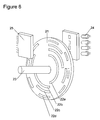
- an optical coder of absolute type comprises a solid disc (21) of the axis (23) which one wants measure the angle of rotation.
- This same disc (21) presents tracks concentric circular rings (22a, 22b and 22c), themselves having alternately opaque and transparent areas. These areas are equal dimensions on a given track and form angular sectors several degrees and identical on each track.
- a light in from, for example, a battery of laser diodes (24), illuminate each track (22a, 22b and 22c).
- the output optical signal is converted into a signal analogue electrical system by a battery of sensors (25), for example of the type photodiodes.
- a photoreceptor When a photoreceptor receives light rays, it produces an analog electrical signal, generally close to a sinusoidal signal. This signal is then processed via a converter analogue / digital or any other method, such as a method interpolation, to obtain a square-wave signal. The angular position of the disk is defined by a binary word.
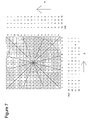
- An interpolation method known of the prior art is shown in FIG. 7. This method consists of a static calculation between the values of a sine signal (Y) and a signal cosine (X). This static calculation is carried out by means of a table (30) of classification of data whose values of the angle to calculate are predefined in relation to sine and cosine values. This table is stored in a data store.
- a disadvantage of this process interpolation is that, to obtain a better precision of the angle, it is necessary to increase the size of the painting, which will then take up more space in the memory.
- this high optical encoder resolution includes a disk (100), itself having at least one fine track (110) and neighboring tracks (111) .
- the fine track (110) is read by four photodetectors arranged two to two opposite and each group of two offset by 90 ° on the disc (100).
- the photoreceptors convert optical signals into signals with at least one sine-type signal and one type signal cosine. These signals will then be processed in a converter analog / digital, then will be processed in a calculator for example an interpolation calculation.
- a first binary word for example comprising 10 bits, the least significant bit of which corresponds to a signal in slot C. To obtain a better correction for example of disc decenter errors, the binary word is enriched by at least one bit of raising doubt.
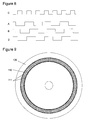
- Figure 8 represents representative chronograms of different signals, A, B, C and D.
- 4 photo-detectors to read the fine track which provides, for example a 10-bit word, and to obtain the rising bits of doubt remains, it takes at least 30 photo-detectors.
- the present invention aims to overcome certain disadvantages of the prior art by proposing an angular interpolation method, by calculation dynamic, associated with a high resolution optical encoder. This process reduces the number of logic gates whose signals are used by the encoder.
- the optical encoder proposes, using this method angular interpolation, to reduce the number of photodetectors used for reading the internal tracks of the high optical encoder disc resolution.
- the angular interpolation method performs the input of digital data Y 0 and X 0 during the first step of the angular interpolation calculation, said digital data resulting from the reading of substantially identical signals to sinusoidal signals respectively sinus and cosine type.
- the value X i of the iteration "i", "i" being different from the zero value is calculated as a function of the values X i -1 and Y i -1 calculated during the iteration "i". -1 "above, and according to the sign" d ", determined during the iteration” i ".
- the value Y i of the iteration "i", "i" being different from the zero value is calculated as a function of the values X i -1 and Y i -1 calculated during the iteration "i -1 "above, and according to the sign" d "determined during the iteration” i ".
- the value Z i of the iteration "i", "i" being different from the zero value is calculated according to the sign "d" determined in the iteration "i” and is, of a predefined constant or of the value Z i -1 calculated during the previous iteration "i-1".
- the number of iterations is predefined, allowing to predefine the constants used in the calculation and thus to reduce the interpolation calculation time carried out by the computer, and to reduce the number of logic gates whose signals are used by the calculator of the optical encoder, while obtaining a precise result.
- the value X no longer varies and is no longer calculated, that it is equal to a value close to zero, said value X remaining the same in the following iterations.
- the method of angular interpolation calculates the X, Y and Z values to obtain integer values, the values in decimal places not being significant for the accuracy of the angle, the calculation as an integer value to reduce the number of logic gates the signals are used by the optical encoder computer.
- the zone of 180 ° locating the position of the angle is determined by the most significant bit of a binary word obtained by the digital analog conversion of a sinusoidal sinusoidal signal or cosine resulting from the reading of the track, said conversion being performed by the means of converting an analog signal into a digital signal.
- Another object is to propose a high resolution optical encoder comprising a disc comprising at least two tracks, including a fine division track and a coarser division track, the division division of each track being a multiple of the previous track, the said tracks are each read by four photodetectors making it possible to obtain, by track, substantially sinusoidal signals offset by 90 ° each, these signals being then digitized by means of converting an analog signal into a digital signal to obtain initial coordinates of an angle of positions which are directly sent to a computer to be processed, the high resolution optical encoder being characterized in that the computer performs a dynamic method of angular interpolation comprising as input the sinusoidal signals generated by the reading of each individual track and converted in digital signals, the computer producing a value of a numeric code for each individual track, these angle values being added to each other and processed to form a digital word representing the absolute angular position of the disc.
- High resolution optical encoder comprising a disk (1) having at least two tracks (2a and 2c), including a fine division track (2c) and a coarser division track (2a), the divisional partition of each track being a multiple of the preceding track, the said tracks (2a and 2c) are each read by four photodetectors (4, 5, 6 and 7) making it possible to obtain, by track, substantially sinusoidal signals shifted by 90 ° each, these signals being then digitized by means of converting an analog signal into a digital signal (14) to obtain initial position angle coordinates (X0 and Y0), the high resolution optical encoder being characterized in that the computer performs a dynamic process of angular interpolation from sinusoidal signals generated by the reading of each individual track (2a and 2c), making it possible to obtain a numerical angle value for each individual track (2a and 2c), these values being added to each other and processed to form a digital word representing the absolute angular position of the disk.
- the calculator comprises means for performing the angular interpolation method, these means comprising a means of determining the angular value to obtain a numerical angle value for each individual track, a means of to determine in an iteration i the operation, addition or subtraction, of the coordinate orthogonal to that computed in the previous iteration i-1, this operation being associated with a condition for determining a sign obtained by a means of comparing the coordinates of the iteration previous with a constant value and ways to use the sign of the operation thus determined to add or subtract a coefficient depending on the iteration level at the previous angle value to get an angle value to know.
- the digital signal processing of substantially sinusoidal shape arriving in the calculator, provides a binary word corresponding to the reading of a track, said binary word comprising a first bit representative of the variation of the opaque zones and of the track read and the remaining bits being representative of the numerical angle value provided by a dynamic interpolation calculation angular.
- the binary words resulting from the treatment digital signals generated during playback of each track individual are treated in a combinatorial way with each other, to obtain a synchronized final binary word, representative of the absolute angular position of the disk, said final binary word consisting of so that the least significant bits correspond to the angular value representative of the reading of the finest divisional track and the bits of highest weight correspond to the representative angular value of the reading of the least fine division track.
- the high resolution optical encoder includes means for converting an analog signal into a signal multiplexed digital device for digitizing shape signals substantially sinusoidal, generated by reading each individual track according to the multiplexing controlled by the computer.
- the high resolution optical encoder includes a multiplexed data processing system, allowing perform the same dynamic process of angular interpolation from all the sinusoidal signals generated by the reading of each track individual.
- the high resolution optical encoder includes a disk that may have more than two tracks, the tracks being of different divisions more or less fine, and being arranged some by to others in a concentric way on the disc, allowing the division of each track is a multiple of the previous track.
- the least fine division track allows generate during reading, at least one form signal substantially sinusoidal whose period corresponds to a rotation of the encoded disk.
- the least fine division track is progressive form, making it possible to generate a shape signal by reading it substantially sinusoidal.
- the present invention relates, in particular, to a calculation method angle interpolation method for calculating the angle formed, for example, by a mechanical arm around an axis.
- the optical encoder used in the beginning of the description is a simplified encoder allowing a better understanding of the process according to the invention.
- This optical encoder comprises a disk (1) disposed on an axis (3), the disk having a thin track (2), said track being read by four photodetectors (4, 5, 6 and 7) arranged around the track so as to provide, after reading the track, sinusoidal signals out of phase by 90 °.
- the four sinusoidal signals correspond respectively to a signal sinus (8), an inverted sine signal (9), a cosine signal (10) and a signal inverted cosine (11).
- Each pair of sinus signal (sinus and inverted sinus) and cosine (cosine and inverted cosine) is then compared in a differential amplifier (12 and 13) to output a sinus signal and a cosine signal, obtained without a shift generated by the direct current.
- These two signals are then digitized, for example, in a converter (14) and after digitization, the signals enter a calculator (15) that performs the interpolation method.
- the method according to the invention performs a calculation substantially equivalent to an iteration calculation.
- iterations, calculated in the present invention are not identical to each other, allowing thus working with predefined constants to minimize the time calculation and the number of logic gates used by the computer.
- the first step of the method concerns the reading and the input of the numerical values Y0 and X0 generated by the converter digital analog. These values correspond respectively to digital values of the converted analog signals. These values represent respectively the numerical values corresponding to the signal cosine (X0) and the sinus signal (Y0) read by the phototransistors arranged on the fine track.
- the mechanical arm represented in an orthogonal plane y-axis and x-axis x is at a position M.
- the data Xi and Yi correspond to values calculated from the values Xi-1 and Yi-1 calculated or read in the previous iterations.
- the data "d” corresponds to a sign, defined according to the values Xi-1 and Yi-1 calculated or read in the previous iterations.
- the datum Zi corresponds to the value approaching each iteration calculation of the value of the angle to be known.
- the values ⁇ _i, ⁇ _i and ⁇ _i are predefined constants.
- the calculator includes means for determining the operation, addition or subtraction, coordinates of each axis x and y (Xi and Yi) in the iteration i as a function of the coordinates (Xi-1 and Yi-1) calculated in the iteration i-1 and also depending on a condition for determining the sign d of the operation based on the coordinates of the iteration i-1.
- the calculator also includes means for determining the angular value to obtain a numerical angle value for each track individual disc. This means of determination comprises a means use the 'd' sign thus determined to add or subtract a coefficient ⁇ _i depending on the iteration level at the previous angle value Zi-1 to get the angle value to know Zi.
- the first phase of calculating an iteration is the determination of the sign "d" as a function of the values Xi and Yi calculated during the previous iteration "i-1" or the values X0 and Y0 entered during the first step performed by the process according to the invention.
- the determination of the sign "d” is carried out by means of comparing the values Xi and Yi calculated during the previous iteration "i-1" according to determination conditions. This means of comparison is included in the calculator.
- the sign "d" is determined by the values X0 and Y0 entered during the first step, performed by the method according to the invention.
- the sign "d” is determined according to the values Xi-1 and Yi-1 calculated during the previous iterations. For example, in iteration number 2, “d” is defined according to X1 and Y1.
- the second phase of calculating an iteration "i" consists in determining the value Xi as a function of the values Xi-1 and Yi-1 calculated during the previous iterations and as a function of the sign "d" defined during the first phase of the iteration number i.
- the computer uses a means of determining the operation, in the example an addition, associated with the previously determined sign "d" to calculate the coordinate Xi.
- the value of X1 is obtained as a function of the values X0 and Y0 entered during the first step, carried out by the method according to the invention and as a function of the sign "d" defined during of the first phase of iteration number 1.
- Xi is a value close to zero. This value no longer varies and remains, when calculating the following iterations, the value of X5.
- the third phase of calculating an iteration "i" consists in determining the value Yi as a function of the values Xi-1 and Yi-1 calculated during the previous iterations and the sign "d" defined during the first phase of the iteration number "i".
- the computer uses a means of determining the operation, in the example a subtraction, associated with the previously determined sign "d" to calculate the coordinate Yi.
- the value of Y1 is obtained as a function of the values X0 and Y0 entered during the first step, carried out by the method according to the invention and as a function of the sign "d" defined during of the first phase of the iteration number "1".
- the determination of the value Yi and the sign "d" in the iterations 6 to 13 is carried out as a function of the value X5 and not the value Xi-1.
- the last phase of calculating an iteration "i" is performed by the means for determining the angular value making it possible to obtain a numerical angle value for each individual track (2a and 2c).
- This phase consists in determining the value Zi as a function of the sign "d" defined during the first phase of the iteration number "i” and as a function of the predefined constants ⁇ _i and ⁇ _i and / or as a function of the calculated value Zi-1 during the previous "i-1" iteration.
- the computer uses the means of using the sign "d” of the operation to add or subtract a coefficient ⁇ _i depending on the iteration level to the angle value Zi-1 to obtain a new angle value Zi.
- the value of Z1 is obtained as a function of the predefined constants ⁇ _i and ⁇ _i and as a function of the sign "d" defined during the first phase of the iteration number "1".
- the value of Z2 is obtained according to the predefined constants, as a function of the value of Z1 and as a function of the sign "d" defined during the first phase of the iteration number 2.
- the value of Z is representative of the positioning angle, for example, of a mechanical arm rotated about an axis.
- the values ⁇ _i, ⁇ _i and ⁇ _i present in the example above, are constants predefined by a programmer and their values are distinct at each iteration.
- This calculation of angular interpolation makes it possible to obtain the value of a calculated over a period ranging from -90 ° to 90 °, knowing that for a value of output 0, the corresponding angle is -90 °.
- the third step of the method according to the invention concerns the determination of the angular value calculated over an angular period of 360 °.
- the calculation made in step 2 is only defined over a period angle of 180 °, ranging from -90 ° to 90 °.
- the objective of the third stage is to determine the 180 ° area of the disc, on which the angle is defined. For to obtain this result over 360 °, the process will be based on the value of the bit of weight of the binary word generated during digital analog conversion sinusoidal sine and cosine signals. This bit is used to define the zone of 180 °, depending on the values 1 or 0. For example the axis is between -90 ° and 90 °, moving in the counterclockwise direction, the value of the weight bit strong is 1, conversely the value of the most significant bit is 0.
- the purpose of discovery is to provide a coding angular, giving an absolute angular position with a large resolution and great accuracy.
- intermediate tracks are arranged on the disc near the fine track the optical encoder shown in FIG. 3.
- the object of the present invention is to realize a high resolution optical encoder using the principle of angular interpolation calculation previously presented, on the tracks internals arranged on the disc near the fine track.
- the device representative of the high resolution optical coder thus makes it possible to reduce the number of photodetectors generally used in the emergence phases doubt, to get a better accuracy.
- the interpolation performed on these tracks will enrich the binary word precisely defining the position angle of the disc. This gives a precise result while decreasing the number of photodetectors included in the encoder.
- the device of the high resolution optical encoder includes a disc with multiple tracks, including at least one track fine and a track, called internal track.
- the device comprises a disk comprising itself, at least one fine track and two internal tracks. Sharing in opaque and transparent division, of each track, fine and internal, represents the integer multiple of the previous track.
- the accuracy and linearity of the signal generated by the playback of individual tracks and the division ratio of following tracks are determined so that the angular value a track is synchronized unequivocally by the signal period of the previous track.
- a first internal track (2a) said 360 ° track, is located in the center of the disc (1).
- This track (2a) is coarse division, it provides at least one sinusoidal signal with only one period per round of the encoded disc.
- the inner track (2a) can be of progressive form. It's the thickness of the track that varies. The progressive shape of the track layout will provide by its reading, the function sine or cosine of the signal.
- Concentrically outside this track is disposed a second intermediate internal track (2b).
- This track is division finer than the first internal track. It allows, for example to obtain at least 64 periods of a sinusoidal signal per revolution of the disk coded (1).
- the intermediate track is composed of opaque graduations and transparent dividers thinner compared to the first internal track.
- a thin track (2c) concentrically outside this intermediate track (2b), is arranged a thin track (2c).
- the thin track (2c) is the incremental track that represents the finest desired resolution of the angular division.
- the thin track (2c) also consists of alternating opaque graduations with transparent areas.
- Each track is read by four photodetectors (4, 5, 6 and 7) arranged in such a way that they are offset by 90 ° from each other. This gives four signals for each track sinusoidal (8, 9, 10 and 11) out of phase by 90 °, respectively a sine signal (8a, 8b and 8c), an inverted sine signal (9a, 9b and 9c), a signal cosine (10a, 10b and 10c) and an inverted cosine signal (11a, 11b and 11c).
- the operating system of the invention comprises a multiplexed analog digital conversion means and a computer using data multiplexing to interpolate dynamic angle on the signals resulting from the reading of each track using the same dynamic process of angular interpolation.
- the result generated by the high resolution optical encoder is represented in a binary word.
- This binary word has the particularity of break down into as many parts as there are tracks on the disc code.
- the word binary breaks down into three parts.
- Figure 4 shows an example representative of a binary word resulting from the present invention.
- the bits B15 to B25 result from the reading of the fine track
- bits B8 at B14 result from reading the intermediate track
- bits B0 through B7 result from the reading of the least fine track. Determination (definition) of the binary word is performed in a more complex way allowing synchronize the results of the tracks playback.
- bit B16 to B25 are obtained by the method of angular interpolation on the signals sine and cosine resulting from the reading of the fine track.
- Bit B15 is a transcription of the reading of the fine track.
- the representative organization chart of this bit corresponds to a square-wave signal representing the opaque zones and transparent of the thin track.
- Intermediate bits (B8 to B14), called intermediate bits of weight strong, are obtained through two treatments performed by the calculator of the optical encoder.
- the first treatment is to get a first word binary.
- the first bit of this binary word is a transcription of the reading of the intermediate track.
- the flowchart representative of this bit corresponds to a niche signal representing the opaque and transparent areas of the intermediate track.
- the other bits of this first binary word are obtained by the method of angular interpolation realized using the signals sine waves resulting from the reading of the intermediate track.
- the second processing makes it possible to synchronize the result of the first binary word with the bit B15 obtained by reading the fine track.
- This combinatorial treatment achieved by the optical encoder calculator makes it possible to obtain the bits B8 to B14.
- the last bits (B0 to B7), called the most significant bits, are also obtained through two treatments performed by the encoder calculator optical.
- the first treatment is to obtain a first binary word.
- the first bit of this binary word is a transcription of the reading of the track.
- the representative flowchart of this bit corresponds to a slot signal representing the opaque and transparent areas of the last runway.
- the other bits of this first binary word are obtained by the method angular interpolation performed using the sinusoidal signals resulting from reading the last track.
- the second treatment allows synchronize the result of the first binary word with the bit B8 obtained by playback of the intermediate track. This combinatorial treatment carried out by the optical encoder calculator makes it possible to obtain the bits B0 to B7.
- the binary word includes the values digital numbers generated by the playback of each individual track, and represents the absolute angular position for example of a mechanical arm in rotation about an axis.
- This binary word is defined through the data multiplexing when calculating the angular interpolation done by the calculator (15). This multiplexing makes it possible to obtain each result of the playing individual tracks, using the same dynamic calculation angular interpolation.
- the linearity of the interpolation of the sine and cosine signals of individual tracks must be very accurate so that each angular value is classified in half a period of the previous track finer, it is necessary the absolute angular position is unambiguously determined. So the first internal track (2a) makes it possible to obtain a first precision coarse, to determine the area of 180 ° where is the arm mechanical.
- the fine track (2b) allows a better precision on the value of the angle formed by the mechanical arm rotating about an axis.
- An encoder optics may include on its encoded disk any number of internal tracks.
- the composition of the binary word is defined according to the number tracks arranged on the disc.
- the number of bits representative of the reading an individual track, in the binary word, can be of value any.
Landscapes
- Physics & Mathematics (AREA)
- General Physics & Mathematics (AREA)
- Engineering & Computer Science (AREA)
- Theoretical Computer Science (AREA)
- Optical Transform (AREA)
- Length Measuring Devices By Optical Means (AREA)
Abstract
- la lecture et la saisie des valeurs numériques X 0 et Y 0 des signaux générés par les capteurs du codeur optique,
- le calcul dynamique de l'interpolation angulaire réalisé sur une période angulaire allant de -90° à 90°, le calcul étant sensiblement équivalent à un calcul par itération, chaque itération « i » comprenant la détermination d'un signe « d » en fonction de valeurs Xi -1 et Yi -1 précédemment calculées ou lues dans l'itération « i-1 » précédente, le calcul de nouvelles valeurs Xi et Yi permettant de déterminer le signe « d » à utiliser dans la prochaine itération « i+1 » et le calcul d'une valeur Z, s'approchant de la valeur d'angle à connaítre.
- la détermination de la zone de 180° comprenant la position de l'angle, pour obtenir un résultat sur une période de 360°, ledit résultat étant présenté par un mot binaire.
Description
- la lecture et la saisie des valeurs numériques Y 0 et X 0 des signaux générés par la source lumineuse et la piste circulaire, les signaux analogiques étant numérisés par un moyen de convertir un signal analogique en un signal numérique,
- le calcul dynamique de l'interpolation angulaire réalisé sur une période angulaire allant de -90° à 90°, ledit calcul d'interpolation étant sensiblement équivalent à un calcul par itération, avec chaque itération « i » comprenant, la détermination d'un signe « d » en fonction de valeurs Xi -1 et Yi -1 précédemment calculées ou lues dans l'itération « i-1 » précédente, le calcul de nouvelles valeurs Xi et Yi permettant de déterminer le signe « d » à utiliser dans la prochaine itération « i+1 », et le calcul d'une valeur Zi s'approchant, à chaque itération, de la valeur finale de l'angle à connaítre.
- la détermination de la zone de 180° situant la position de l'angle, permettant d'obtenir un résultat sur une période angulaire de 360°, ledit résultat étant présenté par un mot binaire comprenant un nombre de bits prédéfinis.
d = -1.
Codeur optique de haute résolution comprenant un disque (1) comportant au moins deux pistes (2a et 2c), dont une piste de division fine (2c) et une piste de division plus grossière (2a), le partage en division de chaque piste étant un multiple de la piste précédente, les dites pistes (2a et 2c) sont lues chacune par quatre photodétecteurs (4, 5, 6 et 7) permettant d'obtenir par piste, des signaux sensiblement sinusoïdaux décalés de 90° chacun, ces signaux étant ensuite numérisés par un moyen de convertir un signal analogique en un signal numérique (14) pour obtenir des coordonnées initiales d'angle de positions (X0 et Y0), le codeur optique haute résolution étant caractérisé en ce que le calculateur réalise un procédé dynamique d'interpolation angulaire à partir de signaux sinusoïdaux générés par la lecture de chaque piste individuelle (2a et 2c), permettant d'obtenir une valeur d'angle numérique pour chaque piste individuelle (2a et 2c), ces valeurs étant ajoutées les unes aux autres et traitées pour former un mot numérique représentant la position angulaire absolue du disque.
- La figure 1 représente le schéma simplifié d'un disque codé, ledit schéma étant utilisé pour expliquer clairement les étapes du procédé dynamique d'interpolation angulaire, selon l'invention ;
- la figure 2 représente le schéma simplifié d'un système d'exploitation d'un codeur optique, ledit schéma étant utilisé pour expliquer clairement les étapes du procédé dynamique d'interpolation angulaire, selon l'invention;
- la figure 3 représente le schéma d'un disque codé, selon l'invention.
- la figure 4 représente un schéma spécifique de la composition d'un mot binaire comprenant la valeur numérique d'un angle, ledit mot binaire résultant du calcul dynamique d'interpolation angulaire, selon l'invention,
- la figure 5 représente le schéma du système d'exploitation du codeur optique de haute résolution utilisant le procédé dynamique d'interpolation angulaire de l'invention ;
- la figure 6 représente le schéma d'un codeur optique connu de l'art antérieur ;
- la figure 7 représente le schéma représentatif du procédé statique d'interpolation angulaire connu de l'art antérieur ;
- la figure 8 représente les chronogrammes représentatifs de l'équation de levée de doute en V connue de l'art antérieur ;
- la figure 9 représente une vue de disposition de pistes concentriques sur un disque codé, permettant de réaliser une levée de doute en V connue de l'art antérieur.
- une étape de saisie des valeurs initiales (X0, Y0),
- une étape de calcul d'interpolation angulaire en fonction des valeurs initiales (X0, Y0) comprenant également d'autres sous étapes, ledit calcul permettant d'obtenir un résultat angulaire positionné sur une période angulaire allant de -90° à 90°,
- et enfin une étape permettant d'obtenir le résultat de la valeur angulaire sur une période de 360°.
Ci-dessous, un exemple d'algorithme de ce calcul d'interpolation est présenté. Cet exemple correspond à un calcul d'interpolation permettant 13 itérations. Ce calcul peut être également réalisé avec un nombre d'itérations inférieur ou supérieur au nombre 13. La deuxième étape du procédé, selon l'invention, est décrite en référence à l'exemple présenté ci-dessous :
La troisième phase de calcul d'une itération « i », consiste à déterminer la valeur Yi en fonction des valeurs Xi-1 et Yi-1 calculées lors des itérations précédentes et du signe « d » défini lors de ia première phase de l'itération numéro « i ». Lors de cette troisième phase de calcul, le calculateur utilise un moyen de déterminer l'opération, dans l'exemple une soustraction, associée au signe précédemment déterminé « d » pour calculer la coordonnée Yi. En se référant à l'exemple ci-dessus, la valeur de Y1 est obtenue en fonction des valeurs X0 et Y0 saisies lors de la première étape, réalisée par le procédé, selon l'invention et en fonction du signe « d » défini lors de la première phase de l'itération numéro « 1 ». La détermination de la valeur Yi et du signe « d » dans les itérations 6 à 13 est réalisée en fonction de la valeur X5 et non la valeur Xi-1.
Claims (21)
- Procédé d'interpolation angulaire, effectué par un codeur optique, ledit codeur optique comprenant au moins, un disque (1) comportant au moins une piste circulaire (2) formée par des zones alternativement opaques et transparentes, une source lumineuse éclairant la piste, des capteurs permettant de convertir un signal optique généré par la source lumineuse et le disque en un signal analogique, un moyen de convertir un signal analogique en un signal numérique (14) et un calculateur (15) réalisant le traitement des données, le procédé d'interpolation angulaire est caractérisé en ce qu'il comprend les étapes suivantes :la lecture et la saisie des valeurs numériques X 0 et Y 0 des signaux générés par la source lumineuse et la piste circulaire, les signaux analogiques étant numérisés par un moyen de convertir un signal analogique en un signal numérique,le calcul dynamique de l'interpolation angulaire réalisé sur une période angulaire allant de -90° à 90°, ledit calcul d'interpolation angulaire étant sensiblement équivalent à un calcul par itération, avec chaque itération « i » comprenant, la détermination d'un signe « d » en fonction de valeurs Xi -1 et Yi -1 précédemment calculées ou lues dans l'itération « i-1 » précédente, le calcul de nouvelles valeurs Xi et Yi permettant de déterminer le signe « d » à utiliser dans la prochaine itération « i+1 », et le calcul d'une valeur Zi s'approchant, à chaque itération, de la valeur finale de l'angle à connaítre.la détermination de la zone de 180° situant la position de l'angle, permettant d'obtenir un résultat sur une période angulaire de 360°, ledit résultat étant présenté par un mot binaire comprenant un nombre de bits prédéfinis.
- Procédé d'interpolation angulaire selon la revendication 1, caractérisé en ce qu'il effectue la saisie de données numériques Y 0 et X 0 lors de la première étape du calcul d'interpolation angulaire, lesdites données numériques résultant de la lecture de signaux sensiblement identiques à des signaux sinusoïdaux respectivement de type sinus et cosinus.
- Procédé d'interpolation angulaire selon la revendication 1 ou 2, caractérisé en ce que la valeur Xi de l'itération « i », « i » étant différente de la valeur nulle, est calculée en fonction des valeurs Xi -1 et Yi -1 calculées lors de l'itération « i -1 » précédente, et en fonction du signe « d », déterminé lors de l'itération « i ».
- Procédé d'interpolation angulaire selon une des revendications 1 à 3, caractérisé en ce que la valeur Yi de l'itération « i », « i » étant différente de la valeur nulle, est calculée en fonction des valeurs Xi -1 et Yi -1 calculées lors de l'itération « i-1 » précédente, et en fonction du signe « d » déterminé lors de l'itération « i ».
- Procédé d'interpolation angulaire selon une des revendications 1 à 4, caractérisé en ce que le signe « d » est déterminé lors de l'étape de saisie des données, par un moyen de comparaison de la valeur des données numérique Y 0 et X 0, en fonction des conditions suivantes : d = 1 si X 0 < 0 et Y 0 < 0 sinon d = -1.
- Procédé d'interpolation angulaire selon une des revendications 1 à 5, caractérisé en ce que le signe « d » est déterminé lors des itérations « i », « i » étant différente de la valeur nulle, par un moyen de comparaison de la valeur des données Xi -1 et Yi -1 déterminées dans l'itération précédente « i-1 », en fonction des conditions suivantes : d = 1 si Xi -1 < 0 et Yi -1 < 0 sinon d = -1.
- Procédé d'interpolation angulaire selon une des revendications 1 à 6, caractérisé en ce que la valeur Zi de l'itération « i », « i » étant différente de la valeur nulle, est calculée en fonction du signe « d » déterminé dans l'itération « i » et soit, d'une constante prédéfinie ou soit, de la valeur Zi -1 calculée lors de l'itération « i-1 » précédente.
- Procédé d'interpolation angulaire selon une des revendications 1 à 7, caractérisé en ce que le nombre d'itérations est prédéfini, permettant ainsi de prédéfinir les constantes utilisées dans le calcul et ainsi de diminuer le temps de calcul d'interpolation réalisé par le calculateur (15), et de diminuer le nombre de portes logiques dont les signaux sont utilisés par le calculateur (15) du codeur optique, tout en obtenant un résultat précis.
- Procédé d'interpolation angulaire selon une des revendications 1 à 8, caractérisé en ce que la valeur X ne varie plus et n'est plus calculée dès lors, qu'elle est égale à une valeur proche de zéro, ladite valeur X restant la même dans les itérations suivantes.
- Procédé d'interpolation angulaire selon une des revendications 1 à 9, caractérisé en ce qu'il calcule les valeurs X, Y et Z pour obtenir des valeurs entières, les valeurs en décimales n'étant pas significatives pour la précision de l'angle, ledit calcul en valeur entière permettant de diminuer le nombre de portes logiques dont les signaux sont utilisés par le calculateur du codeur optique.
- Procédé d'interpolation angulaire selon une des revendications 1 à 10, caractérisé en ce que l'erreur de calcul, obtenue avec un tel procédé d'interpolation angulaire, est inférieure à 1.5en, sachant que e = 2-b, b étant le nombre de bits utilisés pour représenter un nombre, et n étant égal au nombre d'itérations prédéfinies.
- Procédé d'interpolation angulaire selon une des revendications 1 à 11 caractérisé en ce que la zone de 180° situant la position de l'angle, est déterminée par le bit de poids fort d'un mot binaire obtenu par la conversion analogique numérique d'un signal sinusoïdal de type sinus ou cosinus résultant de la lecture de la piste, ladite conversion étant réalisée par le moyen de convertir un signal analogique en un signal numérique (14).
- Codeur optique de haute résolution comprenant un disque (1) comportant au moins deux pistes (2a et 2c), dont une piste de division fine (2c) et une piste de division plus grossière (2a), le partage en division de chaque piste étant un multiple de la piste précédente, les dites pistes (2a et 2c) sont lues chacune par quatre photodétecteurs (4, 5, 6 et 7) permettant d'obtenir par piste, des signaux sensiblement sinusoïdaux décalés de 90° chacun, ces signaux étant ensuite numérisés par un moyen de convertir un signal analogique en un signal numérique (14) pour obtenir des coordonnées initiales d'angle de positions (X0 et Y0) qui sont directement envoyés vers un calculateur (15) pour être traités, le codeur optique haute résolution étant caractérisé en ce que le calculateur effectue un procédé dynamique d'interpolation angulaire comportant en entrée les signaux sinusoïdaux générés par la lecture de chaque piste individuelle (2a et 2c) et convertis en signaux numériques, le calculateur produisant une valeur d'angle numérique pour chaque piste individuelle (2a et 2c), ces valeurs d'angle étant ajoutées les unes aux autres et traitées pour former un mot numérique représentant la position angulaire absolue du disque.
- Codeur optique de haute résolution selon la revendication 13, caractérisé en ce que le calculateur comporte des moyens de réaliser le procédé d'interpolation angulaire, ces moyens comprenant un moyen de déterminer la valeur angulaire permettant d'obtenir une valeur d'angle numérique pour chaque piste individuelle (2a et 2c), un moyen de déterminer dans une itération i l'opération, addition ou soustraction, de la coordonnée orthogonale (Xi ou Yi) à celle (Yi-1 ou Xi-1) calculée dans l'itération précédente i-1, cette opération étant associée à une condition de détermination d'un signe (d) obtenue par un moyen de comparaison des coordonnées de l'itération précédente avec une valeur constante et des moyens d'utiliser le signe (d) de l'opération ainsi déterminée pour ajouter ou soustraire un coefficient (β_i) dépendant du niveau d'itération à la valeur précédente d'angle (Zi-1) pour obtenir une valeur d'angle à connaítre (Zi).
- Codeur optique de haute résolution selon la revendication 13 ou 14, caractérisé en ce que le traitement des signaux numériques de forme sensiblement sinusoïdale arrivant dans le calculateur (15); fournit un mot binaire correspondant à la lecture d'une piste, ledit mot binaire comprenant un premier bit représentatif de la variation des zones opaques et transparentes de la piste lue et les autres bits restants étant représentatifs de la valeur d'angle numérique fournie par un calcul dynamique d'interpolation angulaire.
- Codeur optique de haute résolution selon une des revendications 13 à 15, caractérisé en ce que les mots binaires résultant du traitement des signaux numériques générés lors de la lecture de chaque piste individuelle sont traités de manière combinatoire les uns aux autres, permettant d'obtenir un mot binaire final synchronisé, représentatif de la position angulaire absolue du disque, ledit mot binaire final étant constitué de telle sorte que les bits de poids faibles (16c) correspondent à la valeur angulaire représentative de la lecture de la piste de division la plus fine (2c) et les bits de poids fort (16a) correspondent à la valeur angulaire représentative de la lecture de la piste de division la moins fine (2a).
- Codeur optique de haute résolution, selon une des revendications 13 à 16, caractérisé en ce qu'il comprend un moyen de convertir un signal analogique en un signal numérique (14) multiplexé permettant de numériser les signaux de forme sensiblement sinusoïdale, générés par la lecture de chaque piste individuelle en fonction du multiplexage commandé par le calculateur.
- Codeur optique de haute résolution, selon une des revendications 13 à 17, caractérisé en ce qu'il comprend un système de traitement de données multiplexé, permettant de réaliser le même procédé dynamique d'interpolation angulaire à partir de tous les signaux sinusoïdaux générés par la lecture de chaque piste individuelle.
- Codeur optique de haute résolution selon une des revendications 13 à 18, comprenant un disque pouvant comporter plus de deux pistes, les pistes étant de division différente plus ou moins fine, et étant disposées les unes par rapport aux autres de manière concentrique sur le disque, permettant que le partage en division de chaque piste soit un multiple de la piste précédente.
- Codeur optique de haute résolution selon une des revendications 13 à 19, défini en ce que la piste de division la moins fine (16a) permet de générer lors de sa lecture, au moins un signal de forme sensiblement sinusoïdale dont la période correspond à un tour de rotation du disque codé.
- Codeur optique de haute résolution selon une des revendications 13 à 20, défini en ce que la partie opaque de la piste de division la moins fine (16a) a une épaisseur dans le sens radial variant selon une loi déterminée et permettant de générer par sa lecture un signal de forme sensiblement sinusoïdale.
Applications Claiming Priority (2)
| Application Number | Priority Date | Filing Date | Title |
|---|---|---|---|
| FR0307406A FR2856477B1 (fr) | 2003-06-19 | 2003-06-19 | Procede d'interpolation angulaire realise pour codeur optique haute resolution et le codeur optique |
| FR0307406 | 2003-06-19 |
Publications (2)
| Publication Number | Publication Date |
|---|---|
| EP1489387A1 true EP1489387A1 (fr) | 2004-12-22 |
| EP1489387B1 EP1489387B1 (fr) | 2006-09-06 |
Family
ID=33396809
Family Applications (1)
| Application Number | Title | Priority Date | Filing Date |
|---|---|---|---|
| EP04291492A Expired - Lifetime EP1489387B1 (fr) | 2003-06-19 | 2004-06-15 | Procédé d'interpolation angulaire réalisé pour un codeur optique à haute résolution et le codeur optique correspondant |
Country Status (4)
| Country | Link |
|---|---|
| EP (1) | EP1489387B1 (fr) |
| AT (1) | ATE338934T1 (fr) |
| DE (1) | DE602004002240T2 (fr) |
| FR (1) | FR2856477B1 (fr) |
Cited By (7)
| Publication number | Priority date | Publication date | Assignee | Title |
|---|---|---|---|---|
| WO2015175230A1 (fr) * | 2014-05-12 | 2015-11-19 | Faro Technologies, Inc. | Correction d'indice de robustesse d'un codeur angulaire à l'aide de signaux analogiques |
| US9436003B2 (en) | 2014-05-12 | 2016-09-06 | Faro Technologies, Inc. | Robust index correction of an angular encoder in a three-dimensional coordinate measurement device |
| US9689986B2 (en) | 2014-05-12 | 2017-06-27 | Faro Technologies, Inc. | Robust index correction of an angular encoder based on read head runout |
| CN109827597A (zh) * | 2019-03-08 | 2019-05-31 | 溱者(上海)智能科技有限公司 | 一种编码承载器件及位置编码器装置 |
| CN113091774A (zh) * | 2021-03-17 | 2021-07-09 | 陈权 | 一种基于绝对值编码器的正余弦编码方法 |
| CN115112196A (zh) * | 2022-08-29 | 2022-09-27 | 济南瑞泉电子有限公司 | 一种高精度反射式光电直读水表解码方法及系统 |
| CN116429153A (zh) * | 2022-01-04 | 2023-07-14 | 上海禾赛科技有限公司 | 一种角度确定方法及装置、终端设备 |
Families Citing this family (1)
| Publication number | Priority date | Publication date | Assignee | Title |
|---|---|---|---|---|
| DE102022103577A1 (de) | 2022-02-16 | 2023-08-17 | Ic-Haus Gmbh | Positionssensorvorrichtung für einen optischen Positionsencoder |
Citations (3)
| Publication number | Priority date | Publication date | Assignee | Title |
|---|---|---|---|---|
| EP0200791A1 (fr) * | 1984-11-05 | 1986-11-12 | Fanuc Ltd. | Procede et dispositif de detection de position |
| EP0395936A1 (fr) * | 1989-05-03 | 1990-11-07 | Dr. Johannes Heidenhain GmbH | Dispositif de mesure de position avec plusieurs points de capteur |
| US5041829A (en) * | 1985-08-22 | 1991-08-20 | Muirhead Vactric Components, Ltd. | Interpolation method and shaft angle encoder |
Family Cites Families (1)
| Publication number | Priority date | Publication date | Assignee | Title |
|---|---|---|---|---|
| WO1993021499A1 (fr) * | 1992-04-22 | 1993-10-28 | Copal Company Limited | Codeur absolu |
-
2003
- 2003-06-19 FR FR0307406A patent/FR2856477B1/fr not_active Expired - Fee Related
-
2004
- 2004-06-15 EP EP04291492A patent/EP1489387B1/fr not_active Expired - Lifetime
- 2004-06-15 AT AT04291492T patent/ATE338934T1/de not_active IP Right Cessation
- 2004-06-15 DE DE602004002240T patent/DE602004002240T2/de not_active Expired - Lifetime
Patent Citations (3)
| Publication number | Priority date | Publication date | Assignee | Title |
|---|---|---|---|---|
| EP0200791A1 (fr) * | 1984-11-05 | 1986-11-12 | Fanuc Ltd. | Procede et dispositif de detection de position |
| US5041829A (en) * | 1985-08-22 | 1991-08-20 | Muirhead Vactric Components, Ltd. | Interpolation method and shaft angle encoder |
| EP0395936A1 (fr) * | 1989-05-03 | 1990-11-07 | Dr. Johannes Heidenhain GmbH | Dispositif de mesure de position avec plusieurs points de capteur |
Cited By (10)
| Publication number | Priority date | Publication date | Assignee | Title |
|---|---|---|---|---|
| WO2015175230A1 (fr) * | 2014-05-12 | 2015-11-19 | Faro Technologies, Inc. | Correction d'indice de robustesse d'un codeur angulaire à l'aide de signaux analogiques |
| US9436003B2 (en) | 2014-05-12 | 2016-09-06 | Faro Technologies, Inc. | Robust index correction of an angular encoder in a three-dimensional coordinate measurement device |
| GB2540106A (en) * | 2014-05-12 | 2017-01-04 | Faro Tech Inc | Robust index correction of an angular encoder using analog signals |
| US9689986B2 (en) | 2014-05-12 | 2017-06-27 | Faro Technologies, Inc. | Robust index correction of an angular encoder based on read head runout |
| US9759583B2 (en) | 2014-05-12 | 2017-09-12 | Faro Technologies, Inc. | Method of obtaining a reference correction value for an index mark of an angular encoder |
| GB2540106B (en) * | 2014-05-12 | 2019-03-06 | Faro Tech Inc | Robust index correction of an angular encoder using analog signals |
| CN109827597A (zh) * | 2019-03-08 | 2019-05-31 | 溱者(上海)智能科技有限公司 | 一种编码承载器件及位置编码器装置 |
| CN113091774A (zh) * | 2021-03-17 | 2021-07-09 | 陈权 | 一种基于绝对值编码器的正余弦编码方法 |
| CN116429153A (zh) * | 2022-01-04 | 2023-07-14 | 上海禾赛科技有限公司 | 一种角度确定方法及装置、终端设备 |
| CN115112196A (zh) * | 2022-08-29 | 2022-09-27 | 济南瑞泉电子有限公司 | 一种高精度反射式光电直读水表解码方法及系统 |
Also Published As
| Publication number | Publication date |
|---|---|
| ATE338934T1 (de) | 2006-09-15 |
| FR2856477A1 (fr) | 2004-12-24 |
| DE602004002240D1 (de) | 2006-10-19 |
| EP1489387B1 (fr) | 2006-09-06 |
| DE602004002240T2 (de) | 2007-08-23 |
| FR2856477B1 (fr) | 2006-10-06 |
Similar Documents
| Publication | Publication Date | Title |
|---|---|---|
| CN101506621B (zh) | 光电角度传感器和确定围绕轴的转动角度的方法 | |
| FR2482722A1 (fr) | Dispositif de codage de position | |
| JP5566061B2 (ja) | 光学式変位検出装置 | |
| FR2608790A1 (fr) | Dispositif perfectionne de test pour disques optiques | |
| FR2523349A1 (fr) | Procede et dispositif optique de generation de signaux d'asservissements de la position d'une tache d'exploration des pistes d'un support d'information | |
| EP1489387B1 (fr) | Procédé d'interpolation angulaire réalisé pour un codeur optique à haute résolution et le codeur optique correspondant | |
| CH654659A5 (fr) | Procede de formation d'un signal index precis dans un dispositif codeur angulaire et dispositif codeur angulaire. | |
| Halliday et al. | Line-of-sight velocity distributions of low-luminosity elliptical galaxies | |
| EP0225259B1 (fr) | Support d'information à prégravure et son dispositif d'exploration optiques à accès échantillonné | |
| JP3179493B2 (ja) | アブソリュートエンコーダ | |
| EP1065662A1 (fr) | Procédé et dispositif pour l'asservissement d'un faisceau optique incident sur une piste d'un support mobile d'informations, en particulier un disque numérique à vitesse de rotation élevée | |
| EP3662657A1 (fr) | Circuit de lecture de capteur de temps de vol | |
| EP1017966B1 (fr) | Capteur numerique de position | |
| Yu et al. | High-resolution angular measurement arithmetic based on pixel interpolations | |
| EP1677081B1 (fr) | Procédé de détermination de la position d'un premier élément en mouvement relativement à un second élément et dispositif pour mettre en oeuvre ledit procédé | |
| JP2016014574A (ja) | アブソリュートエンコーダ | |
| JP4895662B2 (ja) | ターゲットパターンを使用して、二次元の絶対位置を感知するシステム | |
| Gusev et al. | Parameters of the brightest star formation regions in the two principal spiral arms of NGC 628 | |
| FR2954493A1 (fr) | Capteur optique de position angulaire absolue | |
| EP0270440B1 (fr) | Capteurs de position angulaire ou linéaire de haute précision à couplage capacitif | |
| FR2717572A1 (fr) | Codeur absolu produisant des formes d'ondes triangulaires déphasées pour la production de signaux à bits multiples. | |
| EP0099797A1 (fr) | Capteur rotatif de position angulaire à sorties numériques | |
| EP1037204B1 (fr) | Procédé et dispositif d'asservissement d'un faisceau optique incident sur une piste d'un support mobile d'informations, en particulier un disque numérique | |
| EP1489388A1 (fr) | Système de codage optique haute précision | |
| FR2595461A1 (fr) | Procede de reperage angulaire d'une machine tournante |
Legal Events
| Date | Code | Title | Description |
|---|---|---|---|
| PUAI | Public reference made under article 153(3) epc to a published international application that has entered the european phase |
Free format text: ORIGINAL CODE: 0009012 |
|
| AK | Designated contracting states |
Kind code of ref document: A1 Designated state(s): AT BE BG CH CY CZ DE DK EE ES FI FR GB GR HU IE IT LI LU MC NL PL PT RO SE SI SK TR |
|
| AX | Request for extension of the european patent |
Extension state: AL HR LT LV MK |
|
| AKX | Designation fees paid | ||
| 17P | Request for examination filed |
Effective date: 20050808 |
|
| RAX | Requested extension states of the european patent have changed |
Extension state: LV Payment date: 20050808 Extension state: LT Payment date: 20050808 |
|
| RBV | Designated contracting states (corrected) |
Designated state(s): AT BE BG CH CY CZ DE DK EE ES FI FR GB GR HU IE IT LI LU MC NL PL PT RO SE SI SK TR |
|
| REG | Reference to a national code |
Ref country code: DE Ref legal event code: 8566 |
|
| GRAP | Despatch of communication of intention to grant a patent |
Free format text: ORIGINAL CODE: EPIDOSNIGR1 |
|
| GRAS | Grant fee paid |
Free format text: ORIGINAL CODE: EPIDOSNIGR3 |
|
| GRAA | (expected) grant |
Free format text: ORIGINAL CODE: 0009210 |
|
| AK | Designated contracting states |
Kind code of ref document: B1 Designated state(s): AT BE BG CH CY CZ DE DK EE ES FI FR GB GR HU IE IT LI LU MC NL PL PT RO SE SI SK TR |
|
| AX | Request for extension of the european patent |
Extension state: LT LV |
|
| PG25 | Lapsed in a contracting state [announced via postgrant information from national office to epo] |
Ref country code: RO Free format text: LAPSE BECAUSE OF FAILURE TO SUBMIT A TRANSLATION OF THE DESCRIPTION OR TO PAY THE FEE WITHIN THE PRESCRIBED TIME-LIMIT Effective date: 20060906 Ref country code: IT Free format text: LAPSE BECAUSE OF FAILURE TO SUBMIT A TRANSLATION OF THE DESCRIPTION OR TO PAY THE FEE WITHIN THE PRESCRIBED TIME-LIMIT;WARNING: LAPSES OF ITALIAN PATENTS WITH EFFECTIVE DATE BEFORE 2007 MAY HAVE OCCURRED AT ANY TIME BEFORE 2007. THE CORRECT EFFECTIVE DATE MAY BE DIFFERENT FROM THE ONE RECORDED. Effective date: 20060906 Ref country code: AT Free format text: LAPSE BECAUSE OF FAILURE TO SUBMIT A TRANSLATION OF THE DESCRIPTION OR TO PAY THE FEE WITHIN THE PRESCRIBED TIME-LIMIT Effective date: 20060906 Ref country code: IE Free format text: LAPSE BECAUSE OF FAILURE TO SUBMIT A TRANSLATION OF THE DESCRIPTION OR TO PAY THE FEE WITHIN THE PRESCRIBED TIME-LIMIT Effective date: 20060906 Ref country code: CZ Free format text: LAPSE BECAUSE OF FAILURE TO SUBMIT A TRANSLATION OF THE DESCRIPTION OR TO PAY THE FEE WITHIN THE PRESCRIBED TIME-LIMIT Effective date: 20060906 Ref country code: SI Free format text: LAPSE BECAUSE OF FAILURE TO SUBMIT A TRANSLATION OF THE DESCRIPTION OR TO PAY THE FEE WITHIN THE PRESCRIBED TIME-LIMIT Effective date: 20060906 Ref country code: FI Free format text: LAPSE BECAUSE OF FAILURE TO SUBMIT A TRANSLATION OF THE DESCRIPTION OR TO PAY THE FEE WITHIN THE PRESCRIBED TIME-LIMIT Effective date: 20060906 Ref country code: PL Free format text: LAPSE BECAUSE OF FAILURE TO SUBMIT A TRANSLATION OF THE DESCRIPTION OR TO PAY THE FEE WITHIN THE PRESCRIBED TIME-LIMIT Effective date: 20060906 Ref country code: NL Free format text: LAPSE BECAUSE OF FAILURE TO SUBMIT A TRANSLATION OF THE DESCRIPTION OR TO PAY THE FEE WITHIN THE PRESCRIBED TIME-LIMIT Effective date: 20060906 Ref country code: SK Free format text: LAPSE BECAUSE OF FAILURE TO SUBMIT A TRANSLATION OF THE DESCRIPTION OR TO PAY THE FEE WITHIN THE PRESCRIBED TIME-LIMIT Effective date: 20060906 |
|
| REG | Reference to a national code |
Ref country code: GB Ref legal event code: FG4D Free format text: NOT ENGLISH |
|
| REG | Reference to a national code |
Ref country code: CH Ref legal event code: EP |
|
| REG | Reference to a national code |
Ref country code: IE Ref legal event code: FG4D Free format text: LANGUAGE OF EP DOCUMENT: FRENCH |
|
| REF | Corresponds to: |
Ref document number: 602004002240 Country of ref document: DE Date of ref document: 20061019 Kind code of ref document: P |
|
| REG | Reference to a national code |
Ref country code: CH Ref legal event code: NV Representative=s name: R. A. EGLI & CO. PATENTANWAELTE |
|
| PG25 | Lapsed in a contracting state [announced via postgrant information from national office to epo] |
Ref country code: SE Free format text: LAPSE BECAUSE OF FAILURE TO SUBMIT A TRANSLATION OF THE DESCRIPTION OR TO PAY THE FEE WITHIN THE PRESCRIBED TIME-LIMIT Effective date: 20061206 Ref country code: DK Free format text: LAPSE BECAUSE OF FAILURE TO SUBMIT A TRANSLATION OF THE DESCRIPTION OR TO PAY THE FEE WITHIN THE PRESCRIBED TIME-LIMIT Effective date: 20061206 Ref country code: BG Free format text: LAPSE BECAUSE OF FAILURE TO SUBMIT A TRANSLATION OF THE DESCRIPTION OR TO PAY THE FEE WITHIN THE PRESCRIBED TIME-LIMIT Effective date: 20061206 |
|
| GBT | Gb: translation of ep patent filed (gb section 77(6)(a)/1977) |
Effective date: 20061121 |
|
| PG25 | Lapsed in a contracting state [announced via postgrant information from national office to epo] |
Ref country code: ES Free format text: LAPSE BECAUSE OF FAILURE TO SUBMIT A TRANSLATION OF THE DESCRIPTION OR TO PAY THE FEE WITHIN THE PRESCRIBED TIME-LIMIT Effective date: 20061217 |
|
| PG25 | Lapsed in a contracting state [announced via postgrant information from national office to epo] |
Ref country code: PT Free format text: LAPSE BECAUSE OF FAILURE TO SUBMIT A TRANSLATION OF THE DESCRIPTION OR TO PAY THE FEE WITHIN THE PRESCRIBED TIME-LIMIT Effective date: 20070219 |
|
| NLV1 | Nl: lapsed or annulled due to failure to fulfill the requirements of art. 29p and 29m of the patents act | ||
| REG | Reference to a national code |
Ref country code: IE Ref legal event code: FD4D |
|
| PLBE | No opposition filed within time limit |
Free format text: ORIGINAL CODE: 0009261 |
|
| STAA | Information on the status of an ep patent application or granted ep patent |
Free format text: STATUS: NO OPPOSITION FILED WITHIN TIME LIMIT |
|
| 26N | No opposition filed |
Effective date: 20070607 |
|
| BERE | Be: lapsed |
Owner name: CODECHAMP S.A. Effective date: 20070630 |
|
| PG25 | Lapsed in a contracting state [announced via postgrant information from national office to epo] |
Ref country code: MC Free format text: LAPSE BECAUSE OF NON-PAYMENT OF DUE FEES Effective date: 20070630 |
|
| PG25 | Lapsed in a contracting state [announced via postgrant information from national office to epo] |
Ref country code: BE Free format text: LAPSE BECAUSE OF NON-PAYMENT OF DUE FEES Effective date: 20070630 |
|
| PG25 | Lapsed in a contracting state [announced via postgrant information from national office to epo] |
Ref country code: GR Free format text: LAPSE BECAUSE OF FAILURE TO SUBMIT A TRANSLATION OF THE DESCRIPTION OR TO PAY THE FEE WITHIN THE PRESCRIBED TIME-LIMIT Effective date: 20061207 |
|
| PG25 | Lapsed in a contracting state [announced via postgrant information from national office to epo] |
Ref country code: EE Free format text: LAPSE BECAUSE OF FAILURE TO SUBMIT A TRANSLATION OF THE DESCRIPTION OR TO PAY THE FEE WITHIN THE PRESCRIBED TIME-LIMIT Effective date: 20060906 |
|
| PG25 | Lapsed in a contracting state [announced via postgrant information from national office to epo] |
Ref country code: LU Free format text: LAPSE BECAUSE OF NON-PAYMENT OF DUE FEES Effective date: 20070615 Ref country code: CY Free format text: LAPSE BECAUSE OF FAILURE TO SUBMIT A TRANSLATION OF THE DESCRIPTION OR TO PAY THE FEE WITHIN THE PRESCRIBED TIME-LIMIT Effective date: 20060906 |
|
| PG25 | Lapsed in a contracting state [announced via postgrant information from national office to epo] |
Ref country code: HU Free format text: LAPSE BECAUSE OF FAILURE TO SUBMIT A TRANSLATION OF THE DESCRIPTION OR TO PAY THE FEE WITHIN THE PRESCRIBED TIME-LIMIT Effective date: 20070307 |
|
| REG | Reference to a national code |
Ref country code: FR Ref legal event code: PLFP Year of fee payment: 13 |
|
| REG | Reference to a national code |
Ref country code: FR Ref legal event code: PLFP Year of fee payment: 14 |
|
| REG | Reference to a national code |
Ref country code: FR Ref legal event code: PLFP Year of fee payment: 15 |
|
| PGFP | Annual fee paid to national office [announced via postgrant information from national office to epo] |
Ref country code: GB Payment date: 20220628 Year of fee payment: 19 |
|
| PGFP | Annual fee paid to national office [announced via postgrant information from national office to epo] |
Ref country code: TR Payment date: 20220601 Year of fee payment: 19 |
|
| PGFP | Annual fee paid to national office [announced via postgrant information from national office to epo] |
Ref country code: FR Payment date: 20220623 Year of fee payment: 19 |
|
| PGFP | Annual fee paid to national office [announced via postgrant information from national office to epo] |
Ref country code: DE Payment date: 20220629 Year of fee payment: 19 |
|
| PGFP | Annual fee paid to national office [announced via postgrant information from national office to epo] |
Ref country code: CH Payment date: 20220706 Year of fee payment: 19 |
|
| REG | Reference to a national code |
Ref country code: DE Ref legal event code: R119 Ref document number: 602004002240 Country of ref document: DE |
|
| REG | Reference to a national code |
Ref country code: CH Ref legal event code: PL |
|
| GBPC | Gb: european patent ceased through non-payment of renewal fee |
Effective date: 20230615 |
|
| PG25 | Lapsed in a contracting state [announced via postgrant information from national office to epo] |
Ref country code: DE Free format text: LAPSE BECAUSE OF NON-PAYMENT OF DUE FEES Effective date: 20240103 Ref country code: GB Free format text: LAPSE BECAUSE OF NON-PAYMENT OF DUE FEES Effective date: 20230615 Ref country code: CH Free format text: LAPSE BECAUSE OF NON-PAYMENT OF DUE FEES Effective date: 20230630 |
|
| PG25 | Lapsed in a contracting state [announced via postgrant information from national office to epo] |
Ref country code: FR Free format text: LAPSE BECAUSE OF NON-PAYMENT OF DUE FEES Effective date: 20230630 |