EP1487171B1 - Reliable Multimedia streaming using retransmissions. - Google Patents
Reliable Multimedia streaming using retransmissions. Download PDFInfo
- Publication number
- EP1487171B1 EP1487171B1 EP04102013A EP04102013A EP1487171B1 EP 1487171 B1 EP1487171 B1 EP 1487171B1 EP 04102013 A EP04102013 A EP 04102013A EP 04102013 A EP04102013 A EP 04102013A EP 1487171 B1 EP1487171 B1 EP 1487171B1
- Authority
- EP
- European Patent Office
- Prior art keywords
- packets
- missing
- packet
- time
- group
- Prior art date
- Legal status (The legal status is an assumption and is not a legal conclusion. Google has not performed a legal analysis and makes no representation as to the accuracy of the status listed.)
- Expired - Lifetime
Links
- 238000004891 communication Methods 0.000 claims description 35
- 238000000034 method Methods 0.000 claims description 23
- 238000013459 approach Methods 0.000 description 43
- 230000015654 memory Effects 0.000 description 15
- 239000000872 buffer Substances 0.000 description 12
- 230000005540 biological transmission Effects 0.000 description 9
- 230000003287 optical effect Effects 0.000 description 9
- 238000005516 engineering process Methods 0.000 description 5
- 230000004044 response Effects 0.000 description 5
- 238000012545 processing Methods 0.000 description 4
- 101000741965 Homo sapiens Inactive tyrosine-protein kinase PRAG1 Proteins 0.000 description 3
- 102100038659 Inactive tyrosine-protein kinase PRAG1 Human genes 0.000 description 3
- 238000010586 diagram Methods 0.000 description 3
- 230000006870 function Effects 0.000 description 3
- 230000006855 networking Effects 0.000 description 3
- 230000002093 peripheral effect Effects 0.000 description 3
- 230000008569 process Effects 0.000 description 3
- 230000001419 dependent effect Effects 0.000 description 2
- 230000007246 mechanism Effects 0.000 description 2
- 230000005055 memory storage Effects 0.000 description 2
- 230000005236 sound signal Effects 0.000 description 2
- 230000006399 behavior Effects 0.000 description 1
- 230000003139 buffering effect Effects 0.000 description 1
- 239000002131 composite material Substances 0.000 description 1
- 230000001934 delay Effects 0.000 description 1
- 238000001514 detection method Methods 0.000 description 1
- 239000000463 material Substances 0.000 description 1
- 238000011084 recovery Methods 0.000 description 1
- 238000012546 transfer Methods 0.000 description 1
- 230000007723 transport mechanism Effects 0.000 description 1
Images


Classifications
-
- H—ELECTRICITY
- H04—ELECTRIC COMMUNICATION TECHNIQUE
- H04L—TRANSMISSION OF DIGITAL INFORMATION, e.g. TELEGRAPHIC COMMUNICATION
- H04L1/00—Arrangements for detecting or preventing errors in the information received
- H04L1/12—Arrangements for detecting or preventing errors in the information received by using return channel
- H04L1/16—Arrangements for detecting or preventing errors in the information received by using return channel in which the return channel carries supervisory signals, e.g. repetition request signals
- H04L1/18—Automatic repetition systems, e.g. Van Duuren systems
-
- H—ELECTRICITY
- H04—ELECTRIC COMMUNICATION TECHNIQUE
- H04L—TRANSMISSION OF DIGITAL INFORMATION, e.g. TELEGRAPHIC COMMUNICATION
- H04L1/00—Arrangements for detecting or preventing errors in the information received
- H04L1/12—Arrangements for detecting or preventing errors in the information received by using return channel
- H04L1/16—Arrangements for detecting or preventing errors in the information received by using return channel in which the return channel carries supervisory signals, e.g. repetition request signals
- H04L1/1607—Details of the supervisory signal
- H04L1/1628—List acknowledgements, i.e. the acknowledgement message consisting of a list of identifiers, e.g. of sequence numbers
-
- H—ELECTRICITY
- H04—ELECTRIC COMMUNICATION TECHNIQUE
- H04L—TRANSMISSION OF DIGITAL INFORMATION, e.g. TELEGRAPHIC COMMUNICATION
- H04L1/00—Arrangements for detecting or preventing errors in the information received
- H04L1/12—Arrangements for detecting or preventing errors in the information received by using return channel
- H04L1/16—Arrangements for detecting or preventing errors in the information received by using return channel in which the return channel carries supervisory signals, e.g. repetition request signals
- H04L1/18—Automatic repetition systems, e.g. Van Duuren systems
- H04L1/1829—Arrangements specially adapted for the receiver end
- H04L1/1848—Time-out mechanisms
-
- H—ELECTRICITY
- H04—ELECTRIC COMMUNICATION TECHNIQUE
- H04L—TRANSMISSION OF DIGITAL INFORMATION, e.g. TELEGRAPHIC COMMUNICATION
- H04L65/00—Network arrangements, protocols or services for supporting real-time applications in data packet communication
- H04L65/60—Network streaming of media packets
- H04L65/70—Media network packetisation
-
- H—ELECTRICITY
- H04—ELECTRIC COMMUNICATION TECHNIQUE
- H04L—TRANSMISSION OF DIGITAL INFORMATION, e.g. TELEGRAPHIC COMMUNICATION
- H04L65/00—Network arrangements, protocols or services for supporting real-time applications in data packet communication
- H04L65/80—Responding to QoS
-
- H—ELECTRICITY
- H04—ELECTRIC COMMUNICATION TECHNIQUE
- H04L—TRANSMISSION OF DIGITAL INFORMATION, e.g. TELEGRAPHIC COMMUNICATION
- H04L69/00—Network arrangements, protocols or services independent of the application payload and not provided for in the other groups of this subclass
- H04L69/16—Implementation or adaptation of Internet protocol [IP], of transmission control protocol [TCP] or of user datagram protocol [UDP]
-
- H—ELECTRICITY
- H04—ELECTRIC COMMUNICATION TECHNIQUE
- H04L—TRANSMISSION OF DIGITAL INFORMATION, e.g. TELEGRAPHIC COMMUNICATION
- H04L69/00—Network arrangements, protocols or services independent of the application payload and not provided for in the other groups of this subclass
- H04L69/16—Implementation or adaptation of Internet protocol [IP], of transmission control protocol [TCP] or of user datagram protocol [UDP]
- H04L69/163—In-band adaptation of TCP data exchange; In-band control procedures
-
- H—ELECTRICITY
- H04—ELECTRIC COMMUNICATION TECHNIQUE
- H04L—TRANSMISSION OF DIGITAL INFORMATION, e.g. TELEGRAPHIC COMMUNICATION
- H04L12/00—Data switching networks
- H04L12/54—Store-and-forward switching systems
- H04L12/56—Packet switching systems
- H04L12/5601—Transfer mode dependent, e.g. ATM
- H04L2012/5603—Access techniques
-
- H—ELECTRICITY
- H04—ELECTRIC COMMUNICATION TECHNIQUE
- H04L—TRANSMISSION OF DIGITAL INFORMATION, e.g. TELEGRAPHIC COMMUNICATION
- H04L65/00—Network arrangements, protocols or services for supporting real-time applications in data packet communication
- H04L65/1066—Session management
- H04L65/1101—Session protocols
Definitions
- This invention generally relates to a network communications technology.
- TCP Transmission Control Protocol
- IP IP Multimedia Subscription Protocol
- TCP guarantees delivery of data and also guarantees that data will be delivered in the same order in which it was sent. To do that, TCP employs an acknowledgement-based retry procedure to detect and retry failed communications.
- a host sends a group (i.e., window) of data packets to a receiver on a communications network.
- the group may be called a "window."
- a TCP window is the amount of outstanding (i.e., unacknowledged by the recipient) data a sender is allowed to send on a particular connection before it gets an ACK back from the receiver that the receiver has gotten some of it.
- ACK is short for acknowledgement code. It typically is a transmission control indicator indicating that a transmitted message was received uncorrupted or without errors or that the receiving station is ready to accept more transmissions.
- the receiver sends the code to the sender to indicate that the transmission has been accepted.
- the host After the host sends the window of packets, it waits for an ACK from that receiver indicating that all or some packets of the window were successfully received. If it fails to receive an ACK within a defined retry time period, the host resends all of the packets of the window. So, if the sender does not receive an ACK, it assumes that the receiver did not receive any of the data since the last time the sender got an ACK from the receiver.
- the ACK received by the host may indicate the last contiguous packet of a window that was successfully received. If so, the host resends all of the packets in the window following that packet specified by the ACK as being successfully received.
- Conventional retry approaches typically resend large groups of data-maybe even an entire window worth of packets-when a communications failure is detected. Also, these conventional approaches are typically ACK-based. Furthermore, these conventional approaches typically do not account for any time-critical nature of the reception of data.
- An example of such a conventional approach is the TCP retry approach discussed above.
- US-A-5 918 002 discloses a selective retransmission technique.
- the described client module to receive the data packets includes a playout buffer.
- the data packets arrive at the client computer in a different order than they were originally transmitted and are rearranged back to the original sequential order. As data packets arrive, the sequence numbers are checked. If a data packet arrives out of sequence, the client computer checks the playout buffer to see if the packet is indeed missing or if the skipped packet has arrived previously and is already stored in the playout buffer. If the skipped data packet is not found in the playout buffer, the client computer computes a roundtrip time for the missing data packet.
- the client computer sends a request to the server for retransmission of the missing data packet. If there is insufficient time remaining to reasonably expect a timely retransmission, then the data packet is presumed unrecoverable and the missing packet is accordingly discarded.
- XP002251288 discloses a retransmission-based error control for continuous media applications.
- a selective repeat technique is adopted and limited buffering at the receiver and the sender is introduced.
- Gap-based loss detection at the receiver combined with NACKs is used. A gap is detected when a packet arrives with a sequence number higher than expected.
- the receiver keeps an estimate of the roundtrip delay, RTD, and the presentation time for each frame and ensures that retransmission requests are generated only if the presentation time is greater than the current RTD estimate.
- the playout buffer status consists of a bitmap indicating the presence or absence of packets. If a gap is detected and there is sufficient time for recovery, a retransmission request is sent immediately and retransmission is done in units of packets.
- the document also discloses an extension of the protocol to multiple retransmissions.
- This invention generally relates to a network communications technology.
- An implementation, described herein performs a time-aware, best-effort, hole-filling communications retry function over a communications network. It does so in a manner that assumes successful reception of data unless the receiver indicates differently.
- the indication specifically identifies the missing data. With this indication, the sender resends only the specifically identified missing data.
- An example of an embodiment of a a time-aware best-effort hole-filling retry method and system for network communications may be referred to as an "exemplary hole-filling retry approach.”
- the one or more exemplary implementations, described herein, of the present claimed invention may be implemented by the presentation device 408 of Figs. 4 and 5, the computer 602 of Fig. 6, and/or as part of a computing environment like that shown in Figs. 4-6.
- Such conventional retry approaches are inefficient for conditions where large amount of data is pouring one-way across the network, for example, in time-sensitive streaming multimedia data applications.
- the conventional approach is inefficient because of the frequent use of ACK packets from the receiver to the sender and because they tend to resend large blocks of data during a retry when only some of the resent data is missing (rather than only when all of the resent data is missing).
- the exemplary hole-filling retry approach overcomes these drawbacks of the conventional retry approaches. It increases the efficiency of communication-especially for conditions where a large amount of data is pouring one-way across the network. Such as is the case with streaming multimedia data.
- the exemplary hole-filling retry approach performs a time-aware, best-effort, hole-filling communications retry function over a communications network.
- the sender uses a NACK-based approach, the sender only resends data to the receiver that the receiver identifies as having not been received.
- the exemplary hole-filling retry approach has the capability to abandon attempts to obtain missing data when that data become irrelevant because it is too old. Unlike conventional approaches, the exemplary hole-filling retry approach may sustain an efficient, non-bursty, high-throughput connection across a communications network (e.g., the Internet), even in the presence of latencies that are high compared to the data-rate and significant packet loss.
- a communications network e.g., the Internet
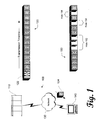
- Fig. 1 illustrates a typical communications network with a host 110 (i.e., a sender herein), a communications network infrastructure 130 (such as the Internet), and a client device 140 (i.e., a receiver herein).
- a host 110 i.e., a sender herein
- a communications network infrastructure 130 such as the Internet
- client device 140 i.e., a receiver herein.
- the exemplary hole-filling retry approach retries based on packets' sequence numbers.
- a sequence number is a number that increments by one for each packet sent. Using these numbers, a receiver may detect one or more missed packets (i.e., holes).
- the exemplary hole-filling retry approach utilizes UDP rather than TCP. It may be either unicast or multicast.
- Group 120 represents an example of group of packets that the sender 110 sends across the network 130. It may have an offset 122 that help identify the particular group. Each packet is individually and sequentially numbered. In this example, they are numbered 1-13.
- the sender 110 sends this window of packets to the receiver 140, one packet at a time.
- Group 150 represents an example of what the receiver 140 may have received at a slice of time during the communications with the sender.
- the receiver 140 As the receiver 140 receives the numbered packets, it buffers them in order of their sequential numbering. They may arrive out-of-order or not all, but as they do arrive the receiver places them in their appropriate place in reception group 150.
- One way to establish the appropriate place is to specify that all packets are a constant size. This is one way that a hole may be detected and its boundaries easily determined. Other approaches may be used to define the boundaries of holes.
- the receiver 140 When the receiver 140 receives a packet that has an out-of-order sequence number, it means that the receiver has missed an intervening numbered packet. These missing packets or groupings of packets are called "holes." The boundaries of a hole are defined by the existence of received packets surrounding the hole.
- the example reception group 150 has three holes. Hole 152 represents missing packets # 5, 6, and 7. Hole 154 represents missing packet #10. Hole 156 represents missing packet # 12.
- the receiver When the receiver detects a new hole, it adds the hole to the table of active holes. Each entry in the table has a defined retry time-which is a configurable parameter.
- the packets may arrive out-of-order.
- the missing packets may be still in-transit to the receiver. That is illustrated by in-transit packet 124-which is missing packet #12.
- a HO period avoids the problem of the receiver requesting a resend for a missing packet when that missing packet is likely on its way to the receiver. Accordingly, the retry time is initially set to a defined "hold-off" period.
- the receiver 140 sends a "hole report" UDP packet to the sender 110 notifying the sender of the one or more holes.
- This report is effectively negative-acknowledgement (NACKs) of the missing packets.
- the retry timer is typically reset to a re-report value (RR), which is a period of time until a re-report is made.
- RR re-report value
- the value of RR may be a customizable parameter, but it is typically a value somewhat greater than the observed round-trip latency of the network.
- the RR period is designed to give time for the sender to receive the report, respond, and for the receiver to receive that response.
- the re-report value is typically greater than the hold-off value, because the re-report value is on the order of the round-trip latency of the network, whereas the hold-off time is typically some fraction of the one-way latency of the network.
- the sender 110 Upon receipt of a hole report, the sender 110 re-sends the UDP packets indicated by the sequence number range contained in the hole report. If the receiver 140 does not receive a response for a while-for example, when the retry request or the response for the retry request is lost-the receiver again sends a retry request for the missing packets when the retry timer expires.
- the retry timer of the remaining portion of the hole (or the resultant two remaining portions of the hole) is set to the hold-off period.
- the receiver 140 When the receiver 140 detects a new hole, it adds the hole to the table of active holes. Each entry in the table has a dynamically calculated retry time (RT). This table is stored in the memory of the receiver.
- RT retry time
- the retry time is initially set to a defined hold-off (HO) period to avoid the problem of the receiver requesting a resend for a missing packet when that missing packet may still be in-transit to the receiver.
- HO hold-off
- the re-report time (RR) and the initial “hold-off” (HO) period are dynamically adjustable based upon many factors, such as observed behavior of the network.
- the hold-off period is typically set to a value that encompasses a large percentage of observed delays between packets when the packets are in the wrong order.
- A,B are packets, in that order, not necessarily adjacent, and they are observed to arrive as B, A (with possibly intervening packets)
- the delay A - B is the value that typically is encompassed by the hold-off period.
- the A - B delay should be observed only when A has not been NACKed, because otherwise the A after B might be a result of a retry.
- the HO period may be set to the maximum one-way latency through the network less the minimum one-way latency through the network with the addition of some small adjustment (e.g., a delta).
- the receiver waits for a short time (e.g., the RR value) for the sender to respond before resending the report.
- a short time e.g., the RR value
- Example Active Hole Table Holes Retry Time Expiration-Time 5-7 +120 +500 10-10 +10 +700 12-12 +10 +730
- a typical hold-off (HO) period may be on the order of 10 ms and a typical re-report (RR) period may be on the order of 100 ms.
- the times listed in this table are relative to the present time and are done so only for illustrative purposes. In reality, an implementation may specify an absolute time value (rather than relative).
- the entries in the table are kept ordered based upon RT. That way the entry to be retried soonest is always first.
- That hole may be split or shortened. For example, if missing packet #5 of reception group 150 of Fig. 1 arrives at the receiver 140, the hole 152 is reduced. The new range for hole 152 is packets 6-7. If, for example, missing packet #6 of reception group 150 arrives, the hole 152 is effectively split into two holes: where packet #5 would be and where packet #7 would be.
- RT retry time
- Every packet has an expiration time-stamp (ETS). Since the data in the packet is time-sensitive, there is a time when its data is irrelevant. That means that there is a time when it no longer matters if the receiver actually receives the packet. That time is its expiration time.
- ETS expiration time-stamp
- the expiration time associated with each entry in the active hole table is the ETS of the packet defining the end boundary of the associated hole.
- ETS for packet #11 of the reception group 150 of Fig. 1 is the value entered into the active hole table for hole 154 (for missing packet #10).
- RT > ETS of an entry in the active hole table If RT > ETS of an entry in the active hole table, then the missing packets are considered irrelevant. As such, the receiver 140 will no longer attempt to obtain those missing packet(s) to fill that hole. That entry is removed from the table and a discontinuity is noted in the stream.
- the receiver Under certain conditions, it is possible for the receiver to fail to recognize a hole that occurs immediately before a momentary pause in transmissions. Since subsequent packets have not yet arrived at the receiver (because they have not yet been sent), the receiver does not recognize the existence of a hole. A packet has failed to arrive, but the receiver does not yet know this. Therefore, the receiver does recognize the existence of the hole until full transmissions resumes.
- a status packet informs the receiver what the immediately previous packet should have been and/or what the next one will be. Assuming that there is a hole, the receiver may now recognize it and act accordingly.
- Fig. 2 shows a methodological implementation of the exemplary hole-filling retry approach. This methodological implementation may be performed in software, hardware, or a combination thereof.
- the receiver 140 of Fig. 1 receives a series of numbered packets of a group of packets.
- a reception buffer receives into a reception buffer a collection of data packets (such group 150 of Fig. 1). It places each numbered packet in order of their numbering. It uses an offset (such as a defined constant packet size) to determine where each packet is placed in the buffer. While doing this, it leave holes for missing numbered packets. For example, hole 152 in Fig. 1 is for missing packets #5, 6, and 7.
- the receiver fills-in a new entry into the active hole table. It enters each new hole as a new entry into the table. For each new entry, it calculates and enters the initial retry time (RT) for the new entries to be now + hold-off (HO) period. For each new entry, the receiver also enters the expiration time-stamp (ETS) for the received packet following and bordering the hole of that entry.
- RT initial retry time
- HO + hold-off
- ETS expiration time-stamp
- the receiver 140 when the current time matches the RT for an entry in the table, the receiver 140 generates and sends a "hole report" packet to the sender 110 notifying the sender of the one or more holes.
- the receiver updates the RT for the entries reported. It resets the RT to now + a re-report (RR) period.
- RT > ETS for a given entry when RT > ETS for a given entry, then it removes that entry from the table and notes a discontinuity in the stream. This means that a hole has expired and its removal from the table means that the receiver will no longer attempt to retrieve it.
- the missing packet when it receives a missing packet, it fills the hole (either partially or wholly). If the missing packet fills the hole completely, then its corresponding entry in the table is removed. If the missing packet only fills it partially, then it readjusts the size of the hole. If the missing packet splits the hole into two holes, then it re-adjusts the size of one hole and generates a new entry for the newly created hole having RT of now + HO for both the smaller original hole and the newly created hole.
- This process continues as packets of reception groups are received.
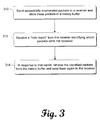
- Fig. 3 shows a methodological implementation of the exemplary hole-filling retry approach. This methodological implementation may be performed in software, hardware, or a combination thereof.
- the sender 110 of Fig. 1 sends sequentially enumerated packets to a receiver 140 and it stores these packets in a history buffer.
- the sender keeps this history buffer so that it can resend packets when requested to do so. Furthermore, the sender assigns an ETS to each packet.
- the sender receives a "hole report" from the receiver identifying which packets were not received.
- the sender retrieves the identified packets from its history buffer and sends them again to the receiver. If the sender gets a request to resend a packet that is no longer in the history buffer, it ignores the request.
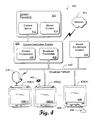
- Fig. 4 illustrates an exemplary environment 400 in which the techniques, systems, and other aspects described herein may be implemented (partially or wholly).
- Exemplary environment 400 is a television entertainment system that facilitates distribution of multi-media.
- a typical digital video broadcast (DVB) network is an example of such an environment.
- DVD digital video broadcast
- the environment 400 includes one or more multimedia content providers 402, a content distribution system 406, and one or more presentation devices 408(1), 408(2), ..., 408(N) coupled to the content distribution system 406 via a broadcast network 410.
- Multimedia content provider 402 includes a content server 412 and stored content 414, such as movies, television programs, commercials, music, and similar audio and/or video content.
- Content server 412 controls distribution of the stored content 414 from content provider 402 to the content distribution system 406. Additionally, content server 402 controls distribution of live content (e.g., content that was not previously stored, such as live feeds) and/or content stored at other locations to the content distribution system 406.
- live content e.g., content that was not previously stored, such as live feeds
- Content distribution system 406 may be coupled to a network 420, such as an intranet or the Internet.
- the content distribution system 406 includes a broadcast transmitter 428, and one or more content processors 430.
- Broadcast transmitter 428 broadcasts signals, such as cable television signals, across broadcast network 410.
- Content distribution system 406 is representative of a headend service that provides multimedia content to multiple subscribers.
- Broadcast network 410 can include a cable television network, RF, microwave, satellite, and/or data network, such as the Internet, and may also include wired or wireless media using any broadcast format or broadcast protocol. Additionally, broadcast network 410 can be any type of network, using any type of network topology and any network communication protocol, and can be represented or otherwise implemented as a combination of two or more networks.
- Content processor 430 processes the content received from content provider 402 prior to transmitting the content across broadcast network 408.
- a particular content processor 430 may encode, or otherwise process, the received content into a format that is understood by the multiple presentation devices 408(1), 408(2), ..., 408(N) coupled to broadcast network 410.
- Presentation devices 408 can be implemented in a number of ways. For example, a presentation device 408(1) receives broadcast content from a satellite-based transmitter via a satellite dish 434. Presentation device 408(1) is also referred to as a set-top box or a satellite receiving device. Presentation device 408(1) is coupled to a television 436(1) for presenting the content received by the presentation device (e.g., audio data and video data), as well as a graphical user interface. A particular presentation device 408 can be coupled to any number of televisions 436 and/or similar devices that can be implemented to display or otherwise render content. Similarly, any number of presentation devices 408 can be coupled to a single television 436.
- a presentation device 408(1) receives broadcast content from a satellite-based transmitter via a satellite dish 434. Presentation device 408(1) is also referred to as a set-top box or a satellite receiving device. Presentation device 408(1) is coupled to a television 436(1) for presenting the content received by the presentation device (e.g., audio data and video data
- Presentation device 408(2) is also coupled to receive broadcast content from broadcast network 410 and provide the received content to associated television 436(2).
- Presentation device 408(N) is an example of a combination television 438 and integrated set-top box 440.
- the set-top box incorporated into the television may receive broadcast signals via a satellite dish (similar to satellite dish 434) and/or via broadcast network 410.
- presentation devices 406 may receive broadcast signals via the Internet or any other broadcast medium.
- the exemplary environment 400 also includes stored on-demand content 442, such as Video On-Demand (VOD) movie content.
- VOD Video On-Demand
- the stored on-demand content can be viewed with a presentation device 408 through an onscreen movie guide, for example, and a viewer can enter instructions to stream a particular movie, or other stored content, down to a corresponding presentation device 408.
- this exemplary environment 400 has been described in terms of a digital video broadcast (DVB) environment. Indeed, that is an exemplary environment.
- DVD digital video broadcast
- the exemplary hole-filling retry approach may be implemented without the whole of the DVB environment itself. Instead, it may be implemented by a standalone presentation device, such as illustrated by devices 408(1), 408(2), ..., 408(N).
- Standalone presentation devices 408(1), 408(2), ..., 408(N) accesses digital video from a storage medium 444, such as a DVD disk. It provides the content from the medium to an associated television 439. Examples of such a standalone presentation device include DVD player, a personal video recorder, etc.
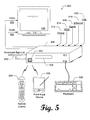
- Fig. 5 illustrates an exemplary implementation 500 of a presentation device 408 shown as a standalone unit that connects to a television 436.
- Presentation device 408 can be implemented in any number of embodiments, including as a set-top box, a satellite receiver, a TV recorder with a hard disk, a game console, an information appliance, a DVD player, personal video recorder, personal computer, media center, and so forth.
- Presentation device 408 includes a wireless receiving port 502, such as an infrared (IR) or Bluetooth wireless port, for receiving wireless communications from a remote control device 504, a handheld input device 506, or any other wireless device, such as a wireless keyboard.
- Handheld input device 506 can be a personal digital assistant (PDA), handheld computer, wireless phone, or the like.
- PDA personal digital assistant
- a wired keyboard 508 is coupled to communicate with the presentation device 408.
- remote control device 504, handheld device 506, and/or keyboard 508 may use an RF communication link or other mode of transmission to communicate with presentation device 408.
- Presentation device 408 may have a storage medium reader 509 for reading content storage media, such as DVD disks.
- a standalone or non-standalone presentation device 408 may include the storage medium reader 509.
- Presentation device 408 may receive one or more broadcast signals 510 from one or more broadcast sources, such as from a satellite or from a broadcast network.
- Presentation device 408 includes hardware and/or software for receiving and decoding broadcast signal 510, such as an NTSC, PAL, SECAM or other TV system video signal.
- Presentation device 408 also includes hardware and/or software for providing the user with a graphical user interface by which the user can, for example, access various network services, configure the presentation device 408, and perform other functions.
- Presentation device 408 may be capable of communicating with other devices via one or more connections including a conventional telephone link 512, an ISDN link 514, a cable link 516, an Ethernet link 518, a DSL link 520, and the like. Presentation device 408 may use any one or more of the various communication links 512-520 at a particular instant to communicate with any number of other devices.
- Presentation device 408 generates video signal(s) 520 and audio signal(s) 522, both of which are communicated to television 436.
- the video signals and audio signals can be communicated from presentation device 408 to television 436 via an RF (radio frequency) link, S-video link, composite video link, component video link, or other communication link.
- RF radio frequency
- the presentation device 408 may include one or more lights or other indicators identifying the current status of the device. Additionally, the presentation device may include one or more control buttons, switches, or other selectable controls for controlling operation of the device.
- Fig. 6 illustrates an example of a suitable computing environment 600 within which an exemplary hole-filling retry approach, as described herein, may be implemented (either fully or partially).
- the computing environment 600 may be utilized in the computer and network architectures described herein.
- the exemplary computing environment 600 is only one example of a computing environment and is not intended to suggest any limitation as to the scope of use or functionality of the computer and network architectures. Neither should the computing environment 600 be interpreted as having any dependency or requirement relating to any one or combination of components illustrated in the exemplary computing environment 600.
- the exemplary hole-filling retry approach may be implemented with numerous other general purpose or special purpose computing system environments or configurations.
- Examples of well known computing systems, environments, and/or configurations that may be suitable for use include, but are not limited to, personal computers, server computers, thin clients, thick clients, hand-held or laptop devices, multiprocessor systems, microprocessor-based systems, set top boxes, programmable consumer electronics, network PCs, minicomputers, mainframe computers, distributed computing environments that include any of the above systems or devices, and the like.
- the exemplary hole-filling retry approach may be described in the general context of computer-executable instructions, such as program modules, being executed by a computer.
- program modules include routines, programs, objects, components, data structures, etc. that perform particular tasks or implement particular abstract data types.
- the exemplary hole-filling retry approach may also be practiced in distributed computing environments where tasks are performed by remote processing devices that are linked through a communications network.
- program modules may be located in both local and remote computer storage media including memory storage devices.
- the computing environment 600 includes a general-purpose computing device in the form of a computer 602.
- the components of computer 602 may include, but are not limited to, one or more processors or processing units 604, a system memory 606, and a system bus 608 that couples various system components, including the processor 604, to the system memory 606.
- a system bus may be implemented as one or more of any of several types of bus structures, including a memory bus or memory controller, a peripheral bus, an accelerated graphics port, or a local bus using any of a variety of bus architectures.
- bus architectures can include a CardBus, Personal Computer Memory Card International Association (PCMCIA), Accelerated Graphics Port (AGP), Small Computer System Interface (SCSI), Universal Serial Bus (USB), IEEE 1394, a Video Electronics Standards Association (VESA) local bus, and a Peripheral Component Interconnects (PCI) bus also known as a Mezzanine bus.
- PCMCIA Personal Computer Memory Card International Association
- AGP Accelerated Graphics Port
- SCSI Small Computer System Interface
- USB Universal Serial Bus
- IEEE 1394 IEEE 1394
- VESA Video Electronics Standards Association
- PCI Peripheral Component Interconnects
- Computer 602 typically includes a variety of computer-readable media. Such media may be any available media that is accessible by computer 602 and includes both volatile and non-volatile media, removable and non-removable media.
- the system memory 606 includes computer-readable media in the form of volatile memory, such as random access memory (RAM) 610, and/or non-volatile memory, such as read only memory (ROM) 612.
- RAM random access memory
- ROM read only memory
- a basic input/output system (BIOS) 614 containing the basic routines that help to transfer information between elements within computer 602, such as during start-up, is stored in ROM 612.
- BIOS basic input/output system
- RAM 610 typically contains data and/or program modules that are immediately accessible to and/or presently operated on by the processing unit 604.
- Computer 602 may also include other removable/non-removable, volatile/non-volatile computer storage media.
- Fig. 6 illustrates a hard disk drive 616 for reading from and writing to a non-removable, non-volatile magnetic media (not shown), a magnetic disk drive 618 for reading from and writing to a removable, non-volatile magnetic disk 620 (e.g., a "floppy disk"), and an optical disk drive 622 for reading from and/or writing to a removable, non-volatile optical disk 624 such as a CD-ROM, DVD-ROM, or other optical media.
- a hard disk drive 616 for reading from and writing to a non-removable, non-volatile magnetic media (not shown)
- a magnetic disk drive 618 for reading from and writing to a removable, non-volatile magnetic disk 620 (e.g., a "floppy disk")
- an optical disk drive 622 for reading from and/or writing to a removable, non-volatile optical
- the hard disk drive 616, magnetic disk drive 618, and optical disk drive 622 are each connected to the system bus 608 by one or more data media interfaces 626.
- the hard disk drive 616, magnetic disk drive 618, and optical disk drive 622 may be connected to the system bus 608 by one or more interfaces (not shown).
- the disk drives and their associated computer-readable media provide non-volatile storage of computer readable instructions, data structures, program modules, and other data for computer 602.
- a hard disk 616 a removable magnetic disk 620, and a removable optical disk 624
- other types of computer-readable media which may store data that is accessible by a computer, such as magnetic cassettes or other magnetic storage devices, flash memory cards, CD-ROM, digital versatile disks (DVD) or other optical storage, random access memories (RAM), read only memories (ROM), electrically erasable programmable read-only memory (EEPROM), and the like, may also be utilized to implement the exemplary computing system and environment.
- Any number of program modules may be stored on the hard disk 616, magnetic disk 620, optical disk 624, ROM 612, and/or RAM 610, including by way of example, an operating system 626, one or more application programs 628, other program modules 630, and program data 632.
- a user may enter commands and information into computer 602 via input devices such as a keyboard 634 and a pointing device 636 (e.g., a "mouse'").
- Other input devices 638 may include a microphone, joystick, game pad, satellite dish, serial port, scanner, and/or the like.
- input/output interfaces 640 that are coupled to the system bus 608, but may be connected by other interface and bus structures, such as a parallel port, game port, or a universal serial bus (USB).
- a monitor 642 or other type of display device may also be connected to the system bus 608 via an interface, such as a video adapter 644.
- other output peripheral devices may include components, such as speakers (not shown) and a printer 646, which may be connected to computer 602 via the input/output interfaces 640.
- Computer 602 may operate in a networked environment using logical connections to one or more remote computers, such as a remote computing device 648.
- the remote computing device 648 may be a personal computer, portable computer, a server, a router, a network computer, a peer device or other common network node, and the like.
- the remote computing device 648 is illustrated as a portable computer that may include many or all of the elements and features described herein, relative to computer 602.
- Logical connections between computer 602 and the remote computer 648 are depicted as a local area network (LAN) 650 and a general wide area network (WAN) 652.
- LAN local area network
- WAN wide area network
- Such networking environments are commonplace in offices, enterprise-wide computer networks, intranets, and the Internet.
- the computer 602 When implemented in a LAN networking environment, the computer 602 is connected to a local network 650 via a network interface or adapter 654. When implemented in a WAN networking environment, the computer 602 typically includes a modem 656 or other means for establishing communications over the wide network 652.
- the modem 656, which may be internal or external to computer 602, may be connected to the system bus 608 via the input/output interfaces 640 or other appropriate mechanisms. It is to be appreciated that the illustrated network connections are exemplary and that other means of establishing communication link(s) between the computers 602 and 648 may be employed.
- remote application programs 658 reside on a memory device of remote computer 648.
- application programs and other executable program components such as the operating system, are illustrated herein as discrete blocks, although it is recognized that such programs and components reside at various times in different storage components of the computing device 602, and are executed by the data processor(s) of the computer.
- An implementation of an exemplary hole-filling retry approach may be described in the general context of computer-executable instructions, such as program modules, executed by one or more computers or other devices.
- program modules include routines, programs, objects, components, data structures, etc. that perform particular tasks or implement particular abstract data types.
- functionality of the program modules may be combined or distributed as desired in various embodiments.
- Fig. 6 illustrates an example of a suitable operating environment 600 in which an exemplary hole-filling retry approach may be implemented.
- the exemplary hole-filling retry approach(s) described herein may be implemented (wholly or in part) by any program modules 628-630 and/or operating system 626 in Fig. 6 or a portion thereof.
- the operating environment is only an example of a suitable operating environment and is not intended to suggest any limitation as to the scope or use of functionality of the exemplary hole-filling retry approach(s) described herein.
- Other well known computing systems, environments, and/or configurations that are suitable for use include, but are not limited to, personal computers (PCs), server computers, hand-held or laptop devices, multiprocessor systems, microprocessor-based systems, programmable consumer electronics, wireless phones and equipments, general- and special-purpose appliances, application-specific integrated circuits (ASICs), network PCs, minicomputers, mainframe computers, distributed computing environments that include any of the above systems or devices, and the like.
- PCs personal computers
- server computers hand-held or laptop devices
- multiprocessor systems microprocessor-based systems
- programmable consumer electronics wireless phones and equipments
- general- and special-purpose appliances application-specific integrated circuits
- ASICs application-specific integrated circuits
- network PCs minicomputers
- mainframe computers distributed computing environments that include any of the above systems or
- Computer-readable media may be any available media that may be accessed by a computer.
- Computer-readable media may comprise, but is not limited to, "computer storage media” and "communications media.”
- Computer storage media include volatile and non-volatile, removable and non-removable media implemented in any method or technology for storage of information such as computer readable instructions, data structures, program modules, or other data.
- Computer storage media includes, but is not limited to, RAM, ROM, EEPROM, flash memory or other memory technology, CD-ROM, digital versatile disks (DVD) or other optical storage, magnetic cassettes, magnetic tape, magnetic disk storage or other magnetic storage devices, or any other medium which may be used to store the desired information and which may be accessed by a computer.
- Communication media typically embodies computer-readable instructions, data structures, program modules, or other data in a modulated data signal, such as carrier wave or other transport mechanism. Communication media also includes any information delivery media.
- modulated data signal means a signal that has one or more of its characteristics set or changed in such a manner as to encode information in the signal.
- communication media may comprise, but is not limited to, wired media such as a wired network or direct-wired connection, and wireless media such as acoustic, RF, infrared, and other wireless media. Combinations of any of the above are also included within the scope of computer-readable media.
Landscapes
- Engineering & Computer Science (AREA)
- Computer Networks & Wireless Communication (AREA)
- Signal Processing (AREA)
- Multimedia (AREA)
- Computer Security & Cryptography (AREA)
- Data Exchanges In Wide-Area Networks (AREA)
- Communication Control (AREA)
- Two-Way Televisions, Distribution Of Moving Picture Or The Like (AREA)
- Detection And Prevention Of Errors In Transmission (AREA)
- Telephonic Communication Services (AREA)
- Medicines Containing Antibodies Or Antigens For Use As Internal Diagnostic Agents (AREA)
- Dental Preparations (AREA)
Applications Claiming Priority (2)
| Application Number | Priority Date | Filing Date | Title |
|---|---|---|---|
| US461797 | 2003-06-13 | ||
| US10/461,797 US7076717B2 (en) | 2003-06-13 | 2003-06-13 | Time-aware best-effort hole-filling retry method and system for network communications |
Publications (2)
| Publication Number | Publication Date |
|---|---|
| EP1487171A1 EP1487171A1 (en) | 2004-12-15 |
| EP1487171B1 true EP1487171B1 (en) | 2007-07-04 |
Family
ID=33299862
Family Applications (1)
| Application Number | Title | Priority Date | Filing Date |
|---|---|---|---|
| EP04102013A Expired - Lifetime EP1487171B1 (en) | 2003-06-13 | 2004-05-10 | Reliable Multimedia streaming using retransmissions. |
Country Status (9)
| Country | Link |
|---|---|
| US (2) | US7076717B2 (enExample) |
| EP (1) | EP1487171B1 (enExample) |
| JP (1) | JP4694152B2 (enExample) |
| KR (1) | KR101066768B1 (enExample) |
| CN (1) | CN100546236C (enExample) |
| AT (1) | ATE366499T1 (enExample) |
| CA (1) | CA2466231C (enExample) |
| DE (1) | DE602004007329T2 (enExample) |
| MX (1) | MXPA04005467A (enExample) |
Cited By (1)
| Publication number | Priority date | Publication date | Assignee | Title |
|---|---|---|---|---|
| US12040068B2 (en) | 2018-07-17 | 2024-07-16 | Icu Medical, Inc. | Reducing file transfer between cloud environment and infusion pumps |
Families Citing this family (58)
| Publication number | Priority date | Publication date | Assignee | Title |
|---|---|---|---|---|
| US7523482B2 (en) * | 2002-08-13 | 2009-04-21 | Microsoft Corporation | Seamless digital channel changing |
| US8397269B2 (en) * | 2002-08-13 | 2013-03-12 | Microsoft Corporation | Fast digital channel changing |
| US7603689B2 (en) | 2003-06-13 | 2009-10-13 | Microsoft Corporation | Fast start-up for digital video streams |
| US7720075B2 (en) * | 2003-06-19 | 2010-05-18 | Intel Corporation | Network idle protocol with reduced channels |
| US7444419B2 (en) * | 2003-10-10 | 2008-10-28 | Microsoft Corporation | Media stream scheduling for hiccup-free fast-channel-change in the presence of network chokepoints |
| US7562375B2 (en) * | 2003-10-10 | 2009-07-14 | Microsoft Corporation | Fast channel change |
| US7430222B2 (en) * | 2004-02-27 | 2008-09-30 | Microsoft Corporation | Media stream splicer |
| US8782654B2 (en) | 2004-03-13 | 2014-07-15 | Adaptive Computing Enterprises, Inc. | Co-allocating a reservation spanning different compute resources types |
| US9176785B2 (en) | 2004-03-13 | 2015-11-03 | Adaptive Computing Enterprises, Inc. | System and method for providing multi-resource management support in a compute environment |
| US20070266388A1 (en) | 2004-06-18 | 2007-11-15 | Cluster Resources, Inc. | System and method for providing advanced reservations in a compute environment |
| US8176490B1 (en) | 2004-08-20 | 2012-05-08 | Adaptive Computing Enterprises, Inc. | System and method of interfacing a workload manager and scheduler with an identity manager |
| US7640352B2 (en) * | 2004-09-24 | 2009-12-29 | Microsoft Corporation | Methods and systems for presentation of media obtained from a media stream |
| JP2006129169A (ja) * | 2004-10-29 | 2006-05-18 | Toshiba Corp | コンテンツ記録媒体補償システム、コンテンツ再生/記録装置及びコンテンツ再生/記録方法 |
| US8271980B2 (en) | 2004-11-08 | 2012-09-18 | Adaptive Computing Enterprises, Inc. | System and method of providing system jobs within a compute environment |
| US7477653B2 (en) * | 2004-12-10 | 2009-01-13 | Microsoft Corporation | Accelerated channel change in rate-limited environments |
| US7370129B2 (en) * | 2004-12-15 | 2008-05-06 | Microsoft Corporation | Retry strategies for use in a streaming environment |
| US20060179392A1 (en) * | 2005-02-08 | 2006-08-10 | Takaaki Ota | Handshakeless retransmission protocol |
| US8930536B2 (en) | 2005-03-16 | 2015-01-06 | Adaptive Computing Enterprises, Inc. | Virtual private cluster |
| US8863143B2 (en) | 2006-03-16 | 2014-10-14 | Adaptive Computing Enterprises, Inc. | System and method for managing a hybrid compute environment |
| US9231886B2 (en) | 2005-03-16 | 2016-01-05 | Adaptive Computing Enterprises, Inc. | Simple integration of an on-demand compute environment |
| US9225663B2 (en) | 2005-03-16 | 2015-12-29 | Adaptive Computing Enterprises, Inc. | System and method providing a virtual private cluster |
| CA2603577A1 (en) | 2005-04-07 | 2006-10-12 | Cluster Resources, Inc. | On-demand access to compute resources |
| EP1994668A2 (en) * | 2005-11-23 | 2008-11-26 | Nxp B.V. | A data processor system and a method for communicating data |
| US8135040B2 (en) * | 2005-11-30 | 2012-03-13 | Microsoft Corporation | Accelerated channel change |
| JP2008048182A (ja) * | 2006-08-17 | 2008-02-28 | Sony Corp | 通信処理装置、および通信制御方法、並びにコンピュータ・プログラム |
| US9686045B2 (en) * | 2007-04-04 | 2017-06-20 | Lantiq Beteiligungs-GmbH & Co. KG | Data transmission and retransmission |
| US8041773B2 (en) | 2007-09-24 | 2011-10-18 | The Research Foundation Of State University Of New York | Automatic clustering for self-organizing grids |
| US8090867B2 (en) * | 2007-10-19 | 2012-01-03 | Voxer Ip Llc | Telecommunication and multimedia management method and apparatus |
| CN101828375B (zh) * | 2007-10-19 | 2014-10-22 | 沃克瑟知识产权有限责任公司 | 通过网络的实时媒体同步的方法和系统 |
| JP4940117B2 (ja) | 2007-12-06 | 2012-05-30 | 株式会社東芝 | 移動通信システムとそのゲートウェイ装置、集線装置およびハンドオーバ制御方法 |
| KR100989716B1 (ko) | 2008-01-21 | 2010-10-26 | 엘지전자 주식회사 | 컨텐츠 송수신 중지 및 재개 방법 |
| JP2009246855A (ja) * | 2008-03-31 | 2009-10-22 | Yamatake Corp | 通信システム |
| US8271106B2 (en) | 2009-04-17 | 2012-09-18 | Hospira, Inc. | System and method for configuring a rule set for medical event management and responses |
| US10877695B2 (en) | 2009-10-30 | 2020-12-29 | Iii Holdings 2, Llc | Memcached server functionality in a cluster of data processing nodes |
| US11720290B2 (en) | 2009-10-30 | 2023-08-08 | Iii Holdings 2, Llc | Memcached server functionality in a cluster of data processing nodes |
| WO2013059615A1 (en) | 2011-10-21 | 2013-04-25 | Hospira, Inc. | Medical device update system |
| US9100460B2 (en) * | 2012-06-28 | 2015-08-04 | Adobe Systems Incorporated | Media stream fragment request |
| JP6139872B2 (ja) * | 2012-12-10 | 2017-05-31 | キヤノン株式会社 | 情報処理装置及びその制御方法、プログラム、記憶媒体、並びに、映像処理システム |
| JP5636574B2 (ja) * | 2013-01-30 | 2014-12-10 | 株式会社日立製作所 | 通信装置、パケット転送方法及びそのプログラム |
| EP2964079B1 (en) | 2013-03-06 | 2022-02-16 | ICU Medical, Inc. | Medical device communication method |
| US20150066531A1 (en) | 2013-08-30 | 2015-03-05 | James D. Jacobson | System and method of monitoring and managing a remote infusion regimen |
| US9662436B2 (en) | 2013-09-20 | 2017-05-30 | Icu Medical, Inc. | Fail-safe drug infusion therapy system |
| JP6853669B2 (ja) | 2014-04-30 | 2021-03-31 | アイシーユー・メディカル・インコーポレーテッド | 条件付きの警報転送を用いた患者治療システム |
| US9724470B2 (en) | 2014-06-16 | 2017-08-08 | Icu Medical, Inc. | System for monitoring and delivering medication to a patient and method of using the same to minimize the risks associated with automated therapy |
| US9539383B2 (en) | 2014-09-15 | 2017-01-10 | Hospira, Inc. | System and method that matches delayed infusion auto-programs with manually entered infusion programs and analyzes differences therein |
| ES2845725T3 (es) | 2015-05-26 | 2021-07-27 | Icu Medical Inc | Sistema y método de bomba de infusión con capacidad de fuente de editor de múltiples bibliotecas de fármacos |
| US10873593B2 (en) * | 2018-01-25 | 2020-12-22 | Cisco Technology, Inc. | Mechanism for identifying differences between network snapshots |
| US11233716B2 (en) | 2018-03-28 | 2022-01-25 | Arlo Technologies, Inc. | System for real-time monitoring with backward error correction |
| EP4297379B1 (en) * | 2018-07-17 | 2026-04-01 | ICU Medical, Inc. | Systems and methods for facilitating clinical messaging in a network environment |
| AU2019309766B2 (en) | 2018-07-26 | 2024-06-13 | Icu Medical, Inc. | Drug library management system |
| EP3966992A4 (en) | 2019-05-08 | 2023-06-21 | ICU Medical, Inc. | THRESHOLD SIGNATURE BASED MEDICAL DEVICE MANAGEMENT |
| CA3187817A1 (en) | 2020-07-02 | 2022-01-06 | Icu Medical, Inc. | Location-based reconfiguration of infusion pump settings |
| EP4208798A4 (en) | 2020-09-05 | 2024-10-09 | ICU Medical, Inc. | IDENTITY-BASED SECURE COMMUNICATION OF MEDICAL DEVICES |
| US11714539B1 (en) | 2022-10-28 | 2023-08-01 | Honeywell International Inc. | Cursor management methods and systems |
| US11960668B1 (en) * | 2022-11-10 | 2024-04-16 | Honeywell International Inc. | Cursor management methods and systems for recovery from incomplete interactions |
| US12451137B2 (en) | 2023-01-19 | 2025-10-21 | Honeywell International Inc. | Speech recognition systems and methods for concurrent voice commands |
| US12236165B2 (en) | 2023-04-05 | 2025-02-25 | Honeywell International Inc. | Methods and systems for decoupling user input using context |
| US11954325B1 (en) | 2023-04-05 | 2024-04-09 | Honeywell International Inc. | Methods and systems for assigning text entry components to cursors |
Family Cites Families (17)
| Publication number | Priority date | Publication date | Assignee | Title |
|---|---|---|---|---|
| JPH06252978A (ja) * | 1993-02-22 | 1994-09-09 | Toshiba Corp | ネットワークパラメタ自動調整装置 |
| JPH0946375A (ja) * | 1995-07-26 | 1997-02-14 | Hitachi Ltd | パケット交換網のパケット再送方法 |
| JPH09191314A (ja) * | 1996-01-10 | 1997-07-22 | Mitsubishi Electric Corp | 連続データ伝送方法および連続データ伝送装置 |
| JPH10257096A (ja) * | 1997-03-10 | 1998-09-25 | Pioneer Electron Corp | データ転送方法及び装置 |
| US5918002A (en) | 1997-03-14 | 1999-06-29 | Microsoft Corporation | Selective retransmission for efficient and reliable streaming of multimedia packets in a computer network |
| JPH1117737A (ja) * | 1997-04-30 | 1999-01-22 | Sony Corp | 送信装置および送信方法、受信装置および受信方法、並びに送受信装置および送受信方法 |
| US6392993B1 (en) * | 1998-06-29 | 2002-05-21 | Microsoft Corporation | Method and computer program product for efficiently and reliably sending small data messages from a sending system to a large number of receiving systems |
| US6286111B1 (en) | 1998-09-01 | 2001-09-04 | International Business Machines Corporation | Retry mechanism for remote operation failure in distributed computing environment |
| DE69938094T2 (de) | 1998-11-30 | 2009-02-05 | Matsushita Electric Industries Co. Ltd., Kadoma | Paketwiederübertragungskontrolle mit Prioritätsinformationen |
| US6335933B1 (en) * | 1999-05-21 | 2002-01-01 | Broadcom Homenetworking, Inc. | Limited automatic repeat request protocol for frame-based communication channels |
| US6907005B1 (en) * | 2000-07-24 | 2005-06-14 | Telefonaktiebolaget L M Ericsson (Publ) | Flexible ARQ for packet data transmission |
| JP2002232478A (ja) * | 2000-11-06 | 2002-08-16 | Matsushita Electric Ind Co Ltd | 送信装置、受信装置及び放送データ配信方法 |
| JP3931595B2 (ja) * | 2001-07-10 | 2007-06-20 | 株式会社日立製作所 | データ修正装置及びデータ修正方法 |
| JP3912091B2 (ja) * | 2001-12-04 | 2007-05-09 | ソニー株式会社 | データ通信システム、データ送信装置、データ受信装置、および方法、並びにコンピュータ・プログラム |
| US6850769B2 (en) * | 2002-02-14 | 2005-02-01 | Qualcomm Incorporated | Method and apparatus for adaptive measurement of round-trip time in ARQ protocols and using the same for controlling flow of data in a communication system |
| US6920504B2 (en) * | 2002-05-13 | 2005-07-19 | Qualcomm, Incorporated | Method and apparatus for controlling flow of data in a communication system |
| US6987780B2 (en) * | 2002-06-10 | 2006-01-17 | Qualcomm, Incorporated | RLP retransmission for CDMA communication systems |
-
2003
- 2003-06-13 US US10/461,797 patent/US7076717B2/en not_active Expired - Fee Related
-
2004
- 2004-05-04 CA CA2466231A patent/CA2466231C/en not_active Expired - Fee Related
- 2004-05-10 AT AT04102013T patent/ATE366499T1/de not_active IP Right Cessation
- 2004-05-10 EP EP04102013A patent/EP1487171B1/en not_active Expired - Lifetime
- 2004-05-10 DE DE602004007329T patent/DE602004007329T2/de not_active Expired - Lifetime
- 2004-06-04 MX MXPA04005467A patent/MXPA04005467A/es active IP Right Grant
- 2004-06-11 KR KR1020040042874A patent/KR101066768B1/ko not_active Expired - Fee Related
- 2004-06-11 CN CNB2004100489461A patent/CN100546236C/zh not_active Expired - Fee Related
- 2004-06-14 JP JP2004176214A patent/JP4694152B2/ja not_active Expired - Fee Related
-
2006
- 2006-07-10 US US11/456,524 patent/US20060251082A1/en not_active Abandoned
Non-Patent Citations (1)
| Title |
|---|
| None * |
Cited By (1)
| Publication number | Priority date | Publication date | Assignee | Title |
|---|---|---|---|---|
| US12040068B2 (en) | 2018-07-17 | 2024-07-16 | Icu Medical, Inc. | Reducing file transfer between cloud environment and infusion pumps |
Also Published As
| Publication number | Publication date |
|---|---|
| CN100546236C (zh) | 2009-09-30 |
| MXPA04005467A (es) | 2005-03-23 |
| US7076717B2 (en) | 2006-07-11 |
| JP4694152B2 (ja) | 2011-06-08 |
| KR20040107400A (ko) | 2004-12-20 |
| EP1487171A1 (en) | 2004-12-15 |
| DE602004007329D1 (de) | 2007-08-16 |
| DE602004007329T2 (de) | 2008-03-06 |
| US20060251082A1 (en) | 2006-11-09 |
| KR101066768B1 (ko) | 2011-09-21 |
| CA2466231A1 (en) | 2004-12-13 |
| JP2005006340A (ja) | 2005-01-06 |
| ATE366499T1 (de) | 2007-07-15 |
| CN1574719A (zh) | 2005-02-02 |
| CA2466231C (en) | 2011-08-16 |
| US20040255219A1 (en) | 2004-12-16 |
Similar Documents
| Publication | Publication Date | Title |
|---|---|---|
| US7076717B2 (en) | Time-aware best-effort hole-filling retry method and system for network communications | |
| CN102687448B (zh) | 网络中可靠实时数据流传输的高效应用层自动重复请求重发的方法 | |
| US8499212B2 (en) | Method and apparatus for adaptive forward error correction with merged automatic repeat request for reliable multicast in wireless local area networks | |
| US7315898B2 (en) | Data communication system, data transmission apparatus, data reception apparatus, data communication method, and computer program | |
| EP1671424B1 (en) | Fec-based reliability control protocols | |
| US20050216472A1 (en) | Efficient multicast/broadcast distribution of formatted data | |
| US20030206549A1 (en) | Method and apparatus for multicast delivery of information | |
| EP1447988A1 (en) | Data transmission in non-reliable networks | |
| US8423855B2 (en) | Adaptive and scalable packer error correction apparatus and method | |
| KR20040035759A (ko) | 베스트-에포트 데이터의 스케줄링된 스트림밍을 위한 방법및 장치 | |
| EP1258104A1 (en) | Wireless network system and method | |
| CN101232443A (zh) | 传输设备、接收设备、分组传输和分组接收方法及其程序 | |
| EP1931082A1 (en) | Method and apparatus for multicasting data | |
| KR101177454B1 (ko) | 영상 데이터의 전송에 따른 에러 복원 결정을 위한 서버 및클라이언트와, 영상 데이터의 전송에 따른 에러 복원결정방법 | |
| US7561523B1 (en) | Method and apparatus for flow control in a reliable multicast communication system | |
| KR100298372B1 (ko) | 영상 데이터 재전송 방법 | |
| US9680610B2 (en) | Method and apparatus for error control in 3D video transmissoin | |
| AU2001232925A1 (en) | Wireless network system and method |
Legal Events
| Date | Code | Title | Description |
|---|---|---|---|
| PUAI | Public reference made under article 153(3) epc to a published international application that has entered the european phase |
Free format text: ORIGINAL CODE: 0009012 |
|
| AK | Designated contracting states |
Kind code of ref document: A1 Designated state(s): AT BE BG CH CY CZ DE DK EE ES FI FR GB GR HU IE IT LI LU MC NL PL PT RO SE SI SK TR |
|
| AX | Request for extension of the european patent |
Extension state: AL HR LT LV MK |
|
| 17P | Request for examination filed |
Effective date: 20050223 |
|
| AKX | Designation fees paid |
Designated state(s): AT BE BG CH CY CZ DE DK EE ES FI FR GB GR HU IE IT LI LU MC NL PL PT RO SE SI SK TR |
|
| 17Q | First examination report despatched |
Effective date: 20060327 |
|
| GRAP | Despatch of communication of intention to grant a patent |
Free format text: ORIGINAL CODE: EPIDOSNIGR1 |
|
| GRAS | Grant fee paid |
Free format text: ORIGINAL CODE: EPIDOSNIGR3 |
|
| GRAA | (expected) grant |
Free format text: ORIGINAL CODE: 0009210 |
|
| AK | Designated contracting states |
Kind code of ref document: B1 Designated state(s): AT BE BG CH CY CZ DE DK EE ES FI FR GB GR HU IE IT LI LU MC NL PL PT RO SE SI SK TR |
|
| REG | Reference to a national code |
Ref country code: GB Ref legal event code: FG4D |
|
| REG | Reference to a national code |
Ref country code: CH Ref legal event code: EP |
|
| REG | Reference to a national code |
Ref country code: IE Ref legal event code: FG4D |
|
| REF | Corresponds to: |
Ref document number: 602004007329 Country of ref document: DE Date of ref document: 20070816 Kind code of ref document: P |
|
| ET | Fr: translation filed | ||
| NLV1 | Nl: lapsed or annulled due to failure to fulfill the requirements of art. 29p and 29m of the patents act | ||
| REG | Reference to a national code |
Ref country code: CH Ref legal event code: PL |
|
| PG25 | Lapsed in a contracting state [announced via postgrant information from national office to epo] |
Ref country code: NL Free format text: LAPSE BECAUSE OF FAILURE TO SUBMIT A TRANSLATION OF THE DESCRIPTION OR TO PAY THE FEE WITHIN THE PRESCRIBED TIME-LIMIT Effective date: 20070704 Ref country code: PT Free format text: LAPSE BECAUSE OF FAILURE TO SUBMIT A TRANSLATION OF THE DESCRIPTION OR TO PAY THE FEE WITHIN THE PRESCRIBED TIME-LIMIT Effective date: 20071204 Ref country code: SI Free format text: LAPSE BECAUSE OF FAILURE TO SUBMIT A TRANSLATION OF THE DESCRIPTION OR TO PAY THE FEE WITHIN THE PRESCRIBED TIME-LIMIT Effective date: 20070704 Ref country code: BG Free format text: LAPSE BECAUSE OF FAILURE TO SUBMIT A TRANSLATION OF THE DESCRIPTION OR TO PAY THE FEE WITHIN THE PRESCRIBED TIME-LIMIT Effective date: 20071004 Ref country code: FI Free format text: LAPSE BECAUSE OF FAILURE TO SUBMIT A TRANSLATION OF THE DESCRIPTION OR TO PAY THE FEE WITHIN THE PRESCRIBED TIME-LIMIT Effective date: 20070704 Ref country code: ES Free format text: LAPSE BECAUSE OF FAILURE TO SUBMIT A TRANSLATION OF THE DESCRIPTION OR TO PAY THE FEE WITHIN THE PRESCRIBED TIME-LIMIT Effective date: 20071015 |
|
| PG25 | Lapsed in a contracting state [announced via postgrant information from national office to epo] |
Ref country code: AT Free format text: LAPSE BECAUSE OF FAILURE TO SUBMIT A TRANSLATION OF THE DESCRIPTION OR TO PAY THE FEE WITHIN THE PRESCRIBED TIME-LIMIT Effective date: 20070704 Ref country code: LI Free format text: LAPSE BECAUSE OF FAILURE TO SUBMIT A TRANSLATION OF THE DESCRIPTION OR TO PAY THE FEE WITHIN THE PRESCRIBED TIME-LIMIT Effective date: 20070704 Ref country code: PL Free format text: LAPSE BECAUSE OF FAILURE TO SUBMIT A TRANSLATION OF THE DESCRIPTION OR TO PAY THE FEE WITHIN THE PRESCRIBED TIME-LIMIT Effective date: 20070704 Ref country code: CH Free format text: LAPSE BECAUSE OF FAILURE TO SUBMIT A TRANSLATION OF THE DESCRIPTION OR TO PAY THE FEE WITHIN THE PRESCRIBED TIME-LIMIT Effective date: 20070704 |
|
| PG25 | Lapsed in a contracting state [announced via postgrant information from national office to epo] |
Ref country code: BE Free format text: LAPSE BECAUSE OF FAILURE TO SUBMIT A TRANSLATION OF THE DESCRIPTION OR TO PAY THE FEE WITHIN THE PRESCRIBED TIME-LIMIT Effective date: 20070704 |
|
| PG25 | Lapsed in a contracting state [announced via postgrant information from national office to epo] |
Ref country code: DK Free format text: LAPSE BECAUSE OF FAILURE TO SUBMIT A TRANSLATION OF THE DESCRIPTION OR TO PAY THE FEE WITHIN THE PRESCRIBED TIME-LIMIT Effective date: 20070704 Ref country code: GR Free format text: LAPSE BECAUSE OF FAILURE TO SUBMIT A TRANSLATION OF THE DESCRIPTION OR TO PAY THE FEE WITHIN THE PRESCRIBED TIME-LIMIT Effective date: 20071005 |
|
| PLBE | No opposition filed within time limit |
Free format text: ORIGINAL CODE: 0009261 |
|
| STAA | Information on the status of an ep patent application or granted ep patent |
Free format text: STATUS: NO OPPOSITION FILED WITHIN TIME LIMIT |
|
| PG25 | Lapsed in a contracting state [announced via postgrant information from national office to epo] |
Ref country code: SK Free format text: LAPSE BECAUSE OF FAILURE TO SUBMIT A TRANSLATION OF THE DESCRIPTION OR TO PAY THE FEE WITHIN THE PRESCRIBED TIME-LIMIT Effective date: 20070704 Ref country code: CZ Free format text: LAPSE BECAUSE OF FAILURE TO SUBMIT A TRANSLATION OF THE DESCRIPTION OR TO PAY THE FEE WITHIN THE PRESCRIBED TIME-LIMIT Effective date: 20070704 |
|
| 26N | No opposition filed |
Effective date: 20080407 |
|
| PG25 | Lapsed in a contracting state [announced via postgrant information from national office to epo] |
Ref country code: SE Free format text: LAPSE BECAUSE OF FAILURE TO SUBMIT A TRANSLATION OF THE DESCRIPTION OR TO PAY THE FEE WITHIN THE PRESCRIBED TIME-LIMIT Effective date: 20071004 Ref country code: RO Free format text: LAPSE BECAUSE OF FAILURE TO SUBMIT A TRANSLATION OF THE DESCRIPTION OR TO PAY THE FEE WITHIN THE PRESCRIBED TIME-LIMIT Effective date: 20070704 |
|
| PG25 | Lapsed in a contracting state [announced via postgrant information from national office to epo] |
Ref country code: MC Free format text: LAPSE BECAUSE OF NON-PAYMENT OF DUE FEES Effective date: 20080531 |
|
| PG25 | Lapsed in a contracting state [announced via postgrant information from national office to epo] |
Ref country code: EE Free format text: LAPSE BECAUSE OF FAILURE TO SUBMIT A TRANSLATION OF THE DESCRIPTION OR TO PAY THE FEE WITHIN THE PRESCRIBED TIME-LIMIT Effective date: 20070704 |
|
| PG25 | Lapsed in a contracting state [announced via postgrant information from national office to epo] |
Ref country code: IE Free format text: LAPSE BECAUSE OF NON-PAYMENT OF DUE FEES Effective date: 20080512 |
|
| PG25 | Lapsed in a contracting state [announced via postgrant information from national office to epo] |
Ref country code: CY Free format text: LAPSE BECAUSE OF FAILURE TO SUBMIT A TRANSLATION OF THE DESCRIPTION OR TO PAY THE FEE WITHIN THE PRESCRIBED TIME-LIMIT Effective date: 20070704 |
|
| PG25 | Lapsed in a contracting state [announced via postgrant information from national office to epo] |
Ref country code: LU Free format text: LAPSE BECAUSE OF NON-PAYMENT OF DUE FEES Effective date: 20080510 Ref country code: HU Free format text: LAPSE BECAUSE OF FAILURE TO SUBMIT A TRANSLATION OF THE DESCRIPTION OR TO PAY THE FEE WITHIN THE PRESCRIBED TIME-LIMIT Effective date: 20080105 |
|
| PG25 | Lapsed in a contracting state [announced via postgrant information from national office to epo] |
Ref country code: TR Free format text: LAPSE BECAUSE OF FAILURE TO SUBMIT A TRANSLATION OF THE DESCRIPTION OR TO PAY THE FEE WITHIN THE PRESCRIBED TIME-LIMIT Effective date: 20070704 |
|
| REG | Reference to a national code |
Ref country code: DE Ref legal event code: R082 Ref document number: 602004007329 Country of ref document: DE Representative=s name: GRUENECKER, KINKELDEY, STOCKMAIR & SCHWANHAEUS, DE |
|
| REG | Reference to a national code |
Ref country code: GB Ref legal event code: 732E Free format text: REGISTERED BETWEEN 20150115 AND 20150121 |
|
| REG | Reference to a national code |
Ref country code: DE Ref legal event code: R082 Ref document number: 602004007329 Country of ref document: DE Representative=s name: GRUENECKER PATENT- UND RECHTSANWAELTE PARTG MB, DE Effective date: 20150126 Ref country code: DE Ref legal event code: R081 Ref document number: 602004007329 Country of ref document: DE Owner name: MICROSOFT TECHNOLOGY LICENSING, LLC, REDMOND, US Free format text: FORMER OWNER: MICROSOFT CORP., REDMOND, WASH., US Effective date: 20150126 |
|
| REG | Reference to a national code |
Ref country code: FR Ref legal event code: TP Owner name: MICROSOFT TECHNOLOGY LICENSING, LLC, US Effective date: 20150724 |
|
| REG | Reference to a national code |
Ref country code: FR Ref legal event code: PLFP Year of fee payment: 13 |
|
| REG | Reference to a national code |
Ref country code: FR Ref legal event code: PLFP Year of fee payment: 14 |
|
| PGFP | Annual fee paid to national office [announced via postgrant information from national office to epo] |
Ref country code: GB Payment date: 20170510 Year of fee payment: 14 Ref country code: DE Payment date: 20170502 Year of fee payment: 14 Ref country code: FR Payment date: 20170413 Year of fee payment: 14 |
|
| PGFP | Annual fee paid to national office [announced via postgrant information from national office to epo] |
Ref country code: IT Payment date: 20170522 Year of fee payment: 14 |
|
| REG | Reference to a national code |
Ref country code: DE Ref legal event code: R119 Ref document number: 602004007329 Country of ref document: DE |
|
| GBPC | Gb: european patent ceased through non-payment of renewal fee |
Effective date: 20180510 |
|
| PG25 | Lapsed in a contracting state [announced via postgrant information from national office to epo] |
Ref country code: GB Free format text: LAPSE BECAUSE OF NON-PAYMENT OF DUE FEES Effective date: 20180510 Ref country code: FR Free format text: LAPSE BECAUSE OF NON-PAYMENT OF DUE FEES Effective date: 20180531 Ref country code: DE Free format text: LAPSE BECAUSE OF NON-PAYMENT OF DUE FEES Effective date: 20181201 Ref country code: IT Free format text: LAPSE BECAUSE OF NON-PAYMENT OF DUE FEES Effective date: 20180510 |